Amp
Desktop app for Mac, Windows and Linux. Agents run on your computer, on your own server or in the vendor's cloud.
Product websiteampcode.com Compare with others Missing or wrong data?
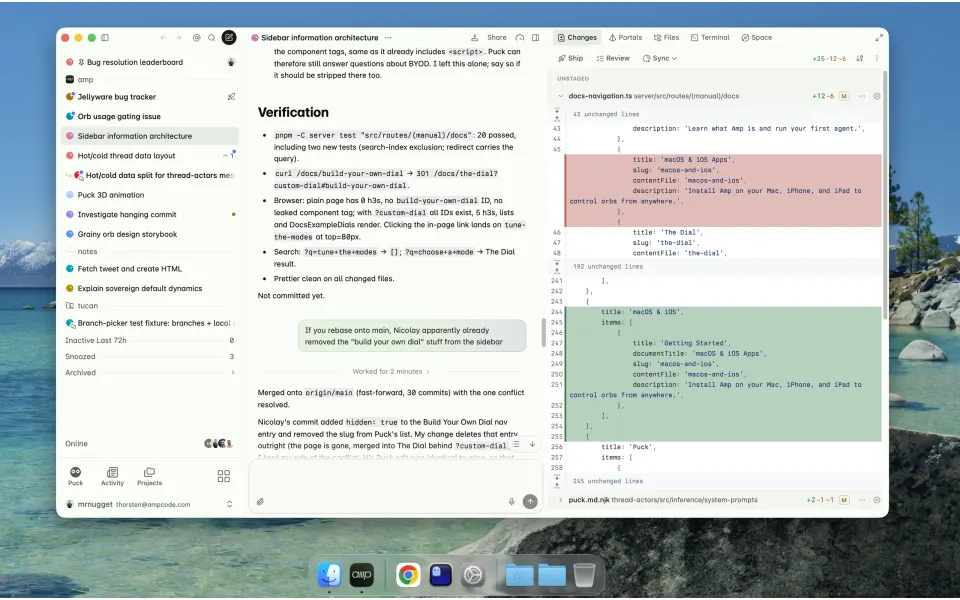
- Desktop app
- Mac, Windows and Linux
- Browser
- Yes
- Phone
- IPhone and Android
- Command line
- Yes
- Agents
- No
- Your subscription
- Works with your own plan
- Agents run
- On your computer, on your own server and in the vendor's cloud
- Laptop closed
- Keeps going
- Isolation
- Worktree and Container
- Parallel agents
- Yes
- Scheduled runs
- Yes
- Coordinator agent
- Yes
- Built-in issues
- Not listed
- Pull requests
- Yes
- Review screen
- Yes
- Team
- Shared sessions, roles and SSO
- Self-hosting
- No
- Licence
- Custom terms
- Price from
- Free
- How it charges
- Free plan, subscription, usage-based, per machine or compute and bring your own key
- Paid plans from
- $11–20/month
Receipts
- Checked
- Findings
- 39 published · 35 cross-checked by a second agent · read them all
- Sources
- 23 public pages on 1 site: ampcode.com
- Screenshot
- ampcode.app, retrieved · first party docs · shows appearance, not capability
- Data
- /products/amp.json · .md
- Method
- Same rules for all 103 researched ADEs. How we check · Report wrong data
What it does
Where you use it
Amp offers Mac, experimental Windows and native Linux desktop apps, native phone apps, the web app and CLI. Linux includes a local systemd runner; individual client limitations remain scoped per question.
Source and scope for Where you use itAgents it runs
Amp supplies its own coding-agent harness across clients and builds prompts/tools around the selected model. Custom agent modes and subagents remain Amp agents; provider subscriptions or models are not third-party coding CLI integrations.
Source and scope for Agents it runsAccounts and subscriptions
The pricing guide supports linking ChatGPT and Claude subscriptions. BYOK is a separate inference route. Further scoped facts are recorded in the atomic answers.
Source and scope for Accounts and subscriptionsWhere agents run
The CLI can run Amp on the user's own machine. Users can supply their own Orb compute through amp orb provider and a dispatch program. Orb execution can be hosted on user infrastructure; this is not self-hosting the Amp control plane. Orbs are per-thread machines that continue working when the laptop closes. The size table lists per-Orb CPU, memory and 60 GB disk; default-size rules vary by project and plan.
Source and scope for Where agents runHow work is kept apart
Runner worktree creation also creates a named branch. A runner creates a Git worktree and branch for a new thread; worktrees separate files without asserting a security sandbox. A documented Docker provider example runs each Orb as a container; this is a self-hosted execution option. Each Orb thread has a fresh isolated working environment; the shared terminal uses the same filesystem as that thread's agent. Docker-backed Orbs do not preserve memory across pause; terminals and desktop processes are lost on wake. Each runner worktree has its own working files and branch.
Source and scope for How work is kept apartParallel work
The Orb guide describes several independent tasks running at once, each with its own environment.
Source and scope for Parallel workScheduled runs
Amp saves one schedule per thread; it can run once or repeat, with pause, resume and delete controls. GitHub events can wake existing threads or start new Orbs. Further scoped facts are recorded in the atomic answers.
Source and scope for Scheduled runsGit and pull requests
Push to Branch ships to a feature branch instead of the base branch. Default Ship commits uncommitted files before rebasing and pushing. Orbs can push branches and open PRs using a connected GitHub identity. Default Ship rebases on the latest base branch and repeats after a concurrent push. The agent resolves conflicts and asks the user before proceeding on substantive conflicts. A PR linked by thread URL or ID appears in the thread title bar with open, draft, queued, merged or closed status.
Source and scope for Git and pull requestsLicence and source
Amp access is covered by the limited, revocable service license in its custom terms. The hosted service is governed by Amp License Terms; an open-source server license was not established.
Source and scope for Licence and sourcePrice
Public tiers are Hobby free, Megawatt $20/month, Gigawatt $200/month, Teams at no additional workspace charge and custom Enterprise. Team members retain individual tiers; model/tool and Orb usage are separately metered.
Source and scope for PriceTyped filters
Every value links to its receipt below. Read plan and surface restrictions before using a filter to decide.
| Filter | Value |
|---|---|
| Desktop OS: macOS | Yes |
| Desktop OS: Windows | Yes |
| Desktop OS: Linux | Yes |
| Web client | Yes |
| Phone access: Native iOS | Yes |
| Phone access: Native Android | Yes |
| Phone access: Phone browser | Unknown |
| CLI | Yes |
| Coding agents: Claude Code | No |
| Coding agents: Codex | No |
| Coding agents: Cursor Agent | No |
| Coding agents: Gemini CLI | No |
| Coding agents: OpenCode | No |
| Coding agents: Pi | No |
| Coding agents: Grok | No |
| Coding agents: Aider | No |
| Coding agents: Antigravity | No |
| Use my subscription | Yes cross-checked |
| Where agents run: On your computer | Yes cross-checked |
| Where agents run: On your own server | Yes cross-checked |
| Where agents run: In the vendor's cloud | Yes cross-checked |
| Workspace isolation: Git worktree | Yes cross-checked |
| Workspace isolation: Container | Yes cross-checked |
| Workspace isolation: VM or microVM | Unknown |
| Parallel runs | Yes cross-checked |
| Coordinator | Yes cross-checked |
| Native issue tracking | Unknown |
| Unattended triggers | Yes cross-checked |
| Shared prompting | Yes cross-checked |
| Team roles | Yes cross-checked |
| SSO | Yes cross-checked |
| Pull request workflow | Yes cross-checked |
| Review interface | Yes cross-checked |
| Product license: Apache-2.0 | No. Custom terms cross-checked |
| Product license: MIT | No. Custom terms cross-checked |
| Product license: GPL-3.0 | No. Custom terms cross-checked |
| Product license: GPL-3.0-or-later | No. Custom terms cross-checked |
| Product license: AGPL-3.0 | No. Custom terms cross-checked |
| Product license: AGPL-3.0-or-later | No. Custom terms cross-checked |
| Product license: Elastic License 2.0 | No. Custom terms cross-checked |
| Product license: Custom terms | Yes. Custom terms cross-checked |
| Product license: Proprietary | No. Custom terms cross-checked |
| Self-hosting | No cross-checked |
| Telemetry opt-out | Unknown |
| Free access | Yes cross-checked |
| Starting price: Free | Yes. Free |
| Starting price: Up to $20/month | No. Free |
| Starting price: $21–40/month | No. Free |
| Starting price: $41–100/month | No. Free |
| Starting price: Over $100/month | No. Free |
| Starting price: Contact for pricing | No. Free |
| Pricing model: Free, no paid plan | No |
| Pricing model: Free plan | Yes |
| Pricing model: Subscription | Yes |
| Pricing model: Per seat | No |
| Pricing model: Usage-based | Yes |
| Pricing model: Per machine or compute | Yes |
| Pricing model: Bring your own key | Yes |
| Pricing model: One-time purchase | No |
| Paid plans from: No paid plan | No. $11–20/month |
| Paid plans from: $10 or less/month | No. $11–20/month |
| Paid plans from: $11–20/month | Yes. $11–20/month |
| Paid plans from: $21–40/month | No. $11–20/month |
| Paid plans from: $41–100/month | No. $11–20/month |
| Paid plans from: Over $100/month | No. $11–20/month |
| Paid plans from: Contact sales | No. $11–20/month |
| Lifecycle status: Active | Unknown |
| Lifecycle status: Sunsetting | Unknown |
| Keeps going with laptop closed | Yes cross-checked |
| Open-source license | No. Custom terms cross-checked |
| Any desktop app | Yes |
| Paid plan up to $20/month | Yes. $11–20/month |
| Paid plan up to $40/month | Yes. $11–20/month |
| Any phone client | Yes |
Filter receipts
Desktop OS: macOS: Yes
Desktop OS: macOS
Typed value: Yes.
Amp offers Mac, experimental Windows and native Linux desktop apps, native phone apps, the web app and CLI. Linux includes a local systemd runner; individual client limitations remain scoped per question.
- Mobile apps: The introduction lists iPhone, iPad and Android apps; release restrictions need per-app verification.
- Browser: Web threads run in Orbs at ampcode.com.
- Cli: The CLI runs locally or in scripts.
- Cross device continuity: The guide describes starting an Orb on iPhone and continuing from Mac or terminal; this was not tested.
- Unknown after the targeted first-party documentation, release and repository pass: mobile_browser, editor_extensions. No configured product fixture was run; documentation does not establish successful hands-on behavior.
-
Finding: Amp offers web, macOS, iOS, Android and CLI access to threads; Orbs keep working after closing the laptop.
Desktop OS: Windows: Yes
Desktop OS: Windows
Typed value: Yes.
Amp offers Mac, experimental Windows and native Linux desktop apps, native phone apps, the web app and CLI. Linux includes a local systemd runner; individual client limitations remain scoped per question.
- Task actions: The Windows app starts threads in Orbs or on runners; its share action sends files or text to Puck. Client parity beyond the documented Windows basics remains unknown.
- Notifications: Windows notifications report a thread ready for input, mentions and access requests; access requests can be answered in the notification.
- Unknown after the targeted first-party documentation, release and repository pass: mobile_browser, editor_extensions. No configured product fixture was run; documentation does not establish successful hands-on behavior.
-
Finding: Experimental Windows 10 1809+/Windows 11 app for x64 and Arm. Threads and orbs, Windows notifications and taskbar actions are documented.
Desktop OS: Linux: Yes
Desktop OS: Linux
Typed value: Yes.
Amp offers Mac, experimental Windows and native Linux desktop apps, native phone apps, the web app and CLI. Linux includes a local systemd runner; individual client limitations remain scoped per question.
- Desktop os: Native Mac, experimental Windows and Linux desktop clients are documented. Linux has installation, tray and local-runner instructions.
- Unknown after the targeted first-party documentation, release and repository pass: mobile_browser, editor_extensions. No configured product fixture was run; documentation does not establish successful hands-on behavior.
-
Finding: Amp has a native Linux desktop app with install instructions, desktop integration and a systemd-backed local runner. It supports tray operation and launch arguments; the Linux app lacks Mac Puck windows/dictation and multiple windows.
Web client: Yes
Web client
Typed value: Yes.
Amp offers Mac, experimental Windows and native Linux desktop apps, native phone apps, the web app and CLI. Linux includes a local systemd runner; individual client limitations remain scoped per question.
- Mobile apps: The introduction lists iPhone, iPad and Android apps; release restrictions need per-app verification.
- Browser: Web threads run in Orbs at ampcode.com.
- Cli: The CLI runs locally or in scripts.
- Cross device continuity: The guide describes starting an Orb on iPhone and continuing from Mac or terminal; this was not tested.
- Unknown after the targeted first-party documentation, release and repository pass: mobile_browser, editor_extensions. No configured product fixture was run; documentation does not establish successful hands-on behavior.
-
Finding: Amp offers web, macOS, iOS, Android and CLI access to threads; Orbs keep working after closing the laptop.
Phone access: Native iOS: Yes
Phone access: Native iOS
Typed value: Yes.
Amp offers Mac, experimental Windows and native Linux desktop apps, native phone apps, the web app and CLI. Linux includes a local systemd runner; individual client limitations remain scoped per question.
- Mobile apps: The introduction lists iPhone, iPad and Android apps; release restrictions need per-app verification.
- Browser: Web threads run in Orbs at ampcode.com.
- Cli: The CLI runs locally or in scripts.
- Cross device continuity: The guide describes starting an Orb on iPhone and continuing from Mac or terminal; this was not tested.
- Unknown after the targeted first-party documentation, release and repository pass: mobile_browser, editor_extensions. No configured product fixture was run; documentation does not establish successful hands-on behavior.
-
Finding: Amp offers web, macOS, iOS, Android and CLI access to threads; Orbs keep working after closing the laptop.
Phone access: Native Android: Yes
Phone access: Native Android
Typed value: Yes.
Amp offers Mac, experimental Windows and native Linux desktop apps, native phone apps, the web app and CLI. Linux includes a local systemd runner; individual client limitations remain scoped per question.
- Mobile apps: The introduction lists iPhone, iPad and Android apps; release restrictions need per-app verification.
- Browser: Web threads run in Orbs at ampcode.com.
- Cli: The CLI runs locally or in scripts.
- Cross device continuity: The guide describes starting an Orb on iPhone and continuing from Mac or terminal; this was not tested.
- Unknown after the targeted first-party documentation, release and repository pass: mobile_browser, editor_extensions. No configured product fixture was run; documentation does not establish successful hands-on behavior.
-
Finding: Amp offers web, macOS, iOS, Android and CLI access to threads; Orbs keep working after closing the laptop.
CLI: Yes
CLI
Typed value: Yes.
Amp offers Mac, experimental Windows and native Linux desktop apps, native phone apps, the web app and CLI. Linux includes a local systemd runner; individual client limitations remain scoped per question.
- Mobile apps: The introduction lists iPhone, iPad and Android apps; release restrictions need per-app verification.
- Browser: Web threads run in Orbs at ampcode.com.
- Cli: The CLI runs locally or in scripts.
- Cross device continuity: The guide describes starting an Orb on iPhone and continuing from Mac or terminal; this was not tested.
- Unknown after the targeted first-party documentation, release and repository pass: mobile_browser, editor_extensions. No configured product fixture was run; documentation does not establish successful hands-on behavior.
-
Finding: Amp offers web, macOS, iOS, Android and CLI access to threads; Orbs keep working after closing the laptop.
Coding agents: Claude Code: No
Coding agents: Claude Code
Typed value: No.
Amp supplies its own coding-agent harness across clients and builds prompts/tools around the selected model. Custom agent modes and subagents remain Amp agents; provider subscriptions or models are not third-party coding CLI integrations.
- Harnesses: Amp own main agent and Task/Read Thread subagents; the documented architecture does not select Claude Code, Codex CLI, Cursor Agent, Gemini CLI, OpenCode, Pi, Grok CLI, Aider or Antigravity harnesses.
- Custom adapters: Plugins define custom Amp agent modes through amp.createAgent with a model; these remain inside the Amp agent API.
- Agent and model choice: first-party sources in this pass did not establish harnesses, custom_adapters, session_integration, mixed_harness_operation. Detailed client actions, provider-specific eligibility and first-run prerequisites need targeted access; no install timing or external-tool fixture was run.
-
Finding: Amp uses its own agent across web, apps and CLI. The selected model is wrapped in Amp system prompts/tools; Task and Read Thread are Amp subagents. Custom plugin agents choose a model through amp.createAgent rather than selecting a third-party coding CLI harness.
Coding agents: Codex: No
Coding agents: Codex
Typed value: No.
Amp supplies its own coding-agent harness across clients and builds prompts/tools around the selected model. Custom agent modes and subagents remain Amp agents; provider subscriptions or models are not third-party coding CLI integrations.
- Harnesses: Amp own main agent and Task/Read Thread subagents; the documented architecture does not select Claude Code, Codex CLI, Cursor Agent, Gemini CLI, OpenCode, Pi, Grok CLI, Aider or Antigravity harnesses.
- Custom adapters: Plugins define custom Amp agent modes through amp.createAgent with a model; these remain inside the Amp agent API.
- Agent and model choice: first-party sources in this pass did not establish harnesses, custom_adapters, session_integration, mixed_harness_operation. Detailed client actions, provider-specific eligibility and first-run prerequisites need targeted access; no install timing or external-tool fixture was run.
-
Finding: Amp uses its own agent across web, apps and CLI. The selected model is wrapped in Amp system prompts/tools; Task and Read Thread are Amp subagents. Custom plugin agents choose a model through amp.createAgent rather than selecting a third-party coding CLI harness.
Coding agents: Cursor Agent: No
Coding agents: Cursor Agent
Typed value: No.
Amp supplies its own coding-agent harness across clients and builds prompts/tools around the selected model. Custom agent modes and subagents remain Amp agents; provider subscriptions or models are not third-party coding CLI integrations.
- Harnesses: Amp own main agent and Task/Read Thread subagents; the documented architecture does not select Claude Code, Codex CLI, Cursor Agent, Gemini CLI, OpenCode, Pi, Grok CLI, Aider or Antigravity harnesses.
- Custom adapters: Plugins define custom Amp agent modes through amp.createAgent with a model; these remain inside the Amp agent API.
- Agent and model choice: first-party sources in this pass did not establish harnesses, custom_adapters, session_integration, mixed_harness_operation. Detailed client actions, provider-specific eligibility and first-run prerequisites need targeted access; no install timing or external-tool fixture was run.
-
Finding: Amp uses its own agent across web, apps and CLI. The selected model is wrapped in Amp system prompts/tools; Task and Read Thread are Amp subagents. Custom plugin agents choose a model through amp.createAgent rather than selecting a third-party coding CLI harness.
Coding agents: Gemini CLI: No
Coding agents: Gemini CLI
Typed value: No.
Amp supplies its own coding-agent harness across clients and builds prompts/tools around the selected model. Custom agent modes and subagents remain Amp agents; provider subscriptions or models are not third-party coding CLI integrations.
- Harnesses: Amp own main agent and Task/Read Thread subagents; the documented architecture does not select Claude Code, Codex CLI, Cursor Agent, Gemini CLI, OpenCode, Pi, Grok CLI, Aider or Antigravity harnesses.
- Custom adapters: Plugins define custom Amp agent modes through amp.createAgent with a model; these remain inside the Amp agent API.
- Agent and model choice: first-party sources in this pass did not establish harnesses, custom_adapters, session_integration, mixed_harness_operation. Detailed client actions, provider-specific eligibility and first-run prerequisites need targeted access; no install timing or external-tool fixture was run.
-
Finding: Amp uses its own agent across web, apps and CLI. The selected model is wrapped in Amp system prompts/tools; Task and Read Thread are Amp subagents. Custom plugin agents choose a model through amp.createAgent rather than selecting a third-party coding CLI harness.
Coding agents: OpenCode: No
Coding agents: OpenCode
Typed value: No.
Amp supplies its own coding-agent harness across clients and builds prompts/tools around the selected model. Custom agent modes and subagents remain Amp agents; provider subscriptions or models are not third-party coding CLI integrations.
- Harnesses: Amp own main agent and Task/Read Thread subagents; the documented architecture does not select Claude Code, Codex CLI, Cursor Agent, Gemini CLI, OpenCode, Pi, Grok CLI, Aider or Antigravity harnesses.
- Custom adapters: Plugins define custom Amp agent modes through amp.createAgent with a model; these remain inside the Amp agent API.
- Agent and model choice: first-party sources in this pass did not establish harnesses, custom_adapters, session_integration, mixed_harness_operation. Detailed client actions, provider-specific eligibility and first-run prerequisites need targeted access; no install timing or external-tool fixture was run.
-
Finding: Amp uses its own agent across web, apps and CLI. The selected model is wrapped in Amp system prompts/tools; Task and Read Thread are Amp subagents. Custom plugin agents choose a model through amp.createAgent rather than selecting a third-party coding CLI harness.
Coding agents: Pi: No
Coding agents: Pi
Typed value: No.
Amp supplies its own coding-agent harness across clients and builds prompts/tools around the selected model. Custom agent modes and subagents remain Amp agents; provider subscriptions or models are not third-party coding CLI integrations.
- Harnesses: Amp own main agent and Task/Read Thread subagents; the documented architecture does not select Claude Code, Codex CLI, Cursor Agent, Gemini CLI, OpenCode, Pi, Grok CLI, Aider or Antigravity harnesses.
- Custom adapters: Plugins define custom Amp agent modes through amp.createAgent with a model; these remain inside the Amp agent API.
- Agent and model choice: first-party sources in this pass did not establish harnesses, custom_adapters, session_integration, mixed_harness_operation. Detailed client actions, provider-specific eligibility and first-run prerequisites need targeted access; no install timing or external-tool fixture was run.
-
Finding: Amp uses its own agent across web, apps and CLI. The selected model is wrapped in Amp system prompts/tools; Task and Read Thread are Amp subagents. Custom plugin agents choose a model through amp.createAgent rather than selecting a third-party coding CLI harness.
Coding agents: Grok: No
Coding agents: Grok
Typed value: No.
Amp supplies its own coding-agent harness across clients and builds prompts/tools around the selected model. Custom agent modes and subagents remain Amp agents; provider subscriptions or models are not third-party coding CLI integrations.
- Harnesses: Amp own main agent and Task/Read Thread subagents; the documented architecture does not select Claude Code, Codex CLI, Cursor Agent, Gemini CLI, OpenCode, Pi, Grok CLI, Aider or Antigravity harnesses.
- Custom adapters: Plugins define custom Amp agent modes through amp.createAgent with a model; these remain inside the Amp agent API.
- Agent and model choice: first-party sources in this pass did not establish harnesses, custom_adapters, session_integration, mixed_harness_operation. Detailed client actions, provider-specific eligibility and first-run prerequisites need targeted access; no install timing or external-tool fixture was run.
-
Finding: Amp uses its own agent across web, apps and CLI. The selected model is wrapped in Amp system prompts/tools; Task and Read Thread are Amp subagents. Custom plugin agents choose a model through amp.createAgent rather than selecting a third-party coding CLI harness.
Coding agents: Aider: No
Coding agents: Aider
Typed value: No.
Amp supplies its own coding-agent harness across clients and builds prompts/tools around the selected model. Custom agent modes and subagents remain Amp agents; provider subscriptions or models are not third-party coding CLI integrations.
- Harnesses: Amp own main agent and Task/Read Thread subagents; the documented architecture does not select Claude Code, Codex CLI, Cursor Agent, Gemini CLI, OpenCode, Pi, Grok CLI, Aider or Antigravity harnesses.
- Custom adapters: Plugins define custom Amp agent modes through amp.createAgent with a model; these remain inside the Amp agent API.
- Agent and model choice: first-party sources in this pass did not establish harnesses, custom_adapters, session_integration, mixed_harness_operation. Detailed client actions, provider-specific eligibility and first-run prerequisites need targeted access; no install timing or external-tool fixture was run.
-
Finding: Amp uses its own agent across web, apps and CLI. The selected model is wrapped in Amp system prompts/tools; Task and Read Thread are Amp subagents. Custom plugin agents choose a model through amp.createAgent rather than selecting a third-party coding CLI harness.
Coding agents: Antigravity: No
Coding agents: Antigravity
Typed value: No.
Amp supplies its own coding-agent harness across clients and builds prompts/tools around the selected model. Custom agent modes and subagents remain Amp agents; provider subscriptions or models are not third-party coding CLI integrations.
- Harnesses: Amp own main agent and Task/Read Thread subagents; the documented architecture does not select Claude Code, Codex CLI, Cursor Agent, Gemini CLI, OpenCode, Pi, Grok CLI, Aider or Antigravity harnesses.
- Custom adapters: Plugins define custom Amp agent modes through amp.createAgent with a model; these remain inside the Amp agent API.
- Agent and model choice: first-party sources in this pass did not establish harnesses, custom_adapters, session_integration, mixed_harness_operation. Detailed client actions, provider-specific eligibility and first-run prerequisites need targeted access; no install timing or external-tool fixture was run.
-
Finding: Amp uses its own agent across web, apps and CLI. The selected model is wrapped in Amp system prompts/tools; Task and Read Thread are Amp subagents. Custom plugin agents choose a model through amp.createAgent rather than selecting a third-party coding CLI harness.
Use my subscription: Yes cross-checked
Use my subscription
Typed value: Yes.
The pricing guide supports linking ChatGPT and Claude subscriptions. BYOK is a separate inference route. Further scoped facts are recorded in the atomic answers.
- Agent subscriptions: The pricing guide supports linking ChatGPT and Claude subscriptions.
- Api accounts: BYOK is a separate inference route.
- Vendor credits: Paid credits cover model and non-model tool usage; non-enterprise inference uses provider API rates without markup.
- Subscriptions, API keys and vendor credits: first-party sources in this pass did not establish local_models, account_switching, vendor_account_requirement, provider_restrictions. Detailed client actions, provider-specific eligibility and first-run prerequisites need targeted access; no install timing or external-tool fixture was run.
-
Finding: Hobby includes product features with separately billed hosted Orbs and inference routes. Teams have no additional charge; enterprise pricing is custom.
Where agents run: On your computer: Yes cross-checked
Where agents run: On your computer
Typed value: Yes.
The CLI can run Amp on the user's own machine. Users can supply their own Orb compute through amp orb provider and a dispatch program. Orb execution can be hosted on user infrastructure; this is not self-hosting the Amp control plane. Orbs are per-thread machines that continue working when the laptop closes. The size table lists per-Orb CPU, memory and 60 GB disk; default-size rules vary by project and plan.
- Local: The CLI can run Amp on the user's own machine.
- Managed cloud: Orbs are per-thread machines that continue working when the laptop closes.
- Unknown after the targeted first-party documentation, release and repository pass: hybrid, provisioning, payer, region, expiry, client_disconnect, other_device_continuation. No configured product fixture was run; documentation does not establish successful hands-on behavior.
-
Finding: Amp offers web, macOS, iOS, Android and CLI access to threads; Orbs keep working after closing the laptop.
Where agents run: On your own server: Yes cross-checked
Where agents run: On your own server
Typed value: Yes.
The CLI can run Amp on the user's own machine. Users can supply their own Orb compute through amp orb provider and a dispatch program. Orb execution can be hosted on user infrastructure; this is not self-hosting the Amp control plane. Orbs are per-thread machines that continue working when the laptop closes. The size table lists per-Orb CPU, memory and 60 GB disk; default-size rules vary by project and plan.
- Byo remote: Users can supply their own Orb compute through amp orb provider and a dispatch program.
- Self hosted: Orb execution can be hosted on user infrastructure; this is not self-hosting the Amp control plane.
- Unknown after the targeted first-party documentation, release and repository pass: hybrid, provisioning, payer, region, expiry, client_disconnect, other_device_continuation. No configured product fixture was run; documentation does not establish successful hands-on behavior.
-
Finding: An outbound provider runs user-supplied spawn/pause/delete dispatch. Docker and Kubernetes examples retain disk but not memory. Self-hosted Orbs still connect to Amp.
Where agents run: In the vendor's cloud: Yes cross-checked
Where agents run: In the vendor's cloud
Typed value: Yes.
The CLI can run Amp on the user's own machine. Users can supply their own Orb compute through amp orb provider and a dispatch program. Orb execution can be hosted on user infrastructure; this is not self-hosting the Amp control plane. Orbs are per-thread machines that continue working when the laptop closes. The size table lists per-Orb CPU, memory and 60 GB disk; default-size rules vary by project and plan.
- Local: The CLI can run Amp on the user's own machine.
- Managed cloud: Orbs are per-thread machines that continue working when the laptop closes.
- Unknown after the targeted first-party documentation, release and repository pass: hybrid, provisioning, payer, region, expiry, client_disconnect, other_device_continuation. No configured product fixture was run; documentation does not establish successful hands-on behavior.
-
Finding: Amp offers web, macOS, iOS, Android and CLI access to threads; Orbs keep working after closing the laptop.
Workspace isolation: Git worktree: Yes cross-checked
Workspace isolation: Git worktree
Typed value: Yes.
Runner worktree creation also creates a named branch. A runner creates a Git worktree and branch for a new thread; worktrees separate files without asserting a security sandbox. A documented Docker provider example runs each Orb as a container; this is a self-hosted execution option. Each Orb thread has a fresh isolated working environment; the shared terminal uses the same filesystem as that thread's agent. Docker-backed Orbs do not preserve memory across pause; terminals and desktop processes are lost on wake. Each runner worktree has its own working files and branch.
- Branch: Runner worktree creation also creates a named branch.
- Worktree: A runner creates a Git worktree and branch for a new thread; worktrees separate files without asserting a security sandbox.
- Code separation: Each runner worktree has its own working files and branch.
- Unknown after the targeted first-party documentation, release and repository pass: checkout, vm, os_sandbox, network, secrets, security_boundary. No configured product fixture was run; documentation does not establish successful hands-on behavior.
-
Finding: Runners serve local or remote directories. New Worktree creates a sibling checkout and branch; threads can archive and remove only clean worktrees.
Workspace isolation: Container: Yes cross-checked
Workspace isolation: Container
Typed value: Yes.
Runner worktree creation also creates a named branch. A runner creates a Git worktree and branch for a new thread; worktrees separate files without asserting a security sandbox. A documented Docker provider example runs each Orb as a container; this is a self-hosted execution option. Each Orb thread has a fresh isolated working environment; the shared terminal uses the same filesystem as that thread's agent. Docker-backed Orbs do not preserve memory across pause; terminals and desktop processes are lost on wake. Each runner worktree has its own working files and branch.
- Container: A documented Docker provider example runs each Orb as a container; this is a self-hosted execution option.
- Process: Docker-backed Orbs do not preserve memory across pause; terminals and desktop processes are lost on wake.
- Unknown after the targeted first-party documentation, release and repository pass: checkout, vm, os_sandbox, network, secrets, security_boundary. No configured product fixture was run; documentation does not establish successful hands-on behavior.
-
Finding: An outbound provider runs user-supplied spawn/pause/delete dispatch. Docker and Kubernetes examples retain disk but not memory. Self-hosted Orbs still connect to Amp.
Parallel runs: Yes cross-checked
Parallel runs
Typed value: Yes.
The Orb guide describes several independent tasks running at once, each with its own environment.
- Concurrent tasks: The Orb guide describes several independent tasks running at once, each with its own environment.
- Parallel work: first-party sources in this pass did not establish concurrent_sessions, quotas, observed_concurrency, status_visibility. No concurrent-worker, duplicate-claim, delegation-retention or twelve-state fleet fixture was run. UI labels alone do not establish enforcement.
-
Finding: Per-thread Orbs preserve files and services across idle pauses and queue starts beyond a documented burst allowance.
Coordinator: Yes cross-checked
Coordinator
Typed value: Yes.
Task executes delegated work and Read Thread summarizes threads. Built-in Task subagents follow the thread's model and effort; custom plugin agents can define model choices. Further scoped facts are recorded in the atomic answers.
- Roles: Task executes delegated work and Read Thread summarizes threads.
- Model harness effort: Built-in Task subagents follow the thread's model and effort; custom plugin agents can define model choices.
- Messages: Built-in subagents cannot communicate with each other or be steered directly by the user.
- Results return: The parent receives final summaries and can send another task with earlier child context retained.
- Inspectable delegation and communication: first-party sources in this pass did not establish cross_harness, orchestration_owner, activation, authentication, live_progress, retained_results, followup, invocation. No concurrent-worker, duplicate-claim, delegation-retention or twelve-state fleet fixture was run. UI labels alone do not establish enforcement.
-
Finding: Task and Read Thread subagents have separate context, report summaries and support follow-up work. They cannot communicate directly with one another.
Unattended triggers: Yes cross-checked
Unattended triggers
Typed value: Yes.
Amp saves one schedule per thread; it can run once or repeat, with pause, resume and delete controls. GitHub events can wake existing threads or start new Orbs. Further scoped facts are recorded in the atomic answers.
- Schedules: Amp saves one schedule per thread; it can run once or repeat, with pause, resume and delete controls.
- Completion conditions: Repeating schedules may end at a configured completion condition.
- Scheduler location: Amp wakes the saved thread and resumes its Orb as needed; this is product-owned scheduling.
- Unattended triggers: first-party sources in this pass did not establish recurring_tasks, overlaps, retries, client_independence. No concurrent-worker, duplicate-claim, delegation-retention or twelve-state fleet fixture was run. UI labels alone do not establish enforcement.
-
Finding: A saved thread schedule wakes the same agent and Orb; one-off, recurring and completion-conditioned runs are documented.
Shared prompting: Yes cross-checked
Shared prompting
Typed value: Yes.
Workspace members can chat with each other in the thread. Workspace teammates can prompt together in an enabled multiplayer thread. Further scoped facts are recorded in the atomic answers.
- Discussion: Workspace members can chat with each other in the thread.
- Coprompting: Workspace teammates can prompt together in an enabled multiplayer thread.
- Permissions: Multiplayer grants workspace members access to that thread, machine, secrets, files and terminal.
- Live human collaboration: first-party sources in this pass did not establish visibility, comments, presence, ordering, conflicts, attribution, plan_restrictions, owner_online. No two-account permission, simultaneous steering, revocation or colleague-takeover fixture was run. Sharing and presence do not establish co-prompting.
-
Finding: Workspace members can co-prompt an enabled thread and access its Orb or shared runner; access is time-limited and bills the owner.
Team roles: Yes cross-checked
Team roles
Typed value: Yes.
Member and Admin roles are documented; Admin manages membership, billing, settings and policies and can view private threads. Admins invite members; member email-invitation rights are configurable. Teams list SAML/OIDC SSO; Enterprise adds SCIM. Enterprise supports directory sync of members and groups. A non-enterprise workspace needs a paid Megawatt or Gigawatt member for SAML/OIDC SSO; Enterprise does not require a paid member tier.
- Organization roles: Member and Admin roles are documented; Admin manages membership, billing, settings and policies and can view private threads.
- Membership: Admins invite members; member email-invitation rights are configurable.
- Provisioning: Enterprise supports directory sync of members and groups.
- Plan scope: A non-enterprise workspace needs a paid Megawatt or Gigawatt member for SAML/OIDC SSO; Enterprise does not require a paid member tier.
- Unknown after the targeted first-party documentation, release and repository pass: project_roles, task_roles, unauthorized_access, revocation. No configured product fixture was run; documentation does not establish successful hands-on behavior.
-
Finding: Member uses shared resources; Admin also manages membership, billing, settings and policies and can inspect private threads. Enterprise adds narrower roles.
SSO: Yes cross-checked
SSO
Typed value: Yes.
Member and Admin roles are documented; Admin manages membership, billing, settings and policies and can view private threads. Admins invite members; member email-invitation rights are configurable. Teams list SAML/OIDC SSO; Enterprise adds SCIM. Enterprise supports directory sync of members and groups. A non-enterprise workspace needs a paid Megawatt or Gigawatt member for SAML/OIDC SSO; Enterprise does not require a paid member tier.
- Sso: Teams list SAML/OIDC SSO; Enterprise adds SCIM.
- Unknown after the targeted first-party documentation, release and repository pass: project_roles, task_roles, unauthorized_access, revocation. No configured product fixture was run; documentation does not establish successful hands-on behavior.
-
Finding: Hobby includes product features with separately billed hosted Orbs and inference routes. Teams have no additional charge; enterprise pricing is custom.
Pull request workflow: Yes cross-checked
Pull request workflow
Typed value: Yes.
Push to Branch ships to a feature branch instead of the base branch. Default Ship commits uncommitted files before rebasing and pushing. Orbs can push branches and open PRs using a connected GitHub identity. Default Ship rebases on the latest base branch and repeats after a concurrent push. The agent resolves conflicts and asks the user before proceeding on substantive conflicts. A PR linked by thread URL or ID appears in the thread title bar with open, draft, queued, merged or closed status.
- Pull requests: Orbs can push branches and open PRs using a connected GitHub identity.
- Product state: A PR linked by thread URL or ID appears in the thread title bar with open, draft, queued, merged or closed status.
- Unknown after the targeted first-party documentation, release and repository pass: worktrees, comments, ci_response. No configured product fixture was run; documentation does not establish successful hands-on behavior.
-
Finding: A GitHub App authorizes selected repositories, branches and PRs; events can continue a thread or spawn a new Orb.
Review interface: Yes cross-checked
Review interface
Typed value: Yes.
The thread's Changes view shows the diff, alongside files, services and conversation. Thread artifacts retain plans, reports and notes. The Artifacts tab groups multiple documents in folders. Artifact links in the transcript open the document in its thread. Artifacts and their uploaded images remain with the thread; deleting the thread deletes its artifacts. A child thread can edit or copy an accessible parent artifact, then notify its thread of the change.
- Diffs: The thread's Changes view shows the diff, alongside files, services and conversation.
- Unknown after the targeted first-party documentation, release and repository pass: screenshots, recordings, previews, test_outputs, reviewer_outputs, revision_links, prompt_leakage. No configured product fixture was run; documentation does not establish successful hands-on behavior.
-
Finding: Per-thread Orbs preserve files and services across idle pauses and queue starts beyond a documented burst allowance.
Product license: Apache-2.0: No. Custom terms cross-checked
Product license: Apache-2.0
Typed value: No. Custom terms.
Amp access is covered by the limited, revocable service license in its custom terms. The hosted service is governed by Amp License Terms; an open-source server license was not established.
- Client license: Amp access is covered by the limited, revocable service license in its custom terms.
- Server license: The hosted service is governed by Amp License Terms; an open-source server license was not established.
- Unknown after the targeted first-party documentation, release and repository pass: hosted_extensions, source_visibility, source_revision, hosted_parity. No configured product fixture was run; documentation does not establish successful hands-on behavior.
-
Finding: Amp grants a revocable, nontransferable service license and reserves proprietary rights. This is a custom service license, not an open-source license.
Product license: MIT: No. Custom terms cross-checked
Product license: MIT
Typed value: No. Custom terms.
Amp access is covered by the limited, revocable service license in its custom terms. The hosted service is governed by Amp License Terms; an open-source server license was not established.
- Client license: Amp access is covered by the limited, revocable service license in its custom terms.
- Server license: The hosted service is governed by Amp License Terms; an open-source server license was not established.
- Unknown after the targeted first-party documentation, release and repository pass: hosted_extensions, source_visibility, source_revision, hosted_parity. No configured product fixture was run; documentation does not establish successful hands-on behavior.
-
Finding: Amp grants a revocable, nontransferable service license and reserves proprietary rights. This is a custom service license, not an open-source license.
Product license: GPL-3.0: No. Custom terms cross-checked
Product license: GPL-3.0
Typed value: No. Custom terms.
Amp access is covered by the limited, revocable service license in its custom terms. The hosted service is governed by Amp License Terms; an open-source server license was not established.
- Client license: Amp access is covered by the limited, revocable service license in its custom terms.
- Server license: The hosted service is governed by Amp License Terms; an open-source server license was not established.
- Unknown after the targeted first-party documentation, release and repository pass: hosted_extensions, source_visibility, source_revision, hosted_parity. No configured product fixture was run; documentation does not establish successful hands-on behavior.
-
Finding: Amp grants a revocable, nontransferable service license and reserves proprietary rights. This is a custom service license, not an open-source license.
Product license: GPL-3.0-or-later: No. Custom terms cross-checked
Product license: GPL-3.0-or-later
Typed value: No. Custom terms.
Amp access is covered by the limited, revocable service license in its custom terms. The hosted service is governed by Amp License Terms; an open-source server license was not established.
- Client license: Amp access is covered by the limited, revocable service license in its custom terms.
- Server license: The hosted service is governed by Amp License Terms; an open-source server license was not established.
- Unknown after the targeted first-party documentation, release and repository pass: hosted_extensions, source_visibility, source_revision, hosted_parity. No configured product fixture was run; documentation does not establish successful hands-on behavior.
-
Finding: Amp grants a revocable, nontransferable service license and reserves proprietary rights. This is a custom service license, not an open-source license.
Product license: AGPL-3.0: No. Custom terms cross-checked
Product license: AGPL-3.0
Typed value: No. Custom terms.
Amp access is covered by the limited, revocable service license in its custom terms. The hosted service is governed by Amp License Terms; an open-source server license was not established.
- Client license: Amp access is covered by the limited, revocable service license in its custom terms.
- Server license: The hosted service is governed by Amp License Terms; an open-source server license was not established.
- Unknown after the targeted first-party documentation, release and repository pass: hosted_extensions, source_visibility, source_revision, hosted_parity. No configured product fixture was run; documentation does not establish successful hands-on behavior.
-
Finding: Amp grants a revocable, nontransferable service license and reserves proprietary rights. This is a custom service license, not an open-source license.
Product license: AGPL-3.0-or-later: No. Custom terms cross-checked
Product license: AGPL-3.0-or-later
Typed value: No. Custom terms.
Amp access is covered by the limited, revocable service license in its custom terms. The hosted service is governed by Amp License Terms; an open-source server license was not established.
- Client license: Amp access is covered by the limited, revocable service license in its custom terms.
- Server license: The hosted service is governed by Amp License Terms; an open-source server license was not established.
- Unknown after the targeted first-party documentation, release and repository pass: hosted_extensions, source_visibility, source_revision, hosted_parity. No configured product fixture was run; documentation does not establish successful hands-on behavior.
-
Finding: Amp grants a revocable, nontransferable service license and reserves proprietary rights. This is a custom service license, not an open-source license.
Product license: Elastic License 2.0: No. Custom terms cross-checked
Product license: Elastic License 2.0
Typed value: No. Custom terms.
Amp access is covered by the limited, revocable service license in its custom terms. The hosted service is governed by Amp License Terms; an open-source server license was not established.
- Client license: Amp access is covered by the limited, revocable service license in its custom terms.
- Server license: The hosted service is governed by Amp License Terms; an open-source server license was not established.
- Unknown after the targeted first-party documentation, release and repository pass: hosted_extensions, source_visibility, source_revision, hosted_parity. No configured product fixture was run; documentation does not establish successful hands-on behavior.
-
Finding: Amp grants a revocable, nontransferable service license and reserves proprietary rights. This is a custom service license, not an open-source license.
Product license: Custom terms: Yes. Custom terms cross-checked
Product license: Custom terms
Typed value: Yes. Custom terms.
Amp access is covered by the limited, revocable service license in its custom terms. The hosted service is governed by Amp License Terms; an open-source server license was not established.
- Client license: Amp access is covered by the limited, revocable service license in its custom terms.
- Server license: The hosted service is governed by Amp License Terms; an open-source server license was not established.
- Unknown after the targeted first-party documentation, release and repository pass: hosted_extensions, source_visibility, source_revision, hosted_parity. No configured product fixture was run; documentation does not establish successful hands-on behavior.
-
Finding: Amp grants a revocable, nontransferable service license and reserves proprietary rights. This is a custom service license, not an open-source license.
Product license: Proprietary: No. Custom terms cross-checked
Product license: Proprietary
Typed value: No. Custom terms.
Amp access is covered by the limited, revocable service license in its custom terms. The hosted service is governed by Amp License Terms; an open-source server license was not established.
- Client license: Amp access is covered by the limited, revocable service license in its custom terms.
- Server license: The hosted service is governed by Amp License Terms; an open-source server license was not established.
- Unknown after the targeted first-party documentation, release and repository pass: hosted_extensions, source_visibility, source_revision, hosted_parity. No configured product fixture was run; documentation does not establish successful hands-on behavior.
-
Finding: Amp grants a revocable, nontransferable service license and reserves proprietary rights. This is a custom service license, not an open-source license.
Self-hosting: No cross-checked
Self-hosting
Typed value: No.
Amp explicitly says it does not offer self-hosted deployments of its control plane. Self-hosted Orbs are execution workers. Threads export to Markdown, with full JSON available to the creator. Thread export formats are Markdown and JSON; artifacts export Markdown, HTML and PDF. Thread transcripts can be exported; importing an exported history was not established.
- Self hosting: Amp explicitly says it does not offer self-hosted deployments of its control plane. Self-hosted Orbs are execution workers.
- Unknown after the targeted first-party documentation, release and repository pass: vendor_dependencies, import, cancellation, account_independence. No configured product fixture was run; documentation does not establish successful hands-on behavior.
-
Finding: Amp describes a cloud control plane without self-hosted deployments, GCP storage, separately controlled training, thread deletion, SOC 2 Type II and authentication audit logs.
Free access: Yes cross-checked
Free access
Typed value: Yes.
The Hobby tier is recurring free; model usage and hosted compute may still cost money. Self-hosted Orbs and own subscriptions or API keys have no Amp fee for individuals and teams; infrastructure and provider costs remain. Hobby includes no usage. Own subscriptions and API keys have no Amp token fees or limits outside Enterprise; provider limits still apply.
- Ongoing free: The Hobby tier is recurring free; model usage and hosted compute may still cost money.
- Self host cost: Self-hosted Orbs and own subscriptions or API keys have no Amp fee for individuals and teams; infrastructure and provider costs remain.
- Usage caps: Hobby includes no usage. Own subscriptions and API keys have no Amp token fees or limits outside Enterprise; provider limits still apply.
- Unknown after the targeted first-party documentation, release and repository pass: trial, credits_trial, paid_only, early_access, free_scenarios, card_required, paid_evaluation. No configured product fixture was run; documentation does not establish successful hands-on behavior.
-
Finding: Hobby is recurring free with no included usage. BYO subscriptions/keys incur no Amp fees outside Enterprise. Megawatt costs $20/month with $20 usage and 750 a1.small Orb hours; compute and credits remain separate.
Starting price: Free: Yes. Free
Starting price: Free
Typed value: Yes. Free.
Public tiers are Hobby free, Megawatt $20/month, Gigawatt $200/month, Teams at no additional workspace charge and custom Enterprise. Team members retain individual tiers; model/tool and Orb usage are separately metered.
- Currency: Public tier prices are USD.
- Workspace fees: Teams carry no extra charge; Enterprise has custom pricing.
- Included usage: Megawatt includes $20 monthly agent usage and 750 hours of a1.small Orbs; larger sizes consume the allowance faster.
- Credits: Purchased credits expire twelve months after purchase and workspace credits are shared.
- Overages: Users can buy credits after consuming included agent usage.
- Model cost: Own subscriptions and API keys have no Amp fees outside Enterprise; Amp-hosted model credits follow provider prices without markup for non-enterprise users.
- Unknown after the targeted first-party documentation, release and repository pass: seat_minimum, trial, taxes. No configured product fixture was run; documentation does not establish successful hands-on behavior.
-
Finding: Hobby is recurring free with no included usage. BYO subscriptions/keys incur no Amp fees outside Enterprise. Megawatt costs $20/month with $20 usage and 750 a1.small Orb hours; compute and credits remain separate.
Starting price: Up to $20/month: No. Free
Starting price: Up to $20/month
Typed value: No. Free.
Public tiers are Hobby free, Megawatt $20/month, Gigawatt $200/month, Teams at no additional workspace charge and custom Enterprise. Team members retain individual tiers; model/tool and Orb usage are separately metered.
- Currency: Public tier prices are USD.
- Workspace fees: Teams carry no extra charge; Enterprise has custom pricing.
- Included usage: Megawatt includes $20 monthly agent usage and 750 hours of a1.small Orbs; larger sizes consume the allowance faster.
- Credits: Purchased credits expire twelve months after purchase and workspace credits are shared.
- Overages: Users can buy credits after consuming included agent usage.
- Model cost: Own subscriptions and API keys have no Amp fees outside Enterprise; Amp-hosted model credits follow provider prices without markup for non-enterprise users.
- Unknown after the targeted first-party documentation, release and repository pass: seat_minimum, trial, taxes. No configured product fixture was run; documentation does not establish successful hands-on behavior.
-
Finding: Hobby is recurring free with no included usage. BYO subscriptions/keys incur no Amp fees outside Enterprise. Megawatt costs $20/month with $20 usage and 750 a1.small Orb hours; compute and credits remain separate.
Starting price: $21–40/month: No. Free
Starting price: $21–40/month
Typed value: No. Free.
Public tiers are Hobby free, Megawatt $20/month, Gigawatt $200/month, Teams at no additional workspace charge and custom Enterprise. Team members retain individual tiers; model/tool and Orb usage are separately metered.
- Currency: Public tier prices are USD.
- Workspace fees: Teams carry no extra charge; Enterprise has custom pricing.
- Included usage: Megawatt includes $20 monthly agent usage and 750 hours of a1.small Orbs; larger sizes consume the allowance faster.
- Credits: Purchased credits expire twelve months after purchase and workspace credits are shared.
- Overages: Users can buy credits after consuming included agent usage.
- Model cost: Own subscriptions and API keys have no Amp fees outside Enterprise; Amp-hosted model credits follow provider prices without markup for non-enterprise users.
- Unknown after the targeted first-party documentation, release and repository pass: seat_minimum, trial, taxes. No configured product fixture was run; documentation does not establish successful hands-on behavior.
-
Finding: Hobby is recurring free with no included usage. BYO subscriptions/keys incur no Amp fees outside Enterprise. Megawatt costs $20/month with $20 usage and 750 a1.small Orb hours; compute and credits remain separate.
Starting price: $41–100/month: No. Free
Starting price: $41–100/month
Typed value: No. Free.
Public tiers are Hobby free, Megawatt $20/month, Gigawatt $200/month, Teams at no additional workspace charge and custom Enterprise. Team members retain individual tiers; model/tool and Orb usage are separately metered.
- Currency: Public tier prices are USD.
- Workspace fees: Teams carry no extra charge; Enterprise has custom pricing.
- Included usage: Megawatt includes $20 monthly agent usage and 750 hours of a1.small Orbs; larger sizes consume the allowance faster.
- Credits: Purchased credits expire twelve months after purchase and workspace credits are shared.
- Overages: Users can buy credits after consuming included agent usage.
- Model cost: Own subscriptions and API keys have no Amp fees outside Enterprise; Amp-hosted model credits follow provider prices without markup for non-enterprise users.
- Unknown after the targeted first-party documentation, release and repository pass: seat_minimum, trial, taxes. No configured product fixture was run; documentation does not establish successful hands-on behavior.
-
Finding: Hobby is recurring free with no included usage. BYO subscriptions/keys incur no Amp fees outside Enterprise. Megawatt costs $20/month with $20 usage and 750 a1.small Orb hours; compute and credits remain separate.
Starting price: Over $100/month: No. Free
Starting price: Over $100/month
Typed value: No. Free.
Public tiers are Hobby free, Megawatt $20/month, Gigawatt $200/month, Teams at no additional workspace charge and custom Enterprise. Team members retain individual tiers; model/tool and Orb usage are separately metered.
- Currency: Public tier prices are USD.
- Workspace fees: Teams carry no extra charge; Enterprise has custom pricing.
- Included usage: Megawatt includes $20 monthly agent usage and 750 hours of a1.small Orbs; larger sizes consume the allowance faster.
- Credits: Purchased credits expire twelve months after purchase and workspace credits are shared.
- Overages: Users can buy credits after consuming included agent usage.
- Model cost: Own subscriptions and API keys have no Amp fees outside Enterprise; Amp-hosted model credits follow provider prices without markup for non-enterprise users.
- Unknown after the targeted first-party documentation, release and repository pass: seat_minimum, trial, taxes. No configured product fixture was run; documentation does not establish successful hands-on behavior.
-
Finding: Hobby is recurring free with no included usage. BYO subscriptions/keys incur no Amp fees outside Enterprise. Megawatt costs $20/month with $20 usage and 750 a1.small Orb hours; compute and credits remain separate.
Starting price: Contact for pricing: No. Free
Starting price: Contact for pricing
Typed value: No. Free.
Public tiers are Hobby free, Megawatt $20/month, Gigawatt $200/month, Teams at no additional workspace charge and custom Enterprise. Team members retain individual tiers; model/tool and Orb usage are separately metered.
- Currency: Public tier prices are USD.
- Workspace fees: Teams carry no extra charge; Enterprise has custom pricing.
- Included usage: Megawatt includes $20 monthly agent usage and 750 hours of a1.small Orbs; larger sizes consume the allowance faster.
- Credits: Purchased credits expire twelve months after purchase and workspace credits are shared.
- Overages: Users can buy credits after consuming included agent usage.
- Model cost: Own subscriptions and API keys have no Amp fees outside Enterprise; Amp-hosted model credits follow provider prices without markup for non-enterprise users.
- Unknown after the targeted first-party documentation, release and repository pass: seat_minimum, trial, taxes. No configured product fixture was run; documentation does not establish successful hands-on behavior.
-
Finding: Hobby is recurring free with no included usage. BYO subscriptions/keys incur no Amp fees outside Enterprise. Megawatt costs $20/month with $20 usage and 750 a1.small Orb hours; compute and credits remain separate.
Pricing model: Free, no paid plan: No
Pricing model: Free, no paid plan
Typed value: No.
Public tiers are Hobby free, Megawatt $20/month, Gigawatt $200/month, Teams at no additional workspace charge and custom Enterprise. Team members retain individual tiers; model/tool and Orb usage are separately metered.
- Interval: Megawatt and Gigawatt are monthly tiers.
- Seats: Teams have no additional workspace/seat charge; each member retains an individual tier. Enterprise pricing is custom.
- Unknown after the targeted first-party documentation, release and repository pass: seat_minimum, trial, taxes. No configured product fixture was run; documentation does not establish successful hands-on behavior.
-
Finding: The complete public tier table lists Hobby free, Megawatt $20/month, Gigawatt $200/month, Teams at no additional charge and custom Enterprise. Usage and Orbs are separately metered. Members keep individual tiers; the public table has no separate per-seat workspace fee or one-time license.
Pricing model: Free plan: Yes
Pricing model: Free plan
Typed value: Yes.
Public tiers are Hobby free, Megawatt $20/month, Gigawatt $200/month, Teams at no additional workspace charge and custom Enterprise. Team members retain individual tiers; model/tool and Orb usage are separately metered.
- Currency: Public tier prices are USD.
- Workspace fees: Teams carry no extra charge; Enterprise has custom pricing.
- Included usage: Megawatt includes $20 monthly agent usage and 750 hours of a1.small Orbs; larger sizes consume the allowance faster.
- Credits: Purchased credits expire twelve months after purchase and workspace credits are shared.
- Overages: Users can buy credits after consuming included agent usage.
- Model cost: Own subscriptions and API keys have no Amp fees outside Enterprise; Amp-hosted model credits follow provider prices without markup for non-enterprise users.
- Unknown after the targeted first-party documentation, release and repository pass: seat_minimum, trial, taxes. No configured product fixture was run; documentation does not establish successful hands-on behavior.
-
Finding: Hobby is recurring free with no included usage. BYO subscriptions/keys incur no Amp fees outside Enterprise. Megawatt costs $20/month with $20 usage and 750 a1.small Orb hours; compute and credits remain separate.
Pricing model: Subscription: Yes
Pricing model: Subscription
Typed value: Yes.
Public tiers are Hobby free, Megawatt $20/month, Gigawatt $200/month, Teams at no additional workspace charge and custom Enterprise. Team members retain individual tiers; model/tool and Orb usage are separately metered.
- Currency: Public tier prices are USD.
- Workspace fees: Teams carry no extra charge; Enterprise has custom pricing.
- Included usage: Megawatt includes $20 monthly agent usage and 750 hours of a1.small Orbs; larger sizes consume the allowance faster.
- Credits: Purchased credits expire twelve months after purchase and workspace credits are shared.
- Overages: Users can buy credits after consuming included agent usage.
- Model cost: Own subscriptions and API keys have no Amp fees outside Enterprise; Amp-hosted model credits follow provider prices without markup for non-enterprise users.
- Unknown after the targeted first-party documentation, release and repository pass: seat_minimum, trial, taxes. No configured product fixture was run; documentation does not establish successful hands-on behavior.
-
Finding: Hobby is recurring free with no included usage. BYO subscriptions/keys incur no Amp fees outside Enterprise. Megawatt costs $20/month with $20 usage and 750 a1.small Orb hours; compute and credits remain separate.
Pricing model: Per seat: No
Pricing model: Per seat
Typed value: No.
Public tiers are Hobby free, Megawatt $20/month, Gigawatt $200/month, Teams at no additional workspace charge and custom Enterprise. Team members retain individual tiers; model/tool and Orb usage are separately metered.
- Interval: Megawatt and Gigawatt are monthly tiers.
- Seats: Teams have no additional workspace/seat charge; each member retains an individual tier. Enterprise pricing is custom.
- Unknown after the targeted first-party documentation, release and repository pass: seat_minimum, trial, taxes. No configured product fixture was run; documentation does not establish successful hands-on behavior.
-
Finding: The complete public tier table lists Hobby free, Megawatt $20/month, Gigawatt $200/month, Teams at no additional charge and custom Enterprise. Usage and Orbs are separately metered. Members keep individual tiers; the public table has no separate per-seat workspace fee or one-time license.
Pricing model: Usage-based: Yes
Pricing model: Usage-based
Typed value: Yes.
Public tiers are Hobby free, Megawatt $20/month, Gigawatt $200/month, Teams at no additional workspace charge and custom Enterprise. Team members retain individual tiers; model/tool and Orb usage are separately metered.
- Currency: Public tier prices are USD.
- Workspace fees: Teams carry no extra charge; Enterprise has custom pricing.
- Included usage: Megawatt includes $20 monthly agent usage and 750 hours of a1.small Orbs; larger sizes consume the allowance faster.
- Credits: Purchased credits expire twelve months after purchase and workspace credits are shared.
- Overages: Users can buy credits after consuming included agent usage.
- Model cost: Own subscriptions and API keys have no Amp fees outside Enterprise; Amp-hosted model credits follow provider prices without markup for non-enterprise users.
- Unknown after the targeted first-party documentation, release and repository pass: seat_minimum, trial, taxes. No configured product fixture was run; documentation does not establish successful hands-on behavior.
-
Finding: Hobby is recurring free with no included usage. BYO subscriptions/keys incur no Amp fees outside Enterprise. Megawatt costs $20/month with $20 usage and 750 a1.small Orb hours; compute and credits remain separate.
Pricing model: Per machine or compute: Yes
Pricing model: Per machine or compute
Typed value: Yes.
Public tiers are Hobby free, Megawatt $20/month, Gigawatt $200/month, Teams at no additional workspace charge and custom Enterprise. Team members retain individual tiers; model/tool and Orb usage are separately metered.
- Compute cost: At the 7 November check, a1.medium lists 4 CPUs, 8 GB RAM and $0.33/hour, billed per minute; other sizes differ.
- Unknown after the targeted first-party documentation, release and repository pass: seat_minimum, trial, taxes. No configured product fixture was run; documentation does not establish successful hands-on behavior.
-
Finding: Hosted sizes and hourly rates are published and billed by minute; idle pause stops charges. Enterprise self-hosted pricing changes after November 13.
Pricing model: Bring your own key: Yes
Pricing model: Bring your own key
Typed value: Yes.
Public tiers are Hobby free, Megawatt $20/month, Gigawatt $200/month, Teams at no additional workspace charge and custom Enterprise. Team members retain individual tiers; model/tool and Orb usage are separately metered.
- Currency: Public tier prices are USD.
- Workspace fees: Teams carry no extra charge; Enterprise has custom pricing.
- Included usage: Megawatt includes $20 monthly agent usage and 750 hours of a1.small Orbs; larger sizes consume the allowance faster.
- Credits: Purchased credits expire twelve months after purchase and workspace credits are shared.
- Overages: Users can buy credits after consuming included agent usage.
- Model cost: Own subscriptions and API keys have no Amp fees outside Enterprise; Amp-hosted model credits follow provider prices without markup for non-enterprise users.
- Unknown after the targeted first-party documentation, release and repository pass: seat_minimum, trial, taxes. No configured product fixture was run; documentation does not establish successful hands-on behavior.
-
Finding: Hobby is recurring free with no included usage. BYO subscriptions/keys incur no Amp fees outside Enterprise. Megawatt costs $20/month with $20 usage and 750 a1.small Orb hours; compute and credits remain separate.
Pricing model: One-time purchase: No
Pricing model: One-time purchase
Typed value: No.
Public tiers are Hobby free, Megawatt $20/month, Gigawatt $200/month, Teams at no additional workspace charge and custom Enterprise. Team members retain individual tiers; model/tool and Orb usage are separately metered.
- Interval: Megawatt and Gigawatt are monthly tiers.
- Seats: Teams have no additional workspace/seat charge; each member retains an individual tier. Enterprise pricing is custom.
- Unknown after the targeted first-party documentation, release and repository pass: seat_minimum, trial, taxes. No configured product fixture was run; documentation does not establish successful hands-on behavior.
-
Finding: The complete public tier table lists Hobby free, Megawatt $20/month, Gigawatt $200/month, Teams at no additional charge and custom Enterprise. Usage and Orbs are separately metered. Members keep individual tiers; the public table has no separate per-seat workspace fee or one-time license.
Paid plans from: No paid plan: No. $11–20/month
Paid plans from: No paid plan
Typed value: No. $11–20/month.
Public tiers are Hobby free, Megawatt $20/month, Gigawatt $200/month, Teams at no additional workspace charge and custom Enterprise. Team members retain individual tiers; model/tool and Orb usage are separately metered.
- Currency: Public tier prices are USD.
- Workspace fees: Teams carry no extra charge; Enterprise has custom pricing.
- Included usage: Megawatt includes $20 monthly agent usage and 750 hours of a1.small Orbs; larger sizes consume the allowance faster.
- Credits: Purchased credits expire twelve months after purchase and workspace credits are shared.
- Overages: Users can buy credits after consuming included agent usage.
- Model cost: Own subscriptions and API keys have no Amp fees outside Enterprise; Amp-hosted model credits follow provider prices without markup for non-enterprise users.
- Unknown after the targeted first-party documentation, release and repository pass: seat_minimum, trial, taxes. No configured product fixture was run; documentation does not establish successful hands-on behavior.
-
Finding: Hobby is recurring free with no included usage. BYO subscriptions/keys incur no Amp fees outside Enterprise. Megawatt costs $20/month with $20 usage and 750 a1.small Orb hours; compute and credits remain separate.
Paid plans from: $10 or less/month: No. $11–20/month
Paid plans from: $10 or less/month
Typed value: No. $11–20/month.
Public tiers are Hobby free, Megawatt $20/month, Gigawatt $200/month, Teams at no additional workspace charge and custom Enterprise. Team members retain individual tiers; model/tool and Orb usage are separately metered.
- Currency: Public tier prices are USD.
- Workspace fees: Teams carry no extra charge; Enterprise has custom pricing.
- Included usage: Megawatt includes $20 monthly agent usage and 750 hours of a1.small Orbs; larger sizes consume the allowance faster.
- Credits: Purchased credits expire twelve months after purchase and workspace credits are shared.
- Overages: Users can buy credits after consuming included agent usage.
- Model cost: Own subscriptions and API keys have no Amp fees outside Enterprise; Amp-hosted model credits follow provider prices without markup for non-enterprise users.
- Unknown after the targeted first-party documentation, release and repository pass: seat_minimum, trial, taxes. No configured product fixture was run; documentation does not establish successful hands-on behavior.
-
Finding: Hobby is recurring free with no included usage. BYO subscriptions/keys incur no Amp fees outside Enterprise. Megawatt costs $20/month with $20 usage and 750 a1.small Orb hours; compute and credits remain separate.
Paid plans from: $11–20/month: Yes. $11–20/month
Paid plans from: $11–20/month
Typed value: Yes. $11–20/month.
Public tiers are Hobby free, Megawatt $20/month, Gigawatt $200/month, Teams at no additional workspace charge and custom Enterprise. Team members retain individual tiers; model/tool and Orb usage are separately metered.
- Currency: Public tier prices are USD.
- Workspace fees: Teams carry no extra charge; Enterprise has custom pricing.
- Included usage: Megawatt includes $20 monthly agent usage and 750 hours of a1.small Orbs; larger sizes consume the allowance faster.
- Credits: Purchased credits expire twelve months after purchase and workspace credits are shared.
- Overages: Users can buy credits after consuming included agent usage.
- Model cost: Own subscriptions and API keys have no Amp fees outside Enterprise; Amp-hosted model credits follow provider prices without markup for non-enterprise users.
- Unknown after the targeted first-party documentation, release and repository pass: seat_minimum, trial, taxes. No configured product fixture was run; documentation does not establish successful hands-on behavior.
-
Finding: Hobby is recurring free with no included usage. BYO subscriptions/keys incur no Amp fees outside Enterprise. Megawatt costs $20/month with $20 usage and 750 a1.small Orb hours; compute and credits remain separate.
Paid plans from: $21–40/month: No. $11–20/month
Paid plans from: $21–40/month
Typed value: No. $11–20/month.
Public tiers are Hobby free, Megawatt $20/month, Gigawatt $200/month, Teams at no additional workspace charge and custom Enterprise. Team members retain individual tiers; model/tool and Orb usage are separately metered.
- Currency: Public tier prices are USD.
- Workspace fees: Teams carry no extra charge; Enterprise has custom pricing.
- Included usage: Megawatt includes $20 monthly agent usage and 750 hours of a1.small Orbs; larger sizes consume the allowance faster.
- Credits: Purchased credits expire twelve months after purchase and workspace credits are shared.
- Overages: Users can buy credits after consuming included agent usage.
- Model cost: Own subscriptions and API keys have no Amp fees outside Enterprise; Amp-hosted model credits follow provider prices without markup for non-enterprise users.
- Unknown after the targeted first-party documentation, release and repository pass: seat_minimum, trial, taxes. No configured product fixture was run; documentation does not establish successful hands-on behavior.
-
Finding: Hobby is recurring free with no included usage. BYO subscriptions/keys incur no Amp fees outside Enterprise. Megawatt costs $20/month with $20 usage and 750 a1.small Orb hours; compute and credits remain separate.
Paid plans from: $41–100/month: No. $11–20/month
Paid plans from: $41–100/month
Typed value: No. $11–20/month.
Public tiers are Hobby free, Megawatt $20/month, Gigawatt $200/month, Teams at no additional workspace charge and custom Enterprise. Team members retain individual tiers; model/tool and Orb usage are separately metered.
- Currency: Public tier prices are USD.
- Workspace fees: Teams carry no extra charge; Enterprise has custom pricing.
- Included usage: Megawatt includes $20 monthly agent usage and 750 hours of a1.small Orbs; larger sizes consume the allowance faster.
- Credits: Purchased credits expire twelve months after purchase and workspace credits are shared.
- Overages: Users can buy credits after consuming included agent usage.
- Model cost: Own subscriptions and API keys have no Amp fees outside Enterprise; Amp-hosted model credits follow provider prices without markup for non-enterprise users.
- Unknown after the targeted first-party documentation, release and repository pass: seat_minimum, trial, taxes. No configured product fixture was run; documentation does not establish successful hands-on behavior.
-
Finding: Hobby is recurring free with no included usage. BYO subscriptions/keys incur no Amp fees outside Enterprise. Megawatt costs $20/month with $20 usage and 750 a1.small Orb hours; compute and credits remain separate.
Paid plans from: Over $100/month: No. $11–20/month
Paid plans from: Over $100/month
Typed value: No. $11–20/month.
Public tiers are Hobby free, Megawatt $20/month, Gigawatt $200/month, Teams at no additional workspace charge and custom Enterprise. Team members retain individual tiers; model/tool and Orb usage are separately metered.
- Currency: Public tier prices are USD.
- Workspace fees: Teams carry no extra charge; Enterprise has custom pricing.
- Included usage: Megawatt includes $20 monthly agent usage and 750 hours of a1.small Orbs; larger sizes consume the allowance faster.
- Credits: Purchased credits expire twelve months after purchase and workspace credits are shared.
- Overages: Users can buy credits after consuming included agent usage.
- Model cost: Own subscriptions and API keys have no Amp fees outside Enterprise; Amp-hosted model credits follow provider prices without markup for non-enterprise users.
- Unknown after the targeted first-party documentation, release and repository pass: seat_minimum, trial, taxes. No configured product fixture was run; documentation does not establish successful hands-on behavior.
-
Finding: Hobby is recurring free with no included usage. BYO subscriptions/keys incur no Amp fees outside Enterprise. Megawatt costs $20/month with $20 usage and 750 a1.small Orb hours; compute and credits remain separate.
Paid plans from: Contact sales: No. $11–20/month
Paid plans from: Contact sales
Typed value: No. $11–20/month.
Public tiers are Hobby free, Megawatt $20/month, Gigawatt $200/month, Teams at no additional workspace charge and custom Enterprise. Team members retain individual tiers; model/tool and Orb usage are separately metered.
- Currency: Public tier prices are USD.
- Workspace fees: Teams carry no extra charge; Enterprise has custom pricing.
- Included usage: Megawatt includes $20 monthly agent usage and 750 hours of a1.small Orbs; larger sizes consume the allowance faster.
- Credits: Purchased credits expire twelve months after purchase and workspace credits are shared.
- Overages: Users can buy credits after consuming included agent usage.
- Model cost: Own subscriptions and API keys have no Amp fees outside Enterprise; Amp-hosted model credits follow provider prices without markup for non-enterprise users.
- Unknown after the targeted first-party documentation, release and repository pass: seat_minimum, trial, taxes. No configured product fixture was run; documentation does not establish successful hands-on behavior.
-
Finding: Hobby is recurring free with no included usage. BYO subscriptions/keys incur no Amp fees outside Enterprise. Megawatt costs $20/month with $20 usage and 750 a1.small Orb hours; compute and credits remain separate.
Keeps going with laptop closed: Yes cross-checked
Keeps going with laptop closed
Typed value: Yes.
The CLI can run Amp on the user's own machine. Users can supply their own Orb compute through amp orb provider and a dispatch program. Orb execution can be hosted on user infrastructure; this is not self-hosting the Amp control plane. Orbs are per-thread machines that continue working when the laptop closes. The size table lists per-Orb CPU, memory and 60 GB disk; default-size rules vary by project and plan.
- Local: The CLI can run Amp on the user's own machine.
- Managed cloud: Orbs are per-thread machines that continue working when the laptop closes.
- Unknown after the targeted first-party documentation, release and repository pass: hybrid, provisioning, payer, region, expiry, client_disconnect, other_device_continuation. No configured product fixture was run; documentation does not establish successful hands-on behavior.
-
Finding: Amp offers web, macOS, iOS, Android and CLI access to threads; Orbs keep working after closing the laptop.
Open-source license: No. Custom terms cross-checked
Open-source license
Typed value: No. Custom terms.
Amp access is covered by the limited, revocable service license in its custom terms. The hosted service is governed by Amp License Terms; an open-source server license was not established.
- Client license: Amp access is covered by the limited, revocable service license in its custom terms.
- Server license: The hosted service is governed by Amp License Terms; an open-source server license was not established.
- Unknown after the targeted first-party documentation, release and repository pass: hosted_extensions, source_visibility, source_revision, hosted_parity. No configured product fixture was run; documentation does not establish successful hands-on behavior.
-
Finding: Amp grants a revocable, nontransferable service license and reserves proprietary rights. This is a custom service license, not an open-source license.
Any desktop app: Yes
Any desktop app
Typed value: Yes.
Amp offers Mac, experimental Windows and native Linux desktop apps, native phone apps, the web app and CLI. Linux includes a local systemd runner; individual client limitations remain scoped per question.
- Mobile apps: The introduction lists iPhone, iPad and Android apps; release restrictions need per-app verification.
- Browser: Web threads run in Orbs at ampcode.com.
- Cli: The CLI runs locally or in scripts.
- Cross device continuity: The guide describes starting an Orb on iPhone and continuing from Mac or terminal; this was not tested.
- Unknown after the targeted first-party documentation, release and repository pass: mobile_browser, editor_extensions. No configured product fixture was run; documentation does not establish successful hands-on behavior.
-
Finding: Amp offers web, macOS, iOS, Android and CLI access to threads; Orbs keep working after closing the laptop.
Paid plan up to $20/month: Yes. $11–20/month
Paid plan up to $20/month
Typed value: Yes. $11–20/month.
Public tiers are Hobby free, Megawatt $20/month, Gigawatt $200/month, Teams at no additional workspace charge and custom Enterprise. Team members retain individual tiers; model/tool and Orb usage are separately metered.
- Currency: Public tier prices are USD.
- Workspace fees: Teams carry no extra charge; Enterprise has custom pricing.
- Included usage: Megawatt includes $20 monthly agent usage and 750 hours of a1.small Orbs; larger sizes consume the allowance faster.
- Credits: Purchased credits expire twelve months after purchase and workspace credits are shared.
- Overages: Users can buy credits after consuming included agent usage.
- Model cost: Own subscriptions and API keys have no Amp fees outside Enterprise; Amp-hosted model credits follow provider prices without markup for non-enterprise users.
- Unknown after the targeted first-party documentation, release and repository pass: seat_minimum, trial, taxes. No configured product fixture was run; documentation does not establish successful hands-on behavior.
-
Finding: Hobby is recurring free with no included usage. BYO subscriptions/keys incur no Amp fees outside Enterprise. Megawatt costs $20/month with $20 usage and 750 a1.small Orb hours; compute and credits remain separate.
Paid plan up to $40/month: Yes. $11–20/month
Paid plan up to $40/month
Typed value: Yes. $11–20/month.
Public tiers are Hobby free, Megawatt $20/month, Gigawatt $200/month, Teams at no additional workspace charge and custom Enterprise. Team members retain individual tiers; model/tool and Orb usage are separately metered.
- Currency: Public tier prices are USD.
- Workspace fees: Teams carry no extra charge; Enterprise has custom pricing.
- Included usage: Megawatt includes $20 monthly agent usage and 750 hours of a1.small Orbs; larger sizes consume the allowance faster.
- Credits: Purchased credits expire twelve months after purchase and workspace credits are shared.
- Overages: Users can buy credits after consuming included agent usage.
- Model cost: Own subscriptions and API keys have no Amp fees outside Enterprise; Amp-hosted model credits follow provider prices without markup for non-enterprise users.
- Unknown after the targeted first-party documentation, release and repository pass: seat_minimum, trial, taxes. No configured product fixture was run; documentation does not establish successful hands-on behavior.
-
Finding: Hobby is recurring free with no included usage. BYO subscriptions/keys incur no Amp fees outside Enterprise. Megawatt costs $20/month with $20 usage and 750 a1.small Orb hours; compute and credits remain separate.
Any phone client: Yes
Any phone client
Typed value: Yes.
Amp offers Mac, experimental Windows and native Linux desktop apps, native phone apps, the web app and CLI. Linux includes a local systemd runner; individual client limitations remain scoped per question.
- Mobile apps: The introduction lists iPhone, iPad and Android apps; release restrictions need per-app verification.
- Browser: Web threads run in Orbs at ampcode.com.
- Cli: The CLI runs locally or in scripts.
- Cross device continuity: The guide describes starting an Orb on iPhone and continuing from Mac or terminal; this was not tested.
- Unknown after the targeted first-party documentation, release and repository pass: mobile_browser, editor_extensions. No configured product fixture was run; documentation does not establish successful hands-on behavior.
-
Finding: Amp offers web, macOS, iOS, Android and CLI access to threads; Orbs keep working after closing the laptop.
All public findings
Findings may summarize a source. They are not presented as verbatim statements.
amp:ACC-01: Amp offers Mac, experimental Windows and native Linux desktop apps, native phone apps, the web app and CLI. Linux includes a local systemd runner; individual client limitations remain scoped per question.
amp:ACC-01
Amp offers Mac, experimental Windows and native Linux desktop apps, native phone apps, the web app and CLI. Linux includes a local systemd runner; individual client limitations remain scoped per question.
- Unknown after the targeted first-party documentation, release and repository pass: mobile_browser, editor_extensions. No configured product fixture was run; documentation does not establish successful hands-on behavior.
-
Finding: Amp offers web, macOS, iOS, Android and CLI access to threads; Orbs keep working after closing the laptop.
-
Finding: Experimental Windows 10 1809+/Windows 11 app for x64 and Arm. Threads and orbs, Windows notifications and taskbar actions are documented.
-
Finding: Amp has a native Linux desktop app with install instructions, desktop integration and a systemd-backed local runner. It supports tray operation and launch arguments; the Linux app lacks Mac Puck windows/dictation and multiple windows.
amp:ACC-02: Amp supplies its own coding-agent harness across clients and builds prompts/tools around the selected model. Custom agent modes and subagents remain Amp agents; provider subscriptions or models are not third-party coding CLI integrations.
amp:ACC-02
Amp supplies its own coding-agent harness across clients and builds prompts/tools around the selected model. Custom agent modes and subagents remain Amp agents; provider subscriptions or models are not third-party coding CLI integrations.
- Agent and model choice: first-party sources in this pass did not establish harnesses, custom_adapters, session_integration, mixed_harness_operation. Detailed client actions, provider-specific eligibility and first-run prerequisites need targeted access; no install timing or external-tool fixture was run.
-
Finding: Task and Read Thread subagents have separate context, report summaries and support follow-up work. They cannot communicate directly with one another.
-
Finding: Amp uses its own agent across web, apps and CLI. The selected model is wrapped in Amp system prompts/tools; Task and Read Thread are Amp subagents. Custom plugin agents choose a model through amp.createAgent rather than selecting a third-party coding CLI harness.
amp:ACC-03: The pricing guide supports linking ChatGPT and Claude subscriptions. BYOK is a separate inference route. Further scoped facts are recorded in the atomic answers. cross-checked
amp:ACC-03
The pricing guide supports linking ChatGPT and Claude subscriptions. BYOK is a separate inference route. Further scoped facts are recorded in the atomic answers.
- Subscriptions, API keys and vendor credits: first-party sources in this pass did not establish local_models, account_switching, vendor_account_requirement, provider_restrictions. Detailed client actions, provider-specific eligibility and first-run prerequisites need targeted access; no install timing or external-tool fixture was run.
-
Finding: Hobby includes product features with separately billed hosted Orbs and inference routes. Teams have no additional charge; enterprise pricing is custom.
amp:ACC-04: The quickstart permits a project without a Git repository. Orbs support GitHub and other HTTPS Git hosts; GitHub private access uses an installed GitHub App. cross-checked
amp:ACC-04
The quickstart permits a project without a Git repository. Orbs support GitHub and other HTTPS Git hosts; GitHub private access uses an installed GitHub App.
- Onboarding and project prerequisites: first-party sources in this pass did not establish first_task_setup, local_git_without_remote, prerequisite_guidance, managed_cloud_setup, byo_vps_onboarding. Detailed client actions, provider-specific eligibility and first-run prerequisites need targeted access; no install timing or external-tool fixture was run.
-
Finding: Amp offers web, macOS, iOS, Android and CLI access to threads; Orbs keep working after closing the laptop.
-
Finding: A GitHub App authorizes selected repositories, branches and PRs; events can continue a thread or spawn a new Orb.
amp:ACC-06: Local commands and remote MCP servers are supported. Remote servers can use OAuth or configured headers. Further scoped facts are recorded in the atomic answers. cross-checked
amp:ACC-06
Local commands and remote MCP servers are supported. Remote servers can use OAuth or configured headers. Further scoped facts are recorded in the atomic answers.
- External tools and extensions: first-party sources in this pass did not establish plugins, custom_tools, instructions_import, integration_owner. Detailed client actions, provider-specific eligibility and first-run prerequisites need targeted access; no install timing or external-tool fixture was run.
-
Finding: Workspace members can co-prompt an enabled thread and access its Orb or shared runner; access is time-limited and bills the owner.
-
Finding: Amp manages local and remote MCP definitions with OAuth or headers; no external-tool call was tested.
amp:PLAN-01: GitHub webhooks can continue threads or spawn Orbs from issues and pull requests. cross-checked
amp:PLAN-01
GitHub webhooks can continue threads or spawn Orbs from issues and pull requests.
- Intake and external tracker relationship: first-party sources in this pass did not establish local_creation, prompt_intake, external_import, authoritative_tracker, stable_ids, sync, supported_edits, external_roundtrips. No shared requirement-to-implementation, backlog evolution or authoritative-record round-trip fixture was run. Instructions and per-task plans do not prove living specifications.
-
Finding: A GitHub App authorizes selected repositories, branches and PRs; events can continue a thread or spawn a new Orb.
amp:PLAN-02: Thread artifacts can hold plans and checklists, persisted with the thread. This does not establish acceptance gates. Humans and agents edit the same artifact. Each artifact save creates a revision. Agents merge against a newer artifact revision when a concurrent save prevents their update. cross-checked
amp:PLAN-02
Thread artifacts can hold plans and checklists, persisted with the thread. This does not establish acceptance gates. Humans and agents edit the same artifact. Each artifact save creates a revision. Agents merge against a newer artifact revision when a concurrent save prevents their update.
- Unknown after the targeted first-party documentation, release and repository pass: acceptance_criteria, implementation_links, restart_persistence. No configured product fixture was run; documentation does not establish successful hands-on behavior.
-
Finding: Changes has per-commit diffs and navigation. Thread exports are Markdown or owner-only JSON. Artifacts are editable documents with revisions, conflict detection and Markdown/HTML/PDF export.
amp:PLAN-04: Amp loads AGENTS.md in the current directory, parents and relevant subtrees, plus personal and system guidance. Workspace global guidance applies to top-level agents, with explicit exclusions for subagents, Puck and raw custom agents. cross-checked
amp:PLAN-04
Amp loads AGENTS.md in the current directory, parents and relevant subtrees, plus personal and system guidance. Workspace global guidance applies to top-level agents, with explicit exclusions for subagents, Puck and raw custom agents.
- Shared context and memory: first-party sources in this pass did not establish skills, project_docs, memory, provenance, correction, deletion, freshness, takeover_continuity. No shared requirement-to-implementation, backlog evolution or authoritative-record round-trip fixture was run. Instructions and per-task plans do not prove living specifications.
-
Finding: Repository, personal and managed guidance has documented inclusion scopes; workspace guidance excludes subagents, Puck and raw custom agents.
amp:PLAN-08: Artifacts can retain a plan or requirements document with a thread; a dedicated executable requirements schema is not established. Workspace users allowed to open the thread can edit its artifacts. Every selectable agent mode can read and write artifacts using the artifact tool. Every artifact save creates a new revision. Artifacts remain accessible from the thread Artifacts view until deleted. cross-checked
amp:PLAN-08
Artifacts can retain a plan or requirements document with a thread; a dedicated executable requirements schema is not established. Workspace users allowed to open the thread can edit its artifacts. Every selectable agent mode can read and write artifacts using the artifact tool. Every artifact save creates a new revision. Artifacts remain accessible from the thread Artifacts view until deleted.
- Unknown after the targeted first-party documentation, release and repository pass: approvals, implementation_links, drift_detection, review_integration. No configured product fixture was run; documentation does not establish successful hands-on behavior.
-
Finding: Changes has per-commit diffs and navigation. Thread exports are Markdown or owner-only JSON. Artifacts are editable documents with revisions, conflict detection and Markdown/HTML/PDF export.
amp:COORD-01: The Orb guide describes several independent tasks running at once, each with its own environment. cross-checked
amp:COORD-01
The Orb guide describes several independent tasks running at once, each with its own environment.
- Parallel work: first-party sources in this pass did not establish concurrent_sessions, quotas, observed_concurrency, status_visibility. No concurrent-worker, duplicate-claim, delegation-retention or twelve-state fleet fixture was run. UI labels alone do not establish enforcement.
-
Finding: Per-thread Orbs preserve files and services across idle pauses and queue starts beyond a documented burst allowance.
amp:COORD-03: Task executes delegated work and Read Thread summarizes threads. Built-in Task subagents follow the thread's model and effort; custom plugin agents can define model choices. Further scoped facts are recorded in the atomic answers. cross-checked
amp:COORD-03
Task executes delegated work and Read Thread summarizes threads. Built-in Task subagents follow the thread's model and effort; custom plugin agents can define model choices. Further scoped facts are recorded in the atomic answers.
- Inspectable delegation and communication: first-party sources in this pass did not establish cross_harness, orchestration_owner, activation, authentication, live_progress, retained_results, followup, invocation. No concurrent-worker, duplicate-claim, delegation-retention or twelve-state fleet fixture was run. UI labels alone do not establish enforcement.
-
Finding: Task and Read Thread subagents have separate context, report summaries and support follow-up work. They cannot communicate directly with one another.
amp:COORD-04: Amp saves one schedule per thread; it can run once or repeat, with pause, resume and delete controls. GitHub events can wake existing threads or start new Orbs. Further scoped facts are recorded in the atomic answers. cross-checked
amp:COORD-04
Amp saves one schedule per thread; it can run once or repeat, with pause, resume and delete controls. GitHub events can wake existing threads or start new Orbs. Further scoped facts are recorded in the atomic answers.
- Unattended triggers: first-party sources in this pass did not establish recurring_tasks, overlaps, retries, client_independence. No concurrent-worker, duplicate-claim, delegation-retention or twelve-state fleet fixture was run. UI labels alone do not establish enforcement.
-
Finding: A GitHub App authorizes selected repositories, branches and PRs; events can continue a thread or spawn a new Orb.
-
Finding: A saved thread schedule wakes the same agent and Orb; one-off, recurring and completion-conditioned runs are documented.
amp:COORD-05: A snoozed thread surfaces and notifies when it needs an approval or answer. cross-checked
amp:COORD-05
A snoozed thread surfaces and notifies when it needs an approval or answer.
- Intervention and attention: first-party sources in this pass did not establish pause, stop, resume, steer, pending_decisions, escalation, visible_errors, chat_terminal_parity, retained_history. No concurrent-worker, duplicate-claim, delegation-retention or twelve-state fleet fixture was run. UI labels alone do not establish enforcement.
-
Finding: A saved thread schedule wakes the same agent and Orb; one-off, recurring and completion-conditioned runs are documented.
amp:COORD-07: The Dial provides low, medium, high and ultra modes; plugins can define custom agents. cross-checked
amp:COORD-07
The Dial provides low, medium, high and ultra modes; plugins can define custom agents.
- Workflow flexibility and orchestration visibility: first-party sources in this pass did not establish quick_task, growing_epic, presets, natural_language, in_run_changes, live_roles, retained_relationships, discoverability, auth_friction. No concurrent-worker, duplicate-claim, delegation-retention or twelve-state fleet fixture was run. UI labels alone do not establish enforcement.
-
Finding: Task and Read Thread subagents have separate context, report summaries and support follow-up work. They cannot communicate directly with one another.
amp:RUN-01: The CLI can run Amp on the user's own machine. Users can supply their own Orb compute through amp orb provider and a dispatch program. Orb execution can be hosted on user infrastructure; this is not self-hosting the Amp control plane. Orbs are per-thread machines that continue working when the laptop closes. The size table lists per-Orb CPU, memory and 60 GB disk; default-size rules vary by project and plan. cross-checked
amp:RUN-01
The CLI can run Amp on the user's own machine. Users can supply their own Orb compute through amp orb provider and a dispatch program. Orb execution can be hosted on user infrastructure; this is not self-hosting the Amp control plane. Orbs are per-thread machines that continue working when the laptop closes. The size table lists per-Orb CPU, memory and 60 GB disk; default-size rules vary by project and plan.
- Unknown after the targeted first-party documentation, release and repository pass: hybrid, provisioning, payer, region, expiry, client_disconnect, other_device_continuation. No configured product fixture was run; documentation does not establish successful hands-on behavior.
-
Finding: Amp offers web, macOS, iOS, Android and CLI access to threads; Orbs keep working after closing the laptop.
-
Finding: Hosted sizes and hourly rates are published and billed by minute; idle pause stops charges. Enterprise self-hosted pricing changes after November 13.
-
Finding: An outbound provider runs user-supplied spawn/pause/delete dispatch. Docker and Kubernetes examples retain disk but not memory. Self-hosted Orbs still connect to Amp.
amp:RUN-02: Runner worktree creation also creates a named branch. A runner creates a Git worktree and branch for a new thread; worktrees separate files without asserting a security sandbox. A documented Docker provider example runs each Orb as a container; this is a self-hosted execution option. Each Orb thread has a fresh isolated working environment; the shared terminal uses the same filesystem as that thread's agent. Docker-backed Orbs do not preserve memory across pause; terminals and desktop processes are lost on wake. Each runner worktree has its own working files and branch. cross-checked
amp:RUN-02
Runner worktree creation also creates a named branch. A runner creates a Git worktree and branch for a new thread; worktrees separate files without asserting a security sandbox. A documented Docker provider example runs each Orb as a container; this is a self-hosted execution option. Each Orb thread has a fresh isolated working environment; the shared terminal uses the same filesystem as that thread's agent. Docker-backed Orbs do not preserve memory across pause; terminals and desktop processes are lost on wake. Each runner worktree has its own working files and branch.
- Unknown after the targeted first-party documentation, release and repository pass: checkout, vm, os_sandbox, network, secrets, security_boundary. No configured product fixture was run; documentation does not establish successful hands-on behavior.
-
Finding: Per-thread Orbs preserve files and services across idle pauses and queue starts beyond a documented burst allowance.
-
Finding: An outbound provider runs user-supplied spawn/pause/delete dispatch. Docker and Kubernetes examples retain disk but not memory. Self-hosted Orbs still connect to Amp.
-
Finding: Runners serve local or remote directories. New Worktree creates a sibling checkout and branch; threads can archive and remove only clean worktrees.
amp:RUN-03: Docker-backed Orb services restart when a portal is reopened after wake; terminal and desktop process state is not restored. An idle Orb wakes with conversation, files and services retained; worker-crash recovery was not tested. Docker-backed Orbs retain disk but lose terminal and desktop process state when paused. cross-checked
amp:RUN-03
Docker-backed Orb services restart when a portal is reopened after wake; terminal and desktop process state is not restored. An idle Orb wakes with conversation, files and services retained; worker-crash recovery was not tested. Docker-backed Orbs retain disk but lose terminal and desktop process state when paused.
- Unknown after the targeted first-party documentation, release and repository pass: client_disconnect, worker_crash, expiry, transcript_reload, process_reconnect, state_reconstruction, duplicate_actions, manual_repair, multi_day_continuity. No configured product fixture was run; documentation does not establish successful hands-on behavior.
-
Finding: Per-thread Orbs preserve files and services across idle pauses and queue starts beyond a documented burst allowance.
-
Finding: An outbound provider runs user-supplied spawn/pause/delete dispatch. Docker and Kubernetes examples retain disk but not memory. Self-hosted Orbs still connect to Amp.
amp:RUN-04: Install shared dependencies in .agents/setup. A matching prepared project snapshot is reused for up to 72 hours. Snapshots capture repository and setup changes and can be deleted from settings or CLI. Long-running processes belong in .amp/services.yaml or systemd, not setup. Shared setup and runtime use different credentials; setup credentials are removed before snapshotting. A matching project snapshot skips setup; freshness is limited to 72 hours and supported Git host checks. .agents/resume runs after activation and wake for authentication, repair or reconnect; successful automatic repair is not independently tested. cross-checked
amp:RUN-04
Install shared dependencies in .agents/setup. A matching prepared project snapshot is reused for up to 72 hours. Snapshots capture repository and setup changes and can be deleted from settings or CLI. Long-running processes belong in .amp/services.yaml or systemd, not setup. Shared setup and runtime use different credentials; setup credentials are removed before snapshotting. A matching project snapshot skips setup; freshness is limited to 72 hours and supported Git host checks. .agents/resume runs after activation and wake for authentication, repair or reconnect; successful automatic repair is not independently tested.
- Unknown after the targeted first-party documentation, release and repository pass: ports, collisions, remote_setup. No configured product fixture was run; documentation does not establish successful hands-on behavior.
-
Finding: Project snapshots reuse dependencies up to 72 hours. Setup and resume scripts have distinct credentials and lifetimes. Services are declared separately; failed setup is visible in Setup Log.
amp:RUN-05: Setup stops after 20 minutes; a failed or timed-out setup does not publish a refreshed snapshot. cross-checked
amp:RUN-05
Setup stops after 20 minutes; a failed or timed-out setup does not publish a refreshed snapshot.
- Unknown after the targeted first-party documentation, release and repository pass: time_limits, turn_limits, token_limits, spend_limits, retries, provider_failures, enforcement. No configured product fixture was run; documentation does not establish successful hands-on behavior.
-
Finding: Hosted sizes and hourly rates are published and billed by minute; idle pause stops charges. Enterprise self-hosted pricing changes after November 13.
-
Finding: Project snapshots reuse dependencies up to 72 hours. Setup and resume scripts have distinct credentials and lifetimes. Services are declared separately; failed setup is visible in Setup Log.
amp:RUN-07: A thread's dollar indicator opens detailed usage; this is documented, not reconciled against invoices. cross-checked
amp:RUN-07
A thread's dollar indicator opens detailed usage; this is documented, not reconciled against invoices.
- Per-task API and compute cost: first-party sources in this pass did not establish task_cost, session_cost, child_cost, epic_cost, harness_aggregation, billed_vs_estimated, tokens, subscription_allowance, provider_reconciliation, compute_cost, refresh_delay, alerts, export. No client-disconnect, crash/restart, resource-pressure or invoice-reconciliation fixture was run. Documented persistence is distinct from measured recovery.
-
Finding: Hobby includes product features with separately billed hosted Orbs and inference routes. Teams have no additional charge; enterprise pricing is custom.
amp:RUN-08: After a burst of twenty metered Orb starts per user, later starts queue at one every five minutes. cross-checked
amp:RUN-08
After a burst of twenty metered Orb starts per user, later starts queue at one every five minutes.
- Compute-aware scheduling and verification: first-party sources in this pass did not establish concurrency, cpu_ram, backpressure, host_awareness, check_reuse, check_deduplication, bounded_tests, cancellation, fairness, recovery, shared_limits. No client-disconnect, crash/restart, resource-pressure or invoice-reconciliation fixture was run. Documented persistence is distinct from measured recovery.
-
Finding: Per-thread Orbs preserve files and services across idle pauses and queue starts beyond a documented burst allowance.
amp:TEAM-01: Workspace members can chat with each other in the thread. Workspace teammates can prompt together in an enabled multiplayer thread. Further scoped facts are recorded in the atomic answers. cross-checked
amp:TEAM-01
Workspace members can chat with each other in the thread. Workspace teammates can prompt together in an enabled multiplayer thread. Further scoped facts are recorded in the atomic answers.
- Live human collaboration: first-party sources in this pass did not establish visibility, comments, presence, ordering, conflicts, attribution, plan_restrictions, owner_online. No two-account permission, simultaneous steering, revocation or colleague-takeover fixture was run. Sharing and presence do not establish co-prompting.
-
Finding: Workspace members can co-prompt an enabled thread and access its Orb or shared runner; access is time-limited and bills the owner.
amp:TEAM-02: Member and Admin roles are documented; Admin manages membership, billing, settings and policies and can view private threads. Admins invite members; member email-invitation rights are configurable. Teams list SAML/OIDC SSO; Enterprise adds SCIM. Enterprise supports directory sync of members and groups. A non-enterprise workspace needs a paid Megawatt or Gigawatt member for SAML/OIDC SSO; Enterprise does not require a paid member tier. cross-checked
amp:TEAM-02
Member and Admin roles are documented; Admin manages membership, billing, settings and policies and can view private threads. Admins invite members; member email-invitation rights are configurable. Teams list SAML/OIDC SSO; Enterprise adds SCIM. Enterprise supports directory sync of members and groups. A non-enterprise workspace needs a paid Megawatt or Gigawatt member for SAML/OIDC SSO; Enterprise does not require a paid member tier.
- Unknown after the targeted first-party documentation, release and repository pass: project_roles, task_roles, unauthorized_access, revocation. No configured product fixture was run; documentation does not establish successful hands-on behavior.
-
Finding: Hobby includes product features with separately billed hosted Orbs and inference routes. Teams have no additional charge; enterprise pricing is custom.
-
Finding: Member uses shared resources; Admin also manages membership, billing, settings and policies and can inspect private threads. Enterprise adds narrower roles.
amp:TEAM-03: Multiplayer starts with a seven-day duration, can end early and expires automatically. Stopping runner sharing ends multiplayer on threads created on it. cross-checked
amp:TEAM-03
Multiplayer starts with a seven-day duration, can end early and expires automatically. Stopping runner sharing ends multiplayer on threads created on it.
- Approvals and temporary access: first-party sources in this pass did not establish command, tool, network, secret, delivery, approver_identity, allow, deny, tunnels, defaults, safer_modes, enforcement. No two-account permission, simultaneous steering, revocation or colleague-takeover fixture was run. Sharing and presence do not establish co-prompting.
-
Finding: Workspace members can co-prompt an enabled thread and access its Orb or shared runner; access is time-limited and bills the owner.
amp:TEAM-04: Enterprise admins can access authentication event audit logs; comprehensive application audit logs remain internal. Each artifact save creates a revision and Share identifies the last editing thread agent. Artifacts export to Markdown, HTML or PDF; threads export to Markdown or owner-only JSON. Artifacts are editable, with a revision made for each save. Deleting a thread deletes its artifacts. A stale agent artifact write is refused when another revision was saved; the agent must merge its changes. cross-checked
amp:TEAM-04
Enterprise admins can access authentication event audit logs; comprehensive application audit logs remain internal. Each artifact save creates a revision and Share identifies the last editing thread agent. Artifacts export to Markdown, HTML or PDF; threads export to Markdown or owner-only JSON. Artifacts are editable, with a revision made for each save. Deleting a thread deletes its artifacts. A stale agent artifact write is refused when another revision was saved; the agent must merge its changes.
- Unknown after the targeted first-party documentation, release and repository pass: approvals, discussion, decisions, cross_user_persistence, cross_session_persistence. No configured product fixture was run; documentation does not establish successful hands-on behavior.
-
Finding: Changes has per-commit diffs and navigation. Thread exports are Markdown or owner-only JSON. Artifacts are editable documents with revisions, conflict detection and Markdown/HTML/PDF export.
-
Finding: Amp describes a cloud control plane without self-hosted deployments, GCP storage, separately controlled training, thread deletion, SOC 2 Type II and authentication audit logs.
amp:TEAM-05: The Changes pane offers all changes, uncommitted changes or a selected commit. The commit picker supports the right arrow key to read a commit message. Commits carry an Amp-Thread-ID trailer linking a code change back to its conversation. cross-checked
amp:TEAM-05
The Changes pane offers all changes, uncommitted changes or a selected commit. The commit picker supports the right arrow key to read a commit message. Commits carry an Amp-Thread-ID trailer linking a code change back to its conversation.
- Unknown after the targeted first-party documentation, release and repository pass: pending_reviews, evidence_navigation, comments, request_changes, shipping_guidance, effort, missed_evidence, narrow_screen, context_switching, roles. No configured product fixture was run; documentation does not establish successful hands-on behavior.
-
Finding: Changes has per-commit diffs and navigation. Thread exports are Markdown or owner-only JSON. Artifacts are editable documents with revisions, conflict detection and Markdown/HTML/PDF export.
amp:TEAM-06: Colleagues use the same thread and Orb or shared runner while multiplayer is active; disconnect takeover was not tested. cross-checked
amp:TEAM-06
Colleagues use the same thread and Orb or shared runner while multiplayer is active; disconnect takeover was not tested.
- Colleague takeover and continuity: first-party sources in this pass did not establish ongoing_takeover, session_history, decisions, artifacts, permissions, runtime_context, owner_disconnect, ownership, attribution, context_loss, harness_transfer. No two-account permission, simultaneous steering, revocation or colleague-takeover fixture was run. Sharing and presence do not establish co-prompting.
-
Finding: Workspace members can co-prompt an enabled thread and access its Orb or shared runner; access is time-limited and bills the owner.
amp:SHIP-01: The thread's Changes view shows the diff, alongside files, services and conversation. Thread artifacts retain plans, reports and notes. The Artifacts tab groups multiple documents in folders. Artifact links in the transcript open the document in its thread. Artifacts and their uploaded images remain with the thread; deleting the thread deletes its artifacts. A child thread can edit or copy an accessible parent artifact, then notify its thread of the change. cross-checked
amp:SHIP-01
The thread's Changes view shows the diff, alongside files, services and conversation. Thread artifacts retain plans, reports and notes. The Artifacts tab groups multiple documents in folders. Artifact links in the transcript open the document in its thread. Artifacts and their uploaded images remain with the thread; deleting the thread deletes its artifacts. A child thread can edit or copy an accessible parent artifact, then notify its thread of the change.
- Unknown after the targeted first-party documentation, release and repository pass: screenshots, recordings, previews, test_outputs, reviewer_outputs, revision_links, prompt_leakage. No configured product fixture was run; documentation does not establish successful hands-on behavior.
-
Finding: Per-thread Orbs preserve files and services across idle pauses and queue starts beyond a documented burst allowance.
-
Finding: Changes has per-commit diffs and navigation. Thread exports are Markdown or owner-only JSON. Artifacts are editable documents with revisions, conflict detection and Markdown/HTML/PDF export.
amp:SHIP-02: Default Ship asks the agent to run the full test suite. The documented agent instruction ignores a failing test only after confirming that it fails on the base branch too. This describes a prompt, not an independently enforced gate. A project can configure Ship Behavior or write a Custom Ship prompt. cross-checked
amp:SHIP-02
Default Ship asks the agent to run the full test suite. The documented agent instruction ignores a failing test only after confirming that it fails on the base branch too. This describes a prompt, not an independently enforced gate. A project can configure Ship Behavior or write a Custom Ship prompt.
- Unknown after the targeted first-party documentation, release and repository pass: lint, types, ci, independent_review, spec_checks, required_checks, requirement_conflicts, enforced_policy. No configured product fixture was run; documentation does not establish successful hands-on behavior.
-
Finding: Default Ship commits, rebases, runs tests and pushes to the base branch. Push to Branch changes the destination; Custom Ship is a configurable prompt. Substantive conflicts require confirmation.
amp:SHIP-03: Push to Branch ships to a feature branch instead of the base branch. Default Ship commits uncommitted files before rebasing and pushing. Orbs can push branches and open PRs using a connected GitHub identity. Default Ship rebases on the latest base branch and repeats after a concurrent push. The agent resolves conflicts and asks the user before proceeding on substantive conflicts. A PR linked by thread URL or ID appears in the thread title bar with open, draft, queued, merged or closed status. cross-checked
amp:SHIP-03
Push to Branch ships to a feature branch instead of the base branch. Default Ship commits uncommitted files before rebasing and pushing. Orbs can push branches and open PRs using a connected GitHub identity. Default Ship rebases on the latest base branch and repeats after a concurrent push. The agent resolves conflicts and asks the user before proceeding on substantive conflicts. A PR linked by thread URL or ID appears in the thread title bar with open, draft, queued, merged or closed status.
- Unknown after the targeted first-party documentation, release and repository pass: worktrees, comments, ci_response. No configured product fixture was run; documentation does not establish successful hands-on behavior.
-
Finding: A GitHub App authorizes selected repositories, branches and PRs; events can continue a thread or spawn a new Orb.
-
Finding: Default Ship commits, rebases, runs tests and pushes to the base branch. Push to Branch changes the destination; Custom Ship is a configurable prompt. Substantive conflicts require confirmation.
amp:SHIP-04: Default Ship writes directly to the base branch after rebasing; PR approval and merge-policy enforcement are not established. Ship behavior is a project-configured agent prompt. The source does not establish an immutable authorization boundary. cross-checked
amp:SHIP-04
Default Ship writes directly to the base branch after rebasing; PR approval and merge-policy enforcement are not established. Ship behavior is a project-configured agent prompt. The source does not establish an immutable authorization boundary.
- Unknown after the targeted first-party documentation, release and repository pass: approve, release, deploy, exact_revision. No configured product fixture was run; documentation does not establish successful hands-on behavior.
-
Finding: Default Ship commits, rebases, runs tests and pushes to the base branch. Push to Branch changes the destination; Custom Ship is a configurable prompt. Substantive conflicts require confirmation.
amp:SHIP-05: The thread records linked PRs when the PR description includes its thread URL or ID. cross-checked
amp:SHIP-05
The thread records linked PRs when the PR description includes its thread URL or ID.
- Completion evidence and rollback: first-party sources in this pass did not establish commit_links, build_links, deployment_links, delivery_status, retained_evidence, rollback, revert, stale_approval_invalidation. No draft PR, failed-gate, stale-approval, rollback or six-task batch-review fixture was run. Described actions do not prove delivery authority.
-
Finding: A GitHub App authorizes selected repositories, branches and PRs; events can continue a thread or spawn a new Orb.
amp:OWN-01: Amp access is covered by the limited, revocable service license in its custom terms. The hosted service is governed by Amp License Terms; an open-source server license was not established. cross-checked
amp:OWN-01
Amp access is covered by the limited, revocable service license in its custom terms. The hosted service is governed by Amp License Terms; an open-source server license was not established.
- Unknown after the targeted first-party documentation, release and repository pass: hosted_extensions, source_visibility, source_revision, hosted_parity. No configured product fixture was run; documentation does not establish successful hands-on behavior.
-
Finding: Amp grants a revocable, nontransferable service license and reserves proprietary rights. This is a custom service license, not an open-source license.
amp:OWN-02: Amp explicitly says it does not offer self-hosted deployments of its control plane. Self-hosted Orbs are execution workers. Threads export to Markdown, with full JSON available to the creator. Thread export formats are Markdown and JSON; artifacts export Markdown, HTML and PDF. Thread transcripts can be exported; importing an exported history was not established. cross-checked
amp:OWN-02
Amp explicitly says it does not offer self-hosted deployments of its control plane. Self-hosted Orbs are execution workers. Threads export to Markdown, with full JSON available to the creator. Thread export formats are Markdown and JSON; artifacts export Markdown, HTML and PDF. Thread transcripts can be exported; importing an exported history was not established.
- Unknown after the targeted first-party documentation, release and repository pass: vendor_dependencies, import, cancellation, account_independence. No configured product fixture was run; documentation does not establish successful hands-on behavior.
-
Finding: Changes has per-commit diffs and navigation. Thread exports are Markdown or owner-only JSON. Artifacts are editable documents with revisions, conflict detection and Markdown/HTML/PDF export.
-
Finding: Amp describes a cloud control plane without self-hosted deployments, GCP storage, separately controlled training, thread deletion, SOC 2 Type II and authentication audit logs.
amp:OWN-03: Local code snippets and context can be sent to Amp Server and model providers. Prompts and conversation history are sent to Amp Server and then inference providers. Authentication audit logs are available to Enterprise admins; internal application logs are not exposed to admins. Enterprise workspace threads remain until the enterprise contract ends, including after the author leaves. Deleting a thread also deletes its associated Orb, usually within seconds. Training can be toggled in Settings Privacy; workspace enabling requires admin approval. Amp Server stores data in a multi-tenant Google Cloud Platform project; its primary infrastructure is hosted in the US, and no narrower region is stated. Personal provider subscription terms and data controls apply independently of Amp training settings.
amp:OWN-03
Local code snippets and context can be sent to Amp Server and model providers. Prompts and conversation history are sent to Amp Server and then inference providers. Authentication audit logs are available to Enterprise admins; internal application logs are not exposed to admins. Enterprise workspace threads remain until the enterprise contract ends, including after the author leaves. Deleting a thread also deletes its associated Orb, usually within seconds. Training can be toggled in Settings Privacy; workspace enabling requires admin approval. Amp Server stores data in a multi-tenant Google Cloud Platform project; its primary infrastructure is hosted in the US, and no narrower region is stated. Personal provider subscription terms and data controls apply independently of Amp training settings.
- Unknown after the targeted first-party documentation, release and repository pass: credentials, artifacts, subprocessors, telemetry_disclosure, telemetry_defaults, telemetry_controls, consent_prompt. No configured product fixture was run; documentation does not establish successful hands-on behavior.
-
Finding: Amp describes a cloud control plane without self-hosted deployments, GCP storage, separately controlled training, thread deletion, SOC 2 Type II and authentication audit logs.
amp:OWN-04: Public tiers are Hobby free, Megawatt $20/month, Gigawatt $200/month, Teams at no additional workspace charge and custom Enterprise. Team members retain individual tiers; model/tool and Orb usage are separately metered.
amp:OWN-04
Public tiers are Hobby free, Megawatt $20/month, Gigawatt $200/month, Teams at no additional workspace charge and custom Enterprise. Team members retain individual tiers; model/tool and Orb usage are separately metered.
- Unknown after the targeted first-party documentation, release and repository pass: seat_minimum, trial, taxes. No configured product fixture was run; documentation does not establish successful hands-on behavior.
-
Finding: Hobby includes product features with separately billed hosted Orbs and inference routes. Teams have no additional charge; enterprise pricing is custom.
-
Finding: Hosted sizes and hourly rates are published and billed by minute; idle pause stops charges. Enterprise self-hosted pricing changes after November 13.
-
Finding: Hobby is recurring free with no included usage. BYO subscriptions/keys incur no Amp fees outside Enterprise. Megawatt costs $20/month with $20 usage and 750 a1.small Orb hours; compute and credits remain separate.
-
Finding: The complete public tier table lists Hobby free, Megawatt $20/month, Gigawatt $200/month, Teams at no additional charge and custom Enterprise. Usage and Orbs are separately metered. Members keep individual tiers; the public table has no separate per-seat workspace fee or one-time license.
amp:OWN-07: Amp publicly states SOC 2 Type II certification; the underlying report was not inspected. Vendor security statement only; certificate issuer, validity period and report scope were not independently verified. cross-checked
amp:OWN-07
Amp publicly states SOC 2 Type II certification; the underlying report was not inspected. Vendor security statement only; certificate issuer, validity period and report scope were not independently verified.
- Unknown after the targeted first-party documentation, release and repository pass: iso_scope, iso_issuer, iso_validity, soc2_scope, soc2_period, report_access, verification_date. No configured product fixture was run; documentation does not establish successful hands-on behavior.
-
Finding: Amp describes a cloud control plane without self-hosted deployments, GCP storage, separately controlled training, thread deletion, SOC 2 Type II and authentication audit logs.
amp:OWN-08: The Hobby tier is recurring free; model usage and hosted compute may still cost money. Self-hosted Orbs and own subscriptions or API keys have no Amp fee for individuals and teams; infrastructure and provider costs remain. Hobby includes no usage. Own subscriptions and API keys have no Amp token fees or limits outside Enterprise; provider limits still apply. cross-checked
amp:OWN-08
The Hobby tier is recurring free; model usage and hosted compute may still cost money. Self-hosted Orbs and own subscriptions or API keys have no Amp fee for individuals and teams; infrastructure and provider costs remain. Hobby includes no usage. Own subscriptions and API keys have no Amp token fees or limits outside Enterprise; provider limits still apply.
- Unknown after the targeted first-party documentation, release and repository pass: trial, credits_trial, paid_only, early_access, free_scenarios, card_required, paid_evaluation. No configured product fixture was run; documentation does not establish successful hands-on behavior.
-
Finding: Hobby includes product features with separately billed hosted Orbs and inference routes. Teams have no additional charge; enterprise pricing is custom.
-
Finding: Hobby is recurring free with no included usage. BYO subscriptions/keys incur no Amp fees outside Enterprise. Megawatt costs $20/month with $20 usage and 750 a1.small Orb hours; compute and credits remain separate.
amp:OWN-09: Agent usage is billed in credits and Orb compute by the minute. Megawatt includes $20 agent usage and 45,000 minutes of a1.small Orbs monthly. Paid credits permit continued model and tool usage beyond the monthly allowance. Enterprise self-hosted Orbs are free until November 13, then billed at 100% of the published standard price; Hobby, Individual and Teams remain free for this platform charge. The guide states no provider API markup for individuals and non-enterprise workspaces. Paid credits require no paid tier or commitment. Enterprise uses custom pricing. cross-checked
amp:OWN-09
Agent usage is billed in credits and Orb compute by the minute. Megawatt includes $20 agent usage and 45,000 minutes of a1.small Orbs monthly. Paid credits permit continued model and tool usage beyond the monthly allowance. Enterprise self-hosted Orbs are free until November 13, then billed at 100% of the published standard price; Hobby, Individual and Teams remain free for this platform charge. The guide states no provider API markup for individuals and non-enterprise workspaces. Paid credits require no paid tier or commitment. Enterprise uses custom pricing.
- Unknown after the targeted first-party documentation, release and repository pass: cancellation, transparency_classification. No configured product fixture was run; documentation does not establish successful hands-on behavior.
-
Finding: Hobby includes product features with separately billed hosted Orbs and inference routes. Teams have no additional charge; enterprise pricing is custom.
-
Finding: Hosted sizes and hourly rates are published and billed by minute; idle pause stops charges. Enterprise self-hosted pricing changes after November 13.
-
Finding: Hobby is recurring free with no included usage. BYO subscriptions/keys incur no Amp fees outside Enterprise. Megawatt costs $20/month with $20 usage and 750 a1.small Orb hours; compute and credits remain separate.