Google Antigravity
Desktop app for Mac, Windows and Linux. Agents run on your computer, on your own server or in the vendor's cloud.
Product websiteantigravity.google Compare with others Missing or wrong data?
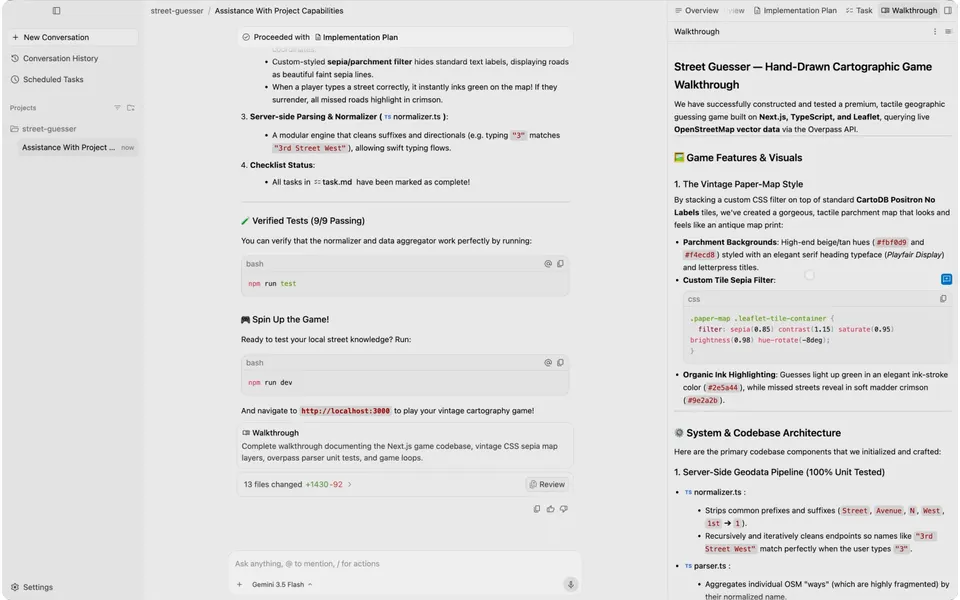
- Desktop app
- Mac, Windows and Linux
- Browser
- Yes
- Phone
- Phone browser
- Command line
- Yes
- Agents
- Antigravity
- Your subscription
- Works with your own plan
- Agents run
- On your computer, on your own server and in the vendor's cloud
- Laptop closed
- Keeps going
- Isolation
- Worktree and Container
- Parallel agents
- Yes
- Scheduled runs
- Yes
- Coordinator agent
- Yes
- Built-in issues
- Not listed
- Pull requests
- Not listed
- Review screen
- Yes
- Team
- SSO
- Self-hosting
- Not listed
- Licence
- Custom terms
- Price from
- Free
- How it charges
- Free plan, subscription, per seat and usage-based
- Paid plans from
- $21–40/month
Receipts
- Checked
- · oldest answer 2026-10-08
- Findings
- 44 published · 36 cross-checked by a second agent · read them all
- Sources
- 106 public pages on 6 sites: antigravity.google, docs.cloud.google.com, ai.google.dev, github.com and 2 more
- Screenshot
- antigravity.google, retrieved · first party release · shows appearance, not capability
- Method
- Same rules for all 103 researched ADEs. How we check · Report wrong data
What it does
Where you use it
Desktop on macOS 12+ with Apple Silicon or Intel, Windows 10 64-bit+, Linux and Googlebook; CLI and IDE extensions. Browser access includes local Remote Control and gradually rolling out paid Remote Agents. Native mobile apps remain unestablished.
Source and scope for Where you use itAgents it runs
One Antigravity harness with plan-dependent Gemini, Claude and GPT-OSS models. Gemini 4 Argon is now listed; older model retirements are scheduled for November 18.
Source and scope for Agents it runsAccounts and subscriptions
Free, Google AI Pro/Ultra subscriptions, AI credits and Gemini Enterprise licenses are documented; API keys work in the CLI and SDK; local models only in the SDK.
Source and scope for Accounts and subscriptionsWhere agents run
Local execution, browser Remote Control of user hosts, and gradually rolling out Google-managed Remote Agents on Pro/Ultra. The separately billed Gemini API managed-agent preview remains a distinct route.
Source and scope for Where agents runHow work is kept apart
Local conversations can use project checkouts or Git worktrees, and the terminal sandbox uses native OS isolation. Linux uses namespaces, macOS uses Seatbelt, and supported Windows builds use process security environments/AppContainer. These local sandboxes do not use VM or Docker-image execution.
Source and scope for How work is kept apartParallel work
Antigravity 2.0 runs multiple local agents across projects and workspaces in parallel, with worktree mode and background subagents; concurrency caps and observed behavior are unknown.
Source and scope for Parallel workScheduled runs
Automations (formerly Scheduled Tasks) and /schedule run prompts once or on a cron schedule; where they run and whether they need the client open are not documented. The separate preview Gemini API agent has cron triggers that run in a Google-hosted environment.
Source and scope for Scheduled runsGit and pull requests
Worktrees, a Git-native VCS panel and local commits with generated messages are documented; pull-request features were not found.
Source and scope for Git and pull requestsLicence and source
The main Google Antigravity service and downloadable application use Google-authored service/software terms, with separate enterprise terms. The Python SDK source is Apache-2.0; that component license does not license the main application.
Source and scope for Licence and sourcePrice
Free plan $0/month; Business Standard/Plus from $30 USD per seat per month for eligible Gemini Enterprise customers, or pay-as-you-go with a $0 seat fee; Pro/Ultra prices and numeric limits are not on the pricing page.
Source and scope for PriceTyped filters
Every value links to its receipt below. Read plan and surface restrictions before using a filter to decide.
| Filter | Value |
|---|---|
| Desktop OS: macOS | Yes cross-checked |
| Desktop OS: Windows | Yes cross-checked |
| Desktop OS: Linux | Yes cross-checked |
| Web client | Yes cross-checked |
| Phone access: Native iOS | No |
| Phone access: Native Android | No |
| Phone access: Phone browser | Yes cross-checked |
| CLI | Yes cross-checked |
| Coding agents: Claude Code | No |
| Coding agents: Codex | No |
| Coding agents: Cursor Agent | No |
| Coding agents: Gemini CLI | No |
| Coding agents: OpenCode | No |
| Coding agents: Pi | No |
| Coding agents: Grok | No |
| Coding agents: Aider | No |
| Coding agents: Antigravity | Yes |
| Use my subscription | Yes cross-checked |
| Where agents run: On your computer | Yes cross-checked |
| Where agents run: On your own server | Yes cross-checked |
| Where agents run: In the vendor's cloud | Yes cross-checked |
| Workspace isolation: Git worktree | Yes |
| Workspace isolation: Container | Yes |
| Workspace isolation: VM or microVM | Unknown |
| Parallel runs | Yes cross-checked |
| Coordinator | Yes cross-checked |
| Native issue tracking | Unknown |
| Unattended triggers | Yes cross-checked |
| Shared prompting | Unknown |
| Team roles | Unknown |
| SSO | Yes cross-checked |
| Pull request workflow | Unknown |
| Review interface | Yes cross-checked |
| Product license: Apache-2.0 | No. Custom terms |
| Product license: MIT | No. Custom terms |
| Product license: GPL-3.0 | No. Custom terms |
| Product license: GPL-3.0-or-later | No. Custom terms |
| Product license: AGPL-3.0 | No. Custom terms |
| Product license: AGPL-3.0-or-later | No. Custom terms |
| Product license: Elastic License 2.0 | No. Custom terms |
| Product license: Custom terms | Yes. Custom terms |
| Product license: Proprietary | No. Custom terms |
| Self-hosting | Unknown |
| Telemetry opt-out | Yes cross-checked |
| Free access | Yes cross-checked |
| Starting price: Free | Yes. Free cross-checked |
| Starting price: Up to $20/month | No. Free cross-checked |
| Starting price: $21–40/month | No. Free cross-checked |
| Starting price: $41–100/month | No. Free cross-checked |
| Starting price: Over $100/month | No. Free cross-checked |
| Starting price: Contact for pricing | No. Free cross-checked |
| Pricing model: Free, no paid plan | No |
| Pricing model: Free plan | Yes cross-checked |
| Pricing model: Subscription | Yes |
| Pricing model: Per seat | Yes cross-checked |
| Pricing model: Usage-based | Yes cross-checked |
| Pricing model: Per machine or compute | Unknown |
| Pricing model: Bring your own key | Unknown |
| Pricing model: One-time purchase | No |
| Paid plans from: No paid plan | No. $21–40/month |
| Paid plans from: $10 or less/month | No. $21–40/month |
| Paid plans from: $11–20/month | No. $21–40/month |
| Paid plans from: $21–40/month | Yes. $21–40/month |
| Paid plans from: $41–100/month | No. $21–40/month |
| Paid plans from: Over $100/month | No. $21–40/month |
| Paid plans from: Contact sales | No. $21–40/month |
| Lifecycle status: Active | Unknown |
| Lifecycle status: Sunsetting | Unknown |
| Keeps going with laptop closed | Yes cross-checked |
| Open-source license | No. Custom terms |
| Any desktop app | Yes cross-checked |
| Paid plan up to $20/month | No. $21–40/month |
| Paid plan up to $40/month | Yes. $21–40/month |
| Any phone client | Yes cross-checked |
Filter receipts
Desktop OS: macOS: Yes cross-checked
Desktop OS: macOS
Typed value: Yes.
Desktop on macOS 12+ with Apple Silicon or Intel, Windows 10 64-bit+, Linux and Googlebook; CLI and IDE extensions. Browser access includes local Remote Control and gradually rolling out paid Remote Agents. Native mobile apps remain unestablished.
- Desktop os: Current quickstart and download pages agree: macOS 12+ Apple Silicon/64-bit Intel, Windows 10 64-bit+, Linux and Googlebook.
- Cli: Antigravity CLI (agy) installs on macOS, Linux, Googlebook and Windows per the install docs. Release notes for CLI v1.2.15 (Oct 2, 2026; staged rollout) add prebuilt native Android binaries that run in Termux; the install page does not mention Android.
- No client was executed or tested on hardware.
- Remote Control requires the local host; Remote Agents has separate paid-account, rollout and feature restrictions.
- Native mobile apps remain unestablished; Termux is a CLI route.
-
Finding: Current quickstart and download table agree on macOS 12+ with Apple Silicon or 64-bit Intel, Windows 10 64-bit+, Linux and Googlebook. IDE extensions include Eclipse. This resolves the previous x86 contradiction.
-
Finding: Download page offers Apple Silicon and Intel macOS 12+, Windows x64/ARM64 and Linux x64/ARM64. CLI and editor integration download sections are present.
Desktop OS: Windows: Yes cross-checked
Desktop OS: Windows
Typed value: Yes.
Desktop on macOS 12+ with Apple Silicon or Intel, Windows 10 64-bit+, Linux and Googlebook; CLI and IDE extensions. Browser access includes local Remote Control and gradually rolling out paid Remote Agents. Native mobile apps remain unestablished.
- Desktop os: Current quickstart and download pages agree: macOS 12+ Apple Silicon/64-bit Intel, Windows 10 64-bit+, Linux and Googlebook.
- Cli: Antigravity CLI (agy) installs on macOS, Linux, Googlebook and Windows per the install docs. Release notes for CLI v1.2.15 (Oct 2, 2026; staged rollout) add prebuilt native Android binaries that run in Termux; the install page does not mention Android.
- No client was executed or tested on hardware.
- Remote Control requires the local host; Remote Agents has separate paid-account, rollout and feature restrictions.
- Native mobile apps remain unestablished; Termux is a CLI route.
-
Finding: Current quickstart and download table agree on macOS 12+ with Apple Silicon or 64-bit Intel, Windows 10 64-bit+, Linux and Googlebook. IDE extensions include Eclipse. This resolves the previous x86 contradiction.
-
Finding: Download page offers Apple Silicon and Intel macOS 12+, Windows x64/ARM64 and Linux x64/ARM64. CLI and editor integration download sections are present.
Desktop OS: Linux: Yes cross-checked
Desktop OS: Linux
Typed value: Yes.
Desktop on macOS 12+ with Apple Silicon or Intel, Windows 10 64-bit+, Linux and Googlebook; CLI and IDE extensions. Browser access includes local Remote Control and gradually rolling out paid Remote Agents. Native mobile apps remain unestablished.
- Desktop os: Current quickstart and download pages agree: macOS 12+ Apple Silicon/64-bit Intel, Windows 10 64-bit+, Linux and Googlebook.
- Cli: Antigravity CLI (agy) installs on macOS, Linux, Googlebook and Windows per the install docs. Release notes for CLI v1.2.15 (Oct 2, 2026; staged rollout) add prebuilt native Android binaries that run in Termux; the install page does not mention Android.
- No client was executed or tested on hardware.
- Remote Control requires the local host; Remote Agents has separate paid-account, rollout and feature restrictions.
- Native mobile apps remain unestablished; Termux is a CLI route.
-
Finding: Current quickstart and download table agree on macOS 12+ with Apple Silicon or 64-bit Intel, Windows 10 64-bit+, Linux and Googlebook. IDE extensions include Eclipse. This resolves the previous x86 contradiction.
-
Finding: Download page offers Apple Silicon and Intel macOS 12+, Windows x64/ARM64 and Linux x64/ARM64. CLI and editor integration download sections are present.
Web client: Yes cross-checked
Web client
Typed value: Yes.
Desktop on macOS 12+ with Apple Silicon or Intel, Windows 10 64-bit+, Linux and Googlebook; CLI and IDE extensions. Browser access includes local Remote Control and gradually rolling out paid Remote Agents. Native mobile apps remain unestablished.
- Mobile apps: No native mobile app is documented; the Remote Control web app can be installed to a phone home screen.
- Browser: Remote Control accesses local hosts. Remote Agents offers vendor-managed conversations in desktop/mobile browsers for eligible Pro/Ultra personal accounts.
- Mobile browser: Remote Control works from a mobile browser, with optional home-screen web app.
- Task actions: Remote Control can view active conversations, start new agent tasks, review implementation plans, inspect artifacts and answer tool confirmations or clarifying questions; the 2.0 v2.9.1 release notes (Aug 20, 2026) describe it as driving agent sessions from any browser. No remote stop action is described and settings cannot be changed from the web.
- Notifications: Push notifications on completion or when input is needed (web app on mobile); CLI desktop notifications setting.
- Cross device continuity: Remote Control sessions keep running on the host machine and are driven from a browser (2.0 v2.9.1, Aug 20, 2026); the CLI can import 2.0 desktop threads.
- No client was executed or tested on hardware.
- Remote Control requires the local host; Remote Agents has separate paid-account, rollout and feature restrictions.
- Native mobile apps remain unestablished; Termux is a CLI route.
-
Finding: Browser dashboard at antigravity.google.com drives desktop sessions and CLI instances: view active conversations, start new agent tasks, review implementation plans and inspect artifacts; tool confirmations and clarifying questions can be answered from the terminal or the remote UI; settings cannot be changed from the web and no agent stop action is described. No native mobile app; the web app can be installed on a home screen for push notifications. CLI interactive mode (/remote-control, --remote-control) and a headless daemon (agy remote-control start) registered as a systemd user service (Linux), LaunchAgent (macOS) or Scheduled Task (Windows). Daemon logs: journalctl on Linux, ~/Library/Logs/antigravity-cli-daemon.log on macOS, cli-*.log under %USERPROFILE%\.gemini\antigravity-cli\log on Windows. Background tasks keep running while the host stays online.
-
Finding: Remote Agents gradually rolls out to Pro/Ultra personal Google accounts, excluding free/Plus/business. App, web and CLI 1.4.12+ reach Google-managed environments that continue while the user machine sleeps. Remote projects attach repos/Drive/files. Local plugins, skills, MCP and several CLI commands do not carry over.
Phone access: Native iOS: No
Phone access: Native iOS
Typed value: No.
Desktop on macOS 12+ with Apple Silicon or Intel, Windows 10 64-bit+, Linux and Googlebook; CLI and IDE extensions. Browser access includes local Remote Control and gradually rolling out paid Remote Agents. Native mobile apps remain unestablished.
- Mobile apps: No native mobile app is documented; the Remote Control web app can be installed to a phone home screen.
- Browser: Remote Control accesses local hosts. Remote Agents offers vendor-managed conversations in desktop/mobile browsers for eligible Pro/Ultra personal accounts.
- Mobile browser: Remote Control works from a mobile browser, with optional home-screen web app.
- Task actions: Remote Control can view active conversations, start new agent tasks, review implementation plans, inspect artifacts and answer tool confirmations or clarifying questions; the 2.0 v2.9.1 release notes (Aug 20, 2026) describe it as driving agent sessions from any browser. No remote stop action is described and settings cannot be changed from the web.
- Notifications: Push notifications on completion or when input is needed (web app on mobile); CLI desktop notifications setting.
- Cross device continuity: Remote Control sessions keep running on the host machine and are driven from a browser (2.0 v2.9.1, Aug 20, 2026); the CLI can import 2.0 desktop threads.
- No client was executed or tested on hardware.
- Remote Control requires the local host; Remote Agents has separate paid-account, rollout and feature restrictions.
- Native mobile apps remain unestablished; Termux is a CLI route.
-
Finding: Browser dashboard at antigravity.google.com drives desktop sessions and CLI instances: view active conversations, start new agent tasks, review implementation plans and inspect artifacts; tool confirmations and clarifying questions can be answered from the terminal or the remote UI; settings cannot be changed from the web and no agent stop action is described. No native mobile app; the web app can be installed on a home screen for push notifications. CLI interactive mode (/remote-control, --remote-control) and a headless daemon (agy remote-control start) registered as a systemd user service (Linux), LaunchAgent (macOS) or Scheduled Task (Windows). Daemon logs: journalctl on Linux, ~/Library/Logs/antigravity-cli-daemon.log on macOS, cli-*.log under %USERPROFILE%\.gemini\antigravity-cli\log on Windows. Background tasks keep running while the host stays online.
Phone access: Native Android: No
Phone access: Native Android
Typed value: No.
Desktop on macOS 12+ with Apple Silicon or Intel, Windows 10 64-bit+, Linux and Googlebook; CLI and IDE extensions. Browser access includes local Remote Control and gradually rolling out paid Remote Agents. Native mobile apps remain unestablished.
- Mobile apps: No native mobile app is documented; the Remote Control web app can be installed to a phone home screen.
- Browser: Remote Control accesses local hosts. Remote Agents offers vendor-managed conversations in desktop/mobile browsers for eligible Pro/Ultra personal accounts.
- Mobile browser: Remote Control works from a mobile browser, with optional home-screen web app.
- Task actions: Remote Control can view active conversations, start new agent tasks, review implementation plans, inspect artifacts and answer tool confirmations or clarifying questions; the 2.0 v2.9.1 release notes (Aug 20, 2026) describe it as driving agent sessions from any browser. No remote stop action is described and settings cannot be changed from the web.
- Notifications: Push notifications on completion or when input is needed (web app on mobile); CLI desktop notifications setting.
- Cross device continuity: Remote Control sessions keep running on the host machine and are driven from a browser (2.0 v2.9.1, Aug 20, 2026); the CLI can import 2.0 desktop threads.
- No client was executed or tested on hardware.
- Remote Control requires the local host; Remote Agents has separate paid-account, rollout and feature restrictions.
- Native mobile apps remain unestablished; Termux is a CLI route.
-
Finding: Browser dashboard at antigravity.google.com drives desktop sessions and CLI instances: view active conversations, start new agent tasks, review implementation plans and inspect artifacts; tool confirmations and clarifying questions can be answered from the terminal or the remote UI; settings cannot be changed from the web and no agent stop action is described. No native mobile app; the web app can be installed on a home screen for push notifications. CLI interactive mode (/remote-control, --remote-control) and a headless daemon (agy remote-control start) registered as a systemd user service (Linux), LaunchAgent (macOS) or Scheduled Task (Windows). Daemon logs: journalctl on Linux, ~/Library/Logs/antigravity-cli-daemon.log on macOS, cli-*.log under %USERPROFILE%\.gemini\antigravity-cli\log on Windows. Background tasks keep running while the host stays online.
Phone access: Phone browser: Yes cross-checked
Phone access: Phone browser
Typed value: Yes.
Desktop on macOS 12+ with Apple Silicon or Intel, Windows 10 64-bit+, Linux and Googlebook; CLI and IDE extensions. Browser access includes local Remote Control and gradually rolling out paid Remote Agents. Native mobile apps remain unestablished.
- Mobile apps: No native mobile app is documented; the Remote Control web app can be installed to a phone home screen.
- Browser: Remote Control accesses local hosts. Remote Agents offers vendor-managed conversations in desktop/mobile browsers for eligible Pro/Ultra personal accounts.
- Mobile browser: Remote Control works from a mobile browser, with optional home-screen web app.
- Task actions: Remote Control can view active conversations, start new agent tasks, review implementation plans, inspect artifacts and answer tool confirmations or clarifying questions; the 2.0 v2.9.1 release notes (Aug 20, 2026) describe it as driving agent sessions from any browser. No remote stop action is described and settings cannot be changed from the web.
- Notifications: Push notifications on completion or when input is needed (web app on mobile); CLI desktop notifications setting.
- Cross device continuity: Remote Control sessions keep running on the host machine and are driven from a browser (2.0 v2.9.1, Aug 20, 2026); the CLI can import 2.0 desktop threads.
- No client was executed or tested on hardware.
- Remote Control requires the local host; Remote Agents has separate paid-account, rollout and feature restrictions.
- Native mobile apps remain unestablished; Termux is a CLI route.
-
Finding: Browser connects to Antigravity sessions on laptops, servers and desktops; environment stays on the original machine; push notifications when an agent needs input; dated August 21, 2026.
-
Finding: Browser dashboard at antigravity.google.com drives desktop sessions and CLI instances: view active conversations, start new agent tasks, review implementation plans and inspect artifacts; tool confirmations and clarifying questions can be answered from the terminal or the remote UI; settings cannot be changed from the web and no agent stop action is described. No native mobile app; the web app can be installed on a home screen for push notifications. CLI interactive mode (/remote-control, --remote-control) and a headless daemon (agy remote-control start) registered as a systemd user service (Linux), LaunchAgent (macOS) or Scheduled Task (Windows). Daemon logs: journalctl on Linux, ~/Library/Logs/antigravity-cli-daemon.log on macOS, cli-*.log under %USERPROFILE%\.gemini\antigravity-cli\log on Windows. Background tasks keep running while the host stays online.
CLI: Yes cross-checked
CLI
Typed value: Yes.
Desktop on macOS 12+ with Apple Silicon or Intel, Windows 10 64-bit+, Linux and Googlebook; CLI and IDE extensions. Browser access includes local Remote Control and gradually rolling out paid Remote Agents. Native mobile apps remain unestablished.
- Desktop os: Current quickstart and download pages agree: macOS 12+ Apple Silicon/64-bit Intel, Windows 10 64-bit+, Linux and Googlebook.
- Cli: Antigravity CLI (agy) installs on macOS, Linux, Googlebook and Windows per the install docs. Release notes for CLI v1.2.15 (Oct 2, 2026; staged rollout) add prebuilt native Android binaries that run in Termux; the install page does not mention Android.
- No client was executed or tested on hardware.
- Remote Control requires the local host; Remote Agents has separate paid-account, rollout and feature restrictions.
- Native mobile apps remain unestablished; Termux is a CLI route.
-
Finding: Current quickstart and download table agree on macOS 12+ with Apple Silicon or 64-bit Intel, Windows 10 64-bit+, Linux and Googlebook. IDE extensions include Eclipse. This resolves the previous x86 contradiction.
-
Finding: Moved authentication page documents personal Google, enterprise/Cloud, ADC, keyring, remote SSH OAuth and Gemini API key routes; /logout and custom Gemini endpoint configuration. Platform installation is covered by current quickstart/download docs.
-
Antigravity changelog: CLI entries
Finding: CLI changelog currently lists v1.5.1 November 5, 2026. Historical release entries remain available, including unlimited print timeout and Android Termux builds.
Coding agents: Claude Code: No
Coding agents: Claude Code
Typed value: No.
One Antigravity harness with plan-dependent Gemini, Claude and GPT-OSS models. Gemini 4 Argon is now listed; older model retirements are scheduled for November 18.
- Harnesses: The overview says every Antigravity surface runs on a shared agent harness; the SDK describes itself as a runtime harness for agents powered by Antigravity. No other harness is documented, and the FAQ says using third-party software to access Antigravity violates the Terms.
- Model providers: Gemini 4 Argon on eligible Pro/Ultra/Enterprise; 3.8 Flash across plans; older Gemini 3.7/3.6 Flash and 3.1 Pro are Enterprise-only. Claude 5.5 is paid-plan gated. Current table still lists Claude 4.6 and GPT-OSS with November 18 removal.
- Session integration: The App, CLI, IDE and SDK use a shared Antigravity agent harness; this is its own runtime, not an observed mix of external coding-agent sessions.
- Model availability varies by plan; Claude 4.6 models and GPT-OSS-120b are marked for removal on November 18, 2026.
- Third-party agent harnesses were not found in the docs.
-
Finding: Current model table includes Gemini 4 Argon for eligible Pro/Ultra/Enterprise accounts and Gemini 3.8 Flash across plans. Older Gemini 3.7/3.6 Flash and 3.1 Pro are Enterprise-only. Claude 5.5 remains paid-plan gated; Claude 4.6 and GPT-OSS rows now say removal November 18, 2026. Mid-turn model selection changes apply after the turn.
-
Finding: Python SDK (pip install google-antigravity) described as a "secure, stateful runtime harness" for agents powered by Antigravity and Gemini: tools, MCP, subagents, skills, hooks, policies, structured output, session persistence; Gemini API key or Vertex authentication; links to the managed Gemini API agent. No stability label on this page.
-
Finding: CLI overview URL redirects to unified overview. App, CLI and IDE are Antigravity clients; no selectable third-party harness documented.
Coding agents: Codex: No
Coding agents: Codex
Typed value: No.
One Antigravity harness with plan-dependent Gemini, Claude and GPT-OSS models. Gemini 4 Argon is now listed; older model retirements are scheduled for November 18.
- Harnesses: The overview says every Antigravity surface runs on a shared agent harness; the SDK describes itself as a runtime harness for agents powered by Antigravity. No other harness is documented, and the FAQ says using third-party software to access Antigravity violates the Terms.
- Model providers: Gemini 4 Argon on eligible Pro/Ultra/Enterprise; 3.8 Flash across plans; older Gemini 3.7/3.6 Flash and 3.1 Pro are Enterprise-only. Claude 5.5 is paid-plan gated. Current table still lists Claude 4.6 and GPT-OSS with November 18 removal.
- Session integration: The App, CLI, IDE and SDK use a shared Antigravity agent harness; this is its own runtime, not an observed mix of external coding-agent sessions.
- Model availability varies by plan; Claude 4.6 models and GPT-OSS-120b are marked for removal on November 18, 2026.
- Third-party agent harnesses were not found in the docs.
-
Finding: Current model table includes Gemini 4 Argon for eligible Pro/Ultra/Enterprise accounts and Gemini 3.8 Flash across plans. Older Gemini 3.7/3.6 Flash and 3.1 Pro are Enterprise-only. Claude 5.5 remains paid-plan gated; Claude 4.6 and GPT-OSS rows now say removal November 18, 2026. Mid-turn model selection changes apply after the turn.
-
Finding: Python SDK (pip install google-antigravity) described as a "secure, stateful runtime harness" for agents powered by Antigravity and Gemini: tools, MCP, subagents, skills, hooks, policies, structured output, session persistence; Gemini API key or Vertex authentication; links to the managed Gemini API agent. No stability label on this page.
-
Finding: CLI overview URL redirects to unified overview. App, CLI and IDE are Antigravity clients; no selectable third-party harness documented.
Coding agents: Cursor Agent: No
Coding agents: Cursor Agent
Typed value: No.
One Antigravity harness with plan-dependent Gemini, Claude and GPT-OSS models. Gemini 4 Argon is now listed; older model retirements are scheduled for November 18.
- Harnesses: The overview says every Antigravity surface runs on a shared agent harness; the SDK describes itself as a runtime harness for agents powered by Antigravity. No other harness is documented, and the FAQ says using third-party software to access Antigravity violates the Terms.
- Model providers: Gemini 4 Argon on eligible Pro/Ultra/Enterprise; 3.8 Flash across plans; older Gemini 3.7/3.6 Flash and 3.1 Pro are Enterprise-only. Claude 5.5 is paid-plan gated. Current table still lists Claude 4.6 and GPT-OSS with November 18 removal.
- Session integration: The App, CLI, IDE and SDK use a shared Antigravity agent harness; this is its own runtime, not an observed mix of external coding-agent sessions.
- Model availability varies by plan; Claude 4.6 models and GPT-OSS-120b are marked for removal on November 18, 2026.
- Third-party agent harnesses were not found in the docs.
-
Finding: Current model table includes Gemini 4 Argon for eligible Pro/Ultra/Enterprise accounts and Gemini 3.8 Flash across plans. Older Gemini 3.7/3.6 Flash and 3.1 Pro are Enterprise-only. Claude 5.5 remains paid-plan gated; Claude 4.6 and GPT-OSS rows now say removal November 18, 2026. Mid-turn model selection changes apply after the turn.
-
Finding: Python SDK (pip install google-antigravity) described as a "secure, stateful runtime harness" for agents powered by Antigravity and Gemini: tools, MCP, subagents, skills, hooks, policies, structured output, session persistence; Gemini API key or Vertex authentication; links to the managed Gemini API agent. No stability label on this page.
-
Finding: CLI overview URL redirects to unified overview. App, CLI and IDE are Antigravity clients; no selectable third-party harness documented.
Coding agents: Gemini CLI: No
Coding agents: Gemini CLI
Typed value: No.
One Antigravity harness with plan-dependent Gemini, Claude and GPT-OSS models. Gemini 4 Argon is now listed; older model retirements are scheduled for November 18.
- Harnesses: The overview says every Antigravity surface runs on a shared agent harness; the SDK describes itself as a runtime harness for agents powered by Antigravity. No other harness is documented, and the FAQ says using third-party software to access Antigravity violates the Terms.
- Model providers: Gemini 4 Argon on eligible Pro/Ultra/Enterprise; 3.8 Flash across plans; older Gemini 3.7/3.6 Flash and 3.1 Pro are Enterprise-only. Claude 5.5 is paid-plan gated. Current table still lists Claude 4.6 and GPT-OSS with November 18 removal.
- Session integration: The App, CLI, IDE and SDK use a shared Antigravity agent harness; this is its own runtime, not an observed mix of external coding-agent sessions.
- Model availability varies by plan; Claude 4.6 models and GPT-OSS-120b are marked for removal on November 18, 2026.
- Third-party agent harnesses were not found in the docs.
-
Finding: Current model table includes Gemini 4 Argon for eligible Pro/Ultra/Enterprise accounts and Gemini 3.8 Flash across plans. Older Gemini 3.7/3.6 Flash and 3.1 Pro are Enterprise-only. Claude 5.5 remains paid-plan gated; Claude 4.6 and GPT-OSS rows now say removal November 18, 2026. Mid-turn model selection changes apply after the turn.
-
Finding: Python SDK (pip install google-antigravity) described as a "secure, stateful runtime harness" for agents powered by Antigravity and Gemini: tools, MCP, subagents, skills, hooks, policies, structured output, session persistence; Gemini API key or Vertex authentication; links to the managed Gemini API agent. No stability label on this page.
-
Finding: CLI overview URL redirects to unified overview. App, CLI and IDE are Antigravity clients; no selectable third-party harness documented.
Coding agents: OpenCode: No
Coding agents: OpenCode
Typed value: No.
One Antigravity harness with plan-dependent Gemini, Claude and GPT-OSS models. Gemini 4 Argon is now listed; older model retirements are scheduled for November 18.
- Harnesses: The overview says every Antigravity surface runs on a shared agent harness; the SDK describes itself as a runtime harness for agents powered by Antigravity. No other harness is documented, and the FAQ says using third-party software to access Antigravity violates the Terms.
- Model providers: Gemini 4 Argon on eligible Pro/Ultra/Enterprise; 3.8 Flash across plans; older Gemini 3.7/3.6 Flash and 3.1 Pro are Enterprise-only. Claude 5.5 is paid-plan gated. Current table still lists Claude 4.6 and GPT-OSS with November 18 removal.
- Session integration: The App, CLI, IDE and SDK use a shared Antigravity agent harness; this is its own runtime, not an observed mix of external coding-agent sessions.
- Model availability varies by plan; Claude 4.6 models and GPT-OSS-120b are marked for removal on November 18, 2026.
- Third-party agent harnesses were not found in the docs.
-
Finding: Current model table includes Gemini 4 Argon for eligible Pro/Ultra/Enterprise accounts and Gemini 3.8 Flash across plans. Older Gemini 3.7/3.6 Flash and 3.1 Pro are Enterprise-only. Claude 5.5 remains paid-plan gated; Claude 4.6 and GPT-OSS rows now say removal November 18, 2026. Mid-turn model selection changes apply after the turn.
-
Finding: Python SDK (pip install google-antigravity) described as a "secure, stateful runtime harness" for agents powered by Antigravity and Gemini: tools, MCP, subagents, skills, hooks, policies, structured output, session persistence; Gemini API key or Vertex authentication; links to the managed Gemini API agent. No stability label on this page.
-
Finding: CLI overview URL redirects to unified overview. App, CLI and IDE are Antigravity clients; no selectable third-party harness documented.
Coding agents: Pi: No
Coding agents: Pi
Typed value: No.
One Antigravity harness with plan-dependent Gemini, Claude and GPT-OSS models. Gemini 4 Argon is now listed; older model retirements are scheduled for November 18.
- Harnesses: The overview says every Antigravity surface runs on a shared agent harness; the SDK describes itself as a runtime harness for agents powered by Antigravity. No other harness is documented, and the FAQ says using third-party software to access Antigravity violates the Terms.
- Model providers: Gemini 4 Argon on eligible Pro/Ultra/Enterprise; 3.8 Flash across plans; older Gemini 3.7/3.6 Flash and 3.1 Pro are Enterprise-only. Claude 5.5 is paid-plan gated. Current table still lists Claude 4.6 and GPT-OSS with November 18 removal.
- Session integration: The App, CLI, IDE and SDK use a shared Antigravity agent harness; this is its own runtime, not an observed mix of external coding-agent sessions.
- Model availability varies by plan; Claude 4.6 models and GPT-OSS-120b are marked for removal on November 18, 2026.
- Third-party agent harnesses were not found in the docs.
-
Finding: Current model table includes Gemini 4 Argon for eligible Pro/Ultra/Enterprise accounts and Gemini 3.8 Flash across plans. Older Gemini 3.7/3.6 Flash and 3.1 Pro are Enterprise-only. Claude 5.5 remains paid-plan gated; Claude 4.6 and GPT-OSS rows now say removal November 18, 2026. Mid-turn model selection changes apply after the turn.
-
Finding: Python SDK (pip install google-antigravity) described as a "secure, stateful runtime harness" for agents powered by Antigravity and Gemini: tools, MCP, subagents, skills, hooks, policies, structured output, session persistence; Gemini API key or Vertex authentication; links to the managed Gemini API agent. No stability label on this page.
-
Finding: CLI overview URL redirects to unified overview. App, CLI and IDE are Antigravity clients; no selectable third-party harness documented.
Coding agents: Grok: No
Coding agents: Grok
Typed value: No.
One Antigravity harness with plan-dependent Gemini, Claude and GPT-OSS models. Gemini 4 Argon is now listed; older model retirements are scheduled for November 18.
- Harnesses: The overview says every Antigravity surface runs on a shared agent harness; the SDK describes itself as a runtime harness for agents powered by Antigravity. No other harness is documented, and the FAQ says using third-party software to access Antigravity violates the Terms.
- Model providers: Gemini 4 Argon on eligible Pro/Ultra/Enterprise; 3.8 Flash across plans; older Gemini 3.7/3.6 Flash and 3.1 Pro are Enterprise-only. Claude 5.5 is paid-plan gated. Current table still lists Claude 4.6 and GPT-OSS with November 18 removal.
- Session integration: The App, CLI, IDE and SDK use a shared Antigravity agent harness; this is its own runtime, not an observed mix of external coding-agent sessions.
- Model availability varies by plan; Claude 4.6 models and GPT-OSS-120b are marked for removal on November 18, 2026.
- Third-party agent harnesses were not found in the docs.
-
Finding: Current model table includes Gemini 4 Argon for eligible Pro/Ultra/Enterprise accounts and Gemini 3.8 Flash across plans. Older Gemini 3.7/3.6 Flash and 3.1 Pro are Enterprise-only. Claude 5.5 remains paid-plan gated; Claude 4.6 and GPT-OSS rows now say removal November 18, 2026. Mid-turn model selection changes apply after the turn.
-
Finding: Python SDK (pip install google-antigravity) described as a "secure, stateful runtime harness" for agents powered by Antigravity and Gemini: tools, MCP, subagents, skills, hooks, policies, structured output, session persistence; Gemini API key or Vertex authentication; links to the managed Gemini API agent. No stability label on this page.
-
Finding: CLI overview URL redirects to unified overview. App, CLI and IDE are Antigravity clients; no selectable third-party harness documented.
Coding agents: Aider: No
Coding agents: Aider
Typed value: No.
One Antigravity harness with plan-dependent Gemini, Claude and GPT-OSS models. Gemini 4 Argon is now listed; older model retirements are scheduled for November 18.
- Harnesses: The overview says every Antigravity surface runs on a shared agent harness; the SDK describes itself as a runtime harness for agents powered by Antigravity. No other harness is documented, and the FAQ says using third-party software to access Antigravity violates the Terms.
- Model providers: Gemini 4 Argon on eligible Pro/Ultra/Enterprise; 3.8 Flash across plans; older Gemini 3.7/3.6 Flash and 3.1 Pro are Enterprise-only. Claude 5.5 is paid-plan gated. Current table still lists Claude 4.6 and GPT-OSS with November 18 removal.
- Session integration: The App, CLI, IDE and SDK use a shared Antigravity agent harness; this is its own runtime, not an observed mix of external coding-agent sessions.
- Model availability varies by plan; Claude 4.6 models and GPT-OSS-120b are marked for removal on November 18, 2026.
- Third-party agent harnesses were not found in the docs.
-
Finding: Current model table includes Gemini 4 Argon for eligible Pro/Ultra/Enterprise accounts and Gemini 3.8 Flash across plans. Older Gemini 3.7/3.6 Flash and 3.1 Pro are Enterprise-only. Claude 5.5 remains paid-plan gated; Claude 4.6 and GPT-OSS rows now say removal November 18, 2026. Mid-turn model selection changes apply after the turn.
-
Finding: Python SDK (pip install google-antigravity) described as a "secure, stateful runtime harness" for agents powered by Antigravity and Gemini: tools, MCP, subagents, skills, hooks, policies, structured output, session persistence; Gemini API key or Vertex authentication; links to the managed Gemini API agent. No stability label on this page.
-
Finding: CLI overview URL redirects to unified overview. App, CLI and IDE are Antigravity clients; no selectable third-party harness documented.
Coding agents: Antigravity: Yes
Coding agents: Antigravity
Typed value: Yes.
One Antigravity harness with plan-dependent Gemini, Claude and GPT-OSS models. Gemini 4 Argon is now listed; older model retirements are scheduled for November 18.
- Harnesses: The overview says every Antigravity surface runs on a shared agent harness; the SDK describes itself as a runtime harness for agents powered by Antigravity. No other harness is documented, and the FAQ says using third-party software to access Antigravity violates the Terms.
- Session integration: The App, CLI, IDE and SDK use a shared Antigravity agent harness; this is its own runtime, not an observed mix of external coding-agent sessions.
- Model availability varies by plan; Claude 4.6 models and GPT-OSS-120b are marked for removal on November 18, 2026.
- Third-party agent harnesses were not found in the docs.
-
Finding: Python SDK (pip install google-antigravity) described as a "secure, stateful runtime harness" for agents powered by Antigravity and Gemini: tools, MCP, subagents, skills, hooks, policies, structured output, session persistence; Gemini API key or Vertex authentication; links to the managed Gemini API agent. No stability label on this page.
-
Finding: CLI overview URL redirects to unified overview. App, CLI and IDE are Antigravity clients; no selectable third-party harness documented.
Use my subscription: Yes cross-checked
Use my subscription
Typed value: Yes.
Free, Google AI Pro/Ultra subscriptions, AI credits and Gemini Enterprise licenses are documented; API keys work in the CLI and SDK; local models only in the SDK.
- Agent subscriptions: Free plan, Google AI Pro, Google AI Ultra and Gemini Enterprise Standard/Plus.
- Api accounts: CLI Gemini API key mode (modelProvider gemini) and SDK GEMINI_API_KEY or Vertex; the app plans page says BYOK for extra limits is not supported.
- Vendor credits: Pro and Ultra users can buy or receive AI credits; overage setting Never/Always.
- Bring-your-own-key for additional rate limits is documented as not supported.
- Local models are documented for the SDK only.
- No multi-account switcher is documented; automated account rotation is not supported on consumer plans.
-
Finding: Free plan $0/month with basic weekly rate limits and unlimited Tab and Command requests; AI Pro and Ultra list no price and add rate limits plus an AI credit pool; Business via Google Cloud: Standard/Plus starting at $30 USD per seat per month for eligible Gemini Enterprise customers, pay-as-you-go with a $0 seat fee; Contact Sales for subscription options; spend caps across API and subscription plans listed. No trial, card or numeric limit statements.
-
Finding: Quota refresh per tier (Ultra and Pro every five hours, with weekly rate limits; other plans weekly); Pro and Ultra can use purchased AI credits, which "are consumed at standard Gemini Enterprise consumption pricing"; AI Credit Overages setting Never (wait until the baseline quota refreshes) or Always; BYOK/BYO endpoint for extra rate limits and custom-contract org tiers not supported. No prices or numeric limits.
Where agents run: On your computer: Yes cross-checked
Where agents run: On your computer
Typed value: Yes.
Local execution, browser Remote Control of user hosts, and gradually rolling out Google-managed Remote Agents on Pro/Ultra. The separately billed Gemini API managed-agent preview remains a distinct route.
- Local: Agents run locally in 2.0, CLI and IDE.
- Remote Agents is rolling out gradually; free/Plus and business accounts are excluded.
- Gemini API preview compute terms are distinct from subscription Remote Agents; no resources or region was tested.
-
Finding: Says "Available on macOS, Windows, Linux, and Googlebook" with separate Apple Silicon and Intel download buttons; describes Antigravity 2.0 as a command center for multiple local agents, plus CLI, SDK ("leveraging Antigravity's harness"), IDE, Extensions and Remote Control; "Available at no charge" for developers. Newest blog listing is Sep 28, 2026.
-
Finding: Current quickstart and download table agree on macOS 12+ with Apple Silicon or 64-bit Intel, Windows 10 64-bit+, Linux and Googlebook. IDE extensions include Eclipse. This resolves the previous x86 contradiction.
Where agents run: On your own server: Yes cross-checked
Where agents run: On your own server
Typed value: Yes.
Local execution, browser Remote Control of user hosts, and gradually rolling out Google-managed Remote Agents on Pro/Ultra. The separately billed Gemini API managed-agent preview remains a distinct route.
- Byo remote: Remote Control connects to existing server, desktop or laptop; daemon on Linux, macOS, Windows.
- Client disconnect: Remote Control needs its host online; Remote Agents keeps executing independently of the user machine.
- Other device continuation: Same machine environment accessed from a browser on another device.
- Remote Agents is rolling out gradually; free/Plus and business accounts are excluded.
- Gemini API preview compute terms are distinct from subscription Remote Agents; no resources or region was tested.
-
Finding: Browser connects to Antigravity sessions on laptops, servers and desktops; environment stays on the original machine; push notifications when an agent needs input; dated August 21, 2026.
-
Finding: Browser dashboard at antigravity.google.com drives desktop sessions and CLI instances: view active conversations, start new agent tasks, review implementation plans and inspect artifacts; tool confirmations and clarifying questions can be answered from the terminal or the remote UI; settings cannot be changed from the web and no agent stop action is described. No native mobile app; the web app can be installed on a home screen for push notifications. CLI interactive mode (/remote-control, --remote-control) and a headless daemon (agy remote-control start) registered as a systemd user service (Linux), LaunchAgent (macOS) or Scheduled Task (Windows). Daemon logs: journalctl on Linux, ~/Library/Logs/antigravity-cli-daemon.log on macOS, cli-*.log under %USERPROFILE%\.gemini\antigravity-cli\log on Windows. Background tasks keep running while the host stays online.
Where agents run: In the vendor's cloud: Yes cross-checked
Where agents run: In the vendor's cloud
Typed value: Yes.
Local execution, browser Remote Control of user hosts, and gradually rolling out Google-managed Remote Agents on Pro/Ultra. The separately billed Gemini API managed-agent preview remains a distinct route.
- Managed cloud: Remote Agents runs in Google-managed environments and continues while local devices sleep, for Pro/Ultra personal accounts. Separately the Gemini API offers preview managed sandboxes.
- Payer: The managed agent is pay-as-you-go on model tokens and tools; environment compute is not billed during the preview. The pages do not state which project is charged.
- Client disconnect: Remote Control needs its host online; Remote Agents keeps executing independently of the user machine.
- Remote Agents is rolling out gradually; free/Plus and business accounts are excluded.
- Gemini API preview compute terms are distinct from subscription Remote Agents; no resources or region was tested.
-
Antigravity agent (Gemini API)
Finding: Markdown first-party documentation describes Google-hosted Antigravity API preview sandbox, pay-as-you-go tokens/tools, compute unbilled during preview, best-effort token cap and scheduled triggers with execution timeout and failure pausing.
-
Finding: Remote Agents gradually rolls out to Pro/Ultra personal Google accounts, excluding free/Plus/business. App, web and CLI 1.4.12+ reach Google-managed environments that continue while the user machine sleeps. Remote projects attach repos/Drive/files. Local plugins, skills, MCP and several CLI commands do not carry over.
Workspace isolation: Git worktree: Yes
Workspace isolation: Git worktree
Typed value: Yes.
Local conversations can use project checkouts or Git worktrees, and the terminal sandbox uses native OS isolation. Linux uses namespaces, macOS uses Seatbelt, and supported Windows builds use process security environments/AppContainer. These local sandboxes do not use VM or Docker-image execution.
- Checkout: Local mode works directly in project folders or Git checkouts.
- Branch: Subagent branch workspace mode creates an isolated Git worktree.
- Worktree: The project worktree selector can create a worktree per conversation. The v2.30.0+ Knowledge Work layout instead uses project folders without that selector.
- CLI Windows sandbox requires Windows 11 24H2 with the August 2026 update or later. Availability also depends on user namespaces and account/version support.
- Default CLI enableTerminalSandbox is false outside Auto mode; Request Review/Turbo presets do not use the sandbox.
- Commands allowed outside the sandbox run on the host. Source pass only; no runtime test ran.
-
Antigravity project/worktree isolation
Finding: Local mode uses current project folders; new-worktree mode creates a Git worktree for each conversation. The Knowledge Work layout in v2.30.0+ uses project folders without showing that selector.
-
Antigravity subagent workspace options
Finding: A subagent can inherit the parent workspace, use branch mode for an isolated Git worktree, or share directory storage.
Workspace isolation: Container: Yes
Workspace isolation: Container
Typed value: Yes.
Local conversations can use project checkouts or Git worktrees, and the terminal sandbox uses native OS isolation. Linux uses namespaces, macOS uses Seatbelt, and supported Windows builds use process security environments/AppContainer. These local sandboxes do not use VM or Docker-image execution.
- Container: Linux terminal sandbox uses documented OS-level container boundaries with filesystem/process/network namespaces; this is not a Docker image.
- Vm: The local terminal sandbox explicitly uses native OS primitives without virtual machines.
- Os sandbox: Linux namespaces and macOS Seatbelt isolate terminal execution. On supported Windows builds, the CLI uses process security environments with AppContainer.
- Filesystem: Project folders, temporary directories and build caches are writable; system mounts are readable and sensitive files are blocked. Windows has different read visibility outside the user profile.
- Process: Linux namespaces hide host processes; other operating systems use their documented native sandbox primitives.
- Network: CLI sandbox networking is denied by default; domains permitted by read_url extend the outbound allowlist.
- Secrets: Sensitive paths including ~/.ssh and .env are blocked in the terminal sandbox.
- Security boundary: The chosen permission preset and allow rules can run commands on the host outside the sandbox.
- CLI Windows sandbox requires Windows 11 24H2 with the August 2026 update or later. Availability also depends on user namespaces and account/version support.
- Default CLI enableTerminalSandbox is false outside Auto mode; Request Review/Turbo presets do not use the sandbox.
- Commands allowed outside the sandbox run on the host. Source pass only; no runtime test ran.
-
Finding: The terminal-sandbox documentation explicitly describes OS-level container boundaries. Linux uses kernel namespaces for filesystem/process/network isolation; macOS uses Seatbelt. The local sandbox has no VM or Docker-image requirement, and settings depend on permission preset.
Parallel runs: Yes cross-checked
Parallel runs
Typed value: Yes.
Antigravity 2.0 runs multiple local agents across projects and workspaces in parallel, with worktree mode and background subagents; concurrency caps and observed behavior are unknown.
- Concurrent sessions: Multiple conversations and agents run in parallel; worktree mode isolates them.
- No hands-on concurrency test; no documented cap on concurrent agents.
-
Finding: Says "Available on macOS, Windows, Linux, and Googlebook" with separate Apple Silicon and Intel download buttons; describes Antigravity 2.0 as a command center for multiple local agents, plus CLI, SDK ("leveraging Antigravity's harness"), IDE, Extensions and Remote Control; "Available at no charge" for developers. Newest blog listing is Sep 28, 2026.
-
Finding: Projects group multi-folder workspaces, settings and conversation histories; folders can be "Local folders: A folder that doesn't have Git configured" or local Git checkouts; Local mode "works directly in your active local folders or Git checkouts" and New worktree mode creates a Git worktree per conversation; /fork between projects.
-
Finding: Multiple agent conversations can run in parallel; conversations can be deleted from the Agent Manager or agent panel.
Coordinator: Yes cross-checked
Coordinator
Typed value: Yes.
Custom subagents and Teamwork roles support messaging, result return, live progress and follow-up; cross-harness delegation was not found.
- Roles: Teamwork documents named roles; subagents carry user-defined roles.
- Model harness effort: Subagent model field accepts inherit, flash or pro; effort levels for subagents not documented.
- Messages: Agents message parents, children and peers by conversation ID; users can message subagents directly (v2.19.1).
- Results return: A finished subagent sends a result message to its parent.
- Orchestration owner: The parent agent, or Sentinel in Teamwork, owns orchestration.
- Activation: invoke_subagent, define_subagent, /teamwork and /boost.
- Authentication: Subagents inherit the parent's "allowed terminal command prefixes, file read/write directory scopes, and sandbox settings".
- Live progress: /agents panel, subagent detail view and CLI status bar.
- Retained results: Teamwork records state changes and verification logs with conversation logs.
- Followup: Messaging an idle subagent wakes it.
- Invocation: Parent invokes a subagent with invoke_subagent; the workspace option is inherit, branch (isolated Git worktree) or share.
- Subagents start without the parent conversation history.
- Teamwork needs a paid plan.
-
Finding: Current releases: app v2.29.0 November 3, CLI v1.5.1 November 5, SDK v0.1.23 October 26. App remote agents start gradual rollout to Pro/Ultra in v2.29.0. Versions roll out gradually.
-
Finding: Current /teamwork command, available on paid plans in app and CLI, documents Project Orchestrator, Explorers, Workers and review gates, exclusive file ownership, project plan/progress artifacts and retained logs. No longer named /teamwork-preview.
-
Finding: Markdown subagents with model inherit/flash/pro; invoke_subagent with inherit/branch(worktree)/share workspace; background and concurrent; messaging by conversation ID, and a parent can interrupt a running subagent by sending a message; /agents panel is a "live checklist of all active, completed, killed, or failed background agents" with role, state and current step; subagents inherit the parent's "allowed terminal command prefixes, file read/write directory scopes, and sandbox settings"; approval requests bubble up to the main UI or subagent panel; Alt+J jumps to the next subagent awaiting approval; killed subagents' transcripts remain readable in JSONL logs; nesting capped at 10.
-
Finding: Command table: /boost, /teamwork-preview, /goal, /plan, /grill-me, /learn, /plugin, /schedule ("one-time timer or recurring cron job"), /browser, /btw; /usage, /credits, /codesearch, /diff, /resume, /permissions appear only in the sidebar. No git, PR, issue, share or export command.
Unattended triggers: Yes cross-checked
Unattended triggers
Typed value: Yes.
Automations (formerly Scheduled Tasks) and /schedule run prompts once or on a cron schedule; where they run and whether they need the client open are not documented. The separate preview Gemini API agent has cron triggers that run in a Google-hosted environment.
- Schedules: 2.0 Automations (renamed from Scheduled Tasks in v2.21.1) and CLI /schedule (one-time timer or recurring cron job). The preview Gemini API agent adds cron triggers with an IANA time zone.
- Recurring tasks: Repeating schedules and five-field cron expressions are documented for /schedule and the sidecar schedule builtin; Gemini API agent triggers also run on cron.
- Completion conditions: /goal works toward a stated objective without per-turn confirmation.
- Scheduler location: Antigravity launches sidecars from config under ~/.gemini and restarts them after crashes; the sidecar page does not otherwise say where its schedule runs, and the location of 2.0 Automations and CLI /schedule is not stated. Gemini API agent triggers are server-side resources that run in the Google-hosted environment.
- Retries: Retries: not documented for Automations, /schedule or sidecar schedules. Gemini API agent triggers count consecutive failures and pause after 5 by default; the page does not describe retries.
- Client independence: Gemini API agent triggers fire on their cron schedule in a Google-hosted environment and can also be run on demand; no client session is involved. Whether 2.0 Automations or CLI /schedule run when the client is closed is not documented.
- Docs do not say whether 2.0 Automations or CLI /schedule run when the app is closed.
- Docs use both Automations (changelog) and Scheduled tasks (features page) names.
- Client-independent triggers belong to the separate preview Gemini API agent, not the 2.0 app or CLI.
-
Finding: Latest entries: Antigravity 2.0 v2.21.1 and CLI v1.3.1 (Oct 7, 2026); VS Code extension v1.7.0, Visual Studio extension v1.0.261005.0 and SDK v0.1.21 (Oct 5). 2.0: v2.21.1 renames Scheduled Tasks to Automations; v2.19.1 (Sep 30) lets users message subagents directly and export rendered Markdown in artifacts as PDF; v2.16.0 (Sep 22) adds Microsoft Office attachments and live subagent cards with a stop control; v2.15.1 adds Windows file and network sandboxing; v2.14.0 (Sep 15) gives Enterprise and Business accounts the integrated terminal and Git; v2.13.0 adds a Documents sidebar section for external files; v2.9.1 (Aug 20) introduces Remote Control to drive agent sessions from any browser. CLI v1.3.0 and v1.3.1 add /diff key navigation and per-file cursor memory. Header says new versions roll out gradually over a few days. No entry announces a macOS Intel, x86 or Apple Silicon build; the CPU mentions are CLI v1.0.8 (Jun 12) "older CPUs (like Intel Ivy Bridge)" AES-NI crash fix, CLI v1.0.9 and v1.0.10 ARM64 device fixes, and SDK v0.1.2 (Jun 4) Windows x86_64 and v0.1.15 (Aug 25) musllinux x86_64 wheels. No entry states future plans.
-
Finding: Page still uses "Scheduled tasks" (queue messages to agents with time-based triggers, Gemini 3.8 Flash), without saying where they run; Git-native VCS panel with per-file stage, unstage and discard, commit with generated messages and push; worktrees; Remote Control.
-
Finding: Command table: /boost, /teamwork-preview, /goal, /plan, /grill-me, /learn, /plugin, /schedule ("one-time timer or recurring cron job"), /browser, /btw; /usage, /credits, /codesearch, /diff, /resume, /permissions appear only in the sidebar. No git, PR, issue, share or export command.
-
Antigravity agent (Gemini API)
Finding: Antigravity agent in preview via the Interactions API: Google-hosted Linux sandbox reusable by environment ID; background runs that can be polled or cancelled; cron triggers with IANA time zone that persist as resources, default max_consecutive_failures 5 (then paused) and execution_timeout_seconds 600, runnable on demand; best-effort max_total_tokens cap ending in status incomplete and resumable; pay-as-you-go token and tool pricing; environment compute "not billed during the preview period"; remote MCP over streamable HTTP. Billed project, region and resources not stated.
SSO: Yes cross-checked
SSO
Typed value: Yes.
Enterprise SSO, Workforce Identity Federation and BYOID are documented; licenses are assigned by the organization's Google Cloud administrator and the tier is detected automatically; Google Cloud IAM roles are named, but project and task role details are not.
- Organization roles: Enterprise setup names roles/discoveryengine.agentspaceAdmin for administrators and roles/discoveryengine.agentspaceUser for Antigravity users, including administrators. These are Google Cloud access roles, not agent-team roles.
- Provisioning: Administrators assign Gemini Enterprise licenses and enable AI developer tools in the subscription region. SCIM provisioning was not established.
- Google Cloud access roles are documented; project/task collaboration roles and enforcement tests remain unestablished.
-
Finding: SSO flow with automatic license-tier detection; BYOID through Workforce Identity Federation with an external identity provider "such as Okta"; "Licenses are assigned by your organization's Google Cloud administrator", users can self-assign by project ID and location, and "You can maintain one license per project and location"; Gemini Enterprise Standard/Plus or Cloud project billing; prompts, code and telemetry not stored outside private environments; global/US/EU endpoints; telemetry and model interactions logged to the license's Cloud project; no certifications or training statement.
Review interface: Yes cross-checked
Review interface
Typed value: Yes.
Diffs, plans, walkthroughs, diagrams, screenshots and browser recordings are produced as artifacts. The app can display interactive HTML widgets in its side panel; persistence, gallery and sharing guarantees remain unestablished.
- Diffs: Code diffs are artifacts.
- Documents: Implementation plans and walkthroughs are artifacts; 2.0 v2.19.1 (Sep 30, 2026) exports rendered Markdown in artifacts as PDF.
- Recordings: Browser action recordings saved as artifacts.
- Previews: The app artifact side panel can open and interact with HTML widgets produced by the agent. General deployment previews are not established.
- Persistence, gallery and sharing guarantees are not established by these sources.
-
Finding: Implementation plans, code diffs, architecture diagrams, images and browser recordings; 2.0 has a visual sidebar and review pane, and in the CLI "you manage artifacts using a fast, keyboard-driven review panel"; inline feedback on plans steers the agent before it modifies files; persistence, gallery, sharing not covered.
Product license: Apache-2.0: No. Custom terms
Product license: Apache-2.0
Typed value: No. Custom terms.
The main Google Antigravity service and downloadable application use Google-authored service/software terms, with separate enterprise terms. The Python SDK source is Apache-2.0; that component license does not license the main application.
- Client license: Main service/downloadable application is governed by Google Universal and Antigravity Additional Terms; enterprise usage has separate accepted terms.
- The Apache-2.0 SDK metadata licenses that component and does not establish an open-source license for the main service/application.
- SDK packaging includes a precompiled Go localharness binary; its separate licensing and whole-service source parity remain unestablished.
-
Finding: Downloading or using Google Antigravity Services is governed by Google Universal Terms and Antigravity Additional Terms, including downloadable software. Enterprise/Cloud access instead follows administrator-accepted service/downloadable-software terms. Third-party/open-source model terms apply separately.
Product license: MIT: No. Custom terms
Product license: MIT
Typed value: No. Custom terms.
The main Google Antigravity service and downloadable application use Google-authored service/software terms, with separate enterprise terms. The Python SDK source is Apache-2.0; that component license does not license the main application.
- Client license: Main service/downloadable application is governed by Google Universal and Antigravity Additional Terms; enterprise usage has separate accepted terms.
- The Apache-2.0 SDK metadata licenses that component and does not establish an open-source license for the main service/application.
- SDK packaging includes a precompiled Go localharness binary; its separate licensing and whole-service source parity remain unestablished.
-
Finding: Downloading or using Google Antigravity Services is governed by Google Universal Terms and Antigravity Additional Terms, including downloadable software. Enterprise/Cloud access instead follows administrator-accepted service/downloadable-software terms. Third-party/open-source model terms apply separately.
Product license: GPL-3.0: No. Custom terms
Product license: GPL-3.0
Typed value: No. Custom terms.
The main Google Antigravity service and downloadable application use Google-authored service/software terms, with separate enterprise terms. The Python SDK source is Apache-2.0; that component license does not license the main application.
- Client license: Main service/downloadable application is governed by Google Universal and Antigravity Additional Terms; enterprise usage has separate accepted terms.
- The Apache-2.0 SDK metadata licenses that component and does not establish an open-source license for the main service/application.
- SDK packaging includes a precompiled Go localharness binary; its separate licensing and whole-service source parity remain unestablished.
-
Finding: Downloading or using Google Antigravity Services is governed by Google Universal Terms and Antigravity Additional Terms, including downloadable software. Enterprise/Cloud access instead follows administrator-accepted service/downloadable-software terms. Third-party/open-source model terms apply separately.
Product license: GPL-3.0-or-later: No. Custom terms
Product license: GPL-3.0-or-later
Typed value: No. Custom terms.
The main Google Antigravity service and downloadable application use Google-authored service/software terms, with separate enterprise terms. The Python SDK source is Apache-2.0; that component license does not license the main application.
- Client license: Main service/downloadable application is governed by Google Universal and Antigravity Additional Terms; enterprise usage has separate accepted terms.
- The Apache-2.0 SDK metadata licenses that component and does not establish an open-source license for the main service/application.
- SDK packaging includes a precompiled Go localharness binary; its separate licensing and whole-service source parity remain unestablished.
-
Finding: Downloading or using Google Antigravity Services is governed by Google Universal Terms and Antigravity Additional Terms, including downloadable software. Enterprise/Cloud access instead follows administrator-accepted service/downloadable-software terms. Third-party/open-source model terms apply separately.
Product license: AGPL-3.0: No. Custom terms
Product license: AGPL-3.0
Typed value: No. Custom terms.
The main Google Antigravity service and downloadable application use Google-authored service/software terms, with separate enterprise terms. The Python SDK source is Apache-2.0; that component license does not license the main application.
- Client license: Main service/downloadable application is governed by Google Universal and Antigravity Additional Terms; enterprise usage has separate accepted terms.
- The Apache-2.0 SDK metadata licenses that component and does not establish an open-source license for the main service/application.
- SDK packaging includes a precompiled Go localharness binary; its separate licensing and whole-service source parity remain unestablished.
-
Finding: Downloading or using Google Antigravity Services is governed by Google Universal Terms and Antigravity Additional Terms, including downloadable software. Enterprise/Cloud access instead follows administrator-accepted service/downloadable-software terms. Third-party/open-source model terms apply separately.
Product license: AGPL-3.0-or-later: No. Custom terms
Product license: AGPL-3.0-or-later
Typed value: No. Custom terms.
The main Google Antigravity service and downloadable application use Google-authored service/software terms, with separate enterprise terms. The Python SDK source is Apache-2.0; that component license does not license the main application.
- Client license: Main service/downloadable application is governed by Google Universal and Antigravity Additional Terms; enterprise usage has separate accepted terms.
- The Apache-2.0 SDK metadata licenses that component and does not establish an open-source license for the main service/application.
- SDK packaging includes a precompiled Go localharness binary; its separate licensing and whole-service source parity remain unestablished.
-
Finding: Downloading or using Google Antigravity Services is governed by Google Universal Terms and Antigravity Additional Terms, including downloadable software. Enterprise/Cloud access instead follows administrator-accepted service/downloadable-software terms. Third-party/open-source model terms apply separately.
Product license: Elastic License 2.0: No. Custom terms
Product license: Elastic License 2.0
Typed value: No. Custom terms.
The main Google Antigravity service and downloadable application use Google-authored service/software terms, with separate enterprise terms. The Python SDK source is Apache-2.0; that component license does not license the main application.
- Client license: Main service/downloadable application is governed by Google Universal and Antigravity Additional Terms; enterprise usage has separate accepted terms.
- The Apache-2.0 SDK metadata licenses that component and does not establish an open-source license for the main service/application.
- SDK packaging includes a precompiled Go localharness binary; its separate licensing and whole-service source parity remain unestablished.
-
Finding: Downloading or using Google Antigravity Services is governed by Google Universal Terms and Antigravity Additional Terms, including downloadable software. Enterprise/Cloud access instead follows administrator-accepted service/downloadable-software terms. Third-party/open-source model terms apply separately.
Product license: Custom terms: Yes. Custom terms
Product license: Custom terms
Typed value: Yes. Custom terms.
The main Google Antigravity service and downloadable application use Google-authored service/software terms, with separate enterprise terms. The Python SDK source is Apache-2.0; that component license does not license the main application.
- Client license: Main service/downloadable application is governed by Google Universal and Antigravity Additional Terms; enterprise usage has separate accepted terms.
- The Apache-2.0 SDK metadata licenses that component and does not establish an open-source license for the main service/application.
- SDK packaging includes a precompiled Go localharness binary; its separate licensing and whole-service source parity remain unestablished.
-
Finding: Downloading or using Google Antigravity Services is governed by Google Universal Terms and Antigravity Additional Terms, including downloadable software. Enterprise/Cloud access instead follows administrator-accepted service/downloadable-software terms. Third-party/open-source model terms apply separately.
Product license: Proprietary: No. Custom terms
Product license: Proprietary
Typed value: No. Custom terms.
The main Google Antigravity service and downloadable application use Google-authored service/software terms, with separate enterprise terms. The Python SDK source is Apache-2.0; that component license does not license the main application.
- Client license: Main service/downloadable application is governed by Google Universal and Antigravity Additional Terms; enterprise usage has separate accepted terms.
- The Apache-2.0 SDK metadata licenses that component and does not establish an open-source license for the main service/application.
- SDK packaging includes a precompiled Go localharness binary; its separate licensing and whole-service source parity remain unestablished.
-
Finding: Downloading or using Google Antigravity Services is governed by Google Universal Terms and Antigravity Additional Terms, including downloadable software. Enterprise/Cloud access instead follows administrator-accepted service/downloadable-software terms. Third-party/open-source model terms apply separately.
Telemetry opt-out: Yes cross-checked
Telemetry opt-out
Typed value: Yes.
Individual use lets Google use Interactions to improve products with a settings opt-out; enterprise data is described as kept in private environments with regional endpoints.
- Telemetry disclosure: Telemetry toggle described in Settings.
- Telemetry controls: Settings > Account toggle and CLI enableTelemetry.
- Retention periods, subprocessors and telemetry defaults not located.
-
Finding: Telemetry toggle in Settings > Account (CLI enableTelemetry); CLI notifications setting; useG1Credits setting.
Free access: Yes cross-checked
Free access
Typed value: Yes.
Individual plan is $0/month with basic weekly rate limits and unlimited Tab completions; Pro and Ultra add limits and credits.
- Ongoing free: Individual plan costs $0/month with basic weekly rate limits.
- Free scenarios: Free plan includes agent models, unlimited Tab and Command requests.
- Usage caps: Basic weekly rate limits.
- Trial, card requirement and numeric limits not stated.
-
Finding: Says "Available on macOS, Windows, Linux, and Googlebook" with separate Apple Silicon and Intel download buttons; describes Antigravity 2.0 as a command center for multiple local agents, plus CLI, SDK ("leveraging Antigravity's harness"), IDE, Extensions and Remote Control; "Available at no charge" for developers. Newest blog listing is Sep 28, 2026.
-
Finding: Free plan $0/month with basic weekly rate limits and unlimited Tab and Command requests; AI Pro and Ultra list no price and add rate limits plus an AI credit pool; Business via Google Cloud: Standard/Plus starting at $30 USD per seat per month for eligible Gemini Enterprise customers, pay-as-you-go with a $0 seat fee; Contact Sales for subscription options; spend caps across API and subscription plans listed. No trial, card or numeric limit statements.
Starting price: Free: Yes. Free cross-checked
Starting price: Free
Typed value: Yes. Free.
Individual plan is $0/month with basic weekly rate limits and unlimited Tab completions; Pro and Ultra add limits and credits.
- Ongoing free: Individual plan costs $0/month with basic weekly rate limits.
- Free scenarios: Free plan includes agent models, unlimited Tab and Command requests.
- Usage caps: Basic weekly rate limits.
- Trial, card requirement and numeric limits not stated.
-
Finding: Says "Available on macOS, Windows, Linux, and Googlebook" with separate Apple Silicon and Intel download buttons; describes Antigravity 2.0 as a command center for multiple local agents, plus CLI, SDK ("leveraging Antigravity's harness"), IDE, Extensions and Remote Control; "Available at no charge" for developers. Newest blog listing is Sep 28, 2026.
-
Finding: Free plan $0/month with basic weekly rate limits and unlimited Tab and Command requests; AI Pro and Ultra list no price and add rate limits plus an AI credit pool; Business via Google Cloud: Standard/Plus starting at $30 USD per seat per month for eligible Gemini Enterprise customers, pay-as-you-go with a $0 seat fee; Contact Sales for subscription options; spend caps across API and subscription plans listed. No trial, card or numeric limit statements.
Starting price: Up to $20/month: No. Free cross-checked
Starting price: Up to $20/month
Typed value: No. Free.
Individual plan is $0/month with basic weekly rate limits and unlimited Tab completions; Pro and Ultra add limits and credits.
- Ongoing free: Individual plan costs $0/month with basic weekly rate limits.
- Free scenarios: Free plan includes agent models, unlimited Tab and Command requests.
- Usage caps: Basic weekly rate limits.
- Trial, card requirement and numeric limits not stated.
-
Finding: Says "Available on macOS, Windows, Linux, and Googlebook" with separate Apple Silicon and Intel download buttons; describes Antigravity 2.0 as a command center for multiple local agents, plus CLI, SDK ("leveraging Antigravity's harness"), IDE, Extensions and Remote Control; "Available at no charge" for developers. Newest blog listing is Sep 28, 2026.
-
Finding: Free plan $0/month with basic weekly rate limits and unlimited Tab and Command requests; AI Pro and Ultra list no price and add rate limits plus an AI credit pool; Business via Google Cloud: Standard/Plus starting at $30 USD per seat per month for eligible Gemini Enterprise customers, pay-as-you-go with a $0 seat fee; Contact Sales for subscription options; spend caps across API and subscription plans listed. No trial, card or numeric limit statements.
Starting price: $21–40/month: No. Free cross-checked
Starting price: $21–40/month
Typed value: No. Free.
Individual plan is $0/month with basic weekly rate limits and unlimited Tab completions; Pro and Ultra add limits and credits.
- Ongoing free: Individual plan costs $0/month with basic weekly rate limits.
- Free scenarios: Free plan includes agent models, unlimited Tab and Command requests.
- Usage caps: Basic weekly rate limits.
- Trial, card requirement and numeric limits not stated.
-
Finding: Says "Available on macOS, Windows, Linux, and Googlebook" with separate Apple Silicon and Intel download buttons; describes Antigravity 2.0 as a command center for multiple local agents, plus CLI, SDK ("leveraging Antigravity's harness"), IDE, Extensions and Remote Control; "Available at no charge" for developers. Newest blog listing is Sep 28, 2026.
-
Finding: Free plan $0/month with basic weekly rate limits and unlimited Tab and Command requests; AI Pro and Ultra list no price and add rate limits plus an AI credit pool; Business via Google Cloud: Standard/Plus starting at $30 USD per seat per month for eligible Gemini Enterprise customers, pay-as-you-go with a $0 seat fee; Contact Sales for subscription options; spend caps across API and subscription plans listed. No trial, card or numeric limit statements.
Starting price: $41–100/month: No. Free cross-checked
Starting price: $41–100/month
Typed value: No. Free.
Individual plan is $0/month with basic weekly rate limits and unlimited Tab completions; Pro and Ultra add limits and credits.
- Ongoing free: Individual plan costs $0/month with basic weekly rate limits.
- Free scenarios: Free plan includes agent models, unlimited Tab and Command requests.
- Usage caps: Basic weekly rate limits.
- Trial, card requirement and numeric limits not stated.
-
Finding: Says "Available on macOS, Windows, Linux, and Googlebook" with separate Apple Silicon and Intel download buttons; describes Antigravity 2.0 as a command center for multiple local agents, plus CLI, SDK ("leveraging Antigravity's harness"), IDE, Extensions and Remote Control; "Available at no charge" for developers. Newest blog listing is Sep 28, 2026.
-
Finding: Free plan $0/month with basic weekly rate limits and unlimited Tab and Command requests; AI Pro and Ultra list no price and add rate limits plus an AI credit pool; Business via Google Cloud: Standard/Plus starting at $30 USD per seat per month for eligible Gemini Enterprise customers, pay-as-you-go with a $0 seat fee; Contact Sales for subscription options; spend caps across API and subscription plans listed. No trial, card or numeric limit statements.
Starting price: Over $100/month: No. Free cross-checked
Starting price: Over $100/month
Typed value: No. Free.
Individual plan is $0/month with basic weekly rate limits and unlimited Tab completions; Pro and Ultra add limits and credits.
- Ongoing free: Individual plan costs $0/month with basic weekly rate limits.
- Free scenarios: Free plan includes agent models, unlimited Tab and Command requests.
- Usage caps: Basic weekly rate limits.
- Trial, card requirement and numeric limits not stated.
-
Finding: Says "Available on macOS, Windows, Linux, and Googlebook" with separate Apple Silicon and Intel download buttons; describes Antigravity 2.0 as a command center for multiple local agents, plus CLI, SDK ("leveraging Antigravity's harness"), IDE, Extensions and Remote Control; "Available at no charge" for developers. Newest blog listing is Sep 28, 2026.
-
Finding: Free plan $0/month with basic weekly rate limits and unlimited Tab and Command requests; AI Pro and Ultra list no price and add rate limits plus an AI credit pool; Business via Google Cloud: Standard/Plus starting at $30 USD per seat per month for eligible Gemini Enterprise customers, pay-as-you-go with a $0 seat fee; Contact Sales for subscription options; spend caps across API and subscription plans listed. No trial, card or numeric limit statements.
Starting price: Contact for pricing: No. Free cross-checked
Starting price: Contact for pricing
Typed value: No. Free.
Individual plan is $0/month with basic weekly rate limits and unlimited Tab completions; Pro and Ultra add limits and credits.
- Ongoing free: Individual plan costs $0/month with basic weekly rate limits.
- Free scenarios: Free plan includes agent models, unlimited Tab and Command requests.
- Usage caps: Basic weekly rate limits.
- Trial, card requirement and numeric limits not stated.
-
Finding: Says "Available on macOS, Windows, Linux, and Googlebook" with separate Apple Silicon and Intel download buttons; describes Antigravity 2.0 as a command center for multiple local agents, plus CLI, SDK ("leveraging Antigravity's harness"), IDE, Extensions and Remote Control; "Available at no charge" for developers. Newest blog listing is Sep 28, 2026.
-
Finding: Free plan $0/month with basic weekly rate limits and unlimited Tab and Command requests; AI Pro and Ultra list no price and add rate limits plus an AI credit pool; Business via Google Cloud: Standard/Plus starting at $30 USD per seat per month for eligible Gemini Enterprise customers, pay-as-you-go with a $0 seat fee; Contact Sales for subscription options; spend caps across API and subscription plans listed. No trial, card or numeric limit statements.
Pricing model: Free, no paid plan: No
Pricing model: Free, no paid plan
Typed value: No.
Free plan $0/month; Business Standard/Plus from $30 USD per seat per month for eligible Gemini Enterprise customers, or pay-as-you-go with a $0 seat fee; Pro/Ultra prices and numeric limits are not on the pricing page.
- Currency: Business plan priced in USD.
- Interval: Free plan per month; Business per seat per month.
- Seats: Business Standard/Plus starts at $30 USD per seat per month for eligible Gemini Enterprise customers; pay-as-you-go has a $0 seat fee.
- Included usage: Basic weekly rate limits and a credit pool, without numbers.
- Credits: AI credit pool on Pro and Ultra; the plans page says "AI credits are consumed at standard Gemini Enterprise consumption pricing."
- Model cost: Business API access is consumption-based.
- Pro/Ultra price, trial, tax and seat minimums not stated.
- Subscription options require contacting sales.
-
Finding: Free plan $0/month with basic weekly rate limits and unlimited Tab and Command requests; AI Pro and Ultra list no price and add rate limits plus an AI credit pool; Business via Google Cloud: Standard/Plus starting at $30 USD per seat per month for eligible Gemini Enterprise customers, pay-as-you-go with a $0 seat fee; Contact Sales for subscription options; spend caps across API and subscription plans listed. No trial, card or numeric limit statements.
Pricing model: Free plan: Yes cross-checked
Pricing model: Free plan
Typed value: Yes.
Free plan $0/month; Business Standard/Plus from $30 USD per seat per month for eligible Gemini Enterprise customers, or pay-as-you-go with a $0 seat fee; Pro/Ultra prices and numeric limits are not on the pricing page.
- Currency: Business plan priced in USD.
- Interval: Free plan per month; Business per seat per month.
- Seats: Business Standard/Plus starts at $30 USD per seat per month for eligible Gemini Enterprise customers; pay-as-you-go has a $0 seat fee.
- Included usage: Basic weekly rate limits and a credit pool, without numbers.
- Credits: AI credit pool on Pro and Ultra; the plans page says "AI credits are consumed at standard Gemini Enterprise consumption pricing."
- Model cost: Business API access is consumption-based.
- Pro/Ultra price, trial, tax and seat minimums not stated.
- Subscription options require contacting sales.
-
Finding: Free plan $0/month with basic weekly rate limits and unlimited Tab and Command requests; AI Pro and Ultra list no price and add rate limits plus an AI credit pool; Business via Google Cloud: Standard/Plus starting at $30 USD per seat per month for eligible Gemini Enterprise customers, pay-as-you-go with a $0 seat fee; Contact Sales for subscription options; spend caps across API and subscription plans listed. No trial, card or numeric limit statements.
Pricing model: Subscription: Yes
Pricing model: Subscription
Typed value: Yes.
Free plan $0/month; Business Standard/Plus from $30 USD per seat per month for eligible Gemini Enterprise customers, or pay-as-you-go with a $0 seat fee; Pro/Ultra prices and numeric limits are not on the pricing page.
- Currency: Business plan priced in USD.
- Interval: Free plan per month; Business per seat per month.
- Seats: Business Standard/Plus starts at $30 USD per seat per month for eligible Gemini Enterprise customers; pay-as-you-go has a $0 seat fee.
- Included usage: Basic weekly rate limits and a credit pool, without numbers.
- Credits: AI credit pool on Pro and Ultra; the plans page says "AI credits are consumed at standard Gemini Enterprise consumption pricing."
- Model cost: Business API access is consumption-based.
- Pro/Ultra price, trial, tax and seat minimums not stated.
- Subscription options require contacting sales.
-
Finding: Free plan $0/month with basic weekly rate limits and unlimited Tab and Command requests; AI Pro and Ultra list no price and add rate limits plus an AI credit pool; Business via Google Cloud: Standard/Plus starting at $30 USD per seat per month for eligible Gemini Enterprise customers, pay-as-you-go with a $0 seat fee; Contact Sales for subscription options; spend caps across API and subscription plans listed. No trial, card or numeric limit statements.
Pricing model: Per seat: Yes cross-checked
Pricing model: Per seat
Typed value: Yes.
Free plan $0/month; Business Standard/Plus from $30 USD per seat per month for eligible Gemini Enterprise customers, or pay-as-you-go with a $0 seat fee; Pro/Ultra prices and numeric limits are not on the pricing page.
- Currency: Business plan priced in USD.
- Interval: Free plan per month; Business per seat per month.
- Seats: Business Standard/Plus starts at $30 USD per seat per month for eligible Gemini Enterprise customers; pay-as-you-go has a $0 seat fee.
- Included usage: Basic weekly rate limits and a credit pool, without numbers.
- Credits: AI credit pool on Pro and Ultra; the plans page says "AI credits are consumed at standard Gemini Enterprise consumption pricing."
- Model cost: Business API access is consumption-based.
- Pro/Ultra price, trial, tax and seat minimums not stated.
- Subscription options require contacting sales.
-
Finding: Free plan $0/month with basic weekly rate limits and unlimited Tab and Command requests; AI Pro and Ultra list no price and add rate limits plus an AI credit pool; Business via Google Cloud: Standard/Plus starting at $30 USD per seat per month for eligible Gemini Enterprise customers, pay-as-you-go with a $0 seat fee; Contact Sales for subscription options; spend caps across API and subscription plans listed. No trial, card or numeric limit statements.
Pricing model: Usage-based: Yes cross-checked
Pricing model: Usage-based
Typed value: Yes.
Free plan $0/month; Business Standard/Plus from $30 USD per seat per month for eligible Gemini Enterprise customers, or pay-as-you-go with a $0 seat fee; Pro/Ultra prices and numeric limits are not on the pricing page.
- Currency: Business plan priced in USD.
- Interval: Free plan per month; Business per seat per month.
- Seats: Business Standard/Plus starts at $30 USD per seat per month for eligible Gemini Enterprise customers; pay-as-you-go has a $0 seat fee.
- Included usage: Basic weekly rate limits and a credit pool, without numbers.
- Credits: AI credit pool on Pro and Ultra; the plans page says "AI credits are consumed at standard Gemini Enterprise consumption pricing."
- Overages: AI Credit Overages setting Never or Always.
- Model cost: Business API access is consumption-based.
- Pro/Ultra price, trial, tax and seat minimums not stated.
- Subscription options require contacting sales.
-
Finding: Free plan $0/month with basic weekly rate limits and unlimited Tab and Command requests; AI Pro and Ultra list no price and add rate limits plus an AI credit pool; Business via Google Cloud: Standard/Plus starting at $30 USD per seat per month for eligible Gemini Enterprise customers, pay-as-you-go with a $0 seat fee; Contact Sales for subscription options; spend caps across API and subscription plans listed. No trial, card or numeric limit statements.
-
Finding: Quota refresh per tier (Ultra and Pro every five hours, with weekly rate limits; other plans weekly); Pro and Ultra can use purchased AI credits, which "are consumed at standard Gemini Enterprise consumption pricing"; AI Credit Overages setting Never (wait until the baseline quota refreshes) or Always; BYOK/BYO endpoint for extra rate limits and custom-contract org tiers not supported. No prices or numeric limits.
Pricing model: One-time purchase: No
Pricing model: One-time purchase
Typed value: No.
Free plan $0/month; Business Standard/Plus from $30 USD per seat per month for eligible Gemini Enterprise customers, or pay-as-you-go with a $0 seat fee; Pro/Ultra prices and numeric limits are not on the pricing page.
- Currency: Business plan priced in USD.
- Interval: Free plan per month; Business per seat per month.
- Seats: Business Standard/Plus starts at $30 USD per seat per month for eligible Gemini Enterprise customers; pay-as-you-go has a $0 seat fee.
- Included usage: Basic weekly rate limits and a credit pool, without numbers.
- Credits: AI credit pool on Pro and Ultra; the plans page says "AI credits are consumed at standard Gemini Enterprise consumption pricing."
- Model cost: Business API access is consumption-based.
- Pro/Ultra price, trial, tax and seat minimums not stated.
- Subscription options require contacting sales.
-
Finding: Free plan $0/month with basic weekly rate limits and unlimited Tab and Command requests; AI Pro and Ultra list no price and add rate limits plus an AI credit pool; Business via Google Cloud: Standard/Plus starting at $30 USD per seat per month for eligible Gemini Enterprise customers, pay-as-you-go with a $0 seat fee; Contact Sales for subscription options; spend caps across API and subscription plans listed. No trial, card or numeric limit statements.
Paid plans from: No paid plan: No. $21–40/month
Paid plans from: No paid plan
Typed value: No. $21–40/month.
Free plan $0/month; Business Standard/Plus from $30 USD per seat per month for eligible Gemini Enterprise customers, or pay-as-you-go with a $0 seat fee; Pro/Ultra prices and numeric limits are not on the pricing page.
- Currency: Business plan priced in USD.
- Interval: Free plan per month; Business per seat per month.
- Seats: Business Standard/Plus starts at $30 USD per seat per month for eligible Gemini Enterprise customers; pay-as-you-go has a $0 seat fee.
- Included usage: Basic weekly rate limits and a credit pool, without numbers.
- Credits: AI credit pool on Pro and Ultra; the plans page says "AI credits are consumed at standard Gemini Enterprise consumption pricing."
- Model cost: Business API access is consumption-based.
- Pro/Ultra price, trial, tax and seat minimums not stated.
- Subscription options require contacting sales.
-
Finding: Free plan $0/month with basic weekly rate limits and unlimited Tab and Command requests; AI Pro and Ultra list no price and add rate limits plus an AI credit pool; Business via Google Cloud: Standard/Plus starting at $30 USD per seat per month for eligible Gemini Enterprise customers, pay-as-you-go with a $0 seat fee; Contact Sales for subscription options; spend caps across API and subscription plans listed. No trial, card or numeric limit statements.
Paid plans from: $10 or less/month: No. $21–40/month
Paid plans from: $10 or less/month
Typed value: No. $21–40/month.
Free plan $0/month; Business Standard/Plus from $30 USD per seat per month for eligible Gemini Enterprise customers, or pay-as-you-go with a $0 seat fee; Pro/Ultra prices and numeric limits are not on the pricing page.
- Currency: Business plan priced in USD.
- Interval: Free plan per month; Business per seat per month.
- Seats: Business Standard/Plus starts at $30 USD per seat per month for eligible Gemini Enterprise customers; pay-as-you-go has a $0 seat fee.
- Included usage: Basic weekly rate limits and a credit pool, without numbers.
- Credits: AI credit pool on Pro and Ultra; the plans page says "AI credits are consumed at standard Gemini Enterprise consumption pricing."
- Model cost: Business API access is consumption-based.
- Pro/Ultra price, trial, tax and seat minimums not stated.
- Subscription options require contacting sales.
-
Finding: Free plan $0/month with basic weekly rate limits and unlimited Tab and Command requests; AI Pro and Ultra list no price and add rate limits plus an AI credit pool; Business via Google Cloud: Standard/Plus starting at $30 USD per seat per month for eligible Gemini Enterprise customers, pay-as-you-go with a $0 seat fee; Contact Sales for subscription options; spend caps across API and subscription plans listed. No trial, card or numeric limit statements.
Paid plans from: $11–20/month: No. $21–40/month
Paid plans from: $11–20/month
Typed value: No. $21–40/month.
Free plan $0/month; Business Standard/Plus from $30 USD per seat per month for eligible Gemini Enterprise customers, or pay-as-you-go with a $0 seat fee; Pro/Ultra prices and numeric limits are not on the pricing page.
- Currency: Business plan priced in USD.
- Interval: Free plan per month; Business per seat per month.
- Seats: Business Standard/Plus starts at $30 USD per seat per month for eligible Gemini Enterprise customers; pay-as-you-go has a $0 seat fee.
- Included usage: Basic weekly rate limits and a credit pool, without numbers.
- Credits: AI credit pool on Pro and Ultra; the plans page says "AI credits are consumed at standard Gemini Enterprise consumption pricing."
- Model cost: Business API access is consumption-based.
- Pro/Ultra price, trial, tax and seat minimums not stated.
- Subscription options require contacting sales.
-
Finding: Free plan $0/month with basic weekly rate limits and unlimited Tab and Command requests; AI Pro and Ultra list no price and add rate limits plus an AI credit pool; Business via Google Cloud: Standard/Plus starting at $30 USD per seat per month for eligible Gemini Enterprise customers, pay-as-you-go with a $0 seat fee; Contact Sales for subscription options; spend caps across API and subscription plans listed. No trial, card or numeric limit statements.
Paid plans from: $21–40/month: Yes. $21–40/month
Paid plans from: $21–40/month
Typed value: Yes. $21–40/month.
Free plan $0/month; Business Standard/Plus from $30 USD per seat per month for eligible Gemini Enterprise customers, or pay-as-you-go with a $0 seat fee; Pro/Ultra prices and numeric limits are not on the pricing page.
- Currency: Business plan priced in USD.
- Interval: Free plan per month; Business per seat per month.
- Seats: Business Standard/Plus starts at $30 USD per seat per month for eligible Gemini Enterprise customers; pay-as-you-go has a $0 seat fee.
- Included usage: Basic weekly rate limits and a credit pool, without numbers.
- Credits: AI credit pool on Pro and Ultra; the plans page says "AI credits are consumed at standard Gemini Enterprise consumption pricing."
- Model cost: Business API access is consumption-based.
- Pro/Ultra price, trial, tax and seat minimums not stated.
- Subscription options require contacting sales.
-
Finding: Free plan $0/month with basic weekly rate limits and unlimited Tab and Command requests; AI Pro and Ultra list no price and add rate limits plus an AI credit pool; Business via Google Cloud: Standard/Plus starting at $30 USD per seat per month for eligible Gemini Enterprise customers, pay-as-you-go with a $0 seat fee; Contact Sales for subscription options; spend caps across API and subscription plans listed. No trial, card or numeric limit statements.
Paid plans from: $41–100/month: No. $21–40/month
Paid plans from: $41–100/month
Typed value: No. $21–40/month.
Free plan $0/month; Business Standard/Plus from $30 USD per seat per month for eligible Gemini Enterprise customers, or pay-as-you-go with a $0 seat fee; Pro/Ultra prices and numeric limits are not on the pricing page.
- Currency: Business plan priced in USD.
- Interval: Free plan per month; Business per seat per month.
- Seats: Business Standard/Plus starts at $30 USD per seat per month for eligible Gemini Enterprise customers; pay-as-you-go has a $0 seat fee.
- Included usage: Basic weekly rate limits and a credit pool, without numbers.
- Credits: AI credit pool on Pro and Ultra; the plans page says "AI credits are consumed at standard Gemini Enterprise consumption pricing."
- Model cost: Business API access is consumption-based.
- Pro/Ultra price, trial, tax and seat minimums not stated.
- Subscription options require contacting sales.
-
Finding: Free plan $0/month with basic weekly rate limits and unlimited Tab and Command requests; AI Pro and Ultra list no price and add rate limits plus an AI credit pool; Business via Google Cloud: Standard/Plus starting at $30 USD per seat per month for eligible Gemini Enterprise customers, pay-as-you-go with a $0 seat fee; Contact Sales for subscription options; spend caps across API and subscription plans listed. No trial, card or numeric limit statements.
Paid plans from: Over $100/month: No. $21–40/month
Paid plans from: Over $100/month
Typed value: No. $21–40/month.
Free plan $0/month; Business Standard/Plus from $30 USD per seat per month for eligible Gemini Enterprise customers, or pay-as-you-go with a $0 seat fee; Pro/Ultra prices and numeric limits are not on the pricing page.
- Currency: Business plan priced in USD.
- Interval: Free plan per month; Business per seat per month.
- Seats: Business Standard/Plus starts at $30 USD per seat per month for eligible Gemini Enterprise customers; pay-as-you-go has a $0 seat fee.
- Included usage: Basic weekly rate limits and a credit pool, without numbers.
- Credits: AI credit pool on Pro and Ultra; the plans page says "AI credits are consumed at standard Gemini Enterprise consumption pricing."
- Model cost: Business API access is consumption-based.
- Pro/Ultra price, trial, tax and seat minimums not stated.
- Subscription options require contacting sales.
-
Finding: Free plan $0/month with basic weekly rate limits and unlimited Tab and Command requests; AI Pro and Ultra list no price and add rate limits plus an AI credit pool; Business via Google Cloud: Standard/Plus starting at $30 USD per seat per month for eligible Gemini Enterprise customers, pay-as-you-go with a $0 seat fee; Contact Sales for subscription options; spend caps across API and subscription plans listed. No trial, card or numeric limit statements.
Paid plans from: Contact sales: No. $21–40/month
Paid plans from: Contact sales
Typed value: No. $21–40/month.
Free plan $0/month; Business Standard/Plus from $30 USD per seat per month for eligible Gemini Enterprise customers, or pay-as-you-go with a $0 seat fee; Pro/Ultra prices and numeric limits are not on the pricing page.
- Currency: Business plan priced in USD.
- Interval: Free plan per month; Business per seat per month.
- Seats: Business Standard/Plus starts at $30 USD per seat per month for eligible Gemini Enterprise customers; pay-as-you-go has a $0 seat fee.
- Included usage: Basic weekly rate limits and a credit pool, without numbers.
- Credits: AI credit pool on Pro and Ultra; the plans page says "AI credits are consumed at standard Gemini Enterprise consumption pricing."
- Model cost: Business API access is consumption-based.
- Pro/Ultra price, trial, tax and seat minimums not stated.
- Subscription options require contacting sales.
-
Finding: Free plan $0/month with basic weekly rate limits and unlimited Tab and Command requests; AI Pro and Ultra list no price and add rate limits plus an AI credit pool; Business via Google Cloud: Standard/Plus starting at $30 USD per seat per month for eligible Gemini Enterprise customers, pay-as-you-go with a $0 seat fee; Contact Sales for subscription options; spend caps across API and subscription plans listed. No trial, card or numeric limit statements.
Keeps going with laptop closed: Yes cross-checked
Keeps going with laptop closed
Typed value: Yes.
Local execution, browser Remote Control of user hosts, and gradually rolling out Google-managed Remote Agents on Pro/Ultra. The separately billed Gemini API managed-agent preview remains a distinct route.
- Byo remote: Remote Control connects to existing server, desktop or laptop; daemon on Linux, macOS, Windows.
- Managed cloud: Remote Agents runs in Google-managed environments and continues while local devices sleep, for Pro/Ultra personal accounts. Separately the Gemini API offers preview managed sandboxes.
- Client disconnect: Remote Control needs its host online; Remote Agents keeps executing independently of the user machine.
- Other device continuation: Same machine environment accessed from a browser on another device.
- Remote Agents is rolling out gradually; free/Plus and business accounts are excluded.
- Gemini API preview compute terms are distinct from subscription Remote Agents; no resources or region was tested.
-
Finding: Browser dashboard at antigravity.google.com drives desktop sessions and CLI instances: view active conversations, start new agent tasks, review implementation plans and inspect artifacts; tool confirmations and clarifying questions can be answered from the terminal or the remote UI; settings cannot be changed from the web and no agent stop action is described. No native mobile app; the web app can be installed on a home screen for push notifications. CLI interactive mode (/remote-control, --remote-control) and a headless daemon (agy remote-control start) registered as a systemd user service (Linux), LaunchAgent (macOS) or Scheduled Task (Windows). Daemon logs: journalctl on Linux, ~/Library/Logs/antigravity-cli-daemon.log on macOS, cli-*.log under %USERPROFILE%\.gemini\antigravity-cli\log on Windows. Background tasks keep running while the host stays online.
-
Finding: Remote Agents gradually rolls out to Pro/Ultra personal Google accounts, excluding free/Plus/business. App, web and CLI 1.4.12+ reach Google-managed environments that continue while the user machine sleeps. Remote projects attach repos/Drive/files. Local plugins, skills, MCP and several CLI commands do not carry over.
Open-source license: No. Custom terms
Open-source license
Typed value: No. Custom terms.
The main Google Antigravity service and downloadable application use Google-authored service/software terms, with separate enterprise terms. The Python SDK source is Apache-2.0; that component license does not license the main application.
- Client license: Main service/downloadable application is governed by Google Universal and Antigravity Additional Terms; enterprise usage has separate accepted terms.
- The Apache-2.0 SDK metadata licenses that component and does not establish an open-source license for the main service/application.
- SDK packaging includes a precompiled Go localharness binary; its separate licensing and whole-service source parity remain unestablished.
-
Finding: Downloading or using Google Antigravity Services is governed by Google Universal Terms and Antigravity Additional Terms, including downloadable software. Enterprise/Cloud access instead follows administrator-accepted service/downloadable-software terms. Third-party/open-source model terms apply separately.
Any desktop app: Yes cross-checked
Any desktop app
Typed value: Yes.
Desktop on macOS 12+ with Apple Silicon or Intel, Windows 10 64-bit+, Linux and Googlebook; CLI and IDE extensions. Browser access includes local Remote Control and gradually rolling out paid Remote Agents. Native mobile apps remain unestablished.
- Desktop os: Current quickstart and download pages agree: macOS 12+ Apple Silicon/64-bit Intel, Windows 10 64-bit+, Linux and Googlebook.
- Cli: Antigravity CLI (agy) installs on macOS, Linux, Googlebook and Windows per the install docs. Release notes for CLI v1.2.15 (Oct 2, 2026; staged rollout) add prebuilt native Android binaries that run in Termux; the install page does not mention Android.
- No client was executed or tested on hardware.
- Remote Control requires the local host; Remote Agents has separate paid-account, rollout and feature restrictions.
- Native mobile apps remain unestablished; Termux is a CLI route.
-
Finding: Current quickstart and download table agree on macOS 12+ with Apple Silicon or 64-bit Intel, Windows 10 64-bit+, Linux and Googlebook. IDE extensions include Eclipse. This resolves the previous x86 contradiction.
-
Finding: Download page offers Apple Silicon and Intel macOS 12+, Windows x64/ARM64 and Linux x64/ARM64. CLI and editor integration download sections are present.
Paid plan up to $20/month: No. $21–40/month
Paid plan up to $20/month
Typed value: No. $21–40/month.
Free plan $0/month; Business Standard/Plus from $30 USD per seat per month for eligible Gemini Enterprise customers, or pay-as-you-go with a $0 seat fee; Pro/Ultra prices and numeric limits are not on the pricing page.
- Currency: Business plan priced in USD.
- Interval: Free plan per month; Business per seat per month.
- Seats: Business Standard/Plus starts at $30 USD per seat per month for eligible Gemini Enterprise customers; pay-as-you-go has a $0 seat fee.
- Included usage: Basic weekly rate limits and a credit pool, without numbers.
- Credits: AI credit pool on Pro and Ultra; the plans page says "AI credits are consumed at standard Gemini Enterprise consumption pricing."
- Model cost: Business API access is consumption-based.
- Pro/Ultra price, trial, tax and seat minimums not stated.
- Subscription options require contacting sales.
-
Finding: Free plan $0/month with basic weekly rate limits and unlimited Tab and Command requests; AI Pro and Ultra list no price and add rate limits plus an AI credit pool; Business via Google Cloud: Standard/Plus starting at $30 USD per seat per month for eligible Gemini Enterprise customers, pay-as-you-go with a $0 seat fee; Contact Sales for subscription options; spend caps across API and subscription plans listed. No trial, card or numeric limit statements.
Paid plan up to $40/month: Yes. $21–40/month
Paid plan up to $40/month
Typed value: Yes. $21–40/month.
Free plan $0/month; Business Standard/Plus from $30 USD per seat per month for eligible Gemini Enterprise customers, or pay-as-you-go with a $0 seat fee; Pro/Ultra prices and numeric limits are not on the pricing page.
- Currency: Business plan priced in USD.
- Interval: Free plan per month; Business per seat per month.
- Seats: Business Standard/Plus starts at $30 USD per seat per month for eligible Gemini Enterprise customers; pay-as-you-go has a $0 seat fee.
- Included usage: Basic weekly rate limits and a credit pool, without numbers.
- Credits: AI credit pool on Pro and Ultra; the plans page says "AI credits are consumed at standard Gemini Enterprise consumption pricing."
- Model cost: Business API access is consumption-based.
- Pro/Ultra price, trial, tax and seat minimums not stated.
- Subscription options require contacting sales.
-
Finding: Free plan $0/month with basic weekly rate limits and unlimited Tab and Command requests; AI Pro and Ultra list no price and add rate limits plus an AI credit pool; Business via Google Cloud: Standard/Plus starting at $30 USD per seat per month for eligible Gemini Enterprise customers, pay-as-you-go with a $0 seat fee; Contact Sales for subscription options; spend caps across API and subscription plans listed. No trial, card or numeric limit statements.
Any phone client: Yes cross-checked
Any phone client
Typed value: Yes.
Desktop on macOS 12+ with Apple Silicon or Intel, Windows 10 64-bit+, Linux and Googlebook; CLI and IDE extensions. Browser access includes local Remote Control and gradually rolling out paid Remote Agents. Native mobile apps remain unestablished.
- Mobile apps: No native mobile app is documented; the Remote Control web app can be installed to a phone home screen.
- Browser: Remote Control accesses local hosts. Remote Agents offers vendor-managed conversations in desktop/mobile browsers for eligible Pro/Ultra personal accounts.
- Mobile browser: Remote Control works from a mobile browser, with optional home-screen web app.
- Task actions: Remote Control can view active conversations, start new agent tasks, review implementation plans, inspect artifacts and answer tool confirmations or clarifying questions; the 2.0 v2.9.1 release notes (Aug 20, 2026) describe it as driving agent sessions from any browser. No remote stop action is described and settings cannot be changed from the web.
- Notifications: Push notifications on completion or when input is needed (web app on mobile); CLI desktop notifications setting.
- Cross device continuity: Remote Control sessions keep running on the host machine and are driven from a browser (2.0 v2.9.1, Aug 20, 2026); the CLI can import 2.0 desktop threads.
- No client was executed or tested on hardware.
- Remote Control requires the local host; Remote Agents has separate paid-account, rollout and feature restrictions.
- Native mobile apps remain unestablished; Termux is a CLI route.
-
Finding: Browser connects to Antigravity sessions on laptops, servers and desktops; environment stays on the original machine; push notifications when an agent needs input; dated August 21, 2026.
-
Finding: Browser dashboard at antigravity.google.com drives desktop sessions and CLI instances: view active conversations, start new agent tasks, review implementation plans and inspect artifacts; tool confirmations and clarifying questions can be answered from the terminal or the remote UI; settings cannot be changed from the web and no agent stop action is described. No native mobile app; the web app can be installed on a home screen for push notifications. CLI interactive mode (/remote-control, --remote-control) and a headless daemon (agy remote-control start) registered as a systemd user service (Linux), LaunchAgent (macOS) or Scheduled Task (Windows). Daemon logs: journalctl on Linux, ~/Library/Logs/antigravity-cli-daemon.log on macOS, cli-*.log under %USERPROFILE%\.gemini\antigravity-cli\log on Windows. Background tasks keep running while the host stays online.
All public findings
Findings may summarize a source. They are not presented as verbatim statements.
antigravity:ACC-01: Desktop on macOS 12+ with Apple Silicon or Intel, Windows 10 64-bit+, Linux and Googlebook; CLI and IDE extensions. Browser access includes local Remote Control and gradually rolling out paid Remote Agents. Native mobile apps remain unestablished. cross-checked
antigravity:ACC-01
Desktop on macOS 12+ with Apple Silicon or Intel, Windows 10 64-bit+, Linux and Googlebook; CLI and IDE extensions. Browser access includes local Remote Control and gradually rolling out paid Remote Agents. Native mobile apps remain unestablished.
- No client was executed or tested on hardware.
- Remote Control requires the local host; Remote Agents has separate paid-account, rollout and feature restrictions.
- Native mobile apps remain unestablished; Termux is a CLI route.
-
Finding: Says "Available on macOS, Windows, Linux, and Googlebook" with separate Apple Silicon and Intel download buttons; describes Antigravity 2.0 as a command center for multiple local agents, plus CLI, SDK ("leveraging Antigravity's harness"), IDE, Extensions and Remote Control; "Available at no charge" for developers. Newest blog listing is Sep 28, 2026.
-
Finding: Browser connects to Antigravity sessions on laptops, servers and desktops; environment stays on the original machine; push notifications when an agent needs input; dated August 21, 2026.
-
Finding: Current releases: app v2.29.0 November 3, CLI v1.5.1 November 5, SDK v0.1.23 October 26. App remote agents start gradual rollout to Pro/Ultra in v2.29.0. Versions roll out gradually.
-
Finding: Current quickstart and download table agree on macOS 12+ with Apple Silicon or 64-bit Intel, Windows 10 64-bit+, Linux and Googlebook. IDE extensions include Eclipse. This resolves the previous x86 contradiction.
-
Finding: Browser dashboard at antigravity.google.com drives desktop sessions and CLI instances: view active conversations, start new agent tasks, review implementation plans and inspect artifacts; tool confirmations and clarifying questions can be answered from the terminal or the remote UI; settings cannot be changed from the web and no agent stop action is described. No native mobile app; the web app can be installed on a home screen for push notifications. CLI interactive mode (/remote-control, --remote-control) and a headless daemon (agy remote-control start) registered as a systemd user service (Linux), LaunchAgent (macOS) or Scheduled Task (Windows). Daemon logs: journalctl on Linux, ~/Library/Logs/antigravity-cli-daemon.log on macOS, cli-*.log under %USERPROFILE%\.gemini\antigravity-cli\log on Windows. Background tasks keep running while the host stays online.
-
Finding: /resume session picker, agy -c, import of 2.0 desktop threads with history, context and tool trajectories; crash recovery not covered.
-
Finding: Moved authentication page documents personal Google, enterprise/Cloud, ADC, keyring, remote SSH OAuth and Gemini API key routes; /logout and custom Gemini endpoint configuration. Platform installation is covered by current quickstart/download docs.
-
Finding: Telemetry toggle in Settings > Account (CLI enableTelemetry); CLI notifications setting; useG1Credits setting.
-
Finding: Unified overview describes app, CLI and IDE clients. Enterprise scope must follow dedicated enterprise and extension docs.
-
Finding: Extensions for VS Code, Visual Studio 2026, JetBrains IDEs, Zed and Xcode; shared sign-in; enterprise support for JetBrains, Zed, Xcode in Preview.
-
Finding: Download page offers Apple Silicon and Intel macOS 12+, Windows x64/ARM64 and Linux x64/ARM64. CLI and editor integration download sections are present.
-
Introducing Google Antigravity 2.0
Finding: Dated May 19, 2026. Says Antigravity 2.0 is "available on macOS, Linux, and Windows"; no CPU architecture statement.
-
Antigravity changelog: CLI entries
Finding: CLI changelog currently lists v1.5.1 November 5, 2026. Historical release entries remain available, including unlimited print timeout and Android Termux builds.
-
Finding: Remote Agents gradually rolls out to Pro/Ultra personal Google accounts, excluding free/Plus/business. App, web and CLI 1.4.12+ reach Google-managed environments that continue while the user machine sleeps. Remote projects attach repos/Drive/files. Local plugins, skills, MCP and several CLI commands do not carry over.
antigravity:ACC-02: One Antigravity harness with plan-dependent Gemini, Claude and GPT-OSS models. Gemini 4 Argon is now listed; older model retirements are scheduled for November 18. cross-checked
antigravity:ACC-02
One Antigravity harness with plan-dependent Gemini, Claude and GPT-OSS models. Gemini 4 Argon is now listed; older model retirements are scheduled for November 18.
- Model availability varies by plan; Claude 4.6 models and GPT-OSS-120b are marked for removal on November 18, 2026.
- Third-party agent harnesses were not found in the docs.
-
Finding: Quota refresh per tier (Ultra and Pro every five hours, with weekly rate limits; other plans weekly); Pro and Ultra can use purchased AI credits, which "are consumed at standard Gemini Enterprise consumption pricing"; AI Credit Overages setting Never (wait until the baseline quota refreshes) or Always; BYOK/BYO endpoint for extra rate limits and custom-contract org tiers not supported. No prices or numeric limits.
-
Finding: Current model table includes Gemini 4 Argon for eligible Pro/Ultra/Enterprise accounts and Gemini 3.8 Flash across plans. Older Gemini 3.7/3.6 Flash and 3.1 Pro are Enterprise-only. Claude 5.5 remains paid-plan gated; Claude 4.6 and GPT-OSS rows now say removal November 18, 2026. Mid-turn model selection changes apply after the turn.
-
Finding: Data collection can be opted out in Settings; using third-party software to access Antigravity violates the Terms; "Wrapping agy inside third-party coding agents or applications, or automating account rotation, is not supported under consumer plans"; limited to personal accounts in approved geographies and users 18+; support answer points to community channels on the Support page.
-
Finding: Python SDK (pip install google-antigravity) described as a "secure, stateful runtime harness" for agents powered by Antigravity and Gemini: tools, MCP, subagents, skills, hooks, policies, structured output, session persistence; Gemini API key or Vertex authentication; links to the managed Gemini API agent. No stability label on this page.
-
Finding: SDK can run local models via LiteRT or OpenAI-compatible servers (Ollama, LM Studio, vLLM); the page says local models run without an API key or internet connection, but the LiteRT setup needs a one-time model checkpoint download (about 16.8 GB example); apps and CLI not covered.
-
Finding: Moved authentication page documents personal Google, enterprise/Cloud, ADC, keyring, remote SSH OAuth and Gemini API key routes; /logout and custom Gemini endpoint configuration. Platform installation is covered by current quickstart/download docs.
-
Finding: CLI overview URL redirects to unified overview. App, CLI and IDE are Antigravity clients; no selectable third-party harness documented.
antigravity:ACC-03: Free, Google AI Pro/Ultra subscriptions, AI credits and Gemini Enterprise licenses are documented; API keys work in the CLI and SDK; local models only in the SDK. cross-checked
antigravity:ACC-03
Free, Google AI Pro/Ultra subscriptions, AI credits and Gemini Enterprise licenses are documented; API keys work in the CLI and SDK; local models only in the SDK.
- Bring-your-own-key for additional rate limits is documented as not supported.
- Local models are documented for the SDK only.
- No multi-account switcher is documented; automated account rotation is not supported on consumer plans.
-
Finding: Free plan $0/month with basic weekly rate limits and unlimited Tab and Command requests; AI Pro and Ultra list no price and add rate limits plus an AI credit pool; Business via Google Cloud: Standard/Plus starting at $30 USD per seat per month for eligible Gemini Enterprise customers, pay-as-you-go with a $0 seat fee; Contact Sales for subscription options; spend caps across API and subscription plans listed. No trial, card or numeric limit statements.
-
Finding: Current releases: app v2.29.0 November 3, CLI v1.5.1 November 5, SDK v0.1.23 October 26. App remote agents start gradual rollout to Pro/Ultra in v2.29.0. Versions roll out gradually.
-
Finding: Quota refresh per tier (Ultra and Pro every five hours, with weekly rate limits; other plans weekly); Pro and Ultra can use purchased AI credits, which "are consumed at standard Gemini Enterprise consumption pricing"; AI Credit Overages setting Never (wait until the baseline quota refreshes) or Always; BYOK/BYO endpoint for extra rate limits and custom-contract org tiers not supported. No prices or numeric limits.
-
Finding: Current model table includes Gemini 4 Argon for eligible Pro/Ultra/Enterprise accounts and Gemini 3.8 Flash across plans. Older Gemini 3.7/3.6 Flash and 3.1 Pro are Enterprise-only. Claude 5.5 remains paid-plan gated; Claude 4.6 and GPT-OSS rows now say removal November 18, 2026. Mid-turn model selection changes apply after the turn.
-
Finding: SSO flow with automatic license-tier detection; BYOID through Workforce Identity Federation with an external identity provider "such as Okta"; "Licenses are assigned by your organization's Google Cloud administrator", users can self-assign by project ID and location, and "You can maintain one license per project and location"; Gemini Enterprise Standard/Plus or Cloud project billing; prompts, code and telemetry not stored outside private environments; global/US/EU endpoints; telemetry and model interactions logged to the license's Cloud project; no certifications or training statement.
-
Finding: Data collection can be opted out in Settings; using third-party software to access Antigravity violates the Terms; "Wrapping agy inside third-party coding agents or applications, or automating account rotation, is not supported under consumer plans"; limited to personal accounts in approved geographies and users 18+; support answer points to community channels on the Support page.
-
Finding: Interactions used to evaluate, develop and improve Google products; Google staff may review; opt-out in settings; deletion by email request; Gemini Enterprise users governed by administrator terms; third-party model terms apply.
-
Finding: Python SDK (pip install google-antigravity) described as a "secure, stateful runtime harness" for agents powered by Antigravity and Gemini: tools, MCP, subagents, skills, hooks, policies, structured output, session persistence; Gemini API key or Vertex authentication; links to the managed Gemini API agent. No stability label on this page.
-
Finding: SDK can run local models via LiteRT or OpenAI-compatible servers (Ollama, LM Studio, vLLM); the page says local models run without an API key or internet connection, but the LiteRT setup needs a one-time model checkpoint download (about 16.8 GB example); apps and CLI not covered.
-
Finding: Moved authentication page documents personal Google, enterprise/Cloud, ADC, keyring, remote SSH OAuth and Gemini API key routes; /logout and custom Gemini endpoint configuration. Platform installation is covered by current quickstart/download docs.
-
Finding: Statusline shows remaining AI credits with a warning highlight; useG1Credits toggle; /credits opens usage and purchase panel; per-task cost not covered.
-
Antigravity changelog: CLI entries
Finding: CLI changelog currently lists v1.5.1 November 5, 2026. Historical release entries remain available, including unlimited print timeout and Android Termux builds.
antigravity:ACC-04: Desktop onboarding works with plain local folders or Git checkouts; hosted Git setup is not documented; a preview managed sandbox exists only through the Gemini API. cross-checked
antigravity:ACC-04
Desktop onboarding works with plain local folders or Git checkouts; hosted Git setup is not documented; a preview managed sandbox exists only through the Gemini API.
- No hosted-Git integration (GitHub, GitLab) was found in the docs read.
- Managed sandbox is the separate preview Gemini API agent, not the apps.
-
Finding: Undated page. For both Antigravity 2.0 and the Antigravity IDE, macOS requirements read "macOS versions with Apple security update support" and "Minimum version 12 (Monterey); x86 is not supported." Windows 10 (64-bit); Linux glibc >= 2.28; Googlebook OS for 2.0. The page's download table still offers Apple Silicon and Intel macOS links (build 2.21.1). No CLI requirements section. First-task setup offers Local mode and New worktree mode.
-
Finding: Browser dashboard at antigravity.google.com drives desktop sessions and CLI instances: view active conversations, start new agent tasks, review implementation plans and inspect artifacts; tool confirmations and clarifying questions can be answered from the terminal or the remote UI; settings cannot be changed from the web and no agent stop action is described. No native mobile app; the web app can be installed on a home screen for push notifications. CLI interactive mode (/remote-control, --remote-control) and a headless daemon (agy remote-control start) registered as a systemd user service (Linux), LaunchAgent (macOS) or Scheduled Task (Windows). Daemon logs: journalctl on Linux, ~/Library/Logs/antigravity-cli-daemon.log on macOS, cli-*.log under %USERPROFILE%\.gemini\antigravity-cli\log on Windows. Background tasks keep running while the host stays online.
-
Finding: Projects group multi-folder workspaces, settings and conversation histories; folders can be "Local folders: A folder that doesn't have Git configured" or local Git checkouts; Local mode "works directly in your active local folders or Git checkouts" and New worktree mode creates a Git worktree per conversation; /fork between projects.
-
Installation and authentication
Finding: "Antigravity CLI runs natively on macOS, Linux, Googlebook, and Windows"; no Android or CPU statement. OS keyring or browser sign-in; SSH code-paste flow; /logout purges saved profiles; Gemini API key mode (modelProvider gemini) never creates an account session; GOOGLE_GEMINI_BASE_URL for a custom endpoint. No account switcher described.
-
Antigravity agent (Gemini API)
Finding: Antigravity agent in preview via the Interactions API: Google-hosted Linux sandbox reusable by environment ID; background runs that can be polled or cancelled; cron triggers with IANA time zone that persist as resources, default max_consecutive_failures 5 (then paused) and execution_timeout_seconds 600, runnable on demand; best-effort max_total_tokens cap ending in status incomplete and resumable; pay-as-you-go token and tool pricing; environment compute "not billed during the preview period"; remote MCP over streamable HTTP. Billed project, region and resources not stated.
antigravity:ACC-05: CLI headless mode, a Python SDK and a preview managed agent API exist; webhooks and a hosted MCP server were not found. cross-checked
antigravity:ACC-05
CLI headless mode, a Python SDK and a preview managed agent API exist; webhooks and a hosted MCP server were not found.
- SDK is classified Alpha (v0.1.21); the managed agent API is in preview.
- Webhooks and an Antigravity-hosted MCP server were not found in the docs read; whether Gemini API Interactions webhooks cover Antigravity agent runs is not stated.
-
Finding: Python SDK (pip install google-antigravity) described as a "secure, stateful runtime harness" for agents powered by Antigravity and Gemini: tools, MCP, subagents, skills, hooks, policies, structured output, session persistence; Gemini API key or Vertex authentication; links to the managed Gemini API agent. No stability label on this page.
-
Finding: agy -p with text, json and stream-json output; JSON usage object with input, output, thinking, cache-read and total tokens; cached credentials only; "By default, a run waits up to five minutes" (--print-timeout default 5m); unapproved tools soft-denied; status values and exit codes; --continue and --conversation resume. No retry statement.
-
Finding: Background processes that run alongside Antigravity; Antigravity launches them and restarts them after crashes (restart_policy always, on-failure or never). Config under ~/.gemini/config, data under ~/.gemini/antigravity/sidecar_data. Off by default. schedule builtin takes a five-field cron expression; agentapi new-conversation and send-message. No webhooks, external triggers or overlap handling described.
-
Installation and authentication
Finding: "Antigravity CLI runs natively on macOS, Linux, Googlebook, and Windows"; no Android or CPU statement. OS keyring or browser sign-in; SSH code-paste flow; /logout purges saved profiles; Gemini API key mode (modelProvider gemini) never creates an account session; GOOGLE_GEMINI_BASE_URL for a custom endpoint. No account switcher described.
-
Antigravity agent (Gemini API)
Finding: Antigravity agent in preview via the Interactions API: Google-hosted Linux sandbox reusable by environment ID; background runs that can be polled or cancelled; cron triggers with IANA time zone that persist as resources, default max_consecutive_failures 5 (then paused) and execution_timeout_seconds 600, runnable on demand; best-effort max_total_tokens cap ending in status incomplete and resumable; pay-as-you-go token and tool pricing; environment compute "not billed during the preview period"; remote MCP over streamable HTTP. Billed project, region and resources not stated.
-
antigravity-sdk-python pyproject.toml and README
Finding: At pinned commit f61cb2f, pyproject.toml declares google-antigravity 0.1.21, license Apache-2.0, "Development Status :: 3 - Alpha", with the comment "Include the pre-compiled Go binary in the wheel." (the release script places the platform binary at google/antigravity/bin/localharness); the repository LICENSE is Apache 2.0 and the README says the SDK relies on a compiled runtime binary included in the platform-specific PyPI wheels. The binary's own license is not stated in these files.
-
Finding: Webhooks cover Batch jobs, Interactions and video generation. The event catalog lists Interactions events interaction.requires_action, interaction.completed, interaction.failed and interaction.cancelled. The page body does not mention managed agents or the Antigravity agent (it appears only in the site navigation).
antigravity:ACC-06: MCP client, skills, plugins and hooks are supported; AGENTS.md and GEMINI.md are read, CLAUDE.md import is not documented. cross-checked
antigravity:ACC-06
MCP client, skills, plugins and hooks are supported; AGENTS.md and GEMINI.md are read, CLAUDE.md import is not documented.
- Plugin publishing and plugin permission model are not documented.
- CLAUDE.md import not documented.
-
Finding: Deny > Ask > Allow rules; Default, Request Review and Turbo presets; MCP, URL and out-of-workspace file access ask by default; scope edits last for the turn.
-
Finding: Page available on 2.0, CLI and IDE. Shared mcp_config.json format for 2.0, IDE and CLI: command for stdio transport, serverUrl for "remote Streamable HTTP or SSE servers"; a CLI note also names "remote SSE, Streamable HTTP, or WebSocket-based MCP connections". SDK connects MCP servers "(stdio, SSE, or HTTP)". OAuth, Google ADC and custom headers; per-tool policy and disabledTools; MCP Store in 2.0 and the IDE; no Antigravity-hosted MCP server described.
-
Finding: SKILL.md skills in workspace and global locations across 2.0, CLI and IDE with progressive disclosure.
-
Finding: AGENTS.md, GEMINI.md and .agents/rules with directory/global scope and precedence; 20,000-token always-on budget; CLAUDE.md not mentioned.
-
Finding: Plugins bundle skills, agents, rules, MCP servers and hooks; install from marketplace, GitHub or local folder; no third-party publishing process or permission model described.
-
Finding: Python SDK (pip install google-antigravity) described as a "secure, stateful runtime harness" for agents powered by Antigravity and Gemini: tools, MCP, subagents, skills, hooks, policies, structured output, session persistence; Gemini API key or Vertex authentication; links to the managed Gemini API agent. No stability label on this page.
-
Finding: Public issue tracker for the CLI and product: 642 open issues on 2026-10-09; first page #1166 to #1190 (Oct 5 to Oct 9) mixes bug reports, feature requests and plugin submissions. No pinned, roadmap or Intel macOS issue on that page; no vendor commitment labels.
antigravity:PLAN-01: Work starts from prompts in a local project conversation; external tracker intake was not found. cross-checked
antigravity:PLAN-01
Work starts from prompts in a local project conversation; external tracker intake was not found.
- No issue-tracker import or sync was found in the docs read.
-
Finding: Undated page. For both Antigravity 2.0 and the Antigravity IDE, macOS requirements read "macOS versions with Apple security update support" and "Minimum version 12 (Monterey); x86 is not supported." Windows 10 (64-bit); Linux glibc >= 2.28; Googlebook OS for 2.0. The page's download table still offers Apple Silicon and Intel macOS links (build 2.21.1). No CLI requirements section. First-task setup offers Local mode and New worktree mode.
-
Finding: Projects group multi-folder workspaces, settings and conversation histories; folders can be "Local folders: A folder that doesn't have Git configured" or local Git checkouts; Local mode "works directly in your active local folders or Git checkouts" and New worktree mode creates a Git worktree per conversation; /fork between projects.
antigravity:PLAN-02: /plan produces a reviewable plan artifact with inline comments and agent revision; persistence and revision history are not documented. cross-checked
antigravity:PLAN-02
/plan produces a reviewable plan artifact with inline comments and agent revision; persistence and revision history are not documented.
- Plan storage, version history and direct editing are not documented.
-
Finding: Plan reviewed before changes unless policy is Always proceed; inline comments and Review submit feedback; agent revises or implements; storage and structure not described.
-
Finding: /plan drafts a plan with verification checkpoints for review; Proceed starts step-by-step execution with milestone tests; revisions and persistence not documented.
antigravity:PLAN-03: Teamwork breaks a brief into milestones and parallel tracks; user-visible epics, blockers and readiness are not documented.
antigravity:PLAN-03
Teamwork breaks a brief into milestones and parallel tracks; user-visible epics, blockers and readiness are not documented.
- Teamwork is a paid-plan command (/teamwork); the project plan artifact mentions a dependency flow, but no blocker or readiness model is documented.
-
Finding: Current /teamwork command, available on paid plans in app and CLI, documents Project Orchestrator, Explorers, Workers and review gates, exclusive file ownership, project plan/progress artifacts and retained logs. No longer named /teamwork-preview.
antigravity:PLAN-04: Rules, AGENTS.md, skills and a /learn command provide shared instructions; memory behavior is not documented. cross-checked
antigravity:PLAN-04
Rules, AGENTS.md, skills and a /learn command provide shared instructions; memory behavior is not documented.
- Memory provenance, deletion and freshness are not documented.
-
Finding: Latest entries: Antigravity 2.0 v2.21.1 and CLI v1.3.1 (Oct 7, 2026); VS Code extension v1.7.0, Visual Studio extension v1.0.261005.0 and SDK v0.1.21 (Oct 5). 2.0: v2.21.1 renames Scheduled Tasks to Automations; v2.19.1 (Sep 30) lets users message subagents directly and export rendered Markdown in artifacts as PDF; v2.16.0 (Sep 22) adds Microsoft Office attachments and live subagent cards with a stop control; v2.15.1 adds Windows file and network sandboxing; v2.14.0 (Sep 15) gives Enterprise and Business accounts the integrated terminal and Git; v2.13.0 adds a Documents sidebar section for external files; v2.9.1 (Aug 20) introduces Remote Control to drive agent sessions from any browser. CLI v1.3.0 and v1.3.1 add /diff key navigation and per-file cursor memory. Header says new versions roll out gradually over a few days. No entry announces a macOS Intel, x86 or Apple Silicon build; the CPU mentions are CLI v1.0.8 (Jun 12) "older CPUs (like Intel Ivy Bridge)" AES-NI crash fix, CLI v1.0.9 and v1.0.10 ARM64 device fixes, and SDK v0.1.2 (Jun 4) Windows x86_64 and v0.1.15 (Aug 25) musllinux x86_64 wheels. No entry states future plans.
-
Finding: SKILL.md skills in workspace and global locations across 2.0, CLI and IDE with progressive disclosure.
-
Finding: AGENTS.md, GEMINI.md and .agents/rules with directory/global scope and precedence; 20,000-token always-on budget; CLAUDE.md not mentioned.
-
Finding: Command table: /boost, /teamwork-preview, /goal, /plan, /grill-me, /learn, /plugin, /schedule ("one-time timer or recurring cron job"), /browser, /btw; /usage, /credits, /codesearch, /diff, /resume, /permissions appear only in the sidebar. No git, PR, issue, share or export command.
antigravity:PLAN-05: Workspace code search, URL reading tools, MCP servers and image/Office inputs are documented; indexing and citation behavior are not. cross-checked
antigravity:PLAN-05
Workspace code search, URL reading tools, MCP servers and image/Office inputs are documented; indexing and citation behavior are not.
- /codesearch docs describe no index or semantic search.
- Citations and conflict detection not documented.
-
Finding: Latest entries: Antigravity 2.0 v2.21.1 and CLI v1.3.1 (Oct 7, 2026); VS Code extension v1.7.0, Visual Studio extension v1.0.261005.0 and SDK v0.1.21 (Oct 5). 2.0: v2.21.1 renames Scheduled Tasks to Automations; v2.19.1 (Sep 30) lets users message subagents directly and export rendered Markdown in artifacts as PDF; v2.16.0 (Sep 22) adds Microsoft Office attachments and live subagent cards with a stop control; v2.15.1 adds Windows file and network sandboxing; v2.14.0 (Sep 15) gives Enterprise and Business accounts the integrated terminal and Git; v2.13.0 adds a Documents sidebar section for external files; v2.9.1 (Aug 20) introduces Remote Control to drive agent sessions from any browser. CLI v1.3.0 and v1.3.1 add /diff key navigation and per-file cursor memory. Header says new versions roll out gradually over a few days. No entry announces a macOS Intel, x86 or Apple Silicon build; the CPU mentions are CLI v1.0.8 (Jun 12) "older CPUs (like Intel Ivy Bridge)" AES-NI crash fix, CLI v1.0.9 and v1.0.10 ARM64 device fixes, and SDK v0.1.2 (Jun 4) Windows x86_64 and v0.1.15 (Aug 25) musllinux x86_64 wheels. No entry states future plans.
-
Finding: Deny > Ask > Allow rules; Default, Request Review and Turbo presets; MCP, URL and out-of-workspace file access ask by default; scope edits last for the turn.
-
Finding: Page available on 2.0, CLI and IDE. Shared mcp_config.json format for 2.0, IDE and CLI: command for stdio transport, serverUrl for "remote Streamable HTTP or SSE servers"; a CLI note also names "remote SSE, Streamable HTTP, or WebSocket-based MCP connections". SDK connects MCP servers "(stdio, SSE, or HTTP)". OAuth, Google ADC and custom headers; per-tool policy and disabledTools; MCP Store in 2.0 and the IDE; no Antigravity-hosted MCP server described.
-
Finding: CLI modes default (inline diff review), accept-edits and plan; in plan mode the agent investigates files using read-only tools (code_search, grep_search, view_file); sandbox is a permission setting not a mode.
-
Finding: Recommends running tests with the agent, /rewind to roll back conversation, /fork for speculative work, screenshot paste, AGENTS.md at workspace root.
-
Finding: /codesearch runs regex or literal queries directly over the workspace; no index or semantic search described.
-
Finding: Curated bundles of skills, MCP servers and extensions (Firebase, Android CLI, Chrome DevTools and others); Firebase skills can deploy security rules.
antigravity:PLAN-08: Teamwork captures requirements in a request artifact and maintains milestone plans and progress, with prompt approval and requirement-specific verification. A complete living specification workflow remains unestablished.
antigravity:PLAN-08
Teamwork captures requirements in a request artifact and maintains milestone plans and progress, with prompt approval and requirement-specific verification. A complete living specification workflow remains unestablished.
- No complete living specification storage, revision history, implementation links or automated drift detection established.
- Teamwork (/teamwork) is available on paid plans only, in the App and CLI.
-
Finding: Current /teamwork command, available on paid plans in app and CLI, documents Project Orchestrator, Explorers, Workers and review gates, exclusive file ownership, project plan/progress artifacts and retained logs. No longer named /teamwork-preview.
antigravity:COORD-01: Antigravity 2.0 runs multiple local agents across projects and workspaces in parallel, with worktree mode and background subagents; concurrency caps and observed behavior are unknown. cross-checked
antigravity:COORD-01
Antigravity 2.0 runs multiple local agents across projects and workspaces in parallel, with worktree mode and background subagents; concurrency caps and observed behavior are unknown.
- No hands-on concurrency test; no documented cap on concurrent agents.
-
Finding: Says "Available on macOS, Windows, Linux, and Googlebook" with separate Apple Silicon and Intel download buttons; describes Antigravity 2.0 as a command center for multiple local agents, plus CLI, SDK ("leveraging Antigravity's harness"), IDE, Extensions and Remote Control; "Available at no charge" for developers. Newest blog listing is Sep 28, 2026.
-
Finding: Latest entries: Antigravity 2.0 v2.21.1 and CLI v1.3.1 (Oct 7, 2026); VS Code extension v1.7.0, Visual Studio extension v1.0.261005.0 and SDK v0.1.21 (Oct 5). 2.0: v2.21.1 renames Scheduled Tasks to Automations; v2.19.1 (Sep 30) lets users message subagents directly and export rendered Markdown in artifacts as PDF; v2.16.0 (Sep 22) adds Microsoft Office attachments and live subagent cards with a stop control; v2.15.1 adds Windows file and network sandboxing; v2.14.0 (Sep 15) gives Enterprise and Business accounts the integrated terminal and Git; v2.13.0 adds a Documents sidebar section for external files; v2.9.1 (Aug 20) introduces Remote Control to drive agent sessions from any browser. CLI v1.3.0 and v1.3.1 add /diff key navigation and per-file cursor memory. Header says new versions roll out gradually over a few days. No entry announces a macOS Intel, x86 or Apple Silicon build; the CPU mentions are CLI v1.0.8 (Jun 12) "older CPUs (like Intel Ivy Bridge)" AES-NI crash fix, CLI v1.0.9 and v1.0.10 ARM64 device fixes, and SDK v0.1.2 (Jun 4) Windows x86_64 and v0.1.15 (Aug 25) musllinux x86_64 wheels. No entry states future plans.
-
Finding: Markdown subagents with model inherit/flash/pro; invoke_subagent with inherit/branch(worktree)/share workspace; background and concurrent; messaging by conversation ID, and a parent can interrupt a running subagent by sending a message; /agents panel is a "live checklist of all active, completed, killed, or failed background agents" with role, state and current step; subagents inherit the parent's "allowed terminal command prefixes, file read/write directory scopes, and sandbox settings"; approval requests bubble up to the main UI or subagent panel; Alt+J jumps to the next subagent awaiting approval; killed subagents' transcripts remain readable in JSONL logs; nesting capped at 10.
-
Finding: Projects group multi-folder workspaces, settings and conversation histories; folders can be "Local folders: A folder that doesn't have Git configured" or local Git checkouts; Local mode "works directly in your active local folders or Git checkouts" and New worktree mode creates a Git worktree per conversation; /fork between projects.
-
Finding: Multiple agent conversations can run in parallel; conversations can be deleted from the Agent Manager or agent panel.
antigravity:COORD-02: Parent agents invoke subagents and Teamwork routes work, assigning each file to one worker; human assignment and queues were not found. cross-checked
antigravity:COORD-02
Parent agents invoke subagents and Teamwork routes work, assigning each file to one worker; human assignment and queues were not found.
- Teamwork is preview; no human assignee or claim system found.
-
Finding: /teamwork-preview multi-agent teams on paid plans in 2.0 and CLI: Sentinel; Project Orchestrator, which "breaks the approved brief into structured milestones"; Explorers; Workers; Critic, Challenger and Auditor gates. Project plan artifact "Tracks the milestone roadmap, active workstreams, and dependency flow." Exclusive file ownership so multiple workers never edit the same file at once; dedicated project folders under ~/teamwork_projects; live progress in the subagent panel or CLI status bar; Alt+J jumps to subagents waiting for approval; no multi-user collaboration described.
-
Finding: Markdown subagents with model inherit/flash/pro; invoke_subagent with inherit/branch(worktree)/share workspace; background and concurrent; messaging by conversation ID, and a parent can interrupt a running subagent by sending a message; /agents panel is a "live checklist of all active, completed, killed, or failed background agents" with role, state and current step; subagents inherit the parent's "allowed terminal command prefixes, file read/write directory scopes, and sandbox settings"; approval requests bubble up to the main UI or subagent panel; Alt+J jumps to the next subagent awaiting approval; killed subagents' transcripts remain readable in JSONL logs; nesting capped at 10.
antigravity:COORD-03: Custom subagents and Teamwork roles support messaging, result return, live progress and follow-up; cross-harness delegation was not found. cross-checked
antigravity:COORD-03
Custom subagents and Teamwork roles support messaging, result return, live progress and follow-up; cross-harness delegation was not found.
- Subagents start without the parent conversation history.
- Teamwork needs a paid plan.
-
Finding: Current releases: app v2.29.0 November 3, CLI v1.5.1 November 5, SDK v0.1.23 October 26. App remote agents start gradual rollout to Pro/Ultra in v2.29.0. Versions roll out gradually.
-
Finding: Current /teamwork command, available on paid plans in app and CLI, documents Project Orchestrator, Explorers, Workers and review gates, exclusive file ownership, project plan/progress artifacts and retained logs. No longer named /teamwork-preview.
-
Finding: Markdown subagents with model inherit/flash/pro; invoke_subagent with inherit/branch(worktree)/share workspace; background and concurrent; messaging by conversation ID, and a parent can interrupt a running subagent by sending a message; /agents panel is a "live checklist of all active, completed, killed, or failed background agents" with role, state and current step; subagents inherit the parent's "allowed terminal command prefixes, file read/write directory scopes, and sandbox settings"; approval requests bubble up to the main UI or subagent panel; Alt+J jumps to the next subagent awaiting approval; killed subagents' transcripts remain readable in JSONL logs; nesting capped at 10.
-
Finding: Command table: /boost, /teamwork-preview, /goal, /plan, /grill-me, /learn, /plugin, /schedule ("one-time timer or recurring cron job"), /browser, /btw; /usage, /credits, /codesearch, /diff, /resume, /permissions appear only in the sidebar. No git, PR, issue, share or export command.
antigravity:COORD-04: Automations (formerly Scheduled Tasks) and /schedule run prompts once or on a cron schedule; where they run and whether they need the client open are not documented. The separate preview Gemini API agent has cron triggers that run in a Google-hosted environment. cross-checked
antigravity:COORD-04
Automations (formerly Scheduled Tasks) and /schedule run prompts once or on a cron schedule; where they run and whether they need the client open are not documented. The separate preview Gemini API agent has cron triggers that run in a Google-hosted environment.
- Docs do not say whether 2.0 Automations or CLI /schedule run when the app is closed.
- Docs use both Automations (changelog) and Scheduled tasks (features page) names.
- Client-independent triggers belong to the separate preview Gemini API agent, not the 2.0 app or CLI.
-
Finding: Latest entries: Antigravity 2.0 v2.21.1 and CLI v1.3.1 (Oct 7, 2026); VS Code extension v1.7.0, Visual Studio extension v1.0.261005.0 and SDK v0.1.21 (Oct 5). 2.0: v2.21.1 renames Scheduled Tasks to Automations; v2.19.1 (Sep 30) lets users message subagents directly and export rendered Markdown in artifacts as PDF; v2.16.0 (Sep 22) adds Microsoft Office attachments and live subagent cards with a stop control; v2.15.1 adds Windows file and network sandboxing; v2.14.0 (Sep 15) gives Enterprise and Business accounts the integrated terminal and Git; v2.13.0 adds a Documents sidebar section for external files; v2.9.1 (Aug 20) introduces Remote Control to drive agent sessions from any browser. CLI v1.3.0 and v1.3.1 add /diff key navigation and per-file cursor memory. Header says new versions roll out gradually over a few days. No entry announces a macOS Intel, x86 or Apple Silicon build; the CPU mentions are CLI v1.0.8 (Jun 12) "older CPUs (like Intel Ivy Bridge)" AES-NI crash fix, CLI v1.0.9 and v1.0.10 ARM64 device fixes, and SDK v0.1.2 (Jun 4) Windows x86_64 and v0.1.15 (Aug 25) musllinux x86_64 wheels. No entry states future plans.
-
Finding: Page still uses "Scheduled tasks" (queue messages to agents with time-based triggers, Gemini 3.8 Flash), without saying where they run; Git-native VCS panel with per-file stage, unstage and discard, commit with generated messages and push; worktrees; Remote Control.
-
Finding: Background processes that run alongside Antigravity; Antigravity launches them and restarts them after crashes (restart_policy always, on-failure or never). Config under ~/.gemini/config, data under ~/.gemini/antigravity/sidecar_data. Off by default. schedule builtin takes a five-field cron expression; agentapi new-conversation and send-message. No webhooks, external triggers or overlap handling described.
-
Finding: Command table: /boost, /teamwork-preview, /goal, /plan, /grill-me, /learn, /plugin, /schedule ("one-time timer or recurring cron job"), /browser, /btw; /usage, /credits, /codesearch, /diff, /resume, /permissions appear only in the sidebar. No git, PR, issue, share or export command.
-
Antigravity agent (Gemini API)
Finding: Antigravity agent in preview via the Interactions API: Google-hosted Linux sandbox reusable by environment ID; background runs that can be polled or cancelled; cron triggers with IANA time zone that persist as resources, default max_consecutive_failures 5 (then paused) and execution_timeout_seconds 600, runnable on demand; best-effort max_total_tokens cap ending in status incomplete and resumable; pay-as-you-go token and tool pricing; environment compute "not billed during the preview period"; remote MCP over streamable HTTP. Billed project, region and resources not stated.
antigravity:COORD-05: Steering, approval cards, resume, notifications and subagent stop are documented; pause semantics and error visibility are not. cross-checked
antigravity:COORD-05
Steering, approval cards, resume, notifications and subagent stop are documented; pause semantics and error visibility are not.
- A generic pause action was not found.
-
Finding: Latest entries: Antigravity 2.0 v2.21.1 and CLI v1.3.1 (Oct 7, 2026); VS Code extension v1.7.0, Visual Studio extension v1.0.261005.0 and SDK v0.1.21 (Oct 5). 2.0: v2.21.1 renames Scheduled Tasks to Automations; v2.19.1 (Sep 30) lets users message subagents directly and export rendered Markdown in artifacts as PDF; v2.16.0 (Sep 22) adds Microsoft Office attachments and live subagent cards with a stop control; v2.15.1 adds Windows file and network sandboxing; v2.14.0 (Sep 15) gives Enterprise and Business accounts the integrated terminal and Git; v2.13.0 adds a Documents sidebar section for external files; v2.9.1 (Aug 20) introduces Remote Control to drive agent sessions from any browser. CLI v1.3.0 and v1.3.1 add /diff key navigation and per-file cursor memory. Header says new versions roll out gradually over a few days. No entry announces a macOS Intel, x86 or Apple Silicon build; the CPU mentions are CLI v1.0.8 (Jun 12) "older CPUs (like Intel Ivy Bridge)" AES-NI crash fix, CLI v1.0.9 and v1.0.10 ARM64 device fixes, and SDK v0.1.2 (Jun 4) Windows x86_64 and v0.1.15 (Aug 25) musllinux x86_64 wheels. No entry states future plans.
-
Finding: Browser dashboard at antigravity.google.com drives desktop sessions and CLI instances: view active conversations, start new agent tasks, review implementation plans and inspect artifacts; tool confirmations and clarifying questions can be answered from the terminal or the remote UI; settings cannot be changed from the web and no agent stop action is described. No native mobile app; the web app can be installed on a home screen for push notifications. CLI interactive mode (/remote-control, --remote-control) and a headless daemon (agy remote-control start) registered as a systemd user service (Linux), LaunchAgent (macOS) or Scheduled Task (Windows). Daemon logs: journalctl on Linux, ~/Library/Logs/antigravity-cli-daemon.log on macOS, cli-*.log under %USERPROFILE%\.gemini\antigravity-cli\log on Windows. Background tasks keep running while the host stays online.
-
Finding: Deny > Ask > Allow rules; Default, Request Review and Turbo presets; MCP, URL and out-of-workspace file access ask by default; scope edits last for the turn.
-
Finding: Implementation plans, code diffs, architecture diagrams, images and browser recordings; 2.0 has a visual sidebar and review pane, and in the CLI "you manage artifacts using a fast, keyboard-driven review panel"; inline feedback on plans steers the agent before it modifies files; persistence, gallery, sharing not covered.
-
Finding: /teamwork-preview multi-agent teams on paid plans in 2.0 and CLI: Sentinel; Project Orchestrator, which "breaks the approved brief into structured milestones"; Explorers; Workers; Critic, Challenger and Auditor gates. Project plan artifact "Tracks the milestone roadmap, active workstreams, and dependency flow." Exclusive file ownership so multiple workers never edit the same file at once; dedicated project folders under ~/teamwork_projects; live progress in the subagent panel or CLI status bar; Alt+J jumps to subagents waiting for approval; no multi-user collaboration described.
-
Finding: Markdown subagents with model inherit/flash/pro; invoke_subagent with inherit/branch(worktree)/share workspace; background and concurrent; messaging by conversation ID, and a parent can interrupt a running subagent by sending a message; /agents panel is a "live checklist of all active, completed, killed, or failed background agents" with role, state and current step; subagents inherit the parent's "allowed terminal command prefixes, file read/write directory scopes, and sandbox settings"; approval requests bubble up to the main UI or subagent panel; Alt+J jumps to the next subagent awaiting approval; killed subagents' transcripts remain readable in JSONL logs; nesting capped at 10.
-
Finding: Projects group multi-folder workspaces, settings and conversation histories; folders can be "Local folders: A folder that doesn't have Git configured" or local Git checkouts; Local mode "works directly in your active local folders or Git checkouts" and New worktree mode creates a Git worktree per conversation; /fork between projects.
-
Finding: /resume session picker, agy -c, import of 2.0 desktop threads with history, context and tool trajectories; crash recovery not covered.
-
Finding: Telemetry toggle in Settings > Account (CLI enableTelemetry); CLI notifications setting; useG1Credits setting.
-
Finding: /tasks monitors and terminates background tasks; /rewind rolls back conversation history; statusline customization; sandbox.
antigravity:COORD-06: Remote Control lists multiple machines and sessions with push attention alerts; 2.0 shows subagents in a panel and groups conversations by project. cross-checked
antigravity:COORD-06
Remote Control lists multiple machines and sessions with push attention alerts; 2.0 shows subagents in a panel and groups conversations by project.
- No fleet fixture was run; dependency and error navigation not documented.
-
Finding: Browser connects to Antigravity sessions on laptops, servers and desktops; environment stays on the original machine; push notifications when an agent needs input; dated August 21, 2026.
-
Finding: Latest entries: Antigravity 2.0 v2.21.1 and CLI v1.3.1 (Oct 7, 2026); VS Code extension v1.7.0, Visual Studio extension v1.0.261005.0 and SDK v0.1.21 (Oct 5). 2.0: v2.21.1 renames Scheduled Tasks to Automations; v2.19.1 (Sep 30) lets users message subagents directly and export rendered Markdown in artifacts as PDF; v2.16.0 (Sep 22) adds Microsoft Office attachments and live subagent cards with a stop control; v2.15.1 adds Windows file and network sandboxing; v2.14.0 (Sep 15) gives Enterprise and Business accounts the integrated terminal and Git; v2.13.0 adds a Documents sidebar section for external files; v2.9.1 (Aug 20) introduces Remote Control to drive agent sessions from any browser. CLI v1.3.0 and v1.3.1 add /diff key navigation and per-file cursor memory. Header says new versions roll out gradually over a few days. No entry announces a macOS Intel, x86 or Apple Silicon build; the CPU mentions are CLI v1.0.8 (Jun 12) "older CPUs (like Intel Ivy Bridge)" AES-NI crash fix, CLI v1.0.9 and v1.0.10 ARM64 device fixes, and SDK v0.1.2 (Jun 4) Windows x86_64 and v0.1.15 (Aug 25) musllinux x86_64 wheels. No entry states future plans.
-
Finding: Browser dashboard at antigravity.google.com drives desktop sessions and CLI instances: view active conversations, start new agent tasks, review implementation plans and inspect artifacts; tool confirmations and clarifying questions can be answered from the terminal or the remote UI; settings cannot be changed from the web and no agent stop action is described. No native mobile app; the web app can be installed on a home screen for push notifications. CLI interactive mode (/remote-control, --remote-control) and a headless daemon (agy remote-control start) registered as a systemd user service (Linux), LaunchAgent (macOS) or Scheduled Task (Windows). Daemon logs: journalctl on Linux, ~/Library/Logs/antigravity-cli-daemon.log on macOS, cli-*.log under %USERPROFILE%\.gemini\antigravity-cli\log on Windows. Background tasks keep running while the host stays online.
-
Finding: /teamwork-preview multi-agent teams on paid plans in 2.0 and CLI: Sentinel; Project Orchestrator, which "breaks the approved brief into structured milestones"; Explorers; Workers; Critic, Challenger and Auditor gates. Project plan artifact "Tracks the milestone roadmap, active workstreams, and dependency flow." Exclusive file ownership so multiple workers never edit the same file at once; dedicated project folders under ~/teamwork_projects; live progress in the subagent panel or CLI status bar; Alt+J jumps to subagents waiting for approval; no multi-user collaboration described.
-
Finding: Markdown subagents with model inherit/flash/pro; invoke_subagent with inherit/branch(worktree)/share workspace; background and concurrent; messaging by conversation ID, and a parent can interrupt a running subagent by sending a message; /agents panel is a "live checklist of all active, completed, killed, or failed background agents" with role, state and current step; subagents inherit the parent's "allowed terminal command prefixes, file read/write directory scopes, and sandbox settings"; approval requests bubble up to the main UI or subagent panel; Alt+J jumps to the next subagent awaiting approval; killed subagents' transcripts remain readable in JSONL logs; nesting capped at 10.
-
Finding: Projects group multi-folder workspaces, settings and conversation histories; folders can be "Local folders: A folder that doesn't have Git configured" or local Git checkouts; Local mode "works directly in your active local folders or Git checkouts" and New worktree mode creates a Git worktree per conversation; /fork between projects.
antigravity:COORD-07: Quick tasks, plan mode, Teamwork for large work and natural-language custom agents are documented; run-time role changes are limited. cross-checked
antigravity:COORD-07
Quick tasks, plan mode, Teamwork for large work and natural-language custom agents are documented; run-time role changes are limited.
- Teamwork needs paid plans.
- Changing model mid-run takes effect after the current turn.
-
Finding: Current quickstart and download table agree on macOS 12+ with Apple Silicon or 64-bit Intel, Windows 10 64-bit+, Linux and Googlebook. IDE extensions include Eclipse. This resolves the previous x86 contradiction.
-
Finding: Current model table includes Gemini 4 Argon for eligible Pro/Ultra/Enterprise accounts and Gemini 3.8 Flash across plans. Older Gemini 3.7/3.6 Flash and 3.1 Pro are Enterprise-only. Claude 5.5 remains paid-plan gated; Claude 4.6 and GPT-OSS rows now say removal November 18, 2026. Mid-turn model selection changes apply after the turn.
-
Finding: Deny > Ask > Allow rules; Default, Request Review and Turbo presets; MCP, URL and out-of-workspace file access ask by default; scope edits last for the turn.
-
Finding: Current /teamwork command, available on paid plans in app and CLI, documents Project Orchestrator, Explorers, Workers and review gates, exclusive file ownership, project plan/progress artifacts and retained logs. No longer named /teamwork-preview.
-
Finding: Markdown subagents with model inherit/flash/pro; invoke_subagent with inherit/branch(worktree)/share workspace; background and concurrent; messaging by conversation ID, and a parent can interrupt a running subagent by sending a message; /agents panel is a "live checklist of all active, completed, killed, or failed background agents" with role, state and current step; subagents inherit the parent's "allowed terminal command prefixes, file read/write directory scopes, and sandbox settings"; approval requests bubble up to the main UI or subagent panel; Alt+J jumps to the next subagent awaiting approval; killed subagents' transcripts remain readable in JSONL logs; nesting capped at 10.
-
Finding: Feature overview now documents Google-managed Remote Agents that continue while the local machine sleeps or is offline, alongside local Remote Control. Scheduled tasks are now called Automations.
-
Finding: Command table: /boost, /teamwork-preview, /goal, /plan, /grill-me, /learn, /plugin, /schedule ("one-time timer or recurring cron job"), /browser, /btw; /usage, /credits, /codesearch, /diff, /resume, /permissions appear only in the sidebar. No git, PR, issue, share or export command.
-
Finding: CLI modes default (inline diff review), accept-edits and plan; in plan mode the agent investigates files using read-only tools (code_search, grep_search, view_file); sandbox is a permission setting not a mode.
antigravity:RUN-01: Local execution, browser Remote Control of user hosts, and gradually rolling out Google-managed Remote Agents on Pro/Ultra. The separately billed Gemini API managed-agent preview remains a distinct route. cross-checked
antigravity:RUN-01
Local execution, browser Remote Control of user hosts, and gradually rolling out Google-managed Remote Agents on Pro/Ultra. The separately billed Gemini API managed-agent preview remains a distinct route.
- Remote Agents is rolling out gradually; free/Plus and business accounts are excluded.
- Gemini API preview compute terms are distinct from subscription Remote Agents; no resources or region was tested.
-
Finding: Says "Available on macOS, Windows, Linux, and Googlebook" with separate Apple Silicon and Intel download buttons; describes Antigravity 2.0 as a command center for multiple local agents, plus CLI, SDK ("leveraging Antigravity's harness"), IDE, Extensions and Remote Control; "Available at no charge" for developers. Newest blog listing is Sep 28, 2026.
-
Finding: Browser connects to Antigravity sessions on laptops, servers and desktops; environment stays on the original machine; push notifications when an agent needs input; dated August 21, 2026.
-
Finding: Current quickstart and download table agree on macOS 12+ with Apple Silicon or 64-bit Intel, Windows 10 64-bit+, Linux and Googlebook. IDE extensions include Eclipse. This resolves the previous x86 contradiction.
-
Finding: Browser dashboard at antigravity.google.com drives desktop sessions and CLI instances: view active conversations, start new agent tasks, review implementation plans and inspect artifacts; tool confirmations and clarifying questions can be answered from the terminal or the remote UI; settings cannot be changed from the web and no agent stop action is described. No native mobile app; the web app can be installed on a home screen for push notifications. CLI interactive mode (/remote-control, --remote-control) and a headless daemon (agy remote-control start) registered as a systemd user service (Linux), LaunchAgent (macOS) or Scheduled Task (Windows). Daemon logs: journalctl on Linux, ~/Library/Logs/antigravity-cli-daemon.log on macOS, cli-*.log under %USERPROFILE%\.gemini\antigravity-cli\log on Windows. Background tasks keep running while the host stays online.
-
Antigravity agent (Gemini API)
Finding: Markdown first-party documentation describes Google-hosted Antigravity API preview sandbox, pay-as-you-go tokens/tools, compute unbilled during preview, best-effort token cap and scheduled triggers with execution timeout and failure pausing.
-
Gemini API managed agents overview
Finding: Managed agents public preview uses pay-as-you-go tokens/tools; environment compute unbilled during preview. Environments deleted after seven days inactivity; VMs spin down and restore state with cold start; max 1,000 agents.
-
Finding: Remote Agents gradually rolls out to Pro/Ultra personal Google accounts, excluding free/Plus/business. App, web and CLI 1.4.12+ reach Google-managed environments that continue while the user machine sleeps. Remote projects attach repos/Drive/files. Local plugins, skills, MCP and several CLI commands do not carry over.
antigravity:RUN-02: Local conversations can use project checkouts or Git worktrees, and the terminal sandbox uses native OS isolation. Linux uses namespaces, macOS uses Seatbelt, and supported Windows builds use process security environments/AppContainer. These local sandboxes do not use VM or Docker-image execution.
antigravity:RUN-02
Local conversations can use project checkouts or Git worktrees, and the terminal sandbox uses native OS isolation. Linux uses namespaces, macOS uses Seatbelt, and supported Windows builds use process security environments/AppContainer. These local sandboxes do not use VM or Docker-image execution.
- CLI Windows sandbox requires Windows 11 24H2 with the August 2026 update or later. Availability also depends on user namespaces and account/version support.
- Default CLI enableTerminalSandbox is false outside Auto mode; Request Review/Turbo presets do not use the sandbox.
- Commands allowed outside the sandbox run on the host. Source pass only; no runtime test ran.
-
Finding: Undated page. For both Antigravity 2.0 and the Antigravity IDE, macOS requirements read "macOS versions with Apple security update support" and "Minimum version 12 (Monterey); x86 is not supported." Windows 10 (64-bit); Linux glibc >= 2.28; Googlebook OS for 2.0. The page's download table still offers Apple Silicon and Intel macOS links (build 2.21.1). No CLI requirements section. First-task setup offers Local mode and New worktree mode.
-
Finding: Deny > Ask > Allow rules; Default, Request Review and Turbo presets; MCP, URL and out-of-workspace file access ask by default; scope edits last for the turn.
-
Finding: Terminal sandbox uses Seatbelt on macOS and namespaces on Linux with no VMs or Docker; no network by default; ~/.ssh and .env blocked; Windows sandbox is preview with a future move to the unified permission system; CLI sandbox off by default.
-
Finding: /teamwork-preview multi-agent teams on paid plans in 2.0 and CLI: Sentinel; Project Orchestrator, which "breaks the approved brief into structured milestones"; Explorers; Workers; Critic, Challenger and Auditor gates. Project plan artifact "Tracks the milestone roadmap, active workstreams, and dependency flow." Exclusive file ownership so multiple workers never edit the same file at once; dedicated project folders under ~/teamwork_projects; live progress in the subagent panel or CLI status bar; Alt+J jumps to subagents waiting for approval; no multi-user collaboration described.
-
Finding: Markdown subagents with model inherit/flash/pro; invoke_subagent with inherit/branch(worktree)/share workspace; background and concurrent; messaging by conversation ID, and a parent can interrupt a running subagent by sending a message; /agents panel is a "live checklist of all active, completed, killed, or failed background agents" with role, state and current step; subagents inherit the parent's "allowed terminal command prefixes, file read/write directory scopes, and sandbox settings"; approval requests bubble up to the main UI or subagent panel; Alt+J jumps to the next subagent awaiting approval; killed subagents' transcripts remain readable in JSONL logs; nesting capped at 10.
-
Finding: Projects group multi-folder workspaces, settings and conversation histories; folders can be "Local folders: A folder that doesn't have Git configured" or local Git checkouts; Local mode "works directly in your active local folders or Git checkouts" and New worktree mode creates a Git worktree per conversation; /fork between projects.
-
Antigravity agent (Gemini API)
Finding: Antigravity agent in preview via the Interactions API: Google-hosted Linux sandbox reusable by environment ID; background runs that can be polled or cancelled; cron triggers with IANA time zone that persist as resources, default max_consecutive_failures 5 (then paused) and execution_timeout_seconds 600, runnable on demand; best-effort max_total_tokens cap ending in status incomplete and resumable; pay-as-you-go token and tool pricing; environment compute "not billed during the preview period"; remote MCP over streamable HTTP. Billed project, region and resources not stated.
-
Gemini API managed agents overview
Finding: Managed agents are in Public Preview. "Environments are permanently deleted after 7 days of inactivity"; VMs shut down after brief inactivity and restore state with a cold start; up to 1,000 managed agents; Ubuntu-based environment with Python 3.12 and Node.js 22; "Environment compute is not billed during the preview." No CPU, RAM, region or billed-project statement.
-
Finding: The terminal-sandbox documentation explicitly describes OS-level container boundaries. Linux uses kernel namespaces for filesystem/process/network isolation; macOS uses Seatbelt. The local sandbox has no VM or Docker-image requirement, and settings depend on permission preset.
-
Antigravity project/worktree isolation
Finding: Local mode uses current project folders; new-worktree mode creates a Git worktree for each conversation. The Knowledge Work layout in v2.30.0+ uses project folders without showing that selector.
-
Antigravity subagent workspace options
Finding: A subagent can inherit the parent workspace, use branch mode for an isolated Git worktree, or share directory storage.
-
Antigravity Teamwork directories
Finding: Teamwork works in a dedicated project folder, defaulting to ~/teamwork_projects/{PROJECT_NAME}, with per-agent scratch directories and assigned file ownership.
-
Antigravity current permission presets
Finding: Default and Auto use the terminal sandbox; Request Review and Turbo disable it. CLI outbound access defaults to none and approved read_url domains extend the allowlist; commands can run outside the sandbox under permission rules.
antigravity:RUN-03: Sessions can be resumed, the Remote Control web UI tries to reconnect after network drops, and the headless Remote Control daemon restarts itself after a crash; recovery of in-flight agent work after a crash, and expiry behavior, are not documented.
antigravity:RUN-03
Sessions can be resumed, the Remote Control web UI tries to reconnect after network drops, and the headless Remote Control daemon restarts itself after a crash; recovery of in-flight agent work after a crash, and expiry behavior, are not documented.
- Crash recovery of in-flight agent tasks is not covered by the resume or Remote Control docs; only the headless daemon process restart is documented.
-
Finding: Browser dashboard at antigravity.google.com drives desktop sessions and CLI instances: view active conversations, start new agent tasks, review implementation plans and inspect artifacts; tool confirmations and clarifying questions can be answered from the terminal or the remote UI; settings cannot be changed from the web and no agent stop action is described. No native mobile app; the web app can be installed on a home screen for push notifications. CLI interactive mode (/remote-control, --remote-control) and a headless daemon (agy remote-control start) registered as a systemd user service (Linux), LaunchAgent (macOS) or Scheduled Task (Windows). Daemon logs: journalctl on Linux, ~/Library/Logs/antigravity-cli-daemon.log on macOS, cli-*.log under %USERPROFILE%\.gemini\antigravity-cli\log on Windows. Background tasks keep running while the host stays online.
-
Finding: Current /teamwork command, available on paid plans in app and CLI, documents Project Orchestrator, Explorers, Workers and review gates, exclusive file ownership, project plan/progress artifacts and retained logs. No longer named /teamwork-preview.
-
Finding: Command table: /boost, /teamwork-preview, /goal, /plan, /grill-me, /learn, /plugin, /schedule ("one-time timer or recurring cron job"), /browser, /btw; /usage, /credits, /codesearch, /diff, /resume, /permissions appear only in the sidebar. No git, PR, issue, share or export command.
-
Finding: /resume session picker, agy -c, import of 2.0 desktop threads with history, context and tool trajectories; crash recovery not covered.
-
Finding: Headless daemon registers as a systemd user service, LaunchAgent or Scheduled Task; table row 'Comes back by itself after a crash' is Yes on Linux and macOS and, on Windows, yes with up to three restart attempts, then at next boot or by re-running start. The web UI automatically tries to reconnect after network drops while host tasks keep running.
antigravity:RUN-04: Remote host setup via a headless daemon is documented; dependency and cache handling are not. cross-checked
antigravity:RUN-04
Remote host setup via a headless daemon is documented; dependency and cache handling are not.
- Only remote host setup is documented.
-
Finding: Browser dashboard at antigravity.google.com drives desktop sessions and CLI instances: view active conversations, start new agent tasks, review implementation plans and inspect artifacts; tool confirmations and clarifying questions can be answered from the terminal or the remote UI; settings cannot be changed from the web and no agent stop action is described. No native mobile app; the web app can be installed on a home screen for push notifications. CLI interactive mode (/remote-control, --remote-control) and a headless daemon (agy remote-control start) registered as a systemd user service (Linux), LaunchAgent (macOS) or Scheduled Task (Windows). Daemon logs: journalctl on Linux, ~/Library/Logs/antigravity-cli-daemon.log on macOS, cli-*.log under %USERPROFILE%\.gemini\antigravity-cli\log on Windows. Background tasks keep running while the host stays online.
antigravity:RUN-05: Headless print mode defaults to unlimited time with an optional --print-timeout. Credit controls, hook timeouts and separate managed-API token/trigger limits are documented.
antigravity:RUN-05
Headless print mode defaults to unlimited time with an optional --print-timeout. Credit controls, hook timeouts and separate managed-API token/trigger limits are documented.
- Controls differ by app, CLI and managed API; none was tested.
- Retry counts are not stated; app retry behavior is described only as about twelve minutes of backoff in v2.14.0.
-
Finding: Free plan $0/month with basic weekly rate limits and unlimited Tab and Command requests; AI Pro and Ultra list no price and add rate limits plus an AI credit pool; Business via Google Cloud: Standard/Plus starting at $30 USD per seat per month for eligible Gemini Enterprise customers, pay-as-you-go with a $0 seat fee; Contact Sales for subscription options; spend caps across API and subscription plans listed. No trial, card or numeric limit statements.
-
Finding: Quota refresh per tier (Ultra and Pro every five hours, with weekly rate limits; other plans weekly); Pro and Ultra can use purchased AI credits, which "are consumed at standard Gemini Enterprise consumption pricing"; AI Credit Overages setting Never (wait until the baseline quota refreshes) or Always; BYOK/BYO endpoint for extra rate limits and custom-contract org tiers not supported. No prices or numeric limits.
-
Finding: PreToolUse/PostToolUse/PreInvocation/PostInvocation/Stop hooks via hooks.json in 2.0, CLI and IDE, used "to enforce rules, execute linters, or capture diagnostics"; the schema example registers a PostToolUse "my-linter-hook" running ./scripts/lint.sh after run_command; hook timeout defaults to 30 seconds; PreToolUse can deny or ask; Stop can force the agent to continue.
-
Finding: Headless docs now state default no time limit; --print-timeout defaults to 0s, meaning unlimited. The earlier five-minute contradiction is resolved. Print mode emits structured result/status events.
-
Antigravity agent (Gemini API)
Finding: Markdown first-party documentation describes Google-hosted Antigravity API preview sandbox, pay-as-you-go tokens/tools, compute unbilled during preview, best-effort token cap and scheduled triggers with execution timeout and failure pausing.
-
Antigravity changelog: CLI entries
Finding: CLI changelog currently lists v1.5.1 November 5, 2026. Historical release entries remain available, including unlimited print timeout and Android Termux builds.
-
Finding: App v2.14.0 fixed a single transient service error ending a session; transient errors are now retried with backoff for about twelve minutes. CLI v1.2.1 retries transient genai.APIError failures (502/503/504, per-minute 429, mid-stream interruptions) in-process with exponential backoff, and unrecovered 503 and 429 responses surface clear user-facing error messages.
antigravity:RUN-06: Headless status values, approval cards, enterprise cloud telemetry logging, Remote Control daemon log locations and JSONL subagent transcripts are documented; usage export and per-task statistics are not. cross-checked
antigravity:RUN-06
Headless status values, approval cards, enterprise cloud telemetry logging, Remote Control daemon log locations and JSONL subagent transcripts are documented; usage export and per-task statistics are not.
- No usage export or task statistics found.
-
Finding: Browser dashboard at antigravity.google.com drives desktop sessions and CLI instances: view active conversations, start new agent tasks, review implementation plans and inspect artifacts; tool confirmations and clarifying questions can be answered from the terminal or the remote UI; settings cannot be changed from the web and no agent stop action is described. No native mobile app; the web app can be installed on a home screen for push notifications. CLI interactive mode (/remote-control, --remote-control) and a headless daemon (agy remote-control start) registered as a systemd user service (Linux), LaunchAgent (macOS) or Scheduled Task (Windows). Daemon logs: journalctl on Linux, ~/Library/Logs/antigravity-cli-daemon.log on macOS, cli-*.log under %USERPROFILE%\.gemini\antigravity-cli\log on Windows. Background tasks keep running while the host stays online.
-
Finding: Deny > Ask > Allow rules; Default, Request Review and Turbo presets; MCP, URL and out-of-workspace file access ask by default; scope edits last for the turn.
-
Finding: SSO flow with automatic license-tier detection; BYOID through Workforce Identity Federation with an external identity provider "such as Okta"; "Licenses are assigned by your organization's Google Cloud administrator", users can self-assign by project ID and location, and "You can maintain one license per project and location"; Gemini Enterprise Standard/Plus or Cloud project billing; prompts, code and telemetry not stored outside private environments; global/US/EU endpoints; telemetry and model interactions logged to the license's Cloud project; no certifications or training statement.
-
Finding: /teamwork-preview multi-agent teams on paid plans in 2.0 and CLI: Sentinel; Project Orchestrator, which "breaks the approved brief into structured milestones"; Explorers; Workers; Critic, Challenger and Auditor gates. Project plan artifact "Tracks the milestone roadmap, active workstreams, and dependency flow." Exclusive file ownership so multiple workers never edit the same file at once; dedicated project folders under ~/teamwork_projects; live progress in the subagent panel or CLI status bar; Alt+J jumps to subagents waiting for approval; no multi-user collaboration described.
-
Finding: Markdown subagents with model inherit/flash/pro; invoke_subagent with inherit/branch(worktree)/share workspace; background and concurrent; messaging by conversation ID, and a parent can interrupt a running subagent by sending a message; /agents panel is a "live checklist of all active, completed, killed, or failed background agents" with role, state and current step; subagents inherit the parent's "allowed terminal command prefixes, file read/write directory scopes, and sandbox settings"; approval requests bubble up to the main UI or subagent panel; Alt+J jumps to the next subagent awaiting approval; killed subagents' transcripts remain readable in JSONL logs; nesting capped at 10.
-
Finding: agy -p with text, json and stream-json output; JSON usage object with input, output, thinking, cache-read and total tokens; cached credentials only; "By default, a run waits up to five minutes" (--print-timeout default 5m); unapproved tools soft-denied; status values and exit codes; --continue and --conversation resume. No retry statement.
antigravity:RUN-07: Per-model quota usage, headless token usage and credit balance alerts are documented; per-task cost is not. cross-checked
antigravity:RUN-07
Per-model quota usage, headless token usage and credit balance alerts are documented; per-task cost is not.
- Per-task cost and provider reconciliation were not found.
-
Finding: Quota refresh per tier (Ultra and Pro every five hours, with weekly rate limits; other plans weekly); Pro and Ultra can use purchased AI credits, which "are consumed at standard Gemini Enterprise consumption pricing"; AI Credit Overages setting Never (wait until the baseline quota refreshes) or Always; BYOK/BYO endpoint for extra rate limits and custom-contract org tiers not supported. No prices or numeric limits.
-
Finding: agy -p with text, json and stream-json output; JSON usage object with input, output, thinking, cache-read and total tokens; cached credentials only; "By default, a run waits up to five minutes" (--print-timeout default 5m); unapproved tools soft-denied; status values and exit codes; --continue and --conversation resume. No retry statement.
-
Finding: /usage shows remaining requests/tokens per supported model; the page does not state whether cost amounts are shown.
-
Finding: Statusline shows remaining AI credits with a warning highlight; useG1Credits toggle; /credits opens usage and purchase panel; per-task cost not covered.
antigravity:TEAM-02: Enterprise SSO, Workforce Identity Federation and BYOID are documented; licenses are assigned by the organization's Google Cloud administrator and the tier is detected automatically; Google Cloud IAM roles are named, but project and task role details are not. cross-checked
antigravity:TEAM-02
Enterprise SSO, Workforce Identity Federation and BYOID are documented; licenses are assigned by the organization's Google Cloud administrator and the tier is detected automatically; Google Cloud IAM roles are named, but project and task role details are not.
- Google Cloud access roles are documented; project/task collaboration roles and enforcement tests remain unestablished.
-
Finding: Latest entries: Antigravity 2.0 v2.21.1 and CLI v1.3.1 (Oct 7, 2026); VS Code extension v1.7.0, Visual Studio extension v1.0.261005.0 and SDK v0.1.21 (Oct 5). 2.0: v2.21.1 renames Scheduled Tasks to Automations; v2.19.1 (Sep 30) lets users message subagents directly and export rendered Markdown in artifacts as PDF; v2.16.0 (Sep 22) adds Microsoft Office attachments and live subagent cards with a stop control; v2.15.1 adds Windows file and network sandboxing; v2.14.0 (Sep 15) gives Enterprise and Business accounts the integrated terminal and Git; v2.13.0 adds a Documents sidebar section for external files; v2.9.1 (Aug 20) introduces Remote Control to drive agent sessions from any browser. CLI v1.3.0 and v1.3.1 add /diff key navigation and per-file cursor memory. Header says new versions roll out gradually over a few days. No entry announces a macOS Intel, x86 or Apple Silicon build; the CPU mentions are CLI v1.0.8 (Jun 12) "older CPUs (like Intel Ivy Bridge)" AES-NI crash fix, CLI v1.0.9 and v1.0.10 ARM64 device fixes, and SDK v0.1.2 (Jun 4) Windows x86_64 and v0.1.15 (Aug 25) musllinux x86_64 wheels. No entry states future plans.
-
Finding: SSO flow with automatic license-tier detection; BYOID through Workforce Identity Federation with an external identity provider "such as Okta"; "Licenses are assigned by your organization's Google Cloud administrator", users can self-assign by project ID and location, and "You can maintain one license per project and location"; Gemini Enterprise Standard/Plus or Cloud project billing; prompts, code and telemetry not stored outside private environments; global/US/EU endpoints; telemetry and model interactions logged to the license's Cloud project; no certifications or training statement.
-
Finding: Agentic IDE with parallel agents across codebases; states the IDE is not supported for enterprise customers.
-
Finding: SSO flow with automatic license-tier detection; BYOID through Workforce Identity Federation with an external identity provider "such as Okta"; "Licenses are assigned by your organization's Google Cloud administrator", users can self-assign by project ID and location, and "You can maintain one license per project and location"; Gemini Enterprise Standard/Plus or Cloud project billing; prompts, code and telemetry not stored outside private environments; global/US/EU endpoints; telemetry and model interactions logged to the license's Cloud project; no certifications or training statement.
-
Antigravity in Gemini Enterprise
Finding: Enterprise integration is supported for the Antigravity App, Antigravity CLI and Antigravity IDE extensions (VS Code, Visual Studio; JetBrains, Zed, Xcode, Eclipse in preview); the standalone Antigravity IDE is not supported for enterprise deployments.
antigravity:TEAM-03: Command, MCP, URL and file approvals with allow/ask/deny rules and presets exist; approver identity and revocation details are limited.
antigravity:TEAM-03
Command, MCP, URL and file approvals with allow/ask/deny rules and presets exist; approver identity and revocation details are limited.
- Enterprise enforcement of permissions is not documented.
-
Finding: Browser dashboard at antigravity.google.com drives desktop sessions and CLI instances: view active conversations, start new agent tasks, review implementation plans and inspect artifacts; tool confirmations and clarifying questions can be answered from the terminal or the remote UI; settings cannot be changed from the web and no agent stop action is described. No native mobile app; the web app can be installed on a home screen for push notifications. CLI interactive mode (/remote-control, --remote-control) and a headless daemon (agy remote-control start) registered as a systemd user service (Linux), LaunchAgent (macOS) or Scheduled Task (Windows). Daemon logs: journalctl on Linux, ~/Library/Logs/antigravity-cli-daemon.log on macOS, cli-*.log under %USERPROFILE%\.gemini\antigravity-cli\log on Windows. Background tasks keep running while the host stays online.
-
Finding: Deny > Ask > Allow rules; Default, Request Review and Turbo presets; MCP, URL and out-of-workspace file access ask by default; scope edits last for the turn.
-
Finding: Terminal sandbox uses Seatbelt on macOS and namespaces on Linux with no VMs or Docker; no network by default; ~/.ssh and .env blocked; Windows sandbox is preview with a future move to the unified permission system; CLI sandbox off by default.
-
Finding: Page available on 2.0, CLI and IDE. Shared mcp_config.json format for 2.0, IDE and CLI: command for stdio transport, serverUrl for "remote Streamable HTTP or SSE servers"; a CLI note also names "remote SSE, Streamable HTTP, or WebSocket-based MCP connections". SDK connects MCP servers "(stdio, SSE, or HTTP)". OAuth, Google ADC and custom headers; per-tool policy and disabledTools; MCP Store in 2.0 and the IDE; no Antigravity-hosted MCP server described.
-
Finding: PreToolUse/PostToolUse/PreInvocation/PostInvocation/Stop hooks via hooks.json in 2.0, CLI and IDE, used "to enforce rules, execute linters, or capture diagnostics"; the schema example registers a PostToolUse "my-linter-hook" running ./scripts/lint.sh after run_command; hook timeout defaults to 30 seconds; PreToolUse can deny or ask; Stop can force the agent to continue.
-
Finding: CLI modes default (inline diff review), accept-edits and plan; in plan mode the agent investigates files using read-only tools (code_search, grep_search, view_file); sandbox is a permission setting not a mode.
-
Finding: Browser dashboard at antigravity.google.com drives desktop sessions and CLI instances: view active conversations, start new agent tasks, review implementation plans and inspect artifacts; tool confirmations and clarifying questions can be answered from the terminal or the remote UI; settings cannot be changed from the web and no agent stop action is described. No native mobile app; the web app can be installed on a home screen for push notifications. CLI interactive mode (/remote-control, --remote-control) and a headless daemon (agy remote-control start) registered as a systemd user service (Linux), LaunchAgent (macOS) or Scheduled Task (Windows). Daemon logs: journalctl on Linux, ~/Library/Logs/antigravity-cli-daemon.log on macOS, cli-*.log under %USERPROFILE%\.gemini\antigravity-cli\log on Windows. Background tasks keep running while the host stays online.
antigravity:TEAM-04: Conversation histories persist across sessions and Teamwork records logs; export and integrity guarantees are not documented. cross-checked
antigravity:TEAM-04
Conversation histories persist across sessions and Teamwork records logs; export and integrity guarantees are not documented.
- No audit export or tamper evidence documented.
-
Finding: Interactions used to evaluate, develop and improve Google products; Google staff may review; opt-out in settings; deletion by email request; Gemini Enterprise users governed by administrator terms; third-party model terms apply.
-
Finding: Current /teamwork command, available on paid plans in app and CLI, documents Project Orchestrator, Explorers, Workers and review gates, exclusive file ownership, project plan/progress artifacts and retained logs. No longer named /teamwork-preview.
-
Finding: Projects group multi-folder workspaces, settings and conversation histories; folders can be "Local folders: A folder that doesn't have Git configured" or local Git checkouts; Local mode "works directly in your active local folders or Git checkouts" and New worktree mode creates a Git worktree per conversation; /fork between projects.
-
Finding: /resume session picker, agy -c, import of 2.0 desktop threads with history, context and tool trajectories; crash recovery not covered.
antigravity:TEAM-05: Inline comments on plans and diffs, a Review Changes pane, walkthrough summaries and keyboard diff navigation are documented. cross-checked
antigravity:TEAM-05
Inline comments on plans and diffs, a Review Changes pane, walkthrough summaries and keyboard diff navigation are documented.
- Accept/reject and request-changes semantics are only partly documented.
-
Finding: Latest entries: Antigravity 2.0 v2.21.1 and CLI v1.3.1 (Oct 7, 2026); VS Code extension v1.7.0, Visual Studio extension v1.0.261005.0 and SDK v0.1.21 (Oct 5). 2.0: v2.21.1 renames Scheduled Tasks to Automations; v2.19.1 (Sep 30) lets users message subagents directly and export rendered Markdown in artifacts as PDF; v2.16.0 (Sep 22) adds Microsoft Office attachments and live subagent cards with a stop control; v2.15.1 adds Windows file and network sandboxing; v2.14.0 (Sep 15) gives Enterprise and Business accounts the integrated terminal and Git; v2.13.0 adds a Documents sidebar section for external files; v2.9.1 (Aug 20) introduces Remote Control to drive agent sessions from any browser. CLI v1.3.0 and v1.3.1 add /diff key navigation and per-file cursor memory. Header says new versions roll out gradually over a few days. No entry announces a macOS Intel, x86 or Apple Silicon build; the CPU mentions are CLI v1.0.8 (Jun 12) "older CPUs (like Intel Ivy Bridge)" AES-NI crash fix, CLI v1.0.9 and v1.0.10 ARM64 device fixes, and SDK v0.1.2 (Jun 4) Windows x86_64 and v0.1.15 (Aug 25) musllinux x86_64 wheels. No entry states future plans.
-
Finding: Browser dashboard at antigravity.google.com drives desktop sessions and CLI instances: view active conversations, start new agent tasks, review implementation plans and inspect artifacts; tool confirmations and clarifying questions can be answered from the terminal or the remote UI; settings cannot be changed from the web and no agent stop action is described. No native mobile app; the web app can be installed on a home screen for push notifications. CLI interactive mode (/remote-control, --remote-control) and a headless daemon (agy remote-control start) registered as a systemd user service (Linux), LaunchAgent (macOS) or Scheduled Task (Windows). Daemon logs: journalctl on Linux, ~/Library/Logs/antigravity-cli-daemon.log on macOS, cli-*.log under %USERPROFILE%\.gemini\antigravity-cli\log on Windows. Background tasks keep running while the host stays online.
-
Finding: Implementation plans, code diffs, architecture diagrams, images and browser recordings; 2.0 has a visual sidebar and review pane, and in the CLI "you manage artifacts using a fast, keyboard-driven review panel"; inline feedback on plans steers the agent before it modifies files; persistence, gallery, sharing not covered.
-
Finding: Agent-created summary of changes after implementation; browser tasks often include screenshots and recordings; storage not described.
-
Finding: Plan reviewed before changes unless policy is Always proceed; inline comments and Review submit feedback; agent revises or implements; storage and structure not described.
-
Finding: Two policies: Request review (halt for approval with inline comments) and Always proceed; per-artifact override and persistence not covered.
-
Finding: Review Changes pane shows all diffs in a conversation and supports comments on file diffs; accept/reject not described.
antigravity:TEAM-06: Session history and cross-device access to the same session exist for the same account; colleague handoff is not documented. cross-checked
antigravity:TEAM-06
Session history and cross-device access to the same session exist for the same account; colleague handoff is not documented.
- Account-bound; handoff to another person not documented.
-
Finding: Browser dashboard at antigravity.google.com drives desktop sessions and CLI instances: view active conversations, start new agent tasks, review implementation plans and inspect artifacts; tool confirmations and clarifying questions can be answered from the terminal or the remote UI; settings cannot be changed from the web and no agent stop action is described. No native mobile app; the web app can be installed on a home screen for push notifications. CLI interactive mode (/remote-control, --remote-control) and a headless daemon (agy remote-control start) registered as a systemd user service (Linux), LaunchAgent (macOS) or Scheduled Task (Windows). Daemon logs: journalctl on Linux, ~/Library/Logs/antigravity-cli-daemon.log on macOS, cli-*.log under %USERPROFILE%\.gemini\antigravity-cli\log on Windows. Background tasks keep running while the host stays online.
-
Finding: /resume session picker, agy -c, import of 2.0 desktop threads with history, context and tool trajectories; crash recovery not covered.
antigravity:SHIP-01: Diffs, plans, walkthroughs, diagrams, screenshots and browser recordings are produced as artifacts. The app can display interactive HTML widgets in its side panel; persistence, gallery and sharing guarantees remain unestablished. cross-checked
antigravity:SHIP-01
Diffs, plans, walkthroughs, diagrams, screenshots and browser recordings are produced as artifacts. The app can display interactive HTML widgets in its side panel; persistence, gallery and sharing guarantees remain unestablished.
- Persistence, gallery and sharing guarantees are not established by these sources.
-
Finding: Current releases: app v2.29.0 November 3, CLI v1.5.1 November 5, SDK v0.1.23 October 26. App remote agents start gradual rollout to Pro/Ultra in v2.29.0. Versions roll out gradually.
-
Finding: Implementation plans, code diffs, architecture diagrams, images and browser recordings; 2.0 has a visual sidebar and review pane, and in the CLI "you manage artifacts using a fast, keyboard-driven review panel"; inline feedback on plans steers the agent before it modifies files; persistence, gallery, sharing not covered.
-
Finding: Agent-created summary of changes after implementation; browser tasks often include screenshots and recordings; storage not described.
-
Finding: Current /teamwork command, available on paid plans in app and CLI, documents Project Orchestrator, Explorers, Workers and review gates, exclusive file ownership, project plan/progress artifacts and retained logs. No longer named /teamwork-preview.
-
Finding: Markdown subagents with model inherit/flash/pro; invoke_subagent with inherit/branch(worktree)/share workspace; background and concurrent; messaging by conversation ID, and a parent can interrupt a running subagent by sending a message; /agents panel is a "live checklist of all active, completed, killed, or failed background agents" with role, state and current step; subagents inherit the parent's "allowed terminal command prefixes, file read/write directory scopes, and sandbox settings"; approval requests bubble up to the main UI or subagent panel; Alt+J jumps to the next subagent awaiting approval; killed subagents' transcripts remain readable in JSONL logs; nesting capped at 10.
-
Finding: Agent controls a local Chrome via a browser subagent in a separate profile, saves screenshots and recordings as artifacts; denylist plus allowlist.
antigravity:SHIP-02: Agents run tests, hooks can run linters and block stops, and Teamwork adds reviewer gates; configured CI gates are not documented. cross-checked
antigravity:SHIP-02
Agents run tests, hooks can run linters and block stops, and Teamwork adds reviewer gates; configured CI gates are not documented.
- No CI or spec gate found.
-
Finding: /plan drafts a plan with verification checkpoints for review; Proceed starts step-by-step execution with milestone tests; revisions and persistence not documented.
-
Finding: Current /teamwork command, available on paid plans in app and CLI, documents Project Orchestrator, Explorers, Workers and review gates, exclusive file ownership, project plan/progress artifacts and retained logs. No longer named /teamwork-preview.
-
Finding: Markdown subagents with model inherit/flash/pro; invoke_subagent with inherit/branch(worktree)/share workspace; background and concurrent; messaging by conversation ID, and a parent can interrupt a running subagent by sending a message; /agents panel is a "live checklist of all active, completed, killed, or failed background agents" with role, state and current step; subagents inherit the parent's "allowed terminal command prefixes, file read/write directory scopes, and sandbox settings"; approval requests bubble up to the main UI or subagent panel; Alt+J jumps to the next subagent awaiting approval; killed subagents' transcripts remain readable in JSONL logs; nesting capped at 10.
-
Finding: PreToolUse/PostToolUse/PreInvocation/PostInvocation/Stop hooks via hooks.json in 2.0, CLI and IDE, used "to enforce rules, execute linters, or capture diagnostics"; the schema example registers a PostToolUse "my-linter-hook" running ./scripts/lint.sh after run_command; hook timeout defaults to 30 seconds; PreToolUse can deny or ask; Stop can force the agent to continue.
-
Finding: Command table: /boost, /teamwork-preview, /goal, /plan, /grill-me, /learn, /plugin, /schedule ("one-time timer or recurring cron job"), /browser, /btw; /usage, /credits, /codesearch, /diff, /resume, /permissions appear only in the sidebar. No git, PR, issue, share or export command.
-
Finding: Recommends running tests with the agent, /rewind to roll back conversation, /fork for speculative work, screenshot paste, AGENTS.md at workspace root.
antigravity:SHIP-03: Worktrees, a Git-native VCS panel and local commits with generated messages are documented; pull-request features were not found. cross-checked
antigravity:SHIP-03
Worktrees, a Git-native VCS panel and local commits with generated messages are documented; pull-request features were not found.
- PR creation, comments and CI response not found.
-
Finding: Markdown subagents with model inherit/flash/pro; invoke_subagent with inherit/branch(worktree)/share workspace; background and concurrent; messaging by conversation ID, and a parent can interrupt a running subagent by sending a message; /agents panel is a "live checklist of all active, completed, killed, or failed background agents" with role, state and current step; subagents inherit the parent's "allowed terminal command prefixes, file read/write directory scopes, and sandbox settings"; approval requests bubble up to the main UI or subagent panel; Alt+J jumps to the next subagent awaiting approval; killed subagents' transcripts remain readable in JSONL logs; nesting capped at 10.
-
Finding: Projects group multi-folder workspaces, settings and conversation histories; folders can be "Local folders: A folder that doesn't have Git configured" or local Git checkouts; Local mode "works directly in your active local folders or Git checkouts" and New worktree mode creates a Git worktree per conversation; /fork between projects.
-
Finding: Page still uses "Scheduled tasks" (queue messages to agents with time-based triggers, Gemini 3.8 Flash), without saying where they run; Git-native VCS panel with per-file stage, unstage and discard, commit with generated messages and push; worktrees; Remote Control.
antigravity:SHIP-04: Firebase skills can deploy security rules; merge and release authority are not documented. cross-checked
antigravity:SHIP-04
Firebase skills can deploy security rules; merge and release authority are not documented.
- Only deployment via Build with Google Firebase skills documented.
-
Finding: Curated bundles of skills, MCP servers and extensions (Firebase, Android CLI, Chrome DevTools and others); Firebase skills can deploy security rules.
antigravity:SHIP-05: /rewind rolls back conversation history; code revert semantics and delivery links are not documented. cross-checked
antigravity:SHIP-05
/rewind rolls back conversation history; code revert semantics and delivery links are not documented.
- The docs do not state whether /rewind restores files; the v2.17.0 changelog entry refers to rewinding no longer restoring out-of-date files.
-
Finding: Latest entries: Antigravity 2.0 v2.21.1 and CLI v1.3.1 (Oct 7, 2026); VS Code extension v1.7.0, Visual Studio extension v1.0.261005.0 and SDK v0.1.21 (Oct 5). 2.0: v2.21.1 renames Scheduled Tasks to Automations; v2.19.1 (Sep 30) lets users message subagents directly and export rendered Markdown in artifacts as PDF; v2.16.0 (Sep 22) adds Microsoft Office attachments and live subagent cards with a stop control; v2.15.1 adds Windows file and network sandboxing; v2.14.0 (Sep 15) gives Enterprise and Business accounts the integrated terminal and Git; v2.13.0 adds a Documents sidebar section for external files; v2.9.1 (Aug 20) introduces Remote Control to drive agent sessions from any browser. CLI v1.3.0 and v1.3.1 add /diff key navigation and per-file cursor memory. Header says new versions roll out gradually over a few days. No entry announces a macOS Intel, x86 or Apple Silicon build; the CPU mentions are CLI v1.0.8 (Jun 12) "older CPUs (like Intel Ivy Bridge)" AES-NI crash fix, CLI v1.0.9 and v1.0.10 ARM64 device fixes, and SDK v0.1.2 (Jun 4) Windows x86_64 and v0.1.15 (Aug 25) musllinux x86_64 wheels. No entry states future plans.
-
Finding: Recommends running tests with the agent, /rewind to roll back conversation, /fork for speculative work, screenshot paste, AGENTS.md at workspace root.
-
Finding: /tasks monitors and terminates background tasks; /rewind rolls back conversation history; statusline customization; sandbox.
antigravity:OWN-01: The main Google Antigravity service and downloadable application use Google-authored service/software terms, with separate enterprise terms. The Python SDK source is Apache-2.0; that component license does not license the main application.
antigravity:OWN-01
The main Google Antigravity service and downloadable application use Google-authored service/software terms, with separate enterprise terms. The Python SDK source is Apache-2.0; that component license does not license the main application.
- The Apache-2.0 SDK metadata licenses that component and does not establish an open-source license for the main service/application.
- SDK packaging includes a precompiled Go localharness binary; its separate licensing and whole-service source parity remain unestablished.
-
antigravity-sdk-python pyproject.toml and README
Finding: At pinned commit f61cb2f, pyproject.toml declares google-antigravity 0.1.21, license Apache-2.0, "Development Status :: 3 - Alpha", with the comment "Include the pre-compiled Go binary in the wheel." (the release script places the platform binary at google/antigravity/bin/localharness); the repository LICENSE is Apache 2.0 and the README says the SDK relies on a compiled runtime binary included in the platform-specific PyPI wheels. The binary's own license is not stated in these files.
-
antigravity-cli repository README
Finding: At pinned commit 968f117 the repository root lists only .github, CHANGELOG.md, README.md, agy-cli-demo.gif and examples: no LICENSE file and no client source tree; the GitHub repository API reports no license (read 2026-10-09).
-
Finding: Downloading or using Google Antigravity Services is governed by Google Universal Terms and Antigravity Additional Terms, including downloadable software. Enterprise/Cloud access instead follows administrator-accepted service/downloadable-software terms. Third-party/open-source model terms apply separately.
-
Antigravity SDK pinned license metadata
Finding: The public Python SDK metadata declares Apache-2.0 and version 0.1.23. Its wheel also includes a precompiled Go localharness binary; that does not establish the main application license.
-
Antigravity CLI pinned repository tree
Finding: The pinned official CLI repository exposes documentation and examples, with no main CLI source tree at its root. Its README links the Antigravity service terms and describes the common agent engine.
antigravity:OWN-02: Desktop threads can be imported into the CLI; 2.0 v2.19.1 can export rendered Markdown in artifacts as PDF; SDK local models run without an API key or internet connection after a model checkpoint download (about 16.8 GB example); the CLI needs a signed-in account unless Gemini API key mode is used, and enterprise use needs Gemini Enterprise sign-in. cross-checked
antigravity:OWN-02
Desktop threads can be imported into the CLI; 2.0 v2.19.1 can export rendered Markdown in artifacts as PDF; SDK local models run without an API key or internet connection after a model checkpoint download (about 16.8 GB example); the CLI needs a signed-in account unless Gemini API key mode is used, and enterprise use needs Gemini Enterprise sign-in.
- No full export or self-hosting documented.
-
Finding: Latest entries: Antigravity 2.0 v2.21.1 and CLI v1.3.1 (Oct 7, 2026); VS Code extension v1.7.0, Visual Studio extension v1.0.261005.0 and SDK v0.1.21 (Oct 5). 2.0: v2.21.1 renames Scheduled Tasks to Automations; v2.19.1 (Sep 30) lets users message subagents directly and export rendered Markdown in artifacts as PDF; v2.16.0 (Sep 22) adds Microsoft Office attachments and live subagent cards with a stop control; v2.15.1 adds Windows file and network sandboxing; v2.14.0 (Sep 15) gives Enterprise and Business accounts the integrated terminal and Git; v2.13.0 adds a Documents sidebar section for external files; v2.9.1 (Aug 20) introduces Remote Control to drive agent sessions from any browser. CLI v1.3.0 and v1.3.1 add /diff key navigation and per-file cursor memory. Header says new versions roll out gradually over a few days. No entry announces a macOS Intel, x86 or Apple Silicon build; the CPU mentions are CLI v1.0.8 (Jun 12) "older CPUs (like Intel Ivy Bridge)" AES-NI crash fix, CLI v1.0.9 and v1.0.10 ARM64 device fixes, and SDK v0.1.2 (Jun 4) Windows x86_64 and v0.1.15 (Aug 25) musllinux x86_64 wheels. No entry states future plans.
-
Finding: Browser dashboard at antigravity.google.com drives desktop sessions and CLI instances: view active conversations, start new agent tasks, review implementation plans and inspect artifacts; tool confirmations and clarifying questions can be answered from the terminal or the remote UI; settings cannot be changed from the web and no agent stop action is described. No native mobile app; the web app can be installed on a home screen for push notifications. CLI interactive mode (/remote-control, --remote-control) and a headless daemon (agy remote-control start) registered as a systemd user service (Linux), LaunchAgent (macOS) or Scheduled Task (Windows). Daemon logs: journalctl on Linux, ~/Library/Logs/antigravity-cli-daemon.log on macOS, cli-*.log under %USERPROFILE%\.gemini\antigravity-cli\log on Windows. Background tasks keep running while the host stays online.
-
Finding: SSO flow with automatic license-tier detection; BYOID through Workforce Identity Federation with an external identity provider "such as Okta"; "Licenses are assigned by your organization's Google Cloud administrator", users can self-assign by project ID and location, and "You can maintain one license per project and location"; Gemini Enterprise Standard/Plus or Cloud project billing; prompts, code and telemetry not stored outside private environments; global/US/EU endpoints; telemetry and model interactions logged to the license's Cloud project; no certifications or training statement.
-
Finding: SDK can run local models via LiteRT or OpenAI-compatible servers (Ollama, LM Studio, vLLM); the page says local models run without an API key or internet connection, but the LiteRT setup needs a one-time model checkpoint download (about 16.8 GB example); apps and CLI not covered.
-
Finding: /resume session picker, agy -c, import of 2.0 desktop threads with history, context and tool trajectories; crash recovery not covered.
-
Installation and authentication
Finding: "Antigravity CLI runs natively on macOS, Linux, Googlebook, and Windows"; no Android or CPU statement. OS keyring or browser sign-in; SSH code-paste flow; /logout purges saved profiles; Gemini API key mode (modelProvider gemini) never creates an account session; GOOGLE_GEMINI_BASE_URL for a custom endpoint. No account switcher described.
-
Finding: Current releases: app v2.29.0 November 3, CLI v1.5.1 November 5, SDK v0.1.23 October 26. App remote agents start gradual rollout to Pro/Ultra in v2.29.0. Versions roll out gradually.
-
Finding: /resume session picker, agy -c, import of 2.0 desktop threads with history, context and tool trajectories; crash recovery not covered.
antigravity:OWN-03: Individual use lets Google use Interactions to improve products with a settings opt-out; enterprise data is described as kept in private environments with regional endpoints. cross-checked
antigravity:OWN-03
Individual use lets Google use Interactions to improve products with a settings opt-out; enterprise data is described as kept in private environments with regional endpoints.
- Retention periods, subprocessors and telemetry defaults not located.
-
Finding: SSO flow with automatic license-tier detection; BYOID through Workforce Identity Federation with an external identity provider "such as Okta"; "Licenses are assigned by your organization's Google Cloud administrator", users can self-assign by project ID and location, and "You can maintain one license per project and location"; Gemini Enterprise Standard/Plus or Cloud project billing; prompts, code and telemetry not stored outside private environments; global/US/EU endpoints; telemetry and model interactions logged to the license's Cloud project; no certifications or training statement.
-
Finding: Data collection can be opted out in Settings; using third-party software to access Antigravity violates the Terms; "Wrapping agy inside third-party coding agents or applications, or automating account rotation, is not supported under consumer plans"; limited to personal accounts in approved geographies and users 18+; support answer points to community channels on the Support page.
-
Finding: Interactions used to evaluate, develop and improve Google products; Google staff may review; opt-out in settings; deletion by email request; Gemini Enterprise users governed by administrator terms; third-party model terms apply.
-
Finding: Telemetry toggle in Settings > Account (CLI enableTelemetry); CLI notifications setting; useG1Credits setting.
-
Finding: Multiple agent conversations can run in parallel; conversations can be deleted from the Agent Manager or agent panel.
antigravity:OWN-04: Free plan $0/month; Business Standard/Plus from $30 USD per seat per month for eligible Gemini Enterprise customers, or pay-as-you-go with a $0 seat fee; Pro/Ultra prices and numeric limits are not on the pricing page. cross-checked
antigravity:OWN-04
Free plan $0/month; Business Standard/Plus from $30 USD per seat per month for eligible Gemini Enterprise customers, or pay-as-you-go with a $0 seat fee; Pro/Ultra prices and numeric limits are not on the pricing page.
- Pro/Ultra price, trial, tax and seat minimums not stated.
- Subscription options require contacting sales.
-
Finding: Free plan $0/month with basic weekly rate limits and unlimited Tab and Command requests; AI Pro and Ultra list no price and add rate limits plus an AI credit pool; Business via Google Cloud: Standard/Plus starting at $30 USD per seat per month for eligible Gemini Enterprise customers, pay-as-you-go with a $0 seat fee; Contact Sales for subscription options; spend caps across API and subscription plans listed. No trial, card or numeric limit statements.
-
Finding: Quota refresh per tier (Ultra and Pro every five hours, with weekly rate limits; other plans weekly); Pro and Ultra can use purchased AI credits, which "are consumed at standard Gemini Enterprise consumption pricing"; AI Credit Overages setting Never (wait until the baseline quota refreshes) or Always; BYOK/BYO endpoint for extra rate limits and custom-contract org tiers not supported. No prices or numeric limits.
antigravity:OWN-06: App v2.29.0 dated November 3 and CLI v1.5.1 dated November 5 are listed. Remote Agents gradually rolls out to Pro/Ultra; model retirements are now dated November 18.
antigravity:OWN-06
App v2.29.0 dated November 3 and CLI v1.5.1 dated November 5 are listed. Remote Agents gradually rolls out to Pro/Ultra; model retirements are now dated November 18.
- Response commitments and status history not found.
-
Finding: Current releases: app v2.29.0 November 3, CLI v1.5.1 November 5, SDK v0.1.23 October 26. App remote agents start gradual rollout to Pro/Ultra in v2.29.0. Versions roll out gradually.
-
Finding: Current model table includes Gemini 4 Argon for eligible Pro/Ultra/Enterprise accounts and Gemini 3.8 Flash across plans. Older Gemini 3.7/3.6 Flash and 3.1 Pro are Enterprise-only. Claude 5.5 remains paid-plan gated; Claude 4.6 and GPT-OSS rows now say removal November 18, 2026. Mid-turn model selection changes apply after the turn.
-
Finding: Terminal sandbox uses Seatbelt on macOS and namespaces on Linux with no VMs or Docker; no network by default; ~/.ssh and .env blocked; Windows sandbox is preview with a future move to the unified permission system; CLI sandbox off by default.
-
Finding: Data collection can be opted out in Settings; using third-party software to access Antigravity violates the Terms; "Wrapping agy inside third-party coding agents or applications, or automating account rotation, is not supported under consumer plans"; limited to personal accounts in approved geographies and users 18+; support answer points to community channels on the Support page.
-
Finding: Current /teamwork command, available on paid plans in app and CLI, documents Project Orchestrator, Explorers, Workers and review gates, exclusive file ownership, project plan/progress artifacts and retained logs. No longer named /teamwork-preview.
-
Finding: Unified overview describes app, CLI and IDE clients. Enterprise scope must follow dedicated enterprise and extension docs.
-
Antigravity agent (Gemini API)
Finding: Markdown first-party documentation describes Google-hosted Antigravity API preview sandbox, pay-as-you-go tokens/tools, compute unbilled during preview, best-effort token cap and scheduled triggers with execution timeout and failure pausing.
-
Finding: Release list did not render ("Loading releases..."); auto-updates by default with manual or none modes; legacy 1.x APT and RPM repositories "no longer updated". No platform or CPU statement.
-
Finding: Current first page of public CLI tracker read November 7; reports and feature requests are community data, not roadmap commitments.
-
antigravity-sdk-python pyproject.toml and README
Finding: At pinned commit f61cb2f, pyproject.toml declares google-antigravity 0.1.21, license Apache-2.0, "Development Status :: 3 - Alpha", with the comment "Include the pre-compiled Go binary in the wheel." (the release script places the platform binary at google/antigravity/bin/localharness); the repository LICENSE is Apache 2.0 and the README says the SDK relies on a compiled runtime binary included in the platform-specific PyPI wheels. The binary's own license is not stated in these files.
-
Finding: Lists docs, community, X, YouTube and LinkedIn links. No support email, response-time commitment, SLA or status page.
-
Finding: Remote Agents gradually rolls out to Pro/Ultra personal Google accounts, excluding free/Plus/business. App, web and CLI 1.4.12+ reach Google-managed environments that continue while the user machine sleeps. Remote projects attach repos/Drive/files. Local plugins, skills, MCP and several CLI commands do not carry over.
-
Antigravity in Gemini Enterprise
Finding: Enterprise integration is supported for the Antigravity App, Antigravity CLI and Antigravity IDE extensions (VS Code, Visual Studio; JetBrains, Zed, Xcode, Eclipse in preview); the standalone Antigravity IDE is not supported for enterprise deployments.
antigravity:OWN-07: Google Cloud documentation states Antigravity in Gemini Enterprise does not support ISO or SOC 1/2/3 certifications. cross-checked
antigravity:OWN-07
Google Cloud documentation states Antigravity in Gemini Enterprise does not support ISO or SOC 1/2/3 certifications.
- Page shows Last updated 2026-10-07 UTC; other plans and surfaces not addressed.
-
AI developer tools overview (Gemini Enterprise)
Finding: States Antigravity in Gemini Enterprise does not support Access Transparency, FedRAMP, IL4/IL5, ISO certifications (including 27001, 42001), ITAR and SOC 1/2/3.
antigravity:OWN-08: Individual plan is $0/month with basic weekly rate limits and unlimited Tab completions; Pro and Ultra add limits and credits. cross-checked
antigravity:OWN-08
Individual plan is $0/month with basic weekly rate limits and unlimited Tab completions; Pro and Ultra add limits and credits.
- Trial, card requirement and numeric limits not stated.
-
Finding: Says "Available on macOS, Windows, Linux, and Googlebook" with separate Apple Silicon and Intel download buttons; describes Antigravity 2.0 as a command center for multiple local agents, plus CLI, SDK ("leveraging Antigravity's harness"), IDE, Extensions and Remote Control; "Available at no charge" for developers. Newest blog listing is Sep 28, 2026.
-
Finding: Free plan $0/month with basic weekly rate limits and unlimited Tab and Command requests; AI Pro and Ultra list no price and add rate limits plus an AI credit pool; Business via Google Cloud: Standard/Plus starting at $30 USD per seat per month for eligible Gemini Enterprise customers, pay-as-you-go with a $0 seat fee; Contact Sales for subscription options; spend caps across API and subscription plans listed. No trial, card or numeric limit statements.
-
Finding: Quota refresh per tier (Ultra and Pro every five hours, with weekly rate limits; other plans weekly); Pro and Ultra can use purchased AI credits, which "are consumed at standard Gemini Enterprise consumption pricing"; AI Credit Overages setting Never (wait until the baseline quota refreshes) or Always; BYOK/BYO endpoint for extra rate limits and custom-contract org tiers not supported. No prices or numeric limits.
-
Finding: Current model table includes Gemini 4 Argon for eligible Pro/Ultra/Enterprise accounts and Gemini 3.8 Flash across plans. Older Gemini 3.7/3.6 Flash and 3.1 Pro are Enterprise-only. Claude 5.5 remains paid-plan gated; Claude 4.6 and GPT-OSS rows now say removal November 18, 2026. Mid-turn model selection changes apply after the turn.
-
Finding: Current /teamwork command, available on paid plans in app and CLI, documents Project Orchestrator, Explorers, Workers and review gates, exclusive file ownership, project plan/progress artifacts and retained logs. No longer named /teamwork-preview.
antigravity:OWN-09: Pricing units are per seat per month or consumption; included limits are qualitative; subscription options require sales. cross-checked
antigravity:OWN-09
Pricing units are per seat per month or consumption; included limits are qualitative; subscription options require sales.
- Pro/Ultra prices missing; numeric limits missing.
-
Finding: Free plan $0/month with basic weekly rate limits and unlimited Tab and Command requests; AI Pro and Ultra list no price and add rate limits plus an AI credit pool; Business via Google Cloud: Standard/Plus starting at $30 USD per seat per month for eligible Gemini Enterprise customers, pay-as-you-go with a $0 seat fee; Contact Sales for subscription options; spend caps across API and subscription plans listed. No trial, card or numeric limit statements.
-
Finding: Quota refresh per tier (Ultra and Pro every five hours, with weekly rate limits; other plans weekly); Pro and Ultra can use purchased AI credits, which "are consumed at standard Gemini Enterprise consumption pricing"; AI Credit Overages setting Never (wait until the baseline quota refreshes) or Always; BYOK/BYO endpoint for extra rate limits and custom-contract org tiers not supported. No prices or numeric limits.