Augment Code
Browser app. Agents run on your computer, on your own server or in the vendor's cloud.
Product websiteaugmentcode.com Compare with others Missing or wrong data?
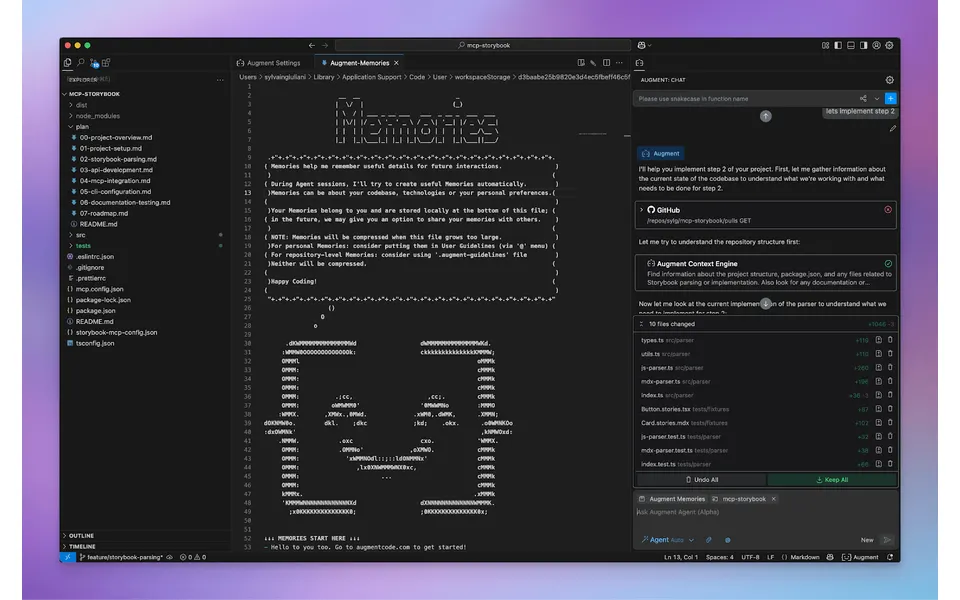
- Desktop app
- Not listed
- Browser
- Yes
- Phone
- Phone browser
- Command line
- Yes
- Agents
- No
- Your subscription
- Not listed
- Agents run
- On your computer, on your own server and in the vendor's cloud
- Laptop closed
- Keeps going
- Isolation
- Worktree and VM
- Parallel agents
- Yes
- Scheduled runs
- Yes
- Coordinator agent
- Yes
- Built-in issues
- Not listed
- Pull requests
- Yes
- Review screen
- Yes
- Team
- Roles and SSO
- Self-hosting
- Not listed
- Licence
- Custom terms
- Price from
- Up to $20/month
- How it charges
- Subscription, usage-based and per machine or compute
- Paid plans from
- $11–20/month
Receipts
- Checked
- · oldest answer 2026-11-07
- Findings
- 41 published · 37 cross-checked by a second agent · read them all
- Sources
- 24 public pages on 3 sites: docs.augmentcode.com, augmentcode.com, harness.io
- Screenshot
- augmentcode.com, retrieved · first party release · shows appearance, not capability
- Method
- Same rules for all 103 researched ADEs. How we check · Report wrong data
What it does
Where you use it
Cosmos explicitly has no separate iOS or Android app. Cosmos sessions are accessed through the web app; the docs also name phone and Slack access without establishing native mobile clients. Cosmos sessions are accessible in a phone browser. Auggie is the terminal client with Augment's agent and Context Engine. The introduction links VS Code and JetBrains clients separately from Cosmos and Auggie CLI.
Source and scope for Where you use itAgents it runs
Augment supplies the Auggie/Cosmos coding agent with a selectable model catalog. Named model providers do not represent separate Claude Code, Codex CLI, Cursor Agent, Gemini CLI, OpenCode, Pi, Grok CLI, Aider or Antigravity harness integrations.
Source and scope for Agents it runsAccounts and subscriptions
The CLI setup requires an Augment account login.
Source and scope for Accounts and subscriptionsWhere agents run
Auggie CLI executes beside local code with Node 20+ on macOS, Linux or Windows WSL. The vendor advertises own machines or mixed pools alongside managed cloud sandboxes; provisioning details were not established. Cosmos runs agents in cloud VMs; an Environment defines base image, repositories and environment variables.
Source and scope for Where agents runHow work is kept apart
Each isolated daemon session gets a separate Git worktree for every configured repository. Cloud work uses sandboxed VMs; security isolation was not tested. Isolated worktree edits do not affect the daemon primary checkout. Git worktrees separate files; a shared daemon workspace allows concurrent sessions to overwrite changes and is not a security sandbox.
Source and scope for How work is kept apartParallel work
Auggie subagents run in parallel with independent context. Standard and Business list 50 concurrent sessions; Enterprise lists unlimited concurrent sessions. Subagents summarize their current progress in the main thread.
Source and scope for Parallel workScheduled runs
Cron is a documented Cosmos trigger source. Persistent Automation rules launch or wake sessions in response to connected-service events.
Source and scope for Scheduled runsGit and pull requests
PR Author creates the implementation branch. PR Author opens a pull or merge request. PR Author responds to review comments. PR Author fixes CI failures. PR Author handles merge conflicts during follow-up.
Source and scope for Git and pull requestsLicence and source
The main Augment/Auggie/Cosmos platform is governed by vendor-authored professional/enterprise service terms. These grant limited internal-business access and reserve platform intellectual property; no open-source license for the core application is granted there.
Source and scope for Licence and sourcePrice
Public plans are USD monthly. Standard costs $20/month and Business $100/month for up to fifty seats, with equal included dollar usage, checked 7 November 2026. Standard and Business include up to 50 seats without per-seat charges. Standard is a flat $20/month and Business $100/month. Standard includes $20 and Business $100 in monthly pooled LLM, Context Engine and compute usage. Top-ups expire twelve months after purchase. Teams can add pay-as-you-go top-ups. LLM inference uses provider public API rates with an added 40% service fee. Compute is separately metered; the 40% LLM service fee does not apply to compute. The complete public offering lists paid Standard, Business and Enterprise, with no recurring free plan, BYOK plan or one-time license.
Source and scope for PriceTyped filters
Every value links to its receipt below. Read plan and surface restrictions before using a filter to decide.
| Filter | Value |
|---|---|
| Desktop OS: macOS | Unknown |
| Desktop OS: Windows | Unknown |
| Desktop OS: Linux | Unknown |
| Web client | Yes cross-checked |
| Phone access: Native iOS | No cross-checked |
| Phone access: Native Android | No cross-checked |
| Phone access: Phone browser | Yes cross-checked |
| CLI | Yes cross-checked |
| Coding agents: Claude Code | No |
| Coding agents: Codex | No |
| Coding agents: Cursor Agent | No |
| Coding agents: Gemini CLI | No |
| Coding agents: OpenCode | No |
| Coding agents: Pi | No |
| Coding agents: Grok | No |
| Coding agents: Aider | No |
| Coding agents: Antigravity | No |
| Use my subscription | Unknown |
| Where agents run: On your computer | Yes cross-checked |
| Where agents run: On your own server | Yes cross-checked |
| Where agents run: In the vendor's cloud | Yes cross-checked |
| Workspace isolation: Git worktree | Yes cross-checked |
| Workspace isolation: Container | Unknown |
| Workspace isolation: VM or microVM | Yes cross-checked |
| Parallel runs | Yes cross-checked |
| Coordinator | Yes cross-checked |
| Native issue tracking | Unknown |
| Unattended triggers | Yes cross-checked |
| Shared prompting | Unknown |
| Team roles | Yes cross-checked |
| SSO | Yes cross-checked |
| Pull request workflow | Yes cross-checked |
| Review interface | Yes cross-checked |
| Product license: Apache-2.0 | No. Custom terms |
| Product license: MIT | No. Custom terms |
| Product license: GPL-3.0 | No. Custom terms |
| Product license: GPL-3.0-or-later | No. Custom terms |
| Product license: AGPL-3.0 | No. Custom terms |
| Product license: AGPL-3.0-or-later | No. Custom terms |
| Product license: Elastic License 2.0 | No. Custom terms |
| Product license: Custom terms | Yes. Custom terms |
| Product license: Proprietary | No. Custom terms |
| Self-hosting | Unknown |
| Telemetry opt-out | Unknown |
| Free access | No |
| Starting price: Free | No. Up to $20/month |
| Starting price: Up to $20/month | Yes. Up to $20/month |
| Starting price: $21–40/month | No. Up to $20/month |
| Starting price: $41–100/month | No. Up to $20/month |
| Starting price: Over $100/month | No. Up to $20/month |
| Starting price: Contact for pricing | No. Up to $20/month |
| Pricing model: Free, no paid plan | No |
| Pricing model: Free plan | No |
| Pricing model: Subscription | Yes |
| Pricing model: Per seat | No |
| Pricing model: Usage-based | Yes |
| Pricing model: Per machine or compute | Yes |
| Pricing model: Bring your own key | No |
| Pricing model: One-time purchase | No |
| Paid plans from: No paid plan | No. $11–20/month |
| Paid plans from: $10 or less/month | No. $11–20/month |
| Paid plans from: $11–20/month | Yes. $11–20/month |
| Paid plans from: $21–40/month | No. $11–20/month |
| Paid plans from: $41–100/month | No. $11–20/month |
| Paid plans from: Over $100/month | No. $11–20/month |
| Paid plans from: Contact sales | No. $11–20/month |
| Lifecycle status: Active | Unknown |
| Lifecycle status: Sunsetting | Unknown |
| Keeps going with laptop closed | Yes |
| Open-source license | No. Custom terms |
| Any desktop app | Unknown |
| Paid plan up to $20/month | Yes. $11–20/month |
| Paid plan up to $40/month | Yes. $11–20/month |
| Any phone client | Yes cross-checked |
Filter receipts
Web client: Yes cross-checked
Web client
Typed value: Yes.
Cosmos explicitly has no separate iOS or Android app. Cosmos sessions are accessed through the web app; the docs also name phone and Slack access without establishing native mobile clients. Cosmos sessions are accessible in a phone browser. Auggie is the terminal client with Augment's agent and Context Engine. The introduction links VS Code and JetBrains clients separately from Cosmos and Auggie CLI.
- Browser: Cosmos sessions are accessed through the web app; the docs also name phone and Slack access without establishing native mobile clients.
- Unknown after the targeted first-party documentation, release and repository pass: desktop_os, task_actions, notifications, cross_device_continuity. No configured product fixture was run; documentation does not establish successful hands-on behavior.
-
Finding: Cosmos runs Experts in sandboxed VMs with triggers, private/shared sessions and persistent automation rules.
Phone access: Native iOS: No cross-checked
Phone access: Native iOS
Typed value: No.
Cosmos explicitly has no separate iOS or Android app. Cosmos sessions are accessed through the web app; the docs also name phone and Slack access without establishing native mobile clients. Cosmos sessions are accessible in a phone browser. Auggie is the terminal client with Augment's agent and Context Engine. The introduction links VS Code and JetBrains clients separately from Cosmos and Auggie CLI.
- Mobile apps: Cosmos explicitly has no separate iOS or Android app.
- Mobile browser: Cosmos sessions are accessible in a phone browser.
- Unknown after the targeted first-party documentation, release and repository pass: desktop_os, task_actions, notifications, cross_device_continuity. No configured product fixture was run; documentation does not establish successful hands-on behavior.
-
Finding: Cosmos supports phone browsers, explicitly has no separate iOS/Android app, saves conversations indefinitely, and gives individually shared users viewer access. Environments pause and may restart clean.
Phone access: Native Android: No cross-checked
Phone access: Native Android
Typed value: No.
Cosmos explicitly has no separate iOS or Android app. Cosmos sessions are accessed through the web app; the docs also name phone and Slack access without establishing native mobile clients. Cosmos sessions are accessible in a phone browser. Auggie is the terminal client with Augment's agent and Context Engine. The introduction links VS Code and JetBrains clients separately from Cosmos and Auggie CLI.
- Mobile apps: Cosmos explicitly has no separate iOS or Android app.
- Mobile browser: Cosmos sessions are accessible in a phone browser.
- Unknown after the targeted first-party documentation, release and repository pass: desktop_os, task_actions, notifications, cross_device_continuity. No configured product fixture was run; documentation does not establish successful hands-on behavior.
-
Finding: Cosmos supports phone browsers, explicitly has no separate iOS/Android app, saves conversations indefinitely, and gives individually shared users viewer access. Environments pause and may restart clean.
Phone access: Phone browser: Yes cross-checked
Phone access: Phone browser
Typed value: Yes.
Cosmos explicitly has no separate iOS or Android app. Cosmos sessions are accessed through the web app; the docs also name phone and Slack access without establishing native mobile clients. Cosmos sessions are accessible in a phone browser. Auggie is the terminal client with Augment's agent and Context Engine. The introduction links VS Code and JetBrains clients separately from Cosmos and Auggie CLI.
- Mobile apps: Cosmos explicitly has no separate iOS or Android app.
- Mobile browser: Cosmos sessions are accessible in a phone browser.
- Unknown after the targeted first-party documentation, release and repository pass: desktop_os, task_actions, notifications, cross_device_continuity. No configured product fixture was run; documentation does not establish successful hands-on behavior.
-
Finding: Cosmos supports phone browsers, explicitly has no separate iOS/Android app, saves conversations indefinitely, and gives individually shared users viewer access. Environments pause and may restart clean.
CLI: Yes cross-checked
CLI
Typed value: Yes.
Cosmos explicitly has no separate iOS or Android app. Cosmos sessions are accessed through the web app; the docs also name phone and Slack access without establishing native mobile clients. Cosmos sessions are accessible in a phone browser. Auggie is the terminal client with Augment's agent and Context Engine. The introduction links VS Code and JetBrains clients separately from Cosmos and Auggie CLI.
- Cli: Auggie is the terminal client with Augment's agent and Context Engine.
- Editor extensions: The introduction links VS Code and JetBrains clients separately from Cosmos and Auggie CLI.
- Unknown after the targeted first-party documentation, release and repository pass: desktop_os, task_actions, notifications, cross_device_continuity. No configured product fixture was run; documentation does not establish successful hands-on behavior.
-
Finding: Augment distinguishes Cosmos automations, Auggie CLI and VS Code/JetBrains integrations; capabilities are not inherited across clients.
Coding agents: Claude Code: No
Coding agents: Claude Code
Typed value: No.
Augment supplies the Auggie/Cosmos coding agent with a selectable model catalog. Named model providers do not represent separate Claude Code, Codex CLI, Cursor Agent, Gemini CLI, OpenCode, Pi, Grok CLI, Aider or Antigravity harness integrations.
- Harnesses: Product runtime is Augment/Auggie and Cosmos experts across documented clients, rather than selectable external coding CLI harnesses.
- Unknown after the targeted first-party documentation, release and repository pass: harnesses, custom_adapters, session_integration, mixed_harness_operation. No configured product fixture was run; documentation does not establish successful hands-on behavior.
-
Finding: The introduction distinguishes the Cosmos automation product, Auggie CLI and Augment IDE clients. The coding workflow is supplied by Augment/Auggie and Cosmos experts; selected Anthropic/OpenAI/Google/xAI model providers do not run those vendors coding CLI harnesses.
Coding agents: Codex: No
Coding agents: Codex
Typed value: No.
Augment supplies the Auggie/Cosmos coding agent with a selectable model catalog. Named model providers do not represent separate Claude Code, Codex CLI, Cursor Agent, Gemini CLI, OpenCode, Pi, Grok CLI, Aider or Antigravity harness integrations.
- Harnesses: Product runtime is Augment/Auggie and Cosmos experts across documented clients, rather than selectable external coding CLI harnesses.
- Unknown after the targeted first-party documentation, release and repository pass: harnesses, custom_adapters, session_integration, mixed_harness_operation. No configured product fixture was run; documentation does not establish successful hands-on behavior.
-
Finding: The introduction distinguishes the Cosmos automation product, Auggie CLI and Augment IDE clients. The coding workflow is supplied by Augment/Auggie and Cosmos experts; selected Anthropic/OpenAI/Google/xAI model providers do not run those vendors coding CLI harnesses.
Coding agents: Cursor Agent: No
Coding agents: Cursor Agent
Typed value: No.
Augment supplies the Auggie/Cosmos coding agent with a selectable model catalog. Named model providers do not represent separate Claude Code, Codex CLI, Cursor Agent, Gemini CLI, OpenCode, Pi, Grok CLI, Aider or Antigravity harness integrations.
- Harnesses: Product runtime is Augment/Auggie and Cosmos experts across documented clients, rather than selectable external coding CLI harnesses.
- Unknown after the targeted first-party documentation, release and repository pass: harnesses, custom_adapters, session_integration, mixed_harness_operation. No configured product fixture was run; documentation does not establish successful hands-on behavior.
-
Finding: The introduction distinguishes the Cosmos automation product, Auggie CLI and Augment IDE clients. The coding workflow is supplied by Augment/Auggie and Cosmos experts; selected Anthropic/OpenAI/Google/xAI model providers do not run those vendors coding CLI harnesses.
Coding agents: Gemini CLI: No
Coding agents: Gemini CLI
Typed value: No.
Augment supplies the Auggie/Cosmos coding agent with a selectable model catalog. Named model providers do not represent separate Claude Code, Codex CLI, Cursor Agent, Gemini CLI, OpenCode, Pi, Grok CLI, Aider or Antigravity harness integrations.
- Harnesses: Product runtime is Augment/Auggie and Cosmos experts across documented clients, rather than selectable external coding CLI harnesses.
- Unknown after the targeted first-party documentation, release and repository pass: harnesses, custom_adapters, session_integration, mixed_harness_operation. No configured product fixture was run; documentation does not establish successful hands-on behavior.
-
Finding: The introduction distinguishes the Cosmos automation product, Auggie CLI and Augment IDE clients. The coding workflow is supplied by Augment/Auggie and Cosmos experts; selected Anthropic/OpenAI/Google/xAI model providers do not run those vendors coding CLI harnesses.
Coding agents: OpenCode: No
Coding agents: OpenCode
Typed value: No.
Augment supplies the Auggie/Cosmos coding agent with a selectable model catalog. Named model providers do not represent separate Claude Code, Codex CLI, Cursor Agent, Gemini CLI, OpenCode, Pi, Grok CLI, Aider or Antigravity harness integrations.
- Harnesses: Product runtime is Augment/Auggie and Cosmos experts across documented clients, rather than selectable external coding CLI harnesses.
- Unknown after the targeted first-party documentation, release and repository pass: harnesses, custom_adapters, session_integration, mixed_harness_operation. No configured product fixture was run; documentation does not establish successful hands-on behavior.
-
Finding: The introduction distinguishes the Cosmos automation product, Auggie CLI and Augment IDE clients. The coding workflow is supplied by Augment/Auggie and Cosmos experts; selected Anthropic/OpenAI/Google/xAI model providers do not run those vendors coding CLI harnesses.
Coding agents: Pi: No
Coding agents: Pi
Typed value: No.
Augment supplies the Auggie/Cosmos coding agent with a selectable model catalog. Named model providers do not represent separate Claude Code, Codex CLI, Cursor Agent, Gemini CLI, OpenCode, Pi, Grok CLI, Aider or Antigravity harness integrations.
- Harnesses: Product runtime is Augment/Auggie and Cosmos experts across documented clients, rather than selectable external coding CLI harnesses.
- Unknown after the targeted first-party documentation, release and repository pass: harnesses, custom_adapters, session_integration, mixed_harness_operation. No configured product fixture was run; documentation does not establish successful hands-on behavior.
-
Finding: The introduction distinguishes the Cosmos automation product, Auggie CLI and Augment IDE clients. The coding workflow is supplied by Augment/Auggie and Cosmos experts; selected Anthropic/OpenAI/Google/xAI model providers do not run those vendors coding CLI harnesses.
Coding agents: Grok: No
Coding agents: Grok
Typed value: No.
Augment supplies the Auggie/Cosmos coding agent with a selectable model catalog. Named model providers do not represent separate Claude Code, Codex CLI, Cursor Agent, Gemini CLI, OpenCode, Pi, Grok CLI, Aider or Antigravity harness integrations.
- Harnesses: Product runtime is Augment/Auggie and Cosmos experts across documented clients, rather than selectable external coding CLI harnesses.
- Unknown after the targeted first-party documentation, release and repository pass: harnesses, custom_adapters, session_integration, mixed_harness_operation. No configured product fixture was run; documentation does not establish successful hands-on behavior.
-
Finding: The introduction distinguishes the Cosmos automation product, Auggie CLI and Augment IDE clients. The coding workflow is supplied by Augment/Auggie and Cosmos experts; selected Anthropic/OpenAI/Google/xAI model providers do not run those vendors coding CLI harnesses.
Coding agents: Aider: No
Coding agents: Aider
Typed value: No.
Augment supplies the Auggie/Cosmos coding agent with a selectable model catalog. Named model providers do not represent separate Claude Code, Codex CLI, Cursor Agent, Gemini CLI, OpenCode, Pi, Grok CLI, Aider or Antigravity harness integrations.
- Harnesses: Product runtime is Augment/Auggie and Cosmos experts across documented clients, rather than selectable external coding CLI harnesses.
- Unknown after the targeted first-party documentation, release and repository pass: harnesses, custom_adapters, session_integration, mixed_harness_operation. No configured product fixture was run; documentation does not establish successful hands-on behavior.
-
Finding: The introduction distinguishes the Cosmos automation product, Auggie CLI and Augment IDE clients. The coding workflow is supplied by Augment/Auggie and Cosmos experts; selected Anthropic/OpenAI/Google/xAI model providers do not run those vendors coding CLI harnesses.
Coding agents: Antigravity: No
Coding agents: Antigravity
Typed value: No.
Augment supplies the Auggie/Cosmos coding agent with a selectable model catalog. Named model providers do not represent separate Claude Code, Codex CLI, Cursor Agent, Gemini CLI, OpenCode, Pi, Grok CLI, Aider or Antigravity harness integrations.
- Harnesses: Product runtime is Augment/Auggie and Cosmos experts across documented clients, rather than selectable external coding CLI harnesses.
- Unknown after the targeted first-party documentation, release and repository pass: harnesses, custom_adapters, session_integration, mixed_harness_operation. No configured product fixture was run; documentation does not establish successful hands-on behavior.
-
Finding: The introduction distinguishes the Cosmos automation product, Auggie CLI and Augment IDE clients. The coding workflow is supplied by Augment/Auggie and Cosmos experts; selected Anthropic/OpenAI/Google/xAI model providers do not run those vendors coding CLI harnesses.
Where agents run: On your computer: Yes cross-checked
Where agents run: On your computer
Typed value: Yes.
Auggie CLI executes beside local code with Node 20+ on macOS, Linux or Windows WSL. The vendor advertises own machines or mixed pools alongside managed cloud sandboxes; provisioning details were not established. Cosmos runs agents in cloud VMs; an Environment defines base image, repositories and environment variables.
- Local: Auggie CLI executes beside local code with Node 20+ on macOS, Linux or Windows WSL.
- Unknown after the targeted first-party documentation, release and repository pass: self_hosted, hybrid, provisioning, payer, resources, region, expiry, client_disconnect, other_device_continuation. No configured product fixture was run; documentation does not establish successful hands-on behavior.
-
Finding: Auggie runs locally or on a server with Node 20+, macOS, Linux or Windows WSL and zsh/bash/fish. Version 1 is prerelease; stable 0.x remains available.
Where agents run: On your own server: Yes cross-checked
Where agents run: On your own server
Typed value: Yes.
Auggie CLI executes beside local code with Node 20+ on macOS, Linux or Windows WSL. The vendor advertises own machines or mixed pools alongside managed cloud sandboxes; provisioning details were not established. Cosmos runs agents in cloud VMs; an Environment defines base image, repositories and environment variables.
- Byo remote: The vendor advertises own machines or mixed pools alongside managed cloud sandboxes; provisioning details were not established.
- Unknown after the targeted first-party documentation, release and repository pass: self_hosted, hybrid, provisioning, payer, resources, region, expiry, client_disconnect, other_device_continuation. No configured product fixture was run; documentation does not establish successful hands-on behavior.
-
Finding: The vendor advertises managed and user-owned execution, shared memory, expert handoffs and human checkpoints. These claims were not exercised.
Where agents run: In the vendor's cloud: Yes cross-checked
Where agents run: In the vendor's cloud
Typed value: Yes.
Auggie CLI executes beside local code with Node 20+ on macOS, Linux or Windows WSL. The vendor advertises own machines or mixed pools alongside managed cloud sandboxes; provisioning details were not established. Cosmos runs agents in cloud VMs; an Environment defines base image, repositories and environment variables.
- Managed cloud: Cosmos runs agents in cloud VMs; an Environment defines base image, repositories and environment variables.
- Unknown after the targeted first-party documentation, release and repository pass: self_hosted, hybrid, provisioning, payer, resources, region, expiry, client_disconnect, other_device_continuation. No configured product fixture was run; documentation does not establish successful hands-on behavior.
-
Finding: Cosmos runs Experts in sandboxed VMs with triggers, private/shared sessions and persistent automation rules.
Workspace isolation: Git worktree: Yes cross-checked
Workspace isolation: Git worktree
Typed value: Yes.
Each isolated daemon session gets a separate Git worktree for every configured repository. Cloud work uses sandboxed VMs; security isolation was not tested. Isolated worktree edits do not affect the daemon primary checkout. Git worktrees separate files; a shared daemon workspace allows concurrent sessions to overwrite changes and is not a security sandbox.
- Worktree: Each isolated daemon session gets a separate Git worktree for every configured repository.
- Code separation: Isolated worktree edits do not affect the daemon primary checkout.
- Security boundary: Git worktrees separate files; a shared daemon workspace allows concurrent sessions to overwrite changes and is not a security sandbox.
- Unknown after the targeted first-party documentation, release and repository pass: checkout, branch, container, os_sandbox, filesystem, process, network, secrets. No configured product fixture was run; documentation does not establish successful hands-on behavior.
-
Daemon Workspaces and Isolation
Finding: Isolated daemon sessions get one Git worktree per repository. Shared sessions edit the daemon checkout and may overwrite each other. Isolation requires Git 2.31+.
Workspace isolation: VM or microVM: Yes cross-checked
Workspace isolation: VM or microVM
Typed value: Yes.
Each isolated daemon session gets a separate Git worktree for every configured repository. Cloud work uses sandboxed VMs; security isolation was not tested. Isolated worktree edits do not affect the daemon primary checkout. Git worktrees separate files; a shared daemon workspace allows concurrent sessions to overwrite changes and is not a security sandbox.
- Vm: Cloud work uses sandboxed VMs; security isolation was not tested.
- Unknown after the targeted first-party documentation, release and repository pass: checkout, branch, container, os_sandbox, filesystem, process, network, secrets. No configured product fixture was run; documentation does not establish successful hands-on behavior.
-
Finding: Cosmos runs Experts in sandboxed VMs with triggers, private/shared sessions and persistent automation rules.
Parallel runs: Yes cross-checked
Parallel runs
Typed value: Yes.
Auggie subagents run in parallel with independent context. Standard and Business list 50 concurrent sessions; Enterprise lists unlimited concurrent sessions. Subagents summarize their current progress in the main thread.
- Concurrent sessions: Auggie subagents run in parallel with independent context.
- Status visibility: Subagents summarize their current progress in the main thread.
- Unknown after the targeted first-party documentation, release and repository pass: concurrent_tasks, observed_concurrency. No configured product fixture was run; documentation does not establish successful hands-on behavior.
-
Finding: Built-in and custom subagents have independent context, tools and prompts, run concurrently and report progress in the parent thread. Configuration includes model and thinking level.
Coordinator: Yes cross-checked
Coordinator
Typed value: Yes.
Project Builder coordinates PR Author implementation workers. Custom Auggie subagent definitions select tools, model, thinking level and prompt. Project Builder reports when changes are ready for review and when the feature is complete. The product-owned Project Builder Expert dispatches workers. Project Builder launches PR Author workers per unit of work. Subagents report progress summaries in the main thread. The /agents command creates a local or repository-shared subagent definition.
- Roles: Project Builder coordinates PR Author implementation workers.
- Results return: Project Builder reports when changes are ready for review and when the feature is complete.
- Orchestration owner: The product-owned Project Builder Expert dispatches workers.
- Activation: Project Builder launches PR Author workers per unit of work.
- Unknown after the targeted first-party documentation, release and repository pass: messages, cross_harness, authentication, retained_results, followup. No configured product fixture was run; documentation does not establish successful hands-on behavior.
-
Finding: The Expert drafts a design, iterates with the human, breaks work into tickets and launches PR Author workers in dependency waves. It never writes implementation code or merges.
Unattended triggers: Yes cross-checked
Unattended triggers
Typed value: Yes.
Cron is a documented Cosmos trigger source. Persistent Automation rules launch or wake sessions in response to connected-service events.
- Schedules: Cron is a documented Cosmos trigger source.
- Events: Persistent Automation rules launch or wake sessions in response to connected-service events.
- Unattended triggers: first-party sources in this pass did not establish recurring_tasks, completion_conditions, scheduler_location, overlaps, retries, client_independence. No concurrent-worker, duplicate-claim, delegation-retention or twelve-state fleet fixture was run. UI labels alone do not establish enforcement.
-
Finding: Cosmos runs Experts in sandboxed VMs with triggers, private/shared sessions and persistent automation rules.
Team roles: Yes cross-checked
Team roles
Typed value: Yes.
Administrator and Member have separate membership, billing and plan permissions. Administrators invite or remove members; members can remove themselves. Enterprise lists SSO, OIDC and SCIM.
- Organization roles: Administrator and Member have separate membership, billing and plan permissions.
- Membership: Administrators invite or remove members; members can remove themselves.
- Unknown after the targeted first-party documentation, release and repository pass: project_roles, task_roles, provisioning, unauthorized_access, revocation, plan_scope. No configured product fixture was run; documentation does not establish successful hands-on behavior.
-
Finding: Administrator manages invites, members, seats, plan and billing. Member can view team information or leave, but cannot administer billing or membership.
SSO: Yes cross-checked
SSO
Typed value: Yes.
Administrator and Member have separate membership, billing and plan permissions. Administrators invite or remove members; members can remove themselves. Enterprise lists SSO, OIDC and SCIM.
- Sso: Enterprise lists SSO, OIDC and SCIM.
- Unknown after the targeted first-party documentation, release and repository pass: project_roles, task_roles, provisioning, unauthorized_access, revocation, plan_scope. No configured product fixture was run; documentation does not establish successful hands-on behavior.
-
Finding: Standard and Business are flat team prices with pooled dollar usage; LLM API list price has a 40% service fee and compute is separate.
Pull request workflow: Yes cross-checked
Pull request workflow
Typed value: Yes.
PR Author creates the implementation branch. PR Author opens a pull or merge request. PR Author responds to review comments. PR Author fixes CI failures. PR Author handles merge conflicts during follow-up.
- Branches: PR Author creates the implementation branch.
- Pull requests: PR Author opens a pull or merge request.
- Comments: PR Author responds to review comments.
- Ci response: PR Author fixes CI failures.
- Conflicts: PR Author handles merge conflicts during follow-up.
- Unknown after the targeted first-party documentation, release and repository pass: worktrees, commits, rebase, product_state. No configured product fixture was run; documentation does not establish successful hands-on behavior.
-
Finding: PR Author creates branches and pull or merge requests, follows CI, handles merge conflicts and responds to review comments.
Review interface: Yes cross-checked
Review interface
Typed value: Yes.
Tasks and Changes views show diffs for each completed task.
- Change understanding: Tasks and Changes views show diffs for each completed task.
- Unknown after the targeted first-party documentation, release and repository pass: pending_reviews, evidence_navigation, comments, request_changes, shipping_guidance, effort, missed_evidence, keyboard, narrow_screen, context_switching, roles, retained_context. No configured product fixture was run; documentation does not establish successful hands-on behavior.
-
Finding: IDE Tasklist supports human and agent creation, editable nested tasks, explicit execution, state indicators, moving lists to a new chat and per-task diff review.
Product license: Apache-2.0: No. Custom terms
Product license: Apache-2.0
Typed value: No. Custom terms.
The main Augment/Auggie/Cosmos platform is governed by vendor-authored professional/enterprise service terms. These grant limited internal-business access and reserve platform intellectual property; no open-source license for the core application is granted there.
- Client license: Vendor professional terms govern limited access to the software-engineering AI platform, with modification/distribution restrictions and retained company ownership.
- Server license: Access to the platform service follows the vendor agreement and order terms.
- Source inspection covers the scoped release only. Unanswered atomic questions remain unknown; no live scenario was run.
-
Augment Code professional terms of service
Finding: The main software-engineering AI platform is covered by Augment professional terms. Customer access is non-exclusive/non-transferable and limited to internal business use; distribution, reverse engineering and derivative versions are restricted, and the company retains platform intellectual property.
Product license: MIT: No. Custom terms
Product license: MIT
Typed value: No. Custom terms.
The main Augment/Auggie/Cosmos platform is governed by vendor-authored professional/enterprise service terms. These grant limited internal-business access and reserve platform intellectual property; no open-source license for the core application is granted there.
- Client license: Vendor professional terms govern limited access to the software-engineering AI platform, with modification/distribution restrictions and retained company ownership.
- Server license: Access to the platform service follows the vendor agreement and order terms.
- Source inspection covers the scoped release only. Unanswered atomic questions remain unknown; no live scenario was run.
-
Augment Code professional terms of service
Finding: The main software-engineering AI platform is covered by Augment professional terms. Customer access is non-exclusive/non-transferable and limited to internal business use; distribution, reverse engineering and derivative versions are restricted, and the company retains platform intellectual property.
Product license: GPL-3.0: No. Custom terms
Product license: GPL-3.0
Typed value: No. Custom terms.
The main Augment/Auggie/Cosmos platform is governed by vendor-authored professional/enterprise service terms. These grant limited internal-business access and reserve platform intellectual property; no open-source license for the core application is granted there.
- Client license: Vendor professional terms govern limited access to the software-engineering AI platform, with modification/distribution restrictions and retained company ownership.
- Server license: Access to the platform service follows the vendor agreement and order terms.
- Source inspection covers the scoped release only. Unanswered atomic questions remain unknown; no live scenario was run.
-
Augment Code professional terms of service
Finding: The main software-engineering AI platform is covered by Augment professional terms. Customer access is non-exclusive/non-transferable and limited to internal business use; distribution, reverse engineering and derivative versions are restricted, and the company retains platform intellectual property.
Product license: GPL-3.0-or-later: No. Custom terms
Product license: GPL-3.0-or-later
Typed value: No. Custom terms.
The main Augment/Auggie/Cosmos platform is governed by vendor-authored professional/enterprise service terms. These grant limited internal-business access and reserve platform intellectual property; no open-source license for the core application is granted there.
- Client license: Vendor professional terms govern limited access to the software-engineering AI platform, with modification/distribution restrictions and retained company ownership.
- Server license: Access to the platform service follows the vendor agreement and order terms.
- Source inspection covers the scoped release only. Unanswered atomic questions remain unknown; no live scenario was run.
-
Augment Code professional terms of service
Finding: The main software-engineering AI platform is covered by Augment professional terms. Customer access is non-exclusive/non-transferable and limited to internal business use; distribution, reverse engineering and derivative versions are restricted, and the company retains platform intellectual property.
Product license: AGPL-3.0: No. Custom terms
Product license: AGPL-3.0
Typed value: No. Custom terms.
The main Augment/Auggie/Cosmos platform is governed by vendor-authored professional/enterprise service terms. These grant limited internal-business access and reserve platform intellectual property; no open-source license for the core application is granted there.
- Client license: Vendor professional terms govern limited access to the software-engineering AI platform, with modification/distribution restrictions and retained company ownership.
- Server license: Access to the platform service follows the vendor agreement and order terms.
- Source inspection covers the scoped release only. Unanswered atomic questions remain unknown; no live scenario was run.
-
Augment Code professional terms of service
Finding: The main software-engineering AI platform is covered by Augment professional terms. Customer access is non-exclusive/non-transferable and limited to internal business use; distribution, reverse engineering and derivative versions are restricted, and the company retains platform intellectual property.
Product license: AGPL-3.0-or-later: No. Custom terms
Product license: AGPL-3.0-or-later
Typed value: No. Custom terms.
The main Augment/Auggie/Cosmos platform is governed by vendor-authored professional/enterprise service terms. These grant limited internal-business access and reserve platform intellectual property; no open-source license for the core application is granted there.
- Client license: Vendor professional terms govern limited access to the software-engineering AI platform, with modification/distribution restrictions and retained company ownership.
- Server license: Access to the platform service follows the vendor agreement and order terms.
- Source inspection covers the scoped release only. Unanswered atomic questions remain unknown; no live scenario was run.
-
Augment Code professional terms of service
Finding: The main software-engineering AI platform is covered by Augment professional terms. Customer access is non-exclusive/non-transferable and limited to internal business use; distribution, reverse engineering and derivative versions are restricted, and the company retains platform intellectual property.
Product license: Elastic License 2.0: No. Custom terms
Product license: Elastic License 2.0
Typed value: No. Custom terms.
The main Augment/Auggie/Cosmos platform is governed by vendor-authored professional/enterprise service terms. These grant limited internal-business access and reserve platform intellectual property; no open-source license for the core application is granted there.
- Client license: Vendor professional terms govern limited access to the software-engineering AI platform, with modification/distribution restrictions and retained company ownership.
- Server license: Access to the platform service follows the vendor agreement and order terms.
- Source inspection covers the scoped release only. Unanswered atomic questions remain unknown; no live scenario was run.
-
Augment Code professional terms of service
Finding: The main software-engineering AI platform is covered by Augment professional terms. Customer access is non-exclusive/non-transferable and limited to internal business use; distribution, reverse engineering and derivative versions are restricted, and the company retains platform intellectual property.
Product license: Custom terms: Yes. Custom terms
Product license: Custom terms
Typed value: Yes. Custom terms.
The main Augment/Auggie/Cosmos platform is governed by vendor-authored professional/enterprise service terms. These grant limited internal-business access and reserve platform intellectual property; no open-source license for the core application is granted there.
- Client license: Vendor professional terms govern limited access to the software-engineering AI platform, with modification/distribution restrictions and retained company ownership.
- Server license: Access to the platform service follows the vendor agreement and order terms.
- Source inspection covers the scoped release only. Unanswered atomic questions remain unknown; no live scenario was run.
-
Augment Code professional terms of service
Finding: The main software-engineering AI platform is covered by Augment professional terms. Customer access is non-exclusive/non-transferable and limited to internal business use; distribution, reverse engineering and derivative versions are restricted, and the company retains platform intellectual property.
Product license: Proprietary: No. Custom terms
Product license: Proprietary
Typed value: No. Custom terms.
The main Augment/Auggie/Cosmos platform is governed by vendor-authored professional/enterprise service terms. These grant limited internal-business access and reserve platform intellectual property; no open-source license for the core application is granted there.
- Client license: Vendor professional terms govern limited access to the software-engineering AI platform, with modification/distribution restrictions and retained company ownership.
- Server license: Access to the platform service follows the vendor agreement and order terms.
- Source inspection covers the scoped release only. Unanswered atomic questions remain unknown; no live scenario was run.
-
Augment Code professional terms of service
Finding: The main software-engineering AI platform is covered by Augment professional terms. Customer access is non-exclusive/non-transferable and limited to internal business use; distribution, reverse engineering and derivative versions are restricted, and the company retains platform intellectual property.
Free access: No
Free access
Typed value: No.
The complete public plan list has paid Standard, Business and Enterprise plus trial access, without a recurring free plan or free application offering.
- Ongoing free: No recurring free plan in the complete current public offering; only trials are described separately.
- Paid only: Current public plans are paid Standard/Business/Enterprise, apart from trials.
- Unknown after the targeted first-party documentation, release and repository pass: ongoing_free, credits_trial, self_host_cost, paid_only, early_access, free_scenarios, card_required, usage_caps, paid_evaluation. No configured product fixture was run; documentation does not establish successful hands-on behavior.
-
Finding: The complete current public plans are paid Standard $20/month, Business $100/month and custom Enterprise. Standard/Business pool model/context/compute dollar usage; top-ups are usage based. Trials have separate support terms, with no recurring free tier listed. No BYOK or one-time purchase plan is listed.
Starting price: Free: No. Up to $20/month
Starting price: Free
Typed value: No. Up to $20/month.
Public plans are USD monthly. Standard costs $20/month and Business $100/month for up to fifty seats, with equal included dollar usage, checked 7 November 2026. Standard and Business include up to 50 seats without per-seat charges. Standard is a flat $20/month and Business $100/month. Standard includes $20 and Business $100 in monthly pooled LLM, Context Engine and compute usage. Top-ups expire twelve months after purchase. Teams can add pay-as-you-go top-ups. LLM inference uses provider public API rates with an added 40% service fee. Compute is separately metered; the 40% LLM service fee does not apply to compute. The complete public offering lists paid Standard, Business and Enterprise, with no recurring free plan, BYOK plan or one-time license.
- Interval: Standard costs $20/month and Business $100/month for up to fifty seats, with equal included dollar usage, checked 7 November 2026.
- Unknown after the targeted first-party documentation, release and repository pass: seat_minimum, trial, taxes. No configured product fixture was run; documentation does not establish successful hands-on behavior.
-
Finding: Standard and Business are flat team prices with pooled dollar usage; LLM API list price has a 40% service fee and compute is separate.
Starting price: Up to $20/month: Yes. Up to $20/month
Starting price: Up to $20/month
Typed value: Yes. Up to $20/month.
Public plans are USD monthly. Standard costs $20/month and Business $100/month for up to fifty seats, with equal included dollar usage, checked 7 November 2026. Standard and Business include up to 50 seats without per-seat charges. Standard is a flat $20/month and Business $100/month. Standard includes $20 and Business $100 in monthly pooled LLM, Context Engine and compute usage. Top-ups expire twelve months after purchase. Teams can add pay-as-you-go top-ups. LLM inference uses provider public API rates with an added 40% service fee. Compute is separately metered; the 40% LLM service fee does not apply to compute. The complete public offering lists paid Standard, Business and Enterprise, with no recurring free plan, BYOK plan or one-time license.
- Interval: Standard costs $20/month and Business $100/month for up to fifty seats, with equal included dollar usage, checked 7 November 2026.
- Unknown after the targeted first-party documentation, release and repository pass: seat_minimum, trial, taxes. No configured product fixture was run; documentation does not establish successful hands-on behavior.
-
Finding: Standard and Business are flat team prices with pooled dollar usage; LLM API list price has a 40% service fee and compute is separate.
Starting price: $21–40/month: No. Up to $20/month
Starting price: $21–40/month
Typed value: No. Up to $20/month.
Public plans are USD monthly. Standard costs $20/month and Business $100/month for up to fifty seats, with equal included dollar usage, checked 7 November 2026. Standard and Business include up to 50 seats without per-seat charges. Standard is a flat $20/month and Business $100/month. Standard includes $20 and Business $100 in monthly pooled LLM, Context Engine and compute usage. Top-ups expire twelve months after purchase. Teams can add pay-as-you-go top-ups. LLM inference uses provider public API rates with an added 40% service fee. Compute is separately metered; the 40% LLM service fee does not apply to compute. The complete public offering lists paid Standard, Business and Enterprise, with no recurring free plan, BYOK plan or one-time license.
- Interval: Standard costs $20/month and Business $100/month for up to fifty seats, with equal included dollar usage, checked 7 November 2026.
- Unknown after the targeted first-party documentation, release and repository pass: seat_minimum, trial, taxes. No configured product fixture was run; documentation does not establish successful hands-on behavior.
-
Finding: Standard and Business are flat team prices with pooled dollar usage; LLM API list price has a 40% service fee and compute is separate.
Starting price: $41–100/month: No. Up to $20/month
Starting price: $41–100/month
Typed value: No. Up to $20/month.
Public plans are USD monthly. Standard costs $20/month and Business $100/month for up to fifty seats, with equal included dollar usage, checked 7 November 2026. Standard and Business include up to 50 seats without per-seat charges. Standard is a flat $20/month and Business $100/month. Standard includes $20 and Business $100 in monthly pooled LLM, Context Engine and compute usage. Top-ups expire twelve months after purchase. Teams can add pay-as-you-go top-ups. LLM inference uses provider public API rates with an added 40% service fee. Compute is separately metered; the 40% LLM service fee does not apply to compute. The complete public offering lists paid Standard, Business and Enterprise, with no recurring free plan, BYOK plan or one-time license.
- Interval: Standard costs $20/month and Business $100/month for up to fifty seats, with equal included dollar usage, checked 7 November 2026.
- Unknown after the targeted first-party documentation, release and repository pass: seat_minimum, trial, taxes. No configured product fixture was run; documentation does not establish successful hands-on behavior.
-
Finding: Standard and Business are flat team prices with pooled dollar usage; LLM API list price has a 40% service fee and compute is separate.
Starting price: Over $100/month: No. Up to $20/month
Starting price: Over $100/month
Typed value: No. Up to $20/month.
Public plans are USD monthly. Standard costs $20/month and Business $100/month for up to fifty seats, with equal included dollar usage, checked 7 November 2026. Standard and Business include up to 50 seats without per-seat charges. Standard is a flat $20/month and Business $100/month. Standard includes $20 and Business $100 in monthly pooled LLM, Context Engine and compute usage. Top-ups expire twelve months after purchase. Teams can add pay-as-you-go top-ups. LLM inference uses provider public API rates with an added 40% service fee. Compute is separately metered; the 40% LLM service fee does not apply to compute. The complete public offering lists paid Standard, Business and Enterprise, with no recurring free plan, BYOK plan or one-time license.
- Interval: Standard costs $20/month and Business $100/month for up to fifty seats, with equal included dollar usage, checked 7 November 2026.
- Unknown after the targeted first-party documentation, release and repository pass: seat_minimum, trial, taxes. No configured product fixture was run; documentation does not establish successful hands-on behavior.
-
Finding: Standard and Business are flat team prices with pooled dollar usage; LLM API list price has a 40% service fee and compute is separate.
Starting price: Contact for pricing: No. Up to $20/month
Starting price: Contact for pricing
Typed value: No. Up to $20/month.
Public plans are USD monthly. Standard costs $20/month and Business $100/month for up to fifty seats, with equal included dollar usage, checked 7 November 2026. Standard and Business include up to 50 seats without per-seat charges. Standard is a flat $20/month and Business $100/month. Standard includes $20 and Business $100 in monthly pooled LLM, Context Engine and compute usage. Top-ups expire twelve months after purchase. Teams can add pay-as-you-go top-ups. LLM inference uses provider public API rates with an added 40% service fee. Compute is separately metered; the 40% LLM service fee does not apply to compute. The complete public offering lists paid Standard, Business and Enterprise, with no recurring free plan, BYOK plan or one-time license.
- Interval: Standard costs $20/month and Business $100/month for up to fifty seats, with equal included dollar usage, checked 7 November 2026.
- Unknown after the targeted first-party documentation, release and repository pass: seat_minimum, trial, taxes. No configured product fixture was run; documentation does not establish successful hands-on behavior.
-
Finding: Standard and Business are flat team prices with pooled dollar usage; LLM API list price has a 40% service fee and compute is separate.
Pricing model: Free, no paid plan: No
Pricing model: Free, no paid plan
Typed value: No.
Public plans are USD monthly. Standard costs $20/month and Business $100/month for up to fifty seats, with equal included dollar usage, checked 7 November 2026. Standard and Business include up to 50 seats without per-seat charges. Standard is a flat $20/month and Business $100/month. Standard includes $20 and Business $100 in monthly pooled LLM, Context Engine and compute usage. Top-ups expire twelve months after purchase. Teams can add pay-as-you-go top-ups. LLM inference uses provider public API rates with an added 40% service fee. Compute is separately metered; the 40% LLM service fee does not apply to compute. The complete public offering lists paid Standard, Business and Enterprise, with no recurring free plan, BYOK plan or one-time license.
- Unknown after the targeted first-party documentation, release and repository pass: seat_minimum, trial, taxes. No configured product fixture was run; documentation does not establish successful hands-on behavior.
-
Finding: The complete current public plans are paid Standard $20/month, Business $100/month and custom Enterprise. Standard/Business pool model/context/compute dollar usage; top-ups are usage based. Trials have separate support terms, with no recurring free tier listed. No BYOK or one-time purchase plan is listed.
Pricing model: Free plan: No
Pricing model: Free plan
Typed value: No.
Public plans are USD monthly. Standard costs $20/month and Business $100/month for up to fifty seats, with equal included dollar usage, checked 7 November 2026. Standard and Business include up to 50 seats without per-seat charges. Standard is a flat $20/month and Business $100/month. Standard includes $20 and Business $100 in monthly pooled LLM, Context Engine and compute usage. Top-ups expire twelve months after purchase. Teams can add pay-as-you-go top-ups. LLM inference uses provider public API rates with an added 40% service fee. Compute is separately metered; the 40% LLM service fee does not apply to compute. The complete public offering lists paid Standard, Business and Enterprise, with no recurring free plan, BYOK plan or one-time license.
- Unknown after the targeted first-party documentation, release and repository pass: seat_minimum, trial, taxes. No configured product fixture was run; documentation does not establish successful hands-on behavior.
-
Finding: The complete current public plans are paid Standard $20/month, Business $100/month and custom Enterprise. Standard/Business pool model/context/compute dollar usage; top-ups are usage based. Trials have separate support terms, with no recurring free tier listed. No BYOK or one-time purchase plan is listed.
Pricing model: Subscription: Yes
Pricing model: Subscription
Typed value: Yes.
Public plans are USD monthly. Standard costs $20/month and Business $100/month for up to fifty seats, with equal included dollar usage, checked 7 November 2026. Standard and Business include up to 50 seats without per-seat charges. Standard is a flat $20/month and Business $100/month. Standard includes $20 and Business $100 in monthly pooled LLM, Context Engine and compute usage. Top-ups expire twelve months after purchase. Teams can add pay-as-you-go top-ups. LLM inference uses provider public API rates with an added 40% service fee. Compute is separately metered; the 40% LLM service fee does not apply to compute. The complete public offering lists paid Standard, Business and Enterprise, with no recurring free plan, BYOK plan or one-time license.
- Currency: Public plans are USD monthly.
- Seats: Standard and Business include up to 50 seats without per-seat charges.
- Workspace fees: Standard is a flat $20/month and Business $100/month.
- Included usage: Standard includes $20 and Business $100 in monthly pooled LLM, Context Engine and compute usage.
- Credits: Top-ups expire twelve months after purchase.
- Overages: Teams can add pay-as-you-go top-ups.
- Model cost: LLM inference uses provider public API rates with an added 40% service fee.
- Compute cost: Compute is separately metered; the 40% LLM service fee does not apply to compute.
- Unknown after the targeted first-party documentation, release and repository pass: seat_minimum, trial, taxes. No configured product fixture was run; documentation does not establish successful hands-on behavior.
-
Finding: Standard is $20/month for up to 50 seats with $20 shared usage; Business is $100. LLM list rates plus 40% service fee, compute without that fee, pooled top-ups valid twelve months. Trials exclude SLA.
Pricing model: Per seat: No
Pricing model: Per seat
Typed value: No.
Public plans are USD monthly. Standard costs $20/month and Business $100/month for up to fifty seats, with equal included dollar usage, checked 7 November 2026. Standard and Business include up to 50 seats without per-seat charges. Standard is a flat $20/month and Business $100/month. Standard includes $20 and Business $100 in monthly pooled LLM, Context Engine and compute usage. Top-ups expire twelve months after purchase. Teams can add pay-as-you-go top-ups. LLM inference uses provider public API rates with an added 40% service fee. Compute is separately metered; the 40% LLM service fee does not apply to compute. The complete public offering lists paid Standard, Business and Enterprise, with no recurring free plan, BYOK plan or one-time license.
- Currency: Public plans are USD monthly.
- Seats: Standard and Business include up to 50 seats without per-seat charges.
- Workspace fees: Standard is a flat $20/month and Business $100/month.
- Included usage: Standard includes $20 and Business $100 in monthly pooled LLM, Context Engine and compute usage.
- Credits: Top-ups expire twelve months after purchase.
- Overages: Teams can add pay-as-you-go top-ups.
- Model cost: LLM inference uses provider public API rates with an added 40% service fee.
- Compute cost: Compute is separately metered; the 40% LLM service fee does not apply to compute.
- Unknown after the targeted first-party documentation, release and repository pass: seat_minimum, trial, taxes. No configured product fixture was run; documentation does not establish successful hands-on behavior.
-
Finding: Standard is $20/month for up to 50 seats with $20 shared usage; Business is $100. LLM list rates plus 40% service fee, compute without that fee, pooled top-ups valid twelve months. Trials exclude SLA.
Pricing model: Usage-based: Yes
Pricing model: Usage-based
Typed value: Yes.
Public plans are USD monthly. Standard costs $20/month and Business $100/month for up to fifty seats, with equal included dollar usage, checked 7 November 2026. Standard and Business include up to 50 seats without per-seat charges. Standard is a flat $20/month and Business $100/month. Standard includes $20 and Business $100 in monthly pooled LLM, Context Engine and compute usage. Top-ups expire twelve months after purchase. Teams can add pay-as-you-go top-ups. LLM inference uses provider public API rates with an added 40% service fee. Compute is separately metered; the 40% LLM service fee does not apply to compute. The complete public offering lists paid Standard, Business and Enterprise, with no recurring free plan, BYOK plan or one-time license.
- Currency: Public plans are USD monthly.
- Seats: Standard and Business include up to 50 seats without per-seat charges.
- Workspace fees: Standard is a flat $20/month and Business $100/month.
- Included usage: Standard includes $20 and Business $100 in monthly pooled LLM, Context Engine and compute usage.
- Credits: Top-ups expire twelve months after purchase.
- Overages: Teams can add pay-as-you-go top-ups.
- Model cost: LLM inference uses provider public API rates with an added 40% service fee.
- Compute cost: Compute is separately metered; the 40% LLM service fee does not apply to compute.
- Unknown after the targeted first-party documentation, release and repository pass: seat_minimum, trial, taxes. No configured product fixture was run; documentation does not establish successful hands-on behavior.
-
Finding: Standard is $20/month for up to 50 seats with $20 shared usage; Business is $100. LLM list rates plus 40% service fee, compute without that fee, pooled top-ups valid twelve months. Trials exclude SLA.
Pricing model: Per machine or compute: Yes
Pricing model: Per machine or compute
Typed value: Yes.
Public plans are USD monthly. Standard costs $20/month and Business $100/month for up to fifty seats, with equal included dollar usage, checked 7 November 2026. Standard and Business include up to 50 seats without per-seat charges. Standard is a flat $20/month and Business $100/month. Standard includes $20 and Business $100 in monthly pooled LLM, Context Engine and compute usage. Top-ups expire twelve months after purchase. Teams can add pay-as-you-go top-ups. LLM inference uses provider public API rates with an added 40% service fee. Compute is separately metered; the 40% LLM service fee does not apply to compute. The complete public offering lists paid Standard, Business and Enterprise, with no recurring free plan, BYOK plan or one-time license.
- Currency: Public plans are USD monthly.
- Seats: Standard and Business include up to 50 seats without per-seat charges.
- Workspace fees: Standard is a flat $20/month and Business $100/month.
- Included usage: Standard includes $20 and Business $100 in monthly pooled LLM, Context Engine and compute usage.
- Credits: Top-ups expire twelve months after purchase.
- Overages: Teams can add pay-as-you-go top-ups.
- Model cost: LLM inference uses provider public API rates with an added 40% service fee.
- Compute cost: Compute is separately metered; the 40% LLM service fee does not apply to compute.
- Unknown after the targeted first-party documentation, release and repository pass: seat_minimum, trial, taxes. No configured product fixture was run; documentation does not establish successful hands-on behavior.
-
Finding: Standard is $20/month for up to 50 seats with $20 shared usage; Business is $100. LLM list rates plus 40% service fee, compute without that fee, pooled top-ups valid twelve months. Trials exclude SLA.
Pricing model: Bring your own key: No
Pricing model: Bring your own key
Typed value: No.
Public plans are USD monthly. Standard costs $20/month and Business $100/month for up to fifty seats, with equal included dollar usage, checked 7 November 2026. Standard and Business include up to 50 seats without per-seat charges. Standard is a flat $20/month and Business $100/month. Standard includes $20 and Business $100 in monthly pooled LLM, Context Engine and compute usage. Top-ups expire twelve months after purchase. Teams can add pay-as-you-go top-ups. LLM inference uses provider public API rates with an added 40% service fee. Compute is separately metered; the 40% LLM service fee does not apply to compute. The complete public offering lists paid Standard, Business and Enterprise, with no recurring free plan, BYOK plan or one-time license.
- Unknown after the targeted first-party documentation, release and repository pass: seat_minimum, trial, taxes. No configured product fixture was run; documentation does not establish successful hands-on behavior.
-
Finding: The complete current public plans are paid Standard $20/month, Business $100/month and custom Enterprise. Standard/Business pool model/context/compute dollar usage; top-ups are usage based. Trials have separate support terms, with no recurring free tier listed. No BYOK or one-time purchase plan is listed.
Pricing model: One-time purchase: No
Pricing model: One-time purchase
Typed value: No.
Public plans are USD monthly. Standard costs $20/month and Business $100/month for up to fifty seats, with equal included dollar usage, checked 7 November 2026. Standard and Business include up to 50 seats without per-seat charges. Standard is a flat $20/month and Business $100/month. Standard includes $20 and Business $100 in monthly pooled LLM, Context Engine and compute usage. Top-ups expire twelve months after purchase. Teams can add pay-as-you-go top-ups. LLM inference uses provider public API rates with an added 40% service fee. Compute is separately metered; the 40% LLM service fee does not apply to compute. The complete public offering lists paid Standard, Business and Enterprise, with no recurring free plan, BYOK plan or one-time license.
- Unknown after the targeted first-party documentation, release and repository pass: seat_minimum, trial, taxes. No configured product fixture was run; documentation does not establish successful hands-on behavior.
-
Finding: The complete current public plans are paid Standard $20/month, Business $100/month and custom Enterprise. Standard/Business pool model/context/compute dollar usage; top-ups are usage based. Trials have separate support terms, with no recurring free tier listed. No BYOK or one-time purchase plan is listed.
Paid plans from: No paid plan: No. $11–20/month
Paid plans from: No paid plan
Typed value: No. $11–20/month.
Public plans are USD monthly. Standard costs $20/month and Business $100/month for up to fifty seats, with equal included dollar usage, checked 7 November 2026. Standard and Business include up to 50 seats without per-seat charges. Standard is a flat $20/month and Business $100/month. Standard includes $20 and Business $100 in monthly pooled LLM, Context Engine and compute usage. Top-ups expire twelve months after purchase. Teams can add pay-as-you-go top-ups. LLM inference uses provider public API rates with an added 40% service fee. Compute is separately metered; the 40% LLM service fee does not apply to compute. The complete public offering lists paid Standard, Business and Enterprise, with no recurring free plan, BYOK plan or one-time license.
- Currency: Public plans are USD monthly.
- Seats: Standard and Business include up to 50 seats without per-seat charges.
- Workspace fees: Standard is a flat $20/month and Business $100/month.
- Included usage: Standard includes $20 and Business $100 in monthly pooled LLM, Context Engine and compute usage.
- Credits: Top-ups expire twelve months after purchase.
- Overages: Teams can add pay-as-you-go top-ups.
- Model cost: LLM inference uses provider public API rates with an added 40% service fee.
- Compute cost: Compute is separately metered; the 40% LLM service fee does not apply to compute.
- Unknown after the targeted first-party documentation, release and repository pass: seat_minimum, trial, taxes. No configured product fixture was run; documentation does not establish successful hands-on behavior.
-
Finding: Standard is $20/month for up to 50 seats with $20 shared usage; Business is $100. LLM list rates plus 40% service fee, compute without that fee, pooled top-ups valid twelve months. Trials exclude SLA.
Paid plans from: $10 or less/month: No. $11–20/month
Paid plans from: $10 or less/month
Typed value: No. $11–20/month.
Public plans are USD monthly. Standard costs $20/month and Business $100/month for up to fifty seats, with equal included dollar usage, checked 7 November 2026. Standard and Business include up to 50 seats without per-seat charges. Standard is a flat $20/month and Business $100/month. Standard includes $20 and Business $100 in monthly pooled LLM, Context Engine and compute usage. Top-ups expire twelve months after purchase. Teams can add pay-as-you-go top-ups. LLM inference uses provider public API rates with an added 40% service fee. Compute is separately metered; the 40% LLM service fee does not apply to compute. The complete public offering lists paid Standard, Business and Enterprise, with no recurring free plan, BYOK plan or one-time license.
- Currency: Public plans are USD monthly.
- Seats: Standard and Business include up to 50 seats without per-seat charges.
- Workspace fees: Standard is a flat $20/month and Business $100/month.
- Included usage: Standard includes $20 and Business $100 in monthly pooled LLM, Context Engine and compute usage.
- Credits: Top-ups expire twelve months after purchase.
- Overages: Teams can add pay-as-you-go top-ups.
- Model cost: LLM inference uses provider public API rates with an added 40% service fee.
- Compute cost: Compute is separately metered; the 40% LLM service fee does not apply to compute.
- Unknown after the targeted first-party documentation, release and repository pass: seat_minimum, trial, taxes. No configured product fixture was run; documentation does not establish successful hands-on behavior.
-
Finding: Standard is $20/month for up to 50 seats with $20 shared usage; Business is $100. LLM list rates plus 40% service fee, compute without that fee, pooled top-ups valid twelve months. Trials exclude SLA.
Paid plans from: $11–20/month: Yes. $11–20/month
Paid plans from: $11–20/month
Typed value: Yes. $11–20/month.
Public plans are USD monthly. Standard costs $20/month and Business $100/month for up to fifty seats, with equal included dollar usage, checked 7 November 2026. Standard and Business include up to 50 seats without per-seat charges. Standard is a flat $20/month and Business $100/month. Standard includes $20 and Business $100 in monthly pooled LLM, Context Engine and compute usage. Top-ups expire twelve months after purchase. Teams can add pay-as-you-go top-ups. LLM inference uses provider public API rates with an added 40% service fee. Compute is separately metered; the 40% LLM service fee does not apply to compute. The complete public offering lists paid Standard, Business and Enterprise, with no recurring free plan, BYOK plan or one-time license.
- Currency: Public plans are USD monthly.
- Seats: Standard and Business include up to 50 seats without per-seat charges.
- Workspace fees: Standard is a flat $20/month and Business $100/month.
- Included usage: Standard includes $20 and Business $100 in monthly pooled LLM, Context Engine and compute usage.
- Credits: Top-ups expire twelve months after purchase.
- Overages: Teams can add pay-as-you-go top-ups.
- Model cost: LLM inference uses provider public API rates with an added 40% service fee.
- Compute cost: Compute is separately metered; the 40% LLM service fee does not apply to compute.
- Unknown after the targeted first-party documentation, release and repository pass: seat_minimum, trial, taxes. No configured product fixture was run; documentation does not establish successful hands-on behavior.
-
Finding: Standard is $20/month for up to 50 seats with $20 shared usage; Business is $100. LLM list rates plus 40% service fee, compute without that fee, pooled top-ups valid twelve months. Trials exclude SLA.
Paid plans from: $21–40/month: No. $11–20/month
Paid plans from: $21–40/month
Typed value: No. $11–20/month.
Public plans are USD monthly. Standard costs $20/month and Business $100/month for up to fifty seats, with equal included dollar usage, checked 7 November 2026. Standard and Business include up to 50 seats without per-seat charges. Standard is a flat $20/month and Business $100/month. Standard includes $20 and Business $100 in monthly pooled LLM, Context Engine and compute usage. Top-ups expire twelve months after purchase. Teams can add pay-as-you-go top-ups. LLM inference uses provider public API rates with an added 40% service fee. Compute is separately metered; the 40% LLM service fee does not apply to compute. The complete public offering lists paid Standard, Business and Enterprise, with no recurring free plan, BYOK plan or one-time license.
- Currency: Public plans are USD monthly.
- Seats: Standard and Business include up to 50 seats without per-seat charges.
- Workspace fees: Standard is a flat $20/month and Business $100/month.
- Included usage: Standard includes $20 and Business $100 in monthly pooled LLM, Context Engine and compute usage.
- Credits: Top-ups expire twelve months after purchase.
- Overages: Teams can add pay-as-you-go top-ups.
- Model cost: LLM inference uses provider public API rates with an added 40% service fee.
- Compute cost: Compute is separately metered; the 40% LLM service fee does not apply to compute.
- Unknown after the targeted first-party documentation, release and repository pass: seat_minimum, trial, taxes. No configured product fixture was run; documentation does not establish successful hands-on behavior.
-
Finding: Standard is $20/month for up to 50 seats with $20 shared usage; Business is $100. LLM list rates plus 40% service fee, compute without that fee, pooled top-ups valid twelve months. Trials exclude SLA.
Paid plans from: $41–100/month: No. $11–20/month
Paid plans from: $41–100/month
Typed value: No. $11–20/month.
Public plans are USD monthly. Standard costs $20/month and Business $100/month for up to fifty seats, with equal included dollar usage, checked 7 November 2026. Standard and Business include up to 50 seats without per-seat charges. Standard is a flat $20/month and Business $100/month. Standard includes $20 and Business $100 in monthly pooled LLM, Context Engine and compute usage. Top-ups expire twelve months after purchase. Teams can add pay-as-you-go top-ups. LLM inference uses provider public API rates with an added 40% service fee. Compute is separately metered; the 40% LLM service fee does not apply to compute. The complete public offering lists paid Standard, Business and Enterprise, with no recurring free plan, BYOK plan or one-time license.
- Currency: Public plans are USD monthly.
- Seats: Standard and Business include up to 50 seats without per-seat charges.
- Workspace fees: Standard is a flat $20/month and Business $100/month.
- Included usage: Standard includes $20 and Business $100 in monthly pooled LLM, Context Engine and compute usage.
- Credits: Top-ups expire twelve months after purchase.
- Overages: Teams can add pay-as-you-go top-ups.
- Model cost: LLM inference uses provider public API rates with an added 40% service fee.
- Compute cost: Compute is separately metered; the 40% LLM service fee does not apply to compute.
- Unknown after the targeted first-party documentation, release and repository pass: seat_minimum, trial, taxes. No configured product fixture was run; documentation does not establish successful hands-on behavior.
-
Finding: Standard is $20/month for up to 50 seats with $20 shared usage; Business is $100. LLM list rates plus 40% service fee, compute without that fee, pooled top-ups valid twelve months. Trials exclude SLA.
Paid plans from: Over $100/month: No. $11–20/month
Paid plans from: Over $100/month
Typed value: No. $11–20/month.
Public plans are USD monthly. Standard costs $20/month and Business $100/month for up to fifty seats, with equal included dollar usage, checked 7 November 2026. Standard and Business include up to 50 seats without per-seat charges. Standard is a flat $20/month and Business $100/month. Standard includes $20 and Business $100 in monthly pooled LLM, Context Engine and compute usage. Top-ups expire twelve months after purchase. Teams can add pay-as-you-go top-ups. LLM inference uses provider public API rates with an added 40% service fee. Compute is separately metered; the 40% LLM service fee does not apply to compute. The complete public offering lists paid Standard, Business and Enterprise, with no recurring free plan, BYOK plan or one-time license.
- Currency: Public plans are USD monthly.
- Seats: Standard and Business include up to 50 seats without per-seat charges.
- Workspace fees: Standard is a flat $20/month and Business $100/month.
- Included usage: Standard includes $20 and Business $100 in monthly pooled LLM, Context Engine and compute usage.
- Credits: Top-ups expire twelve months after purchase.
- Overages: Teams can add pay-as-you-go top-ups.
- Model cost: LLM inference uses provider public API rates with an added 40% service fee.
- Compute cost: Compute is separately metered; the 40% LLM service fee does not apply to compute.
- Unknown after the targeted first-party documentation, release and repository pass: seat_minimum, trial, taxes. No configured product fixture was run; documentation does not establish successful hands-on behavior.
-
Finding: Standard is $20/month for up to 50 seats with $20 shared usage; Business is $100. LLM list rates plus 40% service fee, compute without that fee, pooled top-ups valid twelve months. Trials exclude SLA.
Paid plans from: Contact sales: No. $11–20/month
Paid plans from: Contact sales
Typed value: No. $11–20/month.
Public plans are USD monthly. Standard costs $20/month and Business $100/month for up to fifty seats, with equal included dollar usage, checked 7 November 2026. Standard and Business include up to 50 seats without per-seat charges. Standard is a flat $20/month and Business $100/month. Standard includes $20 and Business $100 in monthly pooled LLM, Context Engine and compute usage. Top-ups expire twelve months after purchase. Teams can add pay-as-you-go top-ups. LLM inference uses provider public API rates with an added 40% service fee. Compute is separately metered; the 40% LLM service fee does not apply to compute. The complete public offering lists paid Standard, Business and Enterprise, with no recurring free plan, BYOK plan or one-time license.
- Currency: Public plans are USD monthly.
- Seats: Standard and Business include up to 50 seats without per-seat charges.
- Workspace fees: Standard is a flat $20/month and Business $100/month.
- Included usage: Standard includes $20 and Business $100 in monthly pooled LLM, Context Engine and compute usage.
- Credits: Top-ups expire twelve months after purchase.
- Overages: Teams can add pay-as-you-go top-ups.
- Model cost: LLM inference uses provider public API rates with an added 40% service fee.
- Compute cost: Compute is separately metered; the 40% LLM service fee does not apply to compute.
- Unknown after the targeted first-party documentation, release and repository pass: seat_minimum, trial, taxes. No configured product fixture was run; documentation does not establish successful hands-on behavior.
-
Finding: Standard is $20/month for up to 50 seats with $20 shared usage; Business is $100. LLM list rates plus 40% service fee, compute without that fee, pooled top-ups valid twelve months. Trials exclude SLA.
Keeps going with laptop closed: Yes
Keeps going with laptop closed
Typed value: Yes.
Auggie CLI executes beside local code with Node 20+ on macOS, Linux or Windows WSL. The vendor advertises own machines or mixed pools alongside managed cloud sandboxes; provisioning details were not established. Cosmos runs agents in cloud VMs; an Environment defines base image, repositories and environment variables.
- Managed cloud: Cosmos runs agents in cloud VMs; an Environment defines base image, repositories and environment variables.
- Unknown after the targeted first-party documentation, release and repository pass: self_hosted, hybrid, provisioning, payer, resources, region, expiry, client_disconnect, other_device_continuation. No configured product fixture was run; documentation does not establish successful hands-on behavior.
-
Finding: Cosmos runs Experts in sandboxed VMs with triggers, private/shared sessions and persistent automation rules.
Open-source license: No. Custom terms
Open-source license
Typed value: No. Custom terms.
The main Augment/Auggie/Cosmos platform is governed by vendor-authored professional/enterprise service terms. These grant limited internal-business access and reserve platform intellectual property; no open-source license for the core application is granted there.
- Client license: Vendor professional terms govern limited access to the software-engineering AI platform, with modification/distribution restrictions and retained company ownership.
- Server license: Access to the platform service follows the vendor agreement and order terms.
- Source inspection covers the scoped release only. Unanswered atomic questions remain unknown; no live scenario was run.
-
Augment Code professional terms of service
Finding: The main software-engineering AI platform is covered by Augment professional terms. Customer access is non-exclusive/non-transferable and limited to internal business use; distribution, reverse engineering and derivative versions are restricted, and the company retains platform intellectual property.
Paid plan up to $20/month: Yes. $11–20/month
Paid plan up to $20/month
Typed value: Yes. $11–20/month.
Public plans are USD monthly. Standard costs $20/month and Business $100/month for up to fifty seats, with equal included dollar usage, checked 7 November 2026. Standard and Business include up to 50 seats without per-seat charges. Standard is a flat $20/month and Business $100/month. Standard includes $20 and Business $100 in monthly pooled LLM, Context Engine and compute usage. Top-ups expire twelve months after purchase. Teams can add pay-as-you-go top-ups. LLM inference uses provider public API rates with an added 40% service fee. Compute is separately metered; the 40% LLM service fee does not apply to compute. The complete public offering lists paid Standard, Business and Enterprise, with no recurring free plan, BYOK plan or one-time license.
- Currency: Public plans are USD monthly.
- Seats: Standard and Business include up to 50 seats without per-seat charges.
- Workspace fees: Standard is a flat $20/month and Business $100/month.
- Included usage: Standard includes $20 and Business $100 in monthly pooled LLM, Context Engine and compute usage.
- Credits: Top-ups expire twelve months after purchase.
- Overages: Teams can add pay-as-you-go top-ups.
- Model cost: LLM inference uses provider public API rates with an added 40% service fee.
- Compute cost: Compute is separately metered; the 40% LLM service fee does not apply to compute.
- Unknown after the targeted first-party documentation, release and repository pass: seat_minimum, trial, taxes. No configured product fixture was run; documentation does not establish successful hands-on behavior.
-
Finding: Standard is $20/month for up to 50 seats with $20 shared usage; Business is $100. LLM list rates plus 40% service fee, compute without that fee, pooled top-ups valid twelve months. Trials exclude SLA.
Paid plan up to $40/month: Yes. $11–20/month
Paid plan up to $40/month
Typed value: Yes. $11–20/month.
Public plans are USD monthly. Standard costs $20/month and Business $100/month for up to fifty seats, with equal included dollar usage, checked 7 November 2026. Standard and Business include up to 50 seats without per-seat charges. Standard is a flat $20/month and Business $100/month. Standard includes $20 and Business $100 in monthly pooled LLM, Context Engine and compute usage. Top-ups expire twelve months after purchase. Teams can add pay-as-you-go top-ups. LLM inference uses provider public API rates with an added 40% service fee. Compute is separately metered; the 40% LLM service fee does not apply to compute. The complete public offering lists paid Standard, Business and Enterprise, with no recurring free plan, BYOK plan or one-time license.
- Currency: Public plans are USD monthly.
- Seats: Standard and Business include up to 50 seats without per-seat charges.
- Workspace fees: Standard is a flat $20/month and Business $100/month.
- Included usage: Standard includes $20 and Business $100 in monthly pooled LLM, Context Engine and compute usage.
- Credits: Top-ups expire twelve months after purchase.
- Overages: Teams can add pay-as-you-go top-ups.
- Model cost: LLM inference uses provider public API rates with an added 40% service fee.
- Compute cost: Compute is separately metered; the 40% LLM service fee does not apply to compute.
- Unknown after the targeted first-party documentation, release and repository pass: seat_minimum, trial, taxes. No configured product fixture was run; documentation does not establish successful hands-on behavior.
-
Finding: Standard is $20/month for up to 50 seats with $20 shared usage; Business is $100. LLM list rates plus 40% service fee, compute without that fee, pooled top-ups valid twelve months. Trials exclude SLA.
Any phone client: Yes cross-checked
Any phone client
Typed value: Yes.
Cosmos explicitly has no separate iOS or Android app. Cosmos sessions are accessed through the web app; the docs also name phone and Slack access without establishing native mobile clients. Cosmos sessions are accessible in a phone browser. Auggie is the terminal client with Augment's agent and Context Engine. The introduction links VS Code and JetBrains clients separately from Cosmos and Auggie CLI.
- Mobile apps: Cosmos explicitly has no separate iOS or Android app.
- Mobile browser: Cosmos sessions are accessible in a phone browser.
- Unknown after the targeted first-party documentation, release and repository pass: desktop_os, task_actions, notifications, cross_device_continuity. No configured product fixture was run; documentation does not establish successful hands-on behavior.
-
Finding: Cosmos supports phone browsers, explicitly has no separate iOS/Android app, saves conversations indefinitely, and gives individually shared users viewer access. Environments pause and may restart clean.
All public findings
Findings may summarize a source. They are not presented as verbatim statements.
augment-code:ACC-01: Cosmos explicitly has no separate iOS or Android app. Cosmos sessions are accessed through the web app; the docs also name phone and Slack access without establishing native mobile clients. Cosmos sessions are accessible in a phone browser. Auggie is the terminal client with Augment's agent and Context Engine. The introduction links VS Code and JetBrains clients separately from Cosmos and Auggie CLI. cross-checked
augment-code:ACC-01
Cosmos explicitly has no separate iOS or Android app. Cosmos sessions are accessed through the web app; the docs also name phone and Slack access without establishing native mobile clients. Cosmos sessions are accessible in a phone browser. Auggie is the terminal client with Augment's agent and Context Engine. The introduction links VS Code and JetBrains clients separately from Cosmos and Auggie CLI.
- Unknown after the targeted first-party documentation, release and repository pass: desktop_os, task_actions, notifications, cross_device_continuity. No configured product fixture was run; documentation does not establish successful hands-on behavior.
-
Finding: Augment distinguishes Cosmos automations, Auggie CLI and VS Code/JetBrains integrations; capabilities are not inherited across clients.
-
Finding: Cosmos runs Experts in sandboxed VMs with triggers, private/shared sessions and persistent automation rules.
-
Finding: Cosmos supports phone browsers, explicitly has no separate iOS/Android app, saves conversations indefinitely, and gives individually shared users viewer access. Environments pause and may restart clean.
augment-code:ACC-02: Augment supplies the Auggie/Cosmos coding agent with a selectable model catalog. Named model providers do not represent separate Claude Code, Codex CLI, Cursor Agent, Gemini CLI, OpenCode, Pi, Grok CLI, Aider or Antigravity harness integrations.
augment-code:ACC-02
Augment supplies the Auggie/Cosmos coding agent with a selectable model catalog. Named model providers do not represent separate Claude Code, Codex CLI, Cursor Agent, Gemini CLI, OpenCode, Pi, Grok CLI, Aider or Antigravity harness integrations.
- Unknown after the targeted first-party documentation, release and repository pass: harnesses, custom_adapters, session_integration, mixed_harness_operation. No configured product fixture was run; documentation does not establish successful hands-on behavior.
-
Finding: Augment lists Anthropic, OpenAI, Google, DeepSeek, Zhipu, xAI and Moonshot models, subject to organization configuration; model options do not prove external harness support.
-
Finding: The introduction distinguishes the Cosmos automation product, Auggie CLI and Augment IDE clients. The coding workflow is supplied by Augment/Auggie and Cosmos experts; selected Anthropic/OpenAI/Google/xAI model providers do not run those vendors coding CLI harnesses.
augment-code:ACC-03: The CLI setup requires an Augment account login. cross-checked
augment-code:ACC-03
The CLI setup requires an Augment account login.
- Subscriptions, API keys and vendor credits: first-party sources in this pass did not establish agent_subscriptions, api_accounts, vendor_credits, local_models, account_switching, provider_restrictions. Detailed client actions, provider-specific eligibility and first-run prerequisites need targeted access; no install timing or external-tool fixture was run.
-
Finding: The 1.x docs describe a prerelease CLI requiring Node 20+, account login, local indexing and print/stream/JSON automation modes.
augment-code:ACC-04: Install the prerelease npm package on Node 20+, open the project and run auggie auth login; setup timing was not tested. Installation documents Node 20+, platform and shell prerequisites. cross-checked
augment-code:ACC-04
Install the prerelease npm package on Node 20+, open the project and run auggie auth login; setup timing was not tested. Installation documents Node 20+, platform and shell prerequisites.
- Unknown after the targeted first-party documentation, release and repository pass: no_git, local_git_without_remote, hosted_git, managed_cloud_setup, byo_vps_onboarding. No configured product fixture was run; documentation does not establish successful hands-on behavior.
-
Finding: The 1.x docs describe a prerelease CLI requiring Node 20+, account login, local indexing and print/stream/JSON automation modes.
-
Finding: Auggie runs locally or on a server with Node 20+, macOS, Linux or Windows WSL and zsh/bash/fish. Version 1 is prerelease; stable 0.x remains available.
augment-code:ACC-05: Auggie --print executes one instruction and exits; --mode stream or json controls programmatic output. Enterprise agreements can disable non-interactive use. cross-checked
augment-code:ACC-05
Auggie --print executes one instruction and exits; --mode stream or json controls programmatic output. Enterprise agreements can disable non-interactive use.
- Programmable access: first-party sources in this pass did not establish api, sdk, mcp_server, webhooks, operations, authentication, stability. Detailed client actions, provider-specific eligibility and first-run prerequisites need targeted access; no install timing or external-tool fixture was run.
-
Finding: The 1.x docs describe a prerelease CLI requiring Node 20+, account login, local indexing and print/stream/JSON automation modes.
augment-code:ACC-06: Expert Capabilities bundle tools or MCP servers. cross-checked
augment-code:ACC-06
Expert Capabilities bundle tools or MCP servers.
- External tools and extensions: first-party sources in this pass did not establish plugins, custom_tools, instructions_import, authentication, permission_scope, integration_owner. Detailed client actions, provider-specific eligibility and first-run prerequisites need targeted access; no install timing or external-tool fixture was run.
-
Finding: Cosmos runs Experts in sandboxed VMs with triggers, private/shared sessions and persistent automation rules.
augment-code:PLAN-01: Triggers include GitHub PRs, Linear status changes, Slack messages and custom webhooks. cross-checked
augment-code:PLAN-01
Triggers include GitHub PRs, Linear status changes, Slack messages and custom webhooks.
- Intake and external tracker relationship: first-party sources in this pass did not establish local_creation, prompt_intake, external_import, authoritative_tracker, stable_ids, sync, supported_edits, external_roundtrips. No shared requirement-to-implementation, backlog evolution or authoritative-record round-trip fixture was run. Instructions and per-task plans do not prove living specifications.
-
Finding: Cosmos runs Experts in sandboxed VMs with triggers, private/shared sessions and persistent automation rules.
augment-code:PLAN-02: IDE Tasklist retains sequential steps and can be moved into a new chat. Humans and the agent can create or refine tasks. Tasks and generated subtasks can be edited or removed. cross-checked
augment-code:PLAN-02
IDE Tasklist retains sequential steps and can be moved into a new chat. Humans and the agent can create or refine tasks. Tasks and generated subtasks can be edited or removed.
- Unknown after the targeted first-party documentation, release and repository pass: acceptance_criteria, revisions, implementation_links, restart_persistence. No configured product fixture was run; documentation does not establish successful hands-on behavior.
-
Finding: IDE Tasklist supports human and agent creation, editable nested tasks, explicit execution, state indicators, moving lists to a new chat and per-task diff review.
augment-code:PLAN-03: Agents generate nested subtasks beneath an initial task. Project Builder launches implementation in dependency waves. Implementation units are launched in dependency waves; enforcement against bypass was not tested. cross-checked
augment-code:PLAN-03
Agents generate nested subtasks beneath an initial task. Project Builder launches implementation in dependency waves. Implementation units are launched in dependency waves; enforcement against bypass was not tested.
- Unknown after the targeted first-party documentation, release and repository pass: epics, enforcement, state_propagation, task_to_epic, identity_retention, workflow_constraints. No configured product fixture was run; documentation does not establish successful hands-on behavior.
-
Finding: IDE Tasklist supports human and agent creation, editable nested tasks, explicit execution, state indicators, moving lists to a new chat and per-task diff review.
-
Finding: The Expert drafts a design, iterates with the human, breaks work into tickets and launches PR Author workers in dependency waves. It never writes implementation code or merges.
augment-code:PLAN-04: Reusable agent-skills packages are stored in Files and provide specialized instructions. The vendor advertises shared memory across runs, agents and teams; provenance and stale-memory controls remain unknown. cross-checked
augment-code:PLAN-04
Reusable agent-skills packages are stored in Files and provide specialized instructions. The vendor advertises shared memory across runs, agents and teams; provenance and stale-memory controls remain unknown.
- Shared context and memory: first-party sources in this pass did not establish instructions, project_docs, scope, provenance, correction, deletion, freshness, takeover_continuity. No shared requirement-to-implementation, backlog evolution or authoritative-record round-trip fixture was run. Instructions and per-task plans do not prove living specifications.
-
Finding: Cosmos runs Experts in sandboxed VMs with triggers, private/shared sessions and persistent automation rules.
-
Finding: The vendor advertises managed and user-owned execution, shared memory, expert handoffs and human checkpoints. These claims were not exercised.
augment-code:PLAN-05: The project is indexed automatically on starting Auggie in its directory; freshness behavior was not tested. cross-checked
augment-code:PLAN-05
The project is indexed automatically on starting Auggie in its directory; freshness behavior was not tested.
- Architecture and API awareness: first-party sources in this pass did not establish code_search, external_knowledge, multimodal_inputs, freshness, access_scope, api_retrieval, citations, conflict_detection, review_enforcement. No shared requirement-to-implementation, backlog evolution or authoritative-record round-trip fixture was run. Instructions and per-task plans do not prove living specifications.
-
Finding: The 1.x docs describe a prerelease CLI requiring Node 20+, account login, local indexing and print/stream/JSON automation modes.
augment-code:PLAN-06: Humans create IDE Tasklist tasks using Add Task; the agent can also generate them. Users can edit, expand and remove tasks and subtasks. A play button starts one task; the list play button runs tasks sequentially. Tasks have not-started, in-progress and completed-ready-for-review states. Tasklist tasks can be created directly; Jira and Linear are optional integrations. cross-checked
augment-code:PLAN-06
Humans create IDE Tasklist tasks using Add Task; the agent can also generate them. Users can edit, expand and remove tasks and subtasks. A play button starts one task; the list play button runs tasks sequentially. Tasks have not-started, in-progress and completed-ready-for-review states. Tasklist tasks can be created directly; Jira and Linear are optional integrations.
- Unknown after the targeted first-party documentation, release and repository pass: discuss, prioritize, label, assign, search, filter, archive, reopen, project_epic_views, idea_parking, task_session_separation, metadata. No configured product fixture was run; documentation does not establish successful hands-on behavior.
-
Finding: IDE Tasklist supports human and agent creation, editable nested tasks, explicit execution, state indicators, moving lists to a new chat and per-task diff review.
augment-code:PLAN-07: The agent can generate a task list and nested subtasks. The agent updates task status during execution. The agent generates nested subtasks under an initial task. Humans see task states and review a task diff by switching Tasks and Changes. cross-checked
augment-code:PLAN-07
The agent can generate a task list and nested subtasks. The agent updates task status during execution. The agent generates nested subtasks under an initial task. Humans see task states and review a task diff by switching Tasks and Changes.
- Unknown after the targeted first-party documentation, release and repository pass: shared_ids, read, update, claim, assign, dependencies, results, attribution, permissions, conflicts. No configured product fixture was run; documentation does not establish successful hands-on behavior.
-
Finding: IDE Tasklist supports human and agent creation, editable nested tasks, explicit execution, state indicators, moving lists to a new chat and per-task diff review.
augment-code:PLAN-08: Project Builder drafts a design document and ticket breakdown; persistence and revision enforcement of a requirements schema remain unestablished. Project Builder iterates on the design with the human. Project Builder dispatches implementation units to PR Author workers. cross-checked
augment-code:PLAN-08
Project Builder drafts a design document and ticket breakdown; persistence and revision enforcement of a requirements schema remain unestablished. Project Builder iterates on the design with the human. Project Builder dispatches implementation units to PR Author workers.
- Unknown after the targeted first-party documentation, release and repository pass: agent_edits, revisions, approvals, later_retrieval, drift_detection, review_integration. No configured product fixture was run; documentation does not establish successful hands-on behavior.
-
Finding: The Expert drafts a design, iterates with the human, breaks work into tickets and launches PR Author workers in dependency waves. It never writes implementation code or merges.
augment-code:COORD-01: Auggie subagents run in parallel with independent context. Standard and Business list 50 concurrent sessions; Enterprise lists unlimited concurrent sessions. Subagents summarize their current progress in the main thread. cross-checked
augment-code:COORD-01
Auggie subagents run in parallel with independent context. Standard and Business list 50 concurrent sessions; Enterprise lists unlimited concurrent sessions. Subagents summarize their current progress in the main thread.
- Unknown after the targeted first-party documentation, release and repository pass: concurrent_tasks, observed_concurrency. No configured product fixture was run; documentation does not establish successful hands-on behavior.
-
Finding: Built-in and custom subagents have independent context, tools and prompts, run concurrently and report progress in the parent thread. Configuration includes model and thinking level.
-
Finding: Standard is $20/month for up to 50 seats with $20 shared usage; Business is $100. LLM list rates plus 40% service fee, compute without that fee, pooled top-ups valid twelve months. Trials exclude SLA.
augment-code:COORD-03: Project Builder coordinates PR Author implementation workers. Custom Auggie subagent definitions select tools, model, thinking level and prompt. Project Builder reports when changes are ready for review and when the feature is complete. The product-owned Project Builder Expert dispatches workers. Project Builder launches PR Author workers per unit of work. Subagents report progress summaries in the main thread. The /agents command creates a local or repository-shared subagent definition. cross-checked
augment-code:COORD-03
Project Builder coordinates PR Author implementation workers. Custom Auggie subagent definitions select tools, model, thinking level and prompt. Project Builder reports when changes are ready for review and when the feature is complete. The product-owned Project Builder Expert dispatches workers. Project Builder launches PR Author workers per unit of work. Subagents report progress summaries in the main thread. The /agents command creates a local or repository-shared subagent definition.
- Unknown after the targeted first-party documentation, release and repository pass: messages, cross_harness, authentication, retained_results, followup. No configured product fixture was run; documentation does not establish successful hands-on behavior.
-
Finding: Cosmos runs Experts in sandboxed VMs with triggers, private/shared sessions and persistent automation rules.
-
Finding: The vendor advertises managed and user-owned execution, shared memory, expert handoffs and human checkpoints. These claims were not exercised.
-
Finding: The Expert drafts a design, iterates with the human, breaks work into tickets and launches PR Author workers in dependency waves. It never writes implementation code or merges.
-
Finding: Built-in and custom subagents have independent context, tools and prompts, run concurrently and report progress in the parent thread. Configuration includes model and thinking level.
augment-code:COORD-04: Cron is a documented Cosmos trigger source. Persistent Automation rules launch or wake sessions in response to connected-service events. cross-checked
augment-code:COORD-04
Cron is a documented Cosmos trigger source. Persistent Automation rules launch or wake sessions in response to connected-service events.
- Unattended triggers: first-party sources in this pass did not establish recurring_tasks, completion_conditions, scheduler_location, overlaps, retries, client_independence. No concurrent-worker, duplicate-claim, delegation-retention or twelve-state fleet fixture was run. UI labels alone do not establish enforcement.
-
Finding: Cosmos runs Experts in sandboxed VMs with triggers, private/shared sessions and persistent automation rules.
augment-code:COORD-05: The IDE Tasklist red square interrupts the current task. After stopping, a user can provide corrective instructions. cross-checked
augment-code:COORD-05
The IDE Tasklist red square interrupts the current task. After stopping, a user can provide corrective instructions.
- Unknown after the targeted first-party documentation, release and repository pass: pause, resume, notifications, pending_decisions, escalation, visible_errors, chat_terminal_parity, retained_history. No configured product fixture was run; documentation does not establish successful hands-on behavior.
-
Finding: IDE Tasklist supports human and agent creation, editable nested tasks, explicit execution, state indicators, moving lists to a new chat and per-task diff review.
augment-code:COORD-07: Project Builder handles a large feature through design, architecture, tickets and coordinated implementation. A user can start with a rough specification, document, mockup or existing ticket. cross-checked
augment-code:COORD-07
Project Builder handles a large feature through design, architecture, tickets and coordinated implementation. A user can start with a rough specification, document, mockup or existing ticket.
- Unknown after the targeted first-party documentation, release and repository pass: quick_task, presets, agent_configuration, in_run_changes, live_roles, retained_relationships, discoverability, auth_friction. No configured product fixture was run; documentation does not establish successful hands-on behavior.
-
Finding: The Expert drafts a design, iterates with the human, breaks work into tickets and launches PR Author workers in dependency waves. It never writes implementation code or merges.
augment-code:RUN-01: Auggie CLI executes beside local code with Node 20+ on macOS, Linux or Windows WSL. The vendor advertises own machines or mixed pools alongside managed cloud sandboxes; provisioning details were not established. Cosmos runs agents in cloud VMs; an Environment defines base image, repositories and environment variables. cross-checked
augment-code:RUN-01
Auggie CLI executes beside local code with Node 20+ on macOS, Linux or Windows WSL. The vendor advertises own machines or mixed pools alongside managed cloud sandboxes; provisioning details were not established. Cosmos runs agents in cloud VMs; an Environment defines base image, repositories and environment variables.
- Unknown after the targeted first-party documentation, release and repository pass: self_hosted, hybrid, provisioning, payer, resources, region, expiry, client_disconnect, other_device_continuation. No configured product fixture was run; documentation does not establish successful hands-on behavior.
-
Finding: Cosmos runs Experts in sandboxed VMs with triggers, private/shared sessions and persistent automation rules.
-
Finding: The vendor advertises managed and user-owned execution, shared memory, expert handoffs and human checkpoints. These claims were not exercised.
-
Finding: Auggie runs locally or on a server with Node 20+, macOS, Linux or Windows WSL and zsh/bash/fish. Version 1 is prerelease; stable 0.x remains available.
augment-code:RUN-02: Each isolated daemon session gets a separate Git worktree for every configured repository. Cloud work uses sandboxed VMs; security isolation was not tested. Isolated worktree edits do not affect the daemon primary checkout. Git worktrees separate files; a shared daemon workspace allows concurrent sessions to overwrite changes and is not a security sandbox. cross-checked
augment-code:RUN-02
Each isolated daemon session gets a separate Git worktree for every configured repository. Cloud work uses sandboxed VMs; security isolation was not tested. Isolated worktree edits do not affect the daemon primary checkout. Git worktrees separate files; a shared daemon workspace allows concurrent sessions to overwrite changes and is not a security sandbox.
- Unknown after the targeted first-party documentation, release and repository pass: checkout, branch, container, os_sandbox, filesystem, process, network, secrets. No configured product fixture was run; documentation does not establish successful hands-on behavior.
-
Finding: Cosmos runs Experts in sandboxed VMs with triggers, private/shared sessions and persistent automation rules.
-
Daemon Workspaces and Isolation
Finding: Isolated daemon sessions get one Git worktree per repository. Shared sessions edit the daemon checkout and may overwrite each other. Isolation requires Git 2.31+.
augment-code:RUN-03: Environments pause when inactive and run at most 24 hours at a time. Saved conversations can be reopened indefinitely. A long-paused Environment may restart clean and lose uncommitted workspace changes. cross-checked
augment-code:RUN-03
Environments pause when inactive and run at most 24 hours at a time. Saved conversations can be reopened indefinitely. A long-paused Environment may restart clean and lose uncommitted workspace changes.
- Unknown after the targeted first-party documentation, release and repository pass: client_disconnect, worker_crash, service_restart, process_reconnect, task_resume, state_reconstruction, duplicate_actions, manual_repair, multi_day_continuity. No configured product fixture was run; documentation does not establish successful hands-on behavior.
-
Finding: Release notes state agents no longer merge PRs, session cost visibility is admin-only, snapshots last fourteen days, and analytics can export CSV.
-
Finding: Cosmos supports phone browsers, explicitly has no separate iOS/Android app, saves conversations indefinitely, and gives individually shared users viewer access. Environments pause and may restart clean.
augment-code:RUN-05: A Cosmos Environment runs up to 24 hours at a time. cross-checked
augment-code:RUN-05
A Cosmos Environment runs up to 24 hours at a time.
- Unknown after the targeted first-party documentation, release and repository pass: turn_limits, token_limits, spend_limits, timeouts, retries, provider_failures, enforcement. No configured product fixture was run; documentation does not establish successful hands-on behavior.
-
Finding: Cosmos supports phone browsers, explicitly has no separate iOS/Android app, saves conversations indefinitely, and gives individually shared users viewer access. Environments pause and may restart clean.
augment-code:RUN-06: Interactive mode shows tool calls/results; print mode emits a final response and Request ID unless JSON output is selected. Outcome Analytics supports search, filtering, CSV export and drill-through to underlying sessions. cross-checked
augment-code:RUN-06
Interactive mode shows tool calls/results; print mode emits a final response and Request ID unless JSON output is selected. Outcome Analytics supports search, filtering, CSV export and drill-through to underlying sessions.
- Truthful status and operational statistics: first-party sources in this pass did not establish traces, failure_reasons, task_stats, agent_stats, project_stats, time_stats, failure_status, approval_status, reconnect_consistency, performance_method, responsiveness. No client-disconnect, crash/restart, resource-pressure or invoice-reconciliation fixture was run. Documented persistence is distinct from measured recovery.
-
Finding: The 1.x docs describe a prerelease CLI requiring Node 20+, account login, local indexing and print/stream/JSON automation modes.
-
Finding: Release notes state agents no longer merge PRs, session cost visibility is admin-only, snapshots last fourteen days, and analytics can export CSV.
augment-code:RUN-07: The Outcome Analytics release says session costs remain visible only to admins; invoice reconciliation was not tested. cross-checked
augment-code:RUN-07
The Outcome Analytics release says session costs remain visible only to admins; invoice reconciliation was not tested.
- Per-task API and compute cost: first-party sources in this pass did not establish task_cost, child_cost, epic_cost, harness_aggregation, billed_vs_estimated, tokens, subscription_allowance, provider_reconciliation, compute_cost, refresh_delay, alerts, export, drilldown. No client-disconnect, crash/restart, resource-pressure or invoice-reconciliation fixture was run. Documented persistence is distinct from measured recovery.
-
Finding: Release notes state agents no longer merge PRs, session cost visibility is admin-only, snapshots last fourteen days, and analytics can export CSV.
augment-code:TEAM-01: Shared sessions are visible to the organization; private sessions only to the owner unless explicitly shared. The session owner can grant named teammates viewer access and revoke it. This does not establish shared prompting. cross-checked
augment-code:TEAM-01
Shared sessions are visible to the organization; private sessions only to the owner unless explicitly shared. The session owner can grant named teammates viewer access and revoke it. This does not establish shared prompting.
- Unknown after the targeted first-party documentation, release and repository pass: discussion, comments, presence, coprompting, ordering, conflicts, attribution, plan_restrictions, owner_online. No configured product fixture was run; documentation does not establish successful hands-on behavior.
-
Finding: Cosmos runs Experts in sandboxed VMs with triggers, private/shared sessions and persistent automation rules.
-
Finding: Cosmos supports phone browsers, explicitly has no separate iOS/Android app, saves conversations indefinitely, and gives individually shared users viewer access. Environments pause and may restart clean.
augment-code:TEAM-02: Administrator and Member have separate membership, billing and plan permissions. Administrators invite or remove members; members can remove themselves. Enterprise lists SSO, OIDC and SCIM. cross-checked
augment-code:TEAM-02
Administrator and Member have separate membership, billing and plan permissions. Administrators invite or remove members; members can remove themselves. Enterprise lists SSO, OIDC and SCIM.
- Unknown after the targeted first-party documentation, release and repository pass: project_roles, task_roles, provisioning, unauthorized_access, revocation, plan_scope. No configured product fixture was run; documentation does not establish successful hands-on behavior.
-
Finding: Standard and Business are flat team prices with pooled dollar usage; LLM API list price has a 40% service fee and compute is separate.
-
Finding: Administrator manages invites, members, seats, plan and billing. Member can view team information or leave, but cannot administer billing or membership.
augment-code:TEAM-03: The vendor says consequential actions pause for human approval; exact authority enforcement was not tested. cross-checked
augment-code:TEAM-03
The vendor says consequential actions pause for human approval; exact authority enforcement was not tested.
- Approvals and temporary access: first-party sources in this pass did not establish command, tool, network, secret, approver_identity, lifetime, allow, deny, revoke, tunnels, defaults, safer_modes, enforcement. No two-account permission, simultaneous steering, revocation or colleague-takeover fixture was run. Sharing and presence do not establish co-prompting.
-
Finding: The vendor advertises managed and user-owned execution, shared memory, expert handoffs and human checkpoints. These claims were not exercised.
augment-code:TEAM-04: A conversation is saved indefinitely, including when an automation archives it. Session transcripts do not expire; execution environments have a separate shorter lifetime. cross-checked
augment-code:TEAM-04
A conversation is saved indefinitely, including when an automation archives it. Session transcripts do not expire; execution environments have a separate shorter lifetime.
- Unknown after the targeted first-party documentation, release and repository pass: actions, approvals, edits, discussion, decisions, cross_user_persistence, export, mutability, integrity. No configured product fixture was run; documentation does not establish successful hands-on behavior.
-
Finding: Cosmos supports phone browsers, explicitly has no separate iOS/Android app, saves conversations indefinitely, and gives individually shared users viewer access. Environments pause and may restart clean.
augment-code:TEAM-05: Tasks and Changes views show diffs for each completed task. cross-checked
augment-code:TEAM-05
Tasks and Changes views show diffs for each completed task.
- Unknown after the targeted first-party documentation, release and repository pass: pending_reviews, evidence_navigation, comments, request_changes, shipping_guidance, effort, missed_evidence, keyboard, narrow_screen, context_switching, roles, retained_context. No configured product fixture was run; documentation does not establish successful hands-on behavior.
-
Finding: IDE Tasklist supports human and agent creation, editable nested tasks, explicit execution, state indicators, moving lists to a new chat and per-task diff review.
augment-code:SHIP-01: Files are stored in a virtual filesystem, with organization-shared and user-private visibility. The Tester expert advertises screenshots in its returned results; gallery persistence was not tested. cross-checked
augment-code:SHIP-01
Files are stored in a virtual filesystem, with organization-shared and user-private visibility. The Tester expert advertises screenshots in its returned results; gallery persistence was not tested.
- Retained artifacts and outputs: first-party sources in this pass did not establish diffs, recordings, previews, test_outputs, reviewer_outputs, gallery, task_links, revision_links, persistence, child_findings, prompt_leakage. No draft PR, failed-gate, stale-approval, rollback or six-task batch-review fixture was run. Described actions do not prove delivery authority.
-
Finding: Cosmos runs Experts in sandboxed VMs with triggers, private/shared sessions and persistent automation rules.
-
Finding: The vendor advertises managed and user-owned execution, shared memory, expert handoffs and human checkpoints. These claims were not exercised.
augment-code:SHIP-02: Cosmos includes an automated PR-review expert; exact-revision approval and enforced delivery gates were not established. cross-checked
augment-code:SHIP-02
Cosmos includes an automated PR-review expert; exact-revision approval and enforced delivery gates were not established.
- Verification and spec gates: first-party sources in this pass did not establish tests, lint, types, ci, spec_checks, required_checks, failure_blocking, requirement_conflicts, configured_policy, enforced_policy. No draft PR, failed-gate, stale-approval, rollback or six-task batch-review fixture was run. Described actions do not prove delivery authority.
-
Finding: Augment distinguishes Cosmos automations, Auggie CLI and VS Code/JetBrains integrations; capabilities are not inherited across clients.
augment-code:SHIP-03: PR Author creates the implementation branch. PR Author opens a pull or merge request. PR Author responds to review comments. PR Author fixes CI failures. PR Author handles merge conflicts during follow-up. cross-checked
augment-code:SHIP-03
PR Author creates the implementation branch. PR Author opens a pull or merge request. PR Author responds to review comments. PR Author fixes CI failures. PR Author handles merge conflicts during follow-up.
- Unknown after the targeted first-party documentation, release and repository pass: worktrees, commits, rebase, product_state. No configured product fixture was run; documentation does not establish successful hands-on behavior.
-
Finding: PR Author creates branches and pull or merge requests, follows CI, handles merge conflicts and responds to review comments.
augment-code:SHIP-04: Cosmos agents do not perform the final merge. The 17 September 2026 release note removes agent PR merging, and current PR-to-Merge documentation assigns the decision and action to a human. PR Author handles implementation and follow-up until that handoff. cross-checked
augment-code:SHIP-04
Cosmos agents do not perform the final merge. The 17 September 2026 release note removes agent PR merging, and current PR-to-Merge documentation assigns the decision and action to a human. PR Author handles implementation and follow-up until that handoff.
- The homepage still describes PR Author as driving work through merge. Current workflow documentation explicitly separates agent review and repair from the human merge action; the homepage wording does not grant autonomous merge authority.
- Approval automation is configurable in the documented PR-to-Merge workflow, but its policy and enforcement were not investigated in this targeted pass. Release, deployment and exact-revision authority remain unknown. No live merge or permission test was run.
-
Finding: The page retains the Augment Code name, links the Harness announcement and credits Harness, Inc. in its footer. PR Author is described as driving work through merge without naming who executes the merge.
-
Harness acquires Augment Code to advance the Autonomous SDLC
Finding: Harness says it acquired selected Augment assets, names Cosmos the Harness Cosmos Software Factory Agent and says it is available now. Agents prepare changes for a team merge decision.
-
Finding: Experts review and repair changes. A human decides and performs the final merge. Configured agent approval is separate from merging.
-
Finding: PR Author creates a branch, implements the change, opens a PR or MR and handles CI, merge conflicts and review comments.
-
Finding: The release note explicitly removes agent pull-request merging.
augment-code:OWN-01: The main Augment/Auggie/Cosmos platform is governed by vendor-authored professional/enterprise service terms. These grant limited internal-business access and reserve platform intellectual property; no open-source license for the core application is granted there.
augment-code:OWN-01
The main Augment/Auggie/Cosmos platform is governed by vendor-authored professional/enterprise service terms. These grant limited internal-business access and reserve platform intellectual property; no open-source license for the core application is granted there.
- Source inspection covers the scoped release only. Unanswered atomic questions remain unknown; no live scenario was run.
-
Augment Code professional terms of service
Finding: The main software-engineering AI platform is covered by Augment professional terms. Customer access is non-exclusive/non-transferable and limited to internal business use; distribution, reverse engineering and derivative versions are restricted, and the company retains platform intellectual property.
augment-code:OWN-03: All paid plans exclude AI training on customer data according to the pricing FAQ; retention and telemetry require separate evidence. cross-checked
augment-code:OWN-03
All paid plans exclude AI training on customer data according to the pricing FAQ; retention and telemetry require separate evidence.
- Data handling and telemetry: first-party sources in this pass did not establish code_data, prompts, credentials, logs, artifacts, retention, deletion, residency, subprocessors, telemetry_disclosure, telemetry_defaults, telemetry_controls, consent_prompt, provider_separation. No full license/hosted parity audit, assurance-report access or fixed one/two/five-person workload costing was performed. Public pricing is dated; missing rates remain unknown.
-
Finding: Standard and Business are flat team prices with pooled dollar usage; LLM API list price has a 40% service fee and compute is separate.
augment-code:OWN-04: Public plans are USD monthly. Standard costs $20/month and Business $100/month for up to fifty seats, with equal included dollar usage, checked 7 November 2026. Standard and Business include up to 50 seats without per-seat charges. Standard is a flat $20/month and Business $100/month. Standard includes $20 and Business $100 in monthly pooled LLM, Context Engine and compute usage. Top-ups expire twelve months after purchase. Teams can add pay-as-you-go top-ups. LLM inference uses provider public API rates with an added 40% service fee. Compute is separately metered; the 40% LLM service fee does not apply to compute. The complete public offering lists paid Standard, Business and Enterprise, with no recurring free plan, BYOK plan or one-time license.
augment-code:OWN-04
Public plans are USD monthly. Standard costs $20/month and Business $100/month for up to fifty seats, with equal included dollar usage, checked 7 November 2026. Standard and Business include up to 50 seats without per-seat charges. Standard is a flat $20/month and Business $100/month. Standard includes $20 and Business $100 in monthly pooled LLM, Context Engine and compute usage. Top-ups expire twelve months after purchase. Teams can add pay-as-you-go top-ups. LLM inference uses provider public API rates with an added 40% service fee. Compute is separately metered; the 40% LLM service fee does not apply to compute. The complete public offering lists paid Standard, Business and Enterprise, with no recurring free plan, BYOK plan or one-time license.
- Unknown after the targeted first-party documentation, release and repository pass: seat_minimum, trial, taxes. No configured product fixture was run; documentation does not establish successful hands-on behavior.
-
Finding: Standard and Business are flat team prices with pooled dollar usage; LLM API list price has a 40% service fee and compute is separate.
-
Finding: Standard is $20/month for up to 50 seats with $20 shared usage; Business is $100. LLM list rates plus 40% service fee, compute without that fee, pooled top-ups valid twelve months. Trials exclude SLA.
-
Finding: The complete current public plans are paid Standard $20/month, Business $100/month and custom Enterprise. Standard/Business pool model/context/compute dollar usage; top-ups are usage based. Trials have separate support terms, with no recurring free tier listed. No BYOK or one-time purchase plan is listed.
augment-code:OWN-06: Auggie 1.x is prerelease; stable 0.x is separately available. Standard and Business have community support and a support-ticket portal; Enterprise adds dedicated support. Paid subscriptions refer to the published SLA and Support Policy; exact response targets were not retrieved. cross-checked
augment-code:OWN-06
Auggie 1.x is prerelease; stable 0.x is separately available. Standard and Business have community support and a support-ticket portal; Enterprise adds dedicated support. Paid subscriptions refer to the published SLA and Support Policy; exact response targets were not retrieved.
- Unknown after the targeted first-party documentation, release and repository pass: access_restrictions, release_activity, status_history, deprecation, export_options. No configured product fixture was run; documentation does not establish successful hands-on behavior.
-
Finding: The 1.x docs describe a prerelease CLI requiring Node 20+, account login, local indexing and print/stream/JSON automation modes.
-
Finding: Auggie runs locally or on a server with Node 20+, macOS, Linux or Windows WSL and zsh/bash/fish. Version 1 is prerelease; stable 0.x remains available.
-
Finding: Standard is $20/month for up to 50 seats with $20 shared usage; Business is $100. LLM list rates plus 40% service fee, compute without that fee, pooled top-ups valid twelve months. Trials exclude SLA.
augment-code:OWN-07: The vendor asserts SOC 2 Type II on the pricing page; report period, scope and independent verification were not obtained. The page directs users to request security reports through its Trust Center; no report was accessed. cross-checked
augment-code:OWN-07
The vendor asserts SOC 2 Type II on the pricing page; report period, scope and independent verification were not obtained. The page directs users to request security reports through its Trust Center; no report was accessed.
- Enterprise assurance: first-party sources in this pass did not establish iso_scope, iso_issuer, iso_validity, soc2_scope, soc2_period, verification_date, evidence_status. No full license/hosted parity audit, assurance-report access or fixed one/two/five-person workload costing was performed. Public pricing is dated; missing rates remain unknown.
-
Finding: Standard and Business are flat team prices with pooled dollar usage; LLM API list price has a 40% service fee and compute is separate.
augment-code:OWN-08: The complete public plan list has paid Standard, Business and Enterprise plus trial access, without a recurring free plan or free application offering.
augment-code:OWN-08
The complete public plan list has paid Standard, Business and Enterprise plus trial access, without a recurring free plan or free application offering.
- Unknown after the targeted first-party documentation, release and repository pass: ongoing_free, credits_trial, self_host_cost, paid_only, early_access, free_scenarios, card_required, usage_caps, paid_evaluation. No configured product fixture was run; documentation does not establish successful hands-on behavior.
-
Finding: Standard is $20/month for up to 50 seats with $20 shared usage; Business is $100. LLM list rates plus 40% service fee, compute without that fee, pooled top-ups valid twelve months. Trials exclude SLA.
-
Finding: The complete current public plans are paid Standard $20/month, Business $100/month and custom Enterprise. Standard/Business pool model/context/compute dollar usage; top-ups are usage based. Trials have separate support terms, with no recurring free tier listed. No BYOK or one-time purchase plan is listed.
augment-code:OWN-09: Usage is measured in dollars across models, Context Engine and compute. Standard and Business have pooled $20/$100 included usage and up to 50 seats. Pay-as-you-go top-ups cover usage beyond the monthly allowance. The LLM service fee is not charged on compute. LLM usage carries a 40% service fee. Enterprise has custom user pricing, usage limits and top-ups. cross-checked
augment-code:OWN-09
Usage is measured in dollars across models, Context Engine and compute. Standard and Business have pooled $20/$100 included usage and up to 50 seats. Pay-as-you-go top-ups cover usage beyond the monthly allowance. The LLM service fee is not charged on compute. LLM usage carries a 40% service fee. Enterprise has custom user pricing, usage limits and top-ups.
- Unknown after the targeted first-party documentation, release and repository pass: minimum_commitment, cancellation, transparency_classification. No configured product fixture was run; documentation does not establish successful hands-on behavior.
-
Finding: Standard and Business are flat team prices with pooled dollar usage; LLM API list price has a 40% service fee and compute is separate.
-
Finding: Standard is $20/month for up to 50 seats with $20 shared usage; Business is $100. LLM list rates plus 40% service fee, compute without that fee, pooled top-ups valid twelve months. Trials exclude SLA.