Open-Inspect
Open-source browser app. Agents run on your own server.
Product websitegithub.com Compare with others Missing or wrong data?
- Desktop app
- No
- Browser
- Yes
- Phone
- Phone browser
- Command line
- No
- Agents
- Claude Code, Codex and OpenCode
- Your subscription
- Works with your own plan
- Agents run
- On your own server
- Laptop closed
- Keeps going
- Isolation
- Container and VM
- Parallel agents
- Yes
- Scheduled runs
- Yes
- Coordinator agent
- Yes
- Built-in issues
- No
- Pull requests
- Yes
- Review screen
- Yes
- Team
- Shared sessions and roles
- Self-hosting
- Yes
- Licence
- MIT
- Price from
- Free
- How it charges
- No paid plan and bring your own key
- Paid plans from
- Not listed
Receipts
- Checked
- · oldest answer 2026-11-08
- Findings
- 40 published · 34 cross-checked by a second agent · read them all
- Sources
- 32 public pages on 2 sites: github.com, backgroundagents.dev
- Screenshot
- github.com, retrieved · first party repository · shows appearance, not capability
- Method
- Same rules for all 103 researched ADEs. How we check · Report wrong data
What it does
Where you use it
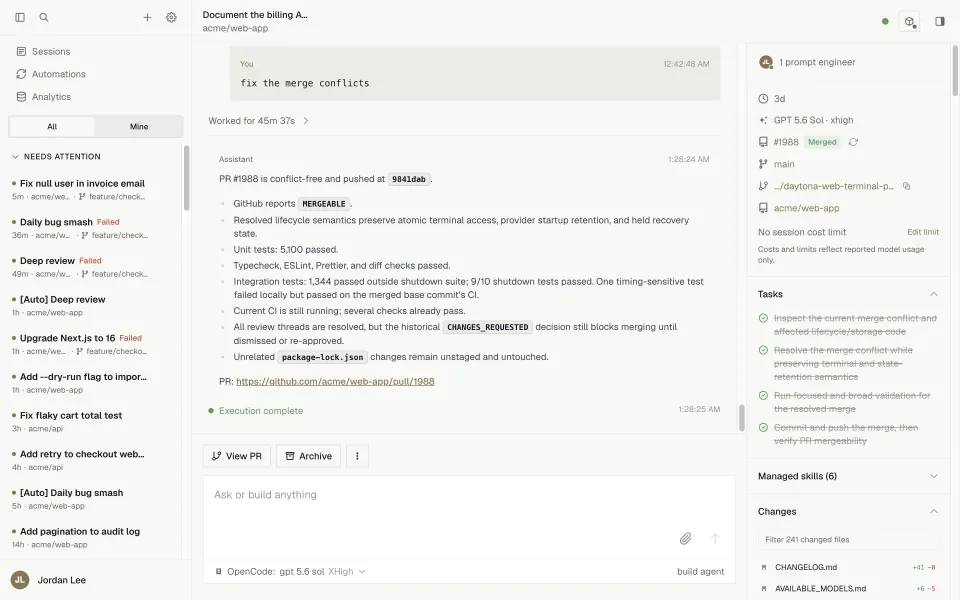
The primary product UI is a web workspace with sessions, automations, review and settings. Changes panel has a full-width unified diff layout on phones and a small-screen session-actions menu. Full phone parity was not tested. Authorized users start sessions, queue follow-ups, stop work and review diffs/PRs through the web. The scoped user distribution is browser-only; no native desktop/phone client or session-control CLI is shipped.
Source and scope for Where you use itAgents it runs
OpenCode, Claude Agent SDK and Codex are separate selectable harnesses; each session keeps its initial harness for life. Anthropic, OpenAI, xAI and OpenCode Zen authentication/model routes are distinct from harnesses. Harnesses run inside a full development sandbox and emit a shared event stream.
Source and scope for Agents it runsAccounts and subscriptions
Claude account works on Claude Agent, ChatGPT account on supported OpenCode/Codex routes, and SuperGrok on supported OpenCode routes. Provider API keys are a separate supported authentication route. Connected account lists expose status/default and per-provider unattended authentication policy.
Source and scope for Accounts and subscriptionsWhere agents run
Operators self-host the control plane and configure their own remote sandbox-provider accounts for agent execution. The supported backend list has no local-laptop agent runtime or Open-Inspect-vendor compute service.
Source and scope for Where agents runHow work is kept apart
Each child gets its own branch and sandbox rather than the parents working branch. Default development runtime uses a container; modal-vm and Boat are separately documented VM-backed options. modal-vm and Boat provide explicit VM-backed execution options. Separate sandbox checkouts/branches do not use Git worktree provisioning in this revision.
Source and scope for How work is kept apartParallel work
Parent continues while independent child sandboxes run simultaneously. Default limits allow five concurrent and fifteen total children per parent.
Source and scope for Parallel workScheduled runs
Cron automation starts ordinary sessions without a human prompting each run. Inbound webhook, Sentry, Slack and configured GitHub events trigger automation; Linear automation events are still planned. Three consecutive run failures pause an automation; scheduled authorization denial pauses immediately.
Source and scope for Scheduled runsGit and pull requests
Each child branches from the parents base branch in its own sandbox. Sessions and children can create PRs; human prompt attribution differs from automation App-authored PRs.
Source and scope for Git and pull requestsLicence and source
The web/control-plane application source uses MIT. The same MIT repository grant covers backend code.
Source and scope for Licence and sourcePrice
Open-Inspect is free, self-hosted MIT software with no paid plan found; model usage is billed through the user's own API key or subscriptions, and sandbox/edge compute through the infrastructure providers it deploys on (no amounts stated).
Source and scope for PriceTyped filters
Every value links to its receipt below. Read plan and surface restrictions before using a filter to decide.
| Filter | Value |
|---|---|
| Desktop OS: macOS | No |
| Desktop OS: Windows | No |
| Desktop OS: Linux | No |
| Web client | Yes |
| Phone access: Native iOS | No |
| Phone access: Native Android | No |
| Phone access: Phone browser | Yes |
| CLI | No |
| Coding agents: Claude Code | Yes cross-checked |
| Coding agents: Codex | Yes cross-checked |
| Coding agents: Cursor Agent | No |
| Coding agents: Gemini CLI | No |
| Coding agents: OpenCode | Yes cross-checked |
| Coding agents: Pi | No |
| Coding agents: Grok | No |
| Coding agents: Aider | No |
| Coding agents: Antigravity | No |
| Use my subscription | Yes cross-checked |
| Where agents run: On your computer | No |
| Where agents run: On your own server | Yes |
| Where agents run: In the vendor's cloud | No |
| Workspace isolation: Git worktree | No |
| Workspace isolation: Container | Yes |
| Workspace isolation: VM or microVM | Yes |
| Parallel runs | Yes cross-checked |
| Coordinator | Yes cross-checked |
| Native issue tracking | No |
| Unattended triggers | Yes cross-checked |
| Shared prompting | Yes cross-checked |
| Team roles | Yes |
| SSO | No |
| Pull request workflow | Yes cross-checked |
| Review interface | Yes cross-checked |
| Product license: Apache-2.0 | No. MIT cross-checked |
| Product license: MIT | Yes. MIT cross-checked |
| Product license: GPL-3.0 | No. MIT cross-checked |
| Product license: GPL-3.0-or-later | No. MIT cross-checked |
| Product license: AGPL-3.0 | No. MIT cross-checked |
| Product license: AGPL-3.0-or-later | No. MIT cross-checked |
| Product license: Elastic License 2.0 | No. MIT cross-checked |
| Product license: Custom terms | No. MIT cross-checked |
| Product license: Proprietary | No. MIT cross-checked |
| Self-hosting | Yes cross-checked |
| Telemetry opt-out | Unknown |
| Free access | Yes cross-checked |
| Starting price: Free | Yes. Free cross-checked |
| Starting price: Up to $20/month | No. Free cross-checked |
| Starting price: $21–40/month | No. Free cross-checked |
| Starting price: $41–100/month | No. Free cross-checked |
| Starting price: Over $100/month | No. Free cross-checked |
| Starting price: Contact for pricing | No. Free cross-checked |
| Pricing model: Free, no paid plan | Yes cross-checked |
| Pricing model: Free plan | No |
| Pricing model: Subscription | No |
| Pricing model: Per seat | No |
| Pricing model: Usage-based | No |
| Pricing model: Per machine or compute | No |
| Pricing model: Bring your own key | Yes cross-checked |
| Pricing model: One-time purchase | No |
| Paid plans from: No paid plan | Unknown |
| Paid plans from: $10 or less/month | Unknown |
| Paid plans from: $11–20/month | Unknown |
| Paid plans from: $21–40/month | Unknown |
| Paid plans from: $41–100/month | Unknown |
| Paid plans from: Over $100/month | Unknown |
| Paid plans from: Contact sales | Unknown |
| Lifecycle status: Active | Unknown |
| Lifecycle status: Sunsetting | Unknown |
| Keeps going with laptop closed | Yes |
| Open-source license | Yes. MIT cross-checked |
| Any desktop app | No |
| Paid plan up to $20/month | Unknown |
| Paid plan up to $40/month | Unknown |
| Any phone client | Yes |
Filter receipts
Desktop OS: macOS: No
Desktop OS: macOS
Typed value: No.
The primary product UI is a web workspace with sessions, automations, review and settings. Changes panel has a full-width unified diff layout on phones and a small-screen session-actions menu. Full phone parity was not tested. Authorized users start sessions, queue follow-ups, stop work and review diffs/PRs through the web. The scoped user distribution is browser-only; no native desktop/phone client or session-control CLI is shipped.
- Desktop os: The complete scoped client build/distribution tree has the web workspace and no native desktop client.
- Mobile apps: The complete scoped client build targets have no native iOS/Android app.
- Cli: Deployment/admin/image scripts and MCP interfaces are supplied, without a coding-session command-line client.
- Only the cited atomic findings are established. Remaining atomic requirements and the full rubric scenario remain unverified.
-
Finding: The scoped user client is the web workspace. Complete package/release targets contain no native desktop or iOS/Android client. Repository command scripts provision/administer deployment, images and users; there is no product-owned coding-session CLI client in the shipped command set.
Desktop OS: Windows: No
Desktop OS: Windows
Typed value: No.
The primary product UI is a web workspace with sessions, automations, review and settings. Changes panel has a full-width unified diff layout on phones and a small-screen session-actions menu. Full phone parity was not tested. Authorized users start sessions, queue follow-ups, stop work and review diffs/PRs through the web. The scoped user distribution is browser-only; no native desktop/phone client or session-control CLI is shipped.
- Desktop os: The complete scoped client build/distribution tree has the web workspace and no native desktop client.
- Mobile apps: The complete scoped client build targets have no native iOS/Android app.
- Cli: Deployment/admin/image scripts and MCP interfaces are supplied, without a coding-session command-line client.
- Only the cited atomic findings are established. Remaining atomic requirements and the full rubric scenario remain unverified.
-
Finding: The scoped user client is the web workspace. Complete package/release targets contain no native desktop or iOS/Android client. Repository command scripts provision/administer deployment, images and users; there is no product-owned coding-session CLI client in the shipped command set.
Desktop OS: Linux: No
Desktop OS: Linux
Typed value: No.
The primary product UI is a web workspace with sessions, automations, review and settings. Changes panel has a full-width unified diff layout on phones and a small-screen session-actions menu. Full phone parity was not tested. Authorized users start sessions, queue follow-ups, stop work and review diffs/PRs through the web. The scoped user distribution is browser-only; no native desktop/phone client or session-control CLI is shipped.
- Desktop os: The complete scoped client build/distribution tree has the web workspace and no native desktop client.
- Mobile apps: The complete scoped client build targets have no native iOS/Android app.
- Cli: Deployment/admin/image scripts and MCP interfaces are supplied, without a coding-session command-line client.
- Only the cited atomic findings are established. Remaining atomic requirements and the full rubric scenario remain unverified.
-
Finding: The scoped user client is the web workspace. Complete package/release targets contain no native desktop or iOS/Android client. Repository command scripts provision/administer deployment, images and users; there is no product-owned coding-session CLI client in the shipped command set.
Web client: Yes
Web client
Typed value: Yes.
The primary product UI is a web workspace with sessions, automations, review and settings. Changes panel has a full-width unified diff layout on phones and a small-screen session-actions menu. Full phone parity was not tested. Authorized users start sessions, queue follow-ups, stop work and review diffs/PRs through the web. The scoped user distribution is browser-only; no native desktop/phone client or session-control CLI is shipped.
- Browser: The primary product UI is a web workspace with sessions, automations, review and settings.
- Only the cited atomic findings are established. Remaining atomic requirements and the full rubric scenario remain unverified.
-
Finding: Self-deployed background coding system has web/chat/Git integrations, multiplayer prompting, per-session sandboxes and subtask spawning. Designed for one trusted organization, not tenant isolation.
Phone access: Native iOS: No
Phone access: Native iOS
Typed value: No.
The primary product UI is a web workspace with sessions, automations, review and settings. Changes panel has a full-width unified diff layout on phones and a small-screen session-actions menu. Full phone parity was not tested. Authorized users start sessions, queue follow-ups, stop work and review diffs/PRs through the web. The scoped user distribution is browser-only; no native desktop/phone client or session-control CLI is shipped.
- Desktop os: The complete scoped client build/distribution tree has the web workspace and no native desktop client.
- Mobile apps: The complete scoped client build targets have no native iOS/Android app.
- Cli: Deployment/admin/image scripts and MCP interfaces are supplied, without a coding-session command-line client.
- Only the cited atomic findings are established. Remaining atomic requirements and the full rubric scenario remain unverified.
-
Finding: The scoped user client is the web workspace. Complete package/release targets contain no native desktop or iOS/Android client. Repository command scripts provision/administer deployment, images and users; there is no product-owned coding-session CLI client in the shipped command set.
Phone access: Native Android: No
Phone access: Native Android
Typed value: No.
The primary product UI is a web workspace with sessions, automations, review and settings. Changes panel has a full-width unified diff layout on phones and a small-screen session-actions menu. Full phone parity was not tested. Authorized users start sessions, queue follow-ups, stop work and review diffs/PRs through the web. The scoped user distribution is browser-only; no native desktop/phone client or session-control CLI is shipped.
- Desktop os: The complete scoped client build/distribution tree has the web workspace and no native desktop client.
- Mobile apps: The complete scoped client build targets have no native iOS/Android app.
- Cli: Deployment/admin/image scripts and MCP interfaces are supplied, without a coding-session command-line client.
- Only the cited atomic findings are established. Remaining atomic requirements and the full rubric scenario remain unverified.
-
Finding: The scoped user client is the web workspace. Complete package/release targets contain no native desktop or iOS/Android client. Repository command scripts provision/administer deployment, images and users; there is no product-owned coding-session CLI client in the shipped command set.
Phone access: Phone browser: Yes
Phone access: Phone browser
Typed value: Yes.
The primary product UI is a web workspace with sessions, automations, review and settings. Changes panel has a full-width unified diff layout on phones and a small-screen session-actions menu. Full phone parity was not tested. Authorized users start sessions, queue follow-ups, stop work and review diffs/PRs through the web. The scoped user distribution is browser-only; no native desktop/phone client or session-control CLI is shipped.
- Mobile browser: Changes panel has a full-width unified diff layout on phones and a small-screen session-actions menu. Full phone parity was not tested.
- Task actions: Authorized users start sessions, queue follow-ups, stop work and review diffs/PRs through the web.
- Only the cited atomic findings are established. Remaining atomic requirements and the full rubric scenario remain unverified.
-
Open-Inspect packages/docs/content/docs/sessions/multiplayer-and-sharing.mdx
Finding: Authorized different people can prompt/stop the same session, share its timeline/sandbox and queue follow-ups. Commit attribution follows prompt authors. Team read isolation requires enforcement on; default is shadow.
-
Open-Inspect packages/docs/content/docs/sessions/reviewing-changes.mdx
Finding: Session Changes view displays committed/uncommitted diffs, file filters and exact comparison context. Timeline retains screenshots, recordings and command output; PR review is a separate GitHub action.
CLI: No
CLI
Typed value: No.
The primary product UI is a web workspace with sessions, automations, review and settings. Changes panel has a full-width unified diff layout on phones and a small-screen session-actions menu. Full phone parity was not tested. Authorized users start sessions, queue follow-ups, stop work and review diffs/PRs through the web. The scoped user distribution is browser-only; no native desktop/phone client or session-control CLI is shipped.
- Desktop os: The complete scoped client build/distribution tree has the web workspace and no native desktop client.
- Mobile apps: The complete scoped client build targets have no native iOS/Android app.
- Cli: Deployment/admin/image scripts and MCP interfaces are supplied, without a coding-session command-line client.
- Only the cited atomic findings are established. Remaining atomic requirements and the full rubric scenario remain unverified.
-
Finding: The scoped user client is the web workspace. Complete package/release targets contain no native desktop or iOS/Android client. Repository command scripts provision/administer deployment, images and users; there is no product-owned coding-session CLI client in the shipped command set.
Coding agents: Claude Code: Yes cross-checked
Coding agents: Claude Code
Typed value: Yes.
OpenCode, Claude Agent SDK and Codex are separate selectable harnesses; each session keeps its initial harness for life. Anthropic, OpenAI, xAI and OpenCode Zen authentication/model routes are distinct from harnesses. Harnesses run inside a full development sandbox and emit a shared event stream.
- Harnesses: OpenCode, Claude Agent and Codex are separate selectable harnesses; each session keeps its initial harness for life. The Claude Agent harness runs the bundled Claude Code binary from the Claude Agent SDK inside the sandbox.
- Only the cited atomic findings are established. Remaining atomic requirements and the full rubric scenario remain unverified.
-
Open-Inspect Claude Agent harness, credential flow
Finding: The Claude Agent harness launches the claude binary inside the sandbox through a clean-credential wrapper that passes a single Anthropic credential, either an API key or a connected Claude account token.
-
Open-Inspect Claude Agent harness behaviour
Finding: The sandbox image pins claude-agent-sdk, whose wheel bundles the claude binary; sessions run on that bundled Claude Code with its skills, Agent sub-agents and settings, plus Open-Inspect tools served over MCP.
Coding agents: Codex: Yes cross-checked
Coding agents: Codex
Typed value: Yes.
OpenCode, Claude Agent SDK and Codex are separate selectable harnesses; each session keeps its initial harness for life. Anthropic, OpenAI, xAI and OpenCode Zen authentication/model routes are distinct from harnesses. Harnesses run inside a full development sandbox and emit a shared event stream.
- Harnesses: OpenCode, Claude Agent and Codex are separate selectable harnesses; each session keeps its initial harness for life. The Claude Agent harness runs the bundled Claude Code binary from the Claude Agent SDK inside the sandbox.
- Model providers: Anthropic, OpenAI, xAI and OpenCode Zen authentication/model routes are distinct from harnesses.
- Session integration: Harnesses run inside a full development sandbox and emit a shared event stream.
- Only the cited atomic findings are established. Remaining atomic requirements and the full rubric scenario remain unverified.
-
Open-Inspect packages/docs/content/docs/models/agent-harnesses.mdx
Finding: Sessions choose OpenCode, Claude Agent SDK or Codex for their lifetime. Children inherit harness. Claude subscriptions require Claude Agent; model choice is not native Grok CLI support.
Coding agents: Cursor Agent: No
Coding agents: Cursor Agent
Typed value: No.
OpenCode, Claude Agent SDK and Codex are separate selectable harnesses; each session keeps its initial harness for life. Anthropic, OpenAI, xAI and OpenCode Zen authentication/model routes are distinct from harnesses. Harnesses run inside a full development sandbox and emit a shared event stream.
- Harnesses: OpenCode, Claude Agent and Codex are separate selectable harnesses; each session keeps its initial harness for life. The Claude Agent harness runs the bundled Claude Code binary from the Claude Agent SDK inside the sandbox.
- Model providers: Anthropic, OpenAI, xAI and OpenCode Zen authentication/model routes are distinct from harnesses.
- Session integration: Harnesses run inside a full development sandbox and emit a shared event stream.
- Only the cited atomic findings are established. Remaining atomic requirements and the full rubric scenario remain unverified.
-
Open-Inspect packages/docs/content/docs/models/agent-harnesses.mdx
Finding: Sessions choose OpenCode, Claude Agent SDK or Codex for their lifetime. Children inherit harness. Claude subscriptions require Claude Agent; model choice is not native Grok CLI support.
Coding agents: Gemini CLI: No
Coding agents: Gemini CLI
Typed value: No.
OpenCode, Claude Agent SDK and Codex are separate selectable harnesses; each session keeps its initial harness for life. Anthropic, OpenAI, xAI and OpenCode Zen authentication/model routes are distinct from harnesses. Harnesses run inside a full development sandbox and emit a shared event stream.
- Harnesses: OpenCode, Claude Agent and Codex are separate selectable harnesses; each session keeps its initial harness for life. The Claude Agent harness runs the bundled Claude Code binary from the Claude Agent SDK inside the sandbox.
- Model providers: Anthropic, OpenAI, xAI and OpenCode Zen authentication/model routes are distinct from harnesses.
- Session integration: Harnesses run inside a full development sandbox and emit a shared event stream.
- Only the cited atomic findings are established. Remaining atomic requirements and the full rubric scenario remain unverified.
-
Open-Inspect packages/docs/content/docs/models/agent-harnesses.mdx
Finding: Sessions choose OpenCode, Claude Agent SDK or Codex for their lifetime. Children inherit harness. Claude subscriptions require Claude Agent; model choice is not native Grok CLI support.
Coding agents: OpenCode: Yes cross-checked
Coding agents: OpenCode
Typed value: Yes.
OpenCode, Claude Agent SDK and Codex are separate selectable harnesses; each session keeps its initial harness for life. Anthropic, OpenAI, xAI and OpenCode Zen authentication/model routes are distinct from harnesses. Harnesses run inside a full development sandbox and emit a shared event stream.
- Harnesses: OpenCode, Claude Agent and Codex are separate selectable harnesses; each session keeps its initial harness for life. The Claude Agent harness runs the bundled Claude Code binary from the Claude Agent SDK inside the sandbox.
- Model providers: Anthropic, OpenAI, xAI and OpenCode Zen authentication/model routes are distinct from harnesses.
- Session integration: Harnesses run inside a full development sandbox and emit a shared event stream.
- Only the cited atomic findings are established. Remaining atomic requirements and the full rubric scenario remain unverified.
-
Open-Inspect packages/docs/content/docs/models/agent-harnesses.mdx
Finding: Sessions choose OpenCode, Claude Agent SDK or Codex for their lifetime. Children inherit harness. Claude subscriptions require Claude Agent; model choice is not native Grok CLI support.
Coding agents: Pi: No
Coding agents: Pi
Typed value: No.
OpenCode, Claude Agent SDK and Codex are separate selectable harnesses; each session keeps its initial harness for life. Anthropic, OpenAI, xAI and OpenCode Zen authentication/model routes are distinct from harnesses. Harnesses run inside a full development sandbox and emit a shared event stream.
- Harnesses: OpenCode, Claude Agent and Codex are separate selectable harnesses; each session keeps its initial harness for life. The Claude Agent harness runs the bundled Claude Code binary from the Claude Agent SDK inside the sandbox.
- Model providers: Anthropic, OpenAI, xAI and OpenCode Zen authentication/model routes are distinct from harnesses.
- Session integration: Harnesses run inside a full development sandbox and emit a shared event stream.
- Only the cited atomic findings are established. Remaining atomic requirements and the full rubric scenario remain unverified.
-
Open-Inspect packages/docs/content/docs/models/agent-harnesses.mdx
Finding: Sessions choose OpenCode, Claude Agent SDK or Codex for their lifetime. Children inherit harness. Claude subscriptions require Claude Agent; model choice is not native Grok CLI support.
Coding agents: Grok: No
Coding agents: Grok
Typed value: No.
OpenCode, Claude Agent SDK and Codex are separate selectable harnesses; each session keeps its initial harness for life. Anthropic, OpenAI, xAI and OpenCode Zen authentication/model routes are distinct from harnesses. Harnesses run inside a full development sandbox and emit a shared event stream.
- Harnesses: OpenCode, Claude Agent and Codex are separate selectable harnesses; each session keeps its initial harness for life. The Claude Agent harness runs the bundled Claude Code binary from the Claude Agent SDK inside the sandbox.
- Model providers: Anthropic, OpenAI, xAI and OpenCode Zen authentication/model routes are distinct from harnesses.
- Session integration: Harnesses run inside a full development sandbox and emit a shared event stream.
- Only the cited atomic findings are established. Remaining atomic requirements and the full rubric scenario remain unverified.
-
Open-Inspect packages/docs/content/docs/models/agent-harnesses.mdx
Finding: Sessions choose OpenCode, Claude Agent SDK or Codex for their lifetime. Children inherit harness. Claude subscriptions require Claude Agent; model choice is not native Grok CLI support.
Coding agents: Aider: No
Coding agents: Aider
Typed value: No.
OpenCode, Claude Agent SDK and Codex are separate selectable harnesses; each session keeps its initial harness for life. Anthropic, OpenAI, xAI and OpenCode Zen authentication/model routes are distinct from harnesses. Harnesses run inside a full development sandbox and emit a shared event stream.
- Harnesses: OpenCode, Claude Agent and Codex are separate selectable harnesses; each session keeps its initial harness for life. The Claude Agent harness runs the bundled Claude Code binary from the Claude Agent SDK inside the sandbox.
- Model providers: Anthropic, OpenAI, xAI and OpenCode Zen authentication/model routes are distinct from harnesses.
- Session integration: Harnesses run inside a full development sandbox and emit a shared event stream.
- Only the cited atomic findings are established. Remaining atomic requirements and the full rubric scenario remain unverified.
-
Open-Inspect packages/docs/content/docs/models/agent-harnesses.mdx
Finding: Sessions choose OpenCode, Claude Agent SDK or Codex for their lifetime. Children inherit harness. Claude subscriptions require Claude Agent; model choice is not native Grok CLI support.
Coding agents: Antigravity: No
Coding agents: Antigravity
Typed value: No.
OpenCode, Claude Agent SDK and Codex are separate selectable harnesses; each session keeps its initial harness for life. Anthropic, OpenAI, xAI and OpenCode Zen authentication/model routes are distinct from harnesses. Harnesses run inside a full development sandbox and emit a shared event stream.
- Harnesses: OpenCode, Claude Agent and Codex are separate selectable harnesses; each session keeps its initial harness for life. The Claude Agent harness runs the bundled Claude Code binary from the Claude Agent SDK inside the sandbox.
- Model providers: Anthropic, OpenAI, xAI and OpenCode Zen authentication/model routes are distinct from harnesses.
- Session integration: Harnesses run inside a full development sandbox and emit a shared event stream.
- Only the cited atomic findings are established. Remaining atomic requirements and the full rubric scenario remain unverified.
-
Open-Inspect packages/docs/content/docs/models/agent-harnesses.mdx
Finding: Sessions choose OpenCode, Claude Agent SDK or Codex for their lifetime. Children inherit harness. Claude subscriptions require Claude Agent; model choice is not native Grok CLI support.
Use my subscription: Yes cross-checked
Use my subscription
Typed value: Yes.
Claude account works on Claude Agent, ChatGPT account on supported OpenCode/Codex routes, and SuperGrok on supported OpenCode routes. Provider API keys are a separate supported authentication route. Connected account lists expose status/default and per-provider unattended authentication policy.
- Agent subscriptions: Claude account works on Claude Agent, ChatGPT account on supported OpenCode/Codex routes, and SuperGrok on supported OpenCode routes.
- Api accounts: Provider API keys are a separate supported authentication route.
- Account switching: Connected account lists expose status/default and per-provider unattended authentication policy.
- Only the cited atomic findings are established. Remaining atomic requirements and the full rubric scenario remain unverified.
-
Open-Inspect packages/docs/content/docs/models/agent-harnesses.mdx
Finding: Sessions choose OpenCode, Claude Agent SDK or Codex for their lifetime. Children inherit harness. Claude subscriptions require Claude Agent; model choice is not native Grok CLI support.
-
Open-Inspect packages/docs/content/docs/models/provider-accounts.mdx
Finding: Connected Claude, ChatGPT/Codex and SuperGrok accounts or API credentials have provider defaults, identity/status and unattended policy. Subscription routes have harness-specific restrictions.
Where agents run: On your computer: No
Where agents run: On your computer
Typed value: No.
Operators self-host the control plane and configure their own remote sandbox-provider accounts for agent execution. The supported backend list has no local-laptop agent runtime or Open-Inspect-vendor compute service.
- Local: The complete selectable agent backend list is remote provider sandboxes; local control-plane hosting is not local agent execution.
- Byo remote: Operators use their own sandbox-provider accounts and infrastructure configuration.
- Managed cloud: Open-Inspect supplies self-hosted code, not a vendor-operated compute service; sandbox vendors are the operator chosen infrastructure providers.
- Only the cited atomic findings are established. Remaining atomic requirements and the full rubric scenario remain unverified.
-
Open-Inspect packages/docs/content/docs/configure/sandbox-providers.mdx
Finding: The complete supported agent execution backend list is Modal, modal-vm, Daytona, Vercel, E2B and Boat. Operators configure/pay their own provider accounts; the control plane can be self-hosted locally but agent sessions execute in those remote sandboxes, not on the browser laptop. No Open-Inspect-vendor-operated compute service is offered.
Where agents run: On your own server: Yes
Where agents run: On your own server
Typed value: Yes.
Operators self-host the control plane and configure their own remote sandbox-provider accounts for agent execution. The supported backend list has no local-laptop agent runtime or Open-Inspect-vendor compute service.
- Local: The complete selectable agent backend list is remote provider sandboxes; local control-plane hosting is not local agent execution.
- Byo remote: Operators use their own sandbox-provider accounts and infrastructure configuration.
- Managed cloud: Open-Inspect supplies self-hosted code, not a vendor-operated compute service; sandbox vendors are the operator chosen infrastructure providers.
- Only the cited atomic findings are established. Remaining atomic requirements and the full rubric scenario remain unverified.
-
Open-Inspect packages/docs/content/docs/configure/sandbox-providers.mdx
Finding: The complete supported agent execution backend list is Modal, modal-vm, Daytona, Vercel, E2B and Boat. Operators configure/pay their own provider accounts; the control plane can be self-hosted locally but agent sessions execute in those remote sandboxes, not on the browser laptop. No Open-Inspect-vendor-operated compute service is offered.
Where agents run: In the vendor's cloud: No
Where agents run: In the vendor's cloud
Typed value: No.
Operators self-host the control plane and configure their own remote sandbox-provider accounts for agent execution. The supported backend list has no local-laptop agent runtime or Open-Inspect-vendor compute service.
- Local: The complete selectable agent backend list is remote provider sandboxes; local control-plane hosting is not local agent execution.
- Byo remote: Operators use their own sandbox-provider accounts and infrastructure configuration.
- Managed cloud: Open-Inspect supplies self-hosted code, not a vendor-operated compute service; sandbox vendors are the operator chosen infrastructure providers.
- Only the cited atomic findings are established. Remaining atomic requirements and the full rubric scenario remain unverified.
-
Open-Inspect packages/docs/content/docs/configure/sandbox-providers.mdx
Finding: The complete supported agent execution backend list is Modal, modal-vm, Daytona, Vercel, E2B and Boat. Operators configure/pay their own provider accounts; the control plane can be self-hosted locally but agent sessions execute in those remote sandboxes, not on the browser laptop. No Open-Inspect-vendor-operated compute service is offered.
Workspace isolation: Git worktree: No
Workspace isolation: Git worktree
Typed value: No.
Each child gets its own branch and sandbox rather than the parents working branch. Default development runtime uses a container; modal-vm and Boat are separately documented VM-backed options. modal-vm and Boat provide explicit VM-backed execution options. Separate sandbox checkouts/branches do not use Git worktree provisioning in this revision.
- Worktree: The complete sandbox repository boot/sync path clones checkouts; no git worktree provisioning path is used.
- Only the cited atomic findings are established. Remaining atomic requirements and the full rubric scenario remain unverified.
-
Open-Inspect packages/sandbox-runtime/src/sandbox_runtime/repository_boot.py
Finding: Each sandbox boots/clones its own repository checkout and branch. Child sessions receive a separate sandbox/branch. The scoped repository boot and synchronization paths use full checkouts rather than creating Git worktrees with git worktree add.
Workspace isolation: Container: Yes
Workspace isolation: Container
Typed value: Yes.
Each child gets its own branch and sandbox rather than the parents working branch. Default development runtime uses a container; modal-vm and Boat are separately documented VM-backed options. modal-vm and Boat provide explicit VM-backed execution options. Separate sandbox checkouts/branches do not use Git worktree provisioning in this revision.
- Container: Default development runtime uses a container; modal-vm and Boat are separately documented VM-backed options.
- Only the cited atomic findings are established. Remaining atomic requirements and the full rubric scenario remain unverified.
-
Open-Inspect runtime architecture
Finding: The default development environment starts as a container; modal-vm and Boat are separately documented VM-backed providers. Runtime snapshots and host reconnection depend on provider.
Workspace isolation: VM or microVM: Yes
Workspace isolation: VM or microVM
Typed value: Yes.
Each child gets its own branch and sandbox rather than the parents working branch. Default development runtime uses a container; modal-vm and Boat are separately documented VM-backed options. modal-vm and Boat provide explicit VM-backed execution options. Separate sandbox checkouts/branches do not use Git worktree provisioning in this revision.
- Vm: modal-vm and Boat provide explicit VM-backed execution options.
- Only the cited atomic findings are established. Remaining atomic requirements and the full rubric scenario remain unverified.
-
Open-Inspect packages/docs/content/docs/configure/sandbox-providers.mdx
Finding: Operator selects Modal, modal-vm, Daytona, Vercel, E2B or Boat. Provider-specific snapshots/resume, CPU/RAM and timeout limits differ. Boat is a persistent full-VM sandbox; default Modal is not Docker-capable.
Parallel runs: Yes cross-checked
Parallel runs
Typed value: Yes.
Parent continues while independent child sandboxes run simultaneously. Default limits allow five concurrent and fifteen total children per parent.
- Concurrent sessions: Parent continues while independent child sandboxes run simultaneously.
- Quotas: Default limits allow five concurrent and fifteen total children per parent.
- Only the cited atomic findings are established. Remaining atomic requirements and the full rubric scenario remain unverified.
-
Open-Inspect packages/docs/content/docs/sessions/child-sessions.mdx
Finding: Product tools spawn independent child sandboxes/branches, send follow-ups, inspect responses/events and cancel descendants. Default limits are five concurrent and fifteen total children per parent; depth is bounded.
Coordinator: Yes cross-checked
Coordinator
Typed value: Yes.
Child can override model/reasoning but inherits its parents harness and authentication. Product-owned spawn-child/send-child-prompt/get-child-status/cancel-child tools manage independent sessions. UI nests children, shows live status/PR state and links parent and child pages. get-child-status can retrieve final responses and paginated event history.
- Model harness effort: Child can override model/reasoning but inherits its parents harness and authentication.
- Orchestration owner: Product-owned spawn-child/send-child-prompt/get-child-status/cancel-child tools manage independent sessions.
- Live progress: UI nests children, shows live status/PR state and links parent and child pages.
- Retained results: get-child-status can retrieve final responses and paginated event history.
- Only the cited atomic findings are established. Remaining atomic requirements and the full rubric scenario remain unverified.
-
Open-Inspect packages/docs/content/docs/sessions/child-sessions.mdx
Finding: Product tools spawn independent child sandboxes/branches, send follow-ups, inspect responses/events and cancel descendants. Default limits are five concurrent and fifteen total children per parent; depth is bounded.
Native issue tracking: No
Native issue tracking
Typed value: No.
Native inbox, searches and child-task cards are session records. The scoped data/API model has no independent product-owned issue/task entity; Linear/GitHub are external integrations.
- Task session separation: Canonical schemas/routes model sessions and external tracker references, without independent issue/task CRUD.
- Source inspection covers the scoped release only. Unanswered atomic questions remain unknown; no live scenario was run.
-
Open-Inspect terraform/d1/migrations/0002_create_session_index.sql
Finding: The scoped canonical schemas and control routes persist coding sessions, automations, memories, collaborators and external tracker references. Native inbox/search/child-task entries are session records; no standalone issue/task CRUD entity exists. Linear/GitHub remain external trackers.
Unattended triggers: Yes cross-checked
Unattended triggers
Typed value: Yes.
Cron automation starts ordinary sessions without a human prompting each run. Inbound webhook, Sentry, Slack and configured GitHub events trigger automation; Linear automation events are still planned. Three consecutive run failures pause an automation; scheduled authorization denial pauses immediately.
- Schedules: Cron automation starts ordinary sessions without a human prompting each run.
- Events: Inbound webhook, Sentry, Slack and configured GitHub events trigger automation; Linear automation events are still planned.
- Retries: Three consecutive run failures pause an automation; scheduled authorization denial pauses immediately.
- Only the cited atomic findings are established. Remaining atomic requirements and the full rubric scenario remain unverified.
-
Open-Inspect packages/docs/content/docs/automations/index.mdx
Finding: Server automation starts sessions from cron, inbound webhook, Sentry, Slack or deployed GitHub bot events. Three consecutive failures pause it; Linear automation events are planned, not current.
Shared prompting: Yes cross-checked
Shared prompting
Typed value: Yes.
Participants and connected-presence dots update for viewers in the same session. Multiple authorized people can send follow-ups to the same session; ordering is a shared queue. Prompt author identity flows into Git commit attribution and connected-user PR identity.
- Presence: Participants and connected-presence dots update for viewers in the same session.
- Coprompting: Multiple authorized people can send follow-ups to the same session; ordering is a shared queue.
- Attribution: Prompt author identity flows into Git commit attribution and connected-user PR identity.
- Only the cited atomic findings are established. Remaining atomic requirements and the full rubric scenario remain unverified.
-
Open-Inspect packages/docs/content/docs/sessions/multiplayer-and-sharing.mdx
Finding: Authorized different people can prompt/stop the same session, share its timeline/sandbox and queue follow-ups. Commit attribution follows prompt authors. Team read isolation requires enforcement on; default is shadow.
Team roles: Yes
Team roles
Typed value: Yes.
Owner, Administrator, Member and Viewer have documented workspace permissions. Team membership and resource-specific checks supplement workspace role; team read isolation requires enforcement on rather than default shadow. Member suspension and team removal affect future authorized operations but do not instantly revoke cached issued tokens or stop already executing sandboxes. Built-in sign-in uses Google/GitHub OAuth without enterprise SAML/OIDC SSO configuration in this scoped release.
- Organization roles: Owner, Administrator, Member and Viewer have documented workspace permissions.
- Project roles: Team membership and resource-specific checks supplement workspace role; team read isolation requires enforcement on rather than default shadow.
- Only the cited atomic findings are established. Remaining atomic requirements and the full rubric scenario remain unverified.
-
Open-Inspect packages/docs/content/docs/sessions/multiplayer-and-sharing.mdx
Finding: Authorized different people can prompt/stop the same session, share its timeline/sandbox and queue follow-ups. Commit attribution follows prompt authors. Team read isolation requires enforcement on; default is shadow.
-
Open-Inspect packages/docs/content/docs/administration/workspace-access.mdx
Finding: Owner, Administrator, Member and Viewer have named permissions; private/team session action checks add resource-specific access boundaries. Viewer lacks prompting/sandbox access.
SSO: No
SSO
Typed value: No.
Owner, Administrator, Member and Viewer have documented workspace permissions. Team membership and resource-specific checks supplement workspace role; team read isolation requires enforcement on rather than default shadow. Member suspension and team removal affect future authorized operations but do not instantly revoke cached issued tokens or stop already executing sandboxes. Built-in sign-in uses Google/GitHub OAuth without enterprise SAML/OIDC SSO configuration in this scoped release.
- Sso: Complete sign-in config supports Google/GitHub social OAuth, with no enterprise SSO provider/plugin.
- Only the cited atomic findings are established. Remaining atomic requirements and the full rubric scenario remain unverified.
-
Open-Inspect packages/control-plane/src/auth/user/better-auth.ts
Finding: UserAuthConfig accepts GitHub and Google social OAuth providers. The complete createUserAuth provider/plugin configuration does not include enterprise SAML/OIDC SSO; workspace roles apply after sign-in. Better Auth own telemetry is explicitly disabled.
Pull request workflow: Yes cross-checked
Pull request workflow
Typed value: Yes.
Each child branches from the parents base branch in its own sandbox. Sessions and children can create PRs; human prompt attribution differs from automation App-authored PRs.
- Pull requests: Sessions and children can create PRs; human prompt attribution differs from automation App-authored PRs.
- Only the cited atomic findings are established. Remaining atomic requirements and the full rubric scenario remain unverified.
-
Finding: Self-deployed background coding system has web/chat/Git integrations, multiplayer prompting, per-session sandboxes and subtask spawning. Designed for one trusted organization, not tenant isolation.
-
Open-Inspect packages/docs/content/docs/sessions/multiplayer-and-sharing.mdx
Finding: Authorized different people can prompt/stop the same session, share its timeline/sandbox and queue follow-ups. Commit attribution follows prompt authors. Team read isolation requires enforcement on; default is shadow.
-
Open-Inspect packages/docs/content/docs/automations/index.mdx
Finding: Server automation starts sessions from cron, inbound webhook, Sentry, Slack or deployed GitHub bot events. Three consecutive failures pause it; Linear automation events are planned, not current.
Review interface: Yes cross-checked
Review interface
Typed value: Yes.
Changes includes committed/uncommitted tracked and nonignored untracked files since session start, with named omission/error states. Timeline retains screenshot cards and recordings alongside tool output. Parent can retrieve childs final response and event history.
- Diffs: Changes includes committed/uncommitted tracked and nonignored untracked files since session start, with named omission/error states.
- Screenshots: Timeline retains screenshot cards and recordings alongside tool output.
- Only the cited atomic findings are established. Remaining atomic requirements and the full rubric scenario remain unverified.
-
Open-Inspect packages/docs/content/docs/sessions/reviewing-changes.mdx
Finding: Session Changes view displays committed/uncommitted diffs, file filters and exact comparison context. Timeline retains screenshots, recordings and command output; PR review is a separate GitHub action.
Product license: Apache-2.0: No. MIT cross-checked
Product license: Apache-2.0
Typed value: No. MIT.
The web/control-plane application source uses MIT. The same MIT repository grant covers backend code.
- Client license: The web/control-plane application source uses MIT.
- Server license: The same MIT repository grant covers backend code.
- Only the cited atomic findings are established. Remaining atomic requirements and the full rubric scenario remain unverified.
-
Finding: Open-Inspect repository code is MIT licensed.
Product license: MIT: Yes. MIT cross-checked
Product license: MIT
Typed value: Yes. MIT.
The web/control-plane application source uses MIT. The same MIT repository grant covers backend code.
- Client license: The web/control-plane application source uses MIT.
- Server license: The same MIT repository grant covers backend code.
- Only the cited atomic findings are established. Remaining atomic requirements and the full rubric scenario remain unverified.
-
Finding: Open-Inspect repository code is MIT licensed.
Product license: GPL-3.0: No. MIT cross-checked
Product license: GPL-3.0
Typed value: No. MIT.
The web/control-plane application source uses MIT. The same MIT repository grant covers backend code.
- Client license: The web/control-plane application source uses MIT.
- Server license: The same MIT repository grant covers backend code.
- Only the cited atomic findings are established. Remaining atomic requirements and the full rubric scenario remain unverified.
-
Finding: Open-Inspect repository code is MIT licensed.
Product license: GPL-3.0-or-later: No. MIT cross-checked
Product license: GPL-3.0-or-later
Typed value: No. MIT.
The web/control-plane application source uses MIT. The same MIT repository grant covers backend code.
- Client license: The web/control-plane application source uses MIT.
- Server license: The same MIT repository grant covers backend code.
- Only the cited atomic findings are established. Remaining atomic requirements and the full rubric scenario remain unverified.
-
Finding: Open-Inspect repository code is MIT licensed.
Product license: AGPL-3.0: No. MIT cross-checked
Product license: AGPL-3.0
Typed value: No. MIT.
The web/control-plane application source uses MIT. The same MIT repository grant covers backend code.
- Client license: The web/control-plane application source uses MIT.
- Server license: The same MIT repository grant covers backend code.
- Only the cited atomic findings are established. Remaining atomic requirements and the full rubric scenario remain unverified.
-
Finding: Open-Inspect repository code is MIT licensed.
Product license: AGPL-3.0-or-later: No. MIT cross-checked
Product license: AGPL-3.0-or-later
Typed value: No. MIT.
The web/control-plane application source uses MIT. The same MIT repository grant covers backend code.
- Client license: The web/control-plane application source uses MIT.
- Server license: The same MIT repository grant covers backend code.
- Only the cited atomic findings are established. Remaining atomic requirements and the full rubric scenario remain unverified.
-
Finding: Open-Inspect repository code is MIT licensed.
Product license: Elastic License 2.0: No. MIT cross-checked
Product license: Elastic License 2.0
Typed value: No. MIT.
The web/control-plane application source uses MIT. The same MIT repository grant covers backend code.
- Client license: The web/control-plane application source uses MIT.
- Server license: The same MIT repository grant covers backend code.
- Only the cited atomic findings are established. Remaining atomic requirements and the full rubric scenario remain unverified.
-
Finding: Open-Inspect repository code is MIT licensed.
Product license: Custom terms: No. MIT cross-checked
Product license: Custom terms
Typed value: No. MIT.
The web/control-plane application source uses MIT. The same MIT repository grant covers backend code.
- Client license: The web/control-plane application source uses MIT.
- Server license: The same MIT repository grant covers backend code.
- Only the cited atomic findings are established. Remaining atomic requirements and the full rubric scenario remain unverified.
-
Finding: Open-Inspect repository code is MIT licensed.
Product license: Proprietary: No. MIT cross-checked
Product license: Proprietary
Typed value: No. MIT.
The web/control-plane application source uses MIT. The same MIT repository grant covers backend code.
- Client license: The web/control-plane application source uses MIT.
- Server license: The same MIT repository grant covers backend code.
- Only the cited atomic findings are established. Remaining atomic requirements and the full rubric scenario remain unverified.
-
Finding: Open-Inspect repository code is MIT licensed.
Self-hosting: Yes cross-checked
Self-hosting
Typed value: Yes.
Full self-hosted deployment is documented, with the control plane on Cloudflare Workers by default or in a container. It still depends on GitHub App access, a chosen sandbox provider and model accounts. Session NDJSON export is operator/service-facing and best-effort rather than an app export/restore flow.
- Self hosting: Operators can deploy the full stack themselves, with the control plane on Cloudflare Workers or in a container.
- Vendor dependencies: Self-deployment depends on GitHub App access, a chosen sandbox provider, model accounts, and Cloudflare unless the container control plane is used.
- Only the cited atomic findings are established. Remaining atomic requirements and the full rubric scenario remain unverified.
-
Open-Inspect docs/SETUP_GUIDE.md
Finding: The setup guide offers running the web app against an existing backend, local contribution, or a full self-hosted deployment, and links a guide for running the control plane in a container without Cloudflare. GitHub App repository credentials are required, and GitHub/Google sign-in is distinct from them. Deployment is single-tenant.
Free access: Yes cross-checked
Free access
Typed value: Yes.
Open-Inspect is free MIT software that operators deploy themselves; the site shows no pricing. Sandbox, hosting and model costs are paid to those providers.
- Ongoing free: The software is MIT-licensed and free to deploy; the website shows no price.
- Paid only: Not paid-only: the MIT source is deployed free of charge.
- Self-hosted only; infrastructure and model provider costs were not checked. No installed-product test was run.
-
Finding: The site presents Open-Inspect as open source and self-hostable, with no pricing or paid plan shown.
-
Finding: The MIT license grants permission to use, copy, modify and distribute the software free of charge.
Starting price: Free: Yes. Free cross-checked
Starting price: Free
Typed value: Yes. Free.
Open-Inspect is free MIT software that operators deploy themselves; the site shows no pricing. Sandbox, hosting and model costs are paid to those providers.
- Ongoing free: The software is MIT-licensed and free to deploy; the website shows no price.
- Paid only: Not paid-only: the MIT source is deployed free of charge.
- Self-hosted only; infrastructure and model provider costs were not checked. No installed-product test was run.
-
Finding: The site presents Open-Inspect as open source and self-hostable, with no pricing or paid plan shown.
-
Finding: The MIT license grants permission to use, copy, modify and distribute the software free of charge.
Starting price: Up to $20/month: No. Free cross-checked
Starting price: Up to $20/month
Typed value: No. Free.
Open-Inspect is free MIT software that operators deploy themselves; the site shows no pricing. Sandbox, hosting and model costs are paid to those providers.
- Ongoing free: The software is MIT-licensed and free to deploy; the website shows no price.
- Paid only: Not paid-only: the MIT source is deployed free of charge.
- Self-hosted only; infrastructure and model provider costs were not checked. No installed-product test was run.
-
Finding: The site presents Open-Inspect as open source and self-hostable, with no pricing or paid plan shown.
-
Finding: The MIT license grants permission to use, copy, modify and distribute the software free of charge.
Starting price: $21–40/month: No. Free cross-checked
Starting price: $21–40/month
Typed value: No. Free.
Open-Inspect is free MIT software that operators deploy themselves; the site shows no pricing. Sandbox, hosting and model costs are paid to those providers.
- Ongoing free: The software is MIT-licensed and free to deploy; the website shows no price.
- Paid only: Not paid-only: the MIT source is deployed free of charge.
- Self-hosted only; infrastructure and model provider costs were not checked. No installed-product test was run.
-
Finding: The site presents Open-Inspect as open source and self-hostable, with no pricing or paid plan shown.
-
Finding: The MIT license grants permission to use, copy, modify and distribute the software free of charge.
Starting price: $41–100/month: No. Free cross-checked
Starting price: $41–100/month
Typed value: No. Free.
Open-Inspect is free MIT software that operators deploy themselves; the site shows no pricing. Sandbox, hosting and model costs are paid to those providers.
- Ongoing free: The software is MIT-licensed and free to deploy; the website shows no price.
- Paid only: Not paid-only: the MIT source is deployed free of charge.
- Self-hosted only; infrastructure and model provider costs were not checked. No installed-product test was run.
-
Finding: The site presents Open-Inspect as open source and self-hostable, with no pricing or paid plan shown.
-
Finding: The MIT license grants permission to use, copy, modify and distribute the software free of charge.
Starting price: Over $100/month: No. Free cross-checked
Starting price: Over $100/month
Typed value: No. Free.
Open-Inspect is free MIT software that operators deploy themselves; the site shows no pricing. Sandbox, hosting and model costs are paid to those providers.
- Ongoing free: The software is MIT-licensed and free to deploy; the website shows no price.
- Paid only: Not paid-only: the MIT source is deployed free of charge.
- Self-hosted only; infrastructure and model provider costs were not checked. No installed-product test was run.
-
Finding: The site presents Open-Inspect as open source and self-hostable, with no pricing or paid plan shown.
-
Finding: The MIT license grants permission to use, copy, modify and distribute the software free of charge.
Starting price: Contact for pricing: No. Free cross-checked
Starting price: Contact for pricing
Typed value: No. Free.
Open-Inspect is free MIT software that operators deploy themselves; the site shows no pricing. Sandbox, hosting and model costs are paid to those providers.
- Ongoing free: The software is MIT-licensed and free to deploy; the website shows no price.
- Paid only: Not paid-only: the MIT source is deployed free of charge.
- Self-hosted only; infrastructure and model provider costs were not checked. No installed-product test was run.
-
Finding: The site presents Open-Inspect as open source and self-hostable, with no pricing or paid plan shown.
-
Finding: The MIT license grants permission to use, copy, modify and distribute the software free of charge.
Pricing model: Free, no paid plan: Yes cross-checked
Pricing model: Free, no paid plan
Typed value: Yes.
Open-Inspect is free, self-hosted MIT software with no paid plan found; model usage is billed through the user's own API key or subscriptions, and sandbox/edge compute through the infrastructure providers it deploys on (no amounts stated).
- First-party pricing pages, terms and licences read 2026-11-10; no purchase, billing or authenticated account test.
-
Finding: The site presents Open-Inspect as open source and self-hostable, with no pricing or paid plan shown.
-
Finding: The MIT license grants permission to use, copy, modify and distribute the software free of charge.
Pricing model: Free plan: No
Pricing model: Free plan
Typed value: No.
Open-Inspect is free, self-hosted MIT software with no paid plan found; model usage is billed through the user's own API key or subscriptions, and sandbox/edge compute through the infrastructure providers it deploys on (no amounts stated).
- Model cost: Models are used via the user's own API key or existing Claude/ChatGPT/SuperGrok subscriptions, billed by those providers.
- Compute cost: Sandboxes and control plane run on third-party platforms (Modal, Daytona, Vercel Sandbox, E2B, Boat, Cloudflare); their costs are not stated.
- First-party pricing pages, terms and licences read 2026-11-10; no purchase, billing or authenticated account test.
-
Finding: The site presents Open-Inspect as open source and self-hostable, with no pricing or paid plan shown.
-
Finding: Users pick a model via their own Anthropic API key or Claude/ChatGPT/SuperGrok subscriptions, and sandboxes run on third-party infrastructure (Modal, Daytona, Vercel Sandbox, E2B, Boat, Cloudflare); no price for Open-Inspect itself is given.
-
Finding: The MIT license grants permission to use, copy, modify and distribute the software free of charge.
Pricing model: Subscription: No
Pricing model: Subscription
Typed value: No.
Open-Inspect is free, self-hosted MIT software with no paid plan found; model usage is billed through the user's own API key or subscriptions, and sandbox/edge compute through the infrastructure providers it deploys on (no amounts stated).
- Model cost: Models are used via the user's own API key or existing Claude/ChatGPT/SuperGrok subscriptions, billed by those providers.
- Compute cost: Sandboxes and control plane run on third-party platforms (Modal, Daytona, Vercel Sandbox, E2B, Boat, Cloudflare); their costs are not stated.
- First-party pricing pages, terms and licences read 2026-11-10; no purchase, billing or authenticated account test.
-
Finding: The site presents Open-Inspect as open source and self-hostable, with no pricing or paid plan shown.
-
Finding: Users pick a model via their own Anthropic API key or Claude/ChatGPT/SuperGrok subscriptions, and sandboxes run on third-party infrastructure (Modal, Daytona, Vercel Sandbox, E2B, Boat, Cloudflare); no price for Open-Inspect itself is given.
-
Finding: The MIT license grants permission to use, copy, modify and distribute the software free of charge.
Pricing model: Per seat: No
Pricing model: Per seat
Typed value: No.
Open-Inspect is free, self-hosted MIT software with no paid plan found; model usage is billed through the user's own API key or subscriptions, and sandbox/edge compute through the infrastructure providers it deploys on (no amounts stated).
- Model cost: Models are used via the user's own API key or existing Claude/ChatGPT/SuperGrok subscriptions, billed by those providers.
- Compute cost: Sandboxes and control plane run on third-party platforms (Modal, Daytona, Vercel Sandbox, E2B, Boat, Cloudflare); their costs are not stated.
- First-party pricing pages, terms and licences read 2026-11-10; no purchase, billing or authenticated account test.
-
Finding: The site presents Open-Inspect as open source and self-hostable, with no pricing or paid plan shown.
-
Finding: Users pick a model via their own Anthropic API key or Claude/ChatGPT/SuperGrok subscriptions, and sandboxes run on third-party infrastructure (Modal, Daytona, Vercel Sandbox, E2B, Boat, Cloudflare); no price for Open-Inspect itself is given.
-
Finding: The MIT license grants permission to use, copy, modify and distribute the software free of charge.
Pricing model: Usage-based: No
Pricing model: Usage-based
Typed value: No.
Open-Inspect is free, self-hosted MIT software with no paid plan found; model usage is billed through the user's own API key or subscriptions, and sandbox/edge compute through the infrastructure providers it deploys on (no amounts stated).
- Model cost: Models are used via the user's own API key or existing Claude/ChatGPT/SuperGrok subscriptions, billed by those providers.
- Compute cost: Sandboxes and control plane run on third-party platforms (Modal, Daytona, Vercel Sandbox, E2B, Boat, Cloudflare); their costs are not stated.
- First-party pricing pages, terms and licences read 2026-11-10; no purchase, billing or authenticated account test.
-
Finding: The site presents Open-Inspect as open source and self-hostable, with no pricing or paid plan shown.
-
Finding: Users pick a model via their own Anthropic API key or Claude/ChatGPT/SuperGrok subscriptions, and sandboxes run on third-party infrastructure (Modal, Daytona, Vercel Sandbox, E2B, Boat, Cloudflare); no price for Open-Inspect itself is given.
-
Finding: The MIT license grants permission to use, copy, modify and distribute the software free of charge.
Pricing model: Per machine or compute: No
Pricing model: Per machine or compute
Typed value: No.
Open-Inspect is free, self-hosted MIT software with no paid plan found; model usage is billed through the user's own API key or subscriptions, and sandbox/edge compute through the infrastructure providers it deploys on (no amounts stated).
- Model cost: Models are used via the user's own API key or existing Claude/ChatGPT/SuperGrok subscriptions, billed by those providers.
- Compute cost: Sandboxes and control plane run on third-party platforms (Modal, Daytona, Vercel Sandbox, E2B, Boat, Cloudflare); their costs are not stated.
- First-party pricing pages, terms and licences read 2026-11-10; no purchase, billing or authenticated account test.
-
Finding: The site presents Open-Inspect as open source and self-hostable, with no pricing or paid plan shown.
-
Finding: Users pick a model via their own Anthropic API key or Claude/ChatGPT/SuperGrok subscriptions, and sandboxes run on third-party infrastructure (Modal, Daytona, Vercel Sandbox, E2B, Boat, Cloudflare); no price for Open-Inspect itself is given.
-
Finding: The MIT license grants permission to use, copy, modify and distribute the software free of charge.
Pricing model: Bring your own key: Yes cross-checked
Pricing model: Bring your own key
Typed value: Yes.
Open-Inspect is free, self-hosted MIT software with no paid plan found; model usage is billed through the user's own API key or subscriptions, and sandbox/edge compute through the infrastructure providers it deploys on (no amounts stated).
- Model cost: Models are used via the user's own API key or existing Claude/ChatGPT/SuperGrok subscriptions, billed by those providers.
- Compute cost: Sandboxes and control plane run on third-party platforms (Modal, Daytona, Vercel Sandbox, E2B, Boat, Cloudflare); their costs are not stated.
- First-party pricing pages, terms and licences read 2026-11-10; no purchase, billing or authenticated account test.
-
Finding: Users pick a model via their own Anthropic API key or Claude/ChatGPT/SuperGrok subscriptions, and sandboxes run on third-party infrastructure (Modal, Daytona, Vercel Sandbox, E2B, Boat, Cloudflare); no price for Open-Inspect itself is given.
Pricing model: One-time purchase: No
Pricing model: One-time purchase
Typed value: No.
Open-Inspect is free, self-hosted MIT software with no paid plan found; model usage is billed through the user's own API key or subscriptions, and sandbox/edge compute through the infrastructure providers it deploys on (no amounts stated).
- Model cost: Models are used via the user's own API key or existing Claude/ChatGPT/SuperGrok subscriptions, billed by those providers.
- Compute cost: Sandboxes and control plane run on third-party platforms (Modal, Daytona, Vercel Sandbox, E2B, Boat, Cloudflare); their costs are not stated.
- First-party pricing pages, terms and licences read 2026-11-10; no purchase, billing or authenticated account test.
-
Finding: The site presents Open-Inspect as open source and self-hostable, with no pricing or paid plan shown.
-
Finding: Users pick a model via their own Anthropic API key or Claude/ChatGPT/SuperGrok subscriptions, and sandboxes run on third-party infrastructure (Modal, Daytona, Vercel Sandbox, E2B, Boat, Cloudflare); no price for Open-Inspect itself is given.
-
Finding: The MIT license grants permission to use, copy, modify and distribute the software free of charge.
Keeps going with laptop closed: Yes
Keeps going with laptop closed
Typed value: Yes.
Operators self-host the control plane and configure their own remote sandbox-provider accounts for agent execution. The supported backend list has no local-laptop agent runtime or Open-Inspect-vendor compute service.
- Client disconnect: The browser is a control client; background sandbox work persists and a colleague can continue the same session after the original user leaves.
- Only the cited atomic findings are established. Remaining atomic requirements and the full rubric scenario remain unverified.
-
Finding: Self-deployed background coding system has web/chat/Git integrations, multiplayer prompting, per-session sandboxes and subtask spawning. Designed for one trusted organization, not tenant isolation.
-
Open-Inspect packages/docs/content/docs/sessions/multiplayer-and-sharing.mdx
Finding: Authorized different people can prompt/stop the same session, share its timeline/sandbox and queue follow-ups. Commit attribution follows prompt authors. Team read isolation requires enforcement on; default is shadow.
Open-source license: Yes. MIT cross-checked
Open-source license
Typed value: Yes. MIT.
The web/control-plane application source uses MIT. The same MIT repository grant covers backend code.
- Client license: The web/control-plane application source uses MIT.
- Server license: The same MIT repository grant covers backend code.
- Only the cited atomic findings are established. Remaining atomic requirements and the full rubric scenario remain unverified.
-
Finding: Open-Inspect repository code is MIT licensed.
Any desktop app: No
Any desktop app
Typed value: No.
The primary product UI is a web workspace with sessions, automations, review and settings. Changes panel has a full-width unified diff layout on phones and a small-screen session-actions menu. Full phone parity was not tested. Authorized users start sessions, queue follow-ups, stop work and review diffs/PRs through the web. The scoped user distribution is browser-only; no native desktop/phone client or session-control CLI is shipped.
- Desktop os: The complete scoped client build/distribution tree has the web workspace and no native desktop client.
- Mobile apps: The complete scoped client build targets have no native iOS/Android app.
- Cli: Deployment/admin/image scripts and MCP interfaces are supplied, without a coding-session command-line client.
- Only the cited atomic findings are established. Remaining atomic requirements and the full rubric scenario remain unverified.
-
Finding: The scoped user client is the web workspace. Complete package/release targets contain no native desktop or iOS/Android client. Repository command scripts provision/administer deployment, images and users; there is no product-owned coding-session CLI client in the shipped command set.
Any phone client: Yes
Any phone client
Typed value: Yes.
The primary product UI is a web workspace with sessions, automations, review and settings. Changes panel has a full-width unified diff layout on phones and a small-screen session-actions menu. Full phone parity was not tested. Authorized users start sessions, queue follow-ups, stop work and review diffs/PRs through the web. The scoped user distribution is browser-only; no native desktop/phone client or session-control CLI is shipped.
- Mobile browser: Changes panel has a full-width unified diff layout on phones and a small-screen session-actions menu. Full phone parity was not tested.
- Task actions: Authorized users start sessions, queue follow-ups, stop work and review diffs/PRs through the web.
- Only the cited atomic findings are established. Remaining atomic requirements and the full rubric scenario remain unverified.
-
Open-Inspect packages/docs/content/docs/sessions/multiplayer-and-sharing.mdx
Finding: Authorized different people can prompt/stop the same session, share its timeline/sandbox and queue follow-ups. Commit attribution follows prompt authors. Team read isolation requires enforcement on; default is shadow.
-
Open-Inspect packages/docs/content/docs/sessions/reviewing-changes.mdx
Finding: Session Changes view displays committed/uncommitted diffs, file filters and exact comparison context. Timeline retains screenshots, recordings and command output; PR review is a separate GitHub action.
All public findings
Findings may summarize a source. They are not presented as verbatim statements.
background-agents:ACC-01: The primary product UI is a web workspace with sessions, automations, review and settings. Changes panel has a full-width unified diff layout on phones and a small-screen session-actions menu. Full phone parity was not tested. Authorized users start sessions, queue follow-ups, stop work and review diffs/PRs through the web. The scoped user distribution is browser-only; no native desktop/phone client or session-control CLI is shipped.
background-agents:ACC-01
The primary product UI is a web workspace with sessions, automations, review and settings. Changes panel has a full-width unified diff layout on phones and a small-screen session-actions menu. Full phone parity was not tested. Authorized users start sessions, queue follow-ups, stop work and review diffs/PRs through the web. The scoped user distribution is browser-only; no native desktop/phone client or session-control CLI is shipped.
- Only the cited atomic findings are established. Remaining atomic requirements and the full rubric scenario remain unverified.
-
Finding: Self-deployed background coding system has web/chat/Git integrations, multiplayer prompting, per-session sandboxes and subtask spawning. Designed for one trusted organization, not tenant isolation.
-
Open-Inspect packages/docs/content/docs/sessions/multiplayer-and-sharing.mdx
Finding: Authorized different people can prompt/stop the same session, share its timeline/sandbox and queue follow-ups. Commit attribution follows prompt authors. Team read isolation requires enforcement on; default is shadow.
-
Open-Inspect packages/docs/content/docs/sessions/reviewing-changes.mdx
Finding: Session Changes view displays committed/uncommitted diffs, file filters and exact comparison context. Timeline retains screenshots, recordings and command output; PR review is a separate GitHub action.
-
Finding: The scoped user client is the web workspace. Complete package/release targets contain no native desktop or iOS/Android client. Repository command scripts provision/administer deployment, images and users; there is no product-owned coding-session CLI client in the shipped command set.
background-agents:ACC-02: OpenCode, Claude Agent SDK and Codex are separate selectable harnesses; each session keeps its initial harness for life. Anthropic, OpenAI, xAI and OpenCode Zen authentication/model routes are distinct from harnesses. Harnesses run inside a full development sandbox and emit a shared event stream. cross-checked
background-agents:ACC-02
OpenCode, Claude Agent SDK and Codex are separate selectable harnesses; each session keeps its initial harness for life. Anthropic, OpenAI, xAI and OpenCode Zen authentication/model routes are distinct from harnesses. Harnesses run inside a full development sandbox and emit a shared event stream.
- Only the cited atomic findings are established. Remaining atomic requirements and the full rubric scenario remain unverified.
-
Open-Inspect packages/docs/content/docs/models/agent-harnesses.mdx
Finding: Sessions choose OpenCode, Claude Agent SDK or Codex for their lifetime. Children inherit harness. Claude subscriptions require Claude Agent; model choice is not native Grok CLI support.
-
Open-Inspect packages/docs/content/docs/models/provider-accounts.mdx
Finding: Connected Claude, ChatGPT/Codex and SuperGrok accounts or API credentials have provider defaults, identity/status and unattended policy. Subscription routes have harness-specific restrictions.
-
Open-Inspect Claude Agent harness, credential flow
Finding: The Claude Agent harness launches the claude binary inside the sandbox through a clean-credential wrapper that passes a single Anthropic credential, either an API key or a connected Claude account token.
-
Open-Inspect Claude Agent harness behaviour
Finding: The sandbox image pins claude-agent-sdk, whose wheel bundles the claude binary; sessions run on that bundled Claude Code with its skills, Agent sub-agents and settings, plus Open-Inspect tools served over MCP.
background-agents:ACC-03: Claude account works on Claude Agent, ChatGPT account on supported OpenCode/Codex routes, and SuperGrok on supported OpenCode routes. Provider API keys are a separate supported authentication route. Connected account lists expose status/default and per-provider unattended authentication policy. cross-checked
background-agents:ACC-03
Claude account works on Claude Agent, ChatGPT account on supported OpenCode/Codex routes, and SuperGrok on supported OpenCode routes. Provider API keys are a separate supported authentication route. Connected account lists expose status/default and per-provider unattended authentication policy.
- Only the cited atomic findings are established. Remaining atomic requirements and the full rubric scenario remain unverified.
-
Open-Inspect packages/docs/content/docs/models/agent-harnesses.mdx
Finding: Sessions choose OpenCode, Claude Agent SDK or Codex for their lifetime. Children inherit harness. Claude subscriptions require Claude Agent; model choice is not native Grok CLI support.
-
Open-Inspect packages/docs/content/docs/models/provider-accounts.mdx
Finding: Connected Claude, ChatGPT/Codex and SuperGrok accounts or API credentials have provider defaults, identity/status and unattended policy. Subscription routes have harness-specific restrictions.
background-agents:ACC-04: The setup guide separates running the web app against an existing backend from a full self-hosted deployment, and links a container control-plane option without Cloudflare. Operators supply the GitHub App and a sandbox provider; this is an installation project rather than a managed turnkey account.
background-agents:ACC-04
The setup guide separates running the web app against an existing backend from a full self-hosted deployment, and links a container control-plane option without Cloudflare. Operators supply the GitHub App and a sandbox provider; this is an installation project rather than a managed turnkey account.
- Only the cited atomic findings are established. Remaining atomic requirements and the full rubric scenario remain unverified.
-
Open-Inspect docs/SETUP_GUIDE.md
Finding: The setup guide offers running the web app against an existing backend, local contribution, or a full self-hosted deployment, and links a guide for running the control plane in a container without Cloudflare. GitHub App repository credentials are required, and GitHub/Google sign-in is distinct from them. Deployment is single-tenant.
background-agents:ACC-05: Control-plane session endpoints include budget updates and operator/service exports, with role/token authorization. The MCP server reads sessions/messages/events/diffs and optionally operates automation and skill import. PAT scope is intersected with user role and workspace policy; read-only tokens cannot write despite tool instructions. cross-checked
background-agents:ACC-05
Control-plane session endpoints include budget updates and operator/service exports, with role/token authorization. The MCP server reads sessions/messages/events/diffs and optionally operates automation and skill import. PAT scope is intersected with user role and workspace policy; read-only tokens cannot write despite tool instructions.
- Only the cited atomic findings are established. Remaining atomic requirements and the full rubric scenario remain unverified.
-
Open-Inspect packages/docs/content/docs/sessions/spend-limits.mdx
Finding: Reported model spend has workspace/repo/environment/session limits. Exhaustion stops work and blocks prompts until owner raises/removes the limit. Subscription costs are informational estimates; unreported usage cannot be bounded.
-
Open-Inspect packages/docs/content/docs/integrations/mcp-server.mdx
Finding: Locally built MCP server reads sessions/diffs/automation history and optionally creates/triggers automation/imports skills through scoped PATs, bounded by the users role.
-
Open-Inspect packages/docs/content/docs/administration/data-controls.mdx
Finding: Web supports archiving/restoration, not deletion controls. Operator/service NDJSON export includes optional traces/events/usage but is best-effort, not a consistent backup.
background-agents:ACC-06: Managed shared/personal MCP connections are available with harness-specific loading restrictions. Claude Agent reads CLAUDE.md/.claude configuration; Codex reads AGENTS.md and refuses repository .codex/config.toml. Personal MCP proxy credentials stay outside the sandbox; loaded tool access differs by harness. cross-checked
background-agents:ACC-06
Managed shared/personal MCP connections are available with harness-specific loading restrictions. Claude Agent reads CLAUDE.md/.claude configuration; Codex reads AGENTS.md and refuses repository .codex/config.toml. Personal MCP proxy credentials stay outside the sandbox; loaded tool access differs by harness.
- Only the cited atomic findings are established. Remaining atomic requirements and the full rubric scenario remain unverified.
-
Open-Inspect packages/docs/content/docs/models/agent-harnesses.mdx
Finding: Sessions choose OpenCode, Claude Agent SDK or Codex for their lifetime. Children inherit harness. Claude subscriptions require Claude Agent; model choice is not native Grok CLI support.
-
Finding: Workspace role checks, private collaborator grants and current team membership govern operations. GitHub credentials are App/session-scoped; snapshot-cached credentials and issued-token revocation limits remain documented.
-
Open-Inspect packages/docs/content/docs/configure/mcp-servers.mdx
Finding: Managed MCP connections have shared/personal scopes and authenticated control-plane proxying. Harness-specific loading restrictions remain.
background-agents:ACC-07: The client package is Next.js web; no native desktop shell was established. cross-checked
background-agents:ACC-07
The client package is Next.js web; no native desktop shell was established.
- Only the cited atomic findings are established. Remaining atomic requirements and the full rubric scenario remain unverified.
-
Finding: Self-deployed background coding system has web/chat/Git integrations, multiplayer prompting, per-session sandboxes and subtask spawning. Designed for one trusted organization, not tenant isolation.
background-agents:PLAN-01: Web prompts, Slack, GitHub PRs, Linear issues and webhooks can start coding sessions. GitHub/Linear integrations remain external issue/PR records; this pass did not establish a separate native issue tracker. cross-checked
background-agents:PLAN-01
Web prompts, Slack, GitHub PRs, Linear issues and webhooks can start coding sessions. GitHub/Linear integrations remain external issue/PR records; this pass did not establish a separate native issue tracker.
- Only the cited atomic findings are established. Remaining atomic requirements and the full rubric scenario remain unverified.
-
Finding: Self-deployed background coding system has web/chat/Git integrations, multiplayer prompting, per-session sandboxes and subtask spawning. Designed for one trusted organization, not tenant isolation.
background-agents:PLAN-03: Sessions retain child/grandchild relationships with a bounded depth and separate sandbox/branch per child. cross-checked
background-agents:PLAN-03
Sessions retain child/grandchild relationships with a bounded depth and separate sandbox/branch per child.
- Only the cited atomic findings are established. Remaining atomic requirements and the full rubric scenario remain unverified.
-
Open-Inspect packages/docs/content/docs/sessions/child-sessions.mdx
Finding: Product tools spawn independent child sandboxes/branches, send follow-ups, inspect responses/events and cancel descendants. Default limits are five concurrent and fifteen total children per parent; depth is bounded.
background-agents:PLAN-04: Harness-native repository instruction files and pinned managed skills provide session context. Scoped persistent memory is configured separately from session transcripts. No living-product-spec approval system is established. Personal, repository and environment memories have separate permissions and session-loading rules. Humans edit/approve scoped memories; repository/environment agent proposals need approval before later sessions use them. Existing session context is not retroactively erased. cross-checked
background-agents:PLAN-04
Harness-native repository instruction files and pinned managed skills provide session context. Scoped persistent memory is configured separately from session transcripts. No living-product-spec approval system is established. Personal, repository and environment memories have separate permissions and session-loading rules. Humans edit/approve scoped memories; repository/environment agent proposals need approval before later sessions use them. Existing session context is not retroactively erased.
- Only the cited atomic findings are established. Remaining atomic requirements and the full rubric scenario remain unverified.
-
Open-Inspect packages/docs/content/docs/models/agent-harnesses.mdx
Finding: Sessions choose OpenCode, Claude Agent SDK or Codex for their lifetime. Children inherit harness. Claude subscriptions require Claude Agent; model choice is not native Grok CLI support.
-
Open-Inspect packages/docs/content/docs/sessions/child-sessions.mdx
Finding: Product tools spawn independent child sandboxes/branches, send follow-ups, inspect responses/events and cancel descendants. Default limits are five concurrent and fifteen total children per parent; depth is bounded.
-
Open-Inspect packages/docs/content/docs/configure/memories.mdx
Finding: Repository/session memory stores provide scoped durable records and explicit mutation/search controls; memory is separate from task-spec approval.
background-agents:PLAN-06: Native inbox, searches and child-task cards are session records. The scoped data/API model has no independent product-owned issue/task entity; Linear/GitHub are external integrations.
background-agents:PLAN-06
Native inbox, searches and child-task cards are session records. The scoped data/API model has no independent product-owned issue/task entity; Linear/GitHub are external integrations.
- Source inspection covers the scoped release only. Unanswered atomic questions remain unknown; no live scenario was run.
-
Open-Inspect terraform/d1/migrations/0002_create_session_index.sql
Finding: The scoped canonical schemas and control routes persist coding sessions, automations, memories, collaborators and external tracker references. Native inbox/search/child-task entries are session records; no standalone issue/task CRUD entity exists. Linear/GitHub remain external trackers.
background-agents:COORD-01: Parent continues while independent child sandboxes run simultaneously. Default limits allow five concurrent and fifteen total children per parent. cross-checked
background-agents:COORD-01
Parent continues while independent child sandboxes run simultaneously. Default limits allow five concurrent and fifteen total children per parent.
- Only the cited atomic findings are established. Remaining atomic requirements and the full rubric scenario remain unverified.
-
Open-Inspect packages/docs/content/docs/sessions/child-sessions.mdx
Finding: Product tools spawn independent child sandboxes/branches, send follow-ups, inspect responses/events and cancel descendants. Default limits are five concurrent and fifteen total children per parent; depth is bounded.
background-agents:COORD-02: Automation admission rechecks executor/target permission; denied scheduled authorization pauses the automation. cross-checked
background-agents:COORD-02
Automation admission rechecks executor/target permission; denied scheduled authorization pauses the automation.
- Only the cited atomic findings are established. Remaining atomic requirements and the full rubric scenario remain unverified.
-
Open-Inspect packages/docs/content/docs/automations/index.mdx
Finding: Server automation starts sessions from cron, inbound webhook, Sentry, Slack or deployed GitHub bot events. Three consecutive failures pause it; Linear automation events are planned, not current.
background-agents:COORD-03: Child can override model/reasoning but inherits its parents harness and authentication. Product-owned spawn-child/send-child-prompt/get-child-status/cancel-child tools manage independent sessions. UI nests children, shows live status/PR state and links parent and child pages. get-child-status can retrieve final responses and paginated event history. cross-checked
background-agents:COORD-03
Child can override model/reasoning but inherits its parents harness and authentication. Product-owned spawn-child/send-child-prompt/get-child-status/cancel-child tools manage independent sessions. UI nests children, shows live status/PR state and links parent and child pages. get-child-status can retrieve final responses and paginated event history.
- Only the cited atomic findings are established. Remaining atomic requirements and the full rubric scenario remain unverified.
-
Open-Inspect packages/docs/content/docs/sessions/child-sessions.mdx
Finding: Product tools spawn independent child sandboxes/branches, send follow-ups, inspect responses/events and cancel descendants. Default limits are five concurrent and fifteen total children per parent; depth is bounded.
background-agents:COORD-04: Cron automation starts ordinary sessions without a human prompting each run. Inbound webhook, Sentry, Slack and configured GitHub events trigger automation; Linear automation events are still planned. Three consecutive run failures pause an automation; scheduled authorization denial pauses immediately. cross-checked
background-agents:COORD-04
Cron automation starts ordinary sessions without a human prompting each run. Inbound webhook, Sentry, Slack and configured GitHub events trigger automation; Linear automation events are still planned. Three consecutive run failures pause an automation; scheduled authorization denial pauses immediately.
- Only the cited atomic findings are established. Remaining atomic requirements and the full rubric scenario remain unverified.
-
Open-Inspect packages/docs/content/docs/automations/index.mdx
Finding: Server automation starts sessions from cron, inbound webhook, Sentry, Slack or deployed GitHub bot events. Three consecutive failures pause it; Linear automation events are planned, not current.
background-agents:COORD-05: Authorized collaborators can stop the current session turn. Follow-ups from any authorized human queue in order behind the current turn. cross-checked
background-agents:COORD-05
Authorized collaborators can stop the current session turn. Follow-ups from any authorized human queue in order behind the current turn.
- Only the cited atomic findings are established. Remaining atomic requirements and the full rubric scenario remain unverified.
-
Open-Inspect packages/docs/content/docs/sessions/multiplayer-and-sharing.mdx
Finding: Authorized different people can prompt/stop the same session, share its timeline/sandbox and queue follow-ups. Commit attribution follows prompt authors. Team read isolation requires enforcement on; default is shadow.
background-agents:RUN-01: Operators self-host the control plane and configure their own remote sandbox-provider accounts for agent execution. The supported backend list has no local-laptop agent runtime or Open-Inspect-vendor compute service.
background-agents:RUN-01
Operators self-host the control plane and configure their own remote sandbox-provider accounts for agent execution. The supported backend list has no local-laptop agent runtime or Open-Inspect-vendor compute service.
- Only the cited atomic findings are established. Remaining atomic requirements and the full rubric scenario remain unverified.
-
Finding: Self-deployed background coding system has web/chat/Git integrations, multiplayer prompting, per-session sandboxes and subtask spawning. Designed for one trusted organization, not tenant isolation.
-
Open-Inspect docs/SETUP_GUIDE.md
Finding: The setup guide offers running the web app against an existing backend, local contribution, or a full self-hosted deployment, and links a guide for running the control plane in a container without Cloudflare. GitHub App repository credentials are required, and GitHub/Google sign-in is distinct from them. Deployment is single-tenant.
-
Open-Inspect packages/docs/content/docs/sessions/multiplayer-and-sharing.mdx
Finding: Authorized different people can prompt/stop the same session, share its timeline/sandbox and queue follow-ups. Commit attribution follows prompt authors. Team read isolation requires enforcement on; default is shadow.
-
Open-Inspect packages/docs/content/docs/configure/sandbox-providers.mdx
Finding: Operator selects Modal, modal-vm, Daytona, Vercel, E2B or Boat. Provider-specific snapshots/resume, CPU/RAM and timeout limits differ. Boat is a persistent full-VM sandbox; default Modal is not Docker-capable.
-
Open-Inspect packages/docs/content/docs/configure/sandbox-providers.mdx
Finding: The complete supported agent execution backend list is Modal, modal-vm, Daytona, Vercel, E2B and Boat. Operators configure/pay their own provider accounts; the control plane can be self-hosted locally but agent sessions execute in those remote sandboxes, not on the browser laptop. No Open-Inspect-vendor-operated compute service is offered.
background-agents:RUN-02: Each child gets its own branch and sandbox rather than the parents working branch. Default development runtime uses a container; modal-vm and Boat are separately documented VM-backed options. modal-vm and Boat provide explicit VM-backed execution options. Separate sandbox checkouts/branches do not use Git worktree provisioning in this revision.
background-agents:RUN-02
Each child gets its own branch and sandbox rather than the parents working branch. Default development runtime uses a container; modal-vm and Boat are separately documented VM-backed options. modal-vm and Boat provide explicit VM-backed execution options. Separate sandbox checkouts/branches do not use Git worktree provisioning in this revision.
- Only the cited atomic findings are established. Remaining atomic requirements and the full rubric scenario remain unverified.
-
Open-Inspect packages/docs/content/docs/sessions/child-sessions.mdx
Finding: Product tools spawn independent child sandboxes/branches, send follow-ups, inspect responses/events and cancel descendants. Default limits are five concurrent and fifteen total children per parent; depth is bounded.
-
Open-Inspect packages/docs/content/docs/configure/sandbox-providers.mdx
Finding: Operator selects Modal, modal-vm, Daytona, Vercel, E2B or Boat. Provider-specific snapshots/resume, CPU/RAM and timeout limits differ. Boat is a persistent full-VM sandbox; default Modal is not Docker-capable.
-
Open-Inspect runtime architecture
Finding: The default development environment starts as a container; modal-vm and Boat are separately documented VM-backed providers. Runtime snapshots and host reconnection depend on provider.
-
Open-Inspect packages/sandbox-runtime/src/sandbox_runtime/repository_boot.py
Finding: Each sandbox boots/clones its own repository checkout and branch. Child sessions receive a separate sandbox/branch. The scoped repository boot and synchronization paths use full checkouts rather than creating Git worktrees with git worktree add.
background-agents:RUN-03: Provider-specific expiry can snapshot/restore or stop/pause/archive and later resume retained state. Each harness has its own session/thread resume identifier; sandbox replacement is distinct from live process reconnection. cross-checked
background-agents:RUN-03
Provider-specific expiry can snapshot/restore or stop/pause/archive and later resume retained state. Each harness has its own session/thread resume identifier; sandbox replacement is distinct from live process reconnection.
- Only the cited atomic findings are established. Remaining atomic requirements and the full rubric scenario remain unverified.
-
Open-Inspect packages/docs/content/docs/models/agent-harnesses.mdx
Finding: Sessions choose OpenCode, Claude Agent SDK or Codex for their lifetime. Children inherit harness. Claude subscriptions require Claude Agent; model choice is not native Grok CLI support.
-
Open-Inspect packages/docs/content/docs/configure/sandbox-providers.mdx
Finding: Operator selects Modal, modal-vm, Daytona, Vercel, E2B or Boat. Provider-specific snapshots/resume, CPU/RAM and timeout limits differ. Boat is a persistent full-VM sandbox; default Modal is not Docker-capable.
background-agents:RUN-04: Prebuilt images and saved-state models differ by provider; Modal supports per-turn snapshots while several backends snapshot at shutdown. Session GitHub tokens are scoped to persisted repositories/team grants, while cached credentials can remain in snapshots. cross-checked
background-agents:RUN-04
Prebuilt images and saved-state models differ by provider; Modal supports per-turn snapshots while several backends snapshot at shutdown. Session GitHub tokens are scoped to persisted repositories/team grants, while cached credentials can remain in snapshots.
- Only the cited atomic findings are established. Remaining atomic requirements and the full rubric scenario remain unverified.
-
Finding: Workspace role checks, private collaborator grants and current team membership govern operations. GitHub credentials are App/session-scoped; snapshot-cached credentials and issued-token revocation limits remain documented.
-
Open-Inspect packages/docs/content/docs/configure/sandbox-providers.mdx
Finding: Operator selects Modal, modal-vm, Daytona, Vercel, E2B or Boat. Provider-specific snapshots/resume, CPU/RAM and timeout limits differ. Boat is a persistent full-VM sandbox; default Modal is not Docker-capable.
background-agents:RUN-05: A reported USD session limit stops active work and blocks queued/new prompts until the owner raises/removes it. Limits document a four-minute connect watchdog, 30-minute default boot budget and 90-second heartbeat timeout with a ready-runtime reconnect grace. Limits apply at reporting boundaries and cannot bound unreported model usage or guarantee exact-dollar stop. cross-checked
background-agents:RUN-05
A reported USD session limit stops active work and blocks queued/new prompts until the owner raises/removes it. Limits document a four-minute connect watchdog, 30-minute default boot budget and 90-second heartbeat timeout with a ready-runtime reconnect grace. Limits apply at reporting boundaries and cannot bound unreported model usage or guarantee exact-dollar stop.
- Only the cited atomic findings are established. Remaining atomic requirements and the full rubric scenario remain unverified.
-
Open-Inspect packages/docs/content/docs/sessions/spend-limits.mdx
Finding: Reported model spend has workspace/repo/environment/session limits. Exhaustion stops work and blocks prompts until owner raises/removes the limit. Subscription costs are informational estimates; unreported usage cannot be bounded.
-
Open-Inspect packages/docs/content/docs/reference/limits.mdx
Finding: Documented session/child/sandbox and automation ceilings vary by configuration/provider; numeric limits are not a tested fleet capacity claim.
background-agents:RUN-06: Sessions share token/tool/step/warning events across harnesses; child history can be retrieved programmatically. cross-checked
background-agents:RUN-06
Sessions share token/tool/step/warning events across harnesses; child history can be retrieved programmatically.
- Only the cited atomic findings are established. Remaining atomic requirements and the full rubric scenario remain unverified.
-
Open-Inspect packages/docs/content/docs/models/agent-harnesses.mdx
Finding: Sessions choose OpenCode, Claude Agent SDK or Codex for their lifetime. Children inherit harness. Claude subscriptions require Claude Agent; model choice is not native Grok CLI support.
-
Open-Inspect packages/docs/content/docs/sessions/child-sessions.mdx
Finding: Product tools spawn independent child sandboxes/branches, send follow-ups, inspect responses/events and cancel descendants. Default limits are five concurrent and fifteen total children per parent; depth is bounded.
background-agents:RUN-07: Budget sidebar displays reported session cost and configured limit. Claude SDK/Codex subscription figures are informational estimates. Missing Codex prices may report zero with a warning, not a measured zero bill. cross-checked
background-agents:RUN-07
Budget sidebar displays reported session cost and configured limit. Claude SDK/Codex subscription figures are informational estimates. Missing Codex prices may report zero with a warning, not a measured zero bill.
- Only the cited atomic findings are established. Remaining atomic requirements and the full rubric scenario remain unverified.
-
Open-Inspect packages/docs/content/docs/sessions/spend-limits.mdx
Finding: Reported model spend has workspace/repo/environment/session limits. Exhaustion stops work and blocks prompts until owner raises/removes the limit. Subscription costs are informational estimates; unreported usage cannot be bounded.
background-agents:RUN-08: Child spawning fails when the configured concurrent limit is reached; it is not described as silently queued beyond that limit. Provider-specific CPU/memory overrides are honored on some backends and dropped on Daytona/E2B. cross-checked
background-agents:RUN-08
Child spawning fails when the configured concurrent limit is reached; it is not described as silently queued beyond that limit. Provider-specific CPU/memory overrides are honored on some backends and dropped on Daytona/E2B.
- Only the cited atomic findings are established. Remaining atomic requirements and the full rubric scenario remain unverified.
-
Open-Inspect packages/docs/content/docs/sessions/child-sessions.mdx
Finding: Product tools spawn independent child sandboxes/branches, send follow-ups, inspect responses/events and cancel descendants. Default limits are five concurrent and fifteen total children per parent; depth is bounded.
-
Open-Inspect packages/docs/content/docs/configure/sandbox-providers.mdx
Finding: Operator selects Modal, modal-vm, Daytona, Vercel, E2B or Boat. Provider-specific snapshots/resume, CPU/RAM and timeout limits differ. Boat is a persistent full-VM sandbox; default Modal is not Docker-capable.
background-agents:TEAM-01: Participants and connected-presence dots update for viewers in the same session. Multiple authorized people can send follow-ups to the same session; ordering is a shared queue. Prompt author identity flows into Git commit attribution and connected-user PR identity. cross-checked
background-agents:TEAM-01
Participants and connected-presence dots update for viewers in the same session. Multiple authorized people can send follow-ups to the same session; ordering is a shared queue. Prompt author identity flows into Git commit attribution and connected-user PR identity.
- Only the cited atomic findings are established. Remaining atomic requirements and the full rubric scenario remain unverified.
-
Open-Inspect packages/docs/content/docs/sessions/multiplayer-and-sharing.mdx
Finding: Authorized different people can prompt/stop the same session, share its timeline/sandbox and queue follow-ups. Commit attribution follows prompt authors. Team read isolation requires enforcement on; default is shadow.
background-agents:TEAM-02: Owner, Administrator, Member and Viewer have documented workspace permissions. Team membership and resource-specific checks supplement workspace role; team read isolation requires enforcement on rather than default shadow. Member suspension and team removal affect future authorized operations but do not instantly revoke cached issued tokens or stop already executing sandboxes. Built-in sign-in uses Google/GitHub OAuth without enterprise SAML/OIDC SSO configuration in this scoped release.
background-agents:TEAM-02
Owner, Administrator, Member and Viewer have documented workspace permissions. Team membership and resource-specific checks supplement workspace role; team read isolation requires enforcement on rather than default shadow. Member suspension and team removal affect future authorized operations but do not instantly revoke cached issued tokens or stop already executing sandboxes. Built-in sign-in uses Google/GitHub OAuth without enterprise SAML/OIDC SSO configuration in this scoped release.
- Only the cited atomic findings are established. Remaining atomic requirements and the full rubric scenario remain unverified.
-
Open-Inspect packages/docs/content/docs/sessions/multiplayer-and-sharing.mdx
Finding: Authorized different people can prompt/stop the same session, share its timeline/sandbox and queue follow-ups. Commit attribution follows prompt authors. Team read isolation requires enforcement on; default is shadow.
-
Open-Inspect packages/docs/content/docs/administration/workspace-access.mdx
Finding: Owner, Administrator, Member and Viewer have named permissions; private/team session action checks add resource-specific access boundaries. Viewer lacks prompting/sandbox access.
-
Finding: Workspace role checks, private collaborator grants and current team membership govern operations. GitHub credentials are App/session-scoped; snapshot-cached credentials and issued-token revocation limits remain documented.
-
Open-Inspect packages/control-plane/src/auth/user/better-auth.ts
Finding: UserAuthConfig accepts GitHub and Google social OAuth providers. The complete createUserAuth provider/plugin configuration does not include enterprise SAML/OIDC SSO; workspace roles apply after sign-in. Better Auth own telemetry is explicitly disabled.
background-agents:TEAM-03: Credential brokering caches data on disk and snapshots can retain it; GitLab uses a deployment PAT. cross-checked
background-agents:TEAM-03
Credential brokering caches data on disk and snapshots can retain it; GitLab uses a deployment PAT.
- Only the cited atomic findings are established. Remaining atomic requirements and the full rubric scenario remain unverified.
-
Finding: Workspace role checks, private collaborator grants and current team membership govern operations. GitHub credentials are App/session-scoped; snapshot-cached credentials and issued-token revocation limits remain documented.
background-agents:TEAM-04: The audit UI records operation/authorization outcomes with actor/resource snapshots; Allowed is not evidence the operation succeeded. Operators can export paginated NDJSON traces with session_error/cursor/error records; not a consistent backup. cross-checked
background-agents:TEAM-04
The audit UI records operation/authorization outcomes with actor/resource snapshots; Allowed is not evidence the operation succeeded. Operators can export paginated NDJSON traces with session_error/cursor/error records; not a consistent backup.
- Only the cited atomic findings are established. Remaining atomic requirements and the full rubric scenario remain unverified.
-
Open-Inspect packages/docs/content/docs/administration/data-controls.mdx
Finding: Web supports archiving/restoration, not deletion controls. Operator/service NDJSON export includes optional traces/events/usage but is best-effort, not a consistent backup.
-
Open-Inspect packages/docs/content/docs/administration/audit-log.mdx
Finding: Owner/admin read-only event UI distinguishes applied/no-change/denied/rejected operation outcomes from allowed authorization decisions, with actor/resource snapshots and structured details.
background-agents:TEAM-05: Changes panel has path filters, unified/split views and Markdown preview with session-start/head context. Phones use full-width Unified diffs; Split is available only at sufficient width. cross-checked
background-agents:TEAM-05
Changes panel has path filters, unified/split views and Markdown preview with session-start/head context. Phones use full-width Unified diffs; Split is available only at sufficient width.
- Only the cited atomic findings are established. Remaining atomic requirements and the full rubric scenario remain unverified.
-
Open-Inspect packages/docs/content/docs/sessions/reviewing-changes.mdx
Finding: Session Changes view displays committed/uncommitted diffs, file filters and exact comparison context. Timeline retains screenshots, recordings and command output; PR review is a separate GitHub action.
background-agents:TEAM-06: An authorized colleague can open history, queued prompts and current sandbox state and continue the same branch. This is documented, not observed with two accounts. cross-checked
background-agents:TEAM-06
An authorized colleague can open history, queued prompts and current sandbox state and continue the same branch. This is documented, not observed with two accounts.
- Only the cited atomic findings are established. Remaining atomic requirements and the full rubric scenario remain unverified.
-
Open-Inspect packages/docs/content/docs/sessions/multiplayer-and-sharing.mdx
Finding: Authorized different people can prompt/stop the same session, share its timeline/sandbox and queue follow-ups. Commit attribution follows prompt authors. Team read isolation requires enforcement on; default is shadow.
background-agents:SHIP-01: Changes includes committed/uncommitted tracked and nonignored untracked files since session start, with named omission/error states. Timeline retains screenshot cards and recordings alongside tool output. Parent can retrieve childs final response and event history. cross-checked
background-agents:SHIP-01
Changes includes committed/uncommitted tracked and nonignored untracked files since session start, with named omission/error states. Timeline retains screenshot cards and recordings alongside tool output. Parent can retrieve childs final response and event history.
- Only the cited atomic findings are established. Remaining atomic requirements and the full rubric scenario remain unverified.
-
Open-Inspect packages/docs/content/docs/sessions/child-sessions.mdx
Finding: Product tools spawn independent child sandboxes/branches, send follow-ups, inspect responses/events and cancel descendants. Default limits are five concurrent and fifteen total children per parent; depth is bounded.
-
Open-Inspect packages/docs/content/docs/sessions/reviewing-changes.mdx
Finding: Session Changes view displays committed/uncommitted diffs, file filters and exact comparison context. Timeline retains screenshots, recordings and command output; PR review is a separate GitHub action.
background-agents:SHIP-02: GitHub PRs and checks are review evidence; a failed-test or requirement-conflict shipping gate was not exercised. cross-checked
background-agents:SHIP-02
GitHub PRs and checks are review evidence; a failed-test or requirement-conflict shipping gate was not exercised.
- Only the cited atomic findings are established. Remaining atomic requirements and the full rubric scenario remain unverified.
-
Open-Inspect packages/docs/content/docs/sessions/reviewing-changes.mdx
Finding: Session Changes view displays committed/uncommitted diffs, file filters and exact comparison context. Timeline retains screenshots, recordings and command output; PR review is a separate GitHub action.
background-agents:SHIP-03: Each child branches from the parents base branch in its own sandbox. Sessions and children can create PRs; human prompt attribution differs from automation App-authored PRs. cross-checked
background-agents:SHIP-03
Each child branches from the parents base branch in its own sandbox. Sessions and children can create PRs; human prompt attribution differs from automation App-authored PRs.
- Only the cited atomic findings are established. Remaining atomic requirements and the full rubric scenario remain unverified.
-
Finding: Self-deployed background coding system has web/chat/Git integrations, multiplayer prompting, per-session sandboxes and subtask spawning. Designed for one trusted organization, not tenant isolation.
-
Open-Inspect packages/docs/content/docs/sessions/child-sessions.mdx
Finding: Product tools spawn independent child sandboxes/branches, send follow-ups, inspect responses/events and cancel descendants. Default limits are five concurrent and fifteen total children per parent; depth is bounded.
-
Open-Inspect packages/docs/content/docs/sessions/multiplayer-and-sharing.mdx
Finding: Authorized different people can prompt/stop the same session, share its timeline/sandbox and queue follow-ups. Commit attribution follows prompt authors. Team read isolation requires enforcement on; default is shadow.
-
Open-Inspect packages/docs/content/docs/automations/index.mdx
Finding: Server automation starts sessions from cron, inbound webhook, Sentry, Slack or deployed GitHub bot events. Three consecutive failures pause it; Linear automation events are planned, not current.
background-agents:SHIP-05: Child UI and session review expose linked pull request state and navigation. cross-checked
background-agents:SHIP-05
Child UI and session review expose linked pull request state and navigation.
- Only the cited atomic findings are established. Remaining atomic requirements and the full rubric scenario remain unverified.
-
Open-Inspect packages/docs/content/docs/sessions/child-sessions.mdx
Finding: Product tools spawn independent child sandboxes/branches, send follow-ups, inspect responses/events and cancel descendants. Default limits are five concurrent and fifteen total children per parent; depth is bounded.
-
Open-Inspect packages/docs/content/docs/sessions/reviewing-changes.mdx
Finding: Session Changes view displays committed/uncommitted diffs, file filters and exact comparison context. Timeline retains screenshots, recordings and command output; PR review is a separate GitHub action.
background-agents:OWN-01: The web/control-plane application source uses MIT. The same MIT repository grant covers backend code. cross-checked
background-agents:OWN-01
The web/control-plane application source uses MIT. The same MIT repository grant covers backend code.
- Only the cited atomic findings are established. Remaining atomic requirements and the full rubric scenario remain unverified.
-
Finding: Open-Inspect repository code is MIT licensed.
background-agents:OWN-02: Full self-hosted deployment is documented, with the control plane on Cloudflare Workers by default or in a container. It still depends on GitHub App access, a chosen sandbox provider and model accounts. Session NDJSON export is operator/service-facing and best-effort rather than an app export/restore flow. cross-checked
background-agents:OWN-02
Full self-hosted deployment is documented, with the control plane on Cloudflare Workers by default or in a container. It still depends on GitHub App access, a chosen sandbox provider and model accounts. Session NDJSON export is operator/service-facing and best-effort rather than an app export/restore flow.
- Only the cited atomic findings are established. Remaining atomic requirements and the full rubric scenario remain unverified.
-
Finding: Self-deployed background coding system has web/chat/Git integrations, multiplayer prompting, per-session sandboxes and subtask spawning. Designed for one trusted organization, not tenant isolation.
-
Open-Inspect docs/SETUP_GUIDE.md
Finding: The setup guide offers running the web app against an existing backend, local contribution, or a full self-hosted deployment, and links a guide for running the control plane in a container without Cloudflare. GitHub App repository credentials are required, and GitHub/Google sign-in is distinct from them. Deployment is single-tenant.
-
Open-Inspect packages/docs/content/docs/administration/data-controls.mdx
Finding: Web supports archiving/restoration, not deletion controls. Operator/service NDJSON export includes optional traces/events/usage but is best-effort, not a consistent backup.
background-agents:OWN-03: Snapshots can retain on-disk cached credentials; removing a grant does not instantly revoke issued tokens. Web exposes archive/unarchive rather than deletion; control-plane delete exists but has no app control. cross-checked
background-agents:OWN-03
Snapshots can retain on-disk cached credentials; removing a grant does not instantly revoke issued tokens. Web exposes archive/unarchive rather than deletion; control-plane delete exists but has no app control.
- Only the cited atomic findings are established. Remaining atomic requirements and the full rubric scenario remain unverified.
-
Finding: Workspace role checks, private collaborator grants and current team membership govern operations. GitHub credentials are App/session-scoped; snapshot-cached credentials and issued-token revocation limits remain documented.
-
Open-Inspect packages/docs/content/docs/administration/data-controls.mdx
Finding: Web supports archiving/restoration, not deletion controls. Operator/service NDJSON export includes optional traces/events/usage but is best-effort, not a consistent backup.
background-agents:OWN-04: Open-Inspect is free, self-hosted MIT software with no paid plan found; model usage is billed through the user's own API key or subscriptions, and sandbox/edge compute through the infrastructure providers it deploys on (no amounts stated). cross-checked
background-agents:OWN-04
Open-Inspect is free, self-hosted MIT software with no paid plan found; model usage is billed through the user's own API key or subscriptions, and sandbox/edge compute through the infrastructure providers it deploys on (no amounts stated).
- First-party pricing pages, terms and licences read 2026-11-10; no purchase, billing or authenticated account test.
-
Finding: The site presents Open-Inspect as open source and self-hostable, with no pricing or paid plan shown.
-
Finding: Users pick a model via their own Anthropic API key or Claude/ChatGPT/SuperGrok subscriptions, and sandboxes run on third-party infrastructure (Modal, Daytona, Vercel Sandbox, E2B, Boat, Cloudflare); no price for Open-Inspect itself is given.
-
Finding: The MIT license grants permission to use, copy, modify and distribute the software free of charge.
background-agents:OWN-06: Public repository, changelog and setup guides provide support context without a response commitment. cross-checked
background-agents:OWN-06
Public repository, changelog and setup guides provide support context without a response commitment.
- Only the cited atomic findings are established. Remaining atomic requirements and the full rubric scenario remain unverified.
-
Finding: Self-deployed background coding system has web/chat/Git integrations, multiplayer prompting, per-session sandboxes and subtask spawning. Designed for one trusted organization, not tenant isolation.
background-agents:OWN-08: Open-Inspect is free MIT software that operators deploy themselves; the site shows no pricing. Sandbox, hosting and model costs are paid to those providers. cross-checked
background-agents:OWN-08
Open-Inspect is free MIT software that operators deploy themselves; the site shows no pricing. Sandbox, hosting and model costs are paid to those providers.
- Self-hosted only; infrastructure and model provider costs were not checked. No installed-product test was run.
-
Open-Inspect docs/SETUP_GUIDE.md
Finding: The setup guide offers running the web app against an existing backend, local contribution, or a full self-hosted deployment, and links a guide for running the control plane in a container without Cloudflare. GitHub App repository credentials are required, and GitHub/Google sign-in is distinct from them. Deployment is single-tenant.
-
Finding: The site presents Open-Inspect as open source and self-hostable, with no pricing or paid plan shown.
-
Finding: The MIT license grants permission to use, copy, modify and distribute the software free of charge.
-
Finding: Users pick a model via their own Anthropic API key or Claude/ChatGPT/SuperGrok subscriptions, and sandboxes run on third-party infrastructure (Modal, Daytona, Vercel Sandbox, E2B, Boat, Cloudflare); no price for Open-Inspect itself is given.