Cate
Open-source desktop app for Mac, Windows and Linux. Agents run on your computer or on your own server.
Product websitecate.cero-ai.com Compare with others Missing or wrong data?
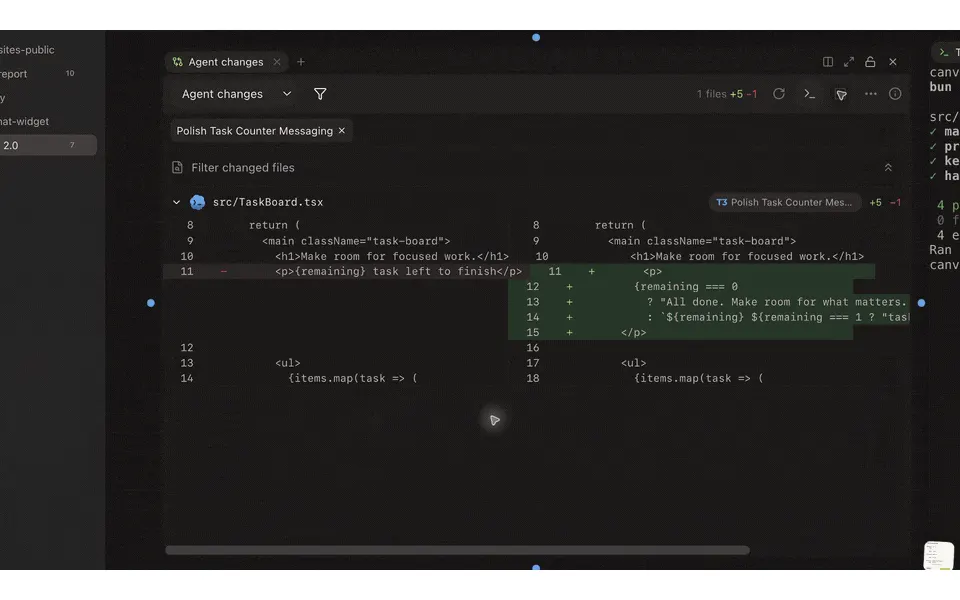
- Desktop app
- Mac, Windows and Linux
- Browser
- No
- Phone
- IPhone
- Command line
- Yes
- Agents
- Claude Code, Codex, Cursor Agent, OpenCode, Pi and Grok
- Your subscription
- Works with your own plan
- Agents run
- On your computer and on your own server
- Laptop closed
- Keeps going
- Isolation
- Worktree
- Parallel agents
- Yes
- Scheduled runs
- No
- Coordinator agent
- Yes
- Built-in issues
- No
- Pull requests
- Yes
- Review screen
- Yes
- Team
- Shared sessions
- Self-hosting
- Yes
- Licence
- MIT
- Price from
- Free
- How it charges
- No paid plan and bring your own key
- Paid plans from
- Not listed
Receipts
- Checked
- Findings
- 48 published · 48 cross-checked by a second agent · read them all
- Sources
- 36 public pages on 2 sites: github.com, cate.cero-ai.com
- GitHub stars
- 2,235 on · github.com · repository attention, not users or capability
- Screenshot
- github.com, retrieved · first party repository · shows appearance, not capability
- Data
- /products/cate.json · .md
- Method
- Same rules for all 103 researched ADEs. How we check · Report wrong data
What it does
Where you use it
Desktop installers cover macOS (arm64/x64), Windows x64 and Linux x64. No web client or phone-browser client exists; the native iPhone app is the phone route. The product-owned cate CLI is the command interface. No editor extensions for external editors exist. Desktop sessions start/steer/review/resume agent work; OS-native notifications plus iOS push; paired devices continue work across machines.
Source and scope for Where you use itAgents it runs
Seven provider CLIs are supported: Claude Code, Codex, Cursor, Grok, Kiro, OpenCode and Pi, launched as installed CLIs with native logins. No product-level model-provider catalog or custom harness adapters exist; mixed providers share one workspace through the cate CLI.
Source and scope for Agents it runsAccounts and subscriptions
Work reuses existing coding-agent subscriptions through native CLI logins; Cate sells nothing and stores no provider credentials. No vendor credits, local-model route, multi-account switching or provider restriction list is established; no Cate account is needed for local or LAN pairing.
Source and scope for Accounts and subscriptionsWhere agents run
Work executes locally or on user-owned SSH/WSL machines whose runtimes Cate installs; self-hosted always-available workspaces are supported. No vendor cloud execution exists. The runtime survives client disconnects per workspace Availability and any paired device continues the same live workspace.
Source and scope for Where agents runHow work is kept apart
Workspaces are plain folder checkouts with git worktree isolation per branch; device links are Noise-encrypted with pinned keys. No container, VM or OS-sandbox workload isolation exists, and process boundaries, secret management and hostile-code containment are not established as product guarantees.
Source and scope for How work is kept apartParallel work
Independent agent sessions run concurrently in separate terminals, one per worktree branch, with running/waiting/finished states visible on the canvas. No concurrency quotas are documented and concurrent execution was not witnessed in a fixture.
Source and scope for Parallel workScheduled runs
No unattended triggers exist: no schedules, event triggers, recurring tasks, completion conditions, scheduler location, overlap handling or retries. Polling-style automation would be a manual integration, of which none is documented.
Source and scope for Scheduled runsGit and pull requests
Branches, worktrees, PR creation/listing/context and merge-back flows are product-owned via the host gh login; commits, comments and rebases stay agent/terminal-side. CI response surfacing and product-held PR state do not exist.
Source and scope for Git and pull requestsLicence and source
The whole application repository is MIT-licensed public source at the pinned tag; the hosted Cate Connect service is a separate closed component whose parity is not established, and the extensions repository publishes no license.
Source and scope for Licence and sourcePrice
Cate is MIT open source and free to download, with no paid plan found; it runs agents on the user own existing agent subscriptions and sells no tokens. No priced dimensions (currency, seats, overages, taxes) are stated.
Source and scope for PriceTyped filters
Every value links to its receipt below. Read plan and surface restrictions before using a filter to decide.
| Filter | Value |
|---|---|
| Desktop OS: macOS | Yes cross-checked |
| Desktop OS: Windows | Yes cross-checked |
| Desktop OS: Linux | Yes cross-checked |
| Web client | No cross-checked |
| Phone access: Native iOS | Yes cross-checked |
| Phone access: Native Android | No cross-checked |
| Phone access: Phone browser | No cross-checked |
| CLI | Yes cross-checked |
| Coding agents: Claude Code | Yes cross-checked |
| Coding agents: Codex | Yes cross-checked |
| Coding agents: Cursor Agent | Yes cross-checked |
| Coding agents: Gemini CLI | No cross-checked |
| Coding agents: OpenCode | Yes cross-checked |
| Coding agents: Pi | Yes cross-checked |
| Coding agents: Grok | Yes cross-checked |
| Coding agents: Aider | No cross-checked |
| Coding agents: Antigravity | No cross-checked |
| Use my subscription | Yes cross-checked |
| Where agents run: On your computer | Yes cross-checked |
| Where agents run: On your own server | Yes cross-checked |
| Where agents run: In the vendor's cloud | No cross-checked |
| Workspace isolation: Git worktree | Yes cross-checked |
| Workspace isolation: Container | No cross-checked |
| Workspace isolation: VM or microVM | No cross-checked |
| Parallel runs | Yes cross-checked |
| Coordinator | Yes cross-checked |
| Native issue tracking | No cross-checked |
| Unattended triggers | No cross-checked |
| Shared prompting | Yes cross-checked |
| Team roles | No cross-checked |
| SSO | No cross-checked |
| Pull request workflow | Yes cross-checked |
| Review interface | Yes cross-checked |
| Product license: Apache-2.0 | No. MIT cross-checked |
| Product license: MIT | Yes. MIT cross-checked |
| Product license: GPL-3.0 | No. MIT cross-checked |
| Product license: GPL-3.0-or-later | No. MIT cross-checked |
| Product license: AGPL-3.0 | No. MIT cross-checked |
| Product license: AGPL-3.0-or-later | No. MIT cross-checked |
| Product license: Elastic License 2.0 | No. MIT cross-checked |
| Product license: Custom terms | No. MIT cross-checked |
| Product license: Proprietary | No. MIT cross-checked |
| Self-hosting | Yes cross-checked |
| Telemetry opt-out | No cross-checked |
| Free access | Yes cross-checked |
| Starting price: Free | Yes. Free cross-checked |
| Starting price: Up to $20/month | No. Free cross-checked |
| Starting price: $21–40/month | No. Free cross-checked |
| Starting price: $41–100/month | No. Free cross-checked |
| Starting price: Over $100/month | No. Free cross-checked |
| Starting price: Contact for pricing | No. Free cross-checked |
| Pricing model: Free, no paid plan | Yes cross-checked |
| Pricing model: Free plan | No |
| Pricing model: Subscription | No |
| Pricing model: Per seat | No |
| Pricing model: Usage-based | No |
| Pricing model: Per machine or compute | No |
| Pricing model: Bring your own key | Yes |
| Pricing model: One-time purchase | No |
| Paid plans from: No paid plan | Unknown |
| Paid plans from: $10 or less/month | Unknown |
| Paid plans from: $11–20/month | Unknown |
| Paid plans from: $21–40/month | Unknown |
| Paid plans from: $41–100/month | Unknown |
| Paid plans from: Over $100/month | Unknown |
| Paid plans from: Contact sales | Unknown |
| Lifecycle status: Active | Unknown |
| Lifecycle status: Sunsetting | Unknown |
| Keeps going with laptop closed | Yes cross-checked |
| Open-source license | Yes. MIT cross-checked |
| Any desktop app | Yes cross-checked |
| Paid plan up to $20/month | Unknown |
| Paid plan up to $40/month | Unknown |
| Any phone client | Yes cross-checked |
Filter receipts
Desktop OS: macOS: Yes cross-checked
Desktop OS: macOS
Typed value: Yes.
Desktop installers cover macOS (arm64/x64), Windows x64 and Linux x64. No web client or phone-browser client exists; the native iPhone app is the phone route. The product-owned cate CLI is the command interface. No editor extensions for external editors exist. Desktop sessions start/steer/review/resume agent work; OS-native notifications plus iOS push; paired devices continue work across machines.
- Desktop os: macOS DMG/ZIP arm64+x64, Windows NSIS/ZIP x64, Linux AppImage/DEB/tar.gz x64, plus Homebrew cask.
- Task actions: Start agents in new panels, prompt/steer running sessions, request changes from reviews, resume by session id after restarts.
- Cross device continuity: Paired devices share the same live workspace; a second device continues agent conversations, prompts and panels.
- Browser, phone-browser and editor-extension routes are absent by bounded inspection; remaining findings are as cited.
-
Finding: Infinite-canvas IDE for parallel coding agents. Install: macOS DMG/ZIP arm64+x64, Windows NSIS/ZIP x64, Linux AppImage/DEB/tar.gz x64, plus Homebrew cask. Features: shared live workspaces, agent-aware terminals with running/waiting/finished states, sessions survive restarts with resume, shared prompt queues, usage overview by time/agent/model plus Claude/Codex subscription limits, git worktrees with colored canvas territories, panels on canvas or dock, multi-repo git with side-by-side diffs, ripgrep search, Cmd+K. Share pairs devices by QR/code over LAN or Cate Connect with end-to-end encryption; Availability choices: finish running work, stay available, stop with Cate.
Desktop OS: Windows: Yes cross-checked
Desktop OS: Windows
Typed value: Yes.
Desktop installers cover macOS (arm64/x64), Windows x64 and Linux x64. No web client or phone-browser client exists; the native iPhone app is the phone route. The product-owned cate CLI is the command interface. No editor extensions for external editors exist. Desktop sessions start/steer/review/resume agent work; OS-native notifications plus iOS push; paired devices continue work across machines.
- Desktop os: macOS DMG/ZIP arm64+x64, Windows NSIS/ZIP x64, Linux AppImage/DEB/tar.gz x64, plus Homebrew cask.
- Task actions: Start agents in new panels, prompt/steer running sessions, request changes from reviews, resume by session id after restarts.
- Cross device continuity: Paired devices share the same live workspace; a second device continues agent conversations, prompts and panels.
- Browser, phone-browser and editor-extension routes are absent by bounded inspection; remaining findings are as cited.
-
Finding: Infinite-canvas IDE for parallel coding agents. Install: macOS DMG/ZIP arm64+x64, Windows NSIS/ZIP x64, Linux AppImage/DEB/tar.gz x64, plus Homebrew cask. Features: shared live workspaces, agent-aware terminals with running/waiting/finished states, sessions survive restarts with resume, shared prompt queues, usage overview by time/agent/model plus Claude/Codex subscription limits, git worktrees with colored canvas territories, panels on canvas or dock, multi-repo git with side-by-side diffs, ripgrep search, Cmd+K. Share pairs devices by QR/code over LAN or Cate Connect with end-to-end encryption; Availability choices: finish running work, stay available, stop with Cate.
Desktop OS: Linux: Yes cross-checked
Desktop OS: Linux
Typed value: Yes.
Desktop installers cover macOS (arm64/x64), Windows x64 and Linux x64. No web client or phone-browser client exists; the native iPhone app is the phone route. The product-owned cate CLI is the command interface. No editor extensions for external editors exist. Desktop sessions start/steer/review/resume agent work; OS-native notifications plus iOS push; paired devices continue work across machines.
- Desktop os: macOS DMG/ZIP arm64+x64, Windows NSIS/ZIP x64, Linux AppImage/DEB/tar.gz x64, plus Homebrew cask.
- Task actions: Start agents in new panels, prompt/steer running sessions, request changes from reviews, resume by session id after restarts.
- Cross device continuity: Paired devices share the same live workspace; a second device continues agent conversations, prompts and panels.
- Browser, phone-browser and editor-extension routes are absent by bounded inspection; remaining findings are as cited.
-
Finding: Infinite-canvas IDE for parallel coding agents. Install: macOS DMG/ZIP arm64+x64, Windows NSIS/ZIP x64, Linux AppImage/DEB/tar.gz x64, plus Homebrew cask. Features: shared live workspaces, agent-aware terminals with running/waiting/finished states, sessions survive restarts with resume, shared prompt queues, usage overview by time/agent/model plus Claude/Codex subscription limits, git worktrees with colored canvas territories, panels on canvas or dock, multi-repo git with side-by-side diffs, ripgrep search, Cmd+K. Share pairs devices by QR/code over LAN or Cate Connect with end-to-end encryption; Availability choices: finish running work, stay available, stop with Cate.
Web client: No cross-checked
Web client
Typed value: No.
Desktop installers cover macOS (arm64/x64), Windows x64 and Linux x64. No web client or phone-browser client exists; the native iPhone app is the phone route. The product-owned cate CLI is the command interface. No editor extensions for external editors exist. Desktop sessions start/steer/review/resume agent work; OS-native notifications plus iOS push; paired devices continue work across machines.
- Browser: No web client: the only shells are desktop Electron and iOS SwiftUI, and the site is marketing with no app UI.
- Mobile browser: No phone-browser client: phone access is the native iOS app only.
- Notifications: OS-native notifications, human-permission attention notifications, one subscription per open workspace, iOS push via APNs.
- Cross device continuity: Paired devices share the same live workspace; a second device continues agent conversations, prompts and panels.
- Browser, phone-browser and editor-extension routes are absent by bounded inspection; remaining findings are as cited.
-
Finding: The runtime is the application: one daemon per workspace; clients (desktop Electron+React shell, iPhone SwiftUI shell) render runtime state. Transports: local socket, machine (SSH/WSL command), network (LAN or Cate Connect). Cate Connect passes connection setup and runs a TURN relay; it never sees workspace plaintext. Agent means one provider CLI identity. D3: every client is the same to the runtime; no roles, no per-client permissions. D4: Noise handshake with pinned keys, only known devices; local transport is OS-user protected with a caller token reaching only the api capability. iOS push goes through an APNs target with a notification service extension.
Phone access: Native iOS: Yes cross-checked
Phone access: Native iOS
Typed value: Yes.
Desktop installers cover macOS (arm64/x64), Windows x64 and Linux x64. No web client or phone-browser client exists; the native iPhone app is the phone route. The product-owned cate CLI is the command interface. No editor extensions for external editors exist. Desktop sessions start/steer/review/resume agent work; OS-native notifications plus iOS push; paired devices continue work across machines.
- Mobile apps: Native SwiftUI iPhone app with agent chat, terminals, editors, browser and review views; App Store review rehearsal scripted; audit targets iPhone-only on iOS 26.
- Mobile browser: No phone-browser client: phone access is the native iOS app only.
- Browser, phone-browser and editor-extension routes are absent by bounded inspection; remaining findings are as cited.
-
Finding: Native SwiftUI iPhone app running the shared client core headless in a WKWebView. Views cover agent chat, terminals, editors, browser panels, review panels and worktrees. App Store review rehearsal uses scripted demo/pairing plans on a physical iPhone.
Phone access: Native Android: No cross-checked
Phone access: Native Android
Typed value: No.
Desktop installers cover macOS (arm64/x64), Windows x64 and Linux x64. No web client or phone-browser client exists; the native iPhone app is the phone route. The product-owned cate CLI is the command interface. No editor extensions for external editors exist. Desktop sessions start/steer/review/resume agent work; OS-native notifications plus iOS push; paired devices continue work across machines.
- Browser: No web client: the only shells are desktop Electron and iOS SwiftUI, and the site is marketing with no app UI.
- Mobile browser: No phone-browser client: phone access is the native iOS app only.
- Notifications: OS-native notifications, human-permission attention notifications, one subscription per open workspace, iOS push via APNs.
- Cross device continuity: Paired devices share the same live workspace; a second device continues agent conversations, prompts and panels.
- Browser, phone-browser and editor-extension routes are absent by bounded inspection; remaining findings are as cited.
-
Finding: The runtime is the application: one daemon per workspace; clients (desktop Electron+React shell, iPhone SwiftUI shell) render runtime state. Transports: local socket, machine (SSH/WSL command), network (LAN or Cate Connect). Cate Connect passes connection setup and runs a TURN relay; it never sees workspace plaintext. Agent means one provider CLI identity. D3: every client is the same to the runtime; no roles, no per-client permissions. D4: Noise handshake with pinned keys, only known devices; local transport is OS-user protected with a caller token reaching only the api capability. iOS push goes through an APNs target with a notification service extension.
Phone access: Phone browser: No cross-checked
Phone access: Phone browser
Typed value: No.
Desktop installers cover macOS (arm64/x64), Windows x64 and Linux x64. No web client or phone-browser client exists; the native iPhone app is the phone route. The product-owned cate CLI is the command interface. No editor extensions for external editors exist. Desktop sessions start/steer/review/resume agent work; OS-native notifications plus iOS push; paired devices continue work across machines.
- Browser: No web client: the only shells are desktop Electron and iOS SwiftUI, and the site is marketing with no app UI.
- Mobile browser: No phone-browser client: phone access is the native iOS app only.
- Notifications: OS-native notifications, human-permission attention notifications, one subscription per open workspace, iOS push via APNs.
- Cross device continuity: Paired devices share the same live workspace; a second device continues agent conversations, prompts and panels.
- Browser, phone-browser and editor-extension routes are absent by bounded inspection; remaining findings are as cited.
-
Finding: The runtime is the application: one daemon per workspace; clients (desktop Electron+React shell, iPhone SwiftUI shell) render runtime state. Transports: local socket, machine (SSH/WSL command), network (LAN or Cate Connect). Cate Connect passes connection setup and runs a TURN relay; it never sees workspace plaintext. Agent means one provider CLI identity. D3: every client is the same to the runtime; no roles, no per-client permissions. D4: Noise handshake with pinned keys, only known devices; local transport is OS-user protected with a caller token reaching only the api capability. iOS push goes through an APNs target with a notification service extension.
CLI: Yes cross-checked
CLI
Typed value: Yes.
The cate CLI covers create/inspect/steer/stop/review across agent, review, browser, terminal, editor and document areas with read/control gating. No public HTTP API, SDK, MCP server or webhooks exist. CLI callers reach only the api capability over an OS-user socket; runtime/client compatibility stays at version 1.
- Cli: cate agent/review/browser plus terminal/editor/document panel operations, callable by agents in terminals.
- Operations: Create (agent start, worktrees), inspect (list/read/inspect), steer (send, review notes), stop (interrupt, close, availability), review (complete, request changes).
- Authentication: Local CLI callers are OS-user scoped to the api capability with read/control areas; network pairing uses device keys. Network caller auth beyond device keys is unstated.
- Network caller auth and API stability policy beyond the cited facts are unstated.
-
cate agent CLI contract (pinned release)
Finding: Product-owned cate CLI for agents: agent start (prompt max 50000 chars, agent/worktree/new-worktree/canvas placement), types, list, read, wait (5-60s), send (queued prompts with ids). Read vs control permission areas gate observation vs steering. Callable in a Cate terminal, i.e. by the agents running there.
Coding agents: Claude Code: Yes cross-checked
Coding agents: Claude Code
Typed value: Yes.
Seven provider CLIs are supported: Claude Code, Codex, Cursor, Grok, Kiro, OpenCode and Pi, launched as installed CLIs with native logins. No product-level model-provider catalog or custom harness adapters exist; mixed providers share one workspace through the cate CLI.
- Harnesses: Claude Code, Codex, Cursor, Grok, Kiro, OpenCode, Pi with launch command, resume argv and session-store paths each.
- Custom adapters: No custom harness adapters: the agent table is a closed total record and new agents are a compile error until every table covers them.
- Session integration: Cate launches installed provider CLIs in terminal PTYs, injects hooks per agent, and reuses native logins; it does not embed a model loop.
- Mixed harness operation: Different CLIs run side by side in one workspace and can drive each other through the shipped cate CLI.
- Product-level model-provider choice is not established; remaining findings are as cited.
-
Agent registry (pinned release)
Finding: Exactly seven supported agent CLIs, total-record compile-checked: claude-code (claude), codex, cursor (cursor-agent), grok, kiro (kiro-cli), opencode, pi. Each declares launch command, resume argv, CLI session-store path, prompt args and interrupt keys. No gemini-cli, aider, antigravity or custom-adapter entry exists in this closed table.
Coding agents: Codex: Yes cross-checked
Coding agents: Codex
Typed value: Yes.
Seven provider CLIs are supported: Claude Code, Codex, Cursor, Grok, Kiro, OpenCode and Pi, launched as installed CLIs with native logins. No product-level model-provider catalog or custom harness adapters exist; mixed providers share one workspace through the cate CLI.
- Harnesses: Claude Code, Codex, Cursor, Grok, Kiro, OpenCode, Pi with launch command, resume argv and session-store paths each.
- Custom adapters: No custom harness adapters: the agent table is a closed total record and new agents are a compile error until every table covers them.
- Session integration: Cate launches installed provider CLIs in terminal PTYs, injects hooks per agent, and reuses native logins; it does not embed a model loop.
- Mixed harness operation: Different CLIs run side by side in one workspace and can drive each other through the shipped cate CLI.
- Product-level model-provider choice is not established; remaining findings are as cited.
-
Agent registry (pinned release)
Finding: Exactly seven supported agent CLIs, total-record compile-checked: claude-code (claude), codex, cursor (cursor-agent), grok, kiro (kiro-cli), opencode, pi. Each declares launch command, resume argv, CLI session-store path, prompt args and interrupt keys. No gemini-cli, aider, antigravity or custom-adapter entry exists in this closed table.
Coding agents: Cursor Agent: Yes cross-checked
Coding agents: Cursor Agent
Typed value: Yes.
Seven provider CLIs are supported: Claude Code, Codex, Cursor, Grok, Kiro, OpenCode and Pi, launched as installed CLIs with native logins. No product-level model-provider catalog or custom harness adapters exist; mixed providers share one workspace through the cate CLI.
- Harnesses: Claude Code, Codex, Cursor, Grok, Kiro, OpenCode, Pi with launch command, resume argv and session-store paths each.
- Custom adapters: No custom harness adapters: the agent table is a closed total record and new agents are a compile error until every table covers them.
- Session integration: Cate launches installed provider CLIs in terminal PTYs, injects hooks per agent, and reuses native logins; it does not embed a model loop.
- Mixed harness operation: Different CLIs run side by side in one workspace and can drive each other through the shipped cate CLI.
- Product-level model-provider choice is not established; remaining findings are as cited.
-
Agent registry (pinned release)
Finding: Exactly seven supported agent CLIs, total-record compile-checked: claude-code (claude), codex, cursor (cursor-agent), grok, kiro (kiro-cli), opencode, pi. Each declares launch command, resume argv, CLI session-store path, prompt args and interrupt keys. No gemini-cli, aider, antigravity or custom-adapter entry exists in this closed table.
Coding agents: Gemini CLI: No cross-checked
Coding agents: Gemini CLI
Typed value: No.
Seven provider CLIs are supported: Claude Code, Codex, Cursor, Grok, Kiro, OpenCode and Pi, launched as installed CLIs with native logins. No product-level model-provider catalog or custom harness adapters exist; mixed providers share one workspace through the cate CLI.
- Harnesses: Claude Code, Codex, Cursor, Grok, Kiro, OpenCode, Pi with launch command, resume argv and session-store paths each.
- Custom adapters: No custom harness adapters: the agent table is a closed total record and new agents are a compile error until every table covers them.
- Session integration: Cate launches installed provider CLIs in terminal PTYs, injects hooks per agent, and reuses native logins; it does not embed a model loop.
- Mixed harness operation: Different CLIs run side by side in one workspace and can drive each other through the shipped cate CLI.
- Product-level model-provider choice is not established; remaining findings are as cited.
-
Agent registry (pinned release)
Finding: Exactly seven supported agent CLIs, total-record compile-checked: claude-code (claude), codex, cursor (cursor-agent), grok, kiro (kiro-cli), opencode, pi. Each declares launch command, resume argv, CLI session-store path, prompt args and interrupt keys. No gemini-cli, aider, antigravity or custom-adapter entry exists in this closed table.
Coding agents: OpenCode: Yes cross-checked
Coding agents: OpenCode
Typed value: Yes.
Seven provider CLIs are supported: Claude Code, Codex, Cursor, Grok, Kiro, OpenCode and Pi, launched as installed CLIs with native logins. No product-level model-provider catalog or custom harness adapters exist; mixed providers share one workspace through the cate CLI.
- Harnesses: Claude Code, Codex, Cursor, Grok, Kiro, OpenCode, Pi with launch command, resume argv and session-store paths each.
- Custom adapters: No custom harness adapters: the agent table is a closed total record and new agents are a compile error until every table covers them.
- Session integration: Cate launches installed provider CLIs in terminal PTYs, injects hooks per agent, and reuses native logins; it does not embed a model loop.
- Mixed harness operation: Different CLIs run side by side in one workspace and can drive each other through the shipped cate CLI.
- Product-level model-provider choice is not established; remaining findings are as cited.
-
Agent registry (pinned release)
Finding: Exactly seven supported agent CLIs, total-record compile-checked: claude-code (claude), codex, cursor (cursor-agent), grok, kiro (kiro-cli), opencode, pi. Each declares launch command, resume argv, CLI session-store path, prompt args and interrupt keys. No gemini-cli, aider, antigravity or custom-adapter entry exists in this closed table.
Coding agents: Pi: Yes cross-checked
Coding agents: Pi
Typed value: Yes.
Seven provider CLIs are supported: Claude Code, Codex, Cursor, Grok, Kiro, OpenCode and Pi, launched as installed CLIs with native logins. No product-level model-provider catalog or custom harness adapters exist; mixed providers share one workspace through the cate CLI.
- Harnesses: Claude Code, Codex, Cursor, Grok, Kiro, OpenCode, Pi with launch command, resume argv and session-store paths each.
- Custom adapters: No custom harness adapters: the agent table is a closed total record and new agents are a compile error until every table covers them.
- Session integration: Cate launches installed provider CLIs in terminal PTYs, injects hooks per agent, and reuses native logins; it does not embed a model loop.
- Mixed harness operation: Different CLIs run side by side in one workspace and can drive each other through the shipped cate CLI.
- Product-level model-provider choice is not established; remaining findings are as cited.
-
Agent registry (pinned release)
Finding: Exactly seven supported agent CLIs, total-record compile-checked: claude-code (claude), codex, cursor (cursor-agent), grok, kiro (kiro-cli), opencode, pi. Each declares launch command, resume argv, CLI session-store path, prompt args and interrupt keys. No gemini-cli, aider, antigravity or custom-adapter entry exists in this closed table.
Coding agents: Grok: Yes cross-checked
Coding agents: Grok
Typed value: Yes.
Seven provider CLIs are supported: Claude Code, Codex, Cursor, Grok, Kiro, OpenCode and Pi, launched as installed CLIs with native logins. No product-level model-provider catalog or custom harness adapters exist; mixed providers share one workspace through the cate CLI.
- Harnesses: Claude Code, Codex, Cursor, Grok, Kiro, OpenCode, Pi with launch command, resume argv and session-store paths each.
- Custom adapters: No custom harness adapters: the agent table is a closed total record and new agents are a compile error until every table covers them.
- Session integration: Cate launches installed provider CLIs in terminal PTYs, injects hooks per agent, and reuses native logins; it does not embed a model loop.
- Mixed harness operation: Different CLIs run side by side in one workspace and can drive each other through the shipped cate CLI.
- Product-level model-provider choice is not established; remaining findings are as cited.
-
Agent registry (pinned release)
Finding: Exactly seven supported agent CLIs, total-record compile-checked: claude-code (claude), codex, cursor (cursor-agent), grok, kiro (kiro-cli), opencode, pi. Each declares launch command, resume argv, CLI session-store path, prompt args and interrupt keys. No gemini-cli, aider, antigravity or custom-adapter entry exists in this closed table.
Coding agents: Aider: No cross-checked
Coding agents: Aider
Typed value: No.
Seven provider CLIs are supported: Claude Code, Codex, Cursor, Grok, Kiro, OpenCode and Pi, launched as installed CLIs with native logins. No product-level model-provider catalog or custom harness adapters exist; mixed providers share one workspace through the cate CLI.
- Harnesses: Claude Code, Codex, Cursor, Grok, Kiro, OpenCode, Pi with launch command, resume argv and session-store paths each.
- Custom adapters: No custom harness adapters: the agent table is a closed total record and new agents are a compile error until every table covers them.
- Session integration: Cate launches installed provider CLIs in terminal PTYs, injects hooks per agent, and reuses native logins; it does not embed a model loop.
- Mixed harness operation: Different CLIs run side by side in one workspace and can drive each other through the shipped cate CLI.
- Product-level model-provider choice is not established; remaining findings are as cited.
-
Agent registry (pinned release)
Finding: Exactly seven supported agent CLIs, total-record compile-checked: claude-code (claude), codex, cursor (cursor-agent), grok, kiro (kiro-cli), opencode, pi. Each declares launch command, resume argv, CLI session-store path, prompt args and interrupt keys. No gemini-cli, aider, antigravity or custom-adapter entry exists in this closed table.
Coding agents: Antigravity: No cross-checked
Coding agents: Antigravity
Typed value: No.
Seven provider CLIs are supported: Claude Code, Codex, Cursor, Grok, Kiro, OpenCode and Pi, launched as installed CLIs with native logins. No product-level model-provider catalog or custom harness adapters exist; mixed providers share one workspace through the cate CLI.
- Harnesses: Claude Code, Codex, Cursor, Grok, Kiro, OpenCode, Pi with launch command, resume argv and session-store paths each.
- Custom adapters: No custom harness adapters: the agent table is a closed total record and new agents are a compile error until every table covers them.
- Session integration: Cate launches installed provider CLIs in terminal PTYs, injects hooks per agent, and reuses native logins; it does not embed a model loop.
- Mixed harness operation: Different CLIs run side by side in one workspace and can drive each other through the shipped cate CLI.
- Product-level model-provider choice is not established; remaining findings are as cited.
-
Agent registry (pinned release)
Finding: Exactly seven supported agent CLIs, total-record compile-checked: claude-code (claude), codex, cursor (cursor-agent), grok, kiro (kiro-cli), opencode, pi. Each declares launch command, resume argv, CLI session-store path, prompt args and interrupt keys. No gemini-cli, aider, antigravity or custom-adapter entry exists in this closed table.
Use my subscription: Yes cross-checked
Use my subscription
Typed value: Yes.
Work reuses existing coding-agent subscriptions through native CLI logins; Cate sells nothing and stores no provider credentials. No vendor credits, local-model route, multi-account switching or provider restriction list is established; no Cate account is needed for local or LAN pairing.
- Agent subscriptions: Existing supported coding-agent subscriptions work; Cate sells no tokens and stores no provider credentials.
- Vendor account requirement: No Cate account is required: local-first workspaces pair over LAN by QR/code; Cate Connect is a transport, not an account gate.
- Credential handling is each CLI own; credit, switching and restriction facts are as cited.
-
Finding: Infinite-canvas IDE for parallel coding agents. Install: macOS DMG/ZIP arm64+x64, Windows NSIS/ZIP x64, Linux AppImage/DEB/tar.gz x64, plus Homebrew cask. Features: shared live workspaces, agent-aware terminals with running/waiting/finished states, sessions survive restarts with resume, shared prompt queues, usage overview by time/agent/model plus Claude/Codex subscription limits, git worktrees with colored canvas territories, panels on canvas or dock, multi-repo git with side-by-side diffs, ripgrep search, Cmd+K. Share pairs devices by QR/code over LAN or Cate Connect with end-to-end encryption; Availability choices: finish running work, stay available, stop with Cate.
Where agents run: On your computer: Yes cross-checked
Where agents run: On your computer
Typed value: Yes.
Work executes locally or on user-owned SSH/WSL machines whose runtimes Cate installs; self-hosted always-available workspaces are supported. No vendor cloud execution exists. The runtime survives client disconnects per workspace Availability and any paired device continues the same live workspace.
- Local: Local execution on the machine holding the workspace files.
- Byo remote: SSH hosts and WSL distros run the workspace with an auto-installed runtime.
- Provisioning: Runtime tarballs install automatically on remote machines; compute itself is user-provisioned.
- Client disconnect: Work continues after the controlling client disconnects, subject to the Availability choice.
- Other device continuation: Any paired device reconnects to the same live workspace from anywhere.
- Resource, region facts are gaps; managed cloud and hybrid are absent.
-
Finding: Infinite-canvas IDE for parallel coding agents. Install: macOS DMG/ZIP arm64+x64, Windows NSIS/ZIP x64, Linux AppImage/DEB/tar.gz x64, plus Homebrew cask. Features: shared live workspaces, agent-aware terminals with running/waiting/finished states, sessions survive restarts with resume, shared prompt queues, usage overview by time/agent/model plus Claude/Codex subscription limits, git worktrees with colored canvas territories, panels on canvas or dock, multi-repo git with side-by-side diffs, ripgrep search, Cmd+K. Share pairs devices by QR/code over LAN or Cate Connect with end-to-end encryption; Availability choices: finish running work, stay available, stop with Cate.
Where agents run: On your own server: Yes cross-checked
Where agents run: On your own server
Typed value: Yes.
Work executes locally or on user-owned SSH/WSL machines whose runtimes Cate installs; self-hosted always-available workspaces are supported. No vendor cloud execution exists. The runtime survives client disconnects per workspace Availability and any paired device continues the same live workspace.
- Local: Local execution on the machine holding the workspace files.
- Byo remote: SSH hosts and WSL distros run the workspace with an auto-installed runtime.
- Self hosted: Self-hosted: the MIT runtime runs on user machines with Stay-available persistence and no vendor account.
- Managed cloud: No vendor cloud execution exists; Cate Connect is signaling plus TURN relay and never runs work.
- Hybrid: No hybrid mode exists: one workspace runs on exactly one runtime machine.
- Other device continuation: Any paired device reconnects to the same live workspace from anywhere.
- Resource, region facts are gaps; managed cloud and hybrid are absent.
-
Finding: The runtime is the application: one daemon per workspace; clients (desktop Electron+React shell, iPhone SwiftUI shell) render runtime state. Transports: local socket, machine (SSH/WSL command), network (LAN or Cate Connect). Cate Connect passes connection setup and runs a TURN relay; it never sees workspace plaintext. Agent means one provider CLI identity. D3: every client is the same to the runtime; no roles, no per-client permissions. D4: Noise handshake with pinned keys, only known devices; local transport is OS-user protected with a caller token reaching only the api capability. iOS push goes through an APNs target with a notification service extension.
Where agents run: In the vendor's cloud: No cross-checked
Where agents run: In the vendor's cloud
Typed value: No.
Work executes locally or on user-owned SSH/WSL machines whose runtimes Cate installs; self-hosted always-available workspaces are supported. No vendor cloud execution exists. The runtime survives client disconnects per workspace Availability and any paired device continues the same live workspace.
- Local: Local execution on the machine holding the workspace files.
- Byo remote: SSH hosts and WSL distros run the workspace with an auto-installed runtime.
- Self hosted: Self-hosted: the MIT runtime runs on user machines with Stay-available persistence and no vendor account.
- Managed cloud: No vendor cloud execution exists; Cate Connect is signaling plus TURN relay and never runs work.
- Hybrid: No hybrid mode exists: one workspace runs on exactly one runtime machine.
- Other device continuation: Any paired device reconnects to the same live workspace from anywhere.
- Resource, region facts are gaps; managed cloud and hybrid are absent.
-
Finding: The runtime is the application: one daemon per workspace; clients (desktop Electron+React shell, iPhone SwiftUI shell) render runtime state. Transports: local socket, machine (SSH/WSL command), network (LAN or Cate Connect). Cate Connect passes connection setup and runs a TURN relay; it never sees workspace plaintext. Agent means one provider CLI identity. D3: every client is the same to the runtime; no roles, no per-client permissions. D4: Noise handshake with pinned keys, only known devices; local transport is OS-user protected with a caller token reaching only the api capability. iOS push goes through an APNs target with a notification service extension.
Workspace isolation: Git worktree: Yes cross-checked
Workspace isolation: Git worktree
Typed value: Yes.
Workspaces are plain folder checkouts with git worktree isolation per branch; device links are Noise-encrypted with pinned keys. No container, VM or OS-sandbox workload isolation exists, and process boundaries, secret management and hostile-code containment are not established as product guarantees.
- Branch: Panels inherit checkouts; worktrees carry branch identity with merge-back flows.
- Worktree: One command creates a git worktree with its own colored canvas territory per branch or PR.
- Filesystem: Worktrees separate files; the local transport is OS-user scoped; per-agent filesystem boundaries are unstated.
- Code separation: Worktrees separate code per branch; agents in one checkout share its files.
- Isolation is worktree-level; stronger boundaries are absent by bounded inspection.
-
Worktree contract (pinned release)
Finding: Free-text work descriptions become branch names; PR checkouts use pr-<n>-<head> folders. A new terminal or agent run inherits its caller checkout or a named worktree. Typing what you work on creates the worktree and branch.
Workspace isolation: Container: No cross-checked
Workspace isolation: Container
Typed value: No.
Workspaces are plain folder checkouts with git worktree isolation per branch; device links are Noise-encrypted with pinned keys. No container, VM or OS-sandbox workload isolation exists, and process boundaries, secret management and hostile-code containment are not established as product guarantees.
- Container: No container isolation exists; only Electron/webview sandboxing, which is not workload isolation.
- Vm: No VM or microVM isolation exists.
- Os sandbox: No OS-sandbox workload isolation exists.
- Process: No process isolation boundary is documented; terminals share the runtime machine.
- Isolation is worktree-level; stronger boundaries are absent by bounded inspection.
-
Bounded no-implementation search (pinned release)
Finding: Bounded search at the pinned commit found no implementation for: scheduled/recurring runs (cron, node-schedule, recurrence terms; only timer/debounce/polling hits); webhooks (only a GraphQL language-mode label and the GitHub API client); SSO/SAML/OIDC/SCIM; container/VM isolation for workloads (docker/podman/firecracker/microVM; only Electron/webview sandboxing); a product MCP client or MCP server (only a Claude --strict-mcp-config passthrough); audit-log export; kanban/backlog/sprint/issue entities; workspace export/import; Cate Connect pricing or paid tiers. Search terms: cron, schedule, webhook, sso, saml, oidc, scim, docker, container, sandbox, microvm, firecracker, mcp, audit, kanban, backlog, sprint, export.
Workspace isolation: VM or microVM: No cross-checked
Workspace isolation: VM or microVM
Typed value: No.
Workspaces are plain folder checkouts with git worktree isolation per branch; device links are Noise-encrypted with pinned keys. No container, VM or OS-sandbox workload isolation exists, and process boundaries, secret management and hostile-code containment are not established as product guarantees.
- Container: No container isolation exists; only Electron/webview sandboxing, which is not workload isolation.
- Vm: No VM or microVM isolation exists.
- Os sandbox: No OS-sandbox workload isolation exists.
- Process: No process isolation boundary is documented; terminals share the runtime machine.
- Isolation is worktree-level; stronger boundaries are absent by bounded inspection.
-
Bounded no-implementation search (pinned release)
Finding: Bounded search at the pinned commit found no implementation for: scheduled/recurring runs (cron, node-schedule, recurrence terms; only timer/debounce/polling hits); webhooks (only a GraphQL language-mode label and the GitHub API client); SSO/SAML/OIDC/SCIM; container/VM isolation for workloads (docker/podman/firecracker/microVM; only Electron/webview sandboxing); a product MCP client or MCP server (only a Claude --strict-mcp-config passthrough); audit-log export; kanban/backlog/sprint/issue entities; workspace export/import; Cate Connect pricing or paid tiers. Search terms: cron, schedule, webhook, sso, saml, oidc, scim, docker, container, sandbox, microvm, firecracker, mcp, audit, kanban, backlog, sprint, export.
Parallel runs: Yes cross-checked
Parallel runs
Typed value: Yes.
Independent agent sessions run concurrently in separate terminals, one per worktree branch, with running/waiting/finished states visible on the canvas. No concurrency quotas are documented and concurrent execution was not witnessed in a fixture.
- Concurrent sessions: Each agent runs in its own terminal panel session; five agents on five branches stay visibly separate.
- Concurrent tasks: Parallel terminals carry independent prompts and conversations per worktree.
- Status visibility: Panels show running, waiting-for-input and finished; the Usage button and presence show live state.
- Quotas and witnessed concurrency are not established.
-
Finding: Infinite-canvas IDE for parallel coding agents. Install: macOS DMG/ZIP arm64+x64, Windows NSIS/ZIP x64, Linux AppImage/DEB/tar.gz x64, plus Homebrew cask. Features: shared live workspaces, agent-aware terminals with running/waiting/finished states, sessions survive restarts with resume, shared prompt queues, usage overview by time/agent/model plus Claude/Codex subscription limits, git worktrees with colored canvas territories, panels on canvas or dock, multi-repo git with side-by-side diffs, ripgrep search, Cmd+K. Share pairs devices by QR/code over LAN or Cate Connect with end-to-end encryption; Availability choices: finish running work, stay available, stop with Cate.
Coordinator: Yes cross-checked
Coordinator
Typed value: Yes.
Any agent in a terminal can start, message, read and wait on other agent sessions through the shipped cate CLI, with live progress and retained results. Effort control stays CLI-side and cross-harness use is possible but only through that CLI.
- Roles: Coordinator and worker are terminal sessions distinguished by who called cate agent start; no formal role records exist.
- Model harness effort: The agentId can be chosen per start; model and effort stay inside each CLI.
- Messages: cate agent send delivers prompts to a chosen panel queue; read prints its conversation.
- Results return: Wait returns readiness, read returns conversations, review notes persist findings.
- Cross harness: A session of one CLI can prompt a session of another through the product CLI; no harness-bridging beyond that exists.
- Activation: Delegation activates by running the CLI in a terminal; hook injection modes auto/on/off gate per-agent tracking.
- Authentication: CLI read/control areas and device pairing keys gate access; per-delegate credentials do not exist.
- Followup: Follow-up prompts can be sent to the same panel; resume commands reattach sessions after restarts.
- Invocation: Invocation is the cate agent start command from any terminal, agent or human.
- Roles are informal and effort control is CLI-side; remaining findings are as cited.
-
cate agent CLI contract (pinned release)
Finding: Product-owned cate CLI for agents: agent start (prompt max 50000 chars, agent/worktree/new-worktree/canvas placement), types, list, read, wait (5-60s), send (queued prompts with ids). Read vs control permission areas gate observation vs steering. Callable in a Cate terminal, i.e. by the agents running there.
Native issue tracking: No cross-checked
Native issue tracking
Typed value: No.
No native issue management exists: no create/edit/discuss/prioritize/label/assign/search/filter/archive/reopen, no idea parking, no dispatch, no task/session separation, no durable issue states. Panels and relations are not issues and no external tracker is required for any issue workflow.
- Create: No issue creation exists.
- Edit: No issue editing exists.
- Discuss: No issue discussion exists.
- Prioritize: No prioritization exists.
- Label: No labels exist.
- Filter: No issue filters exist.
- Archive: No archiving exists.
- Reopen: No reopen flow exists.
- Project epic views: No project/epic views exist; the canvas shows panels, not issues.
- Task session separation: No task/session separation exists; an agent session lives in its terminal panel.
- Metadata: No issue metadata exists.
- Durable states: No durable issue states exist.
- External tracker requirement: No external tracker is required; there is no issue workflow to attach one to.
-
Panel relation graph (pinned release)
Finding: Relations link panels with context/use/verify intents and produce changes, findings or notes; the relation setting is Next/Always/Off with a workspace kill-switch. Relations carry no states, assignees, priorities or due dates and are not an issue tracker.
Unattended triggers: No cross-checked
Unattended triggers
Typed value: No.
No unattended triggers exist: no schedules, event triggers, recurring tasks, completion conditions, scheduler location, overlap handling or retries. Polling-style automation would be a manual integration, of which none is documented.
- Schedules: No schedules exist in the pinned release.
- Events: No event triggers exist.
- Recurring tasks: No recurring tasks exist.
- Completion conditions: No completion conditions exist.
- Scheduler location: No scheduler exists, so no location applies.
- Overlaps: No overlap handling exists.
- Retries: No trigger retries exist.
- Client independence: Nothing can start work without a human; closing the client only matters for work already running.
-
Bounded no-implementation search (pinned release)
Finding: Bounded search at the pinned commit found no implementation for: scheduled/recurring runs (cron, node-schedule, recurrence terms; only timer/debounce/polling hits); webhooks (only a GraphQL language-mode label and the GitHub API client); SSO/SAML/OIDC/SCIM; container/VM isolation for workloads (docker/podman/firecracker/microVM; only Electron/webview sandboxing); a product MCP client or MCP server (only a Claude --strict-mcp-config passthrough); audit-log export; kanban/backlog/sprint/issue entities; workspace export/import; Cate Connect pricing or paid tiers. Search terms: cron, schedule, webhook, sso, saml, oidc, scim, docker, container, sandbox, microvm, firecracker, mcp, audit, kanban, backlog, sprint, export.
Shared prompting: Yes cross-checked
Shared prompting
Typed value: Yes.
Collaborators share one live workspace with presence and simultaneous prompting through shared queues; no in-product discussion or comments exist. No roles, ordering, conflict or plan rules govern co-steering; the original owner need not stay online.
- Visibility: Every connected client sees the same live panels, conversations, layout and presence.
- Presence: Presence shows who else is connected; devices hold full shared control.
- Coprompting: Several people can send prompts into the same agent work via shared queues; no co-prompting protocol exists.
- Simultaneous prompting is shared-queue only; governance questions are gaps or absent.
-
Finding: Infinite-canvas IDE for parallel coding agents. Install: macOS DMG/ZIP arm64+x64, Windows NSIS/ZIP x64, Linux AppImage/DEB/tar.gz x64, plus Homebrew cask. Features: shared live workspaces, agent-aware terminals with running/waiting/finished states, sessions survive restarts with resume, shared prompt queues, usage overview by time/agent/model plus Claude/Codex subscription limits, git worktrees with colored canvas territories, panels on canvas or dock, multi-repo git with side-by-side diffs, ripgrep search, Cmd+K. Share pairs devices by QR/code over LAN or Cate Connect with end-to-end encryption; Availability choices: finish running work, stay available, stop with Cate.
Team roles: No cross-checked
Team roles
Typed value: No.
No organization, project or task roles and no SSO or provisioning exist. Membership is device pairing with immediate revocation; unauthorized devices cannot connect thanks to pinned keys.
- Organization roles: No organization roles exist.
- Project roles: No project roles exist.
- Task roles: No task roles exist.
- Unauthorized access: Only known devices connect: Noise handshake with pinned keys; unpaired devices are refused.
- Membership is pairing-only; roles and SSO are absent.
-
Finding: The runtime is the application: one daemon per workspace; clients (desktop Electron+React shell, iPhone SwiftUI shell) render runtime state. Transports: local socket, machine (SSH/WSL command), network (LAN or Cate Connect). Cate Connect passes connection setup and runs a TURN relay; it never sees workspace plaintext. Agent means one provider CLI identity. D3: every client is the same to the runtime; no roles, no per-client permissions. D4: Noise handshake with pinned keys, only known devices; local transport is OS-user protected with a caller token reaching only the api capability. iOS push goes through an APNs target with a notification service extension.
SSO: No cross-checked
SSO
Typed value: No.
No organization, project or task roles and no SSO or provisioning exist. Membership is device pairing with immediate revocation; unauthorized devices cannot connect thanks to pinned keys.
- Task roles: No task roles exist.
- Sso: No SSO is documented or coded.
- Provisioning: No provisioning exists.
- Membership is pairing-only; roles and SSO are absent.
-
Bounded no-implementation search (pinned release)
Finding: Bounded search at the pinned commit found no implementation for: scheduled/recurring runs (cron, node-schedule, recurrence terms; only timer/debounce/polling hits); webhooks (only a GraphQL language-mode label and the GitHub API client); SSO/SAML/OIDC/SCIM; container/VM isolation for workloads (docker/podman/firecracker/microVM; only Electron/webview sandboxing); a product MCP client or MCP server (only a Claude --strict-mcp-config passthrough); audit-log export; kanban/backlog/sprint/issue entities; workspace export/import; Cate Connect pricing or paid tiers. Search terms: cron, schedule, webhook, sso, saml, oidc, scim, docker, container, sandbox, microvm, firecracker, mcp, audit, kanban, backlog, sprint, export.
Pull request workflow: Yes cross-checked
Pull request workflow
Typed value: Yes.
Branches, worktrees, PR creation/listing/context and merge-back flows are product-owned via the host gh login; commits, comments and rebases stay agent/terminal-side. CI response surfacing and product-held PR state do not exist.
- Worktrees: Worktree create/merge/prune per branch or PR number.
- Pull requests: Create PRs, list open PRs, read PR context and check out PRs into worktrees.
- Git depth is worktree/PR-shaped; commit and CI depth are terminal-side or absent.
-
Git operations incl. PR create (pinned release)
Finding: Runs host gh: pr create --fill --head for the worktree branch, pr view/list for status, pr checkout into a new worktree, plus worktree create/merge/prune. Operations time out (60-120s) and surface errors in product UI.
Review interface: Yes cross-checked
Review interface
Typed value: Yes.
Diffs, file previews, browser panels, test output in terminals and reviewer findings persist per workspace and across restarts, with revision-linked review comparisons. No artifact gallery, recordings, task links or build links exist; prompt-leakage handling is unstated.
- Diffs: Side-by-side diffs with git badges plus review comparisons.
- Reviewer outputs: Reviewer findings and completion states persist in review panels.
- Revision links: Reviews link comparisons and files; commit links are terminal-side git, not product links.
- Child findings: Agent reviewer findings persist in the parent review panel.
- Artifacts are panel-local; gallery and link depth are absent or unstated.
-
Review panel session (pinned release)
Finding: Review panels compare git state or recorded edits: a read-only agent reviewer can be started over the comparison; open findings can be sent back to the source agent or a new one; a reviewer whose terminal exits without cate review complete counts as failed; only the assigned review agent may complete. Findings carry file/line/side/severity and resolve by id.
Product license: Apache-2.0: No. MIT cross-checked
Product license: Apache-2.0
Typed value: No. MIT.
The whole application repository is MIT-licensed public source at the pinned tag; the hosted Cate Connect service is a separate closed component whose parity is not established, and the extensions repository publishes no license.
- Client license: MIT license covers the desktop client in the root LICENSE.
- Server license: MIT covers the runtime daemon: same repository, same license, same build.
- Extensions licensing and hosted parity are not established.
-
Finding: Root MIT license grant covering the application, including desktop, runtime and iOS sources in the same repository.
Product license: MIT: Yes. MIT cross-checked
Product license: MIT
Typed value: Yes. MIT.
The whole application repository is MIT-licensed public source at the pinned tag; the hosted Cate Connect service is a separate closed component whose parity is not established, and the extensions repository publishes no license.
- Client license: MIT license covers the desktop client in the root LICENSE.
- Server license: MIT covers the runtime daemon: same repository, same license, same build.
- Extensions licensing and hosted parity are not established.
-
Finding: Root MIT license grant covering the application, including desktop, runtime and iOS sources in the same repository.
Product license: GPL-3.0: No. MIT cross-checked
Product license: GPL-3.0
Typed value: No. MIT.
The whole application repository is MIT-licensed public source at the pinned tag; the hosted Cate Connect service is a separate closed component whose parity is not established, and the extensions repository publishes no license.
- Client license: MIT license covers the desktop client in the root LICENSE.
- Server license: MIT covers the runtime daemon: same repository, same license, same build.
- Extensions licensing and hosted parity are not established.
-
Finding: Root MIT license grant covering the application, including desktop, runtime and iOS sources in the same repository.
Product license: GPL-3.0-or-later: No. MIT cross-checked
Product license: GPL-3.0-or-later
Typed value: No. MIT.
The whole application repository is MIT-licensed public source at the pinned tag; the hosted Cate Connect service is a separate closed component whose parity is not established, and the extensions repository publishes no license.
- Client license: MIT license covers the desktop client in the root LICENSE.
- Server license: MIT covers the runtime daemon: same repository, same license, same build.
- Extensions licensing and hosted parity are not established.
-
Finding: Root MIT license grant covering the application, including desktop, runtime and iOS sources in the same repository.
Product license: AGPL-3.0: No. MIT cross-checked
Product license: AGPL-3.0
Typed value: No. MIT.
The whole application repository is MIT-licensed public source at the pinned tag; the hosted Cate Connect service is a separate closed component whose parity is not established, and the extensions repository publishes no license.
- Client license: MIT license covers the desktop client in the root LICENSE.
- Server license: MIT covers the runtime daemon: same repository, same license, same build.
- Extensions licensing and hosted parity are not established.
-
Finding: Root MIT license grant covering the application, including desktop, runtime and iOS sources in the same repository.
Product license: AGPL-3.0-or-later: No. MIT cross-checked
Product license: AGPL-3.0-or-later
Typed value: No. MIT.
The whole application repository is MIT-licensed public source at the pinned tag; the hosted Cate Connect service is a separate closed component whose parity is not established, and the extensions repository publishes no license.
- Client license: MIT license covers the desktop client in the root LICENSE.
- Server license: MIT covers the runtime daemon: same repository, same license, same build.
- Extensions licensing and hosted parity are not established.
-
Finding: Root MIT license grant covering the application, including desktop, runtime and iOS sources in the same repository.
Product license: Elastic License 2.0: No. MIT cross-checked
Product license: Elastic License 2.0
Typed value: No. MIT.
The whole application repository is MIT-licensed public source at the pinned tag; the hosted Cate Connect service is a separate closed component whose parity is not established, and the extensions repository publishes no license.
- Client license: MIT license covers the desktop client in the root LICENSE.
- Server license: MIT covers the runtime daemon: same repository, same license, same build.
- Extensions licensing and hosted parity are not established.
-
Finding: Root MIT license grant covering the application, including desktop, runtime and iOS sources in the same repository.
Product license: Custom terms: No. MIT cross-checked
Product license: Custom terms
Typed value: No. MIT.
The whole application repository is MIT-licensed public source at the pinned tag; the hosted Cate Connect service is a separate closed component whose parity is not established, and the extensions repository publishes no license.
- Client license: MIT license covers the desktop client in the root LICENSE.
- Server license: MIT covers the runtime daemon: same repository, same license, same build.
- Extensions licensing and hosted parity are not established.
-
Finding: Root MIT license grant covering the application, including desktop, runtime and iOS sources in the same repository.
Product license: Proprietary: No. MIT cross-checked
Product license: Proprietary
Typed value: No. MIT.
The whole application repository is MIT-licensed public source at the pinned tag; the hosted Cate Connect service is a separate closed component whose parity is not established, and the extensions repository publishes no license.
- Client license: MIT license covers the desktop client in the root LICENSE.
- Server license: MIT covers the runtime daemon: same repository, same license, same build.
- Extensions licensing and hosted parity are not established.
-
Finding: Root MIT license grant covering the application, including desktop, runtime and iOS sources in the same repository.
Self-hosting: Yes cross-checked
Self-hosting
Typed value: Yes.
Self-hosting is the default: MIT software runs on user machines with no vendor account, LAN pairing and on-disk workspace state. GitHub (updates), provider CLIs and the optional Connect relay are the vendor dependencies; no product export/import format exists beyond plain files.
- Self hosting: Core runs on user-controlled machines; no vendor account or service is required.
- Vendor dependencies: Update checks hit GitHub; remote pairing can use the Connect relay; agent work needs user-installed provider CLIs.
- Export: No product export exists; workspaces are plain files plus a data directory on the runtime machine.
- Formats: Plain files plus .cate/ skills/tmp/worktree checkouts; no portable standard format.
- Account independence: Fully usable without any vendor account over LAN pairing.
- History portability: Conversations live in CLI session stores and workspace data as files; no portable history format exists.
- Portability is file-level, not format-level.
-
Finding: The runtime is the application: one daemon per workspace; clients (desktop Electron+React shell, iPhone SwiftUI shell) render runtime state. Transports: local socket, machine (SSH/WSL command), network (LAN or Cate Connect). Cate Connect passes connection setup and runs a TURN relay; it never sees workspace plaintext. Agent means one provider CLI identity. D3: every client is the same to the runtime; no roles, no per-client permissions. D4: Noise handshake with pinned keys, only known devices; local transport is OS-user protected with a caller token reaching only the api capability. iOS push goes through an APNs target with a notification service extension.
Telemetry opt-out: No cross-checked
Telemetry opt-out
Typed value: No.
Local-first: files and sessions stay on the runtime machine, telemetry and crash reports are always-on and undisablable, and agent traffic goes to user-configured providers under their terms. Retention, residency and training facts are partly unstated.
- Code data: Files and sessions are stored on the computer running the runtime; paired devices access them remotely.
- Prompts: Prompts including code excerpts go to the configured provider; usage events exclude AI messages.
- Credentials: Provider and gh credentials live in CLI/host logins; Cate stores none of its own.
- Logs: Diagnostics cover launches, installs, updates and feature use with technical context; contents and paths are excluded.
- Retention: Connection registrations are in-memory and vanish on disconnect; install ids persist; schedule detail is unstated.
- Deletion: Device removal revokes access; deletion requests are described with the mobile supplement covering push data.
- Residency: Hosting and network providers process relay traffic; regions are unstated.
- Subprocessors: Sentry, analytics hosting, network providers and GitHub updates are the named processors.
- Telemetry disclosure: The policy discloses Sentry crash reporting and self-hosted analytics with event scope.
- Telemetry defaults: Both are on in packaged builds from install.
- Telemetry controls: No control exists: always on from 1.3.1, cannot be disabled; the notice is informational only.
- Consent prompt: A first-run notice links the policy but offers no choice.
- Provider separation: Orchestration-vendor policy is separated from model-provider terms in the policy text.
- Telemetry is undisablable; retention detail, residency and training are gaps.
-
Finding: Controller: 0-AI UG (haftungsbeschraenkt), Stuttgart. Desktop telemetry and crash reporting are always on from 1.3.1 and cannot be disabled; usage events cover launches/installs/updates/feature use with a random install id and exclude workspace contents, paths and AI messages. Cate Connect relays E2E-encrypted traffic it cannot read; registrations live in memory and vanish on disconnect; removing a device revokes access. Agent requests use the user own account or API key under provider terms. Packaged builds check GitHub for updates.
Free access: Yes cross-checked
Free access
Typed value: Yes.
The MIT desktop download is a free, ongoing tier for macOS, Windows and Linux with no paid plan, card or evaluation purchase; agent spend stays provider-side. Trial, caps and paid-evaluation questions do not apply to a free product and are answered negatively; iOS ships beta builds pending store review.
- Ongoing free: Free MIT-licensed desktop downloads with no paid tier in the checked sources.
- Trial: No trial exists; the product itself is free.
- Credits trial: No credits trial exists.
- Self host cost: No license cost; the user provides their own machines and provider subscriptions.
- Paid only: Not paid-only: the application downloads free of charge.
- Paid evaluation: No paid evaluation exists; evaluation is the free download.
- Provider-side subscription limits still apply to agent work. No purchase test was run.
-
Finding: Root MIT license grant covering the application, including desktop, runtime and iOS sources in the same repository.
Starting price: Free: Yes. Free cross-checked
Starting price: Free
Typed value: Yes. Free.
The MIT desktop download is a free, ongoing tier for macOS, Windows and Linux with no paid plan, card or evaluation purchase; agent spend stays provider-side. Trial, caps and paid-evaluation questions do not apply to a free product and are answered negatively; iOS ships beta builds pending store review.
- Ongoing free: Free MIT-licensed desktop downloads with no paid tier in the checked sources.
- Trial: No trial exists; the product itself is free.
- Credits trial: No credits trial exists.
- Self host cost: No license cost; the user provides their own machines and provider subscriptions.
- Paid only: Not paid-only: the application downloads free of charge.
- Paid evaluation: No paid evaluation exists; evaluation is the free download.
- Provider-side subscription limits still apply to agent work. No purchase test was run.
-
Finding: Root MIT license grant covering the application, including desktop, runtime and iOS sources in the same repository.
Starting price: Up to $20/month: No. Free cross-checked
Starting price: Up to $20/month
Typed value: No. Free.
The MIT desktop download is a free, ongoing tier for macOS, Windows and Linux with no paid plan, card or evaluation purchase; agent spend stays provider-side. Trial, caps and paid-evaluation questions do not apply to a free product and are answered negatively; iOS ships beta builds pending store review.
- Ongoing free: Free MIT-licensed desktop downloads with no paid tier in the checked sources.
- Trial: No trial exists; the product itself is free.
- Credits trial: No credits trial exists.
- Self host cost: No license cost; the user provides their own machines and provider subscriptions.
- Paid only: Not paid-only: the application downloads free of charge.
- Paid evaluation: No paid evaluation exists; evaluation is the free download.
- Provider-side subscription limits still apply to agent work. No purchase test was run.
-
Finding: Root MIT license grant covering the application, including desktop, runtime and iOS sources in the same repository.
Starting price: $21–40/month: No. Free cross-checked
Starting price: $21–40/month
Typed value: No. Free.
The MIT desktop download is a free, ongoing tier for macOS, Windows and Linux with no paid plan, card or evaluation purchase; agent spend stays provider-side. Trial, caps and paid-evaluation questions do not apply to a free product and are answered negatively; iOS ships beta builds pending store review.
- Ongoing free: Free MIT-licensed desktop downloads with no paid tier in the checked sources.
- Trial: No trial exists; the product itself is free.
- Credits trial: No credits trial exists.
- Self host cost: No license cost; the user provides their own machines and provider subscriptions.
- Paid only: Not paid-only: the application downloads free of charge.
- Paid evaluation: No paid evaluation exists; evaluation is the free download.
- Provider-side subscription limits still apply to agent work. No purchase test was run.
-
Finding: Root MIT license grant covering the application, including desktop, runtime and iOS sources in the same repository.
Starting price: $41–100/month: No. Free cross-checked
Starting price: $41–100/month
Typed value: No. Free.
The MIT desktop download is a free, ongoing tier for macOS, Windows and Linux with no paid plan, card or evaluation purchase; agent spend stays provider-side. Trial, caps and paid-evaluation questions do not apply to a free product and are answered negatively; iOS ships beta builds pending store review.
- Ongoing free: Free MIT-licensed desktop downloads with no paid tier in the checked sources.
- Trial: No trial exists; the product itself is free.
- Credits trial: No credits trial exists.
- Self host cost: No license cost; the user provides their own machines and provider subscriptions.
- Paid only: Not paid-only: the application downloads free of charge.
- Paid evaluation: No paid evaluation exists; evaluation is the free download.
- Provider-side subscription limits still apply to agent work. No purchase test was run.
-
Finding: Root MIT license grant covering the application, including desktop, runtime and iOS sources in the same repository.
Starting price: Over $100/month: No. Free cross-checked
Starting price: Over $100/month
Typed value: No. Free.
The MIT desktop download is a free, ongoing tier for macOS, Windows and Linux with no paid plan, card or evaluation purchase; agent spend stays provider-side. Trial, caps and paid-evaluation questions do not apply to a free product and are answered negatively; iOS ships beta builds pending store review.
- Ongoing free: Free MIT-licensed desktop downloads with no paid tier in the checked sources.
- Trial: No trial exists; the product itself is free.
- Credits trial: No credits trial exists.
- Self host cost: No license cost; the user provides their own machines and provider subscriptions.
- Paid only: Not paid-only: the application downloads free of charge.
- Paid evaluation: No paid evaluation exists; evaluation is the free download.
- Provider-side subscription limits still apply to agent work. No purchase test was run.
-
Finding: Root MIT license grant covering the application, including desktop, runtime and iOS sources in the same repository.
Starting price: Contact for pricing: No. Free cross-checked
Starting price: Contact for pricing
Typed value: No. Free.
The MIT desktop download is a free, ongoing tier for macOS, Windows and Linux with no paid plan, card or evaluation purchase; agent spend stays provider-side. Trial, caps and paid-evaluation questions do not apply to a free product and are answered negatively; iOS ships beta builds pending store review.
- Ongoing free: Free MIT-licensed desktop downloads with no paid tier in the checked sources.
- Trial: No trial exists; the product itself is free.
- Credits trial: No credits trial exists.
- Self host cost: No license cost; the user provides their own machines and provider subscriptions.
- Paid only: Not paid-only: the application downloads free of charge.
- Paid evaluation: No paid evaluation exists; evaluation is the free download.
- Provider-side subscription limits still apply to agent work. No purchase test was run.
-
Finding: Root MIT license grant covering the application, including desktop, runtime and iOS sources in the same repository.
Pricing model: Free, no paid plan: Yes cross-checked
Pricing model: Free, no paid plan
Typed value: Yes.
Cate is MIT open source and free to download, with no paid plan found; it runs agents on the user own existing agent subscriptions and sells no tokens. No priced dimensions (currency, seats, overages, taxes) are stated.
- Priced dimensions are absent because no paid plan exists in the checked sources; no purchase or billing test was run.
-
Finding: Root MIT license grant covering the application, including desktop, runtime and iOS sources in the same repository.
-
Finding: Hero: terminals, editors and browsers on one infinite canvas; downloads for macOS, Windows and Linux (v2.0.5 at fetch time); GitHub star count shown. Footer nav is Blog/Privacy/Impressum/GitHub; no pricing, plans, billing or Cloud-hosted-execution offer appears anywhere on the rendered page.
Pricing model: Free plan: No
Pricing model: Free plan
Typed value: No.
Cate is MIT open source and free to download, with no paid plan found; it runs agents on the user own existing agent subscriptions and sells no tokens. No priced dimensions (currency, seats, overages, taxes) are stated.
- Credits: No credits are sold or mentioned; agent spend is provider-side.
- Model cost: Agent cost is the user own existing subscriptions or API accounts, handled provider-side.
- Priced dimensions are absent because no paid plan exists in the checked sources; no purchase or billing test was run.
-
Finding: Root MIT license grant covering the application, including desktop, runtime and iOS sources in the same repository.
-
Finding: Controller: 0-AI UG (haftungsbeschraenkt), Stuttgart. Desktop telemetry and crash reporting are always on from 1.3.1 and cannot be disabled; usage events cover launches/installs/updates/feature use with a random install id and exclude workspace contents, paths and AI messages. Cate Connect relays E2E-encrypted traffic it cannot read; registrations live in memory and vanish on disconnect; removing a device revokes access. Agent requests use the user own account or API key under provider terms. Packaged builds check GitHub for updates.
-
Bounded no-implementation search (pinned release)
Finding: Bounded search at the pinned commit found no implementation for: scheduled/recurring runs (cron, node-schedule, recurrence terms; only timer/debounce/polling hits); webhooks (only a GraphQL language-mode label and the GitHub API client); SSO/SAML/OIDC/SCIM; container/VM isolation for workloads (docker/podman/firecracker/microVM; only Electron/webview sandboxing); a product MCP client or MCP server (only a Claude --strict-mcp-config passthrough); audit-log export; kanban/backlog/sprint/issue entities; workspace export/import; Cate Connect pricing or paid tiers. Search terms: cron, schedule, webhook, sso, saml, oidc, scim, docker, container, sandbox, microvm, firecracker, mcp, audit, kanban, backlog, sprint, export.
Pricing model: Subscription: No
Pricing model: Subscription
Typed value: No.
Cate is MIT open source and free to download, with no paid plan found; it runs agents on the user own existing agent subscriptions and sells no tokens. No priced dimensions (currency, seats, overages, taxes) are stated.
- Credits: No credits are sold or mentioned; agent spend is provider-side.
- Model cost: Agent cost is the user own existing subscriptions or API accounts, handled provider-side.
- Priced dimensions are absent because no paid plan exists in the checked sources; no purchase or billing test was run.
-
Finding: Root MIT license grant covering the application, including desktop, runtime and iOS sources in the same repository.
-
Finding: Controller: 0-AI UG (haftungsbeschraenkt), Stuttgart. Desktop telemetry and crash reporting are always on from 1.3.1 and cannot be disabled; usage events cover launches/installs/updates/feature use with a random install id and exclude workspace contents, paths and AI messages. Cate Connect relays E2E-encrypted traffic it cannot read; registrations live in memory and vanish on disconnect; removing a device revokes access. Agent requests use the user own account or API key under provider terms. Packaged builds check GitHub for updates.
-
Bounded no-implementation search (pinned release)
Finding: Bounded search at the pinned commit found no implementation for: scheduled/recurring runs (cron, node-schedule, recurrence terms; only timer/debounce/polling hits); webhooks (only a GraphQL language-mode label and the GitHub API client); SSO/SAML/OIDC/SCIM; container/VM isolation for workloads (docker/podman/firecracker/microVM; only Electron/webview sandboxing); a product MCP client or MCP server (only a Claude --strict-mcp-config passthrough); audit-log export; kanban/backlog/sprint/issue entities; workspace export/import; Cate Connect pricing or paid tiers. Search terms: cron, schedule, webhook, sso, saml, oidc, scim, docker, container, sandbox, microvm, firecracker, mcp, audit, kanban, backlog, sprint, export.
Pricing model: Per seat: No
Pricing model: Per seat
Typed value: No.
Cate is MIT open source and free to download, with no paid plan found; it runs agents on the user own existing agent subscriptions and sells no tokens. No priced dimensions (currency, seats, overages, taxes) are stated.
- Credits: No credits are sold or mentioned; agent spend is provider-side.
- Model cost: Agent cost is the user own existing subscriptions or API accounts, handled provider-side.
- Priced dimensions are absent because no paid plan exists in the checked sources; no purchase or billing test was run.
-
Finding: Root MIT license grant covering the application, including desktop, runtime and iOS sources in the same repository.
-
Finding: Controller: 0-AI UG (haftungsbeschraenkt), Stuttgart. Desktop telemetry and crash reporting are always on from 1.3.1 and cannot be disabled; usage events cover launches/installs/updates/feature use with a random install id and exclude workspace contents, paths and AI messages. Cate Connect relays E2E-encrypted traffic it cannot read; registrations live in memory and vanish on disconnect; removing a device revokes access. Agent requests use the user own account or API key under provider terms. Packaged builds check GitHub for updates.
-
Bounded no-implementation search (pinned release)
Finding: Bounded search at the pinned commit found no implementation for: scheduled/recurring runs (cron, node-schedule, recurrence terms; only timer/debounce/polling hits); webhooks (only a GraphQL language-mode label and the GitHub API client); SSO/SAML/OIDC/SCIM; container/VM isolation for workloads (docker/podman/firecracker/microVM; only Electron/webview sandboxing); a product MCP client or MCP server (only a Claude --strict-mcp-config passthrough); audit-log export; kanban/backlog/sprint/issue entities; workspace export/import; Cate Connect pricing or paid tiers. Search terms: cron, schedule, webhook, sso, saml, oidc, scim, docker, container, sandbox, microvm, firecracker, mcp, audit, kanban, backlog, sprint, export.
Pricing model: Usage-based: No
Pricing model: Usage-based
Typed value: No.
Cate is MIT open source and free to download, with no paid plan found; it runs agents on the user own existing agent subscriptions and sells no tokens. No priced dimensions (currency, seats, overages, taxes) are stated.
- Credits: No credits are sold or mentioned; agent spend is provider-side.
- Model cost: Agent cost is the user own existing subscriptions or API accounts, handled provider-side.
- Priced dimensions are absent because no paid plan exists in the checked sources; no purchase or billing test was run.
-
Finding: Root MIT license grant covering the application, including desktop, runtime and iOS sources in the same repository.
-
Finding: Controller: 0-AI UG (haftungsbeschraenkt), Stuttgart. Desktop telemetry and crash reporting are always on from 1.3.1 and cannot be disabled; usage events cover launches/installs/updates/feature use with a random install id and exclude workspace contents, paths and AI messages. Cate Connect relays E2E-encrypted traffic it cannot read; registrations live in memory and vanish on disconnect; removing a device revokes access. Agent requests use the user own account or API key under provider terms. Packaged builds check GitHub for updates.
-
Bounded no-implementation search (pinned release)
Finding: Bounded search at the pinned commit found no implementation for: scheduled/recurring runs (cron, node-schedule, recurrence terms; only timer/debounce/polling hits); webhooks (only a GraphQL language-mode label and the GitHub API client); SSO/SAML/OIDC/SCIM; container/VM isolation for workloads (docker/podman/firecracker/microVM; only Electron/webview sandboxing); a product MCP client or MCP server (only a Claude --strict-mcp-config passthrough); audit-log export; kanban/backlog/sprint/issue entities; workspace export/import; Cate Connect pricing or paid tiers. Search terms: cron, schedule, webhook, sso, saml, oidc, scim, docker, container, sandbox, microvm, firecracker, mcp, audit, kanban, backlog, sprint, export.
Pricing model: Per machine or compute: No
Pricing model: Per machine or compute
Typed value: No.
Cate is MIT open source and free to download, with no paid plan found; it runs agents on the user own existing agent subscriptions and sells no tokens. No priced dimensions (currency, seats, overages, taxes) are stated.
- Credits: No credits are sold or mentioned; agent spend is provider-side.
- Model cost: Agent cost is the user own existing subscriptions or API accounts, handled provider-side.
- Priced dimensions are absent because no paid plan exists in the checked sources; no purchase or billing test was run.
-
Finding: Root MIT license grant covering the application, including desktop, runtime and iOS sources in the same repository.
-
Finding: Controller: 0-AI UG (haftungsbeschraenkt), Stuttgart. Desktop telemetry and crash reporting are always on from 1.3.1 and cannot be disabled; usage events cover launches/installs/updates/feature use with a random install id and exclude workspace contents, paths and AI messages. Cate Connect relays E2E-encrypted traffic it cannot read; registrations live in memory and vanish on disconnect; removing a device revokes access. Agent requests use the user own account or API key under provider terms. Packaged builds check GitHub for updates.
-
Bounded no-implementation search (pinned release)
Finding: Bounded search at the pinned commit found no implementation for: scheduled/recurring runs (cron, node-schedule, recurrence terms; only timer/debounce/polling hits); webhooks (only a GraphQL language-mode label and the GitHub API client); SSO/SAML/OIDC/SCIM; container/VM isolation for workloads (docker/podman/firecracker/microVM; only Electron/webview sandboxing); a product MCP client or MCP server (only a Claude --strict-mcp-config passthrough); audit-log export; kanban/backlog/sprint/issue entities; workspace export/import; Cate Connect pricing or paid tiers. Search terms: cron, schedule, webhook, sso, saml, oidc, scim, docker, container, sandbox, microvm, firecracker, mcp, audit, kanban, backlog, sprint, export.
Pricing model: Bring your own key: Yes
Pricing model: Bring your own key
Typed value: Yes.
Cate is MIT open source and free to download, with no paid plan found; it runs agents on the user own existing agent subscriptions and sells no tokens. No priced dimensions (currency, seats, overages, taxes) are stated.
- Credits: No credits are sold or mentioned; agent spend is provider-side.
- Model cost: Agent cost is the user own existing subscriptions or API accounts, handled provider-side.
- Priced dimensions are absent because no paid plan exists in the checked sources; no purchase or billing test was run.
-
Finding: Infinite-canvas IDE for parallel coding agents. Install: macOS DMG/ZIP arm64+x64, Windows NSIS/ZIP x64, Linux AppImage/DEB/tar.gz x64, plus Homebrew cask. Features: shared live workspaces, agent-aware terminals with running/waiting/finished states, sessions survive restarts with resume, shared prompt queues, usage overview by time/agent/model plus Claude/Codex subscription limits, git worktrees with colored canvas territories, panels on canvas or dock, multi-repo git with side-by-side diffs, ripgrep search, Cmd+K. Share pairs devices by QR/code over LAN or Cate Connect with end-to-end encryption; Availability choices: finish running work, stay available, stop with Cate.
-
Finding: Controller: 0-AI UG (haftungsbeschraenkt), Stuttgart. Desktop telemetry and crash reporting are always on from 1.3.1 and cannot be disabled; usage events cover launches/installs/updates/feature use with a random install id and exclude workspace contents, paths and AI messages. Cate Connect relays E2E-encrypted traffic it cannot read; registrations live in memory and vanish on disconnect; removing a device revokes access. Agent requests use the user own account or API key under provider terms. Packaged builds check GitHub for updates.
Pricing model: One-time purchase: No
Pricing model: One-time purchase
Typed value: No.
Cate is MIT open source and free to download, with no paid plan found; it runs agents on the user own existing agent subscriptions and sells no tokens. No priced dimensions (currency, seats, overages, taxes) are stated.
- Credits: No credits are sold or mentioned; agent spend is provider-side.
- Model cost: Agent cost is the user own existing subscriptions or API accounts, handled provider-side.
- Priced dimensions are absent because no paid plan exists in the checked sources; no purchase or billing test was run.
-
Finding: Root MIT license grant covering the application, including desktop, runtime and iOS sources in the same repository.
-
Finding: Controller: 0-AI UG (haftungsbeschraenkt), Stuttgart. Desktop telemetry and crash reporting are always on from 1.3.1 and cannot be disabled; usage events cover launches/installs/updates/feature use with a random install id and exclude workspace contents, paths and AI messages. Cate Connect relays E2E-encrypted traffic it cannot read; registrations live in memory and vanish on disconnect; removing a device revokes access. Agent requests use the user own account or API key under provider terms. Packaged builds check GitHub for updates.
-
Bounded no-implementation search (pinned release)
Finding: Bounded search at the pinned commit found no implementation for: scheduled/recurring runs (cron, node-schedule, recurrence terms; only timer/debounce/polling hits); webhooks (only a GraphQL language-mode label and the GitHub API client); SSO/SAML/OIDC/SCIM; container/VM isolation for workloads (docker/podman/firecracker/microVM; only Electron/webview sandboxing); a product MCP client or MCP server (only a Claude --strict-mcp-config passthrough); audit-log export; kanban/backlog/sprint/issue entities; workspace export/import; Cate Connect pricing or paid tiers. Search terms: cron, schedule, webhook, sso, saml, oidc, scim, docker, container, sandbox, microvm, firecracker, mcp, audit, kanban, backlog, sprint, export.
Keeps going with laptop closed: Yes cross-checked
Keeps going with laptop closed
Typed value: Yes.
Work executes locally or on user-owned SSH/WSL machines whose runtimes Cate installs; self-hosted always-available workspaces are supported. No vendor cloud execution exists. The runtime survives client disconnects per workspace Availability and any paired device continues the same live workspace.
- Self hosted: Self-hosted: the MIT runtime runs on user machines with Stay-available persistence and no vendor account.
- Expiry: Finish/Stay-available/Stop-with-Cate per workspace; a stopped workspace cannot be started remotely.
- Client disconnect: Work continues after the controlling client disconnects, subject to the Availability choice.
- Resource, region facts are gaps; managed cloud and hybrid are absent.
-
Workspace availability settings (pinned release)
Finding: Per-workspace Availability: Finish running work (agents keep going until done), Stay available, or Stop with Cate (everything stops 5 minutes after the last window closes). A paired device can reconnect while running but cannot start a stopped workspace; reopening over SSH starts it again.
Open-source license: Yes. MIT cross-checked
Open-source license
Typed value: Yes. MIT.
The whole application repository is MIT-licensed public source at the pinned tag; the hosted Cate Connect service is a separate closed component whose parity is not established, and the extensions repository publishes no license.
- Client license: MIT license covers the desktop client in the root LICENSE.
- Server license: MIT covers the runtime daemon: same repository, same license, same build.
- Extensions licensing and hosted parity are not established.
-
Finding: Root MIT license grant covering the application, including desktop, runtime and iOS sources in the same repository.
Any desktop app: Yes cross-checked
Any desktop app
Typed value: Yes.
Desktop installers cover macOS (arm64/x64), Windows x64 and Linux x64. No web client or phone-browser client exists; the native iPhone app is the phone route. The product-owned cate CLI is the command interface. No editor extensions for external editors exist. Desktop sessions start/steer/review/resume agent work; OS-native notifications plus iOS push; paired devices continue work across machines.
- Desktop os: macOS DMG/ZIP arm64+x64, Windows NSIS/ZIP x64, Linux AppImage/DEB/tar.gz x64, plus Homebrew cask.
- Task actions: Start agents in new panels, prompt/steer running sessions, request changes from reviews, resume by session id after restarts.
- Cross device continuity: Paired devices share the same live workspace; a second device continues agent conversations, prompts and panels.
- Browser, phone-browser and editor-extension routes are absent by bounded inspection; remaining findings are as cited.
-
Finding: Infinite-canvas IDE for parallel coding agents. Install: macOS DMG/ZIP arm64+x64, Windows NSIS/ZIP x64, Linux AppImage/DEB/tar.gz x64, plus Homebrew cask. Features: shared live workspaces, agent-aware terminals with running/waiting/finished states, sessions survive restarts with resume, shared prompt queues, usage overview by time/agent/model plus Claude/Codex subscription limits, git worktrees with colored canvas territories, panels on canvas or dock, multi-repo git with side-by-side diffs, ripgrep search, Cmd+K. Share pairs devices by QR/code over LAN or Cate Connect with end-to-end encryption; Availability choices: finish running work, stay available, stop with Cate.
Any phone client: Yes cross-checked
Any phone client
Typed value: Yes.
Desktop installers cover macOS (arm64/x64), Windows x64 and Linux x64. No web client or phone-browser client exists; the native iPhone app is the phone route. The product-owned cate CLI is the command interface. No editor extensions for external editors exist. Desktop sessions start/steer/review/resume agent work; OS-native notifications plus iOS push; paired devices continue work across machines.
- Mobile apps: Native SwiftUI iPhone app with agent chat, terminals, editors, browser and review views; App Store review rehearsal scripted; audit targets iPhone-only on iOS 26.
- Mobile browser: No phone-browser client: phone access is the native iOS app only.
- Browser, phone-browser and editor-extension routes are absent by bounded inspection; remaining findings are as cited.
-
Finding: Native SwiftUI iPhone app running the shared client core headless in a WKWebView. Views cover agent chat, terminals, editors, browser panels, review panels and worktrees. App Store review rehearsal uses scripted demo/pairing plans on a physical iPhone.
All public findings
Findings may summarize a source. They are not presented as verbatim statements.
cate:ACC-01: Desktop installers cover macOS (arm64/x64), Windows x64 and Linux x64. No web client or phone-browser client exists; the native iPhone app is the phone route. The product-owned cate CLI is the command interface. No editor extensions for external editors exist. Desktop sessions start/steer/review/resume agent work; OS-native notifications plus iOS push; paired devices continue work across machines. cross-checked
cate:ACC-01
Desktop installers cover macOS (arm64/x64), Windows x64 and Linux x64. No web client or phone-browser client exists; the native iPhone app is the phone route. The product-owned cate CLI is the command interface. No editor extensions for external editors exist. Desktop sessions start/steer/review/resume agent work; OS-native notifications plus iOS push; paired devices continue work across machines.
- Browser, phone-browser and editor-extension routes are absent by bounded inspection; remaining findings are as cited.
-
Finding: Infinite-canvas IDE for parallel coding agents. Install: macOS DMG/ZIP arm64+x64, Windows NSIS/ZIP x64, Linux AppImage/DEB/tar.gz x64, plus Homebrew cask. Features: shared live workspaces, agent-aware terminals with running/waiting/finished states, sessions survive restarts with resume, shared prompt queues, usage overview by time/agent/model plus Claude/Codex subscription limits, git worktrees with colored canvas territories, panels on canvas or dock, multi-repo git with side-by-side diffs, ripgrep search, Cmd+K. Share pairs devices by QR/code over LAN or Cate Connect with end-to-end encryption; Availability choices: finish running work, stay available, stop with Cate.
-
Finding: The runtime is the application: one daemon per workspace; clients (desktop Electron+React shell, iPhone SwiftUI shell) render runtime state. Transports: local socket, machine (SSH/WSL command), network (LAN or Cate Connect). Cate Connect passes connection setup and runs a TURN relay; it never sees workspace plaintext. Agent means one provider CLI identity. D3: every client is the same to the runtime; no roles, no per-client permissions. D4: Noise handshake with pinned keys, only known devices; local transport is OS-user protected with a caller token reaching only the api capability. iOS push goes through an APNs target with a notification service extension.
-
cate agent CLI contract (pinned release)
Finding: Product-owned cate CLI for agents: agent start (prompt max 50000 chars, agent/worktree/new-worktree/canvas placement), types, list, read, wait (5-60s), send (queued prompts with ids). Read vs control permission areas gate observation vs steering. Callable in a Cate terminal, i.e. by the agents running there.
-
Desktop build targets (pinned release)
Finding: Desktop targets: macOS DMG+ZIP (x64+arm64), Windows NSIS+ZIP (x64), Linux AppImage+DEB+tar.gz (x64). No other desktop OS targets are configured.
-
Finding: Beta.14 and iOS 0.1.2 (22) shipped 2026-11-12; near-daily beta cadence since 2.1.0-beta.1 (2026-10-17). Version 0.4.0 removed the bundled MCP registry and the AI-config/MCP-server subsystem.
-
Finding: Native SwiftUI iPhone app running the shared client core headless in a WKWebView. Views cover agent chat, terminals, editors, browser panels, review panels and worktrees. App Store review rehearsal uses scripted demo/pairing plans on a physical iPhone.
-
Cate Mobile App Store readiness audit
Finding: Engineering readiness review 2026-11-03 (not a guarantee of Apple approval): iPhone-only device family, iOS 26.0 deployment target, production signing matching App Store Connect, in-app Privacy Policy and Support links. Store description frames iPhone support.
-
Finding: Editors reachable through a terminal panel outgoing relation share a normal working file with the agent; autosave after 300ms; submitting a prompt flushes connected editors and a conflict or failed save blocks submission. Explicitly does not execute relations, send tasks automatically or coordinate agent workflows.
-
Finding: Per-CLI table maps hook/notification evidence to running vs waitingForInput for all seven CLIs. Settings shows a read-only Codex approvals label; there are no approval overrides and Cate never modifies a CLI permission policy.
-
Review panel session (pinned release)
Finding: Review panels compare git state or recorded edits: a read-only agent reviewer can be started over the comparison; open findings can be sent back to the source agent or a new one; a reviewer whose terminal exits without cate review complete counts as failed; only the assigned review agent may complete. Findings carry file/line/side/severity and resolve by id.
-
Workspace notifications (pinned release)
Finding: Workspace notification contracts cover events, gating and per-setting control with one subscription per open workspace. Human permission prompts raise waitingForInput attention notifications; display is OS-native.
-
Finding: Hero: terminals, editors and browsers on one infinite canvas; downloads for macOS, Windows and Linux (v2.0.5 at fetch time); GitHub star count shown. Footer nav is Blog/Privacy/Impressum/GitHub; no pricing, plans, billing or Cloud-hosted-execution offer appears anywhere on the rendered page.
-
cate CLI surface (pinned release)
Finding: The product-owned cate CLI exposes agent, review, browser, terminal, editor and document areas to callers in a Cate terminal (including agents), gated by read/control areas. Network pairing and device keys are covered by the architecture transport rules.
-
Bounded no-implementation search (pinned release)
Finding: Bounded search at the pinned commit found no implementation for: scheduled/recurring runs (cron, node-schedule, recurrence terms; only timer/debounce/polling hits); webhooks (only a GraphQL language-mode label and the GitHub API client); SSO/SAML/OIDC/SCIM; container/VM isolation for workloads (docker/podman/firecracker/microVM; only Electron/webview sandboxing); a product MCP client or MCP server (only a Claude --strict-mcp-config passthrough); audit-log export; kanban/backlog/sprint/issue entities; workspace export/import; Cate Connect pricing or paid tiers. Search terms: cron, schedule, webhook, sso, saml, oidc, scim, docker, container, sandbox, microvm, firecracker, mcp, audit, kanban, backlog, sprint, export.
cate:ACC-02: Seven provider CLIs are supported: Claude Code, Codex, Cursor, Grok, Kiro, OpenCode and Pi, launched as installed CLIs with native logins. No product-level model-provider catalog or custom harness adapters exist; mixed providers share one workspace through the cate CLI. cross-checked
cate:ACC-02
Seven provider CLIs are supported: Claude Code, Codex, Cursor, Grok, Kiro, OpenCode and Pi, launched as installed CLIs with native logins. No product-level model-provider catalog or custom harness adapters exist; mixed providers share one workspace through the cate CLI.
- Product-level model-provider choice is not established; remaining findings are as cited.
-
Finding: Infinite-canvas IDE for parallel coding agents. Install: macOS DMG/ZIP arm64+x64, Windows NSIS/ZIP x64, Linux AppImage/DEB/tar.gz x64, plus Homebrew cask. Features: shared live workspaces, agent-aware terminals with running/waiting/finished states, sessions survive restarts with resume, shared prompt queues, usage overview by time/agent/model plus Claude/Codex subscription limits, git worktrees with colored canvas territories, panels on canvas or dock, multi-repo git with side-by-side diffs, ripgrep search, Cmd+K. Share pairs devices by QR/code over LAN or Cate Connect with end-to-end encryption; Availability choices: finish running work, stay available, stop with Cate.
-
Finding: The runtime is the application: one daemon per workspace; clients (desktop Electron+React shell, iPhone SwiftUI shell) render runtime state. Transports: local socket, machine (SSH/WSL command), network (LAN or Cate Connect). Cate Connect passes connection setup and runs a TURN relay; it never sees workspace plaintext. Agent means one provider CLI identity. D3: every client is the same to the runtime; no roles, no per-client permissions. D4: Noise handshake with pinned keys, only known devices; local transport is OS-user protected with a caller token reaching only the api capability. iOS push goes through an APNs target with a notification service extension.
-
Agent registry (pinned release)
Finding: Exactly seven supported agent CLIs, total-record compile-checked: claude-code (claude), codex, cursor (cursor-agent), grok, kiro (kiro-cli), opencode, pi. Each declares launch command, resume argv, CLI session-store path, prompt args and interrupt keys. No gemini-cli, aider, antigravity or custom-adapter entry exists in this closed table.
-
cate agent CLI contract (pinned release)
Finding: Product-owned cate CLI for agents: agent start (prompt max 50000 chars, agent/worktree/new-worktree/canvas placement), types, list, read, wait (5-60s), send (queued prompts with ids). Read vs control permission areas gate observation vs steering. Callable in a Cate terminal, i.e. by the agents running there.
-
Agent install/login adapters (pinned release)
Finding: Per-agent adapters install each CLI (vendor install scripts/npm) and drive its native login (device auth, CLI auth login, Pi /login extension). Only allowlisted public identity fields leave the CLI; Cate stores no provider credentials of its own.
cate:ACC-03: Work reuses existing coding-agent subscriptions through native CLI logins; Cate sells nothing and stores no provider credentials. No vendor credits, local-model route, multi-account switching or provider restriction list is established; no Cate account is needed for local or LAN pairing. cross-checked
cate:ACC-03
Work reuses existing coding-agent subscriptions through native CLI logins; Cate sells nothing and stores no provider credentials. No vendor credits, local-model route, multi-account switching or provider restriction list is established; no Cate account is needed for local or LAN pairing.
- Credential handling is each CLI own; credit, switching and restriction facts are as cited.
-
Finding: Infinite-canvas IDE for parallel coding agents. Install: macOS DMG/ZIP arm64+x64, Windows NSIS/ZIP x64, Linux AppImage/DEB/tar.gz x64, plus Homebrew cask. Features: shared live workspaces, agent-aware terminals with running/waiting/finished states, sessions survive restarts with resume, shared prompt queues, usage overview by time/agent/model plus Claude/Codex subscription limits, git worktrees with colored canvas territories, panels on canvas or dock, multi-repo git with side-by-side diffs, ripgrep search, Cmd+K. Share pairs devices by QR/code over LAN or Cate Connect with end-to-end encryption; Availability choices: finish running work, stay available, stop with Cate.
-
Finding: The runtime is the application: one daemon per workspace; clients (desktop Electron+React shell, iPhone SwiftUI shell) render runtime state. Transports: local socket, machine (SSH/WSL command), network (LAN or Cate Connect). Cate Connect passes connection setup and runs a TURN relay; it never sees workspace plaintext. Agent means one provider CLI identity. D3: every client is the same to the runtime; no roles, no per-client permissions. D4: Noise handshake with pinned keys, only known devices; local transport is OS-user protected with a caller token reaching only the api capability. iOS push goes through an APNs target with a notification service extension.
-
Agent registry (pinned release)
Finding: Exactly seven supported agent CLIs, total-record compile-checked: claude-code (claude), codex, cursor (cursor-agent), grok, kiro (kiro-cli), opencode, pi. Each declares launch command, resume argv, CLI session-store path, prompt args and interrupt keys. No gemini-cli, aider, antigravity or custom-adapter entry exists in this closed table.
-
Finding: Controller: 0-AI UG (haftungsbeschraenkt), Stuttgart. Desktop telemetry and crash reporting are always on from 1.3.1 and cannot be disabled; usage events cover launches/installs/updates/feature use with a random install id and exclude workspace contents, paths and AI messages. Cate Connect relays E2E-encrypted traffic it cannot read; registrations live in memory and vanish on disconnect; removing a device revokes access. Agent requests use the user own account or API key under provider terms. Packaged builds check GitHub for updates.
-
Agent install/login adapters (pinned release)
Finding: Per-agent adapters install each CLI (vendor install scripts/npm) and drive its native login (device auth, CLI auth login, Pi /login extension). Only allowlisted public identity fields leave the CLI; Cate stores no provider credentials of its own.
cate:ACC-04: Install the app and a provider CLI, authenticate it, open a folder and send a message. SSH hosts and WSL distros onboard the same way with automatic runtime install. Git-less folders, prerequisite lists beyond the above, and any managed-cloud setup are not established; no managed cloud exists. cross-checked
cate:ACC-04
Install the app and a provider CLI, authenticate it, open a folder and send a message. SSH hosts and WSL distros onboard the same way with automatic runtime install. Git-less folders, prerequisite lists beyond the above, and any managed-cloud setup are not established; no managed cloud exists.
- Git-backing variants beyond the cited flows are not established; remaining findings are as cited.
-
Finding: Infinite-canvas IDE for parallel coding agents. Install: macOS DMG/ZIP arm64+x64, Windows NSIS/ZIP x64, Linux AppImage/DEB/tar.gz x64, plus Homebrew cask. Features: shared live workspaces, agent-aware terminals with running/waiting/finished states, sessions survive restarts with resume, shared prompt queues, usage overview by time/agent/model plus Claude/Codex subscription limits, git worktrees with colored canvas territories, panels on canvas or dock, multi-repo git with side-by-side diffs, ripgrep search, Cmd+K. Share pairs devices by QR/code over LAN or Cate Connect with end-to-end encryption; Availability choices: finish running work, stay available, stop with Cate.
-
Finding: The runtime is the application: one daemon per workspace; clients (desktop Electron+React shell, iPhone SwiftUI shell) render runtime state. Transports: local socket, machine (SSH/WSL command), network (LAN or Cate Connect). Cate Connect passes connection setup and runs a TURN relay; it never sees workspace plaintext. Agent means one provider CLI identity. D3: every client is the same to the runtime; no roles, no per-client permissions. D4: Noise handshake with pinned keys, only known devices; local transport is OS-user protected with a caller token reaching only the api capability. iOS push goes through an APNs target with a notification service extension.
-
GitHub integration via host login (pinned release)
Finding: GitHub works through the host gh login: connection state, the account pull-request and review-request listing, and per-PR context (head/base). Signed-out state directs the user to sign in to GitHub.
-
Finding: Hero: terminals, editors and browsers on one infinite canvas; downloads for macOS, Windows and Linux (v2.0.5 at fetch time); GitHub star count shown. Footer nav is Blog/Privacy/Impressum/GitHub; no pricing, plans, billing or Cloud-hosted-execution offer appears anywhere on the rendered page.
-
Workspace availability settings (pinned release)
Finding: Per-workspace Availability: Finish running work (agents keep going until done), Stay available, or Stop with Cate (everything stops 5 minutes after the last window closes). A paired device can reconnect while running but cannot start a stopped workspace; reopening over SSH starts it again.
-
Agent install/login adapters (pinned release)
Finding: Per-agent adapters install each CLI (vendor install scripts/npm) and drive its native login (device auth, CLI auth login, Pi /login extension). Only allowlisted public identity fields leave the CLI; Cate stores no provider credentials of its own.
-
Remote runtime install (pinned release)
Finding: The workspace runtime ships as per-architecture tarballs staged with the app and installed onto SSH or WSL machines when a workspace opens there, so local and remote follow the same path.
-
Bounded no-implementation search (pinned release)
Finding: Bounded search at the pinned commit found no implementation for: scheduled/recurring runs (cron, node-schedule, recurrence terms; only timer/debounce/polling hits); webhooks (only a GraphQL language-mode label and the GitHub API client); SSO/SAML/OIDC/SCIM; container/VM isolation for workloads (docker/podman/firecracker/microVM; only Electron/webview sandboxing); a product MCP client or MCP server (only a Claude --strict-mcp-config passthrough); audit-log export; kanban/backlog/sprint/issue entities; workspace export/import; Cate Connect pricing or paid tiers. Search terms: cron, schedule, webhook, sso, saml, oidc, scim, docker, container, sandbox, microvm, firecracker, mcp, audit, kanban, backlog, sprint, export.
cate:ACC-05: The cate CLI covers create/inspect/steer/stop/review across agent, review, browser, terminal, editor and document areas with read/control gating. No public HTTP API, SDK, MCP server or webhooks exist. CLI callers reach only the api capability over an OS-user socket; runtime/client compatibility stays at version 1. cross-checked
cate:ACC-05
The cate CLI covers create/inspect/steer/stop/review across agent, review, browser, terminal, editor and document areas with read/control gating. No public HTTP API, SDK, MCP server or webhooks exist. CLI callers reach only the api capability over an OS-user socket; runtime/client compatibility stays at version 1.
- Network caller auth and API stability policy beyond the cited facts are unstated.
-
Finding: The runtime is the application: one daemon per workspace; clients (desktop Electron+React shell, iPhone SwiftUI shell) render runtime state. Transports: local socket, machine (SSH/WSL command), network (LAN or Cate Connect). Cate Connect passes connection setup and runs a TURN relay; it never sees workspace plaintext. Agent means one provider CLI identity. D3: every client is the same to the runtime; no roles, no per-client permissions. D4: Noise handshake with pinned keys, only known devices; local transport is OS-user protected with a caller token reaching only the api capability. iOS push goes through an APNs target with a notification service extension.
-
cate agent CLI contract (pinned release)
Finding: Product-owned cate CLI for agents: agent start (prompt max 50000 chars, agent/worktree/new-worktree/canvas placement), types, list, read, wait (5-60s), send (queued prompts with ids). Read vs control permission areas gate observation vs steering. Callable in a Cate terminal, i.e. by the agents running there.
-
cate review CLI contract (pinned release)
Finding: cate review inspect prints comparison/files/notes; complete marks review done; note.add/note.resolve record findings on diff lines with severity. Reviews target an explicit or sticky panel.
-
cate browser CLI contract (pinned release)
Finding: cate browser drives workspace browser panels: list tabs, open/switch/close tabs. localhost in a browser panel means the runtime machine, routed through the workspace connection.
-
Cate v2.1.0-beta.14 release notes
Finding: Pinned release 2026-11-12: native agent conversation tracking fixes across restarts/switches; iPhone workspace controls; mobile chat state sync; all seven CLIs exercise the same native reset and saved-conversation switch contract. Compatibility version remains 1.
-
Repository user flows (pinned release)
Finding: Product flows merge a worktree branch into its base with result/error reporting, delete only already-merged branches, warn about unpublished commits, and switch a panel to another checkout.
-
Review panel session (pinned release)
Finding: Review panels compare git state or recorded edits: a read-only agent reviewer can be started over the comparison; open findings can be sent back to the source agent or a new one; a reviewer whose terminal exits without cate review complete counts as failed; only the assigned review agent may complete. Findings carry file/line/side/severity and resolve by id.
-
cate CLI surface (pinned release)
Finding: The product-owned cate CLI exposes agent, review, browser, terminal, editor and document areas to callers in a Cate terminal (including agents), gated by read/control areas. Network pairing and device keys are covered by the architecture transport rules.
-
Bounded no-implementation search (pinned release)
Finding: Bounded search at the pinned commit found no implementation for: scheduled/recurring runs (cron, node-schedule, recurrence terms; only timer/debounce/polling hits); webhooks (only a GraphQL language-mode label and the GitHub API client); SSO/SAML/OIDC/SCIM; container/VM isolation for workloads (docker/podman/firecracker/microVM; only Electron/webview sandboxing); a product MCP client or MCP server (only a Claude --strict-mcp-config passthrough); audit-log export; kanban/backlog/sprint/issue entities; workspace export/import; Cate Connect pricing or paid tiers. Search terms: cron, schedule, webhook, sso, saml, oidc, scim, docker, container, sandbox, microvm, firecracker, mcp, audit, kanban, backlog, sprint, export.
cate:ACC-06: No MCP client exists (subsystem removed in 0.4.0). Official Cate IDE extensions ship through a PR-built catalog; skills install per agent from a curated catalog; the cate CLI plus panel APIs are the agent-usable tools, product-managed with read/control gating and hook modes. cross-checked
cate:ACC-06
No MCP client exists (subsystem removed in 0.4.0). Official Cate IDE extensions ship through a PR-built catalog; skills install per agent from a curated catalog; the cate CLI plus panel APIs are the agent-usable tools, product-managed with read/control gating and hook modes.
- Extension install flow and skill-source review gates are not established; remaining findings are as cited.
-
Finding: The runtime is the application: one daemon per workspace; clients (desktop Electron+React shell, iPhone SwiftUI shell) render runtime state. Transports: local socket, machine (SSH/WSL command), network (LAN or Cate Connect). Cate Connect passes connection setup and runs a TURN relay; it never sees workspace plaintext. Agent means one provider CLI identity. D3: every client is the same to the runtime; no roles, no per-client permissions. D4: Noise handshake with pinned keys, only known devices; local transport is OS-user protected with a caller token reaching only the api capability. iOS push goes through an APNs target with a notification service extension.
-
cate agent CLI contract (pinned release)
Finding: Product-owned cate CLI for agents: agent start (prompt max 50000 chars, agent/worktree/new-worktree/canvas placement), types, list, read, wait (5-60s), send (queued prompts with ids). Read vs control permission areas gate observation vs steering. Callable in a Cate terminal, i.e. by the agents running there.
-
Finding: Beta.14 and iOS 0.1.2 (22) shipped 2026-11-12; near-daily beta cadence since 2.1.0-beta.1 (2026-10-17). Version 0.4.0 removed the bundled MCP registry and the AI-config/MCP-server subsystem.
-
Finding: Per-CLI table maps hook/notification evidence to running vs waitingForInput for all seven CLIs. Settings shows a read-only Codex approvals label; there are no approval overrides and Cate never modifies a CLI permission policy.
-
Skills install and catalog (pinned release)
Finding: Skills install from a curated catalog into per-agent target dirs following the open Agent Skills SKILL.md folder standard; installs are recorded per workspace and uninstall cleanly. Relation context reaches turns via the per-agent promptContextHook (additional-context, plain-text or endpoint).
-
Official Cate extensions repository
Finding: Official Cate IDE extensions: new extensions land by PR; CI builds artifacts and publishes the catalog to GitHub Pages. Pushed 2026-10-11. No license file is published in that repository.
-
cate CLI surface (pinned release)
Finding: The product-owned cate CLI exposes agent, review, browser, terminal, editor and document areas to callers in a Cate terminal (including agents), gated by read/control areas. Network pairing and device keys are covered by the architecture transport rules.
-
Agent install/login adapters (pinned release)
Finding: Per-agent adapters install each CLI (vendor install scripts/npm) and drive its native login (device auth, CLI auth login, Pi /login extension). Only allowlisted public identity fields leave the CLI; Cate stores no provider credentials of its own.
-
Bounded no-implementation search (pinned release)
Finding: Bounded search at the pinned commit found no implementation for: scheduled/recurring runs (cron, node-schedule, recurrence terms; only timer/debounce/polling hits); webhooks (only a GraphQL language-mode label and the GitHub API client); SSO/SAML/OIDC/SCIM; container/VM isolation for workloads (docker/podman/firecracker/microVM; only Electron/webview sandboxing); a product MCP client or MCP server (only a Claude --strict-mcp-config passthrough); audit-log export; kanban/backlog/sprint/issue entities; workspace export/import; Cate Connect pricing or paid tiers. Search terms: cron, schedule, webhook, sso, saml, oidc, scim, docker, container, sandbox, microvm, firecracker, mcp, audit, kanban, backlog, sprint, export.
cate:ACC-07: Desktop is Electron with a React shell; mobile is a native SwiftUI app with a headless shared core. No hybrid framework is used. Evidence is official architecture plus pinned source and build targets. cross-checked
cate:ACC-07
Desktop is Electron with a React shell; mobile is a native SwiftUI app with a headless shared core. No hybrid framework is used. Evidence is official architecture plus pinned source and build targets.
- No hybrid implementation exists by bounded inspection.
-
Finding: The runtime is the application: one daemon per workspace; clients (desktop Electron+React shell, iPhone SwiftUI shell) render runtime state. Transports: local socket, machine (SSH/WSL command), network (LAN or Cate Connect). Cate Connect passes connection setup and runs a TURN relay; it never sees workspace plaintext. Agent means one provider CLI identity. D3: every client is the same to the runtime; no roles, no per-client permissions. D4: Noise handshake with pinned keys, only known devices; local transport is OS-user protected with a caller token reaching only the api capability. iOS push goes through an APNs target with a notification service extension.
-
Desktop build targets (pinned release)
Finding: Desktop targets: macOS DMG+ZIP (x64+arm64), Windows NSIS+ZIP (x64), Linux AppImage+DEB+tar.gz (x64). No other desktop OS targets are configured.
-
Finding: Native SwiftUI iPhone app running the shared client core headless in a WKWebView. Views cover agent chat, terminals, editors, browser panels, review panels and worktrees. App Store review rehearsal uses scripted demo/pairing plans on a physical iPhone.
cate:PLAN-01: Work starts from user prompts (with file/photo attachments) or by opening a folder; agents in terminals take the prompts. No external tracker import, chat/Git triggers, sync or round-trips exist; the workspace document is the local authority and panel relations are not issues. cross-checked
cate:PLAN-01
Work starts from user prompts (with file/photo attachments) or by opening a folder; agents in terminals take the prompts. No external tracker import, chat/Git triggers, sync or round-trips exist; the workspace document is the local authority and panel relations are not issues.
- Tracker-shaped questions are answered negatively by bounded inspection; prompts are the only intake.
-
Finding: Infinite-canvas IDE for parallel coding agents. Install: macOS DMG/ZIP arm64+x64, Windows NSIS/ZIP x64, Linux AppImage/DEB/tar.gz x64, plus Homebrew cask. Features: shared live workspaces, agent-aware terminals with running/waiting/finished states, sessions survive restarts with resume, shared prompt queues, usage overview by time/agent/model plus Claude/Codex subscription limits, git worktrees with colored canvas territories, panels on canvas or dock, multi-repo git with side-by-side diffs, ripgrep search, Cmd+K. Share pairs devices by QR/code over LAN or Cate Connect with end-to-end encryption; Availability choices: finish running work, stay available, stop with Cate.
-
Finding: The runtime is the application: one daemon per workspace; clients (desktop Electron+React shell, iPhone SwiftUI shell) render runtime state. Transports: local socket, machine (SSH/WSL command), network (LAN or Cate Connect). Cate Connect passes connection setup and runs a TURN relay; it never sees workspace plaintext. Agent means one provider CLI identity. D3: every client is the same to the runtime; no roles, no per-client permissions. D4: Noise handshake with pinned keys, only known devices; local transport is OS-user protected with a caller token reaching only the api capability. iOS push goes through an APNs target with a notification service extension.
-
cate agent CLI contract (pinned release)
Finding: Product-owned cate CLI for agents: agent start (prompt max 50000 chars, agent/worktree/new-worktree/canvas placement), types, list, read, wait (5-60s), send (queued prompts with ids). Read vs control permission areas gate observation vs steering. Callable in a Cate terminal, i.e. by the agents running there.
-
cate review CLI contract (pinned release)
Finding: cate review inspect prints comparison/files/notes; complete marks review done; note.add/note.resolve record findings on diff lines with severity. Reviews target an explicit or sticky panel.
-
Git operations incl. PR create (pinned release)
Finding: Runs host gh: pr create --fill --head for the worktree branch, pr view/list for status, pr checkout into a new worktree, plus worktree create/merge/prune. Operations time out (60-120s) and surface errors in product UI.
-
GitHub integration via host login (pinned release)
Finding: GitHub works through the host gh login: connection state, the account pull-request and review-request listing, and per-PR context (head/base). Signed-out state directs the user to sign in to GitHub.
-
Worktree contract (pinned release)
Finding: Free-text work descriptions become branch names; PR checkouts use pr-<n>-<head> folders. A new terminal or agent run inherits its caller checkout or a named worktree. Typing what you work on creates the worktree and branch.
-
Panel relation graph (pinned release)
Finding: Relations link panels with context/use/verify intents and produce changes, findings or notes; the relation setting is Next/Always/Off with a workspace kill-switch. Relations carry no states, assignees, priorities or due dates and are not an issue tracker.
-
Bounded no-implementation search (pinned release)
Finding: Bounded search at the pinned commit found no implementation for: scheduled/recurring runs (cron, node-schedule, recurrence terms; only timer/debounce/polling hits); webhooks (only a GraphQL language-mode label and the GitHub API client); SSO/SAML/OIDC/SCIM; container/VM isolation for workloads (docker/podman/firecracker/microVM; only Electron/webview sandboxing); a product MCP client or MCP server (only a Claude --strict-mcp-config passthrough); audit-log export; kanban/backlog/sprint/issue entities; workspace export/import; Cate Connect pricing or paid tiers. Search terms: cron, schedule, webhook, sso, saml, oidc, scim, docker, container, sandbox, microvm, firecracker, mcp, audit, kanban, backlog, sprint, export.
cate:PLAN-02: Review panels hold a spec with a git/recorded-edits comparison, linked files and notes, and sessions persist across restarts with resume. Acceptance criteria, plan editors, revision history and mid-run amendment are not established. cross-checked
cate:PLAN-02
Review panels hold a spec with a git/recorded-edits comparison, linked files and notes, and sessions persist across restarts with resume. Acceptance criteria, plan editors, revision history and mid-run amendment are not established.
- Only the review-spec findings are established; remaining plan questions are gaps.
-
Finding: Infinite-canvas IDE for parallel coding agents. Install: macOS DMG/ZIP arm64+x64, Windows NSIS/ZIP x64, Linux AppImage/DEB/tar.gz x64, plus Homebrew cask. Features: shared live workspaces, agent-aware terminals with running/waiting/finished states, sessions survive restarts with resume, shared prompt queues, usage overview by time/agent/model plus Claude/Codex subscription limits, git worktrees with colored canvas territories, panels on canvas or dock, multi-repo git with side-by-side diffs, ripgrep search, Cmd+K. Share pairs devices by QR/code over LAN or Cate Connect with end-to-end encryption; Availability choices: finish running work, stay available, stop with Cate.
-
cate agent CLI contract (pinned release)
Finding: Product-owned cate CLI for agents: agent start (prompt max 50000 chars, agent/worktree/new-worktree/canvas placement), types, list, read, wait (5-60s), send (queued prompts with ids). Read vs control permission areas gate observation vs steering. Callable in a Cate terminal, i.e. by the agents running there.
-
cate review CLI contract (pinned release)
Finding: cate review inspect prints comparison/files/notes; complete marks review done; note.add/note.resolve record findings on diff lines with severity. Reviews target an explicit or sticky panel.
-
Review panel session (pinned release)
Finding: Review panels compare git state or recorded edits: a read-only agent reviewer can be started over the comparison; open findings can be sent back to the source agent or a new one; a reviewer whose terminal exits without cate review complete counts as failed; only the assigned review agent may complete. Findings carry file/line/side/severity and resolve by id.
cate:PLAN-03: Nested canvases and dock trees give visual grouping without epic semantics. No epics, blockers, readiness, enforcement, state propagation, task-to-epic growth or workflow constraints exist; relations carry context, not dependencies. cross-checked
cate:PLAN-03
Nested canvases and dock trees give visual grouping without epic semantics. No epics, blockers, readiness, enforcement, state propagation, task-to-epic growth or workflow constraints exist; relations carry context, not dependencies.
- Hierarchy is visual only; all coordination semantics are absent by bounded inspection.
-
Finding: Infinite-canvas IDE for parallel coding agents. Install: macOS DMG/ZIP arm64+x64, Windows NSIS/ZIP x64, Linux AppImage/DEB/tar.gz x64, plus Homebrew cask. Features: shared live workspaces, agent-aware terminals with running/waiting/finished states, sessions survive restarts with resume, shared prompt queues, usage overview by time/agent/model plus Claude/Codex subscription limits, git worktrees with colored canvas territories, panels on canvas or dock, multi-repo git with side-by-side diffs, ripgrep search, Cmd+K. Share pairs devices by QR/code over LAN or Cate Connect with end-to-end encryption; Availability choices: finish running work, stay available, stop with Cate.
-
Finding: The runtime is the application: one daemon per workspace; clients (desktop Electron+React shell, iPhone SwiftUI shell) render runtime state. Transports: local socket, machine (SSH/WSL command), network (LAN or Cate Connect). Cate Connect passes connection setup and runs a TURN relay; it never sees workspace plaintext. Agent means one provider CLI identity. D3: every client is the same to the runtime; no roles, no per-client permissions. D4: Noise handshake with pinned keys, only known devices; local transport is OS-user protected with a caller token reaching only the api capability. iOS push goes through an APNs target with a notification service extension.
-
Finding: Editors reachable through a terminal panel outgoing relation share a normal working file with the agent; autosave after 300ms; submitting a prompt flushes connected editors and a conflict or failed save blocks submission. Explicitly does not execute relations, send tasks automatically or coordinate agent workflows.
-
Worktree contract (pinned release)
Finding: Free-text work descriptions become branch names; PR checkouts use pr-<n>-<head> folders. A new terminal or agent run inherits its caller checkout or a named worktree. Typing what you work on creates the worktree and branch.
-
Panel relation graph (pinned release)
Finding: Relations link panels with context/use/verify intents and produce changes, findings or notes; the relation setting is Next/Always/Off with a workspace kill-switch. Relations carry no states, assignees, priorities or due dates and are not an issue tracker.
-
Bounded no-implementation search (pinned release)
Finding: Bounded search at the pinned commit found no implementation for: scheduled/recurring runs (cron, node-schedule, recurrence terms; only timer/debounce/polling hits); webhooks (only a GraphQL language-mode label and the GitHub API client); SSO/SAML/OIDC/SCIM; container/VM isolation for workloads (docker/podman/firecracker/microVM; only Electron/webview sandboxing); a product MCP client or MCP server (only a Claude --strict-mcp-config passthrough); audit-log export; kanban/backlog/sprint/issue entities; workspace export/import; Cate Connect pricing or paid tiers. Search terms: cron, schedule, webhook, sso, saml, oidc, scim, docker, container, sandbox, microvm, firecracker, mcp, audit, kanban, backlog, sprint, export.
cate:PLAN-04: Relation context and per-agent skill dirs feed turns; project docs are plain files; agent CLIs persist their own sessions with resume. Provenance, citation, correction/deletion and staleness controls are not established; a joining device inherits the full live context. cross-checked
cate:PLAN-04
Relation context and per-agent skill dirs feed turns; project docs are plain files; agent CLIs persist their own sessions with resume. Provenance, citation, correction/deletion and staleness controls are not established; a joining device inherits the full live context.
- Memory is CLI-owned; context governance questions are gaps.
-
Finding: Infinite-canvas IDE for parallel coding agents. Install: macOS DMG/ZIP arm64+x64, Windows NSIS/ZIP x64, Linux AppImage/DEB/tar.gz x64, plus Homebrew cask. Features: shared live workspaces, agent-aware terminals with running/waiting/finished states, sessions survive restarts with resume, shared prompt queues, usage overview by time/agent/model plus Claude/Codex subscription limits, git worktrees with colored canvas territories, panels on canvas or dock, multi-repo git with side-by-side diffs, ripgrep search, Cmd+K. Share pairs devices by QR/code over LAN or Cate Connect with end-to-end encryption; Availability choices: finish running work, stay available, stop with Cate.
-
Finding: The runtime is the application: one daemon per workspace; clients (desktop Electron+React shell, iPhone SwiftUI shell) render runtime state. Transports: local socket, machine (SSH/WSL command), network (LAN or Cate Connect). Cate Connect passes connection setup and runs a TURN relay; it never sees workspace plaintext. Agent means one provider CLI identity. D3: every client is the same to the runtime; no roles, no per-client permissions. D4: Noise handshake with pinned keys, only known devices; local transport is OS-user protected with a caller token reaching only the api capability. iOS push goes through an APNs target with a notification service extension.
-
Agent registry (pinned release)
Finding: Exactly seven supported agent CLIs, total-record compile-checked: claude-code (claude), codex, cursor (cursor-agent), grok, kiro (kiro-cli), opencode, pi. Each declares launch command, resume argv, CLI session-store path, prompt args and interrupt keys. No gemini-cli, aider, antigravity or custom-adapter entry exists in this closed table.
-
Finding: Editors reachable through a terminal panel outgoing relation share a normal working file with the agent; autosave after 300ms; submitting a prompt flushes connected editors and a conflict or failed save blocks submission. Explicitly does not execute relations, send tasks automatically or coordinate agent workflows.
-
Agent presence registry (pinned release)
Finding: Presence derives from authenticated agent-hook posts anchored to process-table pids; the falling edge resolves finished and clears the resume stamp. Combined with shared live workspaces, every connected client sees whose agents and devices are present with full shared control.
-
Skills install and catalog (pinned release)
Finding: Skills install from a curated catalog into per-agent target dirs following the open Agent Skills SKILL.md folder standard; installs are recorded per workspace and uninstall cleanly. Relation context reaches turns via the per-agent promptContextHook (additional-context, plain-text or endpoint).
-
Panel relation graph (pinned release)
Finding: Relations link panels with context/use/verify intents and produce changes, findings or notes; the relation setting is Next/Always/Off with a workspace kill-switch. Relations carry no states, assignees, priorities or due dates and are not an issue tracker.
cate:PLAN-05: Ripgrep search, file/photo attachments, in-app browser panels and editor conflict detection exist. Indexing, external knowledge, citations, API retrieval and review-time enforcement are not established; review checks stay optional. cross-checked
cate:PLAN-05
Ripgrep search, file/photo attachments, in-app browser panels and editor conflict detection exist. Indexing, external knowledge, citations, API retrieval and review-time enforcement are not established; review checks stay optional.
- Retrieval depth questions are gaps; enforcement is absent.
-
Finding: Infinite-canvas IDE for parallel coding agents. Install: macOS DMG/ZIP arm64+x64, Windows NSIS/ZIP x64, Linux AppImage/DEB/tar.gz x64, plus Homebrew cask. Features: shared live workspaces, agent-aware terminals with running/waiting/finished states, sessions survive restarts with resume, shared prompt queues, usage overview by time/agent/model plus Claude/Codex subscription limits, git worktrees with colored canvas territories, panels on canvas or dock, multi-repo git with side-by-side diffs, ripgrep search, Cmd+K. Share pairs devices by QR/code over LAN or Cate Connect with end-to-end encryption; Availability choices: finish running work, stay available, stop with Cate.
-
cate agent CLI contract (pinned release)
Finding: Product-owned cate CLI for agents: agent start (prompt max 50000 chars, agent/worktree/new-worktree/canvas placement), types, list, read, wait (5-60s), send (queued prompts with ids). Read vs control permission areas gate observation vs steering. Callable in a Cate terminal, i.e. by the agents running there.
-
Finding: Editors reachable through a terminal panel outgoing relation share a normal working file with the agent; autosave after 300ms; submitting a prompt flushes connected editors and a conflict or failed save blocks submission. Explicitly does not execute relations, send tasks automatically or coordinate agent workflows.
-
Repository user flows (pinned release)
Finding: Product flows merge a worktree branch into its base with result/error reporting, delete only already-merged branches, warn about unpublished commits, and switch a panel to another checkout.
-
Review panel session (pinned release)
Finding: Review panels compare git state or recorded edits: a read-only agent reviewer can be started over the comparison; open findings can be sent back to the source agent or a new one; a reviewer whose terminal exits without cate review complete counts as failed; only the assigned review agent may complete. Findings carry file/line/side/severity and resolve by id.
cate:PLAN-06: No native issue management exists: no create/edit/discuss/prioritize/label/assign/search/filter/archive/reopen, no idea parking, no dispatch, no task/session separation, no durable issue states. Panels and relations are not issues and no external tracker is required for any issue workflow. cross-checked
cate:PLAN-06
No native issue management exists: no create/edit/discuss/prioritize/label/assign/search/filter/archive/reopen, no idea parking, no dispatch, no task/session separation, no durable issue states. Panels and relations are not issues and no external tracker is required for any issue workflow.
-
Finding: Infinite-canvas IDE for parallel coding agents. Install: macOS DMG/ZIP arm64+x64, Windows NSIS/ZIP x64, Linux AppImage/DEB/tar.gz x64, plus Homebrew cask. Features: shared live workspaces, agent-aware terminals with running/waiting/finished states, sessions survive restarts with resume, shared prompt queues, usage overview by time/agent/model plus Claude/Codex subscription limits, git worktrees with colored canvas territories, panels on canvas or dock, multi-repo git with side-by-side diffs, ripgrep search, Cmd+K. Share pairs devices by QR/code over LAN or Cate Connect with end-to-end encryption; Availability choices: finish running work, stay available, stop with Cate.
-
Finding: The runtime is the application: one daemon per workspace; clients (desktop Electron+React shell, iPhone SwiftUI shell) render runtime state. Transports: local socket, machine (SSH/WSL command), network (LAN or Cate Connect). Cate Connect passes connection setup and runs a TURN relay; it never sees workspace plaintext. Agent means one provider CLI identity. D3: every client is the same to the runtime; no roles, no per-client permissions. D4: Noise handshake with pinned keys, only known devices; local transport is OS-user protected with a caller token reaching only the api capability. iOS push goes through an APNs target with a notification service extension.
-
cate agent CLI contract (pinned release)
Finding: Product-owned cate CLI for agents: agent start (prompt max 50000 chars, agent/worktree/new-worktree/canvas placement), types, list, read, wait (5-60s), send (queued prompts with ids). Read vs control permission areas gate observation vs steering. Callable in a Cate terminal, i.e. by the agents running there.
-
Agent presence registry (pinned release)
Finding: Presence derives from authenticated agent-hook posts anchored to process-table pids; the falling edge resolves finished and clears the resume stamp. Combined with shared live workspaces, every connected client sees whose agents and devices are present with full shared control.
-
Panel relation graph (pinned release)
Finding: Relations link panels with context/use/verify intents and produce changes, findings or notes; the relation setting is Next/Always/Off with a workspace kill-switch. Relations carry no states, assignees, priorities or due dates and are not an issue tracker.
-
Bounded no-implementation search (pinned release)
Finding: Bounded search at the pinned commit found no implementation for: scheduled/recurring runs (cron, node-schedule, recurrence terms; only timer/debounce/polling hits); webhooks (only a GraphQL language-mode label and the GitHub API client); SSO/SAML/OIDC/SCIM; container/VM isolation for workloads (docker/podman/firecracker/microVM; only Electron/webview sandboxing); a product MCP client or MCP server (only a Claude --strict-mcp-config passthrough); audit-log export; kanban/backlog/sprint/issue entities; workspace export/import; Cate Connect pricing or paid tiers. Search terms: cron, schedule, webhook, sso, saml, oidc, scim, docker, container, sandbox, microvm, firecracker, mcp, audit, kanban, backlog, sprint, export.
cate:PLAN-07: Agents operate on panels, files, reviews and conversations through the cate CLI, but no shared issue records exist, so no agent-native issue operations (read/create/update, claim, assign, state changes, dependencies, children, results, attribution, permissions, conflicts) apply. cross-checked
cate:PLAN-07
Agents operate on panels, files, reviews and conversations through the cate CLI, but no shared issue records exist, so no agent-native issue operations (read/create/update, claim, assign, state changes, dependencies, children, results, attribution, permissions, conflicts) apply.
-
Finding: The runtime is the application: one daemon per workspace; clients (desktop Electron+React shell, iPhone SwiftUI shell) render runtime state. Transports: local socket, machine (SSH/WSL command), network (LAN or Cate Connect). Cate Connect passes connection setup and runs a TURN relay; it never sees workspace plaintext. Agent means one provider CLI identity. D3: every client is the same to the runtime; no roles, no per-client permissions. D4: Noise handshake with pinned keys, only known devices; local transport is OS-user protected with a caller token reaching only the api capability. iOS push goes through an APNs target with a notification service extension.
-
cate agent CLI contract (pinned release)
Finding: Product-owned cate CLI for agents: agent start (prompt max 50000 chars, agent/worktree/new-worktree/canvas placement), types, list, read, wait (5-60s), send (queued prompts with ids). Read vs control permission areas gate observation vs steering. Callable in a Cate terminal, i.e. by the agents running there.
-
Review panel session (pinned release)
Finding: Review panels compare git state or recorded edits: a read-only agent reviewer can be started over the comparison; open findings can be sent back to the source agent or a new one; a reviewer whose terminal exits without cate review complete counts as failed; only the assigned review agent may complete. Findings carry file/line/side/severity and resolve by id.
-
Agent presence registry (pinned release)
Finding: Presence derives from authenticated agent-hook posts anchored to process-table pids; the falling edge resolves finished and clears the resume stamp. Combined with shared live workspaces, every connected client sees whose agents and devices are present with full shared control.
-
Panel relation graph (pinned release)
Finding: Relations link panels with context/use/verify intents and produce changes, findings or notes; the relation setting is Next/Always/Off with a workspace kill-switch. Relations carry no states, assignees, priorities or due dates and are not an issue tracker.
-
Bounded no-implementation search (pinned release)
Finding: Bounded search at the pinned commit found no implementation for: scheduled/recurring runs (cron, node-schedule, recurrence terms; only timer/debounce/polling hits); webhooks (only a GraphQL language-mode label and the GitHub API client); SSO/SAML/OIDC/SCIM; container/VM isolation for workloads (docker/podman/firecracker/microVM; only Electron/webview sandboxing); a product MCP client or MCP server (only a Claude --strict-mcp-config passthrough); audit-log export; kanban/backlog/sprint/issue entities; workspace export/import; Cate Connect pricing or paid tiers. Search terms: cron, schedule, webhook, sso, saml, oidc, scim, docker, container, sandbox, microvm, firecracker, mcp, audit, kanban, backlog, sprint, export.
cate:PLAN-08: No living product specifications exist: requirements do not persist across tasks, no human/agent editing with revisions or approvals, no requirement links, retrieval, drift detection or review integration. Review specs are single-review artifacts. cross-checked
cate:PLAN-08
No living product specifications exist: requirements do not persist across tasks, no human/agent editing with revisions or approvals, no requirement links, retrieval, drift detection or review integration. Review specs are single-review artifacts.
-
Review panel session (pinned release)
Finding: Review panels compare git state or recorded edits: a read-only agent reviewer can be started over the comparison; open findings can be sent back to the source agent or a new one; a reviewer whose terminal exits without cate review complete counts as failed; only the assigned review agent may complete. Findings carry file/line/side/severity and resolve by id.
-
Panel relation graph (pinned release)
Finding: Relations link panels with context/use/verify intents and produce changes, findings or notes; the relation setting is Next/Always/Off with a workspace kill-switch. Relations carry no states, assignees, priorities or due dates and are not an issue tracker.
-
Bounded no-implementation search (pinned release)
Finding: Bounded search at the pinned commit found no implementation for: scheduled/recurring runs (cron, node-schedule, recurrence terms; only timer/debounce/polling hits); webhooks (only a GraphQL language-mode label and the GitHub API client); SSO/SAML/OIDC/SCIM; container/VM isolation for workloads (docker/podman/firecracker/microVM; only Electron/webview sandboxing); a product MCP client or MCP server (only a Claude --strict-mcp-config passthrough); audit-log export; kanban/backlog/sprint/issue entities; workspace export/import; Cate Connect pricing or paid tiers. Search terms: cron, schedule, webhook, sso, saml, oidc, scim, docker, container, sandbox, microvm, firecracker, mcp, audit, kanban, backlog, sprint, export.
cate:COORD-01: Independent agent sessions run concurrently in separate terminals, one per worktree branch, with running/waiting/finished states visible on the canvas. No concurrency quotas are documented and concurrent execution was not witnessed in a fixture. cross-checked
cate:COORD-01
Independent agent sessions run concurrently in separate terminals, one per worktree branch, with running/waiting/finished states visible on the canvas. No concurrency quotas are documented and concurrent execution was not witnessed in a fixture.
- Quotas and witnessed concurrency are not established.
-
Finding: Infinite-canvas IDE for parallel coding agents. Install: macOS DMG/ZIP arm64+x64, Windows NSIS/ZIP x64, Linux AppImage/DEB/tar.gz x64, plus Homebrew cask. Features: shared live workspaces, agent-aware terminals with running/waiting/finished states, sessions survive restarts with resume, shared prompt queues, usage overview by time/agent/model plus Claude/Codex subscription limits, git worktrees with colored canvas territories, panels on canvas or dock, multi-repo git with side-by-side diffs, ripgrep search, Cmd+K. Share pairs devices by QR/code over LAN or Cate Connect with end-to-end encryption; Availability choices: finish running work, stay available, stop with Cate.
-
cate agent CLI contract (pinned release)
Finding: Product-owned cate CLI for agents: agent start (prompt max 50000 chars, agent/worktree/new-worktree/canvas placement), types, list, read, wait (5-60s), send (queued prompts with ids). Read vs control permission areas gate observation vs steering. Callable in a Cate terminal, i.e. by the agents running there.
-
Worktree contract (pinned release)
Finding: Free-text work descriptions become branch names; PR checkouts use pr-<n>-<head> folders. A new terminal or agent run inherits its caller checkout or a named worktree. Typing what you work on creates the worktree and branch.
-
Agent usage metering (pinned release)
Finding: Usage is recorded per agent/model and priced per day/hour from a custom override, a CLI-recorded cost or LiteLLM rates; the model also reads CLI-known subscription limits. The sidebar Usage button shows workspace token usage and API-equivalent cost by time, agent and model, plus Claude Code and Codex subscription limits. Display only; no spend enforcement.
-
Agent presence registry (pinned release)
Finding: Presence derives from authenticated agent-hook posts anchored to process-table pids; the falling edge resolves finished and clears the resume stamp. Combined with shared live workspaces, every connected client sees whose agents and devices are present with full shared control.
cate:COORD-02: Work is not assigned: every paired client has full access and there are no claims, routing or ownership enforcement. Per-panel prompt queues hold pending and failed prompts visibly for all clients. cross-checked
cate:COORD-02
Work is not assigned: every paired client has full access and there are no claims, routing or ownership enforcement. Per-panel prompt queues hold pending and failed prompts visibly for all clients.
- Assignment semantics are limited to panel placement and shared queues.
-
Finding: Infinite-canvas IDE for parallel coding agents. Install: macOS DMG/ZIP arm64+x64, Windows NSIS/ZIP x64, Linux AppImage/DEB/tar.gz x64, plus Homebrew cask. Features: shared live workspaces, agent-aware terminals with running/waiting/finished states, sessions survive restarts with resume, shared prompt queues, usage overview by time/agent/model plus Claude/Codex subscription limits, git worktrees with colored canvas territories, panels on canvas or dock, multi-repo git with side-by-side diffs, ripgrep search, Cmd+K. Share pairs devices by QR/code over LAN or Cate Connect with end-to-end encryption; Availability choices: finish running work, stay available, stop with Cate.
-
Finding: The runtime is the application: one daemon per workspace; clients (desktop Electron+React shell, iPhone SwiftUI shell) render runtime state. Transports: local socket, machine (SSH/WSL command), network (LAN or Cate Connect). Cate Connect passes connection setup and runs a TURN relay; it never sees workspace plaintext. Agent means one provider CLI identity. D3: every client is the same to the runtime; no roles, no per-client permissions. D4: Noise handshake with pinned keys, only known devices; local transport is OS-user protected with a caller token reaching only the api capability. iOS push goes through an APNs target with a notification service extension.
-
cate agent CLI contract (pinned release)
Finding: Product-owned cate CLI for agents: agent start (prompt max 50000 chars, agent/worktree/new-worktree/canvas placement), types, list, read, wait (5-60s), send (queued prompts with ids). Read vs control permission areas gate observation vs steering. Callable in a Cate terminal, i.e. by the agents running there.
-
Bounded no-implementation search (pinned release)
Finding: Bounded search at the pinned commit found no implementation for: scheduled/recurring runs (cron, node-schedule, recurrence terms; only timer/debounce/polling hits); webhooks (only a GraphQL language-mode label and the GitHub API client); SSO/SAML/OIDC/SCIM; container/VM isolation for workloads (docker/podman/firecracker/microVM; only Electron/webview sandboxing); a product MCP client or MCP server (only a Claude --strict-mcp-config passthrough); audit-log export; kanban/backlog/sprint/issue entities; workspace export/import; Cate Connect pricing or paid tiers. Search terms: cron, schedule, webhook, sso, saml, oidc, scim, docker, container, sandbox, microvm, firecracker, mcp, audit, kanban, backlog, sprint, export.
cate:COORD-03: Any agent in a terminal can start, message, read and wait on other agent sessions through the shipped cate CLI, with live progress and retained results. Effort control stays CLI-side and cross-harness use is possible but only through that CLI. cross-checked
cate:COORD-03
Any agent in a terminal can start, message, read and wait on other agent sessions through the shipped cate CLI, with live progress and retained results. Effort control stays CLI-side and cross-harness use is possible but only through that CLI.
- Roles are informal and effort control is CLI-side; remaining findings are as cited.
-
Finding: Infinite-canvas IDE for parallel coding agents. Install: macOS DMG/ZIP arm64+x64, Windows NSIS/ZIP x64, Linux AppImage/DEB/tar.gz x64, plus Homebrew cask. Features: shared live workspaces, agent-aware terminals with running/waiting/finished states, sessions survive restarts with resume, shared prompt queues, usage overview by time/agent/model plus Claude/Codex subscription limits, git worktrees with colored canvas territories, panels on canvas or dock, multi-repo git with side-by-side diffs, ripgrep search, Cmd+K. Share pairs devices by QR/code over LAN or Cate Connect with end-to-end encryption; Availability choices: finish running work, stay available, stop with Cate.
-
Finding: The runtime is the application: one daemon per workspace; clients (desktop Electron+React shell, iPhone SwiftUI shell) render runtime state. Transports: local socket, machine (SSH/WSL command), network (LAN or Cate Connect). Cate Connect passes connection setup and runs a TURN relay; it never sees workspace plaintext. Agent means one provider CLI identity. D3: every client is the same to the runtime; no roles, no per-client permissions. D4: Noise handshake with pinned keys, only known devices; local transport is OS-user protected with a caller token reaching only the api capability. iOS push goes through an APNs target with a notification service extension.
-
Agent registry (pinned release)
Finding: Exactly seven supported agent CLIs, total-record compile-checked: claude-code (claude), codex, cursor (cursor-agent), grok, kiro (kiro-cli), opencode, pi. Each declares launch command, resume argv, CLI session-store path, prompt args and interrupt keys. No gemini-cli, aider, antigravity or custom-adapter entry exists in this closed table.
-
cate agent CLI contract (pinned release)
Finding: Product-owned cate CLI for agents: agent start (prompt max 50000 chars, agent/worktree/new-worktree/canvas placement), types, list, read, wait (5-60s), send (queued prompts with ids). Read vs control permission areas gate observation vs steering. Callable in a Cate terminal, i.e. by the agents running there.
-
cate review CLI contract (pinned release)
Finding: cate review inspect prints comparison/files/notes; complete marks review done; note.add/note.resolve record findings on diff lines with severity. Reviews target an explicit or sticky panel.
-
Finding: Per-CLI table maps hook/notification evidence to running vs waitingForInput for all seven CLIs. Settings shows a read-only Codex approvals label; there are no approval overrides and Cate never modifies a CLI permission policy.
-
Worktree contract (pinned release)
Finding: Free-text work descriptions become branch names; PR checkouts use pr-<n>-<head> folders. A new terminal or agent run inherits its caller checkout or a named worktree. Typing what you work on creates the worktree and branch.
-
Review panel session (pinned release)
Finding: Review panels compare git state or recorded edits: a read-only agent reviewer can be started over the comparison; open findings can be sent back to the source agent or a new one; a reviewer whose terminal exits without cate review complete counts as failed; only the assigned review agent may complete. Findings carry file/line/side/severity and resolve by id.
-
Agent presence registry (pinned release)
Finding: Presence derives from authenticated agent-hook posts anchored to process-table pids; the falling edge resolves finished and clears the resume stamp. Combined with shared live workspaces, every connected client sees whose agents and devices are present with full shared control.
-
cate CLI surface (pinned release)
Finding: The product-owned cate CLI exposes agent, review, browser, terminal, editor and document areas to callers in a Cate terminal (including agents), gated by read/control areas. Network pairing and device keys are covered by the architecture transport rules.
-
Panel relation graph (pinned release)
Finding: Relations link panels with context/use/verify intents and produce changes, findings or notes; the relation setting is Next/Always/Off with a workspace kill-switch. Relations carry no states, assignees, priorities or due dates and are not an issue tracker.
cate:COORD-04: No unattended triggers exist: no schedules, event triggers, recurring tasks, completion conditions, scheduler location, overlap handling or retries. Polling-style automation would be a manual integration, of which none is documented. cross-checked
cate:COORD-04
No unattended triggers exist: no schedules, event triggers, recurring tasks, completion conditions, scheduler location, overlap handling or retries. Polling-style automation would be a manual integration, of which none is documented.
-
Workspace availability settings (pinned release)
Finding: Per-workspace Availability: Finish running work (agents keep going until done), Stay available, or Stop with Cate (everything stops 5 minutes after the last window closes). A paired device can reconnect while running but cannot start a stopped workspace; reopening over SSH starts it again.
-
Bounded no-implementation search (pinned release)
Finding: Bounded search at the pinned commit found no implementation for: scheduled/recurring runs (cron, node-schedule, recurrence terms; only timer/debounce/polling hits); webhooks (only a GraphQL language-mode label and the GitHub API client); SSO/SAML/OIDC/SCIM; container/VM isolation for workloads (docker/podman/firecracker/microVM; only Electron/webview sandboxing); a product MCP client or MCP server (only a Claude --strict-mcp-config passthrough); audit-log export; kanban/backlog/sprint/issue entities; workspace export/import; Cate Connect pricing or paid tiers. Search terms: cron, schedule, webhook, sso, saml, oidc, scim, docker, container, sandbox, microvm, firecracker, mcp, audit, kanban, backlog, sprint, export.
cate:COORD-05: Turns stop via per-CLI interrupt keys, sessions resume by id, prompts steer running work, permission waits raise attention notifications, and history is retained. Pause, escalation and a separate chat surface do not exist. cross-checked
cate:COORD-05
Turns stop via per-CLI interrupt keys, sessions resume by id, prompts steer running work, permission waits raise attention notifications, and history is retained. Pause, escalation and a separate chat surface do not exist.
- Pause and escalation are absent by bounded inspection.
-
Finding: Infinite-canvas IDE for parallel coding agents. Install: macOS DMG/ZIP arm64+x64, Windows NSIS/ZIP x64, Linux AppImage/DEB/tar.gz x64, plus Homebrew cask. Features: shared live workspaces, agent-aware terminals with running/waiting/finished states, sessions survive restarts with resume, shared prompt queues, usage overview by time/agent/model plus Claude/Codex subscription limits, git worktrees with colored canvas territories, panels on canvas or dock, multi-repo git with side-by-side diffs, ripgrep search, Cmd+K. Share pairs devices by QR/code over LAN or Cate Connect with end-to-end encryption; Availability choices: finish running work, stay available, stop with Cate.
-
Finding: The runtime is the application: one daemon per workspace; clients (desktop Electron+React shell, iPhone SwiftUI shell) render runtime state. Transports: local socket, machine (SSH/WSL command), network (LAN or Cate Connect). Cate Connect passes connection setup and runs a TURN relay; it never sees workspace plaintext. Agent means one provider CLI identity. D3: every client is the same to the runtime; no roles, no per-client permissions. D4: Noise handshake with pinned keys, only known devices; local transport is OS-user protected with a caller token reaching only the api capability. iOS push goes through an APNs target with a notification service extension.
-
Agent registry (pinned release)
Finding: Exactly seven supported agent CLIs, total-record compile-checked: claude-code (claude), codex, cursor (cursor-agent), grok, kiro (kiro-cli), opencode, pi. Each declares launch command, resume argv, CLI session-store path, prompt args and interrupt keys. No gemini-cli, aider, antigravity or custom-adapter entry exists in this closed table.
-
cate agent CLI contract (pinned release)
Finding: Product-owned cate CLI for agents: agent start (prompt max 50000 chars, agent/worktree/new-worktree/canvas placement), types, list, read, wait (5-60s), send (queued prompts with ids). Read vs control permission areas gate observation vs steering. Callable in a Cate terminal, i.e. by the agents running there.
-
Finding: Editors reachable through a terminal panel outgoing relation share a normal working file with the agent; autosave after 300ms; submitting a prompt flushes connected editors and a conflict or failed save blocks submission. Explicitly does not execute relations, send tasks automatically or coordinate agent workflows.
-
Finding: Per-CLI table maps hook/notification evidence to running vs waitingForInput for all seven CLIs. Settings shows a read-only Codex approvals label; there are no approval overrides and Cate never modifies a CLI permission policy.
-
Repository user flows (pinned release)
Finding: Product flows merge a worktree branch into its base with result/error reporting, delete only already-merged branches, warn about unpublished commits, and switch a panel to another checkout.
-
Review panel session (pinned release)
Finding: Review panels compare git state or recorded edits: a read-only agent reviewer can be started over the comparison; open findings can be sent back to the source agent or a new one; a reviewer whose terminal exits without cate review complete counts as failed; only the assigned review agent may complete. Findings carry file/line/side/severity and resolve by id.
-
Workspace notifications (pinned release)
Finding: Workspace notification contracts cover events, gating and per-setting control with one subscription per open workspace. Human permission prompts raise waitingForInput attention notifications; display is OS-native.
-
Workspace availability settings (pinned release)
Finding: Per-workspace Availability: Finish running work (agents keep going until done), Stay available, or Stop with Cate (everything stops 5 minutes after the last window closes). A paired device can reconnect while running but cannot start a stopped workspace; reopening over SSH starts it again.
-
Bounded no-implementation search (pinned release)
Finding: Bounded search at the pinned commit found no implementation for: scheduled/recurring runs (cron, node-schedule, recurrence terms; only timer/debounce/polling hits); webhooks (only a GraphQL language-mode label and the GitHub API client); SSO/SAML/OIDC/SCIM; container/VM isolation for workloads (docker/podman/firecracker/microVM; only Electron/webview sandboxing); a product MCP client or MCP server (only a Claude --strict-mcp-config passthrough); audit-log export; kanban/backlog/sprint/issue entities; workspace export/import; Cate Connect pricing or paid tiers. Search terms: cron, schedule, webhook, sso, saml, oidc, scim, docker, container, sandbox, microvm, firecracker, mcp, audit, kanban, backlog, sprint, export.
cate:COORD-06: The canvas shows parallel streams on colored worktree territories with running/waiting attention states, but there is no epic model, dependency view, history, workload view or fixture-witnessed navigation. cross-checked
cate:COORD-06
The canvas shows parallel streams on colored worktree territories with running/waiting attention states, but there is no epic model, dependency view, history, workload view or fixture-witnessed navigation.
- Fleet visibility is canvas-only; navigation is unwitnessed.
-
Finding: Infinite-canvas IDE for parallel coding agents. Install: macOS DMG/ZIP arm64+x64, Windows NSIS/ZIP x64, Linux AppImage/DEB/tar.gz x64, plus Homebrew cask. Features: shared live workspaces, agent-aware terminals with running/waiting/finished states, sessions survive restarts with resume, shared prompt queues, usage overview by time/agent/model plus Claude/Codex subscription limits, git worktrees with colored canvas territories, panels on canvas or dock, multi-repo git with side-by-side diffs, ripgrep search, Cmd+K. Share pairs devices by QR/code over LAN or Cate Connect with end-to-end encryption; Availability choices: finish running work, stay available, stop with Cate.
-
Finding: The runtime is the application: one daemon per workspace; clients (desktop Electron+React shell, iPhone SwiftUI shell) render runtime state. Transports: local socket, machine (SSH/WSL command), network (LAN or Cate Connect). Cate Connect passes connection setup and runs a TURN relay; it never sees workspace plaintext. Agent means one provider CLI identity. D3: every client is the same to the runtime; no roles, no per-client permissions. D4: Noise handshake with pinned keys, only known devices; local transport is OS-user protected with a caller token reaching only the api capability. iOS push goes through an APNs target with a notification service extension.
-
cate agent CLI contract (pinned release)
Finding: Product-owned cate CLI for agents: agent start (prompt max 50000 chars, agent/worktree/new-worktree/canvas placement), types, list, read, wait (5-60s), send (queued prompts with ids). Read vs control permission areas gate observation vs steering. Callable in a Cate terminal, i.e. by the agents running there.
-
Worktree contract (pinned release)
Finding: Free-text work descriptions become branch names; PR checkouts use pr-<n>-<head> folders. A new terminal or agent run inherits its caller checkout or a named worktree. Typing what you work on creates the worktree and branch.
-
Agent usage metering (pinned release)
Finding: Usage is recorded per agent/model and priced per day/hour from a custom override, a CLI-recorded cost or LiteLLM rates; the model also reads CLI-known subscription limits. The sidebar Usage button shows workspace token usage and API-equivalent cost by time, agent and model, plus Claude Code and Codex subscription limits. Display only; no spend enforcement.
-
Workspace notifications (pinned release)
Finding: Workspace notification contracts cover events, gating and per-setting control with one subscription per open workspace. Human permission prompts raise waitingForInput attention notifications; display is OS-native.
-
Panel relation graph (pinned release)
Finding: Relations link panels with context/use/verify intents and produce changes, findings or notes; the relation setting is Next/Always/Off with a workspace kill-switch. Relations carry no states, assignees, priorities or due dates and are not an issue tracker.
-
Bounded no-implementation search (pinned release)
Finding: Bounded search at the pinned commit found no implementation for: scheduled/recurring runs (cron, node-schedule, recurrence terms; only timer/debounce/polling hits); webhooks (only a GraphQL language-mode label and the GitHub API client); SSO/SAML/OIDC/SCIM; container/VM isolation for workloads (docker/podman/firecracker/microVM; only Electron/webview sandboxing); a product MCP client or MCP server (only a Claude --strict-mcp-config passthrough); audit-log export; kanban/backlog/sprint/issue entities; workspace export/import; Cate Connect pricing or paid tiers. Search terms: cron, schedule, webhook, sso, saml, oidc, scim, docker, container, sandbox, microvm, firecracker, mcp, audit, kanban, backlog, sprint, export.
cate:COORD-07: Any prompt can start work with no mandatory workflow; canvases grow with worktrees while keeping panel relationships. Agent choice and hook modes are configurable per run, discovery runs through Cmd+K and pairing is a QR scan, but presets, natural-language configuration and model/effort control do not exist. cross-checked
cate:COORD-07
Any prompt can start work with no mandatory workflow; canvases grow with worktrees while keeping panel relationships. Agent choice and hook modes are configurable per run, discovery runs through Cmd+K and pairing is a QR scan, but presets, natural-language configuration and model/effort control do not exist.
- Configuration depth is CLI-side; presets and NL configuration are absent.
-
Finding: Infinite-canvas IDE for parallel coding agents. Install: macOS DMG/ZIP arm64+x64, Windows NSIS/ZIP x64, Linux AppImage/DEB/tar.gz x64, plus Homebrew cask. Features: shared live workspaces, agent-aware terminals with running/waiting/finished states, sessions survive restarts with resume, shared prompt queues, usage overview by time/agent/model plus Claude/Codex subscription limits, git worktrees with colored canvas territories, panels on canvas or dock, multi-repo git with side-by-side diffs, ripgrep search, Cmd+K. Share pairs devices by QR/code over LAN or Cate Connect with end-to-end encryption; Availability choices: finish running work, stay available, stop with Cate.
-
Finding: The runtime is the application: one daemon per workspace; clients (desktop Electron+React shell, iPhone SwiftUI shell) render runtime state. Transports: local socket, machine (SSH/WSL command), network (LAN or Cate Connect). Cate Connect passes connection setup and runs a TURN relay; it never sees workspace plaintext. Agent means one provider CLI identity. D3: every client is the same to the runtime; no roles, no per-client permissions. D4: Noise handshake with pinned keys, only known devices; local transport is OS-user protected with a caller token reaching only the api capability. iOS push goes through an APNs target with a notification service extension.
-
Agent registry (pinned release)
Finding: Exactly seven supported agent CLIs, total-record compile-checked: claude-code (claude), codex, cursor (cursor-agent), grok, kiro (kiro-cli), opencode, pi. Each declares launch command, resume argv, CLI session-store path, prompt args and interrupt keys. No gemini-cli, aider, antigravity or custom-adapter entry exists in this closed table.
-
cate agent CLI contract (pinned release)
Finding: Product-owned cate CLI for agents: agent start (prompt max 50000 chars, agent/worktree/new-worktree/canvas placement), types, list, read, wait (5-60s), send (queued prompts with ids). Read vs control permission areas gate observation vs steering. Callable in a Cate terminal, i.e. by the agents running there.
-
Finding: Editors reachable through a terminal panel outgoing relation share a normal working file with the agent; autosave after 300ms; submitting a prompt flushes connected editors and a conflict or failed save blocks submission. Explicitly does not execute relations, send tasks automatically or coordinate agent workflows.
-
Finding: Per-CLI table maps hook/notification evidence to running vs waitingForInput for all seven CLIs. Settings shows a read-only Codex approvals label; there are no approval overrides and Cate never modifies a CLI permission policy.
-
Worktree contract (pinned release)
Finding: Free-text work descriptions become branch names; PR checkouts use pr-<n>-<head> folders. A new terminal or agent run inherits its caller checkout or a named worktree. Typing what you work on creates the worktree and branch.
-
Review panel session (pinned release)
Finding: Review panels compare git state or recorded edits: a read-only agent reviewer can be started over the comparison; open findings can be sent back to the source agent or a new one; a reviewer whose terminal exits without cate review complete counts as failed; only the assigned review agent may complete. Findings carry file/line/side/severity and resolve by id.
-
Agent install/login adapters (pinned release)
Finding: Per-agent adapters install each CLI (vendor install scripts/npm) and drive its native login (device auth, CLI auth login, Pi /login extension). Only allowlisted public identity fields leave the CLI; Cate stores no provider credentials of its own.
-
Bounded no-implementation search (pinned release)
Finding: Bounded search at the pinned commit found no implementation for: scheduled/recurring runs (cron, node-schedule, recurrence terms; only timer/debounce/polling hits); webhooks (only a GraphQL language-mode label and the GitHub API client); SSO/SAML/OIDC/SCIM; container/VM isolation for workloads (docker/podman/firecracker/microVM; only Electron/webview sandboxing); a product MCP client or MCP server (only a Claude --strict-mcp-config passthrough); audit-log export; kanban/backlog/sprint/issue entities; workspace export/import; Cate Connect pricing or paid tiers. Search terms: cron, schedule, webhook, sso, saml, oidc, scim, docker, container, sandbox, microvm, firecracker, mcp, audit, kanban, backlog, sprint, export.
cate:RUN-01: Work executes locally or on user-owned SSH/WSL machines whose runtimes Cate installs; self-hosted always-available workspaces are supported. No vendor cloud execution exists. The runtime survives client disconnects per workspace Availability and any paired device continues the same live workspace. cross-checked
cate:RUN-01
Work executes locally or on user-owned SSH/WSL machines whose runtimes Cate installs; self-hosted always-available workspaces are supported. No vendor cloud execution exists. The runtime survives client disconnects per workspace Availability and any paired device continues the same live workspace.
- Resource, region facts are gaps; managed cloud and hybrid are absent.
-
Finding: Infinite-canvas IDE for parallel coding agents. Install: macOS DMG/ZIP arm64+x64, Windows NSIS/ZIP x64, Linux AppImage/DEB/tar.gz x64, plus Homebrew cask. Features: shared live workspaces, agent-aware terminals with running/waiting/finished states, sessions survive restarts with resume, shared prompt queues, usage overview by time/agent/model plus Claude/Codex subscription limits, git worktrees with colored canvas territories, panels on canvas or dock, multi-repo git with side-by-side diffs, ripgrep search, Cmd+K. Share pairs devices by QR/code over LAN or Cate Connect with end-to-end encryption; Availability choices: finish running work, stay available, stop with Cate.
-
Finding: The runtime is the application: one daemon per workspace; clients (desktop Electron+React shell, iPhone SwiftUI shell) render runtime state. Transports: local socket, machine (SSH/WSL command), network (LAN or Cate Connect). Cate Connect passes connection setup and runs a TURN relay; it never sees workspace plaintext. Agent means one provider CLI identity. D3: every client is the same to the runtime; no roles, no per-client permissions. D4: Noise handshake with pinned keys, only known devices; local transport is OS-user protected with a caller token reaching only the api capability. iOS push goes through an APNs target with a notification service extension.
-
Finding: Root MIT license grant covering the application, including desktop, runtime and iOS sources in the same repository.
-
Finding: Controller: 0-AI UG (haftungsbeschraenkt), Stuttgart. Desktop telemetry and crash reporting are always on from 1.3.1 and cannot be disabled; usage events cover launches/installs/updates/feature use with a random install id and exclude workspace contents, paths and AI messages. Cate Connect relays E2E-encrypted traffic it cannot read; registrations live in memory and vanish on disconnect; removing a device revokes access. Agent requests use the user own account or API key under provider terms. Packaged builds check GitHub for updates.
-
Finding: Hero: terminals, editors and browsers on one infinite canvas; downloads for macOS, Windows and Linux (v2.0.5 at fetch time); GitHub star count shown. Footer nav is Blog/Privacy/Impressum/GitHub; no pricing, plans, billing or Cloud-hosted-execution offer appears anywhere on the rendered page.
-
Workspace availability settings (pinned release)
Finding: Per-workspace Availability: Finish running work (agents keep going until done), Stay available, or Stop with Cate (everything stops 5 minutes after the last window closes). A paired device can reconnect while running but cannot start a stopped workspace; reopening over SSH starts it again.
-
Remote runtime install (pinned release)
Finding: The workspace runtime ships as per-architecture tarballs staged with the app and installed onto SSH or WSL machines when a workspace opens there, so local and remote follow the same path.
-
Bounded no-implementation search (pinned release)
Finding: Bounded search at the pinned commit found no implementation for: scheduled/recurring runs (cron, node-schedule, recurrence terms; only timer/debounce/polling hits); webhooks (only a GraphQL language-mode label and the GitHub API client); SSO/SAML/OIDC/SCIM; container/VM isolation for workloads (docker/podman/firecracker/microVM; only Electron/webview sandboxing); a product MCP client or MCP server (only a Claude --strict-mcp-config passthrough); audit-log export; kanban/backlog/sprint/issue entities; workspace export/import; Cate Connect pricing or paid tiers. Search terms: cron, schedule, webhook, sso, saml, oidc, scim, docker, container, sandbox, microvm, firecracker, mcp, audit, kanban, backlog, sprint, export.
cate:RUN-02: Workspaces are plain folder checkouts with git worktree isolation per branch; device links are Noise-encrypted with pinned keys. No container, VM or OS-sandbox workload isolation exists, and process boundaries, secret management and hostile-code containment are not established as product guarantees. cross-checked
cate:RUN-02
Workspaces are plain folder checkouts with git worktree isolation per branch; device links are Noise-encrypted with pinned keys. No container, VM or OS-sandbox workload isolation exists, and process boundaries, secret management and hostile-code containment are not established as product guarantees.
- Isolation is worktree-level; stronger boundaries are absent by bounded inspection.
-
Finding: Infinite-canvas IDE for parallel coding agents. Install: macOS DMG/ZIP arm64+x64, Windows NSIS/ZIP x64, Linux AppImage/DEB/tar.gz x64, plus Homebrew cask. Features: shared live workspaces, agent-aware terminals with running/waiting/finished states, sessions survive restarts with resume, shared prompt queues, usage overview by time/agent/model plus Claude/Codex subscription limits, git worktrees with colored canvas territories, panels on canvas or dock, multi-repo git with side-by-side diffs, ripgrep search, Cmd+K. Share pairs devices by QR/code over LAN or Cate Connect with end-to-end encryption; Availability choices: finish running work, stay available, stop with Cate.
-
Finding: The runtime is the application: one daemon per workspace; clients (desktop Electron+React shell, iPhone SwiftUI shell) render runtime state. Transports: local socket, machine (SSH/WSL command), network (LAN or Cate Connect). Cate Connect passes connection setup and runs a TURN relay; it never sees workspace plaintext. Agent means one provider CLI identity. D3: every client is the same to the runtime; no roles, no per-client permissions. D4: Noise handshake with pinned keys, only known devices; local transport is OS-user protected with a caller token reaching only the api capability. iOS push goes through an APNs target with a notification service extension.
-
GitHub integration via host login (pinned release)
Finding: GitHub works through the host gh login: connection state, the account pull-request and review-request listing, and per-PR context (head/base). Signed-out state directs the user to sign in to GitHub.
-
Repository user flows (pinned release)
Finding: Product flows merge a worktree branch into its base with result/error reporting, delete only already-merged branches, warn about unpublished commits, and switch a panel to another checkout.
-
Worktree contract (pinned release)
Finding: Free-text work descriptions become branch names; PR checkouts use pr-<n>-<head> folders. A new terminal or agent run inherits its caller checkout or a named worktree. Typing what you work on creates the worktree and branch.
-
Agent install/login adapters (pinned release)
Finding: Per-agent adapters install each CLI (vendor install scripts/npm) and drive its native login (device auth, CLI auth login, Pi /login extension). Only allowlisted public identity fields leave the CLI; Cate stores no provider credentials of its own.
-
Bounded no-implementation search (pinned release)
Finding: Bounded search at the pinned commit found no implementation for: scheduled/recurring runs (cron, node-schedule, recurrence terms; only timer/debounce/polling hits); webhooks (only a GraphQL language-mode label and the GitHub API client); SSO/SAML/OIDC/SCIM; container/VM isolation for workloads (docker/podman/firecracker/microVM; only Electron/webview sandboxing); a product MCP client or MCP server (only a Claude --strict-mcp-config passthrough); audit-log export; kanban/backlog/sprint/issue entities; workspace export/import; Cate Connect pricing or paid tiers. Search terms: cron, schedule, webhook, sso, saml, oidc, scim, docker, container, sandbox, microvm, firecracker, mcp, audit, kanban, backlog, sprint, export.
cate:RUN-03: Disconnects, restarts and expiry follow the Availability choice with transcript reload and session resume. Crash specifics, context loss, duplicate actions and manual repair are not established; multi-day work relies on Stay-available runtimes. cross-checked
cate:RUN-03
Disconnects, restarts and expiry follow the Availability choice with transcript reload and session resume. Crash specifics, context loss, duplicate actions and manual repair are not established; multi-day work relies on Stay-available runtimes.
- Failure edge-cases beyond the cited restore paths are gaps.
-
Finding: Infinite-canvas IDE for parallel coding agents. Install: macOS DMG/ZIP arm64+x64, Windows NSIS/ZIP x64, Linux AppImage/DEB/tar.gz x64, plus Homebrew cask. Features: shared live workspaces, agent-aware terminals with running/waiting/finished states, sessions survive restarts with resume, shared prompt queues, usage overview by time/agent/model plus Claude/Codex subscription limits, git worktrees with colored canvas territories, panels on canvas or dock, multi-repo git with side-by-side diffs, ripgrep search, Cmd+K. Share pairs devices by QR/code over LAN or Cate Connect with end-to-end encryption; Availability choices: finish running work, stay available, stop with Cate.
-
Finding: The runtime is the application: one daemon per workspace; clients (desktop Electron+React shell, iPhone SwiftUI shell) render runtime state. Transports: local socket, machine (SSH/WSL command), network (LAN or Cate Connect). Cate Connect passes connection setup and runs a TURN relay; it never sees workspace plaintext. Agent means one provider CLI identity. D3: every client is the same to the runtime; no roles, no per-client permissions. D4: Noise handshake with pinned keys, only known devices; local transport is OS-user protected with a caller token reaching only the api capability. iOS push goes through an APNs target with a notification service extension.
-
Agent registry (pinned release)
Finding: Exactly seven supported agent CLIs, total-record compile-checked: claude-code (claude), codex, cursor (cursor-agent), grok, kiro (kiro-cli), opencode, pi. Each declares launch command, resume argv, CLI session-store path, prompt args and interrupt keys. No gemini-cli, aider, antigravity or custom-adapter entry exists in this closed table.
-
Cate v2.1.0-beta.14 release notes
Finding: Pinned release 2026-11-12: native agent conversation tracking fixes across restarts/switches; iPhone workspace controls; mobile chat state sync; all seven CLIs exercise the same native reset and saved-conversation switch contract. Compatibility version remains 1.
-
Workspace availability settings (pinned release)
Finding: Per-workspace Availability: Finish running work (agents keep going until done), Stay available, or Stop with Cate (everything stops 5 minutes after the last window closes). A paired device can reconnect while running but cannot start a stopped workspace; reopening over SSH starts it again.
cate:RUN-04: Only the remote runtime install is product-automated; CLIs install through vendor flows and project dependencies are agent work in terminals. Caches, snapshots, services, ports, collision handling and automatic repair are not established as product behavior. cross-checked
cate:RUN-04
Only the remote runtime install is product-automated; CLIs install through vendor flows and project dependencies are agent work in terminals. Caches, snapshots, services, ports, collision handling and automatic repair are not established as product behavior.
- Environment reliability beyond remote runtime install is agent-side or unstated.
-
Finding: Infinite-canvas IDE for parallel coding agents. Install: macOS DMG/ZIP arm64+x64, Windows NSIS/ZIP x64, Linux AppImage/DEB/tar.gz x64, plus Homebrew cask. Features: shared live workspaces, agent-aware terminals with running/waiting/finished states, sessions survive restarts with resume, shared prompt queues, usage overview by time/agent/model plus Claude/Codex subscription limits, git worktrees with colored canvas territories, panels on canvas or dock, multi-repo git with side-by-side diffs, ripgrep search, Cmd+K. Share pairs devices by QR/code over LAN or Cate Connect with end-to-end encryption; Availability choices: finish running work, stay available, stop with Cate.
-
Finding: Per-CLI table maps hook/notification evidence to running vs waitingForInput for all seven CLIs. Settings shows a read-only Codex approvals label; there are no approval overrides and Cate never modifies a CLI permission policy.
-
GitHub integration via host login (pinned release)
Finding: GitHub works through the host gh login: connection state, the account pull-request and review-request listing, and per-PR context (head/base). Signed-out state directs the user to sign in to GitHub.
-
Agent install/login adapters (pinned release)
Finding: Per-agent adapters install each CLI (vendor install scripts/npm) and drive its native login (device auth, CLI auth login, Pi /login extension). Only allowlisted public identity fields leave the CLI; Cate stores no provider credentials of its own.
-
Remote runtime install (pinned release)
Finding: The workspace runtime ships as per-architecture tarballs staged with the app and installed onto SSH or WSL machines when a workspace opens there, so local and remote follow the same path.
cate:RUN-05: Wait timeouts (5-60s) and CLI timeouts bound product calls; token/subscription limits are displayed, not enforced; spend limits do not exist. Retry and provider-failure specifics beyond stale-guard rails are not established. cross-checked
cate:RUN-05
Wait timeouts (5-60s) and CLI timeouts bound product calls; token/subscription limits are displayed, not enforced; spend limits do not exist. Retry and provider-failure specifics beyond stale-guard rails are not established.
- Limit coverage is display plus timeouts; the rest are gaps.
-
cate agent CLI contract (pinned release)
Finding: Product-owned cate CLI for agents: agent start (prompt max 50000 chars, agent/worktree/new-worktree/canvas placement), types, list, read, wait (5-60s), send (queued prompts with ids). Read vs control permission areas gate observation vs steering. Callable in a Cate terminal, i.e. by the agents running there.
-
Finding: Per-CLI table maps hook/notification evidence to running vs waitingForInput for all seven CLIs. Settings shows a read-only Codex approvals label; there are no approval overrides and Cate never modifies a CLI permission policy.
-
Git operations incl. PR create (pinned release)
Finding: Runs host gh: pr create --fill --head for the worktree branch, pr view/list for status, pr checkout into a new worktree, plus worktree create/merge/prune. Operations time out (60-120s) and surface errors in product UI.
-
Agent usage metering (pinned release)
Finding: Usage is recorded per agent/model and priced per day/hour from a custom override, a CLI-recorded cost or LiteLLM rates; the model also reads CLI-known subscription limits. The sidebar Usage button shows workspace token usage and API-equivalent cost by time, agent and model, plus Claude Code and Codex subscription limits. Display only; no spend enforcement.
-
Review panel session (pinned release)
Finding: Review panels compare git state or recorded edits: a read-only agent reviewer can be started over the comparison; open findings can be sent back to the source agent or a new one; a reviewer whose terminal exits without cate review complete counts as failed; only the assigned review agent may complete. Findings carry file/line/side/severity and resolve by id.
cate:RUN-06: Terminals, conversations, failure text, per-agent usage stats and reconnect-consistent shared state exist. Usage export, project stats, performance figures and responsiveness claims are not established. cross-checked
cate:RUN-06
Terminals, conversations, failure text, per-agent usage stats and reconnect-consistent shared state exist. Usage export, project stats, performance figures and responsiveness claims are not established.
- Statistics are usage-centric; export and performance facts are gaps.
-
Finding: Infinite-canvas IDE for parallel coding agents. Install: macOS DMG/ZIP arm64+x64, Windows NSIS/ZIP x64, Linux AppImage/DEB/tar.gz x64, plus Homebrew cask. Features: shared live workspaces, agent-aware terminals with running/waiting/finished states, sessions survive restarts with resume, shared prompt queues, usage overview by time/agent/model plus Claude/Codex subscription limits, git worktrees with colored canvas territories, panels on canvas or dock, multi-repo git with side-by-side diffs, ripgrep search, Cmd+K. Share pairs devices by QR/code over LAN or Cate Connect with end-to-end encryption; Availability choices: finish running work, stay available, stop with Cate.
-
Finding: The runtime is the application: one daemon per workspace; clients (desktop Electron+React shell, iPhone SwiftUI shell) render runtime state. Transports: local socket, machine (SSH/WSL command), network (LAN or Cate Connect). Cate Connect passes connection setup and runs a TURN relay; it never sees workspace plaintext. Agent means one provider CLI identity. D3: every client is the same to the runtime; no roles, no per-client permissions. D4: Noise handshake with pinned keys, only known devices; local transport is OS-user protected with a caller token reaching only the api capability. iOS push goes through an APNs target with a notification service extension.
-
cate agent CLI contract (pinned release)
Finding: Product-owned cate CLI for agents: agent start (prompt max 50000 chars, agent/worktree/new-worktree/canvas placement), types, list, read, wait (5-60s), send (queued prompts with ids). Read vs control permission areas gate observation vs steering. Callable in a Cate terminal, i.e. by the agents running there.
-
Cate v2.1.0-beta.14 release notes
Finding: Pinned release 2026-11-12: native agent conversation tracking fixes across restarts/switches; iPhone workspace controls; mobile chat state sync; all seven CLIs exercise the same native reset and saved-conversation switch contract. Compatibility version remains 1.
-
Finding: Per-CLI table maps hook/notification evidence to running vs waitingForInput for all seven CLIs. Settings shows a read-only Codex approvals label; there are no approval overrides and Cate never modifies a CLI permission policy.
-
Repository user flows (pinned release)
Finding: Product flows merge a worktree branch into its base with result/error reporting, delete only already-merged branches, warn about unpublished commits, and switch a panel to another checkout.
-
Agent usage metering (pinned release)
Finding: Usage is recorded per agent/model and priced per day/hour from a custom override, a CLI-recorded cost or LiteLLM rates; the model also reads CLI-known subscription limits. The sidebar Usage button shows workspace token usage and API-equivalent cost by time, agent and model, plus Claude Code and Codex subscription limits. Display only; no spend enforcement.
-
Review panel session (pinned release)
Finding: Review panels compare git state or recorded edits: a read-only agent reviewer can be started over the comparison; open findings can be sent back to the source agent or a new one; a reviewer whose terminal exits without cate review complete counts as failed; only the assigned review agent may complete. Findings carry file/line/side/severity and resolve by id.
-
Agent presence registry (pinned release)
Finding: Presence derives from authenticated agent-hook posts anchored to process-table pids; the falling edge resolves finished and clears the resume stamp. Combined with shared live workspaces, every connected client sees whose agents and devices are present with full shared control.
-
Panel relation graph (pinned release)
Finding: Relations link panels with context/use/verify intents and produce changes, findings or notes; the relation setting is Next/Always/Off with a workspace kill-switch. Relations carry no states, assignees, priorities or due dates and are not an issue tracker.
cate:RUN-07: Workspace token usage and API-equivalent cost by time, agent and model are visible, with subscription-limit display; billed-charge reconciliation, per-task/per-child accounting, compute costs, alerts, export and drill-down are not established. cross-checked
cate:RUN-07
Workspace token usage and API-equivalent cost by time, agent and model are visible, with subscription-limit display; billed-charge reconciliation, per-task/per-child accounting, compute costs, alerts, export and drill-down are not established.
- Cost visibility is aggregate estimates; accounting depth is absent or unstated.
-
Finding: Infinite-canvas IDE for parallel coding agents. Install: macOS DMG/ZIP arm64+x64, Windows NSIS/ZIP x64, Linux AppImage/DEB/tar.gz x64, plus Homebrew cask. Features: shared live workspaces, agent-aware terminals with running/waiting/finished states, sessions survive restarts with resume, shared prompt queues, usage overview by time/agent/model plus Claude/Codex subscription limits, git worktrees with colored canvas territories, panels on canvas or dock, multi-repo git with side-by-side diffs, ripgrep search, Cmd+K. Share pairs devices by QR/code over LAN or Cate Connect with end-to-end encryption; Availability choices: finish running work, stay available, stop with Cate.
-
Finding: The runtime is the application: one daemon per workspace; clients (desktop Electron+React shell, iPhone SwiftUI shell) render runtime state. Transports: local socket, machine (SSH/WSL command), network (LAN or Cate Connect). Cate Connect passes connection setup and runs a TURN relay; it never sees workspace plaintext. Agent means one provider CLI identity. D3: every client is the same to the runtime; no roles, no per-client permissions. D4: Noise handshake with pinned keys, only known devices; local transport is OS-user protected with a caller token reaching only the api capability. iOS push goes through an APNs target with a notification service extension.
-
Agent usage metering (pinned release)
Finding: Usage is recorded per agent/model and priced per day/hour from a custom override, a CLI-recorded cost or LiteLLM rates; the model also reads CLI-known subscription limits. The sidebar Usage button shows workspace token usage and API-equivalent cost by time, agent and model, plus Claude Code and Codex subscription limits. Display only; no spend enforcement.
-
Finding: Hero: terminals, editors and browsers on one infinite canvas; downloads for macOS, Windows and Linux (v2.0.5 at fetch time); GitHub star count shown. Footer nav is Blog/Privacy/Impressum/GitHub; no pricing, plans, billing or Cloud-hosted-execution offer appears anywhere on the rendered page.
-
Panel relation graph (pinned release)
Finding: Relations link panels with context/use/verify intents and produce changes, findings or notes; the relation setting is Next/Always/Off with a workspace kill-switch. Relations carry no states, assignees, priorities or due dates and are not an issue tracker.
-
Bounded no-implementation search (pinned release)
Finding: Bounded search at the pinned commit found no implementation for: scheduled/recurring runs (cron, node-schedule, recurrence terms; only timer/debounce/polling hits); webhooks (only a GraphQL language-mode label and the GitHub API client); SSO/SAML/OIDC/SCIM; container/VM isolation for workloads (docker/podman/firecracker/microVM; only Electron/webview sandboxing); a product MCP client or MCP server (only a Claude --strict-mcp-config passthrough); audit-log export; kanban/backlog/sprint/issue entities; workspace export/import; Cate Connect pricing or paid tiers. Search terms: cron, schedule, webhook, sso, saml, oidc, scim, docker, container, sandbox, microvm, firecracker, mcp, audit, kanban, backlog, sprint, export.
cate:RUN-08: No compute-aware scheduling exists: no concurrency limits, queues, CPU/RAM controls, backpressure, host awareness or check dedup. Turn cancellation via interrupt keys is the only bounded control. cross-checked
cate:RUN-08
No compute-aware scheduling exists: no concurrency limits, queues, CPU/RAM controls, backpressure, host awareness or check dedup. Turn cancellation via interrupt keys is the only bounded control.
- Only cancellation is established; the rest are absent or unstated.
-
Finding: Infinite-canvas IDE for parallel coding agents. Install: macOS DMG/ZIP arm64+x64, Windows NSIS/ZIP x64, Linux AppImage/DEB/tar.gz x64, plus Homebrew cask. Features: shared live workspaces, agent-aware terminals with running/waiting/finished states, sessions survive restarts with resume, shared prompt queues, usage overview by time/agent/model plus Claude/Codex subscription limits, git worktrees with colored canvas territories, panels on canvas or dock, multi-repo git with side-by-side diffs, ripgrep search, Cmd+K. Share pairs devices by QR/code over LAN or Cate Connect with end-to-end encryption; Availability choices: finish running work, stay available, stop with Cate.
-
Finding: The runtime is the application: one daemon per workspace; clients (desktop Electron+React shell, iPhone SwiftUI shell) render runtime state. Transports: local socket, machine (SSH/WSL command), network (LAN or Cate Connect). Cate Connect passes connection setup and runs a TURN relay; it never sees workspace plaintext. Agent means one provider CLI identity. D3: every client is the same to the runtime; no roles, no per-client permissions. D4: Noise handshake with pinned keys, only known devices; local transport is OS-user protected with a caller token reaching only the api capability. iOS push goes through an APNs target with a notification service extension.
-
Agent registry (pinned release)
Finding: Exactly seven supported agent CLIs, total-record compile-checked: claude-code (claude), codex, cursor (cursor-agent), grok, kiro (kiro-cli), opencode, pi. Each declares launch command, resume argv, CLI session-store path, prompt args and interrupt keys. No gemini-cli, aider, antigravity or custom-adapter entry exists in this closed table.
-
cate agent CLI contract (pinned release)
Finding: Product-owned cate CLI for agents: agent start (prompt max 50000 chars, agent/worktree/new-worktree/canvas placement), types, list, read, wait (5-60s), send (queued prompts with ids). Read vs control permission areas gate observation vs steering. Callable in a Cate terminal, i.e. by the agents running there.
-
Workspace availability settings (pinned release)
Finding: Per-workspace Availability: Finish running work (agents keep going until done), Stay available, or Stop with Cate (everything stops 5 minutes after the last window closes). A paired device can reconnect while running but cannot start a stopped workspace; reopening over SSH starts it again.
-
Bounded no-implementation search (pinned release)
Finding: Bounded search at the pinned commit found no implementation for: scheduled/recurring runs (cron, node-schedule, recurrence terms; only timer/debounce/polling hits); webhooks (only a GraphQL language-mode label and the GitHub API client); SSO/SAML/OIDC/SCIM; container/VM isolation for workloads (docker/podman/firecracker/microVM; only Electron/webview sandboxing); a product MCP client or MCP server (only a Claude --strict-mcp-config passthrough); audit-log export; kanban/backlog/sprint/issue entities; workspace export/import; Cate Connect pricing or paid tiers. Search terms: cron, schedule, webhook, sso, saml, oidc, scim, docker, container, sandbox, microvm, firecracker, mcp, audit, kanban, backlog, sprint, export.
cate:TEAM-01: Collaborators share one live workspace with presence and simultaneous prompting through shared queues; no in-product discussion or comments exist. No roles, ordering, conflict or plan rules govern co-steering; the original owner need not stay online. cross-checked
cate:TEAM-01
Collaborators share one live workspace with presence and simultaneous prompting through shared queues; no in-product discussion or comments exist. No roles, ordering, conflict or plan rules govern co-steering; the original owner need not stay online.
- Simultaneous prompting is shared-queue only; governance questions are gaps or absent.
-
Finding: Infinite-canvas IDE for parallel coding agents. Install: macOS DMG/ZIP arm64+x64, Windows NSIS/ZIP x64, Linux AppImage/DEB/tar.gz x64, plus Homebrew cask. Features: shared live workspaces, agent-aware terminals with running/waiting/finished states, sessions survive restarts with resume, shared prompt queues, usage overview by time/agent/model plus Claude/Codex subscription limits, git worktrees with colored canvas territories, panels on canvas or dock, multi-repo git with side-by-side diffs, ripgrep search, Cmd+K. Share pairs devices by QR/code over LAN or Cate Connect with end-to-end encryption; Availability choices: finish running work, stay available, stop with Cate.
-
Finding: The runtime is the application: one daemon per workspace; clients (desktop Electron+React shell, iPhone SwiftUI shell) render runtime state. Transports: local socket, machine (SSH/WSL command), network (LAN or Cate Connect). Cate Connect passes connection setup and runs a TURN relay; it never sees workspace plaintext. Agent means one provider CLI identity. D3: every client is the same to the runtime; no roles, no per-client permissions. D4: Noise handshake with pinned keys, only known devices; local transport is OS-user protected with a caller token reaching only the api capability. iOS push goes through an APNs target with a notification service extension.
-
cate agent CLI contract (pinned release)
Finding: Product-owned cate CLI for agents: agent start (prompt max 50000 chars, agent/worktree/new-worktree/canvas placement), types, list, read, wait (5-60s), send (queued prompts with ids). Read vs control permission areas gate observation vs steering. Callable in a Cate terminal, i.e. by the agents running there.
-
Review panel session (pinned release)
Finding: Review panels compare git state or recorded edits: a read-only agent reviewer can be started over the comparison; open findings can be sent back to the source agent or a new one; a reviewer whose terminal exits without cate review complete counts as failed; only the assigned review agent may complete. Findings carry file/line/side/severity and resolve by id.
-
Agent presence registry (pinned release)
Finding: Presence derives from authenticated agent-hook posts anchored to process-table pids; the falling edge resolves finished and clears the resume stamp. Combined with shared live workspaces, every connected client sees whose agents and devices are present with full shared control.
-
Panel relation graph (pinned release)
Finding: Relations link panels with context/use/verify intents and produce changes, findings or notes; the relation setting is Next/Always/Off with a workspace kill-switch. Relations carry no states, assignees, priorities or due dates and are not an issue tracker.
-
Workspace availability settings (pinned release)
Finding: Per-workspace Availability: Finish running work (agents keep going until done), Stay available, or Stop with Cate (everything stops 5 minutes after the last window closes). A paired device can reconnect while running but cannot start a stopped workspace; reopening over SSH starts it again.
-
Bounded no-implementation search (pinned release)
Finding: Bounded search at the pinned commit found no implementation for: scheduled/recurring runs (cron, node-schedule, recurrence terms; only timer/debounce/polling hits); webhooks (only a GraphQL language-mode label and the GitHub API client); SSO/SAML/OIDC/SCIM; container/VM isolation for workloads (docker/podman/firecracker/microVM; only Electron/webview sandboxing); a product MCP client or MCP server (only a Claude --strict-mcp-config passthrough); audit-log export; kanban/backlog/sprint/issue entities; workspace export/import; Cate Connect pricing or paid tiers. Search terms: cron, schedule, webhook, sso, saml, oidc, scim, docker, container, sandbox, microvm, firecracker, mcp, audit, kanban, backlog, sprint, export.
cate:TEAM-02: No organization, project or task roles and no SSO or provisioning exist. Membership is device pairing with immediate revocation; unauthorized devices cannot connect thanks to pinned keys. cross-checked
cate:TEAM-02
No organization, project or task roles and no SSO or provisioning exist. Membership is device pairing with immediate revocation; unauthorized devices cannot connect thanks to pinned keys.
- Membership is pairing-only; roles and SSO are absent.
-
Finding: Infinite-canvas IDE for parallel coding agents. Install: macOS DMG/ZIP arm64+x64, Windows NSIS/ZIP x64, Linux AppImage/DEB/tar.gz x64, plus Homebrew cask. Features: shared live workspaces, agent-aware terminals with running/waiting/finished states, sessions survive restarts with resume, shared prompt queues, usage overview by time/agent/model plus Claude/Codex subscription limits, git worktrees with colored canvas territories, panels on canvas or dock, multi-repo git with side-by-side diffs, ripgrep search, Cmd+K. Share pairs devices by QR/code over LAN or Cate Connect with end-to-end encryption; Availability choices: finish running work, stay available, stop with Cate.
-
Finding: The runtime is the application: one daemon per workspace; clients (desktop Electron+React shell, iPhone SwiftUI shell) render runtime state. Transports: local socket, machine (SSH/WSL command), network (LAN or Cate Connect). Cate Connect passes connection setup and runs a TURN relay; it never sees workspace plaintext. Agent means one provider CLI identity. D3: every client is the same to the runtime; no roles, no per-client permissions. D4: Noise handshake with pinned keys, only known devices; local transport is OS-user protected with a caller token reaching only the api capability. iOS push goes through an APNs target with a notification service extension.
-
Finding: Controller: 0-AI UG (haftungsbeschraenkt), Stuttgart. Desktop telemetry and crash reporting are always on from 1.3.1 and cannot be disabled; usage events cover launches/installs/updates/feature use with a random install id and exclude workspace contents, paths and AI messages. Cate Connect relays E2E-encrypted traffic it cannot read; registrations live in memory and vanish on disconnect; removing a device revokes access. Agent requests use the user own account or API key under provider terms. Packaged builds check GitHub for updates.
-
Bounded no-implementation search (pinned release)
Finding: Bounded search at the pinned commit found no implementation for: scheduled/recurring runs (cron, node-schedule, recurrence terms; only timer/debounce/polling hits); webhooks (only a GraphQL language-mode label and the GitHub API client); SSO/SAML/OIDC/SCIM; container/VM isolation for workloads (docker/podman/firecracker/microVM; only Electron/webview sandboxing); a product MCP client or MCP server (only a Claude --strict-mcp-config passthrough); audit-log export; kanban/backlog/sprint/issue entities; workspace export/import; Cate Connect pricing or paid tiers. Search terms: cron, schedule, webhook, sso, saml, oidc, scim, docker, container, sandbox, microvm, firecracker, mcp, audit, kanban, backlog, sprint, export.
cate:TEAM-03: Cate enforces no command, tool, network or secret approvals itself: agent CLIs own their permission policies. Delivery is gated by review completion (assigned agent only) and device access ends on removal; defaults are full access with hook-mode and CLI-area controls. cross-checked
cate:TEAM-03
Cate enforces no command, tool, network or secret approvals itself: agent CLIs own their permission policies. Delivery is gated by review completion (assigned agent only) and device access ends on removal; defaults are full access with hook-mode and CLI-area controls.
- Approvals are CLI-owned; product enforcement covers CLI areas, reviews and pairing.
-
Finding: Infinite-canvas IDE for parallel coding agents. Install: macOS DMG/ZIP arm64+x64, Windows NSIS/ZIP x64, Linux AppImage/DEB/tar.gz x64, plus Homebrew cask. Features: shared live workspaces, agent-aware terminals with running/waiting/finished states, sessions survive restarts with resume, shared prompt queues, usage overview by time/agent/model plus Claude/Codex subscription limits, git worktrees with colored canvas territories, panels on canvas or dock, multi-repo git with side-by-side diffs, ripgrep search, Cmd+K. Share pairs devices by QR/code over LAN or Cate Connect with end-to-end encryption; Availability choices: finish running work, stay available, stop with Cate.
-
Finding: The runtime is the application: one daemon per workspace; clients (desktop Electron+React shell, iPhone SwiftUI shell) render runtime state. Transports: local socket, machine (SSH/WSL command), network (LAN or Cate Connect). Cate Connect passes connection setup and runs a TURN relay; it never sees workspace plaintext. Agent means one provider CLI identity. D3: every client is the same to the runtime; no roles, no per-client permissions. D4: Noise handshake with pinned keys, only known devices; local transport is OS-user protected with a caller token reaching only the api capability. iOS push goes through an APNs target with a notification service extension.
-
cate agent CLI contract (pinned release)
Finding: Product-owned cate CLI for agents: agent start (prompt max 50000 chars, agent/worktree/new-worktree/canvas placement), types, list, read, wait (5-60s), send (queued prompts with ids). Read vs control permission areas gate observation vs steering. Callable in a Cate terminal, i.e. by the agents running there.
-
Finding: Per-CLI table maps hook/notification evidence to running vs waitingForInput for all seven CLIs. Settings shows a read-only Codex approvals label; there are no approval overrides and Cate never modifies a CLI permission policy.
-
Finding: Controller: 0-AI UG (haftungsbeschraenkt), Stuttgart. Desktop telemetry and crash reporting are always on from 1.3.1 and cannot be disabled; usage events cover launches/installs/updates/feature use with a random install id and exclude workspace contents, paths and AI messages. Cate Connect relays E2E-encrypted traffic it cannot read; registrations live in memory and vanish on disconnect; removing a device revokes access. Agent requests use the user own account or API key under provider terms. Packaged builds check GitHub for updates.
-
Review panel session (pinned release)
Finding: Review panels compare git state or recorded edits: a read-only agent reviewer can be started over the comparison; open findings can be sent back to the source agent or a new one; a reviewer whose terminal exits without cate review complete counts as failed; only the assigned review agent may complete. Findings carry file/line/side/severity and resolve by id.
-
Agent install/login adapters (pinned release)
Finding: Per-agent adapters install each CLI (vendor install scripts/npm) and drive its native login (device auth, CLI auth login, Pi /login extension). Only allowlisted public identity fields leave the CLI; Cate stores no provider credentials of its own.
-
Bounded no-implementation search (pinned release)
Finding: Bounded search at the pinned commit found no implementation for: scheduled/recurring runs (cron, node-schedule, recurrence terms; only timer/debounce/polling hits); webhooks (only a GraphQL language-mode label and the GitHub API client); SSO/SAML/OIDC/SCIM; container/VM isolation for workloads (docker/podman/firecracker/microVM; only Electron/webview sandboxing); a product MCP client or MCP server (only a Claude --strict-mcp-config passthrough); audit-log export; kanban/backlog/sprint/issue entities; workspace export/import; Cate Connect pricing or paid tiers. Search terms: cron, schedule, webhook, sso, saml, oidc, scim, docker, container, sandbox, microvm, firecracker, mcp, audit, kanban, backlog, sprint, export.
cate:TEAM-04: Conversations, permission states, connected edits and review findings persist across users, sessions and restarts, but unattributed: no identities exist. No discussion threads, export or integrity model exist; retention beyond in-memory registrations is workspace files. cross-checked
cate:TEAM-04
Conversations, permission states, connected edits and review findings persist across users, sessions and restarts, but unattributed: no identities exist. No discussion threads, export or integrity model exist; retention beyond in-memory registrations is workspace files.
- History is retained but unattributed; export and integrity are gaps or absent.
-
Finding: Infinite-canvas IDE for parallel coding agents. Install: macOS DMG/ZIP arm64+x64, Windows NSIS/ZIP x64, Linux AppImage/DEB/tar.gz x64, plus Homebrew cask. Features: shared live workspaces, agent-aware terminals with running/waiting/finished states, sessions survive restarts with resume, shared prompt queues, usage overview by time/agent/model plus Claude/Codex subscription limits, git worktrees with colored canvas territories, panels on canvas or dock, multi-repo git with side-by-side diffs, ripgrep search, Cmd+K. Share pairs devices by QR/code over LAN or Cate Connect with end-to-end encryption; Availability choices: finish running work, stay available, stop with Cate.
-
Finding: The runtime is the application: one daemon per workspace; clients (desktop Electron+React shell, iPhone SwiftUI shell) render runtime state. Transports: local socket, machine (SSH/WSL command), network (LAN or Cate Connect). Cate Connect passes connection setup and runs a TURN relay; it never sees workspace plaintext. Agent means one provider CLI identity. D3: every client is the same to the runtime; no roles, no per-client permissions. D4: Noise handshake with pinned keys, only known devices; local transport is OS-user protected with a caller token reaching only the api capability. iOS push goes through an APNs target with a notification service extension.
-
cate review CLI contract (pinned release)
Finding: cate review inspect prints comparison/files/notes; complete marks review done; note.add/note.resolve record findings on diff lines with severity. Reviews target an explicit or sticky panel.
-
Cate v2.1.0-beta.14 release notes
Finding: Pinned release 2026-11-12: native agent conversation tracking fixes across restarts/switches; iPhone workspace controls; mobile chat state sync; all seven CLIs exercise the same native reset and saved-conversation switch contract. Compatibility version remains 1.
-
Finding: Editors reachable through a terminal panel outgoing relation share a normal working file with the agent; autosave after 300ms; submitting a prompt flushes connected editors and a conflict or failed save blocks submission. Explicitly does not execute relations, send tasks automatically or coordinate agent workflows.
-
Finding: Per-CLI table maps hook/notification evidence to running vs waitingForInput for all seven CLIs. Settings shows a read-only Codex approvals label; there are no approval overrides and Cate never modifies a CLI permission policy.
-
Finding: Controller: 0-AI UG (haftungsbeschraenkt), Stuttgart. Desktop telemetry and crash reporting are always on from 1.3.1 and cannot be disabled; usage events cover launches/installs/updates/feature use with a random install id and exclude workspace contents, paths and AI messages. Cate Connect relays E2E-encrypted traffic it cannot read; registrations live in memory and vanish on disconnect; removing a device revokes access. Agent requests use the user own account or API key under provider terms. Packaged builds check GitHub for updates.
-
Review panel session (pinned release)
Finding: Review panels compare git state or recorded edits: a read-only agent reviewer can be started over the comparison; open findings can be sent back to the source agent or a new one; a reviewer whose terminal exits without cate review complete counts as failed; only the assigned review agent may complete. Findings carry file/line/side/severity and resolve by id.
-
Bounded no-implementation search (pinned release)
Finding: Bounded search at the pinned commit found no implementation for: scheduled/recurring runs (cron, node-schedule, recurrence terms; only timer/debounce/polling hits); webhooks (only a GraphQL language-mode label and the GitHub API client); SSO/SAML/OIDC/SCIM; container/VM isolation for workloads (docker/podman/firecracker/microVM; only Electron/webview sandboxing); a product MCP client or MCP server (only a Claude --strict-mcp-config passthrough); audit-log export; kanban/backlog/sprint/issue entities; workspace export/import; Cate Connect pricing or paid tiers. Search terms: cron, schedule, webhook, sso, saml, oidc, scim, docker, container, sandbox, microvm, firecracker, mcp, audit, kanban, backlog, sprint, export.
cate:TEAM-05: Review panels show diffs, files, notes and evidence with comments, request-changes and shipping via merge/PR flows; keyboard shortcuts are rebindable and the iPhone app (with a review view) serves narrow screens. Pending-review discovery, effort and missed-evidence facts are not established. cross-checked
cate:TEAM-05
Review panels show diffs, files, notes and evidence with comments, request-changes and shipping via merge/PR flows; keyboard shortcuts are rebindable and the iPhone app (with a review view) serves narrow screens. Pending-review discovery, effort and missed-evidence facts are not established.
- Discovery and effort facts are gaps; guidance is flow-level.
-
Finding: Infinite-canvas IDE for parallel coding agents. Install: macOS DMG/ZIP arm64+x64, Windows NSIS/ZIP x64, Linux AppImage/DEB/tar.gz x64, plus Homebrew cask. Features: shared live workspaces, agent-aware terminals with running/waiting/finished states, sessions survive restarts with resume, shared prompt queues, usage overview by time/agent/model plus Claude/Codex subscription limits, git worktrees with colored canvas territories, panels on canvas or dock, multi-repo git with side-by-side diffs, ripgrep search, Cmd+K. Share pairs devices by QR/code over LAN or Cate Connect with end-to-end encryption; Availability choices: finish running work, stay available, stop with Cate.
-
Finding: The runtime is the application: one daemon per workspace; clients (desktop Electron+React shell, iPhone SwiftUI shell) render runtime state. Transports: local socket, machine (SSH/WSL command), network (LAN or Cate Connect). Cate Connect passes connection setup and runs a TURN relay; it never sees workspace plaintext. Agent means one provider CLI identity. D3: every client is the same to the runtime; no roles, no per-client permissions. D4: Noise handshake with pinned keys, only known devices; local transport is OS-user protected with a caller token reaching only the api capability. iOS push goes through an APNs target with a notification service extension.
-
cate review CLI contract (pinned release)
Finding: cate review inspect prints comparison/files/notes; complete marks review done; note.add/note.resolve record findings on diff lines with severity. Reviews target an explicit or sticky panel.
-
Finding: Native SwiftUI iPhone app running the shared client core headless in a WKWebView. Views cover agent chat, terminals, editors, browser panels, review panels and worktrees. App Store review rehearsal uses scripted demo/pairing plans on a physical iPhone.
-
Git operations incl. PR create (pinned release)
Finding: Runs host gh: pr create --fill --head for the worktree branch, pr view/list for status, pr checkout into a new worktree, plus worktree create/merge/prune. Operations time out (60-120s) and surface errors in product UI.
-
Repository user flows (pinned release)
Finding: Product flows merge a worktree branch into its base with result/error reporting, delete only already-merged branches, warn about unpublished commits, and switch a panel to another checkout.
-
Review panel session (pinned release)
Finding: Review panels compare git state or recorded edits: a read-only agent reviewer can be started over the comparison; open findings can be sent back to the source agent or a new one; a reviewer whose terminal exits without cate review complete counts as failed; only the assigned review agent may complete. Findings carry file/line/side/severity and resolve by id.
cate:TEAM-06: A second paired person takes over the same live task with full session history, decisions, artifacts and runtime context, including after the first person disconnects; ownership and attribution do not exist as concepts. Harness transfer means prompting a different CLI in the same workspace. cross-checked
cate:TEAM-06
A second paired person takes over the same live task with full session history, decisions, artifacts and runtime context, including after the first person disconnects; ownership and attribution do not exist as concepts. Harness transfer means prompting a different CLI in the same workspace.
- Takeover is total but identity-free; migration is manual.
-
Finding: Infinite-canvas IDE for parallel coding agents. Install: macOS DMG/ZIP arm64+x64, Windows NSIS/ZIP x64, Linux AppImage/DEB/tar.gz x64, plus Homebrew cask. Features: shared live workspaces, agent-aware terminals with running/waiting/finished states, sessions survive restarts with resume, shared prompt queues, usage overview by time/agent/model plus Claude/Codex subscription limits, git worktrees with colored canvas territories, panels on canvas or dock, multi-repo git with side-by-side diffs, ripgrep search, Cmd+K. Share pairs devices by QR/code over LAN or Cate Connect with end-to-end encryption; Availability choices: finish running work, stay available, stop with Cate.
-
Finding: The runtime is the application: one daemon per workspace; clients (desktop Electron+React shell, iPhone SwiftUI shell) render runtime state. Transports: local socket, machine (SSH/WSL command), network (LAN or Cate Connect). Cate Connect passes connection setup and runs a TURN relay; it never sees workspace plaintext. Agent means one provider CLI identity. D3: every client is the same to the runtime; no roles, no per-client permissions. D4: Noise handshake with pinned keys, only known devices; local transport is OS-user protected with a caller token reaching only the api capability. iOS push goes through an APNs target with a notification service extension.
-
Agent registry (pinned release)
Finding: Exactly seven supported agent CLIs, total-record compile-checked: claude-code (claude), codex, cursor (cursor-agent), grok, kiro (kiro-cli), opencode, pi. Each declares launch command, resume argv, CLI session-store path, prompt args and interrupt keys. No gemini-cli, aider, antigravity or custom-adapter entry exists in this closed table.
-
cate agent CLI contract (pinned release)
Finding: Product-owned cate CLI for agents: agent start (prompt max 50000 chars, agent/worktree/new-worktree/canvas placement), types, list, read, wait (5-60s), send (queued prompts with ids). Read vs control permission areas gate observation vs steering. Callable in a Cate terminal, i.e. by the agents running there.
-
Finding: Editors reachable through a terminal panel outgoing relation share a normal working file with the agent; autosave after 300ms; submitting a prompt flushes connected editors and a conflict or failed save blocks submission. Explicitly does not execute relations, send tasks automatically or coordinate agent workflows.
-
Review panel session (pinned release)
Finding: Review panels compare git state or recorded edits: a read-only agent reviewer can be started over the comparison; open findings can be sent back to the source agent or a new one; a reviewer whose terminal exits without cate review complete counts as failed; only the assigned review agent may complete. Findings carry file/line/side/severity and resolve by id.
-
Agent presence registry (pinned release)
Finding: Presence derives from authenticated agent-hook posts anchored to process-table pids; the falling edge resolves finished and clears the resume stamp. Combined with shared live workspaces, every connected client sees whose agents and devices are present with full shared control.
-
Workspace availability settings (pinned release)
Finding: Per-workspace Availability: Finish running work (agents keep going until done), Stay available, or Stop with Cate (everything stops 5 minutes after the last window closes). A paired device can reconnect while running but cannot start a stopped workspace; reopening over SSH starts it again.
-
Bounded no-implementation search (pinned release)
Finding: Bounded search at the pinned commit found no implementation for: scheduled/recurring runs (cron, node-schedule, recurrence terms; only timer/debounce/polling hits); webhooks (only a GraphQL language-mode label and the GitHub API client); SSO/SAML/OIDC/SCIM; container/VM isolation for workloads (docker/podman/firecracker/microVM; only Electron/webview sandboxing); a product MCP client or MCP server (only a Claude --strict-mcp-config passthrough); audit-log export; kanban/backlog/sprint/issue entities; workspace export/import; Cate Connect pricing or paid tiers. Search terms: cron, schedule, webhook, sso, saml, oidc, scim, docker, container, sandbox, microvm, firecracker, mcp, audit, kanban, backlog, sprint, export.
cate:SHIP-01: Diffs, file previews, browser panels, test output in terminals and reviewer findings persist per workspace and across restarts, with revision-linked review comparisons. No artifact gallery, recordings, task links or build links exist; prompt-leakage handling is unstated. cross-checked
cate:SHIP-01
Diffs, file previews, browser panels, test output in terminals and reviewer findings persist per workspace and across restarts, with revision-linked review comparisons. No artifact gallery, recordings, task links or build links exist; prompt-leakage handling is unstated.
- Artifacts are panel-local; gallery and link depth are absent or unstated.
-
Finding: Infinite-canvas IDE for parallel coding agents. Install: macOS DMG/ZIP arm64+x64, Windows NSIS/ZIP x64, Linux AppImage/DEB/tar.gz x64, plus Homebrew cask. Features: shared live workspaces, agent-aware terminals with running/waiting/finished states, sessions survive restarts with resume, shared prompt queues, usage overview by time/agent/model plus Claude/Codex subscription limits, git worktrees with colored canvas territories, panels on canvas or dock, multi-repo git with side-by-side diffs, ripgrep search, Cmd+K. Share pairs devices by QR/code over LAN or Cate Connect with end-to-end encryption; Availability choices: finish running work, stay available, stop with Cate.
-
Finding: The runtime is the application: one daemon per workspace; clients (desktop Electron+React shell, iPhone SwiftUI shell) render runtime state. Transports: local socket, machine (SSH/WSL command), network (LAN or Cate Connect). Cate Connect passes connection setup and runs a TURN relay; it never sees workspace plaintext. Agent means one provider CLI identity. D3: every client is the same to the runtime; no roles, no per-client permissions. D4: Noise handshake with pinned keys, only known devices; local transport is OS-user protected with a caller token reaching only the api capability. iOS push goes through an APNs target with a notification service extension.
-
cate agent CLI contract (pinned release)
Finding: Product-owned cate CLI for agents: agent start (prompt max 50000 chars, agent/worktree/new-worktree/canvas placement), types, list, read, wait (5-60s), send (queued prompts with ids). Read vs control permission areas gate observation vs steering. Callable in a Cate terminal, i.e. by the agents running there.
-
cate browser CLI contract (pinned release)
Finding: cate browser drives workspace browser panels: list tabs, open/switch/close tabs. localhost in a browser panel means the runtime machine, routed through the workspace connection.
-
Cate v2.1.0-beta.14 release notes
Finding: Pinned release 2026-11-12: native agent conversation tracking fixes across restarts/switches; iPhone workspace controls; mobile chat state sync; all seven CLIs exercise the same native reset and saved-conversation switch contract. Compatibility version remains 1.
-
Finding: Editors reachable through a terminal panel outgoing relation share a normal working file with the agent; autosave after 300ms; submitting a prompt flushes connected editors and a conflict or failed save blocks submission. Explicitly does not execute relations, send tasks automatically or coordinate agent workflows.
-
Git operations incl. PR create (pinned release)
Finding: Runs host gh: pr create --fill --head for the worktree branch, pr view/list for status, pr checkout into a new worktree, plus worktree create/merge/prune. Operations time out (60-120s) and surface errors in product UI.
-
Review panel session (pinned release)
Finding: Review panels compare git state or recorded edits: a read-only agent reviewer can be started over the comparison; open findings can be sent back to the source agent or a new one; a reviewer whose terminal exits without cate review complete counts as failed; only the assigned review agent may complete. Findings carry file/line/side/severity and resolve by id.
-
Panel relation graph (pinned release)
Finding: Relations link panels with context/use/verify intents and produce changes, findings or notes; the relation setting is Next/Always/Off with a workspace kill-switch. Relations carry no states, assignees, priorities or due dates and are not an issue tracker.
-
Bounded no-implementation search (pinned release)
Finding: Bounded search at the pinned commit found no implementation for: scheduled/recurring runs (cron, node-schedule, recurrence terms; only timer/debounce/polling hits); webhooks (only a GraphQL language-mode label and the GitHub API client); SSO/SAML/OIDC/SCIM; container/VM isolation for workloads (docker/podman/firecracker/microVM; only Electron/webview sandboxing); a product MCP client or MCP server (only a Claude --strict-mcp-config passthrough); audit-log export; kanban/backlog/sprint/issue entities; workspace export/import; Cate Connect pricing or paid tiers. Search terms: cron, schedule, webhook, sso, saml, oidc, scim, docker, container, sandbox, microvm, firecracker, mcp, audit, kanban, backlog, sprint, export.
cate:SHIP-02: No tests, lint, type, CI, spec or required checks gate delivery; the optional agent review with request-changes is the only verification flow, and nothing blocks merges on failure. Enforcement policy beyond CLI areas does not exist. cross-checked
cate:SHIP-02
No tests, lint, type, CI, spec or required checks gate delivery; the optional agent review with request-changes is the only verification flow, and nothing blocks merges on failure. Enforcement policy beyond CLI areas does not exist.
- Verification is an optional flow; gates do not exist.
-
Finding: Infinite-canvas IDE for parallel coding agents. Install: macOS DMG/ZIP arm64+x64, Windows NSIS/ZIP x64, Linux AppImage/DEB/tar.gz x64, plus Homebrew cask. Features: shared live workspaces, agent-aware terminals with running/waiting/finished states, sessions survive restarts with resume, shared prompt queues, usage overview by time/agent/model plus Claude/Codex subscription limits, git worktrees with colored canvas territories, panels on canvas or dock, multi-repo git with side-by-side diffs, ripgrep search, Cmd+K. Share pairs devices by QR/code over LAN or Cate Connect with end-to-end encryption; Availability choices: finish running work, stay available, stop with Cate.
-
Finding: Per-CLI table maps hook/notification evidence to running vs waitingForInput for all seven CLIs. Settings shows a read-only Codex approvals label; there are no approval overrides and Cate never modifies a CLI permission policy.
-
GitHub integration via host login (pinned release)
Finding: GitHub works through the host gh login: connection state, the account pull-request and review-request listing, and per-PR context (head/base). Signed-out state directs the user to sign in to GitHub.
-
Repository user flows (pinned release)
Finding: Product flows merge a worktree branch into its base with result/error reporting, delete only already-merged branches, warn about unpublished commits, and switch a panel to another checkout.
-
Review panel session (pinned release)
Finding: Review panels compare git state or recorded edits: a read-only agent reviewer can be started over the comparison; open findings can be sent back to the source agent or a new one; a reviewer whose terminal exits without cate review complete counts as failed; only the assigned review agent may complete. Findings carry file/line/side/severity and resolve by id.
-
Bounded no-implementation search (pinned release)
Finding: Bounded search at the pinned commit found no implementation for: scheduled/recurring runs (cron, node-schedule, recurrence terms; only timer/debounce/polling hits); webhooks (only a GraphQL language-mode label and the GitHub API client); SSO/SAML/OIDC/SCIM; container/VM isolation for workloads (docker/podman/firecracker/microVM; only Electron/webview sandboxing); a product MCP client or MCP server (only a Claude --strict-mcp-config passthrough); audit-log export; kanban/backlog/sprint/issue entities; workspace export/import; Cate Connect pricing or paid tiers. Search terms: cron, schedule, webhook, sso, saml, oidc, scim, docker, container, sandbox, microvm, firecracker, mcp, audit, kanban, backlog, sprint, export.
cate:SHIP-03: Branches, worktrees, PR creation/listing/context and merge-back flows are product-owned via the host gh login; commits, comments and rebases stay agent/terminal-side. CI response surfacing and product-held PR state do not exist. cross-checked
cate:SHIP-03
Branches, worktrees, PR creation/listing/context and merge-back flows are product-owned via the host gh login; commits, comments and rebases stay agent/terminal-side. CI response surfacing and product-held PR state do not exist.
- Git depth is worktree/PR-shaped; commit and CI depth are terminal-side or absent.
-
cate agent CLI contract (pinned release)
Finding: Product-owned cate CLI for agents: agent start (prompt max 50000 chars, agent/worktree/new-worktree/canvas placement), types, list, read, wait (5-60s), send (queued prompts with ids). Read vs control permission areas gate observation vs steering. Callable in a Cate terminal, i.e. by the agents running there.
-
Finding: Editors reachable through a terminal panel outgoing relation share a normal working file with the agent; autosave after 300ms; submitting a prompt flushes connected editors and a conflict or failed save blocks submission. Explicitly does not execute relations, send tasks automatically or coordinate agent workflows.
-
Git operations incl. PR create (pinned release)
Finding: Runs host gh: pr create --fill --head for the worktree branch, pr view/list for status, pr checkout into a new worktree, plus worktree create/merge/prune. Operations time out (60-120s) and surface errors in product UI.
-
GitHub integration via host login (pinned release)
Finding: GitHub works through the host gh login: connection state, the account pull-request and review-request listing, and per-PR context (head/base). Signed-out state directs the user to sign in to GitHub.
-
Repository user flows (pinned release)
Finding: Product flows merge a worktree branch into its base with result/error reporting, delete only already-merged branches, warn about unpublished commits, and switch a panel to another checkout.
-
Worktree contract (pinned release)
Finding: Free-text work descriptions become branch names; PR checkouts use pr-<n>-<head> folders. A new terminal or agent run inherits its caller checkout or a named worktree. Typing what you work on creates the worktree and branch.
-
Review panel session (pinned release)
Finding: Review panels compare git state or recorded edits: a read-only agent reviewer can be started over the comparison; open findings can be sent back to the source agent or a new one; a reviewer whose terminal exits without cate review complete counts as failed; only the assigned review agent may complete. Findings carry file/line/side/severity and resolve by id.
-
Bounded no-implementation search (pinned release)
Finding: Bounded search at the pinned commit found no implementation for: scheduled/recurring runs (cron, node-schedule, recurrence terms; only timer/debounce/polling hits); webhooks (only a GraphQL language-mode label and the GitHub API client); SSO/SAML/OIDC/SCIM; container/VM isolation for workloads (docker/podman/firecracker/microVM; only Electron/webview sandboxing); a product MCP client or MCP server (only a Claude --strict-mcp-config passthrough); audit-log export; kanban/backlog/sprint/issue entities; workspace export/import; Cate Connect pricing or paid tiers. Search terms: cron, schedule, webhook, sso, saml, oidc, scim, docker, container, sandbox, microvm, firecracker, mcp, audit, kanban, backlog, sprint, export.
cate:SHIP-04: Merges run through product worktree flows and PR creation, but approval, release and deployment do not exist as product capabilities; exact-revision discipline and authority enforcement are absent. cross-checked
cate:SHIP-04
Merges run through product worktree flows and PR creation, but approval, release and deployment do not exist as product capabilities; exact-revision discipline and authority enforcement are absent.
- Shipping authority is the user; product gates do not exist.
-
Finding: The runtime is the application: one daemon per workspace; clients (desktop Electron+React shell, iPhone SwiftUI shell) render runtime state. Transports: local socket, machine (SSH/WSL command), network (LAN or Cate Connect). Cate Connect passes connection setup and runs a TURN relay; it never sees workspace plaintext. Agent means one provider CLI identity. D3: every client is the same to the runtime; no roles, no per-client permissions. D4: Noise handshake with pinned keys, only known devices; local transport is OS-user protected with a caller token reaching only the api capability. iOS push goes through an APNs target with a notification service extension.
-
Repository user flows (pinned release)
Finding: Product flows merge a worktree branch into its base with result/error reporting, delete only already-merged branches, warn about unpublished commits, and switch a panel to another checkout.
-
Review panel session (pinned release)
Finding: Review panels compare git state or recorded edits: a read-only agent reviewer can be started over the comparison; open findings can be sent back to the source agent or a new one; a reviewer whose terminal exits without cate review complete counts as failed; only the assigned review agent may complete. Findings carry file/line/side/severity and resolve by id.
-
Bounded no-implementation search (pinned release)
Finding: Bounded search at the pinned commit found no implementation for: scheduled/recurring runs (cron, node-schedule, recurrence terms; only timer/debounce/polling hits); webhooks (only a GraphQL language-mode label and the GitHub API client); SSO/SAML/OIDC/SCIM; container/VM isolation for workloads (docker/podman/firecracker/microVM; only Electron/webview sandboxing); a product MCP client or MCP server (only a Claude --strict-mcp-config passthrough); audit-log export; kanban/backlog/sprint/issue entities; workspace export/import; Cate Connect pricing or paid tiers. Search terms: cron, schedule, webhook, sso, saml, oidc, scim, docker, container, sandbox, microvm, firecracker, mcp, audit, kanban, backlog, sprint, export.
cate:SHIP-05: Worktree-PR links, delivery states and retained conversations/notes exist; commit, build and deployment links, rollback, revert and stale-approval invalidation do not. cross-checked
cate:SHIP-05
Worktree-PR links, delivery states and retained conversations/notes exist; commit, build and deployment links, rollback, revert and stale-approval invalidation do not.
- Delivery traceability is naming- and state-level only.
-
Finding: Infinite-canvas IDE for parallel coding agents. Install: macOS DMG/ZIP arm64+x64, Windows NSIS/ZIP x64, Linux AppImage/DEB/tar.gz x64, plus Homebrew cask. Features: shared live workspaces, agent-aware terminals with running/waiting/finished states, sessions survive restarts with resume, shared prompt queues, usage overview by time/agent/model plus Claude/Codex subscription limits, git worktrees with colored canvas territories, panels on canvas or dock, multi-repo git with side-by-side diffs, ripgrep search, Cmd+K. Share pairs devices by QR/code over LAN or Cate Connect with end-to-end encryption; Availability choices: finish running work, stay available, stop with Cate.
-
GitHub integration via host login (pinned release)
Finding: GitHub works through the host gh login: connection state, the account pull-request and review-request listing, and per-PR context (head/base). Signed-out state directs the user to sign in to GitHub.
-
Repository user flows (pinned release)
Finding: Product flows merge a worktree branch into its base with result/error reporting, delete only already-merged branches, warn about unpublished commits, and switch a panel to another checkout.
-
Worktree contract (pinned release)
Finding: Free-text work descriptions become branch names; PR checkouts use pr-<n>-<head> folders. A new terminal or agent run inherits its caller checkout or a named worktree. Typing what you work on creates the worktree and branch.
-
Review panel session (pinned release)
Finding: Review panels compare git state or recorded edits: a read-only agent reviewer can be started over the comparison; open findings can be sent back to the source agent or a new one; a reviewer whose terminal exits without cate review complete counts as failed; only the assigned review agent may complete. Findings carry file/line/side/severity and resolve by id.
-
Agent presence registry (pinned release)
Finding: Presence derives from authenticated agent-hook posts anchored to process-table pids; the falling edge resolves finished and clears the resume stamp. Combined with shared live workspaces, every connected client sees whose agents and devices are present with full shared control.
-
Panel relation graph (pinned release)
Finding: Relations link panels with context/use/verify intents and produce changes, findings or notes; the relation setting is Next/Always/Off with a workspace kill-switch. Relations carry no states, assignees, priorities or due dates and are not an issue tracker.
-
Bounded no-implementation search (pinned release)
Finding: Bounded search at the pinned commit found no implementation for: scheduled/recurring runs (cron, node-schedule, recurrence terms; only timer/debounce/polling hits); webhooks (only a GraphQL language-mode label and the GitHub API client); SSO/SAML/OIDC/SCIM; container/VM isolation for workloads (docker/podman/firecracker/microVM; only Electron/webview sandboxing); a product MCP client or MCP server (only a Claude --strict-mcp-config passthrough); audit-log export; kanban/backlog/sprint/issue entities; workspace export/import; Cate Connect pricing or paid tiers. Search terms: cron, schedule, webhook, sso, saml, oidc, scim, docker, container, sandbox, microvm, firecracker, mcp, audit, kanban, backlog, sprint, export.
cate:SHIP-06: No batch review queue, summaries, grouping, filters, dependency queues or check dedup exist; request-changes and per-review findings with linked artifacts carry high-volume work instead, without stale-approval rules. cross-checked
cate:SHIP-06
No batch review queue, summaries, grouping, filters, dependency queues or check dedup exist; request-changes and per-review findings with linked artifacts carry high-volume work instead, without stale-approval rules.
- Batch review is per-panel, not queue-driven.
-
cate review CLI contract (pinned release)
Finding: cate review inspect prints comparison/files/notes; complete marks review done; note.add/note.resolve record findings on diff lines with severity. Reviews target an explicit or sticky panel.
-
Git operations incl. PR create (pinned release)
Finding: Runs host gh: pr create --fill --head for the worktree branch, pr view/list for status, pr checkout into a new worktree, plus worktree create/merge/prune. Operations time out (60-120s) and surface errors in product UI.
-
Repository user flows (pinned release)
Finding: Product flows merge a worktree branch into its base with result/error reporting, delete only already-merged branches, warn about unpublished commits, and switch a panel to another checkout.
-
Review panel session (pinned release)
Finding: Review panels compare git state or recorded edits: a read-only agent reviewer can be started over the comparison; open findings can be sent back to the source agent or a new one; a reviewer whose terminal exits without cate review complete counts as failed; only the assigned review agent may complete. Findings carry file/line/side/severity and resolve by id.
-
Bounded no-implementation search (pinned release)
Finding: Bounded search at the pinned commit found no implementation for: scheduled/recurring runs (cron, node-schedule, recurrence terms; only timer/debounce/polling hits); webhooks (only a GraphQL language-mode label and the GitHub API client); SSO/SAML/OIDC/SCIM; container/VM isolation for workloads (docker/podman/firecracker/microVM; only Electron/webview sandboxing); a product MCP client or MCP server (only a Claude --strict-mcp-config passthrough); audit-log export; kanban/backlog/sprint/issue entities; workspace export/import; Cate Connect pricing or paid tiers. Search terms: cron, schedule, webhook, sso, saml, oidc, scim, docker, container, sandbox, microvm, firecracker, mcp, audit, kanban, backlog, sprint, export.
cate:OWN-01: The whole application repository is MIT-licensed public source at the pinned tag; the hosted Cate Connect service is a separate closed component whose parity is not established, and the extensions repository publishes no license. cross-checked
cate:OWN-01
The whole application repository is MIT-licensed public source at the pinned tag; the hosted Cate Connect service is a separate closed component whose parity is not established, and the extensions repository publishes no license.
- Extensions licensing and hosted parity are not established.
-
Finding: The runtime is the application: one daemon per workspace; clients (desktop Electron+React shell, iPhone SwiftUI shell) render runtime state. Transports: local socket, machine (SSH/WSL command), network (LAN or Cate Connect). Cate Connect passes connection setup and runs a TURN relay; it never sees workspace plaintext. Agent means one provider CLI identity. D3: every client is the same to the runtime; no roles, no per-client permissions. D4: Noise handshake with pinned keys, only known devices; local transport is OS-user protected with a caller token reaching only the api capability. iOS push goes through an APNs target with a notification service extension.
-
Cate v2.1.0-beta.14 release notes
Finding: Pinned release 2026-11-12: native agent conversation tracking fixes across restarts/switches; iPhone workspace controls; mobile chat state sync; all seven CLIs exercise the same native reset and saved-conversation switch contract. Compatibility version remains 1.
-
Finding: Owner 0-AI-UG; description An infinite zoomable canvas for coding; homepage cate.cero-ai.com; 2235 stars observed 2026-11-12; MIT license; default branch main; pushed 2026-11-12; not archived or disabled. Task URL github.com/eneskirca/cate returns HTTP 404; the live repository is 0-AI-UG/cate.
-
Finding: Root MIT license grant covering the application, including desktop, runtime and iOS sources in the same repository.
-
Official Cate extensions repository
Finding: Official Cate IDE extensions: new extensions land by PR; CI builds artifacts and publishes the catalog to GitHub Pages. Pushed 2026-10-11. No license file is published in that repository.
cate:OWN-02: Self-hosting is the default: MIT software runs on user machines with no vendor account, LAN pairing and on-disk workspace state. GitHub (updates), provider CLIs and the optional Connect relay are the vendor dependencies; no product export/import format exists beyond plain files. cross-checked
cate:OWN-02
Self-hosting is the default: MIT software runs on user machines with no vendor account, LAN pairing and on-disk workspace state. GitHub (updates), provider CLIs and the optional Connect relay are the vendor dependencies; no product export/import format exists beyond plain files.
- Portability is file-level, not format-level.
-
Finding: Infinite-canvas IDE for parallel coding agents. Install: macOS DMG/ZIP arm64+x64, Windows NSIS/ZIP x64, Linux AppImage/DEB/tar.gz x64, plus Homebrew cask. Features: shared live workspaces, agent-aware terminals with running/waiting/finished states, sessions survive restarts with resume, shared prompt queues, usage overview by time/agent/model plus Claude/Codex subscription limits, git worktrees with colored canvas territories, panels on canvas or dock, multi-repo git with side-by-side diffs, ripgrep search, Cmd+K. Share pairs devices by QR/code over LAN or Cate Connect with end-to-end encryption; Availability choices: finish running work, stay available, stop with Cate.
-
Finding: The runtime is the application: one daemon per workspace; clients (desktop Electron+React shell, iPhone SwiftUI shell) render runtime state. Transports: local socket, machine (SSH/WSL command), network (LAN or Cate Connect). Cate Connect passes connection setup and runs a TURN relay; it never sees workspace plaintext. Agent means one provider CLI identity. D3: every client is the same to the runtime; no roles, no per-client permissions. D4: Noise handshake with pinned keys, only known devices; local transport is OS-user protected with a caller token reaching only the api capability. iOS push goes through an APNs target with a notification service extension.
-
Agent registry (pinned release)
Finding: Exactly seven supported agent CLIs, total-record compile-checked: claude-code (claude), codex, cursor (cursor-agent), grok, kiro (kiro-cli), opencode, pi. Each declares launch command, resume argv, CLI session-store path, prompt args and interrupt keys. No gemini-cli, aider, antigravity or custom-adapter entry exists in this closed table.
-
Finding: Root MIT license grant covering the application, including desktop, runtime and iOS sources in the same repository.
-
Finding: Controller: 0-AI UG (haftungsbeschraenkt), Stuttgart. Desktop telemetry and crash reporting are always on from 1.3.1 and cannot be disabled; usage events cover launches/installs/updates/feature use with a random install id and exclude workspace contents, paths and AI messages. Cate Connect relays E2E-encrypted traffic it cannot read; registrations live in memory and vanish on disconnect; removing a device revokes access. Agent requests use the user own account or API key under provider terms. Packaged builds check GitHub for updates.
-
Agent install/login adapters (pinned release)
Finding: Per-agent adapters install each CLI (vendor install scripts/npm) and drive its native login (device auth, CLI auth login, Pi /login extension). Only allowlisted public identity fields leave the CLI; Cate stores no provider credentials of its own.
-
Remote runtime install (pinned release)
Finding: The workspace runtime ships as per-architecture tarballs staged with the app and installed onto SSH or WSL machines when a workspace opens there, so local and remote follow the same path.
-
Bounded no-implementation search (pinned release)
Finding: Bounded search at the pinned commit found no implementation for: scheduled/recurring runs (cron, node-schedule, recurrence terms; only timer/debounce/polling hits); webhooks (only a GraphQL language-mode label and the GitHub API client); SSO/SAML/OIDC/SCIM; container/VM isolation for workloads (docker/podman/firecracker/microVM; only Electron/webview sandboxing); a product MCP client or MCP server (only a Claude --strict-mcp-config passthrough); audit-log export; kanban/backlog/sprint/issue entities; workspace export/import; Cate Connect pricing or paid tiers. Search terms: cron, schedule, webhook, sso, saml, oidc, scim, docker, container, sandbox, microvm, firecracker, mcp, audit, kanban, backlog, sprint, export.
cate:OWN-03: Local-first: files and sessions stay on the runtime machine, telemetry and crash reports are always-on and undisablable, and agent traffic goes to user-configured providers under their terms. Retention, residency and training facts are partly unstated. cross-checked
cate:OWN-03
Local-first: files and sessions stay on the runtime machine, telemetry and crash reports are always-on and undisablable, and agent traffic goes to user-configured providers under their terms. Retention, residency and training facts are partly unstated.
- Telemetry is undisablable; retention detail, residency and training are gaps.
-
Finding: The runtime is the application: one daemon per workspace; clients (desktop Electron+React shell, iPhone SwiftUI shell) render runtime state. Transports: local socket, machine (SSH/WSL command), network (LAN or Cate Connect). Cate Connect passes connection setup and runs a TURN relay; it never sees workspace plaintext. Agent means one provider CLI identity. D3: every client is the same to the runtime; no roles, no per-client permissions. D4: Noise handshake with pinned keys, only known devices; local transport is OS-user protected with a caller token reaching only the api capability. iOS push goes through an APNs target with a notification service extension.
-
Cate Mobile App Store readiness audit
Finding: Engineering readiness review 2026-11-03 (not a guarantee of Apple approval): iPhone-only device family, iOS 26.0 deployment target, production signing matching App Store Connect, in-app Privacy Policy and Support links. Store description frames iPhone support.
-
Desktop product telemetry (pinned release)
Finding: Anonymous telemetry posts to analytics.cero-ai.com; only packaged builds send; no file paths, project names, workspace contents, hostnames or account data. Payload carries a random install id plus app version/platform/arch/locale.
-
Desktop crash reporting (pinned release)
Finding: Sentry crash reporting is always on in packaged builds (dev only with SENTRY_DSN). sendDefaultPii is false; home paths are scrubbed and navigation breadcrumbs keep only the origin.
-
First-run privacy notice (pinned release)
Finding: First-run welcome shows a privacy notice stating Cate collects usage data and crash reports, informational only: there is no choice, just the privacy-policy link. Shown once per TELEMETRY_NOTICE_VERSION.
-
Finding: Controller: 0-AI UG (haftungsbeschraenkt), Stuttgart. Desktop telemetry and crash reporting are always on from 1.3.1 and cannot be disabled; usage events cover launches/installs/updates/feature use with a random install id and exclude workspace contents, paths and AI messages. Cate Connect relays E2E-encrypted traffic it cannot read; registrations live in memory and vanish on disconnect; removing a device revokes access. Agent requests use the user own account or API key under provider terms. Packaged builds check GitHub for updates.
-
GitHub integration via host login (pinned release)
Finding: GitHub works through the host gh login: connection state, the account pull-request and review-request listing, and per-PR context (head/base). Signed-out state directs the user to sign in to GitHub.
-
Agent install/login adapters (pinned release)
Finding: Per-agent adapters install each CLI (vendor install scripts/npm) and drive its native login (device auth, CLI auth login, Pi /login extension). Only allowlisted public identity fields leave the CLI; Cate stores no provider credentials of its own.
cate:OWN-04: Cate is MIT open source and free to download, with no paid plan found; it runs agents on the user own existing agent subscriptions and sells no tokens. No priced dimensions (currency, seats, overages, taxes) are stated. cross-checked
cate:OWN-04
Cate is MIT open source and free to download, with no paid plan found; it runs agents on the user own existing agent subscriptions and sells no tokens. No priced dimensions (currency, seats, overages, taxes) are stated.
- Priced dimensions are absent because no paid plan exists in the checked sources; no purchase or billing test was run.
-
Finding: Infinite-canvas IDE for parallel coding agents. Install: macOS DMG/ZIP arm64+x64, Windows NSIS/ZIP x64, Linux AppImage/DEB/tar.gz x64, plus Homebrew cask. Features: shared live workspaces, agent-aware terminals with running/waiting/finished states, sessions survive restarts with resume, shared prompt queues, usage overview by time/agent/model plus Claude/Codex subscription limits, git worktrees with colored canvas territories, panels on canvas or dock, multi-repo git with side-by-side diffs, ripgrep search, Cmd+K. Share pairs devices by QR/code over LAN or Cate Connect with end-to-end encryption; Availability choices: finish running work, stay available, stop with Cate.
-
Finding: Root MIT license grant covering the application, including desktop, runtime and iOS sources in the same repository.
-
Finding: Controller: 0-AI UG (haftungsbeschraenkt), Stuttgart. Desktop telemetry and crash reporting are always on from 1.3.1 and cannot be disabled; usage events cover launches/installs/updates/feature use with a random install id and exclude workspace contents, paths and AI messages. Cate Connect relays E2E-encrypted traffic it cannot read; registrations live in memory and vanish on disconnect; removing a device revokes access. Agent requests use the user own account or API key under provider terms. Packaged builds check GitHub for updates.
-
Finding: Hero: terminals, editors and browsers on one infinite canvas; downloads for macOS, Windows and Linux (v2.0.5 at fetch time); GitHub star count shown. Footer nav is Blog/Privacy/Impressum/GitHub; no pricing, plans, billing or Cloud-hosted-execution offer appears anywhere on the rendered page.
-
Bounded no-implementation search (pinned release)
Finding: Bounded search at the pinned commit found no implementation for: scheduled/recurring runs (cron, node-schedule, recurrence terms; only timer/debounce/polling hits); webhooks (only a GraphQL language-mode label and the GitHub API client); SSO/SAML/OIDC/SCIM; container/VM isolation for workloads (docker/podman/firecracker/microVM; only Electron/webview sandboxing); a product MCP client or MCP server (only a Claude --strict-mcp-config passthrough); audit-log export; kanban/backlog/sprint/issue entities; workspace export/import; Cate Connect pricing or paid tiers. Search terms: cron, schedule, webhook, sso, saml, oidc, scim, docker, container, sandbox, microvm, firecracker, mcp, audit, kanban, backlog, sprint, export.
cate:OWN-06: Desktop releases ship as versioned betas (2.1.0-beta.14 on 2026-11-12) with near-daily cadence; iOS builds are versioned while App Store review is pending. Support channels, response commitments, status history and deprecation/export options are not established. cross-checked
cate:OWN-06
Desktop releases ship as versioned betas (2.1.0-beta.14 on 2026-11-12) with near-daily cadence; iOS builds are versioned while App Store review is pending. Support channels, response commitments, status history and deprecation/export options are not established.
- Support and status facts are gaps; deprecation absence is not a finding.
-
Finding: The runtime is the application: one daemon per workspace; clients (desktop Electron+React shell, iPhone SwiftUI shell) render runtime state. Transports: local socket, machine (SSH/WSL command), network (LAN or Cate Connect). Cate Connect passes connection setup and runs a TURN relay; it never sees workspace plaintext. Agent means one provider CLI identity. D3: every client is the same to the runtime; no roles, no per-client permissions. D4: Noise handshake with pinned keys, only known devices; local transport is OS-user protected with a caller token reaching only the api capability. iOS push goes through an APNs target with a notification service extension.
-
Cate v2.1.0-beta.14 release notes
Finding: Pinned release 2026-11-12: native agent conversation tracking fixes across restarts/switches; iPhone workspace controls; mobile chat state sync; all seven CLIs exercise the same native reset and saved-conversation switch contract. Compatibility version remains 1.
-
Finding: Beta.14 and iOS 0.1.2 (22) shipped 2026-11-12; near-daily beta cadence since 2.1.0-beta.1 (2026-10-17). Version 0.4.0 removed the bundled MCP registry and the AI-config/MCP-server subsystem.
-
Cate Mobile App Store readiness audit
Finding: Engineering readiness review 2026-11-03 (not a guarantee of Apple approval): iPhone-only device family, iOS 26.0 deployment target, production signing matching App Store Connect, in-app Privacy Policy and Support links. Store description frames iPhone support.
cate:OWN-08: The MIT desktop download is a free, ongoing tier for macOS, Windows and Linux with no paid plan, card or evaluation purchase; agent spend stays provider-side. Trial, caps and paid-evaluation questions do not apply to a free product and are answered negatively; iOS ships beta builds pending store review. cross-checked
cate:OWN-08
The MIT desktop download is a free, ongoing tier for macOS, Windows and Linux with no paid plan, card or evaluation purchase; agent spend stays provider-side. Trial, caps and paid-evaluation questions do not apply to a free product and are answered negatively; iOS ships beta builds pending store review.
- Provider-side subscription limits still apply to agent work. No purchase test was run.
-
Finding: Infinite-canvas IDE for parallel coding agents. Install: macOS DMG/ZIP arm64+x64, Windows NSIS/ZIP x64, Linux AppImage/DEB/tar.gz x64, plus Homebrew cask. Features: shared live workspaces, agent-aware terminals with running/waiting/finished states, sessions survive restarts with resume, shared prompt queues, usage overview by time/agent/model plus Claude/Codex subscription limits, git worktrees with colored canvas territories, panels on canvas or dock, multi-repo git with side-by-side diffs, ripgrep search, Cmd+K. Share pairs devices by QR/code over LAN or Cate Connect with end-to-end encryption; Availability choices: finish running work, stay available, stop with Cate.
-
Finding: The runtime is the application: one daemon per workspace; clients (desktop Electron+React shell, iPhone SwiftUI shell) render runtime state. Transports: local socket, machine (SSH/WSL command), network (LAN or Cate Connect). Cate Connect passes connection setup and runs a TURN relay; it never sees workspace plaintext. Agent means one provider CLI identity. D3: every client is the same to the runtime; no roles, no per-client permissions. D4: Noise handshake with pinned keys, only known devices; local transport is OS-user protected with a caller token reaching only the api capability. iOS push goes through an APNs target with a notification service extension.
-
Cate v2.1.0-beta.14 release notes
Finding: Pinned release 2026-11-12: native agent conversation tracking fixes across restarts/switches; iPhone workspace controls; mobile chat state sync; all seven CLIs exercise the same native reset and saved-conversation switch contract. Compatibility version remains 1.
-
Finding: Root MIT license grant covering the application, including desktop, runtime and iOS sources in the same repository.
-
Cate Mobile App Store readiness audit
Finding: Engineering readiness review 2026-11-03 (not a guarantee of Apple approval): iPhone-only device family, iOS 26.0 deployment target, production signing matching App Store Connect, in-app Privacy Policy and Support links. Store description frames iPhone support.
-
Agent usage metering (pinned release)
Finding: Usage is recorded per agent/model and priced per day/hour from a custom override, a CLI-recorded cost or LiteLLM rates; the model also reads CLI-known subscription limits. The sidebar Usage button shows workspace token usage and API-equivalent cost by time, agent and model, plus Claude Code and Codex subscription limits. Display only; no spend enforcement.
-
Finding: Hero: terminals, editors and browsers on one infinite canvas; downloads for macOS, Windows and Linux (v2.0.5 at fetch time); GitHub star count shown. Footer nav is Blog/Privacy/Impressum/GitHub; no pricing, plans, billing or Cloud-hosted-execution offer appears anywhere on the rendered page.
-
Bounded no-implementation search (pinned release)
Finding: Bounded search at the pinned commit found no implementation for: scheduled/recurring runs (cron, node-schedule, recurrence terms; only timer/debounce/polling hits); webhooks (only a GraphQL language-mode label and the GitHub API client); SSO/SAML/OIDC/SCIM; container/VM isolation for workloads (docker/podman/firecracker/microVM; only Electron/webview sandboxing); a product MCP client or MCP server (only a Claude --strict-mcp-config passthrough); audit-log export; kanban/backlog/sprint/issue entities; workspace export/import; Cate Connect pricing or paid tiers. Search terms: cron, schedule, webhook, sso, saml, oidc, scim, docker, container, sandbox, microvm, firecracker, mcp, audit, kanban, backlog, sprint, export.