claude_codex_bridge
Open-source desktop app for Mac, Windows and Linux. Agents run on your computer or on your own server.
Product websitegithub.com Compare with others Missing or wrong data?
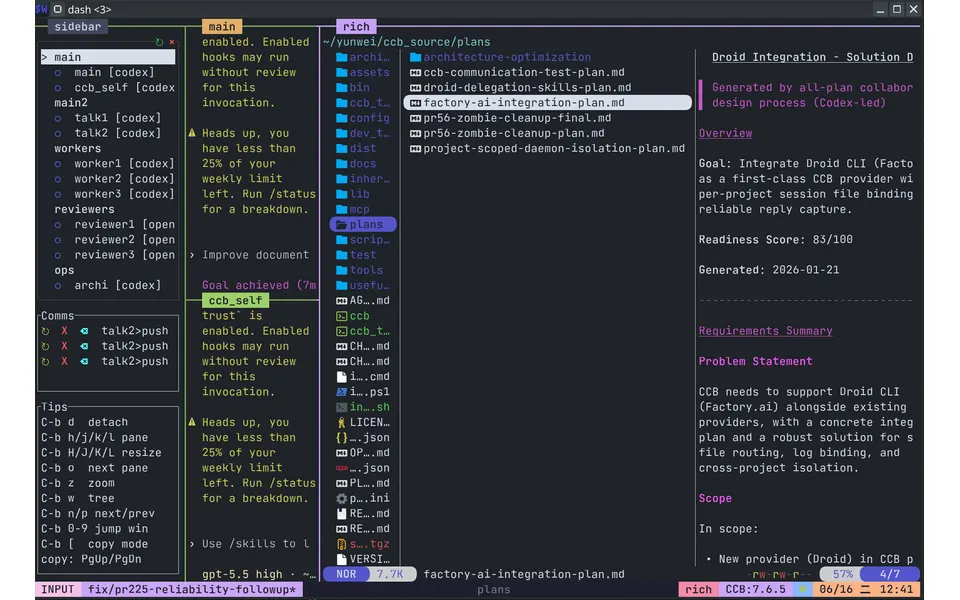
- Desktop app
- Mac, Windows and Linux
- Browser
- Not listed
- Phone
- Android
- Command line
- Yes
- Agents
- Claude Code, Codex, Cursor Agent, Gemini CLI, OpenCode, Pi, Grok and Antigravity
- Your subscription
- Works with your own plan
- Agents run
- On your computer and on your own server
- Laptop closed
- Not listed
- Isolation
- Worktree
- Parallel agents
- Yes
- Scheduled runs
- Yes
- Coordinator agent
- Yes
- Built-in issues
- Yes
- Pull requests
- Not listed
- Review screen
- Not listed
- Team
- Not listed
- Self-hosting
- Yes
- Licence
- AGPL-3.0
- Price from
- Free
- How it charges
- Bring your own key
- Paid plans from
- Not listed
Receipts
- Checked
- · oldest answer 2026-11-08
- Findings
- 33 published · 25 cross-checked by a second agent · read them all
- Sources
- 18 public pages on 1 site: github.com
- Screenshot
- github.com, retrieved · first party repository · shows appearance, not capability
- Method
- Same rules for all 103 researched ADEs. How we check · Report wrong data
What it does
Where you use it
CCB provides a native terminal application for Linux/macOS and a publicly downloadable native Windows x64 beta. Android APK remote control is published; the complete mobile release instructions list no iOS build. The browser Config UI is local configuration rather than an established full agent-session client.
Source and scope for Where you use itAgents it runs
Named CLI families include Claude Code, Codex, Gemini, OpenCode, Pi, Grok, Cursor and additional providers. Interactive providers run in visible native terminal panes; service-backed providers retain a separate host/log surface. One configured workspace can launch Codex/Claude/Gemini workers concurrently. No hands-on mixed run was executed. Claude Codex Bridge v8.7.21 ships an agy provider with pane-backed execution, native session-log completion, resume and workspace attachment.
Source and scope for Agents it runsAccounts and subscriptions
Release history describes preserving local conversation history across credential/key/gateway changes for Claude/Codex. Plan-specific subscription access remains unverified.
Source and scope for Accounts and subscriptionsWhere agents run
CCB runs installed provider CLIs and a project daemon on the current host. The Android controller reaches CCB projects on a server, for example through the alpha Cloudflare Tunnel route with CCB pairing and device tokens. The background daemon preserves project state after foreground UI closure; this alone is not proof that work survives loss of its execution host.
Source and scope for Where agents runHow work is kept apart
CCB separates configured workers with Git worktrees and terminal processes. The pinned built-in workspace and provider launch paths do not provision containers or VMs as task isolation.
Source and scope for How work is kept apartParallel work
Configured windows can run multiple CLI providers concurrently.
Source and scope for Parallel workScheduled runs
An opt-in maintenance heartbeat runner consumes timed schedules and can automatically activate a configured assessor agent for diagnostics. This is a scoped maintenance trigger, not an arbitrary application-work scheduler; it does not start providers or perform repairs.
Source and scope for Scheduled runsGit and pull requests
Explicit worker(worktree) topology separates worker checkouts. PR creation/rebase/merge behavior remains unverified.
Source and scope for Git and pull requestsLicence and source
CCB declares AGPL-3.0; its own license summary also discusses separately licensed closed-source commercial use.
Source and scope for Licence and sourcePrice
The license permits free AGPL use and refers separate closed-source commercial licensing to the maintainer. Public commercial prices, interval and charge unit remain unestablished. Native agent profiles accept the user's own model-provider API keys, with provider charges separate from any CCB commercial license.
Source and scope for PriceTyped filters
Every value links to its receipt below. Read plan and surface restrictions before using a filter to decide.
| Filter | Value |
|---|---|
| Desktop OS: macOS | Yes |
| Desktop OS: Windows | Yes |
| Desktop OS: Linux | Yes |
| Web client | Unknown |
| Phone access: Native iOS | No |
| Phone access: Native Android | Yes |
| Phone access: Phone browser | Unknown |
| CLI | Yes cross-checked |
| Coding agents: Claude Code | Yes cross-checked |
| Coding agents: Codex | Yes cross-checked |
| Coding agents: Cursor Agent | Yes cross-checked |
| Coding agents: Gemini CLI | Yes cross-checked |
| Coding agents: OpenCode | Yes cross-checked |
| Coding agents: Pi | Yes cross-checked |
| Coding agents: Grok | Yes cross-checked |
| Coding agents: Aider | Unknown |
| Coding agents: Antigravity | Yes cross-checked |
| Use my subscription | Yes |
| Where agents run: On your computer | Yes cross-checked |
| Where agents run: On your own server | Yes cross-checked |
| Where agents run: In the vendor's cloud | Unknown |
| Workspace isolation: Git worktree | Yes |
| Workspace isolation: Container | No |
| Workspace isolation: VM or microVM | No |
| Parallel runs | Yes cross-checked |
| Coordinator | Yes |
| Native issue tracking | Yes |
| Unattended triggers | Yes |
| Shared prompting | Unknown |
| Team roles | No |
| SSO | No |
| Pull request workflow | Unknown |
| Review interface | Unknown |
| Product license: Apache-2.0 | No. AGPL-3.0 cross-checked |
| Product license: MIT | No. AGPL-3.0 cross-checked |
| Product license: GPL-3.0 | No. AGPL-3.0 cross-checked |
| Product license: GPL-3.0-or-later | No. AGPL-3.0 cross-checked |
| Product license: AGPL-3.0 | Yes. AGPL-3.0 cross-checked |
| Product license: AGPL-3.0-or-later | No. AGPL-3.0 cross-checked |
| Product license: Elastic License 2.0 | No. AGPL-3.0 cross-checked |
| Product license: Custom terms | No. AGPL-3.0 cross-checked |
| Product license: Proprietary | No. AGPL-3.0 cross-checked |
| Self-hosting | Yes cross-checked |
| Telemetry opt-out | No |
| Free access | Yes cross-checked |
| Starting price: Free | Yes. Free cross-checked |
| Starting price: Up to $20/month | No. Free cross-checked |
| Starting price: $21–40/month | No. Free cross-checked |
| Starting price: $41–100/month | No. Free cross-checked |
| Starting price: Over $100/month | No. Free cross-checked |
| Starting price: Contact for pricing | No. Free cross-checked |
| Pricing model: Free, no paid plan | Unknown |
| Pricing model: Free plan | Unknown |
| Pricing model: Subscription | Unknown |
| Pricing model: Per seat | Unknown |
| Pricing model: Usage-based | Unknown |
| Pricing model: Per machine or compute | Unknown |
| Pricing model: Bring your own key | Yes |
| Pricing model: One-time purchase | Unknown |
| Paid plans from: No paid plan | Unknown |
| Paid plans from: $10 or less/month | Unknown |
| Paid plans from: $11–20/month | Unknown |
| Paid plans from: $21–40/month | Unknown |
| Paid plans from: $41–100/month | Unknown |
| Paid plans from: Over $100/month | Unknown |
| Paid plans from: Contact sales | Unknown |
| Lifecycle status: Active | Unknown |
| Lifecycle status: Sunsetting | Unknown |
| Keeps going with laptop closed | Unknown |
| Open-source license | Yes. AGPL-3.0 cross-checked |
| Any desktop app | Yes |
| Paid plan up to $20/month | Unknown |
| Paid plan up to $40/month | Unknown |
| Any phone client | Yes |
Filter receipts
Desktop OS: macOS: Yes
Desktop OS: macOS
Typed value: Yes.
CCB provides a native terminal application for Linux/macOS and a publicly downloadable native Windows x64 beta. Android APK remote control is published; the complete mobile release instructions list no iOS build. The browser Config UI is local configuration rather than an established full agent-session client.
- Desktop os: Native terminal installation supports Linux and macOS; Windows x64 has a public unsigned beta ZIP requiring Python, WezTerm, Git Bash and Herdr.
- Mobile apps: The documented mobile distribution is Android APK. No iOS release appears in the complete mobile install instructions.
- Only the named documented or inspected parts are established; other atomic questions retain their recorded gaps.
-
Finding: CCB supports native Linux and macOS terminals and a publicly downloadable Windows x64 beta ZIP. Mobile distribution is a Flutter Android APK; no iOS release is listed.
Desktop OS: Windows: Yes
Desktop OS: Windows
Typed value: Yes.
CCB provides a native terminal application for Linux/macOS and a publicly downloadable native Windows x64 beta. Android APK remote control is published; the complete mobile release instructions list no iOS build. The browser Config UI is local configuration rather than an established full agent-session client.
- Desktop os: Native terminal installation supports Linux and macOS; Windows x64 has a public unsigned beta ZIP requiring Python, WezTerm, Git Bash and Herdr.
- Mobile apps: The documented mobile distribution is Android APK. No iOS release appears in the complete mobile install instructions.
- Only the named documented or inspected parts are established; other atomic questions retain their recorded gaps.
-
Finding: CCB supports native Linux and macOS terminals and a publicly downloadable Windows x64 beta ZIP. Mobile distribution is a Flutter Android APK; no iOS release is listed.
Desktop OS: Linux: Yes
Desktop OS: Linux
Typed value: Yes.
CCB provides a native terminal application for Linux/macOS and a publicly downloadable native Windows x64 beta. Android APK remote control is published; the complete mobile release instructions list no iOS build. The browser Config UI is local configuration rather than an established full agent-session client.
- Desktop os: Native terminal installation supports Linux and macOS; Windows x64 has a public unsigned beta ZIP requiring Python, WezTerm, Git Bash and Herdr.
- Mobile apps: The documented mobile distribution is Android APK. No iOS release appears in the complete mobile install instructions.
- Only the named documented or inspected parts are established; other atomic questions retain their recorded gaps.
-
Finding: CCB supports native Linux and macOS terminals and a publicly downloadable Windows x64 beta ZIP. Mobile distribution is a Flutter Android APK; no iOS release is listed.
Phone access: Native iOS: No
Phone access: Native iOS
Typed value: No.
CCB provides a native terminal application for Linux/macOS and a publicly downloadable native Windows x64 beta. Android APK remote control is published; the complete mobile release instructions list no iOS build. The browser Config UI is local configuration rather than an established full agent-session client.
- Desktop os: Native terminal installation supports Linux and macOS; Windows x64 has a public unsigned beta ZIP requiring Python, WezTerm, Git Bash and Herdr.
- Mobile apps: The documented mobile distribution is Android APK. No iOS release appears in the complete mobile install instructions.
- Only the named documented or inspected parts are established; other atomic questions retain their recorded gaps.
-
Finding: CCB supports native Linux and macOS terminals and a publicly downloadable Windows x64 beta ZIP. Mobile distribution is a Flutter Android APK; no iOS release is listed.
Phone access: Native Android: Yes
Phone access: Native Android
Typed value: Yes.
CCB provides a native terminal application for Linux/macOS and a publicly downloadable native Windows x64 beta. Android APK remote control is published; the complete mobile release instructions list no iOS build. The browser Config UI is local configuration rather than an established full agent-session client.
- Browser: Local loopback Config UI edits topology/models/settings; a general-purpose browser session client is not established.
- Cli: CCB provides a multi-pane TUI, ccb CLI and ask collaboration commands.
- Task actions: Android discovers projects/agents, reads conversation context, sends input, opens terminals and transfers files.
- Only the named documented or inspected parts are established; other atomic questions retain their recorded gaps.
-
Finding: CCB launches multiple coding-agent CLIs in visible panes with a persistent daemon, local configuration UI, per-agent message queues, worktrees and a released Flutter Android controller. Optional role packs are separate from core messaging.
CLI: Yes cross-checked
CLI
Typed value: Yes.
ccb config validate/update and ask manage topology and inter-agent collaboration. Agent control skills include ask, ccb-clear, ccb-compact and ccb-diagnose, with Codex reconnect.
- Cli: ccb config validate/update and ask manage topology and inter-agent collaboration.
- Operations: Agent control skills include ask, ccb-clear, ccb-compact and ccb-diagnose, with Codex reconnect.
- Only the cited atomic findings are established. Remaining atomic requirements and the full rubric scenario remain unverified.
-
Finding: CCB launches multiple coding-agent CLIs in visible panes with a persistent daemon, local configuration UI, per-agent message queues, worktrees and a released Flutter Android controller. Optional role packs are separate from core messaging.
Coding agents: Claude Code: Yes cross-checked
Coding agents: Claude Code
Typed value: Yes.
Named CLI families include Claude Code, Codex, Gemini, OpenCode, Pi, Grok, Cursor and additional providers. Interactive providers run in visible native terminal panes; service-backed providers retain a separate host/log surface. One configured workspace can launch Codex/Claude/Gemini workers concurrently. No hands-on mixed run was executed. Claude Codex Bridge v8.7.21 ships an agy provider with pane-backed execution, native session-log completion, resume and workspace attachment.
- Harnesses: Named CLI families include Claude Code, Codex, Gemini, OpenCode, Pi, Grok, Cursor and additional providers. Claude Codex Bridge v8.7.21 ships an agy provider with pane-backed execution, native session-log completion, resume and workspace attachment.
- Session integration: Interactive providers run in visible native terminal panes; service-backed providers retain a separate host/log surface.
- Mixed harness operation: One configured workspace can launch Codex/Claude/Gemini workers concurrently. No hands-on mixed run was executed.
- Only the cited atomic findings are established. Remaining atomic requirements and the full rubric scenario remain unverified.
- The Antigravity adapter reports observed session completion rather than exact completion and does not support stream-watch.
-
Finding: CCB launches multiple coding-agent CLIs in visible panes with a persistent daemon, local configuration UI, per-agent message queues, worktrees and a released Flutter Android controller. Optional role packs are separate from core messaging.
Coding agents: Codex: Yes cross-checked
Coding agents: Codex
Typed value: Yes.
Named CLI families include Claude Code, Codex, Gemini, OpenCode, Pi, Grok, Cursor and additional providers. Interactive providers run in visible native terminal panes; service-backed providers retain a separate host/log surface. One configured workspace can launch Codex/Claude/Gemini workers concurrently. No hands-on mixed run was executed. Claude Codex Bridge v8.7.21 ships an agy provider with pane-backed execution, native session-log completion, resume and workspace attachment.
- Harnesses: Named CLI families include Claude Code, Codex, Gemini, OpenCode, Pi, Grok, Cursor and additional providers. Claude Codex Bridge v8.7.21 ships an agy provider with pane-backed execution, native session-log completion, resume and workspace attachment.
- Session integration: Interactive providers run in visible native terminal panes; service-backed providers retain a separate host/log surface.
- Mixed harness operation: One configured workspace can launch Codex/Claude/Gemini workers concurrently. No hands-on mixed run was executed.
- Only the cited atomic findings are established. Remaining atomic requirements and the full rubric scenario remain unverified.
- The Antigravity adapter reports observed session completion rather than exact completion and does not support stream-watch.
-
Finding: CCB launches multiple coding-agent CLIs in visible panes with a persistent daemon, local configuration UI, per-agent message queues, worktrees and a released Flutter Android controller. Optional role packs are separate from core messaging.
Coding agents: Cursor Agent: Yes cross-checked
Coding agents: Cursor Agent
Typed value: Yes.
Named CLI families include Claude Code, Codex, Gemini, OpenCode, Pi, Grok, Cursor and additional providers. Interactive providers run in visible native terminal panes; service-backed providers retain a separate host/log surface. One configured workspace can launch Codex/Claude/Gemini workers concurrently. No hands-on mixed run was executed. Claude Codex Bridge v8.7.21 ships an agy provider with pane-backed execution, native session-log completion, resume and workspace attachment.
- Harnesses: Named CLI families include Claude Code, Codex, Gemini, OpenCode, Pi, Grok, Cursor and additional providers. Claude Codex Bridge v8.7.21 ships an agy provider with pane-backed execution, native session-log completion, resume and workspace attachment.
- Session integration: Interactive providers run in visible native terminal panes; service-backed providers retain a separate host/log surface.
- Mixed harness operation: One configured workspace can launch Codex/Claude/Gemini workers concurrently. No hands-on mixed run was executed.
- Only the cited atomic findings are established. Remaining atomic requirements and the full rubric scenario remain unverified.
- The Antigravity adapter reports observed session completion rather than exact completion and does not support stream-watch.
-
Finding: CCB launches multiple coding-agent CLIs in visible panes with a persistent daemon, local configuration UI, per-agent message queues, worktrees and a released Flutter Android controller. Optional role packs are separate from core messaging.
Coding agents: Gemini CLI: Yes cross-checked
Coding agents: Gemini CLI
Typed value: Yes.
Named CLI families include Claude Code, Codex, Gemini, OpenCode, Pi, Grok, Cursor and additional providers. Interactive providers run in visible native terminal panes; service-backed providers retain a separate host/log surface. One configured workspace can launch Codex/Claude/Gemini workers concurrently. No hands-on mixed run was executed. Claude Codex Bridge v8.7.21 ships an agy provider with pane-backed execution, native session-log completion, resume and workspace attachment.
- Harnesses: Named CLI families include Claude Code, Codex, Gemini, OpenCode, Pi, Grok, Cursor and additional providers. Claude Codex Bridge v8.7.21 ships an agy provider with pane-backed execution, native session-log completion, resume and workspace attachment.
- Session integration: Interactive providers run in visible native terminal panes; service-backed providers retain a separate host/log surface.
- Mixed harness operation: One configured workspace can launch Codex/Claude/Gemini workers concurrently. No hands-on mixed run was executed.
- Only the cited atomic findings are established. Remaining atomic requirements and the full rubric scenario remain unverified.
- The Antigravity adapter reports observed session completion rather than exact completion and does not support stream-watch.
-
Finding: CCB launches multiple coding-agent CLIs in visible panes with a persistent daemon, local configuration UI, per-agent message queues, worktrees and a released Flutter Android controller. Optional role packs are separate from core messaging.
Coding agents: OpenCode: Yes cross-checked
Coding agents: OpenCode
Typed value: Yes.
Named CLI families include Claude Code, Codex, Gemini, OpenCode, Pi, Grok, Cursor and additional providers. Interactive providers run in visible native terminal panes; service-backed providers retain a separate host/log surface. One configured workspace can launch Codex/Claude/Gemini workers concurrently. No hands-on mixed run was executed. Claude Codex Bridge v8.7.21 ships an agy provider with pane-backed execution, native session-log completion, resume and workspace attachment.
- Harnesses: Named CLI families include Claude Code, Codex, Gemini, OpenCode, Pi, Grok, Cursor and additional providers. Claude Codex Bridge v8.7.21 ships an agy provider with pane-backed execution, native session-log completion, resume and workspace attachment.
- Session integration: Interactive providers run in visible native terminal panes; service-backed providers retain a separate host/log surface.
- Mixed harness operation: One configured workspace can launch Codex/Claude/Gemini workers concurrently. No hands-on mixed run was executed.
- Only the cited atomic findings are established. Remaining atomic requirements and the full rubric scenario remain unverified.
- The Antigravity adapter reports observed session completion rather than exact completion and does not support stream-watch.
-
Finding: CCB launches multiple coding-agent CLIs in visible panes with a persistent daemon, local configuration UI, per-agent message queues, worktrees and a released Flutter Android controller. Optional role packs are separate from core messaging.
Coding agents: Pi: Yes cross-checked
Coding agents: Pi
Typed value: Yes.
Named CLI families include Claude Code, Codex, Gemini, OpenCode, Pi, Grok, Cursor and additional providers. Interactive providers run in visible native terminal panes; service-backed providers retain a separate host/log surface. One configured workspace can launch Codex/Claude/Gemini workers concurrently. No hands-on mixed run was executed. Claude Codex Bridge v8.7.21 ships an agy provider with pane-backed execution, native session-log completion, resume and workspace attachment.
- Harnesses: Named CLI families include Claude Code, Codex, Gemini, OpenCode, Pi, Grok, Cursor and additional providers. Claude Codex Bridge v8.7.21 ships an agy provider with pane-backed execution, native session-log completion, resume and workspace attachment.
- Session integration: Interactive providers run in visible native terminal panes; service-backed providers retain a separate host/log surface.
- Mixed harness operation: One configured workspace can launch Codex/Claude/Gemini workers concurrently. No hands-on mixed run was executed.
- Only the cited atomic findings are established. Remaining atomic requirements and the full rubric scenario remain unverified.
- The Antigravity adapter reports observed session completion rather than exact completion and does not support stream-watch.
-
Finding: CCB launches multiple coding-agent CLIs in visible panes with a persistent daemon, local configuration UI, per-agent message queues, worktrees and a released Flutter Android controller. Optional role packs are separate from core messaging.
Coding agents: Grok: Yes cross-checked
Coding agents: Grok
Typed value: Yes.
Named CLI families include Claude Code, Codex, Gemini, OpenCode, Pi, Grok, Cursor and additional providers. Interactive providers run in visible native terminal panes; service-backed providers retain a separate host/log surface. One configured workspace can launch Codex/Claude/Gemini workers concurrently. No hands-on mixed run was executed. Claude Codex Bridge v8.7.21 ships an agy provider with pane-backed execution, native session-log completion, resume and workspace attachment.
- Harnesses: Named CLI families include Claude Code, Codex, Gemini, OpenCode, Pi, Grok, Cursor and additional providers. Claude Codex Bridge v8.7.21 ships an agy provider with pane-backed execution, native session-log completion, resume and workspace attachment.
- Session integration: Interactive providers run in visible native terminal panes; service-backed providers retain a separate host/log surface.
- Mixed harness operation: One configured workspace can launch Codex/Claude/Gemini workers concurrently. No hands-on mixed run was executed.
- Only the cited atomic findings are established. Remaining atomic requirements and the full rubric scenario remain unverified.
- The Antigravity adapter reports observed session completion rather than exact completion and does not support stream-watch.
-
Finding: CCB launches multiple coding-agent CLIs in visible panes with a persistent daemon, local configuration UI, per-agent message queues, worktrees and a released Flutter Android controller. Optional role packs are separate from core messaging.
Coding agents: Antigravity: Yes cross-checked
Coding agents: Antigravity
Typed value: Yes.
Named CLI families include Claude Code, Codex, Gemini, OpenCode, Pi, Grok, Cursor and additional providers. Interactive providers run in visible native terminal panes; service-backed providers retain a separate host/log surface. One configured workspace can launch Codex/Claude/Gemini workers concurrently. No hands-on mixed run was executed. Claude Codex Bridge v8.7.21 ships an agy provider with pane-backed execution, native session-log completion, resume and workspace attachment.
- Harnesses: Named CLI families include Claude Code, Codex, Gemini, OpenCode, Pi, Grok, Cursor and additional providers. Claude Codex Bridge v8.7.21 ships an agy provider with pane-backed execution, native session-log completion, resume and workspace attachment.
- Only the cited atomic findings are established. Remaining atomic requirements and the full rubric scenario remain unverified.
- The Antigravity adapter reports observed session completion rather than exact completion and does not support stream-watch.
-
claude_codex_bridge Antigravity support at v8.7.21
Finding: Claude Codex Bridge v8.7.21 ships an agy provider with pane-backed execution, native session-log completion, resume and workspace attachment.
Use my subscription: Yes
Use my subscription
Typed value: Yes.
Release history describes preserving local conversation history across credential/key/gateway changes for Claude/Codex. Plan-specific subscription access remains unverified.
- Agent subscriptions: Agents inherit the user's existing provider CLI sign-in by default, including Claude OAuth Keychain credentials and the system Grok login, so a subscription login made in the native CLI carries over. Source and release notes only; per-provider plan terms not checked and not tested.
- Only the cited atomic findings are established. Remaining atomic requirements and the full rubric scenario remain unverified.
-
CCB provider session authority at release v8.7.21
Finding: Provider profiles inherit the user's existing provider authentication by default (inherit_auth defaults to true); inherited external auth is used unless an explicit API credential is configured.
-
CCB README release notes: v8.6.10 and Grok login
Finding: Release notes describe agents reusing the inherited Claude OAuth Keychain credential after an external re-login and refreshing the inherited system Grok login so requests go through each agent's native Grok session.
Where agents run: On your computer: Yes cross-checked
Where agents run: On your computer
Typed value: Yes.
CCB runs installed provider CLIs and a project daemon on the current host. The Android controller reaches CCB projects on a server, for example through the alpha Cloudflare Tunnel route with CCB pairing and device tokens. The background daemon preserves project state after foreground UI closure; this alone is not proof that work survives loss of its execution host.
- Local: CCB runs installed provider CLIs and a project daemon on the current host.
- Byo remote: The Android controller reaches CCB projects on a user's server, for example through the alpha Cloudflare Tunnel route to a loopback-bound gateway.
- Client disconnect: The background daemon preserves project state after foreground UI closure; this alone is not proof that work survives loss of its execution host.
- Only the cited atomic findings are established. Remaining atomic requirements and the full rubric scenario remain unverified.
-
Finding: CCB launches multiple coding-agent CLIs in visible panes with a persistent daemon, local configuration UI, per-agent message queues, worktrees and a released Flutter Android controller. Optional role packs are separate from core messaging.
Where agents run: On your own server: Yes cross-checked
Where agents run: On your own server
Typed value: Yes.
CCB runs installed provider CLIs and a project daemon on the current host. The Android controller reaches CCB projects on a server, for example through the alpha Cloudflare Tunnel route with CCB pairing and device tokens. The background daemon preserves project state after foreground UI closure; this alone is not proof that work survives loss of its execution host.
- Local: CCB runs installed provider CLIs and a project daemon on the current host.
- Byo remote: The Android controller reaches CCB projects on a user's server, for example through the alpha Cloudflare Tunnel route to a loopback-bound gateway.
- Client disconnect: The background daemon preserves project state after foreground UI closure; this alone is not proof that work survives loss of its execution host.
- Only the cited atomic findings are established. Remaining atomic requirements and the full rubric scenario remain unverified.
-
Finding: CCB launches multiple coding-agent CLIs in visible panes with a persistent daemon, local configuration UI, per-agent message queues, worktrees and a released Flutter Android controller. Optional role packs are separate from core messaging.
-
Claude Code Bridge docs/mobile-cloudflare-alpha.md
Finding: The alpha Cloudflare Tunnel route keeps the mobile gateway bound to loopback on the server, with Cloudflare providing the public HTTPS/WSS route and CCB owning pairing, device tokens and terminal tokens; cloudflared runs on the server. The guide does not cover LAN or Tailscale routes.
Workspace isolation: Git worktree: Yes
Workspace isolation: Git worktree
Typed value: Yes.
CCB separates configured workers with Git worktrees and terminal processes. The pinned built-in workspace and provider launch paths do not provision containers or VMs as task isolation.
- Worktree: Workspace configuration can place named workers in separate Git worktrees.
- Only the named documented or inspected parts are established; other atomic questions retain their recorded gaps.
-
Finding: CCB launches multiple coding-agent CLIs in visible panes with a persistent daemon, local configuration UI, per-agent message queues, worktrees and a released Flutter Android controller. Optional role packs are separate from core messaging.
Workspace isolation: Container: No
Workspace isolation: Container
Typed value: No.
CCB separates configured workers with Git worktrees and terminal processes. The pinned built-in workspace and provider launch paths do not provision containers or VMs as task isolation.
- Container: No product-managed container isolation in the inspected workspace/provider launch paths.
- Vm: No product-managed VM isolation in the inspected workspace/provider launch paths.
- Only the named documented or inspected parts are established; other atomic questions retain their recorded gaps.
-
Finding: Built-in workers execute installed provider commands in terminal panes and optional Git worktrees. Bounded inspection of lib/workspace, provider_backends and launch paths found no core-managed container or VM provisioning.
Workspace isolation: VM or microVM: No
Workspace isolation: VM or microVM
Typed value: No.
CCB separates configured workers with Git worktrees and terminal processes. The pinned built-in workspace and provider launch paths do not provision containers or VMs as task isolation.
- Container: No product-managed container isolation in the inspected workspace/provider launch paths.
- Vm: No product-managed VM isolation in the inspected workspace/provider launch paths.
- Only the named documented or inspected parts are established; other atomic questions retain their recorded gaps.
-
Finding: Built-in workers execute installed provider commands in terminal panes and optional Git worktrees. Bounded inspection of lib/workspace, provider_backends and launch paths found no core-managed container or VM provisioning.
Parallel runs: Yes cross-checked
Parallel runs
Typed value: Yes.
Configured windows can run multiple CLI providers concurrently.
- Concurrent sessions: Configured windows can run multiple CLI providers concurrently.
- Only the cited atomic findings are established. Remaining atomic requirements and the full rubric scenario remain unverified.
-
Finding: CCB launches multiple coding-agent CLIs in visible panes with a persistent daemon, local configuration UI, per-agent message queues, worktrees and a released Flutter Android controller. Optional role packs are separate from core messaging.
Coordinator: Yes
Coordinator
Typed value: Yes.
The Config UI edits per-agent provider, model, thinking level, pane topology and worktree scope. Agents invoke /ask to send another configured agent a task and receive a returned result. Core CCB owns communication queues; specialist workflow roles are optional installed Role Packs.
- Model harness effort: The Config UI edits per-agent provider, model, thinking level, pane topology and worktree scope.
- Messages: Agents invoke /ask to send another configured agent a task and receive a returned result.
- Orchestration owner: Core CCB owns communication queues; specialist workflow roles are optional installed Role Packs.
- Only the cited atomic findings are established. Remaining atomic requirements and the full rubric scenario remain unverified.
-
Finding: CCB launches multiple coding-agent CLIs in visible panes with a persistent daemon, local configuration UI, per-agent message queues, worktrees and a released Flutter Android controller. Optional role packs are separate from core messaging.
-
Finding: ask and returned results share per-target FIFO. Draft protection is recommended for managed Claude/Codex/OMP panes, with a 180-second draft deadline and non-atomic final paste/send caveat.
Native issue tracking: Yes
Native issue tracking
Typed value: Yes.
The pinned CLI supplies persistent native plan tasks, with create/status/show/list commands, owner fields and validated state transitions. These task records live in plan task directories separately from conversation sessions.
- Create: ccb plan task-create writes a task record and task directory.
- Edit: Task status commands update records with validated transitions.
- Task session separation: Plan task directories and their JSON index are separate from provider session records.
- Metadata: Tasks include title, plan, status, revision and owner.
- Durable states: Persistent JSON records distinguish draft, ready, running, blocked and done states.
- Only the named documented or inspected parts are established; other atomic questions retain their recorded gaps.
-
Finding: The shipped ccb plan commands create persistent task directories and JSON index records containing task_id, title, plan, status, revision and owner. Commands change task state and list/show tasks separately from agent sessions.
Unattended triggers: Yes
Unattended triggers
Typed value: Yes.
An opt-in maintenance heartbeat runner consumes timed schedules and can automatically activate a configured assessor agent for diagnostics. This is a scoped maintenance trigger, not an arbitrary application-work scheduler; it does not start providers or perform repairs.
- Schedules: ccb maintenance schedule --after persists a future heartbeat run; the configured runner consumes it.
- Events: A non-healthy heartbeat tick can send an automatic silent ask to the configured assessor.
- Scheduler location: The project-scoped runner executes on the CCB host.
- Only the named documented or inspected parts are established; other atomic questions retain their recorded gaps.
-
Finding: When maintenance.heartbeat.enabled is configured, the project runner consumes persisted timed schedules and automatically sends a diagnostic ask to the configured assessor when health requires it. It does not automatically repair or start providers.
Team roles: No
Team roles
Typed value: No.
CCB authorizes paired devices with tokens, capability scopes and revocation. The pinned gateway and CLI source has no human organization/workspace roles or enterprise SSO; agent Role Packs describe agent behavior rather than human access roles.
- Organization roles: Device capabilities are not named human workspace roles; no organization role model was found in the inspected gateway/config/CLI source.
- Sso: The inspected authentication paths use local tokens and pairing, without an SSO provider integration.
- Revocation: Paired device records and terminal tokens can be revoked.
- Only the named documented or inspected parts are established; other atomic questions retain their recorded gaps.
-
Finding: CCB stores paired device identities/tokens with view, focus and terminal_input scopes and supports revocation. Inspection of the gateway, config UI and lib authentication paths found no human workspace role model or SAML/OIDC SSO integration; agent Role Packs are prompting roles.
SSO: No
SSO
Typed value: No.
CCB authorizes paired devices with tokens, capability scopes and revocation. The pinned gateway and CLI source has no human organization/workspace roles or enterprise SSO; agent Role Packs describe agent behavior rather than human access roles.
- Organization roles: Device capabilities are not named human workspace roles; no organization role model was found in the inspected gateway/config/CLI source.
- Sso: The inspected authentication paths use local tokens and pairing, without an SSO provider integration.
- Revocation: Paired device records and terminal tokens can be revoked.
- Only the named documented or inspected parts are established; other atomic questions retain their recorded gaps.
-
Finding: CCB stores paired device identities/tokens with view, focus and terminal_input scopes and supports revocation. Inspection of the gateway, config UI and lib authentication paths found no human workspace role model or SAML/OIDC SSO integration; agent Role Packs are prompting roles.
Product license: Apache-2.0: No. AGPL-3.0 cross-checked
Product license: Apache-2.0
Typed value: No. AGPL-3.0.
CCB declares AGPL-3.0; its own license summary also discusses separately licensed closed-source commercial use.
- Client license: CCB declares AGPL-3.0; its own license summary also discusses separately licensed closed-source commercial use.
- Only the cited atomic findings are established. Remaining atomic requirements and the full rubric scenario remain unverified.
-
Finding: The repository declares AGPL-3.0 and explicitly permits using CCB for free. It also describes separate licensing for closed-source commercial use; this pass does not interpret legal obligations.
Product license: MIT: No. AGPL-3.0 cross-checked
Product license: MIT
Typed value: No. AGPL-3.0.
CCB declares AGPL-3.0; its own license summary also discusses separately licensed closed-source commercial use.
- Client license: CCB declares AGPL-3.0; its own license summary also discusses separately licensed closed-source commercial use.
- Only the cited atomic findings are established. Remaining atomic requirements and the full rubric scenario remain unverified.
-
Finding: The repository declares AGPL-3.0 and explicitly permits using CCB for free. It also describes separate licensing for closed-source commercial use; this pass does not interpret legal obligations.
Product license: GPL-3.0: No. AGPL-3.0 cross-checked
Product license: GPL-3.0
Typed value: No. AGPL-3.0.
CCB declares AGPL-3.0; its own license summary also discusses separately licensed closed-source commercial use.
- Client license: CCB declares AGPL-3.0; its own license summary also discusses separately licensed closed-source commercial use.
- Only the cited atomic findings are established. Remaining atomic requirements and the full rubric scenario remain unverified.
-
Finding: The repository declares AGPL-3.0 and explicitly permits using CCB for free. It also describes separate licensing for closed-source commercial use; this pass does not interpret legal obligations.
Product license: GPL-3.0-or-later: No. AGPL-3.0 cross-checked
Product license: GPL-3.0-or-later
Typed value: No. AGPL-3.0.
CCB declares AGPL-3.0; its own license summary also discusses separately licensed closed-source commercial use.
- Client license: CCB declares AGPL-3.0; its own license summary also discusses separately licensed closed-source commercial use.
- Only the cited atomic findings are established. Remaining atomic requirements and the full rubric scenario remain unverified.
-
Finding: The repository declares AGPL-3.0 and explicitly permits using CCB for free. It also describes separate licensing for closed-source commercial use; this pass does not interpret legal obligations.
Product license: AGPL-3.0: Yes. AGPL-3.0 cross-checked
Product license: AGPL-3.0
Typed value: Yes. AGPL-3.0.
CCB declares AGPL-3.0; its own license summary also discusses separately licensed closed-source commercial use.
- Client license: CCB declares AGPL-3.0; its own license summary also discusses separately licensed closed-source commercial use.
- Only the cited atomic findings are established. Remaining atomic requirements and the full rubric scenario remain unverified.
-
Finding: The repository declares AGPL-3.0 and explicitly permits using CCB for free. It also describes separate licensing for closed-source commercial use; this pass does not interpret legal obligations.
Product license: AGPL-3.0-or-later: No. AGPL-3.0 cross-checked
Product license: AGPL-3.0-or-later
Typed value: No. AGPL-3.0.
CCB declares AGPL-3.0; its own license summary also discusses separately licensed closed-source commercial use.
- Client license: CCB declares AGPL-3.0; its own license summary also discusses separately licensed closed-source commercial use.
- Only the cited atomic findings are established. Remaining atomic requirements and the full rubric scenario remain unverified.
-
Finding: The repository declares AGPL-3.0 and explicitly permits using CCB for free. It also describes separate licensing for closed-source commercial use; this pass does not interpret legal obligations.
Product license: Elastic License 2.0: No. AGPL-3.0 cross-checked
Product license: Elastic License 2.0
Typed value: No. AGPL-3.0.
CCB declares AGPL-3.0; its own license summary also discusses separately licensed closed-source commercial use.
- Client license: CCB declares AGPL-3.0; its own license summary also discusses separately licensed closed-source commercial use.
- Only the cited atomic findings are established. Remaining atomic requirements and the full rubric scenario remain unverified.
-
Finding: The repository declares AGPL-3.0 and explicitly permits using CCB for free. It also describes separate licensing for closed-source commercial use; this pass does not interpret legal obligations.
Product license: Custom terms: No. AGPL-3.0 cross-checked
Product license: Custom terms
Typed value: No. AGPL-3.0.
CCB declares AGPL-3.0; its own license summary also discusses separately licensed closed-source commercial use.
- Client license: CCB declares AGPL-3.0; its own license summary also discusses separately licensed closed-source commercial use.
- Only the cited atomic findings are established. Remaining atomic requirements and the full rubric scenario remain unverified.
-
Finding: The repository declares AGPL-3.0 and explicitly permits using CCB for free. It also describes separate licensing for closed-source commercial use; this pass does not interpret legal obligations.
Product license: Proprietary: No. AGPL-3.0 cross-checked
Product license: Proprietary
Typed value: No. AGPL-3.0.
CCB declares AGPL-3.0; its own license summary also discusses separately licensed closed-source commercial use.
- Client license: CCB declares AGPL-3.0; its own license summary also discusses separately licensed closed-source commercial use.
- Only the cited atomic findings are established. Remaining atomic requirements and the full rubric scenario remain unverified.
-
Finding: The repository declares AGPL-3.0 and explicitly permits using CCB for free. It also describes separate licensing for closed-source commercial use; this pass does not interpret legal obligations.
Self-hosting: Yes cross-checked
Self-hosting
Typed value: Yes.
Core TUI/daemon and mobile gateway run on user-controlled machines from the distributed source/package.
- Self hosting: Core TUI/daemon and mobile gateway run on user-controlled machines from the distributed source/package.
- Only the cited atomic findings are established. Remaining atomic requirements and the full rubric scenario remain unverified.
-
Finding: CCB launches multiple coding-agent CLIs in visible panes with a persistent daemon, local configuration UI, per-agent message queues, worktrees and a released Flutter Android controller. Optional role packs are separate from core messaging.
Telemetry opt-out: No
Telemetry opt-out
Typed value: No.
The inspected core stores local project, device and task records. A bounded search of lib and the mobile app found no core product analytics collector or telemetry-disable control; underlying provider CLI telemetry is outside this source scope.
- Telemetry controls: No core telemetry-disable control is implemented in the inspected lib and mobile application paths. Provider CLI controls are separate.
- This inspection covers CCB code and mobile app code, not the closed provider CLIs or hosted third-party relay operation.
-
CCB core and mobile telemetry search
Finding: The bounded core/mobile search found no product analytics collector or telemetry opt-out setting. The telemetry directory name in cleanup targets Claude-owned files, not a CCB collection client. Provider CLI telemetry is separate.
Free access: Yes cross-checked
Free access
Typed value: Yes.
The license summary explicitly states CCB can be used for free, subject to its licensing terms and separate model costs.
- Ongoing free: The license summary explicitly states CCB can be used for free, subject to its licensing terms and separate model costs.
- Only the cited atomic findings are established. Remaining atomic requirements and the full rubric scenario remain unverified.
-
Finding: The repository declares AGPL-3.0 and explicitly permits using CCB for free. It also describes separate licensing for closed-source commercial use; this pass does not interpret legal obligations.
Starting price: Free: Yes. Free cross-checked
Starting price: Free
Typed value: Yes. Free.
The license summary explicitly states CCB can be used for free, subject to its licensing terms and separate model costs.
- Ongoing free: The license summary explicitly states CCB can be used for free, subject to its licensing terms and separate model costs.
- Only the cited atomic findings are established. Remaining atomic requirements and the full rubric scenario remain unverified.
-
Finding: The repository declares AGPL-3.0 and explicitly permits using CCB for free. It also describes separate licensing for closed-source commercial use; this pass does not interpret legal obligations.
Starting price: Up to $20/month: No. Free cross-checked
Starting price: Up to $20/month
Typed value: No. Free.
The license summary explicitly states CCB can be used for free, subject to its licensing terms and separate model costs.
- Ongoing free: The license summary explicitly states CCB can be used for free, subject to its licensing terms and separate model costs.
- Only the cited atomic findings are established. Remaining atomic requirements and the full rubric scenario remain unverified.
-
Finding: The repository declares AGPL-3.0 and explicitly permits using CCB for free. It also describes separate licensing for closed-source commercial use; this pass does not interpret legal obligations.
Starting price: $21–40/month: No. Free cross-checked
Starting price: $21–40/month
Typed value: No. Free.
The license summary explicitly states CCB can be used for free, subject to its licensing terms and separate model costs.
- Ongoing free: The license summary explicitly states CCB can be used for free, subject to its licensing terms and separate model costs.
- Only the cited atomic findings are established. Remaining atomic requirements and the full rubric scenario remain unverified.
-
Finding: The repository declares AGPL-3.0 and explicitly permits using CCB for free. It also describes separate licensing for closed-source commercial use; this pass does not interpret legal obligations.
Starting price: $41–100/month: No. Free cross-checked
Starting price: $41–100/month
Typed value: No. Free.
The license summary explicitly states CCB can be used for free, subject to its licensing terms and separate model costs.
- Ongoing free: The license summary explicitly states CCB can be used for free, subject to its licensing terms and separate model costs.
- Only the cited atomic findings are established. Remaining atomic requirements and the full rubric scenario remain unverified.
-
Finding: The repository declares AGPL-3.0 and explicitly permits using CCB for free. It also describes separate licensing for closed-source commercial use; this pass does not interpret legal obligations.
Starting price: Over $100/month: No. Free cross-checked
Starting price: Over $100/month
Typed value: No. Free.
The license summary explicitly states CCB can be used for free, subject to its licensing terms and separate model costs.
- Ongoing free: The license summary explicitly states CCB can be used for free, subject to its licensing terms and separate model costs.
- Only the cited atomic findings are established. Remaining atomic requirements and the full rubric scenario remain unverified.
-
Finding: The repository declares AGPL-3.0 and explicitly permits using CCB for free. It also describes separate licensing for closed-source commercial use; this pass does not interpret legal obligations.
Starting price: Contact for pricing: No. Free cross-checked
Starting price: Contact for pricing
Typed value: No. Free.
The license summary explicitly states CCB can be used for free, subject to its licensing terms and separate model costs.
- Ongoing free: The license summary explicitly states CCB can be used for free, subject to its licensing terms and separate model costs.
- Only the cited atomic findings are established. Remaining atomic requirements and the full rubric scenario remain unverified.
-
Finding: The repository declares AGPL-3.0 and explicitly permits using CCB for free. It also describes separate licensing for closed-source commercial use; this pass does not interpret legal obligations.
Pricing model: Bring your own key: Yes
Pricing model: Bring your own key
Typed value: Yes.
The license permits free AGPL use and refers separate closed-source commercial licensing to the maintainer. Public commercial prices, interval and charge unit remain unestablished. Native agent profiles accept the user's own model-provider API keys, with provider charges separate from any CCB commercial license.
- Model cost: Own native-provider API accounts are supported via explicit agent-local API keys. Model usage is charged under that provider account; exact provider rates and CCB commercial license prices are not established here.
- Commercial CCB price, billing cadence and charge units remain unestablished. BYOK is an authentication/billing route, not a claim that model use or commercial licenses are free.
-
CCB native provider API authority
Finding: Explicit agent-local API keys, URLs and routes in .ccb/ccb.config take precedence over inherited provider login state. Claude environment keys and provider routes are preserved as agent-local authority rather than rewriting the global login.
-
CCB provider credential selection
Finding: Native provider authority resolves explicit profile environment credentials including ANTHROPIC_API_KEY and OPENAI_API_KEY. An explicit credential suppresses inherited provider login, establishing own provider API-account use alongside subscription sign-ins.
Open-source license: Yes. AGPL-3.0 cross-checked
Open-source license
Typed value: Yes. AGPL-3.0.
CCB declares AGPL-3.0; its own license summary also discusses separately licensed closed-source commercial use.
- Client license: CCB declares AGPL-3.0; its own license summary also discusses separately licensed closed-source commercial use.
- Only the cited atomic findings are established. Remaining atomic requirements and the full rubric scenario remain unverified.
-
Finding: The repository declares AGPL-3.0 and explicitly permits using CCB for free. It also describes separate licensing for closed-source commercial use; this pass does not interpret legal obligations.
Any desktop app: Yes
Any desktop app
Typed value: Yes.
CCB provides a native terminal application for Linux/macOS and a publicly downloadable native Windows x64 beta. Android APK remote control is published; the complete mobile release instructions list no iOS build. The browser Config UI is local configuration rather than an established full agent-session client.
- Desktop os: Native terminal installation supports Linux and macOS; Windows x64 has a public unsigned beta ZIP requiring Python, WezTerm, Git Bash and Herdr.
- Mobile apps: The documented mobile distribution is Android APK. No iOS release appears in the complete mobile install instructions.
- Only the named documented or inspected parts are established; other atomic questions retain their recorded gaps.
-
Finding: CCB supports native Linux and macOS terminals and a publicly downloadable Windows x64 beta ZIP. Mobile distribution is a Flutter Android APK; no iOS release is listed.
Any phone client: Yes
Any phone client
Typed value: Yes.
CCB provides a native terminal application for Linux/macOS and a publicly downloadable native Windows x64 beta. Android APK remote control is published; the complete mobile release instructions list no iOS build. The browser Config UI is local configuration rather than an established full agent-session client.
- Browser: Local loopback Config UI edits topology/models/settings; a general-purpose browser session client is not established.
- Cli: CCB provides a multi-pane TUI, ccb CLI and ask collaboration commands.
- Task actions: Android discovers projects/agents, reads conversation context, sends input, opens terminals and transfers files.
- Only the named documented or inspected parts are established; other atomic questions retain their recorded gaps.
-
Finding: CCB launches multiple coding-agent CLIs in visible panes with a persistent daemon, local configuration UI, per-agent message queues, worktrees and a released Flutter Android controller. Optional role packs are separate from core messaging.
All public findings
Findings may summarize a source. They are not presented as verbatim statements.
claude-codex-bridge:ACC-01: CCB provides a native terminal application for Linux/macOS and a publicly downloadable native Windows x64 beta. Android APK remote control is published; the complete mobile release instructions list no iOS build. The browser Config UI is local configuration rather than an established full agent-session client.
claude-codex-bridge:ACC-01
CCB provides a native terminal application for Linux/macOS and a publicly downloadable native Windows x64 beta. Android APK remote control is published; the complete mobile release instructions list no iOS build. The browser Config UI is local configuration rather than an established full agent-session client.
- Only the named documented or inspected parts are established; other atomic questions retain their recorded gaps.
-
Finding: CCB launches multiple coding-agent CLIs in visible panes with a persistent daemon, local configuration UI, per-agent message queues, worktrees and a released Flutter Android controller. Optional role packs are separate from core messaging.
-
Finding: CCB supports native Linux and macOS terminals and a publicly downloadable Windows x64 beta ZIP. Mobile distribution is a Flutter Android APK; no iOS release is listed.
claude-codex-bridge:ACC-02: Named CLI families include Claude Code, Codex, Gemini, OpenCode, Pi, Grok, Cursor and additional providers. Interactive providers run in visible native terminal panes; service-backed providers retain a separate host/log surface. One configured workspace can launch Codex/Claude/Gemini workers concurrently. No hands-on mixed run was executed. Claude Codex Bridge v8.7.21 ships an agy provider with pane-backed execution, native session-log completion, resume and workspace attachment. cross-checked
claude-codex-bridge:ACC-02
Named CLI families include Claude Code, Codex, Gemini, OpenCode, Pi, Grok, Cursor and additional providers. Interactive providers run in visible native terminal panes; service-backed providers retain a separate host/log surface. One configured workspace can launch Codex/Claude/Gemini workers concurrently. No hands-on mixed run was executed. Claude Codex Bridge v8.7.21 ships an agy provider with pane-backed execution, native session-log completion, resume and workspace attachment.
- Only the cited atomic findings are established. Remaining atomic requirements and the full rubric scenario remain unverified.
- The Antigravity adapter reports observed session completion rather than exact completion and does not support stream-watch.
-
Finding: CCB launches multiple coding-agent CLIs in visible panes with a persistent daemon, local configuration UI, per-agent message queues, worktrees and a released Flutter Android controller. Optional role packs are separate from core messaging.
-
claude_codex_bridge Antigravity support at v8.7.21
Finding: Claude Codex Bridge v8.7.21 ships an agy provider with pane-backed execution, native session-log completion, resume and workspace attachment.
claude-codex-bridge:ACC-03: Release history describes preserving local conversation history across credential/key/gateway changes for Claude/Codex. Plan-specific subscription access remains unverified.
claude-codex-bridge:ACC-03
Release history describes preserving local conversation history across credential/key/gateway changes for Claude/Codex. Plan-specific subscription access remains unverified.
- Only the cited atomic findings are established. Remaining atomic requirements and the full rubric scenario remain unverified.
-
Finding: CCB launches multiple coding-agent CLIs in visible panes with a persistent daemon, local configuration UI, per-agent message queues, worktrees and a released Flutter Android controller. Optional role packs are separate from core messaging.
-
CCB provider session authority at release v8.7.21
Finding: Provider profiles inherit the user's existing provider authentication by default (inherit_auth defaults to true); inherited external auth is used unless an explicit API credential is configured.
-
CCB README release notes: v8.6.10 and Grok login
Finding: Release notes describe agents reusing the inherited Claude OAuth Keychain credential after an external re-login and refreshing the inherited system Grok login so requests go through each agent's native Grok session.
-
CCB native provider API authority
Finding: Explicit agent-local API keys, URLs and routes in .ccb/ccb.config take precedence over inherited provider login state. Claude environment keys and provider routes are preserved as agent-local authority rather than rewriting the global login.
-
CCB provider credential selection
Finding: Native provider authority resolves explicit profile environment credentials including ANTHROPIC_API_KEY and OPENAI_API_KEY. An explicit credential suppresses inherited provider login, establishing own provider API-account use alongside subscription sign-ins.
claude-codex-bridge:ACC-04: Install @seemseam/ccb, run ccb in a project, then configure installed providers using local Settings or ccb config ui. Native Windows beta requires Python 3.10+, WezTerm, Git Bash and Herdr; updates are diagnostic-only on that beta tier. cross-checked
claude-codex-bridge:ACC-04
Install @seemseam/ccb, run ccb in a project, then configure installed providers using local Settings or ccb config ui. Native Windows beta requires Python 3.10+, WezTerm, Git Bash and Herdr; updates are diagnostic-only on that beta tier.
- Only the cited atomic findings are established. Remaining atomic requirements and the full rubric scenario remain unverified.
-
Finding: CCB launches multiple coding-agent CLIs in visible panes with a persistent daemon, local configuration UI, per-agent message queues, worktrees and a released Flutter Android controller. Optional role packs are separate from core messaging.
claude-codex-bridge:ACC-05: ccb config validate/update and ask manage topology and inter-agent collaboration. Agent control skills include ask, ccb-clear, ccb-compact and ccb-diagnose, with Codex reconnect. cross-checked
claude-codex-bridge:ACC-05
ccb config validate/update and ask manage topology and inter-agent collaboration. Agent control skills include ask, ccb-clear, ccb-compact and ccb-diagnose, with Codex reconnect.
- Only the cited atomic findings are established. Remaining atomic requirements and the full rubric scenario remain unverified.
-
Finding: CCB launches multiple coding-agent CLIs in visible panes with a persistent daemon, local configuration UI, per-agent message queues, worktrees and a released Flutter Android controller. Optional role packs are separate from core messaging.
claude-codex-bridge:ACC-06: Optional Agent Roles packs bundle skills, memory and tools and are installed separately. Managed agents receive built-in control skills even when optional skill inheritance is off. cross-checked
claude-codex-bridge:ACC-06
Optional Agent Roles packs bundle skills, memory and tools and are installed separately. Managed agents receive built-in control skills even when optional skill inheritance is off.
- Only the cited atomic findings are established. Remaining atomic requirements and the full rubric scenario remain unverified.
-
Finding: CCB launches multiple coding-agent CLIs in visible panes with a persistent daemon, local configuration UI, per-agent message queues, worktrees and a released Flutter Android controller. Optional role packs are separate from core messaging.
claude-codex-bridge:ACC-07: CCB Mobile is a Flutter Android app distributed as an APK. cross-checked
claude-codex-bridge:ACC-07
CCB Mobile is a Flutter Android app distributed as an APK.
- Only the cited atomic findings are established. Remaining atomic requirements and the full rubric scenario remain unverified.
-
Finding: CCB launches multiple coding-agent CLIs in visible panes with a persistent daemon, local configuration UI, per-agent message queues, worktrees and a released Flutter Android controller. Optional role packs are separate from core messaging.
claude-codex-bridge:PLAN-01: A new project opens one demo agent using the first available CLI; a full team is not mounted by default. cross-checked
claude-codex-bridge:PLAN-01
A new project opens one demo agent using the first available CLI; a full team is not mounted by default.
- Only the cited atomic findings are established. Remaining atomic requirements and the full rubric scenario remain unverified.
-
Finding: CCB launches multiple coding-agent CLIs in visible panes with a persistent daemon, local configuration UI, per-agent message queues, worktrees and a released Flutter Android controller. Optional role packs are separate from core messaging.
claude-codex-bridge:PLAN-04: Project-wide .ccb/ccb_memory.md stores shared collaboration rules and durable context. Managed revision/approval guarantees are not established. cross-checked
claude-codex-bridge:PLAN-04
Project-wide .ccb/ccb_memory.md stores shared collaboration rules and durable context. Managed revision/approval guarantees are not established.
- Only the cited atomic findings are established. Remaining atomic requirements and the full rubric scenario remain unverified.
-
Finding: CCB launches multiple coding-agent CLIs in visible panes with a persistent daemon, local configuration UI, per-agent message queues, worktrees and a released Flutter Android controller. Optional role packs are separate from core messaging.
claude-codex-bridge:PLAN-06: The pinned CLI supplies persistent native plan tasks, with create/status/show/list commands, owner fields and validated state transitions. These task records live in plan task directories separately from conversation sessions.
claude-codex-bridge:PLAN-06
The pinned CLI supplies persistent native plan tasks, with create/status/show/list commands, owner fields and validated state transitions. These task records live in plan task directories separately from conversation sessions.
- Only the named documented or inspected parts are established; other atomic questions retain their recorded gaps.
-
Finding: The shipped ccb plan commands create persistent task directories and JSON index records containing task_id, title, plan, status, revision and owner. Commands change task state and list/show tasks separately from agent sessions.
claude-codex-bridge:COORD-01: Configured windows can run multiple CLI providers concurrently. cross-checked
claude-codex-bridge:COORD-01
Configured windows can run multiple CLI providers concurrently.
- Only the cited atomic findings are established. Remaining atomic requirements and the full rubric scenario remain unverified.
-
Finding: CCB launches multiple coding-agent CLIs in visible panes with a persistent daemon, local configuration UI, per-agent message queues, worktrees and a released Flutter Android controller. Optional role packs are separate from core messaging.
claude-codex-bridge:COORD-02: ask requests and returned results share a per-target chronological FIFO. cross-checked
claude-codex-bridge:COORD-02
ask requests and returned results share a per-target chronological FIFO.
- Only the cited atomic findings are established. Remaining atomic requirements and the full rubric scenario remain unverified.
-
Finding: ask and returned results share per-target FIFO. Draft protection is recommended for managed Claude/Codex/OMP panes, with a 180-second draft deadline and non-atomic final paste/send caveat.
claude-codex-bridge:COORD-03: The Config UI edits per-agent provider, model, thinking level, pane topology and worktree scope. Agents invoke /ask to send another configured agent a task and receive a returned result. Core CCB owns communication queues; specialist workflow roles are optional installed Role Packs. cross-checked
claude-codex-bridge:COORD-03
The Config UI edits per-agent provider, model, thinking level, pane topology and worktree scope. Agents invoke /ask to send another configured agent a task and receive a returned result. Core CCB owns communication queues; specialist workflow roles are optional installed Role Packs.
- Only the cited atomic findings are established. Remaining atomic requirements and the full rubric scenario remain unverified.
-
Finding: CCB launches multiple coding-agent CLIs in visible panes with a persistent daemon, local configuration UI, per-agent message queues, worktrees and a released Flutter Android controller. Optional role packs are separate from core messaging.
-
Finding: ask and returned results share per-target FIFO. Draft protection is recommended for managed Claude/Codex/OMP panes, with a 180-second draft deadline and non-atomic final paste/send caveat.
claude-codex-bridge:COORD-04: An opt-in maintenance heartbeat runner consumes timed schedules and can automatically activate a configured assessor agent for diagnostics. This is a scoped maintenance trigger, not an arbitrary application-work scheduler; it does not start providers or perform repairs.
claude-codex-bridge:COORD-04
An opt-in maintenance heartbeat runner consumes timed schedules and can automatically activate a configured assessor agent for diagnostics. This is a scoped maintenance trigger, not an arbitrary application-work scheduler; it does not start providers or perform repairs.
- Only the named documented or inspected parts are established; other atomic questions retain their recorded gaps.
-
Finding: When maintenance.heartbeat.enabled is configured, the project runner consumes persisted timed schedules and automatically sends a diagnostic ask to the configured assessor when health requires it. It does not automatically repair or start providers.
claude-codex-bridge:COORD-05: Humans can type in native panes or send phone input; queued messages wait for an eligible idle input surface. The daemon keeps project state after foreground UI closure, while providers keep native session histories. cross-checked
claude-codex-bridge:COORD-05
Humans can type in native panes or send phone input; queued messages wait for an eligible idle input surface. The daemon keeps project state after foreground UI closure, while providers keep native session histories.
- Only the cited atomic findings are established. Remaining atomic requirements and the full rubric scenario remain unverified.
-
Finding: CCB launches multiple coding-agent CLIs in visible panes with a persistent daemon, local configuration UI, per-agent message queues, worktrees and a released Flutter Android controller. Optional role packs are separate from core messaging.
-
Finding: ask and returned results share per-target FIFO. Draft protection is recommended for managed Claude/Codex/OMP panes, with a 180-second draft deadline and non-atomic final paste/send caveat.
claude-codex-bridge:COORD-07: A project starts with one agent and can grow through visual pane/topology configuration and guarded reload. cross-checked
claude-codex-bridge:COORD-07
A project starts with one agent and can grow through visual pane/topology configuration and guarded reload.
- Only the cited atomic findings are established. Remaining atomic requirements and the full rubric scenario remain unverified.
-
Finding: CCB launches multiple coding-agent CLIs in visible panes with a persistent daemon, local configuration UI, per-agent message queues, worktrees and a released Flutter Android controller. Optional role packs are separate from core messaging.
claude-codex-bridge:RUN-01: CCB runs installed provider CLIs and a project daemon on the current host. The Android controller reaches CCB projects on a server, for example through the alpha Cloudflare Tunnel route with CCB pairing and device tokens. The background daemon preserves project state after foreground UI closure; this alone is not proof that work survives loss of its execution host. cross-checked
claude-codex-bridge:RUN-01
CCB runs installed provider CLIs and a project daemon on the current host. The Android controller reaches CCB projects on a server, for example through the alpha Cloudflare Tunnel route with CCB pairing and device tokens. The background daemon preserves project state after foreground UI closure; this alone is not proof that work survives loss of its execution host.
- Only the cited atomic findings are established. Remaining atomic requirements and the full rubric scenario remain unverified.
-
Finding: CCB launches multiple coding-agent CLIs in visible panes with a persistent daemon, local configuration UI, per-agent message queues, worktrees and a released Flutter Android controller. Optional role packs are separate from core messaging.
-
Claude Code Bridge docs/mobile-cloudflare-alpha.md
Finding: The alpha Cloudflare Tunnel route keeps the mobile gateway bound to loopback on the server, with Cloudflare providing the public HTTPS/WSS route and CCB owning pairing, device tokens and terminal tokens; cloudflared runs on the server. The guide does not cover LAN or Tailscale routes.
claude-codex-bridge:RUN-02: CCB separates configured workers with Git worktrees and terminal processes. The pinned built-in workspace and provider launch paths do not provision containers or VMs as task isolation.
claude-codex-bridge:RUN-02
CCB separates configured workers with Git worktrees and terminal processes. The pinned built-in workspace and provider launch paths do not provision containers or VMs as task isolation.
- Only the named documented or inspected parts are established; other atomic questions retain their recorded gaps.
-
Finding: CCB launches multiple coding-agent CLIs in visible panes with a persistent daemon, local configuration UI, per-agent message queues, worktrees and a released Flutter Android controller. Optional role packs are separate from core messaging.
-
Finding: Built-in workers execute installed provider commands in terminal panes and optional Git worktrees. Bounded inspection of lib/workspace, provider_backends and launch paths found no core-managed container or VM provisioning.
claude-codex-bridge:RUN-03: v8.7.21 uses private legacy OpenCode database snapshots and opt-in v2 native ingress; uncertain historical jobs are not replayed. cross-checked
claude-codex-bridge:RUN-03
v8.7.21 uses private legacy OpenCode database snapshots and opt-in v2 native ingress; uncertain historical jobs are not replayed.
- Only the cited atomic findings are established. Remaining atomic requirements and the full rubric scenario remain unverified.
-
Claude Code Bridge docs/releases/v8.7.21.md
Finding: OpenCode 2.2 native task submission/idle completion is opt-in; legacy reads use private database snapshots and OMP uses native ingress. Upgrade and provider restart scope is documented.
claude-codex-bridge:RUN-05: Managed draft protection waits up to 180 seconds before clearing a nonempty draft once; busy/modal states keep waiting. cross-checked
claude-codex-bridge:RUN-05
Managed draft protection waits up to 180 seconds before clearing a nonempty draft once; busy/modal states keep waiting.
- Only the cited atomic findings are established. Remaining atomic requirements and the full rubric scenario remain unverified.
-
Finding: ask and returned results share per-target FIFO. Draft protection is recommended for managed Claude/Codex/OMP panes, with a 180-second draft deadline and non-atomic final paste/send caveat.
claude-codex-bridge:RUN-06: ccb-diagnose combines authoritative job state, queue/inbox/trace/provider logs and live-pane evidence for a named agent. Receipt of an OMP reply is explicitly distinct from completion of subsequent business processing. cross-checked
claude-codex-bridge:RUN-06
ccb-diagnose combines authoritative job state, queue/inbox/trace/provider logs and live-pane evidence for a named agent. Receipt of an OMP reply is explicitly distinct from completion of subsequent business processing.
- Only the cited atomic findings are established. Remaining atomic requirements and the full rubric scenario remain unverified.
-
Finding: CCB launches multiple coding-agent CLIs in visible panes with a persistent daemon, local configuration UI, per-agent message queues, worktrees and a released Flutter Android controller. Optional role packs are separate from core messaging.
claude-codex-bridge:RUN-08: One target agent processes ordered requests/results serially while different agents can work in parallel. cross-checked
claude-codex-bridge:RUN-08
One target agent processes ordered requests/results serially while different agents can work in parallel.
- Only the cited atomic findings are established. Remaining atomic requirements and the full rubric scenario remain unverified.
-
Finding: ask and returned results share per-target FIFO. Draft protection is recommended for managed Claude/Codex/OMP panes, with a 180-second draft deadline and non-atomic final paste/send caveat.
claude-codex-bridge:TEAM-02: CCB authorizes paired devices with tokens, capability scopes and revocation. The pinned gateway and CLI source has no human organization/workspace roles or enterprise SSO; agent Role Packs describe agent behavior rather than human access roles.
claude-codex-bridge:TEAM-02
CCB authorizes paired devices with tokens, capability scopes and revocation. The pinned gateway and CLI source has no human organization/workspace roles or enterprise SSO; agent Role Packs describe agent behavior rather than human access roles.
- Only the named documented or inspected parts are established; other atomic questions retain their recorded gaps.
-
Finding: CCB stores paired device identities/tokens with view, focus and terminal_input scopes and supports revocation. Inspection of the gateway, config UI and lib authentication paths found no human workspace role model or SAML/OIDC SSO integration; agent Role Packs are prompting roles.
claude-codex-bridge:TEAM-03: Pairing profiles authorize view/content/terminal/file-transfer scopes; exact runtime authorization limits require independent check. Tailscale route uses Serve rather than Funnel; loopback is default and LAN mode rejects wildcard/public binds. cross-checked
claude-codex-bridge:TEAM-03
Pairing profiles authorize view/content/terminal/file-transfer scopes; exact runtime authorization limits require independent check. Tailscale route uses Serve rather than Funnel; loopback is default and LAN mode rejects wildcard/public binds.
- Only the cited atomic findings are established. Remaining atomic requirements and the full rubric scenario remain unverified.
-
Finding: CCB launches multiple coding-agent CLIs in visible panes with a persistent daemon, local configuration UI, per-agent message queues, worktrees and a released Flutter Android controller. Optional role packs are separate from core messaging.
claude-codex-bridge:TEAM-04: Project daemon state and shared memory survive closing the foreground UI; no immutable audit-retention claim is made. cross-checked
claude-codex-bridge:TEAM-04
Project daemon state and shared memory survive closing the foreground UI; no immutable audit-retention claim is made.
- Only the cited atomic findings are established. Remaining atomic requirements and the full rubric scenario remain unverified.
-
Finding: CCB launches multiple coding-agent CLIs in visible panes with a persistent daemon, local configuration UI, per-agent message queues, worktrees and a released Flutter Android controller. Optional role packs are separate from core messaging.
claude-codex-bridge:SHIP-01: Optional Rich mode browses files, edits documents and previews media inside WezTerm/Yazi. cross-checked
claude-codex-bridge:SHIP-01
Optional Rich mode browses files, edits documents and previews media inside WezTerm/Yazi.
- Only the cited atomic findings are established. Remaining atomic requirements and the full rubric scenario remain unverified.
-
Finding: CCB launches multiple coding-agent CLIs in visible panes with a persistent daemon, local configuration UI, per-agent message queues, worktrees and a released Flutter Android controller. Optional role packs are separate from core messaging.
claude-codex-bridge:SHIP-03: Explicit worker(worktree) topology separates worker checkouts. PR creation/rebase/merge behavior remains unverified. cross-checked
claude-codex-bridge:SHIP-03
Explicit worker(worktree) topology separates worker checkouts. PR creation/rebase/merge behavior remains unverified.
- Only the cited atomic findings are established. Remaining atomic requirements and the full rubric scenario remain unverified.
-
Finding: CCB launches multiple coding-agent CLIs in visible panes with a persistent daemon, local configuration UI, per-agent message queues, worktrees and a released Flutter Android controller. Optional role packs are separate from core messaging.
claude-codex-bridge:OWN-01: CCB declares AGPL-3.0; its own license summary also discusses separately licensed closed-source commercial use. cross-checked
claude-codex-bridge:OWN-01
CCB declares AGPL-3.0; its own license summary also discusses separately licensed closed-source commercial use.
- Only the cited atomic findings are established. Remaining atomic requirements and the full rubric scenario remain unverified.
-
Finding: The repository declares AGPL-3.0 and explicitly permits using CCB for free. It also describes separate licensing for closed-source commercial use; this pass does not interpret legal obligations.
claude-codex-bridge:OWN-02: Core TUI/daemon and mobile gateway run on user-controlled machines from the distributed source/package. cross-checked
claude-codex-bridge:OWN-02
Core TUI/daemon and mobile gateway run on user-controlled machines from the distributed source/package.
- Only the cited atomic findings are established. Remaining atomic requirements and the full rubric scenario remain unverified.
-
Finding: CCB launches multiple coding-agent CLIs in visible panes with a persistent daemon, local configuration UI, per-agent message queues, worktrees and a released Flutter Android controller. Optional role packs are separate from core messaging.
claude-codex-bridge:OWN-03: The inspected core stores local project, device and task records. A bounded search of lib and the mobile app found no core product analytics collector or telemetry-disable control; underlying provider CLI telemetry is outside this source scope.
claude-codex-bridge:OWN-03
The inspected core stores local project, device and task records. A bounded search of lib and the mobile app found no core product analytics collector or telemetry-disable control; underlying provider CLI telemetry is outside this source scope.
- This inspection covers CCB code and mobile app code, not the closed provider CLIs or hosted third-party relay operation.
-
CCB core and mobile telemetry search
Finding: The bounded core/mobile search found no product analytics collector or telemetry opt-out setting. The telemetry directory name in cleanup targets Claude-owned files, not a CCB collection client. Provider CLI telemetry is separate.
claude-codex-bridge:OWN-04: The license permits free AGPL use and refers separate closed-source commercial licensing to the maintainer. Public commercial prices, interval and charge unit remain unestablished. Native agent profiles accept the user's own model-provider API keys, with provider charges separate from any CCB commercial license.
claude-codex-bridge:OWN-04
The license permits free AGPL use and refers separate closed-source commercial licensing to the maintainer. Public commercial prices, interval and charge unit remain unestablished. Native agent profiles accept the user's own model-provider API keys, with provider charges separate from any CCB commercial license.
- Commercial CCB price, billing cadence and charge units remain unestablished. BYOK is an authentication/billing route, not a claim that model use or commercial licenses are free.
-
Finding: An official or self-hosted encrypted Relay is described with per-invitation data quotas, but no price is given.
-
Finding: The licensing summary permits free AGPL use and refers closed-source commercial licensing to the maintainer. It gives no commercial price, billing interval or unit, so it does not establish recurring, seat, usage, compute or one-time pricing.
-
CCB native provider API authority
Finding: Explicit agent-local API keys, URLs and routes in .ccb/ccb.config take precedence over inherited provider login state. Claude environment keys and provider routes are preserved as agent-local authority rather than rewriting the global login.
-
CCB provider credential selection
Finding: Native provider authority resolves explicit profile environment credentials including ANTHROPIC_API_KEY and OPENAI_API_KEY. An explicit credential suppresses inherited provider login, establishing own provider API-account use alongside subscription sign-ins.
claude-codex-bridge:OWN-06: Version 8.7.21 is current; native Windows x64 remains beta and some provider ingress/queue behavior is opt-in. Release 8.7.21 adds provider native-ingress and legacy database-read changes. cross-checked
claude-codex-bridge:OWN-06
Version 8.7.21 is current; native Windows x64 remains beta and some provider ingress/queue behavior is opt-in. Release 8.7.21 adds provider native-ingress and legacy database-read changes.
- Only the cited atomic findings are established. Remaining atomic requirements and the full rubric scenario remain unverified.
-
Finding: CCB launches multiple coding-agent CLIs in visible panes with a persistent daemon, local configuration UI, per-agent message queues, worktrees and a released Flutter Android controller. Optional role packs are separate from core messaging.
-
Claude Code Bridge docs/releases/v8.7.21.md
Finding: OpenCode 2.2 native task submission/idle completion is opt-in; legacy reads use private database snapshots and OMP uses native ingress. Upgrade and provider restart scope is documented.
claude-codex-bridge:OWN-08: The license summary explicitly states CCB can be used for free, subject to its licensing terms and separate model costs. cross-checked
claude-codex-bridge:OWN-08
The license summary explicitly states CCB can be used for free, subject to its licensing terms and separate model costs.
- Only the cited atomic findings are established. Remaining atomic requirements and the full rubric scenario remain unverified.
-
Finding: The repository declares AGPL-3.0 and explicitly permits using CCB for free. It also describes separate licensing for closed-source commercial use; this pass does not interpret legal obligations.