Cline
Open-source desktop app for Mac, Windows and Linux. Agents run on your computer, on your own server or in the vendor's cloud.
Product websitecline.bot Compare with others Missing or wrong data?
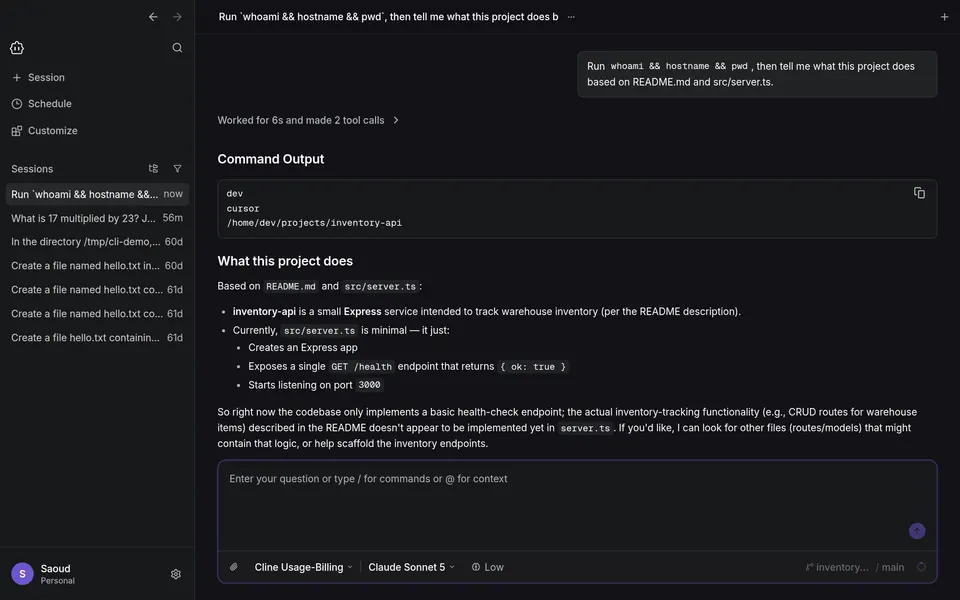
- Desktop app
- Mac, Windows and Linux
- Browser
- Yes
- Phone
- Phone browser
- Command line
- Yes
- Agents
- Claude Code, Codex and OpenCode
- Your subscription
- Works with your own plan
- Agents run
- On your computer, on your own server and in the vendor's cloud
- Laptop closed
- Keeps going
- Isolation
- Worktree
- Parallel agents
- Yes
- Scheduled runs
- Yes
- Coordinator agent
- Yes
- Built-in issues
- Yes
- Pull requests
- Yes
- Review screen
- Yes
- Team
- Roles and SSO
- Self-hosting
- Yes
- Licence
- Apache-2.0
- Price from
- Free
- How it charges
- Free plan, subscription, usage-based and bring your own key
- Paid plans from
- Contact sales
Receipts
- Checked
- · oldest answer 2026-11-07
- Findings
- 43 published · 41 cross-checked by a second agent · read them all
- Sources
- 24 public pages on 3 sites: docs.cline.bot, github.com, cline.bot
- Screenshot
- github.com, retrieved · first party repository · shows appearance, not capability
- Data
- /products/cline.json · .md
- Method
- Same rules for all 103 researched ADEs. How we check · Report wrong data

What it does
Where you use it
Cline supplies Desktop, IDE, CLI/SDK, Kanban and Cloud Agents clients. The complete application catalog and phone access instructions offer mobile browsers rather than a native iOS or Android app. Existing platform release scope and cloud continuation restrictions remain.
Source and scope for Where you use itAgents it runs
The pinned Cline SDK includes native Claude Code and Codex CLI execution adapters and an OpenCode SDK runtime. Claude Code executes native tools with workspace cwd and user/project settings, and Codex uses its exec adapter. Optional Claude/Codex provider packages must be installed. Other model providers, editor hosting and session imports do not establish additional coding harnesses.
Source and scope for Agents it runsAccounts and subscriptions
Cline supports Claude Pro/Max subscription access via an installed authenticated Claude CLI provider. Bring Your Own Key supports cloud providers or local runtimes. Cline usage billing has an account sign-in, built-in billing and changing free model options. Desktop can use supported Ollama or LM Studio models with local setup assistance. Claude CLI mode uses subscription limits and has limited image uploads and prompt caching.
Source and scope for Accounts and subscriptionsWhere agents run
Desktop runs sessions on local hardware. Desktop can select an SSH host while its UI remains on the user's computer; unattended disconnect behavior was not tested. Cloud Agents execute in a vendor-managed sandbox. The source explicitly describes closing the laptop while cloud work continues and checking from a phone. A mobile browser can send follow-up instructions to a Cloud Agent session.
Source and scope for Where agents runHow work is kept apart
Each Cloud Agent session receives its own repository copy. Cloud tasks commit to a cline/ branch, never directly to the default branch. Each task receives an ephemeral Git worktree; shared symlinks are not a security boundary. Each cloud session has a separate sandbox and repository copy.
Source and scope for How work is kept apartParallel work
Desktop supports multiple independent agent sessions in parallel. Multiple Kanban tasks run in parallel in separate worktrees.
Source and scope for Parallel workScheduled runs
Desktop has one-time and recurring Schedule entries with prompt, provider, model, workspace and optional timeout; laptop-disconnect behavior was not established.
Source and scope for Scheduled runsGit and pull requests
Cloud Agents use a cline/ branch per task. The agent commits and pushes progress while working. Users can ask a finished Cloud Agent to open a pull request.
Source and scope for Git and pull requestsLicence and source
The repository LICENSE at a459f1d04dea030833b558be645011ab739c463b is Apache-2.0; hosted components and separate clients require their own licensing checks.
Source and scope for Licence and sourcePrice
The overview lists ClinePass at $9.99/month for selected open coding models, checked 7 November 2026; exact caps remain uncollected. Open-source application use has no subscription or seat fee. Individual users pay their chosen inference provider or Cline inference credits.
Source and scope for PriceTyped filters
Every value links to its receipt below. Read plan and surface restrictions before using a filter to decide.
| Filter | Value |
|---|---|
| Desktop OS: macOS | Yes |
| Desktop OS: Windows | Yes |
| Desktop OS: Linux | Yes |
| Web client | Yes |
| Phone access: Native iOS | No |
| Phone access: Native Android | No |
| Phone access: Phone browser | Yes |
| CLI | Yes cross-checked |
| Coding agents: Claude Code | Yes |
| Coding agents: Codex | Yes |
| Coding agents: Cursor Agent | No |
| Coding agents: Gemini CLI | No |
| Coding agents: OpenCode | Yes |
| Coding agents: Pi | No |
| Coding agents: Grok | No |
| Coding agents: Aider | No |
| Coding agents: Antigravity | No |
| Use my subscription | Yes cross-checked |
| Where agents run: On your computer | Yes cross-checked |
| Where agents run: On your own server | Yes cross-checked |
| Where agents run: In the vendor's cloud | Yes cross-checked |
| Workspace isolation: Git worktree | Yes cross-checked |
| Workspace isolation: Container | Unknown |
| Workspace isolation: VM or microVM | Unknown |
| Parallel runs | Yes cross-checked |
| Coordinator | Yes cross-checked |
| Native issue tracking | Yes cross-checked |
| Unattended triggers | Yes cross-checked |
| Shared prompting | Unknown |
| Team roles | Yes cross-checked |
| SSO | Yes cross-checked |
| Pull request workflow | Yes cross-checked |
| Review interface | Yes cross-checked |
| Product license: Apache-2.0 | Yes. Apache-2.0 cross-checked |
| Product license: MIT | No. Apache-2.0 cross-checked |
| Product license: GPL-3.0 | No. Apache-2.0 cross-checked |
| Product license: GPL-3.0-or-later | No. Apache-2.0 cross-checked |
| Product license: AGPL-3.0 | No. Apache-2.0 cross-checked |
| Product license: AGPL-3.0-or-later | No. Apache-2.0 cross-checked |
| Product license: Elastic License 2.0 | No. Apache-2.0 cross-checked |
| Product license: Custom terms | No. Apache-2.0 cross-checked |
| Product license: Proprietary | No. Apache-2.0 cross-checked |
| Self-hosting | Yes cross-checked |
| Telemetry opt-out | Yes cross-checked |
| Free access | Yes cross-checked |
| Starting price: Free | Yes. Free cross-checked |
| Starting price: Up to $20/month | No. Free cross-checked |
| Starting price: $21–40/month | No. Free cross-checked |
| Starting price: $41–100/month | No. Free cross-checked |
| Starting price: Over $100/month | No. Free cross-checked |
| Starting price: Contact for pricing | No. Free cross-checked |
| Pricing model: Free, no paid plan | No |
| Pricing model: Free plan | Yes cross-checked |
| Pricing model: Subscription | Yes |
| Pricing model: Per seat | No |
| Pricing model: Usage-based | Yes cross-checked |
| Pricing model: Per machine or compute | No |
| Pricing model: Bring your own key | Yes cross-checked |
| Pricing model: One-time purchase | No |
| Paid plans from: No paid plan | No. Contact sales |
| Paid plans from: $10 or less/month | No. Contact sales |
| Paid plans from: $11–20/month | No. Contact sales |
| Paid plans from: $21–40/month | No. Contact sales |
| Paid plans from: $41–100/month | No. Contact sales |
| Paid plans from: Over $100/month | No. Contact sales |
| Paid plans from: Contact sales | Yes. Contact sales |
| Lifecycle status: Active | Unknown |
| Lifecycle status: Sunsetting | Unknown |
| Keeps going with laptop closed | Yes cross-checked |
| Open-source license | Yes. Apache-2.0 cross-checked |
| Any desktop app | Yes |
| Paid plan up to $20/month | No. Contact sales |
| Paid plan up to $40/month | No. Contact sales |
| Any phone client | Yes |
Filter receipts
Desktop OS: macOS: Yes
Desktop OS: macOS
Typed value: Yes.
Cline supplies Desktop, IDE, CLI/SDK, Kanban and Cloud Agents clients. The complete application catalog and phone access instructions offer mobile browsers rather than a native iOS or Android app. Existing platform release scope and cloud continuation restrictions remain.
- Only the named documented or inspected parts are established; other atomic questions retain their recorded gaps.
-
Finding: Desktop is available for macOS and beta Windows, imports Claude Code/Codex conversations into Cline, schedules tasks and supports own keys and local models. Importing a conversation does not run the original harness.
Desktop OS: Windows: Yes
Desktop OS: Windows
Typed value: Yes.
Cline supplies Desktop, IDE, CLI/SDK, Kanban and Cloud Agents clients. The complete application catalog and phone access instructions offer mobile browsers rather than a native iOS or Android app. Existing platform release scope and cloud continuation restrictions remain.
- Only the named documented or inspected parts are established; other atomic questions retain their recorded gaps.
-
Finding: Desktop is available for macOS and beta Windows, imports Claude Code/Codex conversations into Cline, schedules tasks and supports own keys and local models. Importing a conversation does not run the original harness.
Desktop OS: Linux: Yes
Desktop OS: Linux
Typed value: Yes.
Cline supplies Desktop, IDE, CLI/SDK, Kanban and Cloud Agents clients. The complete application catalog and phone access instructions offer mobile browsers rather than a native iOS or Android app. Existing platform release scope and cloud continuation restrictions remain.
- Desktop os: Cline Desktop ships for macOS and Windows, with Windows in beta. Desktop v0.0.49 also attaches Linux .deb and .rpm packages, and the SSH guide lists Desktop on Linux; the download page names only macOS and Windows.
- Only the named documented or inspected parts are established; other atomic questions retain their recorded gaps.
-
Cline Desktop v0.0.49 release assets
Finding: The Desktop v0.0.49 release attaches Linux packages (amd64 and arm64 .deb, x86_64 and aarch64 .rpm) beside the macOS .dmg and Windows setup .exe.
-
Finding: The SSH remote guide lists Cline Desktop on macOS, Windows or Linux as a requirement. The Desktop download page and installation guide name only macOS and Windows (Windows in beta).
Web client: Yes
Web client
Typed value: Yes.
Cline supplies Desktop, IDE, CLI/SDK, Kanban and Cloud Agents clients. The complete application catalog and phone access instructions offer mobile browsers rather than a native iOS or Android app. Existing platform release scope and cloud continuation restrictions remain.
- Browser: Cloud Agents provide a browser interface without installing an IDE, CLI or app.
- Mobile browser: Cloud Agents support mobile browsers for reading, answering questions and sending follow-ups.
- Cross device continuity: Users can start on a laptop, close its lid and continue via a phone browser.
- Only the named documented or inspected parts are established; other atomic questions retain their recorded gaps.
-
Finding: Cloud sessions work from mobile browsers and persist when the laptop closes. Each uses a separate sandbox and cline/ branch. Sandboxes pause after 15 idle minutes; limits are 10 simultaneous and 50 new sessions daily.
Phone access: Native iOS: No
Phone access: Native iOS
Typed value: No.
Cline supplies Desktop, IDE, CLI/SDK, Kanban and Cloud Agents clients. The complete application catalog and phone access instructions offer mobile browsers rather than a native iOS or Android app. Existing platform release scope and cloud continuation restrictions remain.
- Mobile apps: No native iOS or Android app appears in the complete application list; phone instructions use a browser.
- Only the named documented or inspected parts are established; other atomic questions retain their recorded gaps.
-
Finding: The full application catalog lists Desktop, CLI, IDE extensions, SDK and Kanban. Cloud Agents documentation specifies phone browser access. Neither application catalog nor mobile instructions offers a native iOS or Android Cline app.
Phone access: Native Android: No
Phone access: Native Android
Typed value: No.
Cline supplies Desktop, IDE, CLI/SDK, Kanban and Cloud Agents clients. The complete application catalog and phone access instructions offer mobile browsers rather than a native iOS or Android app. Existing platform release scope and cloud continuation restrictions remain.
- Mobile apps: No native iOS or Android app appears in the complete application list; phone instructions use a browser.
- Only the named documented or inspected parts are established; other atomic questions retain their recorded gaps.
-
Finding: The full application catalog lists Desktop, CLI, IDE extensions, SDK and Kanban. Cloud Agents documentation specifies phone browser access. Neither application catalog nor mobile instructions offers a native iOS or Android Cline app.
Phone access: Phone browser: Yes
Phone access: Phone browser
Typed value: Yes.
Cline supplies Desktop, IDE, CLI/SDK, Kanban and Cloud Agents clients. The complete application catalog and phone access instructions offer mobile browsers rather than a native iOS or Android app. Existing platform release scope and cloud continuation restrictions remain.
- Browser: Cloud Agents provide a browser interface without installing an IDE, CLI or app.
- Mobile browser: Cloud Agents support mobile browsers for reading, answering questions and sending follow-ups.
- Cross device continuity: Users can start on a laptop, close its lid and continue via a phone browser.
- Only the named documented or inspected parts are established; other atomic questions retain their recorded gaps.
-
Finding: Cloud sessions work from mobile browsers and persist when the laptop closes. Each uses a separate sandbox and cline/ branch. Sandboxes pause after 15 idle minutes; limits are 10 simultaneous and 50 new sessions daily.
CLI: Yes cross-checked
CLI
Typed value: Yes.
The CLI is documented for scripting and CI/CD. The documented SDK embeds Cline's agent core; this is separate from the inference API.
- Cli: The CLI is documented for scripting and CI/CD.
- Sdk: The documented SDK embeds Cline's agent core; this is separate from the inference API.
- Programmable access: first-party sources in this pass did not establish api, mcp_server, webhooks, operations, authentication, stability. Detailed client actions, provider-specific eligibility and first-run prerequisites need targeted access; no install timing or external-tool fixture was run.
- Kanban is a research preview. Its features do not establish parity with Desktop, IDE or Cloud Agents.
-
Finding: Cline documents distinct desktop, IDE, CLI, SDK and Kanban clients; model access has usage billing, ClinePass and own-key routes.
Coding agents: Claude Code: Yes
Coding agents: Claude Code
Typed value: Yes.
The pinned Cline SDK includes native Claude Code and Codex CLI execution adapters and an OpenCode SDK runtime. Claude Code executes native tools with workspace cwd and user/project settings, and Codex uses its exec adapter. Optional Claude/Codex provider packages must be installed. Other model providers, editor hosting and session imports do not establish additional coding harnesses.
- Harnesses: Native SDK factories launch Claude Code, Codex CLI and OpenCode runtimes; the registered native CLI routes do not include Cursor Agent, Gemini CLI, Pi, Grok Build, Aider or Antigravity.
- Custom adapters: Programmable SDK provider extension is possible, but the inspected shipped native CLI registry names only the three established routes.
- Session integration: The Claude adapter binds cwd and native settings, Codex uses createCodexExec and OpenCode uses its SDK runtime factory.
- Only the named documented or inspected parts are established; other atomic questions retain their recorded gaps.
-
Finding: The SDK registers Claude Code and Codex CLI adapters with provider-tools and local-auth. Claude Code spawns a native CLI agent with workspace cwd, user/project settings and acceptEdits; Codex uses createCodexExec. OpenCode starts its SDK runtime with local CLI authentication. These execute native harnesses, unlike the separate OpenAI subscription HTTP model route. Claude/Codex adapters require optional provider packages.
Coding agents: Codex: Yes
Coding agents: Codex
Typed value: Yes.
The pinned Cline SDK includes native Claude Code and Codex CLI execution adapters and an OpenCode SDK runtime. Claude Code executes native tools with workspace cwd and user/project settings, and Codex uses its exec adapter. Optional Claude/Codex provider packages must be installed. Other model providers, editor hosting and session imports do not establish additional coding harnesses.
- Harnesses: Native SDK factories launch Claude Code, Codex CLI and OpenCode runtimes; the registered native CLI routes do not include Cursor Agent, Gemini CLI, Pi, Grok Build, Aider or Antigravity.
- Custom adapters: Programmable SDK provider extension is possible, but the inspected shipped native CLI registry names only the three established routes.
- Session integration: The Claude adapter binds cwd and native settings, Codex uses createCodexExec and OpenCode uses its SDK runtime factory.
- Only the named documented or inspected parts are established; other atomic questions retain their recorded gaps.
-
Finding: The SDK registers Claude Code and Codex CLI adapters with provider-tools and local-auth. Claude Code spawns a native CLI agent with workspace cwd, user/project settings and acceptEdits; Codex uses createCodexExec. OpenCode starts its SDK runtime with local CLI authentication. These execute native harnesses, unlike the separate OpenAI subscription HTTP model route. Claude/Codex adapters require optional provider packages.
Coding agents: Cursor Agent: No
Coding agents: Cursor Agent
Typed value: No.
The pinned Cline SDK includes native Claude Code and Codex CLI execution adapters and an OpenCode SDK runtime. Claude Code executes native tools with workspace cwd and user/project settings, and Codex uses its exec adapter. Optional Claude/Codex provider packages must be installed. Other model providers, editor hosting and session imports do not establish additional coding harnesses.
- Harnesses: Native SDK factories launch Claude Code, Codex CLI and OpenCode runtimes; the registered native CLI routes do not include Cursor Agent, Gemini CLI, Pi, Grok Build, Aider or Antigravity.
- Custom adapters: Programmable SDK provider extension is possible, but the inspected shipped native CLI registry names only the three established routes.
- Session integration: The Claude adapter binds cwd and native settings, Codex uses createCodexExec and OpenCode uses its SDK runtime factory.
- Only the named documented or inspected parts are established; other atomic questions retain their recorded gaps.
-
Finding: The SDK registers Claude Code and Codex CLI adapters with provider-tools and local-auth. Claude Code spawns a native CLI agent with workspace cwd, user/project settings and acceptEdits; Codex uses createCodexExec. OpenCode starts its SDK runtime with local CLI authentication. These execute native harnesses, unlike the separate OpenAI subscription HTTP model route. Claude/Codex adapters require optional provider packages.
Coding agents: Gemini CLI: No
Coding agents: Gemini CLI
Typed value: No.
The pinned Cline SDK includes native Claude Code and Codex CLI execution adapters and an OpenCode SDK runtime. Claude Code executes native tools with workspace cwd and user/project settings, and Codex uses its exec adapter. Optional Claude/Codex provider packages must be installed. Other model providers, editor hosting and session imports do not establish additional coding harnesses.
- Harnesses: Native SDK factories launch Claude Code, Codex CLI and OpenCode runtimes; the registered native CLI routes do not include Cursor Agent, Gemini CLI, Pi, Grok Build, Aider or Antigravity.
- Custom adapters: Programmable SDK provider extension is possible, but the inspected shipped native CLI registry names only the three established routes.
- Session integration: The Claude adapter binds cwd and native settings, Codex uses createCodexExec and OpenCode uses its SDK runtime factory.
- Only the named documented or inspected parts are established; other atomic questions retain their recorded gaps.
-
Finding: The SDK registers Claude Code and Codex CLI adapters with provider-tools and local-auth. Claude Code spawns a native CLI agent with workspace cwd, user/project settings and acceptEdits; Codex uses createCodexExec. OpenCode starts its SDK runtime with local CLI authentication. These execute native harnesses, unlike the separate OpenAI subscription HTTP model route. Claude/Codex adapters require optional provider packages.
Coding agents: OpenCode: Yes
Coding agents: OpenCode
Typed value: Yes.
The pinned Cline SDK includes native Claude Code and Codex CLI execution adapters and an OpenCode SDK runtime. Claude Code executes native tools with workspace cwd and user/project settings, and Codex uses its exec adapter. Optional Claude/Codex provider packages must be installed. Other model providers, editor hosting and session imports do not establish additional coding harnesses.
- Harnesses: Native SDK factories launch Claude Code, Codex CLI and OpenCode runtimes; the registered native CLI routes do not include Cursor Agent, Gemini CLI, Pi, Grok Build, Aider or Antigravity.
- Custom adapters: Programmable SDK provider extension is possible, but the inspected shipped native CLI registry names only the three established routes.
- Session integration: The Claude adapter binds cwd and native settings, Codex uses createCodexExec and OpenCode uses its SDK runtime factory.
- Only the named documented or inspected parts are established; other atomic questions retain their recorded gaps.
-
Finding: The SDK registers Claude Code and Codex CLI adapters with provider-tools and local-auth. Claude Code spawns a native CLI agent with workspace cwd, user/project settings and acceptEdits; Codex uses createCodexExec. OpenCode starts its SDK runtime with local CLI authentication. These execute native harnesses, unlike the separate OpenAI subscription HTTP model route. Claude/Codex adapters require optional provider packages.
Coding agents: Pi: No
Coding agents: Pi
Typed value: No.
The pinned Cline SDK includes native Claude Code and Codex CLI execution adapters and an OpenCode SDK runtime. Claude Code executes native tools with workspace cwd and user/project settings, and Codex uses its exec adapter. Optional Claude/Codex provider packages must be installed. Other model providers, editor hosting and session imports do not establish additional coding harnesses.
- Harnesses: Native SDK factories launch Claude Code, Codex CLI and OpenCode runtimes; the registered native CLI routes do not include Cursor Agent, Gemini CLI, Pi, Grok Build, Aider or Antigravity.
- Custom adapters: Programmable SDK provider extension is possible, but the inspected shipped native CLI registry names only the three established routes.
- Session integration: The Claude adapter binds cwd and native settings, Codex uses createCodexExec and OpenCode uses its SDK runtime factory.
- Only the named documented or inspected parts are established; other atomic questions retain their recorded gaps.
-
Finding: The SDK registers Claude Code and Codex CLI adapters with provider-tools and local-auth. Claude Code spawns a native CLI agent with workspace cwd, user/project settings and acceptEdits; Codex uses createCodexExec. OpenCode starts its SDK runtime with local CLI authentication. These execute native harnesses, unlike the separate OpenAI subscription HTTP model route. Claude/Codex adapters require optional provider packages.
Coding agents: Grok: No
Coding agents: Grok
Typed value: No.
The pinned Cline SDK includes native Claude Code and Codex CLI execution adapters and an OpenCode SDK runtime. Claude Code executes native tools with workspace cwd and user/project settings, and Codex uses its exec adapter. Optional Claude/Codex provider packages must be installed. Other model providers, editor hosting and session imports do not establish additional coding harnesses.
- Harnesses: Native SDK factories launch Claude Code, Codex CLI and OpenCode runtimes; the registered native CLI routes do not include Cursor Agent, Gemini CLI, Pi, Grok Build, Aider or Antigravity.
- Custom adapters: Programmable SDK provider extension is possible, but the inspected shipped native CLI registry names only the three established routes.
- Session integration: The Claude adapter binds cwd and native settings, Codex uses createCodexExec and OpenCode uses its SDK runtime factory.
- Only the named documented or inspected parts are established; other atomic questions retain their recorded gaps.
-
Finding: The SDK registers Claude Code and Codex CLI adapters with provider-tools and local-auth. Claude Code spawns a native CLI agent with workspace cwd, user/project settings and acceptEdits; Codex uses createCodexExec. OpenCode starts its SDK runtime with local CLI authentication. These execute native harnesses, unlike the separate OpenAI subscription HTTP model route. Claude/Codex adapters require optional provider packages.
Coding agents: Aider: No
Coding agents: Aider
Typed value: No.
The pinned Cline SDK includes native Claude Code and Codex CLI execution adapters and an OpenCode SDK runtime. Claude Code executes native tools with workspace cwd and user/project settings, and Codex uses its exec adapter. Optional Claude/Codex provider packages must be installed. Other model providers, editor hosting and session imports do not establish additional coding harnesses.
- Harnesses: Native SDK factories launch Claude Code, Codex CLI and OpenCode runtimes; the registered native CLI routes do not include Cursor Agent, Gemini CLI, Pi, Grok Build, Aider or Antigravity.
- Custom adapters: Programmable SDK provider extension is possible, but the inspected shipped native CLI registry names only the three established routes.
- Session integration: The Claude adapter binds cwd and native settings, Codex uses createCodexExec and OpenCode uses its SDK runtime factory.
- Only the named documented or inspected parts are established; other atomic questions retain their recorded gaps.
-
Finding: The SDK registers Claude Code and Codex CLI adapters with provider-tools and local-auth. Claude Code spawns a native CLI agent with workspace cwd, user/project settings and acceptEdits; Codex uses createCodexExec. OpenCode starts its SDK runtime with local CLI authentication. These execute native harnesses, unlike the separate OpenAI subscription HTTP model route. Claude/Codex adapters require optional provider packages.
Coding agents: Antigravity: No
Coding agents: Antigravity
Typed value: No.
The pinned Cline SDK includes native Claude Code and Codex CLI execution adapters and an OpenCode SDK runtime. Claude Code executes native tools with workspace cwd and user/project settings, and Codex uses its exec adapter. Optional Claude/Codex provider packages must be installed. Other model providers, editor hosting and session imports do not establish additional coding harnesses.
- Harnesses: Native SDK factories launch Claude Code, Codex CLI and OpenCode runtimes; the registered native CLI routes do not include Cursor Agent, Gemini CLI, Pi, Grok Build, Aider or Antigravity.
- Custom adapters: Programmable SDK provider extension is possible, but the inspected shipped native CLI registry names only the three established routes.
- Session integration: The Claude adapter binds cwd and native settings, Codex uses createCodexExec and OpenCode uses its SDK runtime factory.
- Only the named documented or inspected parts are established; other atomic questions retain their recorded gaps.
-
Finding: The SDK registers Claude Code and Codex CLI adapters with provider-tools and local-auth. Claude Code spawns a native CLI agent with workspace cwd, user/project settings and acceptEdits; Codex uses createCodexExec. OpenCode starts its SDK runtime with local CLI authentication. These execute native harnesses, unlike the separate OpenAI subscription HTTP model route. Claude/Codex adapters require optional provider packages.
Use my subscription: Yes cross-checked
Use my subscription
Typed value: Yes.
Cline supports Claude Pro/Max subscription access via an installed authenticated Claude CLI provider. Bring Your Own Key supports cloud providers or local runtimes. Cline usage billing has an account sign-in, built-in billing and changing free model options. Desktop can use supported Ollama or LM Studio models with local setup assistance. Claude CLI mode uses subscription limits and has limited image uploads and prompt caching.
- Agent subscriptions: Cline supports Claude Pro/Max subscription access via an installed authenticated Claude CLI provider.
- Provider restrictions: Claude CLI mode uses subscription limits and has limited image uploads and prompt caching.
- Unknown after the targeted first-party documentation, release and repository pass: account_switching, vendor_account_requirement. No configured product fixture was run; documentation does not establish successful hands-on behavior.
-
Finding: Cline can use a Claude Pro/Max subscription through an installed and authenticated Claude CLI, selected as a provider. Model limits and image/caching restrictions remain.
Where agents run: On your computer: Yes cross-checked
Where agents run: On your computer
Typed value: Yes.
Desktop runs sessions on local hardware. Desktop can select an SSH host while its UI remains on the user's computer; unattended disconnect behavior was not tested. Cloud Agents execute in a vendor-managed sandbox. The source explicitly describes closing the laptop while cloud work continues and checking from a phone. A mobile browser can send follow-up instructions to a Cloud Agent session.
- Local: Desktop runs sessions on local hardware.
- Byo remote: Desktop can select an SSH host while its UI remains on the user's computer; unattended disconnect behavior was not tested.
- Unknown after the targeted first-party documentation, release and repository pass: self_hosted, hybrid, provisioning, payer, resources, region, expiry. No configured product fixture was run; documentation does not establish successful hands-on behavior.
-
Finding: Desktop offers macOS and Windows beta, independent sessions, imported conversations and local or SSH execution.
Where agents run: On your own server: Yes cross-checked
Where agents run: On your own server
Typed value: Yes.
Desktop runs sessions on local hardware. Desktop can select an SSH host while its UI remains on the user's computer; unattended disconnect behavior was not tested. Cloud Agents execute in a vendor-managed sandbox. The source explicitly describes closing the laptop while cloud work continues and checking from a phone. A mobile browser can send follow-up instructions to a Cloud Agent session.
- Local: Desktop runs sessions on local hardware.
- Byo remote: Desktop can select an SSH host while its UI remains on the user's computer; unattended disconnect behavior was not tested.
- Unknown after the targeted first-party documentation, release and repository pass: self_hosted, hybrid, provisioning, payer, resources, region, expiry. No configured product fixture was run; documentation does not establish successful hands-on behavior.
-
Finding: Desktop offers macOS and Windows beta, independent sessions, imported conversations and local or SSH execution.
Where agents run: In the vendor's cloud: Yes cross-checked
Where agents run: In the vendor's cloud
Typed value: Yes.
Desktop runs sessions on local hardware. Desktop can select an SSH host while its UI remains on the user's computer; unattended disconnect behavior was not tested. Cloud Agents execute in a vendor-managed sandbox. The source explicitly describes closing the laptop while cloud work continues and checking from a phone. A mobile browser can send follow-up instructions to a Cloud Agent session.
- Managed cloud: Cloud Agents execute in a vendor-managed sandbox.
- Client disconnect: The source explicitly describes closing the laptop while cloud work continues and checking from a phone.
- Other device continuation: A mobile browser can send follow-up instructions to a Cloud Agent session.
- Unknown after the targeted first-party documentation, release and repository pass: self_hosted, hybrid, provisioning, payer, resources, region, expiry. No configured product fixture was run; documentation does not establish successful hands-on behavior.
-
Finding: Cloud sessions work from mobile browsers and persist when the laptop closes. Each uses a separate sandbox and cline/ branch. Sandboxes pause after 15 idle minutes; limits are 10 simultaneous and 50 new sessions daily.
Workspace isolation: Git worktree: Yes cross-checked
Workspace isolation: Git worktree
Typed value: Yes.
Each Cloud Agent session receives its own repository copy. Cloud tasks commit to a cline/ branch, never directly to the default branch. Each task receives an ephemeral Git worktree; shared symlinks are not a security boundary. Each cloud session has a separate sandbox and repository copy.
- Worktree: Each task receives an ephemeral Git worktree; shared symlinks are not a security boundary.
- Unknown after the targeted first-party documentation, release and repository pass: container, vm, os_sandbox, filesystem, process, network, secrets, security_boundary. No configured product fixture was run; documentation does not establish successful hands-on behavior.
-
Finding: Kanban cards have explicit dispatch, per-task worktrees, dependency chains, review feedback and prompt-driven commit/PR actions.
Parallel runs: Yes cross-checked
Parallel runs
Typed value: Yes.
Desktop supports multiple independent agent sessions in parallel. Multiple Kanban tasks run in parallel in separate worktrees.
- Concurrent sessions: Desktop supports multiple independent agent sessions in parallel.
- Parallel work: first-party sources in this pass did not establish quotas, observed_concurrency, status_visibility. No concurrent-worker, duplicate-claim, delegation-retention or twelve-state fleet fixture was run. UI labels alone do not establish enforcement.
- Kanban is a research preview. Its features do not establish parity with Desktop, IDE or Cloud Agents.
-
Finding: Desktop offers macOS and Windows beta, independent sessions, imported conversations and local or SSH execution.
Coordinator: Yes cross-checked
Coordinator
Typed value: Yes.
One coordinator delegates subtasks to specialist teammates. Teams have an inter-agent mailbox. The coordinator collects teammate results. Cline owns the coordinator and team tools. /team starts a team, or Cline forms one when needed. Task-board, mailbox and mission-log state is persisted in teams.db. A resumed session retains its team for coordinator follow-up. The /team prompt invokes team coordination in CLI, SDK and Kanban, not IDE extensions.
- Roles: One coordinator delegates subtasks to specialist teammates.
- Messages: Teams have an inter-agent mailbox.
- Results return: The coordinator collects teammate results.
- Orchestration owner: Cline owns the coordinator and team tools.
- Activation: /team starts a team, or Cline forms one when needed.
- Retained results: Task-board, mailbox and mission-log state is persisted in teams.db.
- Followup: A resumed session retains its team for coordinator follow-up.
- Invocation: The /team prompt invokes team coordination in CLI, SDK and Kanban, not IDE extensions.
- Unknown after the targeted first-party documentation, release and repository pass: model_harness_effort, cross_harness, authentication, live_progress. No configured product fixture was run; documentation does not establish successful hands-on behavior.
-
Finding: SDK, CLI and Kanban teams use a coordinator, persistent shared task board, inter-agent mailbox and mission log in teams.db. Resume restores the team; IDE extensions do not support teams.
Native issue tracking: Yes cross-checked
Native issue tracking
Typed value: Yes.
The Kanban board stores manually created cards before play is pressed. Play starts a card's agent and creates its worktree.
- Create: The Kanban board stores manually created cards before play is pressed.
- Explicit dispatch: Play starts a card's agent and creates its worktree.
- Native issue management and idea backlog: first-party sources in this pass did not establish edit, discuss, prioritize, label, assign, search, filter, archive, reopen, project_epic_views, idea_parking, task_session_separation, metadata, durable_states, external_tracker_requirement. No shared requirement-to-implementation, backlog evolution or authoritative-record round-trip fixture was run. Instructions and per-task plans do not prove living specifications.
- Kanban is a research preview. Its features do not establish parity with Desktop, IDE or Cloud Agents.
-
Finding: Kanban cards have explicit dispatch, per-task worktrees, dependency chains, review feedback and prompt-driven commit/PR actions.
Unattended triggers: Yes cross-checked
Unattended triggers
Typed value: Yes.
Desktop has one-time and recurring Schedule entries with prompt, provider, model, workspace and optional timeout; laptop-disconnect behavior was not established.
- Schedules: Desktop has one-time and recurring Schedule entries with prompt, provider, model, workspace and optional timeout; laptop-disconnect behavior was not established.
- Unattended triggers: first-party sources in this pass did not establish events, recurring_tasks, completion_conditions, scheduler_location, overlaps, retries, client_independence. No concurrent-worker, duplicate-claim, delegation-retention or twelve-state fleet fixture was run. UI labels alone do not establish enforcement.
-
Finding: Desktop offers macOS and Windows beta, independent sessions, imported conversations and local or SSH execution.
Team roles: Yes cross-checked
Team roles
Typed value: Yes.
Enterprise documents Member, Admin and Owner with organization-scoped permissions. Enterprise documentation overview lists SSO, role-based controls and remote configuration; paid scope details were not established.
- Organization roles: Enterprise documents Member, Admin and Owner with organization-scoped permissions.
- Unknown after the targeted first-party documentation, release and repository pass: project_roles, task_roles, membership, provisioning, unauthorized_access, revocation, plan_scope. No configured product fixture was run; documentation does not establish successful hands-on behavior.
-
Finding: Cline executes locally or on chosen remote hosts and supports direct provider endpoints. Member/Admin/Owner roles govern the organization. It has no repository indexing and provides OpenTelemetry usage export.
SSO: Yes cross-checked
SSO
Typed value: Yes.
Enterprise documents Member, Admin and Owner with organization-scoped permissions. Enterprise documentation overview lists SSO, role-based controls and remote configuration; paid scope details were not established.
- Sso: Enterprise documentation overview lists SSO, role-based controls and remote configuration; paid scope details were not established.
- Unknown after the targeted first-party documentation, release and repository pass: project_roles, task_roles, membership, provisioning, unauthorized_access, revocation, plan_scope. No configured product fixture was run; documentation does not establish successful hands-on behavior.
-
Finding: Cline documents distinct desktop, IDE, CLI, SDK and Kanban clients; model access has usage billing, ClinePass and own-key routes.
Pull request workflow: Yes cross-checked
Pull request workflow
Typed value: Yes.
Cloud Agents use a cline/ branch per task. The agent commits and pushes progress while working. Users can ask a finished Cloud Agent to open a pull request.
- Unknown after the targeted first-party documentation, release and repository pass: worktrees, comments, ci_response, rebase, conflicts, product_state. No configured product fixture was run; documentation does not establish successful hands-on behavior.
-
Finding: Kanban cards have explicit dispatch, per-task worktrees, dependency chains, review feedback and prompt-driven commit/PR actions.
Review interface: Yes cross-checked
Review interface
Typed value: Yes.
Card details expose the TUI and cumulative or message-range diffs.
- Diffs: Card details expose the TUI and cumulative or message-range diffs.
- Retained artifacts and outputs: first-party sources in this pass did not establish documents, screenshots, recordings, previews, test_outputs, reviewer_outputs, gallery, task_links, revision_links, persistence, child_findings, prompt_leakage. No draft PR, failed-gate, stale-approval, rollback or six-task batch-review fixture was run. Described actions do not prove delivery authority.
- Kanban is a research preview. Its features do not establish parity with Desktop, IDE or Cloud Agents.
-
Finding: Kanban cards have explicit dispatch, per-task worktrees, dependency chains, review feedback and prompt-driven commit/PR actions.
Product license: Apache-2.0: Yes. Apache-2.0 cross-checked
Product license: Apache-2.0
Typed value: Yes. Apache-2.0.
The repository LICENSE at a459f1d04dea030833b558be645011ab739c463b is Apache-2.0; hosted components and separate clients require their own licensing checks.
- Client license: The repository LICENSE at a459f1d04dea030833b558be645011ab739c463b is Apache-2.0; hosted components and separate clients require their own licensing checks.
- Source and license: first-party sources in this pass did not establish server_license, hosted_extensions, source_visibility, source_revision, hosted_parity. No full license/hosted parity audit, assurance-report access or fixed one/two/five-person workload costing was performed. Public pricing is dated; missing rates remain unknown.
-
Finding: The pinned repository LICENSE is Apache-2.0; this does not license every vendor-hosted service.
Product license: MIT: No. Apache-2.0 cross-checked
Product license: MIT
Typed value: No. Apache-2.0.
The repository LICENSE at a459f1d04dea030833b558be645011ab739c463b is Apache-2.0; hosted components and separate clients require their own licensing checks.
- Client license: The repository LICENSE at a459f1d04dea030833b558be645011ab739c463b is Apache-2.0; hosted components and separate clients require their own licensing checks.
- Source and license: first-party sources in this pass did not establish server_license, hosted_extensions, source_visibility, source_revision, hosted_parity. No full license/hosted parity audit, assurance-report access or fixed one/two/five-person workload costing was performed. Public pricing is dated; missing rates remain unknown.
-
Finding: The pinned repository LICENSE is Apache-2.0; this does not license every vendor-hosted service.
Product license: GPL-3.0: No. Apache-2.0 cross-checked
Product license: GPL-3.0
Typed value: No. Apache-2.0.
The repository LICENSE at a459f1d04dea030833b558be645011ab739c463b is Apache-2.0; hosted components and separate clients require their own licensing checks.
- Client license: The repository LICENSE at a459f1d04dea030833b558be645011ab739c463b is Apache-2.0; hosted components and separate clients require their own licensing checks.
- Source and license: first-party sources in this pass did not establish server_license, hosted_extensions, source_visibility, source_revision, hosted_parity. No full license/hosted parity audit, assurance-report access or fixed one/two/five-person workload costing was performed. Public pricing is dated; missing rates remain unknown.
-
Finding: The pinned repository LICENSE is Apache-2.0; this does not license every vendor-hosted service.
Product license: GPL-3.0-or-later: No. Apache-2.0 cross-checked
Product license: GPL-3.0-or-later
Typed value: No. Apache-2.0.
The repository LICENSE at a459f1d04dea030833b558be645011ab739c463b is Apache-2.0; hosted components and separate clients require their own licensing checks.
- Client license: The repository LICENSE at a459f1d04dea030833b558be645011ab739c463b is Apache-2.0; hosted components and separate clients require their own licensing checks.
- Source and license: first-party sources in this pass did not establish server_license, hosted_extensions, source_visibility, source_revision, hosted_parity. No full license/hosted parity audit, assurance-report access or fixed one/two/five-person workload costing was performed. Public pricing is dated; missing rates remain unknown.
-
Finding: The pinned repository LICENSE is Apache-2.0; this does not license every vendor-hosted service.
Product license: AGPL-3.0: No. Apache-2.0 cross-checked
Product license: AGPL-3.0
Typed value: No. Apache-2.0.
The repository LICENSE at a459f1d04dea030833b558be645011ab739c463b is Apache-2.0; hosted components and separate clients require their own licensing checks.
- Client license: The repository LICENSE at a459f1d04dea030833b558be645011ab739c463b is Apache-2.0; hosted components and separate clients require their own licensing checks.
- Source and license: first-party sources in this pass did not establish server_license, hosted_extensions, source_visibility, source_revision, hosted_parity. No full license/hosted parity audit, assurance-report access or fixed one/two/five-person workload costing was performed. Public pricing is dated; missing rates remain unknown.
-
Finding: The pinned repository LICENSE is Apache-2.0; this does not license every vendor-hosted service.
Product license: AGPL-3.0-or-later: No. Apache-2.0 cross-checked
Product license: AGPL-3.0-or-later
Typed value: No. Apache-2.0.
The repository LICENSE at a459f1d04dea030833b558be645011ab739c463b is Apache-2.0; hosted components and separate clients require their own licensing checks.
- Client license: The repository LICENSE at a459f1d04dea030833b558be645011ab739c463b is Apache-2.0; hosted components and separate clients require their own licensing checks.
- Source and license: first-party sources in this pass did not establish server_license, hosted_extensions, source_visibility, source_revision, hosted_parity. No full license/hosted parity audit, assurance-report access or fixed one/two/five-person workload costing was performed. Public pricing is dated; missing rates remain unknown.
-
Finding: The pinned repository LICENSE is Apache-2.0; this does not license every vendor-hosted service.
Product license: Elastic License 2.0: No. Apache-2.0 cross-checked
Product license: Elastic License 2.0
Typed value: No. Apache-2.0.
The repository LICENSE at a459f1d04dea030833b558be645011ab739c463b is Apache-2.0; hosted components and separate clients require their own licensing checks.
- Client license: The repository LICENSE at a459f1d04dea030833b558be645011ab739c463b is Apache-2.0; hosted components and separate clients require their own licensing checks.
- Source and license: first-party sources in this pass did not establish server_license, hosted_extensions, source_visibility, source_revision, hosted_parity. No full license/hosted parity audit, assurance-report access or fixed one/two/five-person workload costing was performed. Public pricing is dated; missing rates remain unknown.
-
Finding: The pinned repository LICENSE is Apache-2.0; this does not license every vendor-hosted service.
Product license: Custom terms: No. Apache-2.0 cross-checked
Product license: Custom terms
Typed value: No. Apache-2.0.
The repository LICENSE at a459f1d04dea030833b558be645011ab739c463b is Apache-2.0; hosted components and separate clients require their own licensing checks.
- Client license: The repository LICENSE at a459f1d04dea030833b558be645011ab739c463b is Apache-2.0; hosted components and separate clients require their own licensing checks.
- Source and license: first-party sources in this pass did not establish server_license, hosted_extensions, source_visibility, source_revision, hosted_parity. No full license/hosted parity audit, assurance-report access or fixed one/two/five-person workload costing was performed. Public pricing is dated; missing rates remain unknown.
-
Finding: The pinned repository LICENSE is Apache-2.0; this does not license every vendor-hosted service.
Product license: Proprietary: No. Apache-2.0 cross-checked
Product license: Proprietary
Typed value: No. Apache-2.0.
The repository LICENSE at a459f1d04dea030833b558be645011ab739c463b is Apache-2.0; hosted components and separate clients require their own licensing checks.
- Client license: The repository LICENSE at a459f1d04dea030833b558be645011ab739c463b is Apache-2.0; hosted components and separate clients require their own licensing checks.
- Source and license: first-party sources in this pass did not establish server_license, hosted_extensions, source_visibility, source_revision, hosted_parity. No full license/hosted parity audit, assurance-report access or fixed one/two/five-person workload costing was performed. Public pricing is dated; missing rates remain unknown.
-
Finding: The pinned repository LICENSE is Apache-2.0; this does not license every vendor-hosted service.
Self-hosting: Yes cross-checked
Self-hosting
Typed value: Yes.
The open-source Cline core and its tools run locally or on user-controlled remote hosts with a chosen inference provider. Direct model providers are supported; with telemetry off, Cline still contacts its servers to sign in, check feature flags and run Cline or ClinePass provider requests. cline history export writes a standalone HTML transcript. Desktop imports supported Claude Code and Codex conversations and continues them with the provider and model configured in Cline. CLI history export produces HTML. Conversation import is documented; original agent runtime state is not transferred.
- Self hosting: The open-source Cline core and its tools run locally or on user-controlled remote hosts with a chosen inference provider.
- Vendor dependencies: Direct model providers are supported; with telemetry off, Cline still contacts its servers to sign in, check feature flags and run Cline or ClinePass provider requests.
- Unknown after the targeted first-party documentation, release and repository pass: cancellation, account_independence. No configured product fixture was run; documentation does not establish successful hands-on behavior.
-
Finding: Cline executes locally or on chosen remote hosts and supports direct provider endpoints. Member/Admin/Owner roles govern the organization. It has no repository indexing and provides OpenTelemetry usage export.
Telemetry opt-out: Yes cross-checked
Telemetry opt-out
Typed value: Yes.
Cline/ClinePass inference telemetry can contain prompts and responses; other providers do not send prompt contents to Cline telemetry. Usage events cover features, tasks, errors, tokens, timing, model/provider, version, OS and installation identity. Telemetry is enabled by default in extensions, Desktop and CLI, including with own keys. Extensions have Allow error and usage reporting; CLI uses telemetryOptOut=true and Desktop has a Telemetry switch. Desktop/CLI require a hub restart for all non-prompt events. With other providers, prompts go to the configured provider. Telemetry opt-out does not stop sign-in, feature-flag or Cline-provider network requests.
- Prompts: Cline/ClinePass inference telemetry can contain prompts and responses; other providers do not send prompt contents to Cline telemetry.
- Telemetry disclosure: Usage events cover features, tasks, errors, tokens, timing, model/provider, version, OS and installation identity.
- Telemetry defaults: Telemetry is enabled by default in extensions, Desktop and CLI, including with own keys.
- Telemetry controls: Extensions have Allow error and usage reporting; CLI uses telemetryOptOut=true and Desktop has a Telemetry switch. Desktop/CLI require a hub restart for all non-prompt events.
- Provider separation: With other providers, prompts go to the configured provider. Telemetry opt-out does not stop sign-in, feature-flag or Cline-provider network requests.
- Unknown after the targeted first-party documentation, release and repository pass: code_data, credentials, logs, artifacts, retention, deletion, training, residency, subprocessors, consent_prompt. No configured product fixture was run; documentation does not establish successful hands-on behavior.
-
Finding: Telemetry defaults on. UI and telemetryOptOut controls disable reporting; Desktop/CLI need a hub restart for non-prompt events. Cline/ClinePass provider requests may include prompts and responses; other providers do not send prompt contents to Cline telemetry.
Free access: Yes cross-checked
Free access
Typed value: Yes.
The open-source extension and CLI are free for individual developers. Application use has no subscription or seat fee; provider inference and user compute costs remain separate. The core open-source application is available free.
- Ongoing free: The open-source extension and CLI are free for individual developers.
- Self host cost: Application use has no subscription or seat fee; provider inference and user compute costs remain separate.
- Paid only: The core open-source application is available free.
- Unknown after the targeted first-party documentation, release and repository pass: trial, credits_trial, early_access, free_scenarios, card_required, usage_caps, paid_evaluation. No configured product fixture was run; documentation does not establish successful hands-on behavior.
-
Finding: The open-source extension and CLI are free with no subscriptions or seat fees; users pay inference charges. Enterprise has custom pricing and centralized administration.
Starting price: Free: Yes. Free cross-checked
Starting price: Free
Typed value: Yes. Free.
The overview lists ClinePass at $9.99/month for selected open coding models, checked 7 November 2026; exact caps remain uncollected. Open-source application use has no subscription or seat fee. Individual users pay their chosen inference provider or Cline inference credits.
- Workspace fees: Open-source application use has no subscription or seat fee.
- Model cost: Individual users pay their chosen inference provider or Cline inference credits.
- Unknown after the targeted first-party documentation, release and repository pass: currency, seats, seat_minimum, included_usage, credits, trial, overages, taxes, compute_cost. No configured product fixture was run; documentation does not establish successful hands-on behavior.
-
Finding: The open-source extension and CLI are free with no subscriptions or seat fees; users pay inference charges. Enterprise has custom pricing and centralized administration.
Starting price: Up to $20/month: No. Free cross-checked
Starting price: Up to $20/month
Typed value: No. Free.
The overview lists ClinePass at $9.99/month for selected open coding models, checked 7 November 2026; exact caps remain uncollected. Open-source application use has no subscription or seat fee. Individual users pay their chosen inference provider or Cline inference credits.
- Workspace fees: Open-source application use has no subscription or seat fee.
- Model cost: Individual users pay their chosen inference provider or Cline inference credits.
- Unknown after the targeted first-party documentation, release and repository pass: currency, seats, seat_minimum, included_usage, credits, trial, overages, taxes, compute_cost. No configured product fixture was run; documentation does not establish successful hands-on behavior.
-
Finding: The open-source extension and CLI are free with no subscriptions or seat fees; users pay inference charges. Enterprise has custom pricing and centralized administration.
Starting price: $21–40/month: No. Free cross-checked
Starting price: $21–40/month
Typed value: No. Free.
The overview lists ClinePass at $9.99/month for selected open coding models, checked 7 November 2026; exact caps remain uncollected. Open-source application use has no subscription or seat fee. Individual users pay their chosen inference provider or Cline inference credits.
- Workspace fees: Open-source application use has no subscription or seat fee.
- Model cost: Individual users pay their chosen inference provider or Cline inference credits.
- Unknown after the targeted first-party documentation, release and repository pass: currency, seats, seat_minimum, included_usage, credits, trial, overages, taxes, compute_cost. No configured product fixture was run; documentation does not establish successful hands-on behavior.
-
Finding: The open-source extension and CLI are free with no subscriptions or seat fees; users pay inference charges. Enterprise has custom pricing and centralized administration.
Starting price: $41–100/month: No. Free cross-checked
Starting price: $41–100/month
Typed value: No. Free.
The overview lists ClinePass at $9.99/month for selected open coding models, checked 7 November 2026; exact caps remain uncollected. Open-source application use has no subscription or seat fee. Individual users pay their chosen inference provider or Cline inference credits.
- Workspace fees: Open-source application use has no subscription or seat fee.
- Model cost: Individual users pay their chosen inference provider or Cline inference credits.
- Unknown after the targeted first-party documentation, release and repository pass: currency, seats, seat_minimum, included_usage, credits, trial, overages, taxes, compute_cost. No configured product fixture was run; documentation does not establish successful hands-on behavior.
-
Finding: The open-source extension and CLI are free with no subscriptions or seat fees; users pay inference charges. Enterprise has custom pricing and centralized administration.
Starting price: Over $100/month: No. Free cross-checked
Starting price: Over $100/month
Typed value: No. Free.
The overview lists ClinePass at $9.99/month for selected open coding models, checked 7 November 2026; exact caps remain uncollected. Open-source application use has no subscription or seat fee. Individual users pay their chosen inference provider or Cline inference credits.
- Workspace fees: Open-source application use has no subscription or seat fee.
- Model cost: Individual users pay their chosen inference provider or Cline inference credits.
- Unknown after the targeted first-party documentation, release and repository pass: currency, seats, seat_minimum, included_usage, credits, trial, overages, taxes, compute_cost. No configured product fixture was run; documentation does not establish successful hands-on behavior.
-
Finding: The open-source extension and CLI are free with no subscriptions or seat fees; users pay inference charges. Enterprise has custom pricing and centralized administration.
Starting price: Contact for pricing: No. Free cross-checked
Starting price: Contact for pricing
Typed value: No. Free.
The overview lists ClinePass at $9.99/month for selected open coding models, checked 7 November 2026; exact caps remain uncollected. Open-source application use has no subscription or seat fee. Individual users pay their chosen inference provider or Cline inference credits.
- Workspace fees: Open-source application use has no subscription or seat fee.
- Model cost: Individual users pay their chosen inference provider or Cline inference credits.
- Unknown after the targeted first-party documentation, release and repository pass: currency, seats, seat_minimum, included_usage, credits, trial, overages, taxes, compute_cost. No configured product fixture was run; documentation does not establish successful hands-on behavior.
-
Finding: The open-source extension and CLI are free with no subscriptions or seat fees; users pay inference charges. Enterprise has custom pricing and centralized administration.
Pricing model: Free, no paid plan: No
Pricing model: Free, no paid plan
Typed value: No.
The overview lists ClinePass at $9.99/month for selected open coding models, checked 7 November 2026; exact caps remain uncollected. Open-source application use has no subscription or seat fee. Individual users pay their chosen inference provider or Cline inference credits.
- Interval: The overview lists ClinePass at $9.99/month for selected open coding models, checked 7 November 2026; exact caps remain uncollected.
- Workspace fees: Open-source application use has no subscription or seat fee.
- Model cost: Individual users pay their chosen inference provider or Cline inference credits.
- Unknown after the targeted first-party documentation, release and repository pass: currency, seats, seat_minimum, included_usage, credits, trial, overages, taxes, compute_cost. No configured product fixture was run; documentation does not establish successful hands-on behavior.
-
Finding: Cline documents distinct desktop, IDE, CLI, SDK and Kanban clients; model access has usage billing, ClinePass and own-key routes.
-
Finding: The open-source extension and CLI are free with no subscriptions or seat fees; users pay inference charges. Enterprise has custom pricing and centralized administration.
Pricing model: Free plan: Yes cross-checked
Pricing model: Free plan
Typed value: Yes.
The overview lists ClinePass at $9.99/month for selected open coding models, checked 7 November 2026; exact caps remain uncollected. Open-source application use has no subscription or seat fee. Individual users pay their chosen inference provider or Cline inference credits.
- Workspace fees: Open-source application use has no subscription or seat fee.
- Model cost: Individual users pay their chosen inference provider or Cline inference credits.
- Unknown after the targeted first-party documentation, release and repository pass: currency, seats, seat_minimum, included_usage, credits, trial, overages, taxes, compute_cost. No configured product fixture was run; documentation does not establish successful hands-on behavior.
-
Finding: The open-source extension and CLI are free with no subscriptions or seat fees; users pay inference charges. Enterprise has custom pricing and centralized administration.
Pricing model: Subscription: Yes
Pricing model: Subscription
Typed value: Yes.
The overview lists ClinePass at $9.99/month for selected open coding models, checked 7 November 2026; exact caps remain uncollected. Open-source application use has no subscription or seat fee. Individual users pay their chosen inference provider or Cline inference credits.
- Interval: The overview lists ClinePass at $9.99/month for selected open coding models, checked 7 November 2026; exact caps remain uncollected.
- Unknown after the targeted first-party documentation, release and repository pass: currency, seats, seat_minimum, included_usage, credits, trial, overages, taxes, compute_cost. No configured product fixture was run; documentation does not establish successful hands-on behavior.
-
Finding: Cline documents distinct desktop, IDE, CLI, SDK and Kanban clients; model access has usage billing, ClinePass and own-key routes.
Pricing model: Per seat: No
Pricing model: Per seat
Typed value: No.
The overview lists ClinePass at $9.99/month for selected open coding models, checked 7 November 2026; exact caps remain uncollected. Open-source application use has no subscription or seat fee. Individual users pay their chosen inference provider or Cline inference credits.
- Workspace fees: Open-source application use has no subscription or seat fee.
- Model cost: Individual users pay their chosen inference provider or Cline inference credits.
- Unknown after the targeted first-party documentation, release and repository pass: currency, seats, seat_minimum, included_usage, credits, trial, overages, taxes, compute_cost. No configured product fixture was run; documentation does not establish successful hands-on behavior.
-
Finding: The open-source extension and CLI are free with no subscriptions or seat fees; users pay inference charges. Enterprise has custom pricing and centralized administration.
Pricing model: Usage-based: Yes cross-checked
Pricing model: Usage-based
Typed value: Yes.
The overview lists ClinePass at $9.99/month for selected open coding models, checked 7 November 2026; exact caps remain uncollected. Open-source application use has no subscription or seat fee. Individual users pay their chosen inference provider or Cline inference credits.
- Workspace fees: Open-source application use has no subscription or seat fee.
- Model cost: Individual users pay their chosen inference provider or Cline inference credits.
- Unknown after the targeted first-party documentation, release and repository pass: currency, seats, seat_minimum, included_usage, credits, trial, overages, taxes, compute_cost. No configured product fixture was run; documentation does not establish successful hands-on behavior.
-
Finding: The open-source extension and CLI are free with no subscriptions or seat fees; users pay inference charges. Enterprise has custom pricing and centralized administration.
Pricing model: Per machine or compute: No
Pricing model: Per machine or compute
Typed value: No.
The overview lists ClinePass at $9.99/month for selected open coding models, checked 7 November 2026; exact caps remain uncollected. Open-source application use has no subscription or seat fee. Individual users pay their chosen inference provider or Cline inference credits.
- Workspace fees: Open-source application use has no subscription or seat fee.
- Model cost: Individual users pay their chosen inference provider or Cline inference credits.
- Unknown after the targeted first-party documentation, release and repository pass: currency, seats, seat_minimum, included_usage, credits, trial, overages, taxes, compute_cost. No configured product fixture was run; documentation does not establish successful hands-on behavior.
-
Finding: The open-source extension and CLI are free with no subscriptions or seat fees; users pay inference charges. Enterprise has custom pricing and centralized administration.
Pricing model: Bring your own key: Yes cross-checked
Pricing model: Bring your own key
Typed value: Yes.
Cline supports Claude Pro/Max subscription access via an installed authenticated Claude CLI provider. Bring Your Own Key supports cloud providers or local runtimes. Cline usage billing has an account sign-in, built-in billing and changing free model options. Desktop can use supported Ollama or LM Studio models with local setup assistance. Claude CLI mode uses subscription limits and has limited image uploads and prompt caching.
- Api accounts: Bring Your Own Key supports cloud providers or local runtimes.
- Vendor credits: Cline usage billing has an account sign-in, built-in billing and changing free model options.
- Unknown after the targeted first-party documentation, release and repository pass: account_switching, vendor_account_requirement. No configured product fixture was run; documentation does not establish successful hands-on behavior.
-
Finding: Cline documents distinct desktop, IDE, CLI, SDK and Kanban clients; model access has usage billing, ClinePass and own-key routes.
Pricing model: One-time purchase: No
Pricing model: One-time purchase
Typed value: No.
The overview lists ClinePass at $9.99/month for selected open coding models, checked 7 November 2026; exact caps remain uncollected. Open-source application use has no subscription or seat fee. Individual users pay their chosen inference provider or Cline inference credits.
- Workspace fees: Open-source application use has no subscription or seat fee.
- Model cost: Individual users pay their chosen inference provider or Cline inference credits.
- Unknown after the targeted first-party documentation, release and repository pass: currency, seats, seat_minimum, included_usage, credits, trial, overages, taxes, compute_cost. No configured product fixture was run; documentation does not establish successful hands-on behavior.
-
Finding: The open-source extension and CLI are free with no subscriptions or seat fees; users pay inference charges. Enterprise has custom pricing and centralized administration.
Paid plans from: No paid plan: No. Contact sales
Paid plans from: No paid plan
Typed value: No. Contact sales.
The overview lists ClinePass at $9.99/month for selected open coding models, checked 7 November 2026; exact caps remain uncollected. Open-source application use has no subscription or seat fee. Individual users pay their chosen inference provider or Cline inference credits.
- Workspace fees: Open-source application use has no subscription or seat fee.
- Model cost: Individual users pay their chosen inference provider or Cline inference credits.
- Unknown after the targeted first-party documentation, release and repository pass: currency, seats, seat_minimum, included_usage, credits, trial, overages, taxes, compute_cost. No configured product fixture was run; documentation does not establish successful hands-on behavior.
-
Finding: The open-source extension and CLI are free with no subscriptions or seat fees; users pay inference charges. Enterprise has custom pricing and centralized administration.
Paid plans from: $10 or less/month: No. Contact sales
Paid plans from: $10 or less/month
Typed value: No. Contact sales.
The overview lists ClinePass at $9.99/month for selected open coding models, checked 7 November 2026; exact caps remain uncollected. Open-source application use has no subscription or seat fee. Individual users pay their chosen inference provider or Cline inference credits.
- Workspace fees: Open-source application use has no subscription or seat fee.
- Model cost: Individual users pay their chosen inference provider or Cline inference credits.
- Unknown after the targeted first-party documentation, release and repository pass: currency, seats, seat_minimum, included_usage, credits, trial, overages, taxes, compute_cost. No configured product fixture was run; documentation does not establish successful hands-on behavior.
-
Finding: The open-source extension and CLI are free with no subscriptions or seat fees; users pay inference charges. Enterprise has custom pricing and centralized administration.
Paid plans from: $11–20/month: No. Contact sales
Paid plans from: $11–20/month
Typed value: No. Contact sales.
The overview lists ClinePass at $9.99/month for selected open coding models, checked 7 November 2026; exact caps remain uncollected. Open-source application use has no subscription or seat fee. Individual users pay their chosen inference provider or Cline inference credits.
- Workspace fees: Open-source application use has no subscription or seat fee.
- Model cost: Individual users pay their chosen inference provider or Cline inference credits.
- Unknown after the targeted first-party documentation, release and repository pass: currency, seats, seat_minimum, included_usage, credits, trial, overages, taxes, compute_cost. No configured product fixture was run; documentation does not establish successful hands-on behavior.
-
Finding: The open-source extension and CLI are free with no subscriptions or seat fees; users pay inference charges. Enterprise has custom pricing and centralized administration.
Paid plans from: $21–40/month: No. Contact sales
Paid plans from: $21–40/month
Typed value: No. Contact sales.
The overview lists ClinePass at $9.99/month for selected open coding models, checked 7 November 2026; exact caps remain uncollected. Open-source application use has no subscription or seat fee. Individual users pay their chosen inference provider or Cline inference credits.
- Workspace fees: Open-source application use has no subscription or seat fee.
- Model cost: Individual users pay their chosen inference provider or Cline inference credits.
- Unknown after the targeted first-party documentation, release and repository pass: currency, seats, seat_minimum, included_usage, credits, trial, overages, taxes, compute_cost. No configured product fixture was run; documentation does not establish successful hands-on behavior.
-
Finding: The open-source extension and CLI are free with no subscriptions or seat fees; users pay inference charges. Enterprise has custom pricing and centralized administration.
Paid plans from: $41–100/month: No. Contact sales
Paid plans from: $41–100/month
Typed value: No. Contact sales.
The overview lists ClinePass at $9.99/month for selected open coding models, checked 7 November 2026; exact caps remain uncollected. Open-source application use has no subscription or seat fee. Individual users pay their chosen inference provider or Cline inference credits.
- Workspace fees: Open-source application use has no subscription or seat fee.
- Model cost: Individual users pay their chosen inference provider or Cline inference credits.
- Unknown after the targeted first-party documentation, release and repository pass: currency, seats, seat_minimum, included_usage, credits, trial, overages, taxes, compute_cost. No configured product fixture was run; documentation does not establish successful hands-on behavior.
-
Finding: The open-source extension and CLI are free with no subscriptions or seat fees; users pay inference charges. Enterprise has custom pricing and centralized administration.
Paid plans from: Over $100/month: No. Contact sales
Paid plans from: Over $100/month
Typed value: No. Contact sales.
The overview lists ClinePass at $9.99/month for selected open coding models, checked 7 November 2026; exact caps remain uncollected. Open-source application use has no subscription or seat fee. Individual users pay their chosen inference provider or Cline inference credits.
- Workspace fees: Open-source application use has no subscription or seat fee.
- Model cost: Individual users pay their chosen inference provider or Cline inference credits.
- Unknown after the targeted first-party documentation, release and repository pass: currency, seats, seat_minimum, included_usage, credits, trial, overages, taxes, compute_cost. No configured product fixture was run; documentation does not establish successful hands-on behavior.
-
Finding: The open-source extension and CLI are free with no subscriptions or seat fees; users pay inference charges. Enterprise has custom pricing and centralized administration.
Paid plans from: Contact sales: Yes. Contact sales
Paid plans from: Contact sales
Typed value: Yes. Contact sales.
The overview lists ClinePass at $9.99/month for selected open coding models, checked 7 November 2026; exact caps remain uncollected. Open-source application use has no subscription or seat fee. Individual users pay their chosen inference provider or Cline inference credits.
- Workspace fees: Open-source application use has no subscription or seat fee.
- Model cost: Individual users pay their chosen inference provider or Cline inference credits.
- Unknown after the targeted first-party documentation, release and repository pass: currency, seats, seat_minimum, included_usage, credits, trial, overages, taxes, compute_cost. No configured product fixture was run; documentation does not establish successful hands-on behavior.
-
Finding: The open-source extension and CLI are free with no subscriptions or seat fees; users pay inference charges. Enterprise has custom pricing and centralized administration.
Keeps going with laptop closed: Yes cross-checked
Keeps going with laptop closed
Typed value: Yes.
Desktop runs sessions on local hardware. Desktop can select an SSH host while its UI remains on the user's computer; unattended disconnect behavior was not tested. Cloud Agents execute in a vendor-managed sandbox. The source explicitly describes closing the laptop while cloud work continues and checking from a phone. A mobile browser can send follow-up instructions to a Cloud Agent session.
- Managed cloud: Cloud Agents execute in a vendor-managed sandbox.
- Client disconnect: The source explicitly describes closing the laptop while cloud work continues and checking from a phone.
- Other device continuation: A mobile browser can send follow-up instructions to a Cloud Agent session.
- Unknown after the targeted first-party documentation, release and repository pass: self_hosted, hybrid, provisioning, payer, resources, region, expiry. No configured product fixture was run; documentation does not establish successful hands-on behavior.
-
Finding: Cloud sessions work from mobile browsers and persist when the laptop closes. Each uses a separate sandbox and cline/ branch. Sandboxes pause after 15 idle minutes; limits are 10 simultaneous and 50 new sessions daily.
Open-source license: Yes. Apache-2.0 cross-checked
Open-source license
Typed value: Yes. Apache-2.0.
The repository LICENSE at a459f1d04dea030833b558be645011ab739c463b is Apache-2.0; hosted components and separate clients require their own licensing checks.
- Client license: The repository LICENSE at a459f1d04dea030833b558be645011ab739c463b is Apache-2.0; hosted components and separate clients require their own licensing checks.
- Source and license: first-party sources in this pass did not establish server_license, hosted_extensions, source_visibility, source_revision, hosted_parity. No full license/hosted parity audit, assurance-report access or fixed one/two/five-person workload costing was performed. Public pricing is dated; missing rates remain unknown.
-
Finding: The pinned repository LICENSE is Apache-2.0; this does not license every vendor-hosted service.
Any desktop app: Yes
Any desktop app
Typed value: Yes.
Cline supplies Desktop, IDE, CLI/SDK, Kanban and Cloud Agents clients. The complete application catalog and phone access instructions offer mobile browsers rather than a native iOS or Android app. Existing platform release scope and cloud continuation restrictions remain.
- Only the named documented or inspected parts are established; other atomic questions retain their recorded gaps.
-
Finding: Desktop is available for macOS and beta Windows, imports Claude Code/Codex conversations into Cline, schedules tasks and supports own keys and local models. Importing a conversation does not run the original harness.
Paid plan up to $20/month: No. Contact sales
Paid plan up to $20/month
Typed value: No. Contact sales.
The overview lists ClinePass at $9.99/month for selected open coding models, checked 7 November 2026; exact caps remain uncollected. Open-source application use has no subscription or seat fee. Individual users pay their chosen inference provider or Cline inference credits.
- Workspace fees: Open-source application use has no subscription or seat fee.
- Model cost: Individual users pay their chosen inference provider or Cline inference credits.
- Unknown after the targeted first-party documentation, release and repository pass: currency, seats, seat_minimum, included_usage, credits, trial, overages, taxes, compute_cost. No configured product fixture was run; documentation does not establish successful hands-on behavior.
-
Finding: The open-source extension and CLI are free with no subscriptions or seat fees; users pay inference charges. Enterprise has custom pricing and centralized administration.
Paid plan up to $40/month: No. Contact sales
Paid plan up to $40/month
Typed value: No. Contact sales.
The overview lists ClinePass at $9.99/month for selected open coding models, checked 7 November 2026; exact caps remain uncollected. Open-source application use has no subscription or seat fee. Individual users pay their chosen inference provider or Cline inference credits.
- Workspace fees: Open-source application use has no subscription or seat fee.
- Model cost: Individual users pay their chosen inference provider or Cline inference credits.
- Unknown after the targeted first-party documentation, release and repository pass: currency, seats, seat_minimum, included_usage, credits, trial, overages, taxes, compute_cost. No configured product fixture was run; documentation does not establish successful hands-on behavior.
-
Finding: The open-source extension and CLI are free with no subscriptions or seat fees; users pay inference charges. Enterprise has custom pricing and centralized administration.
Any phone client: Yes
Any phone client
Typed value: Yes.
Cline supplies Desktop, IDE, CLI/SDK, Kanban and Cloud Agents clients. The complete application catalog and phone access instructions offer mobile browsers rather than a native iOS or Android app. Existing platform release scope and cloud continuation restrictions remain.
- Browser: Cloud Agents provide a browser interface without installing an IDE, CLI or app.
- Mobile browser: Cloud Agents support mobile browsers for reading, answering questions and sending follow-ups.
- Cross device continuity: Users can start on a laptop, close its lid and continue via a phone browser.
- Only the named documented or inspected parts are established; other atomic questions retain their recorded gaps.
-
Finding: Cloud sessions work from mobile browsers and persist when the laptop closes. Each uses a separate sandbox and cline/ branch. Sandboxes pause after 15 idle minutes; limits are 10 simultaneous and 50 new sessions daily.
All public findings
Findings may summarize a source. They are not presented as verbatim statements.
cline:ACC-01: Cline supplies Desktop, IDE, CLI/SDK, Kanban and Cloud Agents clients. The complete application catalog and phone access instructions offer mobile browsers rather than a native iOS or Android app. Existing platform release scope and cloud continuation restrictions remain.
cline:ACC-01
Cline supplies Desktop, IDE, CLI/SDK, Kanban and Cloud Agents clients. The complete application catalog and phone access instructions offer mobile browsers rather than a native iOS or Android app. Existing platform release scope and cloud continuation restrictions remain.
- Only the named documented or inspected parts are established; other atomic questions retain their recorded gaps.
-
Finding: Cline documents distinct desktop, IDE, CLI, SDK and Kanban clients; model access has usage billing, ClinePass and own-key routes.
-
Finding: Desktop offers macOS and Windows beta, independent sessions, imported conversations and local or SSH execution.
-
Finding: Desktop is available for macOS and beta Windows, imports Claude Code/Codex conversations into Cline, schedules tasks and supports own keys and local models. Importing a conversation does not run the original harness.
-
Finding: Cloud sessions work from mobile browsers and persist when the laptop closes. Each uses a separate sandbox and cline/ branch. Sandboxes pause after 15 idle minutes; limits are 10 simultaneous and 50 new sessions daily.
-
Cline Desktop v0.0.49 release assets
Finding: The Desktop v0.0.49 release attaches Linux packages (amd64 and arm64 .deb, x86_64 and aarch64 .rpm) beside the macOS .dmg and Windows setup .exe.
-
Finding: The SSH remote guide lists Cline Desktop on macOS, Windows or Linux as a requirement. The Desktop download page and installation guide name only macOS and Windows (Windows in beta).
-
Finding: The full application catalog lists Desktop, CLI, IDE extensions, SDK and Kanban. Cloud Agents documentation specifies phone browser access. Neither application catalog nor mobile instructions offers a native iOS or Android Cline app.
cline:ACC-02: The pinned Cline SDK includes native Claude Code and Codex CLI execution adapters and an OpenCode SDK runtime. Claude Code executes native tools with workspace cwd and user/project settings, and Codex uses its exec adapter. Optional Claude/Codex provider packages must be installed. Other model providers, editor hosting and session imports do not establish additional coding harnesses.
cline:ACC-02
The pinned Cline SDK includes native Claude Code and Codex CLI execution adapters and an OpenCode SDK runtime. Claude Code executes native tools with workspace cwd and user/project settings, and Codex uses its exec adapter. Optional Claude/Codex provider packages must be installed. Other model providers, editor hosting and session imports do not establish additional coding harnesses.
- Only the named documented or inspected parts are established; other atomic questions retain their recorded gaps.
-
Cline Antigravity support at v4.1.26
Finding: Cline v4.1.26 documents installing Cline inside the Antigravity editor. This does not establish Cline launching the Antigravity coding harness.
-
Cline Antigravity support at v4.1.26
Finding: Cline v4.1.26 documents installing Cline inside the Antigravity editor. This does not establish Cline launching the Antigravity coding harness.
-
Finding: The SDK registers Claude Code and Codex CLI adapters with provider-tools and local-auth. Claude Code spawns a native CLI agent with workspace cwd, user/project settings and acceptEdits; Codex uses createCodexExec. OpenCode starts its SDK runtime with local CLI authentication. These execute native harnesses, unlike the separate OpenAI subscription HTTP model route. Claude/Codex adapters require optional provider packages.
cline:ACC-03: Cline supports Claude Pro/Max subscription access via an installed authenticated Claude CLI provider. Bring Your Own Key supports cloud providers or local runtimes. Cline usage billing has an account sign-in, built-in billing and changing free model options. Desktop can use supported Ollama or LM Studio models with local setup assistance. Claude CLI mode uses subscription limits and has limited image uploads and prompt caching. cross-checked
cline:ACC-03
Cline supports Claude Pro/Max subscription access via an installed authenticated Claude CLI provider. Bring Your Own Key supports cloud providers or local runtimes. Cline usage billing has an account sign-in, built-in billing and changing free model options. Desktop can use supported Ollama or LM Studio models with local setup assistance. Claude CLI mode uses subscription limits and has limited image uploads and prompt caching.
- Unknown after the targeted first-party documentation, release and repository pass: account_switching, vendor_account_requirement. No configured product fixture was run; documentation does not establish successful hands-on behavior.
-
Finding: Cline documents distinct desktop, IDE, CLI, SDK and Kanban clients; model access has usage billing, ClinePass and own-key routes.
-
Finding: Desktop offers macOS and Windows beta, independent sessions, imported conversations and local or SSH execution.
-
Finding: Cline can use a Claude Pro/Max subscription through an installed and authenticated Claude CLI, selected as a provider. Model limits and image/caching restrictions remain.
cline:ACC-04: Kanban requires Node 18+, a Git repository root and npx kanban; it starts a local browser server. cross-checked
cline:ACC-04
Kanban requires Node 18+, a Git repository root and npx kanban; it starts a local browser server.
- Onboarding and project prerequisites: first-party sources in this pass did not establish first_task_setup, no_git, local_git_without_remote, hosted_git, managed_cloud_setup, byo_vps_onboarding. Detailed client actions, provider-specific eligibility and first-run prerequisites need targeted access; no install timing or external-tool fixture was run.
- Kanban is a research preview. Its features do not establish parity with Desktop, IDE or Cloud Agents.
-
Finding: Kanban is explicitly a research preview, started as a local browser server from a Git repository using Node 18+.
cline:ACC-05: The CLI is documented for scripting and CI/CD. The documented SDK embeds Cline's agent core; this is separate from the inference API. cross-checked
cline:ACC-05
The CLI is documented for scripting and CI/CD. The documented SDK embeds Cline's agent core; this is separate from the inference API.
- Programmable access: first-party sources in this pass did not establish api, mcp_server, webhooks, operations, authentication, stability. Detailed client actions, provider-specific eligibility and first-run prerequisites need targeted access; no install timing or external-tool fixture was run.
- Kanban is a research preview. Its features do not establish parity with Desktop, IDE or Cloud Agents.
-
Finding: Cline documents distinct desktop, IDE, CLI, SDK and Kanban clients; model access has usage billing, ClinePass and own-key routes.
cline:ACC-06: Cline supports connecting MCP servers for external tools and data. Desktop Marketplace provides skills, plugins and MCP servers with an installed inventory. cross-checked
cline:ACC-06
Cline supports connecting MCP servers for external tools and data. Desktop Marketplace provides skills, plugins and MCP servers with an installed inventory.
- External tools and extensions: first-party sources in this pass did not establish custom_tools, instructions_import, authentication, permission_scope, integration_owner. Detailed client actions, provider-specific eligibility and first-run prerequisites need targeted access; no install timing or external-tool fixture was run.
-
Finding: Desktop offers macOS and Windows beta, independent sessions, imported conversations and local or SSH execution.
-
Finding: Cline documents MCP server tools as extensions to its agent; no external call was executed.
cline:ACC-07: The pinned technical README describes Cline Desktop as a Tauri shell with Bun sidecar and Next.js UI; no responsiveness measurements were run. cross-checked
cline:ACC-07
The pinned technical README describes Cline Desktop as a Tauri shell with Bun sidecar and Next.js UI; no responsiveness measurements were run.
- Client implementation: first-party sources in this pass did not establish mobile_implementation, hybrids, implementation_evidence. Detailed client actions, provider-specific eligibility and first-run prerequisites need targeted access; no install timing or external-tool fixture was run.
-
Finding: The technical README identifies the Desktop app as a Tauri shell with a Bun sidecar and Next.js UI; this does not establish native platform UI.
cline:PLAN-01: Users add task cards manually or through sidebar chat. cross-checked
cline:PLAN-01
Users add task cards manually or through sidebar chat.
- Intake and external tracker relationship: first-party sources in this pass did not establish prompt_intake, external_import, chat_git_triggers, authoritative_tracker, stable_ids, sync, supported_edits, external_roundtrips. No shared requirement-to-implementation, backlog evolution or authoritative-record round-trip fixture was run. Instructions and per-task plans do not prove living specifications.
- Kanban is a research preview. Its features do not establish parity with Desktop, IDE or Cloud Agents.
-
Finding: Kanban cards have explicit dispatch, per-task worktrees, dependency chains, review feedback and prompt-driven commit/PR actions.
cline:PLAN-03: Linked cards form chains; the next task starts after the prior card completes and is moved to trash. Enforcement under races was not tested. cross-checked
cline:PLAN-03
Linked cards form chains; the next task starts after the prior card completes and is moved to trash. Enforcement under races was not tested.
- Hierarchy, dependencies and evolving scope: first-party sources in this pass did not establish epics, hierarchy, readiness, enforcement, state_propagation, task_to_epic, identity_retention, workflow_constraints. No shared requirement-to-implementation, backlog evolution or authoritative-record round-trip fixture was run. Instructions and per-task plans do not prove living specifications.
- Kanban is a research preview. Its features do not establish parity with Desktop, IDE or Cloud Agents.
-
Finding: Kanban cards have explicit dispatch, per-task worktrees, dependency chains, review feedback and prompt-driven commit/PR actions.
cline:PLAN-04: Memory Bank uses project Markdown files for requirements, architecture, technical context and progress. Optional Memory Bank files retain context across conversations; the documented process requires instructions and periodic updates. Memory Bank files live in the project and are referenced by Cline Rules. Humans or the agent update the ordinary Markdown files. Users are instructed to update active context and progress after milestones; automatic freshness enforcement is not established. cross-checked
cline:PLAN-04
Memory Bank uses project Markdown files for requirements, architecture, technical context and progress. Optional Memory Bank files retain context across conversations; the documented process requires instructions and periodic updates. Memory Bank files live in the project and are referenced by Cline Rules. Humans or the agent update the ordinary Markdown files. Users are instructed to update active context and progress after milestones; automatic freshness enforcement is not established.
- Unknown after the targeted first-party documentation, release and repository pass: instructions, skills, provenance, deletion, takeover_continuity. No configured product fixture was run; documentation does not establish successful hands-on behavior.
-
Finding: An optional Markdown-file methodology preserves project requirements, architecture, current context and progress across conversations; it depends on configured instructions and updates.
cline:PLAN-05: Cline explicitly says it does not index or embed repository contents; it reads files on demand. Cline reads files when a task requires them. cross-checked
cline:PLAN-05
Cline explicitly says it does not index or embed repository contents; it reads files on demand. Cline reads files when a task requires them.
- Unknown after the targeted first-party documentation, release and repository pass: code_search, external_knowledge, multimodal_inputs, freshness, api_retrieval, citations, conflict_detection, review_enforcement. No configured product fixture was run; documentation does not establish successful hands-on behavior.
-
Finding: Cline executes locally or on chosen remote hosts and supports direct provider endpoints. Member/Admin/Owner roles govern the organization. It has no repository indexing and provides OpenTelemetry usage export.
cline:PLAN-06: The Kanban board stores manually created cards before play is pressed. Play starts a card's agent and creates its worktree. cross-checked
cline:PLAN-06
The Kanban board stores manually created cards before play is pressed. Play starts a card's agent and creates its worktree.
- Native issue management and idea backlog: first-party sources in this pass did not establish edit, discuss, prioritize, label, assign, search, filter, archive, reopen, project_epic_views, idea_parking, task_session_separation, metadata, durable_states, external_tracker_requirement. No shared requirement-to-implementation, backlog evolution or authoritative-record round-trip fixture was run. Instructions and per-task plans do not prove living specifications.
- Kanban is a research preview. Its features do not establish parity with Desktop, IDE or Cloud Agents.
-
Finding: Kanban cards have explicit dispatch, per-task worktrees, dependency chains, review feedback and prompt-driven commit/PR actions.
cline:PLAN-07: The sidebar agent can create and link human-visible cards; API permission/conflict behavior remains unknown. The team coordinator hands tasks to teammates. The coordinator collects teammate outputs. cross-checked
cline:PLAN-07
The sidebar agent can create and link human-visible cards; API permission/conflict behavior remains unknown. The team coordinator hands tasks to teammates. The coordinator collects teammate outputs.
- Unknown after the targeted first-party documentation, release and repository pass: shared_ids, read, update, claim, state_changes, dependencies, children, human_visibility, attribution, permissions, conflicts. No configured product fixture was run; documentation does not establish successful hands-on behavior.
-
Finding: Kanban cards have explicit dispatch, per-task worktrees, dependency chains, review feedback and prompt-driven commit/PR actions.
-
Finding: SDK, CLI and Kanban teams use a coordinator, persistent shared task board, inter-agent mailbox and mission log in teams.db. Resume restores the team; IDE extensions do not support teams.
cline:PLAN-08: Memory Bank projectbrief.md stores requirements and goals in the repository. Memory Bank files are regular Markdown accessible to humans. Cline can initialize and update Memory Bank files. Configured rules tell a later conversation to read the project Memory Bank. cross-checked
cline:PLAN-08
Memory Bank projectbrief.md stores requirements and goals in the repository. Memory Bank files are regular Markdown accessible to humans. Cline can initialize and update Memory Bank files. Configured rules tell a later conversation to read the project Memory Bank.
- Unknown after the targeted first-party documentation, release and repository pass: revisions, approvals, implementation_links, drift_detection, review_integration. No configured product fixture was run; documentation does not establish successful hands-on behavior.
-
Finding: An optional Markdown-file methodology preserves project requirements, architecture, current context and progress across conversations; it depends on configured instructions and updates.
cline:COORD-01: Desktop supports multiple independent agent sessions in parallel. Multiple Kanban tasks run in parallel in separate worktrees. cross-checked
cline:COORD-01
Desktop supports multiple independent agent sessions in parallel. Multiple Kanban tasks run in parallel in separate worktrees.
- Parallel work: first-party sources in this pass did not establish quotas, observed_concurrency, status_visibility. No concurrent-worker, duplicate-claim, delegation-retention or twelve-state fleet fixture was run. UI labels alone do not establish enforcement.
- Kanban is a research preview. Its features do not establish parity with Desktop, IDE or Cloud Agents.
-
Finding: Desktop offers macOS and Windows beta, independent sessions, imported conversations and local or SSH execution.
-
Finding: Kanban cards have explicit dispatch, per-task worktrees, dependency chains, review feedback and prompt-driven commit/PR actions.
cline:COORD-03: One coordinator delegates subtasks to specialist teammates. Teams have an inter-agent mailbox. The coordinator collects teammate results. Cline owns the coordinator and team tools. /team starts a team, or Cline forms one when needed. Task-board, mailbox and mission-log state is persisted in teams.db. A resumed session retains its team for coordinator follow-up. The /team prompt invokes team coordination in CLI, SDK and Kanban, not IDE extensions. cross-checked
cline:COORD-03
One coordinator delegates subtasks to specialist teammates. Teams have an inter-agent mailbox. The coordinator collects teammate results. Cline owns the coordinator and team tools. /team starts a team, or Cline forms one when needed. Task-board, mailbox and mission-log state is persisted in teams.db. A resumed session retains its team for coordinator follow-up. The /team prompt invokes team coordination in CLI, SDK and Kanban, not IDE extensions.
- Unknown after the targeted first-party documentation, release and repository pass: model_harness_effort, cross_harness, authentication, live_progress. No configured product fixture was run; documentation does not establish successful hands-on behavior.
-
Finding: SDK, CLI and Kanban teams use a coordinator, persistent shared task board, inter-agent mailbox and mission log in teams.db. Resume restores the team; IDE extensions do not support teams.
cline:COORD-04: Desktop has one-time and recurring Schedule entries with prompt, provider, model, workspace and optional timeout; laptop-disconnect behavior was not established. cross-checked
cline:COORD-04
Desktop has one-time and recurring Schedule entries with prompt, provider, model, workspace and optional timeout; laptop-disconnect behavior was not established.
- Unattended triggers: first-party sources in this pass did not establish events, recurring_tasks, completion_conditions, scheduler_location, overlaps, retries, client_independence. No concurrent-worker, duplicate-claim, delegation-retention or twelve-state fleet fixture was run. UI labels alone do not establish enforcement.
-
Finding: Desktop offers macOS and Windows beta, independent sessions, imported conversations and local or SSH execution.
cline:COORD-06: Cards show latest agent message or tool call; a twelve-state fleet fixture was not run. cross-checked
cline:COORD-06
Cards show latest agent message or tool call; a twelve-state fleet fixture was not run.
- Fleet and epic management UI: first-party sources in this pass did not establish fleet_fixture, parent_child, dependencies, history, workload, navigation_errors, fixture_mode. No concurrent-worker, duplicate-claim, delegation-retention or twelve-state fleet fixture was run. UI labels alone do not establish enforcement.
- Kanban is a research preview. Its features do not establish parity with Desktop, IDE or Cloud Agents.
-
Finding: Kanban cards have explicit dispatch, per-task worktrees, dependency chains, review feedback and prompt-driven commit/PR actions.
cline:COORD-07: Users can describe a recurring task in chat to create a schedule. Scheduled Desktop tasks choose provider, model, workspace and optional system prompt, timeout or tags. cross-checked
cline:COORD-07
Users can describe a recurring task in chat to create a schedule. Scheduled Desktop tasks choose provider, model, workspace and optional system prompt, timeout or tags.
- Unknown after the targeted first-party documentation, release and repository pass: quick_task, growing_epic, presets, in_run_changes, live_roles, retained_relationships, discoverability, auth_friction. No configured product fixture was run; documentation does not establish successful hands-on behavior.
-
Finding: Desktop is available for macOS and beta Windows, imports Claude Code/Codex conversations into Cline, schedules tasks and supports own keys and local models. Importing a conversation does not run the original harness.
cline:RUN-01: Desktop runs sessions on local hardware. Desktop can select an SSH host while its UI remains on the user's computer; unattended disconnect behavior was not tested. Cloud Agents execute in a vendor-managed sandbox. The source explicitly describes closing the laptop while cloud work continues and checking from a phone. A mobile browser can send follow-up instructions to a Cloud Agent session. cross-checked
cline:RUN-01
Desktop runs sessions on local hardware. Desktop can select an SSH host while its UI remains on the user's computer; unattended disconnect behavior was not tested. Cloud Agents execute in a vendor-managed sandbox. The source explicitly describes closing the laptop while cloud work continues and checking from a phone. A mobile browser can send follow-up instructions to a Cloud Agent session.
- Unknown after the targeted first-party documentation, release and repository pass: self_hosted, hybrid, provisioning, payer, resources, region, expiry. No configured product fixture was run; documentation does not establish successful hands-on behavior.
-
Finding: Desktop offers macOS and Windows beta, independent sessions, imported conversations and local or SSH execution.
-
Finding: Cloud sessions work from mobile browsers and persist when the laptop closes. Each uses a separate sandbox and cline/ branch. Sandboxes pause after 15 idle minutes; limits are 10 simultaneous and 50 new sessions daily.
cline:RUN-02: Each Cloud Agent session receives its own repository copy. Cloud tasks commit to a cline/ branch, never directly to the default branch. Each task receives an ephemeral Git worktree; shared symlinks are not a security boundary. Each cloud session has a separate sandbox and repository copy. cross-checked
cline:RUN-02
Each Cloud Agent session receives its own repository copy. Cloud tasks commit to a cline/ branch, never directly to the default branch. Each task receives an ephemeral Git worktree; shared symlinks are not a security boundary. Each cloud session has a separate sandbox and repository copy.
- Unknown after the targeted first-party documentation, release and repository pass: container, vm, os_sandbox, filesystem, process, network, secrets, security_boundary. No configured product fixture was run; documentation does not establish successful hands-on behavior.
-
Finding: Kanban cards have explicit dispatch, per-task worktrees, dependency chains, review feedback and prompt-driven commit/PR actions.
-
Finding: Cloud sessions work from mobile browsers and persist when the laptop closes. Each uses a separate sandbox and cline/ branch. Sandboxes pause after 15 idle minutes; limits are 10 simultaneous and 50 new sessions daily.
cline:RUN-03: Cloud sandboxes pause after 15 minutes of inactivity. Reopening a paused session resumes with the workspace intact. Resuming a session by its ID restores the team and allows continued coordinator instructions. cross-checked
cline:RUN-03
Cloud sandboxes pause after 15 minutes of inactivity. Reopening a paused session resumes with the workspace intact. Resuming a session by its ID restores the team and allows continued coordinator instructions.
- Unknown after the targeted first-party documentation, release and repository pass: client_disconnect, worker_crash, service_restart, transcript_reload, process_reconnect, context_loss, duplicate_actions, manual_repair, multi_day_continuity. No configured product fixture was run; documentation does not establish successful hands-on behavior.
-
Finding: Kanban cards have explicit dispatch, per-task worktrees, dependency chains, review feedback and prompt-driven commit/PR actions.
-
Finding: Editor checkpoints preserve file snapshots separately from Git and offer independent file and transcript restoration.
-
Finding: Cloud sessions work from mobile browsers and persist when the laptop closes. Each uses a separate sandbox and cline/ branch. Sandboxes pause after 15 idle minutes; limits are 10 simultaneous and 50 new sessions daily.
-
Finding: SDK, CLI and Kanban teams use a coordinator, persistent shared task board, inter-agent mailbox and mission log in teams.db. Resume restores the team; IDE extensions do not support teams.
cline:RUN-04: Gitignored dependencies such as node_modules are symlinked from the main repository; writes affect the shared target. cross-checked
cline:RUN-04
Gitignored dependencies such as node_modules are symlinked from the main repository; writes affect the shared target.
- Development environment reliability: first-party sources in this pass did not establish caches, snapshots, services, ports, secrets, duplicate_installs, collisions, remote_setup, automatic_repair. No client-disconnect, crash/restart, resource-pressure or invoice-reconciliation fixture was run. Documented persistence is distinct from measured recovery.
- Kanban is a research preview. Its features do not establish parity with Desktop, IDE or Cloud Agents.
-
Finding: Kanban cards have explicit dispatch, per-task worktrees, dependency chains, review feedback and prompt-driven commit/PR actions.
cline:RUN-05: CLI --timeout sets a task duration in seconds; zero means no timeout. Timeout stops are emitted as errors on stderr. Cloud Agents document ten concurrent sessions and fifty new sessions daily, with an explicit capacity error. cross-checked
cline:RUN-05
CLI --timeout sets a task duration in seconds; zero means no timeout. Timeout stops are emitted as errors on stderr. Cloud Agents document ten concurrent sessions and fifty new sessions daily, with an explicit capacity error.
- Unknown after the targeted first-party documentation, release and repository pass: turn_limits, token_limits, spend_limits, retries, provider_failures. No configured product fixture was run; documentation does not establish successful hands-on behavior.
-
Finding: Cloud sessions work from mobile browsers and persist when the laptop closes. Each uses a separate sandbox and cline/ branch. Sandboxes pause after 15 idle minutes; limits are 10 simultaneous and 50 new sessions daily.
-
Finding: CLI supports detached worktrees, headless JSON event/result output, optional task timeouts and HTML history export. Result records include usage, duration, iterations, model and finish reason.
cline:RUN-06: --json streams timestamped agent events and a final run_result. JSON results expose usage, duration, iteration count and model. run_result includes iterations, usage, model and finishReason. run_result contains durationMs. Errors are emitted as error records; stopped runs have finishReason aborted. cross-checked
cline:RUN-06
--json streams timestamped agent events and a final run_result. JSON results expose usage, duration, iteration count and model. run_result includes iterations, usage, model and finishReason. run_result contains durationMs. Errors are emitted as error records; stopped runs have finishReason aborted.
- Unknown after the targeted first-party documentation, release and repository pass: traces, failure_reasons, agent_stats, project_stats, approval_status, reconnect_consistency, performance_method, responsiveness. No configured product fixture was run; documentation does not establish successful hands-on behavior.
-
Finding: CLI supports detached worktrees, headless JSON event/result output, optional task timeouts and HTML history export. Result records include usage, duration, iterations, model and finish reason.
cline:RUN-07: Session cost includes subagent costs. Subagent token usage and costs are added to the parent session total. Subagent token usage is aggregated into the session total. cross-checked
cline:RUN-07
Session cost includes subagent costs. Subagent token usage and costs are added to the parent session total. Subagent token usage is aggregated into the session total.
- Unknown after the targeted first-party documentation, release and repository pass: task_cost, epic_cost, harness_aggregation, billed_vs_estimated, subscription_allowance, provider_reconciliation, compute_cost, refresh_delay, alerts, export, drilldown. No configured product fixture was run; documentation does not establish successful hands-on behavior.
-
Finding: CLI and Desktop subagents have separate context, run concurrently and return reports. Child usage rolls into session totals. Parent spawn approval covers all child tools, which do not request separate approvals.
cline:RUN-08: At most ten Cloud Agent sessions run concurrently. At cloud capacity users see a message asking them to try again shortly. At most fifty new cloud sessions can start per day. cross-checked
cline:RUN-08
At most ten Cloud Agent sessions run concurrently. At cloud capacity users see a message asking them to try again shortly. At most fifty new cloud sessions can start per day.
- Unknown after the targeted first-party documentation, release and repository pass: queues, cpu_ram, host_awareness, check_reuse, check_deduplication, bounded_tests, cancellation, fairness, recovery. No configured product fixture was run; documentation does not establish successful hands-on behavior.
-
Finding: Cloud sessions work from mobile browsers and persist when the laptop closes. Each uses a separate sandbox and cline/ branch. Sandboxes pause after 15 idle minutes; limits are 10 simultaneous and 50 new sessions daily.
cline:TEAM-02: Enterprise documents Member, Admin and Owner with organization-scoped permissions. Enterprise documentation overview lists SSO, role-based controls and remote configuration; paid scope details were not established. cross-checked
cline:TEAM-02
Enterprise documents Member, Admin and Owner with organization-scoped permissions. Enterprise documentation overview lists SSO, role-based controls and remote configuration; paid scope details were not established.
- Unknown after the targeted first-party documentation, release and repository pass: project_roles, task_roles, membership, provisioning, unauthorized_access, revocation, plan_scope. No configured product fixture was run; documentation does not establish successful hands-on behavior.
-
Finding: Cline documents distinct desktop, IDE, CLI, SDK and Kanban clients; model access has usage billing, ClinePass and own-key routes.
-
Finding: Cline executes locally or on chosen remote hosts and supports direct provider endpoints. Member/Admin/Owner roles govern the organization. It has no repository indexing and provides OpenTelemetry usage export.
cline:TEAM-03: Approving spawn_agent approves its subsequent child tool calls without individual approval. Plan-mode subagents lack file-edit tools and refuse common modifying shell commands, but other commands can still write files. Approval settings do not apply inside subagents; the parent spawn decision is the documented boundary. cross-checked
cline:TEAM-03
Approving spawn_agent approves its subsequent child tool calls without individual approval. Plan-mode subagents lack file-edit tools and refuse common modifying shell commands, but other commands can still write files. Approval settings do not apply inside subagents; the parent spawn decision is the documented boundary.
- Unknown after the targeted first-party documentation, release and repository pass: command, network, secret, delivery, approver_identity, lifetime, allow, deny, revoke, tunnels, defaults. No configured product fixture was run; documentation does not establish successful hands-on behavior.
-
Finding: CLI and Desktop subagents have separate context, run concurrently and return reports. Child usage rolls into session totals. Parent spawn approval covers all child tools, which do not request separate approvals.
cline:TEAM-04: Team task-board, mailbox and mission-log state is stored in teams.db and restored when the session resumes. CLI history exports a standalone HTML session file. Restore Task Only or Files & Task can delete later messages; immutable audit history is not established. cross-checked
cline:TEAM-04
Team task-board, mailbox and mission-log state is stored in teams.db and restored when the session resumes. CLI history exports a standalone HTML session file. Restore Task Only or Files & Task can delete later messages; immutable audit history is not established.
- Unknown after the targeted first-party documentation, release and repository pass: actions, approvals, edits, discussion, decisions, cross_user_persistence, retention, integrity. No configured product fixture was run; documentation does not establish successful hands-on behavior.
-
Finding: Editor checkpoints preserve file snapshots separately from Git and offer independent file and transcript restoration.
-
Finding: SDK, CLI and Kanban teams use a coordinator, persistent shared task board, inter-agent mailbox and mission log in teams.db. Resume restores the team; IDE extensions do not support teams.
-
Finding: CLI supports detached worktrees, headless JSON event/result output, optional task timeouts and HTML history export. Result records include usage, duration, iterations, model and finish reason.
cline:TEAM-05: Inline diff comments go back to the agent as feedback. cross-checked
cline:TEAM-05
Inline diff comments go back to the agent as feedback.
- Review experience and guidance: first-party sources in this pass did not establish pending_reviews, change_understanding, evidence_navigation, request_changes, shipping_guidance, effort, missed_evidence, keyboard, narrow_screen, context_switching, roles, retained_context. No two-account permission, simultaneous steering, revocation or colleague-takeover fixture was run. Sharing and presence do not establish co-prompting.
- Kanban is a research preview. Its features do not establish parity with Desktop, IDE or Cloud Agents.
-
Finding: Kanban cards have explicit dispatch, per-task worktrees, dependency chains, review feedback and prompt-driven commit/PR actions.
cline:TEAM-06: Imported conversation context can continue in Cline; this does not establish preservation of the original runtime or ownership. cross-checked
cline:TEAM-06
Imported conversation context can continue in Cline; this does not establish preservation of the original runtime or ownership.
- Colleague takeover and continuity: first-party sources in this pass did not establish ongoing_takeover, same_task, session_history, decisions, artifacts, permissions, runtime_context, owner_disconnect, ownership, attribution, context_loss. No two-account permission, simultaneous steering, revocation or colleague-takeover fixture was run. Sharing and presence do not establish co-prompting.
-
Finding: Desktop offers macOS and Windows beta, independent sessions, imported conversations and local or SSH execution.
cline:SHIP-01: Card details expose the TUI and cumulative or message-range diffs. cross-checked
cline:SHIP-01
Card details expose the TUI and cumulative or message-range diffs.
- Retained artifacts and outputs: first-party sources in this pass did not establish documents, screenshots, recordings, previews, test_outputs, reviewer_outputs, gallery, task_links, revision_links, persistence, child_findings, prompt_leakage. No draft PR, failed-gate, stale-approval, rollback or six-task batch-review fixture was run. Described actions do not prove delivery authority.
- Kanban is a research preview. Its features do not establish parity with Desktop, IDE or Cloud Agents.
-
Finding: Kanban cards have explicit dispatch, per-task worktrees, dependency chains, review feedback and prompt-driven commit/PR actions.
cline:SHIP-03: Cloud Agents use a cline/ branch per task. The agent commits and pushes progress while working. Users can ask a finished Cloud Agent to open a pull request. cross-checked
cline:SHIP-03
Cloud Agents use a cline/ branch per task. The agent commits and pushes progress while working. Users can ask a finished Cloud Agent to open a pull request.
- Unknown after the targeted first-party documentation, release and repository pass: worktrees, comments, ci_response, rebase, conflicts, product_state. No configured product fixture was run; documentation does not establish successful hands-on behavior.
-
Finding: Kanban cards have explicit dispatch, per-task worktrees, dependency chains, review feedback and prompt-driven commit/PR actions.
-
Finding: Cloud sessions work from mobile browsers and persist when the laptop closes. Each uses a separate sandbox and cline/ branch. Sandboxes pause after 15 idle minutes; limits are 10 simultaneous and 50 new sessions daily.
cline:SHIP-04: Commit sends a dynamic prompt to merge worktree changes to the base branch; a prompt is not proof of an enforced authority boundary. cross-checked
cline:SHIP-04
Commit sends a dynamic prompt to merge worktree changes to the base branch; a prompt is not proof of an enforced authority boundary.
- Merge and deployment authority: first-party sources in this pass did not establish approve, release, deploy, exact_revision, authority_enforcement. No draft PR, failed-gate, stale-approval, rollback or six-task batch-review fixture was run. Described actions do not prove delivery authority.
- Kanban is a research preview. Its features do not establish parity with Desktop, IDE or Cloud Agents.
-
Finding: Kanban cards have explicit dispatch, per-task worktrees, dependency chains, review feedback and prompt-driven commit/PR actions.
cline:SHIP-05: The cloud sidebar reports working, done or awaiting-input session states; this alone is not merge evidence. Cloud changes are committed and pushed to GitHub before the task ends. Checkpoint restore can revert files while retaining the conversation, restore the task alone, or restore both. cross-checked
cline:SHIP-05
The cloud sidebar reports working, done or awaiting-input session states; this alone is not merge evidence. Cloud changes are committed and pushed to GitHub before the task ends. Checkpoint restore can revert files while retaining the conversation, restore the task alone, or restore both.
- Unknown after the targeted first-party documentation, release and repository pass: commit_links, pr_links, build_links, deployment_links, revert, stale_approval_invalidation. No configured product fixture was run; documentation does not establish successful hands-on behavior.
-
Finding: Editor checkpoints preserve file snapshots separately from Git and offer independent file and transcript restoration.
-
Finding: Cloud sessions work from mobile browsers and persist when the laptop closes. Each uses a separate sandbox and cline/ branch. Sandboxes pause after 15 idle minutes; limits are 10 simultaneous and 50 new sessions daily.
cline:OWN-01: The repository LICENSE at a459f1d04dea030833b558be645011ab739c463b is Apache-2.0; hosted components and separate clients require their own licensing checks. cross-checked
cline:OWN-01
The repository LICENSE at a459f1d04dea030833b558be645011ab739c463b is Apache-2.0; hosted components and separate clients require their own licensing checks.
- Source and license: first-party sources in this pass did not establish server_license, hosted_extensions, source_visibility, source_revision, hosted_parity. No full license/hosted parity audit, assurance-report access or fixed one/two/five-person workload costing was performed. Public pricing is dated; missing rates remain unknown.
-
Finding: The pinned repository LICENSE is Apache-2.0; this does not license every vendor-hosted service.
cline:OWN-02: The open-source Cline core and its tools run locally or on user-controlled remote hosts with a chosen inference provider. Direct model providers are supported; with telemetry off, Cline still contacts its servers to sign in, check feature flags and run Cline or ClinePass provider requests. cline history export writes a standalone HTML transcript. Desktop imports supported Claude Code and Codex conversations and continues them with the provider and model configured in Cline. CLI history export produces HTML. Conversation import is documented; original agent runtime state is not transferred. cross-checked
cline:OWN-02
The open-source Cline core and its tools run locally or on user-controlled remote hosts with a chosen inference provider. Direct model providers are supported; with telemetry off, Cline still contacts its servers to sign in, check feature flags and run Cline or ClinePass provider requests. cline history export writes a standalone HTML transcript. Desktop imports supported Claude Code and Codex conversations and continues them with the provider and model configured in Cline. CLI history export produces HTML. Conversation import is documented; original agent runtime state is not transferred.
- Unknown after the targeted first-party documentation, release and repository pass: cancellation, account_independence. No configured product fixture was run; documentation does not establish successful hands-on behavior.
-
Finding: Desktop offers macOS and Windows beta, independent sessions, imported conversations and local or SSH execution.
-
Finding: Desktop is available for macOS and beta Windows, imports Claude Code/Codex conversations into Cline, schedules tasks and supports own keys and local models. Importing a conversation does not run the original harness.
-
Finding: CLI supports detached worktrees, headless JSON event/result output, optional task timeouts and HTML history export. Result records include usage, duration, iterations, model and finish reason.
-
Finding: Cline executes locally or on chosen remote hosts and supports direct provider endpoints. Member/Admin/Owner roles govern the organization. It has no repository indexing and provides OpenTelemetry usage export.
-
Finding: Telemetry defaults on. UI and telemetryOptOut controls disable reporting; Desktop/CLI need a hub restart for non-prompt events. Cline/ClinePass provider requests may include prompts and responses; other providers do not send prompt contents to Cline telemetry.
cline:OWN-03: Cline/ClinePass inference telemetry can contain prompts and responses; other providers do not send prompt contents to Cline telemetry. Usage events cover features, tasks, errors, tokens, timing, model/provider, version, OS and installation identity. Telemetry is enabled by default in extensions, Desktop and CLI, including with own keys. Extensions have Allow error and usage reporting; CLI uses telemetryOptOut=true and Desktop has a Telemetry switch. Desktop/CLI require a hub restart for all non-prompt events. With other providers, prompts go to the configured provider. Telemetry opt-out does not stop sign-in, feature-flag or Cline-provider network requests. cross-checked
cline:OWN-03
Cline/ClinePass inference telemetry can contain prompts and responses; other providers do not send prompt contents to Cline telemetry. Usage events cover features, tasks, errors, tokens, timing, model/provider, version, OS and installation identity. Telemetry is enabled by default in extensions, Desktop and CLI, including with own keys. Extensions have Allow error and usage reporting; CLI uses telemetryOptOut=true and Desktop has a Telemetry switch. Desktop/CLI require a hub restart for all non-prompt events. With other providers, prompts go to the configured provider. Telemetry opt-out does not stop sign-in, feature-flag or Cline-provider network requests.
- Unknown after the targeted first-party documentation, release and repository pass: code_data, credentials, logs, artifacts, retention, deletion, training, residency, subprocessors, consent_prompt. No configured product fixture was run; documentation does not establish successful hands-on behavior.
-
Finding: Telemetry defaults on. UI and telemetryOptOut controls disable reporting; Desktop/CLI need a hub restart for non-prompt events. Cline/ClinePass provider requests may include prompts and responses; other providers do not send prompt contents to Cline telemetry.
cline:OWN-04: The overview lists ClinePass at $9.99/month for selected open coding models, checked 7 November 2026; exact caps remain uncollected. Open-source application use has no subscription or seat fee. Individual users pay their chosen inference provider or Cline inference credits. cross-checked
cline:OWN-04
The overview lists ClinePass at $9.99/month for selected open coding models, checked 7 November 2026; exact caps remain uncollected. Open-source application use has no subscription or seat fee. Individual users pay their chosen inference provider or Cline inference credits.
- Unknown after the targeted first-party documentation, release and repository pass: currency, seats, seat_minimum, included_usage, credits, trial, overages, taxes, compute_cost. No configured product fixture was run; documentation does not establish successful hands-on behavior.
-
Finding: Cline documents distinct desktop, IDE, CLI, SDK and Kanban clients; model access has usage billing, ClinePass and own-key routes.
-
Finding: The open-source extension and CLI are free with no subscriptions or seat fees; users pay inference charges. Enterprise has custom pricing and centralized administration.
cline:OWN-06: Cline Kanban is a research preview with experimental capabilities; this does not classify the stable IDE extension or desktop app. cross-checked
cline:OWN-06
Cline Kanban is a research preview with experimental capabilities; this does not classify the stable IDE extension or desktop app.
- Availability and support: first-party sources in this pass did not establish access_restrictions, support, response_commitments, release_activity, status_history, deprecation, export_options. No full license/hosted parity audit, assurance-report access or fixed one/two/five-person workload costing was performed. Public pricing is dated; missing rates remain unknown.
- Kanban is a research preview. Its features do not establish parity with Desktop, IDE or Cloud Agents.
-
Finding: Kanban is explicitly a research preview, started as a local browser server from a Git repository using Node 18+.
cline:OWN-08: The open-source extension and CLI are free for individual developers. Application use has no subscription or seat fee; provider inference and user compute costs remain separate. The core open-source application is available free. cross-checked
cline:OWN-08
The open-source extension and CLI are free for individual developers. Application use has no subscription or seat fee; provider inference and user compute costs remain separate. The core open-source application is available free.
- Unknown after the targeted first-party documentation, release and repository pass: trial, credits_trial, early_access, free_scenarios, card_required, usage_caps, paid_evaluation. No configured product fixture was run; documentation does not establish successful hands-on behavior.
-
Finding: The open-source extension and CLI are free with no subscriptions or seat fees; users pay inference charges. Enterprise has custom pricing and centralized administration.
cline:OWN-09: The open-source version has no subscription or seat fee. Enterprise pricing requires contacting sales. cross-checked
cline:OWN-09
The open-source version has no subscription or seat fee. Enterprise pricing requires contacting sales.
- Unknown after the targeted first-party documentation, release and repository pass: units, included_limits, overages, compute_markup, model_markup, cancellation, transparency_classification. No configured product fixture was run; documentation does not establish successful hands-on behavior.
-
Finding: The open-source extension and CLI are free with no subscriptions or seat fees; users pay inference charges. Enterprise has custom pricing and centralized administration.