OpenAI Codex
Open-source desktop app for Mac, Windows and Linux. Agents run on your computer, on your own server or in the vendor's cloud.
Product websiteopenai.com Compare with others Missing or wrong data?
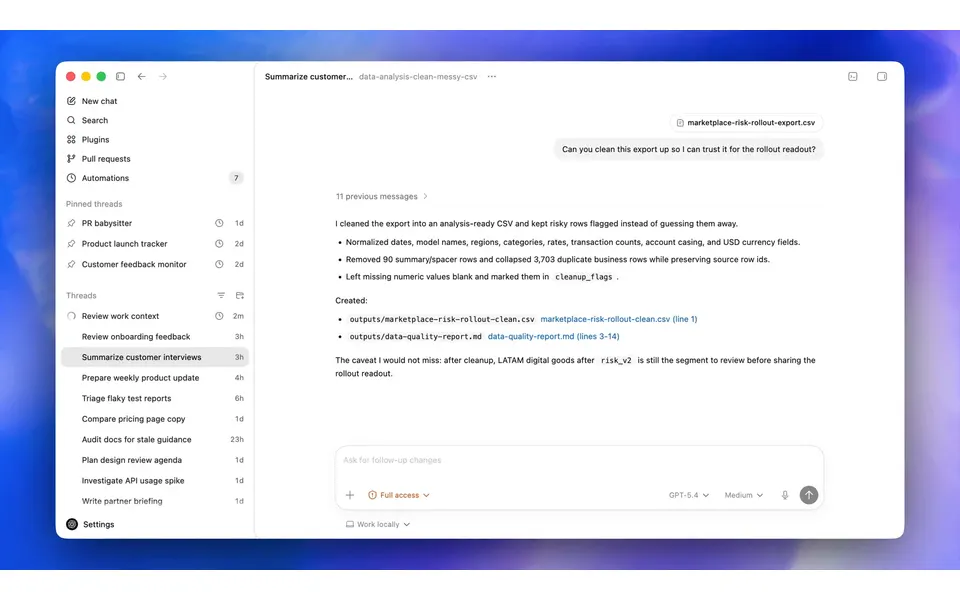
- Desktop app
- Mac, Windows and Linux
- Browser
- Yes
- Phone
- IPhone and Android
- Command line
- Yes
- Agents
- Codex
- Your subscription
- Works with your own plan
- Agents run
- On your computer, on your own server and in the vendor's cloud
- Laptop closed
- Keeps going
- Isolation
- Worktree, Container and VM
- Parallel agents
- Yes
- Scheduled runs
- Yes
- Coordinator agent
- Yes
- Built-in issues
- Not listed
- Pull requests
- Yes
- Review screen
- Yes
- Team
- Roles and SSO
- Self-hosting
- Yes
- Licence
- Apache-2.0
- Price from
- Free
- How it charges
- Free plan, subscription, per seat, usage-based and bring your own key
- Paid plans from
- $10 or less/month
Receipts
- Checked
- · oldest answer 2026-11-07
- Findings
- 33 published · 28 cross-checked by a second agent · read them all
- Sources
- 33 public pages on 2 sites: learn.chatgpt.com, github.com
- Screenshot
- learn.chatgpt.com, retrieved · first party docs · shows appearance, not capability
- Data
- /products/codex.json · .md
- Method
- Same rules for all 103 researched ADEs. How we check · Report wrong data
What it does
Where you use it
Codex is available inside the ChatGPT desktop app on macOS and Windows; Linux is a preview on the distributions documented separately. The shared application is named ChatGPT desktop app; its exact instruction is "Choose ChatGPT or Codex." Codex remains a separately selectable developer experience, so this is evidence of a shared desktop surface rather than an explicit product-wide rename or merger announcement. Codex remote access supports ChatGPT iOS and Android apps, subject to rollout; connected execution hosts must stay awake and online. Codex Cloud tasks are available through ChatGPT on the web. Codex CLI has macOS, Linux and Windows installers. Codex has an IDE extension with in-place code context and edits; compatibility details are bounded by each editor's installation guide. iOS Codex can start tasks, send instructions, approve requested actions and review diffs or test results. Remote clients receive notifications on completion or when input is needed. iOS can continue a cloud task or one on a connected Mac or Windows PC under the same account and workspace.
Source and scope for Where you use itAgents it runs
Codex supplies its own coding harness. In the inspected CLI/core, agent delegation creates Codex threads through AgentControl; model-provider configuration and MCP tools do not replace the native harness with another coding CLI.
Source and scope for Agents it runsAccounts and subscriptions
Supported local Codex clients can sign in with ChatGPT. API-key sign-in uses API billing rather than included ChatGPT usage. API-key authentication works for CLI, SDK and IDE but excludes cloud features such as GitHub review and Slack integration.
Source and scope for Accounts and subscriptionsWhere agents run
The CLI inspects, edits and runs tools in the local project. Codex can execute against an SSH host with Codex installed and authenticated on its PATH. Cloud tasks can keep working while the originating computer is asleep. The desktop UI can control Codex tools and repository files on an SSH host. A paired iOS or Android app can steer and approve work on an awake Mac/Windows host.
Source and scope for Where agents runHow work is kept apart
Codex supports local OS sandboxing, user-managed devcontainers and Git worktrees. The current Cloud environment guide explicitly gives a VM per cloud task with plan-dependent resources; local and cloud isolation scopes are separate.
Source and scope for How work is kept apartParallel work
Each cloud task has its own workspace; the page gives no concurrency quota.
Source and scope for Parallel workScheduled runs
Desktop Codex supports recurring tasks with an RRULE custom cadence. Standalone scheduled tasks start a new chat per run; an in-chat schedule retains the conversation. Local project schedules require the desktop app running on the execution computer. Local scheduled tasks require the computer on and app running; cloud web scheduling is a separate workflow.
Source and scope for Scheduled runsGit and pull requests
Cloud results can be committed or opened as pull requests after review.
Source and scope for Git and pull requestsLicence and source
The repository LICENSE at fc01c073b9ea09c06347a234a1ca231a9ef65bf5 is Apache-2.0; hosted components and separate clients require their own licensing checks. The IDE extension and Codex Cloud are explicitly not open source. CLI, SDK and App Server sources are public; IDE extension and cloud service are not open source. Public CLI/App Server source does not establish hosted Cloud or IDE implementation parity.
Source and scope for Licence and sourcePrice
Codex offers Free and recurring paid ChatGPT plans, with separate API-key billing. Plus/Pro users can purchase additional credits after included limits, and eligible workspace plans can buy shared credits. Existing USD plan prices retain their recorded scope.
Source and scope for PriceTyped filters
Every value links to its receipt below. Read plan and surface restrictions before using a filter to decide.
| Filter | Value |
|---|---|
| Desktop OS: macOS | Yes cross-checked |
| Desktop OS: Windows | Yes cross-checked |
| Desktop OS: Linux | Yes cross-checked |
| Web client | Yes cross-checked |
| Phone access: Native iOS | Yes cross-checked |
| Phone access: Native Android | Yes cross-checked |
| Phone access: Phone browser | Unknown |
| CLI | Yes cross-checked |
| Coding agents: Claude Code | No |
| Coding agents: Codex | Yes |
| Coding agents: Cursor Agent | No |
| Coding agents: Gemini CLI | No |
| Coding agents: OpenCode | No |
| Coding agents: Pi | No |
| Coding agents: Grok | No |
| Coding agents: Aider | No |
| Coding agents: Antigravity | No |
| Use my subscription | Yes cross-checked |
| Where agents run: On your computer | Yes cross-checked |
| Where agents run: On your own server | Yes cross-checked |
| Where agents run: In the vendor's cloud | Yes cross-checked |
| Workspace isolation: Git worktree | Yes |
| Workspace isolation: Container | Yes |
| Workspace isolation: VM or microVM | Yes |
| Parallel runs | Yes cross-checked |
| Coordinator | Yes cross-checked |
| Native issue tracking | Unknown |
| Unattended triggers | Yes cross-checked |
| Shared prompting | Unknown |
| Team roles | Yes cross-checked |
| SSO | Yes cross-checked |
| Pull request workflow | Yes cross-checked |
| Review interface | Yes cross-checked |
| Product license: Apache-2.0 | Yes. Apache-2.0 cross-checked |
| Product license: MIT | No. Apache-2.0 cross-checked |
| Product license: GPL-3.0 | No. Apache-2.0 cross-checked |
| Product license: GPL-3.0-or-later | No. Apache-2.0 cross-checked |
| Product license: AGPL-3.0 | No. Apache-2.0 cross-checked |
| Product license: AGPL-3.0-or-later | No. Apache-2.0 cross-checked |
| Product license: Elastic License 2.0 | No. Apache-2.0 cross-checked |
| Product license: Custom terms | No. Apache-2.0 cross-checked |
| Product license: Proprietary | No. Apache-2.0 cross-checked |
| Self-hosting | Yes |
| Telemetry opt-out | Yes cross-checked |
| Free access | Yes cross-checked |
| Starting price: Free | Yes. Free |
| Starting price: Up to $20/month | No. Free |
| Starting price: $21–40/month | No. Free |
| Starting price: $41–100/month | No. Free |
| Starting price: Over $100/month | No. Free |
| Starting price: Contact for pricing | No. Free |
| Pricing model: Free, no paid plan | No |
| Pricing model: Free plan | Yes |
| Pricing model: Subscription | Yes |
| Pricing model: Per seat | Yes |
| Pricing model: Usage-based | Yes |
| Pricing model: Per machine or compute | Unknown |
| Pricing model: Bring your own key | Yes |
| Pricing model: One-time purchase | No |
| Paid plans from: No paid plan | No. $10 or less/month |
| Paid plans from: $10 or less/month | Yes. $10 or less/month |
| Paid plans from: $11–20/month | No. $10 or less/month |
| Paid plans from: $21–40/month | No. $10 or less/month |
| Paid plans from: $41–100/month | No. $10 or less/month |
| Paid plans from: Over $100/month | No. $10 or less/month |
| Paid plans from: Contact sales | No. $10 or less/month |
| Lifecycle status: Active | Unknown |
| Lifecycle status: Sunsetting | Unknown |
| Keeps going with laptop closed | Yes cross-checked |
| Open-source license | Yes. Apache-2.0 cross-checked |
| Any desktop app | Yes cross-checked |
| Paid plan up to $20/month | Yes. $10 or less/month |
| Paid plan up to $40/month | Yes. $10 or less/month |
| Any phone client | Yes cross-checked |
Filter receipts
Desktop OS: macOS: Yes cross-checked
Desktop OS: macOS
Typed value: Yes.
Codex is available inside the ChatGPT desktop app on macOS and Windows; Linux is a preview on the distributions documented separately. The shared application is named ChatGPT desktop app; its exact instruction is "Choose ChatGPT or Codex." Codex remains a separately selectable developer experience, so this is evidence of a shared desktop surface rather than an explicit product-wide rename or merger announcement. Codex remote access supports ChatGPT iOS and Android apps, subject to rollout; connected execution hosts must stay awake and online. Codex Cloud tasks are available through ChatGPT on the web. Codex CLI has macOS, Linux and Windows installers. Codex has an IDE extension with in-place code context and edits; compatibility details are bounded by each editor's installation guide. iOS Codex can start tasks, send instructions, approve requested actions and review diffs or test results. Remote clients receive notifications on completion or when input is needed. iOS can continue a cloud task or one on a connected Mac or Windows PC under the same account and workspace.
- Desktop os: Codex is available inside the ChatGPT desktop app on macOS and Windows; Linux is a preview on the distributions documented separately. The shared application is named ChatGPT desktop app; its exact instruction is "Choose ChatGPT or Codex." Codex remains a separately selectable developer experience, so this is evidence of a shared desktop surface rather than an explicit product-wide rename or merger announcement.
- Unknown after the targeted first-party documentation, release and repository pass: mobile_browser. No configured product fixture was run; documentation does not establish successful hands-on behavior.
- ChatGPT desktop app is the shared shell name. Codex remains a product-selector choice; the checked docs do not establish a formal Codex product rename, merger or transition date. Generic ChatGPT Work capabilities are not inherited.
-
Finding: The desktop application offers Codex chats and downloads for macOS, Windows and Linux. This evidence concerns the Codex mode, not unrelated ChatGPT Work features.
Desktop OS: Windows: Yes cross-checked
Desktop OS: Windows
Typed value: Yes.
Codex is available inside the ChatGPT desktop app on macOS and Windows; Linux is a preview on the distributions documented separately. The shared application is named ChatGPT desktop app; its exact instruction is "Choose ChatGPT or Codex." Codex remains a separately selectable developer experience, so this is evidence of a shared desktop surface rather than an explicit product-wide rename or merger announcement. Codex remote access supports ChatGPT iOS and Android apps, subject to rollout; connected execution hosts must stay awake and online. Codex Cloud tasks are available through ChatGPT on the web. Codex CLI has macOS, Linux and Windows installers. Codex has an IDE extension with in-place code context and edits; compatibility details are bounded by each editor's installation guide. iOS Codex can start tasks, send instructions, approve requested actions and review diffs or test results. Remote clients receive notifications on completion or when input is needed. iOS can continue a cloud task or one on a connected Mac or Windows PC under the same account and workspace.
- Desktop os: Codex is available inside the ChatGPT desktop app on macOS and Windows; Linux is a preview on the distributions documented separately. The shared application is named ChatGPT desktop app; its exact instruction is "Choose ChatGPT or Codex." Codex remains a separately selectable developer experience, so this is evidence of a shared desktop surface rather than an explicit product-wide rename or merger announcement.
- Unknown after the targeted first-party documentation, release and repository pass: mobile_browser. No configured product fixture was run; documentation does not establish successful hands-on behavior.
- ChatGPT desktop app is the shared shell name. Codex remains a product-selector choice; the checked docs do not establish a formal Codex product rename, merger or transition date. Generic ChatGPT Work capabilities are not inherited.
-
Finding: The desktop application offers Codex chats and downloads for macOS, Windows and Linux. This evidence concerns the Codex mode, not unrelated ChatGPT Work features.
Desktop OS: Linux: Yes cross-checked
Desktop OS: Linux
Typed value: Yes.
The Linux desktop client is in preview, with named x64/ARM64 distribution packages. Linux preview supports Ubuntu 24.04/26.04, Debian 13, Fedora 43/44 and current Arch.
- Release stage: The Linux desktop client is in preview, with named x64/ARM64 distribution packages.
- Access restrictions: Linux preview supports Ubuntu 24.04/26.04, Debian 13, Fedora 43/44 and current Arch.
- Unknown after the targeted first-party documentation, release and repository pass: support, response_commitments, release_activity, status_history, deprecation, export_options. No configured product fixture was run; documentation does not establish successful hands-on behavior.
-
Finding: Linux preview supports Codex on Ubuntu 24.04/26.04, Debian 13, Fedora 43/44 and current Arch, on x64 and ARM64.
Web client: Yes cross-checked
Web client
Typed value: Yes.
Codex is available inside the ChatGPT desktop app on macOS and Windows; Linux is a preview on the distributions documented separately. The shared application is named ChatGPT desktop app; its exact instruction is "Choose ChatGPT or Codex." Codex remains a separately selectable developer experience, so this is evidence of a shared desktop surface rather than an explicit product-wide rename or merger announcement. Codex remote access supports ChatGPT iOS and Android apps, subject to rollout; connected execution hosts must stay awake and online. Codex Cloud tasks are available through ChatGPT on the web. Codex CLI has macOS, Linux and Windows installers. Codex has an IDE extension with in-place code context and edits; compatibility details are bounded by each editor's installation guide. iOS Codex can start tasks, send instructions, approve requested actions and review diffs or test results. Remote clients receive notifications on completion or when input is needed. iOS can continue a cloud task or one on a connected Mac or Windows PC under the same account and workspace.
- Browser: Codex Cloud tasks are available through ChatGPT on the web.
- Unknown after the targeted first-party documentation, release and repository pass: mobile_browser. No configured product fixture was run; documentation does not establish successful hands-on behavior.
- ChatGPT desktop app is the shared shell name. Codex remains a product-selector choice; the checked docs do not establish a formal Codex product rename, merger or transition date. Generic ChatGPT Work capabilities are not inherited.
-
Finding: Published cloud environments provide a separate workspace per task and continue while the originating computer sleeps.
Phone access: Native iOS: Yes cross-checked
Phone access: Native iOS
Typed value: Yes.
Codex is available inside the ChatGPT desktop app on macOS and Windows; Linux is a preview on the distributions documented separately. The shared application is named ChatGPT desktop app; its exact instruction is "Choose ChatGPT or Codex." Codex remains a separately selectable developer experience, so this is evidence of a shared desktop surface rather than an explicit product-wide rename or merger announcement. Codex remote access supports ChatGPT iOS and Android apps, subject to rollout; connected execution hosts must stay awake and online. Codex Cloud tasks are available through ChatGPT on the web. Codex CLI has macOS, Linux and Windows installers. Codex has an IDE extension with in-place code context and edits; compatibility details are bounded by each editor's installation guide. iOS Codex can start tasks, send instructions, approve requested actions and review diffs or test results. Remote clients receive notifications on completion or when input is needed. iOS can continue a cloud task or one on a connected Mac or Windows PC under the same account and workspace.
- Task actions: iOS Codex can start tasks, send instructions, approve requested actions and review diffs or test results.
- Cross device continuity: iOS can continue a cloud task or one on a connected Mac or Windows PC under the same account and workspace.
- Unknown after the targeted first-party documentation, release and repository pass: mobile_browser. No configured product fixture was run; documentation does not establish successful hands-on behavior.
- ChatGPT desktop app is the shared shell name. Codex remains a product-selector choice; the checked docs do not establish a formal Codex product rename, merger or transition date. Generic ChatGPT Work capabilities are not inherited.
-
Finding: Codex in the ChatGPT iOS app can start, steer, approve and review cloud or connected-computer tasks. Local execution needs its connected computer awake. Rollout and workspace policy affect access.
Phone access: Native Android: Yes cross-checked
Phone access: Native Android
Typed value: Yes.
Codex is available inside the ChatGPT desktop app on macOS and Windows; Linux is a preview on the distributions documented separately. The shared application is named ChatGPT desktop app; its exact instruction is "Choose ChatGPT or Codex." Codex remains a separately selectable developer experience, so this is evidence of a shared desktop surface rather than an explicit product-wide rename or merger announcement. Codex remote access supports ChatGPT iOS and Android apps, subject to rollout; connected execution hosts must stay awake and online. Codex Cloud tasks are available through ChatGPT on the web. Codex CLI has macOS, Linux and Windows installers. Codex has an IDE extension with in-place code context and edits; compatibility details are bounded by each editor's installation guide. iOS Codex can start tasks, send instructions, approve requested actions and review diffs or test results. Remote clients receive notifications on completion or when input is needed. iOS can continue a cloud task or one on a connected Mac or Windows PC under the same account and workspace.
- Mobile apps: Codex remote access supports ChatGPT iOS and Android apps, subject to rollout; connected execution hosts must stay awake and online.
- Notifications: Remote clients receive notifications on completion or when input is needed.
- Unknown after the targeted first-party documentation, release and repository pass: mobile_browser. No configured product fixture was run; documentation does not establish successful hands-on behavior.
- ChatGPT desktop app is the shared shell name. Codex remains a product-selector choice; the checked docs do not establish a formal Codex product rename, merger or transition date. Generic ChatGPT Work capabilities are not inherited.
-
Finding: Codex supports iOS and Android control subject to rollout. SSH project chats execute on the remote filesystem after Codex is installed/authenticated there. Handoff moves a chat and Git state between hosts.
CLI: Yes cross-checked
CLI
Typed value: Yes.
Codex is available inside the ChatGPT desktop app on macOS and Windows; Linux is a preview on the distributions documented separately. The shared application is named ChatGPT desktop app; its exact instruction is "Choose ChatGPT or Codex." Codex remains a separately selectable developer experience, so this is evidence of a shared desktop surface rather than an explicit product-wide rename or merger announcement. Codex remote access supports ChatGPT iOS and Android apps, subject to rollout; connected execution hosts must stay awake and online. Codex Cloud tasks are available through ChatGPT on the web. Codex CLI has macOS, Linux and Windows installers. Codex has an IDE extension with in-place code context and edits; compatibility details are bounded by each editor's installation guide. iOS Codex can start tasks, send instructions, approve requested actions and review diffs or test results. Remote clients receive notifications on completion or when input is needed. iOS can continue a cloud task or one on a connected Mac or Windows PC under the same account and workspace.
- Cli: Codex CLI has macOS, Linux and Windows installers.
- Unknown after the targeted first-party documentation, release and repository pass: mobile_browser. No configured product fixture was run; documentation does not establish successful hands-on behavior.
- ChatGPT desktop app is the shared shell name. Codex remains a product-selector choice; the checked docs do not establish a formal Codex product rename, merger or transition date. Generic ChatGPT Work capabilities are not inherited.
-
Finding: The CLI supports local tools, scripted execution, saved chats, subagents, image input, web search and cloud task submission.
Coding agents: Claude Code: No
Coding agents: Claude Code
Typed value: No.
Codex supplies its own coding harness. In the inspected CLI/core, agent delegation creates Codex threads through AgentControl; model-provider configuration and MCP tools do not replace the native harness with another coding CLI.
- Mixed harness operation: The pinned CLI/core has no native alternate coding-harness dispatch route; multi-agent workers use Codex AgentControl threads.
- Only the named documented or inspected parts are established; other atomic questions retain their recorded gaps.
-
Finding: The CLI executes the Codex core and creates native Codex agent threads through AgentControl. Configuration selects model providers and roles, not an alternate external coding-harness executable. Bounded inspection of CLI/core/config and multi-agent handlers found no native Claude Code, Cursor, Gemini CLI, OpenCode, Pi, Grok, Aider or Antigravity adapter.
Coding agents: Codex: Yes
Coding agents: Codex
Typed value: Yes.
Codex supplies its own coding harness. In the inspected CLI/core, agent delegation creates Codex threads through AgentControl; model-provider configuration and MCP tools do not replace the native harness with another coding CLI.
- Harnesses: The product provides the native Codex CLI coding harness; external coding harness support is not established.
- Session integration: The native Codex CLI retains resumable chats and can submit Codex Cloud tasks.
- Only the named documented or inspected parts are established; other atomic questions retain their recorded gaps.
-
Finding: Codex CLI is the product-owned interactive coding agent that runs on local repositories, supports resumable chats and can submit cloud work. It is distinct from a model-provider adapter.
Coding agents: Cursor Agent: No
Coding agents: Cursor Agent
Typed value: No.
Codex supplies its own coding harness. In the inspected CLI/core, agent delegation creates Codex threads through AgentControl; model-provider configuration and MCP tools do not replace the native harness with another coding CLI.
- Mixed harness operation: The pinned CLI/core has no native alternate coding-harness dispatch route; multi-agent workers use Codex AgentControl threads.
- Only the named documented or inspected parts are established; other atomic questions retain their recorded gaps.
-
Finding: The CLI executes the Codex core and creates native Codex agent threads through AgentControl. Configuration selects model providers and roles, not an alternate external coding-harness executable. Bounded inspection of CLI/core/config and multi-agent handlers found no native Claude Code, Cursor, Gemini CLI, OpenCode, Pi, Grok, Aider or Antigravity adapter.
Coding agents: Gemini CLI: No
Coding agents: Gemini CLI
Typed value: No.
Codex supplies its own coding harness. In the inspected CLI/core, agent delegation creates Codex threads through AgentControl; model-provider configuration and MCP tools do not replace the native harness with another coding CLI.
- Mixed harness operation: The pinned CLI/core has no native alternate coding-harness dispatch route; multi-agent workers use Codex AgentControl threads.
- Only the named documented or inspected parts are established; other atomic questions retain their recorded gaps.
-
Finding: The CLI executes the Codex core and creates native Codex agent threads through AgentControl. Configuration selects model providers and roles, not an alternate external coding-harness executable. Bounded inspection of CLI/core/config and multi-agent handlers found no native Claude Code, Cursor, Gemini CLI, OpenCode, Pi, Grok, Aider or Antigravity adapter.
Coding agents: OpenCode: No
Coding agents: OpenCode
Typed value: No.
Codex supplies its own coding harness. In the inspected CLI/core, agent delegation creates Codex threads through AgentControl; model-provider configuration and MCP tools do not replace the native harness with another coding CLI.
- Mixed harness operation: The pinned CLI/core has no native alternate coding-harness dispatch route; multi-agent workers use Codex AgentControl threads.
- Only the named documented or inspected parts are established; other atomic questions retain their recorded gaps.
-
Finding: The CLI executes the Codex core and creates native Codex agent threads through AgentControl. Configuration selects model providers and roles, not an alternate external coding-harness executable. Bounded inspection of CLI/core/config and multi-agent handlers found no native Claude Code, Cursor, Gemini CLI, OpenCode, Pi, Grok, Aider or Antigravity adapter.
Coding agents: Pi: No
Coding agents: Pi
Typed value: No.
Codex supplies its own coding harness. In the inspected CLI/core, agent delegation creates Codex threads through AgentControl; model-provider configuration and MCP tools do not replace the native harness with another coding CLI.
- Mixed harness operation: The pinned CLI/core has no native alternate coding-harness dispatch route; multi-agent workers use Codex AgentControl threads.
- Only the named documented or inspected parts are established; other atomic questions retain their recorded gaps.
-
Finding: The CLI executes the Codex core and creates native Codex agent threads through AgentControl. Configuration selects model providers and roles, not an alternate external coding-harness executable. Bounded inspection of CLI/core/config and multi-agent handlers found no native Claude Code, Cursor, Gemini CLI, OpenCode, Pi, Grok, Aider or Antigravity adapter.
Coding agents: Grok: No
Coding agents: Grok
Typed value: No.
Codex supplies its own coding harness. In the inspected CLI/core, agent delegation creates Codex threads through AgentControl; model-provider configuration and MCP tools do not replace the native harness with another coding CLI.
- Mixed harness operation: The pinned CLI/core has no native alternate coding-harness dispatch route; multi-agent workers use Codex AgentControl threads.
- Only the named documented or inspected parts are established; other atomic questions retain their recorded gaps.
-
Finding: The CLI executes the Codex core and creates native Codex agent threads through AgentControl. Configuration selects model providers and roles, not an alternate external coding-harness executable. Bounded inspection of CLI/core/config and multi-agent handlers found no native Claude Code, Cursor, Gemini CLI, OpenCode, Pi, Grok, Aider or Antigravity adapter.
Coding agents: Aider: No
Coding agents: Aider
Typed value: No.
Codex supplies its own coding harness. In the inspected CLI/core, agent delegation creates Codex threads through AgentControl; model-provider configuration and MCP tools do not replace the native harness with another coding CLI.
- Mixed harness operation: The pinned CLI/core has no native alternate coding-harness dispatch route; multi-agent workers use Codex AgentControl threads.
- Only the named documented or inspected parts are established; other atomic questions retain their recorded gaps.
-
Finding: The CLI executes the Codex core and creates native Codex agent threads through AgentControl. Configuration selects model providers and roles, not an alternate external coding-harness executable. Bounded inspection of CLI/core/config and multi-agent handlers found no native Claude Code, Cursor, Gemini CLI, OpenCode, Pi, Grok, Aider or Antigravity adapter.
Coding agents: Antigravity: No
Coding agents: Antigravity
Typed value: No.
Codex supplies its own coding harness. In the inspected CLI/core, agent delegation creates Codex threads through AgentControl; model-provider configuration and MCP tools do not replace the native harness with another coding CLI.
- Mixed harness operation: The pinned CLI/core has no native alternate coding-harness dispatch route; multi-agent workers use Codex AgentControl threads.
- Only the named documented or inspected parts are established; other atomic questions retain their recorded gaps.
-
Finding: The CLI executes the Codex core and creates native Codex agent threads through AgentControl. Configuration selects model providers and roles, not an alternate external coding-harness executable. Bounded inspection of CLI/core/config and multi-agent handlers found no native Claude Code, Cursor, Gemini CLI, OpenCode, Pi, Grok, Aider or Antigravity adapter.
Use my subscription: Yes cross-checked
Use my subscription
Typed value: Yes.
Supported local Codex clients can sign in with ChatGPT. API-key sign-in uses API billing rather than included ChatGPT usage. API-key authentication works for CLI, SDK and IDE but excludes cloud features such as GitHub review and Slack integration.
- Agent subscriptions: Supported local Codex clients can sign in with ChatGPT.
- Api accounts: API-key sign-in uses API billing rather than included ChatGPT usage.
- Unknown after the targeted first-party documentation, release and repository pass: vendor_credits, local_models, account_switching, vendor_account_requirement. No configured product fixture was run; documentation does not establish successful hands-on behavior.
-
Finding: ChatGPT sign-in and API-key routes have different billing and cloud availability boundaries.
Where agents run: On your computer: Yes cross-checked
Where agents run: On your computer
Typed value: Yes.
The CLI inspects, edits and runs tools in the local project. Codex can execute against an SSH host with Codex installed and authenticated on its PATH. Cloud tasks can keep working while the originating computer is asleep. The desktop UI can control Codex tools and repository files on an SSH host. A paired iOS or Android app can steer and approve work on an awake Mac/Windows host.
- Local: The CLI inspects, edits and runs tools in the local project.
- Unknown after the targeted first-party documentation, release and repository pass: self_hosted, provisioning, payer, resources, region, expiry, client_disconnect. No configured product fixture was run; documentation does not establish successful hands-on behavior.
-
Finding: The CLI supports local tools, scripted execution, saved chats, subagents, image input, web search and cloud task submission.
Where agents run: On your own server: Yes cross-checked
Where agents run: On your own server
Typed value: Yes.
The CLI inspects, edits and runs tools in the local project. Codex can execute against an SSH host with Codex installed and authenticated on its PATH. Cloud tasks can keep working while the originating computer is asleep. The desktop UI can control Codex tools and repository files on an SSH host. A paired iOS or Android app can steer and approve work on an awake Mac/Windows host.
- Byo remote: Codex can execute against an SSH host with Codex installed and authenticated on its PATH.
- Hybrid: The desktop UI can control Codex tools and repository files on an SSH host.
- Other device continuation: A paired iOS or Android app can steer and approve work on an awake Mac/Windows host.
- Unknown after the targeted first-party documentation, release and repository pass: self_hosted, provisioning, payer, resources, region, expiry, client_disconnect. No configured product fixture was run; documentation does not establish successful hands-on behavior.
-
Finding: Codex supports iOS and Android control subject to rollout. SSH project chats execute on the remote filesystem after Codex is installed/authenticated there. Handoff moves a chat and Git state between hosts.
Where agents run: In the vendor's cloud: Yes cross-checked
Where agents run: In the vendor's cloud
Typed value: Yes.
The CLI inspects, edits and runs tools in the local project. Codex can execute against an SSH host with Codex installed and authenticated on its PATH. Cloud tasks can keep working while the originating computer is asleep. The desktop UI can control Codex tools and repository files on an SSH host. A paired iOS or Android app can steer and approve work on an awake Mac/Windows host.
- Managed cloud: Cloud tasks can keep working while the originating computer is asleep.
- Unknown after the targeted first-party documentation, release and repository pass: self_hosted, provisioning, payer, resources, region, expiry, client_disconnect. No configured product fixture was run; documentation does not establish successful hands-on behavior.
-
Finding: Published cloud environments provide a separate workspace per task and continue while the originating computer sleeps.
Workspace isolation: Git worktree: Yes
Workspace isolation: Git worktree
Typed value: Yes.
Codex supports local OS sandboxing, user-managed devcontainers and Git worktrees. The current Cloud environment guide explicitly gives a VM per cloud task with plan-dependent resources; local and cloud isolation scopes are separate.
- Branch: A worktree can use a separate branch; the starting branch is chosen in the new-chat flow.
- Worktree: Codex supports a separate Git worktree for an independent chat.
- Code separation: Worktrees have independent files while sharing Git metadata.
- Only the named documented or inspected parts are established; other atomic questions retain their recorded gaps.
-
Finding: Codex worktree chats isolate repository working files and can be handed between Local and Worktree. Execution remains on the connected project computer or its remote development environment.
Workspace isolation: Container: Yes
Workspace isolation: Container
Typed value: Yes.
Codex supports local OS sandboxing, user-managed devcontainers and Git worktrees. The current Cloud environment guide explicitly gives a VM per cloud task with plan-dependent resources; local and cloud isolation scopes are separate.
- Container: The security guide documents running Codex inside a devcontainer, with optional inner Linux sandbox.
- Security boundary: A devcontainer protects the host but cannot protect credentials already available inside it when sandbox and approvals are bypassed.
- Only the named documented or inspected parts are established; other atomic questions retain their recorded gaps.
-
Finding: Opt-in OTel logs include API, stream, approval and tool events, with prompt text redacted unless enabled. Codex documents a devcontainer security-boundary option with explicit credential-exfiltration limits.
Workspace isolation: VM or microVM: Yes
Workspace isolation: VM or microVM
Typed value: Yes.
Codex supports local OS sandboxing, user-managed devcontainers and Git worktrees. The current Cloud environment guide explicitly gives a VM per cloud task with plan-dependent resources; local and cloud isolation scopes are separate.
- Vm: Each Codex Cloud task runs in a VM. The guide lists CPU/RAM/disk allocations by ChatGPT plan.
- Only the named documented or inspected parts are established; other atomic questions retain their recorded gaps.
-
Finding: The current first-party guide explicitly says each cloud task runs in a VM, with plan-dependent vCPU, RAM and disk resources and a recoverable saved-state window. Enterprise can request larger VM specifications.
Parallel runs: Yes cross-checked
Parallel runs
Typed value: Yes.
Local custom agents can set model and reasoning effort; unspecified children inherit their parent. The main agent collects subagent results into a consolidated response. Further scoped facts are recorded in the atomic answers.
- Model harness effort: Local custom agents can set model and reasoning effort; unspecified children inherit their parent.
- Results return: The main agent collects subagent results into a consolidated response.
- Activation: Current local clients delegate on explicit request or applicable project or skill instructions; the docs say current releases enable subagents by default.
- Live progress: CLI /subagents switches among child threads; desktop and eligible IDE UI expose child activity.
- Inspectable delegation and communication: first-party sources in this pass did not establish roles, messages, cross_harness, orchestration_owner, authentication, retained_results, followup, invocation. No concurrent-worker, duplicate-claim, delegation-retention or twelve-state fleet fixture was run. UI labels alone do not establish enforcement.
-
Finding: Current local Codex clients expose parallel subagent threads, results and follow-up controls; custom agent model configuration is documented.
Coordinator: Yes cross-checked
Coordinator
Typed value: Yes.
Local custom agents can set model and reasoning effort; unspecified children inherit their parent. The main agent collects subagent results into a consolidated response. Further scoped facts are recorded in the atomic answers.
- Model harness effort: Local custom agents can set model and reasoning effort; unspecified children inherit their parent.
- Results return: The main agent collects subagent results into a consolidated response.
- Activation: Current local clients delegate on explicit request or applicable project or skill instructions; the docs say current releases enable subagents by default.
- Live progress: CLI /subagents switches among child threads; desktop and eligible IDE UI expose child activity.
- Inspectable delegation and communication: first-party sources in this pass did not establish roles, messages, cross_harness, orchestration_owner, authentication, retained_results, followup, invocation. No concurrent-worker, duplicate-claim, delegation-retention or twelve-state fleet fixture was run. UI labels alone do not establish enforcement.
-
Finding: Current local Codex clients expose parallel subagent threads, results and follow-up controls; custom agent model configuration is documented.
Unattended triggers: Yes cross-checked
Unattended triggers
Typed value: Yes.
Desktop Codex supports recurring tasks with an RRULE custom cadence. Standalone scheduled tasks start a new chat per run; an in-chat schedule retains the conversation. Local project schedules require the desktop app running on the execution computer. Local scheduled tasks require the computer on and app running; cloud web scheduling is a separate workflow.
- Schedules: Desktop Codex supports recurring tasks with an RRULE custom cadence.
- Recurring tasks: Standalone scheduled tasks start a new chat per run; an in-chat schedule retains the conversation.
- Scheduler location: Local project schedules require the desktop app running on the execution computer.
- Client independence: Local scheduled tasks require the computer on and app running; cloud web scheduling is a separate workflow.
- Unknown after the targeted first-party documentation, release and repository pass: events, completion_conditions, overlaps, retries. No configured product fixture was run; documentation does not establish successful hands-on behavior.
-
Finding: Desktop Codex tasks run on a schedule locally or in worktrees; the app and computer must remain running. Scheduled shows findings and unread attention. CLI and IDE have no Scheduled management UI.
Team roles: Yes cross-checked
Team roles
Typed value: Yes.
Business includes SAML SSO; Enterprise adds SCIM and RBAC.
- Organization roles: Workspaces have built-in Owner, Admin, Member and Analytics Viewer roles, plus custom roles that grant Codex local, Codex cloud and shared-environment permissions.
- Roles and access boundaries: first-party sources in this pass did not establish organization_roles, project_roles, task_roles, membership, provisioning, unauthorized_access, revocation, plan_scope. No two-account permission, simultaneous steering, revocation or colleague-takeover fixture was run. Sharing and presence do not establish co-prompting.
-
Codex roles and workspace permissions
Finding: ChatGPT workspaces have built-in Owner, Admin, Member and Analytics Viewer roles with described rights, plus custom roles that grant Codex permissions such as local Codex use, Codex cloud use and managing shared workspace environments.
SSO: Yes cross-checked
SSO
Typed value: Yes.
Business includes SAML SSO; Enterprise adds SCIM and RBAC.
- Sso: Business includes SAML SSO; Enterprise adds SCIM and RBAC.
- Roles and access boundaries: first-party sources in this pass did not establish organization_roles, project_roles, task_roles, membership, provisioning, unauthorized_access, revocation, plan_scope. No two-account permission, simultaneous steering, revocation or colleague-takeover fixture was run. Sharing and presence do not establish co-prompting.
-
Finding: Plus is $20/month; Business is $20/user/month annually for two or more users or $25 monthly; API keys have separate billing and exclude cloud features.
Pull request workflow: Yes cross-checked
Pull request workflow
Typed value: Yes.
Cloud results can be committed or opened as pull requests after review.
- Pull requests: Cloud results can be committed or opened as pull requests after review.
- Git and pull request workflow: first-party sources in this pass did not establish branches, worktrees, commits, comments, ci_response, rebase, conflicts, product_state. No draft PR, failed-gate, stale-approval, rollback or six-task batch-review fixture was run. Described actions do not prove delivery authority.
-
Finding: Published cloud environments provide a separate workspace per task and continue while the originating computer sleeps.
Review interface: Yes cross-checked
Review interface
Typed value: Yes.
Cloud review shows changed files and check results.
- Diffs: Cloud review shows changed files and check results.
- Retained artifacts and outputs: first-party sources in this pass did not establish documents, screenshots, recordings, previews, test_outputs, reviewer_outputs, gallery, task_links, revision_links, persistence, child_findings, prompt_leakage. No draft PR, failed-gate, stale-approval, rollback or six-task batch-review fixture was run. Described actions do not prove delivery authority.
-
Finding: Published cloud environments provide a separate workspace per task and continue while the originating computer sleeps.
Product license: Apache-2.0: Yes. Apache-2.0 cross-checked
Product license: Apache-2.0
Typed value: Yes. Apache-2.0.
The repository LICENSE at fc01c073b9ea09c06347a234a1ca231a9ef65bf5 is Apache-2.0; hosted components and separate clients require their own licensing checks. The IDE extension and Codex Cloud are explicitly not open source. CLI, SDK and App Server sources are public; IDE extension and cloud service are not open source. Public CLI/App Server source does not establish hosted Cloud or IDE implementation parity.
- Client license: The repository LICENSE at fc01c073b9ea09c06347a234a1ca231a9ef65bf5 is Apache-2.0; hosted components and separate clients require their own licensing checks.
- Unknown after the targeted first-party documentation, release and repository pass: server_license, source_revision. No configured product fixture was run; documentation does not establish successful hands-on behavior.
-
Finding: The pinned repository LICENSE is Apache-2.0; this does not license every vendor-hosted service.
Product license: MIT: No. Apache-2.0 cross-checked
Product license: MIT
Typed value: No. Apache-2.0.
The repository LICENSE at fc01c073b9ea09c06347a234a1ca231a9ef65bf5 is Apache-2.0; hosted components and separate clients require their own licensing checks. The IDE extension and Codex Cloud are explicitly not open source. CLI, SDK and App Server sources are public; IDE extension and cloud service are not open source. Public CLI/App Server source does not establish hosted Cloud or IDE implementation parity.
- Client license: The repository LICENSE at fc01c073b9ea09c06347a234a1ca231a9ef65bf5 is Apache-2.0; hosted components and separate clients require their own licensing checks.
- Unknown after the targeted first-party documentation, release and repository pass: server_license, source_revision. No configured product fixture was run; documentation does not establish successful hands-on behavior.
-
Finding: The pinned repository LICENSE is Apache-2.0; this does not license every vendor-hosted service.
Product license: GPL-3.0: No. Apache-2.0 cross-checked
Product license: GPL-3.0
Typed value: No. Apache-2.0.
The repository LICENSE at fc01c073b9ea09c06347a234a1ca231a9ef65bf5 is Apache-2.0; hosted components and separate clients require their own licensing checks. The IDE extension and Codex Cloud are explicitly not open source. CLI, SDK and App Server sources are public; IDE extension and cloud service are not open source. Public CLI/App Server source does not establish hosted Cloud or IDE implementation parity.
- Client license: The repository LICENSE at fc01c073b9ea09c06347a234a1ca231a9ef65bf5 is Apache-2.0; hosted components and separate clients require their own licensing checks.
- Unknown after the targeted first-party documentation, release and repository pass: server_license, source_revision. No configured product fixture was run; documentation does not establish successful hands-on behavior.
-
Finding: The pinned repository LICENSE is Apache-2.0; this does not license every vendor-hosted service.
Product license: GPL-3.0-or-later: No. Apache-2.0 cross-checked
Product license: GPL-3.0-or-later
Typed value: No. Apache-2.0.
The repository LICENSE at fc01c073b9ea09c06347a234a1ca231a9ef65bf5 is Apache-2.0; hosted components and separate clients require their own licensing checks. The IDE extension and Codex Cloud are explicitly not open source. CLI, SDK and App Server sources are public; IDE extension and cloud service are not open source. Public CLI/App Server source does not establish hosted Cloud or IDE implementation parity.
- Client license: The repository LICENSE at fc01c073b9ea09c06347a234a1ca231a9ef65bf5 is Apache-2.0; hosted components and separate clients require their own licensing checks.
- Unknown after the targeted first-party documentation, release and repository pass: server_license, source_revision. No configured product fixture was run; documentation does not establish successful hands-on behavior.
-
Finding: The pinned repository LICENSE is Apache-2.0; this does not license every vendor-hosted service.
Product license: AGPL-3.0: No. Apache-2.0 cross-checked
Product license: AGPL-3.0
Typed value: No. Apache-2.0.
The repository LICENSE at fc01c073b9ea09c06347a234a1ca231a9ef65bf5 is Apache-2.0; hosted components and separate clients require their own licensing checks. The IDE extension and Codex Cloud are explicitly not open source. CLI, SDK and App Server sources are public; IDE extension and cloud service are not open source. Public CLI/App Server source does not establish hosted Cloud or IDE implementation parity.
- Client license: The repository LICENSE at fc01c073b9ea09c06347a234a1ca231a9ef65bf5 is Apache-2.0; hosted components and separate clients require their own licensing checks.
- Unknown after the targeted first-party documentation, release and repository pass: server_license, source_revision. No configured product fixture was run; documentation does not establish successful hands-on behavior.
-
Finding: The pinned repository LICENSE is Apache-2.0; this does not license every vendor-hosted service.
Product license: AGPL-3.0-or-later: No. Apache-2.0 cross-checked
Product license: AGPL-3.0-or-later
Typed value: No. Apache-2.0.
The repository LICENSE at fc01c073b9ea09c06347a234a1ca231a9ef65bf5 is Apache-2.0; hosted components and separate clients require their own licensing checks. The IDE extension and Codex Cloud are explicitly not open source. CLI, SDK and App Server sources are public; IDE extension and cloud service are not open source. Public CLI/App Server source does not establish hosted Cloud or IDE implementation parity.
- Client license: The repository LICENSE at fc01c073b9ea09c06347a234a1ca231a9ef65bf5 is Apache-2.0; hosted components and separate clients require their own licensing checks.
- Unknown after the targeted first-party documentation, release and repository pass: server_license, source_revision. No configured product fixture was run; documentation does not establish successful hands-on behavior.
-
Finding: The pinned repository LICENSE is Apache-2.0; this does not license every vendor-hosted service.
Product license: Elastic License 2.0: No. Apache-2.0 cross-checked
Product license: Elastic License 2.0
Typed value: No. Apache-2.0.
The repository LICENSE at fc01c073b9ea09c06347a234a1ca231a9ef65bf5 is Apache-2.0; hosted components and separate clients require their own licensing checks. The IDE extension and Codex Cloud are explicitly not open source. CLI, SDK and App Server sources are public; IDE extension and cloud service are not open source. Public CLI/App Server source does not establish hosted Cloud or IDE implementation parity.
- Client license: The repository LICENSE at fc01c073b9ea09c06347a234a1ca231a9ef65bf5 is Apache-2.0; hosted components and separate clients require their own licensing checks.
- Unknown after the targeted first-party documentation, release and repository pass: server_license, source_revision. No configured product fixture was run; documentation does not establish successful hands-on behavior.
-
Finding: The pinned repository LICENSE is Apache-2.0; this does not license every vendor-hosted service.
Product license: Custom terms: No. Apache-2.0 cross-checked
Product license: Custom terms
Typed value: No. Apache-2.0.
The repository LICENSE at fc01c073b9ea09c06347a234a1ca231a9ef65bf5 is Apache-2.0; hosted components and separate clients require their own licensing checks. The IDE extension and Codex Cloud are explicitly not open source. CLI, SDK and App Server sources are public; IDE extension and cloud service are not open source. Public CLI/App Server source does not establish hosted Cloud or IDE implementation parity.
- Client license: The repository LICENSE at fc01c073b9ea09c06347a234a1ca231a9ef65bf5 is Apache-2.0; hosted components and separate clients require their own licensing checks.
- Unknown after the targeted first-party documentation, release and repository pass: server_license, source_revision. No configured product fixture was run; documentation does not establish successful hands-on behavior.
-
Finding: The pinned repository LICENSE is Apache-2.0; this does not license every vendor-hosted service.
Product license: Proprietary: No. Apache-2.0 cross-checked
Product license: Proprietary
Typed value: No. Apache-2.0.
The repository LICENSE at fc01c073b9ea09c06347a234a1ca231a9ef65bf5 is Apache-2.0; hosted components and separate clients require their own licensing checks. The IDE extension and Codex Cloud are explicitly not open source. CLI, SDK and App Server sources are public; IDE extension and cloud service are not open source. Public CLI/App Server source does not establish hosted Cloud or IDE implementation parity.
- Client license: The repository LICENSE at fc01c073b9ea09c06347a234a1ca231a9ef65bf5 is Apache-2.0; hosted components and separate clients require their own licensing checks.
- Unknown after the targeted first-party documentation, release and repository pass: server_license, source_revision. No configured product fixture was run; documentation does not establish successful hands-on behavior.
-
Finding: The pinned repository LICENSE is Apache-2.0; this does not license every vendor-hosted service.
Self-hosting: Yes
Self-hosting
Typed value: Yes.
The Codex CLI and App Server core can run on user-controlled infrastructure under the public source distribution. This hosts the coding loop and local session/control process, while inference uses its configured provider. Codex Cloud and the closed IDE/desktop components are not claimed self-hostable.
- Self hosting: The native CLI runs the core coding agent and can start/manage its local App Server daemon on user-controlled machines.
- Vendor dependencies: The local core still requires configured model inference/authentication; this does not self-host Codex Cloud.
- Only the named documented or inspected parts are established; other atomic questions retain their recorded gaps.
-
Finding: The public Apache-2.0 CLI runs the core coding agent locally and can start/manage its own app-server daemon on a user machine. The local core owns sessions, filesystem tools and process execution; it is not only a worker for the hosted Cloud control plane. Inference still uses the configured model provider.
Telemetry opt-out: Yes cross-checked
Telemetry opt-out
Typed value: Yes.
The Business plan states no training on business data by default; consumer routes are not covered by this statement. Built-in Statsig analytics and independently configured OTel exporters have distinct controls. The default Statsig metrics exporter follows analytics.enabled; the reference says unset analytics uses the client default. OTel log export is separately opt-in. Set analytics.enabled=false for built-in Statsig metrics, and set OTel log, metrics and trace exporters to none to disable explicitly configured telemetry exports.
- Telemetry disclosure: Built-in Statsig analytics and independently configured OTel exporters have distinct controls.
- Telemetry defaults: The default Statsig metrics exporter follows analytics.enabled; the reference says unset analytics uses the client default. OTel log export is separately opt-in.
- Telemetry controls: Set analytics.enabled=false for built-in Statsig metrics, and set OTel log, metrics and trace exporters to none to disable explicitly configured telemetry exports.
- Unknown after the targeted first-party documentation, release and repository pass: code_data, prompts, credentials, logs, artifacts, retention, deletion, residency, subprocessors, consent_prompt, provider_separation. No configured product fixture was run; documentation does not establish successful hands-on behavior.
-
Finding: analytics.enabled=false disables built-in Statsig metrics. Explicit OTLP exporters remain independent; setting log, metrics and trace exporters to none disables those exports. Provider retries and stream timeouts are configurable.
Free access: Yes cross-checked
Free access
Typed value: Yes.
A $0 monthly plan includes limited desktop Codex usage, subject to rollout. Free access is limited to listed desktop model/speed eligibility; detailed task allowances depend on the plan and model.
- Ongoing free: A $0 monthly plan includes limited desktop Codex usage, subject to rollout.
- Usage caps: Free access is limited to listed desktop model/speed eligibility; detailed task allowances depend on the plan and model.
- Unknown after the targeted first-party documentation, release and repository pass: trial, credits_trial, self_host_cost, paid_only, early_access, free_scenarios, card_required, paid_evaluation. No configured product fixture was run; documentation does not establish successful hands-on behavior.
-
Finding: Free is $0 monthly for limited desktop usage subject to rollout. Plus $20 includes CLI, IDE, web and iOS. API-key use excludes cloud integrations. Business is $25/user monthly with at least two users; annual rate differs.
Starting price: Free: Yes. Free
Starting price: Free
Typed value: Yes. Free.
Codex offers Free and recurring paid ChatGPT plans, with separate API-key billing. Plus/Pro users can purchase additional credits after included limits, and eligible workspace plans can buy shared credits. Existing USD plan prices retain their recorded scope.
- Currency: Published prices are USD.
- Interval: Go costs $8/month and Plus $20/month; Pro starts at $100/month. Business costs $20/user/month billed annually or $25/user/month billed monthly.
- Seats: Business is priced per user; a minimum is stated only for the annual rate.
- Seat minimum: Business annual pricing requires at least two users.
- Included usage: Free and Go include desktop-app usage subject to rollout; Plus includes web, CLI, IDE and iOS, with model-dependent shared usage.
- Model cost: API-key usage follows separate API pricing; API rates do not determine included subscription task counts.
- Only the named documented or inspected parts are established; other atomic questions retain their recorded gaps.
-
Finding: Free is $0/month and Go is $8/month, both with GPT-6 Luna in the desktop app subject to rollout. Plus is $20/month with Codex on the web, CLI, IDE extension and iOS. Pro starts at $100/month. Business is $20/user/month billed annually for two or more users, or $25/user/month billed monthly. API-key use is billed at API pricing and has no cloud-based features. Prices are in USD.
Starting price: Up to $20/month: No. Free
Starting price: Up to $20/month
Typed value: No. Free.
Codex offers Free and recurring paid ChatGPT plans, with separate API-key billing. Plus/Pro users can purchase additional credits after included limits, and eligible workspace plans can buy shared credits. Existing USD plan prices retain their recorded scope.
- Currency: Published prices are USD.
- Interval: Go costs $8/month and Plus $20/month; Pro starts at $100/month. Business costs $20/user/month billed annually or $25/user/month billed monthly.
- Seats: Business is priced per user; a minimum is stated only for the annual rate.
- Seat minimum: Business annual pricing requires at least two users.
- Included usage: Free and Go include desktop-app usage subject to rollout; Plus includes web, CLI, IDE and iOS, with model-dependent shared usage.
- Model cost: API-key usage follows separate API pricing; API rates do not determine included subscription task counts.
- Only the named documented or inspected parts are established; other atomic questions retain their recorded gaps.
-
Finding: Free is $0/month and Go is $8/month, both with GPT-6 Luna in the desktop app subject to rollout. Plus is $20/month with Codex on the web, CLI, IDE extension and iOS. Pro starts at $100/month. Business is $20/user/month billed annually for two or more users, or $25/user/month billed monthly. API-key use is billed at API pricing and has no cloud-based features. Prices are in USD.
Starting price: $21–40/month: No. Free
Starting price: $21–40/month
Typed value: No. Free.
Codex offers Free and recurring paid ChatGPT plans, with separate API-key billing. Plus/Pro users can purchase additional credits after included limits, and eligible workspace plans can buy shared credits. Existing USD plan prices retain their recorded scope.
- Currency: Published prices are USD.
- Interval: Go costs $8/month and Plus $20/month; Pro starts at $100/month. Business costs $20/user/month billed annually or $25/user/month billed monthly.
- Seats: Business is priced per user; a minimum is stated only for the annual rate.
- Seat minimum: Business annual pricing requires at least two users.
- Included usage: Free and Go include desktop-app usage subject to rollout; Plus includes web, CLI, IDE and iOS, with model-dependent shared usage.
- Model cost: API-key usage follows separate API pricing; API rates do not determine included subscription task counts.
- Only the named documented or inspected parts are established; other atomic questions retain their recorded gaps.
-
Finding: Free is $0/month and Go is $8/month, both with GPT-6 Luna in the desktop app subject to rollout. Plus is $20/month with Codex on the web, CLI, IDE extension and iOS. Pro starts at $100/month. Business is $20/user/month billed annually for two or more users, or $25/user/month billed monthly. API-key use is billed at API pricing and has no cloud-based features. Prices are in USD.
Starting price: $41–100/month: No. Free
Starting price: $41–100/month
Typed value: No. Free.
Codex offers Free and recurring paid ChatGPT plans, with separate API-key billing. Plus/Pro users can purchase additional credits after included limits, and eligible workspace plans can buy shared credits. Existing USD plan prices retain their recorded scope.
- Currency: Published prices are USD.
- Interval: Go costs $8/month and Plus $20/month; Pro starts at $100/month. Business costs $20/user/month billed annually or $25/user/month billed monthly.
- Seats: Business is priced per user; a minimum is stated only for the annual rate.
- Seat minimum: Business annual pricing requires at least two users.
- Included usage: Free and Go include desktop-app usage subject to rollout; Plus includes web, CLI, IDE and iOS, with model-dependent shared usage.
- Model cost: API-key usage follows separate API pricing; API rates do not determine included subscription task counts.
- Only the named documented or inspected parts are established; other atomic questions retain their recorded gaps.
-
Finding: Free is $0/month and Go is $8/month, both with GPT-6 Luna in the desktop app subject to rollout. Plus is $20/month with Codex on the web, CLI, IDE extension and iOS. Pro starts at $100/month. Business is $20/user/month billed annually for two or more users, or $25/user/month billed monthly. API-key use is billed at API pricing and has no cloud-based features. Prices are in USD.
Starting price: Over $100/month: No. Free
Starting price: Over $100/month
Typed value: No. Free.
Codex offers Free and recurring paid ChatGPT plans, with separate API-key billing. Plus/Pro users can purchase additional credits after included limits, and eligible workspace plans can buy shared credits. Existing USD plan prices retain their recorded scope.
- Currency: Published prices are USD.
- Interval: Go costs $8/month and Plus $20/month; Pro starts at $100/month. Business costs $20/user/month billed annually or $25/user/month billed monthly.
- Seats: Business is priced per user; a minimum is stated only for the annual rate.
- Seat minimum: Business annual pricing requires at least two users.
- Included usage: Free and Go include desktop-app usage subject to rollout; Plus includes web, CLI, IDE and iOS, with model-dependent shared usage.
- Model cost: API-key usage follows separate API pricing; API rates do not determine included subscription task counts.
- Only the named documented or inspected parts are established; other atomic questions retain their recorded gaps.
-
Finding: Free is $0/month and Go is $8/month, both with GPT-6 Luna in the desktop app subject to rollout. Plus is $20/month with Codex on the web, CLI, IDE extension and iOS. Pro starts at $100/month. Business is $20/user/month billed annually for two or more users, or $25/user/month billed monthly. API-key use is billed at API pricing and has no cloud-based features. Prices are in USD.
Starting price: Contact for pricing: No. Free
Starting price: Contact for pricing
Typed value: No. Free.
Codex offers Free and recurring paid ChatGPT plans, with separate API-key billing. Plus/Pro users can purchase additional credits after included limits, and eligible workspace plans can buy shared credits. Existing USD plan prices retain their recorded scope.
- Currency: Published prices are USD.
- Interval: Go costs $8/month and Plus $20/month; Pro starts at $100/month. Business costs $20/user/month billed annually or $25/user/month billed monthly.
- Seats: Business is priced per user; a minimum is stated only for the annual rate.
- Seat minimum: Business annual pricing requires at least two users.
- Included usage: Free and Go include desktop-app usage subject to rollout; Plus includes web, CLI, IDE and iOS, with model-dependent shared usage.
- Model cost: API-key usage follows separate API pricing; API rates do not determine included subscription task counts.
- Only the named documented or inspected parts are established; other atomic questions retain their recorded gaps.
-
Finding: Free is $0/month and Go is $8/month, both with GPT-6 Luna in the desktop app subject to rollout. Plus is $20/month with Codex on the web, CLI, IDE extension and iOS. Pro starts at $100/month. Business is $20/user/month billed annually for two or more users, or $25/user/month billed monthly. API-key use is billed at API pricing and has no cloud-based features. Prices are in USD.
Pricing model: Free, no paid plan: No
Pricing model: Free, no paid plan
Typed value: No.
Codex offers Free and recurring paid ChatGPT plans, with separate API-key billing. Plus/Pro users can purchase additional credits after included limits, and eligible workspace plans can buy shared credits. Existing USD plan prices retain their recorded scope.
- Currency: Published prices are USD.
- Interval: Go costs $8/month and Plus $20/month; Pro starts at $100/month. Business costs $20/user/month billed annually or $25/user/month billed monthly.
- Seats: Business is priced per user; a minimum is stated only for the annual rate.
- Seat minimum: Business annual pricing requires at least two users.
- Included usage: Free and Go include desktop-app usage subject to rollout; Plus includes web, CLI, IDE and iOS, with model-dependent shared usage.
- Model cost: API-key usage follows separate API pricing; API rates do not determine included subscription task counts.
- Only the named documented or inspected parts are established; other atomic questions retain their recorded gaps.
-
Finding: Free is $0/month and Go is $8/month, both with GPT-6 Luna in the desktop app subject to rollout. Plus is $20/month with Codex on the web, CLI, IDE extension and iOS. Pro starts at $100/month. Business is $20/user/month billed annually for two or more users, or $25/user/month billed monthly. API-key use is billed at API pricing and has no cloud-based features. Prices are in USD.
Pricing model: Free plan: Yes
Pricing model: Free plan
Typed value: Yes.
Codex offers Free and recurring paid ChatGPT plans, with separate API-key billing. Plus/Pro users can purchase additional credits after included limits, and eligible workspace plans can buy shared credits. Existing USD plan prices retain their recorded scope.
- Currency: Published prices are USD.
- Interval: Go costs $8/month and Plus $20/month; Pro starts at $100/month. Business costs $20/user/month billed annually or $25/user/month billed monthly.
- Seats: Business is priced per user; a minimum is stated only for the annual rate.
- Seat minimum: Business annual pricing requires at least two users.
- Included usage: Free and Go include desktop-app usage subject to rollout; Plus includes web, CLI, IDE and iOS, with model-dependent shared usage.
- Model cost: API-key usage follows separate API pricing; API rates do not determine included subscription task counts.
- Only the named documented or inspected parts are established; other atomic questions retain their recorded gaps.
-
Finding: Free is $0/month and Go is $8/month, both with GPT-6 Luna in the desktop app subject to rollout. Plus is $20/month with Codex on the web, CLI, IDE extension and iOS. Pro starts at $100/month. Business is $20/user/month billed annually for two or more users, or $25/user/month billed monthly. API-key use is billed at API pricing and has no cloud-based features. Prices are in USD.
Pricing model: Subscription: Yes
Pricing model: Subscription
Typed value: Yes.
Codex offers Free and recurring paid ChatGPT plans, with separate API-key billing. Plus/Pro users can purchase additional credits after included limits, and eligible workspace plans can buy shared credits. Existing USD plan prices retain their recorded scope.
- Currency: Published prices are USD.
- Interval: Go costs $8/month and Plus $20/month; Pro starts at $100/month. Business costs $20/user/month billed annually or $25/user/month billed monthly.
- Seats: Business is priced per user; a minimum is stated only for the annual rate.
- Seat minimum: Business annual pricing requires at least two users.
- Included usage: Free and Go include desktop-app usage subject to rollout; Plus includes web, CLI, IDE and iOS, with model-dependent shared usage.
- Model cost: API-key usage follows separate API pricing; API rates do not determine included subscription task counts.
- Only the named documented or inspected parts are established; other atomic questions retain their recorded gaps.
-
Finding: Free is $0/month and Go is $8/month, both with GPT-6 Luna in the desktop app subject to rollout. Plus is $20/month with Codex on the web, CLI, IDE extension and iOS. Pro starts at $100/month. Business is $20/user/month billed annually for two or more users, or $25/user/month billed monthly. API-key use is billed at API pricing and has no cloud-based features. Prices are in USD.
Pricing model: Per seat: Yes
Pricing model: Per seat
Typed value: Yes.
Codex offers Free and recurring paid ChatGPT plans, with separate API-key billing. Plus/Pro users can purchase additional credits after included limits, and eligible workspace plans can buy shared credits. Existing USD plan prices retain their recorded scope.
- Currency: Published prices are USD.
- Interval: Go costs $8/month and Plus $20/month; Pro starts at $100/month. Business costs $20/user/month billed annually or $25/user/month billed monthly.
- Seats: Business is priced per user; a minimum is stated only for the annual rate.
- Seat minimum: Business annual pricing requires at least two users.
- Included usage: Free and Go include desktop-app usage subject to rollout; Plus includes web, CLI, IDE and iOS, with model-dependent shared usage.
- Model cost: API-key usage follows separate API pricing; API rates do not determine included subscription task counts.
- Only the named documented or inspected parts are established; other atomic questions retain their recorded gaps.
-
Finding: Free is $0/month and Go is $8/month, both with GPT-6 Luna in the desktop app subject to rollout. Plus is $20/month with Codex on the web, CLI, IDE extension and iOS. Pro starts at $100/month. Business is $20/user/month billed annually for two or more users, or $25/user/month billed monthly. API-key use is billed at API pricing and has no cloud-based features. Prices are in USD.
Pricing model: Usage-based: Yes
Pricing model: Usage-based
Typed value: Yes.
Codex offers Free and recurring paid ChatGPT plans, with separate API-key billing. Plus/Pro users can purchase additional credits after included limits, and eligible workspace plans can buy shared credits. Existing USD plan prices retain their recorded scope.
- Credits: Users can purchase additional personal or workspace credits under the documented eligible plans.
- Overages: Additional credits or separately billed API-key usage extend use beyond included plan limits.
- Only the named documented or inspected parts are established; other atomic questions retain their recorded gaps.
-
Finding: Plus/Pro users can purchase additional credits; eligible Business/Edu/Enterprise workspaces can buy workspace credits. API-key use is separately usage-billed. Published plans are recurring subscriptions rather than one-time application licenses.
Pricing model: Bring your own key: Yes
Pricing model: Bring your own key
Typed value: Yes.
Codex offers Free and recurring paid ChatGPT plans, with separate API-key billing. Plus/Pro users can purchase additional credits after included limits, and eligible workspace plans can buy shared credits. Existing USD plan prices retain their recorded scope.
- Currency: Published prices are USD.
- Interval: Go costs $8/month and Plus $20/month; Pro starts at $100/month. Business costs $20/user/month billed annually or $25/user/month billed monthly.
- Seats: Business is priced per user; a minimum is stated only for the annual rate.
- Seat minimum: Business annual pricing requires at least two users.
- Included usage: Free and Go include desktop-app usage subject to rollout; Plus includes web, CLI, IDE and iOS, with model-dependent shared usage.
- Model cost: API-key usage follows separate API pricing; API rates do not determine included subscription task counts.
- Only the named documented or inspected parts are established; other atomic questions retain their recorded gaps.
-
Finding: Free is $0/month and Go is $8/month, both with GPT-6 Luna in the desktop app subject to rollout. Plus is $20/month with Codex on the web, CLI, IDE extension and iOS. Pro starts at $100/month. Business is $20/user/month billed annually for two or more users, or $25/user/month billed monthly. API-key use is billed at API pricing and has no cloud-based features. Prices are in USD.
Pricing model: One-time purchase: No
Pricing model: One-time purchase
Typed value: No.
Codex offers Free and recurring paid ChatGPT plans, with separate API-key billing. Plus/Pro users can purchase additional credits after included limits, and eligible workspace plans can buy shared credits. Existing USD plan prices retain their recorded scope.
- Credits: Users can purchase additional personal or workspace credits under the documented eligible plans.
- Overages: Additional credits or separately billed API-key usage extend use beyond included plan limits.
- Only the named documented or inspected parts are established; other atomic questions retain their recorded gaps.
-
Finding: Plus/Pro users can purchase additional credits; eligible Business/Edu/Enterprise workspaces can buy workspace credits. API-key use is separately usage-billed. Published plans are recurring subscriptions rather than one-time application licenses.
Paid plans from: No paid plan: No. $10 or less/month
Paid plans from: No paid plan
Typed value: No. $10 or less/month.
Codex offers Free and recurring paid ChatGPT plans, with separate API-key billing. Plus/Pro users can purchase additional credits after included limits, and eligible workspace plans can buy shared credits. Existing USD plan prices retain their recorded scope.
- Currency: Published prices are USD.
- Interval: Go costs $8/month and Plus $20/month; Pro starts at $100/month. Business costs $20/user/month billed annually or $25/user/month billed monthly.
- Seats: Business is priced per user; a minimum is stated only for the annual rate.
- Seat minimum: Business annual pricing requires at least two users.
- Included usage: Free and Go include desktop-app usage subject to rollout; Plus includes web, CLI, IDE and iOS, with model-dependent shared usage.
- Model cost: API-key usage follows separate API pricing; API rates do not determine included subscription task counts.
- Only the named documented or inspected parts are established; other atomic questions retain their recorded gaps.
-
Finding: Free is $0/month and Go is $8/month, both with GPT-6 Luna in the desktop app subject to rollout. Plus is $20/month with Codex on the web, CLI, IDE extension and iOS. Pro starts at $100/month. Business is $20/user/month billed annually for two or more users, or $25/user/month billed monthly. API-key use is billed at API pricing and has no cloud-based features. Prices are in USD.
Paid plans from: $10 or less/month: Yes. $10 or less/month
Paid plans from: $10 or less/month
Typed value: Yes. $10 or less/month.
Codex offers Free and recurring paid ChatGPT plans, with separate API-key billing. Plus/Pro users can purchase additional credits after included limits, and eligible workspace plans can buy shared credits. Existing USD plan prices retain their recorded scope.
- Currency: Published prices are USD.
- Interval: Go costs $8/month and Plus $20/month; Pro starts at $100/month. Business costs $20/user/month billed annually or $25/user/month billed monthly.
- Seats: Business is priced per user; a minimum is stated only for the annual rate.
- Seat minimum: Business annual pricing requires at least two users.
- Included usage: Free and Go include desktop-app usage subject to rollout; Plus includes web, CLI, IDE and iOS, with model-dependent shared usage.
- Model cost: API-key usage follows separate API pricing; API rates do not determine included subscription task counts.
- Only the named documented or inspected parts are established; other atomic questions retain their recorded gaps.
-
Finding: Free is $0/month and Go is $8/month, both with GPT-6 Luna in the desktop app subject to rollout. Plus is $20/month with Codex on the web, CLI, IDE extension and iOS. Pro starts at $100/month. Business is $20/user/month billed annually for two or more users, or $25/user/month billed monthly. API-key use is billed at API pricing and has no cloud-based features. Prices are in USD.
Paid plans from: $11–20/month: No. $10 or less/month
Paid plans from: $11–20/month
Typed value: No. $10 or less/month.
Codex offers Free and recurring paid ChatGPT plans, with separate API-key billing. Plus/Pro users can purchase additional credits after included limits, and eligible workspace plans can buy shared credits. Existing USD plan prices retain their recorded scope.
- Currency: Published prices are USD.
- Interval: Go costs $8/month and Plus $20/month; Pro starts at $100/month. Business costs $20/user/month billed annually or $25/user/month billed monthly.
- Seats: Business is priced per user; a minimum is stated only for the annual rate.
- Seat minimum: Business annual pricing requires at least two users.
- Included usage: Free and Go include desktop-app usage subject to rollout; Plus includes web, CLI, IDE and iOS, with model-dependent shared usage.
- Model cost: API-key usage follows separate API pricing; API rates do not determine included subscription task counts.
- Only the named documented or inspected parts are established; other atomic questions retain their recorded gaps.
-
Finding: Free is $0/month and Go is $8/month, both with GPT-6 Luna in the desktop app subject to rollout. Plus is $20/month with Codex on the web, CLI, IDE extension and iOS. Pro starts at $100/month. Business is $20/user/month billed annually for two or more users, or $25/user/month billed monthly. API-key use is billed at API pricing and has no cloud-based features. Prices are in USD.
Paid plans from: $21–40/month: No. $10 or less/month
Paid plans from: $21–40/month
Typed value: No. $10 or less/month.
Codex offers Free and recurring paid ChatGPT plans, with separate API-key billing. Plus/Pro users can purchase additional credits after included limits, and eligible workspace plans can buy shared credits. Existing USD plan prices retain their recorded scope.
- Currency: Published prices are USD.
- Interval: Go costs $8/month and Plus $20/month; Pro starts at $100/month. Business costs $20/user/month billed annually or $25/user/month billed monthly.
- Seats: Business is priced per user; a minimum is stated only for the annual rate.
- Seat minimum: Business annual pricing requires at least two users.
- Included usage: Free and Go include desktop-app usage subject to rollout; Plus includes web, CLI, IDE and iOS, with model-dependent shared usage.
- Model cost: API-key usage follows separate API pricing; API rates do not determine included subscription task counts.
- Only the named documented or inspected parts are established; other atomic questions retain their recorded gaps.
-
Finding: Free is $0/month and Go is $8/month, both with GPT-6 Luna in the desktop app subject to rollout. Plus is $20/month with Codex on the web, CLI, IDE extension and iOS. Pro starts at $100/month. Business is $20/user/month billed annually for two or more users, or $25/user/month billed monthly. API-key use is billed at API pricing and has no cloud-based features. Prices are in USD.
Paid plans from: $41–100/month: No. $10 or less/month
Paid plans from: $41–100/month
Typed value: No. $10 or less/month.
Codex offers Free and recurring paid ChatGPT plans, with separate API-key billing. Plus/Pro users can purchase additional credits after included limits, and eligible workspace plans can buy shared credits. Existing USD plan prices retain their recorded scope.
- Currency: Published prices are USD.
- Interval: Go costs $8/month and Plus $20/month; Pro starts at $100/month. Business costs $20/user/month billed annually or $25/user/month billed monthly.
- Seats: Business is priced per user; a minimum is stated only for the annual rate.
- Seat minimum: Business annual pricing requires at least two users.
- Included usage: Free and Go include desktop-app usage subject to rollout; Plus includes web, CLI, IDE and iOS, with model-dependent shared usage.
- Model cost: API-key usage follows separate API pricing; API rates do not determine included subscription task counts.
- Only the named documented or inspected parts are established; other atomic questions retain their recorded gaps.
-
Finding: Free is $0/month and Go is $8/month, both with GPT-6 Luna in the desktop app subject to rollout. Plus is $20/month with Codex on the web, CLI, IDE extension and iOS. Pro starts at $100/month. Business is $20/user/month billed annually for two or more users, or $25/user/month billed monthly. API-key use is billed at API pricing and has no cloud-based features. Prices are in USD.
Paid plans from: Over $100/month: No. $10 or less/month
Paid plans from: Over $100/month
Typed value: No. $10 or less/month.
Codex offers Free and recurring paid ChatGPT plans, with separate API-key billing. Plus/Pro users can purchase additional credits after included limits, and eligible workspace plans can buy shared credits. Existing USD plan prices retain their recorded scope.
- Currency: Published prices are USD.
- Interval: Go costs $8/month and Plus $20/month; Pro starts at $100/month. Business costs $20/user/month billed annually or $25/user/month billed monthly.
- Seats: Business is priced per user; a minimum is stated only for the annual rate.
- Seat minimum: Business annual pricing requires at least two users.
- Included usage: Free and Go include desktop-app usage subject to rollout; Plus includes web, CLI, IDE and iOS, with model-dependent shared usage.
- Model cost: API-key usage follows separate API pricing; API rates do not determine included subscription task counts.
- Only the named documented or inspected parts are established; other atomic questions retain their recorded gaps.
-
Finding: Free is $0/month and Go is $8/month, both with GPT-6 Luna in the desktop app subject to rollout. Plus is $20/month with Codex on the web, CLI, IDE extension and iOS. Pro starts at $100/month. Business is $20/user/month billed annually for two or more users, or $25/user/month billed monthly. API-key use is billed at API pricing and has no cloud-based features. Prices are in USD.
Paid plans from: Contact sales: No. $10 or less/month
Paid plans from: Contact sales
Typed value: No. $10 or less/month.
Codex offers Free and recurring paid ChatGPT plans, with separate API-key billing. Plus/Pro users can purchase additional credits after included limits, and eligible workspace plans can buy shared credits. Existing USD plan prices retain their recorded scope.
- Currency: Published prices are USD.
- Interval: Go costs $8/month and Plus $20/month; Pro starts at $100/month. Business costs $20/user/month billed annually or $25/user/month billed monthly.
- Seats: Business is priced per user; a minimum is stated only for the annual rate.
- Seat minimum: Business annual pricing requires at least two users.
- Included usage: Free and Go include desktop-app usage subject to rollout; Plus includes web, CLI, IDE and iOS, with model-dependent shared usage.
- Model cost: API-key usage follows separate API pricing; API rates do not determine included subscription task counts.
- Only the named documented or inspected parts are established; other atomic questions retain their recorded gaps.
-
Finding: Free is $0/month and Go is $8/month, both with GPT-6 Luna in the desktop app subject to rollout. Plus is $20/month with Codex on the web, CLI, IDE extension and iOS. Pro starts at $100/month. Business is $20/user/month billed annually for two or more users, or $25/user/month billed monthly. API-key use is billed at API pricing and has no cloud-based features. Prices are in USD.
Keeps going with laptop closed: Yes cross-checked
Keeps going with laptop closed
Typed value: Yes.
The CLI inspects, edits and runs tools in the local project. Codex can execute against an SSH host with Codex installed and authenticated on its PATH. Cloud tasks can keep working while the originating computer is asleep. The desktop UI can control Codex tools and repository files on an SSH host. A paired iOS or Android app can steer and approve work on an awake Mac/Windows host.
- Managed cloud: Cloud tasks can keep working while the originating computer is asleep.
- Unknown after the targeted first-party documentation, release and repository pass: self_hosted, provisioning, payer, resources, region, expiry, client_disconnect. No configured product fixture was run; documentation does not establish successful hands-on behavior.
-
Finding: Published cloud environments provide a separate workspace per task and continue while the originating computer sleeps.
Open-source license: Yes. Apache-2.0 cross-checked
Open-source license
Typed value: Yes. Apache-2.0.
The repository LICENSE at fc01c073b9ea09c06347a234a1ca231a9ef65bf5 is Apache-2.0; hosted components and separate clients require their own licensing checks. The IDE extension and Codex Cloud are explicitly not open source. CLI, SDK and App Server sources are public; IDE extension and cloud service are not open source. Public CLI/App Server source does not establish hosted Cloud or IDE implementation parity.
- Client license: The repository LICENSE at fc01c073b9ea09c06347a234a1ca231a9ef65bf5 is Apache-2.0; hosted components and separate clients require their own licensing checks.
- Unknown after the targeted first-party documentation, release and repository pass: server_license, source_revision. No configured product fixture was run; documentation does not establish successful hands-on behavior.
-
Finding: The pinned repository LICENSE is Apache-2.0; this does not license every vendor-hosted service.
Any desktop app: Yes cross-checked
Any desktop app
Typed value: Yes.
Codex is available inside the ChatGPT desktop app on macOS and Windows; Linux is a preview on the distributions documented separately. The shared application is named ChatGPT desktop app; its exact instruction is "Choose ChatGPT or Codex." Codex remains a separately selectable developer experience, so this is evidence of a shared desktop surface rather than an explicit product-wide rename or merger announcement. Codex remote access supports ChatGPT iOS and Android apps, subject to rollout; connected execution hosts must stay awake and online. Codex Cloud tasks are available through ChatGPT on the web. Codex CLI has macOS, Linux and Windows installers. Codex has an IDE extension with in-place code context and edits; compatibility details are bounded by each editor's installation guide. iOS Codex can start tasks, send instructions, approve requested actions and review diffs or test results. Remote clients receive notifications on completion or when input is needed. iOS can continue a cloud task or one on a connected Mac or Windows PC under the same account and workspace.
- Desktop os: Codex is available inside the ChatGPT desktop app on macOS and Windows; Linux is a preview on the distributions documented separately. The shared application is named ChatGPT desktop app; its exact instruction is "Choose ChatGPT or Codex." Codex remains a separately selectable developer experience, so this is evidence of a shared desktop surface rather than an explicit product-wide rename or merger announcement.
- Unknown after the targeted first-party documentation, release and repository pass: mobile_browser. No configured product fixture was run; documentation does not establish successful hands-on behavior.
- ChatGPT desktop app is the shared shell name. Codex remains a product-selector choice; the checked docs do not establish a formal Codex product rename, merger or transition date. Generic ChatGPT Work capabilities are not inherited.
-
Finding: The desktop application offers Codex chats and downloads for macOS, Windows and Linux. This evidence concerns the Codex mode, not unrelated ChatGPT Work features.
Paid plan up to $20/month: Yes. $10 or less/month
Paid plan up to $20/month
Typed value: Yes. $10 or less/month.
Codex offers Free and recurring paid ChatGPT plans, with separate API-key billing. Plus/Pro users can purchase additional credits after included limits, and eligible workspace plans can buy shared credits. Existing USD plan prices retain their recorded scope.
- Currency: Published prices are USD.
- Interval: Go costs $8/month and Plus $20/month; Pro starts at $100/month. Business costs $20/user/month billed annually or $25/user/month billed monthly.
- Seats: Business is priced per user; a minimum is stated only for the annual rate.
- Seat minimum: Business annual pricing requires at least two users.
- Included usage: Free and Go include desktop-app usage subject to rollout; Plus includes web, CLI, IDE and iOS, with model-dependent shared usage.
- Model cost: API-key usage follows separate API pricing; API rates do not determine included subscription task counts.
- Only the named documented or inspected parts are established; other atomic questions retain their recorded gaps.
-
Finding: Free is $0/month and Go is $8/month, both with GPT-6 Luna in the desktop app subject to rollout. Plus is $20/month with Codex on the web, CLI, IDE extension and iOS. Pro starts at $100/month. Business is $20/user/month billed annually for two or more users, or $25/user/month billed monthly. API-key use is billed at API pricing and has no cloud-based features. Prices are in USD.
Paid plan up to $40/month: Yes. $10 or less/month
Paid plan up to $40/month
Typed value: Yes. $10 or less/month.
Codex offers Free and recurring paid ChatGPT plans, with separate API-key billing. Plus/Pro users can purchase additional credits after included limits, and eligible workspace plans can buy shared credits. Existing USD plan prices retain their recorded scope.
- Currency: Published prices are USD.
- Interval: Go costs $8/month and Plus $20/month; Pro starts at $100/month. Business costs $20/user/month billed annually or $25/user/month billed monthly.
- Seats: Business is priced per user; a minimum is stated only for the annual rate.
- Seat minimum: Business annual pricing requires at least two users.
- Included usage: Free and Go include desktop-app usage subject to rollout; Plus includes web, CLI, IDE and iOS, with model-dependent shared usage.
- Model cost: API-key usage follows separate API pricing; API rates do not determine included subscription task counts.
- Only the named documented or inspected parts are established; other atomic questions retain their recorded gaps.
-
Finding: Free is $0/month and Go is $8/month, both with GPT-6 Luna in the desktop app subject to rollout. Plus is $20/month with Codex on the web, CLI, IDE extension and iOS. Pro starts at $100/month. Business is $20/user/month billed annually for two or more users, or $25/user/month billed monthly. API-key use is billed at API pricing and has no cloud-based features. Prices are in USD.
Any phone client: Yes cross-checked
Any phone client
Typed value: Yes.
Codex is available inside the ChatGPT desktop app on macOS and Windows; Linux is a preview on the distributions documented separately. The shared application is named ChatGPT desktop app; its exact instruction is "Choose ChatGPT or Codex." Codex remains a separately selectable developer experience, so this is evidence of a shared desktop surface rather than an explicit product-wide rename or merger announcement. Codex remote access supports ChatGPT iOS and Android apps, subject to rollout; connected execution hosts must stay awake and online. Codex Cloud tasks are available through ChatGPT on the web. Codex CLI has macOS, Linux and Windows installers. Codex has an IDE extension with in-place code context and edits; compatibility details are bounded by each editor's installation guide. iOS Codex can start tasks, send instructions, approve requested actions and review diffs or test results. Remote clients receive notifications on completion or when input is needed. iOS can continue a cloud task or one on a connected Mac or Windows PC under the same account and workspace.
- Task actions: iOS Codex can start tasks, send instructions, approve requested actions and review diffs or test results.
- Cross device continuity: iOS can continue a cloud task or one on a connected Mac or Windows PC under the same account and workspace.
- Unknown after the targeted first-party documentation, release and repository pass: mobile_browser. No configured product fixture was run; documentation does not establish successful hands-on behavior.
- ChatGPT desktop app is the shared shell name. Codex remains a product-selector choice; the checked docs do not establish a formal Codex product rename, merger or transition date. Generic ChatGPT Work capabilities are not inherited.
-
Finding: Codex in the ChatGPT iOS app can start, steer, approve and review cloud or connected-computer tasks. Local execution needs its connected computer awake. Rollout and workspace policy affect access.
All public findings
Findings may summarize a source. They are not presented as verbatim statements.
codex:ACC-01: Codex is available inside the ChatGPT desktop app on macOS and Windows; Linux is a preview on the distributions documented separately. The shared application is named ChatGPT desktop app; its exact instruction is "Choose ChatGPT or Codex." Codex remains a separately selectable developer experience, so this is evidence of a shared desktop surface rather than an explicit product-wide rename or merger announcement. Codex remote access supports ChatGPT iOS and Android apps, subject to rollout; connected execution hosts must stay awake and online. Codex Cloud tasks are available through ChatGPT on the web. Codex CLI has macOS, Linux and Windows installers. Codex has an IDE extension with in-place code context and edits; compatibility details are bounded by each editor's installation guide. iOS Codex can start tasks, send instructions, approve requested actions and review diffs or test results. Remote clients receive notifications on completion or when input is needed. iOS can continue a cloud task or one on a connected Mac or Windows PC under the same account and workspace. cross-checked
codex:ACC-01
Codex is available inside the ChatGPT desktop app on macOS and Windows; Linux is a preview on the distributions documented separately. The shared application is named ChatGPT desktop app; its exact instruction is "Choose ChatGPT or Codex." Codex remains a separately selectable developer experience, so this is evidence of a shared desktop surface rather than an explicit product-wide rename or merger announcement. Codex remote access supports ChatGPT iOS and Android apps, subject to rollout; connected execution hosts must stay awake and online. Codex Cloud tasks are available through ChatGPT on the web. Codex CLI has macOS, Linux and Windows installers. Codex has an IDE extension with in-place code context and edits; compatibility details are bounded by each editor's installation guide. iOS Codex can start tasks, send instructions, approve requested actions and review diffs or test results. Remote clients receive notifications on completion or when input is needed. iOS can continue a cloud task or one on a connected Mac or Windows PC under the same account and workspace.
- Unknown after the targeted first-party documentation, release and repository pass: mobile_browser. No configured product fixture was run; documentation does not establish successful hands-on behavior.
- ChatGPT desktop app is the shared shell name. Codex remains a product-selector choice; the checked docs do not establish a formal Codex product rename, merger or transition date. Generic ChatGPT Work capabilities are not inherited.
-
Finding: The CLI supports local tools, scripted execution, saved chats, subagents, image input, web search and cloud task submission.
-
Finding: Published cloud environments provide a separate workspace per task and continue while the originating computer sleeps.
-
Finding: The IDE extension works beside code and supports file/selection context; this is distinct from cloud and generic ChatGPT features.
-
Finding: The desktop application offers Codex chats and downloads for macOS, Windows and Linux. This evidence concerns the Codex mode, not unrelated ChatGPT Work features.
-
Finding: Codex in the ChatGPT iOS app can start, steer, approve and review cloud or connected-computer tasks. Local execution needs its connected computer awake. Rollout and workspace policy affect access.
-
Finding: Codex supports iOS and Android control subject to rollout. SSH project chats execute on the remote filesystem after Codex is installed/authenticated there. Handoff moves a chat and Git state between hosts.
-
Finding: The current app is named ChatGPT desktop app and offers ChatGPT or Codex in its product selector. This establishes a shared desktop surface while retaining Codex as a choice; it does not announce a product-wide Codex rename or merger date.
-
Finding: The comparison distinguishes ChatGPT Work and Codex in the same desktop app and directs users to select Codex in the product selector. Codex retains developer project/diff/review surfaces.
codex:ACC-02: Codex supplies its own coding harness. In the inspected CLI/core, agent delegation creates Codex threads through AgentControl; model-provider configuration and MCP tools do not replace the native harness with another coding CLI.
codex:ACC-02
Codex supplies its own coding harness. In the inspected CLI/core, agent delegation creates Codex threads through AgentControl; model-provider configuration and MCP tools do not replace the native harness with another coding CLI.
- Only the named documented or inspected parts are established; other atomic questions retain their recorded gaps.
-
Finding: analytics.enabled=false disables built-in Statsig metrics. Explicit OTLP exporters remain independent; setting log, metrics and trace exporters to none disables those exports. Provider retries and stream timeouts are configurable.
-
Finding: Codex CLI is the product-owned interactive coding agent that runs on local repositories, supports resumable chats and can submit cloud work. It is distinct from a model-provider adapter.
-
Finding: The CLI executes the Codex core and creates native Codex agent threads through AgentControl. Configuration selects model providers and roles, not an alternate external coding-harness executable. Bounded inspection of CLI/core/config and multi-agent handlers found no native Claude Code, Cursor, Gemini CLI, OpenCode, Pi, Grok, Aider or Antigravity adapter.
codex:ACC-03: Supported local Codex clients can sign in with ChatGPT. API-key sign-in uses API billing rather than included ChatGPT usage. API-key authentication works for CLI, SDK and IDE but excludes cloud features such as GitHub review and Slack integration. cross-checked
codex:ACC-03
Supported local Codex clients can sign in with ChatGPT. API-key sign-in uses API billing rather than included ChatGPT usage. API-key authentication works for CLI, SDK and IDE but excludes cloud features such as GitHub review and Slack integration.
- Unknown after the targeted first-party documentation, release and repository pass: vendor_credits, local_models, account_switching, vendor_account_requirement. No configured product fixture was run; documentation does not establish successful hands-on behavior.
-
Finding: ChatGPT sign-in and API-key routes have different billing and cloud availability boundaries.
-
Finding: Free is $0 monthly for limited desktop usage subject to rollout. Plus $20 includes CLI, IDE, web and iOS. API-key use excludes cloud integrations. Business is $25/user monthly with at least two users; annual rate differs.
codex:ACC-04: Install the CLI, open a project directory, run codex and authenticate; elapsed setup time was not tested. Local non-Git projects are supported for scheduled work; worktree mode specifically requires Git. Worktree instructions require a Git repository and do not require a hosted remote. Choose GitHub repositories, let Codex prepare dependencies and tools, review setup and test results, then publish the environment. Configure an SSH alias, verify login, install/authenticate Codex remotely, then add the host and remote project in Settings Connections. cross-checked
codex:ACC-04
Install the CLI, open a project directory, run codex and authenticate; elapsed setup time was not tested. Local non-Git projects are supported for scheduled work; worktree mode specifically requires Git. Worktree instructions require a Git repository and do not require a hosted remote. Choose GitHub repositories, let Codex prepare dependencies and tools, review setup and test results, then publish the environment. Configure an SSH alias, verify login, install/authenticate Codex remotely, then add the host and remote project in Settings Connections.
- Unknown after the targeted first-party documentation, release and repository pass: hosted_git, prerequisite_guidance. No configured product fixture was run; documentation does not establish successful hands-on behavior.
-
Finding: The CLI supports local tools, scripted execution, saved chats, subagents, image input, web search and cloud task submission.
-
Finding: Published cloud environments provide a separate workspace per task and continue while the originating computer sleeps.
-
Finding: Codex worktree chats isolate repository working files and can be handed between Local and Worktree. Execution remains on the connected project computer or its remote development environment.
-
Finding: Codex supports iOS and Android control subject to rollout. SSH project chats execute on the remote filesystem after Codex is installed/authenticated there. Handoff moves a chat and Git state between hosts.
codex:ACC-05: codex exec runs non-interactive tasks in scripts and CI. cross-checked
codex:ACC-05
codex exec runs non-interactive tasks in scripts and CI.
- Programmable access: first-party sources in this pass did not establish api, sdk, mcp_server, webhooks, operations, authentication, stability. Detailed client actions, provider-specific eligibility and first-run prerequisites need targeted access; no install timing or external-tool fixture was run.
-
Finding: The CLI supports local tools, scripted execution, saved chats, subagents, image input, web search and cloud task submission.
codex:ACC-06: The CLI supports packaged skills and plugins. cross-checked
codex:ACC-06
The CLI supports packaged skills and plugins.
- External tools and extensions: first-party sources in this pass did not establish mcp_client, custom_tools, instructions_import, authentication, permission_scope, integration_owner. Detailed client actions, provider-specific eligibility and first-run prerequisites need targeted access; no install timing or external-tool fixture was run.
-
Finding: The CLI supports local tools, scripted execution, saved chats, subagents, image input, web search and cloud task submission.
codex:PLAN-04: Codex reads AGENTS.md before beginning work. Global guidance is followed by repository-root to working-directory instructions; nearer files override earlier guidance. Edit or remove an AGENTS.override.md file before the next startup to change guidance. Instruction discovery runs once per session startup; automatic rereading during a run is not established. cross-checked
codex:PLAN-04
Codex reads AGENTS.md before beginning work. Global guidance is followed by repository-root to working-directory instructions; nearer files override earlier guidance. Edit or remove an AGENTS.override.md file before the next startup to change guidance. Instruction discovery runs once per session startup; automatic rereading during a run is not established.
- Unknown after the targeted first-party documentation, release and repository pass: skills, project_docs, memory, provenance, deletion, takeover_continuity. No configured product fixture was run; documentation does not establish successful hands-on behavior.
-
Custom instructions with AGENTS.md
Finding: Codex loads global and repository/path-specific AGENTS.md guidance at startup; nearer overrides take precedence, with a default 32 KiB combined limit.
codex:PLAN-05: codex --search enables live web search with visible search activity. codex --image accepts images with a prompt. cross-checked
codex:PLAN-05
codex --search enables live web search with visible search activity. codex --image accepts images with a prompt.
- Architecture and API awareness: first-party sources in this pass did not establish code_search, indexing, freshness, access_scope, api_retrieval, citations, conflict_detection, review_enforcement. No shared requirement-to-implementation, backlog evolution or authoritative-record round-trip fixture was run. Instructions and per-task plans do not prove living specifications.
-
Finding: The CLI supports local tools, scripted execution, saved chats, subagents, image input, web search and cloud task submission.
codex:PLAN-06: The public CLI supplies a per-turn update_plan checklist inside a conversation event stream. It does not establish separate persistent user-managed issues/tasks across sessions. The hosted Cloud and closed client implementation remains unestablished.
codex:PLAN-06
The public CLI supplies a per-turn update_plan checklist inside a conversation event stream. It does not establish separate persistent user-managed issues/tasks across sessions. The hosted Cloud and closed client implementation remains unestablished.
- Only the named documented or inspected parts are established; other atomic questions retain their recorded gaps.
-
Finding: update_plan supplies a per-turn checklist of step/status values and emits it into one thread event stream. The app-server sends turn/plan/updated notifications. Bounded source inspection found no separate user-managed cross-session issue store; hosted Cloud/desktop task management is not public source.
codex:COORD-01: Each cloud task has its own workspace; the page gives no concurrency quota. cross-checked
codex:COORD-01
Each cloud task has its own workspace; the page gives no concurrency quota.
- Parallel work: first-party sources in this pass did not establish concurrent_sessions, quotas, observed_concurrency, status_visibility. No concurrent-worker, duplicate-claim, delegation-retention or twelve-state fleet fixture was run. UI labels alone do not establish enforcement.
-
Finding: Published cloud environments provide a separate workspace per task and continue while the originating computer sleeps.
codex:COORD-03: Local custom agents can set model and reasoning effort; unspecified children inherit their parent. The main agent collects subagent results into a consolidated response. Further scoped facts are recorded in the atomic answers. cross-checked
codex:COORD-03
Local custom agents can set model and reasoning effort; unspecified children inherit their parent. The main agent collects subagent results into a consolidated response. Further scoped facts are recorded in the atomic answers.
- Inspectable delegation and communication: first-party sources in this pass did not establish roles, messages, cross_harness, orchestration_owner, authentication, retained_results, followup, invocation. No concurrent-worker, duplicate-claim, delegation-retention or twelve-state fleet fixture was run. UI labels alone do not establish enforcement.
-
Finding: Current local Codex clients expose parallel subagent threads, results and follow-up controls; custom agent model configuration is documented.
codex:COORD-04: Desktop Codex supports recurring tasks with an RRULE custom cadence. Standalone scheduled tasks start a new chat per run; an in-chat schedule retains the conversation. Local project schedules require the desktop app running on the execution computer. Local scheduled tasks require the computer on and app running; cloud web scheduling is a separate workflow. cross-checked
codex:COORD-04
Desktop Codex supports recurring tasks with an RRULE custom cadence. Standalone scheduled tasks start a new chat per run; an in-chat schedule retains the conversation. Local project schedules require the desktop app running on the execution computer. Local scheduled tasks require the computer on and app running; cloud web scheduling is a separate workflow.
- Unknown after the targeted first-party documentation, release and repository pass: events, completion_conditions, overlaps, retries. No configured product fixture was run; documentation does not establish successful hands-on behavior.
-
Finding: Desktop Codex tasks run on a schedule locally or in worktrees; the app and computer must remain running. Scheduled shows findings and unread attention. CLI and IDE have no Scheduled management UI.
codex:COORD-05: The interactive CLI accepts steering during the active turn. Scheduled acts as an inbox with unread indicators for findings requiring attention. cross-checked
codex:COORD-05
The interactive CLI accepts steering during the active turn. Scheduled acts as an inbox with unread indicators for findings requiring attention.
- Unknown after the targeted first-party documentation, release and repository pass: pause, stop, resume, notifications, escalation, visible_errors, chat_terminal_parity, retained_history. No configured product fixture was run; documentation does not establish successful hands-on behavior.
-
Finding: The CLI supports local tools, scripted execution, saved chats, subagents, image input, web search and cloud task submission.
-
Finding: Desktop Codex tasks run on a schedule locally or in worktrees; the app and computer must remain running. Scheduled shows findings and unread attention. CLI and IDE have no Scheduled management UI.
codex:COORD-07: A scheduled task can choose default or explicit model and reasoning effort. Desktop tasks select projects and local or worktree execution. cross-checked
codex:COORD-07
A scheduled task can choose default or explicit model and reasoning effort. Desktop tasks select projects and local or worktree execution.
- Unknown after the targeted first-party documentation, release and repository pass: quick_task, growing_epic, natural_language, in_run_changes, live_roles, retained_relationships, discoverability, auth_friction. No configured product fixture was run; documentation does not establish successful hands-on behavior.
-
Finding: Current local Codex clients expose parallel subagent threads, results and follow-up controls; custom agent model configuration is documented.
-
Finding: Desktop Codex tasks run on a schedule locally or in worktrees; the app and computer must remain running. Scheduled shows findings and unread attention. CLI and IDE have no Scheduled management UI.
codex:RUN-01: The CLI inspects, edits and runs tools in the local project. Codex can execute against an SSH host with Codex installed and authenticated on its PATH. Cloud tasks can keep working while the originating computer is asleep. The desktop UI can control Codex tools and repository files on an SSH host. A paired iOS or Android app can steer and approve work on an awake Mac/Windows host. cross-checked
codex:RUN-01
The CLI inspects, edits and runs tools in the local project. Codex can execute against an SSH host with Codex installed and authenticated on its PATH. Cloud tasks can keep working while the originating computer is asleep. The desktop UI can control Codex tools and repository files on an SSH host. A paired iOS or Android app can steer and approve work on an awake Mac/Windows host.
- Unknown after the targeted first-party documentation, release and repository pass: self_hosted, provisioning, payer, resources, region, expiry, client_disconnect. No configured product fixture was run; documentation does not establish successful hands-on behavior.
-
Finding: The CLI supports local tools, scripted execution, saved chats, subagents, image input, web search and cloud task submission.
-
Finding: Published cloud environments provide a separate workspace per task and continue while the originating computer sleeps.
-
Finding: Codex supports iOS and Android control subject to rollout. SSH project chats execute on the remote filesystem after Codex is installed/authenticated there. Handoff moves a chat and Git state between hosts.
codex:RUN-02: Codex supports local OS sandboxing, user-managed devcontainers and Git worktrees. The current Cloud environment guide explicitly gives a VM per cloud task with plan-dependent resources; local and cloud isolation scopes are separate.
codex:RUN-02
Codex supports local OS sandboxing, user-managed devcontainers and Git worktrees. The current Cloud environment guide explicitly gives a VM per cloud task with plan-dependent resources; local and cloud isolation scopes are separate.
- Only the named documented or inspected parts are established; other atomic questions retain their recorded gaps.
-
Finding: Published cloud environments provide a separate workspace per task and continue while the originating computer sleeps.
-
Finding: Local Codex clients combine OS sandboxing with an approval policy. Legacy cloud setup-secret rules must not be applied to current cloud environments.
-
Finding: Codex worktree chats isolate repository working files and can be handed between Local and Worktree. Execution remains on the connected project computer or its remote development environment.
-
Finding: Opt-in OTel logs include API, stream, approval and tool events, with prompt text redacted unless enabled. Codex documents a devcontainer security-boundary option with explicit credential-exfiltration limits.
-
Codex codex-rs/protocol/src/config_types.rs
Finding: The released CLI's sandbox modes are read-only (the default), workspace-write and danger-full-access.
-
Codex codex-rs/protocol/src/protocol.rs
Finding: The workspace-write sandbox policy limits writes to the working directory plus configured writable roots, and outbound network access is off unless network_access is set to true.
-
Finding: The current first-party guide explicitly says each cloud task runs in a VM, with plan-dependent vCPU, RAM and disk resources and a recoverable saved-state window. Enterprise can request larger VM specifications.
codex:RUN-03: Phone worktree control still requires the execution computer awake; this is distinct from cloud tasks that run while it sleeps. codex resume reopens saved local chats; this does not establish worker-crash recovery. Remote control stops if the host sleeps, disconnects or closes the app and becomes available when the host returns; successful recovery was not tested. Handoff moves a chat between its Local checkout and a worktree while Codex performs the Git operations. An existing cloud task resumes with its own saved files, uncommitted changes and installed tools. cross-checked
codex:RUN-03
Phone worktree control still requires the execution computer awake; this is distinct from cloud tasks that run while it sleeps. codex resume reopens saved local chats; this does not establish worker-crash recovery. Remote control stops if the host sleeps, disconnects or closes the app and becomes available when the host returns; successful recovery was not tested. Handoff moves a chat between its Local checkout and a worktree while Codex performs the Git operations. An existing cloud task resumes with its own saved files, uncommitted changes and installed tools.
- Unknown after the targeted first-party documentation, release and repository pass: worker_crash, service_restart, expiry, context_loss, duplicate_actions, manual_repair, multi_day_continuity. No configured product fixture was run; documentation does not establish successful hands-on behavior.
-
Finding: The CLI supports local tools, scripted execution, saved chats, subagents, image input, web search and cloud task submission.
-
Finding: Codex worktree chats isolate repository working files and can be handed between Local and Worktree. Execution remains on the connected project computer or its remote development environment.
-
Finding: Published cloud environments capture prepared files. Install scripts and start skills prepare services. Existing tasks retain own files and tools; repository refresh preserves dependency caches.
-
Finding: Codex supports iOS and Android control subject to rollout. SSH project chats execute on the remote filesystem after Codex is installed/authenticated there. Handoff moves a chat and Git state between hosts.
codex:RUN-04: Cloud setup identifies and installs repository runtimes, dependencies and tools. Background repository refresh preserves dependency caches without rerunning installation. Publish captures prepared filesystem state for new tasks. The start skill documents how to start services and check readiness. New tasks reuse the published prepared filesystem; background refresh preserves caches. cross-checked
codex:RUN-04
Cloud setup identifies and installs repository runtimes, dependencies and tools. Background repository refresh preserves dependency caches without rerunning installation. Publish captures prepared filesystem state for new tasks. The start skill documents how to start services and check readiness. New tasks reuse the published prepared filesystem; background refresh preserves caches.
- Unknown after the targeted first-party documentation, release and repository pass: ports, secrets, collisions, remote_setup, automatic_repair. No configured product fixture was run; documentation does not establish successful hands-on behavior.
-
Finding: Published cloud environments provide a separate workspace per task and continue while the originating computer sleeps.
-
Finding: Published cloud environments capture prepared files. Install scripts and start skills prepare services. Existing tasks retain own files and tools; repository refresh preserves dependency caches.
codex:RUN-05: Provider SSE idle timeout defaults to 300,000 ms and is configurable. Provider HTTP request retry count defaults to four; interrupted SSE streams default to five retries. Retries for HTTP and SSE failures are configurable; successful recovery was not tested. cross-checked
codex:RUN-05
Provider SSE idle timeout defaults to 300,000 ms and is configurable. Provider HTTP request retry count defaults to four; interrupted SSE streams default to five retries. Retries for HTTP and SSE failures are configurable; successful recovery was not tested.
- Unknown after the targeted first-party documentation, release and repository pass: time_limits, turn_limits, token_limits, spend_limits, enforcement. No configured product fixture was run; documentation does not establish successful hands-on behavior.
-
Finding: analytics.enabled=false disables built-in Statsig metrics. Explicit OTLP exporters remain independent; setting log, metrics and trace exporters to none disables those exports. Provider retries and stream timeouts are configurable.
codex:RUN-06: Opt-in OTel exports structured API, tool, approval and stream events. Telemetry records request and tool durations and status; full distributed-trace parity is not implied. API events include status, duration and error details. Configured OTel stream events include token counts at response completion. Tool-decision events identify approval or denial and whether configuration or user made the decision. cross-checked
codex:RUN-06
Opt-in OTel exports structured API, tool, approval and stream events. Telemetry records request and tool durations and status; full distributed-trace parity is not implied. API events include status, duration and error details. Configured OTel stream events include token counts at response completion. Tool-decision events identify approval or denial and whether configuration or user made the decision.
- Unknown after the targeted first-party documentation, release and repository pass: task_stats, agent_stats, project_stats, time_stats, failure_status, reconnect_consistency, performance_method, responsiveness. No configured product fixture was run; documentation does not establish successful hands-on behavior.
-
Finding: Opt-in OTel logs include API, stream, approval and tool events, with prompt text redacted unless enabled. Codex documents a devcontainer security-boundary option with explicit credential-exfiltration limits.
codex:TEAM-02: Business includes SAML SSO; Enterprise adds SCIM and RBAC. cross-checked
codex:TEAM-02
Business includes SAML SSO; Enterprise adds SCIM and RBAC.
- Roles and access boundaries: first-party sources in this pass did not establish organization_roles, project_roles, task_roles, membership, provisioning, unauthorized_access, revocation, plan_scope. No two-account permission, simultaneous steering, revocation or colleague-takeover fixture was run. Sharing and presence do not establish co-prompting.
-
Finding: Plus is $20/month; Business is $20/user/month annually for two or more users or $25 monthly; API keys have separate billing and exclude cloud features.
-
Codex roles and workspace permissions
Finding: ChatGPT workspaces have built-in Owner, Admin, Member and Analytics Viewer roles with described rights, plus custom roles that grant Codex permissions such as local Codex use, Codex cloud use and managing shared workspace environments.
codex:TEAM-03: Local approval policies control escalation beyond the sandbox; /permissions exposes read-only and other configurations. Network permissions and approval policy are separate controls. Remote projects use SSH; device control uses an authorized secure relay rather than exposing the host publicly. A read-only sandbox mode is documented for local Codex use. cross-checked
codex:TEAM-03
Local approval policies control escalation beyond the sandbox; /permissions exposes read-only and other configurations. Network permissions and approval policy are separate controls. Remote projects use SSH; device control uses an authorized secure relay rather than exposing the host publicly. A read-only sandbox mode is documented for local Codex use.
- Unknown after the targeted first-party documentation, release and repository pass: tool, secret, delivery, approver_identity, lifetime, allow, deny, revoke, defaults, enforcement. No configured product fixture was run; documentation does not establish successful hands-on behavior.
-
Finding: Local Codex clients combine OS sandboxing with an approval policy. Legacy cloud setup-secret rules must not be applied to current cloud environments.
-
Finding: Codex supports iOS and Android control subject to rollout. SSH project chats execute on the remote filesystem after Codex is installed/authenticated there. Handoff moves a chat and Git state between hosts.
codex:TEAM-04: Opt-in OTel tool-decision events retain approved or denied decisions and decision source. OTel exports selected events to user-controlled collectors. cross-checked
codex:TEAM-04
Opt-in OTel tool-decision events retain approved or denied decisions and decision source. OTel exports selected events to user-controlled collectors.
- Unknown after the targeted first-party documentation, release and repository pass: actions, edits, discussion, decisions, cross_user_persistence, cross_session_persistence, mutability, retention, integrity. No configured product fixture was run; documentation does not establish successful hands-on behavior.
-
Finding: Opt-in OTel logs include API, stream, approval and tool events, with prompt text redacted unless enabled. Codex documents a devcontainer security-boundary option with explicit credential-exfiltration limits.
codex:SHIP-01: Cloud review shows changed files and check results. cross-checked
codex:SHIP-01
Cloud review shows changed files and check results.
- Retained artifacts and outputs: first-party sources in this pass did not establish documents, screenshots, recordings, previews, test_outputs, reviewer_outputs, gallery, task_links, revision_links, persistence, child_findings, prompt_leakage. No draft PR, failed-gate, stale-approval, rollback or six-task batch-review fixture was run. Described actions do not prove delivery authority.
-
Finding: Published cloud environments provide a separate workspace per task and continue while the originating computer sleeps.
codex:SHIP-02: A dedicated local review can inspect uncommitted changes, a commit or a base branch and return prioritized findings. cross-checked
codex:SHIP-02
A dedicated local review can inspect uncommitted changes, a commit or a base branch and return prioritized findings.
- Verification and spec gates: first-party sources in this pass did not establish tests, lint, types, ci, spec_checks, required_checks, failure_blocking, requirement_conflicts, configured_policy, enforced_policy. No draft PR, failed-gate, stale-approval, rollback or six-task batch-review fixture was run. Described actions do not prove delivery authority.
-
Finding: The CLI supports local tools, scripted execution, saved chats, subagents, image input, web search and cloud task submission.
codex:SHIP-03: Cloud results can be committed or opened as pull requests after review. cross-checked
codex:SHIP-03
Cloud results can be committed or opened as pull requests after review.
- Git and pull request workflow: first-party sources in this pass did not establish branches, worktrees, commits, comments, ci_response, rebase, conflicts, product_state. No draft PR, failed-gate, stale-approval, rollback or six-task batch-review fixture was run. Described actions do not prove delivery authority.
-
Finding: Published cloud environments provide a separate workspace per task and continue while the originating computer sleeps.
-
Codex codex-rs/utils/cli/src/shared_options.rs
Finding: The released CLI has a --worktree option that runs the session in a new managed Git worktree.
codex:OWN-01: The repository LICENSE at fc01c073b9ea09c06347a234a1ca231a9ef65bf5 is Apache-2.0; hosted components and separate clients require their own licensing checks. The IDE extension and Codex Cloud are explicitly not open source. CLI, SDK and App Server sources are public; IDE extension and cloud service are not open source. Public CLI/App Server source does not establish hosted Cloud or IDE implementation parity. cross-checked
codex:OWN-01
The repository LICENSE at fc01c073b9ea09c06347a234a1ca231a9ef65bf5 is Apache-2.0; hosted components and separate clients require their own licensing checks. The IDE extension and Codex Cloud are explicitly not open source. CLI, SDK and App Server sources are public; IDE extension and cloud service are not open source. Public CLI/App Server source does not establish hosted Cloud or IDE implementation parity.
- Unknown after the targeted first-party documentation, release and repository pass: server_license, source_revision. No configured product fixture was run; documentation does not establish successful hands-on behavior.
-
Finding: The pinned repository LICENSE is Apache-2.0; this does not license every vendor-hosted service.
-
Finding: Codex CLI, SDK and App Server sources are public; IDE extension and Codex Cloud are explicitly not open source.
codex:OWN-02: The Codex CLI and App Server core can run on user-controlled infrastructure under the public source distribution. This hosts the coding loop and local session/control process, while inference uses its configured provider. Codex Cloud and the closed IDE/desktop components are not claimed self-hostable.
codex:OWN-02
The Codex CLI and App Server core can run on user-controlled infrastructure under the public source distribution. This hosts the coding loop and local session/control process, while inference uses its configured provider. Codex Cloud and the closed IDE/desktop components are not claimed self-hostable.
- Only the named documented or inspected parts are established; other atomic questions retain their recorded gaps.
-
Finding: The public Apache-2.0 CLI runs the core coding agent locally and can start/manage its own app-server daemon on a user machine. The local core owns sessions, filesystem tools and process execution; it is not only a worker for the hosted Cloud control plane. Inference still uses the configured model provider.
codex:OWN-03: The Business plan states no training on business data by default; consumer routes are not covered by this statement. Built-in Statsig analytics and independently configured OTel exporters have distinct controls. The default Statsig metrics exporter follows analytics.enabled; the reference says unset analytics uses the client default. OTel log export is separately opt-in. Set analytics.enabled=false for built-in Statsig metrics, and set OTel log, metrics and trace exporters to none to disable explicitly configured telemetry exports. cross-checked
codex:OWN-03
The Business plan states no training on business data by default; consumer routes are not covered by this statement. Built-in Statsig analytics and independently configured OTel exporters have distinct controls. The default Statsig metrics exporter follows analytics.enabled; the reference says unset analytics uses the client default. OTel log export is separately opt-in. Set analytics.enabled=false for built-in Statsig metrics, and set OTel log, metrics and trace exporters to none to disable explicitly configured telemetry exports.
- Unknown after the targeted first-party documentation, release and repository pass: code_data, prompts, credentials, logs, artifacts, retention, deletion, residency, subprocessors, consent_prompt, provider_separation. No configured product fixture was run; documentation does not establish successful hands-on behavior.
-
Finding: Plus is $20/month; Business is $20/user/month annually for two or more users or $25 monthly; API keys have separate billing and exclude cloud features.
-
Finding: analytics.enabled=false disables built-in Statsig metrics. Explicit OTLP exporters remain independent; setting log, metrics and trace exporters to none disables those exports. Provider retries and stream timeouts are configurable.
codex:OWN-04: Codex offers Free and recurring paid ChatGPT plans, with separate API-key billing. Plus/Pro users can purchase additional credits after included limits, and eligible workspace plans can buy shared credits. Existing USD plan prices retain their recorded scope.
codex:OWN-04
Codex offers Free and recurring paid ChatGPT plans, with separate API-key billing. Plus/Pro users can purchase additional credits after included limits, and eligible workspace plans can buy shared credits. Existing USD plan prices retain their recorded scope.
- Only the named documented or inspected parts are established; other atomic questions retain their recorded gaps.
-
Finding: Plus is $20/month; Business is $20/user/month annually for two or more users or $25 monthly; API keys have separate billing and exclude cloud features.
-
Finding: Free is $0 monthly for limited desktop usage subject to rollout. Plus $20 includes CLI, IDE, web and iOS. API-key use excludes cloud integrations. Business is $25/user monthly with at least two users; annual rate differs.
-
Finding: Free is $0/month and Go is $8/month, both with GPT-6 Luna in the desktop app subject to rollout. Plus is $20/month with Codex on the web, CLI, IDE extension and iOS. Pro starts at $100/month. Business is $20/user/month billed annually for two or more users, or $25/user/month billed monthly. API-key use is billed at API pricing and has no cloud-based features. Prices are in USD.
-
Finding: Plus/Pro users can purchase additional credits; eligible Business/Edu/Enterprise workspaces can buy workspace credits. API-key use is separately usage-billed. Published plans are recurring subscriptions rather than one-time application licenses.
codex:OWN-06: The Linux desktop client is in preview, with named x64/ARM64 distribution packages. Linux preview supports Ubuntu 24.04/26.04, Debian 13, Fedora 43/44 and current Arch. cross-checked
codex:OWN-06
The Linux desktop client is in preview, with named x64/ARM64 distribution packages. Linux preview supports Ubuntu 24.04/26.04, Debian 13, Fedora 43/44 and current Arch.
- Unknown after the targeted first-party documentation, release and repository pass: support, response_commitments, release_activity, status_history, deprecation, export_options. No configured product fixture was run; documentation does not establish successful hands-on behavior.
-
Finding: Linux preview supports Codex on Ubuntu 24.04/26.04, Debian 13, Fedora 43/44 and current Arch, on x64 and ARM64.
codex:OWN-08: A $0 monthly plan includes limited desktop Codex usage, subject to rollout. Free access is limited to listed desktop model/speed eligibility; detailed task allowances depend on the plan and model. cross-checked
codex:OWN-08
A $0 monthly plan includes limited desktop Codex usage, subject to rollout. Free access is limited to listed desktop model/speed eligibility; detailed task allowances depend on the plan and model.
- Unknown after the targeted first-party documentation, release and repository pass: trial, credits_trial, self_host_cost, paid_only, early_access, free_scenarios, card_required, paid_evaluation. No configured product fixture was run; documentation does not establish successful hands-on behavior.
-
Finding: Plus is $20/month; Business is $20/user/month annually for two or more users or $25 monthly; API keys have separate billing and exclude cloud features.
-
Finding: Free is $0 monthly for limited desktop usage subject to rollout. Plus $20 includes CLI, IDE, web and iOS. API-key use excludes cloud integrations. Business is $25/user monthly with at least two users; annual rate differs.
codex:OWN-09: Prices distinguish individual subscriptions, Business seats and separate API usage. Enterprise and Edu require contacting sales. cross-checked
codex:OWN-09
Prices distinguish individual subscriptions, Business seats and separate API usage. Enterprise and Edu require contacting sales.
- Pricing transparency: first-party sources in this pass did not establish included_limits, overages, compute_markup, model_markup, minimum_commitment, cancellation, transparency_classification. No full license/hosted parity audit, assurance-report access or fixed one/two/five-person workload costing was performed. Public pricing is dated; missing rates remain unknown.
-
Finding: Plus is $20/month; Business is $20/user/month annually for two or more users or $25 monthly; API keys have separate billing and exclude cloud features.