collaborator
Desktop app for Mac, Windows and Linux. Agents run on your computer.
Product websitegithub.com Compare with others Missing or wrong data?
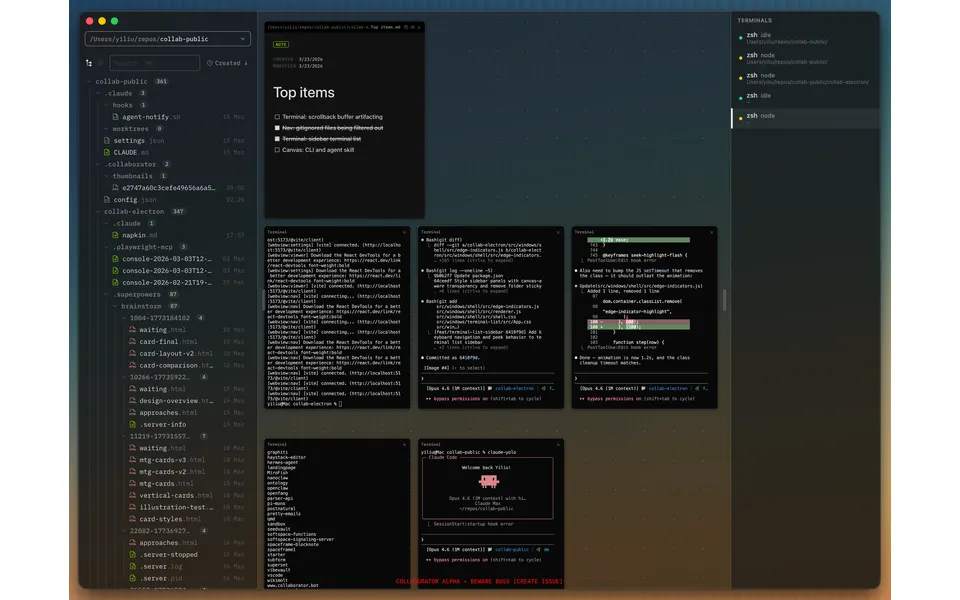
- Desktop app
- Mac, Windows and Linux
- Browser
- No
- Phone
- No
- Command line
- Yes
- Agents
- Claude Code, Codex and Gemini CLI
- Your subscription
- Works with your own plan
- Agents run
- On your computer
- Laptop closed
- No
- Isolation
- No
- Parallel agents
- Yes
- Scheduled runs
- No
- Coordinator agent
- Yes
- Built-in issues
- No
- Pull requests
- No
- Review screen
- No
- Team
- No
- Self-hosting
- Yes
- Licence
- Not listed
- Price from
- Free
- How it charges
- Not listed
- Paid plans from
- Not listed
Receipts
- Checked
- · oldest answer 2026-11-08
- Findings
- 24 published · 10 cross-checked by a second agent · read them all
- Sources
- 8 public pages on 2 sites: github.com, collab.hot
- Screenshot
- raw.githubusercontent.com, retrieved · first party repository · shows appearance, not capability
- Method
- Same rules for all 103 researched ADEs. How we check · Report wrong data
What it does
Where you use it
Collaborator ships a native Electron desktop app for macOS, Windows and Linux. The pinned application has no released web or phone client.
Source and scope for Where you use itAgents it runs
Claude Code, Codex CLI and Gemini CLI have explicit integration detection and canvas instruction installers. Other commands may run in generic terminal tiles, but additional named integrations are not established.
Source and scope for Agents it runsAccounts and subscriptions
Terminal agents run as installed user commands with the user shell environment and native agent login. Collaborator itself needs no account; agent subscription/provider charges remain external.
Source and scope for Accounts and subscriptionsWhere agents run
The scoped Electron app runs local terminal processes on the user computer. It supplies no remote-worker or vendor-cloud execution mode; local execution cannot continue while that computer is shut down or asleep.
Source and scope for Where agents runHow work is kept apart
Terminal tiles use local PTY/tmux sessions in the chosen workspace. The pinned application does not provision a worktree, container or VM per agent.
Source and scope for How work is kept apartParallel work
Independent terminal sessions can run agents side by side on the canvas.
Source and scope for Parallel workScheduled runs
Terminal sessions start through user interaction or explicit local CLI requests. There is no product schedule/event task runner in the scoped desktop application.
Source and scope for Scheduled runsGit and pull requests
The local application has no built-in pull-request creation or management integration. Agents can run arbitrary shell tools separately.
Source and scope for Git and pull requestsLicence and source
Collaborator application source uses FSL-1.1-ALv2, with a future Apache-2.0 conversion. It is not currently an Apache-2.0 application license.
Source and scope for Licence and sourceTyped filters
Every value links to its receipt below. Read plan and surface restrictions before using a filter to decide.
| Filter | Value |
|---|---|
| Desktop OS: macOS | Yes |
| Desktop OS: Windows | Yes |
| Desktop OS: Linux | Yes |
| Web client | No |
| Phone access: Native iOS | No |
| Phone access: Native Android | No |
| Phone access: Phone browser | No |
| CLI | Yes |
| Coding agents: Claude Code | Yes |
| Coding agents: Codex | Yes |
| Coding agents: Cursor Agent | Unknown |
| Coding agents: Gemini CLI | Yes |
| Coding agents: OpenCode | Unknown |
| Coding agents: Pi | Unknown |
| Coding agents: Grok | Unknown |
| Coding agents: Aider | Unknown |
| Coding agents: Antigravity | Unknown |
| Use my subscription | Yes |
| Where agents run: On your computer | Yes |
| Where agents run: On your own server | No |
| Where agents run: In the vendor's cloud | No |
| Workspace isolation: Git worktree | No |
| Workspace isolation: Container | No |
| Workspace isolation: VM or microVM | No |
| Parallel runs | Yes cross-checked |
| Coordinator | Yes |
| Native issue tracking | No |
| Unattended triggers | No |
| Shared prompting | No |
| Team roles | No |
| SSO | No |
| Pull request workflow | No |
| Review interface | No |
| Product license: Apache-2.0 | Unknown |
| Product license: MIT | Unknown |
| Product license: GPL-3.0 | Unknown |
| Product license: GPL-3.0-or-later | Unknown |
| Product license: AGPL-3.0 | Unknown |
| Product license: AGPL-3.0-or-later | Unknown |
| Product license: Elastic License 2.0 | Unknown |
| Product license: Custom terms | Unknown |
| Product license: Proprietary | Unknown |
| Self-hosting | Yes cross-checked |
| Telemetry opt-out | No |
| Free access | Yes cross-checked |
| Starting price: Free | Yes. Free cross-checked |
| Starting price: Up to $20/month | No. Free cross-checked |
| Starting price: $21–40/month | No. Free cross-checked |
| Starting price: $41–100/month | No. Free cross-checked |
| Starting price: Over $100/month | No. Free cross-checked |
| Starting price: Contact for pricing | No. Free cross-checked |
| Pricing model: Free, no paid plan | Unknown |
| Pricing model: Free plan | Unknown |
| Pricing model: Subscription | Unknown |
| Pricing model: Per seat | Unknown |
| Pricing model: Usage-based | Unknown |
| Pricing model: Per machine or compute | Unknown |
| Pricing model: Bring your own key | Unknown |
| Pricing model: One-time purchase | Unknown |
| Paid plans from: No paid plan | Unknown |
| Paid plans from: $10 or less/month | Unknown |
| Paid plans from: $11–20/month | Unknown |
| Paid plans from: $21–40/month | Unknown |
| Paid plans from: $41–100/month | Unknown |
| Paid plans from: Over $100/month | Unknown |
| Paid plans from: Contact sales | Unknown |
| Lifecycle status: Active | Unknown |
| Lifecycle status: Sunsetting | Unknown |
| Keeps going with laptop closed | No |
| Open-source license | Unknown |
| Any desktop app | Yes |
| Paid plan up to $20/month | Unknown |
| Paid plan up to $40/month | Unknown |
| Any phone client | No |
Filter receipts
Desktop OS: macOS: Yes
Desktop OS: macOS
Typed value: Yes.
Collaborator ships a native Electron desktop app for macOS, Windows and Linux. The pinned application has no released web or phone client.
- Desktop os: macOS, Windows and Linux desktop releases.
- Only the cited atomic facts are established. No configured product, account, billing or multi-user scenario was run; remaining atomic answers stay unknown.
-
Finding: Early-stage Electron desktop app for macOS, Windows and Linux. Independent sidecar PTYs, local files, editable Markdown/code tiles and local JSON state. No account required; PostHog anonymous usage analytics.
Desktop OS: Windows: Yes
Desktop OS: Windows
Typed value: Yes.
Collaborator ships a native Electron desktop app for macOS, Windows and Linux. The pinned application has no released web or phone client.
- Desktop os: macOS, Windows and Linux desktop releases.
- Only the cited atomic facts are established. No configured product, account, billing or multi-user scenario was run; remaining atomic answers stay unknown.
-
Finding: Early-stage Electron desktop app for macOS, Windows and Linux. Independent sidecar PTYs, local files, editable Markdown/code tiles and local JSON state. No account required; PostHog anonymous usage analytics.
Desktop OS: Linux: Yes
Desktop OS: Linux
Typed value: Yes.
Collaborator ships a native Electron desktop app for macOS, Windows and Linux. The pinned application has no released web or phone client.
- Desktop os: macOS, Windows and Linux desktop releases.
- Only the cited atomic facts are established. No configured product, account, billing or multi-user scenario was run; remaining atomic answers stay unknown.
-
Finding: Early-stage Electron desktop app for macOS, Windows and Linux. Independent sidecar PTYs, local files, editable Markdown/code tiles and local JSON state. No account required; PostHog anonymous usage analytics.
Web client: No
Web client
Typed value: No.
Collaborator ships a native Electron desktop app for macOS, Windows and Linux. The pinned application has no released web or phone client.
- Mobile apps: No iOS or Android client in the scoped public application.
- Browser: Only Electron clients and local IPC are supplied; embedded browser tiles display other websites.
- Mobile browser: No served ADE phone-browser client.
- Only the cited atomic facts are established. No configured product, account, billing or multi-user scenario was run; remaining atomic answers stay unknown.
-
collaborator: collab-electron/src/main/pty.ts
Finding: Pinned Electron main/renderer source implements local PTY terminals and local JSON canvas/tile state. The native app has no remote execution backend, released browser/mobile client, shared-user account service, role/SSO system, issue store, task scheduler, PR API or workspace/container/VM provisioning. PostHog analytics initializes from a build-time key with no user opt-out control. Generic shell access does not prove named harness integration.
Phone access: Native iOS: No
Phone access: Native iOS
Typed value: No.
Collaborator ships a native Electron desktop app for macOS, Windows and Linux. The pinned application has no released web or phone client.
- Mobile apps: No iOS or Android client in the scoped public application.
- Browser: Only Electron clients and local IPC are supplied; embedded browser tiles display other websites.
- Mobile browser: No served ADE phone-browser client.
- Only the cited atomic facts are established. No configured product, account, billing or multi-user scenario was run; remaining atomic answers stay unknown.
-
collaborator: collab-electron/src/main/pty.ts
Finding: Pinned Electron main/renderer source implements local PTY terminals and local JSON canvas/tile state. The native app has no remote execution backend, released browser/mobile client, shared-user account service, role/SSO system, issue store, task scheduler, PR API or workspace/container/VM provisioning. PostHog analytics initializes from a build-time key with no user opt-out control. Generic shell access does not prove named harness integration.
Phone access: Native Android: No
Phone access: Native Android
Typed value: No.
Collaborator ships a native Electron desktop app for macOS, Windows and Linux. The pinned application has no released web or phone client.
- Mobile apps: No iOS or Android client in the scoped public application.
- Browser: Only Electron clients and local IPC are supplied; embedded browser tiles display other websites.
- Mobile browser: No served ADE phone-browser client.
- Only the cited atomic facts are established. No configured product, account, billing or multi-user scenario was run; remaining atomic answers stay unknown.
-
collaborator: collab-electron/src/main/pty.ts
Finding: Pinned Electron main/renderer source implements local PTY terminals and local JSON canvas/tile state. The native app has no remote execution backend, released browser/mobile client, shared-user account service, role/SSO system, issue store, task scheduler, PR API or workspace/container/VM provisioning. PostHog analytics initializes from a build-time key with no user opt-out control. Generic shell access does not prove named harness integration.
Phone access: Phone browser: No
Phone access: Phone browser
Typed value: No.
Collaborator ships a native Electron desktop app for macOS, Windows and Linux. The pinned application has no released web or phone client.
- Mobile apps: No iOS or Android client in the scoped public application.
- Browser: Only Electron clients and local IPC are supplied; embedded browser tiles display other websites.
- Mobile browser: No served ADE phone-browser client.
- Only the cited atomic facts are established. No configured product, account, billing or multi-user scenario was run; remaining atomic answers stay unknown.
-
collaborator: collab-electron/src/main/pty.ts
Finding: Pinned Electron main/renderer source implements local PTY terminals and local JSON canvas/tile state. The native app has no remote execution backend, released browser/mobile client, shared-user account service, role/SSO system, issue store, task scheduler, PR API or workspace/container/VM provisioning. PostHog analytics initializes from a build-time key with no user opt-out control. Generic shell access does not prove named harness integration.
CLI: Yes
CLI
Typed value: Yes.
The application installs a product-owned canvas CLI for tile creation, terminal input/output and other canvas operations over a local JSON-RPC socket.
- Cli: collab-cli.mjs and cli-installer.ts install and invoke the product canvas CLI.
- Source review and pinned implementation inspection only; no installed-product, account or multi-user scenario was executed. Unanswered atomic questions remain open.
-
collaborator: collab-electron/packages/collab-canvas-skill/skills/collab-canvas/SKILL.md
Finding: The shipped canvas skill instructs an agent to create a terminal, launch Claude Code with a delegated prompt and read its result. The installed CLI controls canvas terminals over local JSON-RPC. integrations.ts detects Claude Code, Codex CLI and Gemini CLI and installs their canvas instructions. Terminals run the user shell with its normal environment and agent login.
Coding agents: Claude Code: Yes
Coding agents: Claude Code
Typed value: Yes.
Claude Code, Codex CLI and Gemini CLI have explicit integration detection and canvas instruction installers. Other commands may run in generic terminal tiles, but additional named integrations are not established.
- Harnesses: Explicit integration IDs are Claude Code, Codex CLI and Gemini CLI.
- Source review and pinned implementation inspection only; no installed-product, account or multi-user scenario was executed. Unanswered atomic questions remain open.
-
collaborator: collab-electron/packages/collab-canvas-skill/skills/collab-canvas/SKILL.md
Finding: The shipped canvas skill instructs an agent to create a terminal, launch Claude Code with a delegated prompt and read its result. The installed CLI controls canvas terminals over local JSON-RPC. integrations.ts detects Claude Code, Codex CLI and Gemini CLI and installs their canvas instructions. Terminals run the user shell with its normal environment and agent login.
Coding agents: Codex: Yes
Coding agents: Codex
Typed value: Yes.
Claude Code, Codex CLI and Gemini CLI have explicit integration detection and canvas instruction installers. Other commands may run in generic terminal tiles, but additional named integrations are not established.
- Harnesses: Explicit integration IDs are Claude Code, Codex CLI and Gemini CLI.
- Source review and pinned implementation inspection only; no installed-product, account or multi-user scenario was executed. Unanswered atomic questions remain open.
-
collaborator: collab-electron/packages/collab-canvas-skill/skills/collab-canvas/SKILL.md
Finding: The shipped canvas skill instructs an agent to create a terminal, launch Claude Code with a delegated prompt and read its result. The installed CLI controls canvas terminals over local JSON-RPC. integrations.ts detects Claude Code, Codex CLI and Gemini CLI and installs their canvas instructions. Terminals run the user shell with its normal environment and agent login.
Coding agents: Gemini CLI: Yes
Coding agents: Gemini CLI
Typed value: Yes.
Claude Code, Codex CLI and Gemini CLI have explicit integration detection and canvas instruction installers. Other commands may run in generic terminal tiles, but additional named integrations are not established.
- Harnesses: Explicit integration IDs are Claude Code, Codex CLI and Gemini CLI.
- Source review and pinned implementation inspection only; no installed-product, account or multi-user scenario was executed. Unanswered atomic questions remain open.
-
collaborator: collab-electron/packages/collab-canvas-skill/skills/collab-canvas/SKILL.md
Finding: The shipped canvas skill instructs an agent to create a terminal, launch Claude Code with a delegated prompt and read its result. The installed CLI controls canvas terminals over local JSON-RPC. integrations.ts detects Claude Code, Codex CLI and Gemini CLI and installs their canvas instructions. Terminals run the user shell with its normal environment and agent login.
Use my subscription: Yes
Use my subscription
Typed value: Yes.
Terminal agents run as installed user commands with the user shell environment and native agent login. Collaborator itself needs no account; agent subscription/provider charges remain external.
- Agent subscriptions: The user-installed Claude Code or Codex CLI runs in the ordinary user shell and retains its own native login; Collaborator supplies canvas integration rather than a replacement account.
- Source review and pinned implementation inspection only; no installed-product, account or multi-user scenario was executed. Unanswered atomic questions remain open.
-
collaborator: collab-electron/src/main/pty.ts
Finding: Pinned Electron main/renderer source implements local PTY terminals and local JSON canvas/tile state. The native app has no remote execution backend, released browser/mobile client, shared-user account service, role/SSO system, issue store, task scheduler, PR API or workspace/container/VM provisioning. PostHog analytics initializes from a build-time key with no user opt-out control. Generic shell access does not prove named harness integration.
-
collaborator: collab-electron/packages/collab-canvas-skill/skills/collab-canvas/SKILL.md
Finding: The shipped canvas skill instructs an agent to create a terminal, launch Claude Code with a delegated prompt and read its result. The installed CLI controls canvas terminals over local JSON-RPC. integrations.ts detects Claude Code, Codex CLI and Gemini CLI and installs their canvas instructions. Terminals run the user shell with its normal environment and agent login.
Where agents run: On your computer: Yes
Where agents run: On your computer
Typed value: Yes.
The scoped Electron app runs local terminal processes on the user computer. It supplies no remote-worker or vendor-cloud execution mode; local execution cannot continue while that computer is shut down or asleep.
- Local: Terminal working directory is the active local workspace.
- Only the cited atomic facts are established. No configured product, account, billing or multi-user scenario was run; remaining atomic answers stay unknown.
-
Finding: Early-stage Electron desktop app for macOS, Windows and Linux. Independent sidecar PTYs, local files, editable Markdown/code tiles and local JSON state. No account required; PostHog anonymous usage analytics.
Where agents run: On your own server: No
Where agents run: On your own server
Typed value: No.
The scoped Electron app runs local terminal processes on the user computer. It supplies no remote-worker or vendor-cloud execution mode; local execution cannot continue while that computer is shut down or asleep.
- Byo remote: No remote worker execution backend; commands such as manually invoked SSH are user shell operations.
- Managed cloud: No managed execution backend in the application.
- Client disconnect: Sidecar/tmux can outlive a tile or UI, but the local machine must remain running.
- Only the cited atomic facts are established. No configured product, account, billing or multi-user scenario was run; remaining atomic answers stay unknown.
-
collaborator: collab-electron/src/main/pty.ts
Finding: Pinned Electron main/renderer source implements local PTY terminals and local JSON canvas/tile state. The native app has no remote execution backend, released browser/mobile client, shared-user account service, role/SSO system, issue store, task scheduler, PR API or workspace/container/VM provisioning. PostHog analytics initializes from a build-time key with no user opt-out control. Generic shell access does not prove named harness integration.
Where agents run: In the vendor's cloud: No
Where agents run: In the vendor's cloud
Typed value: No.
The scoped Electron app runs local terminal processes on the user computer. It supplies no remote-worker or vendor-cloud execution mode; local execution cannot continue while that computer is shut down or asleep.
- Byo remote: No remote worker execution backend; commands such as manually invoked SSH are user shell operations.
- Managed cloud: No managed execution backend in the application.
- Client disconnect: Sidecar/tmux can outlive a tile or UI, but the local machine must remain running.
- Only the cited atomic facts are established. No configured product, account, billing or multi-user scenario was run; remaining atomic answers stay unknown.
-
collaborator: collab-electron/src/main/pty.ts
Finding: Pinned Electron main/renderer source implements local PTY terminals and local JSON canvas/tile state. The native app has no remote execution backend, released browser/mobile client, shared-user account service, role/SSO system, issue store, task scheduler, PR API or workspace/container/VM provisioning. PostHog analytics initializes from a build-time key with no user opt-out control. Generic shell access does not prove named harness integration.
Workspace isolation: Git worktree: No
Workspace isolation: Git worktree
Typed value: No.
Terminal tiles use local PTY/tmux sessions in the chosen workspace. The pinned application does not provision a worktree, container or VM per agent.
- Worktree: Worktree references in paths.ts isolate development builds; they do not create agent workspace worktrees.
- Container: No agent container provisioning backend.
- Vm: No agent VM provisioning backend.
- Source review and pinned implementation inspection only; no installed-product, account or multi-user scenario was executed. Unanswered atomic questions remain open.
-
collaborator: collab-electron/src/main/pty.ts
Finding: Pinned Electron main/renderer source implements local PTY terminals and local JSON canvas/tile state. The native app has no remote execution backend, released browser/mobile client, shared-user account service, role/SSO system, issue store, task scheduler, PR API or workspace/container/VM provisioning. PostHog analytics initializes from a build-time key with no user opt-out control. Generic shell access does not prove named harness integration.
Workspace isolation: Container: No
Workspace isolation: Container
Typed value: No.
Terminal tiles use local PTY/tmux sessions in the chosen workspace. The pinned application does not provision a worktree, container or VM per agent.
- Worktree: Worktree references in paths.ts isolate development builds; they do not create agent workspace worktrees.
- Container: No agent container provisioning backend.
- Vm: No agent VM provisioning backend.
- Source review and pinned implementation inspection only; no installed-product, account or multi-user scenario was executed. Unanswered atomic questions remain open.
-
collaborator: collab-electron/src/main/pty.ts
Finding: Pinned Electron main/renderer source implements local PTY terminals and local JSON canvas/tile state. The native app has no remote execution backend, released browser/mobile client, shared-user account service, role/SSO system, issue store, task scheduler, PR API or workspace/container/VM provisioning. PostHog analytics initializes from a build-time key with no user opt-out control. Generic shell access does not prove named harness integration.
Workspace isolation: VM or microVM: No
Workspace isolation: VM or microVM
Typed value: No.
Terminal tiles use local PTY/tmux sessions in the chosen workspace. The pinned application does not provision a worktree, container or VM per agent.
- Worktree: Worktree references in paths.ts isolate development builds; they do not create agent workspace worktrees.
- Container: No agent container provisioning backend.
- Vm: No agent VM provisioning backend.
- Source review and pinned implementation inspection only; no installed-product, account or multi-user scenario was executed. Unanswered atomic questions remain open.
-
collaborator: collab-electron/src/main/pty.ts
Finding: Pinned Electron main/renderer source implements local PTY terminals and local JSON canvas/tile state. The native app has no remote execution backend, released browser/mobile client, shared-user account service, role/SSO system, issue store, task scheduler, PR API or workspace/container/VM provisioning. PostHog analytics initializes from a build-time key with no user opt-out control. Generic shell access does not prove named harness integration.
Parallel runs: Yes cross-checked
Parallel runs
Typed value: Yes.
Independent terminal sessions can run agents side by side on the canvas.
- Concurrent sessions: Each terminal tile manages its own independent session.
- Only the named facts are documented. Unanswered atomic questions remain unknown; no execution test was performed.
-
Finding: Early-stage Electron desktop app for macOS, Windows and Linux. Independent sidecar PTYs, local files, editable Markdown/code tiles and local JSON state. No account required; PostHog anonymous usage analytics.
Coordinator: Yes
Coordinator
Typed value: Yes.
The supplied canvas skill enables an agent to launch another agent in a terminal, send its prompt and read the result through the product CLI.
- Messages: terminal write sends child input; terminal read retrieves its output.
- Orchestration owner: Product-shipped canvas instructions teach the controlling agent to launch a Claude Code instance and inspect output.
- Invocation: Skill creates a terminal tile, launches claude -p with a delegated prompt and reads the result.
- Source review and pinned implementation inspection only; no installed-product, account or multi-user scenario was executed. Unanswered atomic questions remain open.
-
collaborator: collab-electron/packages/collab-canvas-skill/skills/collab-canvas/SKILL.md
Finding: The shipped canvas skill instructs an agent to create a terminal, launch Claude Code with a delegated prompt and read its result. The installed CLI controls canvas terminals over local JSON-RPC. integrations.ts detects Claude Code, Codex CLI and Gemini CLI and installs their canvas instructions. Terminals run the user shell with its normal environment and agent login.
Native issue tracking: No
Native issue tracking
Typed value: No.
Local persistence stores canvas tiles, terminals, files and agent messages; it has no separate persistent product issue/task entity with state.
- Create: No issue creation API or issue model in local persistence/IPC.
- Task session separation: Canvas tiles and terminal sessions do not form a separate issue backlog.
- Durable states: No native task state machine.
- Source review and pinned implementation inspection only; no installed-product, account or multi-user scenario was executed. Unanswered atomic questions remain open.
-
collaborator: collab-electron/src/main/pty.ts
Finding: Pinned Electron main/renderer source implements local PTY terminals and local JSON canvas/tile state. The native app has no remote execution backend, released browser/mobile client, shared-user account service, role/SSO system, issue store, task scheduler, PR API or workspace/container/VM provisioning. PostHog analytics initializes from a build-time key with no user opt-out control. Generic shell access does not prove named harness integration.
Unattended triggers: No
Unattended triggers
Typed value: No.
Terminal sessions start through user interaction or explicit local CLI requests. There is no product schedule/event task runner in the scoped desktop application.
- Schedules: No agent task scheduler; foreground polling timers do not schedule work.
- Events: Local RPC acts on explicit caller commands; no configured external-event agent trigger service.
- Source review and pinned implementation inspection only; no installed-product, account or multi-user scenario was executed. Unanswered atomic questions remain open.
-
collaborator: collab-electron/src/main/pty.ts
Finding: Pinned Electron main/renderer source implements local PTY terminals and local JSON canvas/tile state. The native app has no remote execution backend, released browser/mobile client, shared-user account service, role/SSO system, issue store, task scheduler, PR API or workspace/container/VM provisioning. PostHog analytics initializes from a build-time key with no user opt-out control. Generic shell access does not prove named harness integration.
Shared prompting: No
Shared prompting
Typed value: No.
The scoped app uses local files and IPC under one desktop user and supplies no multi-user shared prompting service.
- Coprompting: No remote member sessions or shared human input channel in the application.
- Source review and pinned implementation inspection only; no installed-product, account or multi-user scenario was executed. Unanswered atomic questions remain open.
-
collaborator: collab-electron/src/main/pty.ts
Finding: Pinned Electron main/renderer source implements local PTY terminals and local JSON canvas/tile state. The native app has no remote execution backend, released browser/mobile client, shared-user account service, role/SSO system, issue store, task scheduler, PR API or workspace/container/VM provisioning. PostHog analytics initializes from a build-time key with no user opt-out control. Generic shell access does not prove named harness integration.
Team roles: No
Team roles
Typed value: No.
The account-free local application has no team role or enterprise SSO service.
- Organization roles: No organization membership or permission-role model.
- Sso: No SSO login integration.
- Source review and pinned implementation inspection only; no installed-product, account or multi-user scenario was executed. Unanswered atomic questions remain open.
-
collaborator: collab-electron/src/main/pty.ts
Finding: Pinned Electron main/renderer source implements local PTY terminals and local JSON canvas/tile state. The native app has no remote execution backend, released browser/mobile client, shared-user account service, role/SSO system, issue store, task scheduler, PR API or workspace/container/VM provisioning. PostHog analytics initializes from a build-time key with no user opt-out control. Generic shell access does not prove named harness integration.
SSO: No
SSO
Typed value: No.
The account-free local application has no team role or enterprise SSO service.
- Organization roles: No organization membership or permission-role model.
- Sso: No SSO login integration.
- Source review and pinned implementation inspection only; no installed-product, account or multi-user scenario was executed. Unanswered atomic questions remain open.
-
collaborator: collab-electron/src/main/pty.ts
Finding: Pinned Electron main/renderer source implements local PTY terminals and local JSON canvas/tile state. The native app has no remote execution backend, released browser/mobile client, shared-user account service, role/SSO system, issue store, task scheduler, PR API or workspace/container/VM provisioning. PostHog analytics initializes from a build-time key with no user opt-out control. Generic shell access does not prove named harness integration.
Pull request workflow: No
Pull request workflow
Typed value: No.
The local application has no built-in pull-request creation or management integration. Agents can run arbitrary shell tools separately.
- Pull requests: No PR API/command or workflow in the scoped main/renderer code.
- Source review and pinned implementation inspection only; no installed-product, account or multi-user scenario was executed. Unanswered atomic questions remain open.
-
collaborator: collab-electron/src/main/pty.ts
Finding: Pinned Electron main/renderer source implements local PTY terminals and local JSON canvas/tile state. The native app has no remote execution backend, released browser/mobile client, shared-user account service, role/SSO system, issue store, task scheduler, PR API or workspace/container/VM provisioning. PostHog analytics initializes from a build-time key with no user opt-out control. Generic shell access does not prove named harness integration.
Review interface: No
Review interface
Typed value: No.
The canvas displays editable code and file tiles; its source does not implement a proposed-change diff review interface.
- Diffs: Git replay code extracts commit changes for a graph; no proposed-change diff review UI is implemented.
- Only the cited atomic facts are established. No configured product, account, billing or multi-user scenario was run; remaining atomic answers stay unknown.
-
collaborator: collab-electron/src/main/pty.ts
Finding: Pinned Electron main/renderer source implements local PTY terminals and local JSON canvas/tile state. The native app has no remote execution backend, released browser/mobile client, shared-user account service, role/SSO system, issue store, task scheduler, PR API or workspace/container/VM provisioning. PostHog analytics initializes from a build-time key with no user opt-out control. Generic shell access does not prove named harness integration.
Self-hosting: Yes cross-checked
Self-hosting
Typed value: Yes.
Core application can be built and run locally, with no product account required.
- Self hosting: Clone application, bun install and bun run dev.
- Formats: Files plus local canvas-state.json and config.json.
- Account independence: README explicitly says no accounts required.
- Only the named facts are documented. Unanswered atomic questions remain unknown; no execution test was performed.
-
Finding: Early-stage Electron desktop app for macOS, Windows and Linux. Independent sidecar PTYs, local files, editable Markdown/code tiles and local JSON state. No account required; PostHog anonymous usage analytics.
Telemetry opt-out: No
Telemetry opt-out
Typed value: No.
The application collects anonymous usage events with PostHog. The pinned analytics and configuration code exposes no end-user telemetry disable setting.
- Telemetry controls: PostHog initialization depends on a build-time key; no runtime opt-out preference is exposed.
- Only the cited atomic facts are established. No configured product, account, billing or multi-user scenario was run; remaining atomic answers stay unknown.
-
collaborator: collab-electron/src/main/pty.ts
Finding: Pinned Electron main/renderer source implements local PTY terminals and local JSON canvas/tile state. The native app has no remote execution backend, released browser/mobile client, shared-user account service, role/SSO system, issue store, task scheduler, PR API or workspace/container/VM provisioning. PostHog analytics initializes from a build-time key with no user opt-out control. Generic shell access does not prove named harness integration.
Free access: Yes cross-checked
Free access
Typed value: Yes.
The Collaborator desktop app is a free download that needs no account, under FSL-1.1-ALv2 (competing commercial use excluded). No paid plan is published; the linked site is a closed-beta sign-up.
- Ongoing free: Desktop builds download free from GitHub releases and need no account.
- Paid only: Not paid-only: the desktop app downloads free of charge.
- The app is described as early-stage; future paid plans on the closed-beta site are unknown. No installed-product test was run.
-
Collaborator README: install and overview
Finding: Desktop builds for macOS, Windows and Linux download from GitHub releases or a shell install script; the app works on local files with no account required. No price or paid plan is named.
-
Finding: The software is under the Functional Source License 1.1 with Apache-2.0 future license, which permits use, copying and redistribution for any purpose other than a Competing Use, with no fee stated.
Starting price: Free: Yes. Free cross-checked
Starting price: Free
Typed value: Yes. Free.
The Collaborator desktop app is a free download that needs no account, under FSL-1.1-ALv2 (competing commercial use excluded). No paid plan is published; the linked site is a closed-beta sign-up.
- Ongoing free: Desktop builds download free from GitHub releases and need no account.
- Paid only: Not paid-only: the desktop app downloads free of charge.
- The app is described as early-stage; future paid plans on the closed-beta site are unknown. No installed-product test was run.
-
Collaborator README: install and overview
Finding: Desktop builds for macOS, Windows and Linux download from GitHub releases or a shell install script; the app works on local files with no account required. No price or paid plan is named.
-
Finding: The software is under the Functional Source License 1.1 with Apache-2.0 future license, which permits use, copying and redistribution for any purpose other than a Competing Use, with no fee stated.
Starting price: Up to $20/month: No. Free cross-checked
Starting price: Up to $20/month
Typed value: No. Free.
The Collaborator desktop app is a free download that needs no account, under FSL-1.1-ALv2 (competing commercial use excluded). No paid plan is published; the linked site is a closed-beta sign-up.
- Ongoing free: Desktop builds download free from GitHub releases and need no account.
- Paid only: Not paid-only: the desktop app downloads free of charge.
- The app is described as early-stage; future paid plans on the closed-beta site are unknown. No installed-product test was run.
-
Collaborator README: install and overview
Finding: Desktop builds for macOS, Windows and Linux download from GitHub releases or a shell install script; the app works on local files with no account required. No price or paid plan is named.
-
Finding: The software is under the Functional Source License 1.1 with Apache-2.0 future license, which permits use, copying and redistribution for any purpose other than a Competing Use, with no fee stated.
Starting price: $21–40/month: No. Free cross-checked
Starting price: $21–40/month
Typed value: No. Free.
The Collaborator desktop app is a free download that needs no account, under FSL-1.1-ALv2 (competing commercial use excluded). No paid plan is published; the linked site is a closed-beta sign-up.
- Ongoing free: Desktop builds download free from GitHub releases and need no account.
- Paid only: Not paid-only: the desktop app downloads free of charge.
- The app is described as early-stage; future paid plans on the closed-beta site are unknown. No installed-product test was run.
-
Collaborator README: install and overview
Finding: Desktop builds for macOS, Windows and Linux download from GitHub releases or a shell install script; the app works on local files with no account required. No price or paid plan is named.
-
Finding: The software is under the Functional Source License 1.1 with Apache-2.0 future license, which permits use, copying and redistribution for any purpose other than a Competing Use, with no fee stated.
Starting price: $41–100/month: No. Free cross-checked
Starting price: $41–100/month
Typed value: No. Free.
The Collaborator desktop app is a free download that needs no account, under FSL-1.1-ALv2 (competing commercial use excluded). No paid plan is published; the linked site is a closed-beta sign-up.
- Ongoing free: Desktop builds download free from GitHub releases and need no account.
- Paid only: Not paid-only: the desktop app downloads free of charge.
- The app is described as early-stage; future paid plans on the closed-beta site are unknown. No installed-product test was run.
-
Collaborator README: install and overview
Finding: Desktop builds for macOS, Windows and Linux download from GitHub releases or a shell install script; the app works on local files with no account required. No price or paid plan is named.
-
Finding: The software is under the Functional Source License 1.1 with Apache-2.0 future license, which permits use, copying and redistribution for any purpose other than a Competing Use, with no fee stated.
Starting price: Over $100/month: No. Free cross-checked
Starting price: Over $100/month
Typed value: No. Free.
The Collaborator desktop app is a free download that needs no account, under FSL-1.1-ALv2 (competing commercial use excluded). No paid plan is published; the linked site is a closed-beta sign-up.
- Ongoing free: Desktop builds download free from GitHub releases and need no account.
- Paid only: Not paid-only: the desktop app downloads free of charge.
- The app is described as early-stage; future paid plans on the closed-beta site are unknown. No installed-product test was run.
-
Collaborator README: install and overview
Finding: Desktop builds for macOS, Windows and Linux download from GitHub releases or a shell install script; the app works on local files with no account required. No price or paid plan is named.
-
Finding: The software is under the Functional Source License 1.1 with Apache-2.0 future license, which permits use, copying and redistribution for any purpose other than a Competing Use, with no fee stated.
Starting price: Contact for pricing: No. Free cross-checked
Starting price: Contact for pricing
Typed value: No. Free.
The Collaborator desktop app is a free download that needs no account, under FSL-1.1-ALv2 (competing commercial use excluded). No paid plan is published; the linked site is a closed-beta sign-up.
- Ongoing free: Desktop builds download free from GitHub releases and need no account.
- Paid only: Not paid-only: the desktop app downloads free of charge.
- The app is described as early-stage; future paid plans on the closed-beta site are unknown. No installed-product test was run.
-
Collaborator README: install and overview
Finding: Desktop builds for macOS, Windows and Linux download from GitHub releases or a shell install script; the app works on local files with no account required. No price or paid plan is named.
-
Finding: The software is under the Functional Source License 1.1 with Apache-2.0 future license, which permits use, copying and redistribution for any purpose other than a Competing Use, with no fee stated.
Keeps going with laptop closed: No
Keeps going with laptop closed
Typed value: No.
The scoped Electron app runs local terminal processes on the user computer. It supplies no remote-worker or vendor-cloud execution mode; local execution cannot continue while that computer is shut down or asleep.
- Byo remote: No remote worker execution backend; commands such as manually invoked SSH are user shell operations.
- Managed cloud: No managed execution backend in the application.
- Client disconnect: Sidecar/tmux can outlive a tile or UI, but the local machine must remain running.
- Only the cited atomic facts are established. No configured product, account, billing or multi-user scenario was run; remaining atomic answers stay unknown.
-
collaborator: collab-electron/src/main/pty.ts
Finding: Pinned Electron main/renderer source implements local PTY terminals and local JSON canvas/tile state. The native app has no remote execution backend, released browser/mobile client, shared-user account service, role/SSO system, issue store, task scheduler, PR API or workspace/container/VM provisioning. PostHog analytics initializes from a build-time key with no user opt-out control. Generic shell access does not prove named harness integration.
Any desktop app: Yes
Any desktop app
Typed value: Yes.
Collaborator ships a native Electron desktop app for macOS, Windows and Linux. The pinned application has no released web or phone client.
- Desktop os: macOS, Windows and Linux desktop releases.
- Only the cited atomic facts are established. No configured product, account, billing or multi-user scenario was run; remaining atomic answers stay unknown.
-
Finding: Early-stage Electron desktop app for macOS, Windows and Linux. Independent sidecar PTYs, local files, editable Markdown/code tiles and local JSON state. No account required; PostHog anonymous usage analytics.
Any phone client: No
Any phone client
Typed value: No.
Collaborator ships a native Electron desktop app for macOS, Windows and Linux. The pinned application has no released web or phone client.
- Mobile apps: No iOS or Android client in the scoped public application.
- Browser: Only Electron clients and local IPC are supplied; embedded browser tiles display other websites.
- Mobile browser: No served ADE phone-browser client.
- Only the cited atomic facts are established. No configured product, account, billing or multi-user scenario was run; remaining atomic answers stay unknown.
-
collaborator: collab-electron/src/main/pty.ts
Finding: Pinned Electron main/renderer source implements local PTY terminals and local JSON canvas/tile state. The native app has no remote execution backend, released browser/mobile client, shared-user account service, role/SSO system, issue store, task scheduler, PR API or workspace/container/VM provisioning. PostHog analytics initializes from a build-time key with no user opt-out control. Generic shell access does not prove named harness integration.
All public findings
Findings may summarize a source. They are not presented as verbatim statements.
collaborator:ACC-01: Collaborator ships a native Electron desktop app for macOS, Windows and Linux. The pinned application has no released web or phone client.
collaborator:ACC-01
Collaborator ships a native Electron desktop app for macOS, Windows and Linux. The pinned application has no released web or phone client.
- Only the cited atomic facts are established. No configured product, account, billing or multi-user scenario was run; remaining atomic answers stay unknown.
-
Finding: Early-stage Electron desktop app for macOS, Windows and Linux. Independent sidecar PTYs, local files, editable Markdown/code tiles and local JSON state. No account required; PostHog anonymous usage analytics.
-
collaborator: collab-electron/src/main/pty.ts
Finding: Pinned Electron main/renderer source implements local PTY terminals and local JSON canvas/tile state. The native app has no remote execution backend, released browser/mobile client, shared-user account service, role/SSO system, issue store, task scheduler, PR API or workspace/container/VM provisioning. PostHog analytics initializes from a build-time key with no user opt-out control. Generic shell access does not prove named harness integration.
collaborator:ACC-02: Claude Code, Codex CLI and Gemini CLI have explicit integration detection and canvas instruction installers. Other commands may run in generic terminal tiles, but additional named integrations are not established.
collaborator:ACC-02
Claude Code, Codex CLI and Gemini CLI have explicit integration detection and canvas instruction installers. Other commands may run in generic terminal tiles, but additional named integrations are not established.
- Source review and pinned implementation inspection only; no installed-product, account or multi-user scenario was executed. Unanswered atomic questions remain open.
-
collaborator: collab-electron/src/main/pty.ts
Finding: Pinned Electron main/renderer source implements local PTY terminals and local JSON canvas/tile state. The native app has no remote execution backend, released browser/mobile client, shared-user account service, role/SSO system, issue store, task scheduler, PR API or workspace/container/VM provisioning. PostHog analytics initializes from a build-time key with no user opt-out control. Generic shell access does not prove named harness integration.
-
collaborator: collab-electron/packages/collab-canvas-skill/skills/collab-canvas/SKILL.md
Finding: The shipped canvas skill instructs an agent to create a terminal, launch Claude Code with a delegated prompt and read its result. The installed CLI controls canvas terminals over local JSON-RPC. integrations.ts detects Claude Code, Codex CLI and Gemini CLI and installs their canvas instructions. Terminals run the user shell with its normal environment and agent login.
collaborator:ACC-03: Terminal agents run as installed user commands with the user shell environment and native agent login. Collaborator itself needs no account; agent subscription/provider charges remain external.
collaborator:ACC-03
Terminal agents run as installed user commands with the user shell environment and native agent login. Collaborator itself needs no account; agent subscription/provider charges remain external.
- Source review and pinned implementation inspection only; no installed-product, account or multi-user scenario was executed. Unanswered atomic questions remain open.
-
collaborator: collab-electron/src/main/pty.ts
Finding: Pinned Electron main/renderer source implements local PTY terminals and local JSON canvas/tile state. The native app has no remote execution backend, released browser/mobile client, shared-user account service, role/SSO system, issue store, task scheduler, PR API or workspace/container/VM provisioning. PostHog analytics initializes from a build-time key with no user opt-out control. Generic shell access does not prove named harness integration.
-
collaborator: collab-electron/packages/collab-canvas-skill/skills/collab-canvas/SKILL.md
Finding: The shipped canvas skill instructs an agent to create a terminal, launch Claude Code with a delegated prompt and read its result. The installed CLI controls canvas terminals over local JSON-RPC. integrations.ts detects Claude Code, Codex CLI and Gemini CLI and installs their canvas instructions. Terminals run the user shell with its normal environment and agent login.
collaborator:ACC-04: Open a local folder, create a terminal tile and start an installed agent. A hosted Git remote is not a stated onboarding requirement. cross-checked
collaborator:ACC-04
Open a local folder, create a terminal tile and start an installed agent. A hosted Git remote is not a stated onboarding requirement.
- Only the named facts are documented. Unanswered atomic questions remain unknown; no execution test was performed.
-
Finding: Early-stage Electron desktop app for macOS, Windows and Linux. Independent sidecar PTYs, local files, editable Markdown/code tiles and local JSON state. No account required; PostHog anonymous usage analytics.
collaborator:ACC-05: The application installs a product-owned canvas CLI for tile creation, terminal input/output and other canvas operations over a local JSON-RPC socket.
collaborator:ACC-05
The application installs a product-owned canvas CLI for tile creation, terminal input/output and other canvas operations over a local JSON-RPC socket.
- Source review and pinned implementation inspection only; no installed-product, account or multi-user scenario was executed. Unanswered atomic questions remain open.
-
collaborator: collab-electron/packages/collab-canvas-skill/skills/collab-canvas/SKILL.md
Finding: The shipped canvas skill instructs an agent to create a terminal, launch Claude Code with a delegated prompt and read its result. The installed CLI controls canvas terminals over local JSON-RPC. integrations.ts detects Claude Code, Codex CLI and Gemini CLI and installs their canvas instructions. Terminals run the user shell with its normal environment and agent login.
collaborator:ACC-07: Desktop app uses Electron 40, React 19, xterm.js, Monaco and a persistent node-pty sidecar. cross-checked
collaborator:ACC-07
Desktop app uses Electron 40, React 19, xterm.js, Monaco and a persistent node-pty sidecar.
- Only the named facts are documented. Unanswered atomic questions remain unknown; no execution test was performed.
-
Finding: Early-stage Electron desktop app for macOS, Windows and Linux. Independent sidecar PTYs, local files, editable Markdown/code tiles and local JSON state. No account required; PostHog anonymous usage analytics.
collaborator:PLAN-04: Local context files can sit beside terminals as editable Markdown or code tiles; managed shared-memory provenance is unestablished. cross-checked
collaborator:PLAN-04
Local context files can sit beside terminals as editable Markdown or code tiles; managed shared-memory provenance is unestablished.
- Only the named facts are documented. Unanswered atomic questions remain unknown; no execution test was performed.
-
Finding: Early-stage Electron desktop app for macOS, Windows and Linux. Independent sidecar PTYs, local files, editable Markdown/code tiles and local JSON state. No account required; PostHog anonymous usage analytics.
collaborator:PLAN-06: Local persistence stores canvas tiles, terminals, files and agent messages; it has no separate persistent product issue/task entity with state.
collaborator:PLAN-06
Local persistence stores canvas tiles, terminals, files and agent messages; it has no separate persistent product issue/task entity with state.
- Source review and pinned implementation inspection only; no installed-product, account or multi-user scenario was executed. Unanswered atomic questions remain open.
-
collaborator: collab-electron/src/main/pty.ts
Finding: Pinned Electron main/renderer source implements local PTY terminals and local JSON canvas/tile state. The native app has no remote execution backend, released browser/mobile client, shared-user account service, role/SSO system, issue store, task scheduler, PR API or workspace/container/VM provisioning. PostHog analytics initializes from a build-time key with no user opt-out control. Generic shell access does not prove named harness integration.
collaborator:COORD-01: Independent terminal sessions can run agents side by side on the canvas. cross-checked
collaborator:COORD-01
Independent terminal sessions can run agents side by side on the canvas.
- Only the named facts are documented. Unanswered atomic questions remain unknown; no execution test was performed.
-
Finding: Early-stage Electron desktop app for macOS, Windows and Linux. Independent sidecar PTYs, local files, editable Markdown/code tiles and local JSON state. No account required; PostHog anonymous usage analytics.
collaborator:COORD-03: The supplied canvas skill enables an agent to launch another agent in a terminal, send its prompt and read the result through the product CLI.
collaborator:COORD-03
The supplied canvas skill enables an agent to launch another agent in a terminal, send its prompt and read the result through the product CLI.
- Source review and pinned implementation inspection only; no installed-product, account or multi-user scenario was executed. Unanswered atomic questions remain open.
-
collaborator: collab-electron/packages/collab-canvas-skill/skills/collab-canvas/SKILL.md
Finding: The shipped canvas skill instructs an agent to create a terminal, launch Claude Code with a delegated prompt and read its result. The installed CLI controls canvas terminals over local JSON-RPC. integrations.ts detects Claude Code, Codex CLI and Gemini CLI and installs their canvas instructions. Terminals run the user shell with its normal environment and agent login.
collaborator:COORD-04: Terminal sessions start through user interaction or explicit local CLI requests. There is no product schedule/event task runner in the scoped desktop application.
collaborator:COORD-04
Terminal sessions start through user interaction or explicit local CLI requests. There is no product schedule/event task runner in the scoped desktop application.
- Source review and pinned implementation inspection only; no installed-product, account or multi-user scenario was executed. Unanswered atomic questions remain open.
-
collaborator: collab-electron/src/main/pty.ts
Finding: Pinned Electron main/renderer source implements local PTY terminals and local JSON canvas/tile state. The native app has no remote execution backend, released browser/mobile client, shared-user account service, role/SSO system, issue store, task scheduler, PR API or workspace/container/VM provisioning. PostHog analytics initializes from a build-time key with no user opt-out control. Generic shell access does not prove named harness integration.
collaborator:RUN-01: The scoped Electron app runs local terminal processes on the user computer. It supplies no remote-worker or vendor-cloud execution mode; local execution cannot continue while that computer is shut down or asleep.
collaborator:RUN-01
The scoped Electron app runs local terminal processes on the user computer. It supplies no remote-worker or vendor-cloud execution mode; local execution cannot continue while that computer is shut down or asleep.
- Only the cited atomic facts are established. No configured product, account, billing or multi-user scenario was run; remaining atomic answers stay unknown.
-
Finding: Early-stage Electron desktop app for macOS, Windows and Linux. Independent sidecar PTYs, local files, editable Markdown/code tiles and local JSON state. No account required; PostHog anonymous usage analytics.
-
collaborator: collab-electron/src/main/pty.ts
Finding: Pinned Electron main/renderer source implements local PTY terminals and local JSON canvas/tile state. The native app has no remote execution backend, released browser/mobile client, shared-user account service, role/SSO system, issue store, task scheduler, PR API or workspace/container/VM provisioning. PostHog analytics initializes from a build-time key with no user opt-out control. Generic shell access does not prove named harness integration.
collaborator:RUN-02: Terminal tiles use local PTY/tmux sessions in the chosen workspace. The pinned application does not provision a worktree, container or VM per agent.
collaborator:RUN-02
Terminal tiles use local PTY/tmux sessions in the chosen workspace. The pinned application does not provision a worktree, container or VM per agent.
- Source review and pinned implementation inspection only; no installed-product, account or multi-user scenario was executed. Unanswered atomic questions remain open.
-
collaborator: collab-electron/src/main/pty.ts
Finding: Pinned Electron main/renderer source implements local PTY terminals and local JSON canvas/tile state. The native app has no remote execution backend, released browser/mobile client, shared-user account service, role/SSO system, issue store, task scheduler, PR API or workspace/container/VM provisioning. PostHog analytics initializes from a build-time key with no user opt-out control. Generic shell access does not prove named harness integration.
collaborator:RUN-03: Terminal sessions persist independently of the canvas tile lifecycle, and canvas/config state is written to disk. Remote laptop-independent work is unestablished. cross-checked
collaborator:RUN-03
Terminal sessions persist independently of the canvas tile lifecycle, and canvas/config state is written to disk. Remote laptop-independent work is unestablished.
- Only the named facts are documented. Unanswered atomic questions remain unknown; no execution test was performed.
-
Finding: Early-stage Electron desktop app for macOS, Windows and Linux. Independent sidecar PTYs, local files, editable Markdown/code tiles and local JSON state. No account required; PostHog anonymous usage analytics.
collaborator:RUN-04: Terminal tiles open in the workspace directory. Environment provisioning and automatic repair are unestablished. cross-checked
collaborator:RUN-04
Terminal tiles open in the workspace directory. Environment provisioning and automatic repair are unestablished.
- Only the named facts are documented. Unanswered atomic questions remain unknown; no execution test was performed.
-
Finding: Early-stage Electron desktop app for macOS, Windows and Linux. Independent sidecar PTYs, local files, editable Markdown/code tiles and local JSON state. No account required; PostHog anonymous usage analytics.
collaborator:TEAM-01: The scoped app uses local files and IPC under one desktop user and supplies no multi-user shared prompting service.
collaborator:TEAM-01
The scoped app uses local files and IPC under one desktop user and supplies no multi-user shared prompting service.
- Source review and pinned implementation inspection only; no installed-product, account or multi-user scenario was executed. Unanswered atomic questions remain open.
-
collaborator: collab-electron/src/main/pty.ts
Finding: Pinned Electron main/renderer source implements local PTY terminals and local JSON canvas/tile state. The native app has no remote execution backend, released browser/mobile client, shared-user account service, role/SSO system, issue store, task scheduler, PR API or workspace/container/VM provisioning. PostHog analytics initializes from a build-time key with no user opt-out control. Generic shell access does not prove named harness integration.
collaborator:TEAM-02: The account-free local application has no team role or enterprise SSO service.
collaborator:TEAM-02
The account-free local application has no team role or enterprise SSO service.
- Source review and pinned implementation inspection only; no installed-product, account or multi-user scenario was executed. Unanswered atomic questions remain open.
-
collaborator: collab-electron/src/main/pty.ts
Finding: Pinned Electron main/renderer source implements local PTY terminals and local JSON canvas/tile state. The native app has no remote execution backend, released browser/mobile client, shared-user account service, role/SSO system, issue store, task scheduler, PR API or workspace/container/VM provisioning. PostHog analytics initializes from a build-time key with no user opt-out control. Generic shell access does not prove named harness integration.
collaborator:SHIP-01: The canvas displays editable code and file tiles; its source does not implement a proposed-change diff review interface.
collaborator:SHIP-01
The canvas displays editable code and file tiles; its source does not implement a proposed-change diff review interface.
- Only the cited atomic facts are established. No configured product, account, billing or multi-user scenario was run; remaining atomic answers stay unknown.
-
Finding: Early-stage Electron desktop app for macOS, Windows and Linux. Independent sidecar PTYs, local files, editable Markdown/code tiles and local JSON state. No account required; PostHog anonymous usage analytics.
-
collaborator: collab-electron/src/main/pty.ts
Finding: Pinned Electron main/renderer source implements local PTY terminals and local JSON canvas/tile state. The native app has no remote execution backend, released browser/mobile client, shared-user account service, role/SSO system, issue store, task scheduler, PR API or workspace/container/VM provisioning. PostHog analytics initializes from a build-time key with no user opt-out control. Generic shell access does not prove named harness integration.
collaborator:SHIP-03: The local application has no built-in pull-request creation or management integration. Agents can run arbitrary shell tools separately.
collaborator:SHIP-03
The local application has no built-in pull-request creation or management integration. Agents can run arbitrary shell tools separately.
- Source review and pinned implementation inspection only; no installed-product, account or multi-user scenario was executed. Unanswered atomic questions remain open.
-
collaborator: collab-electron/src/main/pty.ts
Finding: Pinned Electron main/renderer source implements local PTY terminals and local JSON canvas/tile state. The native app has no remote execution backend, released browser/mobile client, shared-user account service, role/SSO system, issue store, task scheduler, PR API or workspace/container/VM provisioning. PostHog analytics initializes from a build-time key with no user opt-out control. Generic shell access does not prove named harness integration.
collaborator:OWN-01: Collaborator application source uses FSL-1.1-ALv2, with a future Apache-2.0 conversion. It is not currently an Apache-2.0 application license. cross-checked
collaborator:OWN-01
Collaborator application source uses FSL-1.1-ALv2, with a future Apache-2.0 conversion. It is not currently an Apache-2.0 application license.
- Only the named facts are documented. Unanswered atomic questions remain unknown; no execution test was performed.
-
Finding: Application uses Functional Source License 1.1 with Apache-2.0 future license. Competing commercial uses are restricted before the future-license conversion.
collaborator:OWN-02: Core application can be built and run locally, with no product account required. cross-checked
collaborator:OWN-02
Core application can be built and run locally, with no product account required.
- Only the named facts are documented. Unanswered atomic questions remain unknown; no execution test was performed.
-
Finding: Early-stage Electron desktop app for macOS, Windows and Linux. Independent sidecar PTYs, local files, editable Markdown/code tiles and local JSON state. No account required; PostHog anonymous usage analytics.
collaborator:OWN-03: The application collects anonymous usage events with PostHog. The pinned analytics and configuration code exposes no end-user telemetry disable setting.
collaborator:OWN-03
The application collects anonymous usage events with PostHog. The pinned analytics and configuration code exposes no end-user telemetry disable setting.
- Only the cited atomic facts are established. No configured product, account, billing or multi-user scenario was run; remaining atomic answers stay unknown.
-
Finding: Early-stage Electron desktop app for macOS, Windows and Linux. Independent sidecar PTYs, local files, editable Markdown/code tiles and local JSON state. No account required; PostHog anonymous usage analytics.
-
collaborator: collab-electron/src/main/pty.ts
Finding: Pinned Electron main/renderer source implements local PTY terminals and local JSON canvas/tile state. The native app has no remote execution backend, released browser/mobile client, shared-user account service, role/SSO system, issue store, task scheduler, PR API or workspace/container/VM provisioning. PostHog analytics initializes from a build-time key with no user opt-out control. Generic shell access does not prove named harness integration.
collaborator:OWN-06: Early-stage desktop app; latest listed release 0.8.4 was published June 16, 2026. cross-checked
collaborator:OWN-06
Early-stage desktop app; latest listed release 0.8.4 was published June 16, 2026.
- Only the named facts are documented. Unanswered atomic questions remain unknown; no execution test was performed.
-
Finding: Early-stage Electron desktop app for macOS, Windows and Linux. Independent sidecar PTYs, local files, editable Markdown/code tiles and local JSON state. No account required; PostHog anonymous usage analytics.
-
Finding: Collaborator 0.8.4 was published 2026-06-16. Release notes describe the scoped changes; this is not a hands-on check.
collaborator:OWN-08: The Collaborator desktop app is a free download that needs no account, under FSL-1.1-ALv2 (competing commercial use excluded). No paid plan is published; the linked site is a closed-beta sign-up. cross-checked
collaborator:OWN-08
The Collaborator desktop app is a free download that needs no account, under FSL-1.1-ALv2 (competing commercial use excluded). No paid plan is published; the linked site is a closed-beta sign-up.
- The app is described as early-stage; future paid plans on the closed-beta site are unknown. No installed-product test was run.
-
Collab homepage (collaborator.bot redirect)
Finding: collaborator.bot redirects to a 'Collab' page in closed beta with an early-access sign-up and no pricing.
-
Collaborator README: install and overview
Finding: Desktop builds for macOS, Windows and Linux download from GitHub releases or a shell install script; the app works on local files with no account required. No price or paid plan is named.
-
Finding: The software is under the Functional Source License 1.1 with Apache-2.0 future license, which permits use, copying and redistribution for any purpose other than a Competing Use, with no fee stated.