Fusion
Open-source Windows app. Agents run on your computer or on your own server.
Product websiterunfusion.ai Compare with others Missing or wrong data?
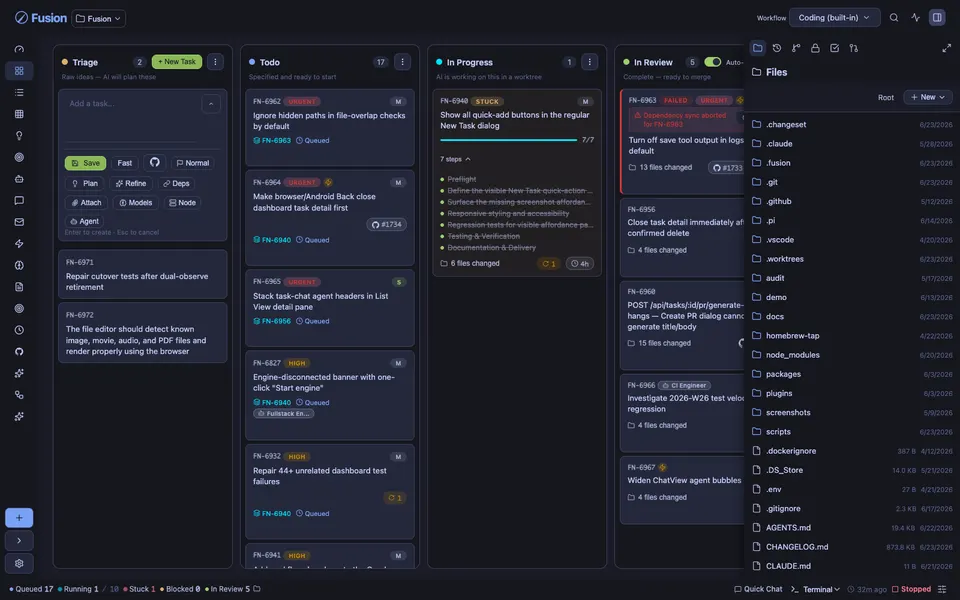
- Desktop app
- Windows
- Browser
- Yes
- Phone
- Android and phone browser
- Command line
- Yes
- Agents
- Claude Code, Cursor Agent, Gemini CLI and Grok
- Your subscription
- Works with your own plan
- Agents run
- On your computer and on your own server
- Laptop closed
- Keeps going
- Isolation
- Worktree and Container
- Parallel agents
- Yes
- Scheduled runs
- Yes
- Coordinator agent
- Yes
- Built-in issues
- Yes
- Pull requests
- Yes
- Review screen
- Yes
- Team
- Not listed
- Self-hosting
- Yes
- Licence
- MIT
- Price from
- Free
- How it charges
- No paid plan and bring your own key
- Paid plans from
- No paid plan
Receipts
- Checked
- · oldest answer 2026-11-08
- Findings
- 44 published · 38 cross-checked by a second agent · read them all
- Sources
- 17 public pages on 2 sites: github.com, runfusion.ai
- Screenshot
- github.com, retrieved · first party repository · shows appearance, not capability
- Data
- /products/fusion.json · .md
- Method
- Same rules for all 103 researched ADEs. How we check · Report wrong data
What it does
Where you use it
Web dashboard (installable PWA), CLI, a released Windows x64 Electron desktop app and an Android APK. macOS and Linux desktop and iOS shells are documented in source but not attached to the v0.77.0 release.
Source and scope for Where you use itAgents it runs
Fusion has explicit installable Cursor Agent and Grok CLI runtime plugins, plus an experimental generic ACP runtime whose documentation names Gemini CLI. Provider OAuth labeled Codex or Gemini is not itself coding-harness support.
Source and scope for Agents it runsAccounts and subscriptions
Subscription OAuth, API-key and local-model paths are separately documented.
Source and scope for Accounts and subscriptionsWhere agents run
Fusion runs its engine/dashboard on user-controlled local or remote hosts. The scoped implementation has no vendor-operated execution service.
Source and scope for Where agents runHow work is kept apart
Tasks use Git worktrees with optional native, bubblewrap, macOS Seatbelt, Docker/Podman or custom execution backends. Docker and Podman supply explicit container isolation options; there is no documented built-in VM backend.
Source and scope for How work is kept apartParallel work
Independent tasks execute concurrently with configurable project/system limits.
Source and scope for Parallel workScheduled runs
Daemon schedules and webhook routines start work unattended.
Source and scope for Scheduled runsGit and pull requests
Integrated Git worktrees, PR creation and GitHub issue import are documented.
Source and scope for Git and pull requestsLicence and source
Fusion repository is MIT licensed; external provider terms remain separate.
Source and scope for Licence and sourcePrice
Fusion is free MIT open source with no paid plan found; model usage is billed by whichever provider (or local runtime) the user connects.
Source and scope for PriceTyped filters
Every value links to its receipt below. Read plan and surface restrictions before using a filter to decide.
| Filter | Value |
|---|---|
| Desktop OS: macOS | No |
| Desktop OS: Windows | Yes cross-checked |
| Desktop OS: Linux | No |
| Web client | Yes cross-checked |
| Phone access: Native iOS | No |
| Phone access: Native Android | Yes cross-checked |
| Phone access: Phone browser | Yes cross-checked |
| CLI | Yes cross-checked |
| Coding agents: Claude Code | Yes |
| Coding agents: Codex | Unknown |
| Coding agents: Cursor Agent | Yes |
| Coding agents: Gemini CLI | Yes |
| Coding agents: OpenCode | Unknown |
| Coding agents: Pi | Unknown |
| Coding agents: Grok | Yes |
| Coding agents: Aider | Unknown |
| Coding agents: Antigravity | Unknown |
| Use my subscription | Yes cross-checked |
| Where agents run: On your computer | Yes |
| Where agents run: On your own server | Yes |
| Where agents run: In the vendor's cloud | No |
| Workspace isolation: Git worktree | Yes |
| Workspace isolation: Container | Yes |
| Workspace isolation: VM or microVM | Unknown |
| Parallel runs | Yes cross-checked |
| Coordinator | Yes cross-checked |
| Native issue tracking | Yes cross-checked |
| Unattended triggers | Yes cross-checked |
| Shared prompting | Unknown |
| Team roles | No |
| SSO | No |
| Pull request workflow | Yes cross-checked |
| Review interface | Yes cross-checked |
| Product license: Apache-2.0 | No. MIT cross-checked |
| Product license: MIT | Yes. MIT cross-checked |
| Product license: GPL-3.0 | No. MIT cross-checked |
| Product license: GPL-3.0-or-later | No. MIT cross-checked |
| Product license: AGPL-3.0 | No. MIT cross-checked |
| Product license: AGPL-3.0-or-later | No. MIT cross-checked |
| Product license: Elastic License 2.0 | No. MIT cross-checked |
| Product license: Custom terms | No. MIT cross-checked |
| Product license: Proprietary | No. MIT cross-checked |
| Self-hosting | Yes cross-checked |
| Telemetry opt-out | No |
| Free access | Yes cross-checked |
| Starting price: Free | Yes. Free cross-checked |
| Starting price: Up to $20/month | No. Free cross-checked |
| Starting price: $21–40/month | No. Free cross-checked |
| Starting price: $41–100/month | No. Free cross-checked |
| Starting price: Over $100/month | No. Free cross-checked |
| Starting price: Contact for pricing | No. Free cross-checked |
| Pricing model: Free, no paid plan | Yes cross-checked |
| Pricing model: Free plan | No |
| Pricing model: Subscription | No |
| Pricing model: Per seat | No |
| Pricing model: Usage-based | No |
| Pricing model: Per machine or compute | No |
| Pricing model: Bring your own key | Yes cross-checked |
| Pricing model: One-time purchase | No |
| Paid plans from: No paid plan | Yes. No paid plan |
| Paid plans from: $10 or less/month | No. No paid plan |
| Paid plans from: $11–20/month | No. No paid plan |
| Paid plans from: $21–40/month | No. No paid plan |
| Paid plans from: $41–100/month | No. No paid plan |
| Paid plans from: Over $100/month | No. No paid plan |
| Paid plans from: Contact sales | No. No paid plan |
| Lifecycle status: Active | Unknown |
| Lifecycle status: Sunsetting | Unknown |
| Keeps going with laptop closed | Yes |
| Open-source license | Yes. MIT cross-checked |
| Any desktop app | Yes cross-checked |
| Paid plan up to $20/month | No. No paid plan |
| Paid plan up to $40/month | No. No paid plan |
| Any phone client | Yes cross-checked |
Filter receipts
Desktop OS: macOS: No
Desktop OS: macOS
Typed value: No.
Web dashboard (installable PWA), CLI, a released Windows x64 Electron desktop app and an Android APK. macOS and Linux desktop and iOS shells are documented in source but not attached to the v0.77.0 release.
- Desktop os: Release v0.77.0 ships a Windows x64 Electron desktop app; the README also describes macOS and Linux desktop builds, but none are attached to the release.
- Mobile apps: Release v0.77.0 ships an Android APK; the Capacitor iOS shell is source-only.
- Browser: Web dashboard served by fn dashboard.
- Cli: fn/fusion commands.
- Task actions: Task detail allows nudging, pause and re-prompt.
- Release scope from the v0.77.0 asset list; installers were not run. Unknown atomic questions remain open.
-
Finding: Early-preview self-hosted coding factory with planning/review workflows, persistent tasks, worktree execution, agent mail, desktop/web/mobile clients and daemon-owned schedules/webhooks.
-
Finding: The latest stable release attaches Windows x64 desktop installers, an Android APK and fn CLI binaries for Linux and Windows; it attaches no macOS or Linux desktop build and no iOS build.
Desktop OS: Windows: Yes cross-checked
Desktop OS: Windows
Typed value: Yes.
Web dashboard (installable PWA), CLI, a released Windows x64 Electron desktop app and an Android APK. macOS and Linux desktop and iOS shells are documented in source but not attached to the v0.77.0 release.
- Desktop os: Release v0.77.0 ships a Windows x64 Electron desktop app; the README also describes macOS and Linux desktop builds, but none are attached to the release.
- Mobile apps: Release v0.77.0 ships an Android APK; the Capacitor iOS shell is source-only.
- Browser: Web dashboard served by fn dashboard.
- Cli: fn/fusion commands.
- Task actions: Task detail allows nudging, pause and re-prompt.
- Release scope from the v0.77.0 asset list; installers were not run. Unknown atomic questions remain open.
-
Finding: Early-preview self-hosted coding factory with planning/review workflows, persistent tasks, worktree execution, agent mail, desktop/web/mobile clients and daemon-owned schedules/webhooks.
-
Finding: The latest stable release attaches Windows x64 desktop installers, an Android APK and fn CLI binaries for Linux and Windows; it attaches no macOS or Linux desktop build and no iOS build.
Desktop OS: Linux: No
Desktop OS: Linux
Typed value: No.
Web dashboard (installable PWA), CLI, a released Windows x64 Electron desktop app and an Android APK. macOS and Linux desktop and iOS shells are documented in source but not attached to the v0.77.0 release.
- Desktop os: Release v0.77.0 ships a Windows x64 Electron desktop app; the README also describes macOS and Linux desktop builds, but none are attached to the release.
- Mobile apps: Release v0.77.0 ships an Android APK; the Capacitor iOS shell is source-only.
- Browser: Web dashboard served by fn dashboard.
- Cli: fn/fusion commands.
- Task actions: Task detail allows nudging, pause and re-prompt.
- Release scope from the v0.77.0 asset list; installers were not run. Unknown atomic questions remain open.
-
Finding: Early-preview self-hosted coding factory with planning/review workflows, persistent tasks, worktree execution, agent mail, desktop/web/mobile clients and daemon-owned schedules/webhooks.
-
Finding: The latest stable release attaches Windows x64 desktop installers, an Android APK and fn CLI binaries for Linux and Windows; it attaches no macOS or Linux desktop build and no iOS build.
Web client: Yes cross-checked
Web client
Typed value: Yes.
Web dashboard (installable PWA), CLI, a released Windows x64 Electron desktop app and an Android APK. macOS and Linux desktop and iOS shells are documented in source but not attached to the v0.77.0 release.
- Desktop os: Release v0.77.0 ships a Windows x64 Electron desktop app; the README also describes macOS and Linux desktop builds, but none are attached to the release.
- Mobile apps: Release v0.77.0 ships an Android APK; the Capacitor iOS shell is source-only.
- Browser: Web dashboard served by fn dashboard.
- Cli: fn/fusion commands.
- Task actions: Task detail allows nudging, pause and re-prompt.
- Release scope from the v0.77.0 asset list; installers were not run. Unknown atomic questions remain open.
-
Finding: Early-preview self-hosted coding factory with planning/review workflows, persistent tasks, worktree execution, agent mail, desktop/web/mobile clients and daemon-owned schedules/webhooks.
Phone access: Native iOS: No
Phone access: Native iOS
Typed value: No.
Web dashboard (installable PWA), CLI, a released Windows x64 Electron desktop app and an Android APK. macOS and Linux desktop and iOS shells are documented in source but not attached to the v0.77.0 release.
- Desktop os: Release v0.77.0 ships a Windows x64 Electron desktop app; the README also describes macOS and Linux desktop builds, but none are attached to the release.
- Mobile apps: Release v0.77.0 ships an Android APK; the Capacitor iOS shell is source-only.
- Browser: Web dashboard served by fn dashboard.
- Cli: fn/fusion commands.
- Task actions: Task detail allows nudging, pause and re-prompt.
- Release scope from the v0.77.0 asset list; installers were not run. Unknown atomic questions remain open.
-
Finding: Early-preview self-hosted coding factory with planning/review workflows, persistent tasks, worktree execution, agent mail, desktop/web/mobile clients and daemon-owned schedules/webhooks.
-
Finding: The latest stable release attaches Windows x64 desktop installers, an Android APK and fn CLI binaries for Linux and Windows; it attaches no macOS or Linux desktop build and no iOS build.
Phone access: Native Android: Yes cross-checked
Phone access: Native Android
Typed value: Yes.
Web dashboard (installable PWA), CLI, a released Windows x64 Electron desktop app and an Android APK. macOS and Linux desktop and iOS shells are documented in source but not attached to the v0.77.0 release.
- Desktop os: Release v0.77.0 ships a Windows x64 Electron desktop app; the README also describes macOS and Linux desktop builds, but none are attached to the release.
- Mobile apps: Release v0.77.0 ships an Android APK; the Capacitor iOS shell is source-only.
- Browser: Web dashboard served by fn dashboard.
- Cli: fn/fusion commands.
- Task actions: Task detail allows nudging, pause and re-prompt.
- Release scope from the v0.77.0 asset list; installers were not run. Unknown atomic questions remain open.
-
Finding: Early-preview self-hosted coding factory with planning/review workflows, persistent tasks, worktree execution, agent mail, desktop/web/mobile clients and daemon-owned schedules/webhooks.
-
Finding: The latest stable release attaches Windows x64 desktop installers, an Android APK and fn CLI binaries for Linux and Windows; it attaches no macOS or Linux desktop build and no iOS build.
Phone access: Phone browser: Yes cross-checked
Phone access: Phone browser
Typed value: Yes.
Web dashboard (installable PWA), CLI, a released Windows x64 Electron desktop app and an Android APK. macOS and Linux desktop and iOS shells are documented in source but not attached to the v0.77.0 release.
- Mobile browser: The dashboard is an installable PWA from Chrome or iOS Safari over HTTPS, documented for phone use; phone layout not tested.
- Release scope from the v0.77.0 asset list; installers were not run. Unknown atomic questions remain open.
-
Fusion MOBILE.md: PWA installation
Finding: The dashboard ships a PWA manifest and service worker; users install it from Chrome (Install app) or iOS Safari (Add to Home Screen) over HTTPS. The README presents the installable PWA beside the Capacitor iOS and Android apps for steering runs from a phone.
CLI: Yes cross-checked
CLI
Typed value: Yes.
Product CLI and HTTP APIs create/manage tasks, agents and routines.
- Cli: fn task create, fn dashboard and other CLI commands.
- Api: Task, automation and routine endpoints.
- Webhooks: Routine webhook endpoint with signature verification support.
- Authentication: Bearer token persisted on host; browser stores token locally.
- Documentation establishes only the named facts. Unknown atomic questions and unrun scenarios remain open.
-
Finding: Early-preview self-hosted coding factory with planning/review workflows, persistent tasks, worktree execution, agent mail, desktop/web/mobile clients and daemon-owned schedules/webhooks.
Coding agents: Claude Code: Yes
Coding agents: Claude Code
Typed value: Yes.
Fusion has explicit installable Cursor Agent and Grok CLI runtime plugins, plus an experimental generic ACP runtime whose documentation names Gemini CLI. Provider OAuth labeled Codex or Gemini is not itself coding-harness support.
- Model providers: Anthropic, OpenAI, Ollama, Google, Z.ai, Kimi and custom compatible APIs.
- Session integration: Independent planner, executor, validator and merger lanes.
- Only the cited atomic facts are established. No configured product, account, billing or multi-user scenario was run; remaining atomic answers stay unknown.
- Antigravity harness support remains unknown; the hidden model-provider entry is not evidence of a runnable CLI integration or a harness-wide prohibition.
-
Fusion docs/settings-reference.md
Finding: Anthropic subscription OAuth and API-key auth are separate; explicit pi-claude-cli runs local Claude. Scheduling has per-project/system/workflow concurrency, worktree caps, verification cap and retry/timeouts. Usage costs are provider-qualified estimates, not bills.
Coding agents: Cursor Agent: Yes
Coding agents: Cursor Agent
Typed value: Yes.
Fusion has explicit installable Cursor Agent and Grok CLI runtime plugins, plus an experimental generic ACP runtime whose documentation names Gemini CLI. Provider OAuth labeled Codex or Gemini is not itself coding-harness support.
- Harnesses: Named runtime plugins include Cursor Agent and Grok CLI; the experimental ACP runtime explicitly documents Gemini CLI. Existing Claude/Pi/Droid routes retain their own scope.
- Custom adapters: Installable generic ACP runtime accepts a configured agent binary/arguments; installed on demand and experimental.
- Only the cited atomic facts are established. No configured product, account, billing or multi-user scenario was run; remaining atomic answers stay unknown.
- Antigravity harness support remains unknown; the hidden model-provider entry is not evidence of a runnable CLI integration or a harness-wide prohibition.
-
Fusion: plugins/fusion-plugin-cursor-runtime/src/runtime-adapter.ts
Finding: Installable runtime plugins launch Cursor Agent with stream-json output and Grok CLI through its ACP server. The generic ACP runtime README explicitly names Gemini CLI (gemini --acp), supports user-configured ACP binaries and is installed on demand as experimental. These coding runtimes are distinct from OpenAI/Codex or Google model-provider authentication.
Coding agents: Gemini CLI: Yes
Coding agents: Gemini CLI
Typed value: Yes.
Fusion has explicit installable Cursor Agent and Grok CLI runtime plugins, plus an experimental generic ACP runtime whose documentation names Gemini CLI. Provider OAuth labeled Codex or Gemini is not itself coding-harness support.
- Harnesses: Named runtime plugins include Cursor Agent and Grok CLI; the experimental ACP runtime explicitly documents Gemini CLI. Existing Claude/Pi/Droid routes retain their own scope.
- Custom adapters: Installable generic ACP runtime accepts a configured agent binary/arguments; installed on demand and experimental.
- Only the cited atomic facts are established. No configured product, account, billing or multi-user scenario was run; remaining atomic answers stay unknown.
- Antigravity harness support remains unknown; the hidden model-provider entry is not evidence of a runnable CLI integration or a harness-wide prohibition.
-
Fusion: plugins/fusion-plugin-cursor-runtime/src/runtime-adapter.ts
Finding: Installable runtime plugins launch Cursor Agent with stream-json output and Grok CLI through its ACP server. The generic ACP runtime README explicitly names Gemini CLI (gemini --acp), supports user-configured ACP binaries and is installed on demand as experimental. These coding runtimes are distinct from OpenAI/Codex or Google model-provider authentication.
Coding agents: Grok: Yes
Coding agents: Grok
Typed value: Yes.
Fusion has explicit installable Cursor Agent and Grok CLI runtime plugins, plus an experimental generic ACP runtime whose documentation names Gemini CLI. Provider OAuth labeled Codex or Gemini is not itself coding-harness support.
- Harnesses: Named runtime plugins include Cursor Agent and Grok CLI; the experimental ACP runtime explicitly documents Gemini CLI. Existing Claude/Pi/Droid routes retain their own scope.
- Custom adapters: Installable generic ACP runtime accepts a configured agent binary/arguments; installed on demand and experimental.
- Only the cited atomic facts are established. No configured product, account, billing or multi-user scenario was run; remaining atomic answers stay unknown.
- Antigravity harness support remains unknown; the hidden model-provider entry is not evidence of a runnable CLI integration or a harness-wide prohibition.
-
Fusion: plugins/fusion-plugin-cursor-runtime/src/runtime-adapter.ts
Finding: Installable runtime plugins launch Cursor Agent with stream-json output and Grok CLI through its ACP server. The generic ACP runtime README explicitly names Gemini CLI (gemini --acp), supports user-configured ACP binaries and is installed on demand as experimental. These coding runtimes are distinct from OpenAI/Codex or Google model-provider authentication.
Use my subscription: Yes cross-checked
Use my subscription
Typed value: Yes.
Subscription OAuth, API-key and local-model paths are separately documented.
- Agent subscriptions: Anthropic subscription OAuth works without raw API key; Codex OAuth login is also documented.
- Api accounts: Provider keys and custom endpoints.
- Local models: Ollama and llama.cpp HTTP server.
- Vendor account requirement: No Fusion-hosted account required for core self-hosted app.
- Documentation establishes only the named facts. Unknown atomic questions and unrun scenarios remain open.
-
Fusion docs/settings-reference.md
Finding: Anthropic subscription OAuth and API-key auth are separate; explicit pi-claude-cli runs local Claude. Scheduling has per-project/system/workflow concurrency, worktree caps, verification cap and retry/timeouts. Usage costs are provider-qualified estimates, not bills.
Where agents run: On your computer: Yes
Where agents run: On your computer
Typed value: Yes.
Fusion runs its engine/dashboard on user-controlled local or remote hosts. The scoped implementation has no vendor-operated execution service.
- Local: Local daemon starts engine and dashboard.
- Byo remote: Linux server or cloud VM can host the daemon.
- Self hosted: Run on own hardware.
- Other device continuation: Connect other devices to running daemon; mobile shell is remote-first.
- Only the cited atomic facts are established. No configured product, account, billing or multi-user scenario was run; remaining atomic answers stay unknown.
-
Finding: Early-preview self-hosted coding factory with planning/review workflows, persistent tasks, worktree execution, agent mail, desktop/web/mobile clients and daemon-owned schedules/webhooks.
Where agents run: On your own server: Yes
Where agents run: On your own server
Typed value: Yes.
Fusion runs its engine/dashboard on user-controlled local or remote hosts. The scoped implementation has no vendor-operated execution service.
- Local: Local daemon starts engine and dashboard.
- Byo remote: Linux server or cloud VM can host the daemon.
- Self hosted: Run on own hardware.
- Other device continuation: Connect other devices to running daemon; mobile shell is remote-first.
- Only the cited atomic facts are established. No configured product, account, billing or multi-user scenario was run; remaining atomic answers stay unknown.
-
Finding: Early-preview self-hosted coding factory with planning/review workflows, persistent tasks, worktree execution, agent mail, desktop/web/mobile clients and daemon-owned schedules/webhooks.
Where agents run: In the vendor's cloud: No
Where agents run: In the vendor's cloud
Typed value: No.
Fusion runs its engine/dashboard on user-controlled local or remote hosts. The scoped implementation has no vendor-operated execution service.
- Managed cloud: No vendor-managed runtime provisioner in the scoped daemon/runtime implementation.
- Only the cited atomic facts are established. No configured product, account, billing or multi-user scenario was run; remaining atomic answers stay unknown.
-
Fusion: packages/dashboard/src/auth-middleware.ts
Finding: Dashboard API uses an operator daemon bearer token, with local unauthenticated mode available. Agent room owner/member roles are not human permissions; there is no named human team-role/SSO service. Multiple authorized browser clients can send messages to the same persisted room through the product endpoint; those requests share one operator identity. Runtime supports native, bubblewrap, Seatbelt, Docker/Podman and custom sandbox backends. No vendor-operated runtime or native VM provisioner is implemented. App settings expose no product telemetry-disable control.
Workspace isolation: Git worktree: Yes
Workspace isolation: Git worktree
Typed value: Yes.
Tasks use Git worktrees with optional native, bubblewrap, macOS Seatbelt, Docker/Podman or custom execution backends. Docker and Podman supply explicit container isolation options; there is no documented built-in VM backend.
- Worktree: Each task has fusion/<task-id> branch/worktree.
- Os sandbox: Opt-in Linux bubblewrap or macOS sandbox-exec.
- Network: Optional sandbox policy controls network.
- Security boundary: Worktrees are code separation; sandbox behavior was not attacked/tested here.
- Only the cited atomic facts are established. No configured product, account, billing or multi-user scenario was run; remaining atomic answers stay unknown.
-
Finding: Early-preview self-hosted coding factory with planning/review workflows, persistent tasks, worktree execution, agent mail, desktop/web/mobile clients and daemon-owned schedules/webhooks.
Workspace isolation: Container: Yes
Workspace isolation: Container
Typed value: Yes.
Tasks use Git worktrees with optional native, bubblewrap, macOS Seatbelt, Docker/Podman or custom execution backends. Docker and Podman supply explicit container isolation options; there is no documented built-in VM backend.
- Container: Experimental Docker/Podman backends execute task commands in containers on Linux/macOS hosts with those runtimes installed.
- Only the cited atomic facts are established. No configured product, account, billing or multi-user scenario was run; remaining atomic answers stay unknown.
-
Fusion container sandbox backend
Finding: Sandbox backend settings include docker and podman. ContainerSandboxBackend executes task commands with the selected container runtime, binds the task cwd/worktree and applies network/resource configuration. Native/Seatbelt/bubblewrap and a custom backend are separate choices.
Parallel runs: Yes cross-checked
Parallel runs
Typed value: Yes.
Independent tasks execute concurrently with configurable project/system limits.
- Concurrent tasks: Independent tasks run in parallel.
- Quotas: maxConcurrent default 2/project; globalMaxConcurrent 4; effective worktree cap may be lower.
- Status visibility: Board and Command Center show working/queued/stuck/review states.
- Documentation establishes only the named facts. Unknown atomic questions and unrun scenarios remain open.
-
Fusion docs/settings-reference.md
Finding: Anthropic subscription OAuth and API-key auth are separate; explicit pi-claude-cli runs local Claude. Scheduling has per-project/system/workflow concurrency, worktree caps, verification cap and retry/timeouts. Usage costs are provider-qualified estimates, not bills.
Coordinator: Yes cross-checked
Coordinator
Typed value: Yes.
Fusion owns orchestration, task delegation and agent mail.
- Roles: Planner, Executor, Reviewer, Merger and custom durable roles.
- Model harness effort: Per-lane/task provider, model and thinking controls.
- Messages: Built-in agent mail and experimental rooms.
- Results return: Reviews/results attach to task workflow.
- Orchestration owner: Fusion daemon, tools and agent store.
- Live progress: Live task chat narrates step progress/failures.
- Documentation establishes only the named facts. Unknown atomic questions and unrun scenarios remain open.
-
Finding: Durable agents have roles, identity/memory and scoped tools for creating/delegating/assigning tasks, agent messaging and runtime coordination. Engineering backlog auto-claim is opt-in; executor pickup is default.
Native issue tracking: Yes cross-checked
Native issue tracking
Typed value: Yes.
Product-owned tasks have durable state, metadata and board/list/graph views.
- Create: Dashboard, CLI and agent task tools.
- Edit: Task metadata and workflow editing.
- Search: Dashboard task navigation and list views.
- Project epic views: Project/task boards and mission hierarchy.
- Task session separation: Persistent tasks can route to durable agent sessions.
- Durable states: Planning, Todo, In Progress, In Review and Done.
- Documentation establishes only the named facts. Unknown atomic questions and unrun scenarios remain open.
-
Fusion docs/task-management.md
Finding: Persistent tasks have IDs, metadata, status and configurable workflows. Task create has similarity/exact duplicate guards with explicit bypasses and fail-open limitations. CLI and agent tools share deterministic duplicate handling.
Unattended triggers: Yes cross-checked
Unattended triggers
Typed value: Yes.
Daemon schedules and webhook routines start work unattended.
- Schedules: Cron schedules for routines and automation steps.
- Events: Routine webhook endpoint.
- Recurring tasks: Global/project scoped routines.
- Completion conditions: Run history and scope isolation are documented.
- Scheduler location: Engine independently polls global/project lanes.
- Documentation establishes only the named facts. Unknown atomic questions and unrun scenarios remain open.
-
Finding: Early-preview self-hosted coding factory with planning/review workflows, persistent tasks, worktree execution, agent mail, desktop/web/mobile clients and daemon-owned schedules/webhooks.
Team roles: No
Team roles
Typed value: No.
Fusion dashboard access uses an operator bearer token, rather than named human workspace roles or enterprise SSO. Room owner/member roles belong to agents.
- Organization roles: No named human workspace permission roles in the scoped auth/model/routes.
- Sso: No enterprise SSO in the scoped dashboard authentication implementation.
- Source review and pinned implementation inspection only; no installed-product, account or multi-user scenario was executed. Unanswered atomic questions remain open.
-
Fusion: packages/dashboard/src/auth-middleware.ts
Finding: Dashboard API uses an operator daemon bearer token, with local unauthenticated mode available. Agent room owner/member roles are not human permissions; there is no named human team-role/SSO service. Multiple authorized browser clients can send messages to the same persisted room through the product endpoint; those requests share one operator identity. Runtime supports native, bubblewrap, Seatbelt, Docker/Podman and custom sandbox backends. No vendor-operated runtime or native VM provisioner is implemented. App settings expose no product telemetry-disable control.
SSO: No
SSO
Typed value: No.
Fusion dashboard access uses an operator bearer token, rather than named human workspace roles or enterprise SSO. Room owner/member roles belong to agents.
- Organization roles: No named human workspace permission roles in the scoped auth/model/routes.
- Sso: No enterprise SSO in the scoped dashboard authentication implementation.
- Source review and pinned implementation inspection only; no installed-product, account or multi-user scenario was executed. Unanswered atomic questions remain open.
-
Fusion: packages/dashboard/src/auth-middleware.ts
Finding: Dashboard API uses an operator daemon bearer token, with local unauthenticated mode available. Agent room owner/member roles are not human permissions; there is no named human team-role/SSO service. Multiple authorized browser clients can send messages to the same persisted room through the product endpoint; those requests share one operator identity. Runtime supports native, bubblewrap, Seatbelt, Docker/Podman and custom sandbox backends. No vendor-operated runtime or native VM provisioner is implemented. App settings expose no product telemetry-disable control.
Pull request workflow: Yes cross-checked
Pull request workflow
Typed value: Yes.
Integrated Git worktrees, PR creation and GitHub issue import are documented.
- Branches: fusion/<task-id>.
- Worktrees: Per-task branch/worktree.
- Pull requests: Create PRs and display PR/issue badges.
- Ci response: PR lifecycle graph fragments where enabled.
- Product state: Workflow and board track review and merge.
- Documentation establishes only the named facts. Unknown atomic questions and unrun scenarios remain open.
-
Finding: Early-preview self-hosted coding factory with planning/review workflows, persistent tasks, worktree execution, agent mail, desktop/web/mobile clients and daemon-owned schedules/webhooks.
Review interface: Yes cross-checked
Review interface
Typed value: Yes.
Task detail combines plan, reviews, diffs and live file changes.
- Pending reviews: In Review board column.
- Change understanding: Task plan, review findings and diffs.
- Evidence navigation: Task-specific retained outputs.
- Request changes: Nudge/re-prompt within task.
- Documentation establishes only the named facts. Unknown atomic questions and unrun scenarios remain open.
-
Finding: Early-preview self-hosted coding factory with planning/review workflows, persistent tasks, worktree execution, agent mail, desktop/web/mobile clients and daemon-owned schedules/webhooks.
Product license: Apache-2.0: No. MIT cross-checked
Product license: Apache-2.0
Typed value: No. MIT.
Fusion repository is MIT licensed; external provider terms remain separate.
- Client license: MIT.
- Server license: MIT repository code.
- Source visibility: Public repository.
- Source revision: eb7eef49d5a0fe3e84e99be30e8ed9622a694e35
- Documentation establishes only the named facts. Unknown atomic questions and unrun scenarios remain open.
-
Finding: MIT source license at the pinned revision.
Product license: MIT: Yes. MIT cross-checked
Product license: MIT
Typed value: Yes. MIT.
Fusion repository is MIT licensed; external provider terms remain separate.
- Client license: MIT.
- Server license: MIT repository code.
- Source visibility: Public repository.
- Source revision: eb7eef49d5a0fe3e84e99be30e8ed9622a694e35
- Documentation establishes only the named facts. Unknown atomic questions and unrun scenarios remain open.
-
Finding: MIT source license at the pinned revision.
Product license: GPL-3.0: No. MIT cross-checked
Product license: GPL-3.0
Typed value: No. MIT.
Fusion repository is MIT licensed; external provider terms remain separate.
- Client license: MIT.
- Server license: MIT repository code.
- Source visibility: Public repository.
- Source revision: eb7eef49d5a0fe3e84e99be30e8ed9622a694e35
- Documentation establishes only the named facts. Unknown atomic questions and unrun scenarios remain open.
-
Finding: MIT source license at the pinned revision.
Product license: GPL-3.0-or-later: No. MIT cross-checked
Product license: GPL-3.0-or-later
Typed value: No. MIT.
Fusion repository is MIT licensed; external provider terms remain separate.
- Client license: MIT.
- Server license: MIT repository code.
- Source visibility: Public repository.
- Source revision: eb7eef49d5a0fe3e84e99be30e8ed9622a694e35
- Documentation establishes only the named facts. Unknown atomic questions and unrun scenarios remain open.
-
Finding: MIT source license at the pinned revision.
Product license: AGPL-3.0: No. MIT cross-checked
Product license: AGPL-3.0
Typed value: No. MIT.
Fusion repository is MIT licensed; external provider terms remain separate.
- Client license: MIT.
- Server license: MIT repository code.
- Source visibility: Public repository.
- Source revision: eb7eef49d5a0fe3e84e99be30e8ed9622a694e35
- Documentation establishes only the named facts. Unknown atomic questions and unrun scenarios remain open.
-
Finding: MIT source license at the pinned revision.
Product license: AGPL-3.0-or-later: No. MIT cross-checked
Product license: AGPL-3.0-or-later
Typed value: No. MIT.
Fusion repository is MIT licensed; external provider terms remain separate.
- Client license: MIT.
- Server license: MIT repository code.
- Source visibility: Public repository.
- Source revision: eb7eef49d5a0fe3e84e99be30e8ed9622a694e35
- Documentation establishes only the named facts. Unknown atomic questions and unrun scenarios remain open.
-
Finding: MIT source license at the pinned revision.
Product license: Elastic License 2.0: No. MIT cross-checked
Product license: Elastic License 2.0
Typed value: No. MIT.
Fusion repository is MIT licensed; external provider terms remain separate.
- Client license: MIT.
- Server license: MIT repository code.
- Source visibility: Public repository.
- Source revision: eb7eef49d5a0fe3e84e99be30e8ed9622a694e35
- Documentation establishes only the named facts. Unknown atomic questions and unrun scenarios remain open.
-
Finding: MIT source license at the pinned revision.
Product license: Custom terms: No. MIT cross-checked
Product license: Custom terms
Typed value: No. MIT.
Fusion repository is MIT licensed; external provider terms remain separate.
- Client license: MIT.
- Server license: MIT repository code.
- Source visibility: Public repository.
- Source revision: eb7eef49d5a0fe3e84e99be30e8ed9622a694e35
- Documentation establishes only the named facts. Unknown atomic questions and unrun scenarios remain open.
-
Finding: MIT source license at the pinned revision.
Product license: Proprietary: No. MIT cross-checked
Product license: Proprietary
Typed value: No. MIT.
Fusion repository is MIT licensed; external provider terms remain separate.
- Client license: MIT.
- Server license: MIT repository code.
- Source visibility: Public repository.
- Source revision: eb7eef49d5a0fe3e84e99be30e8ed9622a694e35
- Documentation establishes only the named facts. Unknown atomic questions and unrun scenarios remain open.
-
Finding: MIT source license at the pinned revision.
Self-hosting: Yes cross-checked
Self-hosting
Typed value: Yes.
Core daemon, dashboard and clients are self-hostable.
- Self hosting: Own hardware/node deployment.
- Vendor dependencies: Provider accounts/keys are required separately; optional external integrations.
- Formats: PROMPT.md, Git branches and PostgreSQL runtime metadata.
- Documentation establishes only the named facts. Unknown atomic questions and unrun scenarios remain open.
-
Finding: Early-preview self-hosted coding factory with planning/review workflows, persistent tasks, worktree execution, agent mail, desktop/web/mobile clients and daemon-owned schedules/webhooks.
Telemetry opt-out: No
Telemetry opt-out
Typed value: No.
Fusion retains task/activity/audit records locally and uses configured model/runtime providers. The inspected application settings do not supply a product telemetry-disable control; provider telemetry remains separate.
- Telemetry controls: No documented app telemetry-disable preference in the scoped settings/auth/runtime implementation.
- Source review and pinned implementation inspection only; no installed-product, account or multi-user scenario was executed. Unanswered atomic questions remain open.
-
Fusion: packages/dashboard/src/auth-middleware.ts
Finding: Dashboard API uses an operator daemon bearer token, with local unauthenticated mode available. Agent room owner/member roles are not human permissions; there is no named human team-role/SSO service. Multiple authorized browser clients can send messages to the same persisted room through the product endpoint; those requests share one operator identity. Runtime supports native, bubblewrap, Seatbelt, Docker/Podman and custom sandbox backends. No vendor-operated runtime or native VM provisioner is implemented. App settings expose no product telemetry-disable control.
Free access: Yes cross-checked
Free access
Typed value: Yes.
Open-source local install offers evaluation with own providers and compute.
- Ongoing free: MIT core source and npm/source installation; no mandatory Fusion account documented.
- Self host cost: User hardware and model usage.
- Documentation establishes only the named facts. Unknown atomic questions and unrun scenarios remain open.
-
Finding: Early-preview self-hosted coding factory with planning/review workflows, persistent tasks, worktree execution, agent mail, desktop/web/mobile clients and daemon-owned schedules/webhooks.
Starting price: Free: Yes. Free cross-checked
Starting price: Free
Typed value: Yes. Free.
Open-source local install offers evaluation with own providers and compute.
- Ongoing free: MIT core source and npm/source installation; no mandatory Fusion account documented.
- Self host cost: User hardware and model usage.
- Documentation establishes only the named facts. Unknown atomic questions and unrun scenarios remain open.
-
Finding: Early-preview self-hosted coding factory with planning/review workflows, persistent tasks, worktree execution, agent mail, desktop/web/mobile clients and daemon-owned schedules/webhooks.
Starting price: Up to $20/month: No. Free cross-checked
Starting price: Up to $20/month
Typed value: No. Free.
Open-source local install offers evaluation with own providers and compute.
- Ongoing free: MIT core source and npm/source installation; no mandatory Fusion account documented.
- Self host cost: User hardware and model usage.
- Documentation establishes only the named facts. Unknown atomic questions and unrun scenarios remain open.
-
Finding: Early-preview self-hosted coding factory with planning/review workflows, persistent tasks, worktree execution, agent mail, desktop/web/mobile clients and daemon-owned schedules/webhooks.
Starting price: $21–40/month: No. Free cross-checked
Starting price: $21–40/month
Typed value: No. Free.
Open-source local install offers evaluation with own providers and compute.
- Ongoing free: MIT core source and npm/source installation; no mandatory Fusion account documented.
- Self host cost: User hardware and model usage.
- Documentation establishes only the named facts. Unknown atomic questions and unrun scenarios remain open.
-
Finding: Early-preview self-hosted coding factory with planning/review workflows, persistent tasks, worktree execution, agent mail, desktop/web/mobile clients and daemon-owned schedules/webhooks.
Starting price: $41–100/month: No. Free cross-checked
Starting price: $41–100/month
Typed value: No. Free.
Open-source local install offers evaluation with own providers and compute.
- Ongoing free: MIT core source and npm/source installation; no mandatory Fusion account documented.
- Self host cost: User hardware and model usage.
- Documentation establishes only the named facts. Unknown atomic questions and unrun scenarios remain open.
-
Finding: Early-preview self-hosted coding factory with planning/review workflows, persistent tasks, worktree execution, agent mail, desktop/web/mobile clients and daemon-owned schedules/webhooks.
Starting price: Over $100/month: No. Free cross-checked
Starting price: Over $100/month
Typed value: No. Free.
Open-source local install offers evaluation with own providers and compute.
- Ongoing free: MIT core source and npm/source installation; no mandatory Fusion account documented.
- Self host cost: User hardware and model usage.
- Documentation establishes only the named facts. Unknown atomic questions and unrun scenarios remain open.
-
Finding: Early-preview self-hosted coding factory with planning/review workflows, persistent tasks, worktree execution, agent mail, desktop/web/mobile clients and daemon-owned schedules/webhooks.
Starting price: Contact for pricing: No. Free cross-checked
Starting price: Contact for pricing
Typed value: No. Free.
Open-source local install offers evaluation with own providers and compute.
- Ongoing free: MIT core source and npm/source installation; no mandatory Fusion account documented.
- Self host cost: User hardware and model usage.
- Documentation establishes only the named facts. Unknown atomic questions and unrun scenarios remain open.
-
Finding: Early-preview self-hosted coding factory with planning/review workflows, persistent tasks, worktree execution, agent mail, desktop/web/mobile clients and daemon-owned schedules/webhooks.
Pricing model: Free, no paid plan: Yes cross-checked
Pricing model: Free, no paid plan
Typed value: Yes.
Fusion is free MIT open source with no paid plan found; model usage is billed by whichever provider (or local runtime) the user connects.
- First-party pricing pages, terms and licences read 2026-11-10; no purchase, billing or authenticated account test.
-
Finding: The site presents Fusion as open source under MIT and shows no pricing.
-
Finding: The MIT license grants permission to use, copy, modify and distribute the software free of charge.
Pricing model: Free plan: No
Pricing model: Free plan
Typed value: No.
Fusion is free MIT open source with no paid plan found; model usage is billed by whichever provider (or local runtime) the user connects.
- Model cost: Users authenticate their own providers (Anthropic, OpenAI, Google, etc.) or local runtimes; those bill model usage.
- First-party pricing pages, terms and licences read 2026-11-10; no purchase, billing or authenticated account test.
-
Finding: Fusion works with many model providers and local runtimes via the user's own API keys or logins; the README calls it MIT open source and states no price.
-
Finding: The MIT license grants permission to use, copy, modify and distribute the software free of charge.
Pricing model: Subscription: No
Pricing model: Subscription
Typed value: No.
Fusion is free MIT open source with no paid plan found; model usage is billed by whichever provider (or local runtime) the user connects.
- Model cost: Users authenticate their own providers (Anthropic, OpenAI, Google, etc.) or local runtimes; those bill model usage.
- First-party pricing pages, terms and licences read 2026-11-10; no purchase, billing or authenticated account test.
-
Finding: Fusion works with many model providers and local runtimes via the user's own API keys or logins; the README calls it MIT open source and states no price.
-
Finding: The MIT license grants permission to use, copy, modify and distribute the software free of charge.
Pricing model: Per seat: No
Pricing model: Per seat
Typed value: No.
Fusion is free MIT open source with no paid plan found; model usage is billed by whichever provider (or local runtime) the user connects.
- Model cost: Users authenticate their own providers (Anthropic, OpenAI, Google, etc.) or local runtimes; those bill model usage.
- First-party pricing pages, terms and licences read 2026-11-10; no purchase, billing or authenticated account test.
-
Finding: Fusion works with many model providers and local runtimes via the user's own API keys or logins; the README calls it MIT open source and states no price.
-
Finding: The MIT license grants permission to use, copy, modify and distribute the software free of charge.
Pricing model: Usage-based: No
Pricing model: Usage-based
Typed value: No.
Fusion is free MIT open source with no paid plan found; model usage is billed by whichever provider (or local runtime) the user connects.
- Model cost: Users authenticate their own providers (Anthropic, OpenAI, Google, etc.) or local runtimes; those bill model usage.
- First-party pricing pages, terms and licences read 2026-11-10; no purchase, billing or authenticated account test.
-
Finding: Fusion works with many model providers and local runtimes via the user's own API keys or logins; the README calls it MIT open source and states no price.
-
Finding: The MIT license grants permission to use, copy, modify and distribute the software free of charge.
Pricing model: Per machine or compute: No
Pricing model: Per machine or compute
Typed value: No.
Fusion is free MIT open source with no paid plan found; model usage is billed by whichever provider (or local runtime) the user connects.
- Model cost: Users authenticate their own providers (Anthropic, OpenAI, Google, etc.) or local runtimes; those bill model usage.
- First-party pricing pages, terms and licences read 2026-11-10; no purchase, billing or authenticated account test.
-
Finding: Fusion works with many model providers and local runtimes via the user's own API keys or logins; the README calls it MIT open source and states no price.
-
Finding: The MIT license grants permission to use, copy, modify and distribute the software free of charge.
Pricing model: Bring your own key: Yes cross-checked
Pricing model: Bring your own key
Typed value: Yes.
Fusion is free MIT open source with no paid plan found; model usage is billed by whichever provider (or local runtime) the user connects.
- Model cost: Users authenticate their own providers (Anthropic, OpenAI, Google, etc.) or local runtimes; those bill model usage.
- First-party pricing pages, terms and licences read 2026-11-10; no purchase, billing or authenticated account test.
-
Finding: Fusion works with many model providers and local runtimes via the user's own API keys or logins; the README calls it MIT open source and states no price.
Pricing model: One-time purchase: No
Pricing model: One-time purchase
Typed value: No.
Fusion is free MIT open source with no paid plan found; model usage is billed by whichever provider (or local runtime) the user connects.
- Model cost: Users authenticate their own providers (Anthropic, OpenAI, Google, etc.) or local runtimes; those bill model usage.
- First-party pricing pages, terms and licences read 2026-11-10; no purchase, billing or authenticated account test.
-
Finding: Fusion works with many model providers and local runtimes via the user's own API keys or logins; the README calls it MIT open source and states no price.
-
Finding: The MIT license grants permission to use, copy, modify and distribute the software free of charge.
Paid plans from: No paid plan: Yes. No paid plan
Paid plans from: No paid plan
Typed value: Yes. No paid plan.
Fusion is free MIT open source with no paid plan found; model usage is billed by whichever provider (or local runtime) the user connects.
- Model cost: Users authenticate their own providers (Anthropic, OpenAI, Google, etc.) or local runtimes; those bill model usage.
- First-party pricing pages, terms and licences read 2026-11-10; no purchase, billing or authenticated account test.
-
Finding: The site presents Fusion as open source under MIT and shows no pricing.
-
Finding: Fusion works with many model providers and local runtimes via the user's own API keys or logins; the README calls it MIT open source and states no price.
-
Finding: The MIT license grants permission to use, copy, modify and distribute the software free of charge.
Paid plans from: $10 or less/month: No. No paid plan
Paid plans from: $10 or less/month
Typed value: No. No paid plan.
Fusion is free MIT open source with no paid plan found; model usage is billed by whichever provider (or local runtime) the user connects.
- Model cost: Users authenticate their own providers (Anthropic, OpenAI, Google, etc.) or local runtimes; those bill model usage.
- First-party pricing pages, terms and licences read 2026-11-10; no purchase, billing or authenticated account test.
-
Finding: The site presents Fusion as open source under MIT and shows no pricing.
-
Finding: Fusion works with many model providers and local runtimes via the user's own API keys or logins; the README calls it MIT open source and states no price.
-
Finding: The MIT license grants permission to use, copy, modify and distribute the software free of charge.
Paid plans from: $11–20/month: No. No paid plan
Paid plans from: $11–20/month
Typed value: No. No paid plan.
Fusion is free MIT open source with no paid plan found; model usage is billed by whichever provider (or local runtime) the user connects.
- Model cost: Users authenticate their own providers (Anthropic, OpenAI, Google, etc.) or local runtimes; those bill model usage.
- First-party pricing pages, terms and licences read 2026-11-10; no purchase, billing or authenticated account test.
-
Finding: The site presents Fusion as open source under MIT and shows no pricing.
-
Finding: Fusion works with many model providers and local runtimes via the user's own API keys or logins; the README calls it MIT open source and states no price.
-
Finding: The MIT license grants permission to use, copy, modify and distribute the software free of charge.
Paid plans from: $21–40/month: No. No paid plan
Paid plans from: $21–40/month
Typed value: No. No paid plan.
Fusion is free MIT open source with no paid plan found; model usage is billed by whichever provider (or local runtime) the user connects.
- Model cost: Users authenticate their own providers (Anthropic, OpenAI, Google, etc.) or local runtimes; those bill model usage.
- First-party pricing pages, terms and licences read 2026-11-10; no purchase, billing or authenticated account test.
-
Finding: The site presents Fusion as open source under MIT and shows no pricing.
-
Finding: Fusion works with many model providers and local runtimes via the user's own API keys or logins; the README calls it MIT open source and states no price.
-
Finding: The MIT license grants permission to use, copy, modify and distribute the software free of charge.
Paid plans from: $41–100/month: No. No paid plan
Paid plans from: $41–100/month
Typed value: No. No paid plan.
Fusion is free MIT open source with no paid plan found; model usage is billed by whichever provider (or local runtime) the user connects.
- Model cost: Users authenticate their own providers (Anthropic, OpenAI, Google, etc.) or local runtimes; those bill model usage.
- First-party pricing pages, terms and licences read 2026-11-10; no purchase, billing or authenticated account test.
-
Finding: The site presents Fusion as open source under MIT and shows no pricing.
-
Finding: Fusion works with many model providers and local runtimes via the user's own API keys or logins; the README calls it MIT open source and states no price.
-
Finding: The MIT license grants permission to use, copy, modify and distribute the software free of charge.
Paid plans from: Over $100/month: No. No paid plan
Paid plans from: Over $100/month
Typed value: No. No paid plan.
Fusion is free MIT open source with no paid plan found; model usage is billed by whichever provider (or local runtime) the user connects.
- Model cost: Users authenticate their own providers (Anthropic, OpenAI, Google, etc.) or local runtimes; those bill model usage.
- First-party pricing pages, terms and licences read 2026-11-10; no purchase, billing or authenticated account test.
-
Finding: The site presents Fusion as open source under MIT and shows no pricing.
-
Finding: Fusion works with many model providers and local runtimes via the user's own API keys or logins; the README calls it MIT open source and states no price.
-
Finding: The MIT license grants permission to use, copy, modify and distribute the software free of charge.
Paid plans from: Contact sales: No. No paid plan
Paid plans from: Contact sales
Typed value: No. No paid plan.
Fusion is free MIT open source with no paid plan found; model usage is billed by whichever provider (or local runtime) the user connects.
- Model cost: Users authenticate their own providers (Anthropic, OpenAI, Google, etc.) or local runtimes; those bill model usage.
- First-party pricing pages, terms and licences read 2026-11-10; no purchase, billing or authenticated account test.
-
Finding: The site presents Fusion as open source under MIT and shows no pricing.
-
Finding: Fusion works with many model providers and local runtimes via the user's own API keys or logins; the README calls it MIT open source and states no price.
-
Finding: The MIT license grants permission to use, copy, modify and distribute the software free of charge.
Keeps going with laptop closed: Yes
Keeps going with laptop closed
Typed value: Yes.
Fusion runs its engine/dashboard on user-controlled local or remote hosts. The scoped implementation has no vendor-operated execution service.
- Local: Local daemon starts engine and dashboard.
- Byo remote: Linux server or cloud VM can host the daemon.
- Self hosted: Run on own hardware.
- Other device continuation: Connect other devices to running daemon; mobile shell is remote-first.
- Only the cited atomic facts are established. No configured product, account, billing or multi-user scenario was run; remaining atomic answers stay unknown.
-
Finding: Early-preview self-hosted coding factory with planning/review workflows, persistent tasks, worktree execution, agent mail, desktop/web/mobile clients and daemon-owned schedules/webhooks.
Open-source license: Yes. MIT cross-checked
Open-source license
Typed value: Yes. MIT.
Fusion repository is MIT licensed; external provider terms remain separate.
- Client license: MIT.
- Server license: MIT repository code.
- Source visibility: Public repository.
- Source revision: eb7eef49d5a0fe3e84e99be30e8ed9622a694e35
- Documentation establishes only the named facts. Unknown atomic questions and unrun scenarios remain open.
-
Finding: MIT source license at the pinned revision.
Any desktop app: Yes cross-checked
Any desktop app
Typed value: Yes.
Web dashboard (installable PWA), CLI, a released Windows x64 Electron desktop app and an Android APK. macOS and Linux desktop and iOS shells are documented in source but not attached to the v0.77.0 release.
- Desktop os: Release v0.77.0 ships a Windows x64 Electron desktop app; the README also describes macOS and Linux desktop builds, but none are attached to the release.
- Mobile apps: Release v0.77.0 ships an Android APK; the Capacitor iOS shell is source-only.
- Browser: Web dashboard served by fn dashboard.
- Cli: fn/fusion commands.
- Task actions: Task detail allows nudging, pause and re-prompt.
- Release scope from the v0.77.0 asset list; installers were not run. Unknown atomic questions remain open.
-
Finding: Early-preview self-hosted coding factory with planning/review workflows, persistent tasks, worktree execution, agent mail, desktop/web/mobile clients and daemon-owned schedules/webhooks.
-
Finding: The latest stable release attaches Windows x64 desktop installers, an Android APK and fn CLI binaries for Linux and Windows; it attaches no macOS or Linux desktop build and no iOS build.
Paid plan up to $20/month: No. No paid plan
Paid plan up to $20/month
Typed value: No. No paid plan.
Fusion is free MIT open source with no paid plan found; model usage is billed by whichever provider (or local runtime) the user connects.
- Model cost: Users authenticate their own providers (Anthropic, OpenAI, Google, etc.) or local runtimes; those bill model usage.
- First-party pricing pages, terms and licences read 2026-11-10; no purchase, billing or authenticated account test.
-
Finding: The site presents Fusion as open source under MIT and shows no pricing.
-
Finding: Fusion works with many model providers and local runtimes via the user's own API keys or logins; the README calls it MIT open source and states no price.
-
Finding: The MIT license grants permission to use, copy, modify and distribute the software free of charge.
Paid plan up to $40/month: No. No paid plan
Paid plan up to $40/month
Typed value: No. No paid plan.
Fusion is free MIT open source with no paid plan found; model usage is billed by whichever provider (or local runtime) the user connects.
- Model cost: Users authenticate their own providers (Anthropic, OpenAI, Google, etc.) or local runtimes; those bill model usage.
- First-party pricing pages, terms and licences read 2026-11-10; no purchase, billing or authenticated account test.
-
Finding: The site presents Fusion as open source under MIT and shows no pricing.
-
Finding: Fusion works with many model providers and local runtimes via the user's own API keys or logins; the README calls it MIT open source and states no price.
-
Finding: The MIT license grants permission to use, copy, modify and distribute the software free of charge.
Any phone client: Yes cross-checked
Any phone client
Typed value: Yes.
Web dashboard (installable PWA), CLI, a released Windows x64 Electron desktop app and an Android APK. macOS and Linux desktop and iOS shells are documented in source but not attached to the v0.77.0 release.
- Desktop os: Release v0.77.0 ships a Windows x64 Electron desktop app; the README also describes macOS and Linux desktop builds, but none are attached to the release.
- Mobile apps: Release v0.77.0 ships an Android APK; the Capacitor iOS shell is source-only.
- Browser: Web dashboard served by fn dashboard.
- Cli: fn/fusion commands.
- Task actions: Task detail allows nudging, pause and re-prompt.
- Release scope from the v0.77.0 asset list; installers were not run. Unknown atomic questions remain open.
-
Finding: Early-preview self-hosted coding factory with planning/review workflows, persistent tasks, worktree execution, agent mail, desktop/web/mobile clients and daemon-owned schedules/webhooks.
-
Finding: The latest stable release attaches Windows x64 desktop installers, an Android APK and fn CLI binaries for Linux and Windows; it attaches no macOS or Linux desktop build and no iOS build.
All public findings
Findings may summarize a source. They are not presented as verbatim statements.
fusion:ACC-01: Web dashboard (installable PWA), CLI, a released Windows x64 Electron desktop app and an Android APK. macOS and Linux desktop and iOS shells are documented in source but not attached to the v0.77.0 release. cross-checked
fusion:ACC-01
Web dashboard (installable PWA), CLI, a released Windows x64 Electron desktop app and an Android APK. macOS and Linux desktop and iOS shells are documented in source but not attached to the v0.77.0 release.
- Release scope from the v0.77.0 asset list; installers were not run. Unknown atomic questions remain open.
-
Finding: Early-preview self-hosted coding factory with planning/review workflows, persistent tasks, worktree execution, agent mail, desktop/web/mobile clients and daemon-owned schedules/webhooks.
-
Fusion MOBILE.md: PWA installation
Finding: The dashboard ships a PWA manifest and service worker; users install it from Chrome (Install app) or iOS Safari (Add to Home Screen) over HTTPS. The README presents the installable PWA beside the Capacitor iOS and Android apps for steering runs from a phone.
-
Finding: The latest stable release attaches Windows x64 desktop installers, an Android APK and fn CLI binaries for Linux and Windows; it attaches no macOS or Linux desktop build and no iOS build.
fusion:ACC-02: Fusion has explicit installable Cursor Agent and Grok CLI runtime plugins, plus an experimental generic ACP runtime whose documentation names Gemini CLI. Provider OAuth labeled Codex or Gemini is not itself coding-harness support.
fusion:ACC-02
Fusion has explicit installable Cursor Agent and Grok CLI runtime plugins, plus an experimental generic ACP runtime whose documentation names Gemini CLI. Provider OAuth labeled Codex or Gemini is not itself coding-harness support.
- Only the cited atomic facts are established. No configured product, account, billing or multi-user scenario was run; remaining atomic answers stay unknown.
- Antigravity harness support remains unknown; the hidden model-provider entry is not evidence of a runnable CLI integration or a harness-wide prohibition.
-
Finding: Early-preview self-hosted coding factory with planning/review workflows, persistent tasks, worktree execution, agent mail, desktop/web/mobile clients and daemon-owned schedules/webhooks.
-
Fusion docs/settings-reference.md
Finding: Anthropic subscription OAuth and API-key auth are separate; explicit pi-claude-cli runs local Claude. Scheduling has per-project/system/workflow concurrency, worktree caps, verification cap and retry/timeouts. Usage costs are provider-qualified estimates, not bills.
-
Fusion Antigravity support at v0.77.0
Finding: Fusion v0.77.0 explicitly hides deprecated Google Gemini CLI and Antigravity model-provider entries. That provider restriction does not establish whether Fusion can run the Antigravity coding harness.
-
Fusion: plugins/fusion-plugin-cursor-runtime/src/runtime-adapter.ts
Finding: Installable runtime plugins launch Cursor Agent with stream-json output and Grok CLI through its ACP server. The generic ACP runtime README explicitly names Gemini CLI (gemini --acp), supports user-configured ACP binaries and is installed on demand as experimental. These coding runtimes are distinct from OpenAI/Codex or Google model-provider authentication.
fusion:ACC-03: Subscription OAuth, API-key and local-model paths are separately documented. cross-checked
fusion:ACC-03
Subscription OAuth, API-key and local-model paths are separately documented.
- Documentation establishes only the named facts. Unknown atomic questions and unrun scenarios remain open.
-
Finding: Early-preview self-hosted coding factory with planning/review workflows, persistent tasks, worktree execution, agent mail, desktop/web/mobile clients and daemon-owned schedules/webhooks.
-
Fusion docs/settings-reference.md
Finding: Anthropic subscription OAuth and API-key auth are separate; explicit pi-claude-cli runs local Claude. Scheduling has per-project/system/workflow concurrency, worktree caps, verification cap and retry/timeouts. Usage costs are provider-qualified estimates, not bills.
fusion:ACC-04: One-command daemon and dismissible onboarding support local setup; remote use requires a running host. cross-checked
fusion:ACC-04
One-command daemon and dismissible onboarding support local setup; remote use requires a running host.
- Documentation establishes only the named facts. Unknown atomic questions and unrun scenarios remain open.
-
Finding: Early-preview self-hosted coding factory with planning/review workflows, persistent tasks, worktree execution, agent mail, desktop/web/mobile clients and daemon-owned schedules/webhooks.
fusion:ACC-05: Product CLI and HTTP APIs create/manage tasks, agents and routines. cross-checked
fusion:ACC-05
Product CLI and HTTP APIs create/manage tasks, agents and routines.
- Documentation establishes only the named facts. Unknown atomic questions and unrun scenarios remain open.
-
Finding: Early-preview self-hosted coding factory with planning/review workflows, persistent tasks, worktree execution, agent mail, desktop/web/mobile clients and daemon-owned schedules/webhooks.
fusion:ACC-06: Fusion owns MCP configuration and plugin setup; actual tool calls depend on runtime support. cross-checked
fusion:ACC-06
Fusion owns MCP configuration and plugin setup; actual tool calls depend on runtime support.
- Documentation establishes only the named facts. Unknown atomic questions and unrun scenarios remain open.
-
Finding: Fusion configures trusted MCP definitions per global/project scope and forwards enabled servers to compatible lanes. Stdio, SSE and streamable HTTP supported; secret references materialized at use.
fusion:ACC-07: Desktop is Electron and mobile is Capacitor, with a separate browser dashboard. cross-checked
fusion:ACC-07
Desktop is Electron and mobile is Capacitor, with a separate browser dashboard.
- Documentation establishes only the named facts. Unknown atomic questions and unrun scenarios remain open.
-
Finding: Early-preview self-hosted coding factory with planning/review workflows, persistent tasks, worktree execution, agent mail, desktop/web/mobile clients and daemon-owned schedules/webhooks.
fusion:PLAN-01: Native tasks are created in dashboard/CLI or imported from GitHub; external sync scope is not assumed. cross-checked
fusion:PLAN-01
Native tasks are created in dashboard/CLI or imported from GitHub; external sync scope is not assumed.
- Documentation establishes only the named facts. Unknown atomic questions and unrun scenarios remain open.
-
Finding: Early-preview self-hosted coding factory with planning/review workflows, persistent tasks, worktree execution, agent mail, desktop/web/mobile clients and daemon-owned schedules/webhooks.
-
Fusion docs/task-management.md
Finding: Persistent tasks have IDs, metadata, status and configurable workflows. Task create has similarity/exact duplicate guards with explicit bypasses and fail-open limitations. CLI and agent tools share deterministic duplicate handling.
fusion:PLAN-02: Planner writes PROMPT.md with steps, file scope and acceptance criteria. cross-checked
fusion:PLAN-02
Planner writes PROMPT.md with steps, file scope and acceptance criteria.
- Documentation establishes only the named facts. Unknown atomic questions and unrun scenarios remain open.
-
Finding: Early-preview self-hosted coding factory with planning/review workflows, persistent tasks, worktree execution, agent mail, desktop/web/mobile clients and daemon-owned schedules/webhooks.
fusion:PLAN-03: Mission hierarchy and dependency-aware dispatch are documented. cross-checked
fusion:PLAN-03
Mission hierarchy and dependency-aware dispatch are documented.
- Documentation establishes only the named facts. Unknown atomic questions and unrun scenarios remain open.
-
Finding: Early-preview self-hosted coding factory with planning/review workflows, persistent tasks, worktree execution, agent mail, desktop/web/mobile clients and daemon-owned schedules/webhooks.
fusion:PLAN-04: Agents retain project and identity instructions/memory; no product-spec drift fixture was run. cross-checked
fusion:PLAN-04
Agents retain project and identity instructions/memory; no product-spec drift fixture was run.
- Documentation establishes only the named facts. Unknown atomic questions and unrun scenarios remain open.
-
Finding: Durable agents have roles, identity/memory and scoped tools for creating/delegating/assigning tasks, agent messaging and runtime coordination. Engineering backlog auto-claim is opt-in; executor pickup is default.
fusion:PLAN-05: Research and knowledge tools retrieve web/GitHub/local documents; architectural enforcement remains untested. cross-checked
fusion:PLAN-05
Research and knowledge tools retrieve web/GitHub/local documents; architectural enforcement remains untested.
- Documentation establishes only the named facts. Unknown atomic questions and unrun scenarios remain open.
-
Finding: Early-preview self-hosted coding factory with planning/review workflows, persistent tasks, worktree execution, agent mail, desktop/web/mobile clients and daemon-owned schedules/webhooks.
fusion:PLAN-06: Product-owned tasks have durable state, metadata and board/list/graph views. cross-checked
fusion:PLAN-06
Product-owned tasks have durable state, metadata and board/list/graph views.
- Documentation establishes only the named facts. Unknown atomic questions and unrun scenarios remain open.
-
Finding: Early-preview self-hosted coding factory with planning/review workflows, persistent tasks, worktree execution, agent mail, desktop/web/mobile clients and daemon-owned schedules/webhooks.
-
Fusion docs/task-management.md
Finding: Persistent tasks have IDs, metadata, status and configurable workflows. Task create has similarity/exact duplicate guards with explicit bypasses and fail-open limitations. CLI and agent tools share deterministic duplicate handling.
fusion:PLAN-07: Agent tools create, assign and delegate native task records. cross-checked
fusion:PLAN-07
Agent tools create, assign and delegate native task records.
- Documentation establishes only the named facts. Unknown atomic questions and unrun scenarios remain open.
-
Fusion docs/task-management.md
Finding: Persistent tasks have IDs, metadata, status and configurable workflows. Task create has similarity/exact duplicate guards with explicit bypasses and fail-open limitations. CLI and agent tools share deterministic duplicate handling.
-
Finding: Durable agents have roles, identity/memory and scoped tools for creating/delegating/assigning tasks, agent messaging and runtime coordination. Engineering backlog auto-claim is opt-in; executor pickup is default.
fusion:COORD-01: Independent tasks execute concurrently with configurable project/system limits. cross-checked
fusion:COORD-01
Independent tasks execute concurrently with configurable project/system limits.
- Documentation establishes only the named facts. Unknown atomic questions and unrun scenarios remain open.
-
Finding: Early-preview self-hosted coding factory with planning/review workflows, persistent tasks, worktree execution, agent mail, desktop/web/mobile clients and daemon-owned schedules/webhooks.
-
Fusion docs/settings-reference.md
Finding: Anthropic subscription OAuth and API-key auth are separate; explicit pi-claude-cli runs local Claude. Scheduling has per-project/system/workflow concurrency, worktree caps, verification cap and retry/timeouts. Usage costs are provider-qualified estimates, not bills.
fusion:COORD-02: Durable agent roles, assignment tools and opt-in backlog claims route work. cross-checked
fusion:COORD-02
Durable agent roles, assignment tools and opt-in backlog claims route work.
- Documentation establishes only the named facts. Unknown atomic questions and unrun scenarios remain open.
-
Fusion docs/task-management.md
Finding: Persistent tasks have IDs, metadata, status and configurable workflows. Task create has similarity/exact duplicate guards with explicit bypasses and fail-open limitations. CLI and agent tools share deterministic duplicate handling.
-
Finding: Durable agents have roles, identity/memory and scoped tools for creating/delegating/assigning tasks, agent messaging and runtime coordination. Engineering backlog auto-claim is opt-in; executor pickup is default.
fusion:COORD-03: Fusion owns orchestration, task delegation and agent mail. cross-checked
fusion:COORD-03
Fusion owns orchestration, task delegation and agent mail.
- Documentation establishes only the named facts. Unknown atomic questions and unrun scenarios remain open.
-
Finding: Early-preview self-hosted coding factory with planning/review workflows, persistent tasks, worktree execution, agent mail, desktop/web/mobile clients and daemon-owned schedules/webhooks.
-
Finding: Durable agents have roles, identity/memory and scoped tools for creating/delegating/assigning tasks, agent messaging and runtime coordination. Engineering backlog auto-claim is opt-in; executor pickup is default.
fusion:COORD-04: Daemon schedules and webhook routines start work unattended. cross-checked
fusion:COORD-04
Daemon schedules and webhook routines start work unattended.
- Documentation establishes only the named facts. Unknown atomic questions and unrun scenarios remain open.
-
Finding: Early-preview self-hosted coding factory with planning/review workflows, persistent tasks, worktree execution, agent mail, desktop/web/mobile clients and daemon-owned schedules/webhooks.
fusion:COORD-05: Active task details expose nudge/pause/re-prompt and question response cards. cross-checked
fusion:COORD-05
Active task details expose nudge/pause/re-prompt and question response cards.
- Documentation establishes only the named facts. Unknown atomic questions and unrun scenarios remain open.
-
Finding: Early-preview self-hosted coding factory with planning/review workflows, persistent tasks, worktree execution, agent mail, desktop/web/mobile clients and daemon-owned schedules/webhooks.
fusion:COORD-06: Boards, graphs, mission planner and Command Center expose multiple work items. cross-checked
fusion:COORD-06
Boards, graphs, mission planner and Command Center expose multiple work items.
- Documentation establishes only the named facts. Unknown atomic questions and unrun scenarios remain open.
-
Finding: Early-preview self-hosted coding factory with planning/review workflows, persistent tasks, worktree execution, agent mail, desktop/web/mobile clients and daemon-owned schedules/webhooks.
fusion:COORD-07: Quick fix, coding, review-heavy and custom graph workflows are selectable per task. cross-checked
fusion:COORD-07
Quick fix, coding, review-heavy and custom graph workflows are selectable per task.
- Documentation establishes only the named facts. Unknown atomic questions and unrun scenarios remain open.
-
Finding: Early-preview self-hosted coding factory with planning/review workflows, persistent tasks, worktree execution, agent mail, desktop/web/mobile clients and daemon-owned schedules/webhooks.
fusion:RUN-01: Fusion runs its engine/dashboard on user-controlled local or remote hosts. The scoped implementation has no vendor-operated execution service.
fusion:RUN-01
Fusion runs its engine/dashboard on user-controlled local or remote hosts. The scoped implementation has no vendor-operated execution service.
- Only the cited atomic facts are established. No configured product, account, billing or multi-user scenario was run; remaining atomic answers stay unknown.
-
Finding: Early-preview self-hosted coding factory with planning/review workflows, persistent tasks, worktree execution, agent mail, desktop/web/mobile clients and daemon-owned schedules/webhooks.
-
Fusion: packages/dashboard/src/auth-middleware.ts
Finding: Dashboard API uses an operator daemon bearer token, with local unauthenticated mode available. Agent room owner/member roles are not human permissions; there is no named human team-role/SSO service. Multiple authorized browser clients can send messages to the same persisted room through the product endpoint; those requests share one operator identity. Runtime supports native, bubblewrap, Seatbelt, Docker/Podman and custom sandbox backends. No vendor-operated runtime or native VM provisioner is implemented. App settings expose no product telemetry-disable control.
fusion:RUN-02: Tasks use Git worktrees with optional native, bubblewrap, macOS Seatbelt, Docker/Podman or custom execution backends. Docker and Podman supply explicit container isolation options; there is no documented built-in VM backend.
fusion:RUN-02
Tasks use Git worktrees with optional native, bubblewrap, macOS Seatbelt, Docker/Podman or custom execution backends. Docker and Podman supply explicit container isolation options; there is no documented built-in VM backend.
- Only the cited atomic facts are established. No configured product, account, billing or multi-user scenario was run; remaining atomic answers stay unknown.
-
Finding: Early-preview self-hosted coding factory with planning/review workflows, persistent tasks, worktree execution, agent mail, desktop/web/mobile clients and daemon-owned schedules/webhooks.
-
Finding: Optional experimental OS sandbox backends are distinct from Git worktrees. Default is native; fail-hard or fallback-native behavior is configurable. Writable/network boundaries vary by backend.
-
Fusion: packages/dashboard/src/auth-middleware.ts
Finding: Dashboard API uses an operator daemon bearer token, with local unauthenticated mode available. Agent room owner/member roles are not human permissions; there is no named human team-role/SSO service. Multiple authorized browser clients can send messages to the same persisted room through the product endpoint; those requests share one operator identity. Runtime supports native, bubblewrap, Seatbelt, Docker/Podman and custom sandbox backends. No vendor-operated runtime or native VM provisioner is implemented. App settings expose no product telemetry-disable control.
-
Fusion container sandbox backend
Finding: Sandbox backend settings include docker and podman. ContainerSandboxBackend executes task commands with the selected container runtime, binds the task cwd/worktree and applies network/resource configuration. Native/Seatbelt/bubblewrap and a custom backend are separate choices.
fusion:RUN-03: Chat streams are resumable and remote clients share daemon state; crash recovery was not tested. cross-checked
fusion:RUN-03
Chat streams are resumable and remote clients share daemon state; crash recovery was not tested.
- Documentation establishes only the named facts. Unknown atomic questions and unrun scenarios remain open.
-
Finding: Early-preview self-hosted coding factory with planning/review workflows, persistent tasks, worktree execution, agent mail, desktop/web/mobile clients and daemon-owned schedules/webhooks.
fusion:RUN-05: Step timeouts, task token budgets and retry/escalation settings are documented. cross-checked
fusion:RUN-05
Step timeouts, task token budgets and retry/escalation settings are documented.
- Documentation establishes only the named facts. Unknown atomic questions and unrun scenarios remain open.
-
Fusion docs/settings-reference.md
Finding: Anthropic subscription OAuth and API-key auth are separate; explicit pi-claude-cli runs local Claude. Scheduling has per-project/system/workflow concurrency, worktree caps, verification cap and retry/timeouts. Usage costs are provider-qualified estimates, not bills.
fusion:RUN-06: Command Center, task logs and task chat expose usage and progress. cross-checked
fusion:RUN-06
Command Center, task logs and task chat expose usage and progress.
- Documentation establishes only the named facts. Unknown atomic questions and unrun scenarios remain open.
-
Finding: Early-preview self-hosted coding factory with planning/review workflows, persistent tasks, worktree execution, agent mail, desktop/web/mobile clients and daemon-owned schedules/webhooks.
-
Fusion docs/settings-reference.md
Finding: Anthropic subscription OAuth and API-key auth are separate; explicit pi-claude-cli runs local Claude. Scheduling has per-project/system/workflow concurrency, worktree caps, verification cap and retry/timeouts. Usage costs are provider-qualified estimates, not bills.
fusion:RUN-07: Costs are estimates based on provider-qualified model prices; unknown pairs remain unavailable. cross-checked
fusion:RUN-07
Costs are estimates based on provider-qualified model prices; unknown pairs remain unavailable.
- Documentation establishes only the named facts. Unknown atomic questions and unrun scenarios remain open.
-
Fusion docs/settings-reference.md
Finding: Anthropic subscription OAuth and API-key auth are separate; explicit pi-claude-cli runs local Claude. Scheduling has per-project/system/workflow concurrency, worktree caps, verification cap and retry/timeouts. Usage costs are provider-qualified estimates, not bills.
fusion:RUN-08: Engine caps project/system agents, task claims and process-wide verification. cross-checked
fusion:RUN-08
Engine caps project/system agents, task claims and process-wide verification.
- Documentation establishes only the named facts. Unknown atomic questions and unrun scenarios remain open.
-
Fusion docs/settings-reference.md
Finding: Anthropic subscription OAuth and API-key auth are separate; explicit pi-claude-cli runs local Claude. Scheduling has per-project/system/workflow concurrency, worktree caps, verification cap and retry/timeouts. Usage costs are provider-qualified estimates, not bills.
fusion:TEAM-01: The dashboard accepts room messages from clients sharing one daemon credential. This establishes shared operator control, not a distinct-human collaboration workflow; separate human accounts, invites and per-person attribution are not implemented.
fusion:TEAM-01
The dashboard accepts room messages from clients sharing one daemon credential. This establishes shared operator control, not a distinct-human collaboration workflow; separate human accounts, invites and per-person attribution are not implemented.
- Shared operator access only; no separate human attribution, membership or concurrent-input scenario was tested.
-
Fusion: packages/dashboard/src/auth-middleware.ts
Finding: Dashboard API uses an operator daemon bearer token, with local unauthenticated mode available. Agent room owner/member roles are not human permissions; there is no named human team-role/SSO service. Multiple authorized browser clients can send messages to the same persisted room through the product endpoint; those requests share one operator identity. Runtime supports native, bubblewrap, Seatbelt, Docker/Podman and custom sandbox backends. No vendor-operated runtime or native VM provisioner is implemented. App settings expose no product telemetry-disable control.
fusion:TEAM-02: Fusion dashboard access uses an operator bearer token, rather than named human workspace roles or enterprise SSO. Room owner/member roles belong to agents.
fusion:TEAM-02
Fusion dashboard access uses an operator bearer token, rather than named human workspace roles or enterprise SSO. Room owner/member roles belong to agents.
- Source review and pinned implementation inspection only; no installed-product, account or multi-user scenario was executed. Unanswered atomic questions remain open.
-
Fusion: packages/dashboard/src/auth-middleware.ts
Finding: Dashboard API uses an operator daemon bearer token, with local unauthenticated mode available. Agent room owner/member roles are not human permissions; there is no named human team-role/SSO service. Multiple authorized browser clients can send messages to the same persisted room through the product endpoint; those requests share one operator identity. Runtime supports native, bubblewrap, Seatbelt, Docker/Podman and custom sandbox backends. No vendor-operated runtime or native VM provisioner is implemented. App settings expose no product telemetry-disable control.
fusion:TEAM-03: Bearer access, trusted MCP and planner confirmation policy provide distinct documented boundaries. cross-checked
fusion:TEAM-03
Bearer access, trusted MCP and planner confirmation policy provide distinct documented boundaries.
- Documentation establishes only the named facts. Unknown atomic questions and unrun scenarios remain open.
-
Finding: Early-preview self-hosted coding factory with planning/review workflows, persistent tasks, worktree execution, agent mail, desktop/web/mobile clients and daemon-owned schedules/webhooks.
-
Finding: Fusion configures trusted MCP definitions per global/project scope and forwards enabled servers to compatible lanes. Stdio, SSE and streamable HTTP supported; secret references materialized at use.
-
Finding: Optional experimental OS sandbox backends are distinct from Git worktrees. Default is native; fail-hard or fallback-native behavior is configurable. Writable/network boundaries vary by backend.
fusion:TEAM-05: Task detail combines plan, reviews, diffs and live file changes. cross-checked
fusion:TEAM-05
Task detail combines plan, reviews, diffs and live file changes.
- Documentation establishes only the named facts. Unknown atomic questions and unrun scenarios remain open.
-
Finding: Early-preview self-hosted coding factory with planning/review workflows, persistent tasks, worktree execution, agent mail, desktop/web/mobile clients and daemon-owned schedules/webhooks.
fusion:SHIP-01: Tasks retain plans, reviews, diffs, files and attachments. cross-checked
fusion:SHIP-01
Tasks retain plans, reviews, diffs, files and attachments.
- Documentation establishes only the named facts. Unknown atomic questions and unrun scenarios remain open.
-
Finding: Early-preview self-hosted coding factory with planning/review workflows, persistent tasks, worktree execution, agent mail, desktop/web/mobile clients and daemon-owned schedules/webhooks.
fusion:SHIP-02: Configurable workflows distinguish pre-merge blocking gates and informational post-merge steps. cross-checked
fusion:SHIP-02
Configurable workflows distinguish pre-merge blocking gates and informational post-merge steps.
- Documentation establishes only the named facts. Unknown atomic questions and unrun scenarios remain open.
-
Finding: Early-preview self-hosted coding factory with planning/review workflows, persistent tasks, worktree execution, agent mail, desktop/web/mobile clients and daemon-owned schedules/webhooks.
fusion:SHIP-03: Integrated Git worktrees, PR creation and GitHub issue import are documented. cross-checked
fusion:SHIP-03
Integrated Git worktrees, PR creation and GitHub issue import are documented.
- Documentation establishes only the named facts. Unknown atomic questions and unrun scenarios remain open.
-
Finding: Early-preview self-hosted coding factory with planning/review workflows, persistent tasks, worktree execution, agent mail, desktop/web/mobile clients and daemon-owned schedules/webhooks.
fusion:SHIP-04: Merge behavior is configurable; planner confirmation claims coexist with global/per-task auto-merge. cross-checked
fusion:SHIP-04
Merge behavior is configurable; planner confirmation claims coexist with global/per-task auto-merge.
- Documentation establishes only the named facts. Unknown atomic questions and unrun scenarios remain open.
-
Finding: Early-preview self-hosted coding factory with planning/review workflows, persistent tasks, worktree execution, agent mail, desktop/web/mobile clients and daemon-owned schedules/webhooks.
fusion:SHIP-05: Task workflow links completion to direct squash merge or merged PR. cross-checked
fusion:SHIP-05
Task workflow links completion to direct squash merge or merged PR.
- Documentation establishes only the named facts. Unknown atomic questions and unrun scenarios remain open.
-
Finding: Early-preview self-hosted coding factory with planning/review workflows, persistent tasks, worktree execution, agent mail, desktop/web/mobile clients and daemon-owned schedules/webhooks.
fusion:SHIP-06: Review columns and PR workflow fragments organize several changes, without a tested six-task review fixture. cross-checked
fusion:SHIP-06
Review columns and PR workflow fragments organize several changes, without a tested six-task review fixture.
- Documentation establishes only the named facts. Unknown atomic questions and unrun scenarios remain open.
-
Finding: Early-preview self-hosted coding factory with planning/review workflows, persistent tasks, worktree execution, agent mail, desktop/web/mobile clients and daemon-owned schedules/webhooks.
fusion:OWN-01: Fusion repository is MIT licensed; external provider terms remain separate. cross-checked
fusion:OWN-01
Fusion repository is MIT licensed; external provider terms remain separate.
- Documentation establishes only the named facts. Unknown atomic questions and unrun scenarios remain open.
-
Finding: MIT source license at the pinned revision.
fusion:OWN-02: Core daemon, dashboard and clients are self-hostable. cross-checked
fusion:OWN-02
Core daemon, dashboard and clients are self-hostable.
- Documentation establishes only the named facts. Unknown atomic questions and unrun scenarios remain open.
-
Finding: Early-preview self-hosted coding factory with planning/review workflows, persistent tasks, worktree execution, agent mail, desktop/web/mobile clients and daemon-owned schedules/webhooks.
fusion:OWN-03: Fusion retains task/activity/audit records locally and uses configured model/runtime providers. The inspected application settings do not supply a product telemetry-disable control; provider telemetry remains separate.
fusion:OWN-03
Fusion retains task/activity/audit records locally and uses configured model/runtime providers. The inspected application settings do not supply a product telemetry-disable control; provider telemetry remains separate.
- Source review and pinned implementation inspection only; no installed-product, account or multi-user scenario was executed. Unanswered atomic questions remain open.
-
Fusion: packages/dashboard/src/auth-middleware.ts
Finding: Dashboard API uses an operator daemon bearer token, with local unauthenticated mode available. Agent room owner/member roles are not human permissions; there is no named human team-role/SSO service. Multiple authorized browser clients can send messages to the same persisted room through the product endpoint; those requests share one operator identity. Runtime supports native, bubblewrap, Seatbelt, Docker/Podman and custom sandbox backends. No vendor-operated runtime or native VM provisioner is implemented. App settings expose no product telemetry-disable control.
fusion:OWN-04: Fusion is free MIT open source with no paid plan found; model usage is billed by whichever provider (or local runtime) the user connects. cross-checked
fusion:OWN-04
Fusion is free MIT open source with no paid plan found; model usage is billed by whichever provider (or local runtime) the user connects.
- First-party pricing pages, terms and licences read 2026-11-10; no purchase, billing or authenticated account test.
-
Finding: The site presents Fusion as open source under MIT and shows no pricing.
-
Finding: Fusion works with many model providers and local runtimes via the user's own API keys or logins; the README calls it MIT open source and states no price.
-
Finding: The MIT license grants permission to use, copy, modify and distribute the software free of charge.
fusion:OWN-06: Fusion is early preview with beta releases and public support channels. cross-checked
fusion:OWN-06
Fusion is early preview with beta releases and public support channels.
- Documentation establishes only the named facts. Unknown atomic questions and unrun scenarios remain open.
-
Finding: Early-preview self-hosted coding factory with planning/review workflows, persistent tasks, worktree execution, agent mail, desktop/web/mobile clients and daemon-owned schedules/webhooks.
-
Finding: Beta release published 23 October 2026. README labels product early preview.
fusion:OWN-08: Open-source local install offers evaluation with own providers and compute. cross-checked
fusion:OWN-08
Open-source local install offers evaluation with own providers and compute.
- Documentation establishes only the named facts. Unknown atomic questions and unrun scenarios remain open.
-
Finding: Early-preview self-hosted coding factory with planning/review workflows, persistent tasks, worktree execution, agent mail, desktop/web/mobile clients and daemon-owned schedules/webhooks.