Gas Town
Open-source desktop app for Mac, Windows and Linux. Agents run on your computer or on your own server.
Product websitegithub.com Compare with others Missing or wrong data?
- Desktop app
- Mac, Windows and Linux
- Browser
- Yes
- Phone
- Not listed
- Command line
- Yes
- Agents
- Claude Code, Codex, Cursor Agent, Gemini CLI, OpenCode, Pi and Aider
- Your subscription
- Works with your own plan
- Agents run
- On your computer and on your own server
- Laptop closed
- Keeps going
- Isolation
- Worktree and Container
- Parallel agents
- Yes
- Scheduled runs
- Yes
- Coordinator agent
- Yes
- Built-in issues
- Yes
- Pull requests
- Yes
- Review screen
- No
- Team
- Not listed
- Self-hosting
- Yes
- Licence
- MIT
- Price from
- Free
- How it charges
- No paid plan
- Paid plans from
- No paid plan
Receipts
- Checked
- · oldest answer 2026-11-08
- Findings
- 43 published · 36 cross-checked by a second agent · read them all
- Sources
- 50 public pages on 1 site: github.com
- Screenshot
- github.com, retrieved · self captured · shows appearance, not capability
- Data
- /products/gastown.json · .md
- Method
- Same rules for all 103 researched ADEs. How we check · Report wrong data
What it does
Where you use it
Gas Town supplies a gt CLI and browser dashboard. Native CLI install/build paths cover macOS, Linux and Windows; these are CLI/TUI clients, not a separate desktop GUI. There is no native phone app in the scoped source.
Source and scope for Where you use itAgents it runs
Gas Town supplies built-in runtime presets and generic user-defined commands. RuntimeConfig explicitly supports selecting aider; that generic route does not establish the hooks/resume parity of named presets.
Source and scope for Agents it runsAccounts and subscriptions
Users install the underlying agent CLI and authenticate it themselves. Copilot specifically needs a seat and organization CLI policy; it is not a bundled Gas Town model-credit plan.
Source and scope for Accounts and subscriptionsWhere agents run
The full workspace manager runs on the user-selected host, including a server reached by terminal or the detached Docker runtime. There is no vendor-operated runtime; a remote host can remain running after the client laptop closes.
Source and scope for Where agents runHow work is kept apart
Git worktrees and optional Docker provide the scoped execution separation. The runtime has no product VM provisioning/isolation backend.
Source and scope for How work is kept apartParallel work
Gas Town manages multiple coding agents working on different tasks. Configured max_polecats caps dispatch; the default dispatches immediately. Claimed twenty-to-thirty-agent comfort was not benchmarked.
Source and scope for Parallel workScheduled runs
The daemon heartbeat auto-dispatches bundled or user plugins with an elapsed cooldown gate to idle dog agents, and with deferred dispatch enabled admits work a human already queued with gt sling. Cron gates are declared in the plugin format but only cooldown gates are dispatched in v1.2.1.
Source and scope for Scheduled runsGit and pull requests
gt done pushes a worker branch and creates a merge-request bead for the internal Refinery. With merge_strategy=pr, a no-merge task gets a GitHub pull request opened by gt done, and the Refinery can wait for approval and merge existing pull requests through the provider API.
Source and scope for Git and pull requestsLicence and source
Gas Town source is MIT licensed at the pinned default-branch revision. Beads and runtime dependencies retain their own component licenses.
Source and scope for Licence and sourcePrice
The core software license permits free-of-charge use. Coding-agent subscriptions, Docker/host resources and optional telemetry infrastructure have separate user costs.
Source and scope for PriceTyped filters
Every value links to its receipt below. Read plan and surface restrictions before using a filter to decide.
| Filter | Value |
|---|---|
| Desktop OS: macOS | Yes |
| Desktop OS: Windows | Yes |
| Desktop OS: Linux | Yes |
| Web client | Yes |
| Phone access: Native iOS | No |
| Phone access: Native Android | No |
| Phone access: Phone browser | Unknown |
| CLI | Yes cross-checked |
| Coding agents: Claude Code | Yes |
| Coding agents: Codex | Yes |
| Coding agents: Cursor Agent | Yes |
| Coding agents: Gemini CLI | Yes |
| Coding agents: OpenCode | Yes |
| Coding agents: Pi | Yes |
| Coding agents: Grok | Unknown |
| Coding agents: Aider | Yes |
| Coding agents: Antigravity | Unknown |
| Use my subscription | Yes cross-checked |
| Where agents run: On your computer | Yes |
| Where agents run: On your own server | Yes |
| Where agents run: In the vendor's cloud | No |
| Workspace isolation: Git worktree | Yes |
| Workspace isolation: Container | Yes |
| Workspace isolation: VM or microVM | No |
| Parallel runs | Yes cross-checked |
| Coordinator | Yes cross-checked |
| Native issue tracking | Yes cross-checked |
| Unattended triggers | Yes cross-checked |
| Shared prompting | Unknown |
| Team roles | No |
| SSO | No |
| Pull request workflow | Yes cross-checked |
| Review interface | No |
| Product license: Apache-2.0 | No. MIT cross-checked |
| Product license: MIT | Yes. MIT cross-checked |
| Product license: GPL-3.0 | No. MIT cross-checked |
| Product license: GPL-3.0-or-later | No. MIT cross-checked |
| Product license: AGPL-3.0 | No. MIT cross-checked |
| Product license: AGPL-3.0-or-later | No. MIT cross-checked |
| Product license: Elastic License 2.0 | No. MIT cross-checked |
| Product license: Custom terms | No. MIT cross-checked |
| Product license: Proprietary | No. MIT cross-checked |
| Self-hosting | Yes cross-checked |
| Telemetry opt-out | Yes cross-checked |
| Free access | Yes cross-checked |
| Starting price: Free | Yes. Free cross-checked |
| Starting price: Up to $20/month | No. Free cross-checked |
| Starting price: $21–40/month | No. Free cross-checked |
| Starting price: $41–100/month | No. Free cross-checked |
| Starting price: Over $100/month | No. Free cross-checked |
| Starting price: Contact for pricing | No. Free cross-checked |
| Pricing model: Free, no paid plan | Yes cross-checked |
| Pricing model: Free plan | No |
| Pricing model: Subscription | No |
| Pricing model: Per seat | No |
| Pricing model: Usage-based | No |
| Pricing model: Per machine or compute | No |
| Pricing model: Bring your own key | Unknown |
| Pricing model: One-time purchase | No |
| Paid plans from: No paid plan | Yes. No paid plan |
| Paid plans from: $10 or less/month | No. No paid plan |
| Paid plans from: $11–20/month | No. No paid plan |
| Paid plans from: $21–40/month | No. No paid plan |
| Paid plans from: $41–100/month | No. No paid plan |
| Paid plans from: Over $100/month | No. No paid plan |
| Paid plans from: Contact sales | No. No paid plan |
| Lifecycle status: Active | Unknown |
| Lifecycle status: Sunsetting | Unknown |
| Keeps going with laptop closed | Yes |
| Open-source license | Yes. MIT cross-checked |
| Any desktop app | Yes |
| Paid plan up to $20/month | No. No paid plan |
| Paid plan up to $40/month | No. No paid plan |
| Any phone client | Unknown |
Filter receipts
Desktop OS: macOS: Yes
Desktop OS: macOS
Typed value: Yes.
Gas Town supplies a gt CLI and browser dashboard. Native CLI install/build paths cover macOS, Linux and Windows; these are CLI/TUI clients, not a separate desktop GUI. There is no native phone app in the scoped source.
- Desktop os: Native gt CLI install/build/release targets include macOS, Linux and Windows; full tmux sessions retain platform prerequisites.
- Mobile apps: No native iOS or Android client in the scoped application.
- Only the cited atomic facts are established. No configured product, account, billing or multi-user scenario was run; remaining atomic answers stay unknown.
-
Gas Town: internal/cmd/dashboard.go
Finding: Gas Town installs a native gt CLI on macOS and Linux, with Windows build instructions and release binaries (full tmux workflows retain host constraints). Dashboard binds localhost or an explicitly chosen address and exposes shared town commands/mail without named human membership roles or SSO. Agent roles such as mayor/crew are agent identities. The runtime runs on user hosts or detached Docker, not a vendor-managed server or VM provisioner; it supplies no native iOS/Android app. The scoped dashboard shows work/merge status, not proposed-code diffs.
Desktop OS: Windows: Yes
Desktop OS: Windows
Typed value: Yes.
Gas Town supplies a gt CLI and browser dashboard. Native CLI install/build paths cover macOS, Linux and Windows; these are CLI/TUI clients, not a separate desktop GUI. There is no native phone app in the scoped source.
- Desktop os: Native gt CLI install/build/release targets include macOS, Linux and Windows; full tmux sessions retain platform prerequisites.
- Mobile apps: No native iOS or Android client in the scoped application.
- Only the cited atomic facts are established. No configured product, account, billing or multi-user scenario was run; remaining atomic answers stay unknown.
-
Gas Town: internal/cmd/dashboard.go
Finding: Gas Town installs a native gt CLI on macOS and Linux, with Windows build instructions and release binaries (full tmux workflows retain host constraints). Dashboard binds localhost or an explicitly chosen address and exposes shared town commands/mail without named human membership roles or SSO. Agent roles such as mayor/crew are agent identities. The runtime runs on user hosts or detached Docker, not a vendor-managed server or VM provisioner; it supplies no native iOS/Android app. The scoped dashboard shows work/merge status, not proposed-code diffs.
Desktop OS: Linux: Yes
Desktop OS: Linux
Typed value: Yes.
Gas Town supplies a gt CLI and browser dashboard. Native CLI install/build paths cover macOS, Linux and Windows; these are CLI/TUI clients, not a separate desktop GUI. There is no native phone app in the scoped source.
- Desktop os: Native gt CLI install/build/release targets include macOS, Linux and Windows; full tmux sessions retain platform prerequisites.
- Mobile apps: No native iOS or Android client in the scoped application.
- Only the cited atomic facts are established. No configured product, account, billing or multi-user scenario was run; remaining atomic answers stay unknown.
-
Gas Town: internal/cmd/dashboard.go
Finding: Gas Town installs a native gt CLI on macOS and Linux, with Windows build instructions and release binaries (full tmux workflows retain host constraints). Dashboard binds localhost or an explicitly chosen address and exposes shared town commands/mail without named human membership roles or SSO. Agent roles such as mayor/crew are agent identities. The runtime runs on user hosts or detached Docker, not a vendor-managed server or VM provisioner; it supplies no native iOS/Android app. The scoped dashboard shows work/merge status, not proposed-code diffs.
Web client: Yes
Web client
Typed value: Yes.
Gas Town supplies a gt CLI and browser dashboard. Native CLI install/build paths cover macOS, Linux and Windows; these are CLI/TUI clients, not a separate desktop GUI. There is no native phone app in the scoped source.
- Browser: Gas Town supplies a gt CLI, terminal activity feed and browser dashboard with a command palette. Native install paths cover macOS, Linux and limited Windows CLI use; full tmux-backed Windows workflows require WSL/Linux. These are not native desktop GUI claims.
- Cli: Gas Town supplies a gt CLI, terminal activity feed and browser dashboard with a command palette. Native install paths cover macOS, Linux and limited Windows CLI use; full tmux-backed Windows workflows require WSL/Linux. These are not native desktop GUI claims.
- Task actions: Gas Town supplies a gt CLI, terminal activity feed and browser dashboard with a command palette. Native install paths cover macOS, Linux and limited Windows CLI use; full tmux-backed Windows workflows require WSL/Linux. These are not native desktop GUI claims.
- Only the cited atomic facts are established. No configured product, account, billing or multi-user scenario was run; remaining atomic answers stay unknown.
-
Gas Town: Installation; Dashboard; Activity feed
Finding: Gas Town supplies a gt CLI, terminal activity feed and browser dashboard with a command palette. Native install paths cover macOS, Linux and limited Windows CLI use; full tmux-backed Windows workflows require WSL/Linux. These are not native desktop GUI claims.
Phone access: Native iOS: No
Phone access: Native iOS
Typed value: No.
Gas Town supplies a gt CLI and browser dashboard. Native CLI install/build paths cover macOS, Linux and Windows; these are CLI/TUI clients, not a separate desktop GUI. There is no native phone app in the scoped source.
- Desktop os: Native gt CLI install/build/release targets include macOS, Linux and Windows; full tmux sessions retain platform prerequisites.
- Mobile apps: No native iOS or Android client in the scoped application.
- Only the cited atomic facts are established. No configured product, account, billing or multi-user scenario was run; remaining atomic answers stay unknown.
-
Gas Town: internal/cmd/dashboard.go
Finding: Gas Town installs a native gt CLI on macOS and Linux, with Windows build instructions and release binaries (full tmux workflows retain host constraints). Dashboard binds localhost or an explicitly chosen address and exposes shared town commands/mail without named human membership roles or SSO. Agent roles such as mayor/crew are agent identities. The runtime runs on user hosts or detached Docker, not a vendor-managed server or VM provisioner; it supplies no native iOS/Android app. The scoped dashboard shows work/merge status, not proposed-code diffs.
Phone access: Native Android: No
Phone access: Native Android
Typed value: No.
Gas Town supplies a gt CLI and browser dashboard. Native CLI install/build paths cover macOS, Linux and Windows; these are CLI/TUI clients, not a separate desktop GUI. There is no native phone app in the scoped source.
- Desktop os: Native gt CLI install/build/release targets include macOS, Linux and Windows; full tmux sessions retain platform prerequisites.
- Mobile apps: No native iOS or Android client in the scoped application.
- Only the cited atomic facts are established. No configured product, account, billing or multi-user scenario was run; remaining atomic answers stay unknown.
-
Gas Town: internal/cmd/dashboard.go
Finding: Gas Town installs a native gt CLI on macOS and Linux, with Windows build instructions and release binaries (full tmux workflows retain host constraints). Dashboard binds localhost or an explicitly chosen address and exposes shared town commands/mail without named human membership roles or SSO. Agent roles such as mayor/crew are agent identities. The runtime runs on user hosts or detached Docker, not a vendor-managed server or VM provisioner; it supplies no native iOS/Android app. The scoped dashboard shows work/merge status, not proposed-code diffs.
CLI: Yes cross-checked
CLI
Typed value: Yes.
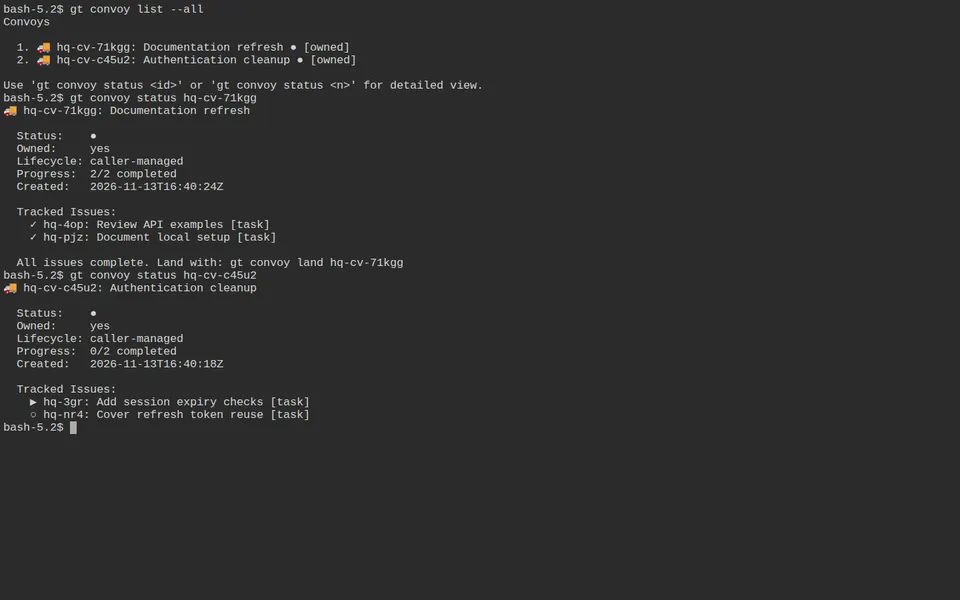
The product-owned gt CLI manages workspaces, agents, dispatch, convoys, scheduler and escalation; the browser dashboard can run gt commands. Stable public SDK or MCP server support was not established.
- Cli: The product-owned gt CLI manages workspaces, agents, dispatch, convoys, scheduler and escalation; the browser dashboard can run gt commands. Stable public SDK or MCP server support was not established.
- Operations: The product-owned gt CLI manages workspaces, agents, dispatch, convoys, scheduler and escalation; the browser dashboard can run gt commands. Stable public SDK or MCP server support was not established.
- Documentation evidence only. Remaining atomic questions and enforcement under failure have not been established by a bounded workflow test.
-
Gas Town: Key commands; Dashboard
Finding: The product-owned gt CLI manages workspaces, agents, dispatch, convoys, scheduler and escalation; the browser dashboard can run gt commands. Stable public SDK or MCP server support was not established.
Coding agents: Claude Code: Yes
Coding agents: Claude Code
Typed value: Yes.
Gas Town supplies built-in runtime presets and generic user-defined commands. RuntimeConfig explicitly supports selecting aider; that generic route does not establish the hooks/resume parity of named presets.
- Session integration: Built-in runtime presets include Claude Code, Gemini CLI, Codex, Cursor, OpenCode, Pi and others. Per-rig runtime commands and named custom aliases can select different agents.
- Mixed harness operation: Built-in runtime presets include Claude Code, Gemini CLI, Codex, Cursor, OpenCode, Pi and others. Per-rig runtime commands and named custom aliases can select different agents.
- Only the cited atomic facts are established. No configured product, account, billing or multi-user scenario was run; remaining atomic answers stay unknown.
-
Gas Town: Runtime Configuration; Agent Operations
Finding: Built-in runtime presets include Claude Code, Gemini CLI, Codex, Cursor, OpenCode, Pi and others. Per-rig runtime commands and named custom aliases can select different agents.
Coding agents: Codex: Yes
Coding agents: Codex
Typed value: Yes.
Gas Town supplies built-in runtime presets and generic user-defined commands. RuntimeConfig explicitly supports selecting aider; that generic route does not establish the hooks/resume parity of named presets.
- Session integration: Built-in runtime presets include Claude Code, Gemini CLI, Codex, Cursor, OpenCode, Pi and others. Per-rig runtime commands and named custom aliases can select different agents.
- Mixed harness operation: Built-in runtime presets include Claude Code, Gemini CLI, Codex, Cursor, OpenCode, Pi and others. Per-rig runtime commands and named custom aliases can select different agents.
- Only the cited atomic facts are established. No configured product, account, billing or multi-user scenario was run; remaining atomic answers stay unknown.
-
Gas Town: Runtime Configuration; Agent Operations
Finding: Built-in runtime presets include Claude Code, Gemini CLI, Codex, Cursor, OpenCode, Pi and others. Per-rig runtime commands and named custom aliases can select different agents.
Coding agents: Cursor Agent: Yes
Coding agents: Cursor Agent
Typed value: Yes.
Gas Town supplies built-in runtime presets and generic user-defined commands. RuntimeConfig explicitly supports selecting aider; that generic route does not establish the hooks/resume parity of named presets.
- Session integration: Built-in runtime presets include Claude Code, Gemini CLI, Codex, Cursor, OpenCode, Pi and others. Per-rig runtime commands and named custom aliases can select different agents.
- Mixed harness operation: Built-in runtime presets include Claude Code, Gemini CLI, Codex, Cursor, OpenCode, Pi and others. Per-rig runtime commands and named custom aliases can select different agents.
- Only the cited atomic facts are established. No configured product, account, billing or multi-user scenario was run; remaining atomic answers stay unknown.
-
Gas Town: Runtime Configuration; Agent Operations
Finding: Built-in runtime presets include Claude Code, Gemini CLI, Codex, Cursor, OpenCode, Pi and others. Per-rig runtime commands and named custom aliases can select different agents.
Coding agents: Gemini CLI: Yes
Coding agents: Gemini CLI
Typed value: Yes.
Gas Town supplies built-in runtime presets and generic user-defined commands. RuntimeConfig explicitly supports selecting aider; that generic route does not establish the hooks/resume parity of named presets.
- Session integration: Built-in runtime presets include Claude Code, Gemini CLI, Codex, Cursor, OpenCode, Pi and others. Per-rig runtime commands and named custom aliases can select different agents.
- Mixed harness operation: Built-in runtime presets include Claude Code, Gemini CLI, Codex, Cursor, OpenCode, Pi and others. Per-rig runtime commands and named custom aliases can select different agents.
- Only the cited atomic facts are established. No configured product, account, billing or multi-user scenario was run; remaining atomic answers stay unknown.
-
Gas Town: Runtime Configuration; Agent Operations
Finding: Built-in runtime presets include Claude Code, Gemini CLI, Codex, Cursor, OpenCode, Pi and others. Per-rig runtime commands and named custom aliases can select different agents.
Coding agents: OpenCode: Yes
Coding agents: OpenCode
Typed value: Yes.
Gas Town supplies built-in runtime presets and generic user-defined commands. RuntimeConfig explicitly supports selecting aider; that generic route does not establish the hooks/resume parity of named presets.
- Session integration: Built-in runtime presets include Claude Code, Gemini CLI, Codex, Cursor, OpenCode, Pi and others. Per-rig runtime commands and named custom aliases can select different agents.
- Mixed harness operation: Built-in runtime presets include Claude Code, Gemini CLI, Codex, Cursor, OpenCode, Pi and others. Per-rig runtime commands and named custom aliases can select different agents.
- Only the cited atomic facts are established. No configured product, account, billing or multi-user scenario was run; remaining atomic answers stay unknown.
-
Gas Town: Runtime Configuration; Agent Operations
Finding: Built-in runtime presets include Claude Code, Gemini CLI, Codex, Cursor, OpenCode, Pi and others. Per-rig runtime commands and named custom aliases can select different agents.
Coding agents: Pi: Yes
Coding agents: Pi
Typed value: Yes.
Gas Town supplies built-in runtime presets and generic user-defined commands. RuntimeConfig explicitly supports selecting aider; that generic route does not establish the hooks/resume parity of named presets.
- Session integration: Built-in runtime presets include Claude Code, Gemini CLI, Codex, Cursor, OpenCode, Pi and others. Per-rig runtime commands and named custom aliases can select different agents.
- Mixed harness operation: Built-in runtime presets include Claude Code, Gemini CLI, Codex, Cursor, OpenCode, Pi and others. Per-rig runtime commands and named custom aliases can select different agents.
- Only the cited atomic facts are established. No configured product, account, billing or multi-user scenario was run; remaining atomic answers stay unknown.
-
Gas Town: Runtime Configuration; Agent Operations
Finding: Built-in runtime presets include Claude Code, Gemini CLI, Codex, Cursor, OpenCode, Pi and others. Per-rig runtime commands and named custom aliases can select different agents.
Coding agents: Aider: Yes
Coding agents: Aider
Typed value: Yes.
Gas Town supplies built-in runtime presets and generic user-defined commands. RuntimeConfig explicitly supports selecting aider; that generic route does not establish the hooks/resume parity of named presets.
- Harnesses: Aider is explicitly named as a generic runtime command in RuntimeConfig; existing built-in harnesses retain their own documented scope.
- Custom adapters: Configured command/args/environment are resolved by the runtime loader.
- Only the cited atomic facts are established. No configured product, account, billing or multi-user scenario was run; remaining atomic answers stay unknown.
-
Gas Town: internal/config/types.go
Finding: RuntimeConfig explicitly names aider as an interchangeable command, with configured arguments/environment, and the generic runtime loader resolves caller-defined agent commands. This establishes Aider as a generic terminal-runtime option, without claiming built-in status/hooks parity.
Use my subscription: Yes cross-checked
Use my subscription
Typed value: Yes.
Users install the underlying agent CLI and authenticate it themselves. Copilot specifically needs a seat and organization CLI policy; it is not a bundled Gas Town model-credit plan.
- Agent subscriptions: Users install the underlying agent CLI and authenticate it themselves. Copilot specifically needs a seat and organization CLI policy; it is not a bundled Gas Town model-credit plan.
- Provider restrictions: Users install the underlying agent CLI and authenticate it themselves. Copilot specifically needs a seat and organization CLI policy; it is not a bundled Gas Town model-credit plan.
- Documentation evidence only. Remaining atomic questions and enforcement under failure have not been established by a bounded workflow test.
-
Gas Town: Prerequisites; Runtime Configuration
Finding: Users install the underlying agent CLI and authenticate it themselves. Copilot specifically needs a seat and organization CLI policy; it is not a bundled Gas Town model-credit plan.
Where agents run: On your computer: Yes
Where agents run: On your computer
Typed value: Yes.
The full workspace manager runs on the user-selected host, including a server reached by terminal or the detached Docker runtime. There is no vendor-operated runtime; a remote host can remain running after the client laptop closes.
- Local: The full workspace manager runs on a user-controlled host or in a detached Docker Compose runtime. No vendor-managed coding runtime is established by this repository.
- Self hosted: The full workspace manager runs on a user-controlled host or in a detached Docker Compose runtime. No vendor-managed coding runtime is established by this repository.
- Only the cited atomic facts are established. No configured product, account, billing or multi-user scenario was run; remaining atomic answers stay unknown.
-
Gas Town: Installation; Docker Compose setup
Finding: The full workspace manager runs on a user-controlled host or in a detached Docker Compose runtime. No vendor-managed coding runtime is established by this repository.
Where agents run: On your own server: Yes
Where agents run: On your own server
Typed value: Yes.
The full workspace manager runs on the user-selected host, including a server reached by terminal or the detached Docker runtime. There is no vendor-operated runtime; a remote host can remain running after the client laptop closes.
- Byo remote: Headless gt/tmux and detached Docker can run on a user-controlled server.
- Managed cloud: No vendor-managed execution provisioner in the scoped code.
- Client disconnect: A separate gt/tmux/Docker host is independent of the initiating terminal; a local host still must stay running.
- Only the cited atomic facts are established. No configured product, account, billing or multi-user scenario was run; remaining atomic answers stay unknown.
-
Gas Town: internal/cmd/dashboard.go
Finding: Gas Town installs a native gt CLI on macOS and Linux, with Windows build instructions and release binaries (full tmux workflows retain host constraints). Dashboard binds localhost or an explicitly chosen address and exposes shared town commands/mail without named human membership roles or SSO. Agent roles such as mayor/crew are agent identities. The runtime runs on user hosts or detached Docker, not a vendor-managed server or VM provisioner; it supplies no native iOS/Android app. The scoped dashboard shows work/merge status, not proposed-code diffs.
Where agents run: In the vendor's cloud: No
Where agents run: In the vendor's cloud
Typed value: No.
The full workspace manager runs on the user-selected host, including a server reached by terminal or the detached Docker runtime. There is no vendor-operated runtime; a remote host can remain running after the client laptop closes.
- Byo remote: Headless gt/tmux and detached Docker can run on a user-controlled server.
- Managed cloud: No vendor-managed execution provisioner in the scoped code.
- Client disconnect: A separate gt/tmux/Docker host is independent of the initiating terminal; a local host still must stay running.
- Only the cited atomic facts are established. No configured product, account, billing or multi-user scenario was run; remaining atomic answers stay unknown.
-
Gas Town: internal/cmd/dashboard.go
Finding: Gas Town installs a native gt CLI on macOS and Linux, with Windows build instructions and release binaries (full tmux workflows retain host constraints). Dashboard binds localhost or an explicitly chosen address and exposes shared town commands/mail without named human membership roles or SSO. Agent roles such as mayor/crew are agent identities. The runtime runs on user hosts or detached Docker, not a vendor-managed server or VM provisioner; it supplies no native iOS/Android app. The scoped dashboard shows work/merge status, not proposed-code diffs.
Workspace isolation: Git worktree: Yes
Workspace isolation: Git worktree
Typed value: Yes.
Git worktrees and optional Docker provide the scoped execution separation. The runtime has no product VM provisioning/isolation backend.
- Branch: Agent work state is stored in Git worktree-based hooks and separate agent workspaces. These provide code separation, not an independently verified hostile-code boundary.
- Worktree: Agent work state is stored in Git worktree-based hooks and separate agent workspaces. These provide code separation, not an independently verified hostile-code boundary.
- Container: The optional Docker runtime runs a full Gas Town environment with persistent volumes and a host HQ bind mount. Only the dashboard port is forwarded; bind mounts and configured capabilities limit any broad security claim.
- Filesystem: The optional Docker runtime runs a full Gas Town environment with persistent volumes and a host HQ bind mount. Only the dashboard port is forwarded; bind mounts and configured capabilities limit any broad security claim.
- Network: The optional Docker runtime runs a full Gas Town environment with persistent volumes and a host HQ bind mount. Only the dashboard port is forwarded; bind mounts and configured capabilities limit any broad security claim.
- Code separation: Agent work state is stored in Git worktree-based hooks and separate agent workspaces. These provide code separation, not an independently verified hostile-code boundary.
- Only the cited atomic facts are established. No configured product, account, billing or multi-user scenario was run; remaining atomic answers stay unknown.
-
Finding: Agent work state is stored in Git worktree-based hooks and separate agent workspaces. These provide code separation, not an independently verified hostile-code boundary.
-
Gas Town: Runtime image; Security posture
Finding: The optional Docker runtime runs a full Gas Town environment with persistent volumes and a host HQ bind mount. Only the dashboard port is forwarded; bind mounts and configured capabilities limit any broad security claim.
Workspace isolation: Container: Yes
Workspace isolation: Container
Typed value: Yes.
Git worktrees and optional Docker provide the scoped execution separation. The runtime has no product VM provisioning/isolation backend.
- Branch: Agent work state is stored in Git worktree-based hooks and separate agent workspaces. These provide code separation, not an independently verified hostile-code boundary.
- Worktree: Agent work state is stored in Git worktree-based hooks and separate agent workspaces. These provide code separation, not an independently verified hostile-code boundary.
- Container: The optional Docker runtime runs a full Gas Town environment with persistent volumes and a host HQ bind mount. Only the dashboard port is forwarded; bind mounts and configured capabilities limit any broad security claim.
- Filesystem: The optional Docker runtime runs a full Gas Town environment with persistent volumes and a host HQ bind mount. Only the dashboard port is forwarded; bind mounts and configured capabilities limit any broad security claim.
- Network: The optional Docker runtime runs a full Gas Town environment with persistent volumes and a host HQ bind mount. Only the dashboard port is forwarded; bind mounts and configured capabilities limit any broad security claim.
- Code separation: Agent work state is stored in Git worktree-based hooks and separate agent workspaces. These provide code separation, not an independently verified hostile-code boundary.
- Only the cited atomic facts are established. No configured product, account, billing or multi-user scenario was run; remaining atomic answers stay unknown.
-
Finding: Agent work state is stored in Git worktree-based hooks and separate agent workspaces. These provide code separation, not an independently verified hostile-code boundary.
-
Gas Town: Runtime image; Security posture
Finding: The optional Docker runtime runs a full Gas Town environment with persistent volumes and a host HQ bind mount. Only the dashboard port is forwarded; bind mounts and configured capabilities limit any broad security claim.
Workspace isolation: VM or microVM: No
Workspace isolation: VM or microVM
Typed value: No.
Git worktrees and optional Docker provide the scoped execution separation. The runtime has no product VM provisioning/isolation backend.
- Vm: No VM isolation backend in the scoped runtime; user-chosen VM hosts are external infrastructure.
- Only the cited atomic facts are established. No configured product, account, billing or multi-user scenario was run; remaining atomic answers stay unknown.
-
Gas Town: internal/cmd/dashboard.go
Finding: Gas Town installs a native gt CLI on macOS and Linux, with Windows build instructions and release binaries (full tmux workflows retain host constraints). Dashboard binds localhost or an explicitly chosen address and exposes shared town commands/mail without named human membership roles or SSO. Agent roles such as mayor/crew are agent identities. The runtime runs on user hosts or detached Docker, not a vendor-managed server or VM provisioner; it supplies no native iOS/Android app. The scoped dashboard shows work/merge status, not proposed-code diffs.
Parallel runs: Yes cross-checked
Parallel runs
Typed value: Yes.
Gas Town manages multiple coding agents working on different tasks. Configured max_polecats caps dispatch; the default dispatches immediately. Claimed twenty-to-thirty-agent comfort was not benchmarked.
- Concurrent sessions: Gas Town manages multiple coding agents working on different tasks. Configured max_polecats caps dispatch; the default dispatches immediately. Claimed twenty-to-thirty-agent comfort was not benchmarked.
- Concurrent tasks: Gas Town manages multiple coding agents working on different tasks. Configured max_polecats caps dispatch; the default dispatches immediately. Claimed twenty-to-thirty-agent comfort was not benchmarked.
- Quotas: Gas Town manages multiple coding agents working on different tasks. Configured max_polecats caps dispatch; the default dispatches immediately. Claimed twenty-to-thirty-agent comfort was not benchmarked.
- Status visibility: Gas Town manages multiple coding agents working on different tasks. Configured max_polecats caps dispatch; the default dispatches immediately. Claimed twenty-to-thirty-agent comfort was not benchmarked.
- Documentation evidence only. Remaining atomic questions and enforcement under failure have not been established by a bounded workflow test.
-
Finding: Gas Town manages multiple coding agents working on different tasks. Configured max_polecats caps dispatch; the default dispatches immediately. Claimed twenty-to-thirty-agent comfort was not benchmarked.
Coordinator: Yes cross-checked
Coordinator
Typed value: Yes.
The Mayor is a product-configured AI coordinator with project/agent context. It creates convoys, assigns issue IDs to workers and receives progress. Mailboxes, nudges and handoffs coordinate agents across roles.
- Roles: The Mayor is a product-configured AI coordinator with project/agent context. It creates convoys, assigns issue IDs to workers and receives progress. Mailboxes, nudges and handoffs coordinate agents across roles.
- Messages: The Mayor is a product-configured AI coordinator with project/agent context. It creates convoys, assigns issue IDs to workers and receives progress. Mailboxes, nudges and handoffs coordinate agents across roles.
- Results return: The Mayor is a product-configured AI coordinator with project/agent context. It creates convoys, assigns issue IDs to workers and receives progress. Mailboxes, nudges and handoffs coordinate agents across roles.
- Orchestration owner: The Mayor is a product-configured AI coordinator with project/agent context. It creates convoys, assigns issue IDs to workers and receives progress. Mailboxes, nudges and handoffs coordinate agents across roles.
- Activation: The Mayor is a product-configured AI coordinator with project/agent context. It creates convoys, assigns issue IDs to workers and receives progress. Mailboxes, nudges and handoffs coordinate agents across roles.
- Live progress: The Mayor is a product-configured AI coordinator with project/agent context. It creates convoys, assigns issue IDs to workers and receives progress. Mailboxes, nudges and handoffs coordinate agents across roles.
- Documentation evidence only. Remaining atomic questions and enforcement under failure have not been established by a bounded workflow test.
-
Gas Town: The Mayor; Monitoring; Basic workflow
Finding: The Mayor is a product-configured AI coordinator with project/agent context. It creates convoys, assigns issue IDs to workers and receives progress. Mailboxes, nudges and handoffs coordinate agents across roles.
Native issue tracking: Yes cross-checked
Native issue tracking
Typed value: Yes.
The bundled Beads ledger gives persistent issue IDs and work state; the dashboard displays issues, hooks, convoys and escalations separate from agent sessions. It does not require GitHub Issues as the work ledger.
- Create: The bundled Beads ledger gives persistent issue IDs and work state; the dashboard displays issues, hooks, convoys and escalations separate from agent sessions. It does not require GitHub Issues as the work ledger.
- Assign: The bundled Beads ledger gives persistent issue IDs and work state; the dashboard displays issues, hooks, convoys and escalations separate from agent sessions. It does not require GitHub Issues as the work ledger.
- Search: The bundled Beads ledger gives persistent issue IDs and work state; the dashboard displays issues, hooks, convoys and escalations separate from agent sessions. It does not require GitHub Issues as the work ledger.
- Project epic views: The bundled Beads ledger gives persistent issue IDs and work state; the dashboard displays issues, hooks, convoys and escalations separate from agent sessions. It does not require GitHub Issues as the work ledger.
- Explicit dispatch: The bundled Beads ledger gives persistent issue IDs and work state; the dashboard displays issues, hooks, convoys and escalations separate from agent sessions. It does not require GitHub Issues as the work ledger.
- Task session separation: The bundled Beads ledger gives persistent issue IDs and work state; the dashboard displays issues, hooks, convoys and escalations separate from agent sessions. It does not require GitHub Issues as the work ledger.
- Durable states: The bundled Beads ledger gives persistent issue IDs and work state; the dashboard displays issues, hooks, convoys and escalations separate from agent sessions. It does not require GitHub Issues as the work ledger.
- External tracker requirement: The bundled Beads ledger gives persistent issue IDs and work state; the dashboard displays issues, hooks, convoys and escalations separate from agent sessions. It does not require GitHub Issues as the work ledger.
- Documentation evidence only. Remaining atomic questions and enforcement under failure have not been established by a bounded workflow test.
-
Gas Town: Beads Integration; Dashboard
Finding: The bundled Beads ledger gives persistent issue IDs and work state; the dashboard displays issues, hooks, convoys and escalations separate from agent sessions. It does not require GitHub Issues as the work ledger.
Unattended triggers: Yes cross-checked
Unattended triggers
Typed value: Yes.
The daemon heartbeat auto-dispatches bundled or user plugins with an elapsed cooldown gate to idle dog agents, and with deferred dispatch enabled admits work a human already queued with gt sling. Cron gates are declared in the plugin format but only cooldown gates are dispatched in v1.2.1.
- Schedules: Interval scheduling exists through cooldown gates. Cron-gated plugins are declared in the format but are not dispatched by the v1.2.1 daemon code.
- Recurring tasks: Plugins with a cooldown gate (for example a bundled quality review every six hours) are dispatched automatically to an idle dog agent on the daemon heartbeat once the window has elapsed.
- Documentation evidence only. Remaining atomic questions and enforcement under failure have not been established by a bounded workflow test.
-
Gas Town daemon plugin dispatch (v1.2.1)
Finding: On each daemon heartbeat, plugins with a cooldown gate whose window has elapsed are assigned to an idle dog agent, which is started in a tmux session with the plugin instructions. Manual-gate plugins are never auto-dispatched; cron gates are declared but only cooldown gates are dispatched by this code.
-
Gas Town bundled quality-review plugin (v1.2.1)
Finding: A bundled plugin declares a six-hour cooldown gate and says it runs every six hours during Deacon patrol to analyse merge quality.
Team roles: No
Team roles
Typed value: No.
Gas Town has named agent roles such as mayor and crew; the scoped dashboard/CLI has no human organization roles or enterprise SSO.
- Organization roles: Agent runtime roles are not human team permission roles.
- Sso: No enterprise SSO integration in the scoped app.
- Source review and pinned implementation inspection only; no installed-product, account or multi-user scenario was executed. Unanswered atomic questions remain open.
-
Gas Town: internal/cmd/dashboard.go
Finding: Gas Town installs a native gt CLI on macOS and Linux, with Windows build instructions and release binaries (full tmux workflows retain host constraints). Dashboard binds localhost or an explicitly chosen address and exposes shared town commands/mail without named human membership roles or SSO. Agent roles such as mayor/crew are agent identities. The runtime runs on user hosts or detached Docker, not a vendor-managed server or VM provisioner; it supplies no native iOS/Android app. The scoped dashboard shows work/merge status, not proposed-code diffs.
SSO: No
SSO
Typed value: No.
Gas Town has named agent roles such as mayor and crew; the scoped dashboard/CLI has no human organization roles or enterprise SSO.
- Organization roles: Agent runtime roles are not human team permission roles.
- Sso: No enterprise SSO integration in the scoped app.
- Source review and pinned implementation inspection only; no installed-product, account or multi-user scenario was executed. Unanswered atomic questions remain open.
-
Gas Town: internal/cmd/dashboard.go
Finding: Gas Town installs a native gt CLI on macOS and Linux, with Windows build instructions and release binaries (full tmux workflows retain host constraints). Dashboard binds localhost or an explicitly chosen address and exposes shared town commands/mail without named human membership roles or SSO. Agent roles such as mayor/crew are agent identities. The runtime runs on user hosts or detached Docker, not a vendor-managed server or VM provisioner; it supplies no native iOS/Android app. The scoped dashboard shows work/merge status, not proposed-code diffs.
Pull request workflow: Yes cross-checked
Pull request workflow
Typed value: Yes.
gt done pushes a worker branch and creates a merge-request bead for the internal Refinery. With merge_strategy=pr, a no-merge task gets a GitHub pull request opened by gt done, and the Refinery can wait for approval and merge existing pull requests through the provider API.
- Pull requests: With merge_strategy=pr, gt done opens a GitHub pull request for no-merge tasks (gh pr create), and the Refinery finds, optionally waits for approval on, and merges a worker branch pull request on GitHub or Bitbucket. Requires an authenticated gh; not tested.
- Documentation evidence only. Remaining atomic questions and enforcement under failure have not been established by a bounded workflow test.
-
Gas Town Refinery merge strategy (v1.2.1)
Finding: With merge_strategy set to pr, the Refinery finds the open pull request for a worker branch on GitHub or Bitbucket, can wait for an approving review, and merges it through the provider's API instead of a direct push. It does not create the pull request itself.
-
Gas Town gt done PR creation (v1.2.1)
Finding: For a no-merge task with merge_strategy set to pr, gt done creates a GitHub pull request for human review with gh pr create, using the issue title and description.
Review interface: No
Review interface
Typed value: No.
The dashboard exposes completed work, merge queues and verification status, but does not display proposed-code diffs for human review.
- Change understanding: No proposed-change code-diff viewer in the scoped dashboard handlers/templates; external Git tools are separate.
- Only the cited atomic facts are established. No configured product, account, billing or multi-user scenario was run; remaining atomic answers stay unknown.
-
Gas Town: internal/cmd/dashboard.go
Finding: Gas Town installs a native gt CLI on macOS and Linux, with Windows build instructions and release binaries (full tmux workflows retain host constraints). Dashboard binds localhost or an explicitly chosen address and exposes shared town commands/mail without named human membership roles or SSO. Agent roles such as mayor/crew are agent identities. The runtime runs on user hosts or detached Docker, not a vendor-managed server or VM provisioner; it supplies no native iOS/Android app. The scoped dashboard shows work/merge status, not proposed-code diffs.
Product license: Apache-2.0: No. MIT cross-checked
Product license: Apache-2.0
Typed value: No. MIT.
Gas Town source is MIT licensed at the pinned default-branch revision. Beads and runtime dependencies retain their own component licenses.
- Client license: Gas Town source is MIT licensed at the pinned default-branch revision. Beads and runtime dependencies retain their own component licenses.
- Server license: Gas Town source is MIT licensed at the pinned default-branch revision. Beads and runtime dependencies retain their own component licenses.
- Source visibility: Gas Town source is MIT licensed at the pinned default-branch revision. Beads and runtime dependencies retain their own component licenses.
- Source revision: Gas Town source is MIT licensed at the pinned default-branch revision. Beads and runtime dependencies retain their own component licenses.
- Documentation evidence only. Remaining atomic questions and enforcement under failure have not been established by a bounded workflow test.
-
Finding: Gas Town source is MIT licensed at the pinned default-branch revision. Beads and runtime dependencies retain their own component licenses.
Product license: MIT: Yes. MIT cross-checked
Product license: MIT
Typed value: Yes. MIT.
Gas Town source is MIT licensed at the pinned default-branch revision. Beads and runtime dependencies retain their own component licenses.
- Client license: Gas Town source is MIT licensed at the pinned default-branch revision. Beads and runtime dependencies retain their own component licenses.
- Server license: Gas Town source is MIT licensed at the pinned default-branch revision. Beads and runtime dependencies retain their own component licenses.
- Source visibility: Gas Town source is MIT licensed at the pinned default-branch revision. Beads and runtime dependencies retain their own component licenses.
- Source revision: Gas Town source is MIT licensed at the pinned default-branch revision. Beads and runtime dependencies retain their own component licenses.
- Documentation evidence only. Remaining atomic questions and enforcement under failure have not been established by a bounded workflow test.
-
Finding: Gas Town source is MIT licensed at the pinned default-branch revision. Beads and runtime dependencies retain their own component licenses.
Product license: GPL-3.0: No. MIT cross-checked
Product license: GPL-3.0
Typed value: No. MIT.
Gas Town source is MIT licensed at the pinned default-branch revision. Beads and runtime dependencies retain their own component licenses.
- Client license: Gas Town source is MIT licensed at the pinned default-branch revision. Beads and runtime dependencies retain their own component licenses.
- Server license: Gas Town source is MIT licensed at the pinned default-branch revision. Beads and runtime dependencies retain their own component licenses.
- Source visibility: Gas Town source is MIT licensed at the pinned default-branch revision. Beads and runtime dependencies retain their own component licenses.
- Source revision: Gas Town source is MIT licensed at the pinned default-branch revision. Beads and runtime dependencies retain their own component licenses.
- Documentation evidence only. Remaining atomic questions and enforcement under failure have not been established by a bounded workflow test.
-
Finding: Gas Town source is MIT licensed at the pinned default-branch revision. Beads and runtime dependencies retain their own component licenses.
Product license: GPL-3.0-or-later: No. MIT cross-checked
Product license: GPL-3.0-or-later
Typed value: No. MIT.
Gas Town source is MIT licensed at the pinned default-branch revision. Beads and runtime dependencies retain their own component licenses.
- Client license: Gas Town source is MIT licensed at the pinned default-branch revision. Beads and runtime dependencies retain their own component licenses.
- Server license: Gas Town source is MIT licensed at the pinned default-branch revision. Beads and runtime dependencies retain their own component licenses.
- Source visibility: Gas Town source is MIT licensed at the pinned default-branch revision. Beads and runtime dependencies retain their own component licenses.
- Source revision: Gas Town source is MIT licensed at the pinned default-branch revision. Beads and runtime dependencies retain their own component licenses.
- Documentation evidence only. Remaining atomic questions and enforcement under failure have not been established by a bounded workflow test.
-
Finding: Gas Town source is MIT licensed at the pinned default-branch revision. Beads and runtime dependencies retain their own component licenses.
Product license: AGPL-3.0: No. MIT cross-checked
Product license: AGPL-3.0
Typed value: No. MIT.
Gas Town source is MIT licensed at the pinned default-branch revision. Beads and runtime dependencies retain their own component licenses.
- Client license: Gas Town source is MIT licensed at the pinned default-branch revision. Beads and runtime dependencies retain their own component licenses.
- Server license: Gas Town source is MIT licensed at the pinned default-branch revision. Beads and runtime dependencies retain their own component licenses.
- Source visibility: Gas Town source is MIT licensed at the pinned default-branch revision. Beads and runtime dependencies retain their own component licenses.
- Source revision: Gas Town source is MIT licensed at the pinned default-branch revision. Beads and runtime dependencies retain their own component licenses.
- Documentation evidence only. Remaining atomic questions and enforcement under failure have not been established by a bounded workflow test.
-
Finding: Gas Town source is MIT licensed at the pinned default-branch revision. Beads and runtime dependencies retain their own component licenses.
Product license: AGPL-3.0-or-later: No. MIT cross-checked
Product license: AGPL-3.0-or-later
Typed value: No. MIT.
Gas Town source is MIT licensed at the pinned default-branch revision. Beads and runtime dependencies retain their own component licenses.
- Client license: Gas Town source is MIT licensed at the pinned default-branch revision. Beads and runtime dependencies retain their own component licenses.
- Server license: Gas Town source is MIT licensed at the pinned default-branch revision. Beads and runtime dependencies retain their own component licenses.
- Source visibility: Gas Town source is MIT licensed at the pinned default-branch revision. Beads and runtime dependencies retain their own component licenses.
- Source revision: Gas Town source is MIT licensed at the pinned default-branch revision. Beads and runtime dependencies retain their own component licenses.
- Documentation evidence only. Remaining atomic questions and enforcement under failure have not been established by a bounded workflow test.
-
Finding: Gas Town source is MIT licensed at the pinned default-branch revision. Beads and runtime dependencies retain their own component licenses.
Product license: Elastic License 2.0: No. MIT cross-checked
Product license: Elastic License 2.0
Typed value: No. MIT.
Gas Town source is MIT licensed at the pinned default-branch revision. Beads and runtime dependencies retain their own component licenses.
- Client license: Gas Town source is MIT licensed at the pinned default-branch revision. Beads and runtime dependencies retain their own component licenses.
- Server license: Gas Town source is MIT licensed at the pinned default-branch revision. Beads and runtime dependencies retain their own component licenses.
- Source visibility: Gas Town source is MIT licensed at the pinned default-branch revision. Beads and runtime dependencies retain their own component licenses.
- Source revision: Gas Town source is MIT licensed at the pinned default-branch revision. Beads and runtime dependencies retain their own component licenses.
- Documentation evidence only. Remaining atomic questions and enforcement under failure have not been established by a bounded workflow test.
-
Finding: Gas Town source is MIT licensed at the pinned default-branch revision. Beads and runtime dependencies retain their own component licenses.
Product license: Custom terms: No. MIT cross-checked
Product license: Custom terms
Typed value: No. MIT.
Gas Town source is MIT licensed at the pinned default-branch revision. Beads and runtime dependencies retain their own component licenses.
- Client license: Gas Town source is MIT licensed at the pinned default-branch revision. Beads and runtime dependencies retain their own component licenses.
- Server license: Gas Town source is MIT licensed at the pinned default-branch revision. Beads and runtime dependencies retain their own component licenses.
- Source visibility: Gas Town source is MIT licensed at the pinned default-branch revision. Beads and runtime dependencies retain their own component licenses.
- Source revision: Gas Town source is MIT licensed at the pinned default-branch revision. Beads and runtime dependencies retain their own component licenses.
- Documentation evidence only. Remaining atomic questions and enforcement under failure have not been established by a bounded workflow test.
-
Finding: Gas Town source is MIT licensed at the pinned default-branch revision. Beads and runtime dependencies retain their own component licenses.
Product license: Proprietary: No. MIT cross-checked
Product license: Proprietary
Typed value: No. MIT.
Gas Town source is MIT licensed at the pinned default-branch revision. Beads and runtime dependencies retain their own component licenses.
- Client license: Gas Town source is MIT licensed at the pinned default-branch revision. Beads and runtime dependencies retain their own component licenses.
- Server license: Gas Town source is MIT licensed at the pinned default-branch revision. Beads and runtime dependencies retain their own component licenses.
- Source visibility: Gas Town source is MIT licensed at the pinned default-branch revision. Beads and runtime dependencies retain their own component licenses.
- Source revision: Gas Town source is MIT licensed at the pinned default-branch revision. Beads and runtime dependencies retain their own component licenses.
- Documentation evidence only. Remaining atomic questions and enforcement under failure have not been established by a bounded workflow test.
-
Finding: Gas Town source is MIT licensed at the pinned default-branch revision. Beads and runtime dependencies retain their own component licenses.
Self-hosting: Yes cross-checked
Self-hosting
Typed value: Yes.
The CLI, ledger, daemon and dashboard run on the user host or Docker runtime. Full core self-hosting is documented; underlying model-provider accounts remain user dependencies.
- Self hosting: The CLI, ledger, daemon and dashboard run on the user host or Docker runtime. Full core self-hosting is documented; underlying model-provider accounts remain user dependencies.
- Vendor dependencies: The CLI, ledger, daemon and dashboard run on the user host or Docker runtime. Full core self-hosting is documented; underlying model-provider accounts remain user dependencies.
- Account independence: The CLI, ledger, daemon and dashboard run on the user host or Docker runtime. Full core self-hosting is documented; underlying model-provider accounts remain user dependencies.
- Documentation evidence only. Remaining atomic questions and enforcement under failure have not been established by a bounded workflow test.
-
Gas Town: Installation; Docker setup
Finding: The CLI, ledger, daemon and dashboard run on the user host or Docker runtime. Full core self-hosting is documented; underlying model-provider accounts remain user dependencies.
Telemetry opt-out: Yes cross-checked
Telemetry opt-out
Typed value: Yes.
Telemetry is off unless an operator sets a GT_OTEL endpoint; events are then exported over OTLP and correlated by run ID. Agent conversation streaming is opt-in and truncated to 512 bytes by default; GT_LOG_AGENT_CONTENT_LIMIT=0 removes the truncation (experts only).
- Telemetry controls: Telemetry is off unless the operator sets GT_OTEL_METRICS_URL or GT_OTEL_LOGS_URL to an OTLP endpoint; leaving both unset disables export.
- Documentation evidence only. Remaining atomic questions and enforcement under failure have not been established by a bounded workflow test.
-
Gas Town telemetry initialisation (v1.2.1)
Finding: Telemetry is disabled unless GT_OTEL_METRICS_URL or GT_OTEL_LOGS_URL is set; with both unset, Init returns no provider and nothing is exported.
Free access: Yes cross-checked
Free access
Typed value: Yes.
The core application is available as free MIT software for self-hosting. Agent and host charges remain separate and no free managed cloud is asserted.
- Ongoing free: The core application is available as free MIT software for self-hosting. Agent and host charges remain separate and no free managed cloud is asserted.
- Self host cost: The core application is available as free MIT software for self-hosting. Agent and host charges remain separate and no free managed cloud is asserted.
- Documentation evidence only. Remaining atomic questions and enforcement under failure have not been established by a bounded workflow test.
-
Finding: The core application is available as free MIT software for self-hosting. Agent and host charges remain separate and no free managed cloud is asserted.
Starting price: Free: Yes. Free cross-checked
Starting price: Free
Typed value: Yes. Free.
The core application is available as free MIT software for self-hosting. Agent and host charges remain separate and no free managed cloud is asserted.
- Ongoing free: The core application is available as free MIT software for self-hosting. Agent and host charges remain separate and no free managed cloud is asserted.
- Self host cost: The core application is available as free MIT software for self-hosting. Agent and host charges remain separate and no free managed cloud is asserted.
- Documentation evidence only. Remaining atomic questions and enforcement under failure have not been established by a bounded workflow test.
-
Finding: The core application is available as free MIT software for self-hosting. Agent and host charges remain separate and no free managed cloud is asserted.
Starting price: Up to $20/month: No. Free cross-checked
Starting price: Up to $20/month
Typed value: No. Free.
The core application is available as free MIT software for self-hosting. Agent and host charges remain separate and no free managed cloud is asserted.
- Ongoing free: The core application is available as free MIT software for self-hosting. Agent and host charges remain separate and no free managed cloud is asserted.
- Self host cost: The core application is available as free MIT software for self-hosting. Agent and host charges remain separate and no free managed cloud is asserted.
- Documentation evidence only. Remaining atomic questions and enforcement under failure have not been established by a bounded workflow test.
-
Finding: The core application is available as free MIT software for self-hosting. Agent and host charges remain separate and no free managed cloud is asserted.
Starting price: $21–40/month: No. Free cross-checked
Starting price: $21–40/month
Typed value: No. Free.
The core application is available as free MIT software for self-hosting. Agent and host charges remain separate and no free managed cloud is asserted.
- Ongoing free: The core application is available as free MIT software for self-hosting. Agent and host charges remain separate and no free managed cloud is asserted.
- Self host cost: The core application is available as free MIT software for self-hosting. Agent and host charges remain separate and no free managed cloud is asserted.
- Documentation evidence only. Remaining atomic questions and enforcement under failure have not been established by a bounded workflow test.
-
Finding: The core application is available as free MIT software for self-hosting. Agent and host charges remain separate and no free managed cloud is asserted.
Starting price: $41–100/month: No. Free cross-checked
Starting price: $41–100/month
Typed value: No. Free.
The core application is available as free MIT software for self-hosting. Agent and host charges remain separate and no free managed cloud is asserted.
- Ongoing free: The core application is available as free MIT software for self-hosting. Agent and host charges remain separate and no free managed cloud is asserted.
- Self host cost: The core application is available as free MIT software for self-hosting. Agent and host charges remain separate and no free managed cloud is asserted.
- Documentation evidence only. Remaining atomic questions and enforcement under failure have not been established by a bounded workflow test.
-
Finding: The core application is available as free MIT software for self-hosting. Agent and host charges remain separate and no free managed cloud is asserted.
Starting price: Over $100/month: No. Free cross-checked
Starting price: Over $100/month
Typed value: No. Free.
The core application is available as free MIT software for self-hosting. Agent and host charges remain separate and no free managed cloud is asserted.
- Ongoing free: The core application is available as free MIT software for self-hosting. Agent and host charges remain separate and no free managed cloud is asserted.
- Self host cost: The core application is available as free MIT software for self-hosting. Agent and host charges remain separate and no free managed cloud is asserted.
- Documentation evidence only. Remaining atomic questions and enforcement under failure have not been established by a bounded workflow test.
-
Finding: The core application is available as free MIT software for self-hosting. Agent and host charges remain separate and no free managed cloud is asserted.
Starting price: Contact for pricing: No. Free cross-checked
Starting price: Contact for pricing
Typed value: No. Free.
The core application is available as free MIT software for self-hosting. Agent and host charges remain separate and no free managed cloud is asserted.
- Ongoing free: The core application is available as free MIT software for self-hosting. Agent and host charges remain separate and no free managed cloud is asserted.
- Self host cost: The core application is available as free MIT software for self-hosting. Agent and host charges remain separate and no free managed cloud is asserted.
- Documentation evidence only. Remaining atomic questions and enforcement under failure have not been established by a bounded workflow test.
-
Finding: The core application is available as free MIT software for self-hosting. Agent and host charges remain separate and no free managed cloud is asserted.
Pricing model: Free, no paid plan: Yes cross-checked
Pricing model: Free, no paid plan
Typed value: Yes.
The core software license permits free-of-charge use. Coding-agent subscriptions, Docker/host resources and optional telemetry infrastructure have separate user costs.
- Model cost: The core software license permits free-of-charge use. Coding-agent subscriptions, Docker/host resources and optional telemetry infrastructure have separate user costs.
- Compute cost: The core software license permits free-of-charge use. Coding-agent subscriptions, Docker/host resources and optional telemetry infrastructure have separate user costs.
- Documentation evidence only. Remaining atomic questions and enforcement under failure have not been established by a bounded workflow test.
-
Finding: The core software license permits free-of-charge use. Coding-agent subscriptions, Docker/host resources and optional telemetry infrastructure have separate user costs.
Pricing model: Free plan: No
Pricing model: Free plan
Typed value: No.
The core software license permits free-of-charge use. Coding-agent subscriptions, Docker/host resources and optional telemetry infrastructure have separate user costs.
- Model cost: The core software license permits free-of-charge use. Coding-agent subscriptions, Docker/host resources and optional telemetry infrastructure have separate user costs.
- Compute cost: The core software license permits free-of-charge use. Coding-agent subscriptions, Docker/host resources and optional telemetry infrastructure have separate user costs.
- Documentation evidence only. Remaining atomic questions and enforcement under failure have not been established by a bounded workflow test.
-
Finding: The core software license permits free-of-charge use. Coding-agent subscriptions, Docker/host resources and optional telemetry infrastructure have separate user costs.
Pricing model: Subscription: No
Pricing model: Subscription
Typed value: No.
The core software license permits free-of-charge use. Coding-agent subscriptions, Docker/host resources and optional telemetry infrastructure have separate user costs.
- Model cost: The core software license permits free-of-charge use. Coding-agent subscriptions, Docker/host resources and optional telemetry infrastructure have separate user costs.
- Compute cost: The core software license permits free-of-charge use. Coding-agent subscriptions, Docker/host resources and optional telemetry infrastructure have separate user costs.
- Documentation evidence only. Remaining atomic questions and enforcement under failure have not been established by a bounded workflow test.
-
Finding: The core software license permits free-of-charge use. Coding-agent subscriptions, Docker/host resources and optional telemetry infrastructure have separate user costs.
Pricing model: Per seat: No
Pricing model: Per seat
Typed value: No.
The core software license permits free-of-charge use. Coding-agent subscriptions, Docker/host resources and optional telemetry infrastructure have separate user costs.
- Model cost: The core software license permits free-of-charge use. Coding-agent subscriptions, Docker/host resources and optional telemetry infrastructure have separate user costs.
- Compute cost: The core software license permits free-of-charge use. Coding-agent subscriptions, Docker/host resources and optional telemetry infrastructure have separate user costs.
- Documentation evidence only. Remaining atomic questions and enforcement under failure have not been established by a bounded workflow test.
-
Finding: The core software license permits free-of-charge use. Coding-agent subscriptions, Docker/host resources and optional telemetry infrastructure have separate user costs.
Pricing model: Usage-based: No
Pricing model: Usage-based
Typed value: No.
The core software license permits free-of-charge use. Coding-agent subscriptions, Docker/host resources and optional telemetry infrastructure have separate user costs.
- Model cost: The core software license permits free-of-charge use. Coding-agent subscriptions, Docker/host resources and optional telemetry infrastructure have separate user costs.
- Compute cost: The core software license permits free-of-charge use. Coding-agent subscriptions, Docker/host resources and optional telemetry infrastructure have separate user costs.
- Documentation evidence only. Remaining atomic questions and enforcement under failure have not been established by a bounded workflow test.
-
Finding: The core software license permits free-of-charge use. Coding-agent subscriptions, Docker/host resources and optional telemetry infrastructure have separate user costs.
Pricing model: Per machine or compute: No
Pricing model: Per machine or compute
Typed value: No.
The core software license permits free-of-charge use. Coding-agent subscriptions, Docker/host resources and optional telemetry infrastructure have separate user costs.
- Model cost: The core software license permits free-of-charge use. Coding-agent subscriptions, Docker/host resources and optional telemetry infrastructure have separate user costs.
- Compute cost: The core software license permits free-of-charge use. Coding-agent subscriptions, Docker/host resources and optional telemetry infrastructure have separate user costs.
- Documentation evidence only. Remaining atomic questions and enforcement under failure have not been established by a bounded workflow test.
-
Finding: The core software license permits free-of-charge use. Coding-agent subscriptions, Docker/host resources and optional telemetry infrastructure have separate user costs.
Pricing model: One-time purchase: No
Pricing model: One-time purchase
Typed value: No.
The core software license permits free-of-charge use. Coding-agent subscriptions, Docker/host resources and optional telemetry infrastructure have separate user costs.
- Model cost: The core software license permits free-of-charge use. Coding-agent subscriptions, Docker/host resources and optional telemetry infrastructure have separate user costs.
- Compute cost: The core software license permits free-of-charge use. Coding-agent subscriptions, Docker/host resources and optional telemetry infrastructure have separate user costs.
- Documentation evidence only. Remaining atomic questions and enforcement under failure have not been established by a bounded workflow test.
-
Finding: The core software license permits free-of-charge use. Coding-agent subscriptions, Docker/host resources and optional telemetry infrastructure have separate user costs.
Paid plans from: No paid plan: Yes. No paid plan
Paid plans from: No paid plan
Typed value: Yes. No paid plan.
The core software license permits free-of-charge use. Coding-agent subscriptions, Docker/host resources and optional telemetry infrastructure have separate user costs.
- Model cost: The core software license permits free-of-charge use. Coding-agent subscriptions, Docker/host resources and optional telemetry infrastructure have separate user costs.
- Compute cost: The core software license permits free-of-charge use. Coding-agent subscriptions, Docker/host resources and optional telemetry infrastructure have separate user costs.
- Documentation evidence only. Remaining atomic questions and enforcement under failure have not been established by a bounded workflow test.
-
Finding: The core software license permits free-of-charge use. Coding-agent subscriptions, Docker/host resources and optional telemetry infrastructure have separate user costs.
Paid plans from: $10 or less/month: No. No paid plan
Paid plans from: $10 or less/month
Typed value: No. No paid plan.
The core software license permits free-of-charge use. Coding-agent subscriptions, Docker/host resources and optional telemetry infrastructure have separate user costs.
- Model cost: The core software license permits free-of-charge use. Coding-agent subscriptions, Docker/host resources and optional telemetry infrastructure have separate user costs.
- Compute cost: The core software license permits free-of-charge use. Coding-agent subscriptions, Docker/host resources and optional telemetry infrastructure have separate user costs.
- Documentation evidence only. Remaining atomic questions and enforcement under failure have not been established by a bounded workflow test.
-
Finding: The core software license permits free-of-charge use. Coding-agent subscriptions, Docker/host resources and optional telemetry infrastructure have separate user costs.
Paid plans from: $11–20/month: No. No paid plan
Paid plans from: $11–20/month
Typed value: No. No paid plan.
The core software license permits free-of-charge use. Coding-agent subscriptions, Docker/host resources and optional telemetry infrastructure have separate user costs.
- Model cost: The core software license permits free-of-charge use. Coding-agent subscriptions, Docker/host resources and optional telemetry infrastructure have separate user costs.
- Compute cost: The core software license permits free-of-charge use. Coding-agent subscriptions, Docker/host resources and optional telemetry infrastructure have separate user costs.
- Documentation evidence only. Remaining atomic questions and enforcement under failure have not been established by a bounded workflow test.
-
Finding: The core software license permits free-of-charge use. Coding-agent subscriptions, Docker/host resources and optional telemetry infrastructure have separate user costs.
Paid plans from: $21–40/month: No. No paid plan
Paid plans from: $21–40/month
Typed value: No. No paid plan.
The core software license permits free-of-charge use. Coding-agent subscriptions, Docker/host resources and optional telemetry infrastructure have separate user costs.
- Model cost: The core software license permits free-of-charge use. Coding-agent subscriptions, Docker/host resources and optional telemetry infrastructure have separate user costs.
- Compute cost: The core software license permits free-of-charge use. Coding-agent subscriptions, Docker/host resources and optional telemetry infrastructure have separate user costs.
- Documentation evidence only. Remaining atomic questions and enforcement under failure have not been established by a bounded workflow test.
-
Finding: The core software license permits free-of-charge use. Coding-agent subscriptions, Docker/host resources and optional telemetry infrastructure have separate user costs.
Paid plans from: $41–100/month: No. No paid plan
Paid plans from: $41–100/month
Typed value: No. No paid plan.
The core software license permits free-of-charge use. Coding-agent subscriptions, Docker/host resources and optional telemetry infrastructure have separate user costs.
- Model cost: The core software license permits free-of-charge use. Coding-agent subscriptions, Docker/host resources and optional telemetry infrastructure have separate user costs.
- Compute cost: The core software license permits free-of-charge use. Coding-agent subscriptions, Docker/host resources and optional telemetry infrastructure have separate user costs.
- Documentation evidence only. Remaining atomic questions and enforcement under failure have not been established by a bounded workflow test.
-
Finding: The core software license permits free-of-charge use. Coding-agent subscriptions, Docker/host resources and optional telemetry infrastructure have separate user costs.
Paid plans from: Over $100/month: No. No paid plan
Paid plans from: Over $100/month
Typed value: No. No paid plan.
The core software license permits free-of-charge use. Coding-agent subscriptions, Docker/host resources and optional telemetry infrastructure have separate user costs.
- Model cost: The core software license permits free-of-charge use. Coding-agent subscriptions, Docker/host resources and optional telemetry infrastructure have separate user costs.
- Compute cost: The core software license permits free-of-charge use. Coding-agent subscriptions, Docker/host resources and optional telemetry infrastructure have separate user costs.
- Documentation evidence only. Remaining atomic questions and enforcement under failure have not been established by a bounded workflow test.
-
Finding: The core software license permits free-of-charge use. Coding-agent subscriptions, Docker/host resources and optional telemetry infrastructure have separate user costs.
Paid plans from: Contact sales: No. No paid plan
Paid plans from: Contact sales
Typed value: No. No paid plan.
The core software license permits free-of-charge use. Coding-agent subscriptions, Docker/host resources and optional telemetry infrastructure have separate user costs.
- Model cost: The core software license permits free-of-charge use. Coding-agent subscriptions, Docker/host resources and optional telemetry infrastructure have separate user costs.
- Compute cost: The core software license permits free-of-charge use. Coding-agent subscriptions, Docker/host resources and optional telemetry infrastructure have separate user costs.
- Documentation evidence only. Remaining atomic questions and enforcement under failure have not been established by a bounded workflow test.
-
Finding: The core software license permits free-of-charge use. Coding-agent subscriptions, Docker/host resources and optional telemetry infrastructure have separate user costs.
Keeps going with laptop closed: Yes
Keeps going with laptop closed
Typed value: Yes.
The full workspace manager runs on the user-selected host, including a server reached by terminal or the detached Docker runtime. There is no vendor-operated runtime; a remote host can remain running after the client laptop closes.
- Byo remote: Headless gt/tmux and detached Docker can run on a user-controlled server.
- Managed cloud: No vendor-managed execution provisioner in the scoped code.
- Client disconnect: A separate gt/tmux/Docker host is independent of the initiating terminal; a local host still must stay running.
- Only the cited atomic facts are established. No configured product, account, billing or multi-user scenario was run; remaining atomic answers stay unknown.
-
Gas Town: internal/cmd/dashboard.go
Finding: Gas Town installs a native gt CLI on macOS and Linux, with Windows build instructions and release binaries (full tmux workflows retain host constraints). Dashboard binds localhost or an explicitly chosen address and exposes shared town commands/mail without named human membership roles or SSO. Agent roles such as mayor/crew are agent identities. The runtime runs on user hosts or detached Docker, not a vendor-managed server or VM provisioner; it supplies no native iOS/Android app. The scoped dashboard shows work/merge status, not proposed-code diffs.
Open-source license: Yes. MIT cross-checked
Open-source license
Typed value: Yes. MIT.
Gas Town source is MIT licensed at the pinned default-branch revision. Beads and runtime dependencies retain their own component licenses.
- Client license: Gas Town source is MIT licensed at the pinned default-branch revision. Beads and runtime dependencies retain their own component licenses.
- Server license: Gas Town source is MIT licensed at the pinned default-branch revision. Beads and runtime dependencies retain their own component licenses.
- Source visibility: Gas Town source is MIT licensed at the pinned default-branch revision. Beads and runtime dependencies retain their own component licenses.
- Source revision: Gas Town source is MIT licensed at the pinned default-branch revision. Beads and runtime dependencies retain their own component licenses.
- Documentation evidence only. Remaining atomic questions and enforcement under failure have not been established by a bounded workflow test.
-
Finding: Gas Town source is MIT licensed at the pinned default-branch revision. Beads and runtime dependencies retain their own component licenses.
Any desktop app: Yes
Any desktop app
Typed value: Yes.
Gas Town supplies a gt CLI and browser dashboard. Native CLI install/build paths cover macOS, Linux and Windows; these are CLI/TUI clients, not a separate desktop GUI. There is no native phone app in the scoped source.
- Desktop os: Native gt CLI install/build/release targets include macOS, Linux and Windows; full tmux sessions retain platform prerequisites.
- Mobile apps: No native iOS or Android client in the scoped application.
- Only the cited atomic facts are established. No configured product, account, billing or multi-user scenario was run; remaining atomic answers stay unknown.
-
Gas Town: internal/cmd/dashboard.go
Finding: Gas Town installs a native gt CLI on macOS and Linux, with Windows build instructions and release binaries (full tmux workflows retain host constraints). Dashboard binds localhost or an explicitly chosen address and exposes shared town commands/mail without named human membership roles or SSO. Agent roles such as mayor/crew are agent identities. The runtime runs on user hosts or detached Docker, not a vendor-managed server or VM provisioner; it supplies no native iOS/Android app. The scoped dashboard shows work/merge status, not proposed-code diffs.
Paid plan up to $20/month: No. No paid plan
Paid plan up to $20/month
Typed value: No. No paid plan.
The core software license permits free-of-charge use. Coding-agent subscriptions, Docker/host resources and optional telemetry infrastructure have separate user costs.
- Model cost: The core software license permits free-of-charge use. Coding-agent subscriptions, Docker/host resources and optional telemetry infrastructure have separate user costs.
- Compute cost: The core software license permits free-of-charge use. Coding-agent subscriptions, Docker/host resources and optional telemetry infrastructure have separate user costs.
- Documentation evidence only. Remaining atomic questions and enforcement under failure have not been established by a bounded workflow test.
-
Finding: The core software license permits free-of-charge use. Coding-agent subscriptions, Docker/host resources and optional telemetry infrastructure have separate user costs.
Paid plan up to $40/month: No. No paid plan
Paid plan up to $40/month
Typed value: No. No paid plan.
The core software license permits free-of-charge use. Coding-agent subscriptions, Docker/host resources and optional telemetry infrastructure have separate user costs.
- Model cost: The core software license permits free-of-charge use. Coding-agent subscriptions, Docker/host resources and optional telemetry infrastructure have separate user costs.
- Compute cost: The core software license permits free-of-charge use. Coding-agent subscriptions, Docker/host resources and optional telemetry infrastructure have separate user costs.
- Documentation evidence only. Remaining atomic questions and enforcement under failure have not been established by a bounded workflow test.
-
Finding: The core software license permits free-of-charge use. Coding-agent subscriptions, Docker/host resources and optional telemetry infrastructure have separate user costs.
All public findings
Findings may summarize a source. They are not presented as verbatim statements.
gastown:ACC-01: Gas Town supplies a gt CLI and browser dashboard. Native CLI install/build paths cover macOS, Linux and Windows; these are CLI/TUI clients, not a separate desktop GUI. There is no native phone app in the scoped source.
gastown:ACC-01
Gas Town supplies a gt CLI and browser dashboard. Native CLI install/build paths cover macOS, Linux and Windows; these are CLI/TUI clients, not a separate desktop GUI. There is no native phone app in the scoped source.
- Only the cited atomic facts are established. No configured product, account, billing or multi-user scenario was run; remaining atomic answers stay unknown.
-
Gas Town: Installation; Dashboard; Activity feed
Finding: Gas Town supplies a gt CLI, terminal activity feed and browser dashboard with a command palette. Native install paths cover macOS, Linux and limited Windows CLI use; full tmux-backed Windows workflows require WSL/Linux. These are not native desktop GUI claims.
-
Gas Town: internal/cmd/dashboard.go
Finding: Gas Town installs a native gt CLI on macOS and Linux, with Windows build instructions and release binaries (full tmux workflows retain host constraints). Dashboard binds localhost or an explicitly chosen address and exposes shared town commands/mail without named human membership roles or SSO. Agent roles such as mayor/crew are agent identities. The runtime runs on user hosts or detached Docker, not a vendor-managed server or VM provisioner; it supplies no native iOS/Android app. The scoped dashboard shows work/merge status, not proposed-code diffs.
gastown:ACC-02: Gas Town supplies built-in runtime presets and generic user-defined commands. RuntimeConfig explicitly supports selecting aider; that generic route does not establish the hooks/resume parity of named presets.
gastown:ACC-02
Gas Town supplies built-in runtime presets and generic user-defined commands. RuntimeConfig explicitly supports selecting aider; that generic route does not establish the hooks/resume parity of named presets.
- Only the cited atomic facts are established. No configured product, account, billing or multi-user scenario was run; remaining atomic answers stay unknown.
-
Gas Town: Runtime Configuration; Agent Operations
Finding: Built-in runtime presets include Claude Code, Gemini CLI, Codex, Cursor, OpenCode, Pi and others. Per-rig runtime commands and named custom aliases can select different agents.
-
Gas Town: internal/config/types.go
Finding: RuntimeConfig explicitly names aider as an interchangeable command, with configured arguments/environment, and the generic runtime loader resolves caller-defined agent commands. This establishes Aider as a generic terminal-runtime option, without claiming built-in status/hooks parity.
gastown:ACC-03: Users install the underlying agent CLI and authenticate it themselves. Copilot specifically needs a seat and organization CLI policy; it is not a bundled Gas Town model-credit plan. cross-checked
gastown:ACC-03
Users install the underlying agent CLI and authenticate it themselves. Copilot specifically needs a seat and organization CLI policy; it is not a bundled Gas Town model-credit plan.
- Documentation evidence only. Remaining atomic questions and enforcement under failure have not been established by a bounded workflow test.
-
Gas Town: Prerequisites; Runtime Configuration
Finding: Users install the underlying agent CLI and authenticate it themselves. Copilot specifically needs a seat and organization CLI policy; it is not a bundled Gas Town model-credit plan.
gastown:ACC-04: A native host requires Git, Beads, Dolt and tmux for the full agent roles; Docker packages prerequisites. Users create an HQ, add a repository rig and start the Mayor. cross-checked
gastown:ACC-04
A native host requires Git, Beads, Dolt and tmux for the full agent roles; Docker packages prerequisites. Users create an HQ, add a repository rig and start the Mayor.
- Documentation evidence only. Remaining atomic questions and enforcement under failure have not been established by a bounded workflow test.
-
Gas Town: Installation; Create your workspace
Finding: A native host requires Git, Beads, Dolt and tmux for the full agent roles; Docker packages prerequisites. Users create an HQ, add a repository rig and start the Mayor.
gastown:ACC-05: The product-owned gt CLI manages workspaces, agents, dispatch, convoys, scheduler and escalation; the browser dashboard can run gt commands. Stable public SDK or MCP server support was not established. cross-checked
gastown:ACC-05
The product-owned gt CLI manages workspaces, agents, dispatch, convoys, scheduler and escalation; the browser dashboard can run gt commands. Stable public SDK or MCP server support was not established.
- Documentation evidence only. Remaining atomic questions and enforcement under failure have not been established by a bounded workflow test.
-
Gas Town: Key commands; Dashboard
Finding: The product-owned gt CLI manages workspaces, agents, dispatch, convoys, scheduler and escalation; the browser dashboard can run gt commands. Stable public SDK or MCP server support was not established.
gastown:ACC-06: TOML formulas define reusable work steps, and custom runtime aliases configure external coding agents. This does not establish a product MCP client. cross-checked
gastown:ACC-06
TOML formulas define reusable work steps, and custom runtime aliases configure external coding agents. This does not establish a product MCP client.
- Documentation evidence only. Remaining atomic questions and enforcement under failure have not been established by a bounded workflow test.
-
Gas Town: Cooking Formulas; Runtime Configuration
Finding: TOML formulas define reusable work steps, and custom runtime aliases configure external coding agents. This does not establish a product MCP client.
gastown:PLAN-01: Gas Town tracks work as Beads issues with stable prefix IDs, groups them in convoys and dispatches by issue ID. Human commands create convoys and add existing issues. cross-checked
gastown:PLAN-01
Gas Town tracks work as Beads issues with stable prefix IDs, groups them in convoys and dispatches by issue ID. Human commands create convoys and add existing issues.
- Documentation evidence only. Remaining atomic questions and enforcement under failure have not been established by a bounded workflow test.
-
Gas Town: Beads Integration; Manual Convoy Workflow
Finding: Gas Town tracks work as Beads issues with stable prefix IDs, groups them in convoys and dispatches by issue ID. Human commands create convoys and add existing issues.
gastown:PLAN-02: TOML formulas are frozen into templates and instantiated as tracked work. Agents read the formula checklist at prime time; poured wisps persist step completion for checkpoint recovery. cross-checked
gastown:PLAN-02
TOML formulas are frozen into templates and instantiated as tracked work. Agents read the formula checklist at prime time; poured wisps persist step completion for checkpoint recovery.
- Documentation evidence only. Remaining atomic questions and enforcement under failure have not been established by a bounded workflow test.
-
Gas Town: Molecule lifecycle; How agents see steps
Finding: TOML formulas are frozen into templates and instantiated as tracked work. Agents read the formula checklist at prime time; poured wisps persist step completion for checkpoint recovery.
gastown:PLAN-03: Dispatch can target an epic and its children or a convoy and tracked issues. The scheduler joins queued work with Beads ready status before spawning. cross-checked
gastown:PLAN-03
Dispatch can target an epic and its children or a convoy and tracked issues. The scheduler joins queued work with Beads ready status before spawning.
- Documentation evidence only. Remaining atomic questions and enforcement under failure have not been established by a bounded workflow test.
-
Gas Town: Quick start; Dispatch cycle
Finding: Dispatch can target an epic and its children or a convoy and tracked issues. The scheduler joins queued work with Beads ready status before spawning.
gastown:PLAN-04: gt prime reconstructs role/work context and gt seance finds earlier sessions or queries a predecessor. Hooks retain work state outside an individual agent context window. cross-checked
gastown:PLAN-04
gt prime reconstructs role/work context and gt seance finds earlier sessions or queries a predecessor. Hooks retain work state outside an individual agent context window.
- Documentation evidence only. Remaining atomic questions and enforcement under failure have not been established by a bounded workflow test.
-
Gas Town: Seance; Context recovery
Finding: gt prime reconstructs role/work context and gt seance finds earlier sessions or queries a predecessor. Hooks retain work state outside an individual agent context window.
gastown:PLAN-06: The bundled Beads ledger gives persistent issue IDs and work state; the dashboard displays issues, hooks, convoys and escalations separate from agent sessions. It does not require GitHub Issues as the work ledger. cross-checked
gastown:PLAN-06
The bundled Beads ledger gives persistent issue IDs and work state; the dashboard displays issues, hooks, convoys and escalations separate from agent sessions. It does not require GitHub Issues as the work ledger.
- Documentation evidence only. Remaining atomic questions and enforcement under failure have not been established by a bounded workflow test.
-
Gas Town: Beads Integration; Dashboard
Finding: The bundled Beads ledger gives persistent issue IDs and work state; the dashboard displays issues, hooks, convoys and escalations separate from agent sessions. It does not require GitHub Issues as the work ledger.
gastown:PLAN-07: Agents use gt/bd commands to inspect hooks, instantiate work, assign issue IDs, report done and escalate blockers in the same work ledger visible in the dashboard. cross-checked
gastown:PLAN-07
Agents use gt/bd commands to inspect hooks, instantiate work, assign issue IDs, report done and escalate blockers in the same work ledger visible in the dashboard.
- Documentation evidence only. Remaining atomic questions and enforcement under failure have not been established by a bounded workflow test.
-
Gas Town: Agent operations; Beads integration
Finding: Agents use gt/bd commands to inspect hooks, instantiate work, assign issue IDs, report done and escalate blockers in the same work ledger visible in the dashboard.
gastown:COORD-01: Gas Town manages multiple coding agents working on different tasks. Configured max_polecats caps dispatch; the default dispatches immediately. Claimed twenty-to-thirty-agent comfort was not benchmarked. cross-checked
gastown:COORD-01
Gas Town manages multiple coding agents working on different tasks. Configured max_polecats caps dispatch; the default dispatches immediately. Claimed twenty-to-thirty-agent comfort was not benchmarked.
- Documentation evidence only. Remaining atomic questions and enforcement under failure have not been established by a bounded workflow test.
-
Finding: Gas Town manages multiple coding agents working on different tasks. Configured max_polecats caps dispatch; the default dispatches immediately. Claimed twenty-to-thirty-agent comfort was not benchmarked.
gastown:COORD-02: gt sling either dispatches directly or creates a separate ephemeral sling-context bead. The daemon counts active polecats and dispatches ready items under the configured concurrency cap. cross-checked
gastown:COORD-02
gt sling either dispatches directly or creates a separate ephemeral sling-context bead. The daemon counts active polecats and dispatches ready items under the configured concurrency cap.
- Documentation evidence only. Remaining atomic questions and enforcement under failure have not been established by a bounded workflow test.
-
Gas Town: Dispatch modes; Sling context beads
Finding: gt sling either dispatches directly or creates a separate ephemeral sling-context bead. The daemon counts active polecats and dispatches ready items under the configured concurrency cap.
gastown:COORD-03: The Mayor is a product-configured AI coordinator with project/agent context. It creates convoys, assigns issue IDs to workers and receives progress. Mailboxes, nudges and handoffs coordinate agents across roles. cross-checked
gastown:COORD-03
The Mayor is a product-configured AI coordinator with project/agent context. It creates convoys, assigns issue IDs to workers and receives progress. Mailboxes, nudges and handoffs coordinate agents across roles.
- Documentation evidence only. Remaining atomic questions and enforcement under failure have not been established by a bounded workflow test.
-
Gas Town: The Mayor; Monitoring; Basic workflow
Finding: The Mayor is a product-configured AI coordinator with project/agent context. It creates convoys, assigns issue IDs to workers and receives progress. Mailboxes, nudges and handoffs coordinate agents across roles.
gastown:COORD-04: The daemon heartbeat auto-dispatches bundled or user plugins with an elapsed cooldown gate to idle dog agents, and with deferred dispatch enabled admits work a human already queued with gt sling. Cron gates are declared in the plugin format but only cooldown gates are dispatched in v1.2.1. cross-checked
gastown:COORD-04
The daemon heartbeat auto-dispatches bundled or user plugins with an elapsed cooldown gate to idle dog agents, and with deferred dispatch enabled admits work a human already queued with gt sling. Cron gates are declared in the plugin format but only cooldown gates are dispatched in v1.2.1.
- Documentation evidence only. Remaining atomic questions and enforcement under failure have not been established by a bounded workflow test.
-
Finding: The daemon heartbeat runs the enabled capacity scheduler periodically and admits previously queued work without a fresh human launch. This is a deferred-work trigger, not a general user cron service.
-
Gas Town daemon plugin dispatch (v1.2.1)
Finding: On each daemon heartbeat, plugins with a cooldown gate whose window has elapsed are assigned to an idle dog agent, which is started in a tmux session with the plugin instructions. Manual-gate plugins are never auto-dispatched; cron gates are declared but only cooldown gates are dispatched by this code.
-
Gas Town bundled quality-review plugin (v1.2.1)
Finding: A bundled plugin declares a six-hour cooldown gate and says it runs every six hours during Deacon patrol to analyse merge quality.
gastown:COORD-05: The activity feed exposes stuck, stalled, zombie, working and idle agents. Operators can nudge or hand off; severity-routed escalations go through Deacon, Mayor and Overseer. cross-checked
gastown:COORD-05
The activity feed exposes stuck, stalled, zombie, working and idle agents. Operators can nudge or hand off; severity-routed escalations go through Deacon, Mayor and Overseer.
- Documentation evidence only. Remaining atomic questions and enforcement under failure have not been established by a bounded workflow test.
-
Gas Town: Problems View; Escalation
Finding: The activity feed exposes stuck, stalled, zombie, working and idle agents. Operators can nudge or hand off; severity-routed escalations go through Deacon, Mayor and Overseer.
gastown:COORD-06: The terminal feed groups agents by rig/role, lists in-progress/recent convoys and streams events. The dashboard shows agents, work, queues, hooks and escalations. No measured large-fleet navigation scenario was run. cross-checked
gastown:COORD-06
The terminal feed groups agents by rig/role, lists in-progress/recent convoys and streams events. The dashboard shows agents, work, queues, hooks and escalations. No measured large-fleet navigation scenario was run.
- Documentation evidence only. Remaining atomic questions and enforcement under failure have not been established by a bounded workflow test.
-
Gas Town: Activity Feed; Dashboard
Finding: The terminal feed groups agents by rig/role, lists in-progress/recent convoys and streams events. The dashboard shows agents, work, queues, hooks and escalations. No measured large-fleet navigation scenario was run.
gastown:COORD-07: Users can tell the Mayor what to build, manually sling issue IDs or run minimal tracking mode with their own agent sessions. Named runtime aliases support different agent configurations. cross-checked
gastown:COORD-07
Users can tell the Mayor what to build, manually sling issue IDs or run minimal tracking mode with their own agent sessions. Named runtime aliases support different agent configurations.
- Documentation evidence only. Remaining atomic questions and enforcement under failure have not been established by a bounded workflow test.
-
Gas Town: Mayor Workflow; Minimal Mode
Finding: Users can tell the Mayor what to build, manually sling issue IDs or run minimal tracking mode with their own agent sessions. Named runtime aliases support different agent configurations.
gastown:RUN-01: The full workspace manager runs on the user-selected host, including a server reached by terminal or the detached Docker runtime. There is no vendor-operated runtime; a remote host can remain running after the client laptop closes.
gastown:RUN-01
The full workspace manager runs on the user-selected host, including a server reached by terminal or the detached Docker runtime. There is no vendor-operated runtime; a remote host can remain running after the client laptop closes.
- Only the cited atomic facts are established. No configured product, account, billing or multi-user scenario was run; remaining atomic answers stay unknown.
-
Gas Town: Installation; Docker Compose setup
Finding: The full workspace manager runs on a user-controlled host or in a detached Docker Compose runtime. No vendor-managed coding runtime is established by this repository.
-
Gas Town: internal/cmd/dashboard.go
Finding: Gas Town installs a native gt CLI on macOS and Linux, with Windows build instructions and release binaries (full tmux workflows retain host constraints). Dashboard binds localhost or an explicitly chosen address and exposes shared town commands/mail without named human membership roles or SSO. Agent roles such as mayor/crew are agent identities. The runtime runs on user hosts or detached Docker, not a vendor-managed server or VM provisioner; it supplies no native iOS/Android app. The scoped dashboard shows work/merge status, not proposed-code diffs.
gastown:RUN-02: Git worktrees and optional Docker provide the scoped execution separation. The runtime has no product VM provisioning/isolation backend.
gastown:RUN-02
Git worktrees and optional Docker provide the scoped execution separation. The runtime has no product VM provisioning/isolation backend.
- Only the cited atomic facts are established. No configured product, account, billing or multi-user scenario was run; remaining atomic answers stay unknown.
-
Finding: Agent work state is stored in Git worktree-based hooks and separate agent workspaces. These provide code separation, not an independently verified hostile-code boundary.
-
Gas Town: Runtime image; Security posture
Finding: The optional Docker runtime runs a full Gas Town environment with persistent volumes and a host HQ bind mount. Only the dashboard port is forwarded; bind mounts and configured capabilities limit any broad security claim.
-
Gas Town: internal/cmd/dashboard.go
Finding: Gas Town installs a native gt CLI on macOS and Linux, with Windows build instructions and release binaries (full tmux workflows retain host constraints). Dashboard binds localhost or an explicitly chosen address and exposes shared town commands/mail without named human membership roles or SSO. Agent roles such as mayor/crew are agent identities. The runtime runs on user hosts or detached Docker, not a vendor-managed server or VM provisioner; it supplies no native iOS/Android app. The scoped dashboard shows work/merge status, not proposed-code diffs.
gastown:RUN-03: Poured workflows retain completed step rows and resume from the last checkpoint after a session dies. Root-only workflows materialize only a root issue and read steps at prime time. No crash/replay fixture was run. cross-checked
gastown:RUN-03
Poured workflows retain completed step rows and resume from the last checkpoint after a session dies. Root-only workflows materialize only a root issue and read steps at prime time. No crash/replay fixture was run.
- Documentation evidence only. Remaining atomic questions and enforcement under failure have not been established by a bounded workflow test.
-
Finding: Poured workflows retain completed step rows and resume from the last checkpoint after a session dies. Root-only workflows materialize only a root issue and read steps at prime time. No crash/replay fixture was run.
gastown:RUN-04: The runtime image bundles prerequisites. agent-home preserves caches/history/credentials and dolt-data separates database storage from the host bind mount. Removing Docker volumes explicitly deletes that state. cross-checked
gastown:RUN-04
The runtime image bundles prerequisites. agent-home preserves caches/history/credentials and dolt-data separates database storage from the host bind mount. Removing Docker volumes explicitly deletes that state.
- Documentation evidence only. Remaining atomic questions and enforcement under failure have not been established by a bounded workflow test.
-
Gas Town: Image contents; Storage
Finding: The runtime image bundles prerequisites. agent-home preserves caches/history/credentials and dolt-data separates database storage from the host bind mount. Removing Docker volumes explicitly deletes that state.
gastown:RUN-05: Enabled deferred dispatch controls concurrency to avoid rate-limit exhaustion. The default has no deferred cap; this is not an enforced token/spend budget. cross-checked
gastown:RUN-05
Enabled deferred dispatch controls concurrency to avoid rate-limit exhaustion. The default has no deferred cap; this is not an enforced token/spend budget.
- Documentation evidence only. Remaining atomic questions and enforcement under failure have not been established by a bounded workflow test.
-
Gas Town: Overview; Dispatch modes
Finding: Enabled deferred dispatch controls concurrency to avoid rate-limit exhaustion. The default has no deferred cap; this is not an enforced token/spend budget.
gastown:RUN-06: OpenTelemetry emits structured session, dispatch, agent-state, mail, formula and daemon events. Problems view separates stuck, stalled, zombie, working and idle. No induced status-consistency scenario was run. cross-checked
gastown:RUN-06
OpenTelemetry emits structured session, dispatch, agent-state, mail, formula and daemon events. Problems view separates stuck, stalled, zombie, working and idle. No induced status-consistency scenario was run.
- Documentation evidence only. Remaining atomic questions and enforcement under failure have not been established by a bounded workflow test.
-
Gas Town: Telemetry; Problems View
Finding: OpenTelemetry emits structured session, dispatch, agent-state, mail, formula and daemon events. Problems view separates stuck, stalled, zombie, working and idle. No induced status-consistency scenario was run.
gastown:RUN-08: The configured scheduler caps polecats, queues work and respects readiness before dispatch. It uses the same gt sling path in direct/deferred modes. Per-host CPU/RAM awareness was not established. cross-checked
gastown:RUN-08
The configured scheduler caps polecats, queues work and respects readiness before dispatch. It uses the same gt sling path in direct/deferred modes. Per-host CPU/RAM awareness was not established.
- Documentation evidence only. Remaining atomic questions and enforcement under failure have not been established by a bounded workflow test.
-
Gas Town: Overview; Quick Start
Finding: The configured scheduler caps polecats, queues work and respects readiness before dispatch. It uses the same gt sling path in direct/deferred modes. Per-host CPU/RAM awareness was not established.
gastown:TEAM-01: The town dashboard exposes a mail-send command to clients sharing operator access. This does not establish a distinct-human prompting workflow, membership or per-person attribution.
gastown:TEAM-01
The town dashboard exposes a mail-send command to clients sharing operator access. This does not establish a distinct-human prompting workflow, membership or per-person attribution.
- Source review and pinned implementation inspection only; no installed-product, account or multi-user scenario was executed. Unanswered atomic questions remain open.
-
Gas Town: internal/cmd/dashboard.go
Finding: Gas Town installs a native gt CLI on macOS and Linux, with Windows build instructions and release binaries (full tmux workflows retain host constraints). Dashboard binds localhost or an explicitly chosen address and exposes shared town commands/mail without named human membership roles or SSO. Agent roles such as mayor/crew are agent identities. The runtime runs on user hosts or detached Docker, not a vendor-managed server or VM provisioner; it supplies no native iOS/Android app. The scoped dashboard shows work/merge status, not proposed-code diffs.
gastown:TEAM-02: Gas Town has named agent roles such as mayor and crew; the scoped dashboard/CLI has no human organization roles or enterprise SSO.
gastown:TEAM-02
Gas Town has named agent roles such as mayor and crew; the scoped dashboard/CLI has no human organization roles or enterprise SSO.
- Source review and pinned implementation inspection only; no installed-product, account or multi-user scenario was executed. Unanswered atomic questions remain open.
-
Gas Town: internal/cmd/dashboard.go
Finding: Gas Town installs a native gt CLI on macOS and Linux, with Windows build instructions and release binaries (full tmux workflows retain host constraints). Dashboard binds localhost or an explicitly chosen address and exposes shared town commands/mail without named human membership roles or SSO. Agent roles such as mayor/crew are agent identities. The runtime runs on user hosts or detached Docker, not a vendor-managed server or VM provisioner; it supplies no native iOS/Android app. The scoped dashboard shows work/merge status, not proposed-code diffs.
gastown:TEAM-03: The Copilot autonomous preset uses --yolo and Kiro uses --trust-all-tools. These are underlying runtime defaults, not evidence of a uniform Gas Town command-approval system. cross-checked
gastown:TEAM-03
The Copilot autonomous preset uses --yolo and Kiro uses --trust-all-tools. These are underlying runtime defaults, not evidence of a uniform Gas Town command-approval system.
- Documentation evidence only. Remaining atomic questions and enforcement under failure have not been established by a bounded workflow test.
-
Gas Town: Runtime Configuration
Finding: The Copilot autonomous preset uses --yolo and Kiro uses --trust-all-tools. These are underlying runtime defaults, not evidence of a uniform Gas Town command-approval system.
gastown:TEAM-04: Agent identities, work provenance and actions are tracked in structured ledger records. This source describes intended attribution; immutable audit retention was not independently verified. cross-checked
gastown:TEAM-04
Agent identities, work provenance and actions are tracked in structured ledger records. This source describes intended attribution; immutable audit retention was not independently verified.
- Documentation evidence only. Remaining atomic questions and enforcement under failure have not been established by a bounded workflow test.
-
Finding: Agent identities, work provenance and actions are tracked in structured ledger records. This source describes intended attribution; immutable audit retention was not independently verified.
gastown:TEAM-05: The dashboard exposes completed work, merge queues and verification status, but does not display proposed-code diffs for human review.
gastown:TEAM-05
The dashboard exposes completed work, merge queues and verification status, but does not display proposed-code diffs for human review.
- Only the cited atomic facts are established. No configured product, account, billing or multi-user scenario was run; remaining atomic answers stay unknown.
-
Gas Town: Merge Queue; Activity Feed
Finding: Operators can find completed work in the merge queue and activity stream with verification status. A guided code-diff review interface was not established by these pages.
-
Gas Town: internal/cmd/dashboard.go
Finding: Gas Town installs a native gt CLI on macOS and Linux, with Windows build instructions and release binaries (full tmux workflows retain host constraints). Dashboard binds localhost or an explicitly chosen address and exposes shared town commands/mail without named human membership roles or SSO. Agent roles such as mayor/crew are agent identities. The runtime runs on user hosts or detached Docker, not a vendor-managed server or VM provisioner; it supplies no native iOS/Android app. The scoped dashboard shows work/merge status, not proposed-code diffs.
gastown:SHIP-01: The federation workflow accepts completion evidence URLs tied to wanted-work IDs. This does not establish a local cross-task artifact gallery or source revision binding. cross-checked
gastown:SHIP-01
The federation workflow accepts completion evidence URLs tied to wanted-work IDs. This does not establish a local cross-task artifact gallery or source revision binding.
- Documentation evidence only. Remaining atomic questions and enforcement under failure have not been established by a bounded workflow test.
-
Gas Town: Wasteland federation
Finding: The federation workflow accepts completion evidence URLs tied to wanted-work IDs. This does not establish a local cross-task artifact gallery or source revision binding.
gastown:SHIP-02: The Refinery batches merge requests, runs verification on the stack and bisects a failing batch to merge only passing work. This is documented policy, not an observed failure-blocking test. cross-checked
gastown:SHIP-02
The Refinery batches merge requests, runs verification on the stack and bisects a failing batch to merge only passing work. This is documented policy, not an observed failure-blocking test.
- Documentation evidence only. Remaining atomic questions and enforcement under failure have not been established by a bounded workflow test.
-
Finding: The Refinery batches merge requests, runs verification on the stack and bisects a failing batch to merge only passing work. This is documented policy, not an observed failure-blocking test.
gastown:SHIP-03: gt done pushes a worker branch and creates a merge-request bead for the internal Refinery. With merge_strategy=pr, a no-merge task gets a GitHub pull request opened by gt done, and the Refinery can wait for approval and merge existing pull requests through the provider API. cross-checked
gastown:SHIP-03
gt done pushes a worker branch and creates a merge-request bead for the internal Refinery. With merge_strategy=pr, a no-merge task gets a GitHub pull request opened by gt done, and the Refinery can wait for approval and merge existing pull requests through the provider API.
- Documentation evidence only. Remaining atomic questions and enforcement under failure have not been established by a bounded workflow test.
-
Finding: gt done pushes a worker branch and creates a merge-request bead for the internal Refinery. This is not necessarily creation of a GitHub pull request.
-
Gas Town Refinery merge strategy (v1.2.1)
Finding: With merge_strategy set to pr, the Refinery finds the open pull request for a worker branch on GitHub or Bitbucket, can wait for an approving review, and merges it through the provider's API instead of a direct push. It does not create the pull request itself.
-
Gas Town gt done PR creation (v1.2.1)
Finding: For a no-merge task with merge_strategy set to pr, gt done creates a GitHub pull request for human review with gh pr create, using the issue title and description.
gastown:SHIP-04: Workers do not push directly to the integration branch; the Refinery merges passing batches and isolates failed ones. Actual access enforcement was not tested. cross-checked
gastown:SHIP-04
Workers do not push directly to the integration branch; the Refinery merges passing batches and isolates failed ones. Actual access enforcement was not tested.
- Documentation evidence only. Remaining atomic questions and enforcement under failure have not been established by a bounded workflow test.
-
Finding: Workers do not push directly to the integration branch; the Refinery merges passing batches and isolates failed ones. Actual access enforcement was not tested.
gastown:SHIP-05: Completed work is tracked through merge-request beads and hooks can be archived. Agent exit alone is not treated as proof of integration. cross-checked
gastown:SHIP-05
Completed work is tracked through merge-request beads and hooks can be archived. Agent exit alone is not treated as proof of integration.
- Documentation evidence only. Remaining atomic questions and enforcement under failure have not been established by a bounded workflow test.
-
Gas Town: Merge Queue; Hook lifecycle
Finding: Completed work is tracked through merge-request beads and hooks can be archived. Agent exit alone is not treated as proof of integration.
gastown:SHIP-06: The Refinery implements a bisecting queue for batches of worker changes, with verification and failed-work redispatch. It is not a measured six-item human-review experience. cross-checked
gastown:SHIP-06
The Refinery implements a bisecting queue for batches of worker changes, with verification and failed-work redispatch. It is not a measured six-item human-review experience.
- Documentation evidence only. Remaining atomic questions and enforcement under failure have not been established by a bounded workflow test.
-
Finding: The Refinery implements a bisecting queue for batches of worker changes, with verification and failed-work redispatch. It is not a measured six-item human-review experience.
gastown:OWN-01: Gas Town source is MIT licensed at the pinned default-branch revision. Beads and runtime dependencies retain their own component licenses. cross-checked
gastown:OWN-01
Gas Town source is MIT licensed at the pinned default-branch revision. Beads and runtime dependencies retain their own component licenses.
- Documentation evidence only. Remaining atomic questions and enforcement under failure have not been established by a bounded workflow test.
-
Finding: Gas Town source is MIT licensed at the pinned default-branch revision. Beads and runtime dependencies retain their own component licenses.
gastown:OWN-02: The CLI, ledger, daemon and dashboard run on the user host or Docker runtime. Full core self-hosting is documented; underlying model-provider accounts remain user dependencies. cross-checked
gastown:OWN-02
The CLI, ledger, daemon and dashboard run on the user host or Docker runtime. Full core self-hosting is documented; underlying model-provider accounts remain user dependencies.
- Documentation evidence only. Remaining atomic questions and enforcement under failure have not been established by a bounded workflow test.
-
Gas Town: Installation; Docker setup
Finding: The CLI, ledger, daemon and dashboard run on the user host or Docker runtime. Full core self-hosting is documented; underlying model-provider accounts remain user dependencies.
gastown:OWN-03: Telemetry is off unless an operator sets a GT_OTEL endpoint; events are then exported over OTLP and correlated by run ID. Agent conversation streaming is opt-in and truncated to 512 bytes by default; GT_LOG_AGENT_CONTENT_LIMIT=0 removes the truncation (experts only). cross-checked
gastown:OWN-03
Telemetry is off unless an operator sets a GT_OTEL endpoint; events are then exported over OTLP and correlated by run ID. Agent conversation streaming is opt-in and truncated to 512 bytes by default; GT_LOG_AGENT_CONTENT_LIMIT=0 removes the truncation (experts only).
- Documentation evidence only. Remaining atomic questions and enforcement under failure have not been established by a bounded workflow test.
-
Gas Town: OTel events; Agent content
Finding: Telemetry events are OTel log records exported over OTLP to the configured GT_OTEL_LOGS_URL and correlated by run ID. Agent conversation content is truncated to 512 bytes; the data model says to set GT_LOG_AGENT_CONTENT_LIMIT=0 to disable, without stating whether that removes the truncation or the content. Prompt keys are opt-in.
-
Gas Town telemetry initialisation (v1.2.1)
Finding: Telemetry is disabled unless GT_OTEL_METRICS_URL or GT_OTEL_LOGS_URL is set; with both unset, Init returns no provider and nothing is exported.
-
Gas Town OTel data model environment variables (v1.2.1)
Finding: Agent conversation streaming is opt-in through GT_LOG_AGENT_OUTPUT, with content truncated to 512 bytes by default; GT_LOG_AGENT_CONTENT_LIMIT overrides the truncation and 0 disables it (experts only).
gastown:OWN-04: The core software license permits free-of-charge use. Coding-agent subscriptions, Docker/host resources and optional telemetry infrastructure have separate user costs. cross-checked
gastown:OWN-04
The core software license permits free-of-charge use. Coding-agent subscriptions, Docker/host resources and optional telemetry infrastructure have separate user costs.
- Documentation evidence only. Remaining atomic questions and enforcement under failure have not been established by a bounded workflow test.
-
Finding: The core software license permits free-of-charge use. Coding-agent subscriptions, Docker/host resources and optional telemetry infrastructure have separate user costs.
gastown:OWN-06: The latest returned release is v1.2.1 dated June 6, while the pinned default branch changed October 28. Recent open issues discuss reaper behavior and missing patrol reports. Old release age is not a sourced shutdown notice. cross-checked
gastown:OWN-06
The latest returned release is v1.2.1 dated June 6, while the pinned default branch changed October 28. Recent open issues discuss reaper behavior and missing patrol reports. Old release age is not a sourced shutdown notice.
- Documentation evidence only. Remaining atomic questions and enforcement under failure have not been established by a bounded workflow test.
-
Gas Town: Release and maintenance
Finding: The latest returned release is v1.2.1 dated June 6, while the pinned default branch changed October 28. Recent open issues discuss reaper behavior and missing patrol reports. Old release age is not a sourced shutdown notice.
gastown:OWN-08: The core application is available as free MIT software for self-hosting. Agent and host charges remain separate and no free managed cloud is asserted. cross-checked
gastown:OWN-08
The core application is available as free MIT software for self-hosting. Agent and host charges remain separate and no free managed cloud is asserted.
- Documentation evidence only. Remaining atomic questions and enforcement under failure have not been established by a bounded workflow test.
-
Finding: The core application is available as free MIT software for self-hosting. Agent and host charges remain separate and no free managed cloud is asserted.