gh-aw
Open-source desktop app for Mac, Windows and Linux. Agents run on your computer, on your own server or in the vendor's cloud.
Product websitegithub.com Compare with others Missing or wrong data?
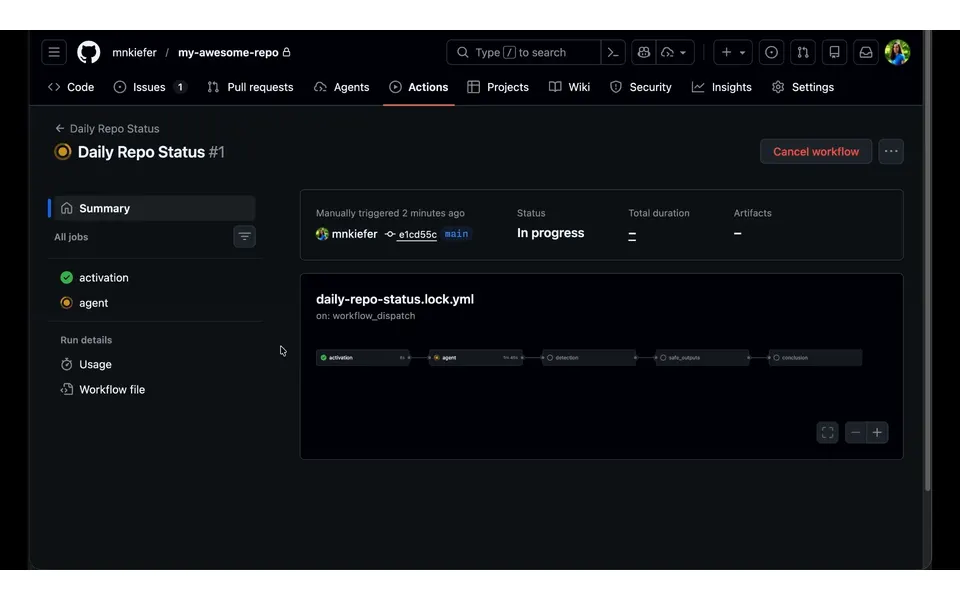
- Desktop app
- Mac, Windows and Linux
- Browser
- No
- Phone
- No
- Command line
- Yes
- Agents
- Claude Code, Codex, Cursor Agent, Gemini CLI, OpenCode, Pi, Aider and Antigravity
- Your subscription
- Works with your own plan
- Agents run
- On your computer, on your own server and in the vendor's cloud
- Laptop closed
- Keeps going
- Isolation
- Container and VM
- Parallel agents
- Yes
- Scheduled runs
- Yes
- Coordinator agent
- Yes
- Built-in issues
- Yes
- Pull requests
- Yes
- Review screen
- No
- Team
- No
- Self-hosting
- Not listed
- Licence
- MIT
- Price from
- Free
- How it charges
- No paid plan and bring your own key
- Paid plans from
- No paid plan
Receipts
- Checked
- · oldest answer 2026-11-08
- Findings
- 34 published · 22 cross-checked by a second agent · read them all
- Sources
- 26 public pages on 1 site: github.com
- Screenshot
- github.com, retrieved · first party repository · shows appearance, not capability
- Data
- /products/gh-aw.json · .md
- Method
- Same rules for all 103 researched ADEs. How we check · Report wrong data
What it does
Where you use it
gh aw ships a native GitHub CLI extension for macOS, Windows and Linux; this is CLI/TUI access, not a separate desktop GUI. It supplies no released product browser or native phone app.
Source and scope for Where you use itAgents it runs
Built-in engines and custom imported definitions are separate. Public experimental samples launch Cursor Agent, OpenCode and Aider without compatibility guarantees; these are runnable integrations, not supported built-in engines.
Source and scope for Agents it runsAccounts and subscriptions
A personal Copilot subscription can use COPILOT_GITHUB_TOKEN. Claude subscription OAuth and ChatGPT subscription login are unsupported. Claude and Codex support API credentials and provider-specific inference routes.
Source and scope for Accounts and subscriptionsWhere agents run
Compiled workflows execute on GitHub Actions runners, including user-controlled Linux runners. A runner on the user computer executes there; other self-hosted runners and GitHub-hosted runners remain separate options.
Source and scope for Where agents runHow work is kept apart
AWF Docker isolation is the default; opt-in Cloud Hypervisor/NVX preview runtimes use KVM microVMs on eligible runners. The compiler does not provision Git worktrees.
Source and scope for How work is kept apartParallel work
Workflows on distinct issues/PRs/branches may run concurrently; default per-engine groups serialize each engine.
Source and scope for Parallel workScheduled runs
Schedule frontmatter can run a recurring workflow such as a daily report. GitHub events can start automation without a human mentioning the agent on every run. Schedules execute through GitHub Actions rather than a local browser or desktop scheduler.
Source and scope for Scheduled runsGit and pull requests
create-pull-request safe outputs propose code in a separate permission-scoped job. Workflow examples include CI-failure investigation; automatically triggering CI from generated PRs may require an additional token.
Source and scope for Git and pull requestsLicence and source
The gh-aw compiler and runtime repository use MIT.
Source and scope for Licence and sourcePrice
The gh-aw extension/compiler is free MIT software without a paid extension plan. Inference is billed by the chosen provider/Copilot plan and Actions compute minutes remain separate.
Source and scope for PriceTyped filters
Every value links to its receipt below. Read plan and surface restrictions before using a filter to decide.
| Filter | Value |
|---|---|
| Desktop OS: macOS | Yes |
| Desktop OS: Windows | Yes |
| Desktop OS: Linux | Yes |
| Web client | No |
| Phone access: Native iOS | No |
| Phone access: Native Android | No |
| Phone access: Phone browser | No |
| CLI | Yes cross-checked |
| Coding agents: Claude Code | Yes |
| Coding agents: Codex | Yes |
| Coding agents: Cursor Agent | Yes |
| Coding agents: Gemini CLI | Yes |
| Coding agents: OpenCode | Yes |
| Coding agents: Pi | Yes |
| Coding agents: Grok | Unknown |
| Coding agents: Aider | Yes |
| Coding agents: Antigravity | Yes |
| Use my subscription | Yes cross-checked |
| Where agents run: On your computer | Yes |
| Where agents run: On your own server | Yes |
| Where agents run: In the vendor's cloud | Yes |
| Workspace isolation: Git worktree | No |
| Workspace isolation: Container | Yes |
| Workspace isolation: VM or microVM | Yes |
| Parallel runs | Yes cross-checked |
| Coordinator | Yes |
| Native issue tracking | Yes cross-checked |
| Unattended triggers | Yes cross-checked |
| Shared prompting | No |
| Team roles | No |
| SSO | No |
| Pull request workflow | Yes cross-checked |
| Review interface | No |
| Product license: Apache-2.0 | No. MIT cross-checked |
| Product license: MIT | Yes. MIT cross-checked |
| Product license: GPL-3.0 | No. MIT cross-checked |
| Product license: GPL-3.0-or-later | No. MIT cross-checked |
| Product license: AGPL-3.0 | No. MIT cross-checked |
| Product license: AGPL-3.0-or-later | No. MIT cross-checked |
| Product license: Elastic License 2.0 | No. MIT cross-checked |
| Product license: Custom terms | No. MIT cross-checked |
| Product license: Proprietary | No. MIT cross-checked |
| Self-hosting | Unknown |
| Telemetry opt-out | Yes |
| Free access | Yes cross-checked |
| Starting price: Free | Yes. Free cross-checked |
| Starting price: Up to $20/month | No. Free cross-checked |
| Starting price: $21–40/month | No. Free cross-checked |
| Starting price: $41–100/month | No. Free cross-checked |
| Starting price: Over $100/month | No. Free cross-checked |
| Starting price: Contact for pricing | No. Free cross-checked |
| Pricing model: Free, no paid plan | Yes |
| Pricing model: Free plan | No |
| Pricing model: Subscription | No |
| Pricing model: Per seat | No |
| Pricing model: Usage-based | No |
| Pricing model: Per machine or compute | No |
| Pricing model: Bring your own key | Yes cross-checked |
| Pricing model: One-time purchase | No |
| Paid plans from: No paid plan | Yes. No paid plan |
| Paid plans from: $10 or less/month | No. No paid plan |
| Paid plans from: $11–20/month | No. No paid plan |
| Paid plans from: $21–40/month | No. No paid plan |
| Paid plans from: $41–100/month | No. No paid plan |
| Paid plans from: Over $100/month | No. No paid plan |
| Paid plans from: Contact sales | No. No paid plan |
| Lifecycle status: Active | Unknown |
| Lifecycle status: Sunsetting | Unknown |
| Keeps going with laptop closed | Yes |
| Open-source license | Yes. MIT cross-checked |
| Any desktop app | Yes |
| Paid plan up to $20/month | No. No paid plan |
| Paid plan up to $40/month | No. No paid plan |
| Any phone client | No |
Filter receipts
Desktop OS: macOS: Yes
Desktop OS: macOS
Typed value: Yes.
gh aw ships a native GitHub CLI extension for macOS, Windows and Linux; this is CLI/TUI access, not a separate desktop GUI. It supplies no released product browser or native phone app.
- Desktop os: Native release extension binaries cover macOS, Windows and Linux; Windows installer uses Git Bash/MSYS/Cygwin.
- Mobile apps: No native iOS/Android application; Android Termux CLI installation is not a native phone app.
- Browser: GitHub workflow pages are the external platform UI; the extension does not supply an ADE browser client.
- Mobile browser: No product-owned phone-browser ADE interface.
- Only the cited atomic findings are established. Remaining atomic requirements and the full rubric scenario remain unverified.
-
Finding: The install script provides native extension binaries for Linux, macOS, Windows and other hosts. gh aw is a CLI/compiler plus GitHub Actions runtime, not a standalone browser/phone app or diff review interface. It executes agent work on configured Actions runners; a self-hosted runner can be on a user computer. Source checkout is managed by the workflow, with no worktree provisioning. GitHub supplies human accounts, repository permissions, SSO, workflow control and logs; no separate human-team or shared live-prompt service is implemented by the extension.
Desktop OS: Windows: Yes
Desktop OS: Windows
Typed value: Yes.
gh aw ships a native GitHub CLI extension for macOS, Windows and Linux; this is CLI/TUI access, not a separate desktop GUI. It supplies no released product browser or native phone app.
- Desktop os: Native release extension binaries cover macOS, Windows and Linux; Windows installer uses Git Bash/MSYS/Cygwin.
- Mobile apps: No native iOS/Android application; Android Termux CLI installation is not a native phone app.
- Browser: GitHub workflow pages are the external platform UI; the extension does not supply an ADE browser client.
- Mobile browser: No product-owned phone-browser ADE interface.
- Only the cited atomic findings are established. Remaining atomic requirements and the full rubric scenario remain unverified.
-
Finding: The install script provides native extension binaries for Linux, macOS, Windows and other hosts. gh aw is a CLI/compiler plus GitHub Actions runtime, not a standalone browser/phone app or diff review interface. It executes agent work on configured Actions runners; a self-hosted runner can be on a user computer. Source checkout is managed by the workflow, with no worktree provisioning. GitHub supplies human accounts, repository permissions, SSO, workflow control and logs; no separate human-team or shared live-prompt service is implemented by the extension.
Desktop OS: Linux: Yes
Desktop OS: Linux
Typed value: Yes.
gh aw ships a native GitHub CLI extension for macOS, Windows and Linux; this is CLI/TUI access, not a separate desktop GUI. It supplies no released product browser or native phone app.
- Desktop os: Native release extension binaries cover macOS, Windows and Linux; Windows installer uses Git Bash/MSYS/Cygwin.
- Mobile apps: No native iOS/Android application; Android Termux CLI installation is not a native phone app.
- Browser: GitHub workflow pages are the external platform UI; the extension does not supply an ADE browser client.
- Mobile browser: No product-owned phone-browser ADE interface.
- Only the cited atomic findings are established. Remaining atomic requirements and the full rubric scenario remain unverified.
-
Finding: The install script provides native extension binaries for Linux, macOS, Windows and other hosts. gh aw is a CLI/compiler plus GitHub Actions runtime, not a standalone browser/phone app or diff review interface. It executes agent work on configured Actions runners; a self-hosted runner can be on a user computer. Source checkout is managed by the workflow, with no worktree provisioning. GitHub supplies human accounts, repository permissions, SSO, workflow control and logs; no separate human-team or shared live-prompt service is implemented by the extension.
Web client: No
Web client
Typed value: No.
gh aw ships a native GitHub CLI extension for macOS, Windows and Linux; this is CLI/TUI access, not a separate desktop GUI. It supplies no released product browser or native phone app.
- Desktop os: Native release extension binaries cover macOS, Windows and Linux; Windows installer uses Git Bash/MSYS/Cygwin.
- Mobile apps: No native iOS/Android application; Android Termux CLI installation is not a native phone app.
- Browser: GitHub workflow pages are the external platform UI; the extension does not supply an ADE browser client.
- Mobile browser: No product-owned phone-browser ADE interface.
- Only the cited atomic findings are established. Remaining atomic requirements and the full rubric scenario remain unverified.
-
Finding: The install script provides native extension binaries for Linux, macOS, Windows and other hosts. gh aw is a CLI/compiler plus GitHub Actions runtime, not a standalone browser/phone app or diff review interface. It executes agent work on configured Actions runners; a self-hosted runner can be on a user computer. Source checkout is managed by the workflow, with no worktree provisioning. GitHub supplies human accounts, repository permissions, SSO, workflow control and logs; no separate human-team or shared live-prompt service is implemented by the extension.
Phone access: Native iOS: No
Phone access: Native iOS
Typed value: No.
gh aw ships a native GitHub CLI extension for macOS, Windows and Linux; this is CLI/TUI access, not a separate desktop GUI. It supplies no released product browser or native phone app.
- Desktop os: Native release extension binaries cover macOS, Windows and Linux; Windows installer uses Git Bash/MSYS/Cygwin.
- Mobile apps: No native iOS/Android application; Android Termux CLI installation is not a native phone app.
- Browser: GitHub workflow pages are the external platform UI; the extension does not supply an ADE browser client.
- Mobile browser: No product-owned phone-browser ADE interface.
- Only the cited atomic findings are established. Remaining atomic requirements and the full rubric scenario remain unverified.
-
Finding: The install script provides native extension binaries for Linux, macOS, Windows and other hosts. gh aw is a CLI/compiler plus GitHub Actions runtime, not a standalone browser/phone app or diff review interface. It executes agent work on configured Actions runners; a self-hosted runner can be on a user computer. Source checkout is managed by the workflow, with no worktree provisioning. GitHub supplies human accounts, repository permissions, SSO, workflow control and logs; no separate human-team or shared live-prompt service is implemented by the extension.
Phone access: Native Android: No
Phone access: Native Android
Typed value: No.
gh aw ships a native GitHub CLI extension for macOS, Windows and Linux; this is CLI/TUI access, not a separate desktop GUI. It supplies no released product browser or native phone app.
- Desktop os: Native release extension binaries cover macOS, Windows and Linux; Windows installer uses Git Bash/MSYS/Cygwin.
- Mobile apps: No native iOS/Android application; Android Termux CLI installation is not a native phone app.
- Browser: GitHub workflow pages are the external platform UI; the extension does not supply an ADE browser client.
- Mobile browser: No product-owned phone-browser ADE interface.
- Only the cited atomic findings are established. Remaining atomic requirements and the full rubric scenario remain unverified.
-
Finding: The install script provides native extension binaries for Linux, macOS, Windows and other hosts. gh aw is a CLI/compiler plus GitHub Actions runtime, not a standalone browser/phone app or diff review interface. It executes agent work on configured Actions runners; a self-hosted runner can be on a user computer. Source checkout is managed by the workflow, with no worktree provisioning. GitHub supplies human accounts, repository permissions, SSO, workflow control and logs; no separate human-team or shared live-prompt service is implemented by the extension.
Phone access: Phone browser: No
Phone access: Phone browser
Typed value: No.
gh aw ships a native GitHub CLI extension for macOS, Windows and Linux; this is CLI/TUI access, not a separate desktop GUI. It supplies no released product browser or native phone app.
- Desktop os: Native release extension binaries cover macOS, Windows and Linux; Windows installer uses Git Bash/MSYS/Cygwin.
- Mobile apps: No native iOS/Android application; Android Termux CLI installation is not a native phone app.
- Browser: GitHub workflow pages are the external platform UI; the extension does not supply an ADE browser client.
- Mobile browser: No product-owned phone-browser ADE interface.
- Only the cited atomic findings are established. Remaining atomic requirements and the full rubric scenario remain unverified.
-
Finding: The install script provides native extension binaries for Linux, macOS, Windows and other hosts. gh aw is a CLI/compiler plus GitHub Actions runtime, not a standalone browser/phone app or diff review interface. It executes agent work on configured Actions runners; a self-hosted runner can be on a user computer. Source checkout is managed by the workflow, with no worktree provisioning. GitHub supplies human accounts, repository permissions, SSO, workflow control and logs; no separate human-team or shared live-prompt service is implemented by the extension.
CLI: Yes cross-checked
CLI
Typed value: Yes.
gh aw compile, logs and audit provide workflow authoring and inspection operations. gh aw mcp-server exposes workflow operations, read-only unless write tools are enabled.
- Cli: gh aw compile, logs and audit provide workflow authoring and inspection operations.
- Only the cited atomic findings are established. Remaining atomic requirements and the full rubric scenario remain unverified.
-
GitHub Agentic Workflows README.md
Finding: The gh aw extension compiles Markdown/YAML repository automation into GitHub Actions workflows with configurable agents, read-only sandbox defaults and separate safe-output jobs.
-
GitHub Agentic Workflows docs/src/content/docs/reference/cost-management.md
Finding: Per-run logs/audit reports display tokens, duration and AI-credit estimates. One AIC represents $0.01 of catalog-estimated inference, distinct from Actions compute and provider invoices.
Coding agents: Claude Code: Yes
Coding agents: Claude Code
Typed value: Yes.
Built-in engines and custom imported definitions are separate. Public experimental samples launch Cursor Agent, OpenCode and Aider without compatibility guarantees; these are runnable integrations, not supported built-in engines.
- Session integration: Compiled workflows launch the configured native engine with declared tools and sandbox policy.
- Only the cited atomic findings are established. Remaining atomic requirements and the full rubric scenario remain unverified.
- The released Agy engine is experimental, Linux x64 only, and supports Gemini API keys rather than Google WIF, ADC or Vertex AI. It cannot disable native shell, editing or web tools.
-
GitHub Agentic Workflows docs/src/content/docs/reference/engines.md
Finding: Built-in engines include Copilot, Claude Code, Codex, deprecated Gemini CLI and Pi. Experimental durable mode checkpoints native sessions in artifacts; max-turns and AI-credit limits vary by engine.
Coding agents: Codex: Yes
Coding agents: Codex
Typed value: Yes.
Built-in engines and custom imported definitions are separate. Public experimental samples launch Cursor Agent, OpenCode and Aider without compatibility guarantees; these are runnable integrations, not supported built-in engines.
- Session integration: Compiled workflows launch the configured native engine with declared tools and sandbox policy.
- Only the cited atomic findings are established. Remaining atomic requirements and the full rubric scenario remain unverified.
- The released Agy engine is experimental, Linux x64 only, and supports Gemini API keys rather than Google WIF, ADC or Vertex AI. It cannot disable native shell, editing or web tools.
-
GitHub Agentic Workflows docs/src/content/docs/reference/engines.md
Finding: Built-in engines include Copilot, Claude Code, Codex, deprecated Gemini CLI and Pi. Experimental durable mode checkpoints native sessions in artifacts; max-turns and AI-credit limits vary by engine.
Coding agents: Cursor Agent: Yes
Coding agents: Cursor Agent
Typed value: Yes.
Built-in engines and custom imported definitions are separate. Public experimental samples launch Cursor Agent, OpenCode and Aider without compatibility guarantees; these are runnable integrations, not supported built-in engines.
- Harnesses: Published experimental custom-engine samples launch Cursor Agent, OpenCode 2 and Aider; existing built-in engines retain their own scope.
- Custom adapters: Compiler accepts imported custom engine definitions, including the shipped samples.
- Only the cited atomic findings are established. Remaining atomic requirements and the full rubric scenario remain unverified.
- The released Agy engine is experimental, Linux x64 only, and supports Gemini API keys rather than Google WIF, ADC or Vertex AI. It cannot disable native shell, editing or web tools.
-
gh-aw: .github/workflows/shared/cursor.md
Finding: The repository ships publicly importable experimental engine definitions that install/launch Cursor Agent, OpenCode 2 and Aider. They are explicitly unsupported examples for integration authors without a compatibility or maintenance commitment, rather than built-in supported engines. Custom engine definitions are accepted by the compiler.
Coding agents: Gemini CLI: Yes
Coding agents: Gemini CLI
Typed value: Yes.
Built-in engines and custom imported definitions are separate. Public experimental samples launch Cursor Agent, OpenCode and Aider without compatibility guarantees; these are runnable integrations, not supported built-in engines.
- Session integration: Compiled workflows launch the configured native engine with declared tools and sandbox policy.
- Only the cited atomic findings are established. Remaining atomic requirements and the full rubric scenario remain unverified.
- The released Agy engine is experimental, Linux x64 only, and supports Gemini API keys rather than Google WIF, ADC or Vertex AI. It cannot disable native shell, editing or web tools.
-
GitHub Agentic Workflows docs/src/content/docs/reference/engines.md
Finding: Built-in engines include Copilot, Claude Code, Codex, deprecated Gemini CLI and Pi. Experimental durable mode checkpoints native sessions in artifacts; max-turns and AI-credit limits vary by engine.
Coding agents: OpenCode: Yes
Coding agents: OpenCode
Typed value: Yes.
Built-in engines and custom imported definitions are separate. Public experimental samples launch Cursor Agent, OpenCode and Aider without compatibility guarantees; these are runnable integrations, not supported built-in engines.
- Harnesses: Published experimental custom-engine samples launch Cursor Agent, OpenCode 2 and Aider; existing built-in engines retain their own scope.
- Custom adapters: Compiler accepts imported custom engine definitions, including the shipped samples.
- Only the cited atomic findings are established. Remaining atomic requirements and the full rubric scenario remain unverified.
- The released Agy engine is experimental, Linux x64 only, and supports Gemini API keys rather than Google WIF, ADC or Vertex AI. It cannot disable native shell, editing or web tools.
-
gh-aw: .github/workflows/shared/cursor.md
Finding: The repository ships publicly importable experimental engine definitions that install/launch Cursor Agent, OpenCode 2 and Aider. They are explicitly unsupported examples for integration authors without a compatibility or maintenance commitment, rather than built-in supported engines. Custom engine definitions are accepted by the compiler.
Coding agents: Pi: Yes
Coding agents: Pi
Typed value: Yes.
Built-in engines and custom imported definitions are separate. Public experimental samples launch Cursor Agent, OpenCode and Aider without compatibility guarantees; these are runnable integrations, not supported built-in engines.
- Session integration: Compiled workflows launch the configured native engine with declared tools and sandbox policy.
- Only the cited atomic findings are established. Remaining atomic requirements and the full rubric scenario remain unverified.
- The released Agy engine is experimental, Linux x64 only, and supports Gemini API keys rather than Google WIF, ADC or Vertex AI. It cannot disable native shell, editing or web tools.
-
GitHub Agentic Workflows docs/src/content/docs/reference/engines.md
Finding: Built-in engines include Copilot, Claude Code, Codex, deprecated Gemini CLI and Pi. Experimental durable mode checkpoints native sessions in artifacts; max-turns and AI-credit limits vary by engine.
Coding agents: Aider: Yes
Coding agents: Aider
Typed value: Yes.
Built-in engines and custom imported definitions are separate. Public experimental samples launch Cursor Agent, OpenCode and Aider without compatibility guarantees; these are runnable integrations, not supported built-in engines.
- Harnesses: Published experimental custom-engine samples launch Cursor Agent, OpenCode 2 and Aider; existing built-in engines retain their own scope.
- Custom adapters: Compiler accepts imported custom engine definitions, including the shipped samples.
- Only the cited atomic findings are established. Remaining atomic requirements and the full rubric scenario remain unverified.
- The released Agy engine is experimental, Linux x64 only, and supports Gemini API keys rather than Google WIF, ADC or Vertex AI. It cannot disable native shell, editing or web tools.
-
gh-aw: .github/workflows/shared/cursor.md
Finding: The repository ships publicly importable experimental engine definitions that install/launch Cursor Agent, OpenCode 2 and Aider. They are explicitly unsupported examples for integration authors without a compatibility or maintenance commitment, rather than built-in supported engines. Custom engine definitions are accepted by the compiler.
Coding agents: Antigravity: Yes
Coding agents: Antigravity
Typed value: Yes.
Built-in engines and custom imported definitions are separate. Public experimental samples launch Cursor Agent, OpenCode and Aider without compatibility guarantees; these are runnable integrations, not supported built-in engines.
- Only the cited atomic findings are established. Remaining atomic requirements and the full rubric scenario remain unverified.
- The released Agy engine is experimental, Linux x64 only, and supports Gemini API keys rather than Google WIF, ADC or Vertex AI. It cannot disable native shell, editing or web tools.
-
gh-aw Antigravity support at v1.2.2
Finding: gh-aw v1.2.2 ships the native experimental Agy engine and documents engine: agy running Antigravity CLI in GitHub Actions.
-
gh-aw Antigravity support at v1.2.2
Finding: gh-aw v1.2.2 ships the native experimental Agy engine and documents engine: agy running Antigravity CLI in GitHub Actions.
Use my subscription: Yes cross-checked
Use my subscription
Typed value: Yes.
A personal Copilot subscription can use COPILOT_GITHUB_TOKEN. Claude subscription OAuth and ChatGPT subscription login are unsupported. Claude and Codex support API credentials and provider-specific inference routes.
- Agent subscriptions: A personal Copilot subscription can use COPILOT_GITHUB_TOKEN. Claude subscription OAuth and ChatGPT subscription login are unsupported.
- Only the cited atomic findings are established. Remaining atomic requirements and the full rubric scenario remain unverified.
-
GitHub Agentic Workflows docs/src/content/docs/engines/copilot.md
Finding: Personal Copilot subscriptions can be used with COPILOT_GITHUB_TOKEN, separate from organization-billed inference.
Where agents run: On your computer: Yes
Where agents run: On your computer
Typed value: Yes.
Compiled workflows execute on GitHub Actions runners, including user-controlled Linux runners. A runner on the user computer executes there; other self-hosted runners and GitHub-hosted runners remain separate options.
- Local: A user-managed Linux runner on the user computer executes the compiled agent job there; compilation by the CLI alone is not agent execution.
- Only the cited atomic findings are established. Remaining atomic requirements and the full rubric scenario remain unverified.
-
Finding: The install script provides native extension binaries for Linux, macOS, Windows and other hosts. gh aw is a CLI/compiler plus GitHub Actions runtime, not a standalone browser/phone app or diff review interface. It executes agent work on configured Actions runners; a self-hosted runner can be on a user computer. Source checkout is managed by the workflow, with no worktree provisioning. GitHub supplies human accounts, repository permissions, SSO, workflow control and logs; no separate human-team or shared live-prompt service is implemented by the extension.
Where agents run: On your own server: Yes
Where agents run: On your own server
Typed value: Yes.
Compiled workflows execute on GitHub Actions runners, including user-controlled Linux runners. A runner on the user computer executes there; other self-hosted runners and GitHub-hosted runners remain separate options.
- Byo remote: Self-hosted Linux container-capable runners can execute the compiled workflow.
- Only the cited atomic findings are established. Remaining atomic requirements and the full rubric scenario remain unverified.
-
GitHub Agentic Workflows docs/src/content/docs/reference/faq.md
Finding: gh-aw is free with separate inference and Actions compute charges. It requires Linux container-capable runners, can use self-hosted runners, and retains GitHub workflow dependencies.
Where agents run: In the vendor's cloud: Yes
Where agents run: In the vendor's cloud
Typed value: Yes.
Compiled workflows execute on GitHub Actions runners, including user-controlled Linux runners. A runner on the user computer executes there; other self-hosted runners and GitHub-hosted runners remain separate options.
- Managed cloud: On GitHub-hosted Actions runners the agent runs in an AWF Docker container by default.
- Only the cited atomic findings are established. Remaining atomic requirements and the full rubric scenario remain unverified.
-
GitHub Agentic Workflows docs/src/content/docs/reference/sandbox.md
Finding: The default docker runtime runs the agent in a rootless AWF container with network isolation; preview cloud-hypervisor and nvx runtimes use KVM microVMs. Filesystem mounts and outbound network allowlists are configurable. The page does not itself describe the GitHub runner as a VM.
-
Finding: The default agent runtime uses Docker container isolation on GitHub-hosted or Linux self-hosted runners, with the Squid proxy as the only egress path. Eligible GitHub-hosted Ubuntu x86_64 KVM runners can instead place the agent in a Cloud Hypervisor microVM (preview).
Workspace isolation: Git worktree: No
Workspace isolation: Git worktree
Typed value: No.
AWF Docker isolation is the default; opt-in Cloud Hypervisor/NVX preview runtimes use KVM microVMs on eligible runners. The compiler does not provision Git worktrees.
- Worktree: Checkout/branch steps use the workflow workspace, not a product worktree isolation option.
- MicroVM runtimes are previews limited to eligible KVM runners; the default is a Docker container.
- Only the cited atomic findings are established. Remaining atomic requirements and the full rubric scenario remain unverified.
-
Finding: The install script provides native extension binaries for Linux, macOS, Windows and other hosts. gh aw is a CLI/compiler plus GitHub Actions runtime, not a standalone browser/phone app or diff review interface. It executes agent work on configured Actions runners; a self-hosted runner can be on a user computer. Source checkout is managed by the workflow, with no worktree provisioning. GitHub supplies human accounts, repository permissions, SSO, workflow control and logs; no separate human-team or shared live-prompt service is implemented by the extension.
Workspace isolation: Container: Yes
Workspace isolation: Container
Typed value: Yes.
AWF Docker isolation is the default; opt-in Cloud Hypervisor/NVX preview runtimes use KVM microVMs on eligible runners. The compiler does not provision Git worktrees.
- Container: The default docker runtime runs the agent in a rootless AWF container.
- Vm: Preview cloud-hypervisor (GitHub-hosted Ubuntu x86_64 KVM runners) and nvx runtimes place the agent in a KVM microVM.
- Network: AWF network isolation sends egress only through the proxy to configured domains.
- MicroVM runtimes are previews limited to eligible KVM runners; the default is a Docker container.
- Only the cited atomic findings are established. Remaining atomic requirements and the full rubric scenario remain unverified.
-
GitHub Agentic Workflows docs/src/content/docs/reference/sandbox.md
Finding: The default docker runtime runs the agent in a rootless AWF container with network isolation; preview cloud-hypervisor and nvx runtimes use KVM microVMs. Filesystem mounts and outbound network allowlists are configurable. The page does not itself describe the GitHub runner as a VM.
-
Finding: The default agent runtime uses Docker container isolation on GitHub-hosted or Linux self-hosted runners, with the Squid proxy as the only egress path. Eligible GitHub-hosted Ubuntu x86_64 KVM runners can instead place the agent in a Cloud Hypervisor microVM (preview).
Workspace isolation: VM or microVM: Yes
Workspace isolation: VM or microVM
Typed value: Yes.
AWF Docker isolation is the default; opt-in Cloud Hypervisor/NVX preview runtimes use KVM microVMs on eligible runners. The compiler does not provision Git worktrees.
- Container: The default docker runtime runs the agent in a rootless AWF container.
- Vm: Preview cloud-hypervisor (GitHub-hosted Ubuntu x86_64 KVM runners) and nvx runtimes place the agent in a KVM microVM.
- Network: AWF network isolation sends egress only through the proxy to configured domains.
- MicroVM runtimes are previews limited to eligible KVM runners; the default is a Docker container.
- Only the cited atomic findings are established. Remaining atomic requirements and the full rubric scenario remain unverified.
-
GitHub Agentic Workflows docs/src/content/docs/reference/sandbox.md
Finding: The default docker runtime runs the agent in a rootless AWF container with network isolation; preview cloud-hypervisor and nvx runtimes use KVM microVMs. Filesystem mounts and outbound network allowlists are configurable. The page does not itself describe the GitHub runner as a VM.
-
Finding: The default agent runtime uses Docker container isolation on GitHub-hosted or Linux self-hosted runners, with the Squid proxy as the only egress path. Eligible GitHub-hosted Ubuntu x86_64 KVM runners can instead place the agent in a Cloud Hypervisor microVM (preview).
Parallel runs: Yes cross-checked
Parallel runs
Typed value: Yes.
Workflows on distinct issues/PRs/branches may run concurrently; default per-engine groups serialize each engine.
- Concurrent sessions: Workflows on distinct issues/PRs/branches may run concurrently; default per-engine groups serialize each engine.
- Only the cited atomic findings are established. Remaining atomic requirements and the full rubric scenario remain unverified.
-
GitHub Agentic Workflows docs/src/content/docs/reference/concurrency.md
Finding: Separate workflows can run concurrently, with default one agent job per engine. Context-specific groups, cancellation and queue:max preserve or cancel pending runs according to trigger configuration.
Coordinator: Yes
Coordinator
Typed value: Yes.
The product supplies producer/dispatcher agent roles and native queue tools for submitting tasks, dispatching approved worker workflows and inspecting task/claim/result snapshots.
- Roles: Product-owned producer/dispatcher and worker roles have distinct tools and authority.
- Results return: Verified Results and Claims are retained in the authoritative Git-backed queue and visible in activation snapshots.
- Orchestration owner: Native work-queue submission/dispatch and verified worker routes are product orchestration rather than provider-native subagents.
- Invocation: Producer/dispatcher agents use work_queue_submit and work_queue_dispatch_next; read/explain inspect their immutable activation snapshot.
- Source review and pinned implementation inspection only; no installed-product, account or multi-user scenario was executed. Unanswered atomic questions remain open.
-
gh-aw: docs/src/content/docs/reference/work-queue.md
Finding: Native producer/dispatcher agent roles can submit immutable tasks/dependency graphs and request scheduler-selected assignments to approved worker workflows. work_queue_read/explain inspect the activation snapshot including task, claim and result state. Worker executions are verified/pinned; dependencies consume independently verified Results. Agent tools stage intents; application settlement performs dispatch.
Native issue tracking: Yes cross-checked
Native issue tracking
Typed value: Yes.
The native work queue (tools.work-queue) keeps Work items with dependencies, priorities and attempt state in a Git-backed ledger, separate from individual workflow runs. Operators submit, list, filter, search, dispatch, cancel and reprioritize Work with gh aw work-queue; GitHub Issues can mirror items but are not the store.
- Create: submit-work and submit-graph admit Work items, optionally as a dependency graph.
- Prioritize: Work has a priority (default 3); administrators can reprioritize Work from 1 to 5.
- Search: state --search TEXT searches the queue tree.
- Filter: state filters by graph, pool and state.
- Explicit dispatch: dispatch-next commits assignments and dispatch activates a verified dispatcher workflow for queued Work.
- Task session separation: Work is an immutable task definition; each attempt is a separate Claim bound to a workflow run.
- Durable states: The version-3 transaction log on the queue branch is authoritative and records Claims, Completions and Results.
- External tracker requirement: No external tracker is required: Issues can mirror Work but cannot store the queue.
- Discussion, labels, assignment to humans, archive and reopen were not established for queue Work. The queue is agent-worker infrastructure rather than a human backlog UI. No installed-product test was run.
-
GitHub Agentic Workflows reference: Work queues (v1.2.2)
Finding: tools.work-queue is a native Git-backed queue whose transaction log is authoritative; it stores Work task definitions with dependencies, Claims for each attempt, Completions and Results. GitHub Issues can mirror tasks but cannot store the queue.
-
GitHub Agentic Workflows reference: Work queue operator commands (v1.2.2)
Finding: gh aw work-queue offers operator commands to submit Work, list state filtered by graph, pool, state or search text, inspect items, dispatch assignments, cancel Work or Claims and, for administrators, reprioritize Work; a keyboard TUI browses the queue.
Unattended triggers: Yes cross-checked
Unattended triggers
Typed value: Yes.
Schedule frontmatter can run a recurring workflow such as a daily report. GitHub events can start automation without a human mentioning the agent on every run. Schedules execute through GitHub Actions rather than a local browser or desktop scheduler.
- Schedules: Schedule frontmatter can run a recurring workflow such as a daily report.
- Events: GitHub events can start automation without a human mentioning the agent on every run.
- Scheduler location: Schedules execute through GitHub Actions rather than a local browser or desktop scheduler.
- Only the cited atomic findings are established. Remaining atomic requirements and the full rubric scenario remain unverified.
-
GitHub Agentic Workflows docs/src/content/docs/reference/triggers.md
Finding: Workflow frontmatter supports scheduled and event-driven repository automation.
Shared prompting: No
Shared prompting
Typed value: No.
The scoped workflow runtime accepts its invocation inputs and does not supply multiple humans with a shared live prompting channel. GitHub discussion and follow-on workflows are external platform interactions.
- Coprompting: No product shared live-prompt channel to an existing agent run in the scoped extension/runtime.
- Source review and pinned implementation inspection only; no installed-product, account or multi-user scenario was executed. Unanswered atomic questions remain open.
-
Finding: The install script provides native extension binaries for Linux, macOS, Windows and other hosts. gh aw is a CLI/compiler plus GitHub Actions runtime, not a standalone browser/phone app or diff review interface. It executes agent work on configured Actions runners; a self-hosted runner can be on a user computer. Source checkout is managed by the workflow, with no worktree provisioning. GitHub supplies human accounts, repository permissions, SSO, workflow control and logs; no separate human-team or shared live-prompt service is implemented by the extension.
Team roles: No
Team roles
Typed value: No.
Human authentication and repository authorization belong to GitHub. Native queue observer/producer/worker roles are agent authority, not human workspace roles or product SSO.
- Organization roles: No separate gh-aw human workspace/team-role model.
- Sso: No product SSO implementation; GitHub login and enterprise authentication are external platform dependencies.
- Source review and pinned implementation inspection only; no installed-product, account or multi-user scenario was executed. Unanswered atomic questions remain open.
-
Finding: The install script provides native extension binaries for Linux, macOS, Windows and other hosts. gh aw is a CLI/compiler plus GitHub Actions runtime, not a standalone browser/phone app or diff review interface. It executes agent work on configured Actions runners; a self-hosted runner can be on a user computer. Source checkout is managed by the workflow, with no worktree provisioning. GitHub supplies human accounts, repository permissions, SSO, workflow control and logs; no separate human-team or shared live-prompt service is implemented by the extension.
SSO: No
SSO
Typed value: No.
Human authentication and repository authorization belong to GitHub. Native queue observer/producer/worker roles are agent authority, not human workspace roles or product SSO.
- Organization roles: No separate gh-aw human workspace/team-role model.
- Sso: No product SSO implementation; GitHub login and enterprise authentication are external platform dependencies.
- Source review and pinned implementation inspection only; no installed-product, account or multi-user scenario was executed. Unanswered atomic questions remain open.
-
Finding: The install script provides native extension binaries for Linux, macOS, Windows and other hosts. gh aw is a CLI/compiler plus GitHub Actions runtime, not a standalone browser/phone app or diff review interface. It executes agent work on configured Actions runners; a self-hosted runner can be on a user computer. Source checkout is managed by the workflow, with no worktree provisioning. GitHub supplies human accounts, repository permissions, SSO, workflow control and logs; no separate human-team or shared live-prompt service is implemented by the extension.
Pull request workflow: Yes cross-checked
Pull request workflow
Typed value: Yes.
create-pull-request safe outputs propose code in a separate permission-scoped job. Workflow examples include CI-failure investigation; automatically triggering CI from generated PRs may require an additional token.
- Pull requests: create-pull-request safe outputs propose code in a separate permission-scoped job.
- Ci response: Workflow examples include CI-failure investigation; automatically triggering CI from generated PRs may require an additional token.
- Only the cited atomic findings are established. Remaining atomic requirements and the full rubric scenario remain unverified.
-
GitHub Agentic Workflows docs/src/content/docs/reference/safe-outputs-pull-requests.md
Finding: Permission-scoped safe outputs can create and manage pull requests. Policy, credentials and individual output configuration govern each operation.
-
GitHub Agentic Workflows docs/src/content/docs/reference/faq.md
Finding: gh-aw is free with separate inference and Actions compute charges. It requires Linux container-capable runners, can use self-hosted runners, and retains GitHub workflow dependencies.
Review interface: No
Review interface
Typed value: No.
The extension exposes workflow logs, audit reports and output artifacts, not a product UI for reviewing proposed code diffs. GitHub pull-request review is separate.
- Diffs: No product-owned proposed-diff review UI in the scoped extension/runtime; reports and GitHub PR pages are separate.
- Only the cited atomic findings are established. Remaining atomic requirements and the full rubric scenario remain unverified.
-
Finding: The install script provides native extension binaries for Linux, macOS, Windows and other hosts. gh aw is a CLI/compiler plus GitHub Actions runtime, not a standalone browser/phone app or diff review interface. It executes agent work on configured Actions runners; a self-hosted runner can be on a user computer. Source checkout is managed by the workflow, with no worktree provisioning. GitHub supplies human accounts, repository permissions, SSO, workflow control and logs; no separate human-team or shared live-prompt service is implemented by the extension.
Product license: Apache-2.0: No. MIT cross-checked
Product license: Apache-2.0
Typed value: No. MIT.
The gh-aw compiler and runtime repository use MIT.
- Client license: The gh-aw compiler and runtime repository use MIT.
- Only the cited atomic findings are established. Remaining atomic requirements and the full rubric scenario remain unverified.
-
GitHub Agentic Workflows LICENSE
Finding: The gh-aw repository code is MIT licensed.
Product license: MIT: Yes. MIT cross-checked
Product license: MIT
Typed value: Yes. MIT.
The gh-aw compiler and runtime repository use MIT.
- Client license: The gh-aw compiler and runtime repository use MIT.
- Only the cited atomic findings are established. Remaining atomic requirements and the full rubric scenario remain unverified.
-
GitHub Agentic Workflows LICENSE
Finding: The gh-aw repository code is MIT licensed.
Product license: GPL-3.0: No. MIT cross-checked
Product license: GPL-3.0
Typed value: No. MIT.
The gh-aw compiler and runtime repository use MIT.
- Client license: The gh-aw compiler and runtime repository use MIT.
- Only the cited atomic findings are established. Remaining atomic requirements and the full rubric scenario remain unverified.
-
GitHub Agentic Workflows LICENSE
Finding: The gh-aw repository code is MIT licensed.
Product license: GPL-3.0-or-later: No. MIT cross-checked
Product license: GPL-3.0-or-later
Typed value: No. MIT.
The gh-aw compiler and runtime repository use MIT.
- Client license: The gh-aw compiler and runtime repository use MIT.
- Only the cited atomic findings are established. Remaining atomic requirements and the full rubric scenario remain unverified.
-
GitHub Agentic Workflows LICENSE
Finding: The gh-aw repository code is MIT licensed.
Product license: AGPL-3.0: No. MIT cross-checked
Product license: AGPL-3.0
Typed value: No. MIT.
The gh-aw compiler and runtime repository use MIT.
- Client license: The gh-aw compiler and runtime repository use MIT.
- Only the cited atomic findings are established. Remaining atomic requirements and the full rubric scenario remain unverified.
-
GitHub Agentic Workflows LICENSE
Finding: The gh-aw repository code is MIT licensed.
Product license: AGPL-3.0-or-later: No. MIT cross-checked
Product license: AGPL-3.0-or-later
Typed value: No. MIT.
The gh-aw compiler and runtime repository use MIT.
- Client license: The gh-aw compiler and runtime repository use MIT.
- Only the cited atomic findings are established. Remaining atomic requirements and the full rubric scenario remain unverified.
-
GitHub Agentic Workflows LICENSE
Finding: The gh-aw repository code is MIT licensed.
Product license: Elastic License 2.0: No. MIT cross-checked
Product license: Elastic License 2.0
Typed value: No. MIT.
The gh-aw compiler and runtime repository use MIT.
- Client license: The gh-aw compiler and runtime repository use MIT.
- Only the cited atomic findings are established. Remaining atomic requirements and the full rubric scenario remain unverified.
-
GitHub Agentic Workflows LICENSE
Finding: The gh-aw repository code is MIT licensed.
Product license: Custom terms: No. MIT cross-checked
Product license: Custom terms
Typed value: No. MIT.
The gh-aw compiler and runtime repository use MIT.
- Client license: The gh-aw compiler and runtime repository use MIT.
- Only the cited atomic findings are established. Remaining atomic requirements and the full rubric scenario remain unverified.
-
GitHub Agentic Workflows LICENSE
Finding: The gh-aw repository code is MIT licensed.
Product license: Proprietary: No. MIT cross-checked
Product license: Proprietary
Typed value: No. MIT.
The gh-aw compiler and runtime repository use MIT.
- Client license: The gh-aw compiler and runtime repository use MIT.
- Only the cited atomic findings are established. Remaining atomic requirements and the full rubric scenario remain unverified.
-
GitHub Agentic Workflows LICENSE
Finding: The gh-aw repository code is MIT licensed.
Telemetry opt-out: Yes
Telemetry opt-out
Typed value: Yes.
gh-aw workflow OTLP telemetry export is configurable and can be disabled by removing workflow/import endpoints and clearing default endpoint secrets/variables. GitHub platform and coding-engine data policies remain separate.
- Telemetry controls: Clear both default endpoint values and remove workflow/import observability.otlp; export becomes a no-op.
- Provider separation: The control disables gh-aw OTLP export, not GitHub operational logs or coding-agent telemetry.
- Source review and pinned implementation inspection only; no installed-product, account or multi-user scenario was executed. Unanswered atomic questions remain open.
-
gh-aw: docs/src/content/docs/reference/open-telemetry.mdx
Finding: Removing workflow/import observability.otlp and clearing both the secret and variable GH_AW_DEFAULT_OTLP_ENDPOINT disables gh-aw OTLP export. With both endpoint values unset export resolves to an empty endpoint and is a no-op. GitHub platform logs and coding-engine telemetry are separate.
Free access: Yes cross-checked
Free access
Typed value: Yes.
gh-aw itself is free; model and runner charges remain separate.
- Ongoing free: gh-aw itself is free; model and runner charges remain separate.
- Only the cited atomic findings are established. Remaining atomic requirements and the full rubric scenario remain unverified.
-
GitHub Agentic Workflows docs/src/content/docs/reference/faq.md
Finding: gh-aw is free with separate inference and Actions compute charges. It requires Linux container-capable runners, can use self-hosted runners, and retains GitHub workflow dependencies.
Starting price: Free: Yes. Free cross-checked
Starting price: Free
Typed value: Yes. Free.
gh-aw itself is free; model and runner charges remain separate.
- Ongoing free: gh-aw itself is free; model and runner charges remain separate.
- Only the cited atomic findings are established. Remaining atomic requirements and the full rubric scenario remain unverified.
-
GitHub Agentic Workflows docs/src/content/docs/reference/faq.md
Finding: gh-aw is free with separate inference and Actions compute charges. It requires Linux container-capable runners, can use self-hosted runners, and retains GitHub workflow dependencies.
Starting price: Up to $20/month: No. Free cross-checked
Starting price: Up to $20/month
Typed value: No. Free.
gh-aw itself is free; model and runner charges remain separate.
- Ongoing free: gh-aw itself is free; model and runner charges remain separate.
- Only the cited atomic findings are established. Remaining atomic requirements and the full rubric scenario remain unverified.
-
GitHub Agentic Workflows docs/src/content/docs/reference/faq.md
Finding: gh-aw is free with separate inference and Actions compute charges. It requires Linux container-capable runners, can use self-hosted runners, and retains GitHub workflow dependencies.
Starting price: $21–40/month: No. Free cross-checked
Starting price: $21–40/month
Typed value: No. Free.
gh-aw itself is free; model and runner charges remain separate.
- Ongoing free: gh-aw itself is free; model and runner charges remain separate.
- Only the cited atomic findings are established. Remaining atomic requirements and the full rubric scenario remain unverified.
-
GitHub Agentic Workflows docs/src/content/docs/reference/faq.md
Finding: gh-aw is free with separate inference and Actions compute charges. It requires Linux container-capable runners, can use self-hosted runners, and retains GitHub workflow dependencies.
Starting price: $41–100/month: No. Free cross-checked
Starting price: $41–100/month
Typed value: No. Free.
gh-aw itself is free; model and runner charges remain separate.
- Ongoing free: gh-aw itself is free; model and runner charges remain separate.
- Only the cited atomic findings are established. Remaining atomic requirements and the full rubric scenario remain unverified.
-
GitHub Agentic Workflows docs/src/content/docs/reference/faq.md
Finding: gh-aw is free with separate inference and Actions compute charges. It requires Linux container-capable runners, can use self-hosted runners, and retains GitHub workflow dependencies.
Starting price: Over $100/month: No. Free cross-checked
Starting price: Over $100/month
Typed value: No. Free.
gh-aw itself is free; model and runner charges remain separate.
- Ongoing free: gh-aw itself is free; model and runner charges remain separate.
- Only the cited atomic findings are established. Remaining atomic requirements and the full rubric scenario remain unverified.
-
GitHub Agentic Workflows docs/src/content/docs/reference/faq.md
Finding: gh-aw is free with separate inference and Actions compute charges. It requires Linux container-capable runners, can use self-hosted runners, and retains GitHub workflow dependencies.
Starting price: Contact for pricing: No. Free cross-checked
Starting price: Contact for pricing
Typed value: No. Free.
gh-aw itself is free; model and runner charges remain separate.
- Ongoing free: gh-aw itself is free; model and runner charges remain separate.
- Only the cited atomic findings are established. Remaining atomic requirements and the full rubric scenario remain unverified.
-
GitHub Agentic Workflows docs/src/content/docs/reference/faq.md
Finding: gh-aw is free with separate inference and Actions compute charges. It requires Linux container-capable runners, can use self-hosted runners, and retains GitHub workflow dependencies.
Pricing model: Free, no paid plan: Yes
Pricing model: Free, no paid plan
Typed value: Yes.
The gh-aw extension/compiler is free MIT software without a paid extension plan. Inference is billed by the chosen provider/Copilot plan and Actions compute minutes remain separate.
- Model cost: Inference is charged by the selected provider or Copilot plan, separate from Actions minutes.
- No provider or Actions compute price is inferred from the software license.
-
GitHub Agentic Workflows docs/src/content/docs/reference/faq.md
Finding: gh-aw is free with separate inference and Actions compute charges. It requires Linux container-capable runners, can use self-hosted runners, and retains GitHub workflow dependencies.
Pricing model: Free plan: No
Pricing model: Free plan
Typed value: No.
The gh-aw extension/compiler is free MIT software without a paid extension plan. Inference is billed by the chosen provider/Copilot plan and Actions compute minutes remain separate.
- Workspace fees: No fee for the scoped MIT extension/compiler software; platform runner and inference charges are separate.
- Model cost: Inference is charged by the selected provider or Copilot plan, separate from Actions minutes.
- Compute cost: GitHub Actions compute minutes are separate from model inference.
- No provider or Actions compute price is inferred from the software license.
-
GitHub Agentic Workflows docs/src/content/docs/reference/cost-management.md
Finding: Per-run logs/audit reports display tokens, duration and AI-credit estimates. One AIC represents $0.01 of catalog-estimated inference, distinct from Actions compute and provider invoices.
-
GitHub Agentic Workflows docs/src/content/docs/reference/faq.md
Finding: gh-aw is free with separate inference and Actions compute charges. It requires Linux container-capable runners, can use self-hosted runners, and retains GitHub workflow dependencies.
-
Finding: The main extension/compiler software is MIT licensed and explicitly permits use free of charge; Actions runner compute and inference plans are separate dependencies.
Pricing model: Subscription: No
Pricing model: Subscription
Typed value: No.
The gh-aw extension/compiler is free MIT software without a paid extension plan. Inference is billed by the chosen provider/Copilot plan and Actions compute minutes remain separate.
- Workspace fees: No fee for the scoped MIT extension/compiler software; platform runner and inference charges are separate.
- Model cost: Inference is charged by the selected provider or Copilot plan, separate from Actions minutes.
- Compute cost: GitHub Actions compute minutes are separate from model inference.
- No provider or Actions compute price is inferred from the software license.
-
GitHub Agentic Workflows docs/src/content/docs/reference/cost-management.md
Finding: Per-run logs/audit reports display tokens, duration and AI-credit estimates. One AIC represents $0.01 of catalog-estimated inference, distinct from Actions compute and provider invoices.
-
GitHub Agentic Workflows docs/src/content/docs/reference/faq.md
Finding: gh-aw is free with separate inference and Actions compute charges. It requires Linux container-capable runners, can use self-hosted runners, and retains GitHub workflow dependencies.
-
Finding: The main extension/compiler software is MIT licensed and explicitly permits use free of charge; Actions runner compute and inference plans are separate dependencies.
Pricing model: Per seat: No
Pricing model: Per seat
Typed value: No.
The gh-aw extension/compiler is free MIT software without a paid extension plan. Inference is billed by the chosen provider/Copilot plan and Actions compute minutes remain separate.
- Workspace fees: No fee for the scoped MIT extension/compiler software; platform runner and inference charges are separate.
- Model cost: Inference is charged by the selected provider or Copilot plan, separate from Actions minutes.
- Compute cost: GitHub Actions compute minutes are separate from model inference.
- No provider or Actions compute price is inferred from the software license.
-
GitHub Agentic Workflows docs/src/content/docs/reference/cost-management.md
Finding: Per-run logs/audit reports display tokens, duration and AI-credit estimates. One AIC represents $0.01 of catalog-estimated inference, distinct from Actions compute and provider invoices.
-
GitHub Agentic Workflows docs/src/content/docs/reference/faq.md
Finding: gh-aw is free with separate inference and Actions compute charges. It requires Linux container-capable runners, can use self-hosted runners, and retains GitHub workflow dependencies.
-
Finding: The main extension/compiler software is MIT licensed and explicitly permits use free of charge; Actions runner compute and inference plans are separate dependencies.
Pricing model: Usage-based: No
Pricing model: Usage-based
Typed value: No.
The gh-aw extension/compiler is free MIT software without a paid extension plan. Inference is billed by the chosen provider/Copilot plan and Actions compute minutes remain separate.
- Workspace fees: No fee for the scoped MIT extension/compiler software; platform runner and inference charges are separate.
- Model cost: Inference is charged by the selected provider or Copilot plan, separate from Actions minutes.
- Compute cost: GitHub Actions compute minutes are separate from model inference.
- No provider or Actions compute price is inferred from the software license.
-
GitHub Agentic Workflows docs/src/content/docs/reference/cost-management.md
Finding: Per-run logs/audit reports display tokens, duration and AI-credit estimates. One AIC represents $0.01 of catalog-estimated inference, distinct from Actions compute and provider invoices.
-
GitHub Agentic Workflows docs/src/content/docs/reference/faq.md
Finding: gh-aw is free with separate inference and Actions compute charges. It requires Linux container-capable runners, can use self-hosted runners, and retains GitHub workflow dependencies.
-
Finding: The main extension/compiler software is MIT licensed and explicitly permits use free of charge; Actions runner compute and inference plans are separate dependencies.
Pricing model: Per machine or compute: No
Pricing model: Per machine or compute
Typed value: No.
The gh-aw extension/compiler is free MIT software without a paid extension plan. Inference is billed by the chosen provider/Copilot plan and Actions compute minutes remain separate.
- Workspace fees: No fee for the scoped MIT extension/compiler software; platform runner and inference charges are separate.
- Model cost: Inference is charged by the selected provider or Copilot plan, separate from Actions minutes.
- Compute cost: GitHub Actions compute minutes are separate from model inference.
- No provider or Actions compute price is inferred from the software license.
-
GitHub Agentic Workflows docs/src/content/docs/reference/cost-management.md
Finding: Per-run logs/audit reports display tokens, duration and AI-credit estimates. One AIC represents $0.01 of catalog-estimated inference, distinct from Actions compute and provider invoices.
-
GitHub Agentic Workflows docs/src/content/docs/reference/faq.md
Finding: gh-aw is free with separate inference and Actions compute charges. It requires Linux container-capable runners, can use self-hosted runners, and retains GitHub workflow dependencies.
-
Finding: The main extension/compiler software is MIT licensed and explicitly permits use free of charge; Actions runner compute and inference plans are separate dependencies.
Pricing model: Bring your own key: Yes cross-checked
Pricing model: Bring your own key
Typed value: Yes.
A personal Copilot subscription can use COPILOT_GITHUB_TOKEN. Claude subscription OAuth and ChatGPT subscription login are unsupported. Claude and Codex support API credentials and provider-specific inference routes.
- Agent subscriptions: A personal Copilot subscription can use COPILOT_GITHUB_TOKEN. Claude subscription OAuth and ChatGPT subscription login are unsupported.
- Api accounts: Claude and Codex support API credentials and provider-specific inference routes.
- Only the cited atomic findings are established. Remaining atomic requirements and the full rubric scenario remain unverified.
-
GitHub Agentic Workflows docs/src/content/docs/reference/engines/claude.md
Finding: Claude supports API/WIF or Copilot inference, not Claude subscription OAuth. dontAsk is default, tools.edit false denies edits, and MCP gateway permissions remain separate from agent approval modes.
-
GitHub Agentic Workflows docs/src/content/docs/engines/codex.md
Finding: Codex uses OpenAI API credentials or Copilot inference; ChatGPT subscription login is unsupported. Per-command Bash allowlists are unavailable for Codex.
Pricing model: One-time purchase: No
Pricing model: One-time purchase
Typed value: No.
The gh-aw extension/compiler is free MIT software without a paid extension plan. Inference is billed by the chosen provider/Copilot plan and Actions compute minutes remain separate.
- Workspace fees: No fee for the scoped MIT extension/compiler software; platform runner and inference charges are separate.
- Model cost: Inference is charged by the selected provider or Copilot plan, separate from Actions minutes.
- Compute cost: GitHub Actions compute minutes are separate from model inference.
- No provider or Actions compute price is inferred from the software license.
-
GitHub Agentic Workflows docs/src/content/docs/reference/cost-management.md
Finding: Per-run logs/audit reports display tokens, duration and AI-credit estimates. One AIC represents $0.01 of catalog-estimated inference, distinct from Actions compute and provider invoices.
-
GitHub Agentic Workflows docs/src/content/docs/reference/faq.md
Finding: gh-aw is free with separate inference and Actions compute charges. It requires Linux container-capable runners, can use self-hosted runners, and retains GitHub workflow dependencies.
-
Finding: The main extension/compiler software is MIT licensed and explicitly permits use free of charge; Actions runner compute and inference plans are separate dependencies.
Paid plans from: No paid plan: Yes. No paid plan
Paid plans from: No paid plan
Typed value: Yes. No paid plan.
The gh-aw extension/compiler is free MIT software without a paid extension plan. Inference is billed by the chosen provider/Copilot plan and Actions compute minutes remain separate.
- Model cost: Inference is charged by the selected provider or Copilot plan, separate from Actions minutes.
- Compute cost: GitHub Actions compute minutes are separate from model inference.
- No provider or Actions compute price is inferred from the software license.
-
GitHub Agentic Workflows docs/src/content/docs/reference/cost-management.md
Finding: Per-run logs/audit reports display tokens, duration and AI-credit estimates. One AIC represents $0.01 of catalog-estimated inference, distinct from Actions compute and provider invoices.
-
GitHub Agentic Workflows docs/src/content/docs/reference/faq.md
Finding: gh-aw is free with separate inference and Actions compute charges. It requires Linux container-capable runners, can use self-hosted runners, and retains GitHub workflow dependencies.
Paid plans from: $10 or less/month: No. No paid plan
Paid plans from: $10 or less/month
Typed value: No. No paid plan.
The gh-aw extension/compiler is free MIT software without a paid extension plan. Inference is billed by the chosen provider/Copilot plan and Actions compute minutes remain separate.
- Model cost: Inference is charged by the selected provider or Copilot plan, separate from Actions minutes.
- Compute cost: GitHub Actions compute minutes are separate from model inference.
- No provider or Actions compute price is inferred from the software license.
-
GitHub Agentic Workflows docs/src/content/docs/reference/cost-management.md
Finding: Per-run logs/audit reports display tokens, duration and AI-credit estimates. One AIC represents $0.01 of catalog-estimated inference, distinct from Actions compute and provider invoices.
-
GitHub Agentic Workflows docs/src/content/docs/reference/faq.md
Finding: gh-aw is free with separate inference and Actions compute charges. It requires Linux container-capable runners, can use self-hosted runners, and retains GitHub workflow dependencies.
Paid plans from: $11–20/month: No. No paid plan
Paid plans from: $11–20/month
Typed value: No. No paid plan.
The gh-aw extension/compiler is free MIT software without a paid extension plan. Inference is billed by the chosen provider/Copilot plan and Actions compute minutes remain separate.
- Model cost: Inference is charged by the selected provider or Copilot plan, separate from Actions minutes.
- Compute cost: GitHub Actions compute minutes are separate from model inference.
- No provider or Actions compute price is inferred from the software license.
-
GitHub Agentic Workflows docs/src/content/docs/reference/cost-management.md
Finding: Per-run logs/audit reports display tokens, duration and AI-credit estimates. One AIC represents $0.01 of catalog-estimated inference, distinct from Actions compute and provider invoices.
-
GitHub Agentic Workflows docs/src/content/docs/reference/faq.md
Finding: gh-aw is free with separate inference and Actions compute charges. It requires Linux container-capable runners, can use self-hosted runners, and retains GitHub workflow dependencies.
Paid plans from: $21–40/month: No. No paid plan
Paid plans from: $21–40/month
Typed value: No. No paid plan.
The gh-aw extension/compiler is free MIT software without a paid extension plan. Inference is billed by the chosen provider/Copilot plan and Actions compute minutes remain separate.
- Model cost: Inference is charged by the selected provider or Copilot plan, separate from Actions minutes.
- Compute cost: GitHub Actions compute minutes are separate from model inference.
- No provider or Actions compute price is inferred from the software license.
-
GitHub Agentic Workflows docs/src/content/docs/reference/cost-management.md
Finding: Per-run logs/audit reports display tokens, duration and AI-credit estimates. One AIC represents $0.01 of catalog-estimated inference, distinct from Actions compute and provider invoices.
-
GitHub Agentic Workflows docs/src/content/docs/reference/faq.md
Finding: gh-aw is free with separate inference and Actions compute charges. It requires Linux container-capable runners, can use self-hosted runners, and retains GitHub workflow dependencies.
Paid plans from: $41–100/month: No. No paid plan
Paid plans from: $41–100/month
Typed value: No. No paid plan.
The gh-aw extension/compiler is free MIT software without a paid extension plan. Inference is billed by the chosen provider/Copilot plan and Actions compute minutes remain separate.
- Model cost: Inference is charged by the selected provider or Copilot plan, separate from Actions minutes.
- Compute cost: GitHub Actions compute minutes are separate from model inference.
- No provider or Actions compute price is inferred from the software license.
-
GitHub Agentic Workflows docs/src/content/docs/reference/cost-management.md
Finding: Per-run logs/audit reports display tokens, duration and AI-credit estimates. One AIC represents $0.01 of catalog-estimated inference, distinct from Actions compute and provider invoices.
-
GitHub Agentic Workflows docs/src/content/docs/reference/faq.md
Finding: gh-aw is free with separate inference and Actions compute charges. It requires Linux container-capable runners, can use self-hosted runners, and retains GitHub workflow dependencies.
Paid plans from: Over $100/month: No. No paid plan
Paid plans from: Over $100/month
Typed value: No. No paid plan.
The gh-aw extension/compiler is free MIT software without a paid extension plan. Inference is billed by the chosen provider/Copilot plan and Actions compute minutes remain separate.
- Model cost: Inference is charged by the selected provider or Copilot plan, separate from Actions minutes.
- Compute cost: GitHub Actions compute minutes are separate from model inference.
- No provider or Actions compute price is inferred from the software license.
-
GitHub Agentic Workflows docs/src/content/docs/reference/cost-management.md
Finding: Per-run logs/audit reports display tokens, duration and AI-credit estimates. One AIC represents $0.01 of catalog-estimated inference, distinct from Actions compute and provider invoices.
-
GitHub Agentic Workflows docs/src/content/docs/reference/faq.md
Finding: gh-aw is free with separate inference and Actions compute charges. It requires Linux container-capable runners, can use self-hosted runners, and retains GitHub workflow dependencies.
Paid plans from: Contact sales: No. No paid plan
Paid plans from: Contact sales
Typed value: No. No paid plan.
The gh-aw extension/compiler is free MIT software without a paid extension plan. Inference is billed by the chosen provider/Copilot plan and Actions compute minutes remain separate.
- Model cost: Inference is charged by the selected provider or Copilot plan, separate from Actions minutes.
- Compute cost: GitHub Actions compute minutes are separate from model inference.
- No provider or Actions compute price is inferred from the software license.
-
GitHub Agentic Workflows docs/src/content/docs/reference/cost-management.md
Finding: Per-run logs/audit reports display tokens, duration and AI-credit estimates. One AIC represents $0.01 of catalog-estimated inference, distinct from Actions compute and provider invoices.
-
GitHub Agentic Workflows docs/src/content/docs/reference/faq.md
Finding: gh-aw is free with separate inference and Actions compute charges. It requires Linux container-capable runners, can use self-hosted runners, and retains GitHub workflow dependencies.
Keeps going with laptop closed: Yes
Keeps going with laptop closed
Typed value: Yes.
Compiled workflows execute on GitHub Actions runners, including user-controlled Linux runners. A runner on the user computer executes there; other self-hosted runners and GitHub-hosted runners remain separate options.
- Client disconnect: Event and scheduled workflows execute on the Actions runner after the initiating client disconnects.
- Only the cited atomic findings are established. Remaining atomic requirements and the full rubric scenario remain unverified.
-
GitHub Agentic Workflows README.md
Finding: The gh aw extension compiles Markdown/YAML repository automation into GitHub Actions workflows with configurable agents, read-only sandbox defaults and separate safe-output jobs.
-
GitHub Agentic Workflows docs/src/content/docs/reference/triggers.md
Finding: Workflow frontmatter supports scheduled and event-driven repository automation.
Open-source license: Yes. MIT cross-checked
Open-source license
Typed value: Yes. MIT.
The gh-aw compiler and runtime repository use MIT.
- Client license: The gh-aw compiler and runtime repository use MIT.
- Only the cited atomic findings are established. Remaining atomic requirements and the full rubric scenario remain unverified.
-
GitHub Agentic Workflows LICENSE
Finding: The gh-aw repository code is MIT licensed.
Any desktop app: Yes
Any desktop app
Typed value: Yes.
gh aw ships a native GitHub CLI extension for macOS, Windows and Linux; this is CLI/TUI access, not a separate desktop GUI. It supplies no released product browser or native phone app.
- Desktop os: Native release extension binaries cover macOS, Windows and Linux; Windows installer uses Git Bash/MSYS/Cygwin.
- Mobile apps: No native iOS/Android application; Android Termux CLI installation is not a native phone app.
- Browser: GitHub workflow pages are the external platform UI; the extension does not supply an ADE browser client.
- Mobile browser: No product-owned phone-browser ADE interface.
- Only the cited atomic findings are established. Remaining atomic requirements and the full rubric scenario remain unverified.
-
Finding: The install script provides native extension binaries for Linux, macOS, Windows and other hosts. gh aw is a CLI/compiler plus GitHub Actions runtime, not a standalone browser/phone app or diff review interface. It executes agent work on configured Actions runners; a self-hosted runner can be on a user computer. Source checkout is managed by the workflow, with no worktree provisioning. GitHub supplies human accounts, repository permissions, SSO, workflow control and logs; no separate human-team or shared live-prompt service is implemented by the extension.
Paid plan up to $20/month: No. No paid plan
Paid plan up to $20/month
Typed value: No. No paid plan.
The gh-aw extension/compiler is free MIT software without a paid extension plan. Inference is billed by the chosen provider/Copilot plan and Actions compute minutes remain separate.
- Model cost: Inference is charged by the selected provider or Copilot plan, separate from Actions minutes.
- Compute cost: GitHub Actions compute minutes are separate from model inference.
- No provider or Actions compute price is inferred from the software license.
-
GitHub Agentic Workflows docs/src/content/docs/reference/cost-management.md
Finding: Per-run logs/audit reports display tokens, duration and AI-credit estimates. One AIC represents $0.01 of catalog-estimated inference, distinct from Actions compute and provider invoices.
-
GitHub Agentic Workflows docs/src/content/docs/reference/faq.md
Finding: gh-aw is free with separate inference and Actions compute charges. It requires Linux container-capable runners, can use self-hosted runners, and retains GitHub workflow dependencies.
Paid plan up to $40/month: No. No paid plan
Paid plan up to $40/month
Typed value: No. No paid plan.
The gh-aw extension/compiler is free MIT software without a paid extension plan. Inference is billed by the chosen provider/Copilot plan and Actions compute minutes remain separate.
- Model cost: Inference is charged by the selected provider or Copilot plan, separate from Actions minutes.
- Compute cost: GitHub Actions compute minutes are separate from model inference.
- No provider or Actions compute price is inferred from the software license.
-
GitHub Agentic Workflows docs/src/content/docs/reference/cost-management.md
Finding: Per-run logs/audit reports display tokens, duration and AI-credit estimates. One AIC represents $0.01 of catalog-estimated inference, distinct from Actions compute and provider invoices.
-
GitHub Agentic Workflows docs/src/content/docs/reference/faq.md
Finding: gh-aw is free with separate inference and Actions compute charges. It requires Linux container-capable runners, can use self-hosted runners, and retains GitHub workflow dependencies.
Any phone client: No
Any phone client
Typed value: No.
gh aw ships a native GitHub CLI extension for macOS, Windows and Linux; this is CLI/TUI access, not a separate desktop GUI. It supplies no released product browser or native phone app.
- Desktop os: Native release extension binaries cover macOS, Windows and Linux; Windows installer uses Git Bash/MSYS/Cygwin.
- Mobile apps: No native iOS/Android application; Android Termux CLI installation is not a native phone app.
- Browser: GitHub workflow pages are the external platform UI; the extension does not supply an ADE browser client.
- Mobile browser: No product-owned phone-browser ADE interface.
- Only the cited atomic findings are established. Remaining atomic requirements and the full rubric scenario remain unverified.
-
Finding: The install script provides native extension binaries for Linux, macOS, Windows and other hosts. gh aw is a CLI/compiler plus GitHub Actions runtime, not a standalone browser/phone app or diff review interface. It executes agent work on configured Actions runners; a self-hosted runner can be on a user computer. Source checkout is managed by the workflow, with no worktree provisioning. GitHub supplies human accounts, repository permissions, SSO, workflow control and logs; no separate human-team or shared live-prompt service is implemented by the extension.
All public findings
Findings may summarize a source. They are not presented as verbatim statements.
gh-aw:ACC-01: gh aw ships a native GitHub CLI extension for macOS, Windows and Linux; this is CLI/TUI access, not a separate desktop GUI. It supplies no released product browser or native phone app.
gh-aw:ACC-01
gh aw ships a native GitHub CLI extension for macOS, Windows and Linux; this is CLI/TUI access, not a separate desktop GUI. It supplies no released product browser or native phone app.
- Only the cited atomic findings are established. Remaining atomic requirements and the full rubric scenario remain unverified.
-
GitHub Agentic Workflows README.md
Finding: The gh aw extension compiles Markdown/YAML repository automation into GitHub Actions workflows with configurable agents, read-only sandbox defaults and separate safe-output jobs.
-
Finding: The install script provides native extension binaries for Linux, macOS, Windows and other hosts. gh aw is a CLI/compiler plus GitHub Actions runtime, not a standalone browser/phone app or diff review interface. It executes agent work on configured Actions runners; a self-hosted runner can be on a user computer. Source checkout is managed by the workflow, with no worktree provisioning. GitHub supplies human accounts, repository permissions, SSO, workflow control and logs; no separate human-team or shared live-prompt service is implemented by the extension.
gh-aw:ACC-02: Built-in engines and custom imported definitions are separate. Public experimental samples launch Cursor Agent, OpenCode and Aider without compatibility guarantees; these are runnable integrations, not supported built-in engines.
gh-aw:ACC-02
Built-in engines and custom imported definitions are separate. Public experimental samples launch Cursor Agent, OpenCode and Aider without compatibility guarantees; these are runnable integrations, not supported built-in engines.
- Only the cited atomic findings are established. Remaining atomic requirements and the full rubric scenario remain unverified.
- The released Agy engine is experimental, Linux x64 only, and supports Gemini API keys rather than Google WIF, ADC or Vertex AI. It cannot disable native shell, editing or web tools.
-
GitHub Agentic Workflows docs/src/content/docs/reference/engines.md
Finding: Built-in engines include Copilot, Claude Code, Codex, deprecated Gemini CLI and Pi. Experimental durable mode checkpoints native sessions in artifacts; max-turns and AI-credit limits vary by engine.
-
gh-aw Antigravity support at v1.2.2
Finding: gh-aw v1.2.2 ships the native experimental Agy engine and documents engine: agy running Antigravity CLI in GitHub Actions.
-
gh-aw Antigravity support at v1.2.2
Finding: gh-aw v1.2.2 ships the native experimental Agy engine and documents engine: agy running Antigravity CLI in GitHub Actions.
-
gh-aw: .github/workflows/shared/cursor.md
Finding: The repository ships publicly importable experimental engine definitions that install/launch Cursor Agent, OpenCode 2 and Aider. They are explicitly unsupported examples for integration authors without a compatibility or maintenance commitment, rather than built-in supported engines. Custom engine definitions are accepted by the compiler.
gh-aw:ACC-03: A personal Copilot subscription can use COPILOT_GITHUB_TOKEN. Claude subscription OAuth and ChatGPT subscription login are unsupported. Claude and Codex support API credentials and provider-specific inference routes. cross-checked
gh-aw:ACC-03
A personal Copilot subscription can use COPILOT_GITHUB_TOKEN. Claude subscription OAuth and ChatGPT subscription login are unsupported. Claude and Codex support API credentials and provider-specific inference routes.
- Only the cited atomic findings are established. Remaining atomic requirements and the full rubric scenario remain unverified.
-
GitHub Agentic Workflows docs/src/content/docs/reference/engines/claude.md
Finding: Claude supports API/WIF or Copilot inference, not Claude subscription OAuth. dontAsk is default, tools.edit false denies edits, and MCP gateway permissions remain separate from agent approval modes.
-
GitHub Agentic Workflows docs/src/content/docs/engines/codex.md
Finding: Codex uses OpenAI API credentials or Copilot inference; ChatGPT subscription login is unsupported. Per-command Bash allowlists are unavailable for Codex.
-
GitHub Agentic Workflows docs/src/content/docs/engines/copilot.md
Finding: Personal Copilot subscriptions can be used with COPILOT_GITHUB_TOKEN, separate from organization-billed inference.
gh-aw:ACC-04: Install the extension, select/authenticate an engine, add Markdown workflow source and compile its lock file. The generated workflow runs on GitHub Actions against the configured repository. cross-checked
gh-aw:ACC-04
Install the extension, select/authenticate an engine, add Markdown workflow source and compile its lock file. The generated workflow runs on GitHub Actions against the configured repository.
- Only the cited atomic findings are established. Remaining atomic requirements and the full rubric scenario remain unverified.
-
GitHub Agentic Workflows README.md
Finding: The gh aw extension compiles Markdown/YAML repository automation into GitHub Actions workflows with configurable agents, read-only sandbox defaults and separate safe-output jobs.
gh-aw:ACC-05: gh aw compile, logs and audit provide workflow authoring and inspection operations. gh aw mcp-server exposes workflow operations, read-only unless write tools are enabled. cross-checked
gh-aw:ACC-05
gh aw compile, logs and audit provide workflow authoring and inspection operations. gh aw mcp-server exposes workflow operations, read-only unless write tools are enabled.
- Only the cited atomic findings are established. Remaining atomic requirements and the full rubric scenario remain unverified.
-
GitHub Agentic Workflows README.md
Finding: The gh aw extension compiles Markdown/YAML repository automation into GitHub Actions workflows with configurable agents, read-only sandbox defaults and separate safe-output jobs.
-
GitHub Agentic Workflows docs/src/content/docs/reference/cost-management.md
Finding: Per-run logs/audit reports display tokens, duration and AI-credit estimates. One AIC represents $0.01 of catalog-estimated inference, distinct from Actions compute and provider invoices.
-
GitHub Agentic Workflows docs/src/content/docs/reference/gh-aw-as-mcp-server.md
Finding: gh aw mcp-server exposes workflow-management CLI operations as MCP tools, read-only by default; writes require --allow-write-tools.
gh-aw:ACC-06: Declared MCP servers are filtered through the configured gateway tool allowlist. Engine-specific plugins are supported where listed; agent plugins remain experimental. Gateway allowlists constrain MCP calls independently of Claude permission mode. cross-checked
gh-aw:ACC-06
Declared MCP servers are filtered through the configured gateway tool allowlist. Engine-specific plugins are supported where listed; agent plugins remain experimental. Gateway allowlists constrain MCP calls independently of Claude permission mode.
- Only the cited atomic findings are established. Remaining atomic requirements and the full rubric scenario remain unverified.
-
GitHub Agentic Workflows docs/src/content/docs/reference/engines.md
Finding: Built-in engines include Copilot, Claude Code, Codex, deprecated Gemini CLI and Pi. Experimental durable mode checkpoints native sessions in artifacts; max-turns and AI-credit limits vary by engine.
-
GitHub Agentic Workflows docs/src/content/docs/reference/engines/claude.md
Finding: Claude supports API/WIF or Copilot inference, not Claude subscription OAuth. dontAsk is default, tools.edit false denies edits, and MCP gateway permissions remain separate from agent approval modes.
gh-aw:PLAN-01: Workflow Markdown holds natural-language task instructions; YAML frontmatter sets triggers and policy. Issues, PRs, comments and other configured GitHub events can trigger workflows. cross-checked
gh-aw:PLAN-01
Workflow Markdown holds natural-language task instructions; YAML frontmatter sets triggers and policy. Issues, PRs, comments and other configured GitHub events can trigger workflows.
- Only the cited atomic findings are established. Remaining atomic requirements and the full rubric scenario remain unverified.
-
GitHub Agentic Workflows README.md
Finding: The gh aw extension compiles Markdown/YAML repository automation into GitHub Actions workflows with configurable agents, read-only sandbox defaults and separate safe-output jobs.
-
GitHub Agentic Workflows docs/src/content/docs/reference/triggers.md
Finding: Workflow frontmatter supports scheduled and event-driven repository automation.
gh-aw:PLAN-04: Cache-memory persists declared files between runs with workflow scope/retention. cross-checked
gh-aw:PLAN-04
Cache-memory persists declared files between runs with workflow scope/retention.
- Only the cited atomic findings are established. Remaining atomic requirements and the full rubric scenario remain unverified.
-
GitHub Agentic Workflows docs/src/content/docs/reference/cache-memory.md
Finding: Workflow cache-memory persists declared files across workflow runs with configured scope and retention.
gh-aw:PLAN-06: The native work queue (tools.work-queue) keeps Work items with dependencies, priorities and attempt state in a Git-backed ledger, separate from individual workflow runs. Operators submit, list, filter, search, dispatch, cancel and reprioritize Work with gh aw work-queue; GitHub Issues can mirror items but are not the store. cross-checked
gh-aw:PLAN-06
The native work queue (tools.work-queue) keeps Work items with dependencies, priorities and attempt state in a Git-backed ledger, separate from individual workflow runs. Operators submit, list, filter, search, dispatch, cancel and reprioritize Work with gh aw work-queue; GitHub Issues can mirror items but are not the store.
- Discussion, labels, assignment to humans, archive and reopen were not established for queue Work. The queue is agent-worker infrastructure rather than a human backlog UI. No installed-product test was run.
-
GitHub Agentic Workflows reference: Work queues (v1.2.2)
Finding: tools.work-queue is a native Git-backed queue whose transaction log is authoritative; it stores Work task definitions with dependencies, Claims for each attempt, Completions and Results. GitHub Issues can mirror tasks but cannot store the queue.
-
GitHub Agentic Workflows reference: Work queue operator commands (v1.2.2)
Finding: gh aw work-queue offers operator commands to submit Work, list state filtered by graph, pool, state or search text, inspect items, dispatch assignments, cancel Work or Claims and, for administrators, reprioritize Work; a keyboard TUI browses the queue.
gh-aw:COORD-01: Workflows on distinct issues/PRs/branches may run concurrently; default per-engine groups serialize each engine. cross-checked
gh-aw:COORD-01
Workflows on distinct issues/PRs/branches may run concurrently; default per-engine groups serialize each engine.
- Only the cited atomic findings are established. Remaining atomic requirements and the full rubric scenario remain unverified.
-
GitHub Agentic Workflows docs/src/content/docs/reference/concurrency.md
Finding: Separate workflows can run concurrently, with default one agent job per engine. Context-specific groups, cancellation and queue:max preserve or cancel pending runs according to trigger configuration.
gh-aw:COORD-02: queue:max and cancel-in-progress settings determine pending-run retention and obsolete-PR cancellation. cross-checked
gh-aw:COORD-02
queue:max and cancel-in-progress settings determine pending-run retention and obsolete-PR cancellation.
- Only the cited atomic findings are established. Remaining atomic requirements and the full rubric scenario remain unverified.
-
GitHub Agentic Workflows docs/src/content/docs/reference/concurrency.md
Finding: Separate workflows can run concurrently, with default one agent job per engine. Context-specific groups, cancellation and queue:max preserve or cancel pending runs according to trigger configuration.
gh-aw:COORD-03: The product supplies producer/dispatcher agent roles and native queue tools for submitting tasks, dispatching approved worker workflows and inspecting task/claim/result snapshots.
gh-aw:COORD-03
The product supplies producer/dispatcher agent roles and native queue tools for submitting tasks, dispatching approved worker workflows and inspecting task/claim/result snapshots.
- Source review and pinned implementation inspection only; no installed-product, account or multi-user scenario was executed. Unanswered atomic questions remain open.
-
gh-aw: docs/src/content/docs/reference/work-queue.md
Finding: Native producer/dispatcher agent roles can submit immutable tasks/dependency graphs and request scheduler-selected assignments to approved worker workflows. work_queue_read/explain inspect the activation snapshot including task, claim and result state. Worker executions are verified/pinned; dependencies consume independently verified Results. Agent tools stage intents; application settlement performs dispatch.
gh-aw:COORD-04: Schedule frontmatter can run a recurring workflow such as a daily report. GitHub events can start automation without a human mentioning the agent on every run. Schedules execute through GitHub Actions rather than a local browser or desktop scheduler. cross-checked
gh-aw:COORD-04
Schedule frontmatter can run a recurring workflow such as a daily report. GitHub events can start automation without a human mentioning the agent on every run. Schedules execute through GitHub Actions rather than a local browser or desktop scheduler.
- Only the cited atomic findings are established. Remaining atomic requirements and the full rubric scenario remain unverified.
-
GitHub Agentic Workflows README.md
Finding: The gh aw extension compiles Markdown/YAML repository automation into GitHub Actions workflows with configurable agents, read-only sandbox defaults and separate safe-output jobs.
-
GitHub Agentic Workflows docs/src/content/docs/reference/triggers.md
Finding: Workflow frontmatter supports scheduled and event-driven repository automation.
gh-aw:RUN-01: Compiled workflows execute on GitHub Actions runners, including user-controlled Linux runners. A runner on the user computer executes there; other self-hosted runners and GitHub-hosted runners remain separate options.
gh-aw:RUN-01
Compiled workflows execute on GitHub Actions runners, including user-controlled Linux runners. A runner on the user computer executes there; other self-hosted runners and GitHub-hosted runners remain separate options.
- Only the cited atomic findings are established. Remaining atomic requirements and the full rubric scenario remain unverified.
-
GitHub Agentic Workflows README.md
Finding: The gh aw extension compiles Markdown/YAML repository automation into GitHub Actions workflows with configurable agents, read-only sandbox defaults and separate safe-output jobs.
-
GitHub Agentic Workflows docs/src/content/docs/reference/sandbox.md
Finding: The default docker runtime runs the agent in a rootless AWF container with network isolation; preview cloud-hypervisor and nvx runtimes use KVM microVMs. Filesystem mounts and outbound network allowlists are configurable. The page does not itself describe the GitHub runner as a VM.
-
GitHub Agentic Workflows docs/src/content/docs/reference/triggers.md
Finding: Workflow frontmatter supports scheduled and event-driven repository automation.
-
GitHub Agentic Workflows docs/src/content/docs/reference/faq.md
Finding: gh-aw is free with separate inference and Actions compute charges. It requires Linux container-capable runners, can use self-hosted runners, and retains GitHub workflow dependencies.
-
Finding: The default agent runtime uses Docker container isolation on GitHub-hosted or Linux self-hosted runners, with the Squid proxy as the only egress path. Eligible GitHub-hosted Ubuntu x86_64 KVM runners can instead place the agent in a Cloud Hypervisor microVM (preview).
-
Finding: The install script provides native extension binaries for Linux, macOS, Windows and other hosts. gh aw is a CLI/compiler plus GitHub Actions runtime, not a standalone browser/phone app or diff review interface. It executes agent work on configured Actions runners; a self-hosted runner can be on a user computer. Source checkout is managed by the workflow, with no worktree provisioning. GitHub supplies human accounts, repository permissions, SSO, workflow control and logs; no separate human-team or shared live-prompt service is implemented by the extension.
gh-aw:RUN-02: AWF Docker isolation is the default; opt-in Cloud Hypervisor/NVX preview runtimes use KVM microVMs on eligible runners. The compiler does not provision Git worktrees.
gh-aw:RUN-02
AWF Docker isolation is the default; opt-in Cloud Hypervisor/NVX preview runtimes use KVM microVMs on eligible runners. The compiler does not provision Git worktrees.
- MicroVM runtimes are previews limited to eligible KVM runners; the default is a Docker container.
- Only the cited atomic findings are established. Remaining atomic requirements and the full rubric scenario remain unverified.
-
GitHub Agentic Workflows docs/src/content/docs/reference/sandbox.md
Finding: The default docker runtime runs the agent in a rootless AWF container with network isolation; preview cloud-hypervisor and nvx runtimes use KVM microVMs. Filesystem mounts and outbound network allowlists are configurable. The page does not itself describe the GitHub runner as a VM.
-
Finding: The default agent runtime uses Docker container isolation on GitHub-hosted or Linux self-hosted runners, with the Squid proxy as the only egress path. Eligible GitHub-hosted Ubuntu x86_64 KVM runners can instead place the agent in a Cloud Hypervisor microVM (preview).
-
Finding: The install script provides native extension binaries for Linux, macOS, Windows and other hosts. gh aw is a CLI/compiler plus GitHub Actions runtime, not a standalone browser/phone app or diff review interface. It executes agent work on configured Actions runners; a self-hosted runner can be on a user computer. Source checkout is managed by the workflow, with no worktree provisioning. GitHub supplies human accounts, repository permissions, SSO, workflow control and logs; no separate human-team or shared live-prompt service is implemented by the extension.
gh-aw:RUN-03: Experimental engine.durable saves/restores native session checkpoints in artifacts, default seven days subject to repository retention. Checkpoint format and resume behavior differ by engine; durable mode does not automatically dispatch a continuation. cross-checked
gh-aw:RUN-03
Experimental engine.durable saves/restores native session checkpoints in artifacts, default seven days subject to repository retention. Checkpoint format and resume behavior differ by engine; durable mode does not automatically dispatch a continuation.
- Only the cited atomic findings are established. Remaining atomic requirements and the full rubric scenario remain unverified.
-
GitHub Agentic Workflows docs/src/content/docs/reference/engines.md
Finding: Built-in engines include Copilot, Claude Code, Codex, deprecated Gemini CLI and Pi. Experimental durable mode checkpoints native sessions in artifacts; max-turns and AI-credit limits vary by engine.
gh-aw:RUN-05: Top-level max-turns defaults to 500 for supported engines; Agy lacks this limit. max-ai-credits bounds catalog-estimated inference consumption through the proxy. Claude recovery resumes the exact session; silent fresh restart after progress requires an explicit override. cross-checked
gh-aw:RUN-05
Top-level max-turns defaults to 500 for supported engines; Agy lacks this limit. max-ai-credits bounds catalog-estimated inference consumption through the proxy. Claude recovery resumes the exact session; silent fresh restart after progress requires an explicit override.
- Only the cited atomic findings are established. Remaining atomic requirements and the full rubric scenario remain unverified.
-
GitHub Agentic Workflows docs/src/content/docs/reference/engines.md
Finding: Built-in engines include Copilot, Claude Code, Codex, deprecated Gemini CLI and Pi. Experimental durable mode checkpoints native sessions in artifacts; max-turns and AI-credit limits vary by engine.
-
GitHub Agentic Workflows docs/src/content/docs/reference/engines/claude.md
Finding: Claude supports API/WIF or Copilot inference, not Claude subscription OAuth. dontAsk is default, tools.edit false denies edits, and MCP gateway permissions remain separate from agent approval modes.
-
GitHub Agentic Workflows docs/src/content/docs/reference/cost-management.md
Finding: Per-run logs/audit reports display tokens, duration and AI-credit estimates. One AIC represents $0.01 of catalog-estimated inference, distinct from Actions compute and provider invoices.
gh-aw:RUN-06: gh aw logs and audit expose per-run duration, token/credit usage and tool/session information. cross-checked
gh-aw:RUN-06
gh aw logs and audit expose per-run duration, token/credit usage and tool/session information.
- Only the cited atomic findings are established. Remaining atomic requirements and the full rubric scenario remain unverified.
-
GitHub Agentic Workflows docs/src/content/docs/reference/cost-management.md
Finding: Per-run logs/audit reports display tokens, duration and AI-credit estimates. One AIC represents $0.01 of catalog-estimated inference, distinct from Actions compute and provider invoices.
gh-aw:RUN-07: AI Credits estimate inference per workflow run; Actions compute is a separate cost component. Credit estimates use catalog prices and do not reconcile the providers invoice. Structured logs JSON includes per-run aic and episode total_aic fields. cross-checked
gh-aw:RUN-07
AI Credits estimate inference per workflow run; Actions compute is a separate cost component. Credit estimates use catalog prices and do not reconcile the providers invoice. Structured logs JSON includes per-run aic and episode total_aic fields.
- Only the cited atomic findings are established. Remaining atomic requirements and the full rubric scenario remain unverified.
-
GitHub Agentic Workflows docs/src/content/docs/reference/cost-management.md
Finding: Per-run logs/audit reports display tokens, duration and AI-credit estimates. One AIC represents $0.01 of catalog-estimated inference, distinct from Actions compute and provider invoices.
gh-aw:RUN-08: Workflow and engine concurrency groups bound overlap and preserve queued work where configured. PR updates can cancel outdated runs; mixed trigger queue behavior is documented separately. cross-checked
gh-aw:RUN-08
Workflow and engine concurrency groups bound overlap and preserve queued work where configured. PR updates can cancel outdated runs; mixed trigger queue behavior is documented separately.
- Only the cited atomic findings are established. Remaining atomic requirements and the full rubric scenario remain unverified.
-
GitHub Agentic Workflows docs/src/content/docs/reference/concurrency.md
Finding: Separate workflows can run concurrently, with default one agent job per engine. Context-specific groups, cancellation and queue:max preserve or cancel pending runs according to trigger configuration.
gh-aw:TEAM-01: The scoped workflow runtime accepts its invocation inputs and does not supply multiple humans with a shared live prompting channel. GitHub discussion and follow-on workflows are external platform interactions.
gh-aw:TEAM-01
The scoped workflow runtime accepts its invocation inputs and does not supply multiple humans with a shared live prompting channel. GitHub discussion and follow-on workflows are external platform interactions.
- Source review and pinned implementation inspection only; no installed-product, account or multi-user scenario was executed. Unanswered atomic questions remain open.
-
Finding: The install script provides native extension binaries for Linux, macOS, Windows and other hosts. gh aw is a CLI/compiler plus GitHub Actions runtime, not a standalone browser/phone app or diff review interface. It executes agent work on configured Actions runners; a self-hosted runner can be on a user computer. Source checkout is managed by the workflow, with no worktree provisioning. GitHub supplies human accounts, repository permissions, SSO, workflow control and logs; no separate human-team or shared live-prompt service is implemented by the extension.
gh-aw:TEAM-02: Human authentication and repository authorization belong to GitHub. Native queue observer/producer/worker roles are agent authority, not human workspace roles or product SSO.
gh-aw:TEAM-02
Human authentication and repository authorization belong to GitHub. Native queue observer/producer/worker roles are agent authority, not human workspace roles or product SSO.
- Source review and pinned implementation inspection only; no installed-product, account or multi-user scenario was executed. Unanswered atomic questions remain open.
-
Finding: The install script provides native extension binaries for Linux, macOS, Windows and other hosts. gh aw is a CLI/compiler plus GitHub Actions runtime, not a standalone browser/phone app or diff review interface. It executes agent work on configured Actions runners; a self-hosted runner can be on a user computer. Source checkout is managed by the workflow, with no worktree provisioning. GitHub supplies human accounts, repository permissions, SSO, workflow control and logs; no separate human-team or shared live-prompt service is implemented by the extension.
gh-aw:TEAM-03: The gateway applies explicit tool allowlists; engine-level tool enforcement differs by engine. Firewall allowlists and scoped safe-output jobs provide configured isolation/write controls. Agents default to read-only access; GitHub mutations normally occur in separately scoped safe-output jobs.
gh-aw:TEAM-03
The gateway applies explicit tool allowlists; engine-level tool enforcement differs by engine. Firewall allowlists and scoped safe-output jobs provide configured isolation/write controls. Agents default to read-only access; GitHub mutations normally occur in separately scoped safe-output jobs.
- Only the cited atomic findings are established. Remaining atomic requirements and the full rubric scenario remain unverified.
-
GitHub Agentic Workflows README.md
Finding: The gh aw extension compiles Markdown/YAML repository automation into GitHub Actions workflows with configurable agents, read-only sandbox defaults and separate safe-output jobs.
-
GitHub Agentic Workflows docs/src/content/docs/reference/engines/claude.md
Finding: Claude supports API/WIF or Copilot inference, not Claude subscription OAuth. dontAsk is default, tools.edit false denies edits, and MCP gateway permissions remain separate from agent approval modes.
-
GitHub Agentic Workflows docs/src/content/docs/engines/codex.md
Finding: Codex uses OpenAI API credentials or Copilot inference; ChatGPT subscription login is unsupported. Per-command Bash allowlists are unavailable for Codex.
-
GitHub Agentic Workflows docs/src/content/docs/introduction/architecture.mdx
Finding: Agent execution, sandbox firewall, tool gateway and validated safe-output jobs form separate trust boundaries. Controls are configurable.
-
GitHub Agentic Workflows docs/src/content/docs/reference/sandbox.md
Finding: The default docker runtime runs the agent in a rootless AWF container with network isolation; preview cloud-hypervisor and nvx runtimes use KVM microVMs. Filesystem mounts and outbound network allowlists are configurable. The page does not itself describe the GitHub runner as a VM.
gh-aw:SHIP-01: The extension exposes workflow logs, audit reports and output artifacts, not a product UI for reviewing proposed code diffs. GitHub pull-request review is separate.
gh-aw:SHIP-01
The extension exposes workflow logs, audit reports and output artifacts, not a product UI for reviewing proposed code diffs. GitHub pull-request review is separate.
- Only the cited atomic findings are established. Remaining atomic requirements and the full rubric scenario remain unverified.
-
GitHub Agentic Workflows docs/src/content/docs/reference/engines.md
Finding: Built-in engines include Copilot, Claude Code, Codex, deprecated Gemini CLI and Pi. Experimental durable mode checkpoints native sessions in artifacts; max-turns and AI-credit limits vary by engine.
-
GitHub Agentic Workflows docs/src/content/docs/reference/cost-management.md
Finding: Per-run logs/audit reports display tokens, duration and AI-credit estimates. One AIC represents $0.01 of catalog-estimated inference, distinct from Actions compute and provider invoices.
-
Finding: The install script provides native extension binaries for Linux, macOS, Windows and other hosts. gh aw is a CLI/compiler plus GitHub Actions runtime, not a standalone browser/phone app or diff review interface. It executes agent work on configured Actions runners; a self-hosted runner can be on a user computer. Source checkout is managed by the workflow, with no worktree provisioning. GitHub supplies human accounts, repository permissions, SSO, workflow control and logs; no separate human-team or shared live-prompt service is implemented by the extension.
gh-aw:SHIP-02: Workflow configuration separates deterministic CI jobs from agent reasoning and permitted outputs. cross-checked
gh-aw:SHIP-02
Workflow configuration separates deterministic CI jobs from agent reasoning and permitted outputs.
- Only the cited atomic findings are established. Remaining atomic requirements and the full rubric scenario remain unverified.
-
GitHub Agentic Workflows README.md
Finding: The gh aw extension compiles Markdown/YAML repository automation into GitHub Actions workflows with configurable agents, read-only sandbox defaults and separate safe-output jobs.
gh-aw:SHIP-03: create-pull-request safe outputs propose code in a separate permission-scoped job. Workflow examples include CI-failure investigation; automatically triggering CI from generated PRs may require an additional token. cross-checked
gh-aw:SHIP-03
create-pull-request safe outputs propose code in a separate permission-scoped job. Workflow examples include CI-failure investigation; automatically triggering CI from generated PRs may require an additional token.
- Only the cited atomic findings are established. Remaining atomic requirements and the full rubric scenario remain unverified.
-
GitHub Agentic Workflows docs/src/content/docs/reference/safe-outputs-pull-requests.md
Finding: Permission-scoped safe outputs can create and manage pull requests. Policy, credentials and individual output configuration govern each operation.
-
GitHub Agentic Workflows docs/src/content/docs/reference/faq.md
Finding: gh-aw is free with separate inference and Actions compute charges. It requires Linux container-capable runners, can use self-hosted runners, and retains GitHub workflow dependencies.
gh-aw:SHIP-04: Merge operations are separately configured safe outputs with scoped credentials; PR creation alone does not grant merging. cross-checked
gh-aw:SHIP-04
Merge operations are separately configured safe outputs with scoped credentials; PR creation alone does not grant merging.
- Only the cited atomic findings are established. Remaining atomic requirements and the full rubric scenario remain unverified.
-
GitHub Agentic Workflows docs/src/content/docs/reference/safe-outputs-pull-requests.md
Finding: Permission-scoped safe outputs can create and manage pull requests. Policy, credentials and individual output configuration govern each operation.
gh-aw:OWN-01: The gh-aw compiler and runtime repository use MIT. cross-checked
gh-aw:OWN-01
The gh-aw compiler and runtime repository use MIT.
- Only the cited atomic findings are established. Remaining atomic requirements and the full rubric scenario remain unverified.
-
GitHub Agentic Workflows LICENSE
Finding: The gh-aw repository code is MIT licensed.
gh-aw:OWN-02: The product code and execution worker can run on user-controlled runners, but GitHub Actions supplies workflow control, triggers, secrets and logs. A self-managed execution worker alone does not establish a fully self-hosted core ADE; a complete user-managed control-plane deployment is unestablished by this source pass.
gh-aw:OWN-02
The product code and execution worker can run on user-controlled runners, but GitHub Actions supplies workflow control, triggers, secrets and logs. A self-managed execution worker alone does not establish a fully self-hosted core ADE; a complete user-managed control-plane deployment is unestablished by this source pass.
- Only the cited atomic findings are established. Remaining atomic requirements and the full rubric scenario remain unverified.
-
GitHub Agentic Workflows docs/src/content/docs/reference/faq.md
Finding: gh-aw is free with separate inference and Actions compute charges. It requires Linux container-capable runners, can use self-hosted runners, and retains GitHub workflow dependencies.
-
Finding: The install script provides native extension binaries for Linux, macOS, Windows and other hosts. gh aw is a CLI/compiler plus GitHub Actions runtime, not a standalone browser/phone app or diff review interface. It executes agent work on configured Actions runners; a self-hosted runner can be on a user computer. Source checkout is managed by the workflow, with no worktree provisioning. GitHub supplies human accounts, repository permissions, SSO, workflow control and logs; no separate human-team or shared live-prompt service is implemented by the extension.
gh-aw:OWN-03: gh-aw workflow OTLP telemetry export is configurable and can be disabled by removing workflow/import endpoints and clearing default endpoint secrets/variables. GitHub platform and coding-engine data policies remain separate.
gh-aw:OWN-03
gh-aw workflow OTLP telemetry export is configurable and can be disabled by removing workflow/import endpoints and clearing default endpoint secrets/variables. GitHub platform and coding-engine data policies remain separate.
- Source review and pinned implementation inspection only; no installed-product, account or multi-user scenario was executed. Unanswered atomic questions remain open.
-
gh-aw: docs/src/content/docs/reference/open-telemetry.mdx
Finding: Removing workflow/import observability.otlp and clearing both the secret and variable GH_AW_DEFAULT_OTLP_ENDPOINT disables gh-aw OTLP export. With both endpoint values unset export resolves to an empty endpoint and is a no-op. GitHub platform logs and coding-engine telemetry are separate.
gh-aw:OWN-04: The gh-aw extension/compiler is free MIT software without a paid extension plan. Inference is billed by the chosen provider/Copilot plan and Actions compute minutes remain separate.
gh-aw:OWN-04
The gh-aw extension/compiler is free MIT software without a paid extension plan. Inference is billed by the chosen provider/Copilot plan and Actions compute minutes remain separate.
- No provider or Actions compute price is inferred from the software license.
-
GitHub Agentic Workflows docs/src/content/docs/reference/cost-management.md
Finding: Per-run logs/audit reports display tokens, duration and AI-credit estimates. One AIC represents $0.01 of catalog-estimated inference, distinct from Actions compute and provider invoices.
-
GitHub Agentic Workflows docs/src/content/docs/reference/faq.md
Finding: gh-aw is free with separate inference and Actions compute charges. It requires Linux container-capable runners, can use self-hosted runners, and retains GitHub workflow dependencies.
-
Finding: The main extension/compiler software is MIT licensed and explicitly permits use free of charge; Actions runner compute and inference plans are separate dependencies.
gh-aw:OWN-06: Release v1.2.1 dated 2026-11-06 adds experimental artifact-backed continuation and workflow fixes. cross-checked
gh-aw:OWN-06
Release v1.2.1 dated 2026-11-06 adds experimental artifact-backed continuation and workflow fixes.
- Only the cited atomic findings are established. Remaining atomic requirements and the full rubric scenario remain unverified.
-
GitHub Agentic Workflows v1.2.1
Finding: Public release v1.2.1 was published 2026-11-06.
gh-aw:OWN-08: gh-aw itself is free; model and runner charges remain separate. cross-checked
gh-aw:OWN-08
gh-aw itself is free; model and runner charges remain separate.
- Only the cited atomic findings are established. Remaining atomic requirements and the full rubric scenario remain unverified.
-
GitHub Agentic Workflows docs/src/content/docs/reference/faq.md
Finding: gh-aw is free with separate inference and Actions compute charges. It requires Linux container-capable runners, can use self-hosted runners, and retains GitHub workflow dependencies.
gh-aw:OWN-09: The application adds no platform charge; inference and Actions minutes remain separate billed units. cross-checked
gh-aw:OWN-09
The application adds no platform charge; inference and Actions minutes remain separate billed units.
- Only the cited atomic findings are established. Remaining atomic requirements and the full rubric scenario remain unverified.
-
GitHub Agentic Workflows docs/src/content/docs/reference/faq.md
Finding: gh-aw is free with separate inference and Actions compute charges. It requires Linux container-capable runners, can use self-hosted runners, and retains GitHub workflow dependencies.