Herdr
Open-source desktop app for Mac, Windows and Linux. Agents run on your computer or on your own server.
Product websiteherdr.dev Compare with others Missing or wrong data?
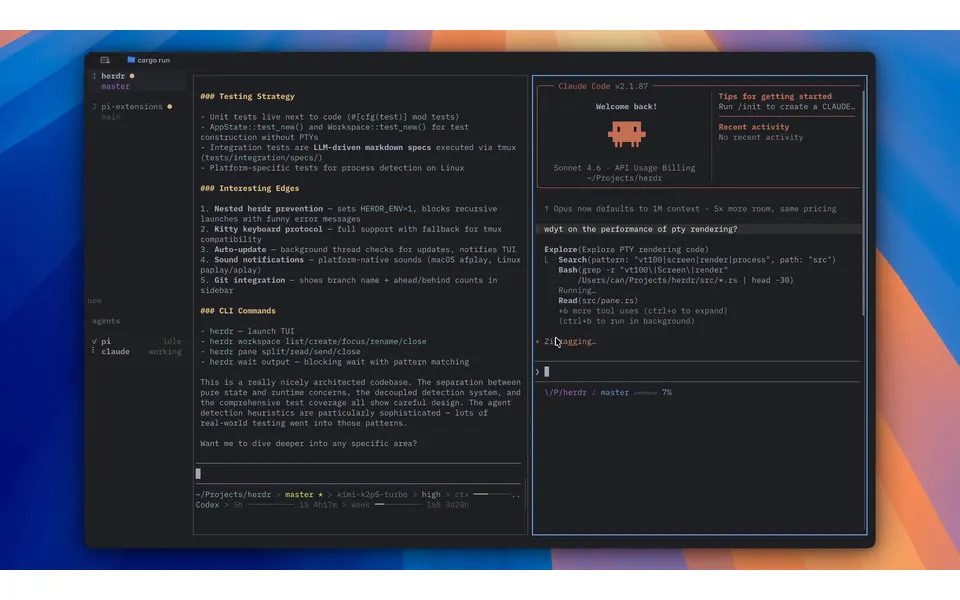
- Desktop app
- Mac, Windows and Linux
- Browser
- No
- Phone
- IPhone and Android
- Command line
- Yes
- Agents
- Claude Code, Codex, Cursor Agent, Gemini CLI, OpenCode, Pi, Grok and Antigravity
- Your subscription
- Works with your own plan
- Agents run
- On your computer and on your own server
- Laptop closed
- Keeps going
- Isolation
- Worktree
- Parallel agents
- Yes
- Scheduled runs
- No
- Coordinator agent
- Yes
- Built-in issues
- No
- Pull requests
- No
- Review screen
- Yes
- Team
- Not listed
- Self-hosting
- Yes
- Licence
- Apache-2.0
- Price from
- Free
- How it charges
- No paid plan
- Paid plans from
- Not listed
Receipts
- Checked
- · oldest answer 2026-11-08
- Findings
- 36 published · 28 cross-checked by a second agent · read them all
- Sources
- 46 public pages on 2 sites: github.com, herdr.dev
- Screenshot
- github.com, retrieved · first party repository · shows appearance, not capability
- Data
- /products/herdr.json · .md
- Method
- Same rules for all 103 researched ADEs. How we check · Report wrong data

What it does
Where you use it
Herdr TUI runs as a Rust terminal program with a product CLI on macOS, Linux and Windows; it is not an Electron desktop client. The new Herdr native app supports Apple silicon macOS, Linux x86_64 and ARM64, and Windows x86_64. It is separate from TUI and does not share its running agents. The current Herdr privacy page describes iOS and Android apps connecting directly to user machines over SSH. This concerns the newer Herdr app family, not TUI terminal installation. No product-owned browser client is distributed in the inspected native app, TUI or documented phone-client list. The scoped clients are native apps and TUI, with no phone-browser frontend.
Source and scope for Where you use itAgents it runs
Herdr TUI runs existing agent CLIs in real terminal panes. Documented detections include Claude Code, Codex, Cursor Agent CLI, OpenCode, Pi, Grok CLI and Gemini CLI, with Gemini state detection labeled less tested. Other commands run as plain terminals. Herdr v0.9.5 recognizes Antigravity terminal sessions as agy and constructs native agy --conversation resume commands.
Source and scope for Agents it runsAccounts and subscriptions
Herdr TUI runs the user's installed agent CLIs unmodified in real terminal panes, so each CLI's own sign-in (for example a Claude or Codex subscription login) applies; the Herdr mobile apps need no Herdr account. API-key, credit, local-model and provider-restriction questions remain unestablished.
Source and scope for Accounts and subscriptionsWhere agents run
Local and saved SSH machines each own their server, sessions and processes. SSH interruptions leave remote work running; clients reconnect independently. The user supplies and pays for the host.
Source and scope for Where agents runHow work is kept apart
The TUI socket exposes worktree.list, worktree.create, worktree.open and worktree.remove with workspace provenance. Git worktrees separate checkouts; no hostile-code containment is claimed. Herdr core explicitly runs commands with host-account access and is not a sandbox. User-provided containers are external infrastructure. Herdr supplies no VM isolation boundary. Connecting over SSH to a user-provided VM is own-server execution.
Source and scope for How work is kept apartParallel work
Multiple agent terminals run concurrently; working, blocked, done and idle states roll up into tabs and workspaces. Observed concurrency and quotas remain untested.
Source and scope for Parallel workScheduled runs
No native task scheduler is implemented in the inspected core or TUI API. External scripts can call the CLI, but no built-in event/webhook task trigger service is implemented.
Source and scope for Scheduled runsGit and pull requests
Herdr TUI creates, opens and removes Git worktrees from the sidebar and socket API, checking out or creating the named branch. Commit, pull request, CI and rebase handling were not found in the checked sources. No product-owned PR creation or management operation is implemented in the inspected built-in clients and APIs.
Source and scope for Git and pull requestsLicence and source
Herdr TUI source is distributed under Apache License 2.0 at the pinned repository revision. The current site also describes the native app and herdr-core as Apache 2.0, without establishing identical runtime behavior.
Source and scope for Licence and sourcePrice
The vendor states the native app, herdr-core and Herdr TUI are free and open source. Underlying agent subscriptions and user host costs remain separate.
Source and scope for PriceTyped filters
Every value links to its receipt below. Read plan and surface restrictions before using a filter to decide.
| Filter | Value |
|---|---|
| Desktop OS: macOS | Yes |
| Desktop OS: Windows | Yes |
| Desktop OS: Linux | Yes |
| Web client | No |
| Phone access: Native iOS | Yes |
| Phone access: Native Android | Yes |
| Phone access: Phone browser | No |
| CLI | Yes cross-checked |
| Coding agents: Claude Code | Yes cross-checked |
| Coding agents: Codex | Yes cross-checked |
| Coding agents: Cursor Agent | Yes cross-checked |
| Coding agents: Gemini CLI | Yes cross-checked |
| Coding agents: OpenCode | Yes cross-checked |
| Coding agents: Pi | Yes cross-checked |
| Coding agents: Grok | Yes cross-checked |
| Coding agents: Aider | Unknown |
| Coding agents: Antigravity | Yes cross-checked |
| Use my subscription | Yes cross-checked |
| Where agents run: On your computer | Yes cross-checked |
| Where agents run: On your own server | Yes cross-checked |
| Where agents run: In the vendor's cloud | No |
| Workspace isolation: Git worktree | Yes |
| Workspace isolation: Container | No |
| Workspace isolation: VM or microVM | No |
| Parallel runs | Yes cross-checked |
| Coordinator | Yes |
| Native issue tracking | No |
| Unattended triggers | No |
| Shared prompting | Unknown |
| Team roles | No |
| SSO | No |
| Pull request workflow | No |
| Review interface | Yes |
| Product license: Apache-2.0 | Yes. Apache-2.0 cross-checked |
| Product license: MIT | No. Apache-2.0 cross-checked |
| Product license: GPL-3.0 | No. Apache-2.0 cross-checked |
| Product license: GPL-3.0-or-later | No. Apache-2.0 cross-checked |
| Product license: AGPL-3.0 | No. Apache-2.0 cross-checked |
| Product license: AGPL-3.0-or-later | No. Apache-2.0 cross-checked |
| Product license: Elastic License 2.0 | No. Apache-2.0 cross-checked |
| Product license: Custom terms | No. Apache-2.0 cross-checked |
| Product license: Proprietary | No. Apache-2.0 cross-checked |
| Self-hosting | Yes cross-checked |
| Telemetry opt-out | Yes cross-checked |
| Free access | Yes cross-checked |
| Starting price: Free | Yes. Free cross-checked |
| Starting price: Up to $20/month | No. Free cross-checked |
| Starting price: $21–40/month | No. Free cross-checked |
| Starting price: $41–100/month | No. Free cross-checked |
| Starting price: Over $100/month | No. Free cross-checked |
| Starting price: Contact for pricing | No. Free cross-checked |
| Pricing model: Free, no paid plan | Yes cross-checked |
| Pricing model: Free plan | No |
| Pricing model: Subscription | No |
| Pricing model: Per seat | No |
| Pricing model: Usage-based | No |
| Pricing model: Per machine or compute | No |
| Pricing model: Bring your own key | Unknown |
| Pricing model: One-time purchase | No |
| Paid plans from: No paid plan | Unknown |
| Paid plans from: $10 or less/month | Unknown |
| Paid plans from: $11–20/month | Unknown |
| Paid plans from: $21–40/month | Unknown |
| Paid plans from: $41–100/month | Unknown |
| Paid plans from: Over $100/month | Unknown |
| Paid plans from: Contact sales | Unknown |
| Lifecycle status: Active | Unknown |
| Lifecycle status: Sunsetting | Unknown |
| Keeps going with laptop closed | Yes cross-checked |
| Open-source license | Yes. Apache-2.0 cross-checked |
| Any desktop app | Yes |
| Paid plan up to $20/month | Unknown |
| Paid plan up to $40/month | Unknown |
| Any phone client | Yes |
Filter receipts
Desktop OS: macOS: Yes
Desktop OS: macOS
Typed value: Yes.
Herdr TUI runs as a Rust terminal program with a product CLI on macOS, Linux and Windows; it is not an Electron desktop client. The new Herdr native app supports Apple silicon macOS, Linux x86_64 and ARM64, and Windows x86_64. It is separate from TUI and does not share its running agents. The current Herdr privacy page describes iOS and Android apps connecting directly to user machines over SSH. This concerns the newer Herdr app family, not TUI terminal installation. No product-owned browser client is distributed in the inspected native app, TUI or documented phone-client list. The scoped clients are native apps and TUI, with no phone-browser frontend.
- Desktop os: The new Herdr native app supports Apple silicon macOS, Linux x86_64 and ARM64, and Windows x86_64. It is separate from TUI and does not share its running agents.
- Mobile apps: The current Herdr privacy page describes iOS and Android apps connecting directly to user machines over SSH. This concerns the newer Herdr app family, not TUI terminal installation.
- Cli: Herdr TUI runs as a Rust terminal program with a product CLI on macOS, Linux and Windows; it is not an Electron desktop client.
- The scoped first-party source pass does not establish editor_extensions, task_actions, notifications, cross_device_continuity. No hands-on scenario was run.
-
Herdr: Install; One Rust binary
Finding: Herdr TUI runs as a Rust terminal program with a product CLI on macOS, Linux and Windows; it is not an Electron desktop client.
-
Herdr: Questions: How is it different; Which systems
Finding: The new Herdr native app supports Apple silicon macOS, Linux x86_64 and ARM64, and Windows x86_64. It is separate from TUI and does not share its running agents.
-
Finding: The current Herdr privacy page describes iOS and Android apps connecting directly to user machines over SSH. This concerns the newer Herdr app family, not TUI terminal installation.
Desktop OS: Windows: Yes
Desktop OS: Windows
Typed value: Yes.
Herdr TUI runs as a Rust terminal program with a product CLI on macOS, Linux and Windows; it is not an Electron desktop client. The new Herdr native app supports Apple silicon macOS, Linux x86_64 and ARM64, and Windows x86_64. It is separate from TUI and does not share its running agents. The current Herdr privacy page describes iOS and Android apps connecting directly to user machines over SSH. This concerns the newer Herdr app family, not TUI terminal installation. No product-owned browser client is distributed in the inspected native app, TUI or documented phone-client list. The scoped clients are native apps and TUI, with no phone-browser frontend.
- Desktop os: The new Herdr native app supports Apple silicon macOS, Linux x86_64 and ARM64, and Windows x86_64. It is separate from TUI and does not share its running agents.
- Mobile apps: The current Herdr privacy page describes iOS and Android apps connecting directly to user machines over SSH. This concerns the newer Herdr app family, not TUI terminal installation.
- Cli: Herdr TUI runs as a Rust terminal program with a product CLI on macOS, Linux and Windows; it is not an Electron desktop client.
- The scoped first-party source pass does not establish editor_extensions, task_actions, notifications, cross_device_continuity. No hands-on scenario was run.
-
Herdr: Install; One Rust binary
Finding: Herdr TUI runs as a Rust terminal program with a product CLI on macOS, Linux and Windows; it is not an Electron desktop client.
-
Herdr: Questions: How is it different; Which systems
Finding: The new Herdr native app supports Apple silicon macOS, Linux x86_64 and ARM64, and Windows x86_64. It is separate from TUI and does not share its running agents.
-
Finding: The current Herdr privacy page describes iOS and Android apps connecting directly to user machines over SSH. This concerns the newer Herdr app family, not TUI terminal installation.
Desktop OS: Linux: Yes
Desktop OS: Linux
Typed value: Yes.
Herdr TUI runs as a Rust terminal program with a product CLI on macOS, Linux and Windows; it is not an Electron desktop client. The new Herdr native app supports Apple silicon macOS, Linux x86_64 and ARM64, and Windows x86_64. It is separate from TUI and does not share its running agents. The current Herdr privacy page describes iOS and Android apps connecting directly to user machines over SSH. This concerns the newer Herdr app family, not TUI terminal installation. No product-owned browser client is distributed in the inspected native app, TUI or documented phone-client list. The scoped clients are native apps and TUI, with no phone-browser frontend.
- Desktop os: The new Herdr native app supports Apple silicon macOS, Linux x86_64 and ARM64, and Windows x86_64. It is separate from TUI and does not share its running agents.
- Mobile apps: The current Herdr privacy page describes iOS and Android apps connecting directly to user machines over SSH. This concerns the newer Herdr app family, not TUI terminal installation.
- Cli: Herdr TUI runs as a Rust terminal program with a product CLI on macOS, Linux and Windows; it is not an Electron desktop client.
- The scoped first-party source pass does not establish editor_extensions, task_actions, notifications, cross_device_continuity. No hands-on scenario was run.
-
Herdr: Install; One Rust binary
Finding: Herdr TUI runs as a Rust terminal program with a product CLI on macOS, Linux and Windows; it is not an Electron desktop client.
-
Herdr: Questions: How is it different; Which systems
Finding: The new Herdr native app supports Apple silicon macOS, Linux x86_64 and ARM64, and Windows x86_64. It is separate from TUI and does not share its running agents.
-
Finding: The current Herdr privacy page describes iOS and Android apps connecting directly to user machines over SSH. This concerns the newer Herdr app family, not TUI terminal installation.
Web client: No
Web client
Typed value: No.
Herdr TUI runs as a Rust terminal program with a product CLI on macOS, Linux and Windows; it is not an Electron desktop client. The new Herdr native app supports Apple silicon macOS, Linux x86_64 and ARM64, and Windows x86_64. It is separate from TUI and does not share its running agents. The current Herdr privacy page describes iOS and Android apps connecting directly to user machines over SSH. This concerns the newer Herdr app family, not TUI terminal installation. No product-owned browser client is distributed in the inspected native app, TUI or documented phone-client list. The scoped clients are native apps and TUI, with no phone-browser frontend.
- Browser: No product-owned browser client is distributed in the inspected native app, TUI or documented phone-client list.
- Mobile browser: The scoped clients are native apps and TUI, with no phone-browser frontend.
- The scoped first-party source pass does not establish editor_extensions, task_actions, notifications, cross_device_continuity. No hands-on scenario was run.
-
Herdr client distribution inspection
Finding: The inspected app and TUI distribute native Rust clients; the first-party mobile page describes iOS and Android SSH clients. No browser client build or phone-browser frontend is supplied by these scoped components.
Phone access: Native iOS: Yes
Phone access: Native iOS
Typed value: Yes.
Herdr TUI runs as a Rust terminal program with a product CLI on macOS, Linux and Windows; it is not an Electron desktop client. The new Herdr native app supports Apple silicon macOS, Linux x86_64 and ARM64, and Windows x86_64. It is separate from TUI and does not share its running agents. The current Herdr privacy page describes iOS and Android apps connecting directly to user machines over SSH. This concerns the newer Herdr app family, not TUI terminal installation. No product-owned browser client is distributed in the inspected native app, TUI or documented phone-client list. The scoped clients are native apps and TUI, with no phone-browser frontend.
- Desktop os: The new Herdr native app supports Apple silicon macOS, Linux x86_64 and ARM64, and Windows x86_64. It is separate from TUI and does not share its running agents.
- Mobile apps: The current Herdr privacy page describes iOS and Android apps connecting directly to user machines over SSH. This concerns the newer Herdr app family, not TUI terminal installation.
- Cli: Herdr TUI runs as a Rust terminal program with a product CLI on macOS, Linux and Windows; it is not an Electron desktop client.
- The scoped first-party source pass does not establish editor_extensions, task_actions, notifications, cross_device_continuity. No hands-on scenario was run.
-
Herdr: Install; One Rust binary
Finding: Herdr TUI runs as a Rust terminal program with a product CLI on macOS, Linux and Windows; it is not an Electron desktop client.
-
Herdr: Questions: How is it different; Which systems
Finding: The new Herdr native app supports Apple silicon macOS, Linux x86_64 and ARM64, and Windows x86_64. It is separate from TUI and does not share its running agents.
-
Finding: The current Herdr privacy page describes iOS and Android apps connecting directly to user machines over SSH. This concerns the newer Herdr app family, not TUI terminal installation.
Phone access: Native Android: Yes
Phone access: Native Android
Typed value: Yes.
Herdr TUI runs as a Rust terminal program with a product CLI on macOS, Linux and Windows; it is not an Electron desktop client. The new Herdr native app supports Apple silicon macOS, Linux x86_64 and ARM64, and Windows x86_64. It is separate from TUI and does not share its running agents. The current Herdr privacy page describes iOS and Android apps connecting directly to user machines over SSH. This concerns the newer Herdr app family, not TUI terminal installation. No product-owned browser client is distributed in the inspected native app, TUI or documented phone-client list. The scoped clients are native apps and TUI, with no phone-browser frontend.
- Desktop os: The new Herdr native app supports Apple silicon macOS, Linux x86_64 and ARM64, and Windows x86_64. It is separate from TUI and does not share its running agents.
- Mobile apps: The current Herdr privacy page describes iOS and Android apps connecting directly to user machines over SSH. This concerns the newer Herdr app family, not TUI terminal installation.
- Cli: Herdr TUI runs as a Rust terminal program with a product CLI on macOS, Linux and Windows; it is not an Electron desktop client.
- The scoped first-party source pass does not establish editor_extensions, task_actions, notifications, cross_device_continuity. No hands-on scenario was run.
-
Herdr: Install; One Rust binary
Finding: Herdr TUI runs as a Rust terminal program with a product CLI on macOS, Linux and Windows; it is not an Electron desktop client.
-
Herdr: Questions: How is it different; Which systems
Finding: The new Herdr native app supports Apple silicon macOS, Linux x86_64 and ARM64, and Windows x86_64. It is separate from TUI and does not share its running agents.
-
Finding: The current Herdr privacy page describes iOS and Android apps connecting directly to user machines over SSH. This concerns the newer Herdr app family, not TUI terminal installation.
Phone access: Phone browser: No
Phone access: Phone browser
Typed value: No.
Herdr TUI runs as a Rust terminal program with a product CLI on macOS, Linux and Windows; it is not an Electron desktop client. The new Herdr native app supports Apple silicon macOS, Linux x86_64 and ARM64, and Windows x86_64. It is separate from TUI and does not share its running agents. The current Herdr privacy page describes iOS and Android apps connecting directly to user machines over SSH. This concerns the newer Herdr app family, not TUI terminal installation. No product-owned browser client is distributed in the inspected native app, TUI or documented phone-client list. The scoped clients are native apps and TUI, with no phone-browser frontend.
- Browser: No product-owned browser client is distributed in the inspected native app, TUI or documented phone-client list.
- Mobile browser: The scoped clients are native apps and TUI, with no phone-browser frontend.
- The scoped first-party source pass does not establish editor_extensions, task_actions, notifications, cross_device_continuity. No hands-on scenario was run.
-
Herdr client distribution inspection
Finding: The inspected app and TUI distribute native Rust clients; the first-party mobile page describes iOS and Android SSH clients. No browser client build or phone-browser frontend is supplied by these scoped components.
CLI: Yes cross-checked
CLI
Typed value: Yes.
Herdr provides CLI wrappers and a local socket API for workspaces, tabs, panes, agent prompts, waits, state events and integration management. The binary emits its matching JSON schema.
- Cli: Herdr provides CLI wrappers and a local socket API for workspaces, tabs, panes, agent prompts, waits, state events and integration management. The binary emits its matching JSON schema.
- Api: Herdr provides CLI wrappers and a local socket API for workspaces, tabs, panes, agent prompts, waits, state events and integration management. The binary emits its matching JSON schema.
- Operations: Herdr provides CLI wrappers and a local socket API for workspaces, tabs, panes, agent prompts, waits, state events and integration management. The binary emits its matching JSON schema.
- Stability: Herdr provides CLI wrappers and a local socket API for workspaces, tabs, panes, agent prompts, waits, state events and integration management. The binary emits its matching JSON schema.
- Documentation evidence only. Remaining atomic questions and enforcement under failure have not been established by a bounded workflow test.
-
Herdr: Choose an integration layer; What you can control
Finding: Herdr provides CLI wrappers and a local socket API for workspaces, tabs, panes, agent prompts, waits, state events and integration management. The binary emits its matching JSON schema.
Coding agents: Claude Code: Yes cross-checked
Coding agents: Claude Code
Typed value: Yes.
Herdr TUI runs existing agent CLIs in real terminal panes. Documented detections include Claude Code, Codex, Cursor Agent CLI, OpenCode, Pi, Grok CLI and Gemini CLI, with Gemini state detection labeled less tested. Other commands run as plain terminals. Herdr v0.9.5 recognizes Antigravity terminal sessions as agy and constructs native agy --conversation resume commands.
- Harnesses: Herdr TUI runs existing agent CLIs in real terminal panes. Documented detections include Claude Code, Codex, Cursor Agent CLI, OpenCode, Pi, Grok CLI and Gemini CLI, with Gemini state detection labeled less tested. Other commands run as plain terminals. Herdr v0.9.5 recognizes Antigravity terminal sessions as agy and constructs native agy --conversation resume commands.
- Custom adapters: Herdr TUI runs existing agent CLIs in real terminal panes. Documented detections include Claude Code, Codex, Cursor Agent CLI, OpenCode, Pi, Grok CLI and Gemini CLI, with Gemini state detection labeled less tested. Other commands run as plain terminals.
- Session integration: Herdr TUI runs existing agent CLIs in real terminal panes. Documented detections include Claude Code, Codex, Cursor Agent CLI, OpenCode, Pi, Grok CLI and Gemini CLI, with Gemini state detection labeled less tested. Other commands run as plain terminals.
- Mixed harness operation: Herdr TUI runs existing agent CLIs in real terminal panes. Documented detections include Claude Code, Codex, Cursor Agent CLI, OpenCode, Pi, Grok CLI and Gemini CLI, with Gemini state detection labeled less tested. Other commands run as plain terminals.
- Documentation evidence only. Remaining atomic questions and enforcement under failure have not been established by a bounded workflow test.
- This is a terminal-pane integration; status is derived from the agent screen and native resume metadata.
-
Finding: Herdr TUI runs existing agent CLIs in real terminal panes. Documented detections include Claude Code, Codex, Cursor Agent CLI, OpenCode, Pi, Grok CLI and Gemini CLI, with Gemini state detection labeled less tested. Other commands run as plain terminals.
Coding agents: Codex: Yes cross-checked
Coding agents: Codex
Typed value: Yes.
Herdr TUI runs existing agent CLIs in real terminal panes. Documented detections include Claude Code, Codex, Cursor Agent CLI, OpenCode, Pi, Grok CLI and Gemini CLI, with Gemini state detection labeled less tested. Other commands run as plain terminals. Herdr v0.9.5 recognizes Antigravity terminal sessions as agy and constructs native agy --conversation resume commands.
- Harnesses: Herdr TUI runs existing agent CLIs in real terminal panes. Documented detections include Claude Code, Codex, Cursor Agent CLI, OpenCode, Pi, Grok CLI and Gemini CLI, with Gemini state detection labeled less tested. Other commands run as plain terminals. Herdr v0.9.5 recognizes Antigravity terminal sessions as agy and constructs native agy --conversation resume commands.
- Custom adapters: Herdr TUI runs existing agent CLIs in real terminal panes. Documented detections include Claude Code, Codex, Cursor Agent CLI, OpenCode, Pi, Grok CLI and Gemini CLI, with Gemini state detection labeled less tested. Other commands run as plain terminals.
- Session integration: Herdr TUI runs existing agent CLIs in real terminal panes. Documented detections include Claude Code, Codex, Cursor Agent CLI, OpenCode, Pi, Grok CLI and Gemini CLI, with Gemini state detection labeled less tested. Other commands run as plain terminals.
- Mixed harness operation: Herdr TUI runs existing agent CLIs in real terminal panes. Documented detections include Claude Code, Codex, Cursor Agent CLI, OpenCode, Pi, Grok CLI and Gemini CLI, with Gemini state detection labeled less tested. Other commands run as plain terminals.
- Documentation evidence only. Remaining atomic questions and enforcement under failure have not been established by a bounded workflow test.
- This is a terminal-pane integration; status is derived from the agent screen and native resume metadata.
-
Finding: Herdr TUI runs existing agent CLIs in real terminal panes. Documented detections include Claude Code, Codex, Cursor Agent CLI, OpenCode, Pi, Grok CLI and Gemini CLI, with Gemini state detection labeled less tested. Other commands run as plain terminals.
Coding agents: Cursor Agent: Yes cross-checked
Coding agents: Cursor Agent
Typed value: Yes.
Herdr TUI runs existing agent CLIs in real terminal panes. Documented detections include Claude Code, Codex, Cursor Agent CLI, OpenCode, Pi, Grok CLI and Gemini CLI, with Gemini state detection labeled less tested. Other commands run as plain terminals. Herdr v0.9.5 recognizes Antigravity terminal sessions as agy and constructs native agy --conversation resume commands.
- Harnesses: Herdr TUI runs existing agent CLIs in real terminal panes. Documented detections include Claude Code, Codex, Cursor Agent CLI, OpenCode, Pi, Grok CLI and Gemini CLI, with Gemini state detection labeled less tested. Other commands run as plain terminals. Herdr v0.9.5 recognizes Antigravity terminal sessions as agy and constructs native agy --conversation resume commands.
- Custom adapters: Herdr TUI runs existing agent CLIs in real terminal panes. Documented detections include Claude Code, Codex, Cursor Agent CLI, OpenCode, Pi, Grok CLI and Gemini CLI, with Gemini state detection labeled less tested. Other commands run as plain terminals.
- Session integration: Herdr TUI runs existing agent CLIs in real terminal panes. Documented detections include Claude Code, Codex, Cursor Agent CLI, OpenCode, Pi, Grok CLI and Gemini CLI, with Gemini state detection labeled less tested. Other commands run as plain terminals.
- Mixed harness operation: Herdr TUI runs existing agent CLIs in real terminal panes. Documented detections include Claude Code, Codex, Cursor Agent CLI, OpenCode, Pi, Grok CLI and Gemini CLI, with Gemini state detection labeled less tested. Other commands run as plain terminals.
- Documentation evidence only. Remaining atomic questions and enforcement under failure have not been established by a bounded workflow test.
- This is a terminal-pane integration; status is derived from the agent screen and native resume metadata.
-
Finding: Herdr TUI runs existing agent CLIs in real terminal panes. Documented detections include Claude Code, Codex, Cursor Agent CLI, OpenCode, Pi, Grok CLI and Gemini CLI, with Gemini state detection labeled less tested. Other commands run as plain terminals.
Coding agents: Gemini CLI: Yes cross-checked
Coding agents: Gemini CLI
Typed value: Yes.
Herdr TUI runs existing agent CLIs in real terminal panes. Documented detections include Claude Code, Codex, Cursor Agent CLI, OpenCode, Pi, Grok CLI and Gemini CLI, with Gemini state detection labeled less tested. Other commands run as plain terminals. Herdr v0.9.5 recognizes Antigravity terminal sessions as agy and constructs native agy --conversation resume commands.
- Harnesses: Herdr TUI runs existing agent CLIs in real terminal panes. Documented detections include Claude Code, Codex, Cursor Agent CLI, OpenCode, Pi, Grok CLI and Gemini CLI, with Gemini state detection labeled less tested. Other commands run as plain terminals. Herdr v0.9.5 recognizes Antigravity terminal sessions as agy and constructs native agy --conversation resume commands.
- Custom adapters: Herdr TUI runs existing agent CLIs in real terminal panes. Documented detections include Claude Code, Codex, Cursor Agent CLI, OpenCode, Pi, Grok CLI and Gemini CLI, with Gemini state detection labeled less tested. Other commands run as plain terminals.
- Session integration: Herdr TUI runs existing agent CLIs in real terminal panes. Documented detections include Claude Code, Codex, Cursor Agent CLI, OpenCode, Pi, Grok CLI and Gemini CLI, with Gemini state detection labeled less tested. Other commands run as plain terminals.
- Mixed harness operation: Herdr TUI runs existing agent CLIs in real terminal panes. Documented detections include Claude Code, Codex, Cursor Agent CLI, OpenCode, Pi, Grok CLI and Gemini CLI, with Gemini state detection labeled less tested. Other commands run as plain terminals.
- Documentation evidence only. Remaining atomic questions and enforcement under failure have not been established by a bounded workflow test.
- This is a terminal-pane integration; status is derived from the agent screen and native resume metadata.
-
Finding: Herdr TUI runs existing agent CLIs in real terminal panes. Documented detections include Claude Code, Codex, Cursor Agent CLI, OpenCode, Pi, Grok CLI and Gemini CLI, with Gemini state detection labeled less tested. Other commands run as plain terminals.
Coding agents: OpenCode: Yes cross-checked
Coding agents: OpenCode
Typed value: Yes.
Herdr TUI runs existing agent CLIs in real terminal panes. Documented detections include Claude Code, Codex, Cursor Agent CLI, OpenCode, Pi, Grok CLI and Gemini CLI, with Gemini state detection labeled less tested. Other commands run as plain terminals. Herdr v0.9.5 recognizes Antigravity terminal sessions as agy and constructs native agy --conversation resume commands.
- Harnesses: Herdr TUI runs existing agent CLIs in real terminal panes. Documented detections include Claude Code, Codex, Cursor Agent CLI, OpenCode, Pi, Grok CLI and Gemini CLI, with Gemini state detection labeled less tested. Other commands run as plain terminals. Herdr v0.9.5 recognizes Antigravity terminal sessions as agy and constructs native agy --conversation resume commands.
- Custom adapters: Herdr TUI runs existing agent CLIs in real terminal panes. Documented detections include Claude Code, Codex, Cursor Agent CLI, OpenCode, Pi, Grok CLI and Gemini CLI, with Gemini state detection labeled less tested. Other commands run as plain terminals.
- Session integration: Herdr TUI runs existing agent CLIs in real terminal panes. Documented detections include Claude Code, Codex, Cursor Agent CLI, OpenCode, Pi, Grok CLI and Gemini CLI, with Gemini state detection labeled less tested. Other commands run as plain terminals.
- Mixed harness operation: Herdr TUI runs existing agent CLIs in real terminal panes. Documented detections include Claude Code, Codex, Cursor Agent CLI, OpenCode, Pi, Grok CLI and Gemini CLI, with Gemini state detection labeled less tested. Other commands run as plain terminals.
- Documentation evidence only. Remaining atomic questions and enforcement under failure have not been established by a bounded workflow test.
- This is a terminal-pane integration; status is derived from the agent screen and native resume metadata.
-
Finding: Herdr TUI runs existing agent CLIs in real terminal panes. Documented detections include Claude Code, Codex, Cursor Agent CLI, OpenCode, Pi, Grok CLI and Gemini CLI, with Gemini state detection labeled less tested. Other commands run as plain terminals.
Coding agents: Pi: Yes cross-checked
Coding agents: Pi
Typed value: Yes.
Herdr TUI runs existing agent CLIs in real terminal panes. Documented detections include Claude Code, Codex, Cursor Agent CLI, OpenCode, Pi, Grok CLI and Gemini CLI, with Gemini state detection labeled less tested. Other commands run as plain terminals. Herdr v0.9.5 recognizes Antigravity terminal sessions as agy and constructs native agy --conversation resume commands.
- Harnesses: Herdr TUI runs existing agent CLIs in real terminal panes. Documented detections include Claude Code, Codex, Cursor Agent CLI, OpenCode, Pi, Grok CLI and Gemini CLI, with Gemini state detection labeled less tested. Other commands run as plain terminals. Herdr v0.9.5 recognizes Antigravity terminal sessions as agy and constructs native agy --conversation resume commands.
- Custom adapters: Herdr TUI runs existing agent CLIs in real terminal panes. Documented detections include Claude Code, Codex, Cursor Agent CLI, OpenCode, Pi, Grok CLI and Gemini CLI, with Gemini state detection labeled less tested. Other commands run as plain terminals.
- Session integration: Herdr TUI runs existing agent CLIs in real terminal panes. Documented detections include Claude Code, Codex, Cursor Agent CLI, OpenCode, Pi, Grok CLI and Gemini CLI, with Gemini state detection labeled less tested. Other commands run as plain terminals.
- Mixed harness operation: Herdr TUI runs existing agent CLIs in real terminal panes. Documented detections include Claude Code, Codex, Cursor Agent CLI, OpenCode, Pi, Grok CLI and Gemini CLI, with Gemini state detection labeled less tested. Other commands run as plain terminals.
- Documentation evidence only. Remaining atomic questions and enforcement under failure have not been established by a bounded workflow test.
- This is a terminal-pane integration; status is derived from the agent screen and native resume metadata.
-
Finding: Herdr TUI runs existing agent CLIs in real terminal panes. Documented detections include Claude Code, Codex, Cursor Agent CLI, OpenCode, Pi, Grok CLI and Gemini CLI, with Gemini state detection labeled less tested. Other commands run as plain terminals.
Coding agents: Grok: Yes cross-checked
Coding agents: Grok
Typed value: Yes.
Herdr TUI runs existing agent CLIs in real terminal panes. Documented detections include Claude Code, Codex, Cursor Agent CLI, OpenCode, Pi, Grok CLI and Gemini CLI, with Gemini state detection labeled less tested. Other commands run as plain terminals. Herdr v0.9.5 recognizes Antigravity terminal sessions as agy and constructs native agy --conversation resume commands.
- Harnesses: Herdr TUI runs existing agent CLIs in real terminal panes. Documented detections include Claude Code, Codex, Cursor Agent CLI, OpenCode, Pi, Grok CLI and Gemini CLI, with Gemini state detection labeled less tested. Other commands run as plain terminals. Herdr v0.9.5 recognizes Antigravity terminal sessions as agy and constructs native agy --conversation resume commands.
- Custom adapters: Herdr TUI runs existing agent CLIs in real terminal panes. Documented detections include Claude Code, Codex, Cursor Agent CLI, OpenCode, Pi, Grok CLI and Gemini CLI, with Gemini state detection labeled less tested. Other commands run as plain terminals.
- Session integration: Herdr TUI runs existing agent CLIs in real terminal panes. Documented detections include Claude Code, Codex, Cursor Agent CLI, OpenCode, Pi, Grok CLI and Gemini CLI, with Gemini state detection labeled less tested. Other commands run as plain terminals.
- Mixed harness operation: Herdr TUI runs existing agent CLIs in real terminal panes. Documented detections include Claude Code, Codex, Cursor Agent CLI, OpenCode, Pi, Grok CLI and Gemini CLI, with Gemini state detection labeled less tested. Other commands run as plain terminals.
- Documentation evidence only. Remaining atomic questions and enforcement under failure have not been established by a bounded workflow test.
- This is a terminal-pane integration; status is derived from the agent screen and native resume metadata.
-
Finding: Herdr TUI runs existing agent CLIs in real terminal panes. Documented detections include Claude Code, Codex, Cursor Agent CLI, OpenCode, Pi, Grok CLI and Gemini CLI, with Gemini state detection labeled less tested. Other commands run as plain terminals.
Coding agents: Antigravity: Yes cross-checked
Coding agents: Antigravity
Typed value: Yes.
Herdr TUI runs existing agent CLIs in real terminal panes. Documented detections include Claude Code, Codex, Cursor Agent CLI, OpenCode, Pi, Grok CLI and Gemini CLI, with Gemini state detection labeled less tested. Other commands run as plain terminals. Herdr v0.9.5 recognizes Antigravity terminal sessions as agy and constructs native agy --conversation resume commands.
- Harnesses: Herdr TUI runs existing agent CLIs in real terminal panes. Documented detections include Claude Code, Codex, Cursor Agent CLI, OpenCode, Pi, Grok CLI and Gemini CLI, with Gemini state detection labeled less tested. Other commands run as plain terminals. Herdr v0.9.5 recognizes Antigravity terminal sessions as agy and constructs native agy --conversation resume commands.
- Documentation evidence only. Remaining atomic questions and enforcement under failure have not been established by a bounded workflow test.
- This is a terminal-pane integration; status is derived from the agent screen and native resume metadata.
-
Herdr Antigravity support at v0.9.5
Finding: Herdr v0.9.5 recognizes Antigravity terminal sessions as agy and constructs native agy --conversation resume commands.
-
Herdr Antigravity support at v0.9.5
Finding: Herdr v0.9.5 recognizes Antigravity terminal sessions as agy and constructs native agy --conversation resume commands.
Use my subscription: Yes cross-checked
Use my subscription
Typed value: Yes.
Herdr TUI runs the user's installed agent CLIs unmodified in real terminal panes, so each CLI's own sign-in (for example a Claude or Codex subscription login) applies; the Herdr mobile apps need no Herdr account. API-key, credit, local-model and provider-restriction questions remain unestablished.
- Agent subscriptions: Herdr runs the installed agent CLI unmodified in a terminal pane and only adds its socket and binary paths to the environment; the Claude integration uses the user's own CLAUDE_CONFIG_DIR or ~/.claude, so the CLI's native subscription login applies. Not tested.
- Source-inspected and documentation only; no authenticated subscription login was tested.
- Account requirement statement comes from the mobile-app page of the newer Herdr app family.
-
Finding: Herdr runs the agent CLIs the user already has (Claude Code, Codex, Cursor, OpenCode, Grok and others) in its own terminals and says it does not wrap or replace them.
-
Finding: The pane command builder only adds the Herdr socket path and Herdr binary path to the pane environment; it does not inject agent credentials or alter the agent command.
-
Herdr Claude config resolution
Finding: Herdr's Claude integration resolves the user's own CLAUDE_CONFIG_DIR or ~/.claude, i.e. the installed CLI's own configuration and login home.
Where agents run: On your computer: Yes cross-checked
Where agents run: On your computer
Typed value: Yes.
Local and saved SSH machines each own their server, sessions and processes. SSH interruptions leave remote work running; clients reconnect independently. The user supplies and pays for the host.
- Local: Local and saved SSH machines each own their server, sessions and processes. SSH interruptions leave remote work running; clients reconnect independently. The user supplies and pays for the host.
- Byo remote: Local and saved SSH machines each own their server, sessions and processes. SSH interruptions leave remote work running; clients reconnect independently. The user supplies and pays for the host.
- Self hosted: Local and saved SSH machines each own their server, sessions and processes. SSH interruptions leave remote work running; clients reconnect independently. The user supplies and pays for the host.
- Hybrid: Local and saved SSH machines each own their server, sessions and processes. SSH interruptions leave remote work running; clients reconnect independently. The user supplies and pays for the host.
- Payer: Local and saved SSH machines each own their server, sessions and processes. SSH interruptions leave remote work running; clients reconnect independently. The user supplies and pays for the host.
- Client disconnect: Local and saved SSH machines each own their server, sessions and processes. SSH interruptions leave remote work running; clients reconnect independently. The user supplies and pays for the host.
- Other device continuation: Local and saved SSH machines each own their server, sessions and processes. SSH interruptions leave remote work running; clients reconnect independently. The user supplies and pays for the host.
- Documentation evidence only. Remaining atomic questions and enforcement under failure have not been established by a bounded workflow test.
-
Finding: Local and saved SSH machines each own their server, sessions and processes. SSH interruptions leave remote work running; clients reconnect independently. The user supplies and pays for the host.
Where agents run: On your own server: Yes cross-checked
Where agents run: On your own server
Typed value: Yes.
Local and saved SSH machines each own their server, sessions and processes. SSH interruptions leave remote work running; clients reconnect independently. The user supplies and pays for the host.
- Local: Local and saved SSH machines each own their server, sessions and processes. SSH interruptions leave remote work running; clients reconnect independently. The user supplies and pays for the host.
- Byo remote: Local and saved SSH machines each own their server, sessions and processes. SSH interruptions leave remote work running; clients reconnect independently. The user supplies and pays for the host.
- Self hosted: Local and saved SSH machines each own their server, sessions and processes. SSH interruptions leave remote work running; clients reconnect independently. The user supplies and pays for the host.
- Hybrid: Local and saved SSH machines each own their server, sessions and processes. SSH interruptions leave remote work running; clients reconnect independently. The user supplies and pays for the host.
- Payer: Local and saved SSH machines each own their server, sessions and processes. SSH interruptions leave remote work running; clients reconnect independently. The user supplies and pays for the host.
- Client disconnect: Local and saved SSH machines each own their server, sessions and processes. SSH interruptions leave remote work running; clients reconnect independently. The user supplies and pays for the host.
- Other device continuation: Local and saved SSH machines each own their server, sessions and processes. SSH interruptions leave remote work running; clients reconnect independently. The user supplies and pays for the host.
- Documentation evidence only. Remaining atomic questions and enforcement under failure have not been established by a bounded workflow test.
-
Finding: Local and saved SSH machines each own their server, sessions and processes. SSH interruptions leave remote work running; clients reconnect independently. The user supplies and pays for the host.
Where agents run: In the vendor's cloud: No
Where agents run: In the vendor's cloud
Typed value: No.
Local and saved SSH machines each own their server, sessions and processes. SSH interruptions leave remote work running; clients reconnect independently. The user supplies and pays for the host.
- Local: Local and saved SSH machines each own their server, sessions and processes. SSH interruptions leave remote work running; clients reconnect independently. The user supplies and pays for the host.
- Byo remote: Local and saved SSH machines each own their server, sessions and processes. SSH interruptions leave remote work running; clients reconnect independently. The user supplies and pays for the host.
- Self hosted: Local and saved SSH machines each own their server, sessions and processes. SSH interruptions leave remote work running; clients reconnect independently. The user supplies and pays for the host.
- Hybrid: Local and saved SSH machines each own their server, sessions and processes. SSH interruptions leave remote work running; clients reconnect independently. The user supplies and pays for the host.
- Payer: Local and saved SSH machines each own their server, sessions and processes. SSH interruptions leave remote work running; clients reconnect independently. The user supplies and pays for the host.
- Client disconnect: Local and saved SSH machines each own their server, sessions and processes. SSH interruptions leave remote work running; clients reconnect independently. The user supplies and pays for the host.
- Other device continuation: Local and saved SSH machines each own their server, sessions and processes. SSH interruptions leave remote work running; clients reconnect independently. The user supplies and pays for the host.
- Documentation evidence only. Remaining atomic questions and enforcement under failure have not been established by a bounded workflow test.
-
Finding: Local and saved SSH machines each own their server, sessions and processes. SSH interruptions leave remote work running; clients reconnect independently. The user supplies and pays for the host.
Workspace isolation: Git worktree: Yes
Workspace isolation: Git worktree
Typed value: Yes.
The TUI socket exposes worktree.list, worktree.create, worktree.open and worktree.remove with workspace provenance. Git worktrees separate checkouts; no hostile-code containment is claimed. Herdr core explicitly runs commands with host-account access and is not a sandbox. User-provided containers are external infrastructure. Herdr supplies no VM isolation boundary. Connecting over SSH to a user-provided VM is own-server execution.
- Worktree: The TUI socket exposes worktree.list, worktree.create, worktree.open and worktree.remove with workspace provenance. Git worktrees separate checkouts; no hostile-code containment is claimed.
- Code separation: The TUI socket exposes worktree.list, worktree.create, worktree.open and worktree.remove with workspace provenance. Git worktrees separate checkouts; no hostile-code containment is claimed.
- The scoped first-party source pass does not establish os_sandbox, filesystem, process, network, secrets, security_boundary. No hands-on scenario was run.
-
Finding: The TUI socket exposes worktree.list, worktree.create, worktree.open and worktree.remove with workspace provenance. Git worktrees separate checkouts; no hostile-code containment is claimed.
Workspace isolation: Container: No
Workspace isolation: Container
Typed value: No.
The TUI socket exposes worktree.list, worktree.create, worktree.open and worktree.remove with workspace provenance. Git worktrees separate checkouts; no hostile-code containment is claimed. Herdr core explicitly runs commands with host-account access and is not a sandbox. User-provided containers are external infrastructure. Herdr supplies no VM isolation boundary. Connecting over SSH to a user-provided VM is own-server execution.
- Container: Herdr core explicitly runs commands with host-account access and is not a sandbox. User-provided containers are external infrastructure.
- Vm: Herdr supplies no VM isolation boundary. Connecting over SSH to a user-provided VM is own-server execution.
- The scoped first-party source pass does not establish os_sandbox, filesystem, process, network, secrets, security_boundary. No hands-on scenario was run.
-
Herdr core security boundaries
Finding: Core runs commands with the OS account access and explicitly is not a sandbox. There is no API password or per-client permission check; SSH supplies login and core does not authenticate a remote user. This establishes no product-owned roles or enterprise SSO.
Workspace isolation: VM or microVM: No
Workspace isolation: VM or microVM
Typed value: No.
The TUI socket exposes worktree.list, worktree.create, worktree.open and worktree.remove with workspace provenance. Git worktrees separate checkouts; no hostile-code containment is claimed. Herdr core explicitly runs commands with host-account access and is not a sandbox. User-provided containers are external infrastructure. Herdr supplies no VM isolation boundary. Connecting over SSH to a user-provided VM is own-server execution.
- Container: Herdr core explicitly runs commands with host-account access and is not a sandbox. User-provided containers are external infrastructure.
- Vm: Herdr supplies no VM isolation boundary. Connecting over SSH to a user-provided VM is own-server execution.
- The scoped first-party source pass does not establish os_sandbox, filesystem, process, network, secrets, security_boundary. No hands-on scenario was run.
-
Herdr core security boundaries
Finding: Core runs commands with the OS account access and explicitly is not a sandbox. There is no API password or per-client permission check; SSH supplies login and core does not authenticate a remote user. This establishes no product-owned roles or enterprise SSO.
Parallel runs: Yes cross-checked
Parallel runs
Typed value: Yes.
Multiple agent terminals run concurrently; working, blocked, done and idle states roll up into tabs and workspaces. Observed concurrency and quotas remain untested.
- Concurrent sessions: Multiple agent terminals run concurrently; working, blocked, done and idle states roll up into tabs and workspaces. Observed concurrency and quotas remain untested.
- Status visibility: Multiple agent terminals run concurrently; working, blocked, done and idle states roll up into tabs and workspaces. Observed concurrency and quotas remain untested.
- Documentation evidence only. Remaining atomic questions and enforcement under failure have not been established by a bounded workflow test.
-
Finding: Multiple agent terminals run concurrently; working, blocked, done and idle states roll up into tabs and workspaces. Observed concurrency and quotas remain untested.
Coordinator: Yes
Coordinator
Typed value: Yes.
Herdr ships an agent skill and CLI that let an agent in a Herdr pane start agents in other panes, prompt them, read their output and wait on their state. The coordinating agent is a third-party CLI using these product-supplied tools.
- Messages: Herdr supplies agent start, read, prompt and event-driven wait operations to external agents and scripts. A wait pins the current pane occupant; Herdr does not thereby become a product-owned reasoning coordinator.
- Orchestration owner: Herdr supplies the coordinator role through its shipped skill and the agent start, prompt, read and wait commands; the reasoning runs in the third-party agent.
- Activation: Herdr supplies agent start, read, prompt and event-driven wait operations to external agents and scripts. A wait pins the current pane occupant; Herdr does not thereby become a product-owned reasoning coordinator.
- Live progress: Herdr supplies agent start, read, prompt and event-driven wait operations to external agents and scripts. A wait pins the current pane occupant; Herdr does not thereby become a product-owned reasoning coordinator.
- Followup: Herdr supplies agent start, read, prompt and event-driven wait operations to external agents and scripts. A wait pins the current pane occupant; Herdr does not thereby become a product-owned reasoning coordinator.
- Invocation: Herdr supplies agent start, read, prompt and event-driven wait operations to external agents and scripts. A wait pins the current pane occupant; Herdr does not thereby become a product-owned reasoning coordinator.
- Documentation evidence only. Remaining atomic questions and enforcement under failure have not been established by a bounded workflow test.
-
Herdr: What you can control; Raw methods
Finding: Herdr supplies agent start, read, prompt and event-driven wait operations to external agents and scripts. A wait pins the current pane occupant; Herdr does not thereby become a product-owned reasoning coordinator.
-
Finding: The shipped skill tells an agent running inside a Herdr pane to use the herdr CLI to inspect neighbouring work, start agents and commands in panes, send input, read output and wait for agent states such as idle, working, blocked and done. It applies when the user asks to use Herdr.
Native issue tracking: No
Native issue tracking
Typed value: No.
The inspected products store terminal/workspace state rather than an independent issue catalog. No built-in issue entity distinct from a terminal or workspace is implemented in the inspected APIs.
- Create: The inspected products store terminal/workspace state rather than an independent issue catalog.
- Task session separation: No built-in issue entity distinct from a terminal or workspace is implemented in the inspected APIs.
- The scoped first-party source pass does not establish edit, discuss, prioritize, label, assign, search, filter, archive, reopen, project_epic_views, idea_parking, explicit_dispatch, metadata, durable_states, external_tracker_requirement. No hands-on scenario was run.
-
Herdr native capability boundary inspection
Finding: The inspected built-in APIs and persisted records organize machines, terminal sessions, workspaces and panes, with no standalone issue catalog, native schedule/webhook trigger service or PR lifecycle operations. User scripts and mods can supply external integrations.
Unattended triggers: No
Unattended triggers
Typed value: No.
No native task scheduler is implemented in the inspected core or TUI API. External scripts can call the CLI, but no built-in event/webhook task trigger service is implemented.
- Schedules: No native task scheduler is implemented in the inspected core or TUI API.
- Events: External scripts can call the CLI, but no built-in event/webhook task trigger service is implemented.
- The scoped first-party source pass does not establish recurring_tasks, completion_conditions, scheduler_location, overlaps, retries, client_independence. No hands-on scenario was run.
-
Herdr native capability boundary inspection
Finding: The inspected built-in APIs and persisted records organize machines, terminal sessions, workspaces and panes, with no standalone issue catalog, native schedule/webhook trigger service or PR lifecycle operations. User scripts and mods can supply external integrations.
Team roles: No
Team roles
Typed value: No.
Core has no per-client permission or human role model; local OS account and SSH access govern control. Core does not authenticate remote users itself; it relies on SSH and implements no product-owned enterprise SSO.
- Organization roles: Core has no per-client permission or human role model; local OS account and SSH access govern control.
- Sso: Core does not authenticate remote users itself; it relies on SSH and implements no product-owned enterprise SSO.
- The scoped first-party source pass does not establish project_roles, task_roles, membership, provisioning, unauthorized_access, revocation, plan_scope. No hands-on scenario was run.
-
Herdr core security boundaries
Finding: Core runs commands with the OS account access and explicitly is not a sandbox. There is no API password or per-client permission check; SSH supplies login and core does not authenticate a remote user. This establishes no product-owned roles or enterprise SSO.
SSO: No
SSO
Typed value: No.
Core has no per-client permission or human role model; local OS account and SSH access govern control. Core does not authenticate remote users itself; it relies on SSH and implements no product-owned enterprise SSO.
- Organization roles: Core has no per-client permission or human role model; local OS account and SSH access govern control.
- Sso: Core does not authenticate remote users itself; it relies on SSH and implements no product-owned enterprise SSO.
- The scoped first-party source pass does not establish project_roles, task_roles, membership, provisioning, unauthorized_access, revocation, plan_scope. No hands-on scenario was run.
-
Herdr core security boundaries
Finding: Core runs commands with the OS account access and explicitly is not a sandbox. There is no API password or per-client permission check; SSH supplies login and core does not authenticate a remote user. This establishes no product-owned roles or enterprise SSO.
Pull request workflow: No
Pull request workflow
Typed value: No.
Herdr TUI creates, opens and removes Git worktrees from the sidebar and socket API, checking out or creating the named branch. Commit, pull request, CI and rebase handling were not found in the checked sources. No product-owned PR creation or management operation is implemented in the inspected built-in clients and APIs.
- Pull requests: No product-owned PR creation or management operation is implemented in the inspected built-in clients and APIs.
- The scoped first-party source pass does not establish commits, comments, ci_response, rebase, conflicts, product_state. No hands-on scenario was run.
-
Herdr native capability boundary inspection
Finding: The inspected built-in APIs and persisted records organize machines, terminal sessions, workspaces and panes, with no standalone issue catalog, native schedule/webhook trigger service or PR lifecycle operations. User scripts and mods can supply external integrations.
Review interface: Yes
Review interface
Typed value: Yes.
Herdr native app ships a Changes panel for reviewing Git file changes and diffs. This does not establish a TUI diff interface or a structured approval queue.
- Change understanding: The native app Changes panel renders changed files and code hunks for review.
- The scoped first-party source pass does not establish pending_reviews, evidence_navigation, comments, request_changes, shipping_guidance, effort, missed_evidence, keyboard, narrow_screen, context_switching, roles, retained_context. No hands-on scenario was run.
-
Finding: The native app ships a Changes panel that lists changed files and additions/deletions, runs git diff against HEAD and renders selected-file hunks. It limits previews to 1500 lines and reports binary or unreadable files. This is a native-app feature, separate from the TUI.
Product license: Apache-2.0: Yes. Apache-2.0 cross-checked
Product license: Apache-2.0
Typed value: Yes. Apache-2.0.
Herdr TUI source is distributed under Apache License 2.0 at the pinned repository revision. The current site also describes the native app and herdr-core as Apache 2.0, without establishing identical runtime behavior.
- Client license: Herdr TUI source is distributed under Apache License 2.0 at the pinned repository revision. The current site also describes the native app and herdr-core as Apache 2.0, without establishing identical runtime behavior.
- Server license: Herdr TUI source is distributed under Apache License 2.0 at the pinned repository revision. The current site also describes the native app and herdr-core as Apache 2.0, without establishing identical runtime behavior.
- Source visibility: Herdr TUI source is distributed under Apache License 2.0 at the pinned repository revision. The current site also describes the native app and herdr-core as Apache 2.0, without establishing identical runtime behavior.
- Source revision: Herdr TUI source is distributed under Apache License 2.0 at the pinned repository revision. The current site also describes the native app and herdr-core as Apache 2.0, without establishing identical runtime behavior.
- Documentation evidence only. Remaining atomic questions and enforcement under failure have not been established by a bounded workflow test.
-
Finding: Herdr TUI source is distributed under Apache License 2.0 at the pinned repository revision. The current site also describes the native app and herdr-core as Apache 2.0, without establishing identical runtime behavior.
Product license: MIT: No. Apache-2.0 cross-checked
Product license: MIT
Typed value: No. Apache-2.0.
Herdr TUI source is distributed under Apache License 2.0 at the pinned repository revision. The current site also describes the native app and herdr-core as Apache 2.0, without establishing identical runtime behavior.
- Client license: Herdr TUI source is distributed under Apache License 2.0 at the pinned repository revision. The current site also describes the native app and herdr-core as Apache 2.0, without establishing identical runtime behavior.
- Server license: Herdr TUI source is distributed under Apache License 2.0 at the pinned repository revision. The current site also describes the native app and herdr-core as Apache 2.0, without establishing identical runtime behavior.
- Source visibility: Herdr TUI source is distributed under Apache License 2.0 at the pinned repository revision. The current site also describes the native app and herdr-core as Apache 2.0, without establishing identical runtime behavior.
- Source revision: Herdr TUI source is distributed under Apache License 2.0 at the pinned repository revision. The current site also describes the native app and herdr-core as Apache 2.0, without establishing identical runtime behavior.
- Documentation evidence only. Remaining atomic questions and enforcement under failure have not been established by a bounded workflow test.
-
Finding: Herdr TUI source is distributed under Apache License 2.0 at the pinned repository revision. The current site also describes the native app and herdr-core as Apache 2.0, without establishing identical runtime behavior.
Product license: GPL-3.0: No. Apache-2.0 cross-checked
Product license: GPL-3.0
Typed value: No. Apache-2.0.
Herdr TUI source is distributed under Apache License 2.0 at the pinned repository revision. The current site also describes the native app and herdr-core as Apache 2.0, without establishing identical runtime behavior.
- Client license: Herdr TUI source is distributed under Apache License 2.0 at the pinned repository revision. The current site also describes the native app and herdr-core as Apache 2.0, without establishing identical runtime behavior.
- Server license: Herdr TUI source is distributed under Apache License 2.0 at the pinned repository revision. The current site also describes the native app and herdr-core as Apache 2.0, without establishing identical runtime behavior.
- Source visibility: Herdr TUI source is distributed under Apache License 2.0 at the pinned repository revision. The current site also describes the native app and herdr-core as Apache 2.0, without establishing identical runtime behavior.
- Source revision: Herdr TUI source is distributed under Apache License 2.0 at the pinned repository revision. The current site also describes the native app and herdr-core as Apache 2.0, without establishing identical runtime behavior.
- Documentation evidence only. Remaining atomic questions and enforcement under failure have not been established by a bounded workflow test.
-
Finding: Herdr TUI source is distributed under Apache License 2.0 at the pinned repository revision. The current site also describes the native app and herdr-core as Apache 2.0, without establishing identical runtime behavior.
Product license: GPL-3.0-or-later: No. Apache-2.0 cross-checked
Product license: GPL-3.0-or-later
Typed value: No. Apache-2.0.
Herdr TUI source is distributed under Apache License 2.0 at the pinned repository revision. The current site also describes the native app and herdr-core as Apache 2.0, without establishing identical runtime behavior.
- Client license: Herdr TUI source is distributed under Apache License 2.0 at the pinned repository revision. The current site also describes the native app and herdr-core as Apache 2.0, without establishing identical runtime behavior.
- Server license: Herdr TUI source is distributed under Apache License 2.0 at the pinned repository revision. The current site also describes the native app and herdr-core as Apache 2.0, without establishing identical runtime behavior.
- Source visibility: Herdr TUI source is distributed under Apache License 2.0 at the pinned repository revision. The current site also describes the native app and herdr-core as Apache 2.0, without establishing identical runtime behavior.
- Source revision: Herdr TUI source is distributed under Apache License 2.0 at the pinned repository revision. The current site also describes the native app and herdr-core as Apache 2.0, without establishing identical runtime behavior.
- Documentation evidence only. Remaining atomic questions and enforcement under failure have not been established by a bounded workflow test.
-
Finding: Herdr TUI source is distributed under Apache License 2.0 at the pinned repository revision. The current site also describes the native app and herdr-core as Apache 2.0, without establishing identical runtime behavior.
Product license: AGPL-3.0: No. Apache-2.0 cross-checked
Product license: AGPL-3.0
Typed value: No. Apache-2.0.
Herdr TUI source is distributed under Apache License 2.0 at the pinned repository revision. The current site also describes the native app and herdr-core as Apache 2.0, without establishing identical runtime behavior.
- Client license: Herdr TUI source is distributed under Apache License 2.0 at the pinned repository revision. The current site also describes the native app and herdr-core as Apache 2.0, without establishing identical runtime behavior.
- Server license: Herdr TUI source is distributed under Apache License 2.0 at the pinned repository revision. The current site also describes the native app and herdr-core as Apache 2.0, without establishing identical runtime behavior.
- Source visibility: Herdr TUI source is distributed under Apache License 2.0 at the pinned repository revision. The current site also describes the native app and herdr-core as Apache 2.0, without establishing identical runtime behavior.
- Source revision: Herdr TUI source is distributed under Apache License 2.0 at the pinned repository revision. The current site also describes the native app and herdr-core as Apache 2.0, without establishing identical runtime behavior.
- Documentation evidence only. Remaining atomic questions and enforcement under failure have not been established by a bounded workflow test.
-
Finding: Herdr TUI source is distributed under Apache License 2.0 at the pinned repository revision. The current site also describes the native app and herdr-core as Apache 2.0, without establishing identical runtime behavior.
Product license: AGPL-3.0-or-later: No. Apache-2.0 cross-checked
Product license: AGPL-3.0-or-later
Typed value: No. Apache-2.0.
Herdr TUI source is distributed under Apache License 2.0 at the pinned repository revision. The current site also describes the native app and herdr-core as Apache 2.0, without establishing identical runtime behavior.
- Client license: Herdr TUI source is distributed under Apache License 2.0 at the pinned repository revision. The current site also describes the native app and herdr-core as Apache 2.0, without establishing identical runtime behavior.
- Server license: Herdr TUI source is distributed under Apache License 2.0 at the pinned repository revision. The current site also describes the native app and herdr-core as Apache 2.0, without establishing identical runtime behavior.
- Source visibility: Herdr TUI source is distributed under Apache License 2.0 at the pinned repository revision. The current site also describes the native app and herdr-core as Apache 2.0, without establishing identical runtime behavior.
- Source revision: Herdr TUI source is distributed under Apache License 2.0 at the pinned repository revision. The current site also describes the native app and herdr-core as Apache 2.0, without establishing identical runtime behavior.
- Documentation evidence only. Remaining atomic questions and enforcement under failure have not been established by a bounded workflow test.
-
Finding: Herdr TUI source is distributed under Apache License 2.0 at the pinned repository revision. The current site also describes the native app and herdr-core as Apache 2.0, without establishing identical runtime behavior.
Product license: Elastic License 2.0: No. Apache-2.0 cross-checked
Product license: Elastic License 2.0
Typed value: No. Apache-2.0.
Herdr TUI source is distributed under Apache License 2.0 at the pinned repository revision. The current site also describes the native app and herdr-core as Apache 2.0, without establishing identical runtime behavior.
- Client license: Herdr TUI source is distributed under Apache License 2.0 at the pinned repository revision. The current site also describes the native app and herdr-core as Apache 2.0, without establishing identical runtime behavior.
- Server license: Herdr TUI source is distributed under Apache License 2.0 at the pinned repository revision. The current site also describes the native app and herdr-core as Apache 2.0, without establishing identical runtime behavior.
- Source visibility: Herdr TUI source is distributed under Apache License 2.0 at the pinned repository revision. The current site also describes the native app and herdr-core as Apache 2.0, without establishing identical runtime behavior.
- Source revision: Herdr TUI source is distributed under Apache License 2.0 at the pinned repository revision. The current site also describes the native app and herdr-core as Apache 2.0, without establishing identical runtime behavior.
- Documentation evidence only. Remaining atomic questions and enforcement under failure have not been established by a bounded workflow test.
-
Finding: Herdr TUI source is distributed under Apache License 2.0 at the pinned repository revision. The current site also describes the native app and herdr-core as Apache 2.0, without establishing identical runtime behavior.
Product license: Custom terms: No. Apache-2.0 cross-checked
Product license: Custom terms
Typed value: No. Apache-2.0.
Herdr TUI source is distributed under Apache License 2.0 at the pinned repository revision. The current site also describes the native app and herdr-core as Apache 2.0, without establishing identical runtime behavior.
- Client license: Herdr TUI source is distributed under Apache License 2.0 at the pinned repository revision. The current site also describes the native app and herdr-core as Apache 2.0, without establishing identical runtime behavior.
- Server license: Herdr TUI source is distributed under Apache License 2.0 at the pinned repository revision. The current site also describes the native app and herdr-core as Apache 2.0, without establishing identical runtime behavior.
- Source visibility: Herdr TUI source is distributed under Apache License 2.0 at the pinned repository revision. The current site also describes the native app and herdr-core as Apache 2.0, without establishing identical runtime behavior.
- Source revision: Herdr TUI source is distributed under Apache License 2.0 at the pinned repository revision. The current site also describes the native app and herdr-core as Apache 2.0, without establishing identical runtime behavior.
- Documentation evidence only. Remaining atomic questions and enforcement under failure have not been established by a bounded workflow test.
-
Finding: Herdr TUI source is distributed under Apache License 2.0 at the pinned repository revision. The current site also describes the native app and herdr-core as Apache 2.0, without establishing identical runtime behavior.
Product license: Proprietary: No. Apache-2.0 cross-checked
Product license: Proprietary
Typed value: No. Apache-2.0.
Herdr TUI source is distributed under Apache License 2.0 at the pinned repository revision. The current site also describes the native app and herdr-core as Apache 2.0, without establishing identical runtime behavior.
- Client license: Herdr TUI source is distributed under Apache License 2.0 at the pinned repository revision. The current site also describes the native app and herdr-core as Apache 2.0, without establishing identical runtime behavior.
- Server license: Herdr TUI source is distributed under Apache License 2.0 at the pinned repository revision. The current site also describes the native app and herdr-core as Apache 2.0, without establishing identical runtime behavior.
- Source visibility: Herdr TUI source is distributed under Apache License 2.0 at the pinned repository revision. The current site also describes the native app and herdr-core as Apache 2.0, without establishing identical runtime behavior.
- Source revision: Herdr TUI source is distributed under Apache License 2.0 at the pinned repository revision. The current site also describes the native app and herdr-core as Apache 2.0, without establishing identical runtime behavior.
- Documentation evidence only. Remaining atomic questions and enforcement under failure have not been established by a bounded workflow test.
-
Finding: Herdr TUI source is distributed under Apache License 2.0 at the pinned repository revision. The current site also describes the native app and herdr-core as Apache 2.0, without establishing identical runtime behavior.
Self-hosting: Yes cross-checked
Self-hosting
Typed value: Yes.
The full TUI and its server can be built from source and run on the user machine or SSH host. This is self-hosting of the TUI, not a managed worker-only arrangement.
- Self hosting: The full TUI and its server can be built from source and run on the user machine or SSH host. This is self-hosting of the TUI, not a managed worker-only arrangement.
- Account independence: The full TUI and its server can be built from source and run on the user machine or SSH host. This is self-hosting of the TUI, not a managed worker-only arrangement.
- Documentation evidence only. Remaining atomic questions and enforcement under failure have not been established by a bounded workflow test.
-
Finding: The full TUI and its server can be built from source and run on the user machine or SSH host. This is self-hosting of the TUI, not a managed worker-only arrangement.
Telemetry opt-out: Yes cross-checked
Telemetry opt-out
Typed value: Yes.
Session data and optional pane history are stored in the local Herdr state directory; history may contain prompts or secrets and is off by default. This does not establish telemetry policy for every component. The native desktop app sends one anonymous daily usage report with fixed counts and agent/layout names, excludes terminal content, file names and prompts, and offers a Settings control to turn reports off. Reports are retained for three months. The phone apps state no tracking or analytics. This policy does not describe TUI telemetry.
- Prompts: Session data and optional pane history are stored in the local Herdr state directory; history may contain prompts or secrets and is off by default. This does not establish telemetry policy for every component.
- Logs: Session data and optional pane history are stored in the local Herdr state directory; history may contain prompts or secrets and is off by default. This does not establish telemetry policy for every component.
- Retention: The native desktop app sends one anonymous daily usage report with fixed counts and agent/layout names, excludes terminal content, file names and prompts, and offers a Settings control to turn reports off. Reports are retained for three months. The phone apps state no tracking or analytics. This policy does not describe TUI telemetry.
- Telemetry disclosure: The native desktop app sends one anonymous daily usage report with fixed counts and agent/layout names, excludes terminal content, file names and prompts, and offers a Settings control to turn reports off. Reports are retained for three months. The phone apps state no tracking or analytics. This policy does not describe TUI telemetry.
- Telemetry defaults: The native desktop app sends one anonymous daily usage report with fixed counts and agent/layout names, excludes terminal content, file names and prompts, and offers a Settings control to turn reports off. Reports are retained for three months. The phone apps state no tracking or analytics. This policy does not describe TUI telemetry.
- Telemetry controls: The native desktop app sends one anonymous daily usage report with fixed counts and agent/layout names, excludes terminal content, file names and prompts, and offers a Settings control to turn reports off. Reports are retained for three months. The phone apps state no tracking or analytics. This policy does not describe TUI telemetry.
- Documentation evidence only. Remaining atomic questions and enforcement under failure have not been established by a bounded workflow test.
-
Herdr: Pane screen history replay; Snapshot restore
Finding: Session data and optional pane history are stored in the local Herdr state directory; history may contain prompts or secrets and is off by default. This does not establish telemetry policy for every component.
-
Herdr: The desktop app; What we keep
Finding: The native desktop app sends one anonymous daily usage report with fixed counts and agent/layout names, excludes terminal content, file names and prompts, and offers a Settings control to turn reports off. Reports are retained for three months. The phone apps state no tracking or analytics. This policy does not describe TUI telemetry.
Free access: Yes cross-checked
Free access
Typed value: Yes.
The app, core and TUI are offered free and open source. The user still supplies compute and any paid coding-agent account.
- Ongoing free: The app, core and TUI are offered free and open source. The user still supplies compute and any paid coding-agent account.
- Self host cost: The app, core and TUI are offered free and open source. The user still supplies compute and any paid coding-agent account.
- Documentation evidence only. Remaining atomic questions and enforcement under failure have not been established by a bounded workflow test.
-
Finding: The app, core and TUI are offered free and open source. The user still supplies compute and any paid coding-agent account.
Starting price: Free: Yes. Free cross-checked
Starting price: Free
Typed value: Yes. Free.
The app, core and TUI are offered free and open source. The user still supplies compute and any paid coding-agent account.
- Ongoing free: The app, core and TUI are offered free and open source. The user still supplies compute and any paid coding-agent account.
- Self host cost: The app, core and TUI are offered free and open source. The user still supplies compute and any paid coding-agent account.
- Documentation evidence only. Remaining atomic questions and enforcement under failure have not been established by a bounded workflow test.
-
Finding: The app, core and TUI are offered free and open source. The user still supplies compute and any paid coding-agent account.
Starting price: Up to $20/month: No. Free cross-checked
Starting price: Up to $20/month
Typed value: No. Free.
The app, core and TUI are offered free and open source. The user still supplies compute and any paid coding-agent account.
- Ongoing free: The app, core and TUI are offered free and open source. The user still supplies compute and any paid coding-agent account.
- Self host cost: The app, core and TUI are offered free and open source. The user still supplies compute and any paid coding-agent account.
- Documentation evidence only. Remaining atomic questions and enforcement under failure have not been established by a bounded workflow test.
-
Finding: The app, core and TUI are offered free and open source. The user still supplies compute and any paid coding-agent account.
Starting price: $21–40/month: No. Free cross-checked
Starting price: $21–40/month
Typed value: No. Free.
The app, core and TUI are offered free and open source. The user still supplies compute and any paid coding-agent account.
- Ongoing free: The app, core and TUI are offered free and open source. The user still supplies compute and any paid coding-agent account.
- Self host cost: The app, core and TUI are offered free and open source. The user still supplies compute and any paid coding-agent account.
- Documentation evidence only. Remaining atomic questions and enforcement under failure have not been established by a bounded workflow test.
-
Finding: The app, core and TUI are offered free and open source. The user still supplies compute and any paid coding-agent account.
Starting price: $41–100/month: No. Free cross-checked
Starting price: $41–100/month
Typed value: No. Free.
The app, core and TUI are offered free and open source. The user still supplies compute and any paid coding-agent account.
- Ongoing free: The app, core and TUI are offered free and open source. The user still supplies compute and any paid coding-agent account.
- Self host cost: The app, core and TUI are offered free and open source. The user still supplies compute and any paid coding-agent account.
- Documentation evidence only. Remaining atomic questions and enforcement under failure have not been established by a bounded workflow test.
-
Finding: The app, core and TUI are offered free and open source. The user still supplies compute and any paid coding-agent account.
Starting price: Over $100/month: No. Free cross-checked
Starting price: Over $100/month
Typed value: No. Free.
The app, core and TUI are offered free and open source. The user still supplies compute and any paid coding-agent account.
- Ongoing free: The app, core and TUI are offered free and open source. The user still supplies compute and any paid coding-agent account.
- Self host cost: The app, core and TUI are offered free and open source. The user still supplies compute and any paid coding-agent account.
- Documentation evidence only. Remaining atomic questions and enforcement under failure have not been established by a bounded workflow test.
-
Finding: The app, core and TUI are offered free and open source. The user still supplies compute and any paid coding-agent account.
Starting price: Contact for pricing: No. Free cross-checked
Starting price: Contact for pricing
Typed value: No. Free.
The app, core and TUI are offered free and open source. The user still supplies compute and any paid coding-agent account.
- Ongoing free: The app, core and TUI are offered free and open source. The user still supplies compute and any paid coding-agent account.
- Self host cost: The app, core and TUI are offered free and open source. The user still supplies compute and any paid coding-agent account.
- Documentation evidence only. Remaining atomic questions and enforcement under failure have not been established by a bounded workflow test.
-
Finding: The app, core and TUI are offered free and open source. The user still supplies compute and any paid coding-agent account.
Pricing model: Free, no paid plan: Yes cross-checked
Pricing model: Free, no paid plan
Typed value: Yes.
The vendor states the native app, herdr-core and Herdr TUI are free and open source. Underlying agent subscriptions and user host costs remain separate.
- Model cost: The vendor states the native app, herdr-core and Herdr TUI are free and open source. Underlying agent subscriptions and user host costs remain separate.
- Compute cost: The vendor states the native app, herdr-core and Herdr TUI are free and open source. Underlying agent subscriptions and user host costs remain separate.
- Documentation evidence only. Remaining atomic questions and enforcement under failure have not been established by a bounded workflow test.
-
Finding: The vendor states the native app, herdr-core and Herdr TUI are free and open source. Underlying agent subscriptions and user host costs remain separate.
Pricing model: Free plan: No
Pricing model: Free plan
Typed value: No.
The vendor states the native app, herdr-core and Herdr TUI are free and open source. Underlying agent subscriptions and user host costs remain separate.
- Model cost: The vendor states the native app, herdr-core and Herdr TUI are free and open source. Underlying agent subscriptions and user host costs remain separate.
- Compute cost: The vendor states the native app, herdr-core and Herdr TUI are free and open source. Underlying agent subscriptions and user host costs remain separate.
- Documentation evidence only. Remaining atomic questions and enforcement under failure have not been established by a bounded workflow test.
-
Finding: The vendor states the native app, herdr-core and Herdr TUI are free and open source. Underlying agent subscriptions and user host costs remain separate.
Pricing model: Subscription: No
Pricing model: Subscription
Typed value: No.
The vendor states the native app, herdr-core and Herdr TUI are free and open source. Underlying agent subscriptions and user host costs remain separate.
- Model cost: The vendor states the native app, herdr-core and Herdr TUI are free and open source. Underlying agent subscriptions and user host costs remain separate.
- Compute cost: The vendor states the native app, herdr-core and Herdr TUI are free and open source. Underlying agent subscriptions and user host costs remain separate.
- Documentation evidence only. Remaining atomic questions and enforcement under failure have not been established by a bounded workflow test.
-
Finding: The vendor states the native app, herdr-core and Herdr TUI are free and open source. Underlying agent subscriptions and user host costs remain separate.
Pricing model: Per seat: No
Pricing model: Per seat
Typed value: No.
The vendor states the native app, herdr-core and Herdr TUI are free and open source. Underlying agent subscriptions and user host costs remain separate.
- Model cost: The vendor states the native app, herdr-core and Herdr TUI are free and open source. Underlying agent subscriptions and user host costs remain separate.
- Compute cost: The vendor states the native app, herdr-core and Herdr TUI are free and open source. Underlying agent subscriptions and user host costs remain separate.
- Documentation evidence only. Remaining atomic questions and enforcement under failure have not been established by a bounded workflow test.
-
Finding: The vendor states the native app, herdr-core and Herdr TUI are free and open source. Underlying agent subscriptions and user host costs remain separate.
Pricing model: Usage-based: No
Pricing model: Usage-based
Typed value: No.
The vendor states the native app, herdr-core and Herdr TUI are free and open source. Underlying agent subscriptions and user host costs remain separate.
- Model cost: The vendor states the native app, herdr-core and Herdr TUI are free and open source. Underlying agent subscriptions and user host costs remain separate.
- Compute cost: The vendor states the native app, herdr-core and Herdr TUI are free and open source. Underlying agent subscriptions and user host costs remain separate.
- Documentation evidence only. Remaining atomic questions and enforcement under failure have not been established by a bounded workflow test.
-
Finding: The vendor states the native app, herdr-core and Herdr TUI are free and open source. Underlying agent subscriptions and user host costs remain separate.
Pricing model: Per machine or compute: No
Pricing model: Per machine or compute
Typed value: No.
The vendor states the native app, herdr-core and Herdr TUI are free and open source. Underlying agent subscriptions and user host costs remain separate.
- Model cost: The vendor states the native app, herdr-core and Herdr TUI are free and open source. Underlying agent subscriptions and user host costs remain separate.
- Compute cost: The vendor states the native app, herdr-core and Herdr TUI are free and open source. Underlying agent subscriptions and user host costs remain separate.
- Documentation evidence only. Remaining atomic questions and enforcement under failure have not been established by a bounded workflow test.
-
Finding: The vendor states the native app, herdr-core and Herdr TUI are free and open source. Underlying agent subscriptions and user host costs remain separate.
Pricing model: One-time purchase: No
Pricing model: One-time purchase
Typed value: No.
The vendor states the native app, herdr-core and Herdr TUI are free and open source. Underlying agent subscriptions and user host costs remain separate.
- Model cost: The vendor states the native app, herdr-core and Herdr TUI are free and open source. Underlying agent subscriptions and user host costs remain separate.
- Compute cost: The vendor states the native app, herdr-core and Herdr TUI are free and open source. Underlying agent subscriptions and user host costs remain separate.
- Documentation evidence only. Remaining atomic questions and enforcement under failure have not been established by a bounded workflow test.
-
Finding: The vendor states the native app, herdr-core and Herdr TUI are free and open source. Underlying agent subscriptions and user host costs remain separate.
Keeps going with laptop closed: Yes cross-checked
Keeps going with laptop closed
Typed value: Yes.
Local and saved SSH machines each own their server, sessions and processes. SSH interruptions leave remote work running; clients reconnect independently. The user supplies and pays for the host.
- Local: Local and saved SSH machines each own their server, sessions and processes. SSH interruptions leave remote work running; clients reconnect independently. The user supplies and pays for the host.
- Byo remote: Local and saved SSH machines each own their server, sessions and processes. SSH interruptions leave remote work running; clients reconnect independently. The user supplies and pays for the host.
- Self hosted: Local and saved SSH machines each own their server, sessions and processes. SSH interruptions leave remote work running; clients reconnect independently. The user supplies and pays for the host.
- Hybrid: Local and saved SSH machines each own their server, sessions and processes. SSH interruptions leave remote work running; clients reconnect independently. The user supplies and pays for the host.
- Payer: Local and saved SSH machines each own their server, sessions and processes. SSH interruptions leave remote work running; clients reconnect independently. The user supplies and pays for the host.
- Client disconnect: Local and saved SSH machines each own their server, sessions and processes. SSH interruptions leave remote work running; clients reconnect independently. The user supplies and pays for the host.
- Other device continuation: Local and saved SSH machines each own their server, sessions and processes. SSH interruptions leave remote work running; clients reconnect independently. The user supplies and pays for the host.
- Documentation evidence only. Remaining atomic questions and enforcement under failure have not been established by a bounded workflow test.
-
Finding: Local and saved SSH machines each own their server, sessions and processes. SSH interruptions leave remote work running; clients reconnect independently. The user supplies and pays for the host.
Open-source license: Yes. Apache-2.0 cross-checked
Open-source license
Typed value: Yes. Apache-2.0.
Herdr TUI source is distributed under Apache License 2.0 at the pinned repository revision. The current site also describes the native app and herdr-core as Apache 2.0, without establishing identical runtime behavior.
- Client license: Herdr TUI source is distributed under Apache License 2.0 at the pinned repository revision. The current site also describes the native app and herdr-core as Apache 2.0, without establishing identical runtime behavior.
- Server license: Herdr TUI source is distributed under Apache License 2.0 at the pinned repository revision. The current site also describes the native app and herdr-core as Apache 2.0, without establishing identical runtime behavior.
- Source visibility: Herdr TUI source is distributed under Apache License 2.0 at the pinned repository revision. The current site also describes the native app and herdr-core as Apache 2.0, without establishing identical runtime behavior.
- Source revision: Herdr TUI source is distributed under Apache License 2.0 at the pinned repository revision. The current site also describes the native app and herdr-core as Apache 2.0, without establishing identical runtime behavior.
- Documentation evidence only. Remaining atomic questions and enforcement under failure have not been established by a bounded workflow test.
-
Finding: Herdr TUI source is distributed under Apache License 2.0 at the pinned repository revision. The current site also describes the native app and herdr-core as Apache 2.0, without establishing identical runtime behavior.
Any desktop app: Yes
Any desktop app
Typed value: Yes.
Herdr TUI runs as a Rust terminal program with a product CLI on macOS, Linux and Windows; it is not an Electron desktop client. The new Herdr native app supports Apple silicon macOS, Linux x86_64 and ARM64, and Windows x86_64. It is separate from TUI and does not share its running agents. The current Herdr privacy page describes iOS and Android apps connecting directly to user machines over SSH. This concerns the newer Herdr app family, not TUI terminal installation. No product-owned browser client is distributed in the inspected native app, TUI or documented phone-client list. The scoped clients are native apps and TUI, with no phone-browser frontend.
- Desktop os: The new Herdr native app supports Apple silicon macOS, Linux x86_64 and ARM64, and Windows x86_64. It is separate from TUI and does not share its running agents.
- Mobile apps: The current Herdr privacy page describes iOS and Android apps connecting directly to user machines over SSH. This concerns the newer Herdr app family, not TUI terminal installation.
- Cli: Herdr TUI runs as a Rust terminal program with a product CLI on macOS, Linux and Windows; it is not an Electron desktop client.
- The scoped first-party source pass does not establish editor_extensions, task_actions, notifications, cross_device_continuity. No hands-on scenario was run.
-
Herdr: Install; One Rust binary
Finding: Herdr TUI runs as a Rust terminal program with a product CLI on macOS, Linux and Windows; it is not an Electron desktop client.
-
Herdr: Questions: How is it different; Which systems
Finding: The new Herdr native app supports Apple silicon macOS, Linux x86_64 and ARM64, and Windows x86_64. It is separate from TUI and does not share its running agents.
-
Finding: The current Herdr privacy page describes iOS and Android apps connecting directly to user machines over SSH. This concerns the newer Herdr app family, not TUI terminal installation.
Any phone client: Yes
Any phone client
Typed value: Yes.
Herdr TUI runs as a Rust terminal program with a product CLI on macOS, Linux and Windows; it is not an Electron desktop client. The new Herdr native app supports Apple silicon macOS, Linux x86_64 and ARM64, and Windows x86_64. It is separate from TUI and does not share its running agents. The current Herdr privacy page describes iOS and Android apps connecting directly to user machines over SSH. This concerns the newer Herdr app family, not TUI terminal installation. No product-owned browser client is distributed in the inspected native app, TUI or documented phone-client list. The scoped clients are native apps and TUI, with no phone-browser frontend.
- Desktop os: The new Herdr native app supports Apple silicon macOS, Linux x86_64 and ARM64, and Windows x86_64. It is separate from TUI and does not share its running agents.
- Mobile apps: The current Herdr privacy page describes iOS and Android apps connecting directly to user machines over SSH. This concerns the newer Herdr app family, not TUI terminal installation.
- Cli: Herdr TUI runs as a Rust terminal program with a product CLI on macOS, Linux and Windows; it is not an Electron desktop client.
- The scoped first-party source pass does not establish editor_extensions, task_actions, notifications, cross_device_continuity. No hands-on scenario was run.
-
Herdr: Install; One Rust binary
Finding: Herdr TUI runs as a Rust terminal program with a product CLI on macOS, Linux and Windows; it is not an Electron desktop client.
-
Herdr: Questions: How is it different; Which systems
Finding: The new Herdr native app supports Apple silicon macOS, Linux x86_64 and ARM64, and Windows x86_64. It is separate from TUI and does not share its running agents.
-
Finding: The current Herdr privacy page describes iOS and Android apps connecting directly to user machines over SSH. This concerns the newer Herdr app family, not TUI terminal installation.
All public findings
Findings may summarize a source. They are not presented as verbatim statements.
herdr:ACC-01: Herdr TUI runs as a Rust terminal program with a product CLI on macOS, Linux and Windows; it is not an Electron desktop client. The new Herdr native app supports Apple silicon macOS, Linux x86_64 and ARM64, and Windows x86_64. It is separate from TUI and does not share its running agents. The current Herdr privacy page describes iOS and Android apps connecting directly to user machines over SSH. This concerns the newer Herdr app family, not TUI terminal installation. No product-owned browser client is distributed in the inspected native app, TUI or documented phone-client list. The scoped clients are native apps and TUI, with no phone-browser frontend.
herdr:ACC-01
Herdr TUI runs as a Rust terminal program with a product CLI on macOS, Linux and Windows; it is not an Electron desktop client. The new Herdr native app supports Apple silicon macOS, Linux x86_64 and ARM64, and Windows x86_64. It is separate from TUI and does not share its running agents. The current Herdr privacy page describes iOS and Android apps connecting directly to user machines over SSH. This concerns the newer Herdr app family, not TUI terminal installation. No product-owned browser client is distributed in the inspected native app, TUI or documented phone-client list. The scoped clients are native apps and TUI, with no phone-browser frontend.
- The scoped first-party source pass does not establish editor_extensions, task_actions, notifications, cross_device_continuity. No hands-on scenario was run.
-
Herdr: Install; One Rust binary
Finding: Herdr TUI runs as a Rust terminal program with a product CLI on macOS, Linux and Windows; it is not an Electron desktop client.
-
Herdr: Questions: How is it different; Which systems
Finding: The new Herdr native app supports Apple silicon macOS, Linux x86_64 and ARM64, and Windows x86_64. It is separate from TUI and does not share its running agents.
-
Finding: The current Herdr privacy page describes iOS and Android apps connecting directly to user machines over SSH. This concerns the newer Herdr app family, not TUI terminal installation.
-
Herdr client distribution inspection
Finding: The inspected app and TUI distribute native Rust clients; the first-party mobile page describes iOS and Android SSH clients. No browser client build or phone-browser frontend is supplied by these scoped components.
herdr:ACC-02: Herdr TUI runs existing agent CLIs in real terminal panes. Documented detections include Claude Code, Codex, Cursor Agent CLI, OpenCode, Pi, Grok CLI and Gemini CLI, with Gemini state detection labeled less tested. Other commands run as plain terminals. Herdr v0.9.5 recognizes Antigravity terminal sessions as agy and constructs native agy --conversation resume commands. cross-checked
herdr:ACC-02
Herdr TUI runs existing agent CLIs in real terminal panes. Documented detections include Claude Code, Codex, Cursor Agent CLI, OpenCode, Pi, Grok CLI and Gemini CLI, with Gemini state detection labeled less tested. Other commands run as plain terminals. Herdr v0.9.5 recognizes Antigravity terminal sessions as agy and constructs native agy --conversation resume commands.
- Documentation evidence only. Remaining atomic questions and enforcement under failure have not been established by a bounded workflow test.
- This is a terminal-pane integration; status is derived from the agent screen and native resume metadata.
-
Finding: Herdr TUI runs existing agent CLIs in real terminal panes. Documented detections include Claude Code, Codex, Cursor Agent CLI, OpenCode, Pi, Grok CLI and Gemini CLI, with Gemini state detection labeled less tested. Other commands run as plain terminals.
-
Herdr Antigravity support at v0.9.5
Finding: Herdr v0.9.5 recognizes Antigravity terminal sessions as agy and constructs native agy --conversation resume commands.
-
Herdr Antigravity support at v0.9.5
Finding: Herdr v0.9.5 recognizes Antigravity terminal sessions as agy and constructs native agy --conversation resume commands.
herdr:ACC-03: Herdr TUI runs the user's installed agent CLIs unmodified in real terminal panes, so each CLI's own sign-in (for example a Claude or Codex subscription login) applies; the Herdr mobile apps need no Herdr account. API-key, credit, local-model and provider-restriction questions remain unestablished. cross-checked
herdr:ACC-03
Herdr TUI runs the user's installed agent CLIs unmodified in real terminal panes, so each CLI's own sign-in (for example a Claude or Codex subscription login) applies; the Herdr mobile apps need no Herdr account. API-key, credit, local-model and provider-restriction questions remain unestablished.
- Source-inspected and documentation only; no authenticated subscription login was tested.
- Account requirement statement comes from the mobile-app page of the newer Herdr app family.
-
Finding: Herdr runs the agent CLIs the user already has (Claude Code, Codex, Cursor, OpenCode, Grok and others) in its own terminals and says it does not wrap or replace them.
-
Finding: The pane command builder only adds the Herdr socket path and Herdr binary path to the pane environment; it does not inject agent credentials or alter the agent command.
-
Herdr Claude config resolution
Finding: Herdr's Claude integration resolves the user's own CLAUDE_CONFIG_DIR or ~/.claude, i.e. the installed CLI's own configuration and login home.
-
Finding: The iPhone, iPad and Android apps connect over SSH directly to herdr-core on the user's machines with no relay and no Herdr account; the app is described as free.
herdr:ACC-04: Install the Herdr binary or a package-manager build, start it where the repository lives and run existing agent commands. Saved SSH machines connect to their own server. cross-checked
herdr:ACC-04
Install the Herdr binary or a package-manager build, start it where the repository lives and run existing agent commands. Saved SSH machines connect to their own server.
- Documentation evidence only. Remaining atomic questions and enforcement under failure have not been established by a bounded workflow test.
-
Finding: Install the Herdr binary or a package-manager build, start it where the repository lives and run existing agent commands. Saved SSH machines connect to their own server.
herdr:ACC-05: Herdr provides CLI wrappers and a local socket API for workspaces, tabs, panes, agent prompts, waits, state events and integration management. The binary emits its matching JSON schema. cross-checked
herdr:ACC-05
Herdr provides CLI wrappers and a local socket API for workspaces, tabs, panes, agent prompts, waits, state events and integration management. The binary emits its matching JSON schema.
- Documentation evidence only. Remaining atomic questions and enforcement under failure have not been established by a bounded workflow test.
-
Herdr: Choose an integration layer; What you can control
Finding: Herdr provides CLI wrappers and a local socket API for workspaces, tabs, panes, agent prompts, waits, state events and integration management. The binary emits its matching JSON schema.
herdr:ACC-06: Plugins extend Herdr terminal panes and workflows, with a marketplace and CLI/API management. This does not establish a built-in MCP client. cross-checked
herdr:ACC-06
Plugins extend Herdr terminal panes and workflows, with a marketplace and CLI/API management. This does not establish a built-in MCP client.
- Documentation evidence only. Remaining atomic questions and enforcement under failure have not been established by a bounded workflow test.
-
Finding: Plugins extend Herdr terminal panes and workflows, with a marketplace and CLI/API management. This does not establish a built-in MCP client.
herdr:ACC-07: Herdr TUI is a Rust binary running in the user terminal rather than an Electron app. This implementation statement does not describe the newer native app. cross-checked
herdr:ACC-07
Herdr TUI is a Rust binary running in the user terminal rather than an Electron app. This implementation statement does not describe the newer native app.
- Documentation evidence only. Remaining atomic questions and enforcement under failure have not been established by a bounded workflow test.
-
Finding: Herdr TUI is a Rust binary running in the user terminal rather than an Electron app. This implementation statement does not describe the newer native app.
herdr:PLAN-01: Scripts and agents create and name workspaces, tabs and panes. These are terminal sessions rather than evidence of persistent native issue objects. cross-checked
herdr:PLAN-01
Scripts and agents create and name workspaces, tabs and panes. These are terminal sessions rather than evidence of persistent native issue objects.
- Documentation evidence only. Remaining atomic questions and enforcement under failure have not been established by a bounded workflow test.
-
Finding: Scripts and agents create and name workspaces, tabs and panes. These are terminal sessions rather than evidence of persistent native issue objects.
herdr:PLAN-04: Saved session shape retains workspaces, tabs, panes, current directories, layout, focus and supported native agent session references. Agent reasoning memory remains harness-owned. cross-checked
herdr:PLAN-04
Saved session shape retains workspaces, tabs, panes, current directories, layout, focus and supported native agent session references. Agent reasoning memory remains harness-owned.
- Documentation evidence only. Remaining atomic questions and enforcement under failure have not been established by a bounded workflow test.
-
Finding: Saved session shape retains workspaces, tabs, panes, current directories, layout, focus and supported native agent session references. Agent reasoning memory remains harness-owned.
herdr:PLAN-06: The inspected products store terminal/workspace state rather than an independent issue catalog. No built-in issue entity distinct from a terminal or workspace is implemented in the inspected APIs.
herdr:PLAN-06
The inspected products store terminal/workspace state rather than an independent issue catalog. No built-in issue entity distinct from a terminal or workspace is implemented in the inspected APIs.
- The scoped first-party source pass does not establish edit, discuss, prioritize, label, assign, search, filter, archive, reopen, project_epic_views, idea_parking, explicit_dispatch, metadata, durable_states, external_tracker_requirement. No hands-on scenario was run.
-
Herdr native capability boundary inspection
Finding: The inspected built-in APIs and persisted records organize machines, terminal sessions, workspaces and panes, with no standalone issue catalog, native schedule/webhook trigger service or PR lifecycle operations. User scripts and mods can supply external integrations.
herdr:COORD-01: Multiple agent terminals run concurrently; working, blocked, done and idle states roll up into tabs and workspaces. Observed concurrency and quotas remain untested. cross-checked
herdr:COORD-01
Multiple agent terminals run concurrently; working, blocked, done and idle states roll up into tabs and workspaces. Observed concurrency and quotas remain untested.
- Documentation evidence only. Remaining atomic questions and enforcement under failure have not been established by a bounded workflow test.
-
Finding: Multiple agent terminals run concurrently; working, blocked, done and idle states roll up into tabs and workspaces. Observed concurrency and quotas remain untested.
herdr:COORD-02: Agents and scripts can start, prompt and wait on selected panes. agent.prompt refuses to send input when the resolved agent is already blocked. This is pane dispatch rather than task ownership enforcement. cross-checked
herdr:COORD-02
Agents and scripts can start, prompt and wait on selected panes. agent.prompt refuses to send input when the resolved agent is already blocked. This is pane dispatch rather than task ownership enforcement.
- Documentation evidence only. Remaining atomic questions and enforcement under failure have not been established by a bounded workflow test.
-
Finding: Agents and scripts can start, prompt and wait on selected panes. agent.prompt refuses to send input when the resolved agent is already blocked. This is pane dispatch rather than task ownership enforcement.
herdr:COORD-03: Herdr ships an agent skill and CLI that let an agent in a Herdr pane start agents in other panes, prompt them, read their output and wait on their state. The coordinating agent is a third-party CLI using these product-supplied tools.
herdr:COORD-03
Herdr ships an agent skill and CLI that let an agent in a Herdr pane start agents in other panes, prompt them, read their output and wait on their state. The coordinating agent is a third-party CLI using these product-supplied tools.
- Documentation evidence only. Remaining atomic questions and enforcement under failure have not been established by a bounded workflow test.
-
Herdr: What you can control; Raw methods
Finding: Herdr supplies agent start, read, prompt and event-driven wait operations to external agents and scripts. A wait pins the current pane occupant; Herdr does not thereby become a product-owned reasoning coordinator.
-
Finding: The shipped skill tells an agent running inside a Herdr pane to use the herdr CLI to inspect neighbouring work, start agents and commands in panes, send input, read output and wait for agent states such as idle, working, blocked and done. It applies when the user asks to use Herdr.
herdr:COORD-04: No native task scheduler is implemented in the inspected core or TUI API. External scripts can call the CLI, but no built-in event/webhook task trigger service is implemented.
herdr:COORD-04
No native task scheduler is implemented in the inspected core or TUI API. External scripts can call the CLI, but no built-in event/webhook task trigger service is implemented.
- The scoped first-party source pass does not establish recurring_tasks, completion_conditions, scheduler_location, overlaps, retries, client_independence. No hands-on scenario was run.
-
Herdr native capability boundary inspection
Finding: The inspected built-in APIs and persisted records organize machines, terminal sessions, workspaces and panes, with no standalone issue catalog, native schedule/webhook trigger service or PR lifecycle operations. User scripts and mods can supply external integrations.
herdr:COORD-05: Known agents report or are detected as idle, working or blocked, with notifications when they finish or need input. Detection can fall back to idle for unfamiliar prompts; that is not permission to approve. cross-checked
herdr:COORD-05
Known agents report or are detected as idle, working or blocked, with notifications when they finish or need input. Detection can fall back to idle for unfamiliar prompts; that is not permission to approve.
- Documentation evidence only. Remaining atomic questions and enforcement under failure have not been established by a bounded workflow test.
-
Herdr: Supported agents; Blocked state
Finding: Known agents report or are detected as idle, working or blocked, with notifications when they finish or need input. Detection can fall back to idle for unfamiliar prompts; that is not permission to approve.
herdr:COORD-06: The sidebar rolls a blocked pane up to its tab and workspace, and shows active work and done agents until viewed. No six-task fleet scenario was run. cross-checked
herdr:COORD-06
The sidebar rolls a blocked pane up to its tab and workspace, and shows active work and done agents until viewed. No six-task fleet scenario was run.
- Documentation evidence only. Remaining atomic questions and enforcement under failure have not been established by a bounded workflow test.
-
Finding: The sidebar rolls a blocked pane up to its tab and workspace, and shows active work and done agents until viewed. No six-task fleet scenario was run.
herdr:COORD-07: Users can start one terminal task, split panes, prompt agents and wait on their state through the same CLI/socket control API. cross-checked
herdr:COORD-07
Users can start one terminal task, split panes, prompt agents and wait on their state through the same CLI/socket control API.
- Documentation evidence only. Remaining atomic questions and enforcement under failure have not been established by a bounded workflow test.
-
Finding: Users can start one terminal task, split panes, prompt agents and wait on their state through the same CLI/socket control API.
herdr:RUN-01: Local and saved SSH machines each own their server, sessions and processes. SSH interruptions leave remote work running; clients reconnect independently. The user supplies and pays for the host. cross-checked
herdr:RUN-01
Local and saved SSH machines each own their server, sessions and processes. SSH interruptions leave remote work running; clients reconnect independently. The user supplies and pays for the host.
- Documentation evidence only. Remaining atomic questions and enforcement under failure have not been established by a bounded workflow test.
-
Finding: Local and saved SSH machines each own their server, sessions and processes. SSH interruptions leave remote work running; clients reconnect independently. The user supplies and pays for the host.
herdr:RUN-02: The TUI socket exposes worktree.list, worktree.create, worktree.open and worktree.remove with workspace provenance. Git worktrees separate checkouts; no hostile-code containment is claimed. Herdr core explicitly runs commands with host-account access and is not a sandbox. User-provided containers are external infrastructure. Herdr supplies no VM isolation boundary. Connecting over SSH to a user-provided VM is own-server execution.
herdr:RUN-02
The TUI socket exposes worktree.list, worktree.create, worktree.open and worktree.remove with workspace provenance. Git worktrees separate checkouts; no hostile-code containment is claimed. Herdr core explicitly runs commands with host-account access and is not a sandbox. User-provided containers are external infrastructure. Herdr supplies no VM isolation boundary. Connecting over SSH to a user-provided VM is own-server execution.
- The scoped first-party source pass does not establish os_sandbox, filesystem, process, network, secrets, security_boundary. No hands-on scenario was run.
-
Finding: The TUI socket exposes worktree.list, worktree.create, worktree.open and worktree.remove with workspace provenance. Git worktrees separate checkouts; no hostile-code containment is claimed.
-
Herdr configuration docs: Worktrees
Finding: New worktree creates a Git worktree checkout under a configurable root, checking out an existing local branch or creating it, and opens it as a grouped workspace; delete runs git worktree remove and leaves branches in place.
-
Herdr core security boundaries
Finding: Core runs commands with the OS account access and explicitly is not a sandbox. There is no API password or per-client permission check; SSH supplies login and core does not authenticate a remote user. This establishes no product-owned roles or enterprise SSO.
herdr:RUN-03: Detach keeps original processes alive. Server restart loses processes but restores layout, and supported integrations can resume native conversations. Optional pane screen replay is off by default; experimental live handoff is best effort. cross-checked
herdr:RUN-03
Detach keeps original processes alive. Server restart loses processes but restores layout, and supported integrations can resume native conversations. Optional pane screen replay is off by default; experimental live handoff is best effort.
- Documentation evidence only. Remaining atomic questions and enforcement under failure have not been established by a bounded workflow test.
-
Herdr: What survives; Snapshot restore; Native agent session restore
Finding: Detach keeps original processes alive. Server restart loses processes but restores layout, and supported integrations can resume native conversations. Optional pane screen replay is off by default; experimental live handoff is best effort.
herdr:RUN-04: Restored panes return to saved directories or remain visibly errored if the directory or shell is unavailable. Snapshot restore does not recreate arbitrary services or test processes. cross-checked
herdr:RUN-04
Restored panes return to saved directories or remain visibly errored if the directory or shell is unavailable. Snapshot restore does not recreate arbitrary services or test processes.
- Documentation evidence only. Remaining atomic questions and enforcement under failure have not been established by a bounded workflow test.
-
Finding: Restored panes return to saved directories or remain visibly errored if the directory or shell is unavailable. Snapshot restore does not recreate arbitrary services or test processes.
herdr:RUN-05: Agent waits have explicit until and timeout_ms controls; an atomic prompt-and-wait avoids the race between separate operations. These are wait limits, not provider token or spend controls. cross-checked
herdr:RUN-05
Agent waits have explicit until and timeout_ms controls; an atomic prompt-and-wait avoids the race between separate operations. These are wait limits, not provider token or spend controls.
- Documentation evidence only. Remaining atomic questions and enforcement under failure have not been established by a bounded workflow test.
-
Herdr: Raw methods: agent.wait
Finding: Agent waits have explicit until and timeout_ms controls; an atomic prompt-and-wait avoids the race between separate operations. These are wait limits, not provider token or spend controls.
herdr:RUN-06: State derives from screen manifests or integration reports. herdr agent explain exposes matched rules, source/version and idle fallback reasons. A process failure/approval fixture has not been induced. cross-checked
herdr:RUN-06
State derives from screen manifests or integration reports. herdr agent explain exposes matched rules, source/version and idle fallback reasons. A process failure/approval fixture has not been induced.
- Documentation evidence only. Remaining atomic questions and enforcement under failure have not been established by a bounded workflow test.
-
Herdr: How status works; Blocked state; Detection manifests
Finding: State derives from screen manifests or integration reports. herdr agent explain exposes matched rules, source/version and idle fallback reasons. A process failure/approval fixture has not been induced.
herdr:TEAM-02: Core has no per-client permission or human role model; local OS account and SSH access govern control. Core does not authenticate remote users itself; it relies on SSH and implements no product-owned enterprise SSO.
herdr:TEAM-02
Core has no per-client permission or human role model; local OS account and SSH access govern control. Core does not authenticate remote users itself; it relies on SSH and implements no product-owned enterprise SSO.
- The scoped first-party source pass does not establish project_roles, task_roles, membership, provisioning, unauthorized_access, revocation, plan_scope. No hands-on scenario was run.
-
Herdr core security boundaries
Finding: Core runs commands with the OS account access and explicitly is not a sandbox. There is no API password or per-client permission check; SSH supplies login and core does not authenticate a remote user. This establishes no product-owned roles or enterprise SSO.
herdr:TEAM-03: Remote connection authentication stays with OpenSSH. Saved machine profiles contain labels, target and session, but not passwords or private keys. This does not establish organization roles or SSO. cross-checked
herdr:TEAM-03
Remote connection authentication stays with OpenSSH. Saved machine profiles contain labels, target and session, but not passwords or private keys. This does not establish organization roles or SSO.
- Documentation evidence only. Remaining atomic questions and enforcement under failure have not been established by a bounded workflow test.
-
Finding: Remote connection authentication stays with OpenSSH. Saved machine profiles contain labels, target and session, but not passwords or private keys. This does not establish organization roles or SSO.
herdr:TEAM-04: Optional pane history stores recent terminal output locally and may contain secrets. It is disabled by default and is not an immutable audit log. cross-checked
herdr:TEAM-04
Optional pane history stores recent terminal output locally and may contain secrets. It is disabled by default and is not an immutable audit log.
- Documentation evidence only. Remaining atomic questions and enforcement under failure have not been established by a bounded workflow test.
-
Herdr: Pane screen history replay
Finding: Optional pane history stores recent terminal output locally and may contain secrets. It is disabled by default and is not an immutable audit log.
herdr:TEAM-05: Herdr native app ships a Changes panel for reviewing Git file changes and diffs. This does not establish a TUI diff interface or a structured approval queue.
herdr:TEAM-05
Herdr native app ships a Changes panel for reviewing Git file changes and diffs. This does not establish a TUI diff interface or a structured approval queue.
- The scoped first-party source pass does not establish pending_reviews, evidence_navigation, comments, request_changes, shipping_guidance, effort, missed_evidence, keyboard, narrow_screen, context_switching, roles, retained_context. No hands-on scenario was run.
-
Finding: The sidebar helps find agents needing attention and jump to the relevant terminal. A product code-diff review interface was not established.
-
Finding: The native app ships a Changes panel that lists changed files and additions/deletions, runs git diff against HEAD and renders selected-file hunks. It limits previews to 1500 lines and reports binary or unreadable files. This is a native-app feature, separate from the TUI.
herdr:TEAM-06: Herdr TUI lets one client own a terminal at a time; herdr agent attach and terminal attach accept --takeover to replace the current owner. It is terminal input ownership, not verified authorized colleague workflow takeover. cross-checked
herdr:TEAM-06
Herdr TUI lets one client own a terminal at a time; herdr agent attach and terminal attach accept --takeover to replace the current owner. It is terminal input ownership, not verified authorized colleague workflow takeover.
- Documentation evidence only. Remaining atomic questions and enforcement under failure have not been established by a bounded workflow test.
-
Finding: Herdr TUI lets one client own a terminal at a time; herdr agent attach and terminal attach accept --takeover to replace the current owner. It is terminal input ownership, not verified authorized colleague workflow takeover.
herdr:SHIP-01: Optional local pane-history replay preserves recent terminal contents after restart. A task/revision-linked artifact library was not found. cross-checked
herdr:SHIP-01
Optional local pane-history replay preserves recent terminal contents after restart. A task/revision-linked artifact library was not found.
- Documentation evidence only. Remaining atomic questions and enforcement under failure have not been established by a bounded workflow test.
-
Herdr: Pane screen history replay
Finding: Optional local pane-history replay preserves recent terminal contents after restart. A task/revision-linked artifact library was not found.
herdr:SHIP-03: Herdr TUI creates, opens and removes Git worktrees from the sidebar and socket API, checking out or creating the named branch. Commit, pull request, CI and rebase handling were not found in the checked sources. No product-owned PR creation or management operation is implemented in the inspected built-in clients and APIs.
herdr:SHIP-03
Herdr TUI creates, opens and removes Git worktrees from the sidebar and socket API, checking out or creating the named branch. Commit, pull request, CI and rebase handling were not found in the checked sources. No product-owned PR creation or management operation is implemented in the inspected built-in clients and APIs.
- The scoped first-party source pass does not establish commits, comments, ci_response, rebase, conflicts, product_state. No hands-on scenario was run.
-
Finding: The TUI socket exposes worktree.list, worktree.create, worktree.open and worktree.remove with workspace provenance. Git worktrees separate checkouts; no hostile-code containment is claimed.
-
Herdr configuration docs: Worktrees
Finding: New worktree creates a Git worktree checkout under a configurable root, checking out an existing local branch or creating it, and opens it as a grouped workspace; delete runs git worktree remove and leaves branches in place.
-
Herdr native capability boundary inspection
Finding: The inspected built-in APIs and persisted records organize machines, terminal sessions, workspaces and panes, with no standalone issue catalog, native schedule/webhook trigger service or PR lifecycle operations. User scripts and mods can supply external integrations.
herdr:OWN-01: Herdr TUI source is distributed under Apache License 2.0 at the pinned repository revision. The current site also describes the native app and herdr-core as Apache 2.0, without establishing identical runtime behavior. cross-checked
herdr:OWN-01
Herdr TUI source is distributed under Apache License 2.0 at the pinned repository revision. The current site also describes the native app and herdr-core as Apache 2.0, without establishing identical runtime behavior.
- Documentation evidence only. Remaining atomic questions and enforcement under failure have not been established by a bounded workflow test.
-
Finding: Herdr TUI source is distributed under Apache License 2.0 at the pinned repository revision. The current site also describes the native app and herdr-core as Apache 2.0, without establishing identical runtime behavior.
herdr:OWN-02: The full TUI and its server can be built from source and run on the user machine or SSH host. This is self-hosting of the TUI, not a managed worker-only arrangement. cross-checked
herdr:OWN-02
The full TUI and its server can be built from source and run on the user machine or SSH host. This is self-hosting of the TUI, not a managed worker-only arrangement.
- Documentation evidence only. Remaining atomic questions and enforcement under failure have not been established by a bounded workflow test.
-
Finding: The full TUI and its server can be built from source and run on the user machine or SSH host. This is self-hosting of the TUI, not a managed worker-only arrangement.
herdr:OWN-03: Session data and optional pane history are stored in the local Herdr state directory; history may contain prompts or secrets and is off by default. This does not establish telemetry policy for every component. The native desktop app sends one anonymous daily usage report with fixed counts and agent/layout names, excludes terminal content, file names and prompts, and offers a Settings control to turn reports off. Reports are retained for three months. The phone apps state no tracking or analytics. This policy does not describe TUI telemetry. cross-checked
herdr:OWN-03
Session data and optional pane history are stored in the local Herdr state directory; history may contain prompts or secrets and is off by default. This does not establish telemetry policy for every component. The native desktop app sends one anonymous daily usage report with fixed counts and agent/layout names, excludes terminal content, file names and prompts, and offers a Settings control to turn reports off. Reports are retained for three months. The phone apps state no tracking or analytics. This policy does not describe TUI telemetry.
- Documentation evidence only. Remaining atomic questions and enforcement under failure have not been established by a bounded workflow test.
-
Herdr: Pane screen history replay; Snapshot restore
Finding: Session data and optional pane history are stored in the local Herdr state directory; history may contain prompts or secrets and is off by default. This does not establish telemetry policy for every component.
-
Herdr: The desktop app; What we keep
Finding: The native desktop app sends one anonymous daily usage report with fixed counts and agent/layout names, excludes terminal content, file names and prompts, and offers a Settings control to turn reports off. Reports are retained for three months. The phone apps state no tracking or analytics. This policy does not describe TUI telemetry.
herdr:OWN-04: The vendor states the native app, herdr-core and Herdr TUI are free and open source. Underlying agent subscriptions and user host costs remain separate. cross-checked
herdr:OWN-04
The vendor states the native app, herdr-core and Herdr TUI are free and open source. Underlying agent subscriptions and user host costs remain separate.
- Documentation evidence only. Remaining atomic questions and enforcement under failure have not been established by a bounded workflow test.
-
Finding: The vendor states the native app, herdr-core and Herdr TUI are free and open source. Underlying agent subscriptions and user host costs remain separate.
herdr:OWN-06: The October 14 release fixes prefix shortcuts, Codex integration warnings, blocked Claude questions and Windows issues. Open issues include restoration directories, SSH key prompt rendering and terminal behavior; reported bugs are not treated as universal failures. cross-checked
herdr:OWN-06
The October 14 release fixes prefix shortcuts, Codex integration warnings, blocked Claude questions and Windows issues. Open issues include restoration directories, SSH key prompt rendering and terminal behavior; reported bugs are not treated as universal failures.
- Documentation evidence only. Remaining atomic questions and enforcement under failure have not been established by a bounded workflow test.
-
Finding: The October 14 release fixes prefix shortcuts, Codex integration warnings, blocked Claude questions and Windows issues. Open issues include restoration directories, SSH key prompt rendering and terminal behavior; reported bugs are not treated as universal failures.
herdr:OWN-08: The app, core and TUI are offered free and open source. The user still supplies compute and any paid coding-agent account. cross-checked
herdr:OWN-08
The app, core and TUI are offered free and open source. The user still supplies compute and any paid coding-agent account.
- Documentation evidence only. Remaining atomic questions and enforcement under failure have not been established by a bounded workflow test.
-
Finding: The app, core and TUI are offered free and open source. The user still supplies compute and any paid coding-agent account.