Kiro
Desktop app for Mac, Windows and Linux. Agents run on your computer, on your own server or in the vendor's cloud.
Product websitekiro.dev Compare with others Missing or wrong data?
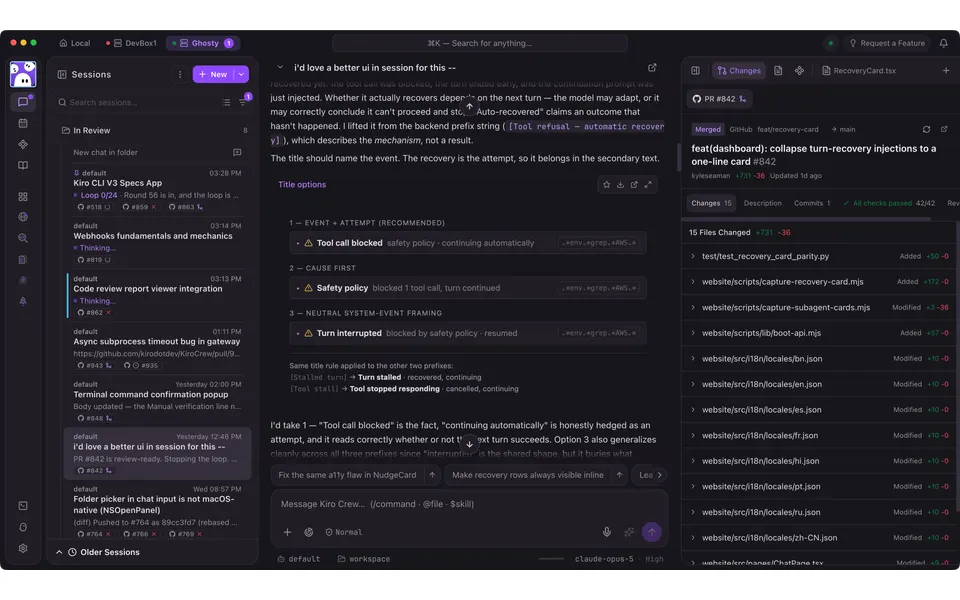
- Desktop app
- Mac, Windows and Linux
- Browser
- Yes
- Phone
- Android and phone browser
- Command line
- Yes
- Agents
- Claude Code, Codex, OpenCode and Pi
- Your subscription
- Works with your own plan
- Agents run
- On your computer, on your own server and in the vendor's cloud
- Laptop closed
- Keeps going
- Isolation
- Worktree, Container and VM
- Parallel agents
- Yes
- Scheduled runs
- Yes
- Coordinator agent
- Yes
- Built-in issues
- Yes
- Pull requests
- Yes
- Review screen
- Yes
- Team
- Shared sessions, roles and SSO
- Self-hosting
- Yes
- Licence
- Custom terms
- Price from
- Free
- How it charges
- Free plan, subscription, per seat, usage-based and bring your own key
- Paid plans from
- $11–20/month
Receipts
- Checked
- · oldest answer 2026-11-07
- Findings
- 38 published · 31 cross-checked by a second agent · read them all
- Sources
- 28 public pages on 2 sites: kiro.dev, github.com
- Screenshot
- kiro.dev, retrieved · first party marketing · shows appearance, not capability
- Data
- /products/kiro.json · .md
- Method
- Same rules for all 103 researched ADEs. How we check · Report wrong data
What it does
Where you use it
The IDE supports macOS, Windows and listed modern Linux distributions; Crew has separate desktop support. Android is publicly distributed through Google Play on paid Kiro plans. iPhone remains limited invitation-only TestFlight early access. Crew also provides a phone-accessible HTTPS browser dashboard on a user-operated gateway.
Source and scope for Where you use itAgents it runs
Crew 0.12 exposes a fixed registry of Kiro/KAS, Claude Code, Codex, OpenCode, Pi, Goose, DeepSeek, Strands and GitHub Copilot CLI backends. Developer Mode has been removed; non-Kiro backends remain experimental. New sessions choose a supported installed harness, and the runtime rejects arbitrary unknown backend IDs. Configured MCP tool commands are separate from coding-agent adapters.
Source and scope for Agents it runsAccounts and subscriptions
Crew runs Claude Code and Codex using each harness native sign-in and own credential store, reusing the external agent account independently of the Kiro account. The managed Kiro Agent backend uses the Kiro sign-in and Kiro credit entitlement; external backends have separate account routes.
Source and scope for Accounts and subscriptionsWhere agents run
Crew runs on the user's machine, container or controlled remote host; the desktop app can connect through an SSH tunnel. Sessions run in isolated Kiro cloud sandboxes in us-east-1; a paid Pro-family plan and some organization enablement are required. Further scoped facts are recorded in the atomic answers.
Source and scope for Where agents runHow work is kept apart
Each task uses its own kirocrew/task/ branch. Existing repositories get a separate Git worktree per task run. Crew documents a Docker container runtime with its own persistent volumes and optional inner sandbox. IDE 1.3+ and local V3 CLI 2.31+ have an optional OS command sandbox, off by default; built-in file tools and remote MCP remain outside it. Worktree-based task runs leave the original checkout untouched. Managed cloud sessions execute the same Kiro harness inside a cloud VM. This is a documented architecture claim, not a containment test.
Source and scope for How work is kept apartParallel work
Spec task execution can run independent tasks in parallel on IDE, CLI and Web; the matrix excludes mobile. The guide permits up to ten concurrent cloud sessions.
Source and scope for Parallel workScheduled runs
Crew Schedule creates recurring jobs in separate sessions; continued execution depends on its Gateway host.
Source and scope for Scheduled runsGit and pull requests
The Web spec flow implements tasks and opens a PR or merge request, with later feedback updates.
Source and scope for Git and pull requestsLicence and source
Kiro IDE and CLI use the AWS Content and AWS IP License terms. Kiro provides dependency-source attribution and relinking material; a complete open-source IDE/CLI was not established.
Source and scope for Licence and sourcePrice
Monthly individual prices are Pro $20, Pro+ $40, Pro Max $100 and Power $200, checked 7 November 2026. Team pooling costs $20/seat/month, adding 500 included credits per seat, with at least two seats. Further scoped facts are recorded in the atomic answers. Crew Strands accepts separately supplied model-provider keys stored in Settings Secrets. These external model costs are distinct from managed Kiro credit billing.
Source and scope for PriceTyped filters
Every value links to its receipt below. Read plan and surface restrictions before using a filter to decide.
| Filter | Value |
|---|---|
| Desktop OS: macOS | Yes |
| Desktop OS: Windows | Yes |
| Desktop OS: Linux | Yes |
| Web client | Yes |
| Phone access: Native iOS | No |
| Phone access: Native Android | Yes |
| Phone access: Phone browser | Yes |
| CLI | Yes |
| Coding agents: Claude Code | Yes |
| Coding agents: Codex | Yes |
| Coding agents: Cursor Agent | No |
| Coding agents: Gemini CLI | No |
| Coding agents: OpenCode | Yes |
| Coding agents: Pi | Yes |
| Coding agents: Grok | No |
| Coding agents: Aider | No |
| Coding agents: Antigravity | No |
| Use my subscription | Yes |
| Where agents run: On your computer | Yes cross-checked |
| Where agents run: On your own server | Yes cross-checked |
| Where agents run: In the vendor's cloud | Yes cross-checked |
| Workspace isolation: Git worktree | Yes |
| Workspace isolation: Container | Yes |
| Workspace isolation: VM or microVM | Yes |
| Parallel runs | Yes cross-checked |
| Coordinator | Yes cross-checked |
| Native issue tracking | Yes cross-checked |
| Unattended triggers | Yes cross-checked |
| Shared prompting | Yes |
| Team roles | Yes |
| SSO | Yes |
| Pull request workflow | Yes cross-checked |
| Review interface | Yes cross-checked |
| Product license: Apache-2.0 | No. Custom terms cross-checked |
| Product license: MIT | No. Custom terms cross-checked |
| Product license: GPL-3.0 | No. Custom terms cross-checked |
| Product license: GPL-3.0-or-later | No. Custom terms cross-checked |
| Product license: AGPL-3.0 | No. Custom terms cross-checked |
| Product license: AGPL-3.0-or-later | No. Custom terms cross-checked |
| Product license: Elastic License 2.0 | No. Custom terms cross-checked |
| Product license: Custom terms | Yes. Custom terms cross-checked |
| Product license: Proprietary | No. Custom terms cross-checked |
| Self-hosting | Yes cross-checked |
| Telemetry opt-out | Yes cross-checked |
| Free access | Yes cross-checked |
| Starting price: Free | Yes. Free cross-checked |
| Starting price: Up to $20/month | No. Free cross-checked |
| Starting price: $21–40/month | No. Free cross-checked |
| Starting price: $41–100/month | No. Free cross-checked |
| Starting price: Over $100/month | No. Free cross-checked |
| Starting price: Contact for pricing | No. Free cross-checked |
| Pricing model: Free, no paid plan | No |
| Pricing model: Free plan | Yes |
| Pricing model: Subscription | Yes |
| Pricing model: Per seat | Yes |
| Pricing model: Usage-based | Yes |
| Pricing model: Per machine or compute | No |
| Pricing model: Bring your own key | Yes |
| Pricing model: One-time purchase | No |
| Paid plans from: No paid plan | No. $11–20/month |
| Paid plans from: $10 or less/month | No. $11–20/month |
| Paid plans from: $11–20/month | Yes. $11–20/month |
| Paid plans from: $21–40/month | No. $11–20/month |
| Paid plans from: $41–100/month | No. $11–20/month |
| Paid plans from: Over $100/month | No. $11–20/month |
| Paid plans from: Contact sales | No. $11–20/month |
| Lifecycle status: Active | Unknown |
| Lifecycle status: Sunsetting | Unknown |
| Keeps going with laptop closed | Yes cross-checked |
| Open-source license | No. Custom terms cross-checked |
| Any desktop app | Yes |
| Paid plan up to $20/month | Yes. $11–20/month |
| Paid plan up to $40/month | Yes. $11–20/month |
| Any phone client | Yes |
Filter receipts
Desktop OS: macOS: Yes
Desktop OS: macOS
Typed value: Yes.
The IDE supports macOS, Windows and listed modern Linux distributions; Crew has separate desktop support. Android is publicly distributed through Google Play on paid Kiro plans. iPhone remains limited invitation-only TestFlight early access. Crew also provides a phone-accessible HTTPS browser dashboard on a user-operated gateway.
- Desktop os: IDE supports macOS Intel/Apple Silicon, Windows 10/11 x64/ARM64 and listed modern Linux distributions; Crew has separate desktop support.
- Browser: Kiro Web uses a modern browser without local installation.
- Cli: CLI supports macOS, Windows 11 PowerShell and Linux glibc 2.34+ or musl variants.
- The scoped first-party source pass does not establish editor_extensions, notifications. No hands-on scenario was run.
-
Finding: Kiro documents distinct IDE, CLI, Web, iOS early access and Crew installations, with OS-specific requirements.
Desktop OS: Windows: Yes
Desktop OS: Windows
Typed value: Yes.
The IDE supports macOS, Windows and listed modern Linux distributions; Crew has separate desktop support. Android is publicly distributed through Google Play on paid Kiro plans. iPhone remains limited invitation-only TestFlight early access. Crew also provides a phone-accessible HTTPS browser dashboard on a user-operated gateway.
- Desktop os: IDE supports macOS Intel/Apple Silicon, Windows 10/11 x64/ARM64 and listed modern Linux distributions; Crew has separate desktop support.
- Browser: Kiro Web uses a modern browser without local installation.
- Cli: CLI supports macOS, Windows 11 PowerShell and Linux glibc 2.34+ or musl variants.
- The scoped first-party source pass does not establish editor_extensions, notifications. No hands-on scenario was run.
-
Finding: Kiro documents distinct IDE, CLI, Web, iOS early access and Crew installations, with OS-specific requirements.
Desktop OS: Linux: Yes
Desktop OS: Linux
Typed value: Yes.
The IDE supports macOS, Windows and listed modern Linux distributions; Crew has separate desktop support. Android is publicly distributed through Google Play on paid Kiro plans. iPhone remains limited invitation-only TestFlight early access. Crew also provides a phone-accessible HTTPS browser dashboard on a user-operated gateway.
- Desktop os: IDE supports macOS Intel/Apple Silicon, Windows 10/11 x64/ARM64 and listed modern Linux distributions; Crew has separate desktop support.
- Browser: Kiro Web uses a modern browser without local installation.
- Cli: CLI supports macOS, Windows 11 PowerShell and Linux glibc 2.34+ or musl variants.
- The scoped first-party source pass does not establish editor_extensions, notifications. No hands-on scenario was run.
-
Finding: Kiro documents distinct IDE, CLI, Web, iOS early access and Crew installations, with OS-specific requirements.
Web client: Yes
Web client
Typed value: Yes.
The IDE supports macOS, Windows and listed modern Linux distributions; Crew has separate desktop support. Android is publicly distributed through Google Play on paid Kiro plans. iPhone remains limited invitation-only TestFlight early access. Crew also provides a phone-accessible HTTPS browser dashboard on a user-operated gateway.
- Desktop os: IDE supports macOS Intel/Apple Silicon, Windows 10/11 x64/ARM64 and listed modern Linux distributions; Crew has separate desktop support.
- Browser: Kiro Web uses a modern browser without local installation.
- Cli: CLI supports macOS, Windows 11 PowerShell and Linux glibc 2.34+ or musl variants.
- The scoped first-party source pass does not establish editor_extensions, notifications. No hands-on scenario was run.
-
Finding: Kiro documents distinct IDE, CLI, Web, iOS early access and Crew installations, with OS-specific requirements.
Phone access: Native iOS: No
Phone access: Native iOS
Typed value: No.
The IDE supports macOS, Windows and listed modern Linux distributions; Crew has separate desktop support. Android is publicly distributed through Google Play on paid Kiro plans. iPhone remains limited invitation-only TestFlight early access. Crew also provides a phone-accessible HTTPS browser dashboard on a user-operated gateway.
- Mobile apps: Android is publicly distributed; iPhone remains invitation-only TestFlight early access and does not count as publicly available.
- The scoped first-party source pass does not establish editor_extensions, notifications. No hands-on scenario was run.
-
Finding: Android is publicly available through Google Play for Android 10+. iPhone requires requested early access through TestFlight; the request page says only limited invitees receive access. Both use paid-plan cloud sessions.
Phone access: Native Android: Yes
Phone access: Native Android
Typed value: Yes.
The IDE supports macOS, Windows and listed modern Linux distributions; Crew has separate desktop support. Android is publicly distributed through Google Play on paid Kiro plans. iPhone remains limited invitation-only TestFlight early access. Crew also provides a phone-accessible HTTPS browser dashboard on a user-operated gateway.
- Mobile apps: Android is publicly distributed; iPhone remains invitation-only TestFlight early access and does not count as publicly available.
- The scoped first-party source pass does not establish editor_extensions, notifications. No hands-on scenario was run.
-
Finding: Android is publicly available through Google Play for Android 10+. iPhone requires requested early access through TestFlight; the request page says only limited invitees receive access. Both use paid-plan cloud sessions.
Phone access: Phone browser: Yes
Phone access: Phone browser
Typed value: Yes.
The IDE supports macOS, Windows and listed modern Linux distributions; Crew has separate desktop support. Android is publicly distributed through Google Play on paid Kiro plans. iPhone remains limited invitation-only TestFlight early access. Crew also provides a phone-accessible HTTPS browser dashboard on a user-operated gateway.
- Mobile browser: Crew provides a phone-accessible HTTPS browser dashboard on the user-operated gateway.
- The scoped first-party source pass does not establish editor_extensions, notifications. No hands-on scenario was run.
-
Finding: The shipped gateway documents opening its HTTPS dashboard URL on a phone, including a named tunnel or Tailscale Serve token link. This is the user-hosted Crew browser client, distinct from the native Kiro Mobile app.
CLI: Yes
CLI
Typed value: Yes.
The IDE supports macOS, Windows and listed modern Linux distributions; Crew has separate desktop support. Android is publicly distributed through Google Play on paid Kiro plans. iPhone remains limited invitation-only TestFlight early access. Crew also provides a phone-accessible HTTPS browser dashboard on a user-operated gateway.
- Desktop os: IDE supports macOS Intel/Apple Silicon, Windows 10/11 x64/ARM64 and listed modern Linux distributions; Crew has separate desktop support.
- Browser: Kiro Web uses a modern browser without local installation.
- Cli: CLI supports macOS, Windows 11 PowerShell and Linux glibc 2.34+ or musl variants.
- The scoped first-party source pass does not establish editor_extensions, notifications. No hands-on scenario was run.
-
Finding: Kiro documents distinct IDE, CLI, Web, iOS early access and Crew installations, with OS-specific requirements.
Coding agents: Claude Code: Yes
Coding agents: Claude Code
Typed value: Yes.
Crew 0.12 exposes a fixed registry of Kiro/KAS, Claude Code, Codex, OpenCode, Pi, Goose, DeepSeek, Strands and GitHub Copilot CLI backends. Developer Mode has been removed; non-Kiro backends remain experimental. New sessions choose a supported installed harness, and the runtime rejects arbitrary unknown backend IDs. Configured MCP tool commands are separate from coding-agent adapters.
- Session integration: Backend is fixed when the session starts; compaction is supported for Codex and OpenCode.
- Mixed harness operation: New Crew sessions can select different harnesses; observed simultaneous cross-harness operation was not tested.
- The scoped first-party source pass does not establish model_providers. No hands-on scenario was run.
-
Finding: Developer Mode enables Preview selection of Claude Code, Codex, OpenCode, Pi and other harnesses. Existing sessions retain their backend. Pi lacks Crew MCP tools; Codex requires sandboxing; Claude preapproved calls may bypass Crew audit.
Coding agents: Codex: Yes
Coding agents: Codex
Typed value: Yes.
Crew 0.12 exposes a fixed registry of Kiro/KAS, Claude Code, Codex, OpenCode, Pi, Goose, DeepSeek, Strands and GitHub Copilot CLI backends. Developer Mode has been removed; non-Kiro backends remain experimental. New sessions choose a supported installed harness, and the runtime rejects arbitrary unknown backend IDs. Configured MCP tool commands are separate from coding-agent adapters.
- Session integration: Backend is fixed when the session starts; compaction is supported for Codex and OpenCode.
- Mixed harness operation: New Crew sessions can select different harnesses; observed simultaneous cross-harness operation was not tested.
- The scoped first-party source pass does not establish model_providers. No hands-on scenario was run.
-
Finding: Developer Mode enables Preview selection of Claude Code, Codex, OpenCode, Pi and other harnesses. Existing sessions retain their backend. Pi lacks Crew MCP tools; Codex requires sandboxing; Claude preapproved calls may bypass Crew audit.
Coding agents: Cursor Agent: No
Coding agents: Cursor Agent
Typed value: No.
Crew 0.12 exposes a fixed registry of Kiro/KAS, Claude Code, Codex, OpenCode, Pi, Goose, DeepSeek, Strands and GitHub Copilot CLI backends. Developer Mode has been removed; non-Kiro backends remain experimental. New sessions choose a supported installed harness, and the runtime rejects arbitrary unknown backend IDs. Configured MCP tool commands are separate from coding-agent adapters.
- Custom adapters: The inspected runtime accepts only its fixed known-backend set and rejects arbitrary backend IDs. Edition registration exposes known adapters, while arbitrary MCP tool commands are not coding-harness adapters.
- The scoped first-party source pass does not establish model_providers. No hands-on scenario was run.
-
Crew fixed native harness registry
Finding: The released runtime has a closed known-backend set for Kiro, Claude Code, KAS, Strands, Codex, OpenCode, Pi, Goose, DeepSeek and Copilot. Registration rejects a backend outside that set. Edition plugin registration does not supply a generic arbitrary coding-harness adapter; configured MCP tool commands are a separate feature.
Coding agents: Gemini CLI: No
Coding agents: Gemini CLI
Typed value: No.
Crew 0.12 exposes a fixed registry of Kiro/KAS, Claude Code, Codex, OpenCode, Pi, Goose, DeepSeek, Strands and GitHub Copilot CLI backends. Developer Mode has been removed; non-Kiro backends remain experimental. New sessions choose a supported installed harness, and the runtime rejects arbitrary unknown backend IDs. Configured MCP tool commands are separate from coding-agent adapters.
- Custom adapters: The inspected runtime accepts only its fixed known-backend set and rejects arbitrary backend IDs. Edition registration exposes known adapters, while arbitrary MCP tool commands are not coding-harness adapters.
- The scoped first-party source pass does not establish model_providers. No hands-on scenario was run.
-
Crew fixed native harness registry
Finding: The released runtime has a closed known-backend set for Kiro, Claude Code, KAS, Strands, Codex, OpenCode, Pi, Goose, DeepSeek and Copilot. Registration rejects a backend outside that set. Edition plugin registration does not supply a generic arbitrary coding-harness adapter; configured MCP tool commands are a separate feature.
Coding agents: OpenCode: Yes
Coding agents: OpenCode
Typed value: Yes.
Crew 0.12 exposes a fixed registry of Kiro/KAS, Claude Code, Codex, OpenCode, Pi, Goose, DeepSeek, Strands and GitHub Copilot CLI backends. Developer Mode has been removed; non-Kiro backends remain experimental. New sessions choose a supported installed harness, and the runtime rejects arbitrary unknown backend IDs. Configured MCP tool commands are separate from coding-agent adapters.
- Session integration: Backend is fixed when the session starts; compaction is supported for Codex and OpenCode.
- Mixed harness operation: New Crew sessions can select different harnesses; observed simultaneous cross-harness operation was not tested.
- The scoped first-party source pass does not establish model_providers. No hands-on scenario was run.
-
Finding: Developer Mode enables Preview selection of Claude Code, Codex, OpenCode, Pi and other harnesses. Existing sessions retain their backend. Pi lacks Crew MCP tools; Codex requires sandboxing; Claude preapproved calls may bypass Crew audit.
Coding agents: Pi: Yes
Coding agents: Pi
Typed value: Yes.
Crew 0.12 exposes a fixed registry of Kiro/KAS, Claude Code, Codex, OpenCode, Pi, Goose, DeepSeek, Strands and GitHub Copilot CLI backends. Developer Mode has been removed; non-Kiro backends remain experimental. New sessions choose a supported installed harness, and the runtime rejects arbitrary unknown backend IDs. Configured MCP tool commands are separate from coding-agent adapters.
- Session integration: Backend is fixed when the session starts; compaction is supported for Codex and OpenCode.
- Mixed harness operation: New Crew sessions can select different harnesses; observed simultaneous cross-harness operation was not tested.
- The scoped first-party source pass does not establish model_providers. No hands-on scenario was run.
-
Finding: Developer Mode enables Preview selection of Claude Code, Codex, OpenCode, Pi and other harnesses. Existing sessions retain their backend. Pi lacks Crew MCP tools; Codex requires sandboxing; Claude preapproved calls may bypass Crew audit.
Coding agents: Grok: No
Coding agents: Grok
Typed value: No.
Crew 0.12 exposes a fixed registry of Kiro/KAS, Claude Code, Codex, OpenCode, Pi, Goose, DeepSeek, Strands and GitHub Copilot CLI backends. Developer Mode has been removed; non-Kiro backends remain experimental. New sessions choose a supported installed harness, and the runtime rejects arbitrary unknown backend IDs. Configured MCP tool commands are separate from coding-agent adapters.
- Custom adapters: The inspected runtime accepts only its fixed known-backend set and rejects arbitrary backend IDs. Edition registration exposes known adapters, while arbitrary MCP tool commands are not coding-harness adapters.
- The scoped first-party source pass does not establish model_providers. No hands-on scenario was run.
-
Crew fixed native harness registry
Finding: The released runtime has a closed known-backend set for Kiro, Claude Code, KAS, Strands, Codex, OpenCode, Pi, Goose, DeepSeek and Copilot. Registration rejects a backend outside that set. Edition plugin registration does not supply a generic arbitrary coding-harness adapter; configured MCP tool commands are a separate feature.
Coding agents: Aider: No
Coding agents: Aider
Typed value: No.
Crew 0.12 exposes a fixed registry of Kiro/KAS, Claude Code, Codex, OpenCode, Pi, Goose, DeepSeek, Strands and GitHub Copilot CLI backends. Developer Mode has been removed; non-Kiro backends remain experimental. New sessions choose a supported installed harness, and the runtime rejects arbitrary unknown backend IDs. Configured MCP tool commands are separate from coding-agent adapters.
- Custom adapters: The inspected runtime accepts only its fixed known-backend set and rejects arbitrary backend IDs. Edition registration exposes known adapters, while arbitrary MCP tool commands are not coding-harness adapters.
- The scoped first-party source pass does not establish model_providers. No hands-on scenario was run.
-
Crew fixed native harness registry
Finding: The released runtime has a closed known-backend set for Kiro, Claude Code, KAS, Strands, Codex, OpenCode, Pi, Goose, DeepSeek and Copilot. Registration rejects a backend outside that set. Edition plugin registration does not supply a generic arbitrary coding-harness adapter; configured MCP tool commands are a separate feature.
Coding agents: Antigravity: No
Coding agents: Antigravity
Typed value: No.
Crew 0.12 exposes a fixed registry of Kiro/KAS, Claude Code, Codex, OpenCode, Pi, Goose, DeepSeek, Strands and GitHub Copilot CLI backends. Developer Mode has been removed; non-Kiro backends remain experimental. New sessions choose a supported installed harness, and the runtime rejects arbitrary unknown backend IDs. Configured MCP tool commands are separate from coding-agent adapters.
- Custom adapters: The inspected runtime accepts only its fixed known-backend set and rejects arbitrary backend IDs. Edition registration exposes known adapters, while arbitrary MCP tool commands are not coding-harness adapters.
- The scoped first-party source pass does not establish model_providers. No hands-on scenario was run.
-
Crew fixed native harness registry
Finding: The released runtime has a closed known-backend set for Kiro, Claude Code, KAS, Strands, Codex, OpenCode, Pi, Goose, DeepSeek and Copilot. Registration rejects a backend outside that set. Edition plugin registration does not supply a generic arbitrary coding-harness adapter; configured MCP tool commands are a separate feature.
Use my subscription: Yes
Use my subscription
Typed value: Yes.
Crew runs Claude Code and Codex using each harness native sign-in and own credential store, reusing the external agent account independently of the Kiro account. The managed Kiro Agent backend uses the Kiro sign-in and Kiro credit entitlement; external backends have separate account routes.
- Agent subscriptions: Crew runs Claude Code and Codex using each harness native sign-in and own credential store, reusing the external agent account independently of the Kiro account.
- The scoped first-party source pass does not establish api_accounts, local_models, account_switching, vendor_account_requirement, provider_restrictions. No hands-on scenario was run.
-
Crew external harness authentication
Finding: Codex uses its own .codex/auth.json and native sign-in; Claude Code uses its own .claude/.credentials.json and native terminal sign-in. Both are own_credential_file entitlements, independent of Crew Kiro logout. This establishes reuse of each coding agent account through its native harness rather than an API-key-only wrapper.
Where agents run: On your computer: Yes cross-checked
Where agents run: On your computer
Typed value: Yes.
Crew runs on the user's machine, container or controlled remote host; the desktop app can connect through an SSH tunnel. Sessions run in isolated Kiro cloud sandboxes in us-east-1; a paid Pro-family plan and some organization enablement are required. Further scoped facts are recorded in the atomic answers.
- Self hosted: Crew runs on the user's machine, container or controlled remote host; the desktop app can connect through an SSH tunnel.
- Laptop-independent execution: first-party sources in this pass did not establish local, byo_remote, hybrid, provisioning, payer, resources, region, expiry, other_device_continuation. No client-disconnect, crash/restart, resource-pressure or invoice-reconciliation fixture was run. Documented persistence is distinct from measured recovery.
-
Finding: Crew is a distinct local or user-hosted Gateway agent with persistent sessions, schedules, memory and a task runner.
Where agents run: On your own server: Yes cross-checked
Where agents run: On your own server
Typed value: Yes.
Crew runs on the user's machine, container or controlled remote host; the desktop app can connect through an SSH tunnel. Sessions run in isolated Kiro cloud sandboxes in us-east-1; a paid Pro-family plan and some organization enablement are required. Further scoped facts are recorded in the atomic answers.
- Self hosted: Crew runs on the user's machine, container or controlled remote host; the desktop app can connect through an SSH tunnel.
- Laptop-independent execution: first-party sources in this pass did not establish local, byo_remote, hybrid, provisioning, payer, resources, region, expiry, other_device_continuation. No client-disconnect, crash/restart, resource-pressure or invoice-reconciliation fixture was run. Documented persistence is distinct from measured recovery.
-
Finding: Crew is a distinct local or user-hosted Gateway agent with persistent sessions, schedules, memory and a task runner.
Where agents run: In the vendor's cloud: Yes cross-checked
Where agents run: In the vendor's cloud
Typed value: Yes.
Crew runs on the user's machine, container or controlled remote host; the desktop app can connect through an SSH tunnel. Sessions run in isolated Kiro cloud sandboxes in us-east-1; a paid Pro-family plan and some organization enablement are required. Further scoped facts are recorded in the atomic answers.
- Managed cloud: Sessions run in isolated Kiro cloud sandboxes in us-east-1; a paid Pro-family plan and some organization enablement are required.
- Client disconnect: Disconnecting a client does not stop an in-flight cloud task according to the guide.
- Laptop-independent execution: first-party sources in this pass did not establish local, byo_remote, hybrid, provisioning, payer, resources, region, expiry, other_device_continuation. No client-disconnect, crash/restart, resource-pressure or invoice-reconciliation fixture was run. Documented persistence is distinct from measured recovery.
-
Finding: Clients attach to the same remote session; disconnection does not stop work, approvals wait, and paid plans include cloud compute with a ten-session cap.
Workspace isolation: Git worktree: Yes
Workspace isolation: Git worktree
Typed value: Yes.
Each task uses its own kirocrew/task/ branch. Existing repositories get a separate Git worktree per task run. Crew documents a Docker container runtime with its own persistent volumes and optional inner sandbox. IDE 1.3+ and local V3 CLI 2.31+ have an optional OS command sandbox, off by default; built-in file tools and remote MCP remain outside it. Worktree-based task runs leave the original checkout untouched. Managed cloud sessions execute the same Kiro harness inside a cloud VM. This is a documented architecture claim, not a containment test.
- Branch: Each task uses its own kirocrew/task/ branch.
- Worktree: Existing repositories get a separate Git worktree per task run.
- Code separation: Worktree-based task runs leave the original checkout untouched.
- The scoped first-party source pass does not establish checkout, filesystem, process, network, secrets, security_boundary. No hands-on scenario was run.
-
Finding: Crew decomposes Markdown specs into persistent task runs and step sessions. Up to three runs/parallel steps, per-run IDs/branches/worktrees, test/review/retry checkpoints, restart reconciliation and explicit approval gates are documented.
Workspace isolation: Container: Yes
Workspace isolation: Container
Typed value: Yes.
Each task uses its own kirocrew/task/ branch. Existing repositories get a separate Git worktree per task run. Crew documents a Docker container runtime with its own persistent volumes and optional inner sandbox. IDE 1.3+ and local V3 CLI 2.31+ have an optional OS command sandbox, off by default; built-in file tools and remote MCP remain outside it. Worktree-based task runs leave the original checkout untouched. Managed cloud sessions execute the same Kiro harness inside a cloud VM. This is a documented architecture claim, not a containment test.
- Container: Crew documents a Docker container runtime with its own persistent volumes and optional inner sandbox.
- The scoped first-party source pass does not establish checkout, filesystem, process, network, secrets, security_boundary. No hands-on scenario was run.
-
Finding: Crew Gateway can run as a service or in Docker on user hardware, including an always-on remote Linux host while the laptop sleeps. Sandbox availability is checked before container agent execution.
Workspace isolation: VM or microVM: Yes
Workspace isolation: VM or microVM
Typed value: Yes.
Each task uses its own kirocrew/task/ branch. Existing repositories get a separate Git worktree per task run. Crew documents a Docker container runtime with its own persistent volumes and optional inner sandbox. IDE 1.3+ and local V3 CLI 2.31+ have an optional OS command sandbox, off by default; built-in file tools and remote MCP remain outside it. Worktree-based task runs leave the original checkout untouched. Managed cloud sessions execute the same Kiro harness inside a cloud VM. This is a documented architecture claim, not a containment test.
- Vm: Managed cloud sessions execute the same Kiro harness inside a cloud VM. This is a documented architecture claim, not a containment test.
- The scoped first-party source pass does not establish checkout, filesystem, process, network, secrets, security_boundary. No hands-on scenario was run.
-
Finding: The engineering explanation says the same standalone harness runs on a laptop or inside a VM in the cloud; remote clients connect to its cloud sandbox. This establishes VM execution, not tested containment guarantees.
Parallel runs: Yes cross-checked
Parallel runs
Typed value: Yes.
Spec task execution can run independent tasks in parallel on IDE, CLI and Web; the matrix excludes mobile. The guide permits up to ten concurrent cloud sessions.
- Concurrent tasks: Spec task execution can run independent tasks in parallel on IDE, CLI and Web; the matrix excludes mobile.
- Parallel work: first-party sources in this pass did not establish concurrent_sessions, observed_concurrency, status_visibility. No concurrent-worker, duplicate-claim, delegation-retention or twelve-state fleet fixture was run. UI labels alone do not establish enforcement.
-
Finding: Specs create requirements/design/tasks files and schedule independent tasks in dependency waves; correctness testing and mobile parity have explicit limits.
Coordinator: Yes cross-checked
Coordinator
Typed value: Yes.
Crew can spawn isolated subagents and synthesize their results; this does not establish IDE-native delegation parity.
- Orchestration owner: Crew can spawn isolated subagents and synthesize their results; this does not establish IDE-native delegation parity.
- Inspectable delegation and communication: first-party sources in this pass did not establish roles, model_harness_effort, messages, results_return, cross_harness, activation, authentication, live_progress, retained_results, followup, invocation. No concurrent-worker, duplicate-claim, delegation-retention or twelve-state fleet fixture was run. UI labels alone do not establish enforcement.
-
Finding: Crew is a distinct local or user-hosted Gateway agent with persistent sessions, schedules, memory and a task runner.
Native issue tracking: Yes cross-checked
Native issue tracking
Typed value: Yes.
Crew Projects creates task runs from a prompt or uploaded spec. An interrupted run can resume with passed/skipped steps preserved. Run starts the task, while pause/cancel controls are available in its sidebar. A task run persists across fresh per-step sessions and reviewer sessions. Run records include task_id, step attempts, work directory and branch. Step states include PENDING, REVIEWING and PASSED; checkpointed progress survives restart.
- Create: Crew Projects creates task runs from a prompt or uploaded spec.
- Reopen: An interrupted run can resume with passed/skipped steps preserved.
- Explicit dispatch: Run starts the task, while pause/cancel controls are available in its sidebar.
- Task session separation: A task run persists across fresh per-step sessions and reviewer sessions.
- Metadata: Run records include task_id, step attempts, work directory and branch.
- Durable states: Step states include PENDING, REVIEWING and PASSED; checkpointed progress survives restart.
- Unknown after the targeted first-party documentation, release and repository pass: edit, discuss, prioritize, label, assign, search, filter, archive, project_epic_views, idea_parking, external_tracker_requirement. No configured product fixture was run; documentation does not establish successful hands-on behavior.
-
Finding: Crew decomposes Markdown specs into persistent task runs and step sessions. Up to three runs/parallel steps, per-run IDs/branches/worktrees, test/review/retry checkpoints, restart reconciliation and explicit approval gates are documented.
Unattended triggers: Yes cross-checked
Unattended triggers
Typed value: Yes.
Crew Schedule creates recurring jobs in separate sessions; continued execution depends on its Gateway host.
- Schedules: Crew Schedule creates recurring jobs in separate sessions; continued execution depends on its Gateway host.
- Unattended triggers: first-party sources in this pass did not establish events, recurring_tasks, completion_conditions, scheduler_location, overlaps, retries, client_independence. No concurrent-worker, duplicate-claim, delegation-retention or twelve-state fleet fixture was run. UI labels alone do not establish enforcement.
-
Finding: Crew is a distinct local or user-hosted Gateway agent with persistent sessions, schedules, memory and a task runner.
Shared prompting: Yes
Shared prompting
Typed value: Yes.
Crew 0.12 ships opt-in Shared Crew collaboration: owners can admit distinct people over Tailscale, and the source records their prompts and presence in the same session. This does not establish multiplayer for the managed IDE/Web cloud session.
- Presence: Shared Crew tracks distinct principals viewing or typing in one session, folding tabs of one principal together.
- Coprompting: Distinct verified Shared Crew principals can submit prompts to the same session, with author attribution and send admission.
- Attribution: Prompts carry the verified actor, and sender labels distinguish multiple people in the same conversation.
- Permissions: The owner enables the released Shared Crew preview and admits people through Tailscale; admitted people initially have equal access.
- The scoped first-party source pass does not establish visibility, discussion, comments, ordering, conflicts, plan_restrictions, owner_online. No hands-on scenario was run.
-
Shared Crew human prompt admission
Finding: Shipped chat admission records the verified actor with each prompt. The presence model distinguishes principals in one session and attribution labels multiple human authors in the same session. preview.py permits the owner to enable this released opt-in preview; this is distinct people sharing one Crew, not just same-account device access.
-
Finding: The public release removes Developer Mode, adds Strands and GitHub Copilot CLI, exposes provider keys in Settings Secrets, and ships Shared Crew as a preview owners can switch on to admit other people over Tailscale with equal access.
Team roles: Yes
Team roles
Typed value: Yes.
Organization sign-in supports IAM Identity Center or external IdP such as Okta and Microsoft Entra. Organization-managed access uses its admin-provided start URL/region or external identity-provider flow. Kiro organizations distinguish administrators managing assigned users, groups and credit limits from members consuming pooled credits.
- Organization roles: Kiro organizations distinguish administrators managing assigned users, groups and credit limits from members consuming pooled credits.
- The scoped first-party source pass does not establish project_roles, task_roles, membership, provisioning, unauthorized_access, revocation. No hands-on scenario was run.
-
Finding: The complete pricing page distinguishes organization administrators who manage users, groups, pooled credit limits and access from assigned members. This establishes organization-level administrative roles, without claiming Crew fine-grained per-person roles from a proposal.
SSO: Yes
SSO
Typed value: Yes.
Organization sign-in supports IAM Identity Center or external IdP such as Okta and Microsoft Entra. Organization-managed access uses its admin-provided start URL/region or external identity-provider flow. Kiro organizations distinguish administrators managing assigned users, groups and credit limits from members consuming pooled credits.
- Sso: Organization sign-in supports IAM Identity Center or external IdP such as Okta and Microsoft Entra.
- Plan scope: Organization-managed access uses its admin-provided start URL/region or external identity-provider flow.
- The scoped first-party source pass does not establish project_roles, task_roles, membership, provisioning, unauthorized_access, revocation. No hands-on scenario was run.
-
Finding: IDE, CLI, Web and Mobile support IAM Identity Center or organization identity providers such as Okta/Entra. CLI also has a CI/headless API-key path.
Pull request workflow: Yes cross-checked
Pull request workflow
Typed value: Yes.
The Web spec flow implements tasks and opens a PR or merge request, with later feedback updates.
- Pull requests: The Web spec flow implements tasks and opens a PR or merge request, with later feedback updates.
- Git and pull request workflow: first-party sources in this pass did not establish branches, worktrees, commits, comments, ci_response, rebase, conflicts, product_state. No draft PR, failed-gate, stale-approval, rollback or six-task batch-review fixture was run. Described actions do not prove delivery authority.
-
Finding: Specs create requirements/design/tasks files and schedule independent tasks in dependency waves; correctness testing and mobile parity have explicit limits.
Review interface: Yes cross-checked
Review interface
Typed value: Yes.
IDE supervised mode shows agent-generated file changes for review. Turn-completion review must be distinguished from a merge/deployment authorization gate.
- Change understanding: IDE supervised mode shows agent-generated file changes for review.
- Shipping guidance: Turn-completion review must be distinguished from a merge/deployment authorization gate.
- Unknown after the targeted first-party documentation, release and repository pass: pending_reviews, evidence_navigation, comments, request_changes, effort, missed_evidence, keyboard, narrow_screen, context_switching, roles, retained_context. No configured product fixture was run; documentation does not establish successful hands-on behavior.
-
Finding: IDE supervised mode presents agent file changes for human review and approval, but is explicitly not a sandbox or access-control boundary.
Product license: Apache-2.0: No. Custom terms cross-checked
Product license: Apache-2.0
Typed value: No. Custom terms.
Kiro IDE and CLI use the AWS Content and AWS IP License terms. Kiro provides dependency-source attribution and relinking material; a complete open-source IDE/CLI was not established.
- Client license: Kiro IDE and CLI use the AWS Content and AWS IP License terms.
- Source visibility: Kiro provides dependency-source attribution and relinking material; a complete open-source IDE/CLI was not established.
- Unknown after the targeted first-party documentation, release and repository pass: server_license, hosted_extensions, source_revision, hosted_parity. No configured product fixture was run; documentation does not establish successful hands-on behavior.
-
Finding: Kiro IDE and CLI are AWS Content under AWS agreements and the AWS IP License. Chromium is the IDE engine; Bun powers the CLI frontend. Dependency licenses do not license the main application as open source.
Product license: MIT: No. Custom terms cross-checked
Product license: MIT
Typed value: No. Custom terms.
Kiro IDE and CLI use the AWS Content and AWS IP License terms. Kiro provides dependency-source attribution and relinking material; a complete open-source IDE/CLI was not established.
- Client license: Kiro IDE and CLI use the AWS Content and AWS IP License terms.
- Source visibility: Kiro provides dependency-source attribution and relinking material; a complete open-source IDE/CLI was not established.
- Unknown after the targeted first-party documentation, release and repository pass: server_license, hosted_extensions, source_revision, hosted_parity. No configured product fixture was run; documentation does not establish successful hands-on behavior.
-
Finding: Kiro IDE and CLI are AWS Content under AWS agreements and the AWS IP License. Chromium is the IDE engine; Bun powers the CLI frontend. Dependency licenses do not license the main application as open source.
Product license: GPL-3.0: No. Custom terms cross-checked
Product license: GPL-3.0
Typed value: No. Custom terms.
Kiro IDE and CLI use the AWS Content and AWS IP License terms. Kiro provides dependency-source attribution and relinking material; a complete open-source IDE/CLI was not established.
- Client license: Kiro IDE and CLI use the AWS Content and AWS IP License terms.
- Source visibility: Kiro provides dependency-source attribution and relinking material; a complete open-source IDE/CLI was not established.
- Unknown after the targeted first-party documentation, release and repository pass: server_license, hosted_extensions, source_revision, hosted_parity. No configured product fixture was run; documentation does not establish successful hands-on behavior.
-
Finding: Kiro IDE and CLI are AWS Content under AWS agreements and the AWS IP License. Chromium is the IDE engine; Bun powers the CLI frontend. Dependency licenses do not license the main application as open source.
Product license: GPL-3.0-or-later: No. Custom terms cross-checked
Product license: GPL-3.0-or-later
Typed value: No. Custom terms.
Kiro IDE and CLI use the AWS Content and AWS IP License terms. Kiro provides dependency-source attribution and relinking material; a complete open-source IDE/CLI was not established.
- Client license: Kiro IDE and CLI use the AWS Content and AWS IP License terms.
- Source visibility: Kiro provides dependency-source attribution and relinking material; a complete open-source IDE/CLI was not established.
- Unknown after the targeted first-party documentation, release and repository pass: server_license, hosted_extensions, source_revision, hosted_parity. No configured product fixture was run; documentation does not establish successful hands-on behavior.
-
Finding: Kiro IDE and CLI are AWS Content under AWS agreements and the AWS IP License. Chromium is the IDE engine; Bun powers the CLI frontend. Dependency licenses do not license the main application as open source.
Product license: AGPL-3.0: No. Custom terms cross-checked
Product license: AGPL-3.0
Typed value: No. Custom terms.
Kiro IDE and CLI use the AWS Content and AWS IP License terms. Kiro provides dependency-source attribution and relinking material; a complete open-source IDE/CLI was not established.
- Client license: Kiro IDE and CLI use the AWS Content and AWS IP License terms.
- Source visibility: Kiro provides dependency-source attribution and relinking material; a complete open-source IDE/CLI was not established.
- Unknown after the targeted first-party documentation, release and repository pass: server_license, hosted_extensions, source_revision, hosted_parity. No configured product fixture was run; documentation does not establish successful hands-on behavior.
-
Finding: Kiro IDE and CLI are AWS Content under AWS agreements and the AWS IP License. Chromium is the IDE engine; Bun powers the CLI frontend. Dependency licenses do not license the main application as open source.
Product license: AGPL-3.0-or-later: No. Custom terms cross-checked
Product license: AGPL-3.0-or-later
Typed value: No. Custom terms.
Kiro IDE and CLI use the AWS Content and AWS IP License terms. Kiro provides dependency-source attribution and relinking material; a complete open-source IDE/CLI was not established.
- Client license: Kiro IDE and CLI use the AWS Content and AWS IP License terms.
- Source visibility: Kiro provides dependency-source attribution and relinking material; a complete open-source IDE/CLI was not established.
- Unknown after the targeted first-party documentation, release and repository pass: server_license, hosted_extensions, source_revision, hosted_parity. No configured product fixture was run; documentation does not establish successful hands-on behavior.
-
Finding: Kiro IDE and CLI are AWS Content under AWS agreements and the AWS IP License. Chromium is the IDE engine; Bun powers the CLI frontend. Dependency licenses do not license the main application as open source.
Product license: Elastic License 2.0: No. Custom terms cross-checked
Product license: Elastic License 2.0
Typed value: No. Custom terms.
Kiro IDE and CLI use the AWS Content and AWS IP License terms. Kiro provides dependency-source attribution and relinking material; a complete open-source IDE/CLI was not established.
- Client license: Kiro IDE and CLI use the AWS Content and AWS IP License terms.
- Source visibility: Kiro provides dependency-source attribution and relinking material; a complete open-source IDE/CLI was not established.
- Unknown after the targeted first-party documentation, release and repository pass: server_license, hosted_extensions, source_revision, hosted_parity. No configured product fixture was run; documentation does not establish successful hands-on behavior.
-
Finding: Kiro IDE and CLI are AWS Content under AWS agreements and the AWS IP License. Chromium is the IDE engine; Bun powers the CLI frontend. Dependency licenses do not license the main application as open source.
Product license: Custom terms: Yes. Custom terms cross-checked
Product license: Custom terms
Typed value: Yes. Custom terms.
Kiro IDE and CLI use the AWS Content and AWS IP License terms. Kiro provides dependency-source attribution and relinking material; a complete open-source IDE/CLI was not established.
- Client license: Kiro IDE and CLI use the AWS Content and AWS IP License terms.
- Source visibility: Kiro provides dependency-source attribution and relinking material; a complete open-source IDE/CLI was not established.
- Unknown after the targeted first-party documentation, release and repository pass: server_license, hosted_extensions, source_revision, hosted_parity. No configured product fixture was run; documentation does not establish successful hands-on behavior.
-
Finding: Kiro IDE and CLI are AWS Content under AWS agreements and the AWS IP License. Chromium is the IDE engine; Bun powers the CLI frontend. Dependency licenses do not license the main application as open source.
Product license: Proprietary: No. Custom terms cross-checked
Product license: Proprietary
Typed value: No. Custom terms.
Kiro IDE and CLI use the AWS Content and AWS IP License terms. Kiro provides dependency-source attribution and relinking material; a complete open-source IDE/CLI was not established.
- Client license: Kiro IDE and CLI use the AWS Content and AWS IP License terms.
- Source visibility: Kiro provides dependency-source attribution and relinking material; a complete open-source IDE/CLI was not established.
- Unknown after the targeted first-party documentation, release and repository pass: server_license, hosted_extensions, source_revision, hosted_parity. No configured product fixture was run; documentation does not establish successful hands-on behavior.
-
Finding: Kiro IDE and CLI are AWS Content under AWS agreements and the AWS IP License. Chromium is the IDE engine; Bun powers the CLI frontend. Dependency licenses do not license the main application as open source.
Self-hosting: Yes cross-checked
Self-hosting
Typed value: Yes.
The Crew Gateway and dashboard run locally, in Docker or on a user-controlled remote host; Kiro/model-service credentials remain backend-specific. Crew runtime/state are user-hosted, while selected coding harness and provider authentication may depend on external services. IDE/CLI on one machine share local memory, distinct from cross-device transcript export.
- Self hosting: The Crew Gateway and dashboard run locally, in Docker or on a user-controlled remote host; Kiro/model-service credentials remain backend-specific.
- Vendor dependencies: Crew runtime/state are user-hosted, while selected coding harness and provider authentication may depend on external services.
- Unknown after the targeted first-party documentation, release and repository pass: export, import, formats, cancellation, account_independence. No configured product fixture was run; documentation does not establish successful hands-on behavior.
-
Finding: Crew Gateway can run as a service or in Docker on user hardware, including an always-on remote Linux host while the laptop sleeps. Sandbox availability is checked before container agent execution.
Telemetry opt-out: Yes cross-checked
Telemetry opt-out
Typed value: Yes.
Improvement content can include generated code, questions, other inputs and responses. Free-tier inputs may be retained up to sixty days for abuse detection; model-specific retention may also apply. Free and individual subscriber content can improve services or models unless opted out; enterprise content is excluded from service improvement. Usage telemetry includes interaction, errors and metrics, separate from shared improvement content. Individual/free usage analytics, errors/crashes and improvement content are collected by default. IDE unchecks Usage Analytics and Performance Metrics; CLI toggles Telemetry off. Content-sharing controls are separate. Enterprise reports are admin controlled. Model-specific abuse-retention requirements remain separate from Kiro improvement opt-out.
- Code data: Improvement content can include generated code, questions, other inputs and responses.
- Retention: Free-tier inputs may be retained up to sixty days for abuse detection; model-specific retention may also apply.
- Training: Free and individual subscriber content can improve services or models unless opted out; enterprise content is excluded from service improvement.
- Telemetry disclosure: Usage telemetry includes interaction, errors and metrics, separate from shared improvement content.
- Telemetry defaults: Individual/free usage analytics, errors/crashes and improvement content are collected by default.
- Telemetry controls: IDE unchecks Usage Analytics and Performance Metrics; CLI toggles Telemetry off. Content-sharing controls are separate. Enterprise reports are admin controlled.
- Provider separation: Model-specific abuse-retention requirements remain separate from Kiro improvement opt-out.
- Unknown after the targeted first-party documentation, release and repository pass: prompts, credentials, logs, artifacts, deletion, residency, subprocessors, consent_prompt. No configured product fixture was run; documentation does not establish successful hands-on behavior.
-
Finding: Individual/free usage may supply content for improvement by default. IDE/CLI telemetry and content have separate opt-outs. Enterprise improvement collection is off; admin reports remain separately controlled. Free inputs may be held up to sixty days for abuse detection.
Free access: Yes cross-checked
Free access
Typed value: Yes.
Kiro Free provides fifty credits monthly for limited listed models; cloud/Web access is not implied. First upgrade to Pro gets the rest of the month free plus 500 trial credits valid for twelve months; higher-plan differences may be charged. Further scoped facts are recorded in the atomic answers.
- Ongoing free: Kiro Free provides fifty credits monthly for limited listed models; cloud/Web access is not implied.
- Trial: First upgrade to Pro gets the rest of the month free plus 500 trial credits valid for twelve months; higher-plan differences may be charged.
- Card required: Upgrading to a paid plan requires a valid card.
- Useful free tier and evaluation access: first-party sources in this pass did not establish credits_trial, self_host_cost, early_access, free_scenarios, usage_caps, paid_evaluation. No full license/hosted parity audit, assurance-report access or fixed one/two/five-person workload costing was performed. Public pricing is dated; missing rates remain unknown.
-
Finding: Free has fifty credits; paid individual tiers and pooled team seats differ in included credits. Add-ons cost $0.04/credit and taxes are excluded.
Starting price: Free: Yes. Free cross-checked
Starting price: Free
Typed value: Yes. Free.
Kiro Free provides fifty credits monthly for limited listed models; cloud/Web access is not implied. First upgrade to Pro gets the rest of the month free plus 500 trial credits valid for twelve months; higher-plan differences may be charged. Further scoped facts are recorded in the atomic answers.
- Ongoing free: Kiro Free provides fifty credits monthly for limited listed models; cloud/Web access is not implied.
- Trial: First upgrade to Pro gets the rest of the month free plus 500 trial credits valid for twelve months; higher-plan differences may be charged.
- Card required: Upgrading to a paid plan requires a valid card.
- Useful free tier and evaluation access: first-party sources in this pass did not establish credits_trial, self_host_cost, early_access, free_scenarios, usage_caps, paid_evaluation. No full license/hosted parity audit, assurance-report access or fixed one/two/five-person workload costing was performed. Public pricing is dated; missing rates remain unknown.
-
Finding: Free has fifty credits; paid individual tiers and pooled team seats differ in included credits. Add-ons cost $0.04/credit and taxes are excluded.
Starting price: Up to $20/month: No. Free cross-checked
Starting price: Up to $20/month
Typed value: No. Free.
Kiro Free provides fifty credits monthly for limited listed models; cloud/Web access is not implied. First upgrade to Pro gets the rest of the month free plus 500 trial credits valid for twelve months; higher-plan differences may be charged. Further scoped facts are recorded in the atomic answers.
- Ongoing free: Kiro Free provides fifty credits monthly for limited listed models; cloud/Web access is not implied.
- Trial: First upgrade to Pro gets the rest of the month free plus 500 trial credits valid for twelve months; higher-plan differences may be charged.
- Card required: Upgrading to a paid plan requires a valid card.
- Useful free tier and evaluation access: first-party sources in this pass did not establish credits_trial, self_host_cost, early_access, free_scenarios, usage_caps, paid_evaluation. No full license/hosted parity audit, assurance-report access or fixed one/two/five-person workload costing was performed. Public pricing is dated; missing rates remain unknown.
-
Finding: Free has fifty credits; paid individual tiers and pooled team seats differ in included credits. Add-ons cost $0.04/credit and taxes are excluded.
Starting price: $21–40/month: No. Free cross-checked
Starting price: $21–40/month
Typed value: No. Free.
Kiro Free provides fifty credits monthly for limited listed models; cloud/Web access is not implied. First upgrade to Pro gets the rest of the month free plus 500 trial credits valid for twelve months; higher-plan differences may be charged. Further scoped facts are recorded in the atomic answers.
- Ongoing free: Kiro Free provides fifty credits monthly for limited listed models; cloud/Web access is not implied.
- Trial: First upgrade to Pro gets the rest of the month free plus 500 trial credits valid for twelve months; higher-plan differences may be charged.
- Card required: Upgrading to a paid plan requires a valid card.
- Useful free tier and evaluation access: first-party sources in this pass did not establish credits_trial, self_host_cost, early_access, free_scenarios, usage_caps, paid_evaluation. No full license/hosted parity audit, assurance-report access or fixed one/two/five-person workload costing was performed. Public pricing is dated; missing rates remain unknown.
-
Finding: Free has fifty credits; paid individual tiers and pooled team seats differ in included credits. Add-ons cost $0.04/credit and taxes are excluded.
Starting price: $41–100/month: No. Free cross-checked
Starting price: $41–100/month
Typed value: No. Free.
Kiro Free provides fifty credits monthly for limited listed models; cloud/Web access is not implied. First upgrade to Pro gets the rest of the month free plus 500 trial credits valid for twelve months; higher-plan differences may be charged. Further scoped facts are recorded in the atomic answers.
- Ongoing free: Kiro Free provides fifty credits monthly for limited listed models; cloud/Web access is not implied.
- Trial: First upgrade to Pro gets the rest of the month free plus 500 trial credits valid for twelve months; higher-plan differences may be charged.
- Card required: Upgrading to a paid plan requires a valid card.
- Useful free tier and evaluation access: first-party sources in this pass did not establish credits_trial, self_host_cost, early_access, free_scenarios, usage_caps, paid_evaluation. No full license/hosted parity audit, assurance-report access or fixed one/two/five-person workload costing was performed. Public pricing is dated; missing rates remain unknown.
-
Finding: Free has fifty credits; paid individual tiers and pooled team seats differ in included credits. Add-ons cost $0.04/credit and taxes are excluded.
Starting price: Over $100/month: No. Free cross-checked
Starting price: Over $100/month
Typed value: No. Free.
Kiro Free provides fifty credits monthly for limited listed models; cloud/Web access is not implied. First upgrade to Pro gets the rest of the month free plus 500 trial credits valid for twelve months; higher-plan differences may be charged. Further scoped facts are recorded in the atomic answers.
- Ongoing free: Kiro Free provides fifty credits monthly for limited listed models; cloud/Web access is not implied.
- Trial: First upgrade to Pro gets the rest of the month free plus 500 trial credits valid for twelve months; higher-plan differences may be charged.
- Card required: Upgrading to a paid plan requires a valid card.
- Useful free tier and evaluation access: first-party sources in this pass did not establish credits_trial, self_host_cost, early_access, free_scenarios, usage_caps, paid_evaluation. No full license/hosted parity audit, assurance-report access or fixed one/two/five-person workload costing was performed. Public pricing is dated; missing rates remain unknown.
-
Finding: Free has fifty credits; paid individual tiers and pooled team seats differ in included credits. Add-ons cost $0.04/credit and taxes are excluded.
Starting price: Contact for pricing: No. Free cross-checked
Starting price: Contact for pricing
Typed value: No. Free.
Kiro Free provides fifty credits monthly for limited listed models; cloud/Web access is not implied. First upgrade to Pro gets the rest of the month free plus 500 trial credits valid for twelve months; higher-plan differences may be charged. Further scoped facts are recorded in the atomic answers.
- Ongoing free: Kiro Free provides fifty credits monthly for limited listed models; cloud/Web access is not implied.
- Trial: First upgrade to Pro gets the rest of the month free plus 500 trial credits valid for twelve months; higher-plan differences may be charged.
- Card required: Upgrading to a paid plan requires a valid card.
- Useful free tier and evaluation access: first-party sources in this pass did not establish credits_trial, self_host_cost, early_access, free_scenarios, usage_caps, paid_evaluation. No full license/hosted parity audit, assurance-report access or fixed one/two/five-person workload costing was performed. Public pricing is dated; missing rates remain unknown.
-
Finding: Free has fifty credits; paid individual tiers and pooled team seats differ in included credits. Add-ons cost $0.04/credit and taxes are excluded.
Pricing model: Free, no paid plan: No
Pricing model: Free, no paid plan
Typed value: No.
Monthly individual prices are Pro $20, Pro+ $40, Pro Max $100 and Power $200, checked 7 November 2026. Team pooling costs $20/seat/month, adding 500 included credits per seat, with at least two seats. Further scoped facts are recorded in the atomic answers. Crew Strands accepts separately supplied model-provider keys stored in Settings Secrets. These external model costs are distinct from managed Kiro credit billing.
- Interval: Monthly individual prices are Pro $20, Pro+ $40, Pro Max $100 and Power $200, checked 7 November 2026.
- Seats: Team pooling costs $20/seat/month, adding 500 included credits per seat, with at least two seats.
- Included usage: Individual paid tiers include 1,000/2,000/5,000/10,000 credits respectively; model multipliers and task complexity affect consumption.
- Overages: Add-on credits cost $0.04 each; individual packs are prepaid and expire after twelve months.
- Taxes: The page excludes applicable taxes/duties unless stated; GovCloud pricing is approximately 20% higher and has no Free tier.
- The scoped first-party source pass does not establish currency, seat_minimum, workspace_fees, credits, trial. No hands-on scenario was run.
-
Finding: Free has fifty credits; paid individual tiers and pooled team seats differ in included credits. Add-ons cost $0.04/credit and taxes are excluded.
Pricing model: Free plan: Yes
Pricing model: Free plan
Typed value: Yes.
Monthly individual prices are Pro $20, Pro+ $40, Pro Max $100 and Power $200, checked 7 November 2026. Team pooling costs $20/seat/month, adding 500 included credits per seat, with at least two seats. Further scoped facts are recorded in the atomic answers. Crew Strands accepts separately supplied model-provider keys stored in Settings Secrets. These external model costs are distinct from managed Kiro credit billing.
- Interval: Monthly individual prices are Pro $20, Pro+ $40, Pro Max $100 and Power $200, checked 7 November 2026.
- Seats: Team pooling costs $20/seat/month, adding 500 included credits per seat, with at least two seats.
- Included usage: Individual paid tiers include 1,000/2,000/5,000/10,000 credits respectively; model multipliers and task complexity affect consumption.
- Overages: Add-on credits cost $0.04 each; individual packs are prepaid and expire after twelve months.
- Taxes: The page excludes applicable taxes/duties unless stated; GovCloud pricing is approximately 20% higher and has no Free tier.
- The scoped first-party source pass does not establish currency, seat_minimum, workspace_fees, credits, trial. No hands-on scenario was run.
-
Finding: Free has fifty credits; paid individual tiers and pooled team seats differ in included credits. Add-ons cost $0.04/credit and taxes are excluded.
Pricing model: Subscription: Yes
Pricing model: Subscription
Typed value: Yes.
Monthly individual prices are Pro $20, Pro+ $40, Pro Max $100 and Power $200, checked 7 November 2026. Team pooling costs $20/seat/month, adding 500 included credits per seat, with at least two seats. Further scoped facts are recorded in the atomic answers. Crew Strands accepts separately supplied model-provider keys stored in Settings Secrets. These external model costs are distinct from managed Kiro credit billing.
- Interval: Monthly individual prices are Pro $20, Pro+ $40, Pro Max $100 and Power $200, checked 7 November 2026.
- Seats: Team pooling costs $20/seat/month, adding 500 included credits per seat, with at least two seats.
- Included usage: Individual paid tiers include 1,000/2,000/5,000/10,000 credits respectively; model multipliers and task complexity affect consumption.
- Overages: Add-on credits cost $0.04 each; individual packs are prepaid and expire after twelve months.
- Taxes: The page excludes applicable taxes/duties unless stated; GovCloud pricing is approximately 20% higher and has no Free tier.
- The scoped first-party source pass does not establish currency, seat_minimum, workspace_fees, credits, trial. No hands-on scenario was run.
-
Finding: Free has fifty credits; paid individual tiers and pooled team seats differ in included credits. Add-ons cost $0.04/credit and taxes are excluded.
Pricing model: Per seat: Yes
Pricing model: Per seat
Typed value: Yes.
Monthly individual prices are Pro $20, Pro+ $40, Pro Max $100 and Power $200, checked 7 November 2026. Team pooling costs $20/seat/month, adding 500 included credits per seat, with at least two seats. Further scoped facts are recorded in the atomic answers. Crew Strands accepts separately supplied model-provider keys stored in Settings Secrets. These external model costs are distinct from managed Kiro credit billing.
- Interval: Monthly individual prices are Pro $20, Pro+ $40, Pro Max $100 and Power $200, checked 7 November 2026.
- Seats: Team pooling costs $20/seat/month, adding 500 included credits per seat, with at least two seats.
- Included usage: Individual paid tiers include 1,000/2,000/5,000/10,000 credits respectively; model multipliers and task complexity affect consumption.
- Overages: Add-on credits cost $0.04 each; individual packs are prepaid and expire after twelve months.
- Taxes: The page excludes applicable taxes/duties unless stated; GovCloud pricing is approximately 20% higher and has no Free tier.
- The scoped first-party source pass does not establish currency, seat_minimum, workspace_fees, credits, trial. No hands-on scenario was run.
-
Finding: Free has fifty credits; paid individual tiers and pooled team seats differ in included credits. Add-ons cost $0.04/credit and taxes are excluded.
Pricing model: Usage-based: Yes
Pricing model: Usage-based
Typed value: Yes.
Monthly individual prices are Pro $20, Pro+ $40, Pro Max $100 and Power $200, checked 7 November 2026. Team pooling costs $20/seat/month, adding 500 included credits per seat, with at least two seats. Further scoped facts are recorded in the atomic answers. Crew Strands accepts separately supplied model-provider keys stored in Settings Secrets. These external model costs are distinct from managed Kiro credit billing.
- Interval: Monthly individual prices are Pro $20, Pro+ $40, Pro Max $100 and Power $200, checked 7 November 2026.
- Seats: Team pooling costs $20/seat/month, adding 500 included credits per seat, with at least two seats.
- Included usage: Individual paid tiers include 1,000/2,000/5,000/10,000 credits respectively; model multipliers and task complexity affect consumption.
- Overages: Add-on credits cost $0.04 each; individual packs are prepaid and expire after twelve months.
- Taxes: The page excludes applicable taxes/duties unless stated; GovCloud pricing is approximately 20% higher and has no Free tier.
- The scoped first-party source pass does not establish currency, seat_minimum, workspace_fees, credits, trial. No hands-on scenario was run.
-
Finding: Free has fifty credits; paid individual tiers and pooled team seats differ in included credits. Add-ons cost $0.04/credit and taxes are excluded.
Pricing model: Per machine or compute: No
Pricing model: Per machine or compute
Typed value: No.
Monthly individual prices are Pro $20, Pro+ $40, Pro Max $100 and Power $200, checked 7 November 2026. Team pooling costs $20/seat/month, adding 500 included credits per seat, with at least two seats. Further scoped facts are recorded in the atomic answers. Crew Strands accepts separately supplied model-provider keys stored in Settings Secrets. These external model costs are distinct from managed Kiro credit billing.
- Compute cost: Cloud sessions are included in the existing paid credit model with no separate cloud-compute charge, checked 7 November 2026.
- The scoped first-party source pass does not establish currency, seat_minimum, workspace_fees, credits, trial. No hands-on scenario was run.
-
Finding: Clients attach to the same remote session; disconnection does not stop work, approvals wait, and paid plans include cloud compute with a ten-session cap.
Pricing model: Bring your own key: Yes
Pricing model: Bring your own key
Typed value: Yes.
Monthly individual prices are Pro $20, Pro+ $40, Pro Max $100 and Power $200, checked 7 November 2026. Team pooling costs $20/seat/month, adding 500 included credits per seat, with at least two seats. Further scoped facts are recorded in the atomic answers. Crew Strands accepts separately supplied model-provider keys stored in Settings Secrets. These external model costs are distinct from managed Kiro credit billing.
- Model cost: Crew Strands accepts separately supplied model-provider keys stored in Settings Secrets. These external model costs are distinct from managed Kiro credit billing.
- The scoped first-party source pass does not establish currency, seat_minimum, workspace_fees, credits, trial. No hands-on scenario was run.
-
Finding: The public release removes Developer Mode, adds Strands and GitHub Copilot CLI, exposes provider keys in Settings Secrets, and ships Shared Crew as a preview owners can switch on to admit other people over Tailscale with equal access.
Pricing model: One-time purchase: No
Pricing model: One-time purchase
Typed value: No.
Monthly individual prices are Pro $20, Pro+ $40, Pro Max $100 and Power $200, checked 7 November 2026. Team pooling costs $20/seat/month, adding 500 included credits per seat, with at least two seats. Further scoped facts are recorded in the atomic answers. Crew Strands accepts separately supplied model-provider keys stored in Settings Secrets. These external model costs are distinct from managed Kiro credit billing.
- Interval: Monthly individual prices are Pro $20, Pro+ $40, Pro Max $100 and Power $200, checked 7 November 2026.
- Seats: Team pooling costs $20/seat/month, adding 500 included credits per seat, with at least two seats.
- Included usage: Individual paid tiers include 1,000/2,000/5,000/10,000 credits respectively; model multipliers and task complexity affect consumption.
- Overages: Add-on credits cost $0.04 each; individual packs are prepaid and expire after twelve months.
- Taxes: The page excludes applicable taxes/duties unless stated; GovCloud pricing is approximately 20% higher and has no Free tier.
- The scoped first-party source pass does not establish currency, seat_minimum, workspace_fees, credits, trial. No hands-on scenario was run.
-
Finding: Free has fifty credits; paid individual tiers and pooled team seats differ in included credits. Add-ons cost $0.04/credit and taxes are excluded.
Paid plans from: No paid plan: No. $11–20/month
Paid plans from: No paid plan
Typed value: No. $11–20/month.
Monthly individual prices are Pro $20, Pro+ $40, Pro Max $100 and Power $200, checked 7 November 2026. Team pooling costs $20/seat/month, adding 500 included credits per seat, with at least two seats. Further scoped facts are recorded in the atomic answers. Crew Strands accepts separately supplied model-provider keys stored in Settings Secrets. These external model costs are distinct from managed Kiro credit billing.
- Interval: Monthly individual prices are Pro $20, Pro+ $40, Pro Max $100 and Power $200, checked 7 November 2026.
- Seats: Team pooling costs $20/seat/month, adding 500 included credits per seat, with at least two seats.
- Included usage: Individual paid tiers include 1,000/2,000/5,000/10,000 credits respectively; model multipliers and task complexity affect consumption.
- Overages: Add-on credits cost $0.04 each; individual packs are prepaid and expire after twelve months.
- Taxes: The page excludes applicable taxes/duties unless stated; GovCloud pricing is approximately 20% higher and has no Free tier.
- The scoped first-party source pass does not establish currency, seat_minimum, workspace_fees, credits, trial. No hands-on scenario was run.
-
Finding: Free has fifty credits; paid individual tiers and pooled team seats differ in included credits. Add-ons cost $0.04/credit and taxes are excluded.
Paid plans from: $10 or less/month: No. $11–20/month
Paid plans from: $10 or less/month
Typed value: No. $11–20/month.
Monthly individual prices are Pro $20, Pro+ $40, Pro Max $100 and Power $200, checked 7 November 2026. Team pooling costs $20/seat/month, adding 500 included credits per seat, with at least two seats. Further scoped facts are recorded in the atomic answers. Crew Strands accepts separately supplied model-provider keys stored in Settings Secrets. These external model costs are distinct from managed Kiro credit billing.
- Interval: Monthly individual prices are Pro $20, Pro+ $40, Pro Max $100 and Power $200, checked 7 November 2026.
- Seats: Team pooling costs $20/seat/month, adding 500 included credits per seat, with at least two seats.
- Included usage: Individual paid tiers include 1,000/2,000/5,000/10,000 credits respectively; model multipliers and task complexity affect consumption.
- Overages: Add-on credits cost $0.04 each; individual packs are prepaid and expire after twelve months.
- Taxes: The page excludes applicable taxes/duties unless stated; GovCloud pricing is approximately 20% higher and has no Free tier.
- The scoped first-party source pass does not establish currency, seat_minimum, workspace_fees, credits, trial. No hands-on scenario was run.
-
Finding: Free has fifty credits; paid individual tiers and pooled team seats differ in included credits. Add-ons cost $0.04/credit and taxes are excluded.
Paid plans from: $11–20/month: Yes. $11–20/month
Paid plans from: $11–20/month
Typed value: Yes. $11–20/month.
Monthly individual prices are Pro $20, Pro+ $40, Pro Max $100 and Power $200, checked 7 November 2026. Team pooling costs $20/seat/month, adding 500 included credits per seat, with at least two seats. Further scoped facts are recorded in the atomic answers. Crew Strands accepts separately supplied model-provider keys stored in Settings Secrets. These external model costs are distinct from managed Kiro credit billing.
- Interval: Monthly individual prices are Pro $20, Pro+ $40, Pro Max $100 and Power $200, checked 7 November 2026.
- Seats: Team pooling costs $20/seat/month, adding 500 included credits per seat, with at least two seats.
- Included usage: Individual paid tiers include 1,000/2,000/5,000/10,000 credits respectively; model multipliers and task complexity affect consumption.
- Overages: Add-on credits cost $0.04 each; individual packs are prepaid and expire after twelve months.
- Taxes: The page excludes applicable taxes/duties unless stated; GovCloud pricing is approximately 20% higher and has no Free tier.
- The scoped first-party source pass does not establish currency, seat_minimum, workspace_fees, credits, trial. No hands-on scenario was run.
-
Finding: Free has fifty credits; paid individual tiers and pooled team seats differ in included credits. Add-ons cost $0.04/credit and taxes are excluded.
Paid plans from: $21–40/month: No. $11–20/month
Paid plans from: $21–40/month
Typed value: No. $11–20/month.
Monthly individual prices are Pro $20, Pro+ $40, Pro Max $100 and Power $200, checked 7 November 2026. Team pooling costs $20/seat/month, adding 500 included credits per seat, with at least two seats. Further scoped facts are recorded in the atomic answers. Crew Strands accepts separately supplied model-provider keys stored in Settings Secrets. These external model costs are distinct from managed Kiro credit billing.
- Interval: Monthly individual prices are Pro $20, Pro+ $40, Pro Max $100 and Power $200, checked 7 November 2026.
- Seats: Team pooling costs $20/seat/month, adding 500 included credits per seat, with at least two seats.
- Included usage: Individual paid tiers include 1,000/2,000/5,000/10,000 credits respectively; model multipliers and task complexity affect consumption.
- Overages: Add-on credits cost $0.04 each; individual packs are prepaid and expire after twelve months.
- Taxes: The page excludes applicable taxes/duties unless stated; GovCloud pricing is approximately 20% higher and has no Free tier.
- The scoped first-party source pass does not establish currency, seat_minimum, workspace_fees, credits, trial. No hands-on scenario was run.
-
Finding: Free has fifty credits; paid individual tiers and pooled team seats differ in included credits. Add-ons cost $0.04/credit and taxes are excluded.
Paid plans from: $41–100/month: No. $11–20/month
Paid plans from: $41–100/month
Typed value: No. $11–20/month.
Monthly individual prices are Pro $20, Pro+ $40, Pro Max $100 and Power $200, checked 7 November 2026. Team pooling costs $20/seat/month, adding 500 included credits per seat, with at least two seats. Further scoped facts are recorded in the atomic answers. Crew Strands accepts separately supplied model-provider keys stored in Settings Secrets. These external model costs are distinct from managed Kiro credit billing.
- Interval: Monthly individual prices are Pro $20, Pro+ $40, Pro Max $100 and Power $200, checked 7 November 2026.
- Seats: Team pooling costs $20/seat/month, adding 500 included credits per seat, with at least two seats.
- Included usage: Individual paid tiers include 1,000/2,000/5,000/10,000 credits respectively; model multipliers and task complexity affect consumption.
- Overages: Add-on credits cost $0.04 each; individual packs are prepaid and expire after twelve months.
- Taxes: The page excludes applicable taxes/duties unless stated; GovCloud pricing is approximately 20% higher and has no Free tier.
- The scoped first-party source pass does not establish currency, seat_minimum, workspace_fees, credits, trial. No hands-on scenario was run.
-
Finding: Free has fifty credits; paid individual tiers and pooled team seats differ in included credits. Add-ons cost $0.04/credit and taxes are excluded.
Paid plans from: Over $100/month: No. $11–20/month
Paid plans from: Over $100/month
Typed value: No. $11–20/month.
Monthly individual prices are Pro $20, Pro+ $40, Pro Max $100 and Power $200, checked 7 November 2026. Team pooling costs $20/seat/month, adding 500 included credits per seat, with at least two seats. Further scoped facts are recorded in the atomic answers. Crew Strands accepts separately supplied model-provider keys stored in Settings Secrets. These external model costs are distinct from managed Kiro credit billing.
- Interval: Monthly individual prices are Pro $20, Pro+ $40, Pro Max $100 and Power $200, checked 7 November 2026.
- Seats: Team pooling costs $20/seat/month, adding 500 included credits per seat, with at least two seats.
- Included usage: Individual paid tiers include 1,000/2,000/5,000/10,000 credits respectively; model multipliers and task complexity affect consumption.
- Overages: Add-on credits cost $0.04 each; individual packs are prepaid and expire after twelve months.
- Taxes: The page excludes applicable taxes/duties unless stated; GovCloud pricing is approximately 20% higher and has no Free tier.
- The scoped first-party source pass does not establish currency, seat_minimum, workspace_fees, credits, trial. No hands-on scenario was run.
-
Finding: Free has fifty credits; paid individual tiers and pooled team seats differ in included credits. Add-ons cost $0.04/credit and taxes are excluded.
Paid plans from: Contact sales: No. $11–20/month
Paid plans from: Contact sales
Typed value: No. $11–20/month.
Monthly individual prices are Pro $20, Pro+ $40, Pro Max $100 and Power $200, checked 7 November 2026. Team pooling costs $20/seat/month, adding 500 included credits per seat, with at least two seats. Further scoped facts are recorded in the atomic answers. Crew Strands accepts separately supplied model-provider keys stored in Settings Secrets. These external model costs are distinct from managed Kiro credit billing.
- Interval: Monthly individual prices are Pro $20, Pro+ $40, Pro Max $100 and Power $200, checked 7 November 2026.
- Seats: Team pooling costs $20/seat/month, adding 500 included credits per seat, with at least two seats.
- Included usage: Individual paid tiers include 1,000/2,000/5,000/10,000 credits respectively; model multipliers and task complexity affect consumption.
- Overages: Add-on credits cost $0.04 each; individual packs are prepaid and expire after twelve months.
- Taxes: The page excludes applicable taxes/duties unless stated; GovCloud pricing is approximately 20% higher and has no Free tier.
- The scoped first-party source pass does not establish currency, seat_minimum, workspace_fees, credits, trial. No hands-on scenario was run.
-
Finding: Free has fifty credits; paid individual tiers and pooled team seats differ in included credits. Add-ons cost $0.04/credit and taxes are excluded.
Keeps going with laptop closed: Yes cross-checked
Keeps going with laptop closed
Typed value: Yes.
Crew runs on the user's machine, container or controlled remote host; the desktop app can connect through an SSH tunnel. Sessions run in isolated Kiro cloud sandboxes in us-east-1; a paid Pro-family plan and some organization enablement are required. Further scoped facts are recorded in the atomic answers.
- Managed cloud: Sessions run in isolated Kiro cloud sandboxes in us-east-1; a paid Pro-family plan and some organization enablement are required.
- Client disconnect: Disconnecting a client does not stop an in-flight cloud task according to the guide.
- Laptop-independent execution: first-party sources in this pass did not establish local, byo_remote, hybrid, provisioning, payer, resources, region, expiry, other_device_continuation. No client-disconnect, crash/restart, resource-pressure or invoice-reconciliation fixture was run. Documented persistence is distinct from measured recovery.
-
Finding: Clients attach to the same remote session; disconnection does not stop work, approvals wait, and paid plans include cloud compute with a ten-session cap.
Open-source license: No. Custom terms cross-checked
Open-source license
Typed value: No. Custom terms.
Kiro IDE and CLI use the AWS Content and AWS IP License terms. Kiro provides dependency-source attribution and relinking material; a complete open-source IDE/CLI was not established.
- Client license: Kiro IDE and CLI use the AWS Content and AWS IP License terms.
- Source visibility: Kiro provides dependency-source attribution and relinking material; a complete open-source IDE/CLI was not established.
- Unknown after the targeted first-party documentation, release and repository pass: server_license, hosted_extensions, source_revision, hosted_parity. No configured product fixture was run; documentation does not establish successful hands-on behavior.
-
Finding: Kiro IDE and CLI are AWS Content under AWS agreements and the AWS IP License. Chromium is the IDE engine; Bun powers the CLI frontend. Dependency licenses do not license the main application as open source.
Any desktop app: Yes
Any desktop app
Typed value: Yes.
The IDE supports macOS, Windows and listed modern Linux distributions; Crew has separate desktop support. Android is publicly distributed through Google Play on paid Kiro plans. iPhone remains limited invitation-only TestFlight early access. Crew also provides a phone-accessible HTTPS browser dashboard on a user-operated gateway.
- Desktop os: IDE supports macOS Intel/Apple Silicon, Windows 10/11 x64/ARM64 and listed modern Linux distributions; Crew has separate desktop support.
- Browser: Kiro Web uses a modern browser without local installation.
- Cli: CLI supports macOS, Windows 11 PowerShell and Linux glibc 2.34+ or musl variants.
- The scoped first-party source pass does not establish editor_extensions, notifications. No hands-on scenario was run.
-
Finding: Kiro documents distinct IDE, CLI, Web, iOS early access and Crew installations, with OS-specific requirements.
Paid plan up to $20/month: Yes. $11–20/month
Paid plan up to $20/month
Typed value: Yes. $11–20/month.
Monthly individual prices are Pro $20, Pro+ $40, Pro Max $100 and Power $200, checked 7 November 2026. Team pooling costs $20/seat/month, adding 500 included credits per seat, with at least two seats. Further scoped facts are recorded in the atomic answers. Crew Strands accepts separately supplied model-provider keys stored in Settings Secrets. These external model costs are distinct from managed Kiro credit billing.
- Interval: Monthly individual prices are Pro $20, Pro+ $40, Pro Max $100 and Power $200, checked 7 November 2026.
- Seats: Team pooling costs $20/seat/month, adding 500 included credits per seat, with at least two seats.
- Included usage: Individual paid tiers include 1,000/2,000/5,000/10,000 credits respectively; model multipliers and task complexity affect consumption.
- Overages: Add-on credits cost $0.04 each; individual packs are prepaid and expire after twelve months.
- Taxes: The page excludes applicable taxes/duties unless stated; GovCloud pricing is approximately 20% higher and has no Free tier.
- The scoped first-party source pass does not establish currency, seat_minimum, workspace_fees, credits, trial. No hands-on scenario was run.
-
Finding: Free has fifty credits; paid individual tiers and pooled team seats differ in included credits. Add-ons cost $0.04/credit and taxes are excluded.
Paid plan up to $40/month: Yes. $11–20/month
Paid plan up to $40/month
Typed value: Yes. $11–20/month.
Monthly individual prices are Pro $20, Pro+ $40, Pro Max $100 and Power $200, checked 7 November 2026. Team pooling costs $20/seat/month, adding 500 included credits per seat, with at least two seats. Further scoped facts are recorded in the atomic answers. Crew Strands accepts separately supplied model-provider keys stored in Settings Secrets. These external model costs are distinct from managed Kiro credit billing.
- Interval: Monthly individual prices are Pro $20, Pro+ $40, Pro Max $100 and Power $200, checked 7 November 2026.
- Seats: Team pooling costs $20/seat/month, adding 500 included credits per seat, with at least two seats.
- Included usage: Individual paid tiers include 1,000/2,000/5,000/10,000 credits respectively; model multipliers and task complexity affect consumption.
- Overages: Add-on credits cost $0.04 each; individual packs are prepaid and expire after twelve months.
- Taxes: The page excludes applicable taxes/duties unless stated; GovCloud pricing is approximately 20% higher and has no Free tier.
- The scoped first-party source pass does not establish currency, seat_minimum, workspace_fees, credits, trial. No hands-on scenario was run.
-
Finding: Free has fifty credits; paid individual tiers and pooled team seats differ in included credits. Add-ons cost $0.04/credit and taxes are excluded.
Any phone client: Yes
Any phone client
Typed value: Yes.
The IDE supports macOS, Windows and listed modern Linux distributions; Crew has separate desktop support. Android is publicly distributed through Google Play on paid Kiro plans. iPhone remains limited invitation-only TestFlight early access. Crew also provides a phone-accessible HTTPS browser dashboard on a user-operated gateway.
- Mobile apps: Android is publicly distributed; iPhone remains invitation-only TestFlight early access and does not count as publicly available.
- The scoped first-party source pass does not establish editor_extensions, notifications. No hands-on scenario was run.
-
Finding: Android is publicly available through Google Play for Android 10+. iPhone requires requested early access through TestFlight; the request page says only limited invitees receive access. Both use paid-plan cloud sessions.
All public findings
Findings may summarize a source. They are not presented as verbatim statements.
kiro:ACC-01: The IDE supports macOS, Windows and listed modern Linux distributions; Crew has separate desktop support. Android is publicly distributed through Google Play on paid Kiro plans. iPhone remains limited invitation-only TestFlight early access. Crew also provides a phone-accessible HTTPS browser dashboard on a user-operated gateway.
kiro:ACC-01
The IDE supports macOS, Windows and listed modern Linux distributions; Crew has separate desktop support. Android is publicly distributed through Google Play on paid Kiro plans. iPhone remains limited invitation-only TestFlight early access. Crew also provides a phone-accessible HTTPS browser dashboard on a user-operated gateway.
- The scoped first-party source pass does not establish editor_extensions, notifications. No hands-on scenario was run.
-
Finding: Kiro documents distinct IDE, CLI, Web, iOS early access and Crew installations, with OS-specific requirements.
-
Finding: Kiro iOS is early access through TestFlight; detailed mobile documentation is still pending.
-
Finding: Clients attach to the same remote session; disconnection does not stop work, approvals wait, and paid plans include cloud compute with a ten-session cap.
-
Finding: Android is publicly available through Google Play for Android 10+. iPhone requires requested early access through TestFlight; the request page says only limited invitees receive access. Both use paid-plan cloud sessions.
-
Finding: The shipped gateway documents opening its HTTPS dashboard URL on a phone, including a named tunnel or Tailscale Serve token link. This is the user-hosted Crew browser client, distinct from the native Kiro Mobile app.
kiro:ACC-02: Crew 0.12 exposes a fixed registry of Kiro/KAS, Claude Code, Codex, OpenCode, Pi, Goose, DeepSeek, Strands and GitHub Copilot CLI backends. Developer Mode has been removed; non-Kiro backends remain experimental. New sessions choose a supported installed harness, and the runtime rejects arbitrary unknown backend IDs. Configured MCP tool commands are separate from coding-agent adapters.
kiro:ACC-02
Crew 0.12 exposes a fixed registry of Kiro/KAS, Claude Code, Codex, OpenCode, Pi, Goose, DeepSeek, Strands and GitHub Copilot CLI backends. Developer Mode has been removed; non-Kiro backends remain experimental. New sessions choose a supported installed harness, and the runtime rejects arbitrary unknown backend IDs. Configured MCP tool commands are separate from coding-agent adapters.
- The scoped first-party source pass does not establish model_providers. No hands-on scenario was run.
-
Finding: Developer Mode enables Preview selection of Claude Code, Codex, OpenCode, Pi and other harnesses. Existing sessions retain their backend. Pi lacks Crew MCP tools; Codex requires sandboxing; Claude preapproved calls may bypass Crew audit.
-
Finding: The public release removes Developer Mode, adds Strands and GitHub Copilot CLI, exposes provider keys in Settings Secrets, and ships Shared Crew as a preview owners can switch on to admit other people over Tailscale with equal access.
-
Crew fixed native harness registry
Finding: The released runtime has a closed known-backend set for Kiro, Claude Code, KAS, Strands, Codex, OpenCode, Pi, Goose, DeepSeek and Copilot. Registration rejects a backend outside that set. Edition plugin registration does not supply a generic arbitrary coding-harness adapter; configured MCP tool commands are a separate feature.
kiro:ACC-03: Crew runs Claude Code and Codex using each harness native sign-in and own credential store, reusing the external agent account independently of the Kiro account. The managed Kiro Agent backend uses the Kiro sign-in and Kiro credit entitlement; external backends have separate account routes.
kiro:ACC-03
Crew runs Claude Code and Codex using each harness native sign-in and own credential store, reusing the external agent account independently of the Kiro account. The managed Kiro Agent backend uses the Kiro sign-in and Kiro credit entitlement; external backends have separate account routes.
- The scoped first-party source pass does not establish api_accounts, local_models, account_switching, vendor_account_requirement, provider_restrictions. No hands-on scenario was run.
-
Crew external harness authentication
Finding: Codex uses its own .codex/auth.json and native sign-in; Claude Code uses its own .claude/.credentials.json and native terminal sign-in. Both are own_credential_file entitlements, independent of Crew Kiro logout. This establishes reuse of each coding agent account through its native harness rather than an API-key-only wrapper.
-
Finding: The public release removes Developer Mode, adds Strands and GitHub Copilot CLI, exposes provider keys in Settings Secrets, and ships Shared Crew as a preview owners can switch on to admit other people over Tailscale with equal access.
kiro:ACC-04: IDE installation requires sign-in and opening a project; measured setup time was not tested. Cloud provisioning clones selected GitHub/GitLab repositories server-side rather than uploading the local checkout. Further scoped facts are recorded in the atomic answers. cross-checked
kiro:ACC-04
IDE installation requires sign-in and opening a project; measured setup time was not tested. Cloud provisioning clones selected GitHub/GitLab repositories server-side rather than uploading the local checkout. Further scoped facts are recorded in the atomic answers.
- Onboarding and project prerequisites: first-party sources in this pass did not establish no_git, local_git_without_remote, hosted_git, prerequisite_guidance. Detailed client actions, provider-specific eligibility and first-run prerequisites need targeted access; no install timing or external-tool fixture was run.
-
Finding: Kiro documents distinct IDE, CLI, Web, iOS early access and Crew installations, with OS-specific requirements.
-
Finding: Clients attach to the same remote session; disconnection does not stop work, approvals wait, and paid plans include cloud compute with a ten-session cap.
-
Finding: Crew is a distinct local or user-hosted Gateway agent with persistent sessions, schedules, memory and a task runner.
kiro:ACC-07: The Kiro license page states that Chromium is the IDE’s underlying engine. Vendor license attribution explicitly names Chromium for IDE and Bun for CLI frontend; source implementation was not inspected. cross-checked
kiro:ACC-07
The Kiro license page states that Chromium is the IDE’s underlying engine. Vendor license attribution explicitly names Chromium for IDE and Bun for CLI frontend; source implementation was not inspected.
- Unknown after the targeted first-party documentation, release and repository pass: mobile_implementation, hybrids. No configured product fixture was run; documentation does not establish successful hands-on behavior.
-
Finding: Kiro IDE and CLI are AWS Content under AWS agreements and the AWS IP License. Chromium is the IDE engine; Bun powers the CLI frontend. Dependency licenses do not license the main application as open source.
kiro:PLAN-01: Crew Projects accepts a prompt or uploaded Markdown specification for a task run. Task Runner persists its run projection and scheduling queue locally. Each concurrent task run has a collision-resistant task_id. cross-checked
kiro:PLAN-01
Crew Projects accepts a prompt or uploaded Markdown specification for a task run. Task Runner persists its run projection and scheduling queue locally. Each concurrent task run has a collision-resistant task_id.
- Unknown after the targeted first-party documentation, release and repository pass: prompt_intake, external_import, chat_git_triggers, sync, supported_edits, external_roundtrips. No configured product fixture was run; documentation does not establish successful hands-on behavior.
-
Finding: Crew decomposes Markdown specs into persistent task runs and step sessions. Up to three runs/parallel steps, per-run IDs/branches/worktrees, test/review/retry checkpoints, restart reconciliation and explicit approval gates are documented.
kiro:PLAN-02: A spec produces requirements.md or bugfix.md, design.md and tasks.md. Spec refinement produces Goal, Requirements and Acceptance Criteria. IDE Markdown Review and CLI phase checkpoints let users comment on planning documents. The runner converts the spec into ordered executable steps with commits and reviewer sessions. kirocrew run automatically resumes a saved checkpoint after restart. cross-checked
kiro:PLAN-02
A spec produces requirements.md or bugfix.md, design.md and tasks.md. Spec refinement produces Goal, Requirements and Acceptance Criteria. IDE Markdown Review and CLI phase checkpoints let users comment on planning documents. The runner converts the spec into ordered executable steps with commits and reviewer sessions. kirocrew run automatically resumes a saved checkpoint after restart.
- Unknown after the targeted first-party documentation, release and repository pass: revisions, amendment. No configured product fixture was run; documentation does not establish successful hands-on behavior.
-
Finding: Specs create requirements/design/tasks files and schedule independent tasks in dependency waves; correctness testing and mobile parity have explicit limits.
-
Finding: Crew decomposes Markdown specs into persistent task runs and step sessions. Up to three runs/parallel steps, per-run IDs/branches/worktrees, test/review/retry checkpoints, restart reconciliation and explicit approval gates are documented.
kiro:PLAN-03: Steps can declare dependencies; independent tasks run in batches. Only ready steps without unmet cross-dependencies run in parallel batches. force_approval steps pause before execution even in YOLO mode. cross-checked
kiro:PLAN-03
Steps can declare dependencies; independent tasks run in batches. Only ready steps without unmet cross-dependencies run in parallel batches. force_approval steps pause before execution even in YOLO mode.
- Unknown after the targeted first-party documentation, release and repository pass: epics, hierarchy, state_propagation, task_to_epic, identity_retention, workflow_constraints. No configured product fixture was run; documentation does not establish successful hands-on behavior.
-
Finding: Specs create requirements/design/tasks files and schedule independent tasks in dependency waves; correctness testing and mobile parity have explicit limits.
-
Finding: Crew decomposes Markdown specs into persistent task runs and step sessions. Up to three runs/parallel steps, per-run IDs/branches/worktrees, test/review/retry checkpoints, restart reconciliation and explicit approval gates are documented.
kiro:PLAN-04: Workspace .kiro/steering and AGENTS.md guide sessions; global local files do not automatically appear in cloud sandboxes. Kiro can retain learned commands, corrections and debugging insights across sessions when enabled. Local memories belong to the user account and are shared by IDE and CLI on the machine. Use-and-learn or read/write modes permit user-requested memory changes; read-only modes forbid writes. Read/write modes permit deleting memories; read-only modes do not. Memories can be refined during later work; automatic expiry is not established. cross-checked
kiro:PLAN-04
Workspace .kiro/steering and AGENTS.md guide sessions; global local files do not automatically appear in cloud sandboxes. Kiro can retain learned commands, corrections and debugging insights across sessions when enabled. Local memories belong to the user account and are shared by IDE and CLI on the machine. Use-and-learn or read/write modes permit user-requested memory changes; read-only modes forbid writes. Read/write modes permit deleting memories; read-only modes do not. Memories can be refined during later work; automatic expiry is not established.
- Unknown after the targeted first-party documentation, release and repository pass: skills, project_docs, provenance, takeover_continuity. No configured product fixture was run; documentation does not establish successful hands-on behavior.
-
Finding: Workspace and global steering have separate scopes; cloud use of local personal configuration requires opt-in upload.
-
Finding: Crew is a distinct local or user-hosted Gateway agent with persistent sessions, schedules, memory and a task runner.
-
Finding: Memory is stored locally per user account and shared by IDE/CLI on the machine. It defaults off in IDE and has read-only/learn controls. Current subagents can read parent memory but cannot modify it.
kiro:PLAN-05: Steering files can carry product, technology and project-structure context; runtime architectural compliance was not tested. Requirements analysis finds cross-requirement contradictions and conflicting constraints. Analysis is optional and can be skipped; it is not a mandatory delivery gate. cross-checked
kiro:PLAN-05
Steering files can carry product, technology and project-structure context; runtime architectural compliance was not tested. Requirements analysis finds cross-requirement contradictions and conflicting constraints. Analysis is optional and can be skipped; it is not a mandatory delivery gate.
- Unknown after the targeted first-party documentation, release and repository pass: code_search, indexing, multimodal_inputs, freshness, access_scope, api_retrieval, citations. No configured product fixture was run; documentation does not establish successful hands-on behavior.
-
Finding: Workspace and global steering have separate scopes; cloud use of local personal configuration requires opt-in upload.
-
Finding: IDE/CLI requirements analysis identifies logical contradictions, ambiguities, conflicting constraints and missing cases. Chat answers update requirements.md. Web does not yet offer this analysis.
kiro:PLAN-06: Crew Projects creates task runs from a prompt or uploaded spec. An interrupted run can resume with passed/skipped steps preserved. Run starts the task, while pause/cancel controls are available in its sidebar. A task run persists across fresh per-step sessions and reviewer sessions. Run records include task_id, step attempts, work directory and branch. Step states include PENDING, REVIEWING and PASSED; checkpointed progress survives restart. cross-checked
kiro:PLAN-06
Crew Projects creates task runs from a prompt or uploaded spec. An interrupted run can resume with passed/skipped steps preserved. Run starts the task, while pause/cancel controls are available in its sidebar. A task run persists across fresh per-step sessions and reviewer sessions. Run records include task_id, step attempts, work directory and branch. Step states include PENDING, REVIEWING and PASSED; checkpointed progress survives restart.
- Unknown after the targeted first-party documentation, release and repository pass: edit, discuss, prioritize, label, assign, search, filter, archive, project_epic_views, idea_parking, external_tracker_requirement. No configured product fixture was run; documentation does not establish successful hands-on behavior.
-
Finding: Crew is a distinct local or user-hosted Gateway agent with persistent sessions, schedules, memory and a task runner.
-
Finding: Crew decomposes Markdown specs into persistent task runs and step sessions. Up to three runs/parallel steps, per-run IDs/branches/worktrees, test/review/retry checkpoints, restart reconciliation and explicit approval gates are documented.
kiro:PLAN-07: Task Runner injects the spec, working memory and prior Git state into each step. The runner decomposes the spec into steps with acceptance criteria and dependencies. Steps transition through REVIEWING to PASSED or retry/failure. Task steps declare dependencies for parallel execution. Passed steps create Git commits; reviewer sessions inspect actual diffs. The dashboard shows task progress, step status, approval buttons and pause/cancel controls. cross-checked
kiro:PLAN-07
Task Runner injects the spec, working memory and prior Git state into each step. The runner decomposes the spec into steps with acceptance criteria and dependencies. Steps transition through REVIEWING to PASSED or retry/failure. Task steps declare dependencies for parallel execution. Passed steps create Git commits; reviewer sessions inspect actual diffs. The dashboard shows task progress, step status, approval buttons and pause/cancel controls.
- Unknown after the targeted first-party documentation, release and repository pass: shared_ids, update, claim, assign, children, attribution, permissions, conflicts. No configured product fixture was run; documentation does not establish successful hands-on behavior.
-
Finding: Crew decomposes Markdown specs into persistent task runs and step sessions. Up to three runs/parallel steps, per-run IDs/branches/worktrees, test/review/retry checkpoints, restart reconciliation and explicit approval gates are documented.
kiro:PLAN-08: Feature specs persist requirements.md, design.md and tasks.md. Humans refine user stories, acceptance criteria, design and task priorities. Kiro generates and refines the specification documents. The Requirements-First workflow requests user confirmation before advancing phases. tasks.md contains executable implementation tasks derived from requirements/design. Analysis can be rerun after requirements edits; automatic implementation-to-spec drift enforcement was not established. Requirements analysis streams issues with suggested fixes and updates requirements.md from answers. cross-checked
kiro:PLAN-08
Feature specs persist requirements.md, design.md and tasks.md. Humans refine user stories, acceptance criteria, design and task priorities. Kiro generates and refines the specification documents. The Requirements-First workflow requests user confirmation before advancing phases. tasks.md contains executable implementation tasks derived from requirements/design. Analysis can be rerun after requirements edits; automatic implementation-to-spec drift enforcement was not established. Requirements analysis streams issues with suggested fixes and updates requirements.md from answers.
- Unknown after the targeted first-party documentation, release and repository pass: revisions, later_retrieval. No configured product fixture was run; documentation does not establish successful hands-on behavior.
-
Finding: Specs create requirements/design/tasks files and schedule independent tasks in dependency waves; correctness testing and mobile parity have explicit limits.
-
Finding: Kiro generates requirements.md with acceptance criteria, design.md with architecture and testing strategy, and tasks.md with dependencies and optional/required work. Humans review and refine each phase.
-
Finding: IDE/CLI requirements analysis identifies logical contradictions, ambiguities, conflicting constraints and missing cases. Chat answers update requirements.md. Web does not yet offer this analysis.
kiro:COORD-01: Spec task execution can run independent tasks in parallel on IDE, CLI and Web; the matrix excludes mobile. The guide permits up to ten concurrent cloud sessions. cross-checked
kiro:COORD-01
Spec task execution can run independent tasks in parallel on IDE, CLI and Web; the matrix excludes mobile. The guide permits up to ten concurrent cloud sessions.
- Parallel work: first-party sources in this pass did not establish concurrent_sessions, observed_concurrency, status_visibility. No concurrent-worker, duplicate-claim, delegation-retention or twelve-state fleet fixture was run. UI labels alone do not establish enforcement.
-
Finding: Specs create requirements/design/tasks files and schedule independent tasks in dependency waves; correctness testing and mobile parity have explicit limits.
-
Finding: Clients attach to the same remote session; disconnection does not stop work, approvals wait, and paid plans include cloud compute with a ten-session cap.
kiro:COORD-03: Crew can spawn isolated subagents and synthesize their results; this does not establish IDE-native delegation parity. cross-checked
kiro:COORD-03
Crew can spawn isolated subagents and synthesize their results; this does not establish IDE-native delegation parity.
- Inspectable delegation and communication: first-party sources in this pass did not establish roles, model_harness_effort, messages, results_return, cross_harness, activation, authentication, live_progress, retained_results, followup, invocation. No concurrent-worker, duplicate-claim, delegation-retention or twelve-state fleet fixture was run. UI labels alone do not establish enforcement.
-
Finding: Crew is a distinct local or user-hosted Gateway agent with persistent sessions, schedules, memory and a task runner.
kiro:COORD-04: Crew Schedule creates recurring jobs in separate sessions; continued execution depends on its Gateway host. cross-checked
kiro:COORD-04
Crew Schedule creates recurring jobs in separate sessions; continued execution depends on its Gateway host.
- Unattended triggers: first-party sources in this pass did not establish events, recurring_tasks, completion_conditions, scheduler_location, overlaps, retries, client_independence. No concurrent-worker, duplicate-claim, delegation-retention or twelve-state fleet fixture was run. UI labels alone do not establish enforcement.
-
Finding: Web is a paid-plan cloud client with interactive, Spec and autonomous modes, cron schedules and a documented no-auto-merge boundary.
-
Finding: Crew is a distinct local or user-hosted Gateway agent with persistent sessions, schedules, memory and a task runner.
kiro:COORD-05: Approvals requested with no client attached wait for the next attaching client. cross-checked
kiro:COORD-05
Approvals requested with no client attached wait for the next attaching client.
- Intervention and attention: first-party sources in this pass did not establish pause, stop, resume, steer, notifications, escalation, visible_errors, chat_terminal_parity, retained_history. No concurrent-worker, duplicate-claim, delegation-retention or twelve-state fleet fixture was run. UI labels alone do not establish enforcement.
-
Finding: Clients attach to the same remote session; disconnection does not stop work, approvals wait, and paid plans include cloud compute with a ten-session cap.
kiro:RUN-01: Crew runs on the user's machine, container or controlled remote host; the desktop app can connect through an SSH tunnel. Sessions run in isolated Kiro cloud sandboxes in us-east-1; a paid Pro-family plan and some organization enablement are required. Further scoped facts are recorded in the atomic answers. cross-checked
kiro:RUN-01
Crew runs on the user's machine, container or controlled remote host; the desktop app can connect through an SSH tunnel. Sessions run in isolated Kiro cloud sandboxes in us-east-1; a paid Pro-family plan and some organization enablement are required. Further scoped facts are recorded in the atomic answers.
- Laptop-independent execution: first-party sources in this pass did not establish local, byo_remote, hybrid, provisioning, payer, resources, region, expiry, other_device_continuation. No client-disconnect, crash/restart, resource-pressure or invoice-reconciliation fixture was run. Documented persistence is distinct from measured recovery.
-
Finding: Clients attach to the same remote session; disconnection does not stop work, approvals wait, and paid plans include cloud compute with a ten-session cap.
-
Finding: Crew is a distinct local or user-hosted Gateway agent with persistent sessions, schedules, memory and a task runner.
kiro:RUN-02: Each task uses its own kirocrew/task/ branch. Existing repositories get a separate Git worktree per task run. Crew documents a Docker container runtime with its own persistent volumes and optional inner sandbox. IDE 1.3+ and local V3 CLI 2.31+ have an optional OS command sandbox, off by default; built-in file tools and remote MCP remain outside it. Worktree-based task runs leave the original checkout untouched. Managed cloud sessions execute the same Kiro harness inside a cloud VM. This is a documented architecture claim, not a containment test.
kiro:RUN-02
Each task uses its own kirocrew/task/ branch. Existing repositories get a separate Git worktree per task run. Crew documents a Docker container runtime with its own persistent volumes and optional inner sandbox. IDE 1.3+ and local V3 CLI 2.31+ have an optional OS command sandbox, off by default; built-in file tools and remote MCP remain outside it. Worktree-based task runs leave the original checkout untouched. Managed cloud sessions execute the same Kiro harness inside a cloud VM. This is a documented architecture claim, not a containment test.
- The scoped first-party source pass does not establish checkout, filesystem, process, network, secrets, security_boundary. No hands-on scenario was run.
-
Finding: Kiro's optional local sandbox covers shell commands/children and optionally stdio MCP, excluding the agent and built-in file tools.
-
Finding: Crew decomposes Markdown specs into persistent task runs and step sessions. Up to three runs/parallel steps, per-run IDs/branches/worktrees, test/review/retry checkpoints, restart reconciliation and explicit approval gates are documented.
-
Finding: Crew Gateway can run as a service or in Docker on user hardware, including an always-on remote Linux host while the laptop sleeps. Sandbox availability is checked before container agent execution.
-
Finding: The engineering explanation says the same standalone harness runs on a laptop or inside a VM in the cloud; remote clients connect to its cloud sandbox. This establishes VM execution, not tested containment guarantees.
kiro:RUN-03: Task Runner reconciles interrupted steps after a Gateway restart. Git-coordinated runs resume automatically from checkpoints after Gateway restart. Cloud conversation, bound repositories and sandbox file state persist independently of the client and replay on reattachment. Passed/skipped steps are retained; unfinished safe steps get a new attempt. Runs without Git/idempotency safeguards reopen paused with an unknown-side-effect notice. Humans inspect external state before resuming unsafe interrupted runs. cross-checked
kiro:RUN-03
Task Runner reconciles interrupted steps after a Gateway restart. Git-coordinated runs resume automatically from checkpoints after Gateway restart. Cloud conversation, bound repositories and sandbox file state persist independently of the client and replay on reattachment. Passed/skipped steps are retained; unfinished safe steps get a new attempt. Runs without Git/idempotency safeguards reopen paused with an unknown-side-effect notice. Humans inspect external state before resuming unsafe interrupted runs.
- Unknown after the targeted first-party documentation, release and repository pass: client_disconnect, expiry, process_reconnect, task_resume, context_loss, multi_day_continuity. No configured product fixture was run; documentation does not establish successful hands-on behavior.
-
Finding: Clients attach to the same remote session; disconnection does not stop work, approvals wait, and paid plans include cloud compute with a ten-session cap.
-
Finding: Crew is a distinct local or user-hosted Gateway agent with persistent sessions, schedules, memory and a task runner.
-
Finding: Crew decomposes Markdown specs into persistent task runs and step sessions. Up to three runs/parallel steps, per-run IDs/branches/worktrees, test/review/retry checkpoints, restart reconciliation and explicit approval gates are documented.
kiro:RUN-05: kirocrew run --timeout sets a run timeout. Each step allows three logic/test retries, two crash recoveries and two replans. The runner caps total tasks including replans at fifty and detects repeated-error loops. cross-checked
kiro:RUN-05
kirocrew run --timeout sets a run timeout. Each step allows three logic/test retries, two crash recoveries and two replans. The runner caps total tasks including replans at fifty and detects repeated-error loops.
- Unknown after the targeted first-party documentation, release and repository pass: turn_limits, token_limits, spend_limits, timeouts, provider_failures. No configured product fixture was run; documentation does not establish successful hands-on behavior.
-
Finding: Crew decomposes Markdown specs into persistent task runs and step sessions. Up to three runs/parallel steps, per-run IDs/branches/worktrees, test/review/retry checkpoints, restart reconciliation and explicit approval gates are documented.
kiro:RUN-07: The account dashboard updates credit usage at least every five minutes; pooled admin usage has separate dashboards. cross-checked
kiro:RUN-07
The account dashboard updates credit usage at least every five minutes; pooled admin usage has separate dashboards.
- Per-task API and compute cost: first-party sources in this pass did not establish task_cost, session_cost, child_cost, epic_cost, harness_aggregation, billed_vs_estimated, tokens, subscription_allowance, provider_reconciliation, compute_cost, alerts, export, drilldown. No client-disconnect, crash/restart, resource-pressure or invoice-reconciliation fixture was run. Documented persistence is distinct from measured recovery.
-
Finding: Free has fifty credits; paid individual tiers and pooled team seats differ in included credits. Add-ons cost $0.04/credit and taxes are excluded.
kiro:RUN-08: Crew allows three concurrent task runs and parallel batches of three independent steps. The shared scheduling queue is persisted in tasks.db. CLI or dashboard can cancel a specific task or all tasks. Interrupted steps are reconciled against the Gateway incarnation and retry safety. cross-checked
kiro:RUN-08
Crew allows three concurrent task runs and parallel batches of three independent steps. The shared scheduling queue is persisted in tasks.db. CLI or dashboard can cancel a specific task or all tasks. Interrupted steps are reconciled against the Gateway incarnation and retry safety.
- Unknown after the targeted first-party documentation, release and repository pass: cpu_ram, backpressure, host_awareness, check_reuse, check_deduplication, bounded_tests, fairness, shared_limits. No configured product fixture was run; documentation does not establish successful hands-on behavior.
-
Finding: Crew decomposes Markdown specs into persistent task runs and step sessions. Up to three runs/parallel steps, per-run IDs/branches/worktrees, test/review/retry checkpoints, restart reconciliation and explicit approval gates are documented.
kiro:TEAM-01: Crew 0.12 ships opt-in Shared Crew collaboration: owners can admit distinct people over Tailscale, and the source records their prompts and presence in the same session. This does not establish multiplayer for the managed IDE/Web cloud session.
kiro:TEAM-01
Crew 0.12 ships opt-in Shared Crew collaboration: owners can admit distinct people over Tailscale, and the source records their prompts and presence in the same session. This does not establish multiplayer for the managed IDE/Web cloud session.
- The scoped first-party source pass does not establish visibility, discussion, comments, ordering, conflicts, plan_restrictions, owner_online. No hands-on scenario was run.
-
Shared Crew human prompt admission
Finding: Shipped chat admission records the verified actor with each prompt. The presence model distinguishes principals in one session and attribution labels multiple human authors in the same session. preview.py permits the owner to enable this released opt-in preview; this is distinct people sharing one Crew, not just same-account device access.
-
Finding: The public release removes Developer Mode, adds Strands and GitHub Copilot CLI, exposes provider keys in Settings Secrets, and ships Shared Crew as a preview owners can switch on to admit other people over Tailscale with equal access.
kiro:TEAM-02: Organization sign-in supports IAM Identity Center or external IdP such as Okta and Microsoft Entra. Organization-managed access uses its admin-provided start URL/region or external identity-provider flow. Kiro organizations distinguish administrators managing assigned users, groups and credit limits from members consuming pooled credits.
kiro:TEAM-02
Organization sign-in supports IAM Identity Center or external IdP such as Okta and Microsoft Entra. Organization-managed access uses its admin-provided start URL/region or external identity-provider flow. Kiro organizations distinguish administrators managing assigned users, groups and credit limits from members consuming pooled credits.
- The scoped first-party source pass does not establish project_roles, task_roles, membership, provisioning, unauthorized_access, revocation. No hands-on scenario was run.
-
Finding: IDE, CLI, Web and Mobile support IAM Identity Center or organization identity providers such as Okta/Entra. CLI also has a CI/headless API-key path.
-
Finding: The complete pricing page distinguishes organization administrators who manage users, groups, pooled credit limits and access from assigned members. This establishes organization-level administrative roles, without claiming Crew fine-grained per-person roles from a proposal.
kiro:TEAM-03: Spec force_approval gates can protect deployment/publish steps. The task pauses and shows Approve/Deny controls before a forced-approval step. A forced approval gate can be denied in the dashboard. Supervised mode is a review workflow, not a sandbox or access boundary; protected paths and command permissions are separate. The sandbox is separate from command permissions and cloud sandboxing, with platform prerequisites and configurable network modes. Claude Code tools preapproved in Claude settings can bypass Crew approval, deny and audit observation. Codex refuses to start with Crew sandbox off. cross-checked
kiro:TEAM-03
Spec force_approval gates can protect deployment/publish steps. The task pauses and shows Approve/Deny controls before a forced-approval step. A forced approval gate can be denied in the dashboard. Supervised mode is a review workflow, not a sandbox or access boundary; protected paths and command permissions are separate. The sandbox is separate from command permissions and cloud sandboxing, with platform prerequisites and configurable network modes. Claude Code tools preapproved in Claude settings can bypass Crew approval, deny and audit observation. Codex refuses to start with Crew sandbox off.
- Unknown after the targeted first-party documentation, release and repository pass: command, tool, network, secret, approver_identity, lifetime, revoke, tunnels. No configured product fixture was run; documentation does not establish successful hands-on behavior.
-
Finding: Kiro's optional local sandbox covers shell commands/children and optionally stdio MCP, excluding the agent and built-in file tools.
-
Finding: Supervised mode reviews file changes after writes and can revert them; it is explicitly not a security boundary.
-
Finding: Developer Mode enables Preview selection of Claude Code, Codex, OpenCode, Pi and other harnesses. Existing sessions retain their backend. Pi lacks Crew MCP tools; Codex requires sandboxing; Claude preapproved calls may bypass Crew audit.
-
Finding: Crew decomposes Markdown specs into persistent task runs and step sessions. Up to three runs/parallel steps, per-run IDs/branches/worktrees, test/review/retry checkpoints, restart reconciliation and explicit approval gates are documented.
kiro:TEAM-05: IDE supervised mode shows agent-generated file changes for review. Turn-completion review must be distinguished from a merge/deployment authorization gate. cross-checked
kiro:TEAM-05
IDE supervised mode shows agent-generated file changes for review. Turn-completion review must be distinguished from a merge/deployment authorization gate.
- Unknown after the targeted first-party documentation, release and repository pass: pending_reviews, evidence_navigation, comments, request_changes, effort, missed_evidence, keyboard, narrow_screen, context_switching, roles, retained_context. No configured product fixture was run; documentation does not establish successful hands-on behavior.
-
Finding: IDE supervised mode presents agent file changes for human review and approval, but is explicitly not a sandbox or access-control boundary.
kiro:SHIP-02: Task steps run tests before committing unless --no-test is selected. A separate reviewer session checks the actual Git diff. Analyze Requirements is listed for IDE/CLI; Correctness property-based testing is listed only for IDE. Review failures revert/retry, but reviewer exceptions are treated as passed and tests may be skipped. force_approval gates and --no-test configure distinct run behaviors. force_approval blocks execution even under YOLO, with explicit Approve/Deny buttons. cross-checked
kiro:SHIP-02
Task steps run tests before committing unless --no-test is selected. A separate reviewer session checks the actual Git diff. Analyze Requirements is listed for IDE/CLI; Correctness property-based testing is listed only for IDE. Review failures revert/retry, but reviewer exceptions are treated as passed and tests may be skipped. force_approval gates and --no-test configure distinct run behaviors. force_approval blocks execution even under YOLO, with explicit Approve/Deny buttons.
- Unknown after the targeted first-party documentation, release and repository pass: lint, types, ci, required_checks, requirement_conflicts. No configured product fixture was run; documentation does not establish successful hands-on behavior.
-
Finding: Specs create requirements/design/tasks files and schedule independent tasks in dependency waves; correctness testing and mobile parity have explicit limits.
-
Finding: Crew decomposes Markdown specs into persistent task runs and step sessions. Up to three runs/parallel steps, per-run IDs/branches/worktrees, test/review/retry checkpoints, restart reconciliation and explicit approval gates are documented.
kiro:SHIP-03: The Web spec flow implements tasks and opens a PR or merge request, with later feedback updates. cross-checked
kiro:SHIP-03
The Web spec flow implements tasks and opens a PR or merge request, with later feedback updates.
- Git and pull request workflow: first-party sources in this pass did not establish branches, worktrees, commits, comments, ci_response, rebase, conflicts, product_state. No draft PR, failed-gate, stale-approval, rollback or six-task batch-review fixture was run. Described actions do not prove delivery authority.
-
Finding: Specs create requirements/design/tasks files and schedule independent tasks in dependency waves; correctness testing and mobile parity have explicit limits.
kiro:SHIP-04: Kiro Web explicitly says it never merges changes automatically; the user reviews before the default branch is changed. cross-checked
kiro:SHIP-04
Kiro Web explicitly says it never merges changes automatically; the user reviews before the default branch is changed.
- Merge and deployment authority: first-party sources in this pass did not establish approve, release, deploy, exact_revision, authority_enforcement. No draft PR, failed-gate, stale-approval, rollback or six-task batch-review fixture was run. Described actions do not prove delivery authority.
-
Finding: Web is a paid-plan cloud client with interactive, Spec and autonomous modes, cron schedules and a documented no-auto-merge boundary.
kiro:SHIP-05: Per-step commits and Git log/diff state feed later step prompts. A failed independent review reverts the step commit before retry. Rejecting supervised changes reverts files to their pre-turn state according to the guide. cross-checked
kiro:SHIP-05
Per-step commits and Git log/diff state feed later step prompts. A failed independent review reverts the step commit before retry. Rejecting supervised changes reverts files to their pre-turn state according to the guide.
- Unknown after the targeted first-party documentation, release and repository pass: commit_links, pr_links, build_links, deployment_links, delivery_status, stale_approval_invalidation. No configured product fixture was run; documentation does not establish successful hands-on behavior.
-
Finding: Supervised mode reviews file changes after writes and can revert them; it is explicitly not a security boundary.
-
Finding: Crew decomposes Markdown specs into persistent task runs and step sessions. Up to three runs/parallel steps, per-run IDs/branches/worktrees, test/review/retry checkpoints, restart reconciliation and explicit approval gates are documented.
kiro:OWN-01: Kiro IDE and CLI use the AWS Content and AWS IP License terms. Kiro provides dependency-source attribution and relinking material; a complete open-source IDE/CLI was not established. cross-checked
kiro:OWN-01
Kiro IDE and CLI use the AWS Content and AWS IP License terms. Kiro provides dependency-source attribution and relinking material; a complete open-source IDE/CLI was not established.
- Unknown after the targeted first-party documentation, release and repository pass: server_license, hosted_extensions, source_revision, hosted_parity. No configured product fixture was run; documentation does not establish successful hands-on behavior.
-
Finding: Kiro IDE and CLI are AWS Content under AWS agreements and the AWS IP License. Chromium is the IDE engine; Bun powers the CLI frontend. Dependency licenses do not license the main application as open source.
kiro:OWN-02: The Crew Gateway and dashboard run locally, in Docker or on a user-controlled remote host; Kiro/model-service credentials remain backend-specific. Crew runtime/state are user-hosted, while selected coding harness and provider authentication may depend on external services. IDE/CLI on one machine share local memory, distinct from cross-device transcript export. cross-checked
kiro:OWN-02
The Crew Gateway and dashboard run locally, in Docker or on a user-controlled remote host; Kiro/model-service credentials remain backend-specific. Crew runtime/state are user-hosted, while selected coding harness and provider authentication may depend on external services. IDE/CLI on one machine share local memory, distinct from cross-device transcript export.
- Unknown after the targeted first-party documentation, release and repository pass: export, import, formats, cancellation, account_independence. No configured product fixture was run; documentation does not establish successful hands-on behavior.
-
Finding: Memory is stored locally per user account and shared by IDE/CLI on the machine. It defaults off in IDE and has read-only/learn controls. Current subagents can read parent memory but cannot modify it.
-
Finding: Crew Gateway can run as a service or in Docker on user hardware, including an always-on remote Linux host while the laptop sleeps. Sandbox availability is checked before container agent execution.
kiro:OWN-03: Improvement content can include generated code, questions, other inputs and responses. Free-tier inputs may be retained up to sixty days for abuse detection; model-specific retention may also apply. Free and individual subscriber content can improve services or models unless opted out; enterprise content is excluded from service improvement. Usage telemetry includes interaction, errors and metrics, separate from shared improvement content. Individual/free usage analytics, errors/crashes and improvement content are collected by default. IDE unchecks Usage Analytics and Performance Metrics; CLI toggles Telemetry off. Content-sharing controls are separate. Enterprise reports are admin controlled. Model-specific abuse-retention requirements remain separate from Kiro improvement opt-out. cross-checked
kiro:OWN-03
Improvement content can include generated code, questions, other inputs and responses. Free-tier inputs may be retained up to sixty days for abuse detection; model-specific retention may also apply. Free and individual subscriber content can improve services or models unless opted out; enterprise content is excluded from service improvement. Usage telemetry includes interaction, errors and metrics, separate from shared improvement content. Individual/free usage analytics, errors/crashes and improvement content are collected by default. IDE unchecks Usage Analytics and Performance Metrics; CLI toggles Telemetry off. Content-sharing controls are separate. Enterprise reports are admin controlled. Model-specific abuse-retention requirements remain separate from Kiro improvement opt-out.
- Unknown after the targeted first-party documentation, release and repository pass: prompts, credentials, logs, artifacts, deletion, residency, subprocessors, consent_prompt. No configured product fixture was run; documentation does not establish successful hands-on behavior.
-
Finding: Individual/free usage may supply content for improvement by default. IDE/CLI telemetry and content have separate opt-outs. Enterprise improvement collection is off; admin reports remain separately controlled. Free inputs may be held up to sixty days for abuse detection.
kiro:OWN-04: Monthly individual prices are Pro $20, Pro+ $40, Pro Max $100 and Power $200, checked 7 November 2026. Team pooling costs $20/seat/month, adding 500 included credits per seat, with at least two seats. Further scoped facts are recorded in the atomic answers. Crew Strands accepts separately supplied model-provider keys stored in Settings Secrets. These external model costs are distinct from managed Kiro credit billing.
kiro:OWN-04
Monthly individual prices are Pro $20, Pro+ $40, Pro Max $100 and Power $200, checked 7 November 2026. Team pooling costs $20/seat/month, adding 500 included credits per seat, with at least two seats. Further scoped facts are recorded in the atomic answers. Crew Strands accepts separately supplied model-provider keys stored in Settings Secrets. These external model costs are distinct from managed Kiro credit billing.
- The scoped first-party source pass does not establish currency, seat_minimum, workspace_fees, credits, trial. No hands-on scenario was run.
-
Finding: Clients attach to the same remote session; disconnection does not stop work, approvals wait, and paid plans include cloud compute with a ten-session cap.
-
Finding: Free has fifty credits; paid individual tiers and pooled team seats differ in included credits. Add-ons cost $0.04/credit and taxes are excluded.
-
Finding: The public release removes Developer Mode, adds Strands and GitHub Copilot CLI, exposes provider keys in Settings Secrets, and ships Shared Crew as a preview owners can switch on to admit other people over Tailscale with equal access.
kiro:OWN-06: Mobile is TestFlight early access, separate from IDE/CLI/Web availability. cross-checked
kiro:OWN-06
Mobile is TestFlight early access, separate from IDE/CLI/Web availability.
- Availability and support: first-party sources in this pass did not establish release_stage, support, response_commitments, release_activity, status_history, deprecation, export_options. No full license/hosted parity audit, assurance-report access or fixed one/two/five-person workload costing was performed. Public pricing is dated; missing rates remain unknown.
-
Finding: Kiro iOS is early access through TestFlight; detailed mobile documentation is still pending.
kiro:OWN-08: Kiro Free provides fifty credits monthly for limited listed models; cloud/Web access is not implied. First upgrade to Pro gets the rest of the month free plus 500 trial credits valid for twelve months; higher-plan differences may be charged. Further scoped facts are recorded in the atomic answers. cross-checked
kiro:OWN-08
Kiro Free provides fifty credits monthly for limited listed models; cloud/Web access is not implied. First upgrade to Pro gets the rest of the month free plus 500 trial credits valid for twelve months; higher-plan differences may be charged. Further scoped facts are recorded in the atomic answers.
- Useful free tier and evaluation access: first-party sources in this pass did not establish credits_trial, self_host_cost, early_access, free_scenarios, usage_caps, paid_evaluation. No full license/hosted parity audit, assurance-report access or fixed one/two/five-person workload costing was performed. Public pricing is dated; missing rates remain unknown.
-
Finding: Web is a paid-plan cloud client with interactive, Spec and autonomous modes, cron schedules and a documented no-auto-merge boundary.
-
Finding: Free has fifty credits; paid individual tiers and pooled team seats differ in included credits. Add-ons cost $0.04/credit and taxes are excluded.
kiro:OWN-09: Credit pricing is public but model choice and work complexity prevent deriving a fixed per-task cost. cross-checked
kiro:OWN-09
Credit pricing is public but model choice and work complexity prevent deriving a fixed per-task cost.
- Pricing transparency: first-party sources in this pass did not establish included_limits, overages, compute_markup, model_markup, minimum_commitment, cancellation, sales_only_unknowns, transparency_classification. No full license/hosted parity audit, assurance-report access or fixed one/two/five-person workload costing was performed. Public pricing is dated; missing rates remain unknown.
-
Finding: Free has fifty credits; paid individual tiers and pooled team seats differ in included credits. Add-ons cost $0.04/credit and taxes are excluded.