lody
Open-source desktop app for Mac, Windows and Linux. Agents run on your computer or on your own server.
Product websitelody.ai Compare with others Missing or wrong data?
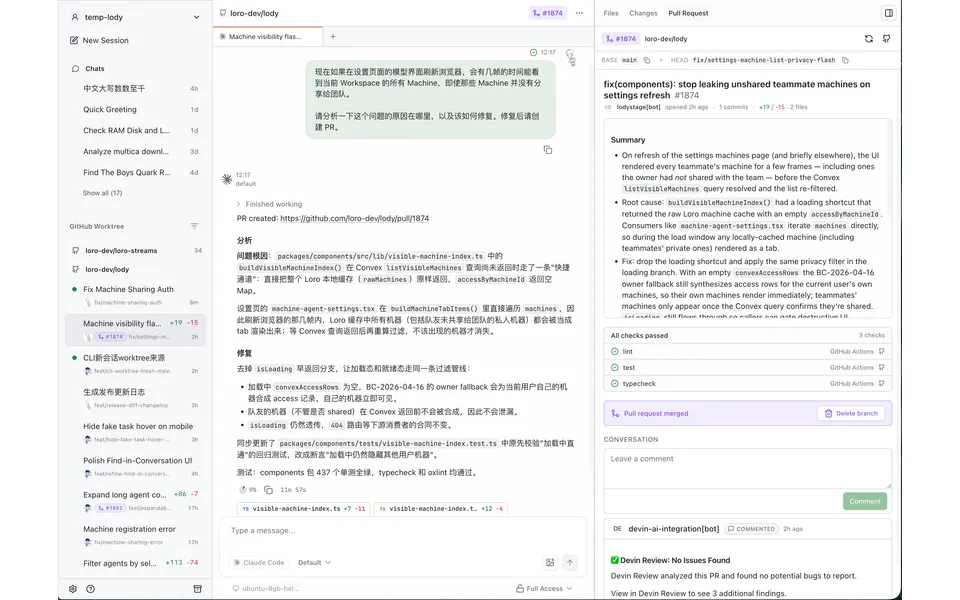
- Desktop app
- Mac, Windows and Linux
- Browser
- Yes
- Phone
- IPhone, Android and phone browser
- Command line
- Yes
- Agents
- Claude Code, Codex, Gemini CLI, OpenCode, Pi and Grok
- Your subscription
- Works with your own plan
- Agents run
- On your computer and on your own server
- Laptop closed
- Keeps going
- Isolation
- Worktree
- Parallel agents
- Yes
- Scheduled runs
- Yes
- Coordinator agent
- Yes
- Built-in issues
- No
- Pull requests
- Yes
- Review screen
- Yes
- Team
- Shared sessions, roles and SSO
- Self-hosting
- Yes
- Licence
- Apache-2.0
- Price from
- Free
- How it charges
- Free plan, subscription, per seat and bring your own key
- Paid plans from
- $10 or less/month
Receipts
- Checked
- Findings
- 50 published · 47 cross-checked by a second agent · read them all
- Sources
- 53 public pages on 3 sites: lody.ai, github.com, api.github.com
- Screenshot
- github.com, retrieved · first party repository · shows appearance, not capability
- Data
- /products/lody.json · .md
- Method
- Same rules for all 103 researched ADEs. How we check · Report wrong data
What it does
Where you use it
Desktop installers cover macOS Universal, Windows x64 and Linux x86-64; native iOS/Android apps, a hosted web app and the lody CLI expose the workspace. The hosted web client has a production phone renderer selected from mobile browser user agents independently of native app shells. Editor extensions are absent; external-editor launchers are separate.
Source and scope for Where you use itAgents it runs
Nine built-in ACP providers plus every ACP Registry runtime and Custom ACP launch commands; Lody launches provider servers, negotiates capabilities and reuses machine-side logins. Mixed-harness sessions run side by side and coordinate through a primary agent.
Source and scope for Agents it runsAccounts and subscriptions
Existing agent subscriptions and API/env credentials stay on the machine and are reused at zero markup; Lody sells no tokens. A Lody account is required for cloud workspaces while local-only use and lody review work without sign-in.
Source and scope for Accounts and subscriptionsWhere agents run
Agents execute on the user's own machines (desktop or BYO server/VM) connected by the daemon; the vendor cloud only relays and stores workspace data. Work survives the controlling client and continues from any device while the execution machine stays online.
Source and scope for Where agents runHow work is kept apart
Each session gets its own Git branch and worktree directory for file separation; credentials stay machine-local in the OS keychain. No container, VM or OS-sandbox boundary exists, and worktrees are not a security boundary.
Source and scope for How work is kept apartParallel work
Independent sessions run concurrently in isolated worktrees with team-visible statuses; workspace session caps and host-machine capacity bound scale. No hands-on concurrency run was performed.
Source and scope for Parallel workScheduled runs
Schedules, manual tasks and one-shot sends run on an owning machine with serialized overlap handling and single catch-up; agents may propose but never create schedules. PR merge/close events drive auto-archive; no generic event triggers exist.
Source and scope for Scheduled runsGit and pull requests
Branches, worktrees, commits, PR creation, review comments, CI response and merge run product-integrated through the GitHub App. Rebase and conflict handling are agent-side and undocumented as product flows.
Source and scope for Git and pull requestsLicence and source
Pinned release tree (CLI, desktop, packages, docs) is Apache-2.0; native mobile client code post-dates the pin with upstream credit, and the vendor sync backend stays closed.
Source and scope for Licence and sourcePrice
Prices are USD: Free is $0 forever; Plus is $10 per seat per month billed monthly, or $8 per seat per month billed yearly; Enterprise is custom. Free includes 2 workspaces, 200 sessions per workspace, 30 turns per session and up to 3 members. Lody charges for the collaboration workspace, while users supply agent/model accounts at zero markup.
Source and scope for PriceTyped filters
Every value links to its receipt below. Read plan and surface restrictions before using a filter to decide.
| Filter | Value |
|---|---|
| Desktop OS: macOS | Yes |
| Desktop OS: Windows | Yes |
| Desktop OS: Linux | Yes |
| Web client | Yes |
| Phone access: Native iOS | Yes |
| Phone access: Native Android | Yes |
| Phone access: Phone browser | Yes |
| CLI | Yes cross-checked |
| Coding agents: Claude Code | Yes cross-checked |
| Coding agents: Codex | Yes cross-checked |
| Coding agents: Cursor Agent | Unknown |
| Coding agents: Gemini CLI | Yes cross-checked |
| Coding agents: OpenCode | Yes cross-checked |
| Coding agents: Pi | Yes cross-checked |
| Coding agents: Grok | Yes cross-checked |
| Coding agents: Aider | Unknown |
| Coding agents: Antigravity | Unknown |
| Use my subscription | Yes cross-checked |
| Where agents run: On your computer | Yes cross-checked |
| Where agents run: On your own server | Yes cross-checked |
| Where agents run: In the vendor's cloud | No cross-checked |
| Workspace isolation: Git worktree | Yes cross-checked |
| Workspace isolation: Container | No cross-checked |
| Workspace isolation: VM or microVM | No cross-checked |
| Parallel runs | Yes cross-checked |
| Coordinator | Yes cross-checked |
| Native issue tracking | No cross-checked |
| Unattended triggers | Yes cross-checked |
| Shared prompting | Yes |
| Team roles | Yes cross-checked |
| SSO | Yes cross-checked |
| Pull request workflow | Yes cross-checked |
| Review interface | Yes cross-checked |
| Product license: Apache-2.0 | Yes. Apache-2.0 cross-checked |
| Product license: MIT | No. Apache-2.0 cross-checked |
| Product license: GPL-3.0 | No. Apache-2.0 cross-checked |
| Product license: GPL-3.0-or-later | No. Apache-2.0 cross-checked |
| Product license: AGPL-3.0 | No. Apache-2.0 cross-checked |
| Product license: AGPL-3.0-or-later | No. Apache-2.0 cross-checked |
| Product license: Elastic License 2.0 | No. Apache-2.0 cross-checked |
| Product license: Custom terms | No. Apache-2.0 cross-checked |
| Product license: Proprietary | No. Apache-2.0 cross-checked |
| Self-hosting | Yes cross-checked |
| Telemetry opt-out | No cross-checked |
| Free access | Yes cross-checked |
| Starting price: Free | Yes. Free cross-checked |
| Starting price: Up to $20/month | No. Free cross-checked |
| Starting price: $21–40/month | No. Free cross-checked |
| Starting price: $41–100/month | No. Free cross-checked |
| Starting price: Over $100/month | No. Free cross-checked |
| Starting price: Contact for pricing | No. Free cross-checked |
| Pricing model: Free, no paid plan | No |
| Pricing model: Free plan | Yes |
| Pricing model: Subscription | Yes |
| Pricing model: Per seat | Yes |
| Pricing model: Usage-based | No |
| Pricing model: Per machine or compute | No |
| Pricing model: Bring your own key | Yes |
| Pricing model: One-time purchase | No |
| Paid plans from: No paid plan | No. $10 or less/month |
| Paid plans from: $10 or less/month | Yes. $10 or less/month |
| Paid plans from: $11–20/month | No. $10 or less/month |
| Paid plans from: $21–40/month | No. $10 or less/month |
| Paid plans from: $41–100/month | No. $10 or less/month |
| Paid plans from: Over $100/month | No. $10 or less/month |
| Paid plans from: Contact sales | No. $10 or less/month |
| Lifecycle status: Active | Unknown |
| Lifecycle status: Sunsetting | Unknown |
| Keeps going with laptop closed | Yes cross-checked |
| Open-source license | Yes. Apache-2.0 cross-checked |
| Any desktop app | Yes |
| Paid plan up to $20/month | Yes. $10 or less/month |
| Paid plan up to $40/month | Yes. $10 or less/month |
| Any phone client | Yes |
Filter receipts
Desktop OS: macOS: Yes
Desktop OS: macOS
Typed value: Yes.
Desktop installers cover macOS Universal, Windows x64 and Linux x86-64; native iOS/Android apps, a hosted web app and the lody CLI expose the workspace. The hosted web client has a production phone renderer selected from mobile browser user agents independently of native app shells. Editor extensions are absent; external-editor launchers are separate.
- Desktop os: Desktop installers support macOS Universal (Apple Silicon and Intel), Windows x64, and Linux AppImage plus Debian/Ubuntu x86-64; the download page presents this as the complete client list.
- Mobile apps: Native iOS app (App Store and TestFlight) and native Android app (Google Play and signed APK) install the same workspace with notifications, diff review and approvals.
- Browser: Hosted web app opens in the browser with the same sessions, files and diffs.
- The phone-browser mapping follows the production browser renderer; no installed-device scenario was run. Native mobile editing and app-specific capabilities retain their documented scope.
-
Finding: Desktop: macOS Universal (Apple Silicon and Intel), Windows x64, Linux AppImage and Debian/Ubuntu x86-64. Mobile: iOS App Store, Android Google Play and signed APK. Browser: hosted web app. This page presents the complete client list.
Desktop OS: Windows: Yes
Desktop OS: Windows
Typed value: Yes.
Desktop installers cover macOS Universal, Windows x64 and Linux x86-64; native iOS/Android apps, a hosted web app and the lody CLI expose the workspace. The hosted web client has a production phone renderer selected from mobile browser user agents independently of native app shells. Editor extensions are absent; external-editor launchers are separate.
- Desktop os: Desktop installers support macOS Universal (Apple Silicon and Intel), Windows x64, and Linux AppImage plus Debian/Ubuntu x86-64; the download page presents this as the complete client list.
- Mobile apps: Native iOS app (App Store and TestFlight) and native Android app (Google Play and signed APK) install the same workspace with notifications, diff review and approvals.
- Browser: Hosted web app opens in the browser with the same sessions, files and diffs.
- The phone-browser mapping follows the production browser renderer; no installed-device scenario was run. Native mobile editing and app-specific capabilities retain their documented scope.
-
Finding: Desktop: macOS Universal (Apple Silicon and Intel), Windows x64, Linux AppImage and Debian/Ubuntu x86-64. Mobile: iOS App Store, Android Google Play and signed APK. Browser: hosted web app. This page presents the complete client list.
Desktop OS: Linux: Yes
Desktop OS: Linux
Typed value: Yes.
Desktop installers cover macOS Universal, Windows x64 and Linux x86-64; native iOS/Android apps, a hosted web app and the lody CLI expose the workspace. The hosted web client has a production phone renderer selected from mobile browser user agents independently of native app shells. Editor extensions are absent; external-editor launchers are separate.
- Desktop os: Desktop installers support macOS Universal (Apple Silicon and Intel), Windows x64, and Linux AppImage plus Debian/Ubuntu x86-64; the download page presents this as the complete client list.
- Mobile apps: Native iOS app (App Store and TestFlight) and native Android app (Google Play and signed APK) install the same workspace with notifications, diff review and approvals.
- Browser: Hosted web app opens in the browser with the same sessions, files and diffs.
- The phone-browser mapping follows the production browser renderer; no installed-device scenario was run. Native mobile editing and app-specific capabilities retain their documented scope.
-
Finding: Desktop: macOS Universal (Apple Silicon and Intel), Windows x64, Linux AppImage and Debian/Ubuntu x86-64. Mobile: iOS App Store, Android Google Play and signed APK. Browser: hosted web app. This page presents the complete client list.
Web client: Yes
Web client
Typed value: Yes.
Desktop installers cover macOS Universal, Windows x64 and Linux x86-64; native iOS/Android apps, a hosted web app and the lody CLI expose the workspace. The hosted web client has a production phone renderer selected from mobile browser user agents independently of native app shells. Editor extensions are absent; external-editor launchers are separate.
- Desktop os: Desktop installers support macOS Universal (Apple Silicon and Intel), Windows x64, and Linux AppImage plus Debian/Ubuntu x86-64; the download page presents this as the complete client list.
- Mobile apps: Native iOS app (App Store and TestFlight) and native Android app (Google Play and signed APK) install the same workspace with notifications, diff review and approvals.
- Browser: Hosted web app opens in the browser with the same sessions, files and diffs.
- Cli: npx lody CLI connects machines (daemon start) and manages projects, sessions and machines from terminal or scripts with --json output.
- Cross device continuity: Daemon keeps machines connected so sessions started on desktop continue from phone, web or another desktop with synced history, diffs and branches.
- The phone-browser mapping follows the production browser renderer; no installed-device scenario was run. Native mobile editing and app-specific capabilities retain their documented scope.
-
Finding: Desktop: macOS Universal (Apple Silicon and Intel), Windows x64, Linux AppImage and Debian/Ubuntu x86-64. Mobile: iOS App Store, Android Google Play and signed APK. Browser: hosted web app. This page presents the complete client list.
-
Finding: Install desktop/mobile/CLI, sign in (browser), add local dir via picker or npx lody project add, connect GitHub, add agent configs and Test them, run npx lody daemon start on servers. Local data under ~/.lody/repos and ~/.lody/logs.
Phone access: Native iOS: Yes
Phone access: Native iOS
Typed value: Yes.
Desktop installers cover macOS Universal, Windows x64 and Linux x86-64; native iOS/Android apps, a hosted web app and the lody CLI expose the workspace. The hosted web client has a production phone renderer selected from mobile browser user agents independently of native app shells. Editor extensions are absent; external-editor launchers are separate.
- Desktop os: Desktop installers support macOS Universal (Apple Silicon and Intel), Windows x64, and Linux AppImage plus Debian/Ubuntu x86-64; the download page presents this as the complete client list.
- Mobile apps: Native iOS app (App Store and TestFlight) and native Android app (Google Play and signed APK) install the same workspace with notifications, diff review and approvals.
- Browser: Hosted web app opens in the browser with the same sessions, files and diffs.
- Task actions: Sessions start, steer (follow-ups, steering), approve (permission prompts), review (diffs, PR panel) and resume (restore/reopen) from desktop, mobile, web and CLI.
- Notifications: Push notifications (task completion, approvals, PR-ready), iOS Live Activities with actionable permission alerts, and in-app/terminal notifications.
- The phone-browser mapping follows the production browser renderer; no installed-device scenario was run. Native mobile editing and app-specific capabilities retain their documented scope.
-
Finding: Desktop: macOS Universal (Apple Silicon and Intel), Windows x64, Linux AppImage and Debian/Ubuntu x86-64. Mobile: iOS App Store, Android Google Play and signed APK. Browser: hosted web app. This page presents the complete client list.
-
Finding: Native iOS (App Store + TestFlight) and Android apps: notifications on task completion/approval/PR-ready, iOS Live Activities incl. actionable permission alerts, diff review and approvals, project file browsing; realtime editing is desktop-only; offline viewing of cached conversations with sync on reconnect.
Phone access: Native Android: Yes
Phone access: Native Android
Typed value: Yes.
Desktop installers cover macOS Universal, Windows x64 and Linux x86-64; native iOS/Android apps, a hosted web app and the lody CLI expose the workspace. The hosted web client has a production phone renderer selected from mobile browser user agents independently of native app shells. Editor extensions are absent; external-editor launchers are separate.
- Desktop os: Desktop installers support macOS Universal (Apple Silicon and Intel), Windows x64, and Linux AppImage plus Debian/Ubuntu x86-64; the download page presents this as the complete client list.
- Mobile apps: Native iOS app (App Store and TestFlight) and native Android app (Google Play and signed APK) install the same workspace with notifications, diff review and approvals.
- Browser: Hosted web app opens in the browser with the same sessions, files and diffs.
- Task actions: Sessions start, steer (follow-ups, steering), approve (permission prompts), review (diffs, PR panel) and resume (restore/reopen) from desktop, mobile, web and CLI.
- Notifications: Push notifications (task completion, approvals, PR-ready), iOS Live Activities with actionable permission alerts, and in-app/terminal notifications.
- The phone-browser mapping follows the production browser renderer; no installed-device scenario was run. Native mobile editing and app-specific capabilities retain their documented scope.
-
Finding: Desktop: macOS Universal (Apple Silicon and Intel), Windows x64, Linux AppImage and Debian/Ubuntu x86-64. Mobile: iOS App Store, Android Google Play and signed APK. Browser: hosted web app. This page presents the complete client list.
-
Finding: Native iOS (App Store + TestFlight) and Android apps: notifications on task completion/approval/PR-ready, iOS Live Activities incl. actionable permission alerts, diff review and approvals, project file browsing; realtime editing is desktop-only; offline viewing of cached conversations with sync on reconnect.
Phone access: Phone browser: Yes
Phone access: Phone browser
Typed value: Yes.
Desktop installers cover macOS Universal, Windows x64 and Linux x86-64; native iOS/Android apps, a hosted web app and the lody CLI expose the workspace. The hosted web client has a production phone renderer selected from mobile browser user agents independently of native app shells. Editor extensions are absent; external-editor launchers are separate.
- Mobile browser: The hosted browser client includes a phone renderer selected from mobile browser user agents, separately from the native iOS/Android shells.
- The phone-browser mapping follows the production browser renderer; no installed-device scenario was run. Native mobile editing and app-specific capabilities retain their documented scope.
-
Lody phone browser client renderer
Finding: The shared production web components recognize iPhone/Android browser user agents independently of native shell detection and select the touch-oriented mobile renderer. The hosted web client is publicly linked from the complete download page. This establishes browser phone access beyond merely having native apps.
CLI: Yes cross-checked
CLI
Typed value: Yes.
The lody CLI manages the full session lifecycle with --json output, and Lody hosts its own session-tools MCP server (stdio + HTTP) while acting as an MCP client. No public REST API, SDK, or webhook receiver exists.
- Cli: Session create/chat/list/status, project/workspace/machine/agent-config management, review, export and magpie import run from the terminal or scripts with --json support.
- Api: No public REST API is documented; packages/cloud-api holds internal optional-cloud protocol names and DTOs only. Bounded search of the CLI reference, docs and command tree found no public API.
- Operations: Create, inspect, message, follow up and cancel sessions through CLI commands and the built-in Lody MCP tools.
- Stability: No stability commitment is made: the MCP servers are marked internal commands and CLI help is declared the flag source of truth.
- Only the cited atomic findings are established. Remaining atomic requirements and the full rubric scenario remain unverified.
- The MCP server commands are marked internal with no stability commitment.
-
Finding: lody CLI is both the daemon runtime (lody start / daemon start) and a one-shot manager: session create/chat/list/status, project/workspace/machine/agent-config commands, lody review prompting and rendering, lody export, import-magpie, --json output; built-in help is the flag source of truth.
Coding agents: Claude Code: Yes cross-checked
Coding agents: Claude Code
Typed value: Yes.
Nine built-in ACP providers plus every ACP Registry runtime and Custom ACP launch commands; Lody launches provider servers, negotiates capabilities and reuses machine-side logins. Mixed-harness sessions run side by side and coordinate through a primary agent.
- Harnesses: Built in: Claude Code, Codex, Grok, Kimi Code, Devin, Pi, DeepSeek Harness, Bub, Dimcode; plus registry runtimes (Auggie, Autohand, Codebuddy, Cline, Factory, Gemini CLI, OpenCode, Qwen, pi ACP) and Custom ACP. The homepage names Cursor, Gemini CLI, Cline, Goose, OpenCode and Qwen as ACP-pluggable alongside the built-ins.
- Session integration: Lody launches the provider ACP server, negotiates capabilities at session start and reuses the machine-side subscription login or environment configuration.
- Only the cited atomic findings are established. Remaining atomic requirements and the full rubric scenario remain unverified.
- Model catalogs resolve per runtime; Lody publishes no standalone model-provider list.
-
ACP and Extension Feature Support | Lody
Finding: Nine built-in providers (Claude Code, Codex, Grok, Kimi Code, Devin, Pi, DeepSeek Harness, Bub, Dimcode) share the ACP baseline; optional capabilities (MCP transports, resume/fork, steering, tasks, subagents, goals, usage, rate limits) differ per adapter via acp-extension-core; declarations are read at session start so updates can shift the matrix.
Coding agents: Codex: Yes cross-checked
Coding agents: Codex
Typed value: Yes.
Nine built-in ACP providers plus every ACP Registry runtime and Custom ACP launch commands; Lody launches provider servers, negotiates capabilities and reuses machine-side logins. Mixed-harness sessions run side by side and coordinate through a primary agent.
- Harnesses: Built in: Claude Code, Codex, Grok, Kimi Code, Devin, Pi, DeepSeek Harness, Bub, Dimcode; plus registry runtimes (Auggie, Autohand, Codebuddy, Cline, Factory, Gemini CLI, OpenCode, Qwen, pi ACP) and Custom ACP. The homepage names Cursor, Gemini CLI, Cline, Goose, OpenCode and Qwen as ACP-pluggable alongside the built-ins.
- Session integration: Lody launches the provider ACP server, negotiates capabilities at session start and reuses the machine-side subscription login or environment configuration.
- Only the cited atomic findings are established. Remaining atomic requirements and the full rubric scenario remain unverified.
- Model catalogs resolve per runtime; Lody publishes no standalone model-provider list.
-
ACP and Extension Feature Support | Lody
Finding: Nine built-in providers (Claude Code, Codex, Grok, Kimi Code, Devin, Pi, DeepSeek Harness, Bub, Dimcode) share the ACP baseline; optional capabilities (MCP transports, resume/fork, steering, tasks, subagents, goals, usage, rate limits) differ per adapter via acp-extension-core; declarations are read at session start so updates can shift the matrix.
Coding agents: Gemini CLI: Yes cross-checked
Coding agents: Gemini CLI
Typed value: Yes.
Nine built-in ACP providers plus every ACP Registry runtime and Custom ACP launch commands; Lody launches provider servers, negotiates capabilities and reuses machine-side logins. Mixed-harness sessions run side by side and coordinate through a primary agent.
- Harnesses: Built in: Claude Code, Codex, Grok, Kimi Code, Devin, Pi, DeepSeek Harness, Bub, Dimcode; plus registry runtimes (Auggie, Autohand, Codebuddy, Cline, Factory, Gemini CLI, OpenCode, Qwen, pi ACP) and Custom ACP. The homepage names Cursor, Gemini CLI, Cline, Goose, OpenCode and Qwen as ACP-pluggable alongside the built-ins.
- Model providers: Models resolve per runtime (refresh/test per agent config) and Magpie imports provider setups; the host machine must carry installs, logins and credentials, and model availability follows the runtime and account.
- Custom adapters: Custom ACP agent configs accept any stdio ACP launch command; the ACP Registry list loads new upstream runtimes without a Lody release.
- Only the cited atomic findings are established. Remaining atomic requirements and the full rubric scenario remain unverified.
- Model catalogs resolve per runtime; Lody publishes no standalone model-provider list.
-
Finding: Every ACP Registry runtime (Auggie, Autohand, Codebuddy, Cline, Factory, Gemini, Kimi, OpenCode, Qwen, pi ACP) plus Custom ACP launch commands; host must have the runtime command, login and credentials installed; models depend on runtime and account.
Coding agents: OpenCode: Yes cross-checked
Coding agents: OpenCode
Typed value: Yes.
Nine built-in ACP providers plus every ACP Registry runtime and Custom ACP launch commands; Lody launches provider servers, negotiates capabilities and reuses machine-side logins. Mixed-harness sessions run side by side and coordinate through a primary agent.
- Harnesses: Built in: Claude Code, Codex, Grok, Kimi Code, Devin, Pi, DeepSeek Harness, Bub, Dimcode; plus registry runtimes (Auggie, Autohand, Codebuddy, Cline, Factory, Gemini CLI, OpenCode, Qwen, pi ACP) and Custom ACP. The homepage names Cursor, Gemini CLI, Cline, Goose, OpenCode and Qwen as ACP-pluggable alongside the built-ins.
- Model providers: Models resolve per runtime (refresh/test per agent config) and Magpie imports provider setups; the host machine must carry installs, logins and credentials, and model availability follows the runtime and account.
- Custom adapters: Custom ACP agent configs accept any stdio ACP launch command; the ACP Registry list loads new upstream runtimes without a Lody release.
- Only the cited atomic findings are established. Remaining atomic requirements and the full rubric scenario remain unverified.
- Model catalogs resolve per runtime; Lody publishes no standalone model-provider list.
-
Finding: Every ACP Registry runtime (Auggie, Autohand, Codebuddy, Cline, Factory, Gemini, Kimi, OpenCode, Qwen, pi ACP) plus Custom ACP launch commands; host must have the runtime command, login and credentials installed; models depend on runtime and account.
Coding agents: Pi: Yes cross-checked
Coding agents: Pi
Typed value: Yes.
Nine built-in ACP providers plus every ACP Registry runtime and Custom ACP launch commands; Lody launches provider servers, negotiates capabilities and reuses machine-side logins. Mixed-harness sessions run side by side and coordinate through a primary agent.
- Harnesses: Built in: Claude Code, Codex, Grok, Kimi Code, Devin, Pi, DeepSeek Harness, Bub, Dimcode; plus registry runtimes (Auggie, Autohand, Codebuddy, Cline, Factory, Gemini CLI, OpenCode, Qwen, pi ACP) and Custom ACP. The homepage names Cursor, Gemini CLI, Cline, Goose, OpenCode and Qwen as ACP-pluggable alongside the built-ins.
- Model providers: Models resolve per runtime (refresh/test per agent config) and Magpie imports provider setups; the host machine must carry installs, logins and credentials, and model availability follows the runtime and account.
- Custom adapters: Custom ACP agent configs accept any stdio ACP launch command; the ACP Registry list loads new upstream runtimes without a Lody release.
- Only the cited atomic findings are established. Remaining atomic requirements and the full rubric scenario remain unverified.
- Model catalogs resolve per runtime; Lody publishes no standalone model-provider list.
-
Finding: One command imports Magpie provider setups (Claude, Codex, Pi, DSH, Kimi, Grok, Bub) on the same server; upstream API keys stay in Magpie; import does not prove inference works; cloud workspaces only, not OSS local-only mode.
-
Finding: Every ACP Registry runtime (Auggie, Autohand, Codebuddy, Cline, Factory, Gemini, Kimi, OpenCode, Qwen, pi ACP) plus Custom ACP launch commands; host must have the runtime command, login and credentials installed; models depend on runtime and account.
Coding agents: Grok: Yes cross-checked
Coding agents: Grok
Typed value: Yes.
Nine built-in ACP providers plus every ACP Registry runtime and Custom ACP launch commands; Lody launches provider servers, negotiates capabilities and reuses machine-side logins. Mixed-harness sessions run side by side and coordinate through a primary agent.
- Harnesses: Built in: Claude Code, Codex, Grok, Kimi Code, Devin, Pi, DeepSeek Harness, Bub, Dimcode; plus registry runtimes (Auggie, Autohand, Codebuddy, Cline, Factory, Gemini CLI, OpenCode, Qwen, pi ACP) and Custom ACP. The homepage names Cursor, Gemini CLI, Cline, Goose, OpenCode and Qwen as ACP-pluggable alongside the built-ins.
- Session integration: Lody launches the provider ACP server, negotiates capabilities at session start and reuses the machine-side subscription login or environment configuration.
- Only the cited atomic findings are established. Remaining atomic requirements and the full rubric scenario remain unverified.
- Model catalogs resolve per runtime; Lody publishes no standalone model-provider list.
-
ACP and Extension Feature Support | Lody
Finding: Nine built-in providers (Claude Code, Codex, Grok, Kimi Code, Devin, Pi, DeepSeek Harness, Bub, Dimcode) share the ACP baseline; optional capabilities (MCP transports, resume/fork, steering, tasks, subagents, goals, usage, rate limits) differ per adapter via acp-extension-core; declarations are read at session start so updates can shift the matrix.
Use my subscription: Yes cross-checked
Use my subscription
Typed value: Yes.
Existing agent subscriptions and API/env credentials stay on the machine and are reused at zero markup; Lody sells no tokens. A Lody account is required for cloud workspaces while local-only use and lody review work without sign-in.
- Agent subscriptions: Claude Code/Codex/subscription logins already on the machine are reused; Lody charges only for the collaboration workspace.
- Only the cited atomic findings are established. Remaining atomic requirements and the full rubric scenario remain unverified.
- No local-model route is documented; vendor-side spend caps are not a Lody control.
-
Coming from Codex or Claude Code | Lody
Finding: Lody launches the same provider CLIs and reuses machine-side subscription logins, API env config, and repo instruction files (AGENTS.md/CLAUDE.md); sessions resume like --resume; CLI remains supported for quick one-off edits.
Where agents run: On your computer: Yes cross-checked
Where agents run: On your computer
Typed value: Yes.
Agents execute on the user's own machines (desktop or BYO server/VM) connected by the daemon; the vendor cloud only relays and stores workspace data. Work survives the controlling client and continues from any device while the execution machine stays online.
- Local: The daemon runs agents on the local desktop workstation with machine-side logins and credentials.
- Byo remote: Servers and cloud VMs join via npx lody daemon start with a sign-in link and stay available for remote dispatch.
- Managed cloud: No vendor-operated agent compute exists; scheduled tasks explicitly do not run in the cloud. Bounded search of docs and code found no managed execution.
- Provisioning: Daemon install plus sign-in link provisions a machine; no compute provisioning or sizing flow exists.
- Only the cited atomic findings are established. Remaining atomic requirements and the full rubric scenario remain unverified.
- No vendor compute, provisioning, regions or lifetimes exist; self-hosting scope beyond local-only mode is not fully documented.
-
Finding: Install desktop/mobile/CLI, sign in (browser), add local dir via picker or npx lody project add, connect GitHub, add agent configs and Test them, run npx lody daemon start on servers. Local data under ~/.lody/repos and ~/.lody/logs.
Where agents run: On your own server: Yes cross-checked
Where agents run: On your own server
Typed value: Yes.
Agents execute on the user's own machines (desktop or BYO server/VM) connected by the daemon; the vendor cloud only relays and stores workspace data. Work survives the controlling client and continues from any device while the execution machine stays online.
- Local: The daemon runs agents on the local desktop workstation with machine-side logins and credentials.
- Byo remote: Servers and cloud VMs join via npx lody daemon start with a sign-in link and stay available for remote dispatch.
- Managed cloud: No vendor-operated agent compute exists; scheduled tasks explicitly do not run in the cloud. Bounded search of docs and code found no managed execution.
- Provisioning: Daemon install plus sign-in link provisions a machine; no compute provisioning or sizing flow exists.
- Only the cited atomic findings are established. Remaining atomic requirements and the full rubric scenario remain unverified.
- No vendor compute, provisioning, regions or lifetimes exist; self-hosting scope beyond local-only mode is not fully documented.
-
Finding: Install desktop/mobile/CLI, sign in (browser), add local dir via picker or npx lody project add, connect GitHub, add agent configs and Test them, run npx lody daemon start on servers. Local data under ~/.lody/repos and ~/.lody/logs.
Where agents run: In the vendor's cloud: No cross-checked
Where agents run: In the vendor's cloud
Typed value: No.
Agents execute on the user's own machines (desktop or BYO server/VM) connected by the daemon; the vendor cloud only relays and stores workspace data. Work survives the controlling client and continues from any device while the execution machine stays online.
- Managed cloud: No vendor-operated agent compute exists; scheduled tasks explicitly do not run in the cloud. Bounded search of docs and code found no managed execution.
- Client disconnect: Work continues on the execution machine after the controlling client disconnects; catch-up syncs on return.
- Only the cited atomic findings are established. Remaining atomic requirements and the full rubric scenario remain unverified.
- No vendor compute, provisioning, regions or lifetimes exist; self-hosting scope beyond local-only mode is not fully documented.
-
Finding: Scheduled/manual/one-shot tasks run on one owning machine (CLI, local timezone; nothing runs in cloud); agent can only propose schedules, never create them; missed runs catch up once; only the creator can edit/pause/delete; machine must be awake.
Workspace isolation: Git worktree: Yes cross-checked
Workspace isolation: Git worktree
Typed value: Yes.
Each session gets its own Git branch and worktree directory for file separation; credentials stay machine-local in the OS keychain. No container, VM or OS-sandbox boundary exists, and worktrees are not a security boundary.
- Checkout: Sessions work in per-session worktrees, or directly in the local project directory when no worktree is used.
- Branch: Each session creates and works on its own branch (default session/<shortSessionId>).
- Worktree: One dedicated Git worktree per session isolates file edits between parallel agents.
- Filesystem: Worktree directories separate task files; no filesystem allow-listing beyond project scope is documented.
- Code separation: Uncommitted edits stay with their session worktree and never mix across parallel tasks.
- Security boundary: Worktree separation is explicitly file isolation, not a security boundary; no hostile-code containment is claimed.
- Only the cited atomic findings are established. Remaining atomic requirements and the full rubric scenario remain unverified.
- Isolation is file separation only; hostile-code containment is not claimed.
-
Finding: One branch (session/<id>) and worktree per session under ~/.lody/repos/<repoId>/; project setup/cleanup scripts with LODY_* env vars; archive/backup rules keep branches and stage pending changes, discard ignored files; restore recreates the worktree from the branch.
Workspace isolation: Container: No cross-checked
Workspace isolation: Container
Typed value: No.
Each session gets its own Git branch and worktree directory for file separation; credentials stay machine-local in the OS keychain. No container, VM or OS-sandbox boundary exists, and worktrees are not a security boundary.
- Worktree: One dedicated Git worktree per session isolates file edits between parallel agents.
- Container: No container isolation exists; bounded search for docker/container/firecracker/gVisor at v0.109.0 found only icon assets.
- Vm: No VM isolation exists; bounded search at v0.109.0 found no VM construct.
- Os sandbox: No OS-sandbox boundary exists; bounded search for sandbox isolation found no implementation.
- Security boundary: Worktree separation is explicitly file isolation, not a security boundary; no hostile-code containment is claimed.
- Only the cited atomic findings are established. Remaining atomic requirements and the full rubric scenario remain unverified.
- Isolation is file separation only; hostile-code containment is not claimed.
-
commands/session.ts worktree paths at v0.109.0
Finding: Sessions create and manage per-session Git worktrees/branches; container, VM, gVisor, Firecracker and OS-sandbox isolation terms return no implementation hits (only file-icon assets), so isolation is worktree-level file separation.
Workspace isolation: VM or microVM: No cross-checked
Workspace isolation: VM or microVM
Typed value: No.
Each session gets its own Git branch and worktree directory for file separation; credentials stay machine-local in the OS keychain. No container, VM or OS-sandbox boundary exists, and worktrees are not a security boundary.
- Worktree: One dedicated Git worktree per session isolates file edits between parallel agents.
- Container: No container isolation exists; bounded search for docker/container/firecracker/gVisor at v0.109.0 found only icon assets.
- Vm: No VM isolation exists; bounded search at v0.109.0 found no VM construct.
- Os sandbox: No OS-sandbox boundary exists; bounded search for sandbox isolation found no implementation.
- Security boundary: Worktree separation is explicitly file isolation, not a security boundary; no hostile-code containment is claimed.
- Only the cited atomic findings are established. Remaining atomic requirements and the full rubric scenario remain unverified.
- Isolation is file separation only; hostile-code containment is not claimed.
-
commands/session.ts worktree paths at v0.109.0
Finding: Sessions create and manage per-session Git worktrees/branches; container, VM, gVisor, Firecracker and OS-sandbox isolation terms return no implementation hits (only file-icon assets), so isolation is worktree-level file separation.
Parallel runs: Yes cross-checked
Parallel runs
Typed value: Yes.
Independent sessions run concurrently in isolated worktrees with team-visible statuses; workspace session caps and host-machine capacity bound scale. No hands-on concurrency run was performed.
- Concurrent sessions: Multiple agent sessions run at once, each with its own conversation and working directory.
- Concurrent tasks: Each session owns one task/branch/worktree so agents change files side by side without colliding.
- Quotas: Free workspaces cap sessions at 200 per workspace (Plus unlimited); practical concurrency also depends on the host machine.
- Only the cited atomic findings are established. Remaining atomic requirements and the full rubric scenario remain unverified.
- Observed concurrency was not tested; quotas are plan caps plus host capacity.
-
Finding: Multiple sessions each with own worktree/branch; mix Claude Code/Codex/Kimi/Grok per session; team sees running sessions via All Tasks; concurrency limited by host machine capacity; agent-to-agent coordination via Agent Session Control.
Coordinator: Yes cross-checked
Coordinator
Typed value: Yes.
A product-owned MCP layer lets any session act as coordinator: create, message, steer and cancel other sessions across machines and harnesses with retained relationships and visible progress. Provider-native subagents surface through declared extension capabilities.
- Roles: Coordinator/worker roles are established per task by asking one session to split work across focused conversations.
- Model harness effort: Delegated sessions select compatible models, reasoning levels and permission modes on the target machine.
- Results return: Delegated results (findings, commits, verification) return to the requesting conversation at terminal state.
- Activation: Delegation activates from an ordinary prompt with no flags, plans or experimental switches.
- Authentication: Delegation reach follows workspace membership and machine/project sharing; only accessible sessions are visible.
- Retained results: Delegated outputs persist in their conversations even after requester timeouts and remain follow-up-able.
- Followup: Coordinators reopen, message and re-steer completed delegated conversations.
- Invocation: Invocation happens through prompts, @ mentions, CLI session commands and the built-in MCP tools.
- Only the cited atomic findings are established. Remaining atomic requirements and the full rubric scenario remain unverified.
- Delegation is prompt-driven; no prebuilt pipeline or approval gate wraps it.
-
Finding: Agents use built-in Lody MCP tools to create/reuse conversations, read status and bounded history, send follow-ups, cancel running turns, select compatible model/reasoning, and bring results back; parent relationship preserved; bounded to Lody conversation data, not a background scheduler.
Native issue tracking: No cross-checked
Native issue tracking
Typed value: No.
Sessions act as durable tasks with archive/restore, search, metadata and PR linkage, dispatchable on send or schedule, without requiring GitHub. Prioritization, labels, assignment, filtering and idea parking do not exist as product features.
- Create: Sessions create from composer drafts, CLI or schedules, but no idea-backlog object exists; task management is planned.
- Prioritize: No prioritization control is documented; bounded search of docs and the pinned tree found no priority entity.
- Label: No labels exist; bounded search of docs content for session labels found only agent-task assignment prose.
- Assign: No human-assignment control exists; work reaches people through handoff and delegation prompts. Bounded search found no assignment entity.
- Idea parking: Unsent composer drafts are not a backlog; idea parking awaits the planned task-management tools.
- Only the cited atomic findings are established. Remaining atomic requirements and the full rubric scenario remain unverified.
- No issue tracker semantics: prioritize, label, assign and filter are absent and task management is planned.
-
Finding: Invite by email with role; owners/admins manage members; All Tasks view with avatars; per-member token usage and trends; machines private by default, explicitly shared per machine; shared docs, mentions and task management are planned, not shipped.
Unattended triggers: Yes cross-checked
Unattended triggers
Typed value: Yes.
Schedules, manual tasks and one-shot sends run on an owning machine with serialized overlap handling and single catch-up; agents may propose but never create schedules. PR merge/close events drive auto-archive; no generic event triggers exist.
- Schedules: Daily, weekday, weekly, monthly, hourly and minutely repeats plus one-shot and manual (Run now) tasks.
- Recurring tasks: Repeat rules with visible next runs, per-run or single-chat accumulation, and run history.
- Scheduler location: The owning machine runs the CLI (the desktop app can start it); nothing executes in the vendor cloud.
- Overlaps: A new run waits for the previous one with at most one run queued; overlapping slots otherwise collapse.
- Retries: A missed slot runs once on return for the most recent missed time, not once per missed slot.
- Client independence: Tasks survive the requesting client closing but require the owning machine to be awake and online.
- Only the cited atomic findings are established. Remaining atomic requirements and the full rubric scenario remain unverified.
- Execution depends on the owning machine being awake; closing the requesting client is fine, closing the owner is not.
-
Finding: Scheduled/manual/one-shot tasks run on one owning machine (CLI, local timezone; nothing runs in cloud); agent can only propose schedules, never create them; missed runs catch up once; only the creator can edit/pause/delete; machine must be awake.
Shared prompting: Yes
Shared prompting
Typed value: Yes.
Team sessions are visible, commentable and hand-off-able with attribution and plan-scoped membership; execution needs the machine online, not the original owner. Simultaneous co-prompting, ordering and conflict handling are not established. A separately invited workspace teammate can open the existing live session and send the next prompt to the same agent with its conversation, worktree and diffs. This establishes shared-human sequential prompting, not simultaneous prompt conflict guarantees.
- Coprompting: A separately invited workspace teammate can open the existing live session and send the next prompt to the same agent with its conversation, worktree and diffs. This establishes shared-human sequential prompting, not simultaneous prompt conflict guarantees.
- Permissions: Workspace membership plus machine/project sharing gates participation.
- Owner online: The execution machine must be online; the original owner need not stay present.
- The scoped first-party source pass does not establish ordering, conflicts. No hands-on scenario was run.
-
Share a Coding Agent Session | Lody
Finding: Teammate joins the same live session (conversation, diffs, worktree) after workspace invite plus machine/project sharing; sharing may widen visibility to other conversations on that machine; transcript/markdown copy is a separate record-only action.
Team roles: Yes cross-checked
Team roles
Typed value: Yes.
Owner/Admin/Member workspace roles with invite, edit, remove and revocation flows; Enterprise adds SSO and access controls. Per-project and per-task roles plus SCIM provisioning do not exist.
- Organization roles: Owner, Admin and Member roles govern inviting, editing and removing members.
- Task roles: No per-task roles exist; bounded search of team docs and the pinned tree found no task-role entity.
- Membership: Email invites with role choice, invite links, and owner/admin removal.
- Provisioning: No SCIM or automated provisioning is documented; bounded search found no provisioning flow.
- Unauthorized access: Unshared machines never sync into other members sidebars; E2E workspaces add cryptographic membership.
- Revocation: Member removal, machine unsharing and device revocation end access.
- Plan scope: Role management sits in every plan; member counts and SSO differ by Free, Plus and Enterprise.
- Only the cited atomic findings are established. Remaining atomic requirements and the full rubric scenario remain unverified.
- Roles are workspace-wide; no project/task roles or provisioning automation exist.
-
Finding: Invite by email with role; owners/admins manage members; All Tasks view with avatars; per-member token usage and trends; machines private by default, explicitly shared per machine; shared docs, mentions and task management are planned, not shipped.
SSO: Yes cross-checked
SSO
Typed value: Yes.
Owner/Admin/Member workspace roles with invite, edit, remove and revocation flows; Enterprise adds SSO and access controls. Per-project and per-task roles plus SCIM provisioning do not exist.
- Sso: Enterprise plan includes SSO and access controls alongside procurement and security review.
- Plan scope: Role management sits in every plan; member counts and SSO differ by Free, Plus and Enterprise.
- Only the cited atomic findings are established. Remaining atomic requirements and the full rubric scenario remain unverified.
- Roles are workspace-wide; no project/task roles or provisioning automation exist.
-
Finding: Free ($0 forever: 2 workspaces, 200 sessions/workspace, 30 turns/session, 3 members) vs Plus ($8/seat/month billed yearly, unlimited) vs Enterprise (custom; SSO, procurement, rollout). No AI token charges; BYO agent accounts at zero markup. Prices USD; yearly upfront per seat for 12 months.
Pull request workflow: Yes cross-checked
Pull request workflow
Typed value: Yes.
Branches, worktrees, commits, PR creation, review comments, CI response and merge run product-integrated through the GitHub App. Rebase and conflict handling are agent-side and undocumented as product flows.
- Worktrees: Each PR-bound session works in its own worktree mapped to its branch.
- Commits: Agents commit and push from sessions with manual Commit and Push controls.
- Pull requests: Create PR from the session with requirement summaries; the PR panel links back with state and CI.
- Comments: Review comments sync both ways between Lody diffs and GitHub PR threads.
- Ci response: Running, passing and failing checks update live in the session.
- Rebase: No product-integrated rebase flow exists; agents handle rebase through ordinary Git commands. Bounded search of GitHub docs and the command tree at v0.109.0 found no rebase flow.
- Conflicts: No product-integrated conflicts flow exists; agents handle conflicts through ordinary Git commands. Bounded search of GitHub docs and the command tree at v0.109.0 found no conflicts flow.
- Product state: PR linkage, branch and CI state are first-class session state, not raw git commands.
- Only the cited atomic findings are established. Remaining atomic requirements and the full rubric scenario remain unverified.
- Rebase and conflict resolution have no product-integrated flow.
-
Finding: GitHub App gives repo access; issues/PRs inject context via @; PR panel shows state/CI/comments/reviews with in-Lody merge and branch delete; review comments sync both ways; PR-linked sessions auto-archive on merge/close; optional act-as-you identity for PR actions.
Review interface: Yes cross-checked
Review interface
Typed value: Yes.
Round and whole-conversation diffs, images, previews, validation outputs and shareable HTML review reports persist per session with task and revision links. Documents, recordings and cross-task galleries do not exist.
- Diffs: Per-round and whole-conversation diffs persist beside the messages that produced them.
- Screenshots: Image input, generated images and previews persist with mobile share/save.
- Recordings: No recordings exist; bounded search of docs and the pinned tree found no recording feature.
- Test outputs: Validation lists and CI check states persist per session without a dedicated test-report gallery.
- Reviewer outputs: Self-contained HTML review reports and Devin review findings persist and share without a cross-task gallery.
- Task links: Sessions link tasks to branches, PRs and CI state from composer to archive.
- Revision links: Rounds, commits and PR heads tie diffs to exact revisions.
- Only the cited atomic findings are established. Remaining atomic requirements and the full rubric scenario remain unverified.
- No document artifacts, recordings, or cross-task gallery exist; retention is per session plus archive.
-
Finding: GitHub App gives repo access; issues/PRs inject context via @; PR panel shows state/CI/comments/reviews with in-Lody merge and branch delete; review comments sync both ways; PR-linked sessions auto-archive on merge/close; optional act-as-you identity for PR actions.
-
Finding: Per-round diffs with changed line counts beside the agent message; file/diff tabs; whole-conversation Changes sidebar; remote devices read diffs through the session file provider with explicit loading states.
Product license: Apache-2.0: Yes. Apache-2.0 cross-checked
Product license: Apache-2.0
Typed value: Yes. Apache-2.0.
Pinned release tree (CLI, desktop, packages, docs) is Apache-2.0; native mobile client code post-dates the pin with upstream credit, and the vendor sync backend stays closed.
- Client license: Desktop and CLI sources carry the root Apache-2.0 grant at the pinned release.
- Server license: Daemon and CLI machine components share the Apache grant; the vendor Convex/relay backend is closed.
- Hosted parity: OSS sources implement the workspace and execution layers; hosted sync, push and store builds have no OSS counterpart in the pin.
- Mobile client code post-dates v0.109.0; the hosted sync/relay backend is closed.
- Repository visibility is not proof of hosted parity.
-
Finding: Root LICENSE is Apache License 2.0 covering the pinned release tree (apps/cli, apps/electron, packages/*, site-docs); hosted sync backend and store-distributed mobile builds are outside this grant.
Product license: MIT: No. Apache-2.0 cross-checked
Product license: MIT
Typed value: No. Apache-2.0.
Pinned release tree (CLI, desktop, packages, docs) is Apache-2.0; native mobile client code post-dates the pin with upstream credit, and the vendor sync backend stays closed.
- Client license: Desktop and CLI sources carry the root Apache-2.0 grant at the pinned release.
- Server license: Daemon and CLI machine components share the Apache grant; the vendor Convex/relay backend is closed.
- Hosted parity: OSS sources implement the workspace and execution layers; hosted sync, push and store builds have no OSS counterpart in the pin.
- Mobile client code post-dates v0.109.0; the hosted sync/relay backend is closed.
- Repository visibility is not proof of hosted parity.
-
Finding: Root LICENSE is Apache License 2.0 covering the pinned release tree (apps/cli, apps/electron, packages/*, site-docs); hosted sync backend and store-distributed mobile builds are outside this grant.
Product license: GPL-3.0: No. Apache-2.0 cross-checked
Product license: GPL-3.0
Typed value: No. Apache-2.0.
Pinned release tree (CLI, desktop, packages, docs) is Apache-2.0; native mobile client code post-dates the pin with upstream credit, and the vendor sync backend stays closed.
- Client license: Desktop and CLI sources carry the root Apache-2.0 grant at the pinned release.
- Server license: Daemon and CLI machine components share the Apache grant; the vendor Convex/relay backend is closed.
- Hosted parity: OSS sources implement the workspace and execution layers; hosted sync, push and store builds have no OSS counterpart in the pin.
- Mobile client code post-dates v0.109.0; the hosted sync/relay backend is closed.
- Repository visibility is not proof of hosted parity.
-
Finding: Root LICENSE is Apache License 2.0 covering the pinned release tree (apps/cli, apps/electron, packages/*, site-docs); hosted sync backend and store-distributed mobile builds are outside this grant.
Product license: GPL-3.0-or-later: No. Apache-2.0 cross-checked
Product license: GPL-3.0-or-later
Typed value: No. Apache-2.0.
Pinned release tree (CLI, desktop, packages, docs) is Apache-2.0; native mobile client code post-dates the pin with upstream credit, and the vendor sync backend stays closed.
- Client license: Desktop and CLI sources carry the root Apache-2.0 grant at the pinned release.
- Server license: Daemon and CLI machine components share the Apache grant; the vendor Convex/relay backend is closed.
- Hosted parity: OSS sources implement the workspace and execution layers; hosted sync, push and store builds have no OSS counterpart in the pin.
- Mobile client code post-dates v0.109.0; the hosted sync/relay backend is closed.
- Repository visibility is not proof of hosted parity.
-
Finding: Root LICENSE is Apache License 2.0 covering the pinned release tree (apps/cli, apps/electron, packages/*, site-docs); hosted sync backend and store-distributed mobile builds are outside this grant.
Product license: AGPL-3.0: No. Apache-2.0 cross-checked
Product license: AGPL-3.0
Typed value: No. Apache-2.0.
Pinned release tree (CLI, desktop, packages, docs) is Apache-2.0; native mobile client code post-dates the pin with upstream credit, and the vendor sync backend stays closed.
- Client license: Desktop and CLI sources carry the root Apache-2.0 grant at the pinned release.
- Server license: Daemon and CLI machine components share the Apache grant; the vendor Convex/relay backend is closed.
- Hosted parity: OSS sources implement the workspace and execution layers; hosted sync, push and store builds have no OSS counterpart in the pin.
- Mobile client code post-dates v0.109.0; the hosted sync/relay backend is closed.
- Repository visibility is not proof of hosted parity.
-
Finding: Root LICENSE is Apache License 2.0 covering the pinned release tree (apps/cli, apps/electron, packages/*, site-docs); hosted sync backend and store-distributed mobile builds are outside this grant.
Product license: AGPL-3.0-or-later: No. Apache-2.0 cross-checked
Product license: AGPL-3.0-or-later
Typed value: No. Apache-2.0.
Pinned release tree (CLI, desktop, packages, docs) is Apache-2.0; native mobile client code post-dates the pin with upstream credit, and the vendor sync backend stays closed.
- Client license: Desktop and CLI sources carry the root Apache-2.0 grant at the pinned release.
- Server license: Daemon and CLI machine components share the Apache grant; the vendor Convex/relay backend is closed.
- Hosted parity: OSS sources implement the workspace and execution layers; hosted sync, push and store builds have no OSS counterpart in the pin.
- Mobile client code post-dates v0.109.0; the hosted sync/relay backend is closed.
- Repository visibility is not proof of hosted parity.
-
Finding: Root LICENSE is Apache License 2.0 covering the pinned release tree (apps/cli, apps/electron, packages/*, site-docs); hosted sync backend and store-distributed mobile builds are outside this grant.
Product license: Elastic License 2.0: No. Apache-2.0 cross-checked
Product license: Elastic License 2.0
Typed value: No. Apache-2.0.
Pinned release tree (CLI, desktop, packages, docs) is Apache-2.0; native mobile client code post-dates the pin with upstream credit, and the vendor sync backend stays closed.
- Client license: Desktop and CLI sources carry the root Apache-2.0 grant at the pinned release.
- Server license: Daemon and CLI machine components share the Apache grant; the vendor Convex/relay backend is closed.
- Hosted parity: OSS sources implement the workspace and execution layers; hosted sync, push and store builds have no OSS counterpart in the pin.
- Mobile client code post-dates v0.109.0; the hosted sync/relay backend is closed.
- Repository visibility is not proof of hosted parity.
-
Finding: Root LICENSE is Apache License 2.0 covering the pinned release tree (apps/cli, apps/electron, packages/*, site-docs); hosted sync backend and store-distributed mobile builds are outside this grant.
Product license: Custom terms: No. Apache-2.0 cross-checked
Product license: Custom terms
Typed value: No. Apache-2.0.
Pinned release tree (CLI, desktop, packages, docs) is Apache-2.0; native mobile client code post-dates the pin with upstream credit, and the vendor sync backend stays closed.
- Client license: Desktop and CLI sources carry the root Apache-2.0 grant at the pinned release.
- Server license: Daemon and CLI machine components share the Apache grant; the vendor Convex/relay backend is closed.
- Hosted parity: OSS sources implement the workspace and execution layers; hosted sync, push and store builds have no OSS counterpart in the pin.
- Mobile client code post-dates v0.109.0; the hosted sync/relay backend is closed.
- Repository visibility is not proof of hosted parity.
-
Finding: Root LICENSE is Apache License 2.0 covering the pinned release tree (apps/cli, apps/electron, packages/*, site-docs); hosted sync backend and store-distributed mobile builds are outside this grant.
Product license: Proprietary: No. Apache-2.0 cross-checked
Product license: Proprietary
Typed value: No. Apache-2.0.
Pinned release tree (CLI, desktop, packages, docs) is Apache-2.0; native mobile client code post-dates the pin with upstream credit, and the vendor sync backend stays closed.
- Client license: Desktop and CLI sources carry the root Apache-2.0 grant at the pinned release.
- Server license: Daemon and CLI machine components share the Apache grant; the vendor Convex/relay backend is closed.
- Hosted parity: OSS sources implement the workspace and execution layers; hosted sync, push and store builds have no OSS counterpart in the pin.
- Mobile client code post-dates v0.109.0; the hosted sync/relay backend is closed.
- Repository visibility is not proof of hosted parity.
-
Finding: Root LICENSE is Apache License 2.0 covering the pinned release tree (apps/cli, apps/electron, packages/*, site-docs); hosted sync backend and store-distributed mobile builds are outside this grant.
Self-hosting: Yes cross-checked
Self-hosting
Typed value: Yes.
Apache source, workspace export with JSON/offline support, Markdown/HTML portability and email-driven account deletion cover exit; vendor services (Convex sync, GitHub App, push) are required for cloud workspaces while local-only use and lody review work independently.
- Self hosting: Source plus local-only mode allow user-controlled execution, but full control-plane self-hosting is not documented.
- Account independence: lody review runs without sign-in and local-only mode works without an account.
- Only the cited atomic findings are established. Remaining atomic requirements and the full rubric scenario remain unverified.
- Cancellation mechanics, import tooling and task/history portability formats beyond export are not documented.
-
Finding: One command imports Magpie provider setups (Claude, Codex, Pi, DSH, Kimi, Grok, Bub) on the same server; upstream API keys stay in Magpie; import does not prove inference works; cloud workspaces only, not OSS local-only mode.
-
Finding: Root LICENSE is Apache License 2.0 covering the pinned release tree (apps/cli, apps/electron, packages/*, site-docs); hosted sync backend and store-distributed mobile builds are outside this grant.
Telemetry opt-out: No cross-checked
Telemetry opt-out
Typed value: No.
LoroHub LLC collects account, device, log and conversation data processed by named subprocessors with export/deletion rights; E2E workspaces restrict reads to authorized devices, while standard workspaces are readable by members and Lody servers. Telemetry is disclosed (PostHog/Sentry/GA) with no documented opt-out or first-run consent.
- Code data: Conversation content and workflow context route through Lody services, readable only on authorized devices in E2E workspaces under the signed permission ledger.
- Prompts: Prompts travel as conversation content under the same handling; no prompt-specific retention is stated.
- Logs: Operational and security logs run, debug and secure the services alongside local log files.
- Artifacts: Files, diffs and images sync as workspace data under the same retention; artifact-specific handling is not stated.
- Retention: Data persists until deletion is requested or as needed for operations and legal duties.
- Deletion: Export or deletion on request via the Account and Data Deletion page or email, cleared within 30 days of verification.
- Subprocessors: Named subprocessors: Cloudflare Pages/R2, Convex, GitHub, Google Analytics, PostHog, Sentry.
- Telemetry disclosure: Product analytics (PostHog), error monitoring (Sentry) and website analytics (Google Analytics) are disclosed as processors.
- Telemetry controls: No telemetry opt-out or disable control is documented; bounded search of settings, CLI and docs found none. A privacy policy alone does not establish a control.
- Consent prompt: No first-run telemetry consent dialog is documented; bounded search of docs and onboarding found none.
- Price-page E2E is flagged coming soon on Plus while E2E docs describe the mechanism; treated as available-with-limitation, not GA-guaranteed.
- No telemetry opt-out, first-run consent prompt, residency statement, or model-training position is documented.
-
Finding: lody CLI is both the daemon runtime (lody start / daemon start) and a one-shot manager: session create/chat/list/status, project/workspace/machine/agent-config commands, lody review prompting and rendering, lody export, import-magpie, --json output; built-in help is the flag source of truth.
-
Finding: Controller LoroHub LLC; collects account/auth data, device/diagnostics, service logs, conversation content; subprocessors Cloudflare, Convex, GitHub, Google Analytics, PostHog, Sentry; export/deletion on request with 30-day clearance; no explicit model-training use stated; no telemetry opt-out control documented.
Free access: Yes cross-checked
Free access
Typed value: Yes.
Free plan is ongoing ($0, no trial clock) with mobile, BYOK, 3 members, scheduled tasks and handoff-capable sharing; two-person collaboration fits, five-person needs Plus. Card requirements and paid-evaluation needs are not documented.
- Ongoing free: Free tier is free forever, not a trial: 2 workspaces, 200 sessions/workspace, 30 turns/session.
- Trial: No time-boxed trial exists; evaluation runs on the ongoing Free plan.
- Credits trial: No credits trial exists; Lody issues no credits.
- Self host cost: Self-hosted execution costs are the user's own machine costs with no Lody fee attached.
- Paid only: Core evaluation (install, sessions, review, mobile, sharing) works without paying.
- Free scenarios: Two-person collaboration, BYO subscriptions, remote machines, mobile review and session handoff fit Free; 4+ members need Plus.
- Usage caps: Free caps: 200 sessions per workspace, 30 turns per session, 3 members, 2 workspaces.
- Paid evaluation: Meaningful evaluation needs no payment; larger teams or unlimited turns move to Plus.
- Only the cited atomic findings are established. Remaining atomic requirements and the full rubric scenario remain unverified.
- Card requirements and any paid-evaluation threshold are undocumented.
-
Finding: Free ($0 forever: 2 workspaces, 200 sessions/workspace, 30 turns/session, 3 members) vs Plus ($8/seat/month billed yearly, unlimited) vs Enterprise (custom; SSO, procurement, rollout). No AI token charges; BYO agent accounts at zero markup. Prices USD; yearly upfront per seat for 12 months.
Starting price: Free: Yes. Free cross-checked
Starting price: Free
Typed value: Yes. Free.
Free plan is ongoing ($0, no trial clock) with mobile, BYOK, 3 members, scheduled tasks and handoff-capable sharing; two-person collaboration fits, five-person needs Plus. Card requirements and paid-evaluation needs are not documented.
- Ongoing free: Free tier is free forever, not a trial: 2 workspaces, 200 sessions/workspace, 30 turns/session.
- Trial: No time-boxed trial exists; evaluation runs on the ongoing Free plan.
- Credits trial: No credits trial exists; Lody issues no credits.
- Self host cost: Self-hosted execution costs are the user's own machine costs with no Lody fee attached.
- Paid only: Core evaluation (install, sessions, review, mobile, sharing) works without paying.
- Free scenarios: Two-person collaboration, BYO subscriptions, remote machines, mobile review and session handoff fit Free; 4+ members need Plus.
- Usage caps: Free caps: 200 sessions per workspace, 30 turns per session, 3 members, 2 workspaces.
- Paid evaluation: Meaningful evaluation needs no payment; larger teams or unlimited turns move to Plus.
- Only the cited atomic findings are established. Remaining atomic requirements and the full rubric scenario remain unverified.
- Card requirements and any paid-evaluation threshold are undocumented.
-
Finding: Free ($0 forever: 2 workspaces, 200 sessions/workspace, 30 turns/session, 3 members) vs Plus ($8/seat/month billed yearly, unlimited) vs Enterprise (custom; SSO, procurement, rollout). No AI token charges; BYO agent accounts at zero markup. Prices USD; yearly upfront per seat for 12 months.
Starting price: Up to $20/month: No. Free cross-checked
Starting price: Up to $20/month
Typed value: No. Free.
Free plan is ongoing ($0, no trial clock) with mobile, BYOK, 3 members, scheduled tasks and handoff-capable sharing; two-person collaboration fits, five-person needs Plus. Card requirements and paid-evaluation needs are not documented.
- Ongoing free: Free tier is free forever, not a trial: 2 workspaces, 200 sessions/workspace, 30 turns/session.
- Trial: No time-boxed trial exists; evaluation runs on the ongoing Free plan.
- Credits trial: No credits trial exists; Lody issues no credits.
- Self host cost: Self-hosted execution costs are the user's own machine costs with no Lody fee attached.
- Paid only: Core evaluation (install, sessions, review, mobile, sharing) works without paying.
- Free scenarios: Two-person collaboration, BYO subscriptions, remote machines, mobile review and session handoff fit Free; 4+ members need Plus.
- Usage caps: Free caps: 200 sessions per workspace, 30 turns per session, 3 members, 2 workspaces.
- Paid evaluation: Meaningful evaluation needs no payment; larger teams or unlimited turns move to Plus.
- Only the cited atomic findings are established. Remaining atomic requirements and the full rubric scenario remain unverified.
- Card requirements and any paid-evaluation threshold are undocumented.
-
Finding: Free ($0 forever: 2 workspaces, 200 sessions/workspace, 30 turns/session, 3 members) vs Plus ($8/seat/month billed yearly, unlimited) vs Enterprise (custom; SSO, procurement, rollout). No AI token charges; BYO agent accounts at zero markup. Prices USD; yearly upfront per seat for 12 months.
Starting price: $21–40/month: No. Free cross-checked
Starting price: $21–40/month
Typed value: No. Free.
Free plan is ongoing ($0, no trial clock) with mobile, BYOK, 3 members, scheduled tasks and handoff-capable sharing; two-person collaboration fits, five-person needs Plus. Card requirements and paid-evaluation needs are not documented.
- Ongoing free: Free tier is free forever, not a trial: 2 workspaces, 200 sessions/workspace, 30 turns/session.
- Trial: No time-boxed trial exists; evaluation runs on the ongoing Free plan.
- Credits trial: No credits trial exists; Lody issues no credits.
- Self host cost: Self-hosted execution costs are the user's own machine costs with no Lody fee attached.
- Paid only: Core evaluation (install, sessions, review, mobile, sharing) works without paying.
- Free scenarios: Two-person collaboration, BYO subscriptions, remote machines, mobile review and session handoff fit Free; 4+ members need Plus.
- Usage caps: Free caps: 200 sessions per workspace, 30 turns per session, 3 members, 2 workspaces.
- Paid evaluation: Meaningful evaluation needs no payment; larger teams or unlimited turns move to Plus.
- Only the cited atomic findings are established. Remaining atomic requirements and the full rubric scenario remain unverified.
- Card requirements and any paid-evaluation threshold are undocumented.
-
Finding: Free ($0 forever: 2 workspaces, 200 sessions/workspace, 30 turns/session, 3 members) vs Plus ($8/seat/month billed yearly, unlimited) vs Enterprise (custom; SSO, procurement, rollout). No AI token charges; BYO agent accounts at zero markup. Prices USD; yearly upfront per seat for 12 months.
Starting price: $41–100/month: No. Free cross-checked
Starting price: $41–100/month
Typed value: No. Free.
Free plan is ongoing ($0, no trial clock) with mobile, BYOK, 3 members, scheduled tasks and handoff-capable sharing; two-person collaboration fits, five-person needs Plus. Card requirements and paid-evaluation needs are not documented.
- Ongoing free: Free tier is free forever, not a trial: 2 workspaces, 200 sessions/workspace, 30 turns/session.
- Trial: No time-boxed trial exists; evaluation runs on the ongoing Free plan.
- Credits trial: No credits trial exists; Lody issues no credits.
- Self host cost: Self-hosted execution costs are the user's own machine costs with no Lody fee attached.
- Paid only: Core evaluation (install, sessions, review, mobile, sharing) works without paying.
- Free scenarios: Two-person collaboration, BYO subscriptions, remote machines, mobile review and session handoff fit Free; 4+ members need Plus.
- Usage caps: Free caps: 200 sessions per workspace, 30 turns per session, 3 members, 2 workspaces.
- Paid evaluation: Meaningful evaluation needs no payment; larger teams or unlimited turns move to Plus.
- Only the cited atomic findings are established. Remaining atomic requirements and the full rubric scenario remain unverified.
- Card requirements and any paid-evaluation threshold are undocumented.
-
Finding: Free ($0 forever: 2 workspaces, 200 sessions/workspace, 30 turns/session, 3 members) vs Plus ($8/seat/month billed yearly, unlimited) vs Enterprise (custom; SSO, procurement, rollout). No AI token charges; BYO agent accounts at zero markup. Prices USD; yearly upfront per seat for 12 months.
Starting price: Over $100/month: No. Free cross-checked
Starting price: Over $100/month
Typed value: No. Free.
Free plan is ongoing ($0, no trial clock) with mobile, BYOK, 3 members, scheduled tasks and handoff-capable sharing; two-person collaboration fits, five-person needs Plus. Card requirements and paid-evaluation needs are not documented.
- Ongoing free: Free tier is free forever, not a trial: 2 workspaces, 200 sessions/workspace, 30 turns/session.
- Trial: No time-boxed trial exists; evaluation runs on the ongoing Free plan.
- Credits trial: No credits trial exists; Lody issues no credits.
- Self host cost: Self-hosted execution costs are the user's own machine costs with no Lody fee attached.
- Paid only: Core evaluation (install, sessions, review, mobile, sharing) works without paying.
- Free scenarios: Two-person collaboration, BYO subscriptions, remote machines, mobile review and session handoff fit Free; 4+ members need Plus.
- Usage caps: Free caps: 200 sessions per workspace, 30 turns per session, 3 members, 2 workspaces.
- Paid evaluation: Meaningful evaluation needs no payment; larger teams or unlimited turns move to Plus.
- Only the cited atomic findings are established. Remaining atomic requirements and the full rubric scenario remain unverified.
- Card requirements and any paid-evaluation threshold are undocumented.
-
Finding: Free ($0 forever: 2 workspaces, 200 sessions/workspace, 30 turns/session, 3 members) vs Plus ($8/seat/month billed yearly, unlimited) vs Enterprise (custom; SSO, procurement, rollout). No AI token charges; BYO agent accounts at zero markup. Prices USD; yearly upfront per seat for 12 months.
Starting price: Contact for pricing: No. Free cross-checked
Starting price: Contact for pricing
Typed value: No. Free.
Free plan is ongoing ($0, no trial clock) with mobile, BYOK, 3 members, scheduled tasks and handoff-capable sharing; two-person collaboration fits, five-person needs Plus. Card requirements and paid-evaluation needs are not documented.
- Ongoing free: Free tier is free forever, not a trial: 2 workspaces, 200 sessions/workspace, 30 turns/session.
- Trial: No time-boxed trial exists; evaluation runs on the ongoing Free plan.
- Credits trial: No credits trial exists; Lody issues no credits.
- Self host cost: Self-hosted execution costs are the user's own machine costs with no Lody fee attached.
- Paid only: Core evaluation (install, sessions, review, mobile, sharing) works without paying.
- Free scenarios: Two-person collaboration, BYO subscriptions, remote machines, mobile review and session handoff fit Free; 4+ members need Plus.
- Usage caps: Free caps: 200 sessions per workspace, 30 turns per session, 3 members, 2 workspaces.
- Paid evaluation: Meaningful evaluation needs no payment; larger teams or unlimited turns move to Plus.
- Only the cited atomic findings are established. Remaining atomic requirements and the full rubric scenario remain unverified.
- Card requirements and any paid-evaluation threshold are undocumented.
-
Finding: Free ($0 forever: 2 workspaces, 200 sessions/workspace, 30 turns/session, 3 members) vs Plus ($8/seat/month billed yearly, unlimited) vs Enterprise (custom; SSO, procurement, rollout). No AI token charges; BYO agent accounts at zero markup. Prices USD; yearly upfront per seat for 12 months.
Pricing model: Free, no paid plan: No
Pricing model: Free, no paid plan
Typed value: No.
Prices are USD: Free is $0 forever; Plus is $10 per seat per month billed monthly, or $8 per seat per month billed yearly; Enterprise is custom. Free includes 2 workspaces, 200 sessions per workspace, 30 turns per session and up to 3 members. Lody charges for the collaboration workspace, while users supply agent/model accounts at zero markup.
- Currency: Prices in U.S. dollars.
- Seats: Plus bills per seat; invitations fill empty seats free, otherwise seats add prorated.
- Workspace fees: Charges attach per workspace seat, not per workspace; no separate workspace fee is stated.
- Included usage: Free: 2 workspaces, 200 sessions per workspace, 30 turns per session, 3 members, mobile and 40+ agents BYOK; Plus: unlimited.
- Credits: No credit system exists; the pricing page lists none.
- Trial: Free is an ongoing evaluation path rather than a time-boxed trial; no trial period is stated.
- Overages: No overages exist: no metered token or usage billing is offered.
- Model cost: Model costs are zero-markup BYO: Lody never charges for AI tokens.
- Compute cost: No compute fees: agents run on user machines at user cost.
- The scoped first-party source pass does not establish seat_minimum, taxes. No hands-on scenario was run.
-
Finding: Free ($0 forever: 2 workspaces, 200 sessions/workspace, 30 turns/session, 3 members) vs Plus ($8/seat/month billed yearly, unlimited) vs Enterprise (custom; SSO, procurement, rollout). No AI token charges; BYO agent accounts at zero markup. Prices USD; yearly upfront per seat for 12 months.
Pricing model: Free plan: Yes
Pricing model: Free plan
Typed value: Yes.
Prices are USD: Free is $0 forever; Plus is $10 per seat per month billed monthly, or $8 per seat per month billed yearly; Enterprise is custom. Free includes 2 workspaces, 200 sessions per workspace, 30 turns per session and up to 3 members. Lody charges for the collaboration workspace, while users supply agent/model accounts at zero markup.
- Currency: Prices in U.S. dollars.
- Seats: Plus bills per seat; invitations fill empty seats free, otherwise seats add prorated.
- Workspace fees: Charges attach per workspace seat, not per workspace; no separate workspace fee is stated.
- Included usage: Free: 2 workspaces, 200 sessions per workspace, 30 turns per session, 3 members, mobile and 40+ agents BYOK; Plus: unlimited.
- Credits: No credit system exists; the pricing page lists none.
- Trial: Free is an ongoing evaluation path rather than a time-boxed trial; no trial period is stated.
- Overages: No overages exist: no metered token or usage billing is offered.
- Model cost: Model costs are zero-markup BYO: Lody never charges for AI tokens.
- Compute cost: No compute fees: agents run on user machines at user cost.
- The scoped first-party source pass does not establish seat_minimum, taxes. No hands-on scenario was run.
-
Finding: Free ($0 forever: 2 workspaces, 200 sessions/workspace, 30 turns/session, 3 members) vs Plus ($8/seat/month billed yearly, unlimited) vs Enterprise (custom; SSO, procurement, rollout). No AI token charges; BYO agent accounts at zero markup. Prices USD; yearly upfront per seat for 12 months.
Pricing model: Subscription: Yes
Pricing model: Subscription
Typed value: Yes.
Prices are USD: Free is $0 forever; Plus is $10 per seat per month billed monthly, or $8 per seat per month billed yearly; Enterprise is custom. Free includes 2 workspaces, 200 sessions per workspace, 30 turns per session and up to 3 members. Lody charges for the collaboration workspace, while users supply agent/model accounts at zero markup.
- Currency: Prices in U.S. dollars.
- Seats: Plus bills per seat; invitations fill empty seats free, otherwise seats add prorated.
- Workspace fees: Charges attach per workspace seat, not per workspace; no separate workspace fee is stated.
- Included usage: Free: 2 workspaces, 200 sessions per workspace, 30 turns per session, 3 members, mobile and 40+ agents BYOK; Plus: unlimited.
- Credits: No credit system exists; the pricing page lists none.
- Trial: Free is an ongoing evaluation path rather than a time-boxed trial; no trial period is stated.
- Overages: No overages exist: no metered token or usage billing is offered.
- Model cost: Model costs are zero-markup BYO: Lody never charges for AI tokens.
- Compute cost: No compute fees: agents run on user machines at user cost.
- The scoped first-party source pass does not establish seat_minimum, taxes. No hands-on scenario was run.
-
Finding: Free ($0 forever: 2 workspaces, 200 sessions/workspace, 30 turns/session, 3 members) vs Plus ($8/seat/month billed yearly, unlimited) vs Enterprise (custom; SSO, procurement, rollout). No AI token charges; BYO agent accounts at zero markup. Prices USD; yearly upfront per seat for 12 months.
Pricing model: Per seat: Yes
Pricing model: Per seat
Typed value: Yes.
Prices are USD: Free is $0 forever; Plus is $10 per seat per month billed monthly, or $8 per seat per month billed yearly; Enterprise is custom. Free includes 2 workspaces, 200 sessions per workspace, 30 turns per session and up to 3 members. Lody charges for the collaboration workspace, while users supply agent/model accounts at zero markup.
- Currency: Prices in U.S. dollars.
- Seats: Plus bills per seat; invitations fill empty seats free, otherwise seats add prorated.
- Workspace fees: Charges attach per workspace seat, not per workspace; no separate workspace fee is stated.
- Included usage: Free: 2 workspaces, 200 sessions per workspace, 30 turns per session, 3 members, mobile and 40+ agents BYOK; Plus: unlimited.
- Credits: No credit system exists; the pricing page lists none.
- Trial: Free is an ongoing evaluation path rather than a time-boxed trial; no trial period is stated.
- Overages: No overages exist: no metered token or usage billing is offered.
- Model cost: Model costs are zero-markup BYO: Lody never charges for AI tokens.
- Compute cost: No compute fees: agents run on user machines at user cost.
- The scoped first-party source pass does not establish seat_minimum, taxes. No hands-on scenario was run.
-
Finding: Free ($0 forever: 2 workspaces, 200 sessions/workspace, 30 turns/session, 3 members) vs Plus ($8/seat/month billed yearly, unlimited) vs Enterprise (custom; SSO, procurement, rollout). No AI token charges; BYO agent accounts at zero markup. Prices USD; yearly upfront per seat for 12 months.
Pricing model: Usage-based: No
Pricing model: Usage-based
Typed value: No.
Prices are USD: Free is $0 forever; Plus is $10 per seat per month billed monthly, or $8 per seat per month billed yearly; Enterprise is custom. Free includes 2 workspaces, 200 sessions per workspace, 30 turns per session and up to 3 members. Lody charges for the collaboration workspace, while users supply agent/model accounts at zero markup.
- Currency: Prices in U.S. dollars.
- Seats: Plus bills per seat; invitations fill empty seats free, otherwise seats add prorated.
- Workspace fees: Charges attach per workspace seat, not per workspace; no separate workspace fee is stated.
- Included usage: Free: 2 workspaces, 200 sessions per workspace, 30 turns per session, 3 members, mobile and 40+ agents BYOK; Plus: unlimited.
- Credits: No credit system exists; the pricing page lists none.
- Trial: Free is an ongoing evaluation path rather than a time-boxed trial; no trial period is stated.
- Overages: No overages exist: no metered token or usage billing is offered.
- Model cost: Model costs are zero-markup BYO: Lody never charges for AI tokens.
- Compute cost: No compute fees: agents run on user machines at user cost.
- The scoped first-party source pass does not establish seat_minimum, taxes. No hands-on scenario was run.
-
Finding: Free ($0 forever: 2 workspaces, 200 sessions/workspace, 30 turns/session, 3 members) vs Plus ($8/seat/month billed yearly, unlimited) vs Enterprise (custom; SSO, procurement, rollout). No AI token charges; BYO agent accounts at zero markup. Prices USD; yearly upfront per seat for 12 months.
Pricing model: Per machine or compute: No
Pricing model: Per machine or compute
Typed value: No.
Prices are USD: Free is $0 forever; Plus is $10 per seat per month billed monthly, or $8 per seat per month billed yearly; Enterprise is custom. Free includes 2 workspaces, 200 sessions per workspace, 30 turns per session and up to 3 members. Lody charges for the collaboration workspace, while users supply agent/model accounts at zero markup.
- Currency: Prices in U.S. dollars.
- Seats: Plus bills per seat; invitations fill empty seats free, otherwise seats add prorated.
- Workspace fees: Charges attach per workspace seat, not per workspace; no separate workspace fee is stated.
- Included usage: Free: 2 workspaces, 200 sessions per workspace, 30 turns per session, 3 members, mobile and 40+ agents BYOK; Plus: unlimited.
- Credits: No credit system exists; the pricing page lists none.
- Trial: Free is an ongoing evaluation path rather than a time-boxed trial; no trial period is stated.
- Overages: No overages exist: no metered token or usage billing is offered.
- Model cost: Model costs are zero-markup BYO: Lody never charges for AI tokens.
- Compute cost: No compute fees: agents run on user machines at user cost.
- The scoped first-party source pass does not establish seat_minimum, taxes. No hands-on scenario was run.
-
Finding: Free ($0 forever: 2 workspaces, 200 sessions/workspace, 30 turns/session, 3 members) vs Plus ($8/seat/month billed yearly, unlimited) vs Enterprise (custom; SSO, procurement, rollout). No AI token charges; BYO agent accounts at zero markup. Prices USD; yearly upfront per seat for 12 months.
Pricing model: Bring your own key: Yes
Pricing model: Bring your own key
Typed value: Yes.
Prices are USD: Free is $0 forever; Plus is $10 per seat per month billed monthly, or $8 per seat per month billed yearly; Enterprise is custom. Free includes 2 workspaces, 200 sessions per workspace, 30 turns per session and up to 3 members. Lody charges for the collaboration workspace, while users supply agent/model accounts at zero markup.
- Currency: Prices in U.S. dollars.
- Seats: Plus bills per seat; invitations fill empty seats free, otherwise seats add prorated.
- Workspace fees: Charges attach per workspace seat, not per workspace; no separate workspace fee is stated.
- Included usage: Free: 2 workspaces, 200 sessions per workspace, 30 turns per session, 3 members, mobile and 40+ agents BYOK; Plus: unlimited.
- Credits: No credit system exists; the pricing page lists none.
- Trial: Free is an ongoing evaluation path rather than a time-boxed trial; no trial period is stated.
- Overages: No overages exist: no metered token or usage billing is offered.
- Model cost: Model costs are zero-markup BYO: Lody never charges for AI tokens.
- Compute cost: No compute fees: agents run on user machines at user cost.
- The scoped first-party source pass does not establish seat_minimum, taxes. No hands-on scenario was run.
-
Finding: Free ($0 forever: 2 workspaces, 200 sessions/workspace, 30 turns/session, 3 members) vs Plus ($8/seat/month billed yearly, unlimited) vs Enterprise (custom; SSO, procurement, rollout). No AI token charges; BYO agent accounts at zero markup. Prices USD; yearly upfront per seat for 12 months.
Pricing model: One-time purchase: No
Pricing model: One-time purchase
Typed value: No.
Prices are USD: Free is $0 forever; Plus is $10 per seat per month billed monthly, or $8 per seat per month billed yearly; Enterprise is custom. Free includes 2 workspaces, 200 sessions per workspace, 30 turns per session and up to 3 members. Lody charges for the collaboration workspace, while users supply agent/model accounts at zero markup.
- Currency: Prices in U.S. dollars.
- Seats: Plus bills per seat; invitations fill empty seats free, otherwise seats add prorated.
- Workspace fees: Charges attach per workspace seat, not per workspace; no separate workspace fee is stated.
- Included usage: Free: 2 workspaces, 200 sessions per workspace, 30 turns per session, 3 members, mobile and 40+ agents BYOK; Plus: unlimited.
- Credits: No credit system exists; the pricing page lists none.
- Trial: Free is an ongoing evaluation path rather than a time-boxed trial; no trial period is stated.
- Overages: No overages exist: no metered token or usage billing is offered.
- Model cost: Model costs are zero-markup BYO: Lody never charges for AI tokens.
- Compute cost: No compute fees: agents run on user machines at user cost.
- The scoped first-party source pass does not establish seat_minimum, taxes. No hands-on scenario was run.
-
Finding: Free ($0 forever: 2 workspaces, 200 sessions/workspace, 30 turns/session, 3 members) vs Plus ($8/seat/month billed yearly, unlimited) vs Enterprise (custom; SSO, procurement, rollout). No AI token charges; BYO agent accounts at zero markup. Prices USD; yearly upfront per seat for 12 months.
Paid plans from: No paid plan: No. $10 or less/month
Paid plans from: No paid plan
Typed value: No. $10 or less/month.
Prices are USD: Free is $0 forever; Plus is $10 per seat per month billed monthly, or $8 per seat per month billed yearly; Enterprise is custom. Free includes 2 workspaces, 200 sessions per workspace, 30 turns per session and up to 3 members. Lody charges for the collaboration workspace, while users supply agent/model accounts at zero markup.
- Interval: Plus costs USD 10 per seat per month billed monthly. The separate yearly option is USD 8 per seat per month billed yearly.
- The scoped first-party source pass does not establish seat_minimum, taxes. No hands-on scenario was run.
-
Finding: The public pricing page implements a Monthly/Yearly toggle. Its monthly branch uses a USD 10 per-seat Plus list price billed monthly; the initial USD 8 display is billed yearly and is not converted into a monthly-paid price.
Paid plans from: $10 or less/month: Yes. $10 or less/month
Paid plans from: $10 or less/month
Typed value: Yes. $10 or less/month.
Prices are USD: Free is $0 forever; Plus is $10 per seat per month billed monthly, or $8 per seat per month billed yearly; Enterprise is custom. Free includes 2 workspaces, 200 sessions per workspace, 30 turns per session and up to 3 members. Lody charges for the collaboration workspace, while users supply agent/model accounts at zero markup.
- Interval: Plus costs USD 10 per seat per month billed monthly. The separate yearly option is USD 8 per seat per month billed yearly.
- The scoped first-party source pass does not establish seat_minimum, taxes. No hands-on scenario was run.
-
Finding: The public pricing page implements a Monthly/Yearly toggle. Its monthly branch uses a USD 10 per-seat Plus list price billed monthly; the initial USD 8 display is billed yearly and is not converted into a monthly-paid price.
Paid plans from: $11–20/month: No. $10 or less/month
Paid plans from: $11–20/month
Typed value: No. $10 or less/month.
Prices are USD: Free is $0 forever; Plus is $10 per seat per month billed monthly, or $8 per seat per month billed yearly; Enterprise is custom. Free includes 2 workspaces, 200 sessions per workspace, 30 turns per session and up to 3 members. Lody charges for the collaboration workspace, while users supply agent/model accounts at zero markup.
- Interval: Plus costs USD 10 per seat per month billed monthly. The separate yearly option is USD 8 per seat per month billed yearly.
- The scoped first-party source pass does not establish seat_minimum, taxes. No hands-on scenario was run.
-
Finding: The public pricing page implements a Monthly/Yearly toggle. Its monthly branch uses a USD 10 per-seat Plus list price billed monthly; the initial USD 8 display is billed yearly and is not converted into a monthly-paid price.
Paid plans from: $21–40/month: No. $10 or less/month
Paid plans from: $21–40/month
Typed value: No. $10 or less/month.
Prices are USD: Free is $0 forever; Plus is $10 per seat per month billed monthly, or $8 per seat per month billed yearly; Enterprise is custom. Free includes 2 workspaces, 200 sessions per workspace, 30 turns per session and up to 3 members. Lody charges for the collaboration workspace, while users supply agent/model accounts at zero markup.
- Interval: Plus costs USD 10 per seat per month billed monthly. The separate yearly option is USD 8 per seat per month billed yearly.
- The scoped first-party source pass does not establish seat_minimum, taxes. No hands-on scenario was run.
-
Finding: The public pricing page implements a Monthly/Yearly toggle. Its monthly branch uses a USD 10 per-seat Plus list price billed monthly; the initial USD 8 display is billed yearly and is not converted into a monthly-paid price.
Paid plans from: $41–100/month: No. $10 or less/month
Paid plans from: $41–100/month
Typed value: No. $10 or less/month.
Prices are USD: Free is $0 forever; Plus is $10 per seat per month billed monthly, or $8 per seat per month billed yearly; Enterprise is custom. Free includes 2 workspaces, 200 sessions per workspace, 30 turns per session and up to 3 members. Lody charges for the collaboration workspace, while users supply agent/model accounts at zero markup.
- Interval: Plus costs USD 10 per seat per month billed monthly. The separate yearly option is USD 8 per seat per month billed yearly.
- The scoped first-party source pass does not establish seat_minimum, taxes. No hands-on scenario was run.
-
Finding: The public pricing page implements a Monthly/Yearly toggle. Its monthly branch uses a USD 10 per-seat Plus list price billed monthly; the initial USD 8 display is billed yearly and is not converted into a monthly-paid price.
Paid plans from: Over $100/month: No. $10 or less/month
Paid plans from: Over $100/month
Typed value: No. $10 or less/month.
Prices are USD: Free is $0 forever; Plus is $10 per seat per month billed monthly, or $8 per seat per month billed yearly; Enterprise is custom. Free includes 2 workspaces, 200 sessions per workspace, 30 turns per session and up to 3 members. Lody charges for the collaboration workspace, while users supply agent/model accounts at zero markup.
- Interval: Plus costs USD 10 per seat per month billed monthly. The separate yearly option is USD 8 per seat per month billed yearly.
- The scoped first-party source pass does not establish seat_minimum, taxes. No hands-on scenario was run.
-
Finding: The public pricing page implements a Monthly/Yearly toggle. Its monthly branch uses a USD 10 per-seat Plus list price billed monthly; the initial USD 8 display is billed yearly and is not converted into a monthly-paid price.
Paid plans from: Contact sales: No. $10 or less/month
Paid plans from: Contact sales
Typed value: No. $10 or less/month.
Prices are USD: Free is $0 forever; Plus is $10 per seat per month billed monthly, or $8 per seat per month billed yearly; Enterprise is custom. Free includes 2 workspaces, 200 sessions per workspace, 30 turns per session and up to 3 members. Lody charges for the collaboration workspace, while users supply agent/model accounts at zero markup.
- Interval: Plus costs USD 10 per seat per month billed monthly. The separate yearly option is USD 8 per seat per month billed yearly.
- The scoped first-party source pass does not establish seat_minimum, taxes. No hands-on scenario was run.
-
Finding: The public pricing page implements a Monthly/Yearly toggle. Its monthly branch uses a USD 10 per-seat Plus list price billed monthly; the initial USD 8 display is billed yearly and is not converted into a monthly-paid price.
Keeps going with laptop closed: Yes cross-checked
Keeps going with laptop closed
Typed value: Yes.
Agents execute on the user's own machines (desktop or BYO server/VM) connected by the daemon; the vendor cloud only relays and stores workspace data. Work survives the controlling client and continues from any device while the execution machine stays online.
- Managed cloud: No vendor-operated agent compute exists; scheduled tasks explicitly do not run in the cloud. Bounded search of docs and code found no managed execution.
- Client disconnect: Work continues on the execution machine after the controlling client disconnects; catch-up syncs on return.
- Other device continuation: Phone, web or another desktop continues the same session, diffs and worktree from shared state.
- Only the cited atomic findings are established. Remaining atomic requirements and the full rubric scenario remain unverified.
- No vendor compute, provisioning, regions or lifetimes exist; self-hosting scope beyond local-only mode is not fully documented.
-
Finding: Native iOS (App Store + TestFlight) and Android apps: notifications on task completion/approval/PR-ready, iOS Live Activities incl. actionable permission alerts, diff review and approvals, project file browsing; realtime editing is desktop-only; offline viewing of cached conversations with sync on reconnect.
-
Finding: Scheduled/manual/one-shot tasks run on one owning machine (CLI, local timezone; nothing runs in cloud); agent can only propose schedules, never create them; missed runs catch up once; only the creator can edit/pause/delete; machine must be awake.
Open-source license: Yes. Apache-2.0 cross-checked
Open-source license
Typed value: Yes. Apache-2.0.
Pinned release tree (CLI, desktop, packages, docs) is Apache-2.0; native mobile client code post-dates the pin with upstream credit, and the vendor sync backend stays closed.
- Client license: Desktop and CLI sources carry the root Apache-2.0 grant at the pinned release.
- Server license: Daemon and CLI machine components share the Apache grant; the vendor Convex/relay backend is closed.
- Hosted parity: OSS sources implement the workspace and execution layers; hosted sync, push and store builds have no OSS counterpart in the pin.
- Mobile client code post-dates v0.109.0; the hosted sync/relay backend is closed.
- Repository visibility is not proof of hosted parity.
-
Finding: Root LICENSE is Apache License 2.0 covering the pinned release tree (apps/cli, apps/electron, packages/*, site-docs); hosted sync backend and store-distributed mobile builds are outside this grant.
Any desktop app: Yes
Any desktop app
Typed value: Yes.
Desktop installers cover macOS Universal, Windows x64 and Linux x86-64; native iOS/Android apps, a hosted web app and the lody CLI expose the workspace. The hosted web client has a production phone renderer selected from mobile browser user agents independently of native app shells. Editor extensions are absent; external-editor launchers are separate.
- Desktop os: Desktop installers support macOS Universal (Apple Silicon and Intel), Windows x64, and Linux AppImage plus Debian/Ubuntu x86-64; the download page presents this as the complete client list.
- Mobile apps: Native iOS app (App Store and TestFlight) and native Android app (Google Play and signed APK) install the same workspace with notifications, diff review and approvals.
- Browser: Hosted web app opens in the browser with the same sessions, files and diffs.
- The phone-browser mapping follows the production browser renderer; no installed-device scenario was run. Native mobile editing and app-specific capabilities retain their documented scope.
-
Finding: Desktop: macOS Universal (Apple Silicon and Intel), Windows x64, Linux AppImage and Debian/Ubuntu x86-64. Mobile: iOS App Store, Android Google Play and signed APK. Browser: hosted web app. This page presents the complete client list.
Paid plan up to $20/month: Yes. $10 or less/month
Paid plan up to $20/month
Typed value: Yes. $10 or less/month.
Prices are USD: Free is $0 forever; Plus is $10 per seat per month billed monthly, or $8 per seat per month billed yearly; Enterprise is custom. Free includes 2 workspaces, 200 sessions per workspace, 30 turns per session and up to 3 members. Lody charges for the collaboration workspace, while users supply agent/model accounts at zero markup.
- Interval: Plus costs USD 10 per seat per month billed monthly. The separate yearly option is USD 8 per seat per month billed yearly.
- The scoped first-party source pass does not establish seat_minimum, taxes. No hands-on scenario was run.
-
Finding: The public pricing page implements a Monthly/Yearly toggle. Its monthly branch uses a USD 10 per-seat Plus list price billed monthly; the initial USD 8 display is billed yearly and is not converted into a monthly-paid price.
Paid plan up to $40/month: Yes. $10 or less/month
Paid plan up to $40/month
Typed value: Yes. $10 or less/month.
Prices are USD: Free is $0 forever; Plus is $10 per seat per month billed monthly, or $8 per seat per month billed yearly; Enterprise is custom. Free includes 2 workspaces, 200 sessions per workspace, 30 turns per session and up to 3 members. Lody charges for the collaboration workspace, while users supply agent/model accounts at zero markup.
- Interval: Plus costs USD 10 per seat per month billed monthly. The separate yearly option is USD 8 per seat per month billed yearly.
- The scoped first-party source pass does not establish seat_minimum, taxes. No hands-on scenario was run.
-
Finding: The public pricing page implements a Monthly/Yearly toggle. Its monthly branch uses a USD 10 per-seat Plus list price billed monthly; the initial USD 8 display is billed yearly and is not converted into a monthly-paid price.
Any phone client: Yes
Any phone client
Typed value: Yes.
Desktop installers cover macOS Universal, Windows x64 and Linux x86-64; native iOS/Android apps, a hosted web app and the lody CLI expose the workspace. The hosted web client has a production phone renderer selected from mobile browser user agents independently of native app shells. Editor extensions are absent; external-editor launchers are separate.
- Desktop os: Desktop installers support macOS Universal (Apple Silicon and Intel), Windows x64, and Linux AppImage plus Debian/Ubuntu x86-64; the download page presents this as the complete client list.
- Mobile apps: Native iOS app (App Store and TestFlight) and native Android app (Google Play and signed APK) install the same workspace with notifications, diff review and approvals.
- Browser: Hosted web app opens in the browser with the same sessions, files and diffs.
- Task actions: Sessions start, steer (follow-ups, steering), approve (permission prompts), review (diffs, PR panel) and resume (restore/reopen) from desktop, mobile, web and CLI.
- Notifications: Push notifications (task completion, approvals, PR-ready), iOS Live Activities with actionable permission alerts, and in-app/terminal notifications.
- The phone-browser mapping follows the production browser renderer; no installed-device scenario was run. Native mobile editing and app-specific capabilities retain their documented scope.
-
Finding: Desktop: macOS Universal (Apple Silicon and Intel), Windows x64, Linux AppImage and Debian/Ubuntu x86-64. Mobile: iOS App Store, Android Google Play and signed APK. Browser: hosted web app. This page presents the complete client list.
-
Finding: Native iOS (App Store + TestFlight) and Android apps: notifications on task completion/approval/PR-ready, iOS Live Activities incl. actionable permission alerts, diff review and approvals, project file browsing; realtime editing is desktop-only; offline viewing of cached conversations with sync on reconnect.
All public findings
Findings may summarize a source. They are not presented as verbatim statements.
lody:ACC-01: Desktop installers cover macOS Universal, Windows x64 and Linux x86-64; native iOS/Android apps, a hosted web app and the lody CLI expose the workspace. The hosted web client has a production phone renderer selected from mobile browser user agents independently of native app shells. Editor extensions are absent; external-editor launchers are separate.
lody:ACC-01
Desktop installers cover macOS Universal, Windows x64 and Linux x86-64; native iOS/Android apps, a hosted web app and the lody CLI expose the workspace. The hosted web client has a production phone renderer selected from mobile browser user agents independently of native app shells. Editor extensions are absent; external-editor launchers are separate.
- The phone-browser mapping follows the production browser renderer; no installed-device scenario was run. Native mobile editing and app-specific capabilities retain their documented scope.
-
Finding: Desktop: macOS Universal (Apple Silicon and Intel), Windows x64, Linux AppImage and Debian/Ubuntu x86-64. Mobile: iOS App Store, Android Google Play and signed APK. Browser: hosted web app. This page presents the complete client list.
-
Finding: Install desktop/mobile/CLI, sign in (browser), add local dir via picker or npx lody project add, connect GitHub, add agent configs and Test them, run npx lody daemon start on servers. Local data under ~/.lody/repos and ~/.lody/logs.
-
Finding: lody CLI is both the daemon runtime (lody start / daemon start) and a one-shot manager: session create/chat/list/status, project/workspace/machine/agent-config commands, lody review prompting and rendering, lody export, import-magpie, --json output; built-in help is the flag source of truth.
-
Finding: Sessions bundle conversation, branch and worktree; fork/side-chat reuse history; sidebar shows status, repo, branch, PR and diff stats; archive retains history and reclaims worktrees; restore recreates them; Quick Session desktop shortcut; Open-in launches VS Code/Xcode/Sublime/Zed (external launchers, not extensions).
-
Finding: Native iOS (App Store + TestFlight) and Android apps: notifications on task completion/approval/PR-ready, iOS Live Activities incl. actionable permission alerts, diff review and approvals, project file browsing; realtime editing is desktop-only; offline viewing of cached conversations with sync on reconnect.
-
Finding: Scheduled/manual/one-shot tasks run on one owning machine (CLI, local timezone; nothing runs in cloud); agent can only propose schedules, never create them; missed runs catch up once; only the creator can edit/pause/delete; machine must be awake.
-
Finding: Any local directory works with synced chat/diffs/branches/worktrees; desktop works offline with later sync; imports Codex/Claude CLI history; team visibility is opt-in per project; local projects cannot push to remote branches directly.
-
Finding: First session works on a plain local directory without GitHub; stop control cancels the active turn; archived sessions keep branch and conversation and are restorable.
-
apps/cli/src/commands at v0.109.0
Finding: CLI implements session/machine/daemon/agent-config/GitHub/review/export/magpie commands; no public REST API surface or SDK package in commands, packages or docs.
-
notifications AGENTS.md at v0.109.0
Finding: Turn outcomes project into control documents and mobile push via the cloud port with best-effort delivery (no outbox, retry, reconnect replay or exactly-once); permission push and Live Activity sync are separate paths.
-
Lody phone browser client renderer
Finding: The shared production web components recognize iPhone/Android browser user agents independently of native shell detection and select the touch-oriented mobile renderer. The hosted web client is publicly linked from the complete download page. This establishes browser phone access beyond merely having native apps.
lody:ACC-02: Nine built-in ACP providers plus every ACP Registry runtime and Custom ACP launch commands; Lody launches provider servers, negotiates capabilities and reuses machine-side logins. Mixed-harness sessions run side by side and coordinate through a primary agent. cross-checked
lody:ACC-02
Nine built-in ACP providers plus every ACP Registry runtime and Custom ACP launch commands; Lody launches provider servers, negotiates capabilities and reuses machine-side logins. Mixed-harness sessions run side by side and coordinate through a primary agent.
- Only the cited atomic findings are established. Remaining atomic requirements and the full rubric scenario remain unverified.
- Model catalogs resolve per runtime; Lody publishes no standalone model-provider list.
-
Lody - Run your agents in parallel, safely
Finding: Team agent workspace: parallel worktrees, live diff review, design mode, mobile access; bring existing Claude Code/Codex/Grok/Kimi subscriptions; ACP-compatible agents plug in; npx lody daemon start connects any machine; sessions shared with usage by member and PR/CI/merge in-session.
-
Finding: Multiple sessions each with own worktree/branch; mix Claude Code/Codex/Kimi/Grok per session; team sees running sessions via All Tasks; concurrency limited by host machine capacity; agent-to-agent coordination via Agent Session Control.
-
Multi-Agent Collaboration with a Primary Agent | Lody
Finding: Primary agent triages PR/issue queues, delegates fixes/reviews to Kimi/Codex/Grok sessions across machines, exchanges findings via @ session mentions, and collects commits; examples are illustrative prompts, not benchmark results.
-
Finding: One command imports Magpie provider setups (Claude, Codex, Pi, DSH, Kimi, Grok, Bub) on the same server; upstream API keys stay in Magpie; import does not prove inference works; cloud workspaces only, not OSS local-only mode.
-
Finding: Every ACP Registry runtime (Auggie, Autohand, Codebuddy, Cline, Factory, Gemini, Kimi, OpenCode, Qwen, pi ACP) plus Custom ACP launch commands; host must have the runtime command, login and credentials installed; models depend on runtime and account.
-
ACP and Extension Feature Support | Lody
Finding: Nine built-in providers (Claude Code, Codex, Grok, Kimi Code, Devin, Pi, DeepSeek Harness, Bub, Dimcode) share the ACP baseline; optional capabilities (MCP transports, resume/fork, steering, tasks, subagents, goals, usage, rate limits) differ per adapter via acp-extension-core; declarations are read at session start so updates can shift the matrix.
-
Coming from Codex or Claude Code | Lody
Finding: Lody launches the same provider CLIs and reuses machine-side subscription logins, API env config, and repo instruction files (AGENTS.md/CLAUDE.md); sessions resume like --resume; CLI remains supported for quick one-off edits.
lody:ACC-03: Existing agent subscriptions and API/env credentials stay on the machine and are reused at zero markup; Lody sells no tokens. A Lody account is required for cloud workspaces while local-only use and lody review work without sign-in. cross-checked
lody:ACC-03
Existing agent subscriptions and API/env credentials stay on the machine and are reused at zero markup; Lody sells no tokens. A Lody account is required for cloud workspaces while local-only use and lody review work without sign-in.
- Only the cited atomic findings are established. Remaining atomic requirements and the full rubric scenario remain unverified.
- No local-model route is documented; vendor-side spend caps are not a Lody control.
-
Finding: Free ($0 forever: 2 workspaces, 200 sessions/workspace, 30 turns/session, 3 members) vs Plus ($8/seat/month billed yearly, unlimited) vs Enterprise (custom; SSO, procurement, rollout). No AI token charges; BYO agent accounts at zero markup. Prices USD; yearly upfront per seat for 12 months.
-
Finding: lody CLI is both the daemon runtime (lody start / daemon start) and a one-shot manager: session create/chat/list/status, project/workspace/machine/agent-config commands, lody review prompting and rendering, lody export, import-magpie, --json output; built-in help is the flag source of truth.
-
Finding: Multiple sessions each with own worktree/branch; mix Claude Code/Codex/Kimi/Grok per session; team sees running sessions via All Tasks; concurrency limited by host machine capacity; agent-to-agent coordination via Agent Session Control.
-
Finding: Scheduled/manual/one-shot tasks run on one owning machine (CLI, local timezone; nothing runs in cloud); agent can only propose schedules, never create them; missed runs catch up once; only the creator can edit/pause/delete; machine must be awake.
-
Finding: Roles package machine, agent config, model, reasoning, permission and instruction; private until shared with workspace; mentionable via @ to start new conversations; bound to one machine/config and unusable while offline.
-
Finding: npx lody review renders a local Git review into a self-contained shareable HTML report without signing in; runs read-only against the local repo; first render may download and cache a verified viewer.
-
Finding: One command imports Magpie provider setups (Claude, Codex, Pi, DSH, Kimi, Grok, Bub) on the same server; upstream API keys stay in Magpie; import does not prove inference works; cloud workspaces only, not OSS local-only mode.
-
Finding: Every ACP Registry runtime (Auggie, Autohand, Codebuddy, Cline, Factory, Gemini, Kimi, OpenCode, Qwen, pi ACP) plus Custom ACP launch commands; host must have the runtime command, login and credentials installed; models depend on runtime and account.
-
Coming from Codex or Claude Code | Lody
Finding: Lody launches the same provider CLIs and reuses machine-side subscription logins, API env config, and repo instruction files (AGENTS.md/CLAUDE.md); sessions resume like --resume; CLI remains supported for quick one-off edits.
-
Terms of Service (LoroHub LLC)
Finding: Provider LoroHub LLC; sign-in via GitHub OAuth; free and paid (Plus) plans with prices on the pricing page in USD; user retains content ownership with a services-only license grant.
-
apps/cli/src/commands at v0.109.0
Finding: CLI implements session/machine/daemon/agent-config/GitHub/review/export/magpie commands; no public REST API surface or SDK package in commands, packages or docs.
lody:ACC-04: Quick Start covers install, sign-in, project add, agent-config test and first session; plain directories, local Git repos and GitHub repos are all supported. The daemon onboards BYO servers; no vendor-managed compute onboarding exists. cross-checked
lody:ACC-04
Quick Start covers install, sign-in, project add, agent-config test and first session; plain directories, local Git repos and GitHub repos are all supported. The daemon onboards BYO servers; no vendor-managed compute onboarding exists.
- Only the cited atomic findings are established. Remaining atomic requirements and the full rubric scenario remain unverified.
- Session-level worktrees require Git; managed-cloud setup is absent.
-
Finding: Install desktop/mobile/CLI, sign in (browser), add local dir via picker or npx lody project add, connect GitHub, add agent configs and Test them, run npx lody daemon start on servers. Local data under ~/.lody/repos and ~/.lody/logs.
-
Finding: Sessions bundle conversation, branch and worktree; fork/side-chat reuse history; sidebar shows status, repo, branch, PR and diff stats; archive retains history and reclaims worktrees; restore recreates them; Quick Session desktop shortcut; Open-in launches VS Code/Xcode/Sublime/Zed (external launchers, not extensions).
-
Finding: Multiple sessions each with own worktree/branch; mix Claude Code/Codex/Kimi/Grok per session; team sees running sessions via All Tasks; concurrency limited by host machine capacity; agent-to-agent coordination via Agent Session Control.
-
Finding: Scheduled/manual/one-shot tasks run on one owning machine (CLI, local timezone; nothing runs in cloud); agent can only propose schedules, never create them; missed runs catch up once; only the creator can edit/pause/delete; machine must be awake.
-
Finding: GitHub App gives repo access; issues/PRs inject context via @; PR panel shows state/CI/comments/reviews with in-Lody merge and branch delete; review comments sync both ways; PR-linked sessions auto-archive on merge/close; optional act-as-you identity for PR actions.
-
Finding: Every ACP Registry runtime (Auggie, Autohand, Codebuddy, Cline, Factory, Gemini, Kimi, OpenCode, Qwen, pi ACP) plus Custom ACP launch commands; host must have the runtime command, login and credentials installed; models depend on runtime and account.
-
Finding: Any local directory works with synced chat/diffs/branches/worktrees; desktop works offline with later sync; imports Codex/Claude CLI history; team visibility is opt-in per project; local projects cannot push to remote branches directly.
-
Finding: First session works on a plain local directory without GitHub; stop control cancels the active turn; archived sessions keep branch and conversation and are restorable.
-
Terms of Service (LoroHub LLC)
Finding: Provider LoroHub LLC; sign-in via GitHub OAuth; free and paid (Plus) plans with prices on the pricing page in USD; user retains content ownership with a services-only license grant.
lody:ACC-05: The lody CLI manages the full session lifecycle with --json output, and Lody hosts its own session-tools MCP server (stdio + HTTP) while acting as an MCP client. No public REST API, SDK, or webhook receiver exists. cross-checked
lody:ACC-05
The lody CLI manages the full session lifecycle with --json output, and Lody hosts its own session-tools MCP server (stdio + HTTP) while acting as an MCP client. No public REST API, SDK, or webhook receiver exists.
- Only the cited atomic findings are established. Remaining atomic requirements and the full rubric scenario remain unverified.
- The MCP server commands are marked internal with no stability commitment.
-
Finding: lody CLI is both the daemon runtime (lody start / daemon start) and a one-shot manager: session create/chat/list/status, project/workspace/machine/agent-config commands, lody review prompting and rendering, lody export, import-magpie, --json output; built-in help is the flag source of truth.
-
Finding: Agents use built-in Lody MCP tools to create/reuse conversations, read status and bounded history, send follow-ups, cancel running turns, select compatible model/reasoning, and bring results back; parent relationship preserved; bounded to Lody conversation data, not a background scheduler.
-
End-to-End Encrypted Workspaces | Lody
Finding: In E2E workspaces only authorized devices can read content; servers relay/store unreadable data; new devices need approval; loss of all devices plus recovery file means permanent loss; browser security depends on served code; price page flags E2E as coming soon on Plus.
-
Finding: Workspace holds members, machines, sessions and settings; session = one task/conversation/branch; Agent Config = runtime plus auth and machine; Lody exposes built-in MCP tools for cross-session work; daemon is the background CLI that runs agents.
-
Terms of Service (LoroHub LLC)
Finding: Provider LoroHub LLC; sign-in via GitHub OAuth; free and paid (Plus) plans with prices on the pricing page in USD; user retains content ownership with a services-only license grant.
-
Finding: Provider-neutral ACP extension contract v0.3.0 (2026-10-27); sibling adapter repos (claude/codex/kimi/grok/dsh/pi/devin/omp) carry no releases and are inspected at default branch; all Apache-2.0.
-
apps/cli/src/commands at v0.109.0
Finding: CLI implements session/machine/daemon/agent-config/GitHub/review/export/magpie commands; no public REST API surface or SDK package in commands, packages or docs.
-
Finding: Lody hosts its own MCP server (session/daemon/schedule/role tools over stdio and HTTP loopback) for agents, and resolves the workspace MCP catalog plus OAuth/keychain credentials into ACP sessions as an MCP client.
-
commands/internal.ts at v0.109.0
Finding: Internal commands expose the Lody session-tools MCP server over stdio and HTTP; marked (internal), so no public stability commitment is made for the MCP surface.
-
apps/cli/src/lib/schedules at v0.109.0
Finding: Schedule storage and command service live in the CLI on the owning machine; PR state arrives via polling (pr-poller/), and no webhook receiver exists in apps/cli, packages or docs.
lody:ACC-06: Workspace MCP catalog with OAuth and per-transport negotiation feeds agents; custom ACP commands, AGENTS.md/skills/roles imports and keychain-backed auth are product-managed while runtime behavior is inherited from the harness. cross-checked
lody:ACC-06
Workspace MCP catalog with OAuth and per-transport negotiation feeds agents; custom ACP commands, AGENTS.md/skills/roles imports and keychain-backed auth are product-managed while runtime behavior is inherited from the harness.
- Only the cited atomic findings are established. Remaining atomic requirements and the full rubric scenario remain unverified.
- No product plugin system exists; plugins appear only as external runtime prerequisites.
-
Finding: Sessions bundle conversation, branch and worktree; fork/side-chat reuse history; sidebar shows status, repo, branch, PR and diff stats; archive retains history and reclaims worktrees; restore recreates them; Quick Session desktop shortcut; Open-in launches VS Code/Xcode/Sublime/Zed (external launchers, not extensions).
-
Finding: Roles package machine, agent config, model, reasoning, permission and instruction; private until shared with workspace; mentionable via @ to start new conversations; bound to one machine/config and unusable while offline.
-
Finding: One command imports Magpie provider setups (Claude, Codex, Pi, DSH, Kimi, Grok, Bub) on the same server; upstream API keys stay in Magpie; import does not prove inference works; cloud workspaces only, not OSS local-only mode.
-
Finding: Every ACP Registry runtime (Auggie, Autohand, Codebuddy, Cline, Factory, Gemini, Kimi, OpenCode, Qwen, pi ACP) plus Custom ACP launch commands; host must have the runtime command, login and credentials installed; models depend on runtime and account.
-
ACP and Extension Feature Support | Lody
Finding: Nine built-in providers (Claude Code, Codex, Grok, Kimi Code, Devin, Pi, DeepSeek Harness, Bub, Dimcode) share the ACP baseline; optional capabilities (MCP transports, resume/fork, steering, tasks, subagents, goals, usage, rate limits) differ per adapter via acp-extension-core; declarations are read at session start so updates can shift the matrix.
-
Coming from Codex or Claude Code | Lody
Finding: Lody launches the same provider CLIs and reuses machine-side subscription logins, API env config, and repo instruction files (AGENTS.md/CLAUDE.md); sessions resume like --resume; CLI remains supported for quick one-off edits.
-
Finding: Workspace holds members, machines, sessions and settings; session = one task/conversation/branch; Agent Config = runtime plus auth and machine; Lody exposes built-in MCP tools for cross-session work; daemon is the background CLI that runs agents.
-
Finding: Lody hosts its own MCP server (session/daemon/schedule/role tools over stdio and HTTP loopback) for agents, and resolves the workspace MCP catalog plus OAuth/keychain credentials into ACP sessions as an MCP client.
-
agent-client.ts permission paths at v0.109.0
Finding: Per-session permission modes flow into agent runs with steering support and rate-limit snapshots where the adapter declares them; personal/project credential grants stay machine-local.
lody:ACC-07: Desktop is an Electron app (pinned source); mobile ships as native iOS/Android apps whose client code post-dates the pinned release. No hybrid wrapper is documented. cross-checked
lody:ACC-07
Desktop is an Electron app (pinned source); mobile ships as native iOS/Android apps whose client code post-dates the pinned release. No hybrid wrapper is documented.
- Only the cited atomic findings are established. Remaining atomic requirements and the full rubric scenario remain unverified.
- Mobile client code landed after v0.109.0, so mobile implementation rests on official docs plus store distribution.
-
Finding: Desktop: macOS Universal (Apple Silicon and Intel), Windows x64, Linux AppImage and Debian/Ubuntu x86-64. Mobile: iOS App Store, Android Google Play and signed APK. Browser: hosted web app. This page presents the complete client list.
-
Finding: Native iOS (App Store + TestFlight) and Android apps: notifications on task completion/approval/PR-ready, iOS Live Activities incl. actionable permission alerts, diff review and approvals, project file browsing; realtime editing is desktop-only; offline viewing of cached conversations with sync on reconnect.
-
apps/mobile README (default branch)
Finding: New native iOS and Android clients under active development with independent build toolchains; iOS built directly on Innei lody-ios with provenance-tracked runtime snapshot reused on Android; mobile client code landed after pinned release v0.109.0.
-
apps/electron/package.json at v0.109.0
Finding: Desktop client is an Electron app (electron runtime, electron-updater, electron-toolkit preload/utils); no Tauri/native-shell packaging in the pinned tree.
lody:PLAN-01: Sessions start locally from composer, prompts, schedules or the CLI; GitHub issues/PRs inject context via @ while GitHub stays authoritative for tracker state; session IDs are durable and PR comment sync is two-way. cross-checked
lody:PLAN-01
Sessions start locally from composer, prompts, schedules or the CLI; GitHub issues/PRs inject context via @ while GitHub stays authoritative for tracker state; session IDs are durable and PR comment sync is two-way.
- Only the cited atomic findings are established. Remaining atomic requirements and the full rubric scenario remain unverified.
- No issue import or two-way issue sync; issue edits stay in GitHub.
-
Finding: Sessions bundle conversation, branch and worktree; fork/side-chat reuse history; sidebar shows status, repo, branch, PR and diff stats; archive retains history and reclaims worktrees; restore recreates them; Quick Session desktop shortcut; Open-in launches VS Code/Xcode/Sublime/Zed (external launchers, not extensions).
-
Multi-Agent Collaboration with a Primary Agent | Lody
Finding: Primary agent triages PR/issue queues, delegates fixes/reviews to Kimi/Codex/Grok sessions across machines, exchanges findings via @ session mentions, and collects commits; examples are illustrative prompts, not benchmark results.
-
Finding: Scheduled/manual/one-shot tasks run on one owning machine (CLI, local timezone; nothing runs in cloud); agent can only propose schedules, never create them; missed runs catch up once; only the creator can edit/pause/delete; machine must be awake.
-
Finding: GitHub App gives repo access; issues/PRs inject context via @; PR panel shows state/CI/comments/reviews with in-Lody merge and branch delete; review comments sync both ways; PR-linked sessions auto-archive on merge/close; optional act-as-you identity for PR actions.
-
Finding: Workspace holds members, machines, sessions and settings; session = one task/conversation/branch; Agent Config = runtime plus auth and machine; Lody exposes built-in MCP tools for cross-session work; daemon is the background CLI that runs agents.
-
Finding: Any local directory works with synced chat/diffs/branches/worktrees; desktop works offline with later sync; imports Codex/Claude CLI history; team visibility is opt-in per project; local projects cannot push to remote branches directly.
-
Finding: Line-level Markdown threads with reply/edit/delete/resolve; threads can be sent into the chat for the agent to address; PR-linked sessions sync both ways with GitHub PR review comments.
-
apps/cli/src/commands at v0.109.0
Finding: CLI implements session/machine/daemon/agent-config/GitHub/review/export/magpie commands; no public REST API surface or SDK package in commands, packages or docs.
lody:PLAN-02: Rounds pair each agent turn with its diff and stay revisable through history, restore and steering; durable cross-session plan objects with acceptance criteria do not exist as product entities. cross-checked
lody:PLAN-02
Rounds pair each agent turn with its diff and stay revisable through history, restore and steering; durable cross-session plan objects with acceptance criteria do not exist as product entities.
- Only the cited atomic findings are established. Remaining atomic requirements and the full rubric scenario remain unverified.
- No plan objects, acceptance criteria, or spec gates exist; rounds and prompts carry intent.
-
Finding: Sessions bundle conversation, branch and worktree; fork/side-chat reuse history; sidebar shows status, repo, branch, PR and diff stats; archive retains history and reclaims worktrees; restore recreates them; Quick Session desktop shortcut; Open-in launches VS Code/Xcode/Sublime/Zed (external launchers, not extensions).
-
Finding: Scheduled/manual/one-shot tasks run on one owning machine (CLI, local timezone; nothing runs in cloud); agent can only propose schedules, never create them; missed runs catch up once; only the creator can edit/pause/delete; machine must be awake.
-
Finding: GitHub App gives repo access; issues/PRs inject context via @; PR panel shows state/CI/comments/reviews with in-Lody merge and branch delete; review comments sync both ways; PR-linked sessions auto-archive on merge/close; optional act-as-you identity for PR actions.
-
Finding: One branch (session/<id>) and worktree per session under ~/.lody/repos/<repoId>/; project setup/cleanup scripts with LODY_* env vars; archive/backup rules keep branches and stage pending changes, discard ignored files; restore recreates the worktree from the branch.
-
ACP and Extension Feature Support | Lody
Finding: Nine built-in providers (Claude Code, Codex, Grok, Kimi Code, Devin, Pi, DeepSeek Harness, Bub, Dimcode) share the ACP baseline; optional capabilities (MCP transports, resume/fork, steering, tasks, subagents, goals, usage, rate limits) differ per adapter via acp-extension-core; declarations are read at session start so updates can shift the matrix.
-
Finding: Per-round diffs with changed line counts beside the agent message; file/diff tabs; whole-conversation Changes sidebar; remote devices read diffs through the session file provider with explicit loading states.
-
Finding: Line-level Markdown threads with reply/edit/delete/resolve; threads can be sent into the chat for the agent to address; PR-linked sessions sync both ways with GitHub PR review comments.
-
Finding: One conversation per feature/fix (usually one PR); review round diffs; Create PR from the session; AI review loop on PR comments; archive (or auto-archive) when merged; non-GitHub projects skip PR/CI automation.
-
apps/cli/src/commands at v0.109.0
Finding: CLI implements session/machine/daemon/agent-config/GitHub/review/export/magpie commands; no public REST API surface or SDK package in commands, packages or docs.
lody:PLAN-03: Parent/child structure exists as forks, side chats, child tabs and delegated conversations with preserved lineage, but no epics, blockers, readiness or enforcement objects exist; scoping guidance is advisory. cross-checked
lody:PLAN-03
Parent/child structure exists as forks, side chats, child tabs and delegated conversations with preserved lineage, but no epics, blockers, readiness or enforcement objects exist; scoping guidance is advisory.
- Only the cited atomic findings are established. Remaining atomic requirements and the full rubric scenario remain unverified.
- Hierarchy, dependency and enforcement concepts are agent-prompt conventions, not product objects.
-
Finding: Sessions bundle conversation, branch and worktree; fork/side-chat reuse history; sidebar shows status, repo, branch, PR and diff stats; archive retains history and reclaims worktrees; restore recreates them; Quick Session desktop shortcut; Open-in launches VS Code/Xcode/Sublime/Zed (external launchers, not extensions).
-
Finding: Child chats share the parent session workspace (files/branch/uncommitted changes) with separate histories; file/diff tabs open beside chat; closing a tab does not stop the agent or remove the worktree.
-
Finding: Agents use built-in Lody MCP tools to create/reuse conversations, read status and bounded history, send follow-ups, cancel running turns, select compatible model/reasoning, and bring results back; parent relationship preserved; bounded to Lody conversation data, not a background scheduler.
-
Multi-Agent Collaboration with a Primary Agent | Lody
Finding: Primary agent triages PR/issue queues, delegates fixes/reviews to Kimi/Codex/Grok sessions across machines, exchanges findings via @ session mentions, and collects commits; examples are illustrative prompts, not benchmark results.
-
Finding: Invite by email with role; owners/admins manage members; All Tasks view with avatars; per-member token usage and trends; machines private by default, explicitly shared per machine; shared docs, mentions and task management are planned, not shipped.
-
Finding: One conversation per feature/fix (usually one PR); review round diffs; Create PR from the session; AI review loop on PR comments; archive (or auto-archive) when merged; non-GitHub projects skip PR/CI automation.
-
orchestration README at v0.109.0
Finding: Orchestration layer runs coordinator workflows over sessions with an inbox; session-create has a documented point-of-no-rollback for cleanup only (not user-facing revert); no merge queue, batch-review queue or duplicate-task detection.
lody:PLAN-04: Repo instruction files, mentionable skills, browsable project files and per-session memory persist; handoff carries context to teammates. Provenance, staleness controls and cross-session memory are not established. cross-checked
lody:PLAN-04
Repo instruction files, mentionable skills, browsable project files and per-session memory persist; handoff carries context to teammates. Provenance, staleness controls and cross-session memory are not established.
- Only the cited atomic findings are established. Remaining atomic requirements and the full rubric scenario remain unverified.
- No provenance, citation, or stale-context model is documented.
-
Finding: Sessions bundle conversation, branch and worktree; fork/side-chat reuse history; sidebar shows status, repo, branch, PR and diff stats; archive retains history and reclaims worktrees; restore recreates them; Quick Session desktop shortcut; Open-in launches VS Code/Xcode/Sublime/Zed (external launchers, not extensions).
-
Finding: Multiple sessions each with own worktree/branch; mix Claude Code/Codex/Kimi/Grok per session; team sees running sessions via All Tasks; concurrency limited by host machine capacity; agent-to-agent coordination via Agent Session Control.
-
Share a Coding Agent Session | Lody
Finding: Teammate joins the same live session (conversation, diffs, worktree) after workspace invite plus machine/project sharing; sharing may widen visibility to other conversations on that machine; transcript/markdown copy is a separate record-only action.
-
Finding: Native iOS (App Store + TestFlight) and Android apps: notifications on task completion/approval/PR-ready, iOS Live Activities incl. actionable permission alerts, diff review and approvals, project file browsing; realtime editing is desktop-only; offline viewing of cached conversations with sync on reconnect.
-
Finding: GitHub App gives repo access; issues/PRs inject context via @; PR panel shows state/CI/comments/reviews with in-Lody merge and branch delete; review comments sync both ways; PR-linked sessions auto-archive on merge/close; optional act-as-you identity for PR actions.
-
Finding: Roles package machine, agent config, model, reasoning, permission and instruction; private until shared with workspace; mentionable via @ to start new conversations; bound to one machine/config and unusable while offline.
-
Coming from Codex or Claude Code | Lody
Finding: Lody launches the same provider CLIs and reuses machine-side subscription logins, API env config, and repo instruction files (AGENTS.md/CLAUDE.md); sessions resume like --resume; CLI remains supported for quick one-off edits.
-
Finding: Workspace holds members, machines, sessions and settings; session = one task/conversation/branch; Agent Config = runtime plus auth and machine; Lody exposes built-in MCP tools for cross-session work; daemon is the background CLI that runs agents.
-
Finding: Any local directory works with synced chat/diffs/branches/worktrees; desktop works offline with later sync; imports Codex/Claude CLI history; team visibility is opt-in per project; local projects cannot push to remote branches directly.
-
Finding: Per-round diffs with changed line counts beside the agent message; file/diff tabs; whole-conversation Changes sidebar; remote devices read diffs through the session file provider with explicit loading states.
-
Finding: Line-level Markdown threads with reply/edit/delete/resolve; threads can be sent into the chat for the agent to address; PR-linked sessions sync both ways with GitHub PR review comments.
-
apps/cli/src/commands at v0.109.0
Finding: CLI implements session/machine/daemon/agent-config/GitHub/review/export/magpie commands; no public REST API surface or SDK package in commands, packages or docs.
lody:PLAN-05: In-UI text search, a session browser panel, and image/file multimodal inputs are product features; indexing, retrieval grounding and review-time enforcement belong to the underlying runtimes, not Lody. cross-checked
lody:PLAN-05
In-UI text search, a session browser panel, and image/file multimodal inputs are product features; indexing, retrieval grounding and review-time enforcement belong to the underlying runtimes, not Lody.
- Only the cited atomic findings are established. Remaining atomic requirements and the full rubric scenario remain unverified.
- No product code index, citation model, or review gate is documented.
-
Finding: Sessions bundle conversation, branch and worktree; fork/side-chat reuse history; sidebar shows status, repo, branch, PR and diff stats; archive retains history and reclaims worktrees; restore recreates them; Quick Session desktop shortcut; Open-in launches VS Code/Xcode/Sublime/Zed (external launchers, not extensions).
-
Share a Coding Agent Session | Lody
Finding: Teammate joins the same live session (conversation, diffs, worktree) after workspace invite plus machine/project sharing; sharing may widen visibility to other conversations on that machine; transcript/markdown copy is a separate record-only action.
-
Finding: Native iOS (App Store + TestFlight) and Android apps: notifications on task completion/approval/PR-ready, iOS Live Activities incl. actionable permission alerts, diff review and approvals, project file browsing; realtime editing is desktop-only; offline viewing of cached conversations with sync on reconnect.
-
Finding: GitHub App gives repo access; issues/PRs inject context via @; PR panel shows state/CI/comments/reviews with in-Lody merge and branch delete; review comments sync both ways; PR-linked sessions auto-archive on merge/close; optional act-as-you identity for PR actions.
-
ACP and Extension Feature Support | Lody
Finding: Nine built-in providers (Claude Code, Codex, Grok, Kimi Code, Devin, Pi, DeepSeek Harness, Bub, Dimcode) share the ACP baseline; optional capabilities (MCP transports, resume/fork, steering, tasks, subagents, goals, usage, rate limits) differ per adapter via acp-extension-core; declarations are read at session start so updates can shift the matrix.
-
Finding: Any local directory works with synced chat/diffs/branches/worktrees; desktop works offline with later sync; imports Codex/Claude CLI history; team visibility is opt-in per project; local projects cannot push to remote branches directly.
-
Finding: Per-round diffs with changed line counts beside the agent message; file/diff tabs; whole-conversation Changes sidebar; remote devices read diffs through the session file provider with explicit loading states.
-
Finding: Line-level Markdown threads with reply/edit/delete/resolve; threads can be sent into the chat for the agent to address; PR-linked sessions sync both ways with GitHub PR review comments.
-
apps/cli/src/commands at v0.109.0
Finding: CLI implements session/machine/daemon/agent-config/GitHub/review/export/magpie commands; no public REST API surface or SDK package in commands, packages or docs.
lody:PLAN-06: Sessions act as durable tasks with archive/restore, search, metadata and PR linkage, dispatchable on send or schedule, without requiring GitHub. Prioritization, labels, assignment, filtering and idea parking do not exist as product features. cross-checked
lody:PLAN-06
Sessions act as durable tasks with archive/restore, search, metadata and PR linkage, dispatchable on send or schedule, without requiring GitHub. Prioritization, labels, assignment, filtering and idea parking do not exist as product features.
- Only the cited atomic findings are established. Remaining atomic requirements and the full rubric scenario remain unverified.
- No issue tracker semantics: prioritize, label, assign and filter are absent and task management is planned.
-
Finding: Sessions bundle conversation, branch and worktree; fork/side-chat reuse history; sidebar shows status, repo, branch, PR and diff stats; archive retains history and reclaims worktrees; restore recreates them; Quick Session desktop shortcut; Open-in launches VS Code/Xcode/Sublime/Zed (external launchers, not extensions).
-
Finding: Child chats share the parent session workspace (files/branch/uncommitted changes) with separate histories; file/diff tabs open beside chat; closing a tab does not stop the agent or remove the worktree.
-
Share a Coding Agent Session | Lody
Finding: Teammate joins the same live session (conversation, diffs, worktree) after workspace invite plus machine/project sharing; sharing may widen visibility to other conversations on that machine; transcript/markdown copy is a separate record-only action.
-
Finding: Invite by email with role; owners/admins manage members; All Tasks view with avatars; per-member token usage and trends; machines private by default, explicitly shared per machine; shared docs, mentions and task management are planned, not shipped.
-
Finding: Scheduled/manual/one-shot tasks run on one owning machine (CLI, local timezone; nothing runs in cloud); agent can only propose schedules, never create them; missed runs catch up once; only the creator can edit/pause/delete; machine must be awake.
-
Finding: GitHub App gives repo access; issues/PRs inject context via @; PR panel shows state/CI/comments/reviews with in-Lody merge and branch delete; review comments sync both ways; PR-linked sessions auto-archive on merge/close; optional act-as-you identity for PR actions.
-
Finding: One branch (session/<id>) and worktree per session under ~/.lody/repos/<repoId>/; project setup/cleanup scripts with LODY_* env vars; archive/backup rules keep branches and stage pending changes, discard ignored files; restore recreates the worktree from the branch.
-
Finding: Any local directory works with synced chat/diffs/branches/worktrees; desktop works offline with later sync; imports Codex/Claude CLI history; team visibility is opt-in per project; local projects cannot push to remote branches directly.
-
Finding: Line-level Markdown threads with reply/edit/delete/resolve; threads can be sent into the chat for the agent to address; PR-linked sessions sync both ways with GitHub PR review comments.
-
Finding: First session works on a plain local directory without GitHub; stop control cancels the active turn; archived sessions keep branch and conversation and are restorable.
-
orchestration README at v0.109.0
Finding: Orchestration layer runs coordinator workflows over sessions with an inbox; session-create has a documented point-of-no-rollback for cleanup only (not user-facing revert); no merge queue, batch-review queue or duplicate-task detection.
lody:PLAN-07: Agents operate on the same durable session IDs humans use — creating, reading, messaging, cancelling and spawning child conversations with results returned and human-visible attribution — gated by workspace and machine sharing. Claims, dependencies and conflict handling are not product concepts. cross-checked
lody:PLAN-07
Agents operate on the same durable session IDs humans use — creating, reading, messaging, cancelling and spawning child conversations with results returned and human-visible attribution — gated by workspace and machine sharing. Claims, dependencies and conflict handling are not product concepts.
- Only the cited atomic findings are established. Remaining atomic requirements and the full rubric scenario remain unverified.
- No claim, dependency, or conflict-resolution semantics exist for agents.
-
Finding: Sessions bundle conversation, branch and worktree; fork/side-chat reuse history; sidebar shows status, repo, branch, PR and diff stats; archive retains history and reclaims worktrees; restore recreates them; Quick Session desktop shortcut; Open-in launches VS Code/Xcode/Sublime/Zed (external launchers, not extensions).
-
Finding: Multiple sessions each with own worktree/branch; mix Claude Code/Codex/Kimi/Grok per session; team sees running sessions via All Tasks; concurrency limited by host machine capacity; agent-to-agent coordination via Agent Session Control.
-
Finding: Agents use built-in Lody MCP tools to create/reuse conversations, read status and bounded history, send follow-ups, cancel running turns, select compatible model/reasoning, and bring results back; parent relationship preserved; bounded to Lody conversation data, not a background scheduler.
-
Multi-Agent Collaboration with a Primary Agent | Lody
Finding: Primary agent triages PR/issue queues, delegates fixes/reviews to Kimi/Codex/Grok sessions across machines, exchanges findings via @ session mentions, and collects commits; examples are illustrative prompts, not benchmark results.
-
Share a Coding Agent Session | Lody
Finding: Teammate joins the same live session (conversation, diffs, worktree) after workspace invite plus machine/project sharing; sharing may widen visibility to other conversations on that machine; transcript/markdown copy is a separate record-only action.
-
Finding: Invite by email with role; owners/admins manage members; All Tasks view with avatars; per-member token usage and trends; machines private by default, explicitly shared per machine; shared docs, mentions and task management are planned, not shipped.
-
Finding: GitHub App gives repo access; issues/PRs inject context via @; PR panel shows state/CI/comments/reviews with in-Lody merge and branch delete; review comments sync both ways; PR-linked sessions auto-archive on merge/close; optional act-as-you identity for PR actions.
-
Finding: Lody hosts its own MCP server (session/daemon/schedule/role tools over stdio and HTTP loopback) for agents, and resolves the workspace MCP catalog plus OAuth/keychain credentials into ACP sessions as an MCP client.
-
orchestration README at v0.109.0
Finding: Orchestration layer runs coordinator workflows over sessions with an inbox; session-create has a documented point-of-no-rollback for cleanup only (not user-facing revert); no merge queue, batch-review queue or duplicate-task detection.
-
apps/cli README encrypted-execution section at v0.109.0
Finding: Encrypted workspaces authorize execution per workspace/device with owner/admin/member grants, sub-15-minute memory-only grants, and offline journal reset; UI account IDs grant nothing; guest/recovery/removed/revoked devices do not qualify.
lody:PLAN-08: No living product specifications exist: documents and document sandboxes are explicitly planned for the future, and shared docs remain on the planned team-features list. cross-checked
lody:PLAN-08
No living product specifications exist: documents and document sandboxes are explicitly planned for the future, and shared docs remain on the planned team-features list.
-
Finding: Invite by email with role; owners/admins manage members; All Tasks view with avatars; per-member token usage and trends; machines private by default, explicitly shared per machine; shared docs, mentions and task management are planned, not shipped.
-
Lody README (release v0.109.0)
Finding: Shared workspace for coding agents teams already use; daemon connects machines; CLI manages sessions; agents coordinate via session tools; parallel worktrees and live diff review; local-first direction via Loro/Flock; mobile clients native with upstream credit.
lody:COORD-01: Independent sessions run concurrently in isolated worktrees with team-visible statuses; workspace session caps and host-machine capacity bound scale. No hands-on concurrency run was performed. cross-checked
lody:COORD-01
Independent sessions run concurrently in isolated worktrees with team-visible statuses; workspace session caps and host-machine capacity bound scale. No hands-on concurrency run was performed.
- Only the cited atomic findings are established. Remaining atomic requirements and the full rubric scenario remain unverified.
- Observed concurrency was not tested; quotas are plan caps plus host capacity.
-
Finding: Free ($0 forever: 2 workspaces, 200 sessions/workspace, 30 turns/session, 3 members) vs Plus ($8/seat/month billed yearly, unlimited) vs Enterprise (custom; SSO, procurement, rollout). No AI token charges; BYO agent accounts at zero markup. Prices USD; yearly upfront per seat for 12 months.
-
Finding: Sessions bundle conversation, branch and worktree; fork/side-chat reuse history; sidebar shows status, repo, branch, PR and diff stats; archive retains history and reclaims worktrees; restore recreates them; Quick Session desktop shortcut; Open-in launches VS Code/Xcode/Sublime/Zed (external launchers, not extensions).
-
Finding: Multiple sessions each with own worktree/branch; mix Claude Code/Codex/Kimi/Grok per session; team sees running sessions via All Tasks; concurrency limited by host machine capacity; agent-to-agent coordination via Agent Session Control.
-
Finding: Invite by email with role; owners/admins manage members; All Tasks view with avatars; per-member token usage and trends; machines private by default, explicitly shared per machine; shared docs, mentions and task management are planned, not shipped.
-
Finding: Native iOS (App Store + TestFlight) and Android apps: notifications on task completion/approval/PR-ready, iOS Live Activities incl. actionable permission alerts, diff review and approvals, project file browsing; realtime editing is desktop-only; offline viewing of cached conversations with sync on reconnect.
lody:COORD-02: Humans join via membership and handoff; agents receive work through composer selection, saved roles and delegation prompts without locks or queues. Machine sharing gates who can run where. cross-checked
lody:COORD-02
Humans join via membership and handoff; agents receive work through composer selection, saved roles and delegation prompts without locks or queues. Machine sharing gates who can run where.
- Only the cited atomic findings are established. Remaining atomic requirements and the full rubric scenario remain unverified.
- No claims, work queues, or exclusive-ownership locks exist.
-
Finding: Multiple sessions each with own worktree/branch; mix Claude Code/Codex/Kimi/Grok per session; team sees running sessions via All Tasks; concurrency limited by host machine capacity; agent-to-agent coordination via Agent Session Control.
-
Multi-Agent Collaboration with a Primary Agent | Lody
Finding: Primary agent triages PR/issue queues, delegates fixes/reviews to Kimi/Codex/Grok sessions across machines, exchanges findings via @ session mentions, and collects commits; examples are illustrative prompts, not benchmark results.
-
Share a Coding Agent Session | Lody
Finding: Teammate joins the same live session (conversation, diffs, worktree) after workspace invite plus machine/project sharing; sharing may widen visibility to other conversations on that machine; transcript/markdown copy is a separate record-only action.
-
Finding: Invite by email with role; owners/admins manage members; All Tasks view with avatars; per-member token usage and trends; machines private by default, explicitly shared per machine; shared docs, mentions and task management are planned, not shipped.
-
Finding: Scheduled/manual/one-shot tasks run on one owning machine (CLI, local timezone; nothing runs in cloud); agent can only propose schedules, never create them; missed runs catch up once; only the creator can edit/pause/delete; machine must be awake.
-
Finding: One branch (session/<id>) and worktree per session under ~/.lody/repos/<repoId>/; project setup/cleanup scripts with LODY_* env vars; archive/backup rules keep branches and stage pending changes, discard ignored files; restore recreates the worktree from the branch.
-
Finding: Roles package machine, agent config, model, reasoning, permission and instruction; private until shared with workspace; mentionable via @ to start new conversations; bound to one machine/config and unusable while offline.
-
orchestration README at v0.109.0
Finding: Orchestration layer runs coordinator workflows over sessions with an inbox; session-create has a documented point-of-no-rollback for cleanup only (not user-facing revert); no merge queue, batch-review queue or duplicate-task detection.
lody:COORD-03: A product-owned MCP layer lets any session act as coordinator: create, message, steer and cancel other sessions across machines and harnesses with retained relationships and visible progress. Provider-native subagents surface through declared extension capabilities. cross-checked
lody:COORD-03
A product-owned MCP layer lets any session act as coordinator: create, message, steer and cancel other sessions across machines and harnesses with retained relationships and visible progress. Provider-native subagents surface through declared extension capabilities.
- Only the cited atomic findings are established. Remaining atomic requirements and the full rubric scenario remain unverified.
- Delegation is prompt-driven; no prebuilt pipeline or approval gate wraps it.
-
Finding: lody CLI is both the daemon runtime (lody start / daemon start) and a one-shot manager: session create/chat/list/status, project/workspace/machine/agent-config commands, lody review prompting and rendering, lody export, import-magpie, --json output; built-in help is the flag source of truth.
-
Finding: Sessions bundle conversation, branch and worktree; fork/side-chat reuse history; sidebar shows status, repo, branch, PR and diff stats; archive retains history and reclaims worktrees; restore recreates them; Quick Session desktop shortcut; Open-in launches VS Code/Xcode/Sublime/Zed (external launchers, not extensions).
-
Finding: Multiple sessions each with own worktree/branch; mix Claude Code/Codex/Kimi/Grok per session; team sees running sessions via All Tasks; concurrency limited by host machine capacity; agent-to-agent coordination via Agent Session Control.
-
Finding: Agents use built-in Lody MCP tools to create/reuse conversations, read status and bounded history, send follow-ups, cancel running turns, select compatible model/reasoning, and bring results back; parent relationship preserved; bounded to Lody conversation data, not a background scheduler.
-
Multi-Agent Collaboration with a Primary Agent | Lody
Finding: Primary agent triages PR/issue queues, delegates fixes/reviews to Kimi/Codex/Grok sessions across machines, exchanges findings via @ session mentions, and collects commits; examples are illustrative prompts, not benchmark results.
-
Share a Coding Agent Session | Lody
Finding: Teammate joins the same live session (conversation, diffs, worktree) after workspace invite plus machine/project sharing; sharing may widen visibility to other conversations on that machine; transcript/markdown copy is a separate record-only action.
-
Finding: Scheduled/manual/one-shot tasks run on one owning machine (CLI, local timezone; nothing runs in cloud); agent can only propose schedules, never create them; missed runs catch up once; only the creator can edit/pause/delete; machine must be awake.
-
ACP and Extension Feature Support | Lody
Finding: Nine built-in providers (Claude Code, Codex, Grok, Kimi Code, Devin, Pi, DeepSeek Harness, Bub, Dimcode) share the ACP baseline; optional capabilities (MCP transports, resume/fork, steering, tasks, subagents, goals, usage, rate limits) differ per adapter via acp-extension-core; declarations are read at session start so updates can shift the matrix.
-
Finding: Lody hosts its own MCP server (session/daemon/schedule/role tools over stdio and HTTP loopback) for agents, and resolves the workspace MCP catalog plus OAuth/keychain credentials into ACP sessions as an MCP client.
lody:COORD-04: Schedules, manual tasks and one-shot sends run on an owning machine with serialized overlap handling and single catch-up; agents may propose but never create schedules. PR merge/close events drive auto-archive; no generic event triggers exist. cross-checked
lody:COORD-04
Schedules, manual tasks and one-shot sends run on an owning machine with serialized overlap handling and single catch-up; agents may propose but never create schedules. PR merge/close events drive auto-archive; no generic event triggers exist.
- Only the cited atomic findings are established. Remaining atomic requirements and the full rubric scenario remain unverified.
- Execution depends on the owning machine being awake; closing the requesting client is fine, closing the owner is not.
-
Finding: Multiple sessions each with own worktree/branch; mix Claude Code/Codex/Kimi/Grok per session; team sees running sessions via All Tasks; concurrency limited by host machine capacity; agent-to-agent coordination via Agent Session Control.
-
Finding: Agents use built-in Lody MCP tools to create/reuse conversations, read status and bounded history, send follow-ups, cancel running turns, select compatible model/reasoning, and bring results back; parent relationship preserved; bounded to Lody conversation data, not a background scheduler.
-
Multi-Agent Collaboration with a Primary Agent | Lody
Finding: Primary agent triages PR/issue queues, delegates fixes/reviews to Kimi/Codex/Grok sessions across machines, exchanges findings via @ session mentions, and collects commits; examples are illustrative prompts, not benchmark results.
-
Finding: Scheduled/manual/one-shot tasks run on one owning machine (CLI, local timezone; nothing runs in cloud); agent can only propose schedules, never create them; missed runs catch up once; only the creator can edit/pause/delete; machine must be awake.
-
Finding: GitHub App gives repo access; issues/PRs inject context via @; PR panel shows state/CI/comments/reviews with in-Lody merge and branch delete; review comments sync both ways; PR-linked sessions auto-archive on merge/close; optional act-as-you identity for PR actions.
lody:COORD-05: Stop, resume, steering, actionable permission prompts and best-effort notifications span desktop, mobile, web and CLI with retained history. Session-level pause and escalation paths are not established. cross-checked
lody:COORD-05
Stop, resume, steering, actionable permission prompts and best-effort notifications span desktop, mobile, web and CLI with retained history. Session-level pause and escalation paths are not established.
- Only the cited atomic findings are established. Remaining atomic requirements and the full rubric scenario remain unverified.
- Delivery is best-effort with no outbox or exactly-once guarantee; escalation is undocumented.
-
Finding: lody CLI is both the daemon runtime (lody start / daemon start) and a one-shot manager: session create/chat/list/status, project/workspace/machine/agent-config commands, lody review prompting and rendering, lody export, import-magpie, --json output; built-in help is the flag source of truth.
-
Finding: Sessions bundle conversation, branch and worktree; fork/side-chat reuse history; sidebar shows status, repo, branch, PR and diff stats; archive retains history and reclaims worktrees; restore recreates them; Quick Session desktop shortcut; Open-in launches VS Code/Xcode/Sublime/Zed (external launchers, not extensions).
-
Finding: Agents use built-in Lody MCP tools to create/reuse conversations, read status and bounded history, send follow-ups, cancel running turns, select compatible model/reasoning, and bring results back; parent relationship preserved; bounded to Lody conversation data, not a background scheduler.
-
Finding: Native iOS (App Store + TestFlight) and Android apps: notifications on task completion/approval/PR-ready, iOS Live Activities incl. actionable permission alerts, diff review and approvals, project file browsing; realtime editing is desktop-only; offline viewing of cached conversations with sync on reconnect.
-
Finding: Scheduled/manual/one-shot tasks run on one owning machine (CLI, local timezone; nothing runs in cloud); agent can only propose schedules, never create them; missed runs catch up once; only the creator can edit/pause/delete; machine must be awake.
-
Finding: GitHub App gives repo access; issues/PRs inject context via @; PR panel shows state/CI/comments/reviews with in-Lody merge and branch delete; review comments sync both ways; PR-linked sessions auto-archive on merge/close; optional act-as-you identity for PR actions.
-
ACP and Extension Feature Support | Lody
Finding: Nine built-in providers (Claude Code, Codex, Grok, Kimi Code, Devin, Pi, DeepSeek Harness, Bub, Dimcode) share the ACP baseline; optional capabilities (MCP transports, resume/fork, steering, tasks, subagents, goals, usage, rate limits) differ per adapter via acp-extension-core; declarations are read at session start so updates can shift the matrix.
-
Finding: Any local directory works with synced chat/diffs/branches/worktrees; desktop works offline with later sync; imports Codex/Claude CLI history; team visibility is opt-in per project; local projects cannot push to remote branches directly.
-
Finding: First session works on a plain local directory without GitHub; stop control cancels the active turn; archived sessions keep branch and conversation and are restorable.
-
notifications AGENTS.md at v0.109.0
Finding: Turn outcomes project into control documents and mobile push via the cloud port with best-effort delivery (no outbox, retry, reconnect replay or exactly-once); permission push and Live Activity sync are separate paths.
lody:COORD-06: The home session list with statuses, PR states, diff stats and filters is the fleet view, backed by attention signals and retained history. Dependencies, workload planning and error/fixture chrome are not established. cross-checked
lody:COORD-06
The home session list with statuses, PR states, diff stats and filters is the fleet view, backed by attention signals and retained history. Dependencies, workload planning and error/fixture chrome are not established.
- Only the cited atomic findings are established. Remaining atomic requirements and the full rubric scenario remain unverified.
- No dependency graph, workload planner, or documented navigation/fixture semantics.
-
Finding: Sessions bundle conversation, branch and worktree; fork/side-chat reuse history; sidebar shows status, repo, branch, PR and diff stats; archive retains history and reclaims worktrees; restore recreates them; Quick Session desktop shortcut; Open-in launches VS Code/Xcode/Sublime/Zed (external launchers, not extensions).
-
Finding: Child chats share the parent session workspace (files/branch/uncommitted changes) with separate histories; file/diff tabs open beside chat; closing a tab does not stop the agent or remove the worktree.
-
Finding: Multiple sessions each with own worktree/branch; mix Claude Code/Codex/Kimi/Grok per session; team sees running sessions via All Tasks; concurrency limited by host machine capacity; agent-to-agent coordination via Agent Session Control.
-
Multi-Agent Collaboration with a Primary Agent | Lody
Finding: Primary agent triages PR/issue queues, delegates fixes/reviews to Kimi/Codex/Grok sessions across machines, exchanges findings via @ session mentions, and collects commits; examples are illustrative prompts, not benchmark results.
-
Finding: Invite by email with role; owners/admins manage members; All Tasks view with avatars; per-member token usage and trends; machines private by default, explicitly shared per machine; shared docs, mentions and task management are planned, not shipped.
-
Finding: Native iOS (App Store + TestFlight) and Android apps: notifications on task completion/approval/PR-ready, iOS Live Activities incl. actionable permission alerts, diff review and approvals, project file browsing; realtime editing is desktop-only; offline viewing of cached conversations with sync on reconnect.
-
Finding: GitHub App gives repo access; issues/PRs inject context via @; PR panel shows state/CI/comments/reviews with in-Lody merge and branch delete; review comments sync both ways; PR-linked sessions auto-archive on merge/close; optional act-as-you identity for PR actions.
-
orchestration README at v0.109.0
Finding: Orchestration layer runs coordinator workflows over sessions with an inbox; session-create has a documented point-of-no-rollback for cleanup only (not user-facing revert); no merge queue, batch-review queue or duplicate-task detection.
lody:COORD-07: Roles, natural-language configuration, per-agent model/effort controls and retained delegation lineage make execution visible and reconfigurable without mandatory presets. Mid-run model changes and auth friction details are only partly established. cross-checked
lody:COORD-07
Roles, natural-language configuration, per-agent model/effort controls and retained delegation lineage make execution visible and reconfigurable without mandatory presets. Mid-run model changes and auth friction details are only partly established.
- Only the cited atomic findings are established. Remaining atomic requirements and the full rubric scenario remain unverified.
- No mandatory workflow exists; mid-run model switching is not documented.
-
Finding: Install desktop/mobile/CLI, sign in (browser), add local dir via picker or npx lody project add, connect GitHub, add agent configs and Test them, run npx lody daemon start on servers. Local data under ~/.lody/repos and ~/.lody/logs.
-
Finding: Sessions bundle conversation, branch and worktree; fork/side-chat reuse history; sidebar shows status, repo, branch, PR and diff stats; archive retains history and reclaims worktrees; restore recreates them; Quick Session desktop shortcut; Open-in launches VS Code/Xcode/Sublime/Zed (external launchers, not extensions).
-
Finding: Child chats share the parent session workspace (files/branch/uncommitted changes) with separate histories; file/diff tabs open beside chat; closing a tab does not stop the agent or remove the worktree.
-
Finding: Agents use built-in Lody MCP tools to create/reuse conversations, read status and bounded history, send follow-ups, cancel running turns, select compatible model/reasoning, and bring results back; parent relationship preserved; bounded to Lody conversation data, not a background scheduler.
-
Multi-Agent Collaboration with a Primary Agent | Lody
Finding: Primary agent triages PR/issue queues, delegates fixes/reviews to Kimi/Codex/Grok sessions across machines, exchanges findings via @ session mentions, and collects commits; examples are illustrative prompts, not benchmark results.
-
Share a Coding Agent Session | Lody
Finding: Teammate joins the same live session (conversation, diffs, worktree) after workspace invite plus machine/project sharing; sharing may widen visibility to other conversations on that machine; transcript/markdown copy is a separate record-only action.
-
Finding: Invite by email with role; owners/admins manage members; All Tasks view with avatars; per-member token usage and trends; machines private by default, explicitly shared per machine; shared docs, mentions and task management are planned, not shipped.
-
Finding: Scheduled/manual/one-shot tasks run on one owning machine (CLI, local timezone; nothing runs in cloud); agent can only propose schedules, never create them; missed runs catch up once; only the creator can edit/pause/delete; machine must be awake.
-
Finding: GitHub App gives repo access; issues/PRs inject context via @; PR panel shows state/CI/comments/reviews with in-Lody merge and branch delete; review comments sync both ways; PR-linked sessions auto-archive on merge/close; optional act-as-you identity for PR actions.
-
Finding: Roles package machine, agent config, model, reasoning, permission and instruction; private until shared with workspace; mentionable via @ to start new conversations; bound to one machine/config and unusable while offline.
-
ACP and Extension Feature Support | Lody
Finding: Nine built-in providers (Claude Code, Codex, Grok, Kimi Code, Devin, Pi, DeepSeek Harness, Bub, Dimcode) share the ACP baseline; optional capabilities (MCP transports, resume/fork, steering, tasks, subagents, goals, usage, rate limits) differ per adapter via acp-extension-core; declarations are read at session start so updates can shift the matrix.
-
Terms of Service (LoroHub LLC)
Finding: Provider LoroHub LLC; sign-in via GitHub OAuth; free and paid (Plus) plans with prices on the pricing page in USD; user retains content ownership with a services-only license grant.
lody:RUN-01: Agents execute on the user's own machines (desktop or BYO server/VM) connected by the daemon; the vendor cloud only relays and stores workspace data. Work survives the controlling client and continues from any device while the execution machine stays online. cross-checked
lody:RUN-01
Agents execute on the user's own machines (desktop or BYO server/VM) connected by the daemon; the vendor cloud only relays and stores workspace data. Work survives the controlling client and continues from any device while the execution machine stays online.
- Only the cited atomic findings are established. Remaining atomic requirements and the full rubric scenario remain unverified.
- No vendor compute, provisioning, regions or lifetimes exist; self-hosting scope beyond local-only mode is not fully documented.
-
Finding: Free ($0 forever: 2 workspaces, 200 sessions/workspace, 30 turns/session, 3 members) vs Plus ($8/seat/month billed yearly, unlimited) vs Enterprise (custom; SSO, procurement, rollout). No AI token charges; BYO agent accounts at zero markup. Prices USD; yearly upfront per seat for 12 months.
-
Finding: Install desktop/mobile/CLI, sign in (browser), add local dir via picker or npx lody project add, connect GitHub, add agent configs and Test them, run npx lody daemon start on servers. Local data under ~/.lody/repos and ~/.lody/logs.
-
Finding: Multiple sessions each with own worktree/branch; mix Claude Code/Codex/Kimi/Grok per session; team sees running sessions via All Tasks; concurrency limited by host machine capacity; agent-to-agent coordination via Agent Session Control.
-
Finding: Native iOS (App Store + TestFlight) and Android apps: notifications on task completion/approval/PR-ready, iOS Live Activities incl. actionable permission alerts, diff review and approvals, project file browsing; realtime editing is desktop-only; offline viewing of cached conversations with sync on reconnect.
-
Finding: Scheduled/manual/one-shot tasks run on one owning machine (CLI, local timezone; nothing runs in cloud); agent can only propose schedules, never create them; missed runs catch up once; only the creator can edit/pause/delete; machine must be awake.
-
End-to-End Encrypted Workspaces | Lody
Finding: In E2E workspaces only authorized devices can read content; servers relay/store unreadable data; new devices need approval; loss of all devices plus recovery file means permanent loss; browser security depends on served code; price page flags E2E as coming soon on Plus.
-
Finding: One command imports Magpie provider setups (Claude, Codex, Pi, DSH, Kimi, Grok, Bub) on the same server; upstream API keys stay in Magpie; import does not prove inference works; cloud workspaces only, not OSS local-only mode.
-
Finding: Any local directory works with synced chat/diffs/branches/worktrees; desktop works offline with later sync; imports Codex/Claude CLI history; team visibility is opt-in per project; local projects cannot push to remote branches directly.
-
Finding: Root LICENSE is Apache License 2.0 covering the pinned release tree (apps/cli, apps/electron, packages/*, site-docs); hosted sync backend and store-distributed mobile builds are outside this grant.
-
apps/cli/src/commands at v0.109.0
Finding: CLI implements session/machine/daemon/agent-config/GitHub/review/export/magpie commands; no public REST API surface or SDK package in commands, packages or docs.
lody:RUN-02: Each session gets its own Git branch and worktree directory for file separation; credentials stay machine-local in the OS keychain. No container, VM or OS-sandbox boundary exists, and worktrees are not a security boundary. cross-checked
lody:RUN-02
Each session gets its own Git branch and worktree directory for file separation; credentials stay machine-local in the OS keychain. No container, VM or OS-sandbox boundary exists, and worktrees are not a security boundary.
- Only the cited atomic findings are established. Remaining atomic requirements and the full rubric scenario remain unverified.
- Isolation is file separation only; hostile-code containment is not claimed.
-
Finding: Sessions bundle conversation, branch and worktree; fork/side-chat reuse history; sidebar shows status, repo, branch, PR and diff stats; archive retains history and reclaims worktrees; restore recreates them; Quick Session desktop shortcut; Open-in launches VS Code/Xcode/Sublime/Zed (external launchers, not extensions).
-
Finding: Multiple sessions each with own worktree/branch; mix Claude Code/Codex/Kimi/Grok per session; team sees running sessions via All Tasks; concurrency limited by host machine capacity; agent-to-agent coordination via Agent Session Control.
-
Finding: One branch (session/<id>) and worktree per session under ~/.lody/repos/<repoId>/; project setup/cleanup scripts with LODY_* env vars; archive/backup rules keep branches and stage pending changes, discard ignored files; restore recreates the worktree from the branch.
-
Finding: Any local directory works with synced chat/diffs/branches/worktrees; desktop works offline with later sync; imports Codex/Claude CLI history; team visibility is opt-in per project; local projects cannot push to remote branches directly.
-
Finding: Lody hosts its own MCP server (session/daemon/schedule/role tools over stdio and HTTP loopback) for agents, and resolves the workspace MCP catalog plus OAuth/keychain credentials into ACP sessions as an MCP client.
-
commands/session.ts worktree paths at v0.109.0
Finding: Sessions create and manage per-session Git worktrees/branches; container, VM, gVisor, Firecracker and OS-sandbox isolation terms return no implementation hits (only file-icon assets), so isolation is worktree-level file separation.
-
agent-client.ts permission paths at v0.109.0
Finding: Per-session permission modes flow into agent runs with steering support and rate-limit snapshots where the adapter declares them; personal/project credential grants stay machine-local.
lody:RUN-03: Client disconnects, restarts and offline stretches recover through daemon persistence, catch-up sync and worktree recreation from kept branches. Crash-recovery semantics and multi-day guarantees are only partly documented. cross-checked
lody:RUN-03
Client disconnects, restarts and offline stretches recover through daemon persistence, catch-up sync and worktree recreation from kept branches. Crash-recovery semantics and multi-day guarantees are only partly documented.
- Only the cited atomic findings are established. Remaining atomic requirements and the full rubric scenario remain unverified.
- Worker-crash behavior, duplicate-action handling and multi-day continuity lack explicit guarantees.
-
Finding: Install desktop/mobile/CLI, sign in (browser), add local dir via picker or npx lody project add, connect GitHub, add agent configs and Test them, run npx lody daemon start on servers. Local data under ~/.lody/repos and ~/.lody/logs.
-
Finding: Sessions bundle conversation, branch and worktree; fork/side-chat reuse history; sidebar shows status, repo, branch, PR and diff stats; archive retains history and reclaims worktrees; restore recreates them; Quick Session desktop shortcut; Open-in launches VS Code/Xcode/Sublime/Zed (external launchers, not extensions).
-
Finding: Multiple sessions each with own worktree/branch; mix Claude Code/Codex/Kimi/Grok per session; team sees running sessions via All Tasks; concurrency limited by host machine capacity; agent-to-agent coordination via Agent Session Control.
-
Finding: Native iOS (App Store + TestFlight) and Android apps: notifications on task completion/approval/PR-ready, iOS Live Activities incl. actionable permission alerts, diff review and approvals, project file browsing; realtime editing is desktop-only; offline viewing of cached conversations with sync on reconnect.
-
Finding: Scheduled/manual/one-shot tasks run on one owning machine (CLI, local timezone; nothing runs in cloud); agent can only propose schedules, never create them; missed runs catch up once; only the creator can edit/pause/delete; machine must be awake.
-
Finding: One branch (session/<id>) and worktree per session under ~/.lody/repos/<repoId>/; project setup/cleanup scripts with LODY_* env vars; archive/backup rules keep branches and stage pending changes, discard ignored files; restore recreates the worktree from the branch.
-
Finding: Any local directory works with synced chat/diffs/branches/worktrees; desktop works offline with later sync; imports Codex/Claude CLI history; team visibility is opt-in per project; local projects cannot push to remote branches directly.
-
Finding: Dated bilingual release notes with recent entries (e.g. 2026-10-15 desktop sign-in fixes; 2026-04-22 PR panel); documents active maintenance alongside GitHub releases.
-
apps/cli/src/commands at v0.109.0
Finding: CLI implements session/machine/daemon/agent-config/GitHub/review/export/magpie commands; no public REST API surface or SDK package in commands, packages or docs.
-
Finding: Lody hosts its own MCP server (session/daemon/schedule/role tools over stdio and HTTP loopback) for agents, and resolves the workspace MCP catalog plus OAuth/keychain credentials into ACP sessions as an MCP client.
-
apps/cli README encrypted-execution section at v0.109.0
Finding: Encrypted workspaces authorize execution per workspace/device with owner/admin/member grants, sub-15-minute memory-only grants, and offline journal reset; UI account IDs grant nothing; guest/recovery/removed/revoked devices do not qualify.
lody:RUN-04: Per-project setup/cleanup scripts with LODY_* env vars prepare every worktree; secrets arrive via agent-config env and keychain. Snapshots, managed services, collision handling and automatic repair are not established. cross-checked
lody:RUN-04
Per-project setup/cleanup scripts with LODY_* env vars prepare every worktree; secrets arrive via agent-config env and keychain. Snapshots, managed services, collision handling and automatic repair are not established.
- Only the cited atomic findings are established. Remaining atomic requirements and the full rubric scenario remain unverified.
- Each worktree runs setup independently; services, ports and repair behavior are only partly documented.
-
Finding: Install desktop/mobile/CLI, sign in (browser), add local dir via picker or npx lody project add, connect GitHub, add agent configs and Test them, run npx lody daemon start on servers. Local data under ~/.lody/repos and ~/.lody/logs.
-
Finding: Sessions bundle conversation, branch and worktree; fork/side-chat reuse history; sidebar shows status, repo, branch, PR and diff stats; archive retains history and reclaims worktrees; restore recreates them; Quick Session desktop shortcut; Open-in launches VS Code/Xcode/Sublime/Zed (external launchers, not extensions).
-
Finding: One branch (session/<id>) and worktree per session under ~/.lody/repos/<repoId>/; project setup/cleanup scripts with LODY_* env vars; archive/backup rules keep branches and stage pending changes, discard ignored files; restore recreates the worktree from the branch.
-
Finding: Any local directory works with synced chat/diffs/branches/worktrees; desktop works offline with later sync; imports Codex/Claude CLI history; team visibility is opt-in per project; local projects cannot push to remote branches directly.
-
apps/cli/src/commands at v0.109.0
Finding: CLI implements session/machine/daemon/agent-config/GitHub/review/export/magpie commands; no public REST API surface or SDK package in commands, packages or docs.
-
Finding: Lody hosts its own MCP server (session/daemon/schedule/role tools over stdio and HTTP loopback) for agents, and resolves the workspace MCP catalog plus OAuth/keychain credentials into ACP sessions as an MCP client.
lody:RUN-05: Free-plan turn caps and schedule serialization bound usage; rate limits and quota states surface visibly with a scheduled-continue path. Timeouts, retries and spend controls are internal or provider-side, not Lody budgets. cross-checked
lody:RUN-05
Free-plan turn caps and schedule serialization bound usage; rate limits and quota states surface visibly with a scheduled-continue path. Timeouts, retries and spend controls are internal or provider-side, not Lody budgets.
- Only the cited atomic findings are established. Remaining atomic requirements and the full rubric scenario remain unverified.
- No Lody-side time, token or spend budgets exist; provider limits apply externally.
-
Finding: Free ($0 forever: 2 workspaces, 200 sessions/workspace, 30 turns/session, 3 members) vs Plus ($8/seat/month billed yearly, unlimited) vs Enterprise (custom; SSO, procurement, rollout). No AI token charges; BYO agent accounts at zero markup. Prices USD; yearly upfront per seat for 12 months.
-
Finding: Multiple sessions each with own worktree/branch; mix Claude Code/Codex/Kimi/Grok per session; team sees running sessions via All Tasks; concurrency limited by host machine capacity; agent-to-agent coordination via Agent Session Control.
-
Finding: Agents use built-in Lody MCP tools to create/reuse conversations, read status and bounded history, send follow-ups, cancel running turns, select compatible model/reasoning, and bring results back; parent relationship preserved; bounded to Lody conversation data, not a background scheduler.
-
Finding: Scheduled/manual/one-shot tasks run on one owning machine (CLI, local timezone; nothing runs in cloud); agent can only propose schedules, never create them; missed runs catch up once; only the creator can edit/pause/delete; machine must be awake.
-
ACP and Extension Feature Support | Lody
Finding: Nine built-in providers (Claude Code, Codex, Grok, Kimi Code, Devin, Pi, DeepSeek Harness, Bub, Dimcode) share the ACP baseline; optional capabilities (MCP transports, resume/fork, steering, tasks, subagents, goals, usage, rate limits) differ per adapter via acp-extension-core; declarations are read at session start so updates can shift the matrix.
-
apps/cli/src/commands at v0.109.0
Finding: CLI implements session/machine/daemon/agent-config/GitHub/review/export/magpie commands; no public REST API surface or SDK package in commands, packages or docs.
-
notifications AGENTS.md at v0.109.0
Finding: Turn outcomes project into control documents and mobile push via the cloud port with best-effort delivery (no outbox, retry, reconnect replay or exactly-once); permission push and Live Activity sync are separate paths.
-
orchestration README at v0.109.0
Finding: Orchestration layer runs coordinator workflows over sessions with an inbox; session-create has a documented point-of-no-rollback for cleanup only (not user-facing revert); no merge queue, batch-review queue or duplicate-task detection.
lody:RUN-06: Live terminal output, log files, failure states, PR checks, per-member usage trends and session export are all observable; presence reconnects keep views consistent. Traces, project rollups and performance claims are not established. cross-checked
lody:RUN-06
Live terminal output, log files, failure states, PR checks, per-member usage trends and session export are all observable; presence reconnects keep views consistent. Traces, project rollups and performance claims are not established.
- Only the cited atomic findings are established. Remaining atomic requirements and the full rubric scenario remain unverified.
- No tracing, project-level statistics, or vendor performance figures exist; this catalog measures none.
-
Finding: Install desktop/mobile/CLI, sign in (browser), add local dir via picker or npx lody project add, connect GitHub, add agent configs and Test them, run npx lody daemon start on servers. Local data under ~/.lody/repos and ~/.lody/logs.
-
Finding: lody CLI is both the daemon runtime (lody start / daemon start) and a one-shot manager: session create/chat/list/status, project/workspace/machine/agent-config commands, lody review prompting and rendering, lody export, import-magpie, --json output; built-in help is the flag source of truth.
-
Finding: Sessions bundle conversation, branch and worktree; fork/side-chat reuse history; sidebar shows status, repo, branch, PR and diff stats; archive retains history and reclaims worktrees; restore recreates them; Quick Session desktop shortcut; Open-in launches VS Code/Xcode/Sublime/Zed (external launchers, not extensions).
-
Finding: Multiple sessions each with own worktree/branch; mix Claude Code/Codex/Kimi/Grok per session; team sees running sessions via All Tasks; concurrency limited by host machine capacity; agent-to-agent coordination via Agent Session Control.
-
Finding: Invite by email with role; owners/admins manage members; All Tasks view with avatars; per-member token usage and trends; machines private by default, explicitly shared per machine; shared docs, mentions and task management are planned, not shipped.
-
Finding: Native iOS (App Store + TestFlight) and Android apps: notifications on task completion/approval/PR-ready, iOS Live Activities incl. actionable permission alerts, diff review and approvals, project file browsing; realtime editing is desktop-only; offline viewing of cached conversations with sync on reconnect.
-
Finding: GitHub App gives repo access; issues/PRs inject context via @; PR panel shows state/CI/comments/reviews with in-Lody merge and branch delete; review comments sync both ways; PR-linked sessions auto-archive on merge/close; optional act-as-you identity for PR actions.
-
apps/cli/src/commands at v0.109.0
Finding: CLI implements session/machine/daemon/agent-config/GitHub/review/export/magpie commands; no public REST API surface or SDK package in commands, packages or docs.
-
notifications AGENTS.md at v0.109.0
Finding: Turn outcomes project into control documents and mobile push via the cloud port with best-effort delivery (no outbox, retry, reconnect replay or exactly-once); permission push and Live Activity sync are separate paths.
lody:RUN-07: Token, context, quota and machine-resource usage is visible per session and broken down by model and member, but money never attaches: Lody bills only the workspace while providers bill their own accounts. cross-checked
lody:RUN-07
Token, context, quota and machine-resource usage is visible per session and broken down by model and member, but money never attaches: Lody bills only the workspace while providers bill their own accounts.
- Only the cited atomic findings are established. Remaining atomic requirements and the full rubric scenario remain unverified.
- No billed amounts, child/epic rollups, alerts or exports exist for cost data.
-
Finding: Free ($0 forever: 2 workspaces, 200 sessions/workspace, 30 turns/session, 3 members) vs Plus ($8/seat/month billed yearly, unlimited) vs Enterprise (custom; SSO, procurement, rollout). No AI token charges; BYO agent accounts at zero markup. Prices USD; yearly upfront per seat for 12 months.
-
Finding: lody CLI is both the daemon runtime (lody start / daemon start) and a one-shot manager: session create/chat/list/status, project/workspace/machine/agent-config commands, lody review prompting and rendering, lody export, import-magpie, --json output; built-in help is the flag source of truth.
-
Finding: Multiple sessions each with own worktree/branch; mix Claude Code/Codex/Kimi/Grok per session; team sees running sessions via All Tasks; concurrency limited by host machine capacity; agent-to-agent coordination via Agent Session Control.
-
Finding: Invite by email with role; owners/admins manage members; All Tasks view with avatars; per-member token usage and trends; machines private by default, explicitly shared per machine; shared docs, mentions and task management are planned, not shipped.
lody:RUN-08: Parallelism is bounded by host capacity, plan session caps, an internal ACP startup queue and serialized schedules, with cancellation and restore for recovery. Resource-aware limits, fairness and verification reuse are not established. cross-checked
lody:RUN-08
Parallelism is bounded by host capacity, plan session caps, an internal ACP startup queue and serialized schedules, with cancellation and restore for recovery. Resource-aware limits, fairness and verification reuse are not established.
- Only the cited atomic findings are established. Remaining atomic requirements and the full rubric scenario remain unverified.
- No CPU/RAM limits, fairness policy, host awareness, or check reuse is documented.
-
Finding: Free ($0 forever: 2 workspaces, 200 sessions/workspace, 30 turns/session, 3 members) vs Plus ($8/seat/month billed yearly, unlimited) vs Enterprise (custom; SSO, procurement, rollout). No AI token charges; BYO agent accounts at zero markup. Prices USD; yearly upfront per seat for 12 months.
-
Finding: Sessions bundle conversation, branch and worktree; fork/side-chat reuse history; sidebar shows status, repo, branch, PR and diff stats; archive retains history and reclaims worktrees; restore recreates them; Quick Session desktop shortcut; Open-in launches VS Code/Xcode/Sublime/Zed (external launchers, not extensions).
-
Finding: Multiple sessions each with own worktree/branch; mix Claude Code/Codex/Kimi/Grok per session; team sees running sessions via All Tasks; concurrency limited by host machine capacity; agent-to-agent coordination via Agent Session Control.
-
Finding: Invite by email with role; owners/admins manage members; All Tasks view with avatars; per-member token usage and trends; machines private by default, explicitly shared per machine; shared docs, mentions and task management are planned, not shipped.
-
Finding: Scheduled/manual/one-shot tasks run on one owning machine (CLI, local timezone; nothing runs in cloud); agent can only propose schedules, never create them; missed runs catch up once; only the creator can edit/pause/delete; machine must be awake.
-
orchestration README at v0.109.0
Finding: Orchestration layer runs coordinator workflows over sessions with an inbox; session-create has a documented point-of-no-rollback for cleanup only (not user-facing revert); no merge queue, batch-review queue or duplicate-task detection.
lody:TEAM-01: Team sessions are visible, commentable and hand-off-able with attribution and plan-scoped membership; execution needs the machine online, not the original owner. Simultaneous co-prompting, ordering and conflict handling are not established. A separately invited workspace teammate can open the existing live session and send the next prompt to the same agent with its conversation, worktree and diffs. This establishes shared-human sequential prompting, not simultaneous prompt conflict guarantees.
lody:TEAM-01
Team sessions are visible, commentable and hand-off-able with attribution and plan-scoped membership; execution needs the machine online, not the original owner. Simultaneous co-prompting, ordering and conflict handling are not established. A separately invited workspace teammate can open the existing live session and send the next prompt to the same agent with its conversation, worktree and diffs. This establishes shared-human sequential prompting, not simultaneous prompt conflict guarantees.
- The scoped first-party source pass does not establish ordering, conflicts. No hands-on scenario was run.
-
Finding: Free ($0 forever: 2 workspaces, 200 sessions/workspace, 30 turns/session, 3 members) vs Plus ($8/seat/month billed yearly, unlimited) vs Enterprise (custom; SSO, procurement, rollout). No AI token charges; BYO agent accounts at zero markup. Prices USD; yearly upfront per seat for 12 months.
-
Finding: Sessions bundle conversation, branch and worktree; fork/side-chat reuse history; sidebar shows status, repo, branch, PR and diff stats; archive retains history and reclaims worktrees; restore recreates them; Quick Session desktop shortcut; Open-in launches VS Code/Xcode/Sublime/Zed (external launchers, not extensions).
-
Share a Coding Agent Session | Lody
Finding: Teammate joins the same live session (conversation, diffs, worktree) after workspace invite plus machine/project sharing; sharing may widen visibility to other conversations on that machine; transcript/markdown copy is a separate record-only action.
-
Finding: Invite by email with role; owners/admins manage members; All Tasks view with avatars; per-member token usage and trends; machines private by default, explicitly shared per machine; shared docs, mentions and task management are planned, not shipped.
-
Finding: Native iOS (App Store + TestFlight) and Android apps: notifications on task completion/approval/PR-ready, iOS Live Activities incl. actionable permission alerts, diff review and approvals, project file browsing; realtime editing is desktop-only; offline viewing of cached conversations with sync on reconnect.
-
Finding: Scheduled/manual/one-shot tasks run on one owning machine (CLI, local timezone; nothing runs in cloud); agent can only propose schedules, never create them; missed runs catch up once; only the creator can edit/pause/delete; machine must be awake.
-
Finding: GitHub App gives repo access; issues/PRs inject context via @; PR panel shows state/CI/comments/reviews with in-Lody merge and branch delete; review comments sync both ways; PR-linked sessions auto-archive on merge/close; optional act-as-you identity for PR actions.
-
Finding: Line-level Markdown threads with reply/edit/delete/resolve; threads can be sent into the chat for the agent to address; PR-linked sessions sync both ways with GitHub PR review comments.
lody:TEAM-02: Owner/Admin/Member workspace roles with invite, edit, remove and revocation flows; Enterprise adds SSO and access controls. Per-project and per-task roles plus SCIM provisioning do not exist. cross-checked
lody:TEAM-02
Owner/Admin/Member workspace roles with invite, edit, remove and revocation flows; Enterprise adds SSO and access controls. Per-project and per-task roles plus SCIM provisioning do not exist.
- Only the cited atomic findings are established. Remaining atomic requirements and the full rubric scenario remain unverified.
- Roles are workspace-wide; no project/task roles or provisioning automation exist.
-
Finding: Free ($0 forever: 2 workspaces, 200 sessions/workspace, 30 turns/session, 3 members) vs Plus ($8/seat/month billed yearly, unlimited) vs Enterprise (custom; SSO, procurement, rollout). No AI token charges; BYO agent accounts at zero markup. Prices USD; yearly upfront per seat for 12 months.
-
Finding: lody CLI is both the daemon runtime (lody start / daemon start) and a one-shot manager: session create/chat/list/status, project/workspace/machine/agent-config commands, lody review prompting and rendering, lody export, import-magpie, --json output; built-in help is the flag source of truth.
-
Share a Coding Agent Session | Lody
Finding: Teammate joins the same live session (conversation, diffs, worktree) after workspace invite plus machine/project sharing; sharing may widen visibility to other conversations on that machine; transcript/markdown copy is a separate record-only action.
-
Finding: Invite by email with role; owners/admins manage members; All Tasks view with avatars; per-member token usage and trends; machines private by default, explicitly shared per machine; shared docs, mentions and task management are planned, not shipped.
-
Finding: Any local directory works with synced chat/diffs/branches/worktrees; desktop works offline with later sync; imports Codex/Claude CLI history; team visibility is opt-in per project; local projects cannot push to remote branches directly.
-
apps/cli/src/commands at v0.109.0
Finding: CLI implements session/machine/daemon/agent-config/GitHub/review/export/magpie commands; no public REST API surface or SDK package in commands, packages or docs.
-
apps/cli README encrypted-execution section at v0.109.0
Finding: Encrypted workspaces authorize execution per workspace/device with owner/admin/member grants, sub-15-minute memory-only grants, and offline journal reset; UI account IDs grant nothing; guest/recovery/removed/revoked devices do not qualify.
lody:TEAM-03: Per-session permission modes gate agent actions with mobile approval prompts, Full Access defaults and safer scoped modes, enforced by the product and E2E machine policy. Per-type approval matrices, lifetimes and multi-approver identity are not detailed. cross-checked
lody:TEAM-03
Per-session permission modes gate agent actions with mobile approval prompts, Full Access defaults and safer scoped modes, enforced by the product and E2E machine policy. Per-type approval matrices, lifetimes and multi-approver identity are not detailed.
- Only the cited atomic findings are established. Remaining atomic requirements and the full rubric scenario remain unverified.
- Approval granularity, scope lifetimes and approver identity beyond the responding device are not documented.
-
Finding: Sessions bundle conversation, branch and worktree; fork/side-chat reuse history; sidebar shows status, repo, branch, PR and diff stats; archive retains history and reclaims worktrees; restore recreates them; Quick Session desktop shortcut; Open-in launches VS Code/Xcode/Sublime/Zed (external launchers, not extensions).
-
Share a Coding Agent Session | Lody
Finding: Teammate joins the same live session (conversation, diffs, worktree) after workspace invite plus machine/project sharing; sharing may widen visibility to other conversations on that machine; transcript/markdown copy is a separate record-only action.
-
Finding: Invite by email with role; owners/admins manage members; All Tasks view with avatars; per-member token usage and trends; machines private by default, explicitly shared per machine; shared docs, mentions and task management are planned, not shipped.
-
Finding: Native iOS (App Store + TestFlight) and Android apps: notifications on task completion/approval/PR-ready, iOS Live Activities incl. actionable permission alerts, diff review and approvals, project file browsing; realtime editing is desktop-only; offline viewing of cached conversations with sync on reconnect.
-
Finding: Scheduled/manual/one-shot tasks run on one owning machine (CLI, local timezone; nothing runs in cloud); agent can only propose schedules, never create them; missed runs catch up once; only the creator can edit/pause/delete; machine must be awake.
-
Finding: GitHub App gives repo access; issues/PRs inject context via @; PR panel shows state/CI/comments/reviews with in-Lody merge and branch delete; review comments sync both ways; PR-linked sessions auto-archive on merge/close; optional act-as-you identity for PR actions.
-
Finding: Every ACP Registry runtime (Auggie, Autohand, Codebuddy, Cline, Factory, Gemini, Kimi, OpenCode, Qwen, pi ACP) plus Custom ACP launch commands; host must have the runtime command, login and credentials installed; models depend on runtime and account.
-
ACP and Extension Feature Support | Lody
Finding: Nine built-in providers (Claude Code, Codex, Grok, Kimi Code, Devin, Pi, DeepSeek Harness, Bub, Dimcode) share the ACP baseline; optional capabilities (MCP transports, resume/fork, steering, tasks, subagents, goals, usage, rate limits) differ per adapter via acp-extension-core; declarations are read at session start so updates can shift the matrix.
-
Finding: Lody hosts its own MCP server (session/daemon/schedule/role tools over stdio and HTTP loopback) for agents, and resolves the workspace MCP catalog plus OAuth/keychain credentials into ACP sessions as an MCP client.
-
agent-client.ts permission paths at v0.109.0
Finding: Per-session permission modes flow into agent runs with steering support and rate-limit snapshots where the adapter declares them; personal/project credential grants stay machine-local.
-
apps/cli README encrypted-execution section at v0.109.0
Finding: Encrypted workspaces authorize execution per workspace/device with owner/admin/member grants, sub-15-minute memory-only grants, and offline journal reset; UI account IDs grant nothing; guest/recovery/removed/revoked devices do not qualify.
lody:TEAM-04: Attributed history persists across users and sessions with export paths; retention ends at user deletion with a 30-day clearance SLA. Formal decision links and an integrity model are not established, and the word audit is not used. cross-checked
lody:TEAM-04
Attributed history persists across users and sessions with export paths; retention ends at user deletion with a 30-day clearance SLA. Formal decision links and an integrity model are not established, and the word audit is not used.
- Only the cited atomic findings are established. Remaining atomic requirements and the full rubric scenario remain unverified.
- No decision-link graph, exportable activity log, or tamper-evidence integrity model is documented.
-
Finding: lody CLI is both the daemon runtime (lody start / daemon start) and a one-shot manager: session create/chat/list/status, project/workspace/machine/agent-config commands, lody review prompting and rendering, lody export, import-magpie, --json output; built-in help is the flag source of truth.
-
Finding: Sessions bundle conversation, branch and worktree; fork/side-chat reuse history; sidebar shows status, repo, branch, PR and diff stats; archive retains history and reclaims worktrees; restore recreates them; Quick Session desktop shortcut; Open-in launches VS Code/Xcode/Sublime/Zed (external launchers, not extensions).
-
Share a Coding Agent Session | Lody
Finding: Teammate joins the same live session (conversation, diffs, worktree) after workspace invite plus machine/project sharing; sharing may widen visibility to other conversations on that machine; transcript/markdown copy is a separate record-only action.
-
Finding: Invite by email with role; owners/admins manage members; All Tasks view with avatars; per-member token usage and trends; machines private by default, explicitly shared per machine; shared docs, mentions and task management are planned, not shipped.
-
Finding: Native iOS (App Store + TestFlight) and Android apps: notifications on task completion/approval/PR-ready, iOS Live Activities incl. actionable permission alerts, diff review and approvals, project file browsing; realtime editing is desktop-only; offline viewing of cached conversations with sync on reconnect.
-
Finding: GitHub App gives repo access; issues/PRs inject context via @; PR panel shows state/CI/comments/reviews with in-Lody merge and branch delete; review comments sync both ways; PR-linked sessions auto-archive on merge/close; optional act-as-you identity for PR actions.
-
Finding: npx lody review renders a local Git review into a self-contained shareable HTML report without signing in; runs read-only against the local repo; first render may download and cache a verified viewer.
-
Finding: Line-level Markdown threads with reply/edit/delete/resolve; threads can be sent into the chat for the agent to address; PR-linked sessions sync both ways with GitHub PR review comments.
-
Finding: Controller LoroHub LLC; collects account/auth data, device/diagnostics, service logs, conversation content; subprocessors Cloudflare, Convex, GitHub, Google Analytics, PostHog, Sentry; export/deletion on request with 30-day clearance; no explicit model-training use stated; no telemetry opt-out control documented.
lody:TEAM-05: Reviewers locate work through statuses and notifications, read round diffs beside evidence, comment, request changes and ship via Create PR and merge, with keyboard shortcuts and mobile review support. Effort analytics and missed-evidence detection are absent. cross-checked
lody:TEAM-05
Reviewers locate work through statuses and notifications, read round diffs beside evidence, comment, request changes and ship via Create PR and merge, with keyboard shortcuts and mobile review support. Effort analytics and missed-evidence detection are absent.
- Only the cited atomic findings are established. Remaining atomic requirements and the full rubric scenario remain unverified.
- No review-effort metrics, missed-evidence detection, or high-volume triage queue exists.
-
Finding: Install desktop/mobile/CLI, sign in (browser), add local dir via picker or npx lody project add, connect GitHub, add agent configs and Test them, run npx lody daemon start on servers. Local data under ~/.lody/repos and ~/.lody/logs.
-
Finding: Sessions bundle conversation, branch and worktree; fork/side-chat reuse history; sidebar shows status, repo, branch, PR and diff stats; archive retains history and reclaims worktrees; restore recreates them; Quick Session desktop shortcut; Open-in launches VS Code/Xcode/Sublime/Zed (external launchers, not extensions).
-
Finding: Child chats share the parent session workspace (files/branch/uncommitted changes) with separate histories; file/diff tabs open beside chat; closing a tab does not stop the agent or remove the worktree.
-
Share a Coding Agent Session | Lody
Finding: Teammate joins the same live session (conversation, diffs, worktree) after workspace invite plus machine/project sharing; sharing may widen visibility to other conversations on that machine; transcript/markdown copy is a separate record-only action.
-
Finding: Invite by email with role; owners/admins manage members; All Tasks view with avatars; per-member token usage and trends; machines private by default, explicitly shared per machine; shared docs, mentions and task management are planned, not shipped.
-
Finding: Native iOS (App Store + TestFlight) and Android apps: notifications on task completion/approval/PR-ready, iOS Live Activities incl. actionable permission alerts, diff review and approvals, project file browsing; realtime editing is desktop-only; offline viewing of cached conversations with sync on reconnect.
-
Finding: GitHub App gives repo access; issues/PRs inject context via @; PR panel shows state/CI/comments/reviews with in-Lody merge and branch delete; review comments sync both ways; PR-linked sessions auto-archive on merge/close; optional act-as-you identity for PR actions.
-
Finding: Roles package machine, agent config, model, reasoning, permission and instruction; private until shared with workspace; mentionable via @ to start new conversations; bound to one machine/config and unusable while offline.
-
Finding: Per-round diffs with changed line counts beside the agent message; file/diff tabs; whole-conversation Changes sidebar; remote devices read diffs through the session file provider with explicit loading states.
-
Finding: Line-level Markdown threads with reply/edit/delete/resolve; threads can be sent into the chat for the agent to address; PR-linked sessions sync both ways with GitHub PR review comments.
-
Finding: One conversation per feature/fix (usually one PR); review round diffs; Create PR from the session; AI review loop on PR comments; archive (or auto-archive) when merged; non-GitHub projects skip PR/CI automation.
lody:TEAM-06: A teammate takes over the identical live session — conversation, decisions, artifacts, worktree and runtime context — after invite plus machine/project sharing, with attribution and documented loss modes. Ownership transfer and cross-harness session migration are not established. cross-checked
lody:TEAM-06
A teammate takes over the identical live session — conversation, decisions, artifacts, worktree and runtime context — after invite plus machine/project sharing, with attribution and documented loss modes. Ownership transfer and cross-harness session migration are not established.
- Only the cited atomic findings are established. Remaining atomic requirements and the full rubric scenario remain unverified.
- No ownership-transfer flow or cross-harness session migration is documented.
-
Finding: Sessions bundle conversation, branch and worktree; fork/side-chat reuse history; sidebar shows status, repo, branch, PR and diff stats; archive retains history and reclaims worktrees; restore recreates them; Quick Session desktop shortcut; Open-in launches VS Code/Xcode/Sublime/Zed (external launchers, not extensions).
-
Finding: Multiple sessions each with own worktree/branch; mix Claude Code/Codex/Kimi/Grok per session; team sees running sessions via All Tasks; concurrency limited by host machine capacity; agent-to-agent coordination via Agent Session Control.
-
Share a Coding Agent Session | Lody
Finding: Teammate joins the same live session (conversation, diffs, worktree) after workspace invite plus machine/project sharing; sharing may widen visibility to other conversations on that machine; transcript/markdown copy is a separate record-only action.
-
Finding: Invite by email with role; owners/admins manage members; All Tasks view with avatars; per-member token usage and trends; machines private by default, explicitly shared per machine; shared docs, mentions and task management are planned, not shipped.
-
Finding: Native iOS (App Store + TestFlight) and Android apps: notifications on task completion/approval/PR-ready, iOS Live Activities incl. actionable permission alerts, diff review and approvals, project file browsing; realtime editing is desktop-only; offline viewing of cached conversations with sync on reconnect.
-
Finding: Scheduled/manual/one-shot tasks run on one owning machine (CLI, local timezone; nothing runs in cloud); agent can only propose schedules, never create them; missed runs catch up once; only the creator can edit/pause/delete; machine must be awake.
-
Finding: One branch (session/<id>) and worktree per session under ~/.lody/repos/<repoId>/; project setup/cleanup scripts with LODY_* env vars; archive/backup rules keep branches and stage pending changes, discard ignored files; restore recreates the worktree from the branch.
-
Finding: Roles package machine, agent config, model, reasoning, permission and instruction; private until shared with workspace; mentionable via @ to start new conversations; bound to one machine/config and unusable while offline.
-
Finding: Line-level Markdown threads with reply/edit/delete/resolve; threads can be sent into the chat for the agent to address; PR-linked sessions sync both ways with GitHub PR review comments.
lody:SHIP-01: Round and whole-conversation diffs, images, previews, validation outputs and shareable HTML review reports persist per session with task and revision links. Documents, recordings and cross-task galleries do not exist. cross-checked
lody:SHIP-01
Round and whole-conversation diffs, images, previews, validation outputs and shareable HTML review reports persist per session with task and revision links. Documents, recordings and cross-task galleries do not exist.
- Only the cited atomic findings are established. Remaining atomic requirements and the full rubric scenario remain unverified.
- No document artifacts, recordings, or cross-task gallery exist; retention is per session plus archive.
-
Finding: lody CLI is both the daemon runtime (lody start / daemon start) and a one-shot manager: session create/chat/list/status, project/workspace/machine/agent-config commands, lody review prompting and rendering, lody export, import-magpie, --json output; built-in help is the flag source of truth.
-
Finding: Sessions bundle conversation, branch and worktree; fork/side-chat reuse history; sidebar shows status, repo, branch, PR and diff stats; archive retains history and reclaims worktrees; restore recreates them; Quick Session desktop shortcut; Open-in launches VS Code/Xcode/Sublime/Zed (external launchers, not extensions).
-
Finding: Agents use built-in Lody MCP tools to create/reuse conversations, read status and bounded history, send follow-ups, cancel running turns, select compatible model/reasoning, and bring results back; parent relationship preserved; bounded to Lody conversation data, not a background scheduler.
-
Multi-Agent Collaboration with a Primary Agent | Lody
Finding: Primary agent triages PR/issue queues, delegates fixes/reviews to Kimi/Codex/Grok sessions across machines, exchanges findings via @ session mentions, and collects commits; examples are illustrative prompts, not benchmark results.
-
Finding: Native iOS (App Store + TestFlight) and Android apps: notifications on task completion/approval/PR-ready, iOS Live Activities incl. actionable permission alerts, diff review and approvals, project file browsing; realtime editing is desktop-only; offline viewing of cached conversations with sync on reconnect.
-
Finding: GitHub App gives repo access; issues/PRs inject context via @; PR panel shows state/CI/comments/reviews with in-Lody merge and branch delete; review comments sync both ways; PR-linked sessions auto-archive on merge/close; optional act-as-you identity for PR actions.
-
Finding: One branch (session/<id>) and worktree per session under ~/.lody/repos/<repoId>/; project setup/cleanup scripts with LODY_* env vars; archive/backup rules keep branches and stage pending changes, discard ignored files; restore recreates the worktree from the branch.
-
Finding: npx lody review renders a local Git review into a self-contained shareable HTML report without signing in; runs read-only against the local repo; first render may download and cache a verified viewer.
-
Finding: Per-round diffs with changed line counts beside the agent message; file/diff tabs; whole-conversation Changes sidebar; remote devices read diffs through the session file provider with explicit loading states.
-
Finding: One conversation per feature/fix (usually one PR); review round diffs; Create PR from the session; AI review loop on PR comments; archive (or auto-archive) when merged; non-GitHub projects skip PR/CI automation.
-
Lody README (release v0.109.0)
Finding: Shared workspace for coding agents teams already use; daemon connects machines; CLI manages sessions; agents coordinate via session tools; parallel worktrees and live diff review; local-first direction via Loro/Flock; mobile clients native with upstream credit.
-
apps/cli/src/commands at v0.109.0
Finding: CLI implements session/machine/daemon/agent-config/GitHub/review/export/magpie commands; no public REST API surface or SDK package in commands, packages or docs.
lody:SHIP-02: Tests, lint, types and CI run through agents and surface in-session with review loops available, but every gate is optional and unenforced; spec conformance cannot exist without product specs. cross-checked
lody:SHIP-02
Tests, lint, types and CI run through agents and surface in-session with review loops available, but every gate is optional and unenforced; spec conformance cannot exist without product specs.
- Only the cited atomic findings are established. Remaining atomic requirements and the full rubric scenario remain unverified.
- All checks are advisory; no required gate, failure blocking, or configured policy exists.
-
Finding: GitHub App gives repo access; issues/PRs inject context via @; PR panel shows state/CI/comments/reviews with in-Lody merge and branch delete; review comments sync both ways; PR-linked sessions auto-archive on merge/close; optional act-as-you identity for PR actions.
-
Finding: npx lody review renders a local Git review into a self-contained shareable HTML report without signing in; runs read-only against the local repo; first render may download and cache a verified viewer.
-
Finding: Per-round diffs with changed line counts beside the agent message; file/diff tabs; whole-conversation Changes sidebar; remote devices read diffs through the session file provider with explicit loading states.
-
Finding: One conversation per feature/fix (usually one PR); review round diffs; Create PR from the session; AI review loop on PR comments; archive (or auto-archive) when merged; non-GitHub projects skip PR/CI automation.
-
Lody README (release v0.109.0)
Finding: Shared workspace for coding agents teams already use; daemon connects machines; CLI manages sessions; agents coordinate via session tools; parallel worktrees and live diff review; local-first direction via Loro/Flock; mobile clients native with upstream credit.
-
apps/cli/src/commands at v0.109.0
Finding: CLI implements session/machine/daemon/agent-config/GitHub/review/export/magpie commands; no public REST API surface or SDK package in commands, packages or docs.
lody:SHIP-03: Branches, worktrees, commits, PR creation, review comments, CI response and merge run product-integrated through the GitHub App. Rebase and conflict handling are agent-side and undocumented as product flows. cross-checked
lody:SHIP-03
Branches, worktrees, commits, PR creation, review comments, CI response and merge run product-integrated through the GitHub App. Rebase and conflict handling are agent-side and undocumented as product flows.
- Only the cited atomic findings are established. Remaining atomic requirements and the full rubric scenario remain unverified.
- Rebase and conflict resolution have no product-integrated flow.
-
Finding: GitHub App gives repo access; issues/PRs inject context via @; PR panel shows state/CI/comments/reviews with in-Lody merge and branch delete; review comments sync both ways; PR-linked sessions auto-archive on merge/close; optional act-as-you identity for PR actions.
-
Finding: One branch (session/<id>) and worktree per session under ~/.lody/repos/<repoId>/; project setup/cleanup scripts with LODY_* env vars; archive/backup rules keep branches and stage pending changes, discard ignored files; restore recreates the worktree from the branch.
-
Finding: Any local directory works with synced chat/diffs/branches/worktrees; desktop works offline with later sync; imports Codex/Claude CLI history; team visibility is opt-in per project; local projects cannot push to remote branches directly.
-
Finding: Line-level Markdown threads with reply/edit/delete/resolve; threads can be sent into the chat for the agent to address; PR-linked sessions sync both ways with GitHub PR review comments.
-
Finding: One conversation per feature/fix (usually one PR); review round diffs; Create PR from the session; AI review loop on PR comments; archive (or auto-archive) when merged; non-GitHub projects skip PR/CI automation.
-
apps/cli/src/commands at v0.109.0
Finding: CLI implements session/machine/daemon/agent-config/GitHub/review/export/magpie commands; no public REST API surface or SDK package in commands, packages or docs.
lody:SHIP-04: PRs merge from Lody (optionally as the GitHub user) with branch cleanup; approvals surface as comments and reviews without a distinct approve authority, and release or deploy authority does not exist. cross-checked
lody:SHIP-04
PRs merge from Lody (optionally as the GitHub user) with branch cleanup; approvals surface as comments and reviews without a distinct approve authority, and release or deploy authority does not exist.
- Only the cited atomic findings are established. Remaining atomic requirements and the full rubric scenario remain unverified.
- No release, deploy, or exact-revision approval semantics are documented.
-
Finding: Free ($0 forever: 2 workspaces, 200 sessions/workspace, 30 turns/session, 3 members) vs Plus ($8/seat/month billed yearly, unlimited) vs Enterprise (custom; SSO, procurement, rollout). No AI token charges; BYO agent accounts at zero markup. Prices USD; yearly upfront per seat for 12 months.
-
Finding: GitHub App gives repo access; issues/PRs inject context via @; PR panel shows state/CI/comments/reviews with in-Lody merge and branch delete; review comments sync both ways; PR-linked sessions auto-archive on merge/close; optional act-as-you identity for PR actions.
-
apps/cli/src/commands at v0.109.0
Finding: CLI implements session/machine/daemon/agent-config/GitHub/review/export/magpie commands; no public REST API surface or SDK package in commands, packages or docs.
lody:SHIP-05: Task-to-commit/PR links, delivery status and retained review evidence persist per session; rollback and stale-approval invalidation do not exist (the only revert in-tree is internal session-create cleanup). cross-checked
lody:SHIP-05
Task-to-commit/PR links, delivery status and retained review evidence persist per session; rollback and stale-approval invalidation do not exist (the only revert in-tree is internal session-create cleanup).
- Only the cited atomic findings are established. Remaining atomic requirements and the full rubric scenario remain unverified.
- No rollback, revert, or stale-approval invalidation is documented.
-
Finding: Sessions bundle conversation, branch and worktree; fork/side-chat reuse history; sidebar shows status, repo, branch, PR and diff stats; archive retains history and reclaims worktrees; restore recreates them; Quick Session desktop shortcut; Open-in launches VS Code/Xcode/Sublime/Zed (external launchers, not extensions).
-
Finding: GitHub App gives repo access; issues/PRs inject context via @; PR panel shows state/CI/comments/reviews with in-Lody merge and branch delete; review comments sync both ways; PR-linked sessions auto-archive on merge/close; optional act-as-you identity for PR actions.
-
Finding: One branch (session/<id>) and worktree per session under ~/.lody/repos/<repoId>/; project setup/cleanup scripts with LODY_* env vars; archive/backup rules keep branches and stage pending changes, discard ignored files; restore recreates the worktree from the branch.
-
Finding: Line-level Markdown threads with reply/edit/delete/resolve; threads can be sent into the chat for the agent to address; PR-linked sessions sync both ways with GitHub PR review comments.
-
Finding: One conversation per feature/fix (usually one PR); review round diffs; Create PR from the session; AI review loop on PR comments; archive (or auto-archive) when merged; non-GitHub projects skip PR/CI automation.
-
apps/cli/src/commands at v0.109.0
Finding: CLI implements session/machine/daemon/agent-config/GitHub/review/export/magpie commands; no public REST API surface or SDK package in commands, packages or docs.
-
orchestration README at v0.109.0
Finding: Orchestration layer runs coordinator workflows over sessions with an inbox; session-create has a documented point-of-no-rollback for cleanup only (not user-facing revert); no merge queue, batch-review queue or duplicate-task detection.
lody:SHIP-06: The session list with per-item summaries, grouping, review threads and per-session ship actions supports high-volume review item by item; risk filters, merge queues, revision-locked approvals and check deduplication do not exist. cross-checked
lody:SHIP-06
The session list with per-item summaries, grouping, review threads and per-session ship actions supports high-volume review item by item; risk filters, merge queues, revision-locked approvals and check deduplication do not exist.
- Only the cited atomic findings are established. Remaining atomic requirements and the full rubric scenario remain unverified.
- No queue-level automation: every ship action is per session.
-
Finding: Sessions bundle conversation, branch and worktree; fork/side-chat reuse history; sidebar shows status, repo, branch, PR and diff stats; archive retains history and reclaims worktrees; restore recreates them; Quick Session desktop shortcut; Open-in launches VS Code/Xcode/Sublime/Zed (external launchers, not extensions).
-
Finding: GitHub App gives repo access; issues/PRs inject context via @; PR panel shows state/CI/comments/reviews with in-Lody merge and branch delete; review comments sync both ways; PR-linked sessions auto-archive on merge/close; optional act-as-you identity for PR actions.
-
Finding: Per-round diffs with changed line counts beside the agent message; file/diff tabs; whole-conversation Changes sidebar; remote devices read diffs through the session file provider with explicit loading states.
-
Finding: Line-level Markdown threads with reply/edit/delete/resolve; threads can be sent into the chat for the agent to address; PR-linked sessions sync both ways with GitHub PR review comments.
-
Finding: One conversation per feature/fix (usually one PR); review round diffs; Create PR from the session; AI review loop on PR comments; archive (or auto-archive) when merged; non-GitHub projects skip PR/CI automation.
-
orchestration README at v0.109.0
Finding: Orchestration layer runs coordinator workflows over sessions with an inbox; session-create has a documented point-of-no-rollback for cleanup only (not user-facing revert); no merge queue, batch-review queue or duplicate-task detection.
lody:OWN-01: Pinned release tree (CLI, desktop, packages, docs) is Apache-2.0; native mobile client code post-dates the pin with upstream credit, and the vendor sync backend stays closed. cross-checked
lody:OWN-01
Pinned release tree (CLI, desktop, packages, docs) is Apache-2.0; native mobile client code post-dates the pin with upstream credit, and the vendor sync backend stays closed.
- Mobile client code post-dates v0.109.0; the hosted sync/relay backend is closed.
- Repository visibility is not proof of hosted parity.
-
Finding: GitHub App gives repo access; issues/PRs inject context via @; PR panel shows state/CI/comments/reviews with in-Lody merge and branch delete; review comments sync both ways; PR-linked sessions auto-archive on merge/close; optional act-as-you identity for PR actions.
-
End-to-End Encrypted Workspaces | Lody
Finding: In E2E workspaces only authorized devices can read content; servers relay/store unreadable data; new devices need approval; loss of all devices plus recovery file means permanent loss; browser security depends on served code; price page flags E2E as coming soon on Plus.
-
LodyAI/Lody repository metadata
Finding: 1,733 stars; Apache-2.0 license; default branch main, pushed 2026-11-13; homepage https://lody.ai; topics include multi-agent, orchestration, collaboration, local-first. Brief URL github.com/eneskirca/lody returns 404; canonical repo is LodyAI/Lody.
-
Finding: Latest release v0.109.0 published 2026-10-30; tag commit e7b7ab7aacf17f3ee056a6d708ad5ac3c18fb60f resolving to commit 2eefb5e0071d2944b40716ab63ec95cd83cada25; release notes list renderer, presence and daemon fixes.
-
apps/mobile README (default branch)
Finding: New native iOS and Android clients under active development with independent build toolchains; iOS built directly on Innei lody-ios with provenance-tracked runtime snapshot reused on Android; mobile client code landed after pinned release v0.109.0.
-
Finding: Root LICENSE is Apache License 2.0 covering the pinned release tree (apps/cli, apps/electron, packages/*, site-docs); hosted sync backend and store-distributed mobile builds are outside this grant.
lody:OWN-02: Apache source, workspace export with JSON/offline support, Markdown/HTML portability and email-driven account deletion cover exit; vendor services (Convex sync, GitHub App, push) are required for cloud workspaces while local-only use and lody review work independently. cross-checked
lody:OWN-02
Apache source, workspace export with JSON/offline support, Markdown/HTML portability and email-driven account deletion cover exit; vendor services (Convex sync, GitHub App, push) are required for cloud workspaces while local-only use and lody review work independently.
- Only the cited atomic findings are established. Remaining atomic requirements and the full rubric scenario remain unverified.
- Cancellation mechanics, import tooling and task/history portability formats beyond export are not documented.
-
Finding: lody CLI is both the daemon runtime (lody start / daemon start) and a one-shot manager: session create/chat/list/status, project/workspace/machine/agent-config commands, lody review prompting and rendering, lody export, import-magpie, --json output; built-in help is the flag source of truth.
-
Finding: npx lody review renders a local Git review into a self-contained shareable HTML report without signing in; runs read-only against the local repo; first render may download and cache a verified viewer.
-
Finding: One command imports Magpie provider setups (Claude, Codex, Pi, DSH, Kimi, Grok, Bub) on the same server; upstream API keys stay in Magpie; import does not prove inference works; cloud workspaces only, not OSS local-only mode.
-
Finding: Any local directory works with synced chat/diffs/branches/worktrees; desktop works offline with later sync; imports Codex/Claude CLI history; team visibility is opt-in per project; local projects cannot push to remote branches directly.
-
Finding: Controller LoroHub LLC; collects account/auth data, device/diagnostics, service logs, conversation content; subprocessors Cloudflare, Convex, GitHub, Google Analytics, PostHog, Sentry; export/deletion on request with 30-day clearance; no explicit model-training use stated; no telemetry opt-out control documented.
-
Finding: Support via email, Discord and X (@lody_ai); responds typically within a couple of business days; no response-time commitment; bug reports should include platform and repro steps.
-
Finding: Root LICENSE is Apache License 2.0 covering the pinned release tree (apps/cli, apps/electron, packages/*, site-docs); hosted sync backend and store-distributed mobile builds are outside this grant.
-
commands/export.ts at v0.109.0
Finding: lody export writes workspace data (sessions, images optional) with --json and offline support; account/data deletion is an email request flow per site-docs account-deletion page.
lody:OWN-03: LoroHub LLC collects account, device, log and conversation data processed by named subprocessors with export/deletion rights; E2E workspaces restrict reads to authorized devices, while standard workspaces are readable by members and Lody servers. Telemetry is disclosed (PostHog/Sentry/GA) with no documented opt-out or first-run consent. cross-checked
lody:OWN-03
LoroHub LLC collects account, device, log and conversation data processed by named subprocessors with export/deletion rights; E2E workspaces restrict reads to authorized devices, while standard workspaces are readable by members and Lody servers. Telemetry is disclosed (PostHog/Sentry/GA) with no documented opt-out or first-run consent.
- Price-page E2E is flagged coming soon on Plus while E2E docs describe the mechanism; treated as available-with-limitation, not GA-guaranteed.
- No telemetry opt-out, first-run consent prompt, residency statement, or model-training position is documented.
-
Finding: Install desktop/mobile/CLI, sign in (browser), add local dir via picker or npx lody project add, connect GitHub, add agent configs and Test them, run npx lody daemon start on servers. Local data under ~/.lody/repos and ~/.lody/logs.
-
Finding: lody CLI is both the daemon runtime (lody start / daemon start) and a one-shot manager: session create/chat/list/status, project/workspace/machine/agent-config commands, lody review prompting and rendering, lody export, import-magpie, --json output; built-in help is the flag source of truth.
-
Finding: Native iOS (App Store + TestFlight) and Android apps: notifications on task completion/approval/PR-ready, iOS Live Activities incl. actionable permission alerts, diff review and approvals, project file browsing; realtime editing is desktop-only; offline viewing of cached conversations with sync on reconnect.
-
End-to-End Encrypted Workspaces | Lody
Finding: In E2E workspaces only authorized devices can read content; servers relay/store unreadable data; new devices need approval; loss of all devices plus recovery file means permanent loss; browser security depends on served code; price page flags E2E as coming soon on Plus.
-
Finding: Permission ledger holds signed membership/device records in a hash chain that devices verify; the server cannot quietly add members; execution grants are memory-only and checked against current membership.
-
Finding: One command imports Magpie provider setups (Claude, Codex, Pi, DSH, Kimi, Grok, Bub) on the same server; upstream API keys stay in Magpie; import does not prove inference works; cloud workspaces only, not OSS local-only mode.
-
Coming from Codex or Claude Code | Lody
Finding: Lody launches the same provider CLIs and reuses machine-side subscription logins, API env config, and repo instruction files (AGENTS.md/CLAUDE.md); sessions resume like --resume; CLI remains supported for quick one-off edits.
-
Finding: Controller LoroHub LLC; collects account/auth data, device/diagnostics, service logs, conversation content; subprocessors Cloudflare, Convex, GitHub, Google Analytics, PostHog, Sentry; export/deletion on request with 30-day clearance; no explicit model-training use stated; no telemetry opt-out control documented.
-
Terms of Service (LoroHub LLC)
Finding: Provider LoroHub LLC; sign-in via GitHub OAuth; free and paid (Plus) plans with prices on the pricing page in USD; user retains content ownership with a services-only license grant.
-
Finding: Support via email, Discord and X (@lody_ai); responds typically within a couple of business days; no response-time commitment; bug reports should include platform and repro steps.
-
Finding: Lody hosts its own MCP server (session/daemon/schedule/role tools over stdio and HTTP loopback) for agents, and resolves the workspace MCP catalog plus OAuth/keychain credentials into ACP sessions as an MCP client.
-
apps/cli README encrypted-execution section at v0.109.0
Finding: Encrypted workspaces authorize execution per workspace/device with owner/admin/member grants, sub-15-minute memory-only grants, and offline journal reset; UI account IDs grant nothing; guest/recovery/removed/revoked devices do not qualify.
lody:OWN-04: Prices are USD: Free is $0 forever; Plus is $10 per seat per month billed monthly, or $8 per seat per month billed yearly; Enterprise is custom. Free includes 2 workspaces, 200 sessions per workspace, 30 turns per session and up to 3 members. Lody charges for the collaboration workspace, while users supply agent/model accounts at zero markup.
lody:OWN-04
Prices are USD: Free is $0 forever; Plus is $10 per seat per month billed monthly, or $8 per seat per month billed yearly; Enterprise is custom. Free includes 2 workspaces, 200 sessions per workspace, 30 turns per session and up to 3 members. Lody charges for the collaboration workspace, while users supply agent/model accounts at zero markup.
- The scoped first-party source pass does not establish seat_minimum, taxes. No hands-on scenario was run.
-
Finding: Free ($0 forever: 2 workspaces, 200 sessions/workspace, 30 turns/session, 3 members) vs Plus ($8/seat/month billed yearly, unlimited) vs Enterprise (custom; SSO, procurement, rollout). No AI token charges; BYO agent accounts at zero markup. Prices USD; yearly upfront per seat for 12 months.
-
Terms of Service (LoroHub LLC)
Finding: Provider LoroHub LLC; sign-in via GitHub OAuth; free and paid (Plus) plans with prices on the pricing page in USD; user retains content ownership with a services-only license grant.
-
Finding: The public pricing page implements a Monthly/Yearly toggle. Its monthly branch uses a USD 10 per-seat Plus list price billed monthly; the initial USD 8 display is billed yearly and is not converted into a monthly-paid price.
lody:OWN-05: One developer: $0 (Free) or $96/year (Plus yearly); two: $0 or $192/year; five: Plus $480/year (Free caps at 3 members). Model and compute costs are BYO and unknown; no fixed task/token/hour assumptions are published. cross-checked
lody:OWN-05
One developer: $0 (Free) or $96/year (Plus yearly); two: $0 or $192/year; five: Plus $480/year (Free caps at 3 members). Model and compute costs are BYO and unknown; no fixed task/token/hour assumptions are published.
- No vendor task cost, token, or compute-hour figures exist; scenario totals cover workspace seats only.
-
Finding: Free ($0 forever: 2 workspaces, 200 sessions/workspace, 30 turns/session, 3 members) vs Plus ($8/seat/month billed yearly, unlimited) vs Enterprise (custom; SSO, procurement, rollout). No AI token charges; BYO agent accounts at zero markup. Prices USD; yearly upfront per seat for 12 months.
-
Finding: Multiple sessions each with own worktree/branch; mix Claude Code/Codex/Kimi/Grok per session; team sees running sessions via All Tasks; concurrency limited by host machine capacity; agent-to-agent coordination via Agent Session Control.
lody:OWN-06: Publicly downloadable with email/Discord/X support (typically days, no commitment), active releases (v0.109.0 on 2026-10-30, pushes through 2026-11-13) and email-driven export/deletion. No staged rollout, status history, or deprecation program is documented. cross-checked
lody:OWN-06
Publicly downloadable with email/Discord/X support (typically days, no commitment), active releases (v0.109.0 on 2026-10-30, pushes through 2026-11-13) and email-driven export/deletion. No staged rollout, status history, or deprecation program is documented.
- Only the cited atomic findings are established. Remaining atomic requirements and the full rubric scenario remain unverified.
- No status page, SLA, or deprecation policy is documented.
-
Finding: Desktop: macOS Universal (Apple Silicon and Intel), Windows x64, Linux AppImage and Debian/Ubuntu x86-64. Mobile: iOS App Store, Android Google Play and signed APK. Browser: hosted web app. This page presents the complete client list.
-
Finding: Native iOS (App Store + TestFlight) and Android apps: notifications on task completion/approval/PR-ready, iOS Live Activities incl. actionable permission alerts, diff review and approvals, project file browsing; realtime editing is desktop-only; offline viewing of cached conversations with sync on reconnect.
-
LodyAI/Lody repository metadata
Finding: 1,733 stars; Apache-2.0 license; default branch main, pushed 2026-11-13; homepage https://lody.ai; topics include multi-agent, orchestration, collaboration, local-first. Brief URL github.com/eneskirca/lody returns 404; canonical repo is LodyAI/Lody.
-
Finding: Latest release v0.109.0 published 2026-10-30; tag commit e7b7ab7aacf17f3ee056a6d708ad5ac3c18fb60f resolving to commit 2eefb5e0071d2944b40716ab63ec95cd83cada25; release notes list renderer, presence and daemon fixes.
-
Finding: Controller LoroHub LLC; collects account/auth data, device/diagnostics, service logs, conversation content; subprocessors Cloudflare, Convex, GitHub, Google Analytics, PostHog, Sentry; export/deletion on request with 30-day clearance; no explicit model-training use stated; no telemetry opt-out control documented.
-
Finding: Support via email, Discord and X (@lody_ai); responds typically within a couple of business days; no response-time commitment; bug reports should include platform and repro steps.
-
Finding: Dated bilingual release notes with recent entries (e.g. 2026-10-15 desktop sign-in fixes; 2026-04-22 PR panel); documents active maintenance alongside GitHub releases.
-
commands/export.ts at v0.109.0
Finding: lody export writes workspace data (sessions, images optional) with --json and offline support; account/data deletion is an email request flow per site-docs account-deletion page.
lody:OWN-08: Free plan is ongoing ($0, no trial clock) with mobile, BYOK, 3 members, scheduled tasks and handoff-capable sharing; two-person collaboration fits, five-person needs Plus. Card requirements and paid-evaluation needs are not documented. cross-checked
lody:OWN-08
Free plan is ongoing ($0, no trial clock) with mobile, BYOK, 3 members, scheduled tasks and handoff-capable sharing; two-person collaboration fits, five-person needs Plus. Card requirements and paid-evaluation needs are not documented.
- Only the cited atomic findings are established. Remaining atomic requirements and the full rubric scenario remain unverified.
- Card requirements and any paid-evaluation threshold are undocumented.
-
Finding: Desktop: macOS Universal (Apple Silicon and Intel), Windows x64, Linux AppImage and Debian/Ubuntu x86-64. Mobile: iOS App Store, Android Google Play and signed APK. Browser: hosted web app. This page presents the complete client list.
-
Finding: Free ($0 forever: 2 workspaces, 200 sessions/workspace, 30 turns/session, 3 members) vs Plus ($8/seat/month billed yearly, unlimited) vs Enterprise (custom; SSO, procurement, rollout). No AI token charges; BYO agent accounts at zero markup. Prices USD; yearly upfront per seat for 12 months.
-
Share a Coding Agent Session | Lody
Finding: Teammate joins the same live session (conversation, diffs, worktree) after workspace invite plus machine/project sharing; sharing may widen visibility to other conversations on that machine; transcript/markdown copy is a separate record-only action.
-
Finding: Native iOS (App Store + TestFlight) and Android apps: notifications on task completion/approval/PR-ready, iOS Live Activities incl. actionable permission alerts, diff review and approvals, project file browsing; realtime editing is desktop-only; offline viewing of cached conversations with sync on reconnect.
-
Finding: Scheduled/manual/one-shot tasks run on one owning machine (CLI, local timezone; nothing runs in cloud); agent can only propose schedules, never create them; missed runs catch up once; only the creator can edit/pause/delete; machine must be awake.
-
Finding: Any local directory works with synced chat/diffs/branches/worktrees; desktop works offline with later sync; imports Codex/Claude CLI history; team visibility is opt-in per project; local projects cannot push to remote branches directly.
lody:OWN-09: Pricing states per-seat subscription units with included limits and zero token/compute markup, but the monthly-cadence figure, minimum commitment, cancellation mechanics and tax handling are missing: partially specified. cross-checked
lody:OWN-09
Pricing states per-seat subscription units with included limits and zero token/compute markup, but the monthly-cadence figure, minimum commitment, cancellation mechanics and tax handling are missing: partially specified.
- Monthly Plus figure, minimum commitment, cancellation mechanics, taxes and sales-only unknowns are not captured.
- No usage-based billing exists, so overage and markup rates are structurally absent rather than hidden.
-
Finding: Free ($0 forever: 2 workspaces, 200 sessions/workspace, 30 turns/session, 3 members) vs Plus ($8/seat/month billed yearly, unlimited) vs Enterprise (custom; SSO, procurement, rollout). No AI token charges; BYO agent accounts at zero markup. Prices USD; yearly upfront per seat for 12 months.
-
Terms of Service (LoroHub LLC)
Finding: Provider LoroHub LLC; sign-in via GitHub OAuth; free and paid (Plus) plans with prices on the pricing page in USD; user retains content ownership with a services-only license grant.