MonoCode
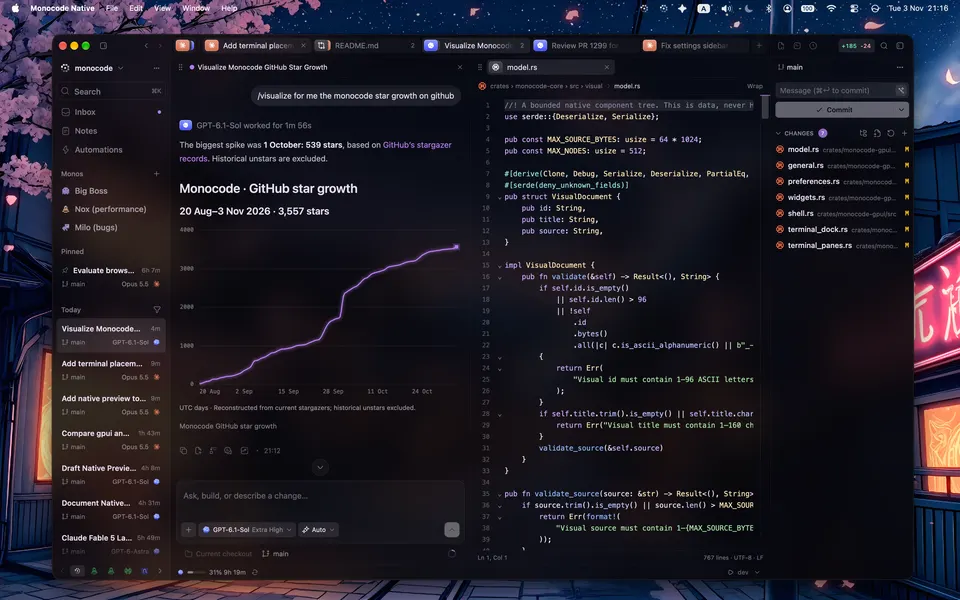
Open-source desktop app for Mac, Windows and Linux. Agents run on your computer or on your own server.
Product websitegithub.com Compare with others Missing or wrong data?
- Desktop app
- Mac, Windows and Linux
- Browser
- No
- Phone
- IPhone and Android
- Command line
- Yes
- Agents
- Claude Code, Codex, Cursor Agent, OpenCode, Pi, Grok and Antigravity
- Your subscription
- Works with your own plan
- Agents run
- On your computer and on your own server
- Laptop closed
- Keeps going
- Isolation
- Worktree
- Parallel agents
- Yes
- Scheduled runs
- Yes
- Coordinator agent
- Yes
- Built-in issues
- No
- Pull requests
- Yes
- Review screen
- Yes
- Team
- Not listed
- Self-hosting
- Yes
- Licence
- MIT
- Price from
- Free
- How it charges
- No paid plan
- Paid plans from
- Not listed
Measured by ADEMark
ADEMark ran the same tests on 15 ADEs. Results for MonoCode 0.16.0, measured up to 12 November 2026 on a Mac mini M4, 16 GB, macOS 27 · Claude Opus 5.5, effort high. Data CC BY 4.0, shown unchanged.
Speed
- Cold start
- 1.8 s2nd of 12median of 10 runs, 1.6 s to 1.86 s · Bare CLI 0.69 s
- New thread, ready to type
- 191 ms2nd of 10median of 6 runs, 176 ms to 205 ms · Bare CLI 375 ms
- First word on screen
- 779 ms6th of 11median of 10 runs, 740 ms to 839 ms · Bare CLI 220 ms
- Typing lag, 5 agents streaming
- 62 ms6th of 111 run · Bare CLI 79 ms
- Open a 2,000-message thread
- 94 ms5th of 11median of 5 runs, 93 ms to 105 ms · Bare CLI 203 ms
Weight
- Memory at rest, 5 threads
- 419 MB2nd of 121 run · Bare CLI 0.99 GB
- Idle CPU
- 9.03%12th of 131 run · Bare CLI 0.37%
- Memory under load
- 1.5 GB2nd of 101 run · Bare CLI 1.86 GB
Tokens
- Tokens to answer “hi”
- 44.6K tokens9th of 13median of 3 runs, 44.1K tokens to 44.7K tokens · Bare CLI 38.2K tokens
- Tokens for one real question
- 122.4K tokens6th of 131 run · Bare CLI 168.3K tokens
Build
- Team build: hidden tests passed
- Not measured
Place counts only apps with a value; lower is better except passed tests. ADEMark publishes no overall score and treats close medians as ties, so read places as an order, not a verdict. The Bare CLI is Claude Code in a terminal, run as an unranked control. Method and every test on ademark.dev · Imported data · How we use it
Receipts
- Checked
- · oldest answer 2026-11-08
- Findings
- 30 published · 22 cross-checked by a second agent · read them all
- Sources
- 20 public pages on 1 site: github.com
- Screenshot
- github.com, retrieved · first party repository · shows appearance, not capability
- Data
- /products/monocode.json · .md
- Method
- Same rules for all 103 researched ADEs. How we check · Report wrong data
What it does
Where you use it
Desktop installers support macOS Apple Silicon/Intel, Linux x64 and Windows x64. Native preview installers are experimental. Source-build instructions exist for an Expo iOS/Android development client. No store-distributed client was established by this pass. Local /operator exposes a product-owned app CLI to opted-in active agent turns. Desktop sessions can be prompted and split side by side; remote desktop views start/steer host sessions with documented feature limits. The phone can read/send/start/stop desktop sessions, but approvals and questions still need desktop attention. The scoped host exposes RPC to native clients and does not serve a standalone browser client.
Source and scope for Where you use itAgents it runs
Claude Code, Codex, Cursor, Grok Build, OpenCode, Pi, omp, fx, Hermes, Antigravity and Devin CLI are listed. MonoCode launches installed provider CLIs and reuses native logins; preview transports vary by provider. MonoCode v0.16.0 documents running installed Antigravity on macOS and Linux and selecting it to send a message after sign-in.
Source and scope for Agents it runsAccounts and subscriptions
README explicitly says existing supported coding-agent subscriptions work; MonoCode does not sell tokens. Mobile account selection reuses desktop Claude/Codex profiles and opens a new conversation when switching an existing chat.
Source and scope for Accounts and subscriptionsWhere agents run
Installed provider CLIs execute in the chosen local project or worktree. Experimental remote hosts execute agent sessions on Linux/macOS/Windows machines. Quitting desktop closes its SSH forward but does not stop remote host services or agent sessions. The remote machine must remain awake. No MonoCode-managed execution service is implemented in the scoped launch paths.
Source and scope for Where agents runHow work is kept apart
Desktop/operator can create and choose Git worktrees for session file separation. The inspected desktop and remote host launch paths use host child processes without per-session containers or VMs.
Source and scope for How work is kept apartParallel work
README explicitly documents separate Git worktrees for parallel tasks and split sessions.
Source and scope for Parallel workScheduled runs
Experimental Monos can run user-configured scheduled tasks. Native preview scheduler/runtime behavior remains unverified. Jira Issue appeared can start work in a selected local project after inbox polling.
Source and scope for Scheduled runsGit and pull requests
Remote Git views stage/discard files, commit and push through the host. Remote PR creation uses gh on the host with commit list/diff summary; generated commit messages are not yet available remotely.
Source and scope for Git and pull requestsLicence and source
MonoCode source is MIT licensed; provider trademarks and notices remain separate.
Source and scope for Licence and sourcePrice
MonoCode is MIT open source and free to download, with no paid plan found; it runs agents on your own existing agent subscriptions and says it does not sell tokens.
Source and scope for PriceTyped filters
Every value links to its receipt below. Read plan and surface restrictions before using a filter to decide.
| Filter | Value |
|---|---|
| Desktop OS: macOS | Yes |
| Desktop OS: Windows | Yes |
| Desktop OS: Linux | Yes |
| Web client | No |
| Phone access: Native iOS | Yes |
| Phone access: Native Android | Yes |
| Phone access: Phone browser | No |
| CLI | Yes |
| Coding agents: Claude Code | Yes cross-checked |
| Coding agents: Codex | Yes cross-checked |
| Coding agents: Cursor Agent | Yes cross-checked |
| Coding agents: Gemini CLI | No |
| Coding agents: OpenCode | Yes cross-checked |
| Coding agents: Pi | Yes cross-checked |
| Coding agents: Grok | Yes cross-checked |
| Coding agents: Aider | No |
| Coding agents: Antigravity | Yes cross-checked |
| Use my subscription | Yes cross-checked |
| Where agents run: On your computer | Yes |
| Where agents run: On your own server | Yes |
| Where agents run: In the vendor's cloud | No |
| Workspace isolation: Git worktree | Yes |
| Workspace isolation: Container | No |
| Workspace isolation: VM or microVM | No |
| Parallel runs | Yes cross-checked |
| Coordinator | Yes cross-checked |
| Native issue tracking | No |
| Unattended triggers | Yes cross-checked |
| Shared prompting | Unknown |
| Team roles | No |
| SSO | No |
| Pull request workflow | Yes cross-checked |
| Review interface | Yes cross-checked |
| Product license: Apache-2.0 | No. MIT cross-checked |
| Product license: MIT | Yes. MIT cross-checked |
| Product license: GPL-3.0 | No. MIT cross-checked |
| Product license: GPL-3.0-or-later | No. MIT cross-checked |
| Product license: AGPL-3.0 | No. MIT cross-checked |
| Product license: AGPL-3.0-or-later | No. MIT cross-checked |
| Product license: Elastic License 2.0 | No. MIT cross-checked |
| Product license: Custom terms | No. MIT cross-checked |
| Product license: Proprietary | No. MIT cross-checked |
| Self-hosting | Yes cross-checked |
| Telemetry opt-out | No |
| Free access | Yes cross-checked |
| Starting price: Free | Yes. Free cross-checked |
| Starting price: Up to $20/month | No. Free cross-checked |
| Starting price: $21–40/month | No. Free cross-checked |
| Starting price: $41–100/month | No. Free cross-checked |
| Starting price: Over $100/month | No. Free cross-checked |
| Starting price: Contact for pricing | No. Free cross-checked |
| Pricing model: Free, no paid plan | Yes cross-checked |
| Pricing model: Free plan | No |
| Pricing model: Subscription | No |
| Pricing model: Per seat | No |
| Pricing model: Usage-based | No |
| Pricing model: Per machine or compute | No |
| Pricing model: Bring your own key | Unknown |
| Pricing model: One-time purchase | No |
| Paid plans from: No paid plan | Unknown |
| Paid plans from: $10 or less/month | Unknown |
| Paid plans from: $11–20/month | Unknown |
| Paid plans from: $21–40/month | Unknown |
| Paid plans from: $41–100/month | Unknown |
| Paid plans from: Over $100/month | Unknown |
| Paid plans from: Contact sales | Unknown |
| Lifecycle status: Active | Unknown |
| Lifecycle status: Sunsetting | Unknown |
| Keeps going with laptop closed | Yes |
| Open-source license | Yes. MIT cross-checked |
| Any desktop app | Yes |
| Paid plan up to $20/month | Unknown |
| Paid plan up to $40/month | Unknown |
| Any phone client | Yes |
Filter receipts
Desktop OS: macOS: Yes
Desktop OS: macOS
Typed value: Yes.
Desktop installers support macOS Apple Silicon/Intel, Linux x64 and Windows x64. Native preview installers are experimental. Source-build instructions exist for an Expo iOS/Android development client. No store-distributed client was established by this pass. Local /operator exposes a product-owned app CLI to opted-in active agent turns. Desktop sessions can be prompted and split side by side; remote desktop views start/steer host sessions with documented feature limits. The phone can read/send/start/stop desktop sessions, but approvals and questions still need desktop attention. The scoped host exposes RPC to native clients and does not serve a standalone browser client.
- Desktop os: Desktop installers support macOS Apple Silicon/Intel, Linux x64 and Windows x64. Native preview installers are experimental.
- Task actions: Desktop sessions can be prompted and split side by side; remote desktop views start/steer host sessions with documented feature limits.
- Only the named atomic answers are established by this source pass. Remaining atomic answers retain their documented gaps.
-
Finding: Desktop installers cover macOS, Linux and Windows. MonoCode uses existing coding-agent subscriptions; parallel tabs/worktrees, editing, diff review and /operator are documented. Production is React/Tauri, preview is Rust/GPUI.
Desktop OS: Windows: Yes
Desktop OS: Windows
Typed value: Yes.
Desktop installers support macOS Apple Silicon/Intel, Linux x64 and Windows x64. Native preview installers are experimental. Source-build instructions exist for an Expo iOS/Android development client. No store-distributed client was established by this pass. Local /operator exposes a product-owned app CLI to opted-in active agent turns. Desktop sessions can be prompted and split side by side; remote desktop views start/steer host sessions with documented feature limits. The phone can read/send/start/stop desktop sessions, but approvals and questions still need desktop attention. The scoped host exposes RPC to native clients and does not serve a standalone browser client.
- Desktop os: Desktop installers support macOS Apple Silicon/Intel, Linux x64 and Windows x64. Native preview installers are experimental.
- Task actions: Desktop sessions can be prompted and split side by side; remote desktop views start/steer host sessions with documented feature limits.
- Only the named atomic answers are established by this source pass. Remaining atomic answers retain their documented gaps.
-
Finding: Desktop installers cover macOS, Linux and Windows. MonoCode uses existing coding-agent subscriptions; parallel tabs/worktrees, editing, diff review and /operator are documented. Production is React/Tauri, preview is Rust/GPUI.
Desktop OS: Linux: Yes
Desktop OS: Linux
Typed value: Yes.
Desktop installers support macOS Apple Silicon/Intel, Linux x64 and Windows x64. Native preview installers are experimental. Source-build instructions exist for an Expo iOS/Android development client. No store-distributed client was established by this pass. Local /operator exposes a product-owned app CLI to opted-in active agent turns. Desktop sessions can be prompted and split side by side; remote desktop views start/steer host sessions with documented feature limits. The phone can read/send/start/stop desktop sessions, but approvals and questions still need desktop attention. The scoped host exposes RPC to native clients and does not serve a standalone browser client.
- Desktop os: Desktop installers support macOS Apple Silicon/Intel, Linux x64 and Windows x64. Native preview installers are experimental.
- Task actions: Desktop sessions can be prompted and split side by side; remote desktop views start/steer host sessions with documented feature limits.
- Only the named atomic answers are established by this source pass. Remaining atomic answers retain their documented gaps.
-
Finding: Desktop installers cover macOS, Linux and Windows. MonoCode uses existing coding-agent subscriptions; parallel tabs/worktrees, editing, diff review and /operator are documented. Production is React/Tauri, preview is Rust/GPUI.
Web client: No
Web client
Typed value: No.
Desktop installers support macOS Apple Silicon/Intel, Linux x64 and Windows x64. Native preview installers are experimental. Source-build instructions exist for an Expo iOS/Android development client. No store-distributed client was established by this pass. Local /operator exposes a product-owned app CLI to opted-in active agent turns. Desktop sessions can be prompted and split side by side; remote desktop views start/steer host sessions with documented feature limits. The phone can read/send/start/stop desktop sessions, but approvals and questions still need desktop attention. The scoped host exposes RPC to native clients and does not serve a standalone browser client.
- Mobile apps: Source-build instructions exist for an Expo iOS/Android development client. No store-distributed client was established by this pass.
- Browser: The scoped host accepts native authenticated RPC rather than serving a browser UI.
- Mobile browser: The companion requires an Expo native module and the host serves RPC rather than a mobile web UI.
- Cross device continuity: The phone can read/send/start/stop desktop sessions, but approvals and questions still need desktop attention.
- Only the named atomic answers are established by this source pass. Remaining atomic answers retain their documented gaps.
-
Finding: The source-built Expo app uses QUIC/mTLS to show desktop projects, send prompts/start/stop turns and view changes. iOS/Android builds require native toolchains; approvals/questions remain on desktop, which must stay awake.
-
Finding: The host exposes authenticated RPC using revocable device bearer credentials. All paired devices address the same stored sessions and can issue session/turn commands, without per-user, organization, project or task roles. The server serves RPC, not a browser UI; no SAML/OIDC login is implemented.
Phone access: Native iOS: Yes
Phone access: Native iOS
Typed value: Yes.
Desktop installers support macOS Apple Silicon/Intel, Linux x64 and Windows x64. Native preview installers are experimental. Source-build instructions exist for an Expo iOS/Android development client. No store-distributed client was established by this pass. Local /operator exposes a product-owned app CLI to opted-in active agent turns. Desktop sessions can be prompted and split side by side; remote desktop views start/steer host sessions with documented feature limits. The phone can read/send/start/stop desktop sessions, but approvals and questions still need desktop attention. The scoped host exposes RPC to native clients and does not serve a standalone browser client.
- Mobile apps: Source-build instructions exist for an Expo iOS/Android development client. No store-distributed client was established by this pass.
- Mobile browser: The companion requires an Expo native module and the host serves RPC rather than a mobile web UI.
- Cross device continuity: The phone can read/send/start/stop desktop sessions, but approvals and questions still need desktop attention.
- Only the named atomic answers are established by this source pass. Remaining atomic answers retain their documented gaps.
-
Finding: The source-built Expo app uses QUIC/mTLS to show desktop projects, send prompts/start/stop turns and view changes. iOS/Android builds require native toolchains; approvals/questions remain on desktop, which must stay awake.
Phone access: Native Android: Yes
Phone access: Native Android
Typed value: Yes.
Desktop installers support macOS Apple Silicon/Intel, Linux x64 and Windows x64. Native preview installers are experimental. Source-build instructions exist for an Expo iOS/Android development client. No store-distributed client was established by this pass. Local /operator exposes a product-owned app CLI to opted-in active agent turns. Desktop sessions can be prompted and split side by side; remote desktop views start/steer host sessions with documented feature limits. The phone can read/send/start/stop desktop sessions, but approvals and questions still need desktop attention. The scoped host exposes RPC to native clients and does not serve a standalone browser client.
- Mobile apps: Source-build instructions exist for an Expo iOS/Android development client. No store-distributed client was established by this pass.
- Mobile browser: The companion requires an Expo native module and the host serves RPC rather than a mobile web UI.
- Cross device continuity: The phone can read/send/start/stop desktop sessions, but approvals and questions still need desktop attention.
- Only the named atomic answers are established by this source pass. Remaining atomic answers retain their documented gaps.
-
Finding: The source-built Expo app uses QUIC/mTLS to show desktop projects, send prompts/start/stop turns and view changes. iOS/Android builds require native toolchains; approvals/questions remain on desktop, which must stay awake.
Phone access: Phone browser: No
Phone access: Phone browser
Typed value: No.
Desktop installers support macOS Apple Silicon/Intel, Linux x64 and Windows x64. Native preview installers are experimental. Source-build instructions exist for an Expo iOS/Android development client. No store-distributed client was established by this pass. Local /operator exposes a product-owned app CLI to opted-in active agent turns. Desktop sessions can be prompted and split side by side; remote desktop views start/steer host sessions with documented feature limits. The phone can read/send/start/stop desktop sessions, but approvals and questions still need desktop attention. The scoped host exposes RPC to native clients and does not serve a standalone browser client.
- Mobile apps: Source-build instructions exist for an Expo iOS/Android development client. No store-distributed client was established by this pass.
- Browser: The scoped host accepts native authenticated RPC rather than serving a browser UI.
- Mobile browser: The companion requires an Expo native module and the host serves RPC rather than a mobile web UI.
- Cross device continuity: The phone can read/send/start/stop desktop sessions, but approvals and questions still need desktop attention.
- Only the named atomic answers are established by this source pass. Remaining atomic answers retain their documented gaps.
-
Finding: The source-built Expo app uses QUIC/mTLS to show desktop projects, send prompts/start/stop turns and view changes. iOS/Android builds require native toolchains; approvals/questions remain on desktop, which must stay awake.
-
Finding: The host exposes authenticated RPC using revocable device bearer credentials. All paired devices address the same stored sessions and can issue session/turn commands, without per-user, organization, project or task roles. The server serves RPC, not a browser UI; no SAML/OIDC login is implemented.
CLI: Yes
CLI
Typed value: Yes.
Opt-in app CLI offers models.list, sessions.start/list/read/send/stop and note/worktree operations. The local operator CLI acts only during its opted-in active turn; remote host device tokens grant OS-user workspace/provider control. A separate user-runnable MonoCode Host CLI starts/stops the host, manages its service and lists/revokes paired devices.
- Cli: The MonoCode Host command-line program supports serve/start/status/stop, service install/uninstall and device pairing/listing/revocation. The app-internal /operator interface is a separate surface.
- Only the named atomic answers are established by this source pass. Remaining atomic answers retain their documented gaps.
-
MonoCode Host command-line interface
Finding: The user-runnable MonoCode Host CLI serves, starts, checks and stops the agent host, installs/uninstalls its service and manages paired device credentials. Published host archives include a Node runtime and launcher for Windows, macOS and Linux. This is separate from the agent-only /operator app actions.
Coding agents: Claude Code: Yes cross-checked
Coding agents: Claude Code
Typed value: Yes.
Claude Code, Codex, Cursor, Grok Build, OpenCode, Pi, omp, fx, Hermes, Antigravity and Devin CLI are listed. MonoCode launches installed provider CLIs and reuses native logins; preview transports vary by provider. MonoCode v0.16.0 documents running installed Antigravity on macOS and Linux and selecting it to send a message after sign-in.
- Harnesses: Claude Code, Codex, Cursor, Grok Build, OpenCode, Pi, omp, fx, Hermes, Antigravity and Devin CLI are listed. MonoCode v0.16.0 documents running installed Antigravity on macOS and Linux and selecting it to send a message after sign-in.
- Session integration: MonoCode launches installed provider CLIs and reuses native logins; preview transports vary by provider.
- Only the cited atomic findings are established. Remaining atomic requirements and the full rubric scenario remain unverified.
- Antigravity uses the ACP runtime on macOS/Linux; the released documentation excludes Windows for this provider.
-
Finding: Installed Claude Code, Codex, Cursor, Grok Build, OpenCode, Pi and other named CLIs use their existing native logins. Missing providers are disabled individually with installation hints.
Coding agents: Codex: Yes cross-checked
Coding agents: Codex
Typed value: Yes.
Claude Code, Codex, Cursor, Grok Build, OpenCode, Pi, omp, fx, Hermes, Antigravity and Devin CLI are listed. MonoCode launches installed provider CLIs and reuses native logins; preview transports vary by provider. MonoCode v0.16.0 documents running installed Antigravity on macOS and Linux and selecting it to send a message after sign-in.
- Harnesses: Claude Code, Codex, Cursor, Grok Build, OpenCode, Pi, omp, fx, Hermes, Antigravity and Devin CLI are listed. MonoCode v0.16.0 documents running installed Antigravity on macOS and Linux and selecting it to send a message after sign-in.
- Session integration: MonoCode launches installed provider CLIs and reuses native logins; preview transports vary by provider.
- Only the cited atomic findings are established. Remaining atomic requirements and the full rubric scenario remain unverified.
- Antigravity uses the ACP runtime on macOS/Linux; the released documentation excludes Windows for this provider.
-
Finding: Installed Claude Code, Codex, Cursor, Grok Build, OpenCode, Pi and other named CLIs use their existing native logins. Missing providers are disabled individually with installation hints.
Coding agents: Cursor Agent: Yes cross-checked
Coding agents: Cursor Agent
Typed value: Yes.
Claude Code, Codex, Cursor, Grok Build, OpenCode, Pi, omp, fx, Hermes, Antigravity and Devin CLI are listed. MonoCode launches installed provider CLIs and reuses native logins; preview transports vary by provider. MonoCode v0.16.0 documents running installed Antigravity on macOS and Linux and selecting it to send a message after sign-in.
- Harnesses: Claude Code, Codex, Cursor, Grok Build, OpenCode, Pi, omp, fx, Hermes, Antigravity and Devin CLI are listed. MonoCode v0.16.0 documents running installed Antigravity on macOS and Linux and selecting it to send a message after sign-in.
- Session integration: MonoCode launches installed provider CLIs and reuses native logins; preview transports vary by provider.
- Only the cited atomic findings are established. Remaining atomic requirements and the full rubric scenario remain unverified.
- Antigravity uses the ACP runtime on macOS/Linux; the released documentation excludes Windows for this provider.
-
Finding: Installed Claude Code, Codex, Cursor, Grok Build, OpenCode, Pi and other named CLIs use their existing native logins. Missing providers are disabled individually with installation hints.
Coding agents: Gemini CLI: No
Coding agents: Gemini CLI
Typed value: No.
Claude Code, Codex, Cursor, Grok Build, OpenCode, Pi, omp, fx, Hermes, Antigravity and Devin CLI are listed. MonoCode launches installed provider CLIs and reuses native logins; preview transports vary by provider. MonoCode v0.16.0 documents running installed Antigravity on macOS and Linux and selecting it to send a message after sign-in.
- Harnesses: Claude Code, Codex, Cursor, Grok Build, OpenCode, Pi, omp, fx, Hermes, Antigravity and Devin CLI are listed. MonoCode v0.16.0 documents running installed Antigravity on macOS and Linux and selecting it to send a message after sign-in.
- Session integration: MonoCode launches installed provider CLIs and reuses native logins; preview transports vary by provider.
- Only the cited atomic findings are established. Remaining atomic requirements and the full rubric scenario remain unverified.
- Antigravity uses the ACP runtime on macOS/Linux; the released documentation excludes Windows for this provider.
-
Finding: Installed Claude Code, Codex, Cursor, Grok Build, OpenCode, Pi and other named CLIs use their existing native logins. Missing providers are disabled individually with installation hints.
Coding agents: OpenCode: Yes cross-checked
Coding agents: OpenCode
Typed value: Yes.
Claude Code, Codex, Cursor, Grok Build, OpenCode, Pi, omp, fx, Hermes, Antigravity and Devin CLI are listed. MonoCode launches installed provider CLIs and reuses native logins; preview transports vary by provider. MonoCode v0.16.0 documents running installed Antigravity on macOS and Linux and selecting it to send a message after sign-in.
- Harnesses: Claude Code, Codex, Cursor, Grok Build, OpenCode, Pi, omp, fx, Hermes, Antigravity and Devin CLI are listed. MonoCode v0.16.0 documents running installed Antigravity on macOS and Linux and selecting it to send a message after sign-in.
- Session integration: MonoCode launches installed provider CLIs and reuses native logins; preview transports vary by provider.
- Only the cited atomic findings are established. Remaining atomic requirements and the full rubric scenario remain unverified.
- Antigravity uses the ACP runtime on macOS/Linux; the released documentation excludes Windows for this provider.
-
Finding: Installed Claude Code, Codex, Cursor, Grok Build, OpenCode, Pi and other named CLIs use their existing native logins. Missing providers are disabled individually with installation hints.
Coding agents: Pi: Yes cross-checked
Coding agents: Pi
Typed value: Yes.
Claude Code, Codex, Cursor, Grok Build, OpenCode, Pi, omp, fx, Hermes, Antigravity and Devin CLI are listed. MonoCode launches installed provider CLIs and reuses native logins; preview transports vary by provider. MonoCode v0.16.0 documents running installed Antigravity on macOS and Linux and selecting it to send a message after sign-in.
- Harnesses: Claude Code, Codex, Cursor, Grok Build, OpenCode, Pi, omp, fx, Hermes, Antigravity and Devin CLI are listed. MonoCode v0.16.0 documents running installed Antigravity on macOS and Linux and selecting it to send a message after sign-in.
- Session integration: MonoCode launches installed provider CLIs and reuses native logins; preview transports vary by provider.
- Only the cited atomic findings are established. Remaining atomic requirements and the full rubric scenario remain unverified.
- Antigravity uses the ACP runtime on macOS/Linux; the released documentation excludes Windows for this provider.
-
Finding: Installed Claude Code, Codex, Cursor, Grok Build, OpenCode, Pi and other named CLIs use their existing native logins. Missing providers are disabled individually with installation hints.
Coding agents: Grok: Yes cross-checked
Coding agents: Grok
Typed value: Yes.
Claude Code, Codex, Cursor, Grok Build, OpenCode, Pi, omp, fx, Hermes, Antigravity and Devin CLI are listed. MonoCode launches installed provider CLIs and reuses native logins; preview transports vary by provider. MonoCode v0.16.0 documents running installed Antigravity on macOS and Linux and selecting it to send a message after sign-in.
- Harnesses: Claude Code, Codex, Cursor, Grok Build, OpenCode, Pi, omp, fx, Hermes, Antigravity and Devin CLI are listed. MonoCode v0.16.0 documents running installed Antigravity on macOS and Linux and selecting it to send a message after sign-in.
- Session integration: MonoCode launches installed provider CLIs and reuses native logins; preview transports vary by provider.
- Only the cited atomic findings are established. Remaining atomic requirements and the full rubric scenario remain unverified.
- Antigravity uses the ACP runtime on macOS/Linux; the released documentation excludes Windows for this provider.
-
Finding: Installed Claude Code, Codex, Cursor, Grok Build, OpenCode, Pi and other named CLIs use their existing native logins. Missing providers are disabled individually with installation hints.
Coding agents: Aider: No
Coding agents: Aider
Typed value: No.
Claude Code, Codex, Cursor, Grok Build, OpenCode, Pi, omp, fx, Hermes, Antigravity and Devin CLI are listed. MonoCode launches installed provider CLIs and reuses native logins; preview transports vary by provider. MonoCode v0.16.0 documents running installed Antigravity on macOS and Linux and selecting it to send a message after sign-in.
- Harnesses: Claude Code, Codex, Cursor, Grok Build, OpenCode, Pi, omp, fx, Hermes, Antigravity and Devin CLI are listed. MonoCode v0.16.0 documents running installed Antigravity on macOS and Linux and selecting it to send a message after sign-in.
- Session integration: MonoCode launches installed provider CLIs and reuses native logins; preview transports vary by provider.
- Only the cited atomic findings are established. Remaining atomic requirements and the full rubric scenario remain unverified.
- Antigravity uses the ACP runtime on macOS/Linux; the released documentation excludes Windows for this provider.
-
Finding: Installed Claude Code, Codex, Cursor, Grok Build, OpenCode, Pi and other named CLIs use their existing native logins. Missing providers are disabled individually with installation hints.
Coding agents: Antigravity: Yes cross-checked
Coding agents: Antigravity
Typed value: Yes.
Claude Code, Codex, Cursor, Grok Build, OpenCode, Pi, omp, fx, Hermes, Antigravity and Devin CLI are listed. MonoCode launches installed provider CLIs and reuses native logins; preview transports vary by provider. MonoCode v0.16.0 documents running installed Antigravity on macOS and Linux and selecting it to send a message after sign-in.
- Harnesses: Claude Code, Codex, Cursor, Grok Build, OpenCode, Pi, omp, fx, Hermes, Antigravity and Devin CLI are listed. MonoCode v0.16.0 documents running installed Antigravity on macOS and Linux and selecting it to send a message after sign-in.
- Only the cited atomic findings are established. Remaining atomic requirements and the full rubric scenario remain unverified.
- Antigravity uses the ACP runtime on macOS/Linux; the released documentation excludes Windows for this provider.
-
MonoCode Antigravity support at v0.16.0
Finding: MonoCode v0.16.0 documents running installed Antigravity on macOS and Linux and selecting it to send a message after sign-in.
-
MonoCode Antigravity support at v0.16.0
Finding: MonoCode v0.16.0 documents running installed Antigravity on macOS and Linux and selecting it to send a message after sign-in.
Use my subscription: Yes cross-checked
Use my subscription
Typed value: Yes.
README explicitly says existing supported coding-agent subscriptions work; MonoCode does not sell tokens. Mobile account selection reuses desktop Claude/Codex profiles and opens a new conversation when switching an existing chat.
- Agent subscriptions: README explicitly says existing supported coding-agent subscriptions work; MonoCode does not sell tokens.
- Only the cited atomic findings are established. Remaining atomic requirements and the full rubric scenario remain unverified.
-
Finding: Desktop installers cover macOS, Linux and Windows. MonoCode uses existing coding-agent subscriptions; parallel tabs/worktrees, editing, diff review and /operator are documented. Production is React/Tauri, preview is Rust/GPUI.
Where agents run: On your computer: Yes
Where agents run: On your computer
Typed value: Yes.
Installed provider CLIs execute in the chosen local project or worktree. Experimental remote hosts execute agent sessions on Linux/macOS/Windows machines. Quitting desktop closes its SSH forward but does not stop remote host services or agent sessions. The remote machine must remain awake. No MonoCode-managed execution service is implemented in the scoped launch paths.
- Local: Installed provider CLIs execute in the chosen local project or worktree.
- Only the named atomic answers are established by this source pass. Remaining atomic answers retain their documented gaps.
-
Finding: Desktop installers cover macOS, Linux and Windows. MonoCode uses existing coding-agent subscriptions; parallel tabs/worktrees, editing, diff review and /operator are documented. Production is React/Tauri, preview is Rust/GPUI.
Where agents run: On your own server: Yes
Where agents run: On your own server
Typed value: Yes.
Installed provider CLIs execute in the chosen local project or worktree. Experimental remote hosts execute agent sessions on Linux/macOS/Windows machines. Quitting desktop closes its SSH forward but does not stop remote host services or agent sessions. The remote machine must remain awake. No MonoCode-managed execution service is implemented in the scoped launch paths.
- Byo remote: Experimental remote hosts execute agent sessions on Linux/macOS/Windows machines.
- Client disconnect: Quitting desktop closes its SSH forward but does not stop remote host services or agent sessions. The remote machine must remain awake.
- Only the named atomic answers are established by this source pass. Remaining atomic answers retain their documented gaps.
-
MonoCode docs/remote-access.md
Finding: Remote Linux/macOS/Windows hosts run provider processes independently of the connecting desktop. SSH setup installs a host service and per-device credentials; remote files/Git/PRs work but operator, terminals and most local-only tools are unavailable.
Where agents run: In the vendor's cloud: No
Where agents run: In the vendor's cloud
Typed value: No.
Installed provider CLIs execute in the chosen local project or worktree. Experimental remote hosts execute agent sessions on Linux/macOS/Windows machines. Quitting desktop closes its SSH forward but does not stop remote host services or agent sessions. The remote machine must remain awake. No MonoCode-managed execution service is implemented in the scoped launch paths.
- Managed cloud: The product starts local or user-operated remote host processes; no vendor runtime provisioner exists in the scoped launch implementation.
- Only the named atomic answers are established by this source pass. Remaining atomic answers retain their documented gaps.
-
Finding: The scoped host starts installed coding-provider child processes in a local checkout or worktree. Inspection of host providers, child backend and desktop launch paths found no vendor-managed runtime provisioning or per-session container/VM launcher.
Workspace isolation: Git worktree: Yes
Workspace isolation: Git worktree
Typed value: Yes.
Desktop/operator can create and choose Git worktrees for session file separation. The inspected desktop and remote host launch paths use host child processes without per-session containers or VMs.
- Worktree: Desktop/operator can create and choose Git worktrees for session file separation.
- Only the named atomic answers are established by this source pass. Remaining atomic answers retain their documented gaps.
-
Finding: Desktop installers cover macOS, Linux and Windows. MonoCode uses existing coding-agent subscriptions; parallel tabs/worktrees, editing, diff review and /operator are documented. Production is React/Tauri, preview is Rust/GPUI.
-
Finding: Opt-in /operator gives that active local thread a scoped app CLI. It starts, reads, sends, stops and organizes sessions/worktrees and notes with explicit IDs; uncertain writes retry with identical request IDs.
Workspace isolation: Container: No
Workspace isolation: Container
Typed value: No.
Desktop/operator can create and choose Git worktrees for session file separation. The inspected desktop and remote host launch paths use host child processes without per-session containers or VMs.
- Container: The inspected provider launcher uses ordinary host processes without provisioning a per-session container.
- Vm: The inspected provider launcher uses ordinary host processes without provisioning a per-session vm.
- Only the named atomic answers are established by this source pass. Remaining atomic answers retain their documented gaps.
-
Finding: The scoped host starts installed coding-provider child processes in a local checkout or worktree. Inspection of host providers, child backend and desktop launch paths found no vendor-managed runtime provisioning or per-session container/VM launcher.
Workspace isolation: VM or microVM: No
Workspace isolation: VM or microVM
Typed value: No.
Desktop/operator can create and choose Git worktrees for session file separation. The inspected desktop and remote host launch paths use host child processes without per-session containers or VMs.
- Container: The inspected provider launcher uses ordinary host processes without provisioning a per-session container.
- Vm: The inspected provider launcher uses ordinary host processes without provisioning a per-session vm.
- Only the named atomic answers are established by this source pass. Remaining atomic answers retain their documented gaps.
-
Finding: The scoped host starts installed coding-provider child processes in a local checkout or worktree. Inspection of host providers, child backend and desktop launch paths found no vendor-managed runtime provisioning or per-session container/VM launcher.
Parallel runs: Yes cross-checked
Parallel runs
Typed value: Yes.
README explicitly documents separate Git worktrees for parallel tasks and split sessions.
- Concurrent sessions: README explicitly documents separate Git worktrees for parallel tasks and split sessions.
- Only the cited atomic findings are established. Remaining atomic requirements and the full rubric scenario remain unverified.
-
Finding: Desktop installers cover macOS, Linux and Windows. MonoCode uses existing coding-agent subscriptions; parallel tabs/worktrees, editing, diff review and /operator are documented. Production is React/Tauri, preview is Rust/GPUI.
Coordinator: Yes cross-checked
Coordinator
Typed value: Yes.
sessions.start accepts provider, model, effort, permission mode and worktree scope. Opted-in Operator can start/read/send/stop other local project sessions through MonoCodes own CLI. sessions.read returns paginated exchanges and sessions.send submits an idle-session follow-up.
- Model harness effort: sessions.start accepts provider, model, effort, permission mode and worktree scope.
- Orchestration owner: Opted-in Operator can start/read/send/stop other local project sessions through MonoCodes own CLI.
- Followup: sessions.read returns paginated exchanges and sessions.send submits an idle-session follow-up.
- Only the cited atomic findings are established. Remaining atomic requirements and the full rubric scenario remain unverified.
-
Finding: Opt-in /operator gives that active local thread a scoped app CLI. It starts, reads, sends, stops and organizes sessions/worktrees and notes with explicit IDs; uncertain writes retry with identical request IDs.
Native issue tracking: No
Native issue tracking
Typed value: No.
The scoped task display renders coding-agent todo tool calls inside sessions, and the inbox links external trackers. Inspection of the task parser and inbox models found no native issue/backlog store distinct from sessions.
- Create: No product-owned issue creation/store was found in the scoped task and inbox implementations.
- Task session separation: The todo list belongs to the agent session; external inbox tickets retain external tracker identity.
- External tracker requirement: Inbox issue models use external GitHub, Jira, Linear or Azure DevOps trackers.
- Only the named atomic answers are established by this source pass. Remaining atomic answers retain their documented gaps.
-
MonoCode session task renderer
Finding: The displayed task list parses TodoWrite/write_todos/update_todos tool payloads inside agent sessions. The scoped inbox models integrate GitHub, Jira, Linear and Azure DevOps trackers; inspection found no product-owned issue/backlog store distinct from sessions and external tickets.
Unattended triggers: Yes cross-checked
Unattended triggers
Typed value: Yes.
Experimental Monos can run user-configured scheduled tasks. Native preview scheduler/runtime behavior remains unverified. Jira Issue appeared can start work in a selected local project after inbox polling.
- Events: Jira Issue appeared can start work in a selected local project after inbox polling.
- Only the cited atomic findings are established. Remaining atomic requirements and the full rubric scenario remain unverified.
-
Finding: Jira Cloud inbox browses issues/comments, starts local work with ticket identity and polls issue-appeared automation. It supports unscoped API tokens, not Jira Data Center.
Team roles: No
Team roles
Typed value: No.
The scoped remote host authenticates revocable device bearer tokens and uses the host OS user privileges. It has no organization, project or task roles and no SAML/OIDC SSO implementation.
- Organization roles: The scoped authentication/dispatch code uses device credentials with host-user access, without organization roles.
- Project roles: The scoped authentication/dispatch code uses device credentials with host-user access, without project roles.
- Task roles: The scoped authentication/dispatch code uses device credentials with host-user access, without task roles.
- Sso: The scoped authentication/dispatch code uses device credentials with host-user access, without sso.
- Only the named atomic answers are established by this source pass. Remaining atomic answers retain their documented gaps.
-
Finding: The host exposes authenticated RPC using revocable device bearer credentials. All paired devices address the same stored sessions and can issue session/turn commands, without per-user, organization, project or task roles. The server serves RPC, not a browser UI; no SAML/OIDC login is implemented.
SSO: No
SSO
Typed value: No.
The scoped remote host authenticates revocable device bearer tokens and uses the host OS user privileges. It has no organization, project or task roles and no SAML/OIDC SSO implementation.
- Organization roles: The scoped authentication/dispatch code uses device credentials with host-user access, without organization roles.
- Project roles: The scoped authentication/dispatch code uses device credentials with host-user access, without project roles.
- Task roles: The scoped authentication/dispatch code uses device credentials with host-user access, without task roles.
- Sso: The scoped authentication/dispatch code uses device credentials with host-user access, without sso.
- Only the named atomic answers are established by this source pass. Remaining atomic answers retain their documented gaps.
-
Finding: The host exposes authenticated RPC using revocable device bearer credentials. All paired devices address the same stored sessions and can issue session/turn commands, without per-user, organization, project or task roles. The server serves RPC, not a browser UI; no SAML/OIDC login is implemented.
Pull request workflow: Yes cross-checked
Pull request workflow
Typed value: Yes.
Remote Git views stage/discard files, commit and push through the host. Remote PR creation uses gh on the host with commit list/diff summary; generated commit messages are not yet available remotely.
- Commits: Remote Git views stage/discard files, commit and push through the host.
- Pull requests: Remote PR creation uses gh on the host with commit list/diff summary; generated commit messages are not yet available remotely.
- Only the cited atomic findings are established. Remaining atomic requirements and the full rubric scenario remain unverified.
-
MonoCode docs/remote-access.md
Finding: Remote Linux/macOS/Windows hosts run provider processes independently of the connecting desktop. SSH setup installs a host service and per-device credentials; remote files/Git/PRs work but operator, terminals and most local-only tools are unavailable.
Review interface: Yes cross-checked
Review interface
Typed value: Yes.
Desktop and remote Changes/Git views display file diffs and history. Remote file/image attachments persist in host private data with 20 MiB per-file limit.
- Diffs: Desktop and remote Changes/Git views display file diffs and history.
- Screenshots: Remote file/image attachments persist in host private data with 20 MiB per-file limit.
- Only the cited atomic findings are established. Remaining atomic requirements and the full rubric scenario remain unverified.
-
Finding: Desktop installers cover macOS, Linux and Windows. MonoCode uses existing coding-agent subscriptions; parallel tabs/worktrees, editing, diff review and /operator are documented. Production is React/Tauri, preview is Rust/GPUI.
-
MonoCode docs/remote-access.md
Finding: Remote Linux/macOS/Windows hosts run provider processes independently of the connecting desktop. SSH setup installs a host service and per-device credentials; remote files/Git/PRs work but operator, terminals and most local-only tools are unavailable.
Product license: Apache-2.0: No. MIT cross-checked
Product license: Apache-2.0
Typed value: No. MIT.
MonoCode source is MIT licensed; provider trademarks and notices remain separate.
- Client license: MonoCode source is MIT licensed; provider trademarks and notices remain separate.
- Only the cited atomic findings are established. Remaining atomic requirements and the full rubric scenario remain unverified.
-
Finding: MonoCode repository code is MIT licensed, subject to provider names/logos and notices.
Product license: MIT: Yes. MIT cross-checked
Product license: MIT
Typed value: Yes. MIT.
MonoCode source is MIT licensed; provider trademarks and notices remain separate.
- Client license: MonoCode source is MIT licensed; provider trademarks and notices remain separate.
- Only the cited atomic findings are established. Remaining atomic requirements and the full rubric scenario remain unverified.
-
Finding: MonoCode repository code is MIT licensed, subject to provider names/logos and notices.
Product license: GPL-3.0: No. MIT cross-checked
Product license: GPL-3.0
Typed value: No. MIT.
MonoCode source is MIT licensed; provider trademarks and notices remain separate.
- Client license: MonoCode source is MIT licensed; provider trademarks and notices remain separate.
- Only the cited atomic findings are established. Remaining atomic requirements and the full rubric scenario remain unverified.
-
Finding: MonoCode repository code is MIT licensed, subject to provider names/logos and notices.
Product license: GPL-3.0-or-later: No. MIT cross-checked
Product license: GPL-3.0-or-later
Typed value: No. MIT.
MonoCode source is MIT licensed; provider trademarks and notices remain separate.
- Client license: MonoCode source is MIT licensed; provider trademarks and notices remain separate.
- Only the cited atomic findings are established. Remaining atomic requirements and the full rubric scenario remain unverified.
-
Finding: MonoCode repository code is MIT licensed, subject to provider names/logos and notices.
Product license: AGPL-3.0: No. MIT cross-checked
Product license: AGPL-3.0
Typed value: No. MIT.
MonoCode source is MIT licensed; provider trademarks and notices remain separate.
- Client license: MonoCode source is MIT licensed; provider trademarks and notices remain separate.
- Only the cited atomic findings are established. Remaining atomic requirements and the full rubric scenario remain unverified.
-
Finding: MonoCode repository code is MIT licensed, subject to provider names/logos and notices.
Product license: AGPL-3.0-or-later: No. MIT cross-checked
Product license: AGPL-3.0-or-later
Typed value: No. MIT.
MonoCode source is MIT licensed; provider trademarks and notices remain separate.
- Client license: MonoCode source is MIT licensed; provider trademarks and notices remain separate.
- Only the cited atomic findings are established. Remaining atomic requirements and the full rubric scenario remain unverified.
-
Finding: MonoCode repository code is MIT licensed, subject to provider names/logos and notices.
Product license: Elastic License 2.0: No. MIT cross-checked
Product license: Elastic License 2.0
Typed value: No. MIT.
MonoCode source is MIT licensed; provider trademarks and notices remain separate.
- Client license: MonoCode source is MIT licensed; provider trademarks and notices remain separate.
- Only the cited atomic findings are established. Remaining atomic requirements and the full rubric scenario remain unverified.
-
Finding: MonoCode repository code is MIT licensed, subject to provider names/logos and notices.
Product license: Custom terms: No. MIT cross-checked
Product license: Custom terms
Typed value: No. MIT.
MonoCode source is MIT licensed; provider trademarks and notices remain separate.
- Client license: MonoCode source is MIT licensed; provider trademarks and notices remain separate.
- Only the cited atomic findings are established. Remaining atomic requirements and the full rubric scenario remain unverified.
-
Finding: MonoCode repository code is MIT licensed, subject to provider names/logos and notices.
Product license: Proprietary: No. MIT cross-checked
Product license: Proprietary
Typed value: No. MIT.
MonoCode source is MIT licensed; provider trademarks and notices remain separate.
- Client license: MonoCode source is MIT licensed; provider trademarks and notices remain separate.
- Only the cited atomic findings are established. Remaining atomic requirements and the full rubric scenario remain unverified.
-
Finding: MonoCode repository code is MIT licensed, subject to provider names/logos and notices.
Self-hosting: Yes cross-checked
Self-hosting
Typed value: Yes.
Desktop and remote host can run from repository source on user-controlled machines. Installed agent providers need their own login; remote hosts reuse the hosts OS-user credentials.
- Self hosting: Desktop and remote host can run from repository source on user-controlled machines.
- Vendor dependencies: Installed agent providers need their own login; remote hosts reuse the hosts OS-user credentials.
- Only the cited atomic findings are established. Remaining atomic requirements and the full rubric scenario remain unverified.
-
Finding: Desktop installers cover macOS, Linux and Windows. MonoCode uses existing coding-agent subscriptions; parallel tabs/worktrees, editing, diff review and /operator are documented. Production is React/Tauri, preview is Rust/GPUI.
-
MonoCode docs/remote-access.md
Finding: Remote Linux/macOS/Windows hosts run provider processes independently of the connecting desktop. SSH setup installs a host service and per-device credentials; remote files/Git/PRs work but operator, terminals and most local-only tools are unavailable.
Telemetry opt-out: No
Telemetry opt-out
Typed value: No.
Bounded source inspection found no MonoCode product analytics emitter or telemetry opt-out control in the public app dependencies and implementation. Underlying agent-provider data handling is separate and remains unestablished here.
- Telemetry defaults: No product analytics emitter was found in the inspected public application components.
- Telemetry controls: No product telemetry opt-out setting was found in the inspected source.
- Only the named atomic answers are established by this source pass. Remaining atomic answers retain their documented gaps.
-
MonoCode app dependencies and telemetry inspection
Finding: Inspection of the public application dependencies and implementation found no product analytics emitter or telemetry opt-out setting. Provider login and provider network usage remain outside this conclusion; this does not establish a provider privacy policy.
Free access: Yes cross-checked
Free access
Typed value: Yes.
MonoCode is a free MIT-licensed desktop download for macOS, Linux and Windows; no paid plan is shown. Agent usage is billed by the user's own agent subscriptions.
- Ongoing free: Desktop installers are free downloads of MIT-licensed software.
- Paid only: Not paid-only: the application downloads free of charge.
- Underlying agent plan limits were not checked. No installed-product test was run.
-
Finding: MonoCode runs the user's installed, logged-in agent subscriptions and does not sell tokens. Installers for macOS, Linux and Windows are free downloads from GitHub releases and dl.usemono.dev; no price or paid plan is named.
-
Finding: The repository is under the MIT License.
Starting price: Free: Yes. Free cross-checked
Starting price: Free
Typed value: Yes. Free.
MonoCode is a free MIT-licensed desktop download for macOS, Linux and Windows; no paid plan is shown. Agent usage is billed by the user's own agent subscriptions.
- Ongoing free: Desktop installers are free downloads of MIT-licensed software.
- Paid only: Not paid-only: the application downloads free of charge.
- Underlying agent plan limits were not checked. No installed-product test was run.
-
Finding: MonoCode runs the user's installed, logged-in agent subscriptions and does not sell tokens. Installers for macOS, Linux and Windows are free downloads from GitHub releases and dl.usemono.dev; no price or paid plan is named.
-
Finding: The repository is under the MIT License.
Starting price: Up to $20/month: No. Free cross-checked
Starting price: Up to $20/month
Typed value: No. Free.
MonoCode is a free MIT-licensed desktop download for macOS, Linux and Windows; no paid plan is shown. Agent usage is billed by the user's own agent subscriptions.
- Ongoing free: Desktop installers are free downloads of MIT-licensed software.
- Paid only: Not paid-only: the application downloads free of charge.
- Underlying agent plan limits were not checked. No installed-product test was run.
-
Finding: MonoCode runs the user's installed, logged-in agent subscriptions and does not sell tokens. Installers for macOS, Linux and Windows are free downloads from GitHub releases and dl.usemono.dev; no price or paid plan is named.
-
Finding: The repository is under the MIT License.
Starting price: $21–40/month: No. Free cross-checked
Starting price: $21–40/month
Typed value: No. Free.
MonoCode is a free MIT-licensed desktop download for macOS, Linux and Windows; no paid plan is shown. Agent usage is billed by the user's own agent subscriptions.
- Ongoing free: Desktop installers are free downloads of MIT-licensed software.
- Paid only: Not paid-only: the application downloads free of charge.
- Underlying agent plan limits were not checked. No installed-product test was run.
-
Finding: MonoCode runs the user's installed, logged-in agent subscriptions and does not sell tokens. Installers for macOS, Linux and Windows are free downloads from GitHub releases and dl.usemono.dev; no price or paid plan is named.
-
Finding: The repository is under the MIT License.
Starting price: $41–100/month: No. Free cross-checked
Starting price: $41–100/month
Typed value: No. Free.
MonoCode is a free MIT-licensed desktop download for macOS, Linux and Windows; no paid plan is shown. Agent usage is billed by the user's own agent subscriptions.
- Ongoing free: Desktop installers are free downloads of MIT-licensed software.
- Paid only: Not paid-only: the application downloads free of charge.
- Underlying agent plan limits were not checked. No installed-product test was run.
-
Finding: MonoCode runs the user's installed, logged-in agent subscriptions and does not sell tokens. Installers for macOS, Linux and Windows are free downloads from GitHub releases and dl.usemono.dev; no price or paid plan is named.
-
Finding: The repository is under the MIT License.
Starting price: Over $100/month: No. Free cross-checked
Starting price: Over $100/month
Typed value: No. Free.
MonoCode is a free MIT-licensed desktop download for macOS, Linux and Windows; no paid plan is shown. Agent usage is billed by the user's own agent subscriptions.
- Ongoing free: Desktop installers are free downloads of MIT-licensed software.
- Paid only: Not paid-only: the application downloads free of charge.
- Underlying agent plan limits were not checked. No installed-product test was run.
-
Finding: MonoCode runs the user's installed, logged-in agent subscriptions and does not sell tokens. Installers for macOS, Linux and Windows are free downloads from GitHub releases and dl.usemono.dev; no price or paid plan is named.
-
Finding: The repository is under the MIT License.
Starting price: Contact for pricing: No. Free cross-checked
Starting price: Contact for pricing
Typed value: No. Free.
MonoCode is a free MIT-licensed desktop download for macOS, Linux and Windows; no paid plan is shown. Agent usage is billed by the user's own agent subscriptions.
- Ongoing free: Desktop installers are free downloads of MIT-licensed software.
- Paid only: Not paid-only: the application downloads free of charge.
- Underlying agent plan limits were not checked. No installed-product test was run.
-
Finding: MonoCode runs the user's installed, logged-in agent subscriptions and does not sell tokens. Installers for macOS, Linux and Windows are free downloads from GitHub releases and dl.usemono.dev; no price or paid plan is named.
-
Finding: The repository is under the MIT License.
Pricing model: Free, no paid plan: Yes cross-checked
Pricing model: Free, no paid plan
Typed value: Yes.
MonoCode is MIT open source and free to download, with no paid plan found; it runs agents on your own existing agent subscriptions and says it does not sell tokens.
- Credits: The README says MonoCode does not sell tokens. No credits are mentioned.
- Model cost: MonoCode uses your existing agent subscriptions and does not sell tokens, so those providers bill for model usage.
- First-party pricing pages, terms and licences read 2026-11-10; no purchase, billing or authenticated account test.
-
Finding: Says MonoCode works with your own Claude Code, Codex, Cursor and other subscriptions and does not sell tokens. The license is MIT.
-
hardbeat920/monocode LICENSE (MIT)
Finding: The MIT License lets anyone obtain, use, copy and modify the software free of charge.
Pricing model: Free plan: No
Pricing model: Free plan
Typed value: No.
MonoCode is MIT open source and free to download, with no paid plan found; it runs agents on your own existing agent subscriptions and says it does not sell tokens.
- Credits: The README says MonoCode does not sell tokens. No credits are mentioned.
- Model cost: MonoCode uses your existing agent subscriptions and does not sell tokens, so those providers bill for model usage.
- First-party pricing pages, terms and licences read 2026-11-10; no purchase, billing or authenticated account test.
-
Finding: Says MonoCode works with your own Claude Code, Codex, Cursor and other subscriptions and does not sell tokens. The license is MIT.
-
hardbeat920/monocode LICENSE (MIT)
Finding: The MIT License lets anyone obtain, use, copy and modify the software free of charge.
Pricing model: Subscription: No
Pricing model: Subscription
Typed value: No.
MonoCode is MIT open source and free to download, with no paid plan found; it runs agents on your own existing agent subscriptions and says it does not sell tokens.
- Credits: The README says MonoCode does not sell tokens. No credits are mentioned.
- Model cost: MonoCode uses your existing agent subscriptions and does not sell tokens, so those providers bill for model usage.
- First-party pricing pages, terms and licences read 2026-11-10; no purchase, billing or authenticated account test.
-
Finding: Says MonoCode works with your own Claude Code, Codex, Cursor and other subscriptions and does not sell tokens. The license is MIT.
-
hardbeat920/monocode LICENSE (MIT)
Finding: The MIT License lets anyone obtain, use, copy and modify the software free of charge.
Pricing model: Per seat: No
Pricing model: Per seat
Typed value: No.
MonoCode is MIT open source and free to download, with no paid plan found; it runs agents on your own existing agent subscriptions and says it does not sell tokens.
- Credits: The README says MonoCode does not sell tokens. No credits are mentioned.
- Model cost: MonoCode uses your existing agent subscriptions and does not sell tokens, so those providers bill for model usage.
- First-party pricing pages, terms and licences read 2026-11-10; no purchase, billing or authenticated account test.
-
Finding: Says MonoCode works with your own Claude Code, Codex, Cursor and other subscriptions and does not sell tokens. The license is MIT.
-
hardbeat920/monocode LICENSE (MIT)
Finding: The MIT License lets anyone obtain, use, copy and modify the software free of charge.
Pricing model: Usage-based: No
Pricing model: Usage-based
Typed value: No.
MonoCode is MIT open source and free to download, with no paid plan found; it runs agents on your own existing agent subscriptions and says it does not sell tokens.
- Credits: The README says MonoCode does not sell tokens. No credits are mentioned.
- Model cost: MonoCode uses your existing agent subscriptions and does not sell tokens, so those providers bill for model usage.
- First-party pricing pages, terms and licences read 2026-11-10; no purchase, billing or authenticated account test.
-
Finding: Says MonoCode works with your own Claude Code, Codex, Cursor and other subscriptions and does not sell tokens. The license is MIT.
-
hardbeat920/monocode LICENSE (MIT)
Finding: The MIT License lets anyone obtain, use, copy and modify the software free of charge.
Pricing model: Per machine or compute: No
Pricing model: Per machine or compute
Typed value: No.
MonoCode is MIT open source and free to download, with no paid plan found; it runs agents on your own existing agent subscriptions and says it does not sell tokens.
- Credits: The README says MonoCode does not sell tokens. No credits are mentioned.
- Model cost: MonoCode uses your existing agent subscriptions and does not sell tokens, so those providers bill for model usage.
- First-party pricing pages, terms and licences read 2026-11-10; no purchase, billing or authenticated account test.
-
Finding: Says MonoCode works with your own Claude Code, Codex, Cursor and other subscriptions and does not sell tokens. The license is MIT.
-
hardbeat920/monocode LICENSE (MIT)
Finding: The MIT License lets anyone obtain, use, copy and modify the software free of charge.
Pricing model: One-time purchase: No
Pricing model: One-time purchase
Typed value: No.
MonoCode is MIT open source and free to download, with no paid plan found; it runs agents on your own existing agent subscriptions and says it does not sell tokens.
- Credits: The README says MonoCode does not sell tokens. No credits are mentioned.
- Model cost: MonoCode uses your existing agent subscriptions and does not sell tokens, so those providers bill for model usage.
- First-party pricing pages, terms and licences read 2026-11-10; no purchase, billing or authenticated account test.
-
Finding: Says MonoCode works with your own Claude Code, Codex, Cursor and other subscriptions and does not sell tokens. The license is MIT.
-
hardbeat920/monocode LICENSE (MIT)
Finding: The MIT License lets anyone obtain, use, copy and modify the software free of charge.
Keeps going with laptop closed: Yes
Keeps going with laptop closed
Typed value: Yes.
Installed provider CLIs execute in the chosen local project or worktree. Experimental remote hosts execute agent sessions on Linux/macOS/Windows machines. Quitting desktop closes its SSH forward but does not stop remote host services or agent sessions. The remote machine must remain awake. No MonoCode-managed execution service is implemented in the scoped launch paths.
- Byo remote: Experimental remote hosts execute agent sessions on Linux/macOS/Windows machines.
- Client disconnect: Quitting desktop closes its SSH forward but does not stop remote host services or agent sessions. The remote machine must remain awake.
- Only the named atomic answers are established by this source pass. Remaining atomic answers retain their documented gaps.
-
MonoCode docs/remote-access.md
Finding: Remote Linux/macOS/Windows hosts run provider processes independently of the connecting desktop. SSH setup installs a host service and per-device credentials; remote files/Git/PRs work but operator, terminals and most local-only tools are unavailable.
Open-source license: Yes. MIT cross-checked
Open-source license
Typed value: Yes. MIT.
MonoCode source is MIT licensed; provider trademarks and notices remain separate.
- Client license: MonoCode source is MIT licensed; provider trademarks and notices remain separate.
- Only the cited atomic findings are established. Remaining atomic requirements and the full rubric scenario remain unverified.
-
Finding: MonoCode repository code is MIT licensed, subject to provider names/logos and notices.
Any desktop app: Yes
Any desktop app
Typed value: Yes.
Desktop installers support macOS Apple Silicon/Intel, Linux x64 and Windows x64. Native preview installers are experimental. Source-build instructions exist for an Expo iOS/Android development client. No store-distributed client was established by this pass. Local /operator exposes a product-owned app CLI to opted-in active agent turns. Desktop sessions can be prompted and split side by side; remote desktop views start/steer host sessions with documented feature limits. The phone can read/send/start/stop desktop sessions, but approvals and questions still need desktop attention. The scoped host exposes RPC to native clients and does not serve a standalone browser client.
- Desktop os: Desktop installers support macOS Apple Silicon/Intel, Linux x64 and Windows x64. Native preview installers are experimental.
- Task actions: Desktop sessions can be prompted and split side by side; remote desktop views start/steer host sessions with documented feature limits.
- Only the named atomic answers are established by this source pass. Remaining atomic answers retain their documented gaps.
-
Finding: Desktop installers cover macOS, Linux and Windows. MonoCode uses existing coding-agent subscriptions; parallel tabs/worktrees, editing, diff review and /operator are documented. Production is React/Tauri, preview is Rust/GPUI.
Any phone client: Yes
Any phone client
Typed value: Yes.
Desktop installers support macOS Apple Silicon/Intel, Linux x64 and Windows x64. Native preview installers are experimental. Source-build instructions exist for an Expo iOS/Android development client. No store-distributed client was established by this pass. Local /operator exposes a product-owned app CLI to opted-in active agent turns. Desktop sessions can be prompted and split side by side; remote desktop views start/steer host sessions with documented feature limits. The phone can read/send/start/stop desktop sessions, but approvals and questions still need desktop attention. The scoped host exposes RPC to native clients and does not serve a standalone browser client.
- Mobile apps: Source-build instructions exist for an Expo iOS/Android development client. No store-distributed client was established by this pass.
- Mobile browser: The companion requires an Expo native module and the host serves RPC rather than a mobile web UI.
- Cross device continuity: The phone can read/send/start/stop desktop sessions, but approvals and questions still need desktop attention.
- Only the named atomic answers are established by this source pass. Remaining atomic answers retain their documented gaps.
-
Finding: The source-built Expo app uses QUIC/mTLS to show desktop projects, send prompts/start/stop turns and view changes. iOS/Android builds require native toolchains; approvals/questions remain on desktop, which must stay awake.
All public findings
Findings may summarize a source. They are not presented as verbatim statements.
monocode:ACC-01: Desktop installers support macOS Apple Silicon/Intel, Linux x64 and Windows x64. Native preview installers are experimental. Source-build instructions exist for an Expo iOS/Android development client. No store-distributed client was established by this pass. Local /operator exposes a product-owned app CLI to opted-in active agent turns. Desktop sessions can be prompted and split side by side; remote desktop views start/steer host sessions with documented feature limits. The phone can read/send/start/stop desktop sessions, but approvals and questions still need desktop attention. The scoped host exposes RPC to native clients and does not serve a standalone browser client.
monocode:ACC-01
Desktop installers support macOS Apple Silicon/Intel, Linux x64 and Windows x64. Native preview installers are experimental. Source-build instructions exist for an Expo iOS/Android development client. No store-distributed client was established by this pass. Local /operator exposes a product-owned app CLI to opted-in active agent turns. Desktop sessions can be prompted and split side by side; remote desktop views start/steer host sessions with documented feature limits. The phone can read/send/start/stop desktop sessions, but approvals and questions still need desktop attention. The scoped host exposes RPC to native clients and does not serve a standalone browser client.
- Only the named atomic answers are established by this source pass. Remaining atomic answers retain their documented gaps.
-
Finding: Desktop installers cover macOS, Linux and Windows. MonoCode uses existing coding-agent subscriptions; parallel tabs/worktrees, editing, diff review and /operator are documented. Production is React/Tauri, preview is Rust/GPUI.
-
Finding: Opt-in /operator gives that active local thread a scoped app CLI. It starts, reads, sends, stops and organizes sessions/worktrees and notes with explicit IDs; uncertain writes retry with identical request IDs.
-
MonoCode docs/remote-access.md
Finding: Remote Linux/macOS/Windows hosts run provider processes independently of the connecting desktop. SSH setup installs a host service and per-device credentials; remote files/Git/PRs work but operator, terminals and most local-only tools are unavailable.
-
Finding: The source-built Expo app uses QUIC/mTLS to show desktop projects, send prompts/start/stop turns and view changes. iOS/Android builds require native toolchains; approvals/questions remain on desktop, which must stay awake.
-
Finding: The host exposes authenticated RPC using revocable device bearer credentials. All paired devices address the same stored sessions and can issue session/turn commands, without per-user, organization, project or task roles. The server serves RPC, not a browser UI; no SAML/OIDC login is implemented.
monocode:ACC-02: Claude Code, Codex, Cursor, Grok Build, OpenCode, Pi, omp, fx, Hermes, Antigravity and Devin CLI are listed. MonoCode launches installed provider CLIs and reuses native logins; preview transports vary by provider. MonoCode v0.16.0 documents running installed Antigravity on macOS and Linux and selecting it to send a message after sign-in. cross-checked
monocode:ACC-02
Claude Code, Codex, Cursor, Grok Build, OpenCode, Pi, omp, fx, Hermes, Antigravity and Devin CLI are listed. MonoCode launches installed provider CLIs and reuses native logins; preview transports vary by provider. MonoCode v0.16.0 documents running installed Antigravity on macOS and Linux and selecting it to send a message after sign-in.
- Only the cited atomic findings are established. Remaining atomic requirements and the full rubric scenario remain unverified.
- Antigravity uses the ACP runtime on macOS/Linux; the released documentation excludes Windows for this provider.
-
Finding: Installed Claude Code, Codex, Cursor, Grok Build, OpenCode, Pi and other named CLIs use their existing native logins. Missing providers are disabled individually with installation hints.
-
MonoCode docs/native/parity.md
Finding: Preview is experimental, and source presence does not establish parity with production. Native automations/Monos and remote features retain documented verification gaps.
-
MonoCode Antigravity support at v0.16.0
Finding: MonoCode v0.16.0 documents running installed Antigravity on macOS and Linux and selecting it to send a message after sign-in.
-
MonoCode Antigravity support at v0.16.0
Finding: MonoCode v0.16.0 documents running installed Antigravity on macOS and Linux and selecting it to send a message after sign-in.
monocode:ACC-03: README explicitly says existing supported coding-agent subscriptions work; MonoCode does not sell tokens. Mobile account selection reuses desktop Claude/Codex profiles and opens a new conversation when switching an existing chat. cross-checked
monocode:ACC-03
README explicitly says existing supported coding-agent subscriptions work; MonoCode does not sell tokens. Mobile account selection reuses desktop Claude/Codex profiles and opens a new conversation when switching an existing chat.
- Only the cited atomic findings are established. Remaining atomic requirements and the full rubric scenario remain unverified.
-
Finding: Desktop installers cover macOS, Linux and Windows. MonoCode uses existing coding-agent subscriptions; parallel tabs/worktrees, editing, diff review and /operator are documented. Production is React/Tauri, preview is Rust/GPUI.
-
Finding: The source-built Expo app uses QUIC/mTLS to show desktop projects, send prompts/start/stop turns and view changes. iOS/Android builds require native toolchains; approvals/questions remain on desktop, which must stay awake.
monocode:ACC-04: Install/authenticate a provider, open a project folder, select an agent and send a message. Experimental SSH connection setup installs/verifies a remote host package, service and per-device credentials. cross-checked
monocode:ACC-04
Install/authenticate a provider, open a project folder, select an agent and send a message. Experimental SSH connection setup installs/verifies a remote host package, service and per-device credentials.
- Only the cited atomic findings are established. Remaining atomic requirements and the full rubric scenario remain unverified.
-
Finding: Installed Claude Code, Codex, Cursor, Grok Build, OpenCode, Pi and other named CLIs use their existing native logins. Missing providers are disabled individually with installation hints.
-
MonoCode docs/remote-access.md
Finding: Remote Linux/macOS/Windows hosts run provider processes independently of the connecting desktop. SSH setup installs a host service and per-device credentials; remote files/Git/PRs work but operator, terminals and most local-only tools are unavailable.
monocode:ACC-05: Opt-in app CLI offers models.list, sessions.start/list/read/send/stop and note/worktree operations. The local operator CLI acts only during its opted-in active turn; remote host device tokens grant OS-user workspace/provider control. A separate user-runnable MonoCode Host CLI starts/stops the host, manages its service and lists/revokes paired devices.
monocode:ACC-05
Opt-in app CLI offers models.list, sessions.start/list/read/send/stop and note/worktree operations. The local operator CLI acts only during its opted-in active turn; remote host device tokens grant OS-user workspace/provider control. A separate user-runnable MonoCode Host CLI starts/stops the host, manages its service and lists/revokes paired devices.
- Only the named atomic answers are established by this source pass. Remaining atomic answers retain their documented gaps.
-
Finding: Opt-in /operator gives that active local thread a scoped app CLI. It starts, reads, sends, stops and organizes sessions/worktrees and notes with explicit IDs; uncertain writes retry with identical request IDs.
-
MonoCode docs/remote-access.md
Finding: Remote Linux/macOS/Windows hosts run provider processes independently of the connecting desktop. SSH setup installs a host service and per-device credentials; remote files/Git/PRs work but operator, terminals and most local-only tools are unavailable.
-
MonoCode Host command-line interface
Finding: The user-runnable MonoCode Host CLI serves, starts, checks and stops the agent host, installs/uninstalls its service and manages paired device credentials. Published host archives include a Node runtime and launcher for Windows, macOS and Linux. This is separate from the agent-only /operator app actions.
monocode:ACC-07: Production uses React/Tauri; experimental native preview uses Rust/GPUI. Mobile is an Expo app with a Rust native QUIC transport module; Expo Go cannot load it. cross-checked
monocode:ACC-07
Production uses React/Tauri; experimental native preview uses Rust/GPUI. Mobile is an Expo app with a Rust native QUIC transport module; Expo Go cannot load it.
- Only the cited atomic findings are established. Remaining atomic requirements and the full rubric scenario remain unverified.
-
Finding: Desktop installers cover macOS, Linux and Windows. MonoCode uses existing coding-agent subscriptions; parallel tabs/worktrees, editing, diff review and /operator are documented. Production is React/Tauri, preview is Rust/GPUI.
-
Finding: The source-built Expo app uses QUIC/mTLS to show desktop projects, send prompts/start/stop turns and view changes. iOS/Android builds require native toolchains; approvals/questions remain on desktop, which must stay awake.
monocode:PLAN-01: Jira inbox includes issue descriptions/comments and starts work with a Jira identifier; it is an external tracker integration. Jira issue-appeared automation polls the inbox after its initial snapshot; it is not a webhook for every created issue. cross-checked
monocode:PLAN-01
Jira inbox includes issue descriptions/comments and starts work with a Jira identifier; it is an external tracker integration. Jira issue-appeared automation polls the inbox after its initial snapshot; it is not a webhook for every created issue.
- Only the cited atomic findings are established. Remaining atomic requirements and the full rubric scenario remain unverified.
-
Finding: Jira Cloud inbox browses issues/comments, starts local work with ticket identity and polls issue-appeared automation. It supports unscoped API tokens, not Jira Data Center.
monocode:PLAN-02: Remote Plan mode creates a reviewable plan card whose Build action continues on the host. cross-checked
monocode:PLAN-02
Remote Plan mode creates a reviewable plan card whose Build action continues on the host.
- Only the cited atomic findings are established. Remaining atomic requirements and the full rubric scenario remain unverified.
-
MonoCode docs/remote-access.md
Finding: Remote Linux/macOS/Windows hosts run provider processes independently of the connecting desktop. SSH setup installs a host service and per-device credentials; remote files/Git/PRs work but operator, terminals and most local-only tools are unavailable.
monocode:PLAN-04: Operator notes.read/write stores project notes with IDs, titles and tags. This is not a verified living spec system. Experimental Monos maintain memory across projects; the native preview still lists runtime/recovery checks as open. cross-checked
monocode:PLAN-04
Operator notes.read/write stores project notes with IDs, titles and tags. This is not a verified living spec system. Experimental Monos maintain memory across projects; the native preview still lists runtime/recovery checks as open.
- Only the cited atomic findings are established. Remaining atomic requirements and the full rubric scenario remain unverified.
-
Finding: Desktop installers cover macOS, Linux and Windows. MonoCode uses existing coding-agent subscriptions; parallel tabs/worktrees, editing, diff review and /operator are documented. Production is React/Tauri, preview is Rust/GPUI.
-
Finding: Opt-in /operator gives that active local thread a scoped app CLI. It starts, reads, sends, stops and organizes sessions/worktrees and notes with explicit IDs; uncertain writes retry with identical request IDs.
-
MonoCode docs/native/parity.md
Finding: Preview is experimental, and source presence does not establish parity with production. Native automations/Monos and remote features retain documented verification gaps.
monocode:PLAN-06: The scoped task display renders coding-agent todo tool calls inside sessions, and the inbox links external trackers. Inspection of the task parser and inbox models found no native issue/backlog store distinct from sessions.
monocode:PLAN-06
The scoped task display renders coding-agent todo tool calls inside sessions, and the inbox links external trackers. Inspection of the task parser and inbox models found no native issue/backlog store distinct from sessions.
- Only the named atomic answers are established by this source pass. Remaining atomic answers retain their documented gaps.
-
MonoCode session task renderer
Finding: The displayed task list parses TodoWrite/write_todos/update_todos tool payloads inside agent sessions. The scoped inbox models integrate GitHub, Jira, Linear and Azure DevOps trackers; inspection found no product-owned issue/backlog store distinct from sessions and external tickets.
monocode:COORD-01: README explicitly documents separate Git worktrees for parallel tasks and split sessions. cross-checked
monocode:COORD-01
README explicitly documents separate Git worktrees for parallel tasks and split sessions.
- Only the cited atomic findings are established. Remaining atomic requirements and the full rubric scenario remain unverified.
-
Finding: Desktop installers cover macOS, Linux and Windows. MonoCode uses existing coding-agent subscriptions; parallel tabs/worktrees, editing, diff review and /operator are documented. Production is React/Tauri, preview is Rust/GPUI.
monocode:COORD-03: sessions.start accepts provider, model, effort, permission mode and worktree scope. Opted-in Operator can start/read/send/stop other local project sessions through MonoCodes own CLI. sessions.read returns paginated exchanges and sessions.send submits an idle-session follow-up. cross-checked
monocode:COORD-03
sessions.start accepts provider, model, effort, permission mode and worktree scope. Opted-in Operator can start/read/send/stop other local project sessions through MonoCodes own CLI. sessions.read returns paginated exchanges and sessions.send submits an idle-session follow-up.
- Only the cited atomic findings are established. Remaining atomic requirements and the full rubric scenario remain unverified.
-
Finding: Opt-in /operator gives that active local thread a scoped app CLI. It starts, reads, sends, stops and organizes sessions/worktrees and notes with explicit IDs; uncertain writes retry with identical request IDs.
monocode:COORD-04: Experimental Monos can run user-configured scheduled tasks. Native preview scheduler/runtime behavior remains unverified. Jira Issue appeared can start work in a selected local project after inbox polling. cross-checked
monocode:COORD-04
Experimental Monos can run user-configured scheduled tasks. Native preview scheduler/runtime behavior remains unverified. Jira Issue appeared can start work in a selected local project after inbox polling.
- Only the cited atomic findings are established. Remaining atomic requirements and the full rubric scenario remain unverified.
-
Finding: Desktop installers cover macOS, Linux and Windows. MonoCode uses existing coding-agent subscriptions; parallel tabs/worktrees, editing, diff review and /operator are documented. Production is React/Tauri, preview is Rust/GPUI.
-
MonoCode docs/native/parity.md
Finding: Preview is experimental, and source presence does not establish parity with production. Native automations/Monos and remote features retain documented verification gaps.
-
Finding: Jira Cloud inbox browses issues/comments, starts local work with ticket identity and polls issue-appeared automation. It supports unscoped API tokens, not Jira Data Center.
monocode:COORD-05: sessions.stop cancels the current local turn and pauses queued messages; archive preserves its conversation. cross-checked
monocode:COORD-05
sessions.stop cancels the current local turn and pauses queued messages; archive preserves its conversation.
- Only the cited atomic findings are established. Remaining atomic requirements and the full rubric scenario remain unverified.
-
Finding: Opt-in /operator gives that active local thread a scoped app CLI. It starts, reads, sends, stops and organizes sessions/worktrees and notes with explicit IDs; uncertain writes retry with identical request IDs.
monocode:RUN-01: Installed provider CLIs execute in the chosen local project or worktree. Experimental remote hosts execute agent sessions on Linux/macOS/Windows machines. Quitting desktop closes its SSH forward but does not stop remote host services or agent sessions. The remote machine must remain awake. No MonoCode-managed execution service is implemented in the scoped launch paths.
monocode:RUN-01
Installed provider CLIs execute in the chosen local project or worktree. Experimental remote hosts execute agent sessions on Linux/macOS/Windows machines. Quitting desktop closes its SSH forward but does not stop remote host services or agent sessions. The remote machine must remain awake. No MonoCode-managed execution service is implemented in the scoped launch paths.
- Only the named atomic answers are established by this source pass. Remaining atomic answers retain their documented gaps.
-
Finding: Desktop installers cover macOS, Linux and Windows. MonoCode uses existing coding-agent subscriptions; parallel tabs/worktrees, editing, diff review and /operator are documented. Production is React/Tauri, preview is Rust/GPUI.
-
MonoCode docs/remote-access.md
Finding: Remote Linux/macOS/Windows hosts run provider processes independently of the connecting desktop. SSH setup installs a host service and per-device credentials; remote files/Git/PRs work but operator, terminals and most local-only tools are unavailable.
-
Finding: The scoped host starts installed coding-provider child processes in a local checkout or worktree. Inspection of host providers, child backend and desktop launch paths found no vendor-managed runtime provisioning or per-session container/VM launcher.
monocode:RUN-02: Desktop/operator can create and choose Git worktrees for session file separation. The inspected desktop and remote host launch paths use host child processes without per-session containers or VMs.
monocode:RUN-02
Desktop/operator can create and choose Git worktrees for session file separation. The inspected desktop and remote host launch paths use host child processes without per-session containers or VMs.
- Only the named atomic answers are established by this source pass. Remaining atomic answers retain their documented gaps.
-
Finding: Desktop installers cover macOS, Linux and Windows. MonoCode uses existing coding-agent subscriptions; parallel tabs/worktrees, editing, diff review and /operator are documented. Production is React/Tauri, preview is Rust/GPUI.
-
Finding: Opt-in /operator gives that active local thread a scoped app CLI. It starts, reads, sends, stops and organizes sessions/worktrees and notes with explicit IDs; uncertain writes retry with identical request IDs.
-
Finding: The scoped host starts installed coding-provider child processes in a local checkout or worktree. Inspection of host providers, child backend and desktop launch paths found no vendor-managed runtime provisioning or per-session container/VM launcher.
monocode:RUN-03: Remote host restart retains transcripts and marks active turns interrupted; uncertain provider operations are not automatically replayed. Uncertain remote commands retain command IDs; Retry asks for the same receipt to avoid duplicated creation/prompts. cross-checked
monocode:RUN-03
Remote host restart retains transcripts and marks active turns interrupted; uncertain provider operations are not automatically replayed. Uncertain remote commands retain command IDs; Retry asks for the same receipt to avoid duplicated creation/prompts.
- Only the cited atomic findings are established. Remaining atomic requirements and the full rubric scenario remain unverified.
-
MonoCode docs/remote-access.md
Finding: Remote Linux/macOS/Windows hosts run provider processes independently of the connecting desktop. SSH setup installs a host service and per-device credentials; remote files/Git/PRs work but operator, terminals and most local-only tools are unavailable.
monocode:RUN-04: Matching host archives are checksum verified; missing release artifacts cause an explicit error instead of falling back to latest. cross-checked
monocode:RUN-04
Matching host archives are checksum verified; missing release artifacts cause an explicit error instead of falling back to latest.
- Only the cited atomic findings are established. Remaining atomic requirements and the full rubric scenario remain unverified.
-
MonoCode docs/remote-access.md
Finding: Remote Linux/macOS/Windows hosts run provider processes independently of the connecting desktop. SSH setup installs a host service and per-device credentials; remote files/Git/PRs work but operator, terminals and most local-only tools are unavailable.
monocode:TEAM-01: Several paired native clients can access the same host sessions and send turn commands. Shared access is through revocable device credentials under the host OS user, without per-person role or ordering guarantees.
monocode:TEAM-01
Several paired native clients can access the same host sessions and send turn commands. Shared access is through revocable device credentials under the host OS user, without per-person role or ordering guarantees.
- Only the named atomic answers are established by this source pass. Remaining atomic answers retain their documented gaps.
-
MonoCode docs/remote-access.md
Finding: Remote Linux/macOS/Windows hosts run provider processes independently of the connecting desktop. SSH setup installs a host service and per-device credentials; remote files/Git/PRs work but operator, terminals and most local-only tools are unavailable.
-
Finding: The host exposes authenticated RPC using revocable device bearer credentials. All paired devices address the same stored sessions and can issue session/turn commands, without per-user, organization, project or task roles. The server serves RPC, not a browser UI; no SAML/OIDC login is implemented.
monocode:TEAM-02: The scoped remote host authenticates revocable device bearer tokens and uses the host OS user privileges. It has no organization, project or task roles and no SAML/OIDC SSO implementation.
monocode:TEAM-02
The scoped remote host authenticates revocable device bearer tokens and uses the host OS user privileges. It has no organization, project or task roles and no SAML/OIDC SSO implementation.
- Only the named atomic answers are established by this source pass. Remaining atomic answers retain their documented gaps.
-
Finding: The host exposes authenticated RPC using revocable device bearer credentials. All paired devices address the same stored sessions and can issue session/turn commands, without per-user, organization, project or task roles. The server serves RPC, not a browser UI; no SAML/OIDC login is implemented.
monocode:TEAM-03: Provider permissions remain CLI-specific; native Supervised mode does not guarantee approval on every edit. Remote credentials can be explicitly revoked; merely removing a saved desktop connection does not revoke them. A paired mobile device has workspace access; display project selection is not an authorization boundary. cross-checked
monocode:TEAM-03
Provider permissions remain CLI-specific; native Supervised mode does not guarantee approval on every edit. Remote credentials can be explicitly revoked; merely removing a saved desktop connection does not revoke them. A paired mobile device has workspace access; display project selection is not an authorization boundary.
- Only the cited atomic findings are established. Remaining atomic requirements and the full rubric scenario remain unverified.
-
MonoCode docs/remote-access.md
Finding: Remote Linux/macOS/Windows hosts run provider processes independently of the connecting desktop. SSH setup installs a host service and per-device credentials; remote files/Git/PRs work but operator, terminals and most local-only tools are unavailable.
-
Finding: The source-built Expo app uses QUIC/mTLS to show desktop projects, send prompts/start/stop turns and view changes. iOS/Android builds require native toolchains; approvals/questions remain on desktop, which must stay awake.
-
MonoCode docs/native/parity.md
Finding: Preview is experimental, and source presence does not establish parity with production. Native automations/Monos and remote features retain documented verification gaps.
monocode:TEAM-04: Remote host stores transcripts/snapshots and preserves pending request identity across desktop restarts. cross-checked
monocode:TEAM-04
Remote host stores transcripts/snapshots and preserves pending request identity across desktop restarts.
- Only the cited atomic findings are established. Remaining atomic requirements and the full rubric scenario remain unverified.
-
MonoCode docs/remote-access.md
Finding: Remote Linux/macOS/Windows hosts run provider processes independently of the connecting desktop. SSH setup installs a host service and per-device credentials; remote files/Git/PRs work but operator, terminals and most local-only tools are unavailable.
monocode:SHIP-01: Desktop and remote Changes/Git views display file diffs and history. Remote file/image attachments persist in host private data with 20 MiB per-file limit. cross-checked
monocode:SHIP-01
Desktop and remote Changes/Git views display file diffs and history. Remote file/image attachments persist in host private data with 20 MiB per-file limit.
- Only the cited atomic findings are established. Remaining atomic requirements and the full rubric scenario remain unverified.
-
Finding: Desktop installers cover macOS, Linux and Windows. MonoCode uses existing coding-agent subscriptions; parallel tabs/worktrees, editing, diff review and /operator are documented. Production is React/Tauri, preview is Rust/GPUI.
-
MonoCode docs/remote-access.md
Finding: Remote Linux/macOS/Windows hosts run provider processes independently of the connecting desktop. SSH setup installs a host service and per-device credentials; remote files/Git/PRs work but operator, terminals and most local-only tools are unavailable.
monocode:SHIP-03: Remote Git views stage/discard files, commit and push through the host. Remote PR creation uses gh on the host with commit list/diff summary; generated commit messages are not yet available remotely. cross-checked
monocode:SHIP-03
Remote Git views stage/discard files, commit and push through the host. Remote PR creation uses gh on the host with commit list/diff summary; generated commit messages are not yet available remotely.
- Only the cited atomic findings are established. Remaining atomic requirements and the full rubric scenario remain unverified.
-
MonoCode docs/remote-access.md
Finding: Remote Linux/macOS/Windows hosts run provider processes independently of the connecting desktop. SSH setup installs a host service and per-device credentials; remote files/Git/PRs work but operator, terminals and most local-only tools are unavailable.
monocode:OWN-01: MonoCode source is MIT licensed; provider trademarks and notices remain separate. cross-checked
monocode:OWN-01
MonoCode source is MIT licensed; provider trademarks and notices remain separate.
- Only the cited atomic findings are established. Remaining atomic requirements and the full rubric scenario remain unverified.
-
Finding: MonoCode repository code is MIT licensed, subject to provider names/logos and notices.
monocode:OWN-02: Desktop and remote host can run from repository source on user-controlled machines. Installed agent providers need their own login; remote hosts reuse the hosts OS-user credentials. cross-checked
monocode:OWN-02
Desktop and remote host can run from repository source on user-controlled machines. Installed agent providers need their own login; remote hosts reuse the hosts OS-user credentials.
- Only the cited atomic findings are established. Remaining atomic requirements and the full rubric scenario remain unverified.
-
Finding: Desktop installers cover macOS, Linux and Windows. MonoCode uses existing coding-agent subscriptions; parallel tabs/worktrees, editing, diff review and /operator are documented. Production is React/Tauri, preview is Rust/GPUI.
-
Finding: Installed Claude Code, Codex, Cursor, Grok Build, OpenCode, Pi and other named CLIs use their existing native logins. Missing providers are disabled individually with installation hints.
-
MonoCode docs/remote-access.md
Finding: Remote Linux/macOS/Windows hosts run provider processes independently of the connecting desktop. SSH setup installs a host service and per-device credentials; remote files/Git/PRs work but operator, terminals and most local-only tools are unavailable.
monocode:OWN-03: Bounded source inspection found no MonoCode product analytics emitter or telemetry opt-out control in the public app dependencies and implementation. Underlying agent-provider data handling is separate and remains unestablished here.
monocode:OWN-03
Bounded source inspection found no MonoCode product analytics emitter or telemetry opt-out control in the public app dependencies and implementation. Underlying agent-provider data handling is separate and remains unestablished here.
- Only the named atomic answers are established by this source pass. Remaining atomic answers retain their documented gaps.
-
MonoCode app dependencies and telemetry inspection
Finding: Inspection of the public application dependencies and implementation found no product analytics emitter or telemetry opt-out setting. Provider login and provider network usage remain outside this conclusion; this does not establish a provider privacy policy.
monocode:OWN-04: MonoCode is MIT open source and free to download, with no paid plan found; it runs agents on your own existing agent subscriptions and says it does not sell tokens. cross-checked
monocode:OWN-04
MonoCode is MIT open source and free to download, with no paid plan found; it runs agents on your own existing agent subscriptions and says it does not sell tokens.
- First-party pricing pages, terms and licences read 2026-11-10; no purchase, billing or authenticated account test.
-
Finding: Says MonoCode works with your own Claude Code, Codex, Cursor and other subscriptions and does not sell tokens. The license is MIT.
-
hardbeat920/monocode LICENSE (MIT)
Finding: The MIT License lets anyone obtain, use, copy and modify the software free of charge.
monocode:OWN-06: The React/Tauri app is production; Rust/GPUI remains experimental preview and uses the same saved database. README links public issues for bug reports without a documented response commitment. Native preview 0.16.0-preview.14 release notes describe current terminal/Git/sign-in changes. cross-checked
monocode:OWN-06
The React/Tauri app is production; Rust/GPUI remains experimental preview and uses the same saved database. README links public issues for bug reports without a documented response commitment. Native preview 0.16.0-preview.14 release notes describe current terminal/Git/sign-in changes.
- Only the cited atomic findings are established. Remaining atomic requirements and the full rubric scenario remain unverified.
-
Finding: Desktop installers cover macOS, Linux and Windows. MonoCode uses existing coding-agent subscriptions; parallel tabs/worktrees, editing, diff review and /operator are documented. Production is React/Tauri, preview is Rust/GPUI.
-
MonoCode docs/native/parity.md
Finding: Preview is experimental, and source presence does not establish parity with production. Native automations/Monos and remote features retain documented verification gaps.
-
MonoCode docs/native/preview-release-notes.md
Finding: Native preview release notes cover terminals, sessions, Git views and sign-in fixes; broad real-device parity is not established.
monocode:OWN-08: MonoCode is a free MIT-licensed desktop download for macOS, Linux and Windows; no paid plan is shown. Agent usage is billed by the user's own agent subscriptions. cross-checked
monocode:OWN-08
MonoCode is a free MIT-licensed desktop download for macOS, Linux and Windows; no paid plan is shown. Agent usage is billed by the user's own agent subscriptions.
- Underlying agent plan limits were not checked. No installed-product test was run.
-
Finding: MonoCode runs the user's installed, logged-in agent subscriptions and does not sell tokens. Installers for macOS, Linux and Windows are free downloads from GitHub releases and dl.usemono.dev; no price or paid plan is named.
-
Finding: The repository is under the MIT License.