open-swe
Open-source Mac app. Agents run on your computer or in the vendor's cloud.
Product websitegithub.com Compare with others Missing or wrong data?
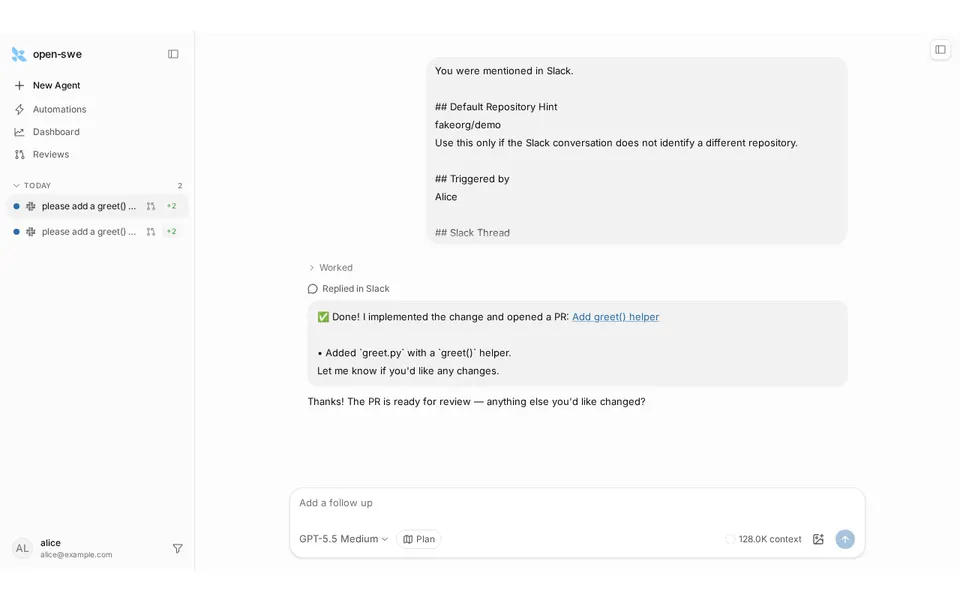
- Desktop app
- Mac
- Browser
- Yes
- Phone
- IPhone and phone browser
- Command line
- Yes
- Agents
- No
- Your subscription
- No
- Agents run
- On your computer and in the vendor's cloud
- Laptop closed
- Keeps going
- Isolation
- Worktree
- Parallel agents
- Yes
- Scheduled runs
- Yes
- Coordinator agent
- Yes
- Built-in issues
- Not listed
- Pull requests
- Yes
- Review screen
- Yes
- Team
- Shared sessions and roles
- Self-hosting
- Yes
- Licence
- MIT
- Price from
- Free
- How it charges
- No paid plan and bring your own key
- Paid plans from
- Not listed
Receipts
- Checked
- · oldest answer 2026-11-08
- Findings
- 37 published · 32 cross-checked by a second agent · read them all
- Sources
- 26 public pages on 2 sites: github.com, openswe.langchain.dev
- Screenshot
- github.com, retrieved · first party repository · shows appearance, not capability
- Data
- /products/open-swe.json · .md
- Method
- Same rules for all 103 researched ADEs. How we check · Report wrong data

What it does
Where you use it
Experimental desktop installation supports Apple Silicon macOS Ventura or later. The web dashboard is the recommended Robin client. Installing the desktop app links robin and oswe CLI commands. The dashboard starts and continues threads; local desktop Changes, Terminal and file browser use the selected checkout. The browser layout explicitly adapts its sidebar for phone-width screens.
Source and scope for Where you use itAgents it runs
Robin runs its own Deep Agents loop on Managed Deep Agents; the Claude Code connection is a read-only mirror. Anthropic, OpenAI and Google model examples are documented separately from the agent loop. Forking agent_catalog configures tools, models, subagents and loop rules. The scoped model/runtime catalog does not integrate the other compared coding-CLI sessions.
Source and scope for Agents it runsAccounts and subscriptions
Deployments use model-provider API keys or LangSmith Gateway credentials. Managed Deep Agents is required by the shipped backend; deploying without it requires adapting the code. The native model runtime uses API/Gateway credentials rather than coding-agent subscription login reuse.
Source and scope for Accounts and subscriptionsWhere agents run
This Mac bridges a selected local folder to the backend-managed agent loop. The control plane has standalone Docker deployment; shipped execution still depends on Managed Deep Agents. Cloud coding uses persistent per-thread LangSmith Linux sandboxes. Local desktop runs stop being reachable when the owning app quits. Cloud thread execution is backend-managed.
Source and scope for Where agents runHow work is kept apart
Local desktop can create a dedicated Git worktree per thread. Local task folders and worktrees are not filesystem security sandboxes; cloud sandboxes have powerful shell/network tools.
Source and scope for How work is kept apartParallel work
Independent cloud threads and separate local worktrees can run in parallel.
Source and scope for Parallel workScheduled runs
Recurring automation can start system-owned coding threads. GitHub, Slack and optional Linear events can initiate work.
Source and scope for Scheduled runsGit and pull requests
Robin opens and updates PRs, runs reviews and responds to CI feedback. Review findings can be published to GitHub.
Source and scope for Git and pull requestsLicence and source
Robin code is MIT licensed; vendor/ material is outside this repository grant. The MIT grant covers Robin backend code with the same vendor/ exclusion.
Source and scope for Licence and sourcePrice
open-swe (Robin) is MIT open source with no price of its own; deploying it as-is requires LangChain's Managed Deep Agents and uses LangSmith sandboxes by default, and the README does not price either. Model execution uses user-supplied provider API keys or LangSmith Gateway credentials; those external service costs are not an Open SWE plan price.
Source and scope for PriceTyped filters
Every value links to its receipt below. Read plan and surface restrictions before using a filter to decide.
| Filter | Value |
|---|---|
| Desktop OS: macOS | Yes |
| Desktop OS: Windows | No |
| Desktop OS: Linux | No |
| Web client | Yes |
| Phone access: Native iOS | Yes |
| Phone access: Native Android | No |
| Phone access: Phone browser | Yes |
| CLI | Yes cross-checked |
| Coding agents: Claude Code | No |
| Coding agents: Codex | No |
| Coding agents: Cursor Agent | No |
| Coding agents: Gemini CLI | No |
| Coding agents: OpenCode | No |
| Coding agents: Pi | No |
| Coding agents: Grok | No |
| Coding agents: Aider | No |
| Coding agents: Antigravity | No |
| Use my subscription | No |
| Where agents run: On your computer | Yes cross-checked |
| Where agents run: On your own server | Unknown |
| Where agents run: In the vendor's cloud | Yes cross-checked |
| Workspace isolation: Git worktree | Yes cross-checked |
| Workspace isolation: Container | Unknown |
| Workspace isolation: VM or microVM | Unknown |
| Parallel runs | Yes cross-checked |
| Coordinator | Yes cross-checked |
| Native issue tracking | Unknown |
| Unattended triggers | Yes cross-checked |
| Shared prompting | Yes cross-checked |
| Team roles | Yes cross-checked |
| SSO | Unknown |
| Pull request workflow | Yes cross-checked |
| Review interface | Yes cross-checked |
| Product license: Apache-2.0 | No. MIT cross-checked |
| Product license: MIT | Yes. MIT cross-checked |
| Product license: GPL-3.0 | No. MIT cross-checked |
| Product license: GPL-3.0-or-later | No. MIT cross-checked |
| Product license: AGPL-3.0 | No. MIT cross-checked |
| Product license: AGPL-3.0-or-later | No. MIT cross-checked |
| Product license: Elastic License 2.0 | No. MIT cross-checked |
| Product license: Custom terms | No. MIT cross-checked |
| Product license: Proprietary | No. MIT cross-checked |
| Self-hosting | Yes cross-checked |
| Telemetry opt-out | Yes cross-checked |
| Free access | Yes cross-checked |
| Starting price: Free | Yes. Free cross-checked |
| Starting price: Up to $20/month | No. Free cross-checked |
| Starting price: $21–40/month | No. Free cross-checked |
| Starting price: $41–100/month | No. Free cross-checked |
| Starting price: Over $100/month | No. Free cross-checked |
| Starting price: Contact for pricing | No. Free cross-checked |
| Pricing model: Free, no paid plan | Yes |
| Pricing model: Free plan | No |
| Pricing model: Subscription | No |
| Pricing model: Per seat | No |
| Pricing model: Usage-based | No |
| Pricing model: Per machine or compute | No |
| Pricing model: Bring your own key | Yes |
| Pricing model: One-time purchase | No |
| Paid plans from: No paid plan | Unknown |
| Paid plans from: $10 or less/month | Unknown |
| Paid plans from: $11–20/month | Unknown |
| Paid plans from: $21–40/month | Unknown |
| Paid plans from: $41–100/month | Unknown |
| Paid plans from: Over $100/month | Unknown |
| Paid plans from: Contact sales | Unknown |
| Lifecycle status: Active | Unknown |
| Lifecycle status: Sunsetting | Unknown |
| Keeps going with laptop closed | Yes |
| Open-source license | Yes. MIT cross-checked |
| Any desktop app | Yes |
| Paid plan up to $20/month | Unknown |
| Paid plan up to $40/month | Unknown |
| Any phone client | Yes |
Filter receipts
Desktop OS: macOS: Yes
Desktop OS: macOS
Typed value: Yes.
Experimental desktop installation supports Apple Silicon macOS Ventura or later. The web dashboard is the recommended Robin client. Installing the desktop app links robin and oswe CLI commands. The dashboard starts and continues threads; local desktop Changes, Terminal and file browser use the selected checkout. The browser layout explicitly adapts its sidebar for phone-width screens.
- Desktop os: Experimental desktop installation supports Apple Silicon macOS Ventura or later.
- Browser: The web dashboard is the recommended Robin client.
- Cli: Installing the desktop app links robin and oswe CLI commands.
- Task actions: The dashboard starts and continues threads; local desktop Changes, Terminal and file browser use the selected checkout.
- Only the named atomic answers are established by this source pass. Remaining atomic answers retain their documented gaps.
-
Finding: Experimental Electron client supports Apple Silicon macOS Ventura or later. Bundled robin/oswe CLI and local bridge run tasks in checkouts or worktrees. Local runs need the app open; Changes shows a session diff.
Desktop OS: Windows: No
Desktop OS: Windows
Typed value: No.
Experimental desktop installation supports Apple Silicon macOS Ventura or later. The web dashboard is the recommended Robin client. Installing the desktop app links robin and oswe CLI commands. The dashboard starts and continues threads; local desktop Changes, Terminal and file browser use the selected checkout. The browser layout explicitly adapts its sidebar for phone-width screens.
- Desktop os: Experimental desktop installation supports Apple Silicon macOS Ventura or later.
- Browser: The web dashboard is the recommended Robin client.
- Cli: Installing the desktop app links robin and oswe CLI commands.
- Task actions: The dashboard starts and continues threads; local desktop Changes, Terminal and file browser use the selected checkout.
- Only the named atomic answers are established by this source pass. Remaining atomic answers retain their documented gaps.
-
Finding: Experimental Electron client supports Apple Silicon macOS Ventura or later. Bundled robin/oswe CLI and local bridge run tasks in checkouts or worktrees. Local runs need the app open; Changes shows a session diff.
Desktop OS: Linux: No
Desktop OS: Linux
Typed value: No.
Experimental desktop installation supports Apple Silicon macOS Ventura or later. The web dashboard is the recommended Robin client. Installing the desktop app links robin and oswe CLI commands. The dashboard starts and continues threads; local desktop Changes, Terminal and file browser use the selected checkout. The browser layout explicitly adapts its sidebar for phone-width screens.
- Desktop os: Experimental desktop installation supports Apple Silicon macOS Ventura or later.
- Browser: The web dashboard is the recommended Robin client.
- Cli: Installing the desktop app links robin and oswe CLI commands.
- Task actions: The dashboard starts and continues threads; local desktop Changes, Terminal and file browser use the selected checkout.
- Only the named atomic answers are established by this source pass. Remaining atomic answers retain their documented gaps.
-
Finding: Experimental Electron client supports Apple Silicon macOS Ventura or later. Bundled robin/oswe CLI and local bridge run tasks in checkouts or worktrees. Local runs need the app open; Changes shows a session diff.
Web client: Yes
Web client
Typed value: Yes.
Experimental desktop installation supports Apple Silicon macOS Ventura or later. The web dashboard is the recommended Robin client. Installing the desktop app links robin and oswe CLI commands. The dashboard starts and continues threads; local desktop Changes, Terminal and file browser use the selected checkout. The browser layout explicitly adapts its sidebar for phone-width screens.
- Desktop os: Experimental desktop installation supports Apple Silicon macOS Ventura or later.
- Browser: The web dashboard is the recommended Robin client.
- Cli: Installing the desktop app links robin and oswe CLI commands.
- Task actions: The dashboard starts and continues threads; local desktop Changes, Terminal and file browser use the selected checkout.
- Only the named atomic answers are established by this source pass. Remaining atomic answers retain their documented gaps.
-
Finding: Experimental Electron client supports Apple Silicon macOS Ventura or later. Bundled robin/oswe CLI and local bridge run tasks in checkouts or worktrees. Local runs need the app open; Changes shows a session diff.
Phone access: Native iOS: Yes
Phone access: Native iOS
Typed value: Yes.
Experimental desktop installation supports Apple Silicon macOS Ventura or later. The web dashboard is the recommended Robin client. Installing the desktop app links robin and oswe CLI commands. The dashboard starts and continues threads; local desktop Changes, Terminal and file browser use the selected checkout. The browser layout explicitly adapts its sidebar for phone-width screens.
- Mobile apps: An iOS client exists as source that you build with Xcode as a development build; it is not in any release or app store. The README says only iOS is supported, so there is no Android app.
- Only the named atomic answers are established by this source pass. Remaining atomic answers retain their documented gaps.
-
Finding: The iOS Expo client is built from source with Xcode as a development build on a simulator or connected iPhone; the README states only iOS is supported. No App Store or release asset is documented.
Phone access: Native Android: No
Phone access: Native Android
Typed value: No.
Experimental desktop installation supports Apple Silicon macOS Ventura or later. The web dashboard is the recommended Robin client. Installing the desktop app links robin and oswe CLI commands. The dashboard starts and continues threads; local desktop Changes, Terminal and file browser use the selected checkout. The browser layout explicitly adapts its sidebar for phone-width screens.
- Mobile apps: An iOS client exists as source that you build with Xcode as a development build; it is not in any release or app store. The README says only iOS is supported, so there is no Android app.
- Only the named atomic answers are established by this source pass. Remaining atomic answers retain their documented gaps.
-
Finding: The iOS Expo client is built from source with Xcode as a development build on a simulator or connected iPhone; the README states only iOS is supported. No App Store or release asset is documented.
Phone access: Phone browser: Yes
Phone access: Phone browser
Typed value: Yes.
Experimental desktop installation supports Apple Silicon macOS Ventura or later. The web dashboard is the recommended Robin client. Installing the desktop app links robin and oswe CLI commands. The dashboard starts and continues threads; local desktop Changes, Terminal and file browser use the selected checkout. The browser layout explicitly adapts its sidebar for phone-width screens.
- Mobile browser: The browser client implements a full-screen mobile sidebar overlay below 767px so the chat stays visible.
- Only the named atomic answers are established by this source pass. Remaining atomic answers retain their documented gaps.
-
Finding: The browser client explicitly uses a mobile full-screen sidebar overlay and collapses it below 767px so the chat remains visible. This is the cloud-thread browser client; This Mac threads retain their documented owning-Mac restrictions.
CLI: Yes cross-checked
CLI
Typed value: Yes.
robin/oswe are product CLI entry points. FastAPI dashboard APIs share the deployment origin with the web dashboard. The Robin MCP endpoint exposes thread lookup and human-review request/dismiss operations to local sessions. Signed GitHub and Slack webhook routes start and continue agent work. Machine callers can start system-owned threads through scoped credentials; dashboard callers use authenticated sessions.
- Cli: robin/oswe are product CLI entry points.
- Only the cited atomic findings are established. Remaining atomic requirements and the full rubric scenario remain unverified.
-
Finding: Experimental Electron client supports Apple Silicon macOS Ventura or later. Bundled robin/oswe CLI and local bridge run tasks in checkouts or worktrees. Local runs need the app open; Changes shows a session diff.
Coding agents: Claude Code: No
Coding agents: Claude Code
Typed value: No.
Robin runs its own Deep Agents loop on Managed Deep Agents; the Claude Code connection is a read-only mirror. Anthropic, OpenAI and Google model examples are documented separately from the agent loop. Forking agent_catalog configures tools, models, subagents and loop rules. The scoped model/runtime catalog does not integrate the other compared coding-CLI sessions.
- Session integration: Robin owns the Deep Agents model/tool loop. Claude Code sync is read-only; it cannot prompt, steer or stop that Claude Code session. No native external coding-CLI session adapters were found in the scoped runtime/model catalog.
- Only the named atomic answers are established by this source pass. Remaining atomic answers retain their documented gaps.
-
Finding: Claude Code hook events are posted to Robin so each Claude Code session appears as a private, read-only dashboard thread; Robin does not drive the session.
-
Robin agent runtime and model configuration
Finding: Every run model loop runs on Managed Deep Agents and uses Robin-configured models, subagents, tools and loop rules. Bounded inspection of mda runtime/model catalog and sandbox tool surface found no runnable integration of the nine compared external coding-CLI harnesses. Claude Code hooks are separately documented read-only mirrors; provider access uses API/Gateway credentials.
Coding agents: Codex: No
Coding agents: Codex
Typed value: No.
Robin runs its own Deep Agents loop on Managed Deep Agents; the Claude Code connection is a read-only mirror. Anthropic, OpenAI and Google model examples are documented separately from the agent loop. Forking agent_catalog configures tools, models, subagents and loop rules. The scoped model/runtime catalog does not integrate the other compared coding-CLI sessions.
- Session integration: Robin owns the Deep Agents model/tool loop. Claude Code sync is read-only; it cannot prompt, steer or stop that Claude Code session. No native external coding-CLI session adapters were found in the scoped runtime/model catalog.
- Only the named atomic answers are established by this source pass. Remaining atomic answers retain their documented gaps.
-
Finding: Claude Code hook events are posted to Robin so each Claude Code session appears as a private, read-only dashboard thread; Robin does not drive the session.
-
Robin agent runtime and model configuration
Finding: Every run model loop runs on Managed Deep Agents and uses Robin-configured models, subagents, tools and loop rules. Bounded inspection of mda runtime/model catalog and sandbox tool surface found no runnable integration of the nine compared external coding-CLI harnesses. Claude Code hooks are separately documented read-only mirrors; provider access uses API/Gateway credentials.
Coding agents: Cursor Agent: No
Coding agents: Cursor Agent
Typed value: No.
Robin runs its own Deep Agents loop on Managed Deep Agents; the Claude Code connection is a read-only mirror. Anthropic, OpenAI and Google model examples are documented separately from the agent loop. Forking agent_catalog configures tools, models, subagents and loop rules. The scoped model/runtime catalog does not integrate the other compared coding-CLI sessions.
- Session integration: Robin owns the Deep Agents model/tool loop. Claude Code sync is read-only; it cannot prompt, steer or stop that Claude Code session. No native external coding-CLI session adapters were found in the scoped runtime/model catalog.
- Only the named atomic answers are established by this source pass. Remaining atomic answers retain their documented gaps.
-
Finding: Claude Code hook events are posted to Robin so each Claude Code session appears as a private, read-only dashboard thread; Robin does not drive the session.
-
Robin agent runtime and model configuration
Finding: Every run model loop runs on Managed Deep Agents and uses Robin-configured models, subagents, tools and loop rules. Bounded inspection of mda runtime/model catalog and sandbox tool surface found no runnable integration of the nine compared external coding-CLI harnesses. Claude Code hooks are separately documented read-only mirrors; provider access uses API/Gateway credentials.
Coding agents: Gemini CLI: No
Coding agents: Gemini CLI
Typed value: No.
Robin runs its own Deep Agents loop on Managed Deep Agents; the Claude Code connection is a read-only mirror. Anthropic, OpenAI and Google model examples are documented separately from the agent loop. Forking agent_catalog configures tools, models, subagents and loop rules. The scoped model/runtime catalog does not integrate the other compared coding-CLI sessions.
- Session integration: Robin owns the Deep Agents model/tool loop. Claude Code sync is read-only; it cannot prompt, steer or stop that Claude Code session. No native external coding-CLI session adapters were found in the scoped runtime/model catalog.
- Only the named atomic answers are established by this source pass. Remaining atomic answers retain their documented gaps.
-
Finding: Claude Code hook events are posted to Robin so each Claude Code session appears as a private, read-only dashboard thread; Robin does not drive the session.
-
Robin agent runtime and model configuration
Finding: Every run model loop runs on Managed Deep Agents and uses Robin-configured models, subagents, tools and loop rules. Bounded inspection of mda runtime/model catalog and sandbox tool surface found no runnable integration of the nine compared external coding-CLI harnesses. Claude Code hooks are separately documented read-only mirrors; provider access uses API/Gateway credentials.
Coding agents: OpenCode: No
Coding agents: OpenCode
Typed value: No.
Robin runs its own Deep Agents loop on Managed Deep Agents; the Claude Code connection is a read-only mirror. Anthropic, OpenAI and Google model examples are documented separately from the agent loop. Forking agent_catalog configures tools, models, subagents and loop rules. The scoped model/runtime catalog does not integrate the other compared coding-CLI sessions.
- Session integration: Robin owns the Deep Agents model/tool loop. Claude Code sync is read-only; it cannot prompt, steer or stop that Claude Code session. No native external coding-CLI session adapters were found in the scoped runtime/model catalog.
- Only the named atomic answers are established by this source pass. Remaining atomic answers retain their documented gaps.
-
Finding: Claude Code hook events are posted to Robin so each Claude Code session appears as a private, read-only dashboard thread; Robin does not drive the session.
-
Robin agent runtime and model configuration
Finding: Every run model loop runs on Managed Deep Agents and uses Robin-configured models, subagents, tools and loop rules. Bounded inspection of mda runtime/model catalog and sandbox tool surface found no runnable integration of the nine compared external coding-CLI harnesses. Claude Code hooks are separately documented read-only mirrors; provider access uses API/Gateway credentials.
Coding agents: Pi: No
Coding agents: Pi
Typed value: No.
Robin runs its own Deep Agents loop on Managed Deep Agents; the Claude Code connection is a read-only mirror. Anthropic, OpenAI and Google model examples are documented separately from the agent loop. Forking agent_catalog configures tools, models, subagents and loop rules. The scoped model/runtime catalog does not integrate the other compared coding-CLI sessions.
- Session integration: Robin owns the Deep Agents model/tool loop. Claude Code sync is read-only; it cannot prompt, steer or stop that Claude Code session. No native external coding-CLI session adapters were found in the scoped runtime/model catalog.
- Only the named atomic answers are established by this source pass. Remaining atomic answers retain their documented gaps.
-
Finding: Claude Code hook events are posted to Robin so each Claude Code session appears as a private, read-only dashboard thread; Robin does not drive the session.
-
Robin agent runtime and model configuration
Finding: Every run model loop runs on Managed Deep Agents and uses Robin-configured models, subagents, tools and loop rules. Bounded inspection of mda runtime/model catalog and sandbox tool surface found no runnable integration of the nine compared external coding-CLI harnesses. Claude Code hooks are separately documented read-only mirrors; provider access uses API/Gateway credentials.
Coding agents: Grok: No
Coding agents: Grok
Typed value: No.
Robin runs its own Deep Agents loop on Managed Deep Agents; the Claude Code connection is a read-only mirror. Anthropic, OpenAI and Google model examples are documented separately from the agent loop. Forking agent_catalog configures tools, models, subagents and loop rules. The scoped model/runtime catalog does not integrate the other compared coding-CLI sessions.
- Session integration: Robin owns the Deep Agents model/tool loop. Claude Code sync is read-only; it cannot prompt, steer or stop that Claude Code session. No native external coding-CLI session adapters were found in the scoped runtime/model catalog.
- Only the named atomic answers are established by this source pass. Remaining atomic answers retain their documented gaps.
-
Finding: Claude Code hook events are posted to Robin so each Claude Code session appears as a private, read-only dashboard thread; Robin does not drive the session.
-
Robin agent runtime and model configuration
Finding: Every run model loop runs on Managed Deep Agents and uses Robin-configured models, subagents, tools and loop rules. Bounded inspection of mda runtime/model catalog and sandbox tool surface found no runnable integration of the nine compared external coding-CLI harnesses. Claude Code hooks are separately documented read-only mirrors; provider access uses API/Gateway credentials.
Coding agents: Aider: No
Coding agents: Aider
Typed value: No.
Robin runs its own Deep Agents loop on Managed Deep Agents; the Claude Code connection is a read-only mirror. Anthropic, OpenAI and Google model examples are documented separately from the agent loop. Forking agent_catalog configures tools, models, subagents and loop rules. The scoped model/runtime catalog does not integrate the other compared coding-CLI sessions.
- Session integration: Robin owns the Deep Agents model/tool loop. Claude Code sync is read-only; it cannot prompt, steer or stop that Claude Code session. No native external coding-CLI session adapters were found in the scoped runtime/model catalog.
- Only the named atomic answers are established by this source pass. Remaining atomic answers retain their documented gaps.
-
Finding: Claude Code hook events are posted to Robin so each Claude Code session appears as a private, read-only dashboard thread; Robin does not drive the session.
-
Robin agent runtime and model configuration
Finding: Every run model loop runs on Managed Deep Agents and uses Robin-configured models, subagents, tools and loop rules. Bounded inspection of mda runtime/model catalog and sandbox tool surface found no runnable integration of the nine compared external coding-CLI harnesses. Claude Code hooks are separately documented read-only mirrors; provider access uses API/Gateway credentials.
Coding agents: Antigravity: No
Coding agents: Antigravity
Typed value: No.
Robin runs its own Deep Agents loop on Managed Deep Agents; the Claude Code connection is a read-only mirror. Anthropic, OpenAI and Google model examples are documented separately from the agent loop. Forking agent_catalog configures tools, models, subagents and loop rules. The scoped model/runtime catalog does not integrate the other compared coding-CLI sessions.
- Session integration: Robin owns the Deep Agents model/tool loop. Claude Code sync is read-only; it cannot prompt, steer or stop that Claude Code session. No native external coding-CLI session adapters were found in the scoped runtime/model catalog.
- Only the named atomic answers are established by this source pass. Remaining atomic answers retain their documented gaps.
-
Finding: Claude Code hook events are posted to Robin so each Claude Code session appears as a private, read-only dashboard thread; Robin does not drive the session.
-
Robin agent runtime and model configuration
Finding: Every run model loop runs on Managed Deep Agents and uses Robin-configured models, subagents, tools and loop rules. Bounded inspection of mda runtime/model catalog and sandbox tool surface found no runnable integration of the nine compared external coding-CLI harnesses. Claude Code hooks are separately documented read-only mirrors; provider access uses API/Gateway credentials.
Use my subscription: No
Use my subscription
Typed value: No.
Deployments use model-provider API keys or LangSmith Gateway credentials. Managed Deep Agents is required by the shipped backend; deploying without it requires adapting the code. The native model runtime uses API/Gateway credentials rather than coding-agent subscription login reuse.
- Agent subscriptions: The shipped own-agent loop uses model API/Gateway credentials; the read-only Claude Code mirror is not agent execution under a reused subscription.
- Only the named atomic answers are established by this source pass. Remaining atomic answers retain their documented gaps.
-
Robin docs/reference/claude-code-sync.md
Finding: Claude Code hooks mirror local sessions into private read-only dashboard threads. Mirrors cannot be prompted, steered or stopped in Robin; uploaded sessions can start a separate continuable thread.
-
Robin agent runtime and model configuration
Finding: Every run model loop runs on Managed Deep Agents and uses Robin-configured models, subagents, tools and loop rules. Bounded inspection of mda runtime/model catalog and sandbox tool surface found no runnable integration of the nine compared external coding-CLI harnesses. Claude Code hooks are separately documented read-only mirrors; provider access uses API/Gateway credentials.
Where agents run: On your computer: Yes cross-checked
Where agents run: On your computer
Typed value: Yes.
This Mac bridges a selected local folder to the backend-managed agent loop. The control plane has standalone Docker deployment; shipped execution still depends on Managed Deep Agents. Cloud coding uses persistent per-thread LangSmith Linux sandboxes. Local desktop runs stop being reachable when the owning app quits. Cloud thread execution is backend-managed.
- Local: This Mac bridges a selected local folder to the backend-managed agent loop.
- Client disconnect: Local desktop runs stop being reachable when the owning app quits. Cloud thread execution is backend-managed.
- Only the cited atomic findings are established. Remaining atomic requirements and the full rubric scenario remain unverified.
-
Finding: Experimental Electron client supports Apple Silicon macOS Ventura or later. Bundled robin/oswe CLI and local bridge run tasks in checkouts or worktrees. Local runs need the app open; Changes shows a session diff.
Where agents run: In the vendor's cloud: Yes cross-checked
Where agents run: In the vendor's cloud
Typed value: Yes.
This Mac bridges a selected local folder to the backend-managed agent loop. The control plane has standalone Docker deployment; shipped execution still depends on Managed Deep Agents. Cloud coding uses persistent per-thread LangSmith Linux sandboxes. Local desktop runs stop being reachable when the owning app quits. Cloud thread execution is backend-managed.
- Managed cloud: Cloud coding uses persistent per-thread LangSmith Linux sandboxes.
- Only the cited atomic findings are established. Remaining atomic requirements and the full rubric scenario remain unverified.
-
Finding: Per-thread LangSmith Linux sandboxes, snapshots and local bridges are configurable. Models use API credentials or LangSmith Gateway. Workspace and personal MCP scopes, skills and repository instructions are configurable.
Workspace isolation: Git worktree: Yes cross-checked
Workspace isolation: Git worktree
Typed value: Yes.
Local desktop can create a dedicated Git worktree per thread. Local task folders and worktrees are not filesystem security sandboxes; cloud sandboxes have powerful shell/network tools.
- Worktree: Local desktop can create a dedicated Git worktree per thread.
- Security boundary: Local task folders and worktrees are not filesystem security sandboxes; cloud sandboxes have powerful shell/network tools.
- Only the cited atomic findings are established. Remaining atomic requirements and the full rubric scenario remain unverified.
-
Finding: Experimental Electron client supports Apple Silicon macOS Ventura or later. Bundled robin/oswe CLI and local bridge run tasks in checkouts or worktrees. Local runs need the app open; Changes shows a session diff.
Parallel runs: Yes cross-checked
Parallel runs
Typed value: Yes.
Independent cloud threads and separate local worktrees can run in parallel.
- Concurrent sessions: Independent cloud threads and separate local worktrees can run in parallel.
- Only the cited atomic findings are established. Remaining atomic requirements and the full rubric scenario remain unverified.
-
Finding: Robin is the current name for this repository. The backend uses Deep Agents and LangGraph, supports parallel threads and subagents, accepts GitHub/Slack/Linear input, and delivers PRs. Managed Deep Agents is required as shipped.
-
Finding: Experimental Electron client supports Apple Silicon macOS Ventura or later. Bundled robin/oswe CLI and local bridge run tasks in checkouts or worktrees. Local runs need the app open; Changes shows a session diff.
Coordinator: Yes cross-checked
Coordinator
Typed value: Yes.
The runtime configures general-purpose subagents for independent work. Configuration separates main and subagent models and reasoning effort. Robin configures Deep Agents subagents through its own agent catalog.
- Roles: The runtime configures general-purpose subagents for independent work.
- Model harness effort: Configuration separates main and subagent models and reasoning effort.
- Orchestration owner: Robin configures Deep Agents subagents through its own agent catalog.
- Only the cited atomic findings are established. Remaining atomic requirements and the full rubric scenario remain unverified.
-
Finding: Per-thread LangSmith Linux sandboxes, snapshots and local bridges are configurable. Models use API credentials or LangSmith Gateway. Workspace and personal MCP scopes, skills and repository instructions are configurable.
Unattended triggers: Yes cross-checked
Unattended triggers
Typed value: Yes.
Recurring automation can start system-owned coding threads. GitHub, Slack and optional Linear events can initiate work.
- Schedules: Recurring automation can start system-owned coding threads.
- Events: GitHub, Slack and optional Linear events can initiate work.
- Only the cited atomic findings are established. Remaining atomic requirements and the full rubric scenario remain unverified.
-
Finding: Robin is the current name for this repository. The backend uses Deep Agents and LangGraph, supports parallel threads and subagents, accepts GitHub/Slack/Linear input, and delivers PRs. Managed Deep Agents is required as shipped.
-
Finding: Web dashboard and FastAPI share one deployment. Docker self-hosting still requires Managed Deep Agents. GitHub/Slack are required, Linear optional. PostHog and Segment capture are disabled without their keys. Shared Slack threads accept queued participant prompts.
Shared prompting: Yes cross-checked
Shared prompting
Typed value: Yes.
Workspace and Slack collaborative threads can be prompted by participants without using personal MCP credentials.
- Coprompting: Workspace and Slack collaborative threads can be prompted by participants without using personal MCP credentials.
- Only the cited atomic findings are established. Remaining atomic requirements and the full rubric scenario remain unverified.
-
Finding: Per-thread LangSmith Linux sandboxes, snapshots and local bridges are configurable. Models use API credentials or LangSmith Gateway. Workspace and personal MCP scopes, skills and repository instructions are configurable.
Team roles: Yes cross-checked
Team roles
Typed value: Yes.
Configured admins administer all workspaces; signed-in users can use every workspace. Per-workspace role-based membership and access are explicitly deferred.
- Organization roles: Configured admins administer all workspaces; signed-in users can use every workspace.
- Project roles: Per-workspace role-based membership and access are explicitly deferred.
- Only the cited atomic findings are established. Remaining atomic requirements and the full rubric scenario remain unverified.
-
Robin docs/reference/workspaces.md
Finding: All signed-in users see all workspaces; configured admins administer all. Public/private thread visibility differs. Per-workspace membership and roles are explicitly deferred; repository routing is not credential isolation.
Pull request workflow: Yes cross-checked
Pull request workflow
Typed value: Yes.
Robin opens and updates PRs, runs reviews and responds to CI feedback. Review findings can be published to GitHub.
- Pull requests: Robin opens and updates PRs, runs reviews and responds to CI feedback.
- Comments: Review findings can be published to GitHub.
- Only the cited atomic findings are established. Remaining atomic requirements and the full rubric scenario remain unverified.
-
Finding: Robin is the current name for this repository. The backend uses Deep Agents and LangGraph, supports parallel threads and subagents, accepts GitHub/Slack/Linear input, and delivers PRs. Managed Deep Agents is required as shipped.
Review interface: Yes cross-checked
Review interface
Typed value: Yes.
Desktop Changes compares against the initial Git snapshot and links the discovered PR.
- Diffs: Desktop Changes compares against the initial Git snapshot and links the discovered PR.
- Only the cited atomic findings are established. Remaining atomic requirements and the full rubric scenario remain unverified.
-
Finding: Experimental Electron client supports Apple Silicon macOS Ventura or later. Bundled robin/oswe CLI and local bridge run tasks in checkouts or worktrees. Local runs need the app open; Changes shows a session diff.
Product license: Apache-2.0: No. MIT cross-checked
Product license: Apache-2.0
Typed value: No. MIT.
Robin code is MIT licensed; vendor/ material is outside this repository grant. The MIT grant covers Robin backend code with the same vendor/ exclusion.
- Client license: Robin code is MIT licensed; vendor/ material is outside this repository grant.
- Server license: The MIT grant covers Robin backend code with the same vendor/ exclusion.
- Only the cited atomic findings are established. Remaining atomic requirements and the full rubric scenario remain unverified.
-
Finding: Robin is the current name for this repository. The backend uses Deep Agents and LangGraph, supports parallel threads and subagents, accepts GitHub/Slack/Linear input, and delivers PRs. Managed Deep Agents is required as shipped.
-
Finding: Robin code is MIT licensed; README excludes vendor/ material from that grant.
Product license: MIT: Yes. MIT cross-checked
Product license: MIT
Typed value: Yes. MIT.
Robin code is MIT licensed; vendor/ material is outside this repository grant. The MIT grant covers Robin backend code with the same vendor/ exclusion.
- Client license: Robin code is MIT licensed; vendor/ material is outside this repository grant.
- Server license: The MIT grant covers Robin backend code with the same vendor/ exclusion.
- Only the cited atomic findings are established. Remaining atomic requirements and the full rubric scenario remain unverified.
-
Finding: Robin is the current name for this repository. The backend uses Deep Agents and LangGraph, supports parallel threads and subagents, accepts GitHub/Slack/Linear input, and delivers PRs. Managed Deep Agents is required as shipped.
-
Finding: Robin code is MIT licensed; README excludes vendor/ material from that grant.
Product license: GPL-3.0: No. MIT cross-checked
Product license: GPL-3.0
Typed value: No. MIT.
Robin code is MIT licensed; vendor/ material is outside this repository grant. The MIT grant covers Robin backend code with the same vendor/ exclusion.
- Client license: Robin code is MIT licensed; vendor/ material is outside this repository grant.
- Server license: The MIT grant covers Robin backend code with the same vendor/ exclusion.
- Only the cited atomic findings are established. Remaining atomic requirements and the full rubric scenario remain unverified.
-
Finding: Robin is the current name for this repository. The backend uses Deep Agents and LangGraph, supports parallel threads and subagents, accepts GitHub/Slack/Linear input, and delivers PRs. Managed Deep Agents is required as shipped.
-
Finding: Robin code is MIT licensed; README excludes vendor/ material from that grant.
Product license: GPL-3.0-or-later: No. MIT cross-checked
Product license: GPL-3.0-or-later
Typed value: No. MIT.
Robin code is MIT licensed; vendor/ material is outside this repository grant. The MIT grant covers Robin backend code with the same vendor/ exclusion.
- Client license: Robin code is MIT licensed; vendor/ material is outside this repository grant.
- Server license: The MIT grant covers Robin backend code with the same vendor/ exclusion.
- Only the cited atomic findings are established. Remaining atomic requirements and the full rubric scenario remain unverified.
-
Finding: Robin is the current name for this repository. The backend uses Deep Agents and LangGraph, supports parallel threads and subagents, accepts GitHub/Slack/Linear input, and delivers PRs. Managed Deep Agents is required as shipped.
-
Finding: Robin code is MIT licensed; README excludes vendor/ material from that grant.
Product license: AGPL-3.0: No. MIT cross-checked
Product license: AGPL-3.0
Typed value: No. MIT.
Robin code is MIT licensed; vendor/ material is outside this repository grant. The MIT grant covers Robin backend code with the same vendor/ exclusion.
- Client license: Robin code is MIT licensed; vendor/ material is outside this repository grant.
- Server license: The MIT grant covers Robin backend code with the same vendor/ exclusion.
- Only the cited atomic findings are established. Remaining atomic requirements and the full rubric scenario remain unverified.
-
Finding: Robin is the current name for this repository. The backend uses Deep Agents and LangGraph, supports parallel threads and subagents, accepts GitHub/Slack/Linear input, and delivers PRs. Managed Deep Agents is required as shipped.
-
Finding: Robin code is MIT licensed; README excludes vendor/ material from that grant.
Product license: AGPL-3.0-or-later: No. MIT cross-checked
Product license: AGPL-3.0-or-later
Typed value: No. MIT.
Robin code is MIT licensed; vendor/ material is outside this repository grant. The MIT grant covers Robin backend code with the same vendor/ exclusion.
- Client license: Robin code is MIT licensed; vendor/ material is outside this repository grant.
- Server license: The MIT grant covers Robin backend code with the same vendor/ exclusion.
- Only the cited atomic findings are established. Remaining atomic requirements and the full rubric scenario remain unverified.
-
Finding: Robin is the current name for this repository. The backend uses Deep Agents and LangGraph, supports parallel threads and subagents, accepts GitHub/Slack/Linear input, and delivers PRs. Managed Deep Agents is required as shipped.
-
Finding: Robin code is MIT licensed; README excludes vendor/ material from that grant.
Product license: Elastic License 2.0: No. MIT cross-checked
Product license: Elastic License 2.0
Typed value: No. MIT.
Robin code is MIT licensed; vendor/ material is outside this repository grant. The MIT grant covers Robin backend code with the same vendor/ exclusion.
- Client license: Robin code is MIT licensed; vendor/ material is outside this repository grant.
- Server license: The MIT grant covers Robin backend code with the same vendor/ exclusion.
- Only the cited atomic findings are established. Remaining atomic requirements and the full rubric scenario remain unverified.
-
Finding: Robin is the current name for this repository. The backend uses Deep Agents and LangGraph, supports parallel threads and subagents, accepts GitHub/Slack/Linear input, and delivers PRs. Managed Deep Agents is required as shipped.
-
Finding: Robin code is MIT licensed; README excludes vendor/ material from that grant.
Product license: Custom terms: No. MIT cross-checked
Product license: Custom terms
Typed value: No. MIT.
Robin code is MIT licensed; vendor/ material is outside this repository grant. The MIT grant covers Robin backend code with the same vendor/ exclusion.
- Client license: Robin code is MIT licensed; vendor/ material is outside this repository grant.
- Server license: The MIT grant covers Robin backend code with the same vendor/ exclusion.
- Only the cited atomic findings are established. Remaining atomic requirements and the full rubric scenario remain unverified.
-
Finding: Robin is the current name for this repository. The backend uses Deep Agents and LangGraph, supports parallel threads and subagents, accepts GitHub/Slack/Linear input, and delivers PRs. Managed Deep Agents is required as shipped.
-
Finding: Robin code is MIT licensed; README excludes vendor/ material from that grant.
Product license: Proprietary: No. MIT cross-checked
Product license: Proprietary
Typed value: No. MIT.
Robin code is MIT licensed; vendor/ material is outside this repository grant. The MIT grant covers Robin backend code with the same vendor/ exclusion.
- Client license: Robin code is MIT licensed; vendor/ material is outside this repository grant.
- Server license: The MIT grant covers Robin backend code with the same vendor/ exclusion.
- Only the cited atomic findings are established. Remaining atomic requirements and the full rubric scenario remain unverified.
-
Finding: Robin is the current name for this repository. The backend uses Deep Agents and LangGraph, supports parallel threads and subagents, accepts GitHub/Slack/Linear input, and delivers PRs. Managed Deep Agents is required as shipped.
-
Finding: Robin code is MIT licensed; README excludes vendor/ material from that grant.
Self-hosting: Yes cross-checked
Self-hosting
Typed value: Yes.
The core backend and web UI can be deployed using the documented Docker image. The unmodified backend requires Managed Deep Agents and LangSmith credentials.
- Self hosting: The core backend and web UI can be deployed using the documented Docker image.
- Vendor dependencies: The unmodified backend requires Managed Deep Agents and LangSmith credentials.
- Only the cited atomic findings are established. Remaining atomic requirements and the full rubric scenario remain unverified.
-
Finding: Web dashboard and FastAPI share one deployment. Docker self-hosting still requires Managed Deep Agents. GitHub/Slack are required, Linear optional. PostHog and Segment capture are disabled without their keys. Shared Slack threads accept queued participant prompts.
Telemetry opt-out: Yes cross-checked
Telemetry opt-out
Typed value: Yes.
The documented optional PostHog and Segment integrations send nothing without keys. This does not describe every trace or audit store. Leaving POSTHOG_API_KEY and SEGMENT_BROWSER_WRITE_KEY unset disables those optional telemetry integrations.
- Telemetry defaults: The documented optional PostHog and Segment integrations send nothing without keys. This does not describe every trace or audit store.
- Telemetry controls: Leaving POSTHOG_API_KEY and SEGMENT_BROWSER_WRITE_KEY unset disables those optional telemetry integrations.
- Only the cited atomic findings are established. Remaining atomic requirements and the full rubric scenario remain unverified.
-
Finding: Web dashboard and FastAPI share one deployment. Docker self-hosting still requires Managed Deep Agents. GitHub/Slack are required, Linear optional. PostHog and Segment capture are disabled without their keys. Shared Slack threads accept queued participant prompts.
Free access: Yes cross-checked
Free access
Typed value: Yes.
Robin is MIT open source. The desktop app and CLI are free downloads from GitHub releases, currently nightly pre-releases. LangChain's own deployment requires sign-in and shows no plans or pricing. Deploying it as-is depends on Managed Deep Agents and LangSmith sandboxes, which the repository does not price.
- Ongoing free: The desktop app, CLI and backend source are free to download under MIT, with no paid tier in the README, licence or releases.
- No installed-product test was run.
- Desktop releases are nightly pre-releases.
- Costs for Managed Deep Agents, LangSmith sandboxes and models are not in the repository.
-
Robin Desktop Nightly 20261110161458 release assets
Finding: The latest desktop release is a free pre-release with only arm64 macOS app builds plus free standalone CLI binaries for macOS and Linux; no Windows or Linux desktop app and no iOS build is attached.
Starting price: Free: Yes. Free cross-checked
Starting price: Free
Typed value: Yes. Free.
Robin is MIT open source. The desktop app and CLI are free downloads from GitHub releases, currently nightly pre-releases. LangChain's own deployment requires sign-in and shows no plans or pricing. Deploying it as-is depends on Managed Deep Agents and LangSmith sandboxes, which the repository does not price.
- Ongoing free: The desktop app, CLI and backend source are free to download under MIT, with no paid tier in the README, licence or releases.
- No installed-product test was run.
- Desktop releases are nightly pre-releases.
- Costs for Managed Deep Agents, LangSmith sandboxes and models are not in the repository.
-
Robin Desktop Nightly 20261110161458 release assets
Finding: The latest desktop release is a free pre-release with only arm64 macOS app builds plus free standalone CLI binaries for macOS and Linux; no Windows or Linux desktop app and no iOS build is attached.
Starting price: Up to $20/month: No. Free cross-checked
Starting price: Up to $20/month
Typed value: No. Free.
Robin is MIT open source. The desktop app and CLI are free downloads from GitHub releases, currently nightly pre-releases. LangChain's own deployment requires sign-in and shows no plans or pricing. Deploying it as-is depends on Managed Deep Agents and LangSmith sandboxes, which the repository does not price.
- Ongoing free: The desktop app, CLI and backend source are free to download under MIT, with no paid tier in the README, licence or releases.
- No installed-product test was run.
- Desktop releases are nightly pre-releases.
- Costs for Managed Deep Agents, LangSmith sandboxes and models are not in the repository.
-
Robin Desktop Nightly 20261110161458 release assets
Finding: The latest desktop release is a free pre-release with only arm64 macOS app builds plus free standalone CLI binaries for macOS and Linux; no Windows or Linux desktop app and no iOS build is attached.
Starting price: $21–40/month: No. Free cross-checked
Starting price: $21–40/month
Typed value: No. Free.
Robin is MIT open source. The desktop app and CLI are free downloads from GitHub releases, currently nightly pre-releases. LangChain's own deployment requires sign-in and shows no plans or pricing. Deploying it as-is depends on Managed Deep Agents and LangSmith sandboxes, which the repository does not price.
- Ongoing free: The desktop app, CLI and backend source are free to download under MIT, with no paid tier in the README, licence or releases.
- No installed-product test was run.
- Desktop releases are nightly pre-releases.
- Costs for Managed Deep Agents, LangSmith sandboxes and models are not in the repository.
-
Robin Desktop Nightly 20261110161458 release assets
Finding: The latest desktop release is a free pre-release with only arm64 macOS app builds plus free standalone CLI binaries for macOS and Linux; no Windows or Linux desktop app and no iOS build is attached.
Starting price: $41–100/month: No. Free cross-checked
Starting price: $41–100/month
Typed value: No. Free.
Robin is MIT open source. The desktop app and CLI are free downloads from GitHub releases, currently nightly pre-releases. LangChain's own deployment requires sign-in and shows no plans or pricing. Deploying it as-is depends on Managed Deep Agents and LangSmith sandboxes, which the repository does not price.
- Ongoing free: The desktop app, CLI and backend source are free to download under MIT, with no paid tier in the README, licence or releases.
- No installed-product test was run.
- Desktop releases are nightly pre-releases.
- Costs for Managed Deep Agents, LangSmith sandboxes and models are not in the repository.
-
Robin Desktop Nightly 20261110161458 release assets
Finding: The latest desktop release is a free pre-release with only arm64 macOS app builds plus free standalone CLI binaries for macOS and Linux; no Windows or Linux desktop app and no iOS build is attached.
Starting price: Over $100/month: No. Free cross-checked
Starting price: Over $100/month
Typed value: No. Free.
Robin is MIT open source. The desktop app and CLI are free downloads from GitHub releases, currently nightly pre-releases. LangChain's own deployment requires sign-in and shows no plans or pricing. Deploying it as-is depends on Managed Deep Agents and LangSmith sandboxes, which the repository does not price.
- Ongoing free: The desktop app, CLI and backend source are free to download under MIT, with no paid tier in the README, licence or releases.
- No installed-product test was run.
- Desktop releases are nightly pre-releases.
- Costs for Managed Deep Agents, LangSmith sandboxes and models are not in the repository.
-
Robin Desktop Nightly 20261110161458 release assets
Finding: The latest desktop release is a free pre-release with only arm64 macOS app builds plus free standalone CLI binaries for macOS and Linux; no Windows or Linux desktop app and no iOS build is attached.
Starting price: Contact for pricing: No. Free cross-checked
Starting price: Contact for pricing
Typed value: No. Free.
Robin is MIT open source. The desktop app and CLI are free downloads from GitHub releases, currently nightly pre-releases. LangChain's own deployment requires sign-in and shows no plans or pricing. Deploying it as-is depends on Managed Deep Agents and LangSmith sandboxes, which the repository does not price.
- Ongoing free: The desktop app, CLI and backend source are free to download under MIT, with no paid tier in the README, licence or releases.
- No installed-product test was run.
- Desktop releases are nightly pre-releases.
- Costs for Managed Deep Agents, LangSmith sandboxes and models are not in the repository.
-
Robin Desktop Nightly 20261110161458 release assets
Finding: The latest desktop release is a free pre-release with only arm64 macOS app builds plus free standalone CLI binaries for macOS and Linux; no Windows or Linux desktop app and no iOS build is attached.
Pricing model: Free, no paid plan: Yes
Pricing model: Free, no paid plan
Typed value: Yes.
open-swe (Robin) is MIT open source with no price of its own; deploying it as-is requires LangChain's Managed Deep Agents and uses LangSmith sandboxes by default, and the README does not price either. Model execution uses user-supplied provider API keys or LangSmith Gateway credentials; those external service costs are not an Open SWE plan price.
- Compute cost: LangSmith is the default sandbox provider, and as-is deployment needs Managed Deep Agents. The README gives no cost, and other sandbox providers or local execution can be configured.
- Only the named atomic answers are established by this source pass. Remaining atomic answers retain their documented gaps.
-
Finding: Says the project (now called Robin) is MIT open source and deployable in your own infrastructure. Deploying it as-is requires LangChain's Managed Deep Agents, and LangSmith is the default sandbox provider. The README gives no price for either.
-
langchain-ai/open-swe LICENSE (MIT)
Finding: The MIT License lets anyone obtain, use, copy and modify the software free of charge.
Pricing model: Free plan: No
Pricing model: Free plan
Typed value: No.
open-swe (Robin) is MIT open source with no price of its own; deploying it as-is requires LangChain's Managed Deep Agents and uses LangSmith sandboxes by default, and the README does not price either. Model execution uses user-supplied provider API keys or LangSmith Gateway credentials; those external service costs are not an Open SWE plan price.
- Compute cost: LangSmith is the default sandbox provider, and as-is deployment needs Managed Deep Agents. The README gives no cost, and other sandbox providers or local execution can be configured.
- Only the named atomic answers are established by this source pass. Remaining atomic answers retain their documented gaps.
-
Finding: Says the project (now called Robin) is MIT open source and deployable in your own infrastructure. Deploying it as-is requires LangChain's Managed Deep Agents, and LangSmith is the default sandbox provider. The README gives no price for either.
-
langchain-ai/open-swe LICENSE (MIT)
Finding: The MIT License lets anyone obtain, use, copy and modify the software free of charge.
Pricing model: Subscription: No
Pricing model: Subscription
Typed value: No.
open-swe (Robin) is MIT open source with no price of its own; deploying it as-is requires LangChain's Managed Deep Agents and uses LangSmith sandboxes by default, and the README does not price either. Model execution uses user-supplied provider API keys or LangSmith Gateway credentials; those external service costs are not an Open SWE plan price.
- Compute cost: LangSmith is the default sandbox provider, and as-is deployment needs Managed Deep Agents. The README gives no cost, and other sandbox providers or local execution can be configured.
- Only the named atomic answers are established by this source pass. Remaining atomic answers retain their documented gaps.
-
Finding: Says the project (now called Robin) is MIT open source and deployable in your own infrastructure. Deploying it as-is requires LangChain's Managed Deep Agents, and LangSmith is the default sandbox provider. The README gives no price for either.
-
langchain-ai/open-swe LICENSE (MIT)
Finding: The MIT License lets anyone obtain, use, copy and modify the software free of charge.
Pricing model: Per seat: No
Pricing model: Per seat
Typed value: No.
open-swe (Robin) is MIT open source with no price of its own; deploying it as-is requires LangChain's Managed Deep Agents and uses LangSmith sandboxes by default, and the README does not price either. Model execution uses user-supplied provider API keys or LangSmith Gateway credentials; those external service costs are not an Open SWE plan price.
- Compute cost: LangSmith is the default sandbox provider, and as-is deployment needs Managed Deep Agents. The README gives no cost, and other sandbox providers or local execution can be configured.
- Only the named atomic answers are established by this source pass. Remaining atomic answers retain their documented gaps.
-
Finding: Says the project (now called Robin) is MIT open source and deployable in your own infrastructure. Deploying it as-is requires LangChain's Managed Deep Agents, and LangSmith is the default sandbox provider. The README gives no price for either.
-
langchain-ai/open-swe LICENSE (MIT)
Finding: The MIT License lets anyone obtain, use, copy and modify the software free of charge.
Pricing model: Usage-based: No
Pricing model: Usage-based
Typed value: No.
open-swe (Robin) is MIT open source with no price of its own; deploying it as-is requires LangChain's Managed Deep Agents and uses LangSmith sandboxes by default, and the README does not price either. Model execution uses user-supplied provider API keys or LangSmith Gateway credentials; those external service costs are not an Open SWE plan price.
- Compute cost: LangSmith is the default sandbox provider, and as-is deployment needs Managed Deep Agents. The README gives no cost, and other sandbox providers or local execution can be configured.
- Only the named atomic answers are established by this source pass. Remaining atomic answers retain their documented gaps.
-
Finding: Says the project (now called Robin) is MIT open source and deployable in your own infrastructure. Deploying it as-is requires LangChain's Managed Deep Agents, and LangSmith is the default sandbox provider. The README gives no price for either.
-
langchain-ai/open-swe LICENSE (MIT)
Finding: The MIT License lets anyone obtain, use, copy and modify the software free of charge.
Pricing model: Per machine or compute: No
Pricing model: Per machine or compute
Typed value: No.
open-swe (Robin) is MIT open source with no price of its own; deploying it as-is requires LangChain's Managed Deep Agents and uses LangSmith sandboxes by default, and the README does not price either. Model execution uses user-supplied provider API keys or LangSmith Gateway credentials; those external service costs are not an Open SWE plan price.
- Compute cost: LangSmith is the default sandbox provider, and as-is deployment needs Managed Deep Agents. The README gives no cost, and other sandbox providers or local execution can be configured.
- Only the named atomic answers are established by this source pass. Remaining atomic answers retain their documented gaps.
-
Finding: Says the project (now called Robin) is MIT open source and deployable in your own infrastructure. Deploying it as-is requires LangChain's Managed Deep Agents, and LangSmith is the default sandbox provider. The README gives no price for either.
-
langchain-ai/open-swe LICENSE (MIT)
Finding: The MIT License lets anyone obtain, use, copy and modify the software free of charge.
Pricing model: Bring your own key: Yes
Pricing model: Bring your own key
Typed value: Yes.
open-swe (Robin) is MIT open source with no price of its own; deploying it as-is requires LangChain's Managed Deep Agents and uses LangSmith sandboxes by default, and the README does not price either. Model execution uses user-supplied provider API keys or LangSmith Gateway credentials; those external service costs are not an Open SWE plan price.
- Model cost: Deployments use model-provider API credentials or LangSmith Gateway, billed externally; the application itself has no paid licence plan.
- Only the named atomic answers are established by this source pass. Remaining atomic answers retain their documented gaps.
-
Robin agent runtime and model configuration
Finding: Every run model loop runs on Managed Deep Agents and uses Robin-configured models, subagents, tools and loop rules. Bounded inspection of mda runtime/model catalog and sandbox tool surface found no runnable integration of the nine compared external coding-CLI harnesses. Claude Code hooks are separately documented read-only mirrors; provider access uses API/Gateway credentials.
Pricing model: One-time purchase: No
Pricing model: One-time purchase
Typed value: No.
open-swe (Robin) is MIT open source with no price of its own; deploying it as-is requires LangChain's Managed Deep Agents and uses LangSmith sandboxes by default, and the README does not price either. Model execution uses user-supplied provider API keys or LangSmith Gateway credentials; those external service costs are not an Open SWE plan price.
- Compute cost: LangSmith is the default sandbox provider, and as-is deployment needs Managed Deep Agents. The README gives no cost, and other sandbox providers or local execution can be configured.
- Only the named atomic answers are established by this source pass. Remaining atomic answers retain their documented gaps.
-
Finding: Says the project (now called Robin) is MIT open source and deployable in your own infrastructure. Deploying it as-is requires LangChain's Managed Deep Agents, and LangSmith is the default sandbox provider. The README gives no price for either.
-
langchain-ai/open-swe LICENSE (MIT)
Finding: The MIT License lets anyone obtain, use, copy and modify the software free of charge.
Keeps going with laptop closed: Yes
Keeps going with laptop closed
Typed value: Yes.
This Mac bridges a selected local folder to the backend-managed agent loop. The control plane has standalone Docker deployment; shipped execution still depends on Managed Deep Agents. Cloud coding uses persistent per-thread LangSmith Linux sandboxes. Local desktop runs stop being reachable when the owning app quits. Cloud thread execution is backend-managed.
- Managed cloud: Cloud coding uses persistent per-thread LangSmith Linux sandboxes.
- Client disconnect: Local desktop runs stop being reachable when the owning app quits. Cloud thread execution is backend-managed.
- Only the cited atomic findings are established. Remaining atomic requirements and the full rubric scenario remain unverified.
-
Finding: Robin is the current name for this repository. The backend uses Deep Agents and LangGraph, supports parallel threads and subagents, accepts GitHub/Slack/Linear input, and delivers PRs. Managed Deep Agents is required as shipped.
-
Finding: Per-thread LangSmith Linux sandboxes, snapshots and local bridges are configurable. Models use API credentials or LangSmith Gateway. Workspace and personal MCP scopes, skills and repository instructions are configurable.
Open-source license: Yes. MIT cross-checked
Open-source license
Typed value: Yes. MIT.
Robin code is MIT licensed; vendor/ material is outside this repository grant. The MIT grant covers Robin backend code with the same vendor/ exclusion.
- Client license: Robin code is MIT licensed; vendor/ material is outside this repository grant.
- Server license: The MIT grant covers Robin backend code with the same vendor/ exclusion.
- Only the cited atomic findings are established. Remaining atomic requirements and the full rubric scenario remain unverified.
-
Finding: Robin is the current name for this repository. The backend uses Deep Agents and LangGraph, supports parallel threads and subagents, accepts GitHub/Slack/Linear input, and delivers PRs. Managed Deep Agents is required as shipped.
-
Finding: Robin code is MIT licensed; README excludes vendor/ material from that grant.
Any desktop app: Yes
Any desktop app
Typed value: Yes.
Experimental desktop installation supports Apple Silicon macOS Ventura or later. The web dashboard is the recommended Robin client. Installing the desktop app links robin and oswe CLI commands. The dashboard starts and continues threads; local desktop Changes, Terminal and file browser use the selected checkout. The browser layout explicitly adapts its sidebar for phone-width screens.
- Desktop os: Experimental desktop installation supports Apple Silicon macOS Ventura or later.
- Browser: The web dashboard is the recommended Robin client.
- Cli: Installing the desktop app links robin and oswe CLI commands.
- Task actions: The dashboard starts and continues threads; local desktop Changes, Terminal and file browser use the selected checkout.
- Only the named atomic answers are established by this source pass. Remaining atomic answers retain their documented gaps.
-
Finding: Experimental Electron client supports Apple Silicon macOS Ventura or later. Bundled robin/oswe CLI and local bridge run tasks in checkouts or worktrees. Local runs need the app open; Changes shows a session diff.
Any phone client: Yes
Any phone client
Typed value: Yes.
Experimental desktop installation supports Apple Silicon macOS Ventura or later. The web dashboard is the recommended Robin client. Installing the desktop app links robin and oswe CLI commands. The dashboard starts and continues threads; local desktop Changes, Terminal and file browser use the selected checkout. The browser layout explicitly adapts its sidebar for phone-width screens.
- Mobile apps: An iOS client exists as source that you build with Xcode as a development build; it is not in any release or app store. The README says only iOS is supported, so there is no Android app.
- Only the named atomic answers are established by this source pass. Remaining atomic answers retain their documented gaps.
-
Finding: The iOS Expo client is built from source with Xcode as a development build on a simulator or connected iPhone; the README states only iOS is supported. No App Store or release asset is documented.
All public findings
Findings may summarize a source. They are not presented as verbatim statements.
open-swe:ACC-01: Experimental desktop installation supports Apple Silicon macOS Ventura or later. The web dashboard is the recommended Robin client. Installing the desktop app links robin and oswe CLI commands. The dashboard starts and continues threads; local desktop Changes, Terminal and file browser use the selected checkout. The browser layout explicitly adapts its sidebar for phone-width screens.
open-swe:ACC-01
Experimental desktop installation supports Apple Silicon macOS Ventura or later. The web dashboard is the recommended Robin client. Installing the desktop app links robin and oswe CLI commands. The dashboard starts and continues threads; local desktop Changes, Terminal and file browser use the selected checkout. The browser layout explicitly adapts its sidebar for phone-width screens.
- Only the named atomic answers are established by this source pass. Remaining atomic answers retain their documented gaps.
-
Finding: Experimental Electron client supports Apple Silicon macOS Ventura or later. Bundled robin/oswe CLI and local bridge run tasks in checkouts or worktrees. Local runs need the app open; Changes shows a session diff.
-
Finding: The iOS Expo client is built from source with Xcode as a development build on a simulator or connected iPhone; the README states only iOS is supported. No App Store or release asset is documented.
-
Finding: Robin builds, opens or updates PRs, uses subagents for independent work, monitors opted-in PRs with /baby-sit and reruns evidence-backed flaky jobs, and runs schedules. Work starts and continues from the dashboard, GitHub, Slack or Linear; cloud coding runs in persistent per-thread Linux sandboxes, LangSmith by default.
-
Finding: A This Mac thread is an ordinary backend thread whose sandbox is the local project; commands run with the login shell environment minus secret-shaped variables. It runs only while the app is open, is visible from web and other computers, but only that Mac can continue it.
-
Robin Desktop Nightly 20261110161458 release assets
Finding: The latest desktop release is a free pre-release with only arm64 macOS app builds plus free standalone CLI binaries for macOS and Linux; no Windows or Linux desktop app and no iOS build is attached.
-
Finding: The browser client explicitly uses a mobile full-screen sidebar overlay and collapses it below 767px so the chat remains visible. This is the cloud-thread browser client; This Mac threads retain their documented owning-Mac restrictions.
open-swe:ACC-02: Robin runs its own Deep Agents loop on Managed Deep Agents; the Claude Code connection is a read-only mirror. Anthropic, OpenAI and Google model examples are documented separately from the agent loop. Forking agent_catalog configures tools, models, subagents and loop rules. The scoped model/runtime catalog does not integrate the other compared coding-CLI sessions.
open-swe:ACC-02
Robin runs its own Deep Agents loop on Managed Deep Agents; the Claude Code connection is a read-only mirror. Anthropic, OpenAI and Google model examples are documented separately from the agent loop. Forking agent_catalog configures tools, models, subagents and loop rules. The scoped model/runtime catalog does not integrate the other compared coding-CLI sessions.
- Only the named atomic answers are established by this source pass. Remaining atomic answers retain their documented gaps.
-
Finding: Robin is the current name for this repository. The backend uses Deep Agents and LangGraph, supports parallel threads and subagents, accepts GitHub/Slack/Linear input, and delivers PRs. Managed Deep Agents is required as shipped.
-
Finding: Per-thread LangSmith Linux sandboxes, snapshots and local bridges are configurable. Models use API credentials or LangSmith Gateway. Workspace and personal MCP scopes, skills and repository instructions are configurable.
-
Robin docs/reference/claude-code-sync.md
Finding: Claude Code hooks mirror local sessions into private read-only dashboard threads. Mirrors cannot be prompted, steered or stopped in Robin; uploaded sessions can start a separate continuable thread.
-
Finding: Claude Code hook events are posted to Robin so each Claude Code session appears as a private, read-only dashboard thread; Robin does not drive the session.
-
Robin agent runtime and model configuration
Finding: Every run model loop runs on Managed Deep Agents and uses Robin-configured models, subagents, tools and loop rules. Bounded inspection of mda runtime/model catalog and sandbox tool surface found no runnable integration of the nine compared external coding-CLI harnesses. Claude Code hooks are separately documented read-only mirrors; provider access uses API/Gateway credentials.
open-swe:ACC-03: Deployments use model-provider API keys or LangSmith Gateway credentials. Managed Deep Agents is required by the shipped backend; deploying without it requires adapting the code. The native model runtime uses API/Gateway credentials rather than coding-agent subscription login reuse.
open-swe:ACC-03
Deployments use model-provider API keys or LangSmith Gateway credentials. Managed Deep Agents is required by the shipped backend; deploying without it requires adapting the code. The native model runtime uses API/Gateway credentials rather than coding-agent subscription login reuse.
- Only the named atomic answers are established by this source pass. Remaining atomic answers retain their documented gaps.
-
Finding: Robin is the current name for this repository. The backend uses Deep Agents and LangGraph, supports parallel threads and subagents, accepts GitHub/Slack/Linear input, and delivers PRs. Managed Deep Agents is required as shipped.
-
Finding: Web dashboard and FastAPI share one deployment. Docker self-hosting still requires Managed Deep Agents. GitHub/Slack are required, Linear optional. PostHog and Segment capture are disabled without their keys. Shared Slack threads accept queued participant prompts.
-
Finding: Per-thread LangSmith Linux sandboxes, snapshots and local bridges are configurable. Models use API credentials or LangSmith Gateway. Workspace and personal MCP scopes, skills and repository instructions are configurable.
-
Robin docs/reference/claude-code-sync.md
Finding: Claude Code hooks mirror local sessions into private read-only dashboard threads. Mirrors cannot be prompted, steered or stopped in Robin; uploaded sessions can start a separate continuable thread.
-
Robin agent runtime and model configuration
Finding: Every run model loop runs on Managed Deep Agents and uses Robin-configured models, subagents, tools and loop rules. Bounded inspection of mda runtime/model catalog and sandbox tool surface found no runnable integration of the nine compared external coding-CLI harnesses. Claude Code hooks are separately documented read-only mirrors; provider access uses API/Gateway credentials.
open-swe:ACC-04: Setup documents backend deployment, GitHub App, Slack App, allowlists and model credentials. Desktop Work mode creates a task folder without requiring a repository. Desktop local project mode supports current checkouts and new Git worktrees. Remote-free behavior was not tested. LangGraph Platform deployment and LangSmith sandbox prerequisites are documented. Standalone Docker deployment needs PostgreSQL, Redis, credentials and the Managed Deep Agents service. cross-checked
open-swe:ACC-04
Setup documents backend deployment, GitHub App, Slack App, allowlists and model credentials. Desktop Work mode creates a task folder without requiring a repository. Desktop local project mode supports current checkouts and new Git worktrees. Remote-free behavior was not tested. LangGraph Platform deployment and LangSmith sandbox prerequisites are documented. Standalone Docker deployment needs PostgreSQL, Redis, credentials and the Managed Deep Agents service.
- Only the cited atomic findings are established. Remaining atomic requirements and the full rubric scenario remain unverified.
-
Finding: Experimental Electron client supports Apple Silicon macOS Ventura or later. Bundled robin/oswe CLI and local bridge run tasks in checkouts or worktrees. Local runs need the app open; Changes shows a session diff.
-
Finding: Web dashboard and FastAPI share one deployment. Docker self-hosting still requires Managed Deep Agents. GitHub/Slack are required, Linear optional. PostHog and Segment capture are disabled without their keys. Shared Slack threads accept queued participant prompts.
open-swe:ACC-05: robin/oswe are product CLI entry points. FastAPI dashboard APIs share the deployment origin with the web dashboard. The Robin MCP endpoint exposes thread lookup and human-review request/dismiss operations to local sessions. Signed GitHub and Slack webhook routes start and continue agent work. Machine callers can start system-owned threads through scoped credentials; dashboard callers use authenticated sessions. cross-checked
open-swe:ACC-05
robin/oswe are product CLI entry points. FastAPI dashboard APIs share the deployment origin with the web dashboard. The Robin MCP endpoint exposes thread lookup and human-review request/dismiss operations to local sessions. Signed GitHub and Slack webhook routes start and continue agent work. Machine callers can start system-owned threads through scoped credentials; dashboard callers use authenticated sessions.
- Only the cited atomic findings are established. Remaining atomic requirements and the full rubric scenario remain unverified.
-
Finding: Experimental Electron client supports Apple Silicon macOS Ventura or later. Bundled robin/oswe CLI and local bridge run tasks in checkouts or worktrees. Local runs need the app open; Changes shows a session diff.
-
Finding: Web dashboard and FastAPI share one deployment. Docker self-hosting still requires Managed Deep Agents. GitHub/Slack are required, Linear optional. PostHog and Segment capture are disabled without their keys. Shared Slack threads accept queued participant prompts.
-
Robin docs/reference/human-review.md
Finding: Feature-flagged Slack human review cards track reviewer sign-up, PR summary and GitHub links. Required-check failures, drafts, closed and conflicted PRs block requests; supplementary specialists are separately selected.
-
Robin docs/reference/claude-code-sync.md
Finding: Claude Code hooks mirror local sessions into private read-only dashboard threads. Mirrors cannot be prompted, steered or stopped in Robin; uploaded sessions can start a separate continuable thread.
open-swe:ACC-06: Product-managed instance, workspace and personal MCP connections support headers or OAuth; collaborative threads exclude personal credentials. Custom Python tools and middleware are documented configuration points. Repository AGENTS.md and prompt/skill configuration are documented. cross-checked
open-swe:ACC-06
Product-managed instance, workspace and personal MCP connections support headers or OAuth; collaborative threads exclude personal credentials. Custom Python tools and middleware are documented configuration points. Repository AGENTS.md and prompt/skill configuration are documented.
- Only the cited atomic findings are established. Remaining atomic requirements and the full rubric scenario remain unverified.
-
Finding: Per-thread LangSmith Linux sandboxes, snapshots and local bridges are configurable. Models use API credentials or LangSmith Gateway. Workspace and personal MCP scopes, skills and repository instructions are configurable.
open-swe:ACC-07: Robin Desktop uses Electron and downloads a backend-selected UI archive. cross-checked
open-swe:ACC-07
Robin Desktop uses Electron and downloads a backend-selected UI archive.
- Only the cited atomic findings are established. Remaining atomic requirements and the full rubric scenario remain unverified.
-
Finding: Experimental Electron client supports Apple Silicon macOS Ventura or later. Bundled robin/oswe CLI and local bridge run tasks in checkouts or worktrees. Local runs need the app open; Changes shows a session diff.
open-swe:PLAN-01: Work starts in the dashboard, GitHub conversations, Slack or optional Linear delegation. Linear mentions or delegation open an agent session; follow-up continues in Linear. GitHub and Slack integrations route repository work to persistent threads. cross-checked
open-swe:PLAN-01
Work starts in the dashboard, GitHub conversations, Slack or optional Linear delegation. Linear mentions or delegation open an agent session; follow-up continues in Linear. GitHub and Slack integrations route repository work to persistent threads.
- Only the cited atomic findings are established. Remaining atomic requirements and the full rubric scenario remain unverified.
-
Finding: Robin is the current name for this repository. The backend uses Deep Agents and LangGraph, supports parallel threads and subagents, accepts GitHub/Slack/Linear input, and delivers PRs. Managed Deep Agents is required as shipped.
-
Finding: Web dashboard and FastAPI share one deployment. Docker self-hosting still requires Managed Deep Agents. GitHub/Slack are required, Linear optional. PostHog and Segment capture are disabled without their keys. Shared Slack threads accept queued participant prompts.
open-swe:PLAN-04: Shared repository instructions, organization skills and private user instructions have documented scopes. Workspace threads load organization skills; private owner threads can load personal skills. cross-checked
open-swe:PLAN-04
Shared repository instructions, organization skills and private user instructions have documented scopes. Workspace threads load organization skills; private owner threads can load personal skills.
- Only the cited atomic findings are established. Remaining atomic requirements and the full rubric scenario remain unverified.
-
Finding: Web dashboard and FastAPI share one deployment. Docker self-hosting still requires Managed Deep Agents. GitHub/Slack are required, Linear optional. PostHog and Segment capture are disabled without their keys. Shared Slack threads accept queued participant prompts.
-
Finding: Per-thread LangSmith Linux sandboxes, snapshots and local bridges are configurable. Models use API credentials or LangSmith Gateway. Workspace and personal MCP scopes, skills and repository instructions are configurable.
open-swe:PLAN-06: Robin has durable native future-work suggestions with summary/details, repository/workspace and context links, independent of the originating thread. Their schema has no work-state field; Task records group coordinator/worker sessions rather than provide a general issue/backlog workflow.
open-swe:PLAN-06
Robin has durable native future-work suggestions with summary/details, repository/workspace and context links, independent of the originating thread. Their schema has no work-state field; Task records group coordinator/worker sessions rather than provide a general issue/backlog workflow.
- Only the named atomic answers are established by this source pass. Remaining atomic answers retain their documented gaps.
-
Robin durable future-work suggestions
Finding: Robin persists independent suggested_task records with summary/details, repository/workspace and context links without starting work. The suggestion schema has no open/in-progress/done state. Its Task table instead groups coordinator/worker agent threads, and task status returns thread-derived worker status. This establishes native idea capture, not a general stateful issue/backlog interface.
open-swe:COORD-01: Independent cloud threads and separate local worktrees can run in parallel. cross-checked
open-swe:COORD-01
Independent cloud threads and separate local worktrees can run in parallel.
- Only the cited atomic findings are established. Remaining atomic requirements and the full rubric scenario remain unverified.
-
Finding: Robin is the current name for this repository. The backend uses Deep Agents and LangGraph, supports parallel threads and subagents, accepts GitHub/Slack/Linear input, and delivers PRs. Managed Deep Agents is required as shipped.
-
Finding: Experimental Electron client supports Apple Silicon macOS Ventura or later. Bundled robin/oswe CLI and local bridge run tasks in checkouts or worktrees. Local runs need the app open; Changes shows a session diff.
-
Finding: Robin builds, opens or updates PRs, uses subagents for independent work, monitors opted-in PRs with /baby-sit and reruns evidence-backed flaky jobs, and runs schedules. Work starts and continues from the dashboard, GitHub, Slack or Linear; cloud coding runs in persistent per-thread Linux sandboxes, LangSmith by default.
open-swe:COORD-02: Local desktop refuses starting another active agent in the same tree or switching its branch underneath it. cross-checked
open-swe:COORD-02
Local desktop refuses starting another active agent in the same tree or switching its branch underneath it.
- Only the cited atomic findings are established. Remaining atomic requirements and the full rubric scenario remain unverified.
-
Finding: Experimental Electron client supports Apple Silicon macOS Ventura or later. Bundled robin/oswe CLI and local bridge run tasks in checkouts or worktrees. Local runs need the app open; Changes shows a session diff.
open-swe:COORD-03: The runtime configures general-purpose subagents for independent work. Configuration separates main and subagent models and reasoning effort. Robin configures Deep Agents subagents through its own agent catalog. cross-checked
open-swe:COORD-03
The runtime configures general-purpose subagents for independent work. Configuration separates main and subagent models and reasoning effort. Robin configures Deep Agents subagents through its own agent catalog.
- Only the cited atomic findings are established. Remaining atomic requirements and the full rubric scenario remain unverified.
-
Finding: Per-thread LangSmith Linux sandboxes, snapshots and local bridges are configurable. Models use API credentials or LangSmith Gateway. Workspace and personal MCP scopes, skills and repository instructions are configurable.
open-swe:COORD-04: Recurring automation can start system-owned coding threads. GitHub, Slack and optional Linear events can initiate work. cross-checked
open-swe:COORD-04
Recurring automation can start system-owned coding threads. GitHub, Slack and optional Linear events can initiate work.
- Only the cited atomic findings are established. Remaining atomic requirements and the full rubric scenario remain unverified.
-
Finding: Robin is the current name for this repository. The backend uses Deep Agents and LangGraph, supports parallel threads and subagents, accepts GitHub/Slack/Linear input, and delivers PRs. Managed Deep Agents is required as shipped.
-
Finding: Web dashboard and FastAPI share one deployment. Docker self-hosting still requires Managed Deep Agents. GitHub/Slack are required, Linear optional. PostHog and Segment capture are disabled without their keys. Shared Slack threads accept queued participant prompts.
-
Finding: Robin builds, opens or updates PRs, uses subagents for independent work, monitors opted-in PRs with /baby-sit and reruns evidence-backed flaky jobs, and runs schedules. Work starts and continues from the dashboard, GitHub, Slack or Linear; cloud coding runs in persistent per-thread Linux sandboxes, LangSmith by default.
-
Finding: Scheduled automations run as system-owned threads on the backend, open PRs as the GitHub App, and do not need the creator's OAuth token.
open-swe:COORD-05: Slack Stop interrupts ordinary thread work, while other participants queued work may continue. Slack follow-ups queue behind an active run; the UI tracks submitted follow-up modes. cross-checked
open-swe:COORD-05
Slack Stop interrupts ordinary thread work, while other participants queued work may continue. Slack follow-ups queue behind an active run; the UI tracks submitted follow-up modes.
- Only the cited atomic findings are established. Remaining atomic requirements and the full rubric scenario remain unverified.
-
Finding: Web dashboard and FastAPI share one deployment. Docker self-hosting still requires Managed Deep Agents. GitHub/Slack are required, Linear optional. PostHog and Segment capture are disabled without their keys. Shared Slack threads accept queued participant prompts.
open-swe:RUN-01: This Mac bridges a selected local folder to the backend-managed agent loop. The control plane has standalone Docker deployment; shipped execution still depends on Managed Deep Agents. Cloud coding uses persistent per-thread LangSmith Linux sandboxes. Local desktop runs stop being reachable when the owning app quits. Cloud thread execution is backend-managed. cross-checked
open-swe:RUN-01
This Mac bridges a selected local folder to the backend-managed agent loop. The control plane has standalone Docker deployment; shipped execution still depends on Managed Deep Agents. Cloud coding uses persistent per-thread LangSmith Linux sandboxes. Local desktop runs stop being reachable when the owning app quits. Cloud thread execution is backend-managed.
- Only the cited atomic findings are established. Remaining atomic requirements and the full rubric scenario remain unverified.
-
Finding: Robin is the current name for this repository. The backend uses Deep Agents and LangGraph, supports parallel threads and subagents, accepts GitHub/Slack/Linear input, and delivers PRs. Managed Deep Agents is required as shipped.
-
Finding: Experimental Electron client supports Apple Silicon macOS Ventura or later. Bundled robin/oswe CLI and local bridge run tasks in checkouts or worktrees. Local runs need the app open; Changes shows a session diff.
-
Finding: Web dashboard and FastAPI share one deployment. Docker self-hosting still requires Managed Deep Agents. GitHub/Slack are required, Linear optional. PostHog and Segment capture are disabled without their keys. Shared Slack threads accept queued participant prompts.
-
Finding: Per-thread LangSmith Linux sandboxes, snapshots and local bridges are configurable. Models use API credentials or LangSmith Gateway. Workspace and personal MCP scopes, skills and repository instructions are configurable.
open-swe:RUN-02: Local desktop can create a dedicated Git worktree per thread. Local task folders and worktrees are not filesystem security sandboxes; cloud sandboxes have powerful shell/network tools. cross-checked
open-swe:RUN-02
Local desktop can create a dedicated Git worktree per thread. Local task folders and worktrees are not filesystem security sandboxes; cloud sandboxes have powerful shell/network tools.
- Only the cited atomic findings are established. Remaining atomic requirements and the full rubric scenario remain unverified.
-
Finding: Robin is the current name for this repository. The backend uses Deep Agents and LangGraph, supports parallel threads and subagents, accepts GitHub/Slack/Linear input, and delivers PRs. Managed Deep Agents is required as shipped.
-
Finding: Experimental Electron client supports Apple Silicon macOS Ventura or later. Bundled robin/oswe CLI and local bridge run tasks in checkouts or worktrees. Local runs need the app open; Changes shows a session diff.
-
Finding: Each thread runs in a LangSmith cloud sandbox that Managed Deep Agents creates when the run starts, using the deployment's LangSmith API key; defaults are 4 vCPUs, 16 GiB memory, 128 GiB disk, a 2 h idle TTL and deletion 7 days after stop, all configurable. The isolation technology (container or VM) is not named. A bridged thread runs on its owner's machine instead.
-
Finding: A This Mac thread is an ordinary backend thread whose sandbox is the local project; commands run with the login shell environment minus secret-shaped variables. It runs only while the app is open, is visible from web and other computers, but only that Mac can continue it.
open-swe:RUN-03: Local threads keep their transcript on the backend and can reopen the bridge on follow-up. An unreachable cloud sandbox is not silently replaced. cross-checked
open-swe:RUN-03
Local threads keep their transcript on the backend and can reopen the bridge on follow-up. An unreachable cloud sandbox is not silently replaced.
- Only the cited atomic findings are established. Remaining atomic requirements and the full rubric scenario remain unverified.
-
Finding: Robin is the current name for this repository. The backend uses Deep Agents and LangGraph, supports parallel threads and subagents, accepts GitHub/Slack/Linear input, and delivers PRs. Managed Deep Agents is required as shipped.
-
Finding: Experimental Electron client supports Apple Silicon macOS Ventura or later. Bundled robin/oswe CLI and local bridge run tasks in checkouts or worktrees. Local runs need the app open; Changes shows a session diff.
open-swe:RUN-04: Admins can capture workspace toolchain snapshots for later sandboxes. Runtime proxy rules inject GitHub App credentials for cloud Git operations. cross-checked
open-swe:RUN-04
Admins can capture workspace toolchain snapshots for later sandboxes. Runtime proxy rules inject GitHub App credentials for cloud Git operations.
- Only the cited atomic findings are established. Remaining atomic requirements and the full rubric scenario remain unverified.
-
Finding: Web dashboard and FastAPI share one deployment. Docker self-hosting still requires Managed Deep Agents. GitHub/Slack are required, Linear optional. PostHog and Segment capture are disabled without their keys. Shared Slack threads accept queued participant prompts.
-
Finding: Per-thread LangSmith Linux sandboxes, snapshots and local bridges are configurable. Models use API credentials or LangSmith Gateway. Workspace and personal MCP scopes, skills and repository instructions are configurable.
open-swe:RUN-06: LangSmith is the default trace provider. cross-checked
open-swe:RUN-06
LangSmith is the default trace provider.
- Only the cited atomic findings are established. Remaining atomic requirements and the full rubric scenario remain unverified.
-
Finding: Robin is the current name for this repository. The backend uses Deep Agents and LangGraph, supports parallel threads and subagents, accepts GitHub/Slack/Linear input, and delivers PRs. Managed Deep Agents is required as shipped.
open-swe:TEAM-01: Workspace and Slack collaborative threads can be prompted by participants without using personal MCP credentials. cross-checked
open-swe:TEAM-01
Workspace and Slack collaborative threads can be prompted by participants without using personal MCP credentials.
- Only the cited atomic findings are established. Remaining atomic requirements and the full rubric scenario remain unverified.
-
Finding: Per-thread LangSmith Linux sandboxes, snapshots and local bridges are configurable. Models use API credentials or LangSmith Gateway. Workspace and personal MCP scopes, skills and repository instructions are configurable.
open-swe:TEAM-02: Configured admins administer all workspaces; signed-in users can use every workspace. Per-workspace role-based membership and access are explicitly deferred. cross-checked
open-swe:TEAM-02
Configured admins administer all workspaces; signed-in users can use every workspace. Per-workspace role-based membership and access are explicitly deferred.
- Only the cited atomic findings are established. Remaining atomic requirements and the full rubric scenario remain unverified.
-
Robin docs/reference/workspaces.md
Finding: All signed-in users see all workspaces; configured admins administer all. Public/private thread visibility differs. Per-workspace membership and roles are explicitly deferred; repository routing is not credential isolation.
open-swe:TEAM-03: Workflow-file push approvals cover detected pushes rather than every shell/API write. Workspace bindings do not narrow installation-wide sandbox GitHub access. cross-checked
open-swe:TEAM-03
Workflow-file push approvals cover detected pushes rather than every shell/API write. Workspace bindings do not narrow installation-wide sandbox GitHub access.
- Only the cited atomic findings are established. Remaining atomic requirements and the full rubric scenario remain unverified.
-
Finding: Robin is the current name for this repository. The backend uses Deep Agents and LangGraph, supports parallel threads and subagents, accepts GitHub/Slack/Linear input, and delivers PRs. Managed Deep Agents is required as shipped.
-
Robin docs/reference/workspaces.md
Finding: All signed-in users see all workspaces; configured admins administer all. Public/private thread visibility differs. Per-workspace membership and roles are explicitly deferred; repository routing is not credential isolation.
open-swe:TEAM-04: Opted-in dashboard mutations and marked agent tools persist actor-attributed activity; unmarked operations are excluded. cross-checked
open-swe:TEAM-04
Opted-in dashboard mutations and marked agent tools persist actor-attributed activity; unmarked operations are excluded.
- Only the cited atomic findings are established. Remaining atomic requirements and the full rubric scenario remain unverified.
-
Finding: Only opted-in marked dashboard mutations and tool operations are persisted with verified actors. Read routes and arbitrary MCP calls are excluded; general arguments and payloads are omitted.
open-swe:TEAM-05: Opt-in Slack cards show a PR summary, size, branches and reviewers with GitHub review links. cross-checked
open-swe:TEAM-05
Opt-in Slack cards show a PR summary, size, branches and reviewers with GitHub review links.
- Only the cited atomic findings are established. Remaining atomic requirements and the full rubric scenario remain unverified.
-
Robin docs/reference/human-review.md
Finding: Feature-flagged Slack human review cards track reviewer sign-up, PR summary and GitHub links. Required-check failures, drafts, closed and conflicted PRs block requests; supplementary specialists are separately selected.
open-swe:SHIP-01: Desktop Changes compares against the initial Git snapshot and links the discovered PR. cross-checked
open-swe:SHIP-01
Desktop Changes compares against the initial Git snapshot and links the discovered PR.
- Only the cited atomic findings are established. Remaining atomic requirements and the full rubric scenario remain unverified.
-
Finding: Experimental Electron client supports Apple Silicon macOS Ventura or later. Bundled robin/oswe CLI and local bridge run tasks in checkouts or worktrees. Local runs need the app open; Changes shows a session diff.
open-swe:SHIP-02: Human-review requests are refused for drafts, conflicts or failing required checks; this is a review-request gate. cross-checked
open-swe:SHIP-02
Human-review requests are refused for drafts, conflicts or failing required checks; this is a review-request gate.
- Only the cited atomic findings are established. Remaining atomic requirements and the full rubric scenario remain unverified.
-
Robin docs/reference/human-review.md
Finding: Feature-flagged Slack human review cards track reviewer sign-up, PR summary and GitHub links. Required-check failures, drafts, closed and conflicted PRs block requests; supplementary specialists are separately selected.
open-swe:SHIP-03: Robin opens and updates PRs, runs reviews and responds to CI feedback. Review findings can be published to GitHub. cross-checked
open-swe:SHIP-03
Robin opens and updates PRs, runs reviews and responds to CI feedback. Review findings can be published to GitHub.
- Only the cited atomic findings are established. Remaining atomic requirements and the full rubric scenario remain unverified.
-
Finding: Robin is the current name for this repository. The backend uses Deep Agents and LangGraph, supports parallel threads and subagents, accepts GitHub/Slack/Linear input, and delivers PRs. Managed Deep Agents is required as shipped.
-
Finding: Robin builds, opens or updates PRs, uses subagents for independent work, monitors opted-in PRs with /baby-sit and reruns evidence-backed flaky jobs, and runs schedules. Work starts and continues from the dashboard, GitHub, Slack or Linear; cloud coding runs in persistent per-thread Linux sandboxes, LangSmith by default.
-
Finding: New worktree gives a local thread its own git worktree on a placeholder open-swe/local-<id> branch that the agent renames, so several local threads can run at once.
open-swe:SHIP-04: Configured standard Slack human review can merge once reviewers approve, subject to its policy and feature flag. cross-checked
open-swe:SHIP-04
Configured standard Slack human review can merge once reviewers approve, subject to its policy and feature flag.
- Only the cited atomic findings are established. Remaining atomic requirements and the full rubric scenario remain unverified.
-
Robin docs/reference/human-review.md
Finding: Feature-flagged Slack human review cards track reviewer sign-up, PR summary and GitHub links. Required-check failures, drafts, closed and conflicted PRs block requests; supplementary specialists are separately selected.
open-swe:SHIP-05: Review requests and desktop Changes link the relevant PR. cross-checked
open-swe:SHIP-05
Review requests and desktop Changes link the relevant PR.
- Only the cited atomic findings are established. Remaining atomic requirements and the full rubric scenario remain unverified.
-
Finding: Experimental Electron client supports Apple Silicon macOS Ventura or later. Bundled robin/oswe CLI and local bridge run tasks in checkouts or worktrees. Local runs need the app open; Changes shows a session diff.
-
Robin docs/reference/human-review.md
Finding: Feature-flagged Slack human review cards track reviewer sign-up, PR summary and GitHub links. Required-check failures, drafts, closed and conflicted PRs block requests; supplementary specialists are separately selected.
open-swe:SHIP-06: Optional merge queue observes GitHub candidates; native observation does not execute merges or tests. cross-checked
open-swe:SHIP-06
Optional merge queue observes GitHub candidates; native observation does not execute merges or tests.
- Only the cited atomic findings are established. Remaining atomic requirements and the full rubric scenario remain unverified.
-
Finding: Optional native merge-queue observer reads GitHub state without merging or dispatching tests. Custom smoke-validation configuration is operator-managed, disabled by default, and not permission to merge.
open-swe:OWN-01: Robin code is MIT licensed; vendor/ material is outside this repository grant. The MIT grant covers Robin backend code with the same vendor/ exclusion. cross-checked
open-swe:OWN-01
Robin code is MIT licensed; vendor/ material is outside this repository grant. The MIT grant covers Robin backend code with the same vendor/ exclusion.
- Only the cited atomic findings are established. Remaining atomic requirements and the full rubric scenario remain unverified.
-
Finding: Robin is the current name for this repository. The backend uses Deep Agents and LangGraph, supports parallel threads and subagents, accepts GitHub/Slack/Linear input, and delivers PRs. Managed Deep Agents is required as shipped.
-
Finding: Robin code is MIT licensed; README excludes vendor/ material from that grant.
open-swe:OWN-02: The core backend and web UI can be deployed using the documented Docker image. The unmodified backend requires Managed Deep Agents and LangSmith credentials. cross-checked
open-swe:OWN-02
The core backend and web UI can be deployed using the documented Docker image. The unmodified backend requires Managed Deep Agents and LangSmith credentials.
- Only the cited atomic findings are established. Remaining atomic requirements and the full rubric scenario remain unverified.
-
Finding: Robin is the current name for this repository. The backend uses Deep Agents and LangGraph, supports parallel threads and subagents, accepts GitHub/Slack/Linear input, and delivers PRs. Managed Deep Agents is required as shipped.
-
Finding: Web dashboard and FastAPI share one deployment. Docker self-hosting still requires Managed Deep Agents. GitHub/Slack are required, Linear optional. PostHog and Segment capture are disabled without their keys. Shared Slack threads accept queued participant prompts.
open-swe:OWN-03: The documented optional PostHog and Segment integrations send nothing without keys. This does not describe every trace or audit store. Leaving POSTHOG_API_KEY and SEGMENT_BROWSER_WRITE_KEY unset disables those optional telemetry integrations. cross-checked
open-swe:OWN-03
The documented optional PostHog and Segment integrations send nothing without keys. This does not describe every trace or audit store. Leaving POSTHOG_API_KEY and SEGMENT_BROWSER_WRITE_KEY unset disables those optional telemetry integrations.
- Only the cited atomic findings are established. Remaining atomic requirements and the full rubric scenario remain unverified.
-
Finding: Web dashboard and FastAPI share one deployment. Docker self-hosting still requires Managed Deep Agents. GitHub/Slack are required, Linear optional. PostHog and Segment capture are disabled without their keys. Shared Slack threads accept queued participant prompts.
open-swe:OWN-04: open-swe (Robin) is MIT open source with no price of its own; deploying it as-is requires LangChain's Managed Deep Agents and uses LangSmith sandboxes by default, and the README does not price either. Model execution uses user-supplied provider API keys or LangSmith Gateway credentials; those external service costs are not an Open SWE plan price.
open-swe:OWN-04
open-swe (Robin) is MIT open source with no price of its own; deploying it as-is requires LangChain's Managed Deep Agents and uses LangSmith sandboxes by default, and the README does not price either. Model execution uses user-supplied provider API keys or LangSmith Gateway credentials; those external service costs are not an Open SWE plan price.
- Only the named atomic answers are established by this source pass. Remaining atomic answers retain their documented gaps.
-
Finding: Web dashboard and FastAPI share one deployment. Docker self-hosting still requires Managed Deep Agents. GitHub/Slack are required, Linear optional. PostHog and Segment capture are disabled without their keys. Shared Slack threads accept queued participant prompts.
-
Finding: Per-thread LangSmith Linux sandboxes, snapshots and local bridges are configurable. Models use API credentials or LangSmith Gateway. Workspace and personal MCP scopes, skills and repository instructions are configurable.
-
Finding: Says the project (now called Robin) is MIT open source and deployable in your own infrastructure. Deploying it as-is requires LangChain's Managed Deep Agents, and LangSmith is the default sandbox provider. The README gives no price for either.
-
langchain-ai/open-swe LICENSE (MIT)
Finding: The MIT License lets anyone obtain, use, copy and modify the software free of charge.
-
Robin agent runtime and model configuration
Finding: Every run model loop runs on Managed Deep Agents and uses Robin-configured models, subagents, tools and loop rules. Bounded inspection of mda runtime/model catalog and sandbox tool surface found no runnable integration of the nine compared external coding-CLI harnesses. Claude Code hooks are separately documented read-only mirrors; provider access uses API/Gateway credentials.
open-swe:OWN-06: The project warns of breaking changes and calls desktop experimental; web UI is recommended. The README says issues and external contributions are not currently accepted. Desktop nightly release notes are publicly available. cross-checked
open-swe:OWN-06
The project warns of breaking changes and calls desktop experimental; web UI is recommended. The README says issues and external contributions are not currently accepted. Desktop nightly release notes are publicly available.
- Only the cited atomic findings are established. Remaining atomic requirements and the full rubric scenario remain unverified.
-
Finding: Robin is the current name for this repository. The backend uses Deep Agents and LangGraph, supports parallel threads and subagents, accepts GitHub/Slack/Linear input, and delivers PRs. Managed Deep Agents is required as shipped.
-
Finding: Experimental Electron client supports Apple Silicon macOS Ventura or later. Bundled robin/oswe CLI and local bridge run tasks in checkouts or worktrees. Local runs need the app open; Changes shows a session diff.
-
Robin desktop-v0.3.14-nightly.20261108081800
Finding: Public release desktop-v0.3.14-nightly.20261108081800 was published 2026-11-08.
open-swe:OWN-08: Robin is MIT open source. The desktop app and CLI are free downloads from GitHub releases, currently nightly pre-releases. LangChain's own deployment requires sign-in and shows no plans or pricing. Deploying it as-is depends on Managed Deep Agents and LangSmith sandboxes, which the repository does not price. cross-checked
open-swe:OWN-08
Robin is MIT open source. The desktop app and CLI are free downloads from GitHub releases, currently nightly pre-releases. LangChain's own deployment requires sign-in and shows no plans or pricing. Deploying it as-is depends on Managed Deep Agents and LangSmith sandboxes, which the repository does not price.
- No installed-product test was run.
- Desktop releases are nightly pre-releases.
- Costs for Managed Deep Agents, LangSmith sandboxes and models are not in the repository.
-
Finding: Each thread runs in a LangSmith cloud sandbox that Managed Deep Agents creates when the run starts, using the deployment's LangSmith API key; defaults are 4 vCPUs, 16 GiB memory, 128 GiB disk, a 2 h idle TTL and deletion 7 days after stop, all configurable. The isolation technology (container or VM) is not named. A bridged thread runs on its owner's machine instead.
-
Finding: The deployer sets at least one model provider key (Anthropic, OpenAI and others) or routes all model calls through the LangSmith LLM Gateway with one LangSmith key.
-
Robin Desktop Nightly 20261110161458 release assets
Finding: The latest desktop release is a free pre-release with only arm64 macOS app builds plus free standalone CLI binaries for macOS and Linux; no Windows or Linux desktop app and no iOS build is attached.
-
Robin sign-in page (LangChain deployment)
Finding: LangChain runs a sign-in-gated Robin deployment at openswe.langchain.dev; the page shows only a LangSmith sign-in and no signup, plan or pricing information.