OpenCode
Open-source desktop app for Mac, Windows and Linux. Agents run on your computer or on your own server.
Product websiteopencode.ai Compare with others Missing or wrong data?
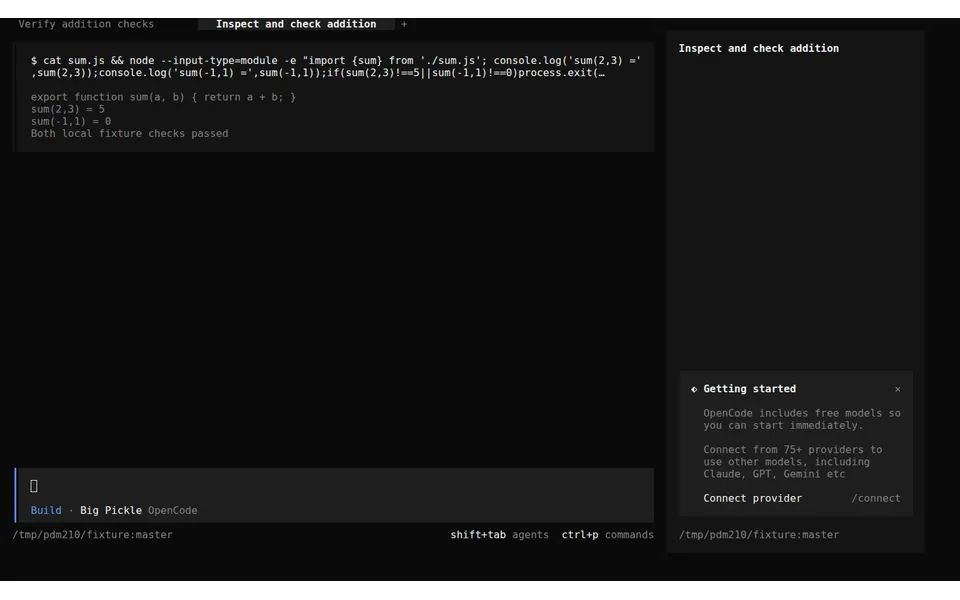
- Desktop app
- Mac, Windows and Linux
- Browser
- Yes
- Phone
- IPhone and phone browser
- Command line
- Yes
- Agents
- Claude Code and OpenCode
- Your subscription
- Works with your own plan
- Agents run
- On your computer and on your own server
- Laptop closed
- Keeps going
- Isolation
- Worktree
- Parallel agents
- Yes
- Scheduled runs
- Yes
- Coordinator agent
- Yes
- Built-in issues
- No
- Pull requests
- Yes
- Review screen
- Yes
- Team
- Roles and SSO
- Self-hosting
- Yes
- Licence
- MIT
- Price from
- Free
- How it charges
- No paid plan and bring your own key
- Paid plans from
- Not listed
Receipts
- Checked
- · oldest answer 2026-11-07
- Findings
- 38 published · 25 cross-checked by a second agent · read them all
- Sources
- 34 public pages on 3 sites: api.github.com, github.com, opencode.ai
- GitHub stars
- 207,860 on · api.github.com · repository attention, not users or capability
- Screenshot
- opencode.ai, retrieved · self captured · shows appearance, not capability
- Data
- /products/opencode.json · .md
- Method
- Same rules for all 103 researched ADEs. How we check · Report wrong data
What it does
Where you use it
OpenCode has desktop/terminal, password-protected browser UI and iPhone remote beta. The web session client has a specific narrow-screen layout below 768px.
Source and scope for Where you use itAgents it runs
OpenCode supplies its own harness and a native Claude Agent integration that launches the installed Claude Code through the official SDK, persists/resumes Claude sessions and manages their process. OpenCode supplies tools, permissions, compaction and subagents; Claude builtin tools/settings are disabled. Other shipped provider routes are model API access, not the other compared harness sessions.
Source and scope for Agents it runsAccounts and subscriptions
Existing provider/subscription routes coexist with free models and local models.
Source and scope for Accounts and subscriptionsWhere agents run
OpenCode supports local service and standalone runtime on a user-owned always-on/remote host.
Source and scope for Where agents runHow work is kept apart
Worktree operation is distinct from host-user security permissions.
Source and scope for How work is kept apartParallel work
Desktop documents agents working concurrently in separate tabs.
Source and scope for Parallel workScheduled runs
The official V2 CLI docs provide a pull-request-triggered GitHub Actions workflow. This is user-configured external automation, not a built-in scheduler.
Source and scope for Scheduled runsGit and pull requests
The available stable V1 GitHub Action can handle issue/PR comments, implement work on a branch and submit a pull request. This is the documented V1 GitHub integration, not a claim that the V2 desktop client has the same native command.
Source and scope for Git and pull requestsPrice
Core OpenCode is explicitly free; external provider and optional model plans cost separately.
Source and scope for PriceTyped filters
Every value links to its receipt below. Read plan and surface restrictions before using a filter to decide.
| Filter | Value |
|---|---|
| Desktop OS: macOS | Yes |
| Desktop OS: Windows | Yes |
| Desktop OS: Linux | Yes |
| Web client | Yes |
| Phone access: Native iOS | Yes |
| Phone access: Native Android | No |
| Phone access: Phone browser | Yes |
| CLI | Yes |
| Coding agents: Claude Code | Yes |
| Coding agents: Codex | No |
| Coding agents: Cursor Agent | No |
| Coding agents: Gemini CLI | No |
| Coding agents: OpenCode | Yes |
| Coding agents: Pi | No |
| Coding agents: Grok | No |
| Coding agents: Aider | No |
| Coding agents: Antigravity | No |
| Use my subscription | Yes cross-checked |
| Where agents run: On your computer | Yes cross-checked |
| Where agents run: On your own server | Yes cross-checked |
| Where agents run: In the vendor's cloud | Unknown |
| Workspace isolation: Git worktree | Yes cross-checked |
| Workspace isolation: Container | Unknown |
| Workspace isolation: VM or microVM | Unknown |
| Parallel runs | Yes cross-checked |
| Coordinator | Yes |
| Native issue tracking | No |
| Unattended triggers | Yes cross-checked |
| Shared prompting | Unknown |
| Team roles | Yes cross-checked |
| SSO | Yes cross-checked |
| Pull request workflow | Yes |
| Review interface | Yes cross-checked |
| Product license: Apache-2.0 | No. MIT cross-checked |
| Product license: MIT | Yes. MIT cross-checked |
| Product license: GPL-3.0 | No. MIT cross-checked |
| Product license: GPL-3.0-or-later | No. MIT cross-checked |
| Product license: AGPL-3.0 | No. MIT cross-checked |
| Product license: AGPL-3.0-or-later | No. MIT cross-checked |
| Product license: Elastic License 2.0 | No. MIT cross-checked |
| Product license: Custom terms | No. MIT cross-checked |
| Product license: Proprietary | No. MIT cross-checked |
| Self-hosting | Yes cross-checked |
| Telemetry opt-out | Unknown |
| Free access | Yes cross-checked |
| Starting price: Free | Yes. Free cross-checked |
| Starting price: Up to $20/month | No. Free cross-checked |
| Starting price: $21–40/month | No. Free cross-checked |
| Starting price: $41–100/month | No. Free cross-checked |
| Starting price: Over $100/month | No. Free cross-checked |
| Starting price: Contact for pricing | No. Free cross-checked |
| Pricing model: Free, no paid plan | Yes cross-checked |
| Pricing model: Free plan | No |
| Pricing model: Subscription | No |
| Pricing model: Per seat | No |
| Pricing model: Usage-based | No |
| Pricing model: Per machine or compute | No |
| Pricing model: Bring your own key | Yes cross-checked |
| Pricing model: One-time purchase | No |
| Paid plans from: No paid plan | Unknown |
| Paid plans from: $10 or less/month | Unknown |
| Paid plans from: $11–20/month | Unknown |
| Paid plans from: $21–40/month | Unknown |
| Paid plans from: $41–100/month | Unknown |
| Paid plans from: Over $100/month | Unknown |
| Paid plans from: Contact sales | Unknown |
| Lifecycle status: Active | Unknown |
| Lifecycle status: Sunsetting | Unknown |
| Keeps going with laptop closed | Yes |
| Open-source license | Yes. MIT cross-checked |
| Any desktop app | Yes |
| Paid plan up to $20/month | Unknown |
| Paid plan up to $40/month | Unknown |
| Any phone client | Yes |
Filter receipts
Desktop OS: macOS: Yes
Desktop OS: macOS
Typed value: Yes.
OpenCode has desktop/terminal, password-protected browser UI and iPhone remote beta. The web session client has a specific narrow-screen layout below 768px.
- Desktop os: macOS, Windows and Linux.
- Mobile apps: iPhone via public TestFlight; Android is not released on this page.
- Cli: Terminal client.
- Task actions: Mobile can start and steer sessions on the connected computer.
- Only the named atomic answers are established by this source pass. Remaining atomic answers retain their documented gaps.
-
Finding: Desktop clients support concurrent sessions, diffs, line comments and a browser. Terminal persistence is documented in v2.2.4 notes.
-
Finding: iPhone TestFlight client pairs to the user computer; Android is coming soon. Pairing links are one-use and expire in five minutes.
-
Finding: CLI run supports scripted prompts. A shared background server owns local sessions and survives client UI lifetime.
Desktop OS: Windows: Yes
Desktop OS: Windows
Typed value: Yes.
OpenCode has desktop/terminal, password-protected browser UI and iPhone remote beta. The web session client has a specific narrow-screen layout below 768px.
- Desktop os: macOS, Windows and Linux.
- Mobile apps: iPhone via public TestFlight; Android is not released on this page.
- Cli: Terminal client.
- Task actions: Mobile can start and steer sessions on the connected computer.
- Only the named atomic answers are established by this source pass. Remaining atomic answers retain their documented gaps.
-
Finding: Desktop clients support concurrent sessions, diffs, line comments and a browser. Terminal persistence is documented in v2.2.4 notes.
-
Finding: iPhone TestFlight client pairs to the user computer; Android is coming soon. Pairing links are one-use and expire in five minutes.
-
Finding: CLI run supports scripted prompts. A shared background server owns local sessions and survives client UI lifetime.
Desktop OS: Linux: Yes
Desktop OS: Linux
Typed value: Yes.
OpenCode has desktop/terminal, password-protected browser UI and iPhone remote beta. The web session client has a specific narrow-screen layout below 768px.
- Desktop os: macOS, Windows and Linux.
- Mobile apps: iPhone via public TestFlight; Android is not released on this page.
- Cli: Terminal client.
- Task actions: Mobile can start and steer sessions on the connected computer.
- Only the named atomic answers are established by this source pass. Remaining atomic answers retain their documented gaps.
-
Finding: Desktop clients support concurrent sessions, diffs, line comments and a browser. Terminal persistence is documented in v2.2.4 notes.
-
Finding: iPhone TestFlight client pairs to the user computer; Android is coming soon. Pairing links are one-use and expire in five minutes.
-
Finding: CLI run supports scripted prompts. A shared background server owns local sessions and survives client UI lifetime.
Web client: Yes
Web client
Typed value: Yes.
OpenCode has desktop/terminal, password-protected browser UI and iPhone remote beta. The web session client has a specific narrow-screen layout below 768px.
- Browser: Web UI is served by the same server that powers the TUI, paired through one-use expiring links.
- Cross device continuity: Browser/app pairing connects to the server-owned sessions; successful cross-device task handoff was not tested.
- Only the named atomic answers are established by this source pass. Remaining atomic answers retain their documented gaps.
-
OpenCode services/site/src/docs/content/cli/web.mdx
Finding: OpenCode serves password-protected web UI from its runtime server. Pair links work once for five minutes; session cookies last 30 days and password change signs all out. Localhost is default; remote always-on hosts can use standalone serve under a supervisor. OpenTunnel remote exposure requires consent.
Phone access: Native iOS: Yes
Phone access: Native iOS
Typed value: Yes.
OpenCode has desktop/terminal, password-protected browser UI and iPhone remote beta. The web session client has a specific narrow-screen layout below 768px.
- Desktop os: macOS, Windows and Linux.
- Mobile apps: iPhone via public TestFlight; Android is not released on this page.
- Cli: Terminal client.
- Task actions: Mobile can start and steer sessions on the connected computer.
- Only the named atomic answers are established by this source pass. Remaining atomic answers retain their documented gaps.
-
Finding: iPhone TestFlight client pairs to the user computer; Android is coming soon. Pairing links are one-use and expire in five minutes.
Phone access: Native Android: No
Phone access: Native Android
Typed value: No.
OpenCode has desktop/terminal, password-protected browser UI and iPhone remote beta. The web session client has a specific narrow-screen layout below 768px.
- Desktop os: macOS, Windows and Linux.
- Mobile apps: iPhone via public TestFlight; Android is not released on this page.
- Cli: Terminal client.
- Task actions: Mobile can start and steer sessions on the connected computer.
- Only the named atomic answers are established by this source pass. Remaining atomic answers retain their documented gaps.
-
Finding: iPhone TestFlight client pairs to the user computer; Android is coming soon. Pairing links are one-use and expire in five minutes.
Phone access: Phone browser: Yes
Phone access: Phone browser
Typed value: Yes.
OpenCode has desktop/terminal, password-protected browser UI and iPhone remote beta. The web session client has a specific narrow-screen layout below 768px.
- Mobile browser: The actual browser session UI adapts to phone-width screens at a 768px breakpoint.
- Only the named atomic answers are established by this source pass. Remaining atomic answers retain their documented gaps.
-
OpenCode browser session layout
Finding: The browser session model explicitly switches between desktop and narrow-screen layouts at 768px. The same password-protected web server powers the chat/session UI; it is a product client, not the public website.
CLI: Yes
CLI
Typed value: Yes.
OpenCode has desktop/terminal, password-protected browser UI and iPhone remote beta. The web session client has a specific narrow-screen layout below 768px.
- Desktop os: macOS, Windows and Linux.
- Mobile apps: iPhone via public TestFlight; Android is not released on this page.
- Cli: Terminal client.
- Task actions: Mobile can start and steer sessions on the connected computer.
- Only the named atomic answers are established by this source pass. Remaining atomic answers retain their documented gaps.
-
Finding: Desktop clients support concurrent sessions, diffs, line comments and a browser. Terminal persistence is documented in v2.2.4 notes.
-
Finding: iPhone TestFlight client pairs to the user computer; Android is coming soon. Pairing links are one-use and expire in five minutes.
-
Finding: CLI run supports scripted prompts. A shared background server owns local sessions and survives client UI lifetime.
Coding agents: Claude Code: Yes
Coding agents: Claude Code
Typed value: Yes.
OpenCode supplies its own harness and a native Claude Agent integration that launches the installed Claude Code through the official SDK, persists/resumes Claude sessions and manages their process. OpenCode supplies tools, permissions, compaction and subagents; Claude builtin tools/settings are disabled. Other shipped provider routes are model API access, not the other compared harness sessions.
- Harnesses: OpenCode runs its own runtime and the optional local Claude Agent bridge launches and resumes the installed Claude Code through the official SDK. OpenCode supplies tools/permissions, without Claude builtin tools/settings or remote-workspace availability.
- Session integration: The local Node runtime starts and resumes the installed Claude Code through the official SDK. The integration uses OpenCode tools and permissions rather than Claude builtin tools/settings, and is unavailable in remote workspaces.
- Only the named atomic answers are established by this source pass. Remaining atomic answers retain their documented gaps.
-
OpenCode Claude Agent execution boundary
Finding: Claude Code is used for model calls and native login while OpenCode owns tools, permissions, compaction and subagents. The shipped provider registry includes this native Claude Agent integration; the other compared external coding harnesses are not supplied as session integrations. ChatGPT/Copilot/provider API routes are model access, not those harnesses.
-
OpenCode native Claude Code process and sessions
Finding: The shipped Claude Agent plugin passes the installed Claude executable and a spawner to the official Agent SDK, persists Claude sessions, resumes by saved Claude session ID and manages a long-running process per OpenCode session. It supplies OpenCode tools as MCP tools and disables Claude builtin tools/settings. This is native process/session management, beyond choosing an API model.
Coding agents: Codex: No
Coding agents: Codex
Typed value: No.
OpenCode supplies its own harness and a native Claude Agent integration that launches the installed Claude Code through the official SDK, persists/resumes Claude sessions and manages their process. OpenCode supplies tools, permissions, compaction and subagents; Claude builtin tools/settings are disabled. Other shipped provider routes are model API access, not the other compared harness sessions.
- Only the named atomic answers are established by this source pass. Remaining atomic answers retain their documented gaps.
-
OpenCode supplied provider registry
Finding: The supplied plugins include the native Claude Agent plugin and model-provider API integrations. Bounded inspection found no supplied session adapter for Codex CLI, Cursor Agent, Gemini CLI, Pi, Grok, Aider or Antigravity; ChatGPT, Copilot, Google and xAI provider names refer to model API access.
Coding agents: Cursor Agent: No
Coding agents: Cursor Agent
Typed value: No.
OpenCode supplies its own harness and a native Claude Agent integration that launches the installed Claude Code through the official SDK, persists/resumes Claude sessions and manages their process. OpenCode supplies tools, permissions, compaction and subagents; Claude builtin tools/settings are disabled. Other shipped provider routes are model API access, not the other compared harness sessions.
- Only the named atomic answers are established by this source pass. Remaining atomic answers retain their documented gaps.
-
OpenCode supplied provider registry
Finding: The supplied plugins include the native Claude Agent plugin and model-provider API integrations. Bounded inspection found no supplied session adapter for Codex CLI, Cursor Agent, Gemini CLI, Pi, Grok, Aider or Antigravity; ChatGPT, Copilot, Google and xAI provider names refer to model API access.
Coding agents: Gemini CLI: No
Coding agents: Gemini CLI
Typed value: No.
OpenCode supplies its own harness and a native Claude Agent integration that launches the installed Claude Code through the official SDK, persists/resumes Claude sessions and manages their process. OpenCode supplies tools, permissions, compaction and subagents; Claude builtin tools/settings are disabled. Other shipped provider routes are model API access, not the other compared harness sessions.
- Only the named atomic answers are established by this source pass. Remaining atomic answers retain their documented gaps.
-
OpenCode supplied provider registry
Finding: The supplied plugins include the native Claude Agent plugin and model-provider API integrations. Bounded inspection found no supplied session adapter for Codex CLI, Cursor Agent, Gemini CLI, Pi, Grok, Aider or Antigravity; ChatGPT, Copilot, Google and xAI provider names refer to model API access.
Coding agents: OpenCode: Yes
Coding agents: OpenCode
Typed value: Yes.
OpenCode supplies its own harness and a native Claude Agent integration that launches the installed Claude Code through the official SDK, persists/resumes Claude sessions and manages their process. OpenCode supplies tools, permissions, compaction and subagents; Claude builtin tools/settings are disabled. Other shipped provider routes are model API access, not the other compared harness sessions.
- Model providers: Provider catalog plus custom compatible endpoints.
- Custom adapters: Configurable provider runtime packages and base URLs.
- Only the named atomic answers are established by this source pass. Remaining atomic answers retain their documented gaps.
-
Finding: Desktop clients support concurrent sessions, diffs, line comments and a browser. Terminal persistence is documented in v2.2.4 notes.
-
Finding: Documents provider credentials, ChatGPT Plus/Pro, custom compatible endpoints, transport timeouts and three retries.
-
Finding: Primary and child sessions have named profiles, model settings and independent permission rules. Steps can bound a model run.
Coding agents: Pi: No
Coding agents: Pi
Typed value: No.
OpenCode supplies its own harness and a native Claude Agent integration that launches the installed Claude Code through the official SDK, persists/resumes Claude sessions and manages their process. OpenCode supplies tools, permissions, compaction and subagents; Claude builtin tools/settings are disabled. Other shipped provider routes are model API access, not the other compared harness sessions.
- Only the named atomic answers are established by this source pass. Remaining atomic answers retain their documented gaps.
-
OpenCode supplied provider registry
Finding: The supplied plugins include the native Claude Agent plugin and model-provider API integrations. Bounded inspection found no supplied session adapter for Codex CLI, Cursor Agent, Gemini CLI, Pi, Grok, Aider or Antigravity; ChatGPT, Copilot, Google and xAI provider names refer to model API access.
Coding agents: Grok: No
Coding agents: Grok
Typed value: No.
OpenCode supplies its own harness and a native Claude Agent integration that launches the installed Claude Code through the official SDK, persists/resumes Claude sessions and manages their process. OpenCode supplies tools, permissions, compaction and subagents; Claude builtin tools/settings are disabled. Other shipped provider routes are model API access, not the other compared harness sessions.
- Only the named atomic answers are established by this source pass. Remaining atomic answers retain their documented gaps.
-
OpenCode supplied provider registry
Finding: The supplied plugins include the native Claude Agent plugin and model-provider API integrations. Bounded inspection found no supplied session adapter for Codex CLI, Cursor Agent, Gemini CLI, Pi, Grok, Aider or Antigravity; ChatGPT, Copilot, Google and xAI provider names refer to model API access.
Coding agents: Aider: No
Coding agents: Aider
Typed value: No.
OpenCode supplies its own harness and a native Claude Agent integration that launches the installed Claude Code through the official SDK, persists/resumes Claude sessions and manages their process. OpenCode supplies tools, permissions, compaction and subagents; Claude builtin tools/settings are disabled. Other shipped provider routes are model API access, not the other compared harness sessions.
- Only the named atomic answers are established by this source pass. Remaining atomic answers retain their documented gaps.
-
OpenCode supplied provider registry
Finding: The supplied plugins include the native Claude Agent plugin and model-provider API integrations. Bounded inspection found no supplied session adapter for Codex CLI, Cursor Agent, Gemini CLI, Pi, Grok, Aider or Antigravity; ChatGPT, Copilot, Google and xAI provider names refer to model API access.
Coding agents: Antigravity: No
Coding agents: Antigravity
Typed value: No.
OpenCode supplies its own harness and a native Claude Agent integration that launches the installed Claude Code through the official SDK, persists/resumes Claude sessions and manages their process. OpenCode supplies tools, permissions, compaction and subagents; Claude builtin tools/settings are disabled. Other shipped provider routes are model API access, not the other compared harness sessions.
- Only the named atomic answers are established by this source pass. Remaining atomic answers retain their documented gaps.
-
OpenCode supplied provider registry
Finding: The supplied plugins include the native Claude Agent plugin and model-provider API integrations. Bounded inspection found no supplied session adapter for Codex CLI, Cursor Agent, Gemini CLI, Pi, Grok, Aider or Antigravity; ChatGPT, Copilot, Google and xAI provider names refer to model API access.
Use my subscription: Yes cross-checked
Use my subscription
Typed value: Yes.
Existing provider/subscription routes coexist with free models and local models.
- Agent subscriptions: ChatGPT Plus or Pro sign-in.
- Api accounts: Connect provider credentials.
- Vendor credits: Optional OpenCode Go subscription. Included limits require a separate plan check.
- Provider restrictions: ChatGPT context caps and configurable provider-specific settings.
- The remaining atomic questions and the rubric scenario are unverified. Documentation is not a successful product test.
- Only the named atomic facts are established by documentation. Remaining rubric scenarios and unknown answers were not demonstrated.
-
Finding: Documents provider credentials, ChatGPT Plus/Pro, custom compatible endpoints, transport timeouts and three retries.
Where agents run: On your computer: Yes cross-checked
Where agents run: On your computer
Typed value: Yes.
OpenCode supports local service and standalone runtime on a user-owned always-on/remote host.
- Local: Computer-hosted service.
- Byo remote: Explicit server URL is supported; remote host setup was not exercised.
- Other device continuation: iPhone pairing reconnects to computer sessions.
- The remaining atomic questions and the rubric scenario are unverified. Documentation is not a successful product test.
- Only the named atomic facts are established by documentation. Remaining rubric scenarios and unknown answers were not demonstrated.
-
Finding: iPhone TestFlight client pairs to the user computer; Android is coming soon. Pairing links are one-use and expire in five minutes.
-
Finding: CLI run supports scripted prompts. A shared background server owns local sessions and survives client UI lifetime.
Where agents run: On your own server: Yes cross-checked
Where agents run: On your own server
Typed value: Yes.
OpenCode supports local service and standalone runtime on a user-owned always-on/remote host.
- Local: Computer-hosted service.
- Byo remote: Explicit server URL is supported; remote host setup was not exercised.
- Other device continuation: iPhone pairing reconnects to computer sessions.
- The remaining atomic questions and the rubric scenario are unverified. Documentation is not a successful product test.
- Only the named atomic facts are established by documentation. Remaining rubric scenarios and unknown answers were not demonstrated.
-
Finding: iPhone TestFlight client pairs to the user computer; Android is coming soon. Pairing links are one-use and expire in five minutes.
-
Finding: CLI run supports scripted prompts. A shared background server owns local sessions and survives client UI lifetime.
Workspace isolation: Git worktree: Yes cross-checked
Workspace isolation: Git worktree
Typed value: Yes.
Worktree operation is distinct from host-user security permissions.
- Worktree: Desktop worktree selection is documented.
- Security boundary: Shell runs with the host user filesystem, process and network authority. Worktree separation is not containment.
- The remaining atomic questions and the rubric scenario are unverified. Documentation is not a successful product test.
-
Finding: Desktop clients support concurrent sessions, diffs, line comments and a browser. Terminal persistence is documented in v2.2.4 notes.
-
Finding: Allow/ask/deny rules, durable project approvals and hard-deny policies are documented; shell uses host-user authority.
Parallel runs: Yes cross-checked
Parallel runs
Typed value: Yes.
Desktop documents agents working concurrently in separate tabs.
- Concurrent sessions: Concurrent sessions.
- Status visibility: Tabs identify sessions; the twelve-state fixture was not run.
- The remaining atomic questions and the rubric scenario are unverified. Documentation is not a successful product test.
-
Finding: Desktop clients support concurrent sessions, diffs, line comments and a browser. Terminal persistence is documented in v2.2.4 notes.
Coordinator: Yes
Coordinator
Typed value: Yes.
OpenCode supplies a product-owned child-session subagent tool with agent/model selection and follow-ups by session ID. The pinned V2.2.6 source supports foreground/background calls; the public V2.3 release makes subagents always background and returns their session ID immediately, reporting back when idle.
- Messages: Calling subagent with sessionID sends follow-up instructions to that child.
- Results return: The pinned V2.2.6 tool returns foreground output or background completion. V2.3 always backgrounds child sessions and reports to the parent whenever idle.
- Orchestration owner: The OpenCode core supplies the child-session subagent tool and parent completion handling.
- Only the named atomic answers are established by this source pass. Remaining atomic answers retain their documented gaps.
-
Finding: The product-owned subagent tool starts a child session with a configured agent and optional model, returns its session ID/result, and accepts follow-ups by sessionID. Background children notify the parent when complete. The OpenCode runtime supplies this coordinator tool.
-
Finding: The November 13 public V2.3 release changes subagents to always run in the background, return a session ID immediately and report to the parent whenever idle. This supersedes the optional foreground behavior in the separately pinned V2.2.6 tool source.
Native issue tracking: No
Native issue tracking
Typed value: No.
The native core implements an experimental per-session todo tool with pending/in-progress/completed/cancelled states in tool/session metadata. Bounded inspection of the native core schema/routes found no separate product-owned issue/backlog work-item store across sessions.
- Create: The inspected core does not provide independent issue/backlog CRUD; tool todo updates are in-session agent bookkeeping.
- Task session separation: Todo state belongs to the tool output/session metadata, not a separate issue/backlog record.
- Only the named atomic answers are established by this source pass. Remaining atomic answers retain their documented gaps.
-
OpenCode session todo implementation
Finding: The experimental todowrite tool stores task content/status in a tool output and session metadata. The inspected native core schema/routes and tool implementation have no separate issue/backlog CRUD or cross-session work-item store; scheduled tasks are trigger configurations, not that backlog.
Unattended triggers: Yes cross-checked
Unattended triggers
Typed value: Yes.
The official V2 CLI docs provide a pull-request-triggered GitHub Actions workflow. This is user-configured external automation, not a built-in scheduler.
- Events: Documented GitHub Actions on: [pull_request] starts a standalone OpenCode run without a human initiating each run.
- Scheduler location: GitHub Actions runner owns event dispatch/execution; no OpenCode internal scheduler is established.
- Documentation example only; no CI run was tested. User configures the workflow and supplies provider credentials.
-
Finding: Official V2 CLI reference supplies a GitHub Actions pull_request-triggered workflow that installs @opencode/cli and runs opencode run --standalone with a provider key secret. GitHub Actions supplies the event/runner; this is a user-configured external workflow, not a built-in OpenCode scheduler.
Team roles: Yes cross-checked
Team roles
Typed value: Yes.
OpenCode Console has named workspace roles and SSO; local runtime has separate password access.
- Organization roles: Console roles are Member, Admin and Owner; role grants cannot exceed caller role and last owner retained.
- Membership: Console owners/admins invite email users; invitations expire after seven days.
- Revocation: Member removal immediately revokes access and workspace API keys they created.
- Plan scope: Console workspace identity controls; Go/Go Plus single member, Go Teams supports invitations.
- Only the named atomic facts are established by documentation. Remaining rubric scenarios and unknown answers were not demonstrated.
-
OpenCode services/site/src/docs/content/console/members.mdx
Finding: Console owners/admins invite Members and change roles within own authority; last owner retained. Roles are Member/Admin/Owner. Invitations expire in seven days. Member removal revokes access and their workspace API keys immediately, while usage remains in reports. Go Teams invitation access costs separately.
SSO: Yes cross-checked
SSO
Typed value: Yes.
OpenCode Console has named workspace roles and SSO; local runtime has separate password access.
- Sso: OIDC/SAML SSO is included in Console workspaces; owners configure and admins/members must use it.
- Only the named atomic facts are established by documentation. Remaining rubric scenarios and unknown answers were not demonstrated.
-
OpenCode services/site/src/docs/content/console/sso.mdx
Finding: Console workspaces include OIDC or SAML SSO, configured by owners. Admins/members must use it, including /connect; owners retain alternative login recovery. One connection per workspace. Domain verification/SCIM affect automatic membership.
Pull request workflow: Yes
Pull request workflow
Typed value: Yes.
The available stable V1 GitHub Action can handle issue/PR comments, implement work on a branch and submit a pull request. This is the documented V1 GitHub integration, not a claim that the V2 desktop client has the same native command.
- Branches: The V1 GitHub Action implements work on a branch.
- Pull requests: The V1 GitHub Action uses GitHub pulls.create to submit the resulting PR.
- Comments: Issue/PR comments trigger the Action and it updates comments through the GitHub API.
- Only the named atomic answers are established by this source pass. Remaining atomic answers retain their documented gaps.
-
OpenCode stable V1 GitHub Action
Finding: The publicly available stable V1 GitHub Action handles issue/PR comments, works on a branch and creates a GitHub pull request through octokit pulls.create. It is invoked through anomalyco/opencode/github@latest and is separate from the V2 native application.
-
OpenCode V1 GitHub integration
Finding: The official maintained V1 documentation describes /opencode or /oc issue/PR comments launching GitHub Actions, implementing changes on a branch and submitting a PR. The page explicitly identifies itself as V1 documentation.
Review interface: Yes cross-checked
Review interface
Typed value: Yes.
Desktop exposes diffs and an in-app browser.
- Diffs: File diffs.
- Previews: Built-in browser.
- The remaining atomic questions and the rubric scenario are unverified. Documentation is not a successful product test.
-
Finding: Desktop clients support concurrent sessions, diffs, line comments and a browser. Terminal persistence is documented in v2.2.4 notes.
Product license: Apache-2.0: No. MIT cross-checked
Product license: Apache-2.0
Typed value: No. MIT.
The root source distribution is MIT.
- Client license: MIT, subject to component notices.
- Source visibility: Public source.
- Source revision: 07f492b0480c750bdb11485f00db5425a4ac6065
- The remaining atomic questions and the rubric scenario are unverified. Documentation is not a successful product test.
-
Finding: The cited root license governs this repository distribution, subject to component notices.
Product license: MIT: Yes. MIT cross-checked
Product license: MIT
Typed value: Yes. MIT.
The root source distribution is MIT.
- Client license: MIT, subject to component notices.
- Source visibility: Public source.
- Source revision: 07f492b0480c750bdb11485f00db5425a4ac6065
- The remaining atomic questions and the rubric scenario are unverified. Documentation is not a successful product test.
-
Finding: The cited root license governs this repository distribution, subject to component notices.
Product license: GPL-3.0: No. MIT cross-checked
Product license: GPL-3.0
Typed value: No. MIT.
The root source distribution is MIT.
- Client license: MIT, subject to component notices.
- Source visibility: Public source.
- Source revision: 07f492b0480c750bdb11485f00db5425a4ac6065
- The remaining atomic questions and the rubric scenario are unverified. Documentation is not a successful product test.
-
Finding: The cited root license governs this repository distribution, subject to component notices.
Product license: GPL-3.0-or-later: No. MIT cross-checked
Product license: GPL-3.0-or-later
Typed value: No. MIT.
The root source distribution is MIT.
- Client license: MIT, subject to component notices.
- Source visibility: Public source.
- Source revision: 07f492b0480c750bdb11485f00db5425a4ac6065
- The remaining atomic questions and the rubric scenario are unverified. Documentation is not a successful product test.
-
Finding: The cited root license governs this repository distribution, subject to component notices.
Product license: AGPL-3.0: No. MIT cross-checked
Product license: AGPL-3.0
Typed value: No. MIT.
The root source distribution is MIT.
- Client license: MIT, subject to component notices.
- Source visibility: Public source.
- Source revision: 07f492b0480c750bdb11485f00db5425a4ac6065
- The remaining atomic questions and the rubric scenario are unverified. Documentation is not a successful product test.
-
Finding: The cited root license governs this repository distribution, subject to component notices.
Product license: AGPL-3.0-or-later: No. MIT cross-checked
Product license: AGPL-3.0-or-later
Typed value: No. MIT.
The root source distribution is MIT.
- Client license: MIT, subject to component notices.
- Source visibility: Public source.
- Source revision: 07f492b0480c750bdb11485f00db5425a4ac6065
- The remaining atomic questions and the rubric scenario are unverified. Documentation is not a successful product test.
-
Finding: The cited root license governs this repository distribution, subject to component notices.
Product license: Elastic License 2.0: No. MIT cross-checked
Product license: Elastic License 2.0
Typed value: No. MIT.
The root source distribution is MIT.
- Client license: MIT, subject to component notices.
- Source visibility: Public source.
- Source revision: 07f492b0480c750bdb11485f00db5425a4ac6065
- The remaining atomic questions and the rubric scenario are unverified. Documentation is not a successful product test.
-
Finding: The cited root license governs this repository distribution, subject to component notices.
Product license: Custom terms: No. MIT cross-checked
Product license: Custom terms
Typed value: No. MIT.
The root source distribution is MIT.
- Client license: MIT, subject to component notices.
- Source visibility: Public source.
- Source revision: 07f492b0480c750bdb11485f00db5425a4ac6065
- The remaining atomic questions and the rubric scenario are unverified. Documentation is not a successful product test.
-
Finding: The cited root license governs this repository distribution, subject to component notices.
Product license: Proprietary: No. MIT cross-checked
Product license: Proprietary
Typed value: No. MIT.
The root source distribution is MIT.
- Client license: MIT, subject to component notices.
- Source visibility: Public source.
- Source revision: 07f492b0480c750bdb11485f00db5425a4ac6065
- The remaining atomic questions and the rubric scenario are unverified. Documentation is not a successful product test.
-
Finding: The cited root license governs this repository distribution, subject to component notices.
Self-hosting: Yes cross-checked
Self-hosting
Typed value: Yes.
The user-operated runtime (shared or standalone server) supports JSON session export/import, and uninstall keeps session data.
- Self hosting: Shared or standalone local service.
- History portability: Uninstall preserves session data, configuration and state. Import into another product was not verified.
- The remaining atomic questions and the rubric scenario are unverified. Documentation is not a successful product test.
- Only the named atomic facts are established by documentation. Remaining rubric scenarios and unknown answers were not demonstrated.
-
Finding: CLI run supports scripted prompts. A shared background server owns local sessions and survives client UI lifetime.
Free access: Yes cross-checked
Free access
Typed value: Yes.
OpenCode is explicitly free to use and includes account-free models.
- Ongoing free: Free application with a set of free models.
- Free scenarios: Use included free models or connect local models; provider-paid use remains separate.
- Only the named atomic facts are established by documentation. Remaining rubric scenarios and unknown answers were not demonstrated.
-
Finding: OpenCode is explicitly free to use, includes free models without an account and can connect local models. Other providers may cost extra. Existing ChatGPT Plus/Pro and GitHub Copilot subscriptions are supported. Free-model data handling differs from other provider routes.
Starting price: Free: Yes. Free cross-checked
Starting price: Free
Typed value: Yes. Free.
OpenCode is explicitly free to use and includes account-free models.
- Ongoing free: Free application with a set of free models.
- Free scenarios: Use included free models or connect local models; provider-paid use remains separate.
- Only the named atomic facts are established by documentation. Remaining rubric scenarios and unknown answers were not demonstrated.
-
Finding: OpenCode is explicitly free to use, includes free models without an account and can connect local models. Other providers may cost extra. Existing ChatGPT Plus/Pro and GitHub Copilot subscriptions are supported. Free-model data handling differs from other provider routes.
Starting price: Up to $20/month: No. Free cross-checked
Starting price: Up to $20/month
Typed value: No. Free.
OpenCode is explicitly free to use and includes account-free models.
- Ongoing free: Free application with a set of free models.
- Free scenarios: Use included free models or connect local models; provider-paid use remains separate.
- Only the named atomic facts are established by documentation. Remaining rubric scenarios and unknown answers were not demonstrated.
-
Finding: OpenCode is explicitly free to use, includes free models without an account and can connect local models. Other providers may cost extra. Existing ChatGPT Plus/Pro and GitHub Copilot subscriptions are supported. Free-model data handling differs from other provider routes.
Starting price: $21–40/month: No. Free cross-checked
Starting price: $21–40/month
Typed value: No. Free.
OpenCode is explicitly free to use and includes account-free models.
- Ongoing free: Free application with a set of free models.
- Free scenarios: Use included free models or connect local models; provider-paid use remains separate.
- Only the named atomic facts are established by documentation. Remaining rubric scenarios and unknown answers were not demonstrated.
-
Finding: OpenCode is explicitly free to use, includes free models without an account and can connect local models. Other providers may cost extra. Existing ChatGPT Plus/Pro and GitHub Copilot subscriptions are supported. Free-model data handling differs from other provider routes.
Starting price: $41–100/month: No. Free cross-checked
Starting price: $41–100/month
Typed value: No. Free.
OpenCode is explicitly free to use and includes account-free models.
- Ongoing free: Free application with a set of free models.
- Free scenarios: Use included free models or connect local models; provider-paid use remains separate.
- Only the named atomic facts are established by documentation. Remaining rubric scenarios and unknown answers were not demonstrated.
-
Finding: OpenCode is explicitly free to use, includes free models without an account and can connect local models. Other providers may cost extra. Existing ChatGPT Plus/Pro and GitHub Copilot subscriptions are supported. Free-model data handling differs from other provider routes.
Starting price: Over $100/month: No. Free cross-checked
Starting price: Over $100/month
Typed value: No. Free.
OpenCode is explicitly free to use and includes account-free models.
- Ongoing free: Free application with a set of free models.
- Free scenarios: Use included free models or connect local models; provider-paid use remains separate.
- Only the named atomic facts are established by documentation. Remaining rubric scenarios and unknown answers were not demonstrated.
-
Finding: OpenCode is explicitly free to use, includes free models without an account and can connect local models. Other providers may cost extra. Existing ChatGPT Plus/Pro and GitHub Copilot subscriptions are supported. Free-model data handling differs from other provider routes.
Starting price: Contact for pricing: No. Free cross-checked
Starting price: Contact for pricing
Typed value: No. Free.
OpenCode is explicitly free to use and includes account-free models.
- Ongoing free: Free application with a set of free models.
- Free scenarios: Use included free models or connect local models; provider-paid use remains separate.
- Only the named atomic facts are established by documentation. Remaining rubric scenarios and unknown answers were not demonstrated.
-
Finding: OpenCode is explicitly free to use, includes free models without an account and can connect local models. Other providers may cost extra. Existing ChatGPT Plus/Pro and GitHub Copilot subscriptions are supported. Free-model data handling differs from other provider routes.
Pricing model: Free, no paid plan: Yes cross-checked
Pricing model: Free, no paid plan
Typed value: Yes.
Core OpenCode is explicitly free; external provider and optional model plans cost separately.
- Model cost: Included free models are available; connecting other providers may add costs.
- Only the named atomic facts are established by documentation. Remaining rubric scenarios and unknown answers were not demonstrated.
-
Finding: OpenCode is explicitly free to use, includes free models without an account and can connect local models. Other providers may cost extra. Existing ChatGPT Plus/Pro and GitHub Copilot subscriptions are supported. Free-model data handling differs from other provider routes.
Pricing model: Free plan: No
Pricing model: Free plan
Typed value: No.
Core OpenCode is explicitly free; external provider and optional model plans cost separately.
- Model cost: Included free models are available; connecting other providers may add costs.
- Only the named atomic facts are established by documentation. Remaining rubric scenarios and unknown answers were not demonstrated.
-
Finding: OpenCode is explicitly free to use, includes free models without an account and can connect local models. Other providers may cost extra. Existing ChatGPT Plus/Pro and GitHub Copilot subscriptions are supported. Free-model data handling differs from other provider routes.
Pricing model: Subscription: No
Pricing model: Subscription
Typed value: No.
Core OpenCode is explicitly free; external provider and optional model plans cost separately.
- Model cost: Included free models are available; connecting other providers may add costs.
- Only the named atomic facts are established by documentation. Remaining rubric scenarios and unknown answers were not demonstrated.
-
Finding: OpenCode is explicitly free to use, includes free models without an account and can connect local models. Other providers may cost extra. Existing ChatGPT Plus/Pro and GitHub Copilot subscriptions are supported. Free-model data handling differs from other provider routes.
Pricing model: Per seat: No
Pricing model: Per seat
Typed value: No.
Core OpenCode is explicitly free; external provider and optional model plans cost separately.
- Model cost: Included free models are available; connecting other providers may add costs.
- Only the named atomic facts are established by documentation. Remaining rubric scenarios and unknown answers were not demonstrated.
-
Finding: OpenCode is explicitly free to use, includes free models without an account and can connect local models. Other providers may cost extra. Existing ChatGPT Plus/Pro and GitHub Copilot subscriptions are supported. Free-model data handling differs from other provider routes.
Pricing model: Usage-based: No
Pricing model: Usage-based
Typed value: No.
Core OpenCode is explicitly free; external provider and optional model plans cost separately.
- Model cost: Included free models are available; connecting other providers may add costs.
- Only the named atomic facts are established by documentation. Remaining rubric scenarios and unknown answers were not demonstrated.
-
Finding: OpenCode is explicitly free to use, includes free models without an account and can connect local models. Other providers may cost extra. Existing ChatGPT Plus/Pro and GitHub Copilot subscriptions are supported. Free-model data handling differs from other provider routes.
Pricing model: Per machine or compute: No
Pricing model: Per machine or compute
Typed value: No.
Core OpenCode is explicitly free; external provider and optional model plans cost separately.
- Model cost: Included free models are available; connecting other providers may add costs.
- Only the named atomic facts are established by documentation. Remaining rubric scenarios and unknown answers were not demonstrated.
-
Finding: OpenCode is explicitly free to use, includes free models without an account and can connect local models. Other providers may cost extra. Existing ChatGPT Plus/Pro and GitHub Copilot subscriptions are supported. Free-model data handling differs from other provider routes.
Pricing model: Bring your own key: Yes cross-checked
Pricing model: Bring your own key
Typed value: Yes.
Existing provider/subscription routes coexist with free models and local models.
- Agent subscriptions: ChatGPT Plus or Pro sign-in.
- Api accounts: Connect provider credentials.
- Vendor credits: Optional OpenCode Go subscription. Included limits require a separate plan check.
- Provider restrictions: ChatGPT context caps and configurable provider-specific settings.
- The remaining atomic questions and the rubric scenario are unverified. Documentation is not a successful product test.
- Only the named atomic facts are established by documentation. Remaining rubric scenarios and unknown answers were not demonstrated.
-
Finding: Documents provider credentials, ChatGPT Plus/Pro, custom compatible endpoints, transport timeouts and three retries.
Pricing model: One-time purchase: No
Pricing model: One-time purchase
Typed value: No.
Core OpenCode is explicitly free; external provider and optional model plans cost separately.
- Model cost: Included free models are available; connecting other providers may add costs.
- Only the named atomic facts are established by documentation. Remaining rubric scenarios and unknown answers were not demonstrated.
-
Finding: OpenCode is explicitly free to use, includes free models without an account and can connect local models. Other providers may cost extra. Existing ChatGPT Plus/Pro and GitHub Copilot subscriptions are supported. Free-model data handling differs from other provider routes.
Keeps going with laptop closed: Yes
Keeps going with laptop closed
Typed value: Yes.
OpenCode supports local service and standalone runtime on a user-owned always-on/remote host.
- Self hosted: serve can run on a shared always-on or remote host under systemd/Docker/supervisor.
- Provisioning: Configure hostname, port, password and CORS; user supplies remote host and supervisor.
- The remaining atomic questions and the rubric scenario are unverified. Documentation is not a successful product test.
- Only the named atomic facts are established by documentation. Remaining rubric scenarios and unknown answers were not demonstrated.
-
OpenCode services/site/src/docs/content/cli/web.mdx
Finding: OpenCode serves password-protected web UI from its runtime server. Pair links work once for five minutes; session cookies last 30 days and password change signs all out. Localhost is default; remote always-on hosts can use standalone serve under a supervisor. OpenTunnel remote exposure requires consent.
Open-source license: Yes. MIT cross-checked
Open-source license
Typed value: Yes. MIT.
The root source distribution is MIT.
- Client license: MIT, subject to component notices.
- Source visibility: Public source.
- Source revision: 07f492b0480c750bdb11485f00db5425a4ac6065
- The remaining atomic questions and the rubric scenario are unverified. Documentation is not a successful product test.
-
Finding: The cited root license governs this repository distribution, subject to component notices.
Any desktop app: Yes
Any desktop app
Typed value: Yes.
OpenCode has desktop/terminal, password-protected browser UI and iPhone remote beta. The web session client has a specific narrow-screen layout below 768px.
- Desktop os: macOS, Windows and Linux.
- Mobile apps: iPhone via public TestFlight; Android is not released on this page.
- Cli: Terminal client.
- Task actions: Mobile can start and steer sessions on the connected computer.
- Only the named atomic answers are established by this source pass. Remaining atomic answers retain their documented gaps.
-
Finding: Desktop clients support concurrent sessions, diffs, line comments and a browser. Terminal persistence is documented in v2.2.4 notes.
-
Finding: iPhone TestFlight client pairs to the user computer; Android is coming soon. Pairing links are one-use and expire in five minutes.
-
Finding: CLI run supports scripted prompts. A shared background server owns local sessions and survives client UI lifetime.
Any phone client: Yes
Any phone client
Typed value: Yes.
OpenCode has desktop/terminal, password-protected browser UI and iPhone remote beta. The web session client has a specific narrow-screen layout below 768px.
- Desktop os: macOS, Windows and Linux.
- Mobile apps: iPhone via public TestFlight; Android is not released on this page.
- Cli: Terminal client.
- Task actions: Mobile can start and steer sessions on the connected computer.
- Only the named atomic answers are established by this source pass. Remaining atomic answers retain their documented gaps.
-
Finding: iPhone TestFlight client pairs to the user computer; Android is coming soon. Pairing links are one-use and expire in five minutes.
All public findings
Findings may summarize a source. They are not presented as verbatim statements.
opencode:ACC-01: OpenCode has desktop/terminal, password-protected browser UI and iPhone remote beta. The web session client has a specific narrow-screen layout below 768px.
opencode:ACC-01
OpenCode has desktop/terminal, password-protected browser UI and iPhone remote beta. The web session client has a specific narrow-screen layout below 768px.
- Only the named atomic answers are established by this source pass. Remaining atomic answers retain their documented gaps.
-
Finding: OpenCode provides terminal and desktop installs, describes desktop beta and built-in agent modes. The current source distribution uses MIT; desktop packaging and provider access have separate docs.
-
Finding: Desktop clients support concurrent sessions, diffs, line comments and a browser. Terminal persistence is documented in v2.2.4 notes.
-
Finding: iPhone TestFlight client pairs to the user computer; Android is coming soon. Pairing links are one-use and expire in five minutes.
-
Finding: CLI run supports scripted prompts. A shared background server owns local sessions and survives client UI lifetime.
-
OpenCode services/site/src/docs/content/cli/web.mdx
Finding: OpenCode serves password-protected web UI from its runtime server. Pair links work once for five minutes; session cookies last 30 days and password change signs all out. Localhost is default; remote always-on hosts can use standalone serve under a supervisor. OpenTunnel remote exposure requires consent.
-
OpenCode browser session layout
Finding: The browser session model explicitly switches between desktop and narrow-screen layouts at 768px. The same password-protected web server powers the chat/session UI; it is a product client, not the public website.
opencode:ACC-02: OpenCode supplies its own harness and a native Claude Agent integration that launches the installed Claude Code through the official SDK, persists/resumes Claude sessions and manages their process. OpenCode supplies tools, permissions, compaction and subagents; Claude builtin tools/settings are disabled. Other shipped provider routes are model API access, not the other compared harness sessions.
opencode:ACC-02
OpenCode supplies its own harness and a native Claude Agent integration that launches the installed Claude Code through the official SDK, persists/resumes Claude sessions and manages their process. OpenCode supplies tools, permissions, compaction and subagents; Claude builtin tools/settings are disabled. Other shipped provider routes are model API access, not the other compared harness sessions.
- Only the named atomic answers are established by this source pass. Remaining atomic answers retain their documented gaps.
-
Finding: Desktop clients support concurrent sessions, diffs, line comments and a browser. Terminal persistence is documented in v2.2.4 notes.
-
Finding: Documents provider credentials, ChatGPT Plus/Pro, custom compatible endpoints, transport timeouts and three retries.
-
Finding: Primary and child sessions have named profiles, model settings and independent permission rules. Steps can bound a model run.
-
OpenCode services/site/src/docs/content/claude-agent.mdx
Finding: Claude Agent runs installed Claude Code 2.1.248+ on the same machine using Claude login. OpenCode supplies tools/permissions/compaction/subagents; Claude Code hooks/MCP/settings/memory do not load. Not available in remote workspaces. Claude subscription costs show none; API routes use provider prices.
-
OpenCode Claude Agent execution boundary
Finding: Claude Code is used for model calls and native login while OpenCode owns tools, permissions, compaction and subagents. The shipped provider registry includes this native Claude Agent integration; the other compared external coding harnesses are not supplied as session integrations. ChatGPT/Copilot/provider API routes are model access, not those harnesses.
-
OpenCode supplied provider registry
Finding: The supplied plugins include the native Claude Agent plugin and model-provider API integrations. Bounded inspection found no supplied session adapter for Codex CLI, Cursor Agent, Gemini CLI, Pi, Grok, Aider or Antigravity; ChatGPT, Copilot, Google and xAI provider names refer to model API access.
-
OpenCode native Claude Code process and sessions
Finding: The shipped Claude Agent plugin passes the installed Claude executable and a spawner to the official Agent SDK, persists Claude sessions, resumes by saved Claude session ID and manages a long-running process per OpenCode session. It supplies OpenCode tools as MCP tools and disables Claude builtin tools/settings. This is native process/session management, beyond choosing an API model.
opencode:ACC-03: Existing provider/subscription routes coexist with free models and local models. cross-checked
opencode:ACC-03
Existing provider/subscription routes coexist with free models and local models.
- The remaining atomic questions and the rubric scenario are unverified. Documentation is not a successful product test.
- Only the named atomic facts are established by documentation. Remaining rubric scenarios and unknown answers were not demonstrated.
-
Finding: Documents provider credentials, ChatGPT Plus/Pro, custom compatible endpoints, transport timeouts and three retries.
-
Finding: OpenCode is explicitly free to use, includes free models without an account and can connect local models. Other providers may cost extra. Existing ChatGPT Plus/Pro and GitHub Copilot subscriptions are supported. Free-model data handling differs from other provider routes.
opencode:ACC-04: Docs describe installing the CLI and connecting a provider. cross-checked
opencode:ACC-04
Docs describe installing the CLI and connecting a provider.
- The remaining atomic questions and the rubric scenario are unverified. Documentation is not a successful product test.
-
Finding: OpenCode provides terminal and desktop installs, describes desktop beta and built-in agent modes. The current source distribution uses MIT; desktop packaging and provider access have separate docs.
-
Finding: Documents provider credentials, ChatGPT Plus/Pro, custom compatible endpoints, transport timeouts and three retries.
opencode:ACC-05: CLI, SDK/HTTP APIs and stdio ACP expose OpenCode programmatic operations.
opencode:ACC-05
CLI, SDK/HTTP APIs and stdio ACP expose OpenCode programmatic operations.
- The remaining atomic questions and the rubric scenario are unverified. Documentation is not a successful product test.
- Only the named atomic facts are established by documentation. Remaining rubric scenarios and unknown answers were not demonstrated.
-
Finding: CLI run supports scripted prompts. A shared background server owns local sessions and survives client UI lifetime.
-
Finding: Typed HTTP client creates and prompts sessions; event streams have no replay or automatic reconnection.
-
OpenCode services/site/src/docs/content/cli/commands.mdx
Finding: CLI session export/import uses JSON with optional sanitize; stats exposes cost/tokens by model, time and project with JSON output. auth supports saved accounts and export/import credentials. Reload applies fresh services at next step boundary. acp starts a stdio server for editor integrations.
opencode:ACC-06: OpenCode supports MCP plus package/local plugin extension points. cross-checked
opencode:ACC-06
OpenCode supports MCP plus package/local plugin extension points.
- The remaining atomic questions and the rubric scenario are unverified. Documentation is not a successful product test.
- Only the named atomic facts are established by documentation. Remaining rubric scenarios and unknown answers were not demonstrated.
-
Finding: Local stdio and remote HTTP MCP clients support project/global config, OAuth and headers.
-
OpenCode services/site/src/docs/content/plugins.mdx
Finding: Plugins load published packages or configured local directories plus discovered TS/JS files. CLI installs/checks/updates/removes plugins. Built-in policy/Console delivery plugins cannot be disabled by repository removal rules.
opencode:ACC-07: The pinned desktop package uses Electron and Solid. cross-checked
opencode:ACC-07
The pinned desktop package uses Electron and Solid.
- The remaining atomic questions and the rubric scenario are unverified. Documentation is not a successful product test.
-
Finding: The pinned desktop build uses Electron and Solid.
opencode:PLAN-02: The Plan agent limits file edits to plan files; shell commands stay permission-controlled. cross-checked
opencode:PLAN-02
The Plan agent limits file edits to plan files; shell commands stay permission-controlled.
- The remaining atomic questions and the rubric scenario are unverified. Documentation is not a successful product test.
-
Finding: Primary and child sessions have named profiles, model settings and independent permission rules. Steps can bound a model run.
opencode:PLAN-04: Agent profiles add project instructions and skills. cross-checked
opencode:PLAN-04
Agent profiles add project instructions and skills.
- The remaining atomic questions and the rubric scenario are unverified. Documentation is not a successful product test.
-
Finding: Primary and child sessions have named profiles, model settings and independent permission rules. Steps can bound a model run.
-
Finding: Documents reusable instruction modules and their discovery.
opencode:PLAN-05: OpenCode documents scoped code search, external retrieval and image/PDF reads. Architectural enforcement remains unknown.
opencode:PLAN-05
OpenCode documents scoped code search, external retrieval and image/PDF reads. Architectural enforcement remains unknown.
- Only the named atomic facts are established by documentation. Remaining rubric scenarios and unknown answers were not demonstrated.
-
OpenCode services/site/src/docs/content/tools.mdx
Finding: Read/glob/grep search files; webfetch/websearch retrieve external context. Subagent supports foreground results or background session IDs with continued prompts. Session and worktree utilities live in the Code Mode namespace; only worktree_remove requests a built-in permission (edit). Shell runs use host authority; no security-sandbox inference.
opencode:PLAN-06: The native core implements an experimental per-session todo tool with pending/in-progress/completed/cancelled states in tool/session metadata. Bounded inspection of the native core schema/routes found no separate product-owned issue/backlog work-item store across sessions.
opencode:PLAN-06
The native core implements an experimental per-session todo tool with pending/in-progress/completed/cancelled states in tool/session metadata. Bounded inspection of the native core schema/routes found no separate product-owned issue/backlog work-item store across sessions.
- Only the named atomic answers are established by this source pass. Remaining atomic answers retain their documented gaps.
-
OpenCode session todo implementation
Finding: The experimental todowrite tool stores task content/status in a tool output and session metadata. The inspected native core schema/routes and tool implementation have no separate issue/backlog CRUD or cross-session work-item store; scheduled tasks are trigger configurations, not that backlog.
opencode:COORD-01: Desktop documents agents working concurrently in separate tabs. cross-checked
opencode:COORD-01
Desktop documents agents working concurrently in separate tabs.
- The remaining atomic questions and the rubric scenario are unverified. Documentation is not a successful product test.
-
Finding: OpenCode provides terminal and desktop installs, describes desktop beta and built-in agent modes. The current source distribution uses MIT; desktop packaging and provider access have separate docs.
-
Finding: Desktop clients support concurrent sessions, diffs, line comments and a browser. Terminal persistence is documented in v2.2.4 notes.
opencode:COORD-03: OpenCode supplies a product-owned child-session subagent tool with agent/model selection and follow-ups by session ID. The pinned V2.2.6 source supports foreground/background calls; the public V2.3 release makes subagents always background and returns their session ID immediately, reporting back when idle.
opencode:COORD-03
OpenCode supplies a product-owned child-session subagent tool with agent/model selection and follow-ups by session ID. The pinned V2.2.6 source supports foreground/background calls; the public V2.3 release makes subagents always background and returns their session ID immediately, reporting back when idle.
- Only the named atomic answers are established by this source pass. Remaining atomic answers retain their documented gaps.
-
Finding: Primary and child sessions have named profiles, model settings and independent permission rules. Steps can bound a model run.
-
OpenCode services/site/src/docs/content/tools.mdx
Finding: Read/glob/grep search files; webfetch/websearch retrieve external context. Subagent supports foreground results or background session IDs with continued prompts. Session and worktree utilities live in the Code Mode namespace; only worktree_remove requests a built-in permission (edit). Shell runs use host authority; no security-sandbox inference.
-
Finding: The product-owned subagent tool starts a child session with a configured agent and optional model, returns its session ID/result, and accepts follow-ups by sessionID. Background children notify the parent when complete. The OpenCode runtime supplies this coordinator tool.
-
Finding: The November 13 public V2.3 release changes subagents to always run in the background, return a session ID immediately and report to the parent whenever idle. This supersedes the optional foreground behavior in the separately pinned V2.2.6 tool source.
opencode:COORD-04: The official V2 CLI docs provide a pull-request-triggered GitHub Actions workflow. This is user-configured external automation, not a built-in scheduler. cross-checked
opencode:COORD-04
The official V2 CLI docs provide a pull-request-triggered GitHub Actions workflow. This is user-configured external automation, not a built-in scheduler.
- Documentation example only; no CI run was tested. User configures the workflow and supplies provider credentials.
-
Finding: Official V2 CLI reference supplies a GitHub Actions pull_request-triggered workflow that installs @opencode/cli and runs opencode run --standalone with a provider key secret. GitHub Actions supplies the event/runner; this is a user-configured external workflow, not a built-in OpenCode scheduler.
opencode:COORD-05: Approval requests can be allowed once, saved or rejected. cross-checked
opencode:COORD-05
Approval requests can be allowed once, saved or rejected.
- The remaining atomic questions and the rubric scenario are unverified. Documentation is not a successful product test.
-
Finding: Allow/ask/deny rules, durable project approvals and hard-deny policies are documented; shell uses host-user authority.
opencode:COORD-07: opencode reload applies configuration changes to running sessions at the next step boundary; other workflow-flexibility questions remain unestablished.
opencode:COORD-07
opencode reload applies configuration changes to running sessions at the next step boundary; other workflow-flexibility questions remain unestablished.
- Only the named atomic facts are established by documentation. Remaining rubric scenarios and unknown answers were not demonstrated.
-
OpenCode services/site/src/docs/content/cli/commands.mdx
Finding: CLI session export/import uses JSON with optional sanitize; stats exposes cost/tokens by model, time and project with JSON output. auth supports saved accounts and export/import credentials. Reload applies fresh services at next step boundary. acp starts a stdio server for editor integrations.
opencode:RUN-01: OpenCode supports local service and standalone runtime on a user-owned always-on/remote host. cross-checked
opencode:RUN-01
OpenCode supports local service and standalone runtime on a user-owned always-on/remote host.
- The remaining atomic questions and the rubric scenario are unverified. Documentation is not a successful product test.
- Only the named atomic facts are established by documentation. Remaining rubric scenarios and unknown answers were not demonstrated.
-
Finding: iPhone TestFlight client pairs to the user computer; Android is coming soon. Pairing links are one-use and expire in five minutes.
-
Finding: CLI run supports scripted prompts. A shared background server owns local sessions and survives client UI lifetime.
-
OpenCode services/site/src/docs/content/cli/web.mdx
Finding: OpenCode serves password-protected web UI from its runtime server. Pair links work once for five minutes; session cookies last 30 days and password change signs all out. Localhost is default; remote always-on hosts can use standalone serve under a supervisor. OpenTunnel remote exposure requires consent.
opencode:RUN-02: Worktree operation is distinct from host-user security permissions. cross-checked
opencode:RUN-02
Worktree operation is distinct from host-user security permissions.
- The remaining atomic questions and the rubric scenario are unverified. Documentation is not a successful product test.
-
Finding: Desktop clients support concurrent sessions, diffs, line comments and a browser. Terminal persistence is documented in v2.2.4 notes.
-
Finding: Allow/ask/deny rules, durable project approvals and hard-deny policies are documented; shell uses host-user authority.
opencode:RUN-03: Desktop terminals persist while API event streams require resubscription. cross-checked
opencode:RUN-03
Desktop terminals persist while API event streams require resubscription.
- The remaining atomic questions and the rubric scenario are unverified. Documentation is not a successful product test.
-
Finding: Desktop clients support concurrent sessions, diffs, line comments and a browser. Terminal persistence is documented in v2.2.4 notes.
-
Finding: Typed HTTP client creates and prompts sessions; event streams have no replay or automatic reconnection.
opencode:RUN-04: OpenCode documents best-effort filesystem snapshots with explicit limits. cross-checked
opencode:RUN-04
OpenCode documents best-effort filesystem snapshots with explicit limits.
- Only the named atomic facts are established by documentation. Remaining rubric scenarios and unknown answers were not demonstrated.
-
OpenCode Workflow; Scope; Storage; Safety
Finding: Undo/redo stages conversation and file rollback using best-effort snapshots in local Git-object storage. File capture requires Git; outside Git only conversation rollback works. Ignored files, untracked files over 2 MiB and effects outside active directory are excluded. Rollback is not secure erasure or process/database rollback.
opencode:RUN-05: Model steps and transport timeouts are configurable. cross-checked
opencode:RUN-05
Model steps and transport timeouts are configurable.
- The remaining atomic questions and the rubric scenario are unverified. Documentation is not a successful product test.
-
Finding: Documents provider credentials, ChatGPT Plus/Pro, custom compatible endpoints, transport timeouts and three retries.
-
Finding: Primary and child sessions have named profiles, model settings and independent permission rules. Steps can bound a model run.
opencode:RUN-06: OpenCode CLI provides project/model/time usage statistics with JSON output. cross-checked
opencode:RUN-06
OpenCode CLI provides project/model/time usage statistics with JSON output.
- Only the named atomic facts are established by documentation. Remaining rubric scenarios and unknown answers were not demonstrated.
-
OpenCode services/site/src/docs/content/cli/commands.mdx
Finding: CLI session export/import uses JSON with optional sanitize; stats exposes cost/tokens by model, time and project with JSON output. auth supports saved accounts and export/import credentials. Reload applies fresh services at next step boundary. acp starts a stdio server for editor integrations.
opencode:RUN-07: OpenCode CLI exposes cost and token statistics; subscription-backed Claude Agent omits monetary cost.
opencode:RUN-07
OpenCode CLI exposes cost and token statistics; subscription-backed Claude Agent omits monetary cost.
- Only the named atomic facts are established by documentation. Remaining rubric scenarios and unknown answers were not demonstrated.
-
OpenCode services/site/src/docs/content/claude-agent.mdx
Finding: Claude Agent runs installed Claude Code 2.1.248+ on the same machine using Claude login. OpenCode supplies tools/permissions/compaction/subagents; Claude Code hooks/MCP/settings/memory do not load. Not available in remote workspaces. Claude subscription costs show none; API routes use provider prices.
-
OpenCode services/site/src/docs/content/cli/commands.mdx
Finding: CLI session export/import uses JSON with optional sanitize; stats exposes cost/tokens by model, time and project with JSON output. auth supports saved accounts and export/import credentials. Reload applies fresh services at next step boundary. acp starts a stdio server for editor integrations.
opencode:TEAM-01: Native clients can access the same OpenCode server, but authentication uses one shared identity. Distinct-human shared prompting remains unestablished; Console workspace membership governs a different model/billing scope.
opencode:TEAM-01
Native clients can access the same OpenCode server, but authentication uses one shared identity. Distinct-human shared prompting remains unestablished; Console workspace membership governs a different model/billing scope.
- Only the named atomic answers are established by this source pass. Remaining atomic answers retain their documented gaps.
-
OpenCode server authentication
Finding: The native server uses one fixed opencode username, a server password and password-derived pairing sessions. Multiple paired clients share that identity; this does not establish distinct human users jointly prompting an agent. Console billing/workspace membership is a separate scope.
opencode:TEAM-02: OpenCode Console has named workspace roles and SSO; local runtime has separate password access. cross-checked
opencode:TEAM-02
OpenCode Console has named workspace roles and SSO; local runtime has separate password access.
- Only the named atomic facts are established by documentation. Remaining rubric scenarios and unknown answers were not demonstrated.
-
OpenCode services/site/src/docs/content/cli/web.mdx
Finding: OpenCode serves password-protected web UI from its runtime server. Pair links work once for five minutes; session cookies last 30 days and password change signs all out. Localhost is default; remote always-on hosts can use standalone serve under a supervisor. OpenTunnel remote exposure requires consent.
-
OpenCode services/site/src/docs/content/console/members.mdx
Finding: Console owners/admins invite Members and change roles within own authority; last owner retained. Roles are Member/Admin/Owner. Invitations expire in seven days. Member removal revokes access and their workspace API keys immediately, while usage remains in reports. Go Teams invitation access costs separately.
-
OpenCode services/site/src/docs/content/console/sso.mdx
Finding: Console workspaces include OIDC or SAML SSO, configured by owners. Admins/members must use it, including /connect; owners retain alternative login recovery. One connection per workspace. Domain verification/SCIM affect automatic membership.
opencode:TEAM-03: Tool permission policies coexist with password-protected server pairing and durable approvals. cross-checked
opencode:TEAM-03
Tool permission policies coexist with password-protected server pairing and durable approvals.
- The remaining atomic questions and the rubric scenario are unverified. Documentation is not a successful product test.
- Only the named atomic facts are established by documentation. Remaining rubric scenarios and unknown answers were not demonstrated.
-
Finding: Allow/ask/deny rules, durable project approvals and hard-deny policies are documented; shell uses host-user authority.
-
OpenCode services/site/src/docs/content/cli/web.mdx
Finding: OpenCode serves password-protected web UI from its runtime server. Pair links work once for five minutes; session cookies last 30 days and password change signs all out. Localhost is default; remote always-on hosts can use standalone serve under a supervisor. OpenTunnel remote exposure requires consent.
opencode:TEAM-04: OpenCode keeps stored sessions that can be listed, exported as JSON (optionally sanitized) and imported.
opencode:TEAM-04
OpenCode keeps stored sessions that can be listed, exported as JSON (optionally sanitized) and imported.
- Only the named atomic facts are established by documentation. Remaining rubric scenarios and unknown answers were not demonstrated.
-
OpenCode services/site/src/docs/content/cli/commands.mdx
Finding: CLI session export/import uses JSON with optional sanitize; stats exposes cost/tokens by model, time and project with JSON output. auth supports saved accounts and export/import credentials. Reload applies fresh services at next step boundary. acp starts a stdio server for editor integrations.
opencode:TEAM-05: Desktop documents diff review and line comments.
opencode:TEAM-05
Desktop documents diff review and line comments.
- The remaining atomic questions and the rubric scenario are unverified. Documentation is not a successful product test.
-
Finding: OpenCode provides terminal and desktop installs, describes desktop beta and built-in agent modes. The current source distribution uses MIT; desktop packaging and provider access have separate docs.
-
Finding: Desktop clients support concurrent sessions, diffs, line comments and a browser. Terminal persistence is documented in v2.2.4 notes.
opencode:SHIP-01: Desktop exposes diffs and an in-app browser. cross-checked
opencode:SHIP-01
Desktop exposes diffs and an in-app browser.
- The remaining atomic questions and the rubric scenario are unverified. Documentation is not a successful product test.
-
Finding: OpenCode provides terminal and desktop installs, describes desktop beta and built-in agent modes. The current source distribution uses MIT; desktop packaging and provider access have separate docs.
-
Finding: Desktop clients support concurrent sessions, diffs, line comments and a browser. Terminal persistence is documented in v2.2.4 notes.
opencode:SHIP-02: A custom read-only reviewer profile is documented; this source pass did not establish a delivery gate. cross-checked
opencode:SHIP-02
A custom read-only reviewer profile is documented; this source pass did not establish a delivery gate.
- The remaining atomic questions and the rubric scenario are unverified. Documentation is not a successful product test.
-
Finding: Primary and child sessions have named profiles, model settings and independent permission rules. Steps can bound a model run.
opencode:SHIP-03: The available stable V1 GitHub Action can handle issue/PR comments, implement work on a branch and submit a pull request. This is the documented V1 GitHub integration, not a claim that the V2 desktop client has the same native command.
opencode:SHIP-03
The available stable V1 GitHub Action can handle issue/PR comments, implement work on a branch and submit a pull request. This is the documented V1 GitHub integration, not a claim that the V2 desktop client has the same native command.
- Only the named atomic answers are established by this source pass. Remaining atomic answers retain their documented gaps.
-
OpenCode stable V1 GitHub Action
Finding: The publicly available stable V1 GitHub Action handles issue/PR comments, works on a branch and creates a GitHub pull request through octokit pulls.create. It is invoked through anomalyco/opencode/github@latest and is separate from the V2 native application.
-
OpenCode V1 GitHub integration
Finding: The official maintained V1 documentation describes /opencode or /oc issue/PR comments launching GitHub Actions, implementing changes on a branch and submitting a PR. The page explicitly identifies itself as V1 documentation.
opencode:SHIP-05: Undo/redo restores attributed conversation/file changes within documented best-effort scope. cross-checked
opencode:SHIP-05
Undo/redo restores attributed conversation/file changes within documented best-effort scope.
- Only the named atomic facts are established by documentation. Remaining rubric scenarios and unknown answers were not demonstrated.
-
OpenCode Workflow; Scope; Storage; Safety
Finding: Undo/redo stages conversation and file rollback using best-effort snapshots in local Git-object storage. File capture requires Git; outside Git only conversation rollback works. Ignored files, untracked files over 2 MiB and effects outside active directory are excluded. Rollback is not secure erasure or process/database rollback.
opencode:OWN-01: The root source distribution is MIT. cross-checked
opencode:OWN-01
The root source distribution is MIT.
- The remaining atomic questions and the rubric scenario are unverified. Documentation is not a successful product test.
-
Finding: The cited root license governs this repository distribution, subject to component notices.
opencode:OWN-02: The user-operated runtime (shared or standalone server) supports JSON session export/import, and uninstall keeps session data. cross-checked
opencode:OWN-02
The user-operated runtime (shared or standalone server) supports JSON session export/import, and uninstall keeps session data.
- The remaining atomic questions and the rubric scenario are unverified. Documentation is not a successful product test.
- Only the named atomic facts are established by documentation. Remaining rubric scenarios and unknown answers were not demonstrated.
-
Finding: CLI run supports scripted prompts. A shared background server owns local sessions and survives client UI lifetime.
-
OpenCode services/site/src/docs/content/cli/commands.mdx
Finding: CLI session export/import uses JSON with optional sanitize; stats exposes cost/tokens by model, time and project with JSON output. auth supports saved accounts and export/import credentials. Reload applies fresh services at next step boundary. acp starts a stdio server for editor integrations.
opencode:OWN-03: OpenCode stores best-effort local snapshots that can contain full file contents; undo does not securely erase them. Official desktop/web Sentry instrumentation is selected by a build-time DSN; a product-wide end-user telemetry opt-out remains unestablished.
opencode:OWN-03
OpenCode stores best-effort local snapshots that can contain full file contents; undo does not securely erase them. Official desktop/web Sentry instrumentation is selected by a build-time DSN; a product-wide end-user telemetry opt-out remains unestablished.
- Only the named atomic answers are established by this source pass. Remaining atomic answers retain their documented gaps.
-
OpenCode Workflow; Scope; Storage; Safety
Finding: Undo/redo stages conversation and file rollback using best-effort snapshots in local Git-object storage. File capture requires Git; outside Git only conversation rollback works. Ignored files, untracked files over 2 MiB and effects outside active directory are excluded. Rollback is not secure erasure or process/database rollback.
-
OpenCode optional Sentry initialization
Finding: Desktop/web Sentry initialization is gated by the build-time VITE_SENTRY_DSN. Inspection of the public native configuration did not establish an end-user control that disables telemetry in official desktop/web builds. V1 experimental.openTelemetry controls AI-SDK spans, a separate narrower instrument.
opencode:OWN-04: Core OpenCode is explicitly free; external provider and optional model plans cost separately. cross-checked
opencode:OWN-04
Core OpenCode is explicitly free; external provider and optional model plans cost separately.
- Only the named atomic facts are established by documentation. Remaining rubric scenarios and unknown answers were not demonstrated.
-
Finding: OpenCode is explicitly free to use, includes free models without an account and can connect local models. Other providers may cost extra. Existing ChatGPT Plus/Pro and GitHub Copilot subscriptions are supported. Free-model data handling differs from other provider routes.
opencode:OWN-06: Desktop README labels the app beta; mobile is a public TestFlight beta. cross-checked
opencode:OWN-06
Desktop README labels the app beta; mobile is a public TestFlight beta.
- The remaining atomic questions and the rubric scenario are unverified. Documentation is not a successful product test.
-
Finding: OpenCode provides terminal and desktop installs, describes desktop beta and built-in agent modes. The current source distribution uses MIT; desktop packaging and provider access have separate docs.
-
Finding: iPhone TestFlight client pairs to the user computer; Android is coming soon. Pairing links are one-use and expire in five minutes.
opencode:OWN-08: OpenCode is explicitly free to use and includes account-free models. cross-checked
opencode:OWN-08
OpenCode is explicitly free to use and includes account-free models.
- Only the named atomic facts are established by documentation. Remaining rubric scenarios and unknown answers were not demonstrated.
-
Finding: OpenCode is explicitly free to use, includes free models without an account and can connect local models. Other providers may cost extra. Existing ChatGPT Plus/Pro and GitHub Copilot subscriptions are supported. Free-model data handling differs from other provider routes.