OpenHands
Open-source desktop app for Mac, Windows and Linux. Agents run on your computer, on your own server or in the vendor's cloud.
Product websiteopenhands.dev Compare with others Missing or wrong data?
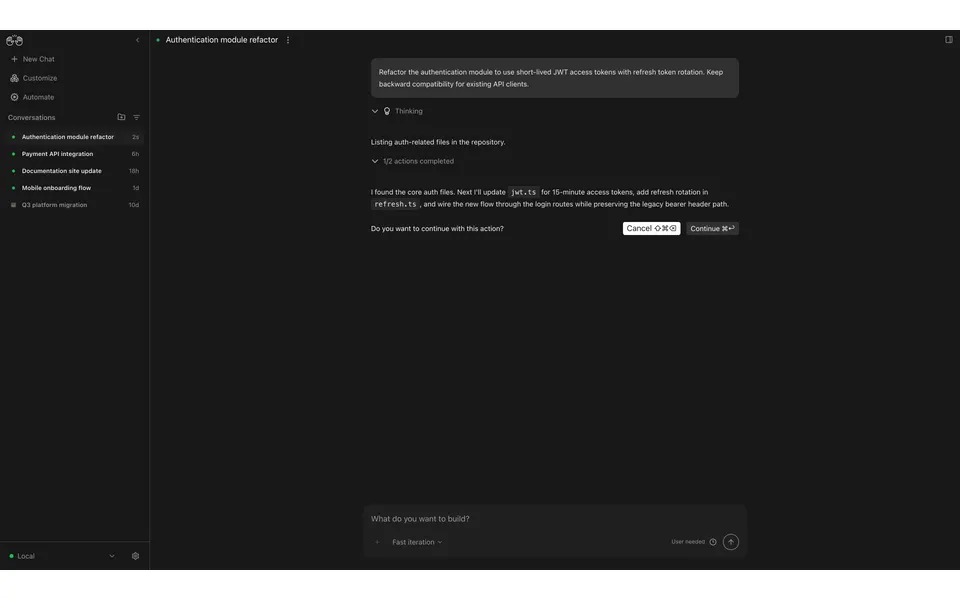
- Desktop app
- Mac, Windows and Linux
- Browser
- Yes
- Phone
- IPhone, Android and phone browser
- Command line
- Yes
- Agents
- Claude Code, Codex, Gemini CLI, OpenCode and Pi
- Your subscription
- Works with your own plan
- Agents run
- On your computer, on your own server and in the vendor's cloud
- Laptop closed
- Keeps going
- Isolation
- Worktree and Container
- Parallel agents
- Yes
- Scheduled runs
- Yes
- Coordinator agent
- Yes
- Built-in issues
- No
- Pull requests
- Yes
- Review screen
- Yes
- Team
- Roles and SSO
- Self-hosting
- Yes
- Licence
- MIT
- Price from
- Free
- How it charges
- Free plan, subscription, per seat and bring your own key
- Paid plans from
- Over $100/month
Receipts
- Checked
- · oldest answer 2026-11-07
- Findings
- 38 published · 35 cross-checked by a second agent · read them all
- Sources
- 25 public pages on 4 sites: api.github.com, github.com, openhands.dev, docs.openhands.dev
- GitHub stars
- 88,155 on · api.github.com · repository attention, not users or capability
- Screenshot
- openhands.dev, retrieved · first party marketing · shows appearance, not capability
- Data
- /products/openhands.json · .md
- Method
- Same rules for all 103 researched ADEs. How we check · Report wrong data
What it does
Where you use it
Canvas provides desktop installation paths, browser UI and documented phone/tablet browser access. A separate public source-built native mobile MVP supports iOS/Android direct Agent Server access, including conversation listing and message sending; Cloud login and Canvas pairing remain planned. The product-owned agent-canvas command launches the local stack.
Source and scope for Where you use itAgents it runs
Canvas integrates OpenHands and ACP agents with custom stdio ACP commands.
Source and scope for Agents it runsAccounts and subscriptions
Local ACP providers can reuse native logins, while clean containers/cloud require credentials and have provider limits.
Source and scope for Accounts and subscriptionsWhere agents run
Canvas switches between local, self-hosted remote and optional cloud backends.
Source and scope for Where agents runHow work is kept apart
Optional containers and worktrees separate execution/files, with documented shared-HOME and shared-workspace limits.
Source and scope for How work is kept apartParallel work
Parallel conversations can use separate Docker runtimes.
Source and scope for Parallel workScheduled runs
Automation Server owns schedules/events and Canvas exposes lifecycle/run history.
Source and scope for Scheduled runsGit and pull requests
Canvas Git controls prompt the agent to commit, pull, push and work with PRs.
Source and scope for Git and pull requestsPrice
The current public self-hosted offer is free Canvas, Teams at $500/month for ten users plus $50/month additional seats with a 5000-session monthly cap, and custom Enterprise. No one-time licence is listed. The optional Cloud backend is not priced in this table; its documented OpenHands LLM credits buy model access, so product-wide metered ADE and compute pricing remain unestablished.
Source and scope for PriceTyped filters
Every value links to its receipt below. Read plan and surface restrictions before using a filter to decide.
| Filter | Value |
|---|---|
| Desktop OS: macOS | Yes |
| Desktop OS: Windows | Yes |
| Desktop OS: Linux | Yes |
| Web client | Yes |
| Phone access: Native iOS | Yes |
| Phone access: Native Android | Yes |
| Phone access: Phone browser | Yes |
| CLI | Yes |
| Coding agents: Claude Code | Yes cross-checked |
| Coding agents: Codex | Yes cross-checked |
| Coding agents: Cursor Agent | Unknown |
| Coding agents: Gemini CLI | Yes cross-checked |
| Coding agents: OpenCode | Yes cross-checked |
| Coding agents: Pi | Yes cross-checked |
| Coding agents: Grok | Unknown |
| Coding agents: Aider | Unknown |
| Coding agents: Antigravity | Unknown |
| Use my subscription | Yes cross-checked |
| Where agents run: On your computer | Yes cross-checked |
| Where agents run: On your own server | Yes cross-checked |
| Where agents run: In the vendor's cloud | Yes cross-checked |
| Workspace isolation: Git worktree | Yes cross-checked |
| Workspace isolation: Container | Yes cross-checked |
| Workspace isolation: VM or microVM | Unknown |
| Parallel runs | Yes cross-checked |
| Coordinator | Yes cross-checked |
| Native issue tracking | No |
| Unattended triggers | Yes cross-checked |
| Shared prompting | Unknown |
| Team roles | Yes cross-checked |
| SSO | Yes cross-checked |
| Pull request workflow | Yes cross-checked |
| Review interface | Yes cross-checked |
| Product license: Apache-2.0 | No. MIT cross-checked |
| Product license: MIT | Yes. MIT cross-checked |
| Product license: GPL-3.0 | No. MIT cross-checked |
| Product license: GPL-3.0-or-later | No. MIT cross-checked |
| Product license: AGPL-3.0 | No. MIT cross-checked |
| Product license: AGPL-3.0-or-later | No. MIT cross-checked |
| Product license: Elastic License 2.0 | No. MIT cross-checked |
| Product license: Custom terms | No. MIT cross-checked |
| Product license: Proprietary | No. MIT cross-checked |
| Self-hosting | Yes cross-checked |
| Telemetry opt-out | Yes cross-checked |
| Free access | Yes cross-checked |
| Starting price: Free | Yes. Free cross-checked |
| Starting price: Up to $20/month | No. Free cross-checked |
| Starting price: $21–40/month | No. Free cross-checked |
| Starting price: $41–100/month | No. Free cross-checked |
| Starting price: Over $100/month | No. Free cross-checked |
| Starting price: Contact for pricing | No. Free cross-checked |
| Pricing model: Free, no paid plan | No |
| Pricing model: Free plan | Yes |
| Pricing model: Subscription | Yes |
| Pricing model: Per seat | Yes |
| Pricing model: Usage-based | Unknown |
| Pricing model: Per machine or compute | Unknown |
| Pricing model: Bring your own key | Yes |
| Pricing model: One-time purchase | No |
| Paid plans from: No paid plan | No. Over $100/month |
| Paid plans from: $10 or less/month | No. Over $100/month |
| Paid plans from: $11–20/month | No. Over $100/month |
| Paid plans from: $21–40/month | No. Over $100/month |
| Paid plans from: $41–100/month | No. Over $100/month |
| Paid plans from: Over $100/month | Yes. Over $100/month |
| Paid plans from: Contact sales | No. Over $100/month |
| Lifecycle status: Active | Unknown |
| Lifecycle status: Sunsetting | Unknown |
| Keeps going with laptop closed | Yes cross-checked |
| Open-source license | Yes. MIT cross-checked |
| Any desktop app | Yes |
| Paid plan up to $20/month | No. Over $100/month |
| Paid plan up to $40/month | No. Over $100/month |
| Any phone client | Yes |
Filter receipts
Desktop OS: macOS: Yes
Desktop OS: macOS
Typed value: Yes.
Canvas provides desktop installation paths, browser UI and documented phone/tablet browser access. A separate public source-built native mobile MVP supports iOS/Android direct Agent Server access, including conversation listing and message sending; Cloud login and Canvas pairing remain planned. The product-owned agent-canvas command launches the local stack.
- Desktop os: macOS, Windows and Linux installation is advertised; minimum OS versions unverified.
- Browser: Browser frontend served by Canvas.
- Only the named atomic answers are established by this source pass. Remaining atomic answers retain their documented gaps.
-
Finding: Vendor describes desktop installs, ACP agents with existing subscriptions, extensions and local, self-hosted or managed backends.
Desktop OS: Windows: Yes
Desktop OS: Windows
Typed value: Yes.
Canvas provides desktop installation paths, browser UI and documented phone/tablet browser access. A separate public source-built native mobile MVP supports iOS/Android direct Agent Server access, including conversation listing and message sending; Cloud login and Canvas pairing remain planned. The product-owned agent-canvas command launches the local stack.
- Desktop os: macOS, Windows and Linux installation is advertised; minimum OS versions unverified.
- Browser: Browser frontend served by Canvas.
- Only the named atomic answers are established by this source pass. Remaining atomic answers retain their documented gaps.
-
Finding: Vendor describes desktop installs, ACP agents with existing subscriptions, extensions and local, self-hosted or managed backends.
Desktop OS: Linux: Yes
Desktop OS: Linux
Typed value: Yes.
Canvas provides desktop installation paths, browser UI and documented phone/tablet browser access. A separate public source-built native mobile MVP supports iOS/Android direct Agent Server access, including conversation listing and message sending; Cloud login and Canvas pairing remain planned. The product-owned agent-canvas command launches the local stack.
- Desktop os: macOS, Windows and Linux installation is advertised; minimum OS versions unverified.
- Browser: Browser frontend served by Canvas.
- Only the named atomic answers are established by this source pass. Remaining atomic answers retain their documented gaps.
-
Finding: Vendor describes desktop installs, ACP agents with existing subscriptions, extensions and local, self-hosted or managed backends.
Web client: Yes
Web client
Typed value: Yes.
Canvas provides desktop installation paths, browser UI and documented phone/tablet browser access. A separate public source-built native mobile MVP supports iOS/Android direct Agent Server access, including conversation listing and message sending; Cloud login and Canvas pairing remain planned. The product-owned agent-canvas command launches the local stack.
- Desktop os: macOS, Windows and Linux installation is advertised; minimum OS versions unverified.
- Browser: Browser frontend served by Canvas.
- Only the named atomic answers are established by this source pass. Remaining atomic answers retain their documented gaps.
-
Finding: Canvas launches local Agent Server/automation services with Node 24 and uv, or optional Docker runtimes. Backends can live on laptop, remote VM or managed cloud. Same host workspace mounts still share files.
-
Finding: Vendor describes desktop installs, ACP agents with existing subscriptions, extensions and local, self-hosted or managed backends.
Phone access: Native iOS: Yes
Phone access: Native iOS
Typed value: Yes.
Canvas provides desktop installation paths, browser UI and documented phone/tablet browser access. A separate public source-built native mobile MVP supports iOS/Android direct Agent Server access, including conversation listing and message sending; Cloud login and Canvas pairing remain planned. The product-owned agent-canvas command launches the local stack.
- Mobile apps: The native Expo source MVP builds for iOS and Android and can list/stream/send to a reachable Agent Server using a session API key. Requires native toolchains; Cloud login, QR pairing and laptop facade are not built.
- Only the named atomic answers are established by this source pass. Remaining atomic answers retain their documented gaps.
-
Finding: The public native Expo MVP can list conversations, stream history/events and send messages to a reachable Agent Server using a session API key. Source-build instructions cover Android and iOS with native toolchains. Cloud login, QR pairing and a laptop remote-session facade are still planned; no store/release binary is asserted.
-
OpenHands native mobile Agent Server client
Finding: The native mobile client implements REST conversation listing/history and sends message events to /api/conversations/{id}/events; ChatScreen calls that sendMessage path, and useConversationSocket streams events through WebSocket. app.json declares iOS and Android native platforms.
Phone access: Native Android: Yes
Phone access: Native Android
Typed value: Yes.
Canvas provides desktop installation paths, browser UI and documented phone/tablet browser access. A separate public source-built native mobile MVP supports iOS/Android direct Agent Server access, including conversation listing and message sending; Cloud login and Canvas pairing remain planned. The product-owned agent-canvas command launches the local stack.
- Mobile apps: The native Expo source MVP builds for iOS and Android and can list/stream/send to a reachable Agent Server using a session API key. Requires native toolchains; Cloud login, QR pairing and laptop facade are not built.
- Only the named atomic answers are established by this source pass. Remaining atomic answers retain their documented gaps.
-
Finding: The public native Expo MVP can list conversations, stream history/events and send messages to a reachable Agent Server using a session API key. Source-build instructions cover Android and iOS with native toolchains. Cloud login, QR pairing and a laptop remote-session facade are still planned; no store/release binary is asserted.
-
OpenHands native mobile Agent Server client
Finding: The native mobile client implements REST conversation listing/history and sends message events to /api/conversations/{id}/events; ChatScreen calls that sendMessage path, and useConversationSocket streams events through WebSocket. app.json declares iOS and Android native platforms.
Phone access: Phone browser: Yes
Phone access: Phone browser
Typed value: Yes.
Canvas provides desktop installation paths, browser UI and documented phone/tablet browser access. A separate public source-built native mobile MVP supports iOS/Android direct Agent Server access, including conversation listing and message sending; Cloud login and Canvas pairing remain planned. The product-owned agent-canvas command launches the local stack.
- Mobile browser: Open Canvas in a phone/tablet browser through Tailscale or authenticated ngrok/public mode.
- Cross device continuity: Phone/tablet browsers can reach the same host Canvas/backend through Tailscale or authenticated ngrok; continuing a specific task across devices is not described and no desktop-phone handoff fixture was run.
- Only the named atomic answers are established by this source pass. Remaining atomic answers retain their documented gaps.
-
Finding: Canvas documents phone/tablet browser access through Tailscale or authenticated public-mode ngrok; it does not establish native mobile apps.
CLI: Yes
CLI
Typed value: Yes.
Canvas provides desktop installation paths, browser UI and documented phone/tablet browser access. A separate public source-built native mobile MVP supports iOS/Android direct Agent Server access, including conversation listing and message sending; Cloud login and Canvas pairing remain planned. The product-owned agent-canvas command launches the local stack.
- Cli: The agent-canvas command launches the local server/automation/frontend stack and supports help/info/version and deployment flags. This is launcher scope.
- Only the named atomic answers are established by this source pass. Remaining atomic answers retain their documented gaps.
-
Agent Canvas command-line launcher
Finding: The product-owned agent-canvas CLI starts the local Agent Server, automation backend and pre-built frontend. It exposes version, stack-info, public/frontend-only/backend-only and help flags. This establishes a user-runnable launcher CLI, without asserting a separate task-operation CLI.
Coding agents: Claude Code: Yes cross-checked
Coding agents: Claude Code
Typed value: Yes.
Canvas integrates OpenHands and ACP agents with custom stdio ACP commands.
- Harnesses: OpenHands agent, Claude Code, Codex, Gemini CLI, Pi, OpenCode or any ACP-compatible agent.
- Session integration: ACP integration for compatible harnesses.
- The remaining atomic questions and the rubric scenario are unverified. Documentation is not a successful product test.
- Only the named atomic facts are established by documentation. Remaining rubric scenarios and unknown answers were not demonstrated.
-
Finding: Canvas launches local Agent Server/automation services with Node 24 and uv, or optional Docker runtimes. Backends can live on laptop, remote VM or managed cloud. Same host workspace mounts still share files.
-
Finding: Vendor describes desktop installs, ACP agents with existing subscriptions, extensions and local, self-hosted or managed backends.
Coding agents: Codex: Yes cross-checked
Coding agents: Codex
Typed value: Yes.
Canvas integrates OpenHands and ACP agents with custom stdio ACP commands.
- Harnesses: OpenHands agent, Claude Code, Codex, Gemini CLI, Pi, OpenCode or any ACP-compatible agent.
- Session integration: ACP integration for compatible harnesses.
- The remaining atomic questions and the rubric scenario are unverified. Documentation is not a successful product test.
- Only the named atomic facts are established by documentation. Remaining rubric scenarios and unknown answers were not demonstrated.
-
Finding: Canvas launches local Agent Server/automation services with Node 24 and uv, or optional Docker runtimes. Backends can live on laptop, remote VM or managed cloud. Same host workspace mounts still share files.
-
Finding: Vendor describes desktop installs, ACP agents with existing subscriptions, extensions and local, self-hosted or managed backends.
Coding agents: Gemini CLI: Yes cross-checked
Coding agents: Gemini CLI
Typed value: Yes.
Canvas integrates OpenHands and ACP agents with custom stdio ACP commands.
- Harnesses: OpenHands agent, Claude Code, Codex, Gemini CLI, Pi, OpenCode or any ACP-compatible agent.
- Session integration: ACP integration for compatible harnesses.
- The remaining atomic questions and the rubric scenario are unverified. Documentation is not a successful product test.
- Only the named atomic facts are established by documentation. Remaining rubric scenarios and unknown answers were not demonstrated.
-
Finding: Canvas launches local Agent Server/automation services with Node 24 and uv, or optional Docker runtimes. Backends can live on laptop, remote VM or managed cloud. Same host workspace mounts still share files.
-
Finding: Vendor describes desktop installs, ACP agents with existing subscriptions, extensions and local, self-hosted or managed backends.
Coding agents: OpenCode: Yes cross-checked
Coding agents: OpenCode
Typed value: Yes.
Canvas integrates OpenHands and ACP agents with custom stdio ACP commands.
- Harnesses: OpenHands agent, Claude Code, Codex, Gemini CLI, Pi, OpenCode or any ACP-compatible agent.
- Session integration: ACP integration for compatible harnesses.
- The remaining atomic questions and the rubric scenario are unverified. Documentation is not a successful product test.
- Only the named atomic facts are established by documentation. Remaining rubric scenarios and unknown answers were not demonstrated.
-
Finding: Canvas launches local Agent Server/automation services with Node 24 and uv, or optional Docker runtimes. Backends can live on laptop, remote VM or managed cloud. Same host workspace mounts still share files.
-
Finding: Vendor describes desktop installs, ACP agents with existing subscriptions, extensions and local, self-hosted or managed backends.
Coding agents: Pi: Yes cross-checked
Coding agents: Pi
Typed value: Yes.
Canvas integrates OpenHands and ACP agents with custom stdio ACP commands.
- Harnesses: OpenHands agent, Claude Code, Codex, Gemini CLI, Pi, OpenCode or any ACP-compatible agent.
- Session integration: ACP integration for compatible harnesses.
- The remaining atomic questions and the rubric scenario are unverified. Documentation is not a successful product test.
- Only the named atomic facts are established by documentation. Remaining rubric scenarios and unknown answers were not demonstrated.
-
Finding: Canvas launches local Agent Server/automation services with Node 24 and uv, or optional Docker runtimes. Backends can live on laptop, remote VM or managed cloud. Same host workspace mounts still share files.
-
Finding: Vendor describes desktop installs, ACP agents with existing subscriptions, extensions and local, self-hosted or managed backends.
Use my subscription: Yes cross-checked
Use my subscription
Typed value: Yes.
Local ACP providers can reuse native logins, while clean containers/cloud require credentials and have provider limits.
- Agent subscriptions: Existing Claude Code, Codex or Gemini subscription access.
- Api accounts: OpenHands agent can use an LLM key.
- The remaining atomic questions and the rubric scenario are unverified. Documentation is not a successful product test.
- Only the named atomic facts are established by documentation. Remaining rubric scenarios and unknown answers were not demonstrated.
-
Finding: Vendor describes desktop installs, ACP agents with existing subscriptions, extensions and local, self-hosted or managed backends.
Where agents run: On your computer: Yes cross-checked
Where agents run: On your computer
Typed value: Yes.
Canvas switches between local, self-hosted remote and optional cloud backends.
- Local: Local Agent Server.
- Byo remote: User-operated dedicated machine or VM.
- Managed cloud: OpenHands Cloud optional backend.
- Hybrid: One Canvas can switch among backends.
- Client disconnect: Vendor states remote server agents continue with laptop off; disconnect was not tested.
- The remaining atomic questions and the rubric scenario are unverified. Documentation is not a successful product test.
-
Finding: Canvas launches local Agent Server/automation services with Node 24 and uv, or optional Docker runtimes. Backends can live on laptop, remote VM or managed cloud. Same host workspace mounts still share files.
-
Finding: Vendor describes desktop installs, ACP agents with existing subscriptions, extensions and local, self-hosted or managed backends.
Where agents run: On your own server: Yes cross-checked
Where agents run: On your own server
Typed value: Yes.
Canvas switches between local, self-hosted remote and optional cloud backends.
- Local: Local Agent Server.
- Byo remote: User-operated dedicated machine or VM.
- Managed cloud: OpenHands Cloud optional backend.
- Hybrid: One Canvas can switch among backends.
- Client disconnect: Vendor states remote server agents continue with laptop off; disconnect was not tested.
- The remaining atomic questions and the rubric scenario are unverified. Documentation is not a successful product test.
-
Finding: Canvas launches local Agent Server/automation services with Node 24 and uv, or optional Docker runtimes. Backends can live on laptop, remote VM or managed cloud. Same host workspace mounts still share files.
-
Finding: Vendor describes desktop installs, ACP agents with existing subscriptions, extensions and local, self-hosted or managed backends.
Where agents run: In the vendor's cloud: Yes cross-checked
Where agents run: In the vendor's cloud
Typed value: Yes.
Canvas switches between local, self-hosted remote and optional cloud backends.
- Local: Local Agent Server.
- Byo remote: User-operated dedicated machine or VM.
- Managed cloud: OpenHands Cloud optional backend.
- Hybrid: One Canvas can switch among backends.
- Client disconnect: Vendor states remote server agents continue with laptop off; disconnect was not tested.
- The remaining atomic questions and the rubric scenario are unverified. Documentation is not a successful product test.
-
Finding: Canvas launches local Agent Server/automation services with Node 24 and uv, or optional Docker runtimes. Backends can live on laptop, remote VM or managed cloud. Same host workspace mounts still share files.
-
Finding: Vendor describes desktop installs, ACP agents with existing subscriptions, extensions and local, self-hosted or managed backends.
Workspace isolation: Git worktree: Yes cross-checked
Workspace isolation: Git worktree
Typed value: Yes.
Optional containers and worktrees separate execution/files, with documented shared-HOME and shared-workspace limits.
- Branch: Cloud children use selected repository and branch.
- Worktree: Local child conversations may use an isolated worktree or parent shared workspace.
- The remaining atomic questions and the rubric scenario are unverified. Documentation is not a successful product test.
- Only the named atomic facts are established by documentation. Remaining rubric scenarios and unknown answers were not demonstrated.
-
OpenHands Child conversations; Commits drawer; Goals; Export; Archive
Finding: Canvas child conversations stay linked and return results; local children may use isolated worktrees or shared workspace. Commit drawer shows diffs and agent Git/PR actions. Goals use a judge with round caps and user-message interruption. Transcripts export locally as Markdown/HTML with tool details; archive keeps backend history.
Workspace isolation: Container: Yes cross-checked
Workspace isolation: Container
Typed value: Yes.
Optional containers and worktrees separate execution/files, with documented shared-HOME and shared-workspace limits.
- Container: Optional container per new conversation.
- Filesystem: Direct mode has host filesystem access; same host workspace mounts still share files.
- Security boundary: Docker execution boundary does not isolate the whole Canvas/automation stack.
- The remaining atomic questions and the rubric scenario are unverified. Documentation is not a successful product test.
- Only the named atomic facts are established by documentation. Remaining rubric scenarios and unknown answers were not demonstrated.
-
Finding: Canvas launches local Agent Server/automation services with Node 24 and uv, or optional Docker runtimes. Backends can live on laptop, remote VM or managed cloud. Same host workspace mounts still share files.
Parallel runs: Yes cross-checked
Parallel runs
Typed value: Yes.
Parallel conversations can use separate Docker runtimes.
- Concurrent sessions: Multiple simultaneous conversations.
- Status visibility: Canvas conversation UI; status correctness untested.
- The remaining atomic questions and the rubric scenario are unverified. Documentation is not a successful product test.
-
Finding: Canvas launches local Agent Server/automation services with Node 24 and uv, or optional Docker runtimes. Backends can live on laptop, remote VM or managed cloud. Same host workspace mounts still share files.
Coordinator: Yes cross-checked
Coordinator
Typed value: Yes.
Canvas launches linked child conversations and returns their results to the parent.
- Roles: Parent/child conversation relationship remains linked.
- Results return: Child result returns to the parent conversation.
- Orchestration owner: Canvas validates launch_child_conversation inputs and creates child conversations.
- Activation: Agent calls launch_child_conversation on supported local/Cloud targets.
- Only the named atomic facts are established by documentation. Remaining rubric scenarios and unknown answers were not demonstrated.
-
OpenHands Child conversations; Commits drawer; Goals; Export; Archive
Finding: Canvas child conversations stay linked and return results; local children may use isolated worktrees or shared workspace. Commit drawer shows diffs and agent Git/PR actions. Goals use a judge with round caps and user-message interruption. Transcripts export locally as Markdown/HTML with tool details; archive keeps backend history.
Native issue tracking: No
Native issue tracking
Typed value: No.
The Canvas Task List renders the latest TaskTrackerObservation from the current conversation, with position-derived IDs and todo/in-progress/done states. Bounded inspection found no independent native issue/backlog work-item store; saved automations are trigger configurations.
- Create: The inspected native interface renders agent TaskTracker observations rather than providing independent issue/backlog CRUD.
- Task session separation: Task rows derive directly from the current conversation event store and do not have independent stable issue identity.
- Durable states: Task statuses are retained as conversation observations, not as separate persistent backlog work items.
- Only the named atomic answers are established by this source pass. Remaining atomic answers retain their documented gaps.
-
Finding: The Canvas Task List derives its entries from the latest TaskTrackerObservation in the current conversation event store. IDs are generated from list position and statuses are todo/in_progress/done. Inspection of the native task-list route and API/store surfaces found no independent issue/backlog work-item entity; automations are separate trigger definitions.
Unattended triggers: Yes cross-checked
Unattended triggers
Typed value: Yes.
Automation Server owns schedules/events and Canvas exposes lifecycle/run history.
- Schedules: Optional automation backend.
- Events: Events through the automation backend.
- Scheduler location: Separate automation service; not the frontend.
- The remaining atomic questions and the rubric scenario are unverified. Documentation is not a successful product test.
- Only the named atomic facts are established by documentation. Remaining rubric scenarios and unknown answers were not demonstrated.
-
Finding: Canvas launches local Agent Server/automation services with Node 24 and uv, or optional Docker runtimes. Backends can live on laptop, remote VM or managed cloud. Same host workspace mounts still share files.
-
Finding: Canvas renders conversations and controls backend APIs; execution, isolation and automation belong to separate runtime services.
Team roles: Yes cross-checked
Team roles
Typed value: Yes.
Organizations document Member/Admin/Owner permissions; paid Teams/Enterprise separately advertise SSO/SAML.
- Organization roles: Member creates conversations/private settings; Admin invites/promotes and manages org settings; Owner deletes org/claims Git organizations.
- Membership: Members join as Member; Admins invite and change Member/Admin roles.
- Plan scope: Cloud/Enterprise organization roles; free Canvas uses a shared identity.
- Only the named atomic facts are established by documentation. Remaining rubric scenarios and unknown answers were not demonstrated.
-
OpenHands Roles table; Private settings
Finding: Cloud/Enterprise organization roles are Member, Admin and Owner. Members create conversations and own private MCP/secrets/settings; Admins invite/promote users and manage LLM settings/credits; Owners delete organizations and claim Git organizations. Private settings remain private from other members including admins.
SSO: Yes cross-checked
SSO
Typed value: Yes.
Organizations document Member/Admin/Owner permissions; paid Teams/Enterprise separately advertise SSO/SAML.
- Sso: OpenHands Enterprise installations document SAML single sign-on with a corporate identity provider; the pricing page lists SSO/SAML on Teams and Enterprise, not free Agent Canvas.
- Only the named atomic facts are established by documentation. Remaining rubric scenarios and unknown answers were not demonstrated.
-
OpenHands Enterprise SAML SSO guide
Finding: The guide explains how to let users of an OpenHands Enterprise installation sign in through a corporate SAML identity provider such as Okta, Entra ID, Google Workspace or ADFS.
-
Finding: Agent Canvas is free and MIT licensed. Teams costs 500 USD per month for up to ten users plus 50 USD per extra seat and lists SSO/SAML and RBAC; Enterprise has custom pricing. The page returns HTTP 403 to some automated fetchers but loads with a browser user agent.
Pull request workflow: Yes cross-checked
Pull request workflow
Typed value: Yes.
Canvas Git controls prompt the agent to commit, pull, push and work with PRs.
- Commits: Commits drawer offers commit/pull/push prompts and recent commits.
- Pull requests: Git-actions control sends pull-request prompts to the agent; no completed PR fixture.
- Only the named atomic facts are established by documentation. Remaining rubric scenarios and unknown answers were not demonstrated.
-
OpenHands Child conversations; Commits drawer; Goals; Export; Archive
Finding: Canvas child conversations stay linked and return results; local children may use isolated worktrees or shared workspace. Commit drawer shows diffs and agent Git/PR actions. Goals use a judge with round caps and user-message interruption. Transcripts export locally as Markdown/HTML with tool details; archive keeps backend history.
Review interface: Yes cross-checked
Review interface
Typed value: Yes.
Canvas exposes combined commit/uncommitted diffs and experimental critic feedback.
- Change understanding: Unified Commits drawer combines commit history and uncommitted changes.
- Evidence navigation: Conversation overview links workspace Git context, Files and Commits drawers.
- Only the named atomic facts are established by documentation. Remaining rubric scenarios and unknown answers were not demonstrated.
-
OpenHands Child conversations; Commits drawer; Goals; Export; Archive
Finding: Canvas child conversations stay linked and return results; local children may use isolated worktrees or shared workspace. Commit drawer shows diffs and agent Git/PR actions. Goals use a judge with round caps and user-message interruption. Transcripts export locally as Markdown/HTML with tool details; archive keeps backend history.
Product license: Apache-2.0: No. MIT cross-checked
Product license: Apache-2.0
Typed value: No. MIT.
The Canvas source distribution is MIT.
- Client license: MIT, subject to component notices.
- Source visibility: Public Canvas source.
- Source revision: b811a4c33979ca4b5d241730b995b56362f4ab34
- The remaining atomic questions and the rubric scenario are unverified. Documentation is not a successful product test.
-
Finding: The cited root license governs this repository distribution, subject to component notices.
Product license: MIT: Yes. MIT cross-checked
Product license: MIT
Typed value: Yes. MIT.
The Canvas source distribution is MIT.
- Client license: MIT, subject to component notices.
- Source visibility: Public Canvas source.
- Source revision: b811a4c33979ca4b5d241730b995b56362f4ab34
- The remaining atomic questions and the rubric scenario are unverified. Documentation is not a successful product test.
-
Finding: The cited root license governs this repository distribution, subject to component notices.
Product license: GPL-3.0: No. MIT cross-checked
Product license: GPL-3.0
Typed value: No. MIT.
The Canvas source distribution is MIT.
- Client license: MIT, subject to component notices.
- Source visibility: Public Canvas source.
- Source revision: b811a4c33979ca4b5d241730b995b56362f4ab34
- The remaining atomic questions and the rubric scenario are unverified. Documentation is not a successful product test.
-
Finding: The cited root license governs this repository distribution, subject to component notices.
Product license: GPL-3.0-or-later: No. MIT cross-checked
Product license: GPL-3.0-or-later
Typed value: No. MIT.
The Canvas source distribution is MIT.
- Client license: MIT, subject to component notices.
- Source visibility: Public Canvas source.
- Source revision: b811a4c33979ca4b5d241730b995b56362f4ab34
- The remaining atomic questions and the rubric scenario are unverified. Documentation is not a successful product test.
-
Finding: The cited root license governs this repository distribution, subject to component notices.
Product license: AGPL-3.0: No. MIT cross-checked
Product license: AGPL-3.0
Typed value: No. MIT.
The Canvas source distribution is MIT.
- Client license: MIT, subject to component notices.
- Source visibility: Public Canvas source.
- Source revision: b811a4c33979ca4b5d241730b995b56362f4ab34
- The remaining atomic questions and the rubric scenario are unverified. Documentation is not a successful product test.
-
Finding: The cited root license governs this repository distribution, subject to component notices.
Product license: AGPL-3.0-or-later: No. MIT cross-checked
Product license: AGPL-3.0-or-later
Typed value: No. MIT.
The Canvas source distribution is MIT.
- Client license: MIT, subject to component notices.
- Source visibility: Public Canvas source.
- Source revision: b811a4c33979ca4b5d241730b995b56362f4ab34
- The remaining atomic questions and the rubric scenario are unverified. Documentation is not a successful product test.
-
Finding: The cited root license governs this repository distribution, subject to component notices.
Product license: Elastic License 2.0: No. MIT cross-checked
Product license: Elastic License 2.0
Typed value: No. MIT.
The Canvas source distribution is MIT.
- Client license: MIT, subject to component notices.
- Source visibility: Public Canvas source.
- Source revision: b811a4c33979ca4b5d241730b995b56362f4ab34
- The remaining atomic questions and the rubric scenario are unverified. Documentation is not a successful product test.
-
Finding: The cited root license governs this repository distribution, subject to component notices.
Product license: Custom terms: No. MIT cross-checked
Product license: Custom terms
Typed value: No. MIT.
The Canvas source distribution is MIT.
- Client license: MIT, subject to component notices.
- Source visibility: Public Canvas source.
- Source revision: b811a4c33979ca4b5d241730b995b56362f4ab34
- The remaining atomic questions and the rubric scenario are unverified. Documentation is not a successful product test.
-
Finding: The cited root license governs this repository distribution, subject to component notices.
Product license: Proprietary: No. MIT cross-checked
Product license: Proprietary
Typed value: No. MIT.
The Canvas source distribution is MIT.
- Client license: MIT, subject to component notices.
- Source visibility: Public Canvas source.
- Source revision: b811a4c33979ca4b5d241730b995b56362f4ab34
- The remaining atomic questions and the rubric scenario are unverified. Documentation is not a successful product test.
-
Finding: The cited root license governs this repository distribution, subject to component notices.
Self-hosting: Yes cross-checked
Self-hosting
Typed value: Yes.
Canvas self-hosts and provides portable conversation and automation exports.
- Self hosting: Frontend, Agent Server and automation stack on the operator machine.
- Vendor dependencies: Selected model/harness services and optional cloud backend remain separate.
- The remaining atomic questions and the rubric scenario are unverified. Documentation is not a successful product test.
- Only the named atomic facts are established by documentation. Remaining rubric scenarios and unknown answers were not demonstrated.
-
Finding: Canvas launches local Agent Server/automation services with Node 24 and uv, or optional Docker runtimes. Backends can live on laptop, remote VM or managed cloud. Same host workspace mounts still share files.
-
Finding: User provisions and hardens a VM; public mode requires an API key, with TLS/firewall setup and shared-origin editor caveats.
Telemetry opt-out: Yes cross-checked
Telemetry opt-out
Typed value: Yes.
Backend settings/secrets and browser-generated exports have explicit boundaries. At v1.38.0 an anonymous usage-data switch defaults on with a consent prompt and can be turned off on local and self-hosted backends; it is forced on for OpenHands Cloud.
- Telemetry defaults: The anonymous usage-data switch defaults on when the user has not chosen; on a Cloud backend it is forced on. Source inspection at v1.38.0, not tested.
- Telemetry controls: App settings offer a switch to stop sending anonymous usage data on local and self-hosted backends; it is disabled on Cloud backends. Source inspection at v1.38.0, not tested.
- Only the named atomic facts are established by documentation. Remaining rubric scenarios and unknown answers were not demonstrated.
-
Agent Canvas app settings analytics switch
Finding: App settings render a 'send anonymous usage data' switch that defaults on and saves user_consents_to_analytics and the telemetry consent as granted or denied. On a Cloud backend the switch is disabled and stays on.
Free access: Yes cross-checked
Free access
Typed value: Yes.
The vendor advertises free local and self-managed Canvas use.
- Ongoing free: Free local Canvas.
- Self host cost: Self-hosted VM is labeled free, OSS and self-managed. The page gives no infrastructure or provider cost detail.
- The remaining atomic questions and the rubric scenario are unverified. Documentation is not a successful product test.
-
Finding: Vendor describes desktop installs, ACP agents with existing subscriptions, extensions and local, self-hosted or managed backends.
Starting price: Free: Yes. Free cross-checked
Starting price: Free
Typed value: Yes. Free.
The vendor advertises free local and self-managed Canvas use.
- Ongoing free: Free local Canvas.
- Self host cost: Self-hosted VM is labeled free, OSS and self-managed. The page gives no infrastructure or provider cost detail.
- The remaining atomic questions and the rubric scenario are unverified. Documentation is not a successful product test.
-
Finding: Vendor describes desktop installs, ACP agents with existing subscriptions, extensions and local, self-hosted or managed backends.
Starting price: Up to $20/month: No. Free cross-checked
Starting price: Up to $20/month
Typed value: No. Free.
The vendor advertises free local and self-managed Canvas use.
- Ongoing free: Free local Canvas.
- Self host cost: Self-hosted VM is labeled free, OSS and self-managed. The page gives no infrastructure or provider cost detail.
- The remaining atomic questions and the rubric scenario are unverified. Documentation is not a successful product test.
-
Finding: Vendor describes desktop installs, ACP agents with existing subscriptions, extensions and local, self-hosted or managed backends.
Starting price: $21–40/month: No. Free cross-checked
Starting price: $21–40/month
Typed value: No. Free.
The vendor advertises free local and self-managed Canvas use.
- Ongoing free: Free local Canvas.
- Self host cost: Self-hosted VM is labeled free, OSS and self-managed. The page gives no infrastructure or provider cost detail.
- The remaining atomic questions and the rubric scenario are unverified. Documentation is not a successful product test.
-
Finding: Vendor describes desktop installs, ACP agents with existing subscriptions, extensions and local, self-hosted or managed backends.
Starting price: $41–100/month: No. Free cross-checked
Starting price: $41–100/month
Typed value: No. Free.
The vendor advertises free local and self-managed Canvas use.
- Ongoing free: Free local Canvas.
- Self host cost: Self-hosted VM is labeled free, OSS and self-managed. The page gives no infrastructure or provider cost detail.
- The remaining atomic questions and the rubric scenario are unverified. Documentation is not a successful product test.
-
Finding: Vendor describes desktop installs, ACP agents with existing subscriptions, extensions and local, self-hosted or managed backends.
Starting price: Over $100/month: No. Free cross-checked
Starting price: Over $100/month
Typed value: No. Free.
The vendor advertises free local and self-managed Canvas use.
- Ongoing free: Free local Canvas.
- Self host cost: Self-hosted VM is labeled free, OSS and self-managed. The page gives no infrastructure or provider cost detail.
- The remaining atomic questions and the rubric scenario are unverified. Documentation is not a successful product test.
-
Finding: Vendor describes desktop installs, ACP agents with existing subscriptions, extensions and local, self-hosted or managed backends.
Starting price: Contact for pricing: No. Free cross-checked
Starting price: Contact for pricing
Typed value: No. Free.
The vendor advertises free local and self-managed Canvas use.
- Ongoing free: Free local Canvas.
- Self host cost: Self-hosted VM is labeled free, OSS and self-managed. The page gives no infrastructure or provider cost detail.
- The remaining atomic questions and the rubric scenario are unverified. Documentation is not a successful product test.
-
Finding: Vendor describes desktop installs, ACP agents with existing subscriptions, extensions and local, self-hosted or managed backends.
Pricing model: Free, no paid plan: No
Pricing model: Free, no paid plan
Typed value: No.
The current public self-hosted offer is free Canvas, Teams at $500/month for ten users plus $50/month additional seats with a 5000-session monthly cap, and custom Enterprise. No one-time licence is listed. The optional Cloud backend is not priced in this table; its documented OpenHands LLM credits buy model access, so product-wide metered ADE and compute pricing remain unestablished.
- Included usage: The current Teams table caps usage at 5000 sessions per month; Enterprise is uncapped.
- Model cost: Self-hosted plans use user-provided LLM keys. Optional OpenHands Cloud LLM keys consume separately purchased model credits and can also be used in other agents.
- Compute cost: The self-hosted table does not price the optional Cloud backend; a vendor sandbox/compute charge is not established by model credits.
- Only the named atomic answers are established by this source pass. Remaining atomic answers retain their documented gaps.
-
OpenHands current self-hosted plan table
Finding: The current public price table lists free self-hosted Canvas, self-hosted Teams at $500/month for ten users plus $50/month additional seats, capped at 5000 sessions monthly, and custom Enterprise. It lists no one-time licence. The separately linked Cloud backend is not priced in this table.
Pricing model: Free plan: Yes
Pricing model: Free plan
Typed value: Yes.
The current public self-hosted offer is free Canvas, Teams at $500/month for ten users plus $50/month additional seats with a 5000-session monthly cap, and custom Enterprise. No one-time licence is listed. The optional Cloud backend is not priced in this table; its documented OpenHands LLM credits buy model access, so product-wide metered ADE and compute pricing remain unestablished.
- Currency: Paid Teams list price in USD.
- Interval: Teams billed monthly at $500 for up to ten users; $50 monthly additional seats.
- Seats: Teams includes up to ten users; Enterprise unlimited seats.
- Trial: Teams advertises a 30-day trial.
- Only the named atomic answers are established by this source pass. Remaining atomic answers retain their documented gaps.
-
OpenHands Plan cards; Comparison table
Finding: Canvas is free, MIT, single-user/shared-identity and self-hosted. Teams is $500 monthly for up to ten users with $50 monthly per additional seat, 5000 sessions per month, 30-day trial, RBAC and SSO/SAML. Enterprise has custom pricing. LLM keys are user-provided.
Pricing model: Subscription: Yes
Pricing model: Subscription
Typed value: Yes.
The current public self-hosted offer is free Canvas, Teams at $500/month for ten users plus $50/month additional seats with a 5000-session monthly cap, and custom Enterprise. No one-time licence is listed. The optional Cloud backend is not priced in this table; its documented OpenHands LLM credits buy model access, so product-wide metered ADE and compute pricing remain unestablished.
- Currency: Paid Teams list price in USD.
- Interval: Teams billed monthly at $500 for up to ten users; $50 monthly additional seats.
- Seats: Teams includes up to ten users; Enterprise unlimited seats.
- Trial: Teams advertises a 30-day trial.
- Only the named atomic answers are established by this source pass. Remaining atomic answers retain their documented gaps.
-
OpenHands Plan cards; Comparison table
Finding: Canvas is free, MIT, single-user/shared-identity and self-hosted. Teams is $500 monthly for up to ten users with $50 monthly per additional seat, 5000 sessions per month, 30-day trial, RBAC and SSO/SAML. Enterprise has custom pricing. LLM keys are user-provided.
Pricing model: Per seat: Yes
Pricing model: Per seat
Typed value: Yes.
The current public self-hosted offer is free Canvas, Teams at $500/month for ten users plus $50/month additional seats with a 5000-session monthly cap, and custom Enterprise. No one-time licence is listed. The optional Cloud backend is not priced in this table; its documented OpenHands LLM credits buy model access, so product-wide metered ADE and compute pricing remain unestablished.
- Currency: Paid Teams list price in USD.
- Interval: Teams billed monthly at $500 for up to ten users; $50 monthly additional seats.
- Seats: Teams includes up to ten users; Enterprise unlimited seats.
- Trial: Teams advertises a 30-day trial.
- Only the named atomic answers are established by this source pass. Remaining atomic answers retain their documented gaps.
-
OpenHands Plan cards; Comparison table
Finding: Canvas is free, MIT, single-user/shared-identity and self-hosted. Teams is $500 monthly for up to ten users with $50 monthly per additional seat, 5000 sessions per month, 30-day trial, RBAC and SSO/SAML. Enterprise has custom pricing. LLM keys are user-provided.
Pricing model: Bring your own key: Yes
Pricing model: Bring your own key
Typed value: Yes.
The current public self-hosted offer is free Canvas, Teams at $500/month for ten users plus $50/month additional seats with a 5000-session monthly cap, and custom Enterprise. No one-time licence is listed. The optional Cloud backend is not priced in this table; its documented OpenHands LLM credits buy model access, so product-wide metered ADE and compute pricing remain unestablished.
- Currency: Paid Teams list price in USD.
- Interval: Teams billed monthly at $500 for up to ten users; $50 monthly additional seats.
- Seats: Teams includes up to ten users; Enterprise unlimited seats.
- Trial: Teams advertises a 30-day trial.
- Only the named atomic answers are established by this source pass. Remaining atomic answers retain their documented gaps.
-
OpenHands Plan cards; Comparison table
Finding: Canvas is free, MIT, single-user/shared-identity and self-hosted. Teams is $500 monthly for up to ten users with $50 monthly per additional seat, 5000 sessions per month, 30-day trial, RBAC and SSO/SAML. Enterprise has custom pricing. LLM keys are user-provided.
Pricing model: One-time purchase: No
Pricing model: One-time purchase
Typed value: No.
The current public self-hosted offer is free Canvas, Teams at $500/month for ten users plus $50/month additional seats with a 5000-session monthly cap, and custom Enterprise. No one-time licence is listed. The optional Cloud backend is not priced in this table; its documented OpenHands LLM credits buy model access, so product-wide metered ADE and compute pricing remain unestablished.
- Included usage: The current Teams table caps usage at 5000 sessions per month; Enterprise is uncapped.
- Model cost: Self-hosted plans use user-provided LLM keys. Optional OpenHands Cloud LLM keys consume separately purchased model credits and can also be used in other agents.
- Compute cost: The self-hosted table does not price the optional Cloud backend; a vendor sandbox/compute charge is not established by model credits.
- Only the named atomic answers are established by this source pass. Remaining atomic answers retain their documented gaps.
-
OpenHands current self-hosted plan table
Finding: The current public price table lists free self-hosted Canvas, self-hosted Teams at $500/month for ten users plus $50/month additional seats, capped at 5000 sessions monthly, and custom Enterprise. It lists no one-time licence. The separately linked Cloud backend is not priced in this table.
Paid plans from: No paid plan: No. Over $100/month
Paid plans from: No paid plan
Typed value: No. Over $100/month.
The current public self-hosted offer is free Canvas, Teams at $500/month for ten users plus $50/month additional seats with a 5000-session monthly cap, and custom Enterprise. No one-time licence is listed. The optional Cloud backend is not priced in this table; its documented OpenHands LLM credits buy model access, so product-wide metered ADE and compute pricing remain unestablished.
- Currency: Paid Teams list price in USD.
- Interval: Teams billed monthly at $500 for up to ten users; $50 monthly additional seats.
- Seats: Teams includes up to ten users; Enterprise unlimited seats.
- Trial: Teams advertises a 30-day trial.
- Only the named atomic answers are established by this source pass. Remaining atomic answers retain their documented gaps.
-
OpenHands Plan cards; Comparison table
Finding: Canvas is free, MIT, single-user/shared-identity and self-hosted. Teams is $500 monthly for up to ten users with $50 monthly per additional seat, 5000 sessions per month, 30-day trial, RBAC and SSO/SAML. Enterprise has custom pricing. LLM keys are user-provided.
Paid plans from: $10 or less/month: No. Over $100/month
Paid plans from: $10 or less/month
Typed value: No. Over $100/month.
The current public self-hosted offer is free Canvas, Teams at $500/month for ten users plus $50/month additional seats with a 5000-session monthly cap, and custom Enterprise. No one-time licence is listed. The optional Cloud backend is not priced in this table; its documented OpenHands LLM credits buy model access, so product-wide metered ADE and compute pricing remain unestablished.
- Currency: Paid Teams list price in USD.
- Interval: Teams billed monthly at $500 for up to ten users; $50 monthly additional seats.
- Seats: Teams includes up to ten users; Enterprise unlimited seats.
- Trial: Teams advertises a 30-day trial.
- Only the named atomic answers are established by this source pass. Remaining atomic answers retain their documented gaps.
-
OpenHands Plan cards; Comparison table
Finding: Canvas is free, MIT, single-user/shared-identity and self-hosted. Teams is $500 monthly for up to ten users with $50 monthly per additional seat, 5000 sessions per month, 30-day trial, RBAC and SSO/SAML. Enterprise has custom pricing. LLM keys are user-provided.
Paid plans from: $11–20/month: No. Over $100/month
Paid plans from: $11–20/month
Typed value: No. Over $100/month.
The current public self-hosted offer is free Canvas, Teams at $500/month for ten users plus $50/month additional seats with a 5000-session monthly cap, and custom Enterprise. No one-time licence is listed. The optional Cloud backend is not priced in this table; its documented OpenHands LLM credits buy model access, so product-wide metered ADE and compute pricing remain unestablished.
- Currency: Paid Teams list price in USD.
- Interval: Teams billed monthly at $500 for up to ten users; $50 monthly additional seats.
- Seats: Teams includes up to ten users; Enterprise unlimited seats.
- Trial: Teams advertises a 30-day trial.
- Only the named atomic answers are established by this source pass. Remaining atomic answers retain their documented gaps.
-
OpenHands Plan cards; Comparison table
Finding: Canvas is free, MIT, single-user/shared-identity and self-hosted. Teams is $500 monthly for up to ten users with $50 monthly per additional seat, 5000 sessions per month, 30-day trial, RBAC and SSO/SAML. Enterprise has custom pricing. LLM keys are user-provided.
Paid plans from: $21–40/month: No. Over $100/month
Paid plans from: $21–40/month
Typed value: No. Over $100/month.
The current public self-hosted offer is free Canvas, Teams at $500/month for ten users plus $50/month additional seats with a 5000-session monthly cap, and custom Enterprise. No one-time licence is listed. The optional Cloud backend is not priced in this table; its documented OpenHands LLM credits buy model access, so product-wide metered ADE and compute pricing remain unestablished.
- Currency: Paid Teams list price in USD.
- Interval: Teams billed monthly at $500 for up to ten users; $50 monthly additional seats.
- Seats: Teams includes up to ten users; Enterprise unlimited seats.
- Trial: Teams advertises a 30-day trial.
- Only the named atomic answers are established by this source pass. Remaining atomic answers retain their documented gaps.
-
OpenHands Plan cards; Comparison table
Finding: Canvas is free, MIT, single-user/shared-identity and self-hosted. Teams is $500 monthly for up to ten users with $50 monthly per additional seat, 5000 sessions per month, 30-day trial, RBAC and SSO/SAML. Enterprise has custom pricing. LLM keys are user-provided.
Paid plans from: $41–100/month: No. Over $100/month
Paid plans from: $41–100/month
Typed value: No. Over $100/month.
The current public self-hosted offer is free Canvas, Teams at $500/month for ten users plus $50/month additional seats with a 5000-session monthly cap, and custom Enterprise. No one-time licence is listed. The optional Cloud backend is not priced in this table; its documented OpenHands LLM credits buy model access, so product-wide metered ADE and compute pricing remain unestablished.
- Currency: Paid Teams list price in USD.
- Interval: Teams billed monthly at $500 for up to ten users; $50 monthly additional seats.
- Seats: Teams includes up to ten users; Enterprise unlimited seats.
- Trial: Teams advertises a 30-day trial.
- Only the named atomic answers are established by this source pass. Remaining atomic answers retain their documented gaps.
-
OpenHands Plan cards; Comparison table
Finding: Canvas is free, MIT, single-user/shared-identity and self-hosted. Teams is $500 monthly for up to ten users with $50 monthly per additional seat, 5000 sessions per month, 30-day trial, RBAC and SSO/SAML. Enterprise has custom pricing. LLM keys are user-provided.
Paid plans from: Over $100/month: Yes. Over $100/month
Paid plans from: Over $100/month
Typed value: Yes. Over $100/month.
The current public self-hosted offer is free Canvas, Teams at $500/month for ten users plus $50/month additional seats with a 5000-session monthly cap, and custom Enterprise. No one-time licence is listed. The optional Cloud backend is not priced in this table; its documented OpenHands LLM credits buy model access, so product-wide metered ADE and compute pricing remain unestablished.
- Currency: Paid Teams list price in USD.
- Interval: Teams billed monthly at $500 for up to ten users; $50 monthly additional seats.
- Seats: Teams includes up to ten users; Enterprise unlimited seats.
- Trial: Teams advertises a 30-day trial.
- Only the named atomic answers are established by this source pass. Remaining atomic answers retain their documented gaps.
-
OpenHands Plan cards; Comparison table
Finding: Canvas is free, MIT, single-user/shared-identity and self-hosted. Teams is $500 monthly for up to ten users with $50 monthly per additional seat, 5000 sessions per month, 30-day trial, RBAC and SSO/SAML. Enterprise has custom pricing. LLM keys are user-provided.
Paid plans from: Contact sales: No. Over $100/month
Paid plans from: Contact sales
Typed value: No. Over $100/month.
The current public self-hosted offer is free Canvas, Teams at $500/month for ten users plus $50/month additional seats with a 5000-session monthly cap, and custom Enterprise. No one-time licence is listed. The optional Cloud backend is not priced in this table; its documented OpenHands LLM credits buy model access, so product-wide metered ADE and compute pricing remain unestablished.
- Currency: Paid Teams list price in USD.
- Interval: Teams billed monthly at $500 for up to ten users; $50 monthly additional seats.
- Seats: Teams includes up to ten users; Enterprise unlimited seats.
- Trial: Teams advertises a 30-day trial.
- Only the named atomic answers are established by this source pass. Remaining atomic answers retain their documented gaps.
-
OpenHands Plan cards; Comparison table
Finding: Canvas is free, MIT, single-user/shared-identity and self-hosted. Teams is $500 monthly for up to ten users with $50 monthly per additional seat, 5000 sessions per month, 30-day trial, RBAC and SSO/SAML. Enterprise has custom pricing. LLM keys are user-provided.
Keeps going with laptop closed: Yes cross-checked
Keeps going with laptop closed
Typed value: Yes.
Canvas switches between local, self-hosted remote and optional cloud backends.
- Local: Local Agent Server.
- Byo remote: User-operated dedicated machine or VM.
- Managed cloud: OpenHands Cloud optional backend.
- Hybrid: One Canvas can switch among backends.
- Client disconnect: Vendor states remote server agents continue with laptop off; disconnect was not tested.
- The remaining atomic questions and the rubric scenario are unverified. Documentation is not a successful product test.
-
Finding: Vendor describes desktop installs, ACP agents with existing subscriptions, extensions and local, self-hosted or managed backends.
Open-source license: Yes. MIT cross-checked
Open-source license
Typed value: Yes. MIT.
The Canvas source distribution is MIT.
- Client license: MIT, subject to component notices.
- Source visibility: Public Canvas source.
- Source revision: b811a4c33979ca4b5d241730b995b56362f4ab34
- The remaining atomic questions and the rubric scenario are unverified. Documentation is not a successful product test.
-
Finding: The cited root license governs this repository distribution, subject to component notices.
Any desktop app: Yes
Any desktop app
Typed value: Yes.
Canvas provides desktop installation paths, browser UI and documented phone/tablet browser access. A separate public source-built native mobile MVP supports iOS/Android direct Agent Server access, including conversation listing and message sending; Cloud login and Canvas pairing remain planned. The product-owned agent-canvas command launches the local stack.
- Desktop os: macOS, Windows and Linux installation is advertised; minimum OS versions unverified.
- Browser: Browser frontend served by Canvas.
- Only the named atomic answers are established by this source pass. Remaining atomic answers retain their documented gaps.
-
Finding: Vendor describes desktop installs, ACP agents with existing subscriptions, extensions and local, self-hosted or managed backends.
Paid plan up to $20/month: No. Over $100/month
Paid plan up to $20/month
Typed value: No. Over $100/month.
The current public self-hosted offer is free Canvas, Teams at $500/month for ten users plus $50/month additional seats with a 5000-session monthly cap, and custom Enterprise. No one-time licence is listed. The optional Cloud backend is not priced in this table; its documented OpenHands LLM credits buy model access, so product-wide metered ADE and compute pricing remain unestablished.
- Currency: Paid Teams list price in USD.
- Interval: Teams billed monthly at $500 for up to ten users; $50 monthly additional seats.
- Seats: Teams includes up to ten users; Enterprise unlimited seats.
- Trial: Teams advertises a 30-day trial.
- Only the named atomic answers are established by this source pass. Remaining atomic answers retain their documented gaps.
-
OpenHands Plan cards; Comparison table
Finding: Canvas is free, MIT, single-user/shared-identity and self-hosted. Teams is $500 monthly for up to ten users with $50 monthly per additional seat, 5000 sessions per month, 30-day trial, RBAC and SSO/SAML. Enterprise has custom pricing. LLM keys are user-provided.
Paid plan up to $40/month: No. Over $100/month
Paid plan up to $40/month
Typed value: No. Over $100/month.
The current public self-hosted offer is free Canvas, Teams at $500/month for ten users plus $50/month additional seats with a 5000-session monthly cap, and custom Enterprise. No one-time licence is listed. The optional Cloud backend is not priced in this table; its documented OpenHands LLM credits buy model access, so product-wide metered ADE and compute pricing remain unestablished.
- Currency: Paid Teams list price in USD.
- Interval: Teams billed monthly at $500 for up to ten users; $50 monthly additional seats.
- Seats: Teams includes up to ten users; Enterprise unlimited seats.
- Trial: Teams advertises a 30-day trial.
- Only the named atomic answers are established by this source pass. Remaining atomic answers retain their documented gaps.
-
OpenHands Plan cards; Comparison table
Finding: Canvas is free, MIT, single-user/shared-identity and self-hosted. Teams is $500 monthly for up to ten users with $50 monthly per additional seat, 5000 sessions per month, 30-day trial, RBAC and SSO/SAML. Enterprise has custom pricing. LLM keys are user-provided.
Any phone client: Yes
Any phone client
Typed value: Yes.
Canvas provides desktop installation paths, browser UI and documented phone/tablet browser access. A separate public source-built native mobile MVP supports iOS/Android direct Agent Server access, including conversation listing and message sending; Cloud login and Canvas pairing remain planned. The product-owned agent-canvas command launches the local stack.
- Mobile apps: The native Expo source MVP builds for iOS and Android and can list/stream/send to a reachable Agent Server using a session API key. Requires native toolchains; Cloud login, QR pairing and laptop facade are not built.
- Only the named atomic answers are established by this source pass. Remaining atomic answers retain their documented gaps.
-
Finding: The public native Expo MVP can list conversations, stream history/events and send messages to a reachable Agent Server using a session API key. Source-build instructions cover Android and iOS with native toolchains. Cloud login, QR pairing and a laptop remote-session facade are still planned; no store/release binary is asserted.
-
OpenHands native mobile Agent Server client
Finding: The native mobile client implements REST conversation listing/history and sends message events to /api/conversations/{id}/events; ChatScreen calls that sendMessage path, and useConversationSocket streams events through WebSocket. app.json declares iOS and Android native platforms.
All public findings
Findings may summarize a source. They are not presented as verbatim statements.
openhands:ACC-01: Canvas provides desktop installation paths, browser UI and documented phone/tablet browser access. A separate public source-built native mobile MVP supports iOS/Android direct Agent Server access, including conversation listing and message sending; Cloud login and Canvas pairing remain planned. The product-owned agent-canvas command launches the local stack.
openhands:ACC-01
Canvas provides desktop installation paths, browser UI and documented phone/tablet browser access. A separate public source-built native mobile MVP supports iOS/Android direct Agent Server access, including conversation listing and message sending; Cloud login and Canvas pairing remain planned. The product-owned agent-canvas command launches the local stack.
- Only the named atomic answers are established by this source pass. Remaining atomic answers retain their documented gaps.
-
Finding: Canvas launches local Agent Server/automation services with Node 24 and uv, or optional Docker runtimes. Backends can live on laptop, remote VM or managed cloud. Same host workspace mounts still share files.
-
Finding: Vendor describes desktop installs, ACP agents with existing subscriptions, extensions and local, self-hosted or managed backends.
-
Finding: Canvas documents phone/tablet browser access through Tailscale or authenticated public-mode ngrok; it does not establish native mobile apps.
-
Finding: The public native Expo MVP can list conversations, stream history/events and send messages to a reachable Agent Server using a session API key. Source-build instructions cover Android and iOS with native toolchains. Cloud login, QR pairing and a laptop remote-session facade are still planned; no store/release binary is asserted.
-
OpenHands native mobile Agent Server client
Finding: The native mobile client implements REST conversation listing/history and sends message events to /api/conversations/{id}/events; ChatScreen calls that sendMessage path, and useConversationSocket streams events through WebSocket. app.json declares iOS and Android native platforms.
-
Agent Canvas command-line launcher
Finding: The product-owned agent-canvas CLI starts the local Agent Server, automation backend and pre-built frontend. It exposes version, stack-info, public/frontend-only/backend-only and help flags. This establishes a user-runnable launcher CLI, without asserting a separate task-operation CLI.
openhands:ACC-02: Canvas integrates OpenHands and ACP agents with custom stdio ACP commands. cross-checked
openhands:ACC-02
Canvas integrates OpenHands and ACP agents with custom stdio ACP commands.
- The remaining atomic questions and the rubric scenario are unverified. Documentation is not a successful product test.
- Only the named atomic facts are established by documentation. Remaining rubric scenarios and unknown answers were not demonstrated.
-
Finding: Canvas launches local Agent Server/automation services with Node 24 and uv, or optional Docker runtimes. Backends can live on laptop, remote VM or managed cloud. Same host workspace mounts still share files.
-
Finding: Vendor describes desktop installs, ACP agents with existing subscriptions, extensions and local, self-hosted or managed backends.
-
Finding: Local ACP agents reuse provider-native logins; clean containers/cloud need credentials. Pi/OpenCode are offered only on local/self-hosted backends. Same-provider conversations sharing container HOME can race on auth/config/lock files; Canvas cannot yet send SDK per-conversation data-dir isolation. Agent choice is per backend and running conversations retain their original agent.
openhands:ACC-03: Local ACP providers can reuse native logins, while clean containers/cloud require credentials and have provider limits. cross-checked
openhands:ACC-03
Local ACP providers can reuse native logins, while clean containers/cloud require credentials and have provider limits.
- The remaining atomic questions and the rubric scenario are unverified. Documentation is not a successful product test.
- Only the named atomic facts are established by documentation. Remaining rubric scenarios and unknown answers were not demonstrated.
-
Finding: Vendor describes desktop installs, ACP agents with existing subscriptions, extensions and local, self-hosted or managed backends.
-
Finding: Local ACP agents reuse provider-native logins; clean containers/cloud need credentials. Pi/OpenCode are offered only on local/self-hosted backends. Same-provider conversations sharing container HOME can race on auth/config/lock files; Canvas cannot yet send SDK per-conversation data-dir isolation. Agent choice is per backend and running conversations retain their original agent.
openhands:ACC-04: Local stack requires Node 24 and uv; Docker and hardened VM routes are separate. cross-checked
openhands:ACC-04
Local stack requires Node 24 and uv; Docker and hardened VM routes are separate.
- The remaining atomic questions and the rubric scenario are unverified. Documentation is not a successful product test.
-
Finding: Canvas launches local Agent Server/automation services with Node 24 and uv, or optional Docker runtimes. Backends can live on laptop, remote VM or managed cloud. Same host workspace mounts still share files.
-
Finding: User provisions and hardens a VM; public mode requires an API key, with TLS/firewall setup and shared-origin editor caveats.
openhands:ACC-05: Canvas uses the Agent Server REST API; SDK ownership is separate. cross-checked
openhands:ACC-05
Canvas uses the Agent Server REST API; SDK ownership is separate.
- The remaining atomic questions and the rubric scenario are unverified. Documentation is not a successful product test.
-
Finding: Canvas launches local Agent Server/automation services with Node 24 and uv, or optional Docker runtimes. Backends can live on laptop, remote VM or managed cloud. Same host workspace mounts still share files.
openhands:ACC-06: Canvas manages backend-scoped MCP, skills and plugins, with health and credential checks. cross-checked
openhands:ACC-06
Canvas manages backend-scoped MCP, skills and plugins, with health and credential checks.
- The remaining atomic questions and the rubric scenario are unverified. Documentation is not a successful product test.
- Only the named atomic facts are established by documentation. Remaining rubric scenarios and unknown answers were not demonstrated.
-
Finding: Vendor describes desktop installs, ACP agents with existing subscriptions, extensions and local, self-hosted or managed backends.
-
OpenHands Persistent memory; MCP health; Per-backend settings
Finding: Canvas loads workspace/user persistent memory when enabled. Skills/MCP/secrets are backend-scoped. MCP health distinguishes reachable, rejected credentials and connection failure; public-server reachability does not verify credentials. Skills load on new conversation start.
openhands:ACC-07: Canvas is a React/TypeScript web frontend. cross-checked
openhands:ACC-07
Canvas is a React/TypeScript web frontend.
- The remaining atomic questions and the rubric scenario are unverified. Documentation is not a successful product test.
-
Finding: Canvas renders conversations and controls backend APIs; execution, isolation and automation belong to separate runtime services.
openhands:PLAN-04: Canvas documents skills and a persistent workspace/user memory setting that can be enabled or disabled. cross-checked
openhands:PLAN-04
Canvas documents skills and a persistent workspace/user memory setting that can be enabled or disabled.
- Only the named atomic facts are established by documentation. Remaining rubric scenarios and unknown answers were not demonstrated.
-
OpenHands Persistent memory; MCP health; Per-backend settings
Finding: Canvas loads workspace/user persistent memory when enabled. Skills/MCP/secrets are backend-scoped. MCP health distinguishes reachable, rejected credentials and connection failure; public-server reachability does not verify credentials. Skills load on new conversation start.
openhands:PLAN-06: The Canvas Task List renders the latest TaskTrackerObservation from the current conversation, with position-derived IDs and todo/in-progress/done states. Bounded inspection found no independent native issue/backlog work-item store; saved automations are trigger configurations.
openhands:PLAN-06
The Canvas Task List renders the latest TaskTrackerObservation from the current conversation, with position-derived IDs and todo/in-progress/done states. Bounded inspection found no independent native issue/backlog work-item store; saved automations are trigger configurations.
- Only the named atomic answers are established by this source pass. Remaining atomic answers retain their documented gaps.
-
Finding: The Canvas Task List derives its entries from the latest TaskTrackerObservation in the current conversation event store. IDs are generated from list position and statuses are todo/in_progress/done. Inspection of the native task-list route and API/store surfaces found no independent issue/backlog work-item entity; automations are separate trigger definitions.
openhands:COORD-01: Parallel conversations can use separate Docker runtimes. cross-checked
openhands:COORD-01
Parallel conversations can use separate Docker runtimes.
- The remaining atomic questions and the rubric scenario are unverified. Documentation is not a successful product test.
-
Finding: Canvas launches local Agent Server/automation services with Node 24 and uv, or optional Docker runtimes. Backends can live on laptop, remote VM or managed cloud. Same host workspace mounts still share files.
openhands:COORD-03: Canvas launches linked child conversations and returns their results to the parent. cross-checked
openhands:COORD-03
Canvas launches linked child conversations and returns their results to the parent.
- Only the named atomic facts are established by documentation. Remaining rubric scenarios and unknown answers were not demonstrated.
-
OpenHands Child conversations; Commits drawer; Goals; Export; Archive
Finding: Canvas child conversations stay linked and return results; local children may use isolated worktrees or shared workspace. Commit drawer shows diffs and agent Git/PR actions. Goals use a judge with round caps and user-message interruption. Transcripts export locally as Markdown/HTML with tool details; archive keeps backend history.
openhands:COORD-04: Automation Server owns schedules/events and Canvas exposes lifecycle/run history. cross-checked
openhands:COORD-04
Automation Server owns schedules/events and Canvas exposes lifecycle/run history.
- The remaining atomic questions and the rubric scenario are unverified. Documentation is not a successful product test.
- Only the named atomic facts are established by documentation. Remaining rubric scenarios and unknown answers were not demonstrated.
-
Finding: Canvas launches local Agent Server/automation services with Node 24 and uv, or optional Docker runtimes. Backends can live on laptop, remote VM or managed cloud. Same host workspace mounts still share files.
-
Finding: Canvas renders conversations and controls backend APIs; execution, isolation and automation belong to separate runtime services.
-
OpenHands Run statuses; Activity costs; Shared automation conversations; Export/import
Finding: Automations have pending/running/completed/failed/cancelled/skipped status; concurrency limits may skip runs. Activity exports CSV/JSON with numeric USD cost or null. Automations export/import versioned JSON; disabling preserves configuration. Other Cloud organization users can view run conversations read-only but cannot send messages.
openhands:COORD-05: Canvas supports goal interruption and preserves failed-message retry controls. cross-checked
openhands:COORD-05
Canvas supports goal interruption and preserves failed-message retry controls.
- Only the named atomic facts are established by documentation. Remaining rubric scenarios and unknown answers were not demonstrated.
-
OpenHands Child conversations; Commits drawer; Goals; Export; Archive
Finding: Canvas child conversations stay linked and return results; local children may use isolated worktrees or shared workspace. Commit drawer shows diffs and agent Git/PR actions. Goals use a judge with round caps and user-message interruption. Transcripts export locally as Markdown/HTML with tool details; archive keeps backend history.
openhands:COORD-06: Canvas shows linked children and grouped conversation metadata. Fleet fixture remains untested. cross-checked
openhands:COORD-06
Canvas shows linked children and grouped conversation metadata. Fleet fixture remains untested.
- Only the named atomic facts are established by documentation. Remaining rubric scenarios and unknown answers were not demonstrated.
-
OpenHands Child conversations; Commits drawer; Goals; Export; Archive
Finding: Canvas child conversations stay linked and return results; local children may use isolated worktrees or shared workspace. Commit drawer shows diffs and agent Git/PR actions. Goals use a judge with round caps and user-message interruption. Transcripts export locally as Markdown/HTML with tool details; archive keeps backend history.
openhands:COORD-07: Canvas has reusable profiles, goals and backend-specific configuration. cross-checked
openhands:COORD-07
Canvas has reusable profiles, goals and backend-specific configuration.
- Only the named atomic facts are established by documentation. Remaining rubric scenarios and unknown answers were not demonstrated.
-
OpenHands Child conversations; Commits drawer; Goals; Export; Archive
Finding: Canvas child conversations stay linked and return results; local children may use isolated worktrees or shared workspace. Commit drawer shows diffs and agent Git/PR actions. Goals use a judge with round caps and user-message interruption. Transcripts export locally as Markdown/HTML with tool details; archive keeps backend history.
-
OpenHands Persistent memory; MCP health; Per-backend settings
Finding: Canvas loads workspace/user persistent memory when enabled. Skills/MCP/secrets are backend-scoped. MCP health distinguishes reachable, rejected credentials and connection failure; public-server reachability does not verify credentials. Skills load on new conversation start.
openhands:RUN-01: Canvas switches between local, self-hosted remote and optional cloud backends. cross-checked
openhands:RUN-01
Canvas switches between local, self-hosted remote and optional cloud backends.
- The remaining atomic questions and the rubric scenario are unverified. Documentation is not a successful product test.
-
Finding: Canvas launches local Agent Server/automation services with Node 24 and uv, or optional Docker runtimes. Backends can live on laptop, remote VM or managed cloud. Same host workspace mounts still share files.
-
Finding: Vendor describes desktop installs, ACP agents with existing subscriptions, extensions and local, self-hosted or managed backends.
openhands:RUN-02: Optional containers and worktrees separate execution/files, with documented shared-HOME and shared-workspace limits. cross-checked
openhands:RUN-02
Optional containers and worktrees separate execution/files, with documented shared-HOME and shared-workspace limits.
- The remaining atomic questions and the rubric scenario are unverified. Documentation is not a successful product test.
- Only the named atomic facts are established by documentation. Remaining rubric scenarios and unknown answers were not demonstrated.
-
Finding: Canvas launches local Agent Server/automation services with Node 24 and uv, or optional Docker runtimes. Backends can live on laptop, remote VM or managed cloud. Same host workspace mounts still share files.
-
OpenHands Child conversations; Commits drawer; Goals; Export; Archive
Finding: Canvas child conversations stay linked and return results; local children may use isolated worktrees or shared workspace. Commit drawer shows diffs and agent Git/PR actions. Goals use a judge with round caps and user-message interruption. Transcripts export locally as Markdown/HTML with tool details; archive keeps backend history.
-
Finding: Local ACP agents reuse provider-native logins; clean containers/cloud need credentials. Pi/OpenCode are offered only on local/self-hosted backends. Same-provider conversations sharing container HOME can race on auth/config/lock files; Canvas cannot yet send SDK per-conversation data-dir isolation. Agent choice is per backend and running conversations retain their original agent.
openhands:RUN-03: Canvas reloads backend conversation history and keeps archived conversations without deleting them. cross-checked
openhands:RUN-03
Canvas reloads backend conversation history and keeps archived conversations without deleting them.
- The remaining atomic questions and the rubric scenario are unverified. Documentation is not a successful product test.
- Only the named atomic facts are established by documentation. Remaining rubric scenarios and unknown answers were not demonstrated.
-
Finding: Canvas launches local Agent Server/automation services with Node 24 and uv, or optional Docker runtimes. Backends can live on laptop, remote VM or managed cloud. Same host workspace mounts still share files.
-
OpenHands Child conversations; Commits drawer; Goals; Export; Archive
Finding: Canvas child conversations stay linked and return results; local children may use isolated worktrees or shared workspace. Commit drawer shows diffs and agent Git/PR actions. Goals use a judge with round caps and user-message interruption. Transcripts export locally as Markdown/HTML with tool details; archive keeps backend history.
openhands:RUN-04: The user chooses workspace mounts and runtime configuration. cross-checked
openhands:RUN-04
The user chooses workspace mounts and runtime configuration.
- The remaining atomic questions and the rubric scenario are unverified. Documentation is not a successful product test.
-
Finding: Canvas launches local Agent Server/automation services with Node 24 and uv, or optional Docker runtimes. Backends can live on laptop, remote VM or managed cloud. Same host workspace mounts still share files.
openhands:RUN-05: Goals and experimental critic refinement have explicit iteration limits. cross-checked
openhands:RUN-05
Goals and experimental critic refinement have explicit iteration limits.
- Only the named atomic facts are established by documentation. Remaining rubric scenarios and unknown answers were not demonstrated.
-
OpenHands Child conversations; Commits drawer; Goals; Export; Archive
Finding: Canvas child conversations stay linked and return results; local children may use isolated worktrees or shared workspace. Commit drawer shows diffs and agent Git/PR actions. Goals use a judge with round caps and user-message interruption. Transcripts export locally as Markdown/HTML with tool details; archive keeps backend history.
-
OpenHands Experimental critic; Iterative refinement
Finding: Experimental critic applies to OpenHands-agent conversations; ACP agents may not expose the path. Default threshold 0.6 and maximum three refinement attempts. Results expose score and detected issue categories; this is additional evaluation, not a successful acceptance-test result.
-
OpenHands Enterprise managed gateway budgets; Usage; Why totals differ
Finding: Enterprise managed-gateway budgets cap organization/user monthly spend. Gateway admits requests and can block at limits; direct provider calls are outside enforcement. Dashboard conversation estimates and gateway budget counters differ in scope/freshness. Spend may be live/stale/unavailable, not zero when unavailable; threshold alerts go to admins/owners.
openhands:RUN-06: Canvas displays automation phase/status and exports reported costs with null for unavailable cost. cross-checked
openhands:RUN-06
Canvas displays automation phase/status and exports reported costs with null for unavailable cost.
- The remaining atomic questions and the rubric scenario are unverified. Documentation is not a successful product test.
- Only the named atomic facts are established by documentation. Remaining rubric scenarios and unknown answers were not demonstrated.
-
Finding: Canvas launches local Agent Server/automation services with Node 24 and uv, or optional Docker runtimes. Backends can live on laptop, remote VM or managed cloud. Same host workspace mounts still share files.
-
OpenHands Run statuses; Activity costs; Shared automation conversations; Export/import
Finding: Automations have pending/running/completed/failed/cancelled/skipped status; concurrency limits may skip runs. Activity exports CSV/JSON with numeric USD cost or null. Automations export/import versioned JSON; disabling preserves configuration. Other Cloud organization users can view run conversations read-only but cannot send messages.
openhands:RUN-07: Canvas automation history exposes reported per-run LLM cost with explicit missing values. cross-checked
openhands:RUN-07
Canvas automation history exposes reported per-run LLM cost with explicit missing values.
- Only the named atomic facts are established by documentation. Remaining rubric scenarios and unknown answers were not demonstrated.
-
OpenHands Run statuses; Activity costs; Shared automation conversations; Export/import
Finding: Automations have pending/running/completed/failed/cancelled/skipped status; concurrency limits may skip runs. Activity exports CSV/JSON with numeric USD cost or null. Automations export/import versioned JSON; disabling preserves configuration. Other Cloud organization users can view run conversations read-only but cannot send messages.
-
OpenHands Enterprise managed gateway budgets; Usage; Why totals differ
Finding: Enterprise managed-gateway budgets cap organization/user monthly spend. Gateway admits requests and can block at limits; direct provider calls are outside enforcement. Dashboard conversation estimates and gateway budget counters differ in scope/freshness. Spend may be live/stale/unavailable, not zero when unavailable; threshold alerts go to admins/owners.
openhands:RUN-08: Backend concurrency caps can skip automation dispatch; resource-aware fairness remains unknown. cross-checked
openhands:RUN-08
Backend concurrency caps can skip automation dispatch; resource-aware fairness remains unknown.
- Only the named atomic facts are established by documentation. Remaining rubric scenarios and unknown answers were not demonstrated.
-
OpenHands Run statuses; Activity costs; Shared automation conversations; Export/import
Finding: Automations have pending/running/completed/failed/cancelled/skipped status; concurrency limits may skip runs. Activity exports CSV/JSON with numeric USD cost or null. Automations export/import versioned JSON; disabling preserves configuration. Other Cloud organization users can view run conversations read-only but cannot send messages.
openhands:TEAM-01: Cloud organization automation conversations support read-only team visibility. Same-agent co-prompting remains unestablished. cross-checked
openhands:TEAM-01
Cloud organization automation conversations support read-only team visibility. Same-agent co-prompting remains unestablished.
- Only the named atomic facts are established by documentation. Remaining rubric scenarios and unknown answers were not demonstrated.
-
OpenHands Run statuses; Activity costs; Shared automation conversations; Export/import
Finding: Automations have pending/running/completed/failed/cancelled/skipped status; concurrency limits may skip runs. Activity exports CSV/JSON with numeric USD cost or null. Automations export/import versioned JSON; disabling preserves configuration. Other Cloud organization users can view run conversations read-only but cannot send messages.
openhands:TEAM-02: Organizations document Member/Admin/Owner permissions; paid Teams/Enterprise separately advertise SSO/SAML. cross-checked
openhands:TEAM-02
Organizations document Member/Admin/Owner permissions; paid Teams/Enterprise separately advertise SSO/SAML.
- Only the named atomic facts are established by documentation. Remaining rubric scenarios and unknown answers were not demonstrated.
-
OpenHands Roles table; Private settings
Finding: Cloud/Enterprise organization roles are Member, Admin and Owner. Members create conversations and own private MCP/secrets/settings; Admins invite/promote users and manage LLM settings/credits; Owners delete organizations and claim Git organizations. Private settings remain private from other members including admins.
-
OpenHands Plan cards; Comparison table
Finding: Canvas is free, MIT, single-user/shared-identity and self-hosted. Teams is $500 monthly for up to ten users with $50 monthly per additional seat, 5000 sessions per month, 30-day trial, RBAC and SSO/SAML. Enterprise has custom pricing. LLM keys are user-provided.
-
OpenHands Enterprise SAML SSO guide
Finding: The guide explains how to let users of an OpenHands Enterprise installation sign in through a corporate SAML identity provider such as Okta, Entra ID, Google Workspace or ADFS.
-
Finding: Agent Canvas is free and MIT licensed. Teams costs 500 USD per month for up to ten users plus 50 USD per extra seat and lists SSO/SAML and RBAC; Enterprise has custom pricing. The page returns HTTP 403 to some automated fetchers but loads with a browser user agent.
openhands:TEAM-03: Self-hosted public mode requires the backend API key. cross-checked
openhands:TEAM-03
Self-hosted public mode requires the backend API key.
- The remaining atomic questions and the rubric scenario are unverified. Documentation is not a successful product test.
-
Finding: User provisions and hardens a VM; public mode requires an API key, with TLS/firewall setup and shared-origin editor caveats.
openhands:TEAM-04: Canvas exports timestamped conversation/tool history and retains archived messages. cross-checked
openhands:TEAM-04
Canvas exports timestamped conversation/tool history and retains archived messages.
- Only the named atomic facts are established by documentation. Remaining rubric scenarios and unknown answers were not demonstrated.
-
OpenHands Child conversations; Commits drawer; Goals; Export; Archive
Finding: Canvas child conversations stay linked and return results; local children may use isolated worktrees or shared workspace. Commit drawer shows diffs and agent Git/PR actions. Goals use a judge with round caps and user-message interruption. Transcripts export locally as Markdown/HTML with tool details; archive keeps backend history.
openhands:TEAM-05: Canvas exposes combined commit/uncommitted diffs and experimental critic feedback. cross-checked
openhands:TEAM-05
Canvas exposes combined commit/uncommitted diffs and experimental critic feedback.
- Only the named atomic facts are established by documentation. Remaining rubric scenarios and unknown answers were not demonstrated.
-
OpenHands Child conversations; Commits drawer; Goals; Export; Archive
Finding: Canvas child conversations stay linked and return results; local children may use isolated worktrees or shared workspace. Commit drawer shows diffs and agent Git/PR actions. Goals use a judge with round caps and user-message interruption. Transcripts export locally as Markdown/HTML with tool details; archive keeps backend history.
-
OpenHands Experimental critic; Iterative refinement
Finding: Experimental critic applies to OpenHands-agent conversations; ACP agents may not expose the path. Default threshold 0.6 and maximum three refinement attempts. Results expose score and detected issue categories; this is additional evaluation, not a successful acceptance-test result.
openhands:SHIP-01: Canvas renders file artifacts, images and unified code-change views. cross-checked
openhands:SHIP-01
Canvas renders file artifacts, images and unified code-change views.
- The remaining atomic questions and the rubric scenario are unverified. Documentation is not a successful product test.
- Only the named atomic facts are established by documentation. Remaining rubric scenarios and unknown answers were not demonstrated.
-
Finding: Canvas renders conversations and controls backend APIs; execution, isolation and automation belong to separate runtime services.
-
OpenHands Child conversations; Commits drawer; Goals; Export; Archive
Finding: Canvas child conversations stay linked and return results; local children may use isolated worktrees or shared workspace. Commit drawer shows diffs and agent Git/PR actions. Goals use a judge with round caps and user-message interruption. Transcripts export locally as Markdown/HTML with tool details; archive keeps backend history.
openhands:SHIP-02: Experimental critic evaluates OpenHands-agent results and can request bounded refinement. cross-checked
openhands:SHIP-02
Experimental critic evaluates OpenHands-agent results and can request bounded refinement.
- Only the named atomic facts are established by documentation. Remaining rubric scenarios and unknown answers were not demonstrated.
-
OpenHands Experimental critic; Iterative refinement
Finding: Experimental critic applies to OpenHands-agent conversations; ACP agents may not expose the path. Default threshold 0.6 and maximum three refinement attempts. Results expose score and detected issue categories; this is additional evaluation, not a successful acceptance-test result.
openhands:SHIP-03: Canvas Git controls prompt the agent to commit, pull, push and work with PRs. cross-checked
openhands:SHIP-03
Canvas Git controls prompt the agent to commit, pull, push and work with PRs.
- Only the named atomic facts are established by documentation. Remaining rubric scenarios and unknown answers were not demonstrated.
-
OpenHands Child conversations; Commits drawer; Goals; Export; Archive
Finding: Canvas child conversations stay linked and return results; local children may use isolated worktrees or shared workspace. Commit drawer shows diffs and agent Git/PR actions. Goals use a judge with round caps and user-message interruption. Transcripts export locally as Markdown/HTML with tool details; archive keeps backend history.
openhands:OWN-01: The Canvas source distribution is MIT. cross-checked
openhands:OWN-01
The Canvas source distribution is MIT.
- The remaining atomic questions and the rubric scenario are unverified. Documentation is not a successful product test.
-
Finding: The cited root license governs this repository distribution, subject to component notices.
openhands:OWN-02: Canvas self-hosts and provides portable conversation and automation exports. cross-checked
openhands:OWN-02
Canvas self-hosts and provides portable conversation and automation exports.
- The remaining atomic questions and the rubric scenario are unverified. Documentation is not a successful product test.
- Only the named atomic facts are established by documentation. Remaining rubric scenarios and unknown answers were not demonstrated.
-
Finding: Canvas launches local Agent Server/automation services with Node 24 and uv, or optional Docker runtimes. Backends can live on laptop, remote VM or managed cloud. Same host workspace mounts still share files.
-
Finding: User provisions and hardens a VM; public mode requires an API key, with TLS/firewall setup and shared-origin editor caveats.
-
OpenHands Child conversations; Commits drawer; Goals; Export; Archive
Finding: Canvas child conversations stay linked and return results; local children may use isolated worktrees or shared workspace. Commit drawer shows diffs and agent Git/PR actions. Goals use a judge with round caps and user-message interruption. Transcripts export locally as Markdown/HTML with tool details; archive keeps backend history.
-
OpenHands Run statuses; Activity costs; Shared automation conversations; Export/import
Finding: Automations have pending/running/completed/failed/cancelled/skipped status; concurrency limits may skip runs. Activity exports CSV/JSON with numeric USD cost or null. Automations export/import versioned JSON; disabling preserves configuration. Other Cloud organization users can view run conversations read-only but cannot send messages.
openhands:OWN-03: Backend settings/secrets and browser-generated exports have explicit boundaries. At v1.38.0 an anonymous usage-data switch defaults on with a consent prompt and can be turned off on local and self-hosted backends; it is forced on for OpenHands Cloud. cross-checked
openhands:OWN-03
Backend settings/secrets and browser-generated exports have explicit boundaries. At v1.38.0 an anonymous usage-data switch defaults on with a consent prompt and can be turned off on local and self-hosted backends; it is forced on for OpenHands Cloud.
- Only the named atomic facts are established by documentation. Remaining rubric scenarios and unknown answers were not demonstrated.
-
OpenHands Child conversations; Commits drawer; Goals; Export; Archive
Finding: Canvas child conversations stay linked and return results; local children may use isolated worktrees or shared workspace. Commit drawer shows diffs and agent Git/PR actions. Goals use a judge with round caps and user-message interruption. Transcripts export locally as Markdown/HTML with tool details; archive keeps backend history.
-
Finding: Local ACP agents reuse provider-native logins; clean containers/cloud need credentials. Pi/OpenCode are offered only on local/self-hosted backends. Same-provider conversations sharing container HOME can race on auth/config/lock files; Canvas cannot yet send SDK per-conversation data-dir isolation. Agent choice is per backend and running conversations retain their original agent.
-
Agent Canvas app settings analytics switch
Finding: App settings render a 'send anonymous usage data' switch that defaults on and saves user_consents_to_analytics and the telemetry consent as granted or denied. On a Cloud backend the switch is disabled and stays on.
-
Agent Canvas telemetry consent modal
Finding: A telemetry consent modal asks the user whether to send anonymous usage data and saves the choice as granted or denied.
openhands:OWN-04: The current public self-hosted offer is free Canvas, Teams at $500/month for ten users plus $50/month additional seats with a 5000-session monthly cap, and custom Enterprise. No one-time licence is listed. The optional Cloud backend is not priced in this table; its documented OpenHands LLM credits buy model access, so product-wide metered ADE and compute pricing remain unestablished.
openhands:OWN-04
The current public self-hosted offer is free Canvas, Teams at $500/month for ten users plus $50/month additional seats with a 5000-session monthly cap, and custom Enterprise. No one-time licence is listed. The optional Cloud backend is not priced in this table; its documented OpenHands LLM credits buy model access, so product-wide metered ADE and compute pricing remain unestablished.
- Only the named atomic answers are established by this source pass. Remaining atomic answers retain their documented gaps.
-
OpenHands Plan cards; Comparison table
Finding: Canvas is free, MIT, single-user/shared-identity and self-hosted. Teams is $500 monthly for up to ten users with $50 monthly per additional seat, 5000 sessions per month, 30-day trial, RBAC and SSO/SAML. Enterprise has custom pricing. LLM keys are user-provided.
-
OpenHands current self-hosted plan table
Finding: The current public price table lists free self-hosted Canvas, self-hosted Teams at $500/month for ten users plus $50/month additional seats, capped at 5000 sessions monthly, and custom Enterprise. It lists no one-time licence. The separately linked Cloud backend is not priced in this table.
-
Finding: Cloud users must buy at least $10 in credits before generating an OpenHands LLM Key. That key can be used in the CLI, self-hosted OpenHands or other coding agents. These are model-provider credits, not proof of a metered ADE or sandbox price.
openhands:OWN-06: Teams and Enterprise plans carry paid identity governance; support ranges from community support for Agent Canvas to best-effort email on Teams and SLA-based response on Enterprise. cross-checked
openhands:OWN-06
Teams and Enterprise plans carry paid identity governance; support ranges from community support for Agent Canvas to best-effort email on Teams and SLA-based response on Enterprise.
- Only the named atomic facts are established by documentation. Remaining rubric scenarios and unknown answers were not demonstrated.
-
OpenHands Plan cards; Comparison table
Finding: Canvas is free, MIT, single-user/shared-identity and self-hosted. Teams is $500 monthly for up to ten users with $50 monthly per additional seat, 5000 sessions per month, 30-day trial, RBAC and SSO/SAML. Enterprise has custom pricing. LLM keys are user-provided.
openhands:OWN-08: The vendor advertises free local and self-managed Canvas use. cross-checked
openhands:OWN-08
The vendor advertises free local and self-managed Canvas use.
- The remaining atomic questions and the rubric scenario are unverified. Documentation is not a successful product test.
-
Finding: Vendor describes desktop installs, ACP agents with existing subscriptions, extensions and local, self-hosted or managed backends.
openhands:OWN-09: Pricing page publishes monthly Teams rate and session caps, with Enterprise by quote. cross-checked
openhands:OWN-09
Pricing page publishes monthly Teams rate and session caps, with Enterprise by quote.
- Only the named atomic facts are established by documentation. Remaining rubric scenarios and unknown answers were not demonstrated.
-
OpenHands Plan cards; Comparison table
Finding: Canvas is free, MIT, single-user/shared-identity and self-hosted. Teams is $500 monthly for up to ten users with $50 monthly per additional seat, 5000 sessions per month, 30-day trial, RBAC and SSO/SAML. Enterprise has custom pricing. LLM keys are user-provided.