OpenSpec
Open-source desktop app for Mac, Windows and Linux. Agents run on your computer.
Product websitegithub.com Compare with others Missing or wrong data?
- Desktop app
- Mac, Windows and Linux
- Browser
- No
- Phone
- No
- Command line
- Yes
- Agents
- Claude Code, Codex, Cursor Agent, Gemini CLI, OpenCode, Pi, Grok and Antigravity
- Your subscription
- Works with your own plan
- Agents run
- On your computer
- Laptop closed
- Not listed
- Isolation
- No
- Parallel agents
- No
- Scheduled runs
- No
- Coordinator agent
- No
- Built-in issues
- Yes
- Pull requests
- No
- Review screen
- No
- Team
- No
- Self-hosting
- Yes
- Licence
- MIT
- Price from
- Free
- How it charges
- No paid plan
- Paid plans from
- Not listed
Receipts
- Checked
- · oldest answer 2026-11-07
- Findings
- 36 published · 25 cross-checked by a second agent · read them all
- Sources
- 18 public pages on 3 sites: api.github.com, openspec.dev, github.com
- GitHub stars
- 68,506 on · api.github.com · repository attention, not users or capability
- Screenshot
- github.com, retrieved · first party repository · shows appearance, not capability
- Data
- /products/openspec.json · .md
- Method
- Same rules for all 103 researched ADEs. How we check · Report wrong data
What it does
Where you use it
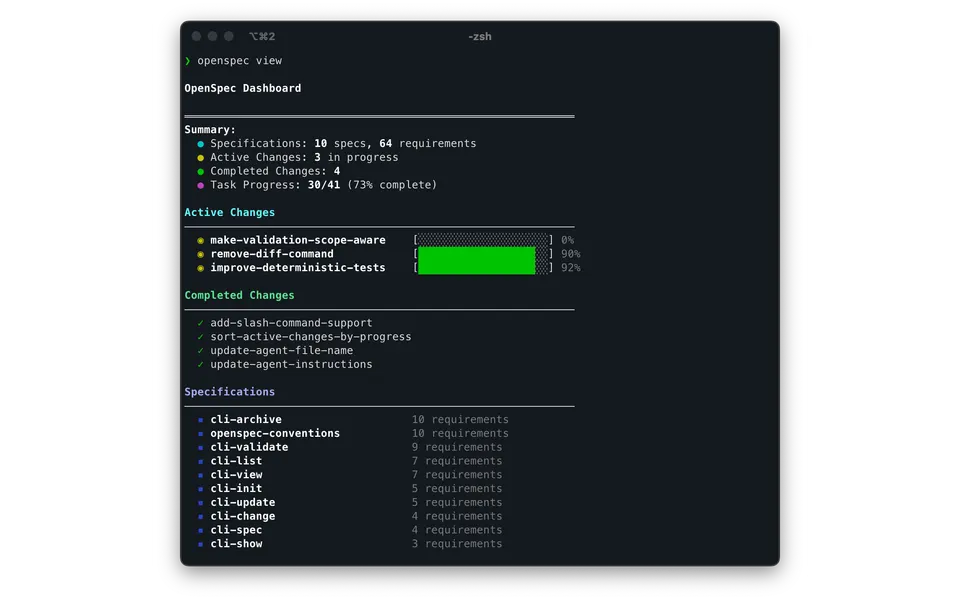
OpenSpec ships a terminal CLI on macOS, Windows and Linux plus assistant workflow files, without a standalone desktop GUI, browser client or phone app.
Source and scope for Where you use itAgents it runs
OpenSpec integrates workflow skills into Claude Code, Codex, Cursor, Gemini CLI, OpenCode, Pi, Grok Build and Antigravity; the assistant supplies the model loop.
Source and scope for Agents it runsAccounts and subscriptions
OpenSpec adds skills and commands to the user's existing coding assistant and runs inside it, so the assistant's own sign-in, including a subscription login, applies. OpenSpec handles no model credentials itself.
Source and scope for Accounts and subscriptionsWhere agents run
OpenSpec runs its CLI and planning workflow on the user-controlled machine with an installed assistant. It provides no vendor-managed coding runtime; remote continuation depends on the assistant host.
Source and scope for Where agents runHow work is kept apart
OpenSpec edits artifacts in existing project directories; it provisions no Git worktree, container or VM isolation.
Source and scope for How work is kept apartParallel work
OpenSpec tracks plans and task checklists but does not own or run concurrent coding-agent sessions.
Source and scope for Parallel workScheduled runs
OpenSpec workflows are invoked by a user or an external assistant; the product has no schedule or event runner.
Source and scope for Scheduled runsGit and pull requests
OpenSpec leaves code commits and pull requests to the user and coding assistant; its native workflow does not create or manage pull requests.
Source and scope for Git and pull requestsLicence and source
The OpenSpec application repository is MIT licensed.
Source and scope for Licence and sourcePrice
OpenSpec is an MIT open-source npm package with no paid plan or price published; it runs inside your existing AI coding assistant, and that assistant's costs are separate.
Source and scope for PriceTyped filters
Every value links to its receipt below. Read plan and surface restrictions before using a filter to decide.
| Filter | Value |
|---|---|
| Desktop OS: macOS | Yes |
| Desktop OS: Windows | Yes |
| Desktop OS: Linux | Yes |
| Web client | No |
| Phone access: Native iOS | No |
| Phone access: Native Android | No |
| Phone access: Phone browser | No |
| CLI | Yes cross-checked |
| Coding agents: Claude Code | Yes |
| Coding agents: Codex | Yes |
| Coding agents: Cursor Agent | Yes |
| Coding agents: Gemini CLI | Yes |
| Coding agents: OpenCode | Yes |
| Coding agents: Pi | Yes |
| Coding agents: Grok | Yes |
| Coding agents: Aider | Unknown |
| Coding agents: Antigravity | Yes |
| Use my subscription | Yes cross-checked |
| Where agents run: On your computer | Yes |
| Where agents run: On your own server | Unknown |
| Where agents run: In the vendor's cloud | No |
| Workspace isolation: Git worktree | No |
| Workspace isolation: Container | No |
| Workspace isolation: VM or microVM | No |
| Parallel runs | No |
| Coordinator | No |
| Native issue tracking | Yes cross-checked |
| Unattended triggers | No |
| Shared prompting | No |
| Team roles | No |
| SSO | No |
| Pull request workflow | No |
| Review interface | No |
| Product license: Apache-2.0 | No. MIT cross-checked |
| Product license: MIT | Yes. MIT cross-checked |
| Product license: GPL-3.0 | No. MIT cross-checked |
| Product license: GPL-3.0-or-later | No. MIT cross-checked |
| Product license: AGPL-3.0 | No. MIT cross-checked |
| Product license: AGPL-3.0-or-later | No. MIT cross-checked |
| Product license: Elastic License 2.0 | No. MIT cross-checked |
| Product license: Custom terms | No. MIT cross-checked |
| Product license: Proprietary | No. MIT cross-checked |
| Self-hosting | Yes cross-checked |
| Telemetry opt-out | Yes cross-checked |
| Free access | Yes cross-checked |
| Starting price: Free | Yes. Free cross-checked |
| Starting price: Up to $20/month | No. Free cross-checked |
| Starting price: $21–40/month | No. Free cross-checked |
| Starting price: $41–100/month | No. Free cross-checked |
| Starting price: Over $100/month | No. Free cross-checked |
| Starting price: Contact for pricing | No. Free cross-checked |
| Pricing model: Free, no paid plan | Yes cross-checked |
| Pricing model: Free plan | No |
| Pricing model: Subscription | No |
| Pricing model: Per seat | No |
| Pricing model: Usage-based | No |
| Pricing model: Per machine or compute | No |
| Pricing model: Bring your own key | Unknown |
| Pricing model: One-time purchase | No |
| Paid plans from: No paid plan | Unknown |
| Paid plans from: $10 or less/month | Unknown |
| Paid plans from: $11–20/month | Unknown |
| Paid plans from: $21–40/month | Unknown |
| Paid plans from: $41–100/month | Unknown |
| Paid plans from: Over $100/month | Unknown |
| Paid plans from: Contact sales | Unknown |
| Lifecycle status: Active | Unknown |
| Lifecycle status: Sunsetting | Unknown |
| Keeps going with laptop closed | Unknown |
| Open-source license | Yes. MIT cross-checked |
| Any desktop app | Yes |
| Paid plan up to $20/month | Unknown |
| Paid plan up to $40/month | Unknown |
| Any phone client | No |
Filter receipts
Desktop OS: macOS: Yes
Desktop OS: macOS
Typed value: Yes.
OpenSpec ships a terminal CLI on macOS, Windows and Linux plus assistant workflow files, without a standalone desktop GUI, browser client or phone app.
- Desktop os: The documented standalone CLI builds and installation commands support macOS, Windows and Linux. These are terminal clients, not desktop GUI applications.
- Mobile apps: The released package has no native iOS or Android app.
- Browser: The released package has no browser work interface.
- Mobile browser: The released package has no phone-browser client.
- Cli: Product-owned openspec terminal interface.
- Task actions: CLI creates changes, lists progress, validates and archives artifacts.
- Documentation and pinned source inspection only; no hands-on scenario was run.
- Other atomic questions remain unestablished: editor_extensions, notifications, cross_device_continuity.
-
Finding: Standalone CLI binaries cover macOS, Linux and Windows; npm requires Node 22.12+. Removing the CLI leaves Markdown specs and archived changes readable.
-
Finding: The released package exposes the openspec terminal CLI and Markdown workflow skills. Its command graph reads and writes project artifacts; it ships no desktop application, browser server or phone application. The view command prints status and progress to the terminal, not code diffs. Searches across src, skills and package.json for createServer, listen, spawn, worktree, docker, VM, scheduler, SAML and agent sessions found no agent runtime, workspace sandbox, co-prompting service or team identity layer. Child processes cover installation, Git store operations and editor/config helpers, not coding-agent sessions.
Desktop OS: Windows: Yes
Desktop OS: Windows
Typed value: Yes.
OpenSpec ships a terminal CLI on macOS, Windows and Linux plus assistant workflow files, without a standalone desktop GUI, browser client or phone app.
- Desktop os: The documented standalone CLI builds and installation commands support macOS, Windows and Linux. These are terminal clients, not desktop GUI applications.
- Mobile apps: The released package has no native iOS or Android app.
- Browser: The released package has no browser work interface.
- Mobile browser: The released package has no phone-browser client.
- Cli: Product-owned openspec terminal interface.
- Task actions: CLI creates changes, lists progress, validates and archives artifacts.
- Documentation and pinned source inspection only; no hands-on scenario was run.
- Other atomic questions remain unestablished: editor_extensions, notifications, cross_device_continuity.
-
Finding: Standalone CLI binaries cover macOS, Linux and Windows; npm requires Node 22.12+. Removing the CLI leaves Markdown specs and archived changes readable.
-
Finding: The released package exposes the openspec terminal CLI and Markdown workflow skills. Its command graph reads and writes project artifacts; it ships no desktop application, browser server or phone application. The view command prints status and progress to the terminal, not code diffs. Searches across src, skills and package.json for createServer, listen, spawn, worktree, docker, VM, scheduler, SAML and agent sessions found no agent runtime, workspace sandbox, co-prompting service or team identity layer. Child processes cover installation, Git store operations and editor/config helpers, not coding-agent sessions.
Desktop OS: Linux: Yes
Desktop OS: Linux
Typed value: Yes.
OpenSpec ships a terminal CLI on macOS, Windows and Linux plus assistant workflow files, without a standalone desktop GUI, browser client or phone app.
- Desktop os: The documented standalone CLI builds and installation commands support macOS, Windows and Linux. These are terminal clients, not desktop GUI applications.
- Mobile apps: The released package has no native iOS or Android app.
- Browser: The released package has no browser work interface.
- Mobile browser: The released package has no phone-browser client.
- Cli: Product-owned openspec terminal interface.
- Task actions: CLI creates changes, lists progress, validates and archives artifacts.
- Documentation and pinned source inspection only; no hands-on scenario was run.
- Other atomic questions remain unestablished: editor_extensions, notifications, cross_device_continuity.
-
Finding: Standalone CLI binaries cover macOS, Linux and Windows; npm requires Node 22.12+. Removing the CLI leaves Markdown specs and archived changes readable.
-
Finding: The released package exposes the openspec terminal CLI and Markdown workflow skills. Its command graph reads and writes project artifacts; it ships no desktop application, browser server or phone application. The view command prints status and progress to the terminal, not code diffs. Searches across src, skills and package.json for createServer, listen, spawn, worktree, docker, VM, scheduler, SAML and agent sessions found no agent runtime, workspace sandbox, co-prompting service or team identity layer. Child processes cover installation, Git store operations and editor/config helpers, not coding-agent sessions.
Web client: No
Web client
Typed value: No.
OpenSpec ships a terminal CLI on macOS, Windows and Linux plus assistant workflow files, without a standalone desktop GUI, browser client or phone app.
- Desktop os: The documented standalone CLI builds and installation commands support macOS, Windows and Linux. These are terminal clients, not desktop GUI applications.
- Mobile apps: The released package has no native iOS or Android app.
- Browser: The released package has no browser work interface.
- Mobile browser: The released package has no phone-browser client.
- Documentation and pinned source inspection only; no hands-on scenario was run.
- Other atomic questions remain unestablished: editor_extensions, notifications, cross_device_continuity.
-
Finding: The released package exposes the openspec terminal CLI and Markdown workflow skills. Its command graph reads and writes project artifacts; it ships no desktop application, browser server or phone application. The view command prints status and progress to the terminal, not code diffs. Searches across src, skills and package.json for createServer, listen, spawn, worktree, docker, VM, scheduler, SAML and agent sessions found no agent runtime, workspace sandbox, co-prompting service or team identity layer. Child processes cover installation, Git store operations and editor/config helpers, not coding-agent sessions.
Phone access: Native iOS: No
Phone access: Native iOS
Typed value: No.
OpenSpec ships a terminal CLI on macOS, Windows and Linux plus assistant workflow files, without a standalone desktop GUI, browser client or phone app.
- Desktop os: The documented standalone CLI builds and installation commands support macOS, Windows and Linux. These are terminal clients, not desktop GUI applications.
- Mobile apps: The released package has no native iOS or Android app.
- Browser: The released package has no browser work interface.
- Mobile browser: The released package has no phone-browser client.
- Documentation and pinned source inspection only; no hands-on scenario was run.
- Other atomic questions remain unestablished: editor_extensions, notifications, cross_device_continuity.
-
Finding: The released package exposes the openspec terminal CLI and Markdown workflow skills. Its command graph reads and writes project artifacts; it ships no desktop application, browser server or phone application. The view command prints status and progress to the terminal, not code diffs. Searches across src, skills and package.json for createServer, listen, spawn, worktree, docker, VM, scheduler, SAML and agent sessions found no agent runtime, workspace sandbox, co-prompting service or team identity layer. Child processes cover installation, Git store operations and editor/config helpers, not coding-agent sessions.
Phone access: Native Android: No
Phone access: Native Android
Typed value: No.
OpenSpec ships a terminal CLI on macOS, Windows and Linux plus assistant workflow files, without a standalone desktop GUI, browser client or phone app.
- Desktop os: The documented standalone CLI builds and installation commands support macOS, Windows and Linux. These are terminal clients, not desktop GUI applications.
- Mobile apps: The released package has no native iOS or Android app.
- Browser: The released package has no browser work interface.
- Mobile browser: The released package has no phone-browser client.
- Documentation and pinned source inspection only; no hands-on scenario was run.
- Other atomic questions remain unestablished: editor_extensions, notifications, cross_device_continuity.
-
Finding: The released package exposes the openspec terminal CLI and Markdown workflow skills. Its command graph reads and writes project artifacts; it ships no desktop application, browser server or phone application. The view command prints status and progress to the terminal, not code diffs. Searches across src, skills and package.json for createServer, listen, spawn, worktree, docker, VM, scheduler, SAML and agent sessions found no agent runtime, workspace sandbox, co-prompting service or team identity layer. Child processes cover installation, Git store operations and editor/config helpers, not coding-agent sessions.
Phone access: Phone browser: No
Phone access: Phone browser
Typed value: No.
OpenSpec ships a terminal CLI on macOS, Windows and Linux plus assistant workflow files, without a standalone desktop GUI, browser client or phone app.
- Desktop os: The documented standalone CLI builds and installation commands support macOS, Windows and Linux. These are terminal clients, not desktop GUI applications.
- Mobile apps: The released package has no native iOS or Android app.
- Browser: The released package has no browser work interface.
- Mobile browser: The released package has no phone-browser client.
- Documentation and pinned source inspection only; no hands-on scenario was run.
- Other atomic questions remain unestablished: editor_extensions, notifications, cross_device_continuity.
-
Finding: The released package exposes the openspec terminal CLI and Markdown workflow skills. Its command graph reads and writes project artifacts; it ships no desktop application, browser server or phone application. The view command prints status and progress to the terminal, not code diffs. Searches across src, skills and package.json for createServer, listen, spawn, worktree, docker, VM, scheduler, SAML and agent sessions found no agent runtime, workspace sandbox, co-prompting service or team identity layer. Child processes cover installation, Git store operations and editor/config helpers, not coding-agent sessions.
CLI: Yes cross-checked
CLI
Typed value: Yes.
Product-owned CLI exposes machine-readable change, spec, readiness and instruction operations.
- Cli: openspec command line is documented.
- Operations: Create/list/show changes and specs, inspect status/instructions, validate and archive.
- Stability: Store and schema commands retain beta/experimental scope.
- Not established by this source pass: api, sdk, mcp_server, webhooks, authentication.
-
Finding: CLI creates changes, reads artifacts as JSON, reports readiness and task completion, validates specs and archives changes. Validation can be bypassed; incomplete tasks warn rather than block. Stores do not synchronize Git.
Coding agents: Claude Code: Yes
Coding agents: Claude Code
Typed value: Yes.
OpenSpec integrates workflow skills into Claude Code, Codex, Cursor, Gemini CLI, OpenCode, Pi, Grok Build and Antigravity; the assistant supplies the model loop.
- Session integration: Init writes skills and command files into each selected assistant directory.
- Documentation and pinned source inspection only; no hands-on scenario was run.
- Other atomic questions remain unestablished: model_providers, mixed_harness_operation.
-
Finding: OpenSpec installs skills and commands into coding assistant directories including Claude Code, Codex, Cursor, Gemini CLI, OpenCode and Pi. These are workflow integrations, not a hosted agent runtime.
Coding agents: Codex: Yes
Coding agents: Codex
Typed value: Yes.
OpenSpec integrates workflow skills into Claude Code, Codex, Cursor, Gemini CLI, OpenCode, Pi, Grok Build and Antigravity; the assistant supplies the model loop.
- Session integration: Init writes skills and command files into each selected assistant directory.
- Documentation and pinned source inspection only; no hands-on scenario was run.
- Other atomic questions remain unestablished: model_providers, mixed_harness_operation.
-
Finding: OpenSpec installs skills and commands into coding assistant directories including Claude Code, Codex, Cursor, Gemini CLI, OpenCode and Pi. These are workflow integrations, not a hosted agent runtime.
Coding agents: Cursor Agent: Yes
Coding agents: Cursor Agent
Typed value: Yes.
OpenSpec integrates workflow skills into Claude Code, Codex, Cursor, Gemini CLI, OpenCode, Pi, Grok Build and Antigravity; the assistant supplies the model loop.
- Session integration: Init writes skills and command files into each selected assistant directory.
- Documentation and pinned source inspection only; no hands-on scenario was run.
- Other atomic questions remain unestablished: model_providers, mixed_harness_operation.
-
Finding: OpenSpec installs skills and commands into coding assistant directories including Claude Code, Codex, Cursor, Gemini CLI, OpenCode and Pi. These are workflow integrations, not a hosted agent runtime.
Coding agents: Gemini CLI: Yes
Coding agents: Gemini CLI
Typed value: Yes.
OpenSpec integrates workflow skills into Claude Code, Codex, Cursor, Gemini CLI, OpenCode, Pi, Grok Build and Antigravity; the assistant supplies the model loop.
- Session integration: Init writes skills and command files into each selected assistant directory.
- Documentation and pinned source inspection only; no hands-on scenario was run.
- Other atomic questions remain unestablished: model_providers, mixed_harness_operation.
-
Finding: OpenSpec installs skills and commands into coding assistant directories including Claude Code, Codex, Cursor, Gemini CLI, OpenCode and Pi. These are workflow integrations, not a hosted agent runtime.
Coding agents: OpenCode: Yes
Coding agents: OpenCode
Typed value: Yes.
OpenSpec integrates workflow skills into Claude Code, Codex, Cursor, Gemini CLI, OpenCode, Pi, Grok Build and Antigravity; the assistant supplies the model loop.
- Session integration: Init writes skills and command files into each selected assistant directory.
- Documentation and pinned source inspection only; no hands-on scenario was run.
- Other atomic questions remain unestablished: model_providers, mixed_harness_operation.
-
Finding: OpenSpec installs skills and commands into coding assistant directories including Claude Code, Codex, Cursor, Gemini CLI, OpenCode and Pi. These are workflow integrations, not a hosted agent runtime.
Coding agents: Pi: Yes
Coding agents: Pi
Typed value: Yes.
OpenSpec integrates workflow skills into Claude Code, Codex, Cursor, Gemini CLI, OpenCode, Pi, Grok Build and Antigravity; the assistant supplies the model loop.
- Session integration: Init writes skills and command files into each selected assistant directory.
- Documentation and pinned source inspection only; no hands-on scenario was run.
- Other atomic questions remain unestablished: model_providers, mixed_harness_operation.
-
Finding: OpenSpec installs skills and commands into coding assistant directories including Claude Code, Codex, Cursor, Gemini CLI, OpenCode and Pi. These are workflow integrations, not a hosted agent runtime.
Coding agents: Grok: Yes
Coding agents: Grok
Typed value: Yes.
OpenSpec integrates workflow skills into Claude Code, Codex, Cursor, Gemini CLI, OpenCode, Pi, Grok Build and Antigravity; the assistant supplies the model loop.
- Harnesses: The shipped AI_TOOLS registry explicitly enables Claude Code, Codex, Cursor, Gemini CLI, OpenCode, Pi, Grok Build and Antigravity.
- Custom adapters: The shared .agents target supports tools that read vendor-neutral skills.
- Documentation and pinned source inspection only; no hands-on scenario was run.
- Other atomic questions remain unestablished: model_providers, mixed_harness_operation.
-
Finding: The shipped tool registry includes Claude Code, Codex, Cursor, Gemini CLI, OpenCode, Pi, Grok Build and Antigravity. OpenSpec writes workflow skills for these tools. A vendor-neutral .agents target lets other compatible agents consume skills, so omission of Aider is not an explicit incompatibility.
Coding agents: Antigravity: Yes
Coding agents: Antigravity
Typed value: Yes.
OpenSpec integrates workflow skills into Claude Code, Codex, Cursor, Gemini CLI, OpenCode, Pi, Grok Build and Antigravity; the assistant supplies the model loop.
- Harnesses: The shipped AI_TOOLS registry explicitly enables Claude Code, Codex, Cursor, Gemini CLI, OpenCode, Pi, Grok Build and Antigravity.
- Custom adapters: The shared .agents target supports tools that read vendor-neutral skills.
- Documentation and pinned source inspection only; no hands-on scenario was run.
- Other atomic questions remain unestablished: model_providers, mixed_harness_operation.
-
Finding: The shipped tool registry includes Claude Code, Codex, Cursor, Gemini CLI, OpenCode, Pi, Grok Build and Antigravity. OpenSpec writes workflow skills for these tools. A vendor-neutral .agents target lets other compatible agents consume skills, so omission of Aider is not an explicit incompatibility.
Use my subscription: Yes cross-checked
Use my subscription
Typed value: Yes.
OpenSpec adds skills and commands to the user's existing coding assistant and runs inside it, so the assistant's own sign-in, including a subscription login, applies. OpenSpec handles no model credentials itself.
- Agent subscriptions: The workflow runs inside the user's chosen assistant (for example Claude Code or Codex), so that assistant's native login, including a subscription, applies. Not tested; plan terms not checked.
- Per-assistant plan terms were not checked. No installed-product test was run.
-
OpenSpec docs: Supported Tools
Finding: openspec init writes OpenSpec skills and command files into each selected assistant's own directory; the user then invokes the workflow inside that assistant, so OpenSpec runs within the assistant's existing session rather than its own runtime or login.
Where agents run: On your computer: Yes
Where agents run: On your computer
Typed value: Yes.
OpenSpec runs its CLI and planning workflow on the user-controlled machine with an installed assistant. It provides no vendor-managed coding runtime; remote continuation depends on the assistant host.
- Local: The CLI and assistant read and edit local project files on the user-controlled machine.
- Managed cloud: OpenSpec has no vendor-operated agent executor in its released CLI package.
- Documentation and pinned source inspection only; no hands-on scenario was run.
- Other atomic questions remain unestablished: byo_remote, self_hosted, hybrid, provisioning, payer, resources, region, expiry, client_disconnect, other_device_continuation.
-
Finding: The released package exposes the openspec terminal CLI and Markdown workflow skills. Its command graph reads and writes project artifacts; it ships no desktop application, browser server or phone application. The view command prints status and progress to the terminal, not code diffs. Searches across src, skills and package.json for createServer, listen, spawn, worktree, docker, VM, scheduler, SAML and agent sessions found no agent runtime, workspace sandbox, co-prompting service or team identity layer. Child processes cover installation, Git store operations and editor/config helpers, not coding-agent sessions.
-
OpenSpec: skills/openspec-apply-change/SKILL.md
Finding: The apply skill tells the existing assistant to read instructions and implement tasks from local project files. OpenSpec does not start or coordinate agent sessions. The installed CLI and skills have no schedule/event runner. Execution, parallel agent work and remote continuation depend on the assistant environment rather than an OpenSpec-managed executor.
Where agents run: In the vendor's cloud: No
Where agents run: In the vendor's cloud
Typed value: No.
OpenSpec runs its CLI and planning workflow on the user-controlled machine with an installed assistant. It provides no vendor-managed coding runtime; remote continuation depends on the assistant host.
- Local: The CLI and assistant read and edit local project files on the user-controlled machine.
- Managed cloud: OpenSpec has no vendor-operated agent executor in its released CLI package.
- Documentation and pinned source inspection only; no hands-on scenario was run.
- Other atomic questions remain unestablished: byo_remote, self_hosted, hybrid, provisioning, payer, resources, region, expiry, client_disconnect, other_device_continuation.
-
Finding: The released package exposes the openspec terminal CLI and Markdown workflow skills. Its command graph reads and writes project artifacts; it ships no desktop application, browser server or phone application. The view command prints status and progress to the terminal, not code diffs. Searches across src, skills and package.json for createServer, listen, spawn, worktree, docker, VM, scheduler, SAML and agent sessions found no agent runtime, workspace sandbox, co-prompting service or team identity layer. Child processes cover installation, Git store operations and editor/config helpers, not coding-agent sessions.
-
OpenSpec: skills/openspec-apply-change/SKILL.md
Finding: The apply skill tells the existing assistant to read instructions and implement tasks from local project files. OpenSpec does not start or coordinate agent sessions. The installed CLI and skills have no schedule/event runner. Execution, parallel agent work and remote continuation depend on the assistant environment rather than an OpenSpec-managed executor.
Workspace isolation: Git worktree: No
Workspace isolation: Git worktree
Typed value: No.
OpenSpec edits artifacts in existing project directories; it provisions no Git worktree, container or VM isolation.
- Worktree: The CLI and workflow skills do not provision Git worktrees.
- Container: The CLI and workflow skills do not provision containers.
- Vm: The CLI and workflow skills do not provision virtual machines.
- Documentation and pinned source inspection only; no hands-on scenario was run.
- Other atomic questions remain unestablished: checkout, branch, os_sandbox, filesystem, process, network, secrets, code_separation, security_boundary.
-
Finding: The released package exposes the openspec terminal CLI and Markdown workflow skills. Its command graph reads and writes project artifacts; it ships no desktop application, browser server or phone application. The view command prints status and progress to the terminal, not code diffs. Searches across src, skills and package.json for createServer, listen, spawn, worktree, docker, VM, scheduler, SAML and agent sessions found no agent runtime, workspace sandbox, co-prompting service or team identity layer. Child processes cover installation, Git store operations and editor/config helpers, not coding-agent sessions.
-
OpenSpec: skills/openspec-apply-change/SKILL.md
Finding: The apply skill tells the existing assistant to read instructions and implement tasks from local project files. OpenSpec does not start or coordinate agent sessions. The installed CLI and skills have no schedule/event runner. Execution, parallel agent work and remote continuation depend on the assistant environment rather than an OpenSpec-managed executor.
Workspace isolation: Container: No
Workspace isolation: Container
Typed value: No.
OpenSpec edits artifacts in existing project directories; it provisions no Git worktree, container or VM isolation.
- Worktree: The CLI and workflow skills do not provision Git worktrees.
- Container: The CLI and workflow skills do not provision containers.
- Vm: The CLI and workflow skills do not provision virtual machines.
- Documentation and pinned source inspection only; no hands-on scenario was run.
- Other atomic questions remain unestablished: checkout, branch, os_sandbox, filesystem, process, network, secrets, code_separation, security_boundary.
-
Finding: The released package exposes the openspec terminal CLI and Markdown workflow skills. Its command graph reads and writes project artifacts; it ships no desktop application, browser server or phone application. The view command prints status and progress to the terminal, not code diffs. Searches across src, skills and package.json for createServer, listen, spawn, worktree, docker, VM, scheduler, SAML and agent sessions found no agent runtime, workspace sandbox, co-prompting service or team identity layer. Child processes cover installation, Git store operations and editor/config helpers, not coding-agent sessions.
-
OpenSpec: skills/openspec-apply-change/SKILL.md
Finding: The apply skill tells the existing assistant to read instructions and implement tasks from local project files. OpenSpec does not start or coordinate agent sessions. The installed CLI and skills have no schedule/event runner. Execution, parallel agent work and remote continuation depend on the assistant environment rather than an OpenSpec-managed executor.
Workspace isolation: VM or microVM: No
Workspace isolation: VM or microVM
Typed value: No.
OpenSpec edits artifacts in existing project directories; it provisions no Git worktree, container or VM isolation.
- Worktree: The CLI and workflow skills do not provision Git worktrees.
- Container: The CLI and workflow skills do not provision containers.
- Vm: The CLI and workflow skills do not provision virtual machines.
- Documentation and pinned source inspection only; no hands-on scenario was run.
- Other atomic questions remain unestablished: checkout, branch, os_sandbox, filesystem, process, network, secrets, code_separation, security_boundary.
-
Finding: The released package exposes the openspec terminal CLI and Markdown workflow skills. Its command graph reads and writes project artifacts; it ships no desktop application, browser server or phone application. The view command prints status and progress to the terminal, not code diffs. Searches across src, skills and package.json for createServer, listen, spawn, worktree, docker, VM, scheduler, SAML and agent sessions found no agent runtime, workspace sandbox, co-prompting service or team identity layer. Child processes cover installation, Git store operations and editor/config helpers, not coding-agent sessions.
-
OpenSpec: skills/openspec-apply-change/SKILL.md
Finding: The apply skill tells the existing assistant to read instructions and implement tasks from local project files. OpenSpec does not start or coordinate agent sessions. The installed CLI and skills have no schedule/event runner. Execution, parallel agent work and remote continuation depend on the assistant environment rather than an OpenSpec-managed executor.
Parallel runs: No
Parallel runs
Typed value: No.
OpenSpec tracks plans and task checklists but does not own or run concurrent coding-agent sessions.
- Concurrent sessions: The command graph and workflow skills do not start or manage coding-agent sessions.
- Documentation and pinned source inspection only; no hands-on scenario was run.
- Other atomic questions remain unestablished: concurrent_tasks, quotas, observed_concurrency, status_visibility.
-
Finding: The released package exposes the openspec terminal CLI and Markdown workflow skills. Its command graph reads and writes project artifacts; it ships no desktop application, browser server or phone application. The view command prints status and progress to the terminal, not code diffs. Searches across src, skills and package.json for createServer, listen, spawn, worktree, docker, VM, scheduler, SAML and agent sessions found no agent runtime, workspace sandbox, co-prompting service or team identity layer. Child processes cover installation, Git store operations and editor/config helpers, not coding-agent sessions.
-
OpenSpec: skills/openspec-apply-change/SKILL.md
Finding: The apply skill tells the existing assistant to read instructions and implement tasks from local project files. OpenSpec does not start or coordinate agent sessions. The installed CLI and skills have no schedule/event runner. Execution, parallel agent work and remote continuation depend on the assistant environment rather than an OpenSpec-managed executor.
Coordinator: No
Coordinator
Typed value: No.
OpenSpec supplies workflow instructions for an existing assistant without a product-owned coordinator or agent-session messaging tools.
- Orchestration owner: No coordinator session, agent-session delegation or inter-agent messaging tools exist in the inspected CLI and workflow skills.
- Documentation and pinned source inspection only; no hands-on scenario was run.
- Other atomic questions remain unestablished: roles, model_harness_effort, messages, results_return, cross_harness, activation, authentication, live_progress, retained_results, followup, invocation.
-
Finding: The released package exposes the openspec terminal CLI and Markdown workflow skills. Its command graph reads and writes project artifacts; it ships no desktop application, browser server or phone application. The view command prints status and progress to the terminal, not code diffs. Searches across src, skills and package.json for createServer, listen, spawn, worktree, docker, VM, scheduler, SAML and agent sessions found no agent runtime, workspace sandbox, co-prompting service or team identity layer. Child processes cover installation, Git store operations and editor/config helpers, not coding-agent sessions.
-
OpenSpec: skills/openspec-apply-change/SKILL.md
Finding: The apply skill tells the existing assistant to read instructions and implement tasks from local project files. OpenSpec does not start or coordinate agent sessions. The installed CLI and skills have no schedule/event runner. Execution, parallel agent work and remote continuation depend on the assistant environment rather than an OpenSpec-managed executor.
Native issue tracking: Yes cross-checked
Native issue tracking
Typed value: Yes.
Named change records and task checklists can be created and archived independently of a chat session.
- Create: new change creates durable metadata.
- Edit: Update-change revises planning artifacts.
- Archive: archive moves a change into a dated archive.
- Idea parking: Explore and proposal artifacts support planning before implementation.
- Task session separation: A change directory exists independently of an assistant conversation.
- Metadata: Changes retain schema and optional goal/description metadata.
- Durable states: Artifact completion and checklist state persist on disk.
- Not established by this source pass: discuss, prioritize, label, assign, search, filter, reopen, project_epic_views, explicit_dispatch, external_tracker_requirement.
-
Finding: CLI creates changes, reads artifacts as JSON, reports readiness and task completion, validates specs and archives changes. Validation can be bypassed; incomplete tasks warn rather than block. Stores do not synchronize Git.
Unattended triggers: No
Unattended triggers
Typed value: No.
OpenSpec workflows are invoked by a user or an external assistant; the product has no schedule or event runner.
- Schedules: The inspected CLI and workflow skills implement no scheduled starts.
- Events: The inspected CLI and workflow skills implement no event-triggered agent starts.
- Recurring tasks: The inspected CLI and workflow skills implement no recurring agent-run scheduler.
- Documentation and pinned source inspection only; no hands-on scenario was run.
- Other atomic questions remain unestablished: completion_conditions, scheduler_location, overlaps, retries, client_independence.
-
Finding: The released package exposes the openspec terminal CLI and Markdown workflow skills. Its command graph reads and writes project artifacts; it ships no desktop application, browser server or phone application. The view command prints status and progress to the terminal, not code diffs. Searches across src, skills and package.json for createServer, listen, spawn, worktree, docker, VM, scheduler, SAML and agent sessions found no agent runtime, workspace sandbox, co-prompting service or team identity layer. Child processes cover installation, Git store operations and editor/config helpers, not coding-agent sessions.
-
OpenSpec: skills/openspec-apply-change/SKILL.md
Finding: The apply skill tells the existing assistant to read instructions and implement tasks from local project files. OpenSpec does not start or coordinate agent sessions. The installed CLI and skills have no schedule/event runner. Execution, parallel agent work and remote continuation depend on the assistant environment rather than an OpenSpec-managed executor.
Shared prompting: No
Shared prompting
Typed value: No.
OpenSpec shares planning artifacts through ordinary Git repositories; it has no shared agent prompting session.
- Coprompting: The CLI and store files have no multi-user agent-session input or ordering mechanism.
- Documentation and pinned source inspection only; no hands-on scenario was run.
- Other atomic questions remain unestablished: comments, presence, ordering, attribution, permissions, plan_restrictions, owner_online.
-
Finding: The released package exposes the openspec terminal CLI and Markdown workflow skills. Its command graph reads and writes project artifacts; it ships no desktop application, browser server or phone application. The view command prints status and progress to the terminal, not code diffs. Searches across src, skills and package.json for createServer, listen, spawn, worktree, docker, VM, scheduler, SAML and agent sessions found no agent runtime, workspace sandbox, co-prompting service or team identity layer. Child processes cover installation, Git store operations and editor/config helpers, not coding-agent sessions.
-
OpenSpec: docs/stores-beta/user-guide.md
Finding: A store is an ordinary Git repository shared by user-managed commits, pushes, pulls and reviews. The source contains no multi-user prompting session, workspace role permissions or enterprise SSO; Git host permissions and review tools remain external.
Team roles: No
Team roles
Typed value: No.
OpenSpec has no workspace identity service, named team roles or enterprise SSO. Store access follows external Git-host permissions.
- Organization roles: No organization role or membership permission model exists in the CLI.
- Project roles: Project and store files use filesystem and external Git access, without product-owned team roles.
- Sso: No SAML/OIDC team SSO service exists in the released CLI.
- Documentation and pinned source inspection only; no hands-on scenario was run.
- Other atomic questions remain unestablished: task_roles, membership, provisioning, unauthorized_access, revocation, plan_scope.
-
Finding: The released package exposes the openspec terminal CLI and Markdown workflow skills. Its command graph reads and writes project artifacts; it ships no desktop application, browser server or phone application. The view command prints status and progress to the terminal, not code diffs. Searches across src, skills and package.json for createServer, listen, spawn, worktree, docker, VM, scheduler, SAML and agent sessions found no agent runtime, workspace sandbox, co-prompting service or team identity layer. Child processes cover installation, Git store operations and editor/config helpers, not coding-agent sessions.
-
OpenSpec: docs/stores-beta/user-guide.md
Finding: A store is an ordinary Git repository shared by user-managed commits, pushes, pulls and reviews. The source contains no multi-user prompting session, workspace role permissions or enterprise SSO; Git host permissions and review tools remain external.
SSO: No
SSO
Typed value: No.
OpenSpec has no workspace identity service, named team roles or enterprise SSO. Store access follows external Git-host permissions.
- Organization roles: No organization role or membership permission model exists in the CLI.
- Project roles: Project and store files use filesystem and external Git access, without product-owned team roles.
- Sso: No SAML/OIDC team SSO service exists in the released CLI.
- Documentation and pinned source inspection only; no hands-on scenario was run.
- Other atomic questions remain unestablished: task_roles, membership, provisioning, unauthorized_access, revocation, plan_scope.
-
Finding: The released package exposes the openspec terminal CLI and Markdown workflow skills. Its command graph reads and writes project artifacts; it ships no desktop application, browser server or phone application. The view command prints status and progress to the terminal, not code diffs. Searches across src, skills and package.json for createServer, listen, spawn, worktree, docker, VM, scheduler, SAML and agent sessions found no agent runtime, workspace sandbox, co-prompting service or team identity layer. Child processes cover installation, Git store operations and editor/config helpers, not coding-agent sessions.
-
OpenSpec: docs/stores-beta/user-guide.md
Finding: A store is an ordinary Git repository shared by user-managed commits, pushes, pulls and reviews. The source contains no multi-user prompting session, workspace role permissions or enterprise SSO; Git host permissions and review tools remain external.
Pull request workflow: No
Pull request workflow
Typed value: No.
OpenSpec leaves code commits and pull requests to the user and coding assistant; its native workflow does not create or manage pull requests.
- Pull requests: The command graph, workflow templates and store documentation provide no product-owned pull request creation or management action.
- Documentation and pinned source inspection only; no hands-on scenario was run.
- Other atomic questions remain unestablished: branches, worktrees, commits, comments, ci_response, rebase, conflicts, product_state.
-
Finding: The released package exposes the openspec terminal CLI and Markdown workflow skills. Its command graph reads and writes project artifacts; it ships no desktop application, browser server or phone application. The view command prints status and progress to the terminal, not code diffs. Searches across src, skills and package.json for createServer, listen, spawn, worktree, docker, VM, scheduler, SAML and agent sessions found no agent runtime, workspace sandbox, co-prompting service or team identity layer. Child processes cover installation, Git store operations and editor/config helpers, not coding-agent sessions.
-
OpenSpec: skills/openspec-apply-change/SKILL.md
Finding: The apply skill tells the existing assistant to read instructions and implement tasks from local project files. OpenSpec does not start or coordinate agent sessions. The installed CLI and skills have no schedule/event runner. Execution, parallel agent work and remote continuation depend on the assistant environment rather than an OpenSpec-managed executor.
-
OpenSpec: docs/stores-beta/user-guide.md
Finding: A store is an ordinary Git repository shared by user-managed commits, pushes, pulls and reviews. The source contains no multi-user prompting session, workspace role permissions or enterprise SSO; Git host permissions and review tools remain external.
Review interface: No
Review interface
Typed value: No.
OpenSpec prints task and artifact progress and supplies verification instructions; it has no code-diff review interface.
- Change understanding: The terminal view prints status and checklist progress, not proposed code changes or code diffs.
- Documentation and pinned source inspection only; no hands-on scenario was run.
- Other atomic questions remain unestablished: pending_reviews, evidence_navigation, comments, request_changes, shipping_guidance, effort, missed_evidence, keyboard, narrow_screen, context_switching, roles, retained_context.
-
Finding: The released package exposes the openspec terminal CLI and Markdown workflow skills. Its command graph reads and writes project artifacts; it ships no desktop application, browser server or phone application. The view command prints status and progress to the terminal, not code diffs. Searches across src, skills and package.json for createServer, listen, spawn, worktree, docker, VM, scheduler, SAML and agent sessions found no agent runtime, workspace sandbox, co-prompting service or team identity layer. Child processes cover installation, Git store operations and editor/config helpers, not coding-agent sessions.
Product license: Apache-2.0: No. MIT cross-checked
Product license: Apache-2.0
Typed value: No. MIT.
The OpenSpec application repository is MIT licensed.
- Client license: MIT license covers the OpenSpec repository.
- Source visibility: Application source is public.
- Source revision: License checked at commit 0fa4a9705c20ef1c571fe3ded74435733e4b73a1.
- Not established by this source pass: server_license, hosted_extensions, hosted_parity.
-
Finding: Repository application is licensed under MIT.
Product license: MIT: Yes. MIT cross-checked
Product license: MIT
Typed value: Yes. MIT.
The OpenSpec application repository is MIT licensed.
- Client license: MIT license covers the OpenSpec repository.
- Source visibility: Application source is public.
- Source revision: License checked at commit 0fa4a9705c20ef1c571fe3ded74435733e4b73a1.
- Not established by this source pass: server_license, hosted_extensions, hosted_parity.
-
Finding: Repository application is licensed under MIT.
Product license: GPL-3.0: No. MIT cross-checked
Product license: GPL-3.0
Typed value: No. MIT.
The OpenSpec application repository is MIT licensed.
- Client license: MIT license covers the OpenSpec repository.
- Source visibility: Application source is public.
- Source revision: License checked at commit 0fa4a9705c20ef1c571fe3ded74435733e4b73a1.
- Not established by this source pass: server_license, hosted_extensions, hosted_parity.
-
Finding: Repository application is licensed under MIT.
Product license: GPL-3.0-or-later: No. MIT cross-checked
Product license: GPL-3.0-or-later
Typed value: No. MIT.
The OpenSpec application repository is MIT licensed.
- Client license: MIT license covers the OpenSpec repository.
- Source visibility: Application source is public.
- Source revision: License checked at commit 0fa4a9705c20ef1c571fe3ded74435733e4b73a1.
- Not established by this source pass: server_license, hosted_extensions, hosted_parity.
-
Finding: Repository application is licensed under MIT.
Product license: AGPL-3.0: No. MIT cross-checked
Product license: AGPL-3.0
Typed value: No. MIT.
The OpenSpec application repository is MIT licensed.
- Client license: MIT license covers the OpenSpec repository.
- Source visibility: Application source is public.
- Source revision: License checked at commit 0fa4a9705c20ef1c571fe3ded74435733e4b73a1.
- Not established by this source pass: server_license, hosted_extensions, hosted_parity.
-
Finding: Repository application is licensed under MIT.
Product license: AGPL-3.0-or-later: No. MIT cross-checked
Product license: AGPL-3.0-or-later
Typed value: No. MIT.
The OpenSpec application repository is MIT licensed.
- Client license: MIT license covers the OpenSpec repository.
- Source visibility: Application source is public.
- Source revision: License checked at commit 0fa4a9705c20ef1c571fe3ded74435733e4b73a1.
- Not established by this source pass: server_license, hosted_extensions, hosted_parity.
-
Finding: Repository application is licensed under MIT.
Product license: Elastic License 2.0: No. MIT cross-checked
Product license: Elastic License 2.0
Typed value: No. MIT.
The OpenSpec application repository is MIT licensed.
- Client license: MIT license covers the OpenSpec repository.
- Source visibility: Application source is public.
- Source revision: License checked at commit 0fa4a9705c20ef1c571fe3ded74435733e4b73a1.
- Not established by this source pass: server_license, hosted_extensions, hosted_parity.
-
Finding: Repository application is licensed under MIT.
Product license: Custom terms: No. MIT cross-checked
Product license: Custom terms
Typed value: No. MIT.
The OpenSpec application repository is MIT licensed.
- Client license: MIT license covers the OpenSpec repository.
- Source visibility: Application source is public.
- Source revision: License checked at commit 0fa4a9705c20ef1c571fe3ded74435733e4b73a1.
- Not established by this source pass: server_license, hosted_extensions, hosted_parity.
-
Finding: Repository application is licensed under MIT.
Product license: Proprietary: No. MIT cross-checked
Product license: Proprietary
Typed value: No. MIT.
The OpenSpec application repository is MIT licensed.
- Client license: MIT license covers the OpenSpec repository.
- Source visibility: Application source is public.
- Source revision: License checked at commit 0fa4a9705c20ef1c571fe3ded74435733e4b73a1.
- Not established by this source pass: server_license, hosted_extensions, hosted_parity.
-
Finding: Repository application is licensed under MIT.
Self-hosting: Yes cross-checked
Self-hosting
Typed value: Yes.
The CLI and durable Markdown planning files run on user-controlled machines.
- Self hosting: Install the local CLI; stores are local Git checkouts.
- Export: Copy or commit the specification/change files.
- Formats: Markdown artifacts and YAML metadata remain readable without the CLI.
- History portability: Archived change folders remain ordinary files after uninstalling.
- Not established by this source pass: vendor_dependencies, import, cancellation, account_independence.
-
Finding: Standalone CLI binaries cover macOS, Linux and Windows; npm requires Node 22.12+. Removing the CLI leaves Markdown specs and archived changes readable.
-
Finding: Stores separate shared planning into a Git repository and support read-only upstream references. Users push/pull themselves; stale checkouts remain stale. Stores are beta.
Telemetry opt-out: Yes cross-checked
Telemetry opt-out
Typed value: Yes.
OpenSpec documents telemetry identifiers and opt-out controls.
- Telemetry disclosure: Global config contains an anonymous identifier and noticeSeen state.
- Telemetry controls: Set telemetry.enabled=false, OPENSPEC_TELEMETRY=0 or DO_NOT_TRACK=1.
- Not established by this source pass: code_data, prompts, credentials, logs, artifacts, retention, deletion, training, residency, subprocessors, telemetry_defaults, consent_prompt, provider_separation.
-
Finding: Telemetry stores an anonymous identifier and notice state. Disable telemetry.enabled or set OPENSPEC_TELEMETRY=0 or DO_NOT_TRACK=1.
Free access: Yes cross-checked
Free access
Typed value: Yes.
OpenSpec is freely installable MIT software; coding assistant costs are separate.
- Ongoing free: OpenSpec can be downloaded and used under the MIT grant.
- Free scenarios: Local specification planning and archive workflows are available in the installed CLI.
- Not established by this source pass: trial, credits_trial, self_host_cost, paid_only, early_access, card_required, usage_caps, paid_evaluation.
-
Finding: Standalone CLI binaries cover macOS, Linux and Windows; npm requires Node 22.12+. Removing the CLI leaves Markdown specs and archived changes readable.
-
Finding: Repository application is licensed under MIT.
Starting price: Free: Yes. Free cross-checked
Starting price: Free
Typed value: Yes. Free.
OpenSpec is freely installable MIT software; coding assistant costs are separate.
- Ongoing free: OpenSpec can be downloaded and used under the MIT grant.
- Free scenarios: Local specification planning and archive workflows are available in the installed CLI.
- Not established by this source pass: trial, credits_trial, self_host_cost, paid_only, early_access, card_required, usage_caps, paid_evaluation.
-
Finding: Standalone CLI binaries cover macOS, Linux and Windows; npm requires Node 22.12+. Removing the CLI leaves Markdown specs and archived changes readable.
-
Finding: Repository application is licensed under MIT.
Starting price: Up to $20/month: No. Free cross-checked
Starting price: Up to $20/month
Typed value: No. Free.
OpenSpec is freely installable MIT software; coding assistant costs are separate.
- Ongoing free: OpenSpec can be downloaded and used under the MIT grant.
- Free scenarios: Local specification planning and archive workflows are available in the installed CLI.
- Not established by this source pass: trial, credits_trial, self_host_cost, paid_only, early_access, card_required, usage_caps, paid_evaluation.
-
Finding: Standalone CLI binaries cover macOS, Linux and Windows; npm requires Node 22.12+. Removing the CLI leaves Markdown specs and archived changes readable.
-
Finding: Repository application is licensed under MIT.
Starting price: $21–40/month: No. Free cross-checked
Starting price: $21–40/month
Typed value: No. Free.
OpenSpec is freely installable MIT software; coding assistant costs are separate.
- Ongoing free: OpenSpec can be downloaded and used under the MIT grant.
- Free scenarios: Local specification planning and archive workflows are available in the installed CLI.
- Not established by this source pass: trial, credits_trial, self_host_cost, paid_only, early_access, card_required, usage_caps, paid_evaluation.
-
Finding: Standalone CLI binaries cover macOS, Linux and Windows; npm requires Node 22.12+. Removing the CLI leaves Markdown specs and archived changes readable.
-
Finding: Repository application is licensed under MIT.
Starting price: $41–100/month: No. Free cross-checked
Starting price: $41–100/month
Typed value: No. Free.
OpenSpec is freely installable MIT software; coding assistant costs are separate.
- Ongoing free: OpenSpec can be downloaded and used under the MIT grant.
- Free scenarios: Local specification planning and archive workflows are available in the installed CLI.
- Not established by this source pass: trial, credits_trial, self_host_cost, paid_only, early_access, card_required, usage_caps, paid_evaluation.
-
Finding: Standalone CLI binaries cover macOS, Linux and Windows; npm requires Node 22.12+. Removing the CLI leaves Markdown specs and archived changes readable.
-
Finding: Repository application is licensed under MIT.
Starting price: Over $100/month: No. Free cross-checked
Starting price: Over $100/month
Typed value: No. Free.
OpenSpec is freely installable MIT software; coding assistant costs are separate.
- Ongoing free: OpenSpec can be downloaded and used under the MIT grant.
- Free scenarios: Local specification planning and archive workflows are available in the installed CLI.
- Not established by this source pass: trial, credits_trial, self_host_cost, paid_only, early_access, card_required, usage_caps, paid_evaluation.
-
Finding: Standalone CLI binaries cover macOS, Linux and Windows; npm requires Node 22.12+. Removing the CLI leaves Markdown specs and archived changes readable.
-
Finding: Repository application is licensed under MIT.
Starting price: Contact for pricing: No. Free cross-checked
Starting price: Contact for pricing
Typed value: No. Free.
OpenSpec is freely installable MIT software; coding assistant costs are separate.
- Ongoing free: OpenSpec can be downloaded and used under the MIT grant.
- Free scenarios: Local specification planning and archive workflows are available in the installed CLI.
- Not established by this source pass: trial, credits_trial, self_host_cost, paid_only, early_access, card_required, usage_caps, paid_evaluation.
-
Finding: Standalone CLI binaries cover macOS, Linux and Windows; npm requires Node 22.12+. Removing the CLI leaves Markdown specs and archived changes readable.
-
Finding: Repository application is licensed under MIT.
Pricing model: Free, no paid plan: Yes cross-checked
Pricing model: Free, no paid plan
Typed value: Yes.
OpenSpec is an MIT open-source npm package with no paid plan or price published; it runs inside your existing AI coding assistant, and that assistant's costs are separate.
- First-party pricing pages, terms and licences read 2026-11-10; no purchase, billing or authenticated account test.
-
Finding: Lists the license as MIT and installs from npm. The page shows no price, plan or pricing page.
-
Fission-AI/OpenSpec LICENSE (MIT)
Finding: The MIT License lets anyone obtain, use, copy and modify the software free of charge.
Pricing model: Free plan: No
Pricing model: Free plan
Typed value: No.
OpenSpec is an MIT open-source npm package with no paid plan or price published; it runs inside your existing AI coding assistant, and that assistant's costs are separate.
- First-party pricing pages, terms and licences read 2026-11-10; no purchase, billing or authenticated account test.
-
Finding: Lists the license as MIT and installs from npm. The page shows no price, plan or pricing page.
-
Fission-AI/OpenSpec LICENSE (MIT)
Finding: The MIT License lets anyone obtain, use, copy and modify the software free of charge.
Pricing model: Subscription: No
Pricing model: Subscription
Typed value: No.
OpenSpec is an MIT open-source npm package with no paid plan or price published; it runs inside your existing AI coding assistant, and that assistant's costs are separate.
- First-party pricing pages, terms and licences read 2026-11-10; no purchase, billing or authenticated account test.
-
Finding: Lists the license as MIT and installs from npm. The page shows no price, plan or pricing page.
-
Fission-AI/OpenSpec LICENSE (MIT)
Finding: The MIT License lets anyone obtain, use, copy and modify the software free of charge.
Pricing model: Per seat: No
Pricing model: Per seat
Typed value: No.
OpenSpec is an MIT open-source npm package with no paid plan or price published; it runs inside your existing AI coding assistant, and that assistant's costs are separate.
- First-party pricing pages, terms and licences read 2026-11-10; no purchase, billing or authenticated account test.
-
Finding: Lists the license as MIT and installs from npm. The page shows no price, plan or pricing page.
-
Fission-AI/OpenSpec LICENSE (MIT)
Finding: The MIT License lets anyone obtain, use, copy and modify the software free of charge.
Pricing model: Usage-based: No
Pricing model: Usage-based
Typed value: No.
OpenSpec is an MIT open-source npm package with no paid plan or price published; it runs inside your existing AI coding assistant, and that assistant's costs are separate.
- First-party pricing pages, terms and licences read 2026-11-10; no purchase, billing or authenticated account test.
-
Finding: Lists the license as MIT and installs from npm. The page shows no price, plan or pricing page.
-
Fission-AI/OpenSpec LICENSE (MIT)
Finding: The MIT License lets anyone obtain, use, copy and modify the software free of charge.
Pricing model: Per machine or compute: No
Pricing model: Per machine or compute
Typed value: No.
OpenSpec is an MIT open-source npm package with no paid plan or price published; it runs inside your existing AI coding assistant, and that assistant's costs are separate.
- First-party pricing pages, terms and licences read 2026-11-10; no purchase, billing or authenticated account test.
-
Finding: Lists the license as MIT and installs from npm. The page shows no price, plan or pricing page.
-
Fission-AI/OpenSpec LICENSE (MIT)
Finding: The MIT License lets anyone obtain, use, copy and modify the software free of charge.
Pricing model: One-time purchase: No
Pricing model: One-time purchase
Typed value: No.
OpenSpec is an MIT open-source npm package with no paid plan or price published; it runs inside your existing AI coding assistant, and that assistant's costs are separate.
- First-party pricing pages, terms and licences read 2026-11-10; no purchase, billing or authenticated account test.
-
Finding: Lists the license as MIT and installs from npm. The page shows no price, plan or pricing page.
-
Fission-AI/OpenSpec LICENSE (MIT)
Finding: The MIT License lets anyone obtain, use, copy and modify the software free of charge.
Open-source license: Yes. MIT cross-checked
Open-source license
Typed value: Yes. MIT.
The OpenSpec application repository is MIT licensed.
- Client license: MIT license covers the OpenSpec repository.
- Source visibility: Application source is public.
- Source revision: License checked at commit 0fa4a9705c20ef1c571fe3ded74435733e4b73a1.
- Not established by this source pass: server_license, hosted_extensions, hosted_parity.
-
Finding: Repository application is licensed under MIT.
Any desktop app: Yes
Any desktop app
Typed value: Yes.
OpenSpec ships a terminal CLI on macOS, Windows and Linux plus assistant workflow files, without a standalone desktop GUI, browser client or phone app.
- Desktop os: The documented standalone CLI builds and installation commands support macOS, Windows and Linux. These are terminal clients, not desktop GUI applications.
- Mobile apps: The released package has no native iOS or Android app.
- Browser: The released package has no browser work interface.
- Mobile browser: The released package has no phone-browser client.
- Cli: Product-owned openspec terminal interface.
- Task actions: CLI creates changes, lists progress, validates and archives artifacts.
- Documentation and pinned source inspection only; no hands-on scenario was run.
- Other atomic questions remain unestablished: editor_extensions, notifications, cross_device_continuity.
-
Finding: Standalone CLI binaries cover macOS, Linux and Windows; npm requires Node 22.12+. Removing the CLI leaves Markdown specs and archived changes readable.
-
Finding: The released package exposes the openspec terminal CLI and Markdown workflow skills. Its command graph reads and writes project artifacts; it ships no desktop application, browser server or phone application. The view command prints status and progress to the terminal, not code diffs. Searches across src, skills and package.json for createServer, listen, spawn, worktree, docker, VM, scheduler, SAML and agent sessions found no agent runtime, workspace sandbox, co-prompting service or team identity layer. Child processes cover installation, Git store operations and editor/config helpers, not coding-agent sessions.
Any phone client: No
Any phone client
Typed value: No.
OpenSpec ships a terminal CLI on macOS, Windows and Linux plus assistant workflow files, without a standalone desktop GUI, browser client or phone app.
- Desktop os: The documented standalone CLI builds and installation commands support macOS, Windows and Linux. These are terminal clients, not desktop GUI applications.
- Mobile apps: The released package has no native iOS or Android app.
- Browser: The released package has no browser work interface.
- Mobile browser: The released package has no phone-browser client.
- Documentation and pinned source inspection only; no hands-on scenario was run.
- Other atomic questions remain unestablished: editor_extensions, notifications, cross_device_continuity.
-
Finding: The released package exposes the openspec terminal CLI and Markdown workflow skills. Its command graph reads and writes project artifacts; it ships no desktop application, browser server or phone application. The view command prints status and progress to the terminal, not code diffs. Searches across src, skills and package.json for createServer, listen, spawn, worktree, docker, VM, scheduler, SAML and agent sessions found no agent runtime, workspace sandbox, co-prompting service or team identity layer. Child processes cover installation, Git store operations and editor/config helpers, not coding-agent sessions.
All public findings
Findings may summarize a source. They are not presented as verbatim statements.
openspec:ACC-01: OpenSpec ships a terminal CLI on macOS, Windows and Linux plus assistant workflow files, without a standalone desktop GUI, browser client or phone app.
openspec:ACC-01
OpenSpec ships a terminal CLI on macOS, Windows and Linux plus assistant workflow files, without a standalone desktop GUI, browser client or phone app.
- Documentation and pinned source inspection only; no hands-on scenario was run.
- Other atomic questions remain unestablished: editor_extensions, notifications, cross_device_continuity.
-
Finding: Standalone CLI binaries cover macOS, Linux and Windows; npm requires Node 22.12+. Removing the CLI leaves Markdown specs and archived changes readable.
-
Finding: CLI creates changes, reads artifacts as JSON, reports readiness and task completion, validates specs and archives changes. Validation can be bypassed; incomplete tasks warn rather than block. Stores do not synchronize Git.
-
Finding: The released package exposes the openspec terminal CLI and Markdown workflow skills. Its command graph reads and writes project artifacts; it ships no desktop application, browser server or phone application. The view command prints status and progress to the terminal, not code diffs. Searches across src, skills and package.json for createServer, listen, spawn, worktree, docker, VM, scheduler, SAML and agent sessions found no agent runtime, workspace sandbox, co-prompting service or team identity layer. Child processes cover installation, Git store operations and editor/config helpers, not coding-agent sessions.
openspec:ACC-02: OpenSpec integrates workflow skills into Claude Code, Codex, Cursor, Gemini CLI, OpenCode, Pi, Grok Build and Antigravity; the assistant supplies the model loop.
openspec:ACC-02
OpenSpec integrates workflow skills into Claude Code, Codex, Cursor, Gemini CLI, OpenCode, Pi, Grok Build and Antigravity; the assistant supplies the model loop.
- Documentation and pinned source inspection only; no hands-on scenario was run.
- Other atomic questions remain unestablished: model_providers, mixed_harness_operation.
-
Finding: OpenSpec installs skills and commands into coding assistant directories including Claude Code, Codex, Cursor, Gemini CLI, OpenCode and Pi. These are workflow integrations, not a hosted agent runtime.
-
Finding: The shipped tool registry includes Claude Code, Codex, Cursor, Gemini CLI, OpenCode, Pi, Grok Build and Antigravity. OpenSpec writes workflow skills for these tools. A vendor-neutral .agents target lets other compatible agents consume skills, so omission of Aider is not an explicit incompatibility.
openspec:ACC-03: OpenSpec adds skills and commands to the user's existing coding assistant and runs inside it, so the assistant's own sign-in, including a subscription login, applies. OpenSpec handles no model credentials itself. cross-checked
openspec:ACC-03
OpenSpec adds skills and commands to the user's existing coding assistant and runs inside it, so the assistant's own sign-in, including a subscription login, applies. OpenSpec handles no model credentials itself.
- Per-assistant plan terms were not checked. No installed-product test was run.
-
OpenSpec docs: Supported Tools
Finding: openspec init writes OpenSpec skills and command files into each selected assistant's own directory; the user then invokes the workflow inside that assistant, so OpenSpec runs within the assistant's existing session rather than its own runtime or login.
openspec:ACC-04: Initialize in a project directory or create a separate planning store. cross-checked
openspec:ACC-04
Initialize in a project directory or create a separate planning store.
- Not established by this source pass: no_git, hosted_git, managed_cloud_setup, byo_vps_onboarding.
-
Finding: Standalone CLI binaries cover macOS, Linux and Windows; npm requires Node 22.12+. Removing the CLI leaves Markdown specs and archived changes readable.
-
Finding: CLI creates changes, reads artifacts as JSON, reports readiness and task completion, validates specs and archives changes. Validation can be bypassed; incomplete tasks warn rather than block. Stores do not synchronize Git.
-
Finding: Stores separate shared planning into a Git repository and support read-only upstream references. Users push/pull themselves; stale checkouts remain stale. Stores are beta.
openspec:ACC-05: Product-owned CLI exposes machine-readable change, spec, readiness and instruction operations. cross-checked
openspec:ACC-05
Product-owned CLI exposes machine-readable change, spec, readiness and instruction operations.
- Not established by this source pass: api, sdk, mcp_server, webhooks, authentication.
-
Finding: CLI creates changes, reads artifacts as JSON, reports readiness and task completion, validates specs and archives changes. Validation can be bypassed; incomplete tasks warn rather than block. Stores do not synchronize Git.
openspec:ACC-06: OpenSpec delivers configurable workflow skills into supported coding assistants. cross-checked
openspec:ACC-06
OpenSpec delivers configurable workflow skills into supported coding assistants.
- Not established by this source pass: mcp_client, custom_tools, authentication, permission_scope.
-
Finding: OpenSpec installs skills and commands into coding assistant directories including Claude Code, Codex, Cursor, Gemini CLI, OpenCode and Pi. These are workflow integrations, not a hosted agent runtime.
-
OpenSpec project configuration
Finding: Project YAML injects context and artifact-specific rules into agent prompts; operations guide apply/archive. Config edits take effect on the next workflow run and are instructions, not enforced execution policy.
openspec:PLAN-01: Ideas become named change folders through an agent workflow or CLI. cross-checked
openspec:PLAN-01
Ideas become named change folders through an agent workflow or CLI.
- Not established by this source pass: external_import, chat_git_triggers, authoritative_tracker, sync, supported_edits, external_roundtrips.
-
Finding: CLI creates changes, reads artifacts as JSON, reports readiness and task completion, validates specs and archives changes. Validation can be bypassed; incomplete tasks warn rather than block. Stores do not synchronize Git.
-
Finding: Skills explore ideas, draft plans, edit requirements, check task boxes, verify implementation and archive changes. Verify is report-only; update asks for confirmation before artifact revisions.
openspec:PLAN-02: A change retains its proposal, requirements, design and implementation checklist as files. cross-checked
openspec:PLAN-02
A change retains its proposal, requirements, design and implementation checklist as files.
- Not established by this source pass: revisions, implementation_links.
-
Finding: Skills explore ideas, draft plans, edit requirements, check task boxes, verify implementation and archive changes. Verify is report-only; update asks for confirmation before artifact revisions.
-
Finding: Proposal, delta specifications, design and task checklist are durable files. Artifact readiness follows schema dependencies; specs have requirements and scenarios; archive merges deltas into canonical specs.
openspec:PLAN-03: Schema dependencies order planning artifacts before implementation. cross-checked
openspec:PLAN-03
Schema dependencies order planning artifacts before implementation.
- Not established by this source pass: epics, hierarchy, enforcement, state_propagation, task_to_epic, identity_retention.
-
Finding: CLI creates changes, reads artifacts as JSON, reports readiness and task completion, validates specs and archives changes. Validation can be bypassed; incomplete tasks warn rather than block. Stores do not synchronize Git.
-
Finding: Proposal, delta specifications, design and task checklist are durable files. Artifact readiness follows schema dependencies; specs have requirements and scenarios; archive merges deltas into canonical specs.
openspec:PLAN-04: Project config and shared stores provide persistent instructions and upstream specifications. cross-checked
openspec:PLAN-04
Project config and shared stores provide persistent instructions and upstream specifications.
- Not established by this source pass: memory, correction, deletion, takeover_continuity.
-
OpenSpec project configuration
Finding: Project YAML injects context and artifact-specific rules into agent prompts; operations guide apply/archive. Config edits take effect on the next workflow run and are instructions, not enforced execution policy.
-
Finding: Stores separate shared planning into a Git repository and support read-only upstream references. Users push/pull themselves; stale checkouts remain stale. Stores are beta.
openspec:PLAN-05: Planning can reference upstream specifications; freshness depends on the user Git checkout. cross-checked
openspec:PLAN-05
Planning can reference upstream specifications; freshness depends on the user Git checkout.
- Not established by this source pass: code_search, indexing, multimodal_inputs, access_scope, conflict_detection, review_enforcement.
-
Finding: Proposal, delta specifications, design and task checklist are durable files. Artifact readiness follows schema dependencies; specs have requirements and scenarios; archive merges deltas into canonical specs.
-
Finding: Stores separate shared planning into a Git repository and support read-only upstream references. Users push/pull themselves; stale checkouts remain stale. Stores are beta.
openspec:PLAN-06: Named change records and task checklists can be created and archived independently of a chat session. cross-checked
openspec:PLAN-06
Named change records and task checklists can be created and archived independently of a chat session.
- Not established by this source pass: discuss, prioritize, label, assign, search, filter, reopen, project_epic_views, explicit_dispatch, external_tracker_requirement.
-
Finding: CLI creates changes, reads artifacts as JSON, reports readiness and task completion, validates specs and archives changes. Validation can be bypassed; incomplete tasks warn rather than block. Stores do not synchronize Git.
-
Finding: Skills explore ideas, draft plans, edit requirements, check task boxes, verify implementation and archive changes. Verify is report-only; update asks for confirmation before artifact revisions.
openspec:PLAN-07: Assistant workflows operate the same named change artifacts users inspect. cross-checked
openspec:PLAN-07
Assistant workflows operate the same named change artifacts users inspect.
- Not established by this source pass: claim, assign, state_changes, dependencies, children, attribution, permissions, conflicts.
-
Finding: CLI creates changes, reads artifacts as JSON, reports readiness and task completion, validates specs and archives changes. Validation can be bypassed; incomplete tasks warn rather than block. Stores do not synchronize Git.
-
Finding: Skills explore ideas, draft plans, edit requirements, check task boxes, verify implementation and archive changes. Verify is report-only; update asks for confirmation before artifact revisions.
openspec:PLAN-08: OpenSpec maintains canonical requirements through change deltas and archive/sync workflows. cross-checked
openspec:PLAN-08
OpenSpec maintains canonical requirements through change deltas and archive/sync workflows.
- Not established by this source pass: revisions, drift_detection.
-
Finding: Skills explore ideas, draft plans, edit requirements, check task boxes, verify implementation and archive changes. Verify is report-only; update asks for confirmation before artifact revisions.
-
Finding: Proposal, delta specifications, design and task checklist are durable files. Artifact readiness follows schema dependencies; specs have requirements and scenarios; archive merges deltas into canonical specs.
-
Finding: Stores separate shared planning into a Git repository and support read-only upstream references. Users push/pull themselves; stale checkouts remain stale. Stores are beta.
openspec:COORD-01: OpenSpec tracks plans and task checklists but does not own or run concurrent coding-agent sessions.
openspec:COORD-01
OpenSpec tracks plans and task checklists but does not own or run concurrent coding-agent sessions.
- Documentation and pinned source inspection only; no hands-on scenario was run.
- Other atomic questions remain unestablished: concurrent_tasks, quotas, observed_concurrency, status_visibility.
-
Finding: The released package exposes the openspec terminal CLI and Markdown workflow skills. Its command graph reads and writes project artifacts; it ships no desktop application, browser server or phone application. The view command prints status and progress to the terminal, not code diffs. Searches across src, skills and package.json for createServer, listen, spawn, worktree, docker, VM, scheduler, SAML and agent sessions found no agent runtime, workspace sandbox, co-prompting service or team identity layer. Child processes cover installation, Git store operations and editor/config helpers, not coding-agent sessions.
-
OpenSpec: skills/openspec-apply-change/SKILL.md
Finding: The apply skill tells the existing assistant to read instructions and implement tasks from local project files. OpenSpec does not start or coordinate agent sessions. The installed CLI and skills have no schedule/event runner. Execution, parallel agent work and remote continuation depend on the assistant environment rather than an OpenSpec-managed executor.
openspec:COORD-03: OpenSpec supplies workflow instructions for an existing assistant without a product-owned coordinator or agent-session messaging tools.
openspec:COORD-03
OpenSpec supplies workflow instructions for an existing assistant without a product-owned coordinator or agent-session messaging tools.
- Documentation and pinned source inspection only; no hands-on scenario was run.
- Other atomic questions remain unestablished: roles, model_harness_effort, messages, results_return, cross_harness, activation, authentication, live_progress, retained_results, followup, invocation.
-
Finding: The released package exposes the openspec terminal CLI and Markdown workflow skills. Its command graph reads and writes project artifacts; it ships no desktop application, browser server or phone application. The view command prints status and progress to the terminal, not code diffs. Searches across src, skills and package.json for createServer, listen, spawn, worktree, docker, VM, scheduler, SAML and agent sessions found no agent runtime, workspace sandbox, co-prompting service or team identity layer. Child processes cover installation, Git store operations and editor/config helpers, not coding-agent sessions.
-
OpenSpec: skills/openspec-apply-change/SKILL.md
Finding: The apply skill tells the existing assistant to read instructions and implement tasks from local project files. OpenSpec does not start or coordinate agent sessions. The installed CLI and skills have no schedule/event runner. Execution, parallel agent work and remote continuation depend on the assistant environment rather than an OpenSpec-managed executor.
openspec:COORD-04: OpenSpec workflows are invoked by a user or an external assistant; the product has no schedule or event runner.
openspec:COORD-04
OpenSpec workflows are invoked by a user or an external assistant; the product has no schedule or event runner.
- Documentation and pinned source inspection only; no hands-on scenario was run.
- Other atomic questions remain unestablished: completion_conditions, scheduler_location, overlaps, retries, client_independence.
-
Finding: The released package exposes the openspec terminal CLI and Markdown workflow skills. Its command graph reads and writes project artifacts; it ships no desktop application, browser server or phone application. The view command prints status and progress to the terminal, not code diffs. Searches across src, skills and package.json for createServer, listen, spawn, worktree, docker, VM, scheduler, SAML and agent sessions found no agent runtime, workspace sandbox, co-prompting service or team identity layer. Child processes cover installation, Git store operations and editor/config helpers, not coding-agent sessions.
-
OpenSpec: skills/openspec-apply-change/SKILL.md
Finding: The apply skill tells the existing assistant to read instructions and implement tasks from local project files. OpenSpec does not start or coordinate agent sessions. The installed CLI and skills have no schedule/event runner. Execution, parallel agent work and remote continuation depend on the assistant environment rather than an OpenSpec-managed executor.
openspec:COORD-05: Apply pauses when tasks are unclear or errors block implementation. cross-checked
openspec:COORD-05
Apply pauses when tasks are unclear or errors block implementation.
- Not established by this source pass: pause, stop, resume, steer, notifications, escalation, visible_errors, chat_terminal_parity.
-
Finding: Skills explore ideas, draft plans, edit requirements, check task boxes, verify implementation and archive changes. Verify is report-only; update asks for confirmation before artifact revisions.
openspec:COORD-07: Profiles, schemas and natural-language workflows customize planning and implementation. cross-checked
openspec:COORD-07
Profiles, schemas and natural-language workflows customize planning and implementation.
- Not established by this source pass: growing_epic, live_roles, retained_relationships, discoverability, auth_friction.
-
Finding: Skills explore ideas, draft plans, edit requirements, check task boxes, verify implementation and archive changes. Verify is report-only; update asks for confirmation before artifact revisions.
-
OpenSpec project configuration
Finding: Project YAML injects context and artifact-specific rules into agent prompts; operations guide apply/archive. Config edits take effect on the next workflow run and are instructions, not enforced execution policy.
openspec:RUN-01: OpenSpec runs its CLI and planning workflow on the user-controlled machine with an installed assistant. It provides no vendor-managed coding runtime; remote continuation depends on the assistant host.
openspec:RUN-01
OpenSpec runs its CLI and planning workflow on the user-controlled machine with an installed assistant. It provides no vendor-managed coding runtime; remote continuation depends on the assistant host.
- Documentation and pinned source inspection only; no hands-on scenario was run.
- Other atomic questions remain unestablished: byo_remote, self_hosted, hybrid, provisioning, payer, resources, region, expiry, client_disconnect, other_device_continuation.
-
Finding: The released package exposes the openspec terminal CLI and Markdown workflow skills. Its command graph reads and writes project artifacts; it ships no desktop application, browser server or phone application. The view command prints status and progress to the terminal, not code diffs. Searches across src, skills and package.json for createServer, listen, spawn, worktree, docker, VM, scheduler, SAML and agent sessions found no agent runtime, workspace sandbox, co-prompting service or team identity layer. Child processes cover installation, Git store operations and editor/config helpers, not coding-agent sessions.
-
OpenSpec: skills/openspec-apply-change/SKILL.md
Finding: The apply skill tells the existing assistant to read instructions and implement tasks from local project files. OpenSpec does not start or coordinate agent sessions. The installed CLI and skills have no schedule/event runner. Execution, parallel agent work and remote continuation depend on the assistant environment rather than an OpenSpec-managed executor.
openspec:RUN-02: OpenSpec edits artifacts in existing project directories; it provisions no Git worktree, container or VM isolation.
openspec:RUN-02
OpenSpec edits artifacts in existing project directories; it provisions no Git worktree, container or VM isolation.
- Documentation and pinned source inspection only; no hands-on scenario was run.
- Other atomic questions remain unestablished: checkout, branch, os_sandbox, filesystem, process, network, secrets, code_separation, security_boundary.
-
Finding: The released package exposes the openspec terminal CLI and Markdown workflow skills. Its command graph reads and writes project artifacts; it ships no desktop application, browser server or phone application. The view command prints status and progress to the terminal, not code diffs. Searches across src, skills and package.json for createServer, listen, spawn, worktree, docker, VM, scheduler, SAML and agent sessions found no agent runtime, workspace sandbox, co-prompting service or team identity layer. Child processes cover installation, Git store operations and editor/config helpers, not coding-agent sessions.
-
OpenSpec: skills/openspec-apply-change/SKILL.md
Finding: The apply skill tells the existing assistant to read instructions and implement tasks from local project files. OpenSpec does not start or coordinate agent sessions. The installed CLI and skills have no schedule/event runner. Execution, parallel agent work and remote continuation depend on the assistant environment rather than an OpenSpec-managed executor.
openspec:RUN-06: CLI reports planning and checklist status, not verified agent runtime statistics. cross-checked
openspec:RUN-06
CLI reports planning and checklist status, not verified agent runtime statistics.
- Not established by this source pass: logs, traces, usage_export, agent_stats, project_stats, time_stats, failure_status, approval_status, reconnect_consistency, performance_method, responsiveness.
-
Finding: CLI creates changes, reads artifacts as JSON, reports readiness and task completion, validates specs and archives changes. Validation can be bypassed; incomplete tasks warn rather than block. Stores do not synchronize Git.
openspec:TEAM-01: OpenSpec shares planning artifacts through ordinary Git repositories; it has no shared agent prompting session.
openspec:TEAM-01
OpenSpec shares planning artifacts through ordinary Git repositories; it has no shared agent prompting session.
- Documentation and pinned source inspection only; no hands-on scenario was run.
- Other atomic questions remain unestablished: comments, presence, ordering, attribution, permissions, plan_restrictions, owner_online.
-
Finding: Stores separate shared planning into a Git repository and support read-only upstream references. Users push/pull themselves; stale checkouts remain stale. Stores are beta.
-
Finding: The released package exposes the openspec terminal CLI and Markdown workflow skills. Its command graph reads and writes project artifacts; it ships no desktop application, browser server or phone application. The view command prints status and progress to the terminal, not code diffs. Searches across src, skills and package.json for createServer, listen, spawn, worktree, docker, VM, scheduler, SAML and agent sessions found no agent runtime, workspace sandbox, co-prompting service or team identity layer. Child processes cover installation, Git store operations and editor/config helpers, not coding-agent sessions.
-
OpenSpec: docs/stores-beta/user-guide.md
Finding: A store is an ordinary Git repository shared by user-managed commits, pushes, pulls and reviews. The source contains no multi-user prompting session, workspace role permissions or enterprise SSO; Git host permissions and review tools remain external.
openspec:TEAM-02: OpenSpec has no workspace identity service, named team roles or enterprise SSO. Store access follows external Git-host permissions.
openspec:TEAM-02
OpenSpec has no workspace identity service, named team roles or enterprise SSO. Store access follows external Git-host permissions.
- Documentation and pinned source inspection only; no hands-on scenario was run.
- Other atomic questions remain unestablished: task_roles, membership, provisioning, unauthorized_access, revocation, plan_scope.
-
Finding: The released package exposes the openspec terminal CLI and Markdown workflow skills. Its command graph reads and writes project artifacts; it ships no desktop application, browser server or phone application. The view command prints status and progress to the terminal, not code diffs. Searches across src, skills and package.json for createServer, listen, spawn, worktree, docker, VM, scheduler, SAML and agent sessions found no agent runtime, workspace sandbox, co-prompting service or team identity layer. Child processes cover installation, Git store operations and editor/config helpers, not coding-agent sessions.
-
OpenSpec: docs/stores-beta/user-guide.md
Finding: A store is an ordinary Git repository shared by user-managed commits, pushes, pulls and reviews. The source contains no multi-user prompting session, workspace role permissions or enterprise SSO; Git host permissions and review tools remain external.
openspec:TEAM-04: Specification and archived change files remain available through the user repository. cross-checked
openspec:TEAM-04
Specification and archived change files remain available through the user repository.
- Not established by this source pass: actions, approvals, edits, discussion, decisions, cross_user_persistence, retention, integrity.
-
Finding: Standalone CLI binaries cover macOS, Linux and Windows; npm requires Node 22.12+. Removing the CLI leaves Markdown specs and archived changes readable.
-
Finding: Stores separate shared planning into a Git repository and support read-only upstream references. Users push/pull themselves; stale checkouts remain stale. Stores are beta.
openspec:TEAM-05: OpenSpec prints task and artifact progress and supplies verification instructions; it has no code-diff review interface.
openspec:TEAM-05
OpenSpec prints task and artifact progress and supplies verification instructions; it has no code-diff review interface.
- Documentation and pinned source inspection only; no hands-on scenario was run.
- Other atomic questions remain unestablished: pending_reviews, evidence_navigation, comments, request_changes, shipping_guidance, effort, missed_evidence, keyboard, narrow_screen, context_switching, roles, retained_context.
-
Finding: The released package exposes the openspec terminal CLI and Markdown workflow skills. Its command graph reads and writes project artifacts; it ships no desktop application, browser server or phone application. The view command prints status and progress to the terminal, not code diffs. Searches across src, skills and package.json for createServer, listen, spawn, worktree, docker, VM, scheduler, SAML and agent sessions found no agent runtime, workspace sandbox, co-prompting service or team identity layer. Child processes cover installation, Git store operations and editor/config helpers, not coding-agent sessions.
openspec:SHIP-01: Change folders retain documents and implementation checklists. cross-checked
openspec:SHIP-01
Change folders retain documents and implementation checklists.
- Not established by this source pass: diffs, screenshots, recordings, previews, test_outputs, gallery, revision_links, child_findings, prompt_leakage.
-
Finding: Skills explore ideas, draft plans, edit requirements, check task boxes, verify implementation and archive changes. Verify is report-only; update asks for confirmation before artifact revisions.
-
Finding: Proposal, delta specifications, design and task checklist are durable files. Artifact readiness follows schema dependencies; specs have requirements and scenarios; archive merges deltas into canonical specs.
openspec:SHIP-02: Structural validation and report-only verification are documented; archive offers bypasses. cross-checked
openspec:SHIP-02
Structural validation and report-only verification are documented; archive offers bypasses.
- Not established by this source pass: tests, lint, types, ci, independent_review, required_checks, requirement_conflicts.
-
Finding: CLI creates changes, reads artifacts as JSON, reports readiness and task completion, validates specs and archives changes. Validation can be bypassed; incomplete tasks warn rather than block. Stores do not synchronize Git.
-
Finding: Skills explore ideas, draft plans, edit requirements, check task boxes, verify implementation and archive changes. Verify is report-only; update asks for confirmation before artifact revisions.
-
OpenSpec project configuration
Finding: Project YAML injects context and artifact-specific rules into agent prompts; operations guide apply/archive. Config edits take effect on the next workflow run and are instructions, not enforced execution policy.
openspec:SHIP-03: OpenSpec leaves code commits and pull requests to the user and coding assistant; its native workflow does not create or manage pull requests.
openspec:SHIP-03
OpenSpec leaves code commits and pull requests to the user and coding assistant; its native workflow does not create or manage pull requests.
- Documentation and pinned source inspection only; no hands-on scenario was run.
- Other atomic questions remain unestablished: branches, worktrees, commits, comments, ci_response, rebase, conflicts, product_state.
-
Finding: The released package exposes the openspec terminal CLI and Markdown workflow skills. Its command graph reads and writes project artifacts; it ships no desktop application, browser server or phone application. The view command prints status and progress to the terminal, not code diffs. Searches across src, skills and package.json for createServer, listen, spawn, worktree, docker, VM, scheduler, SAML and agent sessions found no agent runtime, workspace sandbox, co-prompting service or team identity layer. Child processes cover installation, Git store operations and editor/config helpers, not coding-agent sessions.
-
OpenSpec: skills/openspec-apply-change/SKILL.md
Finding: The apply skill tells the existing assistant to read instructions and implement tasks from local project files. OpenSpec does not start or coordinate agent sessions. The installed CLI and skills have no schedule/event runner. Execution, parallel agent work and remote continuation depend on the assistant environment rather than an OpenSpec-managed executor.
-
OpenSpec: docs/stores-beta/user-guide.md
Finding: A store is an ordinary Git repository shared by user-managed commits, pushes, pulls and reviews. The source contains no multi-user prompting session, workspace role permissions or enterprise SSO; Git host permissions and review tools remain external.
openspec:SHIP-06: Bulk archive reviews several changes and syncs deltas before archiving. cross-checked
openspec:SHIP-06
Bulk archive reviews several changes and syncs deltas before archiving.
- Not established by this source pass: review_queue, grouping, risk_size_filters, findings, artifacts, request_changes, exact_revision_approval, stale_approval_invalidation, check_deduplication.
-
Finding: Skills explore ideas, draft plans, edit requirements, check task boxes, verify implementation and archive changes. Verify is report-only; update asks for confirmation before artifact revisions.
openspec:OWN-01: The OpenSpec application repository is MIT licensed. cross-checked
openspec:OWN-01
The OpenSpec application repository is MIT licensed.
- Not established by this source pass: server_license, hosted_extensions, hosted_parity.
-
Finding: Repository application is licensed under MIT.
openspec:OWN-02: The CLI and durable Markdown planning files run on user-controlled machines. cross-checked
openspec:OWN-02
The CLI and durable Markdown planning files run on user-controlled machines.
- Not established by this source pass: vendor_dependencies, import, cancellation, account_independence.
-
Finding: Standalone CLI binaries cover macOS, Linux and Windows; npm requires Node 22.12+. Removing the CLI leaves Markdown specs and archived changes readable.
-
Finding: Stores separate shared planning into a Git repository and support read-only upstream references. Users push/pull themselves; stale checkouts remain stale. Stores are beta.
openspec:OWN-03: OpenSpec documents telemetry identifiers and opt-out controls. cross-checked
openspec:OWN-03
OpenSpec documents telemetry identifiers and opt-out controls.
- Not established by this source pass: code_data, prompts, credentials, logs, artifacts, retention, deletion, training, residency, subprocessors, telemetry_defaults, consent_prompt, provider_separation.
-
Finding: Telemetry stores an anonymous identifier and notice state. Disable telemetry.enabled or set OPENSPEC_TELEMETRY=0 or DO_NOT_TRACK=1.
openspec:OWN-04: OpenSpec is an MIT open-source npm package with no paid plan or price published; it runs inside your existing AI coding assistant, and that assistant's costs are separate. cross-checked
openspec:OWN-04
OpenSpec is an MIT open-source npm package with no paid plan or price published; it runs inside your existing AI coding assistant, and that assistant's costs are separate.
- First-party pricing pages, terms and licences read 2026-11-10; no purchase, billing or authenticated account test.
-
Finding: Lists the license as MIT and installs from npm. The page shows no price, plan or pricing page.
-
Fission-AI/OpenSpec LICENSE (MIT)
Finding: The MIT License lets anyone obtain, use, copy and modify the software free of charge.
openspec:OWN-06: OpenSpec 1.16.1 is released; store workflows retain beta status. cross-checked
openspec:OWN-06
OpenSpec 1.16.1 is released; store workflows retain beta status.
- Not established by this source pass: access_restrictions, response_commitments, status_history, deprecation, export_options.
-
Finding: Standalone CLI binaries cover macOS, Linux and Windows; npm requires Node 22.12+. Removing the CLI leaves Markdown specs and archived changes readable.
-
Finding: Release published 2026-11-07 fixes validation of unknown delta sections and explicit version checks with telemetry disabled.
openspec:OWN-08: OpenSpec is freely installable MIT software; coding assistant costs are separate. cross-checked
openspec:OWN-08
OpenSpec is freely installable MIT software; coding assistant costs are separate.
- Not established by this source pass: trial, credits_trial, self_host_cost, paid_only, early_access, card_required, usage_caps, paid_evaluation.
-
Finding: Standalone CLI binaries cover macOS, Linux and Windows; npm requires Node 22.12+. Removing the CLI leaves Markdown specs and archived changes readable.
-
Finding: Repository application is licensed under MIT.