Orca
Open-source desktop app for Mac, Windows and Linux. Agents run on your computer or on your own server.
Product websiteonorca.dev Compare with others Missing or wrong data?
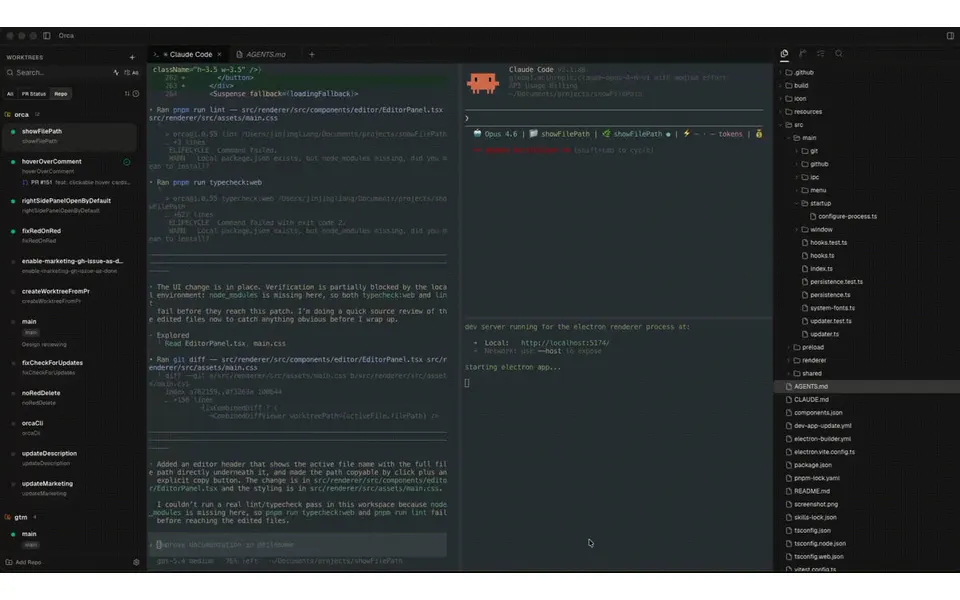
- Desktop app
- Mac, Windows and Linux
- Browser
- Yes
- Phone
- IPhone and Android
- Command line
- Yes
- Agents
- Claude Code, Codex, Cursor Agent, Gemini CLI, OpenCode, Pi, Grok, Aider and Antigravity
- Your subscription
- Works with your own plan
- Agents run
- On your computer and on your own server
- Laptop closed
- Keeps going
- Isolation
- Worktree, Container and VM
- Parallel agents
- Yes
- Scheduled runs
- Yes
- Coordinator agent
- No
- Built-in issues
- No
- Pull requests
- Yes
- Review screen
- Yes
- Team
- Not listed
- Self-hosting
- Yes
- Licence
- MIT
- Price from
- Free
- How it charges
- No paid plan
- Paid plans from
- Not listed
Measured by ADEMark
ADEMark ran the same tests on 15 ADEs. Results for Orca 1.4.249, measured up to 12 November 2026 on a Mac mini M4, 16 GB, macOS 27 · Claude Opus 5.5, effort high. Data CC BY 4.0, shown unchanged.
Speed
- Cold start
- Not measuredADEMark: our probe keystroke reached its shell before its own restore command
- New thread, ready to type
- Not measuredADEMark: its new-thread shortcut opens a shell tab, which our probe cannot time
- First word on screen
- 302 ms2nd of 11median of 9 runs, 257 ms to 317 ms · Bare CLI 220 ms
- Typing lag, 5 agents streaming
- 69 ms8th of 111 run · Bare CLI 79 ms
- Open a 2,000-message thread
- 98 ms6th of 11median of 5 runs, 87 ms to 110 ms · Bare CLI 203 ms
Weight
- Memory at rest, 5 threads
- 1.45 GB8th of 121 run · Bare CLI 0.99 GB
- Idle CPU
- 2.63%10th of 131 run · Bare CLI 0.37%
- Memory under load
- 2.71 GB9th of 101 run · Bare CLI 1.86 GB
Tokens
- Tokens to answer “hi”
- 37.7K tokens5th of 13median of 3 runs, 35.4K tokens to 37.7K tokens · Bare CLI 38.2K tokens
- Tokens for one real question
- 208.2K tokens11th of 131 run · Bare CLI 168.3K tokens
Build
- Team build: hidden tests passed
- Did not finishADEMark: its own workers never started. Claude Code's subagents did the work and passed 5 of 5
Place counts only apps with a value; lower is better except passed tests. ADEMark publishes no overall score and treats close medians as ties, so read places as an order, not a verdict. The Bare CLI is Claude Code in a terminal, run as an unranked control. Method and every test on ademark.dev · Imported data · How we use it
Receipts
- Checked
- · oldest answer 2026-10-09
- Findings
- 51 published · 42 cross-checked by a second agent · read them all
- Sources
- 104 public pages on 4 sites: api.github.com, github.com, onorca.dev, orca.dev
- GitHub stars
- 88,276 on · api.github.com · repository attention, not users or capability
- Screenshot
- github.com, retrieved · first party repository · shows appearance, not capability
- Data
- /products/orca.json · .md
- Method
- Same rules for all 103 researched ADEs. How we check · Report wrong data
What it does
Where you use it
Desktop on macOS, Windows and Linux, plus beta iOS/Android companion. Android current download is APK 0.0.64; the phone app now documents source-control and PR review. CLI scripts the running runtime.
Source and scope for Where you use itAgents it runs
Orca launches and tracks existing CLI agents in terminals rather than embedding a harness: many CLI launchers are preconfigured (Claude Code, Codex, Cursor CLI, Gemini, Antigravity, OpenCode, Copilot CLI and others) and any other CLI can run in a terminal. Orca is not a model provider. Orca v1.4.256 runs Antigravity chats through its managed official ACP server or a compatible host agy acp command.
Source and scope for Agents it runsAccounts and subscriptions
Orca reuses the installed coding-agent native subscription logins, including Claude Code and Codex. Orca account policy is a separate unresolved source conflict.
Source and scope for Accounts and subscriptionsWhere agents run
Local desktop, user-owned SSH hosts and persistent Remote Orca Servers; experimental Cloud VM recipes use the user cloud account. Current SSH uses managed server sessions. Orca does not sell managed VPS hosting.
Source and scope for Where agents runHow work is kept apart
Each task is a real git worktree with its own branch and directory. Containers or VMs are documented through experimental Cloud VM recipes. Orca documents no hostile-code boundary, and launches agents with permission-bypass flags by default on the premise that disposable worktrees are the safety net.
Source and scope for How work is kept apartParallel work
Multiple agent sessions run concurrently, each in its own worktree and terminal, with status visible in the sidebar, an Agents feed and an experimental Agent Dashboard. Concurrency was not measured and no quota was found.
Source and scope for Parallel workScheduled runs
orca automations run a prompt on hourly, daily, weekday, weekly, cron or RRULE schedules against a repo or worktree, scheduled on the Orca host that stores them, with an optional shell precheck, missed-run grace and manual rerun. Event triggers were not found.
Source and scope for Scheduled runsGit and pull requests
Branches, worktrees, staging by hunk, commits, push, PR or MR creation (GitHub, GitLab, Bitbucket Cloud) with draft state on GitHub and GitLab (Bitbucket Cloud has no draft PRs), stacked GitHub PRs, checks, comment replies and conflict resolution are integrated in the app. Rebase relies on plain git with abort controls.
Source and scope for Git and pull requestsLicence and source
The public repository carries a root MIT license that covers the desktop app, mobile app, CLI and the cloud/ Relay and push-gateway source. The Relay runs as a vendor-operated production service, parity between deployed services and the repository is unverified, and the artifact service source was not located.
Source and scope for Licence and sourcePrice
The Orca application is advertised as free and open source with no price list; the Enterprise page offers rollout and support conversations by contact and states no paid plan or fee. Model usage is billed by the user providers and compute by the user own machines.
Source and scope for PriceTyped filters
Every value links to its receipt below. Read plan and surface restrictions before using a filter to decide.
| Filter | Value |
|---|---|
| Desktop OS: macOS | Yes cross-checked |
| Desktop OS: Windows | Yes cross-checked |
| Desktop OS: Linux | Yes cross-checked |
| Web client | Yes cross-checked |
| Phone access: Native iOS | Yes cross-checked |
| Phone access: Native Android | Yes cross-checked |
| Phone access: Phone browser | Unknown |
| CLI | Yes cross-checked |
| Coding agents: Claude Code | Yes cross-checked |
| Coding agents: Codex | Yes cross-checked |
| Coding agents: Cursor Agent | Yes cross-checked |
| Coding agents: Gemini CLI | Yes cross-checked |
| Coding agents: OpenCode | Yes cross-checked |
| Coding agents: Pi | Yes cross-checked |
| Coding agents: Grok | Yes cross-checked |
| Coding agents: Aider | Yes cross-checked |
| Coding agents: Antigravity | Yes cross-checked |
| Use my subscription | Yes |
| Where agents run: On your computer | Yes cross-checked |
| Where agents run: On your own server | Yes cross-checked |
| Where agents run: In the vendor's cloud | No cross-checked |
| Workspace isolation: Git worktree | Yes cross-checked |
| Workspace isolation: Container | Yes cross-checked |
| Workspace isolation: VM or microVM | Yes cross-checked |
| Parallel runs | Yes cross-checked |
| Coordinator | No |
| Native issue tracking | No |
| Unattended triggers | Yes cross-checked |
| Shared prompting | Unknown |
| Team roles | No |
| SSO | No |
| Pull request workflow | Yes cross-checked |
| Review interface | Yes cross-checked |
| Product license: Apache-2.0 | No. MIT cross-checked |
| Product license: MIT | Yes. MIT cross-checked |
| Product license: GPL-3.0 | No. MIT cross-checked |
| Product license: GPL-3.0-or-later | No. MIT cross-checked |
| Product license: AGPL-3.0 | No. MIT cross-checked |
| Product license: AGPL-3.0-or-later | No. MIT cross-checked |
| Product license: Elastic License 2.0 | No. MIT cross-checked |
| Product license: Custom terms | No. MIT cross-checked |
| Product license: Proprietary | No. MIT cross-checked |
| Self-hosting | Yes cross-checked |
| Telemetry opt-out | Yes cross-checked |
| Free access | Yes cross-checked |
| Starting price: Free | Yes. Free cross-checked |
| Starting price: Up to $20/month | No. Free cross-checked |
| Starting price: $21–40/month | No. Free cross-checked |
| Starting price: $41–100/month | No. Free cross-checked |
| Starting price: Over $100/month | No. Free cross-checked |
| Starting price: Contact for pricing | No. Free cross-checked |
| Pricing model: Free, no paid plan | Yes cross-checked |
| Pricing model: Free plan | No |
| Pricing model: Subscription | No |
| Pricing model: Per seat | No |
| Pricing model: Usage-based | No |
| Pricing model: Per machine or compute | No cross-checked |
| Pricing model: Bring your own key | Unknown |
| Pricing model: One-time purchase | No |
| Paid plans from: No paid plan | Unknown |
| Paid plans from: $10 or less/month | Unknown |
| Paid plans from: $11–20/month | Unknown |
| Paid plans from: $21–40/month | Unknown |
| Paid plans from: $41–100/month | Unknown |
| Paid plans from: Over $100/month | Unknown |
| Paid plans from: Contact sales | Unknown |
| Lifecycle status: Active | Unknown |
| Lifecycle status: Sunsetting | Unknown |
| Keeps going with laptop closed | Yes cross-checked |
| Open-source license | Yes. MIT cross-checked |
| Any desktop app | Yes cross-checked |
| Paid plan up to $20/month | Unknown |
| Paid plan up to $40/month | Unknown |
| Any phone client | Yes cross-checked |
Filter receipts
Desktop OS: macOS: Yes cross-checked
Desktop OS: macOS
Typed value: Yes.
Desktop on macOS, Windows and Linux, plus beta iOS/Android companion. Android current download is APK 0.0.64; the phone app now documents source-control and PR review. CLI scripts the running runtime.
- Desktop os: macOS Apple Silicon and Intel, Windows 10/11 x64, and Linux AppImage/deb/rpm builds. The cited download page specifies Windows 10/11; numeric macOS and Linux minimum versions are not given.
- Mobile apps: Beta iOS App Store companion and sideloaded Android APK 0.0.64, paired with a running desktop/server.
- Documentation and source only; no client was installed or cross-device scenario run.
- The download page specifies Windows 10/11; macOS and Linux minimum versions remain unestablished.
- The mobile app is a remote control for a running desktop or server, not a standalone client; the desktop must stay online.
- The mobile companion and Remote Orca Servers are labelled beta on their docs pages. The live CLI reference says Settings > Experimental > CLI, while the CLI overview says Settings > General > Orca CLI.
-
Finding: Re-read 2026-10-09: macOS Apple Silicon and Intel; Windows installer; Linux AppImage, .deb and .rpm; Homebrew cask; RC builds by opt-in. Minimum OS versions were not re-checked.
-
Finding: Current download page offers macOS Apple Silicon/Intel, Windows 10/11 x64, Linux AppImage, iOS App Store and Android APK 0.0.64.
Desktop OS: Windows: Yes cross-checked
Desktop OS: Windows
Typed value: Yes.
Desktop on macOS, Windows and Linux, plus beta iOS/Android companion. Android current download is APK 0.0.64; the phone app now documents source-control and PR review. CLI scripts the running runtime.
- Desktop os: macOS Apple Silicon and Intel, Windows 10/11 x64, and Linux AppImage/deb/rpm builds. The cited download page specifies Windows 10/11; numeric macOS and Linux minimum versions are not given.
- Mobile apps: Beta iOS App Store companion and sideloaded Android APK 0.0.64, paired with a running desktop/server.
- Documentation and source only; no client was installed or cross-device scenario run.
- The download page specifies Windows 10/11; macOS and Linux minimum versions remain unestablished.
- The mobile app is a remote control for a running desktop or server, not a standalone client; the desktop must stay online.
- The mobile companion and Remote Orca Servers are labelled beta on their docs pages. The live CLI reference says Settings > Experimental > CLI, while the CLI overview says Settings > General > Orca CLI.
-
Finding: Re-read 2026-10-09: macOS Apple Silicon and Intel; Windows installer; Linux AppImage, .deb and .rpm; Homebrew cask; RC builds by opt-in. Minimum OS versions were not re-checked.
-
Finding: Current download page offers macOS Apple Silicon/Intel, Windows 10/11 x64, Linux AppImage, iOS App Store and Android APK 0.0.64.
Desktop OS: Linux: Yes cross-checked
Desktop OS: Linux
Typed value: Yes.
Desktop on macOS, Windows and Linux, plus beta iOS/Android companion. Android current download is APK 0.0.64; the phone app now documents source-control and PR review. CLI scripts the running runtime.
- Desktop os: macOS Apple Silicon and Intel, Windows 10/11 x64, and Linux AppImage/deb/rpm builds. The cited download page specifies Windows 10/11; numeric macOS and Linux minimum versions are not given.
- Mobile apps: Beta iOS App Store companion and sideloaded Android APK 0.0.64, paired with a running desktop/server.
- Documentation and source only; no client was installed or cross-device scenario run.
- The download page specifies Windows 10/11; macOS and Linux minimum versions remain unestablished.
- The mobile app is a remote control for a running desktop or server, not a standalone client; the desktop must stay online.
- The mobile companion and Remote Orca Servers are labelled beta on their docs pages. The live CLI reference says Settings > Experimental > CLI, while the CLI overview says Settings > General > Orca CLI.
-
Finding: Re-read 2026-10-09: macOS Apple Silicon and Intel; Windows installer; Linux AppImage, .deb and .rpm; Homebrew cask; RC builds by opt-in. Minimum OS versions were not re-checked.
-
Finding: Current download page offers macOS Apple Silicon/Intel, Windows 10/11 x64, Linux AppImage, iOS App Store and Android APK 0.0.64.
Web client: Yes cross-checked
Web client
Typed value: Yes.
Desktop on macOS, Windows and Linux, plus beta iOS/Android companion. Android current download is APK 0.0.64; the phone app now documents source-control and PR review. CLI scripts the running runtime.
- Browser: The documented browser client pairs to a user-owned Remote Orca Server, sharing that server’s projects, worktrees and sessions. This is not vendor-hosted agent execution.
- Cross device continuity: A paired phone lists the same worktrees and sessions as the desktop or server and can continue them. Documented only; the desktop host must remain reachable.
- Documentation and source only; no client was installed or cross-device scenario run.
- The download page specifies Windows 10/11; macOS and Linux minimum versions remain unestablished.
- The mobile app is a remote control for a running desktop or server, not a standalone client; the desktop must stay online.
- The mobile companion and Remote Orca Servers are labelled beta on their docs pages. The live CLI reference says Settings > Experimental > CLI, while the CLI overview says Settings > General > Orca CLI.
-
Finding: Re-read 2026-10-09: four modes (local desktop, SSH target, Remote Orca Server, Cloud VM per-workspace environment); Orca does not sell managed VPS hosting; remote modes use machines and cloud accounts the user controls; Cloud VM is labelled experimental under Settings > Experimental. Unchanged.
-
Finding: Re-read 2026-10-09: Remote Orca Servers are beta; the server owns projects, worktrees, terminals and agents; agents keep running when clients sleep or disconnect; per-client revocable grants; Tailscale recommended; the server must stay awake and online. Unchanged.
Phone access: Native iOS: Yes cross-checked
Phone access: Native iOS
Typed value: Yes.
Desktop on macOS, Windows and Linux, plus beta iOS/Android companion. Android current download is APK 0.0.64; the phone app now documents source-control and PR review. CLI scripts the running runtime.
- Desktop os: macOS Apple Silicon and Intel, Windows 10/11 x64, and Linux AppImage/deb/rpm builds. The cited download page specifies Windows 10/11; numeric macOS and Linux minimum versions are not given.
- Mobile apps: Beta iOS App Store companion and sideloaded Android APK 0.0.64, paired with a running desktop/server.
- Task actions: Phone replies, source-control review, account switching and PR comments are documented; November 5 release adds per-turn patch review. Not a full editor.
- Notifications: Terminal agent completion has desktop notifications; updated structured-chat success marks unread instead. Desktop per-machine mutes do not change phone push, and the November 2 release lets the phone receive only needs-input agent alerts.
- Cross device continuity: A paired phone lists the same worktrees and sessions as the desktop or server and can continue them. Documented only; the desktop host must remain reachable.
- Documentation and source only; no client was installed or cross-device scenario run.
- The download page specifies Windows 10/11; macOS and Linux minimum versions remain unestablished.
- The mobile app is a remote control for a running desktop or server, not a standalone client; the desktop must stay online.
- The mobile companion and Remote Orca Servers are labelled beta on their docs pages. The live CLI reference says Settings > Experimental > CLI, while the CLI overview says Settings > General > Orca CLI.
-
Finding: Current download page offers macOS Apple Silicon/Intel, Windows 10/11 x64, Linux AppImage, iOS App Store and Android APK 0.0.64.
-
Finding: Beta iOS/Android companion pairs to a running desktop/server, with agent status, scrollback, replies, source-control review and account switching. Phone push and current binary update are documented. Not a full editor.
Phone access: Native Android: Yes cross-checked
Phone access: Native Android
Typed value: Yes.
Desktop on macOS, Windows and Linux, plus beta iOS/Android companion. Android current download is APK 0.0.64; the phone app now documents source-control and PR review. CLI scripts the running runtime.
- Desktop os: macOS Apple Silicon and Intel, Windows 10/11 x64, and Linux AppImage/deb/rpm builds. The cited download page specifies Windows 10/11; numeric macOS and Linux minimum versions are not given.
- Mobile apps: Beta iOS App Store companion and sideloaded Android APK 0.0.64, paired with a running desktop/server.
- Task actions: Phone replies, source-control review, account switching and PR comments are documented; November 5 release adds per-turn patch review. Not a full editor.
- Notifications: Terminal agent completion has desktop notifications; updated structured-chat success marks unread instead. Desktop per-machine mutes do not change phone push, and the November 2 release lets the phone receive only needs-input agent alerts.
- Cross device continuity: A paired phone lists the same worktrees and sessions as the desktop or server and can continue them. Documented only; the desktop host must remain reachable.
- Documentation and source only; no client was installed or cross-device scenario run.
- The download page specifies Windows 10/11; macOS and Linux minimum versions remain unestablished.
- The mobile app is a remote control for a running desktop or server, not a standalone client; the desktop must stay online.
- The mobile companion and Remote Orca Servers are labelled beta on their docs pages. The live CLI reference says Settings > Experimental > CLI, while the CLI overview says Settings > General > Orca CLI.
-
Finding: Current download page offers macOS Apple Silicon/Intel, Windows 10/11 x64, Linux AppImage, iOS App Store and Android APK 0.0.64.
-
Finding: Beta iOS/Android companion pairs to a running desktop/server, with agent status, scrollback, replies, source-control review and account switching. Phone push and current binary update are documented. Not a full editor.
CLI: Yes cross-checked
CLI
Typed value: Yes.
Desktop on macOS, Windows and Linux, plus beta iOS/Android companion. Android current download is APK 0.0.64; the phone app now documents source-control and PR review. CLI scripts the running runtime.
- Cli: The orca CLI ships with the desktop app and scripts a running Orca runtime; its registration location differs between the live and pinned docs (see limitations); orca serve runs the runtime headless.
- Documentation and source only; no client was installed or cross-device scenario run.
- The download page specifies Windows 10/11; macOS and Linux minimum versions remain unestablished.
- The mobile app is a remote control for a running desktop or server, not a standalone client; the desktop must stay online.
- The mobile companion and Remote Orca Servers are labelled beta on their docs pages. The live CLI reference says Settings > Experimental > CLI, while the CLI overview says Settings > General > Orca CLI.
-
Finding: Re-read 2026-10-09: the orca CLI scripts a running Orca runtime (worktrees, terminals, files, browser, automations, artifacts); skills install for agents. Unchanged in the points read.
-
Finding: Re-read 2026-10-09: CLI registered under Settings > Experimental > CLI; orca status and orca serve (headless runtime); selector-based commands with --json; orca linear read and save-issue; orca account add; orca host list; artifacts share. Unchanged.
Coding agents: Claude Code: Yes cross-checked
Coding agents: Claude Code
Typed value: Yes.
Orca launches and tracks existing CLI agents in terminals rather than embedding a harness: many CLI launchers are preconfigured (Claude Code, Codex, Cursor CLI, Gemini, Antigravity, OpenCode, Copilot CLI and others) and any other CLI can run in a terminal. Orca is not a model provider. Orca v1.4.256 runs Antigravity chats through its managed official ACP server or a compatible host agy acp command.
- Harnesses: Preconfigured launchers for many CLI agents; deep integration for Claude Code, Codex, Muse Code and Cursor CLI, with the feature set (usage, hot-swap, hooks, status, history) differing by agent; auto-setup for many others. Orca v1.4.256 runs Antigravity chats through its managed official ACP server or a compatible host agy acp command.
- Model providers: Orca does not host models. Model choice is made inside each agent CLI; Orca shows usage for Claude, Codex, Muse, Gemini, Antigravity, OpenCode, Kimi, MiniMax, Cursor, ZCode and GLM plans, and can pass opaque model IDs to supervised workers of six agents.
- Custom adapters: Any other CLI agent can be launched in a terminal and per-agent launch arguments and environment can be edited; status dots and hooks need a recognized agent. No separate adapter API found.
- Session integration: Orca launches the agent CLI in a terminal PTY and reads state from OSC titles and hooks; a structured chat tab for supported agents keeps session state in Orca; supervised workers are launched through the orchestration CLI.
- Mixed harness operation: Documented: the first-session walkthrough runs Claude Code, Codex and Cursor CLI side by side on the same prompt, and orchestration can start workers of different agents. Not observed.
- Documentation only; mixed-harness operation was not observed.
- Depth of integration varies by agent: some have hooks, status and usage, many are launch-only.
- Agents not recognized by Orca show no status indicators.
- Structured chat and usage facts come from live docs reread 2026-11-07; the pinned 4bb6f20 docs have no such sections, so they are not v1.4.222 code-inspected facts.
- Antigravity structured chat has its own sign-in and cannot adopt terminal conversations; supported account types and runtime compatibility still apply.
-
Finding: Re-read 2026-10-09 at pinned v1.4.222 commit 4bb6f20: macOS, Windows and Linux badge; MIT badge; mobile companion on the iOS App Store and as Android APK 0.0.52; Orca CLI, SSH worktrees, Design Mode and annotate AI diffs listed. Unchanged on the points used by claims.
-
Finding: Re-read 2026-10-09: vendor page says the path from empty app to three agents takes under five minutes; steps are add repo, create worktree, pick agent, race three agents, review, commit and push. Not timed. Unchanged.
-
Finding: Current supported-agents table describes preconfigured CLI launchers with agent-specific hooks, status, usage and account support. Provider-native Claude Agent Teams is off by default. Agent permission-mode support and defaults differ; the exact current launcher count was not established in this pass.
-
Finding: Re-read 2026-10-09: Cursor CLI launches from the agent picker; model selection stays in Cursor settings; Cursor plan usage shown from the existing Cursor sign-in. Unchanged.
-
Finding: Re-read 2026-10-09: usage for Claude Code, Codex, Muse Code, Gemini, Antigravity, OpenCode, Kimi Code, MiniMax, Cursor, ZCode and GLM plans; warning chip at 80%; provider credit balances where reported; Muse usage is local token accounting without a price estimate. Unchanged.
-
Finding: Current structured chat covers Claude, Codex, Grok, OpenCode, Pi, OMP and Antigravity on local supported OS and paired server workspaces. Existing terminal/SSH/WSL sessions have different surfaces. Automatic chat resume default differs for new versus existing installations.
-
Finding: Re-read 2026-10-09: state glyphs (working, waiting on you, done, blocked, idle) from OSC titles and hooks; Agent Dashboard is experimental under Settings > Experimental; the Restart chip rehydrates an exited agent. Unchanged.
-
Finding: Current orchestration guide documents Run/Task/Dispatch, worker-start, agent-specific model/effort overrides, messaging, heartbeats and decision gates. Legacy run/run-stop/coordinator commands have no effects. The page says to enable orchestration under Experimental but also says that panel and switch are temporarily unavailable. CLI operation was not tested; activation availability is unresolved.
Coding agents: Codex: Yes cross-checked
Coding agents: Codex
Typed value: Yes.
Orca launches and tracks existing CLI agents in terminals rather than embedding a harness: many CLI launchers are preconfigured (Claude Code, Codex, Cursor CLI, Gemini, Antigravity, OpenCode, Copilot CLI and others) and any other CLI can run in a terminal. Orca is not a model provider. Orca v1.4.256 runs Antigravity chats through its managed official ACP server or a compatible host agy acp command.
- Harnesses: Preconfigured launchers for many CLI agents; deep integration for Claude Code, Codex, Muse Code and Cursor CLI, with the feature set (usage, hot-swap, hooks, status, history) differing by agent; auto-setup for many others. Orca v1.4.256 runs Antigravity chats through its managed official ACP server or a compatible host agy acp command.
- Model providers: Orca does not host models. Model choice is made inside each agent CLI; Orca shows usage for Claude, Codex, Muse, Gemini, Antigravity, OpenCode, Kimi, MiniMax, Cursor, ZCode and GLM plans, and can pass opaque model IDs to supervised workers of six agents.
- Custom adapters: Any other CLI agent can be launched in a terminal and per-agent launch arguments and environment can be edited; status dots and hooks need a recognized agent. No separate adapter API found.
- Session integration: Orca launches the agent CLI in a terminal PTY and reads state from OSC titles and hooks; a structured chat tab for supported agents keeps session state in Orca; supervised workers are launched through the orchestration CLI.
- Mixed harness operation: Documented: the first-session walkthrough runs Claude Code, Codex and Cursor CLI side by side on the same prompt, and orchestration can start workers of different agents. Not observed.
- Documentation only; mixed-harness operation was not observed.
- Depth of integration varies by agent: some have hooks, status and usage, many are launch-only.
- Agents not recognized by Orca show no status indicators.
- Structured chat and usage facts come from live docs reread 2026-11-07; the pinned 4bb6f20 docs have no such sections, so they are not v1.4.222 code-inspected facts.
- Antigravity structured chat has its own sign-in and cannot adopt terminal conversations; supported account types and runtime compatibility still apply.
-
Finding: Re-read 2026-10-09 at pinned v1.4.222 commit 4bb6f20: macOS, Windows and Linux badge; MIT badge; mobile companion on the iOS App Store and as Android APK 0.0.52; Orca CLI, SSH worktrees, Design Mode and annotate AI diffs listed. Unchanged on the points used by claims.
-
Finding: Re-read 2026-10-09: vendor page says the path from empty app to three agents takes under five minutes; steps are add repo, create worktree, pick agent, race three agents, review, commit and push. Not timed. Unchanged.
-
Finding: Current supported-agents table describes preconfigured CLI launchers with agent-specific hooks, status, usage and account support. Provider-native Claude Agent Teams is off by default. Agent permission-mode support and defaults differ; the exact current launcher count was not established in this pass.
-
Finding: Re-read 2026-10-09: Cursor CLI launches from the agent picker; model selection stays in Cursor settings; Cursor plan usage shown from the existing Cursor sign-in. Unchanged.
-
Finding: Re-read 2026-10-09: usage for Claude Code, Codex, Muse Code, Gemini, Antigravity, OpenCode, Kimi Code, MiniMax, Cursor, ZCode and GLM plans; warning chip at 80%; provider credit balances where reported; Muse usage is local token accounting without a price estimate. Unchanged.
-
Finding: Current structured chat covers Claude, Codex, Grok, OpenCode, Pi, OMP and Antigravity on local supported OS and paired server workspaces. Existing terminal/SSH/WSL sessions have different surfaces. Automatic chat resume default differs for new versus existing installations.
-
Finding: Re-read 2026-10-09: state glyphs (working, waiting on you, done, blocked, idle) from OSC titles and hooks; Agent Dashboard is experimental under Settings > Experimental; the Restart chip rehydrates an exited agent. Unchanged.
-
Finding: Current orchestration guide documents Run/Task/Dispatch, worker-start, agent-specific model/effort overrides, messaging, heartbeats and decision gates. Legacy run/run-stop/coordinator commands have no effects. The page says to enable orchestration under Experimental but also says that panel and switch are temporarily unavailable. CLI operation was not tested; activation availability is unresolved.
Coding agents: Cursor Agent: Yes cross-checked
Coding agents: Cursor Agent
Typed value: Yes.
Orca launches and tracks existing CLI agents in terminals rather than embedding a harness: many CLI launchers are preconfigured (Claude Code, Codex, Cursor CLI, Gemini, Antigravity, OpenCode, Copilot CLI and others) and any other CLI can run in a terminal. Orca is not a model provider. Orca v1.4.256 runs Antigravity chats through its managed official ACP server or a compatible host agy acp command.
- Harnesses: Preconfigured launchers for many CLI agents; deep integration for Claude Code, Codex, Muse Code and Cursor CLI, with the feature set (usage, hot-swap, hooks, status, history) differing by agent; auto-setup for many others. Orca v1.4.256 runs Antigravity chats through its managed official ACP server or a compatible host agy acp command.
- Model providers: Orca does not host models. Model choice is made inside each agent CLI; Orca shows usage for Claude, Codex, Muse, Gemini, Antigravity, OpenCode, Kimi, MiniMax, Cursor, ZCode and GLM plans, and can pass opaque model IDs to supervised workers of six agents.
- Custom adapters: Any other CLI agent can be launched in a terminal and per-agent launch arguments and environment can be edited; status dots and hooks need a recognized agent. No separate adapter API found.
- Session integration: Orca launches the agent CLI in a terminal PTY and reads state from OSC titles and hooks; a structured chat tab for supported agents keeps session state in Orca; supervised workers are launched through the orchestration CLI.
- Mixed harness operation: Documented: the first-session walkthrough runs Claude Code, Codex and Cursor CLI side by side on the same prompt, and orchestration can start workers of different agents. Not observed.
- Documentation only; mixed-harness operation was not observed.
- Depth of integration varies by agent: some have hooks, status and usage, many are launch-only.
- Agents not recognized by Orca show no status indicators.
- Structured chat and usage facts come from live docs reread 2026-11-07; the pinned 4bb6f20 docs have no such sections, so they are not v1.4.222 code-inspected facts.
- Antigravity structured chat has its own sign-in and cannot adopt terminal conversations; supported account types and runtime compatibility still apply.
-
Finding: Re-read 2026-10-09 at pinned v1.4.222 commit 4bb6f20: macOS, Windows and Linux badge; MIT badge; mobile companion on the iOS App Store and as Android APK 0.0.52; Orca CLI, SSH worktrees, Design Mode and annotate AI diffs listed. Unchanged on the points used by claims.
-
Finding: Re-read 2026-10-09: vendor page says the path from empty app to three agents takes under five minutes; steps are add repo, create worktree, pick agent, race three agents, review, commit and push. Not timed. Unchanged.
-
Finding: Current supported-agents table describes preconfigured CLI launchers with agent-specific hooks, status, usage and account support. Provider-native Claude Agent Teams is off by default. Agent permission-mode support and defaults differ; the exact current launcher count was not established in this pass.
-
Finding: Re-read 2026-10-09: Cursor CLI launches from the agent picker; model selection stays in Cursor settings; Cursor plan usage shown from the existing Cursor sign-in. Unchanged.
-
Finding: Re-read 2026-10-09: usage for Claude Code, Codex, Muse Code, Gemini, Antigravity, OpenCode, Kimi Code, MiniMax, Cursor, ZCode and GLM plans; warning chip at 80%; provider credit balances where reported; Muse usage is local token accounting without a price estimate. Unchanged.
-
Finding: Current structured chat covers Claude, Codex, Grok, OpenCode, Pi, OMP and Antigravity on local supported OS and paired server workspaces. Existing terminal/SSH/WSL sessions have different surfaces. Automatic chat resume default differs for new versus existing installations.
-
Finding: Re-read 2026-10-09: state glyphs (working, waiting on you, done, blocked, idle) from OSC titles and hooks; Agent Dashboard is experimental under Settings > Experimental; the Restart chip rehydrates an exited agent. Unchanged.
-
Finding: Current orchestration guide documents Run/Task/Dispatch, worker-start, agent-specific model/effort overrides, messaging, heartbeats and decision gates. Legacy run/run-stop/coordinator commands have no effects. The page says to enable orchestration under Experimental but also says that panel and switch are temporarily unavailable. CLI operation was not tested; activation availability is unresolved.
Coding agents: Gemini CLI: Yes cross-checked
Coding agents: Gemini CLI
Typed value: Yes.
Orca launches and tracks existing CLI agents in terminals rather than embedding a harness: many CLI launchers are preconfigured (Claude Code, Codex, Cursor CLI, Gemini, Antigravity, OpenCode, Copilot CLI and others) and any other CLI can run in a terminal. Orca is not a model provider. Orca v1.4.256 runs Antigravity chats through its managed official ACP server or a compatible host agy acp command.
- Harnesses: Preconfigured launchers for many CLI agents; deep integration for Claude Code, Codex, Muse Code and Cursor CLI, with the feature set (usage, hot-swap, hooks, status, history) differing by agent; auto-setup for many others. Orca v1.4.256 runs Antigravity chats through its managed official ACP server or a compatible host agy acp command.
- Custom adapters: Any other CLI agent can be launched in a terminal and per-agent launch arguments and environment can be edited; status dots and hooks need a recognized agent. No separate adapter API found.
- Documentation only; mixed-harness operation was not observed.
- Depth of integration varies by agent: some have hooks, status and usage, many are launch-only.
- Agents not recognized by Orca show no status indicators.
- Structured chat and usage facts come from live docs reread 2026-11-07; the pinned 4bb6f20 docs have no such sections, so they are not v1.4.222 code-inspected facts.
- Antigravity structured chat has its own sign-in and cannot adopt terminal conversations; supported account types and runtime compatibility still apply.
-
Finding: Current supported-agents table describes preconfigured CLI launchers with agent-specific hooks, status, usage and account support. Provider-native Claude Agent Teams is off by default. Agent permission-mode support and defaults differ; the exact current launcher count was not established in this pass.
Coding agents: OpenCode: Yes cross-checked
Coding agents: OpenCode
Typed value: Yes.
Orca launches and tracks existing CLI agents in terminals rather than embedding a harness: many CLI launchers are preconfigured (Claude Code, Codex, Cursor CLI, Gemini, Antigravity, OpenCode, Copilot CLI and others) and any other CLI can run in a terminal. Orca is not a model provider. Orca v1.4.256 runs Antigravity chats through its managed official ACP server or a compatible host agy acp command.
- Harnesses: Preconfigured launchers for many CLI agents; deep integration for Claude Code, Codex, Muse Code and Cursor CLI, with the feature set (usage, hot-swap, hooks, status, history) differing by agent; auto-setup for many others. Orca v1.4.256 runs Antigravity chats through its managed official ACP server or a compatible host agy acp command.
- Custom adapters: Any other CLI agent can be launched in a terminal and per-agent launch arguments and environment can be edited; status dots and hooks need a recognized agent. No separate adapter API found.
- Documentation only; mixed-harness operation was not observed.
- Depth of integration varies by agent: some have hooks, status and usage, many are launch-only.
- Agents not recognized by Orca show no status indicators.
- Structured chat and usage facts come from live docs reread 2026-11-07; the pinned 4bb6f20 docs have no such sections, so they are not v1.4.222 code-inspected facts.
- Antigravity structured chat has its own sign-in and cannot adopt terminal conversations; supported account types and runtime compatibility still apply.
-
Finding: Current supported-agents table describes preconfigured CLI launchers with agent-specific hooks, status, usage and account support. Provider-native Claude Agent Teams is off by default. Agent permission-mode support and defaults differ; the exact current launcher count was not established in this pass.
Coding agents: Pi: Yes cross-checked
Coding agents: Pi
Typed value: Yes.
Orca launches and tracks existing CLI agents in terminals rather than embedding a harness: many CLI launchers are preconfigured (Claude Code, Codex, Cursor CLI, Gemini, Antigravity, OpenCode, Copilot CLI and others) and any other CLI can run in a terminal. Orca is not a model provider. Orca v1.4.256 runs Antigravity chats through its managed official ACP server or a compatible host agy acp command.
- Harnesses: Preconfigured launchers for many CLI agents; deep integration for Claude Code, Codex, Muse Code and Cursor CLI, with the feature set (usage, hot-swap, hooks, status, history) differing by agent; auto-setup for many others. Orca v1.4.256 runs Antigravity chats through its managed official ACP server or a compatible host agy acp command.
- Custom adapters: Any other CLI agent can be launched in a terminal and per-agent launch arguments and environment can be edited; status dots and hooks need a recognized agent. No separate adapter API found.
- Documentation only; mixed-harness operation was not observed.
- Depth of integration varies by agent: some have hooks, status and usage, many are launch-only.
- Agents not recognized by Orca show no status indicators.
- Structured chat and usage facts come from live docs reread 2026-11-07; the pinned 4bb6f20 docs have no such sections, so they are not v1.4.222 code-inspected facts.
- Antigravity structured chat has its own sign-in and cannot adopt terminal conversations; supported account types and runtime compatibility still apply.
-
Finding: Current supported-agents table describes preconfigured CLI launchers with agent-specific hooks, status, usage and account support. Provider-native Claude Agent Teams is off by default. Agent permission-mode support and defaults differ; the exact current launcher count was not established in this pass.
Coding agents: Grok: Yes cross-checked
Coding agents: Grok
Typed value: Yes.
Orca launches and tracks existing CLI agents in terminals rather than embedding a harness: many CLI launchers are preconfigured (Claude Code, Codex, Cursor CLI, Gemini, Antigravity, OpenCode, Copilot CLI and others) and any other CLI can run in a terminal. Orca is not a model provider. Orca v1.4.256 runs Antigravity chats through its managed official ACP server or a compatible host agy acp command.
- Harnesses: Preconfigured launchers for many CLI agents; deep integration for Claude Code, Codex, Muse Code and Cursor CLI, with the feature set (usage, hot-swap, hooks, status, history) differing by agent; auto-setup for many others. Orca v1.4.256 runs Antigravity chats through its managed official ACP server or a compatible host agy acp command.
- Custom adapters: Any other CLI agent can be launched in a terminal and per-agent launch arguments and environment can be edited; status dots and hooks need a recognized agent. No separate adapter API found.
- Documentation only; mixed-harness operation was not observed.
- Depth of integration varies by agent: some have hooks, status and usage, many are launch-only.
- Agents not recognized by Orca show no status indicators.
- Structured chat and usage facts come from live docs reread 2026-11-07; the pinned 4bb6f20 docs have no such sections, so they are not v1.4.222 code-inspected facts.
- Antigravity structured chat has its own sign-in and cannot adopt terminal conversations; supported account types and runtime compatibility still apply.
-
Finding: Current supported-agents table describes preconfigured CLI launchers with agent-specific hooks, status, usage and account support. Provider-native Claude Agent Teams is off by default. Agent permission-mode support and defaults differ; the exact current launcher count was not established in this pass.
Coding agents: Aider: Yes cross-checked
Coding agents: Aider
Typed value: Yes.
Orca launches and tracks existing CLI agents in terminals rather than embedding a harness: many CLI launchers are preconfigured (Claude Code, Codex, Cursor CLI, Gemini, Antigravity, OpenCode, Copilot CLI and others) and any other CLI can run in a terminal. Orca is not a model provider. Orca v1.4.256 runs Antigravity chats through its managed official ACP server or a compatible host agy acp command.
- Harnesses: Preconfigured launchers for many CLI agents; deep integration for Claude Code, Codex, Muse Code and Cursor CLI, with the feature set (usage, hot-swap, hooks, status, history) differing by agent; auto-setup for many others. Orca v1.4.256 runs Antigravity chats through its managed official ACP server or a compatible host agy acp command.
- Custom adapters: Any other CLI agent can be launched in a terminal and per-agent launch arguments and environment can be edited; status dots and hooks need a recognized agent. No separate adapter API found.
- Documentation only; mixed-harness operation was not observed.
- Depth of integration varies by agent: some have hooks, status and usage, many are launch-only.
- Agents not recognized by Orca show no status indicators.
- Structured chat and usage facts come from live docs reread 2026-11-07; the pinned 4bb6f20 docs have no such sections, so they are not v1.4.222 code-inspected facts.
- Antigravity structured chat has its own sign-in and cannot adopt terminal conversations; supported account types and runtime compatibility still apply.
-
Finding: Current supported-agents table describes preconfigured CLI launchers with agent-specific hooks, status, usage and account support. Provider-native Claude Agent Teams is off by default. Agent permission-mode support and defaults differ; the exact current launcher count was not established in this pass.
Coding agents: Antigravity: Yes cross-checked
Coding agents: Antigravity
Typed value: Yes.
Orca launches and tracks existing CLI agents in terminals rather than embedding a harness: many CLI launchers are preconfigured (Claude Code, Codex, Cursor CLI, Gemini, Antigravity, OpenCode, Copilot CLI and others) and any other CLI can run in a terminal. Orca is not a model provider. Orca v1.4.256 runs Antigravity chats through its managed official ACP server or a compatible host agy acp command.
- Harnesses: Preconfigured launchers for many CLI agents; deep integration for Claude Code, Codex, Muse Code and Cursor CLI, with the feature set (usage, hot-swap, hooks, status, history) differing by agent; auto-setup for many others. Orca v1.4.256 runs Antigravity chats through its managed official ACP server or a compatible host agy acp command.
- Documentation only; mixed-harness operation was not observed.
- Depth of integration varies by agent: some have hooks, status and usage, many are launch-only.
- Agents not recognized by Orca show no status indicators.
- Structured chat and usage facts come from live docs reread 2026-11-07; the pinned 4bb6f20 docs have no such sections, so they are not v1.4.222 code-inspected facts.
- Antigravity structured chat has its own sign-in and cannot adopt terminal conversations; supported account types and runtime compatibility still apply.
-
Orca Antigravity support at v1.4.256
Finding: Orca v1.4.256 runs Antigravity chats through its managed official ACP server or a compatible host agy acp command.
-
Orca Antigravity support at v1.4.256
Finding: Orca v1.4.256 runs Antigravity chats through its managed official ACP server or a compatible host agy acp command.
Use my subscription: Yes
Use my subscription
Typed value: Yes.
Orca reuses the installed coding-agent native subscription logins, including Claude Code and Codex. Orca account policy is a separate unresolved source conflict.
- Agent subscriptions: Orca launches the installed Claude Code and Codex CLIs using their existing native provider subscriptions and logins.
- Account switching: One-click hot-swap of multiple Claude and Codex accounts from the status bar; OpenCode and Devin account profiles; Antigravity accounts; the mobile app exposes the same switcher. Running sessions keep their original account until restarted.
- Documentation and pinned source inspection only; no hands-on scenario was run.
- Other atomic questions remain unestablished: vendor_credits, local_models, provider_restrictions.
- The earlier Orca account-system contradiction is retained explicitly in the unknown vendor_account_requirement answer; no Orca account-policy assertion is made by this narrowed subscription finding.
-
Finding: Re-read 2026-10-09 (homepage HTML): run Claude Code, Codex and other agents in parallel; "Works with Claude Code, Codex, OpenCode, Grok, and any other agent CLI"; "Bring your own agent / subscription"; iOS App Store and Android APK links; "Free and open source for macOS, Windows, and Linux"; footer "Backed by Y Combinator" and "Stably AI". The earlier "27+ agent CLIs" count was not found in this HTML. Client-rendered sections were only partly extracted.
-
Finding: Re-read 2026-10-09: runs the installed Claude Code CLI with the user login in ~/.claude; usage state in the status bar; multiple Claude accounts with one-click swap; subagents and Agent Teams teammates appear as child rows. Unchanged.
-
Finding: Re-read 2026-10-09: account homes; each Codex tab runs its own background server on Codex 0.157 and later; Task subagents appear as child rows. Unchanged.
Where agents run: On your computer: Yes cross-checked
Where agents run: On your computer
Typed value: Yes.
Local desktop, user-owned SSH hosts and persistent Remote Orca Servers; experimental Cloud VM recipes use the user cloud account. Current SSH uses managed server sessions. Orca does not sell managed VPS hosting.
- Local: Agents, terminals and browser run on the desktop by default.
- Byo remote: SSH hosts and self-hosted Remote Orca Servers; current SSH installs its managed server and keeps sessions after client disconnect.
- Managed cloud: Docs state Orca does not sell managed VPS hosting; remote modes always use machines and cloud accounts you control.
- Hybrid: Local, SSH, server and recipe modes can be mixed in one install.
- Provisioning: Add and test an SSH target; pair a server with an access link or pairing URL; Cloud VM recipes in orca.yaml.
- Payer: The user pays for the machines and cloud accounts; Orca software is free.
- Other device continuation: Laptop, browser client and phone can pair to the same server runtime and share sessions. Documented, not tested.
- Cloud VM remains experimental and user-funded.
- Remote work depends on its host remaining available; no binary or disconnect test was run.
-
Finding: Re-read 2026-10-09: four modes (local desktop, SSH target, Remote Orca Server, Cloud VM per-workspace environment); Orca does not sell managed VPS hosting; remote modes use machines and cloud accounts the user controls; Cloud VM is labelled experimental under Settings > Experimental. Unchanged.
Where agents run: On your own server: Yes cross-checked
Where agents run: On your own server
Typed value: Yes.
Local desktop, user-owned SSH hosts and persistent Remote Orca Servers; experimental Cloud VM recipes use the user cloud account. Current SSH uses managed server sessions. Orca does not sell managed VPS hosting.
- Local: Agents, terminals and browser run on the desktop by default.
- Byo remote: SSH hosts and self-hosted Remote Orca Servers; current SSH installs its managed server and keeps sessions after client disconnect.
- Self hosted: Remote Orca Server on a user machine via the desktop app or orca serve; revocable per-client access grants.
- Managed cloud: Docs state Orca does not sell managed VPS hosting; remote modes always use machines and cloud accounts you control.
- Hybrid: Local, SSH, server and recipe modes can be mixed in one install.
- Provisioning: Add and test an SSH target; pair a server with an access link or pairing URL; Cloud VM recipes in orca.yaml.
- Payer: The user pays for the machines and cloud accounts; Orca software is free.
- Expiry: Remote servers must remain awake and online. Current SSH docs remove legacy relay-only lifecycle settings; historical v1.4.222 lease defaults do not establish current expiry.
- Client disconnect: Server mode: agents keep running when the client sleeps or disconnects. SSH: remote PTY sessions live on the host's managed Orca server and survive Orca closing on the laptop. Documented, not tested.
- Other device continuation: Laptop, browser client and phone can pair to the same server runtime and share sessions. Documented, not tested.
- Cloud VM remains experimental and user-funded.
- Remote work depends on its host remaining available; no binary or disconnect test was run.
-
Finding: Current SSH uses a managed Orca server on every host; remote PTYs survive desktop disconnect and reconnect. Old per-host runtime selector and relay-only lifecycle settings are removed. Host CLI control has an explicit per-host grant.
-
Finding: Re-read 2026-10-09: four modes (local desktop, SSH target, Remote Orca Server, Cloud VM per-workspace environment); Orca does not sell managed VPS hosting; remote modes use machines and cloud accounts the user controls; Cloud VM is labelled experimental under Settings > Experimental. Unchanged.
-
Finding: Re-read 2026-10-09: Remote Orca Servers are beta; the server owns projects, worktrees, terminals and agents; agents keep running when clients sleep or disconnect; per-client revocable grants; Tailscale recommended; the server must stay awake and online. Unchanged.
Where agents run: In the vendor's cloud: No cross-checked
Where agents run: In the vendor's cloud
Typed value: No.
Local desktop, user-owned SSH hosts and persistent Remote Orca Servers; experimental Cloud VM recipes use the user cloud account. Current SSH uses managed server sessions. Orca does not sell managed VPS hosting.
- Local: Agents, terminals and browser run on the desktop by default.
- Byo remote: SSH hosts and self-hosted Remote Orca Servers; current SSH installs its managed server and keeps sessions after client disconnect.
- Managed cloud: Docs state Orca does not sell managed VPS hosting; remote modes always use machines and cloud accounts you control.
- Hybrid: Local, SSH, server and recipe modes can be mixed in one install.
- Provisioning: Add and test an SSH target; pair a server with an access link or pairing URL; Cloud VM recipes in orca.yaml.
- Payer: The user pays for the machines and cloud accounts; Orca software is free.
- Other device continuation: Laptop, browser client and phone can pair to the same server runtime and share sessions. Documented, not tested.
- Cloud VM remains experimental and user-funded.
- Remote work depends on its host remaining available; no binary or disconnect test was run.
-
Finding: Re-read 2026-10-09: four modes (local desktop, SSH target, Remote Orca Server, Cloud VM per-workspace environment); Orca does not sell managed VPS hosting; remote modes use machines and cloud accounts the user controls; Cloud VM is labelled experimental under Settings > Experimental. Unchanged.
Workspace isolation: Git worktree: Yes cross-checked
Workspace isolation: Git worktree
Typed value: Yes.
Each task is a real git worktree with its own branch and directory. Containers or VMs are documented through experimental Cloud VM recipes. Orca documents no hostile-code boundary, and launches agents with permission-bypass flags by default on the premise that disposable worktrees are the safety net.
- Checkout: Each workspace has its own on-disk checkout via git worktree.
- Branch: Each worktree has its own branch and start-from ref.
- Worktree: Independent git worktrees; plain git works inside them.
- Filesystem: Worktrees are separate directories, but shared paths such as node_modules may be symlinked between worktrees.
- Secrets: .worktreeinclude copies listed gitignored files such as .env into each worktree; managed Codex accounts use isolated homes.
- Code separation: Per-worktree file changes are documented.
- Documentation only; code separation was not verified with two changes.
- Worktrees share the same OS user and can symlink shared directories between worktrees.
- No OS sandbox, network or process boundary is documented.
-
Finding: Re-read 2026-10-09 at pinned v1.4.222 commit 4bb6f20: macOS, Windows and Linux badge; MIT badge; mobile companion on the iOS App Store and as Android APK 0.0.52; Orca CLI, SSH worktrees, Design Mode and annotate AI diffs listed. Unchanged on the points used by claims.
-
Finding: Re-read 2026-10-09: each task is a git worktree with its own branch; parent workspaces show an N children chip; worktree.sharedDirectories (symlink or clone) and .worktreeinclude (copy); folder workspaces. Unchanged.
Workspace isolation: Container: Yes cross-checked
Workspace isolation: Container
Typed value: Yes.
Each task is a real git worktree with its own branch and directory. Containers or VMs are documented through experimental Cloud VM recipes. Orca documents no hostile-code boundary, and launches agents with permission-bypass flags by default on the premise that disposable worktrees are the safety net.
- Container: Cloud VM recipes can start a cloud sandbox, VM or local Docker container per workspace (experimental).
- Vm: Same experimental per-workspace recipes (Vercel Sandbox, Fly, Modal, SSH hosts).
- Documentation only; code separation was not verified with two changes.
- Worktrees share the same OS user and can symlink shared directories between worktrees.
- No OS sandbox, network or process boundary is documented.
-
Finding: Re-read 2026-10-09: four modes (local desktop, SSH target, Remote Orca Server, Cloud VM per-workspace environment); Orca does not sell managed VPS hosting; remote modes use machines and cloud accounts the user controls; Cloud VM is labelled experimental under Settings > Experimental. Unchanged.
Workspace isolation: VM or microVM: Yes cross-checked
Workspace isolation: VM or microVM
Typed value: Yes.
Each task is a real git worktree with its own branch and directory. Containers or VMs are documented through experimental Cloud VM recipes. Orca documents no hostile-code boundary, and launches agents with permission-bypass flags by default on the premise that disposable worktrees are the safety net.
- Container: Cloud VM recipes can start a cloud sandbox, VM or local Docker container per workspace (experimental).
- Vm: Same experimental per-workspace recipes (Vercel Sandbox, Fly, Modal, SSH hosts).
- Documentation only; code separation was not verified with two changes.
- Worktrees share the same OS user and can symlink shared directories between worktrees.
- No OS sandbox, network or process boundary is documented.
-
Finding: Re-read 2026-10-09: four modes (local desktop, SSH target, Remote Orca Server, Cloud VM per-workspace environment); Orca does not sell managed VPS hosting; remote modes use machines and cloud accounts the user controls; Cloud VM is labelled experimental under Settings > Experimental. Unchanged.
Parallel runs: Yes cross-checked
Parallel runs
Typed value: Yes.
Multiple agent sessions run concurrently, each in its own worktree and terminal, with status visible in the sidebar, an Agents feed and an experimental Agent Dashboard. Concurrency was not measured and no quota was found.
- Concurrent sessions: Parallel agents in separate worktrees; the first-session guide runs three side by side.
- Status visibility: State glyphs (working, waiting, done, failed, idle) on tabs and worktree cards, Needs You counts, Agents feed and kanban dashboard.
- Documentation only; no concurrent run was observed.
- Agent Dashboard and Activity page are experimental.
-
Finding: Re-read 2026-10-09: vendor page says the path from empty app to three agents takes under five minutes; steps are add repo, create worktree, pick agent, race three agents, review, commit and push. Not timed. Unchanged.
-
Finding: Re-read 2026-10-09: state glyphs (working, waiting on you, done, blocked, idle) from OSC titles and hooks; Agent Dashboard is experimental under Settings > Experimental; the Restart chip rehydrates an exited agent. Unchanged.
Coordinator: No
Coordinator
Typed value: No.
Orca documents its own orchestration skill/CLI and supervised worker delegation, but the required Experimental panel and switch are temporarily unavailable, so a currently enableable coordinator is not established.
- Activation: The required Experimental orchestration panel and switch are explicitly temporarily unavailable; retired coordinator-start/run commands perform no effects.
- Documentation and pinned source inspection only; no hands-on scenario was run.
- Other atomic questions remain unestablished: authentication.
-
Orca: Experimental activation notice; Core model and supervised loop
Finding: The current first-party guide requires enabling orchestration under Settings Experimental and explicitly says the panel and switch are temporarily unavailable. It documents native Run/Task/Dispatch objects and worker delegation tools, but those definitions do not establish a currently enableable native issue tracker or coordinator. Retired run/coordinator commands have no effects.
Native issue tracking: No
Native issue tracking
Typed value: No.
Orca documents native Run/Task/Dispatch records independent of external trackers, but the required Experimental orchestration panel and switch are currently unavailable. The native task workflow therefore does not pass the current availability gate.
- Create: The guide defines task-create independently of a worker, but requires a currently unavailable orchestration switch.
- Task session separation: Tasks and Dispatch attempts are separate native objects in the documented/source model; current activation is unavailable.
- Durable states: The model defines native task states, but the guide marks required activation temporarily unavailable.
- Documentation and pinned source inspection only; no hands-on scenario was run.
- Other atomic questions remain unestablished: prioritize, label, assign, archive, reopen, project_epic_views.
-
Orca: Experimental activation notice; Core model and supervised loop
Finding: The current first-party guide requires enabling orchestration under Settings Experimental and explicitly says the panel and switch are temporarily unavailable. It documents native Run/Task/Dispatch objects and worker delegation tools, but those definitions do not establish a currently enableable native issue tracker or coordinator. Retired run/coordinator commands have no effects.
Unattended triggers: Yes cross-checked
Unattended triggers
Typed value: Yes.
orca automations run a prompt on hourly, daily, weekday, weekly, cron or RRULE schedules against a repo or worktree, scheduled on the Orca host that stores them, with an optional shell precheck, missed-run grace and manual rerun. Event triggers were not found.
- Schedules: Presets, cron expressions, RRULE and timezone.
- Recurring tasks: Recurring prompts for triage, review and maintenance; reuse-session option.
- Completion conditions: A precheck command can skip a run; run outcomes (succeeded, failed) are recorded.
- Scheduler location: Automations are stored and scheduled per host (this computer or connected Orca hosts).
- Overlaps: A missed-run grace window can be edited; overlap handling was not described.
- Retries: Manual Rerun for runs that failed before opening a workspace; no automatic retry documented.
- Client independence: Schedules are stored and run on the selected Orca runtime host. A reachable Remote Orca Server keeps its agent processes after the controlling laptop disconnects.
- Documentation only; no schedule was run.
- Behavior when the desktop app is closed was not stated.
- The orca automations commands need the CLI registered; The live CLI reference says Settings > Experimental > CLI, while the CLI overview says Settings > General > Orca CLI.
-
Finding: Re-read 2026-10-09: hourly, daily, weekday, weekly, cron and RRULE schedules; a precheck command skips a run; missed-run grace is editable; manual Rerun for failed runs; no event trigger documented. Unchanged.
Team roles: No
Team roles
Typed value: No.
The self-managed Orca runtime uses revocable paired-device grants without named organization/project user roles or enterprise SSO. External provider logins and cloud infrastructure IAM are separate.
- Organization roles: The scoped runtime device registry implements device tokens and scopes rather than named human organization roles.
- Project roles: There is no project-user role permission model in the inspected core runtime.
- Sso: The inspected core runtime has device pairing rather than enterprise SAML/OIDC workspace SSO.
- Documentation and pinned source inspection only; no hands-on scenario was run.
- Other atomic questions remain unestablished: task_roles, membership, provisioning, unauthorized_access, plan_scope.
-
Orca: src/main/runtime/device-registry.ts
Finding: The self-managed runtime registers devices with separate revocable tokens and mobile/runtime device scopes. Inspection of src, cloud and the remote-server docs for SAML, SSO and organization/workspace role schemas found device authorization rather than a named human team-role or enterprise SSO implementation. Provider authentication and infrastructure IAM roles are separate from Orca workspace roles.
SSO: No
SSO
Typed value: No.
The self-managed Orca runtime uses revocable paired-device grants without named organization/project user roles or enterprise SSO. External provider logins and cloud infrastructure IAM are separate.
- Organization roles: The scoped runtime device registry implements device tokens and scopes rather than named human organization roles.
- Project roles: There is no project-user role permission model in the inspected core runtime.
- Sso: The inspected core runtime has device pairing rather than enterprise SAML/OIDC workspace SSO.
- Documentation and pinned source inspection only; no hands-on scenario was run.
- Other atomic questions remain unestablished: task_roles, membership, provisioning, unauthorized_access, plan_scope.
-
Orca: src/main/runtime/device-registry.ts
Finding: The self-managed runtime registers devices with separate revocable tokens and mobile/runtime device scopes. Inspection of src, cloud and the remote-server docs for SAML, SSO and organization/workspace role schemas found device authorization rather than a named human team-role or enterprise SSO implementation. Provider authentication and infrastructure IAM roles are separate from Orca workspace roles.
Pull request workflow: Yes cross-checked
Pull request workflow
Typed value: Yes.
Branches, worktrees, staging by hunk, commits, push, PR or MR creation (GitHub, GitLab, Bitbucket Cloud) with draft state on GitHub and GitLab (Bitbucket Cloud has no draft PRs), stacked GitHub PRs, checks, comment replies and conflict resolution are integrated in the app. Rebase relies on plain git with abort controls.
- Commits: Stage by hunk or file, commit, AI-drafted messages, explicit amend.
- Pull requests: Create PR or MR with a draft toggle on GitHub and GitLab; Bitbucket Cloud has no draft PRs and hides the Draft option (commit-push docs); auto-merge and stacked PRs on GitHub.
- Comments: GitHub conversation and review-thread replies with reactions.
- Ci response: Failed check logs inline and Fix broken checks hand-off.
- Rebase: Rebase is done with plain git in a terminal; Orca offers abort rebase and force push with lease.
- Conflicts: Three-way conflict UI and Resolve with AI.
- Product state: Linked PR status shows in the sidebar.
- Documentation only; no draft PR was created.
-
Finding: Re-read 2026-10-09: stage by hunk; AI-drafted commit messages optional; explicit amend; no silent force-push; force push with lease offered after rewrites; Fix with AI on hook failure; Resolve with AI for conflicts. Unchanged.
-
Hosted reviews, issues & Actions
Finding: Re-read 2026-10-09: GitHub has the deepest support; GitLab merge requests and issues; Bitbucket Cloud PR creation without drafts; Azure DevOps and Gitea PRs appear in the sidebar; auto-merge and stacked PRs on GitHub. Unchanged.
Review interface: Yes cross-checked
Review interface
Typed value: Yes.
Diffs, HTML and Markdown previews, per-worktree browser pages, screenshots through the CLI and shared HTML or Markdown artifact links (opt-in, 10 MiB) exist. A task-linked gallery with revision links, recordings and test outputs was not found.
- Diffs: Per-worktree diff against the start-from ref and PR diffs.
- Previews: HTML preview and per-worktree Chromium browser for local dev servers.
- Documentation only.
- Publishing and managing shared artifact links require sign-in, and the "Allow publishing public artifact links" setting is off by default (settings docs). The docs do not say whether viewing a public link needs an account.
-
Finding: Re-read 2026-10-09: combined diff; image diffs; HTML preview; three-way merge-conflict UI; hunk and line staging; keyboard shortcuts. Unchanged.
-
Hosted reviews, issues & Actions
Finding: Re-read 2026-10-09: GitHub has the deepest support; GitLab merge requests and issues; Bitbucket Cloud PR creation without drafts; Azure DevOps and Gitea PRs appear in the sidebar; auto-merge and stacked PRs on GitHub. Unchanged.
Product license: Apache-2.0: No. MIT cross-checked
Product license: Apache-2.0
Typed value: No. MIT.
The public repository carries a root MIT license that covers the desktop app, mobile app, CLI and the cloud/ Relay and push-gateway source. The Relay runs as a vendor-operated production service, parity between deployed services and the repository is unverified, and the artifact service source was not located.
- Client license: Root MIT license, copyright 2026 Lovecast Inc.; Terms of Service state the application is licensed under MIT.
- Server license: The runtime (orca serve) and the cloud/ relay and push workspaces sit in the same repository under the root MIT license.
- Source visibility: Public GitHub repository.
- Source revision: v1.4.222 at commit 4bb6f2072b07c1f0664b809551f77754700570e4.
- License read from the repository LICENSE file only.
- A separate license file exists for one mobile audio package.
- Deployed hosted service revisions are not verifiable.
- Terms, Privacy Policy and LICENSE name Lovecast Inc.; the site footer names Stably AI. The relationship between the two names was not established.
-
Finding: Re-read 2026-10-09 at 4bb6f20: MIT License, Copyright (c) 2026 Lovecast Inc. Unchanged.
-
Finding: Re-read 2026-10-09: Terms of Service, last updated April 4, 2026; application licensed under MIT; user responsible for third-party agent use and provider terms. Unchanged.
Product license: MIT: Yes. MIT cross-checked
Product license: MIT
Typed value: Yes. MIT.
The public repository carries a root MIT license that covers the desktop app, mobile app, CLI and the cloud/ Relay and push-gateway source. The Relay runs as a vendor-operated production service, parity between deployed services and the repository is unverified, and the artifact service source was not located.
- Client license: Root MIT license, copyright 2026 Lovecast Inc.; Terms of Service state the application is licensed under MIT.
- Server license: The runtime (orca serve) and the cloud/ relay and push workspaces sit in the same repository under the root MIT license.
- Source visibility: Public GitHub repository.
- Source revision: v1.4.222 at commit 4bb6f2072b07c1f0664b809551f77754700570e4.
- License read from the repository LICENSE file only.
- A separate license file exists for one mobile audio package.
- Deployed hosted service revisions are not verifiable.
- Terms, Privacy Policy and LICENSE name Lovecast Inc.; the site footer names Stably AI. The relationship between the two names was not established.
-
Finding: Re-read 2026-10-09 at 4bb6f20: MIT License, Copyright (c) 2026 Lovecast Inc. Unchanged.
-
Finding: Re-read 2026-10-09: Terms of Service, last updated April 4, 2026; application licensed under MIT; user responsible for third-party agent use and provider terms. Unchanged.
Product license: GPL-3.0: No. MIT cross-checked
Product license: GPL-3.0
Typed value: No. MIT.
The public repository carries a root MIT license that covers the desktop app, mobile app, CLI and the cloud/ Relay and push-gateway source. The Relay runs as a vendor-operated production service, parity between deployed services and the repository is unverified, and the artifact service source was not located.
- Client license: Root MIT license, copyright 2026 Lovecast Inc.; Terms of Service state the application is licensed under MIT.
- Server license: The runtime (orca serve) and the cloud/ relay and push workspaces sit in the same repository under the root MIT license.
- Source visibility: Public GitHub repository.
- Source revision: v1.4.222 at commit 4bb6f2072b07c1f0664b809551f77754700570e4.
- License read from the repository LICENSE file only.
- A separate license file exists for one mobile audio package.
- Deployed hosted service revisions are not verifiable.
- Terms, Privacy Policy and LICENSE name Lovecast Inc.; the site footer names Stably AI. The relationship between the two names was not established.
-
Finding: Re-read 2026-10-09 at 4bb6f20: MIT License, Copyright (c) 2026 Lovecast Inc. Unchanged.
-
Finding: Re-read 2026-10-09: Terms of Service, last updated April 4, 2026; application licensed under MIT; user responsible for third-party agent use and provider terms. Unchanged.
Product license: GPL-3.0-or-later: No. MIT cross-checked
Product license: GPL-3.0-or-later
Typed value: No. MIT.
The public repository carries a root MIT license that covers the desktop app, mobile app, CLI and the cloud/ Relay and push-gateway source. The Relay runs as a vendor-operated production service, parity between deployed services and the repository is unverified, and the artifact service source was not located.
- Client license: Root MIT license, copyright 2026 Lovecast Inc.; Terms of Service state the application is licensed under MIT.
- Server license: The runtime (orca serve) and the cloud/ relay and push workspaces sit in the same repository under the root MIT license.
- Source visibility: Public GitHub repository.
- Source revision: v1.4.222 at commit 4bb6f2072b07c1f0664b809551f77754700570e4.
- License read from the repository LICENSE file only.
- A separate license file exists for one mobile audio package.
- Deployed hosted service revisions are not verifiable.
- Terms, Privacy Policy and LICENSE name Lovecast Inc.; the site footer names Stably AI. The relationship between the two names was not established.
-
Finding: Re-read 2026-10-09 at 4bb6f20: MIT License, Copyright (c) 2026 Lovecast Inc. Unchanged.
-
Finding: Re-read 2026-10-09: Terms of Service, last updated April 4, 2026; application licensed under MIT; user responsible for third-party agent use and provider terms. Unchanged.
Product license: AGPL-3.0: No. MIT cross-checked
Product license: AGPL-3.0
Typed value: No. MIT.
The public repository carries a root MIT license that covers the desktop app, mobile app, CLI and the cloud/ Relay and push-gateway source. The Relay runs as a vendor-operated production service, parity between deployed services and the repository is unverified, and the artifact service source was not located.
- Client license: Root MIT license, copyright 2026 Lovecast Inc.; Terms of Service state the application is licensed under MIT.
- Server license: The runtime (orca serve) and the cloud/ relay and push workspaces sit in the same repository under the root MIT license.
- Source visibility: Public GitHub repository.
- Source revision: v1.4.222 at commit 4bb6f2072b07c1f0664b809551f77754700570e4.
- License read from the repository LICENSE file only.
- A separate license file exists for one mobile audio package.
- Deployed hosted service revisions are not verifiable.
- Terms, Privacy Policy and LICENSE name Lovecast Inc.; the site footer names Stably AI. The relationship between the two names was not established.
-
Finding: Re-read 2026-10-09 at 4bb6f20: MIT License, Copyright (c) 2026 Lovecast Inc. Unchanged.
-
Finding: Re-read 2026-10-09: Terms of Service, last updated April 4, 2026; application licensed under MIT; user responsible for third-party agent use and provider terms. Unchanged.
Product license: AGPL-3.0-or-later: No. MIT cross-checked
Product license: AGPL-3.0-or-later
Typed value: No. MIT.
The public repository carries a root MIT license that covers the desktop app, mobile app, CLI and the cloud/ Relay and push-gateway source. The Relay runs as a vendor-operated production service, parity between deployed services and the repository is unverified, and the artifact service source was not located.
- Client license: Root MIT license, copyright 2026 Lovecast Inc.; Terms of Service state the application is licensed under MIT.
- Server license: The runtime (orca serve) and the cloud/ relay and push workspaces sit in the same repository under the root MIT license.
- Source visibility: Public GitHub repository.
- Source revision: v1.4.222 at commit 4bb6f2072b07c1f0664b809551f77754700570e4.
- License read from the repository LICENSE file only.
- A separate license file exists for one mobile audio package.
- Deployed hosted service revisions are not verifiable.
- Terms, Privacy Policy and LICENSE name Lovecast Inc.; the site footer names Stably AI. The relationship between the two names was not established.
-
Finding: Re-read 2026-10-09 at 4bb6f20: MIT License, Copyright (c) 2026 Lovecast Inc. Unchanged.
-
Finding: Re-read 2026-10-09: Terms of Service, last updated April 4, 2026; application licensed under MIT; user responsible for third-party agent use and provider terms. Unchanged.
Product license: Elastic License 2.0: No. MIT cross-checked
Product license: Elastic License 2.0
Typed value: No. MIT.
The public repository carries a root MIT license that covers the desktop app, mobile app, CLI and the cloud/ Relay and push-gateway source. The Relay runs as a vendor-operated production service, parity between deployed services and the repository is unverified, and the artifact service source was not located.
- Client license: Root MIT license, copyright 2026 Lovecast Inc.; Terms of Service state the application is licensed under MIT.
- Server license: The runtime (orca serve) and the cloud/ relay and push workspaces sit in the same repository under the root MIT license.
- Source visibility: Public GitHub repository.
- Source revision: v1.4.222 at commit 4bb6f2072b07c1f0664b809551f77754700570e4.
- License read from the repository LICENSE file only.
- A separate license file exists for one mobile audio package.
- Deployed hosted service revisions are not verifiable.
- Terms, Privacy Policy and LICENSE name Lovecast Inc.; the site footer names Stably AI. The relationship between the two names was not established.
-
Finding: Re-read 2026-10-09 at 4bb6f20: MIT License, Copyright (c) 2026 Lovecast Inc. Unchanged.
-
Finding: Re-read 2026-10-09: Terms of Service, last updated April 4, 2026; application licensed under MIT; user responsible for third-party agent use and provider terms. Unchanged.
Product license: Custom terms: No. MIT cross-checked
Product license: Custom terms
Typed value: No. MIT.
The public repository carries a root MIT license that covers the desktop app, mobile app, CLI and the cloud/ Relay and push-gateway source. The Relay runs as a vendor-operated production service, parity between deployed services and the repository is unverified, and the artifact service source was not located.
- Client license: Root MIT license, copyright 2026 Lovecast Inc.; Terms of Service state the application is licensed under MIT.
- Server license: The runtime (orca serve) and the cloud/ relay and push workspaces sit in the same repository under the root MIT license.
- Source visibility: Public GitHub repository.
- Source revision: v1.4.222 at commit 4bb6f2072b07c1f0664b809551f77754700570e4.
- License read from the repository LICENSE file only.
- A separate license file exists for one mobile audio package.
- Deployed hosted service revisions are not verifiable.
- Terms, Privacy Policy and LICENSE name Lovecast Inc.; the site footer names Stably AI. The relationship between the two names was not established.
-
Finding: Re-read 2026-10-09 at 4bb6f20: MIT License, Copyright (c) 2026 Lovecast Inc. Unchanged.
-
Finding: Re-read 2026-10-09: Terms of Service, last updated April 4, 2026; application licensed under MIT; user responsible for third-party agent use and provider terms. Unchanged.
Product license: Proprietary: No. MIT cross-checked
Product license: Proprietary
Typed value: No. MIT.
The public repository carries a root MIT license that covers the desktop app, mobile app, CLI and the cloud/ Relay and push-gateway source. The Relay runs as a vendor-operated production service, parity between deployed services and the repository is unverified, and the artifact service source was not located.
- Client license: Root MIT license, copyright 2026 Lovecast Inc.; Terms of Service state the application is licensed under MIT.
- Server license: The runtime (orca serve) and the cloud/ relay and push workspaces sit in the same repository under the root MIT license.
- Source visibility: Public GitHub repository.
- Source revision: v1.4.222 at commit 4bb6f2072b07c1f0664b809551f77754700570e4.
- License read from the repository LICENSE file only.
- A separate license file exists for one mobile audio package.
- Deployed hosted service revisions are not verifiable.
- Terms, Privacy Policy and LICENSE name Lovecast Inc.; the site footer names Stably AI. The relationship between the two names was not established.
-
Finding: Re-read 2026-10-09 at 4bb6f20: MIT License, Copyright (c) 2026 Lovecast Inc. Unchanged.
-
Finding: Re-read 2026-10-09: Terms of Service, last updated April 4, 2026; application licensed under MIT; user responsible for third-party agent use and provider terms. Unchanged.
Self-hosting: Yes cross-checked
Self-hosting
Typed value: Yes.
Orca can be fully self-hosted for desktop, SSH and Remote Orca Server use with no Orca account; Relay pairing, artifact links and skill sharing use vendor-hosted services. Worktrees are real git worktrees and agent transcripts stay in each CLI own store. Export and cancellation behavior were not found.
- Self hosting: Run the desktop app or orca serve on your own machine; Enterprise page says Orca is self-hostable.
- Account independence: SSH, server pairing over Tailscale and local use are documented without an Orca account.
- Documentation only.
- Orca own metadata export format was not found.
-
Finding: Re-read 2026-10-09: Remote Orca Servers are beta; the server owns projects, worktrees, terminals and agents; agents keep running when clients sleep or disconnect; per-client revocable grants; Tailscale recommended; the server must stay awake and online. Unchanged.
-
Finding: Re-read 2026-10-09: "AICPA SOC 2 Readiness" badge; the FAQ question "Is Orca SOC 2 compliant?" has no answer text beneath it on the captured page. The earlier paraphrase that the question is "routed to contact" was not found in this HTML. "Orca never sits in the middle"; rollout guidance; contact-only with no price list.
Telemetry opt-out: Yes cross-checked
Telemetry opt-out
Typed value: Yes.
Vendor policy describes local code/provider credentials and anonymous opt-out telemetry. The old hook-install raw-error field is sanitized in release v1.4.251; only that code path was inspected, not all telemetry.
- Telemetry disclosure: Packaged-build product telemetry is documented, using PostHog Cloud US and a local random identifier.
- Telemetry controls: Settings > Privacy, DO_NOT_TRACK and ORCA_TELEMETRY_DISABLED documented.
- No network capture, installed-build or first-run test.
- Only the named hook-install producer/schema/helper was inspected; no blanket audit of Relay, artifacts or other events.
-
Finding: Re-read 2026-10-09: PostHog Cloud US; anonymous random local ID; no content; "What we never send" still lists "No raw error messages or stack frames"; Agent errors described as a coarse category; opt-outs through Settings > Privacy, DO_NOT_TRACK or ORCA_TELEMETRY_DISABLED. The page still carries the sentence that the shipped agent_hook_install_failed event contradicts (src-telemetry-hook).
Free access: Yes cross-checked
Free access
Typed value: Yes.
The desktop app is advertised as free and open source, so BYO-subscription and self-hosted scenarios carry no Orca fee; user providers and machines still cost money. Enterprise terms are unknown because the Enterprise page is contact-only. RC builds and experimental toggles give early access.
- Ongoing free: Free application advertised for macOS, Windows and Linux.
- Paid only: Desktop app: the homepage says "Free and open source" and "Free and open source for macOS, Windows, and Linux"; the pricing page returned 404. Enterprise terms: unknown (contact-only page). The FAQ answer to "Is it free?" is not in the captured page.
- Early access: RC prereleases via Check for Updates modifier clicks and experimental settings.
- Free scenarios: BYO-subscription use, SSH and self-hosted server scenarios work without an Orca fee.
- Documentation only.
- Two-person collaboration is not documented.
- Enterprise terms are unknown: the Enterprise page is contact-only and states no price.
-
Finding: Re-read 2026-10-09 (homepage HTML): run Claude Code, Codex and other agents in parallel; "Works with Claude Code, Codex, OpenCode, Grok, and any other agent CLI"; "Bring your own agent / subscription"; iOS App Store and Android APK links; "Free and open source for macOS, Windows, and Linux"; footer "Backed by Y Combinator" and "Stably AI". The earlier "27+ agent CLIs" count was not found in this HTML. Client-rendered sections were only partly extracted.
-
Finding: Re-read 2026-10-09: macOS Apple Silicon and Intel; Windows installer; Linux AppImage, .deb and .rpm; Homebrew cask; RC builds by opt-in. Minimum OS versions were not re-checked.
Starting price: Free: Yes. Free cross-checked
Starting price: Free
Typed value: Yes. Free.
The desktop app is advertised as free and open source, so BYO-subscription and self-hosted scenarios carry no Orca fee; user providers and machines still cost money. Enterprise terms are unknown because the Enterprise page is contact-only. RC builds and experimental toggles give early access.
- Ongoing free: Free application advertised for macOS, Windows and Linux.
- Paid only: Desktop app: the homepage says "Free and open source" and "Free and open source for macOS, Windows, and Linux"; the pricing page returned 404. Enterprise terms: unknown (contact-only page). The FAQ answer to "Is it free?" is not in the captured page.
- Early access: RC prereleases via Check for Updates modifier clicks and experimental settings.
- Free scenarios: BYO-subscription use, SSH and self-hosted server scenarios work without an Orca fee.
- Documentation only.
- Two-person collaboration is not documented.
- Enterprise terms are unknown: the Enterprise page is contact-only and states no price.
-
Finding: Re-read 2026-10-09 (homepage HTML): run Claude Code, Codex and other agents in parallel; "Works with Claude Code, Codex, OpenCode, Grok, and any other agent CLI"; "Bring your own agent / subscription"; iOS App Store and Android APK links; "Free and open source for macOS, Windows, and Linux"; footer "Backed by Y Combinator" and "Stably AI". The earlier "27+ agent CLIs" count was not found in this HTML. Client-rendered sections were only partly extracted.
-
Finding: Re-read 2026-10-09: macOS Apple Silicon and Intel; Windows installer; Linux AppImage, .deb and .rpm; Homebrew cask; RC builds by opt-in. Minimum OS versions were not re-checked.
Starting price: Up to $20/month: No. Free cross-checked
Starting price: Up to $20/month
Typed value: No. Free.
The desktop app is advertised as free and open source, so BYO-subscription and self-hosted scenarios carry no Orca fee; user providers and machines still cost money. Enterprise terms are unknown because the Enterprise page is contact-only. RC builds and experimental toggles give early access.
- Ongoing free: Free application advertised for macOS, Windows and Linux.
- Paid only: Desktop app: the homepage says "Free and open source" and "Free and open source for macOS, Windows, and Linux"; the pricing page returned 404. Enterprise terms: unknown (contact-only page). The FAQ answer to "Is it free?" is not in the captured page.
- Early access: RC prereleases via Check for Updates modifier clicks and experimental settings.
- Free scenarios: BYO-subscription use, SSH and self-hosted server scenarios work without an Orca fee.
- Documentation only.
- Two-person collaboration is not documented.
- Enterprise terms are unknown: the Enterprise page is contact-only and states no price.
-
Finding: Re-read 2026-10-09 (homepage HTML): run Claude Code, Codex and other agents in parallel; "Works with Claude Code, Codex, OpenCode, Grok, and any other agent CLI"; "Bring your own agent / subscription"; iOS App Store and Android APK links; "Free and open source for macOS, Windows, and Linux"; footer "Backed by Y Combinator" and "Stably AI". The earlier "27+ agent CLIs" count was not found in this HTML. Client-rendered sections were only partly extracted.
-
Finding: Re-read 2026-10-09: macOS Apple Silicon and Intel; Windows installer; Linux AppImage, .deb and .rpm; Homebrew cask; RC builds by opt-in. Minimum OS versions were not re-checked.
Starting price: $21–40/month: No. Free cross-checked
Starting price: $21–40/month
Typed value: No. Free.
The desktop app is advertised as free and open source, so BYO-subscription and self-hosted scenarios carry no Orca fee; user providers and machines still cost money. Enterprise terms are unknown because the Enterprise page is contact-only. RC builds and experimental toggles give early access.
- Ongoing free: Free application advertised for macOS, Windows and Linux.
- Paid only: Desktop app: the homepage says "Free and open source" and "Free and open source for macOS, Windows, and Linux"; the pricing page returned 404. Enterprise terms: unknown (contact-only page). The FAQ answer to "Is it free?" is not in the captured page.
- Early access: RC prereleases via Check for Updates modifier clicks and experimental settings.
- Free scenarios: BYO-subscription use, SSH and self-hosted server scenarios work without an Orca fee.
- Documentation only.
- Two-person collaboration is not documented.
- Enterprise terms are unknown: the Enterprise page is contact-only and states no price.
-
Finding: Re-read 2026-10-09 (homepage HTML): run Claude Code, Codex and other agents in parallel; "Works with Claude Code, Codex, OpenCode, Grok, and any other agent CLI"; "Bring your own agent / subscription"; iOS App Store and Android APK links; "Free and open source for macOS, Windows, and Linux"; footer "Backed by Y Combinator" and "Stably AI". The earlier "27+ agent CLIs" count was not found in this HTML. Client-rendered sections were only partly extracted.
-
Finding: Re-read 2026-10-09: macOS Apple Silicon and Intel; Windows installer; Linux AppImage, .deb and .rpm; Homebrew cask; RC builds by opt-in. Minimum OS versions were not re-checked.
Starting price: $41–100/month: No. Free cross-checked
Starting price: $41–100/month
Typed value: No. Free.
The desktop app is advertised as free and open source, so BYO-subscription and self-hosted scenarios carry no Orca fee; user providers and machines still cost money. Enterprise terms are unknown because the Enterprise page is contact-only. RC builds and experimental toggles give early access.
- Ongoing free: Free application advertised for macOS, Windows and Linux.
- Paid only: Desktop app: the homepage says "Free and open source" and "Free and open source for macOS, Windows, and Linux"; the pricing page returned 404. Enterprise terms: unknown (contact-only page). The FAQ answer to "Is it free?" is not in the captured page.
- Early access: RC prereleases via Check for Updates modifier clicks and experimental settings.
- Free scenarios: BYO-subscription use, SSH and self-hosted server scenarios work without an Orca fee.
- Documentation only.
- Two-person collaboration is not documented.
- Enterprise terms are unknown: the Enterprise page is contact-only and states no price.
-
Finding: Re-read 2026-10-09 (homepage HTML): run Claude Code, Codex and other agents in parallel; "Works with Claude Code, Codex, OpenCode, Grok, and any other agent CLI"; "Bring your own agent / subscription"; iOS App Store and Android APK links; "Free and open source for macOS, Windows, and Linux"; footer "Backed by Y Combinator" and "Stably AI". The earlier "27+ agent CLIs" count was not found in this HTML. Client-rendered sections were only partly extracted.
-
Finding: Re-read 2026-10-09: macOS Apple Silicon and Intel; Windows installer; Linux AppImage, .deb and .rpm; Homebrew cask; RC builds by opt-in. Minimum OS versions were not re-checked.
Starting price: Over $100/month: No. Free cross-checked
Starting price: Over $100/month
Typed value: No. Free.
The desktop app is advertised as free and open source, so BYO-subscription and self-hosted scenarios carry no Orca fee; user providers and machines still cost money. Enterprise terms are unknown because the Enterprise page is contact-only. RC builds and experimental toggles give early access.
- Ongoing free: Free application advertised for macOS, Windows and Linux.
- Paid only: Desktop app: the homepage says "Free and open source" and "Free and open source for macOS, Windows, and Linux"; the pricing page returned 404. Enterprise terms: unknown (contact-only page). The FAQ answer to "Is it free?" is not in the captured page.
- Early access: RC prereleases via Check for Updates modifier clicks and experimental settings.
- Free scenarios: BYO-subscription use, SSH and self-hosted server scenarios work without an Orca fee.
- Documentation only.
- Two-person collaboration is not documented.
- Enterprise terms are unknown: the Enterprise page is contact-only and states no price.
-
Finding: Re-read 2026-10-09 (homepage HTML): run Claude Code, Codex and other agents in parallel; "Works with Claude Code, Codex, OpenCode, Grok, and any other agent CLI"; "Bring your own agent / subscription"; iOS App Store and Android APK links; "Free and open source for macOS, Windows, and Linux"; footer "Backed by Y Combinator" and "Stably AI". The earlier "27+ agent CLIs" count was not found in this HTML. Client-rendered sections were only partly extracted.
-
Finding: Re-read 2026-10-09: macOS Apple Silicon and Intel; Windows installer; Linux AppImage, .deb and .rpm; Homebrew cask; RC builds by opt-in. Minimum OS versions were not re-checked.
Starting price: Contact for pricing: No. Free cross-checked
Starting price: Contact for pricing
Typed value: No. Free.
The desktop app is advertised as free and open source, so BYO-subscription and self-hosted scenarios carry no Orca fee; user providers and machines still cost money. Enterprise terms are unknown because the Enterprise page is contact-only. RC builds and experimental toggles give early access.
- Ongoing free: Free application advertised for macOS, Windows and Linux.
- Paid only: Desktop app: the homepage says "Free and open source" and "Free and open source for macOS, Windows, and Linux"; the pricing page returned 404. Enterprise terms: unknown (contact-only page). The FAQ answer to "Is it free?" is not in the captured page.
- Early access: RC prereleases via Check for Updates modifier clicks and experimental settings.
- Free scenarios: BYO-subscription use, SSH and self-hosted server scenarios work without an Orca fee.
- Documentation only.
- Two-person collaboration is not documented.
- Enterprise terms are unknown: the Enterprise page is contact-only and states no price.
-
Finding: Re-read 2026-10-09 (homepage HTML): run Claude Code, Codex and other agents in parallel; "Works with Claude Code, Codex, OpenCode, Grok, and any other agent CLI"; "Bring your own agent / subscription"; iOS App Store and Android APK links; "Free and open source for macOS, Windows, and Linux"; footer "Backed by Y Combinator" and "Stably AI". The earlier "27+ agent CLIs" count was not found in this HTML. Client-rendered sections were only partly extracted.
-
Finding: Re-read 2026-10-09: macOS Apple Silicon and Intel; Windows installer; Linux AppImage, .deb and .rpm; Homebrew cask; RC builds by opt-in. Minimum OS versions were not re-checked.
Pricing model: Free, no paid plan: Yes cross-checked
Pricing model: Free, no paid plan
Typed value: Yes.
The Orca application is advertised as free and open source with no price list; the Enterprise page offers rollout and support conversations by contact and states no paid plan or fee. Model usage is billed by the user providers and compute by the user own machines.
- Workspace fees: No workspace fee or paid plan is shown; remote compute uses machines and cloud accounts you control.
- The earlier /pricing URL check returned 404; that does not establish absence of a pricing page elsewhere.
- Documentation only.
-
Finding: Answers "Is it free?" with "Free and open source"; the footer calls Orca free and open source for macOS, Windows and Linux. No price or paid plan is shown.
-
Finding: Offers rollout guidance, data-handling and support conversations by email ("Get in touch"). It says Orca is open source and self-hostable and states no price, licence fee or paid plan.
Pricing model: Free plan: No
Pricing model: Free plan
Typed value: No.
The Orca application is advertised as free and open source with no price list; the Enterprise page offers rollout and support conversations by contact and states no paid plan or fee. Model usage is billed by the user providers and compute by the user own machines.
- Workspace fees: No workspace fee or paid plan is shown; remote compute uses machines and cloud accounts you control.
- The earlier /pricing URL check returned 404; that does not establish absence of a pricing page elsewhere.
- Documentation only.
-
Finding: Answers "Is it free?" with "Free and open source"; the footer calls Orca free and open source for macOS, Windows and Linux. No price or paid plan is shown.
-
Finding: Offers rollout guidance, data-handling and support conversations by email ("Get in touch"). It says Orca is open source and self-hostable and states no price, licence fee or paid plan.
Pricing model: Subscription: No
Pricing model: Subscription
Typed value: No.
The Orca application is advertised as free and open source with no price list; the Enterprise page offers rollout and support conversations by contact and states no paid plan or fee. Model usage is billed by the user providers and compute by the user own machines.
- Workspace fees: No workspace fee or paid plan is shown; remote compute uses machines and cloud accounts you control.
- The earlier /pricing URL check returned 404; that does not establish absence of a pricing page elsewhere.
- Documentation only.
-
Finding: Answers "Is it free?" with "Free and open source"; the footer calls Orca free and open source for macOS, Windows and Linux. No price or paid plan is shown.
-
Finding: Offers rollout guidance, data-handling and support conversations by email ("Get in touch"). It says Orca is open source and self-hostable and states no price, licence fee or paid plan.
Pricing model: Per seat: No
Pricing model: Per seat
Typed value: No.
The Orca application is advertised as free and open source with no price list; the Enterprise page offers rollout and support conversations by contact and states no paid plan or fee. Model usage is billed by the user providers and compute by the user own machines.
- Workspace fees: No workspace fee or paid plan is shown; remote compute uses machines and cloud accounts you control.
- The earlier /pricing URL check returned 404; that does not establish absence of a pricing page elsewhere.
- Documentation only.
-
Finding: Answers "Is it free?" with "Free and open source"; the footer calls Orca free and open source for macOS, Windows and Linux. No price or paid plan is shown.
-
Finding: Offers rollout guidance, data-handling and support conversations by email ("Get in touch"). It says Orca is open source and self-hostable and states no price, licence fee or paid plan.
Pricing model: Usage-based: No
Pricing model: Usage-based
Typed value: No.
The Orca application is advertised as free and open source with no price list; the Enterprise page offers rollout and support conversations by contact and states no paid plan or fee. Model usage is billed by the user providers and compute by the user own machines.
- Workspace fees: No workspace fee or paid plan is shown; remote compute uses machines and cloud accounts you control.
- The earlier /pricing URL check returned 404; that does not establish absence of a pricing page elsewhere.
- Documentation only.
-
Finding: Answers "Is it free?" with "Free and open source"; the footer calls Orca free and open source for macOS, Windows and Linux. No price or paid plan is shown.
-
Finding: Offers rollout guidance, data-handling and support conversations by email ("Get in touch"). It says Orca is open source and self-hostable and states no price, licence fee or paid plan.
Pricing model: Per machine or compute: No cross-checked
Pricing model: Per machine or compute
Typed value: No.
The Orca application is advertised as free and open source with no price list; the Enterprise page offers rollout and support conversations by contact and states no paid plan or fee. Model usage is billed by the user providers and compute by the user own machines.
- Workspace fees: No workspace fee or paid plan is shown; remote compute uses machines and cloud accounts you control.
- Compute cost: Compute is on user-controlled machines; Orca does not sell hosting.
- The earlier /pricing URL check returned 404; that does not establish absence of a pricing page elsewhere.
- Documentation only.
-
Finding: Re-read 2026-10-09: four modes (local desktop, SSH target, Remote Orca Server, Cloud VM per-workspace environment); Orca does not sell managed VPS hosting; remote modes use machines and cloud accounts the user controls; Cloud VM is labelled experimental under Settings > Experimental. Unchanged.
-
Finding: Answers "Is it free?" with "Free and open source"; the footer calls Orca free and open source for macOS, Windows and Linux. No price or paid plan is shown.
-
Finding: Offers rollout guidance, data-handling and support conversations by email ("Get in touch"). It says Orca is open source and self-hostable and states no price, licence fee or paid plan.
Pricing model: One-time purchase: No
Pricing model: One-time purchase
Typed value: No.
The Orca application is advertised as free and open source with no price list; the Enterprise page offers rollout and support conversations by contact and states no paid plan or fee. Model usage is billed by the user providers and compute by the user own machines.
- Workspace fees: No workspace fee or paid plan is shown; remote compute uses machines and cloud accounts you control.
- The earlier /pricing URL check returned 404; that does not establish absence of a pricing page elsewhere.
- Documentation only.
-
Finding: Answers "Is it free?" with "Free and open source"; the footer calls Orca free and open source for macOS, Windows and Linux. No price or paid plan is shown.
-
Finding: Offers rollout guidance, data-handling and support conversations by email ("Get in touch"). It says Orca is open source and self-hostable and states no price, licence fee or paid plan.
Keeps going with laptop closed: Yes cross-checked
Keeps going with laptop closed
Typed value: Yes.
Local desktop, user-owned SSH hosts and persistent Remote Orca Servers; experimental Cloud VM recipes use the user cloud account. Current SSH uses managed server sessions. Orca does not sell managed VPS hosting.
- Byo remote: SSH hosts and self-hosted Remote Orca Servers; current SSH installs its managed server and keeps sessions after client disconnect.
- Self hosted: Remote Orca Server on a user machine via the desktop app or orca serve; revocable per-client access grants.
- Provisioning: Add and test an SSH target; pair a server with an access link or pairing URL; Cloud VM recipes in orca.yaml.
- Expiry: Remote servers must remain awake and online. Current SSH docs remove legacy relay-only lifecycle settings; historical v1.4.222 lease defaults do not establish current expiry.
- Client disconnect: Server mode: agents keep running when the client sleeps or disconnects. SSH: remote PTY sessions live on the host's managed Orca server and survive Orca closing on the laptop. Documented, not tested.
- Other device continuation: Laptop, browser client and phone can pair to the same server runtime and share sessions. Documented, not tested.
- Cloud VM remains experimental and user-funded.
- Remote work depends on its host remaining available; no binary or disconnect test was run.
-
Finding: Current SSH uses a managed Orca server on every host; remote PTYs survive desktop disconnect and reconnect. Old per-host runtime selector and relay-only lifecycle settings are removed. Host CLI control has an explicit per-host grant.
-
Finding: Re-read 2026-10-09: Remote Orca Servers are beta; the server owns projects, worktrees, terminals and agents; agents keep running when clients sleep or disconnect; per-client revocable grants; Tailscale recommended; the server must stay awake and online. Unchanged.
Open-source license: Yes. MIT cross-checked
Open-source license
Typed value: Yes. MIT.
The public repository carries a root MIT license that covers the desktop app, mobile app, CLI and the cloud/ Relay and push-gateway source. The Relay runs as a vendor-operated production service, parity between deployed services and the repository is unverified, and the artifact service source was not located.
- Client license: Root MIT license, copyright 2026 Lovecast Inc.; Terms of Service state the application is licensed under MIT.
- Server license: The runtime (orca serve) and the cloud/ relay and push workspaces sit in the same repository under the root MIT license.
- Source visibility: Public GitHub repository.
- Source revision: v1.4.222 at commit 4bb6f2072b07c1f0664b809551f77754700570e4.
- License read from the repository LICENSE file only.
- A separate license file exists for one mobile audio package.
- Deployed hosted service revisions are not verifiable.
- Terms, Privacy Policy and LICENSE name Lovecast Inc.; the site footer names Stably AI. The relationship between the two names was not established.
-
Finding: Re-read 2026-10-09 at 4bb6f20: MIT License, Copyright (c) 2026 Lovecast Inc. Unchanged.
-
Finding: Re-read 2026-10-09: Terms of Service, last updated April 4, 2026; application licensed under MIT; user responsible for third-party agent use and provider terms. Unchanged.
Any desktop app: Yes cross-checked
Any desktop app
Typed value: Yes.
Desktop on macOS, Windows and Linux, plus beta iOS/Android companion. Android current download is APK 0.0.64; the phone app now documents source-control and PR review. CLI scripts the running runtime.
- Desktop os: macOS Apple Silicon and Intel, Windows 10/11 x64, and Linux AppImage/deb/rpm builds. The cited download page specifies Windows 10/11; numeric macOS and Linux minimum versions are not given.
- Mobile apps: Beta iOS App Store companion and sideloaded Android APK 0.0.64, paired with a running desktop/server.
- Documentation and source only; no client was installed or cross-device scenario run.
- The download page specifies Windows 10/11; macOS and Linux minimum versions remain unestablished.
- The mobile app is a remote control for a running desktop or server, not a standalone client; the desktop must stay online.
- The mobile companion and Remote Orca Servers are labelled beta on their docs pages. The live CLI reference says Settings > Experimental > CLI, while the CLI overview says Settings > General > Orca CLI.
-
Finding: Re-read 2026-10-09: macOS Apple Silicon and Intel; Windows installer; Linux AppImage, .deb and .rpm; Homebrew cask; RC builds by opt-in. Minimum OS versions were not re-checked.
-
Finding: Current download page offers macOS Apple Silicon/Intel, Windows 10/11 x64, Linux AppImage, iOS App Store and Android APK 0.0.64.
Any phone client: Yes cross-checked
Any phone client
Typed value: Yes.
Desktop on macOS, Windows and Linux, plus beta iOS/Android companion. Android current download is APK 0.0.64; the phone app now documents source-control and PR review. CLI scripts the running runtime.
- Desktop os: macOS Apple Silicon and Intel, Windows 10/11 x64, and Linux AppImage/deb/rpm builds. The cited download page specifies Windows 10/11; numeric macOS and Linux minimum versions are not given.
- Mobile apps: Beta iOS App Store companion and sideloaded Android APK 0.0.64, paired with a running desktop/server.
- Task actions: Phone replies, source-control review, account switching and PR comments are documented; November 5 release adds per-turn patch review. Not a full editor.
- Notifications: Terminal agent completion has desktop notifications; updated structured-chat success marks unread instead. Desktop per-machine mutes do not change phone push, and the November 2 release lets the phone receive only needs-input agent alerts.
- Cross device continuity: A paired phone lists the same worktrees and sessions as the desktop or server and can continue them. Documented only; the desktop host must remain reachable.
- Documentation and source only; no client was installed or cross-device scenario run.
- The download page specifies Windows 10/11; macOS and Linux minimum versions remain unestablished.
- The mobile app is a remote control for a running desktop or server, not a standalone client; the desktop must stay online.
- The mobile companion and Remote Orca Servers are labelled beta on their docs pages. The live CLI reference says Settings > Experimental > CLI, while the CLI overview says Settings > General > Orca CLI.
-
Finding: Current download page offers macOS Apple Silicon/Intel, Windows 10/11 x64, Linux AppImage, iOS App Store and Android APK 0.0.64.
-
Finding: Beta iOS/Android companion pairs to a running desktop/server, with agent status, scrollback, replies, source-control review and account switching. Phone push and current binary update are documented. Not a full editor.
All public findings
Findings may summarize a source. They are not presented as verbatim statements.
orca:ACC-01: Desktop on macOS, Windows and Linux, plus beta iOS/Android companion. Android current download is APK 0.0.64; the phone app now documents source-control and PR review. CLI scripts the running runtime. cross-checked
orca:ACC-01
Desktop on macOS, Windows and Linux, plus beta iOS/Android companion. Android current download is APK 0.0.64; the phone app now documents source-control and PR review. CLI scripts the running runtime.
- Documentation and source only; no client was installed or cross-device scenario run.
- The download page specifies Windows 10/11; macOS and Linux minimum versions remain unestablished.
- The mobile app is a remote control for a running desktop or server, not a standalone client; the desktop must stay online.
- The mobile companion and Remote Orca Servers are labelled beta on their docs pages. The live CLI reference says Settings > Experimental > CLI, while the CLI overview says Settings > General > Orca CLI.
-
Finding: Re-read 2026-10-09 at pinned v1.4.222 commit 4bb6f20: macOS, Windows and Linux badge; MIT badge; mobile companion on the iOS App Store and as Android APK 0.0.52; Orca CLI, SSH worktrees, Design Mode and annotate AI diffs listed. Unchanged on the points used by claims.
-
Finding: Re-read 2026-10-09: macOS Apple Silicon and Intel; Windows installer; Linux AppImage, .deb and .rpm; Homebrew cask; RC builds by opt-in. Minimum OS versions were not re-checked.
-
Finding: Current download page offers macOS Apple Silicon/Intel, Windows 10/11 x64, Linux AppImage, iOS App Store and Android APK 0.0.64.
-
Finding: Re-read 2026-10-09: four modes (local desktop, SSH target, Remote Orca Server, Cloud VM per-workspace environment); Orca does not sell managed VPS hosting; remote modes use machines and cloud accounts the user controls; Cloud VM is labelled experimental under Settings > Experimental. Unchanged.
-
Finding: Re-read 2026-10-09: Remote Orca Servers are beta; the server owns projects, worktrees, terminals and agents; agents keep running when clients sleep or disconnect; per-client revocable grants; Tailscale recommended; the server must stay awake and online. Unchanged.
-
Finding: Beta iOS/Android companion pairs to a running desktop/server, with agent status, scrollback, replies, source-control review and account switching. Phone push and current binary update are documented. Not a full editor.
-
Install Orca Mobile on Android
Finding: Re-read 2026-10-09: Android client is a sideloaded app-release.apk with Play Protect and Auto Blocker guidance; no store listing. Unchanged.
-
Finding: Desktop notifications and sounds apply to terminal completion; updated structured chat instead marks successful turns unread without system notification/sound. Machine mutes do not change phone push.
-
Finding: Re-read 2026-10-09: the orca CLI scripts a running Orca runtime (worktrees, terminals, files, browser, automations, artifacts); skills install for agents. Unchanged in the points read.
-
Finding: Re-read 2026-10-09: CLI registered under Settings > Experimental > CLI; orca status and orca serve (headless runtime); selector-based commands with --json; orca linear read and save-issue; orca account add; orca host list; artifacts share. Unchanged.
-
Finding: Re-read 2026-10-09 at 4bb6f20: vite.web.config.ts sets root src/renderer, base ./, and input src/renderer/web-index.html for the renderer web build. Unchanged.
-
Finding: Re-read 2026-10-09 at 4bb6f20: desktops open outbound WebSockets to the Relay; cloud/ sits under the root MIT license; the push gateway holds the APNs key and sends through APNs and FCM. Unchanged.
-
Finding: Current changelog top entry 1.4.250 November 5; mobile code/PR review and inline per-turn patches. October entries include plugins, improved native chat and SSH managed-server changes.
-
docs/site/content/docs/cli/reference.mdx at 4bb6f20
Finding: Re-read 2026-10-09 at pinned 4bb6f20: "Register the CLI under Settings → General → Orca CLI". The pinned install.mdx (line 131) and settings.mdx (line 9) say the same.
-
Finding: Re-read 2026-10-09 (live page): "Register the CLI under Settings -> Experimental -> CLI". The pinned reference says General. The two documents differ.
orca:ACC-02: Orca launches and tracks existing CLI agents in terminals rather than embedding a harness: many CLI launchers are preconfigured (Claude Code, Codex, Cursor CLI, Gemini, Antigravity, OpenCode, Copilot CLI and others) and any other CLI can run in a terminal. Orca is not a model provider. Orca v1.4.256 runs Antigravity chats through its managed official ACP server or a compatible host agy acp command. cross-checked
orca:ACC-02
Orca launches and tracks existing CLI agents in terminals rather than embedding a harness: many CLI launchers are preconfigured (Claude Code, Codex, Cursor CLI, Gemini, Antigravity, OpenCode, Copilot CLI and others) and any other CLI can run in a terminal. Orca is not a model provider. Orca v1.4.256 runs Antigravity chats through its managed official ACP server or a compatible host agy acp command.
- Documentation only; mixed-harness operation was not observed.
- Depth of integration varies by agent: some have hooks, status and usage, many are launch-only.
- Agents not recognized by Orca show no status indicators.
- Structured chat and usage facts come from live docs reread 2026-11-07; the pinned 4bb6f20 docs have no such sections, so they are not v1.4.222 code-inspected facts.
- Antigravity structured chat has its own sign-in and cannot adopt terminal conversations; supported account types and runtime compatibility still apply.
-
Finding: Re-read 2026-10-09 at pinned v1.4.222 commit 4bb6f20: macOS, Windows and Linux badge; MIT badge; mobile companion on the iOS App Store and as Android APK 0.0.52; Orca CLI, SSH worktrees, Design Mode and annotate AI diffs listed. Unchanged on the points used by claims.
-
Finding: Re-read 2026-10-09: vendor page says the path from empty app to three agents takes under five minutes; steps are add repo, create worktree, pick agent, race three agents, review, commit and push. Not timed. Unchanged.
-
Finding: Current supported-agents table describes preconfigured CLI launchers with agent-specific hooks, status, usage and account support. Provider-native Claude Agent Teams is off by default. Agent permission-mode support and defaults differ; the exact current launcher count was not established in this pass.
-
Finding: Re-read 2026-10-09: Cursor CLI launches from the agent picker; model selection stays in Cursor settings; Cursor plan usage shown from the existing Cursor sign-in. Unchanged.
-
Finding: Re-read 2026-10-09: usage for Claude Code, Codex, Muse Code, Gemini, Antigravity, OpenCode, Kimi Code, MiniMax, Cursor, ZCode and GLM plans; warning chip at 80%; provider credit balances where reported; Muse usage is local token accounting without a price estimate. Unchanged.
-
Finding: Current structured chat covers Claude, Codex, Grok, OpenCode, Pi, OMP and Antigravity on local supported OS and paired server workspaces. Existing terminal/SSH/WSL sessions have different surfaces. Automatic chat resume default differs for new versus existing installations.
-
Finding: Re-read 2026-10-09: state glyphs (working, waiting on you, done, blocked, idle) from OSC titles and hooks; Agent Dashboard is experimental under Settings > Experimental; the Restart chip rehydrates an exited agent. Unchanged.
-
Finding: Current orchestration guide documents Run/Task/Dispatch, worker-start, agent-specific model/effort overrides, messaging, heartbeats and decision gates. Legacy run/run-stop/coordinator commands have no effects. The page says to enable orchestration under Experimental but also says that panel and switch are temporarily unavailable. CLI operation was not tested; activation availability is unresolved.
-
Orca Antigravity support at v1.4.256
Finding: Orca v1.4.256 runs Antigravity chats through its managed official ACP server or a compatible host agy acp command.
-
Orca Antigravity support at v1.4.256
Finding: Orca v1.4.256 runs Antigravity chats through its managed official ACP server or a compatible host agy acp command.
orca:ACC-03: Orca reuses the installed coding-agent native subscription logins, including Claude Code and Codex. Orca account policy is a separate unresolved source conflict.
orca:ACC-03
Orca reuses the installed coding-agent native subscription logins, including Claude Code and Codex. Orca account policy is a separate unresolved source conflict.
- Documentation and pinned source inspection only; no hands-on scenario was run.
- Other atomic questions remain unestablished: vendor_credits, local_models, provider_restrictions.
- The earlier Orca account-system contradiction is retained explicitly in the unknown vendor_account_requirement answer; no Orca account-policy assertion is made by this narrowed subscription finding.
-
Finding: Re-read 2026-10-09 (homepage HTML): run Claude Code, Codex and other agents in parallel; "Works with Claude Code, Codex, OpenCode, Grok, and any other agent CLI"; "Bring your own agent / subscription"; iOS App Store and Android APK links; "Free and open source for macOS, Windows, and Linux"; footer "Backed by Y Combinator" and "Stably AI". The earlier "27+ agent CLIs" count was not found in this HTML. Client-rendered sections were only partly extracted.
-
Finding: Beta iOS/Android companion pairs to a running desktop/server, with agent status, scrollback, replies, source-control review and account switching. Phone push and current binary update are documented. Not a full editor.
-
Finding: Current supported-agents table describes preconfigured CLI launchers with agent-specific hooks, status, usage and account support. Provider-native Claude Agent Teams is off by default. Agent permission-mode support and defaults differ; the exact current launcher count was not established in this pass.
-
Finding: Re-read 2026-10-09: runs the installed Claude Code CLI with the user login in ~/.claude; usage state in the status bar; multiple Claude accounts with one-click swap; subagents and Agent Teams teammates appear as child rows. Unchanged.
-
Finding: Re-read 2026-10-09: account homes; each Codex tab runs its own background server on Codex 0.157 and later; Task subagents appear as child rows. Unchanged.
-
Finding: Multiple Codex or Claude accounts swapped from the status bar; running sessions keep their original account until restarted.
-
Finding: Re-read 2026-10-09: usage for Claude Code, Codex, Muse Code, Gemini, Antigravity, OpenCode, Kimi Code, MiniMax, Cursor, ZCode and GLM plans; warning chip at 80%; provider credit balances where reported; Muse usage is local token accounting without a price estimate. Unchanged.
-
Finding: Re-read 2026-10-09: skills install with npx skills add; update nudges; unlisted revocable share links need an Orca account; MCP endpoints registered under Settings > Integrations > MCP are exposed to MCP-capable agent CLIs. The page describes Orca as an MCP client, not an MCP server. Unchanged.
-
Finding: Current settings offer Manual, Auto or Yolo for new sessions, with agent support restrictions and preserved existing preferences. Folder trust bypass remains on by default. Artifact publishing remains default off.
-
Finding: Re-read 2026-10-09: PostHog Cloud US; anonymous random local ID; no content; "What we never send" still lists "No raw error messages or stack frames"; Agent errors described as a coarse category; opt-outs through Settings > Privacy, DO_NOT_TRACK or ORCA_TELEMETRY_DISABLED. The page still carries the sentence that the shipped agent_hook_install_failed event contradicts (src-telemetry-hook).
-
Finding: Re-read 2026-10-09: "AICPA SOC 2 Readiness" badge; the FAQ question "Is Orca SOC 2 compliant?" has no answer text beneath it on the captured page. The earlier paraphrase that the question is "routed to contact" was not found in this HTML. "Orca never sits in the middle"; rollout guidance; contact-only with no price list.
orca:ACC-04: Documentation describes install, first launch (home-directory access, optional import of Claude, Codex and Ghostty settings), adding a local repository, creating a worktree and starting an agent. A vendor-stated five-minute path was not timed. Orca does not provide managed cloud hosting. cross-checked
orca:ACC-04
Documentation describes install, first launch (home-directory access, optional import of Claude, Codex and Ghostty settings), adding a local repository, creating a worktree and starting an agent. A vendor-stated five-minute path was not timed. Orca does not provide managed cloud hosting.
- No fresh-install timing, failure log or non-Git test was run.
- The five-minute figure is a vendor statement.
-
Finding: Re-read 2026-10-09: leased remote PTYs survive closing the desktop app, with a 5 minute default grace configurable per target; SSH target setup, relay installed on first connect, port forwarding, VS Code hand-off and runtime options. Unchanged.
-
Finding: Re-read 2026-10-09: macOS Apple Silicon and Intel; Windows installer; Linux AppImage, .deb and .rpm; Homebrew cask; RC builds by opt-in. Minimum OS versions were not re-checked.
-
Finding: Re-read 2026-10-09: vendor page says the path from empty app to three agents takes under five minutes; steps are add repo, create worktree, pick agent, race three agents, review, commit and push. Not timed. Unchanged.
-
Finding: Re-read 2026-10-09: four modes (local desktop, SSH target, Remote Orca Server, Cloud VM per-workspace environment); Orca does not sell managed VPS hosting; remote modes use machines and cloud accounts the user controls; Cloud VM is labelled experimental under Settings > Experimental. Unchanged.
-
Finding: Re-read 2026-10-09: Remote Orca Servers are beta; the server owns projects, worktrees, terminals and agents; agents keep running when clients sleep or disconnect; per-client revocable grants; Tailscale recommended; the server must stay awake and online. Unchanged.
-
Finding: Re-read 2026-10-09: stage by hunk; AI-drafted commit messages optional; explicit amend; no silent force-push; force push with lease offered after rewrites; Fix with AI on hook failure; Resolve with AI for conflicts. Unchanged.
-
Hosted reviews, issues & Actions
Finding: Re-read 2026-10-09: GitHub has the deepest support; GitLab merge requests and issues; Bitbucket Cloud PR creation without drafts; Azure DevOps and Gitea PRs appear in the sidebar; auto-merge and stacked PRs on GitHub. Unchanged.
-
Finding: Re-read 2026-10-09: fallbacks when no Orca runtime can run on an SSH host; the CLI must be on PATH; the Codex SUN_LEN path-length error is fixed from v1.4.212; memory guidance for many worktrees. Unchanged.
-
Finding: Re-read 2026-10-09 at 4bb6f20: header comment says GitHub access resolves short-lived tokens with gh auth token and injects them only into the gh child process. Unchanged.
orca:ACC-05: Orca exposes a broad orca CLI (worktrees, terminals, files, browser, orchestration, automations, Linear, accounts, artifacts) that talks to a running Orca runtime. No public HTTP API, SDK, Orca-as-MCP-server or webhook surface was found, and the docs say command flags evolve with the app.
orca:ACC-05
Orca exposes a broad orca CLI (worktrees, terminals, files, browser, orchestration, automations, Linear, accounts, artifacts) that talks to a running Orca runtime. No public HTTP API, SDK, Orca-as-MCP-server or webhook surface was found, and the docs say command flags evolve with the app.
- Documentation only; commands were not executed.
- The CLI needs a running Orca runtime (desktop or orca serve).
- The live CLI reference says Settings > Experimental > CLI, while the CLI overview says Settings > General > Orca CLI.
- The legacy orchestration run command is retired; no stability guarantee was found.
- The current orchestration guide says to enable orchestration under Experimental but also says that panel and switch are temporarily unavailable. CLI activation was not tested; command documentation does not settle present availability.
-
Finding: Re-read 2026-10-09: macOS Apple Silicon and Intel; Windows installer; Linux AppImage, .deb and .rpm; Homebrew cask; RC builds by opt-in. Minimum OS versions were not re-checked.
-
Finding: Re-read 2026-10-09: Remote Orca Servers are beta; the server owns projects, worktrees, terminals and agents; agents keep running when clients sleep or disconnect; per-client revocable grants; Tailscale recommended; the server must stay awake and online. Unchanged.
-
Finding: Re-read 2026-10-09: the orca CLI scripts a running Orca runtime (worktrees, terminals, files, browser, automations, artifacts); skills install for agents. Unchanged in the points read.
-
Finding: Re-read 2026-10-09: CLI registered under Settings > Experimental > CLI; orca status and orca serve (headless runtime); selector-based commands with --json; orca linear read and save-issue; orca account add; orca host list; artifacts share. Unchanged.
-
Finding: Current orchestration guide documents Run/Task/Dispatch, worker-start, agent-specific model/effort overrides, messaging, heartbeats and decision gates. Legacy run/run-stop/coordinator commands have no effects. The page says to enable orchestration under Experimental but also says that panel and switch are temporarily unavailable. CLI operation was not tested; activation availability is unresolved.
orca:ACC-06: Orca registers MCP servers for MCP-capable agent CLIs, installs agent skills, imports skill folders from Claude, Codex, Agent Skills and OMP, reads repo .claude and .codex configuration, and has an experimental plugin system. Integrations (GitHub via local gh, Linear, Jira, Bitbucket) use user-supplied tokens. cross-checked
orca:ACC-06
Orca registers MCP servers for MCP-capable agent CLIs, installs agent skills, imports skill folders from Claude, Codex, Agent Skills and OMP, reads repo .claude and .codex configuration, and has an experimental plugin system. Integrations (GitHub via local gh, Linear, Jira, Bitbucket) use user-supplied tokens.
- Documentation only.
- MCP tools are executed by the agent CLIs; Orca registers the endpoints.
- Plugin system is experimental and its API may change.
-
Finding: Re-read 2026-10-09: Linear API token setup, combined task drawer, create worktree from issue, inline edit of status, assignee, priority, labels and estimate, and the orca linear agent CLI. New detail: Linear status sync that moves an issue to In Progress when a worktree is created is opt-in per team. The 2026-10-08 read found no such statement.
-
Finding: Re-read 2026-10-09: the agent hooks and memory page says Orca reads the hook and memory conventions Claude Code and Codex already use. Only the page introduction was checked in this pass.
-
Finding: Re-read 2026-10-09: skills install with npx skills add; update nudges; unlisted revocable share links need an Orca account; MCP endpoints registered under Settings > Integrations > MCP are exposed to MCP-capable agent CLIs. The page describes Orca as an MCP client, not an MCP server. Unchanged.
-
Hosted reviews, issues & Actions
Finding: Re-read 2026-10-09: GitHub has the deepest support; GitLab merge requests and issues; Bitbucket Cloud PR creation without drafts; Azure DevOps and Gitea PRs appear in the sidebar; auto-merge and stacked PRs on GitHub. Unchanged.
-
Finding: Re-read 2026-10-09: Jira Cloud or Server/Data Center with API token; browse, create, comment and edit issues; create a worktree from a Jira issue. Unchanged.
-
Finding: Re-read 2026-10-09: Agent Permissions Yolo or Manual; folder trust on by default; Artifacts sign-in and publishing gate; Resource Manager in the status bar; Experimental toggles for Chat UI, Agent Dashboard, hibernation, Cloud VM and Plugins; Linux credential encryption warning. Unchanged.
-
Finding: Re-read 2026-10-09 at 4bb6f20: header comment says GitHub access resolves short-lived tokens with gh auth token and injects them only into the gh child process. Unchanged.
orca:ACC-07: Source identifies an Electron and React desktop app and an Expo and React Native mobile app; docs mention a WebView-rendered mobile terminal. cross-checked
orca:ACC-07
Source identifies an Electron and React desktop app and an Expo and React Native mobile app; docs mention a WebView-rendered mobile terminal.
- Based on pinned package manifests and docs; build artifacts were not inspected.
- The browser client implementation was not examined beyond its build config.
-
Finding: Re-read 2026-10-09 at 4bb6f20: version 1.4.222; electron 43.7.5; react ~19.2.8; posthog-node ^5.52.5; main ./out/main/index.js. Unchanged. The v1.4.223 manifest was not read.
-
Finding: Re-read 2026-10-09 at 4bb6f20: expo ^55.0.31, react-native ^0.83.10, react 19.2.8. Unchanged.
-
Finding: Re-read 2026-10-09: mobile companion labelled beta; iOS App Store and Android APK 0.0.52; status, scrollback, replies, attachments, dictation and Chat UI; push notifications when an agent finishes; "intentionally not a full editor"; sign-in required for Relay pairing only. Unchanged.
-
Finding: Re-read 2026-10-09 at 4bb6f20: vite.web.config.ts sets root src/renderer, base ./, and input src/renderer/web-index.html for the renderer web build. Unchanged.
orca:PLAN-01: Work can start locally from a name or prompt, or from GitHub, GitLab, Linear or Jira items; the external tracker stays authoritative and each workspace links one issue. Linear, Jira and GitHub issues can be edited in Orca. cross-checked
orca:PLAN-01
Work can start locally from a name or prompt, or from GitHub, GitLab, Linear or Jira items; the external tracker stays authoritative and each workspace links one issue. Linear, Jira and GitHub issues can be edited in Orca.
- Documentation only; no tracker round trip was run.
- A workspace links one issue at a time; changing provider replaces the link.
- Chat or Git-event triggers were not found.
-
Finding: Re-read 2026-10-09: Linear API token setup, combined task drawer, create worktree from issue, inline edit of status, assignee, priority, labels and estimate, and the orca linear agent CLI. New detail: Linear status sync that moves an issue to In Progress when a worktree is created is opt-in per team. The 2026-10-08 read found no such statement.
-
Finding: Re-read 2026-10-09: vendor page says the path from empty app to three agents takes under five minutes; steps are add repo, create worktree, pick agent, race three agents, review, commit and push. Not timed. Unchanged.
-
Finding: Re-read 2026-10-09: each task is a git worktree with its own branch; parent workspaces show an N children chip; worktree.sharedDirectories (symlink or clone) and .worktreeinclude (copy); folder workspaces. Unchanged.
-
Finding: Re-read 2026-10-09: CLI registered under Settings > Experimental > CLI; orca status and orca serve (headless runtime); selector-based commands with --json; orca linear read and save-issue; orca account add; orca host list; artifacts share. Unchanged.
-
Hosted reviews, issues & Actions
Finding: Re-read 2026-10-09: GitHub has the deepest support; GitLab merge requests and issues; Bitbucket Cloud PR creation without drafts; Azure DevOps and Gitea PRs appear in the sidebar; auto-merge and stacked PRs on GitHub. Unchanged.
-
Finding: Re-read 2026-10-09: Jira Cloud or Server/Data Center with API token; browse, create, comment and edit issues; create a worktree from a Jira issue. Unchanged.
orca:PLAN-02: Orca keeps lightweight task state: orchestration tasks carry a spec and status, worktrees carry a free-text comment and card status, and structured chat shows Claude TodoWrite and Codex plan checklists. No editable plan document with acceptance criteria or revision history was found. cross-checked
orca:PLAN-02
Orca keeps lightweight task state: orchestration tasks carry a spec and status, worktrees carry a free-text comment and card status, and structured chat shows Claude TodoWrite and Codex plan checklists. No editable plan document with acceptance criteria or revision history was found.
- Documentation only.
- Worktree comments are free text without history documented.
- Orchestration commands are enabled under Settings > Experimental before use. Chat plan checklists appear in structured chat; the current chat/settings pages no longer label that surface experimental.
- Structured chat and usage facts come from live docs reread 2026-11-07; the pinned 4bb6f20 docs have no such sections, so they are not v1.4.222 code-inspected facts.
- The current orchestration guide says to enable orchestration under Experimental but also says that panel and switch are temporarily unavailable. CLI activation was not tested; command documentation does not settle present availability.
-
Finding: Current structured chat covers Claude, Codex, Grok, OpenCode, Pi, OMP and Antigravity on local supported OS and paired server workspaces. Existing terminal/SSH/WSL sessions have different surfaces. Automatic chat resume default differs for new versus existing installations.
-
Finding: Re-read 2026-10-09: a background daemon keeps agents running across quit and crash; after a host reboot or daemon crash, worktrees, tabs and scrollback return but agent processes do not. Unchanged.
-
Finding: Current orchestration guide documents Run/Task/Dispatch, worker-start, agent-specific model/effort overrides, messaging, heartbeats and decision gates. Legacy run/run-stop/coordinator commands have no effects. The page says to enable orchestration under Experimental but also says that panel and switch are temporarily unavailable. CLI operation was not tested; activation availability is unresolved.
-
Finding: Re-read 2026-10-09: free-text worktree comment and card status (todo, in-progress, in-review, completed) that agents set from the CLI. Unchanged.
orca:PLAN-03: Workspaces can be nested under a parent workspace and orchestration tasks have dependencies and statuses including blocked. No epic object or growth path from task to epic was found. cross-checked
orca:PLAN-03
Workspaces can be nested under a parent workspace and orchestration tasks have dependencies and statuses including blocked. No epic object or growth path from task to epic was found.
- Documentation only.
- Sidebar nesting does not change Git history.
- Dependency enforcement beyond the DAG description was not verified.
- Orchestration commands are enabled under Settings > Experimental before use. Task dependencies and blocked status are part of orchestration.
- The current orchestration guide says to enable orchestration under Experimental but also says that panel and switch are temporarily unavailable. CLI activation was not tested; command documentation does not settle present availability.
-
Finding: Re-read 2026-10-09: each task is a git worktree with its own branch; parent workspaces show an N children chip; worktree.sharedDirectories (symlink or clone) and .worktreeinclude (copy); folder workspaces. Unchanged.
-
Finding: Re-read 2026-10-09: CLI registered under Settings > Experimental > CLI; orca status and orca serve (headless runtime); selector-based commands with --json; orca linear read and save-issue; orca account add; orca host list; artifacts share. Unchanged.
-
Finding: Current orchestration guide documents Run/Task/Dispatch, worker-start, agent-specific model/effort overrides, messaging, heartbeats and decision gates. Legacy run/run-stop/coordinator commands have no effects. The page says to enable orchestration under Experimental but also says that panel and switch are temporarily unavailable. CLI operation was not tested; activation availability is unresolved.
orca:PLAN-04: Orca relies on the agents own instruction files (CLAUDE.md, AGENTS.md) and repo hooks, offers installable and shareable skills, and indexes on-disk agent transcripts for search and resume. No Orca-owned cross-session memory was found. cross-checked
orca:PLAN-04
Orca relies on the agents own instruction files (CLAUDE.md, AGENTS.md) and repo hooks, offers installable and shareable skills, and indexes on-disk agent transcripts for search and resume. No Orca-owned cross-session memory was found.
- Documentation only.
- Transcript search is per computer and does not constitute shared project memory.
-
Finding: Re-read 2026-10-09: Agent Session History in the right sidebar; Resume runs the agent resume command in a fresh terminal; on-disk transcripts for Claude, Codex, Cursor, Gemini, Muse and others. Unchanged.
-
Finding: Re-read 2026-10-09: the agent hooks and memory page says Orca reads the hook and memory conventions Claude Code and Codex already use. Only the page introduction was checked in this pass.
-
Finding: Re-read 2026-10-09: skills install with npx skills add; update nudges; unlisted revocable share links need an Orca account; MCP endpoints registered under Settings > Integrations > MCP are exposed to MCP-capable agent CLIs. The page describes Orca as an MCP client, not an MCP server. Unchanged.
orca:PLAN-05: Multimodal inputs are documented: files and images dragged into agent prompts, Design Mode sends element HTML, CSS and a screenshot to the agent, Linear issue images are added to the prompt, and the mobile app attaches photos and dictation. No agent-facing code index or architecture-rule enforcement was found. cross-checked
orca:PLAN-05
Multimodal inputs are documented: files and images dragged into agent prompts, Design Mode sends element HTML, CSS and a screenshot to the agent, Linear issue images are added to the prompt, and the mobile app attaches photos and dictation. No agent-facing code index or architecture-rule enforcement was found.
- Documentation only.
- No agent-facing index was documented.
-
Finding: Re-read 2026-10-09 at pinned v1.4.222 commit 4bb6f20: macOS, Windows and Linux badge; MIT badge; mobile companion on the iOS App Store and as Android APK 0.0.52; Orca CLI, SSH worktrees, Design Mode and annotate AI diffs listed. Unchanged on the points used by claims.
-
Finding: Re-read 2026-10-09: Linear API token setup, combined task drawer, create worktree from issue, inline edit of status, assignee, priority, labels and estimate, and the orca linear agent CLI. New detail: Linear status sync that moves an issue to In Progress when a worktree is created is opt-in per team. The 2026-10-08 read found no such statement.
-
Finding: Re-read 2026-10-09: mobile companion labelled beta; iOS App Store and Android APK 0.0.52; status, scrollback, replies, attachments, dictation and Chat UI; push notifications when an agent finishes; "intentionally not a full editor"; sign-in required for Relay pairing only. Unchanged.
orca:PLAN-06: Orca documents native Run/Task/Dispatch records independent of external trackers, but the required Experimental orchestration panel and switch are currently unavailable. The native task workflow therefore does not pass the current availability gate.
orca:PLAN-06
Orca documents native Run/Task/Dispatch records independent of external trackers, but the required Experimental orchestration panel and switch are currently unavailable. The native task workflow therefore does not pass the current availability gate.
- Documentation and pinned source inspection only; no hands-on scenario was run.
- Other atomic questions remain unestablished: prioritize, label, assign, archive, reopen, project_epic_views.
-
Finding: Re-read 2026-10-09: Linear API token setup, combined task drawer, create worktree from issue, inline edit of status, assignee, priority, labels and estimate, and the orca linear agent CLI. New detail: Linear status sync that moves an issue to In Progress when a worktree is created is opt-in per team. The 2026-10-08 read found no such statement.
-
Finding: Re-read 2026-10-09: CLI registered under Settings > Experimental > CLI; orca status and orca serve (headless runtime); selector-based commands with --json; orca linear read and save-issue; orca account add; orca host list; artifacts share. Unchanged.
-
Finding: Re-read 2026-10-09: free-text worktree comment and card status (todo, in-progress, in-review, completed) that agents set from the CLI. Unchanged.
-
Hosted reviews, issues & Actions
Finding: Re-read 2026-10-09: GitHub has the deepest support; GitLab merge requests and issues; Bitbucket Cloud PR creation without drafts; Azure DevOps and Gitea PRs appear in the sidebar; auto-merge and stacked PRs on GitHub. Unchanged.
-
Finding: Re-read 2026-10-09: Jira Cloud or Server/Data Center with API token; browse, create, comment and edit issues; create a worktree from a Jira issue. Unchanged.
-
Finding: A durable Run contains Tasks with specs, dependencies and pending/ready/dispatched/completed/failed/blocked states. Dispatches are execution attempts; decision gates block tasks until resolved.
-
Orca: Experimental activation notice; Core model and supervised loop
Finding: The current first-party guide requires enabling orchestration under Settings Experimental and explicitly says the panel and switch are temporarily unavailable. It documents native Run/Task/Dispatch objects and worker delegation tools, but those definitions do not establish a currently enableable native issue tracker or coordinator. Retired run/coordinator commands have no effects.
orca:PLAN-07: Agents can read, create and update Linear issues through orca linear and set worktree comments and status, report through orchestration messages, and manage tasks. Human visibility of agent changes beyond the worktree comment and Linear itself was not tested. cross-checked
orca:PLAN-07
Agents can read, create and update Linear issues through orca linear and set worktree comments and status, report through orchestration messages, and manage tasks. Human visibility of agent changes beyond the worktree comment and Linear itself was not tested.
- Documentation only.
- No shared human/agent scenario was run.
- Attribution, permissions and conflict handling were not found.
- The orca linear and orchestration commands need the CLI registered and orchestration enabled under Settings > Experimental.
- The current orchestration guide says to enable orchestration under Experimental but also says that panel and switch are temporarily unavailable. CLI activation was not tested; command documentation does not settle present availability.
-
Finding: Re-read 2026-10-09: Linear API token setup, combined task drawer, create worktree from issue, inline edit of status, assignee, priority, labels and estimate, and the orca linear agent CLI. New detail: Linear status sync that moves an issue to In Progress when a worktree is created is opt-in per team. The 2026-10-08 read found no such statement.
-
Finding: Re-read 2026-10-09: CLI registered under Settings > Experimental > CLI; orca status and orca serve (headless runtime); selector-based commands with --json; orca linear read and save-issue; orca account add; orca host list; artifacts share. Unchanged.
-
Finding: Current orchestration guide documents Run/Task/Dispatch, worker-start, agent-specific model/effort overrides, messaging, heartbeats and decision gates. Legacy run/run-stop/coordinator commands have no effects. The page says to enable orchestration under Experimental but also says that panel and switch are temporarily unavailable. CLI operation was not tested; activation availability is unresolved.
-
Finding: Re-read 2026-10-09: free-text worktree comment and card status (todo, in-progress, in-review, completed) that agents set from the CLI. Unchanged.
-
Finding: A durable Run contains Tasks with specs, dependencies and pending/ready/dispatched/completed/failed/blocked states. Dispatches are execution attempts; decision gates block tasks until resolved.
orca:PLAN-08: Native orchestration tasks retain a spec and link to execution attempts and decision gates. Full living-spec revision and drift detection remain unestablished.
orca:PLAN-08
Native orchestration tasks retain a spec and link to execution attempts and decision gates. Full living-spec revision and drift detection remain unestablished.
- No general specification editor, revision approval ledger or automated drift detection is documented.
- Orchestration commands are enabled under Settings > Experimental before use (also so labelled in the pinned v1.4.222 orchestration.mdx); the current guide adds that the experimental Orchestration panel and its switch are temporarily unavailable. CLI activation was not tested.
-
Finding: A durable Run contains Tasks with specs, dependencies and pending/ready/dispatched/completed/failed/blocked states. Dispatches are execution attempts; decision gates block tasks until resolved.
orca:COORD-01: Multiple agent sessions run concurrently, each in its own worktree and terminal, with status visible in the sidebar, an Agents feed and an experimental Agent Dashboard. Concurrency was not measured and no quota was found. cross-checked
orca:COORD-01
Multiple agent sessions run concurrently, each in its own worktree and terminal, with status visible in the sidebar, an Agents feed and an experimental Agent Dashboard. Concurrency was not measured and no quota was found.
- Documentation only; no concurrent run was observed.
- Agent Dashboard and Activity page are experimental.
-
Finding: Re-read 2026-10-09: vendor page says the path from empty app to three agents takes under five minutes; steps are add repo, create worktree, pick agent, race three agents, review, commit and push. Not timed. Unchanged.
-
Finding: Re-read 2026-10-09: Agents feed lists completions, blocking states, response previews and worktree creation, with running agents pinned. Unchanged in the points read.
-
Finding: Re-read 2026-10-09: state glyphs (working, waiting on you, done, blocked, idle) from OSC titles and hooks; Agent Dashboard is experimental under Settings > Experimental; the Restart chip rehydrates an exited agent. Unchanged.
-
Finding: Re-read 2026-10-09: orchestration is enabled under Settings > Experimental; legacy orchestration run and run-stop perform no effects; worker-start accepts --agent, --model and --effort for Claude, Codex, Muse, Cursor, Antigravity and OpenCode (per-worker model and effort not with --terminal); the Codex --effort vocabulary includes max and ultra for newer models when the installed Codex supports them; dispatch lifecycle, worker_done, heartbeat and decision gates.
orca:COORD-02: Orchestration dispatches a task to a specific worker terminal and treats the active dispatch as completion authority; messages can be routed to group addresses. Human assignment inside Orca and enforced exclusive claims were not found. cross-checked
orca:COORD-02
Orchestration dispatches a task to a specific worker terminal and treats the active dispatch as completion authority; messages can be routed to group addresses. Human assignment inside Orca and enforced exclusive claims were not found.
- Documentation only; two-worker contention was not tested.
- Dispatch IDs guard completion messages, which is a protocol check rather than a documented exclusive lock.
- Orchestration commands are enabled under Settings > Experimental before use.
- The current orchestration guide says to enable orchestration under Experimental but also says that panel and switch are temporarily unavailable. CLI activation was not tested; command documentation does not settle present availability.
-
Finding: Current orchestration guide documents Run/Task/Dispatch, worker-start, agent-specific model/effort overrides, messaging, heartbeats and decision gates. Legacy run/run-stop/coordinator commands have no effects. The page says to enable orchestration under Experimental but also says that panel and switch are temporarily unavailable. CLI operation was not tested; activation availability is unresolved.
orca:COORD-03: Orca documents its own orchestration skill/CLI and supervised worker delegation, but the required Experimental panel and switch are temporarily unavailable, so a currently enableable coordinator is not established.
orca:COORD-03
Orca documents its own orchestration skill/CLI and supervised worker delegation, but the required Experimental panel and switch are temporarily unavailable, so a currently enableable coordinator is not established.
- Documentation and pinned source inspection only; no hands-on scenario was run.
- Other atomic questions remain unestablished: authentication.
-
Finding: Current supported-agents table describes preconfigured CLI launchers with agent-specific hooks, status, usage and account support. Provider-native Claude Agent Teams is off by default. Agent permission-mode support and defaults differ; the exact current launcher count was not established in this pass.
-
Finding: Re-read 2026-10-09: runs the installed Claude Code CLI with the user login in ~/.claude; usage state in the status bar; multiple Claude accounts with one-click swap; subagents and Agent Teams teammates appear as child rows. Unchanged.
-
Finding: Re-read 2026-10-09: account homes; each Codex tab runs its own background server on Codex 0.157 and later; Task subagents appear as child rows. Unchanged.
-
Finding: Current orchestration guide documents Run/Task/Dispatch, worker-start, agent-specific model/effort overrides, messaging, heartbeats and decision gates. Legacy run/run-stop/coordinator commands have no effects. The page says to enable orchestration under Experimental but also says that panel and switch are temporarily unavailable. CLI operation was not tested; activation availability is unresolved.
-
Finding: Re-read 2026-10-09: skills install with npx skills add; update nudges; unlisted revocable share links need an Orca account; MCP endpoints registered under Settings > Integrations > MCP are exposed to MCP-capable agent CLIs. The page describes Orca as an MCP client, not an MCP server. Unchanged.
-
Orca: Experimental activation notice; Core model and supervised loop
Finding: The current first-party guide requires enabling orchestration under Settings Experimental and explicitly says the panel and switch are temporarily unavailable. It documents native Run/Task/Dispatch objects and worker delegation tools, but those definitions do not establish a currently enableable native issue tracker or coordinator. Retired run/coordinator commands have no effects.
orca:COORD-04: orca automations run a prompt on hourly, daily, weekday, weekly, cron or RRULE schedules against a repo or worktree, scheduled on the Orca host that stores them, with an optional shell precheck, missed-run grace and manual rerun. Event triggers were not found. cross-checked
orca:COORD-04
orca automations run a prompt on hourly, daily, weekday, weekly, cron or RRULE schedules against a repo or worktree, scheduled on the Orca host that stores them, with an optional shell precheck, missed-run grace and manual rerun. Event triggers were not found.
- Documentation only; no schedule was run.
- Behavior when the desktop app is closed was not stated.
- The orca automations commands need the CLI registered; The live CLI reference says Settings > Experimental > CLI, while the CLI overview says Settings > General > Orca CLI.
-
Finding: Re-read 2026-10-09: Remote Orca Servers are beta; the server owns projects, worktrees, terminals and agents; agents keep running when clients sleep or disconnect; per-client revocable grants; Tailscale recommended; the server must stay awake and online. Unchanged.
-
Finding: Re-read 2026-10-09: CLI registered under Settings > Experimental > CLI; orca status and orca serve (headless runtime); selector-based commands with --json; orca linear read and save-issue; orca account add; orca host list; artifacts share. Unchanged.
-
Finding: Re-read 2026-10-09: hourly, daily, weekday, weekly, cron and RRULE schedules; a precheck command skips a run; missed-run grace is editable; manual Rerun for failed runs; no event trigger documented. Unchanged.
orca:COORD-05: Users can stop, steer, queue messages, answer pending questions and approvals (in terminal or Chat UI), and are notified on desktop and phone when agents finish or wait. Pause is limited to Codex goals in chat. Parity between chat and terminal modes is not complete. cross-checked
orca:COORD-05
Users can stop, steer, queue messages, answer pending questions and approvals (in terminal or Chat UI), and are notified on desktop and phone when agents finish or wait. Pause is limited to Codex goals in chat. Parity between chat and terminal modes is not complete.
- Documentation only; no amendment or approval prompt was exercised.
- Chat UI is experimental. Current structured-chat documentation includes Claude, Codex and Grok; behavior was not exercised.
- Structured chat and usage facts come from current docs checked 2026-10-09; the pinned 4bb6f20 docs have no such sections, so they are not v1.4.222 code-inspected facts.
-
Finding: Re-read 2026-10-09: mobile companion labelled beta; iOS App Store and Android APK 0.0.52; status, scrollback, replies, attachments, dictation and Chat UI; push notifications when an agent finishes; "intentionally not a full editor"; sign-in required for Relay pairing only. Unchanged.
-
Finding: Re-read 2026-10-09: desktop system notification, sound and chip on agent finish; header bell; per-category and per-machine settings; phone push is unaffected by desktop mutes. Unchanged.
-
Finding: Re-read 2026-10-09: Chat UI is experimental under Settings > Experimental > Chat UI; the updated structured native chat covers new local Claude, Codex and Grok sessions. The v1.4.223 notes add Grok structured chat and Claude chats for API-key users. Unchanged for the points used by claims.
-
Finding: Re-read 2026-10-09: Agent Session History in the right sidebar; Resume runs the agent resume command in a fresh terminal; on-disk transcripts for Claude, Codex, Cursor, Gemini, Muse and others. Unchanged.
-
Finding: Re-read 2026-10-09: agent hibernation is experimental and off by default (Settings > Experimental > Agent hibernation); the idle window defaults to 30 minutes; hibernated agents resume when the worktree reopens. The earlier finding omitted the off-by-default state.
-
Finding: Re-read 2026-10-09: state glyphs (working, waiting on you, done, blocked, idle) from OSC titles and hooks; Agent Dashboard is experimental under Settings > Experimental; the Restart chip rehydrates an exited agent. Unchanged.
-
Finding: Re-read 2026-10-09: CLI registered under Settings > Experimental > CLI; orca status and orca serve (headless runtime); selector-based commands with --json; orca linear read and save-issue; orca account add; orca host list; artifacts share. Unchanged.
-
Finding: Re-read 2026-10-09: orchestration is enabled under Settings > Experimental; legacy orchestration run and run-stop perform no effects; worker-start accepts --agent, --model and --effort for Claude, Codex, Muse, Cursor, Antigravity and OpenCode (per-worker model and effort not with --terminal); the Codex --effort vocabulary includes max and ultra for newer models when the installed Codex supports them; dispatch lifecycle, worker_done, heartbeat and decision gates.
orca:COORD-06: Fleet views documented: sidebar worktree cards with N-children chips, an experimental kanban dashboard (Needs You, Working, Done, Idle) with project, status and PR filters, and an Agents feed. The 12-state fixture was not run. cross-checked
orca:COORD-06
Fleet views documented: sidebar worktree cards with N-children chips, an experimental kanban dashboard (Needs You, Working, Done, Idle) with project, status and PR filters, and an Agents feed. The 12-state fixture was not run.
- Documentation only; fixture test not run.
- Agent Dashboard is experimental and its idle column is hidden by default.
-
Finding: Re-read 2026-10-09: Agents feed lists completions, blocking states, response previews and worktree creation, with running agents pinned. Unchanged in the points read.
-
Finding: Re-read 2026-10-09: Agent Session History in the right sidebar; Resume runs the agent resume command in a fresh terminal; on-disk transcripts for Claude, Codex, Cursor, Gemini, Muse and others. Unchanged.
-
Finding: Re-read 2026-10-09: state glyphs (working, waiting on you, done, blocked, idle) from OSC titles and hooks; Agent Dashboard is experimental under Settings > Experimental; the Restart chip rehydrates an exited agent. Unchanged.
-
Finding: Re-read 2026-10-09: each task is a git worktree with its own branch; parent workspaces show an N children chip; worktree.sharedDirectories (symlink or clone) and .worktreeinclude (copy); folder workspaces. Unchanged.
-
Finding: Current settings offer Manual, Auto or Yolo for new sessions, with agent support restrictions and preserved existing preferences. Folder trust bypass remains on by default. Artifact publishing remains default off.
orca:COORD-07: Creating a worktree and launching an agent is a create-and-launch sequence with no mandatory workflow selection (the first-session docs list add repo, create worktree, pick agent, then launch, so the flow is multi-step, not one click); per-agent launch arguments and per-worker model and effort can be configured. Growing a task into an epic was not found. cross-checked
orca:COORD-07
Creating a worktree and launching an agent is a create-and-launch sequence with no mandatory workflow selection (the first-session docs list add repo, create worktree, pick agent, then launch, so the flow is multi-step, not one click); per-agent launch arguments and per-worker model and effort can be configured. Growing a task into an epic was not found.
- Documentation only.
- Natural-language workflow configuration was not found.
- Per-worker model and effort depend on orchestration, which is enabled under Settings > Experimental.
- Structured chat and usage facts come from live docs reread 2026-11-07; the pinned 4bb6f20 docs have no such sections, so they are not v1.4.222 code-inspected facts.
- The current orchestration guide says to enable orchestration under Experimental but also says that panel and switch are temporarily unavailable. CLI activation was not tested; command documentation does not settle present availability.
-
Finding: Re-read 2026-10-09: vendor page says the path from empty app to three agents takes under five minutes; steps are add repo, create worktree, pick agent, race three agents, review, commit and push. Not timed. Unchanged.
-
Finding: Re-read 2026-10-09: runs the installed Claude Code CLI with the user login in ~/.claude; usage state in the status bar; multiple Claude accounts with one-click swap; subagents and Agent Teams teammates appear as child rows. Unchanged.
-
Finding: Re-read 2026-10-09: account homes; each Codex tab runs its own background server on Codex 0.157 and later; Task subagents appear as child rows. Unchanged.
-
Finding: Current structured chat covers Claude, Codex, Grok, OpenCode, Pi, OMP and Antigravity on local supported OS and paired server workspaces. Existing terminal/SSH/WSL sessions have different surfaces. Automatic chat resume default differs for new versus existing installations.
-
Finding: Re-read 2026-10-09: each task is a git worktree with its own branch; parent workspaces show an N children chip; worktree.sharedDirectories (symlink or clone) and .worktreeinclude (copy); folder workspaces. Unchanged.
-
Finding: Current orchestration guide documents Run/Task/Dispatch, worker-start, agent-specific model/effort overrides, messaging, heartbeats and decision gates. Legacy run/run-stop/coordinator commands have no effects. The page says to enable orchestration under Experimental but also says that panel and switch are temporarily unavailable. CLI operation was not tested; activation availability is unresolved.
-
Finding: Current settings offer Manual, Auto or Yolo for new sessions, with agent support restrictions and preserved existing preferences. Folder trust bypass remains on by default. Artifact publishing remains default off.
orca:RUN-01: Local desktop, user-owned SSH hosts and persistent Remote Orca Servers; experimental Cloud VM recipes use the user cloud account. Current SSH uses managed server sessions. Orca does not sell managed VPS hosting. cross-checked
orca:RUN-01
Local desktop, user-owned SSH hosts and persistent Remote Orca Servers; experimental Cloud VM recipes use the user cloud account. Current SSH uses managed server sessions. Orca does not sell managed VPS hosting.
- Cloud VM remains experimental and user-funded.
- Remote work depends on its host remaining available; no binary or disconnect test was run.
-
Finding: Current SSH uses a managed Orca server on every host; remote PTYs survive desktop disconnect and reconnect. Old per-host runtime selector and relay-only lifecycle settings are removed. Host CLI control has an explicit per-host grant.
-
Finding: Re-read 2026-10-09 (homepage HTML): run Claude Code, Codex and other agents in parallel; "Works with Claude Code, Codex, OpenCode, Grok, and any other agent CLI"; "Bring your own agent / subscription"; iOS App Store and Android APK links; "Free and open source for macOS, Windows, and Linux"; footer "Backed by Y Combinator" and "Stably AI". The earlier "27+ agent CLIs" count was not found in this HTML. Client-rendered sections were only partly extracted.
-
Orca v1.4.222 release notes (also v1.4.221, v1.4.220)
Finding: Re-read 2026-10-09 via the GitHub release for v1.4.222 (published 2026-10-07, target 4bb6f20): notes say Orca Server 2.0 is coming soon and the current Remote Server remains experimental. Releases v1.4.216 to v1.4.222 and the mobile APK 0.0.52 (2026-10-03) are unchanged. v1.4.223 is recorded in release-history-2026-10-09.
-
Finding: Re-read 2026-10-09: four modes (local desktop, SSH target, Remote Orca Server, Cloud VM per-workspace environment); Orca does not sell managed VPS hosting; remote modes use machines and cloud accounts the user controls; Cloud VM is labelled experimental under Settings > Experimental. Unchanged.
-
Finding: Re-read 2026-10-09: Remote Orca Servers are beta; the server owns projects, worktrees, terminals and agents; agents keep running when clients sleep or disconnect; per-client revocable grants; Tailscale recommended; the server must stay awake and online. Unchanged.
-
Finding: Beta iOS/Android companion pairs to a running desktop/server, with agent status, scrollback, replies, source-control review and account switching. Phone push and current binary update are documented. Not a full editor.
-
Finding: Re-read 2026-10-09: agent hibernation is experimental and off by default (Settings > Experimental > Agent hibernation); the idle window defaults to 30 minutes; hibernated agents resume when the worktree reopens. The earlier finding omitted the off-by-default state.
-
Finding: Re-read 2026-10-09: v1.4.223 published 2026-10-08 22:09 UTC with target commit 5272afeda68c2fe2bbdc3f09159c66688dc27328. Notes say Orca Server 2.0 is coming soon and the current Remote Server remains experimental. They add Grok in structured native chat (experimental, Settings > Chat UI), Claude chats for API-key users, editable CSV tables and SSH reconnect fixes. Not used as the scope version in this pass.
-
docs/site/content/docs/ssh.mdx at 4bb6f20
Finding: Re-read 2026-10-09 at pinned 4bb6f20: "By default there is no countdown at all: Keep terminals alive until reset is on for every target." Turning it off under Advanced Connection sets a bounded Timeout after disconnect; the form starts at 24 hours and accepts 60 seconds to 7 days.
-
src/shared/ssh-types.ts at 4bb6f20
Finding: Re-read 2026-10-09 at pinned 4bb6f20: the default grace is 0 (keep alive until reset), and the bounded default is 24 hours. src/renderer/src/components/settings/ssh-target-draft.ts line 42 sets relayKeepAliveUntilReset from that default; ssh-target-draft.test.ts line 162 asserts new SSH targets default to keep terminals alive until reset.
-
Finding: Current live SSH docs describe persistent managed-server sessions and removal of relay-only lifecycle settings, rather than the prior five-minute lease. Old release-pinned relay defaults remain historical.
orca:RUN-02: Each task is a real git worktree with its own branch and directory. Containers or VMs are documented through experimental Cloud VM recipes. Orca documents no hostile-code boundary, and launches agents with permission-bypass flags by default on the premise that disposable worktrees are the safety net. cross-checked
orca:RUN-02
Each task is a real git worktree with its own branch and directory. Containers or VMs are documented through experimental Cloud VM recipes. Orca documents no hostile-code boundary, and launches agents with permission-bypass flags by default on the premise that disposable worktrees are the safety net.
- Documentation only; code separation was not verified with two changes.
- Worktrees share the same OS user and can symlink shared directories between worktrees.
- No OS sandbox, network or process boundary is documented.
-
Finding: Re-read 2026-10-09 at pinned v1.4.222 commit 4bb6f20: macOS, Windows and Linux badge; MIT badge; mobile companion on the iOS App Store and as Android APK 0.0.52; Orca CLI, SSH worktrees, Design Mode and annotate AI diffs listed. Unchanged on the points used by claims.
-
Finding: Re-read 2026-10-09: four modes (local desktop, SSH target, Remote Orca Server, Cloud VM per-workspace environment); Orca does not sell managed VPS hosting; remote modes use machines and cloud accounts the user controls; Cloud VM is labelled experimental under Settings > Experimental. Unchanged.
-
Finding: Re-read 2026-10-09: about 40 preconfigured CLI agents; permission-bypass flags pre-filled for new launches (for example --dangerously-skip-permissions for Claude); global Yolo and Manual switch. Unchanged.
-
Finding: Re-read 2026-10-09: account homes; each Codex tab runs its own background server on Codex 0.157 and later; Task subagents appear as child rows. Unchanged.
-
Finding: Re-read 2026-10-09: each task is a git worktree with its own branch; parent workspaces show an N children chip; worktree.sharedDirectories (symlink or clone) and .worktreeinclude (copy); folder workspaces. Unchanged.
orca:RUN-03: A background daemon keeps local agent processes running across app quit, update relaunch and Orca app crashes. Current SSH sessions live on the host managed Orca server and survive closing the laptop app; no current detached-session duration is stated. A host reboot or daemon death ends agents while layout and scrollback restore. Multi-day continuity was not tested. cross-checked
orca:RUN-03
A background daemon keeps local agent processes running across app quit, update relaunch and Orca app crashes. Current SSH sessions live on the host managed Orca server and survive closing the laptop app; no current detached-session duration is stated. A host reboot or daemon death ends agents while layout and scrollback restore. Multi-day continuity was not tested.
- Documentation only; no crash, restart or disconnect scenario was run.
- Current SSH docs supersede the historical relay-only duration; no numerical current detached lifetime is established.
- Unprovable interrupted structured-chat sends can remain marked unconfirmed.
- Session-history Resume runs locally; remote users must copy the resume command and run it on the remote themselves.
-
Finding: Current SSH uses a managed Orca server on every host; remote PTYs survive desktop disconnect and reconnect. Old per-host runtime selector and relay-only lifecycle settings are removed. Host CLI control has an explicit per-host grant.
-
Finding: Current structured chat covers Claude, Codex, Grok, OpenCode, Pi, OMP and Antigravity on local supported OS and paired server workspaces. Existing terminal/SSH/WSL sessions have different surfaces. Automatic chat resume default differs for new versus existing installations.
-
Finding: Re-read 2026-10-09: Agent Session History in the right sidebar; Resume runs the agent resume command in a fresh terminal; on-disk transcripts for Claude, Codex, Cursor, Gemini, Muse and others. Unchanged.
-
Finding: Re-read 2026-10-09: agent hibernation is experimental and off by default (Settings > Experimental > Agent hibernation); the idle window defaults to 30 minutes; hibernated agents resume when the worktree reopens. The earlier finding omitted the off-by-default state.
-
Finding: Re-read 2026-10-09: state glyphs (working, waiting on you, done, blocked, idle) from OSC titles and hooks; Agent Dashboard is experimental under Settings > Experimental; the Restart chip rehydrates an exited agent. Unchanged.
-
Finding: Re-read 2026-10-09: a background daemon keeps agents running across quit and crash; after a host reboot or daemon crash, worktrees, tabs and scrollback return but agent processes do not. Unchanged.
orca:RUN-04: New worktrees can run setup hooks, share gitignored directories such as node_modules by symlink, and copy .env-style files listed in .worktreeinclude. SSH workspaces detect and forward listening ports. Snapshots exist only in experimental Cloud VM recipes. cross-checked
orca:RUN-04
New worktrees can run setup hooks, share gitignored directories such as node_modules by symlink, and copy .env-style files listed in .worktreeinclude. SSH workspaces detect and forward listening ports. Snapshots exist only in experimental Cloud VM recipes.
- Documentation only; two same-service workspaces were not started.
- Local port allocation was not documented.
-
Finding: Re-read 2026-10-09: leased remote PTYs survive closing the desktop app, with a 5 minute default grace configurable per target; SSH target setup, relay installed on first connect, port forwarding, VS Code hand-off and runtime options. Unchanged.
-
Finding: Re-read 2026-10-09: four modes (local desktop, SSH target, Remote Orca Server, Cloud VM per-workspace environment); Orca does not sell managed VPS hosting; remote modes use machines and cloud accounts the user controls; Cloud VM is labelled experimental under Settings > Experimental. Unchanged.
-
Finding: Re-read 2026-10-09: the agent hooks and memory page says Orca reads the hook and memory conventions Claude Code and Codex already use. Only the page introduction was checked in this pass.
-
Finding: Re-read 2026-10-09: each task is a git worktree with its own branch; parent workspaces show an N children chip; worktree.sharedDirectories (symlink or clone) and .worktreeinclude (copy); folder workspaces. Unchanged.
-
Finding: Re-read 2026-10-09: CLI registered under Settings > Experimental > CLI; orca status and orca serve (headless runtime); selector-based commands with --json; orca linear read and save-issue; orca account add; orca host list; artifacts share. Unchanged.
-
Finding: Re-read 2026-10-09: fallbacks when no Orca runtime can run on an SSH host; the CLI must be on PATH; the Codex SUN_LEN path-length error is fixed from v1.4.212; memory guidance for many worktrees. Unchanged.
orca:RUN-05: No enforced time, turn, token or spend limit was found. Orca warns at 80% of provider usage limits, supports explicit timeouts for orchestration waits and questions, and offers manual retry for failed runs and unsent chat messages. cross-checked
orca:RUN-05
No enforced time, turn, token or spend limit was found. Orca warns at 80% of provider usage limits, supports explicit timeouts for orchestration waits and questions, and offers manual retry for failed runs and unsent chat messages.
- Documentation only; no failure or budget test was run.
- The 80% chip is a warning, not an enforced stop.
- Structured chat and usage facts come from live docs reread 2026-11-07; the pinned 4bb6f20 docs have no such sections, so they are not v1.4.222 code-inspected facts.
- The current orchestration guide says to enable orchestration under Experimental but also says that panel and switch are temporarily unavailable. CLI activation was not tested; command documentation does not settle present availability.
-
Finding: Re-read 2026-10-09: usage for Claude Code, Codex, Muse Code, Gemini, Antigravity, OpenCode, Kimi Code, MiniMax, Cursor, ZCode and GLM plans; warning chip at 80%; provider credit balances where reported; Muse usage is local token accounting without a price estimate. Unchanged.
-
Finding: Current structured chat covers Claude, Codex, Grok, OpenCode, Pi, OMP and Antigravity on local supported OS and paired server workspaces. Existing terminal/SSH/WSL sessions have different surfaces. Automatic chat resume default differs for new versus existing installations.
-
Finding: Re-read 2026-10-09: CLI registered under Settings > Experimental > CLI; orca status and orca serve (headless runtime); selector-based commands with --json; orca linear read and save-issue; orca account add; orca host list; artifacts share. Unchanged.
-
Finding: Current orchestration guide documents Run/Task/Dispatch, worker-start, agent-specific model/effort overrides, messaging, heartbeats and decision gates. Legacy run/run-stop/coordinator commands have no effects. The page says to enable orchestration under Experimental but also says that panel and switch are temporarily unavailable. CLI operation was not tested; activation availability is unresolved.
-
Finding: Re-read 2026-10-09: hourly, daily, weekday, weekly, cron and RRULE schedules; a precheck command skips a run; missed-run grace is editable; manual Rerun for failed runs; no event trigger documented. Unchanged.
orca:RUN-06: Agent state is shown from hooks and OSC titles with a distinct waiting-on-you state, a feed and a dashboard; Stats show estimated usage and cost. Orca documents one case where mobile status can disagree with the desktop (stuck spinner) and per-incident error detail stays in a local diagnostic file. cross-checked
orca:RUN-06
Agent state is shown from hooks and OSC titles with a distinct waiting-on-you state, a feed and a dashboard; Stats show estimated usage and cost. Orca documents one case where mobile status can disagree with the desktop (stuck spinner) and per-incident error detail stays in a local diagnostic file.
- Documentation only; no worker failure was induced.
- Export and per-project statistics were not found.
- Structured chat and usage facts come from current docs checked 2026-10-09; the pinned 4bb6f20 docs have no such sections, so they are not v1.4.222 code-inspected facts.
-
Finding: Re-read 2026-10-09: mobile companion labelled beta; iOS App Store and Android APK 0.0.52; status, scrollback, replies, attachments, dictation and Chat UI; push notifications when an agent finishes; "intentionally not a full editor"; sign-in required for Relay pairing only. Unchanged.
-
Finding: Re-read 2026-10-09: usage for Claude Code, Codex, Muse Code, Gemini, Antigravity, OpenCode, Kimi Code, MiniMax, Cursor, ZCode and GLM plans; warning chip at 80%; provider credit balances where reported; Muse usage is local token accounting without a price estimate. Unchanged.
-
Finding: Re-read 2026-10-09: Chat UI is experimental under Settings > Experimental > Chat UI; the updated structured native chat covers new local Claude, Codex and Grok sessions. The v1.4.223 notes add Grok structured chat and Claude chats for API-key users. Unchanged for the points used by claims.
-
Finding: Re-read 2026-10-09: Agent Session History in the right sidebar; Resume runs the agent resume command in a fresh terminal; on-disk transcripts for Claude, Codex, Cursor, Gemini, Muse and others. Unchanged.
-
Finding: Re-read 2026-10-09: state glyphs (working, waiting on you, done, blocked, idle) from OSC titles and hooks; Agent Dashboard is experimental under Settings > Experimental; the Restart chip rehydrates an exited agent. Unchanged.
-
Finding: Re-read 2026-10-09: PostHog Cloud US; anonymous random local ID; no content; "What we never send" still lists "No raw error messages or stack frames"; Agent errors described as a coarse category; opt-outs through Settings > Privacy, DO_NOT_TRACK or ORCA_TELEMETRY_DISABLED. The page still carries the sentence that the shipped agent_hook_install_failed event contradicts (src-telemetry-hook).
orca:RUN-07: Orca shows provider usage windows, resets and credit balances, and Stats with estimated cost from a local price table that Orca says is not a live bill; task-level billed dollars are not established. cross-checked
orca:RUN-07
Orca shows provider usage windows, resets and credit balances, and Stats with estimated cost from a local price table that Orca says is not a live bill; task-level billed dollars are not established.
- Documentation only.
- Estimates exclude unpriced models and mark inferred pricing; provider console is the authority.
- Per-task, child and epic aggregation was not documented.
- Structured chat and usage facts come from live docs reread 2026-11-07; the pinned 4bb6f20 docs have no such sections, so they are not v1.4.222 code-inspected facts.
-
Finding: Re-read 2026-10-09 (homepage HTML): run Claude Code, Codex and other agents in parallel; "Works with Claude Code, Codex, OpenCode, Grok, and any other agent CLI"; "Bring your own agent / subscription"; iOS App Store and Android APK links; "Free and open source for macOS, Windows, and Linux"; footer "Backed by Y Combinator" and "Stably AI". The earlier "27+ agent CLIs" count was not found in this HTML. Client-rendered sections were only partly extracted.
-
Finding: Re-read 2026-10-09: usage for Claude Code, Codex, Muse Code, Gemini, Antigravity, OpenCode, Kimi Code, MiniMax, Cursor, ZCode and GLM plans; warning chip at 80%; provider credit balances where reported; Muse usage is local token accounting without a price estimate. Unchanged.
-
Finding: Current changelog top entry 1.4.250 November 5; mobile code/PR review and inline per-turn patches. October entries include plugins, improved native chat and SSH managed-server changes.
orca:RUN-08: A Resource Manager shows CPU, memory and session counts with daemon controls, and idle agents can hibernate to free memory. No scheduler with queues, backpressure or check deduplication was found. cross-checked
orca:RUN-08
A Resource Manager shows CPU, memory and session counts with daemon controls, and idle agents can hibernate to free memory. No scheduler with queues, backpressure or check deduplication was found.
- Documentation only.
- Hibernation is experimental.
-
Finding: Re-read 2026-10-09: agent hibernation is experimental and off by default (Settings > Experimental > Agent hibernation); the idle window defaults to 30 minutes; hibernated agents resume when the worktree reopens. The earlier finding omitted the off-by-default state.
-
Finding: Re-read 2026-10-09: state glyphs (working, waiting on you, done, blocked, idle) from OSC titles and hooks; Agent Dashboard is experimental under Settings > Experimental; the Restart chip rehydrates an exited agent. Unchanged.
-
Finding: Re-read 2026-10-09: Agent Permissions Yolo or Manual; folder trust on by default; Artifacts sign-in and publishing gate; Resource Manager in the status bar; Experimental toggles for Chat UI, Agent Dashboard, hibernation, Cloud VM and Plugins; Linux credential encryption warning. Unchanged.
-
Finding: Re-read 2026-10-09: fallbacks when no Orca runtime can run on an SSH host; the CLI must be on PATH; the Codex SUN_LEN path-length error is fixed from v1.4.212; memory guidance for many worktrees. Unchanged.
orca:TEAM-01: Orca is built around one developer machine or server; several paired clients can see the same server-owned workspaces. Native multi-user workspace discussion, presence, co-prompting and multi-user attribution were not found. Discussion inside Jira, Linear or GitHub issues is external tracker activity (see PLAN-06). cross-checked
orca:TEAM-01
Orca is built around one developer machine or server; several paired clients can see the same server-owned workspaces. Native multi-user workspace discussion, presence, co-prompting and multi-user attribution were not found. Discussion inside Jira, Linear or GitHub issues is external tracker activity (see PLAN-06).
- Documentation only; no two-account test.
- Paired clients may belong to one person; colleague use is not described.
-
Finding: Re-read 2026-10-09: Remote Orca Servers are beta; the server owns projects, worktrees, terminals and agents; agents keep running when clients sleep or disconnect; per-client revocable grants; Tailscale recommended; the server must stay awake and online. Unchanged.
-
Finding: Re-read 2026-10-09: "AICPA SOC 2 Readiness" badge; the FAQ question "Is Orca SOC 2 compliant?" has no answer text beneath it on the captured page. The earlier paraphrase that the question is "routed to contact" was not found in this HTML. "Orca never sits in the middle"; rollout guidance; contact-only with no price list.
orca:TEAM-02: The self-managed Orca runtime uses revocable paired-device grants without named organization/project user roles or enterprise SSO. External provider logins and cloud infrastructure IAM are separate.
orca:TEAM-02
The self-managed Orca runtime uses revocable paired-device grants without named organization/project user roles or enterprise SSO. External provider logins and cloud infrastructure IAM are separate.
- Documentation and pinned source inspection only; no hands-on scenario was run.
- Other atomic questions remain unestablished: task_roles, membership, provisioning, unauthorized_access, plan_scope.
-
Finding: Re-read 2026-10-09: Remote Orca Servers are beta; the server owns projects, worktrees, terminals and agents; agents keep running when clients sleep or disconnect; per-client revocable grants; Tailscale recommended; the server must stay awake and online. Unchanged.
-
Finding: Re-read 2026-10-09: "AICPA SOC 2 Readiness" badge; the FAQ question "Is Orca SOC 2 compliant?" has no answer text beneath it on the captured page. The earlier paraphrase that the question is "routed to contact" was not found in this HTML. "Orca never sits in the middle"; rollout guidance; contact-only with no price list.
-
Orca: src/main/runtime/device-registry.ts
Finding: The self-managed runtime registers devices with separate revocable tokens and mobile/runtime device scopes. Inspection of src, cloud and the remote-server docs for SAML, SSO and organization/workspace role schemas found device authorization rather than a named human team-role or enterprise SSO implementation. Provider authentication and infrastructure IAM roles are separate from Orca workspace roles.
orca:TEAM-03: Approval handling is largely delegated to the agent CLIs: by default Orca pre-fills each supported CLI's permission-bypass flag and pre-trusts folders. Settings > Agents > Agent permissions chooses Manual, Auto or Yolo for new terminal and structured-chat sessions (Auto only for agents that support it: Claude, Claude Agent Teams and Codex), and a Codex chat in Ask mode keeps the workspace read-only until Codex requests an edit. Orca surfaces waiting prompts in terminal, chat and phone. Artifact publishing and agent skill sharing are default-off gates, and links are revocable.
orca:TEAM-03
Approval handling is largely delegated to the agent CLIs: by default Orca pre-fills each supported CLI's permission-bypass flag and pre-trusts folders. Settings > Agents > Agent permissions chooses Manual, Auto or Yolo for new terminal and structured-chat sessions (Auto only for agents that support it: Claude, Claude Agent Teams and Codex), and a Codex chat in Ask mode keeps the workspace read-only until Codex requests an edit. Orca surfaces waiting prompts in terminal, chat and phone. Artifact publishing and agent skill sharing are default-off gates, and links are revocable.
- Documentation only; allow, deny and revoke were not exercised.
- Default is autonomous mode, which disables per-command approval.
- Permission-mode and structured-chat facts come from live docs reread 2026-11-07, not from the pinned v1.4.222 source.
-
Finding: Re-read 2026-10-09: leased remote PTYs survive closing the desktop app, with a 5 minute default grace configurable per target; SSH target setup, relay installed on first connect, port forwarding, VS Code hand-off and runtime options. Unchanged.
-
Finding: Re-read 2026-10-09: Remote Orca Servers are beta; the server owns projects, worktrees, terminals and agents; agents keep running when clients sleep or disconnect; per-client revocable grants; Tailscale recommended; the server must stay awake and online. Unchanged.
-
Finding: Re-read 2026-10-09: about 40 preconfigured CLI agents; permission-bypass flags pre-filled for new launches (for example --dangerously-skip-permissions for Claude); global Yolo and Manual switch. Unchanged.
-
Finding: Re-read 2026-10-09: Chat UI is experimental under Settings > Experimental > Chat UI; the updated structured native chat covers new local Claude, Codex and Grok sessions. The v1.4.223 notes add Grok structured chat and Claude chats for API-key users. Unchanged for the points used by claims.
-
Finding: Re-read 2026-10-09: state glyphs (working, waiting on you, done, blocked, idle) from OSC titles and hooks; Agent Dashboard is experimental under Settings > Experimental; the Restart chip rehydrates an exited agent. Unchanged.
-
Finding: Re-read 2026-10-09: skills install with npx skills add; update nudges; unlisted revocable share links need an Orca account; MCP endpoints registered under Settings > Integrations > MCP are exposed to MCP-capable agent CLIs. The page describes Orca as an MCP client, not an MCP server. Unchanged.
-
Finding: Re-read 2026-10-09: Agent Permissions Yolo or Manual; folder trust on by default; Artifacts sign-in and publishing gate; Resource Manager in the status bar; Experimental toggles for Chat UI, Agent Dashboard, hibernation, Cloud VM and Plugins; Linux credential encryption warning. Unchanged.
-
Finding: Current supported-agents table describes preconfigured CLI launchers with agent-specific hooks, status, usage and account support. Provider-native Claude Agent Teams is off by default. Agent permission-mode support and defaults differ; the exact current launcher count was not established in this pass.
-
Finding: Current structured chat covers Claude, Codex, Grok, OpenCode, Pi, OMP and Antigravity on local supported OS and paired server workspaces. Existing terminal/SSH/WSL sessions have different surfaces. Automatic chat resume default differs for new versus existing installations.
-
Finding: Current settings offer Manual, Auto or Yolo for new sessions, with agent support restrictions and preserved existing preferences. Folder trust bypass remains on by default. Artifact publishing remains default off.
orca:TEAM-04: Orca keeps local per-line attribution of human versus AI edits, a feed of agent events, searchable on-disk session transcripts and pinned diff comments. The Enterprise page names Git history, pull requests and workspace activity as the audit surface. No exportable, attributed multi-user decision log was found. cross-checked
orca:TEAM-04
Orca keeps local per-line attribution of human versus AI edits, a feed of agent events, searchable on-disk session transcripts and pinned diff comments. The Enterprise page names Git history, pull requests and workspace activity as the audit surface. No exportable, attributed multi-user decision log was found.
- Documentation only.
- Attribution is local to Orca and is not committed to git.
- The word audit is a vendor claim without defined retention or integrity.
-
Finding: Re-read 2026-10-09: Agents feed lists completions, blocking states, response previews and worktree creation, with running agents pinned. Unchanged in the points read.
-
Finding: Re-read 2026-10-09: Agent Session History in the right sidebar; Resume runs the agent resume command in a fresh terminal; on-disk transcripts for Claude, Codex, Cursor, Gemini, Muse and others. Unchanged.
-
Finding: Re-read 2026-10-09: CLI registered under Settings > Experimental > CLI; orca status and orca serve (headless runtime); selector-based commands with --json; orca linear read and save-issue; orca account add; orca host list; artifacts share. Unchanged.
-
Finding: Re-read 2026-10-09: per-line human or AI provenance in the diff gutter; local to Orca and not committed; diff metadata can be exported from the diff toolbar. Unchanged.
-
Finding: Re-read 2026-10-09: "AICPA SOC 2 Readiness" badge; the FAQ question "Is Orca SOC 2 compliant?" has no answer text beneath it on the captured page. The earlier paraphrase that the question is "routed to contact" was not found in this HTML. "Orca never sits in the middle"; rollout guidance; contact-only with no price list.
orca:TEAM-05: Review is built into each worktree: a combined diff, image and HTML preview, three-way conflict resolution, line and range comments that can be sent back to an agent as one batch, inline PR checks and comments, and a Source Control button that advances through stage, commit, push or sync, with Create PR as a separate action. cross-checked
orca:TEAM-05
Review is built into each worktree: a combined diff, image and HTML preview, three-way conflict resolution, line and range comments that can be sent back to an agent as one batch, inline PR checks and comments, and a Source Control button that advances through stage, commit, push or sync, with Create PR as a separate action.
- Documentation only; no timed fixture review.
- Mobile offers source control but no diff review was documented.
-
Finding: Re-read 2026-10-09 at pinned v1.4.222 commit 4bb6f20: macOS, Windows and Linux badge; MIT badge; mobile companion on the iOS App Store and as Android APK 0.0.52; Orca CLI, SSH worktrees, Design Mode and annotate AI diffs listed. Unchanged on the points used by claims.
-
Finding: Re-read 2026-10-09: mobile companion labelled beta; iOS App Store and Android APK 0.0.52; status, scrollback, replies, attachments, dictation and Chat UI; push notifications when an agent finishes; "intentionally not a full editor"; sign-in required for Relay pairing only. Unchanged.
-
Finding: Re-read 2026-10-09: state glyphs (working, waiting on you, done, blocked, idle) from OSC titles and hooks; Agent Dashboard is experimental under Settings > Experimental; the Restart chip rehydrates an exited agent. Unchanged.
-
Finding: Re-read 2026-10-09: line or range comments batched and sent to the agent with Send to agent; comments pin to lines and can be resolved. Unchanged.
-
Finding: Re-read 2026-10-09: per-line human or AI provenance in the diff gutter; local to Orca and not committed; diff metadata can be exported from the diff toolbar. Unchanged.
-
Finding: Re-read 2026-10-09: stage by hunk; AI-drafted commit messages optional; explicit amend; no silent force-push; force push with lease offered after rewrites; Fix with AI on hook failure; Resolve with AI for conflicts. Unchanged.
-
Finding: Re-read 2026-10-09: combined diff; image diffs; HTML preview; three-way merge-conflict UI; hunk and line staging; keyboard shortcuts. Unchanged.
-
Hosted reviews, issues & Actions
Finding: Re-read 2026-10-09: GitHub has the deepest support; GitLab merge requests and issues; Bitbucket Cloud PR creation without drafts; Azure DevOps and Gitea PRs appear in the sidebar; auto-merge and stacked PRs on GitHub. Unchanged.
-
Finding: Re-read 2026-10-09: per-worktree Chromium browser; browser-use profiles; Design Mode; orca snapshot, click, fill and screenshot automation. Unchanged in the points read.
orca:TEAM-06: A second client paired to a Remote Orca Server reaches the same server-owned workspaces, tabs and agent sessions. Colleague takeover, ownership transfer and attribution were not documented.
orca:TEAM-06
A second client paired to a Remote Orca Server reaches the same server-owned workspaces, tabs and agent sessions. Colleague takeover, ownership transfer and attribution were not documented.
- Documentation only; no second person took over work.
- Pairing grants are per client; the docs describe several paired clients sharing one server and team-owned hosts, but no colleague takeover, ownership transfer or attribution model.
-
Finding: Re-read 2026-10-09: Remote Orca Servers are beta; the server owns projects, worktrees, terminals and agents; agents keep running when clients sleep or disconnect; per-client revocable grants; Tailscale recommended; the server must stay awake and online. Unchanged.
-
Finding: Re-read 2026-10-09: Agent Session History in the right sidebar; Resume runs the agent resume command in a fresh terminal; on-disk transcripts for Claude, Codex, Cursor, Gemini, Muse and others. Unchanged.
orca:SHIP-01: Diffs, HTML and Markdown previews, per-worktree browser pages, screenshots through the CLI and shared HTML or Markdown artifact links (opt-in, 10 MiB) exist. A task-linked gallery with revision links, recordings and test outputs was not found. cross-checked
orca:SHIP-01
Diffs, HTML and Markdown previews, per-worktree browser pages, screenshots through the CLI and shared HTML or Markdown artifact links (opt-in, 10 MiB) exist. A task-linked gallery with revision links, recordings and test outputs was not found.
- Documentation only.
- Publishing and managing shared artifact links require sign-in, and the "Allow publishing public artifact links" setting is off by default (settings docs). The docs do not say whether viewing a public link needs an account.
-
Finding: Re-read 2026-10-09: CLI registered under Settings > Experimental > CLI; orca status and orca serve (headless runtime); selector-based commands with --json; orca linear read and save-issue; orca account add; orca host list; artifacts share. Unchanged.
-
Finding: Re-read 2026-10-09: orchestration is enabled under Settings > Experimental; legacy orchestration run and run-stop perform no effects; worker-start accepts --agent, --model and --effort for Claude, Codex, Muse, Cursor, Antigravity and OpenCode (per-worker model and effort not with --terminal); the Codex --effort vocabulary includes max and ultra for newer models when the installed Codex supports them; dispatch lifecycle, worker_done, heartbeat and decision gates.
-
Finding: Re-read 2026-10-09: combined diff; image diffs; HTML preview; three-way merge-conflict UI; hunk and line staging; keyboard shortcuts. Unchanged.
-
Hosted reviews, issues & Actions
Finding: Re-read 2026-10-09: GitHub has the deepest support; GitLab merge requests and issues; Bitbucket Cloud PR creation without drafts; Azure DevOps and Gitea PRs appear in the sidebar; auto-merge and stacked PRs on GitHub. Unchanged.
-
Finding: Re-read 2026-10-09: Agent Permissions Yolo or Manual; folder trust on by default; Artifacts sign-in and publishing gate; Resource Manager in the status bar; Experimental toggles for Chat UI, Agent Dashboard, hibernation, Cloud VM and Plugins; Linux credential encryption warning. Unchanged.
-
Finding: Re-read 2026-10-09: per-worktree Chromium browser; browser-use profiles; Design Mode; orca snapshot, click, fill and screenshot automation. Unchanged in the points read.
orca:SHIP-02: Repo pre-commit hooks run on commit with an inline failure and a Fix with AI repair prompt, failing GitHub checks show on the worktree with a Fix broken checks hand-off, and GitHub auto-merge waits for the repository required checks. No Orca-owned required-check or specification gate was established. cross-checked
orca:SHIP-02
Repo pre-commit hooks run on commit with an inline failure and a Fix with AI repair prompt, failing GitHub checks show on the worktree with a Fix broken checks hand-off, and GitHub auto-merge waits for the repository required checks. No Orca-owned required-check or specification gate was established.
- Documentation only.
- Required-check enforcement is by GitHub, not Orca.
-
Finding: Re-read 2026-10-09: stage by hunk; AI-drafted commit messages optional; explicit amend; no silent force-push; force push with lease offered after rewrites; Fix with AI on hook failure; Resolve with AI for conflicts. Unchanged.
-
Hosted reviews, issues & Actions
Finding: Re-read 2026-10-09: GitHub has the deepest support; GitLab merge requests and issues; Bitbucket Cloud PR creation without drafts; Azure DevOps and Gitea PRs appear in the sidebar; auto-merge and stacked PRs on GitHub. Unchanged.
orca:SHIP-03: Branches, worktrees, staging by hunk, commits, push, PR or MR creation (GitHub, GitLab, Bitbucket Cloud) with draft state on GitHub and GitLab (Bitbucket Cloud has no draft PRs), stacked GitHub PRs, checks, comment replies and conflict resolution are integrated in the app. Rebase relies on plain git with abort controls. cross-checked
orca:SHIP-03
Branches, worktrees, staging by hunk, commits, push, PR or MR creation (GitHub, GitLab, Bitbucket Cloud) with draft state on GitHub and GitLab (Bitbucket Cloud has no draft PRs), stacked GitHub PRs, checks, comment replies and conflict resolution are integrated in the app. Rebase relies on plain git with abort controls.
- Documentation only; no draft PR was created.
-
Finding: Re-read 2026-10-09: each task is a git worktree with its own branch; parent workspaces show an N children chip; worktree.sharedDirectories (symlink or clone) and .worktreeinclude (copy); folder workspaces. Unchanged.
-
Finding: Re-read 2026-10-09: stage by hunk; AI-drafted commit messages optional; explicit amend; no silent force-push; force push with lease offered after rewrites; Fix with AI on hook failure; Resolve with AI for conflicts. Unchanged.
-
Finding: Re-read 2026-10-09: combined diff; image diffs; HTML preview; three-way merge-conflict UI; hunk and line staging; keyboard shortcuts. Unchanged.
-
Hosted reviews, issues & Actions
Finding: Re-read 2026-10-09: GitHub has the deepest support; GitLab merge requests and issues; Bitbucket Cloud PR creation without drafts; Azure DevOps and Gitea PRs appear in the sidebar; auto-merge and stacked PRs on GitHub. Unchanged.
orca:SHIP-04: Orca can merge or enable auto-merge on GitHub pull requests using the repository allowed merge methods and can merge a whole GitHub stack; approval, release and deployment authority is left to the host provider and was not documented. cross-checked
orca:SHIP-04
Orca can merge or enable auto-merge on GitHub pull requests using the repository allowed merge methods and can merge a whole GitHub stack; approval, release and deployment authority is left to the host provider and was not documented.
- Documentation only.
- Who may merge is determined by GitHub permissions, which Orca does not document.
-
Hosted reviews, issues & Actions
Finding: Re-read 2026-10-09: GitHub has the deepest support; GitLab merge requests and issues; Bitbucket Cloud PR creation without drafts; Azure DevOps and Gitea PRs appear in the sidebar; auto-merge and stacked PRs on GitHub. Unchanged.
orca:SHIP-05: Worktrees link to pull requests and merge requests with live status, and CI check results appear on the worktree. Deployment links, rollback and stale-approval invalidation were not found. cross-checked
orca:SHIP-05
Worktrees link to pull requests and merge requests with live status, and CI check results appear on the worktree. Deployment links, rollback and stale-approval invalidation were not found.
- Documentation only.
-
Finding: Re-read 2026-10-09: state glyphs (working, waiting on you, done, blocked, idle) from OSC titles and hooks; Agent Dashboard is experimental under Settings > Experimental; the Restart chip rehydrates an exited agent. Unchanged.
-
Finding: Re-read 2026-10-09: stage by hunk; AI-drafted commit messages optional; explicit amend; no silent force-push; force push with lease offered after rewrites; Fix with AI on hook failure; Resolve with AI for conflicts. Unchanged.
-
Hosted reviews, issues & Actions
Finding: Re-read 2026-10-09: GitHub has the deepest support; GitLab merge requests and issues; Bitbucket Cloud PR creation without drafts; Azure DevOps and Gitea PRs appear in the sidebar; auto-merge and stacked PRs on GitHub. Unchanged.
orca:SHIP-06: A done queue exists in the experimental dashboard and Agents feed with response previews, PR status filters and per-turn changed-file summaries in chat. Risk and size filters, dependency queues and exact-revision approval were not found. cross-checked
orca:SHIP-06
A done queue exists in the experimental dashboard and Agents feed with response previews, PR status filters and per-turn changed-file summaries in chat. Risk and size filters, dependency queues and exact-revision approval were not found.
- Documentation only; six-task queue not tested.
- Agent Dashboard is experimental; the current structured chat/settings pages no longer label chat experimental.
- Structured chat and usage facts come from live docs reread 2026-11-07; the pinned 4bb6f20 docs have no such sections, so they are not v1.4.222 code-inspected facts.
-
Finding: Re-read 2026-10-09: Agents feed lists completions, blocking states, response previews and worktree creation, with running agents pinned. Unchanged in the points read.
-
Finding: Current structured chat covers Claude, Codex, Grok, OpenCode, Pi, OMP and Antigravity on local supported OS and paired server workspaces. Existing terminal/SSH/WSL sessions have different surfaces. Automatic chat resume default differs for new versus existing installations.
-
Finding: Re-read 2026-10-09: state glyphs (working, waiting on you, done, blocked, idle) from OSC titles and hooks; Agent Dashboard is experimental under Settings > Experimental; the Restart chip rehydrates an exited agent. Unchanged.
-
Finding: Re-read 2026-10-09: each task is a git worktree with its own branch; parent workspaces show an N children chip; worktree.sharedDirectories (symlink or clone) and .worktreeinclude (copy); folder workspaces. Unchanged.
-
Finding: Re-read 2026-10-09: line or range comments batched and sent to the agent with Send to agent; comments pin to lines and can be resolved. Unchanged.
orca:OWN-01: The public repository carries a root MIT license that covers the desktop app, mobile app, CLI and the cloud/ Relay and push-gateway source. The Relay runs as a vendor-operated production service, parity between deployed services and the repository is unverified, and the artifact service source was not located. cross-checked
orca:OWN-01
The public repository carries a root MIT license that covers the desktop app, mobile app, CLI and the cloud/ Relay and push-gateway source. The Relay runs as a vendor-operated production service, parity between deployed services and the repository is unverified, and the artifact service source was not located.
- License read from the repository LICENSE file only.
- A separate license file exists for one mobile audio package.
- Deployed hosted service revisions are not verifiable.
- Terms, Privacy Policy and LICENSE name Lovecast Inc.; the site footer names Stably AI. The relationship between the two names was not established.
-
Finding: Re-read 2026-10-09 through the GitHub API: 88276 stars, default branch main, last push 2026-10-09T11:51Z. Popularity context only, not a quality score.
-
Finding: Re-read 2026-10-09 at 4bb6f20: version 1.4.222; electron 43.7.5; react ~19.2.8; posthog-node ^5.52.5; main ./out/main/index.js. Unchanged. The v1.4.223 manifest was not read.
-
Finding: Re-read 2026-10-09 at 4bb6f20: MIT License, Copyright (c) 2026 Lovecast Inc. Unchanged.
-
Finding: Re-read 2026-10-09: Terms of Service, last updated April 4, 2026; application licensed under MIT; user responsible for third-party agent use and provider terms. Unchanged.
-
Finding: Re-read 2026-10-09 at 4bb6f20: desktops open outbound WebSockets to the Relay; cloud/ sits under the root MIT license; the push gateway holds the APNs key and sends through APNs and FCM. Unchanged.
-
Finding: Re-read 2026-10-09 at 4bb6f20: the relay is automatically active for entitled signed-in desktops with no rollout flag or user toggle; the emergency kill switch is at the auth plane. Unchanged.
orca:OWN-02: Orca can be fully self-hosted for desktop, SSH and Remote Orca Server use with no Orca account; Relay pairing, artifact links and skill sharing use vendor-hosted services. Worktrees are real git worktrees and agent transcripts stay in each CLI own store. Export and cancellation behavior were not found. cross-checked
orca:OWN-02
Orca can be fully self-hosted for desktop, SSH and Remote Orca Server use with no Orca account; Relay pairing, artifact links and skill sharing use vendor-hosted services. Worktrees are real git worktrees and agent transcripts stay in each CLI own store. Export and cancellation behavior were not found.
- Documentation only.
- Orca own metadata export format was not found.
-
Finding: Re-read 2026-10-09: Remote Orca Servers are beta; the server owns projects, worktrees, terminals and agents; agents keep running when clients sleep or disconnect; per-client revocable grants; Tailscale recommended; the server must stay awake and online. Unchanged.
-
Finding: Re-read 2026-10-09: mobile companion labelled beta; iOS App Store and Android APK 0.0.52; status, scrollback, replies, attachments, dictation and Chat UI; push notifications when an agent finishes; "intentionally not a full editor"; sign-in required for Relay pairing only. Unchanged.
-
Finding: Re-read 2026-10-09: Agent Session History in the right sidebar; Resume runs the agent resume command in a fresh terminal; on-disk transcripts for Claude, Codex, Cursor, Gemini, Muse and others. Unchanged.
-
Finding: Re-read 2026-10-09: each task is a git worktree with its own branch; parent workspaces show an N children chip; worktree.sharedDirectories (symlink or clone) and .worktreeinclude (copy); folder workspaces. Unchanged.
-
Finding: Re-read 2026-10-09: Agent Permissions Yolo or Manual; folder trust on by default; Artifacts sign-in and publishing gate; Resource Manager in the status bar; Experimental toggles for Chat UI, Agent Dashboard, hibernation, Cloud VM and Plugins; Linux credential encryption warning. Unchanged.
-
Finding: Re-read 2026-10-09: "AICPA SOC 2 Readiness" badge; the FAQ question "Is Orca SOC 2 compliant?" has no answer text beneath it on the captured page. The earlier paraphrase that the question is "routed to contact" was not found in this HTML. "Orca never sits in the middle"; rollout guidance; contact-only with no price list.
-
Finding: Re-read 2026-10-09 at 4bb6f20: desktops open outbound WebSockets to the Relay; cloud/ sits under the root MIT license; the push gateway holds the APNs key and sends through APNs and FCM. Unchanged.
orca:OWN-03: Vendor policy describes local code/provider credentials and anonymous opt-out telemetry. The old hook-install raw-error field is sanitized in release v1.4.251; only that code path was inspected, not all telemetry. cross-checked
orca:OWN-03
Vendor policy describes local code/provider credentials and anonymous opt-out telemetry. The old hook-install raw-error field is sanitized in release v1.4.251; only that code path was inspected, not all telemetry.
- No network capture, installed-build or first-run test.
- Only the named hook-install producer/schema/helper was inspected; no blanket audit of Relay, artifacts or other events.
-
Finding: Re-read 2026-10-09: PostHog Cloud US; anonymous random local ID; no content; "What we never send" still lists "No raw error messages or stack frames"; Agent errors described as a coarse category; opt-outs through Settings > Privacy, DO_NOT_TRACK or ORCA_TELEMETRY_DISABLED. The page still carries the sentence that the shipped agent_hook_install_failed event contradicts (src-telemetry-hook).
-
Finding: Privacy policy updated October 22, 2026: vendor says code, proprietary files and provider API keys stay local unless shared; anonymous metrics and optional/directly shared data policies documented. This is vendor policy, not a full telemetry audit.
-
Orca v1.4.251 telemetry current-hook
Finding: Current v1.4.251 producer calls errnoCodeOrUnknown(error), not error.message; errors in reporting are caught locally.
-
Orca v1.4.251 telemetry current-schema
Finding: Current event schema restricts error_message to unknown or ERRNO_CODE_PATTERN.
-
Orca v1.4.251 telemetry current-errno
Finding: Helper accepts only bounded errno-code strings matching anchored /^E[A-Z0-9]{1,15}$/; otherwise returns unknown. This excludes raw path/message text in this audited field.
-
Finding: Provider services have their own privacy policies. Users can request deletion of personal information shared directly. The website names Plausible and PostHog analytics.
orca:OWN-04: The Orca application is advertised as free and open source with no price list; the Enterprise page offers rollout and support conversations by contact and states no paid plan or fee. Model usage is billed by the user providers and compute by the user own machines. cross-checked
orca:OWN-04
The Orca application is advertised as free and open source with no price list; the Enterprise page offers rollout and support conversations by contact and states no paid plan or fee. Model usage is billed by the user providers and compute by the user own machines.
- The earlier /pricing URL check returned 404; that does not establish absence of a pricing page elsewhere.
- Documentation only.
-
Finding: Re-read 2026-10-09 (homepage HTML): run Claude Code, Codex and other agents in parallel; "Works with Claude Code, Codex, OpenCode, Grok, and any other agent CLI"; "Bring your own agent / subscription"; iOS App Store and Android APK links; "Free and open source for macOS, Windows, and Linux"; footer "Backed by Y Combinator" and "Stably AI". The earlier "27+ agent CLIs" count was not found in this HTML. Client-rendered sections were only partly extracted.
-
Finding: Re-read 2026-10-09: four modes (local desktop, SSH target, Remote Orca Server, Cloud VM per-workspace environment); Orca does not sell managed VPS hosting; remote modes use machines and cloud accounts the user controls; Cloud VM is labelled experimental under Settings > Experimental. Unchanged.
-
Finding: Answers "Is it free?" with "Free and open source"; the footer calls Orca free and open source for macOS, Windows and Linux. No price or paid plan is shown.
-
Finding: Offers rollout guidance, data-handling and support conversations by email ("Get in touch"). It says Orca is open source and self-hostable and states no price, licence fee or paid plan.
orca:OWN-05: No priced scenario was built. The Orca application is advertised as free, so fixed Orca software cost is none stated, while model and compute costs depend on the user providers and machines. cross-checked
orca:OWN-05
No priced scenario was built. The Orca application is advertised as free, so fixed Orca software cost is none stated, while model and compute costs depend on the user providers and machines.
- No workload assumptions or totals computed.
- Enterprise pricing is unknown.
-
Finding: Re-read 2026-10-09 (homepage HTML): run Claude Code, Codex and other agents in parallel; "Works with Claude Code, Codex, OpenCode, Grok, and any other agent CLI"; "Bring your own agent / subscription"; iOS App Store and Android APK links; "Free and open source for macOS, Windows, and Linux"; footer "Backed by Y Combinator" and "Stably AI". The earlier "27+ agent CLIs" count was not found in this HTML. Client-rendered sections were only partly extracted.
-
Finding: Re-read 2026-10-09: four modes (local desktop, SSH target, Remote Orca Server, Cloud VM per-workspace environment); Orca does not sell managed VPS hosting; remote modes use machines and cloud accounts the user controls; Cloud VM is labelled experimental under Settings > Experimental. Unchanged.
-
Finding: Re-read 2026-10-09: "AICPA SOC 2 Readiness" badge; the FAQ question "Is Orca SOC 2 compliant?" has no answer text beneath it on the captured page. The earlier paraphrase that the question is "routed to contact" was not found in this HTML. "Orca never sits in the middle"; rollout guidance; contact-only with no price list.
orca:OWN-06: Latest GitHub release is v1.4.253, published November 7, 2026, following v1.4.252 the same day and v1.4.251 on November 6. Remote servers/mobile and selected features have distinct beta/experimental labels. Support channels have no established response commitment.
orca:OWN-06
Latest GitHub release is v1.4.253, published November 7, 2026, following v1.4.252 the same day and v1.4.251 on November 6. Remote servers/mobile and selected features have distinct beta/experimental labels. Support channels have no established response commitment.
- Documentation only.
- Status history and response commitments were not found.
- Structured chat and usage facts come from live docs reread 2026-11-07; the pinned 4bb6f20 docs have no such sections, so they are not v1.4.222 code-inspected facts.
-
Finding: Re-read 2026-10-09 (homepage HTML): run Claude Code, Codex and other agents in parallel; "Works with Claude Code, Codex, OpenCode, Grok, and any other agent CLI"; "Bring your own agent / subscription"; iOS App Store and Android APK links; "Free and open source for macOS, Windows, and Linux"; footer "Backed by Y Combinator" and "Stably AI". The earlier "27+ agent CLIs" count was not found in this HTML. Client-rendered sections were only partly extracted.
-
Orca v1.4.222 release notes (also v1.4.221, v1.4.220)
Finding: Re-read 2026-10-09 via the GitHub release for v1.4.222 (published 2026-10-07, target 4bb6f20): notes say Orca Server 2.0 is coming soon and the current Remote Server remains experimental. Releases v1.4.216 to v1.4.222 and the mobile APK 0.0.52 (2026-10-03) are unchanged. v1.4.223 is recorded in release-history-2026-10-09.
-
Finding: Current download page offers macOS Apple Silicon/Intel, Windows 10/11 x64, Linux AppImage, iOS App Store and Android APK 0.0.64.
-
Finding: Re-read 2026-10-09: four modes (local desktop, SSH target, Remote Orca Server, Cloud VM per-workspace environment); Orca does not sell managed VPS hosting; remote modes use machines and cloud accounts the user controls; Cloud VM is labelled experimental under Settings > Experimental. Unchanged.
-
Finding: Current structured chat covers Claude, Codex, Grok, OpenCode, Pi, OMP and Antigravity on local supported OS and paired server workspaces. Existing terminal/SSH/WSL sessions have different surfaces. Automatic chat resume default differs for new versus existing installations.
-
Finding: Current orchestration guide documents Run/Task/Dispatch, worker-start, agent-specific model/effort overrides, messaging, heartbeats and decision gates. Legacy run/run-stop/coordinator commands have no effects. The page says to enable orchestration under Experimental but also says that panel and switch are temporarily unavailable. CLI operation was not tested; activation availability is unresolved.
-
Finding: Current settings offer Manual, Auto or Yolo for new sessions, with agent support restrictions and preserved existing preferences. Folder trust bypass remains on by default. Artifact publishing remains default off.
-
Finding: Re-read 2026-10-09: "AICPA SOC 2 Readiness" badge; the FAQ question "Is Orca SOC 2 compliant?" has no answer text beneath it on the captured page. The earlier paraphrase that the question is "routed to contact" was not found in this HTML. "Orca never sits in the middle"; rollout guidance; contact-only with no price list.
-
Finding: Newest public Orca issue list reread November 7. Community reports are not vendor commitments.
-
Finding: Re-read 2026-10-09: v1.4.223 published 2026-10-08 22:09 UTC with target commit 5272afeda68c2fe2bbdc3f09159c66688dc27328. Notes say Orca Server 2.0 is coming soon and the current Remote Server remains experimental. They add Grok in structured native chat (experimental, Settings > Chat UI), Claude chats for API-key users, editable CSV tables and SSH reconnect fixes. Not used as the scope version in this pass.
-
Finding: Current changelog top entry 1.4.250 November 5; mobile code/PR review and inline per-turn patches. October entries include plugins, improved native chat and SSH managed-server changes.
-
Finding: GitHub latest release resolves to v1.4.251, displayed November 6. Tag resolves to commit a162e08b29b2883b02d8a0dfcc99e26c80b2cfe7. No binary was executed.
-
Finding: GitHub latest non-prerelease release is v1.4.253, published 2026-11-07 10:47 UTC as a small maintenance release; v1.4.252 was published earlier the same day. Tag peels to commit 27eb5e2.
orca:OWN-07: The Enterprise page shows an "AICPA SOC 2 Readiness" label and the question "Is Orca SOC 2 compliant?", The captured render shows no answer text beneath the question. That is a readiness statement, not a report or certificate; no ISO claim was found. cross-checked
orca:OWN-07
The Enterprise page shows an "AICPA SOC 2 Readiness" label and the question "Is Orca SOC 2 compliant?", The captured render shows no answer text beneath the question. That is a readiness statement, not a report or certificate; no ISO claim was found.
- No SOC 2 report type, audit period or ISO certificate was found.
- Documentation only.
- Accordion answer text was not verified: the raw HTML from 2026-10-09 also lists the FAQ questions without answer text, so answer content may load separately.
-
Finding: Re-read 2026-10-09: "AICPA SOC 2 Readiness" badge; the FAQ question "Is Orca SOC 2 compliant?" has no answer text beneath it on the captured page. The earlier paraphrase that the question is "routed to contact" was not found in this HTML. "Orca never sits in the middle"; rollout guidance; contact-only with no price list.
-
Orca Enterprise page, raw HTML
Finding: Re-read 2026-10-09 via raw HTML download: "AICPA SOC 2 Readiness" appears; "Is Orca SOC 2 compliant?" is followed directly by "Talk to us". The other FAQ questions also have no answer text in the raw HTML, so accordion answer content may load separately and was not verified.
orca:OWN-08: The desktop app is advertised as free and open source, so BYO-subscription and self-hosted scenarios carry no Orca fee; user providers and machines still cost money. Enterprise terms are unknown because the Enterprise page is contact-only. RC builds and experimental toggles give early access. cross-checked
orca:OWN-08
The desktop app is advertised as free and open source, so BYO-subscription and self-hosted scenarios carry no Orca fee; user providers and machines still cost money. Enterprise terms are unknown because the Enterprise page is contact-only. RC builds and experimental toggles give early access.
- Documentation only.
- Two-person collaboration is not documented.
- Enterprise terms are unknown: the Enterprise page is contact-only and states no price.
-
Finding: Re-read 2026-10-09 (homepage HTML): run Claude Code, Codex and other agents in parallel; "Works with Claude Code, Codex, OpenCode, Grok, and any other agent CLI"; "Bring your own agent / subscription"; iOS App Store and Android APK links; "Free and open source for macOS, Windows, and Linux"; footer "Backed by Y Combinator" and "Stably AI". The earlier "27+ agent CLIs" count was not found in this HTML. Client-rendered sections were only partly extracted.
-
Finding: Re-read 2026-10-09: macOS Apple Silicon and Intel; Windows installer; Linux AppImage, .deb and .rpm; Homebrew cask; RC builds by opt-in. Minimum OS versions were not re-checked.
-
Finding: Re-read 2026-10-09: four modes (local desktop, SSH target, Remote Orca Server, Cloud VM per-workspace environment); Orca does not sell managed VPS hosting; remote modes use machines and cloud accounts the user controls; Cloud VM is labelled experimental under Settings > Experimental. Unchanged.
-
Finding: Current settings offer Manual, Auto or Yolo for new sessions, with agent support restrictions and preserved existing preferences. Folder trust bypass remains on by default. Artifact publishing remains default off.
-
Finding: Re-read 2026-10-09: "AICPA SOC 2 Readiness" badge; the FAQ question "Is Orca SOC 2 compliant?" has no answer text beneath it on the captured page. The earlier paraphrase that the question is "routed to contact" was not found in this HTML. "Orca never sits in the middle"; rollout guidance; contact-only with no price list.
orca:OWN-09: The site advertises the desktop app as free; no desktop seat, usage-unit or overage rate is established by the cited pages. Enterprise terms are contact-only. Users bring their own provider accounts and machines. cross-checked
orca:OWN-09
The site advertises the desktop app as free; no desktop seat, usage-unit or overage rate is established by the cited pages. Enterprise terms are contact-only. Users bring their own provider accounts and machines.
- Documentation only.
-
Finding: Re-read 2026-10-09 (homepage HTML): run Claude Code, Codex and other agents in parallel; "Works with Claude Code, Codex, OpenCode, Grok, and any other agent CLI"; "Bring your own agent / subscription"; iOS App Store and Android APK links; "Free and open source for macOS, Windows, and Linux"; footer "Backed by Y Combinator" and "Stably AI". The earlier "27+ agent CLIs" count was not found in this HTML. Client-rendered sections were only partly extracted.
-
Finding: Re-read 2026-10-09: "AICPA SOC 2 Readiness" badge; the FAQ question "Is Orca SOC 2 compliant?" has no answer text beneath it on the captured page. The earlier paraphrase that the question is "routed to contact" was not found in this HTML. "Orca never sits in the middle"; rollout guidance; contact-only with no price list.