Paseo
Open-source desktop app for Mac, Windows and Linux. Agents run on your computer or on your own server.
Product websitepaseo.sh Compare with others Missing or wrong data?
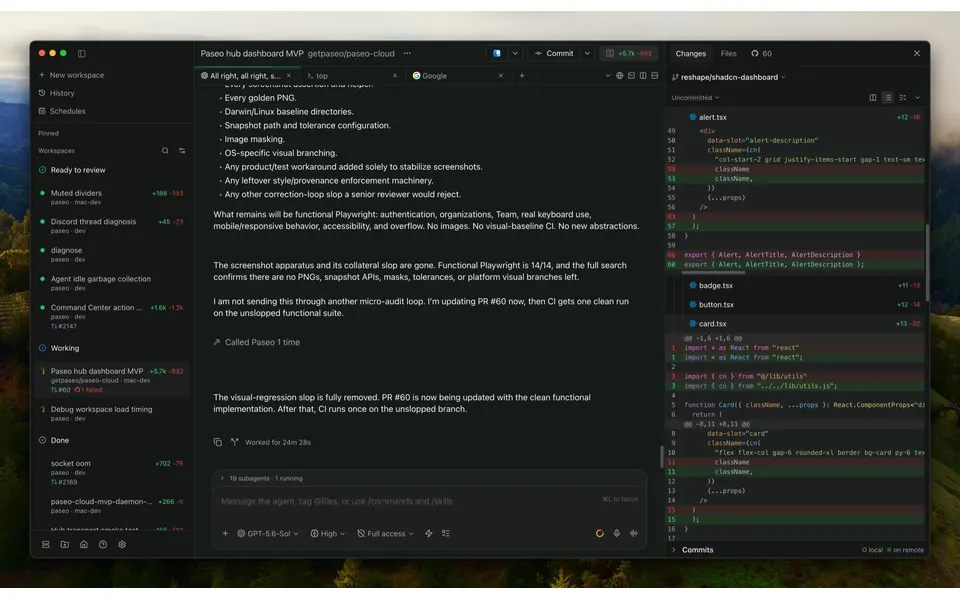
- Desktop app
- Mac, Windows and Linux
- Browser
- Yes
- Phone
- IPhone, Android and phone browser
- Command line
- Yes
- Agents
- Claude Code, Codex, Cursor Agent, Gemini CLI, OpenCode, Pi, Grok and Antigravity
- Your subscription
- Works with your own plan
- Agents run
- On your computer and on your own server
- Laptop closed
- Keeps going
- Isolation
- Worktree, Container and VM
- Parallel agents
- Yes
- Scheduled runs
- Yes
- Coordinator agent
- Yes
- Built-in issues
- No
- Pull requests
- Yes
- Review screen
- Yes
- Team
- Shared sessions and roles
- Self-hosting
- Yes
- Licence
- Apache-2.0
- Price from
- Free
- How it charges
- Free plan, subscription, per seat and bring your own key
- Paid plans from
- Not listed
Measured by ADEMark
ADEMark ran the same tests on 15 ADEs. Results for Paseo 0.15.0, measured up to 12 November 2026 on a Mac mini M4, 16 GB, macOS 27 · Claude Opus 5.5, effort high. Data CC BY 4.0, shown unchanged.
Speed
- Cold start
- 4.22 s9th of 12median of 6 runs, 4.12 s to 4.32 s · Bare CLI 0.69 s
- New thread, ready to type
- 244 ms4th of 10median of 9 runs, 227 ms to 266 ms · Bare CLI 375 ms
- First word on screen
- 726 ms5th of 11median of 9 runs, 669 ms to 869 ms · Bare CLI 220 ms
- Typing lag, 5 agents streaming
- 65 ms7th of 111 run · Bare CLI 79 ms
- Open a 2,000-message thread
- 90 ms3rd of 11median of 5 runs, 89 ms to 102 ms · Bare CLI 203 ms
Weight
- Memory at rest, 5 threads
- 1.23 GB5th of 121 run · Bare CLI 0.99 GB
- Idle CPU
- 0.83%5th of 131 run · Bare CLI 0.37%
- Memory under load
- 2.46 GB5th of 101 run · Bare CLI 1.86 GB
Tokens
- Tokens to answer “hi”
- 22.2K tokens1st of 13median of 3 runs, 22.2K tokens to 45.7K tokens · Bare CLI 38.2K tokens
- Tokens for one real question
- 73.2K tokens1st of 131 run · Bare CLI 168.3K tokens
Build
- Team build: hidden tests passed
- Not measured
Place counts only apps with a value; lower is better except passed tests. ADEMark publishes no overall score and treats close medians as ties, so read places as an order, not a verdict. The Bare CLI is Claude Code in a terminal, run as an unranked control. Method and every test on ademark.dev · Imported data · How we use it
Receipts
- Checked
- · oldest answer 2026-10-09
- Findings
- 47 published · 42 cross-checked by a second agent · read them all
- Sources
- 113 public pages on 3 sites: api.github.com, paseo.sh, github.com
- GitHub stars
- 20,226 on · api.github.com · repository attention, not users or capability
- Screenshot
- github.com, retrieved · first party repository · shows appearance, not capability
- Data
- /products/paseo.json · .md
- Method
- Same rules for all 103 researched ADEs. How we check · Report wrong data

What it does
Where you use it
Paseo offers desktop, native phone, browser and CLI clients for its daemon; the shared browser app includes compact phone layouts.
Source and scope for Where you use itAgents it runs
Current stable and homepage document native Claude Code, Codex, OpenCode, Pi, OMP, Antigravity and Muse plus a version-pinned ACP catalog and custom providers. Provider-specific MCP and permission limits remain separate. Paseo v0.15.4 registers a native Antigravity provider with the agy command, host-side availability checks and a session connection implementation.
Source and scope for Agents it runsAccounts and subscriptions
Paseo reuses each provider CLI's own login for Claude plan, ChatGPT plan and API-key use, and adds no charge for Claude Code or Codex. Optional custom-provider and speech credentials can be written to Paseo config.
Source and scope for Accounts and subscriptionsWhere agents run
Paseo runs agents on operator-owned local or server daemon machines. Clients attach independently, while hosted Hub only dispatches to connected user daemons and does not provide agent compute.
Source and scope for Where agents runHow work is kept apart
Paseo isolates file changes with optional git worktrees per workspace; same-workspace agents share files. Paseo documents no per-task process sandbox: Hub states it does not sandbox provider processes, provider-native sandbox settings apply, and network isolation is unknown.
Source and scope for How work is kept apartParallel work
Paseo runs multiple agents and workspaces concurrently, each in its own worktree if wanted; documented recipes cover parallel research and parallel edits.
Source and scope for Parallel workScheduled runs
Paseo schedules start new agents on a cron cadence (with run and expiry limits) and heartbeats re-prompt an existing agent; Hub starts workflows from GitHub, Slack and Discord events.
Source and scope for Scheduled runsGit and pull requests
Paseo creates worktrees and branches, drafts commit messages and PR text, opens PR workspaces and detects linked PRs; the changelog records pull and merge request support for GitLab, Gitea, Forgejo and Codeberg as well as GitHub. Merge and conflict handling are not documented as Paseo features; git runs through the user or agent.
Source and scope for Git and pull requestsLicence and source
Paseo v0.15.3 root code is Apache-2.0 with third-party licence exceptions; its desktop manifest also declares Apache-2.0. Hub self-hosting is documented, but the separate relay licence, all package licences and hosted-service parity were not audited.
Source and scope for Licence and sourcePrice
The Paseo app, daemon, CLI and SDK are free; hosted Hub is Free ($0, 50 agent runs/month, 1 seat) or Pro ($15 per seat per month, unlimited runs); model and compute costs are the user's.
Source and scope for PriceTyped filters
Every value links to its receipt below. Read plan and surface restrictions before using a filter to decide.
| Filter | Value |
|---|---|
| Desktop OS: macOS | Yes |
| Desktop OS: Windows | Yes |
| Desktop OS: Linux | Yes |
| Web client | Yes |
| Phone access: Native iOS | Yes |
| Phone access: Native Android | Yes |
| Phone access: Phone browser | Yes |
| CLI | Yes |
| Coding agents: Claude Code | Yes cross-checked |
| Coding agents: Codex | Yes cross-checked |
| Coding agents: Cursor Agent | Yes cross-checked |
| Coding agents: Gemini CLI | Yes cross-checked |
| Coding agents: OpenCode | Yes cross-checked |
| Coding agents: Pi | Yes cross-checked |
| Coding agents: Grok | Yes cross-checked |
| Coding agents: Aider | Unknown |
| Coding agents: Antigravity | Yes cross-checked |
| Use my subscription | Yes cross-checked |
| Where agents run: On your computer | Yes |
| Where agents run: On your own server | Yes |
| Where agents run: In the vendor's cloud | No |
| Workspace isolation: Git worktree | Yes cross-checked |
| Workspace isolation: Container | Yes |
| Workspace isolation: VM or microVM | Yes |
| Parallel runs | Yes cross-checked |
| Coordinator | Yes cross-checked |
| Native issue tracking | No |
| Unattended triggers | Yes cross-checked |
| Shared prompting | Yes |
| Team roles | Yes |
| SSO | No |
| Pull request workflow | Yes cross-checked |
| Review interface | Yes cross-checked |
| Product license: Apache-2.0 | Yes. Apache-2.0 cross-checked |
| Product license: MIT | No. Apache-2.0 cross-checked |
| Product license: GPL-3.0 | No. Apache-2.0 cross-checked |
| Product license: GPL-3.0-or-later | No. Apache-2.0 cross-checked |
| Product license: AGPL-3.0 | No. Apache-2.0 cross-checked |
| Product license: AGPL-3.0-or-later | No. Apache-2.0 cross-checked |
| Product license: Elastic License 2.0 | No. Apache-2.0 cross-checked |
| Product license: Custom terms | No. Apache-2.0 cross-checked |
| Product license: Proprietary | No. Apache-2.0 cross-checked |
| Self-hosting | Yes cross-checked |
| Telemetry opt-out | Unknown |
| Free access | Yes cross-checked |
| Starting price: Free | Yes. Free cross-checked |
| Starting price: Up to $20/month | No. Free cross-checked |
| Starting price: $21–40/month | No. Free cross-checked |
| Starting price: $41–100/month | No. Free cross-checked |
| Starting price: Over $100/month | No. Free cross-checked |
| Starting price: Contact for pricing | No. Free cross-checked |
| Pricing model: Free, no paid plan | No |
| Pricing model: Free plan | Yes cross-checked |
| Pricing model: Subscription | Yes |
| Pricing model: Per seat | Yes cross-checked |
| Pricing model: Usage-based | No |
| Pricing model: Per machine or compute | No |
| Pricing model: Bring your own key | Yes cross-checked |
| Pricing model: One-time purchase | No |
| Paid plans from: No paid plan | Unknown |
| Paid plans from: $10 or less/month | Unknown |
| Paid plans from: $11–20/month | Unknown |
| Paid plans from: $21–40/month | Unknown |
| Paid plans from: $41–100/month | Unknown |
| Paid plans from: Over $100/month | Unknown |
| Paid plans from: Contact sales | Unknown |
| Lifecycle status: Active | Unknown |
| Lifecycle status: Sunsetting | Unknown |
| Keeps going with laptop closed | Yes |
| Open-source license | Yes. Apache-2.0 cross-checked |
| Any desktop app | Yes |
| Paid plan up to $20/month | Unknown |
| Paid plan up to $40/month | Unknown |
| Any phone client | Yes |
Filter receipts
Desktop OS: macOS: Yes
Desktop OS: macOS
Typed value: Yes.
Paseo offers desktop, native phone, browser and CLI clients for its daemon; the shared browser app includes compact phone layouts.
- Desktop os: Docs state the desktop app is available on macOS, Windows and Linux (Linux .deb, .rpm, AppImage); homepage download button targets Mac.
- Mobile apps: Native iOS (App Store) and Android (Google Play) apps are linked from the homepage; Android APK also on GitHub releases. Minimum OS versions not checked.
- Browser: Hosted web app at app.paseo.sh and a daemon-served web UI (off by default).
- Cli: npm i -g @getpaseo/cli installs the CLI and daemon; TypeScript SDK @getpaseo/client.
- Cross device continuity: Docs: the daemon owns running agents so mobile, web and CLI clients continue in the same environment. No transition test.
- Documentation and pinned source inspection only; no hands-on scenario was run.
-
Finding: Current homepage presents desktop/mobile/web/CLI and SDK control of user-hosted agents, native Claude/Codex/OpenCode/Pi/OMP/Antigravity/Muse and additional ACP tools. App is free/open source, with optional E2E relay and user provider accounts.
-
Finding: Desktop app bundles its own daemon; Linux .deb/.rpm/AppImage; headless install via npm i -g @getpaseo/cli; Docker image; at least one provider CLI must be installed by the user; gh CLI recommended for PR-aware worktrees.
-
Finding: Desktop app on macOS, Windows and Linux; daemon owns agents and workspaces; mobile, web and CLI clients connect to the same environment; runs agents with the user's own subscriptions, credentials, skills and MCP servers; Apache-2.0 with no telemetry, tracking or required Paseo account. The v0.15.3 tag text of this page is an earlier version; it says the daemon manages agents and clients connect locally or over a relay, and it also states no telemetry and Apache-2.0.
Desktop OS: Windows: Yes
Desktop OS: Windows
Typed value: Yes.
Paseo offers desktop, native phone, browser and CLI clients for its daemon; the shared browser app includes compact phone layouts.
- Desktop os: Docs state the desktop app is available on macOS, Windows and Linux (Linux .deb, .rpm, AppImage); homepage download button targets Mac.
- Mobile apps: Native iOS (App Store) and Android (Google Play) apps are linked from the homepage; Android APK also on GitHub releases. Minimum OS versions not checked.
- Browser: Hosted web app at app.paseo.sh and a daemon-served web UI (off by default).
- Cli: npm i -g @getpaseo/cli installs the CLI and daemon; TypeScript SDK @getpaseo/client.
- Cross device continuity: Docs: the daemon owns running agents so mobile, web and CLI clients continue in the same environment. No transition test.
- Documentation and pinned source inspection only; no hands-on scenario was run.
-
Finding: Current homepage presents desktop/mobile/web/CLI and SDK control of user-hosted agents, native Claude/Codex/OpenCode/Pi/OMP/Antigravity/Muse and additional ACP tools. App is free/open source, with optional E2E relay and user provider accounts.
-
Finding: Desktop app bundles its own daemon; Linux .deb/.rpm/AppImage; headless install via npm i -g @getpaseo/cli; Docker image; at least one provider CLI must be installed by the user; gh CLI recommended for PR-aware worktrees.
-
Finding: Desktop app on macOS, Windows and Linux; daemon owns agents and workspaces; mobile, web and CLI clients connect to the same environment; runs agents with the user's own subscriptions, credentials, skills and MCP servers; Apache-2.0 with no telemetry, tracking or required Paseo account. The v0.15.3 tag text of this page is an earlier version; it says the daemon manages agents and clients connect locally or over a relay, and it also states no telemetry and Apache-2.0.
Desktop OS: Linux: Yes
Desktop OS: Linux
Typed value: Yes.
Paseo offers desktop, native phone, browser and CLI clients for its daemon; the shared browser app includes compact phone layouts.
- Desktop os: Docs state the desktop app is available on macOS, Windows and Linux (Linux .deb, .rpm, AppImage); homepage download button targets Mac.
- Mobile apps: Native iOS (App Store) and Android (Google Play) apps are linked from the homepage; Android APK also on GitHub releases. Minimum OS versions not checked.
- Browser: Hosted web app at app.paseo.sh and a daemon-served web UI (off by default).
- Cli: npm i -g @getpaseo/cli installs the CLI and daemon; TypeScript SDK @getpaseo/client.
- Cross device continuity: Docs: the daemon owns running agents so mobile, web and CLI clients continue in the same environment. No transition test.
- Documentation and pinned source inspection only; no hands-on scenario was run.
-
Finding: Current homepage presents desktop/mobile/web/CLI and SDK control of user-hosted agents, native Claude/Codex/OpenCode/Pi/OMP/Antigravity/Muse and additional ACP tools. App is free/open source, with optional E2E relay and user provider accounts.
-
Finding: Desktop app bundles its own daemon; Linux .deb/.rpm/AppImage; headless install via npm i -g @getpaseo/cli; Docker image; at least one provider CLI must be installed by the user; gh CLI recommended for PR-aware worktrees.
-
Finding: Desktop app on macOS, Windows and Linux; daemon owns agents and workspaces; mobile, web and CLI clients connect to the same environment; runs agents with the user's own subscriptions, credentials, skills and MCP servers; Apache-2.0 with no telemetry, tracking or required Paseo account. The v0.15.3 tag text of this page is an earlier version; it says the daemon manages agents and clients connect locally or over a relay, and it also states no telemetry and Apache-2.0.
Web client: Yes
Web client
Typed value: Yes.
Paseo offers desktop, native phone, browser and CLI clients for its daemon; the shared browser app includes compact phone layouts.
- Desktop os: Docs state the desktop app is available on macOS, Windows and Linux (Linux .deb, .rpm, AppImage); homepage download button targets Mac.
- Mobile apps: Native iOS (App Store) and Android (Google Play) apps are linked from the homepage; Android APK also on GitHub releases. Minimum OS versions not checked.
- Browser: Hosted web app at app.paseo.sh and a daemon-served web UI (off by default).
- Cross device continuity: Docs: the daemon owns running agents so mobile, web and CLI clients continue in the same environment. No transition test.
- Documentation and pinned source inspection only; no hands-on scenario was run.
-
Finding: Current homepage presents desktop/mobile/web/CLI and SDK control of user-hosted agents, native Claude/Codex/OpenCode/Pi/OMP/Antigravity/Muse and additional ACP tools. App is free/open source, with optional E2E relay and user provider accounts.
-
Paseo: Self-hosting the web UI
Finding: Daemon can serve the full browser UI from its own address (off by default, features.webUi.enabled); password and TLS reverse proxy guidance.
Phone access: Native iOS: Yes
Phone access: Native iOS
Typed value: Yes.
Paseo offers desktop, native phone, browser and CLI clients for its daemon; the shared browser app includes compact phone layouts.
- Desktop os: Docs state the desktop app is available on macOS, Windows and Linux (Linux .deb, .rpm, AppImage); homepage download button targets Mac.
- Mobile apps: Native iOS (App Store) and Android (Google Play) apps are linked from the homepage; Android APK also on GitHub releases. Minimum OS versions not checked.
- Browser: Hosted web app at app.paseo.sh and a daemon-served web UI (off by default).
- Cross device continuity: Docs: the daemon owns running agents so mobile, web and CLI clients continue in the same environment. No transition test.
- Documentation and pinned source inspection only; no hands-on scenario was run.
-
Finding: Current homepage presents desktop/mobile/web/CLI and SDK control of user-hosted agents, native Claude/Codex/OpenCode/Pi/OMP/Antigravity/Muse and additional ACP tools. App is free/open source, with optional E2E relay and user provider accounts.
-
Finding: Stable and Beta channels; stable desktop rolls out gradually over 36 hours; app-store releases can lag desktop and CLI; no beta in app stores; Android APK on GitHub releases.
Phone access: Native Android: Yes
Phone access: Native Android
Typed value: Yes.
Paseo offers desktop, native phone, browser and CLI clients for its daemon; the shared browser app includes compact phone layouts.
- Desktop os: Docs state the desktop app is available on macOS, Windows and Linux (Linux .deb, .rpm, AppImage); homepage download button targets Mac.
- Mobile apps: Native iOS (App Store) and Android (Google Play) apps are linked from the homepage; Android APK also on GitHub releases. Minimum OS versions not checked.
- Browser: Hosted web app at app.paseo.sh and a daemon-served web UI (off by default).
- Cross device continuity: Docs: the daemon owns running agents so mobile, web and CLI clients continue in the same environment. No transition test.
- Documentation and pinned source inspection only; no hands-on scenario was run.
-
Finding: Current homepage presents desktop/mobile/web/CLI and SDK control of user-hosted agents, native Claude/Codex/OpenCode/Pi/OMP/Antigravity/Muse and additional ACP tools. App is free/open source, with optional E2E relay and user provider accounts.
-
Finding: Stable and Beta channels; stable desktop rolls out gradually over 36 hours; app-store releases can lag desktop and CLI; no beta in app stores; Android APK on GitHub releases.
Phone access: Phone browser: Yes
Phone access: Phone browser
Typed value: Yes.
Paseo offers desktop, native phone, browser and CLI clients for its daemon; the shared browser app includes compact phone layouts.
- Mobile browser: The browser app implements a mobile visual viewport and compact mobile panel layout.
- Documentation and pinned source inspection only; no hands-on scenario was run.
-
Paseo: packages/app/src/composer/dock/internal/fullscreen.tsx
Finding: The shipped browser app explicitly handles the mobile browser visual viewport and uses compact mobile panel routing in the shared app layout. The daemon-served browser UI connects to the same agents. This establishes phone-browser access without claiming tested feature parity.
CLI: Yes
CLI
Typed value: Yes.
Paseo offers desktop, native phone, browser and CLI clients for its daemon; the shared browser app includes compact phone layouts.
- Desktop os: Docs state the desktop app is available on macOS, Windows and Linux (Linux .deb, .rpm, AppImage); homepage download button targets Mac.
- Cli: npm i -g @getpaseo/cli installs the CLI and daemon; TypeScript SDK @getpaseo/client.
- Documentation and pinned source inspection only; no hands-on scenario was run.
-
Finding: Desktop app bundles its own daemon; Linux .deb/.rpm/AppImage; headless install via npm i -g @getpaseo/cli; Docker image; at least one provider CLI must be installed by the user; gh CLI recommended for PR-aware worktrees.
-
Finding: CLI covers run/ls/attach/send/logs/wait/stop, projects, workspaces, terminals, scripts, plugins, schedules, permissions (paseo permit ls/allow/deny), agent modes and detach, daemon management, Hub commands, remote --host (including ssh://) and JSON/YAML output.
-
Finding: @getpaseo/client drives a daemon from a program: create agents with provider/model, cwd and prompt, wait for finish, send follow-ups; agents created through the SDK appear in the Paseo app and persist after the program exits.
Coding agents: Claude Code: Yes cross-checked
Coding agents: Claude Code
Typed value: Yes.
Current stable and homepage document native Claude Code, Codex, OpenCode, Pi, OMP, Antigravity and Muse plus a version-pinned ACP catalog and custom providers. Provider-specific MCP and permission limits remain separate. Paseo v0.15.4 registers a native Antigravity provider with the agy command, host-side availability checks and a session connection implementation.
- Harnesses: Native adapters and the ACP catalog support existing installed agent CLIs, including Claude Code, Codex, OpenCode, Pi, Cursor, Gemini CLI and Grok. Catalog and provider-specific tool/permission limits differ. Paseo v0.15.4 registers a native Antigravity provider with the agy command, host-side availability checks and a session connection implementation.
- Model providers: Model choice follows the provider CLI (for example OpenCode multi-provider, custom endpoints via agents.providers); Paseo does not itself list a model catalog beyond what each provider reports.
- Custom adapters: Custom providers via config (extends, ACP agents, binary override) and provider plugins.
- Session integration: Existing provider sessions can be imported (Import session on the New workspace screen, paseo import); provider coverage differs (Pi/OMP named in changelog).
- Mixed harness operation: Orchestration docs: agents can launch workers on any configured provider and model, including different providers in one task.
- No mixed-provider execution test; installed tool credentials/model access are separate.
- Antigravity has Full access only and no Paseo tools or steering in the documented adapter.
- Antigravity requires agy on the host and its own sign-in. The documented adapter has Full access only and no Paseo tools or steering.
-
Finding: Current homepage presents desktop/mobile/web/CLI and SDK control of user-hosted agents, native Claude/Codex/OpenCode/Pi/OMP/Antigravity/Muse and additional ACP tools. App is free/open source, with optional E2E relay and user provider accounts.
-
Finding: Current stable changelog starts 0.15.3, November 6, 2026, and describes stable changes since the older v0.11.1 source pass.
-
Paseo: public-docs/orchestration.md
Finding: Agents can launch other agents across providers and models, prompt them by ID, check progress, cancel, create workspaces/worktrees, use the CLI against remote hosts, create schedules and heartbeats. Paseo tool injection is off by default; workers appear in a Subagents track and completion notifies the parent.
-
Paseo: public-docs/orchestration-workflows.md
Finding: Recipes: fan-out research (workers share files), parallel edits in separate worktrees, implement-then-review, prompt another agent by ID, redirect/cancel a worker, remote-host CLI, heartbeats. Distinguishes interactive Paseo subagents from read-only native provider subagent timelines.
-
Finding: Current stable guide covers native Claude Code, Codex, OpenCode, Pi, OMP, Antigravity and Muse plus ACP/custom routes; provider-specific permission, MCP and steering limits are explicit.
-
Finding: Plugins add screens, sidebar items, panels, commands, themes, attachment sources, daemon RPCs and providers; client contributions run on every connected client including mobile; registry install via paseo plugin add owner/slug.
-
Finding: agents.providers in config.json can extend providers to other API endpoints, add profiles, override binaries, add ACP agents or disable providers.
-
Native support (6 entries); ACP catalog (36 entries)
Finding: Current stable guide names native providers and a version-pinned in-app ACP catalog plus custom providers. Antigravity has Full access only and no Paseo tools or steering; no exact stale catalog count repeated.
-
Paseo homepage FAQ and integrations list
Finding: Current homepage lists native Claude, Codex, OpenCode, Pi, OMP, Antigravity and Muse plus ACP; no exact catalog count inferred.
Coding agents: Codex: Yes cross-checked
Coding agents: Codex
Typed value: Yes.
Current stable and homepage document native Claude Code, Codex, OpenCode, Pi, OMP, Antigravity and Muse plus a version-pinned ACP catalog and custom providers. Provider-specific MCP and permission limits remain separate. Paseo v0.15.4 registers a native Antigravity provider with the agy command, host-side availability checks and a session connection implementation.
- Harnesses: Native adapters and the ACP catalog support existing installed agent CLIs, including Claude Code, Codex, OpenCode, Pi, Cursor, Gemini CLI and Grok. Catalog and provider-specific tool/permission limits differ. Paseo v0.15.4 registers a native Antigravity provider with the agy command, host-side availability checks and a session connection implementation.
- Model providers: Model choice follows the provider CLI (for example OpenCode multi-provider, custom endpoints via agents.providers); Paseo does not itself list a model catalog beyond what each provider reports.
- Custom adapters: Custom providers via config (extends, ACP agents, binary override) and provider plugins.
- Session integration: Existing provider sessions can be imported (Import session on the New workspace screen, paseo import); provider coverage differs (Pi/OMP named in changelog).
- Mixed harness operation: Orchestration docs: agents can launch workers on any configured provider and model, including different providers in one task.
- No mixed-provider execution test; installed tool credentials/model access are separate.
- Antigravity has Full access only and no Paseo tools or steering in the documented adapter.
- Antigravity requires agy on the host and its own sign-in. The documented adapter has Full access only and no Paseo tools or steering.
-
Finding: Current homepage presents desktop/mobile/web/CLI and SDK control of user-hosted agents, native Claude/Codex/OpenCode/Pi/OMP/Antigravity/Muse and additional ACP tools. App is free/open source, with optional E2E relay and user provider accounts.
-
Finding: Current stable changelog starts 0.15.3, November 6, 2026, and describes stable changes since the older v0.11.1 source pass.
-
Paseo: public-docs/orchestration.md
Finding: Agents can launch other agents across providers and models, prompt them by ID, check progress, cancel, create workspaces/worktrees, use the CLI against remote hosts, create schedules and heartbeats. Paseo tool injection is off by default; workers appear in a Subagents track and completion notifies the parent.
-
Paseo: public-docs/orchestration-workflows.md
Finding: Recipes: fan-out research (workers share files), parallel edits in separate worktrees, implement-then-review, prompt another agent by ID, redirect/cancel a worker, remote-host CLI, heartbeats. Distinguishes interactive Paseo subagents from read-only native provider subagent timelines.
-
Finding: Current stable guide covers native Claude Code, Codex, OpenCode, Pi, OMP, Antigravity and Muse plus ACP/custom routes; provider-specific permission, MCP and steering limits are explicit.
-
Finding: Plugins add screens, sidebar items, panels, commands, themes, attachment sources, daemon RPCs and providers; client contributions run on every connected client including mobile; registry install via paseo plugin add owner/slug.
-
Finding: agents.providers in config.json can extend providers to other API endpoints, add profiles, override binaries, add ACP agents or disable providers.
-
Native support (6 entries); ACP catalog (36 entries)
Finding: Current stable guide names native providers and a version-pinned in-app ACP catalog plus custom providers. Antigravity has Full access only and no Paseo tools or steering; no exact stale catalog count repeated.
-
Paseo homepage FAQ and integrations list
Finding: Current homepage lists native Claude, Codex, OpenCode, Pi, OMP, Antigravity and Muse plus ACP; no exact catalog count inferred.
Coding agents: Cursor Agent: Yes cross-checked
Coding agents: Cursor Agent
Typed value: Yes.
Current stable and homepage document native Claude Code, Codex, OpenCode, Pi, OMP, Antigravity and Muse plus a version-pinned ACP catalog and custom providers. Provider-specific MCP and permission limits remain separate. Paseo v0.15.4 registers a native Antigravity provider with the agy command, host-side availability checks and a session connection implementation.
- Harnesses: Native adapters and the ACP catalog support existing installed agent CLIs, including Claude Code, Codex, OpenCode, Pi, Cursor, Gemini CLI and Grok. Catalog and provider-specific tool/permission limits differ. Paseo v0.15.4 registers a native Antigravity provider with the agy command, host-side availability checks and a session connection implementation.
- No mixed-provider execution test; installed tool credentials/model access are separate.
- Antigravity has Full access only and no Paseo tools or steering in the documented adapter.
- Antigravity requires agy on the host and its own sign-in. The documented adapter has Full access only and no Paseo tools or steering.
-
Paseo v0.15.3: public-docs/supported-providers.md
Finding: The shipped ACP catalog explicitly lists Cursor, Gemini CLI and Grok; underlying CLIs must be installed and authenticated. No Aider listing was established.
Coding agents: Gemini CLI: Yes cross-checked
Coding agents: Gemini CLI
Typed value: Yes.
Current stable and homepage document native Claude Code, Codex, OpenCode, Pi, OMP, Antigravity and Muse plus a version-pinned ACP catalog and custom providers. Provider-specific MCP and permission limits remain separate. Paseo v0.15.4 registers a native Antigravity provider with the agy command, host-side availability checks and a session connection implementation.
- Harnesses: Native adapters and the ACP catalog support existing installed agent CLIs, including Claude Code, Codex, OpenCode, Pi, Cursor, Gemini CLI and Grok. Catalog and provider-specific tool/permission limits differ. Paseo v0.15.4 registers a native Antigravity provider with the agy command, host-side availability checks and a session connection implementation.
- No mixed-provider execution test; installed tool credentials/model access are separate.
- Antigravity has Full access only and no Paseo tools or steering in the documented adapter.
- Antigravity requires agy on the host and its own sign-in. The documented adapter has Full access only and no Paseo tools or steering.
-
Paseo v0.15.3: public-docs/supported-providers.md
Finding: The shipped ACP catalog explicitly lists Cursor, Gemini CLI and Grok; underlying CLIs must be installed and authenticated. No Aider listing was established.
Coding agents: OpenCode: Yes cross-checked
Coding agents: OpenCode
Typed value: Yes.
Current stable and homepage document native Claude Code, Codex, OpenCode, Pi, OMP, Antigravity and Muse plus a version-pinned ACP catalog and custom providers. Provider-specific MCP and permission limits remain separate. Paseo v0.15.4 registers a native Antigravity provider with the agy command, host-side availability checks and a session connection implementation.
- Harnesses: Native adapters and the ACP catalog support existing installed agent CLIs, including Claude Code, Codex, OpenCode, Pi, Cursor, Gemini CLI and Grok. Catalog and provider-specific tool/permission limits differ. Paseo v0.15.4 registers a native Antigravity provider with the agy command, host-side availability checks and a session connection implementation.
- Model providers: Model choice follows the provider CLI (for example OpenCode multi-provider, custom endpoints via agents.providers); Paseo does not itself list a model catalog beyond what each provider reports.
- Custom adapters: Custom providers via config (extends, ACP agents, binary override) and provider plugins.
- Session integration: Existing provider sessions can be imported (Import session on the New workspace screen, paseo import); provider coverage differs (Pi/OMP named in changelog).
- Mixed harness operation: Orchestration docs: agents can launch workers on any configured provider and model, including different providers in one task.
- No mixed-provider execution test; installed tool credentials/model access are separate.
- Antigravity has Full access only and no Paseo tools or steering in the documented adapter.
- Antigravity requires agy on the host and its own sign-in. The documented adapter has Full access only and no Paseo tools or steering.
-
Finding: Current homepage presents desktop/mobile/web/CLI and SDK control of user-hosted agents, native Claude/Codex/OpenCode/Pi/OMP/Antigravity/Muse and additional ACP tools. App is free/open source, with optional E2E relay and user provider accounts.
-
Finding: Current stable changelog starts 0.15.3, November 6, 2026, and describes stable changes since the older v0.11.1 source pass.
-
Paseo: public-docs/orchestration.md
Finding: Agents can launch other agents across providers and models, prompt them by ID, check progress, cancel, create workspaces/worktrees, use the CLI against remote hosts, create schedules and heartbeats. Paseo tool injection is off by default; workers appear in a Subagents track and completion notifies the parent.
-
Paseo: public-docs/orchestration-workflows.md
Finding: Recipes: fan-out research (workers share files), parallel edits in separate worktrees, implement-then-review, prompt another agent by ID, redirect/cancel a worker, remote-host CLI, heartbeats. Distinguishes interactive Paseo subagents from read-only native provider subagent timelines.
-
Finding: Current stable guide covers native Claude Code, Codex, OpenCode, Pi, OMP, Antigravity and Muse plus ACP/custom routes; provider-specific permission, MCP and steering limits are explicit.
-
Finding: Plugins add screens, sidebar items, panels, commands, themes, attachment sources, daemon RPCs and providers; client contributions run on every connected client including mobile; registry install via paseo plugin add owner/slug.
-
Finding: agents.providers in config.json can extend providers to other API endpoints, add profiles, override binaries, add ACP agents or disable providers.
-
Native support (6 entries); ACP catalog (36 entries)
Finding: Current stable guide names native providers and a version-pinned in-app ACP catalog plus custom providers. Antigravity has Full access only and no Paseo tools or steering; no exact stale catalog count repeated.
-
Paseo homepage FAQ and integrations list
Finding: Current homepage lists native Claude, Codex, OpenCode, Pi, OMP, Antigravity and Muse plus ACP; no exact catalog count inferred.
Coding agents: Pi: Yes cross-checked
Coding agents: Pi
Typed value: Yes.
Current stable and homepage document native Claude Code, Codex, OpenCode, Pi, OMP, Antigravity and Muse plus a version-pinned ACP catalog and custom providers. Provider-specific MCP and permission limits remain separate. Paseo v0.15.4 registers a native Antigravity provider with the agy command, host-side availability checks and a session connection implementation.
- Harnesses: Native adapters and the ACP catalog support existing installed agent CLIs, including Claude Code, Codex, OpenCode, Pi, Cursor, Gemini CLI and Grok. Catalog and provider-specific tool/permission limits differ. Paseo v0.15.4 registers a native Antigravity provider with the agy command, host-side availability checks and a session connection implementation.
- Model providers: Model choice follows the provider CLI (for example OpenCode multi-provider, custom endpoints via agents.providers); Paseo does not itself list a model catalog beyond what each provider reports.
- Custom adapters: Custom providers via config (extends, ACP agents, binary override) and provider plugins.
- Session integration: Existing provider sessions can be imported (Import session on the New workspace screen, paseo import); provider coverage differs (Pi/OMP named in changelog).
- Mixed harness operation: Orchestration docs: agents can launch workers on any configured provider and model, including different providers in one task.
- No mixed-provider execution test; installed tool credentials/model access are separate.
- Antigravity has Full access only and no Paseo tools or steering in the documented adapter.
- Antigravity requires agy on the host and its own sign-in. The documented adapter has Full access only and no Paseo tools or steering.
-
Finding: Current homepage presents desktop/mobile/web/CLI and SDK control of user-hosted agents, native Claude/Codex/OpenCode/Pi/OMP/Antigravity/Muse and additional ACP tools. App is free/open source, with optional E2E relay and user provider accounts.
-
Finding: Current stable changelog starts 0.15.3, November 6, 2026, and describes stable changes since the older v0.11.1 source pass.
-
Paseo: public-docs/orchestration.md
Finding: Agents can launch other agents across providers and models, prompt them by ID, check progress, cancel, create workspaces/worktrees, use the CLI against remote hosts, create schedules and heartbeats. Paseo tool injection is off by default; workers appear in a Subagents track and completion notifies the parent.
-
Paseo: public-docs/orchestration-workflows.md
Finding: Recipes: fan-out research (workers share files), parallel edits in separate worktrees, implement-then-review, prompt another agent by ID, redirect/cancel a worker, remote-host CLI, heartbeats. Distinguishes interactive Paseo subagents from read-only native provider subagent timelines.
-
Finding: Current stable guide covers native Claude Code, Codex, OpenCode, Pi, OMP, Antigravity and Muse plus ACP/custom routes; provider-specific permission, MCP and steering limits are explicit.
-
Finding: Plugins add screens, sidebar items, panels, commands, themes, attachment sources, daemon RPCs and providers; client contributions run on every connected client including mobile; registry install via paseo plugin add owner/slug.
-
Finding: agents.providers in config.json can extend providers to other API endpoints, add profiles, override binaries, add ACP agents or disable providers.
-
Native support (6 entries); ACP catalog (36 entries)
Finding: Current stable guide names native providers and a version-pinned in-app ACP catalog plus custom providers. Antigravity has Full access only and no Paseo tools or steering; no exact stale catalog count repeated.
-
Paseo homepage FAQ and integrations list
Finding: Current homepage lists native Claude, Codex, OpenCode, Pi, OMP, Antigravity and Muse plus ACP; no exact catalog count inferred.
Coding agents: Grok: Yes cross-checked
Coding agents: Grok
Typed value: Yes.
Current stable and homepage document native Claude Code, Codex, OpenCode, Pi, OMP, Antigravity and Muse plus a version-pinned ACP catalog and custom providers. Provider-specific MCP and permission limits remain separate. Paseo v0.15.4 registers a native Antigravity provider with the agy command, host-side availability checks and a session connection implementation.
- Harnesses: Native adapters and the ACP catalog support existing installed agent CLIs, including Claude Code, Codex, OpenCode, Pi, Cursor, Gemini CLI and Grok. Catalog and provider-specific tool/permission limits differ. Paseo v0.15.4 registers a native Antigravity provider with the agy command, host-side availability checks and a session connection implementation.
- No mixed-provider execution test; installed tool credentials/model access are separate.
- Antigravity has Full access only and no Paseo tools or steering in the documented adapter.
- Antigravity requires agy on the host and its own sign-in. The documented adapter has Full access only and no Paseo tools or steering.
-
Paseo v0.15.3: public-docs/supported-providers.md
Finding: The shipped ACP catalog explicitly lists Cursor, Gemini CLI and Grok; underlying CLIs must be installed and authenticated. No Aider listing was established.
Coding agents: Antigravity: Yes cross-checked
Coding agents: Antigravity
Typed value: Yes.
Current stable and homepage document native Claude Code, Codex, OpenCode, Pi, OMP, Antigravity and Muse plus a version-pinned ACP catalog and custom providers. Provider-specific MCP and permission limits remain separate. Paseo v0.15.4 registers a native Antigravity provider with the agy command, host-side availability checks and a session connection implementation.
- Harnesses: Native adapters and the ACP catalog support existing installed agent CLIs, including Claude Code, Codex, OpenCode, Pi, Cursor, Gemini CLI and Grok. Catalog and provider-specific tool/permission limits differ. Paseo v0.15.4 registers a native Antigravity provider with the agy command, host-side availability checks and a session connection implementation.
- No mixed-provider execution test; installed tool credentials/model access are separate.
- Antigravity has Full access only and no Paseo tools or steering in the documented adapter.
- Antigravity requires agy on the host and its own sign-in. The documented adapter has Full access only and no Paseo tools or steering.
-
Paseo Antigravity support at v0.15.4
Finding: Paseo v0.15.4 registers a native Antigravity provider with the agy command, host-side availability checks and a session connection implementation.
Use my subscription: Yes cross-checked
Use my subscription
Typed value: Yes.
Paseo reuses each provider CLI's own login for Claude plan, ChatGPT plan and API-key use, and adds no charge for Claude Code or Codex. Optional custom-provider and speech credentials can be written to Paseo config.
- Agent subscriptions: Claude Code usage counts against the normal Claude plan; Codex can use ChatGPT plan access.
- Api accounts: Codex can use an OpenAI API key; OpenCode uses provider API keys through its CLI. Custom provider env entries (for example ANTHROPIC_API_KEY) and speech provider keys can be written to Paseo config (custom-providers and voice docs at the tag). That is optional configuration, not the normal login path.
- Vendor credits: Docs state no separate Agent SDK credit pool is needed for Claude Code in Paseo; other vendor credit handling not documented.
- Credentials for the normal login path stay in the provider CLI. Multiple accounts are supported per provider: profiles bind different credentials per provider entry (custom-providers docs, Multiple profiles), and agents respect custom CLAUDE_CONFIG_DIR and CODEX_HOME homes (changelog, PR #5465). The exact user action for switching between accounts is not documented. Vendor-side restrictions are not documented by Paseo.
- Claude plan requirement and limits are Anthropic's, per Paseo's own docs.
-
Finding: Runs the official claude CLI via the Claude Agent SDK; usage counts against the user's normal Claude plan limits with no separate Agent SDK credit pool; a Claude plan including Claude Code is required.
-
Finding: No Paseo charge for Codex; sign in with ChatGPT (plan access) or an OpenAI API key.
Where agents run: On your computer: Yes
Where agents run: On your computer
Typed value: Yes.
Paseo runs agents on operator-owned local or server daemon machines. Clients attach independently, while hosted Hub only dispatches to connected user daemons and does not provide agent compute.
- Local: The desktop app starts/manages a local daemon and agents use files/tools on that machine.
- Byo remote: The guide deliberately supports running the environment on a server and remote SSH/Tailscale client attachment.
- Client disconnect: The daemon owns running agents/workspaces independently of its thin clients; the separately hosted daemon must stay running.
- Documentation and pinned source inspection only; no hands-on scenario was run.
- Other atomic questions remain unestablished: resources, region, expiry.
-
Finding: The current pinned release documents automatic local daemon management, with the daemon owning running agents/workspaces and separate desktop/mobile/web/CLI clients. It explicitly supports running the environment on a server and continuing from other devices; client-laptop disconnect does not move execution off that operator daemon host.
Where agents run: On your own server: Yes
Where agents run: On your own server
Typed value: Yes.
Paseo runs agents on operator-owned local or server daemon machines. Clients attach independently, while hosted Hub only dispatches to connected user daemons and does not provide agent compute.
- Local: The desktop app starts/manages a local daemon and agents use files/tools on that machine.
- Byo remote: The guide deliberately supports running the environment on a server and remote SSH/Tailscale client attachment.
- Client disconnect: The daemon owns running agents/workspaces independently of its thin clients; the separately hosted daemon must stay running.
- Documentation and pinned source inspection only; no hands-on scenario was run.
- Other atomic questions remain unestablished: resources, region, expiry.
-
Finding: The current pinned release documents automatic local daemon management, with the daemon owning running agents/workspaces and separate desktop/mobile/web/CLI clients. It explicitly supports running the environment on a server and continuing from other devices; client-laptop disconnect does not move execution off that operator daemon host.
-
Paseo: public-docs/connectivity.md
Finding: The pinned release explicitly supports a daemon on the user computer or server. Desktop and CLI attach through SSH to an already-running remote daemon, while mobile can use relay/Tailscale; this is an operator-owned execution host rather than a vendor compute service.
Where agents run: In the vendor's cloud: No
Where agents run: In the vendor's cloud
Typed value: No.
Paseo runs agents on operator-owned local or server daemon machines. Clients attach independently, while hosted Hub only dispatches to connected user daemons and does not provide agent compute.
- Managed cloud: The current Hub offering executes agents on connected user daemons and nowhere else.
- Documentation and pinned source inspection only; no hands-on scenario was run.
- Other atomic questions remain unestablished: resources, region, expiry.
-
Paseo: Hub FAQ Can the Hub run code on my machines; plan list
Finding: The first-party Hub page says agents run on connected user daemons and nowhere else. Both Hosted Free and Pro specify that daemons run on the user machines. Hosted Hub does not provision agent compute.
Workspace isolation: Git worktree: Yes cross-checked
Workspace isolation: Git worktree
Typed value: Yes.
Paseo isolates file changes with optional git worktrees per workspace; same-workspace agents share files. Paseo documents no per-task process sandbox: Hub states it does not sandbox provider processes, provider-native sandbox settings apply, and network isolation is unknown.
- Branch: Worktree workspaces get a branch (branch-off, checkout-branch, checkout-pr).
- Worktree: Managed git worktrees per workspace with setup/teardown hooks.
- Process: Services get per-worktree ports; processes still share machine ports unless configured.
- Docker image is a deployment option, not per-task isolation; Hub explicitly states it does not sandbox the agent; provider-native sandbox options exist per provider.
-
Finding: Re-read 2026-10-09 at pinned d0bc188 (content unchanged): Worktrees under $PASEO_HOME/worktrees; branch-off, checkout-branch and checkout-pr modes; paseo.json setup/teardown hooks, scripts, supervised services with per-worktree ports, port ranges or external allocator, reverse proxy hostnames, auto-opened terminals.
Workspace isolation: Container: Yes
Workspace isolation: Container
Typed value: Yes.
Paseo isolates file changes with optional git worktrees per workspace; same-workspace agents share files. Paseo documents no per-task process sandbox: Hub states it does not sandbox provider processes, provider-native sandbox settings apply, and network isolation is unknown.
- Container: The official stable Docker image runs the daemon and its launched agents as non-root paseo with scoped code/home mounts. This isolates a deployment rather than each task.
- Code separation: Docker mounts bound reachable repositories and credentials; all agents in that daemon share the mounted environment unless the operator isolates hosts.
- Docker image is a deployment option, not per-task isolation; Hub explicitly states it does not sandbox the agent; provider-native sandbox options exist per provider.
-
Paseo v0.15.3: public-docs/docker.md
Finding: Official stable Docker image runs daemon and launched agents as non-root paseo with explicit code/home mounts; this is host deployment, not one container per task. Agent CLIs are installed in a child image.
Workspace isolation: VM or microVM: Yes
Workspace isolation: VM or microVM
Typed value: Yes.
Paseo isolates file changes with optional git worktrees per workspace; same-workspace agents share files. Paseo documents no per-task process sandbox: Hub states it does not sandbox provider processes, provider-native sandbox settings apply, and network isolation is unknown.
- Vm: Hub recommends an operator-supplied VM when stronger host isolation is needed; Paseo does not provision a VM for each task.
- Network: Hub carries the selected provider native network policy, such as Codex network_access false; OS/network isolation remains the operator responsibility.
- Docker image is a deployment option, not per-task isolation; Hub explicitly states it does not sandbox the agent; provider-native sandbox options exist per provider.
-
Paseo v0.15.3: public-docs/hub/security.md
Finding: Hub does not sandbox agent processes. For stronger host containment it recommends an OS user, container or VM; named Codex options can deny network_access and choose writable roots, with provider/OS enforcement remaining separate.
Parallel runs: Yes cross-checked
Parallel runs
Typed value: Yes.
Paseo runs multiple agents and workspaces concurrently, each in its own worktree if wanted; documented recipes cover parallel research and parallel edits.
- Concurrent sessions: A workspace can run multiple agent sessions, terminals and browsers at once.
- No concurrency quota or observed concurrency measurement documented; research workers in one workspace share files.
-
Finding: Re-read 2026-10-09 at pinned d0bc188 (content unchanged): Project, workspace and session model; workspace isolation is Local (existing directory, shared files) or Worktree (managed git worktree and branch); workspaces can be created without an agent; any directory on a daemon host can be a project.
Coordinator: Yes cross-checked
Coordinator
Typed value: Yes.
Agents can launch, prompt, inspect and cancel other agents of any provider; workers are retained as inspectable subagent sessions with notifications back to the parent.
- Roles: Agent profiles carry When-to-use notes; roles are conventions rather than enforced.
- Model harness effort: create_agent takes provider/model; profiles store thinking level and mode.
- Messages: send_agent_prompt and paseo send address agents by ID, including across workspaces on a host.
- Results return: Parent receives a notification when a worker finishes; paseo wait and get_agent_activity collect results; --output-schema yields structured output.
- Cross harness: Workers can use a different provider than the parent.
- Orchestration owner: Parentage records which agent owns delegated work.
- Activation: Settings > Agents > Enable Paseo tools, off by default; CLI route needs no injection.
- Authentication: MCP and CLI act with the daemon's access; per-provider tool policy is explicitly not a security boundary.
- Live progress: Subagents track and attach/logs follow worker output.
- Retained results: Subagent conversations persist as sessions; closed agents resume.
- Followup: Workers continue in their existing conversation after follow-up prompts.
- Invocation: Natural-language request, MCP tools, CLI or skills.
- Paseo tool injection is off by default; Antigravity lacks Paseo tools; native provider subagents are read-only timelines.
- No hands-on delegation scenario run.
-
Paseo: public-docs/orchestration.md
Finding: Agents can launch other agents across providers and models, prompt them by ID, check progress, cancel, create workspaces/worktrees, use the CLI against remote hosts, create schedules and heartbeats. Paseo tool injection is off by default; workers appear in a Subagents track and completion notifies the parent.
-
Paseo: public-docs/orchestration-workflows.md
Finding: Re-read 2026-10-09 at pinned d0bc188 (content unchanged): Recipes: fan-out research (workers share files), parallel edits in separate worktrees, implement-then-review, prompt another agent by ID, redirect/cancel a worker, remote-host CLI, heartbeats. Distinguishes interactive Paseo subagents from read-only native provider subagent timelines.
-
Finding: Re-read 2026-10-09 at pinned d0bc188 (content unchanged): Paseo MCP server on the daemon (enabled by default; injection into agents off by default) exposing agent, workspace, workspace-script, terminal, schedule/heartbeat, profile, provider, permission, browser and voice tools; per-provider tool allow/deny policy, explicitly not a security boundary.
-
Finding: Re-read 2026-10-09 at pinned d0bc188 (content unchanged): CLI covers run/ls/attach/send/logs/wait/stop, projects, workspaces, terminals, scripts, plugins, schedules, permissions (paseo permit ls/allow/deny), agent modes and detach, daemon management, Hub commands, remote --host (including ssh://) and JSON/YAML output.
-
Finding: Re-read 2026-10-09 at pinned d0bc188 (content unchanged): Agent states initializing/idle/running/error/closed; closed agents keep identity, timeline and persistence handle and resume under the same ID; a runtime that dies between turns can leave an idle-looking agent until reported; cancellation and permission notifications to parent agents.
-
Finding: Named profiles store provider, model, mode, thinking level and features with When-to-use notes that orchestrating agents read via list_profiles.
-
Finding: Installable /paseo, /paseo-handoff, /paseo-committee and /paseo-advisor skills for delegation, handoff and second opinions.
Native issue tracking: No
Native issue tracking
Typed value: No.
The inspected release exposes agent workspaces and provider task displays, but no native issue tracker. The FileTaskStore utility is not connected to an accessible product action.
- Create: No native issue-create action is wired into the daemon, app, CLI or Hub.
- Task session separation: The standalone task-store library has no product entrypoint in the inspected release; external trackers remain separate.
- Durable states: Durable state in the accessible product belongs to agent workspaces or workflow runs, not independent native issues.
- Documentation and pinned source inspection only; no hands-on scenario was run.
- Other atomic questions remain unestablished: edit, discuss, prioritize, label, assign, search, filter, archive, reopen, project_epic_views, idea_parking, explicit_dispatch, metadata, external_tracker_requirement.
-
Paseo: packages/server/src/tasks/task-store.ts
Finding: The source contains a standalone FileTaskStore library with task states, but it is not imported into a shipped daemon route, app action or CLI command. Inspection of the app, daemon, CLI and public Hub routes/schema found provider task displays, agent workspaces and execution runs rather than an accessible product-owned issue tracker. External GitHub and Linear issues remain external.
Unattended triggers: Yes cross-checked
Unattended triggers
Typed value: Yes.
Paseo schedules start new agents on a cron cadence (with run and expiry limits) and heartbeats re-prompt an existing agent; Hub starts workflows from GitHub, Slack and Discord events.
- Schedules: Cron schedules with timezone, run-now, pause/resume/run-once.
- Recurring tasks: Schedules and heartbeats are recurring.
- Completion conditions: Schedules carry --max-runs and --expires-in; heartbeats can expire; Hub steps require agents to call hub.finish_execution.
- Scheduler location: Schedules are managed by the daemon on the user's host; Hub holds triggers and dispatches to daemons.
- Client independence: The daemon manages schedules and heartbeats and keeps running agents without a connected client; the schedule docs do not state no-client behavior explicitly.
- Schedules run on the daemon, so the daemon must be up; Hub does not queue events and does not retry an offline dispatch; overlap behavior was not documented.
-
Finding: Re-read 2026-10-09 at pinned d0bc188 (content unchanged): Schedules start a new agent per run on a cron cadence; heartbeats prompt one existing agent; both can be created in the app, from chat, via CLI or MCP; inspect, pause, resume, run once, update, delete.
-
Finding: Re-read 2026-10-09 at pinned d0bc188 (content unchanged): paseo schedule create with --every/--cron, --timezone, --max-runs, --expires-in, --run-now, --provider, --cwd; ls/inspect/logs/pause/resume/run-once/update/delete; heartbeats via paseo heartbeat; remote daemons via --host.
Shared prompting: Yes
Shared prompting
Typed value: Yes.
In self-hosted Paseo Hub, distinct permitted Slack users can send instructions to one daemon agent by enabling Same conversation continuity for a Slack trigger. Generic daemon-principal pairing alone does not establish distinct human collaboration.
- Coprompting: Slack author IDs pass a per-human allowlist; the thread conversation key omits author ID and Hub sends each arrival to the same persisted agent session.
- Permissions: The Slack trigger independently filters human authors, and the daemon owner explicitly grants Hub hub.execute authority.
- Owner online: The running self-hosted Hub and daemon deliver allowed Slack messages without a desktop-owner client connection.
- Documentation and pinned source inspection only; no hands-on scenario was run.
- Other atomic questions remain unestablished: discussion, comments, presence, ordering, conflicts.
-
Paseo: src/triggers/slack/match.ts
Finding: The Hub Slack trigger independently checks each real Slack author ID or username against from_users (or an explicit wildcard); bot messages are excluded. This establishes distinct permitted human Slack identities rather than shared daemon-owner bearer principals.
-
Paseo: src/triggers/slack/provider.ts
Finding: The first-party Agent continuity control offers Same conversation to continue the same agent for a conversation. Slack conversation keys contain team, channel and root thread timestamp, excluding author ID. Multiple permitted Slack humans in one thread therefore resolve to one continuation key. Custom key is also available; New agent remains separate.
-
Paseo: src/agent-sessions/index.ts
Finding: The Hub selects/persists one agent session per project plus conversation continuation key and delivers each arriving request to that stored agent ID through connection.send. It does not create a fresh agent for each human message when Same conversation is selected. The UI continuity setting is product-owned and publicly configurable.
-
Finding: The released Paseo daemon documents opt-in Hub connection and hub.execute permission for ordinary agent creation, messaging, observation and recovery. Hub owns conversation routing and maps it to workspace/agent IDs; send_agent_message_request reaches the existing provider session with its native steer/queue behavior.
Team roles: Yes
Team roles
Typed value: Yes.
Paseo Hub has owner, admin and member organization roles with enforced management permissions. Its public authentication composition has no enterprise SSO; daemon grants remain separate.
- Organization roles: Hub defines owner/admin/member roles and enforces separate member, owner and resource management capabilities.
- Documentation and pinned source inspection only; no hands-on scenario was run.
- Other atomic questions remain unestablished: project_roles, provisioning, plan_scope.
-
Paseo: src/auth/organization-policy.ts
Finding: Paseo Hub defines owner, admin and member roles. Owners manage members, owners and resources; admins manage members and resources but not owners; members can view but cannot manage them. Organization access and member-role mutation handlers enforce these capabilities.
SSO: No
SSO
Typed value: No.
Paseo Hub has owner, admin and member organization roles with enforced management permissions. Its public authentication composition has no enterprise SSO; daemon grants remain separate.
- Sso: Hub enables email/password and organization membership without an enterprise SAML/OIDC SSO plugin.
- Documentation and pinned source inspection only; no hands-on scenario was run.
- Other atomic questions remain unestablished: project_roles, provisioning, plan_scope.
-
Finding: The public Hub authentication composition enables email/password and the organization plugin. Inspection of src/auth, routes, schema and dependencies for SAML, OIDC, SSO and single sign-on found no enterprise SSO implementation. Provider app OAuth connections are workflow integrations, not enterprise user SSO.
Pull request workflow: Yes cross-checked
Pull request workflow
Typed value: Yes.
Paseo creates worktrees and branches, drafts commit messages and PR text, opens PR workspaces and detects linked PRs; the changelog records pull and merge request support for GitLab, Gitea, Forgejo and Codeberg as well as GitHub. Merge and conflict handling are not documented as Paseo features; git runs through the user or agent.
- Commits: Commit messages are generated for changes being committed; agent or user runs git.
- Pull requests: PR title and body drafted from the diff; PR workspaces and PR detection; the changelog records forge support beyond GitHub (GitLab, Gitea, Forgejo, Codeberg).
- Ci response: Check summaries in PR panel; schedules can babysit builds.
- Product state: Workspace auto-archive after a merged PR appears in changelog fixes.
- Commit and PR actions are done by the user or agent through normal git; no merge automation documented.
-
Finding: Re-read 2026-10-09 at pinned CHANGELOG.md (d0bc188, identical to main). The file is unchanged between the v0.11.1 tag and d0bc188; its top entry is 0.11.1 (2026-10-07) and there is no Unreleased heading. Earlier finding: 0.11.0 adds the plugin registry, Muse Code and Antigravity providers, a Usage view of subscription quota windows, and OMP mid-turn steering; 0.11.1 adds Claude Haiku 5.5 support and fixes subagent status and Claude history after daemon restart. Earlier entries mention push notifications, GitLab/Gitea/Forgejo/Codeberg PR support and PR check summaries.
-
Finding: Re-read 2026-10-09 at pinned d0bc188 (content unchanged): Background model calls generate workspace titles, branch names, commit messages and PR titles/bodies from the diff.
Review interface: Yes cross-checked
Review interface
Typed value: Yes.
Paseo shows workspace diffs and files, previews apps in built-in browser tabs and service proxy URLs, and browser automation on the desktop app can take screenshots; a gallery or revision-linked artifact store was not documented.
- Diffs: Changes tab shows workspace diffs.
- Screenshots: Browser automation can take screenshots on the desktop app.
- Previews: Built-in browser tabs and service proxy URLs preview workspace apps.
- Documentation and source-level pass of Paseo v0.11.1; no hands-on scenario was run and unknown sub-questions remain unknown.
-
Finding: Re-read 2026-10-09 at pinned d0bc188 (content unchanged): Desktop walkthrough: separate worktree workspaces run agents concurrently, Changes tab for diffs, Files, terminals and built-in browser tabs; commit and PR via the user's usual git workflow or the agent; processes still share machine ports.
Product license: Apache-2.0: Yes. Apache-2.0 cross-checked
Product license: Apache-2.0
Typed value: Yes. Apache-2.0.
Paseo v0.15.3 root code is Apache-2.0 with third-party licence exceptions; its desktop manifest also declares Apache-2.0. Hub self-hosting is documented, but the separate relay licence, all package licences and hosted-service parity were not audited.
- Client license: Root LICENSE is Apache-2.0 except third-party components; desktop 0.15.3 manifest also declares Apache-2.0.
- Server license: Root notice applies Apache-2.0 to Paseo repository code including the daemon, except incorporated third-party components. A per-package dependency audit was not performed.
- Source visibility: Public GitHub stable release and pinned licence/component files are available.
- Source revision: Stable v0.15.3 annotated tag peels to d91ae138cb931447635e94296023414a58bedcc5; licence and desktop manifest inspected at that commit.
- Root licence and desktop manifest checked; dependency and separate relay licence audit not performed.
- Hub documentation establishes self-hosting instructions, not hosted-service parity.
- No installation or authenticated service test.
-
Finding: Root notice licenses Paseo under Apache-2.0 except incorporated third-party components, which retain their own licences. Read at pinned stable v0.15.3; no hosted-service parity inferred.
-
Paseo desktop manifest at v0.15.3
Finding: The @getpaseo/desktop Electron wrapper manifest is version 0.15.3 and declares Apache-2.0; depends on Paseo CLI and server packages. This checks the distributed desktop component manifest, not every dependency licence.
Product license: MIT: No. Apache-2.0 cross-checked
Product license: MIT
Typed value: No. Apache-2.0.
Paseo v0.15.3 root code is Apache-2.0 with third-party licence exceptions; its desktop manifest also declares Apache-2.0. Hub self-hosting is documented, but the separate relay licence, all package licences and hosted-service parity were not audited.
- Client license: Root LICENSE is Apache-2.0 except third-party components; desktop 0.15.3 manifest also declares Apache-2.0.
- Server license: Root notice applies Apache-2.0 to Paseo repository code including the daemon, except incorporated third-party components. A per-package dependency audit was not performed.
- Source visibility: Public GitHub stable release and pinned licence/component files are available.
- Source revision: Stable v0.15.3 annotated tag peels to d91ae138cb931447635e94296023414a58bedcc5; licence and desktop manifest inspected at that commit.
- Root licence and desktop manifest checked; dependency and separate relay licence audit not performed.
- Hub documentation establishes self-hosting instructions, not hosted-service parity.
- No installation or authenticated service test.
-
Finding: Root notice licenses Paseo under Apache-2.0 except incorporated third-party components, which retain their own licences. Read at pinned stable v0.15.3; no hosted-service parity inferred.
-
Paseo desktop manifest at v0.15.3
Finding: The @getpaseo/desktop Electron wrapper manifest is version 0.15.3 and declares Apache-2.0; depends on Paseo CLI and server packages. This checks the distributed desktop component manifest, not every dependency licence.
Product license: GPL-3.0: No. Apache-2.0 cross-checked
Product license: GPL-3.0
Typed value: No. Apache-2.0.
Paseo v0.15.3 root code is Apache-2.0 with third-party licence exceptions; its desktop manifest also declares Apache-2.0. Hub self-hosting is documented, but the separate relay licence, all package licences and hosted-service parity were not audited.
- Client license: Root LICENSE is Apache-2.0 except third-party components; desktop 0.15.3 manifest also declares Apache-2.0.
- Server license: Root notice applies Apache-2.0 to Paseo repository code including the daemon, except incorporated third-party components. A per-package dependency audit was not performed.
- Source visibility: Public GitHub stable release and pinned licence/component files are available.
- Source revision: Stable v0.15.3 annotated tag peels to d91ae138cb931447635e94296023414a58bedcc5; licence and desktop manifest inspected at that commit.
- Root licence and desktop manifest checked; dependency and separate relay licence audit not performed.
- Hub documentation establishes self-hosting instructions, not hosted-service parity.
- No installation or authenticated service test.
-
Finding: Root notice licenses Paseo under Apache-2.0 except incorporated third-party components, which retain their own licences. Read at pinned stable v0.15.3; no hosted-service parity inferred.
-
Paseo desktop manifest at v0.15.3
Finding: The @getpaseo/desktop Electron wrapper manifest is version 0.15.3 and declares Apache-2.0; depends on Paseo CLI and server packages. This checks the distributed desktop component manifest, not every dependency licence.
Product license: GPL-3.0-or-later: No. Apache-2.0 cross-checked
Product license: GPL-3.0-or-later
Typed value: No. Apache-2.0.
Paseo v0.15.3 root code is Apache-2.0 with third-party licence exceptions; its desktop manifest also declares Apache-2.0. Hub self-hosting is documented, but the separate relay licence, all package licences and hosted-service parity were not audited.
- Client license: Root LICENSE is Apache-2.0 except third-party components; desktop 0.15.3 manifest also declares Apache-2.0.
- Server license: Root notice applies Apache-2.0 to Paseo repository code including the daemon, except incorporated third-party components. A per-package dependency audit was not performed.
- Source visibility: Public GitHub stable release and pinned licence/component files are available.
- Source revision: Stable v0.15.3 annotated tag peels to d91ae138cb931447635e94296023414a58bedcc5; licence and desktop manifest inspected at that commit.
- Root licence and desktop manifest checked; dependency and separate relay licence audit not performed.
- Hub documentation establishes self-hosting instructions, not hosted-service parity.
- No installation or authenticated service test.
-
Finding: Root notice licenses Paseo under Apache-2.0 except incorporated third-party components, which retain their own licences. Read at pinned stable v0.15.3; no hosted-service parity inferred.
-
Paseo desktop manifest at v0.15.3
Finding: The @getpaseo/desktop Electron wrapper manifest is version 0.15.3 and declares Apache-2.0; depends on Paseo CLI and server packages. This checks the distributed desktop component manifest, not every dependency licence.
Product license: AGPL-3.0: No. Apache-2.0 cross-checked
Product license: AGPL-3.0
Typed value: No. Apache-2.0.
Paseo v0.15.3 root code is Apache-2.0 with third-party licence exceptions; its desktop manifest also declares Apache-2.0. Hub self-hosting is documented, but the separate relay licence, all package licences and hosted-service parity were not audited.
- Client license: Root LICENSE is Apache-2.0 except third-party components; desktop 0.15.3 manifest also declares Apache-2.0.
- Server license: Root notice applies Apache-2.0 to Paseo repository code including the daemon, except incorporated third-party components. A per-package dependency audit was not performed.
- Source visibility: Public GitHub stable release and pinned licence/component files are available.
- Source revision: Stable v0.15.3 annotated tag peels to d91ae138cb931447635e94296023414a58bedcc5; licence and desktop manifest inspected at that commit.
- Root licence and desktop manifest checked; dependency and separate relay licence audit not performed.
- Hub documentation establishes self-hosting instructions, not hosted-service parity.
- No installation or authenticated service test.
-
Finding: Root notice licenses Paseo under Apache-2.0 except incorporated third-party components, which retain their own licences. Read at pinned stable v0.15.3; no hosted-service parity inferred.
-
Paseo desktop manifest at v0.15.3
Finding: The @getpaseo/desktop Electron wrapper manifest is version 0.15.3 and declares Apache-2.0; depends on Paseo CLI and server packages. This checks the distributed desktop component manifest, not every dependency licence.
Product license: AGPL-3.0-or-later: No. Apache-2.0 cross-checked
Product license: AGPL-3.0-or-later
Typed value: No. Apache-2.0.
Paseo v0.15.3 root code is Apache-2.0 with third-party licence exceptions; its desktop manifest also declares Apache-2.0. Hub self-hosting is documented, but the separate relay licence, all package licences and hosted-service parity were not audited.
- Client license: Root LICENSE is Apache-2.0 except third-party components; desktop 0.15.3 manifest also declares Apache-2.0.
- Server license: Root notice applies Apache-2.0 to Paseo repository code including the daemon, except incorporated third-party components. A per-package dependency audit was not performed.
- Source visibility: Public GitHub stable release and pinned licence/component files are available.
- Source revision: Stable v0.15.3 annotated tag peels to d91ae138cb931447635e94296023414a58bedcc5; licence and desktop manifest inspected at that commit.
- Root licence and desktop manifest checked; dependency and separate relay licence audit not performed.
- Hub documentation establishes self-hosting instructions, not hosted-service parity.
- No installation or authenticated service test.
-
Finding: Root notice licenses Paseo under Apache-2.0 except incorporated third-party components, which retain their own licences. Read at pinned stable v0.15.3; no hosted-service parity inferred.
-
Paseo desktop manifest at v0.15.3
Finding: The @getpaseo/desktop Electron wrapper manifest is version 0.15.3 and declares Apache-2.0; depends on Paseo CLI and server packages. This checks the distributed desktop component manifest, not every dependency licence.
Product license: Elastic License 2.0: No. Apache-2.0 cross-checked
Product license: Elastic License 2.0
Typed value: No. Apache-2.0.
Paseo v0.15.3 root code is Apache-2.0 with third-party licence exceptions; its desktop manifest also declares Apache-2.0. Hub self-hosting is documented, but the separate relay licence, all package licences and hosted-service parity were not audited.
- Client license: Root LICENSE is Apache-2.0 except third-party components; desktop 0.15.3 manifest also declares Apache-2.0.
- Server license: Root notice applies Apache-2.0 to Paseo repository code including the daemon, except incorporated third-party components. A per-package dependency audit was not performed.
- Source visibility: Public GitHub stable release and pinned licence/component files are available.
- Source revision: Stable v0.15.3 annotated tag peels to d91ae138cb931447635e94296023414a58bedcc5; licence and desktop manifest inspected at that commit.
- Root licence and desktop manifest checked; dependency and separate relay licence audit not performed.
- Hub documentation establishes self-hosting instructions, not hosted-service parity.
- No installation or authenticated service test.
-
Finding: Root notice licenses Paseo under Apache-2.0 except incorporated third-party components, which retain their own licences. Read at pinned stable v0.15.3; no hosted-service parity inferred.
-
Paseo desktop manifest at v0.15.3
Finding: The @getpaseo/desktop Electron wrapper manifest is version 0.15.3 and declares Apache-2.0; depends on Paseo CLI and server packages. This checks the distributed desktop component manifest, not every dependency licence.
Product license: Custom terms: No. Apache-2.0 cross-checked
Product license: Custom terms
Typed value: No. Apache-2.0.
Paseo v0.15.3 root code is Apache-2.0 with third-party licence exceptions; its desktop manifest also declares Apache-2.0. Hub self-hosting is documented, but the separate relay licence, all package licences and hosted-service parity were not audited.
- Client license: Root LICENSE is Apache-2.0 except third-party components; desktop 0.15.3 manifest also declares Apache-2.0.
- Server license: Root notice applies Apache-2.0 to Paseo repository code including the daemon, except incorporated third-party components. A per-package dependency audit was not performed.
- Source visibility: Public GitHub stable release and pinned licence/component files are available.
- Source revision: Stable v0.15.3 annotated tag peels to d91ae138cb931447635e94296023414a58bedcc5; licence and desktop manifest inspected at that commit.
- Root licence and desktop manifest checked; dependency and separate relay licence audit not performed.
- Hub documentation establishes self-hosting instructions, not hosted-service parity.
- No installation or authenticated service test.
-
Finding: Root notice licenses Paseo under Apache-2.0 except incorporated third-party components, which retain their own licences. Read at pinned stable v0.15.3; no hosted-service parity inferred.
-
Paseo desktop manifest at v0.15.3
Finding: The @getpaseo/desktop Electron wrapper manifest is version 0.15.3 and declares Apache-2.0; depends on Paseo CLI and server packages. This checks the distributed desktop component manifest, not every dependency licence.
Product license: Proprietary: No. Apache-2.0 cross-checked
Product license: Proprietary
Typed value: No. Apache-2.0.
Paseo v0.15.3 root code is Apache-2.0 with third-party licence exceptions; its desktop manifest also declares Apache-2.0. Hub self-hosting is documented, but the separate relay licence, all package licences and hosted-service parity were not audited.
- Client license: Root LICENSE is Apache-2.0 except third-party components; desktop 0.15.3 manifest also declares Apache-2.0.
- Server license: Root notice applies Apache-2.0 to Paseo repository code including the daemon, except incorporated third-party components. A per-package dependency audit was not performed.
- Source visibility: Public GitHub stable release and pinned licence/component files are available.
- Source revision: Stable v0.15.3 annotated tag peels to d91ae138cb931447635e94296023414a58bedcc5; licence and desktop manifest inspected at that commit.
- Root licence and desktop manifest checked; dependency and separate relay licence audit not performed.
- Hub documentation establishes self-hosting instructions, not hosted-service parity.
- No installation or authenticated service test.
-
Finding: Root notice licenses Paseo under Apache-2.0 except incorporated third-party components, which retain their own licences. Read at pinned stable v0.15.3; no hosted-service parity inferred.
-
Paseo desktop manifest at v0.15.3
Finding: The @getpaseo/desktop Electron wrapper manifest is version 0.15.3 and declares Apache-2.0; depends on Paseo CLI and server packages. This checks the distributed desktop component manifest, not every dependency licence.
Self-hosting: Yes cross-checked
Self-hosting
Typed value: Yes.
Paseo runs entirely on user machines, with optional relay and Hub; self-hosting Hub is documented. Export and import formats were not documented.
- Self hosting: Daemon via desktop, npm or Docker; Hub via npx @getpaseo/hub with embedded or PostgreSQL storage.
- Documentation and source-level pass of Paseo v0.11.1; no hands-on scenario was run and unknown sub-questions remain unknown.
-
Finding: Desktop app bundles its own daemon; Linux .deb/.rpm/AppImage; headless install via npm i -g @getpaseo/cli; Docker image; at least one provider CLI must be installed by the user; gh CLI recommended for PR-aware worktrees.
-
Finding: Re-read 2026-10-09 at pinned d0bc188 (content unchanged): npx @getpaseo/hub runs Hub locally with embedded PGlite storage or PostgreSQL via DATABASE_URL; public HTTPS needed for GitHub webhooks; self-hosted uses user-created provider apps.
-
Finding: Official image ghcr.io/getpaseo/paseo runs the daemon and bundled web UI as non-root user; does not bundle agent CLIs; PASEO_PASSWORD recommended before publishing the port; state under /home/paseo.
Free access: Yes cross-checked
Free access
Typed value: Yes.
The Paseo app, daemon, CLI and SDK are free and open source with no usage cap documented; hosted Hub offers a no-card, non-expiring Free plan (50 runs, 1 seat) and a self-hosted Hub is free.
- Ongoing free: Core app is free; Hub Free needs no card and does not expire.
- Card required: Hub Free requires no card.
- Free tier limits for Hub are vendor-stated; users still pay their own provider plans.
- Hub maturity is ambiguous: the live Hub page refers to "access to the beta" (hub-live-faq), and no GA or preview label was found. Hub pricing and signup are read as availability; its maturity status is not established.
-
Finding: Current homepage presents desktop/mobile/web/CLI and SDK control of user-hosted agents, native Claude/Codex/OpenCode/Pi/OMP/Antigravity/Muse and additional ACP tools. App is free/open source, with optional E2E relay and user provider accounts.
-
Finding: Managed service at hub.paseo.sh; organizations start on Free (one seat, monthly run allowance, no card, no expiry); Pro for unlimited runs, more seats and invitations; self-hosted Hub has no plans or billing.
Starting price: Free: Yes. Free cross-checked
Starting price: Free
Typed value: Yes. Free.
The Paseo app, daemon, CLI and SDK are free and open source with no usage cap documented; hosted Hub offers a no-card, non-expiring Free plan (50 runs, 1 seat) and a self-hosted Hub is free.
- Ongoing free: Core app is free; Hub Free needs no card and does not expire.
- Card required: Hub Free requires no card.
- Free tier limits for Hub are vendor-stated; users still pay their own provider plans.
- Hub maturity is ambiguous: the live Hub page refers to "access to the beta" (hub-live-faq), and no GA or preview label was found. Hub pricing and signup are read as availability; its maturity status is not established.
-
Finding: Current homepage presents desktop/mobile/web/CLI and SDK control of user-hosted agents, native Claude/Codex/OpenCode/Pi/OMP/Antigravity/Muse and additional ACP tools. App is free/open source, with optional E2E relay and user provider accounts.
-
Finding: Managed service at hub.paseo.sh; organizations start on Free (one seat, monthly run allowance, no card, no expiry); Pro for unlimited runs, more seats and invitations; self-hosted Hub has no plans or billing.
Starting price: Up to $20/month: No. Free cross-checked
Starting price: Up to $20/month
Typed value: No. Free.
The Paseo app, daemon, CLI and SDK are free and open source with no usage cap documented; hosted Hub offers a no-card, non-expiring Free plan (50 runs, 1 seat) and a self-hosted Hub is free.
- Ongoing free: Core app is free; Hub Free needs no card and does not expire.
- Card required: Hub Free requires no card.
- Free tier limits for Hub are vendor-stated; users still pay their own provider plans.
- Hub maturity is ambiguous: the live Hub page refers to "access to the beta" (hub-live-faq), and no GA or preview label was found. Hub pricing and signup are read as availability; its maturity status is not established.
-
Finding: Current homepage presents desktop/mobile/web/CLI and SDK control of user-hosted agents, native Claude/Codex/OpenCode/Pi/OMP/Antigravity/Muse and additional ACP tools. App is free/open source, with optional E2E relay and user provider accounts.
-
Finding: Managed service at hub.paseo.sh; organizations start on Free (one seat, monthly run allowance, no card, no expiry); Pro for unlimited runs, more seats and invitations; self-hosted Hub has no plans or billing.
Starting price: $21–40/month: No. Free cross-checked
Starting price: $21–40/month
Typed value: No. Free.
The Paseo app, daemon, CLI and SDK are free and open source with no usage cap documented; hosted Hub offers a no-card, non-expiring Free plan (50 runs, 1 seat) and a self-hosted Hub is free.
- Ongoing free: Core app is free; Hub Free needs no card and does not expire.
- Card required: Hub Free requires no card.
- Free tier limits for Hub are vendor-stated; users still pay their own provider plans.
- Hub maturity is ambiguous: the live Hub page refers to "access to the beta" (hub-live-faq), and no GA or preview label was found. Hub pricing and signup are read as availability; its maturity status is not established.
-
Finding: Current homepage presents desktop/mobile/web/CLI and SDK control of user-hosted agents, native Claude/Codex/OpenCode/Pi/OMP/Antigravity/Muse and additional ACP tools. App is free/open source, with optional E2E relay and user provider accounts.
-
Finding: Managed service at hub.paseo.sh; organizations start on Free (one seat, monthly run allowance, no card, no expiry); Pro for unlimited runs, more seats and invitations; self-hosted Hub has no plans or billing.
Starting price: $41–100/month: No. Free cross-checked
Starting price: $41–100/month
Typed value: No. Free.
The Paseo app, daemon, CLI and SDK are free and open source with no usage cap documented; hosted Hub offers a no-card, non-expiring Free plan (50 runs, 1 seat) and a self-hosted Hub is free.
- Ongoing free: Core app is free; Hub Free needs no card and does not expire.
- Card required: Hub Free requires no card.
- Free tier limits for Hub are vendor-stated; users still pay their own provider plans.
- Hub maturity is ambiguous: the live Hub page refers to "access to the beta" (hub-live-faq), and no GA or preview label was found. Hub pricing and signup are read as availability; its maturity status is not established.
-
Finding: Current homepage presents desktop/mobile/web/CLI and SDK control of user-hosted agents, native Claude/Codex/OpenCode/Pi/OMP/Antigravity/Muse and additional ACP tools. App is free/open source, with optional E2E relay and user provider accounts.
-
Finding: Managed service at hub.paseo.sh; organizations start on Free (one seat, monthly run allowance, no card, no expiry); Pro for unlimited runs, more seats and invitations; self-hosted Hub has no plans or billing.
Starting price: Over $100/month: No. Free cross-checked
Starting price: Over $100/month
Typed value: No. Free.
The Paseo app, daemon, CLI and SDK are free and open source with no usage cap documented; hosted Hub offers a no-card, non-expiring Free plan (50 runs, 1 seat) and a self-hosted Hub is free.
- Ongoing free: Core app is free; Hub Free needs no card and does not expire.
- Card required: Hub Free requires no card.
- Free tier limits for Hub are vendor-stated; users still pay their own provider plans.
- Hub maturity is ambiguous: the live Hub page refers to "access to the beta" (hub-live-faq), and no GA or preview label was found. Hub pricing and signup are read as availability; its maturity status is not established.
-
Finding: Current homepage presents desktop/mobile/web/CLI and SDK control of user-hosted agents, native Claude/Codex/OpenCode/Pi/OMP/Antigravity/Muse and additional ACP tools. App is free/open source, with optional E2E relay and user provider accounts.
-
Finding: Managed service at hub.paseo.sh; organizations start on Free (one seat, monthly run allowance, no card, no expiry); Pro for unlimited runs, more seats and invitations; self-hosted Hub has no plans or billing.
Starting price: Contact for pricing: No. Free cross-checked
Starting price: Contact for pricing
Typed value: No. Free.
The Paseo app, daemon, CLI and SDK are free and open source with no usage cap documented; hosted Hub offers a no-card, non-expiring Free plan (50 runs, 1 seat) and a self-hosted Hub is free.
- Ongoing free: Core app is free; Hub Free needs no card and does not expire.
- Card required: Hub Free requires no card.
- Free tier limits for Hub are vendor-stated; users still pay their own provider plans.
- Hub maturity is ambiguous: the live Hub page refers to "access to the beta" (hub-live-faq), and no GA or preview label was found. Hub pricing and signup are read as availability; its maturity status is not established.
-
Finding: Current homepage presents desktop/mobile/web/CLI and SDK control of user-hosted agents, native Claude/Codex/OpenCode/Pi/OMP/Antigravity/Muse and additional ACP tools. App is free/open source, with optional E2E relay and user provider accounts.
-
Finding: Managed service at hub.paseo.sh; organizations start on Free (one seat, monthly run allowance, no card, no expiry); Pro for unlimited runs, more seats and invitations; self-hosted Hub has no plans or billing.
Pricing model: Free, no paid plan: No
Pricing model: Free, no paid plan
Typed value: No.
The Paseo app, daemon, CLI and SDK are free; hosted Hub is Free ($0, 50 agent runs/month, 1 seat) or Pro ($15 per seat per month, unlimited runs); model and compute costs are the user's.
- Currency: Price shown with $ symbol; currency not named.
- Interval: Monthly.
- Seats: Pro $15 per seat; Free 1 seat; trigger-only users do not count; invitations count.
- Included usage: Free: 50 agent runs per month; Pro unlimited runs.
- Currency is shown as $ without naming it; taxes, trial and overage terms not stated; prices read from the vendor pricing page.
-
Finding: Re-read 2026-10-09 (live pricing page): self-hosted Hub is free and open source; Free is $0 per month with 50 agent runs a month and 1 seat; Pro is $15 per seat per month with unlimited runs and seats. Seats are Hub members plus pending invitations; people who only trigger agents through GitHub, Slack or Discord do not count. No card, trial, expiry, SSO, retention or compliance terms are stated on the page. Planned items are listed as "Not built yet" with no dates: provisioning daemons for a team, sharing settings and skills across a team, more integrations.
-
Finding: Managed service at hub.paseo.sh; organizations start on Free (one seat, monthly run allowance, no card, no expiry); Pro for unlimited runs, more seats and invitations; self-hosted Hub has no plans or billing.
Pricing model: Free plan: Yes cross-checked
Pricing model: Free plan
Typed value: Yes.
The Paseo app, daemon, CLI and SDK are free; hosted Hub is Free ($0, 50 agent runs/month, 1 seat) or Pro ($15 per seat per month, unlimited runs); model and compute costs are the user's.
- Currency: Price shown with $ symbol; currency not named.
- Interval: Monthly.
- Seats: Pro $15 per seat; Free 1 seat; trigger-only users do not count; invitations count.
- Included usage: Free: 50 agent runs per month; Pro unlimited runs.
- Currency is shown as $ without naming it; taxes, trial and overage terms not stated; prices read from the vendor pricing page.
-
Finding: Re-read 2026-10-09 (live pricing page): self-hosted Hub is free and open source; Free is $0 per month with 50 agent runs a month and 1 seat; Pro is $15 per seat per month with unlimited runs and seats. Seats are Hub members plus pending invitations; people who only trigger agents through GitHub, Slack or Discord do not count. No card, trial, expiry, SSO, retention or compliance terms are stated on the page. Planned items are listed as "Not built yet" with no dates: provisioning daemons for a team, sharing settings and skills across a team, more integrations.
Pricing model: Subscription: Yes
Pricing model: Subscription
Typed value: Yes.
The Paseo app, daemon, CLI and SDK are free; hosted Hub is Free ($0, 50 agent runs/month, 1 seat) or Pro ($15 per seat per month, unlimited runs); model and compute costs are the user's.
- Currency: Price shown with $ symbol; currency not named.
- Interval: Monthly.
- Seats: Pro $15 per seat; Free 1 seat; trigger-only users do not count; invitations count.
- Included usage: Free: 50 agent runs per month; Pro unlimited runs.
- Currency is shown as $ without naming it; taxes, trial and overage terms not stated; prices read from the vendor pricing page.
-
Finding: Re-read 2026-10-09 (live pricing page): self-hosted Hub is free and open source; Free is $0 per month with 50 agent runs a month and 1 seat; Pro is $15 per seat per month with unlimited runs and seats. Seats are Hub members plus pending invitations; people who only trigger agents through GitHub, Slack or Discord do not count. No card, trial, expiry, SSO, retention or compliance terms are stated on the page. Planned items are listed as "Not built yet" with no dates: provisioning daemons for a team, sharing settings and skills across a team, more integrations.
-
Finding: Managed service at hub.paseo.sh; organizations start on Free (one seat, monthly run allowance, no card, no expiry); Pro for unlimited runs, more seats and invitations; self-hosted Hub has no plans or billing.
Pricing model: Per seat: Yes cross-checked
Pricing model: Per seat
Typed value: Yes.
The Paseo app, daemon, CLI and SDK are free; hosted Hub is Free ($0, 50 agent runs/month, 1 seat) or Pro ($15 per seat per month, unlimited runs); model and compute costs are the user's.
- Currency: Price shown with $ symbol; currency not named.
- Interval: Monthly.
- Seats: Pro $15 per seat; Free 1 seat; trigger-only users do not count; invitations count.
- Included usage: Free: 50 agent runs per month; Pro unlimited runs.
- Currency is shown as $ without naming it; taxes, trial and overage terms not stated; prices read from the vendor pricing page.
-
Finding: Re-read 2026-10-09 (live pricing page): self-hosted Hub is free and open source; Free is $0 per month with 50 agent runs a month and 1 seat; Pro is $15 per seat per month with unlimited runs and seats. Seats are Hub members plus pending invitations; people who only trigger agents through GitHub, Slack or Discord do not count. No card, trial, expiry, SSO, retention or compliance terms are stated on the page. Planned items are listed as "Not built yet" with no dates: provisioning daemons for a team, sharing settings and skills across a team, more integrations.
Pricing model: Usage-based: No
Pricing model: Usage-based
Typed value: No.
The Paseo app, daemon, CLI and SDK are free; hosted Hub is Free ($0, 50 agent runs/month, 1 seat) or Pro ($15 per seat per month, unlimited runs); model and compute costs are the user's.
- Currency: Price shown with $ symbol; currency not named.
- Interval: Monthly.
- Seats: Pro $15 per seat; Free 1 seat; trigger-only users do not count; invitations count.
- Included usage: Free: 50 agent runs per month; Pro unlimited runs.
- Currency is shown as $ without naming it; taxes, trial and overage terms not stated; prices read from the vendor pricing page.
-
Finding: Re-read 2026-10-09 (live pricing page): self-hosted Hub is free and open source; Free is $0 per month with 50 agent runs a month and 1 seat; Pro is $15 per seat per month with unlimited runs and seats. Seats are Hub members plus pending invitations; people who only trigger agents through GitHub, Slack or Discord do not count. No card, trial, expiry, SSO, retention or compliance terms are stated on the page. Planned items are listed as "Not built yet" with no dates: provisioning daemons for a team, sharing settings and skills across a team, more integrations.
-
Finding: Managed service at hub.paseo.sh; organizations start on Free (one seat, monthly run allowance, no card, no expiry); Pro for unlimited runs, more seats and invitations; self-hosted Hub has no plans or billing.
Pricing model: Per machine or compute: No
Pricing model: Per machine or compute
Typed value: No.
The Paseo app, daemon, CLI and SDK are free; hosted Hub is Free ($0, 50 agent runs/month, 1 seat) or Pro ($15 per seat per month, unlimited runs); model and compute costs are the user's.
- Currency: Price shown with $ symbol; currency not named.
- Interval: Monthly.
- Seats: Pro $15 per seat; Free 1 seat; trigger-only users do not count; invitations count.
- Included usage: Free: 50 agent runs per month; Pro unlimited runs.
- Currency is shown as $ without naming it; taxes, trial and overage terms not stated; prices read from the vendor pricing page.
-
Finding: Re-read 2026-10-09 (live pricing page): self-hosted Hub is free and open source; Free is $0 per month with 50 agent runs a month and 1 seat; Pro is $15 per seat per month with unlimited runs and seats. Seats are Hub members plus pending invitations; people who only trigger agents through GitHub, Slack or Discord do not count. No card, trial, expiry, SSO, retention or compliance terms are stated on the page. Planned items are listed as "Not built yet" with no dates: provisioning daemons for a team, sharing settings and skills across a team, more integrations.
-
Finding: Managed service at hub.paseo.sh; organizations start on Free (one seat, monthly run allowance, no card, no expiry); Pro for unlimited runs, more seats and invitations; self-hosted Hub has no plans or billing.
Pricing model: Bring your own key: Yes cross-checked
Pricing model: Bring your own key
Typed value: Yes.
Paseo reuses each provider CLI's own login for Claude plan, ChatGPT plan and API-key use, and adds no charge for Claude Code or Codex. Optional custom-provider and speech credentials can be written to Paseo config.
- Agent subscriptions: Claude Code usage counts against the normal Claude plan; Codex can use ChatGPT plan access.
- Api accounts: Codex can use an OpenAI API key; OpenCode uses provider API keys through its CLI. Custom provider env entries (for example ANTHROPIC_API_KEY) and speech provider keys can be written to Paseo config (custom-providers and voice docs at the tag). That is optional configuration, not the normal login path.
- Credentials for the normal login path stay in the provider CLI. Multiple accounts are supported per provider: profiles bind different credentials per provider entry (custom-providers docs, Multiple profiles), and agents respect custom CLAUDE_CONFIG_DIR and CODEX_HOME homes (changelog, PR #5465). The exact user action for switching between accounts is not documented. Vendor-side restrictions are not documented by Paseo.
- Claude plan requirement and limits are Anthropic's, per Paseo's own docs.
-
Finding: No Paseo charge for Codex; sign in with ChatGPT (plan access) or an OpenAI API key.
Pricing model: One-time purchase: No
Pricing model: One-time purchase
Typed value: No.
The Paseo app, daemon, CLI and SDK are free; hosted Hub is Free ($0, 50 agent runs/month, 1 seat) or Pro ($15 per seat per month, unlimited runs); model and compute costs are the user's.
- Currency: Price shown with $ symbol; currency not named.
- Interval: Monthly.
- Seats: Pro $15 per seat; Free 1 seat; trigger-only users do not count; invitations count.
- Included usage: Free: 50 agent runs per month; Pro unlimited runs.
- Currency is shown as $ without naming it; taxes, trial and overage terms not stated; prices read from the vendor pricing page.
-
Finding: Re-read 2026-10-09 (live pricing page): self-hosted Hub is free and open source; Free is $0 per month with 50 agent runs a month and 1 seat; Pro is $15 per seat per month with unlimited runs and seats. Seats are Hub members plus pending invitations; people who only trigger agents through GitHub, Slack or Discord do not count. No card, trial, expiry, SSO, retention or compliance terms are stated on the page. Planned items are listed as "Not built yet" with no dates: provisioning daemons for a team, sharing settings and skills across a team, more integrations.
-
Finding: Managed service at hub.paseo.sh; organizations start on Free (one seat, monthly run allowance, no card, no expiry); Pro for unlimited runs, more seats and invitations; self-hosted Hub has no plans or billing.
Keeps going with laptop closed: Yes
Keeps going with laptop closed
Typed value: Yes.
Paseo runs agents on operator-owned local or server daemon machines. Clients attach independently, while hosted Hub only dispatches to connected user daemons and does not provide agent compute.
- Local: The desktop app starts/manages a local daemon and agents use files/tools on that machine.
- Byo remote: The guide deliberately supports running the environment on a server and remote SSH/Tailscale client attachment.
- Client disconnect: The daemon owns running agents/workspaces independently of its thin clients; the separately hosted daemon must stay running.
- Documentation and pinned source inspection only; no hands-on scenario was run.
- Other atomic questions remain unestablished: resources, region, expiry.
-
Finding: The current pinned release documents automatic local daemon management, with the daemon owning running agents/workspaces and separate desktop/mobile/web/CLI clients. It explicitly supports running the environment on a server and continuing from other devices; client-laptop disconnect does not move execution off that operator daemon host.
-
Paseo: public-docs/connectivity.md
Finding: The pinned release explicitly supports a daemon on the user computer or server. Desktop and CLI attach through SSH to an already-running remote daemon, while mobile can use relay/Tailscale; this is an operator-owned execution host rather than a vendor compute service.
Open-source license: Yes. Apache-2.0 cross-checked
Open-source license
Typed value: Yes. Apache-2.0.
Paseo v0.15.3 root code is Apache-2.0 with third-party licence exceptions; its desktop manifest also declares Apache-2.0. Hub self-hosting is documented, but the separate relay licence, all package licences and hosted-service parity were not audited.
- Client license: Root LICENSE is Apache-2.0 except third-party components; desktop 0.15.3 manifest also declares Apache-2.0.
- Server license: Root notice applies Apache-2.0 to Paseo repository code including the daemon, except incorporated third-party components. A per-package dependency audit was not performed.
- Source visibility: Public GitHub stable release and pinned licence/component files are available.
- Source revision: Stable v0.15.3 annotated tag peels to d91ae138cb931447635e94296023414a58bedcc5; licence and desktop manifest inspected at that commit.
- Root licence and desktop manifest checked; dependency and separate relay licence audit not performed.
- Hub documentation establishes self-hosting instructions, not hosted-service parity.
- No installation or authenticated service test.
-
Finding: Root notice licenses Paseo under Apache-2.0 except incorporated third-party components, which retain their own licences. Read at pinned stable v0.15.3; no hosted-service parity inferred.
-
Paseo desktop manifest at v0.15.3
Finding: The @getpaseo/desktop Electron wrapper manifest is version 0.15.3 and declares Apache-2.0; depends on Paseo CLI and server packages. This checks the distributed desktop component manifest, not every dependency licence.
Any desktop app: Yes
Any desktop app
Typed value: Yes.
Paseo offers desktop, native phone, browser and CLI clients for its daemon; the shared browser app includes compact phone layouts.
- Desktop os: Docs state the desktop app is available on macOS, Windows and Linux (Linux .deb, .rpm, AppImage); homepage download button targets Mac.
- Mobile apps: Native iOS (App Store) and Android (Google Play) apps are linked from the homepage; Android APK also on GitHub releases. Minimum OS versions not checked.
- Browser: Hosted web app at app.paseo.sh and a daemon-served web UI (off by default).
- Cli: npm i -g @getpaseo/cli installs the CLI and daemon; TypeScript SDK @getpaseo/client.
- Cross device continuity: Docs: the daemon owns running agents so mobile, web and CLI clients continue in the same environment. No transition test.
- Documentation and pinned source inspection only; no hands-on scenario was run.
-
Finding: Current homepage presents desktop/mobile/web/CLI and SDK control of user-hosted agents, native Claude/Codex/OpenCode/Pi/OMP/Antigravity/Muse and additional ACP tools. App is free/open source, with optional E2E relay and user provider accounts.
-
Finding: Desktop app bundles its own daemon; Linux .deb/.rpm/AppImage; headless install via npm i -g @getpaseo/cli; Docker image; at least one provider CLI must be installed by the user; gh CLI recommended for PR-aware worktrees.
-
Finding: Desktop app on macOS, Windows and Linux; daemon owns agents and workspaces; mobile, web and CLI clients connect to the same environment; runs agents with the user's own subscriptions, credentials, skills and MCP servers; Apache-2.0 with no telemetry, tracking or required Paseo account. The v0.15.3 tag text of this page is an earlier version; it says the daemon manages agents and clients connect locally or over a relay, and it also states no telemetry and Apache-2.0.
Any phone client: Yes
Any phone client
Typed value: Yes.
Paseo offers desktop, native phone, browser and CLI clients for its daemon; the shared browser app includes compact phone layouts.
- Desktop os: Docs state the desktop app is available on macOS, Windows and Linux (Linux .deb, .rpm, AppImage); homepage download button targets Mac.
- Mobile apps: Native iOS (App Store) and Android (Google Play) apps are linked from the homepage; Android APK also on GitHub releases. Minimum OS versions not checked.
- Browser: Hosted web app at app.paseo.sh and a daemon-served web UI (off by default).
- Cross device continuity: Docs: the daemon owns running agents so mobile, web and CLI clients continue in the same environment. No transition test.
- Documentation and pinned source inspection only; no hands-on scenario was run.
-
Finding: Current homepage presents desktop/mobile/web/CLI and SDK control of user-hosted agents, native Claude/Codex/OpenCode/Pi/OMP/Antigravity/Muse and additional ACP tools. App is free/open source, with optional E2E relay and user provider accounts.
-
Finding: Stable and Beta channels; stable desktop rolls out gradually over 36 hours; app-store releases can lag desktop and CLI; no beta in app stores; Android APK on GitHub releases.
All public findings
Findings may summarize a source. They are not presented as verbatim statements.
paseo:ACC-01: Paseo offers desktop, native phone, browser and CLI clients for its daemon; the shared browser app includes compact phone layouts.
paseo:ACC-01
Paseo offers desktop, native phone, browser and CLI clients for its daemon; the shared browser app includes compact phone layouts.
- Documentation and pinned source inspection only; no hands-on scenario was run.
-
Finding: Current homepage presents desktop/mobile/web/CLI and SDK control of user-hosted agents, native Claude/Codex/OpenCode/Pi/OMP/Antigravity/Muse and additional ACP tools. App is free/open source, with optional E2E relay and user provider accounts.
-
Finding: Current stable changelog starts 0.15.3, November 6, 2026, and describes stable changes since the older v0.11.1 source pass.
-
Finding: Desktop app bundles its own daemon; Linux .deb/.rpm/AppImage; headless install via npm i -g @getpaseo/cli; Docker image; at least one provider CLI must be installed by the user; gh CLI recommended for PR-aware worktrees.
-
Finding: Desktop app on macOS, Windows and Linux; daemon owns agents and workspaces; mobile, web and CLI clients connect to the same environment; runs agents with the user's own subscriptions, credentials, skills and MCP servers; Apache-2.0 with no telemetry, tracking or required Paseo account. The v0.15.3 tag text of this page is an earlier version; it says the daemon manages agents and clients connect locally or over a relay, and it also states no telemetry and Apache-2.0.
-
Finding: CLI covers run/ls/attach/send/logs/wait/stop, projects, workspaces, terminals, scripts, plugins, schedules, permissions (paseo permit ls/allow/deny), agent modes and detach, daemon management, Hub commands, remote --host (including ssh://) and JSON/YAML output.
-
Finding: @getpaseo/client drives a daemon from a program: create agents with provider/model, cwd and prompt, wait for finish, send follow-ups; agents created through the SDK appear in the Paseo app and persist after the program exits.
-
Finding: Lists community-built projects (not first-party): a VS Code extension, a VS Code Web plugin, a macOS menu-bar status app, cross-daemon comms, Docker packaging, GCP devbox provisioning, and the paseo.cafe plugin directory; states they are not endorsed.
-
Finding: Stable and Beta channels; stable desktop rolls out gradually over 36 hours; app-store releases can lag desktop and CLI; no beta in app stores; Android APK on GitHub releases.
-
Paseo: Self-hosting the web UI
Finding: Daemon can serve the full browser UI from its own address (off by default, features.webUi.enabled); password and TLS reverse proxy guidance.
-
Finding: Current stable why.md describes desktop Mac/Windows/Linux, daemon-owned sessions, native mobile/files/terminals/diffs, optional E2E relay, Apache-2.0 and no required account/telemetry/tracking as vendor claims.
-
public-docs/why.md, lines 35 and 43
Finding: Current stable why.md now includes the earlier main-only mobile/telemetry wording. It is release documentation, not a packet capture.
-
Paseo v0.11.1 Claude Code terminal access
Finding: The release-tag documentation describes terminal use from desktop, web or mobile while retaining workspace and Git-change access. This is a documented route, not a tested parity claim.
-
Paseo: packages/app/src/composer/dock/internal/fullscreen.tsx
Finding: The shipped browser app explicitly handles the mobile browser visual viewport and uses compact mobile panel routing in the shared app layout. The daemon-served browser UI connects to the same agents. This establishes phone-browser access without claiming tested feature parity.
paseo:ACC-02: Current stable and homepage document native Claude Code, Codex, OpenCode, Pi, OMP, Antigravity and Muse plus a version-pinned ACP catalog and custom providers. Provider-specific MCP and permission limits remain separate. Paseo v0.15.4 registers a native Antigravity provider with the agy command, host-side availability checks and a session connection implementation. cross-checked
paseo:ACC-02
Current stable and homepage document native Claude Code, Codex, OpenCode, Pi, OMP, Antigravity and Muse plus a version-pinned ACP catalog and custom providers. Provider-specific MCP and permission limits remain separate. Paseo v0.15.4 registers a native Antigravity provider with the agy command, host-side availability checks and a session connection implementation.
- No mixed-provider execution test; installed tool credentials/model access are separate.
- Antigravity has Full access only and no Paseo tools or steering in the documented adapter.
- Antigravity requires agy on the host and its own sign-in. The documented adapter has Full access only and no Paseo tools or steering.
-
Finding: Current homepage presents desktop/mobile/web/CLI and SDK control of user-hosted agents, native Claude/Codex/OpenCode/Pi/OMP/Antigravity/Muse and additional ACP tools. App is free/open source, with optional E2E relay and user provider accounts.
-
Finding: Current stable changelog starts 0.15.3, November 6, 2026, and describes stable changes since the older v0.11.1 source pass.
-
Paseo: public-docs/orchestration.md
Finding: Agents can launch other agents across providers and models, prompt them by ID, check progress, cancel, create workspaces/worktrees, use the CLI against remote hosts, create schedules and heartbeats. Paseo tool injection is off by default; workers appear in a Subagents track and completion notifies the parent.
-
Paseo: public-docs/orchestration-workflows.md
Finding: Recipes: fan-out research (workers share files), parallel edits in separate worktrees, implement-then-review, prompt another agent by ID, redirect/cancel a worker, remote-host CLI, heartbeats. Distinguishes interactive Paseo subagents from read-only native provider subagent timelines.
-
Finding: Current stable guide covers native Claude Code, Codex, OpenCode, Pi, OMP, Antigravity and Muse plus ACP/custom routes; provider-specific permission, MCP and steering limits are explicit.
-
Finding: Plugins add screens, sidebar items, panels, commands, themes, attachment sources, daemon RPCs and providers; client contributions run on every connected client including mobile; registry install via paseo plugin add owner/slug.
-
Finding: agents.providers in config.json can extend providers to other API endpoints, add profiles, override binaries, add ACP agents or disable providers.
-
Native support (6 entries); ACP catalog (36 entries)
Finding: Current stable guide names native providers and a version-pinned in-app ACP catalog plus custom providers. Antigravity has Full access only and no Paseo tools or steering; no exact stale catalog count repeated.
-
Paseo homepage FAQ and integrations list
Finding: Current homepage lists native Claude, Codex, OpenCode, Pi, OMP, Antigravity and Muse plus ACP; no exact catalog count inferred.
-
Paseo v0.15.3: public-docs/supported-providers.md
Finding: The shipped ACP catalog explicitly lists Cursor, Gemini CLI and Grok; underlying CLIs must be installed and authenticated. No Aider listing was established.
-
Paseo Antigravity support at v0.15.4
Finding: Paseo v0.15.4 registers a native Antigravity provider with the agy command, host-side availability checks and a session connection implementation.
paseo:ACC-03: Paseo reuses each provider CLI's own login for Claude plan, ChatGPT plan and API-key use, and adds no charge for Claude Code or Codex. Optional custom-provider and speech credentials can be written to Paseo config. cross-checked
paseo:ACC-03
Paseo reuses each provider CLI's own login for Claude plan, ChatGPT plan and API-key use, and adds no charge for Claude Code or Codex. Optional custom-provider and speech credentials can be written to Paseo config.
- Credentials for the normal login path stay in the provider CLI. Multiple accounts are supported per provider: profiles bind different credentials per provider entry (custom-providers docs, Multiple profiles), and agents respect custom CLAUDE_CONFIG_DIR and CODEX_HOME homes (changelog, PR #5465). The exact user action for switching between accounts is not documented. Vendor-side restrictions are not documented by Paseo.
- Claude plan requirement and limits are Anthropic's, per Paseo's own docs.
-
Finding: Current stable changelog starts 0.15.3, November 6, 2026, and describes stable changes since the older v0.11.1 source pass.
-
Finding: Desktop app bundles its own daemon; Linux .deb/.rpm/AppImage; headless install via npm i -g @getpaseo/cli; Docker image; at least one provider CLI must be installed by the user; gh CLI recommended for PR-aware worktrees.
-
Finding: Desktop app on macOS, Windows and Linux; daemon owns agents and workspaces; mobile, web and CLI clients connect to the same environment; runs agents with the user's own subscriptions, credentials, skills and MCP servers; Apache-2.0 with no telemetry, tracking or required Paseo account. The v0.15.3 tag text of this page is an earlier version; it says the daemon manages agents and clients connect locally or over a relay, and it also states no telemetry and Apache-2.0.
-
Finding: Daemon on user hardware; relay is E2E encrypted (Curve25519/NaCl box) and off by default; optional bcrypt-hashed password for direct connections; DNS-rebinding host allowlist; Paseo never stores or transmits provider API keys; agents run in the user's context; Docker image runs as non-root but mounts are the boundary; Hub identities are separate from daemon identities.
-
Finding: Runs the official claude CLI via the Claude Agent SDK; usage counts against the user's normal Claude plan limits with no separate Agent SDK credit pool; a Claude plan including Claude Code is required.
-
Finding: No Paseo charge for Codex; sign in with ChatGPT (plan access) or an OpenAI API key.
-
Finding: agents.providers in config.json can extend providers to other API endpoints, add profiles, override binaries, add ACP agents or disable providers.
-
env examples lines 56, 129 and 134; Multiple profiles line 118
Finding: example config sets ANTHROPIC_API_KEY in provider env entries (lines 56, 129, 134); profiles bind different credentials per provider entry (Multiple profiles, line 118).
-
providers.openai.stt and tts apiKey examples, lines 94 and 98
Finding: providers.openai.stt and providers.openai.tts take apiKey values in the example config (lines 94 and 98); environment variables OPENAI_STT_API_KEY and OPENAI_TTS_API_KEY are listed (lines 118 and 119).
paseo:ACC-04: Paseo works in any directory on a daemon host, with or without git; worktree features and PR workspaces need a git checkout, and gh is recommended. cross-checked
paseo:ACC-04
Paseo works in any directory on a daemon host, with or without git; worktree features and PR workspaces need a git checkout, and gh is recommended.
- Onboarding steps are documented, not tested. Managed cloud setup is not established: the docs describe user-supplied machines and Hub dispatch to them.
-
Finding: Re-read 2026-10-09 at pinned CHANGELOG.md (d0bc188, identical to main). The file is unchanged between the v0.11.1 tag and d0bc188; its top entry is 0.11.1 (2026-10-07) and there is no Unreleased heading. Earlier finding: 0.11.0 adds the plugin registry, Muse Code and Antigravity providers, a Usage view of subscription quota windows, and OMP mid-turn steering; 0.11.1 adds Claude Haiku 5.5 support and fixes subagent status and Claude history after daemon restart. Earlier entries mention push notifications, GitLab/Gitea/Forgejo/Codeberg PR support and PR check summaries.
-
Finding: Desktop app bundles its own daemon; Linux .deb/.rpm/AppImage; headless install via npm i -g @getpaseo/cli; Docker image; at least one provider CLI must be installed by the user; gh CLI recommended for PR-aware worktrees.
-
Finding: Re-read 2026-10-09 at pinned d0bc188 (unchanged for the cited statements): Desktop app on macOS, Windows and Linux; daemon owns agents and workspaces; mobile, web and CLI clients connect to the same environment; runs agents with the user's own subscriptions, credentials, skills and MCP servers; Apache-2.0 with no telemetry, tracking or required Paseo account. The v0.11.1 tag text of this page is an earlier version; it says the daemon manages agents and clients connect locally or over a relay, and it also states no telemetry and Apache-2.0.
-
Finding: Re-read 2026-10-09 at pinned d0bc188 (content unchanged): Project, workspace and session model; workspace isolation is Local (existing directory, shared files) or Worktree (managed git worktree and branch); workspaces can be created without an agent; any directory on a daemon host can be a project.
-
Finding: Re-read 2026-10-09 at pinned d0bc188 (content unchanged): Worktrees under $PASEO_HOME/worktrees; branch-off, checkout-branch and checkout-pr modes; paseo.json setup/teardown hooks, scripts, supervised services with per-worktree ports, port ranges or external allocator, reverse proxy hostnames, auto-opened terminals.
-
Finding: Client-to-daemon transports: SSH (desktop and CLI, daemon must already run), optional end-to-end encrypted relay (disabled until enabled), Tailscale/direct TCP with optional password.
-
Finding: Official image ghcr.io/getpaseo/paseo runs the daemon and bundled web UI as non-root user; does not bundle agent CLIs; PASEO_PASSWORD recommended before publishing the port; state under /home/paseo.
-
Finding: Re-read 2026-10-09 at pinned d0bc188 (content unchanged): Desktop and daemon log locations (daemon.log under PASEO_HOME, main.log per OS); restarting the daemon keeps running agents and clients reconnect automatically; login-shell PATH resolution on macOS/Linux only.
paseo:ACC-05: Paseo exposes a CLI, TypeScript SDK, daemon MCP tools and a Hub HTTP API with scoped keys and OpenAPI; daemon access is password-, pairing- or permission-based. cross-checked
paseo:ACC-05
Paseo exposes a CLI, TypeScript SDK, daemon MCP tools and a Hub HTTP API with scoped keys and OpenAPI; daemon access is password-, pairing- or permission-based.
- MCP tool injection is off by default; stability or versioning guarantees were not found; Hub API only covers triggers, projects and daemons.
-
Paseo: public-docs/orchestration.md
Finding: Agents can launch other agents across providers and models, prompt them by ID, check progress, cancel, create workspaces/worktrees, use the CLI against remote hosts, create schedules and heartbeats. Paseo tool injection is off by default; workers appear in a Subagents track and completion notifies the parent.
-
Finding: Re-read 2026-10-09 at pinned d0bc188 (content unchanged): Daemon on user hardware; relay is E2E encrypted (Curve25519/NaCl box) and off by default; optional bcrypt-hashed password for direct connections; DNS-rebinding host allowlist; Paseo never stores or transmits provider API keys; agents run in the user's context; Docker image runs as non-root but mounts are the boundary; Hub identities are separate from daemon identities.
-
Finding: Re-read 2026-10-09 at pinned d0bc188 (content unchanged): Paseo MCP server on the daemon (enabled by default; injection into agents off by default) exposing agent, workspace, workspace-script, terminal, schedule/heartbeat, profile, provider, permission, browser and voice tools; per-provider tool allow/deny policy, explicitly not a security boundary.
-
Finding: Re-read 2026-10-09 at pinned d0bc188 (content unchanged): CLI covers run/ls/attach/send/logs/wait/stop, projects, workspaces, terminals, scripts, plugins, schedules, permissions (paseo permit ls/allow/deny), agent modes and detach, daemon management, Hub commands, remote --host (including ssh://) and JSON/YAML output.
-
Finding: Re-read 2026-10-09 at pinned d0bc188 (content unchanged): @getpaseo/client drives a daemon from a program: create agents with provider/model, cwd and prompt, wait for finish, send follow-ups; agents created through the SDK appear in the Paseo app and persist after the program exits.
-
Finding: Re-read 2026-10-09 at pinned d0bc188 (content unchanged): Hub registers daemons and starts agents from GitHub, Slack and Discord activity; triggers as code in .paseo/; records every accepted event and what ran; team visibility; self-hostable; hosted Free plan needs no card and does not expire.
-
Finding: Re-read 2026-10-09 at pinned d0bc188 (content unchanged): Connections, daemons, projects, environments, triggers, workflows and steps; triggers require a non-empty from_users allowlist; configuration revisions validated on sync with previous revision kept on failure; Hub does not sandbox agents.
-
Finding: Re-read 2026-10-09 at pinned d0bc188 (content unchanged): Hub API with OpenAPI 3.1 document; organization-scoped API keys with selectable scopes (projects:read, configuration:validate/install, runs:dispatch, daemons:enroll); keys do not grant dashboard access; API operations retain key attribution in audit evidence.
-
Finding: Re-read 2026-10-09 at pinned d0bc188 (content unchanged): Daemon authorizes principals via semantic permissions (daemon.read/manage, tunnel.manage, access.manage, workspace.read/write/manage, automation.manage, hub.execute); pairing invitations create principals and credentials with issuer-selected permissions.
paseo:ACC-06: Paseo documents a plugin system and passes through the provider CLI's own MCP servers and skills; it does not document a Paseo-level MCP client registry. cross-checked
paseo:ACC-06
Paseo documents a plugin system and passes through the provider CLI's own MCP servers and skills; it does not document a Paseo-level MCP client registry.
- MCP client behavior is largely each provider's; permission scope of plugins beyond the trusted-local model was not documented.
-
Finding: Re-read 2026-10-09 at pinned CHANGELOG.md (d0bc188, identical to main). The file is unchanged between the v0.11.1 tag and d0bc188; its top entry is 0.11.1 (2026-10-07) and there is no Unreleased heading. Earlier finding: 0.11.0 adds the plugin registry, Muse Code and Antigravity providers, a Usage view of subscription quota windows, and OMP mid-turn steering; 0.11.1 adds Claude Haiku 5.5 support and fixes subagent status and Claude history after daemon restart. Earlier entries mention push notifications, GitLab/Gitea/Forgejo/Codeberg PR support and PR check summaries.
-
Finding: Re-read 2026-10-09 at pinned d0bc188 (unchanged for the cited statements): Desktop app on macOS, Windows and Linux; daemon owns agents and workspaces; mobile, web and CLI clients connect to the same environment; runs agents with the user's own subscriptions, credentials, skills and MCP servers; Apache-2.0 with no telemetry, tracking or required Paseo account. The v0.11.1 tag text of this page is an earlier version; it says the daemon manages agents and clients connect locally or over a relay, and it also states no telemetry and Apache-2.0.
-
Finding: Plugins add screens, sidebar items, panels, commands, themes, attachment sources, daemon RPCs and providers; client contributions run on every connected client including mobile; registry install via paseo plugin add owner/slug.
-
Finding: Installable /paseo, /paseo-handoff, /paseo-committee and /paseo-advisor skills for delegation, handoff and second opinions.
-
Finding: Current stable guide covers native Claude Code, Codex, OpenCode, Pi, OMP, Antigravity and Muse plus ACP/custom routes; provider-specific permission, MCP and steering limits are explicit.
-
env examples lines 56, 129 and 134; Multiple profiles line 118
Finding: example config sets ANTHROPIC_API_KEY in provider env entries (lines 56, 129, 134); profiles bind different credentials per provider entry (Multiple profiles, line 118).
-
Paseo v0.15.3: public-docs/plugins/reference.md
Finding: Plugins execute trusted local TypeScript on a daemon, inherit host authority, can use private-registry credentials; plugin log tails are bounded to 500 entries and 256 KiB in memory, 16 KiB per line.
paseo:ACC-07: Paseo desktop is an Electron app; the mobile and web clients share an Expo / React Native app package. cross-checked
paseo:ACC-07
Paseo desktop is an Electron app; the mobile and web clients share an Expo / React Native app package.
- Package manifests establish the frameworks, not their behavior; whether web, mobile and desktop share all screens was not verified.
-
Finding: Re-read 2026-10-09 (live homepage): Download for Mac links to the v0.11.1 arm64 DMG; iOS App Store and Google Play listings; app.paseo.sh web app; headless daemon; CLI and TypeScript SDK; providers Claude Code, Codex, OpenCode, Pi, OMP, Cursor, Muse Code, Antigravity and about 33 more through ACP; Apache 2.0 and free and open source; no telemetry, tracking or forced login; optional end-to-end encrypted relay; Hub named for teams and triggers. The maintainer is described as one full-time person with no investors; the project is funded by sponsorship and Hub. No roadmap or coming-soon wording found.
-
Paseo: packages/desktop/package.json
Finding: Desktop package declares Electron 44.2.0 in devDependencies and an Apache-2.0 license, and depends on @getpaseo/server.
-
Paseo: packages/app/package.json
Finding: App package declares Expo ^54.0.18, React Native 0.81.5, react-native-web ~0.21.0 and react-dom 19.1.0, with a build:web script that runs expo export --platform web; one package therefore serves the mobile and web clients.
-
Finding: Plugins add screens, sidebar items, panels, commands, themes, attachment sources, daemon RPCs and providers; client contributions run on every connected client including mobile; registry install via paseo plugin add owner/slug.
paseo:PLAN-01: Paseo is workspace- and session-based and is not documented as having a native task-tracker intake; agents start from prompts in the app, CLI, SDK, schedules and MCP, and from Hub triggers on GitHub, Slack and Discord events. cross-checked
paseo:PLAN-01
Paseo is workspace- and session-based and is not documented as having a native task-tracker intake; agents start from prompts in the app, CLI, SDK, schedules and MCP, and from Hub triggers on GitHub, Slack and Discord events.
- Issue import or tracker sync is not established. Hub docs describe event-to-run dispatch.
-
Finding: Re-read 2026-10-09 at pinned d0bc188 (content unchanged): Project, workspace and session model; workspace isolation is Local (existing directory, shared files) or Worktree (managed git worktree and branch); workspaces can be created without an agent; any directory on a daemon host can be a project.
-
Finding: Re-read 2026-10-09 at pinned d0bc188 (content unchanged): CLI covers run/ls/attach/send/logs/wait/stop, projects, workspaces, terminals, scripts, plugins, schedules, permissions (paseo permit ls/allow/deny), agent modes and detach, daemon management, Hub commands, remote --host (including ssh://) and JSON/YAML output.
-
Finding: Re-read 2026-10-09 at pinned d0bc188 (content unchanged): @getpaseo/client drives a daemon from a program: create agents with provider/model, cwd and prompt, wait for finish, send follow-ups; agents created through the SDK appear in the Paseo app and persist after the program exits.
-
Finding: Re-read 2026-10-09 at pinned d0bc188 (content unchanged): Hub registers daemons and starts agents from GitHub, Slack and Discord activity; triggers as code in .paseo/; records every accepted event and what ran; team visibility; self-hostable; hosted Free plan needs no card and does not expire.
-
Finding: Re-read 2026-10-09 at pinned d0bc188 (content unchanged): Connections, daemons, projects, environments, triggers, workflows and steps; triggers require a non-empty from_users allowlist; configuration revisions validated on sync with previous revision kept on failure; Hub does not sandbox agents.
paseo:PLAN-02: Paseo documents plan mode as a session mode and persists agent timelines; a durable task plan or acceptance-criteria object is not established by its documentation. cross-checked
paseo:PLAN-02
Paseo documents plan mode as a session mode and persists agent timelines; a durable task plan or acceptance-criteria object is not established by its documentation.
- Plan mode is a provider/session setting; no plan document store was found.
-
Finding: Re-read 2026-10-09 at pinned d0bc188 (content unchanged): CLI covers run/ls/attach/send/logs/wait/stop, projects, workspaces, terminals, scripts, plugins, schedules, permissions (paseo permit ls/allow/deny), agent modes and detach, daemon management, Hub commands, remote --host (including ssh://) and JSON/YAML output.
-
Finding: Re-read 2026-10-09 at pinned d0bc188 (content unchanged): Agent states initializing/idle/running/error/closed; closed agents keep identity, timeline and persistence handle and resume under the same ID; a runtime that dies between turns can leave an idle-looking agent until reported; cancellation and permission notifications to parent agents.
paseo:PLAN-03: Paseo models parentage between agents (subagents, detach) and workspaces; epics, blockers and readiness states are not established by its documentation. cross-checked
paseo:PLAN-03
Paseo models parentage between agents (subagents, detach) and workspaces; epics, blockers and readiness states are not established by its documentation.
- Parentage is agent-to-agent, not a task hierarchy with dependencies.
-
Paseo: public-docs/orchestration-workflows.md
Finding: Re-read 2026-10-09 at pinned d0bc188 (content unchanged): Recipes: fan-out research (workers share files), parallel edits in separate worktrees, implement-then-review, prompt another agent by ID, redirect/cancel a worker, remote-host CLI, heartbeats. Distinguishes interactive Paseo subagents from read-only native provider subagent timelines.
-
Finding: Re-read 2026-10-09 at pinned d0bc188 (content unchanged): Agent states initializing/idle/running/error/closed; closed agents keep identity, timeline and persistence handle and resume under the same ID; a runtime that dies between turns can leave an idle-looking agent until reported; cancellation and permission notifications to parent agents.
-
Paseo: public-docs/orchestration.md
Finding: Agents can launch other agents across providers and models, prompt them by ID, check progress, cancel, create workspaces/worktrees, use the CLI against remote hosts, create schedules and heartbeats. Paseo tool injection is off by default; workers appear in a Subagents track and completion notifies the parent.
-
Paseo v0.15.3: public-docs/hub/workflows.md
Finding: Hub workflows run ordered steps with unique IDs, prior-step structured outputs, finite classifier-selected environments/agents, conditional skipping, and workflow/step idle/runtime limits. Timeouts fail the run and stop later steps.
paseo:PLAN-04: Paseo relies on each provider CLI's instructions, skills and memory; it adds installable orchestration skills and agent profiles. Shared project memory of its own is not established by its documentation. cross-checked
paseo:PLAN-04
Paseo relies on each provider CLI's instructions, skills and memory; it adds installable orchestration skills and agent profiles. Shared project memory of its own is not established by its documentation.
- Memory scope, provenance and deletion semantics belong to the underlying provider CLI.
-
Finding: Re-read 2026-10-09 at pinned d0bc188 (unchanged for the cited statements): Desktop app on macOS, Windows and Linux; daemon owns agents and workspaces; mobile, web and CLI clients connect to the same environment; runs agents with the user's own subscriptions, credentials, skills and MCP servers; Apache-2.0 with no telemetry, tracking or required Paseo account. The v0.11.1 tag text of this page is an earlier version; it says the daemon manages agents and clients connect locally or over a relay, and it also states no telemetry and Apache-2.0.
-
Finding: Named profiles store provider, model, mode, thinking level and features with When-to-use notes that orchestrating agents read via list_profiles.
-
Finding: Installable /paseo, /paseo-handoff, /paseo-committee and /paseo-advisor skills for delegation, handoff and second opinions.
paseo:PLAN-05: Paseo documents file browsing, a built-in browser and screenshot tools; code search, indexing and retrieval are not established by its documentation. cross-checked
paseo:PLAN-05
Paseo documents file browsing, a built-in browser and screenshot tools; code search, indexing and retrieval are not established by its documentation.
- Code search quality, indexing and citations are provider behavior.
-
Finding: Re-read 2026-10-09 at pinned d0bc188 (content unchanged): Native: Claude Code, Codex, OpenCode, Pi, Antigravity (agy CLI, Full access only, no Paseo MCP tools or steering), Muse Code. ACP catalog lists about 35 more agents (for example Cursor, Gemini CLI, GitHub Copilot, Junie, Amp, Cline, goose); anything else can be added manually.
-
Finding: Re-read 2026-10-09 at pinned d0bc188 (content unchanged): CLI covers run/ls/attach/send/logs/wait/stop, projects, workspaces, terminals, scripts, plugins, schedules, permissions (paseo permit ls/allow/deny), agent modes and detach, daemon management, Hub commands, remote --host (including ssh://) and JSON/YAML output.
-
Finding: Re-read 2026-10-09 at pinned d0bc188 (content unchanged): Desktop walkthrough: separate worktree workspaces run agents concurrently, Changes tab for diffs, Files, terminals and built-in browser tabs; commit and PR via the user's usual git workflow or the agent; processes still share machine ports.
paseo:PLAN-06: The inspected release exposes agent workspaces and provider task displays, but no native issue tracker. The FileTaskStore utility is not connected to an accessible product action.
paseo:PLAN-06
The inspected release exposes agent workspaces and provider task displays, but no native issue tracker. The FileTaskStore utility is not connected to an accessible product action.
- Documentation and pinned source inspection only; no hands-on scenario was run.
- Other atomic questions remain unestablished: edit, discuss, prioritize, label, assign, search, filter, archive, reopen, project_epic_views, idea_parking, explicit_dispatch, metadata, external_tracker_requirement.
-
Paseo: packages/server/src/tasks/task-store.ts
Finding: The source contains a standalone FileTaskStore library with task states, but it is not imported into a shipped daemon route, app action or CLI command. Inspection of the app, daemon, CLI and public Hub routes/schema found provider task displays, agent workspaces and execution runs rather than an accessible product-owned issue tracker. External GitHub and Linear issues remain external.
paseo:COORD-01: Paseo runs multiple agents and workspaces concurrently, each in its own worktree if wanted; documented recipes cover parallel research and parallel edits. cross-checked
paseo:COORD-01
Paseo runs multiple agents and workspaces concurrently, each in its own worktree if wanted; documented recipes cover parallel research and parallel edits.
- No concurrency quota or observed concurrency measurement documented; research workers in one workspace share files.
-
Finding: Re-read 2026-10-09 at pinned CHANGELOG.md (d0bc188, identical to main). The file is unchanged between the v0.11.1 tag and d0bc188; its top entry is 0.11.1 (2026-10-07) and there is no Unreleased heading. Earlier finding: 0.11.0 adds the plugin registry, Muse Code and Antigravity providers, a Usage view of subscription quota windows, and OMP mid-turn steering; 0.11.1 adds Claude Haiku 5.5 support and fixes subagent status and Claude history after daemon restart. Earlier entries mention push notifications, GitLab/Gitea/Forgejo/Codeberg PR support and PR check summaries.
-
Paseo: public-docs/orchestration-workflows.md
Finding: Re-read 2026-10-09 at pinned d0bc188 (content unchanged): Recipes: fan-out research (workers share files), parallel edits in separate worktrees, implement-then-review, prompt another agent by ID, redirect/cancel a worker, remote-host CLI, heartbeats. Distinguishes interactive Paseo subagents from read-only native provider subagent timelines.
-
Finding: Re-read 2026-10-09 at pinned d0bc188 (content unchanged): Project, workspace and session model; workspace isolation is Local (existing directory, shared files) or Worktree (managed git worktree and branch); workspaces can be created without an agent; any directory on a daemon host can be a project.
-
Finding: Re-read 2026-10-09 at pinned d0bc188 (content unchanged): CLI covers run/ls/attach/send/logs/wait/stop, projects, workspaces, terminals, scripts, plugins, schedules, permissions (paseo permit ls/allow/deny), agent modes and detach, daemon management, Hub commands, remote --host (including ssh://) and JSON/YAML output.
-
Finding: Re-read 2026-10-09 at pinned d0bc188 (content unchanged): Desktop walkthrough: separate worktree workspaces run agents concurrently, Changes tab for diffs, Files, terminals and built-in browser tabs; commit and PR via the user's usual git workflow or the agent; processes still share machine ports.
paseo:COORD-02: Paseo documents agent parentage and per-agent addressing; human assignment, agent claims and queue routing are not established by its documentation. cross-checked
paseo:COORD-02
Paseo documents agent parentage and per-agent addressing; human assignment, agent claims and queue routing are not established by its documentation.
- Hub routes events by trigger filters to a named daemon, not by ownership.
-
Finding: Re-read 2026-10-09 at pinned d0bc188 (content unchanged): Connections, daemons, projects, environments, triggers, workflows and steps; triggers require a non-empty from_users allowlist; configuration revisions validated on sync with previous revision kept on failure; Hub does not sandbox agents.
-
Finding: Named profiles store provider, model, mode, thinking level and features with When-to-use notes that orchestrating agents read via list_profiles.
paseo:COORD-03: Agents can launch, prompt, inspect and cancel other agents of any provider; workers are retained as inspectable subagent sessions with notifications back to the parent. cross-checked
paseo:COORD-03
Agents can launch, prompt, inspect and cancel other agents of any provider; workers are retained as inspectable subagent sessions with notifications back to the parent.
- Paseo tool injection is off by default; Antigravity lacks Paseo tools; native provider subagents are read-only timelines.
- No hands-on delegation scenario run.
-
Paseo: public-docs/orchestration.md
Finding: Agents can launch other agents across providers and models, prompt them by ID, check progress, cancel, create workspaces/worktrees, use the CLI against remote hosts, create schedules and heartbeats. Paseo tool injection is off by default; workers appear in a Subagents track and completion notifies the parent.
-
Paseo: public-docs/orchestration-workflows.md
Finding: Re-read 2026-10-09 at pinned d0bc188 (content unchanged): Recipes: fan-out research (workers share files), parallel edits in separate worktrees, implement-then-review, prompt another agent by ID, redirect/cancel a worker, remote-host CLI, heartbeats. Distinguishes interactive Paseo subagents from read-only native provider subagent timelines.
-
Finding: Re-read 2026-10-09 at pinned d0bc188 (content unchanged): Paseo MCP server on the daemon (enabled by default; injection into agents off by default) exposing agent, workspace, workspace-script, terminal, schedule/heartbeat, profile, provider, permission, browser and voice tools; per-provider tool allow/deny policy, explicitly not a security boundary.
-
Finding: Re-read 2026-10-09 at pinned d0bc188 (content unchanged): CLI covers run/ls/attach/send/logs/wait/stop, projects, workspaces, terminals, scripts, plugins, schedules, permissions (paseo permit ls/allow/deny), agent modes and detach, daemon management, Hub commands, remote --host (including ssh://) and JSON/YAML output.
-
Finding: Re-read 2026-10-09 at pinned d0bc188 (content unchanged): Agent states initializing/idle/running/error/closed; closed agents keep identity, timeline and persistence handle and resume under the same ID; a runtime that dies between turns can leave an idle-looking agent until reported; cancellation and permission notifications to parent agents.
-
Finding: Named profiles store provider, model, mode, thinking level and features with When-to-use notes that orchestrating agents read via list_profiles.
-
Finding: Installable /paseo, /paseo-handoff, /paseo-committee and /paseo-advisor skills for delegation, handoff and second opinions.
paseo:COORD-04: Paseo schedules start new agents on a cron cadence (with run and expiry limits) and heartbeats re-prompt an existing agent; Hub starts workflows from GitHub, Slack and Discord events. cross-checked
paseo:COORD-04
Paseo schedules start new agents on a cron cadence (with run and expiry limits) and heartbeats re-prompt an existing agent; Hub starts workflows from GitHub, Slack and Discord events.
- Schedules run on the daemon, so the daemon must be up; Hub does not queue events and does not retry an offline dispatch; overlap behavior was not documented.
-
Paseo: public-docs/orchestration-workflows.md
Finding: Re-read 2026-10-09 at pinned d0bc188 (content unchanged): Recipes: fan-out research (workers share files), parallel edits in separate worktrees, implement-then-review, prompt another agent by ID, redirect/cancel a worker, remote-host CLI, heartbeats. Distinguishes interactive Paseo subagents from read-only native provider subagent timelines.
-
Finding: Re-read 2026-10-09 at pinned d0bc188 (unchanged for the cited statements): Desktop app on macOS, Windows and Linux; daemon owns agents and workspaces; mobile, web and CLI clients connect to the same environment; runs agents with the user's own subscriptions, credentials, skills and MCP servers; Apache-2.0 with no telemetry, tracking or required Paseo account. The v0.11.1 tag text of this page is an earlier version; it says the daemon manages agents and clients connect locally or over a relay, and it also states no telemetry and Apache-2.0.
-
Finding: Re-read 2026-10-09 at pinned d0bc188 (content unchanged): Schedules start a new agent per run on a cron cadence; heartbeats prompt one existing agent; both can be created in the app, from chat, via CLI or MCP; inspect, pause, resume, run once, update, delete.
-
Finding: Re-read 2026-10-09 at pinned d0bc188 (content unchanged): paseo schedule create with --every/--cron, --timezone, --max-runs, --expires-in, --run-now, --provider, --cwd; ls/inspect/logs/pause/resume/run-once/update/delete; heartbeats via paseo heartbeat; remote daemons via --host.
-
Finding: Re-read 2026-10-09 at pinned d0bc188 (content unchanged): Connections, daemons, projects, environments, triggers, workflows and steps; triggers require a non-empty from_users allowlist; configuration revisions validated on sync with previous revision kept on failure; Hub does not sandbox agents.
-
Finding: Re-read 2026-10-09 at pinned d0bc188 (content unchanged): Daemon enrollment via paseo hub login/connect; hub.execute grant defaults to no; Hub resends the same create intent with the same execution id after restart or lost response; offline daemon fails dispatch with daemon_not_connected and nothing is queued; revoke from Hub.
-
Finding: Re-read 2026-10-09 at pinned d0bc188 (content unchanged): Every accepted event is recorded with a bounded unrouted reason; project Activity lists trigger runs and execution state; nothing is retried or queued.
-
Finding: Hub is optional; configuration can be edited in the dashboard with a manual source or read-only from a GitHub source; only from_users can trigger; offline daemon dispatch fails and is not queued; agents reply to Slack/Discord via hub.reply.
paseo:COORD-05: Users and parent agents can cancel a turn, stop or kill an agent, send follow-ups, change mode, and answer permission requests from app, CLI or MCP; some providers support mid-turn steering. cross-checked
paseo:COORD-05
Users and parent agents can cancel a turn, stop or kill an agent, send follow-ups, change mode, and answer permission requests from app, CLI or MCP; some providers support mid-turn steering.
- Pause/resume is provider-dependent; steering absent for Antigravity; notification channels not fully documented.
-
Finding: Re-read 2026-10-09 at pinned CHANGELOG.md (d0bc188, identical to main). The file is unchanged between the v0.11.1 tag and d0bc188; its top entry is 0.11.1 (2026-10-07) and there is no Unreleased heading. Earlier finding: 0.11.0 adds the plugin registry, Muse Code and Antigravity providers, a Usage view of subscription quota windows, and OMP mid-turn steering; 0.11.1 adds Claude Haiku 5.5 support and fixes subagent status and Claude history after daemon restart. Earlier entries mention push notifications, GitLab/Gitea/Forgejo/Codeberg PR support and PR check summaries.
-
Paseo: public-docs/orchestration.md
Finding: Agents can launch other agents across providers and models, prompt them by ID, check progress, cancel, create workspaces/worktrees, use the CLI against remote hosts, create schedules and heartbeats. Paseo tool injection is off by default; workers appear in a Subagents track and completion notifies the parent.
-
Paseo: public-docs/orchestration-workflows.md
Finding: Re-read 2026-10-09 at pinned d0bc188 (content unchanged): Recipes: fan-out research (workers share files), parallel edits in separate worktrees, implement-then-review, prompt another agent by ID, redirect/cancel a worker, remote-host CLI, heartbeats. Distinguishes interactive Paseo subagents from read-only native provider subagent timelines.
-
Finding: Re-read 2026-10-09 at pinned d0bc188 (content unchanged): Native: Claude Code, Codex, OpenCode, Pi, Antigravity (agy CLI, Full access only, no Paseo MCP tools or steering), Muse Code. ACP catalog lists about 35 more agents (for example Cursor, Gemini CLI, GitHub Copilot, Junie, Amp, Cline, goose); anything else can be added manually.
-
Finding: Re-read 2026-10-09 at pinned d0bc188 (content unchanged): Paseo MCP server on the daemon (enabled by default; injection into agents off by default) exposing agent, workspace, workspace-script, terminal, schedule/heartbeat, profile, provider, permission, browser and voice tools; per-provider tool allow/deny policy, explicitly not a security boundary.
-
Finding: Re-read 2026-10-09 at pinned d0bc188 (content unchanged): CLI covers run/ls/attach/send/logs/wait/stop, projects, workspaces, terminals, scripts, plugins, schedules, permissions (paseo permit ls/allow/deny), agent modes and detach, daemon management, Hub commands, remote --host (including ssh://) and JSON/YAML output.
-
Finding: Re-read 2026-10-09 at pinned d0bc188 (content unchanged): Agent states initializing/idle/running/error/closed; closed agents keep identity, timeline and persistence handle and resume under the same ID; a runtime that dies between turns can leave an idle-looking agent until reported; cancellation and permission notifications to parent agents.
paseo:COORD-06: Paseo has a project/workspace sidebar and Subagents track but a fleet board with dependencies and workload views was not documented. cross-checked
paseo:COORD-06
Paseo has a project/workspace sidebar and Subagents track but a fleet board with dependencies and workload views was not documented.
- Documentation and source-level pass of Paseo v0.11.1; no hands-on scenario was run and unknown sub-questions remain unknown.
-
Paseo: public-docs/orchestration-workflows.md
Finding: Re-read 2026-10-09 at pinned d0bc188 (content unchanged): Recipes: fan-out research (workers share files), parallel edits in separate worktrees, implement-then-review, prompt another agent by ID, redirect/cancel a worker, remote-host CLI, heartbeats. Distinguishes interactive Paseo subagents from read-only native provider subagent timelines.
-
Finding: Re-read 2026-10-09 at pinned d0bc188 (content unchanged): Project, workspace and session model; workspace isolation is Local (existing directory, shared files) or Worktree (managed git worktree and branch); workspaces can be created without an agent; any directory on a daemon host can be a project.
paseo:COORD-07: Paseo offers profiles, skills and natural-language orchestration; richer workflow flexibility questions are unestablished. cross-checked
paseo:COORD-07
Paseo offers profiles, skills and natural-language orchestration; richer workflow flexibility questions are unestablished.
- Documentation and source-level pass of Paseo v0.11.1; no hands-on scenario was run and unknown sub-questions remain unknown.
-
Paseo: public-docs/orchestration.md
Finding: Agents can launch other agents across providers and models, prompt them by ID, check progress, cancel, create workspaces/worktrees, use the CLI against remote hosts, create schedules and heartbeats. Paseo tool injection is off by default; workers appear in a Subagents track and completion notifies the parent.
-
Finding: Re-read 2026-10-09 at pinned d0bc188 (content unchanged): CLI covers run/ls/attach/send/logs/wait/stop, projects, workspaces, terminals, scripts, plugins, schedules, permissions (paseo permit ls/allow/deny), agent modes and detach, daemon management, Hub commands, remote --host (including ssh://) and JSON/YAML output.
-
Finding: Re-read 2026-10-09 at pinned d0bc188 (content unchanged): @getpaseo/client drives a daemon from a program: create agents with provider/model, cwd and prompt, wait for finish, send follow-ups; agents created through the SDK appear in the Paseo app and persist after the program exits.
-
Finding: Named profiles store provider, model, mode, thinking level and features with When-to-use notes that orchestrating agents read via list_profiles.
-
Finding: Installable /paseo, /paseo-handoff, /paseo-committee and /paseo-advisor skills for delegation, handoff and second opinions.
-
Built-in Paseo tools (MCP) lines 31 to 37; CLI route line 48; skills line 44
Finding: Re-read 2026-10-09 at tag ab10a6694: the MCP route needs Enable Paseo tools, which is off by default (line 36). "This route does not require enabling tool injection" for the CLI route (line 48). Orchestration skills are optional (line 44).
paseo:RUN-01: Paseo runs agents on operator-owned local or server daemon machines. Clients attach independently, while hosted Hub only dispatches to connected user daemons and does not provide agent compute.
paseo:RUN-01
Paseo runs agents on operator-owned local or server daemon machines. Clients attach independently, while hosted Hub only dispatches to connected user daemons and does not provide agent compute.
- Documentation and pinned source inspection only; no hands-on scenario was run.
- Other atomic questions remain unestablished: resources, region, expiry.
-
Finding: Re-read 2026-10-09 (live homepage): Download for Mac links to the v0.11.1 arm64 DMG; iOS App Store and Google Play listings; app.paseo.sh web app; headless daemon; CLI and TypeScript SDK; providers Claude Code, Codex, OpenCode, Pi, OMP, Cursor, Muse Code, Antigravity and about 33 more through ACP; Apache 2.0 and free and open source; no telemetry, tracking or forced login; optional end-to-end encrypted relay; Hub named for teams and triggers. The maintainer is described as one full-time person with no investors; the project is funded by sponsorship and Hub. No roadmap or coming-soon wording found.
-
Paseo: public-docs/orchestration-workflows.md
Finding: Re-read 2026-10-09 at pinned d0bc188 (content unchanged): Recipes: fan-out research (workers share files), parallel edits in separate worktrees, implement-then-review, prompt another agent by ID, redirect/cancel a worker, remote-host CLI, heartbeats. Distinguishes interactive Paseo subagents from read-only native provider subagent timelines.
-
Finding: Desktop app bundles its own daemon; Linux .deb/.rpm/AppImage; headless install via npm i -g @getpaseo/cli; Docker image; at least one provider CLI must be installed by the user; gh CLI recommended for PR-aware worktrees.
-
Finding: Re-read 2026-10-09 at pinned d0bc188 (unchanged for the cited statements): Desktop app on macOS, Windows and Linux; daemon owns agents and workspaces; mobile, web and CLI clients connect to the same environment; runs agents with the user's own subscriptions, credentials, skills and MCP servers; Apache-2.0 with no telemetry, tracking or required Paseo account. The v0.11.1 tag text of this page is an earlier version; it says the daemon manages agents and clients connect locally or over a relay, and it also states no telemetry and Apache-2.0.
-
Finding: Client-to-daemon transports: SSH (desktop and CLI, daemon must already run), optional end-to-end encrypted relay (disabled until enabled), Tailscale/direct TCP with optional password.
-
Finding: Re-read 2026-10-09 at pinned d0bc188 (content unchanged): Daemon on user hardware; relay is E2E encrypted (Curve25519/NaCl box) and off by default; optional bcrypt-hashed password for direct connections; DNS-rebinding host allowlist; Paseo never stores or transmits provider API keys; agents run in the user's context; Docker image runs as non-root but mounts are the boundary; Hub identities are separate from daemon identities.
-
Finding: Official image ghcr.io/getpaseo/paseo runs the daemon and bundled web UI as non-root user; does not bundle agent CLIs; PASEO_PASSWORD recommended before publishing the port; state under /home/paseo.
-
Finding: Re-read 2026-10-09 at pinned d0bc188 (content unchanged): Runs the official claude CLI via the Claude Agent SDK; usage counts against the user's normal Claude plan limits with no separate Agent SDK credit pool; a Claude plan including Claude Code is required.
-
Finding: Lists community-built projects (not first-party): a VS Code extension, a VS Code Web plugin, a macOS menu-bar status app, cross-daemon comms, Docker packaging, GCP devbox provisioning, and the paseo.cafe plugin directory; states they are not endorsed.
-
Paseo: Self-hosting the web UI
Finding: Daemon can serve the full browser UI from its own address (off by default, features.webUi.enabled); password and TLS reverse proxy guidance.
-
Paseo: Hub FAQ Can the Hub run code on my machines; plan list
Finding: The first-party Hub page says agents run on connected user daemons and nowhere else. Both Hosted Free and Pro specify that daemons run on the user machines. Hosted Hub does not provision agent compute.
-
Finding: The current pinned release documents automatic local daemon management, with the daemon owning running agents/workspaces and separate desktop/mobile/web/CLI clients. It explicitly supports running the environment on a server and continuing from other devices; client-laptop disconnect does not move execution off that operator daemon host.
-
Paseo: public-docs/connectivity.md
Finding: The pinned release explicitly supports a daemon on the user computer or server. Desktop and CLI attach through SSH to an already-running remote daemon, while mobile can use relay/Tailscale; this is an operator-owned execution host rather than a vendor compute service.
paseo:RUN-02: Paseo isolates file changes with optional git worktrees per workspace; same-workspace agents share files. Paseo documents no per-task process sandbox: Hub states it does not sandbox provider processes, provider-native sandbox settings apply, and network isolation is unknown. cross-checked
paseo:RUN-02
Paseo isolates file changes with optional git worktrees per workspace; same-workspace agents share files. Paseo documents no per-task process sandbox: Hub states it does not sandbox provider processes, provider-native sandbox settings apply, and network isolation is unknown.
- Docker image is a deployment option, not per-task isolation; Hub explicitly states it does not sandbox the agent; provider-native sandbox options exist per provider.
-
Finding: Re-read 2026-10-09 at pinned d0bc188 (content unchanged): Project, workspace and session model; workspace isolation is Local (existing directory, shared files) or Worktree (managed git worktree and branch); workspaces can be created without an agent; any directory on a daemon host can be a project.
-
Finding: Re-read 2026-10-09 at pinned d0bc188 (content unchanged): Worktrees under $PASEO_HOME/worktrees; branch-off, checkout-branch and checkout-pr modes; paseo.json setup/teardown hooks, scripts, supervised services with per-worktree ports, port ranges or external allocator, reverse proxy hostnames, auto-opened terminals.
-
Finding: Re-read 2026-10-09 at pinned d0bc188 (content unchanged): Daemon on user hardware; relay is E2E encrypted (Curve25519/NaCl box) and off by default; optional bcrypt-hashed password for direct connections; DNS-rebinding host allowlist; Paseo never stores or transmits provider API keys; agents run in the user's context; Docker image runs as non-root but mounts are the boundary; Hub identities are separate from daemon identities.
-
Finding: Re-read 2026-10-09 at pinned d0bc188 (content unchanged): Paseo MCP server on the daemon (enabled by default; injection into agents off by default) exposing agent, workspace, workspace-script, terminal, schedule/heartbeat, profile, provider, permission, browser and voice tools; per-provider tool allow/deny policy, explicitly not a security boundary.
-
Finding: Re-read 2026-10-09 at pinned d0bc188 (content unchanged): Hub does not sandbox provider processes; hub.execute permission on a daemon is separate from enrollment; provider-native sandbox options per named agent; protect the configuration repository; narrow from_users filters.
-
Finding: Re-read 2026-10-09 at pinned d0bc188 (content unchanged): A step holds GitHub authority only through a github block with declared repositories, permissions and a token lifetime up to 1h; git/gh run with an installation token and App bot identity.
-
Finding: Official image ghcr.io/getpaseo/paseo runs the daemon and bundled web UI as non-root user; does not bundle agent CLIs; PASEO_PASSWORD recommended before publishing the port; state under /home/paseo.
-
Finding: Re-read 2026-10-09 at pinned d0bc188 (content unchanged): Desktop walkthrough: separate worktree workspaces run agents concurrently, Changes tab for diffs, Files, terminals and built-in browser tabs; commit and PR via the user's usual git workflow or the agent; processes still share machine ports.
-
Paseo v0.15.3: public-docs/hub/security.md
Finding: Hub does not sandbox agent processes. For stronger host containment it recommends an OS user, container or VM; named Codex options can deny network_access and choose writable roots, with provider/OS enforcement remaining separate.
-
Paseo v0.15.3: public-docs/docker.md
Finding: Official stable Docker image runs daemon and launched agents as non-root paseo with explicit code/home mounts; this is host deployment, not one container per task. Agent CLIs are installed in a child image.
paseo:RUN-03: Paseo persists agent records and timelines and resumes closed agents under the same ID. Since 0.15.0 daemon restarts keep terminal programs running, but interrupted running agents resume in their existing conversations only when the opt-in agent recovery setting (agents.resumeOnStartup, off by default) is on; the troubleshooting page's broader 'running agents keep going' wording is not reconciled with this. Documented gaps include runtime death between turns and the Antigravity transcript reset. cross-checked
paseo:RUN-03
Paseo persists agent records and timelines and resumes closed agents under the same ID. Since 0.15.0 daemon restarts keep terminal programs running, but interrupted running agents resume in their existing conversations only when the opt-in agent recovery setting (agents.resumeOnStartup, off by default) is on; the troubleshooting page's broader 'running agents keep going' wording is not reconciled with this. Documented gaps include runtime death between turns and the Antigravity transcript reset.
- Documented behavior only; no crash or restart test was run.
- client_disconnect rests on the main-branch wording of doc-why at d0bc188 (unchanged at v0.15.3).
- Restart behaviour differs by source: troubleshooting says running agents keep going after Restart daemon, while the v0.15.3 lifecycle doc and 0.15.0 changelog make agent resumption after a restart opt-in (off by default).
-
Finding: Re-read 2026-10-09 at pinned CHANGELOG.md (d0bc188, identical to main). The file is unchanged between the v0.11.1 tag and d0bc188; its top entry is 0.11.1 (2026-10-07) and there is no Unreleased heading. Earlier finding: 0.11.0 adds the plugin registry, Muse Code and Antigravity providers, a Usage view of subscription quota windows, and OMP mid-turn steering; 0.11.1 adds Claude Haiku 5.5 support and fixes subagent status and Claude history after daemon restart. Earlier entries mention push notifications, GitLab/Gitea/Forgejo/Codeberg PR support and PR check summaries.
-
Finding: Re-read 2026-10-09 at pinned d0bc188 (unchanged for the cited statements): Desktop app on macOS, Windows and Linux; daemon owns agents and workspaces; mobile, web and CLI clients connect to the same environment; runs agents with the user's own subscriptions, credentials, skills and MCP servers; Apache-2.0 with no telemetry, tracking or required Paseo account. The v0.11.1 tag text of this page is an earlier version; it says the daemon manages agents and clients connect locally or over a relay, and it also states no telemetry and Apache-2.0.
-
Finding: Re-read 2026-10-09 at pinned d0bc188 (content unchanged): Native: Claude Code, Codex, OpenCode, Pi, Antigravity (agy CLI, Full access only, no Paseo MCP tools or steering), Muse Code. ACP catalog lists about 35 more agents (for example Cursor, Gemini CLI, GitHub Copilot, Junie, Amp, Cline, goose); anything else can be added manually.
-
Finding: Re-read 2026-10-09 at pinned d0bc188 (content unchanged): Daemon enrollment via paseo hub login/connect; hub.execute grant defaults to no; Hub resends the same create intent with the same execution id after restart or lost response; offline daemon fails dispatch with daemon_not_connected and nothing is queued; revoke from Hub.
-
Finding: Re-read 2026-10-09 at pinned d0bc188 (content unchanged): Agent states initializing/idle/running/error/closed; closed agents keep identity, timeline and persistence handle and resume under the same ID; a runtime that dies between turns can leave an idle-looking agent until reported; cancellation and permission notifications to parent agents.
-
Finding: Re-read 2026-10-09 at pinned d0bc188 (content unchanged): Desktop and daemon log locations (daemon.log under PASEO_HOME, main.log per OS); restarting the daemon keeps running agents and clients reconnect automatically; login-shell PATH resolution on macOS/Linux only.
-
Paseo v0.15.3: docs/agent-lifecycle.md
Finding: Restart recovery is opt-in resumeOnStartup and reopens saved conversation/settings with a configurable Resume working prompt; best-effort recovery can lose or repeat continuation, no exactly-once/retry loop. Idle runtimes close after one hour while identity/timeline persist; background work can die with a provider.
paseo:RUN-04: Paseo worktree setup hooks, scripts and supervised services with port allocation address environment setup; caching, snapshots and automatic repair are not documented. cross-checked
paseo:RUN-04
Paseo worktree setup hooks, scripts and supervised services with port allocation address environment setup; caching, snapshots and automatic repair are not documented.
- Setup is user-authored shell; worktrees start without dependencies or ignored files such as .env.
-
Finding: Re-read 2026-10-09 at pinned d0bc188 (content unchanged): Worktrees under $PASEO_HOME/worktrees; branch-off, checkout-branch and checkout-pr modes; paseo.json setup/teardown hooks, scripts, supervised services with per-worktree ports, port ranges or external allocator, reverse proxy hostnames, auto-opened terminals.
-
Finding: Re-read 2026-10-09 at pinned d0bc188 (content unchanged): Paseo MCP server on the daemon (enabled by default; injection into agents off by default) exposing agent, workspace, workspace-script, terminal, schedule/heartbeat, profile, provider, permission, browser and voice tools; per-provider tool allow/deny policy, explicitly not a security boundary.
-
Finding: Re-read 2026-10-09 at pinned d0bc188 (content unchanged): Desktop walkthrough: separate worktree workspaces run agents concurrently, Changes tab for diffs, Files, terminals and built-in browser tabs; commit and PR via the user's usual git workflow or the agent; processes still share machine ports.
paseo:RUN-05: Paseo documents run counts and expiry on schedules and max_runtime / idle_timeout on Hub steps; token, spend and turn limits were not documented by Paseo. cross-checked
paseo:RUN-05
Paseo documents run counts and expiry on schedules and max_runtime / idle_timeout on Hub steps; token, spend and turn limits were not documented by Paseo.
- Documentation and source-level pass of Paseo v0.11.1; no hands-on scenario was run and unknown sub-questions remain unknown.
-
Paseo: public-docs/orchestration-workflows.md
Finding: Re-read 2026-10-09 at pinned d0bc188 (content unchanged): Recipes: fan-out research (workers share files), parallel edits in separate worktrees, implement-then-review, prompt another agent by ID, redirect/cancel a worker, remote-host CLI, heartbeats. Distinguishes interactive Paseo subagents from read-only native provider subagent timelines.
-
Finding: Re-read 2026-10-09 at pinned d0bc188 (content unchanged): paseo schedule create with --every/--cron, --timezone, --max-runs, --expires-in, --run-now, --provider, --cwd; ls/inspect/logs/pause/resume/run-once/update/delete; heartbeats via paseo heartbeat; remote daemons via --host.
-
Finding: Re-read 2026-10-09 at pinned d0bc188 (content unchanged): Daemon enrollment via paseo hub login/connect; hub.execute grant defaults to no; Hub resends the same create intent with the same execution id after restart or lost response; offline daemon fails dispatch with daemon_not_connected and nothing is queued; revoke from Hub.
-
Finding: Re-read 2026-10-09 at pinned d0bc188 (content unchanged): A step holds GitHub authority only through a github block with declared repositories, permissions and a token lifetime up to 1h; git/gh run with an installation token and App bot identity.
-
Finding: Re-read 2026-10-09 at pinned d0bc188 (content unchanged): Every accepted event is recorded with a bounded unrouted reason; project Activity lists trigger runs and execution state; nothing is retried or queued.
paseo:RUN-06: Paseo provides agent timelines (paseo logs), daemon and desktop logs, a Usage view of subscription quota windows and Hub Activity records; cost, performance and per-project statistics were not documented. cross-checked
paseo:RUN-06
Paseo provides agent timelines (paseo logs), daemon and desktop logs, a Usage view of subscription quota windows and Hub Activity records; cost, performance and per-project statistics were not documented.
- Documentation and source-level pass of Paseo v0.15.3; no hands-on scenario was run and unknown sub-questions remain unknown.
-
Finding: Current stable changelog starts 0.15.3, November 6, 2026, and describes stable changes since the older v0.11.1 source pass.
-
Finding: Paseo MCP server on the daemon (enabled by default; injection into agents off by default) exposing agent, workspace, workspace-script, terminal, schedule/heartbeat, profile, provider, permission, browser and voice tools; per-provider tool allow/deny policy, explicitly not a security boundary.
-
Finding: CLI covers run/ls/attach/send/logs/wait/stop, projects, workspaces, terminals, scripts, plugins, schedules, permissions (paseo permit ls/allow/deny), agent modes and detach, daemon management, Hub commands, remote --host (including ssh://) and JSON/YAML output.
-
Finding: Every accepted event is recorded with a bounded unrouted reason; project Activity lists trigger runs and execution state; nothing is retried or queued.
-
Finding: Agent states initializing/idle/running/error/closed; closed agents keep identity, timeline and persistence handle and resume under the same ID; a runtime that dies between turns can leave an idle-looking agent until reported; cancellation and permission notifications to parent agents.
-
Finding: Desktop and daemon log locations (daemon.log under PASEO_HOME, main.log per OS); restarting the daemon keeps running agents and clients reconnect automatically; login-shell PATH resolution on macOS/Linux only.
paseo:RUN-07: Paseo shows each subscription account's quota windows and context-window usage; per-task or per-epic dollar cost, token reconciliation and alerts were not documented. cross-checked
paseo:RUN-07
Paseo shows each subscription account's quota windows and context-window usage; per-task or per-epic dollar cost, token reconciliation and alerts were not documented.
- Usage view reflects account quota windows, not task cost.
-
Finding: Re-read 2026-10-09 at pinned CHANGELOG.md (d0bc188, identical to main). The file is unchanged between the v0.11.1 tag and d0bc188; its top entry is 0.11.1 (2026-10-07) and there is no Unreleased heading. Earlier finding: 0.11.0 adds the plugin registry, Muse Code and Antigravity providers, a Usage view of subscription quota windows, and OMP mid-turn steering; 0.11.1 adds Claude Haiku 5.5 support and fixes subagent status and Claude history after daemon restart. Earlier entries mention push notifications, GitLab/Gitea/Forgejo/Codeberg PR support and PR check summaries.
paseo:RUN-08: Paseo documents no compute-aware scheduling; Hub dispatch is not queued and agents are launched on demand. cross-checked
paseo:RUN-08
Paseo documents no compute-aware scheduling; Hub dispatch is not queued and agents are launched on demand.
- Documentation and source-level pass of Paseo v0.11.1; no hands-on scenario was run and unknown sub-questions remain unknown.
-
Finding: Re-read 2026-10-09 at pinned d0bc188 (content unchanged): Worktrees under $PASEO_HOME/worktrees; branch-off, checkout-branch and checkout-pr modes; paseo.json setup/teardown hooks, scripts, supervised services with per-worktree ports, port ranges or external allocator, reverse proxy hostnames, auto-opened terminals.
-
Finding: Re-read 2026-10-09 at pinned d0bc188 (content unchanged): Paseo MCP server on the daemon (enabled by default; injection into agents off by default) exposing agent, workspace, workspace-script, terminal, schedule/heartbeat, profile, provider, permission, browser and voice tools; per-provider tool allow/deny policy, explicitly not a security boundary.
-
Finding: Re-read 2026-10-09 at pinned d0bc188 (content unchanged): Daemon enrollment via paseo hub login/connect; hub.execute grant defaults to no; Hub resends the same create intent with the same execution id after restart or lost response; offline daemon fails dispatch with daemon_not_connected and nothing is queued; revoke from Hub.
-
Finding: Re-read 2026-10-09 at pinned d0bc188 (content unchanged): Every accepted event is recorded with a bounded unrouted reason; project Activity lists trigger runs and execution state; nothing is retried or queued.
paseo:TEAM-01: In self-hosted Paseo Hub, distinct permitted Slack users can send instructions to one daemon agent by enabling Same conversation continuity for a Slack trigger. Generic daemon-principal pairing alone does not establish distinct human collaboration.
paseo:TEAM-01
In self-hosted Paseo Hub, distinct permitted Slack users can send instructions to one daemon agent by enabling Same conversation continuity for a Slack trigger. Generic daemon-principal pairing alone does not establish distinct human collaboration.
- Documentation and pinned source inspection only; no hands-on scenario was run.
- Other atomic questions remain unestablished: discussion, comments, presence, ordering, conflicts.
-
Finding: Re-read 2026-10-09 (live pricing page): self-hosted Hub is free and open source; Free is $0 per month with 50 agent runs a month and 1 seat; Pro is $15 per seat per month with unlimited runs and seats. Seats are Hub members plus pending invitations; people who only trigger agents through GitHub, Slack or Discord do not count. No card, trial, expiry, SSO, retention or compliance terms are stated on the page. Planned items are listed as "Not built yet" with no dates: provisioning daemons for a team, sharing settings and skills across a team, more integrations.
-
Finding: Hub registers daemons and starts agents from GitHub, Slack and Discord activity; triggers as code in .paseo/; records every accepted event and what ran; team visibility; self-hostable; hosted Free plan needs no card and does not expire.
-
Finding: Managed service at hub.paseo.sh; organizations start on Free (one seat, monthly run allowance, no card, no expiry); Pro for unlimited runs, more seats and invitations; self-hosted Hub has no plans or billing.
-
Finding: A step holds GitHub authority only through a github block with declared repositories, permissions and a token lifetime up to 1h; git/gh run with an installation token and App bot identity.
-
Finding: Hub API with OpenAPI 3.1 document; organization-scoped API keys with selectable scopes (projects:read, configuration:validate/install, runs:dispatch, daemons:enroll); keys do not grant dashboard access; API operations retain key attribution in audit evidence.
-
Paseo v0.15.3: docs/permissions.md
Finding: Pairing invitations issue credentials to principals with issuer-selected semantic permissions including workspace.read/write/manage, daemon/access administration and hub.execute. This is daemon access policy, not documented named team roles.
-
Paseo: packages/server/src/server/authorization/operation-permissions.ts
Finding: Pairing issues separate principals with workspace.write permission, which authorizes prompts and agent control. The send-agent-message handler addresses a daemon agent by ID and sends or queues the prompt through its shared agent manager, with no per-human session owner restriction in that handler. Authorized principals on the same daemon can instruct the same agent; team presence and per-human attribution are not established.
-
Paseo: src/triggers/slack/match.ts
Finding: The Hub Slack trigger independently checks each real Slack author ID or username against from_users (or an explicit wildcard); bot messages are excluded. This establishes distinct permitted human Slack identities rather than shared daemon-owner bearer principals.
-
Paseo: src/triggers/slack/provider.ts
Finding: The first-party Agent continuity control offers Same conversation to continue the same agent for a conversation. Slack conversation keys contain team, channel and root thread timestamp, excluding author ID. Multiple permitted Slack humans in one thread therefore resolve to one continuation key. Custom key is also available; New agent remains separate.
-
Paseo: src/agent-sessions/index.ts
Finding: The Hub selects/persists one agent session per project plus conversation continuation key and delivers each arriving request to that stored agent ID through connection.send. It does not create a fresh agent for each human message when Same conversation is selected. The UI continuity setting is product-owned and publicly configurable.
-
Finding: The released Paseo daemon documents opt-in Hub connection and hub.execute permission for ordinary agent creation, messaging, observation and recovery. Hub owns conversation routing and maps it to workspace/agent IDs; send_agent_message_request reaches the existing provider session with its native steer/queue behavior.
-
Paseo: public preview availability
Finding: The first-party Hub README describes early development and breaking changes, while documenting public npm startup and a published Docker image with self-hosted setup. The scoped Hub collaboration and human-access features are publicly enableable preview functionality, not generally available stable features.
paseo:TEAM-02: Paseo Hub has owner, admin and member organization roles with enforced management permissions. Its public authentication composition has no enterprise SSO; daemon grants remain separate.
paseo:TEAM-02
Paseo Hub has owner, admin and member organization roles with enforced management permissions. Its public authentication composition has no enterprise SSO; daemon grants remain separate.
- Documentation and pinned source inspection only; no hands-on scenario was run.
- Other atomic questions remain unestablished: project_roles, provisioning, plan_scope.
-
Finding: Re-read 2026-10-09 (live pricing page): self-hosted Hub is free and open source; Free is $0 per month with 50 agent runs a month and 1 seat; Pro is $15 per seat per month with unlimited runs and seats. Seats are Hub members plus pending invitations; people who only trigger agents through GitHub, Slack or Discord do not count. No card, trial, expiry, SSO, retention or compliance terms are stated on the page. Planned items are listed as "Not built yet" with no dates: provisioning daemons for a team, sharing settings and skills across a team, more integrations.
-
Finding: Re-read 2026-10-09 at pinned d0bc188 (content unchanged): Daemon on user hardware; relay is E2E encrypted (Curve25519/NaCl box) and off by default; optional bcrypt-hashed password for direct connections; DNS-rebinding host allowlist; Paseo never stores or transmits provider API keys; agents run in the user's context; Docker image runs as non-root but mounts are the boundary; Hub identities are separate from daemon identities.
-
Finding: Re-read 2026-10-09 at pinned d0bc188 (content unchanged): Connections, daemons, projects, environments, triggers, workflows and steps; triggers require a non-empty from_users allowlist; configuration revisions validated on sync with previous revision kept on failure; Hub does not sandbox agents.
-
Finding: Re-read 2026-10-09 at pinned d0bc188 (content unchanged): Daemon enrollment via paseo hub login/connect; hub.execute grant defaults to no; Hub resends the same create intent with the same execution id after restart or lost response; offline daemon fails dispatch with daemon_not_connected and nothing is queued; revoke from Hub.
-
Finding: Re-read 2026-10-09 at pinned d0bc188 (content unchanged): Hub API with OpenAPI 3.1 document; organization-scoped API keys with selectable scopes (projects:read, configuration:validate/install, runs:dispatch, daemons:enroll); keys do not grant dashboard access; API operations retain key attribution in audit evidence.
-
Finding: Re-read 2026-10-09 at pinned d0bc188 (content unchanged): Daemon authorizes principals via semantic permissions (daemon.read/manage, tunnel.manage, access.manage, workspace.read/write/manage, automation.manage, hub.execute); pairing invitations create principals and credentials with issuer-selected permissions.
-
Paseo: src/auth/organization-policy.ts
Finding: Paseo Hub defines owner, admin and member roles. Owners manage members, owners and resources; admins manage members and resources but not owners; members can view but cannot manage them. Organization access and member-role mutation handlers enforce these capabilities.
-
Finding: The public Hub authentication composition enables email/password and the organization plugin. Inspection of src/auth, routes, schema and dependencies for SAML, OIDC, SSO and single sign-on found no enterprise SSO implementation. Provider app OAuth connections are workflow integrations, not enterprise user SSO.
-
Paseo: public preview availability
Finding: The first-party Hub README describes early development and breaking changes, while documenting public npm startup and a published Docker image with self-hosted setup. The scoped Hub collaboration and human-access features are publicly enableable preview functionality, not generally available stable features.
paseo:TEAM-03: Paseo routes provider permission prompts to the app, CLI and MCP; Hub runs use the provider permission modes set on each named agent (Hub docs say provider modes can bypass approval prompts), and GitHub tokens are declared and time-boxed per step. Approver identity and audited approvals were not documented. cross-checked
paseo:TEAM-03
Paseo routes provider permission prompts to the app, CLI and MCP; Hub runs use the provider permission modes set on each named agent (Hub docs say provider modes can bypass approval prompts), and GitHub tokens are declared and time-boxed per step. Approver identity and audited approvals were not documented.
- Antigravity always runs in Full access; Hub relies on provider-native permission modes and does not sandbox provider processes.
-
Finding: Re-read 2026-10-09 at pinned d0bc188 (content unchanged): Native: Claude Code, Codex, OpenCode, Pi, Antigravity (agy CLI, Full access only, no Paseo MCP tools or steering), Muse Code. ACP catalog lists about 35 more agents (for example Cursor, Gemini CLI, GitHub Copilot, Junie, Amp, Cline, goose); anything else can be added manually.
-
Finding: Re-read 2026-10-09 at pinned d0bc188 (content unchanged): Paseo MCP server on the daemon (enabled by default; injection into agents off by default) exposing agent, workspace, workspace-script, terminal, schedule/heartbeat, profile, provider, permission, browser and voice tools; per-provider tool allow/deny policy, explicitly not a security boundary.
-
Finding: Re-read 2026-10-09 at pinned d0bc188 (content unchanged): CLI covers run/ls/attach/send/logs/wait/stop, projects, workspaces, terminals, scripts, plugins, schedules, permissions (paseo permit ls/allow/deny), agent modes and detach, daemon management, Hub commands, remote --host (including ssh://) and JSON/YAML output.
-
Finding: Re-read 2026-10-09 at pinned d0bc188 (content unchanged): Hub does not sandbox provider processes; hub.execute permission on a daemon is separate from enrollment; provider-native sandbox options per named agent; protect the configuration repository; narrow from_users filters.
-
Finding: Re-read 2026-10-09 at pinned d0bc188 (content unchanged): A step holds GitHub authority only through a github block with declared repositories, permissions and a token lifetime up to 1h; git/gh run with an installation token and App bot identity.
-
Finding: Re-read 2026-10-09 at pinned d0bc188 (content unchanged): Agent states initializing/idle/running/error/closed; closed agents keep identity, timeline and persistence handle and resume under the same ID; a runtime that dies between turns can leave an idle-looking agent until reported; cancellation and permission notifications to parent agents.
paseo:TEAM-04: Paseo persists agent timelines and Hub records every accepted event and run; export, retention and integrity guarantees were not documented. cross-checked
paseo:TEAM-04
Paseo persists agent timelines and Hub records every accepted event and run; export, retention and integrity guarantees were not documented.
- Documentation and source-level pass of Paseo v0.11.1; no hands-on scenario was run and unknown sub-questions remain unknown.
-
Finding: Re-read 2026-10-09 at pinned d0bc188 (content unchanged): Every accepted event is recorded with a bounded unrouted reason; project Activity lists trigger runs and execution state; nothing is retried or queued.
-
Finding: Re-read 2026-10-09 at pinned d0bc188 (content unchanged): Agent states initializing/idle/running/error/closed; closed agents keep identity, timeline and persistence handle and resume under the same ID; a runtime that dies between turns can leave an idle-looking agent until reported; cancellation and permission notifications to parent agents.
paseo:TEAM-05: Paseo provides a Changes (diff) tab, Files, PR panels with check summaries and split panes; a pending-review queue and structured request-changes flow were not documented. cross-checked
paseo:TEAM-05
Paseo provides a Changes (diff) tab, Files, PR panels with check summaries and split panes; a pending-review queue and structured request-changes flow were not documented.
- Documentation and source-level pass of Paseo v0.11.1; no hands-on scenario was run and unknown sub-questions remain unknown.
-
Finding: Re-read 2026-10-09 at pinned CHANGELOG.md (d0bc188, identical to main). The file is unchanged between the v0.11.1 tag and d0bc188; its top entry is 0.11.1 (2026-10-07) and there is no Unreleased heading. Earlier finding: 0.11.0 adds the plugin registry, Muse Code and Antigravity providers, a Usage view of subscription quota windows, and OMP mid-turn steering; 0.11.1 adds Claude Haiku 5.5 support and fixes subagent status and Claude history after daemon restart. Earlier entries mention push notifications, GitLab/Gitea/Forgejo/Codeberg PR support and PR check summaries.
-
Finding: Re-read 2026-10-09 at pinned d0bc188 (unchanged for the cited statements): Desktop app on macOS, Windows and Linux; daemon owns agents and workspaces; mobile, web and CLI clients connect to the same environment; runs agents with the user's own subscriptions, credentials, skills and MCP servers; Apache-2.0 with no telemetry, tracking or required Paseo account. The v0.11.1 tag text of this page is an earlier version; it says the daemon manages agents and clients connect locally or over a relay, and it also states no telemetry and Apache-2.0.
-
Finding: Re-read 2026-10-09 at pinned d0bc188 (content unchanged): Desktop walkthrough: separate worktree workspaces run agents concurrently, Changes tab for diffs, Files, terminals and built-in browser tabs; commit and PR via the user's usual git workflow or the agent; processes still share machine ports.
paseo:TEAM-06: Another user with pairing credentials can connect to the same daemon and, with workspace.read, see its workspaces and timelines; formal takeover, ownership and attribution semantics were not documented. cross-checked
paseo:TEAM-06
Another user with pairing credentials can connect to the same daemon and, with workspace.read, see its workspaces and timelines; formal takeover, ownership and attribution semantics were not documented.
- Documentation and source-level pass of Paseo v0.11.1; no hands-on scenario was run and unknown sub-questions remain unknown.
-
Finding: Re-read 2026-10-09 at pinned d0bc188 (content unchanged): Daemon authorizes principals via semantic permissions (daemon.read/manage, tunnel.manage, access.manage, workspace.read/write/manage, automation.manage, hub.execute); pairing invitations create principals and credentials with issuer-selected permissions.
-
Finding: Re-read 2026-10-09 at pinned d0bc188 (content unchanged): Agent states initializing/idle/running/error/closed; closed agents keep identity, timeline and persistence handle and resume under the same ID; a runtime that dies between turns can leave an idle-looking agent until reported; cancellation and permission notifications to parent agents.
-
Finding: Installable /paseo, /paseo-handoff, /paseo-committee and /paseo-advisor skills for delegation, handoff and second opinions.
paseo:SHIP-01: Paseo shows workspace diffs and files, previews apps in built-in browser tabs and service proxy URLs, and browser automation on the desktop app can take screenshots; a gallery or revision-linked artifact store was not documented. cross-checked
paseo:SHIP-01
Paseo shows workspace diffs and files, previews apps in built-in browser tabs and service proxy URLs, and browser automation on the desktop app can take screenshots; a gallery or revision-linked artifact store was not documented.
- Documentation and source-level pass of Paseo v0.11.1; no hands-on scenario was run and unknown sub-questions remain unknown.
-
Finding: Re-read 2026-10-09 at pinned d0bc188 (content unchanged): Worktrees under $PASEO_HOME/worktrees; branch-off, checkout-branch and checkout-pr modes; paseo.json setup/teardown hooks, scripts, supervised services with per-worktree ports, port ranges or external allocator, reverse proxy hostnames, auto-opened terminals.
-
Finding: Re-read 2026-10-09 at pinned d0bc188 (content unchanged): Desktop walkthrough: separate worktree workspaces run agents concurrently, Changes tab for diffs, Files, terminals and built-in browser tabs; commit and PR via the user's usual git workflow or the agent; processes still share machine ports.
-
Finding: Re-read 2026-10-09 at pinned d0bc188 (content unchanged): Agent states initializing/idle/running/error/closed; closed agents keep identity, timeline and persistence handle and resume under the same ID; a runtime that dies between turns can leave an idle-looking agent until reported; cancellation and permission notifications to parent agents.
paseo:SHIP-02: Paseo lets users define named workspace scripts (tests, lint) and run them from app, CLI or agents; required checks, spec gates and enforced policy were not documented. cross-checked
paseo:SHIP-02
Paseo lets users define named workspace scripts (tests, lint) and run them from app, CLI or agents; required checks, spec gates and enforced policy were not documented.
- Documentation and source-level pass of Paseo v0.11.1; no hands-on scenario was run and unknown sub-questions remain unknown.
-
Finding: Re-read 2026-10-09 at pinned CHANGELOG.md (d0bc188, identical to main). The file is unchanged between the v0.11.1 tag and d0bc188; its top entry is 0.11.1 (2026-10-07) and there is no Unreleased heading. Earlier finding: 0.11.0 adds the plugin registry, Muse Code and Antigravity providers, a Usage view of subscription quota windows, and OMP mid-turn steering; 0.11.1 adds Claude Haiku 5.5 support and fixes subagent status and Claude history after daemon restart. Earlier entries mention push notifications, GitLab/Gitea/Forgejo/Codeberg PR support and PR check summaries.
-
Paseo: public-docs/orchestration-workflows.md
Finding: Re-read 2026-10-09 at pinned d0bc188 (content unchanged): Recipes: fan-out research (workers share files), parallel edits in separate worktrees, implement-then-review, prompt another agent by ID, redirect/cancel a worker, remote-host CLI, heartbeats. Distinguishes interactive Paseo subagents from read-only native provider subagent timelines.
-
Finding: Re-read 2026-10-09 at pinned d0bc188 (content unchanged): Worktrees under $PASEO_HOME/worktrees; branch-off, checkout-branch and checkout-pr modes; paseo.json setup/teardown hooks, scripts, supervised services with per-worktree ports, port ranges or external allocator, reverse proxy hostnames, auto-opened terminals.
-
Finding: Re-read 2026-10-09 at pinned d0bc188 (content unchanged): Schedules start a new agent per run on a cron cadence; heartbeats prompt one existing agent; both can be created in the app, from chat, via CLI or MCP; inspect, pause, resume, run once, update, delete.
paseo:SHIP-03: Paseo creates worktrees and branches, drafts commit messages and PR text, opens PR workspaces and detects linked PRs; the changelog records pull and merge request support for GitLab, Gitea, Forgejo and Codeberg as well as GitHub. Merge and conflict handling are not documented as Paseo features; git runs through the user or agent. cross-checked
paseo:SHIP-03
Paseo creates worktrees and branches, drafts commit messages and PR text, opens PR workspaces and detects linked PRs; the changelog records pull and merge request support for GitLab, Gitea, Forgejo and Codeberg as well as GitHub. Merge and conflict handling are not documented as Paseo features; git runs through the user or agent.
- Commit and PR actions are done by the user or agent through normal git; no merge automation documented.
-
Finding: Re-read 2026-10-09 at pinned CHANGELOG.md (d0bc188, identical to main). The file is unchanged between the v0.11.1 tag and d0bc188; its top entry is 0.11.1 (2026-10-07) and there is no Unreleased heading. Earlier finding: 0.11.0 adds the plugin registry, Muse Code and Antigravity providers, a Usage view of subscription quota windows, and OMP mid-turn steering; 0.11.1 adds Claude Haiku 5.5 support and fixes subagent status and Claude history after daemon restart. Earlier entries mention push notifications, GitLab/Gitea/Forgejo/Codeberg PR support and PR check summaries.
-
Finding: Re-read 2026-10-09 at pinned d0bc188 (content unchanged): Worktrees under $PASEO_HOME/worktrees; branch-off, checkout-branch and checkout-pr modes; paseo.json setup/teardown hooks, scripts, supervised services with per-worktree ports, port ranges or external allocator, reverse proxy hostnames, auto-opened terminals.
-
Finding: Re-read 2026-10-09 at pinned d0bc188 (content unchanged): Schedules start a new agent per run on a cron cadence; heartbeats prompt one existing agent; both can be created in the app, from chat, via CLI or MCP; inspect, pause, resume, run once, update, delete.
-
Finding: Re-read 2026-10-09 at pinned d0bc188 (content unchanged): Desktop walkthrough: separate worktree workspaces run agents concurrently, Changes tab for diffs, Files, terminals and built-in browser tabs; commit and PR via the user's usual git workflow or the agent; processes still share machine ports.
-
Finding: Re-read 2026-10-09 at pinned d0bc188 (content unchanged): Background model calls generate workspace titles, branch names, commit messages and PR titles/bodies from the diff.
paseo:SHIP-04: Merge and deployment authority are not documented by Paseo; Hub steps limit GitHub authority via declared repositories and permissions within the GitHub App installation. cross-checked
paseo:SHIP-04
Merge and deployment authority are not documented by Paseo; Hub steps limit GitHub authority via declared repositories and permissions within the GitHub App installation.
- Documentation and source-level pass of Paseo v0.11.1; no hands-on scenario was run and unknown sub-questions remain unknown.
-
Finding: Re-read 2026-10-09 at pinned d0bc188 (content unchanged): A step holds GitHub authority only through a github block with declared repositories, permissions and a token lifetime up to 1h; git/gh run with an installation token and App bot identity.
paseo:SHIP-05: Paseo documents PR links for workspaces; commit, build and deployment links, completion evidence and code rollback are not documented. Hub keeps the previous active configuration revision when a new one fails activation. cross-checked
paseo:SHIP-05
Paseo documents PR links for workspaces; commit, build and deployment links, completion evidence and code rollback are not documented. Hub keeps the previous active configuration revision when a new one fails activation.
- Documentation and source-level pass of Paseo v0.11.1; no hands-on scenario was run and unknown sub-questions remain unknown.
-
Finding: Re-read 2026-10-09 at pinned CHANGELOG.md (d0bc188, identical to main). The file is unchanged between the v0.11.1 tag and d0bc188; its top entry is 0.11.1 (2026-10-07) and there is no Unreleased heading. Earlier finding: 0.11.0 adds the plugin registry, Muse Code and Antigravity providers, a Usage view of subscription quota windows, and OMP mid-turn steering; 0.11.1 adds Claude Haiku 5.5 support and fixes subagent status and Claude history after daemon restart. Earlier entries mention push notifications, GitLab/Gitea/Forgejo/Codeberg PR support and PR check summaries.
-
Finding: Re-read 2026-10-09 at pinned d0bc188 (content unchanged): Connections, daemons, projects, environments, triggers, workflows and steps; triggers require a non-empty from_users allowlist; configuration revisions validated on sync with previous revision kept on failure; Hub does not sandbox agents.
paseo:OWN-01: Paseo v0.15.3 root code is Apache-2.0 with third-party licence exceptions; its desktop manifest also declares Apache-2.0. Hub self-hosting is documented, but the separate relay licence, all package licences and hosted-service parity were not audited. cross-checked
paseo:OWN-01
Paseo v0.15.3 root code is Apache-2.0 with third-party licence exceptions; its desktop manifest also declares Apache-2.0. Hub self-hosting is documented, but the separate relay licence, all package licences and hosted-service parity were not audited.
- Root licence and desktop manifest checked; dependency and separate relay licence audit not performed.
- Hub documentation establishes self-hosting instructions, not hosted-service parity.
- No installation or authenticated service test.
-
Finding: Root notice licenses Paseo under Apache-2.0 except incorporated third-party components, which retain their own licences. Read at pinned stable v0.15.3; no hosted-service parity inferred.
-
Paseo desktop manifest at v0.15.3
Finding: The @getpaseo/desktop Electron wrapper manifest is version 0.15.3 and declares Apache-2.0; depends on Paseo CLI and server packages. This checks the distributed desktop component manifest, not every dependency licence.
-
Paseo security docs at v0.15.3
Finding: Daemon runs on a user host; relay is optional and defaults off. Documentation links the separately hosted open-source getpaseo/paseo-relay service. The separate relay licence was not audited.
-
Paseo self-hosting Hub at v0.15.3
Finding: npx @getpaseo/hub starts a self-hosted Hub with embedded PGlite by default or PostgreSQL via DATABASE_URL. GitHub webhooks need public HTTPS; Slack Socket Mode does not. Hosted/self-hosted feature parity and per-package Hub licence were not audited.
-
Finding: Latest stable v0.15.3 was released November 6, 2026. Annotated tag 944c98a8fd802586d6d79ac375d4fd811c6545df peels to d91ae138cb931447635e94296023414a58bedcc5; licence and component manifest were read at that commit.
paseo:OWN-02: Paseo runs entirely on user machines, with optional relay and Hub; self-hosting Hub is documented. Export and import formats were not documented. cross-checked
paseo:OWN-02
Paseo runs entirely on user machines, with optional relay and Hub; self-hosting Hub is documented. Export and import formats were not documented.
- Documentation and source-level pass of Paseo v0.11.1; no hands-on scenario was run and unknown sub-questions remain unknown.
-
Finding: Desktop app bundles its own daemon; Linux .deb/.rpm/AppImage; headless install via npm i -g @getpaseo/cli; Docker image; at least one provider CLI must be installed by the user; gh CLI recommended for PR-aware worktrees.
-
Finding: Re-read 2026-10-09 at pinned d0bc188 (unchanged for the cited statements): Desktop app on macOS, Windows and Linux; daemon owns agents and workspaces; mobile, web and CLI clients connect to the same environment; runs agents with the user's own subscriptions, credentials, skills and MCP servers; Apache-2.0 with no telemetry, tracking or required Paseo account. The v0.11.1 tag text of this page is an earlier version; it says the daemon manages agents and clients connect locally or over a relay, and it also states no telemetry and Apache-2.0.
-
Finding: Client-to-daemon transports: SSH (desktop and CLI, daemon must already run), optional end-to-end encrypted relay (disabled until enabled), Tailscale/direct TCP with optional password.
-
Finding: Re-read 2026-10-09 at pinned d0bc188 (content unchanged): npx @getpaseo/hub runs Hub locally with embedded PGlite storage or PostgreSQL via DATABASE_URL; public HTTPS needed for GitHub webhooks; self-hosted uses user-created provider apps.
-
Finding: Hub is optional; configuration can be edited in the dashboard with a manual source or read-only from a GitHub source; only from_users can trigger; offline daemon dispatch fails and is not queued; agents reply to Slack/Discord via hub.reply.
-
Finding: Official image ghcr.io/getpaseo/paseo runs the daemon and bundled web UI as non-root user; does not bundle agent CLIs; PASEO_PASSWORD recommended before publishing the port; state under /home/paseo.
-
Paseo: Self-hosting the web UI
Finding: Daemon can serve the full browser UI from its own address (off by default, features.webUi.enabled); password and TLS reverse proxy guidance.
paseo:OWN-03: Stable v0.15.3 states no telemetry, tracking or required Paseo account for the local app. Code and daemon state remain on the host, relay traffic is end-to-end encrypted, and provider authentication/data handling are separate. Hosted Hub retention and a telemetry disable control remain unestablished. cross-checked
paseo:OWN-03
Stable v0.15.3 states no telemetry, tracking or required Paseo account for the local app. Code and daemon state remain on the host, relay traffic is end-to-end encrypted, and provider authentication/data handling are separate. Hosted Hub retention and a telemetry disable control remain unestablished.
- The no-telemetry statement is vendor documentation; network behavior was not independently tested. Providers' own data handling is separate.
-
Finding: Re-read 2026-10-09 (live homepage): Download for Mac links to the v0.11.1 arm64 DMG; iOS App Store and Google Play listings; app.paseo.sh web app; headless daemon; CLI and TypeScript SDK; providers Claude Code, Codex, OpenCode, Pi, OMP, Cursor, Muse Code, Antigravity and about 33 more through ACP; Apache 2.0 and free and open source; no telemetry, tracking or forced login; optional end-to-end encrypted relay; Hub named for teams and triggers. The maintainer is described as one full-time person with no investors; the project is funded by sponsorship and Hub. No roadmap or coming-soon wording found.
-
Finding: Re-read 2026-10-09 at pinned d0bc188 (unchanged for the cited statements): Desktop app on macOS, Windows and Linux; daemon owns agents and workspaces; mobile, web and CLI clients connect to the same environment; runs agents with the user's own subscriptions, credentials, skills and MCP servers; Apache-2.0 with no telemetry, tracking or required Paseo account. The v0.11.1 tag text of this page is an earlier version; it says the daemon manages agents and clients connect locally or over a relay, and it also states no telemetry and Apache-2.0.
-
Finding: Re-read 2026-10-09 at pinned d0bc188 (content unchanged): Daemon on user hardware; relay is E2E encrypted (Curve25519/NaCl box) and off by default; optional bcrypt-hashed password for direct connections; DNS-rebinding host allowlist; Paseo never stores or transmits provider API keys; agents run in the user's context; Docker image runs as non-root but mounts are the boundary; Hub identities are separate from daemon identities.
-
Finding: Re-read 2026-10-09 at pinned d0bc188 (content unchanged): Desktop and daemon log locations (daemon.log under PASEO_HOME, main.log per OS); restarting the daemon keeps running agents and clients reconnect automatically; login-shell PATH resolution on macOS/Linux only.
-
Finding: Re-read 2026-10-09 at release tag ab10a6694: "Open source. No telemetry on your code." No "tracking" or "required account" wording; no phone files, terminals or diffs wording.
-
public-docs/why.md, lines 35 and 43
Finding: Re-read 2026-10-09 at main d0bc188a5 (eight commits after the tag): "no telemetry, tracking, or required Paseo account" (line 43) and "gives you agents, files, terminals, and diffs on your phone" (line 35). Main-only wording; not claimed for v0.11.1.
-
env examples lines 56, 129 and 134; Multiple profiles line 118
Finding: Re-read 2026-10-09 at tag ab10a6694: example config sets ANTHROPIC_API_KEY in provider env entries (lines 56, 129, 134); profiles bind different credentials per provider entry (Multiple profiles, line 118).
-
providers.openai.stt and tts apiKey examples, lines 94 and 98
Finding: Re-read 2026-10-09 at tag ab10a6694: providers.openai.stt and providers.openai.tts take apiKey values in the example config (lines 94 and 98); environment variables OPENAI_STT_API_KEY and OPENAI_TTS_API_KEY are listed (lines 118 and 119).
-
Finding: Current stable why.md describes desktop Mac/Windows/Linux, daemon-owned sessions, native mobile/files/terminals/diffs, optional E2E relay, Apache-2.0 and no required account/telemetry/tracking as vendor claims.
paseo:OWN-04: The Paseo app, daemon, CLI and SDK are free; hosted Hub is Free ($0, 50 agent runs/month, 1 seat) or Pro ($15 per seat per month, unlimited runs); model and compute costs are the user's. cross-checked
paseo:OWN-04
The Paseo app, daemon, CLI and SDK are free; hosted Hub is Free ($0, 50 agent runs/month, 1 seat) or Pro ($15 per seat per month, unlimited runs); model and compute costs are the user's.
- Currency is shown as $ without naming it; taxes, trial and overage terms not stated; prices read from the vendor pricing page.
-
Finding: Current homepage presents desktop/mobile/web/CLI and SDK control of user-hosted agents, native Claude/Codex/OpenCode/Pi/OMP/Antigravity/Muse and additional ACP tools. App is free/open source, with optional E2E relay and user provider accounts.
-
Finding: Re-read 2026-10-09 (live pricing page): self-hosted Hub is free and open source; Free is $0 per month with 50 agent runs a month and 1 seat; Pro is $15 per seat per month with unlimited runs and seats. Seats are Hub members plus pending invitations; people who only trigger agents through GitHub, Slack or Discord do not count. No card, trial, expiry, SSO, retention or compliance terms are stated on the page. Planned items are listed as "Not built yet" with no dates: provisioning daemons for a team, sharing settings and skills across a team, more integrations.
-
Finding: Managed service at hub.paseo.sh; organizations start on Free (one seat, monthly run allowance, no card, no expiry); Pro for unlimited runs, more seats and invitations; self-hosted Hub has no plans or billing.
-
Finding: Hub does not sandbox provider processes; hub.execute permission on a daemon is separate from enrollment; provider-native sandbox options per named agent; protect the configuration repository; narrow from_users filters.
-
Finding: Runs the official claude CLI via the Claude Agent SDK; usage counts against the user's normal Claude plan limits with no separate Agent SDK credit pool; a Claude plan including Claude Code is required.
-
Finding: No Paseo charge for Codex; sign in with ChatGPT (plan access) or an OpenAI API key.
paseo:OWN-05: Fixed hosted Hub examples: one Free seat $0 for 50 runs/month; two Pro seats $30/month; five $75/month. Local app is free; model and machine workload costs remain separate. cross-checked
paseo:OWN-05
Fixed hosted Hub examples: one Free seat $0 for 50 runs/month; two Pro seats $30/month; five $75/month. Local app is free; model and machine workload costs remain separate.
- No workload, billing or authenticated client test was performed; unestablished details remain unknown.
-
Finding: Re-read 2026-10-09 (live pricing page): self-hosted Hub is free and open source; Free is $0 per month with 50 agent runs a month and 1 seat; Pro is $15 per seat per month with unlimited runs and seats. Seats are Hub members plus pending invitations; people who only trigger agents through GitHub, Slack or Discord do not count. No card, trial, expiry, SSO, retention or compliance terms are stated on the page. Planned items are listed as "Not built yet" with no dates: provisioning daemons for a team, sharing settings and skills across a team, more integrations.
-
Finding: Runs the official claude CLI via the Claude Agent SDK; usage counts against the user's normal Claude plan limits with no separate Agent SDK credit pool; a Claude plan including Claude Code is required.
-
Finding: No Paseo charge for Codex; sign in with ChatGPT (plan access) or an OpenAI API key.
paseo:OWN-06: Current stable is v0.15.3 on November 6, with separate Beta channel and gradual desktop rollout. Hosted Hub still uses beta access language; support-response commitments remain unestablished. cross-checked
paseo:OWN-06
Current stable is v0.15.3 on November 6, with separate Beta channel and gradual desktop rollout. Hosted Hub still uses beta access language; support-response commitments remain unestablished.
- Documentation and source-level pass of Paseo v0.15.3; no hands-on scenario was run and unknown sub-questions remain unknown.
-
Finding: Repository metadata reread November 7 for repository identity. No refreshed popularity count is used as capability evidence.
-
Finding: Current latest stable resolves to v0.15.3 dated November 6; tag peels to d91ae138cb931447635e94296023414a58bedcc5. Earlier v0.11.1 is historical.
-
Finding: Stable and Beta channels; stable desktop rolls out gradually over 36 hours; app-store releases can lag desktop and CLI; no beta in app stores; Android APK on GitHub releases.
-
GitHub API repos/getpaseo/paseo open_issues_count
Finding: Current public issues list reread November 7; prior October counts are not carried forward as current.
-
Finding: Current stable release body explicitly dates 0.15.3 November 6, 2026. Annotated tag peels to d91ae138cb931447635e94296023414a58bedcc5. No binary executed.
-
Paseo Hub - GitHub, Slack, and Discord triggers
Finding: Hub FAQ says Hub can run code on connected daemons, which is why access to the beta stays small and trusted; users can self-host today or sign in to Hosted Hub for a free account and upgrade from Billing.
paseo:OWN-08: The Paseo app, daemon, CLI and SDK are free and open source with no usage cap documented; hosted Hub offers a no-card, non-expiring Free plan (50 runs, 1 seat) and a self-hosted Hub is free. cross-checked
paseo:OWN-08
The Paseo app, daemon, CLI and SDK are free and open source with no usage cap documented; hosted Hub offers a no-card, non-expiring Free plan (50 runs, 1 seat) and a self-hosted Hub is free.
- Free tier limits for Hub are vendor-stated; users still pay their own provider plans.
- Hub maturity is ambiguous: the live Hub page refers to "access to the beta" (hub-live-faq), and no GA or preview label was found. Hub pricing and signup are read as availability; its maturity status is not established.
-
Finding: Current homepage presents desktop/mobile/web/CLI and SDK control of user-hosted agents, native Claude/Codex/OpenCode/Pi/OMP/Antigravity/Muse and additional ACP tools. App is free/open source, with optional E2E relay and user provider accounts.
-
Finding: Re-read 2026-10-09 (live pricing page): self-hosted Hub is free and open source; Free is $0 per month with 50 agent runs a month and 1 seat; Pro is $15 per seat per month with unlimited runs and seats. Seats are Hub members plus pending invitations; people who only trigger agents through GitHub, Slack or Discord do not count. No card, trial, expiry, SSO, retention or compliance terms are stated on the page. Planned items are listed as "Not built yet" with no dates: provisioning daemons for a team, sharing settings and skills across a team, more integrations.
-
Finding: Managed service at hub.paseo.sh; organizations start on Free (one seat, monthly run allowance, no card, no expiry); Pro for unlimited runs, more seats and invitations; self-hosted Hub has no plans or billing.
-
Finding: npx @getpaseo/hub runs Hub locally with embedded PGlite storage or PostgreSQL via DATABASE_URL; public HTTPS needed for GitHub webhooks; self-hosted uses user-created provider apps.
-
Finding: Current Hub FAQ retains small trusted beta language and dispatch to user-connected daemons; self-host or sign up for hosted Free.
paseo:OWN-09: Hub pricing lists the unit (seat), included runs and the seat definition; Paseo documents no model or compute charge of its own (Claude Code and Codex are billed by their providers, and agents run on user machines). Minimum commitment, overage and cancellation terms were not stated. cross-checked
paseo:OWN-09
Hub pricing lists the unit (seat), included runs and the seat definition; Paseo documents no model or compute charge of its own (Claude Code and Codex are billed by their providers, and agents run on user machines). Minimum commitment, overage and cancellation terms were not stated.
- Documentation and source-level pass of Paseo v0.15.3; no hands-on scenario was run and unknown sub-questions remain unknown.
-
Finding: Current homepage presents desktop/mobile/web/CLI and SDK control of user-hosted agents, native Claude/Codex/OpenCode/Pi/OMP/Antigravity/Muse and additional ACP tools. App is free/open source, with optional E2E relay and user provider accounts.
-
Finding: Re-read 2026-10-09 (live pricing page): self-hosted Hub is free and open source; Free is $0 per month with 50 agent runs a month and 1 seat; Pro is $15 per seat per month with unlimited runs and seats. Seats are Hub members plus pending invitations; people who only trigger agents through GitHub, Slack or Discord do not count. No card, trial, expiry, SSO, retention or compliance terms are stated on the page. Planned items are listed as "Not built yet" with no dates: provisioning daemons for a team, sharing settings and skills across a team, more integrations.
-
Finding: Hub does not sandbox provider processes; hub.execute permission on a daemon is separate from enrollment; provider-native sandbox options per named agent; protect the configuration repository; narrow from_users filters.
-
Finding: Runs the official claude CLI via the Claude Agent SDK; usage counts against the user's normal Claude plan limits with no separate Agent SDK credit pool; a Claude plan including Claude Code is required.
-
Finding: No Paseo charge for Codex; sign in with ChatGPT (plan access) or an OpenAI API key.