QM from YC
Open-source Mac app. Agents run on your computer or on your own server.
Product websiteqm.ycombinator.com Compare with others Missing or wrong data?
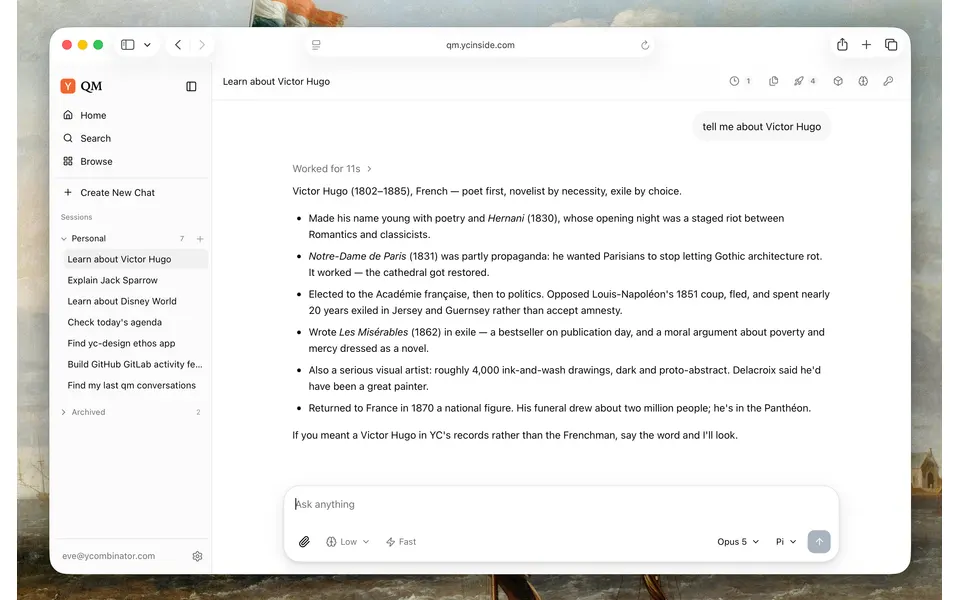
- Desktop app
- Mac
- Browser
- Yes
- Phone
- Phone browser
- Command line
- Yes
- Agents
- Pi
- Your subscription
- Works with your own plan
- Agents run
- On your computer and on your own server
- Laptop closed
- Keeps going
- Isolation
- Container and VM
- Parallel agents
- Yes
- Scheduled runs
- Yes
- Coordinator agent
- Yes
- Built-in issues
- No
- Pull requests
- Yes
- Review screen
- No
- Team
- Shared sessions, roles and SSO
- Self-hosting
- Yes
- Licence
- MIT
- Price from
- Free
- How it charges
- No paid plan and bring your own key
- Paid plans from
- Not listed
Receipts
- Checked
- · oldest answer 2026-11-07
- Findings
- 40 published · 33 cross-checked by a second agent · read them all
- Sources
- 25 public pages on 2 sites: api.github.com, github.com
- GitHub stars
- 15,094 on · api.github.com · repository attention, not users or capability
- Screenshot
- github.com, retrieved · first party repository · shows appearance, not capability
- Data
- /products/qm.json · .md
- Method
- Same rules for all 103 researched ADEs. How we check · Report wrong data
What it does
Where you use it
QM offers web/PWA, Slack and a published Apple Silicon Mac desktop client. Windows/Linux prototype source packaging is separate from published downloads; phone access uses the browser build.
Source and scope for Where you use itAgents it runs
The current QM core runs the Pi coding-agent loop. Model/provider subscription choices do not select a Claude Code, Codex or other coding-agent CLI harness.
Source and scope for Agents it runsAccounts and subscriptions
QM supports both operator-provided model keys and personal Claude or ChatGPT/Codex subscription sign-in for human turns. Background work uses company access.
Source and scope for Accounts and subscriptionsWhere agents run
QM runs its headless core and agent resources on operator infrastructure. In addition to operator-cloud deployments, a local Docker sandbox provider runs tools on an operator computer; cloud-owned core work is independent of browser clients.
Source and scope for Where agents runHow work is kept apart
QM has per-scope sandbox computers. The local provider uses Docker containers, volumes and networks; cloud providers include microVMs. Native Git worktree isolation is not a product workspace option.
Source and scope for How work is kept apartParallel work
Swarms document independently provisioned worker sessions.
Source and scope for Parallel workScheduled runs
Headless QM crons, watches and webhooks run while users are away.
Source and scope for Scheduled runsGit and pull requests
QM advertises agent work in repositories including PR creation and CI monitoring.
Source and scope for Git and pull requestsPrice
QM is MIT open source and self-hosted in your own cloud with your own model keys; YC publishes no paid plan, and the hosted versions listed come from third parties with no price in the README.
Source and scope for PriceTyped filters
Every value links to its receipt below. Read plan and surface restrictions before using a filter to decide.
| Filter | Value |
|---|---|
| Desktop OS: macOS | Yes |
| Desktop OS: Windows | No |
| Desktop OS: Linux | No |
| Web client | Yes |
| Phone access: Native iOS | No |
| Phone access: Native Android | No |
| Phone access: Phone browser | Yes |
| CLI | Yes |
| Coding agents: Claude Code | No |
| Coding agents: Codex | No |
| Coding agents: Cursor Agent | No |
| Coding agents: Gemini CLI | No |
| Coding agents: OpenCode | No |
| Coding agents: Pi | Yes |
| Coding agents: Grok | No |
| Coding agents: Aider | No |
| Coding agents: Antigravity | No |
| Use my subscription | Yes |
| Where agents run: On your computer | Yes |
| Where agents run: On your own server | Yes |
| Where agents run: In the vendor's cloud | Unknown |
| Workspace isolation: Git worktree | No |
| Workspace isolation: Container | Yes |
| Workspace isolation: VM or microVM | Yes |
| Parallel runs | Yes cross-checked |
| Coordinator | Yes cross-checked |
| Native issue tracking | No |
| Unattended triggers | Yes cross-checked |
| Shared prompting | Yes cross-checked |
| Team roles | Yes cross-checked |
| SSO | Yes cross-checked |
| Pull request workflow | Yes cross-checked |
| Review interface | No |
| Product license: Apache-2.0 | No. MIT cross-checked |
| Product license: MIT | Yes. MIT cross-checked |
| Product license: GPL-3.0 | No. MIT cross-checked |
| Product license: GPL-3.0-or-later | No. MIT cross-checked |
| Product license: AGPL-3.0 | No. MIT cross-checked |
| Product license: AGPL-3.0-or-later | No. MIT cross-checked |
| Product license: Elastic License 2.0 | No. MIT cross-checked |
| Product license: Custom terms | No. MIT cross-checked |
| Product license: Proprietary | No. MIT cross-checked |
| Self-hosting | Yes cross-checked |
| Telemetry opt-out | Yes cross-checked |
| Free access | Yes cross-checked |
| Starting price: Free | Yes. Free cross-checked |
| Starting price: Up to $20/month | No. Free cross-checked |
| Starting price: $21–40/month | No. Free cross-checked |
| Starting price: $41–100/month | No. Free cross-checked |
| Starting price: Over $100/month | No. Free cross-checked |
| Starting price: Contact for pricing | No. Free cross-checked |
| Pricing model: Free, no paid plan | Yes cross-checked |
| Pricing model: Free plan | No |
| Pricing model: Subscription | No |
| Pricing model: Per seat | No |
| Pricing model: Usage-based | No |
| Pricing model: Per machine or compute | No |
| Pricing model: Bring your own key | Yes cross-checked |
| Pricing model: One-time purchase | No |
| Paid plans from: No paid plan | Unknown |
| Paid plans from: $10 or less/month | Unknown |
| Paid plans from: $11–20/month | Unknown |
| Paid plans from: $21–40/month | Unknown |
| Paid plans from: $41–100/month | Unknown |
| Paid plans from: Over $100/month | Unknown |
| Paid plans from: Contact sales | Unknown |
| Lifecycle status: Active | Unknown |
| Lifecycle status: Sunsetting | Unknown |
| Keeps going with laptop closed | Yes |
| Open-source license | Yes. MIT cross-checked |
| Any desktop app | Yes |
| Paid plan up to $20/month | Unknown |
| Paid plan up to $40/month | Unknown |
| Any phone client | Yes |
Filter receipts
Desktop OS: macOS: Yes
Desktop OS: macOS
Typed value: Yes.
QM offers web/PWA, Slack and a published Apple Silicon Mac desktop client. Windows/Linux prototype source packaging is separate from published downloads; phone access uses the browser build.
- Desktop os: QM Desktop 0.1.6 is offered for Apple Silicon Macs as a signed/notarized GitHub pre-release.
- Browser: Web workspace.
- Documentation and pinned source inspection only; no hands-on scenario was run.
- Other atomic questions remain unestablished: editor_extensions, notifications.
-
Finding: QM Desktop 0.1.6 (GitHub pre-release, 2026-11-06) is a signed/notarized Apple Silicon ZIP with back/forward navigation, Cmd+N and pane-control fixes; existing installs update through the desktop feed.
Desktop OS: Windows: No
Desktop OS: Windows
Typed value: No.
QM offers web/PWA, Slack and a published Apple Silicon Mac desktop client. Windows/Linux prototype source packaging is separate from published downloads; phone access uses the browser build.
- Desktop os: QM Desktop 0.1.6 is offered for Apple Silicon Macs as a signed/notarized GitHub pre-release.
- Mobile apps: The inspected public client inventory has no native iOS or Android app; its phone interface is the web/PWA build.
- Browser: Web workspace.
- Documentation and pinned source inspection only; no hands-on scenario was run.
- Other atomic questions remain unestablished: editor_extensions, notifications.
-
Finding: QM Desktop 0.1.6 (GitHub pre-release, 2026-11-06) is a signed/notarized Apple Silicon ZIP with back/forward navigation, Cmd+N and pane-control fixes; existing installs update through the desktop feed.
-
Finding: The published Desktop 0.1.6 download is an Apple Silicon Mac ZIP. The desktop README also describes local prototype packaging and Windows/Linux shortcuts, which are not published Windows/Linux releases. Inspection of the public client source roots and release clients found desktop, web/PWA and Slack clients, with no native iOS or Android application. Phone use is the installable browser build.
Desktop OS: Linux: No
Desktop OS: Linux
Typed value: No.
QM offers web/PWA, Slack and a published Apple Silicon Mac desktop client. Windows/Linux prototype source packaging is separate from published downloads; phone access uses the browser build.
- Desktop os: QM Desktop 0.1.6 is offered for Apple Silicon Macs as a signed/notarized GitHub pre-release.
- Mobile apps: The inspected public client inventory has no native iOS or Android app; its phone interface is the web/PWA build.
- Browser: Web workspace.
- Documentation and pinned source inspection only; no hands-on scenario was run.
- Other atomic questions remain unestablished: editor_extensions, notifications.
-
Finding: QM Desktop 0.1.6 (GitHub pre-release, 2026-11-06) is a signed/notarized Apple Silicon ZIP with back/forward navigation, Cmd+N and pane-control fixes; existing installs update through the desktop feed.
-
Finding: The published Desktop 0.1.6 download is an Apple Silicon Mac ZIP. The desktop README also describes local prototype packaging and Windows/Linux shortcuts, which are not published Windows/Linux releases. Inspection of the public client source roots and release clients found desktop, web/PWA and Slack clients, with no native iOS or Android application. Phone use is the installable browser build.
Web client: Yes
Web client
Typed value: Yes.
QM offers web/PWA, Slack and a published Apple Silicon Mac desktop client. Windows/Linux prototype source packaging is separate from published downloads; phone access uses the browser build.
- Desktop os: QM Desktop 0.1.6 is offered for Apple Silicon Macs as a signed/notarized GitHub pre-release.
- Browser: Web workspace.
- Cli: The qm CLI initializes, validates and deploys deployments; task-operation (chat) commands were not established.
- Documentation and pinned source inspection only; no hands-on scenario was run.
- Other atomic questions remain unestablished: editor_extensions, notifications.
-
Finding: Pi is the current core agent loop. Postgres holds durable session state; personal/shared scopes have files, memory, skills, permissions and background work. Operator deploys with own cloud/models/keys.
-
Finding: QM Desktop 0.1.6 (GitHub pre-release, 2026-11-06) is a signed/notarized Apple Silicon ZIP with back/forward navigation, Cmd+N and pane-control fixes; existing installs update through the desktop feed.
Phone access: Native iOS: No
Phone access: Native iOS
Typed value: No.
QM offers web/PWA, Slack and a published Apple Silicon Mac desktop client. Windows/Linux prototype source packaging is separate from published downloads; phone access uses the browser build.
- Mobile apps: The inspected public client inventory has no native iOS or Android app; its phone interface is the web/PWA build.
- Documentation and pinned source inspection only; no hands-on scenario was run.
- Other atomic questions remain unestablished: editor_extensions, notifications.
-
Finding: The published Desktop 0.1.6 download is an Apple Silicon Mac ZIP. The desktop README also describes local prototype packaging and Windows/Linux shortcuts, which are not published Windows/Linux releases. Inspection of the public client source roots and release clients found desktop, web/PWA and Slack clients, with no native iOS or Android application. Phone use is the installable browser build.
Phone access: Native Android: No
Phone access: Native Android
Typed value: No.
QM offers web/PWA, Slack and a published Apple Silicon Mac desktop client. Windows/Linux prototype source packaging is separate from published downloads; phone access uses the browser build.
- Mobile apps: The inspected public client inventory has no native iOS or Android app; its phone interface is the web/PWA build.
- Documentation and pinned source inspection only; no hands-on scenario was run.
- Other atomic questions remain unestablished: editor_extensions, notifications.
-
Finding: The published Desktop 0.1.6 download is an Apple Silicon Mac ZIP. The desktop README also describes local prototype packaging and Windows/Linux shortcuts, which are not published Windows/Linux releases. Inspection of the public client source roots and release clients found desktop, web/PWA and Slack clients, with no native iOS or Android application. Phone use is the installable browser build.
Phone access: Phone browser: Yes
Phone access: Phone browser
Typed value: Yes.
QM offers web/PWA, Slack and a published Apple Silicon Mac desktop client. Windows/Linux prototype source packaging is separate from published downloads; phone access uses the browser build.
- Mobile browser: Phone layout below 860px includes composer, approvals, drawers and home-screen PWA install.
- Task actions: Phone web UI exposes composer/send, session menus, model/effort settings and approvals; no device handoff fixture.
- Cross device continuity: Phones get the same web build with a phone layout; continuing a specific task across devices is not described and no handoff test was run.
- Documentation and pinned source inspection only; no hands-on scenario was run.
- Other atomic questions remain unestablished: editor_extensions, notifications.
-
QM from YC plugins/web-ui/README.md
Finding: Web UI has phone layout and installable PWA. POSTHOG_API_KEY enables browser/core analytics; no key means no analytics requests. SENTRY_BROWSER_DSN enables browser errors and unset disables it; backend DSN never used as browser fallback. Tracing defaults off. PostHog replay follows project settings.
CLI: Yes
CLI
Typed value: Yes.
QM offers web/PWA, Slack and a published Apple Silicon Mac desktop client. Windows/Linux prototype source packaging is separate from published downloads; phone access uses the browser build.
- Browser: Web workspace.
- Cli: The qm CLI initializes, validates and deploys deployments; task-operation (chat) commands were not established.
- Documentation and pinned source inspection only; no hands-on scenario was run.
- Other atomic questions remain unestablished: editor_extensions, notifications.
-
Finding: Pi is the current core agent loop. Postgres holds durable session state; personal/shared scopes have files, memory, skills, permissions and background work. Operator deploys with own cloud/models/keys.
Coding agents: Claude Code: No
Coding agents: Claude Code
Typed value: No.
The current QM core runs the Pi coding-agent loop. Model/provider subscription choices do not select a Claude Code, Codex or other coding-agent CLI harness.
- Harnesses: The active core uses the Pi coding-agent library and supplies no selectable adapter for the other named coding-agent CLIs.
- Documentation and pinned source inspection only; no hands-on scenario was run.
- Other atomic questions remain unestablished: custom_adapters, session_integration, mixed_harness_operation.
-
QM from YC: src/agent/agent-run.ts
Finding: The active core uses the Pi coding-agent library for its model loop. The current runtime has no client-selectable Claude Code, Codex, Cursor, Gemini CLI, OpenCode, Grok, Aider or Antigravity harness adapter. Provider API and subscription choices select model access within Pi rather than a different coding-agent CLI.
Coding agents: Codex: No
Coding agents: Codex
Typed value: No.
The current QM core runs the Pi coding-agent loop. Model/provider subscription choices do not select a Claude Code, Codex or other coding-agent CLI harness.
- Harnesses: The active core uses the Pi coding-agent library and supplies no selectable adapter for the other named coding-agent CLIs.
- Documentation and pinned source inspection only; no hands-on scenario was run.
- Other atomic questions remain unestablished: custom_adapters, session_integration, mixed_harness_operation.
-
QM from YC: src/agent/agent-run.ts
Finding: The active core uses the Pi coding-agent library for its model loop. The current runtime has no client-selectable Claude Code, Codex, Cursor, Gemini CLI, OpenCode, Grok, Aider or Antigravity harness adapter. Provider API and subscription choices select model access within Pi rather than a different coding-agent CLI.
Coding agents: Cursor Agent: No
Coding agents: Cursor Agent
Typed value: No.
The current QM core runs the Pi coding-agent loop. Model/provider subscription choices do not select a Claude Code, Codex or other coding-agent CLI harness.
- Harnesses: The active core uses the Pi coding-agent library and supplies no selectable adapter for the other named coding-agent CLIs.
- Documentation and pinned source inspection only; no hands-on scenario was run.
- Other atomic questions remain unestablished: custom_adapters, session_integration, mixed_harness_operation.
-
QM from YC: src/agent/agent-run.ts
Finding: The active core uses the Pi coding-agent library for its model loop. The current runtime has no client-selectable Claude Code, Codex, Cursor, Gemini CLI, OpenCode, Grok, Aider or Antigravity harness adapter. Provider API and subscription choices select model access within Pi rather than a different coding-agent CLI.
Coding agents: Gemini CLI: No
Coding agents: Gemini CLI
Typed value: No.
The current QM core runs the Pi coding-agent loop. Model/provider subscription choices do not select a Claude Code, Codex or other coding-agent CLI harness.
- Harnesses: The active core uses the Pi coding-agent library and supplies no selectable adapter for the other named coding-agent CLIs.
- Documentation and pinned source inspection only; no hands-on scenario was run.
- Other atomic questions remain unestablished: custom_adapters, session_integration, mixed_harness_operation.
-
QM from YC: src/agent/agent-run.ts
Finding: The active core uses the Pi coding-agent library for its model loop. The current runtime has no client-selectable Claude Code, Codex, Cursor, Gemini CLI, OpenCode, Grok, Aider or Antigravity harness adapter. Provider API and subscription choices select model access within Pi rather than a different coding-agent CLI.
Coding agents: OpenCode: No
Coding agents: OpenCode
Typed value: No.
The current QM core runs the Pi coding-agent loop. Model/provider subscription choices do not select a Claude Code, Codex or other coding-agent CLI harness.
- Harnesses: The active core uses the Pi coding-agent library and supplies no selectable adapter for the other named coding-agent CLIs.
- Documentation and pinned source inspection only; no hands-on scenario was run.
- Other atomic questions remain unestablished: custom_adapters, session_integration, mixed_harness_operation.
-
QM from YC: src/agent/agent-run.ts
Finding: The active core uses the Pi coding-agent library for its model loop. The current runtime has no client-selectable Claude Code, Codex, Cursor, Gemini CLI, OpenCode, Grok, Aider or Antigravity harness adapter. Provider API and subscription choices select model access within Pi rather than a different coding-agent CLI.
Coding agents: Pi: Yes
Coding agents: Pi
Typed value: Yes.
The current QM core runs the Pi coding-agent loop. Model/provider subscription choices do not select a Claude Code, Codex or other coding-agent CLI harness.
- Model providers: Selectable models through Pi from multiple providers.
- Documentation and pinned source inspection only; no hands-on scenario was run.
- Other atomic questions remain unestablished: custom_adapters, session_integration, mixed_harness_operation.
-
Finding: Pi is the current core agent loop. Postgres holds durable session state; personal/shared scopes have files, memory, skills, permissions and background work. Operator deploys with own cloud/models/keys.
Coding agents: Grok: No
Coding agents: Grok
Typed value: No.
The current QM core runs the Pi coding-agent loop. Model/provider subscription choices do not select a Claude Code, Codex or other coding-agent CLI harness.
- Harnesses: The active core uses the Pi coding-agent library and supplies no selectable adapter for the other named coding-agent CLIs.
- Documentation and pinned source inspection only; no hands-on scenario was run.
- Other atomic questions remain unestablished: custom_adapters, session_integration, mixed_harness_operation.
-
QM from YC: src/agent/agent-run.ts
Finding: The active core uses the Pi coding-agent library for its model loop. The current runtime has no client-selectable Claude Code, Codex, Cursor, Gemini CLI, OpenCode, Grok, Aider or Antigravity harness adapter. Provider API and subscription choices select model access within Pi rather than a different coding-agent CLI.
Coding agents: Aider: No
Coding agents: Aider
Typed value: No.
The current QM core runs the Pi coding-agent loop. Model/provider subscription choices do not select a Claude Code, Codex or other coding-agent CLI harness.
- Harnesses: The active core uses the Pi coding-agent library and supplies no selectable adapter for the other named coding-agent CLIs.
- Documentation and pinned source inspection only; no hands-on scenario was run.
- Other atomic questions remain unestablished: custom_adapters, session_integration, mixed_harness_operation.
-
QM from YC: src/agent/agent-run.ts
Finding: The active core uses the Pi coding-agent library for its model loop. The current runtime has no client-selectable Claude Code, Codex, Cursor, Gemini CLI, OpenCode, Grok, Aider or Antigravity harness adapter. Provider API and subscription choices select model access within Pi rather than a different coding-agent CLI.
Coding agents: Antigravity: No
Coding agents: Antigravity
Typed value: No.
The current QM core runs the Pi coding-agent loop. Model/provider subscription choices do not select a Claude Code, Codex or other coding-agent CLI harness.
- Harnesses: The active core uses the Pi coding-agent library and supplies no selectable adapter for the other named coding-agent CLIs.
- Documentation and pinned source inspection only; no hands-on scenario was run.
- Other atomic questions remain unestablished: custom_adapters, session_integration, mixed_harness_operation.
-
QM from YC: src/agent/agent-run.ts
Finding: The active core uses the Pi coding-agent library for its model loop. The current runtime has no client-selectable Claude Code, Codex, Cursor, Gemini CLI, OpenCode, Grok, Aider or Antigravity harness adapter. Provider API and subscription choices select model access within Pi rather than a different coding-agent CLI.
Use my subscription: Yes
Use my subscription
Typed value: Yes.
QM supports both operator-provided model keys and personal Claude or ChatGPT/Codex subscription sign-in for human turns. Background work uses company access.
- Agent subscriptions: The Personal AI accounts guide documents subscription sign-in for Claude and ChatGPT/Codex, backed by native provider OAuth and refresh paths.
- Documentation and pinned source inspection only; no hands-on scenario was run.
- Other atomic questions remain unestablished: vendor_credits, local_models, account_switching, provider_restrictions.
-
QM from YC: plugins/web-ui/README.md
Finding: Settings AI access explicitly offers Company, Claude and ChatGPT/Codex accounts. Users can sign in with a subscription or choose an API key; the selection applies to human chat turns on web and Slack, while background tasks retain company access. The implementation exchanges and refreshes native provider OAuth credentials. These account choices do not add Claude Code or Codex as coding harnesses.
Where agents run: On your computer: Yes
Where agents run: On your computer
Typed value: Yes.
QM runs its headless core and agent resources on operator infrastructure. In addition to operator-cloud deployments, a local Docker sandbox provider runs tools on an operator computer; cloud-owned core work is independent of browser clients.
- Local: The local Docker sandbox provider and build path execute agent tools on the operator host.
- Documentation and pinned source inspection only; no hands-on scenario was run.
- Other atomic questions remain unestablished: managed_cloud, hybrid, resources, region, expiry, other_device_continuation.
-
QM from YC: src/sandbox/local-sandbox.ts
Finding: The local sandbox provider provisions per-scope Docker containers, persistent home volumes and separate Docker networks and launches processes inside them. The documented local build path can run agent tools on an operator computer. This is a local Docker deployment, distinct from the Mac desktop client, which does not bundle a backend.
Where agents run: On your own server: Yes
Where agents run: On your own server
Typed value: Yes.
QM runs its headless core and agent resources on operator infrastructure. In addition to operator-cloud deployments, a local Docker sandbox provider runs tools on an operator computer; cloud-owned core work is independent of browser clients.
- Byo remote: Each deployment runs in operator cloud account with headless core.
- Self hosted: Organization deployment.
- Provisioning: Deployment directory CLI targeting Fly or AWS.
- Payer: Operator cloud account.
- Client disconnect: Background crons/watches/webhooks work while user is away; no transport-disconnect fixture.
- Documentation and pinned source inspection only; no hands-on scenario was run.
- Other atomic questions remain unestablished: managed_cloud, hybrid, resources, region, expiry, other_device_continuation.
-
Finding: Pi is the current core agent loop. Postgres holds durable session state; personal/shared scopes have files, memory, skills, permissions and background work. Operator deploys with own cloud/models/keys.
Workspace isolation: Git worktree: No
Workspace isolation: Git worktree
Typed value: No.
QM has per-scope sandbox computers. The local provider uses Docker containers, volumes and networks; cloud providers include microVMs. Native Git worktree isolation is not a product workspace option.
- Worktree: The current sandbox/workspace model has no product-managed Git worktree provisioning; generic agent Git commands remain separate.
- Documentation and pinned source inspection only; no hands-on scenario was run.
- Other atomic questions remain unestablished: checkout, branch, os_sandbox, process, network, security_boundary.
-
Finding: Bounded inspection of the current API routes, core state and web UI for issue/task/todo CRUD and code-diff review found agent conversations/runs, schedules and approvals, but no product-owned independent issue tracker or proposed-code diff review surface. The sandbox providers expose scoped computers rather than native Git worktree provisioning; agent shell commands can still operate Git independently.
Workspace isolation: Container: Yes
Workspace isolation: Container
Typed value: Yes.
QM has per-scope sandbox computers. The local provider uses Docker containers, volumes and networks; cloud providers include microVMs. Native Git worktree isolation is not a product workspace option.
- Container: The local provider provisions per-scope Docker containers with persistent home volumes and separate networks.
- Documentation and pinned source inspection only; no hands-on scenario was run.
- Other atomic questions remain unestablished: checkout, branch, os_sandbox, process, network, security_boundary.
-
QM from YC: src/sandbox/local-sandbox.ts
Finding: The local sandbox provider provisions per-scope Docker containers, persistent home volumes and separate Docker networks and launches processes inside them. The documented local build path can run agent tools on an operator computer. This is a local Docker deployment, distinct from the Mac desktop client, which does not bundle a backend.
Workspace isolation: VM or microVM: Yes
Workspace isolation: VM or microVM
Typed value: Yes.
QM has per-scope sandbox computers. The local provider uses Docker containers, volumes and networks; cloud providers include microVMs. Native Git worktree isolation is not a product workspace option.
- Vm: DigitalOcean Managed Agents template yields a microVM with no managed agent loop; disk persists across pause/resume.
- Documentation and pinned source inspection only; no hands-on scenario was run.
- Other atomic questions remain unestablished: checkout, branch, os_sandbox, process, network, security_boundary.
-
QM from YC docs/sandbox-preservation.md
Finding: Provider-specific snapshots/pause behavior differs. Modal default one core/2 GiB and 24-hour lifetime; portable tar recovery needs configured S3 bucket. DigitalOcean Managed Agents sandbox template is a microVM with persistent disk across pause/resume. Cold recovery may restore files without processes.
Parallel runs: Yes cross-checked
Parallel runs
Typed value: Yes.
Swarms document independently provisioned worker sessions.
- Concurrent sessions: Worker sessions with separate durable transcripts.
- Quotas: Default lifetime agent budget includes root and failed reservations.
- Status visibility: Inspect reports active, starting, paused, stopped and failed workers.
- Swarms is off by default and requires a per-person or organization feature flag. No live worker fixture was run.
- The swarms document gates this behind a feature flag and states no release stage.
-
Finding: Feature-flagged swarms create durable worker sessions with scoped tokens, model/effort, blank computers, addressed messages, controls and configurable budgets.
Coordinator: Yes cross-checked
Coordinator
Typed value: Yes.
QM swarm APIs retain linked worker sessions and addressable follow-ups.
- Roles: Root and worker metadata.
- Model harness effort: Model, effort and fastMode per spawn.
- Messages: Addressed durable messages.
- Results return: Normal session viewer/run APIs.
- Orchestration owner: QM swarm API.
- Activation: swarms feature flag, off by default.
- Authentication: Session-bound agent capability token.
- Followup: Worker web transcripts are read-only for normal human messages; pending approvals can be answered.
- The remaining atomic questions and the rubric scenario are unverified. Documentation is not a successful product test.
- The swarms document gates this behind a feature flag and states no release stage.
- Only the named atomic facts are established by documentation. Remaining rubric scenarios and unknown answers were not demonstrated.
-
Finding: Feature-flagged swarms create durable worker sessions with scoped tokens, model/effort, blank computers, addressed messages, controls and configurable budgets.
Native issue tracking: No
Native issue tracking
Typed value: No.
The current QM API and web UI expose conversations/runs, schedules and approvals without a native independent issue tracker.
- Create: No issue/task CRUD route or independent native issue record is exposed in the current core and UI.
- Durable states: Durable states in the accessible product belong to runs, sessions or scheduled work rather than independent native issues.
- Documentation and pinned source inspection only; no hands-on scenario was run.
- Other atomic questions remain unestablished: edit, discuss, prioritize, label, assign, search, filter, archive, reopen, project_epic_views, idea_parking, explicit_dispatch, task_session_separation, metadata, external_tracker_requirement.
-
Finding: Bounded inspection of the current API routes, core state and web UI for issue/task/todo CRUD and code-diff review found agent conversations/runs, schedules and approvals, but no product-owned independent issue tracker or proposed-code diff review surface. The sandbox providers expose scoped computers rather than native Git worktree provisioning; agent shell commands can still operate Git independently.
Unattended triggers: Yes cross-checked
Unattended triggers
Typed value: Yes.
Headless QM crons, watches and webhooks run while users are away.
- Schedules: Crons.
- Events: Watches and inbound webhooks.
- Scheduler location: Headless core scheduler.
- Client independence: README explicitly describes background work while away, owned by headless deployed core.
- The remaining atomic questions and the rubric scenario are unverified. Documentation is not a successful product test.
- Only the named atomic facts are established by documentation. Remaining rubric scenarios and unknown answers were not demonstrated.
-
Finding: Pi is the current core agent loop. Postgres holds durable session state; personal/shared scopes have files, memory, skills, permissions and background work. Operator deploys with own cloud/models/keys.
Shared prompting: Yes cross-checked
Shared prompting
Typed value: Yes.
QM supports people collaborating with an agent in shared Slack/web rooms.
- Visibility: Personal and shared scopes.
- Discussion: Slack channels, group messages and projects.
- Coprompting: Employees collaborate with the agent in shared channels, group messages and projects.
- Attribution: Each turn acts as the person with their credentials/permissions; shared scope remains explicit.
- Permissions: Scope-specific permissions and sharing grants.
- The remaining atomic questions and the rubric scenario are unverified. Documentation is not a successful product test.
- Only the named atomic facts are established by documentation. Remaining rubric scenarios and unknown answers were not demonstrated.
-
Finding: Pi is the current core agent loop. Postgres holds durable session state; personal/shared scopes have files, memory, skills, permissions and background work. Operator deploys with own cloud/models/keys.
Team roles: Yes cross-checked
Team roles
Typed value: Yes.
Organization security posture and project membership controls are documented.
- Organization roles: Admin controls organization configuration and sharing. Full role matrix unverified.
- Membership: Add/remove project-member routes.
- The remaining atomic questions and the rubric scenario are unverified. Documentation is not a successful product test.
-
Finding: Pi is the current core agent loop. Postgres holds durable session state; personal/shared scopes have files, memory, skills, permissions and background work. Operator deploys with own cloud/models/keys.
SSO: Yes cross-checked
SSO
Typed value: Yes.
Organization security posture and project membership controls are documented.
- Sso: Deployment can use external OIDC sign-in at the public SSO front door instead of embedded email auth; provider implementation and enterprise policy enforcement untested.
- The remaining atomic questions and the rubric scenario are unverified. Documentation is not a successful product test.
-
Finding: Core hosts the public sign-in front door. Optional embedded auth enables email sign-in; omitting it retains external OIDC sign-in configured in env.core. Web UI README describes the portal as the public SSO front door.
Pull request workflow: Yes cross-checked
Pull request workflow
Typed value: Yes.
QM advertises agent work in repositories including PR creation and CI monitoring.
- Pull requests: README explicitly lists opening PRs from existing repositories.
- Ci response: CI monitoring documented; automated repair or merge gating not established.
- Only the named atomic facts are established by documentation. Remaining rubric scenarios and unknown answers were not demonstrated.
-
Finding: Pi is the current core agent loop. Postgres holds durable session state; personal/shared scopes have files, memory, skills, permissions and background work. Operator deploys with own cloud/models/keys.
Review interface: No
Review interface
Typed value: No.
QM displays conversation artifacts, files and approvals without an integrated proposed-code diff review interface in the inspected client.
- Change understanding: The inspected web client has no proposed-code diff review surface. Configuration text differences and ordinary file viewers are outside this code-review filter.
- Documentation and pinned source inspection only; no hands-on scenario was run.
- Other atomic questions remain unestablished: pending_reviews, evidence_navigation, comments, request_changes, shipping_guidance, effort, missed_evidence, keyboard, narrow_screen, context_switching, roles, retained_context.
-
Finding: Bounded inspection of the current API routes, core state and web UI for issue/task/todo CRUD and code-diff review found agent conversations/runs, schedules and approvals, but no product-owned independent issue tracker or proposed-code diff review surface. The sandbox providers expose scoped computers rather than native Git worktree provisioning; agent shell commands can still operate Git independently.
Product license: Apache-2.0: No. MIT cross-checked
Product license: Apache-2.0
Typed value: No. MIT.
QM repository is MIT.
- Client license: MIT, subject to component notices.
- Source visibility: Public repository.
- Source revision: 1c61ee3bf3b6460d14e39a90a1f53fdef1c81610
- The remaining atomic questions and the rubric scenario are unverified. Documentation is not a successful product test.
-
Finding: The cited root license governs this repository distribution, subject to component notices.
Product license: MIT: Yes. MIT cross-checked
Product license: MIT
Typed value: Yes. MIT.
QM repository is MIT.
- Client license: MIT, subject to component notices.
- Source visibility: Public repository.
- Source revision: 1c61ee3bf3b6460d14e39a90a1f53fdef1c81610
- The remaining atomic questions and the rubric scenario are unverified. Documentation is not a successful product test.
-
Finding: The cited root license governs this repository distribution, subject to component notices.
Product license: GPL-3.0: No. MIT cross-checked
Product license: GPL-3.0
Typed value: No. MIT.
QM repository is MIT.
- Client license: MIT, subject to component notices.
- Source visibility: Public repository.
- Source revision: 1c61ee3bf3b6460d14e39a90a1f53fdef1c81610
- The remaining atomic questions and the rubric scenario are unverified. Documentation is not a successful product test.
-
Finding: The cited root license governs this repository distribution, subject to component notices.
Product license: GPL-3.0-or-later: No. MIT cross-checked
Product license: GPL-3.0-or-later
Typed value: No. MIT.
QM repository is MIT.
- Client license: MIT, subject to component notices.
- Source visibility: Public repository.
- Source revision: 1c61ee3bf3b6460d14e39a90a1f53fdef1c81610
- The remaining atomic questions and the rubric scenario are unverified. Documentation is not a successful product test.
-
Finding: The cited root license governs this repository distribution, subject to component notices.
Product license: AGPL-3.0: No. MIT cross-checked
Product license: AGPL-3.0
Typed value: No. MIT.
QM repository is MIT.
- Client license: MIT, subject to component notices.
- Source visibility: Public repository.
- Source revision: 1c61ee3bf3b6460d14e39a90a1f53fdef1c81610
- The remaining atomic questions and the rubric scenario are unverified. Documentation is not a successful product test.
-
Finding: The cited root license governs this repository distribution, subject to component notices.
Product license: AGPL-3.0-or-later: No. MIT cross-checked
Product license: AGPL-3.0-or-later
Typed value: No. MIT.
QM repository is MIT.
- Client license: MIT, subject to component notices.
- Source visibility: Public repository.
- Source revision: 1c61ee3bf3b6460d14e39a90a1f53fdef1c81610
- The remaining atomic questions and the rubric scenario are unverified. Documentation is not a successful product test.
-
Finding: The cited root license governs this repository distribution, subject to component notices.
Product license: Elastic License 2.0: No. MIT cross-checked
Product license: Elastic License 2.0
Typed value: No. MIT.
QM repository is MIT.
- Client license: MIT, subject to component notices.
- Source visibility: Public repository.
- Source revision: 1c61ee3bf3b6460d14e39a90a1f53fdef1c81610
- The remaining atomic questions and the rubric scenario are unverified. Documentation is not a successful product test.
-
Finding: The cited root license governs this repository distribution, subject to component notices.
Product license: Custom terms: No. MIT cross-checked
Product license: Custom terms
Typed value: No. MIT.
QM repository is MIT.
- Client license: MIT, subject to component notices.
- Source visibility: Public repository.
- Source revision: 1c61ee3bf3b6460d14e39a90a1f53fdef1c81610
- The remaining atomic questions and the rubric scenario are unverified. Documentation is not a successful product test.
-
Finding: The cited root license governs this repository distribution, subject to component notices.
Product license: Proprietary: No. MIT cross-checked
Product license: Proprietary
Typed value: No. MIT.
QM repository is MIT.
- Client license: MIT, subject to component notices.
- Source visibility: Public repository.
- Source revision: 1c61ee3bf3b6460d14e39a90a1f53fdef1c81610
- The remaining atomic questions and the rubric scenario are unverified. Documentation is not a successful product test.
-
Finding: The cited root license governs this repository distribution, subject to component notices.
Self-hosting: Yes cross-checked
Self-hosting
Typed value: Yes.
QM supports own-cloud deployment and durable Files/share outputs separate from sandbox lifetime.
- Self hosting: Operator cloud deployment.
- Vendor dependencies: Model and infrastructure accounts remain dependencies. Hosted third-party QM is separate.
- The remaining atomic questions and the rubric scenario are unverified. Documentation is not a successful product test.
- Only the named atomic facts are established by documentation. Remaining rubric scenarios and unknown answers were not demonstrated.
-
Finding: Pi is the current core agent loop. Postgres holds durable session state; personal/shared scopes have files, memory, skills, permissions and background work. Operator deploys with own cloud/models/keys.
Telemetry opt-out: Yes cross-checked
Telemetry opt-out
Typed value: Yes.
QM telemetry is deployment-configured with separate analytics and backend/browser error controls.
- Logs: Browser Sentry errors carry full message/stack and authenticated identity; optional timing includes request URLs.
- Telemetry disclosure: Optional PostHog browser/core analytics and optional Sentry browser/backend errors/traces.
- Telemetry defaults: No PostHog key means no analytics; no browser DSN means no browser error reporting. Trace rates default zero.
- Telemetry controls: Unset POSTHOG_API_KEY and SENTRY_BROWSER_DSN for analytics/browser errors; backend reporting separately disabled by removing SENTRY_DSN and redeploying.
- Provider separation: Model keys stay server-side and never reach the browser; deployments run in the operator's own cloud with their own models and keys.
- Only the named atomic facts are established by documentation. Remaining rubric scenarios and unknown answers were not demonstrated.
-
QM from YC plugins/web-ui/README.md
Finding: Web UI has phone layout and installable PWA. POSTHOG_API_KEY enables browser/core analytics; no key means no analytics requests. SENTRY_BROWSER_DSN enables browser errors and unset disables it; backend DSN never used as browser fallback. Tracing defaults off. PostHog replay follows project settings.
Free access: Yes cross-checked
Free access
Typed value: Yes.
QM is MIT-licensed software an organization deploys in its own cloud with its own model keys. The README and licence state no price; the README invites larger companies to request a hosted version through a form. Cloud and model costs are the operator's.
- Ongoing free: The software is MIT-licensed and free to deploy; the README and licence state no QM price or paid plan.
- Self host cost: Self-deployment in the operator's own cloud carries no QM fee; cloud and model provider costs are the operator's and are not quantified.
- Paid only: Not paid-only: the MIT source is free to deploy.
- Terms of the requested hosted version and third-party hosted offers were not checked. No installed-product test was run.
-
Finding: QM is deployed by the organization in its own cloud with its own models and keys; hosted versions are offered by third parties. Crons, watches and inbound webhooks keep working while the user is away. The README states no QM price or paid plan.
-
Finding: The repository is under the MIT License, copyright QM contributors, permitting free use, copying and modification.
Starting price: Free: Yes. Free cross-checked
Starting price: Free
Typed value: Yes. Free.
QM is MIT-licensed software an organization deploys in its own cloud with its own model keys. The README and licence state no price; the README invites larger companies to request a hosted version through a form. Cloud and model costs are the operator's.
- Ongoing free: The software is MIT-licensed and free to deploy; the README and licence state no QM price or paid plan.
- Self host cost: Self-deployment in the operator's own cloud carries no QM fee; cloud and model provider costs are the operator's and are not quantified.
- Paid only: Not paid-only: the MIT source is free to deploy.
- Terms of the requested hosted version and third-party hosted offers were not checked. No installed-product test was run.
-
Finding: QM is deployed by the organization in its own cloud with its own models and keys; hosted versions are offered by third parties. Crons, watches and inbound webhooks keep working while the user is away. The README states no QM price or paid plan.
-
Finding: The repository is under the MIT License, copyright QM contributors, permitting free use, copying and modification.
Starting price: Up to $20/month: No. Free cross-checked
Starting price: Up to $20/month
Typed value: No. Free.
QM is MIT-licensed software an organization deploys in its own cloud with its own model keys. The README and licence state no price; the README invites larger companies to request a hosted version through a form. Cloud and model costs are the operator's.
- Ongoing free: The software is MIT-licensed and free to deploy; the README and licence state no QM price or paid plan.
- Self host cost: Self-deployment in the operator's own cloud carries no QM fee; cloud and model provider costs are the operator's and are not quantified.
- Paid only: Not paid-only: the MIT source is free to deploy.
- Terms of the requested hosted version and third-party hosted offers were not checked. No installed-product test was run.
-
Finding: QM is deployed by the organization in its own cloud with its own models and keys; hosted versions are offered by third parties. Crons, watches and inbound webhooks keep working while the user is away. The README states no QM price or paid plan.
-
Finding: The repository is under the MIT License, copyright QM contributors, permitting free use, copying and modification.
Starting price: $21–40/month: No. Free cross-checked
Starting price: $21–40/month
Typed value: No. Free.
QM is MIT-licensed software an organization deploys in its own cloud with its own model keys. The README and licence state no price; the README invites larger companies to request a hosted version through a form. Cloud and model costs are the operator's.
- Ongoing free: The software is MIT-licensed and free to deploy; the README and licence state no QM price or paid plan.
- Self host cost: Self-deployment in the operator's own cloud carries no QM fee; cloud and model provider costs are the operator's and are not quantified.
- Paid only: Not paid-only: the MIT source is free to deploy.
- Terms of the requested hosted version and third-party hosted offers were not checked. No installed-product test was run.
-
Finding: QM is deployed by the organization in its own cloud with its own models and keys; hosted versions are offered by third parties. Crons, watches and inbound webhooks keep working while the user is away. The README states no QM price or paid plan.
-
Finding: The repository is under the MIT License, copyright QM contributors, permitting free use, copying and modification.
Starting price: $41–100/month: No. Free cross-checked
Starting price: $41–100/month
Typed value: No. Free.
QM is MIT-licensed software an organization deploys in its own cloud with its own model keys. The README and licence state no price; the README invites larger companies to request a hosted version through a form. Cloud and model costs are the operator's.
- Ongoing free: The software is MIT-licensed and free to deploy; the README and licence state no QM price or paid plan.
- Self host cost: Self-deployment in the operator's own cloud carries no QM fee; cloud and model provider costs are the operator's and are not quantified.
- Paid only: Not paid-only: the MIT source is free to deploy.
- Terms of the requested hosted version and third-party hosted offers were not checked. No installed-product test was run.
-
Finding: QM is deployed by the organization in its own cloud with its own models and keys; hosted versions are offered by third parties. Crons, watches and inbound webhooks keep working while the user is away. The README states no QM price or paid plan.
-
Finding: The repository is under the MIT License, copyright QM contributors, permitting free use, copying and modification.
Starting price: Over $100/month: No. Free cross-checked
Starting price: Over $100/month
Typed value: No. Free.
QM is MIT-licensed software an organization deploys in its own cloud with its own model keys. The README and licence state no price; the README invites larger companies to request a hosted version through a form. Cloud and model costs are the operator's.
- Ongoing free: The software is MIT-licensed and free to deploy; the README and licence state no QM price or paid plan.
- Self host cost: Self-deployment in the operator's own cloud carries no QM fee; cloud and model provider costs are the operator's and are not quantified.
- Paid only: Not paid-only: the MIT source is free to deploy.
- Terms of the requested hosted version and third-party hosted offers were not checked. No installed-product test was run.
-
Finding: QM is deployed by the organization in its own cloud with its own models and keys; hosted versions are offered by third parties. Crons, watches and inbound webhooks keep working while the user is away. The README states no QM price or paid plan.
-
Finding: The repository is under the MIT License, copyright QM contributors, permitting free use, copying and modification.
Starting price: Contact for pricing: No. Free cross-checked
Starting price: Contact for pricing
Typed value: No. Free.
QM is MIT-licensed software an organization deploys in its own cloud with its own model keys. The README and licence state no price; the README invites larger companies to request a hosted version through a form. Cloud and model costs are the operator's.
- Ongoing free: The software is MIT-licensed and free to deploy; the README and licence state no QM price or paid plan.
- Self host cost: Self-deployment in the operator's own cloud carries no QM fee; cloud and model provider costs are the operator's and are not quantified.
- Paid only: Not paid-only: the MIT source is free to deploy.
- Terms of the requested hosted version and third-party hosted offers were not checked. No installed-product test was run.
-
Finding: QM is deployed by the organization in its own cloud with its own models and keys; hosted versions are offered by third parties. Crons, watches and inbound webhooks keep working while the user is away. The README states no QM price or paid plan.
-
Finding: The repository is under the MIT License, copyright QM contributors, permitting free use, copying and modification.
Pricing model: Free, no paid plan: Yes cross-checked
Pricing model: Free, no paid plan
Typed value: Yes.
QM is MIT open source and self-hosted in your own cloud with your own model keys; YC publishes no paid plan, and the hosted versions listed come from third parties with no price in the README.
- Model cost: You bring your own models and keys, so those providers bill for model usage.
- Compute cost: QM runs in your own cloud, so infrastructure costs fall on your cloud account. The README gives no amounts.
- First-party pricing pages, terms and licences read 2026-11-10; no purchase, billing or authenticated account test.
-
Finding: Says you run QM in your own cloud with your own models and keys, and the license is MIT. Hosted versions come from third parties (Agent 37, E2B, DigitalOcean), and the README gives no price for them.
-
Finding: The MIT License lets anyone obtain, use, copy and modify the software free of charge.
Pricing model: Free plan: No
Pricing model: Free plan
Typed value: No.
QM is MIT open source and self-hosted in your own cloud with your own model keys; YC publishes no paid plan, and the hosted versions listed come from third parties with no price in the README.
- Model cost: You bring your own models and keys, so those providers bill for model usage.
- Compute cost: QM runs in your own cloud, so infrastructure costs fall on your cloud account. The README gives no amounts.
- First-party pricing pages, terms and licences read 2026-11-10; no purchase, billing or authenticated account test.
-
Finding: Says you run QM in your own cloud with your own models and keys, and the license is MIT. Hosted versions come from third parties (Agent 37, E2B, DigitalOcean), and the README gives no price for them.
-
Finding: The MIT License lets anyone obtain, use, copy and modify the software free of charge.
Pricing model: Subscription: No
Pricing model: Subscription
Typed value: No.
QM is MIT open source and self-hosted in your own cloud with your own model keys; YC publishes no paid plan, and the hosted versions listed come from third parties with no price in the README.
- Model cost: You bring your own models and keys, so those providers bill for model usage.
- Compute cost: QM runs in your own cloud, so infrastructure costs fall on your cloud account. The README gives no amounts.
- First-party pricing pages, terms and licences read 2026-11-10; no purchase, billing or authenticated account test.
-
Finding: Says you run QM in your own cloud with your own models and keys, and the license is MIT. Hosted versions come from third parties (Agent 37, E2B, DigitalOcean), and the README gives no price for them.
-
Finding: The MIT License lets anyone obtain, use, copy and modify the software free of charge.
Pricing model: Per seat: No
Pricing model: Per seat
Typed value: No.
QM is MIT open source and self-hosted in your own cloud with your own model keys; YC publishes no paid plan, and the hosted versions listed come from third parties with no price in the README.
- Model cost: You bring your own models and keys, so those providers bill for model usage.
- Compute cost: QM runs in your own cloud, so infrastructure costs fall on your cloud account. The README gives no amounts.
- First-party pricing pages, terms and licences read 2026-11-10; no purchase, billing or authenticated account test.
-
Finding: Says you run QM in your own cloud with your own models and keys, and the license is MIT. Hosted versions come from third parties (Agent 37, E2B, DigitalOcean), and the README gives no price for them.
-
Finding: The MIT License lets anyone obtain, use, copy and modify the software free of charge.
Pricing model: Usage-based: No
Pricing model: Usage-based
Typed value: No.
QM is MIT open source and self-hosted in your own cloud with your own model keys; YC publishes no paid plan, and the hosted versions listed come from third parties with no price in the README.
- Model cost: You bring your own models and keys, so those providers bill for model usage.
- Compute cost: QM runs in your own cloud, so infrastructure costs fall on your cloud account. The README gives no amounts.
- First-party pricing pages, terms and licences read 2026-11-10; no purchase, billing or authenticated account test.
-
Finding: Says you run QM in your own cloud with your own models and keys, and the license is MIT. Hosted versions come from third parties (Agent 37, E2B, DigitalOcean), and the README gives no price for them.
-
Finding: The MIT License lets anyone obtain, use, copy and modify the software free of charge.
Pricing model: Per machine or compute: No
Pricing model: Per machine or compute
Typed value: No.
QM is MIT open source and self-hosted in your own cloud with your own model keys; YC publishes no paid plan, and the hosted versions listed come from third parties with no price in the README.
- Model cost: You bring your own models and keys, so those providers bill for model usage.
- Compute cost: QM runs in your own cloud, so infrastructure costs fall on your cloud account. The README gives no amounts.
- First-party pricing pages, terms and licences read 2026-11-10; no purchase, billing or authenticated account test.
-
Finding: Says you run QM in your own cloud with your own models and keys, and the license is MIT. Hosted versions come from third parties (Agent 37, E2B, DigitalOcean), and the README gives no price for them.
-
Finding: The MIT License lets anyone obtain, use, copy and modify the software free of charge.
Pricing model: Bring your own key: Yes cross-checked
Pricing model: Bring your own key
Typed value: Yes.
QM is MIT open source and self-hosted in your own cloud with your own model keys; YC publishes no paid plan, and the hosted versions listed come from third parties with no price in the README.
- Model cost: You bring your own models and keys, so those providers bill for model usage.
- Compute cost: QM runs in your own cloud, so infrastructure costs fall on your cloud account. The README gives no amounts.
- First-party pricing pages, terms and licences read 2026-11-10; no purchase, billing or authenticated account test.
-
Finding: Says you run QM in your own cloud with your own models and keys, and the license is MIT. Hosted versions come from third parties (Agent 37, E2B, DigitalOcean), and the README gives no price for them.
Pricing model: One-time purchase: No
Pricing model: One-time purchase
Typed value: No.
QM is MIT open source and self-hosted in your own cloud with your own model keys; YC publishes no paid plan, and the hosted versions listed come from third parties with no price in the README.
- Model cost: You bring your own models and keys, so those providers bill for model usage.
- Compute cost: QM runs in your own cloud, so infrastructure costs fall on your cloud account. The README gives no amounts.
- First-party pricing pages, terms and licences read 2026-11-10; no purchase, billing or authenticated account test.
-
Finding: Says you run QM in your own cloud with your own models and keys, and the license is MIT. Hosted versions come from third parties (Agent 37, E2B, DigitalOcean), and the README gives no price for them.
-
Finding: The MIT License lets anyone obtain, use, copy and modify the software free of charge.
Keeps going with laptop closed: Yes
Keeps going with laptop closed
Typed value: Yes.
QM runs its headless core and agent resources on operator infrastructure. In addition to operator-cloud deployments, a local Docker sandbox provider runs tools on an operator computer; cloud-owned core work is independent of browser clients.
- Byo remote: Each deployment runs in operator cloud account with headless core.
- Self hosted: Organization deployment.
- Provisioning: Deployment directory CLI targeting Fly or AWS.
- Payer: Operator cloud account.
- Client disconnect: Background crons/watches/webhooks work while user is away; no transport-disconnect fixture.
- Documentation and pinned source inspection only; no hands-on scenario was run.
- Other atomic questions remain unestablished: managed_cloud, hybrid, resources, region, expiry, other_device_continuation.
-
Finding: Pi is the current core agent loop. Postgres holds durable session state; personal/shared scopes have files, memory, skills, permissions and background work. Operator deploys with own cloud/models/keys.
Open-source license: Yes. MIT cross-checked
Open-source license
Typed value: Yes. MIT.
QM repository is MIT.
- Client license: MIT, subject to component notices.
- Source visibility: Public repository.
- Source revision: 1c61ee3bf3b6460d14e39a90a1f53fdef1c81610
- The remaining atomic questions and the rubric scenario are unverified. Documentation is not a successful product test.
-
Finding: The cited root license governs this repository distribution, subject to component notices.
Any desktop app: Yes
Any desktop app
Typed value: Yes.
QM offers web/PWA, Slack and a published Apple Silicon Mac desktop client. Windows/Linux prototype source packaging is separate from published downloads; phone access uses the browser build.
- Desktop os: QM Desktop 0.1.6 is offered for Apple Silicon Macs as a signed/notarized GitHub pre-release.
- Browser: Web workspace.
- Documentation and pinned source inspection only; no hands-on scenario was run.
- Other atomic questions remain unestablished: editor_extensions, notifications.
-
Finding: QM Desktop 0.1.6 (GitHub pre-release, 2026-11-06) is a signed/notarized Apple Silicon ZIP with back/forward navigation, Cmd+N and pane-control fixes; existing installs update through the desktop feed.
Any phone client: Yes
Any phone client
Typed value: Yes.
QM offers web/PWA, Slack and a published Apple Silicon Mac desktop client. Windows/Linux prototype source packaging is separate from published downloads; phone access uses the browser build.
- Mobile browser: Phone layout below 860px includes composer, approvals, drawers and home-screen PWA install.
- Task actions: Phone web UI exposes composer/send, session menus, model/effort settings and approvals; no device handoff fixture.
- Cross device continuity: Phones get the same web build with a phone layout; continuing a specific task across devices is not described and no handoff test was run.
- Documentation and pinned source inspection only; no hands-on scenario was run.
- Other atomic questions remain unestablished: editor_extensions, notifications.
-
QM from YC plugins/web-ui/README.md
Finding: Web UI has phone layout and installable PWA. POSTHOG_API_KEY enables browser/core analytics; no key means no analytics requests. SENTRY_BROWSER_DSN enables browser errors and unset disables it; backend DSN never used as browser fallback. Tracing defaults off. PostHog replay follows project settings.
All public findings
Findings may summarize a source. They are not presented as verbatim statements.
qm:ACC-01: QM offers web/PWA, Slack and a published Apple Silicon Mac desktop client. Windows/Linux prototype source packaging is separate from published downloads; phone access uses the browser build.
qm:ACC-01
QM offers web/PWA, Slack and a published Apple Silicon Mac desktop client. Windows/Linux prototype source packaging is separate from published downloads; phone access uses the browser build.
- Documentation and pinned source inspection only; no hands-on scenario was run.
- Other atomic questions remain unestablished: editor_extensions, notifications.
-
Finding: Pi is the current core agent loop. Postgres holds durable session state; personal/shared scopes have files, memory, skills, permissions and background work. Operator deploys with own cloud/models/keys.
-
Finding: QM Desktop 0.1.6 (GitHub pre-release, 2026-11-06) is a signed/notarized Apple Silicon ZIP with back/forward navigation, Cmd+N and pane-control fixes; existing installs update through the desktop feed.
-
QM from YC plugins/web-ui/README.md
Finding: Web UI has phone layout and installable PWA. POSTHOG_API_KEY enables browser/core analytics; no key means no analytics requests. SENTRY_BROWSER_DSN enables browser errors and unset disables it; backend DSN never used as browser fallback. Tracing defaults off. PostHog replay follows project settings.
-
Finding: The published Desktop 0.1.6 download is an Apple Silicon Mac ZIP. The desktop README also describes local prototype packaging and Windows/Linux shortcuts, which are not published Windows/Linux releases. Inspection of the public client source roots and release clients found desktop, web/PWA and Slack clients, with no native iOS or Android application. Phone use is the installable browser build.
qm:ACC-02: The current QM core runs the Pi coding-agent loop. Model/provider subscription choices do not select a Claude Code, Codex or other coding-agent CLI harness.
qm:ACC-02
The current QM core runs the Pi coding-agent loop. Model/provider subscription choices do not select a Claude Code, Codex or other coding-agent CLI harness.
- Documentation and pinned source inspection only; no hands-on scenario was run.
- Other atomic questions remain unestablished: custom_adapters, session_integration, mixed_harness_operation.
-
Finding: Pi is the current core agent loop. Postgres holds durable session state; personal/shared scopes have files, memory, skills, permissions and background work. Operator deploys with own cloud/models/keys.
-
QM from YC: src/agent/agent-run.ts
Finding: The active core uses the Pi coding-agent library for its model loop. The current runtime has no client-selectable Claude Code, Codex, Cursor, Gemini CLI, OpenCode, Grok, Aider or Antigravity harness adapter. Provider API and subscription choices select model access within Pi rather than a different coding-agent CLI.
qm:ACC-03: QM supports both operator-provided model keys and personal Claude or ChatGPT/Codex subscription sign-in for human turns. Background work uses company access.
qm:ACC-03
QM supports both operator-provided model keys and personal Claude or ChatGPT/Codex subscription sign-in for human turns. Background work uses company access.
- Documentation and pinned source inspection only; no hands-on scenario was run.
- Other atomic questions remain unestablished: vendor_credits, local_models, account_switching, provider_restrictions.
-
Finding: Pi is the current core agent loop. Postgres holds durable session state; personal/shared scopes have files, memory, skills, permissions and background work. Operator deploys with own cloud/models/keys.
-
QM from YC: plugins/web-ui/README.md
Finding: Settings AI access explicitly offers Company, Claude and ChatGPT/Codex accounts. Users can sign in with a subscription or choose an API key; the selection applies to human chat turns on web and Slack, while background tasks retain company access. The implementation exchanges and refreshes native provider OAuth credentials. These account choices do not add Claude Code or Codex as coding harnesses.
qm:ACC-04: QM supplies an agent-guided deployment directory and requires Postgres. cross-checked
qm:ACC-04
QM supplies an agent-guided deployment directory and requires Postgres.
- The remaining atomic questions and the rubric scenario are unverified. Documentation is not a successful product test.
-
Finding: Pi is the current core agent loop. Postgres holds durable session state; personal/shared scopes have files, memory, skills, permissions and background work. Operator deploys with own cloud/models/keys.
qm:ACC-05: Core HTTP APIs and scoped swarm routes provide programmatic operations. cross-checked
qm:ACC-05
Core HTTP APIs and scoped swarm routes provide programmatic operations.
- The remaining atomic questions and the rubric scenario are unverified. Documentation is not a successful product test.
-
Finding: Feature-flagged swarms create durable worker sessions with scoped tokens, model/effort, blank computers, addressed messages, controls and configurable budgets.
-
Finding: Authenticated project handlers bind capability identity to actor and expose project creation/membership changes; forbidden mutations are explicit.
qm:ACC-06: QM provides administrator-registered HTTP MCP connectors and own-deployment customization. cross-checked
qm:ACC-06
QM provides administrator-registered HTTP MCP connectors and own-deployment customization.
- Only the named atomic facts are established by documentation. Remaining rubric scenarios and unknown answers were not demonstrated.
-
Finding: Pi is the current core agent loop. Postgres holds durable session state; personal/shared scopes have files, memory, skills, permissions and background work. Operator deploys with own cloud/models/keys.
-
QM from YC docs/mcp-connectors.md
Finding: Administrators register HTTP MCP servers; agents cannot change registration. Tools can use shared or per-user encrypted credentials with OAuth/PKCE; calls re-resolve actor credentials and never fall back to another user. Approval is exact-argument one-call, controlled by annotations/all/none.
qm:ACC-07: The web package uses Lit with Vite. cross-checked
qm:ACC-07
The web package uses Lit with Vite.
- The remaining atomic questions and the rubric scenario are unverified. Documentation is not a successful product test.
-
Finding: Pinned web client package uses Lit/Vite.
qm:PLAN-01: QM accepts human prompts in personal and shared channels. cross-checked
qm:PLAN-01
QM accepts human prompts in personal and shared channels.
- The remaining atomic questions and the rubric scenario are unverified. Documentation is not a successful product test.
-
Finding: Pi is the current core agent loop. Postgres holds durable session state; personal/shared scopes have files, memory, skills, permissions and background work. Operator deploys with own cloud/models/keys.
qm:PLAN-04: QM memory uses scoped revisioned records and grant-based skills. cross-checked
qm:PLAN-04
QM memory uses scoped revisioned records and grant-based skills.
- The remaining atomic questions and the rubric scenario are unverified. Documentation is not a successful product test.
- Only the named atomic facts are established by documentation. Remaining rubric scenarios and unknown answers were not demonstrated.
-
Finding: Pi is the current core agent loop. Postgres holds durable session state; personal/shared scopes have files, memory, skills, permissions and background work. Operator deploys with own cloud/models/keys.
-
QM from YC docs/memory-records.md
Finding: Built-in memory has stable record IDs, sensitivity, source scope/session and provenance flags. Revisions are authoritative in Postgres; edits require revision checks, clearing does not erase historical revisions. Access rechecks sources on every read; audience change advances replay cutoff while transcripts/audit remain.
qm:PLAN-05: QM can search notes, documents, email, databases and web; scoped memory retrieval does not prove architecture enforcement. cross-checked
qm:PLAN-05
QM can search notes, documents, email, databases and web; scoped memory retrieval does not prove architecture enforcement.
- Only the named atomic facts are established by documentation. Remaining rubric scenarios and unknown answers were not demonstrated.
-
Finding: Pi is the current core agent loop. Postgres holds durable session state; personal/shared scopes have files, memory, skills, permissions and background work. Operator deploys with own cloud/models/keys.
qm:PLAN-06: The current QM API and web UI expose conversations/runs, schedules and approvals without a native independent issue tracker.
qm:PLAN-06
The current QM API and web UI expose conversations/runs, schedules and approvals without a native independent issue tracker.
- Documentation and pinned source inspection only; no hands-on scenario was run.
- Other atomic questions remain unestablished: edit, discuss, prioritize, label, assign, search, filter, archive, reopen, project_epic_views, idea_parking, explicit_dispatch, task_session_separation, metadata, external_tracker_requirement.
-
Finding: Bounded inspection of the current API routes, core state and web UI for issue/task/todo CRUD and code-diff review found agent conversations/runs, schedules and approvals, but no product-owned independent issue tracker or proposed-code diff review surface. The sandbox providers expose scoped computers rather than native Git worktree provisioning; agent shell commands can still operate Git independently.
qm:COORD-01: Swarms document independently provisioned worker sessions. cross-checked
qm:COORD-01
Swarms document independently provisioned worker sessions.
- Swarms is off by default and requires a per-person or organization feature flag. No live worker fixture was run.
- The swarms document gates this behind a feature flag and states no release stage.
-
Finding: Feature-flagged swarms create durable worker sessions with scoped tokens, model/effort, blank computers, addressed messages, controls and configurable budgets.
qm:COORD-02: Swarms dispatch durable reserved workers and deduplicate retried spawn/send requests by requestId. cross-checked
qm:COORD-02
Swarms dispatch durable reserved workers and deduplicate retried spawn/send requests by requestId.
- Only the named atomic facts are established by documentation. Remaining rubric scenarios and unknown answers were not demonstrated.
- The swarms document gates this behind a feature flag and states no release stage.
-
Finding: Swarms expose hierarchical worker controls, durable messages/session results and linked worker transcripts. Paused notifications wait; Stop aborts and prevents later worker turns. Goal token caps and optional time/message budgets exist. Provisioning has bounded pools/deadlines and cleanup reconciliation; shared forum outlives worker cleanup.
qm:COORD-03: QM swarm APIs retain linked worker sessions and addressable follow-ups. cross-checked
qm:COORD-03
QM swarm APIs retain linked worker sessions and addressable follow-ups.
- The remaining atomic questions and the rubric scenario are unverified. Documentation is not a successful product test.
- The swarms document gates this behind a feature flag and states no release stage.
- Only the named atomic facts are established by documentation. Remaining rubric scenarios and unknown answers were not demonstrated.
-
Finding: Feature-flagged swarms create durable worker sessions with scoped tokens, model/effort, blank computers, addressed messages, controls and configurable budgets.
-
Finding: Swarms expose hierarchical worker controls, durable messages/session results and linked worker transcripts. Paused notifications wait; Stop aborts and prevents later worker turns. Goal token caps and optional time/message budgets exist. Provisioning has bounded pools/deadlines and cleanup reconciliation; shared forum outlives worker cleanup.
qm:COORD-04: Headless QM crons, watches and webhooks run while users are away. cross-checked
qm:COORD-04
Headless QM crons, watches and webhooks run while users are away.
- The remaining atomic questions and the rubric scenario are unverified. Documentation is not a successful product test.
- Only the named atomic facts are established by documentation. Remaining rubric scenarios and unknown answers were not demonstrated.
-
Finding: Pi is the current core agent loop. Postgres holds durable session state; personal/shared scopes have files, memory, skills, permissions and background work. Operator deploys with own cloud/models/keys.
qm:COORD-05: Swarm workers can pause, resume or stop with retained session results. cross-checked
qm:COORD-05
Swarm workers can pause, resume or stop with retained session results.
- The remaining atomic questions and the rubric scenario are unverified. Documentation is not a successful product test.
- The swarms document gates this behind a feature flag and states no release stage.
- Only the named atomic facts are established by documentation. Remaining rubric scenarios and unknown answers were not demonstrated.
-
Finding: Feature-flagged swarms create durable worker sessions with scoped tokens, model/effort, blank computers, addressed messages, controls and configurable budgets.
-
Finding: Swarms expose hierarchical worker controls, durable messages/session results and linked worker transcripts. Paused notifications wait; Stop aborts and prevents later worker turns. Goal token caps and optional time/message budgets exist. Provisioning has bounded pools/deadlines and cleanup reconciliation; shared forum outlives worker cleanup.
qm:COORD-06: Web swarm strip groups workers under parents and exposes control/status. Fleet fixture remains untested. cross-checked
qm:COORD-06
Web swarm strip groups workers under parents and exposes control/status. Fleet fixture remains untested.
- Only the named atomic facts are established by documentation. Remaining rubric scenarios and unknown answers were not demonstrated.
- The swarms document gates this behind a feature flag and states no release stage.
- The swarms document says the agent-board UI is intentionally deferred; only the Swarm strip on swarm sessions is described.
-
Finding: Swarms expose hierarchical worker controls, durable messages/session results and linked worker transcripts. Paused notifications wait; Stop aborts and prevents later worker turns. Goal token caps and optional time/message budgets exist. Provisioning has bounded pools/deadlines and cleanup reconciliation; shared forum outlives worker cleanup.
qm:COORD-07: Feature-flagged swarm workers expose configuration and retained session identities. cross-checked
qm:COORD-07
Feature-flagged swarm workers expose configuration and retained session identities.
- The remaining atomic questions and the rubric scenario are unverified. Documentation is not a successful product test.
- The swarms document gates this behind a feature flag and states no release stage.
-
Finding: Feature-flagged swarms create durable worker sessions with scoped tokens, model/effort, blank computers, addressed messages, controls and configurable budgets.
qm:RUN-01: QM runs its headless core and agent resources on operator infrastructure. In addition to operator-cloud deployments, a local Docker sandbox provider runs tools on an operator computer; cloud-owned core work is independent of browser clients.
qm:RUN-01
QM runs its headless core and agent resources on operator infrastructure. In addition to operator-cloud deployments, a local Docker sandbox provider runs tools on an operator computer; cloud-owned core work is independent of browser clients.
- Documentation and pinned source inspection only; no hands-on scenario was run.
- Other atomic questions remain unestablished: managed_cloud, hybrid, resources, region, expiry, other_device_continuation.
-
Finding: Pi is the current core agent loop. Postgres holds durable session state; personal/shared scopes have files, memory, skills, permissions and background work. Operator deploys with own cloud/models/keys.
-
QM from YC: src/sandbox/local-sandbox.ts
Finding: The local sandbox provider provisions per-scope Docker containers, persistent home volumes and separate Docker networks and launches processes inside them. The documented local build path can run agent tools on an operator computer. This is a local Docker deployment, distinct from the Mac desktop client, which does not bundle a backend.
qm:RUN-02: QM has per-scope sandbox computers. The local provider uses Docker containers, volumes and networks; cloud providers include microVMs. Native Git worktree isolation is not a product workspace option.
qm:RUN-02
QM has per-scope sandbox computers. The local provider uses Docker containers, volumes and networks; cloud providers include microVMs. Native Git worktree isolation is not a product workspace option.
- Documentation and pinned source inspection only; no hands-on scenario was run.
- Other atomic questions remain unestablished: checkout, branch, os_sandbox, process, network, security_boundary.
-
Finding: Feature-flagged swarms create durable worker sessions with scoped tokens, model/effort, blank computers, addressed messages, controls and configurable budgets.
-
QM from YC docs/sandbox-preservation.md
Finding: Provider-specific snapshots/pause behavior differs. Modal default one core/2 GiB and 24-hour lifetime; portable tar recovery needs configured S3 bucket. DigitalOcean Managed Agents sandbox template is a microVM with persistent disk across pause/resume. Cold recovery may restore files without processes.
-
QM from YC: src/sandbox/local-sandbox.ts
Finding: The local sandbox provider provisions per-scope Docker containers, persistent home volumes and separate Docker networks and launches processes inside them. The documented local build path can run agent tools on an operator computer. This is a local Docker deployment, distinct from the Mac desktop client, which does not bundle a backend.
-
Finding: Bounded inspection of the current API routes, core state and web UI for issue/task/todo CRUD and code-diff review found agent conversations/runs, schedules and approvals, but no product-owned independent issue tracker or proposed-code diff review surface. The sandbox providers expose scoped computers rather than native Git worktree provisioning; agent shell commands can still operate Git independently.
qm:RUN-03: Durable core state, provider snapshots and file publication have separate recovery boundaries. cross-checked
qm:RUN-03
Durable core state, provider snapshots and file publication have separate recovery boundaries.
- The remaining atomic questions and the rubric scenario are unverified. Documentation is not a successful product test.
- Only the named atomic facts are established by documentation. Remaining rubric scenarios and unknown answers were not demonstrated.
-
Finding: Pi is the current core agent loop. Postgres holds durable session state; personal/shared scopes have files, memory, skills, permissions and background work. Operator deploys with own cloud/models/keys.
-
Finding: Feature-flagged swarms create durable worker sessions with scoped tokens, model/effort, blank computers, addressed messages, controls and configurable budgets.
-
QM from YC docs/sandbox-preservation.md
Finding: Provider-specific snapshots/pause behavior differs. Modal default one core/2 GiB and 24-hour lifetime; portable tar recovery needs configured S3 bucket. DigitalOcean Managed Agents sandbox template is a microVM with persistent disk across pause/resume. Cold recovery may restore files without processes.
qm:RUN-04: Scoped computers retain installed tools and support provider-specific snapshots. cross-checked
qm:RUN-04
Scoped computers retain installed tools and support provider-specific snapshots.
- Only the named atomic facts are established by documentation. Remaining rubric scenarios and unknown answers were not demonstrated.
-
Finding: Pi is the current core agent loop. Postgres holds durable session state; personal/shared scopes have files, memory, skills, permissions and background work. Operator deploys with own cloud/models/keys.
-
QM from YC docs/sandbox-preservation.md
Finding: Provider-specific snapshots/pause behavior differs. Modal default one core/2 GiB and 24-hour lifetime; portable tar recovery needs configured S3 bucket. DigitalOcean Managed Agents sandbox template is a microVM with persistent disk across pause/resume. Cold recovery may restore files without processes.
qm:RUN-05: Swarm goals/time budgets and resource reconciliation have bounded failure behavior. cross-checked
qm:RUN-05
Swarm goals/time budgets and resource reconciliation have bounded failure behavior.
- The remaining atomic questions and the rubric scenario are unverified. Documentation is not a successful product test.
- The swarms document gates this behind a feature flag and states no release stage.
- Only the named atomic facts are established by documentation. Remaining rubric scenarios and unknown answers were not demonstrated.
-
Finding: Feature-flagged swarms create durable worker sessions with scoped tokens, model/effort, blank computers, addressed messages, controls and configurable budgets.
-
Finding: Swarms expose hierarchical worker controls, durable messages/session results and linked worker transcripts. Paused notifications wait; Stop aborts and prevents later worker turns. Goal token caps and optional time/message budgets exist. Provisioning has bounded pools/deadlines and cleanup reconciliation; shared forum outlives worker cleanup.
qm:RUN-06: Operator error records and optional Sentry reporting expose logs and failure causes. Accuracy not fixture-tested. cross-checked
qm:RUN-06
Operator error records and optional Sentry reporting expose logs and failure causes. Accuracy not fixture-tested.
- Only the named atomic facts are established by documentation. Remaining rubric scenarios and unknown answers were not demonstrated.
-
QM from YC docs/error-reporting.md
Finding: SENTRY_DSN enables backend exception reporting and unset disables it. Error context/stacks are unredacted. Profiling/log/replay disabled by default; optional traces have data scrubbing and sampling. Disable reporting by removing DSN and redeploying.
qm:RUN-08: Swarm resource pools, durable cleanup and notification pools bound provisioning. cross-checked
qm:RUN-08
Swarm resource pools, durable cleanup and notification pools bound provisioning.
- The remaining atomic questions and the rubric scenario are unverified. Documentation is not a successful product test.
- The swarms document gates this behind a feature flag and states no release stage.
- Only the named atomic facts are established by documentation. Remaining rubric scenarios and unknown answers were not demonstrated.
-
Finding: Feature-flagged swarms create durable worker sessions with scoped tokens, model/effort, blank computers, addressed messages, controls and configurable budgets.
-
Finding: Swarms expose hierarchical worker controls, durable messages/session results and linked worker transcripts. Paused notifications wait; Stop aborts and prevents later worker turns. Goal token caps and optional time/message budgets exist. Provisioning has bounded pools/deadlines and cleanup reconciliation; shared forum outlives worker cleanup.
qm:TEAM-01: QM supports people collaborating with an agent in shared Slack/web rooms. cross-checked
qm:TEAM-01
QM supports people collaborating with an agent in shared Slack/web rooms.
- The remaining atomic questions and the rubric scenario are unverified. Documentation is not a successful product test.
- Only the named atomic facts are established by documentation. Remaining rubric scenarios and unknown answers were not demonstrated.
-
Finding: Pi is the current core agent loop. Postgres holds durable session state; personal/shared scopes have files, memory, skills, permissions and background work. Operator deploys with own cloud/models/keys.
qm:TEAM-02: Organization security posture and project membership controls are documented. cross-checked
qm:TEAM-02
Organization security posture and project membership controls are documented.
- The remaining atomic questions and the rubric scenario are unverified. Documentation is not a successful product test.
-
Finding: Pi is the current core agent loop. Postgres holds durable session state; personal/shared scopes have files, memory, skills, permissions and background work. Operator deploys with own cloud/models/keys.
-
Finding: Authenticated project handlers bind capability identity to actor and expose project creation/membership changes; forbidden mutations are explicit.
-
QM from YC plugins/web-ui/README.md
Finding: Web UI has phone layout and installable PWA. POSTHOG_API_KEY enables browser/core analytics; no key means no analytics requests. SENTRY_BROWSER_DSN enables browser errors and unset disables it; backend DSN never used as browser fallback. Tracing defaults off. PostHog replay follows project settings.
-
Finding: Core hosts the public sign-in front door. Optional embedded auth enables email sign-in; omitting it retains external OIDC sign-in configured in env.core. Web UI README describes the portal as the public SSO front door.
qm:TEAM-03: QM has posture-based command rules and exact-argument single-use MCP approvals. cross-checked
qm:TEAM-03
QM has posture-based command rules and exact-argument single-use MCP approvals.
- The remaining atomic questions and the rubric scenario are unverified. Documentation is not a successful product test.
- Only the named atomic facts are established by documentation. Remaining rubric scenarios and unknown answers were not demonstrated.
-
Finding: Pi is the current core agent loop. Postgres holds durable session state; personal/shared scopes have files, memory, skills, permissions and background work. Operator deploys with own cloud/models/keys.
-
Finding: Feature-flagged swarms create durable worker sessions with scoped tokens, model/effort, blank computers, addressed messages, controls and configurable budgets.
-
Finding: Swarms expose hierarchical worker controls, durable messages/session results and linked worker transcripts. Paused notifications wait; Stop aborts and prevents later worker turns. Goal token caps and optional time/message budgets exist. Provisioning has bounded pools/deadlines and cleanup reconciliation; shared forum outlives worker cleanup.
-
QM from YC docs/mcp-connectors.md
Finding: Administrators register HTTP MCP servers; agents cannot change registration. Tools can use shared or per-user encrypted credentials with OAuth/PKCE; calls re-resolve actor credentials and never fall back to another user. Approval is exact-argument one-call, controlled by annotations/all/none.
qm:TEAM-04: Durable shared session snapshots preserve selected visible history, separate from raw tool/audit history. cross-checked
qm:TEAM-04
Durable shared session snapshots preserve selected visible history, separate from raw tool/audit history.
- Only the named atomic facts are established by documentation. Remaining rubric scenarios and unknown answers were not demonstrated.
-
QM from YC docs/session-sharing.md
Finding: Share creates immutable read-only snapshot of visible messages/replies/attachments. Internal audience needs internal sign-in; public bearer link permits downloads. Intermediate reasoning/tools/raw metadata are excluded. No update/revoke control; access disappears if creator loses original access.
qm:TEAM-05: QM displays conversation artifacts, files and approvals without an integrated proposed-code diff review interface in the inspected client.
qm:TEAM-05
QM displays conversation artifacts, files and approvals without an integrated proposed-code diff review interface in the inspected client.
- Documentation and pinned source inspection only; no hands-on scenario was run.
- Other atomic questions remain unestablished: pending_reviews, evidence_navigation, comments, request_changes, shipping_guidance, effort, missed_evidence, keyboard, narrow_screen, context_switching, roles, retained_context.
-
Finding: Bounded inspection of the current API routes, core state and web UI for issue/task/todo CRUD and code-diff review found agent conversations/runs, schedules and approvals, but no product-owned independent issue tracker or proposed-code diff review surface. The sandbox providers expose scoped computers rather than native Git worktree provisioning; agent shell commands can still operate Git independently.
qm:TEAM-06: Slack and web share identity and configuration; full colleague takeover is unverified. cross-checked
qm:TEAM-06
Slack and web share identity and configuration; full colleague takeover is unverified.
- The remaining atomic questions and the rubric scenario are unverified. Documentation is not a successful product test.
-
Finding: Pi is the current core agent loop. Postgres holds durable session state; personal/shared scopes have files, memory, skills, permissions and background work. Operator deploys with own cloud/models/keys.
qm:SHIP-01: Published Files retain artifacts after sandbox retirement. cross-checked
qm:SHIP-01
Published Files retain artifacts after sandbox retirement.
- Only the named atomic facts are established by documentation. Remaining rubric scenarios and unknown answers were not demonstrated.
-
QM from YC docs/files-publication.md
Finding: Files uploads publish durable S3 bytes/metadata separate from sandbox life. Actor/conversation-bound multipart transfer resumes from durable state, has 100 GiB file/four active-upload limits and 24-hour expiry. Deletion records tombstones. Published artifact remains after sandbox retirement.
qm:SHIP-02: QM advertises running tests and monitoring repository CI through the agent. Enforced delivery gates remain unknown. cross-checked
qm:SHIP-02
QM advertises running tests and monitoring repository CI through the agent. Enforced delivery gates remain unknown.
- Only the named atomic facts are established by documentation. Remaining rubric scenarios and unknown answers were not demonstrated.
-
Finding: Pi is the current core agent loop. Postgres holds durable session state; personal/shared scopes have files, memory, skills, permissions and background work. Operator deploys with own cloud/models/keys.
qm:SHIP-03: QM advertises agent work in repositories including PR creation and CI monitoring. cross-checked
qm:SHIP-03
QM advertises agent work in repositories including PR creation and CI monitoring.
- Only the named atomic facts are established by documentation. Remaining rubric scenarios and unknown answers were not demonstrated.
-
Finding: Pi is the current core agent loop. Postgres holds durable session state; personal/shared scopes have files, memory, skills, permissions and background work. Operator deploys with own cloud/models/keys.
qm:OWN-01: QM repository is MIT. cross-checked
qm:OWN-01
QM repository is MIT.
- The remaining atomic questions and the rubric scenario are unverified. Documentation is not a successful product test.
-
Finding: The cited root license governs this repository distribution, subject to component notices.
qm:OWN-02: QM supports own-cloud deployment and durable Files/share outputs separate from sandbox lifetime. cross-checked
qm:OWN-02
QM supports own-cloud deployment and durable Files/share outputs separate from sandbox lifetime.
- The remaining atomic questions and the rubric scenario are unverified. Documentation is not a successful product test.
- Only the named atomic facts are established by documentation. Remaining rubric scenarios and unknown answers were not demonstrated.
-
Finding: Pi is the current core agent loop. Postgres holds durable session state; personal/shared scopes have files, memory, skills, permissions and background work. Operator deploys with own cloud/models/keys.
-
Finding: Feature-flagged swarms create durable worker sessions with scoped tokens, model/effort, blank computers, addressed messages, controls and configurable budgets.
-
QM from YC docs/files-publication.md
Finding: Files uploads publish durable S3 bytes/metadata separate from sandbox life. Actor/conversation-bound multipart transfer resumes from durable state, has 100 GiB file/four active-upload limits and 24-hour expiry. Deletion records tombstones. Published artifact remains after sandbox retirement.
-
QM from YC docs/session-sharing.md
Finding: Share creates immutable read-only snapshot of visible messages/replies/attachments. Internal audience needs internal sign-in; public bearer link permits downloads. Intermediate reasoning/tools/raw metadata are excluded. No update/revoke control; access disappears if creator loses original access.
qm:OWN-03: QM telemetry is deployment-configured with separate analytics and backend/browser error controls. cross-checked
qm:OWN-03
QM telemetry is deployment-configured with separate analytics and backend/browser error controls.
- Only the named atomic facts are established by documentation. Remaining rubric scenarios and unknown answers were not demonstrated.
-
Finding: Pi is the current core agent loop. Postgres holds durable session state; personal/shared scopes have files, memory, skills, permissions and background work. Operator deploys with own cloud/models/keys.
-
QM from YC plugins/web-ui/README.md
Finding: Web UI has phone layout and installable PWA. POSTHOG_API_KEY enables browser/core analytics; no key means no analytics requests. SENTRY_BROWSER_DSN enables browser errors and unset disables it; backend DSN never used as browser fallback. Tracing defaults off. PostHog replay follows project settings.
-
QM from YC docs/error-reporting.md
Finding: SENTRY_DSN enables backend exception reporting and unset disables it. Error context/stacks are unredacted. Profiling/log/replay disabled by default; optional traces have data scrubbing and sampling. Disable reporting by removing DSN and redeploying.
qm:OWN-04: QM is MIT open source and self-hosted in your own cloud with your own model keys; YC publishes no paid plan, and the hosted versions listed come from third parties with no price in the README. cross-checked
qm:OWN-04
QM is MIT open source and self-hosted in your own cloud with your own model keys; YC publishes no paid plan, and the hosted versions listed come from third parties with no price in the README.
- First-party pricing pages, terms and licences read 2026-11-10; no purchase, billing or authenticated account test.
-
Finding: Says you run QM in your own cloud with your own models and keys, and the license is MIT. Hosted versions come from third parties (Agent 37, E2B, DigitalOcean), and the README gives no price for them.
-
Finding: The MIT License lets anyone obtain, use, copy and modify the software free of charge.
qm:OWN-06: QM is distributed as an MIT-licensed npm package and source for operator-run deployment; README links a separate third-party hosted version. cross-checked
qm:OWN-06
QM is distributed as an MIT-licensed npm package and source for operator-run deployment; README links a separate third-party hosted version.
- Only the named atomic facts are established by documentation. Remaining rubric scenarios and unknown answers were not demonstrated.
-
Finding: Pi is the current core agent loop. Postgres holds durable session state; personal/shared scopes have files, memory, skills, permissions and background work. Operator deploys with own cloud/models/keys.
qm:OWN-08: QM is MIT-licensed software an organization deploys in its own cloud with its own model keys. The README and licence state no price; the README invites larger companies to request a hosted version through a form. Cloud and model costs are the operator's. cross-checked
qm:OWN-08
QM is MIT-licensed software an organization deploys in its own cloud with its own model keys. The README and licence state no price; the README invites larger companies to request a hosted version through a form. Cloud and model costs are the operator's.
- Terms of the requested hosted version and third-party hosted offers were not checked. No installed-product test was run.
-
Finding: QM is deployed by the organization in its own cloud with its own models and keys; hosted versions are offered by third parties. Crons, watches and inbound webhooks keep working while the user is away. The README states no QM price or paid plan.
-
Finding: The repository is under the MIT License, copyright QM contributors, permitting free use, copying and modification.