Solenta
Open-source desktop app for Mac, Windows and Linux. Agents run on your computer or on your own server.
Product websitesolenta.app Compare with others Missing or wrong data?
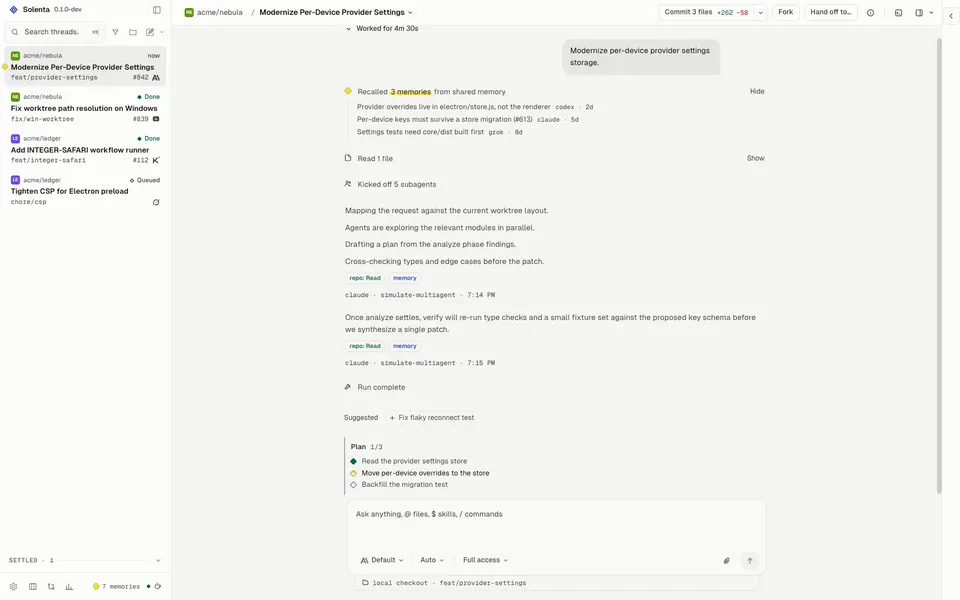
- Desktop app
- Mac, Windows and Linux
- Browser
- Yes
- Phone
- Phone browser
- Command line
- Yes
- Agents
- Claude Code, Codex, Cursor Agent, OpenCode and Grok
- Your subscription
- Works with your own plan
- Agents run
- On your computer and on your own server
- Laptop closed
- Keeps going
- Isolation
- Worktree
- Parallel agents
- Yes
- Scheduled runs
- Yes
- Coordinator agent
- Yes
- Built-in issues
- No
- Pull requests
- Yes
- Review screen
- Yes
- Team
- Not listed
- Self-hosting
- Yes
- Licence
- MIT
- Price from
- Free
- How it charges
- No paid plan and bring your own key
- Paid plans from
- Not listed
Receipts
- Checked
- · oldest answer 2026-11-07
- Findings
- 48 published · 35 cross-checked by a second agent · read them all
- Sources
- 32 public pages on 2 sites: solenta.app, github.com
- Screenshot
- solenta.app, retrieved · first party marketing · shows appearance, not capability
- Data
- /products/solenta.json · .md
- Method
- Same rules for all 103 researched ADEs. How we check · Report wrong data
What it does
Where you use it
Solenta ships macOS, Windows and Linux desktop clients and a host-served browser UI, including phone browsers. The complete download list has no native phone app.
Source and scope for Where you use itAgents it runs
Installed CLI providers retain their sessions in Solenta.
Source and scope for Agents it runsAccounts and subscriptions
Existing subscriptions, keys and local models are documented.
Source and scope for Accounts and subscriptionsWhere agents run
Solenta executes installed agent CLIs on the user's local machine or an SSH/headless host. The official FAQ explicitly says there is no Solenta cloud.
Source and scope for Where agents runHow work is kept apart
Solenta separates code with worktrees and launches local or SSH processes. The scoped runner exposes agent sandbox flags and optional macOS Seatbelt rules, with no product container or per-agent VM backend.
Source and scope for How work is kept apartScheduled runs
App-owned schedules and polled events trigger runs.
Source and scope for Scheduled runsGit and pull requests
The app manages worktree branches and PRs.
Source and scope for Git and pull requestsPrice
The entire Solenta application is free and MIT licensed. The public offering has no paid ADE tier, and Solenta never resells tokens or enters the billing path. Users pay their chosen agent providers separately.
Source and scope for PriceTyped filters
Every value links to its receipt below. Read plan and surface restrictions before using a filter to decide.
| Filter | Value |
|---|---|
| Desktop OS: macOS | Yes |
| Desktop OS: Windows | Yes |
| Desktop OS: Linux | Yes |
| Web client | Yes |
| Phone access: Native iOS | No |
| Phone access: Native Android | No |
| Phone access: Phone browser | Yes |
| CLI | Yes |
| Coding agents: Claude Code | Yes cross-checked |
| Coding agents: Codex | Yes cross-checked |
| Coding agents: Cursor Agent | Yes cross-checked |
| Coding agents: Gemini CLI | Unknown |
| Coding agents: OpenCode | Yes cross-checked |
| Coding agents: Pi | Unknown |
| Coding agents: Grok | Yes cross-checked |
| Coding agents: Aider | Unknown |
| Coding agents: Antigravity | Unknown |
| Use my subscription | Yes cross-checked |
| Where agents run: On your computer | Yes |
| Where agents run: On your own server | Yes |
| Where agents run: In the vendor's cloud | No |
| Workspace isolation: Git worktree | Yes |
| Workspace isolation: Container | No |
| Workspace isolation: VM or microVM | No |
| Parallel runs | Yes cross-checked |
| Coordinator | Yes cross-checked |
| Native issue tracking | No |
| Unattended triggers | Yes cross-checked |
| Shared prompting | Unknown |
| Team roles | No |
| SSO | No |
| Pull request workflow | Yes cross-checked |
| Review interface | Yes cross-checked |
| Product license: Apache-2.0 | No. MIT cross-checked |
| Product license: MIT | Yes. MIT cross-checked |
| Product license: GPL-3.0 | No. MIT cross-checked |
| Product license: GPL-3.0-or-later | No. MIT cross-checked |
| Product license: AGPL-3.0 | No. MIT cross-checked |
| Product license: AGPL-3.0-or-later | No. MIT cross-checked |
| Product license: Elastic License 2.0 | No. MIT cross-checked |
| Product license: Custom terms | No. MIT cross-checked |
| Product license: Proprietary | No. MIT cross-checked |
| Self-hosting | Yes cross-checked |
| Telemetry opt-out | Yes cross-checked |
| Free access | Yes cross-checked |
| Starting price: Free | Yes. Free cross-checked |
| Starting price: Up to $20/month | No. Free cross-checked |
| Starting price: $21–40/month | No. Free cross-checked |
| Starting price: $41–100/month | No. Free cross-checked |
| Starting price: Over $100/month | No. Free cross-checked |
| Starting price: Contact for pricing | No. Free cross-checked |
| Pricing model: Free, no paid plan | Yes |
| Pricing model: Free plan | No |
| Pricing model: Subscription | No |
| Pricing model: Per seat | No |
| Pricing model: Usage-based | No |
| Pricing model: Per machine or compute | No |
| Pricing model: Bring your own key | Yes cross-checked |
| Pricing model: One-time purchase | No |
| Paid plans from: No paid plan | Unknown |
| Paid plans from: $10 or less/month | Unknown |
| Paid plans from: $11–20/month | Unknown |
| Paid plans from: $21–40/month | Unknown |
| Paid plans from: $41–100/month | Unknown |
| Paid plans from: Over $100/month | Unknown |
| Paid plans from: Contact sales | Unknown |
| Lifecycle status: Active | Unknown |
| Lifecycle status: Sunsetting | Unknown |
| Keeps going with laptop closed | Yes |
| Open-source license | Yes. MIT cross-checked |
| Any desktop app | Yes |
| Paid plan up to $20/month | Unknown |
| Paid plan up to $40/month | Unknown |
| Any phone client | Yes |
Filter receipts
Desktop OS: macOS: Yes
Desktop OS: macOS
Typed value: Yes.
Solenta ships macOS, Windows and Linux desktop clients and a host-served browser UI, including phone browsers. The complete download list has no native phone app.
- Desktop os: macOS Apple Silicon, Windows x64 and Linux glibc x64; no Intel Mac build.
- Browser: Host-served Solenta Web.
- Mobile browser: Phone browsers pair with a device token.
- Task actions: Device grants distinguish read-only, steering and full access.
- Cross device continuity: The browser reconnects to host threads; offline messages queue.
- This source pass establishes only the named atomic answers. Other parts retain their documented source gaps; no hands-on test was performed.
-
Solenta: run Claude Code, Codex and Cursor in parallel
Finding: macOS Apple Silicon, Windows x64 portable and Linux glibc x64 downloads. The application is free and MIT licensed; agent subscriptions are separate.
Desktop OS: Windows: Yes
Desktop OS: Windows
Typed value: Yes.
Solenta ships macOS, Windows and Linux desktop clients and a host-served browser UI, including phone browsers. The complete download list has no native phone app.
- Desktop os: macOS Apple Silicon, Windows x64 and Linux glibc x64; no Intel Mac build.
- Browser: Host-served Solenta Web.
- Mobile browser: Phone browsers pair with a device token.
- Task actions: Device grants distinguish read-only, steering and full access.
- Cross device continuity: The browser reconnects to host threads; offline messages queue.
- This source pass establishes only the named atomic answers. Other parts retain their documented source gaps; no hands-on test was performed.
-
Solenta: run Claude Code, Codex and Cursor in parallel
Finding: macOS Apple Silicon, Windows x64 portable and Linux glibc x64 downloads. The application is free and MIT licensed; agent subscriptions are separate.
Desktop OS: Linux: Yes
Desktop OS: Linux
Typed value: Yes.
Solenta ships macOS, Windows and Linux desktop clients and a host-served browser UI, including phone browsers. The complete download list has no native phone app.
- Desktop os: macOS Apple Silicon, Windows x64 and Linux glibc x64; no Intel Mac build.
- Browser: Host-served Solenta Web.
- Mobile browser: Phone browsers pair with a device token.
- Task actions: Device grants distinguish read-only, steering and full access.
- Cross device continuity: The browser reconnects to host threads; offline messages queue.
- This source pass establishes only the named atomic answers. Other parts retain their documented source gaps; no hands-on test was performed.
-
Solenta: run Claude Code, Codex and Cursor in parallel
Finding: macOS Apple Silicon, Windows x64 portable and Linux glibc x64 downloads. The application is free and MIT licensed; agent subscriptions are separate.
Web client: Yes
Web client
Typed value: Yes.
Solenta ships macOS, Windows and Linux desktop clients and a host-served browser UI, including phone browsers. The complete download list has no native phone app.
- Desktop os: macOS Apple Silicon, Windows x64 and Linux glibc x64; no Intel Mac build.
- Browser: Host-served Solenta Web.
- Mobile browser: Phone browsers pair with a device token.
- Task actions: Device grants distinguish read-only, steering and full access.
- Cross device continuity: The browser reconnects to host threads; offline messages queue.
- This source pass establishes only the named atomic answers. Other parts retain their documented source gaps; no hands-on test was performed.
-
Phones and browsers | Solenta docs
Finding: Browser UI is served by the agent host with scoped device tokens, revocation and reconnect. Tailscale can provide HTTPS.
Phone access: Native iOS: No
Phone access: Native iOS
Typed value: No.
Solenta ships macOS, Windows and Linux desktop clients and a host-served browser UI, including phone browsers. The complete download list has no native phone app.
- Mobile apps: The full app download list covers macOS, Windows and Linux; phone access is the host-served browser UI.
- This source pass establishes only the named atomic answers. Other parts retain their documented source gaps; no hands-on test was performed.
-
Solenta download and offering list
Finding: The official offering is a free MIT desktop app for macOS, Windows and Linux, with browser access served by the user host. The complete download list has no iOS/Android app. The FAQ explicitly says there is no Solenta cloud and Solenta never resells tokens or sits in the billing path.
Phone access: Native Android: No
Phone access: Native Android
Typed value: No.
Solenta ships macOS, Windows and Linux desktop clients and a host-served browser UI, including phone browsers. The complete download list has no native phone app.
- Mobile apps: The full app download list covers macOS, Windows and Linux; phone access is the host-served browser UI.
- This source pass establishes only the named atomic answers. Other parts retain their documented source gaps; no hands-on test was performed.
-
Solenta download and offering list
Finding: The official offering is a free MIT desktop app for macOS, Windows and Linux, with browser access served by the user host. The complete download list has no iOS/Android app. The FAQ explicitly says there is no Solenta cloud and Solenta never resells tokens or sits in the billing path.
Phone access: Phone browser: Yes
Phone access: Phone browser
Typed value: Yes.
Solenta ships macOS, Windows and Linux desktop clients and a host-served browser UI, including phone browsers. The complete download list has no native phone app.
- Desktop os: macOS Apple Silicon, Windows x64 and Linux glibc x64; no Intel Mac build.
- Browser: Host-served Solenta Web.
- Mobile browser: Phone browsers pair with a device token.
- Task actions: Device grants distinguish read-only, steering and full access.
- Cross device continuity: The browser reconnects to host threads; offline messages queue.
- This source pass establishes only the named atomic answers. Other parts retain their documented source gaps; no hands-on test was performed.
-
Phones and browsers | Solenta docs
Finding: Browser UI is served by the agent host with scoped device tokens, revocation and reconnect. Tailscale can provide HTTPS.
CLI: Yes
CLI
Typed value: Yes.
External MCP callers launch and inspect tasks.
- Cli: Product-owned --serve-web and --headless startup flags; no task-management CLI established.
- Documentation establishes only the named atomic answers; remaining questions and hands-on behavior are unverified.
-
Other computers and SSH | Solenta docs
Finding: The app can install a Linux headless host over SSH; remote projects run CLIs there. Worktrees and orchestration remain local-only in v1.
Coding agents: Claude Code: Yes cross-checked
Coding agents: Claude Code
Typed value: Yes.
Installed CLI providers retain their sessions in Solenta.
- Harnesses: Claude Code, Codex, Cursor, Kimi, Grok, OpenCode and Muse.
- Session integration: CLI adapters retain provider session IDs.
- Mixed harness operation: Best of N sends a prompt to multiple providers concurrently; not hands-on tested.
- Documentation establishes only the named atomic answers; remaining questions and hands-on behavior are unverified.
-
Getting started | Solenta docs
Finding: Installed agent CLIs are discovered on PATH; adding a non-Git folder initializes Git.
Coding agents: Codex: Yes cross-checked
Coding agents: Codex
Typed value: Yes.
Installed CLI providers retain their sessions in Solenta.
- Harnesses: Claude Code, Codex, Cursor, Kimi, Grok, OpenCode and Muse.
- Session integration: CLI adapters retain provider session IDs.
- Mixed harness operation: Best of N sends a prompt to multiple providers concurrently; not hands-on tested.
- Documentation establishes only the named atomic answers; remaining questions and hands-on behavior are unverified.
-
Getting started | Solenta docs
Finding: Installed agent CLIs are discovered on PATH; adding a non-Git folder initializes Git.
Coding agents: Cursor Agent: Yes cross-checked
Coding agents: Cursor Agent
Typed value: Yes.
Installed CLI providers retain their sessions in Solenta.
- Harnesses: Claude Code, Codex, Cursor, Kimi, Grok, OpenCode and Muse.
- Session integration: CLI adapters retain provider session IDs.
- Mixed harness operation: Best of N sends a prompt to multiple providers concurrently; not hands-on tested.
- Documentation establishes only the named atomic answers; remaining questions and hands-on behavior are unverified.
-
Getting started | Solenta docs
Finding: Installed agent CLIs are discovered on PATH; adding a non-Git folder initializes Git.
Coding agents: OpenCode: Yes cross-checked
Coding agents: OpenCode
Typed value: Yes.
Installed CLI providers retain their sessions in Solenta.
- Harnesses: Claude Code, Codex, Cursor, Kimi, Grok, OpenCode and Muse.
- Session integration: CLI adapters retain provider session IDs.
- Mixed harness operation: Best of N sends a prompt to multiple providers concurrently; not hands-on tested.
- Documentation establishes only the named atomic answers; remaining questions and hands-on behavior are unverified.
-
Getting started | Solenta docs
Finding: Installed agent CLIs are discovered on PATH; adding a non-Git folder initializes Git.
Coding agents: Grok: Yes cross-checked
Coding agents: Grok
Typed value: Yes.
Installed CLI providers retain their sessions in Solenta.
- Harnesses: Claude Code, Codex, Cursor, Kimi, Grok, OpenCode and Muse.
- Session integration: CLI adapters retain provider session IDs.
- Mixed harness operation: Best of N sends a prompt to multiple providers concurrently; not hands-on tested.
- Documentation establishes only the named atomic answers; remaining questions and hands-on behavior are unverified.
-
Getting started | Solenta docs
Finding: Installed agent CLIs are discovered on PATH; adding a non-Git folder initializes Git.
Use my subscription: Yes cross-checked
Use my subscription
Typed value: Yes.
Existing subscriptions, keys and local models are documented.
- Agent subscriptions: Existing coding-agent subscriptions.
- Api accounts: Provider API keys and OpenAI-compatible endpoints.
- Local models: Ollama and LM Studio.
- Account switching: Separate Claude/Codex accounts can have separate CLI homes.
- Documentation establishes only the named atomic answers; remaining questions and hands-on behavior are unverified.
-
Solenta: run Claude Code, Codex and Cursor in parallel
Finding: macOS Apple Silicon, Windows x64 portable and Linux glibc x64 downloads. The application is free and MIT licensed; agent subscriptions are separate.
Where agents run: On your computer: Yes
Where agents run: On your computer
Typed value: Yes.
Solenta executes installed agent CLIs on the user's local machine or an SSH/headless host. The official FAQ explicitly says there is no Solenta cloud.
- Local: Local CLI execution.
- Byo remote: SSH remote projects and Linux headless hosts.
- Self hosted: The complete app can run headlessly on Linux.
- Provisioning: In-app SSH install/update for Linux x86_64.
- Client disconnect: Headless systemd service supports continued work after logout.
- Other device continuation: Connect opens the remote host app and its threads.
- This source pass establishes only the named atomic answers. Other parts retain their documented source gaps; no hands-on test was performed.
-
Other computers and SSH | Solenta docs
Finding: The app can install a Linux headless host over SSH; remote projects run CLIs there. Worktrees and orchestration remain local-only in v1.
Where agents run: On your own server: Yes
Where agents run: On your own server
Typed value: Yes.
Solenta executes installed agent CLIs on the user's local machine or an SSH/headless host. The official FAQ explicitly says there is no Solenta cloud.
- Local: Local CLI execution.
- Byo remote: SSH remote projects and Linux headless hosts.
- Self hosted: The complete app can run headlessly on Linux.
- Provisioning: In-app SSH install/update for Linux x86_64.
- Client disconnect: Headless systemd service supports continued work after logout.
- Other device continuation: Connect opens the remote host app and its threads.
- This source pass establishes only the named atomic answers. Other parts retain their documented source gaps; no hands-on test was performed.
-
Other computers and SSH | Solenta docs
Finding: The app can install a Linux headless host over SSH; remote projects run CLIs there. Worktrees and orchestration remain local-only in v1.
Where agents run: In the vendor's cloud: No
Where agents run: In the vendor's cloud
Typed value: No.
Solenta executes installed agent CLIs on the user's local machine or an SSH/headless host. The official FAQ explicitly says there is no Solenta cloud.
- This source pass establishes only the named atomic answers. Other parts retain their documented source gaps; no hands-on test was performed.
-
Solenta download and offering list
Finding: The official offering is a free MIT desktop app for macOS, Windows and Linux, with browser access served by the user host. The complete download list has no iOS/Android app. The FAQ explicitly says there is no Solenta cloud and Solenta never resells tokens or sits in the billing path.
Workspace isolation: Git worktree: Yes
Workspace isolation: Git worktree
Typed value: Yes.
Solenta separates code with worktrees and launches local or SSH processes. The scoped runner exposes agent sandbox flags and optional macOS Seatbelt rules, with no product container or per-agent VM backend.
- Branch: Each isolated thread uses its own branch.
- Worktree: Per-thread local worktrees.
- Code separation: Failed worktree setup fails closed.
- Security boundary: A worktree is code separation; these docs do not establish a security sandbox.
- This source pass establishes only the named atomic answers. Other parts retain their documented source gaps; no hands-on test was performed.
-
Finding: Local orchestrators fork worktree workers, communicate through MCP, collect results and integrate branches. Remote projects require plain threads by default.
-
Worktrees and pull requests | Solenta docs
Finding: Per-thread worktrees, staged diffs, inline review prompts, PR actions, checkpoints, JSON export and optional independent-provider review are documented.
Workspace isolation: Container: No
Workspace isolation: Container
Typed value: No.
Solenta separates code with worktrees and launches local or SSH processes. The scoped runner exposes agent sandbox flags and optional macOS Seatbelt rules, with no product container or per-agent VM backend.
- Container: No container provisioning or container execution backend in the scoped runner.
- Vm: No per-agent VM isolation backend; a WSL/SSH host is an execution location.
- This source pass establishes only the named atomic answers. Other parts retain their documented source gaps; no hands-on test was performed.
-
Finding: The scoped runner uses ordinary child processes locally, SSH hosts or WSL, with agent-specific permission flags and optional macOS Seatbelt wrapping. It has no product-provisioned container or per-agent VM execution backend. WSL host use is not a per-agent VM isolation option.
Workspace isolation: VM or microVM: No
Workspace isolation: VM or microVM
Typed value: No.
Solenta separates code with worktrees and launches local or SSH processes. The scoped runner exposes agent sandbox flags and optional macOS Seatbelt rules, with no product container or per-agent VM backend.
- Container: No container provisioning or container execution backend in the scoped runner.
- Vm: No per-agent VM isolation backend; a WSL/SSH host is an execution location.
- This source pass establishes only the named atomic answers. Other parts retain their documented source gaps; no hands-on test was performed.
-
Finding: The scoped runner uses ordinary child processes locally, SSH hosts or WSL, with agent-specific permission flags and optional macOS Seatbelt wrapping. It has no product-provisioned container or per-agent VM execution backend. WSL host use is not a per-agent VM isolation option.
Parallel runs: Yes cross-checked
Parallel runs
Typed value: Yes.
Independent provider runs execute concurrently.
- Concurrent sessions: Best of N launches several providers.
- Concurrent tasks: Workers run in separate local worktrees.
- Quotas: Default global maximum is four; configurable or uncapped.
- Status visibility: Running and queued threads retain status.
- Documentation establishes only the named atomic answers; remaining questions and hands-on behavior are unverified.
-
Threads and providers | Solenta docs
Finding: Threads retain provider sessions, models and permissions; Claude and Codex support live steering, while other providers queue follow-ups.
-
Spend guardrails | Solenta docs
Finding: Daily and orchestration budgets gate new work; a configurable concurrency cap queues runs oldest first.
Coordinator: Yes cross-checked
Coordinator
Typed value: Yes.
A product-owned orchestrator inspects workers and returns results.
- Roles: Lead and nested worker threads.
- Model harness effort: Each workflow phase can use a different provider; thread profiles include effort.
- Messages: Workers message each other directly.
- Results return: Worker cards contain diff, verify verdict, hypotheses and risks.
- Cross harness: Fork can choose another provider.
- Orchestration owner: Built-in coder-threads tools.
- Activation: New orchestrator thread or natural-language fan-out.
- Live progress: Agents panel and nested sidebar worker states.
- Retained results: Pending crew notices persist across restart.
- Followup: thread_send starts a prompt on an existing thread.
- Documentation establishes only the named atomic answers; remaining questions and hands-on behavior are unverified.
-
Finding: Local orchestrators fork worktree workers, communicate through MCP, collect results and integrate branches. Remote projects require plain threads by default.
-
Build workflows | Solenta docs
Finding: Sequential phases can fan out across providers, retry interrupted work and use versioned repository templates.
Native issue tracking: No
Native issue tracking
Typed value: No.
Solenta's Planboard is backed by GitHub/GitLab issues. It does not own a separate persistent issue tracker; native threads and spec artifacts are separate workflow objects.
- Task session separation: There is no native issue entity separate from threads; Planboard issues live on GitHub/GitLab.
- External tracker requirement: Planboard needs a GitHub or GitLab project origin and its credentials.
- This source pass establishes only the named atomic answers. Other parts retain their documented source gaps; no hands-on test was performed.
-
Finding: Planboard operations target GitHub/GitLab issues rather than product-owned issue records. Native state contains threads and spec artifacts, not a separate issue lifecycle. The docs explicitly describe the board as external issues.
Unattended triggers: Yes cross-checked
Unattended triggers
Typed value: Yes.
App-owned schedules and polled events trigger runs.
- Schedules: Hourly, daily, weekly and custom cron schedules.
- Events: GitHub, Linear and Sentry events.
- Recurring tasks: Automations persist and can be edited or paused.
- Scheduler location: The running app owns scheduling.
- Retries: Three consecutive failed runs pause the automation.
- Documentation establishes only the named atomic answers; remaining questions and hands-on behavior are unverified.
-
Finding: Schedules and polled GitHub, Linear and Sentry events start threads; three consecutive failures pause an automation.
Team roles: No
Team roles
Typed value: No.
Solenta Web has per-device read-only, steer and full-access grants with revocation. The scoped app has no named organization/project user roles or enterprise SSO.
- Organization roles: Scoped auth and persistence have devices and grants rather than organization members and roles.
- Project roles: Device capability grants are not named human workspace/project roles.
- Sso: The scoped browser auth accepts device tokens and has no SAML/OIDC enterprise identity flow.
- This source pass establishes only the named atomic answers. Other parts retain their documented source gaps; no hands-on test was performed.
-
Solenta shared device transport
Finding: Multiple paired browser devices connect to the same host thread state. Steer/full-access tokens can send thread instructions and approve tool requests through the shared IPC handlers, while broadcasts reach authorized clients. Authentication is device-token based; there is no organization role or SAML/OIDC single-sign-on model in these modules.
SSO: No
SSO
Typed value: No.
Solenta Web has per-device read-only, steer and full-access grants with revocation. The scoped app has no named organization/project user roles or enterprise SSO.
- Organization roles: Scoped auth and persistence have devices and grants rather than organization members and roles.
- Project roles: Device capability grants are not named human workspace/project roles.
- Sso: The scoped browser auth accepts device tokens and has no SAML/OIDC enterprise identity flow.
- This source pass establishes only the named atomic answers. Other parts retain their documented source gaps; no hands-on test was performed.
-
Solenta shared device transport
Finding: Multiple paired browser devices connect to the same host thread state. Steer/full-access tokens can send thread instructions and approve tool requests through the shared IPC handlers, while broadcasts reach authorized clients. Authentication is device-token based; there is no organization role or SAML/OIDC single-sign-on model in these modules.
Pull request workflow: Yes cross-checked
Pull request workflow
Typed value: Yes.
The app manages worktree branches and PRs.
- Branches: Per-thread branch.
- Worktrees: Optional isolated worktrees.
- Commits: Select files or hunks to commit.
- Pull requests: Create, edit, comment on, mark ready, close and merge GitHub PRs in the Git pane; GitLab merge requests support list, checkout, create and squash merge through glab.
- Rebase: Changing base rebases safely before first PR.
- Conflicts: Forecast warns about overlapping work.
- Documentation establishes only the named atomic answers; remaining questions and hands-on behavior are unverified.
-
Worktrees and pull requests | Solenta docs
Finding: Per-thread worktrees, staged diffs, inline review prompts, PR actions, checkpoints, JSON export and optional independent-provider review are documented.
Review interface: Yes cross-checked
Review interface
Typed value: Yes.
Diff review connects comments to agent follow-ups.
- Pending reviews: Open PRs and check badges appear in Review.
- Change understanding: Full-height Git pane and per-turn diffs.
- Evidence navigation: Transcript paths open files in the corresponding worktree.
- Comments: Inline diff comments are sent as agent prompts.
- Request changes: Follow-up includes path, line and quoted change.
- Shipping guidance: Next-action control names the next Git step.
- Keyboard: Permission/plan cards accept y, n or a.
- Documentation establishes only the named atomic answers; remaining questions and hands-on behavior are unverified.
-
Worktrees and pull requests | Solenta docs
Finding: Per-thread worktrees, staged diffs, inline review prompts, PR actions, checkpoints, JSON export and optional independent-provider review are documented.
-
Review itinerary | Solenta docs
Finding: Working-tree changes receive a risk-ranked review order that places CI/config changes first.
Product license: Apache-2.0: No. MIT cross-checked
Product license: Apache-2.0
Typed value: No. MIT.
Solenta is publicly MIT licensed.
- Client license: MIT.
- Source visibility: Public repository linked from official site.
- Documentation establishes only the named atomic answers; remaining questions and hands-on behavior are unverified.
-
Solenta: run Claude Code, Codex and Cursor in parallel
Finding: macOS Apple Silicon, Windows x64 portable and Linux glibc x64 downloads. The application is free and MIT licensed; agent subscriptions are separate.
Product license: MIT: Yes. MIT cross-checked
Product license: MIT
Typed value: Yes. MIT.
Solenta is publicly MIT licensed.
- Client license: MIT.
- Source visibility: Public repository linked from official site.
- Documentation establishes only the named atomic answers; remaining questions and hands-on behavior are unverified.
-
Solenta: run Claude Code, Codex and Cursor in parallel
Finding: macOS Apple Silicon, Windows x64 portable and Linux glibc x64 downloads. The application is free and MIT licensed; agent subscriptions are separate.
Product license: GPL-3.0: No. MIT cross-checked
Product license: GPL-3.0
Typed value: No. MIT.
Solenta is publicly MIT licensed.
- Client license: MIT.
- Source visibility: Public repository linked from official site.
- Documentation establishes only the named atomic answers; remaining questions and hands-on behavior are unverified.
-
Solenta: run Claude Code, Codex and Cursor in parallel
Finding: macOS Apple Silicon, Windows x64 portable and Linux glibc x64 downloads. The application is free and MIT licensed; agent subscriptions are separate.
Product license: GPL-3.0-or-later: No. MIT cross-checked
Product license: GPL-3.0-or-later
Typed value: No. MIT.
Solenta is publicly MIT licensed.
- Client license: MIT.
- Source visibility: Public repository linked from official site.
- Documentation establishes only the named atomic answers; remaining questions and hands-on behavior are unverified.
-
Solenta: run Claude Code, Codex and Cursor in parallel
Finding: macOS Apple Silicon, Windows x64 portable and Linux glibc x64 downloads. The application is free and MIT licensed; agent subscriptions are separate.
Product license: AGPL-3.0: No. MIT cross-checked
Product license: AGPL-3.0
Typed value: No. MIT.
Solenta is publicly MIT licensed.
- Client license: MIT.
- Source visibility: Public repository linked from official site.
- Documentation establishes only the named atomic answers; remaining questions and hands-on behavior are unverified.
-
Solenta: run Claude Code, Codex and Cursor in parallel
Finding: macOS Apple Silicon, Windows x64 portable and Linux glibc x64 downloads. The application is free and MIT licensed; agent subscriptions are separate.
Product license: AGPL-3.0-or-later: No. MIT cross-checked
Product license: AGPL-3.0-or-later
Typed value: No. MIT.
Solenta is publicly MIT licensed.
- Client license: MIT.
- Source visibility: Public repository linked from official site.
- Documentation establishes only the named atomic answers; remaining questions and hands-on behavior are unverified.
-
Solenta: run Claude Code, Codex and Cursor in parallel
Finding: macOS Apple Silicon, Windows x64 portable and Linux glibc x64 downloads. The application is free and MIT licensed; agent subscriptions are separate.
Product license: Elastic License 2.0: No. MIT cross-checked
Product license: Elastic License 2.0
Typed value: No. MIT.
Solenta is publicly MIT licensed.
- Client license: MIT.
- Source visibility: Public repository linked from official site.
- Documentation establishes only the named atomic answers; remaining questions and hands-on behavior are unverified.
-
Solenta: run Claude Code, Codex and Cursor in parallel
Finding: macOS Apple Silicon, Windows x64 portable and Linux glibc x64 downloads. The application is free and MIT licensed; agent subscriptions are separate.
Product license: Custom terms: No. MIT cross-checked
Product license: Custom terms
Typed value: No. MIT.
Solenta is publicly MIT licensed.
- Client license: MIT.
- Source visibility: Public repository linked from official site.
- Documentation establishes only the named atomic answers; remaining questions and hands-on behavior are unverified.
-
Solenta: run Claude Code, Codex and Cursor in parallel
Finding: macOS Apple Silicon, Windows x64 portable and Linux glibc x64 downloads. The application is free and MIT licensed; agent subscriptions are separate.
Product license: Proprietary: No. MIT cross-checked
Product license: Proprietary
Typed value: No. MIT.
Solenta is publicly MIT licensed.
- Client license: MIT.
- Source visibility: Public repository linked from official site.
- Documentation establishes only the named atomic answers; remaining questions and hands-on behavior are unverified.
-
Solenta: run Claude Code, Codex and Cursor in parallel
Finding: macOS Apple Silicon, Windows x64 portable and Linux glibc x64 downloads. The application is free and MIT licensed; agent subscriptions are separate.
Self-hosting: Yes cross-checked
Self-hosting
Typed value: Yes.
The full app runs on owned hosts and exports history.
- Self hosting: Linux headless app under user control.
- Export: JSON export of projects, threads and messages.
- Import: Vibe Kanban database and provider-session imports.
- Formats: JSON history export.
- History portability: Import or eject provider sessions; reclaim external turns.
- Documentation establishes only the named atomic answers; remaining questions and hands-on behavior are unverified.
-
Other computers and SSH | Solenta docs
Finding: The app can install a Linux headless host over SSH; remote projects run CLIs there. Worktrees and orchestration remain local-only in v1.
-
Worktrees and pull requests | Solenta docs
Finding: Per-thread worktrees, staged diffs, inline review prompts, PR actions, checkpoints, JSON export and optional independent-provider review are documented.
-
Import, eject and reclaim | Solenta docs
Finding: Import provider history, eject to a terminal and reclaim outside turns without duplicate messages.
Telemetry opt-out: Yes cross-checked
Telemetry opt-out
Typed value: Yes.
Local storage and provider requests have different boundaries.
- Telemetry controls: DO_NOT_TRACK=1 or SOLENTA_TELEMETRY=0 turns the daily anonymous ping off; the README at v0.29.0 and the telemetry module confirm the check. No in-app toggle was established.
- Documentation establishes only the named atomic answers; remaining questions and hands-on behavior are unverified.
-
Finding: Release builds send one anonymous usage ping a day (random install id, version, OS, architecture and agent CLIs used); setting DO_NOT_TRACK=1 or SOLENTA_TELEMETRY=0 turns it off, as the telemetry module checks.
Free access: Yes cross-checked
Free access
Typed value: Yes.
The application is free to download.
- Ongoing free: Free application; agent subscription/API costs remain separate.
- Free scenarios: Local parallel agent orchestration with existing CLIs.
- Documentation establishes only the named atomic answers; remaining questions and hands-on behavior are unverified.
-
Solenta: run Claude Code, Codex and Cursor in parallel
Finding: macOS Apple Silicon, Windows x64 portable and Linux glibc x64 downloads. The application is free and MIT licensed; agent subscriptions are separate.
Starting price: Free: Yes. Free cross-checked
Starting price: Free
Typed value: Yes. Free.
The application is free to download.
- Ongoing free: Free application; agent subscription/API costs remain separate.
- Free scenarios: Local parallel agent orchestration with existing CLIs.
- Documentation establishes only the named atomic answers; remaining questions and hands-on behavior are unverified.
-
Solenta: run Claude Code, Codex and Cursor in parallel
Finding: macOS Apple Silicon, Windows x64 portable and Linux glibc x64 downloads. The application is free and MIT licensed; agent subscriptions are separate.
Starting price: Up to $20/month: No. Free cross-checked
Starting price: Up to $20/month
Typed value: No. Free.
The application is free to download.
- Ongoing free: Free application; agent subscription/API costs remain separate.
- Free scenarios: Local parallel agent orchestration with existing CLIs.
- Documentation establishes only the named atomic answers; remaining questions and hands-on behavior are unverified.
-
Solenta: run Claude Code, Codex and Cursor in parallel
Finding: macOS Apple Silicon, Windows x64 portable and Linux glibc x64 downloads. The application is free and MIT licensed; agent subscriptions are separate.
Starting price: $21–40/month: No. Free cross-checked
Starting price: $21–40/month
Typed value: No. Free.
The application is free to download.
- Ongoing free: Free application; agent subscription/API costs remain separate.
- Free scenarios: Local parallel agent orchestration with existing CLIs.
- Documentation establishes only the named atomic answers; remaining questions and hands-on behavior are unverified.
-
Solenta: run Claude Code, Codex and Cursor in parallel
Finding: macOS Apple Silicon, Windows x64 portable and Linux glibc x64 downloads. The application is free and MIT licensed; agent subscriptions are separate.
Starting price: $41–100/month: No. Free cross-checked
Starting price: $41–100/month
Typed value: No. Free.
The application is free to download.
- Ongoing free: Free application; agent subscription/API costs remain separate.
- Free scenarios: Local parallel agent orchestration with existing CLIs.
- Documentation establishes only the named atomic answers; remaining questions and hands-on behavior are unverified.
-
Solenta: run Claude Code, Codex and Cursor in parallel
Finding: macOS Apple Silicon, Windows x64 portable and Linux glibc x64 downloads. The application is free and MIT licensed; agent subscriptions are separate.
Starting price: Over $100/month: No. Free cross-checked
Starting price: Over $100/month
Typed value: No. Free.
The application is free to download.
- Ongoing free: Free application; agent subscription/API costs remain separate.
- Free scenarios: Local parallel agent orchestration with existing CLIs.
- Documentation establishes only the named atomic answers; remaining questions and hands-on behavior are unverified.
-
Solenta: run Claude Code, Codex and Cursor in parallel
Finding: macOS Apple Silicon, Windows x64 portable and Linux glibc x64 downloads. The application is free and MIT licensed; agent subscriptions are separate.
Starting price: Contact for pricing: No. Free cross-checked
Starting price: Contact for pricing
Typed value: No. Free.
The application is free to download.
- Ongoing free: Free application; agent subscription/API costs remain separate.
- Free scenarios: Local parallel agent orchestration with existing CLIs.
- Documentation establishes only the named atomic answers; remaining questions and hands-on behavior are unverified.
-
Solenta: run Claude Code, Codex and Cursor in parallel
Finding: macOS Apple Silicon, Windows x64 portable and Linux glibc x64 downloads. The application is free and MIT licensed; agent subscriptions are separate.
Pricing model: Free, no paid plan: Yes
Pricing model: Free, no paid plan
Typed value: Yes.
The entire Solenta application is free and MIT licensed. The public offering has no paid ADE tier, and Solenta never resells tokens or enters the billing path. Users pay their chosen agent providers separately.
- Model cost: Existing subscriptions or own provider API keys.
- This source pass establishes only the named atomic answers. Other parts retain their documented source gaps; no hands-on test was performed.
-
Solenta: run Claude Code, Codex and Cursor in parallel
Finding: macOS Apple Silicon, Windows x64 portable and Linux glibc x64 downloads. The application is free and MIT licensed; agent subscriptions are separate.
Pricing model: Free plan: No
Pricing model: Free plan
Typed value: No.
The entire Solenta application is free and MIT licensed. The public offering has no paid ADE tier, and Solenta never resells tokens or enters the billing path. Users pay their chosen agent providers separately.
- This source pass establishes only the named atomic answers. Other parts retain their documented source gaps; no hands-on test was performed.
-
Solenta download and offering list
Finding: The official offering is a free MIT desktop app for macOS, Windows and Linux, with browser access served by the user host. The complete download list has no iOS/Android app. The FAQ explicitly says there is no Solenta cloud and Solenta never resells tokens or sits in the billing path.
Pricing model: Subscription: No
Pricing model: Subscription
Typed value: No.
The entire Solenta application is free and MIT licensed. The public offering has no paid ADE tier, and Solenta never resells tokens or enters the billing path. Users pay their chosen agent providers separately.
- This source pass establishes only the named atomic answers. Other parts retain their documented source gaps; no hands-on test was performed.
-
Solenta download and offering list
Finding: The official offering is a free MIT desktop app for macOS, Windows and Linux, with browser access served by the user host. The complete download list has no iOS/Android app. The FAQ explicitly says there is no Solenta cloud and Solenta never resells tokens or sits in the billing path.
Pricing model: Per seat: No
Pricing model: Per seat
Typed value: No.
The entire Solenta application is free and MIT licensed. The public offering has no paid ADE tier, and Solenta never resells tokens or enters the billing path. Users pay their chosen agent providers separately.
- This source pass establishes only the named atomic answers. Other parts retain their documented source gaps; no hands-on test was performed.
-
Solenta download and offering list
Finding: The official offering is a free MIT desktop app for macOS, Windows and Linux, with browser access served by the user host. The complete download list has no iOS/Android app. The FAQ explicitly says there is no Solenta cloud and Solenta never resells tokens or sits in the billing path.
Pricing model: Usage-based: No
Pricing model: Usage-based
Typed value: No.
The entire Solenta application is free and MIT licensed. The public offering has no paid ADE tier, and Solenta never resells tokens or enters the billing path. Users pay their chosen agent providers separately.
- This source pass establishes only the named atomic answers. Other parts retain their documented source gaps; no hands-on test was performed.
-
Solenta download and offering list
Finding: The official offering is a free MIT desktop app for macOS, Windows and Linux, with browser access served by the user host. The complete download list has no iOS/Android app. The FAQ explicitly says there is no Solenta cloud and Solenta never resells tokens or sits in the billing path.
Pricing model: Per machine or compute: No
Pricing model: Per machine or compute
Typed value: No.
The entire Solenta application is free and MIT licensed. The public offering has no paid ADE tier, and Solenta never resells tokens or enters the billing path. Users pay their chosen agent providers separately.
- This source pass establishes only the named atomic answers. Other parts retain their documented source gaps; no hands-on test was performed.
-
Solenta download and offering list
Finding: The official offering is a free MIT desktop app for macOS, Windows and Linux, with browser access served by the user host. The complete download list has no iOS/Android app. The FAQ explicitly says there is no Solenta cloud and Solenta never resells tokens or sits in the billing path.
Pricing model: Bring your own key: Yes cross-checked
Pricing model: Bring your own key
Typed value: Yes.
Existing subscriptions, keys and local models are documented.
- Agent subscriptions: Existing coding-agent subscriptions.
- Api accounts: Provider API keys and OpenAI-compatible endpoints.
- Local models: Ollama and LM Studio.
- Account switching: Separate Claude/Codex accounts can have separate CLI homes.
- Documentation establishes only the named atomic answers; remaining questions and hands-on behavior are unverified.
-
Solenta: run Claude Code, Codex and Cursor in parallel
Finding: macOS Apple Silicon, Windows x64 portable and Linux glibc x64 downloads. The application is free and MIT licensed; agent subscriptions are separate.
Pricing model: One-time purchase: No
Pricing model: One-time purchase
Typed value: No.
The entire Solenta application is free and MIT licensed. The public offering has no paid ADE tier, and Solenta never resells tokens or enters the billing path. Users pay their chosen agent providers separately.
- This source pass establishes only the named atomic answers. Other parts retain their documented source gaps; no hands-on test was performed.
-
Solenta download and offering list
Finding: The official offering is a free MIT desktop app for macOS, Windows and Linux, with browser access served by the user host. The complete download list has no iOS/Android app. The FAQ explicitly says there is no Solenta cloud and Solenta never resells tokens or sits in the billing path.
Keeps going with laptop closed: Yes
Keeps going with laptop closed
Typed value: Yes.
Solenta executes installed agent CLIs on the user's local machine or an SSH/headless host. The official FAQ explicitly says there is no Solenta cloud.
- Local: Local CLI execution.
- Byo remote: SSH remote projects and Linux headless hosts.
- Self hosted: The complete app can run headlessly on Linux.
- Provisioning: In-app SSH install/update for Linux x86_64.
- Client disconnect: Headless systemd service supports continued work after logout.
- Other device continuation: Connect opens the remote host app and its threads.
- This source pass establishes only the named atomic answers. Other parts retain their documented source gaps; no hands-on test was performed.
-
Other computers and SSH | Solenta docs
Finding: The app can install a Linux headless host over SSH; remote projects run CLIs there. Worktrees and orchestration remain local-only in v1.
-
Phones and browsers | Solenta docs
Finding: Browser UI is served by the agent host with scoped device tokens, revocation and reconnect. Tailscale can provide HTTPS.
Open-source license: Yes. MIT cross-checked
Open-source license
Typed value: Yes. MIT.
Solenta is publicly MIT licensed.
- Client license: MIT.
- Source visibility: Public repository linked from official site.
- Documentation establishes only the named atomic answers; remaining questions and hands-on behavior are unverified.
-
Solenta: run Claude Code, Codex and Cursor in parallel
Finding: macOS Apple Silicon, Windows x64 portable and Linux glibc x64 downloads. The application is free and MIT licensed; agent subscriptions are separate.
Any desktop app: Yes
Any desktop app
Typed value: Yes.
Solenta ships macOS, Windows and Linux desktop clients and a host-served browser UI, including phone browsers. The complete download list has no native phone app.
- Desktop os: macOS Apple Silicon, Windows x64 and Linux glibc x64; no Intel Mac build.
- Browser: Host-served Solenta Web.
- Mobile browser: Phone browsers pair with a device token.
- Task actions: Device grants distinguish read-only, steering and full access.
- Cross device continuity: The browser reconnects to host threads; offline messages queue.
- This source pass establishes only the named atomic answers. Other parts retain their documented source gaps; no hands-on test was performed.
-
Solenta: run Claude Code, Codex and Cursor in parallel
Finding: macOS Apple Silicon, Windows x64 portable and Linux glibc x64 downloads. The application is free and MIT licensed; agent subscriptions are separate.
Any phone client: Yes
Any phone client
Typed value: Yes.
Solenta ships macOS, Windows and Linux desktop clients and a host-served browser UI, including phone browsers. The complete download list has no native phone app.
- Desktop os: macOS Apple Silicon, Windows x64 and Linux glibc x64; no Intel Mac build.
- Browser: Host-served Solenta Web.
- Mobile browser: Phone browsers pair with a device token.
- Task actions: Device grants distinguish read-only, steering and full access.
- Cross device continuity: The browser reconnects to host threads; offline messages queue.
- This source pass establishes only the named atomic answers. Other parts retain their documented source gaps; no hands-on test was performed.
-
Phones and browsers | Solenta docs
Finding: Browser UI is served by the agent host with scoped device tokens, revocation and reconnect. Tailscale can provide HTTPS.
All public findings
Findings may summarize a source. They are not presented as verbatim statements.
solenta:ACC-01: Solenta ships macOS, Windows and Linux desktop clients and a host-served browser UI, including phone browsers. The complete download list has no native phone app.
solenta:ACC-01
Solenta ships macOS, Windows and Linux desktop clients and a host-served browser UI, including phone browsers. The complete download list has no native phone app.
- This source pass establishes only the named atomic answers. Other parts retain their documented source gaps; no hands-on test was performed.
-
Threads and providers | Solenta docs
Finding: Threads retain provider sessions, models and permissions; Claude and Codex support live steering, while other providers queue follow-ups.
-
Phones and browsers | Solenta docs
Finding: Browser UI is served by the agent host with scoped device tokens, revocation and reconnect. Tailscale can provide HTTPS.
-
Solenta: run Claude Code, Codex and Cursor in parallel
Finding: macOS Apple Silicon, Windows x64 portable and Linux glibc x64 downloads. The application is free and MIT licensed; agent subscriptions are separate.
-
Notifications and updates | Solenta docs
Finding: Desktop completion/decision notifications and a morning digest summarize unattended work.
-
Solenta download and offering list
Finding: The official offering is a free MIT desktop app for macOS, Windows and Linux, with browser access served by the user host. The complete download list has no iOS/Android app. The FAQ explicitly says there is no Solenta cloud and Solenta never resells tokens or sits in the billing path.
solenta:ACC-02: Installed CLI providers retain their sessions in Solenta. cross-checked
solenta:ACC-02
Installed CLI providers retain their sessions in Solenta.
- Documentation establishes only the named atomic answers; remaining questions and hands-on behavior are unverified.
-
Getting started | Solenta docs
Finding: Installed agent CLIs are discovered on PATH; adding a non-Git folder initializes Git.
-
Threads and providers | Solenta docs
Finding: Threads retain provider sessions, models and permissions; Claude and Codex support live steering, while other providers queue follow-ups.
solenta:ACC-03: Existing subscriptions, keys and local models are documented. cross-checked
solenta:ACC-03
Existing subscriptions, keys and local models are documented.
- Documentation establishes only the named atomic answers; remaining questions and hands-on behavior are unverified.
-
Solenta: run Claude Code, Codex and Cursor in parallel
Finding: macOS Apple Silicon, Windows x64 portable and Linux glibc x64 downloads. The application is free and MIT licensed; agent subscriptions are separate.
-
Solenta changelog: release notes and new features
Finding: Shipped provider accounts, local models, MCP controls, schedules and SSH teleport are listed in release notes.
solenta:ACC-04: Setup uses installed CLIs and offers an SSH host installer.
solenta:ACC-04
Setup uses installed CLIs and offers an SSH host installer.
- Documentation establishes only the named atomic answers; remaining questions and hands-on behavior are unverified.
-
Getting started | Solenta docs
Finding: Installed agent CLIs are discovered on PATH; adding a non-Git folder initializes Git.
-
Other computers and SSH | Solenta docs
Finding: The app can install a Linux headless host over SSH; remote projects run CLIs there. Worktrees and orchestration remain local-only in v1.
-
Solenta changelog: release notes and new features
Finding: Shipped provider accounts, local models, MCP controls, schedules and SSH teleport are listed in release notes.
-
Windows | Solenta documentation
Finding: The Windows doctor checks Git Bash, Node 22, long paths and WSL boundaries.
solenta:ACC-05: External MCP callers launch and inspect tasks. cross-checked
solenta:ACC-05
External MCP callers launch and inspect tasks.
- Documentation establishes only the named atomic answers; remaining questions and hands-on behavior are unverified.
-
Other computers and SSH | Solenta docs
Finding: The app can install a Linux headless host over SSH; remote projects run CLIs there. Worktrees and orchestration remain local-only in v1.
-
External MCP pairing | Solenta docs
Finding: External MCP clients can launch and inspect tasks with scoped expiring revocable tokens; new work defaults to approval.
solenta:ACC-06: MCP configuration and skill imports are product-managed. cross-checked
solenta:ACC-06
MCP configuration and skill imports are product-managed.
- Documentation establishes only the named atomic answers; remaining questions and hands-on behavior are unverified.
-
Skills | Solenta documentation
Finding: Users can import skills, MCP configurations and instructions; plugin/local command trust is separate.
-
Solenta changelog: release notes and new features
Finding: Shipped provider accounts, local models, MCP controls, schedules and SSH teleport are listed in release notes.
solenta:ACC-07: The desktop application uses Electron and React. cross-checked
solenta:ACC-07
The desktop application uses Electron and React.
- Documentation establishes only the named atomic answers; remaining questions and hands-on behavior are unverified.
-
Finding: Electron main manages processes, local storage and scheduling; the UI is React over typed IPC.
solenta:PLAN-01: External issue trackers remain authoritative. cross-checked
solenta:PLAN-01
External issue trackers remain authoritative.
- Documentation establishes only the named atomic answers; remaining questions and hands-on behavior are unverified.
-
Worktrees and pull requests | Solenta docs
Finding: Per-thread worktrees, staged diffs, inline review prompts, PR actions, checkpoints, JSON export and optional independent-provider review are documented.
-
Inbox, Planboard, Review | Solenta docs
Finding: The Planboard is GitHub/GitLab issues, not a local tracker. Auto-dispatch skips blocked issues; review queues group PR attention.
solenta:PLAN-02: Approved task artifacts and repository workflow templates precede dispatch.
solenta:PLAN-02
Approved task artifacts and repository workflow templates precede dispatch.
- Documentation establishes only the named atomic answers; remaining questions and hands-on behavior are unverified.
-
Spec mode | Solenta documentation
Finding: Thread artifacts progress through approved requirements, design and tasks. Dependency-aware dispatch and Converge operate on the task DAG.
-
Build workflows | Solenta docs
Finding: Sequential phases can fan out across providers, retry interrupted work and use versioned repository templates.
solenta:PLAN-03: Dependencies constrain dispatch. cross-checked
solenta:PLAN-03
Dependencies constrain dispatch.
- Documentation establishes only the named atomic answers; remaining questions and hands-on behavior are unverified.
-
Inbox, Planboard, Review | Solenta docs
Finding: The Planboard is GitHub/GitLab issues, not a local tracker. Auto-dispatch skips blocked issues; review queues group PR attention.
-
Spec mode | Solenta documentation
Finding: Thread artifacts progress through approved requirements, design and tasks. Dependency-aware dispatch and Converge operate on the task DAG.
solenta:PLAN-04: Local project memory carries source context. cross-checked
solenta:PLAN-04
Local project memory carries source context.
- Documentation establishes only the named atomic answers; remaining questions and hands-on behavior are unverified.
-
Shared Memory for Claude Code, Codex and Cursor Agents
Finding: Project-scoped local SQLite memory carries provenance and citations, invalidates stale file references, and injects recalled context into provider requests.
-
Skills | Solenta documentation
Finding: Users can import skills, MCP configurations and instructions; plugin/local command trust is separate.
solenta:PLAN-05: Code indexing and multimodal attachments provide context. cross-checked
solenta:PLAN-05
Code indexing and multimodal attachments provide context.
- Documentation establishes only the named atomic answers; remaining questions and hands-on behavior are unverified.
-
Threads and providers | Solenta docs
Finding: Threads retain provider sessions, models and permissions; Claude and Codex support live steering, while other providers queue follow-ups.
-
Shared Memory for Claude Code, Codex and Cursor Agents
Finding: Project-scoped local SQLite memory carries provenance and citations, invalidates stale file references, and injects recalled context into provider requests.
solenta:PLAN-06: Solenta's Planboard is backed by GitHub/GitLab issues. It does not own a separate persistent issue tracker; native threads and spec artifacts are separate workflow objects.
solenta:PLAN-06
Solenta's Planboard is backed by GitHub/GitLab issues. It does not own a separate persistent issue tracker; native threads and spec artifacts are separate workflow objects.
- This source pass establishes only the named atomic answers. Other parts retain their documented source gaps; no hands-on test was performed.
-
Finding: Planboard operations target GitHub/GitLab issues rather than product-owned issue records. Native state contains threads and spec artifacts, not a separate issue lifecycle. The docs explicitly describe the board as external issues.
solenta:PLAN-07: Agents write the GitHub issues shown on the Planboard. cross-checked
solenta:PLAN-07
Agents write the GitHub issues shown on the Planboard.
- Documentation establishes only the named atomic answers; remaining questions and hands-on behavior are unverified.
-
Finding: Local orchestrators fork worktree workers, communicate through MCP, collect results and integrate branches. Remote projects require plain threads by default.
solenta:PLAN-08: Spec mode is scoped to a thread; cross-release maintenance remains unverified. cross-checked
solenta:PLAN-08
Spec mode is scoped to a thread; cross-release maintenance remains unverified.
- Documentation establishes only the named atomic answers; remaining questions and hands-on behavior are unverified.
-
Spec mode | Solenta documentation
Finding: Thread artifacts progress through approved requirements, design and tasks. Dependency-aware dispatch and Converge operate on the task DAG.
solenta:COORD-01: Independent provider runs execute concurrently. cross-checked
solenta:COORD-01
Independent provider runs execute concurrently.
- Documentation establishes only the named atomic answers; remaining questions and hands-on behavior are unverified.
-
Threads and providers | Solenta docs
Finding: Threads retain provider sessions, models and permissions; Claude and Codex support live steering, while other providers queue follow-ups.
-
Spend guardrails | Solenta docs
Finding: Daily and orchestration budgets gate new work; a configurable concurrency cap queues runs oldest first.
solenta:COORD-02: Crews share claims and the global queue gates execution.
solenta:COORD-02
Crews share claims and the global queue gates execution.
- Documentation establishes only the named atomic answers; remaining questions and hands-on behavior are unverified.
-
Threads and providers | Solenta docs
Finding: Threads retain provider sessions, models and permissions; Claude and Codex support live steering, while other providers queue follow-ups.
-
Finding: Local orchestrators fork worktree workers, communicate through MCP, collect results and integrate branches. Remote projects require plain threads by default.
-
Spend guardrails | Solenta docs
Finding: Daily and orchestration budgets gate new work; a configurable concurrency cap queues runs oldest first.
-
Finding: Interactive Codex has live steering and approvals; noninteractive workflow phases lack live steering. Native session ownership is protected.
solenta:COORD-03: A product-owned orchestrator inspects workers and returns results. cross-checked
solenta:COORD-03
A product-owned orchestrator inspects workers and returns results.
- Documentation establishes only the named atomic answers; remaining questions and hands-on behavior are unverified.
-
Threads and providers | Solenta docs
Finding: Threads retain provider sessions, models and permissions; Claude and Codex support live steering, while other providers queue follow-ups.
-
Finding: Local orchestrators fork worktree workers, communicate through MCP, collect results and integrate branches. Remote projects require plain threads by default.
-
Build workflows | Solenta docs
Finding: Sequential phases can fan out across providers, retry interrupted work and use versioned repository templates.
solenta:COORD-04: App-owned schedules and polled events trigger runs. cross-checked
solenta:COORD-04
App-owned schedules and polled events trigger runs.
- Documentation establishes only the named atomic answers; remaining questions and hands-on behavior are unverified.
-
Finding: Schedules and polled GitHub, Linear and Sentry events start threads; three consecutive failures pause an automation.
-
Solenta changelog: release notes and new features
Finding: Shipped provider accounts, local models, MCP controls, schedules and SSH teleport are listed in release notes.
solenta:COORD-05: Threads support intervention and retain visible failures. cross-checked
solenta:COORD-05
Threads support intervention and retain visible failures.
- Documentation establishes only the named atomic answers; remaining questions and hands-on behavior are unverified.
-
Threads and providers | Solenta docs
Finding: Threads retain provider sessions, models and permissions; Claude and Codex support live steering, while other providers queue follow-ups.
-
Notifications and updates | Solenta docs
Finding: Desktop completion/decision notifications and a morning digest summarize unattended work.
-
Finding: Interactive Codex has live steering and approvals; noninteractive workflow phases lack live steering. Native session ownership is protected.
solenta:COORD-06: Fleet views expose relationships and attention states. cross-checked
solenta:COORD-06
Fleet views expose relationships and attention states.
- Documentation establishes only the named atomic answers; remaining questions and hands-on behavior are unverified.
-
Finding: Local orchestrators fork worktree workers, communicate through MCP, collect results and integrate branches. Remote projects require plain threads by default.
-
Inbox, Planboard, Review | Solenta docs
Finding: The Planboard is GitHub/GitLab issues, not a local tracker. Auto-dispatch skips blocked issues; review queues group PR attention.
solenta:COORD-07: Interactive runs and flexible orchestration coexist. cross-checked
solenta:COORD-07
Interactive runs and flexible orchestration coexist.
- Documentation establishes only the named atomic answers; remaining questions and hands-on behavior are unverified.
-
Threads and providers | Solenta docs
Finding: Threads retain provider sessions, models and permissions; Claude and Codex support live steering, while other providers queue follow-ups.
-
Finding: Local orchestrators fork worktree workers, communicate through MCP, collect results and integrate branches. Remote projects require plain threads by default.
-
Build workflows | Solenta docs
Finding: Sequential phases can fan out across providers, retry interrupted work and use versioned repository templates.
solenta:RUN-01: Solenta executes installed agent CLIs on the user's local machine or an SSH/headless host. The official FAQ explicitly says there is no Solenta cloud.
solenta:RUN-01
Solenta executes installed agent CLIs on the user's local machine or an SSH/headless host. The official FAQ explicitly says there is no Solenta cloud.
- This source pass establishes only the named atomic answers. Other parts retain their documented source gaps; no hands-on test was performed.
-
Other computers and SSH | Solenta docs
Finding: The app can install a Linux headless host over SSH; remote projects run CLIs there. Worktrees and orchestration remain local-only in v1.
-
Phones and browsers | Solenta docs
Finding: Browser UI is served by the agent host with scoped device tokens, revocation and reconnect. Tailscale can provide HTTPS.
-
Solenta download and offering list
Finding: The official offering is a free MIT desktop app for macOS, Windows and Linux, with browser access served by the user host. The complete download list has no iOS/Android app. The FAQ explicitly says there is no Solenta cloud and Solenta never resells tokens or sits in the billing path.
solenta:RUN-02: Solenta separates code with worktrees and launches local or SSH processes. The scoped runner exposes agent sandbox flags and optional macOS Seatbelt rules, with no product container or per-agent VM backend.
solenta:RUN-02
Solenta separates code with worktrees and launches local or SSH processes. The scoped runner exposes agent sandbox flags and optional macOS Seatbelt rules, with no product container or per-agent VM backend.
- This source pass establishes only the named atomic answers. Other parts retain their documented source gaps; no hands-on test was performed.
-
Finding: Local orchestrators fork worktree workers, communicate through MCP, collect results and integrate branches. Remote projects require plain threads by default.
-
Worktrees and pull requests | Solenta docs
Finding: Per-thread worktrees, staged diffs, inline review prompts, PR actions, checkpoints, JSON export and optional independent-provider review are documented.
-
Finding: The scoped runner uses ordinary child processes locally, SSH hosts or WSL, with agent-specific permission flags and optional macOS Seatbelt wrapping. It has no product-provisioned container or per-agent VM execution backend. WSL host use is not a per-agent VM isolation option.
solenta:RUN-03: Recovery retains conversations, interrupted phases and outside turns. cross-checked
solenta:RUN-03
Recovery retains conversations, interrupted phases and outside turns.
- Documentation establishes only the named atomic answers; remaining questions and hands-on behavior are unverified.
-
Threads and providers | Solenta docs
Finding: Threads retain provider sessions, models and permissions; Claude and Codex support live steering, while other providers queue follow-ups.
-
Finding: Local orchestrators fork worktree workers, communicate through MCP, collect results and integrate branches. Remote projects require plain threads by default.
-
Worktrees and pull requests | Solenta docs
Finding: Per-thread worktrees, staged diffs, inline review prompts, PR actions, checkpoints, JSON export and optional independent-provider review are documented.
-
Build workflows | Solenta docs
Finding: Sequential phases can fan out across providers, retry interrupted work and use versioned repository templates.
-
Import, eject and reclaim | Solenta docs
Finding: Import provider history, eject to a terminal and reclaim outside turns without duplicate messages.
solenta:RUN-04: Workspace configuration covers environment and development lanes.
solenta:RUN-04
Workspace configuration covers environment and development lanes.
- Documentation establishes only the named atomic answers; remaining questions and hands-on behavior are unverified.
-
Other computers and SSH | Solenta docs
Finding: The app can install a Linux headless host over SSH; remote projects run CLIs there. Worktrees and orchestration remain local-only in v1.
-
Worktrees and pull requests | Solenta docs
Finding: Per-thread worktrees, staged diffs, inline review prompts, PR actions, checkpoints, JSON export and optional independent-provider review are documented.
-
Project config files | Solenta docs
Finding: Shared solenta.json and local overrides define setup, quick actions and automations with command trust checks.
-
Finding: Managed servers use per-thread environment paths, optional readiness probes, retained command output and cleanup.
solenta:RUN-05: Budgets and provider quota waits constrain runs. cross-checked
solenta:RUN-05
Budgets and provider quota waits constrain runs.
- Source statements were checked; no hands-on scenario was run.
-
Threads and providers | Solenta docs
Finding: Threads retain provider sessions, models and permissions; Claude and Codex support live steering, while other providers queue follow-ups.
-
Spend guardrails | Solenta docs
Finding: Daily and orchestration budgets gate new work; a configurable concurrency cap queues runs oldest first.
-
Solenta changelog: release notes and new features
Finding: Shipped provider accounts, local models, MCP controls, schedules and SSH teleport are listed in release notes.
-
Build workflows | Solenta docs
Finding: Sequential phases can fan out across providers, retry interrupted work and use versioned repository templates.
-
Finding: Managed servers use per-thread environment paths, optional readiness probes, retained command output and cleanup.
solenta:RUN-06: Usage, traces and explicit failures are visible. cross-checked
solenta:RUN-06
Usage, traces and explicit failures are visible.
- Documentation establishes only the named atomic answers; remaining questions and hands-on behavior are unverified.
-
Threads and providers | Solenta docs
Finding: Threads retain provider sessions, models and permissions; Claude and Codex support live steering, while other providers queue follow-ups.
-
Usage and fleet analytics | Solenta docs
Finding: Usage separates provider/model costs and provider quota windows; estimated model prices fill missing costs and fleet metrics use Git/GitHub.
-
Finding: Managed servers use per-thread environment paths, optional readiness probes, retained command output and cleanup.
solenta:RUN-07: Thread usage separates estimates from reported costs. cross-checked
solenta:RUN-07
Thread usage separates estimates from reported costs.
- Documentation establishes only the named atomic answers; remaining questions and hands-on behavior are unverified.
-
Spend guardrails | Solenta docs
Finding: Daily and orchestration budgets gate new work; a configurable concurrency cap queues runs oldest first.
-
Usage and fleet analytics | Solenta docs
Finding: Usage separates provider/model costs and provider quota windows; estimated model prices fill missing costs and fleet metrics use Git/GitHub.
solenta:RUN-08: Concurrency is bounded by a product queue. cross-checked
solenta:RUN-08
Concurrency is bounded by a product queue.
- Documentation establishes only the named atomic answers; remaining questions and hands-on behavior are unverified.
-
Spend guardrails | Solenta docs
Finding: Daily and orchestration budgets gate new work; a configurable concurrency cap queues runs oldest first.
solenta:TEAM-01: Multiple paired browser devices can instruct the same host threads through Solenta Web. This is shared host access with device tokens, without distinct organization user identities.
solenta:TEAM-01
Multiple paired browser devices can instruct the same host threads through Solenta Web. This is shared host access with device tokens, without distinct organization user identities.
- This source pass establishes only the named atomic answers. Other parts retain their documented source gaps; no hands-on test was performed.
-
Solenta shared device transport
Finding: Multiple paired browser devices connect to the same host thread state. Steer/full-access tokens can send thread instructions and approve tool requests through the shared IPC handlers, while broadcasts reach authorized clients. Authentication is device-token based; there is no organization role or SAML/OIDC single-sign-on model in these modules.
solenta:TEAM-02: Solenta Web has per-device read-only, steer and full-access grants with revocation. The scoped app has no named organization/project user roles or enterprise SSO.
solenta:TEAM-02
Solenta Web has per-device read-only, steer and full-access grants with revocation. The scoped app has no named organization/project user roles or enterprise SSO.
- This source pass establishes only the named atomic answers. Other parts retain their documented source gaps; no hands-on test was performed.
-
Phones and browsers | Solenta docs
Finding: Browser UI is served by the agent host with scoped device tokens, revocation and reconnect. Tailscale can provide HTTPS.
-
Solenta shared device transport
Finding: Multiple paired browser devices connect to the same host thread state. Steer/full-access tokens can send thread instructions and approve tool requests through the shared IPC handlers, while broadcasts reach authorized clients. Authentication is device-token based; there is no organization role or SAML/OIDC single-sign-on model in these modules.
solenta:TEAM-03: Permissions and MCP pairings have bounded grants. cross-checked
solenta:TEAM-03
Permissions and MCP pairings have bounded grants.
- Documentation establishes only the named atomic answers; remaining questions and hands-on behavior are unverified.
-
Threads and providers | Solenta docs
Finding: Threads retain provider sessions, models and permissions; Claude and Codex support live steering, while other providers queue follow-ups.
-
Guardrails and verification | Solenta docs
Finding: Verify command failure prevents green completion. Claude governance policies are limited to calls surfaced for approval.
-
Phones and browsers | Solenta docs
Finding: Browser UI is served by the agent host with scoped device tokens, revocation and reconnect. Tailscale can provide HTTPS.
-
External MCP pairing | Solenta docs
Finding: External MCP clients can launch and inspect tasks with scoped expiring revocable tokens; new work defaults to approval.
-
Finding: Interactive Codex has live steering and approvals; noninteractive workflow phases lack live steering. Native session ownership is protected.
solenta:TEAM-04: Activity and checkpoints retain decisions. cross-checked
solenta:TEAM-04
Activity and checkpoints retain decisions.
- Documentation establishes only the named atomic answers; remaining questions and hands-on behavior are unverified.
-
Guardrails and verification | Solenta docs
Finding: Verify command failure prevents green completion. Claude governance policies are limited to calls surfaced for approval.
-
Worktrees and pull requests | Solenta docs
Finding: Per-thread worktrees, staged diffs, inline review prompts, PR actions, checkpoints, JSON export and optional independent-provider review are documented.
solenta:TEAM-05: Diff review connects comments to agent follow-ups. cross-checked
solenta:TEAM-05
Diff review connects comments to agent follow-ups.
- Documentation establishes only the named atomic answers; remaining questions and hands-on behavior are unverified.
-
Worktrees and pull requests | Solenta docs
Finding: Per-thread worktrees, staged diffs, inline review prompts, PR actions, checkpoints, JSON export and optional independent-provider review are documented.
-
Inbox, Planboard, Review | Solenta docs
Finding: The Planboard is GitHub/GitLab issues, not a local tracker. Auto-dispatch skips blocked issues; review queues group PR attention.
-
Review itinerary | Solenta docs
Finding: Working-tree changes receive a risk-ranked review order that places CI/config changes first.
solenta:SHIP-01: Diffs, spec artifacts and checkpoints remain linked to threads. cross-checked
solenta:SHIP-01
Diffs, spec artifacts and checkpoints remain linked to threads.
- Documentation establishes only the named atomic answers; remaining questions and hands-on behavior are unverified.
-
Finding: Local orchestrators fork worktree workers, communicate through MCP, collect results and integrate branches. Remote projects require plain threads by default.
-
Worktrees and pull requests | Solenta docs
Finding: Per-thread worktrees, staged diffs, inline review prompts, PR actions, checkpoints, JSON export and optional independent-provider review are documented.
-
Spec mode | Solenta documentation
Finding: Thread artifacts progress through approved requirements, design and tasks. Dependency-aware dispatch and Converge operate on the task DAG.
-
Finding: Managed servers use per-thread environment paths, optional readiness probes, retained command output and cleanup.
-
Terminal and Browser panes | Solenta docs
Finding: Per-thread shell and loopback browser provide previews, screenshots and agent-visible diagnostics.
solenta:SHIP-02: Configured verification gates green completion. cross-checked
solenta:SHIP-02
Configured verification gates green completion.
- Documentation establishes only the named atomic answers; remaining questions and hands-on behavior are unverified.
-
Guardrails and verification | Solenta docs
Finding: Verify command failure prevents green completion. Claude governance policies are limited to calls surfaced for approval.
-
Worktrees and pull requests | Solenta docs
Finding: Per-thread worktrees, staged diffs, inline review prompts, PR actions, checkpoints, JSON export and optional independent-provider review are documented.
-
Spec mode | Solenta documentation
Finding: Thread artifacts progress through approved requirements, design and tasks. Dependency-aware dispatch and Converge operate on the task DAG.
solenta:SHIP-03: The app manages worktree branches and PRs. cross-checked
solenta:SHIP-03
The app manages worktree branches and PRs.
- Documentation establishes only the named atomic answers; remaining questions and hands-on behavior are unverified.
-
Worktrees and pull requests | Solenta docs
Finding: Per-thread worktrees, staged diffs, inline review prompts, PR actions, checkpoints, JSON export and optional independent-provider review are documented.
solenta:SHIP-04: Merge and PR actions are available in the Git pane.
solenta:SHIP-04
Merge and PR actions are available in the Git pane.
- Documentation establishes only the named atomic answers; remaining questions and hands-on behavior are unverified.
-
Worktrees and pull requests | Solenta docs
Finding: Per-thread worktrees, staged diffs, inline review prompts, PR actions, checkpoints, JSON export and optional independent-provider review are documented.
solenta:SHIP-05: Checkpoints, revert PRs and post-merge verification aid recovery. cross-checked
solenta:SHIP-05
Checkpoints, revert PRs and post-merge verification aid recovery.
- Documentation establishes only the named atomic answers; remaining questions and hands-on behavior are unverified.
-
Guardrails and verification | Solenta docs
Finding: Verify command failure prevents green completion. Claude governance policies are limited to calls surfaced for approval.
-
Worktrees and pull requests | Solenta docs
Finding: Per-thread worktrees, staged diffs, inline review prompts, PR actions, checkpoints, JSON export and optional independent-provider review are documented.
solenta:SHIP-06: PR queues organize high-volume review.
solenta:SHIP-06
PR queues organize high-volume review.
- Documentation establishes only the named atomic answers; remaining questions and hands-on behavior are unverified.
-
Inbox, Planboard, Review | Solenta docs
Finding: The Planboard is GitHub/GitLab issues, not a local tracker. Auto-dispatch skips blocked issues; review queues group PR attention.
-
Review itinerary | Solenta docs
Finding: Working-tree changes receive a risk-ranked review order that places CI/config changes first.
solenta:OWN-01: Solenta is publicly MIT licensed. cross-checked
solenta:OWN-01
Solenta is publicly MIT licensed.
- Documentation establishes only the named atomic answers; remaining questions and hands-on behavior are unverified.
-
Solenta: run Claude Code, Codex and Cursor in parallel
Finding: macOS Apple Silicon, Windows x64 portable and Linux glibc x64 downloads. The application is free and MIT licensed; agent subscriptions are separate.
solenta:OWN-02: The full app runs on owned hosts and exports history. cross-checked
solenta:OWN-02
The full app runs on owned hosts and exports history.
- Documentation establishes only the named atomic answers; remaining questions and hands-on behavior are unverified.
-
Other computers and SSH | Solenta docs
Finding: The app can install a Linux headless host over SSH; remote projects run CLIs there. Worktrees and orchestration remain local-only in v1.
-
Worktrees and pull requests | Solenta docs
Finding: Per-thread worktrees, staged diffs, inline review prompts, PR actions, checkpoints, JSON export and optional independent-provider review are documented.
-
Import, eject and reclaim | Solenta docs
Finding: Import provider history, eject to a terminal and reclaim outside turns without duplicate messages.
solenta:OWN-03: Local storage and provider requests have different boundaries. cross-checked
solenta:OWN-03
Local storage and provider requests have different boundaries.
- Documentation establishes only the named atomic answers; remaining questions and hands-on behavior are unverified.
-
Shared Memory for Claude Code, Codex and Cursor Agents
Finding: Project-scoped local SQLite memory carries provenance and citations, invalidates stale file references, and injects recalled context into provider requests.
-
Solenta changelog: release notes and new features
Finding: Shipped provider accounts, local models, MCP controls, schedules and SSH teleport are listed in release notes.
-
Finding: Release builds send one anonymous usage ping a day (random install id, version, OS, architecture and agent CLIs used); setting DO_NOT_TRACK=1 or SOLENTA_TELEMETRY=0 turns it off, as the telemetry module checks.
solenta:OWN-04: The entire Solenta application is free and MIT licensed. The public offering has no paid ADE tier, and Solenta never resells tokens or enters the billing path. Users pay their chosen agent providers separately.
solenta:OWN-04
The entire Solenta application is free and MIT licensed. The public offering has no paid ADE tier, and Solenta never resells tokens or enters the billing path. Users pay their chosen agent providers separately.
- This source pass establishes only the named atomic answers. Other parts retain their documented source gaps; no hands-on test was performed.
-
Solenta: run Claude Code, Codex and Cursor in parallel
Finding: macOS Apple Silicon, Windows x64 portable and Linux glibc x64 downloads. The application is free and MIT licensed; agent subscriptions are separate.
-
Solenta download and offering list
Finding: The official offering is a free MIT desktop app for macOS, Windows and Linux, with browser access served by the user host. The complete download list has no iOS/Android app. The FAQ explicitly says there is no Solenta cloud and Solenta never resells tokens or sits in the billing path.
solenta:OWN-06: Release activity is documented. cross-checked
solenta:OWN-06
Release activity is documented.
- Documentation establishes only the named atomic answers; remaining questions and hands-on behavior are unverified.
-
Solenta changelog: release notes and new features
Finding: Shipped provider accounts, local models, MCP controls, schedules and SSH teleport are listed in release notes.
solenta:OWN-08: The application is free to download. cross-checked
solenta:OWN-08
The application is free to download.
- Documentation establishes only the named atomic answers; remaining questions and hands-on behavior are unverified.
-
Solenta: run Claude Code, Codex and Cursor in parallel
Finding: macOS Apple Silicon, Windows x64 portable and Linux glibc x64 downloads. The application is free and MIT licensed; agent subscriptions are separate.
solenta:OWN-09: The ADE has no application subscription charge. cross-checked
solenta:OWN-09
The ADE has no application subscription charge.
- Documentation establishes only the named atomic answers; remaining questions and hands-on behavior are unverified.
-
Solenta: run Claude Code, Codex and Cursor in parallel
Finding: macOS Apple Silicon, Windows x64 portable and Linux glibc x64 downloads. The application is free and MIT licensed; agent subscriptions are separate.