SuperPlane
Open-source browser app. Agents run on your own server or in the vendor's cloud.
Product websitesuperplane.com Compare with others Missing or wrong data?
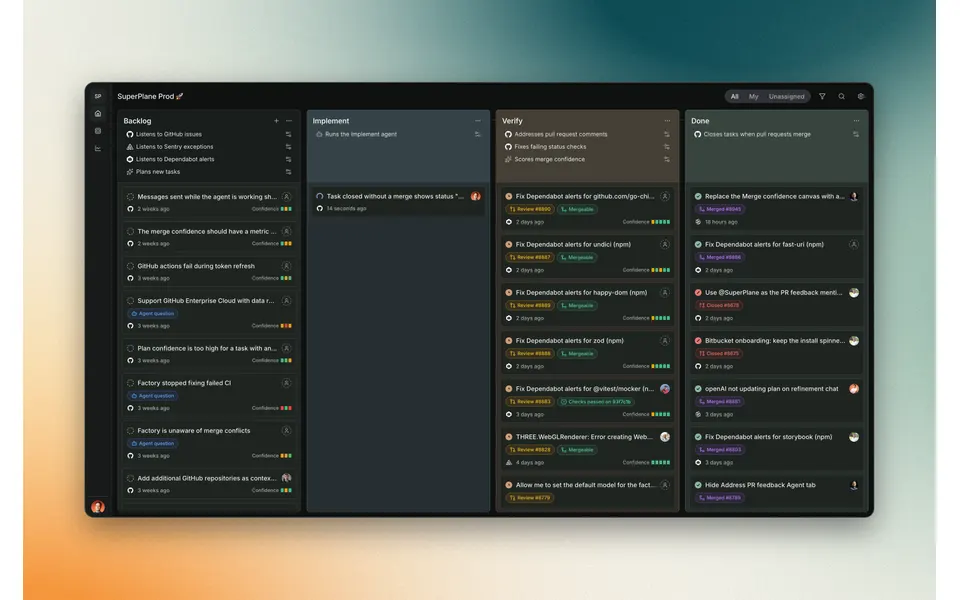
- Desktop app
- No
- Browser
- Yes
- Phone
- Phone browser
- Command line
- Yes
- Agents
- Claude Code, Codex and Cursor Agent
- Your subscription
- Works with your own plan
- Agents run
- On your own server and in the vendor's cloud
- Laptop closed
- Keeps going
- Isolation
- Container and VM
- Parallel agents
- Yes
- Scheduled runs
- Yes
- Coordinator agent
- No
- Built-in issues
- Yes
- Pull requests
- Yes
- Review screen
- Yes
- Team
- Shared sessions, roles and SSO
- Self-hosting
- Yes
- Licence
- Apache-2.0
- Price from
- Free
- How it charges
- Free plan, subscription, per seat, usage-based, per machine or compute and bring your own key
- Paid plans from
- $11–20/month
Receipts
- Checked
- Findings
- 49 published · 45 cross-checked by a second agent · read them all
- Sources
- 82 public pages on 5 sites: github.com, raw.githubusercontent.com, superplane.com, docs.superplane.com and 1 more
- GitHub stars
- 10,025 on · api.github.com · repository attention, not users or capability
- Screenshot
- github.com, retrieved · first party repository · shows appearance, not capability
- Data
- /products/superplane.json · .md
- Method
- Same rules for all 103 researched ADEs. How we check · Report wrong data
What it does
Where you use it
SuperPlane primarily uses the hosted web/phone-browser app, with a companion CLI and a first-party hardware badge client. The bounded public source and release inventory contains no desktop GUI or native phone app.
Source and scope for Where you use itAgents it runs
Workspace agents run Claude Code, Codex (ChatGPT subscriptions), Cursor cloud agents and OpenAI/CustomLLM/OpenRouter/Perplexity components with managed models across seven providers; the product sequences agent sessions through runner components. Joint multi-harness operation in one factory is unestablished.
Source and scope for Agents it runsAccounts and subscriptions
Codex runs on members’ ChatGPT subscriptions (BYOS) and Claude/OpenAI/OpenRouter API keys (BYOK) with provider-side billing and no SuperPlane token markup; otherwise managed models bill provider rate plus 10% from the credit balance with auto-purchase. No local-model route, trial or allowance exists.
Source and scope for Accounts and subscriptionsWhere agents run
Agents execute on SuperPlane-managed Linux machines or self-hosted servers, never on the user laptop; per-node timeouts bound runs; durable execution plus web and badge clients imply laptop independence, with explicit disconnect/continuation tests unestablished. Idle and maximum lifetimes are unverified.
Source and scope for Where agents runHow work is kept apart
Runner components execute arbitrary code in dedicated isolated ephemeral VMs or containers destroyed afterwards; Daytona sandboxes isolate repo work; per-task branches separate code; secrets are AES-256 and memory-only. Worktrees and finer process/network/OS boundaries are unestablished.
Source and scope for How work is kept apartParallel work
Independent tasks run concurrently with plan caps (5 pay-as-you-go, unlimited paid) and a default per-step parallelism cap of 10 with slot queueing; the board shows running, waiting, failed and finished work by stage.
Source and scope for Parallel workScheduled runs
Schedule (minutes-to-cron with timezones), issue/PR, Sentry and webhook triggers start work, including recurring scheduled-intake proposals and completion-conditioned Done rules. Scheduler server-side placement, overlap handling, retry policies and close-client behavior are only partly established.
Source and scope for Scheduled runsGit and pull requests
Source-control components create and update branches and pull requests with explanations, respond to review comments and CI, and offer merge/squash/rebase completion; worktrees and branch-update rebase mechanics are unestablished.
Source and scope for Git and pull requestsLicence and source
The public repository engine is Apache License 2.0; Enterprise-only capabilities (Kubernetes install, SSO, audit logs, configurable retention) ship under a separate commercial Enterprise Edition license requiring Terms acceptance and a valid Enterprise license.
Source and scope for Licence and sourcePrice
Current commercial terms (billing and pricing pages, 2026-11-12): pay-as-you-go $0 per organization per month plus usage, Starter $20 per organization per month plus usage, Team $50 per user per month plus usage, Enterprise custom; credits fund sandbox time, charged separately under every model source, and SuperPlane-provided tokens at provider rate plus 10% (Enterprise custom); own keys and ChatGPT subscriptions carry no token markup. Top up or schedule automatic purchases; pay-as-you-go requires a card; budget controls live on Team and Enterprise.
Source and scope for PriceTyped filters
Every value links to its receipt below. Read plan and surface restrictions before using a filter to decide.
| Filter | Value |
|---|---|
| Desktop OS: macOS | No |
| Desktop OS: Windows | No |
| Desktop OS: Linux | No |
| Web client | Yes |
| Phone access: Native iOS | No |
| Phone access: Native Android | No |
| Phone access: Phone browser | Yes |
| CLI | Yes cross-checked |
| Coding agents: Claude Code | Yes cross-checked |
| Coding agents: Codex | Yes cross-checked |
| Coding agents: Cursor Agent | Yes cross-checked |
| Coding agents: Gemini CLI | No |
| Coding agents: OpenCode | No |
| Coding agents: Pi | No |
| Coding agents: Grok | No |
| Coding agents: Aider | No |
| Coding agents: Antigravity | No |
| Use my subscription | Yes cross-checked |
| Where agents run: On your computer | No |
| Where agents run: On your own server | Yes cross-checked |
| Where agents run: In the vendor's cloud | Yes cross-checked |
| Workspace isolation: Git worktree | No |
| Workspace isolation: Container | Yes cross-checked |
| Workspace isolation: VM or microVM | Yes cross-checked |
| Parallel runs | Yes cross-checked |
| Coordinator | No |
| Native issue tracking | Yes cross-checked |
| Unattended triggers | Yes cross-checked |
| Shared prompting | Yes |
| Team roles | Yes cross-checked |
| SSO | Yes cross-checked |
| Pull request workflow | Yes cross-checked |
| Review interface | Yes cross-checked |
| Product license: Apache-2.0 | Yes. Apache-2.0 cross-checked |
| Product license: MIT | No. Apache-2.0 cross-checked |
| Product license: GPL-3.0 | No. Apache-2.0 cross-checked |
| Product license: GPL-3.0-or-later | No. Apache-2.0 cross-checked |
| Product license: AGPL-3.0 | No. Apache-2.0 cross-checked |
| Product license: AGPL-3.0-or-later | No. Apache-2.0 cross-checked |
| Product license: Elastic License 2.0 | No. Apache-2.0 cross-checked |
| Product license: Custom terms | No. Apache-2.0 cross-checked |
| Product license: Proprietary | No. Apache-2.0 cross-checked |
| Self-hosting | Yes cross-checked |
| Telemetry opt-out | Yes |
| Free access | Yes cross-checked |
| Starting price: Free | Yes. Free cross-checked |
| Starting price: Up to $20/month | No. Free cross-checked |
| Starting price: $21–40/month | No. Free cross-checked |
| Starting price: $41–100/month | No. Free cross-checked |
| Starting price: Over $100/month | No. Free cross-checked |
| Starting price: Contact for pricing | No. Free cross-checked |
| Pricing model: Free, no paid plan | No cross-checked |
| Pricing model: Free plan | Yes cross-checked |
| Pricing model: Subscription | Yes cross-checked |
| Pricing model: Per seat | Yes cross-checked |
| Pricing model: Usage-based | Yes cross-checked |
| Pricing model: Per machine or compute | Yes cross-checked |
| Pricing model: Bring your own key | Yes cross-checked |
| Pricing model: One-time purchase | No cross-checked |
| Paid plans from: No paid plan | No. $11–20/month |
| Paid plans from: $10 or less/month | No. $11–20/month |
| Paid plans from: $11–20/month | Yes. $11–20/month |
| Paid plans from: $21–40/month | No. $11–20/month |
| Paid plans from: $41–100/month | No. $11–20/month |
| Paid plans from: Over $100/month | No. $11–20/month |
| Paid plans from: Contact sales | No. $11–20/month |
| Lifecycle status: Active | Unknown |
| Lifecycle status: Sunsetting | Unknown |
| Keeps going with laptop closed | Yes cross-checked |
| Open-source license | Yes. Apache-2.0 cross-checked |
| Any desktop app | No |
| Paid plan up to $20/month | Yes. $11–20/month |
| Paid plan up to $40/month | Yes. $11–20/month |
| Any phone client | Yes |
Filter receipts
Desktop OS: macOS: No
Desktop OS: macOS
Typed value: No.
SuperPlane primarily uses the hosted web/phone-browser app, with a companion CLI and a first-party hardware badge client. The bounded public source and release inventory contains no desktop GUI or native phone app.
- Desktop os: No desktop GUI in the scoped superplane core/release targets or Remote_Control client. Hosted web app; companion CLI only.
- This source pass establishes only the named atomic answers. Other parts retain their documented source gaps; no hands-on test was performed.
-
SuperPlane bounded native-client distribution inventory
Finding: The scoped core repository builds the hosted browser UI and Go server/companion CLI. Its public release inventory contains server, runner, fleet-manager and CLI artifacts, with no macOS/Windows/Linux desktop GUI. The first-party Remote_Control project is a hardware badge client, not a desktop GUI. No desktop-client repository appears in the checked public product inventory.
Desktop OS: Windows: No
Desktop OS: Windows
Typed value: No.
SuperPlane primarily uses the hosted web/phone-browser app, with a companion CLI and a first-party hardware badge client. The bounded public source and release inventory contains no desktop GUI or native phone app.
- Desktop os: No desktop GUI in the scoped superplane core/release targets or Remote_Control client. Hosted web app; companion CLI only.
- This source pass establishes only the named atomic answers. Other parts retain their documented source gaps; no hands-on test was performed.
-
SuperPlane bounded native-client distribution inventory
Finding: The scoped core repository builds the hosted browser UI and Go server/companion CLI. Its public release inventory contains server, runner, fleet-manager and CLI artifacts, with no macOS/Windows/Linux desktop GUI. The first-party Remote_Control project is a hardware badge client, not a desktop GUI. No desktop-client repository appears in the checked public product inventory.
Desktop OS: Linux: No
Desktop OS: Linux
Typed value: No.
SuperPlane primarily uses the hosted web/phone-browser app, with a companion CLI and a first-party hardware badge client. The bounded public source and release inventory contains no desktop GUI or native phone app.
- Desktop os: No desktop GUI in the scoped superplane core/release targets or Remote_Control client. Hosted web app; companion CLI only.
- This source pass establishes only the named atomic answers. Other parts retain their documented source gaps; no hands-on test was performed.
-
SuperPlane bounded native-client distribution inventory
Finding: The scoped core repository builds the hosted browser UI and Go server/companion CLI. Its public release inventory contains server, runner, fleet-manager and CLI artifacts, with no macOS/Windows/Linux desktop GUI. The first-party Remote_Control project is a hardware badge client, not a desktop GUI. No desktop-client repository appears in the checked public product inventory.
Web client: Yes
Web client
Typed value: Yes.
SuperPlane primarily uses the hosted web/phone-browser app, with a companion CLI and a first-party hardware badge client. The bounded public source and release inventory contains no desktop GUI or native phone app.
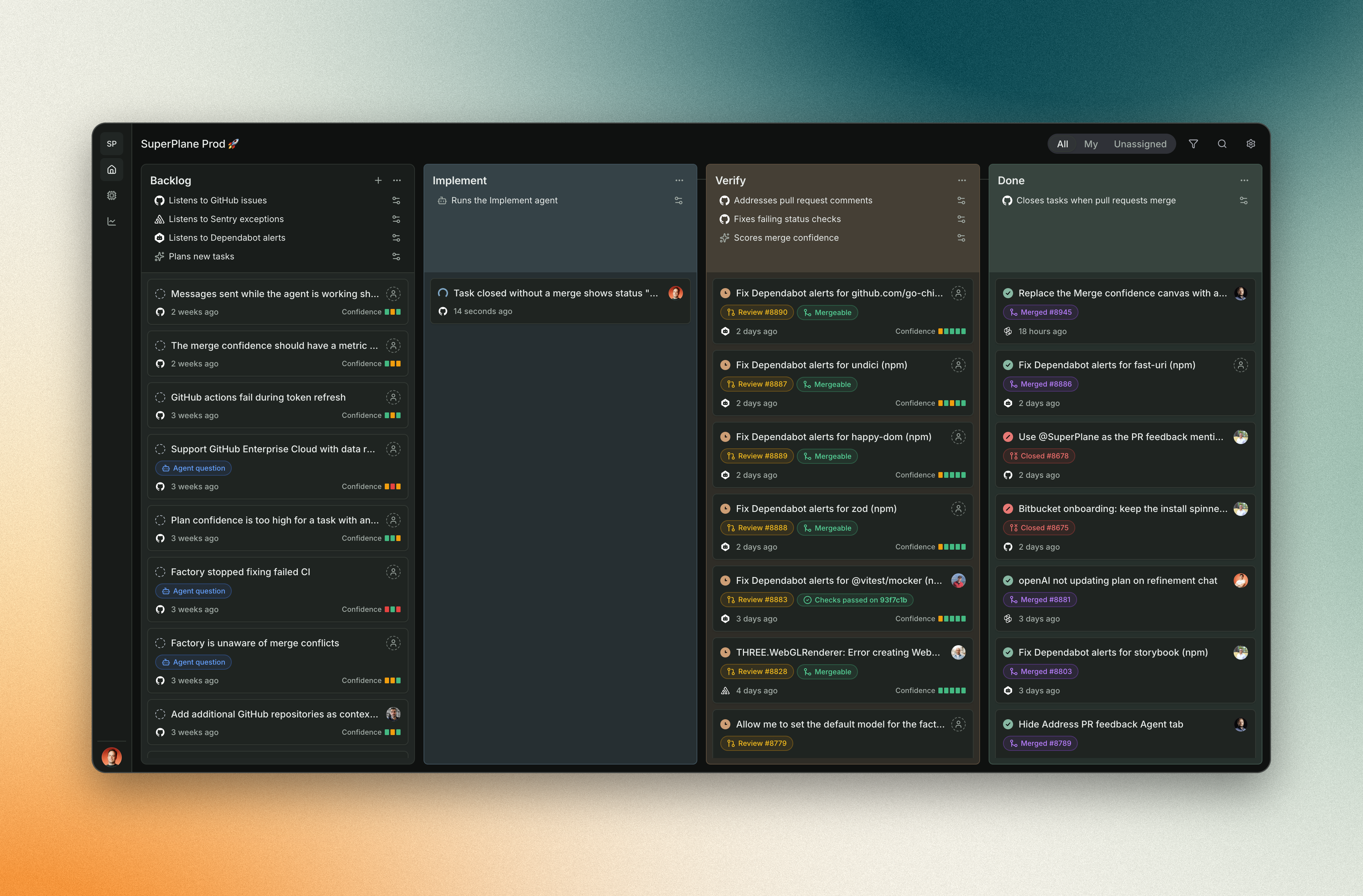
- Browser: The hosted web app at app.superplane.com is the primary client: board with Backlog/Implement/Verify/Done, task detail with prompt input, Start control and review links.
- Task actions: Start, steer, approve, review and resume run in the web app; the Factory Remote badge starts tasks and merges PRs with per-file diffs; CLI task ops cover create/close/dispatch.
- Cross device continuity: Durable server-side runs plus the web board and badge clients reachable from anywhere imply continuation; explicit handoff unestablished.
- This source pass establishes only the named atomic answers. Other parts retain their documented source gaps; no hands-on test was performed.
-
SuperPlane Prod factory board image
Finding: Populated SuperPlane Prod board: Backlog holds items like GitHub-action token-refresh failure with Agent-question badges; Implement runs the Implement agent; Verify lists Dependabot fixes with Review #8887/Mergeable badges and confidence bars; Done lists merged (#8945) and closed (#8678) work with avatars.
-
SuperPlane docs: pipeline overview
Finding: Pipeline stages: Backlog (approved task with context), Implement (branch/PR with explanation), Verify (evidence or feedback), Done (completed task with preserved result/history); people and agents share the same view of work, evidence and decisions.
Phone access: Native iOS: No
Phone access: Native iOS
Typed value: No.
SuperPlane primarily uses the hosted web/phone-browser app, with a companion CLI and a first-party hardware badge client. The bounded public source and release inventory contains no desktop GUI or native phone app.
- Mobile apps: No native iOS or Android app is distributed; phone access is the mobile web board layout, with no store listing or native build documented.
- Mobile browser: The React web app ships a dedicated mobile board layout (column carousel, bottom bar, mobile task creation), usable from a phone browser.
- Cli: Product CLI (@superplane/cli, macOS/Linux x64/arm64) authenticates by API token and inspects workspaces/tasks, with task create/close/dispatch/assign/artifact operations in the command tree.
- Task actions: Start, steer, approve, review and resume run in the web app; the Factory Remote badge starts tasks and merges PRs with per-file diffs; CLI task ops cover create/close/dispatch.
- This source pass establishes only the named atomic answers. Other parts retain their documented source gaps; no hands-on test was performed.
-
SuperPlane docs: install and connect the CLI
Finding: Product CLI via npm @superplane/cli (macOS/Linux x64/arm64; Windows not supported by npm distribution) or install script; API-token auth via SUPERPLANE_URL/SUPERPLANE_TOKEN with saved context; inspects workspaces and tasks (workspace active/list, tasks list, JSON output); connects to self-hosted origins without /api/v1 suffix.
-
Finding: The React web app ships a dedicated mobile board layout (column carousel, bottom bar, mobile task creation and model selection), so the factory board is usable from a phone browser; no native iOS/Android app is present in the repository.
Phone access: Native Android: No
Phone access: Native Android
Typed value: No.
SuperPlane primarily uses the hosted web/phone-browser app, with a companion CLI and a first-party hardware badge client. The bounded public source and release inventory contains no desktop GUI or native phone app.
- Mobile apps: No native iOS or Android app is distributed; phone access is the mobile web board layout, with no store listing or native build documented.
- Mobile browser: The React web app ships a dedicated mobile board layout (column carousel, bottom bar, mobile task creation), usable from a phone browser.
- Cli: Product CLI (@superplane/cli, macOS/Linux x64/arm64) authenticates by API token and inspects workspaces/tasks, with task create/close/dispatch/assign/artifact operations in the command tree.
- Task actions: Start, steer, approve, review and resume run in the web app; the Factory Remote badge starts tasks and merges PRs with per-file diffs; CLI task ops cover create/close/dispatch.
- This source pass establishes only the named atomic answers. Other parts retain their documented source gaps; no hands-on test was performed.
-
SuperPlane docs: install and connect the CLI
Finding: Product CLI via npm @superplane/cli (macOS/Linux x64/arm64; Windows not supported by npm distribution) or install script; API-token auth via SUPERPLANE_URL/SUPERPLANE_TOKEN with saved context; inspects workspaces and tasks (workspace active/list, tasks list, JSON output); connects to self-hosted origins without /api/v1 suffix.
-
Finding: The React web app ships a dedicated mobile board layout (column carousel, bottom bar, mobile task creation and model selection), so the factory board is usable from a phone browser; no native iOS/Android app is present in the repository.
Phone access: Phone browser: Yes
Phone access: Phone browser
Typed value: Yes.
SuperPlane primarily uses the hosted web/phone-browser app, with a companion CLI and a first-party hardware badge client. The bounded public source and release inventory contains no desktop GUI or native phone app.
- Mobile apps: No native iOS or Android app is distributed; phone access is the mobile web board layout, with no store listing or native build documented.
- Mobile browser: The React web app ships a dedicated mobile board layout (column carousel, bottom bar, mobile task creation), usable from a phone browser.
- This source pass establishes only the named atomic answers. Other parts retain their documented source gaps; no hands-on test was performed.
-
Finding: The React web app ships a dedicated mobile board layout (column carousel, bottom bar, mobile task creation and model selection), so the factory board is usable from a phone browser; no native iOS/Android app is present in the repository.
CLI: Yes cross-checked
CLI
Typed value: Yes.
Product CLI (inspect plus task/run/fleet/member/secret/integration ops), OpenAPI 3 API from protobuf v1.0.0-rc7, and an OAuth MCP server with shared-permission task/member/check/artifact tools provide programmable access; inbound webhooks start automations. No shipped SDK or outbound webhooks exist.
- Cli: The product CLI authenticates by API token, manages contexts and operates tasks, runs, fleets, members, secrets, integrations, organizations, workspaces, automations, runners and OIDC verification; task operations include create, describe, list, dispatch, assign, close, checks and five artifact operations.
- Sdk: Repo-wide *sdk* filename search and the api/ tree show no published SDK; programmatic access is the CLI, the OpenAPI spec (for client generation) and the MCP server.
- Operations: Create, inspect, update/close, dispatch, assign, check-reporting and artifact operations exist across the product CLI, MCP and API with stop/cancel via run operations; review is board-mediated and SDK coverage unverified.
- Authentication: API tokens, MCP OAuth with scoped workspace grants, per-run injected runner credentials and organization secrets back the interfaces.
- Only the cited atomic findings are established. No shipped SDK, no outbound webhooks and no published stability policy exist. The runner Bash task CLI has different commands from the product CLI.
-
SuperPlane docs: install and connect the CLI
Finding: Product CLI via npm @superplane/cli (macOS/Linux x64/arm64; Windows not supported by npm distribution) or install script; API-token auth via SUPERPLANE_URL/SUPERPLANE_TOKEN with saved context; inspects workspaces and tasks (workspace active/list, tasks list, JSON output); connects to self-hosted origins without /api/v1 suffix.
Coding agents: Claude Code: Yes cross-checked
Coding agents: Claude Code
Typed value: Yes.
Workspace agents run Claude Code, Codex (ChatGPT subscriptions), Cursor cloud agents and OpenAI/CustomLLM/OpenRouter/Perplexity components with managed models across seven providers; the product sequences agent sessions through runner components. Joint multi-harness operation in one factory is unestablished.
- Harnesses: Claude Code, Codex and Cursor cloud agents are first-class runner components; OpenAI, custom-LLM, OpenRouter and Perplexity components cover additional agent/model backends.
- Session integration: The factory owns the run sequence: canvases launch agent nodes with injected credentials, pass task context, collect outputs as checks/artifacts and route failures.
- Mixed harness operation: No factory combining two harnesses is established: searched the runner component registry (claude, codex, cursor, openrouter, customllm), canvas templates and docs found components coexisting in the catalog but no joint multi-harness operation.
- Only the cited atomic findings are established. Each workspace uses one model source; joint multi-harness operation is unestablished.
-
SuperPlane docs: Implement automation
Finding: Implement automation sets target repo/branch, task plus analysis, AGENTS.md-style instructions, build/test/lint commands, off-limit paths and required outputs (commit, branch, PR summary); source-control nodes attach branch/PR artifacts and update existing PRs rather than duplicating; agent failure output is recorded with logs; model/stage sizing and deterministic bookkeeping nodes control spend.
-
SuperPlane Claude component doc
Finding: Claude components run a managed agent in Anthropic's managed environment, run an autonomous coding agent against a repository that opens/updates a PR, send Messages API prompts, batch requests and fetch Claude Code usage metrics; Files API enabled per request with sessions scoped to the API key workspace.
-
Finding: The Run Claude Code automation node is configured with machine type, ordered prompt/bash steps, agent credentials, model, thinking level, working directory, environment and a per-node execution timeout defaulting to the runner default; it links the canvas workflow to a Claude coding-agent run.
Coding agents: Codex: Yes cross-checked
Coding agents: Codex
Typed value: Yes.
Workspace agents run Claude Code, Codex (ChatGPT subscriptions), Cursor cloud agents and OpenAI/CustomLLM/OpenRouter/Perplexity components with managed models across seven providers; the product sequences agent sessions through runner components. Joint multi-harness operation in one factory is unestablished.
- Harnesses: Claude Code, Codex and Cursor cloud agents are first-class runner components; OpenAI, custom-LLM, OpenRouter and Perplexity components cover additional agent/model backends.
- Model providers: Managed models cover OpenAI, Anthropic, Gemini, xAI Grok, DeepSeek, Qwen and Kimi; workspaces may instead use own Claude/OpenAI/OpenRouter keys or ChatGPT subscriptions.
- Mixed harness operation: No factory combining two harnesses is established: searched the runner component registry (claude, codex, cursor, openrouter, customllm), canvas templates and docs found components coexisting in the catalog but no joint multi-harness operation.
- Only the cited atomic findings are established. Each workspace uses one model source; joint multi-harness operation is unestablished.
-
SuperPlane docs: bring your own subscription
Finding: Each member connects a personal ChatGPT subscription; the workspace selects ChatGPT subscriptions as its model source with a default task owner; each task runs Codex on its owner's subscription and allowed models; the plan covers model use while SuperPlane bills machine time; switching replaces the default owner on every intake including scheduled ones; Maintainer/Admin required.
-
Finding: The Run Codex automation node mirrors the Claude node (machine type, steps, credentials, model, thinking level, timeout); companion modules manage ChatGPT-subscription credentials and token refresh, linking canvas workflows to Codex runs on owner subscriptions.
Coding agents: Cursor Agent: Yes cross-checked
Coding agents: Cursor Agent
Typed value: Yes.
Workspace agents run Claude Code, Codex (ChatGPT subscriptions), Cursor cloud agents and OpenAI/CustomLLM/OpenRouter/Perplexity components with managed models across seven providers; the product sequences agent sessions through runner components. Joint multi-harness operation in one factory is unestablished.
- Harnesses: Claude Code, Codex and Cursor cloud agents are first-class runner components; OpenAI, custom-LLM, OpenRouter and Perplexity components cover additional agent/model backends.
- Only the cited atomic findings are established. Each workspace uses one model source; joint multi-harness operation is unestablished.
-
SuperPlane Cursor component doc
Finding: Cursor components launch cloud agents for asynchronous coding tasks and fetch team usage metrics (lines added/accepted, requests, subscription vs usage-based counts) via Cursor Admin API keys.
Coding agents: Gemini CLI: No
Coding agents: Gemini CLI
Typed value: No.
Workspace agents run Claude Code, Codex (ChatGPT subscriptions), Cursor cloud agents and OpenAI/CustomLLM/OpenRouter/Perplexity components with managed models across seven providers; the product sequences agent sessions through runner components. Joint multi-harness operation in one factory is unestablished.
- Harnesses: Claude Code, Codex and Cursor cloud agents are first-class runner components; OpenAI, custom-LLM, OpenRouter and Perplexity components cover additional agent/model backends.
- Custom adapters: Customprovider and OpenRouter components allow custom model backends; a documented general adapter SDK is unverified.
- Session integration: The factory owns the run sequence: canvases launch agent nodes with injected credentials, pass task context, collect outputs as checks/artifacts and route failures.
- Mixed harness operation: No factory combining two harnesses is established: searched the runner component registry (claude, codex, cursor, openrouter, customllm), canvas templates and docs found components coexisting in the catalog but no joint multi-harness operation.
- Only the cited atomic findings are established. Each workspace uses one model source; joint multi-harness operation is unestablished.
-
SuperPlane docs: all components
Finding: Component catalog: core triggers/approvals/control-flow/HTTP/GraphQL/SSH/memory/factory actions; Daytona sandboxes; coding agents and AI via workspace model source (Claude, Cursor, OpenAI, OpenRouter, Perplexity listed); source control, CI/CD, cloud, observability, communication (Discord, Teams, SendGrid, Slack, SMTP, Telegram) and delivery controls (LaunchDarkly).
-
Finding: The Run Claude Code automation node is configured with machine type, ordered prompt/bash steps, agent credentials, model, thinking level, working directory, environment and a per-node execution timeout defaulting to the runner default; it links the canvas workflow to a Claude coding-agent run.
-
Finding: The Run Codex automation node mirrors the Claude node (machine type, steps, credentials, model, thinking level, timeout); companion modules manage ChatGPT-subscription credentials and token refresh, linking canvas workflows to Codex runs on owner subscriptions.
Coding agents: OpenCode: No
Coding agents: OpenCode
Typed value: No.
Workspace agents run Claude Code, Codex (ChatGPT subscriptions), Cursor cloud agents and OpenAI/CustomLLM/OpenRouter/Perplexity components with managed models across seven providers; the product sequences agent sessions through runner components. Joint multi-harness operation in one factory is unestablished.
- Harnesses: Claude Code, Codex and Cursor cloud agents are first-class runner components; OpenAI, custom-LLM, OpenRouter and Perplexity components cover additional agent/model backends.
- Custom adapters: Customprovider and OpenRouter components allow custom model backends; a documented general adapter SDK is unverified.
- Session integration: The factory owns the run sequence: canvases launch agent nodes with injected credentials, pass task context, collect outputs as checks/artifacts and route failures.
- Mixed harness operation: No factory combining two harnesses is established: searched the runner component registry (claude, codex, cursor, openrouter, customllm), canvas templates and docs found components coexisting in the catalog but no joint multi-harness operation.
- Only the cited atomic findings are established. Each workspace uses one model source; joint multi-harness operation is unestablished.
-
SuperPlane docs: all components
Finding: Component catalog: core triggers/approvals/control-flow/HTTP/GraphQL/SSH/memory/factory actions; Daytona sandboxes; coding agents and AI via workspace model source (Claude, Cursor, OpenAI, OpenRouter, Perplexity listed); source control, CI/CD, cloud, observability, communication (Discord, Teams, SendGrid, Slack, SMTP, Telegram) and delivery controls (LaunchDarkly).
-
Finding: The Run Claude Code automation node is configured with machine type, ordered prompt/bash steps, agent credentials, model, thinking level, working directory, environment and a per-node execution timeout defaulting to the runner default; it links the canvas workflow to a Claude coding-agent run.
-
Finding: The Run Codex automation node mirrors the Claude node (machine type, steps, credentials, model, thinking level, timeout); companion modules manage ChatGPT-subscription credentials and token refresh, linking canvas workflows to Codex runs on owner subscriptions.
Coding agents: Pi: No
Coding agents: Pi
Typed value: No.
Workspace agents run Claude Code, Codex (ChatGPT subscriptions), Cursor cloud agents and OpenAI/CustomLLM/OpenRouter/Perplexity components with managed models across seven providers; the product sequences agent sessions through runner components. Joint multi-harness operation in one factory is unestablished.
- Harnesses: Claude Code, Codex and Cursor cloud agents are first-class runner components; OpenAI, custom-LLM, OpenRouter and Perplexity components cover additional agent/model backends.
- Custom adapters: Customprovider and OpenRouter components allow custom model backends; a documented general adapter SDK is unverified.
- Session integration: The factory owns the run sequence: canvases launch agent nodes with injected credentials, pass task context, collect outputs as checks/artifacts and route failures.
- Mixed harness operation: No factory combining two harnesses is established: searched the runner component registry (claude, codex, cursor, openrouter, customllm), canvas templates and docs found components coexisting in the catalog but no joint multi-harness operation.
- Only the cited atomic findings are established. Each workspace uses one model source; joint multi-harness operation is unestablished.
-
SuperPlane docs: all components
Finding: Component catalog: core triggers/approvals/control-flow/HTTP/GraphQL/SSH/memory/factory actions; Daytona sandboxes; coding agents and AI via workspace model source (Claude, Cursor, OpenAI, OpenRouter, Perplexity listed); source control, CI/CD, cloud, observability, communication (Discord, Teams, SendGrid, Slack, SMTP, Telegram) and delivery controls (LaunchDarkly).
-
Finding: The Run Claude Code automation node is configured with machine type, ordered prompt/bash steps, agent credentials, model, thinking level, working directory, environment and a per-node execution timeout defaulting to the runner default; it links the canvas workflow to a Claude coding-agent run.
-
Finding: The Run Codex automation node mirrors the Claude node (machine type, steps, credentials, model, thinking level, timeout); companion modules manage ChatGPT-subscription credentials and token refresh, linking canvas workflows to Codex runs on owner subscriptions.
Coding agents: Grok: No
Coding agents: Grok
Typed value: No.
Workspace agents run Claude Code, Codex (ChatGPT subscriptions), Cursor cloud agents and OpenAI/CustomLLM/OpenRouter/Perplexity components with managed models across seven providers; the product sequences agent sessions through runner components. Joint multi-harness operation in one factory is unestablished.
- Harnesses: Claude Code, Codex and Cursor cloud agents are first-class runner components; OpenAI, custom-LLM, OpenRouter and Perplexity components cover additional agent/model backends.
- Custom adapters: Customprovider and OpenRouter components allow custom model backends; a documented general adapter SDK is unverified.
- Session integration: The factory owns the run sequence: canvases launch agent nodes with injected credentials, pass task context, collect outputs as checks/artifacts and route failures.
- Mixed harness operation: No factory combining two harnesses is established: searched the runner component registry (claude, codex, cursor, openrouter, customllm), canvas templates and docs found components coexisting in the catalog but no joint multi-harness operation.
- Only the cited atomic findings are established. Each workspace uses one model source; joint multi-harness operation is unestablished.
-
SuperPlane docs: all components
Finding: Component catalog: core triggers/approvals/control-flow/HTTP/GraphQL/SSH/memory/factory actions; Daytona sandboxes; coding agents and AI via workspace model source (Claude, Cursor, OpenAI, OpenRouter, Perplexity listed); source control, CI/CD, cloud, observability, communication (Discord, Teams, SendGrid, Slack, SMTP, Telegram) and delivery controls (LaunchDarkly).
-
Finding: The Run Claude Code automation node is configured with machine type, ordered prompt/bash steps, agent credentials, model, thinking level, working directory, environment and a per-node execution timeout defaulting to the runner default; it links the canvas workflow to a Claude coding-agent run.
-
Finding: The Run Codex automation node mirrors the Claude node (machine type, steps, credentials, model, thinking level, timeout); companion modules manage ChatGPT-subscription credentials and token refresh, linking canvas workflows to Codex runs on owner subscriptions.
Coding agents: Aider: No
Coding agents: Aider
Typed value: No.
Workspace agents run Claude Code, Codex (ChatGPT subscriptions), Cursor cloud agents and OpenAI/CustomLLM/OpenRouter/Perplexity components with managed models across seven providers; the product sequences agent sessions through runner components. Joint multi-harness operation in one factory is unestablished.
- Harnesses: Claude Code, Codex and Cursor cloud agents are first-class runner components; OpenAI, custom-LLM, OpenRouter and Perplexity components cover additional agent/model backends.
- Custom adapters: Customprovider and OpenRouter components allow custom model backends; a documented general adapter SDK is unverified.
- Session integration: The factory owns the run sequence: canvases launch agent nodes with injected credentials, pass task context, collect outputs as checks/artifacts and route failures.
- Mixed harness operation: No factory combining two harnesses is established: searched the runner component registry (claude, codex, cursor, openrouter, customllm), canvas templates and docs found components coexisting in the catalog but no joint multi-harness operation.
- Only the cited atomic findings are established. Each workspace uses one model source; joint multi-harness operation is unestablished.
-
SuperPlane docs: all components
Finding: Component catalog: core triggers/approvals/control-flow/HTTP/GraphQL/SSH/memory/factory actions; Daytona sandboxes; coding agents and AI via workspace model source (Claude, Cursor, OpenAI, OpenRouter, Perplexity listed); source control, CI/CD, cloud, observability, communication (Discord, Teams, SendGrid, Slack, SMTP, Telegram) and delivery controls (LaunchDarkly).
-
Finding: The Run Claude Code automation node is configured with machine type, ordered prompt/bash steps, agent credentials, model, thinking level, working directory, environment and a per-node execution timeout defaulting to the runner default; it links the canvas workflow to a Claude coding-agent run.
-
Finding: The Run Codex automation node mirrors the Claude node (machine type, steps, credentials, model, thinking level, timeout); companion modules manage ChatGPT-subscription credentials and token refresh, linking canvas workflows to Codex runs on owner subscriptions.
Coding agents: Antigravity: No
Coding agents: Antigravity
Typed value: No.
Workspace agents run Claude Code, Codex (ChatGPT subscriptions), Cursor cloud agents and OpenAI/CustomLLM/OpenRouter/Perplexity components with managed models across seven providers; the product sequences agent sessions through runner components. Joint multi-harness operation in one factory is unestablished.
- Harnesses: Claude Code, Codex and Cursor cloud agents are first-class runner components; OpenAI, custom-LLM, OpenRouter and Perplexity components cover additional agent/model backends.
- Custom adapters: Customprovider and OpenRouter components allow custom model backends; a documented general adapter SDK is unverified.
- Session integration: The factory owns the run sequence: canvases launch agent nodes with injected credentials, pass task context, collect outputs as checks/artifacts and route failures.
- Mixed harness operation: No factory combining two harnesses is established: searched the runner component registry (claude, codex, cursor, openrouter, customllm), canvas templates and docs found components coexisting in the catalog but no joint multi-harness operation.
- Only the cited atomic findings are established. Each workspace uses one model source; joint multi-harness operation is unestablished.
-
SuperPlane docs: all components
Finding: Component catalog: core triggers/approvals/control-flow/HTTP/GraphQL/SSH/memory/factory actions; Daytona sandboxes; coding agents and AI via workspace model source (Claude, Cursor, OpenAI, OpenRouter, Perplexity listed); source control, CI/CD, cloud, observability, communication (Discord, Teams, SendGrid, Slack, SMTP, Telegram) and delivery controls (LaunchDarkly).
-
Finding: The Run Claude Code automation node is configured with machine type, ordered prompt/bash steps, agent credentials, model, thinking level, working directory, environment and a per-node execution timeout defaulting to the runner default; it links the canvas workflow to a Claude coding-agent run.
-
Finding: The Run Codex automation node mirrors the Claude node (machine type, steps, credentials, model, thinking level, timeout); companion modules manage ChatGPT-subscription credentials and token refresh, linking canvas workflows to Codex runs on owner subscriptions.
Use my subscription: Yes cross-checked
Use my subscription
Typed value: Yes.
Codex runs on members’ ChatGPT subscriptions (BYOS) and Claude/OpenAI/OpenRouter API keys (BYOK) with provider-side billing and no SuperPlane token markup; otherwise managed models bill provider rate plus 10% from the credit balance with auto-purchase. No local-model route, trial or allowance exists.
- Agent subscriptions: Bring-your-own-subscription runs Codex on each task owner's personal ChatGPT subscription; the plan covers model use while SuperPlane bills machine time.
- Account switching: Members connect one ChatGPT account per organization usable in every workspace; per-member multi-account switching is unverified.
- Only the cited atomic findings are established. Trial and allowance specifics are absent from current pages.
-
SuperPlane docs: bring your own subscription
Finding: Each member connects a personal ChatGPT subscription; the workspace selects ChatGPT subscriptions as its model source with a default task owner; each task runs Codex on its owner's subscription and allowed models; the plan covers model use while SuperPlane bills machine time; switching replaces the default owner on every intake including scheduled ones; Maintainer/Admin required.
Where agents run: On your computer: No
Where agents run: On your computer
Typed value: No.
Agents execute on SuperPlane-managed Linux machines or self-hosted servers, never on the user laptop; per-node timeouts bound runs; durable execution plus web and badge clients imply laptop independence, with explicit disconnect/continuation tests unestablished. Idle and maximum lifetimes are unverified.
- Local: No laptop-local execution target exists: documented targets are managed Linux machines or self-hosted servers, with no local-runner mode after checking setup, install and CLI sources.
- Byo remote: Single-VM Docker Compose and Enterprise Kubernetes installs run agent work on user-owned servers with Fleet Manager runner VMs.
- Self hosted: Community self-hosting and Enterprise self-hosting run the factory on user infrastructure with own model costs.
- Provisioning: Self-hosted runner architectures (x64/ARM64) and Terraform plans are documented; managed provisioning internals and machine sizes are unpublished.
- Resources: Managed machines bill sandbox time from credits under every model source; self-hosted runners span x64 and ARM64 images. Managed machine sizes and hourly rates are unpublished on current pages.
- Only the cited atomic findings are established. Run lifetimes and explicit disconnect/continuation tests are unverified.
-
Finding: First run in under 5 minutes: create account, connect a GitHub repo through intake (recent issues auto-import), open the board across Backlog/Implement/Verify/Done; start with a small bug, test fix, doc update or dependency update; use defaults before changing agents, automations or verification.
-
SuperPlane docs: factory costs
Finding: Cost reporting shows token spend (recorded input/output for supported managed models) and compute spend (supported managed machine time) attributed to closed tasks, with a per-task median-spend-by-day trend; traces increases to repeated attempts, oversized models, unrelated context, long pre-failure sessions, verification loops and unaccepted closes; external provider charges are not automatically represented.
-
SuperPlane docs: self-host overview
Finding: Single-VM Docker Compose install on Linux or Enterprise Kubernetes (Terraform/Helm) on AWS/Azure/GCP; owner setup installs Fleet Manager which starts runner VMs from runner images; self-hosted users cover their own infrastructure and model costs; Kubernetes installs require an Enterprise license.
Where agents run: On your own server: Yes cross-checked
Where agents run: On your own server
Typed value: Yes.
Agents execute on SuperPlane-managed Linux machines or self-hosted servers, never on the user laptop; per-node timeouts bound runs; durable execution plus web and badge clients imply laptop independence, with explicit disconnect/continuation tests unestablished. Idle and maximum lifetimes are unverified.
- Local: No laptop-local execution target exists: documented targets are managed Linux machines or self-hosted servers, with no local-runner mode after checking setup, install and CLI sources.
- Byo remote: Single-VM Docker Compose and Enterprise Kubernetes installs run agent work on user-owned servers with Fleet Manager runner VMs.
- Self hosted: Community self-hosting and Enterprise self-hosting run the factory on user infrastructure with own model costs.
- Provisioning: Self-hosted runner architectures (x64/ARM64) and Terraform plans are documented; managed provisioning internals and machine sizes are unpublished.
- Resources: Managed machines bill sandbox time from credits under every model source; self-hosted runners span x64 and ARM64 images. Managed machine sizes and hourly rates are unpublished on current pages.
- Only the cited atomic findings are established. Run lifetimes and explicit disconnect/continuation tests are unverified.
-
SuperPlane docs: self-host overview
Finding: Single-VM Docker Compose install on Linux or Enterprise Kubernetes (Terraform/Helm) on AWS/Azure/GCP; owner setup installs Fleet Manager which starts runner VMs from runner images; self-hosted users cover their own infrastructure and model costs; Kubernetes installs require an Enterprise license.
Where agents run: In the vendor's cloud: Yes cross-checked
Where agents run: In the vendor's cloud
Typed value: Yes.
Agents execute on SuperPlane-managed Linux machines or self-hosted servers, never on the user laptop; per-node timeouts bound runs; durable execution plus web and badge clients imply laptop independence, with explicit disconnect/continuation tests unestablished. Idle and maximum lifetimes are unverified.
- Local: No laptop-local execution target exists: documented targets are managed Linux machines or self-hosted servers, with no local-runner mode after checking setup, install and CLI sources.
- Managed cloud: SuperPlane Cloud runs agents on managed machines with sandbox time metered from credits; no usage allowance exists and managed machine sizes and rates are unpublished.
- Provisioning: Self-hosted runner architectures (x64/ARM64) and Terraform plans are documented; managed provisioning internals and machine sizes are unpublished.
- Payer: The organization pays subscription plus metered usage from a centralized prepaid balance; members incur no per-seat compute fee.
- Resources: Managed machines bill sandbox time from credits under every model source; self-hosted runners span x64 and ARM64 images. Managed machine sizes and hourly rates are unpublished on current pages.
- Only the cited atomic findings are established. Run lifetimes and explicit disconnect/continuation tests are unverified.
-
SuperPlane docs: factory costs
Finding: Cost reporting shows token spend (recorded input/output for supported managed models) and compute spend (supported managed machine time) attributed to closed tasks, with a per-task median-spend-by-day trend; traces increases to repeated attempts, oversized models, unrelated context, long pre-failure sessions, verification loops and unaccepted closes; external provider charges are not automatically represented.
-
SuperPlane docs: billing overview
Finding: Billing overview now mirrors the pricing page: pay-as-you-go $0 plus usage (10 seats, 5 parallel tasks, card required), Starter $20 per organization plus usage (10 seats, unlimited parallel tasks), Team $50 per user plus usage (up to 50 seats, provider API keys, budget limits, priority support), Enterprise custom (SSO, audit logs, enterprise self-hosting and onboarding). Credits fund sandbox time, charged separately under every model source, and SuperPlane-provided tokens at provider rate plus 10% on pay-as-you-go, Starter and Team (Enterprise custom); own keys and ChatGPT subscriptions carry no token markup. Top up or schedule automatic purchases; budget controls live on Team and Enterprise.
Workspace isolation: Git worktree: No
Workspace isolation: Git worktree
Typed value: No.
Runner components execute arbitrary code in dedicated isolated ephemeral VMs or containers destroyed afterwards; Daytona sandboxes isolate repo work; per-task branches separate code; secrets are AES-256 and memory-only. Worktrees and finer process/network/OS boundaries are unestablished.
- Worktree: No git-worktree implementation exists; searched worktree terms across pkg and cmd (no matches).
- Only the cited atomic findings are established. Worktrees, OS-sandbox machinery and boundary specifics are unestablished.
-
Finding: Runner setup clones provider remotes over HTTPS and runs idempotent bootstrap scripts; no local-directory or local-Git intake path exists.
Workspace isolation: Container: Yes cross-checked
Workspace isolation: Container
Typed value: Yes.
Runner components execute arbitrary code in dedicated isolated ephemeral VMs or containers destroyed afterwards; Daytona sandboxes isolate repo work; per-task branches separate code; secrets are AES-256 and memory-only. Worktrees and finer process/network/OS boundaries are unestablished.
- Container: Runner components run in containers and Daytona provides isolated sandbox environments.
- Vm: Arbitrary-code runners execute in dedicated isolated ephemeral virtual machines destroyed after execution.
- Os sandbox: Container and ephemeral-VM isolation serve as the sandbox boundary; a dedicated OS-sandbox mechanism is unverified.
- Filesystem: Ephemeral isolated environments separate runs; filesystem boundary specifics are unverified.
- Process: Separate ephemeral environments per run separate processes; process-boundary specifics are unverified.
- Network: Isolated execution environments are documented; network egress policy is unverified.
- Secrets: Secrets are AES-256 encrypted at rest and decrypted in memory only for the step that needs them.
- Code separation: Separate ephemeral environments per run separate code; a two-change separation test was not performed.
- Security boundary: Ephemeral isolation is documented for accidental interference, not as hostile-code containment; no separate security evidence was checked.
- Only the cited atomic findings are established. Worktrees, OS-sandbox machinery and boundary specifics are unestablished.
-
Finding: Source cloned into ephemeral isolated environments and not permanently stored; runner components run in dedicated isolated ephemeral VMs/containers destroyed after execution; secrets AES-256 encrypted, decrypted in memory only; human approvals plus RBAC; logs retained limited period then auto-deleted, account deletion destroys data; US hosting; ZDR via OpenRouter for managed models; GitHub/GitLab granular scopes revocable anytime; SOC 2 compliance actively being worked towards, not yet attained.
-
SuperPlane Daytona component doc
Finding: Daytona components create isolated sandboxes, clone a repository, run bootstrap scripts, execute code/commands and delete the environment; clone plus bootstrap run sequentially with error returns.
Workspace isolation: VM or microVM: Yes cross-checked
Workspace isolation: VM or microVM
Typed value: Yes.
Runner components execute arbitrary code in dedicated isolated ephemeral VMs or containers destroyed afterwards; Daytona sandboxes isolate repo work; per-task branches separate code; secrets are AES-256 and memory-only. Worktrees and finer process/network/OS boundaries are unestablished.
- Container: Runner components run in containers and Daytona provides isolated sandbox environments.
- Vm: Arbitrary-code runners execute in dedicated isolated ephemeral virtual machines destroyed after execution.
- Os sandbox: Container and ephemeral-VM isolation serve as the sandbox boundary; a dedicated OS-sandbox mechanism is unverified.
- Filesystem: Ephemeral isolated environments separate runs; filesystem boundary specifics are unverified.
- Process: Separate ephemeral environments per run separate processes; process-boundary specifics are unverified.
- Network: Isolated execution environments are documented; network egress policy is unverified.
- Secrets: Secrets are AES-256 encrypted at rest and decrypted in memory only for the step that needs them.
- Code separation: Separate ephemeral environments per run separate code; a two-change separation test was not performed.
- Security boundary: Ephemeral isolation is documented for accidental interference, not as hostile-code containment; no separate security evidence was checked.
- Only the cited atomic findings are established. Worktrees, OS-sandbox machinery and boundary specifics are unestablished.
-
Finding: Source cloned into ephemeral isolated environments and not permanently stored; runner components run in dedicated isolated ephemeral VMs/containers destroyed after execution; secrets AES-256 encrypted, decrypted in memory only; human approvals plus RBAC; logs retained limited period then auto-deleted, account deletion destroys data; US hosting; ZDR via OpenRouter for managed models; GitHub/GitLab granular scopes revocable anytime; SOC 2 compliance actively being worked towards, not yet attained.
Parallel runs: Yes cross-checked
Parallel runs
Typed value: Yes.
Independent tasks run concurrently with plan caps (5 pay-as-you-go, unlimited paid) and a default per-step parallelism cap of 10 with slot queueing; the board shows running, waiting, failed and finished work by stage.
- Concurrent sessions: Multiple agent sessions run independently across tasks and line steps.
- Concurrent tasks: Parallel tasks are plan-gated (5 pay-as-you-go, unlimited Starter/Team) with conservative-concurrency guidance per line.
- Quotas: Plan task caps and per-step MaxParallelism bound concurrency; waiters queue for released slots.
- Observed concurrency: Concurrent sessions are established by plan quotas, per-step parallelism caps with slot queueing and org scheduling in docs and code; this catalog runs
- Only the cited atomic findings are established.
-
Finding: Plans: Pay-as-you-go $0/mo + usage (10 seats, 5 parallel tasks); Starter $20/org/mo + usage (10 seats, unlimited parallel); Team $50/user/mo + usage (up to 50 seats, BYOK); Enterprise custom (SSO, audit logs, configurable retention, priority support, enterprise self-hosting). Credits for sandbox/model use with scheduled auto-purchase; provider rates +10% for SuperPlane tokens; Codex subscription and API keys carry no token markup; sandbox time separate; card required for pay-as-you-go.
-
Factory line parallelism model
Finding: Factory line steps cap in-flight runs via MaxParallelism with a default of 10; dispatch acquires parallelism slots and waiters move in as slots release, providing the queueing behind the documented concurrency controls.
Coordinator: No
Coordinator
Typed value: No.
SuperPlane canvases sequence staged agent runs and retain their results. The injected agent tool inventory has no product-owned coordinator role that delegates to and inspects/messages other agent sessions; creating a backlog task is separate from dispatch.
- Orchestration owner: Deterministic factory canvases own stage sequencing. Runner agents receive task/check/artifact tools, without a coordinator agent role or delegation/session messaging tools. The official skill bundle covers CLI operation, canvas building and execution monitoring.
- This source pass establishes only the named atomic answers. Other parts retain their documented source gaps; no hands-on test was performed.
-
SuperPlane bounded runner tool inventory
Finding: The injected runner tool list supports task list/create/close, current-task owner assignment, checks and artifacts, but no agent-session delegation/start/inspection or messaging tool. Agents cannot move tasks between columns; deterministic product canvases sequence the stage agents. A general automation canvas is not an agent coordinator role.
-
SuperPlane official skill-role inventory
Finding: The complete published skill bundle supplies CLI operation, app/canvas building and execution monitoring. These skills configure and inspect deterministic workflows rather than designate a session coordinator that starts and messages other agent sessions. This supplements the core injected-runner tool inventory.
Native issue tracking: Yes cross-checked
Native issue tracking
Typed value: Yes.
The board is a native issue system: create, edit, discuss, assign, search/filter, project views, draft parking, explicit Start dispatch, separate task/run entities, rich metadata and durable draft/open/closed states with archive and reopen transitions in the state model. Priorities and user labels have no implementation; the provider tracker still owns code.
- Create: Tasks are created on the board, by agents via create_task, and by scheduled-intake proposals.
- Edit: Board task view and agent tools edit task content.
- Discuss: Tasks carry discussion and comments visible to the team alongside checks and artifacts.
- Assign: Owner assignment with reasons and only-if-unassigned guard; members listed with roles and open counts.
- Search: Task list queries by state with limits; board filters All/My/Unassigned.
- Filter: State, owner and confidence filters focus the board and lists.
- Project epic views: The factory board shows Backlog/Implement/Verify/Done stages with task states, confidence and ownership.
- Idea parking: Unassigned draft tasks wait without creating a running agent until refined and dispatched.
- Metadata: Keys, states, results, owners, confidence, checks and timestamps are recorded; custom metadata fields are unverified.
- Durable states: Draft, open and closed states with completed/rejected/failed results persist through Done.
- Only the cited atomic findings are established. Priorities and user labels have no implementation; archive/reopen surfacing beyond the model is unverified.
-
SuperPlane Prod factory board image
Finding: Populated SuperPlane Prod board: Backlog holds items like GitHub-action token-refresh failure with Agent-question badges; Implement runs the Implement agent; Verify lists Dependabot fixes with Review #8887/Mergeable badges and confidence bars; Done lists merged (#8945) and closed (#8678) work with avatars.
-
Finding: Agents manage factory work through MCP or the runner Bash superplane task CLI: list/create/close tasks with keys and states, list members with roles and open counts, assign owners (with only-if-unassigned), record/remove scored checks, attach/read/remove artifacts; SuperPlane injects per-run credentials and PATH; task queries use the current workspace; both interfaces share the same permissions.
Unattended triggers: Yes cross-checked
Unattended triggers
Typed value: Yes.
Schedule (minutes-to-cron with timezones), issue/PR, Sentry and webhook triggers start work, including recurring scheduled-intake proposals and completion-conditioned Done rules. Scheduler server-side placement, overlap handling, retry policies and close-client behavior are only partly established.
- Schedules: Schedule triggers fire on minute/hour/day/week/month/cron patterns with timezone support.
- Recurring tasks: Scheduled intake proposes one backlog task per run on its timetable.
- Only the cited atomic findings are established. Scheduler placement, overlaps, retry policies and close-client independence are partly verified.
-
SuperPlane Core components doc
Finding: Schedule trigger starts executions on minutes/hours/days/weeks/months/cron (5- or 6-field) schedules with timezones; Webhook trigger starts a chain when called; Approval pauses execution and waits for required approvers (users, groups or roles) with approved/rejected channels.
-
Scheduled intake canvas template
Finding: Bundled template wires a daily 9:00 schedule trigger to an agent node whose proposal passes through a filter into create-task (failures into add-run-error), proving schedules can create backlog work without a human initiating each run.
Shared prompting: Yes
Shared prompting
Typed value: Yes.
Authorized workspace users can prompt the same product planning session. Each message retains its human user ID and participation adds the sender as a draft assignee. This establishes shared planning prompts, without claiming simultaneous keystroke presence or conflict handling.
- Coprompting: The same planning-session ID accepts messages from authorized users without a creator-only restriction.
- Attribution: SendUserMessage stores the human user ID; participating users are added to draft assignees.
- This source pass establishes only the named atomic answers. Other parts retain their documented source gaps; no hands-on test was performed.
-
SuperPlane shared planning-session messages
Finding: An authorized workspace user loads a planning session by organization, factory and session ID, then SendUserMessage records the current user ID in that same session. The handler does not restrict messages to a creator; participating senders are added as draft assignees. The shared planning agent can therefore receive instructions from multiple humans.
Team roles: Yes cross-checked
Team roles
Typed value: Yes.
Org roles admin/maintainer/operator with documented canvas, factory, integration, secret, member and API-key permissions plus source-visible casbin enforcement, member lifecycle management, anytime access revocation and Enterprise SSO with automated provisioning govern access.
- Organization roles: Three org roles separate operator reads, maintainer configuration and admin membership control.
- Membership: Members are listed with roles and open counts, added/updated/removed by admins.
- Unauthorized access: Casbin-backed authorization checks organization permissions per user, resource and action in source, scoped by plan-tier roles.
- Only the cited atomic findings are established. SSO/provisioning setup flows are documented for sales scoping only.
-
Finding: Three-tier hierarchy org_admin > org_maintainer > org_operator; operators read org/canvases/factories/work orders and manage notifications and API-key reads; maintainers manage canvases, factories, integrations and secrets; admins manage members, groups, roles and API keys.
SSO: Yes cross-checked
SSO
Typed value: Yes.
Org roles admin/maintainer/operator with documented canvas, factory, integration, secret, member and API-key permissions plus source-visible casbin enforcement, member lifecycle management, anytime access revocation and Enterprise SSO with automated provisioning govern access.
- Sso: Enterprise plans include SSO and automated user provisioning; setup specifics live behind sales scoping.
- Provisioning: Automated provisioning is an Enterprise entitlement; provisioning flows are documented for sales scoping only.
- Plan scope: Custom roles, groups, audit logs, SSO, retention configuration and provisioning are Enterprise-scoped; core roles span all plans.
- Only the cited atomic findings are established. SSO/provisioning setup flows are documented for sales scoping only.
-
Finding: Plans: Pay-as-you-go $0/mo + usage (10 seats, 5 parallel tasks); Starter $20/org/mo + usage (10 seats, unlimited parallel); Team $50/user/mo + usage (up to 50 seats, BYOK); Enterprise custom (SSO, audit logs, configurable retention, priority support, enterprise self-hosting). Credits for sandbox/model use with scheduled auto-purchase; provider rates +10% for SuperPlane tokens; Codex subscription and API keys carry no token markup; sandbox time separate; card required for pay-as-you-go.
Pull request workflow: Yes cross-checked
Pull request workflow
Typed value: Yes.
Source-control components create and update branches and pull requests with explanations, respond to review comments and CI, and offer merge/squash/rebase completion; worktrees and branch-update rebase mechanics are unestablished.
- Branches: Implementation creates per-task branches and reuses them across correction attempts.
- Worktrees: No git-worktree implementation exists; searched worktree terms across pkg and cmd.
- Commits: Commits land on task branches as the durable change form.
- Pull requests: Pull requests are created or updated with change explanations, checks and uncertainty notes.
- Product state: Agents run git within product-owned steps with attached artifacts; step-vs-prose separation unverified.
- Only the cited atomic findings are established. Worktrees and rebase mechanics are unestablished.
-
SuperPlane docs: Implement automation
Finding: Implement automation sets target repo/branch, task plus analysis, AGENTS.md-style instructions, build/test/lint commands, off-limit paths and required outputs (commit, branch, PR summary); source-control nodes attach branch/PR artifacts and update existing PRs rather than duplicating; agent failure output is recorded with logs; model/stage sizing and deterministic bookkeeping nodes control spend.
Review interface: Yes cross-checked
Review interface
Typed value: Yes.
Factories choose required checks (repo tests, lint, types, CI, task-specific checks) before execution, add independent agent review plus human approval gates, and treat agent completion as insufficient without verification. Spec-conformance checking has no living spec behind it, and block/merge enforcement details are unverified.
- Tests: Required test commands run in Implement and Verify; mandatory-vs-optional is per-factory configuration.
- Types: Type checks join the required-check set per factory; enforcement depth unverified.
- Ci: CI integrations wait for pipeline results and attach them as task checks.
- Independent review: Agent review (merge confidence with concerns) plus human approval gates stand apart from the implementing agent; an agent pass never self-certifies.
- Spec checks: Task requirements are checked as task-specific evidence; no living spec exists to conform against.
- Failure blocking: Failed checks return work to implementation in a bounded loop; hard delivery blocking unverified.
- Requirement conflicts: Merge-confidence scoring and approvals catch conflicts; automatic delivery blocking unverified.
- Only the cited atomic findings are established. Enforcement depth and blocking guarantees are unverified.
-
SuperPlane Prod factory board image
Finding: Populated SuperPlane Prod board: Backlog holds items like GitHub-action token-refresh failure with Agent-question badges; Implement runs the Implement agent; Verify lists Dependabot fixes with Review #8887/Mergeable badges and confidence bars; Done lists merged (#8945) and closed (#8678) work with avatars.
-
Finding: Verify combines repository checks, PR state, task-specific checks, agent review and human review; failed deterministic checks return command plus failure output to implementation in a bounded correction loop; execution failure and verification failure are distinguished; human attention covers tradeoffs, sensitive dependencies, ambiguous requirements and scope calls.
-
Finding: First-party badge client shows the same Backlog, Implement, Verify and Done lanes: hold SELECT starts tasks on Implement, Verify opens PRs with per-file diffs and hold-SELECT merges when SuperPlane reports mergeable, Done shows closing PRs; toast plus case lights signal waiting decisions.
Product license: Apache-2.0: Yes. Apache-2.0 cross-checked
Product license: Apache-2.0
Typed value: Yes. Apache-2.0.
The public repository engine is Apache License 2.0; Enterprise-only capabilities (Kubernetes install, SSO, audit logs, configurable retention) ship under a separate commercial Enterprise Edition license requiring Terms acceptance and a valid Enterprise license.
- Client license: Web client and CLI distribute under the Apache 2.0 repo grant.
- Server license: Self-hosted engine and runners are Apache 2.0.
- Source revision: This pass pins engine commit eaa40c84 (2026-11-12).
- Enterprise-only features sit outside the Apache 2.0 grant under the EE License.
-
Finding: Root LICENSE grants the Apache License, Version 2.0 for the repository contents; README and open-source docs confirm Apache 2.0 for the engine.
Product license: MIT: No. Apache-2.0 cross-checked
Product license: MIT
Typed value: No. Apache-2.0.
The public repository engine is Apache License 2.0; Enterprise-only capabilities (Kubernetes install, SSO, audit logs, configurable retention) ship under a separate commercial Enterprise Edition license requiring Terms acceptance and a valid Enterprise license.
- Client license: Web client and CLI distribute under the Apache 2.0 repo grant.
- Server license: Self-hosted engine and runners are Apache 2.0.
- Source revision: This pass pins engine commit eaa40c84 (2026-11-12).
- Enterprise-only features sit outside the Apache 2.0 grant under the EE License.
-
Finding: Root LICENSE grants the Apache License, Version 2.0 for the repository contents; README and open-source docs confirm Apache 2.0 for the engine.
Product license: GPL-3.0: No. Apache-2.0 cross-checked
Product license: GPL-3.0
Typed value: No. Apache-2.0.
The public repository engine is Apache License 2.0; Enterprise-only capabilities (Kubernetes install, SSO, audit logs, configurable retention) ship under a separate commercial Enterprise Edition license requiring Terms acceptance and a valid Enterprise license.
- Client license: Web client and CLI distribute under the Apache 2.0 repo grant.
- Server license: Self-hosted engine and runners are Apache 2.0.
- Source revision: This pass pins engine commit eaa40c84 (2026-11-12).
- Enterprise-only features sit outside the Apache 2.0 grant under the EE License.
-
Finding: Root LICENSE grants the Apache License, Version 2.0 for the repository contents; README and open-source docs confirm Apache 2.0 for the engine.
Product license: GPL-3.0-or-later: No. Apache-2.0 cross-checked
Product license: GPL-3.0-or-later
Typed value: No. Apache-2.0.
The public repository engine is Apache License 2.0; Enterprise-only capabilities (Kubernetes install, SSO, audit logs, configurable retention) ship under a separate commercial Enterprise Edition license requiring Terms acceptance and a valid Enterprise license.
- Client license: Web client and CLI distribute under the Apache 2.0 repo grant.
- Server license: Self-hosted engine and runners are Apache 2.0.
- Source revision: This pass pins engine commit eaa40c84 (2026-11-12).
- Enterprise-only features sit outside the Apache 2.0 grant under the EE License.
-
Finding: Root LICENSE grants the Apache License, Version 2.0 for the repository contents; README and open-source docs confirm Apache 2.0 for the engine.
Product license: AGPL-3.0: No. Apache-2.0 cross-checked
Product license: AGPL-3.0
Typed value: No. Apache-2.0.
The public repository engine is Apache License 2.0; Enterprise-only capabilities (Kubernetes install, SSO, audit logs, configurable retention) ship under a separate commercial Enterprise Edition license requiring Terms acceptance and a valid Enterprise license.
- Client license: Web client and CLI distribute under the Apache 2.0 repo grant.
- Server license: Self-hosted engine and runners are Apache 2.0.
- Source revision: This pass pins engine commit eaa40c84 (2026-11-12).
- Enterprise-only features sit outside the Apache 2.0 grant under the EE License.
-
Finding: Root LICENSE grants the Apache License, Version 2.0 for the repository contents; README and open-source docs confirm Apache 2.0 for the engine.
Product license: AGPL-3.0-or-later: No. Apache-2.0 cross-checked
Product license: AGPL-3.0-or-later
Typed value: No. Apache-2.0.
The public repository engine is Apache License 2.0; Enterprise-only capabilities (Kubernetes install, SSO, audit logs, configurable retention) ship under a separate commercial Enterprise Edition license requiring Terms acceptance and a valid Enterprise license.
- Client license: Web client and CLI distribute under the Apache 2.0 repo grant.
- Server license: Self-hosted engine and runners are Apache 2.0.
- Source revision: This pass pins engine commit eaa40c84 (2026-11-12).
- Enterprise-only features sit outside the Apache 2.0 grant under the EE License.
-
Finding: Root LICENSE grants the Apache License, Version 2.0 for the repository contents; README and open-source docs confirm Apache 2.0 for the engine.
Product license: Elastic License 2.0: No. Apache-2.0 cross-checked
Product license: Elastic License 2.0
Typed value: No. Apache-2.0.
The public repository engine is Apache License 2.0; Enterprise-only capabilities (Kubernetes install, SSO, audit logs, configurable retention) ship under a separate commercial Enterprise Edition license requiring Terms acceptance and a valid Enterprise license.
- Client license: Web client and CLI distribute under the Apache 2.0 repo grant.
- Server license: Self-hosted engine and runners are Apache 2.0.
- Source revision: This pass pins engine commit eaa40c84 (2026-11-12).
- Enterprise-only features sit outside the Apache 2.0 grant under the EE License.
-
Finding: Root LICENSE grants the Apache License, Version 2.0 for the repository contents; README and open-source docs confirm Apache 2.0 for the engine.
Product license: Custom terms: No. Apache-2.0 cross-checked
Product license: Custom terms
Typed value: No. Apache-2.0.
The public repository engine is Apache License 2.0; Enterprise-only capabilities (Kubernetes install, SSO, audit logs, configurable retention) ship under a separate commercial Enterprise Edition license requiring Terms acceptance and a valid Enterprise license.
- Client license: Web client and CLI distribute under the Apache 2.0 repo grant.
- Server license: Self-hosted engine and runners are Apache 2.0.
- Source revision: This pass pins engine commit eaa40c84 (2026-11-12).
- Enterprise-only features sit outside the Apache 2.0 grant under the EE License.
-
Finding: Root LICENSE grants the Apache License, Version 2.0 for the repository contents; README and open-source docs confirm Apache 2.0 for the engine.
Product license: Proprietary: No. Apache-2.0 cross-checked
Product license: Proprietary
Typed value: No. Apache-2.0.
The public repository engine is Apache License 2.0; Enterprise-only capabilities (Kubernetes install, SSO, audit logs, configurable retention) ship under a separate commercial Enterprise Edition license requiring Terms acceptance and a valid Enterprise license.
- Client license: Web client and CLI distribute under the Apache 2.0 repo grant.
- Server license: Self-hosted engine and runners are Apache 2.0.
- Source revision: This pass pins engine commit eaa40c84 (2026-11-12).
- Enterprise-only features sit outside the Apache 2.0 grant under the EE License.
-
Finding: Root LICENSE grants the Apache License, Version 2.0 for the repository contents; README and open-source docs confirm Apache 2.0 for the engine.
Self-hosting: Yes cross-checked
Self-hosting
Typed value: Yes.
Community single-VM and Enterprise Kubernetes installs run the factory on user infrastructure with own model costs; code and credentials stay in-network on self-host. Required vendor services and data portability beyond usage export are only partly covered.
- Self hosting: Community single-VM and Enterprise Kubernetes installs run user-controlled factories.
- Import: No state or history import tooling exists for migration.
- Account independence: Self-hosted factories run without a vendor account; the operator secures the environment.
- Only the cited atomic findings are established. Import and full portability have no implementation.
-
SuperPlane docs: self-host overview
Finding: Single-VM Docker Compose install on Linux or Enterprise Kubernetes (Terraform/Helm) on AWS/Azure/GCP; owner setup installs Fleet Manager which starts runner VMs from runner images; self-hosted users cover their own infrastructure and model costs; Kubernetes installs require an Enterprise license.
Telemetry opt-out: Yes
Telemetry opt-out
Typed value: Yes.
SuperPlane discloses cloud data handling and product analytics. Self-hosted operators can disable product analytics by leaving POSTHOG_KEY unset; both browser and server skip PostHog without a key. Hosted-user controls and operational tracing are separate.
- Telemetry disclosure: The pinned product analytics guide documents account and factory lifecycle events and their data rules.
- Telemetry controls: Leave POSTHOG_KEY unset on a self-hosted installation to prevent both server and browser product analytics initialization.
- This source pass establishes only the named atomic answers. Other parts retain their documented source gaps; no hands-on test was performed.
-
SuperPlane self-hosted analytics configuration
Finding: The product analytics guide states events are sent only when POSTHOG_KEY is set. The server creates a no-op client for an empty key and the browser does not initialize PostHog without its injected key. Self-hosted operators can leave POSTHOG_KEY unset to disable product analytics; this does not establish a hosted-user opt-out or disable operational tracing.
Free access: Yes cross-checked
Free access
Typed value: Yes.
Evaluation runs on pay-as-you-go ($0 per month plus metered usage, card required) and the Apache 2.0 community self-host download (own infrastructure and model costs). No trial tier exists on current pages; seat and task caps plus plan-gated features bound each route.
- Ongoing free: The free Apache 2.0 community self-host download is the recurring free route; cloud pay-as-you-go carries metered usage.
- Trial: No trial is offered on the current billing or pricing pages.
- Credits trial: Cloud evaluation consumes metered credits/usage rather than free trial credits.
- Self host cost: Self-hosting costs are the user infrastructure plus model providers.
- Paid only: Paid plans gate parallel capacity, API keys and Enterprise controls; core evaluation does not require them.
- Early access: No gated early-access program is documented.
- Free scenarios: Two-person collaboration fits seat caps on any plan; usage costs still apply.
- Card required: Pay-as-you-go requires a payment card despite $0 subscription.
- Usage caps: Seat caps (10/50) and task-parallelism caps (5/unlimited) bound each plan.
- Paid evaluation: Enterprise evaluation requires contacting sales.
- Only the cited atomic findings are established. No trial exists on current pages and cloud evaluation always bills usage outside self-host.
-
Finding: Plans: Pay-as-you-go $0/mo + usage (10 seats, 5 parallel tasks); Starter $20/org/mo + usage (10 seats, unlimited parallel); Team $50/user/mo + usage (up to 50 seats, BYOK); Enterprise custom (SSO, audit logs, configurable retention, priority support, enterprise self-hosting). Credits for sandbox/model use with scheduled auto-purchase; provider rates +10% for SuperPlane tokens; Codex subscription and API keys carry no token markup; sandbox time separate; card required for pay-as-you-go.
-
SuperPlane docs: why open source
Finding: The public repository holds the engine, web interface, API definitions, integrations, dev environment and tests under Apache 2.0 with public development; run in cloud or on own infrastructure with chosen models; open-source project plus managed cloud offering.
Starting price: Free: Yes. Free cross-checked
Starting price: Free
Typed value: Yes. Free.
Current commercial terms (billing and pricing pages, 2026-11-12): pay-as-you-go $0 per organization per month plus usage, Starter $20 per organization per month plus usage, Team $50 per user per month plus usage, Enterprise custom; credits fund sandbox time, charged separately under every model source, and SuperPlane-provided tokens at provider rate plus 10% (Enterprise custom); own keys and ChatGPT subscriptions carry no token markup. Top up or schedule automatic purchases; pay-as-you-go requires a card; budget controls live on Team and Enterprise.
- Currency: USD pricing and rates; prices stated in United States dollars with usage additional to the monthly plan fee.
- Interval: Monthly plans with credit top-up or scheduled automatic purchases.
- Seats: 10 seats on pay-as-you-go and Starter, up to 50 on Team, unlimited on Enterprise.
- Seat minimum: Plan seat caps act as tier minimums/maximums as published.
- Workspace fees: Per-organization subscription plus metered usage; flat-plan members add no fee.
- Included usage: No included usage allowance; plan fees plus metered usage draw from the credit balance with auto-purchase.
- Credits: Buy credits for sandbox time and SuperPlane-provided tokens; top up anytime or schedule automatic purchases.
- Trial: No trial is offered on the current billing or pricing pages; the former 14-day Business trial description left with the page rewrite.
- Overages: Usage beyond balances draws from prepaid credit with auto-purchase to avoid interruption.
- Taxes: No tax treatment is stated on the current billing or pricing pages.
- Model cost: Managed models bill at provider rate plus 10% on pay-as-you-go, Starter and Team (Enterprise custom); own keys and ChatGPT subscriptions carry no token markup.
- Compute cost: Sandbox and machine time is a separate usage charge on credits; hourly rates are unpublished on current pages.
- Enterprise is quote-only; hourly sandbox rates and tax treatment are unpublished.
-
Finding: Plans: Pay-as-you-go $0/mo + usage (10 seats, 5 parallel tasks); Starter $20/org/mo + usage (10 seats, unlimited parallel); Team $50/user/mo + usage (up to 50 seats, BYOK); Enterprise custom (SSO, audit logs, configurable retention, priority support, enterprise self-hosting). Credits for sandbox/model use with scheduled auto-purchase; provider rates +10% for SuperPlane tokens; Codex subscription and API keys carry no token markup; sandbox time separate; card required for pay-as-you-go.
Starting price: Up to $20/month: No. Free cross-checked
Starting price: Up to $20/month
Typed value: No. Free.
Current commercial terms (billing and pricing pages, 2026-11-12): pay-as-you-go $0 per organization per month plus usage, Starter $20 per organization per month plus usage, Team $50 per user per month plus usage, Enterprise custom; credits fund sandbox time, charged separately under every model source, and SuperPlane-provided tokens at provider rate plus 10% (Enterprise custom); own keys and ChatGPT subscriptions carry no token markup. Top up or schedule automatic purchases; pay-as-you-go requires a card; budget controls live on Team and Enterprise.
- Currency: USD pricing and rates; prices stated in United States dollars with usage additional to the monthly plan fee.
- Interval: Monthly plans with credit top-up or scheduled automatic purchases.
- Seats: 10 seats on pay-as-you-go and Starter, up to 50 on Team, unlimited on Enterprise.
- Seat minimum: Plan seat caps act as tier minimums/maximums as published.
- Workspace fees: Per-organization subscription plus metered usage; flat-plan members add no fee.
- Included usage: No included usage allowance; plan fees plus metered usage draw from the credit balance with auto-purchase.
- Credits: Buy credits for sandbox time and SuperPlane-provided tokens; top up anytime or schedule automatic purchases.
- Trial: No trial is offered on the current billing or pricing pages; the former 14-day Business trial description left with the page rewrite.
- Overages: Usage beyond balances draws from prepaid credit with auto-purchase to avoid interruption.
- Taxes: No tax treatment is stated on the current billing or pricing pages.
- Model cost: Managed models bill at provider rate plus 10% on pay-as-you-go, Starter and Team (Enterprise custom); own keys and ChatGPT subscriptions carry no token markup.
- Compute cost: Sandbox and machine time is a separate usage charge on credits; hourly rates are unpublished on current pages.
- Enterprise is quote-only; hourly sandbox rates and tax treatment are unpublished.
-
Finding: Plans: Pay-as-you-go $0/mo + usage (10 seats, 5 parallel tasks); Starter $20/org/mo + usage (10 seats, unlimited parallel); Team $50/user/mo + usage (up to 50 seats, BYOK); Enterprise custom (SSO, audit logs, configurable retention, priority support, enterprise self-hosting). Credits for sandbox/model use with scheduled auto-purchase; provider rates +10% for SuperPlane tokens; Codex subscription and API keys carry no token markup; sandbox time separate; card required for pay-as-you-go.
Starting price: $21–40/month: No. Free cross-checked
Starting price: $21–40/month
Typed value: No. Free.
Current commercial terms (billing and pricing pages, 2026-11-12): pay-as-you-go $0 per organization per month plus usage, Starter $20 per organization per month plus usage, Team $50 per user per month plus usage, Enterprise custom; credits fund sandbox time, charged separately under every model source, and SuperPlane-provided tokens at provider rate plus 10% (Enterprise custom); own keys and ChatGPT subscriptions carry no token markup. Top up or schedule automatic purchases; pay-as-you-go requires a card; budget controls live on Team and Enterprise.
- Currency: USD pricing and rates; prices stated in United States dollars with usage additional to the monthly plan fee.
- Interval: Monthly plans with credit top-up or scheduled automatic purchases.
- Seats: 10 seats on pay-as-you-go and Starter, up to 50 on Team, unlimited on Enterprise.
- Seat minimum: Plan seat caps act as tier minimums/maximums as published.
- Workspace fees: Per-organization subscription plus metered usage; flat-plan members add no fee.
- Included usage: No included usage allowance; plan fees plus metered usage draw from the credit balance with auto-purchase.
- Credits: Buy credits for sandbox time and SuperPlane-provided tokens; top up anytime or schedule automatic purchases.
- Trial: No trial is offered on the current billing or pricing pages; the former 14-day Business trial description left with the page rewrite.
- Overages: Usage beyond balances draws from prepaid credit with auto-purchase to avoid interruption.
- Taxes: No tax treatment is stated on the current billing or pricing pages.
- Model cost: Managed models bill at provider rate plus 10% on pay-as-you-go, Starter and Team (Enterprise custom); own keys and ChatGPT subscriptions carry no token markup.
- Compute cost: Sandbox and machine time is a separate usage charge on credits; hourly rates are unpublished on current pages.
- Enterprise is quote-only; hourly sandbox rates and tax treatment are unpublished.
-
Finding: Plans: Pay-as-you-go $0/mo + usage (10 seats, 5 parallel tasks); Starter $20/org/mo + usage (10 seats, unlimited parallel); Team $50/user/mo + usage (up to 50 seats, BYOK); Enterprise custom (SSO, audit logs, configurable retention, priority support, enterprise self-hosting). Credits for sandbox/model use with scheduled auto-purchase; provider rates +10% for SuperPlane tokens; Codex subscription and API keys carry no token markup; sandbox time separate; card required for pay-as-you-go.
Starting price: $41–100/month: No. Free cross-checked
Starting price: $41–100/month
Typed value: No. Free.
Current commercial terms (billing and pricing pages, 2026-11-12): pay-as-you-go $0 per organization per month plus usage, Starter $20 per organization per month plus usage, Team $50 per user per month plus usage, Enterprise custom; credits fund sandbox time, charged separately under every model source, and SuperPlane-provided tokens at provider rate plus 10% (Enterprise custom); own keys and ChatGPT subscriptions carry no token markup. Top up or schedule automatic purchases; pay-as-you-go requires a card; budget controls live on Team and Enterprise.
- Currency: USD pricing and rates; prices stated in United States dollars with usage additional to the monthly plan fee.
- Interval: Monthly plans with credit top-up or scheduled automatic purchases.
- Seats: 10 seats on pay-as-you-go and Starter, up to 50 on Team, unlimited on Enterprise.
- Seat minimum: Plan seat caps act as tier minimums/maximums as published.
- Workspace fees: Per-organization subscription plus metered usage; flat-plan members add no fee.
- Included usage: No included usage allowance; plan fees plus metered usage draw from the credit balance with auto-purchase.
- Credits: Buy credits for sandbox time and SuperPlane-provided tokens; top up anytime or schedule automatic purchases.
- Trial: No trial is offered on the current billing or pricing pages; the former 14-day Business trial description left with the page rewrite.
- Overages: Usage beyond balances draws from prepaid credit with auto-purchase to avoid interruption.
- Taxes: No tax treatment is stated on the current billing or pricing pages.
- Model cost: Managed models bill at provider rate plus 10% on pay-as-you-go, Starter and Team (Enterprise custom); own keys and ChatGPT subscriptions carry no token markup.
- Compute cost: Sandbox and machine time is a separate usage charge on credits; hourly rates are unpublished on current pages.
- Enterprise is quote-only; hourly sandbox rates and tax treatment are unpublished.
-
Finding: Plans: Pay-as-you-go $0/mo + usage (10 seats, 5 parallel tasks); Starter $20/org/mo + usage (10 seats, unlimited parallel); Team $50/user/mo + usage (up to 50 seats, BYOK); Enterprise custom (SSO, audit logs, configurable retention, priority support, enterprise self-hosting). Credits for sandbox/model use with scheduled auto-purchase; provider rates +10% for SuperPlane tokens; Codex subscription and API keys carry no token markup; sandbox time separate; card required for pay-as-you-go.
Starting price: Over $100/month: No. Free cross-checked
Starting price: Over $100/month
Typed value: No. Free.
Current commercial terms (billing and pricing pages, 2026-11-12): pay-as-you-go $0 per organization per month plus usage, Starter $20 per organization per month plus usage, Team $50 per user per month plus usage, Enterprise custom; credits fund sandbox time, charged separately under every model source, and SuperPlane-provided tokens at provider rate plus 10% (Enterprise custom); own keys and ChatGPT subscriptions carry no token markup. Top up or schedule automatic purchases; pay-as-you-go requires a card; budget controls live on Team and Enterprise.
- Currency: USD pricing and rates; prices stated in United States dollars with usage additional to the monthly plan fee.
- Interval: Monthly plans with credit top-up or scheduled automatic purchases.
- Seats: 10 seats on pay-as-you-go and Starter, up to 50 on Team, unlimited on Enterprise.
- Seat minimum: Plan seat caps act as tier minimums/maximums as published.
- Workspace fees: Per-organization subscription plus metered usage; flat-plan members add no fee.
- Included usage: No included usage allowance; plan fees plus metered usage draw from the credit balance with auto-purchase.
- Credits: Buy credits for sandbox time and SuperPlane-provided tokens; top up anytime or schedule automatic purchases.
- Trial: No trial is offered on the current billing or pricing pages; the former 14-day Business trial description left with the page rewrite.
- Overages: Usage beyond balances draws from prepaid credit with auto-purchase to avoid interruption.
- Taxes: No tax treatment is stated on the current billing or pricing pages.
- Model cost: Managed models bill at provider rate plus 10% on pay-as-you-go, Starter and Team (Enterprise custom); own keys and ChatGPT subscriptions carry no token markup.
- Compute cost: Sandbox and machine time is a separate usage charge on credits; hourly rates are unpublished on current pages.
- Enterprise is quote-only; hourly sandbox rates and tax treatment are unpublished.
-
Finding: Plans: Pay-as-you-go $0/mo + usage (10 seats, 5 parallel tasks); Starter $20/org/mo + usage (10 seats, unlimited parallel); Team $50/user/mo + usage (up to 50 seats, BYOK); Enterprise custom (SSO, audit logs, configurable retention, priority support, enterprise self-hosting). Credits for sandbox/model use with scheduled auto-purchase; provider rates +10% for SuperPlane tokens; Codex subscription and API keys carry no token markup; sandbox time separate; card required for pay-as-you-go.
Starting price: Contact for pricing: No. Free cross-checked
Starting price: Contact for pricing
Typed value: No. Free.
Current commercial terms (billing and pricing pages, 2026-11-12): pay-as-you-go $0 per organization per month plus usage, Starter $20 per organization per month plus usage, Team $50 per user per month plus usage, Enterprise custom; credits fund sandbox time, charged separately under every model source, and SuperPlane-provided tokens at provider rate plus 10% (Enterprise custom); own keys and ChatGPT subscriptions carry no token markup. Top up or schedule automatic purchases; pay-as-you-go requires a card; budget controls live on Team and Enterprise.
- Currency: USD pricing and rates; prices stated in United States dollars with usage additional to the monthly plan fee.
- Interval: Monthly plans with credit top-up or scheduled automatic purchases.
- Seats: 10 seats on pay-as-you-go and Starter, up to 50 on Team, unlimited on Enterprise.
- Seat minimum: Plan seat caps act as tier minimums/maximums as published.
- Workspace fees: Per-organization subscription plus metered usage; flat-plan members add no fee.
- Included usage: No included usage allowance; plan fees plus metered usage draw from the credit balance with auto-purchase.
- Credits: Buy credits for sandbox time and SuperPlane-provided tokens; top up anytime or schedule automatic purchases.
- Trial: No trial is offered on the current billing or pricing pages; the former 14-day Business trial description left with the page rewrite.
- Overages: Usage beyond balances draws from prepaid credit with auto-purchase to avoid interruption.
- Taxes: No tax treatment is stated on the current billing or pricing pages.
- Model cost: Managed models bill at provider rate plus 10% on pay-as-you-go, Starter and Team (Enterprise custom); own keys and ChatGPT subscriptions carry no token markup.
- Compute cost: Sandbox and machine time is a separate usage charge on credits; hourly rates are unpublished on current pages.
- Enterprise is quote-only; hourly sandbox rates and tax treatment are unpublished.
-
Finding: Plans: Pay-as-you-go $0/mo + usage (10 seats, 5 parallel tasks); Starter $20/org/mo + usage (10 seats, unlimited parallel); Team $50/user/mo + usage (up to 50 seats, BYOK); Enterprise custom (SSO, audit logs, configurable retention, priority support, enterprise self-hosting). Credits for sandbox/model use with scheduled auto-purchase; provider rates +10% for SuperPlane tokens; Codex subscription and API keys carry no token markup; sandbox time separate; card required for pay-as-you-go.
Pricing model: Free, no paid plan: No cross-checked
Pricing model: Free, no paid plan
Typed value: No.
Current commercial terms (billing and pricing pages, 2026-11-12): pay-as-you-go $0 per organization per month plus usage, Starter $20 per organization per month plus usage, Team $50 per user per month plus usage, Enterprise custom; credits fund sandbox time, charged separately under every model source, and SuperPlane-provided tokens at provider rate plus 10% (Enterprise custom); own keys and ChatGPT subscriptions carry no token markup. Top up or schedule automatic purchases; pay-as-you-go requires a card; budget controls live on Team and Enterprise.
- Currency: USD pricing and rates; prices stated in United States dollars with usage additional to the monthly plan fee.
- Interval: Monthly plans with credit top-up or scheduled automatic purchases.
- Seats: 10 seats on pay-as-you-go and Starter, up to 50 on Team, unlimited on Enterprise.
- Seat minimum: Plan seat caps act as tier minimums/maximums as published.
- Workspace fees: Per-organization subscription plus metered usage; flat-plan members add no fee.
- Included usage: No included usage allowance; plan fees plus metered usage draw from the credit balance with auto-purchase.
- Credits: Buy credits for sandbox time and SuperPlane-provided tokens; top up anytime or schedule automatic purchases.
- Trial: No trial is offered on the current billing or pricing pages; the former 14-day Business trial description left with the page rewrite.
- Overages: Usage beyond balances draws from prepaid credit with auto-purchase to avoid interruption.
- Taxes: No tax treatment is stated on the current billing or pricing pages.
- Model cost: Managed models bill at provider rate plus 10% on pay-as-you-go, Starter and Team (Enterprise custom); own keys and ChatGPT subscriptions carry no token markup.
- Compute cost: Sandbox and machine time is a separate usage charge on credits; hourly rates are unpublished on current pages.
- Enterprise is quote-only; hourly sandbox rates and tax treatment are unpublished.
-
Finding: Plans: Pay-as-you-go $0/mo + usage (10 seats, 5 parallel tasks); Starter $20/org/mo + usage (10 seats, unlimited parallel); Team $50/user/mo + usage (up to 50 seats, BYOK); Enterprise custom (SSO, audit logs, configurable retention, priority support, enterprise self-hosting). Credits for sandbox/model use with scheduled auto-purchase; provider rates +10% for SuperPlane tokens; Codex subscription and API keys carry no token markup; sandbox time separate; card required for pay-as-you-go.
Pricing model: Free plan: Yes cross-checked
Pricing model: Free plan
Typed value: Yes.
Current commercial terms (billing and pricing pages, 2026-11-12): pay-as-you-go $0 per organization per month plus usage, Starter $20 per organization per month plus usage, Team $50 per user per month plus usage, Enterprise custom; credits fund sandbox time, charged separately under every model source, and SuperPlane-provided tokens at provider rate plus 10% (Enterprise custom); own keys and ChatGPT subscriptions carry no token markup. Top up or schedule automatic purchases; pay-as-you-go requires a card; budget controls live on Team and Enterprise.
- Currency: USD pricing and rates; prices stated in United States dollars with usage additional to the monthly plan fee.
- Interval: Monthly plans with credit top-up or scheduled automatic purchases.
- Seats: 10 seats on pay-as-you-go and Starter, up to 50 on Team, unlimited on Enterprise.
- Seat minimum: Plan seat caps act as tier minimums/maximums as published.
- Workspace fees: Per-organization subscription plus metered usage; flat-plan members add no fee.
- Included usage: No included usage allowance; plan fees plus metered usage draw from the credit balance with auto-purchase.
- Credits: Buy credits for sandbox time and SuperPlane-provided tokens; top up anytime or schedule automatic purchases.
- Trial: No trial is offered on the current billing or pricing pages; the former 14-day Business trial description left with the page rewrite.
- Overages: Usage beyond balances draws from prepaid credit with auto-purchase to avoid interruption.
- Taxes: No tax treatment is stated on the current billing or pricing pages.
- Model cost: Managed models bill at provider rate plus 10% on pay-as-you-go, Starter and Team (Enterprise custom); own keys and ChatGPT subscriptions carry no token markup.
- Compute cost: Sandbox and machine time is a separate usage charge on credits; hourly rates are unpublished on current pages.
- Enterprise is quote-only; hourly sandbox rates and tax treatment are unpublished.
-
Finding: Plans: Pay-as-you-go $0/mo + usage (10 seats, 5 parallel tasks); Starter $20/org/mo + usage (10 seats, unlimited parallel); Team $50/user/mo + usage (up to 50 seats, BYOK); Enterprise custom (SSO, audit logs, configurable retention, priority support, enterprise self-hosting). Credits for sandbox/model use with scheduled auto-purchase; provider rates +10% for SuperPlane tokens; Codex subscription and API keys carry no token markup; sandbox time separate; card required for pay-as-you-go.
Pricing model: Subscription: Yes cross-checked
Pricing model: Subscription
Typed value: Yes.
Current commercial terms (billing and pricing pages, 2026-11-12): pay-as-you-go $0 per organization per month plus usage, Starter $20 per organization per month plus usage, Team $50 per user per month plus usage, Enterprise custom; credits fund sandbox time, charged separately under every model source, and SuperPlane-provided tokens at provider rate plus 10% (Enterprise custom); own keys and ChatGPT subscriptions carry no token markup. Top up or schedule automatic purchases; pay-as-you-go requires a card; budget controls live on Team and Enterprise.
- Currency: USD pricing and rates; prices stated in United States dollars with usage additional to the monthly plan fee.
- Interval: Monthly plans with credit top-up or scheduled automatic purchases.
- Seats: 10 seats on pay-as-you-go and Starter, up to 50 on Team, unlimited on Enterprise.
- Seat minimum: Plan seat caps act as tier minimums/maximums as published.
- Workspace fees: Per-organization subscription plus metered usage; flat-plan members add no fee.
- Included usage: No included usage allowance; plan fees plus metered usage draw from the credit balance with auto-purchase.
- Credits: Buy credits for sandbox time and SuperPlane-provided tokens; top up anytime or schedule automatic purchases.
- Trial: No trial is offered on the current billing or pricing pages; the former 14-day Business trial description left with the page rewrite.
- Overages: Usage beyond balances draws from prepaid credit with auto-purchase to avoid interruption.
- Taxes: No tax treatment is stated on the current billing or pricing pages.
- Model cost: Managed models bill at provider rate plus 10% on pay-as-you-go, Starter and Team (Enterprise custom); own keys and ChatGPT subscriptions carry no token markup.
- Compute cost: Sandbox and machine time is a separate usage charge on credits; hourly rates are unpublished on current pages.
- Enterprise is quote-only; hourly sandbox rates and tax treatment are unpublished.
-
Finding: Plans: Pay-as-you-go $0/mo + usage (10 seats, 5 parallel tasks); Starter $20/org/mo + usage (10 seats, unlimited parallel); Team $50/user/mo + usage (up to 50 seats, BYOK); Enterprise custom (SSO, audit logs, configurable retention, priority support, enterprise self-hosting). Credits for sandbox/model use with scheduled auto-purchase; provider rates +10% for SuperPlane tokens; Codex subscription and API keys carry no token markup; sandbox time separate; card required for pay-as-you-go.
Pricing model: Per seat: Yes cross-checked
Pricing model: Per seat
Typed value: Yes.
Current commercial terms (billing and pricing pages, 2026-11-12): pay-as-you-go $0 per organization per month plus usage, Starter $20 per organization per month plus usage, Team $50 per user per month plus usage, Enterprise custom; credits fund sandbox time, charged separately under every model source, and SuperPlane-provided tokens at provider rate plus 10% (Enterprise custom); own keys and ChatGPT subscriptions carry no token markup. Top up or schedule automatic purchases; pay-as-you-go requires a card; budget controls live on Team and Enterprise.
- Currency: USD pricing and rates; prices stated in United States dollars with usage additional to the monthly plan fee.
- Interval: Monthly plans with credit top-up or scheduled automatic purchases.
- Seats: 10 seats on pay-as-you-go and Starter, up to 50 on Team, unlimited on Enterprise.
- Seat minimum: Plan seat caps act as tier minimums/maximums as published.
- Workspace fees: Per-organization subscription plus metered usage; flat-plan members add no fee.
- Included usage: No included usage allowance; plan fees plus metered usage draw from the credit balance with auto-purchase.
- Credits: Buy credits for sandbox time and SuperPlane-provided tokens; top up anytime or schedule automatic purchases.
- Trial: No trial is offered on the current billing or pricing pages; the former 14-day Business trial description left with the page rewrite.
- Overages: Usage beyond balances draws from prepaid credit with auto-purchase to avoid interruption.
- Taxes: No tax treatment is stated on the current billing or pricing pages.
- Model cost: Managed models bill at provider rate plus 10% on pay-as-you-go, Starter and Team (Enterprise custom); own keys and ChatGPT subscriptions carry no token markup.
- Compute cost: Sandbox and machine time is a separate usage charge on credits; hourly rates are unpublished on current pages.
- Enterprise is quote-only; hourly sandbox rates and tax treatment are unpublished.
-
Finding: Plans: Pay-as-you-go $0/mo + usage (10 seats, 5 parallel tasks); Starter $20/org/mo + usage (10 seats, unlimited parallel); Team $50/user/mo + usage (up to 50 seats, BYOK); Enterprise custom (SSO, audit logs, configurable retention, priority support, enterprise self-hosting). Credits for sandbox/model use with scheduled auto-purchase; provider rates +10% for SuperPlane tokens; Codex subscription and API keys carry no token markup; sandbox time separate; card required for pay-as-you-go.
Pricing model: Usage-based: Yes cross-checked
Pricing model: Usage-based
Typed value: Yes.
Current commercial terms (billing and pricing pages, 2026-11-12): pay-as-you-go $0 per organization per month plus usage, Starter $20 per organization per month plus usage, Team $50 per user per month plus usage, Enterprise custom; credits fund sandbox time, charged separately under every model source, and SuperPlane-provided tokens at provider rate plus 10% (Enterprise custom); own keys and ChatGPT subscriptions carry no token markup. Top up or schedule automatic purchases; pay-as-you-go requires a card; budget controls live on Team and Enterprise.
- Currency: USD pricing and rates; prices stated in United States dollars with usage additional to the monthly plan fee.
- Interval: Monthly plans with credit top-up or scheduled automatic purchases.
- Seats: 10 seats on pay-as-you-go and Starter, up to 50 on Team, unlimited on Enterprise.
- Seat minimum: Plan seat caps act as tier minimums/maximums as published.
- Workspace fees: Per-organization subscription plus metered usage; flat-plan members add no fee.
- Included usage: No included usage allowance; plan fees plus metered usage draw from the credit balance with auto-purchase.
- Credits: Buy credits for sandbox time and SuperPlane-provided tokens; top up anytime or schedule automatic purchases.
- Trial: No trial is offered on the current billing or pricing pages; the former 14-day Business trial description left with the page rewrite.
- Overages: Usage beyond balances draws from prepaid credit with auto-purchase to avoid interruption.
- Taxes: No tax treatment is stated on the current billing or pricing pages.
- Model cost: Managed models bill at provider rate plus 10% on pay-as-you-go, Starter and Team (Enterprise custom); own keys and ChatGPT subscriptions carry no token markup.
- Compute cost: Sandbox and machine time is a separate usage charge on credits; hourly rates are unpublished on current pages.
- Enterprise is quote-only; hourly sandbox rates and tax treatment are unpublished.
-
Finding: Plans: Pay-as-you-go $0/mo + usage (10 seats, 5 parallel tasks); Starter $20/org/mo + usage (10 seats, unlimited parallel); Team $50/user/mo + usage (up to 50 seats, BYOK); Enterprise custom (SSO, audit logs, configurable retention, priority support, enterprise self-hosting). Credits for sandbox/model use with scheduled auto-purchase; provider rates +10% for SuperPlane tokens; Codex subscription and API keys carry no token markup; sandbox time separate; card required for pay-as-you-go.
Pricing model: Per machine or compute: Yes cross-checked
Pricing model: Per machine or compute
Typed value: Yes.
Current commercial terms (billing and pricing pages, 2026-11-12): pay-as-you-go $0 per organization per month plus usage, Starter $20 per organization per month plus usage, Team $50 per user per month plus usage, Enterprise custom; credits fund sandbox time, charged separately under every model source, and SuperPlane-provided tokens at provider rate plus 10% (Enterprise custom); own keys and ChatGPT subscriptions carry no token markup. Top up or schedule automatic purchases; pay-as-you-go requires a card; budget controls live on Team and Enterprise.
- Currency: USD pricing and rates; prices stated in United States dollars with usage additional to the monthly plan fee.
- Interval: Monthly plans with credit top-up or scheduled automatic purchases.
- Seats: 10 seats on pay-as-you-go and Starter, up to 50 on Team, unlimited on Enterprise.
- Seat minimum: Plan seat caps act as tier minimums/maximums as published.
- Workspace fees: Per-organization subscription plus metered usage; flat-plan members add no fee.
- Included usage: No included usage allowance; plan fees plus metered usage draw from the credit balance with auto-purchase.
- Credits: Buy credits for sandbox time and SuperPlane-provided tokens; top up anytime or schedule automatic purchases.
- Trial: No trial is offered on the current billing or pricing pages; the former 14-day Business trial description left with the page rewrite.
- Overages: Usage beyond balances draws from prepaid credit with auto-purchase to avoid interruption.
- Taxes: No tax treatment is stated on the current billing or pricing pages.
- Model cost: Managed models bill at provider rate plus 10% on pay-as-you-go, Starter and Team (Enterprise custom); own keys and ChatGPT subscriptions carry no token markup.
- Compute cost: Sandbox and machine time is a separate usage charge on credits; hourly rates are unpublished on current pages.
- Enterprise is quote-only; hourly sandbox rates and tax treatment are unpublished.
-
Finding: Plans: Pay-as-you-go $0/mo + usage (10 seats, 5 parallel tasks); Starter $20/org/mo + usage (10 seats, unlimited parallel); Team $50/user/mo + usage (up to 50 seats, BYOK); Enterprise custom (SSO, audit logs, configurable retention, priority support, enterprise self-hosting). Credits for sandbox/model use with scheduled auto-purchase; provider rates +10% for SuperPlane tokens; Codex subscription and API keys carry no token markup; sandbox time separate; card required for pay-as-you-go.
Pricing model: Bring your own key: Yes cross-checked
Pricing model: Bring your own key
Typed value: Yes.
Current commercial terms (billing and pricing pages, 2026-11-12): pay-as-you-go $0 per organization per month plus usage, Starter $20 per organization per month plus usage, Team $50 per user per month plus usage, Enterprise custom; credits fund sandbox time, charged separately under every model source, and SuperPlane-provided tokens at provider rate plus 10% (Enterprise custom); own keys and ChatGPT subscriptions carry no token markup. Top up or schedule automatic purchases; pay-as-you-go requires a card; budget controls live on Team and Enterprise.
- Currency: USD pricing and rates; prices stated in United States dollars with usage additional to the monthly plan fee.
- Interval: Monthly plans with credit top-up or scheduled automatic purchases.
- Seats: 10 seats on pay-as-you-go and Starter, up to 50 on Team, unlimited on Enterprise.
- Seat minimum: Plan seat caps act as tier minimums/maximums as published.
- Workspace fees: Per-organization subscription plus metered usage; flat-plan members add no fee.
- Included usage: No included usage allowance; plan fees plus metered usage draw from the credit balance with auto-purchase.
- Credits: Buy credits for sandbox time and SuperPlane-provided tokens; top up anytime or schedule automatic purchases.
- Trial: No trial is offered on the current billing or pricing pages; the former 14-day Business trial description left with the page rewrite.
- Overages: Usage beyond balances draws from prepaid credit with auto-purchase to avoid interruption.
- Taxes: No tax treatment is stated on the current billing or pricing pages.
- Model cost: Managed models bill at provider rate plus 10% on pay-as-you-go, Starter and Team (Enterprise custom); own keys and ChatGPT subscriptions carry no token markup.
- Compute cost: Sandbox and machine time is a separate usage charge on credits; hourly rates are unpublished on current pages.
- Enterprise is quote-only; hourly sandbox rates and tax treatment are unpublished.
-
Finding: Plans: Pay-as-you-go $0/mo + usage (10 seats, 5 parallel tasks); Starter $20/org/mo + usage (10 seats, unlimited parallel); Team $50/user/mo + usage (up to 50 seats, BYOK); Enterprise custom (SSO, audit logs, configurable retention, priority support, enterprise self-hosting). Credits for sandbox/model use with scheduled auto-purchase; provider rates +10% for SuperPlane tokens; Codex subscription and API keys carry no token markup; sandbox time separate; card required for pay-as-you-go.
Pricing model: One-time purchase: No cross-checked
Pricing model: One-time purchase
Typed value: No.
Current commercial terms (billing and pricing pages, 2026-11-12): pay-as-you-go $0 per organization per month plus usage, Starter $20 per organization per month plus usage, Team $50 per user per month plus usage, Enterprise custom; credits fund sandbox time, charged separately under every model source, and SuperPlane-provided tokens at provider rate plus 10% (Enterprise custom); own keys and ChatGPT subscriptions carry no token markup. Top up or schedule automatic purchases; pay-as-you-go requires a card; budget controls live on Team and Enterprise.
- Currency: USD pricing and rates; prices stated in United States dollars with usage additional to the monthly plan fee.
- Interval: Monthly plans with credit top-up or scheduled automatic purchases.
- Seats: 10 seats on pay-as-you-go and Starter, up to 50 on Team, unlimited on Enterprise.
- Seat minimum: Plan seat caps act as tier minimums/maximums as published.
- Workspace fees: Per-organization subscription plus metered usage; flat-plan members add no fee.
- Included usage: No included usage allowance; plan fees plus metered usage draw from the credit balance with auto-purchase.
- Credits: Buy credits for sandbox time and SuperPlane-provided tokens; top up anytime or schedule automatic purchases.
- Trial: No trial is offered on the current billing or pricing pages; the former 14-day Business trial description left with the page rewrite.
- Overages: Usage beyond balances draws from prepaid credit with auto-purchase to avoid interruption.
- Taxes: No tax treatment is stated on the current billing or pricing pages.
- Model cost: Managed models bill at provider rate plus 10% on pay-as-you-go, Starter and Team (Enterprise custom); own keys and ChatGPT subscriptions carry no token markup.
- Compute cost: Sandbox and machine time is a separate usage charge on credits; hourly rates are unpublished on current pages.
- Enterprise is quote-only; hourly sandbox rates and tax treatment are unpublished.
-
Finding: Plans: Pay-as-you-go $0/mo + usage (10 seats, 5 parallel tasks); Starter $20/org/mo + usage (10 seats, unlimited parallel); Team $50/user/mo + usage (up to 50 seats, BYOK); Enterprise custom (SSO, audit logs, configurable retention, priority support, enterprise self-hosting). Credits for sandbox/model use with scheduled auto-purchase; provider rates +10% for SuperPlane tokens; Codex subscription and API keys carry no token markup; sandbox time separate; card required for pay-as-you-go.
Paid plans from: No paid plan: No. $11–20/month
Paid plans from: No paid plan
Typed value: No. $11–20/month.
Current commercial terms (billing and pricing pages, 2026-11-12): pay-as-you-go $0 per organization per month plus usage, Starter $20 per organization per month plus usage, Team $50 per user per month plus usage, Enterprise custom; credits fund sandbox time, charged separately under every model source, and SuperPlane-provided tokens at provider rate plus 10% (Enterprise custom); own keys and ChatGPT subscriptions carry no token markup. Top up or schedule automatic purchases; pay-as-you-go requires a card; budget controls live on Team and Enterprise.
- Currency: USD pricing and rates; prices stated in United States dollars with usage additional to the monthly plan fee.
- Interval: Monthly plans with credit top-up or scheduled automatic purchases.
- Seats: 10 seats on pay-as-you-go and Starter, up to 50 on Team, unlimited on Enterprise.
- Seat minimum: Plan seat caps act as tier minimums/maximums as published.
- Workspace fees: Per-organization subscription plus metered usage; flat-plan members add no fee.
- Included usage: No included usage allowance; plan fees plus metered usage draw from the credit balance with auto-purchase.
- Credits: Buy credits for sandbox time and SuperPlane-provided tokens; top up anytime or schedule automatic purchases.
- Trial: No trial is offered on the current billing or pricing pages; the former 14-day Business trial description left with the page rewrite.
- Overages: Usage beyond balances draws from prepaid credit with auto-purchase to avoid interruption.
- Taxes: No tax treatment is stated on the current billing or pricing pages.
- Model cost: Managed models bill at provider rate plus 10% on pay-as-you-go, Starter and Team (Enterprise custom); own keys and ChatGPT subscriptions carry no token markup.
- Compute cost: Sandbox and machine time is a separate usage charge on credits; hourly rates are unpublished on current pages.
- Enterprise is quote-only; hourly sandbox rates and tax treatment are unpublished.
-
Finding: Plans: Pay-as-you-go $0/mo + usage (10 seats, 5 parallel tasks); Starter $20/org/mo + usage (10 seats, unlimited parallel); Team $50/user/mo + usage (up to 50 seats, BYOK); Enterprise custom (SSO, audit logs, configurable retention, priority support, enterprise self-hosting). Credits for sandbox/model use with scheduled auto-purchase; provider rates +10% for SuperPlane tokens; Codex subscription and API keys carry no token markup; sandbox time separate; card required for pay-as-you-go.
Paid plans from: $10 or less/month: No. $11–20/month
Paid plans from: $10 or less/month
Typed value: No. $11–20/month.
Current commercial terms (billing and pricing pages, 2026-11-12): pay-as-you-go $0 per organization per month plus usage, Starter $20 per organization per month plus usage, Team $50 per user per month plus usage, Enterprise custom; credits fund sandbox time, charged separately under every model source, and SuperPlane-provided tokens at provider rate plus 10% (Enterprise custom); own keys and ChatGPT subscriptions carry no token markup. Top up or schedule automatic purchases; pay-as-you-go requires a card; budget controls live on Team and Enterprise.
- Currency: USD pricing and rates; prices stated in United States dollars with usage additional to the monthly plan fee.
- Interval: Monthly plans with credit top-up or scheduled automatic purchases.
- Seats: 10 seats on pay-as-you-go and Starter, up to 50 on Team, unlimited on Enterprise.
- Seat minimum: Plan seat caps act as tier minimums/maximums as published.
- Workspace fees: Per-organization subscription plus metered usage; flat-plan members add no fee.
- Included usage: No included usage allowance; plan fees plus metered usage draw from the credit balance with auto-purchase.
- Credits: Buy credits for sandbox time and SuperPlane-provided tokens; top up anytime or schedule automatic purchases.
- Trial: No trial is offered on the current billing or pricing pages; the former 14-day Business trial description left with the page rewrite.
- Overages: Usage beyond balances draws from prepaid credit with auto-purchase to avoid interruption.
- Taxes: No tax treatment is stated on the current billing or pricing pages.
- Model cost: Managed models bill at provider rate plus 10% on pay-as-you-go, Starter and Team (Enterprise custom); own keys and ChatGPT subscriptions carry no token markup.
- Compute cost: Sandbox and machine time is a separate usage charge on credits; hourly rates are unpublished on current pages.
- Enterprise is quote-only; hourly sandbox rates and tax treatment are unpublished.
-
Finding: Plans: Pay-as-you-go $0/mo + usage (10 seats, 5 parallel tasks); Starter $20/org/mo + usage (10 seats, unlimited parallel); Team $50/user/mo + usage (up to 50 seats, BYOK); Enterprise custom (SSO, audit logs, configurable retention, priority support, enterprise self-hosting). Credits for sandbox/model use with scheduled auto-purchase; provider rates +10% for SuperPlane tokens; Codex subscription and API keys carry no token markup; sandbox time separate; card required for pay-as-you-go.
Paid plans from: $11–20/month: Yes. $11–20/month
Paid plans from: $11–20/month
Typed value: Yes. $11–20/month.
Current commercial terms (billing and pricing pages, 2026-11-12): pay-as-you-go $0 per organization per month plus usage, Starter $20 per organization per month plus usage, Team $50 per user per month plus usage, Enterprise custom; credits fund sandbox time, charged separately under every model source, and SuperPlane-provided tokens at provider rate plus 10% (Enterprise custom); own keys and ChatGPT subscriptions carry no token markup. Top up or schedule automatic purchases; pay-as-you-go requires a card; budget controls live on Team and Enterprise.
- Currency: USD pricing and rates; prices stated in United States dollars with usage additional to the monthly plan fee.
- Interval: Monthly plans with credit top-up or scheduled automatic purchases.
- Seats: 10 seats on pay-as-you-go and Starter, up to 50 on Team, unlimited on Enterprise.
- Seat minimum: Plan seat caps act as tier minimums/maximums as published.
- Workspace fees: Per-organization subscription plus metered usage; flat-plan members add no fee.
- Included usage: No included usage allowance; plan fees plus metered usage draw from the credit balance with auto-purchase.
- Credits: Buy credits for sandbox time and SuperPlane-provided tokens; top up anytime or schedule automatic purchases.
- Trial: No trial is offered on the current billing or pricing pages; the former 14-day Business trial description left with the page rewrite.
- Overages: Usage beyond balances draws from prepaid credit with auto-purchase to avoid interruption.
- Taxes: No tax treatment is stated on the current billing or pricing pages.
- Model cost: Managed models bill at provider rate plus 10% on pay-as-you-go, Starter and Team (Enterprise custom); own keys and ChatGPT subscriptions carry no token markup.
- Compute cost: Sandbox and machine time is a separate usage charge on credits; hourly rates are unpublished on current pages.
- Enterprise is quote-only; hourly sandbox rates and tax treatment are unpublished.
-
Finding: Plans: Pay-as-you-go $0/mo + usage (10 seats, 5 parallel tasks); Starter $20/org/mo + usage (10 seats, unlimited parallel); Team $50/user/mo + usage (up to 50 seats, BYOK); Enterprise custom (SSO, audit logs, configurable retention, priority support, enterprise self-hosting). Credits for sandbox/model use with scheduled auto-purchase; provider rates +10% for SuperPlane tokens; Codex subscription and API keys carry no token markup; sandbox time separate; card required for pay-as-you-go.
Paid plans from: $21–40/month: No. $11–20/month
Paid plans from: $21–40/month
Typed value: No. $11–20/month.
Current commercial terms (billing and pricing pages, 2026-11-12): pay-as-you-go $0 per organization per month plus usage, Starter $20 per organization per month plus usage, Team $50 per user per month plus usage, Enterprise custom; credits fund sandbox time, charged separately under every model source, and SuperPlane-provided tokens at provider rate plus 10% (Enterprise custom); own keys and ChatGPT subscriptions carry no token markup. Top up or schedule automatic purchases; pay-as-you-go requires a card; budget controls live on Team and Enterprise.
- Currency: USD pricing and rates; prices stated in United States dollars with usage additional to the monthly plan fee.
- Interval: Monthly plans with credit top-up or scheduled automatic purchases.
- Seats: 10 seats on pay-as-you-go and Starter, up to 50 on Team, unlimited on Enterprise.
- Seat minimum: Plan seat caps act as tier minimums/maximums as published.
- Workspace fees: Per-organization subscription plus metered usage; flat-plan members add no fee.
- Included usage: No included usage allowance; plan fees plus metered usage draw from the credit balance with auto-purchase.
- Credits: Buy credits for sandbox time and SuperPlane-provided tokens; top up anytime or schedule automatic purchases.
- Trial: No trial is offered on the current billing or pricing pages; the former 14-day Business trial description left with the page rewrite.
- Overages: Usage beyond balances draws from prepaid credit with auto-purchase to avoid interruption.
- Taxes: No tax treatment is stated on the current billing or pricing pages.
- Model cost: Managed models bill at provider rate plus 10% on pay-as-you-go, Starter and Team (Enterprise custom); own keys and ChatGPT subscriptions carry no token markup.
- Compute cost: Sandbox and machine time is a separate usage charge on credits; hourly rates are unpublished on current pages.
- Enterprise is quote-only; hourly sandbox rates and tax treatment are unpublished.
-
Finding: Plans: Pay-as-you-go $0/mo + usage (10 seats, 5 parallel tasks); Starter $20/org/mo + usage (10 seats, unlimited parallel); Team $50/user/mo + usage (up to 50 seats, BYOK); Enterprise custom (SSO, audit logs, configurable retention, priority support, enterprise self-hosting). Credits for sandbox/model use with scheduled auto-purchase; provider rates +10% for SuperPlane tokens; Codex subscription and API keys carry no token markup; sandbox time separate; card required for pay-as-you-go.
Paid plans from: $41–100/month: No. $11–20/month
Paid plans from: $41–100/month
Typed value: No. $11–20/month.
Current commercial terms (billing and pricing pages, 2026-11-12): pay-as-you-go $0 per organization per month plus usage, Starter $20 per organization per month plus usage, Team $50 per user per month plus usage, Enterprise custom; credits fund sandbox time, charged separately under every model source, and SuperPlane-provided tokens at provider rate plus 10% (Enterprise custom); own keys and ChatGPT subscriptions carry no token markup. Top up or schedule automatic purchases; pay-as-you-go requires a card; budget controls live on Team and Enterprise.
- Currency: USD pricing and rates; prices stated in United States dollars with usage additional to the monthly plan fee.
- Interval: Monthly plans with credit top-up or scheduled automatic purchases.
- Seats: 10 seats on pay-as-you-go and Starter, up to 50 on Team, unlimited on Enterprise.
- Seat minimum: Plan seat caps act as tier minimums/maximums as published.
- Workspace fees: Per-organization subscription plus metered usage; flat-plan members add no fee.
- Included usage: No included usage allowance; plan fees plus metered usage draw from the credit balance with auto-purchase.
- Credits: Buy credits for sandbox time and SuperPlane-provided tokens; top up anytime or schedule automatic purchases.
- Trial: No trial is offered on the current billing or pricing pages; the former 14-day Business trial description left with the page rewrite.
- Overages: Usage beyond balances draws from prepaid credit with auto-purchase to avoid interruption.
- Taxes: No tax treatment is stated on the current billing or pricing pages.
- Model cost: Managed models bill at provider rate plus 10% on pay-as-you-go, Starter and Team (Enterprise custom); own keys and ChatGPT subscriptions carry no token markup.
- Compute cost: Sandbox and machine time is a separate usage charge on credits; hourly rates are unpublished on current pages.
- Enterprise is quote-only; hourly sandbox rates and tax treatment are unpublished.
-
Finding: Plans: Pay-as-you-go $0/mo + usage (10 seats, 5 parallel tasks); Starter $20/org/mo + usage (10 seats, unlimited parallel); Team $50/user/mo + usage (up to 50 seats, BYOK); Enterprise custom (SSO, audit logs, configurable retention, priority support, enterprise self-hosting). Credits for sandbox/model use with scheduled auto-purchase; provider rates +10% for SuperPlane tokens; Codex subscription and API keys carry no token markup; sandbox time separate; card required for pay-as-you-go.
Paid plans from: Over $100/month: No. $11–20/month
Paid plans from: Over $100/month
Typed value: No. $11–20/month.
Current commercial terms (billing and pricing pages, 2026-11-12): pay-as-you-go $0 per organization per month plus usage, Starter $20 per organization per month plus usage, Team $50 per user per month plus usage, Enterprise custom; credits fund sandbox time, charged separately under every model source, and SuperPlane-provided tokens at provider rate plus 10% (Enterprise custom); own keys and ChatGPT subscriptions carry no token markup. Top up or schedule automatic purchases; pay-as-you-go requires a card; budget controls live on Team and Enterprise.
- Currency: USD pricing and rates; prices stated in United States dollars with usage additional to the monthly plan fee.
- Interval: Monthly plans with credit top-up or scheduled automatic purchases.
- Seats: 10 seats on pay-as-you-go and Starter, up to 50 on Team, unlimited on Enterprise.
- Seat minimum: Plan seat caps act as tier minimums/maximums as published.
- Workspace fees: Per-organization subscription plus metered usage; flat-plan members add no fee.
- Included usage: No included usage allowance; plan fees plus metered usage draw from the credit balance with auto-purchase.
- Credits: Buy credits for sandbox time and SuperPlane-provided tokens; top up anytime or schedule automatic purchases.
- Trial: No trial is offered on the current billing or pricing pages; the former 14-day Business trial description left with the page rewrite.
- Overages: Usage beyond balances draws from prepaid credit with auto-purchase to avoid interruption.
- Taxes: No tax treatment is stated on the current billing or pricing pages.
- Model cost: Managed models bill at provider rate plus 10% on pay-as-you-go, Starter and Team (Enterprise custom); own keys and ChatGPT subscriptions carry no token markup.
- Compute cost: Sandbox and machine time is a separate usage charge on credits; hourly rates are unpublished on current pages.
- Enterprise is quote-only; hourly sandbox rates and tax treatment are unpublished.
-
Finding: Plans: Pay-as-you-go $0/mo + usage (10 seats, 5 parallel tasks); Starter $20/org/mo + usage (10 seats, unlimited parallel); Team $50/user/mo + usage (up to 50 seats, BYOK); Enterprise custom (SSO, audit logs, configurable retention, priority support, enterprise self-hosting). Credits for sandbox/model use with scheduled auto-purchase; provider rates +10% for SuperPlane tokens; Codex subscription and API keys carry no token markup; sandbox time separate; card required for pay-as-you-go.
Paid plans from: Contact sales: No. $11–20/month
Paid plans from: Contact sales
Typed value: No. $11–20/month.
Current commercial terms (billing and pricing pages, 2026-11-12): pay-as-you-go $0 per organization per month plus usage, Starter $20 per organization per month plus usage, Team $50 per user per month plus usage, Enterprise custom; credits fund sandbox time, charged separately under every model source, and SuperPlane-provided tokens at provider rate plus 10% (Enterprise custom); own keys and ChatGPT subscriptions carry no token markup. Top up or schedule automatic purchases; pay-as-you-go requires a card; budget controls live on Team and Enterprise.
- Currency: USD pricing and rates; prices stated in United States dollars with usage additional to the monthly plan fee.
- Interval: Monthly plans with credit top-up or scheduled automatic purchases.
- Seats: 10 seats on pay-as-you-go and Starter, up to 50 on Team, unlimited on Enterprise.
- Seat minimum: Plan seat caps act as tier minimums/maximums as published.
- Workspace fees: Per-organization subscription plus metered usage; flat-plan members add no fee.
- Included usage: No included usage allowance; plan fees plus metered usage draw from the credit balance with auto-purchase.
- Credits: Buy credits for sandbox time and SuperPlane-provided tokens; top up anytime or schedule automatic purchases.
- Trial: No trial is offered on the current billing or pricing pages; the former 14-day Business trial description left with the page rewrite.
- Overages: Usage beyond balances draws from prepaid credit with auto-purchase to avoid interruption.
- Taxes: No tax treatment is stated on the current billing or pricing pages.
- Model cost: Managed models bill at provider rate plus 10% on pay-as-you-go, Starter and Team (Enterprise custom); own keys and ChatGPT subscriptions carry no token markup.
- Compute cost: Sandbox and machine time is a separate usage charge on credits; hourly rates are unpublished on current pages.
- Enterprise is quote-only; hourly sandbox rates and tax treatment are unpublished.
-
Finding: Plans: Pay-as-you-go $0/mo + usage (10 seats, 5 parallel tasks); Starter $20/org/mo + usage (10 seats, unlimited parallel); Team $50/user/mo + usage (up to 50 seats, BYOK); Enterprise custom (SSO, audit logs, configurable retention, priority support, enterprise self-hosting). Credits for sandbox/model use with scheduled auto-purchase; provider rates +10% for SuperPlane tokens; Codex subscription and API keys carry no token markup; sandbox time separate; card required for pay-as-you-go.
Keeps going with laptop closed: Yes cross-checked
Keeps going with laptop closed
Typed value: Yes.
Agents execute on SuperPlane-managed Linux machines or self-hosted servers, never on the user laptop; per-node timeouts bound runs; durable execution plus web and badge clients imply laptop independence, with explicit disconnect/continuation tests unestablished. Idle and maximum lifetimes are unverified.
- Client disconnect: Durable execution resumes from known boundaries after interruptions; an explicit originating-client disconnect test is unverified.
- Other device continuation: The web board and task records are reachable from any device; an explicit continue-from-another-device test is unverified.
- Only the cited atomic findings are established. Run lifetimes and explicit disconnect/continuation tests are unverified.
-
SuperPlane Prod factory board image
Finding: Populated SuperPlane Prod board: Backlog holds items like GitHub-action token-refresh failure with Agent-question badges; Implement runs the Implement agent; Verify lists Dependabot fixes with Review #8887/Mergeable badges and confidence bars; Done lists merged (#8945) and closed (#8678) work with avatars.
-
Finding: Implement converts approved tasks to concrete changes; the factory owns sequence and guardrails while the coding agent inspects the repo, edits, runs checks and prepares review; durable execution records state between steps so runs resume from a known boundary instead of restarting; transient errors retry, failing tests return to the agent with output, product decisions pause for a person.
Open-source license: Yes. Apache-2.0 cross-checked
Open-source license
Typed value: Yes. Apache-2.0.
The public repository engine is Apache License 2.0; Enterprise-only capabilities (Kubernetes install, SSO, audit logs, configurable retention) ship under a separate commercial Enterprise Edition license requiring Terms acceptance and a valid Enterprise license.
- Client license: Web client and CLI distribute under the Apache 2.0 repo grant.
- Server license: Self-hosted engine and runners are Apache 2.0.
- Source revision: This pass pins engine commit eaa40c84 (2026-11-12).
- Enterprise-only features sit outside the Apache 2.0 grant under the EE License.
-
Finding: Root LICENSE grants the Apache License, Version 2.0 for the repository contents; README and open-source docs confirm Apache 2.0 for the engine.
Any desktop app: No
Any desktop app
Typed value: No.
SuperPlane primarily uses the hosted web/phone-browser app, with a companion CLI and a first-party hardware badge client. The bounded public source and release inventory contains no desktop GUI or native phone app.
- Desktop os: No desktop GUI in the scoped superplane core/release targets or Remote_Control client. Hosted web app; companion CLI only.
- This source pass establishes only the named atomic answers. Other parts retain their documented source gaps; no hands-on test was performed.
-
SuperPlane bounded native-client distribution inventory
Finding: The scoped core repository builds the hosted browser UI and Go server/companion CLI. Its public release inventory contains server, runner, fleet-manager and CLI artifacts, with no macOS/Windows/Linux desktop GUI. The first-party Remote_Control project is a hardware badge client, not a desktop GUI. No desktop-client repository appears in the checked public product inventory.
Paid plan up to $20/month: Yes. $11–20/month
Paid plan up to $20/month
Typed value: Yes. $11–20/month.
Current commercial terms (billing and pricing pages, 2026-11-12): pay-as-you-go $0 per organization per month plus usage, Starter $20 per organization per month plus usage, Team $50 per user per month plus usage, Enterprise custom; credits fund sandbox time, charged separately under every model source, and SuperPlane-provided tokens at provider rate plus 10% (Enterprise custom); own keys and ChatGPT subscriptions carry no token markup. Top up or schedule automatic purchases; pay-as-you-go requires a card; budget controls live on Team and Enterprise.
- Currency: USD pricing and rates; prices stated in United States dollars with usage additional to the monthly plan fee.
- Interval: Monthly plans with credit top-up or scheduled automatic purchases.
- Seats: 10 seats on pay-as-you-go and Starter, up to 50 on Team, unlimited on Enterprise.
- Seat minimum: Plan seat caps act as tier minimums/maximums as published.
- Workspace fees: Per-organization subscription plus metered usage; flat-plan members add no fee.
- Included usage: No included usage allowance; plan fees plus metered usage draw from the credit balance with auto-purchase.
- Credits: Buy credits for sandbox time and SuperPlane-provided tokens; top up anytime or schedule automatic purchases.
- Trial: No trial is offered on the current billing or pricing pages; the former 14-day Business trial description left with the page rewrite.
- Overages: Usage beyond balances draws from prepaid credit with auto-purchase to avoid interruption.
- Taxes: No tax treatment is stated on the current billing or pricing pages.
- Model cost: Managed models bill at provider rate plus 10% on pay-as-you-go, Starter and Team (Enterprise custom); own keys and ChatGPT subscriptions carry no token markup.
- Compute cost: Sandbox and machine time is a separate usage charge on credits; hourly rates are unpublished on current pages.
- Enterprise is quote-only; hourly sandbox rates and tax treatment are unpublished.
-
Finding: Plans: Pay-as-you-go $0/mo + usage (10 seats, 5 parallel tasks); Starter $20/org/mo + usage (10 seats, unlimited parallel); Team $50/user/mo + usage (up to 50 seats, BYOK); Enterprise custom (SSO, audit logs, configurable retention, priority support, enterprise self-hosting). Credits for sandbox/model use with scheduled auto-purchase; provider rates +10% for SuperPlane tokens; Codex subscription and API keys carry no token markup; sandbox time separate; card required for pay-as-you-go.
Paid plan up to $40/month: Yes. $11–20/month
Paid plan up to $40/month
Typed value: Yes. $11–20/month.
Current commercial terms (billing and pricing pages, 2026-11-12): pay-as-you-go $0 per organization per month plus usage, Starter $20 per organization per month plus usage, Team $50 per user per month plus usage, Enterprise custom; credits fund sandbox time, charged separately under every model source, and SuperPlane-provided tokens at provider rate plus 10% (Enterprise custom); own keys and ChatGPT subscriptions carry no token markup. Top up or schedule automatic purchases; pay-as-you-go requires a card; budget controls live on Team and Enterprise.
- Currency: USD pricing and rates; prices stated in United States dollars with usage additional to the monthly plan fee.
- Interval: Monthly plans with credit top-up or scheduled automatic purchases.
- Seats: 10 seats on pay-as-you-go and Starter, up to 50 on Team, unlimited on Enterprise.
- Seat minimum: Plan seat caps act as tier minimums/maximums as published.
- Workspace fees: Per-organization subscription plus metered usage; flat-plan members add no fee.
- Included usage: No included usage allowance; plan fees plus metered usage draw from the credit balance with auto-purchase.
- Credits: Buy credits for sandbox time and SuperPlane-provided tokens; top up anytime or schedule automatic purchases.
- Trial: No trial is offered on the current billing or pricing pages; the former 14-day Business trial description left with the page rewrite.
- Overages: Usage beyond balances draws from prepaid credit with auto-purchase to avoid interruption.
- Taxes: No tax treatment is stated on the current billing or pricing pages.
- Model cost: Managed models bill at provider rate plus 10% on pay-as-you-go, Starter and Team (Enterprise custom); own keys and ChatGPT subscriptions carry no token markup.
- Compute cost: Sandbox and machine time is a separate usage charge on credits; hourly rates are unpublished on current pages.
- Enterprise is quote-only; hourly sandbox rates and tax treatment are unpublished.
-
Finding: Plans: Pay-as-you-go $0/mo + usage (10 seats, 5 parallel tasks); Starter $20/org/mo + usage (10 seats, unlimited parallel); Team $50/user/mo + usage (up to 50 seats, BYOK); Enterprise custom (SSO, audit logs, configurable retention, priority support, enterprise self-hosting). Credits for sandbox/model use with scheduled auto-purchase; provider rates +10% for SuperPlane tokens; Codex subscription and API keys carry no token markup; sandbox time separate; card required for pay-as-you-go.
Any phone client: Yes
Any phone client
Typed value: Yes.
SuperPlane primarily uses the hosted web/phone-browser app, with a companion CLI and a first-party hardware badge client. The bounded public source and release inventory contains no desktop GUI or native phone app.
- Mobile apps: No native iOS or Android app is distributed; phone access is the mobile web board layout, with no store listing or native build documented.
- Mobile browser: The React web app ships a dedicated mobile board layout (column carousel, bottom bar, mobile task creation), usable from a phone browser.
- This source pass establishes only the named atomic answers. Other parts retain their documented source gaps; no hands-on test was performed.
-
Finding: The React web app ships a dedicated mobile board layout (column carousel, bottom bar, mobile task creation and model selection), so the factory board is usable from a phone browser; no native iOS/Android app is present in the repository.
All public findings
Findings may summarize a source. They are not presented as verbatim statements.
superplane:ACC-01: SuperPlane primarily uses the hosted web/phone-browser app, with a companion CLI and a first-party hardware badge client. The bounded public source and release inventory contains no desktop GUI or native phone app.
superplane:ACC-01
SuperPlane primarily uses the hosted web/phone-browser app, with a companion CLI and a first-party hardware badge client. The bounded public source and release inventory contains no desktop GUI or native phone app.
- This source pass establishes only the named atomic answers. Other parts retain their documented source gaps; no hands-on test was performed.
-
SuperPlane Prod factory board image
Finding: Populated SuperPlane Prod board: Backlog holds items like GitHub-action token-refresh failure with Agent-question badges; Implement runs the Implement agent; Verify lists Dependabot fixes with Review #8887/Mergeable badges and confidence bars; Done lists merged (#8945) and closed (#8678) work with avatars.
-
SuperPlane docs: pipeline overview
Finding: Pipeline stages: Backlog (approved task with context), Implement (branch/PR with explanation), Verify (evidence or feedback), Done (completed task with preserved result/history); people and agents share the same view of work, evidence and decisions.
-
Finding: First run in under 5 minutes: create account, connect a GitHub repo through intake (recent issues auto-import), open the board across Backlog/Implement/Verify/Done; start with a small bug, test fix, doc update or dependency update; use defaults before changing agents, automations or verification.
-
Finding: Implement converts approved tasks to concrete changes; the factory owns sequence and guardrails while the coding agent inspects the repo, edits, runs checks and prepares review; durable execution records state between steps so runs resume from a known boundary instead of restarting; transient errors retry, failing tests return to the agent with output, product decisions pause for a person.
-
SuperPlane docs: connect an MCP client
Finding: Workspace MCP server at https://app.superplane.com/mcp (remote Streamable HTTP) with OAuth sign-in, organization/workspace-scoped approval and per-connection revocation; documented Cursor mcp.json and Claude Code CLI registration; self-hosted installations use their own origin plus /mcp.
-
SuperPlane docs: install and connect the CLI
Finding: Product CLI via npm @superplane/cli (macOS/Linux x64/arm64; Windows not supported by npm distribution) or install script; API-token auth via SUPERPLANE_URL/SUPERPLANE_TOKEN with saved context; inspects workspaces and tasks (workspace active/list, tasks list, JSON output); connects to self-hosted origins without /api/v1 suffix.
-
Finding: Agents manage factory work through MCP or the runner Bash superplane task CLI: list/create/close tasks with keys and states, list members with roles and open counts, assign owners (with only-if-unassigned), record/remove scored checks, attach/read/remove artifacts; SuperPlane injects per-run credentials and PATH; task queries use the current workspace; both interfaces share the same permissions.
-
SuperPlane docs: all components
Finding: Component catalog: core triggers/approvals/control-flow/HTTP/GraphQL/SSH/memory/factory actions; Daytona sandboxes; coding agents and AI via workspace model source (Claude, Cursor, OpenAI, OpenRouter, Perplexity listed); source control, CI/CD, cloud, observability, communication (Discord, Teams, SendGrid, Slack, SMTP, Telegram) and delivery controls (LaunchDarkly).
-
SuperPlane Core components doc
Finding: Schedule trigger starts executions on minutes/hours/days/weeks/months/cron (5- or 6-field) schedules with timezones; Webhook trigger starts a chain when called; Approval pauses execution and waits for required approvers (users, groups or roles) with approved/rejected channels.
-
Finding: Three-tier hierarchy org_admin > org_maintainer > org_operator; operators read org/canvases/factories/work orders and manage notifications and API-key reads; maintainers manage canvases, factories, integrations and secrets; admins manage members, groups, roles and API keys.
-
Finding: The React web app ships a dedicated mobile board layout (column carousel, bottom bar, mobile task creation and model selection), so the factory board is usable from a phone browser; no native iOS/Android app is present in the repository.
-
Finding: First-party badge client shows the same Backlog, Implement, Verify and Done lanes: hold SELECT starts tasks on Implement, Verify opens PRs with per-file diffs and hold-SELECT merges when SuperPlane reports mergeable, Done shows closing PRs; toast plus case lights signal waiting decisions.
-
SuperPlane bounded native-client distribution inventory
Finding: The scoped core repository builds the hosted browser UI and Go server/companion CLI. Its public release inventory contains server, runner, fleet-manager and CLI artifacts, with no macOS/Windows/Linux desktop GUI. The first-party Remote_Control project is a hardware badge client, not a desktop GUI. No desktop-client repository appears in the checked public product inventory.
superplane:ACC-02: Workspace agents run Claude Code, Codex (ChatGPT subscriptions), Cursor cloud agents and OpenAI/CustomLLM/OpenRouter/Perplexity components with managed models across seven providers; the product sequences agent sessions through runner components. Joint multi-harness operation in one factory is unestablished. cross-checked
superplane:ACC-02
Workspace agents run Claude Code, Codex (ChatGPT subscriptions), Cursor cloud agents and OpenAI/CustomLLM/OpenRouter/Perplexity components with managed models across seven providers; the product sequences agent sessions through runner components. Joint multi-harness operation in one factory is unestablished.
- Only the cited atomic findings are established. Each workspace uses one model source; joint multi-harness operation is unestablished.
-
Finding: Plans: Pay-as-you-go $0/mo + usage (10 seats, 5 parallel tasks); Starter $20/org/mo + usage (10 seats, unlimited parallel); Team $50/user/mo + usage (up to 50 seats, BYOK); Enterprise custom (SSO, audit logs, configurable retention, priority support, enterprise self-hosting). Credits for sandbox/model use with scheduled auto-purchase; provider rates +10% for SuperPlane tokens; Codex subscription and API keys carry no token markup; sandbox time separate; card required for pay-as-you-go.
-
SuperPlane docs: Implement automation
Finding: Implement automation sets target repo/branch, task plus analysis, AGENTS.md-style instructions, build/test/lint commands, off-limit paths and required outputs (commit, branch, PR summary); source-control nodes attach branch/PR artifacts and update existing PRs rather than duplicating; agent failure output is recorded with logs; model/stage sizing and deterministic bookkeeping nodes control spend.
-
SuperPlane docs: bring your own key
Finding: Maintainer/Admin connects a Claude, OpenAI or OpenRouter API key as the workspace model source; agents run on that key with provider-side billing and no 10% platform fee while machine time stays on SuperPlane usage; OpenAI API keys are separate from ChatGPT subscriptions.
-
SuperPlane docs: bring your own subscription
Finding: Each member connects a personal ChatGPT subscription; the workspace selects ChatGPT subscriptions as its model source with a default task owner; each task runs Codex on its owner's subscription and allowed models; the plan covers model use while SuperPlane bills machine time; switching replaces the default owner on every intake including scheduled ones; Maintainer/Admin required.
-
SuperPlane docs: model sources
Finding: Each workspace runs agents on exactly one model source: SuperPlane-managed (provider rate +10%), own API key (Claude/OpenAI/OpenRouter, provider-billed), or ChatGPT subscriptions (owner plan covers Codex); the choice applies to every automation and switching replaces the agent; machine time is billed in all three routes.
-
Finding: Agents manage factory work through MCP or the runner Bash superplane task CLI: list/create/close tasks with keys and states, list members with roles and open counts, assign owners (with only-if-unassigned), record/remove scored checks, attach/read/remove artifacts; SuperPlane injects per-run credentials and PATH; task queries use the current workspace; both interfaces share the same permissions.
-
SuperPlane docs: all components
Finding: Component catalog: core triggers/approvals/control-flow/HTTP/GraphQL/SSH/memory/factory actions; Daytona sandboxes; coding agents and AI via workspace model source (Claude, Cursor, OpenAI, OpenRouter, Perplexity listed); source control, CI/CD, cloud, observability, communication (Discord, Teams, SendGrid, Slack, SMTP, Telegram) and delivery controls (LaunchDarkly).
-
SuperPlane Claude component doc
Finding: Claude components run a managed agent in Anthropic's managed environment, run an autonomous coding agent against a repository that opens/updates a PR, send Messages API prompts, batch requests and fetch Claude Code usage metrics; Files API enabled per request with sessions scoped to the API key workspace.
-
SuperPlane Cursor component doc
Finding: Cursor components launch cloud agents for asynchronous coding tasks and fetch team usage metrics (lines added/accepted, requests, subscription vs usage-based counts) via Cursor Admin API keys.
-
Finding: The Run Claude Code automation node is configured with machine type, ordered prompt/bash steps, agent credentials, model, thinking level, working directory, environment and a per-node execution timeout defaulting to the runner default; it links the canvas workflow to a Claude coding-agent run.
-
Finding: The Run Codex automation node mirrors the Claude node (machine type, steps, credentials, model, thinking level, timeout); companion modules manage ChatGPT-subscription credentials and token refresh, linking canvas workflows to Codex runs on owner subscriptions.
superplane:ACC-03: Codex runs on members’ ChatGPT subscriptions (BYOS) and Claude/OpenAI/OpenRouter API keys (BYOK) with provider-side billing and no SuperPlane token markup; otherwise managed models bill provider rate plus 10% from the credit balance with auto-purchase. No local-model route, trial or allowance exists. cross-checked
superplane:ACC-03
Codex runs on members’ ChatGPT subscriptions (BYOS) and Claude/OpenAI/OpenRouter API keys (BYOK) with provider-side billing and no SuperPlane token markup; otherwise managed models bill provider rate plus 10% from the credit balance with auto-purchase. No local-model route, trial or allowance exists.
- Only the cited atomic findings are established. Trial and allowance specifics are absent from current pages.
-
Finding: Plans: Pay-as-you-go $0/mo + usage (10 seats, 5 parallel tasks); Starter $20/org/mo + usage (10 seats, unlimited parallel); Team $50/user/mo + usage (up to 50 seats, BYOK); Enterprise custom (SSO, audit logs, configurable retention, priority support, enterprise self-hosting). Credits for sandbox/model use with scheduled auto-purchase; provider rates +10% for SuperPlane tokens; Codex subscription and API keys carry no token markup; sandbox time separate; card required for pay-as-you-go.
-
Finding: First run in under 5 minutes: create account, connect a GitHub repo through intake (recent issues auto-import), open the board across Backlog/Implement/Verify/Done; start with a small bug, test fix, doc update or dependency update; use defaults before changing agents, automations or verification.
-
SuperPlane docs: factory costs
Finding: Cost reporting shows token spend (recorded input/output for supported managed models) and compute spend (supported managed machine time) attributed to closed tasks, with a per-task median-spend-by-day trend; traces increases to repeated attempts, oversized models, unrelated context, long pre-failure sessions, verification loops and unaccepted closes; external provider charges are not automatically represented.
-
SuperPlane docs: billing overview
Finding: Billing overview now mirrors the pricing page: pay-as-you-go $0 plus usage (10 seats, 5 parallel tasks, card required), Starter $20 per organization plus usage (10 seats, unlimited parallel tasks), Team $50 per user plus usage (up to 50 seats, provider API keys, budget limits, priority support), Enterprise custom (SSO, audit logs, enterprise self-hosting and onboarding). Credits fund sandbox time, charged separately under every model source, and SuperPlane-provided tokens at provider rate plus 10% on pay-as-you-go, Starter and Team (Enterprise custom); own keys and ChatGPT subscriptions carry no token markup. Top up or schedule automatic purchases; budget controls live on Team and Enterprise.
-
SuperPlane docs: bring your own key
Finding: Maintainer/Admin connects a Claude, OpenAI or OpenRouter API key as the workspace model source; agents run on that key with provider-side billing and no 10% platform fee while machine time stays on SuperPlane usage; OpenAI API keys are separate from ChatGPT subscriptions.
-
SuperPlane docs: bring your own subscription
Finding: Each member connects a personal ChatGPT subscription; the workspace selects ChatGPT subscriptions as its model source with a default task owner; each task runs Codex on its owner's subscription and allowed models; the plan covers model use while SuperPlane bills machine time; switching replaces the default owner on every intake including scheduled ones; Maintainer/Admin required.
-
SuperPlane docs: model sources
Finding: Each workspace runs agents on exactly one model source: SuperPlane-managed (provider rate +10%), own API key (Claude/OpenAI/OpenRouter, provider-billed), or ChatGPT subscriptions (owner plan covers Codex); the choice applies to every automation and switching replaces the agent; machine time is billed in all three routes.
-
SuperPlane docs: connect an MCP client
Finding: Workspace MCP server at https://app.superplane.com/mcp (remote Streamable HTTP) with OAuth sign-in, organization/workspace-scoped approval and per-connection revocation; documented Cursor mcp.json and Claude Code CLI registration; self-hosted installations use their own origin plus /mcp.
-
SuperPlane docs: install and connect the CLI
Finding: Product CLI via npm @superplane/cli (macOS/Linux x64/arm64; Windows not supported by npm distribution) or install script; API-token auth via SUPERPLANE_URL/SUPERPLANE_TOKEN with saved context; inspects workspaces and tasks (workspace active/list, tasks list, JSON output); connects to self-hosted origins without /api/v1 suffix.
-
SuperPlane docs: self-host overview
Finding: Single-VM Docker Compose install on Linux or Enterprise Kubernetes (Terraform/Helm) on AWS/Azure/GCP; owner setup installs Fleet Manager which starts runner VMs from runner images; self-hosted users cover their own infrastructure and model costs; Kubernetes installs require an Enterprise license.
superplane:ACC-04: First task completes in under 5 minutes via signup, GitHub connection with automatic issue import and board Start on a small task; hosted-Git, prerequisite, managed-cloud and BYO server onboarding are first-class. Local directories and local-only repos have no intake path. cross-checked
superplane:ACC-04
First task completes in under 5 minutes via signup, GitHub connection with automatic issue import and board Start on a small task; hosted-Git, prerequisite, managed-cloud and BYO server onboarding are first-class. Local directories and local-only repos have no intake path.
- Only the cited atomic findings are established. Folder-without-Git and local-Git-without-remote have no implementation.
-
Finding: First run in under 5 minutes: create account, connect a GitHub repo through intake (recent issues auto-import), open the board across Backlog/Implement/Verify/Done; start with a small bug, test fix, doc update or dependency update; use defaults before changing agents, automations or verification.
-
SuperPlane docs: how SuperPlane works
Finding: Connects tickets, coding agents, source control, CI and review; intake automations import matching tickets and record confidence; lines give agents a controlled path; verification and failure handling precede review; people keep decision control.
-
SuperPlane docs: intakes overview
Finding: Intake sources: GitHub issues/events, Jira, Linear, Sentry events; filter by repo/project/label/state; each task needs requested change, repo/area, source link and a confirming test or check; backlog automation assesses confidence before implementation starts.
-
SuperPlane docs: source control and work intake
Finding: GitHub manages issues, branches, PRs, comments, checks and repo events; GitLab/Bitbucket react to repo events and manage resources; Jira/Linear manage issues, ServiceNow service records; guidance requires dedicated minimum-scope connections able to read the backlog and create branches/PRs.
-
SuperPlane docs: self-host overview
Finding: Single-VM Docker Compose install on Linux or Enterprise Kubernetes (Terraform/Helm) on AWS/Azure/GCP; owner setup installs Fleet Manager which starts runner VMs from runner images; self-hosted users cover their own infrastructure and model costs; Kubernetes installs require an Enterprise license.
-
SuperPlane docs: install on your cloud
Finding: Enterprise cloud install runs Terraform (cluster, Postgres, storage, Helm release), kubectl/Helm setup, DNS, browser owner setup and product-printed Fleet Manager commands; runner images per architecture; Fleet Manager installs Runner v0.2.1.
-
Finding: Runner setup clones provider remotes over HTTPS and runs idempotent bootstrap scripts; no local-directory or local-Git intake path exists.
superplane:ACC-05: Product CLI (inspect plus task/run/fleet/member/secret/integration ops), OpenAPI 3 API from protobuf v1.0.0-rc7, and an OAuth MCP server with shared-permission task/member/check/artifact tools provide programmable access; inbound webhooks start automations. No shipped SDK or outbound webhooks exist. cross-checked
superplane:ACC-05
Product CLI (inspect plus task/run/fleet/member/secret/integration ops), OpenAPI 3 API from protobuf v1.0.0-rc7, and an OAuth MCP server with shared-permission task/member/check/artifact tools provide programmable access; inbound webhooks start automations. No shipped SDK or outbound webhooks exist.
- Only the cited atomic findings are established. No shipped SDK, no outbound webhooks and no published stability policy exist. The runner Bash task CLI has different commands from the product CLI.
-
SuperPlane Prod factory board image
Finding: Populated SuperPlane Prod board: Backlog holds items like GitHub-action token-refresh failure with Agent-question badges; Implement runs the Implement agent; Verify lists Dependabot fixes with Review #8887/Mergeable badges and confidence bars; Done lists merged (#8945) and closed (#8678) work with avatars.
-
Finding: Source cloned into ephemeral isolated environments and not permanently stored; runner components run in dedicated isolated ephemeral VMs/containers destroyed after execution; secrets AES-256 encrypted, decrypted in memory only; human approvals plus RBAC; logs retained limited period then auto-deleted, account deletion destroys data; US hosting; ZDR via OpenRouter for managed models; GitHub/GitLab granular scopes revocable anytime; SOC 2 compliance actively being worked towards, not yet attained.
-
Finding: Publishes an OpenAPI 3 specification generated from application protobuf definitions for v1.0.0-rc7; spec download needs no auth but API requests require workspace credentials and permissions; self-hosted installations use their own base URL.
-
SuperPlane docs: connect an MCP client
Finding: Workspace MCP server at https://app.superplane.com/mcp (remote Streamable HTTP) with OAuth sign-in, organization/workspace-scoped approval and per-connection revocation; documented Cursor mcp.json and Claude Code CLI registration; self-hosted installations use their own origin plus /mcp.
-
SuperPlane docs: install and connect the CLI
Finding: Product CLI via npm @superplane/cli (macOS/Linux x64/arm64; Windows not supported by npm distribution) or install script; API-token auth via SUPERPLANE_URL/SUPERPLANE_TOKEN with saved context; inspects workspaces and tasks (workspace active/list, tasks list, JSON output); connects to self-hosted origins without /api/v1 suffix.
-
Finding: Agents manage factory work through MCP or the runner Bash superplane task CLI: list/create/close tasks with keys and states, list members with roles and open counts, assign owners (with only-if-unassigned), record/remove scored checks, attach/read/remove artifacts; SuperPlane injects per-run credentials and PATH; task queries use the current workspace; both interfaces share the same permissions.
-
SuperPlane docs: custom integrations
Finding: Core components cover REST (HTTP Request), GraphQL, inbound webhook triggers (external URL starts an automation, with authentication and payload validation), and SSH commands with organization secrets; safe design requires minimum permissions, timeouts, failure paths, credential-free logs and human approval before high-impact changes.
-
Finding: v1.0.0 published 2026-10-27, fleet-manager/v0.1.7 on 2026-10-28, runner/v0.2.1 on 2026-10-23, preceded by v1.0.0 release candidates rc4 through rc9 from 2026-10-22 to 2026-10-27.
-
Finding: Server exposes cancel-execution and cancel-run operations with a run-cancellation notifier; release notes confirm active runs can be cancelled asynchronously, so stop terminates execution while the task and its history remain.
-
Finding: The product CLI tree spans tasks, runs, fleets, members, secrets, integrations, organizations, workspaces, automations, runners and OIDC commands; task operations include create, describe, list, dispatch, assign, close and checks plus five artifact operations.
superplane:ACC-06: Agents gain custom capabilities through Bash/Python/JavaScript steps, Daytona sandboxes, custom HTTP/GraphQL/SSH integrations and administrator-configured MCP servers consumed via workspace_mcp.json; repo instructions and inline skills shape them; integration secrets with minimum scope and org RBAC bound access. Third-party skill packages and plugins have no implementation. cross-checked
superplane:ACC-06
Agents gain custom capabilities through Bash/Python/JavaScript steps, Daytona sandboxes, custom HTTP/GraphQL/SSH integrations and administrator-configured MCP servers consumed via workspace_mcp.json; repo instructions and inline skills shape them; integration secrets with minimum scope and org RBAC bound access. Third-party skill packages and plugins have no implementation.
- Only the cited atomic findings are established. The MCP client sits behind the experimental workspace_mcp flag; third-party skill packages, external plugin APIs and per-component setup burden beyond the documented flows are unestablished.
-
Finding: Source cloned into ephemeral isolated environments and not permanently stored; runner components run in dedicated isolated ephemeral VMs/containers destroyed after execution; secrets AES-256 encrypted, decrypted in memory only; human approvals plus RBAC; logs retained limited period then auto-deleted, account deletion destroys data; US hosting; ZDR via OpenRouter for managed models; GitHub/GitLab granular scopes revocable anytime; SOC 2 compliance actively being worked towards, not yet attained.
-
SuperPlane docs: Implement automation
Finding: Implement automation sets target repo/branch, task plus analysis, AGENTS.md-style instructions, build/test/lint commands, off-limit paths and required outputs (commit, branch, PR summary); source-control nodes attach branch/PR artifacts and update existing PRs rather than duplicating; agent failure output is recorded with logs; model/stage sizing and deterministic bookkeeping nodes control spend.
-
Finding: Automations define per-stage triggers, agents, integrations, checks, failure routes and human decisions; editable via canvas or by describing the outcome to an agent (staged graph reviewed before save); deterministic nodes handle filters/status/routing/notifications; per-stage model choice; concurrency limits where tasks share a repo; focused failure context; repeated attempts stop when access, clarification or approval is needed.
-
SuperPlane docs: bring your own key
Finding: Maintainer/Admin connects a Claude, OpenAI or OpenRouter API key as the workspace model source; agents run on that key with provider-side billing and no 10% platform fee while machine time stays on SuperPlane usage; OpenAI API keys are separate from ChatGPT subscriptions.
-
SuperPlane docs: bring your own subscription
Finding: Each member connects a personal ChatGPT subscription; the workspace selects ChatGPT subscriptions as its model source with a default task owner; each task runs Codex on its owner's subscription and allowed models; the plan covers model use while SuperPlane bills machine time; switching replaces the default owner on every intake including scheduled ones; Maintainer/Admin required.
-
Finding: Agents manage factory work through MCP or the runner Bash superplane task CLI: list/create/close tasks with keys and states, list members with roles and open counts, assign owners (with only-if-unassigned), record/remove scored checks, attach/read/remove artifacts; SuperPlane injects per-run credentials and PATH; task queries use the current workspace; both interfaces share the same permissions.
-
SuperPlane docs: source control and work intake
Finding: GitHub manages issues, branches, PRs, comments, checks and repo events; GitLab/Bitbucket react to repo events and manage resources; Jira/Linear manage issues, ServiceNow service records; guidance requires dedicated minimum-scope connections able to read the backlog and create branches/PRs.
-
SuperPlane docs: custom integrations
Finding: Core components cover REST (HTTP Request), GraphQL, inbound webhook triggers (external URL starts an automation, with authentication and payload validation), and SSH commands with organization secrets; safe design requires minimum permissions, timeouts, failure paths, credential-free logs and human approval before high-impact changes.
-
SuperPlane docs: all components
Finding: Component catalog: core triggers/approvals/control-flow/HTTP/GraphQL/SSH/memory/factory actions; Daytona sandboxes; coding agents and AI via workspace model source (Claude, Cursor, OpenAI, OpenRouter, Perplexity listed); source control, CI/CD, cloud, observability, communication (Discord, Teams, SendGrid, Slack, SMTP, Telegram) and delivery controls (LaunchDarkly).
-
SuperPlane Daytona component doc
Finding: Daytona components create isolated sandboxes, clone a repository, run bootstrap scripts, execute code/commands and delete the environment; clone plus bootstrap run sequentially with error returns.
-
Finding: Three-tier hierarchy org_admin > org_maintainer > org_operator; operators read org/canvases/factories/work orders and manage notifications and API-key reads; maintainers manage canvases, factories, integrations and secrets; admins manage members, groups, roles and API keys.
-
Finding: First-party skills (superplane-cli, superplane-app-builder, superplane-monitor) help agents operate SuperPlane via npx skills add, with regression evals that spawn Claude Code sessions to assert commands and canvas YAML.
-
Workspace agent resource model
Finding: Workspace agent resources include an mcp_server kind capped at 20 enabled servers per factory, with URL validation, headers-or-OAuth auth and a list-enabled-servers query backing the settings pages.
-
Workspace MCP resource actions
Finding: MCP servers are managed through list/create/update/delete actions with public-HTTPS URL validation and browser-completed OAuth whose runner receives only a Bearer token.
-
Finding: Claude and Codex runner nodes load workspace_mcp.json from the task directory, injecting workspace-configured MCP servers into agent runs.
-
Finding: The PRD marks workspace MCP servers Implemented behind the experimental workspace_mcp flag, with headers-or-OAuth auth and injection at task build beside the first-party superplane server.
superplane:ACC-07: No desktop client of any implementation exists; the product is a React web app at app.superplane.com with a dedicated mobile-web board layout. No native, Electron, Tauri or React Native client is distributed. cross-checked
superplane:ACC-07
No desktop client of any implementation exists; the product is a React web app at app.superplane.com with a dedicated mobile-web board layout. No native, Electron, Tauri or React Native client is distributed.
- Desktop absence rests on a bounded whole-catalog source and code inspection.
-
SuperPlane docs: pipeline overview
Finding: Pipeline stages: Backlog (approved task with context), Implement (branch/PR with explanation), Verify (evidence or feedback), Done (completed task with preserved result/history); people and agents share the same view of work, evidence and decisions.
-
SuperPlane docs: connect an MCP client
Finding: Workspace MCP server at https://app.superplane.com/mcp (remote Streamable HTTP) with OAuth sign-in, organization/workspace-scoped approval and per-connection revocation; documented Cursor mcp.json and Claude Code CLI registration; self-hosted installations use their own origin plus /mcp.
-
SuperPlane docs: install and connect the CLI
Finding: Product CLI via npm @superplane/cli (macOS/Linux x64/arm64; Windows not supported by npm distribution) or install script; API-token auth via SUPERPLANE_URL/SUPERPLANE_TOKEN with saved context; inspects workspaces and tasks (workspace active/list, tasks list, JSON output); connects to self-hosted origins without /api/v1 suffix.
-
Finding: v1.0.0 published 2026-10-27, fleet-manager/v0.1.7 on 2026-10-28, runner/v0.2.1 on 2026-10-23, preceded by v1.0.0 release candidates rc4 through rc9 from 2026-10-22 to 2026-10-27.
-
Finding: The React web app ships a dedicated mobile board layout (column carousel, bottom bar, mobile task creation and model selection), so the factory board is usable from a phone browser; no native iOS/Android app is present in the repository.
superplane:PLAN-01: Work enters from GitHub/Jira/Linear/Sentry intakes or board-created tasks, plus agent-proposed drafts and schedule/chat triggers; the SuperPlane task (stable SUPER-*/NEWWB-* key) is the working record with its source attached, closing when PRs merge. Full two-way field sync and label/priority edits are unverified. cross-checked
superplane:PLAN-01
Work enters from GitHub/Jira/Linear/Sentry intakes or board-created tasks, plus agent-proposed drafts and schedule/chat triggers; the SuperPlane task (stable SUPER-*/NEWWB-* key) is the working record with its source attached, closing when PRs merge. Full two-way field sync and label/priority edits are unverified.
- Only the cited atomic findings are established. Two-way field sync, labels, priorities, archive and reopen are unverified.
-
SuperPlane Prod factory board image
Finding: Populated SuperPlane Prod board: Backlog holds items like GitHub-action token-refresh failure with Agent-question badges; Implement runs the Implement agent; Verify lists Dependabot fixes with Review #8887/Mergeable badges and confidence bars; Done lists merged (#8945) and closed (#8678) work with avatars.
-
Finding: First run in under 5 minutes: create account, connect a GitHub repo through intake (recent issues auto-import), open the board across Backlog/Implement/Verify/Done; start with a small bug, test fix, doc update or dependency update; use defaults before changing agents, automations or verification.
-
SuperPlane docs: work intake and backlog
Finding: Factories receive work from connected trackers or board-created tasks with source attached; ready tasks state problem, expected behavior, scope, evidence and constraints; confidence score routes (ready vs needs clarification); the Start action is the authorization boundary and implementation begins only after team rules are met.
-
SuperPlane docs: intakes overview
Finding: Intake sources: GitHub issues/events, Jira, Linear, Sentry events; filter by repo/project/label/state; each task needs requested change, repo/area, source link and a confirming test or check; backlog automation assesses confidence before implementation starts.
-
SuperPlane docs: Implement automation
Finding: Implement automation sets target repo/branch, task plus analysis, AGENTS.md-style instructions, build/test/lint commands, off-limit paths and required outputs (commit, branch, PR summary); source-control nodes attach branch/PR artifacts and update existing PRs rather than duplicating; agent failure output is recorded with logs; model/stage sizing and deterministic bookkeeping nodes control spend.
-
Finding: Done means the factory completion rule is met (e.g. PR ready after required checks, optionally approved/merged), not that an agent stopped; the record preserves source issue, branch/commit/PR, agent output, checks, approvals, retries/failures and timestamps; factories may leave merge to repo owners or include approval and merge; timing/stage/retry/intervention signals feed task-selection improvements.
-
Finding: Agents manage factory work through MCP or the runner Bash superplane task CLI: list/create/close tasks with keys and states, list members with roles and open counts, assign owners (with only-if-unassigned), record/remove scored checks, attach/read/remove artifacts; SuperPlane injects per-run credentials and PATH; task queries use the current workspace; both interfaces share the same permissions.
-
SuperPlane docs: source control and work intake
Finding: GitHub manages issues, branches, PRs, comments, checks and repo events; GitLab/Bitbucket react to repo events and manage resources; Jira/Linear manage issues, ServiceNow service records; guidance requires dedicated minimum-scope connections able to read the backlog and create branches/PRs.
-
Finding: CircleCI, Harness, Octopus Deploy, Render, Semaphore, Cloudsmith and JFrog Artifactory integrations trigger pipelines after branch/PR readiness, wait for results, attach checks and route failures back; production deployments stay behind required approval and policy checks.
-
SuperPlane docs: custom integrations
Finding: Core components cover REST (HTTP Request), GraphQL, inbound webhook triggers (external URL starts an automation, with authentication and payload validation), and SSH commands with organization secrets; safe design requires minimum permissions, timeouts, failure paths, credential-free logs and human approval before high-impact changes.
-
SuperPlane Core components doc
Finding: Schedule trigger starts executions on minutes/hours/days/weeks/months/cron (5- or 6-field) schedules with timezones; Webhook trigger starts a chain when called; Approval pauses execution and waits for required approvers (users, groups or roles) with approved/rejected channels.
-
SuperPlane scheduled intake doc
Finding: Scheduled intake adds a Backlog-column entry with a daily time or cron expression (browser-timezone offset stored); backend instantiates a bundled template resolving repo, branch, Git integration and hosted/BYOK agent; the agent writes /tmp/proposal.json and only a valid non-empty proposal creates a task; creation does not start a manual run.
-
Scheduled intake canvas template
Finding: Bundled template wires a daily 9:00 schedule trigger to an agent node whose proposal passes through a filter into create-task (failures into add-run-error), proving schedules can create backlog work without a human initiating each run.
-
Finding: The React web app ships a dedicated mobile board layout (column carousel, bottom bar, mobile task creation and model selection), so the factory board is usable from a phone browser; no native iOS/Android app is present in the repository.
superplane:PLAN-02: Tasks carry refinement plans with confidence analysis, descriptions with acceptance expectations and branch/PR implementation links; board and agent prompts edit them and durable execution preserves them across restarts. Revision history and formal mid-run amendment semantics are unestablished. cross-checked
superplane:PLAN-02
Tasks carry refinement plans with confidence analysis, descriptions with acceptance expectations and branch/PR implementation links; board and agent prompts edit them and durable execution preserves them across restarts. Revision history and formal mid-run amendment semantics are unestablished.
- Only the cited atomic findings are established. Revision history and formal mid-run amendment semantics are unestablished.
-
SuperPlane Prod factory board image
Finding: Populated SuperPlane Prod board: Backlog holds items like GitHub-action token-refresh failure with Agent-question badges; Implement runs the Implement agent; Verify lists Dependabot fixes with Review #8887/Mergeable badges and confidence bars; Done lists merged (#8945) and closed (#8678) work with avatars.
-
SuperPlane docs: work intake and backlog
Finding: Factories receive work from connected trackers or board-created tasks with source attached; ready tasks state problem, expected behavior, scope, evidence and constraints; confidence score routes (ready vs needs clarification); the Start action is the authorization boundary and implementation begins only after team rules are met.
-
SuperPlane docs: backlog automation
Finding: Backlog automation imports/enriches/scores work; routes passed/failed/human-review outcomes; keeps the Start decision visible (automated start only via narrow trusted-repo/label/threshold rules); cost controls include filtering before agent nodes, smaller classification models and no re-analysis until task/context changes.
-
Finding: Implement converts approved tasks to concrete changes; the factory owns sequence and guardrails while the coding agent inspects the repo, edits, runs checks and prepares review; durable execution records state between steps so runs resume from a known boundary instead of restarting; transient errors retry, failing tests return to the agent with output, product decisions pause for a person.
-
SuperPlane docs: Implement automation
Finding: Implement automation sets target repo/branch, task plus analysis, AGENTS.md-style instructions, build/test/lint commands, off-limit paths and required outputs (commit, branch, PR summary); source-control nodes attach branch/PR artifacts and update existing PRs rather than duplicating; agent failure output is recorded with logs; model/stage sizing and deterministic bookkeeping nodes control spend.
-
Finding: Verify combines repository checks, PR state, task-specific checks, agent review and human review; failed deterministic checks return command plus failure output to implementation in a bounded correction loop; execution failure and verification failure are distinguished; human attention covers tradeoffs, sensitive dependencies, ambiguous requirements and scope calls.
-
Finding: Done means the factory completion rule is met (e.g. PR ready after required checks, optionally approved/merged), not that an agent stopped; the record preserves source issue, branch/commit/PR, agent output, checks, approvals, retries/failures and timestamps; factories may leave merge to repo owners or include approval and merge; timing/stage/retry/intervention signals feed task-selection improvements.
-
Finding: Agents manage factory work through MCP or the runner Bash superplane task CLI: list/create/close tasks with keys and states, list members with roles and open counts, assign owners (with only-if-unassigned), record/remove scored checks, attach/read/remove artifacts; SuperPlane injects per-run credentials and PATH; task queries use the current workspace; both interfaces share the same permissions.
-
Finding: Work orders move between draft, open and closed with results completed/rejected/failed/archived/pr_closed/manual_rejected; closed may reopen to open or return to draft; no priority, label, parent, child or dependency fields exist on the model.
superplane:PLAN-03: Confidence scoring plus the Start gate control readiness; tasks retain identity, discussion, history and outputs; approval pauses stop the line; canvases stay customizable with no mandatory preset. Epics, enforced hierarchies, dependency enforcement and state propagation have no implementation. cross-checked
superplane:PLAN-03
Confidence scoring plus the Start gate control readiness; tasks retain identity, discussion, history and outputs; approval pauses stop the line; canvases stay customizable with no mandatory preset. Epics, enforced hierarchies, dependency enforcement and state propagation have no implementation.
- Only the cited atomic findings are established. Epics, hierarchies, dependency enforcement and propagation have no implementation.
-
Finding: First run in under 5 minutes: create account, connect a GitHub repo through intake (recent issues auto-import), open the board across Backlog/Implement/Verify/Done; start with a small bug, test fix, doc update or dependency update; use defaults before changing agents, automations or verification.
-
SuperPlane docs: work intake and backlog
Finding: Factories receive work from connected trackers or board-created tasks with source attached; ready tasks state problem, expected behavior, scope, evidence and constraints; confidence score routes (ready vs needs clarification); the Start action is the authorization boundary and implementation begins only after team rules are met.
-
SuperPlane docs: backlog automation
Finding: Backlog automation imports/enriches/scores work; routes passed/failed/human-review outcomes; keeps the Start decision visible (automated start only via narrow trusted-repo/label/threshold rules); cost controls include filtering before agent nodes, smaller classification models and no re-analysis until task/context changes.
-
Finding: Verify combines repository checks, PR state, task-specific checks, agent review and human review; failed deterministic checks return command plus failure output to implementation in a bounded correction loop; execution failure and verification failure are distinguished; human attention covers tradeoffs, sensitive dependencies, ambiguous requirements and scope calls.
-
Finding: Done means the factory completion rule is met (e.g. PR ready after required checks, optionally approved/merged), not that an agent stopped; the record preserves source issue, branch/commit/PR, agent output, checks, approvals, retries/failures and timestamps; factories may leave merge to repo owners or include approval and merge; timing/stage/retry/intervention signals feed task-selection improvements.
-
Finding: Automations define per-stage triggers, agents, integrations, checks, failure routes and human decisions; editable via canvas or by describing the outcome to an agent (staged graph reviewed before save); deterministic nodes handle filters/status/routing/notifications; per-stage model choice; concurrency limits where tasks share a repo; focused failure context; repeated attempts stop when access, clarification or approval is needed.
-
Finding: Agents manage factory work through MCP or the runner Bash superplane task CLI: list/create/close tasks with keys and states, list members with roles and open counts, assign owners (with only-if-unassigned), record/remove scored checks, attach/read/remove artifacts; SuperPlane injects per-run credentials and PATH; task queries use the current workspace; both interfaces share the same permissions.
-
SuperPlane Core components doc
Finding: Schedule trigger starts executions on minutes/hours/days/weeks/months/cron (5- or 6-field) schedules with timezones; Webhook trigger starts a chain when called; Approval pauses execution and waits for required approvers (users, groups or roles) with approved/rejected channels.
-
Approval component implementation
Finding: Approval nodes implement pending/approved/rejected states with per-record approve/reject operations gated by configured approvers; combined with the documented Approval trigger this enforces human gates (e.g. before merge or production deploy) inside the workflow.
-
Finding: Work orders move between draft, open and closed with results completed/rejected/failed/archived/pr_closed/manual_rejected; closed may reopen to open or return to draft; no priority, label, parent, child or dependency fields exist on the model.
-
Finding: Parallelism slots queue excess runs and admission locks prevent races; closing drops queued dispatches so re-dispatch after reopen is not blocked.
superplane:PLAN-04: Repository instructions, per-task attachments and canvas memories with node/manual source, timestamps and add/update/delete components carry context; the shared task record plus owner transfer survives sessions and colleagues. Cross-harness continuity and staleness enforcement are unverified. cross-checked
superplane:PLAN-04
Repository instructions, per-task attachments and canvas memories with node/manual source, timestamps and add/update/delete components carry context; the shared task record plus owner transfer survives sessions and colleagues. Cross-harness continuity and staleness enforcement are unverified.
- Only the cited atomic findings are established. Freshness enforcement and cross-harness continuity are unverified.
-
SuperPlane docs: Implement automation
Finding: Implement automation sets target repo/branch, task plus analysis, AGENTS.md-style instructions, build/test/lint commands, off-limit paths and required outputs (commit, branch, PR summary); source-control nodes attach branch/PR artifacts and update existing PRs rather than duplicating; agent failure output is recorded with logs; model/stage sizing and deterministic bookkeeping nodes control spend.
-
Finding: Done means the factory completion rule is met (e.g. PR ready after required checks, optionally approved/merged), not that an agent stopped; the record preserves source issue, branch/commit/PR, agent output, checks, approvals, retries/failures and timestamps; factories may leave merge to repo owners or include approval and merge; timing/stage/retry/intervention signals feed task-selection improvements.
-
Finding: Automations define per-stage triggers, agents, integrations, checks, failure routes and human decisions; editable via canvas or by describing the outcome to an agent (staged graph reviewed before save); deterministic nodes handle filters/status/routing/notifications; per-stage model choice; concurrency limits where tasks share a repo; focused failure context; repeated attempts stop when access, clarification or approval is needed.
-
Finding: Agents manage factory work through MCP or the runner Bash superplane task CLI: list/create/close tasks with keys and states, list members with roles and open counts, assign owners (with only-if-unassigned), record/remove scored checks, attach/read/remove artifacts; SuperPlane injects per-run credentials and PATH; task queries use the current workspace; both interfaces share the same permissions.
-
SuperPlane docs: custom integrations
Finding: Core components cover REST (HTTP Request), GraphQL, inbound webhook triggers (external URL starts an automation, with authentication and payload validation), and SSH commands with organization secrets; safe design requires minimum permissions, timeouts, failure paths, credential-free logs and human approval before high-impact changes.
-
SuperPlane docs: all components
Finding: Component catalog: core triggers/approvals/control-flow/HTTP/GraphQL/SSH/memory/factory actions; Daytona sandboxes; coding agents and AI via workspace model source (Claude, Cursor, OpenAI, OpenRouter, Perplexity listed); source control, CI/CD, cloud, observability, communication (Discord, Teams, SendGrid, Slack, SMTP, Telegram) and delivery controls (LaunchDarkly).
-
Finding: Canvas memories carry IDs, created/updated timestamps, canvas ID, namespace, JSON values and a node-or-manual source, backing add/update/delete/read memory components.
superplane:PLAN-05: Agents inspect repositories at runtime with image/video inputs and external tracker signals, but the product provides no code search, indexing, retrieval, citation or conflict-detection machinery; review gates enforce checks, not architecture rules. cross-checked
superplane:PLAN-05
Agents inspect repositories at runtime with image/video inputs and external tracker signals, but the product provides no code search, indexing, retrieval, citation or conflict-detection machinery; review gates enforce checks, not architecture rules.
- Only the cited atomic findings are established. Retrieval, citation, conflict and architecture-enforcement machinery have no implementation.
-
SuperPlane docs: intakes overview
Finding: Intake sources: GitHub issues/events, Jira, Linear, Sentry events; filter by repo/project/label/state; each task needs requested change, repo/area, source link and a confirming test or check; backlog automation assesses confidence before implementation starts.
-
SuperPlane docs: backlog automation
Finding: Backlog automation imports/enriches/scores work; routes passed/failed/human-review outcomes; keeps the Start decision visible (automated start only via narrow trusted-repo/label/threshold rules); cost controls include filtering before agent nodes, smaller classification models and no re-analysis until task/context changes.
-
SuperPlane docs: Implement automation
Finding: Implement automation sets target repo/branch, task plus analysis, AGENTS.md-style instructions, build/test/lint commands, off-limit paths and required outputs (commit, branch, PR summary); source-control nodes attach branch/PR artifacts and update existing PRs rather than duplicating; agent failure output is recorded with logs; model/stage sizing and deterministic bookkeeping nodes control spend.
-
Finding: Verify combines repository checks, PR state, task-specific checks, agent review and human review; failed deterministic checks return command plus failure output to implementation in a bounded correction loop; execution failure and verification failure are distinguished; human attention covers tradeoffs, sensitive dependencies, ambiguous requirements and scope calls.
-
Finding: Agents manage factory work through MCP or the runner Bash superplane task CLI: list/create/close tasks with keys and states, list members with roles and open counts, assign owners (with only-if-unassigned), record/remove scored checks, attach/read/remove artifacts; SuperPlane injects per-run credentials and PATH; task queries use the current workspace; both interfaces share the same permissions.
-
SuperPlane docs: source control and work intake
Finding: GitHub manages issues, branches, PRs, comments, checks and repo events; GitLab/Bitbucket react to repo events and manage resources; Jira/Linear manage issues, ServiceNow service records; guidance requires dedicated minimum-scope connections able to read the backlog and create branches/PRs.
-
SuperPlane docs: observability
Finding: Datadog, Dash0, Grafana, Honeycomb, Logfire, New Relic, Prometheus and Sentry supply investigation evidence; PagerDuty, FireHydrant, incident.io and Rootly drive incident workflows; read-only investigation first, approval required before changing production.
-
SuperPlane docs: all components
Finding: Component catalog: core triggers/approvals/control-flow/HTTP/GraphQL/SSH/memory/factory actions; Daytona sandboxes; coding agents and AI via workspace model source (Claude, Cursor, OpenAI, OpenRouter, Perplexity listed); source control, CI/CD, cloud, observability, communication (Discord, Teams, SendGrid, Slack, SMTP, Telegram) and delivery controls (LaunchDarkly).
-
SuperPlane Daytona component doc
Finding: Daytona components create isolated sandboxes, clone a repository, run bootstrap scripts, execute code/commands and delete the environment; clone plus bootstrap run sequentially with error returns.
-
Finding: The Run Claude Code automation node is configured with machine type, ordered prompt/bash steps, agent credentials, model, thinking level, working directory, environment and a per-node execution timeout defaulting to the runner default; it links the canvas workflow to a Claude coding-agent run.
superplane:PLAN-06: The board is a native issue system: create, edit, discuss, assign, search/filter, project views, draft parking, explicit Start dispatch, separate task/run entities, rich metadata and durable draft/open/closed states with archive and reopen transitions in the state model. Priorities and user labels have no implementation; the provider tracker still owns code. cross-checked
superplane:PLAN-06
The board is a native issue system: create, edit, discuss, assign, search/filter, project views, draft parking, explicit Start dispatch, separate task/run entities, rich metadata and durable draft/open/closed states with archive and reopen transitions in the state model. Priorities and user labels have no implementation; the provider tracker still owns code.
- Only the cited atomic findings are established. Priorities and user labels have no implementation; archive/reopen surfacing beyond the model is unverified.
-
SuperPlane Prod factory board image
Finding: Populated SuperPlane Prod board: Backlog holds items like GitHub-action token-refresh failure with Agent-question badges; Implement runs the Implement agent; Verify lists Dependabot fixes with Review #8887/Mergeable badges and confidence bars; Done lists merged (#8945) and closed (#8678) work with avatars.
-
SuperPlane docs: pipeline overview
Finding: Pipeline stages: Backlog (approved task with context), Implement (branch/PR with explanation), Verify (evidence or feedback), Done (completed task with preserved result/history); people and agents share the same view of work, evidence and decisions.
-
SuperPlane docs: work intake and backlog
Finding: Factories receive work from connected trackers or board-created tasks with source attached; ready tasks state problem, expected behavior, scope, evidence and constraints; confidence score routes (ready vs needs clarification); the Start action is the authorization boundary and implementation begins only after team rules are met.
-
SuperPlane docs: backlog automation
Finding: Backlog automation imports/enriches/scores work; routes passed/failed/human-review outcomes; keeps the Start decision visible (automated start only via narrow trusted-repo/label/threshold rules); cost controls include filtering before agent nodes, smaller classification models and no re-analysis until task/context changes.
-
Finding: Done means the factory completion rule is met (e.g. PR ready after required checks, optionally approved/merged), not that an agent stopped; the record preserves source issue, branch/commit/PR, agent output, checks, approvals, retries/failures and timestamps; factories may leave merge to repo owners or include approval and merge; timing/stage/retry/intervention signals feed task-selection improvements.
-
Finding: Automations define per-stage triggers, agents, integrations, checks, failure routes and human decisions; editable via canvas or by describing the outcome to an agent (staged graph reviewed before save); deterministic nodes handle filters/status/routing/notifications; per-stage model choice; concurrency limits where tasks share a repo; focused failure context; repeated attempts stop when access, clarification or approval is needed.
-
SuperPlane docs: install and connect the CLI
Finding: Product CLI via npm @superplane/cli (macOS/Linux x64/arm64; Windows not supported by npm distribution) or install script; API-token auth via SUPERPLANE_URL/SUPERPLANE_TOKEN with saved context; inspects workspaces and tasks (workspace active/list, tasks list, JSON output); connects to self-hosted origins without /api/v1 suffix.
-
Finding: Agents manage factory work through MCP or the runner Bash superplane task CLI: list/create/close tasks with keys and states, list members with roles and open counts, assign owners (with only-if-unassigned), record/remove scored checks, attach/read/remove artifacts; SuperPlane injects per-run credentials and PATH; task queries use the current workspace; both interfaces share the same permissions.
-
SuperPlane docs: source control and work intake
Finding: GitHub manages issues, branches, PRs, comments, checks and repo events; GitLab/Bitbucket react to repo events and manage resources; Jira/Linear manage issues, ServiceNow service records; guidance requires dedicated minimum-scope connections able to read the backlog and create branches/PRs.
-
SuperPlane scheduled intake doc
Finding: Scheduled intake adds a Backlog-column entry with a daily time or cron expression (browser-timezone offset stored); backend instantiates a bundled template resolving repo, branch, Git integration and hosted/BYOK agent; the agent writes /tmp/proposal.json and only a valid non-empty proposal creates a task; creation does not start a manual run.
-
Finding: Work orders move between draft, open and closed with results completed/rejected/failed/archived/pr_closed/manual_rejected; closed may reopen to open or return to draft; no priority, label, parent, child or dependency fields exist on the model.
superplane:PLAN-07: Agents read, create, update and close the same durable task IDs humans use, claim/assign owners, change state with results and report scored checks through CLI, MCP and Bash with attribution and shared permissions. Dependencies, children and conflict handling have no implementation. cross-checked
superplane:PLAN-07
Agents read, create, update and close the same durable task IDs humans use, claim/assign owners, change state with results and report scored checks through CLI, MCP and Bash with attribution and shared permissions. Dependencies, children and conflict handling have no implementation.
- Only the cited atomic findings are established. Dependencies, children, conflict handling and exclusive claim enforcement have no implementation.
-
SuperPlane Prod factory board image
Finding: Populated SuperPlane Prod board: Backlog holds items like GitHub-action token-refresh failure with Agent-question badges; Implement runs the Implement agent; Verify lists Dependabot fixes with Review #8887/Mergeable badges and confidence bars; Done lists merged (#8945) and closed (#8678) work with avatars.
-
Finding: Automations define per-stage triggers, agents, integrations, checks, failure routes and human decisions; editable via canvas or by describing the outcome to an agent (staged graph reviewed before save); deterministic nodes handle filters/status/routing/notifications; per-stage model choice; concurrency limits where tasks share a repo; focused failure context; repeated attempts stop when access, clarification or approval is needed.
-
SuperPlane docs: connect an MCP client
Finding: Workspace MCP server at https://app.superplane.com/mcp (remote Streamable HTTP) with OAuth sign-in, organization/workspace-scoped approval and per-connection revocation; documented Cursor mcp.json and Claude Code CLI registration; self-hosted installations use their own origin plus /mcp.
-
Finding: Agents manage factory work through MCP or the runner Bash superplane task CLI: list/create/close tasks with keys and states, list members with roles and open counts, assign owners (with only-if-unassigned), record/remove scored checks, attach/read/remove artifacts; SuperPlane injects per-run credentials and PATH; task queries use the current workspace; both interfaces share the same permissions.
-
Finding: Three-tier hierarchy org_admin > org_maintainer > org_operator; operators read org/canvases/factories/work orders and manage notifications and API-key reads; maintainers manage canvases, factories, integrations and secrets; admins manage members, groups, roles and API keys.
-
Finding: Work orders move between draft, open and closed with results completed/rejected/failed/archived/pr_closed/manual_rejected; closed may reopen to open or return to draft; no priority, label, parent, child or dependency fields exist on the model.
superplane:PLAN-08: Living product specifications have no implementation: no persistent cross-task requirements with attributable revisions, approvals, links, retrieval, drift detection or review integration exist; memories are workflow-scoped. cross-checked
superplane:PLAN-08
Living product specifications have no implementation: no persistent cross-task requirements with attributable revisions, approvals, links, retrieval, drift detection or review integration exist; memories are workflow-scoped.
-
Finding: Automations define per-stage triggers, agents, integrations, checks, failure routes and human decisions; editable via canvas or by describing the outcome to an agent (staged graph reviewed before save); deterministic nodes handle filters/status/routing/notifications; per-stage model choice; concurrency limits where tasks share a repo; focused failure context; repeated attempts stop when access, clarification or approval is needed.
-
Finding: Canvas memories carry IDs, created/updated timestamps, canvas ID, namespace, JSON values and a node-or-manual source, backing add/update/delete/read memory components.
superplane:COORD-01: Independent tasks run concurrently with plan caps (5 pay-as-you-go, unlimited paid) and a default per-step parallelism cap of 10 with slot queueing; the board shows running, waiting, failed and finished work by stage. cross-checked
superplane:COORD-01
Independent tasks run concurrently with plan caps (5 pay-as-you-go, unlimited paid) and a default per-step parallelism cap of 10 with slot queueing; the board shows running, waiting, failed and finished work by stage.
- Only the cited atomic findings are established.
-
SuperPlane Prod factory board image
Finding: Populated SuperPlane Prod board: Backlog holds items like GitHub-action token-refresh failure with Agent-question badges; Implement runs the Implement agent; Verify lists Dependabot fixes with Review #8887/Mergeable badges and confidence bars; Done lists merged (#8945) and closed (#8678) work with avatars.
-
Finding: Plans: Pay-as-you-go $0/mo + usage (10 seats, 5 parallel tasks); Starter $20/org/mo + usage (10 seats, unlimited parallel); Team $50/user/mo + usage (up to 50 seats, BYOK); Enterprise custom (SSO, audit logs, configurable retention, priority support, enterprise self-hosting). Credits for sandbox/model use with scheduled auto-purchase; provider rates +10% for SuperPlane tokens; Codex subscription and API keys carry no token markup; sandbox time separate; card required for pay-as-you-go.
-
Finding: Automations define per-stage triggers, agents, integrations, checks, failure routes and human decisions; editable via canvas or by describing the outcome to an agent (staged graph reviewed before save); deterministic nodes handle filters/status/routing/notifications; per-stage model choice; concurrency limits where tasks share a repo; focused failure context; repeated attempts stop when access, clarification or approval is needed.
-
Factory line parallelism model
Finding: Factory line steps cap in-flight runs via MaxParallelism with a default of 10; dispatch acquires parallelism slots and waiters move in as slots release, providing the queueing behind the documented concurrency controls.
-
Finding: Parallelism slots queue excess runs and admission locks prevent races; closing drops queued dispatches so re-dispatch after reopen is not blocked.
superplane:COORD-02: Tasks assign to human owners and to stage agents with a default subscription owner; routing follows named result channels and queues hold excess runs with admission locks. Duplicate-work prevention is partial and contention handling unverified. cross-checked
superplane:COORD-02
Tasks assign to human owners and to stage agents with a default subscription owner; routing follows named result channels and queues hold excess runs with admission locks. Duplicate-work prevention is partial and contention handling unverified.
- Only the cited atomic findings are established. Contention handling and hard exclusive ownership are unverified.
-
SuperPlane docs: Implement automation
Finding: Implement automation sets target repo/branch, task plus analysis, AGENTS.md-style instructions, build/test/lint commands, off-limit paths and required outputs (commit, branch, PR summary); source-control nodes attach branch/PR artifacts and update existing PRs rather than duplicating; agent failure output is recorded with logs; model/stage sizing and deterministic bookkeeping nodes control spend.
-
Finding: Automations define per-stage triggers, agents, integrations, checks, failure routes and human decisions; editable via canvas or by describing the outcome to an agent (staged graph reviewed before save); deterministic nodes handle filters/status/routing/notifications; per-stage model choice; concurrency limits where tasks share a repo; focused failure context; repeated attempts stop when access, clarification or approval is needed.
-
SuperPlane docs: bring your own subscription
Finding: Each member connects a personal ChatGPT subscription; the workspace selects ChatGPT subscriptions as its model source with a default task owner; each task runs Codex on its owner's subscription and allowed models; the plan covers model use while SuperPlane bills machine time; switching replaces the default owner on every intake including scheduled ones; Maintainer/Admin required.
-
Finding: Agents manage factory work through MCP or the runner Bash superplane task CLI: list/create/close tasks with keys and states, list members with roles and open counts, assign owners (with only-if-unassigned), record/remove scored checks, attach/read/remove artifacts; SuperPlane injects per-run credentials and PATH; task queries use the current workspace; both interfaces share the same permissions.
-
Factory line parallelism model
Finding: Factory line steps cap in-flight runs via MaxParallelism with a default of 10; dispatch acquires parallelism slots and waiters move in as slots release, providing the queueing behind the documented concurrency controls.
-
Scheduled intake canvas template
Finding: Bundled template wires a daily 9:00 schedule trigger to an agent node whose proposal passes through a filter into create-task (failures into add-run-error), proving schedules can create backlog work without a human initiating each run.
-
Finding: Parallelism slots queue excess runs and admission locks prevent races; closing drops queued dispatches so re-dispatch after reopen is not blocked.
superplane:COORD-03: SuperPlane canvases sequence staged agent runs and retain their results. The injected agent tool inventory has no product-owned coordinator role that delegates to and inspects/messages other agent sessions; creating a backlog task is separate from dispatch.
superplane:COORD-03
SuperPlane canvases sequence staged agent runs and retain their results. The injected agent tool inventory has no product-owned coordinator role that delegates to and inspects/messages other agent sessions; creating a backlog task is separate from dispatch.
- This source pass establishes only the named atomic answers. Other parts retain their documented source gaps; no hands-on test was performed.
-
SuperPlane Prod factory board image
Finding: Populated SuperPlane Prod board: Backlog holds items like GitHub-action token-refresh failure with Agent-question badges; Implement runs the Implement agent; Verify lists Dependabot fixes with Review #8887/Mergeable badges and confidence bars; Done lists merged (#8945) and closed (#8678) work with avatars.
-
Finding: Source cloned into ephemeral isolated environments and not permanently stored; runner components run in dedicated isolated ephemeral VMs/containers destroyed after execution; secrets AES-256 encrypted, decrypted in memory only; human approvals plus RBAC; logs retained limited period then auto-deleted, account deletion destroys data; US hosting; ZDR via OpenRouter for managed models; GitHub/GitLab granular scopes revocable anytime; SOC 2 compliance actively being worked towards, not yet attained.
-
SuperPlane docs: backlog automation
Finding: Backlog automation imports/enriches/scores work; routes passed/failed/human-review outcomes; keeps the Start decision visible (automated start only via narrow trusted-repo/label/threshold rules); cost controls include filtering before agent nodes, smaller classification models and no re-analysis until task/context changes.
-
Finding: Implement converts approved tasks to concrete changes; the factory owns sequence and guardrails while the coding agent inspects the repo, edits, runs checks and prepares review; durable execution records state between steps so runs resume from a known boundary instead of restarting; transient errors retry, failing tests return to the agent with output, product decisions pause for a person.
-
SuperPlane docs: Implement automation
Finding: Implement automation sets target repo/branch, task plus analysis, AGENTS.md-style instructions, build/test/lint commands, off-limit paths and required outputs (commit, branch, PR summary); source-control nodes attach branch/PR artifacts and update existing PRs rather than duplicating; agent failure output is recorded with logs; model/stage sizing and deterministic bookkeeping nodes control spend.
-
Finding: Verify combines repository checks, PR state, task-specific checks, agent review and human review; failed deterministic checks return command plus failure output to implementation in a bounded correction loop; execution failure and verification failure are distinguished; human attention covers tradeoffs, sensitive dependencies, ambiguous requirements and scope calls.
-
SuperPlane docs: Verify automation
Finding: Verify automation runs required checks and review feedback against the implementation output, preserving task context across correction attempts and recording which checks passed or failed for the task.
-
Finding: Done means the factory completion rule is met (e.g. PR ready after required checks, optionally approved/merged), not that an agent stopped; the record preserves source issue, branch/commit/PR, agent output, checks, approvals, retries/failures and timestamps; factories may leave merge to repo owners or include approval and merge; timing/stage/retry/intervention signals feed task-selection improvements.
-
Finding: Automations define per-stage triggers, agents, integrations, checks, failure routes and human decisions; editable via canvas or by describing the outcome to an agent (staged graph reviewed before save); deterministic nodes handle filters/status/routing/notifications; per-stage model choice; concurrency limits where tasks share a repo; focused failure context; repeated attempts stop when access, clarification or approval is needed.
-
SuperPlane docs: connect an MCP client
Finding: Workspace MCP server at https://app.superplane.com/mcp (remote Streamable HTTP) with OAuth sign-in, organization/workspace-scoped approval and per-connection revocation; documented Cursor mcp.json and Claude Code CLI registration; self-hosted installations use their own origin plus /mcp.
-
Finding: Agents manage factory work through MCP or the runner Bash superplane task CLI: list/create/close tasks with keys and states, list members with roles and open counts, assign owners (with only-if-unassigned), record/remove scored checks, attach/read/remove artifacts; SuperPlane injects per-run credentials and PATH; task queries use the current workspace; both interfaces share the same permissions.
-
SuperPlane docs: all components
Finding: Component catalog: core triggers/approvals/control-flow/HTTP/GraphQL/SSH/memory/factory actions; Daytona sandboxes; coding agents and AI via workspace model source (Claude, Cursor, OpenAI, OpenRouter, Perplexity listed); source control, CI/CD, cloud, observability, communication (Discord, Teams, SendGrid, Slack, SMTP, Telegram) and delivery controls (LaunchDarkly).
-
SuperPlane Core components doc
Finding: Schedule trigger starts executions on minutes/hours/days/weeks/months/cron (5- or 6-field) schedules with timezones; Webhook trigger starts a chain when called; Approval pauses execution and waits for required approvers (users, groups or roles) with approved/rejected channels.
-
SuperPlane scheduled intake doc
Finding: Scheduled intake adds a Backlog-column entry with a daily time or cron expression (browser-timezone offset stored); backend instantiates a bundled template resolving repo, branch, Git integration and hosted/BYOK agent; the agent writes /tmp/proposal.json and only a valid non-empty proposal creates a task; creation does not start a manual run.
-
Finding: The Run Claude Code automation node is configured with machine type, ordered prompt/bash steps, agent credentials, model, thinking level, working directory, environment and a per-node execution timeout defaulting to the runner default; it links the canvas workflow to a Claude coding-agent run.
-
Finding: The Run Codex automation node mirrors the Claude node (machine type, steps, credentials, model, thinking level, timeout); companion modules manage ChatGPT-subscription credentials and token refresh, linking canvas workflows to Codex runs on owner subscriptions.
-
Scheduled intake canvas template
Finding: Bundled template wires a daily 9:00 schedule trigger to an agent node whose proposal passes through a filter into create-task (failures into add-run-error), proving schedules can create backlog work without a human initiating each run.
-
SuperPlane bounded runner tool inventory
Finding: The injected runner tool list supports task list/create/close, current-task owner assignment, checks and artifacts, but no agent-session delegation/start/inspection or messaging tool. Agents cannot move tasks between columns; deterministic product canvases sequence the stage agents. A general automation canvas is not an agent coordinator role.
-
SuperPlane official skill-role inventory
Finding: The complete published skill bundle supplies CLI operation, app/canvas building and execution monitoring. These skills configure and inspect deterministic workflows rather than designate a session coordinator that starts and messages other agent sessions. This supplements the core injected-runner tool inventory.
superplane:COORD-04: Schedule (minutes-to-cron with timezones), issue/PR, Sentry and webhook triggers start work, including recurring scheduled-intake proposals and completion-conditioned Done rules. Scheduler server-side placement, overlap handling, retry policies and close-client behavior are only partly established. cross-checked
superplane:COORD-04
Schedule (minutes-to-cron with timezones), issue/PR, Sentry and webhook triggers start work, including recurring scheduled-intake proposals and completion-conditioned Done rules. Scheduler server-side placement, overlap handling, retry policies and close-client behavior are only partly established.
- Only the cited atomic findings are established. Scheduler placement, overlaps, retry policies and close-client independence are partly verified.
-
SuperPlane docs: intakes overview
Finding: Intake sources: GitHub issues/events, Jira, Linear, Sentry events; filter by repo/project/label/state; each task needs requested change, repo/area, source link and a confirming test or check; backlog automation assesses confidence before implementation starts.
-
Finding: Implement converts approved tasks to concrete changes; the factory owns sequence and guardrails while the coding agent inspects the repo, edits, runs checks and prepares review; durable execution records state between steps so runs resume from a known boundary instead of restarting; transient errors retry, failing tests return to the agent with output, product decisions pause for a person.
-
Finding: Verify combines repository checks, PR state, task-specific checks, agent review and human review; failed deterministic checks return command plus failure output to implementation in a bounded correction loop; execution failure and verification failure are distinguished; human attention covers tradeoffs, sensitive dependencies, ambiguous requirements and scope calls.
-
Finding: Done means the factory completion rule is met (e.g. PR ready after required checks, optionally approved/merged), not that an agent stopped; the record preserves source issue, branch/commit/PR, agent output, checks, approvals, retries/failures and timestamps; factories may leave merge to repo owners or include approval and merge; timing/stage/retry/intervention signals feed task-selection improvements.
-
Finding: Automations define per-stage triggers, agents, integrations, checks, failure routes and human decisions; editable via canvas or by describing the outcome to an agent (staged graph reviewed before save); deterministic nodes handle filters/status/routing/notifications; per-stage model choice; concurrency limits where tasks share a repo; focused failure context; repeated attempts stop when access, clarification or approval is needed.
-
SuperPlane docs: factory costs
Finding: Cost reporting shows token spend (recorded input/output for supported managed models) and compute spend (supported managed machine time) attributed to closed tasks, with a per-task median-spend-by-day trend; traces increases to repeated attempts, oversized models, unrelated context, long pre-failure sessions, verification loops and unaccepted closes; external provider charges are not automatically represented.
-
SuperPlane docs: source control and work intake
Finding: GitHub manages issues, branches, PRs, comments, checks and repo events; GitLab/Bitbucket react to repo events and manage resources; Jira/Linear manage issues, ServiceNow service records; guidance requires dedicated minimum-scope connections able to read the backlog and create branches/PRs.
-
SuperPlane docs: observability
Finding: Datadog, Dash0, Grafana, Honeycomb, Logfire, New Relic, Prometheus and Sentry supply investigation evidence; PagerDuty, FireHydrant, incident.io and Rootly drive incident workflows; read-only investigation first, approval required before changing production.
-
SuperPlane docs: custom integrations
Finding: Core components cover REST (HTTP Request), GraphQL, inbound webhook triggers (external URL starts an automation, with authentication and payload validation), and SSH commands with organization secrets; safe design requires minimum permissions, timeouts, failure paths, credential-free logs and human approval before high-impact changes.
-
SuperPlane docs: self-host overview
Finding: Single-VM Docker Compose install on Linux or Enterprise Kubernetes (Terraform/Helm) on AWS/Azure/GCP; owner setup installs Fleet Manager which starts runner VMs from runner images; self-hosted users cover their own infrastructure and model costs; Kubernetes installs require an Enterprise license.
-
SuperPlane Core components doc
Finding: Schedule trigger starts executions on minutes/hours/days/weeks/months/cron (5- or 6-field) schedules with timezones; Webhook trigger starts a chain when called; Approval pauses execution and waits for required approvers (users, groups or roles) with approved/rejected channels.
-
SuperPlane scheduled intake doc
Finding: Scheduled intake adds a Backlog-column entry with a daily time or cron expression (browser-timezone offset stored); backend instantiates a bundled template resolving repo, branch, Git integration and hosted/BYOK agent; the agent writes /tmp/proposal.json and only a valid non-empty proposal creates a task; creation does not start a manual run.
-
Scheduled intake canvas template
Finding: Bundled template wires a daily 9:00 schedule trigger to an agent node whose proposal passes through a filter into create-task (failures into add-run-error), proving schedules can create backlog work without a human initiating each run.
superplane:COORD-05: Stop/cancel terminates runs with history preserved; steering via task prompts and follow-up loops, approval/agent-question decisions, escalation routes, recorded run errors and notifications are documented; resume continues from durable boundaries. Explicit pause, post-allow revocation and chat/terminal parity are unverified. cross-checked
superplane:COORD-05
Stop/cancel terminates runs with history preserved; steering via task prompts and follow-up loops, approval/agent-question decisions, escalation routes, recorded run errors and notifications are documented; resume continues from durable boundaries. Explicit pause, post-allow revocation and chat/terminal parity are unverified.
- Only the cited atomic findings are established. Pause semantics, revocation after allow, terminal parity and resume fidelity are unverified.
-
SuperPlane Prod factory board image
Finding: Populated SuperPlane Prod board: Backlog holds items like GitHub-action token-refresh failure with Agent-question badges; Implement runs the Implement agent; Verify lists Dependabot fixes with Review #8887/Mergeable badges and confidence bars; Done lists merged (#8945) and closed (#8678) work with avatars.
-
SuperPlane docs: backlog automation
Finding: Backlog automation imports/enriches/scores work; routes passed/failed/human-review outcomes; keeps the Start decision visible (automated start only via narrow trusted-repo/label/threshold rules); cost controls include filtering before agent nodes, smaller classification models and no re-analysis until task/context changes.
-
Finding: Implement converts approved tasks to concrete changes; the factory owns sequence and guardrails while the coding agent inspects the repo, edits, runs checks and prepares review; durable execution records state between steps so runs resume from a known boundary instead of restarting; transient errors retry, failing tests return to the agent with output, product decisions pause for a person.
-
SuperPlane docs: Implement automation
Finding: Implement automation sets target repo/branch, task plus analysis, AGENTS.md-style instructions, build/test/lint commands, off-limit paths and required outputs (commit, branch, PR summary); source-control nodes attach branch/PR artifacts and update existing PRs rather than duplicating; agent failure output is recorded with logs; model/stage sizing and deterministic bookkeeping nodes control spend.
-
Finding: Verify combines repository checks, PR state, task-specific checks, agent review and human review; failed deterministic checks return command plus failure output to implementation in a bounded correction loop; execution failure and verification failure are distinguished; human attention covers tradeoffs, sensitive dependencies, ambiguous requirements and scope calls.
-
Finding: Done means the factory completion rule is met (e.g. PR ready after required checks, optionally approved/merged), not that an agent stopped; the record preserves source issue, branch/commit/PR, agent output, checks, approvals, retries/failures and timestamps; factories may leave merge to repo owners or include approval and merge; timing/stage/retry/intervention signals feed task-selection improvements.
-
SuperPlane docs: install and connect the CLI
Finding: Product CLI via npm @superplane/cli (macOS/Linux x64/arm64; Windows not supported by npm distribution) or install script; API-token auth via SUPERPLANE_URL/SUPERPLANE_TOKEN with saved context; inspects workspaces and tasks (workspace active/list, tasks list, JSON output); connects to self-hosted origins without /api/v1 suffix.
-
Finding: Agents manage factory work through MCP or the runner Bash superplane task CLI: list/create/close tasks with keys and states, list members with roles and open counts, assign owners (with only-if-unassigned), record/remove scored checks, attach/read/remove artifacts; SuperPlane injects per-run credentials and PATH; task queries use the current workspace; both interfaces share the same permissions.
-
SuperPlane docs: custom integrations
Finding: Core components cover REST (HTTP Request), GraphQL, inbound webhook triggers (external URL starts an automation, with authentication and payload validation), and SSH commands with organization secrets; safe design requires minimum permissions, timeouts, failure paths, credential-free logs and human approval before high-impact changes.
-
SuperPlane docs: all components
Finding: Component catalog: core triggers/approvals/control-flow/HTTP/GraphQL/SSH/memory/factory actions; Daytona sandboxes; coding agents and AI via workspace model source (Claude, Cursor, OpenAI, OpenRouter, Perplexity listed); source control, CI/CD, cloud, observability, communication (Discord, Teams, SendGrid, Slack, SMTP, Telegram) and delivery controls (LaunchDarkly).
-
SuperPlane docs: latest release notes
Finding: Docs release-notes page tops out at v0.30.0 dated July 27, 2026 (factory-first onboarding, Linear, GitLab capabilities, Claude/Cursor structured output, sync runs with timeout, cancellable runs, scoped API keys), followed by v0.29.0/v0.28.0; it predates the v1.0.0 GitHub releases and is stale as a changelog source.
-
SuperPlane Core components doc
Finding: Schedule trigger starts executions on minutes/hours/days/weeks/months/cron (5- or 6-field) schedules with timezones; Webhook trigger starts a chain when called; Approval pauses execution and waits for required approvers (users, groups or roles) with approved/rejected channels.
-
Finding: Three-tier hierarchy org_admin > org_maintainer > org_operator; operators read org/canvases/factories/work orders and manage notifications and API-key reads; maintainers manage canvases, factories, integrations and secrets; admins manage members, groups, roles and API keys.
-
Approval component implementation
Finding: Approval nodes implement pending/approved/rejected states with per-record approve/reject operations gated by configured approvers; combined with the documented Approval trigger this enforces human gates (e.g. before merge or production deploy) inside the workflow.
-
Finding: Server exposes cancel-execution and cancel-run operations with a run-cancellation notifier; release notes confirm active runs can be cancelled asynchronously, so stop terminates execution while the task and its history remain.
superplane:COORD-06: The live production board shows work across Backlog/Implement/Verify/Done with failed, reviewing, mergeable, merged and closed states, attention badges and retained history; per-member load and performance views cover workload. Parent/child, dependency and error-navigation views have no implementation. cross-checked
superplane:COORD-06
The live production board shows work across Backlog/Implement/Verify/Done with failed, reviewing, mergeable, merged and closed states, attention badges and retained history; per-member load and performance views cover workload. Parent/child, dependency and error-navigation views have no implementation.
- Only the cited atomic findings are established. Hierarchy, dependency and navigation-error views have no implementation.
-
SuperPlane Prod factory board image
Finding: Populated SuperPlane Prod board: Backlog holds items like GitHub-action token-refresh failure with Agent-question badges; Implement runs the Implement agent; Verify lists Dependabot fixes with Review #8887/Mergeable badges and confidence bars; Done lists merged (#8945) and closed (#8678) work with avatars.
-
SuperPlane docs: pipeline overview
Finding: Pipeline stages: Backlog (approved task with context), Implement (branch/PR with explanation), Verify (evidence or feedback), Done (completed task with preserved result/history); people and agents share the same view of work, evidence and decisions.
-
Finding: Done means the factory completion rule is met (e.g. PR ready after required checks, optionally approved/merged), not that an agent stopped; the record preserves source issue, branch/commit/PR, agent output, checks, approvals, retries/failures and timestamps; factories may leave merge to repo owners or include approval and merge; timing/stage/retry/intervention signals feed task-selection improvements.
-
Finding: Agents manage factory work through MCP or the runner Bash superplane task CLI: list/create/close tasks with keys and states, list members with roles and open counts, assign owners (with only-if-unassigned), record/remove scored checks, attach/read/remove artifacts; SuperPlane injects per-run credentials and PATH; task queries use the current workspace; both interfaces share the same permissions.
-
Finding: Work orders move between draft, open and closed with results completed/rejected/failed/archived/pr_closed/manual_rejected; closed may reopen to open or return to draft; no priority, label, parent, child or dependency fields exist on the model.
-
SuperPlane docs: factory performance
Finding: The Velocity view reports delivery, cycle time and cost over 14d/30d windows with headline metrics, warning that small samples and unmerged results limit what percentages prove.
superplane:COORD-07: Quick fixes and growing lines share one canvas model with non-mandatory templates, natural-language automation edits and per-agent model/effort/machine/timeout config; live roles and retained relationships show in inspection. In-run editing, multi-reviewer capture and measured discovery/friction are unestablished. cross-checked
superplane:COORD-07
Quick fixes and growing lines share one canvas model with non-mandatory templates, natural-language automation edits and per-agent model/effort/machine/timeout config; live roles and retained relationships show in inspection. In-run editing, multi-reviewer capture and measured discovery/friction are unestablished.
- Only the cited atomic findings are established. In-run changes, reviewer multiplicities and measured discovery/friction are unestablished.
-
SuperPlane Prod factory board image
Finding: Populated SuperPlane Prod board: Backlog holds items like GitHub-action token-refresh failure with Agent-question badges; Implement runs the Implement agent; Verify lists Dependabot fixes with Review #8887/Mergeable badges and confidence bars; Done lists merged (#8945) and closed (#8678) work with avatars.
-
Finding: Source cloned into ephemeral isolated environments and not permanently stored; runner components run in dedicated isolated ephemeral VMs/containers destroyed after execution; secrets AES-256 encrypted, decrypted in memory only; human approvals plus RBAC; logs retained limited period then auto-deleted, account deletion destroys data; US hosting; ZDR via OpenRouter for managed models; GitHub/GitLab granular scopes revocable anytime; SOC 2 compliance actively being worked towards, not yet attained.
-
SuperPlane docs: pipeline overview
Finding: Pipeline stages: Backlog (approved task with context), Implement (branch/PR with explanation), Verify (evidence or feedback), Done (completed task with preserved result/history); people and agents share the same view of work, evidence and decisions.
-
Finding: First run in under 5 minutes: create account, connect a GitHub repo through intake (recent issues auto-import), open the board across Backlog/Implement/Verify/Done; start with a small bug, test fix, doc update or dependency update; use defaults before changing agents, automations or verification.
-
SuperPlane docs: how SuperPlane works
Finding: Connects tickets, coding agents, source control, CI and review; intake automations import matching tickets and record confidence; lines give agents a controlled path; verification and failure handling precede review; people keep decision control.
-
Finding: Done means the factory completion rule is met (e.g. PR ready after required checks, optionally approved/merged), not that an agent stopped; the record preserves source issue, branch/commit/PR, agent output, checks, approvals, retries/failures and timestamps; factories may leave merge to repo owners or include approval and merge; timing/stage/retry/intervention signals feed task-selection improvements.
-
Finding: Automations define per-stage triggers, agents, integrations, checks, failure routes and human decisions; editable via canvas or by describing the outcome to an agent (staged graph reviewed before save); deterministic nodes handle filters/status/routing/notifications; per-stage model choice; concurrency limits where tasks share a repo; focused failure context; repeated attempts stop when access, clarification or approval is needed.
-
SuperPlane docs: connect an MCP client
Finding: Workspace MCP server at https://app.superplane.com/mcp (remote Streamable HTTP) with OAuth sign-in, organization/workspace-scoped approval and per-connection revocation; documented Cursor mcp.json and Claude Code CLI registration; self-hosted installations use their own origin plus /mcp.
-
SuperPlane docs: install and connect the CLI
Finding: Product CLI via npm @superplane/cli (macOS/Linux x64/arm64; Windows not supported by npm distribution) or install script; API-token auth via SUPERPLANE_URL/SUPERPLANE_TOKEN with saved context; inspects workspaces and tasks (workspace active/list, tasks list, JSON output); connects to self-hosted origins without /api/v1 suffix.
-
SuperPlane scheduled intake doc
Finding: Scheduled intake adds a Backlog-column entry with a daily time or cron expression (browser-timezone offset stored); backend instantiates a bundled template resolving repo, branch, Git integration and hosted/BYOK agent; the agent writes /tmp/proposal.json and only a valid non-empty proposal creates a task; creation does not start a manual run.
-
Finding: The Run Claude Code automation node is configured with machine type, ordered prompt/bash steps, agent credentials, model, thinking level, working directory, environment and a per-node execution timeout defaulting to the runner default; it links the canvas workflow to a Claude coding-agent run.
-
Finding: The Run Codex automation node mirrors the Claude node (machine type, steps, credentials, model, thinking level, timeout); companion modules manage ChatGPT-subscription credentials and token refresh, linking canvas workflows to Codex runs on owner subscriptions.
-
Scheduled intake canvas template
Finding: Bundled template wires a daily 9:00 schedule trigger to an agent node whose proposal passes through a filter into create-task (failures into add-run-error), proving schedules can create backlog work without a human initiating each run.
-
Finding: Canvas edits are staged per user and committed with stale-version rejection; live execution-time editing behavior is not established.
superplane:RUN-01: Agents execute on SuperPlane-managed Linux machines or self-hosted servers, never on the user laptop; per-node timeouts bound runs; durable execution plus web and badge clients imply laptop independence, with explicit disconnect/continuation tests unestablished. Idle and maximum lifetimes are unverified. cross-checked
superplane:RUN-01
Agents execute on SuperPlane-managed Linux machines or self-hosted servers, never on the user laptop; per-node timeouts bound runs; durable execution plus web and badge clients imply laptop independence, with explicit disconnect/continuation tests unestablished. Idle and maximum lifetimes are unverified.
- Only the cited atomic findings are established. Run lifetimes and explicit disconnect/continuation tests are unverified.
-
SuperPlane Prod factory board image
Finding: Populated SuperPlane Prod board: Backlog holds items like GitHub-action token-refresh failure with Agent-question badges; Implement runs the Implement agent; Verify lists Dependabot fixes with Review #8887/Mergeable badges and confidence bars; Done lists merged (#8945) and closed (#8678) work with avatars.
-
Finding: Plans: Pay-as-you-go $0/mo + usage (10 seats, 5 parallel tasks); Starter $20/org/mo + usage (10 seats, unlimited parallel); Team $50/user/mo + usage (up to 50 seats, BYOK); Enterprise custom (SSO, audit logs, configurable retention, priority support, enterprise self-hosting). Credits for sandbox/model use with scheduled auto-purchase; provider rates +10% for SuperPlane tokens; Codex subscription and API keys carry no token markup; sandbox time separate; card required for pay-as-you-go.
-
Finding: Source cloned into ephemeral isolated environments and not permanently stored; runner components run in dedicated isolated ephemeral VMs/containers destroyed after execution; secrets AES-256 encrypted, decrypted in memory only; human approvals plus RBAC; logs retained limited period then auto-deleted, account deletion destroys data; US hosting; ZDR via OpenRouter for managed models; GitHub/GitLab granular scopes revocable anytime; SOC 2 compliance actively being worked towards, not yet attained.
-
Finding: First run in under 5 minutes: create account, connect a GitHub repo through intake (recent issues auto-import), open the board across Backlog/Implement/Verify/Done; start with a small bug, test fix, doc update or dependency update; use defaults before changing agents, automations or verification.
-
Finding: Implement converts approved tasks to concrete changes; the factory owns sequence and guardrails while the coding agent inspects the repo, edits, runs checks and prepares review; durable execution records state between steps so runs resume from a known boundary instead of restarting; transient errors retry, failing tests return to the agent with output, product decisions pause for a person.
-
Finding: Done means the factory completion rule is met (e.g. PR ready after required checks, optionally approved/merged), not that an agent stopped; the record preserves source issue, branch/commit/PR, agent output, checks, approvals, retries/failures and timestamps; factories may leave merge to repo owners or include approval and merge; timing/stage/retry/intervention signals feed task-selection improvements.
-
SuperPlane docs: factory costs
Finding: Cost reporting shows token spend (recorded input/output for supported managed models) and compute spend (supported managed machine time) attributed to closed tasks, with a per-task median-spend-by-day trend; traces increases to repeated attempts, oversized models, unrelated context, long pre-failure sessions, verification loops and unaccepted closes; external provider charges are not automatically represented.
-
SuperPlane docs: billing overview
Finding: Billing overview now mirrors the pricing page: pay-as-you-go $0 plus usage (10 seats, 5 parallel tasks, card required), Starter $20 per organization plus usage (10 seats, unlimited parallel tasks), Team $50 per user plus usage (up to 50 seats, provider API keys, budget limits, priority support), Enterprise custom (SSO, audit logs, enterprise self-hosting and onboarding). Credits fund sandbox time, charged separately under every model source, and SuperPlane-provided tokens at provider rate plus 10% on pay-as-you-go, Starter and Team (Enterprise custom); own keys and ChatGPT subscriptions carry no token markup. Top up or schedule automatic purchases; budget controls live on Team and Enterprise.
-
SuperPlane docs: bring your own key
Finding: Maintainer/Admin connects a Claude, OpenAI or OpenRouter API key as the workspace model source; agents run on that key with provider-side billing and no 10% platform fee while machine time stays on SuperPlane usage; OpenAI API keys are separate from ChatGPT subscriptions.
-
SuperPlane docs: bring your own subscription
Finding: Each member connects a personal ChatGPT subscription; the workspace selects ChatGPT subscriptions as its model source with a default task owner; each task runs Codex on its owner's subscription and allowed models; the plan covers model use while SuperPlane bills machine time; switching replaces the default owner on every intake including scheduled ones; Maintainer/Admin required.
-
SuperPlane docs: model sources
Finding: Each workspace runs agents on exactly one model source: SuperPlane-managed (provider rate +10%), own API key (Claude/OpenAI/OpenRouter, provider-billed), or ChatGPT subscriptions (owner plan covers Codex); the choice applies to every automation and switching replaces the agent; machine time is billed in all three routes.
-
SuperPlane docs: self-host overview
Finding: Single-VM Docker Compose install on Linux or Enterprise Kubernetes (Terraform/Helm) on AWS/Azure/GCP; owner setup installs Fleet Manager which starts runner VMs from runner images; self-hosted users cover their own infrastructure and model costs; Kubernetes installs require an Enterprise license.
-
SuperPlane docs: install on your cloud
Finding: Enterprise cloud install runs Terraform (cluster, Postgres, storage, Helm release), kubectl/Helm setup, DNS, browser owner setup and product-printed Fleet Manager commands; runner images per architecture; Fleet Manager installs Runner v0.2.1.
-
SuperPlane docs: why open source
Finding: The public repository holds the engine, web interface, API definitions, integrations, dev environment and tests under Apache 2.0 with public development; run in cloud or on own infrastructure with chosen models; open-source project plus managed cloud offering.
-
Finding: The Run Claude Code automation node is configured with machine type, ordered prompt/bash steps, agent credentials, model, thinking level, working directory, environment and a per-node execution timeout defaulting to the runner default; it links the canvas workflow to a Claude coding-agent run.
-
Finding: First-party badge client shows the same Backlog, Implement, Verify and Done lanes: hold SELECT starts tasks on Implement, Verify opens PRs with per-file diffs and hold-SELECT merges when SuperPlane reports mergeable, Done shows closing PRs; toast plus case lights signal waiting decisions.
-
Runner states and registration
Finding: Runners report idle/busy states and register through short-lived single-use expiring grants; per-node execution timeouts bound run length.
superplane:RUN-02: Runner components execute arbitrary code in dedicated isolated ephemeral VMs or containers destroyed afterwards; Daytona sandboxes isolate repo work; per-task branches separate code; secrets are AES-256 and memory-only. Worktrees and finer process/network/OS boundaries are unestablished. cross-checked
superplane:RUN-02
Runner components execute arbitrary code in dedicated isolated ephemeral VMs or containers destroyed afterwards; Daytona sandboxes isolate repo work; per-task branches separate code; secrets are AES-256 and memory-only. Worktrees and finer process/network/OS boundaries are unestablished.
- Only the cited atomic findings are established. Worktrees, OS-sandbox machinery and boundary specifics are unestablished.
-
Finding: Source cloned into ephemeral isolated environments and not permanently stored; runner components run in dedicated isolated ephemeral VMs/containers destroyed after execution; secrets AES-256 encrypted, decrypted in memory only; human approvals plus RBAC; logs retained limited period then auto-deleted, account deletion destroys data; US hosting; ZDR via OpenRouter for managed models; GitHub/GitLab granular scopes revocable anytime; SOC 2 compliance actively being worked towards, not yet attained.
-
SuperPlane docs: Implement automation
Finding: Implement automation sets target repo/branch, task plus analysis, AGENTS.md-style instructions, build/test/lint commands, off-limit paths and required outputs (commit, branch, PR summary); source-control nodes attach branch/PR artifacts and update existing PRs rather than duplicating; agent failure output is recorded with logs; model/stage sizing and deterministic bookkeeping nodes control spend.
-
SuperPlane scheduled intake doc
Finding: Scheduled intake adds a Backlog-column entry with a daily time or cron expression (browser-timezone offset stored); backend instantiates a bundled template resolving repo, branch, Git integration and hosted/BYOK agent; the agent writes /tmp/proposal.json and only a valid non-empty proposal creates a task; creation does not start a manual run.
-
SuperPlane Daytona component doc
Finding: Daytona components create isolated sandboxes, clone a repository, run bootstrap scripts, execute code/commands and delete the environment; clone plus bootstrap run sequentially with error returns.
-
Finding: Runner setup clones provider remotes over HTTPS and runs idempotent bootstrap scripts; no local-directory or local-Git intake path exists.
superplane:RUN-03: Durable execution records state between steps so transient failures resume from known boundaries with websocket refetch on reconnect; idempotency keys guard usage records; task/run/check/artifact history persists. Explicit crash, restart, expiry and multi-day tests are unrecorded. cross-checked
superplane:RUN-03
Durable execution records state between steps so transient failures resume from known boundaries with websocket refetch on reconnect; idempotency keys guard usage records; task/run/check/artifact history persists. Explicit crash, restart, expiry and multi-day tests are unrecorded.
- Only the cited atomic findings are established. Live recovery behaviors have no implementation-level tests recorded.
-
Finding: Source cloned into ephemeral isolated environments and not permanently stored; runner components run in dedicated isolated ephemeral VMs/containers destroyed after execution; secrets AES-256 encrypted, decrypted in memory only; human approvals plus RBAC; logs retained limited period then auto-deleted, account deletion destroys data; US hosting; ZDR via OpenRouter for managed models; GitHub/GitLab granular scopes revocable anytime; SOC 2 compliance actively being worked towards, not yet attained.
-
Finding: Implement converts approved tasks to concrete changes; the factory owns sequence and guardrails while the coding agent inspects the repo, edits, runs checks and prepares review; durable execution records state between steps so runs resume from a known boundary instead of restarting; transient errors retry, failing tests return to the agent with output, product decisions pause for a person.
-
SuperPlane docs: Implement automation
Finding: Implement automation sets target repo/branch, task plus analysis, AGENTS.md-style instructions, build/test/lint commands, off-limit paths and required outputs (commit, branch, PR summary); source-control nodes attach branch/PR artifacts and update existing PRs rather than duplicating; agent failure output is recorded with logs; model/stage sizing and deterministic bookkeeping nodes control spend.
-
Finding: Verify combines repository checks, PR state, task-specific checks, agent review and human review; failed deterministic checks return command plus failure output to implementation in a bounded correction loop; execution failure and verification failure are distinguished; human attention covers tradeoffs, sensitive dependencies, ambiguous requirements and scope calls.
-
Finding: Done means the factory completion rule is met (e.g. PR ready after required checks, optionally approved/merged), not that an agent stopped; the record preserves source issue, branch/commit/PR, agent output, checks, approvals, retries/failures and timestamps; factories may leave merge to repo owners or include approval and merge; timing/stage/retry/intervention signals feed task-selection improvements.
-
Finding: Automations define per-stage triggers, agents, integrations, checks, failure routes and human decisions; editable via canvas or by describing the outcome to an agent (staged graph reviewed before save); deterministic nodes handle filters/status/routing/notifications; per-stage model choice; concurrency limits where tasks share a repo; focused failure context; repeated attempts stop when access, clarification or approval is needed.
-
SuperPlane docs: factory costs
Finding: Cost reporting shows token spend (recorded input/output for supported managed models) and compute spend (supported managed machine time) attributed to closed tasks, with a per-task median-spend-by-day trend; traces increases to repeated attempts, oversized models, unrelated context, long pre-failure sessions, verification loops and unaccepted closes; external provider charges are not automatically represented.
-
Finding: The factory websocket reconnects indefinitely every 3s and invalidates plus refetches work-order queries on reconnect, keeping board state consistent after drops.
-
Finding: Runner token and compute usage records carry idempotency keys so retried work does not double-count spend.
superplane:RUN-04: Repository cloning with idempotent bootstrap, external service integrations, preview URLs and secret injection are implemented; caches, snapshots and collision handling have no implementation; clean-host repair and automatic diagnosis are unverified. cross-checked
superplane:RUN-04
Repository cloning with idempotent bootstrap, external service integrations, preview URLs and secret injection are implemented; caches, snapshots and collision handling have no implementation; clean-host repair and automatic diagnosis are unverified.
- Only the cited atomic findings are established. Caches, snapshots and collisions have no implementation.
-
Finding: Source cloned into ephemeral isolated environments and not permanently stored; runner components run in dedicated isolated ephemeral VMs/containers destroyed after execution; secrets AES-256 encrypted, decrypted in memory only; human approvals plus RBAC; logs retained limited period then auto-deleted, account deletion destroys data; US hosting; ZDR via OpenRouter for managed models; GitHub/GitLab granular scopes revocable anytime; SOC 2 compliance actively being worked towards, not yet attained.
-
Finding: Implement converts approved tasks to concrete changes; the factory owns sequence and guardrails while the coding agent inspects the repo, edits, runs checks and prepares review; durable execution records state between steps so runs resume from a known boundary instead of restarting; transient errors retry, failing tests return to the agent with output, product decisions pause for a person.
-
SuperPlane docs: Implement automation
Finding: Implement automation sets target repo/branch, task plus analysis, AGENTS.md-style instructions, build/test/lint commands, off-limit paths and required outputs (commit, branch, PR summary); source-control nodes attach branch/PR artifacts and update existing PRs rather than duplicating; agent failure output is recorded with logs; model/stage sizing and deterministic bookkeeping nodes control spend.
-
Finding: Automations define per-stage triggers, agents, integrations, checks, failure routes and human decisions; editable via canvas or by describing the outcome to an agent (staged graph reviewed before save); deterministic nodes handle filters/status/routing/notifications; per-stage model choice; concurrency limits where tasks share a repo; focused failure context; repeated attempts stop when access, clarification or approval is needed.
-
Finding: CircleCI, Harness, Octopus Deploy, Render, Semaphore, Cloudsmith and JFrog Artifactory integrations trigger pipelines after branch/PR readiness, wait for results, attach checks and route failures back; production deployments stay behind required approval and policy checks.
-
SuperPlane docs: cloud and infrastructure
Finding: AWS, Google Cloud, Azure, OCI, DigitalOcean, Hetzner and Cloudflare components plus DockerHub, Coolify, Render, Cloudsmith and JFrog Artifactory for build/delivery; narrow credentials with recorded approvals before destructive or production actions.
-
SuperPlane docs: observability
Finding: Datadog, Dash0, Grafana, Honeycomb, Logfire, New Relic, Prometheus and Sentry supply investigation evidence; PagerDuty, FireHydrant, incident.io and Rootly drive incident workflows; read-only investigation first, approval required before changing production.
-
SuperPlane docs: custom integrations
Finding: Core components cover REST (HTTP Request), GraphQL, inbound webhook triggers (external URL starts an automation, with authentication and payload validation), and SSH commands with organization secrets; safe design requires minimum permissions, timeouts, failure paths, credential-free logs and human approval before high-impact changes.
-
SuperPlane docs: self-host overview
Finding: Single-VM Docker Compose install on Linux or Enterprise Kubernetes (Terraform/Helm) on AWS/Azure/GCP; owner setup installs Fleet Manager which starts runner VMs from runner images; self-hosted users cover their own infrastructure and model costs; Kubernetes installs require an Enterprise license.
-
SuperPlane docs: install on your cloud
Finding: Enterprise cloud install runs Terraform (cluster, Postgres, storage, Helm release), kubectl/Helm setup, DNS, browser owner setup and product-printed Fleet Manager commands; runner images per architecture; Fleet Manager installs Runner v0.2.1.
-
SuperPlane Daytona component doc
Finding: Daytona components create isolated sandboxes, clone a repository, run bootstrap scripts, execute code/commands and delete the environment; clone plus bootstrap run sequentially with error returns.
-
Finding: Runner setup clones provider remotes over HTTPS and runs idempotent bootstrap scripts; no local-directory or local-Git intake path exists.
superplane:RUN-05: Per-node execution timeouts, async cancellation, webhook retry fields, transient-vs-code failure routing and group/user/workspace budgets with maximum spend per task bound runs. Turn and token caps have no implementation. cross-checked
superplane:RUN-05
Per-node execution timeouts, async cancellation, webhook retry fields, transient-vs-code failure routing and group/user/workspace budgets with maximum spend per task bound runs. Turn and token caps have no implementation.
- Only the cited atomic findings are established. Turn/token limits and enforcement behavior have no implementation.
-
Finding: Plans: Pay-as-you-go $0/mo + usage (10 seats, 5 parallel tasks); Starter $20/org/mo + usage (10 seats, unlimited parallel); Team $50/user/mo + usage (up to 50 seats, BYOK); Enterprise custom (SSO, audit logs, configurable retention, priority support, enterprise self-hosting). Credits for sandbox/model use with scheduled auto-purchase; provider rates +10% for SuperPlane tokens; Codex subscription and API keys carry no token markup; sandbox time separate; card required for pay-as-you-go.
-
Finding: Implement converts approved tasks to concrete changes; the factory owns sequence and guardrails while the coding agent inspects the repo, edits, runs checks and prepares review; durable execution records state between steps so runs resume from a known boundary instead of restarting; transient errors retry, failing tests return to the agent with output, product decisions pause for a person.
-
Finding: Verify combines repository checks, PR state, task-specific checks, agent review and human review; failed deterministic checks return command plus failure output to implementation in a bounded correction loop; execution failure and verification failure are distinguished; human attention covers tradeoffs, sensitive dependencies, ambiguous requirements and scope calls.
-
SuperPlane docs: factory costs
Finding: Cost reporting shows token spend (recorded input/output for supported managed models) and compute spend (supported managed machine time) attributed to closed tasks, with a per-task median-spend-by-day trend; traces increases to repeated attempts, oversized models, unrelated context, long pre-failure sessions, verification loops and unaccepted closes; external provider charges are not automatically represented.
-
SuperPlane docs: custom integrations
Finding: Core components cover REST (HTTP Request), GraphQL, inbound webhook triggers (external URL starts an automation, with authentication and payload validation), and SSH commands with organization secrets; safe design requires minimum permissions, timeouts, failure paths, credential-free logs and human approval before high-impact changes.
-
SuperPlane docs: latest release notes
Finding: Docs release-notes page tops out at v0.30.0 dated July 27, 2026 (factory-first onboarding, Linear, GitLab capabilities, Claude/Cursor structured output, sync runs with timeout, cancellable runs, scoped API keys), followed by v0.29.0/v0.28.0; it predates the v1.0.0 GitHub releases and is stale as a changelog source.
-
SuperPlane Core components doc
Finding: Schedule trigger starts executions on minutes/hours/days/weeks/months/cron (5- or 6-field) schedules with timezones; Webhook trigger starts a chain when called; Approval pauses execution and waits for required approvers (users, groups or roles) with approved/rejected channels.
-
Finding: The Run Claude Code automation node is configured with machine type, ordered prompt/bash steps, agent credentials, model, thinking level, working directory, environment and a per-node execution timeout defaulting to the runner default; it links the canvas workflow to a Claude coding-agent run.
-
Finding: The Run Codex automation node mirrors the Claude node (machine type, steps, credentials, model, thinking level, timeout); companion modules manage ChatGPT-subscription credentials and token refresh, linking canvas workflows to Codex runs on owner subscriptions.
-
Finding: Server exposes cancel-execution and cancel-run operations with a run-cancellation notifier; release notes confirm active runs can be cancelled asynchronously, so stop terminates execution while the task and its history remain.
superplane:RUN-06: Run-inspector logs, activity traces, recorded failure reasons, CSV/API usage exports and factory dashboards report status; websocket reconnect with refetch keeps board state consistent; product figures carry window and sample caveats. Induced-failure agreement and UI timings are unestablished. cross-checked
superplane:RUN-06
Run-inspector logs, activity traces, recorded failure reasons, CSV/API usage exports and factory dashboards report status; websocket reconnect with refetch keeps board state consistent; product figures carry window and sample caveats. Induced-failure agreement and UI timings are unestablished.
- Only the cited atomic findings are established. Induced-failure agreement and responsiveness figures are unestablished.
-
SuperPlane Prod factory board image
Finding: Populated SuperPlane Prod board: Backlog holds items like GitHub-action token-refresh failure with Agent-question badges; Implement runs the Implement agent; Verify lists Dependabot fixes with Review #8887/Mergeable badges and confidence bars; Done lists merged (#8945) and closed (#8678) work with avatars.
-
SuperPlane docs: pipeline overview
Finding: Pipeline stages: Backlog (approved task with context), Implement (branch/PR with explanation), Verify (evidence or feedback), Done (completed task with preserved result/history); people and agents share the same view of work, evidence and decisions.
-
SuperPlane docs: how SuperPlane works
Finding: Connects tickets, coding agents, source control, CI and review; intake automations import matching tickets and record confidence; lines give agents a controlled path; verification and failure handling precede review; people keep decision control.
-
SuperPlane docs: backlog automation
Finding: Backlog automation imports/enriches/scores work; routes passed/failed/human-review outcomes; keeps the Start decision visible (automated start only via narrow trusted-repo/label/threshold rules); cost controls include filtering before agent nodes, smaller classification models and no re-analysis until task/context changes.
-
SuperPlane docs: Implement automation
Finding: Implement automation sets target repo/branch, task plus analysis, AGENTS.md-style instructions, build/test/lint commands, off-limit paths and required outputs (commit, branch, PR summary); source-control nodes attach branch/PR artifacts and update existing PRs rather than duplicating; agent failure output is recorded with logs; model/stage sizing and deterministic bookkeeping nodes control spend.
-
Finding: Verify combines repository checks, PR state, task-specific checks, agent review and human review; failed deterministic checks return command plus failure output to implementation in a bounded correction loop; execution failure and verification failure are distinguished; human attention covers tradeoffs, sensitive dependencies, ambiguous requirements and scope calls.
-
Finding: Automations define per-stage triggers, agents, integrations, checks, failure routes and human decisions; editable via canvas or by describing the outcome to an agent (staged graph reviewed before save); deterministic nodes handle filters/status/routing/notifications; per-stage model choice; concurrency limits where tasks share a repo; focused failure context; repeated attempts stop when access, clarification or approval is needed.
-
SuperPlane docs: factory costs
Finding: Cost reporting shows token spend (recorded input/output for supported managed models) and compute spend (supported managed machine time) attributed to closed tasks, with a per-task median-spend-by-day trend; traces increases to repeated attempts, oversized models, unrelated context, long pre-failure sessions, verification loops and unaccepted closes; external provider charges are not automatically represented.
-
SuperPlane docs: billing overview
Finding: Billing overview now mirrors the pricing page: pay-as-you-go $0 plus usage (10 seats, 5 parallel tasks, card required), Starter $20 per organization plus usage (10 seats, unlimited parallel tasks), Team $50 per user plus usage (up to 50 seats, provider API keys, budget limits, priority support), Enterprise custom (SSO, audit logs, enterprise self-hosting and onboarding). Credits fund sandbox time, charged separately under every model source, and SuperPlane-provided tokens at provider rate plus 10% on pay-as-you-go, Starter and Team (Enterprise custom); own keys and ChatGPT subscriptions carry no token markup. Top up or schedule automatic purchases; budget controls live on Team and Enterprise.
-
SuperPlane Core components doc
Finding: Schedule trigger starts executions on minutes/hours/days/weeks/months/cron (5- or 6-field) schedules with timezones; Webhook trigger starts a chain when called; Approval pauses execution and waits for required approvers (users, groups or roles) with approved/rejected channels.
-
SuperPlane Cursor component doc
Finding: Cursor components launch cloud agents for asynchronous coding tasks and fetch team usage metrics (lines added/accepted, requests, subscription vs usage-based counts) via Cursor Admin API keys.
-
Finding: The factory websocket reconnects indefinitely every 3s and invalidates plus refetches work-order queries on reconnect, keeping board state consistent after drops.
-
Finding: The full task-run spend ledger (date, user, task, model, tokens, token price, VM type/time/price) exports as CSV with no date window or page cap.
-
SuperPlane docs: factory performance
Finding: The Velocity view reports delivery, cycle time and cost over 14d/30d windows with headline metrics, warning that small samples and unmerged results limit what percentages prove.
superplane:RUN-07: Closed-task cost reporting shows token and compute spend with a per-task median trend; managed billing (provider rate plus 10%), own-key and subscription billing plus separate sandbox/machine charges and budget signals are documented. Session/child/epic granularity, refresh cadence, drill depth and hourly rates are unestablished. cross-checked
superplane:RUN-07
Closed-task cost reporting shows token and compute spend with a per-task median trend; managed billing (provider rate plus 10%), own-key and subscription billing plus separate sandbox/machine charges and budget signals are documented. Session/child/epic granularity, refresh cadence, drill depth and hourly rates are unestablished.
- Only the cited atomic findings are established. Finer granularity, refresh behavior, drill depth and hourly rates are unestablished.
-
Finding: Plans: Pay-as-you-go $0/mo + usage (10 seats, 5 parallel tasks); Starter $20/org/mo + usage (10 seats, unlimited parallel); Team $50/user/mo + usage (up to 50 seats, BYOK); Enterprise custom (SSO, audit logs, configurable retention, priority support, enterprise self-hosting). Credits for sandbox/model use with scheduled auto-purchase; provider rates +10% for SuperPlane tokens; Codex subscription and API keys carry no token markup; sandbox time separate; card required for pay-as-you-go.
-
Finding: Automations define per-stage triggers, agents, integrations, checks, failure routes and human decisions; editable via canvas or by describing the outcome to an agent (staged graph reviewed before save); deterministic nodes handle filters/status/routing/notifications; per-stage model choice; concurrency limits where tasks share a repo; focused failure context; repeated attempts stop when access, clarification or approval is needed.
-
SuperPlane docs: factory costs
Finding: Cost reporting shows token spend (recorded input/output for supported managed models) and compute spend (supported managed machine time) attributed to closed tasks, with a per-task median-spend-by-day trend; traces increases to repeated attempts, oversized models, unrelated context, long pre-failure sessions, verification loops and unaccepted closes; external provider charges are not automatically represented.
-
SuperPlane docs: billing overview
Finding: Billing overview now mirrors the pricing page: pay-as-you-go $0 plus usage (10 seats, 5 parallel tasks, card required), Starter $20 per organization plus usage (10 seats, unlimited parallel tasks), Team $50 per user plus usage (up to 50 seats, provider API keys, budget limits, priority support), Enterprise custom (SSO, audit logs, enterprise self-hosting and onboarding). Credits fund sandbox time, charged separately under every model source, and SuperPlane-provided tokens at provider rate plus 10% on pay-as-you-go, Starter and Team (Enterprise custom); own keys and ChatGPT subscriptions carry no token markup. Top up or schedule automatic purchases; budget controls live on Team and Enterprise.
-
SuperPlane docs: bring your own subscription
Finding: Each member connects a personal ChatGPT subscription; the workspace selects ChatGPT subscriptions as its model source with a default task owner; each task runs Codex on its owner's subscription and allowed models; the plan covers model use while SuperPlane bills machine time; switching replaces the default owner on every intake including scheduled ones; Maintainer/Admin required.
-
SuperPlane docs: model sources
Finding: Each workspace runs agents on exactly one model source: SuperPlane-managed (provider rate +10%), own API key (Claude/OpenAI/OpenRouter, provider-billed), or ChatGPT subscriptions (owner plan covers Codex); the choice applies to every automation and switching replaces the agent; machine time is billed in all three routes.
-
SuperPlane Cursor component doc
Finding: Cursor components launch cloud agents for asynchronous coding tasks and fetch team usage metrics (lines added/accepted, requests, subscription vs usage-based counts) via Cursor Admin API keys.
-
Finding: The full task-run spend ledger (date, user, task, model, tokens, token price, VM type/time/price) exports as CSV with no date window or page cap.
superplane:RUN-08: Per-step parallelism caps (default 10 in-flight) with slot queueing, published self-hosted runner architectures, check-dedup indexing and async cancellation implement compute-aware scheduling with per-organization demand sharing. Host awareness, fairness policy, shared limits and bounded load behavior are unestablished. cross-checked
superplane:RUN-08
Per-step parallelism caps (default 10 in-flight) with slot queueing, published self-hosted runner architectures, check-dedup indexing and async cancellation implement compute-aware scheduling with per-organization demand sharing. Host awareness, fairness policy, shared limits and bounded load behavior are unestablished.
- Only the cited atomic findings are established. Host awareness, fairness, shared limits and load tests are unestablished.
-
Finding: Implement converts approved tasks to concrete changes; the factory owns sequence and guardrails while the coding agent inspects the repo, edits, runs checks and prepares review; durable execution records state between steps so runs resume from a known boundary instead of restarting; transient errors retry, failing tests return to the agent with output, product decisions pause for a person.
-
Finding: Verify combines repository checks, PR state, task-specific checks, agent review and human review; failed deterministic checks return command plus failure output to implementation in a bounded correction loop; execution failure and verification failure are distinguished; human attention covers tradeoffs, sensitive dependencies, ambiguous requirements and scope calls.
-
SuperPlane docs: Verify automation
Finding: Verify automation runs required checks and review feedback against the implementation output, preserving task context across correction attempts and recording which checks passed or failed for the task.
-
Finding: Automations define per-stage triggers, agents, integrations, checks, failure routes and human decisions; editable via canvas or by describing the outcome to an agent (staged graph reviewed before save); deterministic nodes handle filters/status/routing/notifications; per-stage model choice; concurrency limits where tasks share a repo; focused failure context; repeated attempts stop when access, clarification or approval is needed.
-
SuperPlane docs: billing overview
Finding: Billing overview now mirrors the pricing page: pay-as-you-go $0 plus usage (10 seats, 5 parallel tasks, card required), Starter $20 per organization plus usage (10 seats, unlimited parallel tasks), Team $50 per user plus usage (up to 50 seats, provider API keys, budget limits, priority support), Enterprise custom (SSO, audit logs, enterprise self-hosting and onboarding). Credits fund sandbox time, charged separately under every model source, and SuperPlane-provided tokens at provider rate plus 10% on pay-as-you-go, Starter and Team (Enterprise custom); own keys and ChatGPT subscriptions carry no token markup. Top up or schedule automatic purchases; budget controls live on Team and Enterprise.
-
SuperPlane docs: self-host overview
Finding: Single-VM Docker Compose install on Linux or Enterprise Kubernetes (Terraform/Helm) on AWS/Azure/GCP; owner setup installs Fleet Manager which starts runner VMs from runner images; self-hosted users cover their own infrastructure and model costs; Kubernetes installs require an Enterprise license.
-
SuperPlane docs: install on your cloud
Finding: Enterprise cloud install runs Terraform (cluster, Postgres, storage, Helm release), kubectl/Helm setup, DNS, browser owner setup and product-printed Fleet Manager commands; runner images per architecture; Fleet Manager installs Runner v0.2.1.
-
SuperPlane docs: latest release notes
Finding: Docs release-notes page tops out at v0.30.0 dated July 27, 2026 (factory-first onboarding, Linear, GitLab capabilities, Claude/Cursor structured output, sync runs with timeout, cancellable runs, scoped API keys), followed by v0.29.0/v0.28.0; it predates the v1.0.0 GitHub releases and is stale as a changelog source.
-
Finding: Server exposes cancel-execution and cancel-run operations with a run-cancellation notifier; release notes confirm active runs can be cancelled asynchronously, so stop terminates execution while the task and its history remain.
-
Factory line parallelism model
Finding: Factory line steps cap in-flight runs via MaxParallelism with a default of 10; dispatch acquires parallelism slots and waiters move in as slots release, providing the queueing behind the documented concurrency controls.
-
Finding: Parallelism slots queue excess runs and admission locks prevent races; closing drops queued dispatches so re-dispatch after reopen is not blocked.
-
Finding: Scheduling is per-organization with hosted-credit gating before work queues, so lines in one organization share scheduler demand.
-
Workflow event checks dedup migration
Finding: Pull-request checks and webhook delivery lookups carry a dedup_key indexed per workflow, node and pull-request identity so duplicate deliveries find the original checks event without scanning history.
superplane:TEAM-01: Authorized workspace users can prompt the same product planning session. Each message retains its human user ID and participation adds the sender as a draft assignee. This establishes shared planning prompts, without claiming simultaneous keystroke presence or conflict handling.
superplane:TEAM-01
Authorized workspace users can prompt the same product planning session. Each message retains its human user ID and participation adds the sender as a draft assignee. This establishes shared planning prompts, without claiming simultaneous keystroke presence or conflict handling.
- This source pass establishes only the named atomic answers. Other parts retain their documented source gaps; no hands-on test was performed.
-
SuperPlane Prod factory board image
Finding: Populated SuperPlane Prod board: Backlog holds items like GitHub-action token-refresh failure with Agent-question badges; Implement runs the Implement agent; Verify lists Dependabot fixes with Review #8887/Mergeable badges and confidence bars; Done lists merged (#8945) and closed (#8678) work with avatars.
-
Finding: Plans: Pay-as-you-go $0/mo + usage (10 seats, 5 parallel tasks); Starter $20/org/mo + usage (10 seats, unlimited parallel); Team $50/user/mo + usage (up to 50 seats, BYOK); Enterprise custom (SSO, audit logs, configurable retention, priority support, enterprise self-hosting). Credits for sandbox/model use with scheduled auto-purchase; provider rates +10% for SuperPlane tokens; Codex subscription and API keys carry no token markup; sandbox time separate; card required for pay-as-you-go.
-
SuperPlane docs: pipeline overview
Finding: Pipeline stages: Backlog (approved task with context), Implement (branch/PR with explanation), Verify (evidence or feedback), Done (completed task with preserved result/history); people and agents share the same view of work, evidence and decisions.
-
Finding: Implement converts approved tasks to concrete changes; the factory owns sequence and guardrails while the coding agent inspects the repo, edits, runs checks and prepares review; durable execution records state between steps so runs resume from a known boundary instead of restarting; transient errors retry, failing tests return to the agent with output, product decisions pause for a person.
-
Finding: Done means the factory completion rule is met (e.g. PR ready after required checks, optionally approved/merged), not that an agent stopped; the record preserves source issue, branch/commit/PR, agent output, checks, approvals, retries/failures and timestamps; factories may leave merge to repo owners or include approval and merge; timing/stage/retry/intervention signals feed task-selection improvements.
-
Finding: Agents manage factory work through MCP or the runner Bash superplane task CLI: list/create/close tasks with keys and states, list members with roles and open counts, assign owners (with only-if-unassigned), record/remove scored checks, attach/read/remove artifacts; SuperPlane injects per-run credentials and PATH; task queries use the current workspace; both interfaces share the same permissions.
-
Finding: Three-tier hierarchy org_admin > org_maintainer > org_operator; operators read org/canvases/factories/work orders and manage notifications and API-key reads; maintainers manage canvases, factories, integrations and secrets; admins manage members, groups, roles and API keys.
-
Finding: The factory websocket reconnects indefinitely every 3s and invalidates plus refetches work-order queries on reconnect, keeping board state consistent after drops.
-
SuperPlane shared planning-session messages
Finding: An authorized workspace user loads a planning session by organization, factory and session ID, then SendUserMessage records the current user ID in that same session. The handler does not restrict messages to a creator; participating senders are added as draft assignees. The shared planning agent can therefore receive instructions from multiple humans.
superplane:TEAM-02: Org roles admin/maintainer/operator with documented canvas, factory, integration, secret, member and API-key permissions plus source-visible casbin enforcement, member lifecycle management, anytime access revocation and Enterprise SSO with automated provisioning govern access. cross-checked
superplane:TEAM-02
Org roles admin/maintainer/operator with documented canvas, factory, integration, secret, member and API-key permissions plus source-visible casbin enforcement, member lifecycle management, anytime access revocation and Enterprise SSO with automated provisioning govern access.
- Only the cited atomic findings are established. SSO/provisioning setup flows are documented for sales scoping only.
-
Finding: Plans: Pay-as-you-go $0/mo + usage (10 seats, 5 parallel tasks); Starter $20/org/mo + usage (10 seats, unlimited parallel); Team $50/user/mo + usage (up to 50 seats, BYOK); Enterprise custom (SSO, audit logs, configurable retention, priority support, enterprise self-hosting). Credits for sandbox/model use with scheduled auto-purchase; provider rates +10% for SuperPlane tokens; Codex subscription and API keys carry no token markup; sandbox time separate; card required for pay-as-you-go.
-
Finding: Source cloned into ephemeral isolated environments and not permanently stored; runner components run in dedicated isolated ephemeral VMs/containers destroyed after execution; secrets AES-256 encrypted, decrypted in memory only; human approvals plus RBAC; logs retained limited period then auto-deleted, account deletion destroys data; US hosting; ZDR via OpenRouter for managed models; GitHub/GitLab granular scopes revocable anytime; SOC 2 compliance actively being worked towards, not yet attained.
-
SuperPlane docs: bring your own key
Finding: Maintainer/Admin connects a Claude, OpenAI or OpenRouter API key as the workspace model source; agents run on that key with provider-side billing and no 10% platform fee while machine time stays on SuperPlane usage; OpenAI API keys are separate from ChatGPT subscriptions.
-
SuperPlane docs: model sources
Finding: Each workspace runs agents on exactly one model source: SuperPlane-managed (provider rate +10%), own API key (Claude/OpenAI/OpenRouter, provider-billed), or ChatGPT subscriptions (owner plan covers Codex); the choice applies to every automation and switching replaces the agent; machine time is billed in all three routes.
-
SuperPlane docs: connect an MCP client
Finding: Workspace MCP server at https://app.superplane.com/mcp (remote Streamable HTTP) with OAuth sign-in, organization/workspace-scoped approval and per-connection revocation; documented Cursor mcp.json and Claude Code CLI registration; self-hosted installations use their own origin plus /mcp.
-
Finding: Agents manage factory work through MCP or the runner Bash superplane task CLI: list/create/close tasks with keys and states, list members with roles and open counts, assign owners (with only-if-unassigned), record/remove scored checks, attach/read/remove artifacts; SuperPlane injects per-run credentials and PATH; task queries use the current workspace; both interfaces share the same permissions.
-
Finding: Three-tier hierarchy org_admin > org_maintainer > org_operator; operators read org/canvases/factories/work orders and manage notifications and API-key reads; maintainers manage canvases, factories, integrations and secrets; admins manage members, groups, roles and API keys.
-
Finding: Casbin-backed AuthService checks organization permissions per user/org/resource/action through filtered enforcers, giving source-visible RBAC enforcement behind the policy CSV.
superplane:TEAM-03: Approval nodes gate sensitive actions (merge, deploy) behind users/groups/roles with approve/reject channels that pause the workflow; AES-256 secrets and minimum scopes protect tool access. Network scoping, lifetimes, revocation, tunnels, defaults and safer modes have no implementation. cross-checked
superplane:TEAM-03
Approval nodes gate sensitive actions (merge, deploy) behind users/groups/roles with approve/reject channels that pause the workflow; AES-256 secrets and minimum scopes protect tool access. Network scoping, lifetimes, revocation, tunnels, defaults and safer modes have no implementation.
- Only the cited atomic findings are established. Lifetime, revocation, tunnels, defaults and safer modes have no implementation.
-
Finding: Source cloned into ephemeral isolated environments and not permanently stored; runner components run in dedicated isolated ephemeral VMs/containers destroyed after execution; secrets AES-256 encrypted, decrypted in memory only; human approvals plus RBAC; logs retained limited period then auto-deleted, account deletion destroys data; US hosting; ZDR via OpenRouter for managed models; GitHub/GitLab granular scopes revocable anytime; SOC 2 compliance actively being worked towards, not yet attained.
-
Finding: Done means the factory completion rule is met (e.g. PR ready after required checks, optionally approved/merged), not that an agent stopped; the record preserves source issue, branch/commit/PR, agent output, checks, approvals, retries/failures and timestamps; factories may leave merge to repo owners or include approval and merge; timing/stage/retry/intervention signals feed task-selection improvements.
-
Finding: Agents manage factory work through MCP or the runner Bash superplane task CLI: list/create/close tasks with keys and states, list members with roles and open counts, assign owners (with only-if-unassigned), record/remove scored checks, attach/read/remove artifacts; SuperPlane injects per-run credentials and PATH; task queries use the current workspace; both interfaces share the same permissions.
-
SuperPlane docs: source control and work intake
Finding: GitHub manages issues, branches, PRs, comments, checks and repo events; GitLab/Bitbucket react to repo events and manage resources; Jira/Linear manage issues, ServiceNow service records; guidance requires dedicated minimum-scope connections able to read the backlog and create branches/PRs.
-
Finding: CircleCI, Harness, Octopus Deploy, Render, Semaphore, Cloudsmith and JFrog Artifactory integrations trigger pipelines after branch/PR readiness, wait for results, attach checks and route failures back; production deployments stay behind required approval and policy checks.
-
SuperPlane docs: custom integrations
Finding: Core components cover REST (HTTP Request), GraphQL, inbound webhook triggers (external URL starts an automation, with authentication and payload validation), and SSH commands with organization secrets; safe design requires minimum permissions, timeouts, failure paths, credential-free logs and human approval before high-impact changes.
-
SuperPlane Core components doc
Finding: Schedule trigger starts executions on minutes/hours/days/weeks/months/cron (5- or 6-field) schedules with timezones; Webhook trigger starts a chain when called; Approval pauses execution and waits for required approvers (users, groups or roles) with approved/rejected channels.
-
Approval component implementation
Finding: Approval nodes implement pending/approved/rejected states with per-record approve/reject operations gated by configured approvers; combined with the documented Approval trigger this enforces human gates (e.g. before merge or production deploy) inside the workflow.
superplane:TEAM-04: Task records attribute actions, approvals, edits, discussion and checks with cross-user and cross-session persistence through Done plus CSV/API/CLI export; limited retention auto-deletes (Enterprise configurable) with Enterprise audit logs. Mutability controls and integrity modeling are only partly established. cross-checked
superplane:TEAM-04
Task records attribute actions, approvals, edits, discussion and checks with cross-user and cross-session persistence through Done plus CSV/API/CLI export; limited retention auto-deletes (Enterprise configurable) with Enterprise audit logs. Mutability controls and integrity modeling are only partly established.
- Only the cited atomic findings are established. Mutability controls and integrity modeling are partly established.
-
SuperPlane Prod factory board image
Finding: Populated SuperPlane Prod board: Backlog holds items like GitHub-action token-refresh failure with Agent-question badges; Implement runs the Implement agent; Verify lists Dependabot fixes with Review #8887/Mergeable badges and confidence bars; Done lists merged (#8945) and closed (#8678) work with avatars.
-
Finding: Plans: Pay-as-you-go $0/mo + usage (10 seats, 5 parallel tasks); Starter $20/org/mo + usage (10 seats, unlimited parallel); Team $50/user/mo + usage (up to 50 seats, BYOK); Enterprise custom (SSO, audit logs, configurable retention, priority support, enterprise self-hosting). Credits for sandbox/model use with scheduled auto-purchase; provider rates +10% for SuperPlane tokens; Codex subscription and API keys carry no token markup; sandbox time separate; card required for pay-as-you-go.
-
Finding: Source cloned into ephemeral isolated environments and not permanently stored; runner components run in dedicated isolated ephemeral VMs/containers destroyed after execution; secrets AES-256 encrypted, decrypted in memory only; human approvals plus RBAC; logs retained limited period then auto-deleted, account deletion destroys data; US hosting; ZDR via OpenRouter for managed models; GitHub/GitLab granular scopes revocable anytime; SOC 2 compliance actively being worked towards, not yet attained.
-
Finding: Publishes an OpenAPI 3 specification generated from application protobuf definitions for v1.0.0-rc7; spec download needs no auth but API requests require workspace credentials and permissions; self-hosted installations use their own base URL.
-
Finding: Done means the factory completion rule is met (e.g. PR ready after required checks, optionally approved/merged), not that an agent stopped; the record preserves source issue, branch/commit/PR, agent output, checks, approvals, retries/failures and timestamps; factories may leave merge to repo owners or include approval and merge; timing/stage/retry/intervention signals feed task-selection improvements.
-
Finding: Automations define per-stage triggers, agents, integrations, checks, failure routes and human decisions; editable via canvas or by describing the outcome to an agent (staged graph reviewed before save); deterministic nodes handle filters/status/routing/notifications; per-stage model choice; concurrency limits where tasks share a repo; focused failure context; repeated attempts stop when access, clarification or approval is needed.
-
SuperPlane docs: install and connect the CLI
Finding: Product CLI via npm @superplane/cli (macOS/Linux x64/arm64; Windows not supported by npm distribution) or install script; API-token auth via SUPERPLANE_URL/SUPERPLANE_TOKEN with saved context; inspects workspaces and tasks (workspace active/list, tasks list, JSON output); connects to self-hosted origins without /api/v1 suffix.
-
Finding: Agents manage factory work through MCP or the runner Bash superplane task CLI: list/create/close tasks with keys and states, list members with roles and open counts, assign owners (with only-if-unassigned), record/remove scored checks, attach/read/remove artifacts; SuperPlane injects per-run credentials and PATH; task queries use the current workspace; both interfaces share the same permissions.
-
SuperPlane Core components doc
Finding: Schedule trigger starts executions on minutes/hours/days/weeks/months/cron (5- or 6-field) schedules with timezones; Webhook trigger starts a chain when called; Approval pauses execution and waits for required approvers (users, groups or roles) with approved/rejected channels.
-
Finding: The full task-run spend ledger (date, user, task, model, tokens, token price, VM type/time/price) exports as CSV with no date window or page cap.
superplane:TEAM-05: Verify columns, Review-number links, merge-confidence scoring, agent reviews, PR-feedback loops and completion-rule guidance structure review with evidence navigation; keyboard and narrow-screen support are minimal; effort, missed-evidence and context-switching measures have no implementation. The badge client adds toast-driven review with per-file diffs and merge control. cross-checked
superplane:TEAM-05
Verify columns, Review-number links, merge-confidence scoring, agent reviews, PR-feedback loops and completion-rule guidance structure review with evidence navigation; keyboard and narrow-screen support are minimal; effort, missed-evidence and context-switching measures have no implementation. The badge client adds toast-driven review with per-file diffs and merge control.
- Only the cited atomic findings are established. Effort, missed-evidence and context-switching measures have no implementation.
-
SuperPlane Prod factory board image
Finding: Populated SuperPlane Prod board: Backlog holds items like GitHub-action token-refresh failure with Agent-question badges; Implement runs the Implement agent; Verify lists Dependabot fixes with Review #8887/Mergeable badges and confidence bars; Done lists merged (#8945) and closed (#8678) work with avatars.
-
SuperPlane docs: Implement automation
Finding: Implement automation sets target repo/branch, task plus analysis, AGENTS.md-style instructions, build/test/lint commands, off-limit paths and required outputs (commit, branch, PR summary); source-control nodes attach branch/PR artifacts and update existing PRs rather than duplicating; agent failure output is recorded with logs; model/stage sizing and deterministic bookkeeping nodes control spend.
-
Finding: Verify combines repository checks, PR state, task-specific checks, agent review and human review; failed deterministic checks return command plus failure output to implementation in a bounded correction loop; execution failure and verification failure are distinguished; human attention covers tradeoffs, sensitive dependencies, ambiguous requirements and scope calls.
-
Finding: Done means the factory completion rule is met (e.g. PR ready after required checks, optionally approved/merged), not that an agent stopped; the record preserves source issue, branch/commit/PR, agent output, checks, approvals, retries/failures and timestamps; factories may leave merge to repo owners or include approval and merge; timing/stage/retry/intervention signals feed task-selection improvements.
-
Finding: Automations define per-stage triggers, agents, integrations, checks, failure routes and human decisions; editable via canvas or by describing the outcome to an agent (staged graph reviewed before save); deterministic nodes handle filters/status/routing/notifications; per-stage model choice; concurrency limits where tasks share a repo; focused failure context; repeated attempts stop when access, clarification or approval is needed.
-
Finding: Agents manage factory work through MCP or the runner Bash superplane task CLI: list/create/close tasks with keys and states, list members with roles and open counts, assign owners (with only-if-unassigned), record/remove scored checks, attach/read/remove artifacts; SuperPlane injects per-run credentials and PATH; task queries use the current workspace; both interfaces share the same permissions.
-
Finding: The React web app ships a dedicated mobile board layout (column carousel, bottom bar, mobile task creation and model selection), so the factory board is usable from a phone browser; no native iOS/Android app is present in the repository.
-
Finding: First-party badge client shows the same Backlog, Implement, Verify and Done lanes: hold SELECT starts tasks on Implement, Verify opens PRs with per-file diffs and hold-SELECT merges when SuperPlane reports mergeable, Done shows closing PRs; toast plus case lights signal waiting decisions.
-
Finding: The task creation dialog exposes a Meta+Enter/Control+Enter send shortcut with aria-keyshortcuts; broader keyboard navigation is not evidenced.
superplane:TEAM-06: A second authorized person continues work through owner reassignment with the full shared task record after the first person leaves. Runtime-context fidelity and model/harness transfer have no implementation. cross-checked
superplane:TEAM-06
A second authorized person continues work through owner reassignment with the full shared task record after the first person leaves. Runtime-context fidelity and model/harness transfer have no implementation.
- Only the cited atomic findings are established. Runtime and harness transfer have no implementation.
-
SuperPlane Prod factory board image
Finding: Populated SuperPlane Prod board: Backlog holds items like GitHub-action token-refresh failure with Agent-question badges; Implement runs the Implement agent; Verify lists Dependabot fixes with Review #8887/Mergeable badges and confidence bars; Done lists merged (#8945) and closed (#8678) work with avatars.
-
Finding: Implement converts approved tasks to concrete changes; the factory owns sequence and guardrails while the coding agent inspects the repo, edits, runs checks and prepares review; durable execution records state between steps so runs resume from a known boundary instead of restarting; transient errors retry, failing tests return to the agent with output, product decisions pause for a person.
-
Finding: Done means the factory completion rule is met (e.g. PR ready after required checks, optionally approved/merged), not that an agent stopped; the record preserves source issue, branch/commit/PR, agent output, checks, approvals, retries/failures and timestamps; factories may leave merge to repo owners or include approval and merge; timing/stage/retry/intervention signals feed task-selection improvements.
-
Finding: Agents manage factory work through MCP or the runner Bash superplane task CLI: list/create/close tasks with keys and states, list members with roles and open counts, assign owners (with only-if-unassigned), record/remove scored checks, attach/read/remove artifacts; SuperPlane injects per-run credentials and PATH; task queries use the current workspace; both interfaces share the same permissions.
-
SuperPlane Core components doc
Finding: Schedule trigger starts executions on minutes/hours/days/weeks/months/cron (5- or 6-field) schedules with timezones; Webhook trigger starts a chain when called; Approval pauses execution and waits for required approvers (users, groups or roles) with approved/rejected channels.
-
Finding: Three-tier hierarchy org_admin > org_maintainer > org_operator; operators read org/canvases/factories/work orders and manage notifications and API-key reads; maintainers manage canvases, factories, integrations and secrets; admins manage members, groups, roles and API keys.
superplane:SHIP-01: Branch/commit/PR links, scored checks, file artifacts, visual evidence and sandbox preview URLs attach to tasks and persist through Done with per-task retrieval; cross-task galleries, recordings, leakage controls and reviewer reopening have no implementation. cross-checked
superplane:SHIP-01
Branch/commit/PR links, scored checks, file artifacts, visual evidence and sandbox preview URLs attach to tasks and persist through Done with per-task retrieval; cross-task galleries, recordings, leakage controls and reviewer reopening have no implementation.
- Only the cited atomic findings are established. Galleries, recordings, leakage controls and child retrieval have no implementation.
-
SuperPlane Prod factory board image
Finding: Populated SuperPlane Prod board: Backlog holds items like GitHub-action token-refresh failure with Agent-question badges; Implement runs the Implement agent; Verify lists Dependabot fixes with Review #8887/Mergeable badges and confidence bars; Done lists merged (#8945) and closed (#8678) work with avatars.
-
Finding: Source cloned into ephemeral isolated environments and not permanently stored; runner components run in dedicated isolated ephemeral VMs/containers destroyed after execution; secrets AES-256 encrypted, decrypted in memory only; human approvals plus RBAC; logs retained limited period then auto-deleted, account deletion destroys data; US hosting; ZDR via OpenRouter for managed models; GitHub/GitLab granular scopes revocable anytime; SOC 2 compliance actively being worked towards, not yet attained.
-
SuperPlane docs: Implement automation
Finding: Implement automation sets target repo/branch, task plus analysis, AGENTS.md-style instructions, build/test/lint commands, off-limit paths and required outputs (commit, branch, PR summary); source-control nodes attach branch/PR artifacts and update existing PRs rather than duplicating; agent failure output is recorded with logs; model/stage sizing and deterministic bookkeeping nodes control spend.
-
Finding: Verify combines repository checks, PR state, task-specific checks, agent review and human review; failed deterministic checks return command plus failure output to implementation in a bounded correction loop; execution failure and verification failure are distinguished; human attention covers tradeoffs, sensitive dependencies, ambiguous requirements and scope calls.
-
Finding: Done means the factory completion rule is met (e.g. PR ready after required checks, optionally approved/merged), not that an agent stopped; the record preserves source issue, branch/commit/PR, agent output, checks, approvals, retries/failures and timestamps; factories may leave merge to repo owners or include approval and merge; timing/stage/retry/intervention signals feed task-selection improvements.
-
Finding: Automations define per-stage triggers, agents, integrations, checks, failure routes and human decisions; editable via canvas or by describing the outcome to an agent (staged graph reviewed before save); deterministic nodes handle filters/status/routing/notifications; per-stage model choice; concurrency limits where tasks share a repo; focused failure context; repeated attempts stop when access, clarification or approval is needed.
-
Finding: Agents manage factory work through MCP or the runner Bash superplane task CLI: list/create/close tasks with keys and states, list members with roles and open counts, assign owners (with only-if-unassigned), record/remove scored checks, attach/read/remove artifacts; SuperPlane injects per-run credentials and PATH; task queries use the current workspace; both interfaces share the same permissions.
-
Finding: CircleCI, Harness, Octopus Deploy, Render, Semaphore, Cloudsmith and JFrog Artifactory integrations trigger pipelines after branch/PR readiness, wait for results, attach checks and route failures back; production deployments stay behind required approval and policy checks.
-
SuperPlane Daytona component doc
Finding: Daytona components create isolated sandboxes, clone a repository, run bootstrap scripts, execute code/commands and delete the environment; clone plus bootstrap run sequentially with error returns.
-
Finding: The Run Claude Code automation node is configured with machine type, ordered prompt/bash steps, agent credentials, model, thinking level, working directory, environment and a per-node execution timeout defaulting to the runner default; it links the canvas workflow to a Claude coding-agent run.
-
Finding: First-party badge client shows the same Backlog, Implement, Verify and Done lanes: hold SELECT starts tasks on Implement, Verify opens PRs with per-file diffs and hold-SELECT merges when SuperPlane reports mergeable, Done shows closing PRs; toast plus case lights signal waiting decisions.
superplane:SHIP-02: Factories choose required checks (repo tests, lint, types, CI, task-specific checks) before execution, add independent agent review plus human approval gates, and treat agent completion as insufficient without verification. Spec-conformance checking has no living spec behind it, and block/merge enforcement details are unverified. cross-checked
superplane:SHIP-02
Factories choose required checks (repo tests, lint, types, CI, task-specific checks) before execution, add independent agent review plus human approval gates, and treat agent completion as insufficient without verification. Spec-conformance checking has no living spec behind it, and block/merge enforcement details are unverified.
- Only the cited atomic findings are established. Enforcement depth and blocking guarantees are unverified.
-
SuperPlane Prod factory board image
Finding: Populated SuperPlane Prod board: Backlog holds items like GitHub-action token-refresh failure with Agent-question badges; Implement runs the Implement agent; Verify lists Dependabot fixes with Review #8887/Mergeable badges and confidence bars; Done lists merged (#8945) and closed (#8678) work with avatars.
-
SuperPlane docs: work intake and backlog
Finding: Factories receive work from connected trackers or board-created tasks with source attached; ready tasks state problem, expected behavior, scope, evidence and constraints; confidence score routes (ready vs needs clarification); the Start action is the authorization boundary and implementation begins only after team rules are met.
-
SuperPlane docs: Implement automation
Finding: Implement automation sets target repo/branch, task plus analysis, AGENTS.md-style instructions, build/test/lint commands, off-limit paths and required outputs (commit, branch, PR summary); source-control nodes attach branch/PR artifacts and update existing PRs rather than duplicating; agent failure output is recorded with logs; model/stage sizing and deterministic bookkeeping nodes control spend.
-
Finding: Verify combines repository checks, PR state, task-specific checks, agent review and human review; failed deterministic checks return command plus failure output to implementation in a bounded correction loop; execution failure and verification failure are distinguished; human attention covers tradeoffs, sensitive dependencies, ambiguous requirements and scope calls.
-
Finding: Done means the factory completion rule is met (e.g. PR ready after required checks, optionally approved/merged), not that an agent stopped; the record preserves source issue, branch/commit/PR, agent output, checks, approvals, retries/failures and timestamps; factories may leave merge to repo owners or include approval and merge; timing/stage/retry/intervention signals feed task-selection improvements.
-
Finding: Automations define per-stage triggers, agents, integrations, checks, failure routes and human decisions; editable via canvas or by describing the outcome to an agent (staged graph reviewed before save); deterministic nodes handle filters/status/routing/notifications; per-stage model choice; concurrency limits where tasks share a repo; focused failure context; repeated attempts stop when access, clarification or approval is needed.
-
Finding: CircleCI, Harness, Octopus Deploy, Render, Semaphore, Cloudsmith and JFrog Artifactory integrations trigger pipelines after branch/PR readiness, wait for results, attach checks and route failures back; production deployments stay behind required approval and policy checks.
-
SuperPlane Core components doc
Finding: Schedule trigger starts executions on minutes/hours/days/weeks/months/cron (5- or 6-field) schedules with timezones; Webhook trigger starts a chain when called; Approval pauses execution and waits for required approvers (users, groups or roles) with approved/rejected channels.
-
Approval component implementation
Finding: Approval nodes implement pending/approved/rejected states with per-record approve/reject operations gated by configured approvers; combined with the documented Approval trigger this enforces human gates (e.g. before merge or production deploy) inside the workflow.
-
Finding: First-party badge client shows the same Backlog, Implement, Verify and Done lanes: hold SELECT starts tasks on Implement, Verify opens PRs with per-file diffs and hold-SELECT merges when SuperPlane reports mergeable, Done shows closing PRs; toast plus case lights signal waiting decisions.
superplane:SHIP-03: Source-control components create and update branches and pull requests with explanations, respond to review comments and CI, and offer merge/squash/rebase completion; worktrees and branch-update rebase mechanics are unestablished. cross-checked
superplane:SHIP-03
Source-control components create and update branches and pull requests with explanations, respond to review comments and CI, and offer merge/squash/rebase completion; worktrees and branch-update rebase mechanics are unestablished.
- Only the cited atomic findings are established. Worktrees and rebase mechanics are unestablished.
-
SuperPlane Prod factory board image
Finding: Populated SuperPlane Prod board: Backlog holds items like GitHub-action token-refresh failure with Agent-question badges; Implement runs the Implement agent; Verify lists Dependabot fixes with Review #8887/Mergeable badges and confidence bars; Done lists merged (#8945) and closed (#8678) work with avatars.
-
SuperPlane docs: Implement automation
Finding: Implement automation sets target repo/branch, task plus analysis, AGENTS.md-style instructions, build/test/lint commands, off-limit paths and required outputs (commit, branch, PR summary); source-control nodes attach branch/PR artifacts and update existing PRs rather than duplicating; agent failure output is recorded with logs; model/stage sizing and deterministic bookkeeping nodes control spend.
-
Finding: Verify combines repository checks, PR state, task-specific checks, agent review and human review; failed deterministic checks return command plus failure output to implementation in a bounded correction loop; execution failure and verification failure are distinguished; human attention covers tradeoffs, sensitive dependencies, ambiguous requirements and scope calls.
-
Finding: Done means the factory completion rule is met (e.g. PR ready after required checks, optionally approved/merged), not that an agent stopped; the record preserves source issue, branch/commit/PR, agent output, checks, approvals, retries/failures and timestamps; factories may leave merge to repo owners or include approval and merge; timing/stage/retry/intervention signals feed task-selection improvements.
-
SuperPlane docs: source control and work intake
Finding: GitHub manages issues, branches, PRs, comments, checks and repo events; GitLab/Bitbucket react to repo events and manage resources; Jira/Linear manage issues, ServiceNow service records; guidance requires dedicated minimum-scope connections able to read the backlog and create branches/PRs.
-
Finding: CircleCI, Harness, Octopus Deploy, Render, Semaphore, Cloudsmith and JFrog Artifactory integrations trigger pipelines after branch/PR readiness, wait for results, attach checks and route failures back; production deployments stay behind required approval and policy checks.
-
Finding: The merge component offers merge, squash and rebase methods for completing pull requests.
superplane:SHIP-04: Approval gates with user/group/role approvers authorize continuation, factories may include merge in completion rules or leave it to repo owners, and production deploys require approval and policy checks. Revision binding and authority tests are unestablished. cross-checked
superplane:SHIP-04
Approval gates with user/group/role approvers authorize continuation, factories may include merge in completion rules or leave it to repo owners, and production deploys require approval and policy checks. Revision binding and authority tests are unestablished.
- Only the cited atomic findings are established. Revision binding and authority tests are unestablished.
-
Finding: Source cloned into ephemeral isolated environments and not permanently stored; runner components run in dedicated isolated ephemeral VMs/containers destroyed after execution; secrets AES-256 encrypted, decrypted in memory only; human approvals plus RBAC; logs retained limited period then auto-deleted, account deletion destroys data; US hosting; ZDR via OpenRouter for managed models; GitHub/GitLab granular scopes revocable anytime; SOC 2 compliance actively being worked towards, not yet attained.
-
Finding: Verify combines repository checks, PR state, task-specific checks, agent review and human review; failed deterministic checks return command plus failure output to implementation in a bounded correction loop; execution failure and verification failure are distinguished; human attention covers tradeoffs, sensitive dependencies, ambiguous requirements and scope calls.
-
Finding: Done means the factory completion rule is met (e.g. PR ready after required checks, optionally approved/merged), not that an agent stopped; the record preserves source issue, branch/commit/PR, agent output, checks, approvals, retries/failures and timestamps; factories may leave merge to repo owners or include approval and merge; timing/stage/retry/intervention signals feed task-selection improvements.
-
Finding: CircleCI, Harness, Octopus Deploy, Render, Semaphore, Cloudsmith and JFrog Artifactory integrations trigger pipelines after branch/PR readiness, wait for results, attach checks and route failures back; production deployments stay behind required approval and policy checks.
-
SuperPlane Core components doc
Finding: Schedule trigger starts executions on minutes/hours/days/weeks/months/cron (5- or 6-field) schedules with timezones; Webhook trigger starts a chain when called; Approval pauses execution and waits for required approvers (users, groups or roles) with approved/rejected channels.
-
Finding: Three-tier hierarchy org_admin > org_maintainer > org_operator; operators read org/canvases/factories/work orders and manage notifications and API-key reads; maintainers manage canvases, factories, integrations and secrets; admins manage members, groups, roles and API keys.
-
Approval component implementation
Finding: Approval nodes implement pending/approved/rejected states with per-record approve/reject operations gated by configured approvers; combined with the documented Approval trigger this enforces human gates (e.g. before merge or production deploy) inside the workflow.
superplane:SHIP-05: Tasks link to commits, branches and PRs with build/check evidence, Done delivery states and retained history for review; approval invalidation, rollback and revert have no implementation. cross-checked
superplane:SHIP-05
Tasks link to commits, branches and PRs with build/check evidence, Done delivery states and retained history for review; approval invalidation, rollback and revert have no implementation.
- Only the cited atomic findings are established. Invalidation, rollback and revert have no implementation.
-
SuperPlane Prod factory board image
Finding: Populated SuperPlane Prod board: Backlog holds items like GitHub-action token-refresh failure with Agent-question badges; Implement runs the Implement agent; Verify lists Dependabot fixes with Review #8887/Mergeable badges and confidence bars; Done lists merged (#8945) and closed (#8678) work with avatars.
-
SuperPlane docs: Implement automation
Finding: Implement automation sets target repo/branch, task plus analysis, AGENTS.md-style instructions, build/test/lint commands, off-limit paths and required outputs (commit, branch, PR summary); source-control nodes attach branch/PR artifacts and update existing PRs rather than duplicating; agent failure output is recorded with logs; model/stage sizing and deterministic bookkeeping nodes control spend.
-
Finding: Verify combines repository checks, PR state, task-specific checks, agent review and human review; failed deterministic checks return command plus failure output to implementation in a bounded correction loop; execution failure and verification failure are distinguished; human attention covers tradeoffs, sensitive dependencies, ambiguous requirements and scope calls.
-
Finding: Done means the factory completion rule is met (e.g. PR ready after required checks, optionally approved/merged), not that an agent stopped; the record preserves source issue, branch/commit/PR, agent output, checks, approvals, retries/failures and timestamps; factories may leave merge to repo owners or include approval and merge; timing/stage/retry/intervention signals feed task-selection improvements.
-
Finding: CircleCI, Harness, Octopus Deploy, Render, Semaphore, Cloudsmith and JFrog Artifactory integrations trigger pipelines after branch/PR readiness, wait for results, attach checks and route failures back; production deployments stay behind required approval and policy checks.
superplane:SHIP-06: The live board queues reviewable work with summaries, stage grouping, retained reviewer findings, artifact navigation and request-changes loops; risk/size filters, dependency-aware queues and stale-approval invalidation have no implementation. cross-checked
superplane:SHIP-06
The live board queues reviewable work with summaries, stage grouping, retained reviewer findings, artifact navigation and request-changes loops; risk/size filters, dependency-aware queues and stale-approval invalidation have no implementation.
- Only the cited atomic findings are established. Filters, dependency queues and invalidation have no implementation.
-
SuperPlane Prod factory board image
Finding: Populated SuperPlane Prod board: Backlog holds items like GitHub-action token-refresh failure with Agent-question badges; Implement runs the Implement agent; Verify lists Dependabot fixes with Review #8887/Mergeable badges and confidence bars; Done lists merged (#8945) and closed (#8678) work with avatars.
-
SuperPlane docs: pipeline overview
Finding: Pipeline stages: Backlog (approved task with context), Implement (branch/PR with explanation), Verify (evidence or feedback), Done (completed task with preserved result/history); people and agents share the same view of work, evidence and decisions.
-
SuperPlane docs: Implement automation
Finding: Implement automation sets target repo/branch, task plus analysis, AGENTS.md-style instructions, build/test/lint commands, off-limit paths and required outputs (commit, branch, PR summary); source-control nodes attach branch/PR artifacts and update existing PRs rather than duplicating; agent failure output is recorded with logs; model/stage sizing and deterministic bookkeeping nodes control spend.
-
Finding: Verify combines repository checks, PR state, task-specific checks, agent review and human review; failed deterministic checks return command plus failure output to implementation in a bounded correction loop; execution failure and verification failure are distinguished; human attention covers tradeoffs, sensitive dependencies, ambiguous requirements and scope calls.
-
SuperPlane docs: Verify automation
Finding: Verify automation runs required checks and review feedback against the implementation output, preserving task context across correction attempts and recording which checks passed or failed for the task.
-
Finding: Done means the factory completion rule is met (e.g. PR ready after required checks, optionally approved/merged), not that an agent stopped; the record preserves source issue, branch/commit/PR, agent output, checks, approvals, retries/failures and timestamps; factories may leave merge to repo owners or include approval and merge; timing/stage/retry/intervention signals feed task-selection improvements.
-
Finding: Automations define per-stage triggers, agents, integrations, checks, failure routes and human decisions; editable via canvas or by describing the outcome to an agent (staged graph reviewed before save); deterministic nodes handle filters/status/routing/notifications; per-stage model choice; concurrency limits where tasks share a repo; focused failure context; repeated attempts stop when access, clarification or approval is needed.
-
Finding: Agents manage factory work through MCP or the runner Bash superplane task CLI: list/create/close tasks with keys and states, list members with roles and open counts, assign owners (with only-if-unassigned), record/remove scored checks, attach/read/remove artifacts; SuperPlane injects per-run credentials and PATH; task queries use the current workspace; both interfaces share the same permissions.
-
SuperPlane Core components doc
Finding: Schedule trigger starts executions on minutes/hours/days/weeks/months/cron (5- or 6-field) schedules with timezones; Webhook trigger starts a chain when called; Approval pauses execution and waits for required approvers (users, groups or roles) with approved/rejected channels.
-
Approval component implementation
Finding: Approval nodes implement pending/approved/rejected states with per-record approve/reject operations gated by configured approvers; combined with the documented Approval trigger this enforces human gates (e.g. before merge or production deploy) inside the workflow.
-
Workflow event checks dedup migration
Finding: Pull-request checks and webhook delivery lookups carry a dedup_key indexed per workflow, node and pull-request identity so duplicate deliveries find the original checks event without scanning history.
superplane:OWN-01: The public repository engine is Apache License 2.0; Enterprise-only capabilities (Kubernetes install, SSO, audit logs, configurable retention) ship under a separate commercial Enterprise Edition license requiring Terms acceptance and a valid Enterprise license. cross-checked
superplane:OWN-01
The public repository engine is Apache License 2.0; Enterprise-only capabilities (Kubernetes install, SSO, audit logs, configurable retention) ship under a separate commercial Enterprise Edition license requiring Terms acceptance and a valid Enterprise license.
- Enterprise-only features sit outside the Apache 2.0 grant under the EE License.
-
Finding: SuperPlane turns high-confidence backlog issues into verified, review-ready pull requests; coordinates coding agents, source control, CI, review, approvals and feedback on one visible board; offers SuperPlane Cloud signup plus Docker Compose and Kubernetes self-hosting; licensed Apache 2.0.
-
SuperPlane docs: why open source
Finding: The public repository holds the engine, web interface, API definitions, integrations, dev environment and tests under Apache 2.0 with public development; run in cloud or on own infrastructure with chosen models; open-source project plus managed cloud offering.
-
Finding: superplanehq/superplane: 10,025 stars, homepage https://superplane.com, default branch main, pushed 2026-11-12T10:26:00Z; topics include agent-orchestration, agentic-workflows, ai-coding, developer-tools, go, react, self-hosted, software-factory; not archived or disabled.
-
Finding: Root LICENSE grants the Apache License, Version 2.0 for the repository contents; README and open-source docs confirm Apache 2.0 for the engine.
-
SuperPlane Enterprise Edition license
Finding: ee/ carries a separate commercial license requiring agreement to SuperPlane Terms of Service and a valid Enterprise Edition license for self-hosted deployments; enterprise-only features (Kubernetes install, SSO, audit logs, configurable retention) sit outside the Apache 2.0 grant.
superplane:OWN-02: Community single-VM and Enterprise Kubernetes installs run the factory on user infrastructure with own model costs; code and credentials stay in-network on self-host. Required vendor services and data portability beyond usage export are only partly covered. cross-checked
superplane:OWN-02
Community single-VM and Enterprise Kubernetes installs run the factory on user infrastructure with own model costs; code and credentials stay in-network on self-host. Required vendor services and data portability beyond usage export are only partly covered.
- Only the cited atomic findings are established. Import and full portability have no implementation.
-
Finding: Plans: Pay-as-you-go $0/mo + usage (10 seats, 5 parallel tasks); Starter $20/org/mo + usage (10 seats, unlimited parallel); Team $50/user/mo + usage (up to 50 seats, BYOK); Enterprise custom (SSO, audit logs, configurable retention, priority support, enterprise self-hosting). Credits for sandbox/model use with scheduled auto-purchase; provider rates +10% for SuperPlane tokens; Codex subscription and API keys carry no token markup; sandbox time separate; card required for pay-as-you-go.
-
Finding: Source cloned into ephemeral isolated environments and not permanently stored; runner components run in dedicated isolated ephemeral VMs/containers destroyed after execution; secrets AES-256 encrypted, decrypted in memory only; human approvals plus RBAC; logs retained limited period then auto-deleted, account deletion destroys data; US hosting; ZDR via OpenRouter for managed models; GitHub/GitLab granular scopes revocable anytime; SOC 2 compliance actively being worked towards, not yet attained.
-
Finding: Done means the factory completion rule is met (e.g. PR ready after required checks, optionally approved/merged), not that an agent stopped; the record preserves source issue, branch/commit/PR, agent output, checks, approvals, retries/failures and timestamps; factories may leave merge to repo owners or include approval and merge; timing/stage/retry/intervention signals feed task-selection improvements.
-
SuperPlane docs: model sources
Finding: Each workspace runs agents on exactly one model source: SuperPlane-managed (provider rate +10%), own API key (Claude/OpenAI/OpenRouter, provider-billed), or ChatGPT subscriptions (owner plan covers Codex); the choice applies to every automation and switching replaces the agent; machine time is billed in all three routes.
-
SuperPlane docs: install and connect the CLI
Finding: Product CLI via npm @superplane/cli (macOS/Linux x64/arm64; Windows not supported by npm distribution) or install script; API-token auth via SUPERPLANE_URL/SUPERPLANE_TOKEN with saved context; inspects workspaces and tasks (workspace active/list, tasks list, JSON output); connects to self-hosted origins without /api/v1 suffix.
-
SuperPlane docs: source control and work intake
Finding: GitHub manages issues, branches, PRs, comments, checks and repo events; GitLab/Bitbucket react to repo events and manage resources; Jira/Linear manage issues, ServiceNow service records; guidance requires dedicated minimum-scope connections able to read the backlog and create branches/PRs.
-
SuperPlane docs: self-host overview
Finding: Single-VM Docker Compose install on Linux or Enterprise Kubernetes (Terraform/Helm) on AWS/Azure/GCP; owner setup installs Fleet Manager which starts runner VMs from runner images; self-hosted users cover their own infrastructure and model costs; Kubernetes installs require an Enterprise license.
-
SuperPlane docs: install on your cloud
Finding: Enterprise cloud install runs Terraform (cluster, Postgres, storage, Helm release), kubectl/Helm setup, DNS, browser owner setup and product-printed Fleet Manager commands; runner images per architecture; Fleet Manager installs Runner v0.2.1.
-
Finding: Users may terminate accounts anytime via contact or in-service account management; service rights cease on termination and outstanding fees become due.
-
Finding: The full task-run spend ledger (date, user, task, model, tokens, token price, VM type/time/price) exports as CSV with no date window or page cap.
superplane:OWN-03: SuperPlane discloses cloud data handling and product analytics. Self-hosted operators can disable product analytics by leaving POSTHOG_KEY unset; both browser and server skip PostHog without a key. Hosted-user controls and operational tracing are separate.
superplane:OWN-03
SuperPlane discloses cloud data handling and product analytics. Self-hosted operators can disable product analytics by leaving POSTHOG_KEY unset; both browser and server skip PostHog without a key. Hosted-user controls and operational tracing are separate.
- This source pass establishes only the named atomic answers. Other parts retain their documented source gaps; no hands-on test was performed.
-
Finding: Plans: Pay-as-you-go $0/mo + usage (10 seats, 5 parallel tasks); Starter $20/org/mo + usage (10 seats, unlimited parallel); Team $50/user/mo + usage (up to 50 seats, BYOK); Enterprise custom (SSO, audit logs, configurable retention, priority support, enterprise self-hosting). Credits for sandbox/model use with scheduled auto-purchase; provider rates +10% for SuperPlane tokens; Codex subscription and API keys carry no token markup; sandbox time separate; card required for pay-as-you-go.
-
Finding: Collects account, billing (via third-party processor), communications, usage (workflows, machine/model use, error logs), device/log data, PostHog/Google Analytics website data, and third-party integration data including source code, pull requests, issue descriptions and comments; shares with service providers; no sale of personal information stated.
-
Finding: Source cloned into ephemeral isolated environments and not permanently stored; runner components run in dedicated isolated ephemeral VMs/containers destroyed after execution; secrets AES-256 encrypted, decrypted in memory only; human approvals plus RBAC; logs retained limited period then auto-deleted, account deletion destroys data; US hosting; ZDR via OpenRouter for managed models; GitHub/GitLab granular scopes revocable anytime; SOC 2 compliance actively being worked towards, not yet attained.
-
Finding: Done means the factory completion rule is met (e.g. PR ready after required checks, optionally approved/merged), not that an agent stopped; the record preserves source issue, branch/commit/PR, agent output, checks, approvals, retries/failures and timestamps; factories may leave merge to repo owners or include approval and merge; timing/stage/retry/intervention signals feed task-selection improvements.
-
SuperPlane docs: bring your own key
Finding: Maintainer/Admin connects a Claude, OpenAI or OpenRouter API key as the workspace model source; agents run on that key with provider-side billing and no 10% platform fee while machine time stays on SuperPlane usage; OpenAI API keys are separate from ChatGPT subscriptions.
-
Finding: Agents manage factory work through MCP or the runner Bash superplane task CLI: list/create/close tasks with keys and states, list members with roles and open counts, assign owners (with only-if-unassigned), record/remove scored checks, attach/read/remove artifacts; SuperPlane injects per-run credentials and PATH; task queries use the current workspace; both interfaces share the same permissions.
-
SuperPlane self-hosted analytics configuration
Finding: The product analytics guide states events are sent only when POSTHOG_KEY is set. The server creates a no-op client for an empty key and the browser does not initialize PostHog without its injected key. Self-hosted operators can leave POSTHOG_KEY unset to disable product analytics; this does not establish a hosted-user opt-out or disable operational tracing.
superplane:OWN-04: Current commercial terms (billing and pricing pages, 2026-11-12): pay-as-you-go $0 per organization per month plus usage, Starter $20 per organization per month plus usage, Team $50 per user per month plus usage, Enterprise custom; credits fund sandbox time, charged separately under every model source, and SuperPlane-provided tokens at provider rate plus 10% (Enterprise custom); own keys and ChatGPT subscriptions carry no token markup. Top up or schedule automatic purchases; pay-as-you-go requires a card; budget controls live on Team and Enterprise. cross-checked
superplane:OWN-04
Current commercial terms (billing and pricing pages, 2026-11-12): pay-as-you-go $0 per organization per month plus usage, Starter $20 per organization per month plus usage, Team $50 per user per month plus usage, Enterprise custom; credits fund sandbox time, charged separately under every model source, and SuperPlane-provided tokens at provider rate plus 10% (Enterprise custom); own keys and ChatGPT subscriptions carry no token markup. Top up or schedule automatic purchases; pay-as-you-go requires a card; budget controls live on Team and Enterprise.
- Enterprise is quote-only; hourly sandbox rates and tax treatment are unpublished.
-
Finding: Plans: Pay-as-you-go $0/mo + usage (10 seats, 5 parallel tasks); Starter $20/org/mo + usage (10 seats, unlimited parallel); Team $50/user/mo + usage (up to 50 seats, BYOK); Enterprise custom (SSO, audit logs, configurable retention, priority support, enterprise self-hosting). Credits for sandbox/model use with scheduled auto-purchase; provider rates +10% for SuperPlane tokens; Codex subscription and API keys carry no token markup; sandbox time separate; card required for pay-as-you-go.
-
SuperPlane docs: factory costs
Finding: Cost reporting shows token spend (recorded input/output for supported managed models) and compute spend (supported managed machine time) attributed to closed tasks, with a per-task median-spend-by-day trend; traces increases to repeated attempts, oversized models, unrelated context, long pre-failure sessions, verification loops and unaccepted closes; external provider charges are not automatically represented.
-
SuperPlane docs: billing overview
Finding: Billing overview now mirrors the pricing page: pay-as-you-go $0 plus usage (10 seats, 5 parallel tasks, card required), Starter $20 per organization plus usage (10 seats, unlimited parallel tasks), Team $50 per user plus usage (up to 50 seats, provider API keys, budget limits, priority support), Enterprise custom (SSO, audit logs, enterprise self-hosting and onboarding). Credits fund sandbox time, charged separately under every model source, and SuperPlane-provided tokens at provider rate plus 10% on pay-as-you-go, Starter and Team (Enterprise custom); own keys and ChatGPT subscriptions carry no token markup. Top up or schedule automatic purchases; budget controls live on Team and Enterprise.
-
SuperPlane docs: model sources
Finding: Each workspace runs agents on exactly one model source: SuperPlane-managed (provider rate +10%), own API key (Claude/OpenAI/OpenRouter, provider-billed), or ChatGPT subscriptions (owner plan covers Codex); the choice applies to every automation and switching replaces the agent; machine time is billed in all three routes.
superplane:OWN-06: Generally available cloud (v1.0.0 released 2026-10-27; repository active 2026-11-12) with Discord, docs and bug-report support, Enterprise priority support and weekly-scale release activity. Response-time commitments, status history and deprecation/export options are undocumented. cross-checked
superplane:OWN-06
Generally available cloud (v1.0.0 released 2026-10-27; repository active 2026-11-12) with Discord, docs and bug-report support, Enterprise priority support and weekly-scale release activity. Response-time commitments, status history and deprecation/export options are undocumented.
- Only the cited atomic findings are established. SLAs, status history and deprecation/export options are undocumented.
-
Finding: SuperPlane turns high-confidence backlog issues into verified, review-ready pull requests; coordinates coding agents, source control, CI, review, approvals and feedback on one visible board; offers SuperPlane Cloud signup plus Docker Compose and Kubernetes self-hosting; licensed Apache 2.0.
-
Finding: Plans: Pay-as-you-go $0/mo + usage (10 seats, 5 parallel tasks); Starter $20/org/mo + usage (10 seats, unlimited parallel); Team $50/user/mo + usage (up to 50 seats, BYOK); Enterprise custom (SSO, audit logs, configurable retention, priority support, enterprise self-hosting). Credits for sandbox/model use with scheduled auto-purchase; provider rates +10% for SuperPlane tokens; Codex subscription and API keys carry no token markup; sandbox time separate; card required for pay-as-you-go.
-
SuperPlane docs: billing overview
Finding: Billing overview now mirrors the pricing page: pay-as-you-go $0 plus usage (10 seats, 5 parallel tasks, card required), Starter $20 per organization plus usage (10 seats, unlimited parallel tasks), Team $50 per user plus usage (up to 50 seats, provider API keys, budget limits, priority support), Enterprise custom (SSO, audit logs, enterprise self-hosting and onboarding). Credits fund sandbox time, charged separately under every model source, and SuperPlane-provided tokens at provider rate plus 10% on pay-as-you-go, Starter and Team (Enterprise custom); own keys and ChatGPT subscriptions carry no token markup. Top up or schedule automatic purchases; budget controls live on Team and Enterprise.
-
SuperPlane docs: install and connect the CLI
Finding: Product CLI via npm @superplane/cli (macOS/Linux x64/arm64; Windows not supported by npm distribution) or install script; API-token auth via SUPERPLANE_URL/SUPERPLANE_TOKEN with saved context; inspects workspaces and tasks (workspace active/list, tasks list, JSON output); connects to self-hosted origins without /api/v1 suffix.
-
SuperPlane docs: self-host overview
Finding: Single-VM Docker Compose install on Linux or Enterprise Kubernetes (Terraform/Helm) on AWS/Azure/GCP; owner setup installs Fleet Manager which starts runner VMs from runner images; self-hosted users cover their own infrastructure and model costs; Kubernetes installs require an Enterprise license.
-
Finding: superplanehq/superplane: 10,025 stars, homepage https://superplane.com, default branch main, pushed 2026-11-12T10:26:00Z; topics include agent-orchestration, agentic-workflows, ai-coding, developer-tools, go, react, self-hosted, software-factory; not archived or disabled.
-
Finding: v1.0.0 published 2026-10-27, fleet-manager/v0.1.7 on 2026-10-28, runner/v0.2.1 on 2026-10-23, preceded by v1.0.0 release candidates rc4 through rc9 from 2026-10-22 to 2026-10-27.
-
Finding: Product problems are reported as GitHub issues with version, deployment, repro steps and sanitized logs after searching existing issues.
superplane:OWN-08: Evaluation runs on pay-as-you-go ($0 per month plus metered usage, card required) and the Apache 2.0 community self-host download (own infrastructure and model costs). No trial tier exists on current pages; seat and task caps plus plan-gated features bound each route. cross-checked
superplane:OWN-08
Evaluation runs on pay-as-you-go ($0 per month plus metered usage, card required) and the Apache 2.0 community self-host download (own infrastructure and model costs). No trial tier exists on current pages; seat and task caps plus plan-gated features bound each route.
- Only the cited atomic findings are established. No trial exists on current pages and cloud evaluation always bills usage outside self-host.
-
Finding: Plans: Pay-as-you-go $0/mo + usage (10 seats, 5 parallel tasks); Starter $20/org/mo + usage (10 seats, unlimited parallel); Team $50/user/mo + usage (up to 50 seats, BYOK); Enterprise custom (SSO, audit logs, configurable retention, priority support, enterprise self-hosting). Credits for sandbox/model use with scheduled auto-purchase; provider rates +10% for SuperPlane tokens; Codex subscription and API keys carry no token markup; sandbox time separate; card required for pay-as-you-go.
-
Finding: First run in under 5 minutes: create account, connect a GitHub repo through intake (recent issues auto-import), open the board across Backlog/Implement/Verify/Done; start with a small bug, test fix, doc update or dependency update; use defaults before changing agents, automations or verification.
-
SuperPlane docs: factory costs
Finding: Cost reporting shows token spend (recorded input/output for supported managed models) and compute spend (supported managed machine time) attributed to closed tasks, with a per-task median-spend-by-day trend; traces increases to repeated attempts, oversized models, unrelated context, long pre-failure sessions, verification loops and unaccepted closes; external provider charges are not automatically represented.
-
SuperPlane docs: billing overview
Finding: Billing overview now mirrors the pricing page: pay-as-you-go $0 plus usage (10 seats, 5 parallel tasks, card required), Starter $20 per organization plus usage (10 seats, unlimited parallel tasks), Team $50 per user plus usage (up to 50 seats, provider API keys, budget limits, priority support), Enterprise custom (SSO, audit logs, enterprise self-hosting and onboarding). Credits fund sandbox time, charged separately under every model source, and SuperPlane-provided tokens at provider rate plus 10% on pay-as-you-go, Starter and Team (Enterprise custom); own keys and ChatGPT subscriptions carry no token markup. Top up or schedule automatic purchases; budget controls live on Team and Enterprise.
-
SuperPlane docs: self-host overview
Finding: Single-VM Docker Compose install on Linux or Enterprise Kubernetes (Terraform/Helm) on AWS/Azure/GCP; owner setup installs Fleet Manager which starts runner VMs from runner images; self-hosted users cover their own infrastructure and model costs; Kubernetes installs require an Enterprise license.
-
SuperPlane docs: why open source
Finding: The public repository holds the engine, web interface, API definitions, integrations, dev environment and tests under Apache 2.0 with public development; run in cloud or on own infrastructure with chosen models; open-source project plus managed cloud offering.
-
SuperPlane docs: latest release notes
Finding: Docs release-notes page tops out at v0.30.0 dated July 27, 2026 (factory-first onboarding, Linear, GitLab capabilities, Claude/Cursor structured output, sync runs with timeout, cancellable runs, scoped API keys), followed by v0.29.0/v0.28.0; it predates the v1.0.0 GitHub releases and is stale as a changelog source.
superplane:OWN-09: Pricing is partially specified: public per-org/per-seat prices, sandbox-time charges, model +10% markup, credit auto-purchase, minimums and account termination terms are published, but Enterprise is quote-only and hourly rates, tax treatment and termination details beyond closure are unpublished. cross-checked
superplane:OWN-09
Pricing is partially specified: public per-org/per-seat prices, sandbox-time charges, model +10% markup, credit auto-purchase, minimums and account termination terms are published, but Enterprise is quote-only and hourly rates, tax treatment and termination details beyond closure are unpublished.
- Enterprise is quote-only; hourly rates, tax treatment and termination details beyond closure are unpublished.
-
Finding: Plans: Pay-as-you-go $0/mo + usage (10 seats, 5 parallel tasks); Starter $20/org/mo + usage (10 seats, unlimited parallel); Team $50/user/mo + usage (up to 50 seats, BYOK); Enterprise custom (SSO, audit logs, configurable retention, priority support, enterprise self-hosting). Credits for sandbox/model use with scheduled auto-purchase; provider rates +10% for SuperPlane tokens; Codex subscription and API keys carry no token markup; sandbox time separate; card required for pay-as-you-go.
-
SuperPlane docs: factory costs
Finding: Cost reporting shows token spend (recorded input/output for supported managed models) and compute spend (supported managed machine time) attributed to closed tasks, with a per-task median-spend-by-day trend; traces increases to repeated attempts, oversized models, unrelated context, long pre-failure sessions, verification loops and unaccepted closes; external provider charges are not automatically represented.
-
SuperPlane docs: billing overview
Finding: Billing overview now mirrors the pricing page: pay-as-you-go $0 plus usage (10 seats, 5 parallel tasks, card required), Starter $20 per organization plus usage (10 seats, unlimited parallel tasks), Team $50 per user plus usage (up to 50 seats, provider API keys, budget limits, priority support), Enterprise custom (SSO, audit logs, enterprise self-hosting and onboarding). Credits fund sandbox time, charged separately under every model source, and SuperPlane-provided tokens at provider rate plus 10% on pay-as-you-go, Starter and Team (Enterprise custom); own keys and ChatGPT subscriptions carry no token markup. Top up or schedule automatic purchases; budget controls live on Team and Enterprise.
-
SuperPlane docs: model sources
Finding: Each workspace runs agents on exactly one model source: SuperPlane-managed (provider rate +10%), own API key (Claude/OpenAI/OpenRouter, provider-billed), or ChatGPT subscriptions (owner plan covers Codex); the choice applies to every automation and switching replaces the agent; machine time is billed in all three routes.
-
Finding: Users may terminate accounts anytime via contact or in-service account management; service rights cease on termination and outstanding fees become due.