Synara
Open-source desktop app for Mac, Windows and Linux. Agents run on your computer or on your own server.
Product websitetrysynara.com Compare with others Missing or wrong data?
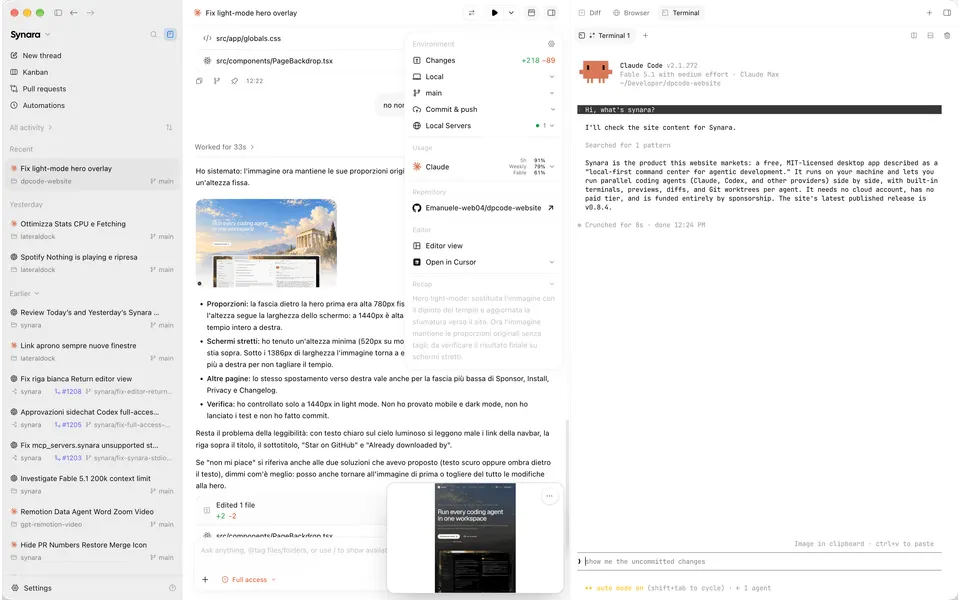
- Desktop app
- Mac, Windows and Linux
- Browser
- Yes
- Phone
- Phone browser
- Command line
- Yes
- Agents
- Claude Code, Codex, Cursor Agent, OpenCode, Pi, Grok and Antigravity
- Your subscription
- Works with your own plan
- Agents run
- On your computer and on your own server
- Laptop closed
- Keeps going
- Isolation
- Worktree
- Parallel agents
- Yes
- Scheduled runs
- Yes
- Coordinator agent
- Yes
- Built-in issues
- Yes
- Pull requests
- Yes
- Review screen
- Yes
- Team
- Not listed
- Self-hosting
- Yes
- Licence
- MIT
- Price from
- Free
- How it charges
- Free plan, subscription and bring your own key
- Paid plans from
- $10 or less/month
Measured by ADEMark
ADEMark ran the same tests on 15 ADEs. Results for Synara 1.1.0, measured up to 12 November 2026 on a Mac mini M4, 16 GB, macOS 27 · Claude Opus 5.5, effort high. Data CC BY 4.0, shown unchanged.
Speed
- Cold start
- 7.13 s11th of 12median of 6 runs, 6.99 s to 7.41 s · Bare CLI 0.69 s
- New thread, ready to type
- 256 ms7th of 10median of 6 runs, 235 ms to 259 ms · Bare CLI 375 ms
- First word on screen
- 610 ms4th of 11median of 6 runs, 584 ms to 631 ms · Bare CLI 220 ms
- Typing lag, 5 agents streaming
- 51 ms3rd of 111 run · Bare CLI 79 ms
- Open a 2,000-message thread
- 104 ms7th of 11median of 5 runs, 91 ms to 109 ms · Bare CLI 203 ms
Weight
- Memory at rest, 5 threads
- 1.32 GB6th of 121 run · Bare CLI 0.99 GB
- Idle CPU
- 2.15%7th of 131 run · Bare CLI 0.37%
- Memory under load
- 2.52 GB6th of 101 run · Bare CLI 1.86 GB
Tokens
- Tokens to answer “hi”
- 30.6K tokens4th of 13median of 3 runs, 30.5K tokens to 30.6K tokens · Bare CLI 38.2K tokens
- Tokens for one real question
- 122.2K tokens5th of 131 run · Bare CLI 168.3K tokens
Build
- Team build: hidden tests passed
- 5 of 5 in 5.2 min1st of 41 run
Place counts only apps with a value; lower is better except passed tests. ADEMark publishes no overall score and treats close medians as ties, so read places as an order, not a verdict. The Bare CLI is Claude Code in a terminal, run as an unranked control. Method and every test on ademark.dev · Imported data · How we use it
Receipts
- Checked
- · oldest answer 2026-11-07
- Findings
- 48 published · 28 cross-checked by a second agent · read them all
- Sources
- 34 public pages on 4 sites: raw.githubusercontent.com, api.github.com, trysynara.com, github.com
- Screenshot
- trysynara.com, retrieved · first party marketing · shows appearance, not capability
- Data
- /products/synara.json · .md
- Method
- Same rules for all 103 researched ADEs. How we check · Report wrong data
What it does
Where you use it
Synara ships macOS, Windows and Linux desktop clients plus a self-hosted browser workspace. Native iPhone/iPad support is coming soon; the release distribution contains no Android app.
Source and scope for Where you use itAgents it runs
Synara's fixed runtime adapters cover Claude Code, Codex, OpenCode, Cursor, Grok, Pi, OMP, Droid, Antigravity and Devin. The complete pinned registry has no Gemini CLI or Aider adapter.
Source and scope for Agents it runsAccounts and subscriptions
Existing provider accounts and subscriptions are reused.
Source and scope for Accounts and subscriptionsWhere agents run
Core server and agents can run on owned infrastructure.
Source and scope for Where agents runHow work is kept apart
Synara separates task code with managed worktrees and launches provider processes on the execution host. The scoped runner/adapters have no product container or per-agent VM isolation backend.
Source and scope for How work is kept apartParallel work
Hub workers and standalone tasks can run concurrently.
Source and scope for Parallel workScheduled runs
Schedules and heartbeat conditions drive app-owned runs.
Source and scope for Scheduled runsGit and pull requests
GitHub PR and local Git operations are integrated.
Source and scope for Git and pull requestsPrice
Local use of Synara is free ($0, no card or account) and MIT open source. Synara Alto adds Remote from another computer for $9.99/month or $79.99/year in USD, plus tax. Synara sells no model plan; model usage runs through your existing provider accounts and is billed by those providers. Provider-native API-key onboarding is explicitly documented.
Source and scope for PriceTyped filters
Every value links to its receipt below. Read plan and surface restrictions before using a filter to decide.
| Filter | Value |
|---|---|
| Desktop OS: macOS | Yes |
| Desktop OS: Windows | Yes |
| Desktop OS: Linux | Yes |
| Web client | Yes |
| Phone access: Native iOS | No |
| Phone access: Native Android | No |
| Phone access: Phone browser | Yes |
| CLI | Yes cross-checked |
| Coding agents: Claude Code | Yes |
| Coding agents: Codex | Yes |
| Coding agents: Cursor Agent | Yes |
| Coding agents: Gemini CLI | No |
| Coding agents: OpenCode | Yes |
| Coding agents: Pi | Yes |
| Coding agents: Grok | Yes |
| Coding agents: Aider | No |
| Coding agents: Antigravity | Yes |
| Use my subscription | Yes cross-checked |
| Where agents run: On your computer | Yes cross-checked |
| Where agents run: On your own server | Yes cross-checked |
| Where agents run: In the vendor's cloud | No |
| Workspace isolation: Git worktree | Yes |
| Workspace isolation: Container | No |
| Workspace isolation: VM or microVM | No |
| Parallel runs | Yes cross-checked |
| Coordinator | Yes cross-checked |
| Native issue tracking | Yes cross-checked |
| Unattended triggers | Yes cross-checked |
| Shared prompting | Unknown |
| Team roles | No |
| SSO | No |
| Pull request workflow | Yes |
| Review interface | Yes cross-checked |
| Product license: Apache-2.0 | No. MIT cross-checked |
| Product license: MIT | Yes. MIT cross-checked |
| Product license: GPL-3.0 | No. MIT cross-checked |
| Product license: GPL-3.0-or-later | No. MIT cross-checked |
| Product license: AGPL-3.0 | No. MIT cross-checked |
| Product license: AGPL-3.0-or-later | No. MIT cross-checked |
| Product license: Elastic License 2.0 | No. MIT cross-checked |
| Product license: Custom terms | No. MIT cross-checked |
| Product license: Proprietary | No. MIT cross-checked |
| Self-hosting | Yes cross-checked |
| Telemetry opt-out | Yes cross-checked |
| Free access | Yes cross-checked |
| Starting price: Free | Yes. Free cross-checked |
| Starting price: Up to $20/month | No. Free cross-checked |
| Starting price: $21–40/month | No. Free cross-checked |
| Starting price: $41–100/month | No. Free cross-checked |
| Starting price: Over $100/month | No. Free cross-checked |
| Starting price: Contact for pricing | No. Free cross-checked |
| Pricing model: Free, no paid plan | No |
| Pricing model: Free plan | Yes |
| Pricing model: Subscription | Yes |
| Pricing model: Per seat | No |
| Pricing model: Usage-based | No |
| Pricing model: Per machine or compute | No |
| Pricing model: Bring your own key | Yes |
| Pricing model: One-time purchase | No |
| Paid plans from: No paid plan | No. $10 or less/month |
| Paid plans from: $10 or less/month | Yes. $10 or less/month |
| Paid plans from: $11–20/month | No. $10 or less/month |
| Paid plans from: $21–40/month | No. $10 or less/month |
| Paid plans from: $41–100/month | No. $10 or less/month |
| Paid plans from: Over $100/month | No. $10 or less/month |
| Paid plans from: Contact sales | No. $10 or less/month |
| Lifecycle status: Active | Unknown |
| Lifecycle status: Sunsetting | Unknown |
| Keeps going with laptop closed | Yes cross-checked |
| Open-source license | Yes. MIT cross-checked |
| Any desktop app | Yes |
| Paid plan up to $20/month | Yes. $10 or less/month |
| Paid plan up to $40/month | Yes. $10 or less/month |
| Any phone client | Yes |
Filter receipts
Desktop OS: macOS: Yes
Desktop OS: macOS
Typed value: Yes.
Synara ships macOS, Windows and Linux desktop clients plus a self-hosted browser workspace. Native iPhone/iPad support is coming soon; the release distribution contains no Android app.
- Desktop os: macOS 13+ Intel/ARM, Windows x64 and Linux x86_64.
- Browser: Headless package serves web workspace.
- Cli: The headless server documents start and server status commands (optional JSON); no command-line client for task actions was found.
- Task actions: Web workspace works against the configured server; provider setup remains host-side.
- This source pass establishes only the named atomic answers. Other parts retain their documented source gaps; no hands-on test was performed.
-
Synara v1.1.0 documentation: getting-started/installation
Finding: Windows x64, macOS Intel/ARM and Linux x86_64 downloads; local provider runtime required.
Desktop OS: Windows: Yes
Desktop OS: Windows
Typed value: Yes.
Synara ships macOS, Windows and Linux desktop clients plus a self-hosted browser workspace. Native iPhone/iPad support is coming soon; the release distribution contains no Android app.
- Desktop os: macOS 13+ Intel/ARM, Windows x64 and Linux x86_64.
- Browser: Headless package serves web workspace.
- Cli: The headless server documents start and server status commands (optional JSON); no command-line client for task actions was found.
- Task actions: Web workspace works against the configured server; provider setup remains host-side.
- This source pass establishes only the named atomic answers. Other parts retain their documented source gaps; no hands-on test was performed.
-
Synara v1.1.0 documentation: getting-started/installation
Finding: Windows x64, macOS Intel/ARM and Linux x86_64 downloads; local provider runtime required.
Desktop OS: Linux: Yes
Desktop OS: Linux
Typed value: Yes.
Synara ships macOS, Windows and Linux desktop clients plus a self-hosted browser workspace. Native iPhone/iPad support is coming soon; the release distribution contains no Android app.
- Desktop os: macOS 13+ Intel/ARM, Windows x64 and Linux x86_64.
- Browser: Headless package serves web workspace.
- Cli: The headless server documents start and server status commands (optional JSON); no command-line client for task actions was found.
- Task actions: Web workspace works against the configured server; provider setup remains host-side.
- This source pass establishes only the named atomic answers. Other parts retain their documented source gaps; no hands-on test was performed.
-
Synara v1.1.0 documentation: getting-started/installation
Finding: Windows x64, macOS Intel/ARM and Linux x86_64 downloads; local provider runtime required.
Web client: Yes
Web client
Typed value: Yes.
Synara ships macOS, Windows and Linux desktop clients plus a self-hosted browser workspace. Native iPhone/iPad support is coming soon; the release distribution contains no Android app.
- Desktop os: macOS 13+ Intel/ARM, Windows x64 and Linux x86_64.
- Browser: Headless package serves web workspace.
- Cli: The headless server documents start and server status commands (optional JSON); no command-line client for task actions was found.
- Task actions: Web workspace works against the configured server; provider setup remains host-side.
- This source pass establishes only the named atomic answers. Other parts retain their documented source gaps; no hands-on test was performed.
-
Synara v1.1.0 documentation: workflows/headless-server
Finding: Node headless tarball serves web UI independently of Electron, with private state directory, token authentication and deliberate remote TLS policy.
Phone access: Native iOS: No
Phone access: Native iOS
Typed value: No.
Synara ships macOS, Windows and Linux desktop clients plus a self-hosted browser workspace. Native iPhone/iPad support is coming soon; the release distribution contains no Android app.
- Desktop os: macOS 13+ Intel/ARM, Windows x64 and Linux x86_64.
- Mobile apps: iPhone/iPad is explicitly coming soon. The complete release asset list has desktop builds and a server tarball, without Android.
- This source pass establishes only the named atomic answers. Other parts retain their documented source gaps; no hands-on test was performed.
-
Finding: Release v1.5.0 ships macOS arm64 and x64 DMGs, a Windows x64 installer, a Linux x86_64 AppImage and a synara-server tarball; the README lists Windows x64, macOS Intel, macOS Apple Silicon and Linux x64 as native release targets.
-
Synara complete plan and client availability list
Finding: Free covers local use with no card/account. Alto is USD 9.99/month or USD 79.99/year for one account's paired computers. iPhone/iPad remote support is explicitly coming soon. The published plans have no per-seat, usage, machine-hour or one-time license fee.
Phone access: Native Android: No
Phone access: Native Android
Typed value: No.
Synara ships macOS, Windows and Linux desktop clients plus a self-hosted browser workspace. Native iPhone/iPad support is coming soon; the release distribution contains no Android app.
- Desktop os: macOS 13+ Intel/ARM, Windows x64 and Linux x86_64.
- Mobile apps: iPhone/iPad is explicitly coming soon. The complete release asset list has desktop builds and a server tarball, without Android.
- This source pass establishes only the named atomic answers. Other parts retain their documented source gaps; no hands-on test was performed.
-
Finding: Release v1.5.0 ships macOS arm64 and x64 DMGs, a Windows x64 installer, a Linux x86_64 AppImage and a synara-server tarball; the README lists Windows x64, macOS Intel, macOS Apple Silicon and Linux x64 as native release targets.
-
Synara complete plan and client availability list
Finding: Free covers local use with no card/account. Alto is USD 9.99/month or USD 79.99/year for one account's paired computers. iPhone/iPad remote support is explicitly coming soon. The published plans have no per-seat, usage, machine-hour or one-time license fee.
Phone access: Phone browser: Yes
Phone access: Phone browser
Typed value: Yes.
Synara ships macOS, Windows and Linux desktop clients plus a self-hosted browser workspace. Native iPhone/iPad support is coming soon; the release distribution contains no Android app.
- Mobile browser: REMOTE.md documents opening the self-hosted web workspace from a phone browser over LAN or Tailnet with an auth token. Phone layout quality was not tested.
- This source pass establishes only the named atomic answers. Other parts retain their documented source gaps; no hands-on test was performed.
-
Synara REMOTE.md: remote access setup (v1.5.0)
Finding: To use Synara from a phone, tablet or another laptop, run the built server with an auth token bound to a LAN or Tailnet address and open http://<machine-ip>:3773 in the phone's browser.
CLI: Yes cross-checked
CLI
Typed value: Yes.
Paired external MCP and server startup/status commands are documented.
- Cli: Headless server start and status commands with optional JSON output; no CLI task create, inspect or steer operations were found.
- Mcp server: Restricted local External MCP.
- Operations: Overview, capabilities, allowed projects, create/read/wait task.
- Authentication: Expiring/revocable integration credentials, project scopes and active limits.
- Documentation establishes only the named atomic answers; remaining questions and hands-on behavior are unverified.
-
Synara v1.1.0 documentation: workflows/headless-server
Finding: Node headless tarball serves web UI independently of Electron, with private state directory, token authentication and deliberate remote TLS policy.
Coding agents: Claude Code: Yes
Coding agents: Claude Code
Typed value: Yes.
Synara's fixed runtime adapters cover Claude Code, Codex, OpenCode, Cursor, Grok, Pi, OMP, Droid, Antigravity and Devin. The complete pinned registry has no Gemini CLI or Aider adapter.
- Harnesses: Claude Code, Codex, OpenCode, Cursor, Grok Build, Pi, OMP, Droid, Antigravity and Devin. Synara v1.5.0 documents an installed and authenticated Antigravity CLI runtime and its agy startup sign-in.
- Session integration: Provider sessions expose tool activity, approvals and continuation.
- Mixed harness operation: Independent tasks can select different providers; not hands-on observed.
- This source pass establishes only the named atomic answers. Other parts retain their documented source gaps; no hands-on test was performed.
-
Synara v1.1.0 documentation: getting-started/providers
Finding: Synara controls installed runtimes; account/model permissions remain provider-owned. Stable and development availability may differ.
-
Finding: Public MIT application with source-run instructions, local CLI subscriptions and server/web modes.
Coding agents: Codex: Yes
Coding agents: Codex
Typed value: Yes.
Synara's fixed runtime adapters cover Claude Code, Codex, OpenCode, Cursor, Grok, Pi, OMP, Droid, Antigravity and Devin. The complete pinned registry has no Gemini CLI or Aider adapter.
- Harnesses: Claude Code, Codex, OpenCode, Cursor, Grok Build, Pi, OMP, Droid, Antigravity and Devin. Synara v1.5.0 documents an installed and authenticated Antigravity CLI runtime and its agy startup sign-in.
- Session integration: Provider sessions expose tool activity, approvals and continuation.
- Mixed harness operation: Independent tasks can select different providers; not hands-on observed.
- This source pass establishes only the named atomic answers. Other parts retain their documented source gaps; no hands-on test was performed.
-
Synara v1.1.0 documentation: getting-started/providers
Finding: Synara controls installed runtimes; account/model permissions remain provider-owned. Stable and development availability may differ.
-
Finding: Public MIT application with source-run instructions, local CLI subscriptions and server/web modes.
Coding agents: Cursor Agent: Yes
Coding agents: Cursor Agent
Typed value: Yes.
Synara's fixed runtime adapters cover Claude Code, Codex, OpenCode, Cursor, Grok, Pi, OMP, Droid, Antigravity and Devin. The complete pinned registry has no Gemini CLI or Aider adapter.
- Harnesses: Claude Code, Codex, OpenCode, Cursor, Grok Build, Pi, OMP, Droid, Antigravity and Devin. Synara v1.5.0 documents an installed and authenticated Antigravity CLI runtime and its agy startup sign-in.
- Session integration: Provider sessions expose tool activity, approvals and continuation.
- Mixed harness operation: Independent tasks can select different providers; not hands-on observed.
- This source pass establishes only the named atomic answers. Other parts retain their documented source gaps; no hands-on test was performed.
-
Synara v1.1.0 documentation: getting-started/providers
Finding: Synara controls installed runtimes; account/model permissions remain provider-owned. Stable and development availability may differ.
-
Finding: Public MIT application with source-run instructions, local CLI subscriptions and server/web modes.
Coding agents: Gemini CLI: No
Coding agents: Gemini CLI
Typed value: No.
Synara's fixed runtime adapters cover Claude Code, Codex, OpenCode, Cursor, Grok, Pi, OMP, Droid, Antigravity and Devin. The complete pinned registry has no Gemini CLI or Aider adapter.
- This source pass establishes only the named atomic answers. Other parts retain their documented source gaps; no hands-on test was performed.
-
Synara fixed provider adapter registry
Finding: The scoped registry binds Codex, Claude, Cursor, Devin, Droid, Grok, OpenCode, Pi, OMP and Antigravity adapters. The shipped product has no generic external-harness registration path and this complete registry includes neither Gemini CLI nor Aider. Custom model configuration in OpenCode is not an additional harness.
Coding agents: OpenCode: Yes
Coding agents: OpenCode
Typed value: Yes.
Synara's fixed runtime adapters cover Claude Code, Codex, OpenCode, Cursor, Grok, Pi, OMP, Droid, Antigravity and Devin. The complete pinned registry has no Gemini CLI or Aider adapter.
- Harnesses: Claude Code, Codex, OpenCode, Cursor, Grok Build, Pi, OMP, Droid, Antigravity and Devin. Synara v1.5.0 documents an installed and authenticated Antigravity CLI runtime and its agy startup sign-in.
- Session integration: Provider sessions expose tool activity, approvals and continuation.
- Mixed harness operation: Independent tasks can select different providers; not hands-on observed.
- This source pass establishes only the named atomic answers. Other parts retain their documented source gaps; no hands-on test was performed.
-
Synara v1.1.0 documentation: getting-started/providers
Finding: Synara controls installed runtimes; account/model permissions remain provider-owned. Stable and development availability may differ.
-
Finding: Public MIT application with source-run instructions, local CLI subscriptions and server/web modes.
Coding agents: Pi: Yes
Coding agents: Pi
Typed value: Yes.
Synara's fixed runtime adapters cover Claude Code, Codex, OpenCode, Cursor, Grok, Pi, OMP, Droid, Antigravity and Devin. The complete pinned registry has no Gemini CLI or Aider adapter.
- Harnesses: Claude Code, Codex, OpenCode, Cursor, Grok Build, Pi, OMP, Droid, Antigravity and Devin. Synara v1.5.0 documents an installed and authenticated Antigravity CLI runtime and its agy startup sign-in.
- Session integration: Provider sessions expose tool activity, approvals and continuation.
- Mixed harness operation: Independent tasks can select different providers; not hands-on observed.
- This source pass establishes only the named atomic answers. Other parts retain their documented source gaps; no hands-on test was performed.
-
Synara v1.1.0 documentation: getting-started/providers
Finding: Synara controls installed runtimes; account/model permissions remain provider-owned. Stable and development availability may differ.
-
Finding: Public MIT application with source-run instructions, local CLI subscriptions and server/web modes.
Coding agents: Grok: Yes
Coding agents: Grok
Typed value: Yes.
Synara's fixed runtime adapters cover Claude Code, Codex, OpenCode, Cursor, Grok, Pi, OMP, Droid, Antigravity and Devin. The complete pinned registry has no Gemini CLI or Aider adapter.
- Harnesses: Claude Code, Codex, OpenCode, Cursor, Grok Build, Pi, OMP, Droid, Antigravity and Devin. Synara v1.5.0 documents an installed and authenticated Antigravity CLI runtime and its agy startup sign-in.
- Session integration: Provider sessions expose tool activity, approvals and continuation.
- Mixed harness operation: Independent tasks can select different providers; not hands-on observed.
- This source pass establishes only the named atomic answers. Other parts retain their documented source gaps; no hands-on test was performed.
-
Synara v1.1.0 documentation: getting-started/providers
Finding: Synara controls installed runtimes; account/model permissions remain provider-owned. Stable and development availability may differ.
-
Finding: Public MIT application with source-run instructions, local CLI subscriptions and server/web modes.
Coding agents: Aider: No
Coding agents: Aider
Typed value: No.
Synara's fixed runtime adapters cover Claude Code, Codex, OpenCode, Cursor, Grok, Pi, OMP, Droid, Antigravity and Devin. The complete pinned registry has no Gemini CLI or Aider adapter.
- This source pass establishes only the named atomic answers. Other parts retain their documented source gaps; no hands-on test was performed.
-
Synara fixed provider adapter registry
Finding: The scoped registry binds Codex, Claude, Cursor, Devin, Droid, Grok, OpenCode, Pi, OMP and Antigravity adapters. The shipped product has no generic external-harness registration path and this complete registry includes neither Gemini CLI nor Aider. Custom model configuration in OpenCode is not an additional harness.
Coding agents: Antigravity: Yes
Coding agents: Antigravity
Typed value: Yes.
Synara's fixed runtime adapters cover Claude Code, Codex, OpenCode, Cursor, Grok, Pi, OMP, Droid, Antigravity and Devin. The complete pinned registry has no Gemini CLI or Aider adapter.
- Harnesses: Claude Code, Codex, OpenCode, Cursor, Grok Build, Pi, OMP, Droid, Antigravity and Devin. Synara v1.5.0 documents an installed and authenticated Antigravity CLI runtime and its agy startup sign-in.
- This source pass establishes only the named atomic answers. Other parts retain their documented source gaps; no hands-on test was performed.
-
Synara Antigravity support at v1.5.0
Finding: Synara v1.5.0 documents an installed and authenticated Antigravity CLI runtime and its agy startup sign-in.
-
Synara Antigravity support at v1.5.0
Finding: Synara v1.5.0 documents an installed and authenticated Antigravity CLI runtime and its agy startup sign-in.
Use my subscription: Yes cross-checked
Use my subscription
Typed value: Yes.
Existing provider accounts and subscriptions are reused.
- Agent subscriptions: Existing coding-agent subscriptions configured on host.
- Api accounts: Provider account environment/configuration supports credential setup.
- Vendor credits: Synara does not host models or sell a separate model subscription.
- Account switching: Account tabs select separate runtime configurations.
- Provider restrictions: Provider account/runtime controls models, limits and permission semantics.
- Documentation establishes only the named atomic answers; remaining questions and hands-on behavior are unverified.
-
Synara v1.1.0 documentation: getting-started/providers
Finding: Synara controls installed runtimes; account/model permissions remain provider-owned. Stable and development availability may differ.
Where agents run: On your computer: Yes cross-checked
Where agents run: On your computer
Typed value: Yes.
Core server and agents can run on owned infrastructure.
- Local: Local desktop provider execution.
- Byo remote: Dedicated user-owned development machine running headless server.
- Self hosted: Complete server/web workspace without Electron.
- Provisioning: Download release tarball, npm production dependencies and configure state/auth.
- Client disconnect: Headless host runs independently of desktop shell; host must stay running.
- Other device continuation: Authenticated web workspace accesses the server.
- Documentation establishes only the named atomic answers; remaining questions and hands-on behavior are unverified.
-
Synara v1.1.0 documentation: workflows/headless-server
Finding: Node headless tarball serves web UI independently of Electron, with private state directory, token authentication and deliberate remote TLS policy.
-
Finding: Public MIT application with source-run instructions, local CLI subscriptions and server/web modes.
Where agents run: On your own server: Yes cross-checked
Where agents run: On your own server
Typed value: Yes.
Core server and agents can run on owned infrastructure.
- Local: Local desktop provider execution.
- Byo remote: Dedicated user-owned development machine running headless server.
- Self hosted: Complete server/web workspace without Electron.
- Provisioning: Download release tarball, npm production dependencies and configure state/auth.
- Client disconnect: Headless host runs independently of desktop shell; host must stay running.
- Other device continuation: Authenticated web workspace accesses the server.
- Documentation establishes only the named atomic answers; remaining questions and hands-on behavior are unverified.
-
Synara v1.1.0 documentation: workflows/headless-server
Finding: Node headless tarball serves web UI independently of Electron, with private state directory, token authentication and deliberate remote TLS policy.
-
Finding: Public MIT application with source-run instructions, local CLI subscriptions and server/web modes.
Where agents run: In the vendor's cloud: No
Where agents run: In the vendor's cloud
Typed value: No.
Core server and agents can run on owned infrastructure.
- Local: Local desktop provider execution.
- Byo remote: Dedicated user-owned development machine running headless server.
- Self hosted: Complete server/web workspace without Electron.
- Provisioning: Download release tarball, npm production dependencies and configure state/auth.
- Client disconnect: Headless host runs independently of desktop shell; host must stay running.
- Other device continuation: Authenticated web workspace accesses the server.
- Documentation establishes only the named atomic answers; remaining questions and hands-on behavior are unverified.
-
Synara v1.1.0 documentation: workflows/headless-server
Finding: Node headless tarball serves web UI independently of Electron, with private state directory, token authentication and deliberate remote TLS policy.
-
Finding: Public MIT application with source-run instructions, local CLI subscriptions and server/web modes.
Workspace isolation: Git worktree: Yes
Workspace isolation: Git worktree
Typed value: Yes.
Synara separates task code with managed worktrees and launches provider processes on the execution host. The scoped runner/adapters have no product container or per-agent VM isolation backend.
- Checkout: Local checkout option.
- Branch: Task-owned branch or detached starting ref.
- Worktree: Task-owned managed worktree.
- Code separation: Terminals/files/Git use the task environment.
- Security boundary: Worktree boundary is separate code directories, not a security sandbox.
- This source pass establishes only the named atomic answers. Other parts retain their documented source gaps; no hands-on test was performed.
-
Synara v1.1.0 documentation: workflows/external-mcp
Finding: Local paired MCP clients can create/read/wait for scoped tasks using revocable audience-bound credentials; remote server access disables this endpoint.
-
Synara v1.1.0 documentation: workflows/worktrees
Finding: Managed task worktrees separate directories/branches and protect active environments from routine cleanup.
Workspace isolation: Container: No
Workspace isolation: Container
Typed value: No.
Synara separates task code with managed worktrees and launches provider processes on the execution host. The scoped runner/adapters have no product container or per-agent VM isolation backend.
- Container: No product container isolation backend in scoped provider launch paths.
- Vm: No product per-agent VM isolation backend in scoped provider launch paths.
- This source pass establishes only the named atomic answers. Other parts retain their documented source gaps; no hands-on test was performed.
-
Synara process and workspace execution
Finding: Provider adapters launch host processes in a project checkout or managed Git worktree. The scoped process runner and adapters have no product container or per-agent VM provisioning backend; worktree separation is not a security sandbox.
Workspace isolation: VM or microVM: No
Workspace isolation: VM or microVM
Typed value: No.
Synara separates task code with managed worktrees and launches provider processes on the execution host. The scoped runner/adapters have no product container or per-agent VM isolation backend.
- Container: No product container isolation backend in scoped provider launch paths.
- Vm: No product per-agent VM isolation backend in scoped provider launch paths.
- This source pass establishes only the named atomic answers. Other parts retain their documented source gaps; no hands-on test was performed.
-
Synara process and workspace execution
Finding: Provider adapters launch host processes in a project checkout or managed Git worktree. The scoped process runner and adapters have no product container or per-agent VM provisioning backend; worktree separation is not a security sandbox.
Parallel runs: Yes cross-checked
Parallel runs
Typed value: Yes.
Hub workers and standalone tasks can run concurrently.
- Concurrent sessions: Independent worker chats.
- Concurrent tasks: Managed worktree workers.
- Quotas: Hub parallelism 1–8, default 3; batch creates up to 20 tasks.
- Status visibility: Queued/starting/working/waiting/completed/failed/cancelled task cards.
- Documentation establishes only the named atomic answers; remaining questions and hands-on behavior are unverified.
-
Synara v1.1.0 documentation: features/hubs
Finding: Stable Hubs coordinate workers with shared memory and a Git-versioned Library; concurrency defaults to three with a 1–8 setting.
-
Synara v1.1.0 documentation: workflows/agent-gateway
Finding: App-owned MCP tools create, inspect, wait and message tasks with scoped active-turn authority; 1–20 task batch creation is idempotent.
Coordinator: Yes cross-checked
Coordinator
Typed value: Yes.
The product-owned gateway coordinates visible task workers.
- Roles: Coordinator and worker chats.
- Model harness effort: Provider/model options discovered from capabilities.
- Messages: Send bounded follow-up or interrupt.
- Results return: Eligible delegated completion returns to origin after durable settlement.
- Cross harness: Different provider/model per worker.
- Orchestration owner: App-owned Agent Gateway and Hub coordinator.
- Activation: Create Hub then send first request.
- Authentication: Thread-scoped capability and active-turn authority.
- Live progress: Open task card to inspect worker.
- Retained results: Durable task IDs and server transcripts.
- Followup: Coordinator can continue existing worker.
- Documentation establishes only the named atomic answers; remaining questions and hands-on behavior are unverified.
-
Synara v1.1.0 documentation: features/hubs
Finding: Stable Hubs coordinate workers with shared memory and a Git-versioned Library; concurrency defaults to three with a 1–8 setting.
-
Synara v1.1.0 documentation: workflows/agent-gateway
Finding: App-owned MCP tools create, inspect, wait and message tasks with scoped active-turn authority; 1–20 task batch creation is idempotent.
Native issue tracking: Yes cross-checked
Native issue tracking
Typed value: Yes.
Native to-dos remain separate from agent chats.
- Create: Tasks add title.
- Edit: Task card edits note/project/priority/due date.
- Prioritize: Priority and due date.
- Reopen: Agent update tool can reopen a to-do.
- Idea parking: Tasks can exist without project or agent.
- Explicit dispatch: Start delegates a task.
- Task session separation: To-do and chat are distinct entities.
- Metadata: Title, notes, priority, due date and project.
- Durable states: Tasks show running/needs-you/review/failed and manual done.
- Documentation establishes only the named atomic answers; remaining questions and hands-on behavior are unverified.
-
Synara v1.1.0 documentation: features/tasks-and-inbox
Finding: Durable to-dos are separate from chats and can be edited/delegated by humans. Agents create/list/update the same records using stable request IDs.
Unattended triggers: Yes cross-checked
Unattended triggers
Typed value: Yes.
Schedules and heartbeat conditions drive app-owned runs.
- Schedules: Schedule/timezone with explicit project/provider/environment.
- Recurring tasks: Recurring standalone/dedicated/heartbeat runs.
- Completion conditions: Heartbeat stop condition and iteration limits.
- Scheduler location: Synara execution host must be running.
- Overlaps: Duplicate reconciliation does not count failure twice; general overlap exclusion not established.
- Retries: The On failure policy sets how many consecutive failed scheduled runs are tolerated before disabling (1, 3 by default, 5 or keep running); automatic retry of a failed run is not documented.
- Documentation establishes only the named atomic answers; remaining questions and hands-on behavior are unverified.
-
Synara v1.1.0 documentation: workflows/automations
Finding: Product-owned schedules retain run history and completion conditions; default failure threshold disables after three consecutive failures.
Team roles: No
Team roles
Typed value: No.
Synara authenticates owner/client sessions and guards owner-only account operations. These are device trust roles, without native organization/project human roles or enterprise SSO in the scoped core.
- Organization roles: No human organization-member role model in the scoped core; owner/client is session trust.
- Project roles: Project/task access is not a named organization-member permission system.
- Sso: Core browser authentication uses paired credentials/session cookies rather than enterprise SAML/OIDC federation.
- This source pass establishes only the named atomic answers. Other parts retain their documented source gaps; no hands-on test was performed.
-
Synara shared task dispatch and session authorization
Finding: Authenticated browser connections reach the same server orchestration dispatch handler and task/thread state. Paired client sessions may send normal thread commands, while account/security operations require owner. Auth roles owner/client describe connection trust; the scoped core has no organization-member role or SAML/OIDC enterprise login model.
SSO: No
SSO
Typed value: No.
Synara authenticates owner/client sessions and guards owner-only account operations. These are device trust roles, without native organization/project human roles or enterprise SSO in the scoped core.
- Organization roles: No human organization-member role model in the scoped core; owner/client is session trust.
- Project roles: Project/task access is not a named organization-member permission system.
- Sso: Core browser authentication uses paired credentials/session cookies rather than enterprise SAML/OIDC federation.
- This source pass establishes only the named atomic answers. Other parts retain their documented source gaps; no hands-on test was performed.
-
Synara shared task dispatch and session authorization
Finding: Authenticated browser connections reach the same server orchestration dispatch handler and task/thread state. Paired client sessions may send normal thread commands, while account/security operations require owner. Auth roles owner/client describe connection trust; the scoped core has no organization-member role or SAML/OIDC enterprise login model.
Pull request workflow: Yes
Pull request workflow
Typed value: Yes.
GitHub PR and local Git operations are integrated.
- Branches: Task branch context.
- Worktrees: Managed worktrees.
- Commits: In-app Git commit and push.
- Pull requests: PR create/inspect/manage with gh authentication.
- Comments: Review comment context.
- Ci response: Repair actions attach failing-check context from the PR workspace to the composer.
- Conflicts: PR repair can include conflict context.
- Product state: PR badges refresh after GitHub operations.
- Documentation establishes only the named atomic answers; remaining questions and hands-on behavior are unverified.
-
Synara v1.1.0 documentation: features/workspace-editor
Finding: Workspace files autosave with conflict handling; revision/turn diffs and checkpoint recovery support review.
-
Synara v1.1.0 documentation: workflows/pull-requests
Finding: GitHub PR aggregation, repair context and checks are integrated; Git and GitHub remain authoritative.
Review interface: Yes cross-checked
Review interface
Typed value: Yes.
Editor diffs and PR repair keep review near the task.
- Pending reviews: PR status and checks in right dock.
- Change understanding: Working/turn/revision diffs alongside editor.
- Comments: PR context cards include review discussion.
- Request changes: Repair actions attach requested-change context.
- Keyboard: Editor commands and configurable keybindings.
- Retained context: Sent context card exposes exact prompt supplied.
- Documentation establishes only the named atomic answers; remaining questions and hands-on behavior are unverified.
-
Synara v1.1.0 documentation: features/workspace-editor
Finding: Workspace files autosave with conflict handling; revision/turn diffs and checkpoint recovery support review.
-
Synara v1.1.0 documentation: workflows/pull-requests
Finding: GitHub PR aggregation, repair context and checks are integrated; Git and GitHub remain authoritative.
Product license: Apache-2.0: No. MIT cross-checked
Product license: Apache-2.0
Typed value: No. MIT.
Main application code is public under MIT.
- Client license: MIT.
- Server license: MIT repository includes server.
- Source visibility: Public application repository.
- Source revision: v1.1.0 release target b6aa37bc82eec649dd527c5956fdccc2c63d3b24.
- Documentation establishes only the named atomic answers; remaining questions and hands-on behavior are unverified.
-
Finding: Public MIT application with source-run instructions, local CLI subscriptions and server/web modes.
-
Finding: Main application source and documentation carry the MIT license, including permission to use and modify without charge.
Product license: MIT: Yes. MIT cross-checked
Product license: MIT
Typed value: Yes. MIT.
Main application code is public under MIT.
- Client license: MIT.
- Server license: MIT repository includes server.
- Source visibility: Public application repository.
- Source revision: v1.1.0 release target b6aa37bc82eec649dd527c5956fdccc2c63d3b24.
- Documentation establishes only the named atomic answers; remaining questions and hands-on behavior are unverified.
-
Finding: Public MIT application with source-run instructions, local CLI subscriptions and server/web modes.
-
Finding: Main application source and documentation carry the MIT license, including permission to use and modify without charge.
Product license: GPL-3.0: No. MIT cross-checked
Product license: GPL-3.0
Typed value: No. MIT.
Main application code is public under MIT.
- Client license: MIT.
- Server license: MIT repository includes server.
- Source visibility: Public application repository.
- Source revision: v1.1.0 release target b6aa37bc82eec649dd527c5956fdccc2c63d3b24.
- Documentation establishes only the named atomic answers; remaining questions and hands-on behavior are unverified.
-
Finding: Public MIT application with source-run instructions, local CLI subscriptions and server/web modes.
-
Finding: Main application source and documentation carry the MIT license, including permission to use and modify without charge.
Product license: GPL-3.0-or-later: No. MIT cross-checked
Product license: GPL-3.0-or-later
Typed value: No. MIT.
Main application code is public under MIT.
- Client license: MIT.
- Server license: MIT repository includes server.
- Source visibility: Public application repository.
- Source revision: v1.1.0 release target b6aa37bc82eec649dd527c5956fdccc2c63d3b24.
- Documentation establishes only the named atomic answers; remaining questions and hands-on behavior are unverified.
-
Finding: Public MIT application with source-run instructions, local CLI subscriptions and server/web modes.
-
Finding: Main application source and documentation carry the MIT license, including permission to use and modify without charge.
Product license: AGPL-3.0: No. MIT cross-checked
Product license: AGPL-3.0
Typed value: No. MIT.
Main application code is public under MIT.
- Client license: MIT.
- Server license: MIT repository includes server.
- Source visibility: Public application repository.
- Source revision: v1.1.0 release target b6aa37bc82eec649dd527c5956fdccc2c63d3b24.
- Documentation establishes only the named atomic answers; remaining questions and hands-on behavior are unverified.
-
Finding: Public MIT application with source-run instructions, local CLI subscriptions and server/web modes.
-
Finding: Main application source and documentation carry the MIT license, including permission to use and modify without charge.
Product license: AGPL-3.0-or-later: No. MIT cross-checked
Product license: AGPL-3.0-or-later
Typed value: No. MIT.
Main application code is public under MIT.
- Client license: MIT.
- Server license: MIT repository includes server.
- Source visibility: Public application repository.
- Source revision: v1.1.0 release target b6aa37bc82eec649dd527c5956fdccc2c63d3b24.
- Documentation establishes only the named atomic answers; remaining questions and hands-on behavior are unverified.
-
Finding: Public MIT application with source-run instructions, local CLI subscriptions and server/web modes.
-
Finding: Main application source and documentation carry the MIT license, including permission to use and modify without charge.
Product license: Elastic License 2.0: No. MIT cross-checked
Product license: Elastic License 2.0
Typed value: No. MIT.
Main application code is public under MIT.
- Client license: MIT.
- Server license: MIT repository includes server.
- Source visibility: Public application repository.
- Source revision: v1.1.0 release target b6aa37bc82eec649dd527c5956fdccc2c63d3b24.
- Documentation establishes only the named atomic answers; remaining questions and hands-on behavior are unverified.
-
Finding: Public MIT application with source-run instructions, local CLI subscriptions and server/web modes.
-
Finding: Main application source and documentation carry the MIT license, including permission to use and modify without charge.
Product license: Custom terms: No. MIT cross-checked
Product license: Custom terms
Typed value: No. MIT.
Main application code is public under MIT.
- Client license: MIT.
- Server license: MIT repository includes server.
- Source visibility: Public application repository.
- Source revision: v1.1.0 release target b6aa37bc82eec649dd527c5956fdccc2c63d3b24.
- Documentation establishes only the named atomic answers; remaining questions and hands-on behavior are unverified.
-
Finding: Public MIT application with source-run instructions, local CLI subscriptions and server/web modes.
-
Finding: Main application source and documentation carry the MIT license, including permission to use and modify without charge.
Product license: Proprietary: No. MIT cross-checked
Product license: Proprietary
Typed value: No. MIT.
Main application code is public under MIT.
- Client license: MIT.
- Server license: MIT repository includes server.
- Source visibility: Public application repository.
- Source revision: v1.1.0 release target b6aa37bc82eec649dd527c5956fdccc2c63d3b24.
- Documentation establishes only the named atomic answers; remaining questions and hands-on behavior are unverified.
-
Finding: Public MIT application with source-run instructions, local CLI subscriptions and server/web modes.
-
Finding: Main application source and documentation carry the MIT license, including permission to use and modify without charge.
Self-hosting: Yes cross-checked
Self-hosting
Typed value: Yes.
The core ADE can be run from source or a headless release.
- Self hosting: User-owned server and web workspace.
- Documentation establishes only the named atomic answers; remaining questions and hands-on behavior are unverified.
-
Synara v1.1.0 documentation: workflows/headless-server
Finding: Node headless tarball serves web UI independently of Electron, with private state directory, token authentication and deliberate remote TLS policy.
-
Finding: Public MIT application with source-run instructions, local CLI subscriptions and server/web modes.
Telemetry opt-out: Yes cross-checked
Telemetry opt-out
Typed value: Yes.
Local state, connectors and diagnostics have separate boundaries. At v1.5.0 Share product analytics is off by default in Stable and Beta; Stable never sends release diagnostics, while Beta release diagnostics are automatic.
- Telemetry defaults: Share product analytics is off by default in Stable and Beta; Stable never constructs the release-diagnostics sender, while Beta sends release diagnostics automatically.
- Telemetry controls: Settings, General, Privacy offers Share product analytics (off by default in Stable and Beta); Stable never sends release diagnostics, while Beta release diagnostics stay automatic.
- Documentation establishes only the named atomic answers; remaining questions and hands-on behavior are unverified.
-
Synara docs: Beta and Remote diagnostics (v1.5.0)
Finding: Stable never constructs the release-diagnostics sender. Desktop Settings, General, Privacy has a Share product analytics switch, off by default in Stable and Beta; Remote diagnostics follow a Share usage and diagnostics switch, and turning sharing off removes unsent diagnostics. Beta release diagnostics remain automatic.
Free access: Yes cross-checked
Free access
Typed value: Yes.
MIT source can be used without an ADE license fee.
- Ongoing free: MIT grants use/modification without charge; own agent/compute costs remain.
- Self host cost: User provides host and provider runtime/account.
- Documentation establishes only the named atomic answers; remaining questions and hands-on behavior are unverified.
-
Finding: Public MIT application with source-run instructions, local CLI subscriptions and server/web modes.
-
Finding: Main application source and documentation carry the MIT license, including permission to use and modify without charge.
Starting price: Free: Yes. Free cross-checked
Starting price: Free
Typed value: Yes. Free.
MIT source can be used without an ADE license fee.
- Ongoing free: MIT grants use/modification without charge; own agent/compute costs remain.
- Self host cost: User provides host and provider runtime/account.
- Documentation establishes only the named atomic answers; remaining questions and hands-on behavior are unverified.
-
Finding: Public MIT application with source-run instructions, local CLI subscriptions and server/web modes.
-
Finding: Main application source and documentation carry the MIT license, including permission to use and modify without charge.
Starting price: Up to $20/month: No. Free cross-checked
Starting price: Up to $20/month
Typed value: No. Free.
MIT source can be used without an ADE license fee.
- Ongoing free: MIT grants use/modification without charge; own agent/compute costs remain.
- Self host cost: User provides host and provider runtime/account.
- Documentation establishes only the named atomic answers; remaining questions and hands-on behavior are unverified.
-
Finding: Public MIT application with source-run instructions, local CLI subscriptions and server/web modes.
-
Finding: Main application source and documentation carry the MIT license, including permission to use and modify without charge.
Starting price: $21–40/month: No. Free cross-checked
Starting price: $21–40/month
Typed value: No. Free.
MIT source can be used without an ADE license fee.
- Ongoing free: MIT grants use/modification without charge; own agent/compute costs remain.
- Self host cost: User provides host and provider runtime/account.
- Documentation establishes only the named atomic answers; remaining questions and hands-on behavior are unverified.
-
Finding: Public MIT application with source-run instructions, local CLI subscriptions and server/web modes.
-
Finding: Main application source and documentation carry the MIT license, including permission to use and modify without charge.
Starting price: $41–100/month: No. Free cross-checked
Starting price: $41–100/month
Typed value: No. Free.
MIT source can be used without an ADE license fee.
- Ongoing free: MIT grants use/modification without charge; own agent/compute costs remain.
- Self host cost: User provides host and provider runtime/account.
- Documentation establishes only the named atomic answers; remaining questions and hands-on behavior are unverified.
-
Finding: Public MIT application with source-run instructions, local CLI subscriptions and server/web modes.
-
Finding: Main application source and documentation carry the MIT license, including permission to use and modify without charge.
Starting price: Over $100/month: No. Free cross-checked
Starting price: Over $100/month
Typed value: No. Free.
MIT source can be used without an ADE license fee.
- Ongoing free: MIT grants use/modification without charge; own agent/compute costs remain.
- Self host cost: User provides host and provider runtime/account.
- Documentation establishes only the named atomic answers; remaining questions and hands-on behavior are unverified.
-
Finding: Public MIT application with source-run instructions, local CLI subscriptions and server/web modes.
-
Finding: Main application source and documentation carry the MIT license, including permission to use and modify without charge.
Starting price: Contact for pricing: No. Free cross-checked
Starting price: Contact for pricing
Typed value: No. Free.
MIT source can be used without an ADE license fee.
- Ongoing free: MIT grants use/modification without charge; own agent/compute costs remain.
- Self host cost: User provides host and provider runtime/account.
- Documentation establishes only the named atomic answers; remaining questions and hands-on behavior are unverified.
-
Finding: Public MIT application with source-run instructions, local CLI subscriptions and server/web modes.
-
Finding: Main application source and documentation carry the MIT license, including permission to use and modify without charge.
Pricing model: Free, no paid plan: No
Pricing model: Free, no paid plan
Typed value: No.
Local use of Synara is free ($0, no card or account) and MIT open source. Synara Alto adds Remote from another computer for $9.99/month or $79.99/year in USD, plus tax. Synara sells no model plan; model usage runs through your existing provider accounts and is billed by those providers. Provider-native API-key onboarding is explicitly documented.
- This source pass establishes only the named atomic answers. Other parts retain their documented source gaps; no hands-on test was performed.
-
Synara complete plan and client availability list
Finding: Free covers local use with no card/account. Alto is USD 9.99/month or USD 79.99/year for one account's paired computers. iPhone/iPad remote support is explicitly coming soon. The published plans have no per-seat, usage, machine-hour or one-time license fee.
Pricing model: Free plan: Yes
Pricing model: Free plan
Typed value: Yes.
Local use of Synara is free ($0, no card or account) and MIT open source. Synara Alto adds Remote from another computer for $9.99/month or $79.99/year in USD, plus tax. Synara sells no model plan; model usage runs through your existing provider accounts and is billed by those providers. Provider-native API-key onboarding is explicitly documented.
- Currency: Prices are in USD.
- Interval: Alto is $9.99/month billed monthly or $79.99/year billed yearly.
- Workspace fees: Local use needs no Synara account; the paid Alto plan requires a Synara account for Remote.
- Taxes: Taxes are added at checkout.
- This source pass establishes only the named atomic answers. Other parts retain their documented source gaps; no hands-on test was performed.
-
Finding: Free is $0 with no card or account and covers local use. Synara Alto, which adds Remote from another computer, is $9.99/month billed monthly plus tax or $79.99/year. Prices are in USD; checkout runs through Polar.
Pricing model: Subscription: Yes
Pricing model: Subscription
Typed value: Yes.
Local use of Synara is free ($0, no card or account) and MIT open source. Synara Alto adds Remote from another computer for $9.99/month or $79.99/year in USD, plus tax. Synara sells no model plan; model usage runs through your existing provider accounts and is billed by those providers. Provider-native API-key onboarding is explicitly documented.
- Currency: Prices are in USD.
- Interval: Alto is $9.99/month billed monthly or $79.99/year billed yearly.
- Workspace fees: Local use needs no Synara account; the paid Alto plan requires a Synara account for Remote.
- Taxes: Taxes are added at checkout.
- This source pass establishes only the named atomic answers. Other parts retain their documented source gaps; no hands-on test was performed.
-
Finding: Free is $0 with no card or account and covers local use. Synara Alto, which adds Remote from another computer, is $9.99/month billed monthly plus tax or $79.99/year. Prices are in USD; checkout runs through Polar.
Pricing model: Per seat: No
Pricing model: Per seat
Typed value: No.
Local use of Synara is free ($0, no card or account) and MIT open source. Synara Alto adds Remote from another computer for $9.99/month or $79.99/year in USD, plus tax. Synara sells no model plan; model usage runs through your existing provider accounts and is billed by those providers. Provider-native API-key onboarding is explicitly documented.
- This source pass establishes only the named atomic answers. Other parts retain their documented source gaps; no hands-on test was performed.
-
Synara complete plan and client availability list
Finding: Free covers local use with no card/account. Alto is USD 9.99/month or USD 79.99/year for one account's paired computers. iPhone/iPad remote support is explicitly coming soon. The published plans have no per-seat, usage, machine-hour or one-time license fee.
Pricing model: Usage-based: No
Pricing model: Usage-based
Typed value: No.
Local use of Synara is free ($0, no card or account) and MIT open source. Synara Alto adds Remote from another computer for $9.99/month or $79.99/year in USD, plus tax. Synara sells no model plan; model usage runs through your existing provider accounts and is billed by those providers. Provider-native API-key onboarding is explicitly documented.
- This source pass establishes only the named atomic answers. Other parts retain their documented source gaps; no hands-on test was performed.
-
Synara complete plan and client availability list
Finding: Free covers local use with no card/account. Alto is USD 9.99/month or USD 79.99/year for one account's paired computers. iPhone/iPad remote support is explicitly coming soon. The published plans have no per-seat, usage, machine-hour or one-time license fee.
Pricing model: Per machine or compute: No
Pricing model: Per machine or compute
Typed value: No.
Local use of Synara is free ($0, no card or account) and MIT open source. Synara Alto adds Remote from another computer for $9.99/month or $79.99/year in USD, plus tax. Synara sells no model plan; model usage runs through your existing provider accounts and is billed by those providers. Provider-native API-key onboarding is explicitly documented.
- This source pass establishes only the named atomic answers. Other parts retain their documented source gaps; no hands-on test was performed.
-
Synara complete plan and client availability list
Finding: Free covers local use with no card/account. Alto is USD 9.99/month or USD 79.99/year for one account's paired computers. iPhone/iPad remote support is explicitly coming soon. The published plans have no per-seat, usage, machine-hour or one-time license fee.
Pricing model: Bring your own key: Yes
Pricing model: Bring your own key
Typed value: Yes.
Local use of Synara is free ($0, no card or account) and MIT open source. Synara Alto adds Remote from another computer for $9.99/month or $79.99/year in USD, plus tax. Synara sells no model plan; model usage runs through your existing provider accounts and is billed by those providers. Provider-native API-key onboarding is explicitly documented.
- Workspace fees: Local use needs no Synara account; the paid Alto plan requires a Synara account for Remote.
- Model cost: Users bring provider-native accounts and model keys, including OpenCode API-key onboarding; Synara sells no model plan.
- This source pass establishes only the named atomic answers. Other parts retain their documented source gaps; no hands-on test was performed.
-
Finding: Calls Synara a free, open-source, local-first workspace under the MIT license. Synara does not sell a model plan or need a Synara cloud account; it uses provider accounts you already have.
-
Synara provider-native API-key setup
Finding: The provider guide explicitly supports OpenCode model-provider OAuth or API-key onboarding. Synara uses those provider accounts and does not sell model plans; the user's own key/account pays the chosen provider.
Pricing model: One-time purchase: No
Pricing model: One-time purchase
Typed value: No.
Local use of Synara is free ($0, no card or account) and MIT open source. Synara Alto adds Remote from another computer for $9.99/month or $79.99/year in USD, plus tax. Synara sells no model plan; model usage runs through your existing provider accounts and is billed by those providers. Provider-native API-key onboarding is explicitly documented.
- This source pass establishes only the named atomic answers. Other parts retain their documented source gaps; no hands-on test was performed.
-
Synara complete plan and client availability list
Finding: Free covers local use with no card/account. Alto is USD 9.99/month or USD 79.99/year for one account's paired computers. iPhone/iPad remote support is explicitly coming soon. The published plans have no per-seat, usage, machine-hour or one-time license fee.
Paid plans from: No paid plan: No. $10 or less/month
Paid plans from: No paid plan
Typed value: No. $10 or less/month.
Local use of Synara is free ($0, no card or account) and MIT open source. Synara Alto adds Remote from another computer for $9.99/month or $79.99/year in USD, plus tax. Synara sells no model plan; model usage runs through your existing provider accounts and is billed by those providers. Provider-native API-key onboarding is explicitly documented.
- Currency: Prices are in USD.
- Interval: Alto is $9.99/month billed monthly or $79.99/year billed yearly.
- Workspace fees: Local use needs no Synara account; the paid Alto plan requires a Synara account for Remote.
- Taxes: Taxes are added at checkout.
- This source pass establishes only the named atomic answers. Other parts retain their documented source gaps; no hands-on test was performed.
-
Finding: Free is $0 with no card or account and covers local use. Synara Alto, which adds Remote from another computer, is $9.99/month billed monthly plus tax or $79.99/year. Prices are in USD; checkout runs through Polar.
Paid plans from: $10 or less/month: Yes. $10 or less/month
Paid plans from: $10 or less/month
Typed value: Yes. $10 or less/month.
Local use of Synara is free ($0, no card or account) and MIT open source. Synara Alto adds Remote from another computer for $9.99/month or $79.99/year in USD, plus tax. Synara sells no model plan; model usage runs through your existing provider accounts and is billed by those providers. Provider-native API-key onboarding is explicitly documented.
- Currency: Prices are in USD.
- Interval: Alto is $9.99/month billed monthly or $79.99/year billed yearly.
- Workspace fees: Local use needs no Synara account; the paid Alto plan requires a Synara account for Remote.
- Taxes: Taxes are added at checkout.
- This source pass establishes only the named atomic answers. Other parts retain their documented source gaps; no hands-on test was performed.
-
Finding: Free is $0 with no card or account and covers local use. Synara Alto, which adds Remote from another computer, is $9.99/month billed monthly plus tax or $79.99/year. Prices are in USD; checkout runs through Polar.
Paid plans from: $11–20/month: No. $10 or less/month
Paid plans from: $11–20/month
Typed value: No. $10 or less/month.
Local use of Synara is free ($0, no card or account) and MIT open source. Synara Alto adds Remote from another computer for $9.99/month or $79.99/year in USD, plus tax. Synara sells no model plan; model usage runs through your existing provider accounts and is billed by those providers. Provider-native API-key onboarding is explicitly documented.
- Currency: Prices are in USD.
- Interval: Alto is $9.99/month billed monthly or $79.99/year billed yearly.
- Workspace fees: Local use needs no Synara account; the paid Alto plan requires a Synara account for Remote.
- Taxes: Taxes are added at checkout.
- This source pass establishes only the named atomic answers. Other parts retain their documented source gaps; no hands-on test was performed.
-
Finding: Free is $0 with no card or account and covers local use. Synara Alto, which adds Remote from another computer, is $9.99/month billed monthly plus tax or $79.99/year. Prices are in USD; checkout runs through Polar.
Paid plans from: $21–40/month: No. $10 or less/month
Paid plans from: $21–40/month
Typed value: No. $10 or less/month.
Local use of Synara is free ($0, no card or account) and MIT open source. Synara Alto adds Remote from another computer for $9.99/month or $79.99/year in USD, plus tax. Synara sells no model plan; model usage runs through your existing provider accounts and is billed by those providers. Provider-native API-key onboarding is explicitly documented.
- Currency: Prices are in USD.
- Interval: Alto is $9.99/month billed monthly or $79.99/year billed yearly.
- Workspace fees: Local use needs no Synara account; the paid Alto plan requires a Synara account for Remote.
- Taxes: Taxes are added at checkout.
- This source pass establishes only the named atomic answers. Other parts retain their documented source gaps; no hands-on test was performed.
-
Finding: Free is $0 with no card or account and covers local use. Synara Alto, which adds Remote from another computer, is $9.99/month billed monthly plus tax or $79.99/year. Prices are in USD; checkout runs through Polar.
Paid plans from: $41–100/month: No. $10 or less/month
Paid plans from: $41–100/month
Typed value: No. $10 or less/month.
Local use of Synara is free ($0, no card or account) and MIT open source. Synara Alto adds Remote from another computer for $9.99/month or $79.99/year in USD, plus tax. Synara sells no model plan; model usage runs through your existing provider accounts and is billed by those providers. Provider-native API-key onboarding is explicitly documented.
- Currency: Prices are in USD.
- Interval: Alto is $9.99/month billed monthly or $79.99/year billed yearly.
- Workspace fees: Local use needs no Synara account; the paid Alto plan requires a Synara account for Remote.
- Taxes: Taxes are added at checkout.
- This source pass establishes only the named atomic answers. Other parts retain their documented source gaps; no hands-on test was performed.
-
Finding: Free is $0 with no card or account and covers local use. Synara Alto, which adds Remote from another computer, is $9.99/month billed monthly plus tax or $79.99/year. Prices are in USD; checkout runs through Polar.
Paid plans from: Over $100/month: No. $10 or less/month
Paid plans from: Over $100/month
Typed value: No. $10 or less/month.
Local use of Synara is free ($0, no card or account) and MIT open source. Synara Alto adds Remote from another computer for $9.99/month or $79.99/year in USD, plus tax. Synara sells no model plan; model usage runs through your existing provider accounts and is billed by those providers. Provider-native API-key onboarding is explicitly documented.
- Currency: Prices are in USD.
- Interval: Alto is $9.99/month billed monthly or $79.99/year billed yearly.
- Workspace fees: Local use needs no Synara account; the paid Alto plan requires a Synara account for Remote.
- Taxes: Taxes are added at checkout.
- This source pass establishes only the named atomic answers. Other parts retain their documented source gaps; no hands-on test was performed.
-
Finding: Free is $0 with no card or account and covers local use. Synara Alto, which adds Remote from another computer, is $9.99/month billed monthly plus tax or $79.99/year. Prices are in USD; checkout runs through Polar.
Paid plans from: Contact sales: No. $10 or less/month
Paid plans from: Contact sales
Typed value: No. $10 or less/month.
Local use of Synara is free ($0, no card or account) and MIT open source. Synara Alto adds Remote from another computer for $9.99/month or $79.99/year in USD, plus tax. Synara sells no model plan; model usage runs through your existing provider accounts and is billed by those providers. Provider-native API-key onboarding is explicitly documented.
- Currency: Prices are in USD.
- Interval: Alto is $9.99/month billed monthly or $79.99/year billed yearly.
- Workspace fees: Local use needs no Synara account; the paid Alto plan requires a Synara account for Remote.
- Taxes: Taxes are added at checkout.
- This source pass establishes only the named atomic answers. Other parts retain their documented source gaps; no hands-on test was performed.
-
Finding: Free is $0 with no card or account and covers local use. Synara Alto, which adds Remote from another computer, is $9.99/month billed monthly plus tax or $79.99/year. Prices are in USD; checkout runs through Polar.
Keeps going with laptop closed: Yes cross-checked
Keeps going with laptop closed
Typed value: Yes.
Core server and agents can run on owned infrastructure.
- Local: Local desktop provider execution.
- Byo remote: Dedicated user-owned development machine running headless server.
- Self hosted: Complete server/web workspace without Electron.
- Provisioning: Download release tarball, npm production dependencies and configure state/auth.
- Client disconnect: Headless host runs independently of desktop shell; host must stay running.
- Other device continuation: Authenticated web workspace accesses the server.
- Documentation establishes only the named atomic answers; remaining questions and hands-on behavior are unverified.
-
Synara v1.1.0 documentation: workflows/headless-server
Finding: Node headless tarball serves web UI independently of Electron, with private state directory, token authentication and deliberate remote TLS policy.
-
Finding: Public MIT application with source-run instructions, local CLI subscriptions and server/web modes.
Open-source license: Yes. MIT cross-checked
Open-source license
Typed value: Yes. MIT.
Main application code is public under MIT.
- Client license: MIT.
- Server license: MIT repository includes server.
- Source visibility: Public application repository.
- Source revision: v1.1.0 release target b6aa37bc82eec649dd527c5956fdccc2c63d3b24.
- Documentation establishes only the named atomic answers; remaining questions and hands-on behavior are unverified.
-
Finding: Public MIT application with source-run instructions, local CLI subscriptions and server/web modes.
-
Finding: Main application source and documentation carry the MIT license, including permission to use and modify without charge.
Any desktop app: Yes
Any desktop app
Typed value: Yes.
Synara ships macOS, Windows and Linux desktop clients plus a self-hosted browser workspace. Native iPhone/iPad support is coming soon; the release distribution contains no Android app.
- Desktop os: macOS 13+ Intel/ARM, Windows x64 and Linux x86_64.
- Browser: Headless package serves web workspace.
- Cli: The headless server documents start and server status commands (optional JSON); no command-line client for task actions was found.
- Task actions: Web workspace works against the configured server; provider setup remains host-side.
- This source pass establishes only the named atomic answers. Other parts retain their documented source gaps; no hands-on test was performed.
-
Synara v1.1.0 documentation: getting-started/installation
Finding: Windows x64, macOS Intel/ARM and Linux x86_64 downloads; local provider runtime required.
Paid plan up to $20/month: Yes. $10 or less/month
Paid plan up to $20/month
Typed value: Yes. $10 or less/month.
Local use of Synara is free ($0, no card or account) and MIT open source. Synara Alto adds Remote from another computer for $9.99/month or $79.99/year in USD, plus tax. Synara sells no model plan; model usage runs through your existing provider accounts and is billed by those providers. Provider-native API-key onboarding is explicitly documented.
- Currency: Prices are in USD.
- Interval: Alto is $9.99/month billed monthly or $79.99/year billed yearly.
- Workspace fees: Local use needs no Synara account; the paid Alto plan requires a Synara account for Remote.
- Taxes: Taxes are added at checkout.
- This source pass establishes only the named atomic answers. Other parts retain their documented source gaps; no hands-on test was performed.
-
Finding: Free is $0 with no card or account and covers local use. Synara Alto, which adds Remote from another computer, is $9.99/month billed monthly plus tax or $79.99/year. Prices are in USD; checkout runs through Polar.
Paid plan up to $40/month: Yes. $10 or less/month
Paid plan up to $40/month
Typed value: Yes. $10 or less/month.
Local use of Synara is free ($0, no card or account) and MIT open source. Synara Alto adds Remote from another computer for $9.99/month or $79.99/year in USD, plus tax. Synara sells no model plan; model usage runs through your existing provider accounts and is billed by those providers. Provider-native API-key onboarding is explicitly documented.
- Currency: Prices are in USD.
- Interval: Alto is $9.99/month billed monthly or $79.99/year billed yearly.
- Workspace fees: Local use needs no Synara account; the paid Alto plan requires a Synara account for Remote.
- Taxes: Taxes are added at checkout.
- This source pass establishes only the named atomic answers. Other parts retain their documented source gaps; no hands-on test was performed.
-
Finding: Free is $0 with no card or account and covers local use. Synara Alto, which adds Remote from another computer, is $9.99/month billed monthly plus tax or $79.99/year. Prices are in USD; checkout runs through Polar.
Any phone client: Yes
Any phone client
Typed value: Yes.
Synara ships macOS, Windows and Linux desktop clients plus a self-hosted browser workspace. Native iPhone/iPad support is coming soon; the release distribution contains no Android app.
- Mobile browser: REMOTE.md documents opening the self-hosted web workspace from a phone browser over LAN or Tailnet with an auth token. Phone layout quality was not tested.
- This source pass establishes only the named atomic answers. Other parts retain their documented source gaps; no hands-on test was performed.
-
Synara REMOTE.md: remote access setup (v1.5.0)
Finding: To use Synara from a phone, tablet or another laptop, run the built server with an auth token bound to a LAN or Tailnet address and open http://<machine-ip>:3773 in the phone's browser.
All public findings
Findings may summarize a source. They are not presented as verbatim statements.
synara:ACC-01: Synara ships macOS, Windows and Linux desktop clients plus a self-hosted browser workspace. Native iPhone/iPad support is coming soon; the release distribution contains no Android app.
synara:ACC-01
Synara ships macOS, Windows and Linux desktop clients plus a self-hosted browser workspace. Native iPhone/iPad support is coming soon; the release distribution contains no Android app.
- This source pass establishes only the named atomic answers. Other parts retain their documented source gaps; no hands-on test was performed.
-
Synara v1.1.0 documentation: getting-started/installation
Finding: Windows x64, macOS Intel/ARM and Linux x86_64 downloads; local provider runtime required.
-
Synara v1.1.0 documentation: workflows/headless-server
Finding: Node headless tarball serves web UI independently of Electron, with private state directory, token authentication and deliberate remote TLS policy.
-
Synara REMOTE.md: remote access setup (v1.5.0)
Finding: To use Synara from a phone, tablet or another laptop, run the built server with an auth token bound to a LAN or Tailnet address and open http://<machine-ip>:3773 in the phone's browser.
-
Finding: Release v1.5.0 ships macOS arm64 and x64 DMGs, a Windows x64 installer, a Linux x86_64 AppImage and a synara-server tarball; the README lists Windows x64, macOS Intel, macOS Apple Silicon and Linux x64 as native release targets.
-
Synara complete plan and client availability list
Finding: Free covers local use with no card/account. Alto is USD 9.99/month or USD 79.99/year for one account's paired computers. iPhone/iPad remote support is explicitly coming soon. The published plans have no per-seat, usage, machine-hour or one-time license fee.
synara:ACC-02: Synara's fixed runtime adapters cover Claude Code, Codex, OpenCode, Cursor, Grok, Pi, OMP, Droid, Antigravity and Devin. The complete pinned registry has no Gemini CLI or Aider adapter.
synara:ACC-02
Synara's fixed runtime adapters cover Claude Code, Codex, OpenCode, Cursor, Grok, Pi, OMP, Droid, Antigravity and Devin. The complete pinned registry has no Gemini CLI or Aider adapter.
- This source pass establishes only the named atomic answers. Other parts retain their documented source gaps; no hands-on test was performed.
-
Synara v1.1.0 documentation: getting-started/providers
Finding: Synara controls installed runtimes; account/model permissions remain provider-owned. Stable and development availability may differ.
-
Finding: Public MIT application with source-run instructions, local CLI subscriptions and server/web modes.
-
Synara Antigravity support at v1.5.0
Finding: Synara v1.5.0 documents an installed and authenticated Antigravity CLI runtime and its agy startup sign-in.
-
Synara Antigravity support at v1.5.0
Finding: Synara v1.5.0 documents an installed and authenticated Antigravity CLI runtime and its agy startup sign-in.
-
Synara fixed provider adapter registry
Finding: The scoped registry binds Codex, Claude, Cursor, Devin, Droid, Grok, OpenCode, Pi, OMP and Antigravity adapters. The shipped product has no generic external-harness registration path and this complete registry includes neither Gemini CLI nor Aider. Custom model configuration in OpenCode is not an additional harness.
synara:ACC-03: Existing provider accounts and subscriptions are reused. cross-checked
synara:ACC-03
Existing provider accounts and subscriptions are reused.
- Documentation establishes only the named atomic answers; remaining questions and hands-on behavior are unverified.
-
Synara v1.1.0 documentation: getting-started/providers
Finding: Synara controls installed runtimes; account/model permissions remain provider-owned. Stable and development availability may differ.
-
Synara v1.1.0 documentation: features/provider-accounts
Finding: Multiple account configurations and provider-native sign-in are supported, with account-specific models and usage snapshots.
synara:ACC-04: Local and headless setup have explicit prerequisites. cross-checked
synara:ACC-04
Local and headless setup have explicit prerequisites.
- Documentation establishes only the named atomic answers; remaining questions and hands-on behavior are unverified.
-
Synara v1.1.0 documentation: getting-started/installation
Finding: Windows x64, macOS Intel/ARM and Linux x86_64 downloads; local provider runtime required.
-
Synara v1.1.0 documentation: getting-started/first-task
Finding: Local folder, provider/model and Local or Worktree environment are selected before work.
-
Synara v1.1.0 documentation: workflows/headless-server
Finding: Node headless tarball serves web UI independently of Electron, with private state directory, token authentication and deliberate remote TLS policy.
synara:ACC-05: Paired external MCP and server startup/status commands are documented. cross-checked
synara:ACC-05
Paired external MCP and server startup/status commands are documented.
- Documentation establishes only the named atomic answers; remaining questions and hands-on behavior are unverified.
-
Synara v1.1.0 documentation: workflows/external-mcp
Finding: Local paired MCP clients can create/read/wait for scoped tasks using revocable audience-bound credentials; remote server access disables this endpoint.
-
Synara v1.1.0 documentation: workflows/headless-server
Finding: Node headless tarball serves web UI independently of Electron, with private state directory, token authentication and deliberate remote TLS policy.
synara:ACC-06: MCP clients and app-owned tools have explicit provider boundaries.
synara:ACC-06
MCP clients and app-owned tools have explicit provider boundaries.
- Documentation establishes only the named atomic answers; remaining questions and hands-on behavior are unverified.
-
Synara v1.1.0 documentation: features/hubs
Finding: Stable Hubs coordinate workers with shared memory and a Git-versioned Library; concurrency defaults to three with a 1–8 setting.
-
Synara v1.1.0 documentation: workflows/agent-gateway
Finding: App-owned MCP tools create, inspect, wait and message tasks with scoped active-turn authority; 1–20 task batch creation is idempotent.
-
Synara v1.1.0 documentation: features/connectors
Finding: Remote MCP connectors are stable in 1.0.9+. Provider support and new-session requirements are explicit; credentials remain in local server secret storage.
synara:ACC-07: The desktop application is packaged with Electron. cross-checked
synara:ACC-07
The desktop application is packaged with Electron.
- Documentation establishes only the named atomic answers; remaining questions and hands-on behavior are unverified.
-
Finding: Desktop manifest packages the Electron application and declares its build dependencies.
synara:PLAN-01: To-dos and coordinator requests are separate intake routes. cross-checked
synara:PLAN-01
To-dos and coordinator requests are separate intake routes.
- Documentation establishes only the named atomic answers; remaining questions and hands-on behavior are unverified.
-
Synara v1.1.0 documentation: features/hubs
Finding: Stable Hubs coordinate workers with shared memory and a Git-versioned Library; concurrency defaults to three with a 1–8 setting.
-
Synara v1.1.0 documentation: features/tasks-and-inbox
Finding: Durable to-dos are separate from chats and can be edited/delegated by humans. Agents create/list/update the same records using stable request IDs.
synara:PLAN-02: Durable task briefs survive without dispatch. cross-checked
synara:PLAN-02
Durable task briefs survive without dispatch.
- Documentation establishes only the named atomic answers; remaining questions and hands-on behavior are unverified.
-
Synara v1.1.0 documentation: features/tasks-and-inbox
Finding: Durable to-dos are separate from chats and can be edited/delegated by humans. Agents create/list/update the same records using stable request IDs.
synara:PLAN-03: Hubs retain coordinator-worker associations and queues.
synara:PLAN-03
Hubs retain coordinator-worker associations and queues.
- Documentation establishes only the named atomic answers; remaining questions and hands-on behavior are unverified.
-
Synara v1.1.0 documentation: features/hubs
Finding: Stable Hubs coordinate workers with shared memory and a Git-versioned Library; concurrency defaults to three with a 1–8 setting.
-
Synara v1.1.0 documentation: workflows/agent-gateway
Finding: App-owned MCP tools create, inspect, wait and message tasks with scoped active-turn authority; 1–20 task batch creation is idempotent.
synara:PLAN-04: Hub instructions, memory and Library persist across workers. cross-checked
synara:PLAN-04
Hub instructions, memory and Library persist across workers.
- Documentation establishes only the named atomic answers; remaining questions and hands-on behavior are unverified.
-
Synara v1.1.0 documentation: features/hubs
Finding: Stable Hubs coordinate workers with shared memory and a Git-versioned Library; concurrency defaults to three with a 1–8 setting.
-
Finding: Public MIT application with source-run instructions, local CLI subscriptions and server/web modes.
synara:PLAN-05: Editor intelligence and external MCP supply scoped context.
synara:PLAN-05
Editor intelligence and external MCP supply scoped context.
- Documentation establishes only the named atomic answers; remaining questions and hands-on behavior are unverified.
-
Synara v1.1.0 documentation: features/connectors
Finding: Remote MCP connectors are stable in 1.0.9+. Provider support and new-session requirements are explicit; credentials remain in local server secret storage.
-
Synara v1.1.0 documentation: features/workspace-editor
Finding: Workspace files autosave with conflict handling; revision/turn diffs and checkpoint recovery support review.
-
https://api.github.com/repos/Emanuele-web04/synara/releases/latest
Finding: Stable v1.1.0 release includes recovery, opt-in continuation after usage limits and safer attachments.
synara:PLAN-06: Native to-dos remain separate from agent chats. cross-checked
synara:PLAN-06
Native to-dos remain separate from agent chats.
- Documentation establishes only the named atomic answers; remaining questions and hands-on behavior are unverified.
-
Synara v1.1.0 documentation: features/tasks-and-inbox
Finding: Durable to-dos are separate from chats and can be edited/delegated by humans. Agents create/list/update the same records using stable request IDs.
synara:PLAN-07: Agents maintain the same native to-do IDs.
synara:PLAN-07
Agents maintain the same native to-do IDs.
- Documentation establishes only the named atomic answers; remaining questions and hands-on behavior are unverified.
-
Synara v1.1.0 documentation: features/tasks-and-inbox
Finding: Durable to-dos are separate from chats and can be edited/delegated by humans. Agents create/list/update the same records using stable request IDs.
-
Synara v1.1.0 documentation: workflows/agent-gateway
Finding: App-owned MCP tools create, inspect, wait and message tasks with scoped active-turn authority; 1–20 task batch creation is idempotent.
synara:COORD-01: Hub workers and standalone tasks can run concurrently. cross-checked
synara:COORD-01
Hub workers and standalone tasks can run concurrently.
- Documentation establishes only the named atomic answers; remaining questions and hands-on behavior are unverified.
-
Synara v1.1.0 documentation: features/hubs
Finding: Stable Hubs coordinate workers with shared memory and a Git-versioned Library; concurrency defaults to three with a 1–8 setting.
-
Synara v1.1.0 documentation: workflows/agent-gateway
Finding: App-owned MCP tools create, inspect, wait and message tasks with scoped active-turn authority; 1–20 task batch creation is idempotent.
synara:COORD-02: Hub queues and idempotent operations bound dispatch. cross-checked
synara:COORD-02
Hub queues and idempotent operations bound dispatch.
- Documentation establishes only the named atomic answers; remaining questions and hands-on behavior are unverified.
-
Synara v1.1.0 documentation: features/hubs
Finding: Stable Hubs coordinate workers with shared memory and a Git-versioned Library; concurrency defaults to three with a 1–8 setting.
-
Synara v1.1.0 documentation: workflows/agent-gateway
Finding: App-owned MCP tools create, inspect, wait and message tasks with scoped active-turn authority; 1–20 task batch creation is idempotent.
synara:COORD-03: The product-owned gateway coordinates visible task workers. cross-checked
synara:COORD-03
The product-owned gateway coordinates visible task workers.
- Documentation establishes only the named atomic answers; remaining questions and hands-on behavior are unverified.
-
Synara v1.1.0 documentation: features/hubs
Finding: Stable Hubs coordinate workers with shared memory and a Git-versioned Library; concurrency defaults to three with a 1–8 setting.
-
Synara v1.1.0 documentation: workflows/agent-gateway
Finding: App-owned MCP tools create, inspect, wait and message tasks with scoped active-turn authority; 1–20 task batch creation is idempotent.
synara:COORD-04: Schedules and heartbeat conditions drive app-owned runs. cross-checked
synara:COORD-04
Schedules and heartbeat conditions drive app-owned runs.
- Documentation establishes only the named atomic answers; remaining questions and hands-on behavior are unverified.
-
Synara v1.1.0 documentation: workflows/automations
Finding: Product-owned schedules retain run history and completion conditions; default failure threshold disables after three consecutive failures.
synara:COORD-05: Tasks expose intervention and pending approvals. cross-checked
synara:COORD-05
Tasks expose intervention and pending approvals.
- Documentation establishes only the named atomic answers; remaining questions and hands-on behavior are unverified.
-
Synara v1.1.0 documentation: features/hubs
Finding: Stable Hubs coordinate workers with shared memory and a Git-versioned Library; concurrency defaults to three with a 1–8 setting.
-
Synara v1.1.0 documentation: workflows/agent-gateway
Finding: App-owned MCP tools create, inspect, wait and message tasks with scoped active-turn authority; 1–20 task batch creation is idempotent.
-
https://api.github.com/repos/Emanuele-web04/synara/releases/latest
Finding: Stable v1.1.0 release includes recovery, opt-in continuation after usage limits and safer attachments.
synara:COORD-06: Inbox and Hubs group attention and worker progress. cross-checked
synara:COORD-06
Inbox and Hubs group attention and worker progress.
- Documentation establishes only the named atomic answers; remaining questions and hands-on behavior are unverified.
-
Synara v1.1.0 documentation: features/hubs
Finding: Stable Hubs coordinate workers with shared memory and a Git-versioned Library; concurrency defaults to three with a 1–8 setting.
-
Synara v1.1.0 documentation: features/tasks-and-inbox
Finding: Durable to-dos are separate from chats and can be edited/delegated by humans. Agents create/list/update the same records using stable request IDs.
synara:COORD-07: Quick chats and coordinator workflows can evolve with provider handoffs. cross-checked
synara:COORD-07
Quick chats and coordinator workflows can evolve with provider handoffs.
- Documentation establishes only the named atomic answers; remaining questions and hands-on behavior are unverified.
-
Synara v1.1.0 documentation: features/hubs
Finding: Stable Hubs coordinate workers with shared memory and a Git-versioned Library; concurrency defaults to three with a 1–8 setting.
-
Synara v1.1.0 documentation: workflows/agent-gateway
Finding: App-owned MCP tools create, inspect, wait and message tasks with scoped active-turn authority; 1–20 task batch creation is idempotent.
-
Synara v1.1.0 documentation: workflows/handoffs
Finding: A provider handoff can retain task ID, worktree and transcript, while native provider state does not transfer.
synara:RUN-01: Core server and agents can run on owned infrastructure. cross-checked
synara:RUN-01
Core server and agents can run on owned infrastructure.
- Documentation establishes only the named atomic answers; remaining questions and hands-on behavior are unverified.
-
Synara v1.1.0 documentation: workflows/headless-server
Finding: Node headless tarball serves web UI independently of Electron, with private state directory, token authentication and deliberate remote TLS policy.
-
Finding: Public MIT application with source-run instructions, local CLI subscriptions and server/web modes.
synara:RUN-02: Synara separates task code with managed worktrees and launches provider processes on the execution host. The scoped runner/adapters have no product container or per-agent VM isolation backend.
synara:RUN-02
Synara separates task code with managed worktrees and launches provider processes on the execution host. The scoped runner/adapters have no product container or per-agent VM isolation backend.
- This source pass establishes only the named atomic answers. Other parts retain their documented source gaps; no hands-on test was performed.
-
Synara v1.1.0 documentation: workflows/external-mcp
Finding: Local paired MCP clients can create/read/wait for scoped tasks using revocable audience-bound credentials; remote server access disables this endpoint.
-
Synara v1.1.0 documentation: workflows/worktrees
Finding: Managed task worktrees separate directories/branches and protect active environments from routine cleanup.
-
Synara process and workspace execution
Finding: Provider adapters launch host processes in a project checkout or managed Git worktree. The scoped process runner and adapters have no product container or per-agent VM provisioning backend; worktree separation is not a security sandbox.
synara:RUN-03: Server transcripts and provider recovery retain explicit limits.
synara:RUN-03
Server transcripts and provider recovery retain explicit limits.
- Documentation establishes only the named atomic answers; remaining questions and hands-on behavior are unverified.
-
Synara v1.1.0 documentation: features/conversation-history
Finding: Server-projected transcripts restore rollback state; imported history is separately paged with retries.
-
Synara v1.1.0 documentation: workflows/handoffs
Finding: A provider handoff can retain task ID, worktree and transcript, while native provider state does not transfer.
-
https://api.github.com/repos/Emanuele-web04/synara/releases/latest
Finding: Stable v1.1.0 release includes recovery, opt-in continuation after usage limits and safer attachments.
synara:RUN-04: Headless remote-host installation is documented; project dependency, service and collision handling are not.
synara:RUN-04
Headless remote-host installation is documented; project dependency, service and collision handling are not.
- Documentation establishes only the named atomic answers; remaining questions and hands-on behavior are unverified.
-
Synara v1.1.0 documentation: workflows/headless-server
Finding: Node headless tarball serves web UI independently of Electron, with private state directory, token authentication and deliberate remote TLS policy.
synara:RUN-05: Failure policy and opt-in limit recovery constrain repeated work.
synara:RUN-05
Failure policy and opt-in limit recovery constrain repeated work.
- Documentation establishes only the named atomic answers; remaining questions and hands-on behavior are unverified.
-
Synara v1.1.0 documentation: workflows/automations
Finding: Product-owned schedules retain run history and completion conditions; default failure threshold disables after three consecutive failures.
-
https://api.github.com/repos/Emanuele-web04/synara/releases/latest
Finding: Stable v1.1.0 release includes recovery, opt-in continuation after usage limits and safer attachments.
synara:RUN-06: Usage snapshots and work logs expose recorded state.
synara:RUN-06
Usage snapshots and work logs expose recorded state.
- Documentation establishes only the named atomic answers; remaining questions and hands-on behavior are unverified.
-
Synara v1.1.0 documentation: features/provider-accounts
Finding: Multiple account configurations and provider-native sign-in are supported, with account-specific models and usage snapshots.
-
Synara v1.1.0 documentation: features/tasks-and-inbox
Finding: Durable to-dos are separate from chats and can be edited/delegated by humans. Agents create/list/update the same records using stable request IDs.
-
Synara v1.1.0 documentation: features/conversation-history
Finding: Server-projected transcripts restore rollback state; imported history is separately paged with retries.
-
Synara v1.1.0 documentation: troubleshooting/diagnostics
Finding: Local diagnostics support inspecting runtime failures and submitting redacted reports.
synara:RUN-07: Recorded provider usage is distinguished from missing metrics. cross-checked
synara:RUN-07
Recorded provider usage is distinguished from missing metrics.
- Documentation establishes only the named atomic answers; remaining questions and hands-on behavior are unverified.
-
Synara v1.1.0 documentation: features/provider-accounts
Finding: Multiple account configurations and provider-native sign-in are supported, with account-specific models and usage snapshots.
-
Synara v1.1.0 documentation: features/tasks-and-inbox
Finding: Durable to-dos are separate from chats and can be edited/delegated by humans. Agents create/list/update the same records using stable request IDs.
synara:RUN-08: Hub parallelism limits and a persistent queue bound concurrent workers.
synara:RUN-08
Hub parallelism limits and a persistent queue bound concurrent workers.
- Documentation establishes only the named atomic answers; remaining questions and hands-on behavior are unverified.
-
Synara v1.1.0 documentation: features/hubs
Finding: Stable Hubs coordinate workers with shared memory and a Git-versioned Library; concurrency defaults to three with a 1–8 setting.
synara:TEAM-01: Multiple authorized browser clients can send instructions into the same server thread through the shared orchestration RPC. This is trusted device/session sharing, without organization-user attribution.
synara:TEAM-01
Multiple authorized browser clients can send instructions into the same server thread through the shared orchestration RPC. This is trusted device/session sharing, without organization-user attribution.
- This source pass establishes only the named atomic answers. Other parts retain their documented source gaps; no hands-on test was performed.
-
Synara shared task dispatch and session authorization
Finding: Authenticated browser connections reach the same server orchestration dispatch handler and task/thread state. Paired client sessions may send normal thread commands, while account/security operations require owner. Auth roles owner/client describe connection trust; the scoped core has no organization-member role or SAML/OIDC enterprise login model.
synara:TEAM-02: Synara authenticates owner/client sessions and guards owner-only account operations. These are device trust roles, without native organization/project human roles or enterprise SSO in the scoped core.
synara:TEAM-02
Synara authenticates owner/client sessions and guards owner-only account operations. These are device trust roles, without native organization/project human roles or enterprise SSO in the scoped core.
- This source pass establishes only the named atomic answers. Other parts retain their documented source gaps; no hands-on test was performed.
-
Synara shared task dispatch and session authorization
Finding: Authenticated browser connections reach the same server orchestration dispatch handler and task/thread state. Paired client sessions may send normal thread commands, while account/security operations require owner. Auth roles owner/client describe connection trust; the scoped core has no organization-member role or SAML/OIDC enterprise login model.
synara:TEAM-03: Task and integration privileges are bounded without worker self-approval.
synara:TEAM-03
Task and integration privileges are bounded without worker self-approval.
- Documentation establishes only the named atomic answers; remaining questions and hands-on behavior are unverified.
-
Synara v1.1.0 documentation: features/hubs
Finding: Stable Hubs coordinate workers with shared memory and a Git-versioned Library; concurrency defaults to three with a 1–8 setting.
-
Synara v1.1.0 documentation: workflows/agent-gateway
Finding: App-owned MCP tools create, inspect, wait and message tasks with scoped active-turn authority; 1–20 task batch creation is idempotent.
-
Synara v1.1.0 documentation: workflows/external-mcp
Finding: Local paired MCP clients can create/read/wait for scoped tasks using revocable audience-bound credentials; remote server access disables this endpoint.
synara:TEAM-04: Transcripts and versioned Library retain history.
synara:TEAM-04
Transcripts and versioned Library retain history.
- Documentation establishes only the named atomic answers; remaining questions and hands-on behavior are unverified.
-
Synara v1.1.0 documentation: features/hubs
Finding: Stable Hubs coordinate workers with shared memory and a Git-versioned Library; concurrency defaults to three with a 1–8 setting.
-
Synara v1.1.0 documentation: features/conversation-history
Finding: Server-projected transcripts restore rollback state; imported history is separately paged with retries.
synara:TEAM-05: Editor diffs and PR repair keep review near the task. cross-checked
synara:TEAM-05
Editor diffs and PR repair keep review near the task.
- Documentation establishes only the named atomic answers; remaining questions and hands-on behavior are unverified.
-
Synara v1.1.0 documentation: features/workspace-editor
Finding: Workspace files autosave with conflict handling; revision/turn diffs and checkpoint recovery support review.
-
Synara v1.1.0 documentation: workflows/pull-requests
Finding: GitHub PR aggregation, repair context and checks are integrated; Git and GitHub remain authoritative.
synara:TEAM-06: Provider handoff preserves task identity with stated context limits; human colleague takeover was not established.
synara:TEAM-06
Provider handoff preserves task identity with stated context limits; human colleague takeover was not established.
- Documentation establishes only the named atomic answers; remaining questions and hands-on behavior are unverified.
-
Synara v1.1.0 documentation: workflows/handoffs
Finding: A provider handoff can retain task ID, worktree and transcript, while native provider state does not transfer.
synara:SHIP-01: Library, diffs and previews retain deliverables. cross-checked
synara:SHIP-01
Library, diffs and previews retain deliverables.
- Documentation establishes only the named atomic answers; remaining questions and hands-on behavior are unverified.
-
Synara v1.1.0 documentation: features/hubs
Finding: Stable Hubs coordinate workers with shared memory and a Git-versioned Library; concurrency defaults to three with a 1–8 setting.
-
Synara v1.1.0 documentation: features/workspace-editor
Finding: Workspace files autosave with conflict handling; revision/turn diffs and checkpoint recovery support review.
synara:SHIP-02: PR checks and separate review tasks are documented without a universal spec gate. cross-checked
synara:SHIP-02
PR checks and separate review tasks are documented without a universal spec gate.
- Documentation establishes only the named atomic answers; remaining questions and hands-on behavior are unverified.
-
Synara v1.1.0 documentation: workflows/pull-requests
Finding: GitHub PR aggregation, repair context and checks are integrated; Git and GitHub remain authoritative.
synara:SHIP-03: GitHub PR and local Git operations are integrated.
synara:SHIP-03
GitHub PR and local Git operations are integrated.
- Documentation establishes only the named atomic answers; remaining questions and hands-on behavior are unverified.
-
Synara v1.1.0 documentation: features/workspace-editor
Finding: Workspace files autosave with conflict handling; revision/turn diffs and checkpoint recovery support review.
-
Synara v1.1.0 documentation: workflows/pull-requests
Finding: GitHub PR aggregation, repair context and checks are integrated; Git and GitHub remain authoritative.
synara:SHIP-04: Remote PR actions use GitHub authority. cross-checked
synara:SHIP-04
Remote PR actions use GitHub authority.
- Documentation establishes only the named atomic answers; remaining questions and hands-on behavior are unverified.
-
Synara v1.1.0 documentation: workflows/pull-requests
Finding: GitHub PR aggregation, repair context and checks are integrated; Git and GitHub remain authoritative.
synara:SHIP-05: Checkpoint and PR records retain recovery context.
synara:SHIP-05
Checkpoint and PR records retain recovery context.
- Documentation establishes only the named atomic answers; remaining questions and hands-on behavior are unverified.
-
Synara v1.1.0 documentation: features/workspace-editor
Finding: Workspace files autosave with conflict handling; revision/turn diffs and checkpoint recovery support review.
-
Synara v1.1.0 documentation: workflows/pull-requests
Finding: GitHub PR aggregation, repair context and checks are integrated; Git and GitHub remain authoritative.
synara:SHIP-06: PR aggregation and attention groups help batch review. cross-checked
synara:SHIP-06
PR aggregation and attention groups help batch review.
- Documentation establishes only the named atomic answers; remaining questions and hands-on behavior are unverified.
-
Synara v1.1.0 documentation: features/tasks-and-inbox
Finding: Durable to-dos are separate from chats and can be edited/delegated by humans. Agents create/list/update the same records using stable request IDs.
-
Synara v1.1.0 documentation: workflows/pull-requests
Finding: GitHub PR aggregation, repair context and checks are integrated; Git and GitHub remain authoritative.
synara:OWN-01: Main application code is public under MIT. cross-checked
synara:OWN-01
Main application code is public under MIT.
- Documentation establishes only the named atomic answers; remaining questions and hands-on behavior are unverified.
-
Finding: Public MIT application with source-run instructions, local CLI subscriptions and server/web modes.
-
Finding: Main application source and documentation carry the MIT license, including permission to use and modify without charge.
synara:OWN-02: The core ADE can be run from source or a headless release. cross-checked
synara:OWN-02
The core ADE can be run from source or a headless release.
- Documentation establishes only the named atomic answers; remaining questions and hands-on behavior are unverified.
-
Synara v1.1.0 documentation: workflows/headless-server
Finding: Node headless tarball serves web UI independently of Electron, with private state directory, token authentication and deliberate remote TLS policy.
-
Finding: Public MIT application with source-run instructions, local CLI subscriptions and server/web modes.
synara:OWN-03: Local state, connectors and diagnostics have separate boundaries. At v1.5.0 Share product analytics is off by default in Stable and Beta; Stable never sends release diagnostics, while Beta release diagnostics are automatic. cross-checked
synara:OWN-03
Local state, connectors and diagnostics have separate boundaries. At v1.5.0 Share product analytics is off by default in Stable and Beta; Stable never sends release diagnostics, while Beta release diagnostics are automatic.
- Documentation establishes only the named atomic answers; remaining questions and hands-on behavior are unverified.
-
Synara v1.1.0 documentation: workflows/headless-server
Finding: Node headless tarball serves web UI independently of Electron, with private state directory, token authentication and deliberate remote TLS policy.
-
Synara v1.1.0 documentation: features/connectors
Finding: Remote MCP connectors are stable in 1.0.9+. Provider support and new-session requirements are explicit; credentials remain in local server secret storage.
-
Synara v1.1.0 documentation: features/synara-beta
Finding: Stable/Beta use separate data homes and feeds. Beta sends crash/usage diagnostics; Stable never sends Beta diagnostics.
-
Synara docs: Beta and Remote diagnostics (v1.5.0)
Finding: Stable never constructs the release-diagnostics sender. Desktop Settings, General, Privacy has a Share product analytics switch, off by default in Stable and Beta; Remote diagnostics follow a Share usage and diagnostics switch, and turning sharing off removes unsent diagnostics. Beta release diagnostics remain automatic.
synara:OWN-04: Local use of Synara is free ($0, no card or account) and MIT open source. Synara Alto adds Remote from another computer for $9.99/month or $79.99/year in USD, plus tax. Synara sells no model plan; model usage runs through your existing provider accounts and is billed by those providers. Provider-native API-key onboarding is explicitly documented.
synara:OWN-04
Local use of Synara is free ($0, no card or account) and MIT open source. Synara Alto adds Remote from another computer for $9.99/month or $79.99/year in USD, plus tax. Synara sells no model plan; model usage runs through your existing provider accounts and is billed by those providers. Provider-native API-key onboarding is explicitly documented.
- This source pass establishes only the named atomic answers. Other parts retain their documented source gaps; no hands-on test was performed.
-
Finding: Calls Synara a free, open-source, local-first workspace under the MIT license. Synara does not sell a model plan or need a Synara cloud account; it uses provider accounts you already have.
-
Finding: Free is $0 with no card or account and covers local use. Synara Alto, which adds Remote from another computer, is $9.99/month billed monthly plus tax or $79.99/year. Prices are in USD; checkout runs through Polar.
-
Synara complete plan and client availability list
Finding: Free covers local use with no card/account. Alto is USD 9.99/month or USD 79.99/year for one account's paired computers. iPhone/iPad remote support is explicitly coming soon. The published plans have no per-seat, usage, machine-hour or one-time license fee.
-
Synara provider-native API-key setup
Finding: The provider guide explicitly supports OpenCode model-provider OAuth or API-key onboarding. Synara uses those provider accounts and does not sell model plans; the user's own key/account pays the chosen provider.
synara:OWN-06: Stable release and source support channels are public. cross-checked
synara:OWN-06
Stable release and source support channels are public.
- Documentation establishes only the named atomic answers; remaining questions and hands-on behavior are unverified.
-
Finding: Public MIT application with source-run instructions, local CLI subscriptions and server/web modes.
-
https://api.github.com/repos/Emanuele-web04/synara/releases/latest
Finding: Stable v1.1.0 release includes recovery, opt-in continuation after usage limits and safer attachments.
synara:OWN-08: MIT source can be used without an ADE license fee. cross-checked
synara:OWN-08
MIT source can be used without an ADE license fee.
- Documentation establishes only the named atomic answers; remaining questions and hands-on behavior are unverified.
-
Finding: Public MIT application with source-run instructions, local CLI subscriptions and server/web modes.
-
Finding: Main application source and documentation carry the MIT license, including permission to use and modify without charge.
synara:OWN-09: Source license is free while provider billing remains external. cross-checked
synara:OWN-09
Source license is free while provider billing remains external.
- Documentation establishes only the named atomic answers; remaining questions and hands-on behavior are unverified.
-
Synara v1.1.0 documentation: getting-started/providers
Finding: Synara controls installed runtimes; account/model permissions remain provider-owned. Stable and development availability may differ.
-
Finding: Main application source and documentation carry the MIT license, including permission to use and modify without charge.