Traycer
Open-source desktop app for Mac, Windows and Linux. Agents run on your computer or on your own server.
Product websitegithub.com Compare with others Missing or wrong data?
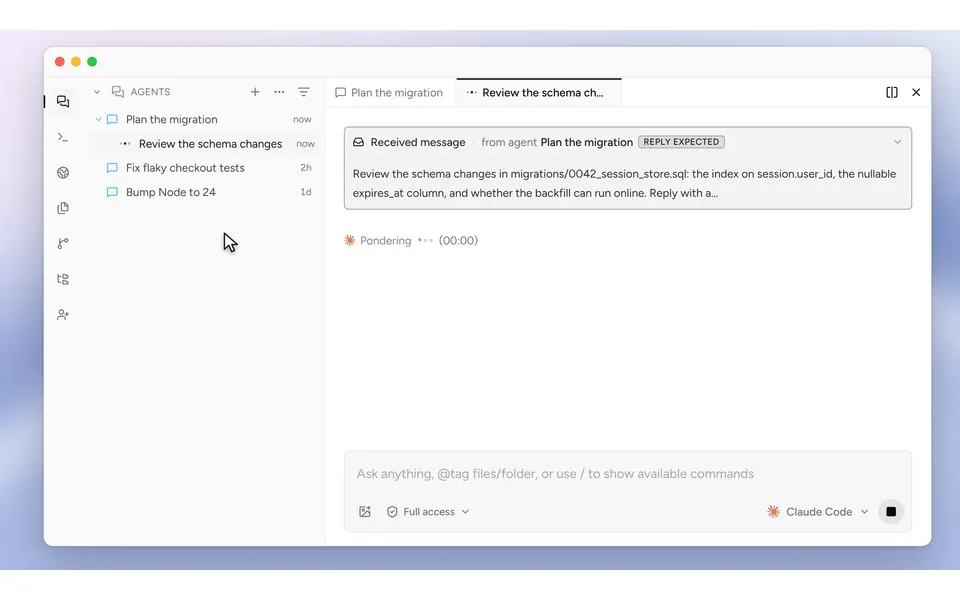
- Desktop app
- Mac, Windows and Linux
- Browser
- No
- Phone
- IPhone and Android
- Command line
- Yes
- Agents
- Claude Code, Codex, Cursor Agent, OpenCode, Pi, Grok and Antigravity
- Your subscription
- Works with your own plan
- Agents run
- On your computer and on your own server
- Laptop closed
- Keeps going
- Isolation
- Worktree
- Parallel agents
- Yes
- Scheduled runs
- Yes
- Coordinator agent
- Yes
- Built-in issues
- Yes
- Pull requests
- Yes
- Review screen
- Yes
- Team
- Roles
- Self-hosting
- Not listed
- Licence
- MIT
- Price from
- Free
- How it charges
- Free plan, subscription, per seat, usage-based and bring your own key
- Paid plans from
- $11–20/month
Measured by ADEMark
ADEMark ran the same tests on 15 ADEs. Results for Traycer 1.5.3, measured up to 12 November 2026 on a Mac mini M4, 16 GB, macOS 27 · Claude Opus 5.5, effort high. Data CC BY 4.0, shown unchanged.
Speed
- Cold start
- 11.35 s12th of 12median of 6 runs, 11.14 s to 11.86 s · Bare CLI 0.69 s
- New thread, ready to type
- 336 ms9th of 10median of 6 runs, 327 ms to 359 ms · Bare CLI 375 ms
- First word on screen
- 907 ms10th of 11median of 6 runs, 859 ms to 943 ms · Bare CLI 220 ms
- Typing lag, 5 agents streaming
- 50 ms2nd of 111 run · Bare CLI 79 ms
- Open a 2,000-message thread
- 127 ms9th of 11median of 5 runs, 126 ms to 127 ms · Bare CLI 203 ms
Weight
- Memory at rest, 5 threads
- 1.83 GB11th of 121 run · Bare CLI 0.99 GB
- Idle CPU
- 15.79%13th of 131 run · Bare CLI 0.37%
- Memory under load
- 2.54 GB7th of 101 run · Bare CLI 1.86 GB
Tokens
- Tokens to answer “hi”
- 68.4K tokens11th of 13median of 3 runs, 68.4K tokens to 68.6K tokens · Bare CLI 38.2K tokens
- Tokens for one real question
- 357.3K tokens13th of 131 run · Bare CLI 168.3K tokens
Build
- Team build: hidden tests passed
- Not measured
Place counts only apps with a value; lower is better except passed tests. ADEMark publishes no overall score and treats close medians as ties, so read places as an order, not a verdict. The Bare CLI is Claude Code in a terminal, run as an unranked control. Method and every test on ademark.dev · Imported data · How we use it
Receipts
- Checked
- Findings
- 38 published · 33 cross-checked by a second agent · read them all
- Sources
- 27 public pages on 1 site: github.com
- Screenshot
- docs.traycer.ai, retrieved · first party repository · shows appearance, not capability
- Data
- /products/traycer.json · .md
- Method
- Same rules for all 103 researched ADEs. How we check · Report wrong data
What it does
Where you use it
Traycer Desktop ships macOS/Windows/Linux clients, native iOS/Android companions and a product CLI. The scoped released distribution has no browser ADE client; account/billing web pages are separate.
Source and scope for Where you use itAgents it runs
Traycer documents multiple coding agents and model switching with shared context. Traycer desktop-v1.5.3 includes Antigravity, introduced in v1.4.0, using its managed official agy_acp_server runtime. The complete Desktop coding-agent table has no Gemini CLI or Aider integration; IDE-extension integrations have a separate scope.
Source and scope for Agents it runsAccounts and subscriptions
Existing coding-agent subscriptions are supported; optional Traycer inference has separate billing.
Source and scope for Accounts and subscriptionsWhere agents run
Agent execution can use the local host or a user-provisioned remote host.
Source and scope for Where agents runHow work is kept apart
Separate Git worktrees are documented; this source does not establish a security boundary.
Source and scope for How work is kept apartParallel work
Parallel agent work is documented, with visible status in Agent Office.
Source and scope for Parallel workScheduled runs
Traycer documents an external host-cron recipe that creates nightly Tasks with idempotency keys. This is a manual integration with external scheduling, not an app-owned scheduler.
Source and scope for Scheduled runsGit and pull requests
Traycer integrates worktrees and PR state; feedback can be sent to the associated agent.
Source and scope for Git and pull requestsLicence and source
Repository source is MIT licensed; hosted parity is not established.
Source and scope for Licence and sourcePrice
Free product access is separate from inference and paid team-wide sharing. Provider setup explicitly accepts the user's own API keys, billed outside Traycer inference.
Source and scope for PriceTyped filters
Every value links to its receipt below. Read plan and surface restrictions before using a filter to decide.
| Filter | Value |
|---|---|
| Desktop OS: macOS | Yes |
| Desktop OS: Windows | Yes |
| Desktop OS: Linux | Yes |
| Web client | No |
| Phone access: Native iOS | Yes |
| Phone access: Native Android | Yes |
| Phone access: Phone browser | No |
| CLI | Yes cross-checked |
| Coding agents: Claude Code | Yes |
| Coding agents: Codex | Yes |
| Coding agents: Cursor Agent | Yes |
| Coding agents: Gemini CLI | No |
| Coding agents: OpenCode | Yes |
| Coding agents: Pi | Yes |
| Coding agents: Grok | Yes |
| Coding agents: Aider | No |
| Coding agents: Antigravity | Yes |
| Use my subscription | Yes cross-checked |
| Where agents run: On your computer | Yes cross-checked |
| Where agents run: On your own server | Yes cross-checked |
| Where agents run: In the vendor's cloud | No |
| Workspace isolation: Git worktree | Yes cross-checked |
| Workspace isolation: Container | Unknown |
| Workspace isolation: VM or microVM | Unknown |
| Parallel runs | Yes cross-checked |
| Coordinator | Yes cross-checked |
| Native issue tracking | Yes cross-checked |
| Unattended triggers | Yes |
| Shared prompting | No cross-checked |
| Team roles | Yes cross-checked |
| SSO | No cross-checked |
| Pull request workflow | Yes cross-checked |
| Review interface | Yes cross-checked |
| Product license: Apache-2.0 | No. MIT cross-checked |
| Product license: MIT | Yes. MIT cross-checked |
| Product license: GPL-3.0 | No. MIT cross-checked |
| Product license: GPL-3.0-or-later | No. MIT cross-checked |
| Product license: AGPL-3.0 | No. MIT cross-checked |
| Product license: AGPL-3.0-or-later | No. MIT cross-checked |
| Product license: Elastic License 2.0 | No. MIT cross-checked |
| Product license: Custom terms | No. MIT cross-checked |
| Product license: Proprietary | No. MIT cross-checked |
| Self-hosting | Unknown |
| Telemetry opt-out | No |
| Free access | Yes cross-checked |
| Starting price: Free | Yes. Free |
| Starting price: Up to $20/month | No. Free |
| Starting price: $21–40/month | No. Free |
| Starting price: $41–100/month | No. Free |
| Starting price: Over $100/month | No. Free |
| Starting price: Contact for pricing | No. Free |
| Pricing model: Free, no paid plan | No |
| Pricing model: Free plan | Yes |
| Pricing model: Subscription | Yes |
| Pricing model: Per seat | Yes |
| Pricing model: Usage-based | Yes |
| Pricing model: Per machine or compute | No |
| Pricing model: Bring your own key | Yes |
| Pricing model: One-time purchase | No |
| Paid plans from: No paid plan | No. $11–20/month |
| Paid plans from: $10 or less/month | No. $11–20/month |
| Paid plans from: $11–20/month | Yes. $11–20/month |
| Paid plans from: $21–40/month | No. $11–20/month |
| Paid plans from: $41–100/month | No. $11–20/month |
| Paid plans from: Over $100/month | No. $11–20/month |
| Paid plans from: Contact sales | No. $11–20/month |
| Lifecycle status: Active | Unknown |
| Lifecycle status: Sunsetting | Unknown |
| Keeps going with laptop closed | Yes cross-checked |
| Open-source license | Yes. MIT cross-checked |
| Any desktop app | Yes |
| Paid plan up to $20/month | Yes. $11–20/month |
| Paid plan up to $40/month | Yes. $11–20/month |
| Any phone client | Yes |
Filter receipts
Desktop OS: macOS: Yes
Desktop OS: macOS
Typed value: Yes.
Traycer Desktop ships macOS/Windows/Linux clients, native iOS/Android companions and a product CLI. The scoped released distribution has no browser ADE client; account/billing web pages are separate.
- Desktop os: macOS 12+ Intel/Apple Silicon; Windows/Linux x64.
- Mobile apps: iPhone/iPad and Android apps connect to existing hosts.
- Cli: Standalone traycer command via npm or Homebrew; desktop bundles it.
- This source pass establishes only the named atomic answers. Other parts retain their documented source gaps; no hands-on test was performed.
-
Finding: Desktop installers support macOS 12+, Windows x64 and Linux x64. Mobile apps and a standalone CLI are documented. Desktop first run signs in and prepares the host.
Desktop OS: Windows: Yes
Desktop OS: Windows
Typed value: Yes.
Traycer Desktop ships macOS/Windows/Linux clients, native iOS/Android companions and a product CLI. The scoped released distribution has no browser ADE client; account/billing web pages are separate.
- Desktop os: macOS 12+ Intel/Apple Silicon; Windows/Linux x64.
- Mobile apps: iPhone/iPad and Android apps connect to existing hosts.
- Cli: Standalone traycer command via npm or Homebrew; desktop bundles it.
- This source pass establishes only the named atomic answers. Other parts retain their documented source gaps; no hands-on test was performed.
-
Finding: Desktop installers support macOS 12+, Windows x64 and Linux x64. Mobile apps and a standalone CLI are documented. Desktop first run signs in and prepares the host.
Desktop OS: Linux: Yes
Desktop OS: Linux
Typed value: Yes.
Traycer Desktop ships macOS/Windows/Linux clients, native iOS/Android companions and a product CLI. The scoped released distribution has no browser ADE client; account/billing web pages are separate.
- Desktop os: macOS 12+ Intel/Apple Silicon; Windows/Linux x64.
- Mobile apps: iPhone/iPad and Android apps connect to existing hosts.
- Cli: Standalone traycer command via npm or Homebrew; desktop bundles it.
- This source pass establishes only the named atomic answers. Other parts retain their documented source gaps; no hands-on test was performed.
-
Finding: Desktop installers support macOS 12+, Windows x64 and Linux x64. Mobile apps and a standalone CLI are documented. Desktop first run signs in and prepares the host.
Web client: No
Web client
Typed value: No.
Traycer Desktop ships macOS/Windows/Linux clients, native iOS/Android companions and a product CLI. The scoped released distribution has no browser ADE client; account/billing web pages are separate.
- Browser: No released browser task/agent client in the scoped client/build distribution.
- Mobile browser: Phone access is the native mobile app, without a released phone-browser ADE client.
- This source pass establishes only the named atomic answers. Other parts retain their documented source gaps; no hands-on test was performed.
-
Traycer released client distribution
Finding: The released client distribution is desktop, native iOS/Android and CLI. The common gui-app is packaged into native clients, not a separately released browser ADE. Account/billing dashboard pages are distinct from task/agent control. The scoped release has no browser ADE client.
Phone access: Native iOS: Yes
Phone access: Native iOS
Typed value: Yes.
Traycer Desktop ships macOS/Windows/Linux clients, native iOS/Android companions and a product CLI. The scoped released distribution has no browser ADE client; account/billing web pages are separate.
- Desktop os: macOS 12+ Intel/Apple Silicon; Windows/Linux x64.
- Mobile apps: iPhone/iPad and Android apps connect to existing hosts.
- Cli: Standalone traycer command via npm or Homebrew; desktop bundles it.
- This source pass establishes only the named atomic answers. Other parts retain their documented source gaps; no hands-on test was performed.
-
Finding: Desktop installers support macOS 12+, Windows x64 and Linux x64. Mobile apps and a standalone CLI are documented. Desktop first run signs in and prepares the host.
Phone access: Native Android: Yes
Phone access: Native Android
Typed value: Yes.
Traycer Desktop ships macOS/Windows/Linux clients, native iOS/Android companions and a product CLI. The scoped released distribution has no browser ADE client; account/billing web pages are separate.
- Desktop os: macOS 12+ Intel/Apple Silicon; Windows/Linux x64.
- Mobile apps: iPhone/iPad and Android apps connect to existing hosts.
- Cli: Standalone traycer command via npm or Homebrew; desktop bundles it.
- This source pass establishes only the named atomic answers. Other parts retain their documented source gaps; no hands-on test was performed.
-
Finding: Desktop installers support macOS 12+, Windows x64 and Linux x64. Mobile apps and a standalone CLI are documented. Desktop first run signs in and prepares the host.
Phone access: Phone browser: No
Phone access: Phone browser
Typed value: No.
Traycer Desktop ships macOS/Windows/Linux clients, native iOS/Android companions and a product CLI. The scoped released distribution has no browser ADE client; account/billing web pages are separate.
- Browser: No released browser task/agent client in the scoped client/build distribution.
- Mobile browser: Phone access is the native mobile app, without a released phone-browser ADE client.
- This source pass establishes only the named atomic answers. Other parts retain their documented source gaps; no hands-on test was performed.
-
Traycer released client distribution
Finding: The released client distribution is desktop, native iOS/Android and CLI. The common gui-app is packaged into native clients, not a separately released browser ADE. Account/billing dashboard pages are distinct from task/agent control. The scoped release has no browser ADE client.
CLI: Yes cross-checked
CLI
Typed value: Yes.
Traycer has task, agent, worktree and host commands with scoped agent access.
- Cli: traycer task create; agent create/list/send/stop/transcript; worktree create/list/delete.
- Operations: Documented creation, inspection, messaging, stopping and host diagnostics.
- Authentication: Signed-in CLI and Task/agent environment context; read-only surfaces restrict mutations.
- Documentation establishes only the named facts. Unknown atomic questions and unrun scenarios remain open.
-
traycer mintlify/cli/commands.mdx
Finding: CLI creates tasks and agents, sends messages and reads transcripts. Agent tools depend on Task/agent environment context and interface permissions. A nightly task example uses external cron.
Coding agents: Claude Code: Yes
Coding agents: Claude Code
Typed value: Yes.
Traycer documents multiple coding agents and model switching with shared context. Traycer desktop-v1.5.3 includes Antigravity, introduced in v1.4.0, using its managed official agy_acp_server runtime. The complete Desktop coding-agent table has no Gemini CLI or Aider integration; IDE-extension integrations have a separate scope.
- Harnesses: Claude Code, Codex, Cursor, OpenCode, GitHub Copilot, Devin, Amp, Droid, Kiro, Pi and other named integrations. Traycer desktop-v1.5.3 includes Antigravity, introduced in v1.4.0, using its managed official agy_acp_server runtime.
- Session integration: Traycer coordinates agent sessions and can switch models within a chat.
- This source pass establishes only the named atomic answers. Other parts retain their documented source gaps; no hands-on test was performed.
-
Finding: Desktop orchestrates parallel coding agents, reuses provider subscriptions and has shared context. Inference and cloud collaboration are separate services.
Coding agents: Codex: Yes
Coding agents: Codex
Typed value: Yes.
Traycer documents multiple coding agents and model switching with shared context. Traycer desktop-v1.5.3 includes Antigravity, introduced in v1.4.0, using its managed official agy_acp_server runtime. The complete Desktop coding-agent table has no Gemini CLI or Aider integration; IDE-extension integrations have a separate scope.
- Harnesses: Claude Code, Codex, Cursor, OpenCode, GitHub Copilot, Devin, Amp, Droid, Kiro, Pi and other named integrations. Traycer desktop-v1.5.3 includes Antigravity, introduced in v1.4.0, using its managed official agy_acp_server runtime.
- Session integration: Traycer coordinates agent sessions and can switch models within a chat.
- This source pass establishes only the named atomic answers. Other parts retain their documented source gaps; no hands-on test was performed.
-
Finding: Desktop orchestrates parallel coding agents, reuses provider subscriptions and has shared context. Inference and cloud collaboration are separate services.
Coding agents: Cursor Agent: Yes
Coding agents: Cursor Agent
Typed value: Yes.
Traycer documents multiple coding agents and model switching with shared context. Traycer desktop-v1.5.3 includes Antigravity, introduced in v1.4.0, using its managed official agy_acp_server runtime. The complete Desktop coding-agent table has no Gemini CLI or Aider integration; IDE-extension integrations have a separate scope.
- Harnesses: Claude Code, Codex, Cursor, OpenCode, GitHub Copilot, Devin, Amp, Droid, Kiro, Pi and other named integrations. Traycer desktop-v1.5.3 includes Antigravity, introduced in v1.4.0, using its managed official agy_acp_server runtime.
- Session integration: Traycer coordinates agent sessions and can switch models within a chat.
- This source pass establishes only the named atomic answers. Other parts retain their documented source gaps; no hands-on test was performed.
-
Finding: Desktop orchestrates parallel coding agents, reuses provider subscriptions and has shared context. Inference and cloud collaboration are separate services.
Coding agents: Gemini CLI: No
Coding agents: Gemini CLI
Typed value: No.
Traycer documents multiple coding agents and model switching with shared context. Traycer desktop-v1.5.3 includes Antigravity, introduced in v1.4.0, using its managed official agy_acp_server runtime. The complete Desktop coding-agent table has no Gemini CLI or Aider integration; IDE-extension integrations have a separate scope.
- This source pass establishes only the named atomic answers. Other parts retain their documented source gaps; no hands-on test was performed.
-
Traycer Desktop complete coding-agent table
Finding: The desktop agent table enumerates its managed and external agent integrations, including Antigravity, Pi and Grok, without Gemini CLI or Aider. CLI-path overrides customize an existing provider, rather than registering an arbitrary new harness. The separate IDE extension's custom-agent export is outside this Desktop scope.
Coding agents: OpenCode: Yes
Coding agents: OpenCode
Typed value: Yes.
Traycer documents multiple coding agents and model switching with shared context. Traycer desktop-v1.5.3 includes Antigravity, introduced in v1.4.0, using its managed official agy_acp_server runtime. The complete Desktop coding-agent table has no Gemini CLI or Aider integration; IDE-extension integrations have a separate scope.
- Harnesses: Claude Code, Codex, Cursor, OpenCode, GitHub Copilot, Devin, Amp, Droid, Kiro, Pi and other named integrations. Traycer desktop-v1.5.3 includes Antigravity, introduced in v1.4.0, using its managed official agy_acp_server runtime.
- Session integration: Traycer coordinates agent sessions and can switch models within a chat.
- This source pass establishes only the named atomic answers. Other parts retain their documented source gaps; no hands-on test was performed.
-
Finding: Desktop orchestrates parallel coding agents, reuses provider subscriptions and has shared context. Inference and cloud collaboration are separate services.
Coding agents: Pi: Yes
Coding agents: Pi
Typed value: Yes.
Traycer documents multiple coding agents and model switching with shared context. Traycer desktop-v1.5.3 includes Antigravity, introduced in v1.4.0, using its managed official agy_acp_server runtime. The complete Desktop coding-agent table has no Gemini CLI or Aider integration; IDE-extension integrations have a separate scope.
- Harnesses: Claude Code, Codex, Cursor, OpenCode, GitHub Copilot, Devin, Amp, Droid, Kiro, Pi and other named integrations. Traycer desktop-v1.5.3 includes Antigravity, introduced in v1.4.0, using its managed official agy_acp_server runtime.
- Session integration: Traycer coordinates agent sessions and can switch models within a chat.
- This source pass establishes only the named atomic answers. Other parts retain their documented source gaps; no hands-on test was performed.
-
Finding: Desktop orchestrates parallel coding agents, reuses provider subscriptions and has shared context. Inference and cloud collaboration are separate services.
Coding agents: Grok: Yes
Coding agents: Grok
Typed value: Yes.
Traycer documents multiple coding agents and model switching with shared context. Traycer desktop-v1.5.3 includes Antigravity, introduced in v1.4.0, using its managed official agy_acp_server runtime. The complete Desktop coding-agent table has no Gemini CLI or Aider integration; IDE-extension integrations have a separate scope.
- Harnesses: Claude Code, Codex, Cursor, OpenCode, GitHub Copilot, Devin, Amp, Droid, Kiro, Pi and other named integrations. Traycer desktop-v1.5.3 includes Antigravity, introduced in v1.4.0, using its managed official agy_acp_server runtime.
- Session integration: Traycer coordinates agent sessions and can switch models within a chat.
- This source pass establishes only the named atomic answers. Other parts retain their documented source gaps; no hands-on test was performed.
-
Finding: Desktop orchestrates parallel coding agents, reuses provider subscriptions and has shared context. Inference and cloud collaboration are separate services.
Coding agents: Aider: No
Coding agents: Aider
Typed value: No.
Traycer documents multiple coding agents and model switching with shared context. Traycer desktop-v1.5.3 includes Antigravity, introduced in v1.4.0, using its managed official agy_acp_server runtime. The complete Desktop coding-agent table has no Gemini CLI or Aider integration; IDE-extension integrations have a separate scope.
- This source pass establishes only the named atomic answers. Other parts retain their documented source gaps; no hands-on test was performed.
-
Traycer Desktop complete coding-agent table
Finding: The desktop agent table enumerates its managed and external agent integrations, including Antigravity, Pi and Grok, without Gemini CLI or Aider. CLI-path overrides customize an existing provider, rather than registering an arbitrary new harness. The separate IDE extension's custom-agent export is outside this Desktop scope.
Coding agents: Antigravity: Yes
Coding agents: Antigravity
Typed value: Yes.
Traycer documents multiple coding agents and model switching with shared context. Traycer desktop-v1.5.3 includes Antigravity, introduced in v1.4.0, using its managed official agy_acp_server runtime. The complete Desktop coding-agent table has no Gemini CLI or Aider integration; IDE-extension integrations have a separate scope.
- Harnesses: Claude Code, Codex, Cursor, OpenCode, GitHub Copilot, Devin, Amp, Droid, Kiro, Pi and other named integrations. Traycer desktop-v1.5.3 includes Antigravity, introduced in v1.4.0, using its managed official agy_acp_server runtime.
- This source pass establishes only the named atomic answers. Other parts retain their documented source gaps; no hands-on test was performed.
-
Traycer Antigravity support at desktop-v1.5.3
Finding: Traycer desktop-v1.5.3 includes Antigravity, introduced in v1.4.0, using its managed official agy_acp_server runtime.
-
Traycer Antigravity support at desktop-v1.5.3
Finding: Traycer desktop-v1.5.3 includes Antigravity, introduced in v1.4.0, using its managed official agy_acp_server runtime.
Use my subscription: Yes cross-checked
Use my subscription
Typed value: Yes.
Existing coding-agent subscriptions are supported; optional Traycer inference has separate billing.
- Agent subscriptions: Bring existing provider subscriptions, including Claude Code and Codex.
- Vendor credits: Optional Traycer inference subscription/credit route is separate from connected agents.
- Documentation establishes only the named facts. Unknown atomic questions and unrun scenarios remain open.
-
Finding: Desktop orchestrates parallel coding agents, reuses provider subscriptions and has shared context. Inference and cloud collaboration are separate services.
Where agents run: On your computer: Yes cross-checked
Where agents run: On your computer
Typed value: Yes.
Agent execution can use the local host or a user-provisioned remote host.
- Local: Desktop prepares a host on the local machine.
- Byo remote: CLI can install/register a host on another computer or server.
- Provisioning: User installs CLI, signs in and runs traycer host ensure; Linux uses systemd user service.
- Client disconnect: Mobile client has no execution host and follows work running on other machines.
- Documentation establishes only the named facts. Unknown atomic questions and unrun scenarios remain open.
-
Finding: Desktop installers support macOS 12+, Windows x64 and Linux x64. Mobile apps and a standalone CLI are documented. Desktop first run signs in and prepares the host.
Where agents run: On your own server: Yes cross-checked
Where agents run: On your own server
Typed value: Yes.
Agent execution can use the local host or a user-provisioned remote host.
- Local: Desktop prepares a host on the local machine.
- Byo remote: CLI can install/register a host on another computer or server.
- Provisioning: User installs CLI, signs in and runs traycer host ensure; Linux uses systemd user service.
- Client disconnect: Mobile client has no execution host and follows work running on other machines.
- Documentation establishes only the named facts. Unknown atomic questions and unrun scenarios remain open.
-
traycer mintlify/concepts/hosts/remote-hosts.mdx
Finding: Install CLI on a remote machine, sign in and start the Host as a persistent service. It runs agents and accesses files on that machine.
Where agents run: In the vendor's cloud: No
Where agents run: In the vendor's cloud
Typed value: No.
Agent execution can use the local host or a user-provisioned remote host.
- Local: Desktop prepares a host on the local machine.
- Byo remote: CLI can install/register a host on another computer or server.
- Provisioning: User installs CLI, signs in and runs traycer host ensure; Linux uses systemd user service.
- Client disconnect: Mobile client has no execution host and follows work running on other machines.
- Documentation establishes only the named facts. Unknown atomic questions and unrun scenarios remain open.
-
Finding: Desktop installers support macOS 12+, Windows x64 and Linux x64. Mobile apps and a standalone CLI are documented. Desktop first run signs in and prepares the host.
-
traycer mintlify/concepts/hosts/remote-hosts.mdx
Finding: Install CLI on a remote machine, sign in and start the Host as a persistent service. It runs agents and accesses files on that machine.
-
traycer mintlify/account/mobile-app.mdx
Finding: Phone clients connect through the relay to hosts on other machines. Agents continue there while the phone follows or steers work. Mobile is included in Free.
Workspace isolation: Git worktree: Yes cross-checked
Workspace isolation: Git worktree
Typed value: Yes.
Separate Git worktrees are documented; this source does not establish a security boundary.
- Checkout: Local folder is an available run location.
- Branch: New-worktree UI creates a branch; CLI can use an existing branch.
- Worktree: New/existing worktrees separate code changes; a new worktree gets a new branch.
- Documentation establishes only the named facts. Unknown atomic questions and unrun scenarios remain open.
-
traycer mintlify/concepts/worktrees.mdx
Finding: Tasks can use the local folder or new/existing Git worktrees; non-Git folders run Local. Setup and teardown scripts live in repository configuration.
Parallel runs: Yes cross-checked
Parallel runs
Typed value: Yes.
Parallel agent work is documented, with visible status in Agent Office.
- Concurrent sessions: Multiple agents run in parallel according to the README.
- Status visibility: Agent Office distinguishes working, waiting for reply, needs you, idle, failed and archived.
- Documentation establishes only the named facts. Unknown atomic questions and unrun scenarios remain open.
-
Finding: Desktop orchestrates parallel coding agents, reuses provider subscriptions and has shared context. Inference and cloud collaboration are separate services.
Coordinator: Yes cross-checked
Coordinator
Typed value: Yes.
Traycer-owned agent commands support cross-harness delegation, transcripts and replies.
- Roles: Parent/child agents have separate model, transcript and run state.
- Messages: Requests, replies and notices across own reachable/synced hosts.
- Results return: Parent can read results and continue the child conversation.
- Cross harness: Different supported harnesses can be chosen for child agents.
- Orchestration owner: Traycer CLI and Host own the documented orchestration.
- Live progress: Agent Office and tree expose agents and states.
- Retained results: Transcript and message replay persist subject to host and sync conditions.
- Followup: Send instructions or reconfigure an existing agent.
- Documentation establishes only the named facts. Unknown atomic questions and unrun scenarios remain open.
-
traycer mintlify/concepts/agent-to-agent.mdx
Finding: Agents create child sessions, message them and read transcripts, with per-interface and ownership restrictions. Agent Office retains lineage, live state and message replay.
Native issue tracking: Yes cross-checked
Native issue tracking
Typed value: Yes.
Traycer retains Tasks independently of their multiple agents and provides organization in History.
- Durable states: Ticket and story artifacts carry a persistent Todo, In Progress or Done status, stored in the artifact file.
- Documentation establishes only the named facts. Unknown atomic questions and unrun scenarios remain open.
-
Traycer mintlify/panels/artifacts.mdx
Finding: Tasks hold ticket and story artifacts that track work with a persistent Todo, In Progress or Done status, changed from a status pill and stored in the artifact file on disk.
Unattended triggers: Yes
Unattended triggers
Typed value: Yes.
Traycer documents an external host-cron recipe that creates nightly Tasks with idempotency keys. This is a manual integration with external scheduling, not an app-owned scheduler.
- Schedules: The documented crontab recipe starts a Task per day; the user installs and operates the schedule.
- Scheduler location: Example uses host cron to invoke traycer task create.
- Overlaps: Idempotency keys suppress duplicate task creation in the example.
- This source pass establishes only the named atomic answers. Other parts retain their documented source gaps; no hands-on test was performed.
-
traycer mintlify/cli/commands.mdx
Finding: CLI creates tasks and agents, sends messages and reads transcripts. Agent tools depend on Task/agent environment context and interface permissions. A nightly task example uses external cron.
Shared prompting: No cross-checked
Shared prompting
Typed value: No.
Tasks, artifacts and shared chats are visible to collaborators, but shared prompting is explicitly restricted.
- Visibility: Invited collaborators see artifacts and shared Chat agents.
- Coprompting: Collaborators can view and clone another user's shared chat but can never act in it.
- Plan restrictions: Individual invitations work on every plan; team sharing needs Sync.
- Documentation establishes only the named facts. Unknown atomic questions and unrun scenarios remain open.
-
traycer mintlify/panels/sharing.mdx
Finding: Task Owner/Editor access is documented. Shared agents can be viewed and cloned but collaborators cannot act in them. Individual invites are Free; whole-team sharing needs Sync.
Team roles: Yes cross-checked
Team roles
Typed value: Yes.
Task Owner/Editor and team Admin/Member roles are documented; SSO/SAML is unavailable.
- Organization roles: Admins can invite and manage team membership; Members have narrower access.
- Task roles: Owner manages removal/team sharing, Editors can work in the Task.
- Sso: Official FAQ says SSO and SAML are not supported.
- Documentation establishes only the named facts. Unknown atomic questions and unrun scenarios remain open.
-
traycer mintlify/panels/sharing.mdx
Finding: Task Owner/Editor access is documented. Shared agents can be viewed and cloned but collaborators cannot act in them. Individual invites are Free; whole-team sharing needs Sync.
-
traycer mintlify/account/teams.mdx
Finding: Teams have Admin/Member roles. SSO and SAML are explicitly not supported.
SSO: No cross-checked
SSO
Typed value: No.
Task Owner/Editor and team Admin/Member roles are documented; SSO/SAML is unavailable.
- Organization roles: Admins can invite and manage team membership; Members have narrower access.
- Task roles: Owner manages removal/team sharing, Editors can work in the Task.
- Sso: Official FAQ says SSO and SAML are not supported.
- Documentation establishes only the named facts. Unknown atomic questions and unrun scenarios remain open.
-
traycer mintlify/account/teams.mdx
Finding: Teams have Admin/Member roles. SSO and SAML are explicitly not supported.
Pull request workflow: Yes cross-checked
Pull request workflow
Typed value: Yes.
Traycer integrates worktrees and PR state; feedback can be sent to the associated agent.
- Branches: Worktree branch controls.
- Worktrees: New/existing worktree selection.
- Pull requests: Panel lists and inspects GitHub PRs through gh.
- Comments: Review feedback is quoted into the originating agent chat.
- Ci response: Failing checks can be placed in chat via Fix in chat.
- Product state: PR state, review decision and check summaries appear in the product.
- Documentation establishes only the named facts. Unknown atomic questions and unrun scenarios remain open.
-
traycer mintlify/panels/pull-requests.mdx
Finding: PR panel groups PRs by repository/stack, shows checks and reviews, diffs and commits, and quotes failing checks or review feedback into an agent composer. It requires authenticated gh on the host.
Review interface: Yes cross-checked
Review interface
Typed value: Yes.
Traycer integrates worktrees and PR state; feedback can be sent to the associated agent.
- Branches: Worktree branch controls.
- Worktrees: New/existing worktree selection.
- Pull requests: Panel lists and inspects GitHub PRs through gh.
- Comments: Review feedback is quoted into the originating agent chat.
- Ci response: Failing checks can be placed in chat via Fix in chat.
- Product state: PR state, review decision and check summaries appear in the product.
- Documentation establishes only the named facts. Unknown atomic questions and unrun scenarios remain open.
-
traycer mintlify/panels/pull-requests.mdx
Finding: PR panel groups PRs by repository/stack, shows checks and reviews, diffs and commits, and quotes failing checks or review feedback into an agent composer. It requires authenticated gh on the host.
Product license: Apache-2.0: No. MIT cross-checked
Product license: Apache-2.0
Typed value: No. MIT.
Repository source is MIT licensed; hosted parity is not established.
- Client license: MIT repository license.
- Source visibility: Public GitHub repository.
- Source revision: 8f64858ca75b5b260ab775bd1efc7ce5f997782e
- Documentation establishes only the named facts. Unknown atomic questions and unrun scenarios remain open.
-
Finding: MIT license covers the repository at the pinned revision; no hosted-service parity is implied.
Product license: MIT: Yes. MIT cross-checked
Product license: MIT
Typed value: Yes. MIT.
Repository source is MIT licensed; hosted parity is not established.
- Client license: MIT repository license.
- Source visibility: Public GitHub repository.
- Source revision: 8f64858ca75b5b260ab775bd1efc7ce5f997782e
- Documentation establishes only the named facts. Unknown atomic questions and unrun scenarios remain open.
-
Finding: MIT license covers the repository at the pinned revision; no hosted-service parity is implied.
Product license: GPL-3.0: No. MIT cross-checked
Product license: GPL-3.0
Typed value: No. MIT.
Repository source is MIT licensed; hosted parity is not established.
- Client license: MIT repository license.
- Source visibility: Public GitHub repository.
- Source revision: 8f64858ca75b5b260ab775bd1efc7ce5f997782e
- Documentation establishes only the named facts. Unknown atomic questions and unrun scenarios remain open.
-
Finding: MIT license covers the repository at the pinned revision; no hosted-service parity is implied.
Product license: GPL-3.0-or-later: No. MIT cross-checked
Product license: GPL-3.0-or-later
Typed value: No. MIT.
Repository source is MIT licensed; hosted parity is not established.
- Client license: MIT repository license.
- Source visibility: Public GitHub repository.
- Source revision: 8f64858ca75b5b260ab775bd1efc7ce5f997782e
- Documentation establishes only the named facts. Unknown atomic questions and unrun scenarios remain open.
-
Finding: MIT license covers the repository at the pinned revision; no hosted-service parity is implied.
Product license: AGPL-3.0: No. MIT cross-checked
Product license: AGPL-3.0
Typed value: No. MIT.
Repository source is MIT licensed; hosted parity is not established.
- Client license: MIT repository license.
- Source visibility: Public GitHub repository.
- Source revision: 8f64858ca75b5b260ab775bd1efc7ce5f997782e
- Documentation establishes only the named facts. Unknown atomic questions and unrun scenarios remain open.
-
Finding: MIT license covers the repository at the pinned revision; no hosted-service parity is implied.
Product license: AGPL-3.0-or-later: No. MIT cross-checked
Product license: AGPL-3.0-or-later
Typed value: No. MIT.
Repository source is MIT licensed; hosted parity is not established.
- Client license: MIT repository license.
- Source visibility: Public GitHub repository.
- Source revision: 8f64858ca75b5b260ab775bd1efc7ce5f997782e
- Documentation establishes only the named facts. Unknown atomic questions and unrun scenarios remain open.
-
Finding: MIT license covers the repository at the pinned revision; no hosted-service parity is implied.
Product license: Elastic License 2.0: No. MIT cross-checked
Product license: Elastic License 2.0
Typed value: No. MIT.
Repository source is MIT licensed; hosted parity is not established.
- Client license: MIT repository license.
- Source visibility: Public GitHub repository.
- Source revision: 8f64858ca75b5b260ab775bd1efc7ce5f997782e
- Documentation establishes only the named facts. Unknown atomic questions and unrun scenarios remain open.
-
Finding: MIT license covers the repository at the pinned revision; no hosted-service parity is implied.
Product license: Custom terms: No. MIT cross-checked
Product license: Custom terms
Typed value: No. MIT.
Repository source is MIT licensed; hosted parity is not established.
- Client license: MIT repository license.
- Source visibility: Public GitHub repository.
- Source revision: 8f64858ca75b5b260ab775bd1efc7ce5f997782e
- Documentation establishes only the named facts. Unknown atomic questions and unrun scenarios remain open.
-
Finding: MIT license covers the repository at the pinned revision; no hosted-service parity is implied.
Product license: Proprietary: No. MIT cross-checked
Product license: Proprietary
Typed value: No. MIT.
Repository source is MIT licensed; hosted parity is not established.
- Client license: MIT repository license.
- Source visibility: Public GitHub repository.
- Source revision: 8f64858ca75b5b260ab775bd1efc7ce5f997782e
- Documentation establishes only the named facts. Unknown atomic questions and unrun scenarios remain open.
-
Finding: MIT license covers the repository at the pinned revision; no hosted-service parity is implied.
Telemetry opt-out: No
Telemetry opt-out
Typed value: No.
Traycer discloses product analytics and separate provider requests. In the scoped release, PostHog initializes from the build key without a user telemetry switch in settings; privacy mode does not disable analytics.
- Telemetry controls: Bounded constructor and settings/UI inspection has no shipped-user product analytics disable control.
- This source pass establishes only the named atomic answers. Other parts retain their documented source gaps; no hands-on test was performed.
-
Traycer release telemetry lacks user opt-out
Finding: Desktop/mobile product analytics enables when the release build has a PostHog key and is not a test build. The constructor and scoped settings store/UI provide no user telemetry toggle; privacy mode is not a telemetry disable control. Building without a key is a developer build configuration, not a shipped-user opt-out.
Free access: Yes cross-checked
Free access
Typed value: Yes.
Recurring Free includes own agents, sync, remote hosts and mobile; whole-team sharing requires Sync.
- Ongoing free: $0 Free plan.
- Free scenarios: Individual invitations, own agents, mobile, remote hosts, planning and agent communication.
- Usage caps: Unlimited agent sessions; upstream agent limits remain separate.
- Documentation establishes only the named facts. Unknown atomic questions and unrun scenarios remain open.
-
traycer mintlify/account/pricing.mdx
Finding: Free is $0 with own agents, unlimited sessions, cloud sync, individual sharing, remote hosts and mobile. Sync is $20/user/month or $16 with yearly billing. Optional inference credits use upstream pricing plus 20% markup.
Starting price: Free: Yes. Free
Starting price: Free
Typed value: Yes. Free.
Free product access is separate from inference and paid team-wide sharing. Provider setup explicitly accepts the user's own API keys, billed outside Traycer inference.
- Currency: USD.
- Interval: Sync $20 per user monthly or $16/user/month billed annually.
- Seats: Sync is priced per user.
- Included usage: Free has unlimited agent sessions with own agents; no inference credits required.
- Model cost: Users may supply their own provider API keys; those calls use provider billing rather than Traycer credits.
- This source pass establishes only the named atomic answers. Other parts retain their documented source gaps; no hands-on test was performed.
-
traycer mintlify/account/pricing.mdx
Finding: Free is $0 with own agents, unlimited sessions, cloud sync, individual sharing, remote hosts and mobile. Sync is $20/user/month or $16 with yearly billing. Optional inference credits use upstream pricing plus 20% markup.
Starting price: Up to $20/month: No. Free
Starting price: Up to $20/month
Typed value: No. Free.
Free product access is separate from inference and paid team-wide sharing. Provider setup explicitly accepts the user's own API keys, billed outside Traycer inference.
- Currency: USD.
- Interval: Sync $20 per user monthly or $16/user/month billed annually.
- Seats: Sync is priced per user.
- Included usage: Free has unlimited agent sessions with own agents; no inference credits required.
- Model cost: Users may supply their own provider API keys; those calls use provider billing rather than Traycer credits.
- This source pass establishes only the named atomic answers. Other parts retain their documented source gaps; no hands-on test was performed.
-
traycer mintlify/account/pricing.mdx
Finding: Free is $0 with own agents, unlimited sessions, cloud sync, individual sharing, remote hosts and mobile. Sync is $20/user/month or $16 with yearly billing. Optional inference credits use upstream pricing plus 20% markup.
Starting price: $21–40/month: No. Free
Starting price: $21–40/month
Typed value: No. Free.
Free product access is separate from inference and paid team-wide sharing. Provider setup explicitly accepts the user's own API keys, billed outside Traycer inference.
- Currency: USD.
- Interval: Sync $20 per user monthly or $16/user/month billed annually.
- Seats: Sync is priced per user.
- Included usage: Free has unlimited agent sessions with own agents; no inference credits required.
- Model cost: Users may supply their own provider API keys; those calls use provider billing rather than Traycer credits.
- This source pass establishes only the named atomic answers. Other parts retain their documented source gaps; no hands-on test was performed.
-
traycer mintlify/account/pricing.mdx
Finding: Free is $0 with own agents, unlimited sessions, cloud sync, individual sharing, remote hosts and mobile. Sync is $20/user/month or $16 with yearly billing. Optional inference credits use upstream pricing plus 20% markup.
Starting price: $41–100/month: No. Free
Starting price: $41–100/month
Typed value: No. Free.
Free product access is separate from inference and paid team-wide sharing. Provider setup explicitly accepts the user's own API keys, billed outside Traycer inference.
- Currency: USD.
- Interval: Sync $20 per user monthly or $16/user/month billed annually.
- Seats: Sync is priced per user.
- Included usage: Free has unlimited agent sessions with own agents; no inference credits required.
- Model cost: Users may supply their own provider API keys; those calls use provider billing rather than Traycer credits.
- This source pass establishes only the named atomic answers. Other parts retain their documented source gaps; no hands-on test was performed.
-
traycer mintlify/account/pricing.mdx
Finding: Free is $0 with own agents, unlimited sessions, cloud sync, individual sharing, remote hosts and mobile. Sync is $20/user/month or $16 with yearly billing. Optional inference credits use upstream pricing plus 20% markup.
Starting price: Over $100/month: No. Free
Starting price: Over $100/month
Typed value: No. Free.
Free product access is separate from inference and paid team-wide sharing. Provider setup explicitly accepts the user's own API keys, billed outside Traycer inference.
- Currency: USD.
- Interval: Sync $20 per user monthly or $16/user/month billed annually.
- Seats: Sync is priced per user.
- Included usage: Free has unlimited agent sessions with own agents; no inference credits required.
- Model cost: Users may supply their own provider API keys; those calls use provider billing rather than Traycer credits.
- This source pass establishes only the named atomic answers. Other parts retain their documented source gaps; no hands-on test was performed.
-
traycer mintlify/account/pricing.mdx
Finding: Free is $0 with own agents, unlimited sessions, cloud sync, individual sharing, remote hosts and mobile. Sync is $20/user/month or $16 with yearly billing. Optional inference credits use upstream pricing plus 20% markup.
Starting price: Contact for pricing: No. Free
Starting price: Contact for pricing
Typed value: No. Free.
Free product access is separate from inference and paid team-wide sharing. Provider setup explicitly accepts the user's own API keys, billed outside Traycer inference.
- Currency: USD.
- Interval: Sync $20 per user monthly or $16/user/month billed annually.
- Seats: Sync is priced per user.
- Included usage: Free has unlimited agent sessions with own agents; no inference credits required.
- Model cost: Users may supply their own provider API keys; those calls use provider billing rather than Traycer credits.
- This source pass establishes only the named atomic answers. Other parts retain their documented source gaps; no hands-on test was performed.
-
traycer mintlify/account/pricing.mdx
Finding: Free is $0 with own agents, unlimited sessions, cloud sync, individual sharing, remote hosts and mobile. Sync is $20/user/month or $16 with yearly billing. Optional inference credits use upstream pricing plus 20% markup.
Pricing model: Free, no paid plan: No
Pricing model: Free, no paid plan
Typed value: No.
Free product access is separate from inference and paid team-wide sharing. Provider setup explicitly accepts the user's own API keys, billed outside Traycer inference.
- Currency: USD.
- Interval: Sync $20 per user monthly or $16/user/month billed annually.
- Seats: Sync is priced per user.
- Included usage: Free has unlimited agent sessions with own agents; no inference credits required.
- Model cost: Users may supply their own provider API keys; those calls use provider billing rather than Traycer credits.
- This source pass establishes only the named atomic answers. Other parts retain their documented source gaps; no hands-on test was performed.
-
traycer mintlify/account/pricing.mdx
Finding: Free is $0 with own agents, unlimited sessions, cloud sync, individual sharing, remote hosts and mobile. Sync is $20/user/month or $16 with yearly billing. Optional inference credits use upstream pricing plus 20% markup.
Pricing model: Free plan: Yes
Pricing model: Free plan
Typed value: Yes.
Free product access is separate from inference and paid team-wide sharing. Provider setup explicitly accepts the user's own API keys, billed outside Traycer inference.
- Currency: USD.
- Interval: Sync $20 per user monthly or $16/user/month billed annually.
- Seats: Sync is priced per user.
- Included usage: Free has unlimited agent sessions with own agents; no inference credits required.
- Model cost: Users may supply their own provider API keys; those calls use provider billing rather than Traycer credits.
- This source pass establishes only the named atomic answers. Other parts retain their documented source gaps; no hands-on test was performed.
-
traycer mintlify/account/pricing.mdx
Finding: Free is $0 with own agents, unlimited sessions, cloud sync, individual sharing, remote hosts and mobile. Sync is $20/user/month or $16 with yearly billing. Optional inference credits use upstream pricing plus 20% markup.
Pricing model: Subscription: Yes
Pricing model: Subscription
Typed value: Yes.
Free product access is separate from inference and paid team-wide sharing. Provider setup explicitly accepts the user's own API keys, billed outside Traycer inference.
- Currency: USD.
- Interval: Sync $20 per user monthly or $16/user/month billed annually.
- Seats: Sync is priced per user.
- Included usage: Free has unlimited agent sessions with own agents; no inference credits required.
- Model cost: Users may supply their own provider API keys; those calls use provider billing rather than Traycer credits.
- This source pass establishes only the named atomic answers. Other parts retain their documented source gaps; no hands-on test was performed.
-
traycer mintlify/account/pricing.mdx
Finding: Free is $0 with own agents, unlimited sessions, cloud sync, individual sharing, remote hosts and mobile. Sync is $20/user/month or $16 with yearly billing. Optional inference credits use upstream pricing plus 20% markup.
Pricing model: Per seat: Yes
Pricing model: Per seat
Typed value: Yes.
Free product access is separate from inference and paid team-wide sharing. Provider setup explicitly accepts the user's own API keys, billed outside Traycer inference.
- Currency: USD.
- Interval: Sync $20 per user monthly or $16/user/month billed annually.
- Seats: Sync is priced per user.
- Included usage: Free has unlimited agent sessions with own agents; no inference credits required.
- Model cost: Users may supply their own provider API keys; those calls use provider billing rather than Traycer credits.
- This source pass establishes only the named atomic answers. Other parts retain their documented source gaps; no hands-on test was performed.
-
traycer mintlify/account/pricing.mdx
Finding: Free is $0 with own agents, unlimited sessions, cloud sync, individual sharing, remote hosts and mobile. Sync is $20/user/month or $16 with yearly billing. Optional inference credits use upstream pricing plus 20% markup.
Pricing model: Usage-based: Yes
Pricing model: Usage-based
Typed value: Yes.
Free product access is separate from inference and paid team-wide sharing. Provider setup explicitly accepts the user's own API keys, billed outside Traycer inference.
- Currency: USD.
- Interval: Sync $20 per user monthly or $16/user/month billed annually.
- Seats: Sync is priced per user.
- Included usage: Free has unlimited agent sessions with own agents; no inference credits required.
- Model cost: Users may supply their own provider API keys; those calls use provider billing rather than Traycer credits.
- This source pass establishes only the named atomic answers. Other parts retain their documented source gaps; no hands-on test was performed.
-
traycer mintlify/account/pricing.mdx
Finding: Free is $0 with own agents, unlimited sessions, cloud sync, individual sharing, remote hosts and mobile. Sync is $20/user/month or $16 with yearly billing. Optional inference credits use upstream pricing plus 20% markup.
Pricing model: Per machine or compute: No
Pricing model: Per machine or compute
Typed value: No.
Free product access is separate from inference and paid team-wide sharing. Provider setup explicitly accepts the user's own API keys, billed outside Traycer inference.
- Currency: USD.
- Interval: Sync $20 per user monthly or $16/user/month billed annually.
- Seats: Sync is priced per user.
- Included usage: Free has unlimited agent sessions with own agents; no inference credits required.
- Model cost: Users may supply their own provider API keys; those calls use provider billing rather than Traycer credits.
- This source pass establishes only the named atomic answers. Other parts retain their documented source gaps; no hands-on test was performed.
-
traycer mintlify/account/pricing.mdx
Finding: Free is $0 with own agents, unlimited sessions, cloud sync, individual sharing, remote hosts and mobile. Sync is $20/user/month or $16 with yearly billing. Optional inference credits use upstream pricing plus 20% markup.
Pricing model: Bring your own key: Yes
Pricing model: Bring your own key
Typed value: Yes.
Free product access is separate from inference and paid team-wide sharing. Provider setup explicitly accepts the user's own API keys, billed outside Traycer inference.
- Currency: USD.
- Interval: Sync $20 per user monthly or $16/user/month billed annually.
- Seats: Sync is priced per user.
- Included usage: Free has unlimited agent sessions with own agents; no inference credits required.
- Model cost: Users may supply their own provider API keys; those calls use provider billing rather than Traycer credits.
- This source pass establishes only the named atomic answers. Other parts retain their documented source gaps; no hands-on test was performed.
-
traycer mintlify/account/pricing.mdx
Finding: Free is $0 with own agents, unlimited sessions, cloud sync, individual sharing, remote hosts and mobile. Sync is $20/user/month or $16 with yearly billing. Optional inference credits use upstream pricing plus 20% markup.
-
Traycer Desktop own-key provider setup
Finding: Desktop provider setup explicitly accepts user-supplied Cursor, xAI, OpenRouter, Factory and other provider API keys. Those paths are billed by their providers outside Traycer inference credits.
Pricing model: One-time purchase: No
Pricing model: One-time purchase
Typed value: No.
Free product access is separate from inference and paid team-wide sharing. Provider setup explicitly accepts the user's own API keys, billed outside Traycer inference.
- Currency: USD.
- Interval: Sync $20 per user monthly or $16/user/month billed annually.
- Seats: Sync is priced per user.
- Included usage: Free has unlimited agent sessions with own agents; no inference credits required.
- Model cost: Users may supply their own provider API keys; those calls use provider billing rather than Traycer credits.
- This source pass establishes only the named atomic answers. Other parts retain their documented source gaps; no hands-on test was performed.
-
traycer mintlify/account/pricing.mdx
Finding: Free is $0 with own agents, unlimited sessions, cloud sync, individual sharing, remote hosts and mobile. Sync is $20/user/month or $16 with yearly billing. Optional inference credits use upstream pricing plus 20% markup.
Paid plans from: No paid plan: No. $11–20/month
Paid plans from: No paid plan
Typed value: No. $11–20/month.
Free product access is separate from inference and paid team-wide sharing. Provider setup explicitly accepts the user's own API keys, billed outside Traycer inference.
- Currency: USD.
- Interval: Sync $20 per user monthly or $16/user/month billed annually.
- Seats: Sync is priced per user.
- Included usage: Free has unlimited agent sessions with own agents; no inference credits required.
- Model cost: Users may supply their own provider API keys; those calls use provider billing rather than Traycer credits.
- This source pass establishes only the named atomic answers. Other parts retain their documented source gaps; no hands-on test was performed.
-
traycer mintlify/account/pricing.mdx
Finding: Free is $0 with own agents, unlimited sessions, cloud sync, individual sharing, remote hosts and mobile. Sync is $20/user/month or $16 with yearly billing. Optional inference credits use upstream pricing plus 20% markup.
Paid plans from: $10 or less/month: No. $11–20/month
Paid plans from: $10 or less/month
Typed value: No. $11–20/month.
Free product access is separate from inference and paid team-wide sharing. Provider setup explicitly accepts the user's own API keys, billed outside Traycer inference.
- Currency: USD.
- Interval: Sync $20 per user monthly or $16/user/month billed annually.
- Seats: Sync is priced per user.
- Included usage: Free has unlimited agent sessions with own agents; no inference credits required.
- Model cost: Users may supply their own provider API keys; those calls use provider billing rather than Traycer credits.
- This source pass establishes only the named atomic answers. Other parts retain their documented source gaps; no hands-on test was performed.
-
traycer mintlify/account/pricing.mdx
Finding: Free is $0 with own agents, unlimited sessions, cloud sync, individual sharing, remote hosts and mobile. Sync is $20/user/month or $16 with yearly billing. Optional inference credits use upstream pricing plus 20% markup.
Paid plans from: $11–20/month: Yes. $11–20/month
Paid plans from: $11–20/month
Typed value: Yes. $11–20/month.
Free product access is separate from inference and paid team-wide sharing. Provider setup explicitly accepts the user's own API keys, billed outside Traycer inference.
- Currency: USD.
- Interval: Sync $20 per user monthly or $16/user/month billed annually.
- Seats: Sync is priced per user.
- Included usage: Free has unlimited agent sessions with own agents; no inference credits required.
- Model cost: Users may supply their own provider API keys; those calls use provider billing rather than Traycer credits.
- This source pass establishes only the named atomic answers. Other parts retain their documented source gaps; no hands-on test was performed.
-
traycer mintlify/account/pricing.mdx
Finding: Free is $0 with own agents, unlimited sessions, cloud sync, individual sharing, remote hosts and mobile. Sync is $20/user/month or $16 with yearly billing. Optional inference credits use upstream pricing plus 20% markup.
Paid plans from: $21–40/month: No. $11–20/month
Paid plans from: $21–40/month
Typed value: No. $11–20/month.
Free product access is separate from inference and paid team-wide sharing. Provider setup explicitly accepts the user's own API keys, billed outside Traycer inference.
- Currency: USD.
- Interval: Sync $20 per user monthly or $16/user/month billed annually.
- Seats: Sync is priced per user.
- Included usage: Free has unlimited agent sessions with own agents; no inference credits required.
- Model cost: Users may supply their own provider API keys; those calls use provider billing rather than Traycer credits.
- This source pass establishes only the named atomic answers. Other parts retain their documented source gaps; no hands-on test was performed.
-
traycer mintlify/account/pricing.mdx
Finding: Free is $0 with own agents, unlimited sessions, cloud sync, individual sharing, remote hosts and mobile. Sync is $20/user/month or $16 with yearly billing. Optional inference credits use upstream pricing plus 20% markup.
Paid plans from: $41–100/month: No. $11–20/month
Paid plans from: $41–100/month
Typed value: No. $11–20/month.
Free product access is separate from inference and paid team-wide sharing. Provider setup explicitly accepts the user's own API keys, billed outside Traycer inference.
- Currency: USD.
- Interval: Sync $20 per user monthly or $16/user/month billed annually.
- Seats: Sync is priced per user.
- Included usage: Free has unlimited agent sessions with own agents; no inference credits required.
- Model cost: Users may supply their own provider API keys; those calls use provider billing rather than Traycer credits.
- This source pass establishes only the named atomic answers. Other parts retain their documented source gaps; no hands-on test was performed.
-
traycer mintlify/account/pricing.mdx
Finding: Free is $0 with own agents, unlimited sessions, cloud sync, individual sharing, remote hosts and mobile. Sync is $20/user/month or $16 with yearly billing. Optional inference credits use upstream pricing plus 20% markup.
Paid plans from: Over $100/month: No. $11–20/month
Paid plans from: Over $100/month
Typed value: No. $11–20/month.
Free product access is separate from inference and paid team-wide sharing. Provider setup explicitly accepts the user's own API keys, billed outside Traycer inference.
- Currency: USD.
- Interval: Sync $20 per user monthly or $16/user/month billed annually.
- Seats: Sync is priced per user.
- Included usage: Free has unlimited agent sessions with own agents; no inference credits required.
- Model cost: Users may supply their own provider API keys; those calls use provider billing rather than Traycer credits.
- This source pass establishes only the named atomic answers. Other parts retain their documented source gaps; no hands-on test was performed.
-
traycer mintlify/account/pricing.mdx
Finding: Free is $0 with own agents, unlimited sessions, cloud sync, individual sharing, remote hosts and mobile. Sync is $20/user/month or $16 with yearly billing. Optional inference credits use upstream pricing plus 20% markup.
Paid plans from: Contact sales: No. $11–20/month
Paid plans from: Contact sales
Typed value: No. $11–20/month.
Free product access is separate from inference and paid team-wide sharing. Provider setup explicitly accepts the user's own API keys, billed outside Traycer inference.
- Currency: USD.
- Interval: Sync $20 per user monthly or $16/user/month billed annually.
- Seats: Sync is priced per user.
- Included usage: Free has unlimited agent sessions with own agents; no inference credits required.
- Model cost: Users may supply their own provider API keys; those calls use provider billing rather than Traycer credits.
- This source pass establishes only the named atomic answers. Other parts retain their documented source gaps; no hands-on test was performed.
-
traycer mintlify/account/pricing.mdx
Finding: Free is $0 with own agents, unlimited sessions, cloud sync, individual sharing, remote hosts and mobile. Sync is $20/user/month or $16 with yearly billing. Optional inference credits use upstream pricing plus 20% markup.
Keeps going with laptop closed: Yes cross-checked
Keeps going with laptop closed
Typed value: Yes.
Agent execution can use the local host or a user-provisioned remote host.
- Local: Desktop prepares a host on the local machine.
- Byo remote: CLI can install/register a host on another computer or server.
- Provisioning: User installs CLI, signs in and runs traycer host ensure; Linux uses systemd user service.
- Client disconnect: Mobile client has no execution host and follows work running on other machines.
- Documentation establishes only the named facts. Unknown atomic questions and unrun scenarios remain open.
-
traycer mintlify/account/mobile-app.mdx
Finding: Phone clients connect through the relay to hosts on other machines. Agents continue there while the phone follows or steers work. Mobile is included in Free.
Open-source license: Yes. MIT cross-checked
Open-source license
Typed value: Yes. MIT.
Repository source is MIT licensed; hosted parity is not established.
- Client license: MIT repository license.
- Source visibility: Public GitHub repository.
- Source revision: 8f64858ca75b5b260ab775bd1efc7ce5f997782e
- Documentation establishes only the named facts. Unknown atomic questions and unrun scenarios remain open.
-
Finding: MIT license covers the repository at the pinned revision; no hosted-service parity is implied.
Any desktop app: Yes
Any desktop app
Typed value: Yes.
Traycer Desktop ships macOS/Windows/Linux clients, native iOS/Android companions and a product CLI. The scoped released distribution has no browser ADE client; account/billing web pages are separate.
- Desktop os: macOS 12+ Intel/Apple Silicon; Windows/Linux x64.
- Mobile apps: iPhone/iPad and Android apps connect to existing hosts.
- Cli: Standalone traycer command via npm or Homebrew; desktop bundles it.
- This source pass establishes only the named atomic answers. Other parts retain their documented source gaps; no hands-on test was performed.
-
Finding: Desktop installers support macOS 12+, Windows x64 and Linux x64. Mobile apps and a standalone CLI are documented. Desktop first run signs in and prepares the host.
Paid plan up to $20/month: Yes. $11–20/month
Paid plan up to $20/month
Typed value: Yes. $11–20/month.
Free product access is separate from inference and paid team-wide sharing. Provider setup explicitly accepts the user's own API keys, billed outside Traycer inference.
- Currency: USD.
- Interval: Sync $20 per user monthly or $16/user/month billed annually.
- Seats: Sync is priced per user.
- Included usage: Free has unlimited agent sessions with own agents; no inference credits required.
- Model cost: Users may supply their own provider API keys; those calls use provider billing rather than Traycer credits.
- This source pass establishes only the named atomic answers. Other parts retain their documented source gaps; no hands-on test was performed.
-
traycer mintlify/account/pricing.mdx
Finding: Free is $0 with own agents, unlimited sessions, cloud sync, individual sharing, remote hosts and mobile. Sync is $20/user/month or $16 with yearly billing. Optional inference credits use upstream pricing plus 20% markup.
Paid plan up to $40/month: Yes. $11–20/month
Paid plan up to $40/month
Typed value: Yes. $11–20/month.
Free product access is separate from inference and paid team-wide sharing. Provider setup explicitly accepts the user's own API keys, billed outside Traycer inference.
- Currency: USD.
- Interval: Sync $20 per user monthly or $16/user/month billed annually.
- Seats: Sync is priced per user.
- Included usage: Free has unlimited agent sessions with own agents; no inference credits required.
- Model cost: Users may supply their own provider API keys; those calls use provider billing rather than Traycer credits.
- This source pass establishes only the named atomic answers. Other parts retain their documented source gaps; no hands-on test was performed.
-
traycer mintlify/account/pricing.mdx
Finding: Free is $0 with own agents, unlimited sessions, cloud sync, individual sharing, remote hosts and mobile. Sync is $20/user/month or $16 with yearly billing. Optional inference credits use upstream pricing plus 20% markup.
Any phone client: Yes
Any phone client
Typed value: Yes.
Traycer Desktop ships macOS/Windows/Linux clients, native iOS/Android companions and a product CLI. The scoped released distribution has no browser ADE client; account/billing web pages are separate.
- Desktop os: macOS 12+ Intel/Apple Silicon; Windows/Linux x64.
- Mobile apps: iPhone/iPad and Android apps connect to existing hosts.
- Cli: Standalone traycer command via npm or Homebrew; desktop bundles it.
- This source pass establishes only the named atomic answers. Other parts retain their documented source gaps; no hands-on test was performed.
-
Finding: Desktop installers support macOS 12+, Windows x64 and Linux x64. Mobile apps and a standalone CLI are documented. Desktop first run signs in and prepares the host.
All public findings
Findings may summarize a source. They are not presented as verbatim statements.
traycer:ACC-01: Traycer Desktop ships macOS/Windows/Linux clients, native iOS/Android companions and a product CLI. The scoped released distribution has no browser ADE client; account/billing web pages are separate.
traycer:ACC-01
Traycer Desktop ships macOS/Windows/Linux clients, native iOS/Android companions and a product CLI. The scoped released distribution has no browser ADE client; account/billing web pages are separate.
- This source pass establishes only the named atomic answers. Other parts retain their documented source gaps; no hands-on test was performed.
-
Finding: Desktop installers support macOS 12+, Windows x64 and Linux x64. Mobile apps and a standalone CLI are documented. Desktop first run signs in and prepares the host.
-
Traycer released client distribution
Finding: The released client distribution is desktop, native iOS/Android and CLI. The common gui-app is packaged into native clients, not a separately released browser ADE. Account/billing dashboard pages are distinct from task/agent control. The scoped release has no browser ADE client.
traycer:ACC-02: Traycer documents multiple coding agents and model switching with shared context. Traycer desktop-v1.5.3 includes Antigravity, introduced in v1.4.0, using its managed official agy_acp_server runtime. The complete Desktop coding-agent table has no Gemini CLI or Aider integration; IDE-extension integrations have a separate scope.
traycer:ACC-02
Traycer documents multiple coding agents and model switching with shared context. Traycer desktop-v1.5.3 includes Antigravity, introduced in v1.4.0, using its managed official agy_acp_server runtime. The complete Desktop coding-agent table has no Gemini CLI or Aider integration; IDE-extension integrations have a separate scope.
- This source pass establishes only the named atomic answers. Other parts retain their documented source gaps; no hands-on test was performed.
-
Finding: Desktop orchestrates parallel coding agents, reuses provider subscriptions and has shared context. Inference and cloud collaboration are separate services.
-
Traycer Antigravity support at desktop-v1.5.3
Finding: Traycer desktop-v1.5.3 includes Antigravity, introduced in v1.4.0, using its managed official agy_acp_server runtime.
-
Traycer Antigravity support at desktop-v1.5.3
Finding: Traycer desktop-v1.5.3 includes Antigravity, introduced in v1.4.0, using its managed official agy_acp_server runtime.
-
Traycer Desktop complete coding-agent table
Finding: The desktop agent table enumerates its managed and external agent integrations, including Antigravity, Pi and Grok, without Gemini CLI or Aider. CLI-path overrides customize an existing provider, rather than registering an arbitrary new harness. The separate IDE extension's custom-agent export is outside this Desktop scope.
traycer:ACC-03: Existing coding-agent subscriptions are supported; optional Traycer inference has separate billing. cross-checked
traycer:ACC-03
Existing coding-agent subscriptions are supported; optional Traycer inference has separate billing.
- Documentation establishes only the named facts. Unknown atomic questions and unrun scenarios remain open.
-
Finding: Desktop orchestrates parallel coding agents, reuses provider subscriptions and has shared context. Inference and cloud collaboration are separate services.
traycer:ACC-04: Install Desktop, sign in, prepare the Host and select agents. CLI host setup is separately documented. cross-checked
traycer:ACC-04
Install Desktop, sign in, prepare the Host and select agents. CLI host setup is separately documented.
- Documentation establishes only the named facts. Unknown atomic questions and unrun scenarios remain open.
-
Finding: Desktop installers support macOS 12+, Windows x64 and Linux x64. Mobile apps and a standalone CLI are documented. Desktop first run signs in and prepares the host.
traycer:ACC-05: Traycer has task, agent, worktree and host commands with scoped agent access. cross-checked
traycer:ACC-05
Traycer has task, agent, worktree and host commands with scoped agent access.
- Documentation establishes only the named facts. Unknown atomic questions and unrun scenarios remain open.
-
traycer mintlify/cli/commands.mdx
Finding: CLI creates tasks and agents, sends messages and reads transcripts. Agent tools depend on Task/agent environment context and interface permissions. A nightly task example uses external cron.
traycer:ACC-06: Traycer manages MCP configuration per provider; availability differs by provider. cross-checked
traycer:ACC-06
Traycer manages MCP configuration per provider; availability differs by provider.
- Documentation establishes only the named facts. Unknown atomic questions and unrun scenarios remain open.
-
traycer mintlify/settings/providers/mcp-servers.mdx
Finding: Provider-specific MCP configuration supports stdio and remote transports with documented authentication. Some providers have no MCP tab.
traycer:PLAN-01: Tasks are local work containers associated with one or more folders. cross-checked
traycer:PLAN-01
Tasks are local work containers associated with one or more folders.
- Documentation establishes only the named facts. Unknown atomic questions and unrun scenarios remain open.
-
traycer mintlify/concepts/tasks-and-workspace-folders.mdx
Finding: A Task groups agents, artifacts, workspace folders, terminals, diffs and pull requests. Multiple agents belong to one Task.
traycer:PLAN-02: Built-in skills create durable brief, technical-plan and ticket artifacts. cross-checked
traycer:PLAN-02
Built-in skills create durable brief, technical-plan and ticket artifacts.
- Documentation establishes only the named facts. Unknown atomic questions and unrun scenarios remain open.
-
traycer mintlify/concepts/artifact-workflow.mdx
Finding: Planning skills write briefs, technical plans and ticket artifacts. Execute orders tickets by dependency and reviews batches. These are optional skills, not enforced automatic pipelines.
traycer:PLAN-03: Ticket breakdown and execute describe dependencies and batched work through skills. cross-checked
traycer:PLAN-03
Ticket breakdown and execute describe dependencies and batched work through skills.
- Documentation establishes only the named facts. Unknown atomic questions and unrun scenarios remain open.
-
traycer mintlify/concepts/artifact-workflow.mdx
Finding: Planning skills write briefs, technical plans and ticket artifacts. Execute orders tickets by dependency and reviews batches. These are optional skills, not enforced automatic pipelines.
traycer:PLAN-04: Tasks retain planning artifacts and support built-in planning and review skills. cross-checked
traycer:PLAN-04
Tasks retain planning artifacts and support built-in planning and review skills.
- Documentation establishes only the named facts. Unknown atomic questions and unrun scenarios remain open.
-
traycer mintlify/concepts/artifact-workflow.mdx
Finding: Planning skills write briefs, technical plans and ticket artifacts. Execute orders tickets by dependency and reviews batches. These are optional skills, not enforced automatic pipelines.
traycer:PLAN-06: Traycer retains Tasks independently of their multiple agents and provides organization in History. cross-checked
traycer:PLAN-06
Traycer retains Tasks independently of their multiple agents and provides organization in History.
- Documentation establishes only the named facts. Unknown atomic questions and unrun scenarios remain open.
-
traycer mintlify/concepts/tasks-and-workspace-folders.mdx
Finding: A Task groups agents, artifacts, workspace folders, terminals, diffs and pull requests. Multiple agents belong to one Task.
-
traycer mintlify/concepts/history.mdx
Finding: Task history supports search, filters, labels, groups, pinning, renaming and deletion.
-
Traycer mintlify/panels/artifacts.mdx
Finding: Tasks hold ticket and story artifacts that track work with a persistent Todo, In Progress or Done status, changed from a status pill and stored in the artifact file on disk.
-
Traycer mintlify/concepts/artifact-workflow.mdx
Finding: The traycer-execute skill orders ticket artifacts into dependency batches, starts one child agent per ticket, reviews each batch and marks passing tickets done.
traycer:PLAN-08: Requirements revision is a documented skill, but persistent product-wide conformance is untested. cross-checked
traycer:PLAN-08
Requirements revision is a documented skill, but persistent product-wide conformance is untested.
- Documentation establishes only the named facts. Unknown atomic questions and unrun scenarios remain open.
-
traycer mintlify/concepts/artifact-workflow.mdx
Finding: Planning skills write briefs, technical plans and ticket artifacts. Execute orders tickets by dependency and reviews batches. These are optional skills, not enforced automatic pipelines.
traycer:COORD-01: Parallel agent work is documented, with visible status in Agent Office. cross-checked
traycer:COORD-01
Parallel agent work is documented, with visible status in Agent Office.
- Documentation establishes only the named facts. Unknown atomic questions and unrun scenarios remain open.
-
Finding: Desktop orchestrates parallel coding agents, reuses provider subscriptions and has shared context. Inference and cloud collaboration are separate services.
-
traycer mintlify/concepts/agent-to-agent.mdx
Finding: Agents create child sessions, message them and read transcripts, with per-interface and ownership restrictions. Agent Office retains lineage, live state and message replay.
traycer:COORD-02: Agents can claim named roles when the optional Agent roles setting is enabled. cross-checked
traycer:COORD-02
Agents can claim named roles when the optional Agent roles setting is enabled.
- Documentation establishes only the named facts. Unknown atomic questions and unrun scenarios remain open.
-
traycer mintlify/cli/commands.mdx
Finding: CLI creates tasks and agents, sends messages and reads transcripts. Agent tools depend on Task/agent environment context and interface permissions. A nightly task example uses external cron.
-
traycer mintlify/concepts/agent-to-agent.mdx
Finding: Agents create child sessions, message them and read transcripts, with per-interface and ownership restrictions. Agent Office retains lineage, live state and message replay.
traycer:COORD-03: Traycer-owned agent commands support cross-harness delegation, transcripts and replies. cross-checked
traycer:COORD-03
Traycer-owned agent commands support cross-harness delegation, transcripts and replies.
- Documentation establishes only the named facts. Unknown atomic questions and unrun scenarios remain open.
-
traycer mintlify/concepts/agent-to-agent.mdx
Finding: Agents create child sessions, message them and read transcripts, with per-interface and ownership restrictions. Agent Office retains lineage, live state and message replay.
traycer:COORD-04: Traycer documents an external host-cron recipe that creates nightly Tasks with idempotency keys. This is a manual integration with external scheduling, not an app-owned scheduler.
traycer:COORD-04
Traycer documents an external host-cron recipe that creates nightly Tasks with idempotency keys. This is a manual integration with external scheduling, not an app-owned scheduler.
- This source pass establishes only the named atomic answers. Other parts retain their documented source gaps; no hands-on test was performed.
-
traycer mintlify/cli/commands.mdx
Finding: CLI creates tasks and agents, sends messages and reads transcripts. Agent tools depend on Task/agent environment context and interface permissions. A nightly task example uses external cron.
traycer:COORD-06: Agent Office supplies lineage, messages and state views; the 12-task fixture was not run. cross-checked
traycer:COORD-06
Agent Office supplies lineage, messages and state views; the 12-task fixture was not run.
- Documentation establishes only the named facts. Unknown atomic questions and unrun scenarios remain open.
-
traycer mintlify/concepts/agent-to-agent.mdx
Finding: Agents create child sessions, message them and read transcripts, with per-interface and ownership restrictions. Agent Office retains lineage, live state and message replay.
traycer:COORD-07: Optional skills and per-agent configuration support different workflow sizes. cross-checked
traycer:COORD-07
Optional skills and per-agent configuration support different workflow sizes.
- Documentation establishes only the named facts. Unknown atomic questions and unrun scenarios remain open.
-
traycer mintlify/cli/commands.mdx
Finding: CLI creates tasks and agents, sends messages and reads transcripts. Agent tools depend on Task/agent environment context and interface permissions. A nightly task example uses external cron.
-
traycer mintlify/concepts/artifact-workflow.mdx
Finding: Planning skills write briefs, technical plans and ticket artifacts. Execute orders tickets by dependency and reviews batches. These are optional skills, not enforced automatic pipelines.
-
traycer mintlify/concepts/agent-to-agent.mdx
Finding: Agents create child sessions, message them and read transcripts, with per-interface and ownership restrictions. Agent Office retains lineage, live state and message replay.
traycer:RUN-01: Agent execution can use the local host or a user-provisioned remote host. cross-checked
traycer:RUN-01
Agent execution can use the local host or a user-provisioned remote host.
- Documentation establishes only the named facts. Unknown atomic questions and unrun scenarios remain open.
-
Finding: Desktop installers support macOS 12+, Windows x64 and Linux x64. Mobile apps and a standalone CLI are documented. Desktop first run signs in and prepares the host.
-
traycer mintlify/concepts/hosts/remote-hosts.mdx
Finding: Install CLI on a remote machine, sign in and start the Host as a persistent service. It runs agents and accesses files on that machine.
-
traycer mintlify/account/mobile-app.mdx
Finding: Phone clients connect through the relay to hosts on other machines. Agents continue there while the phone follows or steers work. Mobile is included in Free.
traycer:RUN-02: Separate Git worktrees are documented; this source does not establish a security boundary. cross-checked
traycer:RUN-02
Separate Git worktrees are documented; this source does not establish a security boundary.
- Documentation establishes only the named facts. Unknown atomic questions and unrun scenarios remain open.
-
traycer mintlify/concepts/worktrees.mdx
Finding: Tasks can use the local folder or new/existing Git worktrees; non-Git folders run Local. Setup and teardown scripts live in repository configuration.
traycer:RUN-03: Transcript durability is documented separately from availability. cross-checked
traycer:RUN-03
Transcript durability is documented separately from availability.
- Documentation establishes only the named facts. Unknown atomic questions and unrun scenarios remain open.
-
traycer mintlify/concepts/agent-to-agent.mdx
Finding: Agents create child sessions, message them and read transcripts, with per-interface and ownership restrictions. Agent Office retains lineage, live state and message replay.
traycer:RUN-04: Worktree setup/teardown scripts support dependency setup with visible failure cards. cross-checked
traycer:RUN-04
Worktree setup/teardown scripts support dependency setup with visible failure cards.
- Documentation establishes only the named facts. Unknown atomic questions and unrun scenarios remain open.
-
traycer mintlify/concepts/worktrees.mdx
Finding: Tasks can use the local folder or new/existing Git worktrees; non-Git folders run Local. Setup and teardown scripts live in repository configuration.
traycer:TEAM-01: Tasks, artifacts and shared chats are visible to collaborators, but shared prompting is explicitly restricted. cross-checked
traycer:TEAM-01
Tasks, artifacts and shared chats are visible to collaborators, but shared prompting is explicitly restricted.
- Documentation establishes only the named facts. Unknown atomic questions and unrun scenarios remain open.
-
traycer mintlify/panels/sharing.mdx
Finding: Task Owner/Editor access is documented. Shared agents can be viewed and cloned but collaborators cannot act in them. Individual invites are Free; whole-team sharing needs Sync.
traycer:TEAM-02: Task Owner/Editor and team Admin/Member roles are documented; SSO/SAML is unavailable. cross-checked
traycer:TEAM-02
Task Owner/Editor and team Admin/Member roles are documented; SSO/SAML is unavailable.
- Documentation establishes only the named facts. Unknown atomic questions and unrun scenarios remain open.
-
traycer mintlify/panels/sharing.mdx
Finding: Task Owner/Editor access is documented. Shared agents can be viewed and cloned but collaborators cannot act in them. Individual invites are Free; whole-team sharing needs Sync.
-
traycer mintlify/account/teams.mdx
Finding: Teams have Admin/Member roles. SSO and SAML are explicitly not supported.
traycer:TEAM-03: Agent creation exposes permission modes with full_access as the default. cross-checked
traycer:TEAM-03
Agent creation exposes permission modes with full_access as the default.
- Documentation establishes only the named facts. Unknown atomic questions and unrun scenarios remain open.
-
traycer mintlify/cli/commands.mdx
Finding: CLI creates tasks and agents, sends messages and reads transcripts. Agent tools depend on Task/agent environment context and interface permissions. A nightly task example uses external cron.
traycer:TEAM-05: Review skills retain findings and a walkthrough, while artifacts support discussion. cross-checked
traycer:TEAM-05
Review skills retain findings and a walkthrough, while artifacts support discussion.
- Documentation establishes only the named facts. Unknown atomic questions and unrun scenarios remain open.
-
traycer mintlify/concepts/artifact-workflow.mdx
Finding: Planning skills write briefs, technical plans and ticket artifacts. Execute orders tickets by dependency and reviews batches. These are optional skills, not enforced automatic pipelines.
traycer:SHIP-01: Specs, tickets, reviews and walkthroughs are durable Task artifacts. cross-checked
traycer:SHIP-01
Specs, tickets, reviews and walkthroughs are durable Task artifacts.
- Documentation establishes only the named facts. Unknown atomic questions and unrun scenarios remain open.
-
traycer mintlify/concepts/artifact-workflow.mdx
Finding: Planning skills write briefs, technical plans and ticket artifacts. Execute orders tickets by dependency and reviews batches. These are optional skills, not enforced automatic pipelines.
traycer:SHIP-02: Execution/review skills propose verification; the source explicitly denies automatic enforcement. cross-checked
traycer:SHIP-02
Execution/review skills propose verification; the source explicitly denies automatic enforcement.
- Documentation establishes only the named facts. Unknown atomic questions and unrun scenarios remain open.
-
traycer mintlify/concepts/artifact-workflow.mdx
Finding: Planning skills write briefs, technical plans and ticket artifacts. Execute orders tickets by dependency and reviews batches. These are optional skills, not enforced automatic pipelines.
traycer:SHIP-03: Traycer integrates worktrees and PR state; feedback can be sent to the associated agent. cross-checked
traycer:SHIP-03
Traycer integrates worktrees and PR state; feedback can be sent to the associated agent.
- Documentation establishes only the named facts. Unknown atomic questions and unrun scenarios remain open.
-
traycer mintlify/concepts/worktrees.mdx
Finding: Tasks can use the local folder or new/existing Git worktrees; non-Git folders run Local. Setup and teardown scripts live in repository configuration.
-
traycer mintlify/panels/pull-requests.mdx
Finding: PR panel groups PRs by repository/stack, shows checks and reviews, diffs and commits, and quotes failing checks or review feedback into an agent composer. It requires authenticated gh on the host.
traycer:SHIP-05: PR rows link Tasks/chats to commits and delivery state; rollback was not tested. cross-checked
traycer:SHIP-05
PR rows link Tasks/chats to commits and delivery state; rollback was not tested.
- Documentation establishes only the named facts. Unknown atomic questions and unrun scenarios remain open.
-
traycer mintlify/panels/pull-requests.mdx
Finding: PR panel groups PRs by repository/stack, shows checks and reviews, diffs and commits, and quotes failing checks or review feedback into an agent composer. It requires authenticated gh on the host.
traycer:SHIP-06: PR stacks and review summaries support browsing several changes, without a tested shipping queue. cross-checked
traycer:SHIP-06
PR stacks and review summaries support browsing several changes, without a tested shipping queue.
- Documentation establishes only the named facts. Unknown atomic questions and unrun scenarios remain open.
-
traycer mintlify/panels/pull-requests.mdx
Finding: PR panel groups PRs by repository/stack, shows checks and reviews, diffs and commits, and quotes failing checks or review feedback into an agent composer. It requires authenticated gh on the host.
traycer:OWN-01: Repository source is MIT licensed; hosted parity is not established. cross-checked
traycer:OWN-01
Repository source is MIT licensed; hosted parity is not established.
- Documentation establishes only the named facts. Unknown atomic questions and unrun scenarios remain open.
-
Finding: MIT license covers the repository at the pinned revision; no hosted-service parity is implied.
traycer:OWN-02: Hosts run on user machines, but account, relay and cloud-sync services remain vendor dependencies. cross-checked
traycer:OWN-02
Hosts run on user machines, but account, relay and cloud-sync services remain vendor dependencies.
- Documentation establishes only the named facts. Unknown atomic questions and unrun scenarios remain open.
-
traycer mintlify/concepts/hosts/remote-hosts.mdx
Finding: Install CLI on a remote machine, sign in and start the Host as a persistent service. It runs agents and accesses files on that machine.
-
traycer mintlify/account/mobile-app.mdx
Finding: Phone clients connect through the relay to hosts on other machines. Agents continue there while the phone follows or steers work. Mobile is included in Free.
-
traycer mintlify/panels/sharing.mdx
Finding: Task Owner/Editor access is documented. Shared agents can be viewed and cloned but collaborators cannot act in them. Individual invites are Free; whole-team sharing needs Sync.
traycer:OWN-03: Traycer discloses product analytics and separate provider requests. In the scoped release, PostHog initializes from the build key without a user telemetry switch in settings; privacy mode does not disable analytics.
traycer:OWN-03
Traycer discloses product analytics and separate provider requests. In the scoped release, PostHog initializes from the build key without a user telemetry switch in settings; privacy mode does not disable analytics.
- This source pass establishes only the named atomic answers. Other parts retain their documented source gaps; no hands-on test was performed.
-
Finding: Desktop orchestrates parallel coding agents, reuses provider subscriptions and has shared context. Inference and cloud collaboration are separate services.
-
Traycer clients/gui-app/src/lib/analytics.ts
Finding: PostHog analytics initialise whenever the build carries a PostHog key and is not a test build; no user-facing switch is read here.
-
Traycer mintlify/changelog.mdx
Finding: Traycer collects product usage data linked to the Traycer account, with automatic capture, session recording, page addresses, errors and content switched off.
-
Traycer release telemetry lacks user opt-out
Finding: Desktop/mobile product analytics enables when the release build has a PostHog key and is not a test build. The constructor and scoped settings store/UI provide no user telemetry toggle; privacy mode is not a telemetry disable control. Building without a key is a developer build configuration, not a shipped-user opt-out.
traycer:OWN-04: Free product access is separate from inference and paid team-wide sharing. Provider setup explicitly accepts the user's own API keys, billed outside Traycer inference.
traycer:OWN-04
Free product access is separate from inference and paid team-wide sharing. Provider setup explicitly accepts the user's own API keys, billed outside Traycer inference.
- This source pass establishes only the named atomic answers. Other parts retain their documented source gaps; no hands-on test was performed.
-
traycer mintlify/account/pricing.mdx
Finding: Free is $0 with own agents, unlimited sessions, cloud sync, individual sharing, remote hosts and mobile. Sync is $20/user/month or $16 with yearly billing. Optional inference credits use upstream pricing plus 20% markup.
-
Traycer Desktop own-key provider setup
Finding: Desktop provider setup explicitly accepts user-supplied Cursor, xAI, OpenRouter, Factory and other provider API keys. Those paths are billed by their providers outside Traycer inference credits.
traycer:OWN-06: Desktop release and first-party support channels are public; SLA was not established. cross-checked
traycer:OWN-06
Desktop release and first-party support channels are public; SLA was not established.
- Documentation establishes only the named facts. Unknown atomic questions and unrun scenarios remain open.
-
Finding: Desktop orchestrates parallel coding agents, reuses provider subscriptions and has shared context. Inference and cloud collaboration are separate services.
-
Finding: Desktop 1.5.3 was published 3 November 2026. The source pass also inspected newer default-branch documentation.
traycer:OWN-08: Recurring Free includes own agents, sync, remote hosts and mobile; whole-team sharing requires Sync. cross-checked
traycer:OWN-08
Recurring Free includes own agents, sync, remote hosts and mobile; whole-team sharing requires Sync.
- Documentation establishes only the named facts. Unknown atomic questions and unrun scenarios remain open.
-
traycer mintlify/account/pricing.mdx
Finding: Free is $0 with own agents, unlimited sessions, cloud sync, individual sharing, remote hosts and mobile. Sync is $20/user/month or $16 with yearly billing. Optional inference credits use upstream pricing plus 20% markup.
traycer:OWN-09: Public plans separate product access and optional inference credits. cross-checked
traycer:OWN-09
Public plans separate product access and optional inference credits.
- Documentation establishes only the named facts. Unknown atomic questions and unrun scenarios remain open.
-
traycer mintlify/account/pricing.mdx
Finding: Free is $0 with own agents, unlimited sessions, cloud sync, individual sharing, remote hosts and mobile. Sync is $20/user/month or $16 with yearly billing. Optional inference credits use upstream pricing plus 20% markup.