Warp Factories / Oz
Desktop app for Mac, Windows and Linux. Agents run on your computer, on your own server or in the vendor's cloud.
Product websitewarp.dev Compare with others Missing or wrong data?
- Desktop app
- Mac, Windows and Linux
- Browser
- Yes
- Phone
- Phone browser
- Command line
- Yes
- Agents
- Claude Code and Codex
- Your subscription
- No
- Agents run
- On your computer, on your own server and in the vendor's cloud
- Laptop closed
- Keeps going
- Isolation
- Worktree, Container and VM
- Parallel agents
- Yes
- Scheduled runs
- Yes
- Coordinator agent
- Yes
- Built-in issues
- Yes
- Pull requests
- Yes
- Review screen
- Yes
- Team
- Shared sessions, roles and SSO
- Self-hosting
- No
- Licence
- Custom terms
- Price from
- Free
- How it charges
- Free plan, subscription, per seat, usage-based, per machine or compute and bring your own key
- Paid plans from
- $11–20/month
Receipts
- Checked
- Findings
- 48 published · 45 cross-checked by a second agent · read them all
- Sources
- 35 public pages on 2 sites: warp.dev, docs.warp.dev
- Screenshot
- docs.warp.dev, retrieved · first party docs · shows appearance, not capability
- Data
- /products/warp-oz.json · .md
- Method
- Same rules for all 103 researched ADEs. How we check · Report wrong data
What it does
Where you use it
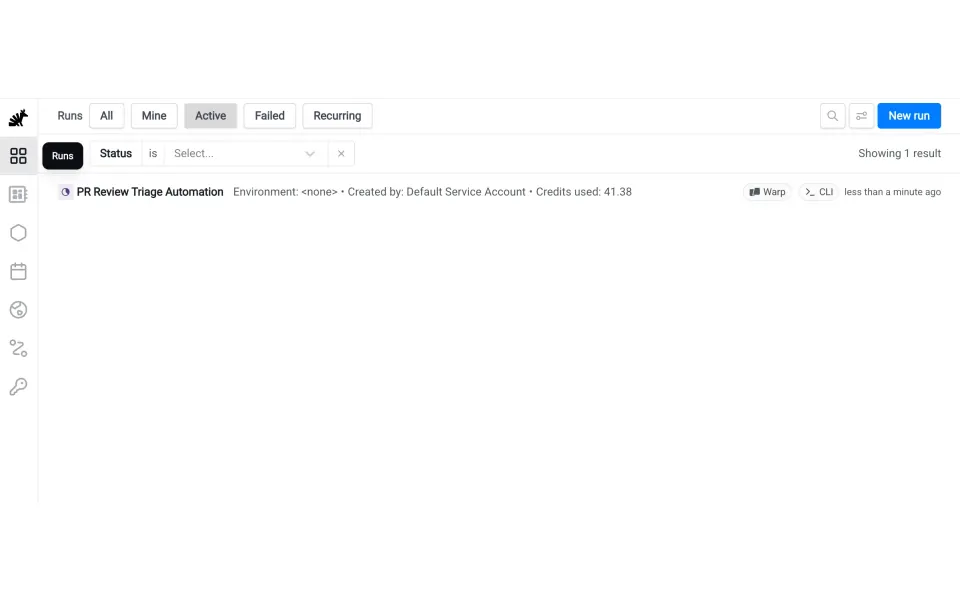
Warp desktop app is offered on macOS, Windows and Linux and exposes the cloud-agent setup and conversation surface documented by its quickstart. Warp Factories is the current branded web offering for factory-based team development workflows. Existing standalone cloud runs continue in the Oz web app; the current transition guide keeps Oz web, CLI, SDK and API paths distinct from new Factories. These sources establish current branding and retained Oz surfaces, not an explicit blanket Oz rename or shutdown. The Oz web app works on mobile devices and manages runs, schedules, environments and integrations without installing Warp. The oz CLI starts cloud runs and unmanaged current-host agents and manages environments, schedules and run history. Browser users create runs, inspect transcripts and outputs, edit saved agents and pause schedules.
Source and scope for Where you use itAgents it runs
The documented harness identifiers are oz, claude and codex; factory agents can use different harnesses. Claude Code cloud auth supports Anthropic or Anthropic Bedrock credentials; Codex uses OpenAI API keys. Harness selection is configured per factory agent or standalone run through app, web, API or SDK. Orchestrations can mix Warp Agent, Claude Code and Codex with a harness-agnostic messaging bus.
Source and scope for Agents it runsAccounts and subscriptions
Managed-secret Codex cloud authentication bills a funded OpenAI API account, not a ChatGPT subscription; Claude Code managed-secret setup similarly documents provider API keys. Customer-supplied inference includes BYOK and custom endpoints; organizations over ten employees require Business or Enterprise for these routes. Harness auth secrets can be team or personal for standalone runs; factory agents require team secrets. Warp authentication and authorization are required in addition to the selected provider credential. Factory agents can select compatible team-owned secrets; local CLI subscription sign-in is a separate path.
Source and scope for Accounts and subscriptionsWhere agents run
oz agent run executes on the current dev host; unmanaged execution supports macOS, Windows and Linux. The platform routes work to configured managed workers on user infrastructure; unmanaged oz agent run is a separate mode. Enterprise managed workers run factory/standalone jobs on customer-controlled Docker, Kubernetes, Direct or external runtimes. Runs execute on configured remote hosts; the cloud agent workflow is distinct from local terminal use. Execution, inference and run-data storage are independent choices. A worker connects outbound with its worker ID and key; runs/schedules/integrations select that host. The customer provides self-hosted compute and networking. Customer workers determine available execution resources. Inactive environments shut down after an unspecified period. Remote sessions open in Warp or a browser on another device.
Source and scope for Where agents runHow work is kept apart
Configured environments clone the authorized repositories. Task-specific branches derive from OZ_RUN_ID. A documented Direct-worker pattern creates one Git worktree and branch per task through setup hooks. Docker runs each task in a container; Kubernetes uses one Job per task. Containers prefer an image non-root user or dedicated agent with passwordless sudo; setup failure can continue as root. Cloud-local children share the parent environment/filesystem; separate-cloud children get separate environments. Direct tasks share the worker host’s processes and network; worktrees do not create an OS security boundary. Workers connect outbound to Warp; task assignment requires no inbound port. Worker keys authenticate the execution host; customer controls runtime secrets. Shared-host agents require distinct worktrees/branches; different prompts alone do not isolate files. Customer compute does not eliminate Warp control-plane or prompt/transcript data flows.
Source and scope for How work is kept apartParallel work
Parent and child agents execute in parallel with independent conversations and run lifecycles. Fan-out/fan-in spawns multiple bounded child tasks in parallel. Orchestration is exactly one level deep; children do not spawn further children. Plan/run concurrency quotas remain unestablished. Runs show live status and nested child rows with a Sub-agents detail tab.
Source and scope for Parallel workScheduled runs
Recurring maintenance uses factory automations or standalone schedules. Factory automations and standalone integration triggers are separately configured. Cron schedules create fresh isolated runs for recurring maintenance. Each schedule runs its saved prompt or skill in a new run context; successful business outcome still depends on that prompt. Automation Platform schedules execute without a manual client trigger. After creation, runs execute automatically at the configured times.
Source and scope for Scheduled runsGit and pull requests
The implement agent works on a branch. The implement agent opens a pull request with test and visual evidence. The work item completes after a merge notification or human confirmation that the PR landed.
Source and scope for Git and pull requestsLicence and source
Hosted Warp services use the vendor’s product/services license agreement with limited access and copying/redistribution restrictions. Third-party dependencies or client licenses do not replace the hosted service agreement.
Source and scope for Licence and sourcePrice
Build is $20/month monthly or $18/month annually. Max is $200 monthly or $180/month annually. Business is $50/user/month monthly or $45 annually, checked 7 November 2026. Build includes $20 agent usage monthly; Max includes $200; Business includes $20 per seat. Compute and platform charges require separate checks. Further scoped facts are recorded in the atomic answers.
Source and scope for PriceTyped filters
Every value links to its receipt below. Read plan and surface restrictions before using a filter to decide.
| Filter | Value |
|---|---|
| Desktop OS: macOS | Yes cross-checked |
| Desktop OS: Windows | Yes cross-checked |
| Desktop OS: Linux | Yes cross-checked |
| Web client | Yes cross-checked |
| Phone access: Native iOS | Unknown |
| Phone access: Native Android | Unknown |
| Phone access: Phone browser | Yes cross-checked |
| CLI | Yes cross-checked |
| Coding agents: Claude Code | Yes cross-checked |
| Coding agents: Codex | Yes cross-checked |
| Coding agents: Cursor Agent | No |
| Coding agents: Gemini CLI | No |
| Coding agents: OpenCode | No |
| Coding agents: Pi | No |
| Coding agents: Grok | No |
| Coding agents: Aider | No |
| Coding agents: Antigravity | No |
| Use my subscription | No cross-checked |
| Where agents run: On your computer | Yes |
| Where agents run: On your own server | Yes |
| Where agents run: In the vendor's cloud | Yes |
| Workspace isolation: Git worktree | Yes |
| Workspace isolation: Container | Yes |
| Workspace isolation: VM or microVM | Yes |
| Parallel runs | Yes cross-checked |
| Coordinator | Yes cross-checked |
| Native issue tracking | Yes cross-checked |
| Unattended triggers | Yes cross-checked |
| Shared prompting | Yes cross-checked |
| Team roles | Yes cross-checked |
| SSO | Yes cross-checked |
| Pull request workflow | Yes cross-checked |
| Review interface | Yes |
| Product license: Apache-2.0 | No. Custom terms cross-checked |
| Product license: MIT | No. Custom terms cross-checked |
| Product license: GPL-3.0 | No. Custom terms cross-checked |
| Product license: GPL-3.0-or-later | No. Custom terms cross-checked |
| Product license: AGPL-3.0 | No. Custom terms cross-checked |
| Product license: AGPL-3.0-or-later | No. Custom terms cross-checked |
| Product license: Elastic License 2.0 | No. Custom terms cross-checked |
| Product license: Custom terms | Yes. Custom terms cross-checked |
| Product license: Proprietary | No. Custom terms cross-checked |
| Self-hosting | No cross-checked |
| Telemetry opt-out | Unknown |
| Free access | Yes cross-checked |
| Starting price: Free | Yes. Free cross-checked |
| Starting price: Up to $20/month | No. Free cross-checked |
| Starting price: $21–40/month | No. Free cross-checked |
| Starting price: $41–100/month | No. Free cross-checked |
| Starting price: Over $100/month | No. Free cross-checked |
| Starting price: Contact for pricing | No. Free cross-checked |
| Pricing model: Free, no paid plan | No |
| Pricing model: Free plan | Yes cross-checked |
| Pricing model: Subscription | Yes cross-checked |
| Pricing model: Per seat | Yes cross-checked |
| Pricing model: Usage-based | Yes cross-checked |
| Pricing model: Per machine or compute | Yes cross-checked |
| Pricing model: Bring your own key | Yes cross-checked |
| Pricing model: One-time purchase | No |
| Paid plans from: No paid plan | No. $11–20/month |
| Paid plans from: $10 or less/month | No. $11–20/month |
| Paid plans from: $11–20/month | Yes. $11–20/month |
| Paid plans from: $21–40/month | No. $11–20/month |
| Paid plans from: $41–100/month | No. $11–20/month |
| Paid plans from: Over $100/month | No. $11–20/month |
| Paid plans from: Contact sales | No. $11–20/month |
| Lifecycle status: Active | Unknown |
| Lifecycle status: Sunsetting | Unknown |
| Keeps going with laptop closed | Yes |
| Open-source license | No. Custom terms cross-checked |
| Any desktop app | Yes cross-checked |
| Paid plan up to $20/month | Yes. $11–20/month |
| Paid plan up to $40/month | Yes. $11–20/month |
| Any phone client | Yes cross-checked |
Filter receipts
Desktop OS: macOS: Yes cross-checked
Desktop OS: macOS
Typed value: Yes.
Warp desktop app is offered on macOS, Windows and Linux and exposes the cloud-agent setup and conversation surface documented by its quickstart. Warp Factories is the current branded web offering for factory-based team development workflows. Existing standalone cloud runs continue in the Oz web app; the current transition guide keeps Oz web, CLI, SDK and API paths distinct from new Factories. These sources establish current branding and retained Oz surfaces, not an explicit blanket Oz rename or shutdown. The Oz web app works on mobile devices and manages runs, schedules, environments and integrations without installing Warp. The oz CLI starts cloud runs and unmanaged current-host agents and manages environments, schedules and run history. Browser users create runs, inspect transcripts and outputs, edit saved agents and pause schedules.
- Desktop os: Warp desktop app is offered on macOS, Windows and Linux and exposes the cloud-agent setup and conversation surface documented by its quickstart.
- Unknown after the targeted first-party documentation, release and repository pass: mobile_apps, editor_extensions, notifications, cross_device_continuity. No configured product fixture was run; documentation does not establish successful hands-on behavior.
- No explicit statement that every Oz product/workflow was renamed Warp Factories was established. Standalone Oz tooling/web paths remain documented. October 3 transition-toward-GA wording is not an exact GA launch; current docs/page retain early-access wording.
-
Finding: Warp app has macOS, Windows and Linux downloads and is a client for standalone cloud runs.
Desktop OS: Windows: Yes cross-checked
Desktop OS: Windows
Typed value: Yes.
Warp desktop app is offered on macOS, Windows and Linux and exposes the cloud-agent setup and conversation surface documented by its quickstart. Warp Factories is the current branded web offering for factory-based team development workflows. Existing standalone cloud runs continue in the Oz web app; the current transition guide keeps Oz web, CLI, SDK and API paths distinct from new Factories. These sources establish current branding and retained Oz surfaces, not an explicit blanket Oz rename or shutdown. The Oz web app works on mobile devices and manages runs, schedules, environments and integrations without installing Warp. The oz CLI starts cloud runs and unmanaged current-host agents and manages environments, schedules and run history. Browser users create runs, inspect transcripts and outputs, edit saved agents and pause schedules.
- Desktop os: Warp desktop app is offered on macOS, Windows and Linux and exposes the cloud-agent setup and conversation surface documented by its quickstart.
- Unknown after the targeted first-party documentation, release and repository pass: mobile_apps, editor_extensions, notifications, cross_device_continuity. No configured product fixture was run; documentation does not establish successful hands-on behavior.
- No explicit statement that every Oz product/workflow was renamed Warp Factories was established. Standalone Oz tooling/web paths remain documented. October 3 transition-toward-GA wording is not an exact GA launch; current docs/page retain early-access wording.
-
Finding: Warp app has macOS, Windows and Linux downloads and is a client for standalone cloud runs.
Desktop OS: Linux: Yes cross-checked
Desktop OS: Linux
Typed value: Yes.
Warp desktop app is offered on macOS, Windows and Linux and exposes the cloud-agent setup and conversation surface documented by its quickstart. Warp Factories is the current branded web offering for factory-based team development workflows. Existing standalone cloud runs continue in the Oz web app; the current transition guide keeps Oz web, CLI, SDK and API paths distinct from new Factories. These sources establish current branding and retained Oz surfaces, not an explicit blanket Oz rename or shutdown. The Oz web app works on mobile devices and manages runs, schedules, environments and integrations without installing Warp. The oz CLI starts cloud runs and unmanaged current-host agents and manages environments, schedules and run history. Browser users create runs, inspect transcripts and outputs, edit saved agents and pause schedules.
- Desktop os: Warp desktop app is offered on macOS, Windows and Linux and exposes the cloud-agent setup and conversation surface documented by its quickstart.
- Unknown after the targeted first-party documentation, release and repository pass: mobile_apps, editor_extensions, notifications, cross_device_continuity. No configured product fixture was run; documentation does not establish successful hands-on behavior.
- No explicit statement that every Oz product/workflow was renamed Warp Factories was established. Standalone Oz tooling/web paths remain documented. October 3 transition-toward-GA wording is not an exact GA launch; current docs/page retain early-access wording.
-
Finding: Warp app has macOS, Windows and Linux downloads and is a client for standalone cloud runs.
Web client: Yes cross-checked
Web client
Typed value: Yes.
Warp desktop app is offered on macOS, Windows and Linux and exposes the cloud-agent setup and conversation surface documented by its quickstart. Warp Factories is the current branded web offering for factory-based team development workflows. Existing standalone cloud runs continue in the Oz web app; the current transition guide keeps Oz web, CLI, SDK and API paths distinct from new Factories. These sources establish current branding and retained Oz surfaces, not an explicit blanket Oz rename or shutdown. The Oz web app works on mobile devices and manages runs, schedules, environments and integrations without installing Warp. The oz CLI starts cloud runs and unmanaged current-host agents and manages environments, schedules and run history. Browser users create runs, inspect transcripts and outputs, edit saved agents and pause schedules.
- Browser: Warp Factories is the current branded web offering for factory-based team development workflows. Existing standalone cloud runs continue in the Oz web app; the current transition guide keeps Oz web, CLI, SDK and API paths distinct from new Factories. These sources establish current branding and retained Oz surfaces, not an explicit blanket Oz rename or shutdown.
- Unknown after the targeted first-party documentation, release and repository pass: mobile_apps, editor_extensions, notifications, cross_device_continuity. No configured product fixture was run; documentation does not establish successful hands-on behavior.
- No explicit statement that every Oz product/workflow was renamed Warp Factories was established. Standalone Oz tooling/web paths remain documented. October 3 transition-toward-GA wording is not an exact GA launch; current docs/page retain early-access wording.
-
Finding: Cloud-agent documentation separates factories from standalone runs and lists local/cloud handoff, API access and configured worker execution.
Phone access: Phone browser: Yes cross-checked
Phone access: Phone browser
Typed value: Yes.
Warp desktop app is offered on macOS, Windows and Linux and exposes the cloud-agent setup and conversation surface documented by its quickstart. Warp Factories is the current branded web offering for factory-based team development workflows. Existing standalone cloud runs continue in the Oz web app; the current transition guide keeps Oz web, CLI, SDK and API paths distinct from new Factories. These sources establish current branding and retained Oz surfaces, not an explicit blanket Oz rename or shutdown. The Oz web app works on mobile devices and manages runs, schedules, environments and integrations without installing Warp. The oz CLI starts cloud runs and unmanaged current-host agents and manages environments, schedules and run history. Browser users create runs, inspect transcripts and outputs, edit saved agents and pause schedules.
- Mobile browser: The Oz web app works on mobile devices and manages runs, schedules, environments and integrations without installing Warp.
- Task actions: Browser users create runs, inspect transcripts and outputs, edit saved agents and pause schedules.
- Unknown after the targeted first-party documentation, release and repository pass: mobile_apps, editor_extensions, notifications, cross_device_continuity. No configured product fixture was run; documentation does not establish successful hands-on behavior.
- No explicit statement that every Oz product/workflow was renamed Warp Factories was established. Standalone Oz tooling/web paths remain documented. October 3 transition-toward-GA wording is not an exact GA launch; current docs/page retain early-access wording.
-
Finding: Browser/mobile app creates runs, agents, skills, schedules, environments and integrations. Runs include status, creator, source, outputs, cost and parent/child inspection.
CLI: Yes cross-checked
CLI
Typed value: Yes.
Warp desktop app is offered on macOS, Windows and Linux and exposes the cloud-agent setup and conversation surface documented by its quickstart. Warp Factories is the current branded web offering for factory-based team development workflows. Existing standalone cloud runs continue in the Oz web app; the current transition guide keeps Oz web, CLI, SDK and API paths distinct from new Factories. These sources establish current branding and retained Oz surfaces, not an explicit blanket Oz rename or shutdown. The Oz web app works on mobile devices and manages runs, schedules, environments and integrations without installing Warp. The oz CLI starts cloud runs and unmanaged current-host agents and manages environments, schedules and run history. Browser users create runs, inspect transcripts and outputs, edit saved agents and pause schedules.
- Cli: The oz CLI starts cloud runs and unmanaged current-host agents and manages environments, schedules and run history.
- Unknown after the targeted first-party documentation, release and repository pass: mobile_apps, editor_extensions, notifications, cross_device_continuity. No configured product fixture was run; documentation does not establish successful hands-on behavior.
- No explicit statement that every Oz product/workflow was renamed Warp Factories was established. Standalone Oz tooling/web paths remain documented. October 3 transition-toward-GA wording is not an exact GA launch; current docs/page retain early-access wording.
-
Finding: Oz CLI runs native agents in cloud or on the current host and manages runs, schedules, environments, MCP, skills, secrets and identity using Warp authentication.
Coding agents: Claude Code: Yes cross-checked
Coding agents: Claude Code
Typed value: Yes.
The documented harness identifiers are oz, claude and codex; factory agents can use different harnesses. Claude Code cloud auth supports Anthropic or Anthropic Bedrock credentials; Codex uses OpenAI API keys. Harness selection is configured per factory agent or standalone run through app, web, API or SDK. Orchestrations can mix Warp Agent, Claude Code and Codex with a harness-agnostic messaging bus.
- Harnesses: The documented harness identifiers are oz, claude and codex; factory agents can use different harnesses.
- Session integration: Harness selection is configured per factory agent or standalone run through app, web, API or SDK.
- Unknown after the targeted first-party documentation, release and repository pass: custom_adapters. No configured product fixture was run; documentation does not establish successful hands-on behavior.
-
Finding: Factories and standalone runs support Warp Agent, Claude Code and Codex. The current page makes plan eligibility conditional instead of a fixed Build minimum.
Coding agents: Codex: Yes cross-checked
Coding agents: Codex
Typed value: Yes.
The documented harness identifiers are oz, claude and codex; factory agents can use different harnesses. Claude Code cloud auth supports Anthropic or Anthropic Bedrock credentials; Codex uses OpenAI API keys. Harness selection is configured per factory agent or standalone run through app, web, API or SDK. Orchestrations can mix Warp Agent, Claude Code and Codex with a harness-agnostic messaging bus.
- Harnesses: The documented harness identifiers are oz, claude and codex; factory agents can use different harnesses.
- Session integration: Harness selection is configured per factory agent or standalone run through app, web, API or SDK.
- Unknown after the targeted first-party documentation, release and repository pass: custom_adapters. No configured product fixture was run; documentation does not establish successful hands-on behavior.
-
Finding: Factories and standalone runs support Warp Agent, Claude Code and Codex. The current page makes plan eligibility conditional instead of a fixed Build minimum.
Coding agents: Cursor Agent: No
Coding agents: Cursor Agent
Typed value: No.
The documented harness identifiers are oz, claude and codex; factory agents can use different harnesses. Claude Code cloud auth supports Anthropic or Anthropic Bedrock credentials; Codex uses OpenAI API keys. Harness selection is configured per factory agent or standalone run through app, web, API or SDK. Orchestrations can mix Warp Agent, Claude Code and Codex with a harness-agnostic messaging bus.
- Harnesses: The documented harness identifiers are oz, claude and codex; factory agents can use different harnesses.
- Session integration: Harness selection is configured per factory agent or standalone run through app, web, API or SDK.
- Unknown after the targeted first-party documentation, release and repository pass: custom_adapters. No configured product fixture was run; documentation does not establish successful hands-on behavior.
-
Finding: Factories and standalone runs support Warp Agent, Claude Code and Codex. The current page makes plan eligibility conditional instead of a fixed Build minimum.
Coding agents: Gemini CLI: No
Coding agents: Gemini CLI
Typed value: No.
The documented harness identifiers are oz, claude and codex; factory agents can use different harnesses. Claude Code cloud auth supports Anthropic or Anthropic Bedrock credentials; Codex uses OpenAI API keys. Harness selection is configured per factory agent or standalone run through app, web, API or SDK. Orchestrations can mix Warp Agent, Claude Code and Codex with a harness-agnostic messaging bus.
- Harnesses: The documented harness identifiers are oz, claude and codex; factory agents can use different harnesses.
- Session integration: Harness selection is configured per factory agent or standalone run through app, web, API or SDK.
- Unknown after the targeted first-party documentation, release and repository pass: custom_adapters. No configured product fixture was run; documentation does not establish successful hands-on behavior.
-
Finding: Factories and standalone runs support Warp Agent, Claude Code and Codex. The current page makes plan eligibility conditional instead of a fixed Build minimum.
Coding agents: OpenCode: No
Coding agents: OpenCode
Typed value: No.
The documented harness identifiers are oz, claude and codex; factory agents can use different harnesses. Claude Code cloud auth supports Anthropic or Anthropic Bedrock credentials; Codex uses OpenAI API keys. Harness selection is configured per factory agent or standalone run through app, web, API or SDK. Orchestrations can mix Warp Agent, Claude Code and Codex with a harness-agnostic messaging bus.
- Harnesses: The documented harness identifiers are oz, claude and codex; factory agents can use different harnesses.
- Session integration: Harness selection is configured per factory agent or standalone run through app, web, API or SDK.
- Unknown after the targeted first-party documentation, release and repository pass: custom_adapters. No configured product fixture was run; documentation does not establish successful hands-on behavior.
-
Finding: Factories and standalone runs support Warp Agent, Claude Code and Codex. The current page makes plan eligibility conditional instead of a fixed Build minimum.
Coding agents: Pi: No
Coding agents: Pi
Typed value: No.
The documented harness identifiers are oz, claude and codex; factory agents can use different harnesses. Claude Code cloud auth supports Anthropic or Anthropic Bedrock credentials; Codex uses OpenAI API keys. Harness selection is configured per factory agent or standalone run through app, web, API or SDK. Orchestrations can mix Warp Agent, Claude Code and Codex with a harness-agnostic messaging bus.
- Harnesses: The documented harness identifiers are oz, claude and codex; factory agents can use different harnesses.
- Session integration: Harness selection is configured per factory agent or standalone run through app, web, API or SDK.
- Unknown after the targeted first-party documentation, release and repository pass: custom_adapters. No configured product fixture was run; documentation does not establish successful hands-on behavior.
-
Finding: Factories and standalone runs support Warp Agent, Claude Code and Codex. The current page makes plan eligibility conditional instead of a fixed Build minimum.
Coding agents: Grok: No
Coding agents: Grok
Typed value: No.
The documented harness identifiers are oz, claude and codex; factory agents can use different harnesses. Claude Code cloud auth supports Anthropic or Anthropic Bedrock credentials; Codex uses OpenAI API keys. Harness selection is configured per factory agent or standalone run through app, web, API or SDK. Orchestrations can mix Warp Agent, Claude Code and Codex with a harness-agnostic messaging bus.
- Harnesses: The documented harness identifiers are oz, claude and codex; factory agents can use different harnesses.
- Session integration: Harness selection is configured per factory agent or standalone run through app, web, API or SDK.
- Unknown after the targeted first-party documentation, release and repository pass: custom_adapters. No configured product fixture was run; documentation does not establish successful hands-on behavior.
-
Finding: Factories and standalone runs support Warp Agent, Claude Code and Codex. The current page makes plan eligibility conditional instead of a fixed Build minimum.
Coding agents: Aider: No
Coding agents: Aider
Typed value: No.
The documented harness identifiers are oz, claude and codex; factory agents can use different harnesses. Claude Code cloud auth supports Anthropic or Anthropic Bedrock credentials; Codex uses OpenAI API keys. Harness selection is configured per factory agent or standalone run through app, web, API or SDK. Orchestrations can mix Warp Agent, Claude Code and Codex with a harness-agnostic messaging bus.
- Harnesses: The documented harness identifiers are oz, claude and codex; factory agents can use different harnesses.
- Session integration: Harness selection is configured per factory agent or standalone run through app, web, API or SDK.
- Unknown after the targeted first-party documentation, release and repository pass: custom_adapters. No configured product fixture was run; documentation does not establish successful hands-on behavior.
-
Finding: Factories and standalone runs support Warp Agent, Claude Code and Codex. The current page makes plan eligibility conditional instead of a fixed Build minimum.
Coding agents: Antigravity: No
Coding agents: Antigravity
Typed value: No.
The documented harness identifiers are oz, claude and codex; factory agents can use different harnesses. Claude Code cloud auth supports Anthropic or Anthropic Bedrock credentials; Codex uses OpenAI API keys. Harness selection is configured per factory agent or standalone run through app, web, API or SDK. Orchestrations can mix Warp Agent, Claude Code and Codex with a harness-agnostic messaging bus.
- Harnesses: The documented harness identifiers are oz, claude and codex; factory agents can use different harnesses.
- Session integration: Harness selection is configured per factory agent or standalone run through app, web, API or SDK.
- Unknown after the targeted first-party documentation, release and repository pass: custom_adapters. No configured product fixture was run; documentation does not establish successful hands-on behavior.
-
Finding: Factories and standalone runs support Warp Agent, Claude Code and Codex. The current page makes plan eligibility conditional instead of a fixed Build minimum.
Use my subscription: No cross-checked
Use my subscription
Typed value: No.
Managed-secret Codex cloud authentication bills a funded OpenAI API account, not a ChatGPT subscription; Claude Code managed-secret setup similarly documents provider API keys. Customer-supplied inference includes BYOK and custom endpoints; organizations over ten employees require Business or Enterprise for these routes. Harness auth secrets can be team or personal for standalone runs; factory agents require team secrets. Warp authentication and authorization are required in addition to the selected provider credential. Factory agents can select compatible team-owned secrets; local CLI subscription sign-in is a separate path.
- Agent subscriptions: Managed-secret Codex cloud authentication bills a funded OpenAI API account, not a ChatGPT subscription; Claude Code managed-secret setup similarly documents provider API keys.
- Account switching: Harness auth secrets can be team or personal for standalone runs; factory agents require team secrets.
- Vendor account requirement: Warp authentication and authorization are required in addition to the selected provider credential.
- Provider restrictions: Factory agents can select compatible team-owned secrets; local CLI subscription sign-in is a separate path.
- Unknown after the targeted first-party documentation, release and repository pass: vendor_credits, local_models. No configured product fixture was run; documentation does not establish successful hands-on behavior.
-
Configuring harness authentication
Finding: Managed-secret Claude Code/Codex cloud setup uses funded provider API credentials. Local Codex ChatGPT sign-in is explicitly different. Factory auth secrets must be team scoped; ad hoc personal runs may use personal secrets.
Where agents run: On your computer: Yes
Where agents run: On your computer
Typed value: Yes.
oz agent run executes on the current dev host; unmanaged execution supports macOS, Windows and Linux. The platform routes work to configured managed workers on user infrastructure; unmanaged oz agent run is a separate mode. Enterprise managed workers run factory/standalone jobs on customer-controlled Docker, Kubernetes, Direct or external runtimes. Runs execute on configured remote hosts; the cloud agent workflow is distinct from local terminal use. Execution, inference and run-data storage are independent choices. A worker connects outbound with its worker ID and key; runs/schedules/integrations select that host. The customer provides self-hosted compute and networking. Customer workers determine available execution resources. Inactive environments shut down after an unspecified period. Remote sessions open in Warp or a browser on another device.
- Local: oz agent run executes on the current dev host; unmanaged execution supports macOS, Windows and Linux.
- Unknown after the targeted first-party documentation, release and repository pass: region, client_disconnect. No configured product fixture was run; documentation does not establish successful hands-on behavior.
-
Finding: oz agent run executes on the current CI, Kubernetes, VM or dev host on macOS/Linux/Windows. Repeatable --share flags grant team/user view or edit access.
Where agents run: On your own server: Yes
Where agents run: On your own server
Typed value: Yes.
oz agent run executes on the current dev host; unmanaged execution supports macOS, Windows and Linux. The platform routes work to configured managed workers on user infrastructure; unmanaged oz agent run is a separate mode. Enterprise managed workers run factory/standalone jobs on customer-controlled Docker, Kubernetes, Direct or external runtimes. Runs execute on configured remote hosts; the cloud agent workflow is distinct from local terminal use. Execution, inference and run-data storage are independent choices. A worker connects outbound with its worker ID and key; runs/schedules/integrations select that host. The customer provides self-hosted compute and networking. Customer workers determine available execution resources. Inactive environments shut down after an unspecified period. Remote sessions open in Warp or a browser on another device.
- Byo remote: The platform routes work to configured managed workers on user infrastructure; unmanaged oz agent run is a separate mode.
- Managed cloud: Runs execute on configured remote hosts; the cloud agent workflow is distinct from local terminal use.
- Unknown after the targeted first-party documentation, release and repository pass: region, client_disconnect. No configured product fixture was run; documentation does not establish successful hands-on behavior.
-
Finding: Cloud-agent documentation separates factories from standalone runs and lists local/cloud handoff, API access and configured worker execution.
Where agents run: In the vendor's cloud: Yes
Where agents run: In the vendor's cloud
Typed value: Yes.
oz agent run executes on the current dev host; unmanaged execution supports macOS, Windows and Linux. The platform routes work to configured managed workers on user infrastructure; unmanaged oz agent run is a separate mode. Enterprise managed workers run factory/standalone jobs on customer-controlled Docker, Kubernetes, Direct or external runtimes. Runs execute on configured remote hosts; the cloud agent workflow is distinct from local terminal use. Execution, inference and run-data storage are independent choices. A worker connects outbound with its worker ID and key; runs/schedules/integrations select that host. The customer provides self-hosted compute and networking. Customer workers determine available execution resources. Inactive environments shut down after an unspecified period. Remote sessions open in Warp or a browser on another device.
- Byo remote: The platform routes work to configured managed workers on user infrastructure; unmanaged oz agent run is a separate mode.
- Managed cloud: Runs execute on configured remote hosts; the cloud agent workflow is distinct from local terminal use.
- Unknown after the targeted first-party documentation, release and repository pass: region, client_disconnect. No configured product fixture was run; documentation does not establish successful hands-on behavior.
-
Finding: Cloud-agent documentation separates factories from standalone runs and lists local/cloud handoff, API access and configured worker execution.
Workspace isolation: Git worktree: Yes
Workspace isolation: Git worktree
Typed value: Yes.
Configured environments clone the authorized repositories. Task-specific branches derive from OZ_RUN_ID. A documented Direct-worker pattern creates one Git worktree and branch per task through setup hooks. Docker runs each task in a container; Kubernetes uses one Job per task. Containers prefer an image non-root user or dedicated agent with passwordless sudo; setup failure can continue as root. Cloud-local children share the parent environment/filesystem; separate-cloud children get separate environments. Direct tasks share the worker host’s processes and network; worktrees do not create an OS security boundary. Workers connect outbound to Warp; task assignment requires no inbound port. Worker keys authenticate the execution host; customer controls runtime secrets. Shared-host agents require distinct worktrees/branches; different prompts alone do not isolate files. Customer compute does not eliminate Warp control-plane or prompt/transcript data flows.
- Branch: Task-specific branches derive from OZ_RUN_ID.
- Worktree: A documented Direct-worker pattern creates one Git worktree and branch per task through setup hooks.
- Process: Direct tasks share the worker host’s processes and network; worktrees do not create an OS security boundary.
- Unknown after the targeted first-party documentation, release and repository pass: vm. No configured product fixture was run; documentation does not establish successful hands-on behavior.
-
Finding: Direct tasks can use per-run worktrees and branches through configured setup/teardown hooks. These share host processes/network/Git metadata and are not OS sandboxes.
Workspace isolation: Container: Yes
Workspace isolation: Container
Typed value: Yes.
Configured environments clone the authorized repositories. Task-specific branches derive from OZ_RUN_ID. A documented Direct-worker pattern creates one Git worktree and branch per task through setup hooks. Docker runs each task in a container; Kubernetes uses one Job per task. Containers prefer an image non-root user or dedicated agent with passwordless sudo; setup failure can continue as root. Cloud-local children share the parent environment/filesystem; separate-cloud children get separate environments. Direct tasks share the worker host’s processes and network; worktrees do not create an OS security boundary. Workers connect outbound to Warp; task assignment requires no inbound port. Worker keys authenticate the execution host; customer controls runtime secrets. Shared-host agents require distinct worktrees/branches; different prompts alone do not isolate files. Customer compute does not eliminate Warp control-plane or prompt/transcript data flows.
- Container: Docker runs each task in a container; Kubernetes uses one Job per task.
- Network: Workers connect outbound to Warp; task assignment requires no inbound port.
- Secrets: Worker keys authenticate the execution host; customer controls runtime secrets.
- Security boundary: Customer compute does not eliminate Warp control-plane or prompt/transcript data flows.
- Unknown after the targeted first-party documentation, release and repository pass: vm. No configured product fixture was run; documentation does not establish successful hands-on behavior.
-
Finding: Enterprise workers support Docker/Kubernetes/Direct/Command execution on customer compute. Warp retains the control plane, operational metadata and billing. Transcript/artifact buckets are independently configurable.
Workspace isolation: VM or microVM: Yes
Workspace isolation: VM or microVM
Typed value: Yes.
Configured environments clone the authorized repositories. Task-specific branches derive from OZ_RUN_ID. A documented Direct-worker pattern creates one Git worktree and branch per task through setup hooks. Docker runs each task in a container; Kubernetes uses one Job per task. Containers prefer an image non-root user or dedicated agent with passwordless sudo; setup failure can continue as root. Cloud-local children share the parent environment/filesystem; separate-cloud children get separate environments. Direct tasks share the worker host’s processes and network; worktrees do not create an OS security boundary. Workers connect outbound to Warp; task assignment requires no inbound port. Worker keys authenticate the execution host; customer controls runtime secrets. Shared-host agents require distinct worktrees/branches; different prompts alone do not isolate files. Customer compute does not eliminate Warp control-plane or prompt/transcript data flows.
- Vm: The vendor cloud session viewer explicitly describes tasks running on remote virtual machines. Customer-managed Direct and container workers remain separate modes.
- Unknown after the targeted first-party documentation, release and repository pass: vm. No configured product fixture was run; documentation does not establish successful hands-on behavior.
-
Finding: Shared cloud agent runs execute on remote virtual machines, whose code/config changes, commands, logs and outputs can be reviewed through Warp or the browser. Idle environments can shut down.
Parallel runs: Yes cross-checked
Parallel runs
Typed value: Yes.
Parent and child agents execute in parallel with independent conversations and run lifecycles. Fan-out/fan-in spawns multiple bounded child tasks in parallel. Orchestration is exactly one level deep; children do not spawn further children. Plan/run concurrency quotas remain unestablished. Runs show live status and nested child rows with a Sub-agents detail tab.
- Concurrent sessions: Parent and child agents execute in parallel with independent conversations and run lifecycles.
- Concurrent tasks: Fan-out/fan-in spawns multiple bounded child tasks in parallel.
- Quotas: Orchestration is exactly one level deep; children do not spawn further children. Plan/run concurrency quotas remain unestablished.
- Unknown after the targeted first-party documentation, release and repository pass: observed_concurrency. No configured product fixture was run; documentation does not establish successful hands-on behavior.
-
Finding: Native parent/child orchestration is one level deep, supports mixed Warp/Claude/Codex harnesses, durable per-agent inboxes, lifecycle events and wake-on-followup. Cloud-local shares filesystem; other cloud children have their own environments.
Coordinator: Yes cross-checked
Coordinator
Typed value: Yes.
A parent spawns children for supervisor/worker, verifier, fan-out or dependency-ordered work. Ad hoc child batches select model, harness and execution settings. Parent/children exchange durable server-backed structured messages through per-agent inboxes. Children report outputs to the parent, which can combine their results. Warp Agent, Claude Code and Codex parents/children can message each other. Warp’s native parent controls child spawning and follow-up. /orchestrate or API mode:orchestrate activates the workflow. Run lifecycle events and child status update the parent and browser/app views. Parent and each child retain separate runs, transcripts, conversations and usage records. Messages can wake terminal-state children for further work. App, Oz CLI, web and API can start orchestrations.
- Roles: A parent spawns children for supervisor/worker, verifier, fan-out or dependency-ordered work.
- Model harness effort: Ad hoc child batches select model, harness and execution settings.
- Messages: Parent/children exchange durable server-backed structured messages through per-agent inboxes.
- Results return: Children report outputs to the parent, which can combine their results.
- Cross harness: Warp Agent, Claude Code and Codex parents/children can message each other.
- Orchestration owner: Warp’s native parent controls child spawning and follow-up.
- Activation: /orchestrate or API mode:orchestrate activates the workflow.
- Live progress: Run lifecycle events and child status update the parent and browser/app views.
- Retained results: Parent and each child retain separate runs, transcripts, conversations and usage records.
- Followup: Messages can wake terminal-state children for further work.
- Invocation: App, Oz CLI, web and API can start orchestrations.
- Unknown after the targeted first-party documentation, release and repository pass: authentication. No configured product fixture was run; documentation does not establish successful hands-on behavior.
-
Finding: Native parent/child orchestration is one level deep, supports mixed Warp/Claude/Codex harnesses, durable per-agent inboxes, lifecycle events and wake-on-followup. Cloud-local shares filesystem; other cloud children have their own environments.
Native issue tracking: Yes cross-checked
Native issue tracking
Typed value: Yes.
Factories accept direct requests, integration events or Factory MCP tasks. Factory MCP supports list_tasks, search_task and get_task by task URL, PR, ticket, thread or branch reference. Direct requests reach the foreman, which chooses the shortest appropriate agent-stage path. One work item can span multiple agent runs and continued/revision conversations. get_task returns status, run history and suggested isolated-worktree setup commands. Work items move through stages to Complete or Cancelled; PR handoff alone does not complete them. Direct requests and Factory MCP create work without requiring an external tracker.
- Create: Factories accept direct requests, integration events or Factory MCP tasks.
- Explicit dispatch: Direct requests reach the foreman, which chooses the shortest appropriate agent-stage path.
- Task session separation: One work item can span multiple agent runs and continued/revision conversations.
- Durable states: Work items move through stages to Complete or Cancelled; PR handoff alone does not complete them.
- External tracker requirement: Direct requests and Factory MCP create work without requiring an external tracker.
- Unknown after the targeted first-party documentation, release and repository pass: edit, discuss, prioritize, label, assign, filter, archive, reopen, project_epic_views, idea_parking. No configured product fixture was run; documentation does not establish successful hands-on behavior.
-
Finding: Factory work items retain identity across triage/spec/implementation/review. Foreman dispatches specialized agents, returns revisions to existing conversations and hands PRs to humans. Spec gates are instruction policy and merges require repository controls.
Unattended triggers: Yes cross-checked
Unattended triggers
Typed value: Yes.
Recurring maintenance uses factory automations or standalone schedules. Factory automations and standalone integration triggers are separately configured. Cron schedules create fresh isolated runs for recurring maintenance. Each schedule runs its saved prompt or skill in a new run context; successful business outcome still depends on that prompt. Automation Platform schedules execute without a manual client trigger. After creation, runs execute automatically at the configured times.
- Schedules: Recurring maintenance uses factory automations or standalone schedules.
- Events: Factory automations and standalone integration triggers are separately configured.
- Unknown after the targeted first-party documentation, release and repository pass: overlaps, retries. No configured product fixture was run; documentation does not establish successful hands-on behavior.
-
Finding: Cloud-agent documentation separates factories from standalone runs and lists local/cloud handoff, API access and configured worker execution.
Shared prompting: Yes cross-checked
Shared prompting
Typed value: Yes.
Shared links expose the remote conversation, commands, logs and outputs to authorized teammates. --share team:edit or user:edit grants collaborators read/write access to steer the same running session. --share targets individual users or the team with explicit view/edit access. Agent-key runs automatically have team scope; sharing still follows account authorization.
- Coprompting: --share team:edit or user:edit grants collaborators read/write access to steer the same running session.
- Permissions: --share targets individual users or the team with explicit view/edit access.
- Plan restrictions: Agent-key runs automatically have team scope; sharing still follows account authorization.
- Unknown after the targeted first-party documentation, release and repository pass: discussion, comments, presence, ordering, conflicts, attribution, owner_online. No configured product fixture was run; documentation does not establish successful hands-on behavior.
-
Finding: oz agent run executes on the current CI, Kubernetes, VM or dev host on macOS/Linux/Windows. Repeatable --share flags grant team/user view or edit access.
Team roles: Yes cross-checked
Team roles
Typed value: Yes.
Inherited Owner/Admin permissions govern administration; factory roles include Factory user and Editor. Enterprise can assign a factory-specific user/Editor role overriding team defaults. Admins assign team-wide and per-factory roles. Business lists SAML SSO; Enterprise adds further administration controls. Factory users can run/view but cannot edit definitions, agents or automations. Granular factory role assignment requires Enterprise; other plans give members Editor access.
- Organization roles: Inherited Owner/Admin permissions govern administration; factory roles include Factory user and Editor.
- Project roles: Enterprise can assign a factory-specific user/Editor role overriding team defaults.
- Membership: Admins assign team-wide and per-factory roles.
- Unauthorized access: Factory users can run/view but cannot edit definitions, agents or automations.
- Plan scope: Granular factory role assignment requires Enterprise; other plans give members Editor access.
- Unknown after the targeted first-party documentation, release and repository pass: task_roles, provisioning, revocation. No configured product fixture was run; documentation does not establish successful hands-on behavior.
-
Finding: Enterprise Factory user/Editor roles control run versus configuration rights, with Admin management and factory-specific overrides. Non-Enterprise members are Editors; role does not grant merge or spec approval authority.
SSO: Yes cross-checked
SSO
Typed value: Yes.
Inherited Owner/Admin permissions govern administration; factory roles include Factory user and Editor. Enterprise can assign a factory-specific user/Editor role overriding team defaults. Admins assign team-wide and per-factory roles. Business lists SAML SSO; Enterprise adds further administration controls. Factory users can run/view but cannot edit definitions, agents or automations. Granular factory role assignment requires Enterprise; other plans give members Editor access.
- Sso: Business lists SAML SSO; Enterprise adds further administration controls.
- Unknown after the targeted first-party documentation, release and repository pass: task_roles, provisioning, revocation. No configured product fixture was run; documentation does not establish successful hands-on behavior.
-
Finding: Free, Build, Max, Business and custom Enterprise plans distinguish included usage, collaboration and customer-supplied inference.
Pull request workflow: Yes cross-checked
Pull request workflow
Typed value: Yes.
The implement agent works on a branch. The implement agent opens a pull request with test and visual evidence. The work item completes after a merge notification or human confirmation that the PR landed.
- Branches: The implement agent works on a branch.
- Pull requests: The implement agent opens a pull request with test and visual evidence.
- Product state: The work item completes after a merge notification or human confirmation that the PR landed.
- Unknown after the targeted first-party documentation, release and repository pass: worktrees, commits, comments, ci_response, rebase, conflicts. No configured product fixture was run; documentation does not establish successful hands-on behavior.
-
Finding: Factory work items retain identity across triage/spec/implementation/review. Foreman dispatches specialized agents, returns revisions to existing conversations and hands PRs to humans. Spec gates are instruction policy and merges require repository controls.
Review interface: Yes
Review interface
Typed value: Yes.
Shared runs expose Computer Use artifacts when produced. The shared session may include Computer Use artifacts; no cross-task gallery or retention test was run. Remote context and generated output can be inspected through the session viewer. Runs carry shareable session links. Parent/child conversations can be inspected separately from their run views.
- Diffs: The shared session lets users review the code/config changes produced by the cloud agent; no full cross-task diff workflow is established.
- Unknown after the targeted first-party documentation, release and repository pass: diffs, documents, test_outputs, reviewer_outputs, gallery, revision_links, persistence, prompt_leakage. No configured product fixture was run; documentation does not establish successful hands-on behavior.
-
Finding: Shared cloud agent runs execute on remote virtual machines, whose code/config changes, commands, logs and outputs can be reviewed through Warp or the browser. Idle environments can shut down.
Product license: Apache-2.0: No. Custom terms cross-checked
Product license: Apache-2.0
Typed value: No. Custom terms.
Hosted Warp services use the vendor’s product/services license agreement with limited access and copying/redistribution restrictions. Third-party dependencies or client licenses do not replace the hosted service agreement.
- Server license: Hosted Warp services use the vendor’s product/services license agreement with limited access and copying/redistribution restrictions.
- Hosted extensions: Third-party dependencies or client licenses do not replace the hosted service agreement.
- Unknown after the targeted first-party documentation, release and repository pass: client_license, source_visibility, source_revision, hosted_parity. No configured product fixture was run; documentation does not establish successful hands-on behavior.
-
Warp product and services license agreement
Finding: Hosted Warp products use a limited proprietary service license with redistribution/reverse-engineering restrictions. Vendor support uses Pacific business hours with reasonable one-business-day response efforts.
Product license: MIT: No. Custom terms cross-checked
Product license: MIT
Typed value: No. Custom terms.
Hosted Warp services use the vendor’s product/services license agreement with limited access and copying/redistribution restrictions. Third-party dependencies or client licenses do not replace the hosted service agreement.
- Server license: Hosted Warp services use the vendor’s product/services license agreement with limited access and copying/redistribution restrictions.
- Hosted extensions: Third-party dependencies or client licenses do not replace the hosted service agreement.
- Unknown after the targeted first-party documentation, release and repository pass: client_license, source_visibility, source_revision, hosted_parity. No configured product fixture was run; documentation does not establish successful hands-on behavior.
-
Warp product and services license agreement
Finding: Hosted Warp products use a limited proprietary service license with redistribution/reverse-engineering restrictions. Vendor support uses Pacific business hours with reasonable one-business-day response efforts.
Product license: GPL-3.0: No. Custom terms cross-checked
Product license: GPL-3.0
Typed value: No. Custom terms.
Hosted Warp services use the vendor’s product/services license agreement with limited access and copying/redistribution restrictions. Third-party dependencies or client licenses do not replace the hosted service agreement.
- Server license: Hosted Warp services use the vendor’s product/services license agreement with limited access and copying/redistribution restrictions.
- Hosted extensions: Third-party dependencies or client licenses do not replace the hosted service agreement.
- Unknown after the targeted first-party documentation, release and repository pass: client_license, source_visibility, source_revision, hosted_parity. No configured product fixture was run; documentation does not establish successful hands-on behavior.
-
Warp product and services license agreement
Finding: Hosted Warp products use a limited proprietary service license with redistribution/reverse-engineering restrictions. Vendor support uses Pacific business hours with reasonable one-business-day response efforts.
Product license: GPL-3.0-or-later: No. Custom terms cross-checked
Product license: GPL-3.0-or-later
Typed value: No. Custom terms.
Hosted Warp services use the vendor’s product/services license agreement with limited access and copying/redistribution restrictions. Third-party dependencies or client licenses do not replace the hosted service agreement.
- Server license: Hosted Warp services use the vendor’s product/services license agreement with limited access and copying/redistribution restrictions.
- Hosted extensions: Third-party dependencies or client licenses do not replace the hosted service agreement.
- Unknown after the targeted first-party documentation, release and repository pass: client_license, source_visibility, source_revision, hosted_parity. No configured product fixture was run; documentation does not establish successful hands-on behavior.
-
Warp product and services license agreement
Finding: Hosted Warp products use a limited proprietary service license with redistribution/reverse-engineering restrictions. Vendor support uses Pacific business hours with reasonable one-business-day response efforts.
Product license: AGPL-3.0: No. Custom terms cross-checked
Product license: AGPL-3.0
Typed value: No. Custom terms.
Hosted Warp services use the vendor’s product/services license agreement with limited access and copying/redistribution restrictions. Third-party dependencies or client licenses do not replace the hosted service agreement.
- Server license: Hosted Warp services use the vendor’s product/services license agreement with limited access and copying/redistribution restrictions.
- Hosted extensions: Third-party dependencies or client licenses do not replace the hosted service agreement.
- Unknown after the targeted first-party documentation, release and repository pass: client_license, source_visibility, source_revision, hosted_parity. No configured product fixture was run; documentation does not establish successful hands-on behavior.
-
Warp product and services license agreement
Finding: Hosted Warp products use a limited proprietary service license with redistribution/reverse-engineering restrictions. Vendor support uses Pacific business hours with reasonable one-business-day response efforts.
Product license: AGPL-3.0-or-later: No. Custom terms cross-checked
Product license: AGPL-3.0-or-later
Typed value: No. Custom terms.
Hosted Warp services use the vendor’s product/services license agreement with limited access and copying/redistribution restrictions. Third-party dependencies or client licenses do not replace the hosted service agreement.
- Server license: Hosted Warp services use the vendor’s product/services license agreement with limited access and copying/redistribution restrictions.
- Hosted extensions: Third-party dependencies or client licenses do not replace the hosted service agreement.
- Unknown after the targeted first-party documentation, release and repository pass: client_license, source_visibility, source_revision, hosted_parity. No configured product fixture was run; documentation does not establish successful hands-on behavior.
-
Warp product and services license agreement
Finding: Hosted Warp products use a limited proprietary service license with redistribution/reverse-engineering restrictions. Vendor support uses Pacific business hours with reasonable one-business-day response efforts.
Product license: Elastic License 2.0: No. Custom terms cross-checked
Product license: Elastic License 2.0
Typed value: No. Custom terms.
Hosted Warp services use the vendor’s product/services license agreement with limited access and copying/redistribution restrictions. Third-party dependencies or client licenses do not replace the hosted service agreement.
- Server license: Hosted Warp services use the vendor’s product/services license agreement with limited access and copying/redistribution restrictions.
- Hosted extensions: Third-party dependencies or client licenses do not replace the hosted service agreement.
- Unknown after the targeted first-party documentation, release and repository pass: client_license, source_visibility, source_revision, hosted_parity. No configured product fixture was run; documentation does not establish successful hands-on behavior.
-
Warp product and services license agreement
Finding: Hosted Warp products use a limited proprietary service license with redistribution/reverse-engineering restrictions. Vendor support uses Pacific business hours with reasonable one-business-day response efforts.
Product license: Custom terms: Yes. Custom terms cross-checked
Product license: Custom terms
Typed value: Yes. Custom terms.
Hosted Warp services use the vendor’s product/services license agreement with limited access and copying/redistribution restrictions. Third-party dependencies or client licenses do not replace the hosted service agreement.
- Server license: Hosted Warp services use the vendor’s product/services license agreement with limited access and copying/redistribution restrictions.
- Hosted extensions: Third-party dependencies or client licenses do not replace the hosted service agreement.
- Unknown after the targeted first-party documentation, release and repository pass: client_license, source_visibility, source_revision, hosted_parity. No configured product fixture was run; documentation does not establish successful hands-on behavior.
-
Warp product and services license agreement
Finding: Hosted Warp products use a limited proprietary service license with redistribution/reverse-engineering restrictions. Vendor support uses Pacific business hours with reasonable one-business-day response efforts.
Product license: Proprietary: No. Custom terms cross-checked
Product license: Proprietary
Typed value: No. Custom terms.
Hosted Warp services use the vendor’s product/services license agreement with limited access and copying/redistribution restrictions. Third-party dependencies or client licenses do not replace the hosted service agreement.
- Server license: Hosted Warp services use the vendor’s product/services license agreement with limited access and copying/redistribution restrictions.
- Hosted extensions: Third-party dependencies or client licenses do not replace the hosted service agreement.
- Unknown after the targeted first-party documentation, release and repository pass: client_license, source_visibility, source_revision, hosted_parity. No configured product fixture was run; documentation does not establish successful hands-on behavior.
-
Warp product and services license agreement
Finding: Hosted Warp products use a limited proprietary service license with redistribution/reverse-engineering restrictions. Vendor support uses Pacific business hours with reasonable one-business-day response efforts.
Self-hosting: No cross-checked
Self-hosting
Typed value: No.
Customer-hosted workers execute jobs, but Warp hosts routing, tracking and control-plane metadata; the complete core platform is not self-hosted. Warp control plane remains required even with customer execution and separate transcript storage.
- Self hosting: Customer-hosted workers execute jobs, but Warp hosts routing, tracking and control-plane metadata; the complete core platform is not self-hosted.
- Vendor dependencies: Warp control plane remains required even with customer execution and separate transcript storage.
- Unknown after the targeted first-party documentation, release and repository pass: export, import, formats, cancellation, account_independence, history_portability. No configured product fixture was run; documentation does not establish successful hands-on behavior.
-
Finding: Enterprise workers support Docker/Kubernetes/Direct/Command execution on customer compute. Warp retains the control plane, operational metadata and billing. Transcript/artifact buckets are independently configurable.
Free access: Yes cross-checked
Free access
Typed value: Yes.
Free is $0/month with core terminal features, limited cloud access and limited conversation storage; additional usage may be purchased.
- Ongoing free: Free is $0/month with core terminal features, limited cloud access and limited conversation storage; additional usage may be purchased.
- Useful free tier and evaluation access: first-party sources in this pass did not establish trial, credits_trial, self_host_cost, paid_only, early_access, free_scenarios, card_required, usage_caps, paid_evaluation. No full license/hosted parity audit, assurance-report access or fixed one/two/five-person workload costing was performed. Public pricing is dated; missing rates remain unknown.
- Warp Factories lists its own $0 pay-as-you-go plan with usage at 20% above API rates; this answer does not describe it.
-
Finding: Free, Build, Max, Business and custom Enterprise plans distinguish included usage, collaboration and customer-supplied inference.
Starting price: Free: Yes. Free cross-checked
Starting price: Free
Typed value: Yes. Free.
Free is $0/month with core terminal features, limited cloud access and limited conversation storage; additional usage may be purchased.
- Ongoing free: Free is $0/month with core terminal features, limited cloud access and limited conversation storage; additional usage may be purchased.
- Useful free tier and evaluation access: first-party sources in this pass did not establish trial, credits_trial, self_host_cost, paid_only, early_access, free_scenarios, card_required, usage_caps, paid_evaluation. No full license/hosted parity audit, assurance-report access or fixed one/two/five-person workload costing was performed. Public pricing is dated; missing rates remain unknown.
- Warp Factories lists its own $0 pay-as-you-go plan with usage at 20% above API rates; this answer does not describe it.
-
Finding: Free, Build, Max, Business and custom Enterprise plans distinguish included usage, collaboration and customer-supplied inference.
Starting price: Up to $20/month: No. Free cross-checked
Starting price: Up to $20/month
Typed value: No. Free.
Free is $0/month with core terminal features, limited cloud access and limited conversation storage; additional usage may be purchased.
- Ongoing free: Free is $0/month with core terminal features, limited cloud access and limited conversation storage; additional usage may be purchased.
- Useful free tier and evaluation access: first-party sources in this pass did not establish trial, credits_trial, self_host_cost, paid_only, early_access, free_scenarios, card_required, usage_caps, paid_evaluation. No full license/hosted parity audit, assurance-report access or fixed one/two/five-person workload costing was performed. Public pricing is dated; missing rates remain unknown.
- Warp Factories lists its own $0 pay-as-you-go plan with usage at 20% above API rates; this answer does not describe it.
-
Finding: Free, Build, Max, Business and custom Enterprise plans distinguish included usage, collaboration and customer-supplied inference.
Starting price: $21–40/month: No. Free cross-checked
Starting price: $21–40/month
Typed value: No. Free.
Free is $0/month with core terminal features, limited cloud access and limited conversation storage; additional usage may be purchased.
- Ongoing free: Free is $0/month with core terminal features, limited cloud access and limited conversation storage; additional usage may be purchased.
- Useful free tier and evaluation access: first-party sources in this pass did not establish trial, credits_trial, self_host_cost, paid_only, early_access, free_scenarios, card_required, usage_caps, paid_evaluation. No full license/hosted parity audit, assurance-report access or fixed one/two/five-person workload costing was performed. Public pricing is dated; missing rates remain unknown.
- Warp Factories lists its own $0 pay-as-you-go plan with usage at 20% above API rates; this answer does not describe it.
-
Finding: Free, Build, Max, Business and custom Enterprise plans distinguish included usage, collaboration and customer-supplied inference.
Starting price: $41–100/month: No. Free cross-checked
Starting price: $41–100/month
Typed value: No. Free.
Free is $0/month with core terminal features, limited cloud access and limited conversation storage; additional usage may be purchased.
- Ongoing free: Free is $0/month with core terminal features, limited cloud access and limited conversation storage; additional usage may be purchased.
- Useful free tier and evaluation access: first-party sources in this pass did not establish trial, credits_trial, self_host_cost, paid_only, early_access, free_scenarios, card_required, usage_caps, paid_evaluation. No full license/hosted parity audit, assurance-report access or fixed one/two/five-person workload costing was performed. Public pricing is dated; missing rates remain unknown.
- Warp Factories lists its own $0 pay-as-you-go plan with usage at 20% above API rates; this answer does not describe it.
-
Finding: Free, Build, Max, Business and custom Enterprise plans distinguish included usage, collaboration and customer-supplied inference.
Starting price: Over $100/month: No. Free cross-checked
Starting price: Over $100/month
Typed value: No. Free.
Free is $0/month with core terminal features, limited cloud access and limited conversation storage; additional usage may be purchased.
- Ongoing free: Free is $0/month with core terminal features, limited cloud access and limited conversation storage; additional usage may be purchased.
- Useful free tier and evaluation access: first-party sources in this pass did not establish trial, credits_trial, self_host_cost, paid_only, early_access, free_scenarios, card_required, usage_caps, paid_evaluation. No full license/hosted parity audit, assurance-report access or fixed one/two/five-person workload costing was performed. Public pricing is dated; missing rates remain unknown.
- Warp Factories lists its own $0 pay-as-you-go plan with usage at 20% above API rates; this answer does not describe it.
-
Finding: Free, Build, Max, Business and custom Enterprise plans distinguish included usage, collaboration and customer-supplied inference.
Starting price: Contact for pricing: No. Free cross-checked
Starting price: Contact for pricing
Typed value: No. Free.
Free is $0/month with core terminal features, limited cloud access and limited conversation storage; additional usage may be purchased.
- Ongoing free: Free is $0/month with core terminal features, limited cloud access and limited conversation storage; additional usage may be purchased.
- Useful free tier and evaluation access: first-party sources in this pass did not establish trial, credits_trial, self_host_cost, paid_only, early_access, free_scenarios, card_required, usage_caps, paid_evaluation. No full license/hosted parity audit, assurance-report access or fixed one/two/five-person workload costing was performed. Public pricing is dated; missing rates remain unknown.
- Warp Factories lists its own $0 pay-as-you-go plan with usage at 20% above API rates; this answer does not describe it.
-
Finding: Free, Build, Max, Business and custom Enterprise plans distinguish included usage, collaboration and customer-supplied inference.
Pricing model: Free, no paid plan: No
Pricing model: Free, no paid plan
Typed value: No.
Build is $20/month monthly or $18/month annually. Max is $200 monthly or $180/month annually. Business is $50/user/month monthly or $45 annually, checked 7 November 2026. Build includes $20 agent usage monthly; Max includes $200; Business includes $20 per seat. Compute and platform charges require separate checks. Further scoped facts are recorded in the atomic answers.
- Interval: Build is $20/month monthly or $18/month annually. Max is $200 monthly or $180/month annually. Business is $50/user/month monthly or $45 annually, checked 7 November 2026.
- Included usage: Build includes $20 agent usage monthly; Max includes $200; Business includes $20 per seat. Compute and platform charges require separate checks.
- Price and included usage: first-party sources in this pass did not establish currency, seats, seat_minimum, workspace_fees, credits, trial, overages, taxes. No full license/hosted parity audit, assurance-report access or fixed one/two/five-person workload costing was performed. Public pricing is dated; missing rates remain unknown.
- Warp Factories has a separate price table: pay as you go, Build, Business and Enterprise, with no Max plan or annual price shown, and factory usage billed by inference, compute and agent use. These terminal-and-agents prices do not describe it.
-
Finding: Free, Build, Max, Business and custom Enterprise plans distinguish included usage, collaboration and customer-supplied inference.
Pricing model: Free plan: Yes cross-checked
Pricing model: Free plan
Typed value: Yes.
Build is $20/month monthly or $18/month annually. Max is $200 monthly or $180/month annually. Business is $50/user/month monthly or $45 annually, checked 7 November 2026. Build includes $20 agent usage monthly; Max includes $200; Business includes $20 per seat. Compute and platform charges require separate checks. Further scoped facts are recorded in the atomic answers.
- Interval: Build is $20/month monthly or $18/month annually. Max is $200 monthly or $180/month annually. Business is $50/user/month monthly or $45 annually, checked 7 November 2026.
- Included usage: Build includes $20 agent usage monthly; Max includes $200; Business includes $20 per seat. Compute and platform charges require separate checks.
- Price and included usage: first-party sources in this pass did not establish currency, seats, seat_minimum, workspace_fees, credits, trial, overages, taxes. No full license/hosted parity audit, assurance-report access or fixed one/two/five-person workload costing was performed. Public pricing is dated; missing rates remain unknown.
- Warp Factories has a separate price table: pay as you go, Build, Business and Enterprise, with no Max plan or annual price shown, and factory usage billed by inference, compute and agent use. These terminal-and-agents prices do not describe it.
-
Finding: Free, Build, Max, Business and custom Enterprise plans distinguish included usage, collaboration and customer-supplied inference.
Pricing model: Subscription: Yes cross-checked
Pricing model: Subscription
Typed value: Yes.
Build is $20/month monthly or $18/month annually. Max is $200 monthly or $180/month annually. Business is $50/user/month monthly or $45 annually, checked 7 November 2026. Build includes $20 agent usage monthly; Max includes $200; Business includes $20 per seat. Compute and platform charges require separate checks. Further scoped facts are recorded in the atomic answers.
- Interval: Build is $20/month monthly or $18/month annually. Max is $200 monthly or $180/month annually. Business is $50/user/month monthly or $45 annually, checked 7 November 2026.
- Included usage: Build includes $20 agent usage monthly; Max includes $200; Business includes $20 per seat. Compute and platform charges require separate checks.
- Price and included usage: first-party sources in this pass did not establish currency, seats, seat_minimum, workspace_fees, credits, trial, overages, taxes. No full license/hosted parity audit, assurance-report access or fixed one/two/five-person workload costing was performed. Public pricing is dated; missing rates remain unknown.
- Warp Factories has a separate price table: pay as you go, Build, Business and Enterprise, with no Max plan or annual price shown, and factory usage billed by inference, compute and agent use. These terminal-and-agents prices do not describe it.
-
Finding: Free, Build, Max, Business and custom Enterprise plans distinguish included usage, collaboration and customer-supplied inference.
Pricing model: Per seat: Yes cross-checked
Pricing model: Per seat
Typed value: Yes.
Build is $20/month monthly or $18/month annually. Max is $200 monthly or $180/month annually. Business is $50/user/month monthly or $45 annually, checked 7 November 2026. Build includes $20 agent usage monthly; Max includes $200; Business includes $20 per seat. Compute and platform charges require separate checks. Further scoped facts are recorded in the atomic answers.
- Interval: Build is $20/month monthly or $18/month annually. Max is $200 monthly or $180/month annually. Business is $50/user/month monthly or $45 annually, checked 7 November 2026.
- Included usage: Build includes $20 agent usage monthly; Max includes $200; Business includes $20 per seat. Compute and platform charges require separate checks.
- Price and included usage: first-party sources in this pass did not establish currency, seats, seat_minimum, workspace_fees, credits, trial, overages, taxes. No full license/hosted parity audit, assurance-report access or fixed one/two/five-person workload costing was performed. Public pricing is dated; missing rates remain unknown.
- Warp Factories has a separate price table: pay as you go, Build, Business and Enterprise, with no Max plan or annual price shown, and factory usage billed by inference, compute and agent use. These terminal-and-agents prices do not describe it.
-
Finding: Free, Build, Max, Business and custom Enterprise plans distinguish included usage, collaboration and customer-supplied inference.
Pricing model: Usage-based: Yes cross-checked
Pricing model: Usage-based
Typed value: Yes.
Build is $20/month monthly or $18/month annually. Max is $200 monthly or $180/month annually. Business is $50/user/month monthly or $45 annually, checked 7 November 2026. Build includes $20 agent usage monthly; Max includes $200; Business includes $20 per seat. Compute and platform charges require separate checks. Further scoped facts are recorded in the atomic answers.
- Compute cost: Warp-hosted cloud compute is a separate component; self-hosted workers avoid that component but still incur cloud platform usage.
- Price and included usage: first-party sources in this pass did not establish currency, seats, seat_minimum, workspace_fees, credits, trial, overages, taxes. No full license/hosted parity audit, assurance-report access or fixed one/two/five-person workload costing was performed. Public pricing is dated; missing rates remain unknown.
- Warp Factories has a separate price table: pay as you go, Build, Business and Enterprise, with no Max plan or annual price shown, and factory usage billed by inference, compute and agent use. These terminal-and-agents prices do not describe it.
-
Finding: Cloud runs incur platform usage even on self-hosted workers. Eligible dollar-billed plans charge $3 per agent-hour; inference and hosted compute are separate.
Pricing model: Per machine or compute: Yes cross-checked
Pricing model: Per machine or compute
Typed value: Yes.
Build is $20/month monthly or $18/month annually. Max is $200 monthly or $180/month annually. Business is $50/user/month monthly or $45 annually, checked 7 November 2026. Build includes $20 agent usage monthly; Max includes $200; Business includes $20 per seat. Compute and platform charges require separate checks. Further scoped facts are recorded in the atomic answers.
- Compute cost: Warp-hosted cloud compute is a separate component; self-hosted workers avoid that component but still incur cloud platform usage.
- Price and included usage: first-party sources in this pass did not establish currency, seats, seat_minimum, workspace_fees, credits, trial, overages, taxes. No full license/hosted parity audit, assurance-report access or fixed one/two/five-person workload costing was performed. Public pricing is dated; missing rates remain unknown.
- Warp Factories has a separate price table: pay as you go, Build, Business and Enterprise, with no Max plan or annual price shown, and factory usage billed by inference, compute and agent use. These terminal-and-agents prices do not describe it.
-
Finding: Cloud runs incur platform usage even on self-hosted workers. Eligible dollar-billed plans charge $3 per agent-hour; inference and hosted compute are separate.
Pricing model: Bring your own key: Yes cross-checked
Pricing model: Bring your own key
Typed value: Yes.
Managed-secret Codex cloud authentication bills a funded OpenAI API account, not a ChatGPT subscription; Claude Code managed-secret setup similarly documents provider API keys. Customer-supplied inference includes BYOK and custom endpoints; organizations over ten employees require Business or Enterprise for these routes. Harness auth secrets can be team or personal for standalone runs; factory agents require team secrets. Warp authentication and authorization are required in addition to the selected provider credential. Factory agents can select compatible team-owned secrets; local CLI subscription sign-in is a separate path.
- Api accounts: Customer-supplied inference includes BYOK and custom endpoints; organizations over ten employees require Business or Enterprise for these routes.
- Unknown after the targeted first-party documentation, release and repository pass: vendor_credits, local_models. No configured product fixture was run; documentation does not establish successful hands-on behavior.
-
Finding: Cloud runs incur platform usage even on self-hosted workers. Eligible dollar-billed plans charge $3 per agent-hour; inference and hosted compute are separate.
Pricing model: One-time purchase: No
Pricing model: One-time purchase
Typed value: No.
Build is $20/month monthly or $18/month annually. Max is $200 monthly or $180/month annually. Business is $50/user/month monthly or $45 annually, checked 7 November 2026. Build includes $20 agent usage monthly; Max includes $200; Business includes $20 per seat. Compute and platform charges require separate checks. Further scoped facts are recorded in the atomic answers.
- Interval: Build is $20/month monthly or $18/month annually. Max is $200 monthly or $180/month annually. Business is $50/user/month monthly or $45 annually, checked 7 November 2026.
- Included usage: Build includes $20 agent usage monthly; Max includes $200; Business includes $20 per seat. Compute and platform charges require separate checks.
- Price and included usage: first-party sources in this pass did not establish currency, seats, seat_minimum, workspace_fees, credits, trial, overages, taxes. No full license/hosted parity audit, assurance-report access or fixed one/two/five-person workload costing was performed. Public pricing is dated; missing rates remain unknown.
- Warp Factories has a separate price table: pay as you go, Build, Business and Enterprise, with no Max plan or annual price shown, and factory usage billed by inference, compute and agent use. These terminal-and-agents prices do not describe it.
-
Finding: Free, Build, Max, Business and custom Enterprise plans distinguish included usage, collaboration and customer-supplied inference.
Paid plans from: No paid plan: No. $11–20/month
Paid plans from: No paid plan
Typed value: No. $11–20/month.
Build is $20/month monthly or $18/month annually. Max is $200 monthly or $180/month annually. Business is $50/user/month monthly or $45 annually, checked 7 November 2026. Build includes $20 agent usage monthly; Max includes $200; Business includes $20 per seat. Compute and platform charges require separate checks. Further scoped facts are recorded in the atomic answers.
- Interval: Build is $20/month monthly or $18/month annually. Max is $200 monthly or $180/month annually. Business is $50/user/month monthly or $45 annually, checked 7 November 2026.
- Included usage: Build includes $20 agent usage monthly; Max includes $200; Business includes $20 per seat. Compute and platform charges require separate checks.
- Price and included usage: first-party sources in this pass did not establish currency, seats, seat_minimum, workspace_fees, credits, trial, overages, taxes. No full license/hosted parity audit, assurance-report access or fixed one/two/five-person workload costing was performed. Public pricing is dated; missing rates remain unknown.
- Warp Factories has a separate price table: pay as you go, Build, Business and Enterprise, with no Max plan or annual price shown, and factory usage billed by inference, compute and agent use. These terminal-and-agents prices do not describe it.
-
Finding: Free, Build, Max, Business and custom Enterprise plans distinguish included usage, collaboration and customer-supplied inference.
Paid plans from: $10 or less/month: No. $11–20/month
Paid plans from: $10 or less/month
Typed value: No. $11–20/month.
Build is $20/month monthly or $18/month annually. Max is $200 monthly or $180/month annually. Business is $50/user/month monthly or $45 annually, checked 7 November 2026. Build includes $20 agent usage monthly; Max includes $200; Business includes $20 per seat. Compute and platform charges require separate checks. Further scoped facts are recorded in the atomic answers.
- Interval: Build is $20/month monthly or $18/month annually. Max is $200 monthly or $180/month annually. Business is $50/user/month monthly or $45 annually, checked 7 November 2026.
- Included usage: Build includes $20 agent usage monthly; Max includes $200; Business includes $20 per seat. Compute and platform charges require separate checks.
- Price and included usage: first-party sources in this pass did not establish currency, seats, seat_minimum, workspace_fees, credits, trial, overages, taxes. No full license/hosted parity audit, assurance-report access or fixed one/two/five-person workload costing was performed. Public pricing is dated; missing rates remain unknown.
- Warp Factories has a separate price table: pay as you go, Build, Business and Enterprise, with no Max plan or annual price shown, and factory usage billed by inference, compute and agent use. These terminal-and-agents prices do not describe it.
-
Finding: Free, Build, Max, Business and custom Enterprise plans distinguish included usage, collaboration and customer-supplied inference.
Paid plans from: $11–20/month: Yes. $11–20/month
Paid plans from: $11–20/month
Typed value: Yes. $11–20/month.
Build is $20/month monthly or $18/month annually. Max is $200 monthly or $180/month annually. Business is $50/user/month monthly or $45 annually, checked 7 November 2026. Build includes $20 agent usage monthly; Max includes $200; Business includes $20 per seat. Compute and platform charges require separate checks. Further scoped facts are recorded in the atomic answers.
- Interval: Build is $20/month monthly or $18/month annually. Max is $200 monthly or $180/month annually. Business is $50/user/month monthly or $45 annually, checked 7 November 2026.
- Included usage: Build includes $20 agent usage monthly; Max includes $200; Business includes $20 per seat. Compute and platform charges require separate checks.
- Price and included usage: first-party sources in this pass did not establish currency, seats, seat_minimum, workspace_fees, credits, trial, overages, taxes. No full license/hosted parity audit, assurance-report access or fixed one/two/five-person workload costing was performed. Public pricing is dated; missing rates remain unknown.
- Warp Factories has a separate price table: pay as you go, Build, Business and Enterprise, with no Max plan or annual price shown, and factory usage billed by inference, compute and agent use. These terminal-and-agents prices do not describe it.
-
Finding: Free, Build, Max, Business and custom Enterprise plans distinguish included usage, collaboration and customer-supplied inference.
Paid plans from: $21–40/month: No. $11–20/month
Paid plans from: $21–40/month
Typed value: No. $11–20/month.
Build is $20/month monthly or $18/month annually. Max is $200 monthly or $180/month annually. Business is $50/user/month monthly or $45 annually, checked 7 November 2026. Build includes $20 agent usage monthly; Max includes $200; Business includes $20 per seat. Compute and platform charges require separate checks. Further scoped facts are recorded in the atomic answers.
- Interval: Build is $20/month monthly or $18/month annually. Max is $200 monthly or $180/month annually. Business is $50/user/month monthly or $45 annually, checked 7 November 2026.
- Included usage: Build includes $20 agent usage monthly; Max includes $200; Business includes $20 per seat. Compute and platform charges require separate checks.
- Price and included usage: first-party sources in this pass did not establish currency, seats, seat_minimum, workspace_fees, credits, trial, overages, taxes. No full license/hosted parity audit, assurance-report access or fixed one/two/five-person workload costing was performed. Public pricing is dated; missing rates remain unknown.
- Warp Factories has a separate price table: pay as you go, Build, Business and Enterprise, with no Max plan or annual price shown, and factory usage billed by inference, compute and agent use. These terminal-and-agents prices do not describe it.
-
Finding: Free, Build, Max, Business and custom Enterprise plans distinguish included usage, collaboration and customer-supplied inference.
Paid plans from: $41–100/month: No. $11–20/month
Paid plans from: $41–100/month
Typed value: No. $11–20/month.
Build is $20/month monthly or $18/month annually. Max is $200 monthly or $180/month annually. Business is $50/user/month monthly or $45 annually, checked 7 November 2026. Build includes $20 agent usage monthly; Max includes $200; Business includes $20 per seat. Compute and platform charges require separate checks. Further scoped facts are recorded in the atomic answers.
- Interval: Build is $20/month monthly or $18/month annually. Max is $200 monthly or $180/month annually. Business is $50/user/month monthly or $45 annually, checked 7 November 2026.
- Included usage: Build includes $20 agent usage monthly; Max includes $200; Business includes $20 per seat. Compute and platform charges require separate checks.
- Price and included usage: first-party sources in this pass did not establish currency, seats, seat_minimum, workspace_fees, credits, trial, overages, taxes. No full license/hosted parity audit, assurance-report access or fixed one/two/five-person workload costing was performed. Public pricing is dated; missing rates remain unknown.
- Warp Factories has a separate price table: pay as you go, Build, Business and Enterprise, with no Max plan or annual price shown, and factory usage billed by inference, compute and agent use. These terminal-and-agents prices do not describe it.
-
Finding: Free, Build, Max, Business and custom Enterprise plans distinguish included usage, collaboration and customer-supplied inference.
Paid plans from: Over $100/month: No. $11–20/month
Paid plans from: Over $100/month
Typed value: No. $11–20/month.
Build is $20/month monthly or $18/month annually. Max is $200 monthly or $180/month annually. Business is $50/user/month monthly or $45 annually, checked 7 November 2026. Build includes $20 agent usage monthly; Max includes $200; Business includes $20 per seat. Compute and platform charges require separate checks. Further scoped facts are recorded in the atomic answers.
- Interval: Build is $20/month monthly or $18/month annually. Max is $200 monthly or $180/month annually. Business is $50/user/month monthly or $45 annually, checked 7 November 2026.
- Included usage: Build includes $20 agent usage monthly; Max includes $200; Business includes $20 per seat. Compute and platform charges require separate checks.
- Price and included usage: first-party sources in this pass did not establish currency, seats, seat_minimum, workspace_fees, credits, trial, overages, taxes. No full license/hosted parity audit, assurance-report access or fixed one/two/five-person workload costing was performed. Public pricing is dated; missing rates remain unknown.
- Warp Factories has a separate price table: pay as you go, Build, Business and Enterprise, with no Max plan or annual price shown, and factory usage billed by inference, compute and agent use. These terminal-and-agents prices do not describe it.
-
Finding: Free, Build, Max, Business and custom Enterprise plans distinguish included usage, collaboration and customer-supplied inference.
Paid plans from: Contact sales: No. $11–20/month
Paid plans from: Contact sales
Typed value: No. $11–20/month.
Build is $20/month monthly or $18/month annually. Max is $200 monthly or $180/month annually. Business is $50/user/month monthly or $45 annually, checked 7 November 2026. Build includes $20 agent usage monthly; Max includes $200; Business includes $20 per seat. Compute and platform charges require separate checks. Further scoped facts are recorded in the atomic answers.
- Interval: Build is $20/month monthly or $18/month annually. Max is $200 monthly or $180/month annually. Business is $50/user/month monthly or $45 annually, checked 7 November 2026.
- Included usage: Build includes $20 agent usage monthly; Max includes $200; Business includes $20 per seat. Compute and platform charges require separate checks.
- Price and included usage: first-party sources in this pass did not establish currency, seats, seat_minimum, workspace_fees, credits, trial, overages, taxes. No full license/hosted parity audit, assurance-report access or fixed one/two/five-person workload costing was performed. Public pricing is dated; missing rates remain unknown.
- Warp Factories has a separate price table: pay as you go, Build, Business and Enterprise, with no Max plan or annual price shown, and factory usage billed by inference, compute and agent use. These terminal-and-agents prices do not describe it.
-
Finding: Free, Build, Max, Business and custom Enterprise plans distinguish included usage, collaboration and customer-supplied inference.
Keeps going with laptop closed: Yes
Keeps going with laptop closed
Typed value: Yes.
oz agent run executes on the current dev host; unmanaged execution supports macOS, Windows and Linux. The platform routes work to configured managed workers on user infrastructure; unmanaged oz agent run is a separate mode. Enterprise managed workers run factory/standalone jobs on customer-controlled Docker, Kubernetes, Direct or external runtimes. Runs execute on configured remote hosts; the cloud agent workflow is distinct from local terminal use. Execution, inference and run-data storage are independent choices. A worker connects outbound with its worker ID and key; runs/schedules/integrations select that host. The customer provides self-hosted compute and networking. Customer workers determine available execution resources. Inactive environments shut down after an unspecified period. Remote sessions open in Warp or a browser on another device.
- Client disconnect: Cloud handoff lets work continue without keeping the controlling laptop awake; unmanaged same-host execution is a separate mode.
- Unknown after the targeted first-party documentation, release and repository pass: region, client_disconnect. No configured product fixture was run; documentation does not establish successful hands-on behavior.
-
Finding: Local-to-cloud handoff transfers an active conversation and workspace snapshot so a long-running task can continue without keeping the laptop awake.
Open-source license: No. Custom terms cross-checked
Open-source license
Typed value: No. Custom terms.
Hosted Warp services use the vendor’s product/services license agreement with limited access and copying/redistribution restrictions. Third-party dependencies or client licenses do not replace the hosted service agreement.
- Server license: Hosted Warp services use the vendor’s product/services license agreement with limited access and copying/redistribution restrictions.
- Hosted extensions: Third-party dependencies or client licenses do not replace the hosted service agreement.
- Unknown after the targeted first-party documentation, release and repository pass: client_license, source_visibility, source_revision, hosted_parity. No configured product fixture was run; documentation does not establish successful hands-on behavior.
-
Warp product and services license agreement
Finding: Hosted Warp products use a limited proprietary service license with redistribution/reverse-engineering restrictions. Vendor support uses Pacific business hours with reasonable one-business-day response efforts.
Any desktop app: Yes cross-checked
Any desktop app
Typed value: Yes.
Warp desktop app is offered on macOS, Windows and Linux and exposes the cloud-agent setup and conversation surface documented by its quickstart. Warp Factories is the current branded web offering for factory-based team development workflows. Existing standalone cloud runs continue in the Oz web app; the current transition guide keeps Oz web, CLI, SDK and API paths distinct from new Factories. These sources establish current branding and retained Oz surfaces, not an explicit blanket Oz rename or shutdown. The Oz web app works on mobile devices and manages runs, schedules, environments and integrations without installing Warp. The oz CLI starts cloud runs and unmanaged current-host agents and manages environments, schedules and run history. Browser users create runs, inspect transcripts and outputs, edit saved agents and pause schedules.
- Desktop os: Warp desktop app is offered on macOS, Windows and Linux and exposes the cloud-agent setup and conversation surface documented by its quickstart.
- Unknown after the targeted first-party documentation, release and repository pass: mobile_apps, editor_extensions, notifications, cross_device_continuity. No configured product fixture was run; documentation does not establish successful hands-on behavior.
- No explicit statement that every Oz product/workflow was renamed Warp Factories was established. Standalone Oz tooling/web paths remain documented. October 3 transition-toward-GA wording is not an exact GA launch; current docs/page retain early-access wording.
-
Finding: Warp app has macOS, Windows and Linux downloads and is a client for standalone cloud runs.
Paid plan up to $20/month: Yes. $11–20/month
Paid plan up to $20/month
Typed value: Yes. $11–20/month.
Build is $20/month monthly or $18/month annually. Max is $200 monthly or $180/month annually. Business is $50/user/month monthly or $45 annually, checked 7 November 2026. Build includes $20 agent usage monthly; Max includes $200; Business includes $20 per seat. Compute and platform charges require separate checks. Further scoped facts are recorded in the atomic answers.
- Interval: Build is $20/month monthly or $18/month annually. Max is $200 monthly or $180/month annually. Business is $50/user/month monthly or $45 annually, checked 7 November 2026.
- Included usage: Build includes $20 agent usage monthly; Max includes $200; Business includes $20 per seat. Compute and platform charges require separate checks.
- Price and included usage: first-party sources in this pass did not establish currency, seats, seat_minimum, workspace_fees, credits, trial, overages, taxes. No full license/hosted parity audit, assurance-report access or fixed one/two/five-person workload costing was performed. Public pricing is dated; missing rates remain unknown.
- Warp Factories has a separate price table: pay as you go, Build, Business and Enterprise, with no Max plan or annual price shown, and factory usage billed by inference, compute and agent use. These terminal-and-agents prices do not describe it.
-
Finding: Free, Build, Max, Business and custom Enterprise plans distinguish included usage, collaboration and customer-supplied inference.
Paid plan up to $40/month: Yes. $11–20/month
Paid plan up to $40/month
Typed value: Yes. $11–20/month.
Build is $20/month monthly or $18/month annually. Max is $200 monthly or $180/month annually. Business is $50/user/month monthly or $45 annually, checked 7 November 2026. Build includes $20 agent usage monthly; Max includes $200; Business includes $20 per seat. Compute and platform charges require separate checks. Further scoped facts are recorded in the atomic answers.
- Interval: Build is $20/month monthly or $18/month annually. Max is $200 monthly or $180/month annually. Business is $50/user/month monthly or $45 annually, checked 7 November 2026.
- Included usage: Build includes $20 agent usage monthly; Max includes $200; Business includes $20 per seat. Compute and platform charges require separate checks.
- Price and included usage: first-party sources in this pass did not establish currency, seats, seat_minimum, workspace_fees, credits, trial, overages, taxes. No full license/hosted parity audit, assurance-report access or fixed one/two/five-person workload costing was performed. Public pricing is dated; missing rates remain unknown.
- Warp Factories has a separate price table: pay as you go, Build, Business and Enterprise, with no Max plan or annual price shown, and factory usage billed by inference, compute and agent use. These terminal-and-agents prices do not describe it.
-
Finding: Free, Build, Max, Business and custom Enterprise plans distinguish included usage, collaboration and customer-supplied inference.
Any phone client: Yes cross-checked
Any phone client
Typed value: Yes.
Warp desktop app is offered on macOS, Windows and Linux and exposes the cloud-agent setup and conversation surface documented by its quickstart. Warp Factories is the current branded web offering for factory-based team development workflows. Existing standalone cloud runs continue in the Oz web app; the current transition guide keeps Oz web, CLI, SDK and API paths distinct from new Factories. These sources establish current branding and retained Oz surfaces, not an explicit blanket Oz rename or shutdown. The Oz web app works on mobile devices and manages runs, schedules, environments and integrations without installing Warp. The oz CLI starts cloud runs and unmanaged current-host agents and manages environments, schedules and run history. Browser users create runs, inspect transcripts and outputs, edit saved agents and pause schedules.
- Mobile browser: The Oz web app works on mobile devices and manages runs, schedules, environments and integrations without installing Warp.
- Task actions: Browser users create runs, inspect transcripts and outputs, edit saved agents and pause schedules.
- Unknown after the targeted first-party documentation, release and repository pass: mobile_apps, editor_extensions, notifications, cross_device_continuity. No configured product fixture was run; documentation does not establish successful hands-on behavior.
- No explicit statement that every Oz product/workflow was renamed Warp Factories was established. Standalone Oz tooling/web paths remain documented. October 3 transition-toward-GA wording is not an exact GA launch; current docs/page retain early-access wording.
-
Finding: Browser/mobile app creates runs, agents, skills, schedules, environments and integrations. Runs include status, creator, source, outputs, cost and parent/child inspection.
All public findings
Findings may summarize a source. They are not presented as verbatim statements.
warp-oz:ACC-01: Warp desktop app is offered on macOS, Windows and Linux and exposes the cloud-agent setup and conversation surface documented by its quickstart. Warp Factories is the current branded web offering for factory-based team development workflows. Existing standalone cloud runs continue in the Oz web app; the current transition guide keeps Oz web, CLI, SDK and API paths distinct from new Factories. These sources establish current branding and retained Oz surfaces, not an explicit blanket Oz rename or shutdown. The Oz web app works on mobile devices and manages runs, schedules, environments and integrations without installing Warp. The oz CLI starts cloud runs and unmanaged current-host agents and manages environments, schedules and run history. Browser users create runs, inspect transcripts and outputs, edit saved agents and pause schedules. cross-checked
warp-oz:ACC-01
Warp desktop app is offered on macOS, Windows and Linux and exposes the cloud-agent setup and conversation surface documented by its quickstart. Warp Factories is the current branded web offering for factory-based team development workflows. Existing standalone cloud runs continue in the Oz web app; the current transition guide keeps Oz web, CLI, SDK and API paths distinct from new Factories. These sources establish current branding and retained Oz surfaces, not an explicit blanket Oz rename or shutdown. The Oz web app works on mobile devices and manages runs, schedules, environments and integrations without installing Warp. The oz CLI starts cloud runs and unmanaged current-host agents and manages environments, schedules and run history. Browser users create runs, inspect transcripts and outputs, edit saved agents and pause schedules.
- Unknown after the targeted first-party documentation, release and repository pass: mobile_apps, editor_extensions, notifications, cross_device_continuity. No configured product fixture was run; documentation does not establish successful hands-on behavior.
- No explicit statement that every Oz product/workflow was renamed Warp Factories was established. Standalone Oz tooling/web paths remain documented. October 3 transition-toward-GA wording is not an exact GA launch; current docs/page retain early-access wording.
-
Finding: Cloud-agent documentation separates factories from standalone runs and lists local/cloud handoff, API access and configured worker execution.
-
Finding: Browser/mobile app creates runs, agents, skills, schedules, environments and integrations. Runs include status, creator, source, outputs, cost and parent/child inspection.
-
Finding: Oz CLI runs native agents in cloud or on the current host and manages runs, schedules, environments, MCP, skills, secrets and identity using Warp authentication.
-
Finding: Warp app has macOS, Windows and Linux downloads and is a client for standalone cloud runs.
-
Finding: The desktop Warp app opens standalone cloud-agent conversations, configures environments and inspects retained run records.
-
Warp Factories: Infrastructure for Software Factories
Finding: The current factory offering is branded Warp Factories and described as infrastructure for software factories. Current page still offers request early access. This does not establish that all standalone Oz workflows were renamed or discontinued.
-
Transitioning from Oz to Warp Factories
Finding: Factories is the web experience for team workflows; existing standalone workflows continue using Oz web app, Oz CLI, SDKs and API references. New software factories use platform.warp.dev. The guide describes adoption/migration rather than an explicit complete product rename.
-
Build the factory. Let it run. Go kayaking.
Finding: The October 3 vendor post uses Warp Factories and describes transition from early access toward general availability. A statement of transition is not an exact GA launch date or proof that current access gates ended.
-
Oz Cloud Agent Platform: Every agent at your command
Finding: The /oz page retains the Oz Cloud Agent Platform title and links standalone automation to oz.warp.dev, while global navigation promotes Warp Factories. This retained standalone naming limits any inferred blanket Oz rename.
warp-oz:ACC-02: The documented harness identifiers are oz, claude and codex; factory agents can use different harnesses. Claude Code cloud auth supports Anthropic or Anthropic Bedrock credentials; Codex uses OpenAI API keys. Harness selection is configured per factory agent or standalone run through app, web, API or SDK. Orchestrations can mix Warp Agent, Claude Code and Codex with a harness-agnostic messaging bus. cross-checked
warp-oz:ACC-02
The documented harness identifiers are oz, claude and codex; factory agents can use different harnesses. Claude Code cloud auth supports Anthropic or Anthropic Bedrock credentials; Codex uses OpenAI API keys. Harness selection is configured per factory agent or standalone run through app, web, API or SDK. Orchestrations can mix Warp Agent, Claude Code and Codex with a harness-agnostic messaging bus.
- Unknown after the targeted first-party documentation, release and repository pass: custom_adapters. No configured product fixture was run; documentation does not establish successful hands-on behavior.
-
Finding: Factories and standalone runs support Warp Agent, Claude Code and Codex. The current page makes plan eligibility conditional instead of a fixed Build minimum.
-
Finding: Native parent/child orchestration is one level deep, supports mixed Warp/Claude/Codex harnesses, durable per-agent inboxes, lifecycle events and wake-on-followup. Cloud-local shares filesystem; other cloud children have their own environments.
-
Configuring harness authentication
Finding: Managed-secret Claude Code/Codex cloud setup uses funded provider API credentials. Local Codex ChatGPT sign-in is explicitly different. Factory auth secrets must be team scoped; ad hoc personal runs may use personal secrets.
warp-oz:ACC-03: Managed-secret Codex cloud authentication bills a funded OpenAI API account, not a ChatGPT subscription; Claude Code managed-secret setup similarly documents provider API keys. Customer-supplied inference includes BYOK and custom endpoints; organizations over ten employees require Business or Enterprise for these routes. Harness auth secrets can be team or personal for standalone runs; factory agents require team secrets. Warp authentication and authorization are required in addition to the selected provider credential. Factory agents can select compatible team-owned secrets; local CLI subscription sign-in is a separate path. cross-checked
warp-oz:ACC-03
Managed-secret Codex cloud authentication bills a funded OpenAI API account, not a ChatGPT subscription; Claude Code managed-secret setup similarly documents provider API keys. Customer-supplied inference includes BYOK and custom endpoints; organizations over ten employees require Business or Enterprise for these routes. Harness auth secrets can be team or personal for standalone runs; factory agents require team secrets. Warp authentication and authorization are required in addition to the selected provider credential. Factory agents can select compatible team-owned secrets; local CLI subscription sign-in is a separate path.
- Unknown after the targeted first-party documentation, release and repository pass: vendor_credits, local_models. No configured product fixture was run; documentation does not establish successful hands-on behavior.
-
Finding: Cloud runs incur platform usage even on self-hosted workers. Eligible dollar-billed plans charge $3 per agent-hour; inference and hosted compute are separate.
-
Finding: Factories and standalone runs support Warp Agent, Claude Code and Codex. The current page makes plan eligibility conditional instead of a fixed Build minimum.
-
Configuring harness authentication
Finding: Managed-secret Claude Code/Codex cloud setup uses funded provider API credentials. Local Codex ChatGPT sign-in is explicitly different. Factory auth secrets must be team scoped; ad hoc personal runs may use personal secrets.
warp-oz:ACC-04: Guided browser onboarding offers automation, app-based cloud agents or programmatic agent workflows. Schedules without an environment can run in a bare sandbox without repository access. Standalone environments clone authorized GitHub repositories. The guide names repository authorization and a public glibc Docker image. Web, CLI and /create-environment configure repos, image and setup commands. Install Oz CLI on the execution host, set a Warp API key and invoke oz agent run in the desired directory. cross-checked
warp-oz:ACC-04
Guided browser onboarding offers automation, app-based cloud agents or programmatic agent workflows. Schedules without an environment can run in a bare sandbox without repository access. Standalone environments clone authorized GitHub repositories. The guide names repository authorization and a public glibc Docker image. Web, CLI and /create-environment configure repos, image and setup commands. Install Oz CLI on the execution host, set a Warp API key and invoke oz agent run in the desired directory.
- Unknown after the targeted first-party documentation, release and repository pass: local_git_without_remote. No configured product fixture was run; documentation does not establish successful hands-on behavior.
-
Finding: Browser/mobile app creates runs, agents, skills, schedules, environments and integrations. Runs include status, creator, source, outputs, cost and parent/child inspection.
-
Finding: oz agent run executes on the current CI, Kubernetes, VM or dev host on macOS/Linux/Windows. Repeatable --share flags grant team/user view or edit access.
-
Configuring cloud agent environments
Finding: Standalone environments configure multiple authorized GitHub repos, Docker images and setup commands. Guided setup recommends tooling. Runs default non-root when possible but may retain root if non-root setup fails.
-
Finding: Scheduled agents execute server-side cron workflows, each with fresh context. CLI/web edit, pause and delete controls are documented; no environment yields a bare sandbox. CLI-created schedules run as creator unless changed in web app.
warp-oz:ACC-05: oz agent run-cloud and oz agent run provide distinct managed and unmanaged execution. Agent/run endpoints submit work and retrieve status, transcripts and results; factory endpoints are a separate route. The page lists API and SDK access for standalone runs. Hosted Factory MCP at app.warp.dev/api/v1/mcp/factory exposes task dispatch, lookup, conversation, handoff and configuration. CLI manages runs, schedules, environments, secrets, MCP configuration and saved agent settings. Factory MCP uses browser OAuth or agent bearer API key; there is no read-only/per-factory scope. cross-checked
warp-oz:ACC-05
oz agent run-cloud and oz agent run provide distinct managed and unmanaged execution. Agent/run endpoints submit work and retrieve status, transcripts and results; factory endpoints are a separate route. The page lists API and SDK access for standalone runs. Hosted Factory MCP at app.warp.dev/api/v1/mcp/factory exposes task dispatch, lookup, conversation, handoff and configuration. CLI manages runs, schedules, environments, secrets, MCP configuration and saved agent settings. Factory MCP uses browser OAuth or agent bearer API key; there is no read-only/per-factory scope.
- Unknown after the targeted first-party documentation, release and repository pass: webhooks, stability. No configured product fixture was run; documentation does not establish successful hands-on behavior.
-
Finding: Cloud-agent documentation separates factories from standalone runs and lists local/cloud handoff, API access and configured worker execution.
-
Finding: Oz CLI runs native agents in cloud or on the current host and manages runs, schedules, environments, MCP, skills, secrets and identity using Warp authentication.
-
Finding: Hosted Factory MCP can send/list/search/get tasks, retrieve conversation, message foreman and hand work back with task identity. OAuth or agent key has full principal permissions, no read-only/per-factory scope.
warp-oz:ACC-06: Factory and standalone agents use stdio, Streamable HTTP or SSE MCP servers. MCP exposes internal tools, external APIs and local processes. Factory-wide MCP grants apply to all agents or can be scoped per agent. The factory definition or standalone config declares connections; connected integrations add separately authorized tools. cross-checked
warp-oz:ACC-06
Factory and standalone agents use stdio, Streamable HTTP or SSE MCP servers. MCP exposes internal tools, external APIs and local processes. Factory-wide MCP grants apply to all agents or can be scoped per agent. The factory definition or standalone config declares connections; connected integrations add separately authorized tools.
- Unknown after the targeted first-party documentation, release and repository pass: plugins, instructions_import, authentication. No configured product fixture was run; documentation does not establish successful hands-on behavior.
-
Finding: Cloud agents use stdio or remote MCP plus managed OAuth installations; factory-wide versus per-agent grants are separate. Connected Slack/Linear/Jira integration tools need no separate MCP installation.
warp-oz:PLAN-01: A direct request goes to the factory foreman. Connected integrations and automations ingest issues, support requests and pull requests. Integration or API requests can start cloud tasks with issue descriptions or PR diffs as context. A work item keeps its identity across stages and contributing agents. The foreman returns work for revisions and continues existing agent conversations. cross-checked
warp-oz:PLAN-01
A direct request goes to the factory foreman. Connected integrations and automations ingest issues, support requests and pull requests. Integration or API requests can start cloud tasks with issue descriptions or PR diffs as context. A work item keeps its identity across stages and contributing agents. The foreman returns work for revisions and continues existing agent conversations.
- Unknown after the targeted first-party documentation, release and repository pass: local_creation, authoritative_tracker, sync, external_roundtrips. No configured product fixture was run; documentation does not establish successful hands-on behavior.
-
Finding: Cloud-agent documentation separates factories from standalone runs and lists local/cloud handoff, API access and configured worker execution.
-
Finding: Factory work items retain identity across triage/spec/implementation/review. Foreman dispatches specialized agents, returns revisions to existing conversations and hands PRs to humans. Spec gates are instruction policy and merges require repository controls.
warp-oz:PLAN-02: A spec agent defines behavior, constraints and validation criteria when planning is needed. Spec planning includes product behavior and validation criteria. The implement agent uses the planned work to create a branch and pull request. Work can return to earlier agents for revisions while retaining the work item context. cross-checked
warp-oz:PLAN-02
A spec agent defines behavior, constraints and validation criteria when planning is needed. Spec planning includes product behavior and validation criteria. The implement agent uses the planned work to create a branch and pull request. Work can return to earlier agents for revisions while retaining the work item context.
- Unknown after the targeted first-party documentation, release and repository pass: editors, revisions, restart_persistence. No configured product fixture was run; documentation does not establish successful hands-on behavior.
-
Finding: Factory work items retain identity across triage/spec/implementation/review. Foreman dispatches specialized agents, returns revisions to existing conversations and hands PRs to humans. Spec gates are instruction policy and merges require repository controls.
warp-oz:PLAN-03: Default spec approval is foreman instruction policy; merging is enforced by repository permissions and branch protection. The work item retains its identity even when multiple agents contribute. Factories use intake, triage, planning, building, reviewing, human handoff and completion/cancellation stages. cross-checked
warp-oz:PLAN-03
Default spec approval is foreman instruction policy; merging is enforced by repository permissions and branch protection. The work item retains its identity even when multiple agents contribute. Factories use intake, triage, planning, building, reviewing, human handoff and completion/cancellation stages.
- Unknown after the targeted first-party documentation, release and repository pass: epics, hierarchy, blockers, readiness, state_propagation, task_to_epic. No configured product fixture was run; documentation does not establish successful hands-on behavior.
-
Finding: Factory work items retain identity across triage/spec/implementation/review. Foreman dispatches specialized agents, returns revisions to existing conversations and hands PRs to humans. Spec gates are instruction policy and merges require repository controls.
warp-oz:PLAN-04: Cloud runs support project guidance through Rules. Reusable skills supply cloud-agent work instructions. Selecting a harness does not make all local features available in cloud; each harness keeps its own tool/context behavior. cross-checked
warp-oz:PLAN-04
Cloud runs support project guidance through Rules. Reusable skills supply cloud-agent work instructions. Selecting a harness does not make all local features available in cloud; each harness keeps its own tool/context behavior.
- Unknown after the targeted first-party documentation, release and repository pass: project_docs, memory, provenance, correction, deletion, freshness, takeover_continuity. No configured product fixture was run; documentation does not establish successful hands-on behavior.
-
Finding: Factory and standalone cloud runs use skills and project Rules, with each harness retaining its own tool/context behavior. Config and auth are selected per factory agent or ad hoc run.
warp-oz:PLAN-05: Codebase Context provides indexed repository search subject to indexing settings and harness scope. cross-checked
warp-oz:PLAN-05
Codebase Context provides indexed repository search subject to indexing settings and harness scope.
- Architecture and API awareness: first-party sources in this pass did not establish indexing, external_knowledge, multimodal_inputs, freshness, access_scope, api_retrieval, citations, conflict_detection, review_enforcement. No shared requirement-to-implementation, backlog evolution or authoritative-record round-trip fixture was run. Instructions and per-task plans do not prove living specifications.
-
Finding: Cloud-agent documentation separates factories from standalone runs and lists local/cloud handoff, API access and configured worker execution.
warp-oz:PLAN-06: Factories accept direct requests, integration events or Factory MCP tasks. Factory MCP supports list_tasks, search_task and get_task by task URL, PR, ticket, thread or branch reference. Direct requests reach the foreman, which chooses the shortest appropriate agent-stage path. One work item can span multiple agent runs and continued/revision conversations. get_task returns status, run history and suggested isolated-worktree setup commands. Work items move through stages to Complete or Cancelled; PR handoff alone does not complete them. Direct requests and Factory MCP create work without requiring an external tracker. cross-checked
warp-oz:PLAN-06
Factories accept direct requests, integration events or Factory MCP tasks. Factory MCP supports list_tasks, search_task and get_task by task URL, PR, ticket, thread or branch reference. Direct requests reach the foreman, which chooses the shortest appropriate agent-stage path. One work item can span multiple agent runs and continued/revision conversations. get_task returns status, run history and suggested isolated-worktree setup commands. Work items move through stages to Complete or Cancelled; PR handoff alone does not complete them. Direct requests and Factory MCP create work without requiring an external tracker.
- Unknown after the targeted first-party documentation, release and repository pass: edit, discuss, prioritize, label, assign, filter, archive, reopen, project_epic_views, idea_parking. No configured product fixture was run; documentation does not establish successful hands-on behavior.
-
Finding: Factory work items retain identity across triage/spec/implementation/review. Foreman dispatches specialized agents, returns revisions to existing conversations and hands PRs to humans. Spec gates are instruction policy and merges require repository controls.
-
Finding: Hosted Factory MCP can send/list/search/get tasks, retrieve conversation, message foreman and hand work back with task identity. OAuth or agent key has full principal permissions, no read-only/per-factory scope.
warp-oz:PLAN-07: External coding agents retrieve the same task through URL, source ticket, PR or branch reference. get_task and get_conversation retrieve status, run history and foreman replies. send_task creates a factory task with title and note. External agents can hand completed pushed work back to the same factory task. MCP acts with its authenticating principal’s full permissions; no per-factory/read-only scopes exist. cross-checked
warp-oz:PLAN-07
External coding agents retrieve the same task through URL, source ticket, PR or branch reference. get_task and get_conversation retrieve status, run history and foreman replies. send_task creates a factory task with title and note. External agents can hand completed pushed work back to the same factory task. MCP acts with its authenticating principal’s full permissions; no per-factory/read-only scopes exist.
- Unknown after the targeted first-party documentation, release and repository pass: update, claim, assign, state_changes, dependencies, children, human_visibility, attribution, conflicts. No configured product fixture was run; documentation does not establish successful hands-on behavior.
-
Finding: Hosted Factory MCP can send/list/search/get tasks, retrieve conversation, message foreman and hand work back with task identity. OAuth or agent key has full principal permissions, no read-only/per-factory scope.
warp-oz:PLAN-08: Spec agent produces behavior, technical constraints and validation criteria for a work item. Warp-managed factory definitions can be edited, validated and committed in the web app. Agents can propose a factory definition branch for review. Implementation waits for spec approval under default foreman instruction policy, which can be edited. The implement and review stages follow the work item’s specification. Inbox supports commenting on definition diffs, Request changes and Approve & merge. cross-checked
warp-oz:PLAN-08
Spec agent produces behavior, technical constraints and validation criteria for a work item. Warp-managed factory definitions can be edited, validated and committed in the web app. Agents can propose a factory definition branch for review. Implementation waits for spec approval under default foreman instruction policy, which can be edited. The implement and review stages follow the work item’s specification. Inbox supports commenting on definition diffs, Request changes and Approve & merge.
- Unknown after the targeted first-party documentation, release and repository pass: revisions, later_retrieval, drift_detection. No configured product fixture was run; documentation does not establish successful hands-on behavior.
-
Finding: Factory work items retain identity across triage/spec/implementation/review. Foreman dispatches specialized agents, returns revisions to existing conversations and hands PRs to humans. Spec gates are instruction policy and merges require repository controls.
-
Finding: Dashboard exposes run timeline/cost/subagents, PR cycle time and estimated cost per PR including children. Warp-managed definition edits validate and commit; agent-proposed definitions use spec-review inbox with request-changes or approve/merge.
warp-oz:COORD-01: Parent and child agents execute in parallel with independent conversations and run lifecycles. Fan-out/fan-in spawns multiple bounded child tasks in parallel. Orchestration is exactly one level deep; children do not spawn further children. Plan/run concurrency quotas remain unestablished. Runs show live status and nested child rows with a Sub-agents detail tab. cross-checked
warp-oz:COORD-01
Parent and child agents execute in parallel with independent conversations and run lifecycles. Fan-out/fan-in spawns multiple bounded child tasks in parallel. Orchestration is exactly one level deep; children do not spawn further children. Plan/run concurrency quotas remain unestablished. Runs show live status and nested child rows with a Sub-agents detail tab.
- Unknown after the targeted first-party documentation, release and repository pass: observed_concurrency. No configured product fixture was run; documentation does not establish successful hands-on behavior.
-
Finding: Browser/mobile app creates runs, agents, skills, schedules, environments and integrations. Runs include status, creator, source, outputs, cost and parent/child inspection.
-
Finding: Native parent/child orchestration is one level deep, supports mixed Warp/Claude/Codex harnesses, durable per-agent inboxes, lifecycle events and wake-on-followup. Cloud-local shares filesystem; other cloud children have their own environments.
warp-oz:COORD-02: The foreman routes work to triage, spec, implement or review agents. The foreman skips unnecessary stages and returns revisions to appropriate existing conversations. cross-checked
warp-oz:COORD-02
The foreman routes work to triage, spec, implement or review agents. The foreman skips unnecessary stages and returns revisions to appropriate existing conversations.
- Unknown after the targeted first-party documentation, release and repository pass: human_assignment, claims, queues, duplicate_prevention, ownership_enforcement. No configured product fixture was run; documentation does not establish successful hands-on behavior.
-
Finding: Factory work items retain identity across triage/spec/implementation/review. Foreman dispatches specialized agents, returns revisions to existing conversations and hands PRs to humans. Spec gates are instruction policy and merges require repository controls.
warp-oz:COORD-03: A parent spawns children for supervisor/worker, verifier, fan-out or dependency-ordered work. Ad hoc child batches select model, harness and execution settings. Parent/children exchange durable server-backed structured messages through per-agent inboxes. Children report outputs to the parent, which can combine their results. Warp Agent, Claude Code and Codex parents/children can message each other. Warp’s native parent controls child spawning and follow-up. /orchestrate or API mode:orchestrate activates the workflow. Run lifecycle events and child status update the parent and browser/app views. Parent and each child retain separate runs, transcripts, conversations and usage records. Messages can wake terminal-state children for further work. App, Oz CLI, web and API can start orchestrations. cross-checked
warp-oz:COORD-03
A parent spawns children for supervisor/worker, verifier, fan-out or dependency-ordered work. Ad hoc child batches select model, harness and execution settings. Parent/children exchange durable server-backed structured messages through per-agent inboxes. Children report outputs to the parent, which can combine their results. Warp Agent, Claude Code and Codex parents/children can message each other. Warp’s native parent controls child spawning and follow-up. /orchestrate or API mode:orchestrate activates the workflow. Run lifecycle events and child status update the parent and browser/app views. Parent and each child retain separate runs, transcripts, conversations and usage records. Messages can wake terminal-state children for further work. App, Oz CLI, web and API can start orchestrations.
- Unknown after the targeted first-party documentation, release and repository pass: authentication. No configured product fixture was run; documentation does not establish successful hands-on behavior.
-
Finding: Native parent/child orchestration is one level deep, supports mixed Warp/Claude/Codex harnesses, durable per-agent inboxes, lifecycle events and wake-on-followup. Cloud-local shares filesystem; other cloud children have their own environments.
warp-oz:COORD-04: Recurring maintenance uses factory automations or standalone schedules. Factory automations and standalone integration triggers are separately configured. Cron schedules create fresh isolated runs for recurring maintenance. Each schedule runs its saved prompt or skill in a new run context; successful business outcome still depends on that prompt. Automation Platform schedules execute without a manual client trigger. After creation, runs execute automatically at the configured times. cross-checked
warp-oz:COORD-04
Recurring maintenance uses factory automations or standalone schedules. Factory automations and standalone integration triggers are separately configured. Cron schedules create fresh isolated runs for recurring maintenance. Each schedule runs its saved prompt or skill in a new run context; successful business outcome still depends on that prompt. Automation Platform schedules execute without a manual client trigger. After creation, runs execute automatically at the configured times.
- Unknown after the targeted first-party documentation, release and repository pass: overlaps, retries. No configured product fixture was run; documentation does not establish successful hands-on behavior.
-
Finding: Cloud-agent documentation separates factories from standalone runs and lists local/cloud handoff, API access and configured worker execution.
-
Finding: Scheduled agents execute server-side cron workflows, each with fresh context. CLI/web edit, pause and delete controls are documented; no environment yields a bare sandbox. CLI-created schedules run as creator unless changed in web app.
warp-oz:COORD-05: A run detail page has a stop action. Users can send follow-up instructions to the remote agent while its environment is active. Inbox includes asked questions and spec or PR reviews awaiting the initiating user. Run timelines and personal Inbox expose failed/blocked work. After sandbox shutdown View session opens the saved conversation transcript. cross-checked
warp-oz:COORD-05
A run detail page has a stop action. Users can send follow-up instructions to the remote agent while its environment is active. Inbox includes asked questions and spec or PR reviews awaiting the initiating user. Run timelines and personal Inbox expose failed/blocked work. After sandbox shutdown View session opens the saved conversation transcript.
- Unknown after the targeted first-party documentation, release and repository pass: pause, resume, notifications, escalation, chat_terminal_parity. No configured product fixture was run; documentation does not establish successful hands-on behavior.
-
Finding: Authorized users can inspect and follow up remote runs while the VM remains active; after shutdown a conversation can be forked locally.
-
Finding: A personal queue gathers questions, spec/PR reviews, blocked and failed items for tasks the user started.
-
Finding: Dashboard exposes run timeline/cost/subagents, PR cycle time and estimated cost per PR including children. Warp-managed definition edits validate and commit; agent-proposed definitions use spec-review inbox with request-changes or approve/merge.
warp-oz:COORD-06: App status pills and browser nested rows show one parent/direct-child level. A parent can encode DAG dependencies, wait on lifecycle events and start ready dependents. The inbox spans accessible factories but only includes tasks the user started, not teammates' tasks. Each agent retains a separate transcript and run lifecycle. cross-checked
warp-oz:COORD-06
App status pills and browser nested rows show one parent/direct-child level. A parent can encode DAG dependencies, wait on lifecycle events and start ready dependents. The inbox spans accessible factories but only includes tasks the user started, not teammates' tasks. Each agent retains a separate transcript and run lifecycle.
- Unknown after the targeted first-party documentation, release and repository pass: fleet_fixture, workload, navigation_errors, fixture_mode. No configured product fixture was run; documentation does not establish successful hands-on behavior.
-
Finding: A personal queue gathers questions, spec/PR reviews, blocked and failed items for tasks the user started.
-
Finding: Native parent/child orchestration is one level deep, supports mixed Warp/Claude/Codex harnesses, durable per-agent inboxes, lifecycle events and wake-on-followup. Cloud-local shares filesystem; other cloud children have their own environments.
warp-oz:COORD-07: A parent can expand a task into child work and dependency-ordered execution. The parent accepts a task description that specifies child boundaries and success criteria. Batch configuration selects model, harness and execution mode. cross-checked
warp-oz:COORD-07
A parent can expand a task into child work and dependency-ordered execution. The parent accepts a task description that specifies child boundaries and success criteria. Batch configuration selects model, harness and execution mode.
- Unknown after the targeted first-party documentation, release and repository pass: quick_task, presets, in_run_changes, live_roles, retained_relationships, discoverability, auth_friction. No configured product fixture was run; documentation does not establish successful hands-on behavior.
-
Finding: Native parent/child orchestration is one level deep, supports mixed Warp/Claude/Codex harnesses, durable per-agent inboxes, lifecycle events and wake-on-followup. Cloud-local shares filesystem; other cloud children have their own environments.
warp-oz:RUN-01: oz agent run executes on the current dev host; unmanaged execution supports macOS, Windows and Linux. The platform routes work to configured managed workers on user infrastructure; unmanaged oz agent run is a separate mode. Enterprise managed workers run factory/standalone jobs on customer-controlled Docker, Kubernetes, Direct or external runtimes. Runs execute on configured remote hosts; the cloud agent workflow is distinct from local terminal use. Execution, inference and run-data storage are independent choices. A worker connects outbound with its worker ID and key; runs/schedules/integrations select that host. The customer provides self-hosted compute and networking. Customer workers determine available execution resources. Inactive environments shut down after an unspecified period. Remote sessions open in Warp or a browser on another device.
warp-oz:RUN-01
oz agent run executes on the current dev host; unmanaged execution supports macOS, Windows and Linux. The platform routes work to configured managed workers on user infrastructure; unmanaged oz agent run is a separate mode. Enterprise managed workers run factory/standalone jobs on customer-controlled Docker, Kubernetes, Direct or external runtimes. Runs execute on configured remote hosts; the cloud agent workflow is distinct from local terminal use. Execution, inference and run-data storage are independent choices. A worker connects outbound with its worker ID and key; runs/schedules/integrations select that host. The customer provides self-hosted compute and networking. Customer workers determine available execution resources. Inactive environments shut down after an unspecified period. Remote sessions open in Warp or a browser on another device.
- Unknown after the targeted first-party documentation, release and repository pass: region, client_disconnect. No configured product fixture was run; documentation does not establish successful hands-on behavior.
-
Finding: Cloud-agent documentation separates factories from standalone runs and lists local/cloud handoff, API access and configured worker execution.
-
Finding: Enterprise workers support Docker/Kubernetes/Direct/Command execution on customer compute. Warp retains the control plane, operational metadata and billing. Transcript/artifact buckets are independently configurable.
-
Finding: oz agent run executes on the current CI, Kubernetes, VM or dev host on macOS/Linux/Windows. Repeatable --share flags grant team/user view or edit access.
-
Finding: Cloud sessions expose commands, logs, plans and artifacts, permit followups while the environment is active, and fork conversations locally after shutdown; code branches may require manual clone.
-
Finding: Local-to-cloud handoff transfers an active conversation and workspace snapshot so a long-running task can continue without keeping the laptop awake.
warp-oz:RUN-02: Configured environments clone the authorized repositories. Task-specific branches derive from OZ_RUN_ID. A documented Direct-worker pattern creates one Git worktree and branch per task through setup hooks. Docker runs each task in a container; Kubernetes uses one Job per task. Containers prefer an image non-root user or dedicated agent with passwordless sudo; setup failure can continue as root. Cloud-local children share the parent environment/filesystem; separate-cloud children get separate environments. Direct tasks share the worker host’s processes and network; worktrees do not create an OS security boundary. Workers connect outbound to Warp; task assignment requires no inbound port. Worker keys authenticate the execution host; customer controls runtime secrets. Shared-host agents require distinct worktrees/branches; different prompts alone do not isolate files. Customer compute does not eliminate Warp control-plane or prompt/transcript data flows.
warp-oz:RUN-02
Configured environments clone the authorized repositories. Task-specific branches derive from OZ_RUN_ID. A documented Direct-worker pattern creates one Git worktree and branch per task through setup hooks. Docker runs each task in a container; Kubernetes uses one Job per task. Containers prefer an image non-root user or dedicated agent with passwordless sudo; setup failure can continue as root. Cloud-local children share the parent environment/filesystem; separate-cloud children get separate environments. Direct tasks share the worker host’s processes and network; worktrees do not create an OS security boundary. Workers connect outbound to Warp; task assignment requires no inbound port. Worker keys authenticate the execution host; customer controls runtime secrets. Shared-host agents require distinct worktrees/branches; different prompts alone do not isolate files. Customer compute does not eliminate Warp control-plane or prompt/transcript data flows.
- Unknown after the targeted first-party documentation, release and repository pass: vm. No configured product fixture was run; documentation does not establish successful hands-on behavior.
-
Finding: Native parent/child orchestration is one level deep, supports mixed Warp/Claude/Codex harnesses, durable per-agent inboxes, lifecycle events and wake-on-followup. Cloud-local shares filesystem; other cloud children have their own environments.
-
Finding: Enterprise workers support Docker/Kubernetes/Direct/Command execution on customer compute. Warp retains the control plane, operational metadata and billing. Transcript/artifact buckets are independently configurable.
-
Finding: Direct tasks can use per-run worktrees and branches through configured setup/teardown hooks. These share host processes/network/Git metadata and are not OS sandboxes.
-
Configuring cloud agent environments
Finding: Standalone environments configure multiple authorized GitHub repos, Docker images and setup commands. Guided setup recommends tooling. Runs default non-root when possible but may retain root if non-root setup fails.
-
Finding: Shared cloud agent runs execute on remote virtual machines, whose code/config changes, commands, logs and outputs can be reviewed through Warp or the browser. Idle environments can shut down.
warp-oz:RUN-03: Inactive cloud environments shut down; continuation then uses Fork to local rather than reconnecting to a stopped VM. Cloud conversation history remains inspectable through the session link. Followups reuse an active remote environment; after shutdown Fork to local continues the conversation. Conversation transfer does not automatically transfer every remote branch or live process. Forked code work can require manually cloning the remotely-created branch. cross-checked
warp-oz:RUN-03
Inactive cloud environments shut down; continuation then uses Fork to local rather than reconnecting to a stopped VM. Cloud conversation history remains inspectable through the session link. Followups reuse an active remote environment; after shutdown Fork to local continues the conversation. Conversation transfer does not automatically transfer every remote branch or live process. Forked code work can require manually cloning the remotely-created branch.
- Unknown after the targeted first-party documentation, release and repository pass: client_disconnect, worker_crash, service_restart, process_reconnect, state_reconstruction, duplicate_actions, multi_day_continuity. No configured product fixture was run; documentation does not establish successful hands-on behavior.
-
Finding: Authorized users can inspect and follow up remote runs while the VM remains active; after shutdown a conversation can be forked locally.
-
Finding: Cloud sessions expose commands, logs, plans and artifacts, permit followups while the environment is active, and fork conversations locally after shutdown; code branches may require manual clone.
warp-oz:RUN-04: Environment images and setup commands define the toolchain and install steps. Each scheduled run begins in a clean isolated environment rather than reusing the previous run’s context. Factory secrets or standalone Agent Secrets supply setup credentials. Docs recommend repeatable setup and pinned toolchains; automatic setup deduplication is not established. /create-environment inspects repo languages and proposes image/setup configuration. cross-checked
warp-oz:RUN-04
Environment images and setup commands define the toolchain and install steps. Each scheduled run begins in a clean isolated environment rather than reusing the previous run’s context. Factory secrets or standalone Agent Secrets supply setup credentials. Docs recommend repeatable setup and pinned toolchains; automatic setup deduplication is not established. /create-environment inspects repo languages and proposes image/setup configuration.
- Unknown after the targeted first-party documentation, release and repository pass: caches, services, ports, collisions, automatic_repair. No configured product fixture was run; documentation does not establish successful hands-on behavior.
-
Configuring cloud agent environments
Finding: Standalone environments configure multiple authorized GitHub repos, Docker images and setup commands. Guided setup recommends tooling. Runs default non-root when possible but may retain root if non-root setup fails.
-
Finding: Scheduled agents execute server-side cron workflows, each with fresh context. CLI/web edit, pause and delete controls are documented; no environment yields a bare sandbox. CLI-created schedules run as creator unless changed in web app.
warp-oz:RUN-05: Worker idle-on-complete defaults forty-five minutes unless overridden; direct Agent API runs default ten minutes. One-shot Direct workers force maximum concurrency one and exit after the accepted task terminates. cross-checked
warp-oz:RUN-05
Worker idle-on-complete defaults forty-five minutes unless overridden; direct Agent API runs default ten minutes. One-shot Direct workers force maximum concurrency one and exit after the accepted task terminates.
- Unknown after the targeted first-party documentation, release and repository pass: time_limits, turn_limits, token_limits, spend_limits, retries, provider_failures. No configured product fixture was run; documentation does not establish successful hands-on behavior.
-
Finding: max-concurrent-tasks defaults unlimited and queues excess work when capped. One-shot Direct forces one task; completion-idle settings and Kubernetes resource/timeouts are configurable.
warp-oz:RUN-06: Run detail panes expose transcripts and outputs. Failure states and transcripts are inspectable; a standardized root-cause diagnosis is not established. Runs list environment, creator, source, artifacts and cost/credits. Runs can expose subagents and their independent details. Dashboard includes factory autonomy, PR cycle time, opened/merged PRs and cost-per-PR metrics. Runs can be filtered by date range. Run states include working, succeeded, failed, canceled, errored and blocked. Inbox links questions/spec approvals/PR reviews awaiting human attention. cross-checked
warp-oz:RUN-06
Run detail panes expose transcripts and outputs. Failure states and transcripts are inspectable; a standardized root-cause diagnosis is not established. Runs list environment, creator, source, artifacts and cost/credits. Runs can expose subagents and their independent details. Dashboard includes factory autonomy, PR cycle time, opened/merged PRs and cost-per-PR metrics. Runs can be filtered by date range. Run states include working, succeeded, failed, canceled, errored and blocked. Inbox links questions/spec approvals/PR reviews awaiting human attention.
- Unknown after the targeted first-party documentation, release and repository pass: traces, usage_export, reconnect_consistency, performance_method, responsiveness. No configured product fixture was run; documentation does not establish successful hands-on behavior.
-
Finding: Browser/mobile app creates runs, agents, skills, schedules, environments and integrations. Runs include status, creator, source, outputs, cost and parent/child inspection.
-
Finding: Dashboard exposes run timeline/cost/subagents, PR cycle time and estimated cost per PR including children. Warp-managed definition edits validate and commit; agent-proposed definitions use spec-review inbox with request-changes or approve/merge.
warp-oz:RUN-07: Run pages expose a timeline and cost. Factory cost-per-PR includes a run’s children and apportions cost across generated PRs. Dashboard cost-per-PR is an estimate, not an invoice total. Warp explicitly says external inference bills are not fully represented in its summaries. Cost-per-PR expands to show the most expensive PRs over the selected date range. cross-checked
warp-oz:RUN-07
Run pages expose a timeline and cost. Factory cost-per-PR includes a run’s children and apportions cost across generated PRs. Dashboard cost-per-PR is an estimate, not an invoice total. Warp explicitly says external inference bills are not fully represented in its summaries. Cost-per-PR expands to show the most expensive PRs over the selected date range.
- Unknown after the targeted first-party documentation, release and repository pass: task_cost, epic_cost, harness_aggregation, tokens, subscription_allowance, compute_cost, refresh_delay, alerts, export. No configured product fixture was run; documentation does not establish successful hands-on behavior.
-
Finding: Factories and standalone runs support Warp Agent, Claude Code and Codex. The current page makes plan eligibility conditional instead of a fixed Build minimum.
-
Finding: Dashboard exposes run timeline/cost/subagents, PR cycle time and estimated cost per PR including children. Warp-managed definition edits validate and commit; agent-proposed definitions use spec-review inbox with request-changes or approve/merge.
warp-oz:RUN-08: Managed workers support --max-concurrent-tasks; zero defaults to unlimited. Tasks above the configured worker concurrency wait for a free slot. Kubernetes preflight/resources and task-container limits are configurable. Worker concurrency caps delay admission instead of starting all tasks immediately. cross-checked
warp-oz:RUN-08
Managed workers support --max-concurrent-tasks; zero defaults to unlimited. Tasks above the configured worker concurrency wait for a free slot. Kubernetes preflight/resources and task-container limits are configurable. Worker concurrency caps delay admission instead of starting all tasks immediately.
- Unknown after the targeted first-party documentation, release and repository pass: host_awareness, check_reuse, check_deduplication, bounded_tests, cancellation, fairness, recovery, shared_limits. No configured product fixture was run; documentation does not establish successful hands-on behavior.
-
Finding: max-concurrent-tasks defaults unlimited and queues excess work when capped. One-shot Direct forces one task; completion-idle settings and Kubernetes resource/timeouts are configurable.
warp-oz:TEAM-01: Shared links expose the remote conversation, commands, logs and outputs to authorized teammates. --share team:edit or user:edit grants collaborators read/write access to steer the same running session. --share targets individual users or the team with explicit view/edit access. Agent-key runs automatically have team scope; sharing still follows account authorization. cross-checked
warp-oz:TEAM-01
Shared links expose the remote conversation, commands, logs and outputs to authorized teammates. --share team:edit or user:edit grants collaborators read/write access to steer the same running session. --share targets individual users or the team with explicit view/edit access. Agent-key runs automatically have team scope; sharing still follows account authorization.
- Unknown after the targeted first-party documentation, release and repository pass: discussion, comments, presence, ordering, conflicts, attribution, owner_online. No configured product fixture was run; documentation does not establish successful hands-on behavior.
-
Finding: Cloud-agent documentation separates factories from standalone runs and lists local/cloud handoff, API access and configured worker execution.
-
Finding: Authorized users can inspect and follow up remote runs while the VM remains active; after shutdown a conversation can be forked locally.
-
Finding: oz agent run executes on the current CI, Kubernetes, VM or dev host on macOS/Linux/Windows. Repeatable --share flags grant team/user view or edit access.
warp-oz:TEAM-02: Inherited Owner/Admin permissions govern administration; factory roles include Factory user and Editor. Enterprise can assign a factory-specific user/Editor role overriding team defaults. Admins assign team-wide and per-factory roles. Business lists SAML SSO; Enterprise adds further administration controls. Factory users can run/view but cannot edit definitions, agents or automations. Granular factory role assignment requires Enterprise; other plans give members Editor access. cross-checked
warp-oz:TEAM-02
Inherited Owner/Admin permissions govern administration; factory roles include Factory user and Editor. Enterprise can assign a factory-specific user/Editor role overriding team defaults. Admins assign team-wide and per-factory roles. Business lists SAML SSO; Enterprise adds further administration controls. Factory users can run/view but cannot edit definitions, agents or automations. Granular factory role assignment requires Enterprise; other plans give members Editor access.
- Unknown after the targeted first-party documentation, release and repository pass: task_roles, provisioning, revocation. No configured product fixture was run; documentation does not establish successful hands-on behavior.
-
Finding: Free, Build, Max, Business and custom Enterprise plans distinguish included usage, collaboration and customer-supplied inference.
-
Finding: Enterprise Factory user/Editor roles control run versus configuration rights, with Admin management and factory-specific overrides. Non-Enterprise members are Editors; role does not grant merge or spec approval authority.
warp-oz:TEAM-03: Factory role does not confer repository merge rights. Repository permissions and branch protection govern PR approval and merging; foreman instructions govern specification approval. cross-checked
warp-oz:TEAM-03
Factory role does not confer repository merge rights. Repository permissions and branch protection govern PR approval and merging; foreman instructions govern specification approval.
- Unknown after the targeted first-party documentation, release and repository pass: command, tool, network, secret, approver_identity, lifetime, allow, deny, revoke, tunnels, defaults, safer_modes. No configured product fixture was run; documentation does not establish successful hands-on behavior.
-
Finding: Enterprise Factory user/Editor roles control run versus configuration rights, with Admin management and factory-specific overrides. Non-Enterprise members are Editors; role does not grant merge or spec approval authority.
warp-oz:TEAM-05: Inbox shows questions, specs and PR reviews awaiting the current user. Rows open detail panes and linked runs, PRs, specs or originating tickets. cross-checked
warp-oz:TEAM-05
Inbox shows questions, specs and PR reviews awaiting the current user. Rows open detail panes and linked runs, PRs, specs or originating tickets.
- Unknown after the targeted first-party documentation, release and repository pass: change_understanding, comments, request_changes, shipping_guidance, effort, missed_evidence, keyboard, narrow_screen, context_switching, roles, retained_context. No configured product fixture was run; documentation does not establish successful hands-on behavior.
-
Finding: Authorized users can inspect and follow up remote runs while the VM remains active; after shutdown a conversation can be forked locally.
-
Finding: A personal queue gathers questions, spec/PR reviews, blocked and failed items for tasks the user started.
-
Finding: Personal Inbox includes questions, spec approvals, PR reviews and blocked/failed items only for tasks started by that person. Items auto-clear or can be resolved/undone and filtered.
warp-oz:TEAM-06: Authorized users send follow-up instructions through a shared active cloud session. Follow-up chat continues the remote agent conversation. Review includes prompt, plan, decisions, commands and logs. The remote environment remains usable only while active; after shutdown the workflow forks locally. Fork to local transfers the conversation; a remote-created branch may need to be cloned manually. This is not tested same-runtime human takeover. cross-checked
warp-oz:TEAM-06
Authorized users send follow-up instructions through a shared active cloud session. Follow-up chat continues the remote agent conversation. Review includes prompt, plan, decisions, commands and logs. The remote environment remains usable only while active; after shutdown the workflow forks locally. Fork to local transfers the conversation; a remote-created branch may need to be cloned manually. This is not tested same-runtime human takeover.
- Unknown after the targeted first-party documentation, release and repository pass: decisions, artifacts, permissions, owner_disconnect, ownership, attribution, context_loss. No configured product fixture was run; documentation does not establish successful hands-on behavior.
-
Finding: Authorized users can inspect and follow up remote runs while the VM remains active; after shutdown a conversation can be forked locally.
-
Finding: Cloud sessions expose commands, logs, plans and artifacts, permit followups while the environment is active, and fork conversations locally after shutdown; code branches may require manual clone.
warp-oz:SHIP-01: Shared runs expose Computer Use artifacts when produced. The shared session may include Computer Use artifacts; no cross-task gallery or retention test was run. Remote context and generated output can be inspected through the session viewer. Runs carry shareable session links. Parent/child conversations can be inspected separately from their run views.
warp-oz:SHIP-01
Shared runs expose Computer Use artifacts when produced. The shared session may include Computer Use artifacts; no cross-task gallery or retention test was run. Remote context and generated output can be inspected through the session viewer. Runs carry shareable session links. Parent/child conversations can be inspected separately from their run views.
- Unknown after the targeted first-party documentation, release and repository pass: diffs, documents, test_outputs, reviewer_outputs, gallery, revision_links, persistence, prompt_leakage. No configured product fixture was run; documentation does not establish successful hands-on behavior.
-
Finding: Authorized users can inspect and follow up remote runs while the VM remains active; after shutdown a conversation can be forked locally.
-
Finding: Cloud sessions expose commands, logs, plans and artifacts, permit followups while the environment is active, and fork conversations locally after shutdown; code branches may require manual clone.
-
Finding: Shared cloud agent runs execute on remote virtual machines, whose code/config changes, commands, logs and outputs can be reviewed through Warp or the browser. Idle environments can shut down.
warp-oz:SHIP-02: A separate review agent checks requirements, tests and security expectations. Review compares changes with requirements and validation criteria. Agent review verdicts are advisory; spec/question pauses are configurable instruction policy. Repository controls must enforce human-only merging. cross-checked
warp-oz:SHIP-02
A separate review agent checks requirements, tests and security expectations. Review compares changes with requirements and validation criteria. Agent review verdicts are advisory; spec/question pauses are configurable instruction policy. Repository controls must enforce human-only merging.
- Unknown after the targeted first-party documentation, release and repository pass: tests, lint, types, ci, required_checks, failure_blocking, requirement_conflicts, configured_policy. No configured product fixture was run; documentation does not establish successful hands-on behavior.
-
Finding: Factory work items retain identity across triage/spec/implementation/review. Foreman dispatches specialized agents, returns revisions to existing conversations and hands PRs to humans. Spec gates are instruction policy and merges require repository controls.
warp-oz:SHIP-03: The implement agent works on a branch. The implement agent opens a pull request with test and visual evidence. The work item completes after a merge notification or human confirmation that the PR landed. cross-checked
warp-oz:SHIP-03
The implement agent works on a branch. The implement agent opens a pull request with test and visual evidence. The work item completes after a merge notification or human confirmation that the PR landed.
- Unknown after the targeted first-party documentation, release and repository pass: worktrees, commits, comments, ci_response, rebase, conflicts. No configured product fixture was run; documentation does not establish successful hands-on behavior.
-
Finding: Factory work items retain identity across triage/spec/implementation/review. Foreman dispatches specialized agents, returns revisions to existing conversations and hands PRs to humans. Spec gates are instruction policy and merges require repository controls.
warp-oz:SHIP-04: A person decides when/whether to merge; branch protection and repository permissions enforce that boundary. Factory instructions alone do not enforce human-only merge; repository access controls are required. cross-checked
warp-oz:SHIP-04
A person decides when/whether to merge; branch protection and repository permissions enforce that boundary. Factory instructions alone do not enforce human-only merge; repository access controls are required.
- Unknown after the targeted first-party documentation, release and repository pass: approve, release, deploy, exact_revision. No configured product fixture was run; documentation does not establish successful hands-on behavior.
-
Finding: Factory work items retain identity across triage/spec/implementation/review. Foreman dispatches specialized agents, returns revisions to existing conversations and hands PRs to humans. Spec gates are instruction policy and merges require repository controls.
warp-oz:SHIP-05: Factory handoff presents pull requests and evidence linked to the originating work item. The default foreman waits for a merge notification or confirmation before marking Complete. Work-item source context persists through stages and the human handoff. cross-checked
warp-oz:SHIP-05
Factory handoff presents pull requests and evidence linked to the originating work item. The default foreman waits for a merge notification or confirmation before marking Complete. Work-item source context persists through stages and the human handoff.
- Unknown after the targeted first-party documentation, release and repository pass: commit_links, build_links, deployment_links, rollback, revert, stale_approval_invalidation. No configured product fixture was run; documentation does not establish successful hands-on behavior.
-
Finding: Factory work items retain identity across triage/spec/implementation/review. Foreman dispatches specialized agents, returns revisions to existing conversations and hands PRs to humans. Spec gates are instruction policy and merges require repository controls.
warp-oz:SHIP-06: Factory Inbox collects the current user’s question, spec-review and PR-review items. Inbox filters by factory, kind and read state and searches title/descriptions. This is a personal attention queue for self-started tasks, not a team-wide dependency queue. Rows link the run, PR, spec or source ticket; items can be marked resolved with Undo. cross-checked
warp-oz:SHIP-06
Factory Inbox collects the current user’s question, spec-review and PR-review items. Inbox filters by factory, kind and read state and searches title/descriptions. This is a personal attention queue for self-started tasks, not a team-wide dependency queue. Rows link the run, PR, spec or source ticket; items can be marked resolved with Undo.
- Unknown after the targeted first-party documentation, release and repository pass: summaries, risk_size_filters, findings, artifacts, request_changes, exact_revision_approval, stale_approval_invalidation, check_deduplication. No configured product fixture was run; documentation does not establish successful hands-on behavior.
-
Finding: A personal queue gathers questions, spec/PR reviews, blocked and failed items for tasks the user started.
-
Finding: Personal Inbox includes questions, spec approvals, PR reviews and blocked/failed items only for tasks started by that person. Items auto-clear or can be resolved/undone and filtered.
warp-oz:OWN-01: Hosted Warp services use the vendor’s product/services license agreement with limited access and copying/redistribution restrictions. Third-party dependencies or client licenses do not replace the hosted service agreement. cross-checked
warp-oz:OWN-01
Hosted Warp services use the vendor’s product/services license agreement with limited access and copying/redistribution restrictions. Third-party dependencies or client licenses do not replace the hosted service agreement.
- Unknown after the targeted first-party documentation, release and repository pass: client_license, source_visibility, source_revision, hosted_parity. No configured product fixture was run; documentation does not establish successful hands-on behavior.
-
Warp product and services license agreement
Finding: Hosted Warp products use a limited proprietary service license with redistribution/reverse-engineering restrictions. Vendor support uses Pacific business hours with reasonable one-business-day response efforts.
warp-oz:OWN-02: Customer-hosted workers execute jobs, but Warp hosts routing, tracking and control-plane metadata; the complete core platform is not self-hosted. Warp control plane remains required even with customer execution and separate transcript storage. cross-checked
warp-oz:OWN-02
Customer-hosted workers execute jobs, but Warp hosts routing, tracking and control-plane metadata; the complete core platform is not self-hosted. Warp control plane remains required even with customer execution and separate transcript storage.
- Unknown after the targeted first-party documentation, release and repository pass: export, import, formats, cancellation, account_independence, history_portability. No configured product fixture was run; documentation does not establish successful hands-on behavior.
-
Finding: Enterprise workers support Docker/Kubernetes/Direct/Command execution on customer compute. Warp retains the control plane, operational metadata and billing. Transcript/artifact buckets are independently configurable.
warp-oz:OWN-03: Warp retains control-plane operational logs, configuration, run metadata and billing records. Transcripts, artifacts and prompt attachments use Warp-managed storage unless configured to a customer bucket. Warp Agent inference routes through Warp; Claude Code/Codex call providers directly from the execution environment. cross-checked
warp-oz:OWN-03
Warp retains control-plane operational logs, configuration, run metadata and billing records. Transcripts, artifacts and prompt attachments use Warp-managed storage unless configured to a customer bucket. Warp Agent inference routes through Warp; Claude Code/Codex call providers directly from the execution environment.
- Unknown after the targeted first-party documentation, release and repository pass: code_data, prompts, credentials, retention, deletion, training, residency, subprocessors, telemetry_disclosure, telemetry_defaults, telemetry_controls, consent_prompt. No configured product fixture was run; documentation does not establish successful hands-on behavior.
-
Finding: Enterprise workers support Docker/Kubernetes/Direct/Command execution on customer compute. Warp retains the control plane, operational metadata and billing. Transcript/artifact buckets are independently configurable.
warp-oz:OWN-04: Build is $20/month monthly or $18/month annually. Max is $200 monthly or $180/month annually. Business is $50/user/month monthly or $45 annually, checked 7 November 2026. Build includes $20 agent usage monthly; Max includes $200; Business includes $20 per seat. Compute and platform charges require separate checks. Further scoped facts are recorded in the atomic answers. cross-checked
warp-oz:OWN-04
Build is $20/month monthly or $18/month annually. Max is $200 monthly or $180/month annually. Business is $50/user/month monthly or $45 annually, checked 7 November 2026. Build includes $20 agent usage monthly; Max includes $200; Business includes $20 per seat. Compute and platform charges require separate checks. Further scoped facts are recorded in the atomic answers.
- Price and included usage: first-party sources in this pass did not establish currency, seats, seat_minimum, workspace_fees, credits, trial, overages, taxes. No full license/hosted parity audit, assurance-report access or fixed one/two/five-person workload costing was performed. Public pricing is dated; missing rates remain unknown.
- Warp Factories has a separate price table: pay as you go, Build, Business and Enterprise, with no Max plan or annual price shown, and factory usage billed by inference, compute and agent use. These terminal-and-agents prices do not describe it.
-
Finding: Free, Build, Max, Business and custom Enterprise plans distinguish included usage, collaboration and customer-supplied inference.
-
Finding: Cloud runs incur platform usage even on self-hosted workers. Eligible dollar-billed plans charge $3 per agent-hour; inference and hosted compute are separate.
-
Finding: Factories and standalone runs support Warp Agent, Claude Code and Codex. The current page makes plan eligibility conditional instead of a fixed Build minimum.
warp-oz:OWN-06: Warp Factories is labeled Early Access in the current documentation navigation; standalone cloud-agent availability is separate. Vendor terms offer email/chat support during Pacific business hours excluding weekends/US federal holidays. Terms state reasonable efforts to respond within one business day, rather than an unconditional response SLA. cross-checked
warp-oz:OWN-06
Warp Factories is labeled Early Access in the current documentation navigation; standalone cloud-agent availability is separate. Vendor terms offer email/chat support during Pacific business hours excluding weekends/US federal holidays. Terms state reasonable efforts to respond within one business day, rather than an unconditional response SLA.
- Unknown after the targeted first-party documentation, release and repository pass: access_restrictions, release_activity, status_history, deprecation, export_options. No configured product fixture was run; documentation does not establish successful hands-on behavior.
-
Finding: The official docs label Factories Early Access, separate from standalone cloud-agent availability.
-
Warp product and services license agreement
Finding: Hosted Warp products use a limited proprietary service license with redistribution/reverse-engineering restrictions. Vendor support uses Pacific business hours with reasonable one-business-day response efforts.
warp-oz:OWN-07: Warp states SOC2 TypeII certification. Vendor scope lists Security, Availability, Confidentiality and Processing Integrity. Enterprise report access requires a request through the Trust Center/account team. Vendor documentation was checked on 2026-11-07; the underlying audit report was not inspected. Vendor assurance statement only; audit issuer and period remain unverified. cross-checked
warp-oz:OWN-07
Warp states SOC2 TypeII certification. Vendor scope lists Security, Availability, Confidentiality and Processing Integrity. Enterprise report access requires a request through the Trust Center/account team. Vendor documentation was checked on 2026-11-07; the underlying audit report was not inspected. Vendor assurance statement only; audit issuer and period remain unverified.
- Unknown after the targeted first-party documentation, release and repository pass: iso_scope, iso_issuer, iso_validity, soc2_period. No configured product fixture was run; documentation does not establish successful hands-on behavior.
-
Finding: Vendor states SOC2 TypeII and provides Enterprise reports on request. Scope lists security, availability, confidentiality and processing integrity; no report was inspected.
warp-oz:OWN-08: Free is $0/month with core terminal features, limited cloud access and limited conversation storage; additional usage may be purchased. cross-checked
warp-oz:OWN-08
Free is $0/month with core terminal features, limited cloud access and limited conversation storage; additional usage may be purchased.
- Useful free tier and evaluation access: first-party sources in this pass did not establish trial, credits_trial, self_host_cost, paid_only, early_access, free_scenarios, card_required, usage_caps, paid_evaluation. No full license/hosted parity audit, assurance-report access or fixed one/two/five-person workload costing was performed. Public pricing is dated; missing rates remain unknown.
- Warp Factories lists its own $0 pay-as-you-go plan with usage at 20% above API rates; this answer does not describe it.
-
Finding: Free, Build, Max, Business and custom Enterprise plans distinguish included usage, collaboration and customer-supplied inference.
warp-oz:OWN-09: Eligible dollar-billed accounts pay $3/agent-hour or $0.05/billable minute. Warp Agent meters response generation; Claude Code and Codex meter active runtime including commands. Enterprise follows contract. Enterprise has custom prices and shared usage pools. cross-checked
warp-oz:OWN-09
Eligible dollar-billed accounts pay $3/agent-hour or $0.05/billable minute. Warp Agent meters response generation; Claude Code and Codex meter active runtime including commands. Enterprise follows contract. Enterprise has custom prices and shared usage pools.
- Pricing transparency: first-party sources in this pass did not establish included_limits, overages, compute_markup, model_markup, minimum_commitment, cancellation, transparency_classification. No full license/hosted parity audit, assurance-report access or fixed one/two/five-person workload costing was performed. Public pricing is dated; missing rates remain unknown.
-
Finding: Free, Build, Max, Business and custom Enterprise plans distinguish included usage, collaboration and customer-supplied inference.
-
Finding: Cloud runs incur platform usage even on self-hosted workers. Eligible dollar-billed plans charge $3 per agent-hour; inference and hosted compute are separate.