Warp
Open-source desktop app for Mac, Windows and Linux. Agents run on your computer, on your own server or in the vendor's cloud.
Product websitewarp.dev Compare with others Missing or wrong data?
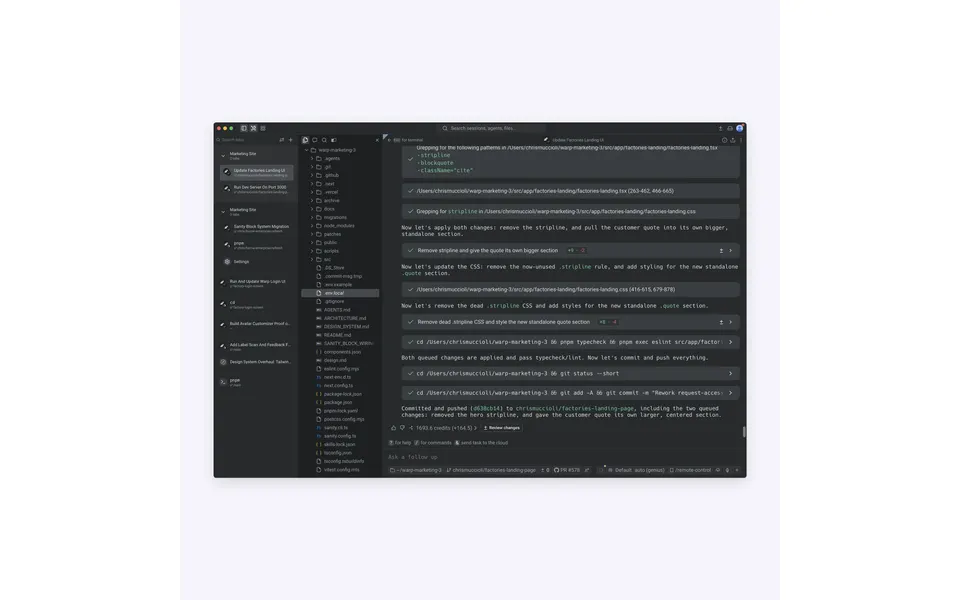
- Desktop app
- Mac, Windows and Linux
- Browser
- Yes
- Phone
- Phone browser
- Command line
- Yes
- Agents
- Claude Code, Codex, Cursor Agent, Gemini CLI, OpenCode, Pi, Grok and Antigravity
- Your subscription
- Works with your own plan
- Agents run
- On your computer, on your own server and in the vendor's cloud
- Laptop closed
- Keeps going
- Isolation
- Worktree
- Parallel agents
- Yes
- Scheduled runs
- Not listed
- Coordinator agent
- Yes
- Built-in issues
- Not listed
- Pull requests
- Yes
- Review screen
- Yes
- Team
- Shared sessions, roles and SSO
- Self-hosting
- No
- Licence
- AGPL-3.0
- Price from
- Free
- How it charges
- Free plan, subscription, per seat, usage-based, per machine or compute and bring your own key
- Paid plans from
- $11–20/month
Receipts
- Checked
- Findings
- 37 published · 34 cross-checked by a second agent · read them all
- Sources
- 30 public pages on 3 sites: warp.dev, docs.warp.dev, github.com
- Screenshot
- warp.dev, retrieved · first party marketing · shows appearance, not capability
- Data
- /products/warp.json · .md
- Method
- Same rules for all 103 researched ADEs. How we check · Report wrong data
What it does
Where you use it
Warp Terminal downloads are offered for macOS 10.14+, Windows 11/10 and Linux. Shared local-agent sessions are accessible in a web browser without installing Warp; Warp sign-in is required. Phone/tablet browsers can view shared sessions and interact when granted edit access. The standalone Warp Agent CLI runs the native Warp Agent in any terminal, without requiring the desktop app. CLI prompts, shell execution, inline diffs, approvals and saved-conversation resumption are documented. Claude Code, Codex and OpenCode support agent notifications after one-time integration setup; most other recognized harnesses do not. A shared session can be opened on another desktop or browser with its prompt, tool and terminal context.
Source and scope for Where you use itAgents it runs
Terminal integrations include Claude Code, Codex, OpenCode, Cursor CLI, Gemini CLI, Pi and Grok Build, plus Amp, Auggie, Copilot CLI, Droid, Goose, Antigravity, Hermes, Mistral Vibe and Kiro CLI. Third-party agents run in panes with toolbelt and vertical-tab status; they do not appear in Warp’s native Conversation or Agent Management panels. Separate terminal panes can run different recognized coding agents with their own live status. Warp's current published CLI-agent documentation explicitly supports Antigravity, invoked with agy or antigravity, in terminal panes with agent toolbelt and status.
Source and scope for Agents it runsAccounts and subscriptions
A third-party Claude Code session uses the user’s paid Claude plan or API credits through Claude login, separate from Warp native-agent credits. Customer-supplied inference includes BYOK and custom endpoints; organizations over ten employees require Business or Enterprise for these routes. The Claude Code guide requires a Claude account with CLI access; provider eligibility and restrictions remain provider controlled.
Source and scope for Accounts and subscriptionsWhere agents run
Warp runs agents on local worktrees and via SSH. The application also supports native local-to-cloud handoff, transferring a conversation and workspace snapshot so work continues without keeping the laptop awake.
Source and scope for Where agents runHow work is kept apart
Each worktree has its own checked-out branch and Git status. Warp detects Git worktrees and supports parallel local agents in separate worktree directories. Per-worktree review and indexing distinguish local working files; shared Git metadata still exists.
Source and scope for How work is kept apartParallel work
Warp documents running several Warp Agent conversations in parallel, tracked in the Agent Management Panel, and parent-agent orchestration of child agents. Vertical tabs display sessions with Git branch, worktree and PR metadata.
Source and scope for Parallel workGit and pull requests
Warp detects worktrees for branch-aware review and indexing. Its code review panel supports commit, push and PR creation, including SSH repositories with the extension installed.
Source and scope for Git and pull requestsLicence and source
Warp's privacy documentation says its client source is open source under AGPL v3 and links warpdotdev/warp. At commit abb3fe3 that repository's README licenses the warpui_core and warpui UI framework crates under MIT and the rest of the client code under AGPL v3; LICENSE-AGPL contains the AGPL v3 text. Hosted Warp services are not covered by this repository license.
Source and scope for Licence and sourcePrice
Build is $20/month monthly or $18/month annually. Max is $200 monthly or $180/month annually. Business is $50/user/month monthly or $45 annually, checked 7 November 2026. Build includes $20 agent usage monthly; Max includes $200; Business includes $20 per seat. Compute and platform charges require separate checks. Further scoped facts are recorded in the atomic answers.
Source and scope for PriceTyped filters
Every value links to its receipt below. Read plan and surface restrictions before using a filter to decide.
| Filter | Value |
|---|---|
| Desktop OS: macOS | Yes cross-checked |
| Desktop OS: Windows | Yes cross-checked |
| Desktop OS: Linux | Yes cross-checked |
| Web client | Yes cross-checked |
| Phone access: Native iOS | Unknown |
| Phone access: Native Android | Unknown |
| Phone access: Phone browser | Yes cross-checked |
| CLI | Yes cross-checked |
| Coding agents: Claude Code | Yes cross-checked |
| Coding agents: Codex | Yes cross-checked |
| Coding agents: Cursor Agent | Yes cross-checked |
| Coding agents: Gemini CLI | Yes cross-checked |
| Coding agents: OpenCode | Yes cross-checked |
| Coding agents: Pi | Yes cross-checked |
| Coding agents: Grok | Yes cross-checked |
| Coding agents: Aider | Unknown |
| Coding agents: Antigravity | Yes cross-checked |
| Use my subscription | Yes cross-checked |
| Where agents run: On your computer | Yes |
| Where agents run: On your own server | Yes |
| Where agents run: In the vendor's cloud | Yes |
| Workspace isolation: Git worktree | Yes cross-checked |
| Workspace isolation: Container | Unknown |
| Workspace isolation: VM or microVM | Unknown |
| Parallel runs | Yes cross-checked |
| Coordinator | Yes cross-checked |
| Native issue tracking | Unknown |
| Unattended triggers | Unknown |
| Shared prompting | Yes cross-checked |
| Team roles | Yes cross-checked |
| SSO | Yes cross-checked |
| Pull request workflow | Yes |
| Review interface | Yes cross-checked |
| Product license: Apache-2.0 | No. AGPL-3.0 cross-checked |
| Product license: MIT | No. AGPL-3.0 cross-checked |
| Product license: GPL-3.0 | No. AGPL-3.0 cross-checked |
| Product license: GPL-3.0-or-later | No. AGPL-3.0 cross-checked |
| Product license: AGPL-3.0 | Yes. AGPL-3.0 cross-checked |
| Product license: AGPL-3.0-or-later | No. AGPL-3.0 cross-checked |
| Product license: Elastic License 2.0 | No. AGPL-3.0 cross-checked |
| Product license: Custom terms | No. AGPL-3.0 cross-checked |
| Product license: Proprietary | No. AGPL-3.0 cross-checked |
| Self-hosting | No cross-checked |
| Telemetry opt-out | Yes cross-checked |
| Free access | Yes cross-checked |
| Starting price: Free | Yes. Free cross-checked |
| Starting price: Up to $20/month | No. Free cross-checked |
| Starting price: $21–40/month | No. Free cross-checked |
| Starting price: $41–100/month | No. Free cross-checked |
| Starting price: Over $100/month | No. Free cross-checked |
| Starting price: Contact for pricing | No. Free cross-checked |
| Pricing model: Free, no paid plan | No |
| Pricing model: Free plan | Yes cross-checked |
| Pricing model: Subscription | Yes cross-checked |
| Pricing model: Per seat | Yes cross-checked |
| Pricing model: Usage-based | Yes cross-checked |
| Pricing model: Per machine or compute | Yes cross-checked |
| Pricing model: Bring your own key | Yes cross-checked |
| Pricing model: One-time purchase | No |
| Paid plans from: No paid plan | No. $11–20/month |
| Paid plans from: $10 or less/month | No. $11–20/month |
| Paid plans from: $11–20/month | Yes. $11–20/month |
| Paid plans from: $21–40/month | No. $11–20/month |
| Paid plans from: $41–100/month | No. $11–20/month |
| Paid plans from: Over $100/month | No. $11–20/month |
| Paid plans from: Contact sales | No. $11–20/month |
| Lifecycle status: Active | Unknown |
| Lifecycle status: Sunsetting | Unknown |
| Keeps going with laptop closed | Yes |
| Open-source license | Yes. AGPL-3.0 cross-checked |
| Any desktop app | Yes cross-checked |
| Paid plan up to $20/month | Yes. $11–20/month |
| Paid plan up to $40/month | Yes. $11–20/month |
| Any phone client | Yes cross-checked |
Filter receipts
Desktop OS: macOS: Yes cross-checked
Desktop OS: macOS
Typed value: Yes.
Warp Terminal downloads are offered for macOS 10.14+, Windows 11/10 and Linux. Shared local-agent sessions are accessible in a web browser without installing Warp; Warp sign-in is required. Phone/tablet browsers can view shared sessions and interact when granted edit access. The standalone Warp Agent CLI runs the native Warp Agent in any terminal, without requiring the desktop app. CLI prompts, shell execution, inline diffs, approvals and saved-conversation resumption are documented. Claude Code, Codex and OpenCode support agent notifications after one-time integration setup; most other recognized harnesses do not. A shared session can be opened on another desktop or browser with its prompt, tool and terminal context.
- Desktop os: Warp Terminal downloads are offered for macOS 10.14+, Windows 11/10 and Linux.
- Unknown after the targeted first-party documentation, release and repository pass: mobile_apps, editor_extensions. No configured product fixture was run; documentation does not establish successful hands-on behavior.
-
Finding: Warp Terminal advertises Mac, Windows and Linux clients, agent sessions in vertical tabs and an integrated review/editing flow.
-
Finding: Free, Build, Max, Business and custom Enterprise plans distinguish included usage, collaboration and customer-supplied inference.
Desktop OS: Windows: Yes cross-checked
Desktop OS: Windows
Typed value: Yes.
Warp Terminal downloads are offered for macOS 10.14+, Windows 11/10 and Linux. Shared local-agent sessions are accessible in a web browser without installing Warp; Warp sign-in is required. Phone/tablet browsers can view shared sessions and interact when granted edit access. The standalone Warp Agent CLI runs the native Warp Agent in any terminal, without requiring the desktop app. CLI prompts, shell execution, inline diffs, approvals and saved-conversation resumption are documented. Claude Code, Codex and OpenCode support agent notifications after one-time integration setup; most other recognized harnesses do not. A shared session can be opened on another desktop or browser with its prompt, tool and terminal context.
- Desktop os: Warp Terminal downloads are offered for macOS 10.14+, Windows 11/10 and Linux.
- Unknown after the targeted first-party documentation, release and repository pass: mobile_apps, editor_extensions. No configured product fixture was run; documentation does not establish successful hands-on behavior.
-
Finding: Warp Terminal advertises Mac, Windows and Linux clients, agent sessions in vertical tabs and an integrated review/editing flow.
-
Finding: Free, Build, Max, Business and custom Enterprise plans distinguish included usage, collaboration and customer-supplied inference.
Desktop OS: Linux: Yes cross-checked
Desktop OS: Linux
Typed value: Yes.
Warp Terminal downloads are offered for macOS 10.14+, Windows 11/10 and Linux. Shared local-agent sessions are accessible in a web browser without installing Warp; Warp sign-in is required. Phone/tablet browsers can view shared sessions and interact when granted edit access. The standalone Warp Agent CLI runs the native Warp Agent in any terminal, without requiring the desktop app. CLI prompts, shell execution, inline diffs, approvals and saved-conversation resumption are documented. Claude Code, Codex and OpenCode support agent notifications after one-time integration setup; most other recognized harnesses do not. A shared session can be opened on another desktop or browser with its prompt, tool and terminal context.
- Desktop os: Warp Terminal downloads are offered for macOS 10.14+, Windows 11/10 and Linux.
- Unknown after the targeted first-party documentation, release and repository pass: mobile_apps, editor_extensions. No configured product fixture was run; documentation does not establish successful hands-on behavior.
-
Finding: Warp Terminal advertises Mac, Windows and Linux clients, agent sessions in vertical tabs and an integrated review/editing flow.
-
Finding: Free, Build, Max, Business and custom Enterprise plans distinguish included usage, collaboration and customer-supplied inference.
Web client: Yes cross-checked
Web client
Typed value: Yes.
Warp Terminal downloads are offered for macOS 10.14+, Windows 11/10 and Linux. Shared local-agent sessions are accessible in a web browser without installing Warp; Warp sign-in is required. Phone/tablet browsers can view shared sessions and interact when granted edit access. The standalone Warp Agent CLI runs the native Warp Agent in any terminal, without requiring the desktop app. CLI prompts, shell execution, inline diffs, approvals and saved-conversation resumption are documented. Claude Code, Codex and OpenCode support agent notifications after one-time integration setup; most other recognized harnesses do not. A shared session can be opened on another desktop or browser with its prompt, tool and terminal context.
- Browser: Shared local-agent sessions are accessible in a web browser without installing Warp; Warp sign-in is required.
- Mobile browser: Phone/tablet browsers can view shared sessions and interact when granted edit access.
- Cross device continuity: A shared session can be opened on another desktop or browser with its prompt, tool and terminal context.
- Unknown after the targeted first-party documentation, release and repository pass: mobile_apps, editor_extensions. No configured product fixture was run; documentation does not establish successful hands-on behavior.
-
Finding: Local Warp and third-party sessions can be shared to signed-in web/mobile viewers. Editors can prompt and execute commands concurrently; data expires after roughly one week and secret redaction is not applied.
Phone access: Phone browser: Yes cross-checked
Phone access: Phone browser
Typed value: Yes.
Warp Terminal downloads are offered for macOS 10.14+, Windows 11/10 and Linux. Shared local-agent sessions are accessible in a web browser without installing Warp; Warp sign-in is required. Phone/tablet browsers can view shared sessions and interact when granted edit access. The standalone Warp Agent CLI runs the native Warp Agent in any terminal, without requiring the desktop app. CLI prompts, shell execution, inline diffs, approvals and saved-conversation resumption are documented. Claude Code, Codex and OpenCode support agent notifications after one-time integration setup; most other recognized harnesses do not. A shared session can be opened on another desktop or browser with its prompt, tool and terminal context.
- Browser: Shared local-agent sessions are accessible in a web browser without installing Warp; Warp sign-in is required.
- Mobile browser: Phone/tablet browsers can view shared sessions and interact when granted edit access.
- Cross device continuity: A shared session can be opened on another desktop or browser with its prompt, tool and terminal context.
- Unknown after the targeted first-party documentation, release and repository pass: mobile_apps, editor_extensions. No configured product fixture was run; documentation does not establish successful hands-on behavior.
-
Finding: Local Warp and third-party sessions can be shared to signed-in web/mobile viewers. Editors can prompt and execute commands concurrently; data expires after roughly one week and secret redaction is not applied.
CLI: Yes cross-checked
CLI
Typed value: Yes.
Warp Terminal downloads are offered for macOS 10.14+, Windows 11/10 and Linux. Shared local-agent sessions are accessible in a web browser without installing Warp; Warp sign-in is required. Phone/tablet browsers can view shared sessions and interact when granted edit access. The standalone Warp Agent CLI runs the native Warp Agent in any terminal, without requiring the desktop app. CLI prompts, shell execution, inline diffs, approvals and saved-conversation resumption are documented. Claude Code, Codex and OpenCode support agent notifications after one-time integration setup; most other recognized harnesses do not. A shared session can be opened on another desktop or browser with its prompt, tool and terminal context.
- Cli: The standalone Warp Agent CLI runs the native Warp Agent in any terminal, without requiring the desktop app.
- Task actions: CLI prompts, shell execution, inline diffs, approvals and saved-conversation resumption are documented.
- Unknown after the targeted first-party documentation, release and repository pass: mobile_apps, editor_extensions. No configured product fixture was run; documentation does not establish successful hands-on behavior.
-
Finding: Standalone warp command runs the native agent in any terminal including SSH, with saved account conversations, shell, diffs, approvals, context and model selection.
Coding agents: Claude Code: Yes cross-checked
Coding agents: Claude Code
Typed value: Yes.
Terminal integrations include Claude Code, Codex, OpenCode, Cursor CLI, Gemini CLI, Pi and Grok Build, plus Amp, Auggie, Copilot CLI, Droid, Goose, Antigravity, Hermes, Mistral Vibe and Kiro CLI. Third-party agents run in panes with toolbelt and vertical-tab status; they do not appear in Warp’s native Conversation or Agent Management panels. Separate terminal panes can run different recognized coding agents with their own live status. Warp's current published CLI-agent documentation explicitly supports Antigravity, invoked with agy or antigravity, in terminal panes with agent toolbelt and status.
- Harnesses: Terminal integrations include Claude Code, Codex, OpenCode, Cursor CLI, Gemini CLI, Pi and Grok Build, plus Amp, Auggie, Copilot CLI, Droid, Goose, Antigravity, Hermes, Mistral Vibe and Kiro CLI. Warp's current published CLI-agent documentation explicitly supports Antigravity, invoked with agy or antigravity, in terminal panes with agent toolbelt and status.
- Session integration: Third-party agents run in panes with toolbelt and vertical-tab status; they do not appear in Warp’s native Conversation or Agent Management panels.
- Mixed harness operation: Separate terminal panes can run different recognized coding agents with their own live status.
- Unknown after the targeted first-party documentation, release and repository pass: model_providers, custom_adapters. No configured product fixture was run; documentation does not establish successful hands-on behavior.
- This is documented released terminal integration, not Warp native Conversation or Agent Management panel support. The pinned documentation commit is not a Warp binary release tag.
-
Third-party CLI agents overview
Finding: Warp detects third-party coding agents in terminal panes with rich input, per-agent status, code review and remote control. They are separate from the native conversation and agent-management panels.
Coding agents: Codex: Yes cross-checked
Coding agents: Codex
Typed value: Yes.
Terminal integrations include Claude Code, Codex, OpenCode, Cursor CLI, Gemini CLI, Pi and Grok Build, plus Amp, Auggie, Copilot CLI, Droid, Goose, Antigravity, Hermes, Mistral Vibe and Kiro CLI. Third-party agents run in panes with toolbelt and vertical-tab status; they do not appear in Warp’s native Conversation or Agent Management panels. Separate terminal panes can run different recognized coding agents with their own live status. Warp's current published CLI-agent documentation explicitly supports Antigravity, invoked with agy or antigravity, in terminal panes with agent toolbelt and status.
- Harnesses: Terminal integrations include Claude Code, Codex, OpenCode, Cursor CLI, Gemini CLI, Pi and Grok Build, plus Amp, Auggie, Copilot CLI, Droid, Goose, Antigravity, Hermes, Mistral Vibe and Kiro CLI. Warp's current published CLI-agent documentation explicitly supports Antigravity, invoked with agy or antigravity, in terminal panes with agent toolbelt and status.
- Session integration: Third-party agents run in panes with toolbelt and vertical-tab status; they do not appear in Warp’s native Conversation or Agent Management panels.
- Mixed harness operation: Separate terminal panes can run different recognized coding agents with their own live status.
- Unknown after the targeted first-party documentation, release and repository pass: model_providers, custom_adapters. No configured product fixture was run; documentation does not establish successful hands-on behavior.
- This is documented released terminal integration, not Warp native Conversation or Agent Management panel support. The pinned documentation commit is not a Warp binary release tag.
-
Third-party CLI agents overview
Finding: Warp detects third-party coding agents in terminal panes with rich input, per-agent status, code review and remote control. They are separate from the native conversation and agent-management panels.
Coding agents: Cursor Agent: Yes cross-checked
Coding agents: Cursor Agent
Typed value: Yes.
Terminal integrations include Claude Code, Codex, OpenCode, Cursor CLI, Gemini CLI, Pi and Grok Build, plus Amp, Auggie, Copilot CLI, Droid, Goose, Antigravity, Hermes, Mistral Vibe and Kiro CLI. Third-party agents run in panes with toolbelt and vertical-tab status; they do not appear in Warp’s native Conversation or Agent Management panels. Separate terminal panes can run different recognized coding agents with their own live status. Warp's current published CLI-agent documentation explicitly supports Antigravity, invoked with agy or antigravity, in terminal panes with agent toolbelt and status.
- Harnesses: Terminal integrations include Claude Code, Codex, OpenCode, Cursor CLI, Gemini CLI, Pi and Grok Build, plus Amp, Auggie, Copilot CLI, Droid, Goose, Antigravity, Hermes, Mistral Vibe and Kiro CLI. Warp's current published CLI-agent documentation explicitly supports Antigravity, invoked with agy or antigravity, in terminal panes with agent toolbelt and status.
- Session integration: Third-party agents run in panes with toolbelt and vertical-tab status; they do not appear in Warp’s native Conversation or Agent Management panels.
- Mixed harness operation: Separate terminal panes can run different recognized coding agents with their own live status.
- Unknown after the targeted first-party documentation, release and repository pass: model_providers, custom_adapters. No configured product fixture was run; documentation does not establish successful hands-on behavior.
- This is documented released terminal integration, not Warp native Conversation or Agent Management panel support. The pinned documentation commit is not a Warp binary release tag.
-
Third-party CLI agents overview
Finding: Warp detects third-party coding agents in terminal panes with rich input, per-agent status, code review and remote control. They are separate from the native conversation and agent-management panels.
Coding agents: Gemini CLI: Yes cross-checked
Coding agents: Gemini CLI
Typed value: Yes.
Terminal integrations include Claude Code, Codex, OpenCode, Cursor CLI, Gemini CLI, Pi and Grok Build, plus Amp, Auggie, Copilot CLI, Droid, Goose, Antigravity, Hermes, Mistral Vibe and Kiro CLI. Third-party agents run in panes with toolbelt and vertical-tab status; they do not appear in Warp’s native Conversation or Agent Management panels. Separate terminal panes can run different recognized coding agents with their own live status. Warp's current published CLI-agent documentation explicitly supports Antigravity, invoked with agy or antigravity, in terminal panes with agent toolbelt and status.
- Harnesses: Terminal integrations include Claude Code, Codex, OpenCode, Cursor CLI, Gemini CLI, Pi and Grok Build, plus Amp, Auggie, Copilot CLI, Droid, Goose, Antigravity, Hermes, Mistral Vibe and Kiro CLI. Warp's current published CLI-agent documentation explicitly supports Antigravity, invoked with agy or antigravity, in terminal panes with agent toolbelt and status.
- Session integration: Third-party agents run in panes with toolbelt and vertical-tab status; they do not appear in Warp’s native Conversation or Agent Management panels.
- Mixed harness operation: Separate terminal panes can run different recognized coding agents with their own live status.
- Unknown after the targeted first-party documentation, release and repository pass: model_providers, custom_adapters. No configured product fixture was run; documentation does not establish successful hands-on behavior.
- This is documented released terminal integration, not Warp native Conversation or Agent Management panel support. The pinned documentation commit is not a Warp binary release tag.
-
Third-party CLI agents overview
Finding: Warp detects third-party coding agents in terminal panes with rich input, per-agent status, code review and remote control. They are separate from the native conversation and agent-management panels.
Coding agents: OpenCode: Yes cross-checked
Coding agents: OpenCode
Typed value: Yes.
Terminal integrations include Claude Code, Codex, OpenCode, Cursor CLI, Gemini CLI, Pi and Grok Build, plus Amp, Auggie, Copilot CLI, Droid, Goose, Antigravity, Hermes, Mistral Vibe and Kiro CLI. Third-party agents run in panes with toolbelt and vertical-tab status; they do not appear in Warp’s native Conversation or Agent Management panels. Separate terminal panes can run different recognized coding agents with their own live status. Warp's current published CLI-agent documentation explicitly supports Antigravity, invoked with agy or antigravity, in terminal panes with agent toolbelt and status.
- Harnesses: Terminal integrations include Claude Code, Codex, OpenCode, Cursor CLI, Gemini CLI, Pi and Grok Build, plus Amp, Auggie, Copilot CLI, Droid, Goose, Antigravity, Hermes, Mistral Vibe and Kiro CLI. Warp's current published CLI-agent documentation explicitly supports Antigravity, invoked with agy or antigravity, in terminal panes with agent toolbelt and status.
- Session integration: Third-party agents run in panes with toolbelt and vertical-tab status; they do not appear in Warp’s native Conversation or Agent Management panels.
- Mixed harness operation: Separate terminal panes can run different recognized coding agents with their own live status.
- Unknown after the targeted first-party documentation, release and repository pass: model_providers, custom_adapters. No configured product fixture was run; documentation does not establish successful hands-on behavior.
- This is documented released terminal integration, not Warp native Conversation or Agent Management panel support. The pinned documentation commit is not a Warp binary release tag.
-
Third-party CLI agents overview
Finding: Warp detects third-party coding agents in terminal panes with rich input, per-agent status, code review and remote control. They are separate from the native conversation and agent-management panels.
Coding agents: Pi: Yes cross-checked
Coding agents: Pi
Typed value: Yes.
Terminal integrations include Claude Code, Codex, OpenCode, Cursor CLI, Gemini CLI, Pi and Grok Build, plus Amp, Auggie, Copilot CLI, Droid, Goose, Antigravity, Hermes, Mistral Vibe and Kiro CLI. Third-party agents run in panes with toolbelt and vertical-tab status; they do not appear in Warp’s native Conversation or Agent Management panels. Separate terminal panes can run different recognized coding agents with their own live status. Warp's current published CLI-agent documentation explicitly supports Antigravity, invoked with agy or antigravity, in terminal panes with agent toolbelt and status.
- Harnesses: Terminal integrations include Claude Code, Codex, OpenCode, Cursor CLI, Gemini CLI, Pi and Grok Build, plus Amp, Auggie, Copilot CLI, Droid, Goose, Antigravity, Hermes, Mistral Vibe and Kiro CLI. Warp's current published CLI-agent documentation explicitly supports Antigravity, invoked with agy or antigravity, in terminal panes with agent toolbelt and status.
- Session integration: Third-party agents run in panes with toolbelt and vertical-tab status; they do not appear in Warp’s native Conversation or Agent Management panels.
- Mixed harness operation: Separate terminal panes can run different recognized coding agents with their own live status.
- Unknown after the targeted first-party documentation, release and repository pass: model_providers, custom_adapters. No configured product fixture was run; documentation does not establish successful hands-on behavior.
- This is documented released terminal integration, not Warp native Conversation or Agent Management panel support. The pinned documentation commit is not a Warp binary release tag.
-
Third-party CLI agents overview
Finding: Warp detects third-party coding agents in terminal panes with rich input, per-agent status, code review and remote control. They are separate from the native conversation and agent-management panels.
Coding agents: Grok: Yes cross-checked
Coding agents: Grok
Typed value: Yes.
Terminal integrations include Claude Code, Codex, OpenCode, Cursor CLI, Gemini CLI, Pi and Grok Build, plus Amp, Auggie, Copilot CLI, Droid, Goose, Antigravity, Hermes, Mistral Vibe and Kiro CLI. Third-party agents run in panes with toolbelt and vertical-tab status; they do not appear in Warp’s native Conversation or Agent Management panels. Separate terminal panes can run different recognized coding agents with their own live status. Warp's current published CLI-agent documentation explicitly supports Antigravity, invoked with agy or antigravity, in terminal panes with agent toolbelt and status.
- Harnesses: Terminal integrations include Claude Code, Codex, OpenCode, Cursor CLI, Gemini CLI, Pi and Grok Build, plus Amp, Auggie, Copilot CLI, Droid, Goose, Antigravity, Hermes, Mistral Vibe and Kiro CLI. Warp's current published CLI-agent documentation explicitly supports Antigravity, invoked with agy or antigravity, in terminal panes with agent toolbelt and status.
- Session integration: Third-party agents run in panes with toolbelt and vertical-tab status; they do not appear in Warp’s native Conversation or Agent Management panels.
- Mixed harness operation: Separate terminal panes can run different recognized coding agents with their own live status.
- Unknown after the targeted first-party documentation, release and repository pass: model_providers, custom_adapters. No configured product fixture was run; documentation does not establish successful hands-on behavior.
- This is documented released terminal integration, not Warp native Conversation or Agent Management panel support. The pinned documentation commit is not a Warp binary release tag.
-
Third-party CLI agents overview
Finding: Warp detects third-party coding agents in terminal panes with rich input, per-agent status, code review and remote control. They are separate from the native conversation and agent-management panels.
Coding agents: Antigravity: Yes cross-checked
Coding agents: Antigravity
Typed value: Yes.
Terminal integrations include Claude Code, Codex, OpenCode, Cursor CLI, Gemini CLI, Pi and Grok Build, plus Amp, Auggie, Copilot CLI, Droid, Goose, Antigravity, Hermes, Mistral Vibe and Kiro CLI. Third-party agents run in panes with toolbelt and vertical-tab status; they do not appear in Warp’s native Conversation or Agent Management panels. Separate terminal panes can run different recognized coding agents with their own live status. Warp's current published CLI-agent documentation explicitly supports Antigravity, invoked with agy or antigravity, in terminal panes with agent toolbelt and status.
- Harnesses: Terminal integrations include Claude Code, Codex, OpenCode, Cursor CLI, Gemini CLI, Pi and Grok Build, plus Amp, Auggie, Copilot CLI, Droid, Goose, Antigravity, Hermes, Mistral Vibe and Kiro CLI. Warp's current published CLI-agent documentation explicitly supports Antigravity, invoked with agy or antigravity, in terminal panes with agent toolbelt and status.
- Unknown after the targeted first-party documentation, release and repository pass: model_providers, custom_adapters. No configured product fixture was run; documentation does not establish successful hands-on behavior.
- This is documented released terminal integration, not Warp native Conversation or Agent Management panel support. The pinned documentation commit is not a Warp binary release tag.
-
Warp Antigravity support at published documentation checked 2026-11-10
Finding: Warp's current published CLI-agent documentation explicitly supports Antigravity, invoked with agy or antigravity, in terminal panes with agent toolbelt and status.
-
Warp Antigravity support at published documentation checked 2026-11-10
Finding: Warp's current published CLI-agent documentation explicitly supports Antigravity, invoked with agy or antigravity, in terminal panes with agent toolbelt and status.
Use my subscription: Yes cross-checked
Use my subscription
Typed value: Yes.
A third-party Claude Code session uses the user’s paid Claude plan or API credits through Claude login, separate from Warp native-agent credits. Customer-supplied inference includes BYOK and custom endpoints; organizations over ten employees require Business or Enterprise for these routes. The Claude Code guide requires a Claude account with CLI access; provider eligibility and restrictions remain provider controlled.
- Agent subscriptions: A third-party Claude Code session uses the user’s paid Claude plan or API credits through Claude login, separate from Warp native-agent credits.
- Provider restrictions: The Claude Code guide requires a Claude account with CLI access; provider eligibility and restrictions remain provider controlled.
- Unknown after the targeted first-party documentation, release and repository pass: vendor_credits, local_models, account_switching, vendor_account_requirement. No configured product fixture was run; documentation does not establish successful hands-on behavior.
-
Finding: Warp documents running Claude Code with a paid Claude account or API credits and authenticating with its own provider login.
Where agents run: On your computer: Yes
Where agents run: On your computer
Typed value: Yes.
Warp runs agents on local worktrees and via SSH. The application also supports native local-to-cloud handoff, transferring a conversation and workspace snapshot so work continues without keeping the laptop awake.
- Local: Warp documents running multiple local agents on worktrees in user directories.
- Unknown after the targeted first-party documentation, release and repository pass: self_hosted, managed_cloud, hybrid, provisioning, payer, resources, region, expiry, client_disconnect, other_device_continuation. No configured product fixture was run; documentation does not establish successful hands-on behavior.
-
Finding: Warp supports separate Git worktrees with independent diffs, indexing and branch status for parallel local agent work.
Where agents run: On your own server: Yes
Where agents run: On your own server
Typed value: Yes.
Warp runs agents on local worktrees and via SSH. The application also supports native local-to-cloud handoff, transferring a conversation and workspace snapshot so work continues without keeping the laptop awake.
- Byo remote: The standalone Warp Agent CLI runs as a regular command-line program over SSH on a user-controlled remote host.
- Unknown after the targeted first-party documentation, release and repository pass: self_hosted, managed_cloud, hybrid, provisioning, payer, resources, region, expiry, client_disconnect, other_device_continuation. No configured product fixture was run; documentation does not establish successful hands-on behavior.
-
Finding: Standalone warp command runs the native agent in any terminal including SSH, with saved account conversations, shell, diffs, approvals, context and model selection.
Where agents run: In the vendor's cloud: Yes
Where agents run: In the vendor's cloud
Typed value: Yes.
Warp runs agents on local worktrees and via SSH. The application also supports native local-to-cloud handoff, transferring a conversation and workspace snapshot so work continues without keeping the laptop awake.
- Managed cloud: The Warp app can hand off a local conversation to its separately hosted cloud-agent service, after selecting a configured environment.
- Client disconnect: Documented cloud handoff allows a task to keep working without the controlling laptop awake; local-only execution still requires its host.
- Unknown after the targeted first-party documentation, release and repository pass: self_hosted, managed_cloud, hybrid, provisioning, payer, resources, region, expiry, client_disconnect, other_device_continuation. No configured product fixture was run; documentation does not establish successful hands-on behavior.
-
Warp app local-to-cloud handoff
Finding: The Warp app can hand off a local conversation and workspace snapshot through the ampersand or /handoff controls. The remote cloud agent can continue without keeping the laptop awake; cloud storage and an eligible usage balance are required.
Workspace isolation: Git worktree: Yes cross-checked
Workspace isolation: Git worktree
Typed value: Yes.
Each worktree has its own checked-out branch and Git status. Warp detects Git worktrees and supports parallel local agents in separate worktree directories. Per-worktree review and indexing distinguish local working files; shared Git metadata still exists.
- Branch: Each worktree has its own checked-out branch and Git status.
- Worktree: Warp detects Git worktrees and supports parallel local agents in separate worktree directories.
- Code separation: Per-worktree review and indexing distinguish local working files; shared Git metadata still exists.
- Unknown after the targeted first-party documentation, release and repository pass: checkout, container, vm, os_sandbox, filesystem, process, network, secrets, security_boundary. No configured product fixture was run; documentation does not establish successful hands-on behavior.
-
Finding: Warp supports separate Git worktrees with independent diffs, indexing and branch status for parallel local agent work.
Parallel runs: Yes cross-checked
Parallel runs
Typed value: Yes.
Warp documents running several Warp Agent conversations in parallel, tracked in the Agent Management Panel, and parent-agent orchestration of child agents. Vertical tabs display sessions with Git branch, worktree and PR metadata.
- Concurrent sessions: Docs state the Warp Agent can run several conversations in parallel and track them in the Agent Management Panel. Not tested.
- Parallel work: first-party sources did not establish concurrent_tasks, quotas or observed_concurrency. No concurrency fixture was run; documented parallelism is not a tested limit.
-
Finding: The Warp Agent can run several conversations in parallel, tracked in the Agent Management Panel, or a parent agent can spawn and coordinate child agents through orchestration.
Coordinator: Yes cross-checked
Coordinator
Typed value: Yes.
A native parent agent spawns and coordinates child agents. The plan orchestration configuration exposes model, harness, environment, host and parallelism. The proposal names each child’s expected output; parent and child conversations remain inspectable. Warp’s own parent agent controls the child fan-out. /orchestrate or /plan opens a proposal that the human approves before fan-out. Cloud children inherit the local parent’s authentication and account billing. A pill bar shows parent and child names with live status badges.
- Roles: A native parent agent spawns and coordinates child agents.
- Model harness effort: The plan orchestration configuration exposes model, harness, environment, host and parallelism.
- Results return: The proposal names each child’s expected output; parent and child conversations remain inspectable.
- Orchestration owner: Warp’s own parent agent controls the child fan-out.
- Activation: /orchestrate or /plan opens a proposal that the human approves before fan-out.
- Authentication: Cloud children inherit the local parent’s authentication and account billing.
- Live progress: A pill bar shows parent and child names with live status badges.
- Unknown after the targeted first-party documentation, release and repository pass: messages, cross_harness, retained_results, followup, invocation. No configured product fixture was run; documentation does not establish successful hands-on behavior.
-
Finding: A Warp app parent proposes a child-agent breakdown through /orchestrate or /plan. Approved children can run locally or in cloud environments, with status pills and retained child conversations.
Shared prompting: Yes cross-checked
Shared prompting
Typed value: Yes.
Finished command blocks can be shared by permalink or embed; this does not establish co-prompting. Shared participants can add follow-up agent queries in the same session. Multiple participants see each other’s cursors and avatars. Granted editors can send agent queries and execute commands in the same shared session. The sharer grants view or edit access, can invite individuals or a team and can stop sharing.
- Discussion: Shared participants can add follow-up agent queries in the same session.
- Presence: Multiple participants see each other’s cursors and avatars.
- Coprompting: Granted editors can send agent queries and execute commands in the same shared session.
- Permissions: The sharer grants view or edit access, can invite individuals or a team and can stop sharing.
- Unknown after the targeted first-party documentation, release and repository pass: comments, ordering, conflicts, attribution, plan_restrictions, owner_online. No configured product fixture was run; documentation does not establish successful hands-on behavior.
-
Finding: Local Warp and third-party sessions can be shared to signed-in web/mobile viewers. Editors can prompt and execute commands concurrently; data expires after roughly one week and secret redaction is not applied.
Team roles: Yes cross-checked
Team roles
Typed value: Yes.
Single-team workspaces have Owner, Admin and Member roles. Owners/admins invite, remove and promote/demote team members. Business lists SAML SSO; Enterprise adds further administration controls. Members use agents and shared resources within enforced administrator settings. Administrators can remove members and demote admins; only the owner transfers ownership.
- Organization roles: Single-team workspaces have Owner, Admin and Member roles.
- Membership: Owners/admins invite, remove and promote/demote team members.
- Unauthorized access: Members use agents and shared resources within enforced administrator settings.
- Revocation: Administrators can remove members and demote admins; only the owner transfers ownership.
- Unknown after the targeted first-party documentation, release and repository pass: project_roles, task_roles, provisioning, plan_scope. No configured product fixture was run; documentation does not establish successful hands-on behavior.
-
Finding: Owner, Admin and Member have explicit administration and usage boundaries; organization-enforced settings cannot be overridden.
SSO: Yes cross-checked
SSO
Typed value: Yes.
Single-team workspaces have Owner, Admin and Member roles. Owners/admins invite, remove and promote/demote team members. Business lists SAML SSO; Enterprise adds further administration controls. Members use agents and shared resources within enforced administrator settings. Administrators can remove members and demote admins; only the owner transfers ownership.
- Sso: Business lists SAML SSO; Enterprise adds further administration controls.
- Unknown after the targeted first-party documentation, release and repository pass: project_roles, task_roles, provisioning, plan_scope. No configured product fixture was run; documentation does not establish successful hands-on behavior.
-
Finding: Free, Build, Max, Business and custom Enterprise plans distinguish included usage, collaboration and customer-supplied inference.
Pull request workflow: Yes
Pull request workflow
Typed value: Yes.
Warp detects worktrees for branch-aware review and indexing. Its code review panel supports commit, push and PR creation, including SSH repositories with the extension installed.
- Pull requests: The code review panel creates PRs, including remote repositories when the SSH extension is installed.
- Unknown after the targeted first-party documentation, release and repository pass: commits, pull_requests, comments, ci_response, rebase, conflicts, product_state. No configured product fixture was run; documentation does not establish successful hands-on behavior.
-
Finding: With the SSH extension installed, Warp code review can commit, push and create pull requests on remote repositories. Commit messages and PR descriptions are generated on the remote host.
Review interface: Yes cross-checked
Review interface
Typed value: Yes.
An integrated editing and review interface is advertised, without an artifact persistence test. Block sharing can retain selected commands and output in a shared link.
- Diffs: An integrated editing and review interface is advertised, without an artifact persistence test.
- Retained artifacts and outputs: first-party sources in this pass did not establish documents, screenshots, recordings, previews, reviewer_outputs, gallery, task_links, revision_links, persistence, child_findings, prompt_leakage. No draft PR, failed-gate, stale-approval, rollback or six-task batch-review fixture was run. Described actions do not prove delivery authority.
-
Finding: Warp Terminal advertises Mac, Windows and Linux clients, agent sessions in vertical tabs and an integrated review/editing flow.
Product license: Apache-2.0: No. AGPL-3.0 cross-checked
Product license: Apache-2.0
Typed value: No. AGPL-3.0.
Warp's privacy documentation says its client source is open source under AGPL v3 and links warpdotdev/warp. At commit abb3fe3 that repository's README licenses the warpui_core and warpui UI framework crates under MIT and the rest of the client code under AGPL v3; LICENSE-AGPL contains the AGPL v3 text. Hosted Warp services are not covered by this repository license.
- Client license: At commit abb3fe3 the warpdotdev/warp README licenses the warpui_core and warpui UI framework crates under MIT and the rest of the client code under AGPL v3; the privacy page links this AGPL license.
- Source visibility: The privacy page and the repository README both say Warp's client source is public in warpdotdev/warp.
- Unknown after the targeted first-party documentation, release and repository pass: server_license, hosted_extensions, hosted_parity. No configured product fixture was run; documentation does not establish successful hands-on behavior. The repository was checked at a pinned commit; no build was compared with released binaries.
-
Finding: Paid plans may disable Help improve Warp and crash reports while retaining AI. Free AI requires telemetry. Vendor documentation labels client source AGPLv3, but its linked source license was not retrievable in this pass.
Product license: MIT: No. AGPL-3.0 cross-checked
Product license: MIT
Typed value: No. AGPL-3.0.
Warp's privacy documentation says its client source is open source under AGPL v3 and links warpdotdev/warp. At commit abb3fe3 that repository's README licenses the warpui_core and warpui UI framework crates under MIT and the rest of the client code under AGPL v3; LICENSE-AGPL contains the AGPL v3 text. Hosted Warp services are not covered by this repository license.
- Client license: At commit abb3fe3 the warpdotdev/warp README licenses the warpui_core and warpui UI framework crates under MIT and the rest of the client code under AGPL v3; the privacy page links this AGPL license.
- Source visibility: The privacy page and the repository README both say Warp's client source is public in warpdotdev/warp.
- Unknown after the targeted first-party documentation, release and repository pass: server_license, hosted_extensions, hosted_parity. No configured product fixture was run; documentation does not establish successful hands-on behavior. The repository was checked at a pinned commit; no build was compared with released binaries.
-
Finding: Paid plans may disable Help improve Warp and crash reports while retaining AI. Free AI requires telemetry. Vendor documentation labels client source AGPLv3, but its linked source license was not retrievable in this pass.
Product license: GPL-3.0: No. AGPL-3.0 cross-checked
Product license: GPL-3.0
Typed value: No. AGPL-3.0.
Warp's privacy documentation says its client source is open source under AGPL v3 and links warpdotdev/warp. At commit abb3fe3 that repository's README licenses the warpui_core and warpui UI framework crates under MIT and the rest of the client code under AGPL v3; LICENSE-AGPL contains the AGPL v3 text. Hosted Warp services are not covered by this repository license.
- Client license: At commit abb3fe3 the warpdotdev/warp README licenses the warpui_core and warpui UI framework crates under MIT and the rest of the client code under AGPL v3; the privacy page links this AGPL license.
- Source visibility: The privacy page and the repository README both say Warp's client source is public in warpdotdev/warp.
- Unknown after the targeted first-party documentation, release and repository pass: server_license, hosted_extensions, hosted_parity. No configured product fixture was run; documentation does not establish successful hands-on behavior. The repository was checked at a pinned commit; no build was compared with released binaries.
-
Finding: Paid plans may disable Help improve Warp and crash reports while retaining AI. Free AI requires telemetry. Vendor documentation labels client source AGPLv3, but its linked source license was not retrievable in this pass.
Product license: GPL-3.0-or-later: No. AGPL-3.0 cross-checked
Product license: GPL-3.0-or-later
Typed value: No. AGPL-3.0.
Warp's privacy documentation says its client source is open source under AGPL v3 and links warpdotdev/warp. At commit abb3fe3 that repository's README licenses the warpui_core and warpui UI framework crates under MIT and the rest of the client code under AGPL v3; LICENSE-AGPL contains the AGPL v3 text. Hosted Warp services are not covered by this repository license.
- Client license: At commit abb3fe3 the warpdotdev/warp README licenses the warpui_core and warpui UI framework crates under MIT and the rest of the client code under AGPL v3; the privacy page links this AGPL license.
- Source visibility: The privacy page and the repository README both say Warp's client source is public in warpdotdev/warp.
- Unknown after the targeted first-party documentation, release and repository pass: server_license, hosted_extensions, hosted_parity. No configured product fixture was run; documentation does not establish successful hands-on behavior. The repository was checked at a pinned commit; no build was compared with released binaries.
-
Finding: Paid plans may disable Help improve Warp and crash reports while retaining AI. Free AI requires telemetry. Vendor documentation labels client source AGPLv3, but its linked source license was not retrievable in this pass.
Product license: AGPL-3.0: Yes. AGPL-3.0 cross-checked
Product license: AGPL-3.0
Typed value: Yes. AGPL-3.0.
Warp's privacy documentation says its client source is open source under AGPL v3 and links warpdotdev/warp. At commit abb3fe3 that repository's README licenses the warpui_core and warpui UI framework crates under MIT and the rest of the client code under AGPL v3; LICENSE-AGPL contains the AGPL v3 text. Hosted Warp services are not covered by this repository license.
- Client license: At commit abb3fe3 the warpdotdev/warp README licenses the warpui_core and warpui UI framework crates under MIT and the rest of the client code under AGPL v3; the privacy page links this AGPL license.
- Source visibility: The privacy page and the repository README both say Warp's client source is public in warpdotdev/warp.
- Unknown after the targeted first-party documentation, release and repository pass: server_license, hosted_extensions, hosted_parity. No configured product fixture was run; documentation does not establish successful hands-on behavior. The repository was checked at a pinned commit; no build was compared with released binaries.
-
Finding: Paid plans may disable Help improve Warp and crash reports while retaining AI. Free AI requires telemetry. Vendor documentation labels client source AGPLv3, but its linked source license was not retrievable in this pass.
Product license: AGPL-3.0-or-later: No. AGPL-3.0 cross-checked
Product license: AGPL-3.0-or-later
Typed value: No. AGPL-3.0.
Warp's privacy documentation says its client source is open source under AGPL v3 and links warpdotdev/warp. At commit abb3fe3 that repository's README licenses the warpui_core and warpui UI framework crates under MIT and the rest of the client code under AGPL v3; LICENSE-AGPL contains the AGPL v3 text. Hosted Warp services are not covered by this repository license.
- Client license: At commit abb3fe3 the warpdotdev/warp README licenses the warpui_core and warpui UI framework crates under MIT and the rest of the client code under AGPL v3; the privacy page links this AGPL license.
- Source visibility: The privacy page and the repository README both say Warp's client source is public in warpdotdev/warp.
- Unknown after the targeted first-party documentation, release and repository pass: server_license, hosted_extensions, hosted_parity. No configured product fixture was run; documentation does not establish successful hands-on behavior. The repository was checked at a pinned commit; no build was compared with released binaries.
-
Finding: Paid plans may disable Help improve Warp and crash reports while retaining AI. Free AI requires telemetry. Vendor documentation labels client source AGPLv3, but its linked source license was not retrievable in this pass.
Product license: Elastic License 2.0: No. AGPL-3.0 cross-checked
Product license: Elastic License 2.0
Typed value: No. AGPL-3.0.
Warp's privacy documentation says its client source is open source under AGPL v3 and links warpdotdev/warp. At commit abb3fe3 that repository's README licenses the warpui_core and warpui UI framework crates under MIT and the rest of the client code under AGPL v3; LICENSE-AGPL contains the AGPL v3 text. Hosted Warp services are not covered by this repository license.
- Client license: At commit abb3fe3 the warpdotdev/warp README licenses the warpui_core and warpui UI framework crates under MIT and the rest of the client code under AGPL v3; the privacy page links this AGPL license.
- Source visibility: The privacy page and the repository README both say Warp's client source is public in warpdotdev/warp.
- Unknown after the targeted first-party documentation, release and repository pass: server_license, hosted_extensions, hosted_parity. No configured product fixture was run; documentation does not establish successful hands-on behavior. The repository was checked at a pinned commit; no build was compared with released binaries.
-
Finding: Paid plans may disable Help improve Warp and crash reports while retaining AI. Free AI requires telemetry. Vendor documentation labels client source AGPLv3, but its linked source license was not retrievable in this pass.
Product license: Custom terms: No. AGPL-3.0 cross-checked
Product license: Custom terms
Typed value: No. AGPL-3.0.
Warp's privacy documentation says its client source is open source under AGPL v3 and links warpdotdev/warp. At commit abb3fe3 that repository's README licenses the warpui_core and warpui UI framework crates under MIT and the rest of the client code under AGPL v3; LICENSE-AGPL contains the AGPL v3 text. Hosted Warp services are not covered by this repository license.
- Client license: At commit abb3fe3 the warpdotdev/warp README licenses the warpui_core and warpui UI framework crates under MIT and the rest of the client code under AGPL v3; the privacy page links this AGPL license.
- Source visibility: The privacy page and the repository README both say Warp's client source is public in warpdotdev/warp.
- Unknown after the targeted first-party documentation, release and repository pass: server_license, hosted_extensions, hosted_parity. No configured product fixture was run; documentation does not establish successful hands-on behavior. The repository was checked at a pinned commit; no build was compared with released binaries.
-
Finding: Paid plans may disable Help improve Warp and crash reports while retaining AI. Free AI requires telemetry. Vendor documentation labels client source AGPLv3, but its linked source license was not retrievable in this pass.
Product license: Proprietary: No. AGPL-3.0 cross-checked
Product license: Proprietary
Typed value: No. AGPL-3.0.
Warp's privacy documentation says its client source is open source under AGPL v3 and links warpdotdev/warp. At commit abb3fe3 that repository's README licenses the warpui_core and warpui UI framework crates under MIT and the rest of the client code under AGPL v3; LICENSE-AGPL contains the AGPL v3 text. Hosted Warp services are not covered by this repository license.
- Client license: At commit abb3fe3 the warpdotdev/warp README licenses the warpui_core and warpui UI framework crates under MIT and the rest of the client code under AGPL v3; the privacy page links this AGPL license.
- Source visibility: The privacy page and the repository README both say Warp's client source is public in warpdotdev/warp.
- Unknown after the targeted first-party documentation, release and repository pass: server_license, hosted_extensions, hosted_parity. No configured product fixture was run; documentation does not establish successful hands-on behavior. The repository was checked at a pinned commit; no build was compared with released binaries.
-
Finding: Paid plans may disable Help improve Warp and crash reports while retaining AI. Free AI requires telemetry. Vendor documentation labels client source AGPLv3, but its linked source license was not retrievable in this pass.
Self-hosting: No cross-checked
Self-hosting
Typed value: No.
Terminal and customer execution are local/customer-controlled, while orchestration, observability and inference remain in Warp’s hosted control plane. Agent orchestration and inference route through Warp’s backend even when execution is customer hosted. Plans export as Markdown for repository storage or sharing. Markdown export is documented for plans.
- Self hosting: Terminal and customer execution are local/customer-controlled, while orchestration, observability and inference remain in Warp’s hosted control plane.
- Vendor dependencies: Agent orchestration and inference route through Warp’s backend even when execution is customer hosted.
- Unknown after the targeted first-party documentation, release and repository pass: import, cancellation, account_independence, history_portability. No configured product fixture was run; documentation does not establish successful hands-on behavior.
-
Finding: Warp separates client/execution from its hosted orchestration, observability and inference control plane; customer-hosted workers still send prompts/transcripts through Warp servers.
Telemetry opt-out: Yes cross-checked
Telemetry opt-out
Typed value: Yes.
With telemetry disabled no console interactions are persisted on Warp servers, according to the privacy documentation. Secret redaction is not applied to Session Sharing; visible secrets remain visible to authorized viewers. Session sharing uploads scrollback and live output to Warp servers. Shared-session data expires approximately one week after sharing. Stop sharing ends live access, but no per-session immediate-delete control is available before expiry; account-deletion jobs run every twenty-four hours. Warp documents Rudderstack analytics, Sentry crashes and an exhaustive event table. Help improve Warp permits high-level usage data and AI interactions/console inputs; Free AI requires telemetry. Settings > Privacy separately disables Help improve Warp and Send crash reports. Paid plans retain AI after opting out; Free AI requires telemetry. Business and Enterprise ZDR excludes AI interaction and console-data collection.
- Code data: With telemetry disabled no console interactions are persisted on Warp servers, according to the privacy documentation.
- Telemetry disclosure: Warp documents Rudderstack analytics, Sentry crashes and an exhaustive event table.
- Telemetry defaults: Help improve Warp permits high-level usage data and AI interactions/console inputs; Free AI requires telemetry.
- Telemetry controls: Settings > Privacy separately disables Help improve Warp and Send crash reports. Paid plans retain AI after opting out; Free AI requires telemetry.
- Provider separation: Business and Enterprise ZDR excludes AI interaction and console-data collection.
- Unknown after the targeted first-party documentation, release and repository pass: prompts, logs, training, residency, subprocessors, consent_prompt. No configured product fixture was run; documentation does not establish successful hands-on behavior.
-
Finding: Paid plans may disable Help improve Warp and crash reports while retaining AI. Free AI requires telemetry. Vendor documentation labels client source AGPLv3, but its linked source license was not retrievable in this pass.
Free access: Yes cross-checked
Free access
Typed value: Yes.
Free is $0/month with core terminal features, limited cloud access and limited conversation storage; additional usage may be purchased.
- Ongoing free: Free is $0/month with core terminal features, limited cloud access and limited conversation storage; additional usage may be purchased.
- Useful free tier and evaluation access: first-party sources in this pass did not establish trial, credits_trial, self_host_cost, paid_only, early_access, free_scenarios, card_required, usage_caps, paid_evaluation. No full license/hosted parity audit, assurance-report access or fixed one/two/five-person workload costing was performed. Public pricing is dated; missing rates remain unknown.
-
Finding: Free, Build, Max, Business and custom Enterprise plans distinguish included usage, collaboration and customer-supplied inference.
Starting price: Free: Yes. Free cross-checked
Starting price: Free
Typed value: Yes. Free.
Free is $0/month with core terminal features, limited cloud access and limited conversation storage; additional usage may be purchased.
- Ongoing free: Free is $0/month with core terminal features, limited cloud access and limited conversation storage; additional usage may be purchased.
- Useful free tier and evaluation access: first-party sources in this pass did not establish trial, credits_trial, self_host_cost, paid_only, early_access, free_scenarios, card_required, usage_caps, paid_evaluation. No full license/hosted parity audit, assurance-report access or fixed one/two/five-person workload costing was performed. Public pricing is dated; missing rates remain unknown.
-
Finding: Free, Build, Max, Business and custom Enterprise plans distinguish included usage, collaboration and customer-supplied inference.
Starting price: Up to $20/month: No. Free cross-checked
Starting price: Up to $20/month
Typed value: No. Free.
Free is $0/month with core terminal features, limited cloud access and limited conversation storage; additional usage may be purchased.
- Ongoing free: Free is $0/month with core terminal features, limited cloud access and limited conversation storage; additional usage may be purchased.
- Useful free tier and evaluation access: first-party sources in this pass did not establish trial, credits_trial, self_host_cost, paid_only, early_access, free_scenarios, card_required, usage_caps, paid_evaluation. No full license/hosted parity audit, assurance-report access or fixed one/two/five-person workload costing was performed. Public pricing is dated; missing rates remain unknown.
-
Finding: Free, Build, Max, Business and custom Enterprise plans distinguish included usage, collaboration and customer-supplied inference.
Starting price: $21–40/month: No. Free cross-checked
Starting price: $21–40/month
Typed value: No. Free.
Free is $0/month with core terminal features, limited cloud access and limited conversation storage; additional usage may be purchased.
- Ongoing free: Free is $0/month with core terminal features, limited cloud access and limited conversation storage; additional usage may be purchased.
- Useful free tier and evaluation access: first-party sources in this pass did not establish trial, credits_trial, self_host_cost, paid_only, early_access, free_scenarios, card_required, usage_caps, paid_evaluation. No full license/hosted parity audit, assurance-report access or fixed one/two/five-person workload costing was performed. Public pricing is dated; missing rates remain unknown.
-
Finding: Free, Build, Max, Business and custom Enterprise plans distinguish included usage, collaboration and customer-supplied inference.
Starting price: $41–100/month: No. Free cross-checked
Starting price: $41–100/month
Typed value: No. Free.
Free is $0/month with core terminal features, limited cloud access and limited conversation storage; additional usage may be purchased.
- Ongoing free: Free is $0/month with core terminal features, limited cloud access and limited conversation storage; additional usage may be purchased.
- Useful free tier and evaluation access: first-party sources in this pass did not establish trial, credits_trial, self_host_cost, paid_only, early_access, free_scenarios, card_required, usage_caps, paid_evaluation. No full license/hosted parity audit, assurance-report access or fixed one/two/five-person workload costing was performed. Public pricing is dated; missing rates remain unknown.
-
Finding: Free, Build, Max, Business and custom Enterprise plans distinguish included usage, collaboration and customer-supplied inference.
Starting price: Over $100/month: No. Free cross-checked
Starting price: Over $100/month
Typed value: No. Free.
Free is $0/month with core terminal features, limited cloud access and limited conversation storage; additional usage may be purchased.
- Ongoing free: Free is $0/month with core terminal features, limited cloud access and limited conversation storage; additional usage may be purchased.
- Useful free tier and evaluation access: first-party sources in this pass did not establish trial, credits_trial, self_host_cost, paid_only, early_access, free_scenarios, card_required, usage_caps, paid_evaluation. No full license/hosted parity audit, assurance-report access or fixed one/two/five-person workload costing was performed. Public pricing is dated; missing rates remain unknown.
-
Finding: Free, Build, Max, Business and custom Enterprise plans distinguish included usage, collaboration and customer-supplied inference.
Starting price: Contact for pricing: No. Free cross-checked
Starting price: Contact for pricing
Typed value: No. Free.
Free is $0/month with core terminal features, limited cloud access and limited conversation storage; additional usage may be purchased.
- Ongoing free: Free is $0/month with core terminal features, limited cloud access and limited conversation storage; additional usage may be purchased.
- Useful free tier and evaluation access: first-party sources in this pass did not establish trial, credits_trial, self_host_cost, paid_only, early_access, free_scenarios, card_required, usage_caps, paid_evaluation. No full license/hosted parity audit, assurance-report access or fixed one/two/five-person workload costing was performed. Public pricing is dated; missing rates remain unknown.
-
Finding: Free, Build, Max, Business and custom Enterprise plans distinguish included usage, collaboration and customer-supplied inference.
Pricing model: Free, no paid plan: No
Pricing model: Free, no paid plan
Typed value: No.
Build is $20/month monthly or $18/month annually. Max is $200 monthly or $180/month annually. Business is $50/user/month monthly or $45 annually, checked 7 November 2026. Build includes $20 agent usage monthly; Max includes $200; Business includes $20 per seat. Compute and platform charges require separate checks. Further scoped facts are recorded in the atomic answers.
- Interval: Build is $20/month monthly or $18/month annually. Max is $200 monthly or $180/month annually. Business is $50/user/month monthly or $45 annually, checked 7 November 2026.
- Included usage: Build includes $20 agent usage monthly; Max includes $200; Business includes $20 per seat. Compute and platform charges require separate checks.
- Price and included usage: first-party sources in this pass did not establish currency, seats, seat_minimum, workspace_fees, credits, trial, overages, taxes. No full license/hosted parity audit, assurance-report access or fixed one/two/five-person workload costing was performed. Public pricing is dated; missing rates remain unknown.
-
Finding: Free, Build, Max, Business and custom Enterprise plans distinguish included usage, collaboration and customer-supplied inference.
Pricing model: Free plan: Yes cross-checked
Pricing model: Free plan
Typed value: Yes.
Build is $20/month monthly or $18/month annually. Max is $200 monthly or $180/month annually. Business is $50/user/month monthly or $45 annually, checked 7 November 2026. Build includes $20 agent usage monthly; Max includes $200; Business includes $20 per seat. Compute and platform charges require separate checks. Further scoped facts are recorded in the atomic answers.
- Interval: Build is $20/month monthly or $18/month annually. Max is $200 monthly or $180/month annually. Business is $50/user/month monthly or $45 annually, checked 7 November 2026.
- Included usage: Build includes $20 agent usage monthly; Max includes $200; Business includes $20 per seat. Compute and platform charges require separate checks.
- Price and included usage: first-party sources in this pass did not establish currency, seats, seat_minimum, workspace_fees, credits, trial, overages, taxes. No full license/hosted parity audit, assurance-report access or fixed one/two/five-person workload costing was performed. Public pricing is dated; missing rates remain unknown.
-
Finding: Free, Build, Max, Business and custom Enterprise plans distinguish included usage, collaboration and customer-supplied inference.
Pricing model: Subscription: Yes cross-checked
Pricing model: Subscription
Typed value: Yes.
Build is $20/month monthly or $18/month annually. Max is $200 monthly or $180/month annually. Business is $50/user/month monthly or $45 annually, checked 7 November 2026. Build includes $20 agent usage monthly; Max includes $200; Business includes $20 per seat. Compute and platform charges require separate checks. Further scoped facts are recorded in the atomic answers.
- Interval: Build is $20/month monthly or $18/month annually. Max is $200 monthly or $180/month annually. Business is $50/user/month monthly or $45 annually, checked 7 November 2026.
- Included usage: Build includes $20 agent usage monthly; Max includes $200; Business includes $20 per seat. Compute and platform charges require separate checks.
- Price and included usage: first-party sources in this pass did not establish currency, seats, seat_minimum, workspace_fees, credits, trial, overages, taxes. No full license/hosted parity audit, assurance-report access or fixed one/two/five-person workload costing was performed. Public pricing is dated; missing rates remain unknown.
-
Finding: Free, Build, Max, Business and custom Enterprise plans distinguish included usage, collaboration and customer-supplied inference.
Pricing model: Per seat: Yes cross-checked
Pricing model: Per seat
Typed value: Yes.
Build is $20/month monthly or $18/month annually. Max is $200 monthly or $180/month annually. Business is $50/user/month monthly or $45 annually, checked 7 November 2026. Build includes $20 agent usage monthly; Max includes $200; Business includes $20 per seat. Compute and platform charges require separate checks. Further scoped facts are recorded in the atomic answers.
- Interval: Build is $20/month monthly or $18/month annually. Max is $200 monthly or $180/month annually. Business is $50/user/month monthly or $45 annually, checked 7 November 2026.
- Included usage: Build includes $20 agent usage monthly; Max includes $200; Business includes $20 per seat. Compute and platform charges require separate checks.
- Price and included usage: first-party sources in this pass did not establish currency, seats, seat_minimum, workspace_fees, credits, trial, overages, taxes. No full license/hosted parity audit, assurance-report access or fixed one/two/five-person workload costing was performed. Public pricing is dated; missing rates remain unknown.
-
Finding: Free, Build, Max, Business and custom Enterprise plans distinguish included usage, collaboration and customer-supplied inference.
Pricing model: Usage-based: Yes cross-checked
Pricing model: Usage-based
Typed value: Yes.
Build is $20/month monthly or $18/month annually. Max is $200 monthly or $180/month annually. Business is $50/user/month monthly or $45 annually, checked 7 November 2026. Build includes $20 agent usage monthly; Max includes $200; Business includes $20 per seat. Compute and platform charges require separate checks. Further scoped facts are recorded in the atomic answers.
- Model cost: Customer-supplied inference is billed separately by the user's own provider.
- Compute cost: Warp-hosted cloud compute is a separate component; self-hosted workers avoid that component but still incur cloud platform usage.
- Price and included usage: first-party sources in this pass did not establish currency, seats, seat_minimum, workspace_fees, credits, trial, overages, taxes. No full license/hosted parity audit, assurance-report access or fixed one/two/five-person workload costing was performed. Public pricing is dated; missing rates remain unknown.
-
Finding: Cloud runs incur platform usage even on self-hosted workers. Eligible dollar-billed plans charge $3 per agent-hour; inference and hosted compute are separate.
Pricing model: Per machine or compute: Yes cross-checked
Pricing model: Per machine or compute
Typed value: Yes.
Build is $20/month monthly or $18/month annually. Max is $200 monthly or $180/month annually. Business is $50/user/month monthly or $45 annually, checked 7 November 2026. Build includes $20 agent usage monthly; Max includes $200; Business includes $20 per seat. Compute and platform charges require separate checks. Further scoped facts are recorded in the atomic answers.
- Model cost: Customer-supplied inference is billed separately by the user's own provider.
- Compute cost: Warp-hosted cloud compute is a separate component; self-hosted workers avoid that component but still incur cloud platform usage.
- Price and included usage: first-party sources in this pass did not establish currency, seats, seat_minimum, workspace_fees, credits, trial, overages, taxes. No full license/hosted parity audit, assurance-report access or fixed one/two/five-person workload costing was performed. Public pricing is dated; missing rates remain unknown.
-
Finding: Cloud runs incur platform usage even on self-hosted workers. Eligible dollar-billed plans charge $3 per agent-hour; inference and hosted compute are separate.
Pricing model: Bring your own key: Yes cross-checked
Pricing model: Bring your own key
Typed value: Yes.
A third-party Claude Code session uses the user’s paid Claude plan or API credits through Claude login, separate from Warp native-agent credits. Customer-supplied inference includes BYOK and custom endpoints; organizations over ten employees require Business or Enterprise for these routes. The Claude Code guide requires a Claude account with CLI access; provider eligibility and restrictions remain provider controlled.
- Api accounts: Customer-supplied inference includes BYOK and custom endpoints; organizations over ten employees require Business or Enterprise for these routes.
- Unknown after the targeted first-party documentation, release and repository pass: vendor_credits, local_models, account_switching, vendor_account_requirement. No configured product fixture was run; documentation does not establish successful hands-on behavior.
-
Finding: Cloud runs incur platform usage even on self-hosted workers. Eligible dollar-billed plans charge $3 per agent-hour; inference and hosted compute are separate.
Pricing model: One-time purchase: No
Pricing model: One-time purchase
Typed value: No.
Build is $20/month monthly or $18/month annually. Max is $200 monthly or $180/month annually. Business is $50/user/month monthly or $45 annually, checked 7 November 2026. Build includes $20 agent usage monthly; Max includes $200; Business includes $20 per seat. Compute and platform charges require separate checks. Further scoped facts are recorded in the atomic answers.
- Interval: Build is $20/month monthly or $18/month annually. Max is $200 monthly or $180/month annually. Business is $50/user/month monthly or $45 annually, checked 7 November 2026.
- Included usage: Build includes $20 agent usage monthly; Max includes $200; Business includes $20 per seat. Compute and platform charges require separate checks.
- Price and included usage: first-party sources in this pass did not establish currency, seats, seat_minimum, workspace_fees, credits, trial, overages, taxes. No full license/hosted parity audit, assurance-report access or fixed one/two/five-person workload costing was performed. Public pricing is dated; missing rates remain unknown.
-
Finding: Free, Build, Max, Business and custom Enterprise plans distinguish included usage, collaboration and customer-supplied inference.
Paid plans from: No paid plan: No. $11–20/month
Paid plans from: No paid plan
Typed value: No. $11–20/month.
Build is $20/month monthly or $18/month annually. Max is $200 monthly or $180/month annually. Business is $50/user/month monthly or $45 annually, checked 7 November 2026. Build includes $20 agent usage monthly; Max includes $200; Business includes $20 per seat. Compute and platform charges require separate checks. Further scoped facts are recorded in the atomic answers.
- Interval: Build is $20/month monthly or $18/month annually. Max is $200 monthly or $180/month annually. Business is $50/user/month monthly or $45 annually, checked 7 November 2026.
- Included usage: Build includes $20 agent usage monthly; Max includes $200; Business includes $20 per seat. Compute and platform charges require separate checks.
- Price and included usage: first-party sources in this pass did not establish currency, seats, seat_minimum, workspace_fees, credits, trial, overages, taxes. No full license/hosted parity audit, assurance-report access or fixed one/two/five-person workload costing was performed. Public pricing is dated; missing rates remain unknown.
-
Finding: Free, Build, Max, Business and custom Enterprise plans distinguish included usage, collaboration and customer-supplied inference.
Paid plans from: $10 or less/month: No. $11–20/month
Paid plans from: $10 or less/month
Typed value: No. $11–20/month.
Build is $20/month monthly or $18/month annually. Max is $200 monthly or $180/month annually. Business is $50/user/month monthly or $45 annually, checked 7 November 2026. Build includes $20 agent usage monthly; Max includes $200; Business includes $20 per seat. Compute and platform charges require separate checks. Further scoped facts are recorded in the atomic answers.
- Interval: Build is $20/month monthly or $18/month annually. Max is $200 monthly or $180/month annually. Business is $50/user/month monthly or $45 annually, checked 7 November 2026.
- Included usage: Build includes $20 agent usage monthly; Max includes $200; Business includes $20 per seat. Compute and platform charges require separate checks.
- Price and included usage: first-party sources in this pass did not establish currency, seats, seat_minimum, workspace_fees, credits, trial, overages, taxes. No full license/hosted parity audit, assurance-report access or fixed one/two/five-person workload costing was performed. Public pricing is dated; missing rates remain unknown.
-
Finding: Free, Build, Max, Business and custom Enterprise plans distinguish included usage, collaboration and customer-supplied inference.
Paid plans from: $11–20/month: Yes. $11–20/month
Paid plans from: $11–20/month
Typed value: Yes. $11–20/month.
Build is $20/month monthly or $18/month annually. Max is $200 monthly or $180/month annually. Business is $50/user/month monthly or $45 annually, checked 7 November 2026. Build includes $20 agent usage monthly; Max includes $200; Business includes $20 per seat. Compute and platform charges require separate checks. Further scoped facts are recorded in the atomic answers.
- Interval: Build is $20/month monthly or $18/month annually. Max is $200 monthly or $180/month annually. Business is $50/user/month monthly or $45 annually, checked 7 November 2026.
- Included usage: Build includes $20 agent usage monthly; Max includes $200; Business includes $20 per seat. Compute and platform charges require separate checks.
- Price and included usage: first-party sources in this pass did not establish currency, seats, seat_minimum, workspace_fees, credits, trial, overages, taxes. No full license/hosted parity audit, assurance-report access or fixed one/two/five-person workload costing was performed. Public pricing is dated; missing rates remain unknown.
-
Finding: Free, Build, Max, Business and custom Enterprise plans distinguish included usage, collaboration and customer-supplied inference.
Paid plans from: $21–40/month: No. $11–20/month
Paid plans from: $21–40/month
Typed value: No. $11–20/month.
Build is $20/month monthly or $18/month annually. Max is $200 monthly or $180/month annually. Business is $50/user/month monthly or $45 annually, checked 7 November 2026. Build includes $20 agent usage monthly; Max includes $200; Business includes $20 per seat. Compute and platform charges require separate checks. Further scoped facts are recorded in the atomic answers.
- Interval: Build is $20/month monthly or $18/month annually. Max is $200 monthly or $180/month annually. Business is $50/user/month monthly or $45 annually, checked 7 November 2026.
- Included usage: Build includes $20 agent usage monthly; Max includes $200; Business includes $20 per seat. Compute and platform charges require separate checks.
- Price and included usage: first-party sources in this pass did not establish currency, seats, seat_minimum, workspace_fees, credits, trial, overages, taxes. No full license/hosted parity audit, assurance-report access or fixed one/two/five-person workload costing was performed. Public pricing is dated; missing rates remain unknown.
-
Finding: Free, Build, Max, Business and custom Enterprise plans distinguish included usage, collaboration and customer-supplied inference.
Paid plans from: $41–100/month: No. $11–20/month
Paid plans from: $41–100/month
Typed value: No. $11–20/month.
Build is $20/month monthly or $18/month annually. Max is $200 monthly or $180/month annually. Business is $50/user/month monthly or $45 annually, checked 7 November 2026. Build includes $20 agent usage monthly; Max includes $200; Business includes $20 per seat. Compute and platform charges require separate checks. Further scoped facts are recorded in the atomic answers.
- Interval: Build is $20/month monthly or $18/month annually. Max is $200 monthly or $180/month annually. Business is $50/user/month monthly or $45 annually, checked 7 November 2026.
- Included usage: Build includes $20 agent usage monthly; Max includes $200; Business includes $20 per seat. Compute and platform charges require separate checks.
- Price and included usage: first-party sources in this pass did not establish currency, seats, seat_minimum, workspace_fees, credits, trial, overages, taxes. No full license/hosted parity audit, assurance-report access or fixed one/two/five-person workload costing was performed. Public pricing is dated; missing rates remain unknown.
-
Finding: Free, Build, Max, Business and custom Enterprise plans distinguish included usage, collaboration and customer-supplied inference.
Paid plans from: Over $100/month: No. $11–20/month
Paid plans from: Over $100/month
Typed value: No. $11–20/month.
Build is $20/month monthly or $18/month annually. Max is $200 monthly or $180/month annually. Business is $50/user/month monthly or $45 annually, checked 7 November 2026. Build includes $20 agent usage monthly; Max includes $200; Business includes $20 per seat. Compute and platform charges require separate checks. Further scoped facts are recorded in the atomic answers.
- Interval: Build is $20/month monthly or $18/month annually. Max is $200 monthly or $180/month annually. Business is $50/user/month monthly or $45 annually, checked 7 November 2026.
- Included usage: Build includes $20 agent usage monthly; Max includes $200; Business includes $20 per seat. Compute and platform charges require separate checks.
- Price and included usage: first-party sources in this pass did not establish currency, seats, seat_minimum, workspace_fees, credits, trial, overages, taxes. No full license/hosted parity audit, assurance-report access or fixed one/two/five-person workload costing was performed. Public pricing is dated; missing rates remain unknown.
-
Finding: Free, Build, Max, Business and custom Enterprise plans distinguish included usage, collaboration and customer-supplied inference.
Paid plans from: Contact sales: No. $11–20/month
Paid plans from: Contact sales
Typed value: No. $11–20/month.
Build is $20/month monthly or $18/month annually. Max is $200 monthly or $180/month annually. Business is $50/user/month monthly or $45 annually, checked 7 November 2026. Build includes $20 agent usage monthly; Max includes $200; Business includes $20 per seat. Compute and platform charges require separate checks. Further scoped facts are recorded in the atomic answers.
- Interval: Build is $20/month monthly or $18/month annually. Max is $200 monthly or $180/month annually. Business is $50/user/month monthly or $45 annually, checked 7 November 2026.
- Included usage: Build includes $20 agent usage monthly; Max includes $200; Business includes $20 per seat. Compute and platform charges require separate checks.
- Price and included usage: first-party sources in this pass did not establish currency, seats, seat_minimum, workspace_fees, credits, trial, overages, taxes. No full license/hosted parity audit, assurance-report access or fixed one/two/five-person workload costing was performed. Public pricing is dated; missing rates remain unknown.
-
Finding: Free, Build, Max, Business and custom Enterprise plans distinguish included usage, collaboration and customer-supplied inference.
Keeps going with laptop closed: Yes
Keeps going with laptop closed
Typed value: Yes.
Warp runs agents on local worktrees and via SSH. The application also supports native local-to-cloud handoff, transferring a conversation and workspace snapshot so work continues without keeping the laptop awake.
- Managed cloud: The Warp app can hand off a local conversation to its separately hosted cloud-agent service, after selecting a configured environment.
- Client disconnect: Documented cloud handoff allows a task to keep working without the controlling laptop awake; local-only execution still requires its host.
- Unknown after the targeted first-party documentation, release and repository pass: self_hosted, managed_cloud, hybrid, provisioning, payer, resources, region, expiry, client_disconnect, other_device_continuation. No configured product fixture was run; documentation does not establish successful hands-on behavior.
-
Warp app local-to-cloud handoff
Finding: The Warp app can hand off a local conversation and workspace snapshot through the ampersand or /handoff controls. The remote cloud agent can continue without keeping the laptop awake; cloud storage and an eligible usage balance are required.
Open-source license: Yes. AGPL-3.0 cross-checked
Open-source license
Typed value: Yes. AGPL-3.0.
Warp's privacy documentation says its client source is open source under AGPL v3 and links warpdotdev/warp. At commit abb3fe3 that repository's README licenses the warpui_core and warpui UI framework crates under MIT and the rest of the client code under AGPL v3; LICENSE-AGPL contains the AGPL v3 text. Hosted Warp services are not covered by this repository license.
- Client license: At commit abb3fe3 the warpdotdev/warp README licenses the warpui_core and warpui UI framework crates under MIT and the rest of the client code under AGPL v3; the privacy page links this AGPL license.
- Source visibility: The privacy page and the repository README both say Warp's client source is public in warpdotdev/warp.
- Unknown after the targeted first-party documentation, release and repository pass: server_license, hosted_extensions, hosted_parity. No configured product fixture was run; documentation does not establish successful hands-on behavior. The repository was checked at a pinned commit; no build was compared with released binaries.
-
Finding: Paid plans may disable Help improve Warp and crash reports while retaining AI. Free AI requires telemetry. Vendor documentation labels client source AGPLv3, but its linked source license was not retrievable in this pass.
Any desktop app: Yes cross-checked
Any desktop app
Typed value: Yes.
Warp Terminal downloads are offered for macOS 10.14+, Windows 11/10 and Linux. Shared local-agent sessions are accessible in a web browser without installing Warp; Warp sign-in is required. Phone/tablet browsers can view shared sessions and interact when granted edit access. The standalone Warp Agent CLI runs the native Warp Agent in any terminal, without requiring the desktop app. CLI prompts, shell execution, inline diffs, approvals and saved-conversation resumption are documented. Claude Code, Codex and OpenCode support agent notifications after one-time integration setup; most other recognized harnesses do not. A shared session can be opened on another desktop or browser with its prompt, tool and terminal context.
- Desktop os: Warp Terminal downloads are offered for macOS 10.14+, Windows 11/10 and Linux.
- Unknown after the targeted first-party documentation, release and repository pass: mobile_apps, editor_extensions. No configured product fixture was run; documentation does not establish successful hands-on behavior.
-
Finding: Warp Terminal advertises Mac, Windows and Linux clients, agent sessions in vertical tabs and an integrated review/editing flow.
-
Finding: Free, Build, Max, Business and custom Enterprise plans distinguish included usage, collaboration and customer-supplied inference.
Paid plan up to $20/month: Yes. $11–20/month
Paid plan up to $20/month
Typed value: Yes. $11–20/month.
Build is $20/month monthly or $18/month annually. Max is $200 monthly or $180/month annually. Business is $50/user/month monthly or $45 annually, checked 7 November 2026. Build includes $20 agent usage monthly; Max includes $200; Business includes $20 per seat. Compute and platform charges require separate checks. Further scoped facts are recorded in the atomic answers.
- Interval: Build is $20/month monthly or $18/month annually. Max is $200 monthly or $180/month annually. Business is $50/user/month monthly or $45 annually, checked 7 November 2026.
- Included usage: Build includes $20 agent usage monthly; Max includes $200; Business includes $20 per seat. Compute and platform charges require separate checks.
- Price and included usage: first-party sources in this pass did not establish currency, seats, seat_minimum, workspace_fees, credits, trial, overages, taxes. No full license/hosted parity audit, assurance-report access or fixed one/two/five-person workload costing was performed. Public pricing is dated; missing rates remain unknown.
-
Finding: Free, Build, Max, Business and custom Enterprise plans distinguish included usage, collaboration and customer-supplied inference.
Paid plan up to $40/month: Yes. $11–20/month
Paid plan up to $40/month
Typed value: Yes. $11–20/month.
Build is $20/month monthly or $18/month annually. Max is $200 monthly or $180/month annually. Business is $50/user/month monthly or $45 annually, checked 7 November 2026. Build includes $20 agent usage monthly; Max includes $200; Business includes $20 per seat. Compute and platform charges require separate checks. Further scoped facts are recorded in the atomic answers.
- Interval: Build is $20/month monthly or $18/month annually. Max is $200 monthly or $180/month annually. Business is $50/user/month monthly or $45 annually, checked 7 November 2026.
- Included usage: Build includes $20 agent usage monthly; Max includes $200; Business includes $20 per seat. Compute and platform charges require separate checks.
- Price and included usage: first-party sources in this pass did not establish currency, seats, seat_minimum, workspace_fees, credits, trial, overages, taxes. No full license/hosted parity audit, assurance-report access or fixed one/two/five-person workload costing was performed. Public pricing is dated; missing rates remain unknown.
-
Finding: Free, Build, Max, Business and custom Enterprise plans distinguish included usage, collaboration and customer-supplied inference.
Any phone client: Yes cross-checked
Any phone client
Typed value: Yes.
Warp Terminal downloads are offered for macOS 10.14+, Windows 11/10 and Linux. Shared local-agent sessions are accessible in a web browser without installing Warp; Warp sign-in is required. Phone/tablet browsers can view shared sessions and interact when granted edit access. The standalone Warp Agent CLI runs the native Warp Agent in any terminal, without requiring the desktop app. CLI prompts, shell execution, inline diffs, approvals and saved-conversation resumption are documented. Claude Code, Codex and OpenCode support agent notifications after one-time integration setup; most other recognized harnesses do not. A shared session can be opened on another desktop or browser with its prompt, tool and terminal context.
- Browser: Shared local-agent sessions are accessible in a web browser without installing Warp; Warp sign-in is required.
- Mobile browser: Phone/tablet browsers can view shared sessions and interact when granted edit access.
- Cross device continuity: A shared session can be opened on another desktop or browser with its prompt, tool and terminal context.
- Unknown after the targeted first-party documentation, release and repository pass: mobile_apps, editor_extensions. No configured product fixture was run; documentation does not establish successful hands-on behavior.
-
Finding: Local Warp and third-party sessions can be shared to signed-in web/mobile viewers. Editors can prompt and execute commands concurrently; data expires after roughly one week and secret redaction is not applied.
All public findings
Findings may summarize a source. They are not presented as verbatim statements.
warp:ACC-01: Warp Terminal downloads are offered for macOS 10.14+, Windows 11/10 and Linux. Shared local-agent sessions are accessible in a web browser without installing Warp; Warp sign-in is required. Phone/tablet browsers can view shared sessions and interact when granted edit access. The standalone Warp Agent CLI runs the native Warp Agent in any terminal, without requiring the desktop app. CLI prompts, shell execution, inline diffs, approvals and saved-conversation resumption are documented. Claude Code, Codex and OpenCode support agent notifications after one-time integration setup; most other recognized harnesses do not. A shared session can be opened on another desktop or browser with its prompt, tool and terminal context. cross-checked
warp:ACC-01
Warp Terminal downloads are offered for macOS 10.14+, Windows 11/10 and Linux. Shared local-agent sessions are accessible in a web browser without installing Warp; Warp sign-in is required. Phone/tablet browsers can view shared sessions and interact when granted edit access. The standalone Warp Agent CLI runs the native Warp Agent in any terminal, without requiring the desktop app. CLI prompts, shell execution, inline diffs, approvals and saved-conversation resumption are documented. Claude Code, Codex and OpenCode support agent notifications after one-time integration setup; most other recognized harnesses do not. A shared session can be opened on another desktop or browser with its prompt, tool and terminal context.
- Unknown after the targeted first-party documentation, release and repository pass: mobile_apps, editor_extensions. No configured product fixture was run; documentation does not establish successful hands-on behavior.
-
Finding: Warp Terminal advertises Mac, Windows and Linux clients, agent sessions in vertical tabs and an integrated review/editing flow.
-
Finding: Free, Build, Max, Business and custom Enterprise plans distinguish included usage, collaboration and customer-supplied inference.
-
Finding: Standalone warp command runs the native agent in any terminal including SSH, with saved account conversations, shell, diffs, approvals, context and model selection.
-
Third-party CLI agents overview
Finding: Warp detects third-party coding agents in terminal panes with rich input, per-agent status, code review and remote control. They are separate from the native conversation and agent-management panels.
-
Finding: Local Warp and third-party sessions can be shared to signed-in web/mobile viewers. Editors can prompt and execute commands concurrently; data expires after roughly one week and secret redaction is not applied.
warp:ACC-02: Terminal integrations include Claude Code, Codex, OpenCode, Cursor CLI, Gemini CLI, Pi and Grok Build, plus Amp, Auggie, Copilot CLI, Droid, Goose, Antigravity, Hermes, Mistral Vibe and Kiro CLI. Third-party agents run in panes with toolbelt and vertical-tab status; they do not appear in Warp’s native Conversation or Agent Management panels. Separate terminal panes can run different recognized coding agents with their own live status. Warp's current published CLI-agent documentation explicitly supports Antigravity, invoked with agy or antigravity, in terminal panes with agent toolbelt and status. cross-checked
warp:ACC-02
Terminal integrations include Claude Code, Codex, OpenCode, Cursor CLI, Gemini CLI, Pi and Grok Build, plus Amp, Auggie, Copilot CLI, Droid, Goose, Antigravity, Hermes, Mistral Vibe and Kiro CLI. Third-party agents run in panes with toolbelt and vertical-tab status; they do not appear in Warp’s native Conversation or Agent Management panels. Separate terminal panes can run different recognized coding agents with their own live status. Warp's current published CLI-agent documentation explicitly supports Antigravity, invoked with agy or antigravity, in terminal panes with agent toolbelt and status.
- Unknown after the targeted first-party documentation, release and repository pass: model_providers, custom_adapters. No configured product fixture was run; documentation does not establish successful hands-on behavior.
- This is documented released terminal integration, not Warp native Conversation or Agent Management panel support. The pinned documentation commit is not a Warp binary release tag.
-
Third-party CLI agents overview
Finding: Warp detects third-party coding agents in terminal panes with rich input, per-agent status, code review and remote control. They are separate from the native conversation and agent-management panels.
-
Warp Antigravity support at published documentation checked 2026-11-10
Finding: Warp's current published CLI-agent documentation explicitly supports Antigravity, invoked with agy or antigravity, in terminal panes with agent toolbelt and status.
-
Warp Antigravity support at published documentation checked 2026-11-10
Finding: Warp's current published CLI-agent documentation explicitly supports Antigravity, invoked with agy or antigravity, in terminal panes with agent toolbelt and status.
warp:ACC-03: A third-party Claude Code session uses the user’s paid Claude plan or API credits through Claude login, separate from Warp native-agent credits. Customer-supplied inference includes BYOK and custom endpoints; organizations over ten employees require Business or Enterprise for these routes. The Claude Code guide requires a Claude account with CLI access; provider eligibility and restrictions remain provider controlled. cross-checked
warp:ACC-03
A third-party Claude Code session uses the user’s paid Claude plan or API credits through Claude login, separate from Warp native-agent credits. Customer-supplied inference includes BYOK and custom endpoints; organizations over ten employees require Business or Enterprise for these routes. The Claude Code guide requires a Claude account with CLI access; provider eligibility and restrictions remain provider controlled.
- Unknown after the targeted first-party documentation, release and repository pass: vendor_credits, local_models, account_switching, vendor_account_requirement. No configured product fixture was run; documentation does not establish successful hands-on behavior.
-
Finding: Cloud runs incur platform usage even on self-hosted workers. Eligible dollar-billed plans charge $3 per agent-hour; inference and hosted compute are separate.
-
Finding: Warp documents running Claude Code with a paid Claude account or API credits and authenticating with its own provider login.
warp:ACC-04: Install the CLI, start warp, approve its browser device-code login, then send a first prompt. The quickstart names a Warp account and macOS, Linux or Windows computer. The regular CLI works over SSH; headless authentication uses WARP_API_KEY.
warp:ACC-04
Install the CLI, start warp, approve its browser device-code login, then send a first prompt. The quickstart names a Warp account and macOS, Linux or Windows computer. The regular CLI works over SSH; headless authentication uses WARP_API_KEY.
- Unknown after the targeted first-party documentation, release and repository pass: no_git, local_git_without_remote, hosted_git, managed_cloud_setup. No configured product fixture was run; documentation does not establish successful hands-on behavior.
-
Finding: Standalone warp command runs the native agent in any terminal including SSH, with saved account conversations, shell, diffs, approvals, context and model selection.
-
Finding: CLI supports macOS Intel/Apple Silicon, Linux x64/Arm64 and Windows x64/Arm64. Browser device code or WARP_API_KEY authentication is documented.
warp:ACC-05: warp starts the standalone interactive Warp Agent CLI; /status reports version, conversation ID and account. The CLI prompts agents, runs shell commands, resumes conversations and hands work to cloud agents. CLI authenticates through browser device-code login or WARP_API_KEY in a headless environment. cross-checked
warp:ACC-05
warp starts the standalone interactive Warp Agent CLI; /status reports version, conversation ID and account. The CLI prompts agents, runs shell commands, resumes conversations and hands work to cloud agents. CLI authenticates through browser device-code login or WARP_API_KEY in a headless environment.
- Unknown after the targeted first-party documentation, release and repository pass: api, sdk, mcp_server, webhooks, stability. No configured product fixture was run; documentation does not establish successful hands-on behavior.
-
Finding: Standalone warp command runs the native agent in any terminal including SSH, with saved account conversations, shell, diffs, approvals, context and model selection.
-
Finding: CLI supports macOS Intel/Apple Silicon, Linux x64/Arm64 and Windows x64/Arm64. Browser device code or WARP_API_KEY authentication is documented.
warp:ACC-06: Warp local agents can use configured command, Streamable HTTP or SSE MCP servers. MCP exposes custom tools and data sources to local agents. Warp loads root/current-directory AGENTS.md or WARP.md, preferring WARP.md when both exist. MCP config accepts environment variables and custom HTTP headers. Users configure servers; Warp starts/stops command servers with the app lifecycle. cross-checked
warp:ACC-06
Warp local agents can use configured command, Streamable HTTP or SSE MCP servers. MCP exposes custom tools and data sources to local agents. Warp loads root/current-directory AGENTS.md or WARP.md, preferring WARP.md when both exist. MCP config accepts environment variables and custom HTTP headers. Users configure servers; Warp starts/stops command servers with the app lifecycle.
- Unknown after the targeted first-party documentation, release and repository pass: plugins, permission_scope. No configured product fixture was run; documentation does not establish successful hands-on behavior.
-
Finding: Global and repository AGENTS.md/WARP.md rules have documented precedence and create/edit/delete controls. WARP.md wins when both exist in one directory.
-
Finding: Warp local agents support command, Streamable HTTP and SSE MCP servers, credentials via env/headers, and local configuration; launched servers stop when Warp exits.
warp:PLAN-02: /plan or a natural-language request creates a structured plan. Plans use a native rich-text editor with code blocks and file links. Every agent plan update creates a version; users can compare and restore previous versions. Plans link files and can execute all steps or a selected phase. Humans edit plans or ask the agent to revise them, including while execution is active. Plans persist in Warp Drive and can be reopened across conversations. cross-checked
warp:PLAN-02
/plan or a natural-language request creates a structured plan. Plans use a native rich-text editor with code blocks and file links. Every agent plan update creates a version; users can compare and restore previous versions. Plans link files and can execute all steps or a selected phase. Humans edit plans or ask the agent to revise them, including while execution is active. Plans persist in Warp Drive and can be reopened across conversations.
- Unknown after the targeted first-party documentation, release and repository pass: acceptance_criteria. No configured product fixture was run; documentation does not establish successful hands-on behavior.
-
Finding: Plans are editable, versioned, selectively executable and saved in Warp Drive with Markdown export and reuse across conversations.
warp:PLAN-04: Global Rules and repository AGENTS.md or backward-compatible WARP.md provide reusable instructions. Subdirectory rules outrank root rules, which outrank Global Rules; sibling-directory inclusion is best effort. Global and project rules have editing controls in Warp. Rules can be deleted through their documented controls or project file edits. cross-checked
warp:PLAN-04
Global Rules and repository AGENTS.md or backward-compatible WARP.md provide reusable instructions. Subdirectory rules outrank root rules, which outrank Global Rules; sibling-directory inclusion is best effort. Global and project rules have editing controls in Warp. Rules can be deleted through their documented controls or project file edits.
- Unknown after the targeted first-party documentation, release and repository pass: skills, project_docs, memory, provenance, freshness, takeover_continuity. No configured product fixture was run; documentation does not establish successful hands-on behavior.
-
Finding: Global and repository AGENTS.md/WARP.md rules have documented precedence and create/edit/delete controls. WARP.md wins when both exist in one directory.
warp:PLAN-05: Without indexed context agents can still navigate with grep and sed. Warp automatically detects Git repositories and indexes each worktree independently. Sync is periodic, at new conversations or manually triggered; branch changes and slow networks can leave stale context temporarily. Remote indexing works on the remote host with Warp’s SSH extension; WSL is not yet supported. Indexed answers can reference actual files, functions and line numbers. cross-checked
warp:PLAN-05
Without indexed context agents can still navigate with grep and sed. Warp automatically detects Git repositories and indexes each worktree independently. Sync is periodic, at new conversations or manually triggered; branch changes and slow networks can leave stale context temporarily. Remote indexing works on the remote host with Warp’s SSH extension; WSL is not yet supported. Indexed answers can reference actual files, functions and line numbers.
- Unknown after the targeted first-party documentation, release and repository pass: external_knowledge, multimodal_inputs, api_retrieval, conflict_detection, review_enforcement. No configured product fixture was run; documentation does not establish successful hands-on behavior.
-
Finding: Git-tracked repositories and worktrees index separately; code is not stored on Warp servers. Sync is periodic, at new conversations or manual; indexing delay can expose stale context.
warp:PLAN-06: Agents automatically create step lists for complex requests. Documented task lists are accessed inside an Agent conversation; separate issue records remain unestablished. Conversation task lists expose not-started, active, completed and cancelled states; a separate durable issue tracker was not established. cross-checked
warp:PLAN-06
Agents automatically create step lists for complex requests. Documented task lists are accessed inside an Agent conversation; separate issue records remain unestablished. Conversation task lists expose not-started, active, completed and cancelled states; a separate durable issue tracker was not established.
- Unknown after the targeted first-party documentation, release and repository pass: edit, discuss, prioritize, label, assign, search, filter, archive, reopen, project_epic_views, idea_parking, explicit_dispatch, metadata, external_tracker_requirement. No configured product fixture was run; documentation does not establish successful hands-on behavior.
-
Finding: The agent creates sequential task lists automatically for complex requests and shows pending, active, completed and cancelled statuses inside conversations.
warp:PLAN-07: The agent automatically decomposes complex requests into task lists. The agent updates the list while executing and explains skipped or unsuccessful steps. A conversation task-list chip opens the current progress list. cross-checked
warp:PLAN-07
The agent automatically decomposes complex requests into task lists. The agent updates the list while executing and explains skipped or unsuccessful steps. A conversation task-list chip opens the current progress list.
- Unknown after the targeted first-party documentation, release and repository pass: shared_ids, read, update, claim, assign, dependencies, children, results, attribution, permissions, conflicts. No configured product fixture was run; documentation does not establish successful hands-on behavior.
-
Finding: The agent creates sequential task lists automatically for complex requests and shows pending, active, completed and cancelled statuses inside conversations.
warp:PLAN-08: Plans persist as reusable documents in Warp Drive. Humans can reorganize and refine plan steps manually. Agents can revise sections and create a new version. Plan version history permits comparison and restoration. Referenced file paths link plans to the workspace; a selected plan section can be executed. @plans searches previously saved plans for future conversations. cross-checked
warp:PLAN-08
Plans persist as reusable documents in Warp Drive. Humans can reorganize and refine plan steps manually. Agents can revise sections and create a new version. Plan version history permits comparison and restoration. Referenced file paths link plans to the workspace; a selected plan section can be executed. @plans searches previously saved plans for future conversations.
- Unknown after the targeted first-party documentation, release and repository pass: approvals, drift_detection, review_integration. No configured product fixture was run; documentation does not establish successful hands-on behavior.
-
Finding: Plans are editable, versioned, selectively executable and saved in Warp Drive with Markdown export and reuse across conversations.
warp:COORD-01: Warp documents running several Warp Agent conversations in parallel, tracked in the Agent Management Panel, and parent-agent orchestration of child agents. Vertical tabs display sessions with Git branch, worktree and PR metadata. cross-checked
warp:COORD-01
Warp documents running several Warp Agent conversations in parallel, tracked in the Agent Management Panel, and parent-agent orchestration of child agents. Vertical tabs display sessions with Git branch, worktree and PR metadata.
- Parallel work: first-party sources did not establish concurrent_tasks, quotas or observed_concurrency. No concurrency fixture was run; documented parallelism is not a tested limit.
-
Finding: Warp Terminal advertises Mac, Windows and Linux clients, agent sessions in vertical tabs and an integrated review/editing flow.
-
Finding: The Warp Agent can run several conversations in parallel, tracked in the Agent Management Panel, or a parent agent can spawn and coordinate child agents through orchestration.
warp:COORD-03: A native parent agent spawns and coordinates child agents. The plan orchestration configuration exposes model, harness, environment, host and parallelism. The proposal names each child’s expected output; parent and child conversations remain inspectable. Warp’s own parent agent controls the child fan-out. /orchestrate or /plan opens a proposal that the human approves before fan-out. Cloud children inherit the local parent’s authentication and account billing. A pill bar shows parent and child names with live status badges. cross-checked
warp:COORD-03
A native parent agent spawns and coordinates child agents. The plan orchestration configuration exposes model, harness, environment, host and parallelism. The proposal names each child’s expected output; parent and child conversations remain inspectable. Warp’s own parent agent controls the child fan-out. /orchestrate or /plan opens a proposal that the human approves before fan-out. Cloud children inherit the local parent’s authentication and account billing. A pill bar shows parent and child names with live status badges.
- Unknown after the targeted first-party documentation, release and repository pass: messages, cross_harness, retained_results, followup, invocation. No configured product fixture was run; documentation does not establish successful hands-on behavior.
-
Finding: A Warp app parent proposes a child-agent breakdown through /orchestrate or /plan. Approved children can run locally or in cloud environments, with status pills and retained child conversations.
warp:COORD-05: Ctrl+C stops a streaming agent response or running command. Interactive approval or question cards replace CLI input until answered. CLI conversations are saved and accessible from history across devices. cross-checked
warp:COORD-05
Ctrl+C stops a streaming agent response or running command. Interactive approval or question cards replace CLI input until answered. CLI conversations are saved and accessible from history across devices.
- Unknown after the targeted first-party documentation, release and repository pass: pause, resume, steer, notifications, escalation, visible_errors, chat_terminal_parity. No configured product fixture was run; documentation does not establish successful hands-on behavior.
-
Agent conversations in Warp Agent CLI
Finding: Conversations save automatically, sync across account clients and resume after exiting. Markdown export and Ctrl+C cancellation are documented; restoring a process is separate.
warp:COORD-07: /orchestrate accepts a natural-language task and proposed child boundaries. Plan configuration exposes harness/model/environment/host/parallelism/authentication pickers. The /orchestrate and /plan slash-command entry points are documented. cross-checked
warp:COORD-07
/orchestrate accepts a natural-language task and proposed child boundaries. Plan configuration exposes harness/model/environment/host/parallelism/authentication pickers. The /orchestrate and /plan slash-command entry points are documented.
- Unknown after the targeted first-party documentation, release and repository pass: quick_task, growing_epic, presets, in_run_changes, live_roles, retained_relationships, auth_friction. No configured product fixture was run; documentation does not establish successful hands-on behavior.
-
Finding: A Warp app parent proposes a child-agent breakdown through /orchestrate or /plan. Approved children can run locally or in cloud environments, with status pills and retained child conversations.
warp:RUN-01: Warp runs agents on local worktrees and via SSH. The application also supports native local-to-cloud handoff, transferring a conversation and workspace snapshot so work continues without keeping the laptop awake.
warp:RUN-01
Warp runs agents on local worktrees and via SSH. The application also supports native local-to-cloud handoff, transferring a conversation and workspace snapshot so work continues without keeping the laptop awake.
- Unknown after the targeted first-party documentation, release and repository pass: self_hosted, managed_cloud, hybrid, provisioning, payer, resources, region, expiry, client_disconnect, other_device_continuation. No configured product fixture was run; documentation does not establish successful hands-on behavior.
-
Warp Terminal documentation bundle
Finding: The first-party documentation bundle describes SSH workflows, restored layouts, tab error indicators and reusable shared materials.
-
Finding: Standalone warp command runs the native agent in any terminal including SSH, with saved account conversations, shell, diffs, approvals, context and model selection.
-
Finding: Warp supports separate Git worktrees with independent diffs, indexing and branch status for parallel local agent work.
-
Warp app local-to-cloud handoff
Finding: The Warp app can hand off a local conversation and workspace snapshot through the ampersand or /handoff controls. The remote cloud agent can continue without keeping the laptop awake; cloud storage and an eligible usage balance are required.
warp:RUN-02: Each worktree has its own checked-out branch and Git status. Warp detects Git worktrees and supports parallel local agents in separate worktree directories. Per-worktree review and indexing distinguish local working files; shared Git metadata still exists. cross-checked
warp:RUN-02
Each worktree has its own checked-out branch and Git status. Warp detects Git worktrees and supports parallel local agents in separate worktree directories. Per-worktree review and indexing distinguish local working files; shared Git metadata still exists.
- Unknown after the targeted first-party documentation, release and repository pass: checkout, container, vm, os_sandbox, filesystem, process, network, secrets, security_boundary. No configured product fixture was run; documentation does not establish successful hands-on behavior.
-
Finding: Warp supports separate Git worktrees with independent diffs, indexing and branch status for parallel local agent work.
warp:RUN-03: CLI conversation history saves and syncs with the Warp account, including after exiting. Past conversations can be resumed; live process restoration after worker crash was not established. cross-checked
warp:RUN-03
CLI conversation history saves and syncs with the Warp account, including after exiting. Past conversations can be resumed; live process restoration after worker crash was not established.
- Unknown after the targeted first-party documentation, release and repository pass: client_disconnect, worker_crash, service_restart, expiry, process_reconnect, state_reconstruction, context_loss, duplicate_actions, manual_repair, multi_day_continuity. No configured product fixture was run; documentation does not establish successful hands-on behavior.
-
Warp Terminal documentation bundle
Finding: The first-party documentation bundle describes SSH workflows, restored layouts, tab error indicators and reusable shared materials.
-
Agent conversations in Warp Agent CLI
Finding: Conversations save automatically, sync across account clients and resume after exiting. Markdown export and Ctrl+C cancellation are documented; restoring a process is separate.
warp:RUN-06: Tab indicators can mark commands that exit with errors; full task-state consistency was not tested. cross-checked
warp:RUN-06
Tab indicators can mark commands that exit with errors; full task-state consistency was not tested.
- Truthful status and operational statistics: first-party sources in this pass did not establish logs, traces, failure_reasons, usage_export, task_stats, agent_stats, project_stats, time_stats, approval_status, reconnect_consistency, performance_method, responsiveness. No client-disconnect, crash/restart, resource-pressure or invoice-reconciliation fixture was run. Documented persistence is distinct from measured recovery.
-
Warp Terminal documentation bundle
Finding: The first-party documentation bundle describes SSH workflows, restored layouts, tab error indicators and reusable shared materials.
warp:RUN-07: Warp says the user's own provider bills customer-supplied inference separately. Its summaries show platform cost when available and are not agent-hour counters. cross-checked
warp:RUN-07
Warp says the user's own provider bills customer-supplied inference separately. Its summaries show platform cost when available and are not agent-hour counters.
- Per-task API and compute cost: first-party sources in this pass did not establish task_cost, session_cost, child_cost, epic_cost, harness_aggregation, billed_vs_estimated, tokens, subscription_allowance, compute_cost, refresh_delay, alerts, export, drilldown. No client-disconnect, crash/restart, resource-pressure or invoice-reconciliation fixture was run. Documented persistence is distinct from measured recovery.
-
Finding: Cloud runs incur platform usage even on self-hosted workers. Eligible dollar-billed plans charge $3 per agent-hour; inference and hosted compute are separate.
warp:TEAM-01: Finished command blocks can be shared by permalink or embed; this does not establish co-prompting. Shared participants can add follow-up agent queries in the same session. Multiple participants see each other’s cursors and avatars. Granted editors can send agent queries and execute commands in the same shared session. The sharer grants view or edit access, can invite individuals or a team and can stop sharing. cross-checked
warp:TEAM-01
Finished command blocks can be shared by permalink or embed; this does not establish co-prompting. Shared participants can add follow-up agent queries in the same session. Multiple participants see each other’s cursors and avatars. Granted editors can send agent queries and execute commands in the same shared session. The sharer grants view or edit access, can invite individuals or a team and can stop sharing.
- Unknown after the targeted first-party documentation, release and repository pass: comments, ordering, conflicts, attribution, plan_restrictions, owner_online. No configured product fixture was run; documentation does not establish successful hands-on behavior.
-
Warp Terminal documentation bundle
Finding: The first-party documentation bundle describes SSH workflows, restored layouts, tab error indicators and reusable shared materials.
-
Finding: Local Warp and third-party sessions can be shared to signed-in web/mobile viewers. Editors can prompt and execute commands concurrently; data expires after roughly one week and secret redaction is not applied.
warp:TEAM-02: Single-team workspaces have Owner, Admin and Member roles. Owners/admins invite, remove and promote/demote team members. Business lists SAML SSO; Enterprise adds further administration controls. Members use agents and shared resources within enforced administrator settings. Administrators can remove members and demote admins; only the owner transfers ownership. cross-checked
warp:TEAM-02
Single-team workspaces have Owner, Admin and Member roles. Owners/admins invite, remove and promote/demote team members. Business lists SAML SSO; Enterprise adds further administration controls. Members use agents and shared resources within enforced administrator settings. Administrators can remove members and demote admins; only the owner transfers ownership.
- Unknown after the targeted first-party documentation, release and repository pass: project_roles, task_roles, provisioning, plan_scope. No configured product fixture was run; documentation does not establish successful hands-on behavior.
-
Finding: Free, Build, Max, Business and custom Enterprise plans distinguish included usage, collaboration and customer-supplied inference.
-
Finding: Owner, Admin and Member have explicit administration and usage boundaries; organization-enforced settings cannot be overridden.
warp:TEAM-03: Command permissions, allowlists and denylists control approval prompts. Profiles separately control file reads, diffs, planning, commands and MCP access. Run-until-completion changes autonomy for the current task. Always allow and command allowlists enable unattended actions. Never disables supported actions; denylist entries ordinarily force a prompt. Run-until-completion can bypass the command denylist; denylist matching is not an unconditional execution prohibition. cross-checked
warp:TEAM-03
Command permissions, allowlists and denylists control approval prompts. Profiles separately control file reads, diffs, planning, commands and MCP access. Run-until-completion changes autonomy for the current task. Always allow and command allowlists enable unattended actions. Never disables supported actions; denylist entries ordinarily force a prompt. Run-until-completion can bypass the command denylist; denylist matching is not an unconditional execution prohibition.
- Unknown after the targeted first-party documentation, release and repository pass: network, secret, delivery, approver_identity, revoke, tunnels, defaults, safer_modes. No configured product fixture was run; documentation does not establish successful hands-on behavior.
-
Finding: Profiles configure models and per-tool autonomy, command allow/denylists and MCP tool access. Run-until-completion can bypass denylist prompts for a task.
warp:TEAM-04: Every CLI conversation is saved automatically as work proceeds. /export-to-clipboard and /export-to-file export a conversation as Markdown. cross-checked
warp:TEAM-04
Every CLI conversation is saved automatically as work proceeds. /export-to-clipboard and /export-to-file export a conversation as Markdown.
- Unknown after the targeted first-party documentation, release and repository pass: actions, approvals, edits, discussion, decisions, cross_user_persistence, mutability, retention, integrity. No configured product fixture was run; documentation does not establish successful hands-on behavior.
-
Agent conversations in Warp Agent CLI
Finding: Conversations save automatically, sync across account clients and resume after exiting. Markdown export and Ctrl+C cancellation are documented; restoring a process is separate.
warp:TEAM-05: The product page describes reviewing changes, commenting and sending changes back to agents. Reviewers annotate specific changed lines/blocks, batch comments and submit them to the agent. The agent receives batched feedback and returns an updated diff. Comments are anchored to file/line context for the agent. cross-checked
warp:TEAM-05
The product page describes reviewing changes, commenting and sending changes back to agents. Reviewers annotate specific changed lines/blocks, batch comments and submit them to the agent. The agent receives batched feedback and returns an updated diff. Comments are anchored to file/line context for the agent.
- Unknown after the targeted first-party documentation, release and repository pass: pending_reviews, evidence_navigation, shipping_guidance, effort, missed_evidence, keyboard, narrow_screen, context_switching, roles. No configured product fixture was run; documentation does not establish successful hands-on behavior.
-
Finding: Warp Terminal advertises Mac, Windows and Linux clients, agent sessions in vertical tabs and an integrated review/editing flow.
-
Finding: Inline comments on Git-indexed diffs can be batched and sent to native or supported third-party agents for revisions.
warp:TEAM-06: A collaborator with edit access can continue prompting the same shared session. Shared context includes prompt, responses, tools, plans and terminal output. The owner decides who can view or interact; workspace policy can disable sharing. Shared-session data expires after approximately one week; it is not permanent task ownership storage. cross-checked
warp:TEAM-06
A collaborator with edit access can continue prompting the same shared session. Shared context includes prompt, responses, tools, plans and terminal output. The owner decides who can view or interact; workspace policy can disable sharing. Shared-session data expires after approximately one week; it is not permanent task ownership storage.
- Unknown after the targeted first-party documentation, release and repository pass: ongoing_takeover, decisions, artifacts, runtime_context, owner_disconnect, ownership, attribution, harness_transfer. No configured product fixture was run; documentation does not establish successful hands-on behavior.
-
Finding: Local Warp and third-party sessions can be shared to signed-in web/mobile viewers. Editors can prompt and execute commands concurrently; data expires after roughly one week and secret redaction is not applied.
warp:SHIP-01: An integrated editing and review interface is advertised, without an artifact persistence test. Block sharing can retain selected commands and output in a shared link. cross-checked
warp:SHIP-01
An integrated editing and review interface is advertised, without an artifact persistence test. Block sharing can retain selected commands and output in a shared link.
- Retained artifacts and outputs: first-party sources in this pass did not establish documents, screenshots, recordings, previews, reviewer_outputs, gallery, task_links, revision_links, persistence, child_findings, prompt_leakage. No draft PR, failed-gate, stale-approval, rollback or six-task batch-review fixture was run. Described actions do not prove delivery authority.
-
Finding: Warp Terminal advertises Mac, Windows and Linux clients, agent sessions in vertical tabs and an integrated review/editing flow.
-
Warp Terminal documentation bundle
Finding: The first-party documentation bundle describes SSH workflows, restored layouts, tab error indicators and reusable shared materials.
warp:SHIP-03: Warp detects worktrees for branch-aware review and indexing. Its code review panel supports commit, push and PR creation, including SSH repositories with the extension installed.
warp:SHIP-03
Warp detects worktrees for branch-aware review and indexing. Its code review panel supports commit, push and PR creation, including SSH repositories with the extension installed.
- Unknown after the targeted first-party documentation, release and repository pass: commits, pull_requests, comments, ci_response, rebase, conflicts, product_state. No configured product fixture was run; documentation does not establish successful hands-on behavior.
-
Finding: Warp supports separate Git worktrees with independent diffs, indexing and branch status for parallel local agent work.
-
Finding: With the SSH extension installed, Warp code review can commit, push and create pull requests on remote repositories. Commit messages and PR descriptions are generated on the remote host.
warp:SHIP-06: Line/block comments collect concrete requested changes. Review operates on actual Git-indexed file diffs. Batched comments request agent revisions and another diff review. cross-checked
warp:SHIP-06
Line/block comments collect concrete requested changes. Review operates on actual Git-indexed file diffs. Batched comments request agent revisions and another diff review.
- Unknown after the targeted first-party documentation, release and repository pass: review_queue, summaries, grouping, risk_size_filters, exact_revision_approval, dependency_queues, next_actions, stale_approval_invalidation, check_deduplication. No configured product fixture was run; documentation does not establish successful hands-on behavior.
-
Finding: Inline comments on Git-indexed diffs can be batched and sent to native or supported third-party agents for revisions.
warp:OWN-01: Warp's privacy documentation says its client source is open source under AGPL v3 and links warpdotdev/warp. At commit abb3fe3 that repository's README licenses the warpui_core and warpui UI framework crates under MIT and the rest of the client code under AGPL v3; LICENSE-AGPL contains the AGPL v3 text. Hosted Warp services are not covered by this repository license. cross-checked
warp:OWN-01
Warp's privacy documentation says its client source is open source under AGPL v3 and links warpdotdev/warp. At commit abb3fe3 that repository's README licenses the warpui_core and warpui UI framework crates under MIT and the rest of the client code under AGPL v3; LICENSE-AGPL contains the AGPL v3 text. Hosted Warp services are not covered by this repository license.
- Unknown after the targeted first-party documentation, release and repository pass: server_license, hosted_extensions, hosted_parity. No configured product fixture was run; documentation does not establish successful hands-on behavior. The repository was checked at a pinned commit; no build was compared with released binaries.
-
Finding: Paid plans may disable Help improve Warp and crash reports while retaining AI. Free AI requires telemetry. Vendor documentation labels client source AGPLv3, but its linked source license was not retrievable in this pass.
-
Finding: The client repository linked from the privacy page contains the GNU Affero General Public License v3 text; GitHub reports the repository license as AGPL-3.0.
-
Finding: The warpui_core and warpui UI framework crates are MIT; the rest of the client repository is AGPL v3. The README says Warp's client codebase is open source in this repository.
warp:OWN-02: Terminal and customer execution are local/customer-controlled, while orchestration, observability and inference remain in Warp’s hosted control plane. Agent orchestration and inference route through Warp’s backend even when execution is customer hosted. Plans export as Markdown for repository storage or sharing. Markdown export is documented for plans. cross-checked
warp:OWN-02
Terminal and customer execution are local/customer-controlled, while orchestration, observability and inference remain in Warp’s hosted control plane. Agent orchestration and inference route through Warp’s backend even when execution is customer hosted. Plans export as Markdown for repository storage or sharing. Markdown export is documented for plans.
- Unknown after the targeted first-party documentation, release and repository pass: import, cancellation, account_independence, history_portability. No configured product fixture was run; documentation does not establish successful hands-on behavior.
-
Warp Terminal documentation bundle
Finding: The first-party documentation bundle describes SSH workflows, restored layouts, tab error indicators and reusable shared materials.
-
Finding: Plans are editable, versioned, selectively executable and saved in Warp Drive with Markdown export and reuse across conversations.
-
Finding: Warp separates client/execution from its hosted orchestration, observability and inference control plane; customer-hosted workers still send prompts/transcripts through Warp servers.
warp:OWN-03: With telemetry disabled no console interactions are persisted on Warp servers, according to the privacy documentation. Secret redaction is not applied to Session Sharing; visible secrets remain visible to authorized viewers. Session sharing uploads scrollback and live output to Warp servers. Shared-session data expires approximately one week after sharing. Stop sharing ends live access, but no per-session immediate-delete control is available before expiry; account-deletion jobs run every twenty-four hours. Warp documents Rudderstack analytics, Sentry crashes and an exhaustive event table. Help improve Warp permits high-level usage data and AI interactions/console inputs; Free AI requires telemetry. Settings > Privacy separately disables Help improve Warp and Send crash reports. Paid plans retain AI after opting out; Free AI requires telemetry. Business and Enterprise ZDR excludes AI interaction and console-data collection. cross-checked
warp:OWN-03
With telemetry disabled no console interactions are persisted on Warp servers, according to the privacy documentation. Secret redaction is not applied to Session Sharing; visible secrets remain visible to authorized viewers. Session sharing uploads scrollback and live output to Warp servers. Shared-session data expires approximately one week after sharing. Stop sharing ends live access, but no per-session immediate-delete control is available before expiry; account-deletion jobs run every twenty-four hours. Warp documents Rudderstack analytics, Sentry crashes and an exhaustive event table. Help improve Warp permits high-level usage data and AI interactions/console inputs; Free AI requires telemetry. Settings > Privacy separately disables Help improve Warp and Send crash reports. Paid plans retain AI after opting out; Free AI requires telemetry. Business and Enterprise ZDR excludes AI interaction and console-data collection.
- Unknown after the targeted first-party documentation, release and repository pass: prompts, logs, training, residency, subprocessors, consent_prompt. No configured product fixture was run; documentation does not establish successful hands-on behavior.
-
Finding: Local Warp and third-party sessions can be shared to signed-in web/mobile viewers. Editors can prompt and execute commands concurrently; data expires after roughly one week and secret redaction is not applied.
-
Finding: Paid plans may disable Help improve Warp and crash reports while retaining AI. Free AI requires telemetry. Vendor documentation labels client source AGPLv3, but its linked source license was not retrievable in this pass.
warp:OWN-04: Build is $20/month monthly or $18/month annually. Max is $200 monthly or $180/month annually. Business is $50/user/month monthly or $45 annually, checked 7 November 2026. Build includes $20 agent usage monthly; Max includes $200; Business includes $20 per seat. Compute and platform charges require separate checks. Further scoped facts are recorded in the atomic answers. cross-checked
warp:OWN-04
Build is $20/month monthly or $18/month annually. Max is $200 monthly or $180/month annually. Business is $50/user/month monthly or $45 annually, checked 7 November 2026. Build includes $20 agent usage monthly; Max includes $200; Business includes $20 per seat. Compute and platform charges require separate checks. Further scoped facts are recorded in the atomic answers.
- Price and included usage: first-party sources in this pass did not establish currency, seats, seat_minimum, workspace_fees, credits, trial, overages, taxes. No full license/hosted parity audit, assurance-report access or fixed one/two/five-person workload costing was performed. Public pricing is dated; missing rates remain unknown.
-
Finding: Free, Build, Max, Business and custom Enterprise plans distinguish included usage, collaboration and customer-supplied inference.
-
Finding: Cloud runs incur platform usage even on self-hosted workers. Eligible dollar-billed plans charge $3 per agent-hour; inference and hosted compute are separate.
warp:OWN-07: Warp states SOC 2 Type II certification. The vendor lists Security, Availability, Confidentiality and Processing Integrity criteria. Enterprise customers request SOC2 reports through the Trust Center/account manager. Vendor documentation was read on 2026-11-07; no independent audit report was inspected. Vendor documentation only; audit period/issuer and report contents remain unverified. cross-checked
warp:OWN-07
Warp states SOC 2 Type II certification. The vendor lists Security, Availability, Confidentiality and Processing Integrity criteria. Enterprise customers request SOC2 reports through the Trust Center/account manager. Vendor documentation was read on 2026-11-07; no independent audit report was inspected. Vendor documentation only; audit period/issuer and report contents remain unverified.
- Unknown after the targeted first-party documentation, release and repository pass: iso_scope, iso_issuer, iso_validity, soc2_period. No configured product fixture was run; documentation does not establish successful hands-on behavior.
-
Finding: Vendor states SOC2 TypeII covering security, availability, confidentiality and processing integrity; Enterprise reports are request-only. No audit issuer/period was exposed.
warp:OWN-08: Free is $0/month with core terminal features, limited cloud access and limited conversation storage; additional usage may be purchased. cross-checked
warp:OWN-08
Free is $0/month with core terminal features, limited cloud access and limited conversation storage; additional usage may be purchased.
- Useful free tier and evaluation access: first-party sources in this pass did not establish trial, credits_trial, self_host_cost, paid_only, early_access, free_scenarios, card_required, usage_caps, paid_evaluation. No full license/hosted parity audit, assurance-report access or fixed one/two/five-person workload costing was performed. Public pricing is dated; missing rates remain unknown.
-
Finding: Free, Build, Max, Business and custom Enterprise plans distinguish included usage, collaboration and customer-supplied inference.
warp:OWN-09: Platform usage applies to cloud runs and to local Business or Enterprise runs with customer-supplied inference; other local runs have no platform charge. Eligible dollar-billed accounts pay $3/agent-hour or $0.05/billable minute. Warp Agent meters response generation; Claude Code and Codex meter active runtime including commands. Enterprise follows contract. Enterprise has custom prices and shared usage pools. cross-checked
warp:OWN-09
Platform usage applies to cloud runs and to local Business or Enterprise runs with customer-supplied inference; other local runs have no platform charge. Eligible dollar-billed accounts pay $3/agent-hour or $0.05/billable minute. Warp Agent meters response generation; Claude Code and Codex meter active runtime including commands. Enterprise follows contract. Enterprise has custom prices and shared usage pools.
- Pricing transparency: first-party sources in this pass did not establish included_limits, overages, compute_markup, model_markup, minimum_commitment, cancellation, transparency_classification. No full license/hosted parity audit, assurance-report access or fixed one/two/five-person workload costing was performed. Public pricing is dated; missing rates remain unknown.
-
Finding: Free, Build, Max, Business and custom Enterprise plans distinguish included usage, collaboration and customer-supplied inference.
-
Finding: Cloud runs incur platform usage even on self-hosted workers. Eligible dollar-billed plans charge $3 per agent-hour; inference and hosted compute are separate.